Category: AM-NC

  • Technology – A Roundup of Significant Articles on ForeignAffairs.co.nz for June 30, 2025

    Technology News – A Roundup of Significant Articles on ForeignAffairs.co.nz for June 30, 2025

    MIL-OSI USA: McCaul Discusses Importance of USAGM’s Work in Iran with Kari Lake at House Foreign Affairs Committee Hearing
    Source: United States House of Representatives – Congressman Michael McCaul (10th District of Texas) WASHINGTON – Today, U.S. Congressman Michael McCaul (R-Texas) — chairman emeritus of the House Committee on Foreign Affairs — discussed the importance of the U.S. Agency for Global Media’s work in Iran with Senior Advisor for USAGM Kari Lake. Click to watch Full exchange below: […]

    MIL-OSI Economics: Samsung Showcases AI Home Appliance Innovations at DA Global Tech Seminars Across Five Regions
    Source: Samsung From March to June, Samsung Electronics hosted Digital Appliances (DA) Global Tech Seminars across five regions — the United States, Europe, Latin America, Southeast Asia and Southwest Asia — to showcase its latest innovations to audiences around the world. The seminars welcomed about 240 media representatives and tech influencers from 40 countries to […]

    MIL-OSI New Zealand: Tech Appointments – Tim Dacombe-Bird Appointed as Head of Google Cloud in New Zealand
    Source: Sling & Stone AUCKLAND, New Zealand, June 30 2025 — Google Cloud today announced the appointment of Tim Dacombe-Bird as Head of Google Cloud in New Zealand. Based in Wellington, Tim will be responsible for spearheading Google Cloud’s local go-to-market strategy and working closely with partners and customers to help Kiwi businesses build an […]

    MIL-OSI United Kingdom: Upgrading national grid to power AI future to be tackled at AI Energy Council
    Source: United Kingdom – Executive Government & Departments Press release Upgrading national grid to power AI future to be tackled at AI Energy Council The Technology and Energy Secretaries will chair the second meeting of the AI Energy Council today. AI Energy Council helping to power new AI breakthroughs. Second meeting to focus on bringing […]

    MIL-OSI Australia: AI chatbots could spread ‘fake news’ with serious health consequences
    Source: 30 June 2025 Trust your doctor, not a chatbot. That’s the stark lesson from a world-first study that demonstrates why we shouldn’t be taking health advice generated by artificial intelligence (AI). Chatbots can easily be programmed to deliver false medical and health information, according to an international team of researchers who have exposed some […]

    MIL-OSI New Zealand: The awkward places NZers admit to using their devices – and why scammers love it
    Source: BNZ Statements From the bathroom to the boardroom, New Zealanders are responding to notifications and messages in some pretty awkward places – and it reveals just how distracted and hurried we’ve become, a new survey from BNZ shows. The nationwide study found that most New Zealanders have responded to an email, text or notification […]

    MIL-OSI Australia: Does your business pay contractors?
    Source: New places to play in Gungahlin If your business pays contractors to deliver any of these services on your behalf, you may need to lodge a Taxable payments annual report (TPAR) online by 28 August: building and construction cleaning courier and road freight information technology (IT) security, investigation or surveillance. TPAR help us keep things […]

    MIL-OSI: Ripple Ends SEC Lawsuit—SunnyMining Cloud Mining Launches XRP Daily Cryptocurrency Earnings
    Source: GlobeNewswire (MIL-OSI) New York City, June 29, 2025 (GLOBE NEWSWIRE) — Ripple reached a landmark settlement with the U.S. Securities and Exchange Commission (SEC), XRP market sentiment quickly heated up, and the market’s attention to XRP and its revenue products continued to rise. Cloud mining platform SunnyMining has launched an XRP contract revenue plan […]

    MIL-OSI: Will XRP Hit $5? PFMCrypto Expands XRP Mining Contracts to Meet Surging Investment Demand
    Source: GlobeNewswire (MIL-OSI) Farington, England, June 29, 2025 (GLOBE NEWSWIRE) — XRP Builds Strong Momentum as $5 Price Target Comes Into Focus. PFMCrypto’s New XRP Mining Contracts Offer Investors a Unique Opportunity for Daily Passive Income and Long-Term Asset Growth.After nearly four years of legal proceedings, Ripple has officially ended its long-standing dispute with the […]

    MIL-OSI Russia: Chinese company unveils intelligent laser weeding robot
    Translation. Region: Russian Federal Source: People’s Republic of China in Russian – People’s Republic of China in Russian – Source: People’s Republic of China – State Council News WUHAN, June 29 (Xinhua) — A Chinese company has launched an intelligent laser weeding robot that works 24 hours a day, which it says may be the […]

    MIL-OSI Analysis: Gen Z is struggling to find work: 4 strategies to move forward
    Source: The Conversation – Canada – By Leda Stawnychko, Associate Professor of Strategy and Organizational Theory, Mount Royal University As the school year comes to a close, young Canadians entering the job market are facing one of the toughest hiring seasons in years. Despite their drive to build careers and connections, many Gen Z are […]

    MIL-OSI Global: Gen Z is struggling to find work: 4 stategies to move forward
    Source: The Conversation – Canada – By Leda Stawnychko, Assistant Professor of Strategy and Organizational Theory, Mount Royal University As the school year comes to a close, young Canadians entering the job market are facing one of the toughest hiring seasons in years. Despite their drive to build careers and connections, many Gen Z are […]

    MIL-OSI: UK-certified ALL4 Mining launches the best free cloud mining for BTC, DOGE, XRP and other popular currency enthusiasts
    Source: GlobeNewswire (MIL-OSI) London, UK, June 29, 2025 (GLOBE NEWSWIRE) — Traditionally, cryptocurrency mining requires significant capital investment, complex technical setup, and high energy consumption. However, ALL4 Mining is changing the industry by providing a convenient, cost-effective cloud mining solution for enthusiasts of tokens such as Bitcoin (BTC), Dogecoin (DOGE), and Ripple (XRP). As a […]

    MIL-OSI Africa: Chikunga unveils strategic roadmap to drive gender equality
    Source: South Africa News Agency Chikunga unveils strategic roadmap to drive gender equality Minister in the Presidency for Women, Youth and Persons with Disabilities, Sindisiwe Chikunga, has laid out a firm and focused roadmap for the department, telling Parliament that the Strategic Plan and Annual Performance Plan being tabled is not “a wishlist” but a […]

    MIL-OSI Video: Top Technologies 2025 & Data Centres in Space | WEF | Top Stories Week
    Source: World Economic Forum (video statements) This week’s top stories of the week include: 0:15 Top technologies to watch in 2025 – From digital trust to clean energy, 2025 is seeing breakthrough innovations with wide-ranging impact. Here are five of the most promising technologies this year. 2:50 How to close the gender gap in tech […]

    MIL-Evening Report: Clark warns in new Pacific book renewed nuclear tensions pose ‘existential threat to humanity’
    Asia Pacific Report Former New Zealand prime minister Helen Clark has warned the country needs to maintain its nuclear-free policy as a “fundamental tenet” of its independent foreign policy in the face of gathering global storm clouds. Writing in a new book being published next week, she says “nuclear war is an existential threat to […]

    MIL-OSI: Earn Millions of Cryptocurrency with Ease and Stability – BTC Miner Helps You Overcome XRP Market Volatility
    Source: GlobeNewswire (MIL-OSI) New York City, June 29, 2025 (GLOBE NEWSWIRE) — Earn Millions of Cryptocurrency with Ease and Stability – BTC Miner Helps You Overcome XRP Market Volatility With XRP (Ripple) facing significant volatility due to ongoing geopolitical tensions and legal uncertainties, many investors are turning to more stable investment solutions. BTC Miner, an […]

    MIL-OSI Economics: Sustaining trust and stability
    Source: Bank for International Settlements Good morning, ladies and gentlemen. Thank you for joining us at this pivotal moment for the global economy. As we gather here today, we find ourselves at a crossroads – one shaped by challenges that are both immediate and structural. At the same time, we also have opportunities to reshape […]

    MIL-OSI: Bitcoin Solaris Presale Surges Past $5M as Phase 9 Begins, Offering Early Investors a 150% Upside Before July Launch
    Source: GlobeNewswire (MIL-OSI) TALLINN, Estonia, June 29, 2025 (GLOBE NEWSWIRE) — Bitcoin Solaris (BTC-S), the next-generation blockchain platform focused on scalability and real-world utility, has crossed a major milestone in its ongoing presale—raising over $5 million as it enters Phase 9. With the token price now at $9 and a public launch target of $20, […]

    MIL-OSI: PFM Crypto Allocates $1M Reward Pool for New AI-Driven 1-Day Mining Contracts
    Source: GlobeNewswire (MIL-OSI) LOS ANGELES, June 29, 2025 (GLOBE NEWSWIRE) — PFM Crypto, the world’s leading crypto asset management platform, has officially launched its innovative “1-Day Contract,” providing new users with a flexible, low-risk way to experience the platform’s capabilities. This product debut coincides with a major promotional campaign featuring over $1 million in giveaways, […]
  • MIL-OSI New Zealand: Whānau Ora focused on serving greatest need

    Source: New Zealand Government

    New Zealanders will soon benefit from strengthened Whānau Ora support services with a renewed focus on those in greatest need, Whānau Ora Minister Tama Potaka says.

    Four new Whānau Ora commissioning agencies – Rangitāmiro, Te Rūnanga o Toa Rangatira, Te Tauraki (a subsidiary of Te Runanga o Ngai Tahu), and the Cause Collective (operating as The Tātou Collective) – will begin commissioning services from providers starting 1 July.

    Mr Potaka attended the launch event for Te Rūnanga o Toa Rangatira’s Whānau Ora Commissioning Agency at Hongoeka Marae in Plimmerton this morning.

    “Today, we acknowledge and celebrate the success of Whānau Ora and the great legacy of the late Kahurangi (Dame) Tariana Turia, which will be carried forward by the new commissioning agencies from tomorrow.

    “Since National helped launch Whānau Ora in 2010, the model has become a trusted foundation for whanau-centred services. It’s now time to further strengthen that foundation with a focused plan to better meet whānau needs as well as a more robust data framework to support ongoing improvement.

    “National backed a bright future for Whānau Ora in last year’s Budget by providing a $179 million investment for this 2025/26 year and out years. Starting tomorrow, funding for the four new commissioning agencies will be clearly allocated to regions of greatest need based on the Census 2023 Deprivation Index.

    “These Iwi and agencies know the needs of their communities and are eager to get started supporting whānau aspirations. They are committed to:

    • Expanding the reach of Whānau Ora to engage with more whānau most in need;
    • Strengthening the evidence that Whānau Ora delivers for whānau;
    • Introducing a data driven approach to strategic and investment planning, with Investment Boards to better ensure input from local communities drives investment decisions;
    • Having improved transparency for the use of public funding for delivery outcomes;
    • Developing and investing in the navigator workforce to develop the capability and retention of navigator kaimahi working with whānau; and
    • Increasing capacity for identifying whānau in high-risk situations, and the ability to support whānau through these times.

    “All four commissioning agencies have networks in place to ensure service providers and navigators – local kaimahi employed to work with whānau to identify services and support required to meet their goals, are delivering services on the ground.

    “We know Whānau Ora services can have long-term, life-changing impacts. More consistent data collection will allow us to better measure these impacts and in time provide the foundation for greater, more targeted and evidence-based investment.

    “As a part of our changes, anonymous Whānau Ora data will be further linked to the Stats NZ Integrated Data Infrastructure database, providing key information on the benefits of Whānau Ora.

    “This is consistent with the Government’s broader social investment approach, delivering better outcomes for all New Zealanders.”

    Overview of each incoming Commissioning Agency:

    • National Hauora Coalition, Te Tiratū and Ngaa Pou Hauora o Taamaki Makaurau Consortium operating as Rangitāmiro, which will commission Whānau Ora services in the North Island, down to Taupō (Region 1).
    • Te Rūnanga o Toa Rangatira, which will commission Whānau Ora services in the North Island, south of Taupō and east to Bay of Plenty and the East Coast (Region 2).
    • Te Tauraki Limited, a subsidiary of Te Rūnanga o Ngāi Tahu, which will commission Whānau Ora services in the South Island (Region 3).
    • The Cause Collective, operating as The Tātou Collective, which will commission Whānau Ora services across Aotearoa focussed on delivery methodologies that can deliver for Pacific peoples (Region 4). 

    MIL OSI New Zealand News

  • MIL-Evening Report: Tahiti prepares for its first Matari’i public holiday

    RNZ Te Manu Korihi

    Tahiti will mark Matari’i as a national public holiday for the first time in November, following in the footsteps of Matariki in Aotearoa New Zealand.

    Matari’i refers to the same star cluster as Matariki. And for Tahitians, November 20 will mark the start of Matari’i i ni’a — the “season of abundance” — which lasts for six months to be followed by Matari’i i raro, the “season of scarcity”.

    Te Māreikura Whakataka-Brightwell is a New Zealand artist who was born in Tahiti and raised in Tūranganui-a-Kiwa, Gisborne, with whakapapa links to both countries. He spoke to RNZ’s Matariki programme from the island of Moorea.

    His father was the master carver Matahi Whakataka-Brightwell, and his grandfather was the renowned Tahitian navigator Francis Puara Cowan.

    In Tahiti, there has been a series of cultural revival practices, and with the support of the likes of Professor Rangi Mātāmua, there is hope to bring these practices out into the public arena, he said.

    The people of Tahiti had always lived in accordance with Matari’i i ni’a and Matari’i i raro, with six months of abundance and six months of scarcity, he said.

    “Bringing that back into the public space is good to sort of recognise the ancestral practice of not only Matariki in terms of the abundance but also giving more credence to our tūpuna kōrero and mātauranga tuku iho.”

    Little controversy
    Whakataka-Brightwell said there had been a little controversy around the new holiday as it replaced another public holiday, Internal Autonomy Day, on June 29, which marked the French annexation of Tahiti.

    But he said a lot of people in Tahiti liked the shift towards having local practices represented in a holiday.

    There would be several public celebrations organised for the inaugural public holiday but most people on the islands would be holding more intimate ceremonies at home, he said.

    “A lot of people already had practices of celebrating Matariki which was more about now marking the season of abundance, so I think at a whānau level people will continue to do that, I think this will be a little bit more of an incentive for everything else to align to those sorts of celebrations.”

    Many of the traditions surrounding Matari’i related to the Arioi clan, whose ranks included artists, priests, navigators and diplomats who would celebrate the rituals of Matari’i, he said.

    “Tahiti is an island of artists, it’s an island of rejuvenation, so I’m pretty sure they’ll be doing a lot of that and basing some of those traditions on the Arioi traditions.”

    Whakataka-Brightwell encouraged anyone with Māori heritage to make the pilgrimage to Tahiti at some point in their lives, as the place where many of the waka that carried Māori ancestors were launched.

    “I’ve always been a firm believer of particular people with whakapapa Māori to come back, hoki mai ki te whenua o Tahiti roa, Tahiti pāmamao.

    “Those connections still exist, I mean, people still have the same last names as people in Aotearoa, and it’s not very far away, so I would encourage everybody to explore their own connections but also hoki mai ki te whenua (return to the land).”

    This article is republished under a community partnership agreement with RNZ.

    MIL OSI AnalysisEveningReport.nz

  • MIL-OSI Australia: Police investigating suspicious structure fire, Rossarden

    Source: New South Wales Community and Justice

    Police investigating suspicious structure fire, Rossarden

    Sunday, 29 June 2025 – 4:05 pm.

    Police are investigating a suspicious structure fire at Rossarden overnight.
    Emergency services were called to the former Rossarden School House in Schell Street just before 1am after reports of a fire.
    Tasmania Fire Service contained the fire before an investigation determined it was deliberately lit.
    Nobody was inside the structure at the time and police are asking anyone with information to come forward.
    Anyone with information is asked to contact police on 131 444 or Crime Stoppers on 1800 333 000 or at crimestopperstas.com.au. Information can be provided anonymously.  Please quote offence report number 778719.

    MIL OSI News

  • MIL-OSI Australia: Arrests – Stealing with violence – Alice Springs

    Source: Northern Territory Police and Fire Services

    The Northern Territory Police Force have arrested three men in relation to a stealing with violence incident that occurred in Alice Springs on Sunday morning.

    Around 10:15am, police received a report of unknown men trying to break into a commercial premises on Barrett Drive in Desert Springs.

    It is alleged that after gaining access to the building, one of the offenders smashed the glass door to a fridge and stole a quantity of alcohol while the other two waited outside. While attempting to leave, he was confronted by a female employee who he assaulted with a bottle of wine, striking her to the hand as she raised her arm to protect herself, causing minor injuries.

    All three offenders fled the scene on foot and headed in the direction of the Todd River.

    Police responded and located the offenders aged 37, 41 and 41, consuming the stolen alcohol in the river and were arrested without incident.

    All three have since been charged in relation to the incident and were remanded in custody to appear in court today.

    Police continue to urge anyone who witnesses crime or antisocial behaviour to contact police on 131 444. In an emergency dial 000. Anonymous reports can be made through Crime Stoppers on 1800 333 000 or via https://crimestoppersnt.com.au/.

    MIL OSI News

  • MIL-Evening Report: Cities are heating up the planet – how they can do more to fight climate change

    Source: The Conversation (Au and NZ) – By Anna Hurlimann, Associate Professor in Urban Planning, The University of Melbourne

    Quality Stock Arts/Shutterstock

    Cities have a central role to play tackling climate change. They contribute 67–72% of the greenhouse gas emissions which are heating up the planet.

    At the same time, cities are increasingly at risk from global warming. Flood, fire and drought are affecting everything from the cost of insuring homes and businesses, through to impacts on health and safety.

    This is critical given 90% of Australians live in urban areas. Globally, cities are home to more than four billion people.

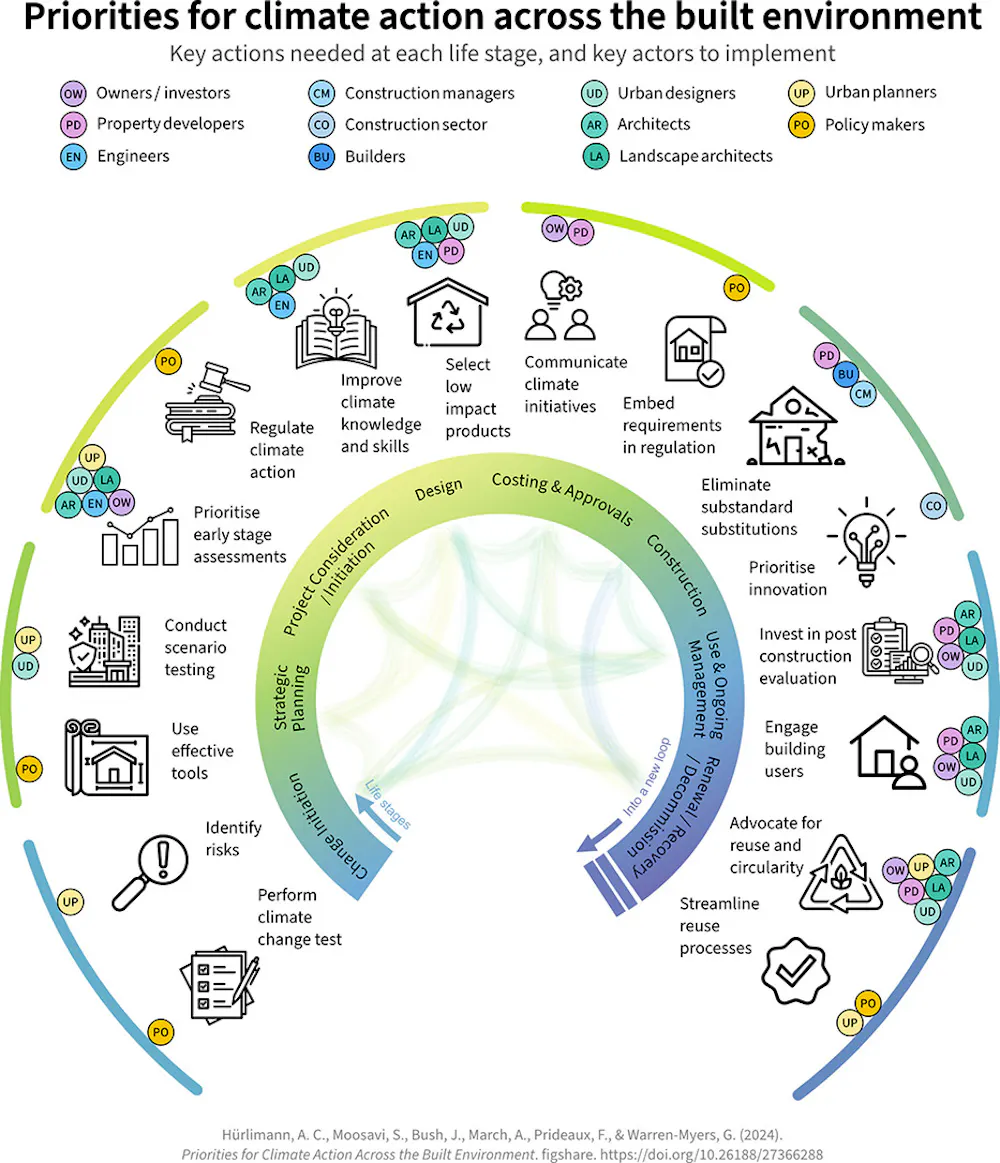
    Our new study identifies 16 priority actions to address climate change in the construction and management of cities.

    Building smarter

    Climate change must be a key consideration when designing, building and managing our cities. The emissions generated need to be minimised and eventually eliminated.

    We must build in locations, and in ways, that reduce climate risks. But policies governing how our cities are designed and constructed don’t achieve this.

    A recent study of three local government areas identified only limited action on adaptation and mitigation. Other research has found few urban development policies include carbon reduction goals that meet international targets.

    The National Housing Accord will see more than one million houses built by 2029. These new homes must address the climate challenge.

    16 areas for priority action

    The priority areas in our new study were informed by interviews with more than 150 stakeholders working in urban planning, architecture, landscape architecture, urban design, sustainability, construction and property.

    Priority areas for minimising damaging emissions generated by cities.
    CC BY

    The actions they identified cover the entire life cycle of the built environment.

    One of the first barriers to overcome is the perceived lack of agency among industry professionals to initiate or demand climate action. They perceive others, such as property owners or clients, to have more influence.

    Climate change risks should be identified in the early stages of planning new developments, backed up by effective tools to make risk identification and action easier:

    There were areas that were identified as being flood prone or risk prone. But there was no strategy to deal with what happens to those areas – An urban planner

    Once specific projects are being considered it is important to prioritise early stage climate assessments, supported by policies which mandate climate action:

    Everyone has good intentions but without big formal legislation around it, everyone’s just sort of making their way in the dark – A construction industry professional

    In the design stage, steps to improve the climate knowledge and skills of the workforce beyond disciplinary boundaries is critical. The selection of low-impact products and materials will also help ensure design is more climate responsive.

    Climate action must be embedded in all stages of design and construction of Australian cities.
    GagliardiPhotography/Shutterstock

    The highest number of hurdles to climate action were found to occur during the costing and approvals stage. Participants spoke of a highly competitive building industry. If climate change initiatives introduced at an earlier stage aren’t required by law, they are likely to be cut.

    unless there’s something in it for them in terms of return on investment, it’s going to be hard to get them to do it, unless we make them – An urban planner

    During the construction phase, product and material substitutions that have detrimental environmental impact should be eliminated. Innovation should be encouraged:

    If you want to push the envelope a little bit in terms of using recycled materials […] that’s a bit of a barrier. To push innovation is difficult – A landscape architect

    Post-construction

    Once construction is complete and buildings and public spaces are being used, it is important to invest in a thorough evaluation process. Building users should be involved to ensure buildings are maintained for optimal climate outcomes:

    [We] tried to achieve the six star rating […] the client has to maintain it [the building] for a year, and that’s when things start to fall off – An architect

    When it comes to area upgrades or building renewals, advocating for reuse and materials circularity is important. But the custom of demolishing and building anew, is hard to shift:

    The reuse of the existing building obviously generates significantly less waste and involves less material. So, design decisions and strategic decisions around using existing buildings is really important – An urban designer

    Working together

    This is a time of significant change in our urban areas.

    We need to make sure climate action is embedded in every stage of decision making. This may mean more efficient use, and reuse, of the existing built stock. This will require an overhaul of policies regarding building retrofits, and a change in mindsets.

    The priority actions to address climate change in cities can be implemented across a range of levels for:

    • individual professionals – pursue development of their climate change skills, including opportunities provided by professional associations

    • professional practices – review internal processes to ensure climate action is mainstreamed across projects, and in company decision making

    • universities teaching built environment professional degrees – embed climate change knowledge, skills, and competencies across the curriculum

    • governments at all levels – review policy settings to mandate mitigation and adaption.

    By addressing these actions, we can collectively work towards achieving our emission reduction targets and making sure our cities minimise climate change risks.

    Anna Hurlimann received funding for the research reported in this article from the Australian Research Council – Discovery Grant DP200101378, with co-chief investigators Georgia Warren-Myers, Alan March, Sareh Moosavi and Judy Bush. She is a member of the Planning Institute of Australia.

    Sareh Moosavi received funding for the research reported in this article from the Australian Research Council – Discovery Grant DP200101378, with co-chief investigators Anna Hurlimann, Georgia Warren-Myers, Alan March, and Judy Bush.

    ref. Cities are heating up the planet – how they can do more to fight climate change – https://theconversation.com/cities-are-heating-up-the-planet-how-they-can-do-more-to-fight-climate-change-259391

    MIL OSI AnalysisEveningReport.nz

  • MIL-OSI Submissions: Gaza: Deadly Israeli-US supply distribution scheme must be dismantled and siege lifted – MSF

    Source: Médecins Sans Frontières (MSF)

    28 June, Gaza: The Israeli-US food distribution scheme in Gaza, launched one month ago, is degrading Palestinians by design, forcing them to choose between starvation or risking their lives for minimal supplies. With over 500 people killed and nearly 4,000 wounded while seeking food, this scheme is slaughter masquerading as humanitarian aid and must be immediately dismantled. Médecins Sans Frontières (MSF) calls on the Israeli authorities and their allies to lift the siege on food, fuel, medical, and humanitarian supplies and to revert to the pre-existing principled humanitarian system, coordinated by the UN.

    This disaster has been orchestrated by the Israeli-US proxy operating under the name Gaza Humanitarian Foundation (GHF). The way supplies are distributed forces thousands of Palestinians, who have been starved by an over 100 day-long Israeli siege, to walk long distances to reach the four distribution sites and fight for scraps of food supplies. These sites hinder women, children, the elderly, and people with disabilities from accessing aid and people are killed and wounded in the chaotic process. Yet each renewed atrocity now happens with barely a shrug, let alone condemnation, from an international community seemingly resigned to its role in allowing and perpetuating a campaign consistent with patterns of genocide. This cannot be allowed to continue.

    “The four distribution sites, all located in areas under the full control of Israeli forces after people had been forcibly displaced from there, are the size of football fields surrounded by watch points, mounds of earth and barbed wire. The fenced entrance gives only one access point in or out,” says Aitor Zabalgogeazkoa, MSF emergency coordinator in Gaza. “GHF workers drop the pallets and the boxes of food and open the fences, allowing thousands in all at once to fight down to the last grain of rice.

    “If people arrive early and approach the checkpoints, they get shot. If they arrive on time, but there is an overflow and they jump over the mounds and the wires, they get shot,” says Zabalgogeazkoa. “If they arrive late, they shouldn’t be there because it is an ‘evacuated zone’, they get shot.”

    Every day, MSF teams see patients who have been killed or wounded trying to get food at one of these sites.

    “A lot of people were getting directly shot at. This is not aid – it’s a death trap,” says Hani Abu Soud, a community member at Al-Mawasi primary healthcare centre. “They were going to kill us one by one.  We were hungry, we were just trying to feed our children. What else can I do?  A bag of lentils costs around 30-40 shekels [€6 – €10]”.

    “We do not have that kind of money. Death has become cheaper than survival.”

    As the distributions have continued, medical teams have noticed a stark increase in the number of patients with gunshot wounds. In the MSF field hospital in Deir Al-Balah the number of patients with gunshot wounds increased by 190 per cent the week of 8 June, compared to the week before. The still barely functioning hospitals in Gaza are devastated; running on minimal supplies of pain relief, anaesthetic and blood. Fully functioning hospitals would struggle to cope with such a high number of trauma patients flooding emergency rooms every day.

    Injured patients seek help at basic healthcare clinics or field hospitals, since larger hospitals better equipped to provide treatment for violent trauma have been damaged by Israel’s attacks on healthcare facilities, with many no longer functioning. The MSF clinic in Al Mawasi, which is not typically equipped to treat trauma patients, has received 423 people wounded from the distribution sites since 7 June.  Ten or more patients with violent injuries arrive from distribution sites each day. These injuries require immediate life-saving treatment, like blood transfusions or surgery, that our medical teams cannot provide in a basic healthcare clinic. Patients are referred to the few remaining hospitals still functioning like Nasser hospital, but with healthcare so scarce, MSF has received reports of people wounded at aid distribution sites dying from their injuries before they can receive treatment.

    With no food in the tent he shared with his family, seventeen-year-old Ashraf went to a distribution site on 23 June. “I told him it was too dangerous. He said he wanted to get something for his sister,” says Hanan, Ashraf’s mother. “Thirty minutes later he called me, crying for help. He had been shot. This ‘aid’ is soaked in blood.”

    Ashraf was being treated at Al Mawasi basic healthcare clinic.

    Aid must not be controlled by a warring party to further its military objectives. The Israeli authorities have used a deliberate tactic of food deprivation against Palestinians in Gaza. They have weaponised food supply by denying it to people, then by limiting it to a trickle, in a complete violation of international humanitarian law. Humanitarian principles exist to enable the facilitation of aid to those who need it most, with dignity. Aid must be delivered at scale, consistent with these principles. The people of Gaza are in vital and immediate need of the re-establishment of a genuine aid system, and a sustained ceasefire, for their very survival.

    MSF is an international, medical, humanitarian organisation that delivers medical care to people in need, regardless of their origin, religion, or political affiliation. MSF has been working in Haiti for over 30 years, offering general healthcare, trauma care, burn wound care, maternity care, and care for survivors of sexual violence. MSF Australia was established in 1995 and is one of 24 international MSF sections committed to delivering medical humanitarian assistance to people in crisis. In 2022, more than 120 project staff from Australia and New Zealand worked with MSF on assignment overseas. MSF delivers medical care based on need alone and operates independently of government, religion or economic influence and irrespective of race, religion or gender. For more information visit msf.org.au  

    MIL OSI – Submitted News

  • MIL-OSI Submissions: Gaza: Deadly Israeli-US supply distribution scheme must be dismantled and siege lifted – MSF

    Source: Médecins Sans Frontières (MSF)

    28 June, Gaza: The Israeli-US food distribution scheme in Gaza, launched one month ago, is degrading Palestinians by design, forcing them to choose between starvation or risking their lives for minimal supplies. With over 500 people killed and nearly 4,000 wounded while seeking food, this scheme is slaughter masquerading as humanitarian aid and must be immediately dismantled. Médecins Sans Frontières (MSF) calls on the Israeli authorities and their allies to lift the siege on food, fuel, medical, and humanitarian supplies and to revert to the pre-existing principled humanitarian system, coordinated by the UN.

    This disaster has been orchestrated by the Israeli-US proxy operating under the name Gaza Humanitarian Foundation (GHF). The way supplies are distributed forces thousands of Palestinians, who have been starved by an over 100 day-long Israeli siege, to walk long distances to reach the four distribution sites and fight for scraps of food supplies. These sites hinder women, children, the elderly, and people with disabilities from accessing aid and people are killed and wounded in the chaotic process. Yet each renewed atrocity now happens with barely a shrug, let alone condemnation, from an international community seemingly resigned to its role in allowing and perpetuating a campaign consistent with patterns of genocide. This cannot be allowed to continue.

    “The four distribution sites, all located in areas under the full control of Israeli forces after people had been forcibly displaced from there, are the size of football fields surrounded by watch points, mounds of earth and barbed wire. The fenced entrance gives only one access point in or out,” says Aitor Zabalgogeazkoa, MSF emergency coordinator in Gaza. “GHF workers drop the pallets and the boxes of food and open the fences, allowing thousands in all at once to fight down to the last grain of rice.

    “If people arrive early and approach the checkpoints, they get shot. If they arrive on time, but there is an overflow and they jump over the mounds and the wires, they get shot,” says Zabalgogeazkoa. “If they arrive late, they shouldn’t be there because it is an ‘evacuated zone’, they get shot.”

    Every day, MSF teams see patients who have been killed or wounded trying to get food at one of these sites.

    “A lot of people were getting directly shot at. This is not aid – it’s a death trap,” says Hani Abu Soud, a community member at Al-Mawasi primary healthcare centre. “They were going to kill us one by one.  We were hungry, we were just trying to feed our children. What else can I do?  A bag of lentils costs around 30-40 shekels [€6 – €10]”.

    “We do not have that kind of money. Death has become cheaper than survival.”

    As the distributions have continued, medical teams have noticed a stark increase in the number of patients with gunshot wounds. In the MSF field hospital in Deir Al-Balah the number of patients with gunshot wounds increased by 190 per cent the week of 8 June, compared to the week before. The still barely functioning hospitals in Gaza are devastated; running on minimal supplies of pain relief, anaesthetic and blood. Fully functioning hospitals would struggle to cope with such a high number of trauma patients flooding emergency rooms every day.

    Injured patients seek help at basic healthcare clinics or field hospitals, since larger hospitals better equipped to provide treatment for violent trauma have been damaged by Israel’s attacks on healthcare facilities, with many no longer functioning. The MSF clinic in Al Mawasi, which is not typically equipped to treat trauma patients, has received 423 people wounded from the distribution sites since 7 June.  Ten or more patients with violent injuries arrive from distribution sites each day. These injuries require immediate life-saving treatment, like blood transfusions or surgery, that our medical teams cannot provide in a basic healthcare clinic. Patients are referred to the few remaining hospitals still functioning like Nasser hospital, but with healthcare so scarce, MSF has received reports of people wounded at aid distribution sites dying from their injuries before they can receive treatment.

    With no food in the tent he shared with his family, seventeen-year-old Ashraf went to a distribution site on 23 June. “I told him it was too dangerous. He said he wanted to get something for his sister,” says Hanan, Ashraf’s mother. “Thirty minutes later he called me, crying for help. He had been shot. This ‘aid’ is soaked in blood.”

    Ashraf was being treated at Al Mawasi basic healthcare clinic.

    Aid must not be controlled by a warring party to further its military objectives. The Israeli authorities have used a deliberate tactic of food deprivation against Palestinians in Gaza. They have weaponised food supply by denying it to people, then by limiting it to a trickle, in a complete violation of international humanitarian law. Humanitarian principles exist to enable the facilitation of aid to those who need it most, with dignity. Aid must be delivered at scale, consistent with these principles. The people of Gaza are in vital and immediate need of the re-establishment of a genuine aid system, and a sustained ceasefire, for their very survival.

    MSF is an international, medical, humanitarian organisation that delivers medical care to people in need, regardless of their origin, religion, or political affiliation. MSF has been working in Haiti for over 30 years, offering general healthcare, trauma care, burn wound care, maternity care, and care for survivors of sexual violence. MSF Australia was established in 1995 and is one of 24 international MSF sections committed to delivering medical humanitarian assistance to people in crisis. In 2022, more than 120 project staff from Australia and New Zealand worked with MSF on assignment overseas. MSF delivers medical care based on need alone and operates independently of government, religion or economic influence and irrespective of race, religion or gender. For more information visit msf.org.au  

    MIL OSI – Submitted News

  • MIL-OSI New Zealand: Crash and court a costly night for driver

    Source: New Zealand Police

    It was pricey night for one dangerous driver who dented his pride and joy and landed himself in court.

    Police in Papakura observed a vehicle travelling at speed on Clevedon Road just before 11pm.

    Counties Manukau South Area Prevention Manager, Inspector Matt Hoyes, says officers signalled for the vehicle to stop.

    “The driver has initially pulled over on Broadway, however, as officers began talking to him about his speed, he has accelerated away along Elliot Street.”

    Inspector Hoyes says staff then located the vehicle crashed into a light pole on the corner of Elliot Street and observed the driver fleeing on foot.

    “Officer have quickly pursued him and taken him into custody without further incident.

    “Unfortunately this man has ended up with a costly repair bill and a trip to court, which could have been prevented if he had made different decisions.”

    A 27-year-old man will appear in Papakura District Court today charged with dangerous driving, failing to remain stopped and driving with excess breath alcohol.

    ENDS.

    Holly McKay/NZ Police

    MIL OSI New Zealand News

  • MIL-OSI Australia: Bupa in Court for unconscionable conduct and misleading consumers about health insurance benefits entitlements

    Source: Australian Ministers for Regional Development

    The ACCC has instituted proceedings in the Federal Court against Bupa HI Pty Ltd (Bupa) for breaches of the Australian Consumer Law in relation to members’ entitlements to private health insurance benefits for certain claims, affecting thousands of consumers over a period of more than five years.

    Bupa has admitted to engaging in misleading or deceptive conduct and making false or misleading representations by advising members they were not entitled to private health insurance benefits for their entire claim, when in fact this was not the case. Bupa has also admitted to engaging in unconscionable conduct in connection with its assessment of 388 Mixed Coverage Claims.

    Most of the claims impacted by the admitted conduct were claims for hospital treatment, in which two or more procedures were performed at the same time. In cases where part of the treatment was covered by a member’s policy and part of the treatment was not covered, Bupa incorrectly rejected the entire claim.

    The ACCC and Bupa will jointly ask the Court to order Bupa to pay a total penalty of $35 million and make other orders. It is a matter for the Court to determine whether the penalty and other orders are appropriate.

    Bupa started compensating affected members, medical providers and hospitals, before the start of this legal action, and to date, has paid $14.3 million to parties for more than 4,100 affected claims. The ACCC has accepted a court-enforceable undertaking from Bupa to continue compensating affected parties under its existing remediation program.

    “Bupa’s conduct affected thousands of members over more than five years, and caused harm to consumers some of whom delayed, cancelled or went without treatment for which they were, at least partially, covered under their health insurance policies,” ACCC Chair Gina Cass-Gottlieb said.

    Some consumers were left thousands of dollars out of pocket and had to personally finance expenses for some medical treatments that Bupa was in fact obliged to pay, at least in part, under its policies. Some policy holders also upgraded to more expensive policies to ensure coverage.

    In addition to financial impacts, some consumers were exposed to potential medical risks or complications, physical pain and distress as a result of not proceeding with medical treatment or as a result of undergoing multiple treatments after being falsely advised they were not covered for certain procedures.

    “Consumers purchase private health insurance to provide peace of mind, certainty of coverage and the ability to choose where and when to undertake their procedures. Bupa’s conduct denied certain members benefits to which they were entitled to under their private health insurance policies,” Ms Cass-Gottlieb said.

    Medical providers and hospitals were also impacted by the conduct, including by not receiving the payments to which they were entitled in respect of certain claims.

    Bupa has admitted that at various times between May 2018 and August 2023 it misrepresented that members were not entitled to any benefits for a Mixed Coverage Claim or Uncategorised Item Claim, when in fact, they were eligible for benefits for any treatment that was covered under their insurance policy. The misrepresentations occurred before medical treatment, when consumers were checking their coverage and entitlements with Bupa staff, as well as after a procedure due to its automatic claims assessment systems.

    Bupa also admitted that between June 2020 and February 2021, it stopped manually reviewing certain Mixed Coverage Claims that had been automatically incorrectly assessed as having no benefits payable. It has admitted that this was unconscionable in certain circumstances, including where it knew that manual review was necessary to ensure it identified and paid benefits for those claims.

    Bupa’s conduct occurred because Bupa staff did not have consistent and clear instructions and training for assessing Mixed Coverage Claims, and because its systems were programmed to incorrectly reject Mixed Coverage and Uncategorised Item Claims.

    “Private health insurance is complex, and consumers should be able to trust their health insurer to assess and pay health insurance claims accurately,” Ms Cass-Gottlieb said.

    “Bupa’s conduct is very serious and fell well short of what is expected of one of the largest health insurers in Australia. Bupa should have invested in the necessary systems, processes and training to prevent this from happening, and address it promptly when it occurred.”

    A copy of the undertaking relating to the compensation is available at Bupa HI Pty Ltd.

    If you consider you may have been impacted by the conduct, please contact Bupa on a number you source independently or you can complete a Remediation Form available at: www.bupa.com.au/mixedcoverage.

    Bupa has cooperated with the ACCC during its investigation, including by agreeing to jointly seek declarations, penalties, an injunction, costs and other orders. The Federal Court will consider whether to make the orders sought on a date to be fixed.

    Background

    Bupa is one of the largest private health insurers in Australia. It is a subsidiary of Bupa HI Holdings Pty Ltd which is ultimately controlled by British United Provident Association Ltd. 

    Mixed Coverage Claims are claims under Bupa’s private health insurance policy that included treatment that was covered under a member’s private health insurance policy as well as treatment that was not covered under their policy.

    Uncategorised Item Claims are claims that included treatment that were not assigned to a standard clinical category in Bupa’s claims assessment system.

    MIL OSI News

  • MIL-OSI New Zealand: Northland Regional Council News – 30 June 2025

    Source: Northland Regional Council

    NOMINATIONS FOR NRC OPEN 04 JULY
    People keen to stand for one of nine places on the Northland Regional Council at this year’s local body elections in October can get their nominations in from Friday 04 July until noon on Friday 01 August 2025.
    Anyone aged 18 and over can stand for election provided they’re a New Zealand citizen, enrolled on the Parliamentary electoral roll and are nominated by two electors whose names appear on the electoral roll within the constituency the candidate is standing for.
    Printed nomination forms and a candidate handbook will be available from 04 July from any regional council office, by phoning (0800) 002 004, from www.nrc.govt.nz or by downloading from esp.electionservices.co.nz/lge2025/NRC
    SECOND FEEDBACK PERIOD ON NAVIGATION SAFETY BYLAW
    Northlanders now have a further chance to have their say on Northland Regional Council’s Navigation Safety Bylaw, which sets the rules for keeping people safe on the water.
    After a first feedback period during May, the council is now running a second feedback period, recognising the need to provide more detail on key proposals and ensure there is sufficient time for people to have their say.
    The provisions in the draft bylaw remain the same, with key proposals including a new requirement to carry two forms of communication on a vessel; amending the requirements for wearing a lifejacket; and removing a clause prohibiting wind-powered board sports in the Ruakākā and Waipū estuaries.
    The feedback period runs until Monday 28 July. More detail can be found at www.nrc.govt.nz/bylawreview

    MIL OSI New Zealand News

  • MIL-OSI New Zealand: Northland News – Nominations for Northland Regional Council open 04 July

    Source: Northland Regional Council

    People keen to stand for one of nine places on the Northland Regional Council at this year’s local body elections in October can get their nominations in from Friday 04 July.
    Dale Ofsoske, the council’s Electoral Officer, says nominations open on Friday 04 July and close at noon on Friday 01 August 2025.
    Mr Ofsoske says anyone aged 18 and over can stand for election provided they’re a New Zealand citizen and enrolled on the Parliamentary electoral roll.
    “You must also be nominated by two electors whose names appear on the electoral roll within the respective constituency that a candidate is standing for.”
    Mr Ofsoske warns against leaving the lodgement of nomination papers to the last minute.
    “Should a nomination paper be lodged late on the morning nominations close, and be incorrectly completed or ineligible nominators are provided, there may be insufficient time to correct the situation and the nomination paper could be invalidated.”
    Mr Ofsoske says in the regional council’s case seven general councillors will be elected from seven general constituencies (one from each) and two councillors elected from a region-wide Māori constituency (Te Raki).
    The general constituencies are Far North, Coastal Central, Coastal South, Kaipara, Mid North, Whangārei Central and Bay of Islands-Whangaroa.
    Mr Ofsoske says printed nomination forms and a candidate handbook will be available from 04 July from any regional council office, by phoning (0800) 002 004, from www.nrc.govt.nz or by downloading from esp.electionservices.co.nz/lge2025/NRC 

    MIL OSI New Zealand News

  • MIL-OSI New Zealand: STEAM education and sports key recipients in Canterbury funding

    Source: Rata Foundation

    Rātā Foundation has announced $617,000 will go to community groups in Canterbury in its most recent funding round, focused on large and multi-year funding.
    Tagata Moana Trust, a not-for-profit organisation dedicated to the advancement of Pacific peoples living in Aotearoa, will receive $110,000. The organisation’s focus is on using Pacific arts, language and culture to drive STEAM education and experiences for Pacific peoples of all ages. Sport in the region is also set to benefit, with $100,000 funding for Canterbury West Coast Sports Trust (Sport Canterbury). Other funding recipients include organisations from the arts, education, social services, and disability sectors.
    Canterbury will also benefit from an additional $495,000 for multi-region funding (for organisations that bridge two or more of its funding regions).
    This funding round is one of four additional rounds reserved for large and multi-year grants, in addition to the eight funding rounds for smaller grants each year.
    Chief Executive Leighton Evans says: “At Rātā, our aim is to support communities so that nothing gets in the way of people being able to make the most of life. With responsive and proactive community investment, alongside strategic partnerships and strong relationships, Rātā can help achieve more, and we are seeing that through the long-term positive impact our partnership organisations are making in their respective communities.”
    Rātā manages a pūtea (fund) of around $700 million, enabling an investment of around $25 million per annum into its funding regions of Canterbury, Nelson, Marlborough and the Chatham Islands. Since its inception in 1988, Rātā has invested over $550 million through community investment programmes to empower people to thrive.
    Canterbury funding:
    Arts Foundation of New Zealand, $55,000
    Canterbury West Coast Sports Trust (T/A Sport Canterbury), $110,000
    Disabled Persons Assembly (New Zealand) Incorporated, $40,000
    Neighbourhood Trust, $50,000
    Oak Development Trust, $35,000
    Petersgate Trust, $40,000
    Social Service Council of the Diocese of Christchurch – Tenants Protection – Collaboration, $60,000
    Tagata Moana Trust, $110,000
    The Kind Foundation, $40,000
    Woolston Development Project Incorporated, $40,000
    WORD Christchurch, $37,000
    Nelson funding:
    Motueka High School, $56,799
    Nelson Women’s Centre Te Whare Āwhina Mō Ngā Wāhine Puawai Incorporated, $I35,000
    Project De-Vine Trust, $135,000
    Te Whare Mahana Trust Board, $41,000
    Building project (multi-year): Whakatu Group Riding for the Disabled Incorporated, $120,000
    Marlborough funding:
    Marlborough Pacific Trust, $50,000
    Marlborough District Council- Future of Work, $10,000
    Building project (multi-year): Wairau Pa Marae (2020) Incorporated, $130,508
    Multi-region funding:
    English Language Partners New Zealand Trust, $50,000
    NZ Family And Foster Care Federation Incorporated, $40,000
    Talk Link Trust, $45,000
    Tasman Regional Sports Trust (T/A Sport Tasman), $115,000
    The Open Home Foundation of New Zealand, $65,000
    Youthline Central South Island, $45,000

    MIL OSI New Zealand News

  • MIL-OSI New Zealand: Hong Kong: National Security Law analysis shows vast majority unjustly arrested

    Source: Amnesty International


    More than 80% of people convicted under Hong Kong’s National Security Law (NSL) have been wrongly criminalized and should never have been charged in the first place, according to new research by Amnesty International published on the fifth anniversary of the law being enacted.


    The organization’s analysis of 255 individuals targeted under national security legislation in Hong Kong since 30 June 2020 also showed that bail was denied in almost 90% of cases where charges were brought, and that those denied bail were forced to spend an average of 11 months in detention before facing trial.


    “Five years after the enactment of the National Security Law, our alarming findings show that the fears we raised about this law in 2020 have been realized. The Hong Kong government must stop using the pretext of ‘national security’ to punish legitimate expression,” Amnesty International’s China Director Sarah Brooks said.


    “This draconian law, and the other national security legislation it spawned, has corroded key legal safeguards that once formed the foundation for protecting human rights and the rule of law in Hong Kong. The result has been a devastation of Hongkongers’ ability to express themselves without fear of arrest.”


    Amnesty’s briefing paper analyses patterns in arrests, bail decisions and prosecutions under the NSL and other national security legislation. In particular, the research highlights three major concerns: the criminalization of the legitimate exercise of the human right to freedom of expression, the low bail grant rates in these cases, and the de facto long-term incarceration of most accused.


    The analysis found that of the 78 concluded cases under the NSL at least 66 (84.6%) involved legitimate expression that should not have been criminalized according to international standards, with no evidence of violent conduct or incitement.


    When concluded cases under Article 23 and pre-Article 23 “sedition” offences are also counted, at least 108 out of a total of 127 cases (85%) involved similarly legitimate forms of expression which were unjustly prosecuted. These cases fall well short of the high threshold required for criminalization under international standards.


    Meanwhile, according to Amnesty’s data, the courts denied bail in 129 national security cases, or 89% of those in which individuals were charged.


    Among the 129 cases where bail was denied, the average length of detention was 328 days. Fifty-two cases (40.3%) involved detentions lasting one year or more before trial or a guilty plea.


    “In five years, the National Security Law has transformed Hong Kong from a city of tolerance and open debate into a city of repression and self-censorship. Our analysis shows that Hong Kong’s national security framework is not just a flagrant violation of international human rights standards on paper but that authorities misuse it to target opposition voices and foster an environment of fear,” Sarah Brooks said.


    “This research demonstrates that the vast majority of those charged with national security offences have acted entirely within their rights. Meanwhile, prosecutors have continued to bring cases under this flawed national security architecture and appealed the rare acquittals awarded by courts. Other governments should step up and use their influence to urgently press the Hong Kong and Chinese authorities to repeal the law.


    “In the interim, the Hong Kong government should stop applying national security legislation immediately. At the very least they need to reinstate the presumption of bail in favour of release pending trial. No one should be made to languish in jail simply for exercising their right to freedom of expression.”


    Background


    Since the imposition of the NSL on 30 June 2020, the human rights landscape in Hong Kong has deteriorated at an alarming pace. Civil society has been effectively dismantled, while long-standing rights — including the rights to freedom of expression, peaceful assembly and association — have been severely curtailed.


    Amnesty International’s analysis covered the cases of 255 individuals who, between 30 June 2020 and 31 May 2025, were arrested for and/or charged with any offences under the NSL; Part 1 and 2 of the city’s Crimes Ordinance that define the colonial-era offence of “sedition”; and the Article 23 law (also known as the Safeguarding National Security Ordinance), which replaced Part 1 and 2 of the Crimes Ordinance when it entered into force on 23 March 2024.


    Amnesty International sent its briefing to the Hong Kong government, which dismissed the findings as a “distortion of the reality” and said the NSL “has restored the enjoyment of rights and freedoms” in Hong Kong.

    MIL OSI New Zealand News

  • MIL-OSI New Zealand: Health – Wai July launches: Tāne Māori encouraged to go alcohol-free this July

    Source: Hapai Te Hauora

    Hāpai Te Hauora has launched Wai July, a new kaupapa calling on tāne Māori to go alcohol-free for the month of July.
    The challenge invites tāne to press pause on waipiro, reflect on how it shows up in their lives, and choose wai (water) instead, all while backing their bros and reclaiming their hauora.
    “This isn’t just about going alcohol free. It’s about creating a supportive space for tāne to choose themselves, back their mates, and reflect on the role alcohol plays in their lives,” says Jessikha Makoare, General Manager at Hāpai Te Hauora.
    Wai July was created in response to the ongoing impacts of alcohol harm in Māori communities. Māori men continue to be overrepresented in alcohol-related harm statistics, from long-term health conditions to whānau violence and mental distress.
    This kaupapa offers a chance to reset, with support, accountability and brotherhood at the center.
    Tāne can sign up as an individual or join as a group. All participants will receive support throughout the month, with fresh content, ambassador kōrero and free Wai July merch.
    One of this year’s ambassadors, Chaz Brown (Ngāti Raukawa ki Wharepūhunga, Ngāti Apakura, Ngāti Maniapoto, Ngāti Kahu), is the owner of Wai Ora Sports Recovery & Wellness based in New Lynn, Tāmaki Makaurau.
    “This is more than cutting out the drink. It’s about showing discipline, backing each other, and honouring our hauora across tinana, hinengaro and wairua,” says Brown.
    “Whether you’re doing this to reset, show leadership, or just support the kaupapa, it’s another step in levelling up together.”
    Throughout July, Chaz will also be hosting Sunday Morning Sessions in Tāmaki Makaurau to keep his community connected. These include run clubs, recovery sessions, mobility work and kōrero over coffee.
    “No drink, just discipline. Whether you’re here for the grind, the connection, or the clarity, this is our space to refocus and move with intention.”
    Sign up now at: hapai.co.nz/wai-july

    MIL OSI New Zealand News

  • MIL-OSI New Zealand: Health and Housing – Many rentals may still fall short as healthy homes deadline arrives

    Source: Asthma and Respiratory Foundation

    As winter grips the country, many Kiwis will go to sleep tonight in rental homes that may still be putting their health at risk.
    From midnight tonight, all private residential landlords must ensure their properties fully comply with the Healthy Homes Standards – a legal requirement introduced in 2019 to make rental homes warmer, drier, and healthier. These standards introduced minimum standards for heating, insulation, ventilation, moisture ingress and drainage, and draught stopping in rental properties.
    Yet despite having six years to prepare, questions remain about how many rental homes will truly be compliant come July 1.
    The Asthma and Respiratory Foundation NZ warns that without effective enforcement, these standards risk leaving tenants, especially those with respiratory conditions, exposed to cold, damp homes that threaten their health.
    Foundation Medical Director Professor Bob Hancox says one thing we have learnt from research into housing and health in New Zealand is that many homes are too cold and too damp.
    “Having a warm and dry house is very important for respiratory health, particularly for people with respiratory diseases such as asthma or COPD.
    “Improving the quality of housing is one of the best ways to help people stay well through the winter.”
    Currently, landlords can self-certify that their property meets the Healthy Homes Standards, and there is no requirement for an independent, physical inspection of the property.
    “Implementing the healthy homes standard would go a long way to keep people out of hospital and GP clinics, but at the moment, we don’t know how well the standards are being applied,” Professor Hancox says.
    The Foundation is renewing its call to the Government to require independent, accredited assessments of all rental homes to ensure that the Healthy Homes Standards are actually being met.
    New Zealand Institute of Building Inspectors Chief Executive Neville Scott says the fact that landlords can self-certify is a loophole that undermines the intent of the law.
    “We fully support the Foundation in their call to Government, as we see – all too often – cases where properties are signed off by landlords but clearly fall short of the standards.
    “Without qualified, independent inspections, there’s no way to guarantee consistency or integrity in the process,” he says.
    “It’s like letting drivers issue their own warrants of fitness.”
    According to Tenancy Services NZ, more than 600,000 households rent in New Zealand, and research shows that rental stock is of poorer quality than owner-occupied homes.
    A recent report by Stats NZ on housing in New Zealand revealed that almost 30 per cent of households that did not own their home experienced dampness at least some of the time. Those same households were more likely to experience visible mould over A4 size at least some of the time (22.9 per cent).
    Dr Lucy Telfar-Barnard, public health researcher and member of the Foundation’s Scientific Advisory Board, says the current state of many rental properties is both unacceptable and avoidable.
    “We’re still seeing families living in mouldy, poorly ventilated homes that actively worsen chronic conditions like asthma.
    “Effective enforcement of the healthy homes standards is essential for protecting our most vulnerable populations and reducing health inequities.”
    The Foundation’s call is part of its ongoing commitment to improve the health outcomes of those living with respiratory conditions in NZ.

    MIL OSI New Zealand News

  • MIL-OSI New Zealand: Events – UNERASED Returns: Made in Palestine Exhibition Opens in Auckland

    Source: Palestine Forum of New Zealand

    Following the success of UNERASED: The Palestinian Experience, the Palestine Forum of New Zealand is proud to present the second edition of the exhibition series — UNERASED: Made in Palestine.

    Curated by acclaimed artists Emily Hartley-Skudder and Pinky Fang, with scent installation by Nathan Taare, this exhibition offers a powerful exploration of Palestinian identity, memory, and resistance through contemporary art.

    Exhibition Details:

    Venue: 250 Ponsonby Road, Ponsonby, Auckland
    Dates: 28 June – 12 July
    Opening Hours: 12pm–6pm | Wednesday to Sunday

    UNERASED: Made in Palestine invites audiences to engage with the stories, symbols, and lived experiences of Palestine, centering narratives that refuse to be erased.

    Maher Nazzal
    Palestine Forum of New Zealand

    MIL OSI New Zealand News

  • MIL-OSI Economics: Samsung Showcases AI Home Appliance Innovations at DA Global Tech Seminars Across Five Regions

    Source: Samsung

    From March to June, Samsung Electronics hosted Digital Appliances (DA) Global Tech Seminars across five regions — the United States, Europe, Latin America, Southeast Asia and Southwest Asia — to showcase its latest innovations to audiences around the world. The seminars welcomed about 240 media representatives and tech influencers from 40 countries to experience Samsung’s latest AI home appliances firsthand and observe how the company is tailoring features to meet the unique needs of each region.1 Attendees also participated in Q&A sessions with product developers, who shared in-depth insights and explanations.
     
    Samsung Newsroom recaps each regional seminar with on-site highlights and photos.
     
     
    United States: Large-Capacity Washer-Dryers Win Praise for Practicality and Efficiency
    ▲ 2025 DA Global Tech Seminar held in the U.S.
     
    The U.S. Tech Seminar took place on March 18 at Samsung Home, a Bespoke AI experience space in SoHo, New York City — a neighborhood synonymous with art and creative living.
     
    American consumers tend to prioritize practicality and efficiency. Taking this into account, Samsung set up a dedicated experience zone for the large-capacity Bespoke AI Laundry Vented Combo, featuring a product cutaway mock-up that allowed visitors to intuitively understand the product’s core technologies and features. In addition, a live cooking demonstration showcased the AI capabilities of the Bespoke AI Oven, while the Bespoke AI Hybrid Refrigerator — which boosts energy efficiency using a semiconductor-based Peltier module — also mesmerized guests.
     
     
    Europe: Bespoke AI Jet Ultra Takes Center Stage With Industry-Leading Suction Power
    ▲ 2025 DA Global Tech Seminar held in Germany
     
    On the same day, the European Tech Seminar kicked off in Frankfurt, Germany, at World of Samsung — a global showcase designed to provide an in-depth look at Samsung’s products.
     
    A key highlight was the Bespoke AI Jet Ultra, which features the world’s most powerful suction for a cordless stick vacuum cleaner at 400W. Samsung developers gave presentations, offering insight into the vacuum cleaner’s high-performance engineering. The Bespoke AI Jet Ultra recently earned 4.5 out of 5 stars from U.K.-based review outlet Trusted Reviews and ranked first among 43 cordless vacuums tested by German IT outlet Chip.
     
     
    Latin America: SmartThings-Connected Home Appliances Growing at Twice the Global Rate
    ▲ 2025 DA Global Tech Seminar held in Mexico
     
    The Latin America Tech Seminar took place on June 3 in the vibrant metropolis of Mexico City, Mexico, drawing media and influencers from 13 countries to experience Samsung’s new lineup firsthand. Consumers in the region have shown high interest in connected living, with SmartThings-connected appliance adoption growing at more than twice the global average.2
     
    Reflecting this demand, demonstrations highlighted various features including Map View, Bixby, Routines — all easily accessible via SmartThings or the AI Home screen. Attendees also visited Sam’s House, a premium residential showroom where they engaged in hands-on interactions with Samsung’s connected products.
     
     
    Southeast Asia: AI Appliances Optimized for Hot, Humid Climates
    ▲ 2025 DA Global Tech Seminar held in Thailand
     
    On June 20, Samsung held the Southeast Asia Tech Seminar at a showroom in Bangkok, Thailand, where attendees explored the company’s latest products in settings simulating both commercial and residential spaces.
     
    Through demonstrations, attendees experienced how the Voice ID feature on the Bespoke AI Family Hub refrigerator can recognize individual voices to deliver personalized responses. They also saw how Samsung is localizing AI home appliances to better suit Southeast Asia’s hot and humid climate — for example, the 1-Way Cassette system air conditioner and the Bespoke AI Top Load Washer. “The use of AI to enhance user experience and facilitate both usage and energy savings is particularly valuable and useful,” said Kemachad Gunpai of Future Trends Thailand who attended the seminar.
     
     
    Southwest Asia: AI-Powered, Efficient Cooling Solutions in the Spotlight
    ▲ 2025 DA Global Tech Seminar held in India
     
    Held on June 25 in Gurugram, India, the Southwest Asia Tech Seminar focused on SmartThings-connected solutions and energy-efficient features tailored to local preferences.
     
    Among the demonstrations were AI appliances responding to sleep patterns detected by motion sensors, alongside cooling solutions tailored for Indian consumers. Attendees also received detailed explanations on how to track energy usage via SmartThings, a particularly relevant feature amid rising electricity costs. Samsung employees also explained how each product operates in AI Energy Mode to maximize efficiency and minimize energy consumption.
     
    “Samsung will continue to develop and expand the Global Tech Seminars in ways that reflect the unique local characteristics of each region,” said Soohyuk Ro, Vice President and Head of Tech Insight Group at Digital Appliances (DA) Business, Samsung Electronics, as the seminars came to an end. “In doing so, we will provide even deeper insights into how Samsung’s AI Home and innovative AI appliances can bring meaningful benefits to daily life for everyone.”
     
     
    1 Product names and features mentioned in this article may vary by region.
    2 Based on internal data from Samsung, aggregated via BDC (BI & Analytics), reflecting the cumulative annual ratio of Wi-Fi-connected devices.

    MIL OSI Economics

  • MIL-OSI USA: Myth vs. Fact: The One Big Beautiful Bill

    US Senate News:

    Source: US Whitehouse
    While Democrats spend the day launching desperate, hollow attacks in a last-ditch effort to block President Trump’s One Big Beautiful Bill, the FACTS speak for themselves.
    MYTH: The One Big Beautiful Bill is “just a tax break for billionaires.”FACT: The One Big Beautiful Bill delivers the largest middle- and working-class tax cut in U.S. history. The President’s legislation will put more than $10,000 a year back in the pockets of typical hardworking families. This is the most pro-growth, pro-worker, pro-family legislation ever crafted.
    MYTH: The One Big Beautiful Bill “takes from the poor to give to the rich.”FACT: The lowest-income workers receive the largest percentage tax cuts. The One Big Beautiful Bill delivers the largest tax cut in history for working-and -middle class Americans.
    MYTH: The One Big Beautiful Bill “makes life more unaffordable.”FACT: The bill delivers bigger paychecks, expanding take-home pay by over $10,000 per year for a typical family.
    MYTH: The One Big Beautiful Bill “hurts low-income families.”FACT: The One Big Beautiful Bill is the most pro-family legislation ever crafted. It will deliver bigger paychecks, giving more than a $10,000 boost annually to everyday families. We are also expanding Opportunity Zones, expanding childcare access, increasing the child tax credit, and creating newborn savings accounts.
    MYTH: The One Big Beautiful Bill “is just a handout to corporations.”FACT: This bill drives a Blue-Collar BOOM with tax relief for workers, support for small businesses, and investments in American manufacturing. The One Big Beautiful Bill delivers the largest middle- and working-class tax cut in U.S. history.
    MYTH: The One Big Beautiful Bill “leaves American workers behind.”FACT: This is the most pro-American worker bill in history. The One Big Beautiful Bill boosts pay for millions—and with no tax on tips or overtime, those working hourly and service jobs receive additional tax relief.
    MYTH: The One Big Beautiful Bill “hurts small businesses.”FACT: The One Big Beautiful Bill will make the Trump Tax Cuts permanent, including the small business deduction—helping Main Street grow and hire. Failure to pass this legislation would result in a $4 trillion tax hike.
    MYTH: The One Big Beautiful Bill “kicks American families off Medicaid.”FACT: As the President has said numerous times, there will be no cuts to Medicaid. The One Big Beautiful Bill protects and strengthens Medicaid for those who rely on it—pregnant women, children, seniors, people with disabilities, and low-income families—while eliminating waste, fraud, and abuse. The One Big Beautiful Bill removes illegal aliens, enforces work requirements, and protects Medicaid for the truly vulnerable.
    MYTH: The One Big Beautiful Bill “cuts Medicare.”FACT: Medicare has not been touched in this bill— absolutely nothing in the bill reduces spending on Medicare benefits. This legislation does not make a single cut to welfare programs—it safeguards and protects these programs for all eligible Americans.
    MYTH: The One Big Beautiful Bill “will close rural hospitals.”FACT: Rural hospitals comprise just 7% of all hospital spending on Medicaid, illustrating that they have not benefited from the massive increase in waste, fraud, and abuse under the Biden administration. By strengthening Medicaid, we are making more resources available for vulnerable populations and safety net providers, like rural hospitals. We are expanding rural hospital protection, providing targeted funds for rural care, and giving states flexibility to support local providers.
    MYTH: “People will literally die” from the One Big Beautiful Bill — “and millions will be kicked off their healthcare.”FACT: This is one of the most egregious, deranged attacks from the Left peddling fear over the facts. The One Big Beautiful Bill protects eligible Americans on federal welfare – including Medicaid. By strengthening the integrity of Medicaid by eliminating waste, fraud, and abuse, its resources can be refocused on providing better care for those whom the program was designed to serve: pregnant women, children, people with disabilities, low-income seniors, and other vulnerable low-income families.
    MYTH: The One Big Beautiful Bill “will hurt people with disabilities.”FACT: The One Big Beautiful Bill protects and strengthens Medicaid for Americans with disabilities. Rest assured, those with disabilities receiving Medicaid will receive no loss or change in coverage.
    MYTH: The One Big Beautiful Bill “punishes vulnerable Americans with work requirements to receive their benefits.”FACT: Not true. The 20-hour weekly work requirement applies only to able-bodied adults without young children and promotes dignity, stability, and better health outcomes for families. The One Big Beautiful Bill restores the dignity of work with historically bipartisan work requirements for able-bodied Americans. We are implementing commonsense, Clinton-era work, volunteer, education, or training requirements with broad bipartisan support.
    MYTH: “There’s no fraud in Medicaid — Republicans are just taking coverage away from vulnerable populations.”FACT: In the last 10 years, CMS admitted that improper payments for Medicaid have exceeded HALF A TRILLION dollars. In just the past year, taxpayers spent $56 billion on benefits for able-bodied adults abusing the system—and over a million illegal aliens are receiving free health care on the backs of taxpayers. The One Big Beautiful Bill removes illegal aliens, enacts work requirements for able-bodied adults, and protects Medicaid for the truly vulnerable.
    MYTH: “SNAP work requirements are unnecessary.”FACT: Only 28% of able-bodied adults on SNAP work. The One Big Beautiful Bill promotes work, responsibility, and restores SNAP to serve the truly needy. SNAP enrollment remains high even in a strong economy, including millions of able-bodied adults who could work. In fact, almost three-quarters of able-bodied adults without dependents on SNAP have no earned income. The mission of the program has failed. SNAP was intended to be temporary help for those who encounter tough times—we are strengthening this program to serve those who need it most.
    MYTH: “Illegal aliens don’t get federal benefits.”FACT: Illegals burden taxpayers with billions in costs for free health care and welfare benefits. The One Big Beautiful Bill ends Medicaid and SNAP fraud and ensures these programs serve only eligible Americans.
    MYTH: The One Big Beautiful Bill “doesn’t actually end taxes on Social Security.”FACT: The One Big Beautiful Bill delivers historic tax relief to seniors, with a new tax deduction that, combined with other deductions, ensures the average Social Security beneficiary will pay zero taxes on Social Security.
    MYTH: The One Big Beautiful Bill “increases the deficit.”FACT: The One Big Beautiful Bill reduces deficits by over $2 trillion by increasing economic growth and cutting waste, fraud, and abuse across government programs at an unprecedented rate. This legislation delivers historic levels of mandatory savings. President Trump’s pro-growth economic formula will reduce the deficit, increase wages, deliver American jobs, and drive down the cost of living.
    MYTH: “But the CBO says….”FACT: The Crooked Budget Office has a terrible record with its predictions and hasn’t earned the attention the media gives it. The CBO misreads the economic consequences of not extending the Trump Tax Cuts. The One Big Beautiful Bill delivers real savings that will unleash our economy and prevent the largest tax hike in history, resulting in historic prosperity, while lowering the debt burden.
    MYTH: “There’s too much ‘pork’ in this bill.”FACT: There’s no pork in the bill. Every single provision in the One Big Beautiful Bill is a campaign promise the American people elected President Trump to deliver. The only new spending in the bill is to secure the homeland of the United States and save American sovereignty — which is fully paid for by increased visa fees on foreigners.
    MYTH: “The One Big Beautiful Bill won’t strengthen national security.”FACT: The One Big Beautiful Bill delivers on President Trump’s Peace Through Strength agenda by funding the Golden Dome missile defense system and modernizing our military to prioritize lethality and readiness. It fully equips our war fighters with the resources they need while modernizing and revolutionizing our equipment and technology.
    MYTH: The One Big Beautiful Bill “helps ‘Big Oil’ and locks up U.S. energy resources.”FACT: Quite the opposite. It unleashes American energy, refills the Strategic Petroleum Reserve, and repeals the Green New Scam policies. The One Big Beautiful Bill unleashes clean, American-made energy and will reduce the cost of living for Americans nationwide.
    MYTH: “Manufacturing jobs will still go overseas.”FACT: The One Big Beautiful Bill delivers 100% expensing for new domestic factories, revitalizes Opportunity Zones, and incentivizes companies to keep jobs in America.
    MYTH: The One Big Beautiful Bill “neglects rural America.”FACT: This bill invests in rural communities, expands market access, and delivers historic support to farm families. The One Big Beautiful Bill provides the certainty America’s farm families need to continue operating and producing the affordable, safe, and abundant supply of food, fuel, and fiber that our nation relies on.
    MYTH: “SNAP is being gutted and cutting food stamps for families, causing them to go hungry.”FACT: The One Big Beautiful Bill protects and strengthens SNAP. Right now, almost three-quarters of able-bodied adults without dependents on SNAP have no earned income and the fraud rate is high. The mission of the program has failed: SNAP was intended to be temporary help for those who encounter tough times. Now, it’s become so bloated that it is leaving fewer resources for those who truly need help. We are committed to preserving SNAP for the truly needy.
    MYTH: “Republicans are shutting Democrats out of the legislative process.”FACT: This is not a partisan bill—Democrats shut themselves out by supporting higher taxes, open borders, and giveaways to illegal immigrants. The One Big Beautiful Bill delivers on Republican promises to lower taxes, secure the border, cut spending, and put Americans first.
    MYTH: The One Big Beautiful Bill “border package is not necessary since President Trump has secured the border.”FACT: We must ensure that the invasion we witnessed as a nation under Joe Biden and Kamala Harris never happens again. The One Big Beautiful Bill’s historic investment in our border security ensures we permanently secure our border and protect our homeland by finishing the border wall, hiring 10,000 new ICE officers, and funding efforts to stop the flow of fentanyl.

    MIL OSI USA News

  • MIL-OSI USA: McCaul, McGovern Introduce Bipartisan Resolution Commemorating His Holiness the Dalai Lama’s 90th Birthday as “A Day of Compassion”

    Source: United States House of Representatives – Congressman Michael McCaul (10th District of Texas)

    WASHINGTON  Today, U.S. Congressman Michael McCaul (R-Texas) — chairman emeritus of the House Committee on Foreign Affairs — introduced a resolution alongside Rep. Jim McGovern (D-Mass.) designating July 6th, 2025, as “A Day of Compassion” in honor of His Holiness the 14th Dalai Lama’s 90th birthday. 

    “Despite having faced persecution, oppression, and unspeakable violence at the hands of the CCP, His Holiness the Dalai Lama has maintained inner peace and continues to preach compassion — inspiring not only his own people, but the entire world,” said Rep. McCaul. “I was honored to meet him in Dharamsala last year to voice the U.S. government’s support for the people of Tibet, emphasize the friendship between our two peoples, and learn more of his courageous, peaceful, and sacrificial leadership. Ahead of His Holiness’s 90th birthday, I am proud to introduce this resolution calling for ‘A Day of Compassion’ and affirming Tibetans’ fundamental human rights as we look forward to the day the Dalai Lama and his people can return to their homeland in peace.”

    “His Holiness the Dalai Lama is an inspiration to millions of people around the world, including to me,” said Rep. McGovern. “His teachings on religious tolerance, non-violent responses to conflict and violent extremism, and peace-building are both timeless and urgently needed in our present circumstances. He has been a passionate advocate for the freedom and dignity for the Tibetan people. It is appropriate for Congress to honor the 14th Dalai Lama and his countless accomplishments on his 90th birthday. May his next one be celebrated in Lhasa.” 

    “This resolution expresses a wonderful, bipartisan recognition that His Holiness the Dalai Lama stands as a global icon of compassion and honors his lifelong commitment to strive for peace and justice for his homeland and the people of Tibet,” said International Campaign for Tibet (ICT) President Tencho Gyatso. “Swift passage of this resolution led by HFAC Chairman Emeritus McCaul and Congressman McGovern, will bring joy and inspiration to all those celebrating the Dalai Lama’s 90th birthday, and perhaps most critically, provide hope and inspiration to the Tibetan people in Tibet for whom even a simple public acknowledgement of the Dalai Lama’s birthday remains a dangerous act.”

    The resolution is co-signed by Representatives Joe Wilson (R-S.C.), Mike Lawler (R-N.Y.), Raja Krishnamoorthi (D-Ill.), Jamie Raskin (D-Md.), Janice Schakowsky (D-Ill.), and Young Kim (R-Calif.).

    Background:

    This resolution designates July 6, 2025, as “A Day of Compassion” to honor the upcoming 90th birthday of His Holiness the 14th Dalai Lama and recognize his lifelong commitment to peace, nonviolence, human rights, and the preservation of Tibetan culture. It reaffirms bipartisan U.S. support for the Tibetan people’s right to self-determination, opposes Chinese government interference in Tibetan practices, and expresses deep respect for the Dalai Lama’s moral leadership and humanitarian contributions to the international community.

    To read the full resolution text, click here.

    ###

    MIL OSI USA News

  • MIL-OSI USA: McCaul Statement on U.S. Strikes on Iranian Nuclear Sites

    Source: United States House of Representatives – Congressman Michael McCaul (10th District of Texas)

    WASHINGTON – U.S. Congressman Michael McCaul (R-Texas) — chairman emeritus of the House Committee on Foreign Affairs — released the following statement on the United States’ successful strikes on Iranian nuclear facilities.

    “The United States government has long maintained that Iran must never acquire a nuclear weapon. Today, President Trump backed that commitment with decisive action — demonstrating the kind of leadership that does what it takes to protect American lives.

    “President Trump gave the Iranian regime every chance to pursue diplomacy and spare their people further devastation. Instead, they chose to escalate their nuclear ambitions — announcing a new enrichment site just last week.

    “Make no mistake: If Iran were to obtain nuclear weapons, the regime would pose an existential threat not only to Israel, which they call the ‘little Satan,’ but especially to the United States, their so-called ‘great Satan.’ Only the U.S. military — the most capable in the world — could neutralize that threat.

    “Without leaving any boots on the ground in Iran, this limited, targeted operation sent a powerful message of deterrence that I hope and believe will lead to greater peace across the region. Iran, its proxies, and any enemy of the United States should think twice the next time they intend to harm our nation — because President Trump means what he says.

    “May God bless the brave men and women of our armed forces who executed these strikes, and may God bless the United States of America.”

    ###

    MIL OSI USA News

  • MIL-OSI USA: McCaul Hosts Ceremony in Bastrop to Dedicate Post Office in Sergeant Major Billy D. Waugh’s Honor

    Source: United States House of Representatives – Congressman Michael McCaul (10th District of Texas)

    McCaul’s bill to dedicate the post office in honor of Sergeant Waugh became law in 2024

    Bastrop, Texas  Today, U.S. Congressman Michael McCaul (R-Texas) honored a U.S. Army veteran and American military hero, Sergeant Major Billy D. Waugh, at a ceremony to officially dedicate the facility of the United States Postal Service located at 1106 Main Street in Bastrop as the “Sergeant Major Billy D. Waugh Post Office.” McCaul hosted the event in conjunction with the family of Sergeant Waugh and the United States Postal Service.

    “A member of the Greatest Generation, Sergeant Major Billy D. Waugh was a true American hero who dedicated himself to a life of courage, patriotism, and self-sacrifice,” said Rep. McCaul. “I’m amazed and inspired by the longevity of his service, which included time in the Special Forces — where he gained eight purple hearts — the Central Intelligence Agency, and even the United States Postal Service. Throughout his impressive career, he never lost his sense of duty, his patriotism, or his enduring love of freedom. I am proud to officially dedicate the Bastrop Post Office in his honor so all Texans can remember his incredible life of service and pay homage to this great American Hero.”

    McCaul delivers remarks at ceremony

    McCaul with Sergeant Waugh’s family members

    Background:

    During the 118th Congress, Rep. McCaul introduced a bill to designate the United States Postal Service located at 1106 Main Street in Bastrop, Texas, as the “Sergeant Major Billy D Waugh Post Office,” which passed Congress unanimously late last year. 

    Sergeant Major Billy D. Waugh was born December 1929 and raised in Bastrop, Texas. He served his country as an Army paratrooper and Special Forces soldier from 1948 to 1972, including seven years in combat during the Korean and Vietnam wars. He also was part of the first high-altitude, low-opening (HALO) combat parachute assault in military history. 

    For his service, Mr. Waugh received dozens of awards and medals, including eight Purple Hearts for his combat wounds — placing him third on the list of most Purple Hearts ever received. After retirement, he joined the United States Postal Service. Then, he once again served his country as a paramilitary operations officer in the Central Intelligence Agency, where he successfully pursued terrorists including Carlos the Jackal and Osama Bin Laden.

    He eventually returned to his hometown of Bastrop and passed away in April 2023 at the age of 93.

    ###

    MIL OSI USA News

  • MIL-OSI USA: McCaul Discusses Importance of USAGM’s Work in Iran with Kari Lake at House Foreign Affairs Committee Hearing

    Source: United States House of Representatives – Congressman Michael McCaul (10th District of Texas)

    WASHINGTON – Today, U.S. Congressman Michael McCaul (R-Texas) — chairman emeritus of the House Committee on Foreign Affairs — discussed the importance of the U.S. Agency for Global Media’s work in Iran with Senior Advisor for USAGM Kari Lake.

    Click to watch

    Full exchange below:

     Chair Emeritus McCaul: Thank you, Mr. Chairman. Ms. Lake, thanks for being here today. I want to thank you for visiting with me in my office to talk about these challenges that you’ve outlined. I think the chairman has outlined them quite well. I want to commend you for reforming USAGM. I think every new administration has a right and responsibility to do so. Your testimony has highlighted systemic problems that must be addressed — more importantly, security lapses, misuse of visas, weak editorial oversight, and much more. I look forward to authorizing this agency with the chairman and his authorization bill to correct these abuses.

     I remember President Reagan used Voice of America when I was entering college, as a frontline voice against Soviet oppression. It was the Voice of America, not the Voice of anti-America. 

    Recently, I used the Voice of America and the Open Technology Fund to translate my report on the origins of COVID-19. We disseminated it through mainland China — broke through the firewall. It went viral [and] got the attention of the CCP foreign minister, who spoke out against me and the report. That’s the kind of impact this agency needs to reach. 

    With the events in Iran — we need America’s voice in Iran right now. We need to ensure the Iranian people hear the truth: that we do not intend to harm them, but rather their oppressor and this theocratic regime of the Ayatollah. We need communications inside and outside of Iran. 

    This week, General Vogel, the CENTCOM commander, said the Voice of America is a critical tool for American security. You’ve outlined why there are many insecurities. I hope we can go back to that core mission.

    So my question is, Ms. Lake, how are you working to fix the Voice of America so it is the Voice of America — and not anti-America — in Iran? And [how are you using] the Open Technology Fund to achieve the mission — the core mission that Congress intended?

    Ms. Lake: Thank you for that question, and thank you for laying out when it was a better agency. You’re right, Ronald Reagan used it — a great broadcaster, one of the great communicators — and he used it, but times have changed, and it’s still doing 1990-style television in a world where people are getting their information right here on their smartphones. It’s in the back pocket, and so we need to update it and modernize it. But President Trump’s executive order dated March 14th has called for this agency to be brought to its statutory minimum. 

    I’m glad that you mentioned Iran, because one of the languages that is required in the statute is Farsi, and we are still broadcasting in Farsi. And Ranking Member Meeks said that we have not been, and that in a panic we started to put news out in Farsi. That is actually not true. We were in the process of effectuating President Trump’s executive order, and in the process of doing that, several malicious lawsuits were started up, and the judge froze us from being able to get news on. We literally were frozen in place because of all these lawsuits.

    Once we were freed to start putting news on, we immediately went to what the statutory minimum is, and one of the languages is Farsi going into Iran. I’m very proud to say that when President Trump — when the bombings happened over the weekend on Saturday and when President Trump started to speak, we had a crew in on Saturday delivering President Trump’s message to the people of Iran in Farsi. It was translated and it went out. Sometimes a lean and mean and smaller staff makes it easier to get things done. In one of the emails that I got from our Persian team, they actually said that. They were able to move quicker because it was smaller, the bloat had been diminished. And I’m really proud of the fact that we got that on.

    We are going to continue to operate at the statutory minimum. We are putting out content in Pashto, Dari, Mandarin, Farsi, and Spanish through the Office of Cuba Broadcasting. 

    Chair Emeritus McCaul: Thank you for that response. I think it’s very important right now that the Iranian people hear the American story and the American message, and I commend you for your efforts to reform. I encourage you to get that message into Iran right now. Communication inside and out is so important for those people if they’re going to rise up against this oppressive theocracy that we’ve endured since 1979. I yield back.

    ###

    MIL OSI USA News

  • MIL-OSI Australia: Major milestone for Canberra’s first light rail bridge

    Source: Australian National Party


    As part of ACT Government’s ‘One Government, One Voice’ program, we are transitioning this website across to our . You can access everything you need through this website while it’s happening.


    Released 18/06/2025

    Construction is set to begin on Canberra’s first light rail bridge, a major milestone in connecting the city to Commonwealth Park and Acton Waterfront.

    The new rail bridge – spanning Parkes Way between the existing Commonwealth Avenue road bridges – has been designed to carry two fully loaded light rail vehicles at once – the equivalent of about 70 cars.

    The new bridge will be a vital connection between the city, Commonwealth Park and the Acton Waterfront, forming a key piece of infrastructure for the future light rail network.

    Bridge piling works for the foundations will begin in late June, paving the way for the installation of massive steel girder frames later in the year, using an 800-tonne crane stationed in the Parkes Way median – a significant engineering feat.

    To ensure piling works can be undertaken safely, Parkes Way will be closed under Commonwealth Avenue in both directions between Coranderrk Street and the Glenloch Interchange from 8pm on Friday 27 June until 5am on Monday 30 June, and potentially from 8pm on Friday 4 July until 5am on Monday 7 July.

    Traffic controls and signage will be put in place to safely direct motorists along alternative routes.

    Eastbound traffic will be directed along either Caswell Drive or Lady Denman Drive, while westbound traffic will be diverted across Commonwealth Avenue.

    Works have been scheduled to take place over weekends to minimise the impact to Canberra’s road network. Public transport may experience some delays during these works.

    Additional road closures will be required in the coming months as construction continues on this vital asset.

    The community will be notified in advance about any potential impacts and traffic changes.

    We apologise for any inconvenience and thank you for your patience and understanding.

    More details on road changes and other impacts relating to the construction of light rail are available on the online construction impacts map.

    To view the map and stay up to date visit https://www.builtforcbr.act.gov.au/travel-impacts.

    – Statement ends –

    Infrastructure Canberra | Media Releases

    «ACT Government Media Releases | «Directorate Media Releases

    MIL OSI News

  • MIL-OSI China: China, Vietnam hold border meeting on judicial cooperation

    Source: People’s Republic of China – State Council News

    NANNING, June 29 — Judicial administrative authorities from China and Vietnam held a border meeting from Saturday to Sunday in Nanning, capital of south China’s Guangxi Zhuang Autonomous Region, to enhance cooperation.

    The meeting, the first of its kind, brought together nearly 150 participants from both countries, including officials from the justice departments, local judicial administrative organs, and legal professions.

    During the talks, the two sides reached a broad consensus on establishing diversified mechanisms for resolving civil and commercial disputes along the border, expanding legal service cooperation, and jointly cultivating quality legal talent.

    China’s Minister of Justice He Rong said the two countries would work together to strengthen exchanges and practical cooperation in areas such as legislation, legal services, judicial assistance, talent training and the use of digital technologies.

    Vietnam’s Minister of Justice Nguyen Hai Ninh said the meeting would help build a peaceful and friendly border, deepen the comprehensive strategic partnership between the two countries, and jointly advance the building of a strategically significant Vietnam-China community with a shared future.

    Participants also engaged in in-depth discussions on lawyer services, mediation, international cooperation, civil and commercial judicial assistance, and legal talent development.

    Several cooperation agreements were signed during the meeting.

    MIL OSI China News

  • MIL-OSI New Zealand: Rare slab hut refurbishment keeps traditional ways alive

    Source: NZ Department of Conservation

    Date:  30 June 2025

    The historic Slaty Creek Hut, in the Grey Valley, was originally built as a winter project in 1952 by deer cullers. The hut was built with timber milled with hand tools using logs from the beech forest surrounding the site. It’s now used by recreational hunters, trampers and climbers.

    Slab huts are a surviving form of the slab houses which European settlers built in 19th century New Zealand to accommodate themselves in a practical and cost-effective way, using a material found readily in many areas – trees.

    Before the introduction of water and steam powered sawmills, trees were dissembled by splitting, sawing or hewing, and it is these techniques that were carried on into the 20th century in building slab huts for deer cullers, musterers and gold fossickers in rural areas of New Zealand.

    Because of the impermanence of wood due to rot, and that slab houses were only seen by settlers as temporary housing until something more permanent could be built when resources allowed, very few slab houses or buildings remain, making slab huts like Slaty Creek Hut a real link to the past. There are 12 slab huts on public conservation land in the South Island.

    Because so few people still have the skills to hew timber from logs with hand tools, maintaining historic huts like Slaty Creek is becoming more difficult -which is why rangers spent time learning about the techniques.

    The rangers spent a day breaking down beech logs and hewing these into hand shaped timber, which was used to replace boards and framing on Slaty Creek Hut. While the rangers were at Slaty Creek they also replaced the hearth of the fire, installed a new sub floor structure, dug drainage channels around the hut and gave it a good spruce up.

    Ranger Casey Rhodes, who has been on the team restoring the hut says, “We went in six months ago and scoped it out and worked out which boards needed to be replaced and made a list, so we’re only replacing the minimum to try and keep as much heritage factor as we can”.

    Mike Gillies, a Senior Heritage Advisor who is sharing his skills in these historic building methods, says it’s important to maintain traditions of how huts and structures were built.

    “We could use modern methods and materials on the hut, but you pretty soon lose authenticity, whereas doing it using the same tools and techniques ensures that craft and those traditions stay alive. So the guys are using axes and draw knifes and wedges and mauls, the same way people have been building for hundreds of years.

    “It’s the best feeling in the world, compared to a modern building site where there are lots of power tools and you are working with treated timber. It’s very quiet, all you can hear are the axes and adzes hewing. It’s a real privilege to be able to continue this tradition and this craft that’s been passed down for a really long time.”

    Background information

    Slaty Creek Hut is a backcountry hut and there is no formed track leading to it. Anyone wanting to visit should be experienced and well equipped, with suitable route finding and navigational skills.

    The hut is on the Amuri Pass tramping route, an advanced multi-day trip which follows a historic route between the West Coast and Canterbury which was once used to move stock.

    Contact

    For media enquiries contact:

    Email: media@doc.govt.nz

    MIL OSI New Zealand News

  • MIL-OSI New Zealand: Serious crash, Cambridge Road, Waipa district

    Source: New Zealand Police

    Emergency services are at the scene of a crash that has blocked Cambridge Road in Waipa district.

    The crash involves a car and a truck, and was reported about 11.25am.

    One person is reported to be injured.

    Cambridge Road is closed between Storey Road and Cox Road and motorists should expect delays while traffic management is arranged.

    ENDS

    Issued by the Police Media Centre

    MIL OSI New Zealand News

  • MIL-OSI New Zealand: Tech Appointments – Tim Dacombe-Bird Appointed as Head of Google Cloud in New Zealand

    Source: Sling & Stone

    AUCKLAND, New Zealand, June 30 2025 — Google Cloud today announced the appointment of Tim Dacombe-Bird as Head of Google Cloud in New Zealand. Based in Wellington, Tim will be responsible for spearheading Google Cloud’s local go-to-market strategy and working closely with partners and customers to help Kiwi businesses build an AI-first future.

    “Tim is a recognised industry leader in the New Zealand technology landscape, and we are delighted to have him join our team,” said Paul Migliorini, Vice President, Google Cloud Australia & New Zealand. “With a history of successfully leading rapidly growing businesses and developing high-performing teams, Tim has been at the forefront of some major technology shifts, and his expertise will be invaluable in helping our customers maximise their AI and digital strategies.”

    “I’m incredibly excited to step into this role and lead Google Cloud’s journey here in Aotearoa,” said Tim Dacombe-Bird, Head of Google Cloud, New Zealand. “New Zealand businesses are inherently innovative, adaptable, and ready to embrace the next wave of digitisation. I’m passionate about working with our customers and partners to leverage Google Cloud’s leading AI capabilities, helping to drive efficiency and unlock new possibilities. With Google Cloud’s ongoing investment in, and our commitment to New Zealand, it’s an exciting time to be part of the growth story for Kiwi businesses.”

    Caroline Rainsford, Country Director of Google New Zealand, reiterated the strength of Tim’s experience, saying, “We’re thrilled to have Tim join the Google New Zealand team, bringing with him deep knowledge of cloud and well-established connections to the Public Sector. Google is committed to developing and strengthening the digital capacity of Aotearoa, and to bringing the best of Google’s AI to businesses, communities and individuals to grow our digital future.”

    Kiwi businesses are choosing Google Cloud for its full stack of AI innovation from infrastructure, to research, to models and platforms. Recently, Auckland Council announced it is trialling ‘Ask Auckland Council’, an AI assistant leveraging Google Cloud AI solutions and Deloitte, to help Aucklanders get the information they need quickly and easily, across the council’s digital properties. In 2023, Google Cloud signed an All-of-Government Cloud Framework Agreement with the New Zealand Government, allowing eligible agencies to modernise systems and build secure applications.

    Google Cloud also continues its investment in New Zealand, recently announcing the ‘Pacific Connect Initiative’, which will deliver two new trans-Pacific subsea cables — Honomoana and Tabua — to help increase the reliability and resilience of digital connectivity in the Pacific. The Honomoana cable system will add a branch to Auckland and enable a double Australian landing in Melbourne and Sydney.

    Prior to joining Google Cloud, Tim held leadership roles at Wiz, AWS, and VMware in New Zealand.

    MIL OSI New Zealand News

  • MIL-OSI USA: Wyden, Markey, Leader Schumer Call on Republicans to Stop Solar Cuts That Threaten Funding for K-12 Schools

    US Senate News:

    Source: United States Senator Ron Wyden (D-Ore)
    June 29, 2025
    The lawmakers released data showing more than 250 schools are at risk of project delays and higher energy costs
    Washington, D.C. – U.S. Senator Ron Wyden, D-Ore., said today that he and two Democratic colleagues have written to Donald Trump and Republican congressional leaders about the risks to K-12 funding posed by  the Republican budget reconciliation proposal.
    Projects supported by tax credits, which Republicans want to eliminate, have saved communities tens of thousands of dollars annually. Any cuts could delay or disrupt important, ongoing solar projects, prevent schools and school districts from having access to a tool to save on energy costs, and waste state and school district investments. 
    “By cutting federal clean energy incentives, the Republican budget reconciliation bill would interfere with K-12 school funding across the United States,” wrote Wyden, U.S. Sen.  Edward J. Markey, D-Mass., and Senate Democratic Leader Chuck Schumer, D-N.Y.
    “Clean energy projects can reduce monthly energy costs, allowing schools to spend more on supporting students, faculty, and staff,” Wyden, Markey and Schumer wrote to Trump, Senate Majority Leader John Thune, R-S.D., and Speaker of the House Mike Johnson, R-La. “With its draconian cuts to solar energy incentives, the Republican reconciliation bill promises to stall ongoing state and school district solar projects, disrupt their investments, and eliminate an essential cost-saving tool. We urge you to reconsider cuts to clean energy incentives that provide cost saving benefits to schools.”
    Several stakeholders joined Wyden, Markey and Schumer in voicing their opposition to the proposed cuts. 
    “Across the country, school districts have been saving taxpayers money by taking advantage of clean energy tax credits through direct pay. These projects have created jobs, reduced energy costs, and opened up opportunities for school building improvements out of reach for too long. Rolling back the clean energy tax credits would stop that progress in its tracks and increase costs to local communities. It is critical that these important initiatives remain available to our schools,” said Jason Walsh, Executive Director of BlueGreen Alliance.
    “School districts across the country have been using clean energy tax credits to lower their energy costs and upgrade their facilities. Investments in things like cleaner running buses and new HVAC systems are reducing both indoor and outdoor air pollution, all while creating good paying jobs. We urge Republican leaders to abandon their efforts to end these tax credits,” said Randi Weingarten, President of the American Federation of Teachers.
    “School districts across the country are attempting to move forward on sorely needed repairs and update their school buildings, and solar energy contributes important cost stability and resilience,” said Ally Talcott, Executive Director of the BASIC Coalition. “Our school leaders do not need whiplash amid the important work to finance improvements to our schools; they need support and stability. The cuts to solar energy incentives pull one more resource away from school districts trying to provide safe, modern, and healthy school buildings for their communities.”
    The text of the letter is here.

    MIL OSI USA News

  • MIL-OSI New Zealand: DOC’s Jobs for Nature legacy

    Source: NZ Department of Conservation

    Date:  30 June 2025

    Sia says, “Jobs for Nature projects have had a positive impact on the environment, restoring over 6000 ha of wetland, which has improved wildlife habitat, water quality and flood control capability, and have worked toward restoring six priority waterways, such as the Rangitata and Whanganui Rivers, among many other amazing results for our land, water, and species.”

    “As the Department’s work with Jobs for Nature comes to an end this month, the programme has been successful for the thousands who’ve gained valuable experience and achieved great things for nature.”

    Launched to turbo-boost nature-based employment through COVID-19, the $1.2 billion multi-agency programme employed people whose livelihoods were impacted through the pandemic, enabling them to stay local and support their families and communities.

    This support also benefitted regional economies reliant on tourism. In South Westland for example, the Jobs for Nature programme redeployed tourism workers from 40 businesses, keeping essential skills vital for economic recovery in the community.

    Sia says, “We estimate Jobs for Nature projects will return more than $1.97 billion in environmental, social and economic benefits over 30 years.

    “Jobs for Nature has stood up a new generation of conservationists who have upskilled and trained in critical ranger skills including pest control, planting, and landscape restoration.”

    When surveyed, 91 project partners identified as being whānau, hapū or iwi, and a further 63 said they have strong engagement with whānau, hapū or iwi.

    “Jobs for Nature supported Māori to work in their communities, contribute directly to improving the health of the whenua.”

    While government funding ends on 30 June 2025, there is an ongoing legacy, with just over 20 percent of projects (46) intending to develop businesses and continue their mahi.

    “We’ve seen tangible benefits for iwi, communities and nature. It’s demonstrated that when we take action for nature, it can bounce back,” Sia says.

    Background information

    Jobs for Nature (JFN) was a $1.2 billion programme set up in response to COVID-19 to create both nature-based employment opportunities and enduring environmental benefits.

    It ran from July 2020 to June 2025 and was administered by five government agencies. The Department of Conservation Te Papa Atawhai (DOC) allocated $485.3 million over 225 projects across Aotearoa New Zealand.

    Over five years, since 2020, the programme has improved biodiversity, increased environmental protection and supported better access to nature for future generations:

    • 8.4 million hours of conservation work was enabled, including more than 2.3 million hectares of pest control (animal and plant) and 5 million plantings.
    • Targeted support was provided for threatened species and ecosystems, including the Threatened – Nationally Critical kākāriki karaka/orange-fronted parakeet.
    • Restoration of six priority freshwater waterways was accelerated to protect and improve their biodiversity.
    • Over 6,000 hectares of wetland was restored, improving wildlife habitat, water quality, flood control and more.
    • Over 1,000 cultural heritage and recreational sites were maintained and improved, retaining our connection to nature and identity.
    • Local resilience to climate change impacts was increased.

    The programme also enabled iwi, hapū and whānau to realise their aspirations for the environment:

    • 90 Māori collective entities received funding totalling nearly $135 million, allowing them to have a greater influence in local decision making and delivery.
    • When surveyed, 91 project partners identified as being whānau, hapū or iwi, and a further 63 said they have strong engagement with whānau, hapū or iwi.
    • 93 projects included work on Māori land, improving the whenua for the future.

    *Data as at March, 2025.

    Contact

    For media enquiries contact:

    Email: media@doc.govt.nz

    MIL OSI New Zealand News