Category: AM-NC

  • MIL-OSI Security: Misconduct hearing into search of Child Q delivers findings

    Source: United Kingdom London Metropolitan Police

    Gross misconduct and misconduct has been proven for three officers involved in the search of Child Q.

    A disciplinary hearing found a number of allegations proven against trainee Detective Constable Kristina Linge, PC Victoria Wray and PC Rafal Szmydynski, each attached to Central East Command Unit which covers Hackney and Tower Hamlets.

    The hearing did not find that the officers were influenced by Child Q’s race, nor that was she subject to adultification.

    Commander Kevin Southworth said: “The experience of Child Q should never have happened and was truly regrettable.

    “We have sincerely apologised to Child Q since this incident happened. Again, I am deeply sorry to Child Q and her family for the trauma that we caused her, and the damage this incident caused to the trust and confidence Black communities across London have in our officers.

    “While the officers involved did not act correctly, we acknowledge there were organisational failings. Training to our officers around strip search and the type of search carried out on Child Q was inadequate, and our oversight of the power was also severely lacking.

    “This left officers, often young in service or junior in rank, making difficult decisions in complex situations with little information, support or clear resources to help their decision-making.

    “What happened to Child Q was a catalyst for change both for the Met and for policing nationally.

    “While we should not have needed an incident such as Child Q to check our approach, it has absolutely led us to improving our processes and significantly reducing the number of these types of searches carried out.

    “It’s crucial we get this right to ensure the impact on young people is minimised as far as possible.

    “Sadly, we know there are children in London being exploited to carry drugs and weapons for others as well as involved in criminality, so these types of searches have to remain within police powers. The work we have done since Child Q means we now have the right safeguards in place.”

    The search of Child Q took place on Thursday, 3 December 2020, when police were called to a Hackney school. Staff were concerned that a 15-year-old girl smelled strongly of cannabis and may have been in possession of drugs.

    Two female officers conducted a more thorough search of the girl, that exposed intimate parts, in the medical room at the school.

    No drugs were found.

    The Met voluntarily referred the matter to the Independent Office for Police Conduct in May 2021 following complaints received.

    The misconduct hearing concluded that the search on Child Q was unnecessary, inappropriate and disproportionate. It was carried out without authorisation from a more senior officer, without an appropriate adult present and a proper record was not made afterwards.

    The hearing found T/DC Linge and PC Szmydynsk breached standards of professional behaviour in relation to authority, respect and courtesy, orders and instructions, duties and responsibilities and discreditable contact at the level of gross misconduct.

    PC Wray breached standards in relation to authority, respect and courtesy, orders and instructions and duties and responsibilities at the level of misconduct.

    Allegations against all the officers that they breached the standards of professional behaviour for equality and diversity were not proven.

    Allegations that PC Szmydynski and TDC Linge breached standards for honesty and integrity for reportedly making a misleading record of the search were also not proven.

    The misconduct panel is now considering sanction.

    Progress since this case

    Ensuring the safeguarding of every child who is searched is an absolute priority.

    • Every strip search or more thorough search where intimate parts are exposed (an ‘MTIP search’ outside custody as carried out on Child Q) requires authorisation by a local officer of inspector rank. That inspector is also responsible for the administration of the search, including recording the rationale, and a mandatory safeguarding referral to relevant authorities. This has been cemented in our Metropolitan Police Service Children’s Strategy, published in September 2024.
    • We have issued guidance to every frontline officer across the Met on the correct process, including the requirement for an appropriate adult to be present during the strip search or MTIP search of a child.
    • We have linked in with policing nationally to share areas of learning from Child Q’s incident and ensure forces across the country are aligned.
    • Recognising the wider community concerns that this case has raised regardless of today’s outcome, the Met is currently training more than 20,000 frontline officers and staff as part of a New Met for London around the risk of adultification and how to ensure a child-first approach in every instance.
    • We continue to listen to communities and partners on what more we need to do around our processes. Hackney has an active community-led scrutiny panel which scrutinises the use of police powers across the borough.
    • We continue to work closely in partnership with schools across London to keep children safe and prevent and detect crime.
    • Following Child Q we reviewed all strip searches and MTIP searches across the Met and made a number of voluntary referrals to the IOPC. In a number of those cases the IOPC found officers acted correctly, in others we have progressed disciplinary matters and learning.
    • We continue to publish data, which shows how the figures have significantly fallen on these types of searches, both inside and outside of custody:

    Stops and Search – More Thorough Searches Dashboard | Tableau Public

    Custody Dashboard | Tableau Public

    For MTIP searches on those aged under 18:

    A total of 68 were carried out between 1 June 2023 and 31 May 2024. The positive outcome rate was 66.2 per cent (45 individuals).

    A total of 42 were carried out between 1 June 2024 and 31 May 2025. The positive outcome rate was 59.5 per cent (25 individuals).

    This shows a decrease over this period in the number of searches carried out of 38.2 per cent. The overall positive outcome rate for this period was 63.6 per cent.

    A positive outcome means when criminality of any type is detected following a search.

    The number of MTIPs carried out on under 18s over this period was 7.3 per cent of the total for all ages.

    The dashboard carries data from the last two years.

    Prior to that, between 25 May 2021 and 24 May 2022 – a full year before we made changes to policy as the result of Child Q – a total of 232 MTIP searches on children were carried out.

    Between 25 May 2022 and 24 May 2023 – a full year post policy change – a total of 101 MTIP searches on children were carried out.

    This is a 56 per cent decrease.

    On average in London, in the five years to 31 May 2025, we have each year seen 499 children (aged 17 and under) recorded as a victim of crime after being injured with a knife, not including domestic abuse related incidents.

    Tragically, during that five-year period, 59 of those children were fatally stabbed.

    An annual average of 432 children were arrested for possession with intent to supply drugs and an annual average of 1,626 were arrested for possession of an offensive weapon.

    MIL Security OSI

  • MIL-OSI Analysis: What if universal rental assistance were implemented to deal with the housing crisis?

    Source: The Conversation – USA – By Alex Schwartz, Professor of Urban Policy, The New School

    Thousands of American families that can’t find affordable apartments are stuck living in extended-stay motels. Michael S. Williamson/The Washington Post via Getty Images

    If there’s one thing that U.S. politicians and activists from across the political spectrum can agree on, it’s that rents are far too high.

    Many experts believe that this crisis is fueled by a shortage of housing, caused principally by restrictive regulations.

    Rents and home prices would fall, the argument goes, if rules such as minimum lot- and house-size requirements and prohibitions against apartment complexes were relaxed. This, in turn, would make it easier to build more housing.

    As experts on housing policy, we’re concerned about housing affordability. But our research shows little connection between a shortfall of housing and rental affordability problems. Even a massive infusion of new housing would not shrink housing costs enough to solve the crisis, as rents would likely remain out of reach for many households.

    However, there are already subsidies in place that ensure that some renters in the U.S. pay no more than 30% of their income on housing costs. The most effective solution, in our view, is to make these subsidies much more widely available.

    A financial sinkhole

    Just how expensive are rents in the U.S.?

    According to the U.S. Department of Housing and Urban Development, a household that spends more than 30% of its income on housing is deemed to be cost-burdened. If it spends more than 50%, it’s considered severely burdened. In 2023, 54% of all renters spent more than 30% of their pretax income on housing. That’s up from 43% of renters in 1999. And 28% of all renters spent more than half their income on housing in 2023.

    Renters with low incomes are especially unlikely to afford their housing: 81% of renters making less than $30,000 spent more than 30% of their income on housing, and 60% spent more than 50%.

    Estimates of the nation’s housing shortage vary widely, reaching up to 20 million units, depending on analytic approach and the time period covered. Yet our research, which compares growth in the housing stock from 2000 to the present, finds no evidence of an overall shortage of housing units. Rather, we see a gap between the number of low-income households and the number of affordable housing units available to them; more affluent renters face no such shortage. This is true in the nation as a whole and in nearly all large and small metropolitan areas.

    Would lower rents help? Certainly. But they wouldn’t fix everything.

    We ran a simulation to test an admittedly unlikely scenario: What if rents dropped 25% across the board? We found it would reduce the number of cost-burdened renters – but not by as much as you might think.

    Even with the reduction, nearly one-third of all renters would still spend more than 30% of their income on housing. Moreover, reducing rents would help affluent renters much more than those with lower incomes – the households that face the most severe affordability challenges.

    The proportion of cost-burdened renters earning more than $75,000 would fall from 16% to 4%, while the share of similarly burdened renters earning less than $15,000 would drop from 89% to just 80%. Even with a rent rollback of 25%, the majority of renters earning less than $30,000 would remain cost-burdened.

    Vouchers offer more breathing room

    Meanwhile, there’s a proven way of making housing more affordable: rental subsidies.

    In 2024, the U.S. provided what are known as “deep” housing subsidies to about 5 million households, meaning that rent payments are capped at 30% of their income.

    These subsidies take three forms: Housing Choice Vouchers that enable people to rent homes in the private market; public housing; and project-based rental assistance, in which the federal government subsidizes the rents for all or some of the units in properties under private and nonprofit ownership.

    The number of households participating in these three programs has increased by less than 2% since 2014, and they constitute only 25% of all eligible households. Households earning less than 50% of their area’s median family income are eligible for rental assistance. But unlike Social Security, Medicare or food stamps, rental assistance is not an entitlement available to all who qualify. The number of recipients is limited by the amount of funding appropriated each year by Congress, and this funding has never been sufficient to meet the need.

    By expanding rental assistance to all eligible low-income households, the government could make huge headway in solving the rental affordability crisis. The most obvious option would be to expand the existing Housing Choice Voucher program, also known as Section 8.

    The program helps pay the rent up to a specified “payment standard” determined by each local public housing authority, which can set this standard at between 80% and 120% of the HUD-designated fair market rent. To be eligible for the program, units must also satisfy HUD’s physical quality standards.

    Unfortunately, about 43% of voucher recipients are unable to use it. They are either unable to find an apartment that rents for less than the payment standard, meets the physical quality standard, or has a landlord willing to accept vouchers.

    Renters are more likely to find housing using vouchers in cities and states where it’s illegal for landlords to discriminate against voucher holders. Programs that provide housing counseling and landlord outreach and support have also improved outcomes for voucher recipients.

    However, it might be more effective to forgo the voucher program altogether and simply give eligible households cash to cover their housing costs. The Philadelphia Housing Authority is currently testing out this approach.

    The idea is that landlords would be less likely to reject applicants receiving government support if the bureaucratic hurdles were eliminated. The downside of this approach is that it would not prevent landlords from renting out deficient units that the voucher program would normally reject.

    Homeowners get subsidies – why not renters?

    Expanding rental assistance to all eligible low-income households would be costly.

    The Urban Institute, a nonpartisan think tank, estimates it would cost about $118 billion a year.

    However, Congress has spent similar sums on housing subsidies before. But they involve tax breaks for homeowners, not low-income renters. Congress forgoes billions of dollars annually in tax revenue it would otherwise collect were it not for tax deductions, credits, exclusions and exemptions. These are known as tax expenditures. A tax not collected is equivalent to a subsidy payment.

    Only about 25% of eligiblge households receive rental assistance from the federal government.
    Luis Sinco/Los Angeles Times via Getty Images

    For example, from 1998 through 2017 – prior to the tax changes enacted by the first Trump administration in 2017 – the federal government annually sacrificed $187 billion on average, after inflation, in revenue due to mortgage interest deductions, deductions for state and local taxes, and for the exemption of proceeds from the sale of one’s home from capital gains taxes. In fiscal year 2025, these tax expenditures totaled $95.4 billion.

    Moreover, tax expenditures on behalf of homeowners flow mostly to higher-income households. In 2024, for example, over 70% of all mortgage-interest tax deductions went to homeowners earning at least $200,000.

    Broadening the availability of rental subsidies would have other benefits. It would save federal, state and local governments billions of dollars in homeless services. Moreover, automatic provision of rental subsidies would reduce the need for additional subsidies to finance new affordable housing. Universal rental assistance, by guaranteeing sufficient rental income, would allow builders to more easily obtain loans to cover development costs.

    Of course, sharply raising federal expenditures for low-income rental assistance flies in the face of the Trump administration’s priorities. Its budget proposal for the next fiscal year calls for a 44% cut of more than $27 billion in rental assistance and public housing.

    On the other hand, if the government supported rental assistance in amounts commensurate with the tax benefits given to homeowners, it would go a long way toward resolving the rental housing affordability crisis.

    This article is part of a series centered on envisioning ways to deal with the housing crisis.

    Alex Schwartz has received funding from the Catherine and John D. MacArthur Foundation. Since 2019 he has served on New York City’s Rent Guidelines Board. He has a relative who works for The Conversation.

    Kirk McClure received funding from the U.S. Department of Housing and Urban Development and receives funding from the National Science Foundation.

    ref. What if universal rental assistance were implemented to deal with the housing crisis? – https://theconversation.com/what-if-universal-rental-assistance-were-implemented-to-deal-with-the-housing-crisis-257213

    MIL OSI Analysis

  • MIL-OSI Analysis: What if universal rental assistance were implemented to deal with the housing crisis?

    Source: The Conversation – USA – By Alex Schwartz, Professor of Urban Policy, The New School

    Thousands of American families that can’t find affordable apartments are stuck living in extended-stay motels. Michael S. Williamson/The Washington Post via Getty Images

    If there’s one thing that U.S. politicians and activists from across the political spectrum can agree on, it’s that rents are far too high.

    Many experts believe that this crisis is fueled by a shortage of housing, caused principally by restrictive regulations.

    Rents and home prices would fall, the argument goes, if rules such as minimum lot- and house-size requirements and prohibitions against apartment complexes were relaxed. This, in turn, would make it easier to build more housing.

    As experts on housing policy, we’re concerned about housing affordability. But our research shows little connection between a shortfall of housing and rental affordability problems. Even a massive infusion of new housing would not shrink housing costs enough to solve the crisis, as rents would likely remain out of reach for many households.

    However, there are already subsidies in place that ensure that some renters in the U.S. pay no more than 30% of their income on housing costs. The most effective solution, in our view, is to make these subsidies much more widely available.

    A financial sinkhole

    Just how expensive are rents in the U.S.?

    According to the U.S. Department of Housing and Urban Development, a household that spends more than 30% of its income on housing is deemed to be cost-burdened. If it spends more than 50%, it’s considered severely burdened. In 2023, 54% of all renters spent more than 30% of their pretax income on housing. That’s up from 43% of renters in 1999. And 28% of all renters spent more than half their income on housing in 2023.

    Renters with low incomes are especially unlikely to afford their housing: 81% of renters making less than $30,000 spent more than 30% of their income on housing, and 60% spent more than 50%.

    Estimates of the nation’s housing shortage vary widely, reaching up to 20 million units, depending on analytic approach and the time period covered. Yet our research, which compares growth in the housing stock from 2000 to the present, finds no evidence of an overall shortage of housing units. Rather, we see a gap between the number of low-income households and the number of affordable housing units available to them; more affluent renters face no such shortage. This is true in the nation as a whole and in nearly all large and small metropolitan areas.

    Would lower rents help? Certainly. But they wouldn’t fix everything.

    We ran a simulation to test an admittedly unlikely scenario: What if rents dropped 25% across the board? We found it would reduce the number of cost-burdened renters – but not by as much as you might think.

    Even with the reduction, nearly one-third of all renters would still spend more than 30% of their income on housing. Moreover, reducing rents would help affluent renters much more than those with lower incomes – the households that face the most severe affordability challenges.

    The proportion of cost-burdened renters earning more than $75,000 would fall from 16% to 4%, while the share of similarly burdened renters earning less than $15,000 would drop from 89% to just 80%. Even with a rent rollback of 25%, the majority of renters earning less than $30,000 would remain cost-burdened.

    Vouchers offer more breathing room

    Meanwhile, there’s a proven way of making housing more affordable: rental subsidies.

    In 2024, the U.S. provided what are known as “deep” housing subsidies to about 5 million households, meaning that rent payments are capped at 30% of their income.

    These subsidies take three forms: Housing Choice Vouchers that enable people to rent homes in the private market; public housing; and project-based rental assistance, in which the federal government subsidizes the rents for all or some of the units in properties under private and nonprofit ownership.

    The number of households participating in these three programs has increased by less than 2% since 2014, and they constitute only 25% of all eligible households. Households earning less than 50% of their area’s median family income are eligible for rental assistance. But unlike Social Security, Medicare or food stamps, rental assistance is not an entitlement available to all who qualify. The number of recipients is limited by the amount of funding appropriated each year by Congress, and this funding has never been sufficient to meet the need.

    By expanding rental assistance to all eligible low-income households, the government could make huge headway in solving the rental affordability crisis. The most obvious option would be to expand the existing Housing Choice Voucher program, also known as Section 8.

    The program helps pay the rent up to a specified “payment standard” determined by each local public housing authority, which can set this standard at between 80% and 120% of the HUD-designated fair market rent. To be eligible for the program, units must also satisfy HUD’s physical quality standards.

    Unfortunately, about 43% of voucher recipients are unable to use it. They are either unable to find an apartment that rents for less than the payment standard, meets the physical quality standard, or has a landlord willing to accept vouchers.

    Renters are more likely to find housing using vouchers in cities and states where it’s illegal for landlords to discriminate against voucher holders. Programs that provide housing counseling and landlord outreach and support have also improved outcomes for voucher recipients.

    However, it might be more effective to forgo the voucher program altogether and simply give eligible households cash to cover their housing costs. The Philadelphia Housing Authority is currently testing out this approach.

    The idea is that landlords would be less likely to reject applicants receiving government support if the bureaucratic hurdles were eliminated. The downside of this approach is that it would not prevent landlords from renting out deficient units that the voucher program would normally reject.

    Homeowners get subsidies – why not renters?

    Expanding rental assistance to all eligible low-income households would be costly.

    The Urban Institute, a nonpartisan think tank, estimates it would cost about $118 billion a year.

    However, Congress has spent similar sums on housing subsidies before. But they involve tax breaks for homeowners, not low-income renters. Congress forgoes billions of dollars annually in tax revenue it would otherwise collect were it not for tax deductions, credits, exclusions and exemptions. These are known as tax expenditures. A tax not collected is equivalent to a subsidy payment.

    Only about 25% of eligiblge households receive rental assistance from the federal government.
    Luis Sinco/Los Angeles Times via Getty Images

    For example, from 1998 through 2017 – prior to the tax changes enacted by the first Trump administration in 2017 – the federal government annually sacrificed $187 billion on average, after inflation, in revenue due to mortgage interest deductions, deductions for state and local taxes, and for the exemption of proceeds from the sale of one’s home from capital gains taxes. In fiscal year 2025, these tax expenditures totaled $95.4 billion.

    Moreover, tax expenditures on behalf of homeowners flow mostly to higher-income households. In 2024, for example, over 70% of all mortgage-interest tax deductions went to homeowners earning at least $200,000.

    Broadening the availability of rental subsidies would have other benefits. It would save federal, state and local governments billions of dollars in homeless services. Moreover, automatic provision of rental subsidies would reduce the need for additional subsidies to finance new affordable housing. Universal rental assistance, by guaranteeing sufficient rental income, would allow builders to more easily obtain loans to cover development costs.

    Of course, sharply raising federal expenditures for low-income rental assistance flies in the face of the Trump administration’s priorities. Its budget proposal for the next fiscal year calls for a 44% cut of more than $27 billion in rental assistance and public housing.

    On the other hand, if the government supported rental assistance in amounts commensurate with the tax benefits given to homeowners, it would go a long way toward resolving the rental housing affordability crisis.

    This article is part of a series centered on envisioning ways to deal with the housing crisis.

    Alex Schwartz has received funding from the Catherine and John D. MacArthur Foundation. Since 2019 he has served on New York City’s Rent Guidelines Board. He has a relative who works for The Conversation.

    Kirk McClure received funding from the U.S. Department of Housing and Urban Development and receives funding from the National Science Foundation.

    ref. What if universal rental assistance were implemented to deal with the housing crisis? – https://theconversation.com/what-if-universal-rental-assistance-were-implemented-to-deal-with-the-housing-crisis-257213

    MIL OSI Analysis

  • MIL-OSI Analysis: Yelp’s addition of a ‘Black-owned’ tag led to a slight drop in business ratings in Detroit

    Source: The Conversation – USA – By Matthew Bui, Assistant Professor of Information and Digital Studies, University of Michigan

    Yelp’s Black-owned tag was designed to help business owners like Don Studvent attract more customers. His restaurant closed in 2018 after nine years in business. AP Photo/Carlos Osorio

    When the online review platform Yelp added a “Black-owned” tag in 2020, it boosted the visibility of Black-owned restaurants in Detroit. It also caused their ratings to drop, according to our recent study.

    Both local and nonlocal reviewers who showed awareness of a restaurant’s Black ownership rated restaurants 3.03 stars on average. Those who did not acknowledge Black ownership gave a rating of 3.78 stars on average. The tag seems to have caused the average rating to drop by attracting more reviewers who were aware of Black ownership.

    Why it matters

    Technology companies often introduce new features and tools to influence user behavior and make their platforms more usable.

    Although Yelp intended to support Black communities with the Black-owned tag, the design intervention was harmful to Black restaurant owners in Detroit because Yelp failed to consider platform and community-based factors that significantly shape user interactions.

    Yelp’s user base is predominantly white, educated and affluent. Making Detroit’s Black-owned restaurants more visible to Yelp users may have amplified cross-cultural interactions and frictions. For example, non-Black users sometimes mentioned “slower” and “rude” service as justifications for lower ratings. Close readings of these reviews hinted at intercultural and communicative clashes.

    And even businesses that don’t select the tag are identified within searches as Black-owned, based on user reviews and relevant links. Yelp doesn’t provide a way for the business to opt out of these search results.

    How we did our work

    To examine the local impacts of Yelp’s Black-owned tag, we collected over 250,000 Yelp reviews of Black- and non-Black-owned restaurants in Detroit and Los Angeles.

    We identified Black-owned restaurants through community-sourced lists for Detroit and Los Angeles and then generated a random sample for the non-Black-owned restaurants.

    We then identified reviews that explicitly noted “Black ownership” for closer analysis.

    Detroit’s Black-owned businesses saw a greater loss in business compared with “ownership-unreported” restaurants during the COVID-19 pandemic. This means they also potentially had more to gain from the new tag.

    We found the awareness of Black ownership on Yelp significantly increased following Yelp’s addition of the Black-owned tag in June 2020. A year after the tag was added, reviews in Detroit mentioned Black ownership 4.3% more often than a year before it was rolled out.

    Detroit Black-owned restaurants also saw a small temporary spike in their number of reviews, largely around the time Yelp added the Black-owned tag. At the same time, the restaurants’ average star ratings dropped from 3.91 to 3.88. In contrast, non-Black-owned restaurants’ ratings stayed relatively steady at 3.90.

    This metric is an aggregate of all Detroit restaurants’ Yelp reviews over their entire existence, so a .03-star rating change is small but significant.

    Even minor changes to star ratings affect the number of diners restaurants attract, their earning potential and the likelihood they will sell out of food.

    Adding obstacles in digital platforms serves to reproduce and amplify inequalities these businesses already face, rather than alleviate them. For example, Black-owned businesses have a harder time getting loans and are relatively underrepresented in Michigan as a whole.

    These findings may seem surprising given that Detroit is a majority Black city. However, Black users on Yelp are a minority. Keeping in mind the skewed user base of Yelp, we hypothesize the lower reviews for businesses featuring a Black-owned tag reflect existing racial and digital divides in the city.

    Generally, our study provides additional evidence that digital interventions are not “one-size-fits-all,” nor is digital visibility inherently positive for all businesses.

    The Research Brief is a short take on interesting academic work.

    This research was supported by a research grant from the Ewing Marion Kauffman Foundation.

    Matthew Bui does not work for, consult, own shares in or receive funding from any company or organization that would benefit from this article, and has disclosed no relevant affiliations beyond their academic appointment.

    Cameron Moy does not work for, consult, own shares in or receive funding from any company or organization that would benefit from this article, and has disclosed no relevant affiliations beyond their academic appointment.

    ref. Yelp’s addition of a ‘Black-owned’ tag led to a slight drop in business ratings in Detroit – https://theconversation.com/yelps-addition-of-a-black-owned-tag-led-to-a-slight-drop-in-business-ratings-in-detroit-256306

    MIL OSI Analysis

  • MIL-OSI Analysis: Yelp’s addition of a ‘Black-owned’ tag led to a slight drop in business ratings in Detroit

    Source: The Conversation – USA – By Matthew Bui, Assistant Professor of Information and Digital Studies, University of Michigan

    Yelp’s Black-owned tag was designed to help business owners like Don Studvent attract more customers. His restaurant closed in 2018 after nine years in business. AP Photo/Carlos Osorio

    When the online review platform Yelp added a “Black-owned” tag in 2020, it boosted the visibility of Black-owned restaurants in Detroit. It also caused their ratings to drop, according to our recent study.

    Both local and nonlocal reviewers who showed awareness of a restaurant’s Black ownership rated restaurants 3.03 stars on average. Those who did not acknowledge Black ownership gave a rating of 3.78 stars on average. The tag seems to have caused the average rating to drop by attracting more reviewers who were aware of Black ownership.

    Why it matters

    Technology companies often introduce new features and tools to influence user behavior and make their platforms more usable.

    Although Yelp intended to support Black communities with the Black-owned tag, the design intervention was harmful to Black restaurant owners in Detroit because Yelp failed to consider platform and community-based factors that significantly shape user interactions.

    Yelp’s user base is predominantly white, educated and affluent. Making Detroit’s Black-owned restaurants more visible to Yelp users may have amplified cross-cultural interactions and frictions. For example, non-Black users sometimes mentioned “slower” and “rude” service as justifications for lower ratings. Close readings of these reviews hinted at intercultural and communicative clashes.

    And even businesses that don’t select the tag are identified within searches as Black-owned, based on user reviews and relevant links. Yelp doesn’t provide a way for the business to opt out of these search results.

    How we did our work

    To examine the local impacts of Yelp’s Black-owned tag, we collected over 250,000 Yelp reviews of Black- and non-Black-owned restaurants in Detroit and Los Angeles.

    We identified Black-owned restaurants through community-sourced lists for Detroit and Los Angeles and then generated a random sample for the non-Black-owned restaurants.

    We then identified reviews that explicitly noted “Black ownership” for closer analysis.

    Detroit’s Black-owned businesses saw a greater loss in business compared with “ownership-unreported” restaurants during the COVID-19 pandemic. This means they also potentially had more to gain from the new tag.

    We found the awareness of Black ownership on Yelp significantly increased following Yelp’s addition of the Black-owned tag in June 2020. A year after the tag was added, reviews in Detroit mentioned Black ownership 4.3% more often than a year before it was rolled out.

    Detroit Black-owned restaurants also saw a small temporary spike in their number of reviews, largely around the time Yelp added the Black-owned tag. At the same time, the restaurants’ average star ratings dropped from 3.91 to 3.88. In contrast, non-Black-owned restaurants’ ratings stayed relatively steady at 3.90.

    This metric is an aggregate of all Detroit restaurants’ Yelp reviews over their entire existence, so a .03-star rating change is small but significant.

    Even minor changes to star ratings affect the number of diners restaurants attract, their earning potential and the likelihood they will sell out of food.

    Adding obstacles in digital platforms serves to reproduce and amplify inequalities these businesses already face, rather than alleviate them. For example, Black-owned businesses have a harder time getting loans and are relatively underrepresented in Michigan as a whole.

    These findings may seem surprising given that Detroit is a majority Black city. However, Black users on Yelp are a minority. Keeping in mind the skewed user base of Yelp, we hypothesize the lower reviews for businesses featuring a Black-owned tag reflect existing racial and digital divides in the city.

    Generally, our study provides additional evidence that digital interventions are not “one-size-fits-all,” nor is digital visibility inherently positive for all businesses.

    The Research Brief is a short take on interesting academic work.

    This research was supported by a research grant from the Ewing Marion Kauffman Foundation.

    Matthew Bui does not work for, consult, own shares in or receive funding from any company or organization that would benefit from this article, and has disclosed no relevant affiliations beyond their academic appointment.

    Cameron Moy does not work for, consult, own shares in or receive funding from any company or organization that would benefit from this article, and has disclosed no relevant affiliations beyond their academic appointment.

    ref. Yelp’s addition of a ‘Black-owned’ tag led to a slight drop in business ratings in Detroit – https://theconversation.com/yelps-addition-of-a-black-owned-tag-led-to-a-slight-drop-in-business-ratings-in-detroit-256306

    MIL OSI Analysis

  • MIL-OSI Analysis: Self-censorship and the ‘spiral of silence’: Why Americans are less likely to publicly voice their opinions on political issues

    Source: The Conversation – USA – By James L. Gibson, Sidney W. Souers Professor of Government, Washington University in St. Louis

    Polarization has led many people to feel they’re being silenced. AP Photo/Andrew Harnik

    For decades, Americans’ trust in one another has been on the decline, according to the most recent General Social Survey.

    A major factor in that downshift has been the concurrent rise in the polarization between the two major political parties. Supporters of Republicans and Democrats are far more likely than in the past to view the opposite side with distrust.

    That political polarization is so stark that many Americans are now unlikely to have friendly social interactions, live nearby or congregate with people from opposing camps, according to one recent study.

    Social scientists often refer to this sort of animosity as “affective polarization,” meaning that people not only hold conflicting views on many or most political issues but also disdain fellow citizens who hold different opinions. Over the past few decades, such affective polarization in the U.S. has become commonplace.

    Polarization undermines democracy by making the essential processes of democratic deliberation – discussion, negotiation, compromise and bargaining over public policies – difficult, if not impossible. Because polarization extends so broadly and deeply, some people have become unwilling to express their views until they’ve confirmed they’re speaking with someone who’s like-minded.

    I’m a political scientist, and I found that Americans were far less likely to publicly voice their opinions than even during the height of the McCarthy-era Red Scare.

    A supporter of Donald Trump tries to push past demonstrators in Philadelphia on June 30, 2023.
    AP Photo/Nathan Howard

    The muting of the American voice

    According to a 2022 book written by political scientists Taylor Carlson and Jaime E. Settle, fears about speaking out are grounded in concerns about social sanctions for expressing unwelcome views.

    And this withholding of views extends across a broad range of social circumstances. In 2022, for instance, I conducted a survey of a representative sample of about 1,500 residents of the U.S. I found that while 45% of the respondents were worried about expressing their views to members of their immediate family, this percentage ballooned to 62% when it came to speaking out publicly in one’s community. Nearly half of those surveyed said they felt less free to speak their minds than they used to.

    About three to four times more Americans said they did not feel free to express themselves, compared with the number of those who said so during the McCarthy era.

    Censorship in the US and globally

    Since that survey, attacks on free speech have increased markedly, especially under the Trump administration.

    Issues such as the Israeli war in Gaza, activist campaigns against “wokeism,” and the ever-increasing attempts to penalize people for expressing certain ideas have made it more difficult for people to speak out.

    The breadth of self-censorship in the U.S. in recent times is not unprecedented or unique to the U.S. Indeed, research in Germany, Sweden and elsewhere have reported similar increases in self-censorship in the past several years.

    How the ‘spiral of a silence’ explains self-censorship

    In the 1970s, Elisabeth Noelle-Neumann, a distinguished German political scientist, coined the term the “spiral of silence” to describe how self-censorship arises and what its consequences can be. Informed by research she conducted on the 1965 West German federal election, Noelle-Neumann observed that an individual’s willingness to publicly give their opinion was tied to their perceptions of public opinion on an issue.

    The so-called spiral happens when someone expresses a view on a controversial issue and then encounters vigorous criticism from an aggressive minority – perhaps even sharp attacks.

    People rally at the University of California, Berkeley, to protest the Trump administration on March 19, 2025.
    AP Photo/Godofredo A. Vásquez

    A listener can impose costs on the speaker for expressing the view in a number of ways, including criticism, direct personal attacks and even attempts to “cancel” the speaker through ending friendships or refusing to attend social events such as Thanksgiving or holiday dinners.

    This kind of sanction isn’t limited to just social interactions but also when someone is threatened by far bigger institutions, from corporations to the government. The speaker learns from this encounter and decides to keep their mouth shut in the future because the costs of expressing the view are simply too high.

    This self-censorship has knock-on effects, as views become less commonly expressed and people are less likely to encounter support from those who hold similar views. People come to believe that they are in the minority, even if they are, in fact, in the majority. This belief then also contributes to the unwillingness to express one’s views.

    The opinions of the aggressive minority then become dominant. True public opinion and expressed public opinion diverge. Most importantly, the free-ranging debate so necessary to democratic politics is stifled.

    Not all issues are like this, of course – only issues for which a committed and determined minority exists that can impose costs on a particular viewpoint are subject to this spiral.

    The consequences for democratic deliberation

    The tendency toward self-censorship means listeners are deprived of hearing the withheld views. The marketplace of ideas becomes skewed; the choices of buyers in that marketplace are circumscribed. The robust debate so necessary to deliberations in a democracy is squelched as the views of a minority come to be seen as the only “acceptable” political views.

    No better example of this can be found than in the absence of debate in the contemporary U.S. about the treatment of the Palestinians by the Israelis, whatever outcome such vigorous discussion might produce. Fearful of consequences, many people are withholding their views on Israel – whether Israel has committed war crimes, for instance, or whether Israeli members of government should be sanctioned – because they fear being branded as antisemitic.

    Many Americans are also biting their tongues when it comes to DEI, affirmative action and even whether political tolerance is essential for democracy.

    But the dominant views are also penalized by this spiral. By not having to face their competitors, they lose the opportunity to check their beliefs and, if confirmed, bolster and strengthen their arguments. Good ideas lose the chance to become better, while bad ideas – such as something as extreme as Holocaust denial – are given space to flourish.

    The spiral of silence therefore becomes inimical to pluralistic debate, discussion and, ultimately, to democracy itself.

    James L. Gibson does not work for, consult, own shares in or receive funding from any company or organization that would benefit from this article, and has disclosed no relevant affiliations beyond their academic appointment.

    ref. Self-censorship and the ‘spiral of silence’: Why Americans are less likely to publicly voice their opinions on political issues – https://theconversation.com/self-censorship-and-the-spiral-of-silence-why-americans-are-less-likely-to-publicly-voice-their-opinions-on-political-issues-251979

    MIL OSI Analysis

  • MIL-OSI Analysis: Self-censorship and the ‘spiral of silence’: Why Americans are less likely to publicly voice their opinions on political issues

    Source: The Conversation – USA – By James L. Gibson, Sidney W. Souers Professor of Government, Washington University in St. Louis

    Polarization has led many people to feel they’re being silenced. AP Photo/Andrew Harnik

    For decades, Americans’ trust in one another has been on the decline, according to the most recent General Social Survey.

    A major factor in that downshift has been the concurrent rise in the polarization between the two major political parties. Supporters of Republicans and Democrats are far more likely than in the past to view the opposite side with distrust.

    That political polarization is so stark that many Americans are now unlikely to have friendly social interactions, live nearby or congregate with people from opposing camps, according to one recent study.

    Social scientists often refer to this sort of animosity as “affective polarization,” meaning that people not only hold conflicting views on many or most political issues but also disdain fellow citizens who hold different opinions. Over the past few decades, such affective polarization in the U.S. has become commonplace.

    Polarization undermines democracy by making the essential processes of democratic deliberation – discussion, negotiation, compromise and bargaining over public policies – difficult, if not impossible. Because polarization extends so broadly and deeply, some people have become unwilling to express their views until they’ve confirmed they’re speaking with someone who’s like-minded.

    I’m a political scientist, and I found that Americans were far less likely to publicly voice their opinions than even during the height of the McCarthy-era Red Scare.

    A supporter of Donald Trump tries to push past demonstrators in Philadelphia on June 30, 2023.
    AP Photo/Nathan Howard

    The muting of the American voice

    According to a 2022 book written by political scientists Taylor Carlson and Jaime E. Settle, fears about speaking out are grounded in concerns about social sanctions for expressing unwelcome views.

    And this withholding of views extends across a broad range of social circumstances. In 2022, for instance, I conducted a survey of a representative sample of about 1,500 residents of the U.S. I found that while 45% of the respondents were worried about expressing their views to members of their immediate family, this percentage ballooned to 62% when it came to speaking out publicly in one’s community. Nearly half of those surveyed said they felt less free to speak their minds than they used to.

    About three to four times more Americans said they did not feel free to express themselves, compared with the number of those who said so during the McCarthy era.

    Censorship in the US and globally

    Since that survey, attacks on free speech have increased markedly, especially under the Trump administration.

    Issues such as the Israeli war in Gaza, activist campaigns against “wokeism,” and the ever-increasing attempts to penalize people for expressing certain ideas have made it more difficult for people to speak out.

    The breadth of self-censorship in the U.S. in recent times is not unprecedented or unique to the U.S. Indeed, research in Germany, Sweden and elsewhere have reported similar increases in self-censorship in the past several years.

    How the ‘spiral of a silence’ explains self-censorship

    In the 1970s, Elisabeth Noelle-Neumann, a distinguished German political scientist, coined the term the “spiral of silence” to describe how self-censorship arises and what its consequences can be. Informed by research she conducted on the 1965 West German federal election, Noelle-Neumann observed that an individual’s willingness to publicly give their opinion was tied to their perceptions of public opinion on an issue.

    The so-called spiral happens when someone expresses a view on a controversial issue and then encounters vigorous criticism from an aggressive minority – perhaps even sharp attacks.

    People rally at the University of California, Berkeley, to protest the Trump administration on March 19, 2025.
    AP Photo/Godofredo A. Vásquez

    A listener can impose costs on the speaker for expressing the view in a number of ways, including criticism, direct personal attacks and even attempts to “cancel” the speaker through ending friendships or refusing to attend social events such as Thanksgiving or holiday dinners.

    This kind of sanction isn’t limited to just social interactions but also when someone is threatened by far bigger institutions, from corporations to the government. The speaker learns from this encounter and decides to keep their mouth shut in the future because the costs of expressing the view are simply too high.

    This self-censorship has knock-on effects, as views become less commonly expressed and people are less likely to encounter support from those who hold similar views. People come to believe that they are in the minority, even if they are, in fact, in the majority. This belief then also contributes to the unwillingness to express one’s views.

    The opinions of the aggressive minority then become dominant. True public opinion and expressed public opinion diverge. Most importantly, the free-ranging debate so necessary to democratic politics is stifled.

    Not all issues are like this, of course – only issues for which a committed and determined minority exists that can impose costs on a particular viewpoint are subject to this spiral.

    The consequences for democratic deliberation

    The tendency toward self-censorship means listeners are deprived of hearing the withheld views. The marketplace of ideas becomes skewed; the choices of buyers in that marketplace are circumscribed. The robust debate so necessary to deliberations in a democracy is squelched as the views of a minority come to be seen as the only “acceptable” political views.

    No better example of this can be found than in the absence of debate in the contemporary U.S. about the treatment of the Palestinians by the Israelis, whatever outcome such vigorous discussion might produce. Fearful of consequences, many people are withholding their views on Israel – whether Israel has committed war crimes, for instance, or whether Israeli members of government should be sanctioned – because they fear being branded as antisemitic.

    Many Americans are also biting their tongues when it comes to DEI, affirmative action and even whether political tolerance is essential for democracy.

    But the dominant views are also penalized by this spiral. By not having to face their competitors, they lose the opportunity to check their beliefs and, if confirmed, bolster and strengthen their arguments. Good ideas lose the chance to become better, while bad ideas – such as something as extreme as Holocaust denial – are given space to flourish.

    The spiral of silence therefore becomes inimical to pluralistic debate, discussion and, ultimately, to democracy itself.

    James L. Gibson does not work for, consult, own shares in or receive funding from any company or organization that would benefit from this article, and has disclosed no relevant affiliations beyond their academic appointment.

    ref. Self-censorship and the ‘spiral of silence’: Why Americans are less likely to publicly voice their opinions on political issues – https://theconversation.com/self-censorship-and-the-spiral-of-silence-why-americans-are-less-likely-to-publicly-voice-their-opinions-on-political-issues-251979

    MIL OSI Analysis

  • MIL-OSI Analysis: I’m a physician who has looked at hundreds of studies of vaccine safety, and here’s some of what RFK Jr. gets wrong

    Source: The Conversation – USA – By Jake Scott, Clinical Associate Professor of Infectious Diseases, Stanford University

    Public health experts worry that factually inaccurate statements by Robert F. Kennedy Jr. threaten the public’s confidence in vaccines. Andrew HarnikGetty Images

    In the four months since he began serving as secretary of the Department of Health and Human Services, Robert F. Kennedy Jr. has made many public statements about vaccines that have cast doubt on their safety and on the objectivity of long-standing processes established to evaluate them.

    Many of these statements are factually incorrect. For example, in a newscast aired on June 12, 2025, Kennedy told Fox News viewers that 97% of federal vaccine advisers are on the take. In the same interview, he also claimed that children receive 92 mandatory shots. He has also widely claimed that only COVID-19 vaccines, not other vaccines in use by both children and adults, were ever tested against placebos and that “nobody has any idea” how safe routine immunizations are.

    As an infectious disease physician who curates an open database of hundreds of controlled vaccine trials involving over 6 million participants, I am intimately familiar with the decades of research on vaccine safety. I believe it is important to correct the record – especially because these statements come from the official who now oversees the agencies charged with protecting Americans’ health.

    Do children really receive 92 mandatory shots?

    In 1986, the childhood vaccine schedule contained about 11 doses protecting against seven diseases. Today, it includes roughly 50 injections covering 16 diseases. State school entry laws typically require 30 to 32 shots across 10 to 12 diseases. No state mandates COVID-19 vaccination. Where Kennedy’s “92 mandatory shots” figure comes from is unclear, but the actual number is significantly lower.

    From a safety standpoint, the more important question is whether today’s schedule with additional vaccines might be too taxing for children’s immune systems. It isn’t, because as vaccine technology improved over the past several decades, the number of antigens in each vaccine dose is much lower than before.

    Antigens are the molecules in vaccines that trigger a response from the immune system, training it to identify the specific pathogen. Some vaccines contain a minute amount of aluminum salt that serves as an adjuvant – a helper ingredient that improves the quality and staying power of the immune response, so each dose can protect with less antigen.

    Those 11 doses in 1986 delivered more than 3,000 antigens and 1.5 milligrams of aluminum over 18 years. Today’s complete schedule delivers roughly 165 antigens – which is a 95% reduction – and 5-6 milligrams of aluminum in the same time frame. A single smallpox inoculation in 1900 exposed a child to more antigens than today’s complete series.

    Jonas Salk, the inventor of the polio vaccine, administers a dose to a boy in 1954.
    Underwood Archives via Getty Images

    Since 1986, the United States has introduced vaccines against Haemophilus influenzae type b, hepatitis A and B, chickenpox, pneumococcal disease, rotavirus and human papillomavirus. Each addition represents a life-saving advance.

    The incidence of Haemophilus influenzae type b, a bacterial infection that can cause pneumonia, meningitis and other severe diseases, has dropped by 99% in infants. Pediatric hepatitis infections are down more than 90%, and chickenpox hospitalizations are down about 90%. The Centers for Disease Control and Prevention estimates that vaccinating children born from 1994 to 2023 will avert 508 million illnesses and 1,129,000 premature deaths.

    Placebo testing for vaccines

    Kennedy has asserted that only COVID-19 vaccines have undergone rigorous safety trials in which they were tested against placebos. This is categorically wrong.

    Of the 378 controlled trials in our database, 195 compared volunteers’ response to a vaccine with their response to a placebo. Of those, 159 gave volunteers only a salt water solution or another inert substance. Another 36 gave them just the adjuvant without any viral or bacterial material, as a way to see whether there were side effects from the antigen itself or the injection. Every routine childhood vaccine antigen appears in at least one such study.

    The 1954 Salk polio trial, one of the largest clinical trials in medical history, enrolled more than 600,000 children and tested the vaccine by comparing it with a salt water control. Similar trials, which used a substance that has no biological effect as a control, were used to test Haemophilus influenzae type b, pneumococcal, rotavirus, influenza and HPV vaccines.

    Once an effective vaccine exists, ethics boards require new versions be compared against that licensed standard because withholding proven protection from children would be unethical.

    How unknown is the safety of widely used vaccines?

    Kennedy has insisted on multiple occasions that “nobody has any idea” about vaccine safety profiles. Of the 378 trials in our database, the vast majority published detailed safety outcomes.

    Beyond trials, the U.S. operates the Vaccine Adverse Event Reporting System, the Vaccine Safety Datalink and the PRISM network to monitor hundreds of millions of doses for rare problems. The Vaccine Adverse Event Reporting System works like an open mailbox where anyone – patients, parents, clinicians – can report a post-shot problem; the Vaccine Safety Datalink analyzes anonymized electronic health records from large health care systems to spot patterns; and PRISM scans billions of insurance claims in near-real time to confirm or rule out rare safety signals.

    These systems led health officials to pull the first rotavirus vaccine in 1999 after it was linked to bowel obstruction, and to restrict the Johnson & Johnson COVID-19 vaccine in 2021 after rare clotting events. Few drug classes undergo such continuous surveillance and are subject to such swift corrective action when genuine risks emerge.

    The conflicts of interest claim

    On June 9, Kennedy took the unprecedented step of dissolving vetted members of the Advisory Committee on Immunization Practices, the expert body that advises the CDC on national vaccine policy. He has claimed repeatedly that the vast majority of serving members of the committee – 97% – had extensive conflicts of interest because of their entanglements with the pharmaceutical industry. Kennedy bases that number on a 2009 federal audit of conflict-of-interest paperwork, but that report looked at 17 CDC advisory committees, not specifically this vaccine committee. And it found no pervasive wrongdoing – 97% of disclosure forms only contained routine paperwork mistakes, such as information in the wrong box or a missing initial, and not hidden financial ties.

    Reuters examined data from Open Payments, a government website that discloses health care providers’ relationships with industry, for all 17 voting members of the committee who were dismissed. Six received no more than US$80 from drugmakers over seven years, and four had no payments at all.

    The remaining seven members accepted between $4,000 and $55,000 over seven years, mostly for modest consulting or travel. In other words, just 41% of the committee received anything more than pocket change from drugmakers. Committee members must divest vaccine company stock and recuse themselves from votes involving conflicts.

    A term without a meaning

    Kennedy has warned that vaccines cause “immune deregulation,” a term that has no basis in immunology. Vaccines train the immune system, and the diseases they prevent are the real threats to immune function.

    Measles can wipe immune memory, leaving children vulnerable to other infections for years. COVID-19 can trigger multisystem inflammatory syndrome in children. Chronic hepatitis B can cause immune-mediated organ damage. Preventing these conditions protects people from immune system damage.

    Today’s vaccine panel doesn’t just prevent infections; it deters doctor visits and thereby reduces unnecessary prescriptions for “just-in-case” antibiotics. It’s one of the rare places in medicine where physicians like me now do more good with less biological burden than we did 40 years ago.

    The evidence is clear and publicly available: Vaccines have dramatically reduced childhood illness, disability and death on a historic scale.

    Jake Scott does not work for, consult, own shares in or receive funding from any company or organization that would benefit from this article, and has disclosed no relevant affiliations beyond their academic appointment.

    ref. I’m a physician who has looked at hundreds of studies of vaccine safety, and here’s some of what RFK Jr. gets wrong – https://theconversation.com/im-a-physician-who-has-looked-at-hundreds-of-studies-of-vaccine-safety-and-heres-some-of-what-rfk-jr-gets-wrong-259659

    MIL OSI Analysis

  • MIL-OSI Analysis: I’m a physician who has looked at hundreds of studies of vaccine safety, and here’s some of what RFK Jr. gets wrong

    Source: The Conversation – USA – By Jake Scott, Clinical Associate Professor of Infectious Diseases, Stanford University

    Public health experts worry that factually inaccurate statements by Robert F. Kennedy Jr. threaten the public’s confidence in vaccines. Andrew HarnikGetty Images

    In the four months since he began serving as secretary of the Department of Health and Human Services, Robert F. Kennedy Jr. has made many public statements about vaccines that have cast doubt on their safety and on the objectivity of long-standing processes established to evaluate them.

    Many of these statements are factually incorrect. For example, in a newscast aired on June 12, 2025, Kennedy told Fox News viewers that 97% of federal vaccine advisers are on the take. In the same interview, he also claimed that children receive 92 mandatory shots. He has also widely claimed that only COVID-19 vaccines, not other vaccines in use by both children and adults, were ever tested against placebos and that “nobody has any idea” how safe routine immunizations are.

    As an infectious disease physician who curates an open database of hundreds of controlled vaccine trials involving over 6 million participants, I am intimately familiar with the decades of research on vaccine safety. I believe it is important to correct the record – especially because these statements come from the official who now oversees the agencies charged with protecting Americans’ health.

    Do children really receive 92 mandatory shots?

    In 1986, the childhood vaccine schedule contained about 11 doses protecting against seven diseases. Today, it includes roughly 50 injections covering 16 diseases. State school entry laws typically require 30 to 32 shots across 10 to 12 diseases. No state mandates COVID-19 vaccination. Where Kennedy’s “92 mandatory shots” figure comes from is unclear, but the actual number is significantly lower.

    From a safety standpoint, the more important question is whether today’s schedule with additional vaccines might be too taxing for children’s immune systems. It isn’t, because as vaccine technology improved over the past several decades, the number of antigens in each vaccine dose is much lower than before.

    Antigens are the molecules in vaccines that trigger a response from the immune system, training it to identify the specific pathogen. Some vaccines contain a minute amount of aluminum salt that serves as an adjuvant – a helper ingredient that improves the quality and staying power of the immune response, so each dose can protect with less antigen.

    Those 11 doses in 1986 delivered more than 3,000 antigens and 1.5 milligrams of aluminum over 18 years. Today’s complete schedule delivers roughly 165 antigens – which is a 95% reduction – and 5-6 milligrams of aluminum in the same time frame. A single smallpox inoculation in 1900 exposed a child to more antigens than today’s complete series.

    Jonas Salk, the inventor of the polio vaccine, administers a dose to a boy in 1954.
    Underwood Archives via Getty Images

    Since 1986, the United States has introduced vaccines against Haemophilus influenzae type b, hepatitis A and B, chickenpox, pneumococcal disease, rotavirus and human papillomavirus. Each addition represents a life-saving advance.

    The incidence of Haemophilus influenzae type b, a bacterial infection that can cause pneumonia, meningitis and other severe diseases, has dropped by 99% in infants. Pediatric hepatitis infections are down more than 90%, and chickenpox hospitalizations are down about 90%. The Centers for Disease Control and Prevention estimates that vaccinating children born from 1994 to 2023 will avert 508 million illnesses and 1,129,000 premature deaths.

    Placebo testing for vaccines

    Kennedy has asserted that only COVID-19 vaccines have undergone rigorous safety trials in which they were tested against placebos. This is categorically wrong.

    Of the 378 controlled trials in our database, 195 compared volunteers’ response to a vaccine with their response to a placebo. Of those, 159 gave volunteers only a salt water solution or another inert substance. Another 36 gave them just the adjuvant without any viral or bacterial material, as a way to see whether there were side effects from the antigen itself or the injection. Every routine childhood vaccine antigen appears in at least one such study.

    The 1954 Salk polio trial, one of the largest clinical trials in medical history, enrolled more than 600,000 children and tested the vaccine by comparing it with a salt water control. Similar trials, which used a substance that has no biological effect as a control, were used to test Haemophilus influenzae type b, pneumococcal, rotavirus, influenza and HPV vaccines.

    Once an effective vaccine exists, ethics boards require new versions be compared against that licensed standard because withholding proven protection from children would be unethical.

    How unknown is the safety of widely used vaccines?

    Kennedy has insisted on multiple occasions that “nobody has any idea” about vaccine safety profiles. Of the 378 trials in our database, the vast majority published detailed safety outcomes.

    Beyond trials, the U.S. operates the Vaccine Adverse Event Reporting System, the Vaccine Safety Datalink and the PRISM network to monitor hundreds of millions of doses for rare problems. The Vaccine Adverse Event Reporting System works like an open mailbox where anyone – patients, parents, clinicians – can report a post-shot problem; the Vaccine Safety Datalink analyzes anonymized electronic health records from large health care systems to spot patterns; and PRISM scans billions of insurance claims in near-real time to confirm or rule out rare safety signals.

    These systems led health officials to pull the first rotavirus vaccine in 1999 after it was linked to bowel obstruction, and to restrict the Johnson & Johnson COVID-19 vaccine in 2021 after rare clotting events. Few drug classes undergo such continuous surveillance and are subject to such swift corrective action when genuine risks emerge.

    The conflicts of interest claim

    On June 9, Kennedy took the unprecedented step of dissolving vetted members of the Advisory Committee on Immunization Practices, the expert body that advises the CDC on national vaccine policy. He has claimed repeatedly that the vast majority of serving members of the committee – 97% – had extensive conflicts of interest because of their entanglements with the pharmaceutical industry. Kennedy bases that number on a 2009 federal audit of conflict-of-interest paperwork, but that report looked at 17 CDC advisory committees, not specifically this vaccine committee. And it found no pervasive wrongdoing – 97% of disclosure forms only contained routine paperwork mistakes, such as information in the wrong box or a missing initial, and not hidden financial ties.

    Reuters examined data from Open Payments, a government website that discloses health care providers’ relationships with industry, for all 17 voting members of the committee who were dismissed. Six received no more than US$80 from drugmakers over seven years, and four had no payments at all.

    The remaining seven members accepted between $4,000 and $55,000 over seven years, mostly for modest consulting or travel. In other words, just 41% of the committee received anything more than pocket change from drugmakers. Committee members must divest vaccine company stock and recuse themselves from votes involving conflicts.

    A term without a meaning

    Kennedy has warned that vaccines cause “immune deregulation,” a term that has no basis in immunology. Vaccines train the immune system, and the diseases they prevent are the real threats to immune function.

    Measles can wipe immune memory, leaving children vulnerable to other infections for years. COVID-19 can trigger multisystem inflammatory syndrome in children. Chronic hepatitis B can cause immune-mediated organ damage. Preventing these conditions protects people from immune system damage.

    Today’s vaccine panel doesn’t just prevent infections; it deters doctor visits and thereby reduces unnecessary prescriptions for “just-in-case” antibiotics. It’s one of the rare places in medicine where physicians like me now do more good with less biological burden than we did 40 years ago.

    The evidence is clear and publicly available: Vaccines have dramatically reduced childhood illness, disability and death on a historic scale.

    Jake Scott does not work for, consult, own shares in or receive funding from any company or organization that would benefit from this article, and has disclosed no relevant affiliations beyond their academic appointment.

    ref. I’m a physician who has looked at hundreds of studies of vaccine safety, and here’s some of what RFK Jr. gets wrong – https://theconversation.com/im-a-physician-who-has-looked-at-hundreds-of-studies-of-vaccine-safety-and-heres-some-of-what-rfk-jr-gets-wrong-259659

    MIL OSI Analysis

  • MIL-OSI Analysis: Israel-Iran war recalls the 2003 US invasion of Iraq – a war my undergraduate students see as a relic of the past

    Source: The Conversation – USA – By Andrea Stanton, Associate Professor of Islamic Studies & Faculty Affiliate, Center for Middle East Studies, University of Denver

    American troops topple a statue of Saddam Hussein on April 9, 2003, in Baghdad. Gilles Bassignac/Gamma-Rapho via Getty Images

    After 12 days of trading deadly airstrikes, Israel and Iran confirmed on June 24, 2025, that a ceasefire is in effect, one day after President Donald Trump proclaimed the countries reached a deal to end fighting. Experts are wondering how long the ceasefire, which does not contain any specific conditions, will hold.

    Meanwhile, Republicans and Democrats alike have debated whether the Trump administration’s decision to bomb Iran’s three nuclear facilities on June 22 constituted an unofficial declaration of war – since Trump has not asked Congress to formally declare war against Iran.

    The United States’ involvement in the fighting between Iran and Israel, which Israel started on June 12, has also sparked concerned comparisons with the eight-year war the U.S. waged in Iraq, another Middle Eastern country.

    The U.S. invaded Iraq more than 20 years ago in March 2003, claiming it had to disarm the Iraqi government of weapons of mass destruction and end the dictatorial rule of President Saddam Hussein. U.S. soldiers captured Saddam in December 2003, but the war dragged on through 2011.

    A 15-month search by U.S. and United Nations inspectors revealed in 2004 that Iraq had no weapons of mass destruction to seize.

    The Trump administration, bolstered by the Israeli government, has claimed that Iran’s development of nuclear weapons represents an imminent, dangerous threat to Western countries and the rest of the world. Iran says that its nuclear development program is for civilian use. While the International Atomic Energy Agency, an independent organization that is part of the United Nations, monitors Iran and other countries’ nuclear development work, Iran has not complied with recent IAEA requests for information about its nuclear program.

    Trump has also called for regime change in Iran, writing on his Truth Social media platform on June 22 that he wants to “Make Iran Great Again”, though he has since walked back that plan. The case of U.S. involvement in Iraq might offer some lessons in this current moment.

    The start and cost of the Iraq War

    The conflict between Western powers and Iraq dragged on until 2011. More than 4,600 American soldiers died in combat – and thousands more died by suicide after they returned home.

    More than 288,000 Iraqis, including fighters and civilians, have died from war-related violence since the invasion.

    The war cost the U.S. over $2 trillion.

    And Iraq is still dealing with widespread political violence between rival religious-political groups and an unstable government.

    Most of these problems stem directly or indirectly from the war. The 2003 U.S. invasion of Iraq and the war that followed are defining events in the histories of both countries – and the region. Yet, for many young people in the United States, drawing a connection between the war and its present-day impact is becoming more difficult. For them, the war is an artifact of the past.

    I am a Middle East historian and an Islamic studies scholar who teaches two undergraduate courses that cover the 2003 invasion and the Iraq War. My courses attract students who hope to work in politics, law, government and nonprofit groups, and whose personal backgrounds include a range of religious traditions, immigration histories and racial identities.

    The stories of the invasion and subsequent war resonate with them in the same way that stories of other past events do – they’re eager to learn from them, but don’t see them as directly connected to their lives.

    Former President George W. Bush formally declared war on Iraq in a televised address on March 19, 2003.
    Brooks Kraft LLC/Corbis via Getty Images

    A generational shift

    Since I started teaching courses related to the Iraq War in 2010, my students have shifted from millennials to Generation Z. The latter were born between the mid-1990s and early 2010s. There has also been a change in how these students understand major early 21st-century events, including the U.S. invasion of Iraq.

    I teach this event by showing things like former President George W. Bush’s March 19, 2003, televised announcement of the invasion.

    I also teach it through the flow of my lived experience. That includes remembering the Feb. 15, 2003, anti-war protests that took place in over 600 cities around the world as an effort to prevent what appeared to be an inevitable war. And I show students aspects of material culture, like the “Iraqi most wanted” deck of playing cards, distributed to deployed U.S. military personnel in Iraq, who used the cards for games and to help them identify key figures in the Iraq government.

    The millennial students I taught around 2010 recalled the U.S. invasion of Iraq from their early teen years – a confusing but foundational moment in their personal timelines.

    But for the Gen-Z students I teach today, the invasion sits firmly in the past, as a part of history.

    Why this matters

    Since the mid-2010s, I have not been able to expect students to enroll in my course with personal prior knowledge about the invasion and war that followed. In 2013, my students would tell me that their childhoods had been defined by a United States at war – even if those wars happened far from U.S. soil.

    Millennial students considered the trifecta of 9/11, the war in Afghanistan and the war in Iraq to be defining events in their lives. The U.S. and its allies launched airstrikes against al-Qaida and Taliban targets in Afghanistan on Oct. 7, 2001, less than a month after the Sept. 11 terrorist attacks. This followed the Taliban refusing to hand over Osama bin Laden, the architect of 9/11.

    By 2021, my students considered Bush’s actions with the same level of abstract curiosity that they had brought to the class’s earlier examination of the 1957 Eisenhower Doctrine, which said that a country could request help from U.S. military forces if it was being threatened by another country, and was used to justify U.S. military involvement in Lebanon in 1958.

    On an educational level, this means that I now provide much more background information on the first the Gulf War, the 2000 presidential elections, the Bush presidency, the immediate U.S. responses to 9/11 and the Afghanistan invasion than I had to do before. All of these events help students better understand why the U.S. invaded Iraq and why Americans felt so strongly about the military action – whether they were for or against the invasion.

    The Iraq invasion lost popularity among Americans within two years. In March 2003, 71% of Americans said that the U.S. made the right decision to use military force in Iraq.

    That percentage dropped to 47% in 2005, following the revelation that there were no weapons of mass destruction. Yet those supporters continued to strongly endorse the invasion in later polls.

    In 2018, just over half of Americans believed that the U.S. failed to achieve its goals, however those goals might have been defined in Iraq.

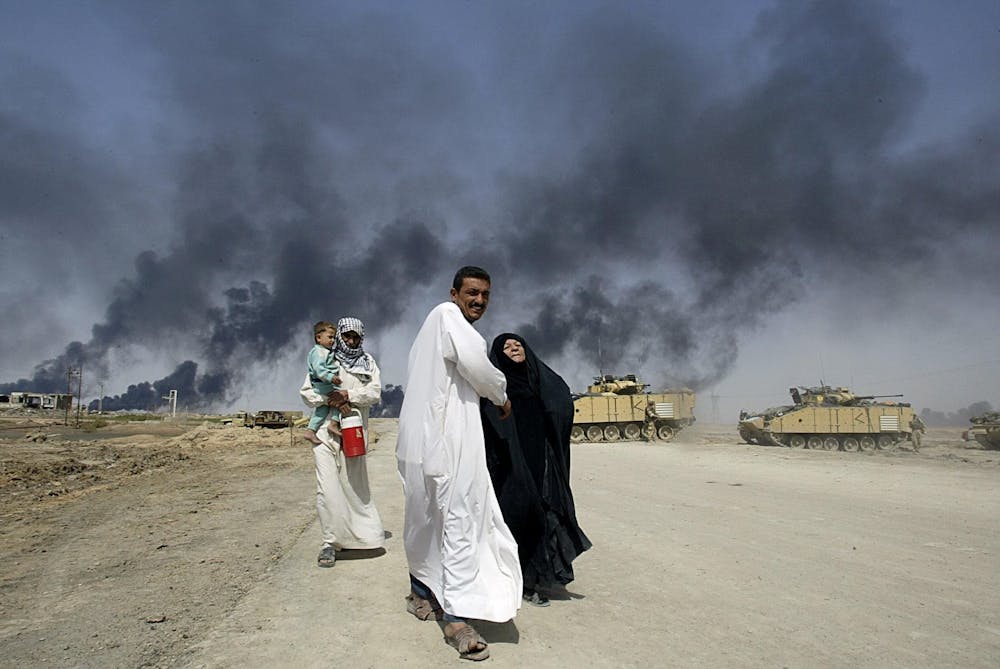
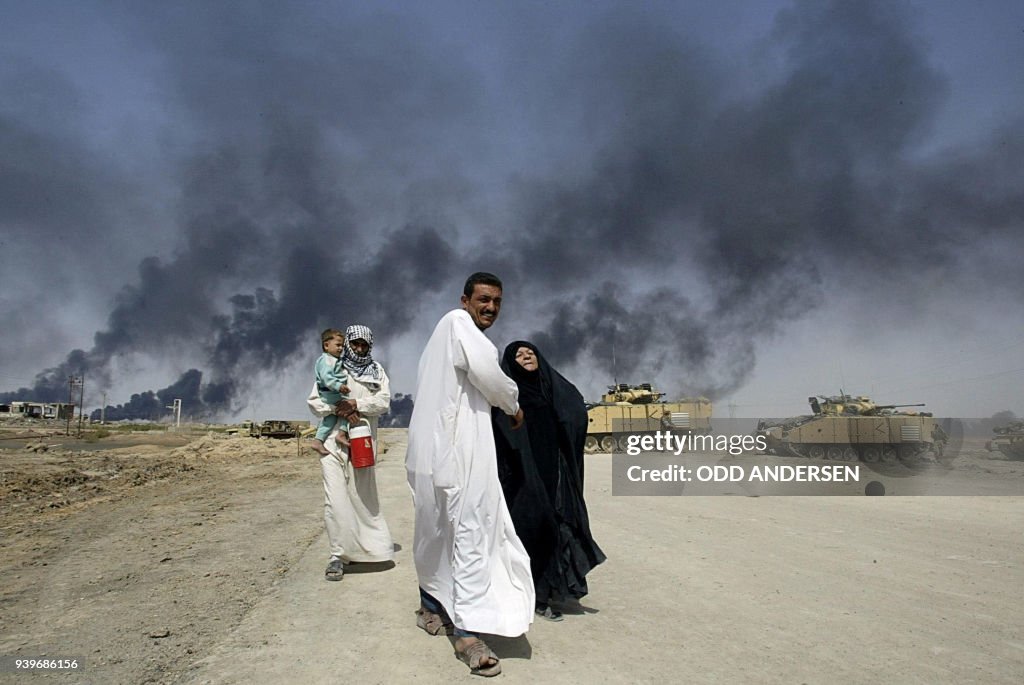
    An Iraqi family flees past British tanks from the city of Basra in March 2003.
    Odd Andersen/AFP via Getty Images

    A new set of priorities

    Older Americans age 65 and up are more likely than young people to prioritize foreign policy issues, including maintaining a U.S. military advantage.

    Younger Americans – age 18 to 39 – say the top issues that require urgency are providing support to refugees and limiting U.S. military commitments abroad, according to a 2021 Pew research survey.

    Generation Z members are also less likely than older Americans to think that the U.S. should act by itself in defending or protecting democracy around the world, according to a 2019 poll by the think tank Center for American Progress.

    They also agree with the statement that the United States’ “wars in the Middle East and Afghanistan were a waste of time, lives, and taxpayer money and they did nothing to make us safer at home.” They prefer that the U.S. use economic and diplomatic means, rather than military intervention, to advance American interests around the world.

    Israel’s conflict with Iran may not flare again and give way to more airstrikes and violence. If the countries resume fighting, however, their conflict threatens to draw in Lebanon, Qatar and other countries in the Middle East, as well as likely the U.S. – and to drag on for a long time.

    This is an update from a story originally published on March 15, 2023.

    Andrea Stanton does not work for, consult, own shares in or receive funding from any company or organization that would benefit from this article, and has disclosed no relevant affiliations beyond their academic appointment.

    ref. Israel-Iran war recalls the 2003 US invasion of Iraq – a war my undergraduate students see as a relic of the past – https://theconversation.com/israel-iran-war-recalls-the-2003-us-invasion-of-iraq-a-war-my-undergraduate-students-see-as-a-relic-of-the-past-259652

    MIL OSI Analysis

  • MIL-OSI Analysis: Using TikTok could be making you more politically polarized, new study finds

    Source: The Conversation – USA – By Zicheng Cheng, Assistant Professor of Mass Communications, University of Arizona

    Are you in an echo chamber on TikTok? LeoPatrizi/E+ via Getty Images

    People on TikTok tend to follow accounts that align with their own political beliefs, meaning the platform is creating political echo chambers among its users. These findings, from a study my collaborators, Yanlin Li and Homero Gil de Zúñiga, and I published in the academic journal New Media & Society, show that people mostly hear from voices they already agree with.

    We analyzed the structure of different political networks on TikTok and found that right-leaning communities are more isolated from other political groups and from mainstream news outlets. Looking at their internal structures, the right-leaning communities are more tightly connected than their left-leaning counterparts. In other words, conservative TikTok users tend to stick together. They rarely follow accounts with opposing views or mainstream media accounts. Liberal users, on the other hand, are more likely to follow a mix of accounts, including those they might disagree with.

    Our study is based on a massive dataset of over 16 million TikTok videos from more than 160,000 public accounts between 2019 and 2023. We saw a spike of political TikTok videos during the 2020 U.S. presidential election. More importantly, people aren’t just passively watching political content; they’re actively creating political content themselves.

    Some people are more outspoken about politics than others. We found that users with stronger political leanings and those who get more likes and comments on their videos are more motivated to keep posting. This shows the power of partisanship, but also the power of TikTok’s social rewards system. Engagement signals – likes, shares, comments – are like a fuel, encouraging users to create even more.

    Why it matters

    People are turning to TikTok not just for a good laugh. A recent Pew Research Center survey shows that almost 40% of U.S. adults under 30 regularly get news on TikTok. The question becomes what kind of news are they watching, and what does that mean for how they engage with politics.

    The content on TikTok often comes from creators and influencers or digital-native media sources. The quality of this news content remains uncertain. Without access to balanced, fact-based information, people may struggle to make informed political decisions.

    TikTok is not unique; social media generally fosters polarization.

    Amid the debates over banning TikTok, our study highlights how TikTok can be a double-edged sword in political communication. It’s encouraging to see people participate in politics through TikTok when that’s their medium of choice. However, if a user’s network is closed and homogeneous and their expression serves as in-group validation, it may further solidify the political echo chamber.

    When people are exposed to one-sided messages, it can increase hostility toward outgroups. In the long run, relying on TikTok as a source for political information might deepen people’s political views and contribute to greater polarization.

    What other research is being done

    Echo chambers have been widely studied on platforms like Twitter and Facebook, but similar research on TikTok is in its infancy. TikTok is drawing scrutiny, particularly its role in news production, political messaging and social movements.

    TikTok has its unique format, algorithmic curation and entertainment-driven design. I believe that its function as a tool for political communication calls for closer examination.

    What’s next

    In 2024, the Biden/Harris and Trump campaigns joined TikTok to reach young voters. My research team is now analyzing how these political communication dynamics may have shifted during the 2024 election. Future research could use experiments to explore whether these campaign videos significantly influence voters’ perceptions and behaviors.

    The Research Brief is a short take on interesting academic work.

    Zicheng Cheng does not work for, consult, own shares in or receive funding from any company or organization that would benefit from this article, and has disclosed no relevant affiliations beyond their academic appointment.

    ref. Using TikTok could be making you more politically polarized, new study finds – https://theconversation.com/using-tiktok-could-be-making-you-more-politically-polarized-new-study-finds-258791

    MIL OSI Analysis

  • MIL-OSI Analysis: Uranium enrichment: A chemist explains how the surprisingly common element is processed to power reactors and weapons

    Source: The Conversation – USA – By André O. Hudson, Dean of the College of Science, Professor of Biochemistry, Rochester Institute of Technology

    Yellowcake is a concentrated form of mined and processed uranium. Nuclear Regulatory Commission, CC BY

    When most people hear the word uranium, they think of mushroom clouds, Cold War standoffs or the glowing green rods from science fiction. But uranium isn’t just fuel for apocalyptic fears. It’s also a surprisingly common element that plays a crucial role in modern energy, medicine and geopolitics.

    Uranium reentered the global spotlight in June 2025, when the U.S. launched military strikes on sites in Iran believed to be housing highly enriched uranium, a move that reignited urgent conversations around nuclear proliferation. Many headlines have mentioned Iran’s 60% enrichment of uranium, but what does that really mean?

    As a biochemist, I’m interested in demystifying this often misunderstood element.

    What is uranium?

    Uranium holds the 92nd position on the periodic table, and it is a radioactive, metallic element. Radioactivity is a natural process where some atoms – like uranium, thorium and radium – break down on their own, releasing energy.

    The German chemist Martin Heinrich Klaproth initially identified uranium in 1789, and he named it after the newly discovered planet Uranus. However, its power was not unlocked until the 20th century, when scientists discovered that uranium atoms could split via a process known as nuclear fission. In fission, the nucleus of the atom splits into two or more nuclei, which releases large amounts of energy.

    Uranium is found almost everywhere. It is in rocks, soil and water. There are even traces of uranium in plants and animals – albeit tiny amounts. Most of it is found in the Earth’s crust, where it is mined and concentrated to increase the amount of its most useful radioactive form, uranium-235.

    The enrichment dilemma

    Uranium-235 is an isotope of uranium, which is a version of an element that has the same basic identity but weighs a little more or less. Think about apples from the same tree. Some are big and some are small, but they are all apples – even though they have slightly different weights. Basically, an isotope is the same element but with a different mass.

    Unprocessed uranium is mostly uranium-238. It only contains approximately 0.7% uranium-235, the isotope that allows the most nuclear fission to occur. So, the enrichment process concentrates uranium-235.

    Enrichment can make uranium more useful for the development of nuclear weapons, since natural uranium doesn’t have enough uranium-235 to work well in reactors or weapons. The process usually contains three steps.

    Centrifuges spin the uranium to separate out its isotopes.

    The first step is to convert the uranium into a gas, called uranium hexafluoride. In the second step, the gas gets funneled into a machine called a centrifuge that spins very fast. Because uranium-235 is a little lighter than uranium-238, it moves outward more slowly when spun, and the two isotopes separate.

    It’s sort of like how a salad spinner separates water from lettuce. One spin doesn’t make much of a difference, so the gas is spun through many centrifuges in a row until the uranium-235 is concentrated.

    Uranium can typically power nuclear plants and generate electricity when it is 3%-5% enriched, meaning 3%-5% of the uranium is uranium-235. At 20% enriched, uranium-235 is considered highly enriched uranium, and 90% or higher is known as weapons-grade uranium.

    The enrichment level depends on the proportion of uranium-235 to uranium-238.
    Wikimedia Commons

    This high grade works in nuclear weapons because it can sustain a fast, uncontrolled chain reaction, which releases a large amount of energy compared with the other isotopes.

    Uranium’s varied powers

    While many headlines focus on uranium’s military potential, this element also plays a vital role in modern life. At low enrichment levels, uranium powers nearly 10% of the world’s electricity.

    In the U.S., many nuclear power plants run on uranium fuel, producing carbon-free energy. In addition, some cancer therapies and diagnostic imaging technologies harness uranium to treat diseases.

    Enriched uranium is used for nuclear power.
    Raimond Spekking/Wikimedia Commons, CC BY-SA

    In naval technology, nuclear-powered submarines and aircraft carriers rely on enriched uranium to operate silently and efficiently for years.

    Uranium is a story of duality. It is a mineral pulled from ancient rocks that can light up a city or wipe one off the map. It’s not just a relic of the Cold War or science fiction. It’s real, it’s powerful, and it’s shaping our world – from global conflicts to cancer clinics, from the energy grid to international diplomacy.

    In the end, the real power is not just in the energy released from the element. It is in how people choose to use it.

    André O. Hudson receives funding from the National Institutes of Health.

    ref. Uranium enrichment: A chemist explains how the surprisingly common element is processed to power reactors and weapons – https://theconversation.com/uranium-enrichment-a-chemist-explains-how-the-surprisingly-common-element-is-processed-to-power-reactors-and-weapons-259646

    MIL OSI Analysis

  • MIL-OSI Analysis: Uranium enrichment: A chemist explains how the surprisingly common element is processed to power reactors and weapons

    Source: The Conversation – USA – By André O. Hudson, Dean of the College of Science, Professor of Biochemistry, Rochester Institute of Technology

    Yellowcake is a concentrated form of mined and processed uranium. Nuclear Regulatory Commission, CC BY

    When most people hear the word uranium, they think of mushroom clouds, Cold War standoffs or the glowing green rods from science fiction. But uranium isn’t just fuel for apocalyptic fears. It’s also a surprisingly common element that plays a crucial role in modern energy, medicine and geopolitics.

    Uranium reentered the global spotlight in June 2025, when the U.S. launched military strikes on sites in Iran believed to be housing highly enriched uranium, a move that reignited urgent conversations around nuclear proliferation. Many headlines have mentioned Iran’s 60% enrichment of uranium, but what does that really mean?

    As a biochemist, I’m interested in demystifying this often misunderstood element.

    What is uranium?

    Uranium holds the 92nd position on the periodic table, and it is a radioactive, metallic element. Radioactivity is a natural process where some atoms – like uranium, thorium and radium – break down on their own, releasing energy.

    The German chemist Martin Heinrich Klaproth initially identified uranium in 1789, and he named it after the newly discovered planet Uranus. However, its power was not unlocked until the 20th century, when scientists discovered that uranium atoms could split via a process known as nuclear fission. In fission, the nucleus of the atom splits into two or more nuclei, which releases large amounts of energy.

    Uranium is found almost everywhere. It is in rocks, soil and water. There are even traces of uranium in plants and animals – albeit tiny amounts. Most of it is found in the Earth’s crust, where it is mined and concentrated to increase the amount of its most useful radioactive form, uranium-235.

    The enrichment dilemma

    Uranium-235 is an isotope of uranium, which is a version of an element that has the same basic identity but weighs a little more or less. Think about apples from the same tree. Some are big and some are small, but they are all apples – even though they have slightly different weights. Basically, an isotope is the same element but with a different mass.

    Unprocessed uranium is mostly uranium-238. It only contains approximately 0.7% uranium-235, the isotope that allows the most nuclear fission to occur. So, the enrichment process concentrates uranium-235.

    Enrichment can make uranium more useful for the development of nuclear weapons, since natural uranium doesn’t have enough uranium-235 to work well in reactors or weapons. The process usually contains three steps.

    Centrifuges spin the uranium to separate out its isotopes.

    The first step is to convert the uranium into a gas, called uranium hexafluoride. In the second step, the gas gets funneled into a machine called a centrifuge that spins very fast. Because uranium-235 is a little lighter than uranium-238, it moves outward more slowly when spun, and the two isotopes separate.

    It’s sort of like how a salad spinner separates water from lettuce. One spin doesn’t make much of a difference, so the gas is spun through many centrifuges in a row until the uranium-235 is concentrated.

    Uranium can typically power nuclear plants and generate electricity when it is 3%-5% enriched, meaning 3%-5% of the uranium is uranium-235. At 20% enriched, uranium-235 is considered highly enriched uranium, and 90% or higher is known as weapons-grade uranium.

    The enrichment level depends on the proportion of uranium-235 to uranium-238.
    Wikimedia Commons

    This high grade works in nuclear weapons because it can sustain a fast, uncontrolled chain reaction, which releases a large amount of energy compared with the other isotopes.

    Uranium’s varied powers

    While many headlines focus on uranium’s military potential, this element also plays a vital role in modern life. At low enrichment levels, uranium powers nearly 10% of the world’s electricity.

    In the U.S., many nuclear power plants run on uranium fuel, producing carbon-free energy. In addition, some cancer therapies and diagnostic imaging technologies harness uranium to treat diseases.

    Enriched uranium is used for nuclear power.
    Raimond Spekking/Wikimedia Commons, CC BY-SA

    In naval technology, nuclear-powered submarines and aircraft carriers rely on enriched uranium to operate silently and efficiently for years.

    Uranium is a story of duality. It is a mineral pulled from ancient rocks that can light up a city or wipe one off the map. It’s not just a relic of the Cold War or science fiction. It’s real, it’s powerful, and it’s shaping our world – from global conflicts to cancer clinics, from the energy grid to international diplomacy.

    In the end, the real power is not just in the energy released from the element. It is in how people choose to use it.

    André O. Hudson receives funding from the National Institutes of Health.

    ref. Uranium enrichment: A chemist explains how the surprisingly common element is processed to power reactors and weapons – https://theconversation.com/uranium-enrichment-a-chemist-explains-how-the-surprisingly-common-element-is-processed-to-power-reactors-and-weapons-259646

    MIL OSI Analysis

  • MIL-OSI Analysis: Israel bombed an Iraqi nuclear reactor in 1981 − it pushed program underground and spurred Saddam Hussein’s desire for nukes

    Source: The Conversation – Global Perspectives – By Jeffrey Fields, Professor of the Practice of International Relations, USC Dornsife College of Letters, Arts and Sciences

    The Osirak nuclear power research station in 1981. Jacques Pavlovsky/Sygma via Getty Images

    Israel, with the assistance of U.S. military hardware, bombs an adversary’s nuclear facility to set back the perceived pursuit of the ultimate weapon. We have been here before, about 44 years ago.

    In 1981, Israeli fighter jets supplied by Washington attacked an Iraqi nuclear research reactor being built near Baghdad by the French government.

    The reactor, which the French called Osirak and Iraqis called Tammuz, was destroyed. Much of the international community initially condemned the attack. But Israel claimed the raid set Iraqi nuclear ambitions back at least a decade. In time, many Western observers and government officials, too, chalked up the attack as a win for nonproliferation, hailing the strike as an audacious but necessary step to prevent Iraqi dictator Saddam Hussein from building a nuclear arsenal.

    But the reality is more complicated. As nuclear proliferation experts assess the extent of damage to Iran’s nuclear facilities following the recent U.S. and Israeli raids, it is worth reassessing the longer-term implications of that earlier Iraqi strike.

    The Osirak reactor

    Iraq joined the landmark Nuclear Non-Proliferation Treaty in 1970, committing the country to refrain from the pursuit of nuclear weapons. But in exchange, signatories are entitled to engage in civilian nuclear activities, including having research or power reactors and access to the enriched uranium that drives them.

    The International Atomic Energy Agency is responsible through safeguards agreements for monitoring countries’ civilian use of nuclear technology, with on-the-ground inspections to ensure that civilian nuclear programs do not divert materials for nuclear weapons.

    But to Israel, the Iraqi reactor was provocative and an escalation in the Arab-Israeli conflict.

    Israel believed that Iraq would use the French reactor – Iraq said it was for research purposes – to generate plutonium for a nuclear weapon. After diplomacy with France and the United States failed to persuade the two countries to halt construction of the reactor, Prime Minister Menachem Begin concluded that attacking the reactor was Israel’s best option. That decision gave birth to the “Begin Doctrine,” which has committing Israel to preventing its regional adversaries from becoming nuclear powers ever since.

    Israeli Prime Minister Menachem Begin addresses the press after the 1981 attack on the Osarik nuclear reactor.
    Israel Press and Photo Agency/Wikimedia Commons

    In spring 1979, Israel attempted to sabotage the project, bombing the reactor core destined for Iraq while it sat awaiting shipment in the French town of La Seyne-sur-Mer. The mission was only a partial success, damaging but not destroying the reactor.

    France and Iraq persisted with the project, and in July 1980 – with the reactor having been delivered – Iraq received the first shipment of highly enriched uranium fuel at the Tuwaitha Nuclear Research Center near Baghdad.

    Then in September 1980, during the initial days of the Iran-Iraq war, Iranian jets struck the nuclear research center. The raid also targeted a power station, knocking out electricity in Baghdad for several days. But a Central Intelligence Agency situation report assessed that “only secondary buildings” were hit at the nuclear site itself.

    It was then Israel’s turn. The reactor was still unfinished and not in operation when on June 7, 1981, eight U.S.-supplied F-16s flew over Jordanian and Saudi airspace and bombed the reactor in Iraq. The attack killed 10 Iraqi soldiers and a French civilian.

    Revisiting the ‘success’ of Israeli raid

    Many years later, U.S. President Bill Clinton commented: “Everybody talks about what the Israelis did at Osirak in 1981, which I think, in retrospect, was a really good thing. You know, it kept Saddam from developing nuclear power.”

    But nonproliferation experts have contended for years that while Saddam may have had nuclear weapons ambitions, the French-built research reactor would not have been the route to go. Iraq would either have had to divert the reactor’s highly enriched uranium fuel for a few weapons or shut the reactor down to extract plutonium from the fuel rods – all while hiding these operations from the International Atomic Energy Agency.

    As an additional safeguard, the French government, too, had pledged to shut down the reactor if it detected efforts to use the reactor for weapons purposes.

    In any event, Iraq’s desire for a nuclear weapon was more aspirational than operational. A 2011 article in the journal International Security included interviews with several scientists who worked on Iraq’s nuclear program and characterized the country’s pursuit of a nuclear weapons capability as “both directionless and disorganized” before the attack.

    Iraq’s program begins in earnest

    So what happened after the strike? Many analysts have argued that the Israeli attack, rather than diminish Iraqi desire for a nuclear weapon, actually catalyzed it.

    Nuclear proliferation expert Målfrid Braut-Hegghammer, the author of the 2011 study, concluded that the Israeli attack “triggered a nuclear weapons program where one did not previously exist.”

    In the aftermath of the attack, Saddam decided to formally, if secretively, establish a nuclear weapons program, with scientists deciding that a uranium-based weapon was the best route. He tasked his scientists with pursuing multiple methods to enrich uranium to weapons grade to ensure success, much the way the Manhattan Project scientists approached the same problem in the U.S.

    In other words, the Israeli attack, rather than set back an existing nuclear weapons program, turned an incoherent and exploratory nuclear endeavor into a drive to get the bomb personally overseen by Saddam and sparing little expense even as Iraq’s war with Iran substantially taxed Iraqi resources.

    From 1981 to 1987, the nuclear program progressed fitfully, facing both organizational and scientific challenges.

    As those challenges were beginning to be addressed, Iraq invaded Kuwait in 1990, provoking a military response from the United States. In the aftermath of what would become Operation Desert Storm, U.N. weapons inspectors discovered and dismantled the clandestine Iraqi nuclear weapons program.

    The Tammuz nuclear reactor was hit again during the 1991 Gulf War.
    Ramzi Haidar/AFP via Getty Images

    Had Saddam not invaded Kuwait over a matter not related to security, it is very possible that Baghdad would have had a nuclear weapon capability by the mid-to-late 1990s.

    Similarly to Iraq in 1980, Iran today is a party to the Nuclear Non-Proliferation Treaty. At the time President Donald Trump withdrew U.S. support in 2018 for the Joint Comprehensive Plan of Action, colloquially known as the Iran nuclear deal, the International Atomic Energy Agency certified that Tehran was complying with the requirements of the agreement.

    In the case of Iraq, military action on its nascent nuclear program merely pushed it underground – to Saddam, the Israeli strikes made acquiring the ultimate weapon more rather than less attractive as a deterrent. Almost a half-century on, some analysts and observers are warning the same about Iran.

    Jeffrey Fields receives funding from the Carnegie Corporation of New York and Schmidt Futures.

    ref. Israel bombed an Iraqi nuclear reactor in 1981 − it pushed program underground and spurred Saddam Hussein’s desire for nukes – https://theconversation.com/israel-bombed-an-iraqi-nuclear-reactor-in-1981-it-pushed-program-underground-and-spurred-saddam-husseins-desire-for-nukes-259618

    MIL OSI Analysis

  • MIL-OSI Analysis: Japanese prime minister’s abrupt no-show at NATO summit reveals a strained alliance with the US

    Source: The Conversation – Global Perspectives – By Craig Mark, Adjunct Lecturer, Faculty of Economics, Hosei University

    Japanese Prime Minister Shigeru Ishiba has sent a clear signal to the Trump administration: the Japan–US relationship is in a dire state.

    After saying just days ago he would be attending this week’s NATO summit at The Hague, Ishiba abruptly pulled out at the last minute.

    He joins two other leaders from the Indo-Pacific region, Australian Prime Minister Anthony Albanese and South Korean President Lee Jae-myung, in skipping the summit.

    The Japanese media reported Ishiba cancelled the trip because a bilateral meeting with US President Donald Trump was unlikely, as was a meeting of the Indo-Pacific Four (IP4) NATO partners (Australia, New Zealand, South Korea and Japan).

    Japan will still be represented by Foreign Minister Takeshi Iwaya, showing its desire to strengthen its security relationship with NATO.

    However, Ishiba’s no-show reveals how Japan views its relationship with the Trump administration, following the severe tariffs Washington imposed on Japan and Trump’s mixed messages on the countries’ decades-long military alliance.

    Tariffs and diplomatic disagreements

    Trump’s tariff policy is at the core of the divide between the US and Japan.

    Ishiba attempted to get relations with the Trump administration off to a good start. He was the second world leader to visit Trump at the White House, after Israeli Prime Minister Benjamin Netanyahu.

    However, Trump’s “Liberation Day” tariffs imposed a punitive rate of 25% on Japanese cars and 24% on all other Japanese imports. They are already having an adverse impact on Japan’s economy: exports of automobiles to the US dropped in May by 25% compared to a year ago.

    Six rounds of negotiations have made little progress, as Ishiba’s government insists on full tariff exemptions.

    Japan has been under pressure from the Trump administration to increase its defence spending, as well. According to the Financial Times, Tokyo cancelled a summit between US and Japanese defence and foreign ministers over the demand. (A Japanese official denied the report.)

    Japan also did not offer its full support to the US bombings of Iran’s nuclear facilities earlier this week. The foreign minister instead said Japan “understands” the US’s determination to prevent Iran from acquiring nuclear weapons.

    Japan has traditionally had fairly good relations with Iran, often acting as an indirect bridge with the West. Former Prime Minister Shinzo Abe even made a visit there in 2019.

    Japan also remains heavily dependent on oil from the Middle East. It would have been adversely affected if the Strait of Hormuz had been blocked, as Iran was threatening to do.

    Unlike the response from the UK and Australia, which both supported the strikes, the Ishiba government prioritised its commitment to upholding international law and the rules-based global order. In doing so, Japan seeks to deny China, Russia and North Korea any leeway to similarly erode global norms on the use of force and territorial aggression.

    Strategic dilemma of the Japan–US military alliance

    In addition, Japan is facing the same dilemma as other American allies – how to manage relations with the “America first” Trump administration, which has made the US an unreliable ally.

    Earlier this year, Trump criticised the decades-old security alliance between the US and Japan, calling it “one-sided”.

    “If we’re ever attacked, they don’t have to do a thing to protect us,” he said of Japan.

    Lower-level security cooperation is ongoing between the two allies and their regional partners. The US, Japanese and Philippine Coast Guards conducted drills in Japanese waters this week. The US military may also assist with upgrading Japan’s counterstrike missile capabilities.

    But Japan is still likely to continue expanding its security ties with partners beyond the US, such as NATO, the European Union, India, the Philippines, Vietnam and other ASEAN members, while maintaining its fragile rapprochement with South Korea.

    Australia is now arguably Japan’s most reliable security partner. Canberra is considering buying Japan’s Mogami-class frigates for the Royal Australian Navy. And if the AUKUS agreement with the US and UK collapses, Japanese submarines could be a replacement.

    Ishiba under domestic political pressure

    There are also intensifying domestic political pressures on Ishiba to hold firm against Trump, who is deeply unpopular among the Japanese public.

    After replacing former prime minister Fumio Kishida as leader of the Liberal Democratic Party (LDP) last September, the party lost its majority in the lower house of parliament in snap elections. This made it dependent on minor parties for legislative support.

    Ishiba’s minority government has struggled ever since with poor opinion polling. There has been widespread discontent with inflation, the high cost of living and stagnant wages, the legacy of LDP political scandals, and ever-worsening geopolitical uncertainty.

    On Sunday, the party suffered its worst-ever result in elections for the Tokyo Metropolitan Assembly, winning its lowest number of seats.

    The party could face a similar drubbing in the election for half of the upper house of the Diet (Japan’s parliament) on July 20. Ishiba has pledged to maintain the LDP’s majority in the house with its junior coalition partner Komeito. But if the government falls into minority status in both houses, Ishiba will face heavy pressure to step down.

    Craig Mark does not work for, consult, own shares in or receive funding from any company or organisation that would benefit from this article, and has disclosed no relevant affiliations beyond their academic appointment.

    ref. Japanese prime minister’s abrupt no-show at NATO summit reveals a strained alliance with the US – https://theconversation.com/japanese-prime-ministers-abrupt-no-show-at-nato-summit-reveals-a-strained-alliance-with-the-us-259694

    MIL OSI Analysis

  • MIL-OSI Analysis: Oil shocks in the 1970s drove rapid changes in transport. It could happen again if Middle East tensions continue

    Source: The Conversation – Global Perspectives – By Hussein Dia, Professor of Future Urban Mobility, Swinburne University of Technology

    The Image Bank/Getty

    As the world watches the US–Iran situation with concern, the ripple effect from these events are reaching global oil supply chains – and exposing their fragility.

    If Iran closes the Strait of Hormuz as it is considering, it would restrict the global oil trade and trigger energy chaos.

    Petrol in some Australian cities could hit A$2.50 a litre according to some economists. As global instability worsens, other experts warn price spikes are increasingly likely.

    What would happen next? There is a precedent: the oil shocks of the 1970s, when oil prices quadrupled. The shock drove rapid change, from more efficient cars to sudden interest in alternative energy sources. This time, motorists would likely switch to electric vehicles.

    If this crisis continues or if another one flares up, it could mark a turning point in Australia’s long dependence on foreign oil.

    What would an oil shock mean?

    Australia currently imports 80% of its liquid fuels, the highest level on record. If the flow of oil stopped, we would have about 50 days worth in storage before we ran out.

    Our cars, buses, trucks and planes run overwhelmingly on petrol and diesel. Almost three-quarters (74%) of these liquid fuels are used in transport, with road transport accounting for more than half (54%) of all liquid fuels. Australia is highly exposed to global supply shocks.

    The best available option to reduce dependence on oil imports is to electrify transport.

    How does Australia compare on EVs?

    EV uptake in Australia continues to lag behind global leaders. In 2024, EVs accounted for 9.65% of new car sales in Australia, up from 8.45% in 2023.

    In the first quarter of 2025, EVs were 6.3% of new car sales, a decline from 7.4% in the final quarter of 2024.

    Norway remains the global leader, with battery-electric passenger cars making up 88.9% of sales in 2024. The United Kingdom also saw significant growth – EVs hit almost 20% of new car registrations in 2024.

    In China, EVs made up 40.9% of new car sales in 2024. The 12.87 million cars sold represent three-quarters of total EV sales worldwide.

    One reason for Australia’s sluggishness is a lack of reliable public chargers. While charging infrastructure is expanding, large parts of regional Australia still lack reliable access to EV charging.

    Until recently, Australia’s fuel efficiency standards were among the weakest in the OECD. Earlier this year, the government’s new standards came into force. These are expected to boost EV uptake.

    Could global tensions trigger faster action?

    If history is any guide, oil shocks lead to long-term change.

    The 1970s oil shocks triggered waves of energy reform.

    When global oil prices quadrupled in 1973–74, many nations were forced to reconsider where they got their energy. A few years later, the 1979 Iranian Revolution caused another major supply disruption, sending oil prices soaring and pushing much of the world into recession.

    Huge increases in oil prices drove people to look for alternatives during the 1970s oil shocks.
    Everett Collection/Shutterstock

    These shocks drove the formation of the International Energy Agency in 1974, spurred alternative energy investment and led to advances in fuel-efficiency standards.

    Much more recently, Russia’s invasion of Ukraine pushed the European Union to face up to its reliance on Russian gas and find alternatives by importing gas from different countries and accelerating the clean energy shift.

    Clearly, energy shocks can be catalysts for long-term structural change in how we produce and consume energy.

    The new crisis could do the same, but only if policy catches up.

    If fuel prices shot up and stayed there, consumer behaviour would begin to shift. People would drive less and seek alternate forms of transport. Over time, more would look for better ways to get around.

    But without stronger support such as incentives, infrastructure and fuel security planning, shifting consumer preferences could be too slow to matter.

    A clean-energy future is more secure

    Cutting oil dependency through electrification isn’t just good for the climate. It’s also a hedge against future price shocks and supply disruptions.

    Transport is now Australia’s third-largest source of greenhouse gas emissions. Now that emissions are falling in the electricity sector, transport will be the highest emitting sector emissions source as soon as 2030.

    Building a cleaner transport system also means building a more resilient one. Charging EVs on locally produced renewable power cuts our exposure to global oil markets. So do biofuels, better public transport and smarter urban planning.

    Improving domestic energy resilience isn’t just about climate targets. It’s about economic stability and national security. Clean local energy sources reduce vulnerability to events beyond our control.

    What can we learn from China?

    China offers a compelling case study. The nation of 1.4 billion faces real oil security challenges. In response, Beijing has spent the past decade building a domestic clean energy ecosystem to reduce oil dependency and cut emissions.

    This is now bearing fruit. Last year, China’s oil imports had the first sustained fall in nearly two decades. Crude oil imports fell 1.5%, while oil refinery activity also fell due to lower demand.

    China’s rapid uptake of EVs has clear energy security benefits.
    pim pic/Shutterstock

    China’s green energy transition was driven by coordinated policy, industrial investment and public support for clean transport.

    China’s rapid shift to EVs and clean energy shows how long-term planning and targeted investment can pay off on climate and energy security.

    What we do next matters

    The rolling crises of 2025 present Australian policymakers a rare alignment of interests. What’s good for the climate, for consumers and for national security may now be the same thing.

    Real change will require more than sustained high petrol prices. It demands political will, targeted investment and a long-term vision for clean, resilient transport.

    Doing nothing has a real cost – not just in what we pay at the service station, but in how vulnerable we remain to events a long way away.

    Hussein Dia receives funding from the Australian Research Council, the iMOVE Australia Cooperative Research Centre, Transport for New South Wales, Queensland Department of Transport and Main Roads, Victorian Department of Transport and Planning, and Department of Infrastructure, Transport, Regional Development, Communications and the Arts.

    ref. Oil shocks in the 1970s drove rapid changes in transport. It could happen again if Middle East tensions continue – https://theconversation.com/oil-shocks-in-the-1970s-drove-rapid-changes-in-transport-it-could-happen-again-if-middle-east-tensions-continue-259670

    MIL OSI Analysis

  • MIL-OSI Video: 80th anniversary of the signing of the UN Charter – Commemoration at the General Assembly

    Source: United Nations (video statements)

    A commemorative plenary meeting to celebrate the 80th anniversary of the signing of the UN Charter, emphasizing its foundational importance to achieving peace, development and human rights for “we the peoples”.

    Opening Segment 
    Musical Performance  
    Plenary

    The President of the 79th session of the UN General Assembly convenes a commemorative plenary meeting to celebrate the 80th anniversary of the signing of the UN Charter, emphasizing its foundational importance to achieving peace, development and human rights for “we the peoples”.

    A meeting of the General Assembly to observe the 80th anniversary of the signing of the UN Charter. The meeting will serve as a moment to revive the spirit of San Francisco and once again embrace the ideals that united humanity during its darkest hour, reaffirming our commitment to those values into the future.

    The commemoration of the 80th anniversary will include an extensive communications campaign that will spotlight the Charter and its signing, as well as highlight milestones and successes of the United Nations and its Member States over the past 80 years. This campaign will also feature video testimonials by world leaders from June to September 2025.

    A High-Level meeting of the General Assembly for Heads of State and Government to mark the 80th anniversary is scheduled for 22 September 2025, during the UNGA High-Level Week.

    https://www.youtube.com/watch?v=tG_zb7CNB6g

    MIL OSI Video

  • MIL-OSI Asia-Pac: Winnie Ho tours housing project

    Source: Hong Kong Information Services

    Secretary for Housing Winnie Ho attended the Asia-Pacific Network for Housing Research (APNHR) 2025 Conference at Tsinghua University and visited the Qingtangwan public rental housing project in Beijing today.

    The APNHR is an international organisation focusing on housing issues in the Asia-Pacific region. The conference was held at Tsinghua University this year with the theme “Towards Resilience and Inclusivity: Adapting to Multifaceted Challenges in the Asia-Pacific Region”.

    The conference convened experts and scholars in the fields of architecture, urban planning, sociology, environmental studies, and others from the Asia-Pacific region to have in-depth exchanges on the housing development and challenges in the region, and to jointly explore ways to promote innovative housing construction and development directions.

    At the conference’s roundtable session this morning, Ms Ho shared the opportunities and challenges in housing development faced by the Hong Kong Special Administrative Region Government Housing Bureau (HB) and the Hong Kong Housing Authority (HKHA).

    She said that the current-term Hong Kong SAR Government has actively addressed Hong Kong’s housing problems since taking office, overcoming livelihood issues and addressing people’s concerns by identifying sites and enhancing the quantity, speed, efficiency and quality of public housing construction.

    The HB is working full steam ahead on implementing groundbreaking innovative policy initiatives, such as Light Public Housing (LPH) and Basic Housing Units, to tackle the long-standing, big and difficult issue that has plagued Hong Kong for many years and to provide the grassroots with options to improve their living environment and quality of life.

    Ms Ho highlighted that the HB and the HKHA have been making use of various innovative construction technologies, such as Modular Integrated Construction, construction robots and smart project management platforms, to enhance construction efficiency and build LPH expeditiously, so as to improve the living conditions of those who are inadequately housed as soon as possible.

    She also introduced at the conference the “well-being design” guide launched by the HB and the HKHA last year, which serves as a reference for the future design of new public housing and the improvement works of existing public rental housing estates.

    Apart from housing construction, the HKHA has also continued to enhance the management efficiency and service quality of its nearly 200 public rental housing estates by actively promoting smart estate management and introducing new technologies to optimise estate management and building maintenance services, to provide a better living environment for its residents.

    In the afternoon, Ms Ho visited the Qingtangwan public rental housing project in Beijing. This project is a green residential area that adopted the use of prefabricated components and environmental monitoring platforms. It also implements smart community management through community apps.

    Afterwards, Ms Ho met Deputy Director-General of the Bureau of International Cooperation of the State-owned Assets Supervision & Administration Commission of the State Council Xie Hui to exchange views on housing design and planning.

    She also shared the adoption of advanced construction technologies from the Mainland in Hong Kong and the outcomes.

    Yesterday, Ms Ho visited the Better House Living Tech Lab and was briefed on the practice of combining housing design concepts of quality homes and technologies on the Mainland.

    The housing chief will continue her Beijing visit tomorrow before returning to Hong Kong.

    MIL OSI Asia Pacific News

  • MIL-OSI China: Chinese state councilor stresses bolstering employment, boosting consumption

    Source: People’s Republic of China – State Council News

    CHANGSHA, June 26 — Chinese State Councilor Shen Yiqin has called for efforts to stabilize the employment of key groups such as college graduates and further boost culture, tourism and sports-related consumption.

    Shen made the remarks during an inspection tour in central China’s Hunan Province from Monday to Thursday.

    Shen urged placing greater importance on employment, and called for supportive measures to strengthen the job opportunities for key groups including college graduates, migrant workers and those who have shaken off poverty.

    Enterprises should receive more support to aid in the creation of more job opportunities, said Shen, who called for the launch of large-scale vocational training programs in key sectors to improve labor force skills.

    Shen also called for efforts to continue increasing the supply of high-quality products and services, and to accelerate the integration of culture, tourism and sports with science and technology, to better meet people’s growing demand. 

    MIL OSI China News

  • MIL-OSI China: Documentary “Xi Jinping’s Cultural Story” premieres on major Italian media

    Source: People’s Republic of China – State Council News

    In celebration of the 55th anniversary of the establishment of diplomatic ties between China and Italy, a launch event for the documentary “Xi Jinping’s Cultural Story,” produced by China Media Group, was held in Rome on Wednesday.

    Starting from June 25, the program will be broadcast across more than 30 mainstream Italian media outlets, including Alma TV, Donna TV, Travel TV, Lazio TV, Lombardia City TV, Roma Corona TV, Milan Pavia TV, and the website of Milano Finanza, among others.

    “Xi Jinping’s Cultural Story” features vivid stories that reflect Chinese President Xi Jinping’s deep concern for the inheritance and development of culture. It showcases his profound reflections on the idea that “our country will thrive only if our culture thrives, and our nation will be strong only if our culture is strong,” as well as his deep affection for cultural heritage and his dedication to preserving historical continuity. The program explains to international audiences the essence of Xi Jinping Thought on Culture and the solid cultural foundation underpinning his philosophy of governance.

    The documentary includes on-site visits to places where Xi has worked or conducted inspections, such as Zhengding in Hebei Province, Xiamen in Fujian Province, Hangzhou in Zhejiang Province, and Dunhuang in Gansu Province. Through a variety of narrative forms — including video footage and in-depth interviews — it vividly presents China’s practical efforts in the new era to trace the origins of civilization and protect cultural heritage, highlighting the profound, far-reaching, inclusive and ever-evolving nature of Chinese culture.

    MIL OSI China News

  • MIL-OSI Banking: RBI imposes monetary penalty on The Karnataka Co-operative Bank Limited, Muddebihal, Karnataka

    Source: Reserve Bank of India

    The Reserve Bank of India (RBI) has, by an order dated June 23, 2025, imposed a monetary penalty of ₹1 lakh (Rupees One Lakh only) on The Karnataka Co-operative Bank Limited, Muddebihal, Karnataka (the bank) for non-compliance with certain directions issued by RBI on ‘Exposure Norms and Statutory / Other Restrictions – UCBs’ and ‘Know Your Customer (KYC)’. This penalty has been imposed in exercise of powers conferred on RBI under the provisions of Section 47A(1)(c) read with Sections 46(4)(i) and 56 of the Banking Regulation Act, 1949.

    The statutory inspection of the bank was conducted by RBI with reference to its financial position as on March 31, 2024. Based on supervisory findings of non-compliance with RBI directions and related correspondence in that regard, a notice was issued to the bank advising it to show cause as to why penalty should not be imposed on it for its failure to comply with the said directions. After considering the bank’s reply to the notice and oral submissions made during the personal hearing, RBI found, inter alia, that the following charges against the bank were sustained, warranting imposition of monetary penalty:

    The bank had:

    1. breached the prudential inter-bank (gross) and counterparty exposure limits; and

    2. failed to upload the KYC records of customers onto Central KYC Records Registry within the prescribed timeline.

    This action is based on deficiencies in regulatory compliance and is not intended to pronounce upon the validity of any transaction or agreement entered into by the bank with its customers. Further, imposition of this monetary penalty is without prejudice to any other action that may be initiated by RBI against the bank.

    (Puneet Pancholy)  
    Chief General Manager

    Press Release: 2025-2026/600

    MIL OSI Global Banks

  • MIL-OSI Banking: Secretary-General of ASEAN meets with the Director-General of Casablanca Finance City (CFC)

    Source: ASEAN

    Secretary-General of ASEAN, Dr. Kao Kim Hourn, met with Mr. Said Ibrahimi, Director-General of Casablanca Finance City (CFC), in Casablanca, Morocco, on 26 June 2025. SG Dr. Kao shared ASEAN’s progress in financial integration, financial inclusion, and sustainable finance and exchanged views on possible areas of cooperation with Morocco in financial sector.

    The post Secretary-General of ASEAN meets with the Director-General of Casablanca Finance City (CFC) appeared first on ASEAN Main Portal.

    MIL OSI Global Banks

  • MIL-OSI Europe: Pride march in Budapest: Ministers Aurore Bergé and Benjamin Haddad reaffirm France’s support for LGBT+ people’s rights (26 June 2025)

    Source: Republic of France in English
    The Republic of France has issued the following statement:

    On the occasion of the Budapest Pride march on 28 June 2025, France reaffirms its commitment to the freedom, protection and rights of LGBT+ people within the European Union.

    Held as part of Pride month, Pride marches are a legacy of the historic struggles that began with the Stonewall riots in New York on 28 June 1969, the founding event of the contemporary movement for LGBT+ people’s rights. In France, in Europe and all over the world, the marches are a reminder that those rights are the result of collective battles against discrimination, criminalization, pathologization and violence.

    Banned by the Hungarian Government but supported by the Mayor of Budapest, the Budapest Pride march will be held amid a worrying national decline in individual freedoms. LGBT+ people there are facing an increasingly hostile political and social climate, fomented by hate speech and discriminatory policies that fuel an environment of fear and exclusion.

    In this regard, France wants to reiterate its deep commitment to respect for the European Union’s basic values, as set out in Article 2 of the Treaty on European Union: “The Union is founded on the values of respect for human dignity, freedom, democracy, equality, the rule of law and respect for human rights, including the rights of persons belonging to minorities. These values are common to the Member States in a society in which pluralism, non-discrimination, tolerance, justice, solidarity and equality between women and men prevail.”

    France calls for heightened vigilance in the face of legislative and social changes in the various Member States, in order to guarantee respect for basic rights, defend the principles of the European Union and ensure consistency in its values, particularly in terms of equality and non-discrimination.

    At the ministers’ request, M. Jean-March Berthon, Ambassador for the Rights of LGBT+ People, will officially represent the French Government at the march, as a sign of France’s support and commitment.

    What is playing out in Hungary is a reminder of a global reality: the rights of LGBT+ people are far from being guaranteed and remain profoundly fragile. No victory is irreversible.

    Everywhere, reactionary and fundamentalist onslaughts are seeking to restrict equality and wipe out existences. What can be won through struggles can be destroyed through inaction. In the face of this global threat, visibility, international solidarity and commitment remain more essential than ever.

    “Respect for and protection of human rights must apply everywhere, all the time, and to everyone. LGBT+ citizens can in no way be an exception to this basic principle, on which France will never compromise. The slightest relapse in terms of public freedoms within the European Union itself is unacceptable. Combating all forms of regression is a necessity, building a world without violence is an imperative, and furthering human rights is France’s commitment,” said Aurore Bergé, Minister Delegate for Gender Equality and the Fight against Discrimination.

    “My colleague Aurore Bergé and I pay tribute to the advocacy work of the activists, journalists and nongovernmental organizations working to ensure that Hungarians enjoy equal treatment and full legal protection, regardless of their sexual orientation or gender expression. The Budapest Pride march is an important moment both for LGBTQI+ people and for all those committed to freedom. France will remain a powerful champion of a Europe where everyone is guaranteed the opportunity to express their basic freedoms freely and safely,” said Benjamin Haddad, Minister for Europe.

    MIL OSI Europe News

  • MIL-OSI United Kingdom: Welfare vote a test of ‘moral backbone’ for Scottish Labour

    Source: Scottish Greens

    Scottish Greens call on Labour MPs to vote against Starmer’s Welfare Bill

    An upcoming vote on social security cuts at Westminster will be a test of Scottish Labour’s moral backbone, says Scottish Green’s social justice spokesperson Maggie Chapman.

    Next Tuesday, Westminster is due to vote on the controversial changes to social security, which would see financial support for disabled people slashed in an effort to save £5 billion from the UK Government’s welfare bill.

    A number of Labour MPs have now supported an amendment to reject the Bill outright, warning that the proposals lack consultation, ignore any real impact assessment, and will deepen inequality. However, the vast majority of Scottish MPs have not signed up.

    The Government’s own impact assessment stated that these proposals could push up to 250,000 people, including 50,000 children, into poverty. Recent research from the Trussell Trust states that 300,000 Scots could lose £500 a year in crucial disability support payments if the cuts are voted through.

    The Scottish Greens are urging all Scottish Labour MPs and MSPs to clearly oppose the dangerous cuts to social security, and oppose this new wave of austerity inflicted on Scotland.

    Commenting, Maggie said:

    “It’s clear to anyone who’s looking that the brutal welfare cuts put forward by Labour at Westminster will push disabled folk across the UK into poverty. The Government’s own assessment of the proposals tells us that. 

    “Supporting these turbo-charged austerity measures – while the evidence of the harms they will cause is so painfully obvious – is completely inexcusable. This is not leadership, it is cowardice and cruelty dressed up as pragmatism.

    “Next week’s vote will be a crucial moral test for all Scottish Labour politicians. Will they choose to back a Prime Minister who is once again ploughing ahead with deeply unpopular and harmful cuts to our communities, or will they do the right thing and stand up for their constituents in Scotland?

    “There is no excuse for silence here in Holyrood or Westminster. Now is the time to show solidarity and moral leadership – not to hide behind party lines.

    “The public deserves better than a Labour Party that promises change but delivers cuts.”

    MIL OSI United Kingdom

  • MIL-OSI United Kingdom: Massive annual increase in private jet traffic in Scotland shows urgent need to tax the rich

    Source: Scottish Greens

    Prestwick Airport has seen a 32% annual increase in private jet flights

    A 32% year-on-year increase in private jet flights to just one Scottish airport is a sign that we urgently need to tax the super-rich, says Scottish Greens MSP Ross Greer.

    The statistic comes from an investigation from Oxfam Scotland, which revealed that Scottish Government-owned Prestwick Airport saw a huge 32% increase in private jet flights from 2023 to 2024.

    Oxfam Scotland’s investigation also highlighted that some private jets can emit 20 or even 30 times more carbon emissions than flying economy class.

    The Scottish Greens have long campaigned for a Private Jet Tax in Scotland by increasing the rate of Air Departure Tax (ADT) on non-commercial jets. However, an ongoing stalemate between the Scottish Government and the UK Government over the introduction of ADT has delayed progress.

    The party is now calling for the Scottish Government to show clear leadership and to tax the super-rich by introducing a departure and arrival levy on private jet flights at Government-owned airports, namely Prestwick and the eleven airports owned via Highlands and Islands Airports Limited (HIAL).

    While Prestwick Airport sees substantial private jet traffic, often associated with golf events, HIAL airports are also regularly used by international elites who own large estates in Scotland.

    Ross said:

    “An obscene amount of wealth is being hoarded by a tiny number of elites who fly across the globe in their climate-wrecking private jets.

    “These jets have a huge impact on our environment, and while their super-rich occupants fly between their golf courses and superyachts, it’s Scottish taxpayers left paying to clean up their mess.

    “We all know that we urgently need to reduce pollution from planes to combat the climate emergency. One of the easiest ways to do that is to reduce private jet use, which is twenty times more polluting than regular commercial flights.

    “That’s why the Scottish Greens are proposing a private jet tax, which would raise money for our public services and keep the super-rich and their destructive toys on the ground.

    “We’ve waited for years for the Scottish and UK Governments to deliver the devolution of Air Departure Tax in Scotland, as they agreed to do over a decade ago.

    “Delays to the devolution of ADT aren’t a get out of jail free card for the Scottish Government. They can introduce a charge on private jets at the dozen airports they own right now, raising cash for public services and taking action to tackle the climate emergency.”

    MIL OSI United Kingdom

  • MIL-OSI United Kingdom: Urgent warning to pet owners as toxic chemicals found in fake flea treatments

    Source: United Kingdom – Executive Government & Departments

    Press release

    Urgent warning to pet owners as toxic chemicals found in fake flea treatments

    Pet owners urged to be wary of dangerous fake treatments discovered on e-commerce sites.

    Main developments are:

    • urgent government warning issued after toxic insecticide discovered in counterfeit flea treatments – one cat required emergency surgery after severe poisoning

    • fake pet medicines lack essential ingredients while containing dangerous chemicals that trigger vomiting, seizures and potential death

    • warning signs include poor packaging, spelling mistakes, unusual smells and suspiciously low prices

    • new figures show three quarters of consumers wrongly believe fake goods are of similar quality to genuine products

    • pet owners should only buy from trusted sources and immediately report suspicious products

    The Intellectual Property Office (IPO) and Veterinary Medicine Directorate (VMD) are urging pet owners to take caution when purchasing common medicines, including common flea treatments and wormers. 
     
    The alert comes after toxic pesticide traces were found in a fake flea treatment that caused a pet cat to become seriously ill, prompting the owner to have the product tested. Laboratory tests confirmed the presence of Pirimiphos-methyl, a dangerous insecticide toxic to cats. 
     
    Officials are urging pet owners to recognise signs of counterfeit products, avoid using suspicious items, and know how to report concerns.  

    Counterfeit animal medicines deliberately copy the appearance, packaging and branding of genuine veterinary products to deceive pet owners. Like all counterfeits, they are illegal to sell in the UK.   

    These fakes typically lack proper active ingredients, making them ineffective. Worse still, they may also contain harmful substances, causing severe reactions including vomiting, muscle tremors, breathing difficulties, seizures and potentially death.

    Pet owners seeking bargains, or a quick purchase online may unknowingly purchase these dangerous counterfeits.  
     
    The VMD and IPO are urging owners to check for warning signs including poor packaging, spelling errors, missing information, and unusual smells. 

    Last year alone, the VMD issued 122 seizure notices for the selling of unauthorised animal medicines and supplements, preventing around 18,000 illegal items from reaching consumers. 

    After purchasing what appeared to be genuine FRONTLINE ® flea treatment online for his cat, Smokey, Alan Wall from Preston was devastated when Smokey became very unwell. The condition was so severe that Smokey required emergency intestinal surgery to survive. This was followed by a week-long stay at the veterinary surgery and significant bills to support his recovery.

    Alan Wall said:

    Smokey is more than just a pet, he’s a member of our family. When he became ill after using what we believed was a genuine flea treatment, we were terrified. Watching him suffer, not knowing whether he would pull through, was heartbreaking. It’s taken a huge emotional toll on all of us. Without the support of our vets and the extensive surgery they performed we know Smokey wouldn’t be with us today. We want to warn other pet owners about these fake products so that no one else has to endure what we’ve been through.

    Images of Smokey the cat – receiving treatment, and when healthier

    A Veterinary Medicines Directorate Veterinary Surgeon and Efficacy Assessor, Dr Heilin-Anne Leonard-Pugh, explains:

    Pirimiphos-methyl is toxic to cats. Exposure to this insecticide can prevent the cat’s body from breaking down a substance called acetylcholine, leading to an overstimulation of the cat’s nervous system. This can cause symptoms such as vomiting, uncoordinated gait, muscle tremors, weakness, paralysis, increased sensitivity to touch, difficulty breathing, restlessness, urinary incontinence, low heart rate and seizures. In some cases, even death can sadly occur. If you suspect your pet has been exposed to a counterfeit medicine, seek veterinary advice immediately.  

    Sue Horseman from Bristol also purchased what appeared to be FRONTLINE® flea treatment online for her cat, but quickly became suspicious that the product wasn’t genuine.  
     
    Sue explained that the product was difficult to open and had a distinct smell of white spirit and paraffin, whereas the genuine flea treatment has no smell.  When she reported this to Trading Standards, experts confirmed that the treatment was a counterfeit. 

    While the online platform has removed the seller, they had already managed to sell 211 batches of suspected counterfeit pet medicines and supplements, including fake FRONTLINE Flea and Tick Treatment and PRO PLAN FortiFlora Probiotic Sachets for dogs and cats. 
     
    New counterfeit goods research (Wave 4) shows that counterfeit goods of all types are frequently purchased via global e-commerce websites. The figures also show that in 2024, nearly-one-in-five (17%) consumers unknowingly purchased goods later found to be fake, with 60% of purchasers also saying that ‘ease of purchasing’ influenced their decision.  Saving money is a strong motivator for buying fakes, with around three quarters (72%) of purchasers saying price was an important factor in their decision. Worryingly, around three-quarters (72%) wrongly believed the products would be of a similar quality to the genuine item.

    The IPO’s Deputy Director of Enforcement Helen Barnham, said:

    We are a nation of animal lovers, and criminals dealing in counterfeits are targeting pet owners with complete disregard for the animal’s wellbeing.  This can have some distressing consequences, as they may contain toxic chemicals that are harmful to our pets. We are urging pet owners to be vigilant when purchasing any type of animal treatment, and beware of any offers that ‘look too good to be true’.   

    Counterfeiting is anything but a victimless crime and this latest discovery confirms this. If you suspect that any goods offered for sale may be counterfeit, you should always report this to your local Trading Standards or Crimestoppers Online.

    Caroline Allen, RSPCA Chief Veterinary Officer said: 

    We are very concerned about counterfeit vet treatments on sale which can be highly toxic to pets and we would always urge pet owners to seek professional veterinary advice if they have any health concerns.  

    We appreciate financial pressures can lead to some owners to look for cheaper treatments online but they could be unwittingly putting their beloved pets in serious danger by inadvertently buying these counterfeit goods and would urge them to take on board this government advice.

    Nina Downing, Vet Nurse from PDSA, a vet charity and a leading authority on pet health in the UK, said:

    Counterfeit veterinary medicines can pose a serious threat to our pets ‘ health and wellbeing. While legitimate medications play a vital role in keeping our pets healthy, counterfeit products can cause severe harm or even be fatal. These fake medicines may contain incorrect ingredients or dangerous substances that can make pets extremely ill – leading to symptoms like twitching, swelling, breathing difficulties, vomiting, diarrhoea, collapse, coma and even death.

    We always recommend that you only give your pet medication which has been prescribed by your vet. When fulfilling a prescription online, source them from reputable companies that are on the Register of online retailers, brought to you by the Veterinary Medicines Directorate. If you suspect your pet is reacting badly to any medication, contact your vet immediately.

    When examining the counterfeit FRONTLINE® flea treatment, experts from the University of Bath also identified telling packaging flaws. Most notably, the label used ‘GATTI’ (Italian for cats) instead of the English ‘CAT’, alongside multiple spelling errors – common indicators of counterfeit products.

    Image: Packaging featuring spelling mistakes and mixed languages

    Pet owners should check the packaging and always be cautious of third-party sellers when shopping on e-commerce sites for any type of pet medication. 

    The IPO and VMD are offering advice for consumers to help spot fake animal medicines, and what to do if they believe they may have purchased them or seen them offered for sale.

    How to identify fake animal medicines online:

    1. Warning signs of fake medicines. Look out for: 

    • poor quality or damaged packaging
    • spelling or grammar errors
    • missing leaflets or expiry dates
    • instructions not provided in English
    • suspicious smell, colour or texture
    • poor quality tablets, capsules, vials or pipettes – homemade appearance

    Be wary of any retailer selling prescription only products without asking for your prescription. This is illegal. 

    All online sellers of prescription only animal medicines must be registered with the VMD. If in any doubt, you can check retailers on the VMD’s Register of Online Retailers.

    2. Always shop safely online. Be cautious of:

    • heavily discounted goods and flash sales. Question the price if much cheaper than elsewhere. Whether buying online or in person, always think about the price
    • a seller asking for sensitive information or requesting payment by bank transfer
    • fake websites and social media profiles. These can contain original brand names – confirm the website is authentic and check seller details and reviews before purchasing
    • any deal or offer that looks ‘too good to be true’ 

    What you can do

    If you have you been personally affected by a poisoning case, you should report through the Veterinary Poisons Information Service (VPIS) questionnaire

    If you see these goods being offered for sale, whether on a website, social media post or on the high street, contact your local Trading Standards or Crimestoppers online or by calling 0800 555 111. 

    If you encounter suspicious veterinary medicines or retailers, please also report them to the VMD Enforcement Team. (You can do so anonymously if preferred): 

    Additional information

    1. All veterinary medicines sold in the UK must be authorised. If the brand looks unfamiliar, ensure its authorised before purchasing. To know if the medicine is UK- approved, you should look for English labelling and a valid Marketing Authorisation number (e.g. Vm 12345/4001). You can check if the medicine you are buying is authorised in the UK by searching the VMD’s Product Information Database.

      Using ant unauthorised medicine poses a serious risk to the welfare of your pet. These medicines have not been assessed by the Veterinary Medicines Directorate and their safety, quality and efficacy cannot be guaranteed.  

    2. Online retailers of low-risk, general sale veterinary medicines that can be sold by anyone without a prescription (known as AVM-GSL medications) don’t need to register. When buying these medicines always shop from a trusted source. 

    3. The Intellectual Property Office (IPO) is the UK government body responsible for responsible for intellectual property (IP) rights including patents, designs, trade marks and copyright. IPO is an executive agency, sponsored by the Department for Science, Innovation and Technology.  

    4. The Veterinary Medicines Directorate (VMD) is an executive agency of the Department for Environment, Food and Rural Affairs (DEFRA) and the UK Competent Authority for veterinary medicines regulation. The VMD protects public health, animal health, and the environment and promotes animal welfare by assuring the safety, quality, and efficacy of veterinary medicines.  

    5. The IPO regularly conducts research to understand consumer behaviour in relation to the purchasing of and attitudes toward counterfeit goods. The most recent Counterfeit Goods Research report (published Tuesday 17 May 2025) show the main motivations for those who purchase counterfeits: 

    • similar/ the same quality – 72.3%
    • wanting to reduce spending/outgoings - 72%
    • the real product was out of your budget/ price range - 70.9%
    • the fake product was cheaper  – 72%
    • hearing from family or friends that the ‘fake’ products were good - 64.8%
    • similar/the same design – 64.6%
    • being able to purchase ‘fake’ or counterfeit products easily – 60.5%

    Updates to this page

    Published 26 June 2025

    MIL OSI United Kingdom

  • MIL-OSI United Kingdom: Growth and local jobs top of the agenda as Cardiff Capital Region Investment Zone advances

    Source: United Kingdom – Government Statements

    Press release

    Growth and local jobs top of the agenda as Cardiff Capital Region Investment Zone advances

    Investment Zone to drive innovation and growth in advanced manufacturing, digital and technology sectors

    • Zone will develop semiconductor hub in Newport and science and tech park in Cardiff as part of the government’s transformative Industrial Strategy announced today
    • Expected to attract £500m private sector investment and create 4000 new jobs as part of the government’s Plan for Change

    The Cardiff Capital Region Investment Zone has taken a major step forward with the announcement of its industrial and key sites, giving a huge boost to regional investment and job creation.

    The Investment Zone – a joint initiative between the UK and Welsh Governments – will drive innovation and growth across the advanced manufacturing and digital and technology sectors, with a focus on the region’s world-class compound semiconductor cluster. 

    Backed by £160m of UK Government funding, the Zone will develop the semiconductor hub in Newport, where key businesses including KLA, IQE and Vishay are located, and develop a science and technology park to become the focus point for R&D activity and investment in Cardiff. 

    The Investment Zone – one of two planned for Wales – is expected to attract £500m of private sector investment, create 4000 new jobs and unlock 3m square feet of manufacturing, R&D and innovation capacity. 

    UK Minister for Building Safety, Fire and Local Growth Alex Norris said: 

    Unleashing the potential of our cities and regions is at the heart of the Industrial Strategy and the Plan for Change. 

    The Cardiff Capital Region Investment Zone Investment Zone, which we’re backing with £160m of funding, will build on the region’s industrial strengths to shape an exciting future for local people – creating new skilled jobs and driving economic growth locally and across Wales.

    Welsh Secretary Jo Stevens said:

    This step forward for the Cardiff Capital Region Investment Zone is a huge boost for the world-class business and industry within the area.

    It will drive growth, create 4,000 jobs and build on the talent and expertise that already exists in this part of Wales.

    Working alongside Welsh Government we are building the economy of the future and delivering for working people across the country.

    Welsh Government Cabinet Secretary for Economy, Energy and Planning, Rebecca Evans, said: 

    The Cardiff and Newport Investment Zone marks a transformative step forward for South East Wales and demonstrates our firm commitment to establishing the region as a global powerhouse in compound semiconductors.

    We will continue working closely with the South East Wales Corporate Joint Committee and the UK Government to build on the region’s strengths, attract significant private investment, strengthen regional partnerships and deliver real benefits that people across Wales will feel in their everyday lives.

    Cllr Mary Ann Brocklesby, Leader, Monmouthshire Council, and Chair, Cardiff Capital Region said: 

    This is a tremendous step forward for the Investment Zone. We look forward to building upon our strong industrial base and world-class research in semiconductors to drive innovation in emerging technologies, and fast-growing markets, whilst working together with UK and Welsh Government.

    By aligning our efforts with the region’s unique assets and fostering collaboration across sectors, we aim to create a dynamic environment where new ideas thrive, investment is attracted, and meaningful impact is delivered to people and places across the region.

    The news comes as part of the Industrial Strategy announcement today (Monday).

    As set out in the strategy, advanced manufacturing and digital and technology are two key growth-driving sectors.

    The news follows the confirmation of the industrial and geographic focuses of two Investment Zones in Scotland earlier this month, and the Wrexham and Flintshire Investment Zone earlier this year.

    ENDS

    Updates to this page

    Published 26 June 2025

    MIL OSI United Kingdom

  • MIL-OSI Russia: Dmitry Chernyshenko: 94% of young people are proud that they are citizens of Russia

    Translation. Region: Russian Federal

    Source: Government of the Russian Federation – An important disclaimer is at the bottom of this article.

    Representatives of government bodies and public organizations involved in the implementation of youth policy summed up the results of Rosmolodezh’s activities in 2024 and announced plans for 2025.

    Dmitry Chernyshenko noted that one of the key results of 2024 was the adoption of the Strategy for the implementation of youth policy in Russia until 2030.

    “Youth policy occupies a special place in the system of public administration. It is aimed at realizing the potential of each person, developing their talents, and raising patriotic, socially responsible citizens. This is a national goal set by our President Vladimir Vladimirovich Putin. According to surveys, today more than 86% of young people believe in the possibility of self-realization in Russia, and 94% of young people are proud to be its citizens. These are good indicators. They mean that we are creating conditions for every young person in our country to find their path and reveal their talent,” the Deputy Prime Minister emphasized.

    Dmitry Chernyshenko noted that at the Government meeting chaired by Mikhail Mishustin, an action plan for the Strategy for the Implementation of Youth Policy was adopted: “The plan contains about 90 different initiatives from 30 ministries and departments. It contains sections on such important areas as creating favorable conditions for young families aimed at increasing the birth rate, and forming a system of values for a healthy lifestyle among young people.”

    As part of the strategy’s implementation, special attention is also paid to expanding youth infrastructure. In 2024, 18 year-round educational youth centers were opened, 11 of which were opened with the participation of the President. Separate executive authorities have been formed in 87 constituent entities of the Russian Federation, and the “Movement of the First” has united a quarter of all children and young people in the country.

    Dmitry Chernyshenko emphasized that an important area is the involvement of SVO veterans in the implementation of youth policy, where they occupy key positions. International youth cooperation is also actively developing, as evidenced by the World Youth Festival held in Russia.

    The volunteer movement is also growing. Thus, the number of volunteers on the Dobro.RF platform has increased by one and a half million people in six months.

    In his report, the chairman of the board, head of Rosmolodezh Grigory Gurov, announced the results of the agency’s activities for 2024.

    “Today, the board summed up the results of the department’s activities and outlined priority tasks for the future. Since this year, on the instructions of the President, we have been implementing the national project “Youth and Children”. Its measures cover all areas of young people’s lives – from the creation of educational infrastructure and modern youth spaces to projects aimed at self-realization of young people and support for their initiatives. We measure the results of our work not by the number of events held, but by changes in the consciousness of young people – strengthening the sense of pride in their country, faith in the possibilities of self-realization in Russia. Today, 86.1% of young people believe in these possibilities, and 94% of young people feel pride in the country. This work is being carried out together with specialized departments, public associations and institutions, educational institutions. It is very valuable that our friends and partners were present at the board meeting today. Together we are creating a unified educational space so that every young person can realize their dreams in Russia – the land of opportunity,” emphasized the head of Rosmolodezh Grigory Gurov.

    Please note: This information is raw content directly from the source of the information. It is exactly what the source states and does not reflect the position of MIL-OSI or its clients.

    MIL OSI Russia News

  • MIL-OSI Russia: Marat Khusnullin: About 3.2 thousand km of the regional backbone road network will be updated under the national project “Infrastructure for Life” this year

    Translation. Region: Russian Federal

    Source: Government of the Russian Federation – An important disclaimer is at the bottom of this article.

    The road Astrakhan – Krasny Yar – the border of the Republic of Kazakhstan, Astrakhan region.

    As part of the national project “Infrastructure for Life”, work is underway to reconstruct and repair road sections throughout the country. This year, it is planned to bring about 3.2 thousand km of regional and inter-municipal roads included in the backbone network into regulatory condition.

    “The backbone network as the key transport framework of our country covers about 82 million people. By 2030, the task is to ensure that about 120 million people are in the backbone network zone. By that time, the share of backbone network roads in the standard should increase to 85%. These highways not only connect regional capitals with municipal districts, but also lead to large cities, industrial centers, and the borders of neighboring states. It is along them that the main freight and passenger flow moves. The good condition of such roads also contributes to an increase in the quality of life of citizens by reducing travel time and making travel more comfortable. This year, under the federal project “Regional and Local Road Network” of the national project “Infrastructure for Life”, we will bring 3.2 thousand km of backbone network roads up to standard,” said Deputy Prime Minister Marat Khusnullin.

    Let us recall that in 2023, the concept of “backbone road network” was enshrined in Russian legislation for the first time. The corresponding law was signed by President Vladimir Putin.

    “Today, the total length of the backbone road network is 140.8 thousand km. Of this amount, 74.3 thousand km are roads of regional or inter-municipal significance and 66.5 thousand km are federal. Thanks to the interaction of the federal center and regional project teams, by the end of 2024, the share of backbone road network in the standard was 73.18%,” emphasized Minister of Transport Roman Starovoit.

    The positive experience of previous years will contribute to the implementation of the tasks set before road workers.

    “In 2024, over 3.5 thousand km of the backbone network were updated under the federal project “Regional and Local Road Network” of the national project “Safe High-Quality Roads”. This work is actively continuing in the regions today thanks to the national project “Infrastructure for Life”, – noted Deputy Head of the Federal Road Agency Igor Kostyuchenko.

    Thus, in the Ryazan region, major repairs are underway on a section of the regional highway Tambov-Shatsk, which connects the subject with the neighboring Tambov region. The length of the facility is 15.8 km.

    The same road is being renovated in the Tambov region. In 2025, 20.1 km of the road surface will be repaired under the national project. In particular, in the area of the villages of Serpovoye and Khlystovo, the asphalt concrete surface will be replaced, and near the village of Algasovo, road workers will lay the foundation for 2 km, lay the lower and upper layers of the road surface.

    In the Novosibirsk region this season 50 km of the Novosibirsk-Kochki-Pavlodar highway will be renewed. It provides fast communication with the regional center for residents of five districts and more than a hundred settlements, and is also a transport corridor to the Republic of Kazakhstan.

    The work is being carried out in five districts of the region at once. The largest is in Novosibirsk. Here, reconstruction of a section near the villages of Krasny Vostok and 8 Marta, 3.2 km long, has begun. The road will be widened to 4 lanes, 7 adjoining sections will be built, 4 stops and 2 overground pedestrian crossings will be equipped.

    In the Astrakhan region, a 12-kilometer section of the Astrakhan-Krasny Yar-border with the Republic of Kazakhstan highway has already been put into operation after repairs. The highway plays an important role in the economic and social development of the region, as it provides transport links with the neighboring state – the Republic of Kazakhstan.

    Please note: This information is raw content directly from the source of the information. It is exactly what the source states and does not reflect the position of MIL-OSI or its clients.

    MIL OSI Russia News

  • MIL-OSI Russia: Saudi Arabia: Concluding Statement of the 2025 Article IV Mission

    Source: IMF – News in Russian

    June 26, 2025

    A Concluding Statement describes the preliminary findings of IMF staff at the end of an official staff visit (or ‘mission’), in most cases to a member country. Missions are undertaken as part of regular (usually annual) consultations under Article IV of the IMF’s Articles of Agreement, in the context of a request to use IMF resources (borrow from the IMF), as part of discussions of staff monitored programs, or as part of other staff monitoring of economic developments.

    The authorities have consented to the publication of this statement. The views expressed in this statement are those of the IMF staff and do not necessarily represent the views of the IMF’s Executive Board. Based on the preliminary findings of this mission, staff will prepare a report that, subject to management approval, will be presented to the IMF Executive Board for discussion and decision.

    Washington, DC: Saudi Arabia’s economy has demonstrated strong resilience to shocks, with non-oil economic activities expanding, inflation contained, and unemployment reaching record-low levels. While lower oil proceeds and investment-linked imports led to the emergence of twin deficits, external and fiscal buffers remain ample. A higher-than-budgeted fiscal stance in 2025 remains appropriate to prevent procyclicality that could exacerbate the growth impact of lower oil prices. Addressing strong credit growth and associated funding pressures will be crucial in mitigating risks to systemic financial stability. Given the current heightened global uncertainty, continued efforts on structural reform are essential to sustain non-oil growth and drive economic diversification.

    RECENT ECONOMIC DEVELOPMENTS[1]

    Saudi Arabia’s economy has been resilient to shocks. In 2024, non-oil real GDP grew by 4.2 percent, primarily driven by private consumption and non-oil private investment, with retail, hospitality, and construction leading growth. Repeated extensions of the OPEC+ production cuts have kept oil output at 9 million barrels per day (mb/d)—the lowest level since 2011— resulting in a 4.4 percent decline in oil GDP and an overall real growth rate of 1.8 percent. The composite PMI indicates sustained activity in Q1 2025, with the latest Q1 GDP estimate showing non-oil activities expanding by 4.9 percent year-on-year.

    The labor market’s strong momentum continues. The unemployment rate for Saudi nationals has declined to a record low of 7 percent in 2024, surpassing the original Vision 2030 target, which has now been revised down to 5 percent. The improvement is broad-based, with both youth and female unemployment halved over a four-year period. Private sector employment surged by 12 percent on average in 2024, while public sector hiring continued to slow, reflecting a redeployment to non-government entities.

    Inflation is contained as rent inflation decelerates. Despite a small pick-up to 2.3 percent in April 2025, headline inflation remains low, helped by high real interest rates. Declining prices for transport and communication helped offset housing rent inflation, which has decelerated for the 6th consecutive month to 8.1 percent y-o-y (the lowest annual rise since February 2023). Real wages have remained stable, albeit with some pickup for highly skilled workers.   

    The current account shifted to a narrow deficit, transitioning from a surplus of 2.9 percent of GDP in 2023 to a deficit of 0.5 percent of GDP in 2024. This shift mainly reflects a decline in oil export proceeds, higher imports of machinery and equipment, and stronger remittance outflows—factors that more than offset a surge in tourism inflows. The current account deficit has been financed through external borrowing and reduced FX asset accumulation. As a result, the Saudi Central Bank’s (SAMA) net foreign assets (NFA) holdings stabilized at $415 billion by end-2024—equivalent to 15 months of imports and 187 percent of the IMF’s reserve adequacy metric. 

    While spending overruns increased the overall fiscal deficit, the fiscal stance—as measured by the non-oil primary balance—showed a slight improvement in 2024. Additional expenditures related to project financing—partly linked to an accelerated implementation of Vision 2030—and flat oil revenue widened the overall fiscal deficit to 2.5 percent of GDP, approximately 0.8 percentage points above the budgeted target. However, driven by stronger non-oil revenue, the non-oil primary deficit improved, decreasing by 0.6 percentage points of GDP in 2024 compared to 2023. Central government debt rose to 26.2 percent of GDP as Saudi Arabia became the largest emerging market dollar debt issuer in 2024. However, Saudi Arabia remains amongst the lowest indebted nation globally and net debt is relatively low at approximately 17 percent of GDP.

    ECONOMIC OUTLOOK AND RISKS

    Robust domestic demand—including from government-led projects—will continue to drive growth despite heightened global uncertainty and a weakened commodity price outlook. Non-oil real GDP growth is projected at 3.4 percent in 2025, about 0.8 percentage points lower than in 2024. This reflects the continued implementation of Vision 2030 projects through public and private investment, as well as strong credit growth, which would help sustain domestic demand and mitigate the impact of lower oil prices. The direct impact of rising global trade tensions is limited, as oil products—comprising 78 percent of Saudi Arabia’s goods exports to the U.S. in 2024—are exempt from U.S. tariffs, while non-oil exports to the U.S. only account for 3.4 percent of Saudi Arabia’s total non-oil exports. Over the medium term, domestic demand—including momentum ahead of Saudi Arabia’s hosting of large-scale international events—is expected to push non-oil growth closer to 4 percent in 2027 before stabilizing at 3.5 percent by 2030. Supported by the OPEC+ production cut phase-out schedule, overall GDP growth will accelerate to 3.5 percent in 2025 and 3.9 percent in 2026 before stabilizing at approximately 3.3 percent over the medium term.

    Inflation would remain anchored around 2 percent, supported by a credible peg to the U.S. dollar, domestic subsidies, and an elastic supply of expatriate labor, notwithstanding a projected moderate positive output gap over the medium term. Imported inflation from increased tariffs worldwide is expected to remain contained.

    The external position will weaken. Investment-linked imports and remittance outflows from an expanding expatriate labor force are expected to widen the current account deficit, which is projected to peak at about 3.9 percent of GDP by 2027 before converging to about 3.4 percent of GDP in 2030. Rising non-oil exports and robust inbound tourism will have a partial offsetting effect. The deficit will be increasingly financed through deposit drawdowns, less FX asset accumulation abroad, and external borrowing. International reserve coverage would remain adequate at about 11-12 month import coverage over the medium term, with foreign assets held by the Public Investment Fund (PIF) and other government-related entities offering strong additional buffers.

    Risks to the outlook are mainly to the downside. Weaker oil demand, driven by heightened uncertainty, an escalation of global trade tensions, and deepening geoeconomic fragmentation could dampen oil proceeds. This, in turn, would lead to higher fiscal deficits and debt and costlier financing. An abrupt decrease in spending by the government (including projects recalibration below its baseline) or a slowdown in reform implementation in response to lower oil prices could further hinder private investment growth. Conversely, higher-than-expected oil production/prices and accelerated implementation of reforms could yield stronger or earlier-than-expected growth dividends.

    POLICIES

    Fiscal Policy

    The 2025 fiscal stance—resulting in a deficit twice the budget target—remains appropriate. Given past overruns and the ongoing transformational projects tied to Vision 2030, staff anticipates higher current expenditures than budgeted. Combined with lower oil prices and minimal performance-linked dividends from Aramco, this will bring the overall fiscal deficit to 4.3 percent of GDP. However, this outcome still represents a 3.6 percentage points of non-oil GDP improvement in the non-oil primary balance, effectively frontloading part of the adjustment required by 2030 to uphold intergenerational equity. Given the upfront adjustment and ample fiscal buffers available, staff believes that additional spending restraint in 2025—triggered by lower-than-budgeted oil prices—is not necessary as it would make fiscal policy procyclical and exacerbate the impact on growth.

    Over the medium term, the overall fiscal deficit is expected to narrow. After peaking at 4.3 percent of GDP in 2025, it will decline to approximately 3.3 percent of GDP by 2030, driven by ongoing wage bill containment and spending efficiency measures. Under this baseline scenario, the non-oil primary deficit would shrink by about 4.2 percent of non-oil GDP from 2025 to 2030. The fiscal deficit would primarily be financed by borrowing, including through debt issuances, syndicated loans or facilities from export credit agencies, leading to an increase in the public debt-to-GDP ratio to about 42 percent by 2030.

    A gradual fiscal consolidation will remain necessary over the medium term to achieve intergenerational equity. To avoid disruptive adjustments and build buffers, an additional 3.3 percent of non-oil GDP must be generated over the 2026-30 period, mainly through:

    • Non-oil revenue mobilization. Plans to increase the tax rate on underdeveloped land, introduce a tax on vacant land, and broadening the VAT base (e.g., for e-commerce transactions) are welcome. Additional efforts—including through new tax policy measures and continued efforts to strengthen revenue administration—would be needed. The temporary tax penalty waiver introduced repeatedly since Covid, should not be renewed when it expires in June as it fuels moral hazard and could undermine compliance.
    • Removing energy subsidies. Staff welcomes the ongoing energy price adjustments—including a doubling of diesel prices since January 2024—which combined with lower international oil prices have reduced fuel subsidies to 3½ percent of GDP (down from 5½ percent in 2022). With retail fuel prices closer to international oil prices and the envisaged scaling up of the well-targeted Damaan social support program, efforts should be accelerated to reduce energy subsidies, including by removing the cap on gasoline prices.
    • Rationalizing other spending. The mission welcomes ongoing spending reviews—including recent assessments on project execution by various government entities—to identify areas for potential savings and efficiency gains. Further rationalization should prioritize reducing current expenditures with a low fiscal multiplier, while preserving medium-term, growth-enhancing infrastructure plans. Greater transparency on how spending prioritization and recalibration aligns with the authorities’ announced investment plans will support investor confidence.

    Given the high global uncertainty, staff welcomes the authorities’ contingency planning to safeguard fiscal sustainability in the event of a severe shock. In a scenario where oil prices decline significantly, a more aggressive fiscal consolidation strategy would be necessary. Identifying and prioritizing projects that can be extended or cut, if further adjustments are required, represents a prudent approach to maintaining fiscal sustainability. Staff recommends a partial drawdown of fiscal buffers in the event of a temporary oil price shock, which would help smooth the transition to a steady state and mitigate the impact of short-term oil price fluctuations.

    Sustaining the authorities’ ongoing efforts to strengthen fiscal institutions will be crucial in supporting the fiscal adjustment and Saudi Arabia’s Vision 2030 objectives. Enhancing the Medium-Term Fiscal Framework remains a priority, particularly through better integration of its multiyear projections into annual budget preparations to align spending ceilings with fiscal forecasts, including commitments from multi-year contracts. Operationalizing and ensuring compliance with an expenditure-based fiscal rule would help anchor the fiscal stance over the medium term.

    Prudent debt management and a proper sovereign asset liability management (SALM) framework becomes increasingly important in a lower oil price environment. The mission encourages the authorities to assess the complex trade-offs between making greater use of central government deposits (currently at around 9¼ percent of GDP) and new bond issuances. The mission also supports the ongoing efforts toward operationalizing a comprehensive SALM framework to enhance the oversight of sovereign balance sheet exposures, which publication alongside the budget statement would support the drive for greater transparency and provide additional tools for fiscal policy analysis and formulation. Additionally, contingent liabilities—such as financing obligations for giga projects, debt guarantees, and Public-Private Partnerships—should be closely monitored.

    Monetary and Exchange Rate Policy

    SAMA has continued to refine its liquidity management framework to help reduce  overall liquidity volatility. Bank funding conditions in Saudi Arabia are influenced by persistently strong double-digit credit growth, with periodic spikes in the SAIBOR-SOFR spread reflecting episodes of liquidity pressures. SAMA’s standard market-based monetary operations should continue to remain focused on smoothing short-term liquidity imbalances without fueling asset/credit growth. The recent data-sharing arrangement between SAMA and the Ministry of Finance regarding expected government transactions is anticipated to improve the accuracy of liquidity forecasting and should be effectively implemented. Additionally, further enhancements to the reserve requirement framework would strengthen effective liquidity management and monetary policy transmission.

    The currency peg to the U.S. dollar remains appropriate. It has provided a credible anchor for monetary policy and is backed by ample external buffers. With an open capital account, it is essential that SAMA’s policy rate continues to align with the Fed’s policy rate.

    Financial Sector Policies

    The banking sector remains resilient, demonstrating strong capitalization and profitability despite rising funding costs. As of end-2024, the sector’s solvency ratio stood at 19.6 percent. Despite higher funding costs—driven by the increasing share of time and saving deposits—bank profitability is high, with an average return on assets of 2.2 percent in 2024. Non-performing loans have reached their lowest levels since 2016, reinforcing overall financial stability. Liquidity indicators are adequate and within regulatory thresholds, although the ratio of liquid assets to short-term liabilities has been declining, and the regulatory loan-to-deposit ratio has been on an upward trend.

    Strong credit growth is leading to funding pressures and a change in the funding mix of Saudi banks. As credit growth—mostly to corporates and for mortgages—outpaces deposit growth, banks diversify their liabilities by increasing reliance on other forms of financing, especially external borrowings in the form of bonds, bilateral or syndicated loans, and certificates of deposit. High external borrowing turned banks’ Net Foreign Assets (NFA) negative in 2024 for the first time since 1993. This trend is expected to continue in the near term as several banks are in the process of securing additional external funding. However, banks’ exposure to foreign exchange risk remains low.

    Addressing strong credit growth and associated funding pressures would help mitigate risks to systemic financial stability. The mission welcomes SAMA’s ongoing efforts to review its existing prudential toolkits to counter risks stemming from persistent double-digit credit growth amid a credit-to-deposit growth gap and the increased resort to short-term external wholesale funding. As loan demand is expected to remain high relative to deposit-based funding, setting prudential requirements commensurate with the evolving risks is essential. In that regard, the mission welcomes the introduction in May 2025 of a 100 basis points countercyclical capital buffer, which will be effective within a year. Vulnerabilities would be further mitigated by: (i) narrowing loan-to-value and debt burden ratios, which remain elevated relative to international standards; and (ii) tightening loan-to-deposit ratio to discourage excessive short-term foreign exchange funding. The mission welcomes SAMA’s proactive approach to monitoring the Liquidity Coverage Ratio and Net Stable Funding Ratio in foreign currency and encourages consideration of setting these ratios as regulatory requirements, should circumstances warrant.

    SAMA’s continued efforts to enhance regulatory and supervisory frameworks are commendable. The new Banking Law has been submitted for legislative approval, a risk-based supervisory framework is being refined, and a monitoring system has been introduced for large construction and infrastructure projects. Additionally, SAMA’s bank resolution function is being operationalized. The authorities have also made good progress in establishing a crisis management framework that includes an emergency liquidity assistance framework, which should be completed without undue delay. Furthermore, improvements in enhancing the effectiveness of AML/CFT supervision—including through thematic inspections—are welcome.

    Deepening the capital market is essential to help diversify funding and reduce reliance on bank financing. Although the capital market remains dominated by the large government-related issuers and the trading volumes are low, the recent and ongoing initiatives, such as the Investment Law that came into effect in February 2025 and the ongoing pension and savings reforms, should improve market liquidity and increase foreign participation in the Saudi capital markets. Greater use of asset-backed securities will create a new asset class and contribute to expanding funding in the banking system. The deepening of the domestic capital markets would also help improve the monetary policy transmission mechanism.

    Structural Policies

    The current environment of heightened uncertainty underscores the importance of continued structural reform efforts to sustain non-oil growth and economic diversification. Since 2016, Saudi Arabia has implemented significant and wide-ranging reforms, particularly in business regulations, governance, labor and capital markets. Several new laws that took effect in 2025—including the updated Investment Law, Labor Law amendments, and the new Commercial Registration Law—will enhance contractual certainty for investors and businesses, while also supporting productivity gains.

    The reform momentum should continue irrespective of oil price developments. Ongoing work to strengthen the anti-corruption framework—including by building on the recent Ultimate Beneficial Ownership Rules and By Laws of Nazaha—remains crucial. Equally important is enhancing human capital by aligning the skills of Saudi nationals with evolving labor market needs, improving access to finance and fostering digitalization, all of which are key to advancing the Kingdom’s economic diversification goals that are further enhanced with the integration of AI in government services. In addition to stronger fiscal institutions, pursuing these reforms will help Saudi Arabia build further resilience to oil price volatility.

    Targeted interventions through industrial policies should complement—not replace— structural reforms and must avoid crowding out private sector investment. Interventions by the PIF and public entities should continue to focus on areas where private investment is limited, market failures exist, or where they can play a catalytic role in attracting private capital, rather than potentially displacing domestic and foreign investors.  Industrial Policies should have clear exit criteria, claw-back mechanisms, and sunset clauses, to ensure they do not remain in place beyond their intended objective.

    **************************

    The mission team would like to thank the Saudi Arabian authorities and the people they met outside the government sector for their close collaboration, candid and informative discussions, and warm hospitality.

    [1] Numbers referred in percent of GDP are based on the authorities’ new rebasing GDP published in May 2025. The new methodological update is generally consistent with international best practices and the UN’s system of national accounts,

    IMF Communications Department
    MEDIA RELATIONS

    PRESS OFFICER: Wafa Amr

    Phone: +1 202 623-7100Email: MEDIA@IMF.org

    https://www.imf.org/en/News/Articles/2025/06/25/saudi-arabia-concluding-statement-of-the-2025-article-iv-mission

    MIL OSI

    MIL OSI Russia News