Category: Americas

  • MIL-OSI USA: King, Shaheen Stress Important Role of Military Firefighters at Portsmouth Naval Shipyard

    US Senate News:

    Source: United States Senator for Maine Angus King
    WASHINGTON, D.C. — U.S. Senators Angus King (I-ME) and Jeanne Shaheen (D-NH), members of the Senate Armed Services Committee (SASC), are expressing their concerns about the potential loss of Department of Defense (DoD) firefighters on probationary status at Portsmouth Naval Shipyard (PNSY). In a letter to Acting Secretary of the Navy Terrence Emmert, the Senators make clear the importance of having a highly trained firefighting force, and urged the Secretary to provide clear and consistent guidance regarding the seemingly arbitrary hiring freezes and terminations requested by the Trump Administration and Elon Musk’s Department of Government Efficiency (DOGE).
    The effects of inadequate firefighter staffing are profound; insufficient fire protection has the potential to halt shipyard operations, threatening safety for military personnel and undermining national security. ‘Hot work’ — like welding — on submarines in the shipyard will stop if there are not enough firefighters. 
    “We are writing to express deep concern regarding manning challenges faced by Department of Defense firefighters, particularly those responsible for protecting critical naval installations at Portsmouth Naval Shipyard (PNSY). Recent administration actions create a significant degree of uncertainty and operational risk, which demand urgent attention. We urge you to bring clarity to your most valuable asset—the people who serve the Department of the Navy,” began the Senators.
    One of the most pressing concerns is the uncertain job environment for these essential personnel. Probationary firefighters face an alarming risk of termination due to haphazard workforce reductions and unclear guidance on exceptions. While federal police personnel appear to be granted certain protections, there is no specific indication that firefighters are similarly excepted. This lack of clarity has led to unnecessary distress and instability within the workforce,” wrote the Senators.
    Firefighting is an arduous profession requiring specialized training and expertise. At Naval Computer and Telecommunications Station Cutler, it took two years to reach full manning levels, underscoring the challenge of adequately staffing these critical roles. The firefighters at such remote bases are indispensable, as they provide emergency response capabilities in areas without local fire department support. Their work directly supports sensitive national security missions, making their continued employment a matter of national security, not just workforce planning,” the Senators continued.
    As a member of the Senate Armed Services Committee (SASC), and Chairman of the Strategic Forces Subcommittee, Senator King is a steadfast supporter of the Navy and Coast Guard. He recently secured key provisions in the FY 2025 National Defense Authorization Act (NDAA) to support the maritime forces and ensure that America’s military can continue providing best in class services to protect the ‘territory of the brave.’ In 2023, he was honored with the Congressional Sea Services Award by the Navy League Capital Council and accepted it on behalf of the men and women of the sea services and the shipbuilders at Bath Iron Works (BIW) and Portsmouth Naval Shipyard. Additionally, at the personal invitation of Senator King, former Secretary of the Navy Carlos Del Toro visited Maine shipyards, like Portsmouth Naval Shipyard, regularly during his service. Most recently, he expressed gratitude that the Coast Guard funding bill passed the Senate unanimously.
    The full letter sent to Acting Secretary Emmert can be found here and below.
    +++
    We are writing to express deep concern regarding manning challenges faced by Department of Defense firefighters, particularly those responsible for protecting critical naval installations at Portsmouth Naval Shipyard (PNSY). Recent administration actions create a significant degree of uncertainty and operational risk, which demand urgent attention. We urge you to bring clarity to your most valuable asset—the people who serve the Department of the Navy.
    One of the most pressing concerns is the uncertain job environment for these essential personnel. Probationary firefighters face an alarming risk of termination due to haphazard workforce reductions and unclear guidance on exceptions. While federal police personnel appear to be granted certain protections, there is no specific indication that firefighters are similarly excepted. This lack of clarity has led to unnecessary distress and instability within the workforce.
    The potential loss of probationary employees at PNSY would be particularly devastating. If these individuals are terminated, the shipyard would lose an entire shift—amounting to a 22% reduction in its firefighting workforce. This level of loss in staffing would severely compromise emergency response capabilities and overall operational safety.
    Compounding this issue is the seemingly arbitrary hiring freeze, which has abruptly halted employment commitments. Some prospective hires, who had already made significant life changes, including relocating hundreds of miles to accept these positions, were suddenly told to stop and that their hiring would not proceed. This approach not only disrupts lives but also undermines the Department’s ability to attract and retain top-tier firefighting talent in an already competitive job market.
    Firefighting is an arduous profession requiring specialized training and expertise. At Naval Computer and Telecommunications Station Cutler, it took two years to reach full manning levels, underscoring the challenge of adequately staffing these critical roles. The firefighters at such remote bases are indispensable, as they provide emergency response capabilities in areas without local fire department support. Their work directly supports sensitive national security missions, making their continued employment a matter of national security, not just workforce planning.
    Furthermore, the national shortage of firefighters extends beyond the Department, which means that arbitrarily cutting positions and telling personnel to reapply later is not a viable option. Unlike other fields outside of the Department of the Navy, where hiring and layoffs can be more flexible, firefighting requires continuous training and preparedness. A break in service could result in skill degradation and loss of qualified personnel to other sectors that provide greater stability.
    The importance of base fire departments cannot be overstated. Fires do not stop at the gates of a base, and present hazards to the surrounding population. Shipyards are especially vulnerable due to the inherently hazardous nature of their operations. History has demonstrated the catastrophic consequences of shipyard fires, making it imperative that we maintain adequate firefighting staffing levels. Without sufficient personnel, shipyard operations may come to a halt, delaying essential maintenance and production work vital to fleet readiness.
    Ultimately, this is not just a matter of workforce numbers—it is a matter of safety for our military personnel, our local communities, and the security of our nation. The firefighters protecting our bases and shipyards are essential to ensuring operational continuity and emergency preparedness. We urge you to address these concerns and provide clear, consistent guidance to stabilize this critical workforce.
    We appreciate your time and consideration in addressing these urgent matters and look forward to your timely response.
    Sincerely,

    MIL OSI USA News

  • MIL-OSI USA: Cortez Masto, Wyden Demand Answers on DHS, DOGE Requests to Access Sensitive IRS Information

    US Senate News:

    Source: United States Senator for Nevada Cortez Masto
    Washington, D.C. – U.S. Senator Catherine Cortez Masto (D-Nev.) and Senate Finance Committee Ranking Member Ron Wyden (D-Ore.) led 15 of their Democratic Senate colleagues in a letter to Internal Revenue Service (IRS) Acting Commissioner Melanie Krause, IRS Acting Chief Counsel Andrew De Mello, and Department of Homeland Security (DHS) Secretary Kristi Noem demanding answers on reports that DHS and the “Department of Government Efficiency” have illegally requested sensitive taxpayer information from the IRS. The Senators also expressed concern at the abrupt replacement of previous Acting Chief Counsel William Paul.
    “We write about alarming reports that the Department of Homeland Security (DHS) has asked for unprecedented access to private taxpayer data from the Internal Revenue Service (IRS),” wrote the Senators. “Elon Musk and his associates at the so-called Department of Government Efficiency (DOGE) have also reportedly sought to cross-reference taxpayer data with sensitive personal data held by other agencies that provide public benefits.”
    According to a Washington Post report, DHS officials requested the IRS turn over home addresses, phone numbers, and email addresses of over 700,000 people in an apparent attempt to weaponize the tax system against those suspected of being undocumented immigrants. This unlawful move would target people paying taxes and contributing to American communities and is the latest attempt from the Trump Administration to target immigrant communities. It was also reported that DOGE sought access to sensitive personal tax records, the sharing of which would be illegal.
    “In addition to violating tax privacy laws, the wholesale sharing of tax return information with DHS or DOGE, as described in the press, would also penalize individuals for complying with federal tax law and undermine the IRS’s core mission of tax collection by reducing voluntary tax compliance,” continued the Senators. “According to official government data, millions of taxpayers who do not have a social security number file their taxes with the IRS each year using an individual taxpayer identification number (ITIN), including many undocumented individuals. Such voluntary tax compliance depends on trust that the IRS will keep taxpayer data confidential.”
    Additional signatories to the letter include Senators Richard Blumenthal (D-Conn.), Dick Durbin (D-Ill.), Martin Heinrich (D-N.M.), Ben Ray Luján (D-N.M.), Ed Markey (D-Mass.), Jeff Merkley (D-Ore.), Alex Padilla (D-Calif.), Jacky Rosen (D-Nev.), Bernie Sanders (D-Vt.), Adam Schiff (D-Calif.), Chris Van Hollen (D-Md.), Raphael Warnock (D-Ga.), Elizabeth Warren (D-Mass.), Peter Welch (D-Vt.), and Sheldon Whitehouse (D-R.I.).
    Read the full letter here.
    Senator Cortez Masto has pushed multiple Departments under the Trump Administration for detailed, public information regarding the impacts of President Trump’s federal funding freeze, hiring freeze, and terminations on Nevada – including to the Department of the Interior, the U.S. Forest Service, the National Nuclear Security Administration, the Department of Veterans Affairs, Department of Agriculture, and General Services Administration.

    MIL OSI USA News

  • MIL-OSI USA: MEDIA ADVISORY: House Foreign Affairs Subcommittee on the Western Hemisphere Hearing

    Source: US House Committee on Foreign Affairs

    Media Contact 202-226-8467

    WASHINGTON, D.C. – The House Foreign Affairs Subcommittee on the Western Hemisphere will hold a public hearing titled, “INL Should Fight Crime, Not Fight Conservatives” on Wednesday, March 26, 2025.

    What: House Foreign Affairs Subcommittee on the Western Hemisphere Hearing

    Date: Wednesday, March 26, 2025

    Time: 2:00 p.m. ET

    Location: 2200 Rayburn

    Subject: INL Should Fight Crime, Not Fight Conservatives

    Witnesses:


    Ms. Chelsa Kenney

    Director 

    International Affairs and Trade

    U.S. Government Accountability Office

    Mr. Rodrigo Arenas

    Editor in Chief

    Republica.com

    ***Check here for updates. The hearing will be webcast live here and open to the public and press. Members of the media who would like to attend in-person should RSVP with Joe Clark at joseph.clark@mail.house.gov by 5 p.m. Tuesday, March 25, 2025. ***

    MIL OSI USA News

  • MIL-OSI USA: Mississippi Man Indicted for Federal Civil Rights and Arson Charges for Setting Fire to Mormon Church

    Source: US State of North Dakota

    A federal grand jury in Gulfport, Mississippi, returned a six-count superseding indictment today charging Stefan Day, also known as Stefan Pete Day Rowold, with federal civil rights and arson violations for vandalizing and setting fire to a house of worship.

    According to the superseding indictment, on July 5, 2024, and July 7, 2024, Day set fire to The Church of Jesus Christ of Latter-Day Saints in Wiggins, Mississippi. Counts one and four of the superseding indictment charge Day with arson for setting fire to the church. Counts two and five of the superseding indictment charge Day with intentionally damaging, defacing, and destroying religious real property because of the religious character of the property. Counts three and six of the superseding indictment charge Day with using fire to commit a federal felony offense.

    If convicted, Day faces a minimum penalty of five years in prison and a maximum penalty of 20 years in prison on each of the arson charges, a maximum penalty of 20 years in prison for each of the civil rights charges, and a minimum penalty of ten years in prison for the use of fire to commit a federal felony offense.

    Deputy Assistant Attorney General Mac Warner of the Justice Department’s Civil Rights Division, Acting U.S. Attorney Patrick Lemon for the Southern District of Mississippi, and Special Agent in Charge Robert A. Eikhoff of the FBI Jackson Field Office made the announcement.

    The FBI Jackson Field Office investigated the case, with assistance from the Bureau of Alcohol, Tobacco, Firearms and Explosives, the Mississippi Bureau of Investigation, the Mississippi State Fire Marshal, and the Wiggins Police Department.

    Assistant U.S. Attorney Jonathan Buckner for the Southern District of Mississippi and Trial Attorney Chloe Neely of the Civil Rights Division’s Criminal Section are prosecuting the case.

    An indictment is merely an allegation. All defendants are presumed innocent until proven guilty beyond a reasonable doubt in a court of law.

    MIL OSI USA News

  • MIL-OSI USA: Filing a return could net thousands in tax credits for low-income families

    Source: US State of Oregon

    regon’s newest refundable personal income tax credit put more than $39 million into the pockets of low-income families in its first year in 2024.

    The Oregon Kids Credit, created by the Legislature in 2023, is a refundable credit for low-income people with young dependent children. For those with a modified adjusted gross income (MAGI) of $25,750 or less, the full credit is $1,000 per child for up to five dependent children under the age of six at the end of the tax year—a maximum benefit of $5,000. A partial credit is available for individuals and families with an MAGI up to $30,750.

    So far in 2025, more than 22,000 taxpayers have claimed $25 million in benefits from the Oregon Kids Credit.

    When combined with the federal Earned Income Tax Credit and the Oregon Earned Income Credit, it could help boost the tax refund for the lowest income families by a total of $13,770.

    The EITC is for people with an adjusted gross income of up to $66,818 in 2024. Families may be eligible for a maximum refundable credit of $7,830 on their federal tax return, and a maximum Oregon EIC of $940 on their state tax return.

    All three credits are fully refundable, meaning the portion of the credit that is larger than what a taxpayer owes can be refunded. Taxpayers may even be able to claim the credits and receive a tax refund if they don’t normally file a tax return.

    To claim the credits, taxpayers must file a return. To assist taxpayers, Oregon offers several free filing options, including free fillable forms and the new Direct File Oregon. Taxpayers who need help filing their taxes can also find free assistance options on the agency website.

    Families who are eligible for the Oregon Kids Credit are also likely eligible for the refundable Working Family Household and Dependent Care Credit (WFHDC), which helps low- to moderate-income families pay for the care of their dependents while they’re working, looking for work, or attending school.

    For more information about the federal EITC, the Oregon EIC, the Oregon Kids Credit and other similar credits, go to the Tax benefits for families page.

    Taxpayers filing their own 2024 income tax returns can get free assistance using the new combination of IRS Direct File and Direct File Oregon when Oregon Department of Revenue volunteers visit libraries across the state this tax season.

    The department offers special computer kiosks in four of its regional offices where taxpayers who don’t have access to computers can file their return using the free fillable forms and Direct File Oregon e-file options.

    The kiosks are available in the DOR regional offices in:

    • Bend, 951 SW Simpson Ave, Suite 100
    • Monday – Friday 8 a.m. – 5 p.m. (closed 12:30 p.m. – 1:30 p.m.)
    • Eugene, 1600 Valley River Drive, Suite 310
    • Monday – Friday 8 a.m. – 5 p.m. (closed 12:30 p.m. – 1:30 p.m.)
    • Gresham, 1550 NW Eastman Parkway, Suite 220
    • Monday – Friday 8 a.m. – 5 p.m. (closed 12:30 p.m. – 1:30 p.m.)
    • Portland, 800 NE Oregon St, Suite 505
      Monday – Friday, 8 a.m.-5 p.m. (closed 12 – 12:30 p.m.)

    Taxpayers can visit the Oregon Department of Revenue website to find free tax preparation sites by using the department’s interactive map.

    To get tax forms, check the status of their refund, or make payments, visit the Revenue website or email questions.dor@dor.oregon.gov.

    Taxpayers can also call 800-356-4222 toll-free from an Oregon prefix (English or Spanish) or 503-378-4988 in Salem and outside Oregon. For TTY (hearing or speech impaired), the department accepts all relay calls.

    MIL OSI USA News

  • MIL-OSI USA: Welch Discusses Attacks on Medicaid & Bipartisan Bill to Support Rural Access to Care in Brattleboro

    US Senate News:

    Source: United States Senator Peter Welch (D-Vermont)
    BRATTLEBORO, VT – On Wednesday, U.S. Senator Peter Welch (D-Vt.), a member of the Senate Finance Committee, toured the Brattleboro Memorial Hospital, where he discussed his new bipartisan bill to support rural health care providers, the Rural Hospital Support Act, and the impact of President Trump’s and Congressional Republicans’ proposed Medicaid cuts on Vermonters. 
    “Rural hospitals are in trouble—that’s true in Vermont and it’s true in Iowa. They need a lifeline like the bipartisan Rural Hospital Support Act, which will help keep the doors open for patients who rely on our rural health care providers every day,” said Senator Welch ahead of the tour.  
    Welch continued: “Medicaid is essential for patients and our rural hospitals in Vermont, and that’s true across America. Vermonters I speak with have a genuine fear for how this budget will hurt their access to care—I share that, and I’m pushing back on this appalling agenda. There should be bipartisan support to protect this essential service—not slash it.” 
    See photos from the event below:  
    Senator Welch has slammed President Trump and Congressional Republicans for their budget, which would slash Medicaid and increase health care costs for millions of seniors, children, veterans, people with disabilities, and people with chronic diseases like cancer—all to give tax handouts to the ultra-wealthy. 
    More than 157,000 Vermonters rely on Medicaid for their health coverage and access to care. Medicaid provides around 41% of children in Vermont with health care, and nearly 2,000 births per year are covered by Medicaid. More than 38,000 people with a disability in Vermont are covered by Medicaid. More than 60% of nursing home residents in Vermont rely on Medicaid to pay for the care in the nursing home. Every hospital in Vermont serves Medicaid beneficiaries. The Republican budget threatens to slash Medicaid funding by a third, which means 32,000 rural residents in Vermont could lose their coverage.  
    Nationally, nearly 80 million Americans rely on Medicaid or the Children’s Health Insurance Program. Medicaid covers nearly a quarter of Americans in rural areas. Medicaid pays for nearly half of all births in the U.S., covers nearly half of all of America’s children, provides care to 2 in 3 nursing home residents, and provides peace of mind to 17 million women of reproductive age. More than 15.5 million Americans with a disability are covered by Medicaid. This program is a lifeline for rural communities and our rural hospitals, and any cuts to this funding could result in hospitals closures in rural communities like VT and across the country. The Washington Post recently highlighted the impact of Medicaid cuts to rural hospitals and maternity care. The reporting highlighted widespread concerns from rural health leaders about the detrimental impact of the Republicans’ budget. 
    Senator Welch and Senator Chuck Grassley (R-Iowa) recently introduced the bipartisan Rural Hospital Support Act, legislation to prevent rural hospital closures by extending and modernizing critical Medicare programs. The bill would permanently extend the Medicare-Dependent Hospital (MDH) program to ensure eligible rural hospitals are reimbursed for their costs. The bill would also permanently extend the Low-Volume Hospital (LVH) program to level the playing field for rural hospitals whose operating costs often outpace their revenue.  Rural hospitals provide critical care for patients, many of whom rely on Medicare and Medicaid. These hospitals also serve as economic anchors – accounting for around 14% of total employment in rural areas.  
    Learn more about the Rural Hospital Support Act. 

    MIL OSI USA News

  • MIL-OSI Europe: Canada and France are “peaceful powers and reliable allies”

    Source: France-Diplomatie – Ministry of Foreign Affairs and International Development

    Statement by M. Emmanuel Macron, President of the Republic, ahead of the working lunch with Mr Mark Carney, Prime Minister of Canada (excerpts) (Paris, March 17, 2025)

    = Check against delivery =

    Prime Minister, thank you for being in Paris today; I’d like to welcome you and say how pleased we are to have you here. Firstly, because it’s your first visit and you chose France for this first visit abroad. It’s a huge honour and it also shows the importance of all the challenges we share. On a more personal note, allow me to wish you a very happy birthday, albeit a day late.

    As you powerfully said on Friday when you took office, France – through its culture, way of life and language – is an irreducible part of Canada’s identity, just like the First Peoples and the British legacy. And we’re proud of this. We’re proud of this shared history, we’re proud of having with us an ally in every battle, a nation determined to champion a fairer world, and a people driven by a humanist ideal. During the 80th anniversary of the Normandy Landings, we paid tribute to the courage and exceptional self-sacrifice of a generation of Canadians who came to fight right here in France, like their ancestors at the Battle of Vimy Ridge, for a certain idea of freedom. That generation continues to inspire us, and Canada is a unique friend to us.

    This has been the case since the war of aggression waged by Russia against Ukraine; your country has unfailingly stood by Europe and France and the Ukrainian people. And on Saturday morning we were together at a video conference with our friend the British Prime Minister and all the other allies and partners, to talk about this. The aim of this shared commitment to standing with the Ukrainians has always been to bring about solid, lasting peace, i.e. peace with robust guarantees that will protect Ukraine against any further Russian aggression and ensure the security of the whole of Europe.

    Canada and France are peaceful powers and reliable allies who will take part in this effort together. It is in this spirit that we’ll carry on our support for Ukraine and continue to demand clear commitments from Russia, and take all necessary initiatives to make progress together with our American, European and [other] international partners. And it’s obviously one of the issues the Prime Minister and I will discuss in a moment.

    In the current international context, we also want to be able to develop our most strategic projects with our closest, most loyal partners, because we’re convinced – I believe this goes for both of us – that we are stronger together, better able to ensure that our interests are respected and to exercise our sovereignty to the full. We must be ambitious in the defence and security sectors, but also beyond, in organizing the ecological transition, developing new technology and tightening our links as much as is needed.

    We’ve already had initial successes, as proven by the recent announcement that a consortium including French businesses had been chosen for the first stage of the planned high-speed train between Quebec and Toronto, which is symbolic in every sense. Further proof is the very strong turnout by your investors and businesses at the artificial intelligence summit, which shows Canada’s strong presence and the partnership we have together in this area. Our businesses are also talking about mutual investments in the critical-metals sector – essential building-blocks for any energy transition.

    I know how much you’re also promoting fresh ambition on nuclear energy, which is the focus of long-standing cooperation between our two countries, and on quantum, where our research centres and businesses have knowledge unique in the world, which is going to be developed as part of a bilateral agreement. And after the recent artificial intelligence summit I mentioned, we’re going to continue making active efforts together, because we’re holding successive G7 presidencies, with challenges which await you in a few weeks’ time and which we’ll continue addressing, as we did from Charlevoix to Biarritz a few years ago.

    We’ll also make sure that our friendship is useful in promoting our values and our shared commitments to defending democracies, international solidarity, development, fair trade and protecting the planet. Indeed, I think we both believe that fair trade which respects international rules is a good thing for everyone’s prosperity, and it’s certainly more effective than tariffs, which create inflation and damage production chains and the integration of our economies. We too believe that the freedom of expression so precious to our countries is not the same as an outpouring of hatred, violence, online harassment and opaque algorithms. That’s why your G7 presidency in 2025 should be an opportunity for us to make progress on each of these points and basically uphold together a fair international order, in other words something that is neither the law of the strongest nor isolationism, and that’s why we’re fighting.

    The most important part of all this is still our people-to-people ties, which are both close and warm. Prime Minister, French people love Canada. The French language unites us. (…)

    In any case, Prime Minister, cher Mark, as you’ve understood, we’re welcoming a friend here, we’re welcoming him very joyfully, creating a lot of ambitions and plans together. And having known you for many years, I also know we’re welcoming here a man who loves his country, is committed to serving its interests, and thinks you can serve your country’s interests by being a good comrade on the international stage and forging effective, respectful partnerships.

    That’s the spirit that drives us too. Welcome!./.

    MIL OSI Europe News

  • MIL-OSI USA: Legislation considered under suspension of the Rules of the House of Representatives during the week of March 24, 2025

    Source: US Congressional Budget Office

    The Majority Leader of the House of Representatives announces bills that will be considered under suspension of the rules in that chamber. Under suspension, floor debate is limited, all floor amendments are prohibited, points of order against the bill are waived, and final passage requires a two-thirds majority vote.

    At the request of the Majority Leader and the House Committee on the Budget, CBO estimates the effects of those bills on direct spending and revenues. CBO has limited time to review the legislation before consideration. Although it is possible in most cases to determine whether the legislation would affect direct spending or revenues, time may be insufficient to estimate the magnitude of those effects. If CBO has prepared estimates for similar or identical legislation, a more detailed assessment of budgetary effects, including effects on spending subject to appropriation, may be included.

    CBO’s estimates of the bills that have been posted for possible consideration under suspension of the rules during the week of March 24, 2025, include:

    • H.R. 359, Cost-Share Accountability Act of 2025
    • H.R. 730, Mathematical and Statistical Modeling Education Act
    • H.R. 1223, ANCHOR Act
    • H.R. 1318, United States Research Protection Act
    • H.R. 1325, Commercial Remote Sensing Amendment Act of 2025
    • H.R. 1326, DOE and USDA Interagency Research Act
    • H.R. 1350, DOE and NSF Interagency Research Act
    • H.R. 1368, DOE and NASA Interagency Research Coordination Act
    • H.R. 1453, Clean Energy Demonstration Transparency Act of 2025
    • H.R. 1534, IMPACT Act

    MIL OSI USA News

  • MIL-OSI USA: Attorney General Alan Wilson announces Murrells Inlet nurse charged with stealing drugs from patientsRead More

    Source: US State of South Carolina

    (COLUMBIA, S.C.) – South Carolina Attorney General Alan Wilson announced that his office’s Vulnerable Adults and Medicaid Provider Fraud unit (VAMPF) and the Department of Public Health’s Bureau of Drug Control have arrested Erin Homan, 34 years old, of Murrells Inlet, S.C., on two counts of Exploitation of a Vulnerable Adult {43-35-0085 (D)}, and two counts of Theft of a Controlled Substance, First Offense {44-53-0365(A). Homan was booked into the J. Reuben Long Detention Center on March 18, 2025.

    These charges stem from Homan’s conduct while employed as a Licensed Practical Nurse (LPN) at Angel Oak Nursing and Rehabilitation Center in Myrtle Beach on October 23, 2024. Investigators from VAMPF and the DPH Bureau of Drug Control allege that Homan, while performing her duties as an LPN, stole a quantity of Tramadol, a schedule IV controlled substance, belonging to two residents of the facility. It is further alleged that Homan unlawfully obtained the Tramadol for her own personal use and deprived the two vulnerable adult residents of their prescribed medication. 

    This case was referred to investigators by Angel Oak Nursing and Rehabilitation Center, which cooperated fully with investigators. This case will be prosecuted by the Attorney General’s Office.

    Exploitation of a Vulnerable Adult is a felony and, upon conviction, has a penalty of up to five years in prison, a fine of up to $5,000, or both. Theft of a Controlled Substance, First Offense, is a felony and, upon conviction, has a penalty of up to five years in prison, a fine of up to $5,000, or both.

    Pursuant to federal regulations, VAMPF has authority over Medicaid provider fraud; abuse and neglect of Medicaid beneficiaries in any setting; and the abuse, neglect, and exploitation of individuals residing in assisted living facilities or nursing homes. 

    Attorney General Wilson stressed all defendants are presumed innocent unless and until they are proven guilty in a court of law.

    The South Carolina Medicaid Fraud Control Unit, dba VAMPF, receives 75 percent of its funding from the U.S. Department of Health and Human Services under a grant award totaling $2,889,252 for federal fiscal year 2025. The remaining 25 percent, totaling $963,084 for FFY 2025, is funded by South Carolina.

    MIL OSI USA News

  • MIL-OSI Security: Salt River Man Convicted of Murder and Conspiracy

    Source: Federal Bureau of Investigation (FBI) State Crime News

    PHOENIX, Ariz. – On Wednesday, March 12, 2025, a jury found Clifton Nez Hamalowa, 47, of the Salt River Pima-Maricopa Indian Community, guilty of First-Degree Murder, Conspiracy to Commit Assault Resulting in Serious Bodily Injury, Assault with a Dangerous Weapon, Assault Resulting in Serious Bodily Injury, and Discharging a Firearm During, In Relation to, and in Furtherance of a Crime of Violence. The guilty verdict followed a seven-day jury trial before United States District Court Judge John J. Tuchi.

    During trial, evidence showed that Hamalowa became angry with the victim one evening and then shot the victim in the head multiple times the following morning, August 29, 2020. Hamalowa dumped the victim’s body in a remote area of the Salt River Pima-Maricopa Indian Reservation. Meanwhile, Hamalowa’s brother disposed of the victim’s car in Parker, Arizona, and Hamalowa’s sister made her daughter clean the victim’s blood from the crime scene on the Gila River Indian Reservation. Over the next two weeks, Hamalowa and his sister also intimidated witnesses into silence. Eventually, a witness was able to contact the Gila River Police Department so that officers could rescue the victim’s minor child who was still in the victim’s home.

    Hamalowa’s brother, Thomas Leon Hamalowa, pleaded guilty to Accessory-After-the-Fact to Murder and was sentenced to 108 months in prison on October 23, 2023. Hamalowa’s sister, Devonne Beth Hamalowa, pleaded guilty to Accessory-After-the-Fact to Murder and was sentenced to 84 months in prison on April 1, 2024.

    The Federal Bureau of Investigation and Gila River Police Department jointly investigated the case. Assistant U.S. Attorneys Jennifer E. LaGrange and Travis L. Wheeler, District of Arizona, Phoenix, handled the prosecution.
     

    CASE NUMBER:           CR-22-00751-PHX-JJT
    RELEASE NUMBER:    2025-037_Hamalowa

    # # #

    For more information on the U.S. Attorney’s Office, District of Arizona, visit http://www.justice.gov/usao/az/
    Follow the U.S. Attorney’s Office, District of Arizona, on X @USAO_AZ for the latest news.

    MIL Security OSI

  • MIL-OSI: Bitfarms Schedules Fourth Quarter and Full Year 2024 Conference Call on March 27, 2025

    Source: GlobeNewswire (MIL-OSI)

    TORONTO, Ontario, March 19, 2025 (GLOBE NEWSWIRE) — Bitfarms Ltd. (NASDAQ/TSX: BITF), a global Bitcoin and vertically integrated data center company, will report its fourth quarter and full year 2024 financial results on Thursday, March 27 before the market opens. Management will host a conference call on the same day at 8:00 am EST. All Q4 2024 materials will be available before the call and can be accessed on the ‘Financial Results’ section of the Bitfarms investor site.

    The live webcast and a webcast replay of the conference call can be accessed here. To access the call by telephone, register here to receive dial-in numbers and a unique PIN to join the call.

    About Bitfarms Ltd.

    Founded in 2017, Bitfarms is a global Bitcoin and vertically integrated data center company that sells its computational power to one or more mining pools from which it receives payment in Bitcoin. Bitfarms develops, owns, and operates vertically integrated mining facilities with in-house management and company-owned electrical engineering, installation service, and multiple onsite technical repair centers.

    Bitfarms currently has 15 operating Bitcoin data centersin four countries: the United States, Canada, Paraguay, and Argentina. Powered predominantly by environmentally friendly hydro-electric and long-term power contracts, Bitfarms is committed to using sustainable and often underutilized energy infrastructure.

    To learn more about Bitfarms’ events, developments, and online communities:

    www.bitfarms.com
    https://www.facebook.com/bitfarms/
    https://x.com/Bitfarms_io
    https://www.instagram.com/bitfarms/
    https://www.linkedin.com/company/bitfarms/

    Investor Relations Contacts:

    Tracy Krumme
    SVP, Head of IR & Corp. Comms.
    +1 786-671-5638
    tkrumme@bitfarms.com

    Media Contacts:

    Caroline Brady Baker
    Director, Communications
    cbaker@bitfarms.com

    The MIL Network

  • MIL-OSI Global: How King Charles is sending Canada subtle signals of support amid Trump’s threats

    Source: The Conversation – Canada – By Justin Vovk, Royal Historian, McMaster University

    It started as a joke. In December 2024, Donald Trump glibly told Justin Trudeau that Canada should become the 51st state. Three months later, the “joke” seems to have become an American foreign policy goal for the second Trump administration.


    Read more:
    How Donald Trump’s attacks on Canada are stoking a new Canadian nationalism


    Canadian Parliament has been unanimous in its response: “Canada is not for sale.” But Canada’s head of state, King Charles, has remained largely silent on the matter — until recently.

    Over the last several weeks, observers have started to pick up on subtle signs of support for Canadians from the King. But many people have no doubt been wondering why there’s not been a direct statement of support from King Charles.

    The answer to that question isn’t as simple as many people might think.

    King of Canada

    Since 1689, Britain has been a constitutional monarchy. The sovereign is the head of state, but the prime minister leads the government. As such, the King can’t interfere with politics. He is supposed to remain neutral and be the embodiment of the nation.

    This crucial separation between palace and Parliament was solidified in Canada and throughout the Commonwealth in 1931 with the Statute of Westminster. In 1954, the Royal Styles and Titles Act separated the British Crown from the other Commonwealth realms. Queen Elizabeth became the first sovereign to ever be called Queen of Canada.

    As a constitutional monarch, King Charles is bound by parliamentary limitations on his authority. He cannot act without taking advice from the prime ministers in his various realms.

    This means King Charles can’t make a political statement about the ongoing tensions between Canada and the U.S. without the green light from Ottawa. When asked about the situation in January, a palace official said simply that this is “not something we would comment on.”

    As former Alberta premier Jason Kenney later explained on social media:

    “For Canadians disappointed that King Charles has not commented on President Trump’s threats to annex Canada: in his capacity as King of Canada, he can only act on the advice of his Canadian first minister, i.e. Justin Trudeau.”

    Or, at this moment, Mark Carney.

    Signs of support

    The King met with Trudeau at Sandringham, the royal family’s private estate in Norfolk, England, on March 3. This meeting seems to have prompted a series of symbolic gestures demonstrating the monarchy’s solidarity with Canadians.

    The next day, the King conducted an inspection of the British aircraft carrier HMS Prince of Wales in his capacity as head of the Armed Forces. Canadian medals and honours adorned his naval dress uniform during the inspection.

    A week later, the King planted a red maple tree at Buckingham Palace to honour Queen Elizabeth’s commitment to the preservation of forests and the bonds among Commonwealth nations.

    On March 12, the King met with representatives from the Canadian Senate.

    He presented a ceremonial sword to Gregory Peters, the Usher of the Black Rod (one of the Senate’s chief protocol officers). Raymonde Gagné, the speaker of the Senate, was also present for that meeting.

    And on March 17, the King met with Carney as part of new prime minister’s whirlwind diplomatic tour of western Europe.

    Some observers even pointed to the Princess of Wales’s red dress at the Commonwealth Day Service of Celebration on March 10 as yet another nod of recognition for Canada.

    Soft power and the Royal Family

    These sorts of gestures are examples of what is known as “soft power.” Unlike the hard power of military and economic force used by governments, soft power describes any number of ways that people or groups can influence others through culture, personal diplomacy and even fashion.

    As one Buckingham Palace source remarked: “The King knows that seemingly small gestures can send a reassuring sign of recognition about what is going on around the world.”

    One of the best known forms of the monarchy wielding soft power is through the use of state visits. At the British prime minister’s request, world leaders are invited to London by the sovereign. The red carpet is rolled out for them, they’re wined and dined in lavish dinners at Buckingham Palace and they often make a speech to Parliament.

    These state visits are a way for the Royal Family to use their soft power to positively influence diplomatic relations.

    In February, British Prime Minister Keir Starmer presented Trump with an invitation from the King for a second state visit to the U.K.. So far, no date for the trip has been announced, but the King’s meetings with Trudeau and Ukraine’s Volodymyr Zelenskyy reportedly irritated Trump.

    It remains to be seen how King Charles navigates his constitutional role as both king of the United Kingdom and of Canada. Will Trump’s state visit only be about British interests? Or will Charles use it as a chance to address the concerns of his Canadian subjects?

    Justin Vovk received funding from the Social Sciences and Humanities Research Council of Canada. Justin Vovk is an advisory board member for the Institute of the Study of the Crown in Canada.

    ref. How King Charles is sending Canada subtle signals of support amid Trump’s threats – https://theconversation.com/how-king-charles-is-sending-canada-subtle-signals-of-support-amid-trumps-threats-252142

    MIL OSI – Global Reports

  • MIL-OSI Global: Revoking EPA’s endangerment finding – the keystone of US climate policies – won’t be simple and could have unintended consequences

    Source: The Conversation – USA – By Patrick Parenteau, Professor of Law Emeritus, Vermont Law & Graduate School

    Several U.S. climate regulations aim to reduce burning of fossil fuels, a driver of climate change. Visions of America/Joseph Sohm/Universal Images Group via Getty Images

    Most of the United States’ major climate regulations are underpinned by one important document: It’s called the endangerment finding, and it concludes that greenhouse gas emissions are a threat to human health and welfare.

    The Trump administration is vowing to eliminate it.

    Environmental Protection Agency Administrator Lee Zeldin referred to the 2009 endangerment finding as the “holy grail of the climate religion” when he announced on March 12, 2025, that he would reconsider the finding and all U.S. climate regulations and actions that rely on it. That would include rules to control planet-warming emissions of greenhouse gases like carbon dioxide and methane from power plants, vehicles and oil and gas operations.

    But revoking the endangerment finding isn’t a simple task. And doing so could have unintended consequences for the very industries Trump is trying to help.

    EPA Administrator Lee Zeldin announces plans to reconsider more than 30 climate regulations.

    As a law professor, I have tracked federal climate regulations and the lawsuits and court rulings that have followed them over the past 25 years. To understand the challenges, let’s look at the endangerment finding’s origins and Zeldin’s options.

    Origin and limits of the endangerment finding

    In 2007, the U.S. Supreme Court ruled in Massachusetts v. EPA that six greenhouse gases are pollutants under the Clean Air Act and that the EPA has a duty under the same law to determine whether they pose a danger to public health or welfare.

    The court also ruled that once the EPA made an endangerment finding, the agency would have a mandatory duty under the Clean Air Act to regulate all sources that contribute to the danger.

    The Court emphasized that the endangerment finding was a scientific determination and rejected a laundry list of policy arguments made by the George W. Bush administration for why the government preferred to use nonregulatory approaches to reduce emissions. The court said the only question was whether sufficient scientific evidence exists to determine whether greenhouse gases are harmful.

    The endangerment finding was the EPA’s response.

    The finding was challenged and upheld in 2012 by the U.S. District Circuit for the District of Columbia. In that case, Coalition for Responsible Regulation v. EPA, the court found that the “body of scientific evidence marshaled by the EPA in support of the endangerment finding is substantial.” The Supreme Court declined to review the decision. The endangerment finding was updated and confirmed by the EPA in 2015 and 2016.

    Challenging the endangerment finding

    The scientific basis for the endangerment finding is stronger today than it was in 2009.

    The Intergovernmental Panel on Climate Change’s latest assessment report, involving hundreds of scientists and thousands of studies from around the world, concluded that the scientific evidence for warming of the climate system is “unequivocal” and that greenhouse gases from human activities are causing it.

    According to the National Climate Assessment released in 2023, the effects of human-caused climate change are already “far-reaching and worsening across every region of the United States.”

    Summer temperatures have climbed in much of the U.S. and the world as greenhouse gas emissions have risen.
    Fifth National Climate Assessment

    During President Donald Trump’s first term, then-EPA Administrator Scott Pruitt considered repealing the endangerment finding but ultimately decided against it. In fact, he relied on it in proposing the Affordable Clean Energy Rule to replace President Barack Obama’s Clean Power Plan for regulating emissions for coal-fired power plants.

    What happens if the EPA revokes the endangerment finding?

    For the Trump administration to now revoke that finding, Zeldin must first recruit new members of the EPA’s Science Advisory Board to replace those dismissed by the Trump administration. Congress created the board in 1978 to provide independent, unbiased scientific advice to the EPA administrator, and it has consistently supported the 2009 endangerment finding.

    Zeldin must then initiate rulemaking in compliance with the Administrative Procedure Act, provide the opportunity for public comment and respond to comments that are likely to be voluminous. This process could take several months if done properly.

    If Zeldin then decides to revoke the endangerment finding, lawsuits will immediately challenge the move.

    Even if Zeldin is able to revoke the finding, that does not automatically repeal all the rules that rely on it. Each of those rules must go through separate rulemaking processes that will also take months.

    Zeldin could simply refuse to enforce the rules on the books while he reconsiders the endangerment finding.

    However, a blanket policy abdicating any enforcement responsibility could be challenged in lawsuits as arbitrary and capricious. Further, the regulated industries would be taking a chance if they delayed complying with regulations only to find the endangerment finding and climate laws still in place.

    Zeldin’s cost argument

    Zeldin previewed his arguments in a news release on March 12.

    His first argument is that the 2009 endangerment finding did not consider costs. However, that argument was rejected by the D.C. Circuit Court in Coalition for Responsible Regulation v. EPA. Cost becomes relevant once the EPA considers new regulations – after the endangerment finding.

    Moreover, in a unanimous 2001 decision, the Supreme Court in Whitman v. American Trucking Associations held that the EPA cannot consider cost in setting air quality standards.

    A repeal could backfire

    Repealing the endangerment finding could also backfire on the fossil fuel industry.

    States and cities have filed dozens of lawsuits against the major oil companies. The industry’s strongest argument has been that these cases are preempted by federal law. In AEP v. Connecticut in 2011, the Supreme Court ruled that the Clean Air Act “displaced” federal common law, barring state claims for remedies related to damages from climate change.

    However, if the endangerment finding is repealed, then there is arguably no basis for federal preemption, and these state lawsuits would have legal grounds. Prominent industry lawyers have warned the EPA about this and urged it to focus instead on changing individual regulations. The industry is concerned enough that it may try to get Congress to grant it immunity from climate lawsuits.

    To the extent that Zeldin is counting on the conservative Supreme Court to back him up, he may be disappointed.

    In 2024, the court overturned the Chevron doctrine, which required courts to defer to agencies’ reasonable interpretations when laws were ambiguous. That means Zeldin’s reinterpretation of the statute is not entitled to deference. Nor can he count on the court overturning its Massachusetts v. EPA ruling to free him to disregard science for policy reasons.

    Patrick Parenteau does not work for, consult, own shares in or receive funding from any company or organization that would benefit from this article, and has disclosed no relevant affiliations beyond their academic appointment.

    ref. Revoking EPA’s endangerment finding – the keystone of US climate policies – won’t be simple and could have unintended consequences – https://theconversation.com/revoking-epas-endangerment-finding-the-keystone-of-us-climate-policies-wont-be-simple-and-could-have-unintended-consequences-252271

    MIL OSI – Global Reports

  • MIL-OSI Global: US isn’t first country to dismantle its foreign aid office − here’s what happened after the UK killed its version of USAID

    Source: The Conversation – USA – By Sarah Stroup, Professor of Political Science; Director, Conflict Transformation Collaborative, Middlebury

    The U.S. and U.K. used to be major funders of global immunization programs for children. AP Photo/Sunday Alamba, File

    The Trump administration’s dismantling of the United States Agency for International Development is unconstitutional, a federal judge ruled on March 18, 2025. The court order to pause the agency’s shuttering came days after Secretary of State Marco Rubio said that 83% of its programs had been cut.

    USAID was created in 1961 as the lead agency for U.S. international development. Until recently, it funded health and humanitarian aid programs in more than 130 countries. Despite the administration’s claim of cost-cutting, USAID was a relatively small and economical operation. Its US$40 billion budget accounted for just 0.7% of annual federal spending. Congress also required regular reporting and evaluations on USAID, helping to ensure substantial oversight of how it spent its taxpayer dollars.

    USAID’s swift destruction has sent shock waves across the globe. But as a scholar of the global humanitarian aid sector and donor agencies, I know this assault on foreign aid is not unprecedented.

    In June 2020, Boris Johnson, then the prime minister of the United Kingdom, used similar claims of budget-tightening to effectively close the Department for International Development, Britain’s equivalent of USAID.

    A COVID merger

    Both the U.S. and British foreign aid programs have long prompted heated debates over the proper relationship between development, diplomacy and national security. The U.S. and Britain have long been among the top five providers of development assistance worldwide, and both USAID and DFID have played leading roles in the development community.

    Countries give foreign aid for both altruistic and self-interested reasons. Treating global diseases and addressing civil conflicts is a way for wealthy Western governments to limit threats that could destabilize their countries, as well as the rest of the world. It also burnishes their reputation and encourages cooperation with other governments.

    Scholars from across the political spectrum and around the world have questioned the general efficacy of foreign assistance, arguing that these programs are designed to serve the interests of donors, not the needs or recipients. Other development experts contend that foreign aid programs, while imperfect, have still made meaningful progress in improving health, education and freedoms.

    Britain’s DFID was created in 1997 as an independent, Cabinet-level department deliberately independent of partisan politics. It quickly developed a reputation as a model donor, even among skeptics of international aid.

    British Prime Minister Boris Johnson announced the DFiD merger in June 2020.
    AP Photo/Kirsty Wigglesworth, file

    For example, a staffer at the international medical charity Doctors without Borders told me in a 2006 interview that he had scoffed at the idea of a politics-free aid agency.

    Yet, he said, he had found DFID “relatively easier to work with” than other donors.

    “I have never heard of someone being told, as a result of accepting DFID funds, what to do, either explicitly or behind closed doors,” he told me.

    But its good reputation could not protect DFID. At the height of the COVID-19 pandemic, Johnson announced that DFID would merge with the Foreign Office, Britain’s equivalent of the State Department, to create a new government agency. By uniting aid and diplomacy, Johnson said, the new Foreign, Commonwealth and Development Office would get “maximum value for the British taxpayer,” and he cited the economic impact of COVID to justify his decision.

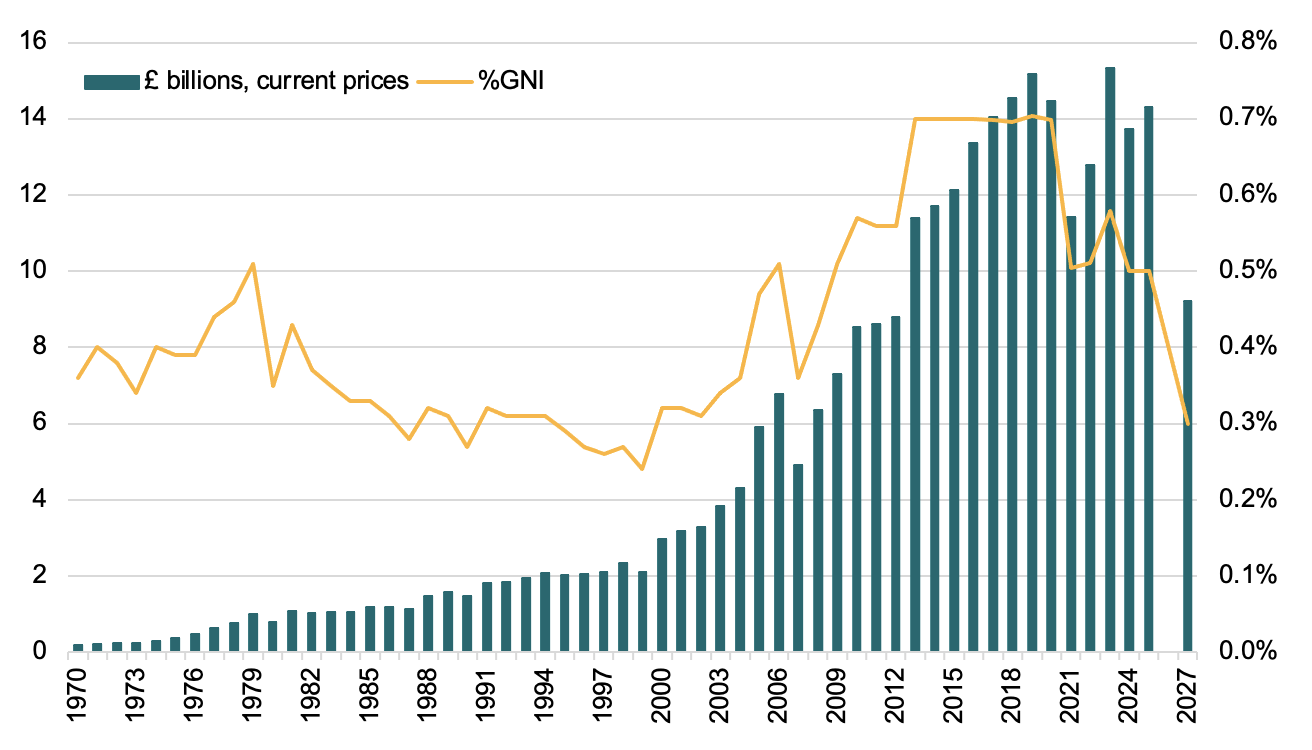
    Foreign aid dropped sharply after the merger, from 0.7% of Britain’s gross national income to 0.5% – a cut of about US$6 billion.

    Development professionals decried Johnson’s merger, arguing it could not have happened at a worse time, with the pandemic heightening the need for global health funding. And coming shortly after Brexit, Britain’s withdrawal from the European Union, DFID’s demise further called into question Britain’s commitment to global cooperation.

    Less money, less impact

    Five years later, it’s not clear that dismantling DFID has made British foreign aid more efficient or effective, as Johnson pledged.

    “We have seen evidence of where a more integrated approach has improved the organisation’s ability to respond to international crises and events, which has led to a better result,” reads one 2025 report by the U.K.’s National Audit Office.

    Two departments in one – but not twice the budget.
    Mike Kemp/In Pictures via Getty Images

    Yet, the auditors add, the British government has spent at least £24.7 million – US$32 million – to merge its aid and diplomacy offices, and it failed to track these costs. Nor did the leaders of the merger set out a clear vision for its new purpose.

    Britain’s slimmer new Foreign, Commonwealth and Development Office has also relinquished the U.K.’s past leadership in research and expertise, largely due to pay reductions and restrictions on hiring non-British nationals.

    From the outset, DFID had invested substantially in building expertise in global development, particularly in conflict-ridden states. In 2001, for example, it spent almost 5% of its budget – an unusually high amount – on research and policy analysis to design and assess its programs.

    DFID produced regular case studies of the projects it funded, which included getting Syrian refugee children back in school, building roads that help Rwandan farmers move their products to market, and providing health care after Pakistan’s 2010 floods.

    Given the “development expertise that was lost with the merger,” the U.K. government can no longer conduct “the kind of rigorous, long-term focus necessary to make a real impact,” said the Center for Global Development in a recent report.

    A 2022 study suggests that DFID’s dismantling was a fundamentally political move, “divorced from substantive analysis of policy or inter-institution relationships.”

    Britain’s new Prime Minister Keir Starmer, of the leftist Labour Party, initially promised to boost British foreign aid. But in early March 2025, he backtracked, announcing instead a further cut to foreign aid.

    By 2027, the U.K. government will spend just 0.3% of its budget on overseas aid. That’s roughly $11 billion less than before the merger in 2019.

    ‘Clear and easy target’

    USAID’s budget was much larger than DFID’s, and the administration apparently wants not to streamline U.S. foreign aid but halt it almost entirely. If this effort succeeds, it will have even more severe effects worldwide, at least in the immediate term.

    The global health programs administered by USAIDm which combat diseases such as HIV, tuberculosis and malaria, have received bipartisan and global praise. The PEPFAR program, which USAID helps administer, distributes antiretroviral drugs worldwide. It alone has saved 25 million lives over the past two decades, including the lives of 5.5 million babies born healthy to mothers with HIV.

    Development professionals tend to see independent government agencies such as USAID and DFID as better able to prioritize the needs of the poor because their programming is run separately from partisan policies.

    Yet standalone agencies are also more visible – and so more vulnerable to political targeting.

    DFID was a clear and easy target when Johnson began his pandemic-era budget-slashing. USAID is now suffering a similar fate.

    Sarah Stroup does not work for, consult, own shares in or receive funding from any company or organization that would benefit from this article, and has disclosed no relevant affiliations beyond their academic appointment.

    ref. US isn’t first country to dismantle its foreign aid office − here’s what happened after the UK killed its version of USAID – https://theconversation.com/us-isnt-first-country-to-dismantle-its-foreign-aid-office-heres-what-happened-after-the-uk-killed-its-version-of-usaid-250868

    MIL OSI – Global Reports

  • MIL-OSI Canada: Helping Canadian workers impacted by layoffs reskill and find work  

    Source: Government of Canada News

    March 19, 2025              (Gatineau, Quebec)              Employment and Social Development Canada

    Canada is home to a proud, adaptable and robust social safety net. The Government of Canada has worked with local and sectoral partners to implement measures that expand that net to support even more workers, keep more communities and towns resilient and bridge more impacted Canadians and their families to new opportunities.

    Today, we are adding to that body of work.

    The Minister of Jobs and Families, Steven MacKinnon, today announced an investment of almost $5 million for four community-based projects under the Canada Retraining and Opportunities Initiative.

    Three projects in British Columbia, and one in Yukon, will help bolster community resilience by complementing existing programs and services to help displaced workers transition into new jobs. These projects will support workers and communities affected by layoffs in the forestry and mining sectors.

    The Canada Retraining and Opportunities Initiative is a $50 million initiative for projects that bring together community-based organizations, providing new skills training opportunities for workers. It is part of the Government’s response to significant job losses impacting a community and provides funding to address exceptional situations.

    The Canada Retraining and Opportunities Initiative call for proposals is accepting applications. Interested organizations can apply by first submitting an expression of interest. Organizations that meet the criteria in the expression of interest will be invited to submit a full application. For more information, consult the Canada Retraining and Opportunities Initiative webpage.

    MIL OSI Canada News

  • MIL-OSI USA: 2024 Army Community Partnership Award winners announced

    Source: United States Army

    WASHINGTON – The Department of the Army has announced the seven winners of the 2024 Army Community Partnership Awards.

    “The installations honored this year highlight the excellent commitment to partnering with communities and strengthening those relationships that allow us to provide the best possible resources for Soldiers and their families,” said Lt. Gen. David Wilson, Deputy Chief of Staff, G-9.

    The Army Community Partnership Awards Program seeks to highlight examples of exceptional cooperation and diligence that will encourage continued collaboration to achieve the full potential of community partnerships. The awardees represent partnerships that have improved quality of life for Soldiers and their families, enhanced readiness, driven modernization and contributed to reform initiatives throughout the Army.

    “These partnerships exemplify the collaboration required to enhance our resilience, improve quality of life for our Soldiers and their families, and bolster our operational readiness to meet the needs of our Army today and tomorrow,” said Daniel M. Klippstein, senior official performing the duties of the Assistant Secretary of the Army for Installations, Energy and Environment.

    The Army selected seven winners and their neighboring communities that formed innovative partnerships that improve quality of life for Soldiers and families, enhance readiness, modernize services, provide efficiencies, expand capabilities and strengthen community relations.

    • Fort Leonard Wood and the cities of Saint Robert and Waynesville: Fort Leonard Wood’s new airfield lease project supports the construction of a new non-Army funded terminal critical to the long-term viability of commercial jet service to and from the installation. The new 25-year lease, new terminal, and past investments in planning, improvements, and repairs reiterates long-term commitments from the cities, the FAA and the state of Missouri to maintain accessibility to Fort Leonard Wood. The new terminal will modernize and increase the efficiency of all terminal operational and security services, systems and processes as compared to existing legacy facilities.
    • U.S. Army Garrison Hawaii, Pōhakuloa Training Area and the Hawaii County Fire & Emergency Services: The Mutual Aid Agreement between USAG-HI (PTA) and the Hawaii County Fire & Emergency Services seamlessly integrates resources and joint training exercises. This collaboration is a robust mutual support system enhancing the regional emergency response capabilities. Collaboration between PTA and Hawaii County Fire & Emergency Services maximizes shared resource utilization and operational efficiency.
    • Picatinny Arsenal and the Morris County Municipalities & Fire Districts: The MAA between Picatinny Arsenal and the Morris County Municipalities & Fire Districts provides 24-hour emergency dispatching service at no cost to the Army. The partnership enhances Picatinny’s emergency response capabilities and fills a gap in service availability. By partnering with Morris County, Picatinny Arsenal improved their firefighting capabilities through real-world responses and joint training exercises. The MAA enabled Picatinny to access 24/7 emergency response while also realizing significant cost savings.
    • Fort Carson and the Colorado Springs Utilities: The intergovernmental support agreement between Fort Carson and the Colorado Springs Utilities provides Fort Carson with superior operations and maintenance of electric and gas systems beyond pre-IGSA capabilities. Partnering with CSU enhances Fort Carson’s energy resilience by creating the capability to operate independently in the event of an off-post electrical grid failure. The IGSA created the on-post generation and microgrid capabilities necessary to operate during an off-post blackouts.
    • Fort Bliss and the El Paso Water Utilities Public Service Board: This IGSA between USAG-Fort Bliss and the El Paso Water Utilities Public Service Board provides engineering, technical, project design, consultant services, minor construction, repair, maintenance, geotechnical services, land surveying, soil borings, water quality testing, and water resource planning services associated with and incidental to stormwater management, water quality, water conservation, and those types of capital improvement projects.
    • U.S. Army Garrison Poland and the Republic of Poland: The Polish Provided Logistics Support provides in-kind logistical support to the U.S. Army. The PPLS provides infrastructure, logistical support and munitions storage to facilitate joint military exercises as part of the Enhanced Defense Cooperation Agreement. The availability of pre-positioned equipment and supplies improves the readiness of U.S. forces in the region, enabling a stronger alliance and faster response times.
    • U.S. Army War College and the Cumberland County Department of Public Safety: The MAA between U.S. Army War College and the Cumberland County Department of Public Safety expands operational and mission capabilities by sharing capacity, resources and capabilities. Cooperating with CCDPS has enhanced the War College’s emergency response capabilities. The partnership utilizes joint training and planning, shared emergency response resources, and shared expertise to enhance shared public safety and emergency response capabilities.

    Awardees included partnerships signed in fiscal years 2021-2024 by garrisons, reserve centers and armories. Submissions were evaluated using the following criteria:

    • Improves Soldier/family quality of life
    • Improves or enhances readiness
    • Modernizes a service, system or process
    • Provides cost or other efficiencies
    • Expands capability
    • Improves community relations

    The awards ceremony will be held in the Pentagon Hall of Heroes on April 10, 2025, from 10:00 to 11:00 AM.

    For additional information, please contact the Office of the Deputy Chief of Staff, G-9, usarmy.pentagon.hqda-dcs-g-9.list.sig@mail.mil.

    MIL OSI USA News

  • MIL-OSI Security: U.S. Marshals Fugitive Task Force Apprehends Austin Homicide Suspect Sought in December Shooting

    Source: US Marshals Service

    Austin, TX – Members of the U.S. Marshals-led Lone Star Fugitive Task Force March 13 arrested a man sought for murder that occurred Dec. 21, 2024, in Austin. 

    Juan Carlos Rodriguez-Gomez, 26, was a suspect wanted by the Austin Police Department for a homicide that occurred in the 2500 block of Huntwick Road, where a victim was reported to have been shot inside a vehicle in the parking lot.  

    Austin police arrived on scene and located the male victim, who had sustained life-threatening gunshot wounds, and was pronounced deceased, despite lifesaving attempts. 

    On Feb. 16, the Austin Police Department, Homicide Unit, obtained a warrant for Rodriguez-Gomez in the City of Austin Municipal Court and requested immediate assistance from the Lone Star Fugitive Task Force in the Austin Division. 

    On March 13, after members of the task force developed information that indicated Rodriguez-Gomez was residing in the 15200 block of Sparks Road in Manor, the suspect fled on foot into a wooded area and was arrested by a swarm of task force officers, with vital assistance provided by the Austin Police Department, Air Support Division. 

    Rodriguez-Gomez was transferred to the Austin Police Department and booked into the Travis County Jail where he will await further judicial proceedings. 

    According to Immigration and Customs Enforcement (ICE) Rodriguez-Gomez, a Mexican national, is an undocumented immigrant from Mexico with no legal status in the United States.

    Members of the Lone Star Fugitive Task Force in Austin – 

    Austin Police Department-Tactical Intelligence Unit
    Round Rock, and San Marcos Police Department
    Caldwell, Hays, Travis, and Williamson County Sheriff’s Office
    Texas Attorney General’s Office
    Texas Department of Criminal Justice OIG
    Texas Department of Public Safety
    U.S. Immigration & Customs Enforcement
    U.S. DHS/Homeland Security Investigations

    MIL Security OSI

  • MIL-OSI Security: Three Venezuelans Sentenced to Prison for Possessing Fake Green Cards

    Source: Office of United States Attorneys

    Defendants Arrested During the Laken Riley Murder Investigation in Athens, Georgia

    ATHENS, Ga. – A Venezuelan man who entered the United States illegally and who admitted to possessing a fraudulent Green Ccard during the murder investigation of a 22-year-old nursing student was sentenced to serve 48 months in prison—above the federal sentencing guidelines—and to be deported along with his brother and a former roommate.

    Diego Jose Ibarra, aka “Gocho,” 29, was sentenced to serve a total of 48 months in prison after he pleaded guilty to two counts of possession of a fraudulent document on July 15, 2024. Argenis Ibarra, aka “Meny,” 25, of Venezuela, was sentenced to time served after he pleaded guilty to one count of possession of a fraudulent document on Dec. 10, 2024. Rosbeli Flores-Bello, aka “La Gorda,” 29, of Venezuela, was sentenced to time served after she pleaded guilty to one count of possession of a fraudulent document on Dec. 11, 2024.

    All three defendants are to be delivered to U.S. Immigration and Customs Enforcement (ICE) for deportation. Diego Ibarra will be placed in ICE custody at the conclusion of his federal prison sentence; Argenis Ibarra and Flores-Bello will be placed in ICE custody immediately. U.S. District Judge Tilman E. Self, III handed down the sentences on March 19 in Athens. There is no parole in the federal system.

    According to court documents and statements referenced in court, Homeland Security Investigations (HSI) was made aware of Deigo Ibarra’s undocumented presence in the United States on Feb. 23, 2024, during the murder investigation of Laken Hope Riley, who was kidnapped and brutally murdered on Feb. 22, 2024, during a morning run at the University of Georgia, where she previously attended as an undergraduate prior to transferring to the Augusta University College of Nursing. At the time, an Athens-Clarke County Police Department (ACCPD) officer approached Diego Ibarra because he matched the description of the primary suspect in the murder investigation, which was his brother, Jose Antonio Ibarra. Diego Ibarra gave the ACCPD officer a counterfeit U.S. Permanent Resident Card (also called a Green Card) as identification and was taken into custody. Jose Ibarra was convicted of Laken Riley’s murder on Nov. 20, 2024, in Athens-Clarke County Superior Court and is serving a life sentence.

    On April 30, 2023, Diego Ibarra illegally entered the United States, along with four other Venezuelan men, by crossing the border near the Ysleta station in El Paso, Texas. The men fled when approached by the United States Border Patrol (USBP) agents. Diego Ibarra resisted an agent’s efforts to detain him and grabbed the agent’s service radio, threw it into a nearby yard, and then attempted to bite the agent. Agents scuffled with him and another Venezuelan man for several minutes before the National Guard arrived and assisted in subduing both men. Diego Ibarra was taken to a local hospital after complaining of chest pains and pain in his back and leg, which he indicated to FBI agents he sustained from scaling and falling from the border fence during his illegal crossing. He admitted to illegally crossing the border, resisting arrest and attempting to avoid apprehension at any cost. He said his injuries were not from the fight with agents.

    According to information uncovered during the investigation and provided in multiple court documents, Diego Ibarra is likely affiliated with the Venezuelan gang Tren de Aragua (TdA), based on evidence including his multiple TdA tattoos and photos of him on social media making the TdA gang signs and wearing TdA clothing. Further investigation concluded that Diego Ibarra was previously removed from the United States to Mexico on April 3, 2023, after agents apprehended him illegally entering the United States near Eagle Pass, Texas. After the above incident on April 30, 2023, Diego Ibarra claimed asylum and fear of return to Venezuela. On May 11, 2023, ICE Enforcement and Removal Operations (ERO) placed him in the Alternatives to Detention (ATD) program, and he was released from immigration custody the following day. The ATD program required Diego Ibarra to wear a global positioning system (GPS) ankle monitoring device, and he was directed to report to New York, New York, pending asylum proceedings. He failed to report in New York as directed.

    On May 25, 2023, Diego Ibarra’s ankle monitor last “pinged” near Littleton, Colorado, and he cut it off at some point prior to his final arrest in Athens, Georgia. Diego Ibarra settled in Athens and was subsequently arrested three times by law enforcement: on Sept. 24, 2023, he was arrested by ACCPD for driving under the influence of alcohol and driving without a license; on Oct. 27, 2023, he was arrested by ACCPD for theft by shoplifting; and on Dec. 8, 2023, he was arrested by ACCPD for shoplifting and for an outstanding arrest warrant that was issued when he failed to appear in court for his DUI charge. In addition, ACCPD responded to a domestic incident involving Diego Ibarra and his girlfriend on Sept. 26, 2023. And, while in the custody of the U.S. Marshals Service and housed in the Butts County Detention Center, Ibarra caused “severe water damage” inside the jail when he damaged the fire sprinkler system in a jail cell block. On June 25, 2024, jail officers found Ibarra in possession of two improvised weapons: a sharpened sprinkler head with a make-shift grip and a pen wrapped in saran wrap.

    Co-defendants Argenis Ibarra (Diego and Jose Ibarra’s younger brother) and Flores-Bello (Deigo and Jose Ibarra’s roommate) admitted to possessing a fraudulent U.S. Permanent Resident Card in the names of Argenis Jose Ibarra Ibarra and Rodrianny Brito Brito respectively on Feb. 23, 2024. In addition, agents found counterfeit Social Security cards for Argenis Ibarra and Flores-Bello in the apartment they shared with Diego and Jose Ibarra.

    Investigators determined that Argenis Ibarra entered the United States illegally on April 3, 2023, near Eagle Pass, Texas, and the USBP returned him to Mexico. On April 30, 2023, the USBP encountered and arrested him near El Paso, Texas, and transported him to an ICE processing center in El Paso. Because the processing center lacked space, Ibarra was released on his own recognizance on May 4, 2023. Argenis submitted Form I-765 for Employment Authorization on Oct. 20, 2023, and Nov. 2, 2023, both of which were rejected.

    Flores-Bello illegally entered the United States on May 3, 2023, and was arrested by the USBP. She was transported to an ICE processing center in El Paso. On May 5, 2023, Flores-Bello was released on her own recognizance because the processing center lacked space. She provided a residential address in New York and was scheduled for immigration court there on Oct. 18, 2023. In Dec. 2023, she and Jose Ibarra, whom she met in New York, took a humanitarian flight from New York to Atlanta, Georgia. She settled in Athens and lived with the Ibarra brothers until Laken Riley was murdered.

    This case is part of Operation Take Back America, a nationwide initiative that marshals the full resources of the Department of Justice to repel the invasion of illegal immigration, achieve the total elimination of cartels and transnational criminal organizations (TCOs) and protect our communities from the perpetrators of violent crime. Operation Take Back America streamlines efforts and resources from the Department’s Organized Crime Drug Enforcement Task Forces (OCDETFs) and Project Safe Neighborhood (PSN).

    The case was investigated by Homeland Security Investigations (HSI) with critical assistance from FBI, GBI, Athens-Clarke County Police Department, University of Georgia Police Department and Clarke County Sheriff’s Office.

    Assistant U.S. Attorney Mike Morrison prosecuted the case for the Government

    MIL Security OSI

  • MIL-OSI: SolMicroGrid Completes its Latest Microgrid Project with Chick-fil-A in California

    Source: GlobeNewswire (MIL-OSI)

    NEW YORK and OCEANSIDE, Calif., March 19, 2025 (GLOBE NEWSWIRE) — SolMicroGrid, a leading national microgrid company, announced the completion of a microgrid project at a Chick-fil-A® Quarry Creek in Oceanside, California.

    SolMicroGrid typically leverages a combination of solar, on-site battery energy storage, and generators to enable reliable and continuous power to its clients. The project at this Chick-fil-A restaurant includes an 81 kWh battery energy storage system and has a 112 kW solar array consisting of canopy and ground-mounted modules. The project’s components are all controlled by a sophisticated energy management system which optimizes the performance and maximizes the synergies between the technologies. Due to the location’s unique, sloped terrain, SolMicroGrid approached the ground-mount installation with a technique specifically designed for rocky slopes – utilizing ground screws instead of standard concrete-poured footings.

    Among other benefits, microgrid projects strategically deploy distributed energy resources to lower energy bills. The Oceanside project is expected to deliver about one-third of the restaurant’s annual energy needs at a 10% discount to grid power.

    “The combination of solar and battery storage that we provided Chick-fil-A will help reduce energy costs while also achieving sustainability goals,” said Kirk Edelman, CEO of SolMicroGrid. “We’re grateful for the opportunity to provide Chick-fil-A with renewable energy at a discount.”

    SolMicroGrid and Chick-fil-A’s latest achievement comes after successful microgrid deployments at local owner-operated locations at Chick-fil-A Mendocino Avenue in Santa Rosa, CA and Chick-fil-A March Lane at I-5 in Stockton, CA.

    “Chick-fil-A’s investment in piloting solar-powered microgrids, in partnership with SolMicroGrid, demonstrates our commitment to environmental stewardship,” said Peden Young, a principal program lead on the sustainability team at Chick-fil-A, Inc. “Harnessing renewable energy onsite at our restaurants reduces our environmental footprint, while also reflecting Chick-fil-A’s dedication to pursuing what’s next and caring for our planet.”

    SolMicroGrid requires no upfront costs and provides quick-service restaurants, large franchises, grocery stores, and other building operators with customizable microgrid components that reduce energy costs and improve efficiency.

    About SolMicroGrid
    SolMicroGrid is a differentiated developer and operator of solar-enabled microgrid systems, offering energy resiliency and efficiency to commercial and industrial customers. The company’s service solution reduces operating expenses without the need for customer capital investment. SolMicroGrid is a portfolio company of Morgan Stanley Energy Partners.

    Media Contact
    SMG@fischtankpr.com
    FischTank PR

    About Chick-fil-A, Inc.
    Chick-fil-A, Inc. is the third largest quick-service restaurant company in the United States, known for its freshly prepared food, signature hospitality and unique franchise model. More than 200,000 Team Members are employed by local Owner-Operators in more than 3,000 restaurants across the United States, Canada and Puerto Rico.

    Chick-fil-A opened its first restaurant in the UK in early 2025 with the goal of launching five locations across the UK within the next two years. The first Singapore restaurant is set to open in late 2025, marking the brand’s entry into Asia.

    Chick-fil-A local Owner-Operators live and work in the communities their restaurants serve, each supporting local efforts to address hunger, education, and making a positive impact. The family-owned and privately held company was founded in 1967 by S. Truett Cathy. More information on Chick-fil-A is available at  www.chick-fil-a.com  and @ChickfilANews

    Photos accompanying this announcement are available at:

    https://www.globenewswire.com/NewsRoom/AttachmentNg/cc681a01-c073-46e5-8aa9-e87d8a02e206
    https://www.globenewswire.com/NewsRoom/AttachmentNg/df7428b3-163b-406f-a928-9a04034d8421
    https://www.globenewswire.com/NewsRoom/AttachmentNg/0569f111-cf92-4735-8a7b-29b4050268bd

    The MIL Network

  • MIL-OSI: The Clearing House SVP of Product Strategy Ben Isaacson Named Co-Chair of Financial Data Exchange (FDX) Board 

    Source: GlobeNewswire (MIL-OSI)

    SALT LAKE CITY, March 19, 2025 (GLOBE NEWSWIRE) — Financial Data Exchange (FDX), a CFPB-recognized standard-setting body for Open Banking in the U.S., recently announced that Ben Isaacson, Senior Vice President of Product Strategy at The Clearing House, has been appointed as FDX Board Co-Chair. Isaacson has been a member of the FDX Board since 2019 and brings extensive expertise in financial data standards, payments innovation, and industry collaboration.

    “We are very grateful to have Ben stepping into this role at such a pivotal time for the industry,” shared Kevin Feltes, CEO of FDX. “His leadership and long-standing commitment to advancing industry standards will be invaluable as we continue driving forward on key initiatives in financial data sharing.”

    As SVP of Product Strategy at The Clearing House, Isaacson has worked closely with financial institutions, regulators, and industry stakeholders to modernize financial data standards. His leadership in driving innovation aligns with FDX’s mission to create a unified, interoperable, and more secure open banking ecosystem.

    “I’m honored to step into the role of FDX Co-Chair and continue working alongside Jane Barratt and the broader FDX community,” said Ben Isaacson. “FDX has made incredible progress in standardizing more secure data sharing, and I look forward to contributing to its ongoing success.”

    About FDX
    Financial Data Exchange (FDX) is a non-profit organization operating in the US and Canada that is dedicated to unifying the financial industry around a common, interoperable, royalty-free standard for secure and convenient consumer and business access to their financial data. FDX empowers users through its commitment to the development, growth, and industry-wide adoption of the FDX API, according to the principles of control, access, transparency, traceability, and security. Membership is open to financial institutions, fintech companies, financial data aggregators, consumer advocacy groups, payment networks and other industry stakeholders. For more information and to join, visit www.financialdataexchange.org.

    Contact info:
    Porche Matthews
    Marketing Manager
    pmatthews@financialdataexchange.org

    The MIL Network

  • MIL-OSI USA: Senators Coons, colleagues introduce bipartisan bill to strengthen medical supply chains

    US Senate News:

    Source: United States Senator for Delaware Christopher Coons
    WASHINGTON – U.S. Senators Chris Coons (D-Del.), Thom Tillis (R-N.C.), John Cornyn (R-Texas), and Michael Bennet (D-Colo.) introduced the Medical Supply Chain Resiliency Act, bipartisan legislation to jump start trade negotiations to ensure that hospitals, doctors, and patients have access to critical medical goods. U.S. Representatives Brad Schneider (D-Ill.) and Nicole Malliotakis (R-N.Y.) introduced companion legislation in the House. 
    “Life-threatening shortages of testing kits, drugs, and masks during the COVID-19 pandemic showed us just how fragile our medical supply chains are. If we are caught off-guard like we were during COVID once again, more Americans will die,” said Senator Coons. “Working with our most trusted trading partners to make our supply chains more resilient will strengthen our response to future public health emergencies while ensuring that health care providers have access to essential medical products and patients have access to life-saving care.”
    “The Medical Supply Chain Resiliency Act is a critical step toward ensuring that America’s healthcare providers have reliable access to the essential supplies they need,” said Senator Tillis. “By strengthening trade partnerships with our allies and expanding domestic manufacturing, we can enhance our nation’s preparedness for future health challenges. I’m proud to support this bipartisan effort to reinforce our medical supply chains and protect public health.” 
    “America’s medical supply chains rely heavily on China, posing risks to U.S. national security and public health,” said Senator Bennet. “Our bipartisan bill will address this vulnerability by authorizing the president to deepen relationships with our trading partners.”
    “During the pandemic, the U.S. faced severe shortages of medical supplies due to overreliance on foreign adversaries like China,” said Senator Cornyn. “This legislation would allow the U.S. to engage in trade negotiations with trusted allies for medical goods and services, helping ensure we’re better prepared to respond to future global health crises.”
    “The Medical Supply Chain Resiliency Act is the type of positive approach to trade America must embrace to deepen its economic partnerships with key allies,” said Brad Wood, Senior Director for Trade and Innovation Policy, National Foreign Trade Council.“By empowering the United States Trade Representative to negotiate new agreements with trusted trade partners, the United States has the opportunity to strengthen supply chain security, support U.S. innovation and jobs, and, ultimately, improve health outcomes. It is critically important that the United States collaborate with its allies to support the public health demands of our populations and prepare to meet the challenges of the next global health emergency. NFTC applauds Senators Tillis, Coons, Cornyn, and Bennet for championing this legislation, and urges Congress to support its swift passage.”
    “Premier commends Senators Thom Tillis, Chris Coons, John Cornyn and Michael Bennet and Representatives Brad Schneider and Nicole Malliotakis for their bipartisan leadership in reinforcing the resilience of our nation’s healthcare supply chain,” said Soumi Saha, Senior Vice President of Government Affairs, Premier Inc. “Building a stronger, more sustainable, and secure supply chain demands a balanced approach – expanding domestic manufacturing while fostering strategic trade partnerships. The Medical Supply Chain Resiliency Act is a critical step toward this goal by enabling the designation of trusted trade partners to diversify sourcing for medical devices and pharmaceuticals. Ensuring providers have reliable access to the essential supplies needed to deliver quality patient care is a paramount priority for our nation.”
    “The Chamber strongly supports the Medical Supply Chain Resilience Act, which will strengthen supply chains for medical goods and services while bolstering manufacturing in the U.S. and among our close allies and partners,” said John Murphy, Senior Vice President for International Policy, U.S. Chamber of Commerce. “Enhancing the resilience of medical supply chains is important to both our public health and our national security. The bill would direct the U.S. Trade Representative to negotiate trade agreements with trusted allies to eliminate tariffs and other trade barriers that weaken the U.S. medical goods manufacturing base and that of our allies. These agreements would also support intellectual property protection, regulatory cooperation, and collaboration on public and private R&D efforts. Only close allies and partners would qualify for such agreements. Close consultation with the legislative branch would be essential, and Congress would retain a right to disapprove any agreements. This is practical legislation that, if enacted, will apply lessons learned in the COVID-19 pandemic to strengthen America’s health preparedness. The Chamber urges Congress to pass it into law.”
    “Authorizing the administration to negotiate meaningful trade agreements with trusted partners, including the European Union, Japan, Switzerland, and the United Kingdom, would reduce trade barriers and strengthen medical supply chains. The biopharmaceutical industry, whose exports exceeded $101 billion in 2023, welcomes the Medical Supply Chain Resiliency Act and encourages the administration to embrace this pathway to expand trade with allies,” said PhRMA. 
    The COVID-19 pandemic presented significant challenges for supply chains around the world, disproportionately hampering health care providers’ access to medical devices, treatments, and equipment at a time when these products were desperately needed. By expanding U.S. engagement with our allies across the globe, this legislation would combat shortages of medical products and supplies by strengthening supply chain resiliency and safeguarding against future health crises. 
    You can read the full text of the bill here.

    MIL OSI USA News

  • MIL-OSI Canada: A new sports centre for Montréal-Nord

    Source: Government of Canada News

    Montréal, Quebec, March 19, 2025 — A further step has been taken towards a new modern aquatic sports complex that will be built in Montréal-Nord on the site of the former Garon arena, thanks to contributions of $88 million from the City of Montreal and $15 million from the federal government.

    This announcement was made by Emmanuel Dubourg, Member of Parliament for Bourassa, Caroline Bourgeois, Mayor of Rivière-des-Prairies–Pointe-aux-Trembles, responsible for Sports and Recreation and for East Montreal on the Executive Committee of the City of Montreal and Christine Black, Borough mayor of Montréal-Nord.

    Sports Component

    This funding will allow for the construction of the sports section, which will include a double gymnasium, a gymnastics hall, a three-lane walking track, locker rooms, bleachers, and administrative offices for organizations. Adapted to the current and future needs of the community, this modern facility will offer enhanced and diversified recreational and sports programs for citizens of all age groups in the borough of Montréal-Nord. The centre aims to improve access to sports facilities for all, promote the adoption of healthy lifestyles, and strengthen the local social fabric.

    The design of the new building follows a rigorous sustainable development approach. The goal is to achieve a LEED Gold v4 certification, ensuring optimal energy efficiency, responsible resource use, and a reduced environmental footprint. Furthermore, the project will integrate the new building standards provided in the BCZ-Design v4 standard, meeting the latest standards for ecological performance and climate resilience. This new sports centre embodies Montréal-Nord’s commitment to sustainability, inclusivity, and the well-being of its entire community, while actively contributing to improving the quality of life for its citizens.

    Aquatic Component

    Before the confirmation of financial contributions from other levels of government, the City of Montreal had already planned investments estimated at $88M in this project for the construction of the pool. With the desire to move forward quickly, the aquatic component of the sports complex has already been in planning for two years. Once the project’s financial structure is completed and the construction work is finished, the sports and aquatic facilities will be connected.

    MIL OSI Canada News

  • MIL-OSI USA: Sens. Johnson, Grassley Continue to Fight for Unredacted Crossfire Hurricane Interview Transcripts

    US Senate News:

    Source: United States Senator for Wisconsin Ron Johnson

    WASHINGTON – On Monday, Permanent Subcommittee on Investigations Chairman Ron Johnson (R-Wis.) and Judiciary Committee Chairman Chuck Grassley (R-Iowa) sent a letter to Attorney General Pamela Bondi and Federal Bureau of Investigation (FBI) Director Kash Patel requesting their offices take immediate action to remove all redactions from interview transcripts relating to the Department of Justice Office of Inspector General’s (DOJ OIG) examination of the FBI’s Crossfire Hurricane investigation.

    In April 2023, the senators requested these unredacted transcripts from the DOJ OIG. However, the DOJ OIG informed the senators that the redactions in those transcripts were made by other government agencies, such as the FBI and DOJ, and the DOJ OIG lacked the authority to release the information.

    The senators’ recent letter calls on DOJ and FBI to work with the DOJ OIG to produce these unredacted versions of the transcripts as soon as possible.

    Read more about the letter in Daily Mail.

    The full text of the letter can be found here.

    MIL OSI USA News

  • MIL-OSI USA: Wisconsinites’ Years of Work Fighting Fentanyl

    US Senate News:

    Source: United States Senator for Wisconsin Ron Johnson

    The Halt All Lethal Trafficking of Fentanyl (HALT) Act passed the Senate last week with an overwhelmingly bipartisan vote of 84-16. 

    The HALT Fentanyl Act incorporates the permanent scheduling of fentanyl-related substances, which I first introduced in 2017 in the Stopping Overdoses of Fentanyl Analogues Act (SOFA). It ensures law enforcement has the tools they need to stop fentanyl’s flow into our country. 

    SOFA served as the template for the Trump administration’s temporary scheduling rule in 2018, and it recognizes the admirable devotion of Wisconsinites Dr. Tim Westlake and Lauri Badura (pictured above). Ms. Badura, who founded Saving Others for Archie, made it her life’s mission to end the fentanyl crisis after tragically losing her son, Archie, to fentanyl poisoning. 

    WATCH: Video message from families (including Baduras) to pass the HALT Act

    WATCH: 2017 video with Lauri telling Archie’s story

    As a member of the U.S. Senate Committee on Finance, I met with President Trump last week and we discussed my plan to get spending back to pre-pandemic levels – saving a minimum of $700 billion.

    There is so much room for reducing the size of the federal government and balancing the budget is entirely doable. I look forward to working with the White House and getting spending under control.

    Thank you to Kevin O’Leary for highlighting my chart on Fox Business. This is an eminently reasonable approach to returning to a pre-pandemic level of spending. 

    WATCH: Sen. Johnson on Fox Business discusses his White House meeting 

    WATCH: Sen. Johnson on the Jesse Kelly podcast reviews his plan to balance budget

    • LISTEN: I joined the MAHA Alliance podcast for a powerful discussion on the MAHA movement, RFK Jr., and government corruption.
    • I was highly disappointed to hear that the nomination of Dr. David Weldon to lead the CDC has been withdrawn. Although we will never know exactly why his nomination was pulled, I suspect it had something to do with the fact he has had the courage to be skeptical of the consensus “narrative” surrounding the childhood vaccine schedule. Skepticism is the vital attribute of true science, and it is beyond unfortunate that someone with his background and integrity will not be able to help fix what is broken at the CDC. (I discussed this on Off the Record podcast with Emily Jashinsky.)
    • My X post on the news that Steak n’ Shake will soon be using Wisconsin butter instead of a “buttery blend”. 

    I helped introduce a bipartisan, bicameral bill to expand federal funding for bike and pedestrian safety. The bill is named for American diplomat and Wisconsin native Sarah Debbink Langenkamp, who was killed in 2022 while riding her bicycle in Bethesda. 

    The Sarah Debbink Langenkamp Active Safety Transportation Act will expand federal funding opportunities for local governments to improve roadway safety for bicyclists and pedestrians.  

    While honoring Sarah, this bill will protect Wisconsinites by investing in infrastructure to enhance road safety for pedestrians and cyclists. By using taxpayer dollars effectively, it will help prevent further deaths from preventable traffic accidents and ensure Americans feel safe when using our roads.

    Thank you to everyone who participated in my 114th telephone town hall last week. 

    We are now streaming our town halls on X, so you can listen to it here.
     
    Questions asked include:

    11:45    Introduction
    13:45    Protecting personal information from DOGE 
    16:27    Will there be cuts to Social Security and Medicare?
    18:40    Justice System transparency 
    20:20    Wasteful spending examples
    24:00    Is Social Security a legal Ponzi scheme?
    29:00    ICE and deportations
    31:31    Federal worker layoffs 
    35:04    How do we make the spending cuts permanent?
    40:55    Inspector Generals and oversight
    43:30    Support for Veterans and the VA
    46:08    COVID-19 vaccine requirements for citizenship
    48:04    Wisconsin manufacturing and tariffs
    51:35    Controlling crime and fentanyl 
    54:35    Taxing pensions
    56:45    Bipartisanship
    1:00:25 Federal voter ID and proof of citizenship 
    1:02:36 Balancing the budget

     
    To join future telephone town halls live, sign up here. There is also a link on that page to submit written questions during the live town halls.
     

    MIL OSI USA News

  • MIL-OSI USA: SBA Sets Dates for Free National Small Business Week Virtual Summit

    Source: United States Small Business Administration

    WASHINGTON — Today, the U.S. Small Business Administration and SCORE, mentors to America’s small businesses and an SBA resource partner, set the dates for the 2025 National Small Business Week virtual summit. The free two-day online event will take place May 6 and 7 from 10 a.m. to 6 p.m. ET and registration is required.

    The virtual summit will feature educational workshops presented by cosponsors, access to federal resources, and networking and mentorship opportunities. Participants will be able to learn about a wide range of topics including manufacturing, digital marketing, cybersecurity and AI, cryptocurrency and online business resources. A detailed agenda and list of speakers for the virtual summit will be published soon.

    “Fostering small business growth is at the heart of what we do, and the National Small Business Week virtual summit embodies that commitment,” SCORE CEO Bridget Weston said. “SCORE is proud to once again co-host this event with the SBA. We’re looking forward to this opportunity to empower entrepreneurs with the timely, useful resources and information they need to launch and grow their businesses.”

    The National Small Business Week virtual summit is part of SBA’s year-round efforts to leverage technology to reach small business owners in communities across America. An in-person, national award celebration will take place on May 5 in Washington, D.C., and local winners will be recognized at award events across the nation.

    Details on National Small Business Week, the virtual summit and registration are featured on National Small Business Week and will be updated as additional information and activities are confirmed. Local events will be featured on Find upcoming events and identifiable by searching with #SmallBusinessWeek.  

    ###

    About SCORE 

    SCORE, the nation’s largest network of volunteer, expert business mentors, is dedicated to helping small businesses get off the ground, grow and achieve their goals. Since 1964, SCORE has provided education and mentorship to more than 11 million entrepreneurs. SCORE is a 501(c)(3) nonprofit organization and a resource partner of the U.S. Small Business Administration.

    About the U.S. Small Business Administration

    The U.S. Small Business Administration helps power the American dream of entrepreneurship. As the leading voice for small businesses within the federal government, the SBA empowers job creators with the resources and support they need to start, grow, and expand their businesses or recover from a declared disaster. It delivers services through an extensive network of SBA field offices and partnerships with public and private organizations. To learn more, visit www.sba.gov.

    Cosponsorship Authorization #24-44-C. SBA’s participation in this Cosponsored Activity is not an endorsement of the views, opinions, products or services of any Cosponsor or other person or entity. All SBA programs and services are extended to the public on a nondiscriminatory basis.

    MIL OSI USA News

  • MIL-OSI Canada: Government of Canada announces appointment to the Windsor-Detroit Bridge Authority Board of Directors

    Source: Government of Canada News

    Biography

    Marie Campagna – Chair, Board of Directors

    Marie Campagna has been a member of the WDBA Board of Directors since 2017 and has most recently served in the role of interim Chair since May 2024.

    Since retiring from her role as Chief Financial Officer (CFO) of Hotel Dieu Grace Healthcare, Ms. Campagna was appointed as an Executive in Residence at the University of Windsor’s Odette School of Business. She is a facilitator in the Chartered Professional Accountants of Ontario’s CFO of the Future program.

    Ms. Campagna holds several governance positions that include Board Chair of Essex Energy Corporation, Member of the LaSalle Police Board, Member of Assumption University, Member of Invest Windsor Essex, Past Chair of Transform Shared Services Organization, and a past Board Member of the Windsor-Essex Regional Chamber of Commerce. She also previously held many board and committee positions with Essex Power Corporation, CMA Ontario, and CMA Canada.

    Ms. Campagna holds an ICD.D designation from the Institute of Corporate Directors, a CPA designation, and is a Fellow and life member of the Chartered Professional Accountants of Ontario. She holds a Bachelor of Commerce degree and an MBA from the University of Windsor.  

    MIL OSI Canada News

  • MIL-OSI USA: Baldwin Raises Concerns About How NOAA Firings Will Impact Great Lakes

    US Senate News:

    Source: United States Senator for Wisconsin Tammy Baldwin

    WASHINGTON, D.C. – U.S. Senator Tammy Baldwin (D-WI) and a group of her colleagues are pressing the National Oceanic and Atmospheric Administration (NOAA) for more information about the termination of staff and the potential impact these firings will have on the health and commerce on the Great Lakes, including the countless Wisconsin communities who rely on Lake Michigan and Superior for fresh drinking water and to support their local economies.

    “We write to express our deep concern over the firing of probationary staff at the National Oceanic and Atmospheric Administration (NOAA) and the potential impact these firings will have on the Great Lakes,” wrote the Senators in a letter to NOAA’s Vice Admiral Nancy Hann.

    “The Great Lakes are among the United States’ greatest natural treasures, strengthening our economy and attracting millions of visitors each year. The Lakes provide drinking water to over 30 million people, generate clean hydropower, and generate $3.1 trillion in gross domestic product,” the Senators continued. “National and regional NOAA programs help protect these lakes and support our constituents who call the Great Lakes home.

    The Senators pressed Admiral Hann to detail (1) the number of people fired at NOAA during her tenure as Acting Administrator, (2) the number of people fired at each NOAA program serving the Great Lakes, (3) the services that will be terminated as a result, and (4) her plan to preserve these services.

    In addition to Senator Baldwin, the letter was led by Senator Amy Klobuchar (D-MN) and co-signed by Senators Chuck Schumer (D-NY), Dick Durbin (D-IL), Elissa Slotkin (D-MI), Tina Smith (D-MN), Kirsten Gillibrand (D-NY), and Gary Peters (D-MI).

    A full version of this letter is available here and below.

    Dear Vice Admiral Nancy Hann:

    We write to express our deep concern over the firing of probationary staff at the National Oceanic and Atmospheric Administration (NOAA) and the potential impact these firings will have on the Great Lakes. We request information on these firings—including at the Great Lakes Environmental Research Laboratory (GLERL) and any other NOAA installations and programs that serve the Great Lakes area—as well as a concrete plan for re-establishing terminated public services.

    The Great Lakes are among the United States’ greatest natural treasures, strengthening our economy and attracting millions of visitors each year. The Lakes provide drinking water to over 30 million people, generate clean hydropower, and generate $3.1 trillion in gross domestic product.

    National and regional NOAA programs help protect these lakes and support our constituents who call the Great Lakes home. The National Weather Service provides our weather and climate forecasts and warnings. The National Sea Grant Program helps conserve our aquatic resources. The Marine Debris Program prevents microplastics and litter from entering the Great Lakes, protecting our wildlife, natural resources, fishing and boating economy, and nearby residents’ health. The Cooperative Institute for Great Lakes Research invests in our clean drinking water. And the Great Lakes Environmental Research Laboratory (GLERL) provides critical information for resource use and management decisions, including information on algal blooms and hypoxia, invasive species, ice cover and shipping navigability, and storm surges and coastal flooding.

    We are deeply concerned that the layoffs at NOAA will harm these critical initiatives. The staffing reductions have already required the GLERL, for example, to take an “indefinite hiatus” from its public communications, depriving the public of critical information such as what to do during a flood warning and how to stay safe in the extreme cold. When these communications go dark, the public suffers.

    Therefore, we request the following information by March 28, 2025:

    1. The number of people fired at NOAA during your tenure as Acting Administrator.
    2. The number of people fired at each NOAA program that serves the Great Lakes:
      1. National Weather Service
      2. National Estuarine Research Reserve System
      3. NOAA National Marine Sanctuaries
      4. National Sea Grant Program
      5. NOAA Marine Debris Program
      6. Integrated Ocean Observing System (IOOS)
      7. Great Lakes Bay Watershed Education and Training (B-WET)
      8. Great Lakes Environmental Research Laboratory
      9. Great Lakes Information Network (GLIN)
      10. Cooperative Institute for Great Lakes Research (CIGLR)
      11. Cooperative Institute for Meteorological Satellite Studies (CIMSS)
      12. Midwestern Regional Climate Center (MRCC)
    3. The services that will be terminated as a result of the firings at each of the above programs.
    4. Your plan to maintain or restore these services.

    Thank you for your attention to this important matter.

    MIL OSI USA News

  • MIL-OSI Canada: Funding municipal priorities

    It’s no secret – Alberta’s population is growing rapidly, and there are more people relying on municipal infrastructure such as recreation centres, roads and other public spaces than ever before. Being able to meet the needs of the province’s rapidly growing population is a top priority for Alberta’s government, and this work begins with ensuring municipalities are well-positioned to support their residents.

    To strengthen municipalities’ ability to meet the needs of Alberta’s rapidly growing population, Budget 2025, if passed, increases capital funding through the Local Government Fiscal Framework (LGFF) by more than 13 per cent. This increase will provide municipalities with a predictable and reliable source of funding to help build, maintain and modernize the public infrastructure their residents depend on.

    “Alberta’s municipalities are vital to our province’s identity and success so we’re supporting their growth and prosperity. This year’s allocation of LGFF funds was predictable and will ensure municipalities can plan and execute their local priority infrastructure needs. This will put our municipal partners in the best position to advance the public infrastructure that their residents require.”

    Ric McIver, Minister of Municipal Affairs

    Alberta’s government introduced LGFF to provide a more predictable, legislated municipal infrastructure funding model that is tied to provincial revenues, as municipalities had requested. This means when provincial revenues increase, municipal funding will also increase three years later. This change ensures that municipalities can predict how much funding they will receive through LGFF a year and a half in advance so they can plan their capital expenditures with certainty.

    “We are pleased to see LGFF funding increase by $98 million in fiscal year 2025-26, in accordance with the agreed-upon formula. Our 264 member communities appreciate every dollar they receive from the provincial government for municipal infrastructure projects, especially as Alberta’s population continues to grow by leaps and bounds. We look forward to continuing our discussions with the Government of Alberta about how best to grow municipal infrastructure investments to meet the needs of our growing communities.”

    Tyler Gandam, president, Alberta Municipalities

    In 2025, LGFF capital funding is increasing from $722 million to $820 million, providing municipalities across the province with more resources to advance their local priorities. In 2026, LGFF funding will decrease about 2.5 per cent to $800 million, and is projected to then increase again in 2027 to about $871 million.

    “The Local Government Fiscal Framework is an important resource for mid-sized cities across the province in our capital planning, and we appreciate the Government of Alberta’s increase in LGFF in Budget 2025. Mid-sized cities look forward to continuing to work collaboratively with the government to address critical infrastructure needs in our growing communities.”

    Mayor Jeff Genung, chair, Mid-sized Cities Mayors Caucus, and mayor, Town of Cochrane

    Budget 2025 is meeting the challenge faced by Alberta with continued investments in education and health, lower taxes for families and a focus on the economy.

    Quick facts

    • The Local Government Fiscal Framework Act was passed in the Alberta legislature in December 2019.
    • The LGFF provides funding for local infrastructure priorities in cities, towns, villages, summer villages, municipal districts and counties, and Metis Settlements across Alberta.

    Related news

    MIL OSI Canada News

  • MIL-OSI Canada: Canada Announces Support for British Columbia’s Forest Sector

    Source: Government of Canada News

    March 19, 2025          Richmond, British Columbia             Natural Resources Canada

    Canada’s forest sector is an important contributor to our national economy. Since 2017, Canada’s softwood lumber exports have been subject to unfair and unwarranted U.S. duties, and they now face the threat of additional unjustified trade barriers. It is now more important than ever to support Canadian businesses so that they can innovate, diversify and expand their markets to continue to support thousands of jobs in hundreds of communities across the country.

    Today, the Honourable Jonathan Wilkinson, Minister of Energy and Natural Resources, announced a total investment of over $20 million for 67 projects that will help to boost the competitiveness and resiliency of British Columbia’s forest sector while growing wood product exports.

    The investments announced today include:

    • over $11.3 million in funding through the Investments in Forest Industry Transformation (IFIT) program for six projects that will facilitate the adoption and commercialization of new technologies, focusing on the production of innovative, low-carbon products that result in new or diversified revenue streams
    • over $7 million in funding through the Indigenous Forestry Initiative (IFI) program, for 50 projects that will advance economic development opportunities in the forest sector for Indigenous communities while strengthening Indigenous leadership and participation in forest stewardship
    • over $1.6 million in funding under the Green Construction through Wood (GCWood) program for nine projects that will promote the adoption and commercialization of wood-based products in the construction sector
    • over $600,000 in Global Forest Leadership program funding for two projects that will strengthen international partnerships with like-minded organizations by sharing Canadian expertise and decreasing market barriers for sustainable forest products

    The Government of Canada will always stand up for Canadians and Canadian industry, and that very much includes the forest sector. The investments announced today will support leadership, innovation and sustainable practices in the forest sector while creating significant economic and environmental benefits for British Columbians and Canadians

    MIL OSI Canada News

  • MIL-OSI Canada: The Government of Canada recognizes the national historic significance of the Hôpital-Général de Québec Monastery

    Source: Government of Canada News

    The oldest convent in the country, it is of vital importance to Canada’s medical, religious and social history.

    March 19, 2025                         City of Québec, Quebec                 Parks Canada

    Today, the Honourable Steven Guilbeault, Minister of Canadian Culture and Identity, Parks Canada, and the Honourable Jean-Yves Duclos, Member of Parliament for Québec, announced the designation of the Hôpital-Général de Québec Monastery as a national historic site under Parks Canada’s National Program of Historical Commemoration. 

    The Hôpital-Général de Québec monastery, located at the intersection of the Saint-Roch and Saint-Sauveur neighbourhoods in the city of Québec, is a large convent complex dating back to the 17th century built on the former property of the Récollets. In 1692, Bishop Jean-Baptiste de La Croix de Chevrières de Saint-Vallier (1653–1727) acquired the Récollets’ monastery and founded a general hospital, open to the poor, the sick, the infirm, and the aged. In 1693, he entrusted the management of this hospital to the Augustines de la Miséricorde de Jésus, a community of cloistered nursing sisters who were already responsible for the Hôtel-Dieu de Québec.

    This convent complex was occupied continuously by the Augustinian Sisters since 1693 and is an excellent example of their hospital work. Inspired by European tradition, the Augustinian monastery buildings are a remarkable illustration of the evolution of architecture and building techniques in Canada since the second half of the 17th century. Having been spared the bombardments of the Siege of Québec of 1759 and having never experienced a major fire, the buildings are still in their original condition. The ensemble of buildings is in a remarkable state of conservation, constituting a site of architectural and artistic heritage preservation of outstanding importance.

    The Government of Canada, through the Historic Sites and Monuments Board of Canada and Parks Canada, recognizes significant persons, places, and events that have shaped our country as one way of helping Canadians connect with their past. By sharing these stories, we hope to foster understanding and reflection on the diverse histories, cultures, legacies, and realities of Canada’s past and present. 

                                                                                                      -30-

    MIL OSI Canada News