Category: Americas

  • MIL-OSI USA: Students Dive Into Robotics at Competition Supported by NASA JPL

    Source: NASA

    Robots built by high schoolers vied for points in a fast-moving game inspired by complex ocean ecosystems at the FIRST Robotics Los Angeles regional competition.
    High school students who spent weeks designing, assembling, and testing 125-pound rolling robots put their fast-moving creations into the ring over the weekend, facing off at the annual Los Angeles regional FIRST Robotics Competition, an event supported by NASA’s Jet Propulsion Laboratory in Southern California.
    Four of the 43 participating teams earned a chance to compete in April at the FIRST international championship tournament in Houston, which draws winning teams from across the country.
    Held March 14 to 16 at the Da Vinci Schools campus in El Segundo, the event is one of many supported by the nonprofit FIRST (For Inspiration and Recognition of Science and Technology), which pairs students with STEM professionals. Teams receive the game rules, which change every year, in January and sprint toward competition, assembling their robot based on FIRST’s specifications. The global competition not only gives students engineering experience but also helps them develop business skills with a range of activities, from fundraising for their team to marketing.
    For this year’s game, called “Reefscape,” two alliances of three teams competed for points during each 2½-minute match. That meant six robots at a time sped across the floor, knocking into each other and angling to seed “coral” (pieces of PVC pipe) on “reefs” and harvesting “algae” (rubber balls). In the final seconds of each round, teams could earn extra points if their robots were able to hoist themselves into the air and dangle from hanging cages, as though they were ascending to the ocean surface.
    The action was set to a bouncy soundtrack that reverberated through the gym, while in the bleachers there were choreographed dancing, loud cheers, pom-poms, and even some tears.
    The winning alliance was composed of Warbots from Downey’s Warren High School, TorBots from Torrance’s South High School, and West Torrance Robotics from Torrance’s West High School. The Robo-Nerds of Benjamin Franklin High in Los Angeles’ Highland Park and Robo’Lyon from Notre Dame de Bellegarde outside Lyon, France, won awards that mean they’ll also get to compete in Houston, alongside the Warbots and the TorBots.
    NASA and its Robotics Alliance Project provide grants for high school teams across the country and support FIRST Robotics competitions to encourage students to pursue STEM careers in aerospace. For the L.A. regional competition, JPL has coordinated volunteers — and provided coaching and mentoring to teams, judges, and other competition support — for 25 years.
    For more information about the FIRST Los Angeles regional, visit:

    Los Angeles Regional

    News Media Contact
    Melissa PamerJet Propulsion Laboratory, Pasadena, Calif.626-314-4928melissa.pamer@jpl.nasa.gov
    2025-037

    MIL OSI USA News

  • MIL-OSI USA: Don’t Get Scammed, Be Aware of Fake FEMA Inspectors and Contractors

    Source: US Federal Emergency Management Agency

    Headline: Don’t Get Scammed, Be Aware of Fake FEMA Inspectors and Contractors

    Don’t Get Scammed, Be Aware of Fake FEMA Inspectors and Contractors

    Don’t Get Scammed, Be Aware of Fake FEMA Inspectors and ContractorsTALLAHASSEE, Fla

    – While disaster recovery continues throughout Florida, disaster survivors are encouraged to protect themselves from fraudulent inspectors and contractors claiming to work for FEMA

    FEMA inspectors are still in communities performing home inspections

    Be aware, fake or unlicensed inspectors may try to take advantage of this situation to scam residents affected by Hurricanes Debbie, Helene or Milton

     Keep in MindFEMA will never charge applicants for disaster assistance or help with applications, appeals or inspections

    FEMA inspectors will not ask for banking information

    Ask inspectors to show identification – contractors working for FEMA always wear an official government badge to identify themselves

    Report suspicious activity of this kind to your local police department, the FEMA Disaster Fraud Hotline at 866-223-0814, or the Florida Attorney General’s Office by calling 866-9NO-SCAM (866-966-7226) or visit MyFloridaLegal

    com

    ###FEMA’s mission is helping people before, during and after disasters

    Follow FEMA online, on X @FEMA or @FEMAEspanol, on FEMA’s Facebook page or Espanol page and at FEMA’s YouTube account

    Also, follow on X FEMA_Cam

     For preparedness information follow the Ready Campaign on X at @Ready

    gov, on Instagram @Ready

    gov or on the Ready Facebook page

      
    lindsay

    tozer
    Mon, 03/17/2025 – 15:57

    MIL OSI USA News

  • MIL-OSI USA: NASA’s SpaceX Crew-10 Launch

    Source: NASA

    A SpaceX Falcon 9 rocket carrying the company’s Dragon spacecraft is launched on NASA’s SpaceX Crew-10 mission to the International Space Station with NASA astronauts Anne McClain and Nichole Ayers, JAXA (Japan Aerospace Exploration Agency) astronaut Takuya Onishi, and Roscosmos cosmonaut Kirill Peskov onboard, Friday, March 14, 2025, from NASA’s Kennedy Space Center in Florida. NASA’s SpaceX Crew-10 mission is the tenth crew rotation mission of the SpaceX Dragon spacecraft and Falcon 9 rocket to the International Space Station as part of the agency’s Commercial Crew Program. McClain, Ayers, Onishi, and Peskov launched at 7:03 p.m. EDT from Launch Complex 39A at NASA Kennedy to begin a six-month mission aboard the orbital outpost.
    Image Credit: NASA/Aubrey Gemignani

    MIL OSI USA News

  • MIL-OSI USA: NASA’s Webb Images Young, Giant Exoplanets, Detects Carbon Dioxide

    Source: NASA

    NASA’s James Webb Space Telescope has captured direct images of multiple gas giant planets within an iconic planetary system. HR 8799, a young system 130 light-years away, has long been a key target for planet formation studies.
    The observations indicate that the well-studied planets of HR 8799 are rich in carbon dioxide gas. This provides strong evidence that the system’s four giant planets formed much like Jupiter and Saturn, by slowly building solid cores that attract gas from within a protoplanetary disk, a process known as core accretion.
    The results also confirm that Webb can infer the chemistry of exoplanet atmospheres through imaging. This technique complements Webb’s powerful spectroscopic instruments, which can resolve the atmospheric composition.
    “By spotting these strong carbon dioxide features, we have shown there is a sizable fraction of heavier elements, like carbon, oxygen, and iron, in these planets’ atmospheres,” said William Balmer, of Johns Hopkins University in Baltimore. “Given what we know about the star they orbit, that likely indicates they formed via core accretion, which is an exciting conclusion for planets that we can directly see.”
    Balmer is the lead author of the study announcing the results published today in The Astrophysical Journal. Balmer and their team’s analysis also includes Webb’s observation of a system 97 light-years away called 51 Eridani.

    HR 8799 is a young system about 30 million years old, a fraction of our solar system’s 4.6 billion years. Still hot from their tumultuous formation, the planets within HR 8799 emit large amounts of infrared light that give scientists valuable data on how they formed.
    Giant planets can take shape in two ways: by slowly building solid cores with heavier elements that attract gas, just like the giants in our solar system, or when particles of gas rapidly coalesce into massive objects from a young star’s cooling disk, which is made mostly of the same kind of material as the star. The first process is called core accretion, and the second is called disk instability. Knowing which formation model is more common can give scientists clues to distinguish between the types of planets they find in other systems.
    “Our hope with this kind of research is to understand our own solar system, life, and ourselves in the comparison to other exoplanetary systems, so we can contextualize our existence,” Balmer said. “We want to take pictures of other solar systems and see how they’re similar or different when compared to ours. From there, we can try to get a sense of how weird our solar system really is—or how normal.”

    Of the nearly 6,000 exoplanets discovered, few have been directly imaged, as even giant planets are many thousands of times fainter than their stars. The images of HR 8799 and 51 Eridani were made possible by Webb’s NIRCam (Near-Infrared Camera) coronagraph, which blocks light from bright stars to reveal otherwise hidden worlds.
    This technology allowed the team to look for infrared light emitted by the planets in wavelengths that are absorbed by specific gases. The team found that the four HR 8799 planets contain more heavy elements than previously thought.
    The team is paving the way for more detailed observations to determine whether objects they see orbiting other stars are truly giant planets or objects such as brown dwarfs, which form like stars but don’t accumulate enough mass to ignite nuclear fusion.
    “We have other lines of evidence that hint at these four HR 8799 planets forming using this bottom-up approach” said Laurent Pueyo, an astronomer at the Space Telescope Science Institute in Baltimore, who co-led the work. “How common is this for planets we can directly image? We don’t know yet, but we’re proposing more Webb observations to answer that question.”
    “We knew Webb could measure colors of the outer planets in directly imaged systems,” added Rémi Soummer, director of STScI’s Russell B. Makidon Optics Lab and former lead for Webb coronagraph operations. “We have been waiting for 10 years to confirm that our finely tuned operations of the telescope would also allow us to access the inner planets. Now the results are in and we can do interesting science with it.”
    The NIRCam observations of HR 8799 and 51 Eridani were conducted as part of Guaranteed Time Observations programs 1194 and 1412 respectively.
    The James Webb Space Telescope is the world’s premier space science observatory. Webb will solve mysteries in our solar system, look beyond to distant worlds around other stars, and probe the mysterious structures and origins of our universe and our place in it. Webb is an international program led by NASA with its partners, ESA (European Space Agency) and the Canadian Space Agency.
    Downloads
    Click any image to open a larger version.
    View/Download all image products at all resolutions for this article from the Space Telescope Science Institute.
    View/Download the research results from The Astrophysical Journal.

    Laura Betz – laura.e.betz@nasa.govNASA’s Goddard Space Flight Center, Greenbelt, Md.
    Hannah Braun – hbraun@stsci.eduSpace Telescope Science Institute, Baltimore, Md.
    Roberto Molar CandanosaJohns Hopkins University, Baltimore, Md.

    More Webb News
    More Webb Images
    Webb Science Themes
    Webb Mission Page
    Webb Blog: How Webb’s Coronagraphs Reveal Exoplanets in the Infrared
    Video: Eclipse/Coronagraph Animation
    Video: Exploring Star and Planet Formation
    Learn more about gas giants

    What is the Webb Telescope?
    SpacePlace for Kids
    En Español
    Ciencia de la NASA
    NASA en español 
    Space Place para niños

    MIL OSI USA News

  • MIL-OSI USA: NASA, Firefly Invite Media to Discuss End of Blue Ghost Moon Mission

    Source: NASA

    NASA and Firefly Aerospace will host a news conference at 2 p.m. EDT Tuesday, March 18, from NASA’s Johnson Space Center in Houston to discuss the company’s successful Blue Ghost Mission 1 on the Moon’s surface.
    Watch the news conference on NASA+. Learn how to watch NASA content through a variety of platforms, including social media.
    U.S. media interested in participating in person or remotely must request accreditation by 5 p.m., Monday, March 17, by contacting the NASA Johnson newsroom at 281-483-5111 or jsccommu@mail.nasa.gov. A copy of NASA’s media accreditation policy is online. To ask questions via phone, media must dial into the news conference no later than 15 minutes prior to the start of the call.
    Firefly’s Blue Ghost lunar lander touched down March 2, on the Moon’s Mare Crisium basin. The lander’s NASA payloads were activated, collected science data, and performed operations as part of NASA’s CLPS (Commercial Lunar Payload Services) initiative and Artemis campaign to establish a long-term lunar presence. The mission is not designed to survive through the lunar night; however, Blue Ghost continued operations for five hours after lunar sunset on March 16.
    Participants will include:

    Joel Kearns, deputy associate administrator for exploration, Science Mission Directorate, NASA Headquarters in Washington 
    Jason Kim, CEO, Firefly Aerospace
    Ray Allensworth, spacecraft program director, Firefly
    Adam Schlesinger, CLPS project manager, NASA Johnson

    The Blue Ghost Mission 1 mission launched at 1:11 a.m., Jan. 15, on a SpaceX Falcon 9 rocket from Launch Complex 39A at NASA’s Kennedy Space Center in Florida. The lander delivered 10 NASA science investigations and technology demonstrations including testing and demonstrating lunar drilling technology, regolith (lunar rocks and soil) sample collection capabilities, global navigation satellite system abilities, radiation tolerant computing, and lunar dust mitigation. The data captured will benefit humans on Earth in many ways, providing insights into how space weather and other cosmic forces impact our home planet. 
    NASA continues to work with multiple American companies to deliver science and technology to the lunar surface through the agency’s CLPS initiative. This pool of companies may bid on NASA contracts for end-to-end lunar surface delivery services, including all payload integration and operations, launching from Earth and landing on the surface of the Moon.
    Through the Artemis campaign, commercial robotic deliveries will perform science experiments, test technologies, and demonstrate capabilities on and around the Moon to help NASA explore in advance of Artemis Generation astronaut missions to the lunar surface, and ultimately crewed missions to Mars.
    For more information about the agency’s Commercial Lunar Payload Services initiative: 
    https://www.nasa.gov/clps
    -end-
    Karen Fox / Alise FisherHeadquarters, Washington202-358-1600  karen.c.fox@nasa.gov / alise.m.fisher@nasa.gov
    Natalia Riusech / Nilufar RamjiJohnson Space Center, Houston 281-483-5111 natalia.s.riusech@nasa.gov / nilufar.ramji@nasa.gov 

    MIL OSI USA News

  • MIL-OSI USA: Summer 2024

    Source: NASA

    Help learners STEMify their summer through hands-on and engaging activities curated by the NASA eClips team. You’ll find something for everyone – Earth-based and out-of-this-world. This issue includes eClips videos, resources, and design challenges as well as partner activities and other recommended summer activities. We have organized them by the amount of time the activity will take so you can easily plan your day around them! Enjoy!

    MIL OSI USA News

  • MIL-OSI USA: New Modeling Assesses Age of Next Target Asteroid for NASA’s Lucy

    Source: NASA

    Although NASA’s Lucy spacecraft’s upcoming encounter with the asteroid Donaldjohanson is primarily a mission rehearsal for later asteroid encounters, a new paper suggests that this small, main belt asteroid may have some surprises of its own. New modeling indicates that Donaldjohanson may have been formed about 150 million years ago when a larger parent asteroid broke apart; its orbit and spin properties have undergone significant evolution since.

    When the Lucy spacecraft flies by this approximately three-mile-wide space rock on April 20, 2025, the data collected could provide independent insights on such processes based on its shape, surface geology and cratering history.
    “Based on ground-based observations, Donaldjohanson appears to be a peculiar object,” said Simone Marchi, deputy principal investigator for Lucy of Southwest Research Institute in Boulder, Colorado and lead author of the research published in The Planetary Science Journal. “Understanding the formation of Donaldjohanson could help explain its peculiarities.”
    “Data indicates that it could be quite elongated and a slow rotator, possibly due to thermal torques that have slowed its spin over time,” added David Vokrouhlický, a professor at the Charles University, Prague, and co-author of the research.
    Lucy’s target is a common type of asteroid, composed of silicate rocks and perhaps containing clays and organic matter. The new paper indicates that Donaldjohanson is a likely member of the Erigone collisional asteroid family, a group of asteroids on similar orbits that was created when a larger parent asteroid broke apart. The family originated in the inner main belt not very far from the source regions of the near-Earth asteroids Bennu and Ryugu, recently visited respectively by NASA’s OSIRIS-REx and JAXA’s (Japan Aerospace Exploration Agency’s) Hayabusa2 missions.
    “We can hardly wait for the flyby because, as of now, Donaldjohanson’s characteristics appear very distinct from Bennu and Ryugu. Yet, we may uncover unexpected connections,” added Marchi.
    “It’s exciting to put together what we’ve been able to glean about this asteroid,” said Keith Noll, Lucy project scientist at NASA’s Goddard Space Flight Center in Greenbelt, Maryland. “But Earth-based observing and theoretical models can only take us so far – to validate these models and get to the next level of detail we need close-up data. Lucy’s upcoming flyby will give us that.”
    Donaldjohanson is named for the paleontologist who discovered Lucy, the fossilized skeleton of an early hominin found in Ethiopia in 1974, which is how the Lucy mission got its name. Just as the Lucy fossil provided unique insights into the origin of humanity, the Lucy mission promises to revolutionize our knowledge of the origin of humanity’s home world. Donaldjohanson is the only named asteroid so far to be visited while its namesake is still living.
    “Lucy is an ambitious NASA mission, with plans to visit 11 asteroids in its 12-year mission to tour the Trojan asteroids that are located in two swarms leading and trailing Jupiter,” said SwRI’s Dr. Hal Levison, mission principal investigator at the Boulder, Colorado branch of Southwest Research Institute in San Antonio, Texas. “Encounters with main belt asteroids not only provide a close-up view of those bodies but also allow us to perform engineering tests of the spacecraft’s innovative navigation system before the main event to study the Trojans. These relics are effectively fossils of the planet formation process, holding vital clues to deciphering the history of our solar system.”
    Lucy’s principal investigator is based out of the Boulder, Colorado, branch of Southwest Research Institute, headquartered in San Antonio. NASA’s Goddard Space Flight Center in Greenbelt, Maryland, provides overall mission management, systems engineering, and safety and mission assurance. Lockheed Martin Space in Littleton, Colorado, built the spacecraft. Lucy is the 13th mission in NASA’s Discovery Program. NASA’s Marshall Space Flight Center in Huntsville, Alabama, manages the Discovery Program for the agency’s Science Mission Directorate in Washington.
    By Deb Schmid and Katherine Kretke, Southwest Research Institute
    Media Contact:Karen Fox / Molly WasserHeadquarters, Washington202-358-1600karen.c.fox@nasa.gov / molly.l.wasser@nasa.gov
    Nancy N. JonesNASA’s Goddard Space Flight Center, Greenbelt, Md.

    MIL OSI USA News

  • MIL-OSI USA: September 2024

    Source: NASA

    Fall back to school with this edition of the NASA eClips newsletter! Educators are provided with a host of resources to help engineer a great school year! Videos and activities focus on comparing science and engineering practices. Two new Spotlite Design Challenges are launched on climate change and Earth-observing satellites! And a fun activity for learners to work in groups to design their own mission patches.

    MIL OSI USA News

  • MIL-OSI USA: Additional Kentucky Counties Now Eligible for FEMA Individual and Public Assistance

    Source: US Federal Emergency Management Agency

    Headline: Additional Kentucky Counties Now Eligible for FEMA Individual and Public Assistance

    Additional Kentucky Counties Now Eligible for FEMA Individual and Public Assistance

    FRANKFORT, Ky

    – New counties are now eligible for Individual Assistance and Public Assistance in response to the February severe storms, straight-line winds, flooding, landslides, and mudslides

     Leslie and Woodford County is now eligible for Individual Assistance to support homeowners and renters

    Estill, Lee and Owsley, Breckenridge, Edmonson, Franklin, Greenup, Henderson, Henry, Jackson, Leslie, Lawrence, Menifee, Nicholas, Powell, Pulaski, Robertson, Whitley and Wolfe counties are eligible for all forms of Public Assistance, including direct federal assistance

    Commonwealth and local governments and certain private-non-profit organizations in these designated counties are eligible for assistance for emergency work and the repair or replacement of disaster-damaged facilities

     Learn more about the Public Assistance program

    For the latest information about Kentucky’s recovery, visit fema

    gov/disaster/4860

    Follow FEMA on X at x

    com/femaregion4 or on Facebook at facebook

    com/fema

    martyce

    allenjr
    Mon, 03/17/2025 – 13:06

    MIL OSI USA News

  • MIL-OSI USA: Leiopapa A Kamehameha Ceiling Repairs Enter Next Phase

    Source: US State of Hawaii

    Leiopapa A Kamehameha Ceiling Repairs Enter Next Phase

    Posted on Mar 17, 2025 in Main

    HONOLULU — Leiopapa a Kamehameha, also known as The State Office Tower, is set to sport a new look in its lobby soon. The state of Hawaiʻi Department of Accounting and General Services (DAGS) built the16-story commercial property on the corner of Alakea and Beretania Streets in 1991. After some three decades, the lobby’s wood ceiling fell prey to termites; the best solution was to remove it.

    DAGS’ Central Services Division (CSD), which performs repairs and maintenance on state facilities, hired a contractor to remove the beams and design a new aesthetic for the area. The work started in February of this year.

    Termite droppings were falling from the wood in the ceiling, which made that part of the lobby unusable and created extra work for custodial staff. Of much greater concern, eventually the termites would eat through the wood, creating a safety hazard.

    The construction crew finished the demolition phase last week and has begun repairs. “The second phase is to restore energy-efficient lighting in the lobby. Our attached agency, the State Foundation on Culture and the Arts, has for years used this lobby to display artwork, and we’d like to let them do that again soon in a renewed space,” said DAGS Director and Comptroller Keith Regan.

    CSD Administrator James Kurata detailed the changes. “It’s going to look different from the original because we’re not putting back a wood ceiling. We’re going to paint the ceiling to match the wall color for a uniform look. Then we’ll install modern LED lighting.”

    The project’s awarded bid came in at $116,888. The contractor has a total of 120 calendar days, so it’s scheduled to be finished in April 2025.

    MIL OSI USA News

  • MIL-OSI Security: Mexican National Sentenced To 45 Months’ Imprisonment For Illegally Reentering And Unlawfully Possessing Firearm And Ammunition

    Source: Office of United States Attorneys

    Tampa, Florida – U.S. District Judge Richard A. Lazzara has sentenced Horus Samuel Marquez Villatoro (31) to three years and nine months in federal prison for illegal reentry by a removed alien, and possession of a firearm and ammunition by an alien illegally in the United States. The court also ordered the defendant to forfeit the firearm and ammunition that he illegally possessed. Marquez Villatoro pled guilty on December 18, 2024.

    According to court documents, Marquez Villatoro, a citizen of Mexico with no legal status in the United States, was removed from the United States on three previous occasions before reentering unlawfully sometime after 2019. On January 23, 2024, the defendant was found in Hillsborough County driving a car that contained a black Glock 17 9mm pistol, an extended magazine, and over 100 rounds of ammunition. Marquez Villatoro knew that the firearm and ammunition were in the car, and that he was an alien and unlawfully in the United States.

    This case was investigated by Immigration and Customs Enforcement (ICE) Enforcement and Removal Operations (ERO). It was prosecuted by Assistant United States Attorney Lindsey N. Schmidt.

    This case is part of Project Safe Neighborhoods (PSN), a program bringing together all levels of law enforcement and the communities they serve to reduce violent crime and gun violence, and to make our neighborhoods safer for everyone. On May 26, 2021, the Department launched a violent crime reduction strategy strengthening PSN based on these core principles: fostering trust and legitimacy in our communities, supporting community-based organizations that help prevent violence from occurring in the first place, setting focused and strategic enforcement priorities, and measuring the results.

    MIL Security OSI

  • MIL-OSI Security: Orlando Man Sentenced To Two Years In Federal Prison For Trafficking Firearms

    Source: Office of United States Attorneys

    Orlando, Florida – U.S. District Judge John Antoon II has sentenced Jonen Castillo (24, Orlando) to two years in federal prison for smuggling goods from the United States. The court also ordered Castillo to forfeit two Glock pistols, which were involved in the offense. Castillo entered a guilty plea on November 25, 2024.

    According to court records, in June 2023, Castillo concealed five firearms and nine firearm magazines inside record players and mailed them to a friend residing in Canada.

    This case was investigated by Homeland Security Investigations and the Bureau of Alcohol, Tobacco, Firearms and Explosives. It was prosecuted by Assistant United States Attorney Diane Hu.

    This case is part of Project Safe Neighborhoods (PSN), a program bringing together all levels of law enforcement and the communities they serve to reduce violent crime and gun violence, and to make our neighborhoods safer for everyone.  On May 26, 2021, the Department launched a violent crime reduction strategy strengthening PSN based on these core principles: fostering trust and legitimacy in our communities, supporting community-based organizations that help prevent violence from occurring in the first place, setting focused and strategic enforcement priorities, and measuring the results.

    MIL Security OSI

  • MIL-OSI Security: Santa Teresa Man Charged with Assaulting U.S. Customs and Border Protection Employees

    Source: Office of United States Attorneys

    ALBUQUERQUE – A Santa Teresa man faces federal charges for multiple incidents involving U.S. Customs and Border Protection employees in Santa Teresa, New Mexico.

    According to court documents, on February 11, 2025, Andrew Josiah Segura, 28, allegedly verbally threatened a U.S. Border Patrol agent at a Love’s Travel Stop, calling him a “traitor” and saying, “I will smack the shit out of you.” This confrontation was followed by another incident on February 19, 2025, when Segura allegedly confronted two CBP employees wearing CBP-issued uniforms at a post office. He verbally threatened one employee, calling him a “traitor” and saying, “You better watch your back,” before physically assaulting a second employee by pushing him and engaging in a physical altercation that left bruises on the employee’s arm.

    Witnesses reported that Segura‘s actions appeared unprovoked and were specifically targeted at the CBP employees because of their employment, as he did not bother anyone else at the post office.

    Segura will remain in custody pending trial, which has not been set. If convicted of the current charges, Segura faces eight years in prison.

    Acting U.S. Attorney Holland S. Kastrin and Jason T. Stevens, Special Agent in Charge of Homeland Security Investigations (HSI) El Paso, made the announcement today.

    Homeland Security Investigations (HSI) El Paso investigated this case with assistance from U.S. Border Patrol. Assistant U.S. Attorneys Richard C. Williams and Grant Gardner are prosecuting the case.

    A criminal complaint is merely an allegation. All defendants are presumed innocent until proven guilty beyond a reasonable doubt in a court of law.

    MIL Security OSI

  • MIL-OSI Security: Broward Man Pleads Guilty to Impersonating U.S. Citizen to Vote in Federal Election

    Source: United States Bureau of Alcohol Tobacco Firearms and Explosives (ATF)

    MIAMI – Carlos Abreu, 36, of Sunrise, Fla., has pleaded guilty in two consolidated federal cases (24cr60155 and 25cr60015) to the following charges: (1) falsely claiming United States citizenship to register to vote; (2) using a United States citizen’s name to vote; (3) possessing firearms as an alien without lawful status; (4) making false statements in support of a passport application; and (5) aggravated identity theft.

    According to the two factual proffers, Abreu entered the United States without inspection and, in 2007, assumed the identity of the victim, “C.R.V.” Between 2007 and his August 2024 arrest, Abreu held himself out as “C.R.V.” to Federal, state, and local government agencies. The victim, “C.R.V.,” is a United States citizen living in Puerto Rico who did not know Abreu.

    Abreu obtained a Florida driver’s license in 2007.  He registered to vote under the name “C.R.V.” in 2016, and renewed his registration in 2020. He admitted to voting in federal elections in 2016 and 2022. Abreu also admitted to obtaining a Florida concealed carry permit in “C.R.V.’s” name and purchasing four firearms. Abreu also conceded that, in 2021, he had attempted to obtain U.S. passports for his two minor daughters as well as himself, using “C.R.V.’s” name and personal identifying information, all without lawful authorization.

    Abreu is scheduled to be sentenced on June 10, 2025, before U.S. District Judge David S. Leibowitz.  Abreu faces up to fifteen years on the gun possession count, ten years on the passport counts, five years on the voting counts, and a mandatory minimum of two years for aggravated identity theft. The court will determine any sentence after considering the U.S. Sentencing Guidelines and other statutory factors.

    United States Attorney Hayden P. O’Byrne for the Southern District of Florida, and Acting Special Agent in Charge Michael Conklin of the U.S. Department of State Diplomatic Security Service (DSS) Miami Field Office made the announcement.

    DSS’ Miami Field Office investigated the case.  The DSS San Juan Resident Office in Puerto Rico and ATF Miami provided invaluable assistance.  Assistant U.S. Attorneys Brianna Coakley and Daniel Rosenfeld are prosecuting the case. Assistant U.S. Attorney Nadya Z. Cheatham is handling asset forfeiture.

    You may find a copy of this press release (and any updates) on the website of the United States Attorney’s Office for the Southern District of Florida at www.justice.gov/usao-sdfl.

    Related court documents and information may be found on the website of the District Court for the Southern District of Florida at www.flsd.uscourts.gov or at http://pacer.flsd.uscourts.gov, under case numbers 24-cr-60155 and 25-cr-60015.

    ###

    MIL Security OSI

  • MIL-OSI Security: Woman who Possessed “Sawed-Off” Shotgun and Shared Guns with Felon-Husband Sentenced to Federal Prison

    Source: United States Bureau of Alcohol Tobacco Firearms and Explosives (ATF)

    An Iowa woman who illegally possessed a sawed-off shotgun and shared multiple guns with her husband, a convicted felon who was prohibited from possessing firearms, was sentenced March 14, 2025, to 42 months’ imprisonment.

    Sarah Kay Johnson, age 38, from Mason City, Iowa, received the prison term after an October 17, 2024 guilty plea to possession of a national firearms destructive device not registered to possessor.

    In October 2023, law enforcement officers traffic stopped Ian Jon Duffy, Johnson’s then boyfriend, due to concerns about his wellbeing.  At that time, he possessed multiple loaded firearms.  Duffy had a prior domestic abuse conviction which prohibited him from possessing firearms.  After the traffic stop, Duffy had Johnson obtain a Glock handgun for him.  At this time, Duffy was also prohibited from possessing a firearm due to a felony conviction.  Johnson obtained several firearms that she shared with Duffy in their residence, including a sawed-off shotgun.

    Johnson was sentenced in Cedar Rapids by United States District Court Chief Judge C.J. Williams.  Johnson was sentenced to 42 months’ imprisonment.  She must also serve a three-year term of supervised release after the prison term.  There is no parole in the federal system.

    The case was prosecuted by Assistant United States Attorney Nicole L. Nagin, and it was investigated by the Bureau of Alcohol, Tobacco, Firearms and Explosives, the Federal Bureau of Investigation, the Waterloo Police Department, and the Cedar Falls Police Department.

    This case is part of Project Safe Neighborhoods (PSN), a program bringing together all levels of law enforcement and the communities they serve to reduce violent crime and gun violence, and to make our neighborhoods safer for everyone. On May 26, 2021, the Department launched a violent crime reduction strategy strengthening PSN based on these core principles: fostering trust and legitimacy in our communities, supporting community-based organizations that help prevent violence from occurring in the first place, setting focused and strategic enforcement priorities, and measuring the results.

    Court file information at https://ecf.iand.uscourts.gov/cgi-bin/login.pl.

    The case file number is 24-CR- 02031-1.

    Follow us on X @USAO_NDIA.

    MIL Security OSI

  • MIL-OSI: South Plains Financial, Inc. Publishes 2024 Community Impact Report

    Source: GlobeNewswire (MIL-OSI)

    LUBBOCK, Texas, March 17, 2025 (GLOBE NEWSWIRE) — South Plains Financial, Inc. (NASDAQ:SPFI) (“South Plains” or the “Company”), the parent company of City Bank (the “Bank”), today announced the release of the Company’s 2024 Community Impact Report. This report demonstrates South Plains’ ongoing commitment to being a responsible corporate citizen in each of the unique communities in which the Company and the Bank operate.

    “At South Plains, we value the importance of doing business the right way, for our customers, employees and our communities,” commented Curtis Griffith, South Plains’ Chairman and Chief Executive Officer. “Our core purpose at City Bank is to use the power of relationships to help people succeed and live better by creating a great place to work, helping people achieve their goals, and investing generously in our communities. I am very proud of our achievements over the past year and excited with the many opportunities that lie ahead as we continue to strive to make a positive impact and help people live better.”

    Highlights from the 2024 Community Impact Report:

    • Provided more than $400 million in loans for small businesses, farms and community development during the year ended December 31, 2024.
    • Employees volunteered more than 4,200 hours to 184 organizations.
    • South Plains Food Bank recognized City Bank as the group of the year, as we continue to help serve more than 57,000 individuals annually.
    • Provided 1,257 hours of learning to more than 500 students in our Texas and New Mexico markets in our first full year with our EverFi partnership.

    For more information, please read the Company’s 2024 Community Impact Report, available at www.spfi.bank/communityimpact.

    About South Plains Financial, Inc.

    South Plains is the bank holding company for City Bank, a Texas state-chartered bank headquartered in Lubbock, Texas. City Bank is one of the largest independent banks in West Texas and has additional banking operations in the Dallas, El Paso, Greater Houston, the Permian Basin, and College Station, Texas markets, and the Ruidoso, New Mexico market. South Plains provides a wide range of commercial and consumer financial services to small and medium-sized businesses and individuals in its market areas. Its principal business activities include commercial and retail banking, along with investment, trust and mortgage services. Please visit https://www.spfi.bank for more information.

    Available Information

    The Company routinely posts important information for investors on its web site (under www.spfi.bank and, more specifically, under the News & Events tab at www.spfi.bank/news-events/press-releases). The Company intends to use its web site as a means of disclosing material non-public information and for complying with its disclosure obligations under Regulation FD (Fair Disclosure) promulgated by the U.S. Securities and Exchange Commission (the “SEC”). Accordingly, investors should monitor the Company’s web site, in addition to following the Company’s press releases, SEC filings, public conference calls, presentations and webcasts.

    The information contained on, or that may be accessed through, the Company’s web site is not incorporated by reference into, and is not a part of, this document.

    Contact:

    Mikella Newsom, Chief Risk Officer and Secretary
      investors@city.bank
      (866) 771-3347
       

    Source: South Plains Financial, Inc.

    The MIL Network

  • MIL-OSI USA: President Trump Is Delivering Needed Economic Relief

    US Senate News:

    Source: The White House
    Americans are continuing to see the benefits as the economic agenda of President Donald J. Trump and his administration comes into focus. After years of soaring prices and economic pain, the Trump Administration’s focus on cutting regulations and unleashing American energy is leading to stability for Americans’ bottom lines.
    EGGS: The average wholesale price of eggs recorded another huge drop today as the Trump Administration fulfills its plan for long-term affordability by reversing the previous administration’s flawed approach.
    On January 21, 2025, the wholesale price for eggs was $6.55/dozen; today, it’s $3.45/dozen — a $3.10/dozen (–47.3%) decrease.
    The average wholesale price for eggs has declined for three straight weeks.
    GAS: The nationwide average for gas continues falling as the Trump Administration implements its American energy agenda.
    The nationwide average for gas has declined for four straight weeks — down ten cents from one month ago and 42 cents from one year ago.
    More than two-thirds of gas stations in the U.S. have gas at $2.99/gallon or less, according to GasBuddy.
    Average gas prices are currently at their lowest level for March in four years. At this point in Biden’s presidency, gas prices had already gone up 49 cents.
    Average prices are below $3/gallon in a majority of states.
    Alabama: Today: $2.74; One year ago: $3.18; Record: $4.63 (6/14/22)
    Alaska: Today: $3.39; One year ago: $3.80; Record: $5.61 (6/19/22)
    Arizona: Today: $3.34; One year ago: $3.71; Record: $5.39 (6/17/22)
    Arkansas: Today: $2.72; One year ago: $3.08; Record: $4.54 (6/14/22)
    California: Today: $4.66; One year ago: $4.90; Record: $6.44 (6/14/22)
    Colorado: Today: $2.93; One year ago: $3.06; Record: $4.92 (6/21/22)
    Connecticut: Today: $3.00; One year ago: $3.36; Record: $4.98 (6/14/22)
    Delaware: Today: $2.87; One year ago: $3.29; Record: $4.99 (6/14/22)
    District of Columbia: Today: $3.20; One year ago: $3.61; Record: $5.26 (6/13/22)
    Florida: Today: $3.10; One year ago: $3.47; Record: $4.89 (6/13/22)
    Georgia: Today: $2.89; One year ago: $3.36; Record: $4.50 (6/15/22)
    Hawaii: Today: $4.52; One year ago: $4.69; Record: $5.62 (7/9/22)
    Idaho: Today: $3.18; One year ago: $3.37; Record: $5.25 (7/1/22)
    Illinois: Today: $3.24; One year ago: $3.71; Record: $5.56 (6/13/22)
    Indiana: Today: $2.93; One year ago: $3.53; Record: $5.24 (6/9/22)
    Iowa: Today: $2.88; One year ago: $3.19; Record: $4.76 (6/15/22)
    Kansas: Today: $2.79; One year ago: $3.16; Record: $4.67 (6/15/22)
    Kentucky: Today: $2.68; One year ago: $3.14; Record: $4.80 (6/11/22)
    Louisiana: Today: $2.71; One year ago: $3.13; Record: $4.56 (6/15/22)
    Maine: Today: $3.03; One year ago: $3.28; Record: $5.09 (6/16/22)
    Maryland: Today: $3.02; One year ago: $3.51; Record: $5.02 (6/14/22)
    Massachusetts: Today: $2.96; One year ago: $3.25; Record: $5.05 (6/12/22)
    Michigan: Today: $3.03; One year ago: $3.64; Record: $5.22 (6/11/22)
    Minnesota: Today: $2.96; One year ago: $3.21; Record: $4.76 (6/15/22)
    Mississippi: Today: $2.63; One year ago: $3.03; Record: $4.53 (6/12/22)
    Missouri: Today: $2.79; One year ago: $3.21; Record: $4.68 (6/16/22)
    Montana: Today: $3.11; One year ago: $3.48; Record: $4.98 (6/19/22)
    Nebraska: Today: $2.93; One year ago: $3.19; Record: $4.79 (6/17/22)
    Nevada: Today: $3.73; One year ago: $4.18; Record: $5.68 (6/16/22)
    New Hampshire: Today: $2.92; One year ago: $3.18; Record: $5.00 (6/13/22)
    New Jersey: Today: $2.91; One year ago: $3.25; Record: $5.06 (6/13/22)
    New Mexico: Today: $2.83; One year ago: $3.25; Record: $4.83 (6/15/22)
    New York: Today: $3.11; One year ago: $3.37; Record: $5.04 (6/14/22)
    North Carolina: Today: $2.75; One year ago: $3.32; Record: $4.67 (6/13/22)
    North Dakota: Today: $2.99; One year ago: $3.30; Record: $4.80 (6/15/22)
    Ohio: Today: $2.90; One year ago: $3.22; Record: $5.07 (6/9/22)
    Oklahoma: Today: $2.66; One year ago: $3.08; Record: $4.67 (6/15/22)
    Oregon: Today: $3.72; One year ago: $4.06; Record: $5.55 (6/15/22)
    Pennsylvania: Today: $3.21; One year ago: $3.58; Record: $5.07 (6/12/22)
    Rhode Island: Today: $2.92; One year ago: $3.21; Record: $5.02 (6/13/22)
    South Carolina: Today: $2.72; One year ago: $3.24; Record: $4.61 (6/12/22)
    South Dakota: Today: $2.93; One year ago: $3.23; Record: $4.80 (6/16/22)
    Tennessee: Today: $2.70; One year ago: $3.09; Record: $4.64 (6/12/22)
    Texas: Today: $2.65; One year ago: $3.07; Record: $4.70 (6/15/22)
    Utah: Today: $3.03; One year ago: $3.34; Record: $5.26 (7/1/22)
    Vermont: Today: $3.13; One year ago: $3.30; Record: $5.06 (6/14/22)
    Virginia: Today: $2.89; One year ago: $3.37; Record: $4.87 (6/14/22)
    Washington: Today: $4.08; One year ago: $4.30; Record: $5.56 (6/16/22)
    West Virginia: Today: $2.85; One year ago: $3.26; Record: $4.93 (6/15/22)
    Wisconsin: Today: $2.87; One year ago: $3.32; Record: $4.92 (6/12/22)
    Wyoming: Today: $3.01; One year ago: $3.11; Record: $4.90 (7/1/22)

    And it hasn’t even been 60 days since President Trump began his second term.

    MIL OSI USA News

  • MIL-OSI Europe: Written question – Effect of imposing duties on European agri-food imports – E-000991/2025

    Source: European Parliament

    Question for written answer  E-000991/2025
    to the Commission
    Rule 144
    Daniel Buda (PPE)

    The USA plans to impose duties on agricultural products from the European Union, having publicly accused the EU of unfair trading practices and claiming the European bloc does not offer US products, especially machinery and agricultural goods, equal access to its markets.

    • 1.What action is the Commission preparing to take in response to the imposition of duties on EU agricultural products exported to the USA?
    • 2.Are there concrete measures the Commission plans to take in order to protect European exporters and maintain a balance in transatlantic trade relations?

    Submitted: 7.3.2025

    Last updated: 17 March 2025

    MIL OSI Europe News

  • MIL-OSI Europe: Written question – Competitiveness in the field of artificial intelligence – E-000992/2025

    Source: European Parliament

    Question for written answer  E-000992/2025
    to the Commission
    Rule 144
    Daniel Buda (PPE)

    France is to invest EUR 109 billion in artificial intelligence and hence become a European leader in that field, with the caveat that over-regulation could stifle innovation in Europe. France’s plan targets the construction of data centres, developing the production of semiconductors and supporting start-ups. In the meantime, the USA and China continue to dominate the AI race, making huge investments and rapid advances in this sector.

    • 1.Given the investments announced by France and the intensification of global competition in the field of artificial intelligence, what concrete measures will the Commission implement to boost investment and innovation in AI throughout the European Union in order to avoid our falling behind the rest of the world?
    • 2.Is there a coordinated plan, similar to France’s initiative, for the development of infrastructure, the start-up ecosystem and semiconductor production across the EU?

    Submitted: 7.3.2025

    Last updated: 17 March 2025

    MIL OSI Europe News

  • MIL-OSI Asia-Pac: Indian Railways’ financial condition is good, providing more subsidy to passengers: Union Railway Minister

    Source: Government of India

    Indian Railways’ financial condition is good, providing more subsidy to passengers: Union Railway Minister

    The cost of travel per kilometer by train is ₹1.38, but passengers are charged only 73 paise.

    This year, 1,400 locomotives have been produced, which is more than the combined production of America and Europe.

    By March 31, Indian Railways, with 1.6 billion tons of cargo carriage, will be among the world’s top 3 countries.

    Important steps have been taken to prevent incidents like the New Delhi Railway Station accident in the future: Union Railway Minister

    Posted On: 17 MAR 2025 8:28PM by PIB Delhi

    Union Minister of Railways, Information & Broadcasting, and Electronics & Information Technology, Shri Ashwini Vaishnaw, today, during the discussion on the working of the Ministry of Railways in the Rajya Sabha, highlighted the achievements of Indian Railways and its future plans. He said that Indian Railways is not only providing safe and quality services to passengers at affordable fares but is also making a distinct identity at the global level. He also mentioned that in India, railway fares are lower compared to neighboring countries like Pakistan, Bangladesh, and Sri Lanka, whereas in Western countries, they are 10 to 20 times higher than in India.

    Regarding the subsidy being given to rail passengers, the Railway Minister said that currently, the cost of travel per kilometer by train is ₹1.38, but passengers are charged only 73 paise, meaning 47% subsidy is provided. In the financial year 2022-23, passengers were given a subsidy of ₹57,000 crore, which increased to approximately ₹60,000 crore in 2023-24 (provisional figure). Our goal is to provide safe and better services at minimal fares.

    Highlighting the benefits of railway electrification, the Union Minister said that despite the increasing number of passengers and freight transport, energy costs have remained stable. Indian Railways is working on the target of achieving ‘Scope 1 Net Zero’ by 2025 and ‘Scope 2 Net Zero’ by 2030. He informed that the export of locomotives manufactured at the Madhepura factory in Bihar will soon begin. Currently, Indian Railways’ passenger coaches are being exported to Mozambique, Bangladesh, and Sri Lanka, while locomotives are being sent to Mozambique, Senegal, Sri Lanka, Myanmar, and Bangladesh. Apart from this, bogie underframes are being exported to the United Kingdom, Saudi Arabia, France, and Australia, while propulsion parts are being sent to France, Mexico, Germany, Spain, Romania, and Italy.

    This year, 1,400 locomotives have been produced in India, which is more than the combined production of America and Europe. Along with this, 2 lakh new wagons have been added to the fleet. The Minister stated that in the financial year ending March 31, Indian Railways will transport 1.6 billion tons of cargo, making India one of the top three countries in the world, including China and America. This reflects the increasing capacity of the railway and its significant role in the logistics sector.

    Talking about railway safety, Union Minister Shri Ashwini Vaishnaw said that 41,000 LHB coaches have been prepared, and all ICF coaches will be converted into LHB coaches. Long rails, electronic interlocking, fog safety devices, and the ‘Kavach’ system are being implemented rapidly. Thanking Prime Minister Shri Narendra Modi, Shri Vaishnaw stated that earlier, the railway used to receive ₹25,000 crore in support, which has now increased to more than ₹2.5 lakh crore, leading to significant infrastructure improvements. Meanwhile, 50 Namo Bharat trains are being manufactured, offering both AC and non-AC options for short-distance travel.

    Regarding the recent accident at New Delhi Railway Station, the Union Railway Minister informed the House that a high-level committee is investigating this tragic incident. CCTV footage and all data have been secured, and facts are being examined by talking to about 300 people. Important steps have been taken to prevent such incidents in the future.

    The Minister said that our government is committed to the poorest of the poor. That is why the number of general coaches is being increased by 2.5 times compared to AC coaches. According to the current production plan, there is a program for the manufacturing of 17,000 non-AC coaches. Along with this, he stated that the financial condition of Indian Railways is good, and continuous efforts for improvement are ongoing. The railway has successfully overcome the challenges related to the COVID pandemic. The number of passengers is increasing, and freight transport is also rising. Now, railway revenue is about ₹2.78 lakh crore, and expenses are ₹2.75 lakh crore. Indian Railways is covering all major expenses from its own income, which has been made possible due to the better performance of the railway.

    In his concluding remarks in the Rajya Sabha, Shri Vaishnaw assured that the railway would emerge as a more modern, safe, and environmentally friendly transportation system in the future.

    ****

    Dharamendra Tewari/Shatrunjay Kumar

    (Release ID: 2112013) Visitor Counter : 60

    Read this release in: Hindi

    MIL OSI Asia Pacific News

  • MIL-OSI USA: S. 258, TORNADO Act

    Source: US Congressional Budget Office

    S. 258 would direct the National Oceanic and Atmospheric Administration (NOAA) to improve forecasting of and warnings about hazardous weather. The bill also would require NOAA to initiate a pilot program for communicating tornado hazards. Finally, the bill would require the Government Accountability Office (GAO) to report on the National Weather Service’s information technology infrastructure.

    The costs of the legislation, detailed in Table 1, fall within budget function 300 (natural resources and environment).

    CBO assumes that S. 258 will be enacted in fiscal year 2025 and that the authorized and estimated amounts will be available in each year. Based on historical spending patterns, CBO estimates that implementing the bill would cost $74 million over the 2025-2030 period, as described below.

    VORTEX-USA

    The bill would authorize the appropriation of $11 million annually from 2025 through 2032 for VORTEX-USA (Verification of the Origins of Rotation in Tornadoes Experiment) to develop accurate and timely tornado forecasts, predictions, and warnings. In 2024, NOAA allocated $11 million to the project. CBO estimates that implementing this provision would cost $59 million over the 2025‑2030 period and $28 million after 2030, assuming appropriation of the authorized amounts.

    Other Activities

    Using information from NOAA, CBO estimates that the pilot program would require four full-time employees and one cooperative agreement with a research university at a total cost of $15 million over the 2025‑2030 period. Most of that cost would be for the cooperative agreement. CBO also estimates that the GAO report would cost less than $500,000. Any related spending would be subject to the availability of appropriated funds.

    Table 1.

    Estimated Increases in Spending Subject to Appropriation Under S. 258


    By Fiscal Year, Millions of Dollars


    2025

    2026

    2027

    2028

    2029

    2030

    2025-2030

    VORTEX-USA


    Authorization

    11

    11

    11

    11

    11

    11

    66

    Estimated Outlays

    3

    10

    12

    12

    11

    11

    59

    Other Activities


    Estimated Authorization

    1

    3

    3

    3

    3

    3

    16

    Estimated Outlays

    1

    2

    3

    3

    3

    3

    15

    Total Changes


    Estimated Authorization

    12

    14

    14

    14

    14

    14

    82

    Estimated Outlays

    4

    12

    15

    15

    14

    14

    74

    The CBO staff contacts for this estimate are Aurora Swanson and Johnny Willing. The estimate was reviewed by H. Samuel Papenfuss, Deputy Director of Budget Analysis.

    Phillip L. Swagel

    Director, Congressional Budget Office

    MIL OSI USA News

  • MIL-OSI USA: YORK COUNTY – Shapiro Administration to Highlight Proposed Multimillion Dollar Investments to Improve Care for Pennsylvanians in Long-Term Care Facilities

    Source: US State of Pennsylvania

    March 18, 2025York, PA

    ADVISORY – YORK COUNTY – Shapiro Administration to Highlight Proposed Multimillion Dollar Investments to Improve Care for Pennsylvanians in Long-Term Care Facilities

    Pennsylvania Department of Health (DOH) Secretary Dr. Debra Bogen and Department of Aging (PDA) representatives will visit Country Meadows of York-West to highlight Governor Josh Shapiro’s investments in the 2025-26 proposed budget that help improve care for Pennsylvania’s older adults.

    To curb the rise in nursing facility closures in communities where these older adults live, Governor Shapiro’s 2025-2026 budget proposal includes $7.5 million to continue support for these long-term care facilities by increasing investments that help solve staffing challenges. The budget also proposes a $21 million investment to increase wages for direct care workers who provide services to adults with disabilities and older adults.

    More than 80,000 Pennsylvanians reside in over 700 nursing homes throughout the state. Over the past two years, investments disbursed through DOH’s Long-Term Care Transformation Office (LTCTO) helped meet the needs of the Commonwealth’s growing older adult population through major quality improvements in long-term care facilities. Country Meadows used the funding it received to help optimize its workforce and strengthen resident safety with the implementation of anti-fall software.

    WHO:
    Department of Health Secretary Dr. Debra Bogen
    Special Advisor to the Secretary of Aging Gabrielle Szymanski
    Country Meadows Senior Vice President of Operations Amy Wagaman

    WHEN:
    Tuesday, March 18, 2025, at 1:30 PM

    WHERE:
    Country Meadows of York-West
    1920 Trolley Road
    York, PA 17408
    (Independent Living Dining Room)

    PARKING: Follow signs onsite to direct attendees to available parking.

    MEDIA RSVP: Media interested in attending must RSVP with the name of the reporter and photojournalist to ra-dhpressoffice@pa.gov.

    MIL OSI USA News

  • MIL-OSI NGOs: California’s dirty democrats exposed!

    Source: Greenpeace Statement –

    Dirty. Deceitful. Democrats. They take industry money and cover for the oil and gas industry’s lies and deception and then claim to do so in the interest of working people. They hide behind their political party affiliation hoping we won’t notice.

    Well, the jig is up. This spring, Greenpeace USA, California Working Families Party and Courage California, along with other local and statewide allies are exposing California’s Dirty Dems — the Democratic State Assembly Members and Senators who take the most money from the oil and gas industry and have a poor voting record on progressive issues. 

    Californians, who are paying for the climate crisis with their lives, homes, money, and so much more, are tired of corrupt politicians making callous decisions about our future. It’s time to hold our leaders accountable to the families and communities they serve. 

    Are you ready to meet these Dirty Dems? Each week we will surprise the messiest Democratic legislators with events in their district to confront their climate records and demand they pledge to do better. Words aren’t enough — it’s time for action.

    Urge your legislator (Dirty Dem or not!) to take the no fossil fuels money pledge.

    Thousands of candidates and elected officials have already taken the pledge. Make sure your legislator knows that true leaders answer to the people, not to corporate donors. 


    Are you in Assembly Member Nguyen’s district? Demand that she do better by your community and take the no fossil fuel money pledge.

    Stephanie Nguyen — Assembly Member, District 10

    Stephanie Nguyen chooses corporate money over clean communities.

    Representing the 10th District of South Sacramento’s Elk Grove area, Assembly Member Stephanie Nguyen has directly accepted $31K from the oil and gas industry, as well as personal gifts from the Western States Petroleum Association (the largest trade association representing the oil and gas industry in California). And during her election in 2022, a PAC funded primarily by big oil companies, including Chevron, spent $900K to get her elected.

    Assembly Member Nguyen has a shocking pattern of abstaining from voting on progressive priorities. She has received an F grade across the board from multiple environmental and environmental justice scorecards since she has been in office and she is on Courage California’s Hall of Shame.

    A few of the lowlights of Nguyen’s time in office:
    — Skipped the vote on a bill aimed at reducing noxious pollutants (linked to asthma and cancer) from being released into our communities
    — Skipped votes on multiple bills aimed at ensuring the oil and gas industry pays to clean up idle wells quickly and not stick taxpayers with the bill
    — Skipped the vote on a bill allowing the Civil Rights Department to better investigate and enforce civil rights violations
    — Voted against protections for grocery workers, against increasing the number of paid sick days, and against strengthening labor law enforcement

    Are you in Rep Nguyen’s district? Demand that she do better by your community and take the no fossil fuel money pledge.

    MIL OSI NGO

  • MIL-OSI Global: Researchers created sound that can bend itself through space, reaching only your ear in a crowd

    Source: The Conversation – USA – By Jiaxin Zhong, Postdoctoral Researcher in Acoustics, Penn State

    For your ears only. Cinefootage Visuals/iStock via Getty Images Plus

    What if you could listen to music or a podcast without headphones or earbuds and without disturbing anyone around you? Or have a private conversation in public without other people hearing you?

    Our newly published research introduces a way to create audible enclaves – localized pockets of sound that are isolated from their surroundings. In other words, we’ve developed a technology that could create sound exactly where it needs to be.

    The ability to send sound that becomes audible only at a specific location could transform entertainment, communication and spatial audio experiences.

    What is sound?

    Sound is a vibration that travels through air as a wave. These waves are created when an object moves back and forth, compressing and decompressing air molecules.

    The frequency of these vibrations is what determines pitch. Low frequencies correspond to deep sounds, like a bass drum; high frequencies correspond to sharp sounds, like a whistle.

    Sound is composed of particles moving in a continuous wave.
    Daniel A. Russell, CC BY-NC-ND

    Controlling where sound goes is difficult because of a phenomenon called diffraction – the tendency of sound waves to spread out as they travel. This effect is particularly strong for low-frequency sounds because of their longer wavelengths, making it nearly impossible to keep sound confined to a specific area.

    Certain audio technologies, such as parametric array loudspeakers, can create focused sound beams aimed in a specific direction. However, these technologies will still emit sound that is audible along its entire path as it travels through space.

    The science of audible enclaves

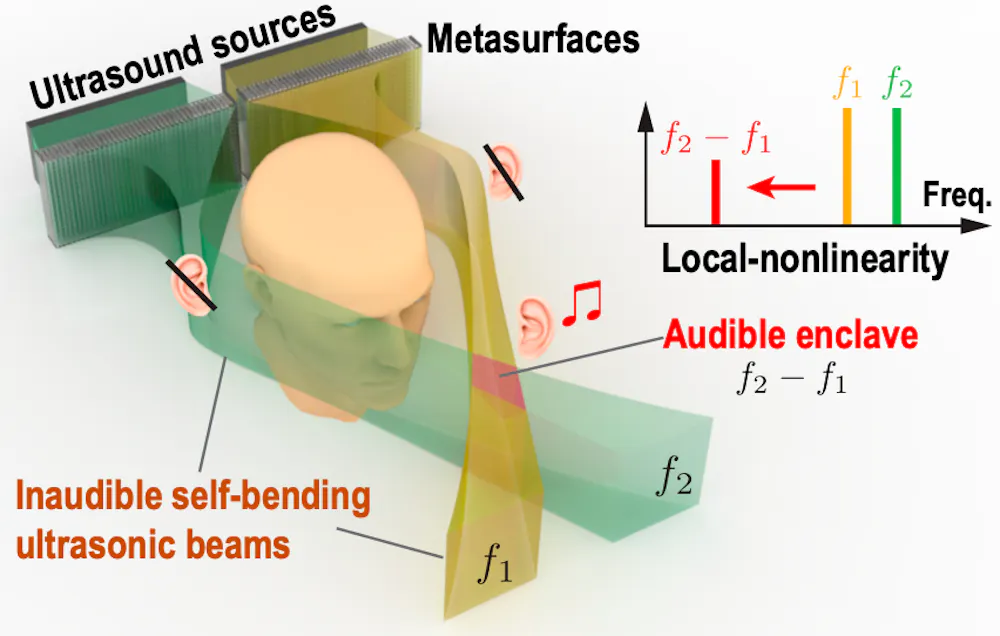
    We found a new way to send sound to one specific listener: through self-bending ultrasound beams and a concept called nonlinear acoustics.

    Ultrasound refers to sound waves with frequencies above the human hearing range, or above 20 kHz. These waves travel through the air like normal sound waves but are inaudible to people. Because ultrasound can penetrate through many materials and interact with objects in unique ways, it’s widely used for medical imaging and many industrial applications.

    In our work, we used ultrasound as a carrier for audible sound. It can transport sound through space silently – becoming audible only when desired. How did we do this?

    Normally, sound waves combine linearly, meaning they just proportionally add up into a bigger wave. However, when sound waves are intense enough, they can interact nonlinearly, generating new frequencies that were not present before.

    This is the key to our technique: We use two ultrasound beams at different frequencies that are completely silent on their own. But when they intersect in space, nonlinear effects cause them to generate a new sound wave at an audible frequency that would be heard only in that specific region.

    Audible enclaves are created at the intersection of two ultrasound beams.
    Jiaxin Zhong et al./PNAS, CC BY-NC-ND

    Crucially, we designed ultrasonic beams that can bend on their own. Normally, sound waves travel in straight lines unless something blocks or reflects them. However, by using acoustic metasurfaces – specialized materials that manipulate sound waves – we can shape ultrasound beams to bend as they travel. Similar to how an optical lens bends light, acoustic metasurfaces change the shape of the path of sound waves. By precisely controlling the phase of the ultrasound waves, we create curved sound paths that can navigate around obstacles and meet at a specific target location.

    The key phenomenon at play is what’s called difference frequency generation. When two ultrasonic beams of slightly different frequencies, such as 40 kHz and 39.5 kHz, overlap, they create a new sound wave at the difference between their frequencies – in this case 0.5 kHz, or 500 Hz, which is well within the human hearing range. Sound can be heard only where the beams cross. Outside of that intersection, the ultrasound waves remain silent.

    This means you can deliver audio to a specific location or person without disturbing other people as the sound travels.

    Advancing sound control

    The ability to create audio enclaves has many potential applications.

    Audio enclaves could enable personalized audio in public spaces. For example, museums could provide different audio guides to visitors without headphones, and libraries could allow students to study with audio lessons without disturbing others.

    In a car, passengers could listen to music without distracting the driver from hearing navigation instructions. Offices and military settings could also benefit from localized speech zones for confidential conversations. Audio enclaves could also be adapted to cancel out noise in designated areas, creating quiet zones to improve focus in workplaces or reduce noise pollution in cities.

    A sound only you can hear.
    Daly and Newton/The Image Bank via Getty Images

    This isn’t something that’s going to be on the shelf in the immediate future. For instance, challenges remain for our technology. Nonlinear distortion can affect sound quality. And power efficiency is another issue – converting ultrasound to audible sound requires high-intensity fields that can be energy intensive to generate.

    Despite these hurdles, audio enclaves present a fundamental shift in sound control. By redefining how sound interacts with space, we open up new possibilities for immersive, efficient and personalized audio experiences.

    Yun Jing receives funding from NSF.

    Jiaxin Zhong does not work for, consult, own shares in or receive funding from any company or organization that would benefit from this article, and has disclosed no relevant affiliations beyond their academic appointment.

    ref. Researchers created sound that can bend itself through space, reaching only your ear in a crowd – https://theconversation.com/researchers-created-sound-that-can-bend-itself-through-space-reaching-only-your-ear-in-a-crowd-252266

    MIL OSI – Global Reports

  • MIL-OSI Global: Trump shrugs off stock market slump, but economic warning signs loom

    Source: The Conversation – UK – By Conor O’Kane, Senior Lecturer in Economics, Bournemouth University

    bodrumsurf / Shutterstock

    During Donald Trump’s first term as US president, he regularly referred to rising stock markets as evidence of the success of his economic policies. “Highest Stock Market EVER”, Trump wrote on social media in 2017 after record gains. “That doesn’t just happen!”

    And after securing a second term in November 2024, some of Trump’s close advisers told the New York Times that the president “sees the market as a barometer of his success and abhors the idea that his actions might drive down stock prices”.

    This, in addition to a broader economic policy agenda committed to lower regulation and significant tax cuts, had Wall Street investors bullish about their prospects under the new Trump administration.

    But fears of an escalating trade war have seen the S&P 500, an index of the leading 500 publicly traded companies in the US, drop more than 10% from its February 2025 high. A decline of this magnitude in a major index is what professional traders refer to as a “correction”. In less than a month, roughly US$5 trillion (£3.9 trillion) has been wiped off the value of US stocks.

    So, what exactly is driving down stock prices? Economists cite the president’s brinkmanship, as well as his start-stop approach to tariffs with Canada and Mexico, as having rattled global investors. Some commentators believe this “chaotic” trade agenda has created huge uncertainty for consumers, investors and businesses.

    In view of such policies, a recent JP Morgan report said that US economic policy was “tilting away from growth”, and put the chances of a US recession at 40%, up from 30% at the start of the year. Moody’s Analytics has upped the odds of a US recession from 15% to 35%, citing tariffs as a key factor driving the downturn in its outlook.

    Any economic downturn would have an adverse impact on the profitability of US corporations, and the declining share prices reflect the negative outlook from investors.

    So far, the Trump administration appears unfazed by the US stock market decline. In an address to Congress on March 4, Trump declared his use of tariffs was all about making America rich again. “There will be a little disturbance, but we’re okay with that,” he said.

    The White House has, since then, announced that some short-term pain may be necessary for Trump to implement his trade agenda successfully, which is designed to bring manufacturing jobs back to the US.

    So, should we read this economic turbulence as a temporary blip? Or is it symptomatic of a more fundamental shift in the US economy?

    Change of strategy

    Stephen Miran, who was recently confirmed as chairman of Trump’s council of economic advisers, wrote a paper in November 2024 titled: A User’s Guide to Restructuring the Global Trading System. The paper gives us an insight into the Trump administration’s wider economic strategy.

    It sets out Trump’s desire “to reform the global trading system and put American industry on fairer ground vis-a-vis the rest of the world”. Miran cites persistent US dollar overvaluation as the root cause of economic imbalances.

    Miran does not believe that tariffs are inflationary, and argues that their use during Trump’s first presidential term had little discernible macroeconomic consequences. He does concede that tariffs may eventually lead to an appreciation – or further overvaluation – of the US dollar. However, Miran sees the extent of that appreciation as “debatable”.

    He sees tariffs as a tool for leverage in trade negotiations. The administration could, for example, agree to a reduction in tariffs in exchange for significant investment is the US by key trading partners. China investing in car manufacturing in the US is specifically mentioned in his analysis.

    Miran also states his belief that tariffs can be used to raise tax revenues from foreigners in order to retain low tax rates on American citizens.

    Some economists agree that the US dollar is overvalued. A combination of its role as the world’s reserve currency, as well as the attractiveness of the US economy as an investment destination, fuels demand for the US dollar and makes it stronger.

    A strong US dollar has made American manufacturing exports less competitive. This has cost American jobs. The “rust belt” states of the north-eastern and mid-western US have experienced a decline in manufacturing employment over the past 40 years, which is evidence of this.

    However, it is worth noting that the many US manufacturers who import manufactured parts or components to make their products do benefit from a stronger dollar. This is because it makes the parts and materials they are importing cheaper. US mortgage holders and investors also benefit from a stronger dollar through lower interest rates on loans.

    Steven Englander, the head of research and strategy at Standard Chartered bank, believes there are some contradictions in the Trump administration’s approach.

    In a recent interview with the Financial Times, Englander said: “The problem for the new administration is that it simultaneously wants a weaker dollar, a reduced trade deficit, capital inflows, and the dollar to remain the key currency in international reserves and payments.”

    Reduced trade deficits and capital inflows would typically strengthen the US dollar, as does its position as the world’s reserve currency.

    As Miran says in his paper: “There is a path by which the Trump administration can reconfigure the global trading and financial systems to America’s benefit. But it is narrow, and will require careful planning, precise execution, and attention to steps to minimise adverse consequences.”

    Only time will tell whether the Trump administration can successfully navigate this “narrow” path. In the meantime, the recent turbulence in US stock prices appears to be acceptable to the Trump administration in their pursuit of reforming the global financial system.

    Conor O’Kane does not work for, consult, own shares in or receive funding from any company or organisation that would benefit from this article, and has disclosed no relevant affiliations beyond their academic appointment.

    ref. Trump shrugs off stock market slump, but economic warning signs loom – https://theconversation.com/trump-shrugs-off-stock-market-slump-but-economic-warning-signs-loom-251988

    MIL OSI – Global Reports

  • MIL-OSI USA: Rosen, Colleagues Demand Department of Veterans Affairs Reverse Course on Plans to Reduce Workforce

    US Senate News:

    Source: United States Senator Jacky Rosen (D-NV)
    WASHINGTON, DC – U.S. Senator Jacky Rosen (D-NV) joined her Senate colleagues in a letter opposing the Trump Administration’s plan to cut more than 80,000 employees at the Department of Veterans Affairs this year. They demanded that the VA reverse course, stressing the harmful impact it will have on veterans’ earned care and benefits, which have been dramatically expanded since 2019 thanks to laws passed with bipartisan support such as the PACT Act.
    “We write today regarding a memo issued by your Chief of Staff on March 4, and later proudly announced by you via Twitter, detailing a plan to reduce the Department of Veterans Affairs (VA) workforce to 2019 levels,” wrote the Senators. “Over the past five years, there have been monumental bipartisan expansions and improvements to veterans’ healthcare and benefits. Your proposal puts all of them at risk. And we believe it is blatantly dishonest to claim veterans’ healthcare and benefits will not be impacted by the termination of up to 83,000 employees, including 20,000 veterans.”
    “As we continue to first learn of these disastrous ideas from VA employees and veterans, we will continue to speak out and fight on behalf of those men and women unjustly and immorally harmed by your actions. We are not deterred or fooled by your political theatrics that seek to defend your actions with half-truths and vague, empty promises – and neither are veterans,” they continued. “We will make sure the public knows the truth – that cutting back to 2019 staffing levels means firing over 18,000 nurses, ten percent of the VA police force, nearly 10,000 schedulers, and more than thirty percent of the Veterans Benefits Administration staff… We urge you to start putting veterans first – to review VA’s own data, listen to your leadership and frontline staff on the ground serving veterans every day, and talk to veterans and their families. When you do, you will come to the one and only legitimate conclusion – that massive, arbitrary staff cuts will not make the Department more efficient nor improve care and benefits for veterans.”
    The full letter can be found HERE.
    Senator Rosen has been fighting for Nevada’s veterans. Last week, she called on the VA to permanently reverse layoffs of VA employees in Nevada, and helped introduce legislation to reinstate veterans wrongfully fired by President Trump and Elon Musk. Earlier this month, Senator Rosen took to the Senate floor to oppose the actions of the Trump Administration and Elon Musk to mass fire employees working at the VA. Senator Rosen also demanded the VA provide answers regarding mass employee terminations.

    MIL OSI USA News

  • MIL-OSI USA: Senator Baldwin Launches “Hands Off Medicaid Tour”

    US Senate News:

    Source: United States Senator for Wisconsin Tammy Baldwin
    WISCONSIN – Today, U.S. Senator Tammy Baldwin (D-WI) is launching her “Hands Off Medicaid Tour” to call out President Donald Trump and Congressional Republicans’ plan to slash Medicaid to pay for tax cuts for billionaires. At each stop, Senator Baldwin will be joined by individuals and families who rely on Medicaid and hear firsthand about what taking away that care would mean to their health and wellbeing.
    “Republicans are planning to rip away health care from Wisconsin grandparents, kids, and loved ones on Medicaid – all to pay for new tax breaks for billionaires,” said Senator Baldwin. “I’m launching my ‘Hands Off Medicaid Tour’ because sharing the stories of the real people who will have their care taken away is more important than ever. We need to show the President and Congressional Republicans what cuts to Medicaid would mean to Wisconsinites, show them that their tax cut for their wealthy friends will be life or death to some Wisconsinites, and show them we are fighting back.”
    The first stops of the “Hands Off Medicaid Tour” include:
    La Crosse on Monday, March 17, 2025
    Eau Claire on Tuesday, March 18, 2025
    Madison and Racine on Thursday, March 20, 2025
    Waukesha on Friday, March 21, 2025
    Details of each event will be released at a later date.
    Republicans are planning deep cuts to Medicaid that will jeopardize the coverage of 72 million Americans. In Wisconsin, over 1.2 million are enrolled in Medicaid. About 1 in 3 children in both Wisconsin’s rural and metro communities have Medicaid coverage. More than 300,000 kids under age 19 are members of BadgerCare Plus or another Wisconsin Medicaid program.
    Across the country, Medicaid covers nearly half of all children, 31.5 million, over 8.3 million seniors, and around 15 million people with disabilities. Medicaid also pays for 6 out of 10 residents in nursing homes, with 5.6 million Americans counting on Medicaid for their long-term care bills and Medicaid paying for over half of long-term care in the United States. Severe cuts to Medicaid will also jeopardize rural hospitals and clinics’ ability to keep their doors open. Over 12 million rural Americans rely on Medicaid for health care.

    MIL OSI USA News

  • MIL-OSI USA: Baldwin Votes to Strengthen Penalties, Step Up Enforcement Around Deadly Fentanyl

    US Senate News:

    Source: United States Senator for Wisconsin Tammy Baldwin
    WASHINGTON, D.C. – U.S. Senator Tammy Baldwin (D-WI) released the following statement after voting to pass the bipartisan Halt All Lethal Trafficking (HALT) Fentanyl Act to permanently classify fentanyl-related substances as Schedule I drugs under the Controlled Substances Act, putting the drug on par with the deadliest and most dangerous substances.
    “When it comes to confronting the opioid epidemic, to me and so many families in every corner of our state, it’s personal. With fentanyl, one pill can kill, and we need to be giving our law enforcement the tools they need to crack down on suppliers who traffic fentanyl into our communities,” said Senator Baldwin. “As I have always said, I will work with anyone to do right by Wisconsin and this bipartisan bill will help save lives and save more families from the heartache of losing a loved one too soon from fentanyl poisoning.”
    The HALT Fentanyl Act would permanently classify street versions of fentanyl as Schedule I substances, ensuring clear and enforceable penalties under the Drug Enforcement Administration (DEA). It also streamlines the registration process for studying Schedule I substances, allowing researchers to better understand and address the fentanyl crisis, while bolstering efforts to research fentanyl equivalents. Fentanyl-related substances are currently considered a Schedule I substance on a temporary basis until March 31; however, this legislation would make that qualification permanent. The HALT Fentanyl Act ensures that street versions of fentanyl produced by transnational criminal organizations are subject to criminal penalties and enables law enforcement, including U.S. Customs and Border Protection, to have the authority to seize these illicit substances and keep our communities safe.
    In Wisconsin, synthetic opioids, primarily fentanyl, were identified in 91 percent of opioid overdose deaths and 73 percent of all drug overdose deaths, according to the Department of Health Services. Provisional data shows the number of fentanyl overdose deaths in Wisconsin grew by 97 percent from 2019 (651) to 2021 (1,280).

    MIL OSI USA News

  • MIL-OSI: B.C. On-Farm Technology Adoption Program Continues Support to B.C. Farmers

    Source: GlobeNewswire (MIL-OSI)

    VANCOUVER, British Columbia, March 17, 2025 (GLOBE NEWSWIRE) — Starting March 17, farmers can apply to receive funding support to acquire new technology to support their operations through the B.C. On-Farm Technology Adoption Program.

    Launched in 2023 and delivered by Innovate BC, the B.C. On-Farm Technology Adoption Program provides B.C. and federal cost-shared funding to eligible participants, through the Sustainable Canadian Agricultural Partnership (Sustainable CAP), to adopt new technologies on-farm that will enhance profitability, productivity, and/or efficiency. This is the third intake for the program and focuses on new commercially available farming technologies that will help grow, raise, harvest, pack or store food more effectively, productively or profitably. The program will focus on funding labour-saving technologies that help address labour shortages and improve processes for labour-intensive tasks. 

    “In light of the heightened focus on sustainability, now more than ever, it is crucial for consumers to buy local produce, as this not only supports local economies and reduces carbon footprints, but also provides fresher, more flavourful food.” said Lana Popham, Minister of Agriculture and Food. “Thanks to this program, we’re helping farmers and food producers all over the province use technology to increase their efficiency and production, as well as address labor challenges the sector is facing. This new intake will allow more producers to have the latest equipment and software on their farms so they can be more competitive, improve their bottom line, and produce more of the food that feeds our communities.”

    Applications for this round of funding are open from March 17 to April 28. Farmers with operations within British Columbia can apply, with up to $2.25M available from the governments of Canada and British Columbia for the current 2025/2026 fiscal year. 

    Farmers can use the funding to buy new technologies, such as equipment and robotics that can operate independently and adapt to their environment. Examples are automated weeding equipment and harvesters or machinery that can perform tasks with minimal human interaction, like automated grading and sorting machines. 

    As of March 17, 2025, the program has awarded $4.12M to support 85 farm projects in B.C. with adopting new technologies.

    “With rising costs and shifting market conditions, investing in innovation is more critical than ever to strengthen local food security and keep B.C. farms competitive,’ said Peter Cowan, President + CEO of Innovate BC, “The B.C. On-Farm Technology Adoption Program helps farmers access cutting-edge agritech that boosts efficiency and resilience, ensuring they can keep their business productive and remain key contributors to our economy and communities. Innovate BC is proud to deliver this program on behalf of the Ministry of Agriculture and Food, supporting a strong agricultural sector and a more prosperous B.C.”

    “Through B.C.’s Integrated Marketplace, we are supporting our agriculture sector to adopt new technologies to make their businesses more productive and profitable, and make our economy stronger,” said Diana Gibson, Minister of Jobs, Economic Development and Innovation. “Through innovation, we can support our farmers and grow not only food but also a more resilient economy.” 

    Part of Innovate BC’s Integrated Marketplace suite of programming, the B.C. On-Farm Technology Adoption Program is funded by the Sustainable Canadian Agricultural Partnership (Sustainable CAP). The Sustainable CAP is a five-year, $3.5-billion investment by federal, provincial and territorial governments to strengthen the competitiveness, innovation and resilience of Canada’s agriculture, agrifood and agriculture-based products sector. This includes $1 billion in federal programs and activities and a $2.5-billion commitment that is cost-shared 60% federally and 40% provincially/territorially for programs that are designed and delivered by provinces and territories.

    To learn more about Innovate BC, visit innovatebc.ca.

    Additional Quotes

    Sam DiMaria, Owner, Bella Rosa Orchards

    “Labour is the highest operating cost for my orchard, and I knew that adopting a mobile picking platform could help address this. The B.C. On-Farm Technology Adoption Program support allowed me to bring in the platform, which is already making a difference. Emerging technologies play a crucial role in making farming more efficient and cost-effective. Farmers must be willing to learn and embrace these changes, and government support can help us transition successfully.” 

    Media Contact

    Michael Gleboff
    Communications + Community Manager
    mgleboff@innovatebc.ca
    604602-5210

    About Innovate BC

    A Crown Agency of British Columbia, Innovate BC works to foster innovation across the province and bolster the growth of the local economy through delivering a wide range of programs that help companies start and scale, access talent and encourage technology development, commercialization, and adoption. Innovate BC also harnesses crucial data collection and research, and works to forge strategic industry and community partnerships that create more opportunities for B.C. innovators.

    A photo accompanying this announcement is available at https://www.globenewswire.com/NewsRoom/AttachmentNg/12b1c076-c344-428e-8b97-1f55a4d5ac89

    The MIL Network

  • MIL-OSI Global: Why Americans care so much about eggs prices – and how this issue got so political

    Source: The Conversation – UK – By Clodagh Harrington, Lecturer in American Politics, University College Cork

    The price of eggs has risen dramatically in recent years across the US. A dozen eggs cost US$1.20 (92p) in June 2019, but the price is now around US$4.90 (with a peak of US$8.17 in early March).

    Some restaurants have imposed surcharges on egg-based dishes, bringing even more attention to escalating costs. And there are also shortages on supermarket shelves.

    In the coming months, the US plans to import up to 100 million of this consumer staple. Government officials are approaching countries from Turkey to Brazil with enquiries about eggs for export.

    Agriculture secretary Brooke Rollins, who previously said that one option to the crisis was for people to get a chicken for their backyard, suggested in the Wall Street Journal that prices are unlikely to stabilise for some months. And Donald Trump recently shared an article on Truth Social calling on the public to “shut up about egg prices”.

    The main cause of the problem is an outbreak of avian flu that has resulted in over 166 million birds in the US being slaughtered. Around 98% of the nation’s chickens are produced on factory farms, which are ripe for contagion.

    According to the Centers for Disease Control, the flu has already spread to several hundred dairy cattle and to one human. The USDA recently announced a US$1 billion plan to counter the problem, with funding for improved bio-security, vaccine research and compensation to farmers.

    In January 2025, Donald Trump’s White House press secretary, Karoline Leavitt, blamed the previous administration for high egg prices. It is true that birds were slaughtered on President Joe Biden’s watch, but this was and remains standard practice at times of bird flu outbreaks and had also been the case during the Obama and first Trump administrations.

    However, this points to the way the rising price of eggs has become a political touchstone. It was referred to regularly in campaign speeches and press briefings as a sign of things going wrong and a symbol of the US economy faced. Donald Trump promised to fix the price of eggs swiftly if elected, but so far the issue shows no sign of going away.

    Prices are still trending up. Even when prices suddenly drop, as they have this week, the public know how much cheaper they used to be until recently, and do not tend to feel better.

    There are a number of reasons why egg prices have become an important to US politicians. First, almost everyone buys eggs. So the shortage and subsequent price rise is newsworthy and affects consumers in all income brackets.

    Secondly, they are a measure of broader economic vulnerabilities, so egg-related problems tend to be part of a larger story about how weak the economy is. And thirdly, egg prices are political because of Trump’s promise to bring them down.


    Read more:
    US inflation has increased since Trump took office – why prices are unlikely to come down soon


    Polls showed that the economy and inflation were key factors in voter choice on election day 2024. In February 2025, Donald Trump did an interview with NBC News in which he said he won the election on the border and groceries.

    On immigration, voters often base their opinions on what they perceive to be true. For example, tough rhetoric on building a wall may equate with a sense of feeling that the president is taking strong action, whether anything tangible actually materialises or not.

    With groceries, reality trumps perception. The price of eggs is printed on the box and the cost is paid directly by voters.

    Donald Trump on what he’s doing on egg prices and the economy.

    Then there are the egg producers. US farmers tended to overwhelmingly support Trump on election day, so it is prudent for him to feel their pain, or at least appear to. Farming areas voted for him increasingly in his three election efforts, even increasing their support for him in 2020 after trade wars and price increases which would have negatively impacted them.

    Another factor that may push up egg prices is that an estimated 70% of the factory farm workforce is immigrant labour, and as many as 40% are undocumented. Should the administration’s plans for high tariffs and mass deportations come to fruition, the industry would struggle to function.

    Further food price increases will be inevitable, with potential exacerbation via the funding freezes for some USDA programmes that Trump has enacted. As of March 2025, US$1 billion in cuts has been announced, the consequences of which are already being felt by farmers. The “pain now for gain later” message is a tricky political sell.

    Even in the current era of international turbulence, elections are largely won on more pedestrian matters. Specifically, “kitchen-table” economics is relatable to every voter, regardless of how grand, or not, their table is.

    Americans will be aware that in neighbouring Canada, egg prices have not risen dramatically and there have not been shortages. But prices in Canada have been traditionally higher than the US, this is in part at least because farming standards differ.

    The US does not have high welfare standards for agricultural workers or animals, and this shortcoming needs to be addressed in order to help reduce future risk of flu, but this is likely to also raise prices.

    Blaming the previous incumbent is not a durable stance for Donald Trump. As former president Harry Truman might remind him: “The buck stops here.” Right at his desk.

    Clodagh Harrington does not work for, consult, own shares in or receive funding from any company or organisation that would benefit from this article, and has disclosed no relevant affiliations beyond their academic appointment.

    ref. Why Americans care so much about eggs prices – and how this issue got so political – https://theconversation.com/why-americans-care-so-much-about-eggs-prices-and-how-this-issue-got-so-political-251752

    MIL OSI – Global Reports