Category: Americas

  • MIL-OSI Global: Simple strategies can boost vaccination rates for adults over 65 − new study

    Source: The Conversation – USA – By Laurie Archbald-Pannone, Associate Professor of Medicine and Geriatrics, University of Virginia

    Many older adults are not up to date on their vaccines. Morsa Images via Getty Images

    Knowing which vaccines older adults should get and hearing a clear recommendation from their health care provider about why a particular vaccine is important strongly motivated them to get vaccinated. That’s a key finding in a recent study I co-authored in the journal Open Forum Infectious Diseases.

    Adults over 65 have a higher risk of severe infections, but they receive routine vaccinations at lower rates than do other groups. My colleagues and I collaborated with six primary care clinics across the U.S. to test two approaches for increasing vaccination rates for older adults.

    In all, 249 patients who were visiting their primary care providers participated in the study. Of these, 116 patients received a two-page vaccine discussion guide to read in the waiting room before their visit. Another 133 patients received invitations to attend a one-hour education session after their visit.

    The guide, which we created for the study, was designed to help people start a conversation about vaccines with their providers. It included checkboxes for marking what made it hard for them to get vaccinated and which vaccines they want to know more about, as well as space to write down any questions they have. The guide also featured a chart listing recommended vaccines for older adults, with boxes where people could check off ones they had already received.

    In the sessions, providers shared in-depth information about vaccines and vaccine-preventable diseases and facilitated a discussion to address vaccine hesitancy.

    In a follow-up survey two months later, patients reported that the most significant barriers they faced were knowing when they should receive a particular vaccine, having concerns about side effects and securing transportation to a vaccination appointment.

    The percentage of patients who said they wanted to get a vaccine increased from 68% to 79% after using the vaccine guide. Following each intervention, 80% of patients reported they discussed vaccines more in that visit than they had in prior visits.

    Of the 14 health care providers who completed the follow-up survey, 57% reported increased vaccination rates following each approach. Half of the providers felt that the use of the vaccine guide was an effective strategy in guiding conversations with their patients.

    A pamphlet at the doctor’s office can empower older patients to ask about vaccines.

    Why it matters

    Only about 15% of adults ages 60-64 and 26% of adults 65 and older are up to date on all the vaccines recommended for their age, according to CDC data from 2022. These include vaccines for COVID 19, influenza, tetanus, pneumococcal disease and shingles.

    Yet studies consistently show that getting vaccinated reduces the risk of complications from these conditions in this age group.

    My research shows that strategies that equip older adults with personalized information about vaccines empower them to start the conversation about vaccines with their clinicians and enable them to be active participants in their health care.

    What’s next

    In the future, we will explore whether engaging patients on this topic earlier is even more helpful than doing so in the waiting room before their visit.

    This might involve having clinical team members or care coordinators connect with patients ahead of their visit, either by phone or through telemedicine that is designed specifically for older adults.

    My research team plans to conduct a pilot study that tests this approach. We hope to learn whether reaching out to these patients before their clinic visits and helping them think through their vaccination status, which vaccines their provider recommends and what barriers they face in getting vaccinated will improve vaccination rates for this population.

    The Research Brief is a short take on interesting academic work.

    Laurie Archbald-Pannone has received funding from Virginia Department of Health and PRIME education. This activity is supported by an independent educational grant from GSK.

    ref. Simple strategies can boost vaccination rates for adults over 65 − new study – https://theconversation.com/simple-strategies-can-boost-vaccination-rates-for-adults-over-65-new-study-250246

    MIL OSI – Global Reports

  • MIL-OSI Global: The psychology behind anti-trans legislation: How cognitive biases shape thoughts and policy

    Source: The Conversation – USA – By Julia Standefer, Ph.D. Student in Psychology, Iowa State University

    Protesters fill the Iowa state Capitol to denounce a bill that will strip the state civil rights code of protections based on gender identity. AP Photo/Charlie Neibergall

    A state law signed Feb. 28, 2025, removes gender identity as a protected status from the Iowa Civil Rights Act, leaving transgender people vulnerable to discrimination. The rights of transgender people – those who present gender characteristics that differ from what has historically been expected of someone based on their biological sex traits – are under political attack across the United States. There are now hundreds of anti-trans bills at various points in the legislative process.

    But why?

    Reasons given usually center on protecting children, protecting cisgender women’s rights in bathrooms and sports competitions, and on removing funding for gender-affirming care. Some efforts appear to stem from fear-driven motives that are not supported by evidence.

    Bias against trans people may not always feel like bias. For someone who believes it to be true, saying there can only be biological men who identify as men and biological women who identify as women may feel like a statement of fact. But research shows that gender is a spectrum, separate from biological sex, which is also more complex than the common male-female binary.

    We are social psychologists who study and teach about the basic social, cognitive and emotion-based processes people use to make sense of themselves and the world. Research reveals psychological processes that bias people in ways they usually aren’t aware of. These common human tendencies can influence what we think about a particular group, influence how we act toward them, and prompt legislators to pass biased laws.

    Root of negative views of transgender people

    Social psychology theory and research point to several possible sources of negative views of transgender people.

    Part of forming your own identity is defining yourself by the traits that make you unique. To do this, you categorize others as belonging to your group – based on characteristics that matter to you, such as race, age, culture or gender – or not. Psychologists call these categories in-groups and out-groups.

    There is a natural human tendency to have inherent negative feelings toward people who aren’t part of your in-group. The bias you might feel against fans of a rival sports team is an example. This tendency may be rooted deep in evolutionary history, when favoring your own safe group over unknown outsiders would have been a survival advantage.

    A trans person’s status as transgender may be the most salient thing about them to an observer, overshadowing other characteristics such as their height, race, profession, parental status and so on. As a small minority, transgender people are an out-group from the mainstream – making it likely out-group bias will be directed their way.

    Anti-trans feeling may also result from fear that transgender people pose threats to one’s personal or group identity. Gender is part of everyone’s identity. If someone perceives their own gender to be determined by their biological sex, they may perceive other people who violate that “rule” as a threat to their own gender identity. Part of identity formation is not just out-group derogation but in-group favoritism. A cisgender person may engage in “in-group boundary protection” by making sure the parameters of “gender” are well defined and match their own beliefs.

    Once you hold negative feelings about someone in an out-group, there are other social psychological processes that may solidify and amplify them in your mind.

    The illusion of a causal connection

    People tend to form illusory correlations between objects, people, occurrences or behaviors, particularly when those things are infrequently encountered. Two distinctive things happening at the same time makes people believe that one is causing the other.

    Some superstitions result from this phenomenon. For example, you might attribute an unusual success such as winning money to wearing a particular shirt, which you now think of as your lucky shirt.

    If a person only ever hears about negative events when they see or hear about a transgender person, an immigrant or a member of some other minority group, then an illusory correlation can form between the negative events and the minority group. That connection is the starting point for prejudice: automatic, negative feelings toward a group of people without justification.

    Of course, it is possible that individuals from the group in question have committed some offense. But to take one individual’s bad deed and attribute it to an entire group of people isn’t justified. This kind of extrapolation is the natural human tendency of stereotyping, which can bias people’s actions.

    ‘That’s exactly what I thought’

    Human minds are biased to confirm the beliefs they already hold, including stereotypes about trans people. A few interconnected processes are at play in what psychologists call confirmation bias.

    First, there’s a natural tendency to seek out information that fits with what you already believe. If you think a shirt is lucky, then you’re more likely to look for positive things that happen when you wear it than you are to look for negative events that would seem to disconfirm its luckiness.

    If you think transgender people are dangerous, you are more likely to conduct an internet search for “transgender people who are dangerous” than “transgender people are victims of crime.”

    There’s a second, more passive process in play as well. Rather than actively seeking out confirming information, people also simply pay attention to information that confirms what they thought in the first place and ignore contradictory information. This can happen without you even realizing.

    People also tend to interpret ambiguous events in line with their beliefs – “I must be having a good day, despite some setbacks, because I’m wearing my lucky shirt.” That confirmation bias could explain someone with anti-trans attitudes thinking “that transgender person holding hands with a child must be a pedophile” instead of “that transgender mother is showing love and care for her kid.”

    Finally, people tend to remember things that confirm their beliefs better than things that challenge them.

    Confirmation bias can strengthen an illusory correlation, making it even more likely to influence subsequent actions – whether compulsively wearing a lucky shirt to an anxiety-inducing appointment or not hiring someone because of discriminatory thoughts about the group they belong to.

    Moving past biases

    Awareness of biases is the first step in avoiding them. Setting bias aside allows people to make fair decisions, based on accurate information, and in line with their values.

    However, this is not an easy task in the face of another social psychological process called group polarization. This phenomenon occurs when individuals’ beliefs become more extreme as they talk and listen only to people who hold the same beliefs they do. Think of the social media bubbles that result from interacting only with people who share your perspective.

    Efforts to stifle or prohibit educators’ and librarians’ ability to teach and discuss gender and sexuality topics, openly and fairly, add another challenge. Education through access to impartial, evidence-based information can be one way to help neutralize inherent bias.

    Montana state Rep. Zooey Zephyr, who is transgender, in discussion with a colleague.
    AP Photo/Tommy Martino

    As a final, hopeful point, social psychological research has identified one strategy for overcoming intergroup conflict: forming close contacts with individuals from the “other” group. Having a friend, loved one or trusted and valued colleague who belongs to the out-group can help you recognize their humanity and overcome the biases you hold against that out-group as a whole.

    A relevant and recent example of this scenario came when two transgender state representatives convinced their fellow lawmakers to vote against two extreme anti-trans bills in Montana by making the issue personal.

    All of these decision-making biases influence everyone, not just the lawmakers currently in power. And they can be quite complex, with particular in-group and out-group memberships being hard to define – for instance, factions within religious groups who disagree on particular political issues.

    But understanding and overcoming the biases everyone falls prey to means that optimal decisions can be made for everyone’s well-being and economic vitality. After all, psychology research has repeatedly demonstrated that diversity is good for the bottom line while it simultaneously promotes an equitable and inclusive society. Even from a solely financial perspective, discrimination is bad for all Americans.

    The authors do not work for, consult, own shares in or receive funding from any company or organization that would benefit from this article, and have disclosed no relevant affiliations beyond their academic appointment.

    ref. The psychology behind anti-trans legislation: How cognitive biases shape thoughts and policy – https://theconversation.com/the-psychology-behind-anti-trans-legislation-how-cognitive-biases-shape-thoughts-and-policy-251691

    MIL OSI – Global Reports

  • MIL-OSI Global: Radioisotope generators − inside the ‘nuclear batteries’ that power faraway spacecraft

    Source: The Conversation – USA – By Benjamin Roulston, Assistant Professor of Physics, Clarkson University

    Voyager 1, shown in this illustration, has operated for decades thanks to a radioisotope power system. NASA via AP

    Powering spacecraft with solar energy may not seem like a challenge, given how intense the Sun’s light can feel on Earth. Spacecraft near the Earth use large solar panels to harness the Sun for the electricity needed to run their communications systems and science instruments.

    However, the farther into space you go, the weaker the Sun’s light becomes and the less useful it is for powering systems with solar panels. Even in the inner solar system, spacecraft such as lunar or Mars rovers need alternative power sources.

    As an astrophysicist and professor of physics, I teach a senior-level aerospace engineering course on the space environment. One of the key lessons I emphasize to my students is just how unforgiving space can be. In this extreme environment where spacecraft must withstand intense solar flares, radiation and temperature swings from hundreds of degrees below zero to hundreds of degrees above zero, engineers have developed innovative solutions to power some of the most remote and isolated space missions.

    So how do engineers power missions in the outer reaches of our solar system and beyond? The solution is technology developed in the 1960s based on scientific principles discovered two centuries ago: radioisotope thermoelectric generators, or RTGs.

    RTGs are essentially nuclear-powered batteries. But unlike the AAA batteries in your TV remote, RTGs can provide power for decades while hundreds of millions to billions of miles from Earth.

    Nuclear power

    Radioisotope thermoelectric generators do not rely on chemical reactions like the batteries in your phone. Instead, they rely on the radioactive decay of elements to produce heat and eventually electricity. While this concept sounds similar to that of a nuclear power plant, RTGs work on a different principle.

    Most RTGs are built using plutonium-238 as their source of energy, which is not usable for nuclear power plants since it does not sustain fission reactions. Instead, plutonium-238 is an unstable element that will undergo radioactive decay.

    Radioactive decay, or nuclear decay, happens when an unstable atomic nucleus spontaneously and randomly emits particles and energy to reach a more stable configuration. This process often causes the element to change into another element, since the nucleus can lose protons.

    Plutonium-238 decays into uranium-234 and emits an alpha particle, made of two protons and two neutrons.
    NASA

    When plutonium-238 decays, it emits alpha particles, which consist of two protons and two neutrons. When the plutonium-238, which starts with 94 protons, releases an alpha particle, it loses two protons and turns into uranium-234, which has 92 protons.

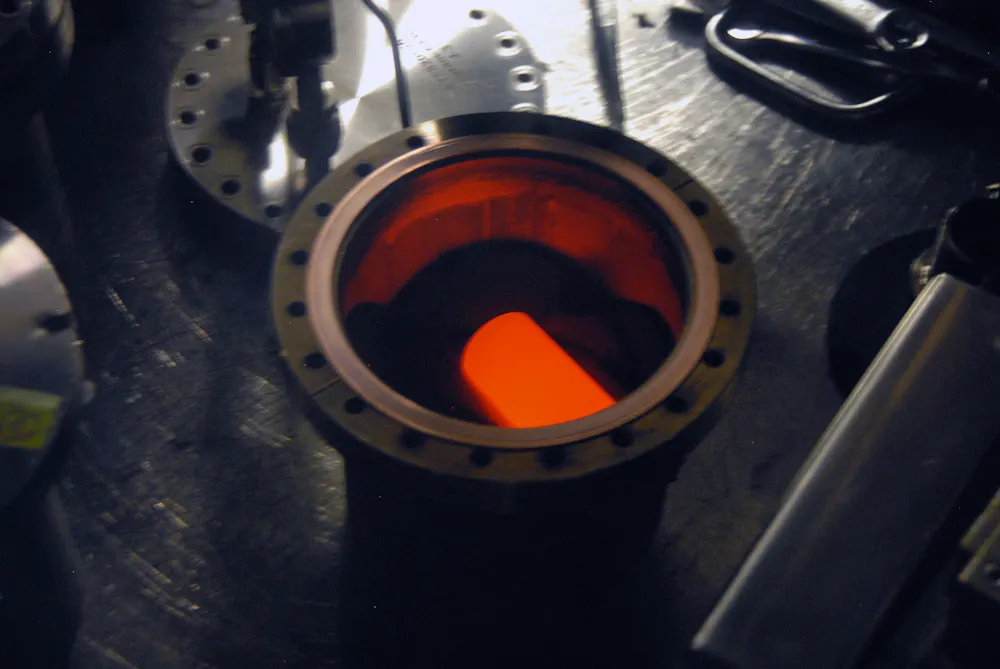
    These alpha particles interact with and transfer energy into the material surrounding the plutonium, which heats up that material. The radioactive decay of plutonium-238 releases enough energy that it can glow red from its own heat, and it is this powerful heat that is the energy source to power an RTG.

    The nuclear heat source for the Mars Curiosity rover is encased in a graphite shell. The fuel glows red hot because of the radioactive decay of plutonium-238.
    Idaho National Laboratory, CC BY

    Heat as power

    Radioisotope thermoelectric generators can turn heat into electricity using a principle called the Seebeck effect, discovered by German scientist Thomas Seebeck in 1821. As an added benefit, the heat from some types of RTGs can help keep electronics and the other components of a deep-space mission warm and working well.

    In its basic form, the Seebeck effect describes how two wires of different conducting materials joined in a loop produce a current in that loop when exposed to a temperature difference.

    The Seeback effect is the principle behind RTGs.

    Devices that use this principle are called thermoelectric couples, or thermocouples. These thermocouples allow RTGs to produce electricity from the difference in temperature created by the heat of plutonium-238 decay and the frigid cold of space.

    Radioisotope thermoelectric generator design

    In a basic radioisotope thermoelectric generator, you have a container of plutonium-238, stored in the form of plutonium-dioxide, often in a solid ceramic state that provides extra safety in the event of an accident. The plutonium material is surrounded by a protective layer of foil insulation to which a large array of thermocouples is attached. The whole assembly is inside a protective aluminum casing.

    An RTG has decaying material in its core, which generates heat that it converts to electricity.
    U.S. Department of Energy

    The interior of the RTG and one side of the thermocouples is kept hot – close to 1,000 degrees Fahrenheit (538 degrees Celsius) – while the outside of the RTG and the other side of the thermocouples are exposed to space. This outside, space-facing layer can be as cold as a few hundred degrees Fahrenheit below zero.

    This strong temperature difference allows an RTG to turn the heat from radioactive decay into electricity. That electricity powers all kinds of spacecraft, from communications systems to science instruments to rovers on Mars, including five current NASA missions.

    But don’t get too excited about buying an RTG for your house. With the current technology, they can produce only a few hundred watts of power. That may be enough to power a standard laptop, but not enough to play video games with a powerful GPU.

    For deep-space missions, however, those couple hundred watts are more than enough.

    The real benefit of RTGs is their ability to provide predictable, consistent power. The radioactive decay of plutonium is constant – every second of every day for decades. Over the course of about 90 years, only half the plutonium in an RTG will have decayed away. An RTG requires no moving parts to generate electricity, which makes them much less likely to break down or stop working.

    Additionally, they have an excellent safety record, and they’re designed to survive their normal use and also be safe in the event of an accident.

    RTGs in action

    RTGs have been key to the success of many of NASA’s solar system and deep-space missions. The Mars Curiosity and Perseverance rovers and the New Horizons spacecraft that visited Pluto in 2015 have all used RTGs. New Horizons is traveling out of the solar system, where its RTGs will provide power where solar panels could not.

    However, no missions capture the power of RTGs quite like the Voyager missions. NASA launched the twin spacecraft Voyager 1 and Voyager 2 in 1977 to take a tour of the outer solar system and then journey beyond it.

    The RTGs on the Voyager probes have allowed the spacecraft to stay powered up while they collect data.
    NASA/JPL-Caltech

    Each craft was equipped with three RTGs, providing a total of 470 watts of power at launch. It has been almost 50 years since the launch of the Voyager probes, and both are still active science missions, collecting and sending data back to Earth.

    Voyager 1 and Voyager 2 are about 15.5 billion miles and 13 billion miles (nearly 25 billion kilometers and 21 billion kilometers) from the Earth, respectively, making them the most distant human-made objects ever. Even at these extreme distances, their RTGs are still providing them consistent power.

    These spacecraft are a testament to the ingenuity of the engineers who first designed RTGs in the early 1960s.

    Benjamin Roulston does not work for, consult, own shares in or receive funding from any company or organization that would benefit from this article, and has disclosed no relevant affiliations beyond their academic appointment.

    ref. Radioisotope generators − inside the ‘nuclear batteries’ that power faraway spacecraft – https://theconversation.com/radioisotope-generators-inside-the-nuclear-batteries-that-power-faraway-spacecraft-248504

    MIL OSI – Global Reports

  • MIL-OSI Video: President Trump Delivers Remarks at the Department of Justice

    Source: United States of America – The White House (video statements)

    Washington, D.C.

    https://www.youtube.com/watch?v=6i41Av4eYO8

    MIL OSI Video

  • MIL-OSI Video: Secretary Rubio’s remarks to the press

    Source: United States of America – Department of State (video statements)

    Secretary of State Marco A. Rubio Remarks to Press in Shannon, Ireland, on March 12, 2025.

    Transcript: https://www.state.gov/secretary-of-state-marco-rubio-remarks-to-press/
    ———-
    Under the leadership of the President and Secretary of State, the U.S. Department of State leads America’s foreign policy through diplomacy, advocacy, and assistance by advancing the interests of the American people, their safety and economic prosperity. On behalf of the American people we promote and demonstrate democratic values and advance a free, peaceful, and prosperous world.

    The Secretary of State, appointed by the President with the advice and consent of the Senate, is the President’s chief foreign affairs adviser. The Secretary carries out the President’s foreign policies through the State Department, which includes the Foreign Service, Civil Service and U.S. Agency for International Development.

    Get updates from the U.S. Department of State at www.state.gov and on social media!
    Facebook: https://www.facebook.com/statedept
    X: https://x.com/StateDept
    Instagram: https://www.instagram.com/statedept
    Flickr: https://flickr.com/photos/statephotos/

    Subscribe to the State Department Blog: https://www.state.gov/blogs
    Watch on-demand State Department videos: https://video.state.gov/
    Subscribe to The Week at State e-newsletter: http://ow.ly/diiN30ro7Cw

    State Department website: https://www.state.gov/
    Careers website: https://careers.state.gov/
    White House website: https://www.whitehouse.gov/
    Terms of Use: https://state.gov/tou

    #StateDepartment #DepartmentofState #Diplomacy

    https://www.youtube.com/watch?v=mH-OyfhXPUg

    MIL OSI Video

  • MIL-OSI Video: Train to win, there’s no other option

    Source: US Army (video statements)

    About the U.S. Army:

    The Army Mission – our purpose – remains constant: To deploy, fight and win our nation’s wars by providing ready, prompt & sustained land dominance by Army forces across the full spectrum of conflict as part of the joint force.

    Interested in joining the U.S. Army?
    Visit: spr.ly/6001igl5L

    Connect with the U.S. Army online:
    Web: https://www.army.mil
    Facebook: https://www.facebook.com/USarmy/
    X: https://www.twitter.com/USArmy
    Instagram: https://www.instagram.com/usarmy/
    LinkedIn: https://www.linkedin.com/company/us-army
    #USArmy #Soldiers #Military #Shorts

    https://www.youtube.com/watch?v=uHC7hmBGjrg

    MIL OSI Video

  • MIL-OSI Video: Reserve Soldiers speak candidly before deployment | Army Reserve | U.S. Army

    Source: US Army (video statements)

    The U.S. Army and U.S. Army Reserve can help you to learn new skills, find mentors, and build for a great future!

    About the U.S. Army:
    The Army Mission – our purpose – remains constant: To deploy, fight and win our nation’s wars by providing ready, prompt & sustained land dominance by Army forces across the full spectrum of conflict as part of the joint force.
    Interested in joining the U.S. Army?
    Visit: spr.ly/6001igl5L
    Connect with the U.S. Army online:
    Web: https://www.army.mil
    Facebook: https://www.facebook.com/USarmy/
    X: https://www.twitter.com/USArmy
    Instagram: https://www.instagram.com/usarmy/
    LinkedIn: https://www.linkedin.com/company/us-army
    #USArmy #Soldiers #Military

    https://www.youtube.com/watch?v=7GOb4QUOCMY

    MIL OSI Video

  • MIL-OSI Video: The Palo Verde Generating Station

    Source: United States of America – Federal Government Departments (video statements)

    The Palo Verde Generating Station is one of the largest power plants in the U.S. and the nation’s only nuclear plant not located by a body water.

    The plant’s 3 reactors are cooled by treated wastewater that’s sourced from nearby cities, recycling more than 20 billion gallons of wastewater each year.

    Palo Verde generates enough electricity to power 2.5 million homes in Arizona and also provides reliable and low-cost power to parts of California, New Mexico, and Texas.

    https://www.youtube.com/watch?v=tPRPu3ncw90

    MIL OSI Video

  • MIL-OSI Video: This Week at Interior March 14, 2025

    Source: United States of America – Federal Government Departments (video statements)

    This Week: Secretary Burgum signs a Secretary’s Order renaming the Anahuac National Wildlife Refuge in Texas to the Jocelyn Nungaray National Wildlife Refuge. The renaming honors 12-year-old Jocelyn Nungaray, who was brutally murdered by illegal immigrants in North Houston, Texas, in June 2024. It is a tragic case that underscores the urgent need for President Trump’s stronger border security measures and stricter immigration enforcement; Secretary Burgum talks American Energy Dominance at CERAWeek in Houston; Interior extends a Montana mine’s operational life by 16 years, and that means more coal, and more jobs; a California power transmission line gets the go ahead from the Bureau of Land Management; the U.S. Geological Survey releases its first-ever World Minerals Outlook to provide forecasts for global mineral supply chains; as cherry blossom, season approaches, the project to repair the Tidal Basin’s sagging seawall is on schedule and on budget in Washington, D.C.; the National Wildlife Refuge System celebrates a birthday; and we check in with some fine feathered friends in our social media Picture of the Week! Make sure you follow us on Facebook, Instagram, YouTube and X!

    http:/www.facebook.com/usinterior
    http:/www.instagram.com/usinterior
    http:/www.x.com/Interior

    https://www.youtube.com/watch?v=H8imi67sL-Y

    MIL OSI Video

  • MIL-OSI Video: CBP Home App: New ‘Intent to Depart’ Feature | CBP

    Source: United States of America – Federal Government Departments (video statements)

    White House Press Secretary Karoline Leavitt introduces an update to the U.S. Customs and Border Protection (CBP) Home App, allowing unlawfully present individuals to notify the U.S. government of their departure plans. This new feature strengthens border security and streamlines the exit process.

    Instagram ➤ https://instagram.com/CBPgov
    Facebook ➤ https://facebook.com/CBPgov
    Twitter ➤ https://twitter.com/CBP
    Official Website ➤ https://www.cbp.gov

    #cbp
    #deportation
    #migration

    https://www.youtube.com/watch?v=HCwkDimNUXo

    MIL OSI Video

  • MIL-OSI Video: VA helps Navy Veteran get back on the course

    Source: United States of America – Federal Government Departments (video statements)

    108-year-old Navy Veteran Donald Johnson served during WWII and began golfing in the 1950s. After a stroke at age 106, he found hope at the National Disabled Veterans Golf Clinic, which he attended in 2023 and 2024, and plans to return in 2025 at 109.

    https://www.youtube.com/watch?v=uPChemRtusQ

    MIL OSI Video

  • MIL-OSI Video: Syria, Sudan/Security Council & other topics – Daily Press Briefing | United Nations

    Source: United Nations (Video News)

    Noon Briefing by Stéphane Dujarric, Spokesperson for the Secretary-General.

    Highlights:
    Secretary-General
    Syria
    Treaty on state border between the Kyrgyz Republic and the Republic of Tajikistan
    Haiti
    Sudan/Security Council
    Sudan / Humanitarian
    Occupied Palestinian Territory
    Yemen
    Bosnia and Herzegovina
    Ethiopia
    Measles / European Region
    Journalism Fellowship

    SECRETARY-GENERAL The Secretary-General just arrived in Dhaka, Bangladesh, to start off his Ramadan solidarity visit. Tomorrow, he will meet with the Chief Adviser of the government, Muhammad Yunus and travel with him to Cox’s Bazaar. They will meet there with Rohingya refugees who have been forcibly displaced from their homes in Myanmar and also, they will meet  with the host Bangladeshi communities who have been so generous in hosting them. The Secretary-General will also share an Iftar with the refugees, and he will also issue a call to the international community to step up their humanitarian assistance for these men, women and children who have already suffered so much. And on Saturday in Dhaka, the Secretary-General will meet with youth and representatives from civil society. He will also have a joint press conference with the Foreign Adviser, Touhid Hossain. 
    SYRIA Following the Constitutional Declaration issued by the Caretaker Authorities in Syria, the Special Envoy for Syria, Geir Pedersen, said he welcomes moves toward restoring the rule of law and notes that this development potentially fills an important legal vacuum.  The Special Envoy hopes the declaration can be a solid legal framework for a genuinely credible and inclusive political transition. Proper implementation will be key, he said, along with continued efforts to ensure transitional governance in an orderly manner. In a statement, the Secretary-General said that 14 years have now passed since the Syrian people stood up in peaceful protest for their universal rights and freedoms, only to be met with brutal repression.  Mr. Guterres added that what began as a call for peaceful change turned into one of the world’s most devastating conflicts, with an incalculable human cost.  The Secretary-General spoke about the millions of men, women and children who were displaced and subjected to unimaginable hardship. Yet, the Syrian people never wavered in their steadfast and courageous calls for freedom, for dignity, and for a just future.            Since 8 December, however, we saw renewed hope that Syrians can chart a different course and the chance to rebuild, the chance to reconcile, and the chance to create a nation where they can all live peacefully and in dignity.  The Secretary-General said nothing can justify the killing of civilians, that we have been reporting in recent days. He stressed that all violence must stop, and there must be a credible, an independent, an impartial investigation of violations and those responsible must be held to account.  He added that the caretaker authorities have repeatedly committed to building a new Syria based on inclusive and credible foundations for all Syrians. Now is the time for action, he said. He concluded by reiterating that we stand ready to work alongside the Syrians and support an inclusive political transition and we stand with the Syrian people towards the promise of a better Syria – for all Syrians.  
    TREATY ON STATE BORDER BETWEEN THE KYRGYZ REPUBLIC AND THE REPUBLIC OF TAJIKISTAN The Secretary-General warmly welcomes the signing of the Treaty on the State Border by the Presidents of the Kyrgyz Republic and the Republic of Tajikistan, and that took place today in Bishkek. He congratulates the two countries on this historic achievement and commends their leadership, their determination and their political will to bring the decades-long negotiation process to a successful conclusion. The Secretary-General looks forward to a sustained constructive engagement between the two countries towards fostering mutual trust, good-neighbourly relations and a peaceful future for their people and the broader region. 

    Full Highlights: https://www.un.org/sg/en/content/noon-briefing-highlight?date%5Bvalue%5D%5Bdate%5D=13%20March%202025

    https://www.youtube.com/watch?v=yyL8dWzt2kI

    MIL OSI Video

  • MIL-OSI USA News: Remarks by President Trump and NATO Secretary General Mark Rutte Before Bilateral Meeting

    Source: The White House

    class=”has-text-align-center”>Oval Office

    12:33 P.M. EDT

         PRESIDENT TRUMP:  Hello, everybody.  It’s great to be with a friend of mine, who was prime minister of the Netherlands, so I got to know him very well.  We had a great relationship always.

    SECRETARY GENERAL RUTTE:  Absolutely.

    PRESIDENT TRUMP:  Mark Rutte.  Now he’s secretary general of NATO and doing a fantastic job.  Everybody — every report I’ve gotten is what a great job he did.  And I’m not at all surprised when I hear it.  We had to support him, and we supported him as soon as I heard the name.  

    SECRETARY GENERAL RUTTE:  Thank you.

    PRESIDENT TRUMP:  But he was a fantastic prime minister, and he’s doing a fantastic job. An even tougher job.  Which is tougher: being the prime minister of Netherlands or?

    SECRETARY GENERAL RUTTE:  This job is quite tough.  Yeah.  (Laughter.)

    PRESIDENT TRUMP:  I would think this is a little tougher.

    SECRETARY GENERAL RUTTE:  But — but Dutch politics is also brutal.  So — (laughter).

    PRESIDENT TRUMP:  Yeah.  But this is pretty tough. 

    SECRETARY GENERAL RUTTE:  Yeah.

    PRESIDENT TRUMP:  But you’re doing good. 

    SECRETARY GENERAL RUTTE:  Thank you.

    PRESIDENT TRUMP:  We’re going to be discussing a lot of things.  Obviously, we’ll be discussing what’s happening with respect to Ukraine and Russia. 

    At this moment, we have people talking in Russia.  We have representatives over there — Steve Witkoff and others.  And they’re in very serious discussions.  As you know, Ukraine has agreed, subject to this — what’s happening today — to a complete ceasefire, and we hope Russia will do the same. 

    Thousands of people are being killed — young people, usually, mostly young people.  We were just talking about it.  Thousands of young people are being killed a week, and we want to see that stop.  And they’re not Americans, and they’re not from the Netherlands for the most part.

    SECRETARY GENERAL RUTTE:  No.

    PRESIDENT TRUMP:  They’re not from — they’re from Russia and they’re from Ukraine, but they’re people.  And I think everybody feels the same way.  We want it to stop.

    It’s also a tremendous cost to the United States and to other countries.  And it’s something that would have never happened if I were president, and it makes me very angry to see that it did happen.  But it happened, and we have to stop it.  

    And Mark has done some really good work over the last week.  We’ve been working together, and he’s done some really good work.  So, I’m very happy about that. 

    We’ll also be talking about trade and various other things, and I think we’ll have a very, very strong day.  We’re going to have lunch afterwards.  That’ll go.  And then we’ll see you all later. 

    But, Mark, would you like to say something?

    SECRETARY GENERAL RUTTE:  Yeah.  First of all, thank you so much, Mr. President, dear Donald, again for hosting me and — but also for taking time in Florida a couple of weeks after you —

    PRESIDENT TRUMP:  Right.  That’s right.

    SECRETARY GENERAL RUTTE:  — you were reelected. 

    PRESIDENT TRUMP:  That’s right.

    SECRETARY GENERAL RUTTE:  And, of course, our phone call a couple of weeks ago.  And I must say, Trump 45 — you basically — you originated the fact that in Europe we are now spending, when you take it to aggregate, $700 billion more on defense —

    PRESIDENT TRUMP:  Yeah.

    SECRETARY GENERAL RUTTE:  — than when you came in office in 2016 — in 2017.

    But that was Trump 45.  But when look at Trump 47 —

    PRESIDENT TRUMP:  Going to be hard to top.  (Laughter.)

    SECRETARY GENERAL RUTTE:  — what happened the last couple of weeks is really staggering.  The Europeans committing to a package of $800 billion defense spending.  The Germans now —

    PRESIDENT TRUMP:  Yeah.

    SECRETARY GENERAL RUTTE:  — potentially up to half a trillion extra in defense spending.  And then, of course, you have Keir Starmer here, the British prime minister, and others all committing to much higher defense spending.  

    They’re not there.  We need to do more.  But I really want to work together with you in a run-up to The Hague summit to make sure that we will have a NATO which is really reinvigorated under your leadership.  And we are getting there.  

    We also discussed defense production, because we need to produce more weaponry.  We are not doing enough — not in the U.S., not in Europe.  And we are lagging behind when you compare to the Russians and the Chinese.  And you have a huge defense industrial base, Europeans buying mo- — four times more here than the other — the other way around, which is good, because you have a strong defense industry. 

    But we need to do more there to make sure that we ramp up production and kill the red tape.  So, I would love to work with you on that. 

    And finally, Ukraine — you broke the deadlock.  As you said, all the killing, the young people dying, cities getting destroyed.  The fact that you did that, that you started the dialogue with the Russians and the successful talks in Saudi Arabia now with the Ukrainians — I really want to commend you for this.

    So, well, The Hague is my hometown.  I’d love to host you there in the summer and work together to make sure that —

    PRESIDENT TRUMP:  We’ll do that.

    SECRETARY GENERAL RUTTE:  — that will be a splash, a real success, projecting American power on the world stage. 

    PRESIDENT TRUMP:  What Mark is saying is: When I first went to NATO, my first meeting, I noticed that very few people were paying.  And if they were, they weren’t paying their fair share.  There were only seven countries that were paying what they were supposed to be paying, which was —

    SECRETARY GENERAL RUTTE:  It’s even worse, there were three.

    PRESIDENT TRUMP:  Yeah.

    SECRETARY GENERAL RUTTE:  That’s even worse.

    PRESIDENT TRUMP:  It could be even worse. 

    SECRETARY GENERAL RUTTE:  Yeah.

    PRESIDENT TRUMP:  But there were just very few countries that were paying.  And even the paying, it was at 2 percent, which is too low.  It should be higher.  It should be quite a bit higher.

    But you had Poland and I remember Poland was actually paying a little bit more than they were supposed to, which I was very impressed with.  And they’ve been actually terrific and some of the others.  But most of them weren’t paying or they were paying very little.  

    And I didn’t think it was appropriate to bring it up there, but I said, “It’s going to be brought up at my next meeting.”  And my next meeting — you know, the first meeting, you want to give them a little break.  The second meeting, it began.

    And I was able to raise —

    SECRETARY GENERAL RUTTE:  You did.  (Laughs.)

    PRESIDENT TRUMP:  — hundreds of billions of dollars.  I just said, “We’re not going to be involved with you if you’re not going to pay.”  And the money started pouring in.  And NATO became much stronger because of my actions and working along with a lot of people, including Mark.

    But they would not pay for other presidents.  I don’t think other presidents even knew that they weren’t paid.  I asked, first question, “Has everybody paid up?”  And literally, I mean, they showed — they told me seven.  You could be right.  It could be three.  But — that makes it even worse — but they just weren’t paying. 

    And I said, “No, I won’t protect if you’re not paying.  If you’re delinquent or if the money isn’t paid, why would we do that?”

    And as soon as I said that, got a little hit from the press, because they said, “Oh, gee, that’s not very nice.”  But if you said the other, nobody would have paid.  And the money started coming in by the billions.  

    And, you know, hundreds of billions of dollars flowed into NATO, and NATO became strong.

    SECRETARY GENERAL RUTTE:  Yeah.

    PRESIDENT TRUMP:  And you remember that.  And your predecessor, who I thought was a very good man actually.

    SECRETARY GENERAL RUTTE:  Absolutely.  Jens Stoltenberg.  He sends his best greetings.

    PRESIDENT TRUMP:  Yeah.  He was terrific.

    SECRETARY GENERAL RUTTE:  Yeah.

    PRESIDENT TRUMP:  Stoltenberg, secretary general.

    SECRETARY GENERAL RUTTE:  Great man.

    PRESIDENT TRUMP:  And he made the statement that when Trump came in, the money started coming in like we never saw before.  Hundreds of billions — it was actually probably close to $600 billion came in.  And NATO became strong from that standpoint.

    And now, we have to use it wisely.  And we have to get this war over with.  And you’ll be back to a normal — much more normal life. 

    And maybe we’re close.  We’re getting words that things are going okay in Russia, and it doesn’t mean anything until we hear what the final outcome is. 

    But they have very serious discussions going on right now with President Putin and others.  And hopefully, they all want to end this nightmare.  It’s a nightmare.  It’s a horrible thing, when you look.  I get pictures every week.  They give me the pictures of the battlefield, which I almost don’t want to see.  It’s so horrible to see.

    SECRETARY GENERAL RUTTE:  It’s so terrible.

    PRESIDENT TRUMP:  Young people laying — arms and legs and heads laying all over the field.  It’s the most terrible thing that you’ll ever see. 

    And it’s got to stop.  These are young people with mothers and fathers and sisters and brothers and friends, and it’s got to stop. 

    So, we hopefully are going to be in a good position sometime today to have a good idea.  We’ll have — we know where we are with Ukraine, and we are getting good signals outside of Russia as to where we are with Russia, and hopefully they’ll do the right thing.  

    It’s a really — humanity — we’re talking about humanity.  We’re not talking about the money.  But then you add the money to it, and, you know, hundreds of billions of dollars is being spent and, really, wasted so unnecessarily.  It should have never happened.  

    So, it’s an honor to have you here.  They picked a great gentleman.  I’ll tell you, that was — I was so happy to hear, because you had somebody — Stoltenberg was really good.  And you have somebody that’s going to do an incredible job.  And I was so much in favor of you, you have no idea. 

    They had another person that I did not like.  (Laughter.)  I was not happy.  And I think I kept him from — you know what I’m talking about.  I said, “This is the right man to do it.”  And he really did.  He was a great prime minister of the Netherlands.  He did a great job.  And that’s what he’s doing right now. 

    So, thank you, everybody, for being here.  And very great honor to have you.  And we even have some of our great energy people here today, right?  We have the governor, and we have Chris.  You know Chris.

    SECRETARY GENERAL RUTTE:  Yeah.  Absolutely.

    PRESIDENT TRUMP:  He’s supposed to be the most talented man in the world of energy, according to the governor.  (Laughter.)  So, I don’t know if he’s right.

    And we have — General, you’ve been fantastic.  Thank you very much. 

    And we have a lot of good people that won’t be so much involved with this, but they wanted to see what was happening.  It’s become a little bit of a show — (laughter) — but they wanted to see what was happening.  And I think a lot of good things are happening.  

    So, with that, if anybody would have a question.

    (Cross-talk.) 

    Q    Mr. President, o- — on Russia. 

    PRESIDENT TRUMP:  Please, go ahead.

    Q    Vlad- —

         Q    Sorry.  Sorry, Mary.  Steve Witkoff’s trip to Moscow, you spoke about it.  What sort of agreement do you hope he comes away from there with?

    PRESIDENT TRUMP:  Well, we’d like to see a ceasefire from Russia.  And we have, you know, not been working in the dark.  We’ve been discussing with Ukraine land and pieces of land that would be kept and lost and all of the other elements of a final agreement.  

    There’s a power plant involved — you know, a very big power plant involved.  Who’s going to get the power plant and who’s going to get this and that.  And so, you know, it’s not an easy process.

    But phase one is the ceasefire.  A lot of the individual subjects have been discussed, though.  You know, we’ve been discussing concepts of land, because you don’t want to waste time with the ceasefire if it’s not going to mean anything.  So, we’re saying, “Look, this is what you can get.  This is what you can’t get.” 

    They discussed NATO and being in NATO, and everybody knows what the answer to that is.  They’ve known that answer for 40 years, in all fairness. 

    So, a lot of the details of a final agreement have actually been discussed.  Now we’re going to see whether or not Russia is there, and if they’re not, it’ll be a very disappointing moment for the world. 

    Yeah. 

    Q    And Vladimir Putin just said he is open to a ceasefire, but he does still have some concerns.  He suggested that you two should speak directly.  Do you have plans to speak to him soon?  If so, when?

    PRESIDENT TRUMP:  Well, I would.  Yeah, sure.

    Q    And are you confident you can get this across the finish line?

    PRESIDENT TRUMP:  Sure.  He did say that today.  It was a very promising statement, because other people are saying different things, and you don’t know if they have anything to really — if they have any meaning, or I don’t know.  I think some of them were making statements.  I don’t think they have anything to do with it.

    No, he put out a very promising statement, but it wasn’t complete.  And, yeah, I’d love to meet with him or talk to him, but we have to get it over with fast.  You know, every day people are being killed.  It’s not like — as we sit here, two people will be killed.  Think of it.  Two people are going to be killed during this little period of time. 

         Thousands of people a week are dying, so we really don’t have very much time.  We have to make this fast.  It shouldn’t be very complicated.

    (Cross-talk.) 

    Yes.

    Q    Thank you, Mr. President.  A representative of Canada, the finance minister, are in town and will meet members of your administration during the day. 

    PRESIDENT TRUMP:  Sure.  Yeah.

    Q    Any chances that you will ban on the tariffs on aluminum and — and the — the ones that are planned for April 2nd?

    PRESIDENT TRUMP:  No.

    Q    You are not going to change your mind? 

    PRESIDENT TRUMP:  No, I’m not.  Look, we’ve been ripped off for years, and we’re not going to be ripped off anymore.  No, I’m not going to bend at all on aluminum or steel or cars.  We’re not going to bend.  We’ve been ripped off as a country for many, many years.  We’ve been subjected to costs that we shouldn’t be subjected to. 

    In the case of Canada, we’re spending $200 billion a year to subsidize Canada.  I love Canada.  I love the people of Canada. I have many friends in Canada.  “The Great One,” Wayne Gretzky, the great.  Hey, how good is Wayne Gretzky?  He’s the Great One.  

    But we have — I know many people from Canada that are good friends of mine.  But, you know, the United States can’t subsidize a country for $200 billion a year.  We don’t need their cars.  We don’t need their energy.  We don’t need their lumber.  We don’t need anything that they give. 

    We do it because we want to be helpful, but it comes a point when you just can’t do that.  You have to run your own country.  And to be honest with you, Canada only works as a state.  We don’t need anything they have.  As a state, it would be one of the great states anywhere.  

    This would be the most incredible country visually.  If you look at a map, they drew an artificial line right through it — between Canada and the U.S.  Just a straight artificial line.  Somebody did it a long time ago — many, many decades ago — and makes no sense.  

    It’s so perfect as a great and cherished state, keeping “O Canada,” the national anthem.  I love it.  I think it’s great.  Keep it, but it’ll be for the state.  One of our greatest states.  Maybe our greatest state.  

    But why should we subsidize another country for $200 billion?  It costs us $200 billion a year.  And again, we don’t need their lumber.  We don’t need their energy.  We have more than they do.  We don’t need anything.  We don’t need their cars.  I’d much rather make the cars here.  

    And there’s not a thing that we need.  Now, there’ll be a little disruption, but it won’t be very long.  But they need us.  We really don’t need them.  And we have to do this.  I’m sorry, we have to do this.  

    Yes. 

    Q    Mr. President — 

    PRESIDENT TRUMP:  Yeah. 

    Q    — you have made it very clear that NATO needs to step up, although great progress —

    PRESIDENT TRUMP:  Yeah.

    Q    — has been made in your first mandate.  How do you envision this new transatlantic —

    PRESIDENT TRUMP:  Are you talking about NATO stepping up?

    Q    Yes.

    PRESIDENT TRUMP:  Well, NATO is stepping up through this man. This man is a man that only knows how to step up.  And we have the same goal in mind: We want the war ended.  And he’s doing his job.  He only knows how to do a good job.  That’s one thing.  That’s why I fought for him to get that job —

    SECRETARY GENERAL RUTTE:  Thank you so much.

    PRESIDENT TRUMP:  — because they had some other candidates that I’ll tell you would not have done a very good job.

    SECRETARY GENERAL RUTTE:  I need this part of the — of the movie for my family.  (Laughter.)

         PRESIDENT TRUMP:  That’s right.  That’s right.  We’ll get you a clip. 

         SECRETARY GENERAL RUTTE:  Yeah.  Exactly.  (Laughs.)

         PRESIDENT TRUMP:  We’re going to get him a clip of that — of that little last essay.  But the rest of the statements he doesn’t care about.

    Q    Sir, how does this new transatlantic cooperation — how do you envision it?  What is it going to look like?

    PRESIDENT TRUMP:  Well, we have — that’s one thing.  I mean, you know, we’re the other side of the ocean, and they’re right there.  And yet, we’re in for $350 billion because of Biden, and they’re in for $100 billion.  So, it’s a big difference, and it’s unfair.  

    And I said, “You have to equalize.”  They should equalize.  They should have — it should have never happened, where Biden just gave his money away. 

    Now, as you know, we have an agreement with Ukraine on the rare earths and other things, and that’ll get us

    something back — a lot back.  It’ll get us our money back.  We’re not doing it for that, though.  We’re doing — I’m just doing this to get the war stopped.  I’m doing it, really, to save lives.

    But, at the same time, we were treated very unfairly, as we always are by every country.  And we’re in for very substantially more than the European nations are in for, and that shouldn’t be.

    You know, they’re much more affected by it than we are, because we do have an ocean in between. 

    But I don’t know.  I think good things are going to happen.  I really do.  I think good things are going to happen. 

    I do say — we were talking before, and Mark was very nice.  He said, “If you wouldn’t get involved, there would be” — you’d just be going on.

    SECRETARY GENERAL RUTTE:  Yeah.

    PRESIDENT TRUMP:  This thing would have gone on for a long time.

    SECRETARY GENERAL RUTTE:  Breaking a deadlock.  It was crucial.

    PRESIDENT TRUMP:  Yeah, we broke a deadlock. 

    SECRETARY GENERAL RUTTE:  Yeah. 

    PRESIDENT TRUMP:  We did break a deadlock.  I hope it’s meaningful. 

    SECRETARY GENERAL RUTTE:  Yeah. 

    PRESIDENT TRUMP:  Yes, did you have one?

    Q    Mr. President — 

    PRESIDENT TRUMP:  Yeah, please.

    Q    Yes, sir.  Thank you, Mr. President.  Amanda Head with Just the News.  On the southern border, you’ve got DHS and ICE, who are reporting that there was a little bit of fudging of numbers during the Biden administration —

    PRESIDENT TRUMP:  Yeah.

    Q    — on both the catch and the release side with respect to reporting the number of illegals coming into the country who were released.

    PRESIDENT TRUMP:  They cheated on the numbers.  They were — the numbers were — I love that question.

    Q    Right.

    PRESIDENT TRUMP:  Who are you with?

    Q    Just the News.  Amanda Head.

    PRESIDENT TRUMP:  Very nice.  That’s good.  That’s good.

    Q    Do you know how many of those are criminal illegal aliens? 

    PRESIDENT TRUMP:  Many of them.

    Q    And Biden is out of office —

    PRESIDENT TRUMP:   Yeah.

    Q    — Alejandro Mayorkas.  Who gets held accountable?

    PRESIDENT TRUMP:  No, Biden fudged the numbers.  The numbers were totally fake, and he gave fake numbers.  I knew they were fake.  Everybody knew they were fake, but now it came out.  And terrible what — what they did.  That administration was a horror show for this country.

    Q    Can you hold anyone accountable?

    PRESIDENT TRUMP:  Well, I don’t know.  They gave phony numbers, and phony numbers are a very bad thing to give.  But I’m not sure about that.  I don’t know how it would play.  We want to get it straightened out.  

    We have — we’re after many, many bad people that were let into our country.  And Kristi Noem and my friend Homan — how good is Tom Homan doing, right?  And they’re after them.  And they — I mean, you see: They’re taking them out in record numbers.  Gang members, gang leaders, drug dealers. 

    This is a problem the Netherlands does not have.  The Netherlands never had this problem.  If you’d like to take —

    SECRETARY GENERAL RUTTE:  We have a few drug- — drug dealers, I’m afraid.  (Laughter.)

    PRESIDENT TRUMP:  I could deliver some people.  I could deliver some nice people to the Netherlands if you’d like.  (Laughter.)

    SECRETARY GENERAL RUTTE:  I’m not sure.  (Laughs.)

    PRESIDENT TRUMP:  No, what he did to this country, letting 21 million people flow through an open border — many of those people were hard criminals from prisons and jails, from mental institutions, and I always say “insane asylums,” because they were seriously deranged.  And they’re here from not South America, from all over the world.  From South America, but from all over the world.  And it’s so sad. 

    You’d say, “Why would anybody do this?  Why?”

    Yeah, go ahead.

    Q    And — and one more.  There’s some new internal Democrat polling that doesn’t look great for Democrats, but it also has 54 percent unfavorability for Republicans in swing states and battlegrounds for the midterms.  Do you consider those voters cap- — capturable for — for Republicans?

    PRESIDENT TRUMP:  Yeah, well, we did — you know, I won every swing state, as you know, by a lot, and I won the popular vote by a lot, and we won the counties.  If you look at the counties and district plan, we had 2,725, and they had 501.  That’s a real — that’s why the map is all red.  So, we had a great thing.

    Yeah, I think winning from the Democrats — I saw — if you looked the other night, I made a speech, and I introduced two young ladies who were killed.  Two killed.  Viciously, violently killed.  Young.  Unbelievable.  Both outstanding people.  They were killed by illegal aliens.  And the Democrats wouldn’t get up and applaud.  The mothers were, I mean, inconsolable.  They were crying, and everybody was crying.  The Democrats sat there with stone faces.  They didn’t clap, they didn’t stand, they didn’t do anything.  

    We had a young man with very serious cancer, wanted to — his dream is to be with the police department someday, and he was introduced. 

    SECRETARY GENERAL RUTTE:  That was very touching.

    PRESIDENT TRUMP:  They didn’t even clap.

    SECRETARY GENERAL RUTTE:  Yeah, I saw it.

    PRESIDENT TRUMP:  I mean, they were disgusting.  Frankly, they were disgusting.  There’s something wrong with them.  They’re deranged.  They’re deranged.  Like Jack Smith, they’re deranged people. 

    And I never saw anything like it.  I’m standing up, and I introduce the mother and the parents of these two young girls that were just recently, essentially, killed.  Violently killed.  And the Democrats are like this.  It’s so sad.  

    And I saw this morning where — one of them is pretty well-known — one is arguing, fighting like crazy over men being able to play in women’s sports.  I said, “Yeah, I thought that was tried.”  I thought that was about a 95 — I think it’s a 95 percent issue.  

    But, in a way, I want them to keep doing it, because I don’t think they can win a race.  I mean — and I tell the Republicans, I said, “Don’t bring that subject up, because there’s no election right now.  But about a week before the election, bring it up, because you can’t lose.”  

    And everything is “transgender this, transgender that.”  You know, they have bad politics. 

    But one thing: They stick together.  You know?

    I wish — and the Republicans stick together, mostly, but we have a couple that are grandstanders.  You know, you always have grandstanders in life.

    But the Democrats, they don’t seem — they have grandstanders, but when it comes to a vote, they do stick together, right?

    VICE PRESIDENT VANCE:  They get in line.  Yes, sir.

    PRESIDENT TRUMP:  So.

    Q    It seems like they’ll stick together on the shutdown.  Will that hurt Democrats going into midterms?

    PRESIDENT TRUMP:  Well, if they do a shutdown and, ultimately, that might lead to very, very high taxes, because we’re talking about a shutdown.  We’re talking about getting to work immediately on the greatest tax bill ever passed.  That was the one we did.  It’s a renewal, and it’s an addition to it.  And we’re going to cut people’s taxes. 

    And if we don’t open, the Democrats are stopping all of these good things that we’re providing.  We’re providing the greatest package of benefits that this country has ever provided. 

    The biggest part of that’s going to be tax cuts for the middle class and for businesses, small businesses, employers — people that hire people and jobs. 

    And if it’s shut down, it’s only going to be — if there’s a shutdown, it’s only because of the Democrats, and they would really be taking away a lot from our country and from the people of our country.

    Q    Mr. President, on — on tariffs.  You made clear you’re not backing down from this, but many American small-business owners say they are concerned that these tariffs are going to hurt them.  What’s your message to them?

    PRESIDENT TRUMP:  They’re going to be so much richer than they are right now.

    And we have many — yesterday, General Motors was in.  They want to invest $60 billion.  The people from Facebook were in yesterday.  They’re going to invest $60 billion by the end of the year.  Other people are talking about numbers.  

    Apple, as you know, a few days ago, announced $500 billion investment.  They’re going to build their plants in the United States, which, as you know, almost all of their plants are in China.  Now they’re building in the United States.

    Look, the reason is two things.  Number one, the election. November 5th.  And the other thing is tariffs.  I think, probably, in that order. 

    But Tim Cook came in and he announced 500 — think of it, $500 billion, not million.  Five hundred million is a lot, when you think about it, right?  But —

    VICE PRESIDENT VANCE:  Yes, sir.

    PRESIDENT TRUMP:  I would have been happy with $500 million.  But it’s $500 billion investment by Apple in the United States, and that’s because of the election result and it’s because of the tariffs and the tax incentives too.  You know, tariffs and tax incentives.  And I’ve never seen anything like it. 

    We have plants going up now in Indiana.  We have plants going up in Michigan.  A lot of plants going to be planned from — I’m trying to steer them to Michigan, because Michigan got so badly beaten by, you know, what happened with Europe.

    You know, if you look at Europe. Take a look at the EU.  We’re not allowed to sell cars there.  It’s prohibitive because of their policies, and also their nonmonetary tariffs.  They put obstacles in your way that you can do nothing about.  

    But if you take a look at what happens — so, we sell no cars to Europe — I mean, virtually no cars — and they sell millions of cars to us.  They don’t take our agriculture.  We take their agriculture. It’s like a one-way street with them.

    The European Union is very, very nasty. 

    They sue our companies.  Apple was forced to pay $16 billion on a case that — very much like my cases that I won.  They shouldn’t have been even cases.  But we felt they had no case, and they ended up having an extremely favorable judge and decision.  

    But they’re suing Google, they’re suing Facebook, they’re suing all of these companies, and they’re taking billions of dollars out of American companies, many more than the ones I just mentioned.  And I guess they’re using it to run Europe or something.  I don’t know what they’re using it for. 

    But they treat us very badly.  China obviously treats this very badly.  Almost everybody does.  And I blame past presidents, to be honest. 

    Because when I was president, I — we received, so far, about $700 billion from China, over the years, on the tariffs that I put in.  No other president got 10 cents from China.  And that was only beginning.  Except for COVID, it would have — I would have been able to finish the process.  But we had to fight the COVID thing, and we did really well with it.  But we had to fight.

    And then we had actually — as you remember, Mark, we actually handed over the stock market.  It was higher than just previous to COVID coming in, which was sort of a miracle, frankly.  We did a good job.

    But the tariffs are very important.  And I think the psychology — there’s great spirit.  When Mark came in, he said, “Congratulations.  There’s a whole new spirit.  There’s a whole new light over this country, and really over the world” —

    SECRETARY GENERAL RUTTE:  Yeah.

    PRESIDENT TRUMP:  — because you have somebody that — a whole group of people, really, because I talk about this whole group, that we know what we’re doing.  And a lot of great things are happening.

    But I’ve never seen investment like this.  Trillions of dollars is being invested in the United States now that would have never — our country could have failed.  Another four years of this, what happened in the last four years, our country would have been a crime-ridden mess.  

    And I don’t know if you noticed — a little thing, they call it, but it’s not a little thing if you don’t have — if you like eggs and you don’t have a lot of money — eggs have gone down 25 percent in the last couple of weeks.  We inherited that problem: eggs.  

    Groceries have gone down a little bit.  Energy has gone down. 

    Do you want to speak to that for a second, Governor?  Would you just say a couple of words, you and Chris, about energy, what’s happened?

    SECRETARY BURGUM:  Well, happy to, but I think that — Chris and I just came from CERAWeek, which is the largest conference in the world.  So, global leaders, people from the EU, officials from all the energy-producing countries all there.  And all the global nationals, all the U.S.  The — the spirit of that group is through the roof, because now they realize that in the United States, that President Trump’s policies are pro — pro developing more energy, as opposed to we’re trying to shut down energy.  

    And that pro-growth, pro-business, pro- — pro-energy approach is giving people the optimism.  So, then the markets are reacting to that, and energy prices on the futures market are going to go down because people know we’re — we’re not going to be killing off the energy we need for prosperity in all of our countries, but also for peace, because people have used energy to fuel these wars that President Trump is working so hard to end.  And — and we — we know that energy — high energy prices were driving the inflation that he talked about. 

    So, it accomplishes two goals for us — which is prosperity for the world, peace for the world — when we have smart energy policies.  And — and President Trump has brought common sense back to how we think about energy.

    PRESIDENT TRUMP:  And it’s brought down now $65 a barrel,  I saw this morning.  That’s phenomenal news, and that’s going to bring — that’s what brought it up.  The energy went — they took our beautiful energy policies and they just messed them up.  And then they went immediately back to them, because — but by that time, they lost it.  They lost that bronco, as the expression goes.

    Chris, do you have something to say?

    SECRETARY WRIGHT:  I think Doug said it well, but you just can’t overstate how important the return of common sense, the return of knowledge about energy and pro-American consumers, pro investment in our country.  I think, globally, that was welcomed.  It means capital flows.  It means more sobriety and lower energy prices, more economic opportunity for Americans. 

    So, yeah, it was elated atmosphere at a global energy conference. 

    PRESIDENT TRUMP:  Well, we’re working on one project, and it should be very easy.  It’s a pipeline going through a small section of New York.  New York has held it up for years, actually.  For years they’ve wanted to do it. For years and years.  And it will reduce — 

    The most expensive energy, almost, in the world is in New England, because they have no way of getting it there because it’s been held up by New York.  And the whole of New England and Connecticut and New York — the energy prices are through the roof.  And this one pipeline will save per family, $2,500 just on heating and another $2,500 on everything else.  So, the energy — by just a simple pipeline going through an area that wants it — an area that’s not a rich area; it’s actually a very poor area — would create jobs and everything else.

    And it’s going to be way underground.  Nobody’s going to see it.  Once they fill it up, nobody’s going to see it.  Nobody’s going to know it’s there. 

    And families in New York and Connecticut and New England are going to save $5,000 a family.  Think of that.  Because, right now, they have the highest energy prices maybe in the world, they say.  New England is a disaster.  

    So, we’re working on that.  In fact, the governor is coming in — governor of New York, Kathy Hochul, who’s a very nice woman.  She’s coming in tomorrow morning at 9 o’clock to meet me on that and other things — not only that, but other things.

    So, I hope we don’t have to use the extraordinary powers of the federal government to get it done, but if we have to, we will.  But I don’t think we’ll have to. 

    I can tell you, Connecticut wants it and all of New England wants it.  And who wouldn’t want it?  And it’s also jobs on top of everything else.  So, that’s going to be very exciting.  So, we’re meeting with the governor tomorrow morning. 

    (Cross-talk.)

    Yeah. 

    Q    Thank you, Mr. President.  Greenland.  What is your vision for the potential annexation of Greenland and getting them, potentially, to —

    PRESIDENT TRUMP:  Yeah.

    Q    — to statehood?

    PRESIDENT TRUMP:  Well, I think it’ll happen.  And I’m just thinking — I didn’t give it much thought before, but I’m sitting with a man that could be very instrumental.  You know, Mark, we need that for international security — not just security, international.  We have a lot of our favorite players, you know, cruising around the coast, and we have to be careful.  And we’ll be talking to you.

    And it’s a very appropriate — really, a very appropriate question. 

    SECRETARY GENERAL RUTTE:  It’s an —

    PRESIDENT TRUMP:  Thank you very much.

    SECRETARY GENERAL RUTTE:  — an issue in the high north, so the Arctic.  So, what you did —

    So, when it comes to Greenland, yes or no, joining the U.S., I would leave that outside, for me, this discussion, because I don’t want to drag NATO in that. 

    But when it comes to the high north in the Arctic, you are totally right.  The Chinese and — are using these routes.  We know that the Russians already arming.  We know we have a lack of icebreakers.  So, the fact that the seven — outside of Russia, there are seven Arctic countries — working together on this, under U.S. leadership — it’s very important to make sure that that region, that that a part of the world stays safe.  And — and we know things are changing there, and we have to be there.

    Q    Well, they just had an election there the other day.  I mean, do you see a referendum, a plebiscite where the people of Greenland would be in a position to decide if they want to become part of the United States? 

    PRESIDENT TRUMP:  Yeah, it was a good election for us, as you know.  It was not a referendum.  It wouldn’t be called that.  It was an individual election.  But the person that did the best is a very good person, as far as we’re concerned.  And so, we’ll be talking about it.  And it’s very important. 

    Mark mentioned the word “icebreaker.”  So, we’re in the process of ordering 48 icebreakers, and Canada wants to know if they could use them.  I said, “Well, you know, you got to pay for them.”  Think of it.  Canada.  We pay for their military.  You know, Canada pays very little for their military, because they think we’re going to protect them, but — even with the icebreakers. 

    So, we’re going to order 48, and Canada wants to be part of the deal.  I say, “You got to get your own icebreakers.  I mean, if you’re a state, you can be part of the deal, but if you’re a separate country, you’ve got to get your own icebreakers.”  

    Russia, as you know, has about 40 of them, and we have 1 big icebreaker.  But that whole area is becoming very important and for a lot of reasons.  The routes are, you know, very direct to Asia, to Russia, and you have ships all over the place.  And we have to have protection.  So, we’re going to have to make a deal on that.

    And Denmark is not able to do that.  You know, Denmark is very far away and really has nothing to do. 

    What happens?  A boat landed there 200 years ago or something, and they say they have rights to it.  I don’t know if that’s true.  I’m not — I don’t think it is, actually.

    But we’ve been dealing with Denmark.  We’ve been dealing with Greenland.  And we have to do it.  We really need it for national security.  I think that’s why NATO might have to get involved in a way, because we really need Greenland for national security.  It’s very important.  

    You know, we have a couple of bases on Greenland already, and we have quite a few soldiers that — maybe you’ll see more and more soldiers go there.  I don’t know.

    What do you think about that, Pete? Don’t answer that, Pete.  (Laughter.)  Don’t answer that question.  

    But we have bases, and we have quite a few soldiers on Greenland already. 

    Q    Mr. President, some people question your commitment to NATO.  Will everything — anything change?

    Your com- — your commitment to NATO, will anything change?  Same amount of money?

    PRESIDENT TRUMP:  Well, I think they made —

    Q    Same number of troops?

    PRESIDENT TRUMP:  — a great step by putting Mark in charge.  I think, to me, that’s a great step, because he and I have seen eye to eye on everything for a long time.  We’ve been doing this a long time now.

    SECRETARY GENERAL RUTTE:  Nine years now.

    PRESIDENT TRUMP:  And so, that’s a great step. 

    You have to keep NATO strong.  You have to keep it relevant. 

    But the biggest thing we have to worry about right now is what’s going on right now.  I think the rest is going to take care of itself. 

    I don’t see this having — this was a fluke.  This was something that if we had a competent president, it would not have happened.  The man was grossly incompetent.  All you have to do is look in — take a look at — he signs by autopen.

    Who was signing all this stuff by autopen?  Who would think you signed important documents by autopen?  You know, these are major documents you’re signing.  You’re proud to sign them.  You have your signature on something — in 300 years, they say, “Oh, look.”  Can you imagine?  Everything was signed by autopen — almost everything.  Nobody has ever heard of such a thing. 

    Q    Do you —

    PRESIDENT TRUMP:  So —

    Q    Sorry. 

    PRESIDENT TRUMP:  Should have never happened. 

    Q    You’re speaking tomorrow at the Justice Department about law and order.  Could you tell us a little bit about that? 

    PRESIDENT TRUMP:  Yeah, we’re going to be with the Justice Department.  We have a great Justice Department.  Pam Bondi is so fantastic.  And Todd Blanche and Emil — you got to know him a little bit; he was acting for a little while — and some other people are incredible in the Justice Department. 

    And I consider the FBI to be a part of it, in a sense, and Kash is going to be fantastic, and all the people he’s — Dan Bongino, I love that.  I mean, I love that.  I think Dan is great. 

    I think we have unbelievable people.  And all I’m going to do is set out my vision.  It’s going to be their vision, really, but it’s my ideas.  And basically, we don’t want to have crime in the streets.  We don’t want to have people pushed into subways and killed, and then the — the person that did the pushing ends up in a 15-year trial and gets off scot-free.  We want to have justice, and we want to have safety in our cities, as well as our communities. 

    And we’ll be talking about immigration.  We’ll be talking about a lot of things.  Just the complete gamut.  So, I look forward to that.  That will be tomorrow at the Justice Department. 

    Q    Mr. President, you are a man of peace.  You’ve said it several times and made it very clear.  A man of peace dealing with belligerent people. 

    PRESIDENT TRUMP:  Yeah.

    Q    And I’m thinking we saw you handled Zelenskyy in this very own room.  What is your leverage on Putin?  Are you thinking sanctions?  What if he refuses to —

    PRESIDENT TRUMP:  Well, I do have leverage, but I don’t want to talk about leverage now, because right now we’re talking to him.  And based on the statements he made today, they were pretty positive, I think, so I don’t want to talk about that.  

    I hope Russia is going to make the deal too.  And I think once that deal happens, you’re never going to be in a process.  I don’t think they’re going back to shooting again.  I really believe if we get a peace treaty, a ceasefire treaty, I think that leads to peace.  That’s going to really lead to a —

    I don’t think anyone wants to go back.  They’ve been doing this for a long time, and it’s vicious and violent.  And I think if President Putin agrees and does a ceasefire, I think we’re going to be in very good shape to get it done.  We want to get it over with.  That’s why — it was very important what I instructed everybody, including Steve, what we’re looking for: to discuss concepts of land, concepts of —

    MR. WALTZ:  Yes, sir.   

    PRESIDENT TRUMP:  — of power plants because it’s complicated.  You know, you have a whole — you’re sort of creating the edge of a country. 

    The sad part is that country, if they didn’t — if this didn’t happen — and it wouldn’t have happened — I don’t know if they would have to give anything back.  I guess Crimea? 

    You know, I said it last time, Crimea was given by Obama, Biden gave them the whole thing, and Bush gave them Georgia.  And Trump didn’t give them anything. 

    I gave them — you know what I gave them?  I gave them Javelins.  And the Javelins were very effective, as you know.  I gave them nothing —

    SECRETARY GENERAL RUTTE:  2019. 

    PRESIDENT TRUMP:  And then also, if you take a look, I was the one that stopped the pipeline going into Europe.  It was totally stopped: Nord Stream 2.  Nobody ever heard of Nord Stream 2 before I came along.

    But I got along very well with President Putin.  I got along with most of them.  I get along great with President Xi.  I got along great with Kim Jong Un.  I got along great with all of them.  And we had no wars.  We had no problems.  We wiped out ISIS in record time. General “Razin” Kane.  And he wiped them out. 

    And he is going to be our new chief, right?  He’s going to be —

    SECRETARY HEGSETH:  Yes, sir.

    PRESIDENT TRUMP:  — the head of Joint Chiefs of Staff, and he’s a highly respected man.  He’s going to be great. 

    Pete is going to be fantastic.  I have no doubt about it.  We have a great team.  A really great team. 

    Yeah, please.  Go ahead, please.

    Q    Mr. President, some of our allies have said that they’re worried that they could be the next to be attacked by Russia.  You’ve spoken directly with the Russian president.

    PRESIDENT TRUMP:  Yeah.

    Q    Do you think those fears are justified?

    PRESIDENT TRUMP:  No, I don’t.  I think when this gets done, it’s done.  They’re going to all want to go home and rest.  I don’t see it happening.  Nope, I don’t see that happening.  And we’ll make sure it doesn’t happen.  Not going to happen.  But we’ll make sure it doesn’t happen. 

    Yeah, go ahead, please. 

    Q    Leaders from Russia and Iran are heading to Beijing tomorrow to discuss nuclear programs.  What do you hope to get out of that?

    PRESIDENT TRUMP:  Well, maybe they’re going to talk about non-nuclear programs.  Maybe they’re going to be talking about the de-escalation of nuclear weapons, because, you know, I was talking about that with President Putin very strongly.  And we could have done something.  Had that election not been rigged, we would have had something.  I think I would have made a deal with Putin on de-escalation, denuclearization, as they say.  But we would have de-escalated nuclear weapons, because the power of nuclear weapons is so great and so devastating. 

    And, right now, Russia and us have by far the most, but China will catch us within five years.  China doesn’t have — but they’re in the process of building.

    SECRETARY GENERAL RUTTE:  Yeah.

    PRESIDENT TRUMP: And they build.  And within four or five years, they’ll probably have the same.

    SECRETARY GENERAL RUTTE:  And, by the way, you — this is a Republican tradition.  Ronald Reagan, when he negotiated with Gorbachev —

    PRESIDENT TRUMP:  Right. 

    SECRETARY GENERAL RUTTE:  — in the 1980s —

    PRESIDENT TRUMP:  That’s right.

    SECRETARY GENERAL RUTTE:  — about bringing down the number of nuclear weapons is what you have been doing your first term.  And it is important. 

    PRESIDENT TRUMP:  It would be a great achievement if we could bring down the number.  We have so many weapons, and the power is so great. 

    And we — number one, you don’t need them to that extent.  And then we’d have to get others, because, as you know, in a smaller way — Kim Jong Un has a lot of nuclear weapons, by the way — a lot — and others do also.  You have India.  You have Pakistan.  You have others that have them, and we’d get them involved. 

    But we started off with Russia and us.  We have, by far — actually, by far, the most.  And we were going to denuclearize, and that was going to happen. 

    And then we were going to China.  And I spoke to China.  I spoke to President Xi about it.  And he really liked the idea.  You know, he’d like not to spend trillions of dollars building weapons that, hopefully, he’s never going to have to use.  And — because they are very expensive also.  So, that would have been great. 

    Okay, one or two more. 

    (Cross-talk.)

    Yeah, go ahead.  

    Q    Thank you.  We are looking at an impending government shutdown Friday at midnight.

    PRESIDENT TRUMP:  Yeah. 

    Q    Democrats, for 30 years straight, have said, if there’s a shutdown, bad things happen.  Do you anticipate direct negotiations yourself with conference leader of the Democrats, Chuck Schumer?

         PRESIDENT TRUMP:  Yeah, if they need me, I’m there a hundred percent.  It’s — right now, it’s two or three people.  If it shuts down, it’s not the Republicans’ fault.  You know, we passed a bill where we had an incredible Republican vote.  We only had one negative vote, a grandstander.  You know, one grandstander.  There’s always a grandstander in the lot. 

         But it was amazing.  People were amazed that the Republicans were able to vote in unison like that so strongly. 

         If there’s a shutdown, even the Democrats admit it will be their fault.  And I’m hearing a lot of Democrats are going to vote for it, and I hope they do.  This is an extension. 

         But ultimately, we want to vote for one big, beautiful bill where we put the taxes in, we put everything in.  We’re going to have big tax cuts.  We’re going to have tremendous incentives for companies coming into our country and employing lots of people.  

         It’ll be — I called it, in a rare moment, one big, beautiful bill.  That’s what I like.  And it seems to be that’s where they’re heading.  And we’ll have to take care of something to do with Los Angeles. 

         A place called Los Angeles almost burned to the ground.  By the way, I broke into Los Angeles.  Can you believe it?  I had to break in. 

         SECRETARY GENERAL RUTTE:  Yeah?

         PRESIDENT TRUMP:  I invaded Los Angeles.  And we opened up the water, and the water is now flowing down.  They have so much water, they don’t know what to do.  They were sending it out to the Pacific for environmental reasons.  Okay?  Can you believe it?  And in the meantime, they lost 25,000 houses.  They lost — and nobody’s ever seen anything like it. 

         But we have the water.  I’d love to show you a picture.  You’ve seen the picture.  The water is flowing through the half pipes.  You know, we have the big half pipes that go down.  Used to — 25 years ago, they used to have plenty of water, but they turned it off for — again, for environmental reasons.  Well, I turned it on for environmental reasons and also fire reasons. 

         And I’ve been asking them to do that during my first term.  I said, “Do it.”  I didn’t think anything like — could happen like this, but they didn’t have enough water. 

         Now the farmers are going to have water for their land, and the water is in there. 

         But I actually had to break in.  We broke in to do it because we had people that were afraid to give water.

         SECRETARY GENERAL RUTTE:  Yeah.

         PRESIDENT TRUMP:  They were — in particular, they were trying to protect a certain little fish.  And I say, “How do you protect a fish if you don’t have water?”  They didn’t have any water, so they’re protecting a fish, and that didn’t work out too well, by the way.  

         So, they have a lot of water going down throughout California, all coming out from the Pacific Northwest, even some from Canada. 

         Thank you, Canada, very much.  I appreciate it. 

         Next thing you know, they’ll want to turn the water off.  They’ll want to charge us for the water.

         But it comes up from the Pacific Northwest, and it’s a beautiful thing to see.  I mean, it is brimming with water. 

         Now, if they would have had that done, you wouldn’t have had the damage, because the fire would have been put out.  The fire hydrants would have been loaded.  The sprinklers in people’s living rooms and bedrooms would have been loaded up with the — they had no water.  The government makes them put sprinklers in.  They had no water in the sprinklers because they had no water. 

         So, the water is flowing, and we’re going to have to give a lot of money to Los Angeles to help them, and the Democrats are going to want to do that.  So, that’s the one thing different. 

         And I frankly, I think that makes it a lot easier.  But one of the big thing is we have the big, beautiful bill.  We got to get that done.  And that will put our country in a position like it’s never been in. 

         It’s a reduction of taxes.  It’s tremendous incentives for companies to come from all over the world into our country.  It’s great environmentally, but it’s not this environmental scam that we went through — that we all went through.  It provides for everything.  

         It’s a big, beautiful bill, and I hope we can get it approved.  And that will be next. 

         But in the meantime, we have the continuing resolution, and the Republicans have approved it, and now the Democrats have to approve it.  And I hope they will. 

         And I think a lot of them — I can tell you, they want to.  I’ve spoken to some of them.  They really want to.  Their leadership may not want them to.  And if it closes, it’s purely on the Democrats. 

         All right, one more.

         Q    On Korea, sir.  We’ve seen tension increasing in the Peninsula.  You’ve talked about Kim Jong Un.  Do you have any plans of getting — of reestablishing the relationship you had during the first meeting?

         PRESIDENT TRUMP:  Yeah.  Well, I would.  I had a great relationship with Kim Jong Un, North Korea.  If I wasn’t elected, if Hillary got in, you would have had a nuclear war with North Korea.  He expected it.  He expected it.  And they said, “Oh, thousands of people.”  No, millions of people would have been killed.  

         But I got in.  We went to Singapore.  We met.  We went to — to Vietnam.  We met.  We got along really good.  We had a very good relationship.  And we still do.  We still do.  You don’t have that threat that you had.

         Q    You have talked with — have you talked to him?  

         PRESIDENT TRUMP:  I mean, look, when I was running the first time, it looked like there was going to be a war with North Korea.  You know that better than anyone.

         SECRETARY GENERAL RUTTE:  Tensions were high.  Yes.  Yeah.

         PRESIDENT TRUMP.  Yeah.  And it started off —

         SECRETARY GENERAL RUTTE:  And everybody was — was startled that you —

         PRESIDENT TRUMP:  Yeah.

         SECRETARY GENERAL RUTTE:  — invited him for talks. 

         PRESIDENT TRUMP:  Right.

         SECRETARY GENERAL RUTTE:  But you did, and it —

         PRESIDENT TRUMP:  It started out very rough.  

         SECRETARY GENERAL RUTTE:  Yeah.  Yeah.

         PRESIDENT TRUMP:  And he wouldn’t meet with Obama.  Wouldn’t take his calls.  I said, “How many times did you call?” They called a lot.  He wouldn’t take their call.  He told me, “I wouldn’t take his call.” 

         But with me, it did start off rough, if you remember.  Very rough, actually.  Very nasty.  And — 

         SECRETARY GENERAL RUTTE:  That was in Singapore, the first one?

         PRESIDENT TRUMP:  Yeah, but then — no, before that.  Then it stopped.  The rhetoric was extremely tough.  It was a little bit —

         SECRETARY GENERAL RUTTE:  You had it in your speech at the U.N. I remember.  (Laughs.)

         PRESIDENT TRUMP:  Yeah, that’s right.  It was a little bit dangerous.  

         And then we met.  They asked for a meeting, and then we met.  And the meeting caused the Olympics, which was in South Korea, to become a tremendous success.  Nobody was buying tickets for the Olympics because they didn’t want to be nuked.  

         And I met, and not only did the Olympics become successful, but North Korea participated in the Olympics.

         SECRETARY GENERAL RUTTE:  Yeah.  His sister visited.

         PRESIDENT TRUMP:  It was an amazing thing.

         SECRETARY GENERAL RUTTE:  Yeah.

         PRESIDENT TRUMP:  And that was something that was an achievement of the Trump administration. Great achievement.  And so, I have a great relationship with Kim Jong Un.  And we’ll see what happens. 

         But certainly, he’s a nuclear power.

         Okay?  Thank you very much, everybody.  Thank you.  Thank you very much.

                                      END            1:20 P.M. EDT

    MIL OSI USA News

  • MIL-OSI USA: March 14th, 2025 Heinrich Discusses Need to Bring Hardrock Mining Law into the 21st Century & Re-Shore Critical Minerals Supply Chain

    US Senate News:

    Source: United States Senator for New Mexico Martin Heinrich
    VIDEO
    WASHINGTON — At a hearing this week, U.S. Senator Martin Heinrich, Ranking Member of the Senate Energy and Natural Resources Committee, discussed the need for legislation to bring public land mining into the 21st century and re-shore the critical minerals supply chain.

    VIDEO: U.S. Senator Martin Heinrich, Ranking Member of the Senate Energy and Natural Resources Committee, delivers opening remarks at a hearing on March 12, 2025.
    At the hearing, Heinrich underscored how the Mining Law that governs metal mining on most public lands in the West was written more than 150 years ago.
    Heinrich stated, “Our hardrock mining law remains stuck in the 19th Century, right when we need to build the energy infrastructure of the 21st Century. Updating the 1872 Mining Law could bring public land mining into the 21st century and provide the minerals we need for the energy technologies of today.”
    Additionally, Heinrich pointed out the urgent need to re-shore our nation’s supply chain away from dependence on foreign adversaries by investing in the entire lifecycle of minerals.
    “This includes increasing our domestic mineral processing capacity, continuing the onshoring of manufacturing through the CHIPS and Science Act, and investing in recycling technologies so that we can reuse the minerals we already have,” Heinrich said.
    Heinrich continued, “The fact that we export copper and rare earth minerals to China in the form of electronic waste is one of the more infuriating realities of our current system. We should be capturing and reusing the minerals present within our borders in devices, vehicles, batteries and machinery rather than paying to ship them overseas.”
    Heinrich also emphasized the importance of securing minerals critical for new energy technologies while also protecting our water, air, and public lands.
    “I believe it’s possible to open new mines while giving local communities a say in whether a particular location on public land is an appropriate place for a mine, just like we do with oil and gas. And I am confident we can find a way to finally fund the cleanup of legacy mine pollution that contaminates streams and rivers across the West,” Heinrich said.
    Heinrich’s full opening remarks are below:
    I’m glad we’re holding this hearing today on a set of issues that are critically important to people and communities across the nation, but especially in the West.
    However, before turning to the topic of today’s hearing, it’s impossible to talk about any natural resource issue today without talking about the incredible damage being done to the workforce that manages those lands and resources for the American people.
    The illegal firings of probationary staff—rumored to be just the beginning of staffing reductions—is already reducing access to public lands, with locked gates and closed visitor centers at parks across the country.
    What’s more, as we’re considering legislation intended to increase mineral production on public lands, this administration is cutting staff and the land agencies that process those same permits.
    With a voluntary resignation offer that encouraged some of the most experienced, highest performing staff at these agencies to leave public service, along with illegal firings of staff who were recently promoted because of their high performance, this administration is crippling the very public land agencies that evaluate plans for new mines. 
    Anyone one who was hoping for “government efficiency” out of this administration can see what we’re getting is government dysfunction instead.
    Now to today’s hearing.
    Modern technologies involve a lot of raw materials—and as our scientists and engineers find new and cheaper ways to generate and store energy, the types and quantities of minerals used in energy technologies will only continue to grow.
    Responsible domestic mining and processing can be part of the solution—but we can’t get there with outdated laws that don’t reflect the nation’s needs and priorities today.
    The law that governs metal mining on most public lands in the West was written in 1872—more than 150 years ago.
    Yellowstone had been a national park for barely two months when the Mining Law was signed, and New Mexico would still be a territory for another 40 years. 
    We’ve learned a lot since 1872:
    How to manage public land for public benefit;
    How to conserve habitat for sustainable fish and wildlife populations;
    How to protect our drinking and irrigation water from heavy metals pollution;  and
    How to ensure a fair return for the commercial development of resources that belong to the American people.
    And yet our hardrock mining law remains stuck in the 19th Century, right when we need to build the energy infrastructure of the 21st Century.
    Updating the 1872 Mining Law could bring public land mining into the 21st century and provide the minerals we need for the energy technologies of today.
    But we’re here today to talk about more than mining, because mining alone won’t solve our supply chain dependence on adversaries unless we also invest in the entire lifecycle of minerals.
    This includes increasing our domestic mineral processing capacity, continuing the onshoring of manufacturing through the CHIPS and Science Act, and investing in recycling technologies so that we can reuse the minerals we already have.
    The fact that we export copper and rare earth minerals to China in the form of electronic waste is one of the more infuriating realities of our current system.
    We should be capturing and reusing the minerals present within our borders in devices, vehicles, batteries and machinery rather than paying to ship them overseas.
    I firmly believe we can find ways to secure the minerals we need for new energy technologies while also protecting our water, air, and public lands.
    I believe it’s possible to open new mines while giving local communities a say in whether a particular location on public land is an appropriate place for a mine, just like we do with oil and gas.
    And I am confident we can find a way to finally fund the cleanup of legacy mine pollution that contaminates streams and rivers across the West.
    I hope that today’s hearing can be a step toward those goals.

    MIL OSI USA News

  • MIL-OSI USA: Duckworth, Booker Statement as Trump Administration Moves to Shut Down All EPA Environmental Justice Offices and Slash Dozens of Critical Regulations That Help Protect Public Health and Environment

    US Senate News:

    Source: United States Senator for Illinois Tammy Duckworth
    March 13, 2025
    [WASHINGTON, D.C.] – Today, U.S. Senators Tammy Duckworth (D-IL) and Cory Booker (D-NJ)—founding co-chairs of the Senate’s first-ever Environmental Justice Caucus—issued the following statement after the Trump Administration moved to close all the environmental justice offices within the Environmental Protection Agency (EPA) and slash over 30 EPA regulations that have helped protect our nation’s public health and the environment for decades:
    “The Trump Administration seems determined to undermine protections aimed at helping every American—no matter their zip code—breathe safe air, drink clean water and live, work and play on uncontaminated land. By planning to shut down EPA’s environmental justice offices and throw out decades of proven regulations, Donald Trump and Elon Musk are needlessly endangering the health of millions of Americans—all so they can carve out tax cuts for billionaires and let the biggest polluters poison our environment. It’s a whole new level of cruel.
    “Underserved communities in rural, urban and tribal areas already shoulder the brunt of the climate crisis and environmental injustice. These cuts and reversals will make it even harder for these communities to address some of our nation’s toughest challenges, including removing lead pipes, cleaning up dangerous toxins, addressing legacy pollution that has led to higher cancer, asthma and death rates and tackling the climate crisis that threatens our health and collective planetary future. After years of leading the charge to advance environmental justice in the Senate, we’re outraged that Trump and Musk would slash EPA’s workforce and redirect the agency’s mission away from protecting Americans in need.
    “With so much at stake, we urge them to immediately reverse course and prioritize public health before billionaires’ wealth. Making it harder for Americans to breathe safe air and drink clean water is not making America great or healthy again.”
    As co-chairs and co-founders of the Senate Environmental Justice Caucus, Duckworth and Booker have long pushed to strengthen and defend environmental justice efforts across the country. Last month, Duckworth and Booker—along with U.S. Senator Lisa Blunt Rochester (D-DE)—urged EPA Administrator Zeldin to reopen the EPA’s Office of Environmental Justice and External Civil Rights (OEJECR), which Duckworth and Booker led the charge to create.
    The Senators also recently helped introduce legislation that would permanently codify the Office of Environmental Justice within the Department of Justice’s (DOJ) Environment and Natural Resources Division (ENRD) in response to Attorney General Bondi’s order eliminating all environmental justice efforts at the DOJ.
    For years, Duckworth and Booker have led the charge pushing for their A. Donald McEachin Environmental Justice For All Act—the most comprehensive environmental justice legislation in history—which would help achieve health equity and climate justice for all, particularly in underserved communities and communities of color that have long been disproportionately harmed by environmental injustices and toxic pollutants.
    Duckworth and Booker both worked to help pass the historic Bipartisan Infrastructure Law, which included Duckworth’s Drinking Water and Wastewater Infrastructure Act (DWWIA)—the most significant federal investment in water infrastructure in history that includes $15 billion for national lead pipe replacement. DWWIA, which focuses on disadvantaged communities, is helping rebuild our nation’s crumbling and dangerous water infrastructure and enable communities to repair and modernize their failing wastewater systems, with many of the provisions to help low-income communities designed specifically for communities like Chicago, Cahokia Heights and East St. Louis.
    -30-

    MIL OSI USA News

  • MIL-OSI USA: Boilermakers celebrate organizing win at BWXT

    Source: US International Brotherhood of Boilermakers

    Workers at BWXT in Lynchburg, Virginia, voted overwhelmingly yesterday to unionize with the Boilermakers union. The union welcomes 145 machinists from BWXT’s machine shop micro-unit as new Boilermaker brothers and sisters, represented by Local 45 (Richmond, Virginia).

    Northeast Area organizer John Bland said the initiative all started when a BWXT worker reached out to Kevin Battle, Local 45 Business Manager/Secretary-Treasurer. They were upset about working conditions and constantly changing rules, and they knew unionizing would give them a voice and a say through collective bargaining. 

    “As soon as Kevin got the call, everyone got moving on it,” Bland said. “He swung into action and started follow-ups immediately.”

    He said the workers were especially key in organizing at BWXT. Because BWXT is a secured nuclear operation, the massive facility is not accessible to visitors, such as union organizers. Even inside the facility itself, for security purposes, some units, areas and workers are off-limits to one another.

    “The workers really took the reins inside and got the ball rolling,” he said. “Over 30 people showed up for our first meeting. They wanted a union, because they had wanted a voice for many years and to have a seat at the table. Wages are usually an issue, but this was more about their conditions and how they were being treated at work.”

    Organizing efforts began in January, and M.O.R.E. Work organizing funds were invested to support the campaign.

    “This win will help grow our industry and show more workers another way of life,” Bland said.

    MIL OSI USA News

  • MIL-OSI USA: Attorney General Bonta Announces $1.3 Million Settlement Against Companies Over Sham Health Insurance Plans

    Source: US State of California

    Friday, March 14, 2025

    Contact: (916) 210-6000, agpressoffice@doj.ca.gov

    Settlement also prohibits companies from selling or operating any health plans in California

    OAKLAND — California Attorney General Rob Bonta today announced a $1.3 million settlement with Sedera, Inc. (Sedera) and Sedera Medical Cost Sharing Community, LLC (SMC) to resolve allegations that they violated California law by advertising and selling sham health insurance plans to over two thousand Californians. In addition, the settlement resolves allegations that Sedera and SMC falsely advertised their sham plans as both novel “non-insurance” medical cost sharing products and as health care sharing ministry (HCSM) plans. An investigation by the California Department of Justice found that because, among other things, Sedera and SMC collected mandatory monthly payments in exchange for the payment of medical services, Sedera and SMC operated health plans. Health plans are required to comply with a myriad of important state consumer protection laws and regulations. Those laws and regulations require that, among other things, health plans provide coverage for all essential health benefits, including preventative care. The products offered by Sedera and SMC did not.  

    “Sedera and SMC were able to sell their sham health insurance plans at lower costs precisely because those plans were a sham and failed to comply with state law. For example, they did not offer Californians the essential health benefits they were entitled to,” said Attorney General Bonta. “Today’s settlement includes not only strong injunctive terms that prohibit Sedera and SMC from marketing, selling, or operating any plans in California, but also consumer restitution and payment for civil penalties. We welcome businesses in our state, but we will not allow them to prey on our people. Lastly, to my fellow Californians: please do your research and first consider applying for affordable, reliable coverage through Covered California.”

    SMC, a corporation that falsely purported to be a non-profit, created, operated, and sold unauthorized health plans through its for-profit administrative vendor, Sedera. As part of today’s settlement, Sedera and SMC: 

    • Will be prohibited from selling, marketing, and operating any health plans in California.
    • Will be prohibited from moving its California members to another plan or directing them to any other cost sharing entities. 
    • Must delete their California customer lists and provide members with notice of their plan termination. 
    • Must pay $1.3 million. Of that total, $800,000 will be for consumer restitution (two payments over six months) and $560,000 will be for civil penalties.

    In April 2021, after receiving multiple complaints from consumers alleging that their HCSM plans refused to cover treatments and pay their medical bills, Attorney General Bonta issued a consumer alert, warning Californians about illegitimate HCSMs. In January 2022, he filed a lawsuit against The Aliera Companies for purporting to be a HCSM. Further, in March 2023, Attorney General Bonta announced a $2.1 million settlement against Alliance for Shared Health to resolve allegations that they offered and deceptively advertised sham health insurance.

    A copy of the complaint can be found here. A copy of the stipulated judgment, which is subject to court approval, can be found here.

    # # #

    MIL OSI USA News

  • MIL-OSI USA: WTAS: Ernst’s INNOVATE Act to Usher in Golden Age of American Innovation

    US Senate News:

    Source: United States Senator Joni Ernst (R-IA)
    WASHINGTON – As part of her mission to unleash small businesses and usher in a Golden Age of American innovation, U.S. Senate Committee on Small Business and Entrepreneurship Chair Joni Ernst (R-Iowa) recently unveiled her Investing in National Next-Generation Opportunities for Venture Acceleration and Technological Excellence (INNOVATE) Act to reauthorize and reform the Small Business Innovation Research (SBIR) and Small Business Technology Transfer (STTR) programs that fuel innovation and supply cutting-edge technology to the defense industrial base.
    During a hearing last week, Ernst highlighted how the bill will slash red tape to make way for new applicants, scale the best battle-ready technologies for the warfighter, end corporate welfare for SBIR mills, and strengthen protections against China’s attempts to steal taxpayer-funded intellectual property. Since its introduction, the INNOVATE Act has garnered widespread praise.
    What They Are Saying about the INNOVATE Act:
    Technology Association of Iowa
    “Iowa’s tech-driven small businesses play an essential role in advancing innovation, creating high-quality jobs, and driving economic growth across the state,” said Brian Waller, President. “However, many of these companies face significant barriers when seeking federal funding for research and development. Current SBIR-STTR application processes are complex and time-consuming, limiting participation from new and emerging startups that lack the resources to navigate the challenging process. The INNOVATE Act directly addresses these challenges by introducing a streamlined Phase 1A application process, making it easier for first-time applicants to access funding and contribute to the nation’s technological advancement.”
    Iowa Economic Development Authority
    “I appreciate that the INNOVATE Act makes fundamental changes to encourage more participation, including appropriate standards for the size of participating companies and Phase II awards for entrepreneurs transitioning into the workforce from academia,” said Debi Durham, Director. “Also, the proposal to create Phase 1A awards with a shorter, streamlined application will attract thousands of new small business owners and entrepreneurs, both urban and rural, who may have been discouraged previously by bureaucratic red tape.”
    America First Policy Institute
    “The Chinese Communist Party (CCP) has a history of abusing government programs that provide startup capital and investment to American small businesses,” said Adam Savit, China Policy Initiative Director. “The Innovate Act reforms this process and would safeguard taxpayer-funded programs at the Small Business Administration (SBA) from exploitation by requiring vetting of international affiliations of business applicants and board members for ties to foreign regimes like the CCP. It adds a uniform evaluation baseline for all agencies participating in these programs. Also, it strengthens the ability to claw back investment money if the agency later discovers adversarial or malign influence. These commonsense reforms meet the rising threat of foreign state actors who only want to wreck our economy. These sensible reforms would protect programs like the SBA’s SBIR, STTR, and others from CCP exploitation if passed.”
    New American Industrial Alliance
    “The INNOVATE Act ensures that SBIR and STTR will remain critical components of America’s innovation infrastructure,”said Julius Krein, Chair of the Board of Directors. “The reforms and improvements included in this bill will keep these programs focused on advancing the most promising technologies while addressing efficiency concerns and national security risks.”
    Foundation for American Innovation
    “The INNOVATE Act would improve government efficiency by reforming the SBIR and STTR programs to reduce waste and ensure that more American tax dollars are invested in the most promising technologies to advance American innovation,” said Dan Lips, Senior Fellow. “Importantly, the bill also tightens safeguards in these programs to address fraud and national security risks that government watchdogs have documented.”
    Alliance for Commercial Technology in Government
    “The Alliance for Commercial Technology in Government is delighted to provide our enthusiastic endorsement of, and support for the INNOVATE Act, released March 5th by the Senate Small Business Committee,” said Warren Katz, Chairman. “The Small Business Innovation Research (SBIR) program, known as America’s Seed Fund, is a highly effective research program with commercialization of government funded research by small business its main goal. It should be reauthorized with much-needed reforms included in INNOVATE.”
    Software in Defense Coalition
    “SBIR and STTR programs are an essential part of enabling innovative high-tech companies to advance national security technologies. We strongly urge adoption of these crucial reforms to foster a more competitive and innovative ecosystem in the federal enterprise, protected from adversarial influence. These changes will ensure SBIR and STTR programs continue to drive innovation for the benefit of our nation’s defense and technological leadership.”

    MIL OSI USA News

  • MIL-OSI USA: Ernst Provides Small Businesses Opportunity to Compete in Federal Marketplace

    US Senate News:

    Source: United States Senator Joni Ernst (R-IA)
    WASHINGTON – Today, U.S. Senate Committee on Small Business and Entrepreneurship Chair Joni Ernst (R-Iowa) is building on her work to boost small business involvement and provide greater opportunity in the federal marketplace by identifying the challenges they face in doing business with the government.
    Ernst is rolling out a survey to examine the relationship between prime contractors and small subcontractors, and how red tape and hurdles prevent small contractors from competing.
    “Small businesses have been getting squeezed out of the federal marketplace for the last fifteen years,” said Ernst. “I am continuing my work to reverse this troubling trend and expand opportunities. This survey will provide critical data to identify obstacles and red tape that are standing in the way of small contractors.”
    Background:
    Ernst hosts an annual expo in Iowa for small businesses to hear from speakers, join breakout sessions with federal agencies, network with agency officials, and learn about getting involved in federal contracting and innovation programs.
    Last year, Ernst released a report detailing the troubling trend of a nearly 50% decrease since 2008 in small business vendors in the federal marketplace.

    MIL OSI USA News

  • MIL-OSI USA: Cantwell to Dr. Oz: “Are You Going to Cut Medicaid?”

    US Senate News:

    Source: United States Senator for Washington Maria Cantwell
    03.14.25
    Cantwell to Dr. Oz: “Are You Going to Cut Medicaid?”
    Dr. Mehmet Oz nominated by Trump to serve in key post overseeing Medicare and Medicaid spending; GOP spending bill would necessitate slashing Medicaid; Cantwell snapshot report shows rural central and eastern WA health care would be devastated by Medicaid cuts
    WASHINGTON, D.C. – Today, U.S. Senator Maria Cantwell (D-WA), senior member of the Senate Finance Committee and ranking member of the Senate Committee on Commerce, Science, and Transportation, pressed Dr. Mehmet Oz – Trump’s nominee for Administrator of the Centers for Medicare and Medicaid Services – on how he plans to defend Medicaid as Republicans in Congress move to cut billions of dollars from the program.
    During Dr. Oz’s Finance Committee confirmation hearing, Sen. Cantwell asked him: “Do you believe in the Medicaid expansion that was done under the Affordable Care Act?”
    Dr. Oz: “For some states, it made sense. For some it didn’t. I think that’s a good example of how states should pick a path to take care of their most vulnerable. But they have to have a plan.”
    Sen. Cantwell: “Well, wait, but the states that didn’t don’t have a plan. What plan did they have?”
    Dr. Oz: “As we discussed in your office, with the Affordable Care Act, they have an opportunity to expand Medicaid, or they could use other tactics. As you know, 10 states haven’t expanded—”
    Sen. Cantwell: “I know, but you’re saying that’s okay?”
    Dr. Oz: “As long as they have a plan to address their challenges of dealing with the underserved populations.”
    Sen. Cantwell: “What plan?”
    Sen. Cantwell concluded her questioning by calling Dr. Oz out for not saying which elements of Medicaid and the Affordable Care Act he plans to defend from cuts under a Trump administration. She reminded him that in 2009, he told the Seattle Times: “It should be mandatory that everybody in America have health-care coverage. If you can’t afford it, we have to give it to you.”
    “Look — you’re coming with the ability to be an advocate here. So we want to know what you’re going to be an advocate for. And all my colleagues are going to want to know, are you going to cut Medicaid?” Sen. Cantwell asked. “We don’t believe in cutting Medicaid.”
    “The number of people in my state who are getting maternal care from this is exorbitant. The number of kids getting care from this is high — 47% of kids in my state receive insurance from Medicaid. And we have population centers of our entire state that are well above 50% Medicaid, Medicare populations,” she continued. “If you don’t like some aspects of the Affordable Care Act, you should say which ones you don’t like.”
    Last month, Sen. Cantwell released a snapshot report highlighting the impact that slashing Medicaid to fund tax cuts for corporations and the ultra-wealthy would have on Washington state’s health care system — especially in Central and Eastern Washington.
    READ MORE:
    The Spokesman Review: Medicaid could be on chopping block after Northwest Republicans help pass House budget measure
    The Tri-City Herald: Newhouse backs House GOP budget plan that could lead to cuts for Tri-Cities Medicaid users
    The Seattle Times: Cuts to Medicaid would hurt WA’s children, poor
    Medicaid is the federal program that insures many low-income adults and children, pregnant people, seniors, and people with disabilities. Washington state’s Medicaid program, Apple Health, ensures that eligible Washingtonians can afford to seek health care and see providers when they need to. The program also ensures that hospitals — which are required to treat everyone, regardless of their ability to pay — receive reimbursements for the significant number of low-income people they serve. Over 1.9 million Washingtonians are enrolled in Apple Health.
    Late last month, the House of Representatives passed a funding bill that would necessitate $880 billion in cuts from the House Energy and Commerce Committee, which has jurisdiction over Medicaid. Supporters of the bill claim that the text includes no mention of Medicaid — however, the extent of the cuts required by the legislation would mean that the committee has essentially no other options other than to hack away at Medicaid.
    Moreover, this week – after President Trump told Congress that Elon Musk is leading his efforts to cut the government – Musk said the vital Social Security, Medicare, and Medicaid programs are “the big one to eliminate.”
    Video of Sen. Cantwell’s exchange with Dr. Oz is available HERE, audio HERE, and a full transcript is HERE.

    MIL OSI USA News

  • MIL-OSI USA: Baldwin, Colleagues Press Trump Administration to Address Consequences of Social Security Workforce Layoffs

    US Senate News:

    Source: United States Senator for Wisconsin Tammy Baldwin
    WASHINGTON, D.C. – U.S. Senator Tammy Baldwin (D-WI) is pressing President Donald Trump on his plan to protect Social Security as he and Elon Musk slash its workforce. The Trump Administration’s plans to terminate Social Security employees threaten millions of Americans’ ability to access their earned benefits.
    “As one of the nation’s most popular and effective programs, Social Security provides a foundation of income on which workers can build for their retirement, as well as valuable insurance protection against unexpected hardship,” wrote the Senators in a letter to Social Security Administration (SSA) Acting Commissioner Leland Dudek. “By slashing staff and eliminating field offices, fewer Americans will be able to seek assistance during pivotal life events and risk causing further hardship to those in dire circumstances.”
    In-person services are critical for people who lack reliable internet access and cannot navigate Social Security’s website. On average, 120,000 Americans visit and 233,000 call SSA field offices every day. The Trump Administration’s plans to cut staff and eliminate field offices will threaten Americans’ access to their earned benefits when they need them most.
    In their letter, the senators called on Dudek to cease activities that threaten Americans’ Social Security benefits. The senators also requested that Dudek provide information on the number of SSA employees that have left or been terminated, how terminating staff with over 20 years of experience would improve customer service, and how SSA will determine which field and regional offices are shut down.
    “Despite your stated commitment to transparency, the agency’s decision to strip down SSA while keeping Members of Congress, community leaders, advocates, and the public in the dark undermine the agency’s own stated policy and best practices. As you know, even subtle changes to SSA’s service delivery can cause significant disruptions to its customers. SSA must take care to ensure that community leaders and stakeholders are consulted so service to the public continues in the most effective, efficient, and caring way possible,” concluded the senators.
    In addition to Senator Baldwin, the letter was led by U.S. Senators Ron Wyden (D-OR), Patty Murray (D-WA), Senate Minority Leader Chuck Schumer (D-NY), and co-signed by 43 of their Senate colleagues.
    A full version of this letter is available here and below.
    Acting Commissioner Dudek:
    We write to express our strong concern over the Social Security Administration’s (SSA) reckless actions to shutter offices, slash SSA’s workforce, and close field offices across the country. These draconian cuts to SSA will have a devastating toll on Americans’ ability to access their earned benefits. Additionally, they seem to have been made with no consideration for their impact on the agency’s ability to achieve its mission.
    Nearly every American interacts with SSA at certain points in our lives, particularly during significant moments like a birth and adoption; marriage and divorce; onset of a life-altering disability; retirement from work; or the death of a spouse. SSA employees help seniors enroll into Medicare, help Americans determine when to retire and file for Social Security benefits, and help Americans file for disability benefits. Access to in-person services is especially important for people who have difficulty speaking by phone, who do not have reliable internet access, and people who have difficulty understanding program rules. Every day, over 120,000 people visit and 233,000 call SSA’s field offices, on average. In Fiscal Year 2024 alone, SSA processed over 8 million Social Security benefit claims, 1.4 million Supplemental Security Income (SSI) claims, and received over 57 million calls to their field offices and nearly 80 million calls through SSA’s 1-800 Number.
    As one of the nation’s most popular and effective programs, Social Security provides a foundation of income on which workers can build for their retirement, as well as valuable insurance protection against unexpected hardship. By slashing staff and eliminating field offices, fewer Americans will be able to seek assistance during pivotal life events and risk causing further hardship to those in dire circumstances.
    The agency’s brash decision defies the President’s pledge to not touch Social Security and the Administration’s policies. In the Office on Management and Budget and Office of Personnel Management joint memo about slashing the federal workforce, there are references to ensuring that any workforce reductions at Social Security will have a positive effect on the delivery of services. Based on the rash actions to date, we have serious concerns that the administration takes this assurance and commitment seriously. Empirical evidence and basic common sense shows that further reducing staff and field offices will have a substantial adverse impact on Americans’ ability to access Social Security benefits. A 2017 academic study found field office closures lead to “large and persistent reductions” in the number of applications and receipt of disability benefits, which are more acutely felt among those with severe physical and mental disabilities, low income, and those without a college degree. Similarly, a 2020 Social Security Advisory Board report found that a two-year long hiring freeze and reduction in field office operating hours resulted in higher congestion in the field offices, with the number of visitors waiting over an hour increased by 78 percent and the average wait time increased 37 percent to 24.9 minutes. Simply put, making it more cumbersome to access Social Security does not make the program more efficient nor does it improve customer service. The administration hasn’t even provided estimates of what the changes it has already taken credit for will mean for customer services and key workloads.
    Your characterization of its recent reorganizations and staffing reductions as “duplicative,” “redundant” or “non-mission critical” is an utter farce and insulting to the thousands of Americans who dedicated their career in service of the agency’s mission. These public servants worked on critical projects focusing on improving customer service for all its customers, reducing waste, fraud, and abuse, and ensuring that all Americans, particularly those with disabilities, can access SSA offices and their earned benefits. Moreover, eliminating those staff does not eliminate their work. Driving staff out of the agency and forcing the remaining staff to complete more work is a recipe for burnout, low morale, and worse productivity.
    Despite your stated commitment to transparency, the agency’s decision to strip down SSA while keeping Members of Congress, community leaders, advocates, and the public in the dark undermine the agency’s own stated policy and best practices. As you know, even subtle changes to SSA’s service delivery can cause significant disruptions to its customers. SSA must take care to ensure that community leaders and stakeholders are consulted so service to the public continues in the most effective, efficient, and caring way possible. The only explanation that can justify SSA’s actions is to appease the President and Elon Musk in their crusade to dismantle the federal government. Musk made his views towards Social Security clear when he called the program “the biggest Ponzi scheme of all time.”
    We urge you to cease any activities that threaten Americans’ Social Security benefits. To understand the agency’s recent actions, please detail the steps SSA took to ensure customer service remains uninterrupted for the millions of Americans no later than March 12, 2025. This should include:
    Any and all qualitative and quantitative analyses conducted to evaluate the impact of these changes on SSA’s ability to administer the programs and on SSA’s customers since January 20, 2025;
    A report detailing how:
    Reduced staff in the regional offices would improve customer service;
    Reduced staff in field offices would improve customer service;
    Reduced staff in state disability determination services would improve customer service;
    Reduced staff in hearings offices would improve customer service;
    Reduced staff in appeals councils would improve customer service;
    Reduced staff in Social Security Card Centers would improve customer service;
    Reduced staff in teleservice centers would improve customer service;
    Reduced staff in program centers would improve customer service;

    A report explaining how driving out experienced SSA employees with at least 20 years of experience would improve customer service;
    For the decision to consolidate ten regional offices into four, please also provide:
    The number of SSA employees working when the regional office closed and their responsibilities;
    The percentage of SSA employees in the regional office who were terminated, resigned, or retired;
    The number of claims or post-entitlement actions that were pending in the regional office at the time of closure, and how SSA will ensure those pending cases are timely addressed;
    The list of evaluating factors or criteria SSA considered in determining to close the regional office.
    A list of all community outreach meetings SSA conducted with key community leaders (e.g., mayor, city council, etc.), unique institutions (e.g., schools for the blind, hospitals, prisons, etc.), advocacy groups, community-based organizations that represent SSA clients, employees and labor groups about the proposed closure, consolidation, or relocation of the affected office since January 20, 2025;
    Whether you or other senior SSA officials conducted any outreach with Members of Congress and U.S. Senators and/or their staff who represent the affected regional office about the proposed closure prior to your February 28 announcement.
    Thank you for your prompt attention to this matter.

    MIL OSI USA News

  • MIL-OSI USA: Asteroid 2024 YR4 Possible Impact Raised Eyebrows: Skywatchers Continue Working as Guardians of Earth

    Source: US Geological Survey

    And although eyes were initially closely watching 2024 YR4 and its potential to impact Earth, NASA has eased our minds, by stating the latest calculations now show it’s no significant threat to Earth in 2032, and for the foreseeable future. 

    Dr. Tim Titus, Research Space Scientist at USGS Astrogeology Science Center, said “While no longer a threat, this provided a real-life test of the asteroid warning protocols.” 

    Click here for animation.

    When we hear about asteroids like 2024 YR4, most people recall the Chicxulub impactor, or comet, that slammed in the Gulf of America. That’s because it carries the criminal record of wiping out the dinosaurs, and some animal and plant species, 66 million years ago. While some people would have loved to have seen dinosaurs, others are content to view their skeletons in museums and feel fear at the prospect of an asteroid approaching Earth. 

    Scientists have said impactors like Chixculub occurs every 100 million years or so. So it’s millennia too early to pack up the family and pets, expecting an asteroid with catastrophic power to impact the blue marble any time soon.  According to NASA, the likelihood of that is slim. 

    But this doesn’t mean scientists are out of the woods as they prepare for asteroid impacts all together. 

    First, we are no strangers to impacts: raising awareness!

    In July 1994, the founder of Astrogeology, Dr. Euguene Shoemaker, and wife, Carolyn Shoemaker, and colleague, David Levy were responsible for showing the world a comet slamming into Jupiter, leaving for months an observable, deep, dark scar. The Shoemaker-Levy impact was a landmark event that raised the awareness about the risks of otherworldly objects, and the first time that astronomers were able to directly observe an asteroid, or comet, colliding with a planet.  

    Earth’s satellite, the Moon, reflects its numerous scars from impacts of asteroids and comets. There is still a small possibility that 2024 YR4 could impact the Moon. But as we research other planets to understand our home and support space travel, we recognize they possibly can provide  Tim Titus has alerted us of Cascading Hazards from asteroid or comet impacts. These are secondary hazards that emergency responders and community workers should investigate in an effected and surrounding community.  It is paromount to consider not just the immediate immediate effects, he said, but also the broader, long-term implications for the safety of Earth’s inhabitants. 

    Fourth, NASA implements a strategy: technology flourishes!

    In preparation for planetary defense, in 2022, NASA tested changing the trajectory of an asteroid during its Double Asteroid Redirection Test (DART) program. The Eruopean Space Agency (ESA) has followed up the DART mission by sending its own mission, Hera, to investigate the damage done by DART. 

    Guardians of Earth work around the globe and clock in hopes for a safer tomorrow.

    MIL OSI USA News

  • MIL-OSI USA: Notes from the Field: What’s on a sparrow’s dinner menu?

    Source: US Geological Survey

    “Notes From the Field” news articles highlight the continued importance of bird banding. This article was contributed by Tabitha Olsen who is currently working on her PhD dissertation examining the diet of sparrows wintering in the post-oak ecoregion of Texas. 

    Today, banding allows scientists to investigate bird behavior, migration, lifespans, populations, diseases and levels of environmental contaminants. Information gathered through the North American Bird Banding Program helps inform management and conservation decisions for game and non-game species, such as protecting or restoring habitat, setting hunting regulations and determining plans for human-led development. The North American Bird Banding Program depends on a network of over 10,000 permitted bird banders working in the United States, Canada and Trust Territories. Each year these banders help us add up to 1.2 million new banding records to our century-long dataset.

    A bander gently scrapes a sparrow fecal sample into a microcentrifuge tube for storage. Photo courtesy of Gautam Apte.
    What is your bird banding/marking project? 

    As part of a larger PhD dissertation, we are examining the diet of sparrows wintering in the post-oak ecoregion of Texas. This study will take place during the winter season of November 2024-March 2025 and November 2025-March 2026. We use mist-nets to capture sparrows to collect morphometric data and a fecal sample to assess diet. To obtain the fecal sample, the birds are placed in paper bags, with a sterile platform for them to stand on. Once the birds are banded, measured, and a sample is collected, they are released. 

    How/why was this project started? What question(s) are you trying to answer through your research?  

    During the winter in Texas, the distribution of migratory sparrows such as White-throated Sparrows (Zonotichia albicollis), Field Sparrows (Spizella pusilla), and Melospiza sparrows (Lincoln’s Sparrow [M. lincolnii], Swamp Sparrow [M. georgiana], Song Sparrow [M. melodia]), overlap. These species often utilize many of the same habitats during the winter and inadvertently interact. Since these sparrows are similar in how they forage and what they consume, we wondered how they minimized competitive interactions. By examining diet, we aim to quantify the dietary breadth of each wintering sparrow species, as well as determine the level of dietary overlap or partitioning that occurs between interacting sparrows. We can extract DNA from fecal samples and obtain a detailed look of what individuals are consuming. We predict that sparrows will display high overlap at broad taxonomic levels (e.g., the consumption of seeds, plants, and invertebrates), but display some partitioning in the specific species of organisms being consumed or even in the proportions consumed. Additionally, we are using physical measurements of individuals (e.g., bill depth, tarsus, wing chord, etc.) to determine whether any divergence in diet is reflected in physical differences.

    White-throated Sparrow being held prior to morphometric data being collected. Photo courtesy of Pourya Sardari. 
    How does banding/marking help you answer your research questions and achieve objectives? 

    Each sparrow we capture and sample is banded with a metal USGS band, which allows us to make individual-level assessments of diet and morphology. Individual-level comprehensive diet analyses are traditionally difficult to conduct without lethally harvesting individuals. However, by banding and collecting fecal samples, we are able to non-invasively sample birds and still achieve fine taxonomic resolution of samples. Additionally, since each bird is individually marked, we are able to re-capture and re-sample individuals to obtain data at multiple time-points to monitor changes in diet. 

    What have you found so far? Any surprises? Major accomplishments?   

    While our first field season is still ongoing, we have banded and collected fecal samples from over 120 sparrows, including White-throated, White-crowned (Zonotrichia leucophrys), Lincoln’s, Song, Swamp, Vesper (Pooecetes gramineus), Chipping (Spizella passerina), and Savannah Sparrows (Passerculus sandwichensis). Additionally, we’ve collected fecal samples from an Eastern Towhee x Spotted Towhee hybrid (Pipilo erythrophthalmus x P. maculatus), a hybrid that is suspected to be common in our region of Texas but is generally under-recorded. This project is extremely early in its development and is currently in the sample collection phase. However, we are excited to begin the next phase of DNA extraction in the coming months.

    What are the next short- and long-term steps for your research project? What questions remain or what new questions have been raised by what you have found so far?  

    As we proceed through our field season, we are interested in examining specialization of individual birds as well as species. Our data are unique, as banding allows us to identify individuals, so we can quantify the variability of diet within each population as well as over time through recapture samples. We hope to further expand this idea in our examination of White-throated and White-crowned Sparrows, both of which are generally understood to be generalist foragers, how variation in diet measured among individuals influences the diversity in diet measured within populations or species.

    White-throated Sparrow being evaluated for molt limits. Bander is gently opening the wing to examine the wear on the primary coverts. Photo courtesy of Pourya Sardari. 
    Why is your study species particularly interesting?  

    Sparrows (or ‘little brown birds’ as some refer to them) are often overlooked by bird watchers and the public due to their tendency to be present everywhere, having song and call similarities, and their brown, drab appearance. However, sparrows are hidden gems that allow us to formulate seemingly simple questions such as “What do they eat?” into complex answers regarding competition, niche establishment, and community interactions. These migratory, ‘little brown birds’ are often the first faces of winter for our region of Texas. With a deeper understanding of winter diet dynamics, they may become faces of conservation for the post-oak savanna and its associated flora and fauna. 

    Who is involved in your project (individuals, university, partners, collaborators)? 

    This project is a chapter of a larger PhD dissertation and is affiliated with Texas A&M University. Specific individuals involved with the project include:

    • Tabitha Olsen (PhD student who designed the project for her dissertation)
    • Dr. Christopher Butler (Lab PI)
    • Inland Bird Banding Association (Funding)
    • Schubot Center for Avian Health (Funding)
    Opening mist-nets as dawn approaches. Early start to make sure the site is in working order before the birds wake up and begin to move. Photo courtesy of Pourya Sardari. 
    How long have you been working in biology? How long have you been banding or marking birds?  How has bird banding/marking changed over the course of your career or during this project? 

    I have been banding birds since 2018 when I was an undergraduate student in the Department of Forestry and Natural Resources at Purdue University. During that period, I co-led the University’s Northern Saw-whet Owl (Aegolius acadicus) Banding Station where we focused on undergraduate skill-building, community engagement, and individual project development. Since then, I have been working in the avian ecology field for my entire career, including my Master’s and now my PhD. Banding birds has been a consistent part of my career, whether it be owls, rails, or passerines. 

    Why do you think projects like yours are so important?  

    Everyone needs to eat something, but organisms cannot typically eat everything that is within their environment. Improving our understanding of how organisms utilize the world around them helps us to better connect habitat use to the species of interest. Diet is a fundamental part of an organism’s life and ecology and, until recently, a fine-scale assessment of how and what individuals consume has been difficult to obtain. Studies like this are an example of how new tools can be used to ask age-old questions: What’s for dinner?

    Where can I get more information about your project (project website, publications etc.)?  

    You can receive more information and updates regarding this project at Tabitha Olsen’s ResearchGate or her OrcID. Publications will be added to these sites as they are released.

    Is there anything else you think is important to mention about your project/research?  

    We are grateful for the support of the Inland Bird Banding Association and the Schubot Center for Avian Health for providing funding for this work.


    Any use of trade, firm, or product names is for descriptive purposes only and does not imply endorsement by the U.S. Government.  

    All banding, marking, and sampling is being conducted under a federally authorized Bird Banding Permit issued by the USGS BBL.  

    The “Notes From the Field” series highlights current banding projects and the continued importance of bird banding and the Bird Banding Lab. Want to see your project featured in a future “Notes From the Field” article? Email Kyra Harvey kharvey@usgs.gov for submission details.

    MIL OSI USA News

  • MIL-OSI USA: Respect nesting areas to protect threatened snowy plover March 15 – Sept. 15

    Source: US State of Oregon

    strong>Corvallis, Ore., March 13, 2025 – The Oregon Parks and Recreation Department and Siuslaw National Forest remind visitors to the Oregon coast that it is plover nesting season ­— beachgoers can help recovery efforts for the threatened western snowy plover March 15 to Sept. 15.

    Sensitive plover nesting areas are identified on maps for the northern Oregon Coast and southern Oregon Coast. Signs may be present at trailheads with additional rules and limits, such as staying on the wet sand, to help protect the small shorebirds and their exposed nests during this crucial period. Visitors may also see rope fencing in dry sand areas; this fencing delineates some, but not all, of the critical plover habitat that should be avoided.

    Recreation restrictions occur in designated plover management areas: stretches of beach along the coastline where plovers nest or might nest. These areas combined make up about 40 miles of Oregon’s 362 miles of shoreline.

    Seasonal recreation restrictions have helped protect these small birds that nest on open sand along Oregon’s beaches. Nests, and especially chicks, are well-camouflaged. During the nesting season, human disturbances can flush adult plovers away from their nests as they attempt to defend their young. Left alone too long, or too often, eggs or chicks can die from exposure, predators or people.

    Reminders for recreation on designated plover beaches March 15-Sept. 15:

    • The following are not permitted: dogs (even on a leash), driving a vehicle, riding a bicycle, operating electric-assisted bicycles, camping, burning wood, flying kites or operating drones.
    • Foot and equestrian traffic are permitted below the high-tide line on hard packed sand.
    • Respect signs and barriers to protect nesting habitat.

    “With the support of the public and improvements to plover habitat, we’re making great strides in reversing the decline of this species,” said Cindy Burns, Siuslaw National Forest wildlife biologist. “Keep doing your part to understand nesting season rules and to share the beach this spring and summer.”

    The U.S. Fish and Wildlife Service listed western snowy plovers as a threatened species in 1993, when officials counted only 45 breeding adults. The numbers of breeding adults have steadily increased since then due to ongoing efforts. Officials counted 440 during the breeding season survey in 2024.

    “We appreciate visitors’ support in keeping these shorebirds safe in the combined 40 miles of protected area along the coast. We invite visitors to enjoy permitted recreation in those areas or to recreate without seasonal restrictions on the hundreds of miles of beaches not designated as plover nesting areas,” said Laurel Hillmann, ocean shore specialist for Oregon Parks and Recreation Department.

    More information on the snowy plover, including detailed maps of nesting sites, can be found on the Oregon State Parks website (oregon.gov/plovers) and on the Siuslaw National Forest website (https://t.ly/AKPAN). Visitors to the Oregon Dunes National Recreation Area and Sand Lake Recreation Area can review Off-highway Vehicle (OHV) maps to identify unrestricted recreation areas and information on riding motor vehicles on the sand.

    New plover activity

    Plovers have been found nesting in new or historical nesting sites. For example, plover nests have been identified at the Sand Lake Recreation Area, near the lake’s inlet, every year the last few years. Beachgoers can protect these birds by recreating on the wet sand areas, avoiding roped off nesting areas, observing trail kiosks and signs, packing all trash out and keeping dogs on leash.

    Background on plover protections

    Several land managers oversee beach activity for plover protection, primarily the U.S. Forest Service (USFS), the Bureau of Land Management (BLM) Oregon Parks and Recreation Department (OPRD), and U.S. Fish and Wildlife Service (USFW).

    Habitat loss from invasive plants — as well as human disturbances, including litter and discarded food scraps that attract predators — have contributed to the birds’ decline. The Oregon Dunes Restoration Collaborative, saveoregondunes.org, is working with land managers on a restoration strategy and to raise public awareness about the need to restore the dunes ecosystem for western snowy plovers, rare plants and animals and the unique recreation opportunities offered here.

    Editors: photos are available at this link.

    MIL OSI USA News

  • MIL-OSI USA: Shapiro Administration Stock Trout in Pennsylvania Waterways, Prepare Camgrounds Ahead of Opening Day of Trout Season

    Source: US State of Pennsylvania

    March 14, 2025Mifflinburg, PA

    Shapiro Administration Stock Trout in Pennsylvania Waterways, Prepare Camgrounds Ahead of Opening Day of Trout Season

    Department of Conservation and Natural Resources (DCNR) Secretary Cindy Adams Dunn and Deputy Executive Director of the Pennsylvania Fish and Boat Commission (PFBC) Laurel Anders, visited R.B. Winter State Park in Union County to stock trout and highlight the amazing fishing opportunities available in the Commonwealth.

    Through a partnership with PFBC, the American Sportfishing Association, and DCNR, the public can borrow fishing rods, reels, and an equipped tackle box to try fishing while at the certain parks.

    “Being outdoors is good for your health, and a day spent fishing also creates memories with family and friends. We want those benefits to be available to all,” Secretary Dunn said. “Pennsylvania has endless opportunities to experience the great outdoors and offer a chance to reconnect with nature. That’s exactly what this new partnership is about: discovering a new skill, revisiting a childhood hobby and enjoying our beautiful state parks.”

    Speakers Include:
    RB Winter State Park Manager Mike Crowley
    DCNR Secretary Cindy Adams Dunn
    PFBC Deputy Executive Director Laurel Anders
    Derek Eberly, director of the Governor’s Advisory Council for Hunting, Fishing, and Conservation
    Waterways Conservation Officer Jake Bennett
    Director of the Bureau of Hatcheries Brian Niewinski

    MIL OSI USA News

  • MIL-OSI USA: Strengthening Our Workforce: Shapiro Administration Visits Rice Fruit Company to Highlight the Governor’s Proposed Investment in Pennsylvania’s Agricultural Workforce

    Source: US State of Pennsylvania

    March 14, 2025Gardners, PA

    Strengthening Our Workforce: Shapiro Administration Visits Rice Fruit Company to Highlight the Governor’s Proposed Investment in Pennsylvania’s Agricultural Workforce

    The Department of Community and Economic Development (DCED) Secretary Rick Siger and local leaders visited the Rice Fruit Company in Gardners, Adams County, to highlight the Shapiro Administration’s commitment to investing in Pennsylvania’s workers. Building on that commitment, Governor Josh Shapiro’s 2025-2026 proposed budget invests $12.5 million in the WEDnetPA program.

    Created by DCED more than 25 years ago and made available through the Workforce and Economic Development Network of Pennsylvania, WEDnetPA provides funds to qualified employers to train new and existing employees. The training must be skill-building for an employee’s current job or for an advancement or promotion.

    Governor Shapiro’s proposed investment in the program creates a dedicated funding source for WEDnetPA and increases the program’s funding to ensure more Pennsylvania businesses have access to the tools they need to train their employees. Demand for the WEDnetPA program is at least double what the current $8 million in in funding can provide. While nearly 500 businesses will receive WEDnetPA assistance this year, there are an additional 250 submitted applications requesting funds – demonstrating the need for additional money to support Pennsylvania companies that prioritize upskilling their workforce.

    Speakers in Order:
    Rick Siger – Secretary of the Dept. of the PA Community and Economic Development (DCED)
    Representative Torren Ecker
    Shannon Munro – Executive Program Officer of WEDnetPA
    Ben Rice – President, Rice Fruit Company

    MIL OSI USA News

  • MIL-OSI USA: Senator Marshall and Senator Coons Introduce Bill Connecting Trade School Graduates with Small Businesses

    US Senate News:

    Source: United States Senator for Kansas Roger Marshall
    Washington – U.S. Senator Roger Marshall (R-Kansas) and U.S. Senator Chris Coons (D-Delaware) introduced the Connecting Small Businesses with Career and Technical Education Graduates Act.
    This legislation amends the Small Business Act to add a requirement for Small Business Development Centers (SBDCs) and Women’s Business Centers (WBCs) to educate small businesses on identifying career opportunities for graduates of career and technical education (CTE) programs. It also requires SBDCs and WBCs to educate graduates of CTE programs on how to start a small business of their own.
    “By addressing the shortage of skilled trade workers, we can secure Kansas’ long-term economic prosperity,” said Senator Marshall. “The Connecting Small Businesses with Career and Technical Education Graduates Act helps close the gap by connecting CTE graduates with employers, strengthening our workforce, supporting small businesses, and driving economic growth. I urge the Senate to quickly pass this commonsense legislation.”
    “Graduates of career and technical education programs are ready to succeed in the valued jobs that small businesses in Delaware and across the country urgently need to fill,” said Senator Coons. “The Supporting Small Business Career and Technical Education Act can help bridge the gap between capable CTE graduates and small businesses in high-growth industries like health care and education, science and technology, food and agriculture, and manufacturing and logistics. I’m thrilled to reintroduce this bipartisan bill alongside Senator Marshall to empower workers and support small businesses nationwide.”
    U.S. Representative Roger Williams (R-Texas-25), Chairman of the House Committee on Small Business, introduced companion legislation in the House of Representatives.
    “We thank Senator Marshall for his leadership on the Connecting Small Businesses with Career Technical Education Graduates Act,” said Chairman Roger Williams. “This important legislation will create greater opportunities for small businesses to employ high-quality technical graduates and support hard-working Americans seeking to improve their lives through technical education.”
    The bill is supported by Skills USA, Association for Career and Technical Education (ACTE), and Workforce Solutions Rural Capital Area. 
    BACKGROUND:
    America is facing a worker shortage crisis. In Kansas, there are only 51 available workers for every 100 open jobs.
    The job market is experiencing a high demand for skilled workers, particularly in fields like technology, healthcare, and construction.
    This legislation is a step in addressing the worker shortage crisis facing our country and empowering career and technical education graduates with the resources and connections they need to enter the workforce and thrive.
    Click HERE to read the full bill text.

    MIL OSI USA News

  • MIL-OSI USA: King, Sheehy Lead Bipartisan Legislation to Combat Veteran Suicide

    US Senate News:

    Source: United States Senator for Maine Angus King
    WASHINGTON, D.C. — Today, U.S. Senators Angus King (I-ME) and Tim Sheehy (R-MT), members of the Senate Veterans Affairs Committee (SVAC), introduced bipartisan legislation to reduce the risk of veteran suicide. The Saving Our Veterans’ Lives Act would authorize a program through the Department of Veterans Affairs (VA) to provide free firearm lockboxes to veterans to put time and space between at-risk individuals and lethal means, such as firearms.
    Firearms are the most common means used by veterans who die by suicide. Approximately 75% of male veteran suicide deaths and 45% of female veteran suicide deaths are with firearms, rates that greatly exceed those of non-veterans. The high-risk phase of many suicidal crises arise quickly. Studies have found that nearly half of suicide attempts are done within 10 minutes after the decision to end one’s life. Limiting the ease by which at-risk individuals can access firearms — such as with lockboxes — has been shown to prevent suicide deaths.
    “Our veterans represent the very best of Maine and our nation — making countless sacrifices to protect and defend our country,” said Senator King. “We have an obligation to provide our veterans with as many resources as possible to keep them safe during some of their most vulnerable moments. The Saving Our Veterans’ Lives Act would provide free firearm lockboxes to every veteran who requests one; studies have shown that the extra space between a veteran in crisis and their firearm could mean the difference between life and death. This commonsense bill makes a critical investment in protecting America’s best asset — its people.”
    “As a combat veteran, who is married to a combat veteran, I know firsthand how critical it is for us to provide those who have served our country with the support they need in good times and bad,” said Senator Sheehy. “I’m proud to support this commonsense legislation that supports our mission to combat veteran suicide and fight to ensure veterans have the resources they need to achieve the same American Dream they fought to defend.”
    Since 2012, the VA’s Suicide Prevention Program has distributed free firearm cable locks to any veteran who requests one. However, veterans and other firearm owners overwhelmingly favor lockboxes and safes to secure their guns. Currently, there is a program that offers free lockboxes to veterans enrolled in the Veterans Health Administration (VHA) who are at elevated risks for suicide or self-harm.
    The Saving Our Veterans’ Lives Act would build upon this program by:
    Offering lockboxes to veterans with or without identified risks, and with or without VHA-enrollment;
    Allocating sufficient funding for lockboxes;
    Distributing lockboxes both through the VA Prosthetic and Sensory Aids Services (PSAS) and firearm retailers;
    Promoting public education campaigns.
    Companion legislation was introduced in the House of Representatives by Congressmen Chris Deluzio (D-PA), Brian Fitzpatrick (R-PA), Greg Landsman (D-OH) and John James (R-MI).
    The Saving Our Veterans’ Lives Act is endorsed by the following organizations: Disabled American Veterans (DAV), GIFFORDS, Everytown for Gun Safety, Brady, National Alliance on Mental Illness (NAMI), NAMI-Maine, American Psychiatric Association (APA), American Psychological Association (APA), and the American Foundation for Suicide Prevention (AFSP).
    Representing one of the states with the highest rates of military families and veterans per capita, Senator King has been a staunch advocate for America’s servicemembers and veterans. A member of the Senate Veterans’ Affairs Committee (SVAC), he works to ensure American veterans receive their earned benefits and that the VA is properly implementing various programs such as the PACT Act, the State Veterans Homes Domiciliary Care Flexibility Act, and the John Scott Hannon Act. In February, in a letter to VA Secretary Doug Collins, Senator King joined his colleagues in urging for immediate action to secure veterans’ personal information provided by VA or other agencies to Elon Musk and his “Department of Government Efficiency” (DOGE), a measure that would protect millions of veterans’ medical records stored in VA’s computer systems. In addition, he helped pass the Veterans COLA Act, which increased benefits for 30,000 Maine veterans and their families. Recently, Senator King introduced bipartisan legislation alongside SVAC Chairman Senator Jerry Moran (R-KS) to improve care coordination for veterans who rely on both VA health care and Medicare. Senator King was recently honored by the Disabled American Veterans as its 2025 Legislator of the Year. Last year, he was recognized by the Wounded Warrior Project as the 2024 Legislator of the Year for his “outstanding legislative effort and achievement to improve the lives of the wounded, ill, and injured veterans.” In a recent SVAC hearing, Senator King stressed the importance of supporting servicemembers shifting to civilian status; the first few months after leaving active duty are often the most fragile for veterans and put them at an increased risk for self-harm and suicide.

    MIL OSI USA News