Source: United States of America – Federal Government Departments (video statements)
Source: United States of America – Federal Government Departments (video statements)
Source: United States of America – Federal Government Departments (video statements)
U.S. Customs and Border Protection (CBP) is supporting efforts to keep Super Bowl LIX in New Orleans safe and secure.
Pooling various resources, CBP has agents, officers, and aircrew working in collaboration with local, state, and federal agencies to secure the Super Bowl.
Instagram ➤ https://instagram.com/CBPgov
Facebook ➤ https://facebook.com/CBPgov
Twitter ➤ https://twitter.com/CBP
Official Website ➤ https://www.cbp.gov
#cbp
#superbowl
#lawenforcement
#superbowllix
#security
US Senate News:
Source: United States Senator Marsha Blackburn (R-Tenn)
WASHINGTON, D.C. – Ahead of Valentine’s Day, U.S. Senators Marsha Blackburn (R-Tenn.), Tammy Duckworth (D-Ill.), Susan Collins (R-Maine), Mazie Hirono (D-Hawaii), John Boozman (R-Ark.), Amy Klobuchar (D-Minn.), and Jeanne Shaheen (D-N.H.) introduced the bipartisan Supporting the Abused by Learning Options to Navigate Survivor (SALONS) Stories Act to incentivize domestic violence awareness training for cosmetologists and beauty professionals.
Tennessee passed landmark legislation to give beauty professionals these necessary skills, serving as a model for states around the nation.
“Domestic violence is a tragic epidemic in the United States, impacting millions of women every year who often suffer in silence,” said Senator Blackburn. “Given their close relationship with their clients, beauty professionals have the unique opportunity to be a first line of defense against domestic violence by identifying the signs of abuse and helping victims and survivors escape dangerous situations. The SALONS Stories Act would help save the lives of vulnerable and isolated women across the country, and the nation should follow Tennessee’s lead by equipping cosmetologists to recognize and support victims of domestic violence.”
“Victims of domestic violence often don’t know where to turn or who to talk to, but they do often continue going to their salons—which puts beauty professionals in a unique position of potentially being among the first people who can recognize signs of abuse,” said Senator Duckworth. “I’m proud to join Senator Blackburn in reintroducing our bipartisan bill, which builds on Illinois’s 2017 law, to help more beauty professionals access free domestic violence awareness training that can give them the tools and knowledge they need to help victims effectively. How they handle these critical moments could be life-saving.”
“No state, no community, and no family is immune to the horrors of domestic violence. In Maine, domestic violence has historically been involved in approximately half of annual homicides. That’s unacceptable,” said Senator Collins. “Ending domestic violence requires an all hands on deck approach, and the SALONS Act would equip cosmetologists with the tools they need to join the fight. It’s a bipartisan, commonsense idea that has the potential to save lives.”
“With nearly 20 percent of Hawaii’s residents having experienced domestic violence, it’s critical we do more to prevent this violence and support survivors,” said Senator Hirono. “By expanding opportunities for beauty professionals to participate in domestic violence awareness training, the SALON Stories Act would create another avenue survivors can turn to for help and support. I’m glad to join my colleagues in introducing this lifesaving legislation.”
“Domestic violence often goes underreported because victims are unable to confide in others and the signs of mistreatment can be difficult to identify,” said Senator Boozman. “Cosmetologists, who routinely build trust and close familiarity with their clients, can help break down those barriers. Encouraging states to adopt programs that help them recognize signs of domestic violence can bring victims one step closer to the resources and support needed to escape dangerous, abusive situations.”
“We must do everything we can to prevent human trafficking. That includes thinking outside the box so we can reach the people who need help the most,” said Senator Klobuchar. “This bipartisan legislation is another step in the fight to end trafficking by increasing the number of beauty professionals who are trained to identify and intervene in domestic violence.”
“Too often, victims of domestic violence are discouraged from seeking the help they need because they don’t know who to turn to or confide in,” said Senator Shaheen. “Our bipartisan bill would equip community members like beauty professionals—who have close, personal relationships with many of their clients—with the tools to recognize signs of domestic violence and intervene to ensure survivors get the help they need.”
BACKGROUND
One in four women will be a victim of domestic violence in her lifetime.
In the United States, three women are killed each day by an intimate partner.
To support state initiatives at the federal level, the SALONS Stories Act would provide grants to states that have in place laws requiring cosmetologists to undergo free and easily accessible domestic violence awareness training.
This legislation would also preserve states’ autonomy in setting their cosmetology standards while incentivizing lifesaving legislation.
View the bill text here.
ENDORSEMENTS
The Professional Beauty Association, National Network to End Domestic Violence, National Domestic Violence Hotline, Shear Haven, YWCA USA, and YWCA Nashville have endorsed this legislation.
US Senate News:
Source: United States Senator Marsha Blackburn (R-Tenn)
“Nashville is a cultural Mecca: from music to food to sports, Tennessee’s capital has it all.”
WASHINGTON, D.C. – Today, U.S. Senators Marsha Blackburn (R-Tenn.) and Bill Hagerty (R-Tenn.) sent a letter to the Women’s National Basketball Association (WNBA) Commissioner Cathy Engelbert to express their support for Nashville’s bid to expand the WNBA and host a franchise in Tennessee. The team would be named the “Tennessee Summitt” in honor of the late Lady Vols women’s basketball coach Pat Summitt.
As a Top Global Travel Destination, Nashville Would Be an Ideal Choice for WNBA Franchise
“We write to you in support of Nashville’s bid to expand the Women’s National Basketball Association (WNBA) and host a franchise in our great state. Nashville is a cultural Mecca: from music to food to sports, Tennessee’s capital has it all. People want to visit Nashville—evidenced by the record 16.4 million visitors in 2023… In fact, Nashville has been named a top global travel destination by major travel outlets for more than a decade, in part because of the state of Tennessee’s investment in our unique culture and industries. The investment in our sports teams is evident, and Tennessee’s sports fans are unmatched. Tennessee’s fanbases extend across cities—everyone roots for the Predators, the Titans, Nashville Soccer Club, and the Memphis Grizzlies. In the good times and the bad, that support would be extended to the Tennessee Summitt.”
Nashville’s Infrastructure is Well-Equipped to Host the Tennessee Summitt
“Additionally, Nashville undoubtedly has the infrastructure to host a WNBA franchise. The Tennessee Summitt would play in Nashville’s Bridgestone Arena, home of the Predators. This facility has won multiple awards for its superior programming, effective marketing, and incredible experience, including the Pollstar Arena of the Year Award, the International Entertainment Buyers Association Venue of the Year Award, the Academy of Country Music Arena of the Year Award, and the Country Music Association Touring Award. Not only will Bridgestone be open to the Tennessee Summitt, but the investors supporting the bid have committed to building a state-of-the art practice facility in Nashville. As long-term advocates for opportunities and equal facilities for female athletes, we are confident that the Tennessee Summitt will be well served in Nashville.”
WNBA Team Would Serve as Beacon of Opportunity for Tennessee Women
“Some of the strongest women in history have called Tennessee home—from suffragist Anne Dallas Dudley to artist and philanthropist Dolly Parton to athletes like Wilma Rudolph and Pat Summitt. A WNBA team in Tennessee—which would become only the second franchise in the Southeast—would serve as a beacon of opportunity for women and girls in the state and across the South. We are grateful for the legacy of Pat Summitt and to individuals like Bill and Chrissy Haslam, Candace Parker, Peyton Manning, Faith Hill, Tim McGraw, and others who have brought this forward. We urge you to award the bid for the Tennessee Summitt, and we stand ready to provide you with any additional information or support you may need as you consider this proposal.”
View the full letter here.
Source: European Parliament
The fight against organised crime is a shared challenge and priority for the EU and Mexico. The EU closely follows the Mexican government’s new security strategy,
As indicated in the reply to your Question E -002382/2024 from 31 October 2024, the EU remains committed to cooperating with and supporting Mexico to address security and drug trafficking, notably through the programme of the EU with Latin America and the Caribbean against Transnational Organised Crime EL PACCTO[1] and the Cooperation Program between Latin America, the Caribbean and the EU on drug policy COPOLAD[2].
The EU makes use of the appropriate tools to ensure a sound management of EU funds at all stages of the project management cycle, notably through monitoring and evaluation.
Reinforcing EU-Mexico cooperation in the fight against firearms trafficking is also a shared priority. The EU seeks to improve international cooperation of law enforcement services.
The EU has been encouraging Mexico to increase its involvement in the operational actions of the European Multiplatform against criminal threats (EMPACT) firearms and of the network of Police Specialized in Arms Trafficking (red ARCO), which is part of the EU programme El PACCTO.
Regarding allegations that a percentage of firearms seized in Mexico is originating from EU Member States, the Commission underlines that it has no access to the operations of exportation, as it is a national competence. EU law governing the export of firearms for civilian use[3] has safeguards to ensure legal transactions.
The EU recently adopted a recast Regulation that introduces, inter alia, more safeguards such as the issue of a user statement regarding the final use, the need for a proof of receipt and the possibility to carry out post-shipment checks.
Source: European Parliament
1. The Agreement associating Canada to Pillar II, ‘Global Challenges and European Industrial Competitiveness’, of the Horizon Europe Programme[1], was signed on 3 July 2024 and published in the Official Journal on 26 July 2024[2]. The European Parliament Committee on Industry, Research and Energy was regularly informed on the negotiations. Reciprocity and the possibility for legal entities established in the EU to participate in projects, programmes and activities of Canada equivalent to those under Pillar II is expressly provided for in Article 3 of the Protocol to the Agreement and is thus one of the conditions for the association of Canada to Horizon Europe.
2. Canadian entities participating in Horizon Europe must abide by the requirements set out in the calls for proposals and in the grant agreements. In addition, in line with Article 22(5) of the Horizon Europe Regulation[3], the EU can put restrictions on the participation of Canadian entities (or of any third country’s entities) in Horizon Europe actions related to EU strategic assets, interests, autonomy or security ( Article 2 of the Protocol to the Agreement) . Furthermore,the Commission may request specific information or assurances in this regard, including whether reciprocal access to equivalent Canadian projects, programmes and activities has been or will be granted to EU entities, before deciding on whether Canadian entities can be considered eligible to participate in such restricted actions.
3. A non-exhaustive list of the existing equivalent Canadian projects, programmes and activities which are reciprocally open to the participation of EU entities is set out in Annex II of the Protocol.
US Senate News:
Source: United States Senator for Wyoming Cynthia Lummis
WASHINGTON, D.C. – Senator Cynthia Lummis (R-WY) released the following statement praising the selection of former Wyoming Game and Fish Department Director Brian Nesvik to serve as Director of the United States Fish and Wildlife Service.
“President Trump has made a great decision in nominating Wyoming’s own Brian Nesvik to serve as Director of the United States Fish and Wildlife Service,” said Lummis. “Brian has spent his entire career serving the people of Wyoming and working alongside outfitters, hunters, landowners, fishermen, and anyone else who loves the great outdoors. That attitude and passion for balancing wildlife conservation and recreational access will serve him well in this important role. I look forward to working to get Brian confirmed as soon as possible.”
US Senate News:
Source: United States Senator for Virginia Tim Kaine
WASHINGTON, D.C. – Today, U.S. Senators Tim Kaine (D-VA) and Ted Cruz (R-TX), members of the Senate Foreign Relations Committee, introduced the Korean American Divided Families National Registry Act, bipartisan legislation to help reunite Korean Americans who have been separated from their relatives in North Korea since the Korean War. For Korean Americans who have immigrated to the U.S. since the war, there is no official channel to reunite with family members still in North Korea.
“There are countless heartbreaking stories of Koreans being torn apart from their family members during the Korean War. Today, many of them are proud Virginians who still dream of one day reuniting with their loved ones,” said Kaine. “That’s why I’m introducing this bipartisan legislation to help facilitate the reunification of Korean Americans with their relatives.”
Cruz said, “Reuniting Korean-Americans with their loved ones should be a humanitarian imperative. I am proud to work with Sen. Kaine in introducing and advancing this bill, and to work toward reuniting Americans with family members who have long suffered and are suffering today under the North Korean regime.”
Specifically, the Korean American Divided Families National Registry Act would:
Virginia is home to the sixth largest Korean American population in the country. Last year in Centreville, Kaine met with Korean Americans who have been separated since the Korean War.
The legislation is cosponsored by U.S. Senators Chris Coons (D-DE), Pete Ricketts (R-NE), and Mark Kelly (D-AZ). Companion legislation is being introduced in the U.S. House of Representatives by U.S. Representatives Suhas Subramanyam (D-VA-10) and Young Kim (R-CA-40).
Full text of the bill is available here.
US Senate News:
Source: United States Senator for Virginia Tim Kaine
WASHINGTON, D.C. – U.S. Senator Tim Kaine (D-VA), a member of the Senate Health, Education, Labor and Pensions (HELP) Committee, joined U.S. Senators Peter Welch (D-VT) and Chuck Grassley (R-IA) in introducing the bipartisan Rural Hospital Support Act, legislation to prevent rural hospital closures by extending and modernizing critical Medicare programs. The legislation would permanently extend the Medicare-Dependent Hospital (MDH) program to ensure eligible rural hospitals are reimbursed for their costs. The bill would also permanently extend the Low-Volume Hospital (LVH) program to level the playing field for rural hospitals whose operating costs often outpace their revenue.
According to the Virginia Hospital & Healthcare Association rural hospital report, in 2024, there were 28 rural hospitals providing care for Virginians across the Commonwealth—from Lee County to the Eastern Shore. These hospitals also serve as economic anchors for rural communities—employing over 9,000 Virginians and providing over $800 million in benefits.
“Across Virginia, rural hospitals are lifelines to Virginians and their families, especially our seniors who often depend on Medicare for critical health care coverage,” said Kaine. “I’m proud to have worked with colleagues on both sides of the aisle to introduce the Rural Hospital Support Act to ensure our rural hospitals have the funding and support necessary to continue providing vital care to all in need.”
The Rural Hospital Support Act does not change other rural hospital Medicare programs including critical access hospitals (CAH), rural referral centers (RRC), Rural Community Hospital Demonstration, or the new voluntary rural emergency hospitals (REH). Each of these rural programs offer unique flexibilities to ensure health care services are accessible in rural America. Additionally, the bill would also update the rebasing year for Sole Community Hospitals (SCH) and MDHs to allow hospitals to tie reimbursement estimates to more recent trends in costs.
In addition to Kaine, Welch, and Grassley, the bill is cosponsored by U.S. Senators Shelley Moore Capito (R-WV), Roger Wicker (R-MS), Jeanne Shaheen (D-NH), Jerry Moran (R-KS), Tina Smith (D-MN), Cindy Hyde-Smith (R-MS), John Fetterman (D-PA), John Boozman (R-AR), Mark Kelly (D-AZ), Roger Marshall (R-KS), and Gary Peters (D-MI).
The Rural Hospital Support Act is endorsed by the Alliance for Rural Hospital Access, American Hospital Association, Iowa Hospital Association, MercyOne, National Rural Health Association, and UnityPoint Health.
The full text of the bill is available here. A one-pager is available here.
US Senate News:
Source: United States Senator for Vermont – Bernie Sanders
It is absolutely unacceptable that since 2001, the top health care companies in America spent 95% of their profits, $2.6 trillion, not to make Americans healthy, but to make their CEOs and stockholders obscenely rich.
In America today, 85 million Americans are uninsured or under-insured. One out of four Americans cannot afford the medicine their doctors prescribe. Over half a million Americans go bankrupt each and every year due to medically related debt. 68,000 people in our country die each year because they cannot afford to go to a doctor when they get sick. How many of those Americans would be alive today if the top health care companies in our country spent $2.6 trillion on disease prevention and primary care, instead of stock buybacks and dividends?
The function of a rational health care system is to guarantee quality health care to all, not huge payouts for stockholders and executives in the drug and insurance industries. None of this money was used to search for new treatments and cures, to lower prices, or to improve patient care. That has got to change.
This study confirms that the greatest waste, fraud and abuse in this country is corporate greed. Unfortunately, instead of working with Congress on this real issue, Trump and Musk have launched an immoral and unconstitutional attack on the Department of Health and Human Services.
Instead of taking on the greed of the pharmaceutical industry, Trump and Musk are taking away AIDS treatment from poor people.
Instead of taking on the for-profit insurance industry, Trump and Musk are making it harder for working-class Americans to get the health care they need through Medicaid and community health centers.
This absurdity must end. As the Ranking Member of the Senate Health, Education, Labor, and Pensions Committee, I will do everything I can to take on the unprecedented level of corporate greed in our health care system.
Source: US GOIAM Union
The IAM and the National Federation of Federal Employees (NFFE-IAM) joined unions and elected officials, like House Democratic Leader Hakeem Jeffries, to protest Elon Musk and the Trump Administration’s war on America’s civil services.
Share and Follow:
Source: The Conversation (Au and NZ) – By Sam Burrow, PhD candidate, School of Population and Global Health, The University of Western Australia
Today marks 17 years since the apology to Australia’s Indigenous peoples for the forced removal of Aboriginal and Torres Strait Islander children from their families between the mid-1800s and 1970s.
Yet, communities and researchers are concerned that child protection systems are creating “another stolen generation” and a “crisis in infant removals”.
Statistics tell us Indigenous children are 11 times more likely to be removed by child protection systems than non-Indigenous children. Indigenous babies aged under one are at greatest risk.
But beyond the data, what do parents tell us about this experience?
Our recent study reviewed all the studies available about child protection processes in the perinatal period (during pregnancy and the year following birth) in Australia and across the world.
We looked at parents’ experiences across the board, with a special interest in whether First Nations families had been included in existing research.
Whistleblowers, including a former Aboriginal family support officer, have reported distressing child protection processes, including the removal of babies immediately following delivery.
Families that interact with child protection systems often already face multiple and complex forms of adversity. This can include poverty, homelessness, racism, intergenerational trauma, family violence, disability, mental illness, substance use and incarceration.
The perinatal period offers a unique window for early intervention and family support to reduce the risk of removal.
This could involve greater help accessing suitable housing and addressing family violence, and enhancing access to health care that is culturally safe and trauma-informed, before and after birth.
Our systematic review examined 24 studies about child protection services becoming involved with families during pregnancy and the first year after birth. This included research from Australia, the United Kingdom, Canada, the United States, New Zealand and Sweden.
We looked at what parents told researchers about their experiences and found striking similarities, regardless of where they lived.
Globally, there were comparatively few studies including First Nations families. But both Indigenous and non-Indigenous parents reported punitive processes that had an enduring impact on the health and wellbeing of the parent and family.
They also agreed that early, transparent, compassionate and culturally appropriate support was required to address their needs. These included legal support to understand court processes, as well as being able to access health care without fear it could lead to removal.
Four themes emerged from these lived experiences. Here, we’ve included the voices of Aboriginal mothers who participated in a 2023 Australian study to illustrate the importance of these issues to Indigenous families.
Parents often found the birth of their babies life-changing. However many believed child protection services didn’t adequately understand their experience or inform and support them at this time.
Mothers felt confused and overwhelmed, experiencing symptoms of post-traumatic stress disorder and enduring grief following the removal of their babies.
Bridget*, an Aboriginal mother, told researchers:
There is no support… I think they should help towards improving family and helping family before taking a child away. It should be the absolute last option.
Mothers often felt isolated and described negative interactions not only with child protection workers but also partners and families.
Fear of removal also prevented mothers from seeking antenatal care or professional support services, further compromising health and wellbeing.
Stacey said:
You have to do what they want; they control everything… who you hang out with, what you do […] There is no fixing the family… What they say goes or they take your kids.
Many mothers had been in care themselves. They felt unfairly punished, because it was assumed they would not be capable parents due to past and present trauma.
First-time parents felt especially powerless to prove their parenting capacity.
Stacey said removing a baby from a first-time mum causes
a lot of stress and impact on everyone involved… It’s causing a lot of pain… give us the chance to be with our child to build that bond first.
Parents described surveillance framed as support, a lack of professional transparency, and often unexpected and acutely painful removals.
Insufficient support for poverty and homelessness before removal made it impossible to meet child protection requirements.
A mother who was homeless at the time her baby was removed said:
We had got secure accommodation with family. […] We weren’t doing any drugs; we were on the methadone… we had a caseworker…
They led us to believe we’re keeping her… [then] they handed me a piece of paper and said, “We’re taking your baby”. I was in shock… I felt like I was ambushed.
Parents with complex health issues also felt judged according to negative stereotypes and traditional, white, middle-class standards.
Some parents lost welfare entitlements and housing because babies had been removed, compounding their difficulties.
In Australia, current Indigenous-led research and the work of Aboriginal state, territory, and national children’s commissioners is critical to guiding the development of support for families to stay together and thrive.
Parents and researchers are united about the immediate need for child protection systems to:
Renna (a co-author on this article and also a proud Walbunja woman from the Yuin Nation, academic and social worker) reflects on the removal of her baby not long before the apology.
Eighteen years later, I know we will never feel whole, left with empty arms, a life stolen, the shadow festers and grows.
Special thanks to our review co-authors Melissa O’Donnell, Lisa Wood, Colleen Fisher and Renée Usher, our expert advisory group, the Stan Perron Charitable Foundation and the original participants and researchers whose primary studies made our review and this article possible.
*Names have been changed for privacy.
If this article has raised issues for you, or if you’re concerned about someone you know, call Lifeline on 13 11 14. 13YARN is a free and confidential 24/7 national crisis support line for Aboriginal and Torres Strait Islander people who are feeling overwhelmed or having difficulty coping. Call 13 92 76.
Sam Burrow receives a PhD scholarship from the Stan Perron Charitable Foundation.
Renna Gayde is affiliated with SAFeST start coalition, a stream of the Replanting the Birthing Trees Project.
– ref. Removing babies is still harming First Nations families, almost two decades after the apology to Stolen Generations – https://theconversation.com/removing-babies-is-still-harming-first-nations-families-almost-two-decades-after-the-apology-to-stolen-generations-249353
Source: The Conversation – USA – By Christopher Ferguson, Associate Professor of History, Auburn University
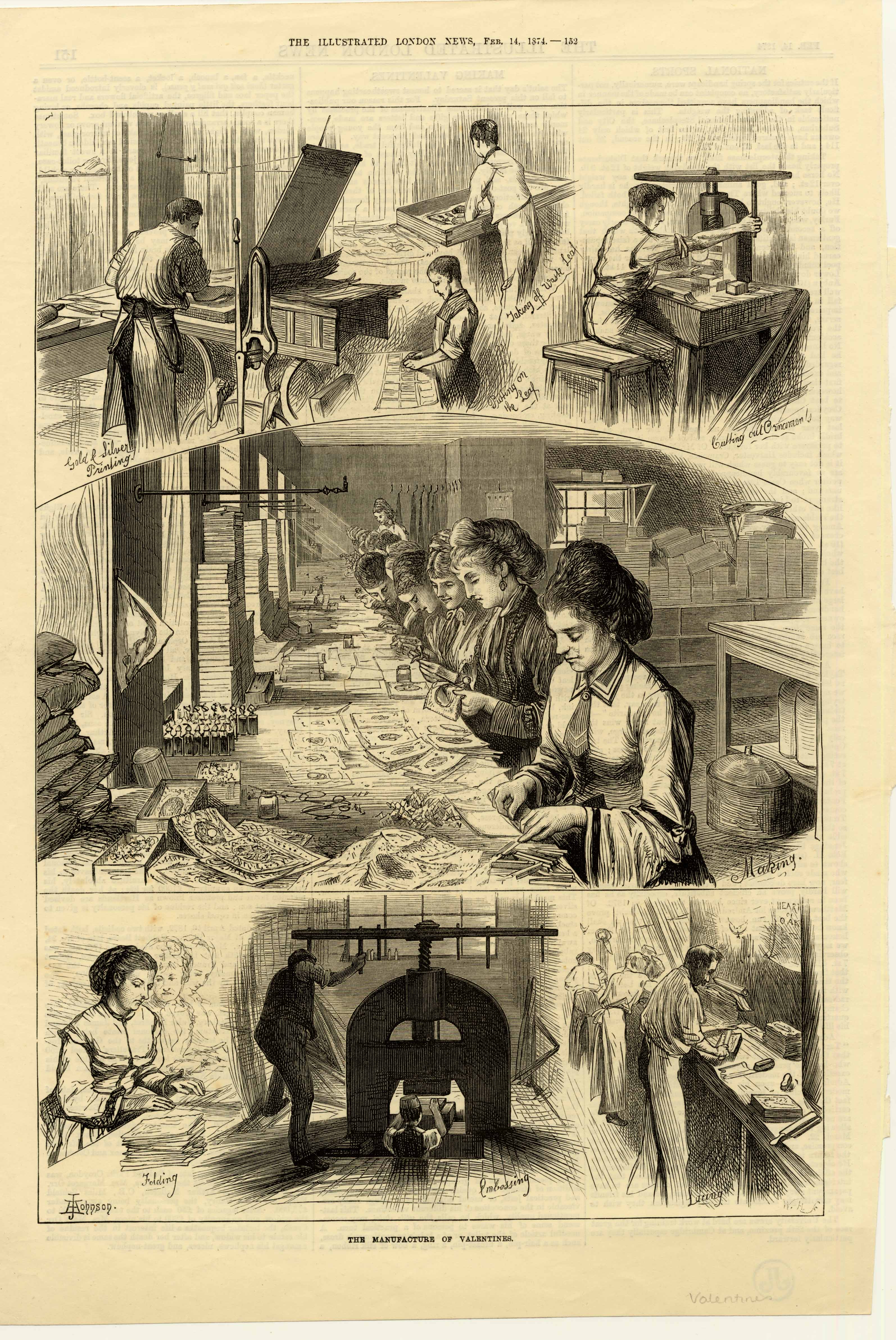
When we think of Valentine’s Day, chubby Cupids, hearts and roses generally come to mind, not industrial processes like mass production and the division of labor. Yet the latter were essential to the holiday’s history.
As a historian researching material culture and emotions, I’m aware of the important role the exchange of manufactured greeting cards played in the 19th-century version of Valentine’s Day.
At the beginning of that century, Britons produced most of their valentines by hand. By the 1850s, however, manufactured cards had replaced those previously made by individuals at home. By the 1860s, more than 1 million cards were in circulation in London alone.
The British journalist and playwright Andrew Halliday was fascinated by these cards, especially one popular card that featured a lady and gentleman walking arm-in-arm up a pathway toward a church.
Halliday recalled watching in fascination as “the windows of small booksellers and stationers” filled with “highly-coloured” valentines, and contemplating “how and where” they “originated.” “Who draws the pictures?” he wondered. “Who writes the poetry?”
In 1864 he decided to find out.
Today Halliday is most often remembered for his writing on London beggars in a groundbreaking 1864 social survey, “London Labour and the London Poor.” However, throughout the 1860s he was a regular contributor to Charles Dickens’ popular journal “All the Year Round,” in which he entertained readers with essays addressing various facets of ordinary British daily existence, including family relations, travel, public services and popular entertainments.
In one essay for that journal – “Cupid’s Manufactory,” which was later reprinted in 1866 in the collection “Everyday Papers” – Halliday led his readers on a guided tour of one of London’s foremost card manufacturers.
Inside the premises of “Cupid and Co.,” they followed a “valentine step by step” from a “plain sheet of paper” to “that neat white box in which it is packed, with others of its kind, to be sent out to the trade.”
“Cupid and Co.” was most likely the firm of Joseph Mansell, a lace-paper and stationary company that manufactured large numbers of valentines between the 1840s and 1860s – and also just happened to occupy the same address as “Mr. Cupid’s” in London’s Red Lion Square.
The processes Halliday described, however, were common to many British card manufacturers in the 1860s, and exemplified many industrial practices first introduced during the late 18th century, including the subdivision of tasks and the employment of women and child laborers.
Halliday moved through the rooms of “Cupid’s Manufactory,” describing the variety of processes by which various styles of cards were made for a range of different people and price points.
He noted how the card with the lady and gentleman on the path to the church began as a simple stamped card, in black and white – identical to one preserved today in the collections of the London Museum – priced at one penny.
A portion of these cards, however, then went on to a room where a group of young women were arranged along a bench, each with a different color of “liquid water-colour at her elbow.” Using stencils, one painted the “pale brown” pathway, then handed it to the woman next to her, who painted the “gentleman’s blue coat,” who then handed it to the next, who painted the “salmon-coloured church,” and so forth. It was much like a similar group of female workers depicted making valentines in the “Illustrated London News” in the 1870s.
These colored cards, Halliday noted, would be sold for “sixpence to half-a-crown.” A portion of these, however, were then sent on to another room, where another group of young women glued on feathers, lace-paper, bits of silk or velvet, or even gold leaf, creating even more ornate cards sometimes sold for 5 shillings and above.
All told, Halliday witnessed “about sixty hands” – mostly young women, but also “men and boys,” who worked 10 hours a day in every season of the year, making cards for Valentine’s Day.
Yet, it was on the top floor of the business that Halliday encountered the people who arguably fascinated him the most: the six artists who designed all the cards, and the poets who provided their text – most of whom actually worked offsite.
Here were the men responsible for manufacturing the actual sentiments the cards conveyed – and in the mid-19th century these encompassed a far wider range of emotions than the cards produced by Hallmark and others in the 21st century.
Many Victorians mailed cards not only to those with whom they were in love, but also to those they disliked or wished to mock or abuse. A whole subgenre of cards existed to belittle the members of certain trades, like tailors or draper’s assistants, or people who dressed out of fashion.
Cards were specifically designed for discouraging suitors and for poking fun of the old or the unattractive. While some of these cards likely were exchanged as jokes between friends, the consensus among scholars is that many were absolutely intended to be sent as cruel insults.
Furthermore, unlike in the present day, in the 19th century those who received a Valentine were expected to send one in return, which meant there were also cards to discourage future attentions, recommend patience, express thanks, proclaim mutual admiration, or affirm love’s effusions.
Halliday noted the poet employed by “Cupid’s” had recently finished the text for a mean-spirited comic valentine featuring a gentleman admiring himself in a mirror:
Looking at thyself within the glass,
You appear lost in admiration;
You deceive yourself, and think, alas!
You are a wonder of creation.
This same author, however, had earlier completed the opposite kind of text for the card Halliday had previously highlighted, featuring the “lady and gentleman churchward-bound”:
“The path before me gladly would I trace,
With one who’s dearest to my constant heart,
To yonder church, the holy sacred place,
Where I my vows of Love would fain impart;
And in sweet wedlock’s bonds unite with thee,
Oh, then, how blest my life would ever be!”
These were very different texts by the very same man. And Halliday assured his readers “Cupid’s laureate” had authored many others in every imaginable style and sentiment, all year long, for “twopence a line.”
Halliday showed how a stranger was manufacturing expressions of emotions for the use of other strangers who paid money for them. In fact, he assured his readers that in the lead up to Valentine’s Day “Cupid’s” was “turning out two hundred and fifty pounds’ worth of valentines a week,” and that his business was “yearly on the increase.”
Halliday found this dynamic – the process of mass producing cards for profit to help people express their authentic emotions – both fascinating and bizarre. It was a practice he thought seemed like it ought to be “beneath the dignity of the age.”
And yet it thrived among the earnest Victorians, and it thrives still. Indeed, it remains a core feature of the modern holiday of Valentine’s Day.
This year, like in so many others, I will stand at a display of greeting cards, with many other strangers, as we all try to find that one card designed by someone else, mass-produced for profit, that will convey our sincere personal feelings for our friends and loved ones.
Christopher Ferguson does not work for, consult, own shares in or receive funding from any company or organization that would benefit from this article, and has disclosed no relevant affiliations beyond their academic appointment.
– ref. How Valentine’s Day was transformed by the Industrial Revolution and ‘manufactured intimacy’ – https://theconversation.com/how-valentines-day-was-transformed-by-the-industrial-revolution-and-manufactured-intimacy-247441
Source: US State of North Carolina
Headline: Governor Stein Announces Additional Team Members
Governor Stein Announces Additional Team Members
lsaito
Today, Governor Stein announces additional staff as he continues to grow his team committed to building a safer, stronger North Carolina.
Adam Chandler, Policy Director
Adam Chandler is a native of Burlington, North Carolina, and a 12-year veteran of the U.S. Department of Justice, where he served most recently as Associate Deputy Attorney General and Chief of Staff to the Deputy Attorney General. Adam previously practiced at the Department as an appellate attorney, specializing in antitrust law, and served as a speechwriter for two attorneys general. He graduated from Yale Law School; the University of Oxford, where he studied as a Rhodes Scholar; and Duke University.
Kindl Detar, Senior Policy Advisor
Kindl Detar previously served as a Special Deputy Attorney General and the Director of the Public Protection Section at the North Carolina Department of Justice. Prior to her state government service, she worked at Foundation For The Carolinas and Robinson Bradshaw. Kindl is a graduate of the University of North Carolina at Chapel Hill and the University of Pennsylvania School of Law. A native of Concord, she resides in Charlotte with her husband and three children.
Sadie Weiner, Senior Advisor
Sadie Weiner has worked in state and federal government and campaigns for almost two decades. She served in the Office of Governor Roy Cooper first as Communications Director and most recently as Director of External Affairs. Previously, Weiner was the Communications Director of the Democratic Senatorial Campaign Committee (DSCC), supporting campaigns across the country and picking up two Senate seats. She was also the Communications Director for U.S. Senator Kay Hagan in both her Senate office and her re-election campaign. Weiner lives in Raleigh with her husband and two children.
Awo Eni, Digital Director
Awo Eni returns to North Carolina after working on Cheri Beasley’s campaign for Senate in 2022 as the Deputy Digital Director. She most recently served as Director of Digital Content on Senator Sherrod Brown’s campaign for re-election in Ohio. Awo is a proud British-born Nigerian-American immigrant who calls Texas home. She is a graduate of the University of North Texas.
Liz Doherty, Policy Advisor
Liz Doherty joins the Stein Administration as a policy advisor in the Governor’s office. Prior to this role, she served as a policy advisor to Governor Roy Cooper and held various campaign roles, including as Governor Cooper’s communications director in 2020. She also serves as a board member on the NC Council for Women and completed a Master’s of Public Policy from the Duke University Sanford School in 2023.
Rania Hassan, Policy Analyst
Rania Hassan is a policy analyst in the Office of Governor Josh Stein. She previously worked as policy assistant and analyst in the Office of Governor Roy Cooper. She graduated from NC State University with a B.S. in Environmental Science and a minor in Environmental Policy and Justice.
Madhu Vulimiri, Senior Advisor for Health & Families Policy
Madhu Vulimiri joins the Governor’s Office from the North Carolina Department of Health and Human Services, where she served as the Deputy Director for the Division of Child and Family Well-Being overseeing nutrition programs that support children and families. Prior to that, she led cross-agency priority initiatives at NCDHHS, including in the COVID-19 response, in chief of staff and senior strategy roles to the Chief Deputy Secretary of NCDHHS and at NC Medicaid. She earned her Bachelor of Science in Public Health from the University of North Carolina-Chapel Hill, where she was a Morehead-Cain Scholar, and her Master of Public Policy from Duke University, where she was a Margolis Scholar in Health Policy and Management.
Elena Ashburn, Senior Advisor for Education Policy
Elena Ashburn joins the policy team after serving as an area superintendent in the Wake County Public School System, where she led 17,000 students in 23 schools. She began her career in education as a Teach For America teacher and later served as a middle and high school principal. Elena earned a doctorate in educational leadership from UNC Chapel Hill and was named the North Carolina Wells Fargo Principal of the Year in 2021.
Jonathan Moch, Senior Advisor for Climate & Energy Policy
Jonathan Moch was most recently Science and Technology Policy Advisor for the Office of the Special Presidential Envoy for Climate and Office of Global Change in the U.S. Department of State, where he designed, negotiated, and implemented international climate and energy initiatives and agreements. Prior to the State Department, he was an interdisciplinary Postdoctoral Fellow with joint appointments in Harvard’s engineering, public health, and government schools. Jonathan holds a Ph.D. in Earth and Planetary Sciences with a secondary field in Science, Technology and Society, a master’s in Environmental Science and Engineering from Harvard University, and an undergraduate degree from Princeton University.
P.J. Connelly, Director of the Governor’s Eastern North Carolina Office
P.J. Connelly will serve as the Director of the Governor’s Eastern North Carolina Office. He served in this role for former Governor Roy Cooper from 2022 to 2024. Prior to that, Connelly served North Carolina’s rural communities through the Governor’s Hometown Strong Initiative. He also served as Assistant Director of Boards and Commissions in the Office of the Governor from 2017 to 2019. Connelly is from New Bern, North Carolina.
Source: US State of North Carolina
Headline: 2025 Eastern NC Regional Braille Challenge Set for Feb. 17
2025 Eastern NC Regional Braille Challenge Set for Feb. 17
jejohnson6
The State Library of North Carolina Accessible Books and Library Services (ABLS) is thrilled to announce the upcoming 2025 Eastern NC Regional Braille Challenge, a compelling event that promises to highlight the talents and achievements of blind and visually impaired students in the realm of Braille literacy.
Taking place Feb. 17, from 9 a.m. to 4 p.m. at the Governor Morehead School for the Blind in Raleigh, this event is a unique opportunity for media professionals to capture and share inspiring stories.
The 2025 Eastern NC Regional Braille Challenge is a regional event of The Braille Challenge, a national program of the Braille Institute.
About the Event: The 2025 Eastern NC Regional Braille Challenge is more than a competition; it’s a celebration of Braille literacy, bringing together talented students from the region. From captivating Braille reading sessions to thought-provoking writing challenges, the event is designed to showcase the incredible skills and determination of blind and visually impaired youth.
Event Details:
• Date: Monday, Feb.17
• Time: 9 a.m.-4 p.m.
• Location: Governor Morehead School for the Blind, 301 Ashe Ave, Raleigh, NC 27606
In the event of inclement weather, causing potential travel concerns, the Braille Challenge will be rescheduled to Feb. 24.
Media Opportunity: Journalists, photographers, and camera crews are invited to attend the Braille Challenge and witness firsthand the spirit and resilience of these talented students. From heartwarming success stories to the demonstration of Braille proficiency, this event offers a wealth of visual and narrative opportunities for media coverage.
Interview Opportunities:
• Engage with participants, educators, and organizers to learn more about the significance of Braille literacy.
• Capture emotional moments as students showcase their Braille skills in a competitive and supportive environment.
How to Cover the Event: For media inquiries or to confirm attendance, contact Clint Exum, Outreach Specialist, at clint.exum@dncr.nc.gov or 984-236-1118.
About SLNC ABLS
ABLS is the free public library for North Carolinians with a print disability, such as blindness, a physical disability preventing them from holding a book, or a reading disability. Our library serves the entire state by mail or online with an assortment of accessible resources like talking books, braille books, large print books, and descriptive movies. https://statelibrary.ncdcr.gov/blind-print-disabled
Source: US State of North Carolina
Headline: Bennett Place State Historic Site Hosts Lecture and Debuts a Community Project in Honor of Black History Month
Bennett Place State Historic Site Hosts Lecture and Debuts a Community Project in Honor of Black History Month
jejohnson6
On Saturday, Feb. 15 at 2 p.m., Bennett Place State Historic Site will host a free lecture with local historian Ernest Dollar entitled “Jublio: Moments of Freedom, 1865.”
Dollar, who serves as director of the Museums Section for the City of Raleigh, will highlight how enslaved people found and claimed freedom for themselves in the final days of the Civil War in North Carolina. This program will explore perspectives of African American men and women’s first moments of freedom as part of the site’s Black History Month programming.
Bennett Place interprets the largest troop surrender of the Civil War in April 1865 and how it contributed to ending slavery.
Now through April 16, visitors are invited to commemorate emancipation by creating community luminaries. A self-guided station at the Visitor Center will provide instructions for making the luminaries, which will be used during an April 25 program marking the 160th anniversary of a new chapter of freedom for more than 331,000 formerly enslaved North Carolinians. Visitors can also learn more about the connection between Bennett Place and emancipation. The Community Luminary table is open Tuesday-Saturday, 9:30 a.m.-4:30 p.m.
About the North Carolina Department of Natural and Cultural Resources
The N.C. Department of Natural and Cultural Resources (DNCR) manages, promotes, and enhances the things that people love about North Carolina – its diverse arts and culture, rich history, and spectacular natural areas. Through its programs, the department enhances education, stimulates economic development, improves public health, expands accessibility, and strengthens community resiliency.
Source: US State of North Carolina
Headline: Prominent Civil Rights Attorney James Walker Jr., to be Featured on N.C. Highway Historical Marker
Prominent Civil Rights Attorney James Walker Jr., to be Featured on N.C. Highway Historical Marker
jejohnson6
James Robert Walker Jr., a prominent civil rights attorney from northeastern North Carolina, soon will be recognized with a North Carolina Highway Historical Marker.
The marker commemorating Walker will be dedicated during a ceremony at the New Ahoskie Missionary Baptist Church (410 West Hayes St., Ahoskie, N.C.) on Saturday, Feb. 22 at 1 p.m. The marker will be installed at the intersection of U.S. 13 and N.C. 42 in Ahoskie.
Born in 1924 as the first of eight children, Walker grew up in Ahoskie, in a family of educators with advanced degrees and the grandson of a preacher. He served in World War II and earned his bachelor’s degree from North Carolina College, now North Carolina Central University, after being honorably discharged from the United States Army.
Walker later became the first of two Black graduates from any program at UNC-Chapel Hill, having graduated from its law school in 1952. He returned to his native northeastern North Carolina and became a grassroots civil rights attorney, namely waging battles in the realm of voting rights across a six-county area (Halifax, Northampton, Warren, Bertie, Hertford, Gates).
Walker was the principal organizer and president of the Eastern Council on Community Affairs. This group advocated for Black representation in local and state governing bodies, including town councils and state legislatures. It also opposed bills for school separation or segregation.
Walker became the first Black member of UNC-Chapel Hill’s Dialectic and Philanthropic Societies, the school’s debating and literacy society, and the oldest student organization on the campus. The state’s NAACP also recognized him with its Distinguished Service Award for his efforts in civil rights. In 1961, he was the keynote speaker for the National Lawyers Guild in Detroit, Michigan, and in 1978, was named Lawyer of the Year by the same organization.
Walker died in 1997.
For more information about the historical markers, please visit https://www.dncr.nc.gov/blog/2024/07/10/james-walker-jr-1924-1997-96, or call (919) 814-6625.
The Highway Historical Marker Program is a collaboration between the N.C. departments of Natural and Cultural Resources and Transportation.
Source: US State of South Carolina
(COLUMBIA, S.C.) – Attorney General Wilson released the following statement following the oral arguments today before the South Carolina Supreme Court on the state’s Fetal Heartbeat Act:
“This is the third time my office has gone to the state Supreme Court to fight to uphold our state’s Fetal Heartbeat Act. The legislature’s intent was clear—to protect life once a heartbeat is detected. We thank the justices for their attention and thoughtful questions and look forward to their ruling. I will always fight to uphold the sanctity of life.”
Source: Africa Press Organisation – English (2) – Report:
ABUJA, Nigeria, February 12, 2025/APO Group/ —
The Federal Government of Nigeria and Afreximbank (www.Afreximbank.com) have signed the Host Country Agreement for the 32nd Afreximbank Annual Meetings (AAM) in Abuja, Nigeria, from 23-28 June 2025.
Afreximbank Annual Meetings is one of the most anticipated gatherings on the African continent, featuring high-level policy discussions, presentations, and side events on issues pertinent to the socio-economic development of Africa as well as business networking sessions that drive integration through trade and investments.
The 32nd Afreximbank Annual Meetings in June 2025 is expected to be the largest gathering of Global Africa in the Bank’s Annual Meetings history, bringing together over 6,000 delegates including Heads of State, government officials, captains of industry, businesspeople, decision-makers, academics, respected experts and advisors from Africa, the CARICOM region and globally.
Commenting on the significance of the agreement, H.E. Wale Edun, the Honourable Minister of Finance and Coordinating Minister of the Economy for Nigeria, emphasised Nigeria’s strong partnership with Afreximbank and its commitment to fostering trade and economic growth for Africa and beyond.
He said: “Nigeria is honoured to host the 2025 Afreximbank Annual Meetings, which will serve as a critical platform to drive discussions on trade financing, economic growth, and investment opportunities across Africa.” He added: “This event is a testament to our commitment to strengthening Africa’s financial sector and positioning Nigeria as a hub for economic transformation.”
Professor Benedict Oramah, President and Chairman of the Board of Directors, Afreximbank, said: “We greatly appreciate the Federal Government of Nigeria’s acceptance to host the 2025 Afreximbank Annual Meetings, which demonstrates our united determination to accelerating Africa’s economic growth and development.
“The Government of Nigeria has been a steadfast partner and a strong backbone of the Bank. It has consistently responded positively to capital calls, injecting significant equity into the Bank even when the economic environment seemed challenging; removing regulatory hurdles that would otherwise inhibit the Bank’s business in Nigeria, and being at the forefront of rallying continental support for the Bank.”
“This year’s theme, ‘Building the Future on Decades of Resilience,’ reflects the progress that we have made over the past three decades and the bold steps that are imperative to navigate the increasingly complex global landscape. The African Continental Free Trade Area (AfCTA) has given our continent an unrivalled opportunity to deliver sustainable economic transformation that will propel Africa’s economic growth and raise living standards and prosperity for all Africans.
“Afreximbank Annual Meetings will provide a platform to reflect on our journey, celebrate contributions, and chart a path forward that reinforces our continent’s economic independence and global influence. We look forward to welcoming and meeting stakeholders from across Africa and other parts of the world to Abuja for this prestigious event.”
Prof. Oramah noted that Nigeria’s unwavering support to Afreximbank has been the primary driver of the Bank’s strong continental impact. “The impact on the Nigerian economy is equally palpable. Being the largest recipient of the Bank’s trade and development finance, Nigeria has attracted cumulative disbursements of about US$52 billion in addition to being the first beneficiary of several flagship transformative projects being executed by the Bank such as the African Medical Centre of Excellence (AMCE), African Quality Assurance Centre (AQAC), Afreximbank African Trade Centre (AATC), among others.
This year’s event comes on the backdrop of the highly successful 2024 AAM, held in Nassau, The Bahamas and attended by over 4,000 delegates, including over 20 Heads of State, government ministers, high-level dignitaries, global experts, and world-renowned celebrities and artists.
Afreximbank was established when the shareholders held their first General Meeting in Abuja, Nigeria in October 1993. Today, Nigeria is Afreximbank’s second-largest shareholder.
Source: US Immigration and Customs Enforcement
February 12, 2025Annadale, VA, United StatesEnforcement and Removal
ANNANDALE, Va. — U.S. Immigration and Customs Enforcement, assisted by the FBI, apprehended seven illegally present aliens during a routine enforcement operation in Annandale, Feb. 5.
“These seven individuals were in the Northern Virginia area in violation of U.S. immigration laws,” said ICE Enforcement and Removal Operations Washington, D.C. acting Field Office Director Patrick Divver. “ICE Washington, D.C.’s mission is to ensure the safety and security of our District of Columbia and Virginia communities through the arrest and removal of those individuals who undermine the safety of our communities and the integrity of our immigration laws. We take this mission extremely seriously, and we will continue to arrest and remove alien offenders.”
During the targeted operation, ICE officers and FBI special agents arrested:
Members of the public can report crimes and suspicious activity by dialing 866-DHS-2-ICE (866-347-2423) or completing the online tip form.
Learn more about ICE’s mission to increase public safety in our communities on X: @EROWashington.
Source: US GOIAM Union
For the past two years, the IAM Veterans Services team has been traveling across the country, assisting and advocating on behalf of our veteran members. On Jan. 17, 2025, the U.S. Department of Veterans Affairs (VA) notified the IAM that the Veterans Services Program had reached their long and hard-fought goal. IAM is officially the first and only labor union to be recognized as a national Veterans Service Organization (VSO). For IAM U.S. military veterans and their families, this recognition means increased access to vital resources and support, along with a powerful advocate by their side.
“It has been a long road, but we made it,” said IAM International President Brian Bryant. “For IAM military veterans, this recognition brings hope and assurance that they are not alone. They have a trusted ally with the formal backing of the VA, with the expertise to help secure the benefits they earned through their service at no cost to our members and their families. The entire Executive Council and I take great pride in this accomplishment, as should all IAM members.”
This official recognition by the VA is not just a title. It signifies that the IAM has met stringent requirements and is now able to expand its representation of veterans in a more formal capacity. This includes assisting with claims through more representatives, advocating for benefits, pushing for legislative changes, and providing guidance through the often-complex VA system. It demonstrates the organization’s strong commitment to understanding and meeting the needs of veterans and their families.
The IAM has one of the highest percentages of military Veterans in the entire labor movement. In less than three years, the IAM Veterans Services Program has secured over $3 million in disability payments and over $300,000 a month in compensation increases for about 300 IAM Veterans.
“We will now be able to grow our organization and set a new standard of care for all IAM Veterans,” said IAM Veterans Services Coordinator Richard Evans. “For the IAM itself, this recognition is a testament to our hard work, dedication, and tireless advocacy on behalf of those who have served in our military. It shows that this organization is equipped with the tools, knowledge, and resources to effectively help Veterans navigate the challenges they face after service. Whether it’s securing healthcare, disability benefits, or educational opportunities, this recognition strengthens our ability to fight for veterans’ rights and ensure they receive the care and support they deserve.”
“This is a significant level up for the IAM Veterans Service program,” said IAM Veterans Services Assistant Coordinator Bryan Stymacks. “We’re incredibly grateful to so many within the IAM who helped us move this application forward, as well as former VA Secretary Denis McDonough and the Biden Administration for approving the IAM as a VSO.”
“We owe this achievement to the veterans themselves, the true heroes. This recognition is about them and ensuring that they are never forgotten,” said IAM Retirees and Membership Assistance Director James Little. “Our work has only just begun, and with this recognition, we are more motivated than ever to continue pushing forward, advocating for the rights of veterans, and ensuring they have the support they need and deserve.”
Share and Follow:
Source: US State of Pennsylvania
February 12, 2025 – Claysburg, PA
Lt. Gov. Austin Davis and Second Lady Blayre Holmes Davis joined local business leaders, parents and providers for a roundtable conversation at Sheetz’s corporate support center in Claysburg to highlight the Shapiro-Davis Administration’s 2025-26 proposed budget, which continues vital investments in childcare and early learning and includes a new proposal to address shortages in the childcare workforce.
“The childcare workforce shortage hurts working families, and it hurts our economy, likely in the range of billions of dollars in lost earnings, productivity and revenue,” said Lt. Gov. Davis, who is co-chair of the Early Learning Investment Commission (ELIC), a public-private partnership that brings together leaders to make recommendations and policy for early learning. “That’s why our new proposed budget would fund $1,000 bonuses to recruit and retain childcare workers across the Commonwealth. These workers are caring for our most valuable resource – our children. Many of them are mothers, who are also trying to make ends meet for their own families. They work hard, and they deserve it.”
“The Lieutenant Governor and I know about this issue firsthand – our daughter, Harper, attends a wonderful childcare facility that we were incredibly fortunate to find,” said Second Lady Holmes Davis. “We want working parents all across this Commonwealth to have the same access to affordable, high-quality care that we have, and we want every Pennsylvania child to have the same opportunities our daughter has – opportunities to learn, play and grow in a safe and loving environment.”
Roundtable Participants Include:
Lieutenant Governor Austin A. Davis
Second Lady Blayre Holmes Davis
Sheetz EVP of People and Culture Stephanie Doliveira
Bright Horizons Divisional VP Julie Beam
Litte Sproutz Teacher Chelsey Morse
Sheetz Employee Relations Lauren Harris
Blair County Commissioner Laura O. Burke, Esq.
Altoona Blair County Development Corporation – VP of Business Retention & Expansion Matt Fox
Blair Companies President & CEO Phil Devorris
Source: US State of Rhode Island
As part of work statewide to protect children and families from the hazards of lead exposure, the Rhode Island Department of Health (RIDOH) has launched its Rental Registry public database. (See link below.)
With this dashboard, a resident can look up their rental property to see if the property’s landlord has secured a Certificate of Lead Conformance, or other lead certificate, for the property. These have been required by Rhode Island law for pre-1978 homes since 2005. They are issued by a licensed lead inspector and document that a property is in a lead-safe condition. The registry will also make the contact information of the property owner or manager available.
“This new public database promotes transparency, safety, and accountability for people who rent their homes in Rhode Island,” said Director of Health Jerry Larkin, MD. “All children and families deserve to live in housing that is healthy and safe. By ensuring compliance with the requirement for landlords to provide lead-safe housing – which has been on the books for two decades – we are one step closer to that goal.”
A requirement for landlords to register their rental properties by October 1, 2024 was laid out in the Residential Landlord and Tenant Act (R.I. Gen. Laws � 34-18-58), which became law in Rhode Island in 2023. Through increased trainings and licensing professionals who were already license-holders in other states, RIDOH has significantly increased the number of licensed lead inspectors who are available to inspect properties for lead.
In addition to allowing people who rent to search their properties, the new system also features a portal for landlords that makes it easier to register their rental properties. Landlords who have already registered their properties do not need to take any additional action right now. RIDOH will provide information to landlords about when re-registration is required. Landlords must re-register every year. (In the upcoming version of the Rental Registry, landlords will no longer need to upload their lead certificates. The new system will automatically recognize whether a property’s units are lead certificate compliant.)
Most homes in Rhode Island were built before 1978 and likely have lead-based paint. (Lead paint was banned after 1978.) Lead paint and paint dust can harm young children’s health. Children younger than six years old are at greatest risk. Lead exposure can slow a child’s development and cause learning disabilities and behavior problems. The most effective way to prevent lead exposure is to properly maintain lead-painted surfaces or remove lead-based paints.
RIDOH is continuing to focus its efforts on landlord education through broad social media and paid media campaigns right now. However, the failure to register and/or have a lead certificate can result in fines. RIDOH anticipates beginning to fine noncompliant landlords this summer. RIDOH will do additional, wide communication to landlords and the public before any fines are levied.
The fine for failure to register is $50 per month, per unit. The fine for failure to obtain a valid lead certificate, where applicable, is $125 per month, per unit. A landlord who continues to fail to register or obtain a lead certificate is subject to additional, more significant penalties. Additionally, landlords cannot file for eviction for nonpayment of rent unless the property involved is registered in the Rhode Island Rental Registry.
The rental registry includes rental properties that have been registered by landlords and properties that may be rental units that are still unregistered. (Potential rental properties were identified using tax assessor data and other public information.) As more properties are registered, the registry will become more complete. If tenants do not find their residence while searching the database, they can write to rentalregistry@health.ri.gov.
US Senate News:
Source: United States Senator John Kennedy (Louisiana)
WASHINGTON – Sen. John Kennedy (R-La.) celebrated the Trump administration’s effort to expose wasteful spending within the federal government in a speech on the Senate floor.
Key excerpts of the speech are below:
“I want to make a brief comment about the continuing saga that our new president is doing, in my judgment, a good job of prosecuting here in Washington. I am talking about his audits of federal government spending and all of the wasteful spending—I call it spending porn—that he is finding.”
. . .
“The battle lines are drawn. Some of my colleagues have decided to support the bureaucracy and the spending porn over the American taxpayer. . . . That is their right.
“It is not against the law or unconstitutional to be foolish in America, but these are the same people . . . who chose to support illegal immigration over the rule of law. These are the same people who have chosen to support teachers’ unions over parents and kids. These are the same people who have chosen to support criminals over cops and victims. These are the same people who have chosen to support transgender athletes over women’s sports. These are the same people who have chosen to support Hamas over Israel.
“They think they are winning. Maybe in this town they are—if you listen to a lot of the pundits up here, if you listen to a lot of the members of the ‘wokerati’ in Washington—but they are not winning in America. The justice stick is coming, and I am very proud to be a part of that effort.”
Watch Kennedy’s full speech here.
Source: GlobeNewswire (MIL-OSI)
Dubai, Feb. 12, 2025 (GLOBE NEWSWIRE) — Dubai, 12 February 2025: Vantage Drilling International Ltd. (the “Company”) announces it has entered into a marketing agreement with Eldorado Drilling AS to market the 7th Generation Dorado Drillship for drilling opportunities in various locations in Africa, the Mediterranean, Asia and Australasia.
Ihab Toma, CEO of Vantage Drilling, commented: ´We are delighted to have entered into this agreement with Eldorado Drilling and we look forward to successfully placing the rig in operation. The Dorado is one of the last delivered 7th generation drillships – an advanced-capability drillship designed to operate in water depths of up to 12,000 feet. This new agreement further demonstrates the rig owners’ confidence in Vantage as a most reliable and trusted partner to market and operate their assets.´
About the Company
Vantage Drilling International Ltd., a Bermuda exempted company, is an offshore drilling contractor. Vantage Drilling’s primary business is to contract drilling units, related equipment and work crews primarily on a dayrate basis to drill oil and natural gas wells globally for major, national and independent oil and gas companies. Vantage Drilling also markets, operates and provides management services in respect of drilling units owned by others. For more information about the Company, please refer to the Company’s website, www.vantagedrilling.com
Attachment
US Senate News:
Source: United States Senator for Nebraska Deb Fischer
to support nationwide infrastructure investments and promote fairness among drivers. The Fair Sharing of Highways and Roads for Electric Vehicles (Fair SHARE) Act would ensure that electric vehicles (EVs) pay into the Highway Trust Fund (HTF) to support the construction and maintenance of U.S. roads and bridges.
Gasoline-powered cars pay into the HTF through the gas tax, but as of now, EVs do not contribute to the HTF at all. However, the average EV is significantly heavier than its gas-powered counterpart due to the weight of large EV batteries. The Fair SHARE Act would require additional investment in the HTF for EVs with heavier batteries to account for the road damage and increased maintenance costs they cause.
In addition to Senator Fischer, the legislation is cosponsored by U.S. Senators Cynthia Lummis (R-Wyo.) and Pete Ricketts (R-Neb.). U.S. Representative Dusty Johnson (S.D.–AL) introduced identical companion legislation in the House.
“EVs can weigh up to three times as much as gas-powered cars, creating more wear and tear on our roads and bridges. It’s only fair that they pay into the Highway Trust Fund just like other cars do. The Fair SHARE Act will require EVs to pay their fair share for the upkeep of America’s infrastructure,” said Senator Fischer.
“EV drivers use our highways just as much as gas-powered vehicles, yet they are currently exempt from paying into the Highway Trust Fund because the Biden administration wanted to score points with its radical climate change base. The days of liberal elites in their expensive EV’s getting a free pass are over; they are contributing to wear and tear on our roads, and they should be forced to pay their fair share in repairs just like the rest of us,” said Senator Lummis.
“EVs are heavier than other consumer vehicles, and increase the wear and tear on our roads. EV drivers also don’t pay a gas tax like other drivers do,” said Senator Ricketts. “That’s wrong. This bill ensures Americans fueling their vehicles are not forced to pay for EV drivers.”
“The Highway Trust Fund is on the road to insolvency,” said Congressman Johnson. “It’s time to consider real changes and ensure EVs pay their fair share to maintain our roads and bridges. I’m grateful for Senator Fischer’s leadership on this bill that will undoubtedly create a more stable Highway Trust Fund, ensuring the government can continue to make meaningful investments in our road infrastructure needs.”
“All Americans benefit from a robust and safe transportation system. When it comes to paying for the maintenance and expansion of our road network, no one should get a free ride,” said American Trucking Associations Senior Vice President of Legislative Affairs Henry Hanscom. “The trucking industry makes up just four percent of the vehicles on our nation’s highways, yet we pay nearly half the tab into the federal Highway Trust Fund—all while moving over 70 percent of the domestic freight tonnage. Clearly trucks are doing their part to invest in the nation’s infrastructure, and it is reasonable to expect electric vehicles to do the same. As fuel efficiency rises and adoption rates for alternative fuels accelerate, we must find long-term, sustainable, and equitable sources of revenue for the HTF. We commend Senator Deb Fischer and Congressman Dusty Johnson for leading this effort to ensure that electric vehicles are paying their fair share.”
“For nearly 70 years, purchasers of gasoline, diesel, gasohol, liquified natural gas and liquified petroleum gas have supported the maintenance and improvement of the nation’s roads and bridges. The lone exception to this user-fairness principle remains vehicles powered by electricity. Thankfully, Senator Fischer and Representative Johnson have introduced the Fair SHARE Act to correct this oversight and improve mobility for all Americans,” said American Road & Transportation Builders Association President and CEO Dave Bauer.
“This measure will provide a sustainable, long-term revenue stream to the Highway Trust Fund, allowing the construction employers to maintain and rebuild our nation’s roads and bridges. The legislation will close a loophole for electric vehicles, which currently do not currently contribute to the Fund. Instead of giving them a free ride, this measure simply asked electric vehicle users to take part in the same user-pay approach that enabled the U.S. to build and maintain the highway network,” said Associated General Contractors of America CEO Jeff Shoaf.
“It is imperative that all vehicles share the responsibility of maintaining our roadways. Senator Fischer’s Fair SHARE Act will ensure that by requiring EVs to contribute to the Highway Trust Fund, we can ensure that essential transportation infrastructure remains safe and accessible to everyone without any unfair burden placed upon any specific type of vehicle,” said National Association of County Engineers Executive Directors Kevan Stone.Full List of Stakeholder Support:
American Trucking Associations, American Road and Transportation Builders Association, American Society of Civil Engineers, Associated General Contractors of America, National Association of Counties, National Association of County Engineers, and National League of Cities.
Background:The HTF supports over 90 percent of federal highway aid to states. The HTF was meant to befunded primarily by the federal gas tax. However, since the gas tax was last raised in 1993, the HTF faces insolvency due to more fuel-efficient vehicles on the roads, leading to reduced fuel consumption.
EVs are not subject to the gas tax and do not contribute to the HTF. Furthermore, their heavy batteries (up to triple the weight of gas-powered cars) lead to more extensive road wear, causing more maintenance and greater costs.
Senator Fischer’s legislation would fix this discrepancy by implementing a fee at the manufacturer level at the point of sale of EVs. This ensures that every vehicle on the road is paying into the HTF and supporting critical repairs to America’s infrastructure.
Click
US Senate News:
Source: United States Senator for Massachusetts – Elizabeth Warren
February 12, 2025
Washington, D.C. – Today, in response to House Republicans unveiling their FY 2025 budget resolution proposal, U.S. Senator Elizabeth Warren (D-Mass.) released the following statement:
“Republicans are pulling a fast one on working people by reaching into their pockets to pay for billionaire handouts. Make no mistake: this GOP plan will raise the cost that American families pay for groceries, health care, and getting an education – all to fund tax cuts for the ultra-rich.”
US Senate News:
Source: United States Senator for Illinois Dick Durbin
February 12, 2025
WASHINGTON – In a speech on the Senate floor, U.S. Senate Democratic Whip Dick Durbin (D-IL) outlined his serious concerns with Tulsi Gabbard, President Trump’s nominee to be the Director of National Intelligence ahead of her confirmation vote. Durbin began his remarks by highlighting the history of the Office of the Director of National Intelligence, which was established after the September 11th terrorist attacks.
“[September 11 led to the creation] of the Office of the Director of National Intelligence, which oversees the 18 intelligence agencies that span the CIA, Defense Department, State Department, Energy Department, and others. It is now essential to modern safety in America. But yet, the President—Donald Trump—has selected a person who has little or no experience to lead this critical part of America’s security apparatus: her name is Tulsi Gabbard,” Durbin said.
“During President Trump’s first term, he made clear his fondness for certain leaders of the world that are controversial such as Viktor Orban of Hungary, Vladimir Putin of Russia, and Kim Jong Un of North Korea. So, he ends up picking a person to run America’s intelligence network who shares similarly terrible judgment on critical security matters. Tulsi Gabbard is infamous fordefending despots and other autocratic leaders in the world—including Vladimir Putin and Bashar al-Assad—and traitors to the United States such as Edward Snowden. And her fondness for these oppressive, anti-democratic regimes does not go unreciprocated—they know her [and] they like her,” Durbin continued.
Durbin then highlighted examples on the floor of the anti-democratic regimes who are cheering for Ms. Gabbard’s confirmation—including hosts of Russian media who believe her nomination will “dismantle America,” and some on Russian state channels have even referred to her as their “girlfriend.” Russian state TV also called her a Russian “comrade” in President Trump’s emerging cabinet. A pro-Putin propagandist Vladimir Soloviev once called Gabbard “our friend.” Later, when asked if she was “some sort of Russian agent?” Soloviev replied: “yes.” In a profile in a Russian state newspaper, it said of Gabbard’s nomination: “The C.I.A. and the F.B.I. are trembling,” noting that Ukrainians consider her “an agent of the Russian state.”
“Imagine that. The person tapped to head America’s intelligence community—being called a puppet of an adversary’s country by that very same country. It seems too ridiculous to be true. But I’m sorry to say it is. To merely join America’s intelligence community—never mind lead it—candidates must go through vigorous background checks and earn security clearances… If Tulsi Gabbard was applying for an entry-level position, her relationship with Russia would disqualify her for the job. Why, then, would we trust her to [head the entire intelligence network] given the examples that abound of Tulsi Gabbard proving publicly, shamelessly, and carelessly her sympathies for nations that undermine U.S. interests and security. That is unexplainable and irresponsible,” Durbin continued.
“Our allies depend on us as much as we depend on their security and to share critical intelligence. Now, they are looking at us in disbelief that we would let someone like Tusli Gabbard with such an appalling record anywhere near the leadership of the intelligence community. Intelligence professionals from Canada and the United Kingdom—which are members of the critical Five Eyes intelligence alliance along with the U.S., Australia, and New Zealand—have expressed concern about even working with her if she is in charge. In order to keep Americans safe throughout the world, we need to have the trust of our allies,” Durbin said.
Durbin then spoke about the impacts Ms. Gabbard’s confirmation would have on supporting our Ukrainian ally and their defense against Russia. Since Russia’s full-scale invasion, Gabbard has taken Russia’s side—claiming ‘Russia had legitimate security concerns,’ and blaming NATO, one of our most significant security alliances.
“Let me be clear: Supporting democracies has not historically been a partisan matter,” Durbin continued. “For example, contrast Tulsi Gabbard’s nonsense with former President Ronald Reagan’s clear-eyed understanding of the danger of the communist Russian empire. Nearly 40 years ago, he stood at the Brandenburg Gate in West Berlin and famously challenged the Soviet Union to ‘tear down this wall.’ Reagan understood the true nature and threat of the Russians. And we have all seen the horrific costs of Russia’s war in Ukraine and increasing attacks against NATO allies.”
“Is there a deal to be made to end this war? Perhaps. But doing so must be with the best intelligence available—a clear eye about who we are negotiating with and long-term guarantees of the security of Ukraine, of Europe, and the transatlantic alliance. One would think that any American president navigating such difficult waters would want a top official to serve as the head of National Intelligence. Tulsi Gabbard fails that test,” Durbin said.
Durbin concluded, “Tulsi Gabbard would not be qualified for an entry-level position within our intelligence community. And she is not qualified to lead it. Period. Some of the President’s cabinet nominees are hard to imagine because they are so unqualified. But for the position of DNI—putting someone unqualified in charge is not funny at all. It is life or death dangerous.”
Video of Durbin’s remarks on the Senate floor is available here.
Audio of Durbin’s remarks on the Senate floor is available here.
Footage of Durbin’s remarks on the Senate floor is available here for TV Stations.
-30-
Source: United States Department of Defense
DEFENSE SECRETARY HEGSETH: How’s it going everybody? Sir. Good to see you. It’s been a great day, really. Any day we can spend with the troops from the very early morning of PT with some high speed guys and gals to two COCOMs that are right in the front lines of advancing American interests. Proud to be here today.
Just an impressive display of what Americans are doing in far flung places for the American people, so proud to be here for sure. I think we have a local — where’s our local reporter? I’d like to go first to our local.
Q: Thank you so much. So —
DEFENSE SECRETARY HEGSETH: Where are you from?
Q: I’m from Suddeutsche Zeitung. That’s the second biggest newspaper in Germany.
DEFENSE SECRETARY HEGSETH: Well, it’s my favorite now.
Q: And you are visiting Africom as one of your first points in your duty. Does that mean that the American strategic aims in Africa are going to change?
DEFENSE SECRETARY HEGSETH: Well, I think it’s a reflection of the importance of that command as well as EUCOM. We spent this morning at EUCOM, as well; made sense to come to both if we’re here in Germany.
But it’s also a reflection that, you know, the PRC’s intentions are pernicious, not just in their part of the world, but also in South America and on the African continent. And America’s posture there along with allies and partners is going to matter about contesting that space. So, it certainly remains a priority.
You saw the strike in Somalia on February 1st. That — as we talked to the command, that’s a reflection also of pushing decision authority down, untying the hands of war fighters who in the previous administration made multiple requests and were often denied for that kind of kinetic action, or the decision had to be made at the White House when it should be made at the four star level or at the Secretary of Defense level more quickly based on the ability to degrade the enemy.
So, this is a very important part of the world for us. The President feels that way, as well, and we’re honored to be here. Thank you.
Q: Mr. Secretary, are you planning to cut the number of American forces in Europe, shift to the Pacific and focus on China?
DEFENSE SECRETARY HEGSETH: There are no plans right now in the making to cut anything.
There is an understanding that we’re going to review force posture across the world, right. President Trump’s planning assumptions are different in many ways, or at least strategic assumptions than Joe Biden’s were. We certainly don’t want to plan on the back of the withdrawal from Afghanistan and what happened on October 7th and the war that was unleashed in Ukraine.
You have to manage and mitigate those things by coming alongside your friends in Israel, ensuring their defense and peacefully resolving the conflict in Ukraine. But those shouldn’t define how we orient and with hopefully a rapid peace deal in Ukraine, which the President is committed to delivering, we can then review force posture and encourage as we’re going to — you’re going to see tomorrow in Ukraine and — or at the Ukraine Contact Group and the NATO ministerial, we’re going to have straight talk with our friends.
This kind of urgency of this moment requires friends talking to friends about capabilities, about leadership, about stepping up, about burden sharing and the incentives to say the European continent deserves to be free from any aggression.
But it ought be those in the neighborhood, investing the most in that collective — individual and collective defense. That’s common sense. As the President talks a lot about, common sense is you defend your neighborhood and the Americans will come alongside you in helping in that defense. If and when that happens, and I believe it will because of President Trump, most NATO countries are already close to 2 percent.
We believe that needs to be higher. The president has said 5 percent. I think he’s right. That’s a reflection of a need to invest on the continent. If and when that happens through investments in the defense industrial base, as well, then yes, America as the leader of the free world defending American interests is going to need to make sure we’re focused properly on the Communist Chinese and their ambitions in the Indo-Pacific, and as I mentioned before, around the world.
So, we would be remiss in not reviewing force posture everywhere, but it would be the wrong planning assumption to say, oh, America is abandoning something or America is leaving. No, America is smart to observe, plan, prioritize and project power where we need to deter conflict. We don’t want conflict with China.
We don’t want — the President has ran on being a peace president, and he’s delivered that. But being strong, peace through strength is how you deter that, and we want to posture for that just like we believe the Europeans alongside our support need to on the continent, as well.
Q: Is China the biggest threat to the United States?
DEFENSE SECRETARY HEGSETH: Well, right now, the biggest threat was securing our own border, which we are addressing rapidly. And I’m proud of what NORTHCOM has done and the Defense Department has done is shifting there. You don’t have a country if you don’t have borders, as the President has pointed out. And we’ve been defending other people’s borders for a long time; time to defend ours. So we’re sealing that border. We continue to do that. But as far as external threats, there’s just no doubt the communist Chinese ambitions are robust. Their view of the world is quite different than ours. And whoever carries that mantle is going to set the tone for the 21st century.
UNKNOWN: Christine —
Q: You made the point to do PT with tenth group this morning on very little sleep. Why was it so important for you to do this? And tell us about the workout?
DEFENSE SECRETARY HEGSETH: I did do PT with the troops this morning. Listen, it’s not that long ago that I was right there with them. I probably — no offense, General — I probably connect more with those guys than I do with four-star Generals. But now I get the chance of working with four stars and others who are committed to the troops.
But when I can get down, do push ups and deadlifts with the troops, and just hear from them, what’s working, what isn’t, how do you see your mission set, I love that. So there was never a doubt. even though we got in at 2:00 in the morning, that we were getting up a couple hours later to go do PT. It’s a reminder that — you guys — the press in Washington might think I’m young, but in military terms, I’m old.
And that showed this morning with these young guys who ran circles around me in that parking lot.
UNKNOWN: We’ll [Inaudible] then Zach.
DEFENSE SECRETARY HEGSETH: Go ahead.
Q: Thanks for doing this. Uh, you mentioned earlier that President Trump wants, uh, NATO countries to spend 5 percent of their GDP on defense. Do you think the US should also spend 5 percent of its GDP on defense?
DEFENSE SECRETARY HEGSETH: Well, I think the US needs to spend more than the Biden administration was willing to, who historically underinvested in the capabilities of our military. So the president is committed, as he was in the first term, to rebuilding America’s military by investing. And you’re going to see that in the conversations on Capitol Hill.
We’ve already been intimately involved with the folks on HASC and SASC and appropriations, talking about the capabilities we’re going to need, not just next year and the year after that or for the next four years, but for power projection going forward and then the reforms needed to make sure that every dollar goes further.
Now at a minimum, we should not go below 3 percent. That’s a view I know the President shares. But as far as going forward in that, those are decisions he will make based on my consultations with him. Listen, any defense secretary would be lying if they said they didn’t want more. You always want more.
But we live in fiscally constrained times where we need to be responsible with taxpayer dollars. We’re $37 trillion in debt. That’s a national security liability, as well. So, we’re going to work with Capitol Hill. The President is going to lead the way on making sure the troops have the resources they need and that we truly rebuild our military just like President Trump did in the first term.
Q: And President Biden — President Biden vowed against sending US troops into Ukraine. Would you be open to sending US troops into Ukraine to track weapons shipments?
DEFENSE SECRETARY HEGSETH: We are not sending US troops to Ukraine.
Q: You talked about wanting to welcome Elon Musk and DOGE into the Pentagon potentially in the next few weeks. Do you expect him to start unilaterally cutting programs and contracts the way he’s done at USAID and other agencies? And are there any limits or supervision you’d want to place on his team, given his conflicts of interest [Inaudible]?
DEFENSE SECRETARY HEGSETH: Well, we’ve been in touch with — I’ve been in touch with Elon Musk, who’s a great patriot, interested in advancing the America First agenda, knows that President Trump got 77 million votes and a mandate from the American people. And part of that is bringing actual businesslike efficiency to government; hence, what DOGE is doing.
Uh, we’ve been talking to them, in partnership with them. And as I said on social media, we welcome DOGE to the Pentagon, and I hope to welcome Elon to the Pentagon very soon and his team, working in collaboration with us. There are waste, redundancies and headcounts in headquarters that need to be addressed.
There’s just no doubt. Look at a lot of the climate programs that have been pursued at the Defense Department. The Defense Department is not in the business of climate change, solving the global thermostat. We’re in the business of deterring and winning wars. So, things like that we want to look for to find efficiencies and many others – the way we acquire weapons, system procurement.
There’s plenty of places where we want the keen eye of DOGE, but we’ll do it in coordination. We’re not going to do things that are to the detriment of American operational or tactical capabilities. There’s just — President Trump is committed to delivering the best possible military. The Defense Department is not USAID. USAID has got a lot of problems that I talked about with the troops, pursuing globalist agendas that don’t have a connection to America First.
That’s not the Defense Department, but we’re also not perfect, either. So where we can find billions of dollars — and he’s right to say billions — inside the Defense Department, every dollar we save there is a dollar that goes to warfighters, and that’s good for the American people.
Q: [Inaudible] Mr. Secretary, Since we’re here at AFRICOM, I have a question about Africa. Now when you served, you fought jihadists in the Middle East, and there’s a lot of jihadists in Africa, whether it’s ISIS, al-Qaida, al-Shabab, go on and on. How do you plan to handle that threat?
I’m not saying put troops on the ground in Africa to fight them, but are you concerned that there could be some sort of cell that might be plotting attacks against other parts of the world, trying to recruit soldiers because it’s Africa with a growing population? How concerned are you about the jihadist threat in Africa today?
DEFENSE SECRETARY HEGSETH: Definitely concerned. I mean, anybody of our — anybody of my generation that served in Iraq and Afghanistan or have been a part of post-9-11 understands the threat of global jihad, especially the desire to export that against our allies in Europe or Israel or certainly the United States of America. So the counterterrorism threat focused on those who would seek to do us harm is of the highest priority, which is why you saw what AFRICOM did so well in that strike in Somalia.
Where we see those growing, plotting or planning with increased capabilities we will strike. And that pertains to Islamist organizations all across the continent. But it also — we have to work with partners and allies. I mean, foreign internal defense and security force assistance — I was with Green Berets this morning.
You know, we think of Green Berets in the context of post-9-11, right – kicking down doors, and they’re really good at that. But what they’re best at is doing security force assistance and foreign internal defense where they work with local security forces to build up their capabilities so that it’s indigenous forces fighting Islamists because they want to secure their country, as well.
And AFRICOM is very directly committed to doing that. That’s a mission very much worth resourcing. I mean Africa is very much the front lines of a fight from Islamists. You’ve got Christian populations that are under siege in Africa and have been ignored for far too long and American interests there. It matters a great deal. And Islamists — we’re not going to allow them to maintain a foothold, especially to try to strike at America.
UNKNOWN: We’re going to finish up with two questions from these two [Inaudible].
DEFENSE SECRETARY HEGSETH: Ok. One more here and then here.
Q: John Barrowman, Stars and Stripes. Also related to AFRICOM and Somalia, during the end of President Trump’s first term, he elected to pull forces out of Somalia and switched to more of a rotational concept.
President Biden sent troops back in there on a full time basis. What’s your vision going forward for Somalia? Do you want to maintain troops there continuously, or are you looking more towards pulling them back?
DEFENSE SECRETARY HEGSETH: Well, I mean, I’m going to listen to the commanders on the ground, first and foremost, as is the President.
And he’s charged me with, hey, give me your best advice, but also keep your ear to the ground of what’s most effective. But he’s also been very clear that we’re not trying to have American boots all over the globe. Where we can do counterterrorism effectively over the horizon, that’s the preference. But we’ll review the force posture there and with the generals doing the heavy lifting and take it into consideration, no doubt.
But thankfully, we have the intelligence capabilities to do the kind of strike that we saw, and we believe we can do more of that.
UNKNOWN: Last question.
Q: So — so you renamed the name of Fort Liberty into Fort Bragg, and you honored the private first class who lost his life while liberating Germany. What does that mean for the US forces?
DEFENSE SECRETARY HEGSETH: Well, first, it means Bragg is back. It means the legacy of an institution that generations of Americans have mobilized through and served at is back.
I mean, it’s a shame what was done to vets, service members, their families who were born there, deployed out of there, lived there, gave there — I was with airborne troops here, some of which spent 25 years at Fort Bragg and never called it Fort Liberty because it wasn’t Fort Liberty, it’s Fort Bragg.
And so I was honored to be able to put my signature on that. By the way, with the support of the President of the United States who set the tone on this and said, I want Fort Bragg back.
And we’re honored to support a private first class who received a Purple Heart and the Silver Star at the battle of the bulge. We’re honoring a private first class and I’m proud that we have a Marine corporal as the vice president of the United States too. Junior enlisted have never seen better days. But it’s about that legacy.
It’s about the connection to the community, to those who served. And we’re not, as the President has said and I’ve said as well, we’re not done there. There are other bases that have been renamed that erodes that very same legacy. There’s a reason I said Bragg and Benning when I walked into the Pentagon on day one.
But it’s not just Bragg and Benning. There are a lot of other service members that have connections and we’re going to do our best to restore it. It’s an honor to do so. Thank you all for your time. Appreciate it. Thank you. Thank you. Thank you. Thank you.
Source: Office of United States Attorneys
BOSTON – A Brazilian man has been indicted by a federal grand jury in Boston for illegally reentering the United States after deportation.
Rafael De Jesus-Ribeiro, 39, was indicted on one count of unlawful reentry of a deported alien. De Jesus-Ribeiro was detained by Immigration and Customs Enforcement on Jan. 13, 2025. He will appear in federal court in Boston at a later date.
According to the indictment, De Jesus-Ribeiro was deported from the United States on July 17, 2019. It is alleged that sometime after his July 2019 removal, De Jesus-Ribeiro illegally reentered the United States without permission.
The charge of unlawful reentry of a deported alien provides for a sentence of up to two years in prison, one year of supervised release and a fine of up to $250,000. The defendant will be subject to deportation proceedings upon completion of an imposed sentence. Sentences are imposed by a federal district court judge based upon the U.S. Sentencing Guidelines and statutes which govern the determination of a sentence in a criminal case.
United States Attorney Leah Foley and Todd M. Lyons, Field Office Director, Boston, U.S. Immigration and Customs Enforcement’s Enforcement and Removal Operations made the announcement today. Assistant U.S. Attorney Eric L. Hawkins of the Major Crimes Unit is prosecuting the case.
The details contained in the charging documents are allegations. The defendant is presumed innocent unless and until proven guilty beyond a reasonable doubt in a court of law.