CFTC Announces Crypto CEO Forum to Launch Digital Asset Markets Pilot | CFTC
/PressRoom/PressReleases/9049-25 Skip to main content
February 07, 2025
WASHINGTON, D.C. — The Commodity Futures Trading Commission will hold a CEO Forum of industry-leading firms to discuss the launch of the CFTC’s digital asset markets pilot program for tokenized non-cash collateral such as stablecoins. Participants will include Circle, Coinbase, Crypto.com and Ripple. Further information on the CEO Forum will be released once details are finalized.
“I’m excited to announce this groundbreaking initiative for U.S. digital asset markets,” said Acting Chairman Caroline D. Pham. “The CFTC is committed to responsible innovation. I look forward to engaging with market participants to deliver on the Trump Administration’s promise of ensuring that America leads the way on economic opportunity.”
Acting Chairman Pham has previously proposed a CFTC pilot program as a U.S. regulatory sandbox to provide regulatory clarity for digital asset markets and ensure that robust guardrails are in place. The CFTC has had success with pilot programs dating back to the 1990s.
The CFTC’s Global Markets Advisory Committee, sponsored by Acting Chairman Pham, released a recommendation last year by its Digital Asset Markets Subcommittee on expanding the use of non-cash collateral through distributed ledger technology.
CAMDEN, N.J. – A Mexican national admitted on Tuesday to trafficking cocaine and illegally re-entering the United States after previously sustaining an aggravated felony conviction, Acting U.S. Attorney Vikas Khanna announced.
Anastacio Santiago Chaparro, aka Arnoldo Urquidez, 41 of Mexico pleaded guilty to an indictment charging him with possession with intent to distribute cocaine and illegal reentry by a convicted felon before U.S. District Judge Edward S. Kiel in Camden federal court.
According to documents filed in this case and statements made in court:
On November 6, 2023, Santiago Chaparro was caught by law enforcement transporting a backpack that contained over 10 kilograms of cocaine. Santiago Chaparro admitted that the cocaine was intended for distribution. Additionally, Santiago Chaparro had been deported from the United States to Mexico three times and previously sustained a conviction for being an illegal alien in possession of a firearm, an aggravated felony.
The charge of possession with intent to distribute cocaine carries a maximum penalty of 20 years in prison and a fine of up to $1,000,000. The charge of illegal reentry by a convicted felon carries a maximum penalty of 20 years in prison and a fine of up to $250,000.
Acting U.S. Attorney Khanna credited special agents of Homeland Security Investigations Newark, under the direction of Special Agent in Charge Ricky Patel, and from the Drug Enforcement Administration New York, under the direction of Frank A. Tarentino, with the investigation.
The government is represented by Assistant U.S. Attorney Chana Y. Zuckier of the Bank Integrity, Money Laundering and Recovery Unit in Newark. Sentencing is scheduled for June 9, 2025, at 11:00 a.m.
US Drug Enforcement Administration images accompanying a warning about the emergence of nitazenes in Washington DC, June 2022USDEA
In the early hours of September 14 2021, three men parked in a quiet car park in the southern English market town of Abingdon-on-Thames. The men, returning from a night out, had pulled over to smoke heroin.
Unknown to them, the drug had been fortified with a nitazene compound called isotonitazene, a highly potent new synthetic opioid. Two of the men, Peter Haslam and Adrian Davies, overdosed and went into cardiac arrest. The third, Michael Parsons, tried to save them and himself by injecting naloxone, an opioid overdose antidote. Despite paramedics also trying to resuscitate Haslam and Davies, both died at the scene.
Their deaths were among at least 27 fatalities linked to nitazenes that year in the UK. Since then, nitazenes – otherwise known as 2-benzylbenzimidazole opioids – have become more prevalent in the UK’s illegal drug supply, leading some experts to warn that they are a major new threat because of their extreme potency.
In June 2023, the UK’s most recent outbreak of deaths linked to synthetic opioids emerged in the West Midlands when drug dealers used nitazenes to fortify low-purity heroin. By August, there were 21 nitazene-related fatalities in Birmingham alone. In some cases, dealers also added xylazine (colloquially known as “tranq”), a non-opioid sedative used by vets.
The increasing availability of these and other synthetic drugs led the UK’s National Crime Agency (NCA) to warn in August 2024 that “there has never been a more dangerous time to take drugs”. Like Haslam and Davies, many heroin users are unaware they might also be consuming nitazenes, which significantly increase the risk of overdose.
Given their potency, only a small amount of nitazene is required to produce a fatal dose. While some studies have concluded that nitazenes are even more potent than the synthetic opioid fentanyl, which causes many thousands of deaths in the US, the NCA judges it a “realistic possibility” that the potency of both substances are “broadly equivalent” – making them roughly 50 times more potent than heroin.
Illicit drug use is damaging large parts of the world socially, politically and environmentally. Patterns of supply and demand are changing rapidly. In our new longform series Addicted, leading drug experts bring you the latest insights on drug use and production as we ask: is it time to declare a planetary emergency?
Officially, more than 400 deaths plus many non-fatal overdoses were linked to nitazenes in the UK between June 2023 and January 2025. But this is likely to be an underestimate because of gaps within forensic and toxicology reporting. These figures come amid record levels of drug-related deaths in England and Wales. In 2023, there were 5,448 deaths related to drug poisoning, an 11% increase on the previous year and the highest total since records began in 1993.
This is of particular concern given that the UK has the largest heroin market in Europe, comprising around 300,000 users in England alone. While nitazene-related deaths are still relatively low (although by no means insignificant) compared with those from heroin and other opioids, these new synthetic opioids are cheap and easy to buy, and offer dealers multiple advantages over traditional plant-based drugs.
Unlike opium, nitazenes and other synthetic opioids can be produced anywhere in the world using precursor chemicals that are often uncontrolled and widely available. Producer countries including China and India have not yet banned all nitazene compounds, meaning they are sold legally – mostly online. Chemical manufacturing companies in these countries can synthesise nitazenes at scale using a comparatively easy three or four-step process.
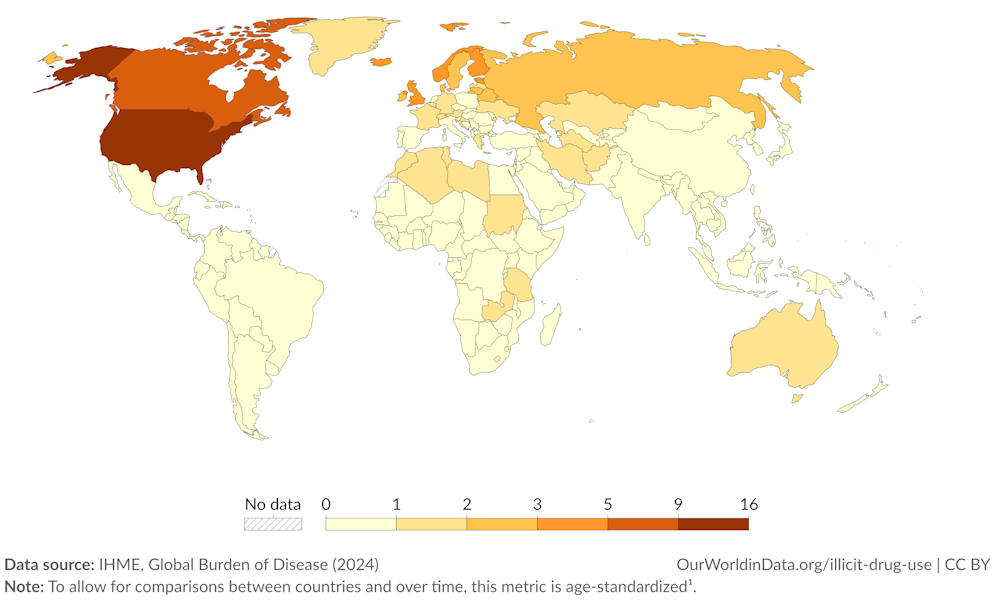
Opioid use death rates around the world:
Estimated deaths from opioid use disorders per 100,000 people in 2021. Our World In Data, CC BY
For the past 15 years, I have researched and advised on the international narcotics industry, especially the Afghan drug trade, as an academic, UK Home Office official and consultant. I’ve observed many shifts within global drug markets, and I believe the increasing availability of synthetic drugs in the UK and Europe may represent a new chapter in illicit drug use here – with the emergence of nitazenes only adding to these concerns.
A brief history of synthetic opioids
New synthetic opioids (NSOs) are one of the fastest-growing groups of new psychoactive substances around the world. The EU Drugs Agency (EUDA) currently monitors 81 NSOs – the fourth-largest group of drugs under observation.
NSOs largely fall into two broad groups: fentanyl and its analogues, and non-fentanyl-structured compounds – these include nitazenes, among many other substances.
Many of these “new” synthetic opioids have, in fact, existed for decades. Nitazenes were first synthesised in the 1950s by the Swiss pharmaceutical company, Ciba Aktiengesellschaft, as pain-relieving analgesics, although they were never approved for medical use.
Prior to 2019, there had only been limited reports of nitazenes in the illegal drug supply – including a “brownish looking powder” found in Italy in 1966; the discovery of a lab in Germany in 1987; several nitazene-related deaths in Moscow in 1998; and a US chemist illegally producing the drug for personal use in 2003. But since nitazenes re-emerged at the end of the last decade, over 20 variants have been discovered.
Paul Janssen, the Belgian chemist who first made fentanyl. Johnson & Johnson
The most common NSO in the illegal drug market, fentanyl, was first synthesised by Belgian chemist Paul Janssen in 1960. Fentanyl, which is roughly 100 times more potent than morphine, was approved in the US in 1968 for pharmaceutical use as an analgesic.
Over the next four decades, however, illegally produced fentanyl resulted in three relatively small outbreaks of deaths in the US. A fourth, larger fentanyl outbreak in Chicago, Detroit and Philadelphia resulted in about 1,000 deaths between 2005 and 2007.
The current US fentanyl crisis started in 2013, expanding to affect much of the country. Between 2014 and 2019, Chinese companies were the main manufacturers of finished fentanyl substances in the US – to combat this, both the Obama and Trump administrations lobbied Beijing to curtail the fentanyl industry.
The Chinese government responded by controlling specific fentanyl analogues. However, every time an analogue was banned, chemists there would slightly adjust the formula to produce a new compound that mirrored the banned substance.
China finally banned all fentanyl-related substances in May 2019, prompting two significant changes in the drug’s supply: a slowdown in the development of new fentanyl analogues, and a reduction in their direct sale to the US from China. Instead, Chinese companies increasingly sent fentanyl precursors to Mexican drug cartels who would synthesise fentanyl (or counterfeit medication) in clandestine labs, before smuggling it across the US border. Consequently, Mexico is now the primary source of fentanyl in the US.
But these supply changes led to another shift in the global drugs arena, as China’s chemical and pharmaceutical businesses – keen to develop new markets – adjusted their focus to producing uncontrolled synthetic substances, including nitazenes. At the same time, they expanded their geographical focus from North America to include Europe and the UK.
The nitazene supply chain
Producing nitazenes is a relatively low-cost exercise. They are largely manufactured in laboratories – both legal and illegal – in China, before being smuggled to the UK and Europe via fast parcel and post networks.
Nitazenes’ high potency means only small quantities are required, making them easier to transport and harder for border officials to detect. Some Chinese vendors have reportedly been offering to hide nitazenes in legitimate goods such as dog food and catering supplies, to circumvent custom controls. All of this decreases the risk to sellers, and lessens the price of doing business.
In March 2024, two China-based sellers operating on the dark web were selling a kilo of nitazene for between €10,000 and €17,000 (£12,000-£20,000). During roughly the same period, a kilo of heroin at the wholesale level in the UK was selling for between £23,000 and £26,000. Once bought, nitazenes are largely used to fortify low-purity heroin, although the drug can also be made into pills.
Video by The Guardian.
Nitazenes are not limited to the dark web. They are widely and openly advertised on the internet, social media and music streaming platforms. In February 2024, one China-based e-commerce site displayed 85 advertisements for nitazenes. Such sites also sell a range of other synthetic drugs, including fentanyl analogues and precursors, xylazines, cannabinoids and methamphetamine.
This means drug dealers in the UK and across the world no longer need to have established connections to underworld figures to source illegal drugs. With a click of a mouse, they can have them delivered to their home address. In this sense, the internet has democratised the drug trade by widening access beyond “traditional” criminals.
In the UK, while the supply of nitazenes is currently assessed as “low”, a number of smaller-scale organised crime groups are importing them to fortify low-purity heroin, before largely dealing it at the “county lines” level. This involves organised crime groups moving drugs – primarily heroin and crack cocaine – across towns, cities and county borders within the UK, using mobile phones or another form of “deal line” to sell to customers.
In November 2023, Leon Brown from West Bromwich was imprisoned for seven years for dealing drugs containing nitazenes – a verdict described as “a great result in our ongoing efforts to tackle county lines drug dealing” by detective sergeant Luke Papps of the South Worcestershire county lines team.
A few larger UK criminal networks have also been involved in nitazene distribution. In October 2023, the police and Border Force conducted raids across north London, arresting 11 people. They dismantled a drug processing site and seized 150,000 tablets containing nitazene – the UK’s largest ever seizure of synthetic opioids – as well as a pill-pressing machine, a firearm, more than £60,000 in cash and £8,000 in cryptocurrency. The police suspected the group had been selling the tablets on the dark web.
Anecdotal reports suggest there have been mixed reactions to the introduction of nitazenes into the illegal drug supply. Richard, a recovering heroin user from Bristol, told Vice magazine that, given their potency, some “people are scared of [nitazenes]” while others are “actively seeking” them.
As has been the case with fentanyl in the US, users build up tolerance and therefore seek stronger doses. Manny, a heroin user from Bristol, told Vice: “I smoked [heroin cut with nitazenes] and it felt like the first time I’d ever taken drugs.”
Video by Vice.
UK-based criminals also use the dark web to export nitazenes abroad. In October 2023, the Australian Border Force identified 22 nitazene discoveries in packages shipped to the country via mail cargo from the UK. British criminals have also trafficked counterfeit medicines containing nitazenes to Ireland and Norway.
Use of nitazenes is now being detected all over the world. Within Europe, Ireland experienced several nitazene outbreaks in 2023-24 while in Estonia, nitazenes now account for a large share of overdose deaths – a trend also seen (to a lesser extent) in Latvia. Preliminary data suggests at least 150 deaths were linked to nitazenes in Europe in 2023.
Nitazenes have also been discovered in fake pain medication such as benzodiazepines, oxycodone and diazepam, which widens the number of people at risk to include those with no opioid tolerance. The death in July 2023 of Alex Harpum, a 23-year-old British student who was preparing for a career as an opera singer, was a stark reminder of the danger of buying fake medicine online that may have been contaminated with nitazenes.
The nitazene ‘boom’ and the global heroin trade
For decades, Afghanistan was the world’s largest opium producer and the source of most of Europe’s heroin. Then in April 2022, the ruling Taliban announced a comprehensive prohibition on the use, trade, transport, production, import and export of all drugs. As a result, poppy cultivation has fallen to historically low levels for a second consecutive year.
While this has not, as yet, translated into a shortage of heroin on European streets, including in the UK and Germany, some indicators suggest a slowdown in heroin supplies to the UK. In the year March 2023-24, the quantity of heroin seized in the UK fell by 54%, from 950kg to 441kg. This is the lowest quantity of heroin seized since 1989, when about 350kg was intercepted.
The NCA assesses that the Taliban ban has created market “uncertainty”. The wholesale price of heroin has increased from roughly £16,000 per kilo prior to the COVID-19 pandemic to about £26,000, while anecdotal reports suggest average heroin purity for users dropped to under 30% (often to 10-20%) in 2024, compared with around 35% in 2023 and 45% in 2022.
Video by UN Story.
Even without the Taliban’s ban, heroin is not easy to produce and supply. Cultivating opium poppy is labour-intensive, taking five or six months. The static nature of opium fields means they are visible and susceptible to eradication; poppy crops can also be negatively affected by blight or drought.
Converting opium into heroin base is also a labour-intensive process that can involve (depending on the production method) at least 17 steps. Acetic anhydride, the main chemical used to convert morphine into heroin, is relatively expensive compared with synthetic precursors. Moreover, heroin is a bulky product, which means it is harder to move in large volumes.
While the relationship between events in opiate-producer countries and the introduction of synthetic opioids to consumer markets should not be overstated, this new type of drug offers economic advantages to criminals whose “sole motivation is greed”.
For decades, Turkish, Kurdish and Pakistani criminal networks have been responsible for importing heroin into the UK. Once in the UK, both Turkish and British groups largely control its wholesale supply, with some participation of Albanian gangs.
To date, there is little evidence to suggest these groups have transitioned to supplying NSOs, including nitazenes. The shifting dynamics in the global drug supply chain, however, could upend traditional markets and the gangs who profit from them.
America’s synthetic drug crisis
The synthetic opioid fentanyl has devastated the US, having been linked to about 75,000 deaths in 2023 alone. It is the primary cause of death for Americans aged 18-49. Canada, too, has experienced a wave of deaths: between January 2016 and June 2024, there were 49,105 apparent opioid deaths there, with fentanyl implicated in a large proportion.
More than 4,300 reports of nitazenes have reached the US National Forensic Laboratory Information System since 2019. They are typically used to fortify fentanyl and other opioids, which can produce a fatal concoction.
Efforts to stem the flow of NSOs, including nitazenes, from China to the US and elsewhere will prove challenging. And even if China does implement stricter controls, other countries could step in to fill the void. According to the Commission on Combating Synthetic Opioid Trafficking:
The overall sizes of these industries, limited oversight efforts and political incentives contribute to an atmosphere of impunity among firms and individuals associated with those industries.
While US and Chinese counter-narcotics cooperation ended in 2022 amid increasing geopolitical tensions, the following November’s summit in Woodside, California, between presidents Joe Biden and Xi Jinping saw them agree to recommence collaboration.
As a result, China recently closed several chemical companies that were shipping fentanyl precursors and nitazenes to the US. These vendors used encrypted platforms and cryptocurrency to conduct the deals, and mislabelled the consignments to try to ensure the substances evaded border controls. China has also outlawed more chemicals and substances, including several nitazene variants.
But President Trump’s imposition of tariffs on imports from China – which sit alongside proposed taxes on imports from Canada and Mexico, in part for supposedly not doing enough to curb the trafficking of fentanyl and its precursors to the US – threatens this counter-narcotics cooperation.
While nitazenes are not yet widely available in the US, their presence within some fentanyl batches is complicating the US opioid crisis – and according to some experts, has the potential to further increase the already shocking number of synthetic opioid-related deaths.
The UK response to nitazenes
Successive UK governments have made tackling NSOs a high priority. Shortly after the most recent nitazene-related deaths were discovered in the UK in summer 2023, the NCA launched Project Housebuilder to lead and coordinate the law enforcement and public health response.
This was soon followed by the establishment of a government-wide Synthetic Opioids Taskforce “to improve…understanding, preparedness and mitigation against this evolving threat”. Chris Philp, then the UK’s combatting drugs minister, stated that “synthetic opioids are at the top of [this government’s] list because of the harm they cause”.
The taskforce has taken a range of measures, such as controlling more NSOs as class A drugs, conducting more intelligence operations at UK borders, widening access to naloxone, and enhancing the UK’s real-time, multi-source drug surveillance system. The government also worked with the US and Canada to learn from their experiences.
Recently, the current UK government banned a further six synthetic opioids and introduced a generic definition of nitazenes as class A drugs. And the UK’s current government, unlike its Conservative predecessor, has also indicated its willingness to consider evidence from the UK’s first drug consumption facility, which recently opened in Glasgow.
Other policy measures worthy of consideration include expanding drug checking services whereby drug users submit drugs to a lab to test what is in them, then are provided with information about the sample. These services offer vital information to the public and authorities about current drug trends.
While there is high uncertainty about what is going to happen next in the UK regarding illicit drug trends, the evolution of the US drug landscape over generations provides some important lessons.
Lessons from the US
The US fentanyl crisis shows drug markets can change quickly with long-lasting consequences. Most heroin on US streets contains – or has been replaced by – fentanyl. According to DEA seizure data, US heroin seizures declined by nearly 70% between 2019 and 2023, whereas fentanyl seizures have increased by 451%.
However, illegal drug markets evolve in different ways and at different paces. In May 1989, Douglas Hogg, a UK Home Office minister, travelled to the US and the Bahamas on a fact-finding mission about crack cocaine, a drug that was predicted to spread from the US to the UK. Upon his return, Hogg noted:
The ethnic, social and economic characters of many of our big cities are very similar to those in the US. If they have a crack problem, why should not we? … The use of crack in Great Britain is likely to develop very substantially over the next few years.
But this “crack invasion”, as some called it, did not materialise in the UK to the extent it had in the US – and the same was true about a predicted wave of methamphetamine use in the UK, which remains low compared with the US.
It is also unlikely the UK and Europe will experience a synthetic opioid crisis on the same scale as the US. The first wave of the US crisis was driven by extensive overprescription of opioids for pain relief. This increased the number of people addicted to opioids, some of whom later turned to heroin, before transitioning to fentanyl. In contrast, large-scale opioid prescriptions have not been a major issue in the UK or Europe, although there is some diversion of legal fentanyl into the illegal drug market in Europe.
Video by The Brookings Institution.
According to Alex Stevens, professor of criminology at the University of Sheffield, another factor differentiating the US and Europe is the provision of drug treatment and harm reduction programmes. Opioid users in Europe, and to a lesser extent in the UK, are much more likely to be in medication-assisted treatment than their US counterparts, thus reducing the number of people at risk. These interventions are reinforced by different socioeconomic factors in much of Europe, such as lower economic inequality, stronger social protections, and better healthcare systems.
None of this, though, means the nitazene threat in the UK and Europe should be underestimated, nor that use and supply of these drugs (and other NSOs) will not increase from its current relatively low base. As the NCA recently warned:
While a zero-tolerance approach from law enforcement, plus advice to users on the heightened dangers, may contain or slow the current uptake, we must prepare for these substances to become widely available, both unadvertised in fortified mixes and in response to user demand as a more potent high.
The future of new synthetic opioids
Predicting the future of NSO use and trafficking is a challenging task. Projections for Europe range from existing opiate stockpiles ensuring that heroin consumer markets remain serviced (assuming the Taliban ban is short-lived), to a heroin shortage which results in more drug dealers turning to NSOs to plug the shortfall, which in turn could lead to lasting changes in European drug markets (as happened in a few countries following the Taliban’s first opium ban in 2000-01).
In such a scenario, it is possible that Turkish criminal networks may exploit their links with Mexico’s Sinaloa cartel to source NSOs. Mexican criminal gangs also operate in Europe, which may increase the likelihood of them trying to open a new NSO market on the continent.
There is also evidence that some Italian criminal organisations have entered the NSO marketplace. In November 2023, Italian authorities announced the seizure of 100,000 doses of synthetic drugs, including fentanyl, as part of operation Painkiller, a joint Italian-American initiative.
Given the many advantages for criminal groups of NSOs, it seems likely they are here to stay. A key question is whether nitazenes (or other NSOs) will supplant traditional heroin as the opioid of choice, as they have done in the US, or remain at relatively low levels in Europe, co-existing with or mixed into the heroin supply.
In December 2023, Paul Griffiths, the EUDA’s scientific director, told Vice: “We’re not seeing much new initiation of heroin use in Europe. So in five to ten years … as heroin users get older and more vulnerable, we’re not going to have much of an opiate problem left.”
But he warned that if heroin use does dry up: “You might then see opioids appearing in other forms and preparations, such as pills, that could potentially become popular among younger age groups who currently do not appear attracted to injecting heroin.”
While previous NSO outbreaks in the UK were relatively short-lived and limited in scale, the most recent nitazene outbreak, which started in summer of 2023, has been more sustained, covered more parts of the UK, and involved more fatalities. The broader trend in Europe also suggests the prevalence and variations of NSOs are increasing at a faster pace than in previous years.
Notwithstanding, nitazene use and supply in the UK currently remains relatively low. In fact, the rate of nitazene-linked deaths – at least those officially reported – decreased between spring 2024 and the end of the year.
In the short term, then, it seems unlikely there will be a nitazene “explosion”. Rather, criminal groups will probably try to increasingly embed nitazenes into the UK drug market at a similar pace to the last 18 months.
However, this situation could change rapidly in future, especially if larger criminal networks involved in heroin importation switch to smuggling NSOs, and there is a genuine shortage of Afghan heroin. This problem would be compounded if drug users start seeking nitazenes, thus creating demand for them.
Either way, the UK government, along with its European partners, should continue to reinforce the whole drug system, to prepare for the worst-case scenario.
To hear about new Insights articles, join the hundreds of thousands of people who value The Conversation’s evidence-based news. Subscribe to our newsletter.
Philip A. Berry does not work for, consult, own shares in or receive funding from any company or organisation that would benefit from this article, and has disclosed no relevant affiliations beyond their academic appointment.
Donald Trump has hit the 30-day pause button on imposing 25% tariffs on Canada and Mexico, but is proceeding with slapping 10% tariffs on Chinese imports, and tariffs on the EU are still on his agenda.
Trump has declared that “tariff” is “the most beautiful word in the dictionary”. Yet as the president weighs up the sweeping consequences of his tariff fixation, he may want to throw out the dictionary and pick up a history book.
The magnitude and scale of the proposed tariffs hark back to the US Smoot-Hawley Tariff Act enacted in 1930.
For example, Nobel Laureate economist Paul Krugman told Bloomberg that “we’re really talking about tariffs on a scale that we … have not seen,” adding that “we’re talking about a reversal of really 90 years of US policy”.
The Smoot-Hawley tariffs were initially intended to provide support to the deeply indebted US agricultural sector at the end of the 1920s, and protect them from foreign competition – all familiar themes to the anti-free-trade rhetoric peddled by Trumpists today.
The advent of the Great Depression had generated widespread, albeit not universal, demands for protection from imports, and Smoot-Hawley increased already significant tariffs on overseas goods. Members of Congress were eager to provide protection, trading votes in exchange for support for their constituents’ industries.
Although at the time more than 1,000 economists implored President Herbert Hoover to veto Smoot-Hawley, the bill was signed into law. The resulting tariff act led to taxes averaging nearly 40% on 20,000 or so different types of imported goods.
The history of trade tariffs in the US.
The culmination led to a dramatic decline in US trade with other countries, particularly among those that retaliated, and is widely acknowledge as severely worsening the Great Depression. According to one estimate, the sum of US imports plummeted by nearly half.
What’s more, the impacts were felt globally. Protectionist policies are believed to have accounted for about half of the 25% decline in world trade, and indirectly helped create economic factors that led to the second world war.
The blowback against Capitol Hill was immense as well: the optics of vote trading over the tariff act resulted in Congress delegating control over trade policy to the president just four years later because the behaviour was regarded as so reckless.
All of this came against the backdrop of diplomatic American isolationism in the 1930s, which were not unlike many of Trump’s current efforts to retreat from – or even attack – multilateral institutions.
Despite President Woodrow Wilson winning the Nobel Peace Prize in 1919 for his work initiating the League of Nations (a forerunner of the United Nations), for example, the US never became a member. The term “America first” was also used widely in this period to refer to a focus on domestic policy and high tariffs.
Fast forward to present day
Trump has said that his tariffs will cause “some pain” but are “worth the price that must be paid.” Based on recent estimates from the non-partisan Peterson Institute for International Economics, Trump’s tariffs could drive up costs for the average US household more than US$1,200 (£963) per year.
Whether US voters will still stand behind Trump when actual prices begin to rise is still to be determined.
However, many Republicans on Capitol Hill have rushed to Trump’s defence. Congresswoman Claudia Tenney of New York told Fox News that she’s glad the US is “projecting strength for once on the world stage”. Senator Eric Schmitt of Missouri insisted that tariffs were “not a surprise,” emphasising that Trump had relentlessly campaigned on “improving our standing in the world.”
Perhaps the sharpest Republican rebuke came from Sen. Mitch McConnell of Kentucky, who labelled the tariffs simply a “bad idea”.
Public opinion data show that tariffs are hotly contested, with partisanship shaping both general views toward tariffs and views on specific national targets.
According to a January 2025 Harvard CAPS/Harris poll, 52% of Americans overall approve of placing new tariffs on China, with 74% of Republicans in favour, but just 34% of Democrats.
Support is more modest for imposing tariffs on America’s neighbours. Only 40% of voters think tariffs on Canada and Mexico are a good idea, including 59% of Republicans and 24% of Democrats.
Tariffs rank low on a list of national priorities. A mere 3% of Americans think tariffs on Canada and Mexico should be a top priority for Trump in his first 100 days, while just 11% rank tariffs on China as a top priority.
Prospect of a broader trade war
What seems clear is that Trump’s proposed tariffs against Canada, Mexico, and China could be just the opening salvos in a broader tit-for-tat that may extend to Europe, and beyond.
At home, the political challenge for Trump is to keep intact what increasingly looks like a fragile coalition – balancing the interests of hardline Maga supporters who reject free trade and tech titans who see tariffs as disrupting vital supply chains, especially to Asia.
After Trump’s election, former adviser and populist nationalist Steve Bannon warned that America would no longer be “abused” by “unbalanced trade deals.” “Yes, tariffs are coming,” he said. “You will have to pay to have access to the US market. It is no longer free, the free market is over.”
Meanwhile, Silicon Valley has been mostly silent on the tariffs. While tech moguls are doubtlessly trying to curry favour for tariff exemptions or the reduction of tariffs altogether, it’s possible that they have been assured that the tariffs are about leverage and will be gone soon enough.
Regardless, Trump is showing that tariffs are a crucial part of his “America first” foreign policy, a kind of belligerent unilateralism that treats allies and adversaries alike as pieces to be moved around a chessboard.
Under Trump, the “art of the deal” means throwing America’s weight around as the world’s economic superpower, and waiting for the leaders of other nations to fold. Whether American voters will endure the economic costs necessary for his plans could determine his resolve.
Trump may think that tariff is a beautiful word now. But if even a glimmer of the 1930s repeats itself, its economic shadow could soon look grim.
The authors do not work for, consult, own shares in or receive funding from any company or organisation that would benefit from this article, and have disclosed no relevant affiliations beyond their academic appointment.
Source: United Kingdom – Executive Government & Departments
Scientists comment on the Public Accounts Committee (PAC) report on Carbon Capture, Usage and Storage (CCUS) technologies.
Prof Hannah Chalmers, Personal Chair of Sustainable Energy Systems, Institute for Energy Systems, School of Engineering, University of Edinburgh, said:
“CCUS technologies can play a unique role in tackling carbon dioxide emissions. They can be used at large industrial sites to ensure that most of the carbon dioxide produced by activities like iron and steel production is not emitted to the atmosphere. Instead, the carbon dioxide is permanently stored in geological formations (rocks). In the UK, CCUS projects are developing plans to store carbon dioxide in layers of rock that are deep underneath the sea.
“There is also ongoing work to develop and deploy cost-effective approaches to remove carbon dioxide directly from the air. This provides an important option to respond to the widely reported increases in carbon dioxide levels in the atmosphere that are causing significant concern.
“There is significant evidence that including CCUS in a mix of technologies to reduce carbon dioxide emissions will be the most cost-effective way to address climate change. Several large-scale projects have been operating in other countries for many years. Experience from these projects is being used to ensure that the CCUS projects that are being developed in the UK are designed to be reliable and cost-effective.”
Dr Stuart Gilfillan, Reader in Geochemistry, University of Edinburgh, said:
What is CCUS technology, how does it work, does it have limitations?
“CCUS stands for Carbon Capture, Utilisation, and Storage, which is a developing technology which reduces the amount of carbon dioxide (CO2) released into the atmosphere. It works by capturing CO2 at the point source, transporting it and then burying it for safe storage in rocks over a kilometre below the ground surface. Like any technology, it has pros and cons, and costs more than simply releasing the CO2 directly to the atmosphere, which is currently free. CCUS is the only currently available technology that can directly reduce CO2 emissions from sources like power plants and industrial processes. Given that global temperature records are now being broken on an almost daily basis and yesterday’s announcement of the hottest January on record, it is essential tool in the urgent fight against runaway climate change.
What is the existing evidence around the efficacy of CCUS?
“CO2 capture technology has proven successful in capturing up to 90-95% of CO2 emissions from point of sources from power stations and industrial facilities. Successful examples include the Boundary Dam power station in Saskatchewan, Canada, where a large-scale CCUS unit has been operational since 2014, capturing about 1 million tonnes of CO2 per year.
“The long-term storage of CO2 is proven by natural CO2 reservoirs around the world and engineered projects like Sleipner in the North Sea, which have been injecting CO2 beneath the seabed since 1996 without significant issues. Research over the past two decades has developed monitoring technologies that can detect and mitigate potential leakage and to ensure that CO2 remains securely buried in rocks deep underground.
What more evidence may be needed to be confident in its applications?
“No more evidence is required, as exemplified by the UK’s Climate Change Committee (CCC), which is an independent body established under the Climate Change Act who advise the government on emissions targets and report to Parliament on progress made in reducing greenhouse gas emissions. The CCC is clear that CCUS is a critical technology for the decarbonisation of the UK economy, particularly in sectors that are hard to decarbonize directly, such as heavy industry (steel, cement, chemicals) and power generation.
“CCUS is not only as a standalone technology but is an essential part of a broader strategy to reach net-zero emissions by 2050. It compliments energy efficiency, renewable energy deployment, and electrification. CCUS is a clear driver for regional economic development, particularly in regions with suitable geological storage sites and industrial bases, such as the East Coast of Scotland, the Humber region, and North East England, areas that have been ‘left behind’ in recent times.”
Dr Tim Dixon, IEA Greenhouse Gas, Director and General Manager, said:
“Carbon Capture and Storage (CCS) is a necessary technology for the UK and other countries to achieve net-zero, and we need all low-carbon energy technologies. The science case for the role of CCS is provided by the UK’s Climate Change Committee, the Intergovernmental Panel on Climate Change (IPCC) and the International Energy Agency (IEA) and cannot be disputed if climate change is to be taken seriously. The key aspect of CCS is the secure long-term retention of CO2 in deep geological formations, and we have decades of experience in this from around the world. With over 40 large scale projects in operation injecting millions of tonnes every year and many pilot-scale projects, this has allowed us to test the science, the monitoring and the practicalities of geological storage of CO2. Hence CO2 geological storage is a proven technology and the regulations to enable and to ensure that it is safe and secure are based upon this sound science and experience. ”
Professor Paul Fennell FIchemE, Professor of Clean Energy, Imperial College London, said:
“The idea that Carbon Capture and Storage is an unproven technology is simply untrue. There are projects ongoing around the world, and millions of tonnes of CO2 have been safely stored over the last couple of decades. This has not happened in the U.K. because of our sclerotic inability to develop public infrastructure, not because the technology is unproven.”
Dr Greg Mutch, Researcher in Carbon Capture and Storage, Newcastle University, said:
“Carbon capture and storage is a technology that prevents carbon dioxide from entering the atmosphere, by capturing it and storing it underground in ‘empty’ oil & gas reservoirs or saline aquifers. According to the world’s foremost experts on the subject, gathered to contribute the International Panel on Climate Change, carbon capture and storage processes are necessary to achieve climate change mitigation goals at lowest cost. Without scalable CCS technologies by the end of the century, climate change mitigation will cost between 29 and 297% (mean value 138%) more.[1] Moreover, CCS is predicted to provide tens of thousands of jobs in the UK, add several billion pounds in terms of gross value added per year by 2050,[2] and enable other important technologies (hydrogen production etc) that will come with further jobs and economic value.”
[1] IPCC, 2018: Global Warming of 1.5 °C. An IPCC Special Report on the impacts of global warming of 1.5 °C above pre-industrial levels and related global greenhouse gas emission pathways, in the context of strengthening the global response to the threat of climate change, sustainable development, and efforts to eradicate poverty, ed. V. Masson-Delmotte, P. Zhai, H.-O. Portner, D. Roberts, J. Skea, P. R. Shukla, A. Pirani, W. Moufouma-Okia, C. Pean, R. Pidcock, S. Connors, J. B. R. Matthews, Y. Chen, X. Zhou, M. I. Gomis, E. Lonnoy, T. Maycock, M. Tignor and T. Waterfield, Cambridge University Press, 2018.
[2] Energy Innovation Needs Assessment Sub-theme report: Carbon capture, utilisation, and storage, Vivid Economics, Carbon Trust, E4tech, Imperial College London, Frazer-Nash Consultancy, Energy Systems Catapult. Commissioned by the Department for Business, Energy & Industrial Strategy, 2019.
Professor Peter Styring, Director of the UK Centre for Carbon Dioxide Utilization, Professor of Chemical Engineering & Chemistry, University of Sheffield, said:
What is CCUS technology, how does it work, does it have limitations?
“CCUS is carbon capture and storage. This has been primarily focused on CCS as the main driver. It aims to capture carbon dioxide from emitters such as power stations and industries. The current technology temperature swing absorption (TSA) using a chemical reaction with an aqueous amine solvent to capture the CO2 from the mixed waste gas and then to release it in a purified form by increased temperature chemical desorption and then further drying and purification to get a gas that can be in theory transported to a site where the gas can be stored underground. It works but at a high energy cost and the production of amine decomposition products that need to be removed and more amine added. It costs a lot!
“Limitations are the energy and financial costs, permitting regulations on solvent disclosure and the large physical footprint. Full system lifecycle analysis is required but this is not always reported.”
What is the existing evidence around the efficacy of CCUS?
“This is not proven using current technologies. The problem is that the current government funded projects use old technologies to achieve CCS and what is actually needed is a step change to new, lower cost more efficient processes such as solid based pressure swing adsorption (PSA). The whole system tends to be simpler and the energy costs and land use is significantly reduced.”
What more evidence may be needed to be confident in its applications?
“Full evaluation of new technologies and rapid acceleration from proof of concept to capture at scale. The Innovate UK funded Flue2Chem project is a good example of how this is being addressed using mid-TRL technologies. The UK also needs to move away from a single minded storage approach to adding value through the use of CO2 in the production of chemicals that would otherwise be sourced from virgin fossil carbon. SUSTAIN project is making synthetic fuels from captured CO2 and Flue2Chem is making FMCG components, including surfactants and precursors from the CO2.”
Dr Stuart Jenkins, Net Zero Fossil Fuel Fellow, University of Oxford, said:
“The Public Accounts Committee are wrong to have labelled CCUS as ‘unproven’, there are many commercial scale projects around the world, but they are right to question the current model for funding it. We need to make sure the CCUS industry becomes self-sustaining, without the need for major taxpayer funding. One option — asking fossil fuel suppliers to contribute to these costs via a carbon storage mandate — is a fair and responsible approach going forward.
In a recent report we published working with researchers at the University of Oxford and Carbon Balance Initiative [1] we looked at the use of Carbon Storage Mandates, which place an obligation on fossil fuel producers to capture and store a rising fraction of the CO2 they produce, to support the UK’s CCUS industry.
Carbon storage mandates, in tandem with carbon pricing and other mechanisms, could deliver subsidy-free CCUS to the UK and provide investment certainty for companies.”
Dr Stuart Jenkins Our report was funded by the Carbon Capture and Storage Association, and consulted regulators, fossil fuel companies, capture and storage entities, UK Government, and academics on models for CCUS sector support packages.
Professor Paul Fennell: No conflicts other than being involved in CCs research.
Dr Tim Dixon: “Tim is a Director of IEA Environmental Projects Ltd (UK), a Non-Executive Director on the Board for The International CCS Knowledge Centre (Canada). He is also proud to be an Honorary Senior Research Fellow at the Bureau of Economic Geology, University of Texas in Austin, and an Honorary Lecturer at the School of Geosciences at University of Edinburgh. He was an original Board Member of the UK CCS Research Centre. Previously he worked in CCS, emissions trading, clean energy technologies and related areas for AEA Technology (ETSU), for the UK Government‘s Department of Trade and Industry (DTI) and for the Global CCS Institute. He was the EU’s Lead Negotiator for getting CCS in the CDM in UNFCCC in 2011, and a UK negotiator for getting CCS in the London Convention 2004-7, in OSPAR 2006-7, in the EU Emission Trading Scheme 2004-8, and inputting to the EU CCS Directive 2007-8. He gives talks on climate and CCS to schools and public organisations and supported the start of Oxford Climate Society at the University of Oxford. He is a Fellow of the UK Energy Institute, and member of the UK Institute of Physics and the UK Environmental Law Association.”
Dr Stuart Gilfillan “I have received funding from TotalEnergies in the past, for research related to CO2 origins in the subsurface and reservoir connectivity and Equinor on CO2 dissolution in natural CO2 reservoirs. I currently receive funding from the Natural Environment Research Council and Carbfix on CO2 mineralisation.”
Prof Hannah Chalmers “I work collaboratively with industrial partners who are developing CCUS projects in the UK (e.g. as a member of the Advisory Board for the Industrial Decarbonisation Research and Innovation Centre). I currently receive no funding from industry, but have received funding from industrial partners who are actively developing CCUS projects in the UK in the past (e.g. SSE plc).”
Professor Peter Styring: Peter is Professor of Chemical Engineering and Chemistry at the University of Sheffield (an investigator on Flue2Chem and SUSTAIN) and a Co-founder and Director of CCU International.
For all other experts, no response to our request for DOIs was received.
Premier Scott Moe will travel to Washington D.C. this week for meetings with U.S. elected representatives, industry organizations and to participate in the premier’s Council of the Federation (COF) joint-mission to Washington.
Prior to the COF mission, Premier Moe will meet with U.S. elected representatives and businesses to emphasize the strong trade relationship between Canada and the U.S, and the role Saskatchewan plays in supplying the continent with energy and food security.
“It’s important in the current economic environment that we engage with our counterparts in the United States to emphasize the shared benefit of trade between our two countries and turn the conversation toward building on those strengths rather than jeopardizing them with tariffs,” said Moe.
The U.S. is Saskatchewan’s largest and most important trading partner. About $40 billion worth of imports and exports cross the border every year. The current tariff-free border allows businesses to add value to products and economies, whether flowing from north to south or vice versa.
Premier Moe’s meetings will focus on maintaining strong Canada-U.S. relations by addressing shared issues such as the economy, energy, supply chains and the impacts of the Trump Administration’s proposed tariffs.
Premier Moe will also express Saskatchewan’s support for strong measures to secure the Canada-U.S. border.
“Strengthening border security and preventing the flow of illicit drugs like Fentanyl is a concern that has been identified by the U.S. and one that I share,” Moe added. “We are already taking action as a province through our Border Security Plan to ensure we have more officers and law enforcement presence at the Saskatchewan-U.S. border.”
The Council of the Federation’s joint-mission to Washington will allow all thirteen premiers to present a united voice on the important benefits that free-trade brings to Canada and the U.S. and the concern over the negative impact of tariffs to consumers and businesses on both sides of the border.
The COF program will take place on Feb 12 and will include meetings with U.S. elected representatives, business leaders and the Canada American Business Council.
Following the COF mission Premier Moe will travel to Mexico to engage with business and elected officials to advance relationships with this key trading partner.
Over the course of the next few weeks, Premier Moe and multiple cabinet Ministers will be travelling within Canada and beyond to advocate for Saskatchewan’s interests. These engagement efforts will focus on promoting the province as a global supplier of food and energy security, while strengthening relationships with our key international trading partners.
CALGARY, Alberta, Feb. 07, 2025 (GLOBE NEWSWIRE) — Canoe Financial LP (“Canoe Financial”) is recognized with three 2024 FundGrade A+® Awards for outstanding performance.
Canoe Financial 2024 FundGrade A+ Award winning funds:
FundGrade calculation date 12/31/2024.
The FundGrade A+® rating recognizes the best performing funds that deliver the most consistent risk-adjusted returns. It is a yearly award that honours the “best of the best” among Canadian investment funds that have maintained a high FundGrade rating throughout a calendar year.
“These awards are a testament to the strength of our investment philosophy and the dedication of our team. At Canoe Financial, we’re committed to helping Canadians build lasting wealth through disciplined, active management and a focus on delivering consistent, long-term performance,” said Darcy Hulston, President and Chief Executive Officer, Canoe Financial.
About Canoe Financial Canoe Financial is one of Canada’s fastest growing independent mutual fund companies managing $20 billion in assets across a diversified range of award-winning investment solutions. Founded in 2008, Canoe Financial is an employee-owned investment management firm focused on building financial wealth for Canadians. Canoe Financial has a significant presence across Canada, including offices in Calgary, Toronto and Montreal.
About FundGrade A+ Awards FundGrade A+® is used with permission from Fundata Canada Inc., all rights reserved. The annual FundGrade A+® Awards are presented by Fundata Canada Inc. to recognize the “best of the best” among Canadian investment funds. The FundGrade A+® calculation is supplemental to the monthly FundGrade ratings and is calculated at the end of each calendar year. The FundGrade rating system evaluates funds based on their risk-adjusted performance, measured by Sharpe Ratio, Sortino Ratio, and Information Ratio. The score for each ratio is calculated individually, covering all time periods from 2 to 10 years. The scores are then weighted equally in calculating a monthly FundGrade. The top 10% of funds earn an A Grade; the next 20% of funds earn a B Grade; the next 40% of funds earn a C Grade; the next 20% of funds receive a D Grade; and the lowest 10% of funds receive an E Grade. To be eligible, a fund must have received a FundGrade rating every month in the previous year. The FundGrade A+® uses a GPA-style calculation, where each monthly FundGrade from “A” to “E” receives a score from 4 to 0, respectively. A fund’s average score for the year determines its GPA. Any fund with a GPA of 3.5 or greater is awarded a FundGrade A+® Award. For more information, see www.FundGradeAwards.com. Although Fundata makes every effort to ensure the accuracy and reliability of the data contained herein, the accuracy is not guaranteed by Fundata.
Canoe Equity Portfolio Class Series, Canadian Focused Equity category out of a total of 70 funds: 20.20% (1 year), 9.46% (3 years), 14.48% (5 years), 10.16% (10 years) and 8.02% (since inception-February 2011); Canoe Asset Allocation Portfolio Class, Tactical Balanced category out of a total of 56 funds: 14.65% (1 year), 6.35% (3 years), 10.46% (5 years), 7.36% (10 years) and 5.85% (since inception-February 2011); Canoe North American Monthly Income Portfolio Class, Global Neutral Balanced category out of a total of 224 funds: 13.40% (1 year), 6.22% (3 years), 8.25% (5 years), 6.47% (10 years) and 7.25% (since inception- December 2012).
Further information Investor Relations Canoe Financial LP 1–877–434–2796 info@canoefinancial.com
Commissions, trailing commissions, management fees and expenses all may be associated with mutual fund investments. Please read the prospectus before investing. The indicated rates of return are the historical annual compounded total returns including changes in unit value and reinvestment of all distributions and do not take into account sales, redemption, distribution or optional charges or income taxes payable by any unitholder that would have reduced returns. Mutual funds are not guaranteed, their values change frequently, and past performance may not be repeated.
NAPERVILLE, Ill., Feb. 07, 2025 (GLOBE NEWSWIRE) — Track Group, Inc. (OTCQB: TRCK), a global leader in offender tracking and monitoring services, today announced financial results for its fiscal quarter ended December 31, 2024 (“Q1 FY25”). In Q1 FY25, the Company posted (i) total revenue of $8.7 Million (“M”), a decrease of approximately 3.3% over total revenue of $9.0M for the quarter ended December 31, 2023 (“Q1 FY24”); (ii) Q1 FY25 operating income of $0.1M compared to Q1 FY24 operating loss of ($0.2M); and (iii) net loss attributable to common shareholders of ($2.0M) in Q1 FY25 compared to net income attributable to common shareholders of $0.1M in Q1 FY24.
“The quarter ending December 31, 2024 showed increases in gross profit, operating income and Adjusted EBITDA. This progress reflects the increased use of our products and services in legacy programs and continued expansion through newly awarded contracts domestically and abroad. With a strong pipeline and a commitment to delivering value, we are poised for continued success in fiscal year 2025,” said Derek Cassell, Track Group’s CEO.
FINANCIAL HIGHLIGHTS
Total Q1 FY25 revenue of $8.7M decreased approximately 3.3% compared to Q1 FY24 revenue of $9.0M. The decrease in revenue was driven principally by a decrease in people assigned to monitoring for clients in Michigan and Virginia, and our recently sold Chilean subsidiary. This decrease was partially offset by revenue increases for clients in Illinois, Puerto Rico and the Bahamas who experienced increases in the number of people assigned to monitoring.
Gross profit of $4.4M in Q1 FY25 increased approximately 5.2% compared to Q1 FY24 gross profit of $4.2M due to a decrease in monitoring center costs, partially offset by a decrease in revenue.
Operating income in Q1 FY25 of $0.1M increased compared to the operating loss of ($0.2M) in Q1 FY24. The increase in net income in Q1 FY25 is primarily due to a decrease in cost of revenue and a decrease in operating expense.
Adjusted EBITDA for Q1 FY25 of $1.2M, increased compared to $1.1M for Q1 FY24 due to an increase in operating income and gross profit. Adjusted EBITDA in Q1 FY25 as a percentage of revenue increased to 14.4%, compared to 11.8% for Q1 FY24 for the same reasons.
Unrestricted cash balance of $3.7M for Q1 FY25 increased compared to $3.6M for Q1 FY24. The change in cash position was principally due to the sale of our Chilean subsidiary.
Net loss attributable to shareholders in FY24 was ($2,010,849) compared to net income of $461 in FY23, a change principally attributable to lower revenue and a foreign currency exchange rate loss.
Business Outlook
Growth in gross profit and operating income in Q1 FY25 reinforces our confidence in the strategic reinvestment in technology and the implementation of new programs initiated in late FY23. These endeavors position us well for sustained growth throughout FY25. As a result, the Company’s preliminary outlook for FY25 is as follows:
Actual
Outlook
FY 2023
FY 2024
FY 2025
Revenue:
$34.5
M
$36.9
M
$35M – $36M
Adjusted EBITDA Margin:
11.1
%
14.6
%
14% – 15%
About Track Group, Inc. Track Group designs, manufactures, and markets location tracking devices; as well as develops and sells a variety of related software, services, and accessories, networking solutions, and monitoring applications. The Company’s products and services are designed to empower professionals in security, law enforcement, corrections, and rehabilitation organizations worldwide with single-sourced offender management solutions that integrate reliable intervention technologies to support re-socialization and monitoring initiatives.
The Company currently trades under the ticker symbol “TRCK” on the OTCQB exchange. For more information, visit www.trackgrp.com.
Forward-Looking Statements Any statements contained in this document that are not historical facts are forward-looking statements as defined in the U.S. Private Securities Litigation Reform Act of 1995. Words such as “anticipate,” “believe,” “estimate,” “expect,” “forecast,” “intend,” “may,” “plan,” “project,” “predict,” “if”, “should” and “will” and similar expressions as they relate to Track Group, Inc., and subsidiaries (“Track Group”) are intended to identify such forward-looking statements. These statements are only predictions and reflect Track Group’s current beliefs and expectations with respect to future events and are based on assumptions and subject to risks and uncertainties and subject to change at any time. Track Group may from time-to-time update these publicly announced projections, but it is not obligated to do so. Any projections of future results of operations should not be construed in any manner as a guarantee that such results will in fact occur. These projections are subject to change and could differ materially from final reported results. For a discussion of such risks and uncertainties, see “Risk Factors” in Track Group’s annual report on Form 10-K, its quarterly report on Form 10-Q, and its other reports filed with the Securities and Exchange Commission under the Securities Exchange Act of 1934, as amended. New risks emerge from time to time. Readers are cautioned not to place undue reliance on these forward-looking statements, which speak only as of the dates on which they are made.
Non-GAAP Financial Measures This release includes financial measures defined as “non-GAAP financial measures” by the Securities and Exchange Commission including non-GAAP EBITDA. These measures may be different from non-GAAP financial measures used by other companies. The presentation of this financial information, which is not prepared under any comprehensive set of accounting rules or principles, is not intended to be considered in isolation or as a substitute for the financial information prepared and presented in accordance with generally accepted accounting principles. Reconciliations of these non-GAAP financial measures are based on the financial figures for the respective period.
Non-GAAP Adjusted EBITDA excludes items included but not limited to interest, taxes, depreciation, amortization, impairment charges, gains and losses, currency effects, one-time charges or benefits that are not indicative of operations, charges to consolidate, integrate or consider recently acquired businesses, costs of closing facilities, stock based or other non-cash compensation or other stated cash and non-cash charges (the “Adjustments”).
The Company believes the non-GAAP measures provide useful information to both management and investors when factoring in the Adjustments. Specific disclosure regarding the Company’s financial results, including management’s analysis of results from operations and financial condition, are contained in the Company’s annual report on Form 10-K for the fiscal year ended September 30, 2023, and other reports filed with the Securities and Exchange Commission. Investors are encouraged to carefully read and consider such disclosure and analysis contained in the Company’s Form 10-K and other reports, including the risk factors contained in such Form 10-K.
TRACK GROUP, INC. AND SUBSIDIARIES CONSOLIDATED BALANCE SHEETS
(Unaudited)
December 31,
September 30,
2024
2024
Assets
Current assets:
Cash
$
3,740,043
$
3,574,215
Accounts receivable, net of allowance for credit losses of $525,141 and $432,904 respectively
5,319,041
4,428,535
Prepaid expense and deposits
420,680
638,293
Inventory, net of reserves of $99,041 and $82,848, respectively
811,992
582,481
Assets held for sale
–
969,481
Total current assets
10,291,756
10,193,005
Property and equipment, net of accumulated depreciation of $293,419 and $430,003, respectively
351,353
317,206
Monitoring equipment, net of accumulated depreciation of $5,145,204 and $5,982,972, respectively
4,550,033
4,598,864
Intangible assets, net of accumulated amortization of $19,954,086 and $19,699,966, respectively
13,415,776
13,959,571
Goodwill
7,913,369
7,941,190
Other assets, net
1,238,608
660,170
Total assets
$
37,760,895
$
37,670,006
Liabilities and Stockholders’ Equity (Deficit)
Current liabilities:
Accounts payable
$
3,336,084
$
3,082,467
Accrued liabilities
2,542,932
2,639,318
Liabilities held for sale
–
732,028
Total current liabilities
5,879,016
6,453,813
Long-term debt, net of current portion
42,659,634
42,639,197
Long-term liabilities
679,823
186,407
Total liabilities
49,218,473
49,279,417
Stockholders’ equity (deficit):
Common stock, $0.0001 par value: 30,000,000 shares authorized; 11,863,758 and 11,863,758 shares outstanding, respectively
Series A Convertible Preferred stock, $0.0001 par value: 1,200,000 shares authorized; 0 shares outstanding
–
–
Paid in capital
302,600,546
302,600,546
Accumulated deficit
(315,274,178
)
(312,691,811
)
Accumulated other comprehensive loss
1,214,868
(1,519,332
)
Total equity (deficit)
(11,457,578
)
(11,609,411
)
Total liabilities and stockholders’ equity (deficit)
$
37,760,895
$
37,670,006
TRACK GROUP, INC. AND SUBSIDIARIES CONSOLIDATED STATEMENTS OF OPERATIONS AND COMPREHENSIVE INCOME/(LOSS) (Unaudited)
Three Months Ended December 31,
2024
2023
Revenue:
Monitoring and other related services
$
8,441,307
$
8,674,485
Product sales and other
227,021
292,487
Total revenue
8,668,328
8,966,972
Cost of revenue:
Monitoring, products and other related services
3,508,762
3,973,989
Depreciation and amortization included in cost of revenue
735,224
789,463
Total cost of revenue
4,243,986
4,763,452
Gross profit
4,424,342
4,203,520
Operating expense:
General & administrative
2,431,118
2,757,887
Selling & marketing
901,189
706,531
Research & development
669,391
682,463
Depreciation & amortization
227,553
239,760
Loss on sale of subsidiary
66,483
–
Total operating expense
4,295,734
4,386,641
Operating income (loss)
128,608
(183,121
)
Other income (expense):
Interest income
2,839
48,162
Interest expense
(571,798
)
(486,084
)
Currency exchange rate gain (loss)
(1,499,262
)
538,945
Total other income (expense)
(2,068,221
)
101,023
Net income (loss) before income taxes
(1,939,613
)
(82,098
)
Income tax expense (benefit)
71,236
(82,559
)
Net income (loss) attributable to common stockholders
(2,010,849
)
461
Release of cumulative translation adjustment for sale of subsidiary
1,390,913
–
Equity adjustment for sale of subsidiary
571,518
–
Foreign currency translation adjustments
771,769
(106,702
)
Comprehensive income (loss)
$
723,351
$
(106,241
)
Net income (loss) per share – basic:
Net income (loss) per common share
$
(0.17
)
$
0.00
Weighted average common shares outstanding
11,863,758
11,863,758
Net income (loss) per share – diluted:
Net income (loss) per common share
$
(0.17
)
$
0.00
Weighted average common shares outstanding
11,863,758
11,863,758
TRACK GROUP, INC. AND SUBSIDIARIES NON-GAAP ADJUSTED EBITDA DECEMBER 31 (UNAUDITED) (amounts in thousands, except share and per share data)
Three Months Ended December 31,
2024
2023
Non-GAAP Adjusted EBITDA
Net income (loss) attributable to common shareholders
$
(2,011
)
$
–
Interest expense, net
569
438
Depreciation and amortization
963
1,029
Income taxes (1)
71
(83
)
Board compensation and stock-based compensation
75
53
Foreign exchange expense (gain)
1,499
(539
)
Loss on sale of subsidiary
66
–
Other charges (2)
18
164
Total Non-GAAP Adjusted EBITDA
$
1,250
$
1,062
Non-GAAP Adjusted EBITDA, percent of revenue
14.4
%
11.8
%
Non-GAAP earnings per share – basic:
Weighted average common shares outstanding
11,863,758
11,863,758
Non-GAAP earnings per share
$
0.11
$
0.09
Non-GAAP earnings per share – diluted:
Weighted average common shares outstanding
11,863,758
11,863,758
Non-GAAP earnings per share
$
0.11
$
0.09
(1
)
Currently, the Company has significant U.S. tax loss carryforwards that may be used to offset future taxable income, subject to IRS limitations. However, the Company is still subject to certain state, commonwealth, and other foreign based taxes.
(2
)
Other charges are expenses related to the board of directors, severance, and other Chile monitoring center costs for our recently sold subsidiary.
James Berg Chief Financial Officer jim.berg@trackgrp.com
Source: United States Senator for Maine Angus King
WASHINGTON, D.C. — U.S. Senator Angus King (I-ME) is introducing legislation to prohibit direct-to-consumer advertising of pharmaceutical drugs. The Responsibility in Drug Advertising Act would prohibit direct-to-consumer (DTC) advertising of a new drug in the first three years after the drug receives Federal Drug Administration (FDA) approval. The FDA could waive the third year of this prohibition if an affirmative value to public health is established or extend the prohibition if the drug has significant adverse health effects.
The legislation comes as more than 120 million viewers are expected to tune in to Super Bowl LIX this Sunday. Drug advertisers use these high-visibility moments, with millions of eyes on TV screens, to persuade and potentially mislead consumers about specific drugs that can be costlier to patients and possibly hazardous to their health. In the weeks leading up to Super Bowl LIX, the network airing the game has fetched $8 million for each 30-second TV ad slot, as companies pay a premium to tout their newest product to the Super Bowl’s vast audience.
“The widespread use of direct-to-consumer advertising by pharmaceutical companies drives up costs and doesn’t necessarily make patients healthier. It is misleading and frankly not safe for Maine people and all Americans looking for specific treatments to their conditions,” said Senator King. “The Responsibility in Drug Advertising Act would prohibit direct-to-consumer advertising of recently approved pharmaceutical drugs to protect people over profits. This bill is a great step to ensure that patients are getting the best information possible: we can start by making sure newly-approved drugs aren’t allowed to immediately flood the market with promotional ads before we fully understand their impact on the general public.”
Before the mid-1980s, drug companies only provided information about their products to doctors or pharmacists, who would then relay information to their patients when appropriate. But during the 1980s, companies started to market their drugs directly to consumers through ads. To date, federal law does not require the FDA to approve advertisements before they are released to the public. The only major requirement is that advertised information must be presented in consumer-friendly language that is readily understandable.
The United States and New Zealand are the only two countries that even allow direct to consumer drug advertising. In 2007, the World Health Organization (WHO) made a strong recommendation against direct-to-consumer drug advertising, calling it, “a significant risk of exposing more patients to the adverse effects of new drugs.” A study by Dartmouth College and the University of Wisconsin-Madison found that nearly 60 percent of prescription drug advertisements were misleading or false.
Senator King has been a leader in working to reduce prescription drug costs and hold pharmaceutical companies accountable for the content of their ads. Most recently, Senator King cosponsored bipartisan legislation which would require price disclosures on advertisements for prescription drugs in order to inform patients who are considering certain medications after seeing television commercials. He has previously introduced legislation to prohibit pharmaceutical drug manufacturers from claiming tax deductions for consumer advertising expenses. Senator King has also supported a number of commonsense bills to drive down the costs of prescription medication in the United States including the historic Inflation Reduction Act. Thanks to the Inflation Reduction Act, insulin fees are capped at $35/month, Medicare is able to negotiate drug prices, and a $2,000 yearly cap on out-of-pocket expenses has been instituted for Medicare recipients.
ADVISORY – POSTPONED – Auditor General DeFoor to Release Findings from Audit of DCNR’s Community Conservation Partnerships Program (C2P2)
What: Pennsylvania Auditor General Timothy L. DeFoor will release the findings from an audit of the Community Conservation Partnership Program (C2P2), administered by the Pennsylvania Department of Conservation and Natural Resources (DCNR).
When: Thursday, February 13, 2025; 11:00 a.m.
Who: Timothy L. DeFoor, Pennsylvania Auditor General
Where: Capitol Media Center, Commonwealth Ave, Harrisburg, PA
Watch: pacast.com/live/audgen and facebook.com/PaAuditorGeneral
Media contacts: Gabrielle Ernst, Auditor General 717-787-1381 or news@paauditor.gov
Source: United States Senator for Massachusetts – Elizabeth Warren
February 07, 2025
Musk’s Team May Have Obtained Access to Personal Information of Millions of Borrowers; Raises Concerns About Violations of the Law, Failure to Protect Sensitive Information
“The millions of families who rely on ED to help them achieve the American Dream deserve answers about reports that an unelected billionaire and his team now have access to some of their most sensitive personal information.”
Text of Letter (PDF)
Washington, D.C. – U.S. Senator Elizabeth Warren (D-Mass.) and Senate Minority Leader Chuck Schumer (D-N.Y.) led 14 of their colleagues in sending a letter to Acting Secretary of the Department of Education, Denise Carter, launching a probe into recent reports that Elon Musk’s Department of Government Efficiency (DOGE) has infiltrated the Department of Education (ED) and that “DOGE staffers have gained access to federal student loan data, which includes personal information for millions of borrowers.”
The letter was joined by Senators Cory Booker (D-N.J.), Richard Durbin (D-Ill.), Jack Reed (D-R.I.), Ed Markey (D-Mass.), Jeff Merkley (D-Ore.), Alex Padilla (D-Calif), Richard Blumenthal (D-Conn.), Tammy Duckworth (D-Ill.), Mazie Hirono (D-Hawaii), Tina Smith (D-Minn.), Chris Van Hollen (D-Md.), Raphael Warnock (D-Ga.), Ben Ray Luján (D-N.M.), and Ron Wyden (D-Ore.).
There are over 40 million federal student loan borrowers in the United States. ED’s student loan database contains millions of borrowers’ highly sensitive information, including Social Security numbers, marital status, and income data.
“This deeply troubling report raises questions about potential exposures of Americans’ private data, the abuse of this data by the Trump Administration, and whether officials who have access to the data may have violated the law or the federal government’s procedures for handling sensitive information,” wrote the senators.
According to public reporting, “a handful of 19-to-24-year-old engineers linked to Musk’s companies, with unclear titles, could be bypassing regular security protocols” during DOGE’s infiltration of federal agencies. The senators also raised concerns that the access provided to DOGE-affiliated staff by the Department may violate the Privacy Act, which generally prohibits the disclosure of such information.
“We are especially troubled by this reporting given President Trump’s stated pledge to abolish the Department,” concluded the lawmakers. “The millions of families who rely on ED to help them achieve the American Dream deserve answers about reports that an unelected billionaire and his team now have access to some of their most sensitive personal information.”
Additional reporting suggests that DOGE has “fed sensitive data from across the Education Department into artificial intelligence software to probe the agency’s programs and spending.” The 16 senators requested answers from Acting Secretary Carter about DOGE’s access to federal student loan data and any other sensitive databases by February 13, 2025.
SUBJECT: Advancing United States Interests When Funding
Nongovernmental Organizations
The United States Government has provided significant taxpayer dollars to Nongovernmental Organizations (NGOs), many of which are engaged in actions that actively undermine the security, prosperity, and safety of the American people. It is the policy of my Administration to stop funding NGOs that undermine the national interest.
I therefore direct the heads of executive departments and agencies (agencies) to review all funding that agencies provide to NGOs. The heads of agencies shall align future funding decisions with the interests of the United States and with the goals and priorities of my Administration, as expressed in executive actions; as otherwise determined in the judgment of the heads of agencies; and on the basis of applicable authorizing statutes, regulations, and terms.
class=”has-text-align-left”>“Today’s jobs report reveals the Biden economy was far worse than anyone thought, and underscores the necessity of President Trump’s pro-growth policies. During his first weeks in office, President Trump declared a national energy emergency to Make America Energy Dominant Again, pledged to cut 10 regulations for every new regulatory action, and outlined a plan to deliver the largest tax cut in history for hardworking Americans. President Trump is delivering on his promise to restore our broken economy, revive small business optimism, create jobs, and ignite a new Golden Age for America.”
The Department of Finance and the Bank of Canada, in its role as the Government of Canada’s fiscal agent, are announcing the launch of securities lending of the government’s Canada Mortgage Bond (CMB) holdings, to support market well-functioning.
The government is making its CMB holdings available to borrow via CIBC Mellon/BNY’s pre-existing securities lending services, which uses a market-based pricing structure. CIBC Mellon/BNY was selected as agent based on a detailed evaluation of short-listed securities lending agents in the Canadian fixed-income market.
CMBs will be made available to borrow beginning Monday, February 10, 2025. The government is making its full holdings of CMBs available, and the daily average amounts on loan over the prior month for each security will be published on the Bank’s website by the fifth business day of the following month.
For further details, including terms and conditions, loan pricing, eligible collateral and to register as an eligible counterparty, please contact CIBC Mellon/BNY directly.
Note that as previously announced, the government will participate in all fixed-rate CMB syndications proposed for 2025 and will continue to target a total purchase amount of 50% of fixed-rate CMB primary issuances. The Bank of Canada will continue to conduct CMB purchases on the government’s behalf.
For further information, please contact:
Director Funds Management Division Department of Finance Canada 343‑549‑3651
Director Financial Markets Department Bank of Canada
Premier Tim Houston will join other Canadian premiers as part of the Council of the Federation mission to Washington, D.C., next week.
The delegation of 13 premiers will meet with U.S. political and business leaders to remind them of how both countries significantly benefit from free trade.
“I’m proud to stand in solidarity with my provincial and territorial colleagues and remind our American friends and allies that our economies thrive when we work together,” said Premier Houston. “We know the stakes are high – not just for Canadians and Nova Scotians but also for Americans who will also pay the price if tariffs are imposed.”
Premier Houston has a full schedule of meetings and events February 11-12. In addition to discussing the importance of stabilizing North America’s partnership, the premiers will also continue discussions on removing interprovincial trade barriers, improving labour mobility and diversifying markets.
Quick Facts:
Canada is the top export destination for more than half of all goods produced in the United States
motor vehicles, machinery, metals, minerals and agri-food made up more than 50 per cent of U.S. exports to Canada in 2023
in 2023, Nova Scotia exports to the U.S. were worth $4.4 billion and imports were $682.7 million
the goods with the largest volume shipped to the U.S. were tires, fish and prepared seafood, forest products and plastics
mission delegates are Premier Houston; Nicole LaFosse Parker, Chief of Staff and General Counsel; and Executive Deputy Minister Tracey Taweel
Source: United States Senator Kevin Cramer (R-ND)
BISMARCK, N.D. – The Water Resources Development Act of 2024 included legislation from U.S. Senators Kevin Cramer (R-ND), Chairman of the Senate Environment and Public Works (EPW) Transportation and Infrastructure (T&I) Subcommittee, and Mark Kelly (D-AZ), member of the EPW Committee, to rightsize the federal government’s real estate portfolio and ensure taxpayer-funded buildings do not sit empty. Their legislation, the Federal Assets and Transfers Act (FASTA) Reform Act, builds on the success of FASTA, which was passed by Congress and signed into law in 2016.
FASTA established a six-year pilot program overseen by the Public Buildings Reform Board (PBRB) to recommend the disposal of unused federal properties in three rounds. The PBRB began operating in 2019, and its work resulted in the sale of 10 buildings, generating over $193 million in revenue. However, as of 2022, the federal government still had 7,697 vacant buildings. Over the past two years, this problem has worsened with the federal agencies’ embrace of remote and telework policies. A Government Accountability Office (GAO) study from October 2023 found 17 of 24 surveyed federal agencies, on average, used an estimated 25 percent or less of the capacity of their headquarters buildings. The GAO study also estimated over $81 million is wasted each year due to this underutilization of office space.
Cramer and Kelly sent a letter to PBRB requesting it complete the final round of disposals required under FASTA and FASTA Reform Act to bring “tangible benefits” to the taxpayer.
“The Public Building Reform Board (PBRB) must build on this success by taking a comprehensive approach aimed at maximizing savings and reducing waste,” the senators wrote. “It is critical the PBRB and OMB collaborate to ensure this round delivers the best possible result.
“Congress and taxpayers alike recognize the urgent need to address our government’s inefficient real estate portfolio,” the senators concluded. “We look forward to the completion of the third round and the tangible benefits it will bring.”
Click here for the letter.
EVERETT, Mass. — U.S. Immigration and Customs Enforcement apprehended an illegally present 41-year-old Salvadoran fugitive wanted in his home country for aggravated homicide when officers arrested the fugitive Jan. 22 in Everett, Massachusetts. ICE is withholding the fugitive’s name and likeness due to privacy issues.
“This Salvadoran fugitive attempted to flee justice in his home country by trying to hide out in Massachusetts,” said ICE Enforcement and Removal Operations Boston acting Field Office Director Patricia H. Hyde. “Our ICE officers are the best in the business at finding foreign fugitives who don’t want to be found. Now this alien will have his day in court. ICE ERO Boston will continue our mission to prioritize public safety by arresting and removing alien offenders from our New England communities.”
The Salvadoran national illegally entered the United States on an unknown date, at an unknown location, without being admitted, inspected, or paroled by a U.S. immigration official.
Salvadoran authorities issued an arrest warrant for the fugitive for the offense of aggravated homicide Aug. 22, 2016.
ICE served him with a notice to appear before a Department of Justice immigration judge following his arrest.
Members of the public can report crimes or suspicious activity by dialing the ICE Tip Line at 866-DHS-2-ICE (866-347-2423) or completing the online tip form.
Learn more about the ICE mission to increase public safety in our communities on X at @EROBoston.
WASHINGTON, D.C. – Yesterday, The Washington Post published an op-ed exposing how Democrats long championed merging the United States Agency for International Development with the State Department before their hypocritical U-turn.
Marc A. Thiessen writes for the Post:
“Shuttering USAID is not some evil MAGA plot. In fact, it was first proposed by a Democrat — Secretary of State Warren Christopher — who tried to close the foreign aid agency during the Clinton administration.”
A move so MAGA it was championed by … Bill Clinton’s secretary of state?
By Marc A. Thiessen
February 6, 2025
Democrats are in an uproar over President Donald Trump’s plan to abolish the U.S. Agency for International Development and move its functions into the State Department. At a rally in front of the shuttered agency, Rep. Ilhan Omar (Minnesota) declared that “this is what the beginning of dictatorship looks like,” while Rep. Jamie Raskin (Maryland) said Trump “is threatening lives all over the world.”
Please. Shuttering USAID is not some evil MAGA plot. In fact, it was first proposed by a Democrat — Secretary of State Warren Christopher — who tried to close the foreign aid agency during the Clinton administration.
In 1995, Christopher proposed a plan to eliminate three independent foreign policy agencies — USAID, the U.S. Information Agency (USIA), the Arms Control and Disarmament Agency (ACDA) — and merge them into a “super State Department.” In a 15-page single-spaced memo, his State Department declared “the current organizational structures and activities of the department and other foreign affairs agencies … are increasingly redundant, bloated and unresponsive to policy makers.” It even produced an organizational chart showing the three abolished agencies absorbed into a new “Consolidated Department of International Relations.” This would have restored President John F. Kennedy’s original vision for USAID, which he established in 1961 by executive order as “an agency in the Department of State” — but has since grown into an massive, entrenched bureaucratic behemoth.
Then, as now, the consolidation plan encountered fierce opposition from the foreign aid bureaucracy — USAID Director J. Brian Atwood told Christopher he would resign if his proposal went through — which managed to persuade Vice President Al Gore and his “reinventing government” team to torpedo the plan.
But not before my then-boss, Senate Foreign Relations Committee Chairman Jesse Helms (R-North Carolina), got involved. In a Feb. 14, 1995, Post op-ed headlined “Christopher Is Right,” Helms declared he would not allow the Clinton administration to shelve “the most thoughtful reorganization of U.S. foreign affairs institutions since World War II.” USAID, Helms wrote, had become “an entrenched bureaucracy” that was “not functioning as part of a coherent, coordinated approach, maximizing the benefit of every dollar spent” and adding, “It is my intent to support Secretary Christopher against the bureaucrats who feel threatened by his long-overdue reorganization of Foggy Bottom.”
Helms put forward a plan of his own to merge the three agencies into the State Department. Atwood went on the attack, declaring Helms an “neo-isolationist” who wanted to gut foreign aid. Big mistake. It turned out that many within USAID supported Helms’s reorganization, and some began leaking internal memos to Helms’s staff detailing waste, fraud and abuse inside the agency — which we released to the press as “Captured Enemy Documents.” Noting how Helms had famously blocked a National Endowment for the Arts grant for a performance artist who smeared her nude body with chocolate syrup, a Post article said the pugnacious senator was now “smearing AID’s nude body with chocolate syrup … pointing out AID’s supposed miscues in a series of press releases.”
Among the captured documents was a cable from the U.S. ambassador to Chad complaining to the State Department about USAID’s attempt to fund a bizarre study on the “Viability of the Chadian State,” asking: “What exactly would we have done if they concluded that it wasn’t?” USAID projects, the ambassador said, deepened “the culture of dependency,” resulted in “little direct contact with poor people” and had “gestation periods longer than that of an African elephant.”
Helms refused to allow a Senate vote on the Chemical Weapons Convention or payment of U.N. arrears until Clinton agreed to his reorganization plan. After a long standoff, they compromised: Congress passed, and Clinton signed, the Foreign Affairs Reform and Restructuring Act of 1998, which eliminated two of the three agencies (USIA and ACDA) and allowed USAID to remain a distinct entity but took away its independence, putting its administrator “under the direct authority and foreign policy guidance of the Secretary of State.” The bill was supported by none other than … wait for it … Sen. Joe Biden, then the ranking Democrat on the Foreign Relations Committee.
Helms refused to allow a Senate vote on the Chemical Weapons Convention or payment of U.N. arrears until Clinton agreed to his reorganization plan. After a long standoff, they compromised: Congress passed, and Clinton signed, the Foreign Affairs Reform and Restructuring Act of 1998, which eliminated two of the three agencies (USIA and ACDA) and allowed USAID to remain a distinct entity but took away its independence, putting its administrator “under the direct authority and foreign policy guidance of the Secretary of State.” The bill was supported by none other than … wait for it … Sen. Joe Biden, then the ranking Democrat on the Foreign Relations Committee.
Thanks to the Helms-Biden law, Secretary of State Marco Rubio has full legal authority over USAID — including the power to serve as acting director, delegate his authority to a subordinate in the State Department, pause foreign aid spending, direct staff not to report to work and move USAID functions into the State Department — all of which he has done. To permanently dismantle USAID requires an act of Congress, but short of that Rubio has broad authority over its operations.
He is right to exercise that authority. The fact is, none of the good things USAID does cannot be done from the State Department. But too many foreign aid bureaucrats don’t like the president’s team ensuring that their work keeps with Trump’s foreign policy objectives. As Rubio correctly put it during his visit to Central America, “In many cases, USAID is involved in programs that run counter to what we’re trying to do in our national strategy with that country or with that region. That cannot continue. USAID is not an independent nongovernmental entity. It is an entity that spends taxpayer dollars, and it needs to spend it, as the statute says, in alignment with the policy directives that they get from the secretary of state, the National Security Council and the president.”
Trump, Elon Musk and Rubio are finally making sure, as Helms insisted three decades ago, that “every dollar spent on the conduct of U.S. foreign policy is spent wisely, efficiently and in support of our national interest.”
The European Anti-Fraud Office (OLAF) and the Customs Administration of Honduras have signed an Administrative Cooperation Arrangement to enhance collaboration in the fight against customs fraud and illicit trade. This marks the first agreement between OLAF and a customs authority in Latin America, reflecting a significant step in international efforts to safeguard trade integrity.
The Arrangement establishes a framework for cooperation. It aims to strengthen efforts to combat illicit trade in dangerous goods, cigarettes, counterfeit goods, and other customs fraud.
“I am delighted that we are taking this important step with our partners in Honduras. This agreement is a reflection of the great understanding between our Offices, and I have no doubt that it will help us tackle fraud more effectively,” said Ville Itälä, OLAF Director-General.
Under this new cooperation framework, OLAF and the Customs Administration of Honduras will support each other in key areas such as the exchange of information, assistance in investigative activities, and strategic risk analysis. The partnership will enhance intelligence-sharing and enforcement actions, helping to detect and prevent fraudulent practices more effectively.
The signing of this arrangement underscores the commitment of both OLAF and the Customs Administration of Honduras to strengthening international partnerships in the fight against customs fraud and illicit trade. Through this enhanced cooperation, both parties aim to improve enforcement efficiency, contributing to fair and secure trade across borders.
For more information, read the publication from the Honduras Customs Administration.
Green MP and party co-leader Adrian Ramsay has urged the government to divert planned new subsidies for the privately owned wood-burning Drax power station to a national home insulation scheme.
Adrian Ramsay said:
“Drax is a green energy scam, burning trees – some imported from ancient forests from as far away as Canada – subsidised by the taxpayer.
“The billions of pounds worth of subsidies run out in 2027, but the government is expected to try to renew them next week, turning taxpayer money into profits for a private company, instead of using the money to fuel a green energy revolution.
“Drax has benefitted from over £6 billion in subsidies since 2012 and neither taxpayers nor the environment can afford a penny more.
“The money should be used to help fund a national scheme of home insulation that would cut people’s energy bills and help to reduce energy use.
“Green MPs and Peers will be pressing the government to end this subsidy scandal and invest people’s money where it will make a real difference to them.”
Governor Kathy Hochul today announced that, as part of New York State’s continued effort to combat the spread of highly pathogenic avian influenza (HPAI), the Department of Agriculture and Markets (AGM) has issued a new Notice and Order for live bird markets that have not had a detection of HPAI in New York City and Westchester, Suffolk, and Nassau counties. The order requires those markets to sell down all inventory, complete cleaning and disinfection procedures, and remain closed for a period of five days after cleaning and disinfection. In addition, the Notice and Order further outlines quarantine and depopulation procedures for markets that have confirmed detections of HPAI. This Notice and Order follows seven detections of HPAI in markets in Queens, the Bronx, and Brooklyn during routine surveillance conducted by AGM since January 31, 2025. The State reminds farmers to follow good biosecurity measures and emphasizes that the risk to humans remains low.
“Safeguarding public health is all about being proactive, and New York State is continuing our coordinated effort to monitor for the Avian Influenza,” Governor Hochul said. “My top priority will always be to keep New Yorkers safe, and I have directed our state agencies to use all available resources to ensure we are taking every measure necessary to keep the risk to the public low. We will continue to take these measured, common sense steps that will curb the spread of bird flu and ultimately protect our communities.”
New York State Agriculture Commissioner Richard A. Ball said, “We’re continuing to work hard with our partners to combat the spread of HPAI in New York. Today, I signed a Notice and Order requiring that live bird markets in New York City and the surrounding areas close for cleaning and disinfection, even if they haven’t yet had a detection of HPAI in their market. Following seven detections of HPAI in live bird markets in the last week, this Notice and Order is a commonsense measure aimed at getting ahead of the virus, rather than chasing it. We’re working with USDA and other partners to make sure that we can minimize the economic impact to these markets, and we very much appreciate the markets’ cooperation and assistance in protecting public and animal health.”
New York State Health Commissioner Dr. James McDonald said, “While there is no immediate threat to public health and no known cases of HPAIin humans in New York State, we support the Department of Agriculture and Markets’ latest proactive measures to prevent the spread of the disease between animals and humans by temporarily closing live bird markets in New York City and surrounding counties. Those who have regular contact with livestock and wild birds should safeguard their health by wearing personal protective equipment when in contact with these animals. We will remain vigilant in working with our state and local partners to monitor for detections and reduce any potential risks to public health and safety.”
New York State Department of Environmental Conservation Interim Commissioner Sean Mahar said, “Through Governor Hochul’s leadership, New York State is acting aggressively to monitor for and advance actions to reduce the spread of Highly Pathogenic Avian Influenza. DEC remains committed to working comprehensively with our state and federal partners to respond to HPAI and encourages New Yorkers to use our new web-based tool to report suspected HPAI outbreaks in wildlife, and follow proper precautions when handling deceased wildlife. Visit DEC’s website for additional information on safe wildlife handling and proper disposal techniques.”
New York City Health Department Acting Commissioner Michelle Morse said, “The current risk to New Yorkers of bird flu (H5N1) remains low. Avian influenza viruses only present a wider risk if the virus develops the ability to transmit between people – which we have not seen. The NYC Health Department will continue to work closely with the NYS Department of Agriculture and NYS Department of Health to ensure that Live Bird Market staff receive essential information and, if symptoms present themselves, receive any treatment they may need. We are prepared to respond to any disease outbreak, including quickly ramping up testing and treatment, and working closely with providers and community partners to rapidly disseminate messaging.”
HPAI is a contagious viral disease that is known to be deadly to domestic poultry and has been transmitted within and between farms and live bird markets. The temporary shutdown mandated by the Notice and Order is necessary and essential to ensuring a break in HPAI virus transmission within the impacted markets. While AGM’s routine surveillance is effective, after finding seven detections of HPAI in live bird markets within the last week, the temporary shutdown ensures that the State can get ahead of any additional opportunities for transmission of the virus within the markets at the current time. A uniform market closure for a five-day period addresses the persistence and circulation of the virus within the markets by quickly reducing the virus prevalence to zero percent.
Effective immediately, the Notice and Order requires that:
No poultry shall be delivered to live bird markets or distributors covered by the Order from February 7, 2025 through February 14, 2025.
Any market that harbors birds exhibiting clinical signs of HPAI must contact the Department of Agriculture and Markets immediately to undergo investigation and testing.
Markets that test positive for HPAI shall be depopulated; undergo cleaning and disinfection and be empty of birds for five days, at a minimum; and shall remain closed until the market passes cleaning and disinfection inspection by an AGM animal health inspector.
All unaffected live bird markets in New York City and Westchester, Suffolk, and Nassau counties must sell down all inventory for a period of three days beginning on February 7, 2025; complete cleaning and disinfection procedures; and subsequently close for a period of five days following cleaning and disinfection. These markets must pass a cleaning and disinfection inspection by an AGM animal health inspector before reopening.
Cleaning and disinfection includes the removal of all organic debris from all equipment, caging, flooring, etc.; and requires that all surfaces be cleaned with soap or detergent, rinsed with water, and saturated with a disinfectant appropriate for killing the avian influenza virus, in accordance with the manufacturer’s label.
USDA provides indemnity and compensation for losses incurred following a confirmed detection of HPAI on a premise.
State Senator Michelle Hinchey said, “This proactive decision by NYS Agriculture and Markets to temporarily close at-risk poultry markets as a precaution against avian flu is a difficult yet necessary step to curb the spread of this highly contagious disease. New York benefits immensely from having one of the country’s top Animal Diagnostic Labs at Cornell University, which will play a critical role in limiting further spread and reducing disruptions for both farmers and businesses. We are committed to ensuring that the lab has the necessary resources to quickly respond to this and any other pathogen-based threats that may emerge.”
Assemblymember Donna Lupardo said, “After detecting avian flu at seven live bird markets across NYS, the decision was made to temporarily close these markets. Proactive measures, while concerning to businesses and consumers alike, are necessary to help prevent the spread of a virus that has devastated poultry farms across the country. We are fortunate in NYS to have one of the country’s premier Animal Diagnostic Labs at Cornell University whose expertise will be invaluable as we navigate these waters.”
HPAI in Poultry
At Governor Hochul’s direction, AGM, DOH, and DEC continue to collaborate closely on proactive measures to prevent the spread of HPAI and facilitate early detection, as the risk to humans remains low. The New York State Department of Health is also reminding the public that the finding of HPAI in this market does not present an immediate public health concern. Individuals working in the markets will be assessed for potential high-risk exposure and be monitored for symptoms by the New York City Department of Health and Mental Hygiene accordingly. If any become ill, they will be evaluated for infection with avian influenza. Since the start of 2024, there have been 67 human cases of avian influenza in the United States, and none of these have been in New York State.
AGM encourages those involved in poultry production to take extra steps to prevent their flocks from becoming infected. All poultry producers, from small backyard to large commercial operations, should review their biosecurity plans and take precautions to protect their birds. Poultry biosecurity materials and checklists can be found on the USDA’s “Defend the Flock” website.
In addition to practicing good biosecurity, poultry owners should keep their birds away from wild ducks and geese and their droppings. Outdoor access for poultry should be limited at this time, particularly as the State continues to see HPAI detections in wild bird populations.
To report sick birds, unexplained high number of deaths, or sudden drop in egg production, please contact AGM’s Division of Animal Industry at (518) 457-3502 or the USDA at (866) 536-7593.
HPAI in Dairy Cattle
In January, AGM announced that it is implementing new testing initiatives on dairy farms as part of its aggressive, proactive response to the outbreak of HPAI in livestock in other states. Working in close collaboration with federal partners, including USDA’s Animal and Plant Health Inspection Service, FDA, and the National Association of State Departments of Agriculture, and State partners, including DOH, this enhanced testing strategy is part of the State’s effort to protect animal and human health and prevent the transmission of HPAI in livestock in New York State. While there have been no detections of HPAI in livestock in New York to date, the State’s comprehensive approach is aimed at ensuring the state remains free of HPAI and facilitating early detection.
In addition to the new testing initiative, New York State has taken multiple preventative measures to prevent the spread of HPAI and protect animal and human health since the first detection of HPAI in dairy cattle in Texas in March 2024. In April, June, and August 2024, the Department issued orders on import requirements for dairy cattle coming into New York as well as testing requirements for lactating dairy cattle entering fairs or exhibitions. These orders continue to remain in place until further notice.
USDA offers several producer support programs that are available to all dairy producers as well as certain programs only available to dairy producers with HPAI-positive herds. These programs include tools to support biosecurity planning and implementation as well as financial support programs to offset costs associated with HPAI testing, veterinary expenses, personal protective equipment purchases, milk disposal, and milk losses.
SINGAPORE, Feb. 07, 2025 (GLOBE NEWSWIRE) — With the price of bitcoin once again trading below $100,000, many analysts believe it will enter a long period of high volatility. Holding spot positions may not continue to generate profits in the short term. BexBack Exchange is stepping up its efforts to provide traders with irresistible preferential packages. The platform now offers a 100% deposit bonus, a $50 welcome bonus for new users, and a 100x leverage on cryptocurrency trading, creating unparalleled opportunities for investors.
What Is 100x Leverage and How Does It Work?
Simply put, 100x leverage allows you to open larger trading positions with less capital. For example:
Suppose the Bitcoin price is $100,000 that day, and you open a long contract with 1 BTC. After using 100x leverage, the transaction amount is equivalent to 100 BTC.
One day later, if the price rises to $105,000, your profit will be (105,000 – 100,000) * 100 BTC / 100,000 = 5 BTC, a yield of up to 500%.
With BexBack’s deposit bonus
BexBack offers a 100% deposit bonus. If the initial investment is 2 BTC, the profit will increase to 10 BTC, and the return on investment will double to 1000%.
Note: Although leveraged trading can magnify profits, you also need to be wary of liquidation risks.
How Does the 100% Deposit Bonus Work? The deposit bonus from BexBack cannot be directly withdrawn but can be used to open larger positions and increase potential profits. Additionally, during significant market fluctuations, the bonus can serve as extra margin, effectively reducing the risk of liquidation.
About BexBack?
BexBack is a leading cryptocurrency derivatives platform that offers 100x leverage on BTC, ETH, ADA, SOL, and XRP futures contracts. It is headquartered in Singapore with offices in Hong Kong, Japan, the United States, the United Kingdom, and Argentina. It holds a US MSB (Money Services Business) license and is trusted by more than 200,000 traders worldwide. Accepts users from the United States, Canada, and Europe. There are no deposit fees, and traders can get the most thoughtful service, including 24/7 customer support.
Why recommend BexBack?
No KYC Required: Start trading immediately without complex identity verification.
High-Leverage Trading: Offers up to 100x leverage, maximizing investors’ capital efficiency.
Demo Account: Comes with 10 BTC in virtual funds, ideal for beginners to practice risk-free trading.
Comprehensive Trading Options: Feature-rich trading available via Web and mobile applications.
Convenient Operation: No slippage, no spread, and fast, precise trade execution.
Global User Support: Enjoy 24/7 customer service, no matter where you are.
Lucrative Affiliate Rewards: Earn up to 50% commission, perfect for promoters.
Take Action Now—Don’t Miss Another Opportunity!
If you missed the previous crypto bull run, this could be your chance. With BexBack’s 100x leverage and 100% deposit bonus and $50 bonus for new users (complete one trade within one week of registration), you can be a winner in the new bull run.
Sign up on BexBack now, claim your exclusive bonus and start accumulating more BTC today!
Disclaimer: This content is provided by BexBack. The statements, views and opinions expressed in this column are solely those of the content provider. The information provided in this press release is not a solicitation for investment, nor is it intended as investment advice, financial advice, or trading advice. It is strongly recommended you practice due diligence, including consultation with a professional financial advisor, before investing in or trading cryptocurrency and securities. Please conduct your own research and invest at your own risk.
Rural America faces many challenges that Congress and the federal government could help alleviate under the new Trump administration.
Rural hospitals and their obstetrics wards have been closing at a rapid pace, leaving rural residents traveling farther for health care. Affordable housing is increasingly hard to find in rural communities, where pay is often lower and poverty higher than average. Land ownership is changing, leaving more communities with outsiders wielding influence over their local resources.
Here are some ways we believe the Trump administration could work with Congress to boost these communities’ health and economies.
1. Rural health care access
One of the greatest challenges to rural health care is its vulnerability to shifts in policy and funding cuts because of rural areas’ high rates of Medicare and Medicaid beneficiaries.
Funding from those federal programs affects rural hospitals, and rural hospitals are struggling.
Nearly half of rural hospitals operate in the red today, and over 170 rural hospitals have closed since 2010. The low population density of rural areas can make it difficult for hospitals to cover operating costs when their patient volume is low. These hospital closures have left rural residents traveling an extra 20 miles (32 km) on average to receive inpatient health care services and an extra 40 miles (64 km) for specialty care services.
The government has created programs to try to help keep hospitals operating, but they all require funding that is at risk. For example:
The Low-volume Hospital Adjustment Act, first implemented in 2005, has helped numerous rural hospitals by boosting their Medicare payments per patient, but it faces regular threats of funding cuts. It and several other programs to support Medicare-dependent hospitals are set to expire on March 31, 2025, when the next federal budget is due.
The rural emergency hospital model, created in 2020, helps qualifying rural facilities to maintain access to essential emergency and outpatient hospital services, also by providing higher Medicare payments. Thus far, only 30 rural hospitals have transitioned to this model, in part because they would have to eliminate inpatient care services, which also limits outpatient surgery and other medical services that could require overnight care in the event of an emergency.
Rural emergency hospitals can get extra funding, but there’s a catch: They have no inpatient beds, so people in need of longer care must go farther. AP Photo/Rogelio V. Solis
Services for pregnant women have also gotten harder to find in rural areas.
Before the COVID-19 pandemic, telehealth – the ability to meet with your doctor over video – wasn’t widely used. It could be difficult for doctors to ensure reimbursement, and the logistics of meeting federal requirements and privacy rules could be challenging.
The pandemic changed that. Improving technology allowed telehealth to quickly expand, reducing people’s contact with sick patients, and the government issued waivers for Medicare and Medicaid to pay for telehealth treatment. That opened up new opportunities for rural patients to get health care and opportunities for providers to reach more patients.
However, the Medicare and Medicaid waivers for most telehealth services were only temporary. Only payments for mental and behavioral health teleheath services continued, and those are set to expire with the federal budget in March 2025, unless they are renewed.
Like their urban peers, rural communities face a shortage of affordable housing.
Unemployment in rural areas today exceeds levels before the COVID-19 pandemic. Job growth and median incomes lag behind urban areas, and rural poverty rates are higher.
Rural housing prices have been exacerbated by continued population growth over the past four years, lower incomes compared with their urban peers, limited employment opportunities and few high-quality homes available for rent or sale. Rural communities often have aging homes built upon outdated or inadequate infrastructure, such as deteriorating sewer and water lines.
Rental homes in older towns can become run down. Community maintenance of pipes and other services also requires funding. LawrenceSawyer/E+ via Getty Images
One proposal to help people looking for affordable rural housing is the bipartisan Neighborhood Homes Investment Act, which calls for creating a new federal tax credit to spur the development and renovation of family housing in distressed urban, suburban and rural neighborhoods.
Similarly, the Section 502 Direct Loan Program through the U.S. Department of Agriculture, which subsidizes mortgages for low-income applicants to obtain safe housing, could be expanded with additional funding to enable more people to receive subsidized mortgages.
3. Locally owned land benefits communities
Seniors age 65 and older own 40% of the agricultural land in the U.S., according to the American Farmland Trust. That means that more than 360 million acres of farmland could be transferred to new owners in the next few decades. If their heirs aren’t interested in farming, that land could be sold to large operations or real estate developers.
A farmer carries organic squash during harvest. Young farmers often struggle to find land to expand their operations. Thomas Barwick/Stone via Getty Images
Congress can take some steps to help communities keep more farmland locally owned.
The proposed Farm Transitions Act, for example, would establish a commission on farm transitions to study issues that affect locally owned farms and provide recommendations to help transition agricultural operations to the next generation of farmers and ranchers.
About 30% of farmers have been in business for less than 10 years, and many of them rent the land they farm. Programs such as USDA’s farm loan programs and the Beginning Farmer and Rancher Development Program help support local land purchases and could be improved to identify and eliminate barriers that communities face.
We believe that by addressing these issues, Congress and the new administration can help some of the country’s most vulnerable citizens. Efforts to build resilient and strong rural communities will benefit everyone.
Randolph Hubach receives funding from the National Institutes of Health and the Health Resources and Services Administration.
Cody Mullen receives funding from the Health Resources and Services Administration. He is affiliated with the National Rural Health Association.
Robert F. Kennedy Jr., who is expected to clear the final hurdles in his confirmation as President Donald Trump’s health secretary, and a host of health influencers have proclaimed that widely used cooking oils such as canola oil and soybean oil are toxic.
T-shirts sold by his “Make America Healthy Again” campaign now include the slogan, “make frying oil tallow again” – a reference to the traditional use of rendered beef fat for cooking.
Seed oils have become a mainstay of the American diet because unlike beef tallow, which is comprised of saturated fats that increase cholesterol levels, seed oils contain unsaturated fats that can decrease cholesterol levels. In theory, that means they should reduce the risk of heart disease.
But research shows that different seed oils have varying effects on risk for heart disease.
Furthermore, seed oils have also been shown to increase risk for migraines. This is likely due to their high levels of omega-6 fatty acids. These fats can increase inflammation, a heightened and potentially harmful state of system immune activation.
As a family physician with a Ph.D. in nutrition, I translate the latest nutrition science into dietary recommendations for my patients. When it comes to seed oils, the research shows that their health effects are more nuanced than headlines and social media posts suggest.
How seed oils infiltrated the American diet
Seed oils — often confusingly referred to as “vegetable oils” — are, as the name implies, oils extracted from the seeds of plants. This is unlike olive oil and coconut oil, which are derived from fruits. People decrying their widespread use often refer to the “hateful eight” top seed oil offenders: canola, corn, soybean, cottonseed, grapeseed, sunflower, safflower and rice bran oil.
These oils entered the human diet at unprecedented levels after the invention of the mechanical screw press in 1888 enabled the extraction of oil from seeds in quantities that were never before possible.
Evaluating the omega-6 to omega-3 fatty acid ratio
Omega-6 and omega-3 fatty acids are essential nutrients that control inflammation. While omega-6s tend to produce molecules that boost it, omega-3s tend to produce molecules that tone it down. Until recently, people generally ate equal amounts of omega-6 and omega-3 fatty acids. However, over the past century, this ratio has changed. Today, people consume 15 times more omega-6s than omega-3s, partly due to increased consumption of seed oils.
In theory, seed oils can cause health problems because they contain a high absolute amount of omega-6 fatty acids, as well as a high omega-6 to omega-3 ratio. Studies have linked an increased omega-6 to omega-3 ratio to a wide range of conditions, including mood disorders, knee pain, back pain, menstrual pain and even preterm birth. Omega-6 fatty acids have also been implicated in the processes that drive colon cancer.
However, the absolute omega-6 level and the omega-6 to omega-3 ratio in different seed oils vary tremendously. For example, safflower oil and sunflower oil have ratios of 125:1 and 91:1. Corn oil’s ratio is 50:1. Meanwhile, soybean oil and canola oil have lower ratios, at 8:1 and 2:1, respectively.
Scientists have used genetic modification to create seed oils like high oleic acid canola oil that have a lower omega-6 to 3 ratio. However, the health benefit of these bioengineered oils is still being studied.
The upshot on inflammation and health risks
Part of the controversy surrounding seed oils is that studies investigating their inflammatory effect have yielded mixed results. One meta-analysis synthesizing the effects of seed oils on 11 inflammatory markers largely showed no effects – with the exception of one inflammatory signal, which was significantly elevated in people with the highest omega-6 intakes.
To complicate things further, genetics also plays a role in seed oils’ inflammatory potential. People of African, Indigenous and Latino descent tend to metabolize omega-6 fatty acids faster, which can increase the inflammatory effect of consuming seed oils. Scientists still don’t fully understand how genetics and other factors may influence the health effects of these oils.
The effect of different seed oils on cardiovascular risk
A review of seven randomized controlled trials showed that the effect of seed oils on risk of heart attacks varies depending on the type of seed oil.
This was corroborated by data resurrected from tapes dug up in the basement of a researcher who in the 1970s conducted the largest and most rigorously executed dietary trial to date investigating the replacement of saturated fat with seed oils. In that work, replacing saturated fats such as beef tallow with seed oils always lowers cholesterol, but it does not always lower risk of death from heart disease.
Taken together, these studies show that when saturated fats such as beef tallow are replaced with seed oils that have lower omega-6 to omega-3 ratios, such as soybean oil, the risk of heart attacks and death from heart disease falls. However, when saturated fats are replaced with seed oils with a higher omega-6 to omega-3 ratio, such as corn oil, risk of death from heart disease rises.
However, seed oils with less favorable ratios, such as corn oil and safflower oil, can be found in countless processed foods, including potato chips, frozen dinners and packaged desserts. Nevertheless, other aspects of these foods, in addition to their seed oil content, also make them unhealthy.
The case for migraines – and beyond
A rigorous randomized controlled trial – the gold standard for clinical evidence – showed that diets high in omega-3 fatty acids and low in omega-6 fatty acids, hence low in seed oils, significantly reduced the risk of migraines
In the study, people who stepped up their consumption of omega-3 fatty acids by eating fatty fish such as salmon experienced an average of two fewer migraines per month than usual, even if they did not change their omega-6 consumption. However, if they reduced their omega-6 intake by switching out corn oil for olive oil, while simultaneously increasing their omega-3 intake, they experienced four fewer migraines per month.
That’s a noteworthy difference, considering that the latest migraine medications reduce migraine frequency by approximately two days per month, compared to a placebo. Thus, for migraine sufferers — 1 in 6 Americans — decreasing seed oils, along with increasing omega-3 intake, may be even more effective than currently available medications.
Overall, the drastic way in which omega-6 fatty acids have entered the food supply and fundamentally changed our biological composition makes this an important area of study. But the question of whether seed oils are good or bad is not black and white. There is no basis to conclude that Americans would be healthier if we started frying everything in beef tallow again, but there is an argument for a more careful consideration of the nuance surrounding these oils and their potential effects.
Mary J. Scourboutakos does not work for, consult, own shares in or receive funding from any company or organization that would benefit from this article, and has disclosed no relevant affiliations beyond their academic appointment.
Source: The Conversation – USA – By Mark S. Chandler, Professor of Practice and Director, Government Relations – Intelligence and Security Studies Department, Coastal Carolina University
U.S. intelligence workers gather information from around the world to help guide leaders’ decisions.da-kuk/E+ via Getty Images
The United States’ security depends on leaders who make well-informed decisions, including matters ranging from diplomatic relations around the world to economic relations, threats to the U.S., up to the deployment of military force. The nation’s intelligence community – 18 federal agencies, some military and others civilian – has the responsibility of gathering information from all over the world and delivering it to the country’s leaders for their use.
As a nearly 40-year veteran of the intelligence community, both in and out of uniform, I know that regardless of what leaders do with the information, the American people need them to have as thorough, unbiased, fact-based and nonpoliticized intelligence assessments as possible.
That’s because reality matters. Those tasked with gathering, analyzing and assembling intelligence material work hard to assemble facts and information to give leaders an advantage over other nations in international relations, trade agreements and even warfare. Reality is so important that a key policy document for the intelligence community tells analysts that their top two priorities are to be “objective” and “independent of political consideration.”
But an investigation into the intelligence community found that during the first Trump administration, intelligence workers at many levels made political value judgments about the information they assembled, and did not report the truest picture possible to the nation’s leaders.
Tulsi Gabbard is President Donald Trump’s choice to be director of national intelligence. AP Photo/John McDonnell
Analysts are a key defense against politicization
In general, each administration develops a national security strategy based on global events and issues, including threats to U.S. interests that are detailed and monitored by the intelligence community. Based on the administration’s priorities and interests, intelligence agencies collect and analyze data. Regular, often daily, briefings keep the president abreast of developments and warn of potential new challenges.
In a perfect world, the president and the national security team use that information to determine which policies and actions are in the nation’s best interests.
With the recent arrival of a new presidential administration, recent reports indicate that at least some workers in the intelligence community are feeling pressure to shift their priorities away from delivering facts and toward manipulating intelligence to achieve specific outcomes.
Current and former intelligence officials have publicly worried that President Donald Trump might be biased against the intelligence community and seek to overhaul it if analyses did not fit his policy objectives.
It happened in Trump’s first term. After Trump left office in 2021, Congress turned to the Office of the Director of National Intelligence – which oversees the entire intelligence community – to investigate whether intelligence reports were politicized under Trump’s leadership.
The investigation determined that they were, up and down the intelligence system. The report found that some people who didn’t agree with the president’s policy views and objectives decided among themselves not to provide a full intelligence picture, while others tried to tailor what they showed the president to match his existing plans.
At times, individual analysts withheld information. And managers, even up to the most senior level, also edited analyses and assessments, seeking to make them more appealing to leaders.
For instance, the report found that top intelligence community officials, members of the National Intelligence Council, “consistently watered down conclusions during a drawn-out review process, boosting the threat from China and making the threat from Russia ‘not too controversial.’”
The ombudsman’s report pointed out that this type of event has happened before – specifically, in 2003 around questions of whether Iraq had weapons of mass destruction – which it was ultimately found not to. As the report describes, “politicians and political appointees had … made up their mind about an issue and spent considerable time pressuring analysts and managers to prove their thesis to the American public.” That biased, politically motivated intelligence led to a war that killed nearly 4,500 U.S. service members, wounded more than 30,000 more, and cost the lives of about 200,000 Iraqi civilians, as well as more than $700 billion in U.S. taxpayer funds.
Intelligence community leaders brief not only the president and others in the executive branch, but also members and committees in Congress. Anna Moneymaker/Getty Images
Leaders don’t have to listen
At some point or other, almost every president makes decisions that run contrary to intelligence assessments. For instance, George H.W. Bush did not prioritize a crumbling Yugoslavia, and the challenges that presented, choosing to focus on Iraq’s 1990 invasion of Kuwait and the resulting U.S. military Operations Desert Shield and Desert Storm.
President Bill Clinton inherited the Yugoslavia situation, in which a failing country was at risk of political implosion, and chose to ignore intelligence warnings until the ethnic cleansing in that country became too public to ignore, at which point he began a U.S.-led NATO air campaign to stop the fighting. Clinton also ignored several intelligence warnings about al-Qaida, even after its deadly attacks on two U.S. embassies in 1998, and in 2000 on the USS Cole, a U.S. Navy destroyer. He chose more limited responses than aides suggested, including passing up an opportunity to kill al-Qaida leader Osama bin Laden.
Elected officials are accountable to the American people, and to history, but I believe accountability is key to ensuring the intelligence community follows its own standards from top to bottom, from senior leaders to the most junior analysts. Failure to abide by those standards harms American national security, and the standards themselves say violations are meant to bring professional, and potentially personal, consequences.
A U.S. military helicopter flies above Kabul during the evacuation of U.S. troops from Afghanistan in 2021. Wakil Kohsar/AFP via Getty Images
Perfection is elusive
It’s impossible for intelligence collection and analysis staff to get everything right – they don’t have a crystal ball. Leaders aren’t under any obligation to follow the intelligence community’s recommendations. But if intelligence officials and political leaders are to have effective relationships that safeguard the nation’s security, each must understand their role and trust that each is doing that work as best as possible.
Providing unvarnished truthful assessments is the job of the intelligence community. That means assessing what’s happening and what might happen as a result of a range of decisions the policymakers might choose. In my experience, putting aside my own views of leaders and their past decisions built trust with them and improved the likelihood that they would take my assessments seriously and make decisions based on the best available information.
It’s not that intelligence professionals can’t have opinions, political ideologies or particular perspectives on policy decisions. All Americans can, and should.
But as a second Trump administration begins, I think of what I told my colleagues and staff over the decades: National security requires us to keep those personal views out of intelligence analysis.
Mark S. Chandler does not work for, consult, own shares in or receive funding from any company or organization that would benefit from this article, and has disclosed no relevant affiliations beyond their academic appointment.
Maps are ubiquitous – on phones, in-flight and car displays, and in textbooks the world over. While some maps delineate and name territories and boundaries, others show different voting blocs in elections, and GPS devices help drivers navigate to their destination.
But no matter the purpose, all maps have something in common: They are political. Making maps is about making decisions about what to omit and what to include. They are subject to selection, classification, abstractions and simplifications. And studying the choices that go into maps, as I do, can reveal different stories about land and the people who claim it as theirs.
Nowhere is this more true than in the contested regions that today include modern-day Israel and the Palestinian territories. Since the establishment of the state of Israel in 1948, different governmental and nongovernmental organizations and political interest groups have engaged in what can best be described as “map wars.”
Maps of the region use the naming of places, the position of borders and the inclusion or omission of certain territories to present contrasting geopolitical visions. To this day, Israel or the Palestinian territories may fall off some maps, depending on the politics of their makers.
This is not exclusive to the Middle East – “map wars” are underway across the globe. Some of the more well-known examples include disputes between Ukraine and Russia, Taiwan and China, and India and China. All are engaged in controversies over the territorial integrity of nation-states.
Israeli Prime Minister Benjamin Netanyahu displays a map of Israel indicating the Golan Heights are inside the state’s borders. Thomas Coex/AFP via Getty Images
A short history of maps
Traditionally, maps have been used to represent cosmologies, cultures and belief systems. By the 17th century, maps that represented spatial relations within a given territory beaome important to the making of nation-states. Such official maps helped annex territories and determine property rights. Indeed, to map a territory meant to know and control it.
More recently, the tools for making maps have become more broadly accessible. Anyone with a computer and internet access can now make and share “alternative maps” that present different visions of a territory and make varied geopolitical claims.
And maps produced in a conflict region, such as Israel and the Palestinian territories, tell a rich story about the relationship between mapmaking and politics.
Mapping the Middle East
During the British Mandate of Palestine from 1917 to 1947, British surveyors mapped the territories to exercise their control over the land and its people. It was an attempt to supersede the more informal Ottoman land claims of the time.
A map shows the shaded areas of the Arab state recommended by the U.N. Special Committee on Palestine in 1947. The unshaded areas are parts of the proposed Jewish state. Underwood Archives/Getty Images
Maps also helped build the Israeli state. Surveyors and planners mapped the land to allocate land rights, and they helped build the state’s infrastructure, including roads and railroads.
But maps also helped create a sense of nationhood. Maps representing a nation’s shape by delineating its national borders are known as “logo” maps. They can enhance feelings of national unity and a sense of national belonging.
Once established, the Israeli state remade the maps of the region. An Israeli Governmental Names Commission came up with Hebrew names to replace formerly Arab and Christian names for different towns and villages on the official map of Israel. At the same time, formerly Palestinian topographies and places were omitted from the map.
Some Palestinian mapmakers, however, continue to make maps that include Palestinian named sites and depict pre-1948 historic Palestine – an area that stretches from River Jordan in the east to the Mediterranean Sea in the west. Such maps are used to advocate for Palestinians’ right to land and foster a sense of national belonging.
A Palestinian woman holds up a map of the British Mandate of Palestine during a protest in Gaza City on Feb. 27, 2020. Mohammed Abed/AFP via Getty Images
At the same time, Palestinian cartographers who work with the Palestinian Authority – the government body that administers partial civil control over Palestinian enclaves in the West Bank – make official maps of the West Bank and Gaza in the hope of establishing a future state of Palestine. They align their maps with United Nations efforts to map the territories according to international law by demarking the West Bank and Gaza as separate from and as occupied by Israel.
After the 1967 war between Israel and its Arab neighbors, Israel occupied the West Bank and Gaza. As a result, map wars intensified, especially between different fractions within Israel. The left-wing “peace camp,” which was dedicated to territorial compromises with the Palestinians, was pitted against an Israeli right wing committed to reclaiming the “Promised Land” for ensuring Israeli security.
Such incompatible geopolitical visions continue to be reflected in the maps produced. “Peace camp” maps adhere to the delineation of the territories according to international law. For example, they include the Green Line – the internationally recognized armistice line between the West Bank and Israel. Official maps produced by the Israeli government, by contrast, stopped delineating the Green Line after 1967.
Broader and border disputes
Not only have different interest groups and political actors used maps of the region to put forth competing geopolitical claims, but maps have also played a central role in sporadic efforts to establish peace in the region.
The 1993 Oslo Accords, for example, relied on maps to provide the framework for Palestinian self-rule in return for security for Israel. The aim was that after a five-year interim period, a permanent peace settlement would be negotiated based on the borders laid out in these maps.
A map of the West Bank with proposed Palestinian-controlled areas in yellow, as per the Oslo II Accords. Wikimedia Commons
Consequently, Palestinian planners and surveyors mapped the territory allocated to a future state of Palestine. With the Oslo Accords promising only a future state – but with its borders and level of sovereignty still uncertain – Palestinian experts nevertheless continue to prepare for governing the territories by mapping them.
The Oslo maps are used to this day to delineate geopolitical visions of Israel and a future state of Palestine that are based on international law. But for many Israelis, the Oslo vision of a two-state solution has died – the attack by Hamas, the Palestinian nationalist political organization that governs Gaza, on Israel on Oct. 7, 2023, was its last blow.
The subsequent war between Israel and Hamas, currently subject to a cease-fire, has from the outset involved maps.
In December 2023, the Israeli military posted an online “evacuation map” that divided the Gaza Strip into 623 zones. Palestinians could go online – provided they have access to electricity and internet in a territory plagued by blackouts – to find out whether their neighborhood was called upon to evacuate. Israeli military commanders used this map to decide where to launch airstrikes and conduct ground maneuvers.
Maps aren’t just for making sense of the past and present – they help people imagine the future, too. And different maps can reveal conflicting geopolitical visions.
In January 2024, for example, various Israeli right-wing and settler organizations organized the Conference for the Victory of Israel. The aim was to plan for resettling Gaza and increase Jewish settlements in the West Bank. Speakers advocated for transferring Palestinians from the Strip to the Sinai through “voluntary emigration.” With Jewish settlers planning for the return to Gaza, and speakers citing both the Bible and Israeli security for justifications, an oversized map showed the location of proposed Jewish settlements.
A man takes a photo with a map showing the Gaza Strip with Jewish settlements during a convention calling to resettle the Gaza Strip on Jan. 28, 2024, in Jerusalem, Israel. Amir Levy/Getty Images
Such maps reveal the desire by some in Israel for a “Greater Israel” – an area described in 1904 by Theodor Herzl, considered the father of modern-day Zionism, as spanning from the brook of Egypt to the Euphrates.
Unsurprisingly, Palestinians make different maps for envisioning the future. Palestine Emerging – a Palestinian and international initiative that brings together various experts, organizations, and funders – uses maps that connect Gaza to the West Bank and the wider region.
A map shows the proposed Gaza-West Bank corridor transport link. Palestine Emerging
Their aim is to transform Gaza into a commercial hub for trade, tourism and innovation and to integrate it into the global economy. Accordingly, maps of urban projects, airports and seaports overlay the cartographic contours of Gaza; and a Gaza-West Bank corridor, which would be sealed for Israeli security, could connect the two geographically separate Palestinian territories.
Such maps reflect the efforts by Palestinian stakeholders to continue surveying the territories that, since the Oslo Accords, were to make up the future state of Palestine.
In a novel twist, U.S. President Donald Trump on Feb. 4, 2025, floated a plan for the U.S. to “take over” Gaza, moving its current inhabitants out and turning the enclave into “”the Riviera of the Middle East.”
Such a move would amount to another attempt to remake borders across the Middle East. It would not, however, end the “map wars” in Israel/Palestine.
This work was supported by the National Science Foundation through the Science and Technology Studies (STS) Program, award #1152322. Any opinions, findings, and conclusions or recommendations expressed in this material are those of the author and do not necessarily reflect the views of the National Science Foundation or any other entity.
Source: The Conversation – USA – By Alex Hinton, Distinguished Professor of Anthropology; Director, Center for the Study of Genocide and Human Rights, Rutgers University – Newark
On Feb. 4, 2025, Trump described his plans for Linda McMahon, his nominee for education secretary. “I want Linda to put herself out of a job,” Trump said, according to The Associated Press.
Education policies in the U.S. are largely carried out at the state and local levels. The Education Department is a relatively small government agency, with just over 4,000 employees and a US$268 billion annual budget. A large part of its work is overseeing $1.6 trillion in federal student loans as well as grants for K-12 schools.
And it ensures that public schools comply with federal laws that protect vulnerable students, like those with disabilities.
Why, then, does Trump want to eliminate the department?
A will to fight against so-called “wokeness” and a desire to shrink the government are among the four reasons I have found.
President Donald Trump waves to supporters at a Jan. 25, 2025, rally in Las Vegas. Ian Maule/Getty Images
First and foremost, Trump and his supporters believe that liberals are ruining public education by instituting what they call a
“radical woke agenda” that they say prioritizes identity politics and politically correct groupthink at the expense of the free speech of those, like many conservatives, who have different views.
Diversity, equity and inclusion, or DEI, initiatives promoting social justice – and critical race theory, or the idea that racism is entrenched in social and legal institutions – are a particular focus of MAGA ire.
So, too, is what Trump supporters call “radical gender ideology,” which they contend promotes policies like letting transgender students play on school sports teams or use bathrooms corresponding with their gender identity, not biological sex.
Trump supporters say that such policies – which the Education Department indirectly supported by expanding Title IX gender protections in 2024 to include discrimination based on gender identity – are at odds with parental school choice rights or, for some religious conservatives, the Bible.
For MAGA supporters, ”radical left“ wokeness is part of liberals’ long-standing attempt to ”brainwash“ others with their allegedly Marxist views that embrace communism.
Trump supporters also argue that “woke” federal public education policy infringes on people’s basic freedoms and rights.
This idea extends to what Trump supporters call “restoring parental rights,” including the right to decide whether a child undergoes a gender transition or learns about nonbinary gender identity at public schools.
Diversity, according to this argument, should include faith-based institutions and homeschooling. Project 2025 proposes that the government could support parents who choose to homeschool or put their kids in a religious primary school by providing Educational Savings Accounts and school vouchers. Vouchers give public funding for students to attend private schools and have been expanding in use in recent years.
For the MAGA faithful, the Education Department exemplifies government inefficiency and red tape.
Project 2025, for example, contends that from the time it was established by the Carter administration in 1979, the Education Department has ballooned in size, come under the sway of special interest groups and now serves as an inefficient “one-stop shop for the woke education cartel.”
To deal with the Education Department’s “bloat” and “suffocating bureaucratic red tape,” Project 2025 recommends shifting all of the department’s federal programs and money to other agencies and the states.
And Trump has taken actions, such as seeking to shut down the U.S. Agency for International Development without the required congressional approval, which suggest he may try to act on his Education Department promises.
Abolishing the department, however, would legally require congressional approval and 60 votes to move forward in the Senate, which is unlikely since Republicans only have 53 seats.
Trump also made similar promises in 2016 that were unfulfilled. And Trump’s executive actions are likely to face legal challenges – like a DEI-focused higher education lawsuit filed on Feb. 3.
Regardless of such legal challenges, Trump’s executive orders related to education demonstrate that he is already attempting to “drain the swamp” – starting with the Education Department.
Alex Hinton receives funding from the Rutgers-Newark Sheila Y. Oliver Center for Politics and Race in America, Rutgers Research Council, and Henry Frank Guggenheim Foundation.
Royal Air Force aviators have joined counterparts from the United States, Canada and Australia on Exercise Red Flag Nellis 25-1, considered one of the world’s toughest air combat training environments, to hone their war-fighting skills.
RAF personnel, including Rivet Joint aircrew from 51 Squadron, Air Operations Controllers from 19 Squadron and 20 Squadron, along with eight Typhoons and a Voyager aircraft are participating in the exercise, running 27th January to 14th February at Nellis Air Force Base in Nevada, United States.
Exercise Red Flag was established by United States Air Force in 1975, after the Vietnam War revealed the first 10 combat missions to be the most dangerous for aircrews. The first 10 missions of a modern air campaign are recreated in Red Flag to provide an invaluable experience for all participants.
Generations of RAF aviators have attended this exercise, and it continues to evolve and reflect the threats and challenges faced on modern operations. Missions are conducted to the nearby Nevada Test and Training Range, and further to the southwest of the United States where there is integration with maritime units.
This year’s exercise involves approximately 3,000 personnel and up to 150 aircraft over 15 different locations, conducting large force employment missions in a range of scenarios.
The exercise is renowned for its use of ‘aggressor’ forces including simulated enemy fighter aircraft, ground-based radars and simulated surface-to-air missiles – and even cyber and space-based elements that simulate threats for each mission.
The Tactical Command and Control team’s role is to manage and control all of those aircraft, alongside other elements and units working in the ground, maritime, cyber and space-based domains, to accomplish the mission. The scale and complexity of Exercise Red Flag Nellis cannot be replicated elsewhere, which makes it an outstanding place to build experience and reinforce a close working relationship with the United States, Australia and Canada.
TORONTO, Feb. 07, 2025 (GLOBE NEWSWIRE) — Portland Investment Counsel Inc. (Portland) is pleased to announce that the Portland Life Sciences Alternative Fund, managed by Michael Lee-Chin, Executive Chairman and Portfolio Manager and Dragos Berbecel, Portfolio Manager of Portland, was awarded a 2024 FundGrade A+® Award in the Alternative Equity Focused category for the 12-month period ending December 31, 2024, out of a total of 58 funds.
“We are deeply honored that Portland Life Sciences Alternative Fund has been recognized with a FundGrade A+® Award, a noteworthy achievement in Canada’s wealth management industry. This award reinforces our unwavering commitment to creating wealth for our investors and demonstrates our thesis that improved patient outcomes can lead to stronger investor outcomes. We extend our congratulations to all fellow recipients. Most importantly, we thank advisors and investors for their continued trust and confidence in our investment framework ” said Michael Lee-Chin.
The annual FundGrade A+® Awards are presented by Fundata Canada Inc. to recognize Canadian investment funds that have consistently received a FundGrade rating every month in the previous year.
About Portland Investment Counsel Inc. Portland is an Investment Fund Manager, Portfolio Manager and Exempt Market Dealer. We have a reputation for being Owners and Operators thus we are insightful Investors. Portland provides portfolio management and exempt market dealer services as well as investment products. Our investor roots date back to 1987. www.portlandic.com
About Fundata Canada Inc.’s FundGrade A+®rating FundGrade A+® is used with permission from Fundata Canada Inc., all rights reserved. The annual FundGrade A+® Awards are presented by Fundata Canada Inc. to recognize the “best of the best” among Canadian investment funds. The FundGrade A+® calculation is supplemental to the monthly FundGrade ratings and is calculated at the end of each calendar year. The FundGrade rating system evaluates funds based on their risk-adjusted performance, measured by Sharpe Ratio, Sortino Ratio, and Information Ratio. The score for each ratio is calculated individually, covering all time periods from 2 to 10 years. The scores are then weighted equally in calculating a monthly FundGrade. The top 10% of funds earn an A Grade; the next 20% of funds earn a B Grade; the next 40% of funds earn a C Grade; the next 20% of funds receive a D Grade; and the lowest 10% of funds receive an E Grade. To be eligible, a fund must have received a FundGrade rating every month in the previous year. The FundGrade A+® uses a GPA-style calculation, where each monthly FundGrade from “A” to “E” receives a score from 4 to 0, respectively. A fund’s average score for the year determines its GPA. Any fund with a GPA of 3.5 or greater is awarded a FundGrade A+® Award. For more information, see www.FundGradeAwards.com. Although Fundata makes every effort to ensure the accuracy and reliability of the data contained herein, the accuracy is not guaranteed by Fundata.
Portland Investment Counsel Inc. Diana N. Oddi, Director, Communications and Marketing 905.331.4250
TORONTO, Feb. 07, 2025 (GLOBE NEWSWIRE) — Ninepoint Partners LP (“Ninepoint”) is pleased to announce its Ninepoint Energy Fund (the “Fund”) has received a FundGrade A+ Award at Fundata’s 2024 Evening of Excellence event recently held in Toronto. The FundGrade A+ award has been accepted and embraced by the financial services industry as an objective, independent mark of distinction for those funds and fund managers who receive the award. This award acknowledges Canadian investment funds that have maintained an exceptional performance rating over the entire previous calendar year.
CIFSC Category
Fund Count
FundGrade Start Date
FundGrade Calculation Date
Ninepoint Energy Fund
Energy Equity
18
12/31/2014
12/31/2024
Fund Objective
The Ninepoint Energy Fund seeks to achieve long-term capital growth. The Fund invests primarily in equity and equity-related securities of companies that are involved directly or indirectly in the exploration, development, production and distribution of oil, gas, coal, or uranium and other related activities in the energy and resource sector.
Compounded Returns (as of December 31, 2024) | Inception date: April 15, 2004 (Series F)
1 YR
3 YR
5 YR
10 YR
15 YR
Since Inception
Ninepoint Energy Fund, Series F
13.2%
17.8%
29.5%
7.8%
6.1%
7.2%
All returns and fund details are a) based on Series F units; b) net of fees; c) annualized if period is greater than one year
FundGrade A+® is used with permission from Fundata Canada Inc., all rights reserved. The annual FundGrade A+® Awards are presented by Fundata Canada Inc. to recognize the “best of the best” among Canadian investment funds. The FundGrade A+® calculation is supplemental to the monthly FundGrade ratings and is calculated at the end of each calendar year. The FundGrade rating system evaluates funds based on their risk-adjusted performance, measured by Sharpe Ratio, Sortino Ratio, and Information Ratio. The score for each ratio is calculated individually, covering all time periods from 2 to 10 years. The scores are then weighted equally in calculating a monthly FundGrade. The top 10% of funds earn an A Grade; the next 20% of funds earn a B Grade; the next 40% of funds earn a C Grade; the next 20% of funds receive a D Grade; and the lowest 10% of funds receive an E Grade. To be eligible, a fund must have received a FundGrade rating every month in the previous year. The FundGrade A+® uses a GPA-style calculation, where each monthly FundGrade from “A” to “E” receives a score from 4 to 0, respectively. A fund’s average score for the year determines its GPA. Any fund with a GPA of 3.5 or greater is awarded a FundGrade A+® Award. For more information, see www.FundGradeAwards.com. Although Fundata makes every effort to ensure the accuracy and reliability of the data contained herein, the accuracy is not guaranteed by Fundata.
About Ninepoint Partners LP
Based in Toronto, Ninepoint Partners LP is one of Canada’s leading alternative investment management firms overseeing approximately $7 billion in assets under management and institutional contracts. Committed to helping investors explore innovative investment solutions that have the potential to enhance returns and manage portfolio risk, Ninepoint offers a diverse set of alternative strategies spanning Equities, Fixed Income, Alternative Income, Real Assets, F/X and Digital Assets.
For more information on Ninepoint Partners LP, please visit www.ninepoint.com or for inquiries regarding the offering, please contact us at (416) 943-6707 or (866) 299-9906 or invest@ninepoint.com.
For more information, please contact:
Sales Inquiries:
Neil Ross Ninepoint Partners 416.945.6227 nross@ninepoint.com
Ninepoint Partners LP is the investment manager to the Ninepoint Funds (collectively, the “Funds”).
The Fund is generally exposed to the following risks. See the prospectus of the Fund for a description of these risks: concentration risk; credit risk; currency risk; cybersecurity risk; derivatives risk; energy risk; exchange traded funds risk; foreign investment risk; inflation risk; interest rate risk; liquidity risk; market risk; performance fee risk; regulatory risk; Rule 144A and other exempted securities risk; securities lending, repurchase and reverse repurchase transactions risk; series risk; short selling risk; small capitalization natural resource company risk; specific issuer risk; tax risk; Absence of an active market for ETF Series risk; Halted trading of ETF Series risk; Trading price of ETF Series risk.
Commissions, trailing commissions, management fees, performance fees (if any), and other expenses all may be associated with investing in the Funds. Please read the prospectus carefully before investing. The indicated rate of return for series F units of the Funds for the period ended December 31, 2024 is based on the historical annual compounded total return including changes in unit value and reinvestment of all distributions and do not take into account sales, redemption, distribution or optional charges or income taxes payable by any unitholder that would have reduced returns. Mutual funds are not guaranteed, their values change frequently and past performance may not be repeated. This communication does not constitute an offer to sell or solicitation to purchase securities of the Funds.
The information contained herein does not constitute an offer or solicitation by anyone in the United States or in any other jurisdiction in which such an offer or solicitation is not authorized or to any person to whom it is unlawful to make such an offer or solicitation. Prospective investors who are not resident in Canada should contact their financial advisor to determine whether securities of the Funds may be lawfully sold in their jurisdiction.