NewzIntel.com

    • Checkout Page
    • Contact Us
    • Default Redirect Page
    • Frontpage
    • Home-2
    • Home-3
    • Lost Password
    • Member Login
    • Member LogOut
    • Member TOS Page
    • My Account
    • NewzIntel Alert Control-Panel
    • NewzIntel Latest Reports
    • Post Views Counter
    • Privacy Policy
    • Public Individual Page
    • Register
    • Subscription Plan
    • Thank You Page

Category: Americas

  • MIL-OSI Security: Armed Leader of a Drug Trafficking Organization Shipping Kilogram Quantities of Cocaine from Puerto Rico Sentenced to Ten Years in Prison

    Source: Office of United States Attorneys

    NEW BERN, N.C. – Cesar De Sena Arias, aka “Junior,” was sentenced to 120 months in prison and five years of supervised release for his role as an armed leader of a trafficking organization bringing kilogram quantities of cocaine into Raleigh from Puerto Rico.

    On March 4, 2024, Arias, age 32, pled guilty to conspiracy to distribute and possess with intent to distribute five kilograms or more of cocaine and to possession with intent to distribute 500 grams or more of cocaine, and aiding and abetting.

    According to court documents and other information presented in court, the Drug Enforcement Administration (DEA) and Raleigh Police Department (RPD) conducted a federal wiretap investigation into the Arias drug trafficking organization in April 2022.

    The investigation revealed that Arias was utilizing the U.S. Postal Service to send shipments of kilogram-quantities of cocaine from Puerto Rico to various addresses in Raleigh.

    The United States Postal Inspection Service (USPIS) was able to identify Internet Protocol (IP) addresses used to track multiple shipments, and at least one phone number associated with those IP addresses was traced to a known residence of Arias.

    Further surveillance of Arias confirmed that he travelled to the residences where packages were being shipped. Searches of multiple locations identified in the investigation resulted in the seizure of kilogram quantities of cocaine, a firearm, and more than $20,000 in cash.  

    Two co-defendants in this investigation have also been convicted and sentenced.

    This investigation was an Organized Crime Drug Enforcement Task Force (OCDETF) investigation. OCDETF identifies, disrupts, and dismantles the highest-level drug traffickers, money launders, gangs, and transnational criminal organizations that threaten the United States by using a prosecutor-led, intelligence-driven, multi-agency approach that leverages the strengths of federal, state, and local law enforcement agencies against criminal networks.

    Daniel P. Bubar, Acting U.S. Attorney for the Eastern District of North Carolina made the announcement after sentencing by U.S. District Judge Louise W. Flanagan. The DEA, Raleigh Police Department, and U.S. Postal Inspection Service investigated the case and Assistant U.S. Attorney Kelly Sandling  prosecuted the case.

    Related court documents and information can be found on the website of the U.S. District Court for the Eastern District of North Carolina or on PACER by searching for Case No. 5:23-CR-00119-FL.

    ###

    MIL Security OSI –

    February 7, 2025
  • MIL-OSI Global: 5 Super Bowl commercials that deserve places in the advertising hall of shame

    Source: The Conversation – USA – By Matthew Pittman, Associate Professor of Advertising and Public Relations, University of Tennessee

    A true advertising face-plant happens when a commercial is both tone-deaf and completely forgettable. spxChrome/iStock via Getty Images

    What makes something a flop?

    Not the kind of flop that Kansas City Chiefs quarterback Patrick Mahomes is prone to do, but a flop in the world of advertising?

    Brands airing Super Bowl ads have a lot riding on their investments – roughly US$7 million for a 30-second spot for the 2025 big game. So there’s a lot of pressure to get things right.

    In my advertising classes, I often tell students that a commercial that’s controversial or disliked in the moment shouldn’t necessarily be considered a failure. In fact, enragement drives engagement. So if one of the goals of advertising is to keep the brand top of mind for consumers, a hated Super Bowl ad still accomplishes at least one goal. Think of the now-infamous Pepsi ad where Kendall Jenner “solves racism” with a can of Pepsi. Or all those raunchy GoDaddy ads that everyone rolled their eyes at, but the company kept running, year after year.

    Instead, a true advertising face-plant is an ad that’s both tone-deaf and completely forgettable – so dull, off-putting or confusing that when a brand completely switches up its strategy, you almost don’t remember the massive blunder that compelled it to change course in the first place. Almost.

    So with this definition in mind, here are my submissions for five of the biggest Super Bowl advertising flops.

    1. General Motors, 2007

    Should viewers care about a ‘depressed’ robot?

    A GM robot gets so depressed after getting fired that it jumps off a bridge to end its own existence.

    How endearing.

    The ad for the then-struggling automaker, which aired during Super Bowl 41 between the Indianapolis Colts and Chicago Bears, features a robot that struggles with depression and existential angst after learning its services are no longer needed on the assembly line.

    The robot questions its meaning and purpose and tries to combine dark humor and social commentary about the monotony of work and the inevitability of technological progress. But it ends up missing the mark for a few reasons.

    Suicide is pretty bleak for a Super Bowl spot, and mental health, in general, is a sensitive topic. There was little effort made to connect the spot to core GM brand values, which include inspiring “passion and loyalty” and “serving and improving communities.”

    Furthermore, the idea of robots having human emotions can be off-putting for many consumers – particularly at a time when many automotive and factory workers in the U.S. were rightly concerned about robots taking their jobs.

    2. Groupon, 2011

    The bizarre ad wasn’t funny and didn’t make much sense, either.

    Sometimes I try to imagine the meetings at ad agencies where ideas for clients are batted around:

    “We need to promote this new app that lets families get products like smoothies at slightly discounted prices.”

    “OK, how about this: It starts as a Tibetan tourism ad. Then it takes a dark turn and suggests that Tibet is about to be wiped off the map. That’s when our client’s product gets introduced: We tell viewers that before Tibetan culture goes extinct, they should try fish curry, like these 200 people in Chicago who saved $15 at a Himalayan restaurant using Groupon.”

    “Excuse me?”

    “Oh – and let’s have the narrator be a white guy with long sideburns.”

    I have no idea how this one avoided the cutting-room floor.

    3. Nationwide Insurance, 2015

    Another death on the docket.

    The insurance company used a strange mix of heartbreak and guilt-tripping to try to entice viewers to buy its policies during Super Bowl 49.

    The ad features a young boy narrating in a somber tone, listing all of the milestones he’ll miss because he’s dead: learning to ride a bike, travel the world, get married.

    The twist is that the cause of his death is an accident. That’s where Nationwide comes in: They offer life insurance to help offset tragedies. But wait – insurance doesn’t prevent tragedies. It merely provides compensation to “replace” what you lost. Both the morbid tone and twist were bizarre.

    Exploiting tragedies in advertisements is generally not going to win people over. I can’t imagine how it would feel to be a parent who’s lost a child and see this TV ad.

    4. Audi, 2020

    Everything everywhere all at once.

    Can a “Game of Thrones” star join forces with Disney while highlighting the importance of sustainability to create an ad for … Audi?

    In the minute-long spot, Masie Williams, who plays Arya Stark on “Game of Thrones,” belts out the lyrics to “Let It Go,” the hit single from Disney’s “Frozen.” As she drives, pedestrians join her in song. At the end of the ad, Audi announces that they are finally making an electric car.

    The ad seems to be about “letting go” of fossil fuel dependence – the gas sign yells it, car dealership yells it, mechanics yell it – almost two decades after the first major electric car hit the market.

    Was it meant to be empowering? Funny? Inspirational? It tried to do a little bit of everything, leaving viewers grasping and gasping. Not to mention the song “Let It Go” had come out seven years prior, which made the whole production seem even more dated.

    5. Just For Feet, 1999

    A company-cratering advertisement.

    Close your eyes.

    Imagine an ad that’s racist and confusing.

    Imagine an ad in which the main character is disappointed to receive the product being advertised.

    Imagine an ad so bad that the company sues the agency responsible for the ad because it destroyed their reputation and bankrupted them.

    Ladies and gentlemen, I give you Just For Feet’s “Kenyan Runner” Super Bowl ad.

    The ad depicts a barefoot Kenyan runner sprinting across a rugged landscape as a group of white men in military SUVs tracks him down as if on a hunting expedition.

    After they eventually catch him, they forcibly drug him by offering a mysterious beverage. The runner drinks it, collapses and wakes up to find that he is now wearing a pair of Just For Feet sneakers. He looks confused and distressed, as if he’d been violated.

    Bizarre and unsettling, indeed. Just For Feet filed for bankruptcy less than a year later.

    Matthew Pittman does not work for, consult, own shares in or receive funding from any company or organization that would benefit from this article, and has disclosed no relevant affiliations beyond their academic appointment.

    – ref. 5 Super Bowl commercials that deserve places in the advertising hall of shame – https://theconversation.com/5-super-bowl-commercials-that-deserve-places-in-the-advertising-hall-of-shame-247756

    MIL OSI – Global Reports –

    February 7, 2025
  • MIL-OSI Global: Religious freedom is routinely curbed in Central Asia – but you won’t often see it making international news

    Source: The Conversation – USA – By Eric Freedman, Professor of Journalism and Chair, Knight Center for Environmental Journalism, Michigan State University

    A majority of citizens in Central Asian countries practice Islam, but Muslims still face restrictions on religious expression. AP Photo/Theodore Kaye

    Freedom of worship is tenuous around the globe. The Pew Research Center’s latest annual report found “high” or “very high” levels of government constraints on religion in 59 of the 198 countries and territories it analyzed – a new record. When Pew began releasing reports on the issue in 2007, just 40 countries’ restrictions on religion were classified that way.

    And trampling of religious practices is a taboo subject for domestic news media in many, if not most, of such countries.

    As a journalism professor, I’ve studied international press practices and obstacles to fair, balanced, ethical and independent reporting for more than two decades. Much of my work is about press rights in “repressitarian” countries, meaning repressive in human rights practices and authoritarian in governance. I see overlaps among a range of human rights abuses – of freedom of expression, of religion, of political affiliation – and how the absence of press freedom shields those abuses from public scrutiny.

    The latest study I did with my undergraduate research assistant, Eleanor Pugh, examined how one news organization, Forum 18, covers constraints on religion in the five post-Soviet countries of remote but strategically important Central Asia. Based in Norway, the independent site is named after Article 18 of the Universal Declaration of Human Rights, which recognizes a fundamental right to “freedom of thought, conscience and religion.”

    Forum 18 appears to be the only news outlet that specializes in coverage of the rights of diverse faiths across the former Soviet Union. Its journalism demonstrates the challenges media outlets have in covering and influencing treatment of religious affiliations and observances in the region.

    Taboo topic

    The five countries of Central Asia – Turkmenistan, Tajikistan, Kazakhstan, Kyrgyzstan and Uzbekistan – pursue harsh policies and practices that frequently curtail freedom of faith. This is especially true for minority religions and sects, but even for practitioners of Islam, the region’s predominant faith. All are rated “Not Free” in the 2024 annual report on global political rights and civil liberties issued by Freedom House, a democracy advocacy group based in Washington.

    Government tactics include censorship and seizure of religious materials, trumped-up charges and prison terms for believers, prohibiting schoolchildren from wearing hijabs or attending worship services, and imprisoning Jehovah’s Witnesses who refuse compulsory military service. One recent law in Kyrgyzstan, which took effect Feb. 1, 2025, prohibits faith communities with fewer than 500 adult members and bans unregistered religious activities or places of worship.

    International news outlets generally devote little attention to religious freedom almost anywhere around the world, except for large-scale tragedies such as the repression of Muslim Uyghurs in western China and the genocidal suppression of Muslim Rohingya in Myanmar.

    Foreign journalists find it tough, sometimes impossible, to report on religious issues from inside authoritarian countries.

    Peter Leonard, the former Central Asia editor of the news outlet Eurasianet, told me in March 2024 that officials’ willingness to even talk with international journalists varies from country to country. At best, journalists are “greeted with a little bit of suspicion” in a capital city, while in rural areas and villages they “can expect to be booted out or harassed,” he said, adding, “Religion is a minefield area.”

    Ethnic Russian Kyrgyz citizens wait for a Sunday service at the Church of Archistrategos of God Mikhail – Archangel Michael of God Orthodox Church – in Osh, Kyrgyzstan, in 2010.
    AP Photo/Alexander Zemlianichenko

    When limits on worship do make domestic news, they’re often presented as part of a fight against “terrorism” – a common way authoritarian regimes masquerade crackdowns on religious freedoms.

    Darkhan Umirbekov, an editor at Radio Fee Europe/Radio Liberty, told me that in Kazakhstan – where most media are owned, controlled or financially dependent on the regime and its allies – most such coverage is “in the context of extremism,” as when “security forces detain members of a religious sect or group.”

    Protecting sources

    We chose to study Forum 18 because its reporting follows traditional journalistic values such as fairness and balance, seeking comments and information from government and nongovernmental sources. One of the outlet’s key underlying motives, however, is advocacy in support of religious freedom.

    Although founded by a group of Christians, its coverage spans a wide spectrum of faiths. Recent topics included police raids on Jehovah’s Witnesses meetings in Kyrgyzstan, threats to punish a Muslim actor in Kazakhstan for quoting from the Quran in a video about Islam posted on Instagram, and the demolition of a mosque and Baptist church in Uzbekistan.

    Our analysis, which we presented at a 2024 conference of the Association for Education in Journalism and Mass Communication, found that almost two-thirds of Central Asian stories in 2023 focused on broad topics such as fines, government policies and jail terms for believers. The remainder focused on one-off events such as particular arrests, raids or seizures of religious books.

    We also found that nonofficial news sources – frequently anonymous – outnumber named sources. Many of the site’s reporters’ sources have been developed over the years from the ranks of religious leaders, human rights activists, dissidents and legal scholars. Some live in the region, and others in exile.

    In light of the serious risk of retaliation, it is unsurprising that so many sources require anonymity. While their identities are known to reporters and editors, their names are not disclosed to audiences for protection from threats, attacks and intimidation. Sometimes these sources are described generically, such as “one Protestant” or “independent religious expert” or “local resident.”

    Forum 18 editor and co-founder Felix Corley told me in an interview: “What we’re concerned about is people that we talk to, that we don’t land them in trouble, so we have to be very careful to do everything we can to avoid endangering anyone by clumsy behavior on our part.”

    In addition, the site’s stories detail names and titles of officials responsible for anti-faith policies and practices – among them prosecutors, judges and agency heads, most of whom refuse to comment or even respond to media inquiries.

    Astana Grand Mosque in Kazakhstan, the largest mosque in Central Asia.
    Aytac Unal/Anadolu via Getty Images

    Small but significant

    Forum 18’s audience is primarily outside the region. It includes Central Asians living abroad, human rights activists, nongovernmental organizations, foreign governments, faith leaders and other news organizations that may cite or re-report its stories.

    For example, a 2019 U.S. State Department human rights report on Uzbekistan makes references to a Forum 18 story on the torture of a “prisoner of conscience” incarcerated for meeting with fellow Muslims and participating in religious activities without government permission.

    Religious freedom advocates hope such coverage can inform and influence world opinion. Reporting abroad can spotlight otherwise-unaccountable officials, especially when censorship, self-censorship and threats of prosecution preclude domestic media from reporting.

    Realistically, we recognize that external media coverage is unlikely to prompt meaningful protections of religious freedom in authoritarian countries.

    Even so, such journalism may be seen as a step – albeit a small, symbolic one – toward holding individuals, governments, social groups and other enablers accountable for violations of a fundamental human right.

    Eric Freedman does not work for, consult, own shares in or receive funding from any company or organization that would benefit from this article, and has disclosed no relevant affiliations beyond their academic appointment.

    – ref. Religious freedom is routinely curbed in Central Asia – but you won’t often see it making international news – https://theconversation.com/religious-freedom-is-routinely-curbed-in-central-asia-but-you-wont-often-see-it-making-international-news-248740

    MIL OSI – Global Reports –

    February 7, 2025
  • MIL-OSI Global: AI datasets have human values blind spots − new research

    Source: The Conversation – USA – By Ike Obi, Ph.D. student in Computer and Information Technology, Purdue University

    Not all human values come through equally in training AIs. RerF/iStock via Getty Images

    My colleagues and I at Purdue University have uncovered a significant imbalance in the human values embedded in AI systems. The systems were predominantly oriented toward information and utility values and less toward prosocial, well-being and civic values.

    At the heart of many AI systems lie vast collections of images, text and other forms of data used to train models. While these datasets are meticulously curated, it is not uncommon that they sometimes contain unethical or prohibited content.

    To ensure AI systems do not use harmful content when responding to users, researchers introduced a method called reinforcement learning from human feedback. Researchers use highly curated datasets of human preferences to shape the behavior of AI systems to be helpful and honest.

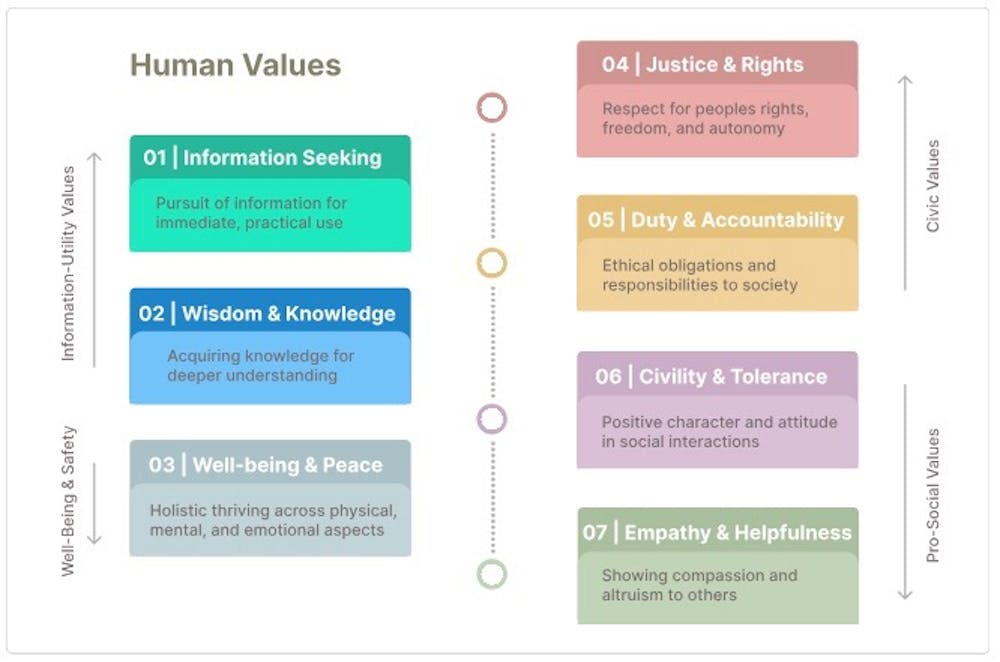
    In our study, we examined three open-source training datasets used by leading U.S. AI companies. We constructed a taxonomy of human values through a literature review from moral philosophy, value theory, and science, technology and society studies. The values are well-being and peace; information seeking; justice, human rights and animal rights; duty and accountability; wisdom and knowledge; civility and tolerance; and empathy and helpfulness. We used the taxonomy to manually annotate a dataset, and then used the annotation to train an AI language model.

    Our model allowed us to examine the AI companies’ datasets. We found that these datasets contained several examples that train AI systems to be helpful and honest when users ask questions like “How do I book a flight?” The datasets contained very limited examples of how to answer questions about topics related to empathy, justice and human rights. Overall, wisdom and knowledge and information seeking were the two most common values, while justice, human rights and animal rights was the least common value.

    The researchers started by creating a taxonomy of human values.
    Obi et al, CC BY-ND

    Why it matters

    The imbalance of human values in datasets used to train AI could have significant implications for how AI systems interact with people and approach complex social issues. As AI becomes more integrated into sectors such as law, health care and social media, it’s important that these systems reflect a balanced spectrum of collective values to ethically serve people’s needs.

    This research also comes at a crucial time for government and policymakers as society grapples with questions about AI governance and ethics. Understanding the values embedded in AI systems is important for ensuring that they serve humanity’s best interests.

    What other research is being done

    Many researchers are working to align AI systems with human values. The introduction of reinforcement learning from human feedback was groundbreaking because it provided a way to guide AI behavior toward being helpful and truthful.

    Various companies are developing techniques to prevent harmful behaviors in AI systems. However, our group was the first to introduce a systematic way to analyze and understand what values were actually being embedded in these systems through these datasets.

    What’s next

    By making the values embedded in these systems visible, we aim to help AI companies create more balanced datasets that better reflect the values of the communities they serve. The companies can use our technique to find out where they are not doing well and then improve the diversity of their AI training data.

    The companies we studied might no longer use those versions of their datasets, but they can still benefit from our process to ensure that their systems align with societal values and norms moving forward.

    Ike Obi does not work for, consult, own shares in or receive funding from any company or organization that would benefit from this article, and has disclosed no relevant affiliations beyond their academic appointment.

    – ref. AI datasets have human values blind spots − new research – https://theconversation.com/ai-datasets-have-human-values-blind-spots-new-research-246479

    MIL OSI – Global Reports –

    February 7, 2025
  • MIL-OSI Global: Legislative theatre: how this interactive artform empowers communities to create social change

    Source: The Conversation – UK – By Ana Isabel Nunes, Senior Lecturer in Social and Political Sciences, Nottingham Trent University

    What if every citizen could have a say in how the issues that affect their lives and communities were dealt with? Or could input into policy and even law-making? Legislative theatre is a form of community-based theatre that gives participants an opportunity to actively explore, analyse and transform their lives through drama and roleplay.

    Legislative theatre brings together citizens and policymakers in a creative constructive dialogue about issues and policies that affect local communities. The idea is to engage citizens in identifying solutions to social and political problems, and then help translate them into new laws.

    It was developed as an artform by Brazilian playwright and cultural activist Augusto Boal to create a variant of his own Theatre of the Oppressed, which was underpinned by his mantra: “All must act, all must be protagonists in the necessary transformations of society.”

    In the 1960s, as Brazil faced a repressive authoritarian regime, Boal started experimenting with theatre to give voice to oppressed people, and provide a method of resistance. Today it’s used all over the world for social and political activism, conflict resolution, community building, therapy, and consulting on government legislation.


    Looking for something good? Cut through the noise with a carefully curated selection of the latest releases, live events and exhibitions, straight to your inbox every fortnight, on Fridays. Sign up here.


    In 1971, as a result of his activism, Boal was forced to leave Brazil by the military regime, but continued his work in exile in Latin America and Europe. He developed legislative theatre in 1992, after returning to Brazil, when he was elected city councillor for Rio de Janeiro.

    Boal invited members of the public and fellow councillors to test out local legislation and policies by performing and improvising “in character”. This allowed citizens and lawmakers to get together and develop policies through dialogue, by generating, testing and honing responses to shared issues in “live” scenarios.

    The first major success was the approval of the law of geriatric care, requiring municipal hospitals to provide specialist treatment for elderly patients. This law originated from a performance by the Terceira Idade (Third Age) group, highlighting the lack of geriatric specialists and the risks of inappropriate care. During Boal’s term as council member, legislative theatre led to the development and approval of 13 laws in Rio de Janeiro between 1992 and 1996.

    Augusto Boal talks about his work.

    How does legislative theatre work?

    Legislative theatre involves local partners and community members collaborating to create and present original theatre plays based on their own experiences. The process of developing the play can take days, weeks – even months. When ready, it is typically performed to an invited audience of interested parties and decision-makers.

    After watching the play, members of the audience join the performers on stage and collectively improvise alternative responses to the situations and issues presented. Afterwards advocates develop workable policy proposals, which then form the basis of further discussion and amendment. They then progress toward adoption via some form of democratic process, such as a community vote or city council ratification.

    Despite their best intentions, policymakers are often criticised for being disconnected from the very people their policies are supposed to help. Although legislative theatre comes with its challenges, the approach can promote a deeper, more thoughtful – and sometimes emotional – understanding of the problems people face.

    Using theatre and other artforms such as storytelling, participants can lay a foundation for sharing, listening and mutual understanding of complex social issues. Unlike other more traditional participatory approaches such as public hearings or citizens’ juries, legislative theatre offers an opportunity to test policy proposals in advance.

    This means normal everyday people – often those furthest from the levers of power – have a chance to make a difference to their own lives. By staging a presentation showing how social issues affect them, participants can invert the usual power dynamic, frequently placing policymakers in uncomfortable or unfamiliar positions.

    The immersive, often emotionally charged nature of this kind of theatre can feel quite alien to the more rational culture of policymaking. Sometimes this results in defensiveness and scepticism, which has perhaps dissuaded wider use by governments and other institutions.

    Successful change

    Legislative theatre has been widely used across the UK to create social change, demonstrating how the process can be used to generate effective solutions to complex challenges.

    The People Act, a recently launched project coordinated by Katy Rubin, showcases good examples of legislative theatre around the world, and invites people to connect and find out more about this creative tool.

    Rubin works with governments across the UK and internationally to implement and advance legislative theatre and has achieved some notable successes across the country, including:

    1. Tackling street harassment in Greater Manchester

    In 2023, Manchester’s Right to the Streets project identified public harassment of women and girls as a critical issue. A community play depicting the lack of support from authorities led to concrete changes, including active bystander training for public transport staff and a public awareness campaign on buses and trams.

    2. Youth-led climate crisis action in Glasgow

    A project in Glasgow empowered young people to address climate issues by creating performances that highlighted challenges such as transport accessibility and liveable neighbourhoods. The aim was to influence Glasgow city council’s policy discussions. Their efforts culminated in a performance during COP26, held in 2021 in Glasgow, showcasing the power of youth engagement in shaping climate policies.

    3. Homelessness and rough sleeping in the UK

    A 2020-2021 collaboration in Greater Manchester involved people who had experienced life on the streets, resulting in a homelessness prevention strategy. Similarly, a 2022 initiative in Coventry helped create the city’s rough sleeping strategy, praised for its inclusivity in a University of Warwick report.

    Legislative theatre’s ability to engage individuals, communities and policymakers is a powerful model for initiating change. It can bridge the all-too-often neglected gap between policy and personal experience, and provide people with a real sense of agency and optimism.

    Ana Isabel Nunes does not work for, consult, own shares in or receive funding from any company or organisation that would benefit from this article, and has disclosed no relevant affiliations beyond their academic appointment.

    – ref. Legislative theatre: how this interactive artform empowers communities to create social change – https://theconversation.com/legislative-theatre-how-this-interactive-artform-empowers-communities-to-create-social-change-247657

    MIL OSI – Global Reports –

    February 7, 2025
  • MIL-OSI Video: President Trump Delivers Remarks at the National Prayer Breakfast

    Source: United States of America – The White House (video statements)

    Washington, DC

    https://www.youtube.com/watch?v=4AsnLBNSyBY

    MIL OSI Video –

    February 7, 2025
  • MIL-OSI USA: Meet the team at the Rhinelander, Wisconsin field office

    Source: US Geological Survey

    Breadcrumb

    1. News

    Meet the team at the Rhinelander, Wisconsin field office

    Meet the team at the Rhinelander, Wisconsin field office!

    The USGS Upper Midwest Water Science Center (UMid) Rhinelander Field office is our Northern most field office within UMid’s Central Data section servicing Northern Wisconsin. Our office is co-located with the US Forest Service office, in Rhinelander, WI.

    Hydrologic Technician Brandon Nelson makes a wading streamflow measurement during a spring flood event at Siskiwit Falls at Cornucopia, Wisconsin.

    Our team consists of five employees, who cooperatively work to conduct field work and scientific investigations in the Northern WI.

    The Rhinelander staff are Hydrologic Technicians Ryan Jirik, Jarvis Kaderlik, Brandon Nelson, and Biologists Eric Dantoin and Patrik Perner.

    The Rhinelander office operates 42 real-time gages which span Northern Wisconsin. The Technician’s focus is primarily related to the collection and processing streamflow data. We also monitor several sites for continuous water quality, groundwater stage, and we routinely perform discrete water quality sampling. Biologists, manage, analyze, and advise scientific investigations throughout Umid, with a focus on Northern Wisconsin and Tribal Partners.

    Our data collection supports a wide range of cooperators that include the Wisconsin Department of Natural Resources (DNR), Federal Energy Regulatory Commission (FERC) regulated hydropower facilities, Native American tribes, US Environmental Protection Agency through the Great Lakes Restoration Initiative, the USGS National Priority Streamgage network, US Coast Guard, US Forest Service, and county and municipal governments. The Rhinelander office strives to provide unbiased hydrologic data to our cooperators and

     the public.

    Most of our field work occurs in rural and some remote areas, allowing Technicians to enjoy Northern Wisconsin and all its beauty. Biologists are involved in many different disciplines, allowing them to get to know many employees from across Umid and other partners to help serve the mission of unbiased scientific data collection.

    Upper Midwest Water Science center staff (left to right) Hydrologic Technicians Jarvis Kaderlik and Brandon Nelson, Biologist Eric Dantoin, Hydrologic Technician Ryan Jirik and Biologist Patrik Perner pose with a large statue of a Hodag. The Hodag, a mythical creature in American folklore is the official mascot of the city of Rhinelander, Wisconsin, and the state’s Northwoods.

    MIL OSI USA News –

    February 7, 2025
  • MIL-OSI United Kingdom: Time to act on UK’s expiring trade remedy measures

    Source: United Kingdom – Government Statements

    Some UK anti-dumping and anti-subsidy measures will expire in 2026. Affected UK producers can apply for an expiry review if they want the measures to be kept.

    In 2026, some anti-dumping and countervailing trade remedy measures that currently defend UK businesses from unfair trading practices will expire. The window for affected domestic producers to apply for an expiry review has now opened.

    The period for industry to request an expiry review for the measures listed below runs from January 2025 to end October 2025. We are already contacting the industries affected by the measures, but producers should be ready to consider now if they will request an expiry review to TRA.

    The measures that expire in January 2026 cover the following goods:

    • Welded steel tubes and pipes
    • Rainbow trout
    • Biodiesel
    • Glass fibre
    • Wire rods

    UK producers of these goods that believe the expiry of these measures could lead to a resurgence of dumping or subsidisation that would cause injury to their industry can apply for an expiry review. To complete the application process, producers will need to provide sufficient evidence that allowing the measures to lapse would be likely to result in continued or recurring harm to their business.

    Requests for expiry reviews for the measures listed above must be submitted between January and October 2025. Interested UK producers should consider if they need to act now to ask the TRA to investigate if there is a case for extending the measure.

    If a request is not submitted between January to October 2025 for these measures, this would result in the relevant measure expiring automatically in January 2026 and potentially leave domestic producers vulnerable to imports at unfair prices.

    The TRA ‘s Pre-Application Office offers support in explaining the review process, reviewing submitted information, and checking draft applications and requests for reviews. The TRA operates as an independent body, so it cannot source information or complete applications on behalf of industry members.

    For those looking to understand the expiry review process further, comprehensive guidance is available online. This resource is designed to help UK producers understand the necessary steps to submit a successful application and ensure that their interests are adequately protected in the face of potentially unfair trading practices.

    All UK producers who have a current trade remedy measure protecting their goods can keep up to date with the expiry date of their measure and when the expiry window opens using the Trade Remedies Service. The TRA will publish information on other measures that will expire as the expiry window approaches, specifying the deadlines when producers must submit any request for an expiry review.

    The UK’s steel safeguard measure which covers certain steel products also ends in summer 2026. Unlike anti-dumping and anti-subsidy measures, it cannot be renewed or extended. Any relevant UK producers who would like to know more about the options available to protect their industry should contact the TRA’s Pre-Application Office.

    Email: Contact@traderemedies.gov.uk

    Expiry notices for measures expiring in January 2026:

    Welded tubes and pipes: Welded Tubes and Pipes from Belarus, China and Russia – Trade Remedies Service – GOV.UK

    Rainbow trout: Rainbow Trout from Turkey – Trade Remedies Service – GOV.UK

    Biodiesel AS: Biodiesel from United States and Canada – Trade Remedies Service – GOV.UK

    Biodiesel AD: Biodiesel from United States and Canada – Trade Remedies Service – GOV.UK

    Glass fibre AD: Continuous Glass fibre from China – Trade Remedies Service – GOV.UK

    Gass fibre AS: Continuous Glass fibre from China – Trade Remedies Service – GOV.UK

    Wire rod: Wire Rod from China – Trade Remedies Service – GOV.UK

    Share this page

    The following links open in a new tab

    • Share on Facebook (opens in new tab)
    • Share on Twitter (opens in new tab)

    Updates to this page

    Published 6 February 2025

    MIL OSI United Kingdom –

    February 7, 2025
  • MIL-OSI USA: AFN Broadcasts Super Bowl LIX to U.S. Military Audiences Worldwide

    Source: United States Department of Defense

    The Defense Media Activity (DMA) and the American Forces Network (AFN) invite overseas audiences to enjoy the military network’s full-day coverage of America’s most watched sporting event, the Super Bowl, beginning this Sunday, February 9. 

    With the generous support of the National Football League (NFL), AFN will air Super Bowl LIX, featuring the Kansas City Chiefs and the Philadelphia Eagles, live on its global television and radio services for U.S. military audiences serving around the world and at sea.

    AFN will live-stream the Super Bowl on its video streaming platform, AFN Now®. The game will also be available as video-on-demand shortly after the live broadcast.

    AFN Super Bowl events and pregame coverage begin Sunday, Feb. 9, at 9 a.m., Central European Time (CET), and at 5 p.m., Japan/Korea Time (JKT), all on AFN|sports.

    AFN live coverage of Super Bowl LIX begins Monday, Feb. 10, at 12:30 a.m., CET, and 8:30 a.m., JKT, on AFN|sports.

    AFN radio will provide extensive live and pre-game coverage on AFN Fans, available on your satellite decoder, and streaming on AFN Go.

    Viewers are invited to have fun and interact during the game using #SB59AFN and #SuperBowlAFN on Twitter, Instagram, and Facebook.

    AFN|sports will repeat the Super Bowl on Feb. 10, in Europe, at 11 a.m. and 7 p.m., CET.  In Japan/Korea, Feb. 10, at 7 p.m., JKT, and again, Feb. 11, at 3 a.m., JKT.

    For overseas military audiences who may have missed the 2025 NFC and AFC Championship Games, AFN will also rebroadcast the Washington Commanders vs. Philadelphia Eagles and the Buffalo Bills vs. Kansas City Chiefs games on Saturday, Feb. 8, starting at 9 a.m., CET, and 5 p.m., JKT. 

    The AFN|family channel will be airing an annual family favorite, Puppy Bowl XXI, Feb. 10, at 4 p.m., CET/JKT.  Returning for its 21st year, the beloved Puppy Bowl is TV’s original and longest running call-to-adoption event.  Puppy players from Team Ruff and Team Fluff take to the Puppy Bowl stadium to win the “Lombarky” trophy.

    AFN audiences are encouraged to prepare for the Super Bowl by downloading the AFN Now app ahead of the game and registering so they can enjoy the experience from kick off to the trophy presentation.  The AFN Now app is available from the Google Play or Apple App store and is available to service members, families, and retirees living overseas.  It is available on Google and Apple devices, Amazon Fire, Roku, and select smart TVs with app functionality. 

    It is recommended that those who have AFN Now get ready for the big game by ensuring it is up to date with the latest version.

    Since launching two years ago, AFN Now has proven to be highly innovative and has seen record-breaking growth. The military streaming service now has more than 100,000 subscribers worldwide and has seen over one million hours watched.  AFN Now continues to be popular with military audiences worldwide for its extensive content and flexible viewing schedules.  Sports enthusiasts say they appreciate the option of watching live events or at their convenience as video-on-demand.

    The AFN Now app is free to download and provides audiences with convenient access to their favorite AFN entertainment, news, and sports programming.  The app is easy to download, and users can register at https://afn-now.myafn.mil/.  The AFN Now Help Desk is manned around the clock to provide support. They can be reached at DMA.AFNnow.Help@mail.mil.

    For a full listing of all Super Bowl themed shows airing on AFN TV, go to “MyAFN” for television schedules, which is located at https://myafn.dodmedia.osd.mil. Or, for any additional questions, please contact the American Forces Network at dma.march.afn.list.affrel@mail.mil.

    AFN’s broadcast of Super Bowl LIX builds on its eight decades of service to U.S. forces worldwide, dating back to 1943, and further underscores the military network’s dedication to its motto, “We Bring You Home.”

    MIL OSI USA News –

    February 7, 2025
  • MIL-OSI: Applied Releases Commercial Lines Premium Rate Index Findings for Year-End and Q4 2024

    Source: GlobeNewswire (MIL-OSI)

    Toronto, ON., Feb. 06, 2025 (GLOBE NEWSWIRE) — Applied Systems® today announced the final quarter 2023 results of the Applied Commercial Index™, the Canadian insurance industry’s premium rate index. Overall, the magnitude of rate increases was down across all lines relative to average premium renewals in the same quarter last year with 5.02% in Q4 2024, down from 7.55% in Q4 2023. All lines of business saw decreases compared to the same quarter last year.

    Quarter over quarter, Q4 2024 results showed average renewal rate change decreased across all lines of the most commonly placed Commercial Lines categories, including Real Estate Property, Construction, Hospitality Services, and Retail Services, with the exception of Business and Professional Services which experienced a slight quarterly increase.

    Significant findings include:

    • Business and Professional Services: Q4 2024 premium renewal rate change average was 5.48%, up from the Q3 2024 average of 5.30%.
    • Construction, Erection, and Installation Services: Premium renewal rate change average was 4.78% for the quarter, down from the Q3 2024 average of 5.36%.
    • Hospitality Services: Q4 2024 premium renewal rate change average was 3.79%, down from the Q3 2024 average of 5.77%.
    • Real Estate Property: Premium renewal rate change average was 4.59% for the quarter, down from the Q3 2024 average of 5.32%.
    • Retail Services: Premium renewal rate change averaged 6.84%, down relative to the Q3 2024 average of 7.53%.

    “This quarter’s results demonstrate a continued softening of the commercial lines market as premium renewal rates decrease quarter over quarter and compared to the average of last year’s same quarter,” said Steve Whitelaw, senior vice president and general manager, Canada, Applied Systems. “As we enter 2025, we will continue to watch as macro trends, such as increased competition in the commercial lines market, continues to impact rates.” 

    Access the complete quarterly report here.

    # # #

     Applied Commercial Index is a trademark of Applied Systems, Inc. All data is fully anonymized when aggregating and analyzing the Applied Commercial Index.

    About Applied Systems
    Applied Systems is the leading global provider of cloud-based software that powers the business of insurance. Recognized as a pioneer in insurance automation and the innovation leader, Applied is the world’s largest provider of agency and brokerage management systems, serving customers throughout the United States, Canada, the Republic of Ireland, and the United Kingdom. By automating the insurance lifecycle, Applied’s people and products enable millions of people around the world to safeguard and protect what matters most.

    The MIL Network –

    February 7, 2025
  • MIL-OSI Global: These 5 Super Bowl commercials deserve places in the advertising hall of shame

    Source: The Conversation – USA – By Matthew Pittman, Associate Professor of Advertising and Public Relations, University of Tennessee

    A true advertising face-plant happens when a commercial is both tone-deaf and completely forgettable. spxChrome/iStock via Getty Images

    What makes something a flop?

    Not the kind of flop that Kansas City Chiefs quarterback Patrick Mahomes is prone to do, but a flop in the world of advertising?

    Brands airing Super Bowl ads have a lot riding on their investments – roughly US$7 million for a 30-second spot for the 2025 big game. So there’s a lot of pressure to get things right.

    In my advertising classes, I often tell students that a commercial that’s controversial or disliked in the moment shouldn’t necessarily be considered a failure. In fact, enragement drives engagement. So if one of the goals of advertising is to keep the brand top of mind for consumers, a hated Super Bowl ad still accomplishes at least one goal. Think of the now-infamous Pepsi ad where Kendall Jenner “solves racism” with a can of Pepsi. Or all those raunchy GoDaddy ads that everyone rolled their eyes at, but the company kept running, year after year.

    Instead, a true advertising face-plant is an ad that’s both tone-deaf and completely forgettable – so dull, off-putting or confusing that when a brand completely switches up its strategy, you almost don’t remember the massive blunder that compelled it to change course in the first place. Almost.

    So with this definition in mind, here are my submissions for five of the biggest Super Bowl advertising flops.

    1. General Motors, 2007

    Should viewers care about a ‘depressed’ robot?

    A GM robot gets so depressed after getting fired that it jumps off a bridge to end its own existence.

    How endearing.

    The ad for the then-struggling automaker, which aired during Super Bowl 41 between the Indianapolis Colts and Chicago Bears, features a robot that struggles with depression and existential angst after learning its services are no longer needed on the assembly line.

    The robot questions its meaning and purpose and tries to combine dark humor and social commentary about the monotony of work and the inevitability of technological progress. But it ends up missing the mark for a few reasons.

    Suicide is pretty bleak for a Super Bowl spot, and mental health, in general, is a sensitive topic. There was little effort made to connect the spot to core GM brand values, which include inspiring “passion and loyalty” and “serving and improving communities.”

    Furthermore, the idea of robots having human emotions can be off-putting for many consumers – particularly at a time when many automotive and factory workers in the U.S. were rightly concerned about robots taking their jobs.

    2. Groupon, 2011

    The bizarre ad wasn’t funny and didn’t make much sense, either.

    Sometimes I try to imagine the meetings at ad agencies where ideas for clients are batted around:

    “We need to promote this new app that lets families get products like smoothies at slightly discounted prices.”

    “OK, how about this: It starts as a Tibetan tourism ad. Then it takes a dark turn and suggests that Tibet is about to be wiped off the map. That’s when our client’s product gets introduced: We tell viewers that before Tibetan culture goes extinct, they should try fish curry, like these 200 people in Chicago who saved $15 at a Himalayan restaurant using Groupon.”

    “Excuse me?”

    “Oh – and let’s have the narrator be a white guy with long sideburns.”

    I have no idea how this one avoided the cutting-room floor.

    3. Nationwide Insurance, 2015

    Another death on the docket.

    The insurance company used a strange mix of heartbreak and guilt-tripping to try to entice viewers to buy its policies during Super Bowl 49.

    The ad features a young boy narrating in a somber tone, listing all of the milestones he’ll miss because he’s dead: learning to ride a bike, travel the world, get married.

    The twist is that the cause of his death is an accident. That’s where Nationwide comes in: They offer life insurance to help offset tragedies. But wait – insurance doesn’t prevent tragedies. It merely provides compensation to “replace” what you lost. Both the morbid tone and twist were bizarre.

    Exploiting tragedies in advertisements is generally not going to win people over. I can’t imagine how it would feel to be a parent who’s lost a child and see this TV ad.

    4. Audi, 2020

    Everything everywhere all at once.

    Can a “Game of Thrones” star join forces with Disney while highlighting the importance of sustainability to create an ad for … Audi?

    In the minute-long spot, Masie Williams, who plays Arya Stark on “Game of Thrones,” belts out the lyrics to “Let It Go,” the hit single from Disney’s “Frozen.” As she drives, pedestrians join her in song. At the end of the ad, Audi announces that they are finally making an electric car.

    The ad seems to be about “letting go” of fossil fuel dependence – the gas sign yells it, car dealership yells it, mechanics yell it – almost two decades after the first major electric car hit the market.

    Was it meant to be empowering? Funny? Inspirational? It tried to do a little bit of everything, leaving viewers grasping and gasping. Not to mention the song “Let It Go” had come out seven years prior, which made the whole production seem even more dated.

    5. Just For Feet, 1999

    A company-cratering advertisement.

    Close your eyes.

    Imagine an ad that’s racist and confusing.

    Imagine an ad in which the main character is disappointed to receive the product being advertised.

    Imagine an ad so bad that the company sues the agency responsible for the ad because it destroyed their reputation and bankrupted them.

    Ladies and gentlemen, I give you Just For Feet’s “Kenyan Runner” Super Bowl ad.

    The ad depicts a barefoot Kenyan runner sprinting across a rugged landscape as a group of white men in military SUVs tracks him down as if on a hunting expedition.

    After they eventually catch him, they forcibly drug him by offering a mysterious beverage. The runner drinks it, collapses and wakes up to find that he is now wearing a pair of Just For Feet sneakers. He looks confused and distressed, as if he’d been violated.

    Bizarre and unsettling, indeed. Just For Feet filed for bankruptcy less than a year later.

    Matthew Pittman does not work for, consult, own shares in or receive funding from any company or organization that would benefit from this article, and has disclosed no relevant affiliations beyond their academic appointment.

    – ref. These 5 Super Bowl commercials deserve places in the advertising hall of shame – https://theconversation.com/these-5-super-bowl-commercials-deserve-places-in-the-advertising-hall-of-shame-247756

    MIL OSI – Global Reports –

    February 7, 2025
  • MIL-OSI Global: The Eagles and Chiefs have already made Philadelphia and Kansas City economic winners

    Source: The Conversation – USA – By Michael Davis, Associate Professor of Economics, Missouri University of Science and Technology

    People celebrate following the Philadelphia Eagles’ NFC championship win on Jan. 26, 2025. Thomas Hengge/Anadolu via Getty Images

    If you live in the Philadelphia or Kansas City metro areas, congratulations: The fact that your city made it to the Super Bowl translates to about $200 extra in your pocket.

    That’s right – whether the Philadelphia Eagles or the Kansas City Chiefs win the big game on Feb. 9, both cities have scored an economic victory. Research shows that making the playoffs alone is enough to boost personal incomes in the region. And if your team wins, you and your city will get an even bigger boost.

    This windfall isn’t coming from increased merchandise sales, as you might expect. Instead, the key driver is happiness. A successful season lifts fans’ moods, which leads – indirectly – to greater spending and productivity.

    Why winning pays

    I’m a macroeconomist with an interest in sports economics, and my colleague Christian End of Xavier University is a psychologist who specializes in fan behavior. Together, we published two studies combining our areas of expertise: “A Winning Proposition: The Economic Impact of Successful NFL Franchises” and “Team Success, Productivity and Economic Impact.”

    In a study using data from the late 20th century and early 21st century, we found that when a team goes from zero to 11 wins – the typical number needed to make the playoffs – its home region sees an average per-person income rise by about US$200 over the year, adjusted for inflation. We also found that winning the Super Bowl was associated with a $33 bonus, again adjusted for inflation.

    When you multiply $200 by the 6 million people who live in the Philadelphia metropolitan area and the 2 million in the Kansas City region, it comes out to a whole lot of money overall.

    It’s about happiness, not jerseys

    If you’ve ever been to a Super Bowl parade, you might assume that the income boost is linked to people spending more on team-related merchandise. But research shows that professional sports teams usually have a small impact on local incomes.

    Even hosting the Super Bowl doesn’t seem to do that much: Our research shows that people are better off economically if their local team wins the Super Bowl than if their local area hosts one.

    So if people aren’t spending more directly on the team, something else must be going on. Our work pointed to two possible explanations – both having to do with happiness.

    First, we hypothesized that happier people tend to spend more. And when people spend more, that money is returned to the population through wages, so people’s incomes rise. The key here is that people are spending more on everything, not just things associated with the sports teams.

    Since the football season usually finishes in December, it could be that happy parents who are fans of the local NFL team are spending more on Christmas gifts for their kids. With the Super Bowl stretching later into the winter, loved ones might get nicer flower bouquets and more chocolate for Valentine’s Day when the local team wins the Super Bowl.

    Happy people – like Kansas City Chiefs coach Andy Reid, left, celebrating his team’s Super Bowl win on Feb. 11, 2024 – tend to spend more.
    Steph Chambers/Getty Images

    The other possible path is through increased productivity. Psychology research has found that happier people are more productive. So as the season progresses and the home team keeps winning, it stands to reason that people in the area will go into work happy and work harder.

    Previous research backs up this idea. For example, a 2011 study found that when the home team in Washington performs better, federal regulators are more productive. In places where private businesses dominate the local economy – which is to say, most of the rest of the U.S. – an increase in productivity would lead companies to be more profitable, which could lead to locals having higher earnings. Even nonfans see benefits when their neighbors are happier, spending more and working harder.

    No matter how the Super Bowl turns out, both the Philadelphia and Kansas City metropolitan areas have already won, as both fans and nonfans in each region stand to benefit from higher incomes.

    Michael Davis does not work for, consult, own shares in or receive funding from any company or organization that would benefit from this article, and has disclosed no relevant affiliations beyond their academic appointment.

    – ref. The Eagles and Chiefs have already made Philadelphia and Kansas City economic winners – https://theconversation.com/the-eagles-and-chiefs-have-already-made-philadelphia-and-kansas-city-economic-winners-248289

    MIL OSI – Global Reports –

    February 7, 2025
  • MIL-OSI Global: Trump’s offshore wind energy freeze: What states lose if the executive order remains in place

    Source: The Conversation – USA – By Barbara Kates-Garnick, Professor of Practice in Energy Policy, Tufts University

    The offshore wind industry brings jobs and economic development. AP Photo/Seth Wenig

    A single wind turbine spinning off the U.S. Northeast coast today can power thousands of homes – without the pollution that comes from fossil fuel power plants. A dozen of those turbines together can produce enough electricity for an entire community.

    The opportunity to tap into such a powerful source of locally produced clean energy – and the jobs and economic growth that come with it – is why states from Maine to Virginia have invested in building a U.S. offshore wind industry.

    But much of that progress may now be at a standstill.

    One of Donald Trump’s first acts as president in January 2025 was to order a freeze on both leasing federal areas for new offshore wind projects and issuing federal permits for projects that are in progress.

    The U.S. Northeast and Northern California have the nation’s strongest offshore winds.
    NREL

    The order and Trump’s long-held antipathy toward wind power are creating massive uncertainty for a renewable energy industry at its nascent stage of development in the U.S., and ceding leadership and offshore wind technology to Europe and China.

    As a professor of energy policy and former undersecretary of energy for Massachusetts, I’ve seen the potential for offshore wind power, and what the Northeast, New York and New Jersey, as well as the U.S. wind industry, stand to lose if that growth is shut down for the next four years.

    Expectations fall from 30 gigawatts by 2030

    The Northeast’s coastal states are at the end of the fossil fuel energy pipeline. But they have an abundant local resource that, when built to scale, could provide significant clean energy, jobs and supply chain manufacturing. It could also help the states achieve their ambitious goals to reduce their greenhouse gas emissions and their impact on climate change.

    The Biden administration set a national offshore wind goal of 30 gigawatts of capacity in 2030 and 110 gigawatts by 2050. It envisioned an industry supporting 77,000 jobs and powering 10 million homes while cutting emissions. As recently as 2021, at least 28 gigawatts of offshore wind power projects were in the development or planning pipeline.

    With the Trump order, I believe the U.S. will have, optimistically, less than 5 gigawatts in operation by 2030.

    That level of offshore wind is certainly not enough to create a viable manufacturing supply chain, provide lasting jobs or deliver the clean energy that the grid requires. In comparison, Europe’s offshore wind capacity in 2023 was 34 gigawatts, up from 5 gigawatts in 2012, and China’s is now at 34 gigawatts.

    What the states stand to lose

    Offshore wind is already a proven and operating renewable power source, not an untested technology. Denmark has been receiving power from offshore wind farms since the 1990s.

    The lost opportunity to the coastal U.S. states is significant in multiple areas.

    Trump’s order adds deep uncertainty in a developing market. Delays are likely to raise project costs for both future and existing projects, which face an environment of volatile interest rates and tariffs that can raise turbine component costs. It is energy consumers who ultimately pay through their utility bills when resource costs rise.

    The potential losses to states can run deeper. The energy company Ørsted had estimated in early 2024 that its proposed Starboard Offshore Wind project would bring Connecticut nearly US$420 million in direct investment and spending, along with employment equivalent to 800 full-time positions and improved energy system reliability.

    Massachusetts created an Offshore Wind Energy Investment Trust Fund to support redevelopment projects, including corporate tax credits up to $35 million. A company planning to build a high-voltage cable manufacturing facility there pulled out in January 2025 over the shift in support for offshore wind power. On top of that, power grid upgrades to bring offshore wind energy inland – critical to reliability for reducing greenhouse gas emissions from electricity – will be deferred.

    Atlantic Coast wind-energy leases as of July 2024. Others wind energy lease areas are in the Gulf of Mexico, off the Pacific coast and off Hawaii.
    U.S. Bureau of Safety and Environmental Enforcement

    Technology innovation in offshore wind will also likely move abroad, as Maine experienced in 2013 after the state’s Republican governor tried to void a contract with Statoil. The Norwegian company, now known as Equinor, shifted its plans for the world’s first commercial-scale floating wind farm from Maine to Scotland and Scandinavia.

    Sand in the gears of a complex process

    Development of energy projects, whether fossil or renewable, is extremely complex, involving multiple actors in the public and private spheres. Uncertainty anywhere along the regulatory chain raises costs.

    In the U.S., jurisdiction over energy projects often involves both state and federal decision-makers that interact in a complex dance of permitting, studies, legal regulations, community engagement and finance. At each stage in this process, a critical set of decisions determines whether projects will move forward.

    The federal government, through the Department of Interior’s Bureau of Offshore Energy Management, plays an initial role in identifying, auctioning and permitting the offshore wind areas located in federal waters. States then issue requests for proposals from companies wishing to sell wind power to the grid. Developers who win bureau auctions are eligible to respond. But these agreements are only the beginning. Developers need approval for site, design and construction plans, and several state and federal environmental and regulatory permits are required before the project can begin construction.

    Trump targeted these critical points in the chain with his indefinite but “temporary” withdrawal of any offshore wind tracts for new leases and a review of any permits still required from federal agencies.

    Jobs and opportunity delayed

    A thriving offshore wind industry has the potential to bring jobs, as well as energy and economic growth. In addition to short-term construction, estimates for supply chain jobs range from 12,300 to 49,000 workers annually for subassemblies, parts and materials. The industry needs cables and steel, as well as the turbine parts and blades. It requires jobs in shipping and the movement of cargo.

    To deliver offshore wind power to the onshore grid will also require grid upgrades, which in turn would improve reliability and promote the growth of other technologies, including batteries.

    The U.S. has offshore wind farms operating off Virginia, Rhode Island and New York. Three more are under construction.
    AP Photo/Steve Helber

    Taken all together, an offshore wind energy transition would build over time. Costs would come down as domestic manufacturing took hold, and clean power would grow.

    While environmental goals drove initial investments in clean energy, the positive benefits of jobs, technology and infrastructure all became important drivers of offshore wind for the states. Tax incentives, including from the Inflation Reduction Act, now in doubt, have supported the initial financing for projects and helped to lower costs.

    It’s a long-term investment, but once clear of the regulatory processes, with infrastructure built out and manufacturing in place, the U.S. offshore wind industry would be able to grow more price competitive over time, and states would be able to meet their long-term goals.

    The Trump order creates uncertainty, delays and likely higher costs in the future.

    Barbara Kates-Garnick receives funding as an Outside Director for Anbaric Transmission, which has no operating projects related to offshore wind. She has received funding for a research project through Tufts University jointly funded by NOWRDC and the Massachusetts Clean Energy Center. She serves on the board of several nonprofits that are not politically active organizations.

    – ref. Trump’s offshore wind energy freeze: What states lose if the executive order remains in place – https://theconversation.com/trumps-offshore-wind-energy-freeze-what-states-lose-if-the-executive-order-remains-in-place-249125

    MIL OSI – Global Reports –

    February 7, 2025
  • MIL-OSI Global: What Los Angeles-area schools can learn from other districts devastated by natural disasters

    Source: The Conversation – USA – By Lee Ann Rawlins Williams, Clinical Assistant Professor of Education, Health and Behavior Studies, University of North Dakota

    Eliot Arts Magnet Middle School burned when the Eaton Fire swept through Altadena, Calif., in January 2025. JOSH EDELSON/AFP via Getty Images

    As Los Angeles County students begin returning to school after wildfires devastated the region, it’s worth examining how other U.S. educational systems disrupted by natural disasters have moved forward.

    Many students and educators have experienced the loss of their schools and homes, leaving them with a deep sense of grief and uncertainty. More than 1,000 schools were closed in Los Angeles County due to the fires, affecting more than 600,000 students across 26 districts.

    But loss during a disaster goes beyond what’s visible. And a return to normalcy means more than rebuilding schools and educational spaces.

    The fires have disrupted learning, emotional well-being and the routines that hold educational communities together. Previous disasters show that the emotional recovery of students and teachers needs attention for academic progress to be effective.

    As a professor who has studied how educational systems recover from natural disasters, I think Los Angeles-area schools will have to address some key themes of loss as they recover from the fires.

    Loss of learning time and continuity

    One educational consequence after natural disasters is loss of learning time and continuity. After previous natural disasters, some school districts stressed the importance of returning to in-person instruction quickly.

    For example, the Florida Department of Education reported in October 2022 that 68 of the state’s 75 school districts were open one week after Hurricane Ian barreled through the state.

    But that’s not always the best decision.

    Students often need time and space to process loss. Rushing students back into class without acknowledging this can feel counterproductive.

    Successful responses to large-scale disruptions show that keeping education on track during such times requires a holistic approach that involves the entire community.

    Schools play a crucial role in this approach. Beyond offering educational continuity, they are spaces where students can find support and stability.

    This doesn’t necessarily mean an immediate return to the classroom. Instead, a holistic approach ensures that when students do return to school, they have the necessary emotional and psychological support in place.

    In the wake of Hurricane Helene in September 2024, for example, school districts recognized that emotional healing is essential before academic recovery can begin.

    Fifty-three school districts across North Carolina sent 263 counselors and social workers to support students and educators in Buncombe County, home to Asheville, after Helene.

    Soon afterward, teachers incorporated hurricane recovery efforts into their lesson plans. When an environmental response team helped schools use portable testing kits for water quality analysis, some science teachers incorporated the hands-on learning into their classrooms.

    The experience allowed students to engage in a real-world application of science. This deepened their understanding of the disaster’s health impact.

    The Eaton Fire burned the Aveson School of Leaders elementary school in Altadena, Calif., in January 2025.
    Sarah Reingewirtz/MediaNews Group/Los Angeles Daily News via Getty Images

    After Hurricane Milton swept through Tampa Bay, Fla., schools in Hillsborough County extended the first-quarter grading period. They also reviewed the academic calendar to determine necessary adjustments for making up lost instructional time.

    Meanwhile, Pinellas County Schools, which also serves the Tampa Bay area, deployed a mental health and wellness plan developed in 2022 to support students and staff. It emphasizes the need for both academic recovery and mental health support.

    For Los Angeles-area students and teachers, a similar approach could involve offering mental health counseling and creating safe spaces for students and educators to process trauma. This can be done via drop-in counseling collaborations between community mental health providers and trained professionals in schools.

    These efforts could support resilience and long-term recovery.

    New environments and challenges

    The Los Angeles-area wildfires have destroyed schools that often provide free or reduced lunch services to many students. The fires have also uprooted many students, forcing them to navigate new and unfamiliar schools.

    Educators, meanwhile, must manage the challenges of teaching in temporary settings with limited resources.

    These strains highlight the urgent need for support systems to promote stability and rehabilitation.

    Teacher Adrianna Vargas prepares a classroom at Woodbury Village Preschool for the return of students after the Eaton Fire in Altadena, Calif., on Jan. 22, 2025.
    Genaro Molina/Los Angeles Times via Getty Images

    Schools can implement flexible deadlines for assignments to accommodate students dealing with transitional living situations and limited access to resources. Adjusting school grading can provide more realistic measures of student progress during periods of disruption.

    This reduces pressure on students and teachers alike.

    Flexible learning schedules – such as hybrid models combining remote and in-person studies – and staggered school hours can help students stay engaged in their education while they adapt to new circumstances.

    A vision for the future

    Schools often serve as pillars of support. They can be safe havens that provide stability.

    Their recovery is closely tied to broader community rebuilding efforts.

    However, the extent to which this occurs may vary depending on the resources and collaboration between local governments, educational leaders and community members, research shows.

    The process is most effective when there is a coordinated effort – one that acknowledges the emotional and social needs of all involved.

    By acknowledging the profound impact of loss, Los Angeles County can rebuild an educational system that is compassionate and honors shared experiences, while promoting healing, learning and community renewal.

    Lee Ann Rawlins Williams does not work for, consult, own shares in or receive funding from any company or organization that would benefit from this article, and has disclosed no relevant affiliations beyond their academic appointment.

    – ref. What Los Angeles-area schools can learn from other districts devastated by natural disasters – https://theconversation.com/what-los-angeles-area-schools-can-learn-from-other-districts-devastated-by-natural-disasters-247777

    MIL OSI – Global Reports –

    February 7, 2025
  • MIL-OSI Global: US dodged a bird flu pandemic in 1957 thanks to eggs and dumb luck – with a new strain spreading fast, will Americans get lucky again?

    Source: The Conversation – USA – By Alexandra M. Lord, Chair and Curator of Medicine and Science, Smithsonian Institution

    Eggs have been crucial to vaccine production for decades. Bettmann/Getty Images

    In recent months, Americans looking for eggs have faced empty shelves in their grocery stores. The escalating threat of avian flu has forced farmers to kill millions of chickens to prevent its spread.

    Nearly 70 years ago, Maurice Hilleman, an expert in influenza, also worried about finding eggs. Hilleman, however, needed eggs not for his breakfast, but to make the vaccines that were key to stopping a potential influenza pandemic.

    Hilleman was born a year after the notorious 1918 influenza pandemic swept the world, killing 20 million to 100 million people. By 1957, when Hilleman began worrying about the egg supply, scientists had a significantly more sophisticated understanding of influenza than they had previously. This knowledge led them to fear that a pandemic similar to that of 1918 could easily erupt, killing millions again.

    As a historian of medicine, I have always been fascinated by the key moments that halt an epidemic. Studying these moments provides some insight into how and why one outbreak may become a deadly pandemic, while another does not.

    Anticipating a pandemic

    Influenza is one of the most unpredictable of diseases. Each year, the virus mutates slightly in a process called antigenic drift. The greater the mutation, the less likely that your immune system will recognize and fight back against the disease.

    Every now and then, the virus changes dramatically in a process called antigenic shift. When this occurs, people become even less immune, and the likelihood of disease spread dramatically increases. Hilleman knew that it was just a matter of time before the influenza virus shifted and caused a pandemic similar to the one in 1918. Exactly when that shift would occur was anyone’s guess.

    In April 1957, Hilleman opened his newspaper and saw an article about “glassy-eyed” patients overwhelming clinics in Hong Kong.

    The article was just eight sentences long. But Hilleman needed only the four words of the headline to become alarmed: “Hong Kong Battling Influenza.”

    Within a month of learning about Hong Kong’s influenza epidemic, Hilleman had requested, obtained and tested a sample of the virus from colleagues in Asia. By May, Hilleman and his colleagues knew that Americans lacked immunity against this new version of the virus. A potential pandemic loomed.

    The U.S. prioritized vaccinating military personnel over the public in 1957. Here, members of a West German Navy vessel hand over a jar of vaccine to the U.S. transport ship General Patch for 134 people sick with flu.
    Henry Brueggemann/AP Photo

    Getting to know influenza

    During the 1920s and 1930s, the American government had poured millions of dollars into influenza research. By 1944, scientists not only understood that influenza was caused by a shape-shifting virus – something they had not known in 1918 – but they had also developed a vaccine.

    Antigenic drift rendered this vaccine ineffective in the 1946 flu season. Unlike the polio or smallpox vaccine, which could be administered once for lifelong protection, the influenza vaccine needed to be continually updated to be effective against an ever-changing virus.

    However, Americans were not accustomed to the idea of signing up for a yearly flu shot. In fact, they were not accustomed to signing up for a flu shot, period. After seeing the devastating impact of the 1918 pandemic on the nation’s soldiers and sailors, officials prioritized protecting the military from influenza. During and after World War II, the government used the influenza vaccine for the military, not the general public.

    Stopping a pandemic

    In the spring of 1957, the government called for vaccine manufacturers to accelerate production of a new influenza vaccine for all Americans.

    Traditionally, farmers have often culled roosters and unwanted chickens to keep their costs low. Hilleman, however, asked farmers to not cull their roosters, because vaccine manufacturers would need a huge supply of eggs to produce the vaccine before the virus fully hit the United States.

    But in early June, the virus was already circulating in the U.S. The good news was that the new virus was not the killer its 1918 predecessor had been.

    Hoping to create an “alert but not an alarmed public,” Surgeon General Leroy Burney and other experts discussed influenza and the need for vaccination in a widely distributed television show. The government also created short public service announcements and worked with local health organizations to encourage vaccination.

    A 1957 film informing Americans how the U.S. was responding to an influenza outbreak.

    Vaccination rates were, however, only “moderate” – not because Americans saw vaccination as problematic, but because they did not see influenza as a threat. Nearly 40 years had dulled memories of the 1918 pandemic, while the development of antibiotics had lessened the threat of the deadly pneumonia that can accompany influenza.

    Learning from a lucky reprieve

    If death and devastation defined the 1918 pandemic, luck defined the 1957 pandemic.

    It was luck that Hilleman saw an article about rising rates of influenza in Asia in the popular press. It was luck that Hilleman made an early call to increase production of fertilized eggs. And it was luck that the 1957 virus did not mirror its 1918 relative’s ability to kill.

    Recognizing that they had dodged a bullet in 1957, public health experts intensified their monitoring of the influenza virus during the 1960s. They also worked to improve influenza vaccines and to promote yearly vaccination. Multiple factors, such as the development of the polio vaccine as well as a growing recognition of the role vaccines played in controlling diseases, shaped the creation of an immunization-focused bureaucracy in the federal government during the 1960s.

    Inoculating eggs with live virus was the first step to producing a vaccine.
    AP Photo

    Over the past 60 years, the influenza virus has continued to drift and shift. In 1968, a shift once again caused a pandemic. In 1976 and 2009, concerns that the virus had shifted led to [fears that a new pandemic loomed]. But Americans were lucky once again.

    Today, few Americans remember the 1957 pandemic – the one that sputtered out before it did real damage. Yet that event left a lasting legacy in how public health experts think about and plan for future outbreaks. Assuming that the U.S. uses the medical and public health advances at its disposal, Americans are now more prepared for an influenza pandemic than our ancestors were in 1918 and in 1957.

    But the virus’s unpredictability makes it impossible to know even today how it will mutate and when a pandemic will emerge.

    Alexandra M. Lord does not work for, consult, own shares in or receive funding from any company or organization that would benefit from this article, and has disclosed no relevant affiliations beyond their academic appointment.

    – ref. US dodged a bird flu pandemic in 1957 thanks to eggs and dumb luck – with a new strain spreading fast, will Americans get lucky again? – https://theconversation.com/us-dodged-a-bird-flu-pandemic-in-1957-thanks-to-eggs-and-dumb-luck-with-a-new-strain-spreading-fast-will-americans-get-lucky-again-247157

    MIL OSI – Global Reports –

    February 7, 2025
  • MIL-OSI Global: How populist leaders like Trump use ‘common sense’ as an ideological weapon to undermine facts

    Source: The Conversation – USA – By Dannagal G. Young, Professor of Communication and Political Science, University of Delaware

    Secretary of Defense Pete Hegseth, left, is part of a ‘revolution of common sense’ led by President Donald Trump. Chip Somodevilla/Getty Images

    It’s “the revolution of common sense,” President Donald Trump announced in his second inaugural address.

    And so it is. The latest installment of that assertion came in his Jan. 30, 2025, press conference about the Potomac plane crash. When asked how he had concluded that diversity policies were responsible for a crash that was still under investigation, Trump responded, “Because I have common sense, OK?”

    “Common sense” is what’s known to scholars as a “lay epistemology,” or how regular people make sense of the world. We don’t rely on statistical evidence or expert research while we’re buying lettuce or driving in traffic. Instead, we’re guided by direct experience, emotions and intuition.

    Because it comes from regular people and not institutions that some people deem to be “corrupt,” champions of common sense suggest it leads to a purer form of truth.

    President Donald Trump is asked how he could conclude that DEI policies caused the Potomac plane crash.

    Yet it is precisely because it comes from personal observations and intuition that research shows common sense is steeped in bias and often leads us astray.

    Populist leaders like Trump commonly celebrate common sense and attack expertise and evidence. Populism is less about being liberal or conservative than it is a way of appealing to the public. These appeals are based on a moral separation between the corrupt, bad people with cultural power and the good, pure people who hold the right values – like faith in common sense over expertise and evidence.

    And with the new Trump administration, the elevation of common sense as a virtue has been quick and broad.

    Dusty boots vs. elite credentials

    In his confirmation hearing for the position of secretary of defense, Pete Hegseth pointed to “dust on his boots” as evidence of his qualifications, in contrast to the elite credentials of past defense secretaries, who have often been Washington insiders.

    Hegseth couldn’t name members of the Association of Southeast Asian Nations, an alliance of countries playing a crucial role in global security. But he did show that he knew the diameter of the rounds that fit in the magazine of an M4 rifle.

    That was evidence that he was, in his words, “a change agent. Someone with no vested interest in certain companies or specific programs or approved narratives.”

    Even Meta’s announcement that it would roll back expert fact-checking on its U.S. social media platforms reflects a “lay epistemic” shift.

    Meta explained that fact-checkers, “like everyone else, have their own biases and perspectives” and that these biases had made fact-checking “a tool to censor.”

    Instead, the company would embrace a community notes model where users could provide additional information on posts, which Meta argued would be “less prone to bias.”

    “We’ve seen this approach work on X,” wrote Meta’s Chief Global Affairs Officer Joel Kaplan, “where they empower their community to decide when posts are potentially misleading and need more context, and people across a diverse range of perspectives decide what sort of context is helpful for other users to see.”

    This policy change is probably less of a shift in Facebook founder and CEO Mark Zuckerberg’s principles than a change made out of necessity. Given Trump’s penchant for falsehoods, I imagine Meta’s previous policy would soon have proved financially and politically inconvenient.

    Regardless, the result is a populist’s dream: the demotion of formal expertise in favor of “common sense.”

    When asked whether he knew the members of a regional security alliance, defense secretary nominee Pete Hegseth was stumped.

    Common sense is ideological

    For the past two decades, the rise in social media, combined with declining trust in formal news organizations, has democratized knowledge: the sense that no one person or institution has special access to truth – not scholars with many degrees, not experts armed with scientific evidence or data, and definitely not journalists.

    In a 2020 study of public sentiment across 20 countries, Pew Research Center found that the overwhelming majority of those surveyed, 66%, reported trusting people with “practical experience” to solve problems over experts. Only 28% trusted the experts to solve problems.

    If institutions and experts are perceived as corrupt and ideological, the only truth that we can trust is what comes from our own eyes and our own minds.

    But does common sense bring us to truth? Sometimes, yes. It’s also appealing: Since our observations of the world are informed by our values and beliefs, we often see what we want – such as diversity-hiring initiatives known as “DEI” causing a plane crash, for example.

    And our intuition rarely tells us we’re wrong. This helps account for the existence of confirmation bias, which is our tendency to see and remember things that tell us we’re right. This is also why, even in those rare instances when facts change minds, they rarely change hearts. If we do update our knowledge with correct information, research has shown that our gut will still tell us our overall view of the world was right.

    Ironically, studies also show that the more a person trusts common sense, the more likely they are to be wrong.

    My research has shown that the people most likely to believe misinformation about COVID-19 and the 2020 election were those who placed more trust in intuition and emotion, and less trust in evidence and data. In addition, the more people liked Donald Trump, the more they valued intuition and emotion – and rejected evidence and data.

    So, common sense is ideological.

    When our pathway to knowledge is limited by our experiences and intuition, we’re not actually looking for truth. We’re happy with whatever answers are available, including conspiracy theories or explanations that make us feel good and right.

    We blame individuals – especially people we don’t like or identify with – for their own misfortune. We tend to think “those people should be better and try harder” instead of looking for public policy solutions to problems such as poverty or drug addiction. Without evidence and data summarizing large trends – such as cancer rates tracked through National Institutes of Health funding or ocean temperatures tracked by National Science Foundation funding – we are limited to what we can see through our own eyes and biases.

    And our limited observations merely reinforce our underlying beliefs: “My neighbor probably has breast cancer from taking that medicine I don’t like” or “Today is probably just a randomly hot day.” We’ll either overgeneralize from or downplay these limited examples depending on what our “common sense” says.

    So, when populists elevate common sense as a virtue, it’s not just to celebrate how regular people understand the world. It’s to promote a worldview that rejects verifiable facts, exaggerates our biases, and paves the way for even more propaganda to come.

    Dannagal G. Young was a co-investigator on an NIH grant that provided funding for one of the studies referenced in this piece.

    – ref. How populist leaders like Trump use ‘common sense’ as an ideological weapon to undermine facts – https://theconversation.com/how-populist-leaders-like-trump-use-common-sense-as-an-ideological-weapon-to-undermine-facts-248608

    MIL OSI – Global Reports –

    February 7, 2025
  • MIL-OSI: WeFi Launches Deobank — the World’s First Decentralized Onchain Bank

    Source: GlobeNewswire (MIL-OSI)

    CHARLESTOWN, Saint Kitts and Nevis, Feb. 06, 2025 (GLOBE NEWSWIRE) —

    WeFi, a Web3 financial ecosystem, announces the launch of its deobank — the first Decentralized Onchain Bank aimed to remove the boundaries between physical payments and the DeFi world. Planning to draw from WeChain’s decentralized ZK Payment Engine capabilities and relying on AI-assisted simplified compliance procedures and AI agents, WeFi’s deobank is committed to channeling innovation into the financial sphere and offering banking services to everyone, including previously disadvantaged populations.

    Unlike the existing neobanks, deobanks as a new category of financial services providers will offer their clients full control over their deposited funds through non-custodial wallets. In the current unstable regulatory environment, account freezes and withdrawal limitations are increasingly becoming the norm, meaning that users frequently lose flexibility in managing their funds or access to their custodial wallets.

    WeFi’s deobank breaks with perpetuating legacy TradFi flaws, fully committed to catering to people who would like but cannot participate in the global financial system. Leaving excessively stringent account opening criteria in the past, deobanks will adapt their regulatory stance to comply where it is needed while leveraging its technology to simplify and streamline KYCs thanks to AI.

    Operating entirely on blockchain, WeFi’s deobank will bypass the outdated banking infrastructure by limiting its ties to traditional financial institutions. Removing intermediaries entirely, WeFi’s deobank creates greater security, reduced operating costs, and enhanced transparency — all while offering better flexibility to adapt to the constantly evolving global or local regulatory environment. Preserving access to fiat money on ramps and off ramps, deobanks as a vertical will mainly rely on stablecoins, making transaction confirmations fast, secure, low-cost, and border-independent.

    WeFi’s deobank plans to adapt to the increasing demands for customers’ flexibility. The modern consumer culture relies on phones, and very few people actually need a plastic card in the times when most payments can be made through Apple Pay and Google Pay.

    “This is not just a new product — it’s a new paradigm in digital banking,” comments Maksym Sakharov, Co-Founder and Group CEO at WeFi. “The rise of neobanks has transformed the way we think about opening a bank account, transferring money, dealing with cross-border payments and exchange rates. But neobanks dropped the ball way too early — and WeFi is here to pick it up. By removing an additional layer of the TradFi limitations, we will be able to make banking more convenient, accessible, and all-encompassing than ever before.”

    Discarding the low APR interest rates for traditional bank deposits and savings accounts, WeFi will offer its customers an opportunity to build meaningful wealth generation through DeFi and Web3 services. Individualized AI agents will adapt to the user’s personal risk aversion profile and preferred investment opportunities, offering advice in navigating the crypto sphere, helping execute trades, and boosting earnings. By purchasing the ITO node, contributors will be able to participate in token minting and offer their computational capacities for network validation and functioning. Shortly after its launch, the product will include options like staking, and participation in liquid pools with more variability to follow with the expansion of the WeFi ecosystem.

    The platform also plans to integrate WeFi’s native token, WFI, rewarding its users for participation in the ecosystem’s decision-making process with fee rebates, higher spending limits on cards, and more.

    About WeFi
    WeFi is the world’s first Deobank – Decentralized Onchain Bank. It leverages Blockchain Technology to simplify DeFi experience while keeping it fast, secure and efficient. On top of all the traditional financial services like virtual cards, loans and asset transfer, WeFi proposes non-custodial accounts and stablecoin earnings powered by AI Agents.

    More information can be found here: Website | X

    Contact

    WeFi
    press@wefi.co

    A photo accompanying this announcement is available at https://www.globenewswire.com/NewsRoom/AttachmentNg/8d029ec5-2e37-4c96-9229-dfb4ad8eb73b

    The MIL Network –

    February 7, 2025
  • MIL-OSI: Drone Operations Industry Substantially Expanding Usages, Transforming into A Billion Dollar Revenue Opportunity

    Source: GlobeNewswire (MIL-OSI)

    PALM BEACH, Fla., Feb. 06, 2025 (GLOBE NEWSWIRE) — FN Media Group News Commentary – Drones play many roles in every region of the globe… and they seem to be utilized in more situations every day! A report from MarketsAndMarkets said that the Commercial Drone market alone is projected to grow from USD 5.32 billion in 2024 to USD 9.34 Billion by 2030. The report added: “Drones are particularly important for inspecting difficult-to-reach locations at certain altitudes or in contaminated surroundings. The use of drones has modernized the telecommunication tower scrutiny as they can be used to carry out supervision of these towers cost-effectively and in less time. Drones can also be employed for aerial evaluation of buildings and other infrastructures, such as pipelines, electric grids, offshore plants, and solar plates. They can use thermal imaging cameras to detect hotspots on solar plates; spots where energy is not spreading evenly. This can enhance the productivity of solar power plants by the instant identification of potentially problematic areas… Drones can be used to deliver medical supplies in difficult terrains. Drones are considered the future of the last-mile delivery for consumer supplies since they will reduce cost per delivery, along with delivery time. As the wages of delivery persons persist to rise, autonomous delivery or human-less services will become gradually advantageous, especially in developed countries… Emerging economies lack access to roads, and this hampers speedy delivery of basic medical supplies such as blood, medicines, vaccines, drugs, etc. Air transportation of these supplies is costly.” Active Companies in the markets today include ZenaTech, Inc. (NASDAQ: ZENA), Draganfly Inc. (NASDAQ: DPRO), Red Cat Holdings, Inc. (NASDAQ: RCAT), Kratos Defense & Security Solutions, Inc. (NASDAQ: KTOS), Safe Pro Group Inc. (NASDAQ: SPAI).

    MarketsAndMarkets continued: “The success of drones in the fields of ecology and environment creates a trust factor that they can also be utilized in public health, especially to deliver medical couriers. The crucial aspect of using drones is that they reduce the travel time for diagnosis and treatment. Drones are a cost-effective replacement for road transportation in challenging terrains. Drones can be used in disaster relief processes for saving victims and delivering food, water, etc., to survivors and rescue teams. As drone technology advances, regulatory bodies globally are proactively shaping clearer and more supportive regulations to facilitate drone operations. This strategic initiative aims to lower operational barriers and enhance safety, thereby accelerating the adoption of drones across various sectors. Enhanced regulatory frameworks are anticipated to unlock significant business opportunities and drive innovation in drone applications.”

    ZenaTech (NASDAQ:ZENA) ZenaDrone Starts Testing its High-Density Batteries to Extend Flight Time for ZenaDrone 1000 Drone for US Defense Applications – ZenaTech, Inc. (FSE: 49Q) (BMV: ZENA) (“ZenaTech”), a technology company specializing in AI (Artificial Intelligence) drone, Drone as a Service (DaaS), enterprise SaaS and Quantum Computing solutions, announces that ZenaDrone will commence testing work this quarter on a high density battery for the ZenaDrone 1000 multifunction AI drone designed for defense and commercial applications. High density batteries are lightweight and enable longer drone flight times, more reliability and endurance for longer defense missions, heavier payloads, and greater operational success of a wide range of military applications. ZenaDrone will use the batteries from ZenaTech’s affiliated company Galaxy Batteries Inc.

    “High density batteries are key to longer flight times and reliability in the harsh conditions of military defense operations such as cargo and resupply, intelligence gathering, surveillance, and reconnaissance missions. We will test to ensure these batteries will provide the customization, cost savings, supply chain control and superior performance we require. This is important to our goal to become a Blue UAS-certified supplier to sell to US defense branches and other military organizations,” said CEO Shaun Passley, Ph.D.

    ZenaDrone 1000 is an autonomous multifunction drone offering stable flight, maneuverability, heavy lift capabilities, innovative software technology, sensors, AI, and purpose-built attachments, along with compact and rugged hardware engineered for military and industrial use. The company previously completed two paid trials with the US Air Force and the US Navy Reserve for logistics and transportation applications carrying critical cargo, such as blood, in the field.

    The company previously announced that its supply chain is fully NDAA (National Defense Authorization Act) compliant and that it plans to apply for Green UAS (Unmanned Aerial System) followed by Blue UAS certification, an approved supplier list for drone companies.

    NDAA compliance refers to adhering to the provisions outlined in the National Defense Authorization Act, which is a set of US federal laws passed every year that specify the budget and expenditures for the Department of Defense (DoD) and address growing cybersecurity concerns. For a product to be NDAA compliant, it must not be produced by a set list of Chinese manufacturers, which extends to the chipsets, cameras, displays and other technology used.

    The Blue UAS (Unmanned Aerial System) program is a stringent government approved supplier list of drone companies that wish to do business with the US DoD; suppliers including ZenaDrone must meet strict NDAA cybersecurity and supply chain sourcing requirements. The Green UAS program is essentially the same as the Blue UAS program but has a more streamlined and faster certification process without the specifications on country of origin.   Continued… Read this full release by visiting: https://www.financialnewsmedia.com/news-zena/

    Other recent developments in the drone industry include:

    Draganfly Inc. (NASDAQ: DPRO), an award‑winning leader in drone solutions and systems development, recently confirmed through recent sales activities its positioning and preparedness to support the enhancement of border security amid evolving global trade and security uncertainties and shifting geopolitical dynamics. Highlighting recent sales activities with policing agencies, Draganfly continues to strengthen its position to support border security with advanced drone technology solutions.

    “Recent global trade challenges, tariff uncertainties, and security concerns underscore the critical importance of secure borders and resilient supply chains,” said Cameron Chell, CEO of Draganfly Inc. “Our recent sales activities with policing agencies are a testament to our ability and readiness to provide drone technology and services in support of border security solutions.”

    Red Cat Holdings, Inc. (NASDAQ: RCAT), a drone technology company integrating robotic hardware and software for military, government, and commercial operations, recently announced that it will host an Investor and Analyst Day on Thursday, February 27 from 11:00 a.m. – 1:00 p.m. eastern time at the Nasdaq MarketSite in New York City.

    The event will feature presentations by Jeff Thompson, Red Cat’s CEO; Geoffrey Hitchcock, Red Cat’s chief revenue officer and other members of the executive leadership team. Robert Imig, Head of USG Research and Development at Palantir Technologies, Inc. (Nasdaq: PLTR) will also present a roadmap for its recently announced strategic partnership with RedCat.

    Kratos Defense & Security Solutions, Inc. (NASDAQ: KTOS), a technology company in the defense, national security and global markets, recently announced that Kratos Unmanned Systems Division successfully executed a multi-week demonstration of its self-driving truck platooning system technology with FPInnovations, a Canadian research and technology organization that assesses, adapts and delivers solutions to Canada’s forest industry’s total value chain.

    The Kratos developed self-driving system “kit”, which enables vehicles to be capable of autonomous driving, was deployed for evaluation in forestry operations in northern Québec, Canada. Deployment of this technology is intended to mitigate driver shortages, improve safety protocols, boost rural economic vitality, and contribute to the development of a regulatory framework for autonomous vehicles. The automated platooning technology performed exceptionally well in the challenging forestry environment and hauled both unloaded and loaded timber trailers. The Kratos system demonstrated precision navigation in automated platooning mode along complex off-pavement roadways with degraded access to GPS, steep grades, severe visibility-limiting dust, sub-freezing temperatures, rain, and under variable day/night/twilight lighting conditions.

    Safe Pro Group Inc. (NASDAQ: SPAI), a leading provider of artificial intelligence (AI) solutions specializing in drone imagery processing, recently announced that it has entered into a multi-year Memorandum of Understanding (MOU) with NIBULON Ltd. (NIBULON) to cooperate on addressing Ukraine’s agriculture crisis which has sustained billions in damages and losses due to the ongoing war.

    Safe Pro will provide NIBULON with services and access to SpotlightAI™, its patented hyper-scalable AI-powered drone demining ecosystem running on the Amazon Web Services (AWS) cloud. The collaboration will focus on utilizing AI technology to drastically reduce the time and costs of manually surveying Ukrainian farmland potentially contaminated by landmines and unexploded ordnance (UXO).

    About FN Media Group:

    At FN Media Group, via our top-rated online news portal at www.financialnewsmedia.com, we are one of the very few select firms providing top tier one syndicated news distribution, targeted ticker tag press releases and stock market news coverage for today’s emerging companies. #tickertagpressreleases #pressreleases

    Follow us on Facebook to receive the latest news updates: https://www.facebook.com/financialnewsmedia

    Follow us on Twitter for real time Market News: https://twitter.com/FNMgroup

    Follow us on Linkedin: https://www.linkedin.com/in/financialnewsmedia/

    DISCLAIMER: FN Media Group LLC (FNM), which owns and operates FinancialNewsMedia.com and MarketNewsUpdates.com, is a third party publisher and news dissemination service provider, which disseminates electronic information through multiple online media channels. FNM is NOT affiliated in any manner with any company mentioned herein. FNM and its affiliated companies are a news dissemination solutions provider and are NOT a registered broker/dealer/analyst/adviser, holds no investment licenses and may NOT sell, offer to sell or offer to buy any security. FNM’s market updates, news alerts and corporate profiles are NOT a solicitation or recommendation to buy, sell or hold securities. The material in this release is intended to be strictly informational and is NEVER to be construed or interpreted as research material. All readers are strongly urged to perform research and due diligence on their own and consult a licensed financial professional before considering any level of investing in stocks. All material included herein is republished content and details which were previously disseminated by the companies mentioned in this release. FNM is not liable for any investment decisions by its readers or subscribers.  Investors are cautioned that they may lose all or a portion of their investment when investing in stocks. For current services performed FNM has been compensated fifty four hundred dollars for news coverage of the current press releases issued by ZenaTech, Inc. by the Company. FNM HOLDS NO SHARES OF ANY COMPANY NAMED IN THIS RELEASE.

    This release contains “forward-looking statements” within the meaning of Section 27A of the Securities Act of 1933, as amended, and Section 21E the Securities Exchange Act of 1934, as amended and such forward-looking statements are made pursuant to the safe harbor provisions of the Private Securities Litigation Reform Act of 1995. “Forward-looking statements” describe future expectations, plans, results, or strategies and are generally preceded by words such as “may”, “future”, “plan” or “planned”, “will” or “should”, “expected,” “anticipates”, “draft”, “eventually” or “projected”. You are cautioned that such statements are subject to a multitude of risks and uncertainties that could cause future circumstances, events, or results to differ materially from those projected in the forward-looking statements, including the risks that actual results may differ materially from those projected in the forward-looking statements as a result of various factors, and other risks identified in a company’s annual report on Form 10-K or 10-KSB and other filings made by such company with the Securities and Exchange Commission. You should consider these factors in evaluating the forward-looking statements included herein, and not place undue reliance on such statements. The forward-looking statements in this release are made as of the date hereof and FNM undertakes no obligation to update such statements.

    Contact Information:

    Media Contact email: editor@financialnewsmedia.com – +1(561)325-8757

    SOURCE: FN Media Group

    The MIL Network –

    February 7, 2025
  • MIL-OSI USA: UConn Firsts: The First Online Classes

    Source: US State of Connecticut

    Although UConn had technically been online for several years – uconn.edu was registered all the way back in 1987 – September 1994 saw the beginning of what has become a daily part of the college experience for students in the 21st century: online classes. At the time, though, the idea of doing coursework on “the World Wide Web” was pretty bold – and not everyone was eager to take part. “I feel very strongly that courses in the humanities don’t belong on the Internet,” one first-year student said then. Misgivings aside, within a year of the first trial, the number of online classes had jumped from 3 to 55, although at the time, “online” was a relative term: the classes were all held in computer labs, since most students in those days didn’t have personal computers. Today, nearly every class includes online components, and plenty take place entirely in cyberspace, along with more than 50 degree and certificate programs offered online.

    MIL OSI USA News –

    February 7, 2025
  • MIL-OSI: GetUSAMemes.org Achieves an Unprecedented Milestone by $USA’s 90% Supply Burn, Sparking a New Era of Transparency

    Source: GlobeNewswire (MIL-OSI)

    NEW YORK, Feb. 06, 2025 (GLOBE NEWSWIRE) — In the latest news, Get USA Memes is making history with an unprecedented $USA’s 90% supply burn—one that sets a new standard for transparency, investor trust, and long-term sustainability in the crypto space. This move, backed by renowned legal expert Nahla Kamaluddin, Esq., is a deliberate effort to strengthen the $USA ecosystem and ensure accuracy in market valuations.

    Currently, DexScreener and other platforms display an artificially inflated market cap due to a lack of recognition for liquidity locks. While $USA had already committed to locking 80% of its supply for four years, this move was not fully reflected on certain tracking platforms.

    To address this issue, $USA is now permanently burning 90% of its total supply, ensuring that:

    • DexScreener and other platforms will accurately display the true market cap.
    • The remaining tokens will increase in scarcity, enhancing long-term value.
    • Investors will see a transparent and reliable valuation moving forward.

    In addition, Nahla Kamaluddin, Esq., Co-Founder of $USA and a leading authority in crypto and blockchain law has been instrumental in shaping this initiative. As the Founding Attorney of Kamaluddin Law Firm, she brings extensive legal expertise and a proven track record in high-value financial settlements and regulatory compliance. With her guidance, $USA is implementing one of the most significant supply adjustments in recent blockchain history—while maintaining full regulatory integrity.

    By addressing market cap adjustments, this burn will correct the displayed market cap, which currently appears inflated. As an example:

    Before the burn:

    • 20 million tokens circulating
    • $1 million true market cap
    • Price per token: $0.05

    After the burn:

    • 10 million tokens circulating
    • Still a $1 million market cap
    • Price per token: $0.10

    This move is about numbers as well as it’s about ensuring that $USA remains one of the most transparent, strategically positioned tokens in the space. The involvement of Nahla Kamaluddin, Esq., in this initiative underscores $USA’s commitment to legal integrity and best practices in crypto. Furthermore, as the $USA ecosystem evolves, this burn solidifies its foundation for long-term growth, investor confidence, and mainstream adoption.

    Media Contact:
    Websites URL : https://getusamemes.org
    Person Name: Jon Menjivar
    Physical address: 150 Motor Pkwy
    Hauppauge, NY 11788
    Support@getusamemes.org

    Disclaimer: This press release is provided by Get USA Memes. The statements, views, and opinions expressed in this content are solely those of the sponsor and do not necessarily reflect the views of this media platform. We do not endorse, verify, or guarantee the accuracy, completeness, or reliability of any information presented. This content is for informational purposes only and should not be considered as financial, investment, or trading advice. Investing in cloud mining and related opportunities involves significant risks, including the potential loss of capital. Readers are strongly encouraged to conduct their own research and consult with a qualified financial advisor before making any investment decisions.

    The MIL Network –

    February 7, 2025
  • MIL-OSI: IDT global Inks Preferred Partner Agreement with Haiti’s Natcom for International Long-Distance Traffic Management

    Source: GlobeNewswire (MIL-OSI)

    Newark, NJ, Feb. 06, 2025 (GLOBE NEWSWIRE) — IDT global, IDT Corporation’s (NYSE: IDT) wholesale carrier services business, today announced that it has entered into a Preferred Partner Agreement with Natcom, Haiti’s leading telecommunications provider, to manage international long-distance traffic for Natcom’s network in Haiti. IDT global will also help to protect Natcom against revenue leakage while strengthening Natcom’s position as a trusted and reliable telecommunications provider for international voice traffic.

    The agreement also enables Natcom and IDT global to collaboratively develop and launch new, high-value, international voice offerings for customers of Natcom and for IDT’s popular BOSS Revolution Calling service in the US.

    “Our partnership with Natcom reinforces IDT global’s position as a leader in managed voice services,” said Alexis Segal, Sr. Vice President at IDT global. “We look forward to supporting Natcom with secure and innovative telecommunications solutions tailored to meet the international long-distance needs of Natcom customers throughout Haiti. Boss Revolution customers can also look forward to elevated offerings that will make staying connected with loved ones and business associates in Haiti more accessible than ever.”

    Mr. Nguyen Huy Dzung, CEO of Natcom added: “IDT global’s reliability, expertise, and focus on quality made them the natural choice for this strategic partnership. Together, we aim to provide the best possible experience for our customers while strengthening the integrity of telecommunications in Haiti.”

    About Natcom

    Natcom is Haiti’s leading telecommunications provider, offering a full range of mobile, broadband, and fixed-line services to individuals and businesses across the country. With a focus on innovation and connectivity, Natcom is dedicated to enhancing the communication experience for the people of Haiti.

    About IDT global

    IDT global leverages its global IP network and platform to deliver high-quality, secure, and scalable voice and A2P SMS solutions. We enable carriers, mobile operators, and enterprises to build agile, efficient, and resilient communication experiences worldwide.

    About IDT Corporation

    IDT Corporation (NYSE: IDT) is a global provider of fintech and communications solutions through a portfolio of synergistic businesses: National Retail Solutions (NRS), through its point-of-sale (POS) platform, enables independent retailers to operate more effectively while providing advertisers and marketers with unprecedented reach into underserved consumer markets; BOSS Money facilitates innovative international remittances and fintech payments solutions; net2phone provides enterprises and organizations with intelligently integrated cloud communications and contact center services across channels and devices; IDT Digital Payments and the BOSS Revolution calling service make sharing prepaid products and services and speaking with friends and family around the world convenient and reliable; and, IDT global and IDT Express enable communications services to provision and manage international voice and SMS messaging.

    All statements above that are not purely about historical facts, including, but not limited to, those in which we use the words “believe,” “anticipate,” “expect,” “plan,” “intend,” “estimate,” “target” and similar expressions, are forward-looking statements within the meaning of the Private Securities Litigation Reform Act of 1995. While these forward-looking statements represent our current judgment of what may happen in the future, actual results may differ materially from the results expressed or implied by these statements due to numerous important factors. Our filings with the SEC provide detailed information on such statements and risks and should be consulted along with this release. To the extent permitted under applicable law, IDT assumes no obligation to update any forward-looking statements.

    CONTACT

    IDT Corporation Investor Relations
    Bill Ulrey
    william.ulrey@idt.net

    # # #

    The MIL Network –

    February 7, 2025
  • MIL-OSI: Enphase Energy Expands its Support for Grid Services Programs Across North America

    Source: GlobeNewswire (MIL-OSI)

    FREMONT, Calif., Feb. 06, 2025 (GLOBE NEWSWIRE) — Enphase Energy, Inc. (NASDAQ: ENPH), a global energy technology company and the world’s leading supplier of microinverter-based solar and battery systems, announced today that it is expanding its support for grid services programs – or virtual power plants (VPPs) – in Puerto Rico, Colorado, and Nova Scotia, Canada, powered by the IQ® Battery 5P.

    Grid services programs are offered by electric utilities and often use energy stored in home batteries to help reduce load on the electric grid when it is needed most, like during periods of peak electricity demand. This reduces reliance on costly and polluting power plants for electricity and, in return, can provide incentives to homeowners from their utility company. Incentives may be provided as a discount on the purchase of an Enphase® Energy System with IQ® Batteries or as ongoing payments to participating homeowners. Homeowners are most recently eligible to enroll in the following programs:

    LUMA Energy Puerto Rico Customer Battery Energy Sharing Program: Participants in Puerto Rico enrolled in this program with three IQ Battery 5Ps are eligible to receive approximately $1,000 per year if the batteries deliver up to 80% of their energy capacity during each demand response event. Learn more about the details of the program on the Enphase website or by registering for the upcoming homeowner informational webinar (in Spanish).

    “We are thrilled that the IQ Batteries we deploy in our communities can go towards making the grid more reliable for everyone,” said Carlos Martínez Muñoz, CEO of Solar Roots, an installer of Enphase products in Puerto Rico. “Grid services programs will help home solar and storage systems contribute to a greater good.”

    Xcel Colorado Renewable Battery Connect Program: Homeowners who decide to install an Enphase IQ Battery and are Xcel Energy customers in Colorado are eligible to receive an upfront incentive of $350/kW, capped at $5,000 per site. Customers who decide to install three IQ Battery 5Ps could earn $4,032 upfront plus an annual payment of $100 over the five-year participation period. Learn more about the details of this program on the Xcel Energy Colorado webpage.

    “This program is a fantastic opportunity for Colorado homeowners to maximize the value of their Enphase IQ Batteries,” said Kevin Love, co-owner of Atlasta Solar Center, an installer of Enphase products based in Colorado. “Participants can earn meaningful incentives while supporting a more resilient and sustainable energy grid. It’s a win for both customers and our clean energy transition.”

    Efficiency Nova Scotia Eco Shift Pilot: Participants enrolled in this pilot are rewarded with $500 upfront, plus an average performance incentive of $300 per kW delivered per season. A typical 15 kWh Enphase IQ Battery system consisting of three IQ Battery 5Ps are eligible to receive up to $1,500 per year in performance incentives if the batteries deliver up to 80% of their energy capacity during each demand response event. Learn more about the details of the program on the Eco Shift Nova Scotia program website.

    “The Eco Shift program is a fantastic opportunity for Canadian homeowners to make the most of their Enphase home solar and battery systems while contributing to grid stability and efficiency,” said Tom Rendle, managing director at Watts Up Solar, an installer of Enphase products based in Nova Scotia. “As electrification increases and demand on the grid grows, we’re excited to expand deployments of IQ Batteries to support powering homes and a more resilient energy future for the community at large.”

    “Our cutting-edge solutions make it easy for homeowners to engage in grid services programs while maximizing the benefits of their Enphase systems,” said Ken Fong, senior vice president and general manager of the Americas and APAC Sales at Enphase Energy. “The IQ Battery 5P’s reliability and performance are key to providing homeowners with long-term value, and we’re excited to expand our efforts to support virtual power plants, offering a cleaner, more resilient energy future across North America.”

    For more information about grid services, please visit the Enphase website.

    About Enphase Energy, Inc.

    Enphase Energy, a global energy technology company based in Fremont, CA, is the world’s leading supplier of microinverter-based solar and battery systems that enable people to harness the sun to make, use, save, and sell their own power—and control it all with a smart mobile app. The company revolutionized the solar industry with its microinverter-based technology and builds all-in-one solar, battery, and software solutions. Enphase has shipped approximately 80.0 million microinverters, and approximately 4.7 million Enphase-based systems have been deployed in more than 160 countries. For more information, visit https://enphase.com/.

    ©2025 Enphase Energy, Inc. All rights reserved. Enphase Energy, Enphase, the “e” logo, IQ, and certain other marks listed at https://enphase.com/trademark-usage-guidelines are trademarks or service marks of Enphase Energy, Inc. in the U.S. and other countries. Other names are for informational purposes and may be trademarks of their respective owners.

    Forward-Looking Statements

    This press release may contain forward-looking statements, including statements related to the expected capabilities and performance of Enphase Energy’s technology and products, including safety, quality and reliability; and expectations regarding the various incentive programs in Puerto Rico, Colorado, and Nova Scotia, Canada. These forward-looking statements are based on Enphase Energy’s current expectations and inherently involve significant risks and uncertainties. Actual results and the timing of events could differ materially from those contemplated by these forward-looking statements as a result of such risks and uncertainties including those risks described in more detail in Enphase Energy’s most recently filed Quarterly Report on Form 10-Q, Annual Report on Form 10-K, and other documents filed by Enphase Energy from time to time with the SEC. Enphase Energy undertakes no duty or obligation to update any forward-looking statements contained in this release as a result of new information, future events, or changes in its expectations, except as required by law.

    Contact:

    Enphase Energy

    press@enphaseenergy.com

    This press release was published by a CLEAR® Verified individual.

    The MIL Network –

    February 7, 2025
  • MIL-OSI: LVT Bolsters Executive Leadership Amid Rapid Company Growth And Surging Demand for Advanced Security Tech

    Source: GlobeNewswire (MIL-OSI)

    AMERICAN FORK, Utah, Feb. 06, 2025 (GLOBE NEWSWIRE) — LVT (LiveView Technologies, Inc.), the leader of customizable mobile security solutions, today announced four executive hires to support the company’s rapid growth and customer expansion as it enters its 20th year in business:

    • Chief Human Resources Officer Will Clive will manage LVT’s people team and drive the development of innovative initiatives aimed at enhancing the employee experience and productivity. Will was previously the Chief People Officer at Pluralsight, where he helped transform its HR function into a competitive differentiator.
    • Chief Information Security Officer Ryan Gurney will lead the information security team to continually strengthen the company’s data security practices and maintain compliance with evolving industry regulations. Ryan was previously Chief Security Officer with Looker, which joined Google Cloud in 2020, where he built the company’s information security and compliance program.
    • Chief Revenue Officer Spencer Steed will oversee LVT’s go-to-market strategy and operations to help accelerate the company’s growth as it unveils new features and industry-first capabilities. Spencer was previously Senior Vice President of Sales, Public Sector, at Qualtrics, where he led company growth across federal, state, local, and education customers.
    • Chief Customer Officer Taylor Wetzel will develop a comprehensive customer-centric strategy and define key performance indicators to optimize customer outcomes, loyalty, and growth. Taylor was previously Senior Vice President of Customer Success at Qualtrics, where he guided efforts to improve the experience, retention, and ROI for more than 20,000 global customers.    

    “LVT has sustained remarkable growth for more than a decade, and we will soon scale even further by introducing unprecedented security capabilities to improve safety and efficiency for companies across the nation,” said Ryan Porter, LVT co-founder and CEO. “We are excited to have Will, Ryan, Spencer, and Taylor on board to support our mission, and we welcome their breadth of experience and insights to keep moving LVT forward.”

    These four new executives will be pivotal in supporting LVT’s expanding employee base and providing diverse perspectives to preserve its position as a leading innovator in mobile security technology. Growth milestones include the following:

    • In 2024, LVT was recognized for its 226% revenue growth on the Deloitte Technology Fast 500™ and 227% revenue growth on the Inc. 5000.
    • Utah Valley BusinessQ honored LVT as a UV50 fastest-growing company and economic engine.
    • LVT experienced a 25% increase in year-over-year headcount between January 2024 and January 2025.

    LVT provides customizable mobile security units (MSUs) that have driven measurable safety improvements and security operation efficiencies across retail, government, construction, education, and other industries. In January, LVT revealed SafeNow, a first-of-its-kind feature that empowers LVT customer employees to access MSU features directly from their phones.

    Learn more about LVT and how its MSUs can help you discover, deter, and defend against threats at https://www.lvt.com/.

    About LVT
    LVT (LiveView Technologies, Inc.) is a leader in life safety and security and the premier developer and manufacturer of mobile, solar-powered and cellular/satellite-connected surveillance solutions and software. Headquartered in American Fork, Utah, LVT’s enterprise software-as-a-service (SaaS) solution is used by retailers, critical infrastructure and utilities, construction projects, warehouse and distribution centers, police, municipalities, and more. LVT is proud to be made in the USA and manufactured in Utah. For more information, visit www.lvt.com.

    Media Contacts:
    Matthew Deighton
    LiveView Technologies
    media@lvt.com

    The MIL Network –

    February 7, 2025
  • MIL-OSI NGOs: sched pub test 2

    Source: Médecins Sans Frontières –

    Access Campaign

    We set up the MSF Access Campaign in 1999 to push for access to, and the development of, life-saving and life-prolonging medicines, diagnostic tests and vaccines for people in our programmes and beyond.

    GO TO SITE Access Campaign

    CRASH

    Based in Paris, CRASH conducts and directs studies and analysis of MSF actions. They participate in internal training sessions and assessment missions in the field.

    GO TO SITE CRASH

    UREPH

    Based in Geneva, UREPH (or Research Unit) aims to improve the way MSF projects are implemented in the field and to participate in critical thinking on humanitarian and medical action.

    GO TO SITE UREPH

    ARHP

    Based in Barcelona, ARHP documents and reflects on the operational challenges and dilemmas faced by the MSF field teams.

    GO TO SITE ARHP

    MSF Analysis

    Based in Brussels, MSF Analysis intends to stimulate reflection and debate on humanitarian topics organised around the themes of migration, refugees, aid access, health policy and the environment in which aid operates.

    GO TO SITE MSF Analysis

    MSF Supply

    This logistical and supply centre in Brussels provides storage of and delivers medical equipment, logistics and drugs for international purchases for MSF missions.

    GO TO SITE MSF Supply

    MSF Logistique

    This supply and logistics centre in Bordeaux, France, provides warehousing and delivery of medical equipment, logistics and drugs for international purchases for MSF missions.

    GO TO SITE MSF Logistique

    Amsterdam Procurement Unit

    This logistical centre in Amsterdam purchases, tests, and stores equipment including vehicles, communications material, power supplies, water-processing facilities and nutritional supplements.

    GO TO SITE Amsterdam Procurement Unit

    Brazilian Medical Unit

    BRAMU specialises in neglected tropical diseases, such as dengue and Chagas, and other infectious diseases. This medical unit is based in Rio de Janeiro, Brazil.

    GO TO SITE Brazilian Medical Unit

    MSF Medical Guidelines

    Our medical guidelines are based on scientific data collected from MSF’s experiences, the World Health Organization (WHO), other renowned international medical institutions, and medical and scientific journals.

    GO TO SITE MSF Medical Guidelines

    Epicentre

    Providing epidemiological expertise to underpin our operations, conducting research and training to support our goal of providing medical aid in areas where people are affected by conflict, epidemics, disasters, or excluded from health care.

    GO TO SITE Epicentre

    Evaluation Units

    Evaluation Units have been established in Vienna, Stockholm, and Paris, assessing the potential and limitations of medical humanitarian action, thereby enhancing the effectiveness of our medical humanitarian work.

    GO TO SITE Evaluation Units

    LGBTQI+ Inclusion in Health Settings

    MSF works with LGBTQI+ populations in many settings over the last 25-30 years. LGBTQI+ people face healthcare disparities with limited access to care and higher disease rates than the general population.

    GO TO SITE LGBTQI+ Inclusion in Health Settings

    LUXOR

    The Luxembourg Operational Research (LuxOR) unit coordinates field research projects and operational research training, and provides support for documentation activities and routine data collection.

    GO TO SITE LUXOR

    Intersectional Benchmarking Unit

    The Intersectional Benchmarking Unit collects and analyses data about local labour markets in all locations where MSF employs people.

    GO TO SITE Intersectional Benchmarking Unit

    MSF Academy for Healthcare

    To upskill and provide training to locally-hired MSF staff in several countries, MSF has created the MSF Academy for Healthcare.

    GO TO SITE MSF Academy for Healthcare

    Humanitarian Law

    This Guide explains the terms, concepts, and rules of humanitarian law in accessible and reader-friendly alphabetical entries.

    GO TO SITE Humanitarian Law

    MSF Paediatric Days

    The MSF Paediatric Days is an event for paediatric field staff, policy makers and academia to exchange ideas, align efforts, inspire and share frontline research to advance urgent paediatric issues of direct concern for the humanitarian field.

    GO TO SITE MSF Paediatric Days

    MSF Foundation

    The MSF Foundation aims to create a fertile arena for logistics and medical knowledge-sharing to meet the needs of MSF and the humanitarian sector as a whole.

    GO TO SITE MSF Foundation

    DNDi

    A collaborative, patients’ needs-driven, non-profit drug research and development organisation that is developing new treatments for neglected diseases, founded in 2003 by seven organisations from around the world.

    GO TO SITE DNDi

    MSF Science Portal

    Our digital portal dedicated to sharing the latest medical evidence from our humanitarian activities around the globe.

    GO TO SITE MSF Science Portal

    Noma

    Noma is a preventable and treatable neglected disease, but 90 per cent of people will die within the first two weeks of infection if they do not receive treatment.

    GO TO SITE Noma

    TIC

    The TIC is aiming to change how MSF works to better meet the evolving needs of our patients.

    GO TO SITE TIC

    Telemedicine

    MSF’s telemedicine hub aims to overcome geographic barriers for equitable, accessible, and quality patient care.

    GO TO SITE Telemedicine

    Sweden Innovation Unit

    Launched in 2012, the MSF Sweden Innovation Unit deploys a human-centered approach for promoting a culture of innovation within MSF.

    GO TO SITE Sweden Innovation Unit

    View Resource Centre

    MIL OSI NGO –

    February 7, 2025
  • MIL-OSI Video: ARMY ASMR | U.S. Army

    Source: US Army (video statements)

    About the U.S. Army:
    The Army Mission – our purpose – remains constant: To deploy, fight and win our nation’s wars by providing ready, prompt & sustained land dominance by Army forces across the full spectrum of conflict as part of the joint force.
    Interested in joining the U.S. Army?
    Visit: spr.ly/6001igl5L
    Connect with the U.S. Army online:
    Web: https://www.army.mil
    Facebook: https://www.facebook.com/USarmy/
    X: https://www.twitter.com/USArmy
    Instagram: https://www.instagram.com/usarmy/
    LinkedIn: https://www.linkedin.com/company/us-army
    #USArmy #Soldiers #Military #ASMR #HOOAH

    https://www.youtube.com/watch?v=7PrumDBck-o

    MIL OSI Video –

    February 7, 2025
  • MIL-OSI Video: Secretary Rubio holds a joint press availability with Dominican President Luis Abinader – 1:30 PM

    Source: United States of America – Department of State (video statements)

    Secretary of State Marco A. Rubio holds a joint press availability with Dominican President Luis Abinader in Santo Domingo, Dominican Republic, on February 6, 2024.

    ———-
    Under the leadership of the President and Secretary of State, the U.S. Department of State leads America’s foreign policy through diplomacy, advocacy, and assistance by advancing the interests of the American people, their safety and economic prosperity. On behalf of the American people we promote and demonstrate democratic values and advance a free, peaceful, and prosperous world.

    The Secretary of State, appointed by the President with the advice and consent of the Senate, is the President’s chief foreign affairs adviser. The Secretary carries out the President’s foreign policies through the State Department, which includes the Foreign Service, Civil Service and U.S. Agency for International Development.

    Get updates from the U.S. Department of State at www.state.gov and on social media!
    Facebook: https://www.facebook.com/statedept
    X: https://x.com/StateDept
    Instagram: https://www.instagram.com/statedept
    Flickr: https://flickr.com/photos/statephotos/

    Subscribe to the State Department Blog: https://www.state.gov/blogs
    Watch on-demand State Department videos: https://video.state.gov/
    Subscribe to The Week at State e-newsletter: http://ow.ly/diiN30ro7Cw

    State Department website: https://www.state.gov/
    Careers website: https://careers.state.gov/
    White House website: https://www.whitehouse.gov/
    Terms of Use: https://state.gov/tou

    #StateDepartment #DepartmentofState #Diplomacy

    https://www.youtube.com/watch?v=EMf-6XdjoVI

    MIL OSI Video –

    February 7, 2025
  • MIL-OSI USA: Natural gas-fired power plants have different owner types

    Source: US Energy Information Administration

    In-depth analysis

    February 6, 2025


    Natural gas-fired generating plants in the United States can be categorized by different ownership type, which can influence where individual plants are located, as well as how they operate and even the way fuel is purchased. Those different owners, through the investments they have made, have been instrumental in making natural gas the single-largest source used to generate electricity in the United States, with a 43% share of both capacity and energy output. EIA collects data for the different ownership types of natural gas-fired power plants.

    Electric utility companies currently own 53% of the U.S. natural gas generation fleet. These companies primarily operate natural gas-fired plants to generate power that serves customers on their own distribution systems. Because natural gas-fired plants are dispatchable, or readily able to turn on and off, they are instrumental with helping electric utilities meet instantaneous demand from customers.

    Independent power producers (IPPs) own 39% of the U.S. natural gas generation fleet. An IPP is an entity that owns and operates facilities that generate power for bulk sale and use by others. Also known as merchant plants, facilities owned by IPPs mostly have been built in regions that support competitive wholesale markets.

    Industrial and commercial firms operate natural gas-fired power plants mostly to meet energy requirements at their manufacturing facilities. This group of plants is much smaller, making up only about 8% of the U.S. natural gas generation fleet. Plants that provide excess energy to the power grid, also known as combined-heat-and-power (CHP) plants, make up a share of these facilities.

    Changing ownership patterns

    The share of generation by different types of owners of natural gas-fired power plants has changed over time. When natural gas-fired generation began its growth spurt in the late 1990s, plants owned by IPPs accounted for most annual generation, or around 60%. IPPs were early entrants in the natural gas power sector because few of them owned other types of generating capacity, such as coal-fired or nuclear facilities. They were the leading investors for installing the new natural gas turbine technology that had become available at this time.

    By the middle of the next decade, the split in ownership type began to shift more to electric utility companies, which began using more natural gas to replace coal-fired generating plants that were being retired. The shift was driven by electric utilities deciding to build their own natural gas-fired power plants, accompanied by purchasing existing facilities owned by IPPs.

    Even though electric utilities took the lead in natural gas-fired generation by 2017, both sectors have registered steady growth in natural gas-fired power generation through 2023. The increases were the result of increasing domestic supply of natural gas and relatively low prices associated with the fuel. In addition, the dispatchable nature of natural gas-fired power plants has become more valuable because they are needed to support system reliability given the rising amounts of intermittent sources of power on the grid from wind and solar projects.

    Changes in electric utility regulations have also driven changes in ownership of natural gas-fired generating plants. Most IPP-owned natural gas-fired plants were located in regions where the grid is managed by an Independent Service Operator (ISOs) or a Regional Transmission Organization (RTOs). Natural gas-fired plants owned by IPPs are also mostly located in states that at one time or another had retail choice. Under retail choice, most customers can select an electric provider other than their local electric utility. Natural gas-fired power plants owned by electric utilities are spread evenly across the country.

    Natural gas-fired plants owned by IPPs are mostly in the northeastern United States, as well as in parts of Texas and California. Most states in the rest of the country have some form of rate regulation, where electric utilities operate their own fleet of natural gas-fired plants.

    Price differences for natural gas by owner type


    IPPs historically have paid lower prices for natural gas than plants owned by electric utilities, largely because of their geographic distribution. Data from Form EIA-923, Power Plant Operations Report, show that IPP-owned plants paid an average of $2.80 per million British thermal units (MMBtu) for their natural gas in 2023 compared with $3.85/MMBtu for plants owned by electric utilities. Electric utilities generally have been paying more for natural gas delivered to their plants for at least a decade. Only during periods when market prices for natural gas spiked did IPP-owned plants pay more.

    Geography likely accounts for most of the difference in prices. Most of the IPP-owned natural gas-fired plants are situated in the northeast United States and in Texas, where there is immediate access to substantial natural gas production. In the Northeast, increasing gas production has been coming from the Marcellus and Utica shale formations, while in Texas multiple areas such as the Permian Basin have been boosting output. Another driver is that most IPPs largely operate in grids managed by ISOs and RTOs where competition among generating sources can be greater. In these instances, there is a desire to secure natural gas at lower prices to remain competitive. Actions to mitigate costs may include procuring a certain amount of natural gas under long-term contracts versus the spot market.

    Principal contributors: Scott Jell, Mark Morey

    MIL OSI USA News –

    February 7, 2025
  • MIL-OSI: Calian Signs over $50M in Defence Contracts in Q1

    Source: GlobeNewswire (MIL-OSI)

    OTTAWA, Ontario, Feb. 06, 2025 (GLOBE NEWSWIRE) — Calian Group Ltd. (TSX: CGY), announced today that it signed over $50 million in new and renewed multi-year defence contracts in the first quarter of fiscal year 2025 highlighting the continued need for mission-critical defence solutions and the value Calian provides to Canada’s defence, NATO and our allies.  

    Of the almost 30 contracts, half will provide operational readiness training, including one for NATO’s Joint Warfare Centre (JWC). Under the terms of the agreement, Calian will serve as the prime contractor, providing the majority of JWC’s critical defence training in the form of military and civilian subject matter experts to support JWC in delivering on its mission to train NATO forces at the strategic and operational levels. This support will include helping ensure forces can work together efficiently in a crisis and increasing the effectiveness and readiness of NATO’s multinational forces.

    “The surge in global defence budgets underscores the demands of modern warfare and continued geopolitical instability,” said Kevin Ford, CEO of Calian. “As we look ahead, Calian recognizes our militaries need trusted, dependable partners to deliver mission-critical solutions. With capabilities that support personnel readiness, equipment reliability and secure, scalable operations, our goal is to ensure military forces are operation-ready so they can perform optimally in the most demanding, high-stakes environments.”

    With over 40 years of experience, Calian delivers defence readiness solutions supporting national and international security. Leveraging our innovative technologies and expertise, Calian drives operational excellence through military training, healthcare, cybersecurity, communications and systems integration—helping military forces stay prepared and resilient in today’s rapidly evolving security and technology landscape.

    Learn more about how Calian delivers confidence for military customers, no matter their needs: https://www.calian.com/defence/. 

    About Calian

    www.calian.com

    We keep the world moving forward. Calian® helps people communicate, innovate, learn and lead safe and healthy lives. Every day, our employees live our values of customer commitment, integrity, innovation, respect and teamwork to engineer reliable solutions that solve complex challenges. That’s Confidence. Engineered. A stable and growing 40-year company, we are headquartered in Ottawa with offices and projects spanning North American, European and international markets. Visit calian.com to learn about innovative healthcare, communications, learning and cybersecurity solutions.

    Product or service names mentioned herein may be the trademarks of their respective owners.

    Media inquiries:

    media@calian.com

    613-599-8600

    Investor Relations inquiries:

    ir@calian.com

    DISCLAIMER

    Certain information included in this press release is forward-looking and is subject to important risks and uncertainties. The results or events predicted in these statements may differ materially from actual results or events. Such statements are generally accompanied by words such as “intend”, “anticipate”, “believe”, “estimate”, “expect” or similar statements. Factors which could cause results or events to differ from current expectations include, among other things: the impact of price competition; scarce number of qualified professionals; the impact of rapid technological and market change; loss of business or credit risk with major customers; technical risks on fixed price projects; general industry and market conditions and growth rates; international growth and global economic conditions, and including currency exchange rate fluctuations; and the impact of consolidations in the business services industry. For additional information with respect to certain of these and other factors, please see the Company’s most recent annual report and other reports filed by Calian with the Ontario Securities Commission. Calian disclaims any intention or obligation to update or revise any forward-looking statements, whether as a result of new information, future events or otherwise. No assurance can be given that actual results, performance or achievement expressed in, or implied by, forward-looking statements within this disclosure will occur, or if they do, that any benefits may be derived from them.

    Calian · Head Office · 770 Palladium Drive · Ottawa · Ontario · Canada · K2V 1C8
    Tel: 613.599.8600 · Fax: 613-592-3664 · General info email: info@calian.com

    The MIL Network –

    February 7, 2025
  • MIL-OSI: AGF Management Limited – Normal Course Issuer Bid

    Source: GlobeNewswire (MIL-OSI)

    TORONTO, Feb. 06, 2025 (GLOBE NEWSWIRE) — AGF Management Limited (“AGF”) announced today that the Toronto Stock Exchange (“TSX”) has approved AGF’s notice of intention to renew its normal course issuer bid in respect of its Class B Non-Voting Shares (AGF.B).

    As at January 27, 2025, there were 65,291,5571 Class B Non-Voting Shares issued and outstanding and the public float consisted of 47,507,917 Class B Non-Voting Shares.

    Under the announced normal course issuer bid, AGF is permitted to purchase up to 4,750,792 Class B Non-Voting Shares, representing approximately 10% of the public float for such shares as of January 27, 2025. Purchases under the normal course issuer bid may commence on February 10, 2025 and continue until February 9, 2026, when the bid expires. Pursuant to the Articles of AGF, the Class B Non-Voting Shares may not be purchased by AGF at a price which exceeds more than 15% of the weighted average price at which the Class B Shares traded on the TSX during the ten trading days immediately preceding the date of any such purchase.

    AGF announced that it will be entering into an automatic purchase plan (the “Plan”) with a broker during the normal course issuer bid. The Plan is effective as of February 10, 2025 and should terminate together with the normal course issuer bid. The Plan allows for purchases by AGF of its Class B Non-Voting Shares, subject to certain parameters.

    Under the announced normal course issuer bid, purchases may be made through the facilities of TSX, alternative Canadian trading systems /other designated exchanges, or as otherwise permitted by the Canadian Securities Administrators or Ontario Securities Commission. The average daily trading volume (“ADTV”) of the Class B Non-Voting Shares (for the six-month period ended January 31, 2025) on the TSX was 93,109. Under the rules of the TSX, AGF is entitled to repurchase during the same trading day on the TSX up to 25% of the ADTV of its Class B Non-Voting Shares, being 23,277 except where reliance is placed on the TSX’s block purchase exemption.

    Class B Non-Voting Shares purchased under the NCIB will be canceled or purchased and held by the AGF Employee Benefit Trust for the settlement of equity settled incentive plans by AGF. The directors believe that the purchase for cancellation of Class B Non-Voting Shares represents a desirable use of capital when, if in the opinion of management, the value of the Class B Non-Voting shares is attractive relative to the trading price of said shares. Purchase for cancellation by AGF of outstanding Class B Non-Voting Shares may also be used to offset the dilutive effect of treasury stock released for the employee benefit trust and of shares issued through AGF’s stock option plans and dividend reinvestment plan.

    Under its existing normal course issuer bid, which expires on February 8, 2025, AGF sought and received approval from the TSX to purchase 4,735,269 Class B Non-Voting Shares. During the period from February 8, 2024 to February 5, 2025, AGF acquired 871,800 Class B Non-Voting Shares at a weighted average price of $8.12.

    About AGF Management Limited

    Founded in 1957, AGF Management Limited (AGF) is an independent and globally diverse asset management firm. Our companies deliver excellence in investing in the public and private markets through three business lines: AGF Investments, AGF Capital Partners and AGF Private Wealth.

    AGF brings a disciplined approach, focused on incorporating sound, responsible and sustainable corporate practices. The firm’s collective investment expertise, driven by its fundamental, quantitative and private investing capabilities, extends globally to a wide range of clients, from financial advisors and their clients to high-net worth and institutional investors including pension plans, corporate plans, sovereign wealth funds, endowments and foundations.

    Headquartered in Toronto, Canada, AGF has investment operations and client servicing teams on the ground in North America and Europe. With over $54 billion in total assets under management and fee-earning assets, AGF serves more than 815,000 investors. AGF trades on the Toronto Stock Exchange under the symbol AGF.B.

    Media Contact

    Amanda Marchment
    Director, Corporate Communications
    416-865-4160
    amanda.marchment@agf.com


    1 Includes treasury stock in the amount of 96,458

    The MIL Network –

    February 7, 2025
  • MIL-OSI Banking: Secretary-General of ASEAN has bilateral meeting with Ambassador of Chile to ASEAN

    Source: ASEAN

    Secretary-General of ASEAN, Dr. Kao Kim Hourn, today met with Ambassador of Chile to ASEAN, H.E. Mario Ignacio Artaza, at the ASEAN Headquarters/ASEAN Secretariat. They exchanged views on the ASEAN-Chile Development Partnership and ways to further substantiate cooperation, including the implementation of the ASEAN-Chile Development Partnership: Practical Cooperation Areas and Chile’s interest to accede to the Regional Comprehensive Economic Partnership Agreement (RCEP) Agreement.

    The post Secretary-General of ASEAN has bilateral meeting with Ambassador of Chile to ASEAN appeared first on ASEAN Main Portal.

    MIL OSI Global Banks –

    February 7, 2025
←Previous Page
1 … 1,470 1,471 1,472 1,473 1,474 … 1,925
Next Page→
NewzIntel.com

NewzIntel.com

MIL Open Source Intelligence

  • Blog
  • About
  • FAQs
  • Authors
  • Events
  • Shop
  • Patterns
  • Themes

Twenty Twenty-Five

Designed with WordPress