Coast Guard Cutter Joseph Napier rescued five boaters from a disabled vessel 13 nautical miles off Cabo Rojo, Puerto Rico, Saturday afternoon. Rescued are four men and a woman, who came into distress after their 18-foot recreational vessel Michelle Marie II became disabled in eight-foot seas and started taking on water. “The situation and conditions on-scene could have caused this vessel to capsize at any given moment,” said Capt. Robert E. Stiles, Coast Guard Sector San Juan Search and Rescue mission coordinator for the case. “Thanks to the quick response and swift coordination between Coast Guard watchstanders and the Coast Guard Cutter Joseph Napier crew all five lives were saved, and a tragic outcome was averted. Although we are very glad everyone aboard the Michelle Marie II is safe, we can’t overemphasize the importance heeding small craft advisories and paying close attention to projected sea-states and weather conditions before going out to sea.”
For more breaking news follow us on Twitter and Facebook.
PITTSBURGH, Pa. – A resident of Russellton, Pennsylvania, has been indicted by a federal grand jury in Pittsburgh on charges of violating federal law regarding the sexual exploitation of minors, Acting United States Attorney Troy Rivetti announced today.
The two-count Indictment named Michael Rearick, 43, as the sole defendant.
According to the Indictment, from April 21, 2023, until April 23, 2023, Rearick traveled and transported a minor from the Commonwealth of Pennsylvania to Canada, with the intent that the minor engage in criminal activity and illicit sexual activity.
The law provides for a maximum total sentence of not less than 10 years and up to life in prison, a fine of $250,000, or both. Under the federal Sentencing Guidelines, the actual sentence imposed would be based upon the seriousness of the offenses and the prior criminal history, if any, of the defendant.
Assistant United States Attorney Heidi M. Grogan is prosecuting this case on behalf of the government.
Homeland Security Investigations-Pittsburgh, the Pennsylvania Office of Attorney General, and the West Deer Township Police Department conducted the investigation leading to the Indictment.
This case was brought as part of Project Safe Childhood, a nationwide initiative launched in May 2006 by the Department of Justice to combat the growing epidemic of child sexual exploitation and abuse. Led by the United States Attorneys’ Offices and the Criminal Division’s Child Exploitation and Obscenity Section, Project Safe Childhood marshals federal, state, and local resources to locate, apprehend, and prosecute individuals who sexually exploit children, and to identify and rescue victims. For more information about Project Safe Childhood, please visit www.justice.gov/psc.
An indictment is an accusation. A defendant is presumed innocent unless and until proven guilty.
Oscar Navarro-Zepeda, 43, from Spencer, Iowa, was sentenced on January 31, 2025, to 204 months’ imprisonment. Navarro-Zepeda was convicted by a jury on August 22, 2024, after a 3 ½ day trial in federal court in Sioux City. Navarro-Zepeda was convicted of conspiracy to distribute methamphetamine; possession with intent to distribute methamphetamine; possession of firearm by prohibited person; and possession of a firearm in furtherance of a drug trafficking crime.
Evidence at the trial showed that between April 2021 and April 2023, in the Northern District of Iowa and elsewhere Navarro-Zepeda was involved in a conspiracy that distributed more than 31 kilograms of methamphetamine. Evidence also showed that on April 18, 2023, during a search warrant at Navarro-Zepeda’s residence in Spencer, Iowa, law enforcement seized approximately 33 pounds of methamphetamine in separate one-pound packages, which he intended to distribute to others in the Spencer, Iowa, area. Officers also seized $17,932; an AR-15 style .223 caliber rifle, two loaded magazines, other .223 ammunition, as well as various items of drug distribution and use paraphernalia. Navarro-Zepeda was prohibited from possessing firearms and possessed a firearm in furtherance of his drug trafficking, to protect himself, his drugs and drug proceeds from others.
Sentencing was held before United States District Court Judge Leonard T. Strand. Navarro-Zepeda was sentenced to 204 months’ imprisonment and must serve a term of five years of supervised release following imprisonment. There is no parole in the federal system. Navarro-Zepeda remains in custody of the United States Marshal until he can be transported to a federal prison.
The case was prosecuted by Assistant United States Attorney Shawn S. Wehde and was investigated by Tri-State Drug Task Force based in Sioux City, Iowa, that consists of law enforcement personnel from the Drug Enforcement Administration; Sioux City, Iowa, Police Department; Homeland Security Investigations; Woodbury County Sheriff’s Office; South Sioux City, Nebraska, Police Department; Nebraska State Patrol; Iowa National Guard; Iowa Division of Narcotics Enforcement; United States Marshals Service; South Dakota Division of Criminal Investigation; and Woodbury County Attorney’s Office.
A woman who stole firearms during two burglaries she committed with a wanted fugitive was sentenced on January 31, 2025, to more than four years in federal prison.
Madison Diane Kidd, age 26, from Stratford, Iowa, received the prison term after an August 16, 2024 guilty plea to possession of firearms and ammunition by a prohibited person.
Information from a plea agreement showed that in late 2022 and early 2023, Kidd harbored Michael Ackerson, a federal fugitive who had a warrant for his arrest, at her residence in Stratford. On January 11, and January 13, 2023, Kidd and Ackerson burglarized two homes on Brushy Creek Road in Webster County, Iowa. During these burglaries, they stole five firearms, a safe containing coins and jewelry, and a compound bow, among other items. Kidd hid four of the stolen firearms and the stolen bow in a crawl space in her residence in Stratford. On January 25, 2023, law enforcement officers searched Kidd’s home. During the search, they located and arrested Ackerson. They also found the firearms, the bow, other property stolen during the burglaries, methamphetamine, and drug paraphernalia.
In January 2023, Kidd was a methamphetamine user who had at least three prior felony convictions. After Ackerson’s arrest, Kidd and Ackerson discussed who would take responsibility for the firearms on recorded jail calls. Ackerson gave Kidd login information for a Google account, and Kidd logged into the account, changed the password, and deleted information from the account to conceal evidence of their crimes. On December 6, 2023, Ackerson was sentenced to 100 months’ imprisonment after he pled guilty to escape from custody and possession of firearms by a felon.
Kidd was sentenced in Sioux City by United States District Court Judge Leonard T. Strand. Kidd was sentenced to 57 months’ imprisonment. She was ordered to make $865.34 in restitution to the victims. She must also serve a three-year term of supervised release after the prison term. There is no parole in the federal system.
This case is part of Project Safe Neighborhoods (PSN), a program bringing together all levels of law enforcement and the communities they serve to reduce violent crime and gun violence, and to make our neighborhoods safer for everyone. On May 26, 2021, the Department launched a violent crime reduction strategy strengthening PSN based on these core principles: fostering trust and legitimacy in our communities, supporting community-based organizations that help prevent violence from occurring in the first place, setting focused and strategic enforcement priorities, and measuring the results.
Kidd is being held in the United States Marshal’s custody until she can be transported to a federal prison.
The case was prosecuted by Assistant United States Attorney Kyndra Lundquist and investigated by the United States Marshals Service, the Webster County Sheriff’s Office, the Iowa Division of Criminal Investigation, the Iowa Division of Narcotics Enforcement, and the Hamilton County Sheriff’s Office.
SAN JUAN, Puerto Rico, Feb. 03, 2025 (GLOBE NEWSWIRE) — Red Cat Holdings, Inc. (Nasdaq: RCAT) (“Red Cat” or the “Company”), a drone technology company integrating robotic hardware and software for military, government, and commercial operations, will host an Investor and Analyst Day on Thursday, February 27 from 11:00 a.m. – 1:00 p.m. eastern time at the Nasdaq MarketSite in New York City.
The event will feature presentations by Jeff Thompson, Red Cat’s CEO; Geoffrey Hitchcock, Red Cat’s chief revenue officer and other members of the executive leadership team. Robert Imig, Head of USG Research and Development at Palantir Technologies, Inc. (Nasdaq: PLTR) will also present a roadmap for its recently announced strategic partnership with RedCat.
Registration for the event is available on the Investor Relation’s section of Red Cat’s website https://redcat.red/investor-day/. Registrants that are not attending in person will be emailed a link to a video recording of the event once it is available.
About Red Cat Holdings, Inc.
Red Cat (Nasdaq: RCAT) is a drone technology company integrating robotic hardware and software for military, government, and commercial operations. Through two wholly owned subsidiaries, Teal Drones and FlightWave Aerospace, Red Cat has developed a Family of Systems. This includes the Black Widow™, a small unmanned ISR system that was awarded the U.S. Army’s Short Range Reconnaissance (SRR) Program of Record contract. The Family of Systems also includes TRICHON™, a fixed-wing VTOL for extended endurance and range, and FANG™, the industry’s first line of NDAA-compliant FPV drones optimized for military operations with precision strike capabilities. Learn more at www.redcat.red.
Forward Looking Statements This press release contains “forward-looking statements” that are subject to substantial risks and uncertainties. All statements, other than statements of historical fact, contained in this press release are forward-looking statements. Forward-looking statements contained in this press release may be identified by the use of words such as “anticipate,” “believe,” “contemplate,” “could,” “estimate,” “expect,” “intend,” “seek,” “may,” “might,” “plan,” “potential,” “predict,” “project,” “target,” “aim,” “should,” “will” “would,” or the negative of these words or other similar expressions, although not all forward-looking statements contain these words. Forward-looking statements are based on Red Cat Holdings, Inc.’s current expectations and are subject to inherent uncertainties, risks and assumptions that are difficult to predict. Further, certain forward-looking statements are based on assumptions as to future events that may not prove to be accurate. These and other risks and uncertainties are described more fully in the section titled “Risk Factors” in the Form 10-K filed with the Securities and Exchange Commission on July 27, 2023. Forward-looking statements contained in this announcement are made as of this date, and Red Cat Holdings, Inc. undertakes no duty to update such information except as required under applicable law.
Source: United States Senator Amy Klobuchar (D-Minn)
WASHINGTON – U.S. Senators Amy Klobuchar (D-MN) and Chuck Grassley (R-IA) announced the Senate passage of their bipartisan resolution designating January as National Stalking Awareness Month. The resolution raises awareness of the dangers of stalking and highlights the need for law enforcement to prevent this predatory behavior. Approximately 1 in 3 women in the U.S. have experienced stalking at some point in their lives. Representatives Brian Fitzpatrick (R-PA) and Debbie Dingell (D-MI) lead a companion resolution in the House of Representatives.
“As a former prosecutor, I have seen firsthand the serious emotional and physical toll stalking can take on victims,” said Klobuchar. “Our bipartisan resolution raises awareness about the dangers of stalking, the need to protect victims, and the resources available to help survivors.”
“Far too many Americans have suffered physical and psychological trauma as a result of stalking. I’m glad to join my colleagues in raising awareness of this terrible crime and highlighting the essential work of advocates, law enforcement and service workers who support victims and survivors,” said Grassley.
“The severity of stalking cannot be understated—this dangerous and repugnant crime has resulted in severe physiological and physical trauma and it is imperative that we provide the necessary resources to protect victims from these heinous acts,” said Fitzpatrick. “Our bipartisan National Stalking Awareness Month resolution promotes awareness about stalking and recognizes the need to prevent this crime while continuing efforts to safeguard our communities from such threats.”
“Stalking is a serious crime that imparts unimaginable physical and psychological distress on its victims. No one should have to fear for their safety or for the safety of their loved ones, but it’s estimated over 13 million people are stalked in the United States every year. On top of this, we know stalking is a significant risk factor for intimate partner homicide,” said Dingell. “We recognize National Stalking Awareness Month to educate the public about the dangers of stalking, reaffirm our commitment to survivors, and continue working to identify new ways to keep communities safe.”
Source: United States Senator for New Jersey Cory Booker
WASHINGTON — Today, U.S. Senators Jeanne Shaheen (D-NH), Ranking Member of the U.S. Senate Foreign Relations Committee (SFRC), Cory Booker (D-NJ), Brian Schatz (D-HI), Chris Coons (D-DE), Chris Murphy (D-CT), Tim Kaine (D-VA), Jeff Merkley (D-OR), Chris Van Hollen (D-MD), Tammy Duckworth (D-IL) and Jacky Rosen (D-NV), members of SFRC, sent a letter to Secretary of State Marco Rubio demanding an explanation of recent developments at the United States Agency for International Development (USAID), including reports that individuals who identified themselves as working for the “Department of Government Efficiency” (DOGE) accessed USAID’s main headquarters, American citizens’ data and classified spaces.
“Congress established the U.S. Agency for International Development (USAID) as an independent agency, separate from the Department of State, to ensure that we can deploy development expertise and U.S. foreign assistance quickly, particularly in times of crisis, to meet our national security goals,” wrote the lawmakers. “For this reason, any effort to merge or fold USAID into the Department of State should be, and by law must be, previewed, discussed, and approved by Congress.”
“We received reports that individuals who identified themselves as working for the ‘Department of Government Efficiency’ (DOGE) accessed USAID’s main headquarters, including classified spaces,” continued the lawmakers. “The potential access of sensitive, even classified, files which may include the personally identifiable information (PII) of Americans working with USAID, and this incident as a whole raises deep concerns about the protection and safeguarding of matters related to U.S. national security.”
“We request an immediate update about the access of USAID’s headquarters, including whether the individuals who accessed the headquarters were authorized to be there and by whom, whether all individuals who accessed classified spaces have active security clearances at the appropriate level, what they were seeking to access, if any PII of American citizens was breached, and whether any review is underway regarding potential unauthorized access to sensitive personnel information and classified materials,” concluded the lawmakers.
Source: United States Senator for Illinois Tammy Duckworth
January 31, 2025
[WASHINGTON, D.C.] – Yesterday, combat Veteran and U.S. Senator Tammy Duckworth (D-IL)—a member of the U.S. Senate Armed Services Committee who served 23 years in the Reserve Forces—successfully pressed President Trump’s Secretary of the Army nominee Daniel Driscoll to pledge that he would refuse to obey an illegal order from President Trump, such as following through on the President’s dangerous freeze and withholding hundreds of millions of dollars in grants awarded to the Department of Army. Mr. Driscoll stated that he “would only follow lawful orders.” Duckworth’s full remarks can be found on the Senator’s YouTube.
“I was distinctly unimpressed and disappointed with the lack of preparation Mr. Driscoll brought to our personal meeting earlier this month and I had hoped that he would take the time to do his homework before today’s confirmation hearing,” said Duckworth. “While I remain dissatisfied by Mr. Driscoll’s utter lack of qualifications to lead an organization as big and complex as the Army, I hope, for the sake of our Soldiers, that his improved preparation for this hearing is a sign that he takes seriously the incredible responsibility inherent in being Secretary of the Army. We ask our troops to operate at the highest possible level and it would be an insult to our brave Soldiers to confirm someone who does not meet that same standard to lead them.”
Duckworth underscored her concerns with Mr. Driscoll’s lack of preparedness for their meeting ahead of the hearing and offered him another chance to prove his qualifications to lead the largest and most complex branch of our Defense. Duckworth pressed Mr. Driscoll to answer basic questions, including naming the components and elements of force posture. This comes after Duckworth also pressed Secretary of Defense nominee Pete Hegseth on his lack of qualifications during his confirmation hearing, in which he could not correctly name a single nation that is a part of ASEAN. Duckworth’s full remarks can be found on the Senator’s YouTube.
Duckworth is a proven leader and fierce advocate for our servicemembers, Veterans and their families. In the Fiscal Year (FY) 2025National Defense Authorization Act(NDAA) that was signed into law, Duckworth secured several important provisions that support our servicemembers and their families, enhance strategic partnerships in the Indo-Pacific region, improve logistics to bolster readiness and energy resiliency as well as continue to restore American competitiveness.
During Secretary Hegseth’s confirmation hearing, Duckworth demonstrated some of the areas where he lacks the experience or knowledge that a serious Defense Secretary nominee should have, grilling him on basic questions that he failed to answer. She asked him if he ever led an audit. He would not confirm. She asked him to describe at least one of the main international security agreements a Secretary of Defense is responsible for leading. He could not name any. She asked him to name at least one nation that is a part of ASEAN, an organization with several member states who have mutual defense treaties, alliances or enhanced defense cooperation agreements with the U.S. None of the three countries he named were correct.
Duckworth then delivered an impassioned speech on the Senate floor slamming Hegseth for his lack of experience and qualifications to lead the Department of Defense. Speaking next to a framed copy of the Soldier’s Creed—a copy that hangs over her desk in the Senate and hung above her bed during her recovery at Walter Reed Medical Center after the helicopter she co-piloted was shot down—Duckworth underscored that it is insulting to ask our servicemembers to train and perform to the absolute highest standards when the Senate confirms a Secretary of Defense who is wholly unprepared and unqualified to lead them in any way.
Source: United States Senator for Illinois Tammy Duckworth
January 31, 2025
[WASHINGTON, D.C.] – Today, U.S. Senators Tammy Duckworth (D-IL) and Dick Durbin (D-IL) joined U.S. Senator Chris Van Hollen (D-MD) and 14 other U.S. Senators in reintroducing the Keep Our Promise to America’s Children and Teachers (PACT) Act to help put Congress on a fiscally responsible path to fully fund Title I and the Individuals with Disabilities Education Act (IDEA) on a mandatory basis. These programs, which respectively support public education for children in low-income areas and education for individuals with learning disabilities, have been chronically underfunded since their inception, leaving our public schools, students and teachers at a disadvantage.
“When we invest in education and prioritize students across our nation—regardless of zip code—we’re really investing in their future as much as our country’s future,” said Senator Duckworth. “I’m proud to help reintroduce the Keep Our PACT Act to help provide countless teachers, school districts and young people a fairer, more equitable shot at reaching their full potential. Every child deserves the chance to succeed.”
“Our nation’s children are the future. Every student, including students with disabilities, should have equal access to a quality education, regardless of their family’s income or where they live,” said Senator Durbin. “I’m joining my colleagues in reintroducing the Keep Our Promise to America’s Children and Teachers (PACT) Act to ensure the federal government upholds its promise to fund schools, as well as Title I and IDEA programs, that serve our nation’s most vulnerable students.”
“Every child – no matter their zip code – deserves access to a high-quality education and the opportunity to succeed,” said Senator Van Hollen. “But too many children still don’t have that opportunity because the federal government has never lived up to its commitment to fully fund Title I and IDEA – the federal programs designed to keep our promise to all students, including those facing the greatest challenges. The Keep Our PACT Act will ensure the federal government finally makes good on its obligation to invest in a first-rate education for all our students.”
Duckworth and Durbin have worked hard to help ensure that every child in our country has access to a quality public education. In December, Duckworth and Durbin announced over $4 million in funding to help educators across Illinois increase the math proficiency of their students, and they also announced over $7 million in funding to help prepare young Illinoisans to succeed in high-demand careers.
Source: United States Senator for Illinois Tammy Duckworth
January 31, 2025
[WASHINGTON, D.C.] – U.S. Senator Tammy Duckworth (D-IL)—a member of the U.S. Senate Committee on Commerce, Science and Transportation (CST)—helped reintroduce bipartisan legislation alongside U.S. Senator Deb Fischer (R-NE) aimed at addressing freight fraud. The Household Goods Shipping Consumer Protection Act would help provide the Federal Motor Carrier Safety Administration (FMCSA) with the tools needed to protect consumers from fraud by scammers in the interstate transportation of household goods.
“Bad actors are constantly developing new ways to defraud hardworking Americans, so it’s critical we keep our legislation up to speed so we can protect our constituents from the latest scamming techniques,” said Senator Duckworth. “Moving is stressful enough without worrying about whether your movers are actually scammers trying to steal your money and belongings. I’m proud to help introduce this bipartisan legislation alongside Senator Fischer to help ensure FMCSA has the tools it needs to shield American consumers from these thieves.”
“We cannot allow bad actors in the shipping and moving industry to violate consumer trust and harm our nation’s supply chain,” said Senator Fischer. “Our bipartisan, bicameral legislation will give the Federal Motor Carrier Safety Administration the tools they need to hold these thieves accountable. I look forward to working with my colleagues in both the House and the Senate to get our bill signed into law.”
Freight fraud, particularly in the household goods sector, is a growing problem that continues to undermine the integrity of the shipping and logistics industry. The bipartisan Household Goods Shipping Consumer Protection Act seeks to help address the issue of household goods fraud by empowering FMCSA with the tools it needs to combat fraudulent actors in the shipping industry. Duckworth is an advocate for stronger consumer protections—in 2023, she and several Senate colleagues called on the Consumer Financial Protection Bureau (CFPB) to improve their oversight over financial firms offering “buy now, pay later” products to ensure they comply with consumer protection laws.
Source: United States Senator for Illinois Tammy Duckworth
February 01, 2025
[WASHINGTON, D.C.] – Today, U.S. Senator Tammy Duckworth (D-IL)—a member of the U.S. Senate Foreign Relations Committee (SFRC)—released the following statement after President Donald Trump took several actions to freeze funding and operations at the United States Agency for International Development (USAID) this week, an agency that is critical to advancing American interests and supporting millions across the globe:
“Donald Trump’s attack on USAID will have devastating, far-reaching consequences at home and abroad. Injecting this deliberate chaos into such a core agency will not only jeopardize the safety and well-being of innocent people around the world who rely on USAID for critical humanitarian assistance, but it will also undermine the United States’ global standing, our interests and national security.
“Make no mistake: this short-sighted agenda is yet another illegal power grab by Donald Trump—and Americans will undoubtedly feel the ramifications as bad actors in the PRC and Russia step in to fill the leadership vacuum that Trump so foolishly created this week. In addition to saving lives, American aid encourages contributions from other international partners, ultimately improving global stability.
“I strongly oppose any effort to dismantle USAID as an independent agency. As a member of the Senate Foreign Relations Committee, I’ll continue to do everything in my power to hold the Trump Administration accountable, help repair the damage already done and ensure those most in need across the globe know that not all Americans have abandoned them.”
The new Ta’talu Elementary has created more than 500 student seats in Surrey.
“Ta’talu Elementary is part of our government’s commitment to meeting the needs of growing communities like Surrey,” said Lisa Beare, Minister of Education and Child Care. “Providing hundreds of new seats, Ta’talu Elementary ensures more students and families in Surrey have modern spaces to learn, grow and play.”
Ta’talu Elementary is the seventh new school to open in Surrey since 2017. The three-storey school has space for 655 students, in addition to child care space. Building the new Ta’talu Elementary school was funded with more than $39 million provided by the Province and $5 million from the Surrey School District.
“More families are settling down in Surrey and we need to make sure there are safe and comfortable schools to support their kids as they grow and learn,” said Bowinn Ma, Minister of Infrastructure. “That’s why we’re making record investments in schools, housing and health-care facilities so that families can get the services they need in their communities.”
This school is part of the government’s ongoing work over the past seven years to deliver new and expanded schools in Surrey. In the past few months, an 800-seat addition was announced for Fleetwood Park Secondary, as well as prefabricated additions for Old Yale Road Elementary, Latimer Road Elementary, William Watson Elementary and Martha Currie Elementary.
Construction is also underway for the new Snokomish Elementary, and additions at Semiahmoo Trail Elementary and South Meridian Elementary. These projects will create 3,500 new student seats in Surrey.
“Ta’talu is the perfect example of the kind of learning environment every single Surrey student deserves – a beautiful building with a gym, library, music room and dedicated space for students with diverse learning needs,” said Gary Tymoschuk, chair of the Surrey Board of Education. “This is exactly the type of investment our growing communities need so that students in Surrey can thrive and succeed.”
The school’s name was gifted to Surrey school district by Chief Harley Chappell of the Semiahmoo First Nation. Derived from the SENĆOŦEN language, it translates to “little arms.” It pays homage to the school’s location near Campbell River and its tributaries, often referred to as the little arms of the river.
Ta’talu Elementary is part of an investment of nearly $1 billion in schools in the area. To further support the growing population in Surrey, the Province is also building a new hospital and cancer centre, and expanding Surrey Memorial Hospital to include a new renal hemodialysis facility and new interventional cardiology and radiology suites. In addition, the Simon Fraser University Surrey campus is set to open Western Canada’s first medical school in 55 years in 2026.
Quotes:
Garry Begg, MLA for Surrey-Guilford –
“Surrey is a wonderful place to call home. This new school will be an excellent addition to the community and provide Surrey children and families with the infrastructure they need to thrive for generations to come.”
Jessie Sunner, MLA for Surrey-Newton –
“I’m thrilled to see the completion of Ta’talu Elementary. This school will be a modern, vibrant space for Surrey’s students, ensuring they have the safe, innovative and spacious learning environments they need to succeed.”
Jagrup Brar, MLA for Surrey-Fleetwood –
“Surrey is growing quickly, and the completion of another new school is great news for students and families in our community. This school will provide lasting benefits to the community for years to come.”
Amna Shah, MLA for Surrey City Centre –
“The opening of Ta’talu Elementary is part of the Province’s continued commitment to meet the needs of growing communities like Surrey. With hundreds of new seats, we are ensuring Surrey students have the spaces they need to learn and play.”
Learn More:
For more information about Surrey School District, visit: https://www.surreyschools.ca/
For more information about K-12 school capital projects in B.C., visit: https://www2.gov.bc.ca/gov/content/education-training/k-12/administration/capital
For more information about health capital projects in B.C., visit: https://www2.gov.bc.ca/gov/content/health/accessing-health-care/capital-projects
hen Joni Kabana first saw the Spray General Store in Spray, Oregon, the roof was in disrepair, a tree was threatening the building from the back and it was filled with stuff the owner was storing. The whole building was in rough shape.
But Kabana felt a calling to do something with the old beloved store.
“My intuition just said, ‘Let’s do it.’ Sometimes I just go with my gut with what I’m supposed to do,” she said.
That was 12 years ago. Three years ago, she bought the building. She removed the threatening tree and put on a new roof. At first, she thought the building would be a good place for her photography and writing studio. But it soon morphed into a community center. The Spray General Store now offers the community of Spray – and its 159 residents – and others, a place to visit, a place to create art, play music, take classes and hold meetings – a place to gather and get to know each other. Kabana acts as the event and building manager.
Throughout the years when the building needed something she applied for grants and asked for donations. As you can imagine, an old building has its needs. One of the store’s needs was for a heater that would heat the kitchen and bathroom.
Recently Kabana applied for a Resilience Hubs and Networks Grant from the Oregon Department of Human Services Office of Resilience and Emergency Management (OREM). The funding came from Oregon Legislature through House Bill 3409 passed in 2023. The grant allocated $10 million to develop Resilience Hubs throughout Oregon.
The Spray General Store was one of the grant’s recipients, receiving $26,300. There were more than 700 applicants for this grant money. More than 87 different groups from throughout the state were awarded a grant. $2 million was set aside to provide to each of the Nine Tribes of Oregon $222,222.
“What impressed me was I had chance to visit Spray. I talked to neighbors, and they all worked together. There had been a big forest fire in Spray. When I went to visit, I opened the doors and there were air filters, water for people. It was a perfect example of what a resilience hub is,” Ed Flick, OREM Director, said.
“When they told me I got our grant, and they told me we could have heat I got really choked up. I got really emotional. Rarely do we get funding for building issues. That bathroom and kitchen are really freezing. We would hear people scream when they went into the bathroom. Getting heat in the kitchen and bathroom is going to be a game changer for us,” Kabana said.
Being able to use the kitchen and bathroom in the winter months means the store can hold more community events through off seasons when area businesses are struggling. Being used in the winter can bring more people to town who will use places like the motel, the grocery store and the gas station.
Some of the grant money will also be used to install electricity in the storage building in the back. That’s where they store blacksmithing and ceramic material used in their classes and also wood and tools.
“Now if you need a tool or something you go in there and there is no light. You better go in during the day,” Kabana said.
“This is a wonderful opportunity to upgrade the heating and provide operational costs to keep the General Store functioning year-round. If the need arises, this will be a place the people of Spray can go to seek shelter, water and other resources.” Jenn Bosch, OREM Grants Program Administrator, said.
Here is what the grant will fund: heat repaired/installed in the kitchen and bathroom; operational costs such as internet, electric, water; outreach; window purchase and installation; and partial costs of an electrical panel in the barn.
Kabana also wants to bring in a mobile BBQ food cart. There is no restaurant in Spray. And the other two restaurants about an hour’s drive away just closed. She wants to let people have a really good restaurant experience. She hopes to partner the food cart with an event like a float on the nearby John Day River, or an open mic night for musicians.
Learn more about the Resilience Hubs and Networks Grant: https://www.oregon.gov/odhs/emergency-management/Pages/resilience-grants.aspx
OAKLAND —Attorney General Bonta today annnounced a nationwide settlement against Pfizer-owned Biohaven Pharmaceutical Holding Company for submitting false claims to the Medicaid program and other government healthcare programs. The settlement addresses claims that Biohaven participated in a kickback scheme from 2020 to 2022, where they provided cash and extravagant gifts to healthcare providers in return for prescribing their medication, Nurtec. As part of today’s settlement, Pfizer has agreed to pay, on behalf of Biohaven, a total of nearly $60 million to resolve federal and state violations, most of which resulted in losses to the federal Medicare program. The State of California will receive $413,776 for its share of losses to California’s Medicaid program, Medi-Cal.
“The best interests of patients must always come first,” said Attorney General Bonta. “It is up to us, along with our state and federal partners, to keep violations like those alleged against Biohaven in check. Today’s settlement returns critical funding to our communities and programs like Medicaid that keep them healthy.”
Pfizer has agreed to pay $59,746,277, plus interest, on behalf of Biohaven to resolve allegations that Biohaven engaged in unlawful kickback practices to encourage providers to prescribe Nurtec, a prescription medication designed for the treatment of migraine headaches, to patients who use Medicaid for insurance. That payment will be shared by the federal government and several states, including California. The claims assert that kickbacks were provided to healthcare professionals in the form of cash payments, lavish meals, and honoraria, thereby breaching the Anti-Kickback Statute.
The California Department of Justice’s DMFEA protects Californians by investigating and prosecuting those who defraud the Medi-Cal program as well as those who commit elder abuse. These settlements are made possible only through the coordination and collaboration of governmental agencies, as well as the critical help from whistleblowers who report incidences of abuse or Medi-Cal fraud at oag.ca.gov/dmfea/reporting.
The Division of Medi-Cal Fraud and Elder Abuse receives 75 percent of its funding from the U.S. Department of Health and Human Services under a grant award totaling $69,244,976 for Federal fiscal year (FY) 2025. The remaining 25 percent is funded by the State of California. FY 2025 is from October 1, 2024 through September 30, 2025.
Source: The Conversation – UK – By Sofia Nilsson Warkander, PhD Candidate, 17th-Century Literature, Stockholm University
José Lourenço’s film adaptation of German author Johann Wolfgang von Goethe’s epistolary novel The Sorrows of Young Werther opens with a line on screen stating it is “based on the smash hit 1774 novel of tragic romance”. Set in contemporary Canada, it revolves around Werther (Douglas Booth), who falls tragically in love with Charlotte (Alison Pill), who is already engaged to Albert (Patrick J. Adams).
Goethe’s “smash hit” was written in a new literary landscape, where both readers and writers increasingly belonged to the growing middle class. It was one of the most influential works of the Sturm und Drang movement, also called Geniezeit (the age of genius), which cultivated individual emotion and expression, rejecting antiquated class structures in favour of an “aristocracy of feeling”.
The movement’s interest in the individual’s inner life was revolutionary at the time. Today, it has become an integral part of western ideology and culture, and is arguably part of the reason that romantic comedy is such a popular genre.
Looking for something good? Cut through the noise with a carefully curated selection of the latest releases, live events and exhibitions, straight to your inbox every fortnight, on Fridays. Sign up here.
In recent years, movie adaptations of early modern works have been made with a tongue-in-cheek style far removed from BBC adaptations of the 1990s. One notable example is Carrie Cracknell’s 2022 adaptation of Jane Austen’s Persuasion, where much of the original novel’s tone was changed for a strong flavour of the television series Fleabag. But still, successful reworkings generally show a director’s appreciation for the original.
Lourenço’s comedy, however, strips away much of the complexity of Goethe’s masterpiece. In I’ve Never Wanted Anyone More, the literary genius of The Sorrows of Young Werther is metamorphosed into tropes so contemporary that they already seem dated.
The jovial movie Werther is a trust-fund baby who loves gelato and bespoke tailoring. Instead of an artist, here he is an aspiring science-fiction writer. And although they share an enthusiasm for J.D. Salinger, the film’s Werther and Charlotte generally find more joy in sample sales and smoking joints than poetry.
The trailer for I’ve Never Wanted Anyone More.
The film also has a bizarre penis fixation. Werther’s confidant, Paul, has an obsession with semen, and his uncle repeatedly urges him to avoid condoms. In the moment of their greatest confrontation, Charlotte’s fiancé Albert and Werther agree that linden trees (a passing reference to the ones the literary Werther is buried between) smell like semen.
Apparently, after a fistfight, this is all two romantic rivals have to talk about. As the seminal male bond prevails, I can’t help feeling that the film would have been more credible without trying to be American Pie.
Adapting Goethe
Beyond passion, Goethe’s novel also depicts different social dilemmas. In the book, Werther leaves a promising bureaucratic career because he cannot overcome a sense of disgust at having to navigate social hierarchies with flattery and falseness. In fact, it often seems that it is this social order that he cannot survive, rather than his infatuation with Charlotte.
Unlike Werther, in the novel Charlotte can’t give in to her feelings, because of the expectations of female modesty of the time as well as her duty to provide for her younger siblings by marrying the well-to-do Albert.
In the film version, Charlotte is despondent about how much of her own life she has had to sacrifice to care for her family. The film’s exploration of this sacrifice, and her loneliness as Albert neglects her in favour of his work, shows the potential for a more nuanced characterisation of the heroine.
Unfortunately, I’ve Never Wanted Anyone More is typical of much contemporary screenwriting in its over-explanation of actions and desires, telling rather than showing.
Lourenço often appears inspired by Whit Stillman’s deftly crafted romantic comedies. Love and Friendship (2016), Stillman’s brilliantly funny adaptation of Jane Austen’s novella Lady Susan, could be a model for any attempt to rework centuries-old prose. However, I’ve Never Wanted Anyone More lacks the light touch and meticulous writing that made that adaptation glimmer, exposing original genius alongside the new version’s appeal.
Instead, the film turns both social analysis and tragedy into pat, moral lessons. The literary Werther’s reluctance to partake in a society still ruled by arbitrary privilege is excised from the movie. After being chastised by a friend for being unhappy instead of recognising the advantages he already possesses, Werther instead helps Albert and Charlotte improve their marital relationship.
This therapy speak seems oddly in touch with contemporary pop psychology touting the benefits of gratitude. Instead of suicide, in the film Werther’s despair is transmuted into an artistic breakthrough and an exultant trip to Berlin with Paul, as Charlotte and Albert settle into wedded bliss.
Touching on the novel’s social critique would have made for a more complex and satisfying adaptation. It also has its own interest in times of increasing income disparity and the eradication of the middle class. Keeping more such characteristic marks could have made this reworking stand out among blander cinematic fare.
I’ve Never Wanted Anyone More’s problem is that it cannot decide whether to be burlesque or emotional, whether it’s adapting a novel or its Sparknotes summary. Again, differences between model and adaptation might not be a work’s most important quality. But if the director wants to deviate so consistently, why choose a literary model at all?
Sofia Nilsson Warkander does not work for, consult, own shares in or receive funding from any company or organisation that would benefit from this article, and has disclosed no relevant affiliations beyond their academic appointment.
It has taken decades for some to accept the devastating effects of climate change on our planet. Despite scientific evidence that was available years ago, many people were reluctant to make the connection between increasing use of fossil fuels, rising global temperatures and devastating weather events.
A key reason for this reluctance is the dislocation of cause and effect, both in time and geography. And here there are clear parallels with another deadly human activity that is causing increasing levels of suffering across the planet: the production, trafficking and consumption of illicit drugs. Here are some troubling “highlights” from the UN’s latest World Drugs Report:
Cocaine production is reaching record highs, with production climbing in Latin America coupled with drug use and markets expanding in Europe, Africa and Asia.
Synthetic drugs are also inflicting great harm on people and communities, caused by an increase in methamphetamine trafficking in south-west Asia, the near and Middle East and south-eastern Europe, and fentanyl overdoses in North America.
Meanwhile, the opium ban imposed by the de facto authorities in Afghanistan is having a significant impact on farmers’ livelihoods and incomes, necessitating a sustainable humanitarian response.
The report notes how organised criminal groups are “exploiting instability and gaps in the rule of law” to expand their trafficking operations, “while damaging fragile ecosystems and perpetuating other forms of organised crime such as human trafficking”.
Illicit drug use is damaging large parts of the world socially, politically and environmentally. Patterns of supply and demand are changing rapidly. In our new longform series Addicted, leading drug experts bring you the latest insights on drug use and production as we ask: is it time to declare a planetary emergency?
At every stage of the process of producing drugs such as cocaine, there are not only societal impacts but environmental ones too. An example of the interconnected relationship between climate change and drugs is demonstrated in the use of land.
Demand for cocaine has grown rapidly across many western countries, and meeting this can only be met by changing how land is used. Forests are cleared in South America to make way for growing coca plants. The refinement of coca into cocaine involves toxic chemicals that pollute the soil and nearby watercourses. This in turn compromises those living in these areas as access to clean water and fertile land is reduced.
Until this is reversed, these local communities will not be able to cultivate the land to earn an income or rely on water sources to live. And each year, some of their number will add to the hundreds of thousands of people around the world who die, directly or indirectly, as a result of illicit drug use.
People in the world with drug use disorders (1990-2021)
Having spent most of my career researching the human toll of drug use at almost every stage of the supply and consumption chain, I believe a complete shift in the way we think about the world’s drug problem is required.
We already have many years of evidence of the ways that drugs – both natural and (increasingly) synthetic – are destabilising countries’ legal and political institutions, devastating entire communities, and destroying millions of lives. My question is, as with climate change, why are we so slow to recognise the existential threat that drug use poses to humanity?
The disconnect between users and producers
For decades, problems with drugs have been viewed as a mainly western issue, affecting Europe, North America and Australasia in terms of drug taking. This perception was fostered in part by US president Richard Nixon’s “war on drugs” announcement in June 1971, when he declared drug abuse to be “public enemy number one”.
This western-centric focus has come at a cost – we still have little data and information about drug use and problems in Africa, for example. But we are beginning to see how far drugs and their associated devastation has reached beyond traditional western borders.
Illicit drug use has increased by 20% over the past decade, only partly due to population growth. Almost 300 million people are estimated to consume illicit drugs regularly, with the three most popular being cannabis (228 million users), opioids (60 million) and cocaine (23 million). According to the UN report:
The range of drugs available to consumers has expanded, making patterns of use increasingly complex and polydrug use a common feature in most drug markets. One in 81 people (64 million) worldwide were suffering from a drug use disorder in 2022, an increase of 3% compared with 2018.
There are multiple harmful consequences of drug use. The largest global burden of disease continues to be attributed to opioids, use of which appears to have remained stable at the global level since 2019, in contrast to other drugs.
In the same way that climate change has threatened whole populations, so too have drugs. Yet many of us remain disconnected from how they are produced and distributed – and the misery they cause throughout the supply chain, all over the world.
The production of cocaine, for example, is associated with violence and exploitation at every stage of the manufacturing process. Death threats to farmers and unwilling traffickers have all increased in parallel with the growing demand for cocaine in the US and Europe.
Global drug use disorder deaths by substance (2000-21):
Organised crime groups not only supply and distribute drugs but also trade in people, whether for the commercial sex trade or other forms of modern slavery. This makes sense as the infrastructure and contacts to move drugs are similar to those used to move humans across borders and even continents. Yet many cocaine users are oblivious – wilfully or otherwise – of the violence associated with how this drug is supplied to them. As the UK National Crime Agency points out:
Reducing demand is another critical factor in reducing the supply of illegal drugs. Many people see recreational drug use as a victimless crime. The reality is that the production of illegal drugs for western markets has a devastating impact in source countries in terms of violence, exploitation of vulnerable and indigenous people and environmental destruction.
While some of the suffering associated with the production of drugs like cocaine makes the headlines, it’s often overshadowed by the glamorisation of criminal drug gangs in films and on TV. To the extent that people worry about the impact of drugs, it’s usually focused on those in our immediate communities, such as people dependent on heroin who are sleeping rough and vulnerable to exploitation. But there have already been other victims before the drug reaches our streets.
Shifts in the global supply chain
Tracking heroin routes demonstrates the way that drug supply is an international effort which affects every community on its journey, from the Afghan farmer to officials who are bribed so the drug can cross borders or be let through ports without being seized, to the person injecting or smoking the finished product.
Much of Europe’s heroin is produced in Afghanistan by small farming operations growing opium, which is then transformed into the drug. Most Afghan farmers are simply surviving growing the crop, and don’t reap significant wealth from their harvest. It is those supplying and distributing the opium as heroin who can make serious money from it.
Meanwhile, following the return of the Taliban to power in Afghanistan in August 2021, those farmers’ livelihoods have faced a new threat.
The Taliban is ideologically opposed to the production of opium. Soon after assuming control, its leaders issued a decree banning farmers from growing opium. They have enforced this by destroying crops when farmers have ignored the ban – although there is still believed to be a significant stockpile of heroin in the country, meaning that as yet, there has not been a big impact on supply to Europe and the UK. But this could change amid the emergence of more deadly synthetic alternatives, including nitazenes and other new synthetic opioids.
Heroin trafficking flows based on reported seizures (2019-22):
Either way, the drug gangs who traffic heroin won’t worry about the opium farmers’ wellbeing. As so often happens with changes in the availability of illicit drugs, when there is a shortage, these groups prove adaptable and nimble at providing alternatives quickly.
While gathering intelligence about organised crime gangs is difficult and potentially dangerous, the European Union Drugs Agency (EUDA) has provided some insights about who these groups are and how they operate. The Netherlands remains an important hub for the distribution of heroin, with several Dutch criminal groups involved in importing and distributing heroin from Afghanistan.
But others are involved too: the EUDA’s intelligence shows that criminal networks with members from Kurdish background are central to the wholesale supply and have control over many parts of the supply chain. These professional, well-organised groups have established legal businesses throughout the route of supply that facilitate their illicit activities – largely along the Balkan route with hubs in Europe.
Intermediate & final recipients of heroin shipments (2019-22):
Unlike these organised crime gangs, governments and law enforcement appear to respond to emerging threats slowly and lack the flexibility and ingenuity that the gangs repeatedly demonstrate.
As drug detection techniques have improved, organised crime has shown how inventive it can be. Taking advantage of the COVID-19 pandemic, dealers used consignments of surgical masks to conceal large quantities of cocaine being trafficked to China and Hong Kong from South America.
And as western markets for cocaine become saturated, organised crime gangs have exploited new markets in Asia, where cocaine seizures, a proxy for use of cocaine, have increased. But the shifting landscape is also reflected in changes in consumption, with use of the synthetic stimulant methamphetamine growing rapidly in Asia – reflected in record levels of seizures in the region in 2023.
For the organised crime gangs, production and supply of synthetic drugs is in many ways easier, as it is not reliant on an agricultural crop in the way that heroin and cocaine are and can be manufactured locally. This reduces the distribution logistics and distance needed for an effective supply chain. According to the UN Office on Drugs and Crime, organised crime gangs are exploiting gaps in law enforcement and state governance to both traffic large volumes of drugs and expand their production in the region.
Where there is destabilisation, there is opportunity for those who seek to profit from drug addiction. In Syria, Russia and Ukraine, war has made some people very rich.
Syria and Russia: the new drug hotspots
The wars in Syria and Ukraine bear testament to the way drugs provide solutions to people who are experiencing the worst of times – and to governments that are ready to exploit evolving situations.
As the war in Syria progressed, the Bashar Al-Assad regime actively developed a strategy to dominate the captagon market in the Middle East and North Africa. First produced in the 1960s in Germany to treat conditions such as attention deficit disorders and narcolepsy and other conditions, captagon is a stimulant that staves off hunger and sleep, making it ideal for military use – particularly in countries where food supplies are inconsistent. It has been referred to as the “drug of jihad” used by Islamic fighters in the region.
As the war progressed in Syria, the country and its leader became increasingly isolated, its economy crashed creating the perfect conditions to develop the trade in captagon. Rather than drug production leading to the collapse of law and order, it was the other way round.
Isolated by the west and with a historically strained relationship with its neighbours including Saudi Arabia, the Assad regime – under the guidance, reportedly, of Assad’s brother Maher al-Assad– ruthlessly positioned itself as the world’s main producer and distributor of this drug, then used this position to leverage its influence and try to reintegrate into the Arab world.
Video by TRT World.
Captagon also provided much-needed revenue for the Assad regime. The drug was estimated to be worth US$5.7 billion annually to the Syrian economy – at a time when western governments have placed severe sanctions on the country, restricting its ability to raise revenue. Saudi Arabia was one of the main countries being supplied captagon by Syria. Until the fall of Assad, it was the senior leadership in Syria that controlled the supply and distribution of the drug – giving rise to the label “the world’s largest narco state”.
The Assad government achieved this position by making captagon good value – a viable alternative to alcohol in terms of price and for those who don’t drink. Exploiting many of its own citizens, the regime encouraged individuals and businesses to participate in manufacturing and distributing the drug.
The fall of Assad and his hurried escape to Russia left the rebel fighters to pick up vast hauls of captagon and other drug ingredients. “We found a large number of devices that were stuffed with packages of captagon pills meant to be smuggled out of the country. It’s a huge quantity,” one fighter belonging to the Hayat Tahrir al-Sham (HTS) group told the Guardian. What this will do to drug production and supply in the region is unclear.
While the latest UN World Drug Report highlights “a rapid increase in both the scale and sophistication of drug trafficking operations in the region over the past decade”, it goes on to highlight that “one of the most striking changes worldwide in drug trafficking and drug use over the past decade has taken place in Central Asia, Transcaucasia [Armenia, Azerbaijan and Georgia] and eastern Europe”, where there has been a shift “away from opiates, mostly originating in Afghanistan – towards the use of synthetic stimulants, notably cathinones … There is hardly any other region where cathinones play such a significant role.”
This is part of “a groundbreaking shift in the global drug trade, pioneered in Russia and now spreading globally,” according to the Global Initiative Against Transnational Organized Crime. This shift is changing the nature of drug sales, using “darknet markets and cryptocurrency for anonymous transactions, allowing buyers to retrieve drugs from hidden physical locations or ‘dead drops’, rather than direct exchanges.”
The rise of Russia’s dead drop drug trade stems from several unique national factors: restrictive anti-drug policies, strained western trade relations, and a strong technological foundation. Enabled by these conditions, the dead drop model has reshaped how drugs are distributed in Russia.
Drug transactions now involve no face-to-face interactions; instead, orders are placed online, paid for with cryptocurrency, and retrieved from secret locations across cities within hours. This system, offering convenience and anonymity, has seen synthetic drugs – especially synthetic cathinones like mephedrone – overtake traditional imported substances like cocaine and heroin in Russia … These potent synthetic drugs are cheap, easy to manufacture, and readily distributed through Russia’s vast delivery networks.
The report notes that this shift in drug distribution has been accompanied by rising levels of violence including punishment beatings, and a public health crisis.
Podcast by the Global Initiative Against Transnational Organized Crime.
Yet officially, there is very little reliable data about drug use in Russia. Under the premiership of Vladimir Putin, Russia has no sympathy with those who are dependent, viewing them as weak and without value. And its invasion of Ukraine three years ago has had ramifications for Ukraine’s users too.
Prior to the war, Ukraine had demonstrated an increasingly progressive policy towards those who had problems with drugs, establishing treatment centers and encouraging access to treatment. Since Russia invaded Ukraine in February 2022, this strategy has been severely set back, with many people who need access to substitute treatments such as methadone unable to secure consistent supply of these drugs.
Another global blind spot is China, where, like Russia, little is known about the extent or type of problems that drugs are causing. Both regimes are ideologically opposed to recreational or problem drug use and, as far as we know, there is no state-funded rehabilitation provided in either country; the approach is to criminalise people rather than offer health-based interventions.
We shouldn’t be too critical as many western countries, including the UK, also need to pivot from a criminal approach to drug problems towards a health-focused one. Portugal made such a policy change several years ago, recognising that people who develop problems with drugs such as dependency need help rather than punishment.
This radical shift in thinking has made a significant change to the way those using drugs are treated, in the main offered help and specialist support rather than being arrested and sent to jail, only to be released and then repeat the same cycle of drug use, arrest and prison.
The evidence of this policy change is impressive: not only have drug-related deaths fallen, but population-level drug use is among the lowest in Europe. Nowhere is this policy shift more urgent than the US.
North America: epicentre of the opioid crisis
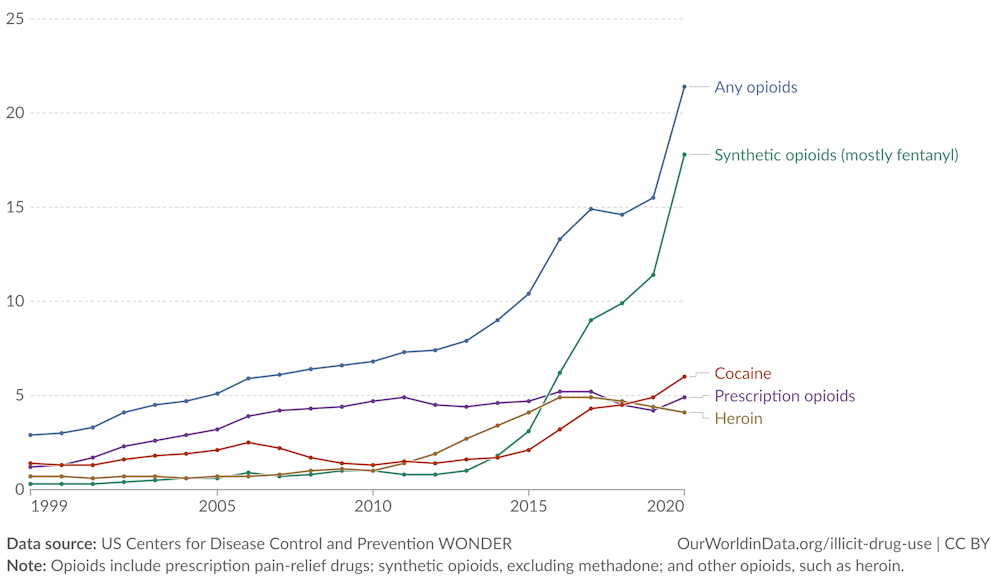
In the US, the synthetic opioids fentanyl and oxycodone have contributed to more than 100,000 fatal overdoses each year since 2021. While there are signs this deaths toll is at last beginning to fall, the harm and pain of addiction and overdose affects every strata of American society – as shown in moving portrayals of America’s opioid crisis such as Painkiller and Dopesick. Most fatalities are caused by respiratory depression where breathing is significantly slowed or stops altogether.
Official trailer for Painkiller (Netflix)
Fentanyl is an analgesic drug that is 50-100 times more potent than heroin or morphine. Where China used to be the principal manufacturer and supplier of fentanyl to the US, Mexico is now the primary source. In December 2024, Mexican authorities announced “the largest mass seizure of fentanyl pills ever made” – amounting to more than 20 million doses of fentanyl pills worth nearly US$400 million. The pills were found in Mexico’s Sinaloa state, home of the Sinaloa drug cartel and a hub of fentanyl production,
“This is what makes us rich,” one fentanyl cook recently told the New York Times. He was scathing about the idea that Donald Trump would be able to stamp out the supply of fentanyl from Mexico to the US by threatening Mexico’s government with tariffs. “Drug trafficking is the main economy here.”
However, the introduction of synthetic opioids to the US came not via organised crime but through a deliberate strategy of the pharmaceutical industry. Upon launching its prescription opioid painkiller OxyContin (a brand name for oxycodone) in 1996, Perdue Pharma, owned by the Sackler family, devised a plan to increase prescriptions of the drug by incentivizing and rewarding doctors to give these drugs to their patients. On a business level, this was a success; on a human level, it has been a disaster.
As patients quickly developed tolerance to drugs such as OxyContin, they had to take higher doses to avoid withdrawal symptoms or the positive feelings it gave them. Taking more of these opiates increases the risk of accidental overdose, many of which proved to be fatal. It has also driven those dependent on drugs to the black market, and into the hands of organised drug gangs, as they seek the drugs in greater quantities.
Dependency on fentanyl and other opioids is all-consuming. When not using these drugs, people are entirely focused on ensuring sufficient supply of the next dose. This includes funding supply which can take people to places they thought they would never be, for example breaking the law, shoplifting or getting involved in commercial sex to make enough money to buy drugs.
Synthetic opiates like OxyContin and fentanyl have proved to be classless, ageless and sex blind. The first-hand experience of addiction and fatalities have radically altered the way many Americans think about drugs and the problems they cause. Canada, too, is suffering a major crisis.
Compounding this tragedy is the failure of the state to provide interventions and treatment that could have reduced fatal and non-fatal overdoses. It is only now that evidence-based interventions are beginning to be made widely available, such as access to Naloxone – a drug that can reverse the effects of opiates and potentially save a life.
Of course, it isn’t just hospitals and health professionals that are challenged by the results of widespread use of opioids, but public services like the police and fire service. In some areas of the US, there have been so many daily overdoses that every service was called on to try and deal with it. Local mayors have made it a priority to train police and fire personnel to be trained as first responders, such is the scale of the problem.
But it is not just in North America that we see the failure of politicians and the state to act when faced with growing problems with drugs. In the UK, where record numbers are dying because of using drugs such as heroin, the government has not invested in overdose prevention strategies. At a time when fatal overdoses increase year on year, budgets for specialist treatment have been reduced. It remains to be seen what the recently elected Labour government will do, if anything, to tackle the tragic rise in drug related fatalities.
What connects both examples from the US and UK is the attitude and perception of drug use many of us have. Drug use and the heavy use of prescription painkillers is still heavily stigmatised. Many of us still view this as something individuals bring on themselves or have a choice about.
So, if we don’t care about what happens to people who develop problems with drugs, why should our elected representatives? In part, it is our bigotry that is enabling the lack of timely intervention, despite us possessing the knowledge and evidence of how drug harms can be minimised.
Latin America: breakdown of the rule of law
Under the last Conservative government, the UK Home Office asserted that people who used cocaine recreationally are supporting violence not only in the UK but in the countries that produce its raw ingredients. It’s not clear if this has made any difference to those using cocaine in the UK – personally, I doubt many people consider or are aware of how cocaine is produced or its provenance.
Perhaps if those using cocaine, mainly in western countries, realised the extent of violence and suffering that cocaine manufacture causes they might think again. Latin America has suffered enormously, with few countries there not touched in some way by the violence and breakdown of law associated with drug production and supply. According to the latest UN World Drugs Report:
Global cocaine supply reached a record high in 2022, with more than 2,700 tons of cocaine produced that year, 20% more than in the previous year … The impact of increased cocaine trafficking has been felt in Ecuador in particular, which has seen a wave of lethal violence in recent years linked to both local and transnational crime groups, most notably from Mexico and the Balkan countries.
Cocaine seizures and homicide rates increased five-fold between 2019 and 2022 in Ecuador, with the highest such rates reported in the coastal areas used for trafficking the drug to major destination markets in North America and Europe.
Cocaine trafficking flows based on reported seizures (2019-22):
As with opium production in Afghanistan, it is small-scale farmers in Colombia, Peru and Bolivia that grow the coca plant that will be turned into cocaine. Like their Afghan counterparts, they grow coca as it is more profitable than alternatives such as coffee. While it may be profitable in the short term, there are greater costs to them and their society.
Cocaine production brings with it violence as those further up the drug production chain try to control its trade. Few parts of these societies are unscathed, from bribing local politicians through to whole regions that are controlled by organised crime. Keeping control means that the use of firearms and violence increases. Against this backdrop, it is unsurprising that basic health and social services suffer.
So, while a coca grower may have more money, every other aspect of their life is negatively impacted. Whether it is regional or state institutions, both are compromised by the drug trade and those that control it. While this may not lead to the total collapse of law and order, it does create injustice and distorts the rule of law in many areas of Latin America and the Caribbean, where competition between gangs has also resulted in an increase in homicides.
The impact is on all sectors of society, now and into the future. For example, while historically the role of women has been largely underrepresented in research and drug policy, the UN report recognises that this is changing:
As women increasingly participate in economic activities, the role that women play in the drug phenomenon may become increasingly important. For example, a shift away from plant-based drug production may affect many women in rural households involved in opium poppy and coca bush cultivation.
The UN also identifies the specific risk to young people and the drugs trade, highlighting:
Long-term efforts to dismantle drug economies must provide socioeconomic opportunities and alternatives, which go beyond merely replacing illicit crops or incomes and instead address the root structural causes behind illicit crop cultivation, such as poverty, underdevelopment, and insecurity. They must also target the factors driving the recruitment of young people into the drug trade, who are at particular risk of synthetic drug use.
Meanwhile, demand for treatment in Europe due to problems with cocaine has risen significantly in recent years, since 2011 there has been an 80% increase in treatment presentations. This reflects the growing number of people using cocaine and the rise in purity of the drug.
Amid what may seem to be a story of unrelenting despair and hopelessness, there are local initiatives and even a few state-wide policies that provide optimism that change is possible.
In my roles both as clinician and scientist, I’ve often been amazed by how ingenious people can be when faced with the apparently impossible. For example, the way some people use heroin to dampen their psychotic symptoms, such as auditory and visual hallucinations – or the development of Naloxone, a drug that can temporarily reverse the effects of opioids, providing a short window for emergency services to treat people who have overdosed.
Early in my career, I witnessed the emergence of HIV in the UK in the 1980s. The speed at which this disease spread was not matched by our ability to treat it. Our response to HIV was undoubtedly hampered by prejudice and stigma towards marginalised groups in society, namely gay men and those using drugs (particularly injecting them).
However, unexpectedly and courageously, the Conservative government recognised those who were most at risk of contracting HIV, and organised a package of measures to contain the spread of infection. One part of this was a media campaign based on public health messaging designed to reduce the risk of contracting the disease. But the government also invested in treatment for those who had been infected and engaged with people at high risk, such as those intravenously injecting drugs.
I worked in specialist HIV clinics for those using drugs. At the time, methadone and diamorphine were provided as an alternative to heroin. Regulations and protocols that restricted the prescribing of these medical opioids were eased, so we could ensure patients attending these clinics were given sufficient oral and injectable opioids that they didn’t need to source street heroin.
This meant they had access to medical grade opioids and, crucially, were given regular supplies of sterile injecting equipment. It was this that reduced the risk of contracting HIV, as some people would share injecting equipment when using heroin.
This impressive policy ran counter to the Conservative party’s ideology at the time, which was to punish rather than help those using drugs like heroin. It showed me how, even with traditional mindsets, it is possible to shift policy thinking in the face of a health crisis. And make no mistake, the global drug problem is an ongoing health crisis. Today, the UN points to the risks that intravenous users of drugs still face:
An estimated 13.9 million people injected drugs in 2022, with the largest number living in North America and East and South-East Asia … The relative risk of acquiring HIV is 14 times higher for those who inject drugs than in the wider population globally.
There are, though, signs of positive change in the way some countries and regions are changing their drug policies. Scotland recently opened a drug consumption facility in Glasgow – a safe place for people to use their drugs, usually injecting drugs like heroin. Such spaces provide access to sterile injecting equipment, reducing the risk of blood-borne infections such as HIV or Hepatitis. At the same time, they offer the opportunity to engage with people who have not accessed traditional health services.
Portugal, as mentioned earlier, has made substantial changes to the way it approaches drug use and the problems associated with it. This policy shift since 2000 has saved lives and brought a more humane way of treating people who develop problems with drugs.
Contrast this with the wasted effort and resources ploughed into the war on drugs – initiated by Nixon and followed by so many western governments ever since. My plea to policymakers is simple: employ the same evidence-based science you use for health issues towards drugs and problem drug use.
Science and research can help in many ways, if given the chance. Some of it might seem radical, like providing safe drug consumption spaces. Some of it is more mundane, but vital – like tackling inequality, a clear driver of problem drug use across the world.
But while we often look to politicians to take the lead on change, it is people – us – that really hold the solution. By far the greatest threat to people and society from drugs is ignorance and bigotry. So many lives have been lost to drugs because of shame, either as a driver of drug use or a barrier to seeking help.
Beliefs are notoriously difficult to shift. As with climate change, the most powerful driver of change is personal experience. We know that when a family or community is affected by a drug overdose, their beliefs and perceptions change. But this is not the way any of us should want to see change happen.
To hear about new Insights articles, join the hundreds of thousands of people who value The Conversation’s evidence-based news. Subscribe to our newsletter.
Ian Hamilton does not work for, consult, own shares in or receive funding from any company or organisation that would benefit from this article, and has disclosed no relevant affiliations beyond their academic appointment.
Source: United States Senator for Maine Angus King
WASHINGTON, D.C. — U.S. Senator Angus King (I-ME) is introducing bipartisan legislation with eight of his colleagues to fast-track and modernize prescription drug testing protocols which will in turn improve patient outcomes. The FDA Modernization Act 3.0 (FDAMA) is a bipartisan effort to reduce ineffective animal testing and expedite scientific innovation. In 2022, President Biden signed FDAMA 2.0 into law removing the longstanding requirement that investigational new drugs (INDs) undergo mandatory animal testing before human clinical trials. Instead, the law provided FDA and drug developers the option to use advanced, non-animal methods such as cell-based assays, organ chips, computer modeling, and bioprinting.
However, the FDA has yet to update its regulations leaving numerous FDA regulations that continue to require animal testing against the law. The FDA Modernization Act 3.0 seeks to resolve this by mandating the FDA to update its regulations within 12 months of the bill’s enactment. By fully implementing FDAMA 2.0, drug development can be both more humane and more efficient, ultimately leading to faster and more reliable treatments for patients. An astonishing 90-95% of drugs that pass animal tests go on to fail in human clinical trials, wasting precious time for patients.
“Maine people deserve a modern FDA that approves prescription drugs in an efficient and safe manner consistent with the law,” said Senator King. “The FDA Modernization Act 3.0 will ensure that the American people have access to more reliable treatments, with renewed confidence in their governmental agencies that have long been bogged down with red tape and bureaucratic inefficiencies. I thank my colleagues on both sides of the aisle for prioritizing people over politics in Maine, and across the country.”
In addition to King, the legislation is cosponsored by Senators Cory Booker (D-NJ), Eric Schmitt (R-MO), Rand Paul (R-KY), Sheldon Whitehouse (D-RI), John Kennedy (R-LA), Richard Blumenthal (D-CT), Ben Ray Luján (D-NM), and Roger Marshall (R-KS).
Senator King has consistently worked to increase transparency of prescriptions drugs. Last year, he introduced bicameral legislation to prohibit direct-to-consumer drug advertising of pharmaceutical drugs in the first three years after the drug receives Federal Drug Administration (FDA) approval. Additionally, Senator King has introduced legislation to prohibit pharmaceutical drug manufacturers from claiming tax deductions for consumer advertising expenses.
DENVER — Today, Governor Jared Polis, the Office of Just Transition (OJT) within the Colorado Department of Labor and Employment (CDLE), and the Office of Economic Development and International Trade (OEDIT) announced two new Coal Transition Community Assistance grants aimed at supporting local economic diversification efforts in Moffat and Rio Blanco Counties. These grants are part of the state’s broader initiative to support communities impacted by the decline of coal-powered electricity production in Colorado.
“Colorado is helping communities succeed in new ways, which will create more jobs for local workers and save people money. We are committed to helping communities in Western Colorado plan for the future,” said Governor Polis.
“Communities in Northwest Colorado are working hard to diversify their economies, and we are pleased to support those efforts. When economic development plans are based on local strengths and opportunities, we see greater impacts for Coloradans,” said Eve Lieberman, OEDIT Executive Director.
City of Craig Awarded $1,051,000 for Business and Industrial Park In Moffat County, the City of Craig has been awarded $1,051,000 to purchase property for the development of a new business and industrial park. The park will be strategically located with access to both the Union Pacific rail line and 1st Street in Craig, offering excellent opportunities for growth and investment.
“The Office of Just Transition plays a critical role in promoting stability, recovery, and sustainability for regions like NW Colorado, as we all anticipate the impacts from coal mine and power plant closures,” said Craig City Manager Peter Brixius. “In the face of these impacts, we are very pleased that OJT is a partner in our vision for the future growth and development of new and expanding opportunities for our region. The acquisition of this property in Craig will establish a business park in an area that will provide a skilled and ready workforce with a quality of life that includes world class recreational opportunities right in our backyard. We are planning a business park for those looking for flexibility and services, as they make fiscally responsible decisions, and at the same time realize their dreams.”
The City of Craig will collaborate with a private developer to begin the master planning process for the park. In addition to the Coal Transition Community grant, the project has been awarded $2.5 million in Congressionally Designated Spending to cover horizontal infrastructure costs.
Rio Blanco Water Conservancy District Awarded $100,000 for Wolf Creek Reservoir Study The Rio Blanco Water Conservancy District has been awarded $100,000 to conduct a comprehensive survey and report on the potential impacts of a new reservoir in Rio Blanco County. The study will evaluate the impact of the proposed new reservoir on agricultural production, flatwater recreation, and a countywide water augmentation plan designed to increase the supply of water available for beneficial use. This award will not bias various state and federal permitting processes required for this project.
“Our economy is transitioning away from fossil fuel electric generation, and a reliable water supply is a key component of this critical economic transition,” said Alden Vanden Brink with the Rio Blanco Water Conservancy District.
“This study will provide important information that will guide the future of the Wolf Creek Reservoir and help ensure that we understand the economic potential of the project,” said OJT Director Wade Buchanan. “By investing in such efforts, we continue to support the long-term prosperity of communities in the Yampa Valley.”
About the Office of Just Transition: Colorado created the Office of Just Transition within Colorado’s Department of Labor and Employment in 2019 to assist workers and communities that will be adversely affected by the loss of jobs and revenues due to the closure of coal mines and coal-fired power plants. Its purpose is to help workers transition to new, high-quality, jobs, to help communities continue to thrive by expanding and attracting diverse businesses, and to replace lost revenues. To learn more about the Office of Just Transition, its action plan and the corresponding legislation, please visit cdle.colorado.gov/offices/the-office-of-just-transition.
About Colorado Office of Economic Development and International Trade: The Colorado Office of Economic Development and International Trade (OEDIT) works with partners to create a positive business climate that encourages dynamic economic development and sustainable job growth. OEDIT partners with businesses and communities to offer financial, technical, and advisory assistance. From business retention services to incentives and funding, OEDIT supports economic growth across Colorado through its diverse programs and services. To learn more, visit oedit.colorado.gov.
(COLUMBIA, S.C.) –South Carolina Attorney General Alan Wilson announced the arrest of Shaquezius Leevontae Dennis, 19, of Batesburg-Leesville, S.C., on one charge connected to the sexual exploitation of minors. Internet Crimes Against Children (ICAC) Task Force investigators with the Lexington County Sheriff’s Department made the arrest. Investigators with the Attorney General’s Office, also a member of the state’s ICAC Task Force, assisted with the investigation.
Investigators received a CyberTipline report from the National Center for Missing and Exploited Children (NCMEC) which led them to Dennis. Investigators state Dennis distributed files of child sexual abuse material.
Dennis was arrested on January 31, 2025. He is charged with one count of sexual exploitation of a minor, second degree (§16-15-405), a felony offense punishable by up to 10 years imprisonment.
This case will be prosecuted by the Attorney General’s Office.
Attorney General Wilson stressed all defendants are presumed innocent unless and until they are proven guilty in a court of law.
* Child sexual abuse material, or CSAM, is a more accurate reflection of the material involved in these heinous and abusive crimes. “Pornography” can imply the child was a consenting participant. Globally, the term child pornography is being replaced by CSAM for this reason.
The Pat and Jim Calhoun Cardiology Center is celebrating its 20th anniversary.
It was founded thanks to the generous philanthropic support of the Calhoun family in 2004.
Dr. Bruce T. Liang, cardiovascular physician-scientist at the Calhoun Cardiology Center (Tina Encarnacion/UConn Health photo)
“As founding director of the Calhoun Cardiology Center, the last two decades have been quite an exciting ride. It’s been a wonderful and gratifying experience seeing the comprehensive center triple its growth in both patient volumes and providers and adding new specialties such as electrophysiology, vascular surgery, and cardiovascular surgery,” says Dean Dr. Bruce T. Liang, the Ray Neag Distinguished Professor of Cardiovascular Biology and Medicine.
Coach Jim Calhoun and his wife Pat visited the Center on May 8 to applaud the cardiology faculty and staff for their longstanding contributions advancing cardiovascular care, research breakthroughs, and education of the next generation of heart specialists.
The Center is also on the forefront of cardiovascular research thanks to the endowment of the Calhoun family, and NIH funding to the Center has grown to millions of dollars annually for cutting-edge research. One of those innovative NIH-funded researchers is Dr. Travis Hinson, cardiovascular physician-scientist at UConn Health/JAX who serves as the Pat and Jim Calhoun Endowed Professor.
His Cardiovascular Genetics Program is translating innovative laboratory findings for the next generation of patient treatments.
UConn Health/JAX”s Dr. Travis J. Hinson leads the successful Cardiovascular Genetics Program of the Calhoun Cardiology Center.
“Our translational cardiovascular medicine makes UConn very unique. Thanks to the Calhouns we have exponentially expanded genetic precision medicine and have tested over 1,000 heart patients and their families to help them get the best, personalized treatments possible. It’s really exciting. Coach Calhoun, Pat, and their family’s recognition of UConn’s excellence have helped us grow. The Calhouns have made a huge impact.”
Liang concludes, “Coach Calhoun is larger than life and is an inspiring figure on and off the court at UConn. He believes in the power of the Calhoun Cardiology Center and has put his heart and soul into it. We are extremely thankful to Coach. Thank you.”
An official website of the United States government
Here’s how you know
Official websites use .gov A .gov website belongs to an official government organization in the United States.
Secure .gov websites use HTTPS A lock ( ) or https:// means you’ve safely connected to the .gov website. Share sensitive information only on official, secure websites.
WASHINGTON — The Department of Veterans Affairs today announced its return to in-person work policy, which states eligible employees must work full-time at their respective duty stations (agency worksites) unless excused due to a disability, qualifying medical condition or other compelling reason.
The announcement follows President Trump’s Jan. 20, presidential memorandum on return to in-person work.
More than 20% of VA’s more than 479,000 employees currently have telework or remote work arrangements. As part of the new policy:
Political appointees, senior executive service members, SES equivalents, senior level and scientific and professional employees will no longer be eligible for remote work arrangements. By Feb. 24, 2025, their telework agreements will be terminated, except for ad hoc or situational telework.
Also, by Feb. 24, 2025, remote work and telework arrangements for supervisors with current official duty stations within 50 miles of an agency facility will be terminated, except for ad hoc or situational telework.
By April 28, 2025, remote work and telework arrangements for non-bargaining unit employees with current official duty stations within 50 miles of an agency facility will be terminated, except for ad hoc or situational telework.
Remote work and telework arrangements for supervisors and non-bargaining unit employees with current official duty stations outside 50 miles of an agency facility will not be terminated at this time. Further guidance will be forthcoming regarding these arrangements.
Return to in person work requirements for bargaining unit employees will be announced at a later date.
VA’s policy allows exceptions for arrangements approved for employees as a reasonable accommodation due to a disability or a qualifying medical condition. Exceptions may also be allowed for military spouses with permanent change of station orders.
“This is a commonsense step toward treating all VA employees equally,” said Acting VA Secretary Todd Hunter. “Most VA clinical staff don’t have the luxury of working remotely, and we believe the performance, collaboration and productivity of the department will improve if all VA employees are held to the same standard.”
Reporters and media outlets with questions or comments should contact the Office of Media Relations at vapublicaffairs@va.gov
Veterans with questions about their health care and benefits (including GI Bill). Questions, updates and documents can be submitted online.
Contact us online through Ask VA
Veterans can also use our chatbot to get information about VA benefits and services. The chatbot won’t connect you with a person, but it can show you where to go on VA.gov to find answers to some common questions.
Learn about our chatbot and ask a question
Subscribe today to receive these news releases in your inbox.
Flood-Risk Classifications Can Drive Risky Development
A new study by Southeast CASC researchers highlights the “safe development paradox,” where areas adjacent to regulatory “high risk” zones are less expensive to develop and viewed as safe for home buyers, driving up risky development in potentially vulnerable areas.
The “safe development paradox” highlights how classifying land areas as “high risk” for flooding can unintentionally encourage high levels of risky development just outside of these zones. Though the risk continues beyond the high-risk label, the implication is that if an area is not listed as “high risk,” then it must be “safe.” This misconception arises from how flood risk is communicated and used to guide regulations, such as mandatory flood insurance and structural requirements. Because developers are able to avoid these regulations, building just outside of these “high risk” zones is more affordable, leading to clustering of development in areas that are still vulnerable to flooding from rivers, lakes, and coastlines.
A new study, titled “The Safe Development Paradox of the United States Regulatory Floodplain,” analyzed national development trends and 100-year floodplain maps from more than 2,300 U.S. counties. Supported by the Southeast CASC, the researchers found that 24% of development occurs within 250 meters of high-risk flood zones. That distance is less than the length of three football fields, or, in a dense urban grid like Manhattan, about 1-3 city blocks. The researchers also looked at future projections, and assuming current policies remain the same, they predicted that 22% of new development by 2060 will also occur within the 250-meter zone next to the “high risk” area, likely increasing the number of people who live in risky areas just outside of the regulatory zone.
By linking historical and future development trends to 100-year floodplain (1% annual flood risk) classifications that guide safety regulations, this national assessment reveals some unintended consequences of these designations and emphasizes the need to align actual and perceived flood risks. This information can aid regulatory agencies making flood risk designations and communications to support effective planning.
This research was supported by the Southeast CASC Project:“Improving Scenarios of Future Patterns of Urbanization, Climate Adaptation, and Landscape Change in the Southeast.”
Related
link
Improving Scenarios of Future Patterns of Urbanization, Climate Adaptation, and Landscape Change in the Southeast
Arguably the most direct, intense, and long-lasting modification that humans can make to a landscape is converting rural lands to urbanized areas. As human populations grow, the demand for urbanized areas will increase, and scientists can help natural resource managers plan for these changes by creating models that predict potential patterns of future urbanization. The Southeast U.S. is experienci
NC CASC Tackles Climate Threats to Sagebrush Ecosystems
The North Central CASC leads initiative, holds workshop, to address threats to the “Sagebrush Sea,” one of the most expansive ecosystems in the United States.
The eastern sagebrush ecosystem, sometimes called the “Sagebrush Sea” for its vast expanse and rolling waves of silvery-green plants, is the largest continuous ecosystem in the continental United States. It provides essential habitat for wildlife like mule deer, pronghorn antelope, and greater sage-grouse, while also supporting livestock grazing, recreation, and cultural traditions. Despite its vast size, nearly half of this ecosystem has been lost under the pressures of land conversions and development, overgrazing, and invasive species – and now, these threats are compounded by changing climate conditions, like rising temperatures, shifting precipitation patterns, and more frequent extreme events.
To address these challenges, the North Central CASC (NC CASC) gathered 24 experts at a workshop at the University of Colorado Boulder. Their goal: to identify the most pressing research needs and practical solutions for adapting sagebrush ecosystems to a changing climate. Discussions focused on evaluating management practices, clarifying how ecosystems respond to environmental changes, strengthening connections with stakeholders and local communities, and understanding community values of sagebrush landscapes, as well as developing tools and datasets to support conservation efforts.
Building on the momentum of the workshop, the NC CASC is launching a two-year Science Synthesis Working Group. This collaborative effort will address the research gaps identified at the workshop and provide actionable climate-informed guidance to safeguard the Sagebrush Sea for future generations.
“Notes From the Field” news articles highlight the continued importance of bird banding. This article was contributed by Paul Link with Louisiana Department of Wildlife & Fisheries who began researching Black-bellied Whistling Ducks in 2011, and Pam Garrettson and Joshua Dooley with the U.S. Fish and Wildlife Service, who are assisting with the band-recovery data analyses.
Today, banding allows scientists to investigate bird behavior, migration, lifespans, populations, diseases and levels of environmental contaminants. Information gathered through the North American Bird Banding Program helps inform management and conservation decisions for game and non-game species, such as protecting or restoring habitat, setting hunting regulations and determining plans for human-led development.TheNorth American Bird Banding Programdepends on a network of over 10,000 permitted bird banders working in the United States, Canada and Trust Territories. Each year these banders help us add up to 1.2 million new banding records to our century-long dataset.
Holding banded Black-bellied Whistling Ducks are band resight extraordinaire Alvin Attenhofer on the left and on the right Paul Link, Research Program Manager of LA Department of Wildlife & Fisheries. Photo courtesy of Michael Slazer.
How do you use bird banding in your research?
We initiated our research in 2011 to answer questions related to the movement ecology and survival of Black-bellied Whistling Ducks in south Louisiana. We started out opportunistically banding this species with standard aluminum butt-end bands for a couple years, but upon realizing encounter rates were much lower than expected, we greatly increased our banding effort. We plan to utilize both live recaptures and dead recoveries to estimate annual survival. Our banding season is February through May, which is an ideal period for captures as the ducks are still gregarious prior to dispersing for nesting. At the onset of our research, we hypothesized that they migrated south to Texas or Mexico during winter, but we hope to use recovery data to better describe movements and habitat use throughout the annual cycle.
Why is your study species so interesting?
Black-bellied Whistling Ducks are found only in the Western Hemisphere. They are more arboreal than other whistling-ducks; they nest primarily in natural tree cavities and readily utilize artificial nest boxes, but also commonly nest on the ground. Unlike most ducks, both the male and female take part in incubation and brood rearing. In North America, this species historically nested mainly along Mexico and south Texas coasts. However, their range began expanding northward mid-20th century, with sightings in Arizona, Louisiana, and Florida by the 1960s. They are a game species with liberal regulations; however, they are only lightly harvested because of their nocturnal nature. Furthermore, traditional waterfowl surveys are inadequate for this species due to low detection probabilities. Many Black-bellied Whistling Ducks congregate in or under trees in urban, suburban, or industrial areas during fall and winter where they are difficult to harvest and/or survey, which makes estimating vital rates such as survival and harvest probabilities more challenging than for most other waterfowl species.
What have you found so far?
Since 2011, we have banded over 40,000 Black-bellied Whistling Ducks and have recaptured >4,200. Interestingly, we have similar numbers of resights versus shot or found dead. The vast majority of those resights are by a single citizen scientist that devotes most evenings for several months each year observing and documenting the ducks’ movements, pair associations, and family status. Roughly 80% of the banded Black-bellied Whistling Ducks are subsequently encountered in Louisiana, with 10% encountered in Mississippi (where we band ~150/year and the previously mentioned citizen scientist resights and reports individuals once per calendar year), 8% in Texas, and 1% or less in Arkansas, Florida, Tennessee, Alabama, and North Carolina. We’ve had just one report of a band recovered in Mexico, from a duck found dead in a grain cargo ship that set sail from the Port of New Orleans days earlier. Thus, most Black-bellied Whistling Ducks appear to be transient residents that concentrate in safe places during the fall and winter and disperse throughout Louisiana during spring and summer to breed. Their apparent survival rates (calculated using only live recapture data) were lower than expected; we are currently incorporating both live and dead recoveries to calculate actual annual survival. We’ve documented multiple large die-offs of up to 3,000 Black-bellied Whistling Ducks due to unintentional poisoning at water treatment and grain handling facilities. Avian cholera outbreaks are also common among this species. An unknown number are also killed via shooting or avicide under agricultural depredation and aircraft bird strike prevention orders. Due to their highly gregarious behavior, Black-bellied Whistling Ducks are particularly susceptible to communicable diseases. Thus, their population seems to self-regulate under conditions of minimal recreational harvest.
Why do you think projects like yours are so important?
This banding project will help us understand the movements and vital rates for a poorly understood, yet very common, waterfowl species along the Gulf Coast, improving population management options. Black-bellied Whistling Ducks are considered a nuisance by many (such as agriculture producers, golf course managers, and aircraft strike prevention personnel); however, amidst long-term declining trends in most resident and migratory waterfowl in Louisiana, waterfowl hunters welcome the sight of this relative newcomer on the landscape.
What are the next steps for your project?
We’ll continue to band a maintenance number of approximately 3,000 individuals per year to explore changes in vital rates amidst a rapidly changing landscape. We are also currently analyzing results from a pilot study utilizing satellite transmitters, as well as working with a transmitter manufacturer to design a miniaturized GPS/GSM device to collect higher quality and greater quantity movement data to better understand their local and long-range movements, use of habitats, nesting and non-breeding ecology, and seasonal survival rates.
Adult and juvenile Black-bellied Whistling Ducks in flight. Photo courtesy of John K. Flores.
The “Notes From the Field” series highlights current banding projects and the continued importance of bird banding and the Bird Banding Lab. Want to see your project featured in a future “Notes From the Field” article? Email Kyra Harveykharvey@usgs.govfor submission details.
February 3, 2025Tampa, FL, United StatesEnforcement and Removal
TAMPA, Fla. – An investigation by U.S. Immigration and Customs Enforcement has led to Jonathan Javier Godoy-Pivaral, 29, an illegal alien from Honduras who was previously deported from the United States, being sentenced to more than five months in prison for illegally reentering the U.S. Godoy-Pivaral pleaded guilty on Nov. 6, 2024.
According to court documents, Godoy-Pivaral was removed from the U.S on Feb. 26, 2018. He later unlawfully reentered the U.S. and was arrested for burglary on June 19, 2024, in Hillsborough County, Fla.
This case was prosecuted by Assistant U.S. Attorney Lindsey Schmidt and Special Assistant U.S. Attorney Joseph Wheeler, III.
February 3, 2025Tampa, FL, United StatesEnforcement and Removal
ICE Miami, Stuart Sub-office @HSI_Miami @CBPHQ & the Florida Fish & Wildlife Conservation Commission conducted a multi-agency immigration enforcement operation spanning several counties in Southern Florida, netting 32 arrests of criminal illegal aliens. The illegal aliens were from Guatemala, Haiti, Mexico, Honduras, El Salvador, Venezuela, Colombia, Brazil, Cuba, Nicaragua with criminal convictions including prostitution, robbery, fraud, larceny, DUI, & narcotics possession.
STUART, Fla. – U.S. Immigration and Customs Enforcement activities in Palm Beach County, Fla., recently netted 32 illegal aliens from various counties with criminal convictions which included drug possession, prostitution, illegal re-entry, resisting an officer, robbery, probation violation, fraud (illegal use of a credit card), larceny, cocaine possession, driving under the influence and possession of stolen property.
ICE officers and agents in Miami, in coordination with the U. S. Border Patrol, conducted targeted immigration enforcement operations in Palm Beach County from January 27 to 28. The operation netted 32 illegal aliens from Guatemala, Haiti, Mexico, Honduras, El Salvador, Venezuela, Colombia, Brazil, Cuba, and Nicaragua.
All illegal aliens arrested during this operation will be detained pending their removal from the United States or a hearing before an immigration judge.
Some highlights from the arrests include:
A 30-year-old Venezuelan male with criminal convictions for resisting officer, drug possession, and robbery who is being detained pending his removal from the United States.
A 44-year-old Haitian female with criminal convictions for battery, drug possession, prostitution, and narcotic equipment possession who is awaiting a removal hearing by an immigration judge.
A 24-year-old Cuban male with criminal convictions for fraud, failure to appear, larceny, and probation violation who is in custody pending removal from the U.S.
A 25-year-old Guatemalan male with criminal convictions for illegal re-entry, cocaine possession, and driving under the influence who is being detained pending removal from the U.S.
Jefferson City — Today, Governor Mike Kehoe ordered U.S. and Missouri flags be flown at half-staff at government buildings in Pettis and Saline counties, the Fire Fighters Memorial of Missouri in Kingdom City, and firehouses statewide on Tuesday, February 4, 2025, from sunrise to sunset in honor of West Central Missouri Fire Protection District of Saline and Pettis Counties Captain Christopher Mykel Clevenger.
“Christopher Clevenger felt a calling to public service early in life, joining the West Central Missouri Fire Protection District of Saline and Pettis Counties as a volunteer firefighter when he was just 18 years old,” Governor Mike Kehoe said. “As he established a career, raised a family, and coached youth sports, volunteering in the fire service and protecting the public remained an essential part of his life. Claudia and I are deeply saddened by his passing at just 33 years of age. Captain Clevenger’s commitment to serving others will be a lasting part of his legacy.”
Captain Clevenger died of a medical emergency on January 26, 2025, after responding to an emergency call as a member of the West Central Missouri Fire Protection District of Saline and Pettis Counties the previous afternoon.
The flags will be held at half-staff on the day of Clevenger’s interment. To view the Governor’s proclamation, click here.
Headline: NCDHHS Program Celebrates 25 Years of Promoting Healthy Smiles for Young Children
NCDHHS Program Celebrates 25 Years of Promoting Healthy Smiles for Young Children hejones1
The North Carolina Department of Health and Human Services is celebrating the 25th anniversary of the Into the Mouths of Babes program, a partnership that delivers preventive oral health services to young children insured by NC Medicaid. Since 2000, this program has helped medical providers across the state give infants and toddlers early dental evaluations, preventive oral health care and other dental services that lay the foundation for good health.
“Tooth decay is the most common chronic disease in children,” said Dr. Patrick Roberson, DDS, North Carolina State Dental Director. “This program provides vital oral health services for children who need it most and connects medical and dental care to improve outcomes.”
Into the Mouths of Babes was originally piloted in nine western North Carolina counties as the “Smart Smiles” program in the mid-1990’s. In 2001, the program expanded statewide and established a reimbursement package through NC Medicaid.
“Since Into the Mouths of Babes began, more than 2.8 million claims have been submitted for preventive oral health services,” said Dr. Mark Casey, DDS, MPH, Dental Officer for NC Medicaid. “This is the finest example of a cost-effective preventive oral health care program at work.”
Early oral health evaluations provided through Into the Mouths of Babes allow medical providers to identify issues before they become serious, ensuring families can get help early. Additionally, caregiver education provided by the program gives families the tools they need to support healthy habits for life.
“Our rural pediatric practice has provided fluoride treatments to infants and toddlers for over 15 years,” said Dr. Marston Crawford, MD, FAAP, pediatrician for Coastal Children’s Clinic. “These treatments, combined with caregiver discussion about early oral health, have sharply reduced cavities and preventable dental surgery. The majority of our children enter kindergarten cavity-free.”
Training and community outreach are key to the program’s long-term success. NCDHHS employs 20 public health dental hygienists in 10 regions across the state who provide training for Into the Mouths of Babes. The American Academy of Family Physicians also provides continuing medical education hours to physicians who attend an NCDHHS training session.
Key program partners include NC Medicaid, the NCDHHS Division of Public Health’s Oral Health Section, UNC Adams School of Dentistry, UNC Gillings School of Global Public Health, the North Carolina Pediatric Society and the North Carolina Academy of Family Physicians among others.
“The NC Academy of Family Physicians is proud to support this program,” said Gregory Griggs, Executive Vice President of the Academy. “It has made a huge difference in reducing tooth decay for children across North Carolina.”
For more information on the program, including partnerships and the online toolkit, visit the Into the Mouths of Babes webpage.
El Departamento de Salud y Servicios Humanos de Carolina del Norte celebra el 25 aniversario del programaInto the Mouth of Babes, una colaboración que brinda servicios preventivos de salud oral a niños pequeños asegurados por NC Medicaid. Desde el año 2000, este programa ha ayudado a los proveedores médicos de todo el estado a brindar evaluaciones dentales tempranas a bebés y niños pequeños, atención preventiva de la salud oral y otros servicios dentales que sientan las bases para una buena salud.
“La caries dental es la enfermedad crónica más común en los niños”, dijo Dr. Patrick Roberson, DDS, Director Dental del Estado de Carolina del Norte. “Este programa proporciona servicios vitales de salud oral para los niños que más lo necesitan y conecta la atención médica y dental para mejorar los objetivos”.
Into the Mouths of Babes se había iniciado originalmente en nueve condados del oeste de Carolina del Norte como el programa “Smart Smiles” a mediados de la década de 1990. En 2001, el programa se expandió por todo el estado y estableció un paquete de reembolso a través de NC Medicaid.
“Desde que comenzó Into the Mouth of Babes, se han presentado más de 2,8 millones de solicitudes de servicios preventivos de salud oral”, dijo la Dra. Mark Casey, DDS, MPH, Oficial Dental de NC Medicaid. “Este es el mejor ejemplo de un programa de costo económico de atención preventiva de la salud oral que funciona”.
Las evaluaciones tempranas de salud oral proporcionadas a través de Into the Mouth of Babes permiten a los proveedores médicos identificar los problemas antes de que se agraven, asegurando que las familias puedan obtener ayuda temprano. Además, la educación para los cuidadores proporcionada por el programa brinda a las familias las herramientas que necesitan para mantener hábitos saludables de por vida.
“Nuestra práctica pediátrica rural ha proporcionado tratamientos con flúor a bebés y niños pequeños durante más de 15 años”, dijo el Dr. Marston Crawford, MD, FAAP, pediatra de Coastal Children’s Clinic. “Estos tratamientos, combinados con la charla con los cuidadores sobre la salud oral en los primeros años de edad, han reducido drásticamente las caries e intervenciones quirúrgicas dentales menores. La mayoría de nuestros niños entran al jardín de infantes sin caries”.
La capacitación y el alcance comunitario son clave para el éxito a largo plazo del programa. El Departamento de Salud y Servicios Humanos de Carolina del Norte, (NCDHHS, por sus siglas en inglés), emplea a 20 higienistas dentales de salud pública en diez regiones de todo el estado quienes proporcionan formación para Into the Mouth of Babes. La Academia Estadounidense de Médicos de Familia también ofrece horas de educación médica continua a los médicos que asisten a una sesión de capacitación del NCDHHS.
Los socios clave del programa incluyen NC Medicaid, la Sección de Salud Oral de la División de Salud Pública de NCDHHS, la Escuela de Odontología UNC Adams, la Escuela de Salud Pública Global UNC Gillings, la Sociedad Pediátrica de Carolina del Norte y la Academia de Médicos de Familia de Carolina del Norte, entre otros.
“La Academia de Médicos de Familia de Carolina del Norte se enorgullece de apoyar este programa”, dijo Gregory Griggs, Vicepresidente Ejecutivo de la Academia. “Ha marcado una gran diferencia en la reducción de la caries dental en los niños de Carolina del Norte”.
Para obtener más información sobre el programa, incluidas las colaboraciones y el kit de herramientas en línea, visite la página web deInto the Mouths of Babes.
The Rhode Island Department of Health (RIDOH) is advising consumers that Blue Ridge Beef is recalling 5,700 pounds of their two-pound log Natural Mix dog food due to a contamination of Salmonella.
The recalled products have the Lot number N25/12/31. (Lot numbers are stamped in the clips on the end of the chubs/bags.) The products have UPC# 854298001054.
Salmonella can affect animals eating the products and there is risk to humans from handling contaminated pet products, especially if they have not thoroughly washed their hands after having contact with the products or any surfaces exposed to these products.
Healthy people infected with Salmonella should monitor themselves for some or all of the following symptoms: nausea, vomiting, diarrhea or bloody diarrhea, abdominal cramping and fever. Rarely, Salmonella can result in more serious ailments, including arterial infections, endocarditis, arthritis, muscle pain, eye irritation, and urinary tract symptoms. Consumers exhibiting these signs after having contact with this product should contact their healthcare providers.
Pets with Salmonella infections may be lethargic and have diarrhea or bloody diarrhea, fever, and vomiting. Some pets will have only decreased appetite, fever, and abdominal pain. Infected but otherwise healthy pets can be carriers and infect other animals or humans. If your pet has consumed the recalled product and has these symptoms, please contact your veterinarian.
Samples of the product were collected on 01/08/25 by the North Carolina Department of Agriculture and tested by the North Carolina Department of Agriculture Food and Drug Protection Laboratory. The product tested positive for Salmonella.
On 01/27/2025 the firm was notified by the FDA that the product tested positive for Salmonella.
These products were distributed between January 3, 2025 and January 24, 2025. The product is packaged in clear plastic and was sold primarily in retail stores located in Virginia, Maryland, Pennsylvania, Connecticut, Massachusetts, New York State, Tennessee, and Rhode Island.
Consumers who have purchased this product are urged to return to place of purchase or destroy the food in a way that children, pets, and wildlife cannot access it.
For more information contact blueridgebeefnc@yahoo.com or 704-873-2072.
Ocala, Florida – United States Attorney Roger B. Handberg announces the filing of a criminal complaint charging Antonio Candia-Bautista (45, Mexico) with illegal reentry into the United States by a previously deported alien. If convicted, Candia-Bautista faces a maximum penalty of two years in federal prison.
According to the complaint, Candia-Bautista was deported from the United States on October 4, 2016. At some time thereafter, he unlawfully reentered the United States. He was recently arrested during a state investigation into an automobile accident in Sumter County on January 28, 2025. A records check confirmed that Candia-Bautista was a citizen of Mexico with no lawful permission to be present in the United States.
A complaint is merely a formal charge that a defendant has committed one or more violations of federal criminal law, and every defendant is presumed innocent unless, and until, proven guilty.
This case was investigated by the United States Border Patrol. It is being prosecuted by Assistant United States Attorney Tyrie K. Boyer.