NewzIntel.com

    • Checkout Page
    • Contact Us
    • Default Redirect Page
    • Frontpage
    • Home-2
    • Home-3
    • Lost Password
    • Member Login
    • Member LogOut
    • Member TOS Page
    • My Account
    • NewzIntel Alert Control-Panel
    • NewzIntel Latest Reports
    • Post Views Counter
    • Privacy Policy
    • Public Individual Page
    • Register
    • Subscription Plan
    • Thank You Page

Category: Americas

  • MIL-OSI USA: Emergency Measures to Provide Water Resources in California and Improve Disaster Response in Certain Areas

    US Senate News:

    Source: The White House
    By the authority vested in me as President by the Constitution and the laws of the United States of America, it is hereby ordered:
    Section 1.  Policy.  For weeks, residents of the Los Angeles area have watched raging fires consume their homes, belongings, beloved pets, and childhood memories.  Almost immediately, firefighters were unable to fight the blaze due to dry hydrants, empty reservoirs, and inadequate water infrastructure.  Today, at least 28 people have lost their lives and thousands more have lost everything else, with some damage estimates calculating hundreds of billions of dollars in damage.
    This tragedy affects the entire Nation, so it is in the Nation’s interest to ensure that California has what it needs to prevent and fight these fires and others in the future.  Therefore, it is the policy of the United States to provide Southern California with necessary water resources, notwithstanding actively harmful State or local policies.  And it is the policy of the United States to assist Americans in disaster areas through responsive policies that more effectively empower them to rebuild and regain their livelihoods.
    Sec. 2.  Overriding Disastrous California Policies.  (a)  The Secretary of Defense, the Attorney General, the Secretary of Homeland Security, the Secretary of Commerce, the Secretary of the Interior, and the Secretary of Agriculture shall expeditiously take all measures, consistent with all applicable authorities, to ensure adequate water resources in Southern California.  Each shall report to me within 15 days on all authorities, including emergency authorities, available to ensure, require, maintain, or use infrastructure necessary to fight and prevent massive wildfires in Southern California. 
    (b)  In particular, the Secretary of the Interior and the Secretary of Commerce shall immediately take actions to override existing activities that unduly burden efforts to maximize water deliveries.  The Secretary of the Interior and the Secretary of Commerce shall consider actions including those consistent with the “No Action Alternative” in the Final Environmental Impact Statement issued November 15, 2024, by the Bureau of Reclamation on Long-term Operation of the Central Valley Project and State Water Project.
    (c)  The Secretary of the Interior, including through the Bureau of Reclamation, shall utilize his discretion to operate the CVP to deliver more water and produce additional hydropower, including by increasing storage and conveyance, and jointly operating federal and state facilities, to high-need communities, notwithstanding any contrary State or local laws.  The Bureau of Reclamation shall take all available measures to ensure that State agencies — including the California Department of Water Resources — do not interfere with the Bureau of Reclamation’s operation of the project to maximize water delivery to high-need communities or otherwise, including but not limited to the issuance of a new Record of Decision maximizing water deliveries and consistent with the 2020 Record of Decision.
    (d)  In accordance with section 6 of the Executive Order of January 20, 2025 (Declaring a National Energy Emergency), the Secretary of the Interior, through the Bureau of Reclamation, and in accordance with section 1536 of title 16 United States Code, shall expedite action related to any exemption under the Endangered Species Act of 1973 (ESA), 16 U.S.C. 1531 et seq., for the Long-Term Operation of the CVP and the State Water Project for all applicable threatened and endangered species.
    (e)  The Secretary of the Interior shall promptly review, revise, or rescind any regulations or procedures specific to implementation of section 1536 of title 16 United States Code, as needed and consistent with applicable law, to conform with the plain meaning of the statute.
    (f)  The Secretary of the Interior and the Secretary of Commerce shall identify all ongoing or potential major water-supply and storage projects within the State of California for which they have joint responsibility under the ESA or individual responsibilities under the National Environmental Policy Act of 1969 (NEPA), 42 U.S.C. 4321 et seq.
    (g)  For each such project identified under subsection (f), the Secretary of the Interior and the Secretary of Commerce shall each designate one federal official to coordinate each agency’s respective NEPA and ESA compliance responsibilities. Within 30 days from the date of this order, each designated official shall identify any regulatory hurdles that unduly burden each respective water project, identify any recent changes in state or Federal law that may impact such projects from a regulatory perspective (including Public Law 118-5), and shall develop a proposed plan, for review by the Secretaries, to appropriately suspend, revise, or rescind any regulations or procedures that unduly burden such projects and are not necessary to protect the public interest or otherwise comply with the law.  In so doing, each designated federal official will coordinate and share all appropriate information that will enable improved efficiencies.  For the purposes of this order, “unduly burden” means to unnecessarily obstruct, delay, curtail, impede or otherwise impose significant costs on the permitting, utilization, transmission, delivery, or supply of water resources and water infrastructure.
    Sec. 3.  Ending the Subsidization of California’s Mismanagement.  (a) The Director of the Office of Management and Budget (OMB) shall review all Federal programs, projects, and activities for all relevant agencies that impact land management, water availability, water supply, water storage and delivery, water infrastructure, and disaster preparedness and response.
    (b)  Within 30 days of the date of this order, to ensure that State and local jurisdictions promote sensible land management practices and reliable water supply for all Americans, the Secretary of the Interior, the Secretary of Agriculture, and the Secretary of Commerce shall jointly report to the President, through the Assistant to the President for Domestic Policy and Assistant to the President for Economic Policy, regarding California State and local policies or practices inconsistent with sound disaster prevention and response.
    (c)  The Director of OMB, in consultation with the Assistant to the President for Domestic Policy and Assistant to the President for Economic Policy, shall recommend appropriate action to the President, regarding:
    (i)   any lack of compliance by California with the terms of existing Federal grants, contracts, or other financial assistance to States or localities; and
    (ii)  beneficial additional terms that may be added with respect to any future Federal programs, projects, or activities to ensure sound disaster prevention and response.
    Sec. 4.  Additional Actions to Help Los Angeles Families.  (a)  Housing Displaced Families.  The Secretary of Housing and Urban Development and the Secretary of Homeland Security, through the Administrator of FEMA, shall expeditiously provide an Integrated Federal Housing Strategy and Implementation Plan to the Director of OMB and the Assistant to the President for National Security Affairs that expedites options for housing relief to survivors displaced by wildfires in California. 
    (b)  Expediting Waste Removal.  Within 5 days from the date of this order, to accelerate the rebuilding of areas devastated by the recent Los Angeles wildfires, the Secretary of Defense, the Secretary of Homeland Security, through the Administrator of FEMA, and the Administrator of the Environmental Protection Agency shall develop and execute a plan to expedite the bulk removal of contaminated and general debris.
    (c)  Effectively Using Grants to Improve Fire Preparedness.  The Secretary of Homeland Security, through the Administrator of FEMA, shall immediately implement a plan to enable the timely and appropriate use of Federal preparedness grants for the City of Los Angeles.  As of the date of this order, the city has yet to use the majority of its $213 million allotment that has accrued since fiscal year 2021.  These Federal preparedness grants shall not be used to support illegal aliens.  The Attorney General, in coordination with the FEMA Administrator, shall investigate the misuse of these grants by the City of Los Angeles and take appropriate action to address such misuse.
    Sec. 5.  Additional Actions to Help North Carolina Families.  (a)  Clearing Roads.  To accelerate rebuilding and community recovery, the Secretary of Transportation, the Secretary of Homeland Security, acting through the Administrator of FEMA, and the Administrator of the Small Business Administration shall immediately take all necessary and appropriate measures, including through direct assistance, loans, and other available means, to expedite roadway clearance or rebuilding, including the section of Interstate 40 in North Carolina that remains closed, and the repair or rebuilding of roads and bridges on private property in areas of North Carolina affected by Hurricane Helene.
    (b)  Housing Displaced Families.  The Secretary of Housing and Urban Development and the Secretary of Homeland Security, through the Administrator of the Federal Emergency Management Agency, shall immediately provide an Integrated Federal Housing Strategy and Implementation Plan to the Director of the Office of Management and Budget and the Assistant to the President for National Security Affairs that expedites options for housing relief to survivors displaced by Hurricane Helene.
    Sec. 6. General Provisions.  (a)  Nothing in this order shall be construed to impair or otherwise affect:
    (i)   the authority granted by law to an executive department or agency, or the head thereof; or
    (ii)  the functions of the Director of the Office of Management and Budget relating to budgetary, administrative, or legislative proposals.
    (b)  This order shall be implemented consistent with applicable law and subject to the availability of appropriations.
    (c)  This order is not intended to, and does not, create any right or benefit, substantive or procedural, enforceable at law or in equity by any party against the United States, its departments, agencies, or entities, its officers, employees, or agents, or any other person.
    THE WHITE HOUSE,
        January 24, 2025.
    MIL OSI USA News –

    January 27, 2025
  • MIL-Evening Report: Albanese records worst Newspoll ratings this term; Victorian Labor’s primary plunges

    Source: The Conversation (Au and NZ) – By Adrian Beaumont, Election Analyst (Psephologist) at The Conversation; and Honorary Associate, School of Mathematics and Statistics, The University of Melbourne

    A national Newspoll, conducted January 20–24 from a sample of 1,259, gave the Coalition a 51–49 lead, a one-point gain for the Coalition since the previous Newspoll in early December. Primary votes were 39% Coalition (steady), 31% Labor (down two), 12% Greens (up one), 7% One Nation (steady) and 11% for all Others (up one).

    In three of the last four Newspolls, the Coalition has had a 51–49 lead. This is the consensus of the polls at the moment, as can be seen from the graph below. The federal election is not due until May, and this position is recoverable for Labor, but they would probably lose now. I had more comments on this last Thursday.

    The worst news from Newspoll for Labor was Anthony Albanese’s ratings, which slumped six points since December to a term-low net approval of -20, with 57% dissatisfied and 37% satisfied.

    Peter Dutton’s net approval increased one point to -11. Albanese led Dutton by 44–41 as better PM (45–38 in December). This three-point margin for Albanese is a term low.

    The graph below shows Albanese’s Newspoll ratings this term. The individual polls are marked with plus signs and a smoothed line has been fitted.

    There have been five polls in January of leaders’ ratings from Freshwater, YouGov, Resolve, Essential and Newspoll. On average, Albanese is at -15 net approval and Dutton at -3.2. If not for a net zero approval from Essential, Albanese’s ratings would be worse.

    Additional Resolve questions

    I previously covered the mid-January Resolve poll for Nine newspapers that gave Dutton a 39–34 preferred PM lead over Albanese. In additional questions, by 61–24, voters supported keeping Australia’s national day on January 26 over changing to another date (47–39 in January 2023).

    The thumping defeat of the October 2023 Voice referendum has damaged the push to change the date. By 52–24, voters supported legislating so that January 26 is enshrined in law as Australia’s national day.

    By 54–9, respondents thought there had been more antisemitism over more Islamophobia in recent months (32–14 in October). By 51–24, they thought the conflict in the Middle East had made Australia a less safe place (45–26 in October).

    Victorian Resolve poll: Labor’s primary plunges to 22%

    A Victorian state Resolve poll
    for The Age, conducted with the federal December and January Resolve polls from a sample of over 1,000, gave the Coalition 42% of the primary vote (up four since November), Labor 22% (down six), the Greens 13% (steady), independents 17% (up three) and others 6% (down one).

    Resolve doesn’t usually give a two-party estimate, but The Age’s article said that on 2022 election preference flows, the Coalition would have a 55.5–44.5 lead. Independents would be unlikely to get 17% at an election, but they are on the readout everywhere in Resolve polls until after nominations close.

    In late December, Brad Battin was elected Liberal leader in a party room vote, replacing John Pesutto. From just the January sample, Battin led Labor incumbent Jacinta Allan as preferred premier by 36–27 (30–29 to Pesutto in November).

    Victorian Labor’s unpopularity is hurting federal Labor in Victoria. The Poll Bludger’s BludgerTrack has a 5.3% swing against Labor in Victoria, with swings in the other mainland states at 2% or less.

    By the November 2026 election, Labor will have governed in Victoria for 12 successive years and for 23 of the 27 years since 1999. An “it’s time” factor is probably contributing to Labor’s woes.

    State byelections will occur on February 8 in Labor-held Werribee and Greens-held Prahran. At the 2022 election, Labor won Werribee by a 60.9–39.1 margin against the Liberals, while the Greens won Prahran by 62.0–38.0 against the Liberals.

    In Prahran, which Labor is not contesting, Tony Lupton, who was the Labor MP from 2002 to 2010, is running as an independent. The Liberals and Lupton will swap preferences on their how to vote material. Voters can choose their own preferences instead of following their candidate’s recommendations, but many will follow those recommendations.

    Germany and Canada

    I covered German and Canadian electoral developments for The Poll Bludger on Saturday. The German federal election is in about four weeks, on February 23. Polls are bleak for the left, with big gains likely for the far-right AfD.

    Justin Trudeau announced he would resign as Canadian Liberal leader and PM on January 6 once a new Liberal leader had been elected, which will occur on March 9. The Conservatives had a big lead in last Monday’s update to the CBC Poll Tracker, but there’s a new poll that gives the Conservatives just a 3.8-point lead. Trudeau promised to reform Canada’s electoral system before he won the October 2015 election, but did nothing.

    Adrian Beaumont does not work for, consult, own shares in or receive funding from any company or organisation that would benefit from this article, and has disclosed no relevant affiliations beyond their academic appointment.

    – ref. Albanese records worst Newspoll ratings this term; Victorian Labor’s primary plunges – https://theconversation.com/albanese-records-worst-newspoll-ratings-this-term-victorian-labors-primary-plunges-248222

    MIL OSI Analysis – EveningReport.nz –

    January 27, 2025
  • MIL-OSI USA: White House Statement on Agreement Extension Between Lebanon and Israel

    US Senate News:

    Source: The White House
    The arrangement between Lebanon and Israel, monitored by the United States, will continue to be in effect until February 18, 2025. The Government of Lebanon, the Government of Israel, and the Government of the United States will also begin negotiations for the return of Lebanese prisoners captured after October 7, 2023.

    MIL OSI USA News –

    January 27, 2025
  • MIL-OSI USA: Readout of President Donald J. Trump’s Call with Prime Minister Starmer of the United Kingdom

    US Senate News:

    Source: The White House
    Today, President Donald J. Trump held a call with Prime Minister Keir Starmer of the United Kingdom. President Trump offered his condolences for the recent loss of the Prime Minister’s brother and expressed his well wishes for the British Royal Family. The two leaders also discussed the recent release of Israeli-British national Emily Damari from Hamas captivity and how both countries can promote a fair bilateral economic relationship.

    MIL OSI USA News –

    January 27, 2025
  • MIL-OSI USA: Readout of Secretary of Defense Pete Hegseth’s Call With Israeli Prime Minister Benjamin Netanyahu

    Source: United States Department of Defense

    A Senior Defense Official provided the following readout:

    Secretary of Defense Pete Hegseth and Israeli Prime Minister Benjamin Netanyahu held an introductory call today to discuss the unbreakable bond that exists between the United States and Israel. Both leaders discussed the importance of advancing mutual security interests and priorities, especially in the face of persistent threats. The Secretary stressed that the United States is fully committed, under President Trump’s leadership, to ensure that Israel has the capabilities it needs to defend itself. Both leaders agreed to remain in close contact.

    MIL OSI USA News –

    January 27, 2025
  • MIL-OSI USA: HARRISBURG – Shapiro-Davis Administration to Highlight $2.5 Million Federal Award to Establish New Statewide Sexual Assault Kit Tracking System

    Source: US State of Pennsylvania

    January 27, 2025 – Harrisburg, PA

    ADVISORY – HARRISBURG – Shapiro-Davis Administration to Highlight $2.5 Million Federal Award to Establish New Statewide Sexual Assault Kit Tracking System

    Lieutenant Governor Austin Davis will join bipartisan legislators and advocates to announce a new $2.5 million federal award from the U.S. Department of Justice, Bureau of Justice Assistance (BJA) awarded to the Pennsylvania Commission on Crime and Delinquency (PCCD) to transform the Commonwealth’s ability to support survivors of sexual violence and increase accountability and transparency through a new statewide sexual assault kit tracking system initiative.

    The federal award furthers recent legislation, Senate Bill 920, sponsored by Senator Langerholc and enacted by Governor Shapiro in October 2024 as Act 122 of 2024.

    WHO:
    Lt. Governor Davis, PCCD Chair
    Senator Wayne Langerholc
    Speaker of the House, Representative Joanna McClinton
    Senator Katie Muth
    Senator Tracy Pennycuick
    Gabriella Romeo, Public Policy Director, Pennsylvania Coalition to Advance Respect (PCAR)

    WHEN:
    Monday, January 27, 2025 at 10:30 AM.

    WHERE:
    Balcony outside of the Lt. Governor’s Office, Capitol Building.

    RSVP:
    Press who are interested in attending must RSVP to algantz@pa.gov.

    Photos will be available on following the event.

    MIL OSI USA News –

    January 27, 2025
  • MIL-OSI United Nations: Briefing Security Council on Worsening Situation in Democratic Republic of Congo, Senior Official Says Actions Endangering Civilians, UN ‘Will Not be Tolerated’

    Source: United Nations General Assembly and Security Council

    Holding an emergency meeting following advances by the 23 March Movement, or M23, towards the city of Goma in the Democratic Republic of the Congo and concurrent attacks on United Nations peacekeepers there, the Security Council heard today that urgent action is needed to address a rapidly deteriorating situation while time remains to do so.

    “The United Nations is profoundly concerned by the resumption of hostilities,” said Jean-Pierre Lacroix, Under-Secretary-General for Peace Operations.  On 23-24 January, M23 fired on positions of the United Nations Organization Stabilization Mission in the Democratic Republic of the Congo (MONUSCO).  He reported that, as a result, several blue helmets were “killed in carrying out the tasks entrusted to them by this Council”.  He also noted that M23 has significantly extended its territorial gains over the past few weeks and has opened a new front in South Kivu, from which MONUSCO recently withdrew.

    “At this critical juncture, with the lives of countless vulnerable civilians, peacekeepers and respect for this Council’s mandate at stake, MONUSCO remains committed to the robust defence of its mandate,” he stated.  He stressed that, for its part, the Council “must honour the sacrifices made by the peacekeepers who laid down their lives in pursuit of this noble goal by sending a clear and unequivocal message to M23 and its backers that actions endangering the lives of civilians and UN peacekeepers will not be tolerated.”

    Also reporting on the situation was Bintou Keita, Special Representative of the Secretary-General for the Democratic Republic of the Congo and Head of MONUSCO.  Noting that M23 and Rwandan forces have penetrated the outskirts of Goma — “causing mass panic and flight amongst the population” — she said that roads are blocked and that M23 has declared Goma’s airspace closed.  “In other words, we are trapped,” she said, calling on the Council to “act now” to secure the civilian population, humanitarian-aid workers and all UN personnel.

    Calling on the Democratic Republic of the Congo and Rwanda to continue political negotiations in the context of the Luanda Process, she urged:  “More than ever, we must find a political solution.”  She also called on Rwanda to withdraw its forces from Congolese territory and end support for M23, and on the Democratic Republic of the Congo to “make significant efforts” to neutralize the Democratic Liberation Forces of Rwanda, or FDLR.

    Joyce Msuya, Assistant Secretary-General for Humanitarian Affairs and Deputy Emergency Relief Coordinator, then stressed that if hostilities spread into Goma, “the impact on civilians could be devastating”.  In North and South Kivu, hundreds of civilians have been killed and injured over the last few weeks.  Further, hundreds of thousands have fled their homes, humanitarian access remains constrained and hospitals are overwhelmed.  Against that backdrop, she urged all parties to “protect civilians and the critical infrastructure they rely on”.

    She also urged them to avoid using wide-area explosives and heavy weapons in populated areas.  “This will be particularly important should the hostilities spread into Goma, given the risks of conflict in urban areas,” she observed.  And, to address the escalating humanitarian crisis “before the situation worsens further”, she called on the Council to end the hostilities, ensure respect for international law and provide adequate funding for humanitarian action.

    “The resolution of the conflict in eastern DRC [Democratic Republic of the Congo] must be political, not military,” stated the representative of Sierra Leone, also speaking for Algeria, Guyana and Somalia.  The Luanda and Nairobi Processes “remain viable paths to peace”, he said, while underscoring that the sovereignty and territorial integrity of the Democratic Republic of the Congo must be respected “by all States and non-State actors alike”.  France’s representative, stating that the presence of foreign military forces threatens civilian protection and contributes to displacement, concurred: “Force is not an option.”

    Along those lines, China’s representative said:  “All external forces should refrain from providing support to M23 and other armed groups to prevent further deterioration.”  He also joined other Council members in pointing out that “attacks on peacekeepers may constitute war crimes”.  The representative of Greece echoed that, also noting that attacks against MONUSCO peacekeepers constitute a basis for sanctions designations.  Also making these points was the representative of the United Kingdom, who observed that “the numbers of those lost and injured is changing by the hour”.

    These attacks, stressed Slovenia’s representative, constitute “an attack on peace itself”.  Recalling the Council’s recent, unanimous decision to renew MONUSCO’s mandate, she underlined the organ’s responsibility to “stand unequivocally behind [its personnel] in these perilous times and ensure they return safely to their loved ones”.  She added: “The international community, and this Council, cannot afford to remain passive in the face of this crisis.”  Panama’s representative similarly stated: “History will not judge us on our intentions but, rather, our actions.”

    The United Nations must take immediate measures to ensure the safety and security of both civilians and peacekeepers, underscored the representative of Pakistan.  Expressing particular concern over a “highly exposed” Pakistani artillery battery near Sake, he stressed that this unit should be quickly redeployed for the safety of its personnel and heavy, expensive equipment.  Stating that peacekeepers cannot be expected to implement the “challenging mandate assigned to them by the Council” without adequate support, he also urged the organ to address the root cause of the conflict — the illegal exploitation of natural resources.

    On that, Denmark’s representative observed:  “The illegal exploitation of natural resources in eastern DRC is a key driver to instability in the Great Lakes region — this must end.”  The representative of the United States also expressed concern over the illicit exploitation of mining areas in territories controlled by M23, as did the representative of the Russian Federation:  “The struggle to gain access towards strategically important Congolese minerals is one of the reasons for the continuation of the crisis.”

    The representative of the Republic of Korea detailed that crisis: “In the past week alone, as [M23] has expanded its territory by 11 per cent, the number of [internally displaced persons] has doubled to 400,000.”  He joined other Council members in calling on Rwanda to cease its support for the group and urged both Kinshasa and Kigali to return to dialogue and fully implement their commitments under the Luanda Process.  He added:  “We recognize the differing interests of the DRC and Rwanda, but further escalation of tensions is simply unacceptable — many lives are at stake.”

    Thérèse Kayikwamba Wagner, Minister for Foreign Affairs, International Cooperation and Francophonie of the Democratic Republic of the Congo, meanwhile, took the floor to stress that the situation in her country is “not a conflict like others”.  Rather, it is “a declaration of war that no longer hides itself behind diplomatic manoeuvres”, she said, stressing that “Rwanda is preparing to orchestrate a carnage in broad daylight”.  She also said that it is “clear that this crisis is directly linked to the economic plunder of our country by Rwanda”.

    On that, she said that over 150 tons of coltan are illegally extracted and transported to Rwanda each month, where they are fraudulently labelled for export.  Yet, while this illicit commerce finances the military activities of armed groups, it is “only one aspect of the aggression carried out by Rwanda”, she stressed.  Others include the systematic targeting of peacekeeping forces, the 24 January assassination of the military governor of North Kivu and the sabotage of the Luanda Process.

    Underscoring that the Council “cannot content itself with declarations of concern or simply ‘remaining seized of the matter’”, she said that the organ’s duty is to “defend human life without distinction”.  It must therefore order an immediate end to Rwanda’s hostilities, impose targeted sanctions against those responsible for the aggression, impose an embargo on the export of all minerals labelled as Rwandan — particularly coltan and gold — and revoke Rwanda’s status as a troop-contributing country.  “History will remember your decision today,” she said.

    Meanwhile, Rwanda’s representative stressed:  “The current crisis could have been averted had the DRC Government demonstrated a genuine commitment to peace.”  While the Luanda Process achieved “significant milestones” — including a ceasefire that came into force on 4 August 2024 — the Government and Armed Forces of the Democratic Republic of the Congo decided to increase militarization in the country’s east in October 2024.  This included the deployment of heavy weaponry and additional troops — 10,000 from Burundi — along the border.

    “By prioritizing militarization of the conflict instead of embracing the regional mechanisms that have been put in place to foster a sustainable solution born out of dialogue, the conflict has continued to escalate — leading to the prevailing situation today,” he said.  He added that the FDLR has “even moved from being a suppletive force to a strategic ally of the Kinshasa Government”.  Further, he said that the President of the Democratic Republic of the Congo has publicly vowed to instigate regime change in Rwanda for two years now.

    While stating that “no one should harm peacekeepers”, he expressed concern that MONUSCO is “at the risk of being sucked into a conflict in which it would be a belligerent force”.  MONUSCO should therefore focus on protecting civilians instead of fighting alongside Kinshasa’s military coalition.  Noting that the situation today mirrors that which occurred 12 years ago, he stressed that “the DRC must play a helpful role — after all, this is a Congolese problem, for which the DRC is looking to outsource its solution.”

    “It is with profound regret that this meeting is taking place at a time when a number of peacekeepers have lost their lives in the line of duty,” observed South Africa’s representative.  Urging the Council to “send a clear message that peacekeepers’ lives matter”, she underlined the need to “value and safeguard the contribution of those entrusted to carry out the mandates adopted in this chamber”.  Extending condolences to all victims’ families, the representative of Uruguay reiterated his country’s “steadfast commitment to peace”.

    Angola’s representative pointed to “remarkable progress in the implementation of the Luanda Process”.  “We need speedy and unconditional de-escalation of the conflict and genuine, renewed engagement of the parties to explore the ways of overcoming the pending issues,” he added.  On that, Burundi’s representative said that the Luanda and Nairobi Processes “set out a clear road map to reach a lasting ceasefire”.  Calling on the Council to demand an end to foreign interference and act decisively to guarantee that the Democratic Republic of the Congo can fully exercise its sovereignty and restore peace, he stressed:  “Security and stability in Central Africa and beyond are at stake.”

    MIL OSI United Nations News –

    January 27, 2025
  • MIL-OSI USA: Chairman Mast Issues Statement on Measures Against Colombia

    Source: US House Committee on Foreign Affairs

    Media Contact 202-226-8467

    WASHINGTON, D.C. – Today, House Foreign Affairs Committee Chairman Brian Mast released the following statement on President Trump‘s retaliatory measures against Colombia for refusing to accept the return of illegal aliens.

    “We don’t allow our people to cross Colombia’s borders illegally, they shouldn’t allow theirs to cross our illegally. If they do, they should work with us to clean up the mess. The rule of law and the law of the jungle have returned.”

    ### 

    MIL OSI USA News –

    January 27, 2025
  • MIL-Evening Report: The ‘singles tax’ means you often pay more for going it alone. Here’s how it works

    Source: The Conversation (Au and NZ) – By Alicia Bubb, Research & Teaching Sessional Academic, RMIT University

    lightman_pic/Shutterstock

    Heard of the “singles tax”? Going it alone can also come with a hidden financial burden you may not be aware of.

    Obviously, this isn’t an official levy paid to anyone in particular. It simply refers to the higher costs single people face compared to couples or families.

    Single-person households have been on the rise in Australia. It’s projected they’ll account for up to 28% of all households in 2046.

    People are marrying later, divorce rates remain high and an ageing population means more people live alone in older age. Many people also make a conscious decision to remain single, seeing it as a sign of independence and empowerment.

    This is part of a global trend, with singledom increasing in Europe, North America and Asia.

    So, how does the singles tax work – and is it worse for some groups than others? What, if anything, can we do about it?

    Why does being single cost more?

    One of the biggest drivers of the singles tax is the inability to split important everyday costs. For example, a single person renting a one-bedroom apartment has to bear the full cost, while a couple sharing it can split the rent.

    Being single can mean not being being able to split living costs like groceries.
    Gorodenkoff/Shutterstock

    Singles often miss out on the savings from bulk grocery purchases, as larger households consume more and can take better advantage of these deals.

    Fixed costs for a house like electricity, water and internet bills often don’t increase by much when you add an extra user or two. Living alone means you pay more.

    These are all examples of how couples benefit from economies of scale – the cost advantage that comes from sharing fixed or semi-fixed expenses – simply by living together.

    My calculations, based on the most recent data from the Australian Bureau of Statistics (ABS), show that singles spend about 3% more per person on goods and services compared to couples.

    Compared to couples with children, single parents spend about 19% more per person. While government support mechanisms such as the child care subsidy exist, many single parents find them insufficient, especially if they work irregular hours.

    Beyond the essentials

    The singles tax extends beyond our “essential needs” and into the costs of travel, socialising and entertainment.

    Solo travellers, for example, may encounter something called a “single supplement” – an extra fee charged for utilising an accommodation or travel product designed for two people.

    Streaming services such as Netflix and Spotify offer family plans at slightly higher prices than individual ones, making them more cost-effective for larger households.

    Couples and families can easily split fixed costs, such as streaming subscriptions.
    Vantage_DS/Shutterstock

    A global phenomenon

    Reports from around the world paint a similar picture.

    In the United States, research by real estate marketplace Zillow found singles pay on average US$7,000 ($A11,100) more annually for housing, compared to those sharing a two-bedroom apartment.

    In Europe, higher living costs and limited government supports put singles at a disadvantage. And in Canada, singles report feeling the pinch of rising rent and grocery prices.

    The tax systems of many countries can amplify the financial burden of being single, by favouring couples and families.

    In the United States, for example, tax policies intended to alleviate poverty often exclude childless adults, disproportionately taxing them into poverty.

    The Earned Income Tax Credit (EITC) reduces tax liabilities by providing refundable credits to low-income workers. It’s had some significant benefits for families, but offers minimal support to single, childless individuals.

    Many tax structures disadvantage single-person households.
    WPixz/Shutterstock

    As economist Patricia Apps argues, tax and transfer policies often fail to account for the complexities of household income distribution.

    These systems favour traditional family structures by providing benefits like spousal offsets or joint income tax breaks. Single individuals and single-parent households are left bearing a disproportionate financial burden.

    Who is affected the most?

    The singles tax disproportionately impacts women, who are more likely to live alone than men.

    This can compound existing financial pressures such as the gender pay gap, taking career breaks, and societal expectations leaving them with lower retirement savings.

    For older women, the singles tax adds another layer of difficulty to maintaining financial security.

    And it can seriously exacerbate financial pressures on single mothers. Many rely on child support payments, which are often inconsistent or inefficient, leaving them financially vulnerable.

    Working part-time or in casual roles due to caregiving responsibilities further limits their earning potential.

    Single mothers may be disproportionately impacted by the singles tax.
    Drazen Zigic/Shutterstock

    There are unique challenges for single men, too, who may lack the same access to family-oriented subsidies and workplace flexibility. Single men may also face societal expectations to spend more on dating or socialising.

    Alarmingly, men are disproportionately represented among the homeless population, making up 55.9% of people experiencing homelessness, and single men have a higher risk of premature death.

    Growing recognition

    While the singles tax highlights big systemic inequities, there are signs the issue is receiving more attention.

    Some advocacy groups are pushing for better financial protections and child support reforms for single mothers.

    Similarly, efforts to address homelessness have gained momentum, with increased attention to advocacy and services for single men facing housing insecurity.

    There is also the potential to design tax systems to reduce these inequities. Tax systems that treat individuals as economic units, instead of basing benefits on household structures, could mitigate the singles tax and create a fairer system for all.

    Nothing to disclose.

    Sarah Sinclair does not work for, consult, own shares in or receive funding from any company or organisation that would benefit from this article, and has disclosed no relevant affiliations beyond their academic appointment.

    – ref. The ‘singles tax’ means you often pay more for going it alone. Here’s how it works – https://theconversation.com/the-singles-tax-means-you-often-pay-more-for-going-it-alone-heres-how-it-works-247578

    MIL OSI Analysis – EveningReport.nz –

    January 27, 2025
  • MIL-OSI Canada: Government of Yukon ratifies a new Collective Agreement with the Yukon Association of Education Professionals

    Government of Yukon ratifies a new Collective Agreement with the Yukon Association of Education Professionals
    jlutz
    January 24, 2025 – 4:20 pm

    The Government of Yukon values the work of educators and is very pleased to announce a new collective agreement is in place with the Yukon Association of Education Professionals. The three-year agreement contains several updates and new provisions to benefit employees, including wage increases of 14.15 per cent over three years.

    The new collective agreement keeps Yukon educators among the highest paid in Canada while maintaining fiscal responsibility. 

    The Government of Yukon has 90 days following ratification by the union membership to implement the new collective agreement. Once in place, the new agreement will be in effect until June 30, 2027. 

    MIL OSI Canada News –

    January 27, 2025
  • MIL-OSI Canada: Statement from Minister McPhee for National Crime Stoppers Month

    Statement from Minister McPhee for National Crime Stoppers Month
    jlutz
    January 24, 2025 – 1:05 pm

    Minister of Justice Tracy-Anne McPhee has issued the following statement:

    “Every January is National Crime Stoppers Month. This year, the Yukon Chapter is hosting an awareness and information session at the Canada Games Centre on Saturday, January 25, from 11 am to 3 pm. This information session is to raise awareness about the Crime Stoppers tip app, which allows anyone to anonymously report a crime in their community. I encourage Yukoners to attend, learn more about this important organization and discover how we can all make a difference.

    “This independent, non-profit organization empowers Yukoners to take action by anonymously reporting suspicious activities or potential crimes through a secure tip line system, available by phone, online or on the app. Any tips received that help solve a case or lead to an arrest are eligible for a cash reward.

    “Crime Stoppers Yukon plays a key role in raising public awareness and educating the community about illegal activities. This organization is committed to stopping, solving and preventing crimes in the Yukon. Crime Stoppers collaborates with law enforcement and government agencies to provide information on supports and resources to help both offenders and victims. Our government will continue to work with Crime Stoppers Yukon and other organizations to help further reduce crime rates across the territory.

    “Public safety and community wellbeing remain top priorities for our government. We thank Crime Stoppers Yukon for their strong program and for their commitment to making communities safer for all Yukoners.”
     

    MIL OSI Canada News –

    January 27, 2025
  • MIL-OSI Canada: Government of Yukon highlighted territory’s mineral potential at conferences in Vancouver

    Government of Yukon highlighted territory’s mineral potential at conferences in Vancouver
    jlutz
    January 24, 2025 – 4:05 pm

    This week, Premier Ranj Pillai, Deputy Premier and Minister Responsible for Women and Gender Equity Directorate Jeanie McLean and Energy, Mines and Resources Minister John Streicker joined a delegation of representatives from the Government of Yukon, Yukon First Nations, the Yukon Geological Survey, the Yukon Mining Alliance, the Yukon First Nation Chamber of Commerce, the Yukon Chamber of Mines and Yukon businesses to promote Yukon jobs and industry at the Association for Mineral Exploration’s Roundup (AME Roundup) conference and the Vancouver Resource Investment Conference in Vancouver, British Columbia.

    Cabinet Ministers and Government of Yukon officials highlighted the importance of industry and government working with Yukon First Nations communities and shared upcoming plans for investment in the territory’s economic development through an emphasis on infrastructure upgrades and modernizing legislation. The Government of Yukon attended the conferences to provide information about mineral development opportunities in the territory.

    Investments in strategic infrastructure play a pivotal role in supporting Yukon residents, businesses and the territory’s mining industry. Ministers emphasized Government of Yukon priorities including improving access to Yukon communities through the Yukon Resource Gateway program, ongoing work with the Government of Canada to connect the Yukon and British Columbia’s electricity grids, as well as recent successes including the now-completed Dempster Fibre Line project.

    At AME Roundup, Minister John Streicker led a panel discussion on how industry and governments at all levels must work together to support community safety so that Yukon communities can truly benefit from the economic opportunities that industry presents. Geologists from the Yukon Geological Survey presented the results of their fieldwork to the mineral and investment community.

    Minister McLean joined Doris Bill, former Chief of the Kwanlin Dün First Nation, and Gina Nagano, President and Community Safety Specialist at House of Wolf, to lead a vital panel discussion at The Gathering Place on the importance of community safety as a foundation for equitable participation in the mining and resources industry. The session highlighted the critical role of safety and other foundational conditions in fostering inclusive opportunities, with a focus on Yukon-led initiatives such as the Yukon’s Missing and Murdered Indigenous Women, Girls and Two-Spirit+ Strategy. Minister McLean emphasized the importance of creating safe and supportive communities to ensure all Yukoners, particularly Indigenous women and Two-Spirit+ individuals, can benefit from the territory’s economic development.

    MIL OSI Canada News –

    January 27, 2025
  • MIL-OSI Canada: Statement from Minister McLean on International Day of Education 2025

    Statement from Minister McLean on International Day of Education 2025
    jlutz
    January 24, 2025 – 12:08 pm

    Minister of Education Jeanie McLean has issued the following statement:

    “Today, we celebrate International Day of Education. This year’s theme, Artificial Intelligence and Education: Preserving Human Agency in a World of Automation, encourages us to reflect on the role of education in preparing the next generation to understand the impact of artificial intelligence and to make thoughtful decisions about how they engage with technology.

    “In the Yukon, we are proud to prioritize digital literacy in our schools. Beginning in Grade 6, students are introduced to the responsible and ethical use of digital tools. As technology continues to advance, it’s critical that we not only teach students to use these tools effectively but also empower them to maintain their autonomy in a world increasingly shaped by automation and artificial intelligence.

    “By fostering critical thinking, problem-solving and creativity through digital literacy programs, we are helping ensure that Yukon students are informed and active participants when using technology. These skills are essential as artificial intelligence continues to transform various aspects of day-to-day life. The principles of digital literacy being taught today lay the groundwork for students to embrace the digital world with confidence, responsibility and critical awareness.

    “On this International Day of Education, join me in celebrating Yukon students and supporting them as they work toward a bright and promising future.”

    MIL OSI Canada News –

    January 27, 2025
  • MIL-OSI USA: Statement by US Immigration and Customs Enforcement

    Source: US Immigration and Customs Enforcement

    January 26, 2025Washington, DC, United StatesStatement

    U.S. Immigration and Customs Enforcement, along with federal partners, including the FBI, ATF, DEA, CBP and the U.S. Marshals Service, began conducting enhanced targeted operations today in Chicago to enforce U.S. immigration law and preserve public safety and national security by keeping potentially dangerous criminal aliens out of our communities.

    MIL OSI USA News –

    January 27, 2025
  • MIL-OSI United Kingdom: The UK is deeply concerned by the scale and pace of recent M23 and Rwandan Defence Forces advances in eastern DRC: UK statement at the UN Security Council

    Source: United Kingdom – Executive Government & Departments

    Statement by Ambassador James Kariuki, UK Deputy Permanent Representative to the UN, at the UN Security Council meeting on the Democratic Republic of Congo.

    President, MONUSCO peacekeepers and personnel work bravely to deliver this Council’s mandate in the most difficult of circumstances.

    The United Kingdom reiterates clearly today that attacks on UN peacekeepers are absolutely unacceptable, and may constitute war crimes. 

    We also recall that planning, directing, sponsoring or conducting attacks against MONUSCO peacekeepers may constitute a basis for UN sanctions designations.

    The UK extends its sympathies to the families of the Blue Helmets from South Africa and Uruguay who have lost their lives serving in MONUSCO, and we extend our best wishes for a full recovery to those peacekeepers who have been injured.

    The UK also extends its condolences to the families of all troops from the Southern African Development Community Mission in DRC who have lost their lives in support of DRC’s stability and security.

    As we do so, we fully acknowledge that the numbers of those lost and injured is changing by the hour. It is a critical moment for DRC and for the region.

    President, I would now like to make three points.

    First, the United Kingdom once again condemns the violent actions of all armed groups, including FDLR and M23.

    We are deeply concerned by the scale and pace of recent M23 and Rwandan Defence Forces advances in eastern DRC.

    In December this Council renewed MONUSCO’s mandate. And in the four weeks since, M23’s unacceptable offensive, and that of the Rwanda Defence Forces, through North and South Kivu, has resulted in the capture of several towns and villages.

    As we’ve heard, hundreds of thousands of civilians have been displaced, and violence has intensified as a result.

    We are also deeply alarmed by M23’s declaration that they intend to take Goma, a city where the humanitarian situation is already catastrophic.

    The rising number of displaced people resulting from M23’s territorial expansion has placed further pressure on crowded IDP camps and exacerbates the challenges faced by humanitarian actors.

    This morning, the UK Foreign Secretary spoke with President Kagame and called for urgent de-escalation, outlining the need for Rwanda and the DRC to urgently return to the negotiating table.

    Now, more than ever, it is critical that MONUSCO is able to deliver its mandate. M23 attacks on peacekeepers, with support from the RDF, must stop immediately.

    These attacks prevent the force from being able to discharge its Security Council-mandated mission to protect civilians.

    Rwandan spoofing and jamming of GPS signals, which obstruct UN and humanitarian operations, must also stop.

    We urge all parties to remember their obligations under international humanitarian law.

    Finally, President, the United Kingdom once again extends its thanks to Angola for its leadership on mediation efforts.

    We encourage DRC and Rwanda to return to the negotiating table and to focus on making tangible progress on delivering on their commitments under the concept of operations.

    There can be no military solution. Fighting must stop. Civilians must be protected. And the parties should engage in good faith in the political process.

    Updates to this page

    Published 26 January 2025

    MIL OSI United Kingdom –

    January 27, 2025
  • MIL-OSI USA: PHOTO RELEASE: Kristi Noem Sworn in as the Secretary of DHS

    Source: US Federal Emergency Management Agency

    Headline: PHOTO RELEASE: Kristi Noem Sworn in as the Secretary of DHS

    “It is such an honor to be sworn in as the United States Secretary of Homeland Security. It was made even more meaningful by being sworn in by Supreme Court Justice Clarence Thomas at his home. Thank you, President Trump for putting your trust in me to help keep America safe.”  
    — Secretary Kristi Noem  

    On January 25, Kristi Noem is sworn in as the Secretary of the Department of Homeland Security” data-asset-id=”58348″ data-asset-link=”1″ data-asset-type=”imageasset” data-entity-type=”emerald” data-image-style=”large” src=”https://www.dhs.gov/sites/default/files/styles/large/public/externals/d505d2c6eeb96b260e0bf3ec5f6b6333.jpg.webp?itok=Qj2BrOKq”>
    On January 25, Kristi Noem is sworn in as the Secretary of the Department of Homeland Security | View Original

    The swearing-in ceremony took place at the home of U.S. Supreme Court Justice Clarence Thomas.” data-asset-id=”58349″ data-asset-link=”1″ data-asset-type=”imageasset” data-entity-type=”emerald” data-image-style=”large” src=”https://www.dhs.gov/sites/default/files/styles/large/public/externals/b0642fea0bc46d5281a980c46b4a66c5.jpg.webp?itok=voFvGwUA”>
    The swearing-in ceremony took place at the home of U.S. Supreme Court Justice Clarence Thomas. | View Original

    On January 25, Kristi Noem is sworn in as the Secretary of the Department of Homeland Security” data-asset-id=”58347″ data-asset-link=”1″ data-asset-type=”imageasset” data-entity-type=”emerald” data-image-style=”large” src=”https://www.dhs.gov/sites/default/files/styles/large/public/externals/eeffcfca5c3db081f5303d7872426ff4.jpg.webp?itok=o7Q6ncNh”>
    On January 25, Kristi Noem is sworn in as the Secretary of the Department of Homeland Security | View Original

    On January 25, Kristi Noem is sworn in as the Secretary of the Department of Homeland Security” data-asset-id=”58346″ data-asset-link=”1″ data-asset-type=”imageasset” data-entity-type=”emerald” data-image-style=”large” src=”https://www.dhs.gov/sites/default/files/styles/large/public/externals/8a6abd552845ee30f4fda87ab732b217.jpg.webp?itok=zGe7jFfu”>
    On January 25, Kristi Noem is sworn in as the Secretary of the Department of Homeland Security | View Original

    MIL OSI USA News –

    January 27, 2025
  • MIL-OSI Global: LA gets rain, but also risk of flooding and debris flows from wildfire burn scars – a geologist explains the threat

    Source: The Conversation – USA – By Jen Pierce, Professor of Geosciences, Boise State University

    A debris flow channel in a severely burned watershed in Idaho. Amirhossein Montazeri/Boise State University, CC BY-ND

    While firefighters work to extinguish the Los Angeles-area wildfires, city officials and emergency managers are also worried about what could come next.

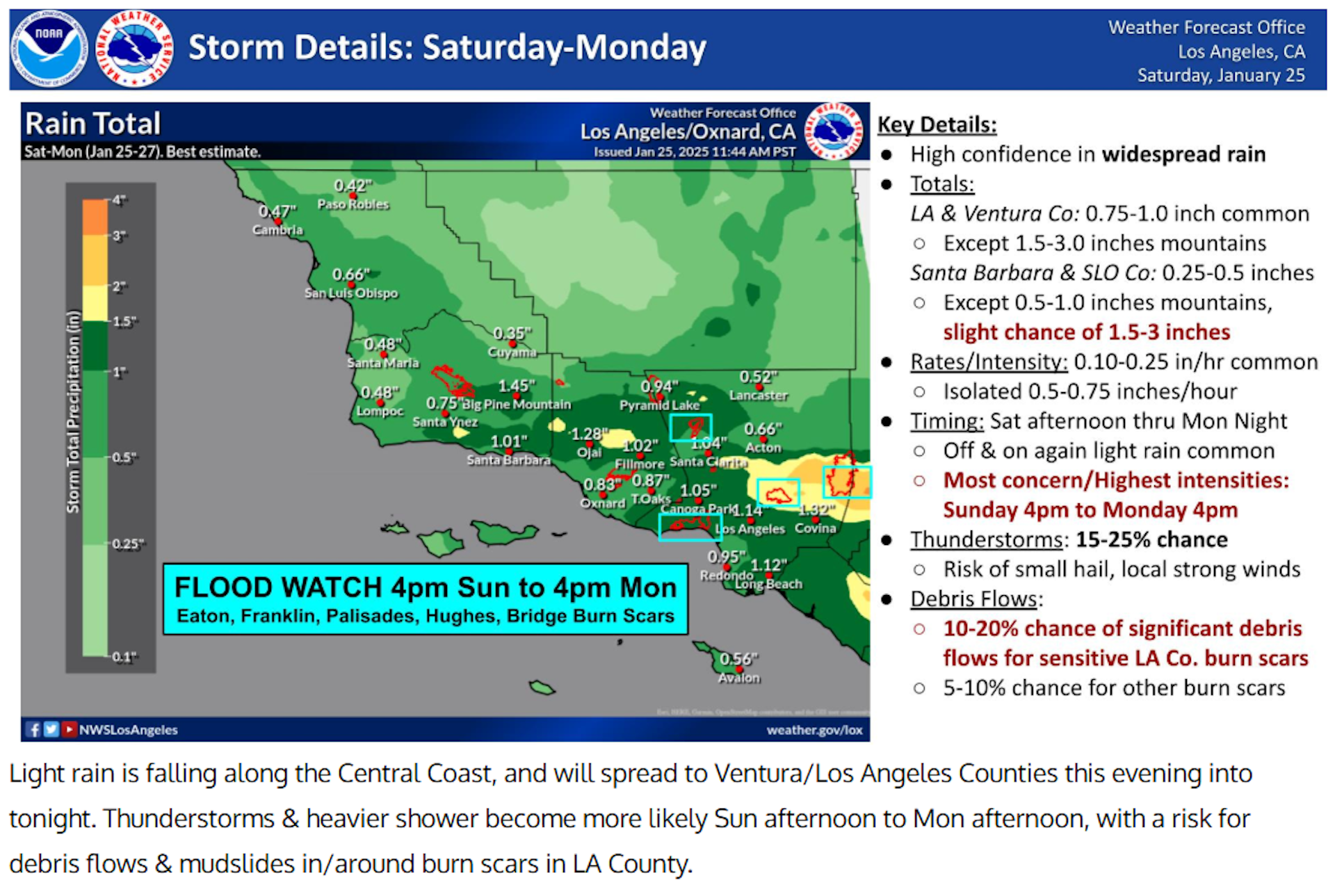
    Light rain began falling on Jan. 25, 2025, helping firefighters who have been battling fires for nearly three weeks, but rain can also trigger dangerous floods and debris flows on burned hillslopes. The National Weather Service issued a flood watch for the burned areas through Jan. 27.

    Debris flows can move with the speed of a freight train, picking up or destroying anything in their path. They can move tons of sediment during a single storm, as Montecito, just up the coast from Los Angeles, saw in 2018.

    What causes these debris flows, sometimes called mudflows, and why are they so common and dangerous after a fire? I am a geologist whose research focuses on pyrogeomorphology, which is how fire affects the land. Here’s what we know.

    How debris flows begin

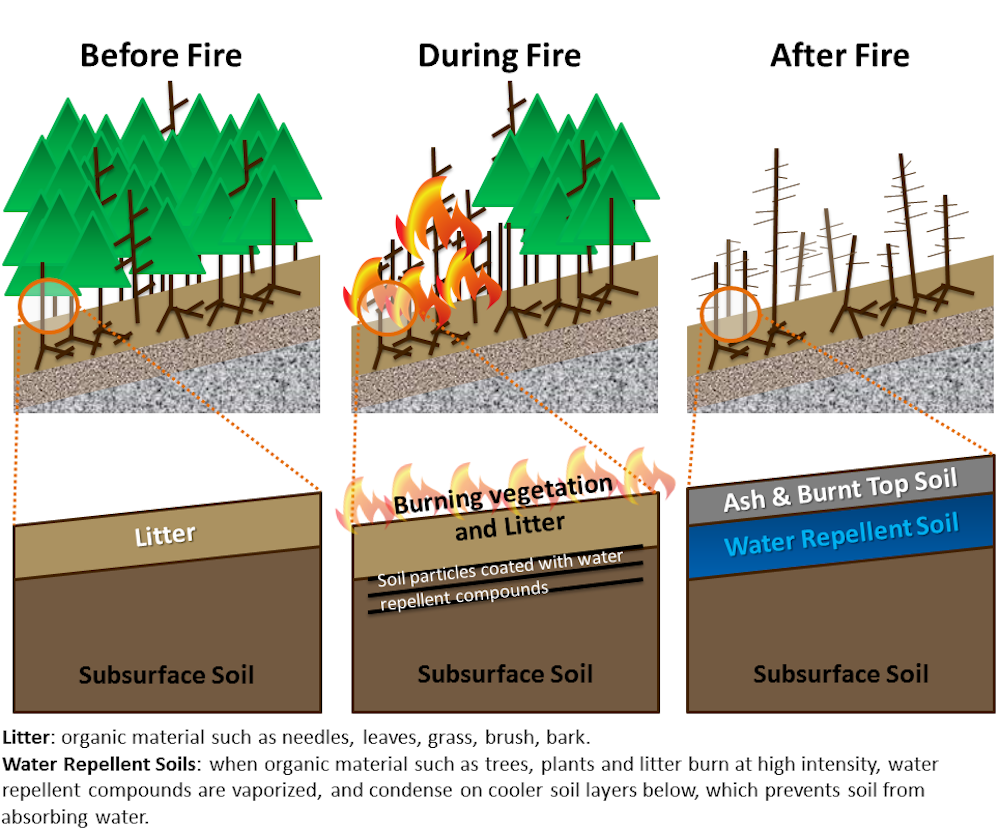
    When severe fires burn hillslopes, the high heat from the fires, sometimes exceeding 1,000 degrees Fahrenheit (538 degrees Celsius), completely destroys trees, shrubs, grass and structures, leaving behind a moonscape of gray ash. Not only that, the heat of the fire actually burns and damages the soil, creating a water-repellent, or hydrophobic, layer.

    What once was a vegetated hillslope, with leaves and trees to intercept rain and spongy soils to absorb water, is transformed into a barren landscape covered with ash, and burned soil where water cannot soak in.

    Illustrations show how fire can change the soil and landscape.
    National Weather Service

    When rain does fall on a burned area like this, water mixes with the ash, rocks and sediment to form a slurry. This slurry of debris then pours downhill in small gullies called rills, which then converge to form bigger and bigger rills, creating a torrent of sediment, water and debris rushing downhill. All this debris and water can transform small streams and usually dry gullies into a danger zone.

    Because the concentration of sediment is so high, especially when there is a large amount of ash and clay, debris flows behave more like a slurry of wet cement than a normal stream. This fluid can pick up and move large boulders, cars, trees and other debris rapidly downhill.

    A firefighter walks through knee-deep mud while checking for victims after a debris flow hit Montecito, Calif., in January 2018.
    Wally Skalij/Los Angeles Times via Getty Images

    In January 2018, a few weeks after the Thomas fire burned through the hills above Montecito, a storm triggered debris flows that killed 23 people and damaged at least 400 homes.

    What controls size and timing of debris flows

    The geography of the land, burn severity, storm intensity and soil characteristics all play important roles in if, when and where debris flows occur.

    Fire and debris flow scientists with the U.S. Geological Survey use these variables to create models to predict the likelihood and possible hazards from postfire debris flows. They are already developing maps to help residents, emergency managers and city officials prepare and predict postfire debris flows in 2025 burn areas in Los Angeles.

    The U.S. Geological Survey modeled debris flow risks after the Palisades Fire near Los Angeles. The map shows some of the highest-risk areas if hit by 15 minutes of rain falling at just under 1 inch (24 millimeters) per hour.
    USGS

    Some of the triggers of debris flows are literally part of the landscape.

    For example, the slope angle in a watershed and the amount of clay in the soil are important. Watersheds with gentle slopes – generally less than about 23 degrees – and a lack of clay and silt-sized particles are unlikely to produce debris flows.

    Other key factors that contribute to postfire debris flows relate to the proportion of the watershed that is severely burned and the intensity and duration of the rainstorm event.

    Early important research in the field of pyrogeomorphology demonstrated that while large, intense storms are more likely to cause large, intense debris flows, even small rainstorms can produce debris flows in burned areas.

    Debris flows are becoming more common

    A whopping 21.8 million Americans live within 3 miles of where a fire burned during the past two decades, and that population more than doubled from 2000 to 2019. A recent study from central and northern California indicates that nearly all the observed increases in area burned by wildfires in recent decades are due to human-caused climate change.

    The warming climate is also increasing the likelihood of more extreme downpours. The amount of moisture the atmosphere can hold increases by about 7% per degree Celsius of warming, leading to more intense downpours, particularly from ocean storms. In California, scientists project increases in rainfall intensity of 18% will result in an overall 110% increase in the probability of major debris flows.

    Jon Frye, of Santa Barbara Public Works, shows what happened in the January 2018 Montecito debris flow and why the risks to downslope communities would continue for several years. Source: County of Santa Barbara, 2018.

    Studies using models of fire, climate and erosion rates estimate that the amount of sediment flowing downhill after fires will increase by more than 10% in nine out of every 10 watersheds in the western U.S.

    Even without rain, debris on fire-damaged slopes can be unstable. A small slide in Pacific Palisades shortly after a fire burned through the area split a home in two. A phenomenon called “dry ravel” is a dominant form of hillslope erosion following wildfires in chaparral environments in Southern California

    Preparing for debris flow risks

    Research on charcoal pieces from ancient debris flows has shown fires and erosion have shaped Earth’s landscape for at least thousands of years. However, the rising risk of wildfires near populated areas and the potential for increasingly intense downpours mean a greater risk of damaging and potentially deadly debris flows.

    As their populations expand, community planners need to be aware of those risks and prepare.

    This article, originally published Jan. 23, 2025, has been updated with rainfall in Los Angeles.

    Jen Pierce receives funding from the National Science Foundation and is the chair of the Quaternary Geology and Geomorphology division of the Geological Society of America.

    – ref. LA gets rain, but also risk of flooding and debris flows from wildfire burn scars – a geologist explains the threat – https://theconversation.com/la-gets-rain-but-also-risk-of-flooding-and-debris-flows-from-wildfire-burn-scars-a-geologist-explains-the-threat-247770

    MIL OSI – Global Reports –

    January 27, 2025
  • MIL-OSI Global: Rain falling on wildfire burn scars can trigger deadly debris flows – a geologist explains how

    Source: The Conversation – USA – By Jen Pierce, Professor of Geosciences, Boise State University

    A debris flow channel in a severely burned watershed in Idaho. Amirhossein Montazeri/Boise State University, CC BY-ND

    While firefighters work to extinguish the Los Angeles-area wildfires, city officials and emergency managers are also worried about what could come next.

    Light rain began falling on Jan. 25, 2025, helping firefighters who have been battling fires for nearly three weeks, but rain can also trigger dangerous floods and debris flows on burned hillslopes. The National Weather Service issued a flood watch for the burned areas through Jan. 27.

    Debris flows can move with the speed of a freight train, picking up or destroying anything in their path. They can move tons of sediment during a single storm, as Montecito, just up the coast from Los Angeles, saw in 2018.

    What causes these debris flows, sometimes called mudflows, and why are they so common and dangerous after a fire? I am a geologist whose research focuses on pyrogeomorphology, which is how fire affects the land. Here’s what we know.

    How debris flows begin

    When severe fires burn hillslopes, the high heat from the fires, sometimes exceeding 1,000 degrees Fahrenheit (538 degrees Celsius), completely destroys trees, shrubs, grass and structures, leaving behind a moonscape of gray ash. Not only that, the heat of the fire actually burns and damages the soil, creating a water-repellent, or hydrophobic, layer.

    What once was a vegetated hillslope, with leaves and trees to intercept rain and spongy soils to absorb water, is transformed into a barren landscape covered with ash, and burned soil where water cannot soak in.

    Illustrations show how fire can change the soil and landscape.
    National Weather Service

    When rain does fall on a burned area like this, water mixes with the ash, rocks and sediment to form a slurry. This slurry of debris then pours downhill in small gullies called rills, which then converge to form bigger and bigger rills, creating a torrent of sediment, water and debris rushing downhill. All this debris and water can transform small streams and usually dry gullies into a danger zone.

    Because the concentration of sediment is so high, especially when there is a large amount of ash and clay, debris flows behave more like a slurry of wet cement than a normal stream. This fluid can pick up and move large boulders, cars, trees and other debris rapidly downhill.

    A firefighter walks through knee-deep mud while checking for victims after a debris flow hit Montecito, Calif., in January 2018.
    Wally Skalij/Los Angeles Times via Getty Images

    In January 2018, a few weeks after the Thomas fire burned through the hills above Montecito, a storm triggered debris flows that killed 23 people and damaged at least 400 homes.

    What controls size and timing of debris flows

    The geography of the land, burn severity, storm intensity and soil characteristics all play important roles in if, when and where debris flows occur.

    Fire and debris flow scientists with the U.S. Geological Survey use these variables to create models to predict the likelihood and possible hazards from postfire debris flows. They are already developing maps to help residents, emergency managers and city officials prepare and predict postfire debris flows in 2025 burn areas in Los Angeles.

    The U.S. Geological Survey modeled debris flow risks after the Palisades Fire near Los Angeles. The map shows some of the highest-risk areas if hit by 15 minutes of rain falling at just under 1 inch (24 millimeters) per hour.
    USGS

    Some of the triggers of debris flows are literally part of the landscape.

    For example, the slope angle in a watershed and the amount of clay in the soil are important. Watersheds with gentle slopes – generally less than about 23 degrees – and a lack of clay and silt-sized particles are unlikely to produce debris flows.

    Other key factors that contribute to postfire debris flows relate to the proportion of the watershed that is severely burned and the intensity and duration of the rainstorm event.

    Early important research in the field of pyrogeomorphology demonstrated that while large, intense storms are more likely to cause large, intense debris flows, even small rainstorms can produce debris flows in burned areas.

    Debris flows are becoming more common

    A whopping 21.8 million Americans live within 3 miles of where a fire burned during the past two decades, and that population more than doubled from 2000 to 2019. A recent study from central and northern California indicates that nearly all the observed increases in area burned by wildfires in recent decades are due to human-caused climate change.

    The warming climate is also increasing the likelihood of more extreme downpours. The amount of moisture the atmosphere can hold increases by about 7% per degree Celsius of warming, leading to more intense downpours, particularly from ocean storms. In California, scientists project increases in rainfall intensity of 18% will result in an overall 110% increase in the probability of major debris flows.

    Jon Frye, of Santa Barbara Public Works, shows what happened in the January 2018 Montecito debris flow and why the risks to downslope communities would continue for several years. Source: County of Santa Barbara, 2018.

    Studies using models of fire, climate and erosion rates estimate that the amount of sediment flowing downhill after fires will increase by more than 10% in nine out of every 10 watersheds in the western U.S.

    Even without rain, debris on fire-damaged slopes can be unstable. A small slide in Pacific Palisades shortly after a fire burned through the area split a home in two. A phenomenon called “dry ravel” is a dominant form of hillslope erosion following wildfires in chaparral environments in Southern California

    Preparing for debris flow risks

    Research on charcoal pieces from ancient debris flows has shown fires and erosion have shaped Earth’s landscape for at least thousands of years. However, the rising risk of wildfires near populated areas and the potential for increasingly intense downpours mean a greater risk of damaging and potentially deadly debris flows.

    As their populations expand, community planners need to be aware of those risks and prepare.

    This article, originally published Jan. 23, 2025, has been updated with rainfall in Los Angeles.

    Jen Pierce receives funding from the National Science Foundation and is the chair of the Quaternary Geology and Geomorphology division of the Geological Society of America.

    – ref. Rain falling on wildfire burn scars can trigger deadly debris flows – a geologist explains how – https://theconversation.com/rain-falling-on-wildfire-burn-scars-can-trigger-deadly-debris-flows-a-geologist-explains-how-247770

    MIL OSI – Global Reports –

    January 27, 2025
  • MIL-OSI Global: California depends on prison labour to deal with climate disasters — Canada must avoid a similar model

    Source: The Conversation – Canada – By Jordan House, Assistant Professor, Labour Studies, Brock University

    As wildfires continue to burn in and around Los Angeles, the fact that many of the firefighters battling the blazes are inmates from California’s prison system has drawn significant attention in news coverage.

    While the California Department of Corrections and Rehabilitation (CDCR) claims their fire camp program is voluntary and provides prisoners with meaningful opportunities, research demonstrates otherwise.

    Critics, including the American Civil Liberties Union (ACLU), argue that the program exploits incarcerated individuals, labelling it as “modern-day slavery.” One ex-prisoner described it as “involuntary servitude.”

    An inmate shares his experience fighting California wildfires (ABC News).

    The use of prison labour is particularly concerning, given Black Americans are incarcerated at nearly five times the rate of white Americans in state prisons. In 12 states, more than half of the prison population is Black.

    California prisoners are denied access to minimum wage provisions, prevented from forming labour unions and denied access to other workplace safety regulations. They’re also more likely to be injured or to die on the job than non-incarcerated firefighters. Their wages are capped at US$29.80 per day, compared to non-incarcerated firefighters, who earn up to US$358 daily, not including overtime.

    While serving in a fire crew gives prisoners the chance to shave time off of their sentences and have records expunged, neither of these benefits is guaranteed. Both are contingent on the CDCR or county jails deeming the service in a fire camp to be “successful.” This leaves prisoners vulnerable to being denied these benefits, despite risking injury or death.

    Prison labour in the Canadian context

    Some Canadian coverage of the L.A. fires has noted that provincial prisoners in British Columbia also work in a wildfire suppression program. However, little has been said about how that work relates to the larger system of prison labour in the country.

    Like their counterparts south of the border, Canadian prisoners are engaged in various forms of labour, including wildfire management, but are denied basic rights as workers.

    In 1975, Donald Griggs, then-superintendent of Ontario’s Monteith Correctional Complex, told the Globe and Mail that prison labour had been used in response to fires from time immemorial: “When a fire got bad, the jails were emptied and the men were shoved out on the fire line.”

    By the late 1960s, programs for prisoners to support wildfire suppression had become more formalized. During that time, for example, prisoners at Beaver Creek, a federal prison in Ontario, participated in regional bushfire response efforts. Working in the program offered prisoners, who were paid $1.25 an hour, a chance at some “action.”

    By the mid-1970s, some Ontario prisoners earned up to $50 a day battling wildfires. Today, however, most prisoners don’t earn anything close to those wages. Federal prisoner pay maxes out at $6.90 per day.

    In the rare situations where prisoners are relatively well-compensated, prison labour still offers employers unique benefits. Prisoners’ lack of freedom and limited ability to refuse work is touted as an advantage. Correctional Service of Canada (CSC) officials have argued that, compared to volunteer firefighters, prisoners “are always in one place and available for duty.”

    Prison labour in British Columbia

    Canada’s most prominent use of prison labour to manage wildfires is in B.C. While prisoners served in direct firefighting roles in the past, today provincial prisoners, who make between $2 and $8 per day, play a critical support role for wildfire-fighting crews by maintaining equipment and fire camps.

    Notably, all the participating prisoners have “open custody” status, having “behaved exceptionally well during previous experience on other community work crews.”

    In Canada, prisoners are supposed to work as part of their rehabilitation, not as punishment. However, the reality often prioritizes the needs of employers over the rehabilitation of prisoners. A review of the CSC’s Federal Work Release Program, which was established in 1992 and included a firefighting component, notes:

    “It is not necessary that the work be directly related to the offender’s correctional plan…work release is a very flexible program that allows correctional managers to respond to community projects and local needs for labour.”

    This is particularly concerning given that ex-prisoners often struggle to secure gainful employment upon release, despite their participation in employment programming.

    Prison labour as a response to climate disasters

    While the idea of keeping people incarcerated to maintain a labour force to fight disasters might sound like something out of science fiction, it’s not mere speculation. Responses to climate catastrophes like the L.A. fires demand huge amounts of resources and labour.

    Former U.S. vice-president Kamala Harris, as California attorney general, led a campaign to defy a U.S. Supreme Court order to reduce the state’s prison population partly because decarceration would “severely impact fire camp participation.”

    In Canada, prison labour has similarly been used in disaster responses. Most recently, CORCAN, the federal prison industry program, has been contracted to build temporary housing for people displaced by the 2024 wildfires in Jasper, Alta.

    Just as Black, Indigenous and racialized people in the U.S. are more likely to become incarcerated, these are also the populations that suffer disproportionately from the impacts of wildfires. Studies have shown that Indigenous communities in Canada are the hardest hit by wildfires, while Indigenous Peoples make up the fastest growing prison populations.

    Much like the U.S., Canada also disproportionately incarcerates Black, Indigenous and racialized people, while also depriving incarcerated labourers of access to minimum wage rights, workplace safety provisions and the right to unionize.

    The root cause of many of these disasters — climate change — is disproportionately driven by the world’s wealthiest elites. The use of prison labour to fight wildfires only further perpetuates the systemic inequalities exacerbated by climate injustice and reflects a continuation of indentured servitude.

    The authors do not work for, consult, own shares in or receive funding from any company or organisation that would benefit from this article, and have disclosed no relevant affiliations beyond their academic appointment.

    – ref. California depends on prison labour to deal with climate disasters — Canada must avoid a similar model – https://theconversation.com/california-depends-on-prison-labour-to-deal-with-climate-disasters-canada-must-avoid-a-similar-model-248099

    MIL OSI – Global Reports –

    January 27, 2025
  • MIL-OSI Global: The legacy of anti-Black racism: The public health crisis of racial trauma

    Source: The Conversation – Canada – By Ingrid Waldron, Professor, Faculty of Humanities, HOPE Chair in Peace & Health, McMaster University

    The police killing of George Floyd in 2020 in the United States was an appalling act involving a group of officers who did not place much, if any, value on the life of a Black man. In the agonizing nine minutes before he died under the knee of Derek Chauvin, Floyd cried out for air and for his mother.

    Those moments, recorded by a passerby and shared widely and repeatedly over the days that followed, shocked the consciences of many Americans and others, triggering protests across the United States and in other countries, many of them led by the Black Lives Matter movement.

    Chauvin was convicted of murder, and three other officers were convicted of other serious crimes.


    Read more:
    How to deal with the pain of racism — and become a better advocate: Don’t Call Me Resilient EP 2


    While there is now greater awareness and scrutiny of racism and violence in policing, there is also a long record of reverting to old ways. Indeed, deeply entrenched racial bias is rooted in the soul and psyche of North American society and globally.

    When we think about Black Lives Matter, we typically think of criminal justice, but the movement also started a conversation about the lingering mental health impacts of police brutality on those who experience it directly, as well as those who experience it vicariously.

    Black trauma

    The traumatizing after-effects of anti-Black racism also result from Black people’s experiences within other social structures, such as employment, education and health care.

    The trauma resulting from multiple forms of anti-Black racism has a legacy that took root during the colonial era and has endured, impacting the spiritual, emotional, psychological and mental well-being of Black people in societies harmed by colonialism, such as Canada, the U.S. and the United Kingdom.

    I am a professor and the HOPE Chair in Peace and Health in the Global Peace and Social Justice Program at McMaster University. I have been studying Black trauma for almost 20 years, and recently published a book on the subject, From the Enlightenment to Black Lives Matter: Tracing the Impacts of Racial Trauma in Black Communities from the Colonial Era to the Present.

    The book documents that since the colonial era, Black bodies have been receptacles for trauma that carry the weight of the past and the present. Black trauma is deep, complex and continuing, and has harmful impacts on the mental health of Black people. It includes the dehumanizing and lingering consequences of the slave trade, the social and economic subjugation of Black people in Jim Crow America and the racist social structures that persist there and in Canada, the U.K. and elsewhere.

    For Black people, trauma results from racist assaults to their spiritual, emotional, mental, psychological and physical well-being. When racism resides in the body in these visceral ways, it manifests as emotional pain and rage, and its lingering after-effects endure over generations.

    Public health crisis

    Addressing the public health crisis of racial trauma for Black people requires that racism be recognized as a legitimate issue in health education and training, research, clinical practice, mental health services and policy, and in the mental health system more broadly.

    It also requires that mental health professionals not only become more culturally competent, but also develop skills in structural competency.

    That means being prepared to play a role in dismantling the inequities embedded within our social structures, including addressing the impact of upstream factors (poverty, poor public infrastructure, etc.) on the mental health of Black and other marginalized populations.

    Addressing racial trauma experienced by Black people also demands an analysis that appreciates racism’s inter-generational and multifaceted features. This analysis would examine how racism not only manifests itself over generations, but also at different levels, such as through everyday interactions between people (individual racism), within institutions (institutional racism), or through cultural dominance (cultural racism).

    Challenging legacies

    Addressing racial trauma experienced by Black people also demands an analysis that appreciates racism’s inter-generational and multifaceted features.
    (Shutterstock)

    For too long, efforts to address disparities between Black and white people in education, labour, employment, health and other social structures have focused on attributing these disparities to pathologies presumed to be inherent to Black culture and Black people. Instead, these efforts must be focused on identifying, dismantling and resolving the pathologies embedded within these social structures and peeling back the systems of power that impact mental health and well-being in Black communities.

    Resolving structural pathologies that harm Black people must be accompanied by a willingness to understand and appreciate the complexities of Black life, Black trauma and Black responses to trauma that may appear maladaptive to many, but that are normal and natural responses to racism’s intergenerational, multi-faceted and multilevel manifestations.

    Finally, resolving Black trauma must involve challenging the colonial and imperial legacies that reside within psychiatry and other mental health professions.

    Ingrid Waldron receives funding from CIHR, SSHRC.

    – ref. The legacy of anti-Black racism: The public health crisis of racial trauma – https://theconversation.com/the-legacy-of-anti-black-racism-the-public-health-crisis-of-racial-trauma-246104

    MIL OSI – Global Reports –

    January 27, 2025
  • MIL-OSI Global: Online platforms risk becoming ideological echo chambers that undermine meaningful dialogue

    Source: The Conversation – Canada – By Alexander Martin, PhD Student, Science and Technology Studies, York University, Canada

    The migration to Bluesky, especially after the 2024 U.S. presidential election, reflects a growing dissatisfaction with centralized platforms and their handling of political content. (Shutterstock)

    There has recently been a shift online from centralized platforms like X (formerly Twitter) to decentralized alternatives like Bluesky. In particular, many users unhappy with the politics and antics of X owner Elon Musk are moving to Bluesky.

    Users migrating from X have cited a rise in bots and hate speech as the reason for leaving the site. Journalist Cory Doctorow termed this the idea of “enshittification,” a process where platforms get worse by focusing on profit and spreading harmful content.

    Under Musk, X has seemingly shifted to promote more extreme accounts, making the platform less welcoming to others. These users are looking for more control, transparency, and less manipulation.

    However, this migration raises an important question. Is this shift towards platforms like Bluesky limiting cross-ideological conversation and increasing political polarization? If so, what does this mean for the health of democracy in the digital age?

    The migration to Bluesky, especially after the 2024 U.S. presidential election, reflects a growing dissatisfaction with centralized platforms and their handling of political content. Understanding this trend is essential, as it could shape how future political debates and movements unfold online.

    Social media and political discourse

    Social media platforms are now central to political discourse. Amid recent political movements, including Donald Trump’s rise, social media has emerged as a key player in shaping political narratives. Figures like Musk and Meta CEO Mark Zuckerberg are increasingly close to Trump.

    Meta donated $1 million to Trump’s inauguration fund, as did other tech companies. Both Zuckerberg and Musk made appearances at Trump’s inauguration, signalling support for Trump’s ascent to power. This demonstrates the tech industry’s close proximity to political power and centralized social media’s potential to amplify certain political agendas.

    The shift from X to Bluesky is part of a larger trend. Left-leaning users are moving to Bluesky because of concerns over political bias and misinformation on X.

    Musk’s acquisition of X in 2022 changed its content moderation policies. This change amplified conservative voices and pushed away users who already felt marginalized. This resulted in an initial exodus to another decentralized social media site called Mastodon, where the user count surged from 3,400 to 113,400 in a single day.

    Commentators have pointed out that many users want a platform with less bias, few manipulations and more freedom of expression.

    Bluesky’s open-source, federated structure provides a space where users have more control over their online experience. This has helped Bluesky grow rapidly, with the platform gaining 2.5 million new users in just two months and seeing a 500 per cent increase in traffic following the U.S. election.

    The platform’s appeal lies in its promise of transparency and user autonomy, qualities that users increasingly value as centralized platforms like X and Meta face scrutiny over political bias and misinformation.

    Tara McGowan discusses the migration of liberals from X to Bluesky.

    May fuel more polarization

    While Bluesky offers an alternative to X’s perceived political bias, it may also deepen political polarization. Its decentralized nature gives users control over what they see, which could reinforce ideological silos.

    Research being done on Mastodon shows that this model can contribute to the democratization of social media by offering more control. As left-leaning users flock to Bluesky while right-leaning users stay on X and Meta, the divide between these groups deepens, further entrenching political silos.

    One of the main reasons for the migration to Bluesky is dissatisfaction with content moderation practices on centralized platforms like X and Meta. Under Musk’s leadership, X has scaled back content moderation and reinstated controversial accounts, raising concerns about the spread of misinformation.

    Similarly, Meta has relaxed its content guidelines by introducing community notes, similar to X. This makes it easier for harmful content to spread. With the community notes, the platform decides what content is considered factual. While this gives users more freedom, it could also enable the spread of false and misleading information.


    Read more:
    Meta is abandoning fact checking – this doesn’t bode well for the fight against misinformation


    Bluesky offers a decentralized model that gives users more control over the content they see. Users can curate their own feeds, creating a more personalized experience.

    Though this model faces challenges, like bot activity and misinformation, it moves away from algorithm-driven approach of platforms like X and Meta. In an era where users worry about bias and censorship, Bluesky’s model offers a potential solution for those seeking more transparency and control over the content they see.

    However, all misinformation threatens the integrity of public discourse. As users gravitate toward platforms that reinforce their existing beliefs, they become more vulnerable to misinformation campaigns.

    This has the potential to undermine public trust in political institutions and the democratic process. Unchecked false information could have serious consequences for democratic participation and the legitimacy of the political process.

    A threat to democracy?

    Bluesky’s decentralized model offers an alternative to traditional centralized platforms that are increasingly seen as biased or manipulative.

    However, this migration also highlights the dangers of political polarization and echo chambers. As users move to platforms that align with their beliefs, space for cross-ideological dialogue shrinks, weakening public discourse.

    This growing division could make it harder for people to have informed, open debates about important issues that matter most. Moving to decentralized platforms like Bluesky may provide more control over the content, but it still requires careful attention to how platforms shape political narratives and the future of democratic engagement.

    Alexander Martin does not work for, consult, own shares in or receive funding from any company or organisation that would benefit from this article, and has disclosed no relevant affiliations beyond their academic appointment.

    – ref. Online platforms risk becoming ideological echo chambers that undermine meaningful dialogue – https://theconversation.com/online-platforms-risk-becoming-ideological-echo-chambers-that-undermine-meaningful-dialogue-247982

    MIL OSI – Global Reports –

    January 27, 2025
  • MIL-OSI Global: How Jan. 27 came to be International Day of Commemoration in Memory of the Victims of the Holocaust

    Source: The Conversation – Canada – By Robert Jan van Pelt, Professor, School of Architecture, University of Waterloo

    When, in the late 1980s, I began my research on the architectural history of the Auschwitz death camp, Jan. 27 wasn’t marked on any official calendar as a special day of commemoration.

    Since then, as a historian who has focused on the history of the Holocaust in general and the history of Auschwitz in particular, and who has with collaborators curated the Auschwitz exhibition now showing in Toronto, I have seen changes in terms of how the Holocaust generally, and Auschwitz in particular, is publicly remembered and commemorated.

    Jan. 27 is now identified as an annual International Day of Commemoration in Memory of the Victims of the Holocaust. On Jan. 27 1945, the Red Army liberated some 7,000 remaining prisoners in Auschwitz, located in south-central Poland. How was this date chosen, and what issues or reflection might it raise?

    Poland

    With 1.1 million murdered victims — of whom one million were Jews — Auschwitz was the most murderous of the German death camps. It had already become by the mid-1970s a powerful symbol of the Holocaust.

    Yet during the Cold War, European nations commemorated the dead of the Second World War on dates that were anniversaries of the end of the war. In Poland, a profoundly Roman Catholic country, the observances of the victims of the war were held on All Saints Day or, since 1955, the Sunday closest to the Ides of April, not Jan. 27.

    In the early 1990s, the Polish government led by President Lech Walesa decided to make the 50th anniversary of the arrival of the liberating Red Army at the gates of Auschwitz into a major international commemoration in 1995.

    Seventeen heads of state, including German Federal President Roman Herzog, attended the occasion on Jan. 27, 1995. It was, in a sense, a “coming-out” of the now firmly democratic Polish Republic. At that time, Warsaw was eyeing membership of NATO and the EU, which had been formally established by means of the Maastricht Treaty two years earlier.

    In the 1995 commemoration, Jews were largely invisible — in fact, Walesa forgot to mention the Jews in his speech.

    Dates in the Hebrew calendar

    Among Jews, primarily in North America and Israel, Holocaust commemorations are typically associated with three dates in the Hebrew (lunar) calendar:

    1. The ninth day of the Jewish month of Av: Since time immemorial, Jews commemorated on this day the destruction of the First Temple (in 586 BCE) and the destruction of the Second Temple (in 70 CE).

    2. The 10th day of the Jewish month of Tevet: This day, King Nebuchadnezzar II began the siege of Jerusalem that was to lead to the destruction of the First Temple. Traditionally on this day, Jews say the prayer of the dead for family members whose date of death is unknown. As the date of death of most of the Jews murdered in the Holocaust is indeed unknown, the 10th of Tevet became quite prominent in Israel as a date of Holocaust commemoration.

    3. The 27th day of the Jewish month of Nisan: This day, established in 1953 as Yom Hashoah (Shoah Day) by the Israeli government, coincides with the Warsaw Ghetto Uprising, which is a point of great pride to Jews. Thus, Yom Hashoah was meant to commemorate not only the depth of the catastrophe, but at the same time one of the few points of light within the Holocaust.

    In American society, a custom arose in the 1980s to hold a commemorative day of the Holocaust in the period that stretches from the Sunday preceding Yom Hashoah to the Sunday following Yom Hashoah, creating a clear link with the Jewish practice. In Canada, Jews mobilized to introduce provincial days of remembrance, insisting that they would follow Jewish practice and be held on Yom Hashoah.

    Germany

    Months after the 1995 Polish commemoration, the leaders of the allied nations and Germany gathered in Berlin on May 8, 1995 to observe the 50th anniversary of the end of the Second World War. German President Herzog noted that while many Germans still remembered May 8 as a day of defeat, in fact that day had opened a door to a future of peace and co-operation in Europe.

    However, some Germans believed that it was now time to move on and stop talking about the the Nazis, the war and the Holocaust.

    Herzog decided something had to be done to force continued engagement with the Nazi past, and to shut up revisionists who stressed German victimhood. He proclaimed Jan. 27 as Day of Commemoration of the Victims of National Socialism. It was a politically astute move. He knew that in any discussion about the meaning of the Third Reich, the name “Auschwitz” was the ultimate trump card that could not be beaten.

    Sweden, U.K., EU, UN

    In 1998, Swedish Prime Minister Göran Persson declared Jan. 27 to be an official day of Holocaust Remembrance. This move was to lay the groundwork for a larger Swedish-led inter-governmental educational initiative founded to combat rising antisemitism.

    In support of this project, which lead to the Stockholm Declaration and the establishment of the International Holocaust Remembrance Alliance (IHRA), the British and Italian governments adopted Jan. 27 as a day of commemoration in 1999 and 2000.

    A few years later, the Czech Republic, Estonia, Hungary, Latvia, Lithuania, Poland, Slovakia and Slovenia — plus Malta and Cyprus — joined the EU. Until then, it had consisted of countries that had been either stable liberal democracies since 1945, or had become such in the 1970s.

    Most of the new members had been communist-ruled. There was nervousness about the baggage they would bring — especially persistent antisemitism. On Jan. 27, 2005, the European Parliament called on the European Council, Commission and member states to make Jan. 27 European Holocaust Memorial Day, to be observed across the EU.

    The effects were profound: Aleida Assmann, a prominent historian of collective memory, observed that pan-European importance of the Jan. 27 day of commemoration since 2005 confirmed the Holocaust as a common “europäischer Gründungsmythos” or European foundation narrative

    Later in 2005, the General Assembly of the United Nations made Jan. 27 an annual International Day of Commemoration in Memory of the Victims of the Holocaust. The resolution establishing the date invoked the Universal Declaration of Human Rights and reaffirmed “that the Holocaust, which resulted in the murder of one third of the Jewish people, along with countless members of other minorities, will forever be a warning to all people of the dangers of hatred, bigotry, racism and prejudice.”

    What to think of Jan. 27?

    While deeply committed to the study of the history of Auschwitz and profoundly engaged with the commemoration of both the Holocaust in general and Auschwitz in particular, if forced to choose, I have a clear preference for Yom Hashoah over Jan. 27.

    Jan. 27 as a day of commemoration emerged from initiatives taken by non-Jews at the highest political level, without much consultation with Jews.

    A few of my now-deceased Auschwitz survivor friends told me that the entire Jan. 27 date should be cancelled as it has no or little meaning for Jews, and it certainly had no meaning for them as Auschwitz survivors, because they had been taken away from Auschwitz in a death march before the arrival of the Red Army.

    Yet now it exists, and better to work with it. All the good reasons why Auschwitz became a symbol of the Holocaust are still valid — especially the fact that it ties a very complex series of events to a real place that everyone can visit.

    But I would like to invite all who gather on Jan. 27 to remember the Holocaust to consider also its profoundly political origins. And I hope that they will decide to also attend a similar event a few months later, on Yom Hashoah.

    Robert Jan van Pelt is curator for the Auschwitz exhibit at the ROM.

    – ref. How Jan. 27 came to be International Day of Commemoration in Memory of the Victims of the Holocaust – https://theconversation.com/how-jan-27-came-to-be-international-day-of-commemoration-in-memory-of-the-victims-of-the-holocaust-248104

    MIL OSI – Global Reports –

    January 27, 2025
  • MIL-OSI Global: Canada’s claim that it champions human rights is at odds with its mining practices

    Source: The Conversation – Canada – By Véronique Plouffe, PhD candidate in Feminist and Gender Studies, L’Université d’Ottawa/University of Ottawa

    Canada presents itself as a gender equality and human rights champion both at home and abroad. But it’s also a global leader in mining, an industry with an abysmal human rights record.

    Under the previous Conservative federal government, Canadian foreign aid was more directly aligned with mining and commercial interests. But when Liberal Justin Trudeau was elected in 2015, it appeared to signal a return to more “progressive” values.


    Read more:
    Justin Trudeau’s resignation creates a progressive void in Canada, part of a long-established cycle


    The launch of the Feminist International Assistance Policy in 2017 was a powerful symbol in this direction. But despite Canadian mining companies being accused of environmental and human rights violations in various countries, the Liberal government continues to actively support mining abroad.

    Canada is a global mining powerhouse, home to almost half of the world’s publicly listed mining and mineral exploration companies.

    According to 2023 data, Canadian mining companies operate in 95 foreign countries and the value of Canadian mining assets totalled $336.7 billion. Half of Canadian foreign mining assets are located in Latin America and the Caribbean.

    Canadian mining in Peru

    Peru is a key mining partner; 71 firms operate in the country and Canada has nearly $10 billion of mining assets in the South American country. Canada has the largest number of mining exploration projects in Peru at 24, and ranks third (after the United Kingdom and Peru itself) in terms of mining exploration investments.

    At last year’s Asia-Pacific Economic Cooperation meeting in Lima, Trudeau announced investments to create “a better future by focusing on a healthier planet and equal opportunities for all.” These included initiatives to support women’s and girls’ rights as well as improving access to the justice system for Indigenous and Afro-Peruvian communities.

    Trudeau also announced the creation of a Canada-Peru Dialogue of Critical Minerals and Mining Sustainability.

    But can Canada be both a human rights champion and a global mining leader? While Canada describes its mining industry as sustainable and socially responsible, human rights organizations paint a different picture.

    Backing Boluarte government

    Canadian mining companies have been accused in Peru of environmental contamination, criminalizing community leaders, land dispossession and the violation of Indigenous self-determination. Canada has also supported Peruvian mining law reforms in favour of foreign mining investment.

    Canada’s support of the current and highly unpopular Dina Boluarte government, which ousted left-wing president Pedro Castillo in 2022, points to the ongoing prioritization of mining interests over human rights, even those of Canadian citizens.

    Castillo meanwhile had proposed a plan to renegotiate mining contracts with multinational companies so that more profits stayed in Peru.

    The impact on women

    Reports have shown that women bear the brunt of mining’s negative impacts, which include gender violence, economic and food insecurity and health problems.

    Women human rights defenders confronting extractive industries also face gender-specific risks and challenges. Indigenous women are often at the forefront of resisting extractive projects.

    Despite the bold ambitions of Canada’s Feminist International Assistance Policy to promote a “more peaceful, more inclusive and more prosperous world,” critics have highlighted several weaknesses and challenges.

    Among them: insufficient funding, its instrumentalist approach (when women are used for broader economic and political goals), as well as its emphasis on neoliberal capitalist growth and the private sector.

    Some have also highlighted its lack of coherence with other policy areas, including trade and security, its support for Israel and its treatment of Indigenous women in Canada.


    Read more:
    Canada’s inaction in Gaza marks a failure of its feminist foreign policy


    Structural causes not addressed

    My ongoing research with civil society organizations in Peru suggests that Canada is providing much-needed and highly appreciated support for women’s rights, LGTBQ+ and Indigenous women’s organizations, namely through its Women’s Voice and Leadership Program. The positive impacts of such initiatives should not be overlooked.

    But even though these projects — often short-term — may benefit some people and some organizations, they often fail to tackle the structural causes of poverty and gender inequality. They also neglect to take into account Canada’s role in creating and maintaining global inequalities through its disruptive mining activities.


    Read more:
    The role of Canadian mining in the plight of Central American migrants


    For years, Canadian civil society organizations have been demanding greater accountability and regulation for Canadian overseas corporations. Despite promises to hold companies accountable for abuses abroad with the creation of the Ombudsperson for Responsible Enterprise, the Trudeau government has been criticized for failing to deliver on these pledges.

    With the possible election of a Conservative federal government in the coming months, it’s unlikely that tightening regulations for private Canadian companies operating in other countries will be a priority.

    Despite its feminist ambitions, taking a closer look at Canada’s role in countries where it has significant mining interests reveals a more complex and nuanced image of Canada in the world.

    Véronique Plouffe receives funding from the Social Sciences and Humanities Research Council (SSHRC).

    – ref. Canada’s claim that it champions human rights is at odds with its mining practices – https://theconversation.com/canadas-claim-that-it-champions-human-rights-is-at-odds-with-its-mining-practices-246757

    MIL OSI – Global Reports –

    January 27, 2025
  • MIL-Evening Report: Trump’s ‘free speech’ vision comes at expense of press freedom

    Pacific Media Watch

    Among his first official acts on returning to the White House, President Donald Trump issued an executive order “restoring freedom of speech and ending federal censorship”.

    Implicit in this vaguely written document: the United States is done fighting mis- and disinformation online, reports the Paris-based global media watchdog Reporters Without Borders (RSF).

    Meanwhile, far from living up to the letter or spirit of his own order, Trump is fighting battles against the American news media on multiple fronts and has pardoned at least 13 individuals convicted or charged for attacking journalists in the 6 January 2021 insurrection.

    An RSF statement strongly refutes Trump’s “distorted vision of free speech, which is inherently detrimental to press freedom”.

    Trump has long been one of social media’s most prevalent spreaders of false information, and his executive order, “Restoring Freedom of Speech and Ending Federal Censorship,” is the latest in a series of victories for the propagators of disinformation online.

    Bowing to pressure from Trump, Mark Zuckerberg, whose Meta platforms are already hostile to journalism, did away with fact-checking on Facebook, which the tech mogul falsely equated to censorship while throwing fact-checking journalists under the bus.

    Trump ally Elon Musk also dismantled the meagre trust and safety safeguards in place when he took over Twitter and proceeded to arbitrarily ban journalists who were critical of him from the site.

    ‘Free speech’ isn’t ‘free of facts’
    “Free speech doesn’t mean public discourse has to be free of facts. Donald Trump and his Big Tech cronies like Elon Musk and Mark Zuckerberg are dismantling what few guardrails the internet had to protect the integrity of information,” said RSF’s USA executive director Clayton Weimers.

    “We cannot ignore the irony of Trump appointing himself the chief crusader for ‘free speech’ while he continues to personally attack press freedom — a pillar of the First Amendment — and has vowed to weaponise the federal government against expression he doesn’t like.

    “If Trump means what he says in his own executive order, he could start by dropping his lawsuits against news organisations.”

    Trump recently settled a lawsuit out of court with ABC News parent company Disney, but is still suing the Des Moines Register and its parent company Gannett for publishing a poll unfavourable to his campaign, and the Pulitzer Center board for awarding coverage of his 2016 campaign’s alleged ties with Russia.

    Trump should immediately drop both lawsuits and refrain from launching others while in office.

    After a campaign where he attacked the press on a daily basis, Trump has continued to berate the media and dismissed its legitimacy to critique him.

    During a press conference the day after he took office, Trump reproached NBC reporter Peter Alexander for questions about Trump’s blanket pardons of the January 6th riot participants, saying, “Just look at the numbers on the election.

    “We won this election in a landslide, because the American public is tired of people like you that are just one-sided, horrible people, in terms of crime.”

    An incoherent press freedom policy
    The executive order also flies in the face of his violent rhetoric against journalists.

    The order asserts that during the Biden administration, “the Federal government infringed on the constitutionally protected speech rights of American citizens across the United States in a manner that advanced the government’s preferred narrative about significant matters of public debate.”

    It goes on to state, “It is the policy of the United States to ensure that no Federal Government officer, employee, or agent engages in or facilitates any conduct that would unconstitutionally abridge the free speech of any American citizen.”

    This stated policy, laudable in a vacuum, even if made redundant by the First Amendment, is rendered meaningless by Trump’s explicit threats to weaponise the government against the media, which have recently included threats to revoke broadcast licenses in political retaliation, investigate news organizations that criticise him, and jail journalists who refuse to expose confidential sources.

    Instead, the policy appears designed to amplify disinformation, which benefits a President of the United States who has proven willing to spread disinformation that furthered his political interests on matters small and large.

    “If Trump is serious about his stated commitment to free speech, RSF suggests he begin by ensuring his own actions serve to protect the free press, rather than censoring or punishing media outlets,” the watchdog said.

    “The United States has seen a steady decline in its press freedom ranking in RSF’s World Press Freedom Index over the past decade to a current ranking of 55th out of 180 countries, with presidents from both parties presiding over this backslide.

    “While Trump is not entirely responsible for the present situation, his frequent attacks on the news media have no doubt contributed to the decline in trust in the media, which has been driven partly by partisan attitudes towards journalism.

    “Trump’s violent rhetoric can also contribute to real-life violence — assaults on journalists nearly doubled in 2024, when his campaign was at its apex, compared to 2023.”

    Pacific Media Watch collaborates with RSF.

    MIL OSI Analysis – EveningReport.nz –

    January 27, 2025
  • MIL-OSI Global: Finding ‘Kape’: How Language Documentation helps us preserve an endangered language

    Source: The Conversation – Indonesia – By Francesco Perono Cacciafoco, Associate Professor in Linguistics, Xi’an Jiaotong-Liverpool University

    Shiyue Wu, a member of Francesco Perono Cacciafoco’s research team at Xi’an Jiaotong-Liverpool University (XJTLU), who is currently developing intensive fieldwork in Alor Island to document and preserve endangered languages, discovered and first documented Kape during a Language Documentation fieldwork in August 2024 and therefore actively contributed to this study.


    As of 2025, more than 7000 languages are spoken across the world. However, only about half of them are properly documented, leaving the rest at risk of disappearing.

    Globalisation has propelled languages such as English and Chinese into the mainstream, and they now dominate global communication.

    Parents today prefer their children learn widely-spoken languages. Meanwhile, indigenous languages, such as Copainalá Zoque in Mexico and Northern Ndebele in Zimbabwe, are not even consistently taught in schools.

    Indigenous people generally did not use writing for centuries and, therefore, their languages do not have ancient written records. This has contributed to their gradual disappearance.

    To prevent the loss of endangered languages, field linguists – or language documentarists – work to ensure that new generations have access to their cultural heritage. Their efforts reveal the vocabulary and structure of these languages and the stories and traditions embedded within them.

    My research team and I have spent over 13 years documenting endangered Papuan languages in Southeast and East Indonesia, particularly in the Alor-Pantar Archipelago, near Timor, and the Maluku Islands. One of our significant and very recent discoveries is Kape, a previously undocumented and neglected language spoken by small coastal communities in Central-Northern Alor.

    Not only is the discovery important for mapping the linguistic context of the island, but it also highlights the urgency of preserving endangered languages by employing Language Documentation methods.

    The discovery of Kape

    In August 2024, while working with our Abui consultants, Shiyue Wu, my Research Assistant at Xi’an Jiaotong-Liverpool University, discovered a previously-ignored, presumably undocumented Papuan language from Alor, ‘Kape’.

    At the time, she was gathering information about the names and locations of ritual altars known as ‘maasang’ in the Abui area, with assistance from our main consultant and several native speakers. In Central Alor, every village has a ‘maasang’.

    During conversations about the variants in altar names across Alor languages and Abui dialects, some speakers mentioned the name of the ‘maasang’ (‘mata’) in Kape—a language previously unrecorded and overlooked in linguistic documentation.

    ‘Kape’ translates to ‘rope’, symbolising how the language connects its speakers across the island, from the mountains to the sea. Geographically and linguistically, it is associated with Kabola in the east and Abui and Kamang in Central Alor.

    At this stage, it is unclear whether Kape is a distinct language or a dialect of Kamang, as the two are mutually intelligible. Much of Kape’s basic lexicon (the collection of words in one language), indeed, shares cognates (related words among languages) with Kamang.

    However, Kape is spoken as the primary (native) language by the whole Kape ethnic group of Alor, and the speakers consider themselves an independent linguistic and ethnic community. This could serve as an element for regarding Kape as a language.

    Kape also shows connections with Suboo, Tiyei, and Adang, other Papuan languages from Alor Island. The speakers, known as ‘Kafel’ in Abui, are multilingual, fluent, to some extent, in Kape, Kamang, Bahasa Indonesia, Alor Malay, and, sometimes, Abui.

    So far, no historical records have been found for Kape, though archival research may reveal more about its origins. Based on its typology and lexical characteristics, Kape appears as ancient as other languages spoken in Alor. Like many Papuan languages, it is critically endangered and requires urgent documentation to preserve its legacy.

    Documenting languages: An ongoing challenge

    Language Documentation aims to reconstruct the unwritten history of indigenous peoples and to guarantee the future of their cultures and languages. This is accomplished by preserving endangered, scarcely documented or entirely undocumented languages in disadvantaged and remote areas.

    External sources, like diaries by missionaries and documentation produced by colonisers, can help reconstruct some historical events. However, they are insufficient for providing reliable linguistic data since the authors were not linguists.

    My research team and I document endangered languages, starting with their lexicon and grammar. Eventually, we also explore the ancient traditions and ancestral wisdom of the native speakers we work with.

    We have contributed to the documentation of several Papuan languages from Alor Island, especially Abui, Kula, and Sawila. These languages are spoken among small, sometimes dispersed communities of indigenous peoples belonging to different but related ethnic clusters.

    They communicate with each other mostly in Bahasa Indonesia and Alor Malay. This is because their local languages are almost never taught in schools and are rarely used outside their groups.

    Over time, in addition to documenting their lexicons and grammars, we worked to reconstruct their place-names and landscape names, oral traditions, foundation myths, ancestral legends and the names of plants and trees they use.

    We also explored their traditional medical practices and local ethnobotany, along with their musical culture and number systems.

    Safeguarding Kape is not just linguistically relevant. Its preservation and documentation are not just about attesting its existence – they also contribute to revitalising the language, keeping it alive, and allowing the local community to rediscover its history, knowledge, and traditions to pass down to the next generations.

    This journey has just begun, but my team and I – with the indispensable collaboration from our local consultants and native speakers – are prepared to go all the way towards its completion.

    Francesco Perono Cacciafoco received funding from Xi’an Jiaotong-Liverpool University (XJTLU): Research Development Fund (RDF) Grant, “Place Names and Cultural Identity: Toponyms and Their Diachronic Evolution among the Kula People from Alor Island”, Grant Number: RDF-23-01-014, School of Humanities and Social Sciences (HSS), Xi’an Jiaotong-Liverpool University (XJTLU), Suzhou (Jiangsu), China, 2024-2025.

    – ref. Finding ‘Kape’: How Language Documentation helps us preserve an endangered language – https://theconversation.com/finding-kape-how-language-documentation-helps-us-preserve-an-endangered-language-247465

    MIL OSI – Global Reports –

    January 26, 2025
  • MIL-OSI: Key Tronic Corporation Announces Results for the First Quarter of Fiscal Year 2025

    Source: GlobeNewswire (MIL-OSI)

    SPOKANE VALLEY, Wash., Nov. 05, 2024 (GLOBE NEWSWIRE) — Key Tronic Corporation (Nasdaq: KTCC), a provider of electronic manufacturing services (EMS), today announced its results for the quarter ended September 28, 2024.

    For the first quarter of fiscal year 2025, Key Tronic reported total revenue of $131.6 million, compared to $150.1 million in the same period of fiscal year 2024. Revenue in the first quarter of fiscal year 2025 was adversely impacted by customer-driven design and qualification delays of three programs that we believe impacted revenue by approximately $9 million. These delays have since been resolved on two of these programs and shipments have resumed in the second quarter.   Production in Key Tronic’s Mexico facilities in the first quarter of fiscal year 2025 increased by approximately 10% sequentially from the prior quarter.  

    The Company saw significant improvement in its production efficiencies compared to the first quarter of fiscal year 2024, primarily as a result of recent headcount reductions, continued improvements in the supply chain and a favorable decline in the exchange rate of the Mexican Peso. Gross margins were 10.1% and operating margins were 3.4% in the first quarter of fiscal year 2025, up from 7.2% and 2.2%, respectively, in the same period of fiscal year 2024.

    Net income was $1.1 million or $0.10 per share for the first quarter of fiscal year 2025, compared to net income of $0.3 million or $0.03 per share for the same period of fiscal year 2024.   Adjusted net income was $1.2 million or $0.11 per share for the first quarter of fiscal year 2025, compared to $0.0 million or $0.00 per share for the same period of fiscal year 2024. See “Non-GAAP Financial Measures,” below for additional information about adjusted net income and adjusted net income per share.

    “While we did not meet revenue expectations in our first quarter of fiscal 2025 due to unavoidable delays for a few programs, we are pleased to see our improved operating efficiencies, margins, and liquidity,” said Brett Larsen, President and CEO. “The recent workforce reductions in Mexico, trimming of non-profitable programs, and making a concerted effort to improve working capital are starting to pay off.   We also continued to reduce our inventories, which are now much more in line with our revenue levels. Over the longer term, we expect that these strategic changes will improve our overall profitability.”  

    “During the first quarter, we also continued to win new business, including new programs in manufacturing equipment, vehicle lighting, and commercial pest control.   We believe we are well positioned for increased growth and profitability in coming periods.”

    The financial data presented for the first quarter of fiscal 2025 should be considered preliminary and could be subject to change, as the Company’s independent auditor has not completed their review procedures.

    Business Outlook

    For the second quarter of fiscal 2025, Key Tronic expects to report revenue in the range of $130 million to $140 million and earnings in the range $0.05 to $0.15 per diluted share. These expected results assume an effective tax rate of 20% in the coming quarter.

    Conference Call

    Key Tronic will host a conference call to discuss its financial results at 2:00 PM Pacific (5:00 PM Eastern) today. A broadcast of the conference call will be available at www.keytronic.com under “Investor Relations” or by calling 888-394-8218 or +1-313-209-4906 (Access Code: 7268667). The Company will also reference accompanying slides that can be viewed with the webcast at www.keytronic.com under “Investor Relations”. A replay will be available at www.keytronic.com under “Investor Relations”.

    About Key Tronic

    Key Tronic is a leading contract manufacturer offering value-added design and manufacturing services from its facilities in the United States, Mexico, China and Vietnam. The Company provides its customers with full engineering services, materials management, worldwide manufacturing facilities, assembly services, in-house testing, and worldwide distribution. Its customers include some of the world’s leading original equipment manufacturers. For more information about Key Tronic visit: www.keytronic.com

    Forward-Looking Statements

    Some of the statements in this press release are forward-looking statements within the meaning of the Private Securities Litigation Reform Act of 1995. Forward-looking statements include, but are not limited to those including such words as aims, anticipates, believes, continues, estimates, expects, hopes, intends, plans, predicts, projects, targets, will, or would, similar verbs, or nouns corresponding to such verbs, which may be forward looking. Forward-looking statements also include other passages that are relevant to expected future events, performances, and actions or that can only be fully evaluated by events that will occur in the future. Forward-looking statements in this release include, without limitation, the Company’s statements regarding its expectations with respect to financial conditions and results, including revenue and earnings, cost savings from headcount reduction and the Mexican Peso exchange rate, demand for certain products and the effectiveness of some of its programs, business from customers and programs, and impacts from operational streamlining and efficiencies. There are many factors, risks and uncertainties that could cause actual results to differ materially from those predicted or projected in forward-looking statements, including but not limited to: the future of the global economic environment and its impact on our customers and suppliers; the availability of components from the supply chain; the availability of a healthy workforce; the accuracy of suppliers’ and customers’ forecasts; development and success of customers’ programs and products; timing and effectiveness of ramping of new programs; success of new-product introductions; the risk of legal proceedings or governmental investigations relating to the previously reported financial statement restatements and related material weaknesses, the May 2024 cybersecurity incident and the subject of the internal investigation by the Company’s Audit Committee and related or other unrelated matters; acquisitions or divestitures of operations or facilities; technology advances; changes in pricing policies by the Company, its competitors, customers or suppliers; impact of new governmental legislation and regulation, including tax reform, tariffs and related activities, such trade negotiations and other risks; and other factors, risks, and uncertainties detailed from time to time in the Company’s SEC filings.

    Non-GAAP Financial Measures

    To supplement our consolidated financial statements, which are prepared in accordance with generally accepted accounting principles in the United States (GAAP), we use certain non-GAAP financial measures, adjusted net income and adjusted net income per share, diluted. We provide these non-GAAP financial measures because we believe they provide greater transparency related to our core operations and represent supplemental information used by management in its financial and operational decision making. We exclude (or include) certain items in our non-GAAP financial measures as we believe the net result is a measure of our core business. We believe this facilitates operating performance comparisons from period to period by eliminating potential differences caused by the existence and timing of certain income and expense items that would not otherwise be apparent on a GAAP basis. Non-GAAP performance measures should be considered in addition to, and not as a substitute for, results prepared in accordance with GAAP. We strongly encourage investors and shareholders to review our financial statements and publicly-filed reports in their entirety and not to rely on any single financial measure. Our non-GAAP financial measures may be different from those reported by other companies. See the table below entitled “Reconciliation of GAAP to non-GAAP measures” for reconciliations of adjusted net income to the most directly comparable GAAP measure, which is GAAP net income, and the computation of adjusted net income per share, diluted.

     
    KEY TRONIC CORPORATION AND SUBSIDIARIES
    CONSOLIDATED STATEMENTS OF OPERATIONS
    (In thousands, except per share amounts)
    (Unaudited)
     
      Three Months Ended
      September 28, 2024   September 30, 2023
    Net sales $ 131,558     $ 150,112  
    Cost of sales   118,255       139,250  
    Gross profit   13,303       10,862  
    Research, development and engineering expenses   2,289       2,241  
    Selling, general and administrative expenses   6,570       5,784  
    Gain on insurance proceeds, net of losses   —       (431 )
    Total operating expenses   8,859       7,594  
    Operating income   4,444       3,268  
    Interest expense, net   3,263       3,011  
    Income before income taxes   1,181       257  
    Income tax (benefit) provision   57       (78 )
    Net income $ 1,124     $ 335  
    Net income per share — Basic $ 0.10     $ 0.03  
    Weighted average shares outstanding — Basic   10,762       10,762  
    Net income per share — Diluted $ 0.10     $ 0.03  
    Weighted average shares outstanding — Diluted   10,762       11,003  
     
    KEY TRONIC CORPORATION AND SUBSIDIARIES
    CONSOLIDATED BALANCE SHEETS
    (In thousands)
    (Unaudited)
     
        September 28, 2024   June 29, 2024
    ASSETS        
    Current assets:        
    Cash and cash equivalents   $ 6,555     $ 4,752  
    Trade receivables, net of credit losses of $3,129 and $2,918     133,984       132,559  
    Contract assets     23,626       21,250  
    Inventories, net     95,845       105,099  
    Other, net of credit losses of $1,642 and $1,679     28,273       24,739  
    Total current assets     288,283       288,399  
    Property, plant and equipment, net     27,910       28,806  
    Operating lease right-of-use assets, net     14,612       15,416  
    Other assets:        
    Deferred income tax asset     18,394       17,376  
    Other     6,735       5,346  
    Total other assets     25,129       22,722  
    Total assets   $ 355,934     $ 355,343  
    LIABILITIES AND SHAREHOLDERS’ EQUITY        
    Current liabilities:        
    Accounts payable   $ 83,768     $ 79,394  
    Accrued compensation and vacation     6,870       6,510  
    Current portion of long-term debt     3,057       3,123  
    Other     18,450       15,149  
    Total current liabilities     112,145       104,176  
    Long-term liabilities:        
    Long-term debt, net     109,675       116,383  
    Operating lease liabilities     9,573       10,312  
    Deferred income tax liability     74       263  
    Other long-term obligations     124       219  
    Total long-term liabilities     119,446       127,177  
    Total liabilities     231,591       231,353  
    Shareholders’ equity:        
    Common stock, no par value—shares authorized 25,000; issued and outstanding 10,762 and 10,762 shares, respectively     47,351       47,284  
    Retained earnings     78,045       76,921  
    Accumulated other comprehensive income (loss)     (1,053 )     (215 )
    Total shareholders’ equity     124,343       123,990  
    Total liabilities and shareholders’ equity   $ 355,934     $ 355,343  
             
    KEY TRONIC CORPORATION AND SUBSIDIARIES
    Reconciliation of GAAP to non-GAAP measures
    (In thousands, except per share amounts)
    (Unaudited)
     
      Three Months Ended
      September 28, 2024   September 30, 2023
    GAAP net income $ 1,124     $ 335  
    Gain on insurance proceeds (net of losses)   —       (431 )
    Stock-based compensation expense   67       59  
    Income tax effect of non-GAAP adjustments (1)   (13 )     74  
    Adjusted net income: $ 1,178     $ 37  
           
    Adjusted net income per share — non-GAAP Diluted $ 0.11     $ 0.00  
    Weighted average shares outstanding — Diluted   10,762       11,003  
           
    (1) Income tax effects are calculated using an effective tax rate of 20%, which approximates the statutory GAAP tax rate for the presented periods.
             
    CONTACTS:   Tony Voorhees   Michael Newman
        Chief Financial Officer   Investor Relations
        Key Tronic Corporation   StreetConnect
        (509)-927-5345   (206) 729-3625

    The MIL Network –

    January 26, 2025
  • MIL-OSI: Institute for Catastrophic Loss Reduction formally opens Winnipeg Climate Resilience Centre

    Source: GlobeNewswire (MIL-OSI)

    WINNIPEG, Manitoba, Nov. 05, 2024 (GLOBE NEWSWIRE) — The Institute for Catastrophic Loss Reduction (ICLR) is very pleased to announce the formal launch of its Climate Resilience Centre in downtown Winnipeg. The centre was made possible through generous contributions from Wawanesa, including the provision of office space in the company’s former executive office at 191 Broadway and operating funds.

    “ICLR is thrilled to partner with Wawanesa on this trailblazing facility,” said Paul Kovacs, Executive Director of the Institute for Catastrophic Loss Reduction. “After this year’s horrendous series of storm and wildfire-related losses that have led to a record $8 billion in insurance claims, it has never been more clear that all facets of Canadian society must work together to foster resilience to extremes. In the context of making Canadian homes, both existing and new, stronger against nature’s extremes, we know what features need to be added. The new ICLR Climate Resilience Centre in Winnipeg allows attendees to see these features in action.”

    “As Canada’s leading property and casualty mutual insurer, we see firsthand the devastating impact of severe weather across the country,” said Jeff Goy, President & CEO of Wawanesa. “Driven by our commitment to building stronger, more resilient communities, Wawanesa is proud to support the Institute for Catastrophic Loss Reduction’s new Climate Resilience Centre in our former executive office in Winnipeg. This facility will serve as a critical resource in equipping Canadians with the knowledge to better protect themselves against the growing threats of climate change, helping them to reduce their risk of loss.”

    The Climate Resilience Centre will serve as a destination for various stakeholders, such as insurers, reinsurers, brokers, home builders, building code officials and others to come together and learn about best practices and the issues involved in becoming more climate resilient. This includes:

    • Developing programming with national reach, distributing information to various stakeholders that is relevant to climate risks across the country.
    • Free attendance, allowing groups to book the premises for education sessions, host events and to collaborate in person.
    • Multimedia and other hands-on displays highlighting practical strategies for property loss mitigation developed by ICLR and sponsored by Wawanesa. The displays will be able to travel to communities for education events to address hazards such as basement flooding/sewer backup, wildfire, overland flooding, extreme wind, and hail.
    • A dedicated space sponsored by Wawanesa that will encourage attendees to come together to share knowledge and learn.

    Tours of the ICLR Climate Resilience Centre can be booked, and inquiries about borrowing the displays can be made by visiting www.iclr.org/climatecentre/.

    About The Institute for Catastrophic Loss Reduction (ICLR)
    Canada’s leading disaster research institute, the Institute for Catastrophic Loss Reduction (ICLR), was established by the insurance industry in 1997 as an independent, not-for-profit research and outreach institute to champion disaster resilience in Canada. ICLR is an international centre of excellence affiliated with Western University, London, Ontario. The Institute develops and champions evidence-based disaster safety solutions that can be implemented by homeowners, businesses and governments to enhance their disaster resilience. Visit www.iclr.org for more information.

    About The Wawanesa Mutual Insurance Company
    The Wawanesa Mutual Insurance Company, founded in 1896, is one of Canada’s largest mutual insurers, with over $3.5 billion in annual revenue and assets of $10 billion. Wawanesa Mutual, with its National Headquarters in Winnipeg, is the parent company of Wawanesa Life, which provides life insurance products and services throughout Canada, and Western Financial Group, which distributes personal and business insurance across Canada. Wawanesa proudly serves more than 1.7 million members in Canada. The company actively gives back to organizations that strengthen communities, donating more than $3.5 million annually to charitable organizations, including over $2 million annually in support of people on the front lines of climate change. Learn more at wawanesa.com.

    For more information:
    Michel Rosset
    Manager, Corporate Communications & Media Relations
    The Wawanesa Mutual Insurance Company
    media@wawanesa.com

    Photos accompanying this announcement are available at

    https://www.globenewswire.com/NewsRoom/AttachmentNg/2b304c1a-bceb-4c48-81ab-b15fbf482fd5

    https://www.globenewswire.com/NewsRoom/AttachmentNg/df5d68f1-6b5a-4a3e-aef0-b2630d979275

    https://www.globenewswire.com/NewsRoom/AttachmentNg/ec5a4ca6-49a7-425f-a354-f6b7a926aa64

    The MIL Network –

    January 26, 2025
  • MIL-OSI USA: Beyond the Console: Kenneth Attocknie’s Mission to Bridge Cultures at NASA

    Source: NASA

    From the Mission Control Center to community celebrations, Kenneth Attocknie blends safety expertise with a commitment to cultural connection. 
    For the past 25 years at NASA, Attocknie has dedicated his career to safeguarding the International Space Station and supporting real-time mission operations at Johnson Space Center in Houston.  
    As a principal safety engineer in the Safety and Mission Assurance Directorate, Attocknie ensures the safe operation of the space station’s environmental control and life support system. This system is vital for maintaining the life-sustaining environment aboard the orbiting laboratory— a critical foundation for similar systems planned for future Artemis missions. 

    As a contractor with SAIC, Attocknie has served as a flight controller, astronaut crew office engineer, and astronaut crew instructor. He joined NASA just as the first two modules of the space station, Zarya and Unity, connected in space on Dec. 6, 1998.  
    “I’ve supported the space station ever since and have been blessed to witness the remarkable progression of this amazing orbiting experiment,” he said. “I feel I have found a way to contribute positively to NASA’s mission: to improve life for all people on our planet.” 
    He also contributed to closing out the Space Shuttle Program and worked in system safety for the Constellation program. 
    As part of SAIC’s Employee Resource Group, Attocknie supports the Mathematics, Engineering, Science Achievement project, which uses project-based learning to inspire high school students from underrepresented communities to pursue careers in science, technology, engineering, and mathematics. He continues to advocate for Native Americans as a member of the American Indian Science and Engineering Society, helping NASA engage with college students across Indian Country. 

    Attocknie strives to contribute to a space exploration legacy that uplifts and unites cultures, paving the way for a future in human spaceflight that honors and empowers all. 
    A member of the Comanche and Caddo tribes of Oklahoma, he has made it his mission to create a cross-cultural exchange between NASA and Native communities to provide opportunities for Natives to visit Johnson.  
    One of his proudest moments was organizing a Native American Heritage Month event with NASA’s Equal Opportunity and Diversity Office. The celebration brought together Native dancers and singers from Oklahoma and Texas to honor their heritage at Johnson.  
    “Seeing the Johnson community rally around this event was amazing,” said Attocknie. “It was a profound experience to share and celebrate my culture here.” 

    Overcoming challenges and setbacks has been part of his NASA experience as well. “Finding and achieving my purpose is always an ongoing journey,” he said. “Accepting what might seem like a regression is the first step of growth. There’s always a lesson to be found, and every disappointment can fuel a new ambition and direction. Ride the waves, be humble, learn lessons, and above all, always keep going.” 
    He believes that NASA’s mission is deeply connected to diversity and inclusion. “You can’t truly benefit humankind if you don’t represent humankind,” said Attocknie. “The status quo may feel comfortable, but it leads to stagnation and is the antithesis of innovation.” 

    Attocknie’s hope for the Artemis Generation? “A healthier planet, society, and the desire to pass on lessons of stewardship for our environment. All life is precious.” 
    He sees NASA as a gateway to a brighter future: “NASA can truly harness its influence to be an example for our planet, not only in the new heavenly bodies we journey to but also in the new human spirits we touch.” 

    MIL OSI USA News –

    January 26, 2025
  • MIL-OSI Security: Bay d’Espoir — Bay d’Espoir RCMP investigates break and enter at Canada Post storage shed

    Source: Royal Canadian Mounted Police

    Bay d’Espoir RCMP is investigating a break, enter and theft that occurred at a Canada Post storage shed sometime between Saturday, November 2 and Monday, November 4.

    Shortly before 2:30 p.m. on Monday, police received the report of the crime that occurred at the storage shed located on Route 360, approximately 1 km north of the Route 361 turnoff. Suspect(s) forced entry into the shed, causing property damage. In the same area, a passenger van was stolen and was later recovered abandoned at an apartment building parking lot in Grand Falls-Windsor. See images attached.

    Police believe the two incidents may be related. The investigation is continuing.

    Anyone with information about this crime or the identity of those responsible is asked to contact Bay d’Espoir RCMP at 709-882-2230. To remain anonymous, contact Crime Stoppers: #SayItHere 1-800-222-TIPS (8477), visit www.nlcrimestoppers.com or use the P3Tips app.

    MIL Security OSI –

    January 26, 2025
  • MIL-OSI Security: Albuquerque FBI Division Announces It’s 2025 Citizen’s Academy

    Source: Federal Bureau of Investigation (FBI) State Crime Alerts (c)

    Have you ever wondered how the FBI solves a case? Want to hear about the work agents are doing across New Mexico? Special Agent in Charge Raul Bujanda welcomes business, civic, and faith-based community leaders to apply for FBI Albuquerque’s Citizens Academy program, where we will give participants a first-hand look into life at the FBI.

    “The FBI’s Citizens Academy provides an incredible opportunity for members of the community to better understand the work of the FBI and partner with us in keeping New Mexico citizens safe,” said Raul Bujanda, special agent in charge for the FBI Albuquerque Division. “The FBI Citizens Academy program is a unique opportunity for us to share our work one-on-one with community leaders of all backgrounds, and for them to provide us with feedback. Through frank discussion and information sharing, we can improve relationships and advance our mission to protect all Americans.”

    FBI Albuquerque is now accepting nominations for the 2025 FBI Citizens Academy. Over the course of 8 sessions this spring, select business, religious, civic, and community leaders will be given an opportunity to go behind the scenes of local FBI operations and experience case studies and demonstrations led by Special Agents, Intelligence Analysts, and FBI Professional Staff. Topics will include how the FBI works to combat violent crime, human trafficking, cybercrime, counterintelligence, Indian Country, terrorism, and how teams train in forensics, firearms, evidence recovery, and more.

    • When: Wednesday evenings February 19th, 2025 – April 23rd, 2025
    • Where: FBI Albuquerque 4200 Luecking Park Ave NE, Albuquerque New Mexico 87107

    How to Apply: The FBI Citizens Academy is open to anyone with an interest in learning how the FBI works to protect and serve the community. Candidates can be nominated by a program alumnus, former or current FBI employee, or self-nominated. The nomination form must be completed in full and returned by the close of business on Friday, December 20, 2024. If selected, there is no cost to attend. Questions regarding the program or application process can be directed to aq.outreach@fbi.gov

    Requirements:

    • Business, religious, civic, or community leader
    • Be at least 21 years of age
    • No felony or serious misdemeanor convictions
    • Cannot be under investigation as a subject in a criminal case
    • Must live or work in New Mexico
    • Must agree to and pass a limited background check
    • Must be able to attend classes in person

    MIL Security OSI –

    January 26, 2025
←Previous Page
1 … 1,569 1,570 1,571 1,572 1,573 … 1,925
Next Page→
NewzIntel.com

NewzIntel.com

MIL Open Source Intelligence

  • Blog
  • About
  • FAQs
  • Authors
  • Events
  • Shop
  • Patterns
  • Themes

Twenty Twenty-Five

Designed with WordPress