Category: Americas

  • MIL-OSI USA: Rep. Norcross Presents $850,000 in Community Project Funding to Upgrade Pedestrian and Bike Path in Merchantville

    Source: United States House of Representatives – Congressman Donald Norcross (1st District of New Jersey)

    CHERRY HILL, NJ – Today, Rep. Donald Norcross (D-NJ) presented $850,000 in Community Project Funding (CPF) to the Borough of Merchantville to upgrade pedestrian and bike path infrastructure.  

    The funding was secured through the Fiscal Year 2024 government funding package and will be used to upgrade pedestrian and bike path infrastructure. The upgrades will include new lighting, resurfacing, crosswalks, and ADA ramps for seniors at the senior housing center nearby. 

    “Community Project Funding grants invest in our communities and support economic development, job creation, and critical projects that improve the quality of life,” Rep. Norcross said. “I’m proud to have secured this funding for the Borough of Merchantville to upgrade our infrastructure and enhance safe recreational opportunities for our neighbors.” 

    “The funding of the Merchantville Community Project related to enhancements to the Merchantville Multi-Use path is critical to the continued success of the Borough of Merchantville and our surrounding communities,” Mayor Brennan said. “This path serves not just as the most well used amenity in our Borough, contributing to the health and wellness of residents in our region, but it is also part of a network of alternative transportation that connects the populations of the greater Camden County region to jobs and commerce. The proposed improvements for the path of lighting and accessibility to name a few, will only enhance this important connector of people and commerce and I am proud of Merchantville’s role in that and incredibly thankful to our federal representatives, particularly our Congressman, Donald Norcross, and US Senator Corey Booker for their support of this important project.” 

    Rep. Norcross recently secured 14 CPF awards totaling $13,565,031 for projects throughout New Jersey’s First Congressional District to support economic development, create jobs, and respond to the most pressing needs of the community. More information on the 14 projects can be found here. 

    Since the creation of CPFs in 2021, Rep. Norcross has secured $28.8 million in awards for local projects throughout South Jersey. CPF awards secured by Rep. Norcross range from road and transportation projects and affordable housing upgrades to improving health care and education accessibility.  


    ###

    MIL OSI USA News

  • MIL-OSI Banking: Grandoreiro, the global trojan with grandiose ambitions

    Source: Securelist – Kaspersky

    Headline: Grandoreiro, the global trojan with grandiose ambitions

    Grandoreiro is a well-known Brazilian banking trojan — part of the Tetrade umbrella — that enables threat actors to perform fraudulent banking operations by using the victim’s computer to bypass the security measures of banking institutions. It’s been active since at least 2016 and is now one of the most widespread banking trojans globally.

    INTERPOL and law enforcement agencies across the globe are fighting against Grandoreiro, and Kaspersky is cooperating with them, sharing TTPs and IoCs. However, despite the disruption of some local operators of this trojan in 2021 and 2024, and the arrest of gang members in Spain, Brazil, and Argentina, they’re still active. We now know for sure that only part of this gang was arrested: the remaining operators behind Grandoreiro continue attacking users all over the world, further developing new malware and establishing new infrastructure.

    Every year we observe new Grandoreiro campaigns targeting financial entities, using new tricks in samples with low detection rates by security solutions. The group has evolved over the years, expanding the number of targets in every new campaign we tracked. In 2023, the banking trojan targeted 900 banks in 40 countries — in 2024, the newest versions of the trojan targeted 1,700 banks and 276 crypto wallets in 45 countries and territories, located on all continents of the world. Asia and Africa have finally joined the list of its targets, making it a truly global financial threat. In Spain alone, Grandoreiro has been responsible for fraudulent activities amounting to 3.5 million euros in profits, according to conservative estimates — several failed attempts could have yielded beyond 110 million euros for the criminal organization.

    In this article, we will detail how Grandoreiro operates, its evolution over time, and the new tricks adopted by the malware, such as the usage of 3 DGAs (domain generation algorithm) in its C2 communications, the adoption of ciphertext stealing encryption (CTS), and mouse behavior tracking, aiming to bypass anti-fraud solutions. This evolution culminates with the appearance of lighter, local versions, now focused on Mexico, positioning the group as a challenge for the financial sector, law enforcement agencies and security solutions worldwide.

    Grandoreiro: One malware, many operators, fragmented versions

    Grandoreiro is a banking trojan of Brazilian origin that has been active since at least 2016. Grandoreiro is written in the Delphi programming language, and there are many versions, indicating that different operators are involved in developing the malware.

    Since 2016, we have seen the threat actors behind Grandoreiro operations regularly improving their techniques to stay unmonitored and active for a longer time. In 2020, Grandoreiro started to expand its attacks in Latin America and later in Europe with great success, focusing its efforts on evading detection using modular installers.

    Grandoreiro generally operates as Malware-as-a-Service, although it’s slightly different from other banking trojan families. You won’t find an announcement on underground forums selling the Grandoreiro package — it seems that access to the source-code or builders of the trojan is very limited, only for trusted partners.

    After the arrests of some operators, Grandoreiro split its codebase into lighter versions, with fewer targets. These fragmented versions of the trojan are a reaction to the recent law enforcement operations. This discovery is supported by the existence of two distinct codebases in simultaneous campaigns: newer samples featuring updated code, and older samples which rely on the legacy codebase, now targeting only users in Mexico — customers of around 30 banks.

    2022 and 2023 campaigns

    Grandoreiro campaigns commonly start with a phishing email written in the target country language. For example, the emails distributed in most of Latin America are in Spanish. However, we also saw the use of Google Ads (malvertising) in some Grandoreiro campaigns to drive users to download the initial stage of infection.

    Phishing emails use different lures to make the victim interact with the message and download the malware. Some messages refer to a pending phone bill, others mimic a tax notification, and son. In early 2022 campaigns, the malicious email included an attached PDF. As soon as the PDF is opened, the victim is prompted with a blurred image except for a part containing “Visualizar Documento” (“View Document” in Spanish). When the victim clicks the button, they are redirected to a malicious web page which prompts them to download a ZIP file. Since May 2022, Grandoreiro campaigns include a malicious link inside the email body that redirects the victim to a website that then downloads a malicious ZIP archive on the victim’s machine. These ZIP archives commonly contain two files: a legitimate file and a Grandoreiro loader, which is responsible for downloading, extracting and executing the final Grandoreiro payload.

    The Grandoreiro loader is delivered in the form of a Windows Installer (MSI) file that extracts a dynamic link library (DLL) file and executes a function embedded in the DLL. The function will do nothing if the system language is English, but otherwise the final payload is downloaded. Most likely, this means that the analyzed versions didn’t target English-speaking countries. There have also been other cases where a VBS file is used instead of the DLL to execute the final payload.

    Grandoreiro recent infection flow

    As for the malware itself, in August 2022 campaigns, the final payload was an incredibly big 414 MB portable executable file disguised with a PNG extension (which is later renamed to EXE dynamically by the loader). It masked itself as an ASUS driver using the ASUS icon and was signed with an “ASUSTEK DRIVER ASSISTANTE” digital certificate.

    In 2023 campaigns, Grandoreiro used samples with rather low detection rates. Initially, we identified three samples related to these campaigns, compiled in June 2023. All of them were portable executables, 390 MB big, with the original name “ATISSDDRIVER.EXE” and internal name “ATIECLXX.EXE”. The main purpose of these samples is to monitor the victims’ visits to financial institution websites and steal their credentials. The malware also allows threat actors to remotely control the victim machines and perform fraudulent transactions within them.

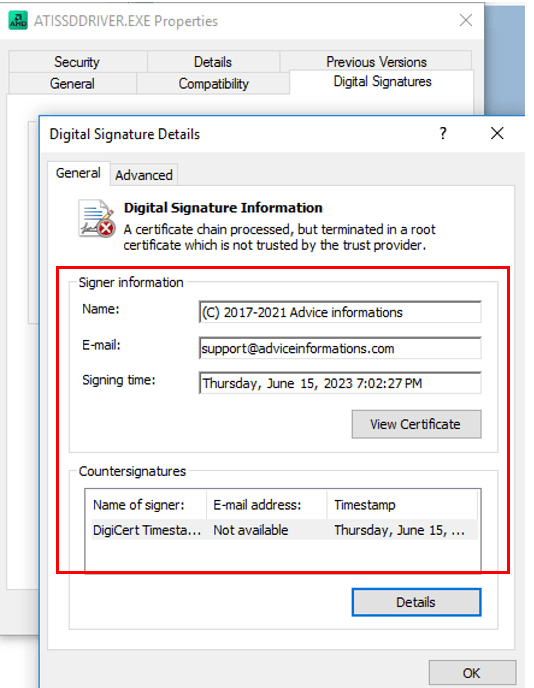
    In the campaign involving the discussed samples, the malware tries to impersonate an AMD External Data SSD driver and is signed with an “Advice informations” digital certificate in order to appear legitimate and evade detection.

    Implant impersonating AMD driver

    Digital certificate used by Grandoreiro malware

    In both cases, the malware is an executable that registers itself to be launched with Windows. However, it is worth noting that in the majority of Grandoreiro attacks, a DLL sideloading technique is employed, using legitimate binaries that are digitally signed to run the malware.

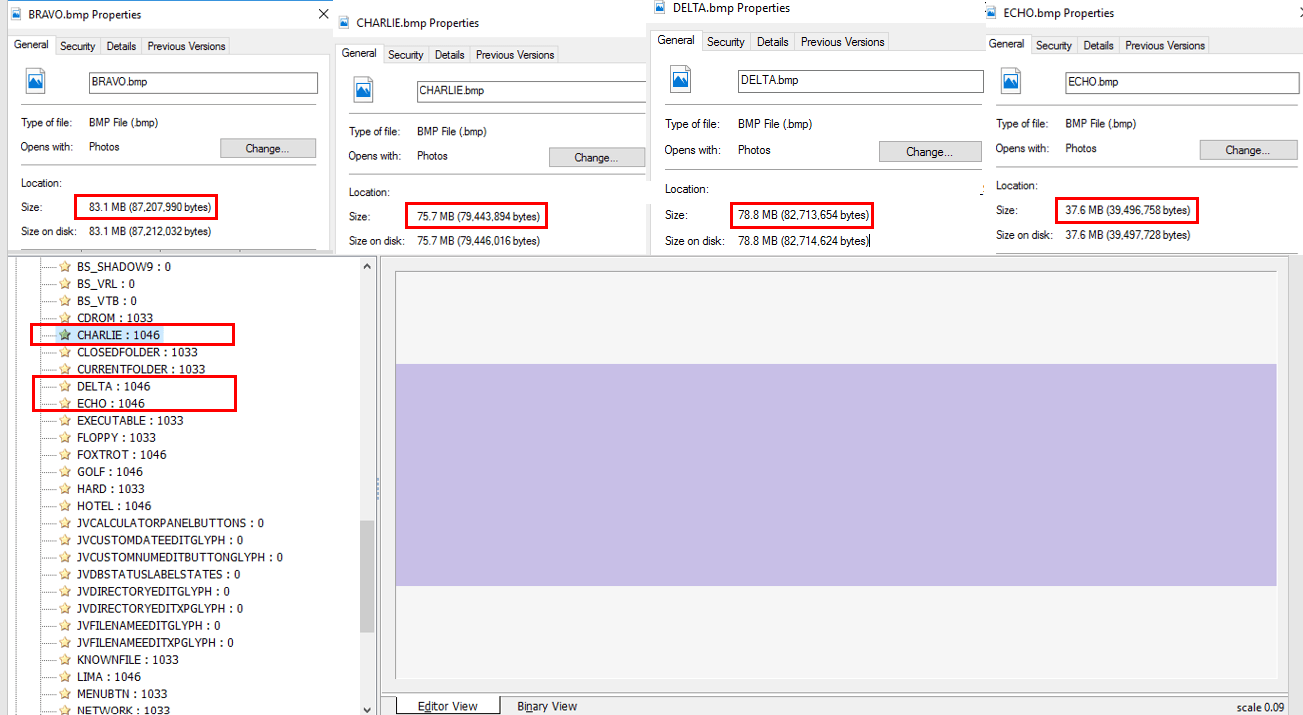
    The considerable size of the executables can be explained by the fact that Grandoreiro utilizes a binary padding technique to inflate the size of the malicious files as a way to evade sandboxes. To achieve this, the attackers add multiple BMP images to the resource section of the binary. In the example below, the sample included several big images. The sizes of the highlighted images are around 83.1 MB, 78.8 MB, 75.7 and 37.6 MB. However, there are more of them in the binary, and together all the images add ~376 MB to the file.

    Binary padding used by Grandoreiro

    In both 2022 and 2023 campaigns, Grandoreiro used a well-known XOR-based string encryption algorithm that is shared with other Brazilian malware families. The difference is the encryption key. For Grandoreiro, some magic values were the following:

    Date Encryption key
    March 2022 F5454DNBVXCCEFD3EFMNBVDCMNXCEVXD3CMBKJHGFM
    March 2022 XD3CMBKJCEFD3EFMF5454NBVDNBVXCCMNXCEVDHGFM
    August 2022 BVCKLMBNUIOJKDOSOKOMOI5M4OKYMKLFODIO
    June 2023 B00X02039AVBJICXNBJOIKCVXMKOMASUJIERNJIQWNLKFMDOPVXCMUIJBNOXCKMVIOKXCJ
    UIHNSDIUJNRHUQWEBGYTVasuydhosgkjopdf

    The various checks and validations aimed at avoiding detection and complicating malware analysis were also changed in the 2022 and 2023 versions. In contrast with the older Grandoreiro campaigns, we found that some of the tasks that were previously executed by the final payload are now implemented in the first stage loader. These tasks include security checks, anti-debugging techniques, and more. This represents a significant change from previous campaigns.

    One of these tasks is the use of the geolocation service http://ip-api.com/json to gather the target’s IP address location data. In a campaign reported in May 2023 by Trustwave, this task is performed by a JScript code embedded in an MSI installer before the delivery of the final payload.

    There are numerous other checks that have been transferred into the loader, although some of them are still present in the banking trojan itself. Grandoreiro gathers host information such as operating system version, hostname, display monitor information, keyboard layout, current time and date, time zone, default language and mouse type. Then the malware retrieves the computer name and compares it against the following strings that correspond to known sandboxes:

    • WIN-VUA6POUV5UP;
    • Win-StephyPC3;
    • difusor;
    • DESTOP2457;
    • JOHN-PC.

    Computer name validation

    It also collects the username and verifies if it matches with the “John” or “WORK” strings. If any of these validations match, the malware stops its execution.

    Grandoreiro includes detection of tools commonly used by security analysts, such as regmon.exe, procmon.exe, Wireshark, and so on. The process list varies across the malware versions, and it was significantly expanded in 2024, so we’ll share the full list later in this post. The malware takes a snapshot of currently executing processes in the system using the CreateToolhelp32Snapshot() Windows API and goes through the process list using Process32FirstW() and Process32NextW(). If any of the analysis tools exists in the system, the malware execution is terminated.

    Grandoreiro also checks the directory in which it is being executed. If the execution paths are D:programming or D:script, it terminates itself.

    Another anti-debugging technique implemented in the trojan involves checking for the presence of a virtual environment by reading data from the I/O Port “0x5658h” (VX) and looking for the VMWare magic number 0x564D5868. The malware also uses the IsDebuggerPresent() function to determine whether the current process is being executed in the context of a debugger.

    Last but not least, Grandoreiro searches for anti-malware solutions such as AVAST, Bitdefender, Nod32, Kaspersky, McAfee, Windows Defender, Sophos, Virus Free, Adaware, Symantec, Tencent, Avira, ActiveScan and CrowdStrike. It also looks for banking security software, such as Topaz OFD and Trusteer.

    In terms of the core functionality, some Grandoreiro samples check whether the following programs are installed:

    • CHROME.EXE;
    • MSEDGE.EXE;
    • FIREFOX.EXE;
    • IEXPLORE.EXE;
    • OUTLOOK.EXE;
    • OPERA.EXE;
    • BRAVE.EXE;
    • CHROMIUM.EXE;
    • AVASTBROWSER.EXE;
    • VeraCrypt;
    • Nortonvpn;
    • Adobe;
    • OneDrive;
    • Dropbox.

    If any of these is present on the system, the malware stores their names to further monitor user activity in them.

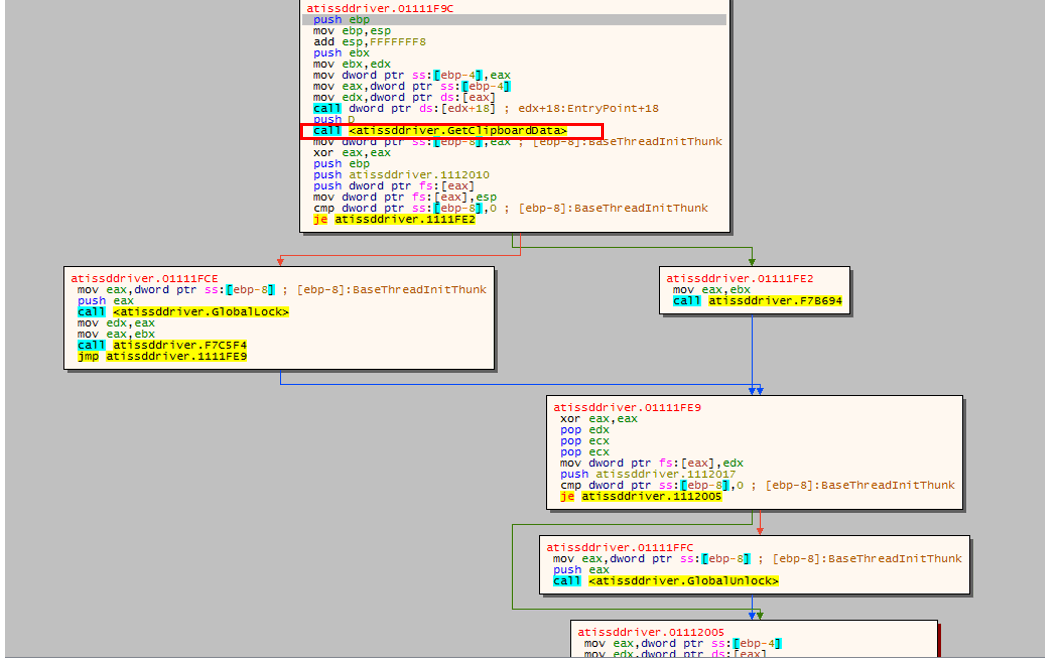
    Grandoreiro also checks for crypto wallets installed on the infected machine. The malware includes a clipboard replacer for crypto wallets, monitoring the user’s clipboard activity and replacing the clipboard data with the threat actor keys.

    Clipboard replacer

    2024 campaigns

    During a certain period of time in February 2024, a few days after the announcement of the arrest of some of the gang’s operators in Brazil, we observed a significant increase in emails detected by spam traps. There was a notable prevalence of Grandoreiro-themed messages masquerading as Mexican CFDI communications. Mexican CFDI, short for “Comprobante Fiscal Digital por Internet” is an electronic invoicing system administered by the Mexican Tax Authority (SAT — Servicio de Administración Tributaria). It facilitates the creation, transmission, and storage of digital tax documents, mandatory for businesses in Mexico to record transactions for tax purposes.

    In our investigation, we have acquired 48 samples associated not only with this instance but also with various other campaigns.

    Notably, this new campaign added a new sandbox detection mechanism, namely a CAPTCHA before the execution of the main payload, as a way to avoid the automatic analysis used by some companies:

    Grandoreiro anti-sandbox CAPTCHA

    It is worth noting that in the 2024 Grandoreiro campaigns, the new sandbox evasion code has been implemented in the downloader. Although the main sample still has anti-sandbox functionality too, if a sandbox is detected, it is simply not downloaded. Besides that, the new version also added detection of many tools to its arsenal, aiming to avoid analysis. Here is whole list of analysis tools detected by the newest versions:

    regmon.exe hopper.exe nessusd.exe OmniPeek.exe
    procmon.exe jd-gui.exe PacketSled.exe netmon.exe
    filemon.exe canvas.exe prtg.exe colasoft.exe
    Wireshark.exe pebrowsepro.exe cain.exe netwitness.exe
    ProcessHacker.exe gdb.exe NetworkAnalyzerPro.exe netscanpro.exe
    PCHunter64.exe scylla.exe OmniPeek.exe packetanalyzer.exe
    PCHunter32.exe volatility.exe netmon.exe packettotal.exe
    JoeTrace.exe cffexplorer.exe colasoft.exe tshark.exe
    ollydbg.exe angr.exe netwitness.exe windump.exe
    ida.exe pestudio.exe netscanpro.exe PRTG Probe.exe
    x64dbg.exe die.exe packetanalyzer.exe NetFlowAnalyzer.exe
    cheatengine.exe ethereal.exe packettotal.exe SWJobEngineWorker2x64.exe
    ollyice.exe Capsa.exe tshark.exe NetPerfMonService.exe
    fiddler.exe tcpdump.exe windump.exe SolarWinds.DataProcessor.exe
    devenv.exe NetworkMiner.exe PRTG Probe.exe ettercap.exe
    radare2.exe smartsniff.exe NetFlowAnalyzer.exe apimonitor.exe
    ghidra.exe snort.exe SWJobEngineWorker2x64.exe apimonitor-x64.exe
    frida.exe pcap.exe NetPerfMonService.exe apimonitor-x32.exe
    binaryninja.exe SolarWinds.NetPerfMon.exe SolarWinds.DataProcessor.exe x32dbg.exe
    cutter.exe nmap.exe ettercap.exe x64dbg.exe
    scylla.exe apimonitor.exe PCHunter64.exe x96dbg.exe
    volatility.exe apimonitor-x64.exe PCHunter32.exe fakenet.exe
    cffexplorer.exe apimonitor-x32.exe JoeTrace.exe hexworkshop.exe
    angr.exe x32dbg.exe ollydbg.exe Dbgview.exe
    pestudio.exe x64dbg.exe ida.exe sysexp.exe
    die.exe x96dbg.exe x64dbg.exe vmtoolsd.exe
    ethereal.exe fakenet.exe cheatengine.exe dotPeek.exe
    Capsa.exe hexworkshop.exe ollyice.exe procexp64.exe
    tcpdump.exe Dbgview.exe fiddler.exe procexp64a.exe
    NetworkMiner.exe sysexp.exe devenv.exe procexp.exe
    smartsniff.exe vmtoolsd.exe radare2.exe cheatengine.exe
    snort.exe dotPeek.exe ghidra.exe ollyice.exe
    pcap.exe procexp64.exe frida.exe pebrowsepro.exe
    cain.exe procexp64a.exe binaryninja.exe gdb.exe
    nmap.exe procexp.exe cutter.exe Wireshark.exe
    nessusd.exe regmon.exe hopper.exe ProcessHacker.exe
    PacketSled.exe procmon.exe jd-gui.exe SolarWinds.NetPerfMon.exe
    prtg.exe filemon.exe canvas.exe NetworkAnalyzerPro.exe

    These are some RAT features that we found in this version:

    • Auto-update feature allows newer versions of the malware to be deployed to the victim’s machine;
    • Sandbox/AV detection, still present in the main module, which includes more tools than previous versions;
    • Keylogger feature;
    • Ability to select country for listing victims;
    • Banking security solutions detection;
    • Checking geolocation information to ensure it runs in the target country;
    • Monitoring Outlook emails for specific keywords;
    • Ability to use Outlook to send spam emails.

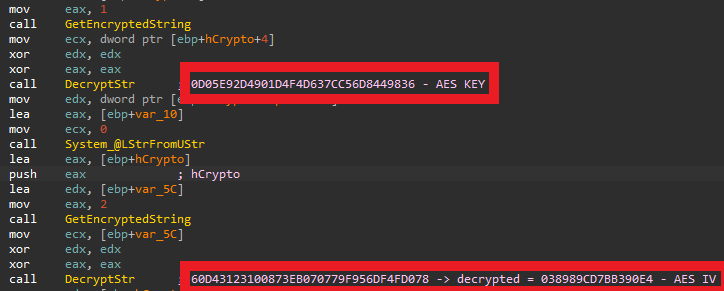
    In terms of static analysis protection, in 2024 versions, Grandoreiro has implemented enhanced encryption measures. Departing from its previous reliance on commonly shared encryption algorithms found in other malware, Grandoreiro has now adopted a multi-layered encryption approach. The decryption process in the newer versions is the following. Initially, the string undergoes deobfuscation through a simple replacement algorithm. Following this, Grandoreiro employs the encryption algorithm based on XOR and conditional subtraction typically utilized by Brazilian malware; however, it differs from them by incorporating a lengthy, 140759-byte string instead of smaller magic strings we saw in 2022 and 2023 samples. Subsequently, the decrypted string undergoes base64 decoding before being subjected to decryption via the AES-256 algorithm. Notably, the AES key and IV are encrypted within Grandoreiro’s code. Upon completion of all these steps, the decrypted string is successfully recovered.

    Grandoreiro AES key and IV

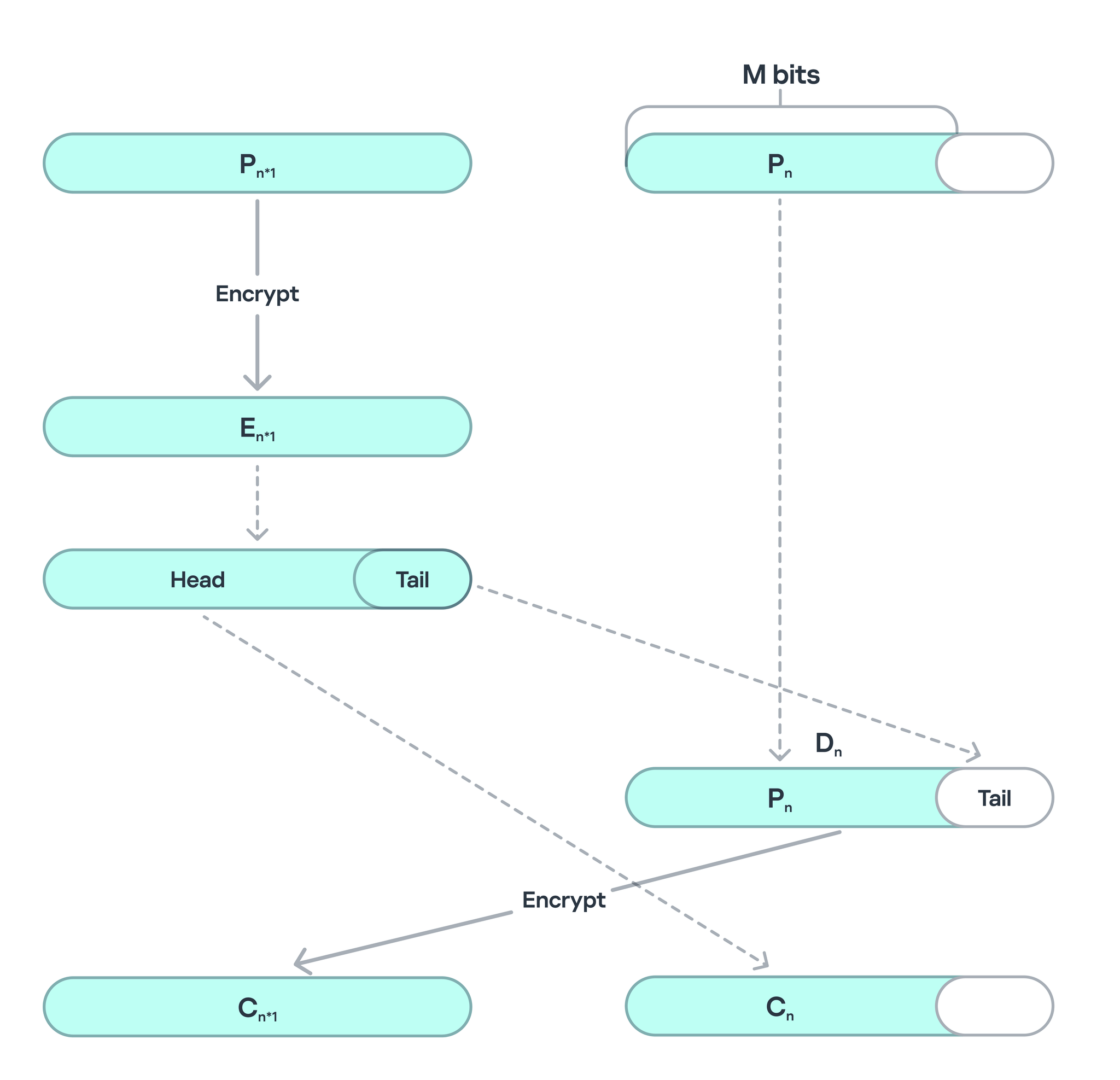
    In newer samples, Grandoreiro upgraded yet again the encryption algorithm using AES with CTS, or Ciphertext Stealing, a specialized encryption mode used when the plaintext is not a multiple of the block size, which in this case is the 128-bit (16-byte) block size used by AES. Unlike more common padding schemes, such as PKCS#7, where the final block is padded with extra bytes to ensure it fits a full block, CTS operates without padding. Instead, it manipulates the final partial block of data by encrypting the last full block and XORing its output with the partial block. This allows encryption of any arbitrary-length input without adding extra padding bytes, preserving the original size of the data.

    ECB Encryption Steps for CTS

    In the case of Grandoreiro, the malware’s encryption routine does not add standard padding to incomplete blocks of data. Their main goal is to complicate analysis: it takes time to figure out that CTS was used, and then more time to implement decryption in this mode, which makes the extraction and obfuscation of strings more complicated. This marks the first time this particular method has been observed in a malware sample.

    As the threat actors continue to evolve their techniques, changing the encryption in every iteration of the malware, the use of CTS in malware may signal a shift toward more advanced encryption practices.

    Local versions: old meets new

    In a recent campaign, our analysis has revealed the existence of an older variant of the malware that utilizes legacy encryption keys, outdated algorithms, and a simplified structure, but which runs in parallel to the campaign using the new code. This variant targets fewer banks — about 30 financial institutions, mainly from Mexico. This analysis clearly indicates that another developer, likely with access to older source code, is conducting new campaigns using the legacy version of the malware.

    How they steal your money

    Operators behind Grandoreiro are equipped with a wide variety of remote commands, including an option to lock the user screen and present a custom image (overlay) to ask the victim for extra information. These are usually OTPs (one-time passwords), transaction passwords or tokens received by SMS, sent by financial institutions.

    A new tactic that we have discovered in the most recent versions found in July 2024 and later suggests that the malware is capturing user input patterns, particularly mouse movements, to bypass machine learning-based security systems. Two specific strings found in the malware — “GRAVAR_POR_5S_VELOCIDADE_MOUSE_CLIENTE_MEDIA” (“Record for 5 seconds the client’s average mouse speed”) and “Medição iniciada, aguarde 5 segundos!” (“Measurement started, please wait 5 seconds!”) — indicate that Grandoreiro is monitoring and recording the user’s mouse activity over a short period. This behavior appears to be an attempt to mimic legitimate user interactions in order to evade detection by anti-fraud systems and security solutions that rely on behavioral analytics. Modern cybersecurity tools, especially those powered by machine learning algorithms, analyze user’s behavior to distinguish between human users and bots or automated malware scripts. By capturing and possibly replaying these natural mouse movement patterns, Grandoreiro could trick these systems into identifying the activity as legitimate, thus bypassing certain security controls.

    This discovery highlights the continuous evolution of malware like Grandoreiro, where attackers are increasingly incorporating tactics designed to counter modern security solutions that rely on behavioral biometrics and machine learning.

    To perform the cash-out in the victim’s account, Grandoreiro operators’ options are to transfer money to the account of local money mules, using transfer apps, buy cryptocurrency or gift cards, or even going to an ATM. Usually, they search for money mules in Telegram channels, paying $200 to $500 USD per day:

    Grandoreiro operator looking for money mules

    Infrastructure

    The newest Grandoreiro version uses 3 Domain Generation Algorithms (DGAs), generating valid domains for command and control (C2) communications. The algorithm uses the current daytime to select strings of predefined lists and concatenates them with a magic key to create the final domain.

    By dynamically generating unique domain names based on various input data, the algorithm complicates traditional domain-based blocking strategies. This adaptability allows the malicious actors to maintain persistent command-and-control communications, even when specific domains are identified and blacklisted, requiring security solutions to base their protection not on a fixed list of domains, but on an algorithm for generating them.

    Since early 2022, Grandoreiro leverages a known Delphi component shared among different malware families named RealThinClient SDK to remotely access victim machines and perform fraudulent actions. This SDK is a flexible and modular framework for building reliable and scalable Windows HTTP/HTTPS applications with Delphi. By using RealThinClient SDK, the program can handle thousands of active connections in an efficient multithreaded manner.

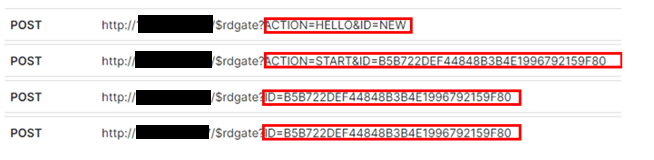
    Grandoreiro C2 Communication

    Operator tool

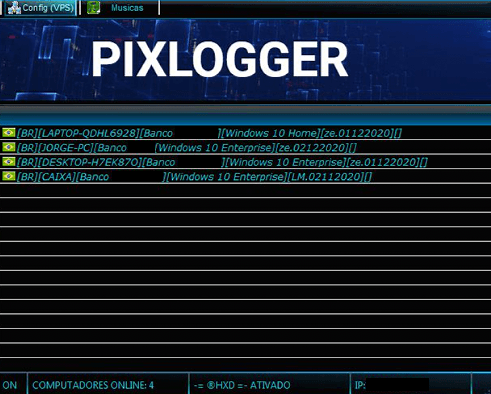
    Grandoreiro’s Operator is the tool that allows the cybercriminal to remotely access and control the victim’s machine. It’s a Delphi-based software that lists its victims whenever they start browsing a targeted financial institution website.

    Grandoreiro’s Operator tool

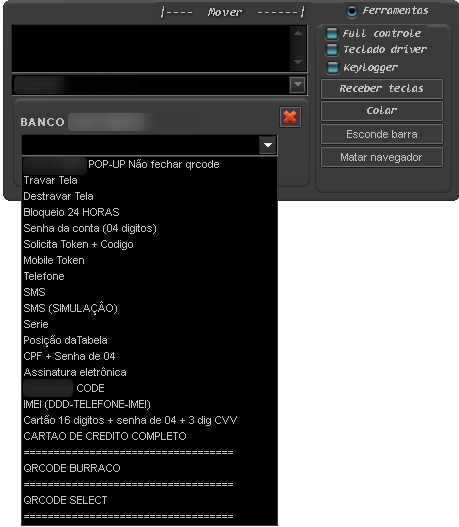
    Once the cybercriminal chooses a victim to operate on, they will be presented with the following screen, seen in the image below, which allows many commands to be executed and visualizes the victim’s desktop.

    Grandoreiro’s Operator commands

    Cloud VPS

    One overlooked feature of the Grandoreiro malware is what is called “Cloud VPS” by the attackers — it allows cybercriminals to set up a gateway computer between the victim’s machine and the malware operator, thus hiding the cybercriminal’s real IP address.

    This is also used by them to make investigation harder, as the first thing noted is the gateway’s IP address. When requesting a seizure, an investigator just finds the gateway module. Meanwhile, the criminal has already set up a new gateway somewhere else and new victims connect to the new one through its DGA.

    Grandoreiro Cloud VPS

    Victims and targets

    The Grandoreiro banking trojan is primed to steal the credentials accounts for 1,700 financial institutions, located in 45 countries and territories. After decrypting the strings of the malware, we can see the targeted banks listed separated by countries/territories. This doesn’t mean that Grandoreiro will target a specific bank from the list; it means it is ready to steal credentials and act, if there is a local partner or money mule who can operationalize and complete the action. The banks targeted by Grandoreiro are located in Algeria, Angola, Antigua and Barbuda, Argentina, Australia, Bahamas, Barbados, Belgium, Belize, Brazil, Canada, Cayman Islands, Chile, Colombia, Costa Rica, Dominican Republic, Ecuador, Ethiopia, France, Ghana, Haiti, Honduras, India, Ivory Coast, Kenya, Malta, Mexico, Mozambique, New Zealand, Nigeria, Panama, Paraguay, Peru, Philippines, Poland, Portugal, South Africa, Spain, Switzerland, Tanzania, Uganda, United Kingdom, Uruguay, USA, and Venezuela. It’s important to note that the list of targeted banks and institutions tend to slightly change from one version to another.

    From January to October 2024, our solutions blocked more than 150,000 infections impacting more than 30,000 users worldwide, a clear sign the group is still very active. According to our telemetry, the countries most affected by Grandoreiro infections are Mexico, Brazil, Spain, and Argentina, among many others.

    Conclusion

    We understand how difficult it is to eradicate a malware family, but it is possible to impede their operation with the cooperation of law enforcement agencies and the private sector — modern financial cybercrime can and must be fought.

    Brazilian banking trojans are already an international threat; they’re filling the gaps left by Eastern European gangs who have migrated into ransomware. We know that in some countries, internet banking is declining on desktops, forcing Grandoreiro to target companies and government entities who are still using operating in that way.

    The threat actors behind the Grandoreiro banking malware are continuously evolving their tactics and malware to successfully carry out attacks against their targets and evade security solutions. Kaspersky continues to cooperate with INTERPOL and other agencies around the world to fight the Grandoreiro threat among internet banking users.

    This threat is detected by Kaspersky products as HEUR:Trojan-Banker.Win32.Grandoreiro, Trojan-Downloader.OLE2.Grandoreiro, Trojan.PDF.Grandoreiro and Trojan-Downloader.Win32.Grandoreiro.

    For more information, please contact: crimewareintel@kaspersky.com

    Indicators of Compromise

    Host based
    f0243296c6988a3bce24f95035ab4885
    dd2ea25752751c8fb44da2b23daf24a4
    555856076fad10b2c0c155161fb9384b
    49355fd0d152862e9c8e3ca3bbc55eb0
    43eec7f0fecf58c71a9446f56def0240
    150de04cb34fdc5fd131e342fe4df638
    b979d79be32d99824ee31a43deccdb18

    MIL OSI Global Banks

  • MIL-OSI USA: Congressman Alford Statement on the Passing of Sergeant Sarah Roque

    Source: United States House of Representatives – Representative Mark Alford (Missouri 4th District)

    RAYMORE, Mo. – Today, U.S. Congressman Mark Alford (MO-04) released the following statement on the passing of Sergeant Sarah Roque.

    “We send our deep condolences to the family, friends, and loved ones of Sergeant Sarah Roque and to the entire Fort Leonard Wood community. Sergeant Roque was a dedicated solider whose patriotic service earned her multiple awards and decorations, including the Army Commendation Medal and the National Defense Service Medal. We mourn with all those affected by this tragedy, and we stand alongside them during this horrible time,” said Congressman Alford.

    On Tuesday, Fort Leonard Wood announced that Sergeant Sarah Roque, 23, had been found deceased. Sergeant Roque, of Ligonier, Indiana, was a bridge crewmember, serving as a Mine Dog Handler with the K9 Detachment, Headquarters and Headquarters Company, 5th Engineer Battalion.

    She enlisted in 2020 and attended Basic Combat Training at Fort Leonard Wood. Sergeant Roque’s awards and decorations include the Army Commendation Medal, National Defense Service Medal, Good Conduct Medal, and the Army Service Ribbon.

    MIL OSI USA News

  • MIL-OSI USA: Ezell and Wicker Announce $1 Million Grant for Gulfport-Biloxi International Airport Infrastructure Improvements

    Source: United States House of Representatives – Congressman Mike Ezell (Mississippi 4th District)

    Today, Congressman Mike Ezell (MS-04) and Senator Roger Wicker (R-MS) announced a $1,000,000 grant to Gulfport-Biloxi International Airport to replace and install a passenger boarding bridge that has reached the end of its useful life. This crucial funding will enhance the airport’s infrastructure, improving both efficiency and safety for travelers.

    “The Gulfport-Biloxi International Airport is a strong partner in the economic vitality of South Mississippi,” Ezell said. “This grant will allow the airport to continue serving South Mississippians and those traveling to our community, ensuring a more efficient and safer travel experience as we enhance the infrastructure that supports our growing community.”

    “When people travel through our airports, whether for travel, leisure, or business, they should have a pleasant experience. This new passenger jet bridge will help ensure this outcome happens in Gulfport,” Senator Wicker said. “Supporting Mississippi’s airport infrastructure will continue to be one of my top priorities as a member of the Senate Commerce, Science, and Transportation Committee.”

    “On behalf of Gulfport-Biloxi International Airport, we greatly appreciate the support of the Congressional delegation in providing funding for infrastructure improvements to enhance the overall flying experience for those traveling to and from South Mississippi,” said Clay Williams, Executive Director, Gulfport-Biloxi International Airport. 

    The Gulfport-Biloxi International Airport is centrally located on the Mississippi Gulf Coast in Gulfport, Mississippi, and is the second largest airport in the state. The airport is approximately two miles from Interstate 10 and the Port of Gulfport, and it welcomes nearly 800,000 travelers each year. This grant will help ensure the airport continues to meet the demands of increasing travel while providing a seamless experience for passengers.

    Background on Ezell’s work on the Transportation and Infrastructure Committee:

    • Ezell has prioritized initiatives that support regional airports, recognizing their role in local economies. His work on the Transportation & Infrastructure Committee has focused on advocating for increased funding for maintenance and improvements at airports like Gulfport-Biloxi.
    • Ezell has been a strong proponent of safety measures in transportation. He believes that investments in airport infrastructure, such as the replacement of outdated boarding bridges, are essential to ensuring safe travel for all passengers.
    • Understanding the importance of timely infrastructure upgrades, Ezell has worked to streamline the processes for federal funding, making it easier for local airports to access the resources they need for essential improvements.
    • Ezell’s efforts on the committee include advocating for infrastructure that stimulates economic growth. By investing in airport upgrades, he is helping to enhance connectivity, attract tourism, and support local businesses.

    ###

    MIL OSI USA News

  • MIL-OSI USA: Hinson Joins Benton County Auditor for Discussion on Election Security

    Source: United States House of Representatives – Congresswoman Ashley Hinson (IA-01)

    Benton County, Iowa – Congresswoman Ashley Hinson (IA-02) was joined by Benton County Auditor and Commissioner of Elections, Hayley Rippel, for a live discussion on election security in Iowa. They covered early and absentee voting as well as Iowa’s election integrity measures that make it easy to vote and hard to cheat.

    Watch the Full Conversation Here

    ###

    MIL OSI USA News

  • MIL-OSI Video: “Secretary Blinken hosts a Department retirement ceremony”

    Source: United States of America – Department of State (video statements)

    “Secretary of State Antony J. Blinken hosts a Department retirement ceremony” on October 4, 2024
    ———-
    Under the leadership of the President and Secretary of State, the U.S. Department of State leads America’s foreign policy through diplomacy, advocacy, and assistance by advancing the interests of the American people, their safety and economic prosperity. On behalf of the American people we promote and demonstrate democratic values and advance a free, peaceful, and prosperous world.

    The Secretary of State, appointed by the President with the advice and consent of the Senate, is the President’s chief foreign affairs adviser. The Secretary carries out the President’s foreign policies through the State Department, which includes the Foreign Service, Civil Service and U.S. Agency for International Development.

    Get updates from the U.S. Department of State at http://www.state.gov and on social media!
    Facebook: https://www.facebook.com/statedept
    Twitter: https://twitter.com/StateDept
    Instagram: https://www.instagram.com/statedept
    Flickr: https://flickr.com/photos/statephotos/

    Subscribe to the State Department Blog: https://www.state.gov/blogs
    Watch on-demand State Department videos: https://video.state.gov/
    Subscribe to The Week at State e-newsletter: http://ow.ly/diiN30ro7Cw

    State Department website: https://www.state.gov/
    Careers website: https://careers.state.gov/
    White House website: https://www.whitehouse.gov/
    Terms of Use: https://state.gov/tou

    #StateDepartment #DepartmentofState #Diplomacy

    https://www.youtube.com/watch?v=fniRt2qMfbo

    MIL OSI Video

  • MIL-OSI USA: Rep. Cammack Announces Plans For Legislation To Create Tax-Free Savings Accounts For First-Time Homebuyers

    Source: United States House of Representatives – Congresswoman Kat Cammack (R-FL-03)

    WASHINGTON, D.C. — Today, Congresswoman Kat Cammack announced plans to introduce legislation to create tax-free savings accounts for individuals and families purchasing their first homes.  

    The NEST (Next-Generation Equity Savings Tool) Act would assist first-time homebuyers in overcoming financial barriers, especially the challenges related to down payments and closing costs. Individuals and families could save money on a pre-tax basis, with no tax upon withdrawal, if the funds are used to purchase a first home.  

    High home prices in many markets have created barriers for first-time buyers, which is why dedicated savings vehicles for home purchases can assist and encourage those seeking to enter the market and stimulate the economy.  

    More information, including bill text, is expected in the coming days. Please visit cammack.house.gov for more details.  

    ###

    MIL OSI USA News

  • MIL-OSI USA: Hickenlooper Hires Patrick Ortiz as San Luis Valley Regional Representative

    US Senate News:

    Source: United States Senator John Hickenlooper – Colorado
    WASHINGTON – Today, U.S. Senator John Hickenlooper announced Patrick Ortiz, formerly the Operations Director for San Luis Valley Great Outdoors, as his Regional Representative for the San Luis Valley.
    “Patrick knows how to bring people together and make sure everyone’s voice is truly heard. His deep understanding of Southern Colorado’s history, culture, and people will make him a strong advocate for San Luis Valley families,” said Hickenlooper. “We couldn’t be more excited to have him on board!”
    “I’ve always admired how Senator Hickenlooper sets politics aside and tackles our state’s problems. He listens to the people, especially in the most rural areas of the state, to make sure our priorities are his priorities. I’m excited to join this great team and represent the residents and communities of the San Luis Valley,” said Ortiz.
    Prior to joining Hickenlooper’s team, Ortiz served as the Operations Director for San Luis Valley Great Outdoors (SLV GO!), a non-profit organization that works to create inclusive outdoor recreation opportunities in the San Luis Valley to connect communities and strengthen the local economy. He is an Adams State University alum.

    MIL OSI USA News

  • MIL-OSI USA: Shaheen, Collins Call on Navy to Reconsider Civilian Workforce Classification Review, Protect Employee Pay and Benefits at Portsmouth Naval Shipyard

    US Senate News:

    Source: United States Senator for New Hampshire Jeanne Shaheen
    (Washington, DC) – U.S. Senators Jeanne Shaheen (D-NH), a senior member of the U.S. Senate Armed Services Committee and Co-Chair of the U.S. Senate Navy Caucus, and Susan Collins (R-ME) sent a bipartisan letter to the U.S. Department of the Navy urging it to reconsider the Office of Civilian Human Resources’ (OCHR) decision to review and modify civilian workforce position classifications across four public shipyards, including Portsmouth Naval Shipyard. In their letter to Secretary Carlos Del Toro and Chief of Naval Operation Admiral Lisa Franchetti, the Senators note that the review could result in civilian employees losing pay and benefits as well as negatively impact efforts to eliminate submarine maintenance backlogs.
    The Senators wrote, in part: “Should OCHR’s review result in position description demotions and salary decreases for a significant population of technical professionals, it would cripple efforts to staff and support the needs of the Navy.  We, therefore, ask for your support in protecting our shipyard employees by reconsidering OCHR’s directive and by engaging with OPM to find a position that both maintains the integrity of the Federal and Department of Navy Classification Programs while protecting the wages and benefits of our valued workforce.”
    They concluded: “Today’s security environment requires the United States to have a combat-credible undersea fleet to maintain a competitive edge over our adversaries.  The overwhelming production capacity of the People’s Republic of China (PRC), Russia’s steady production progress toward fifth generation submarines, and growing cooperation between these authoritarian regimes will create additional demands on the U.S. submarine force.  Meanwhile, the U.S. submarine industrial base continues to face maintenance shortfalls at our four public shipyards that affect the Navy’s ability to get boats back into the fleet on time.  Reducing these maintenance backlogs is contingent on a robust, well-trained shipyard workforce.”
    The full text of the letter can be found here.
    As a co-chair of the U.S. Senate Navy Caucus and a senior member of both the U.S. Senate Appropriations Defense Subcommittee and U.S. Senate Armed Services Committee, Senator Shaheen is New Hampshire’s strongest advocate for the Portsmouth Naval Shipyard and Navy shipbuilding programs. In the Senate-passed Department of Defense Appropriations Act for Fiscal Year (FY) 2025, Shaheen secured funding for the Shipyard Infrastructure Optimization Program (SIOP), including the funding needed to complete dry dock projects at Portsmouth Naval Shipyard. The bill also includes $795 million for the SIOP above the President’s Budget, which will help to increase submarine maintenance availability at Portsmouth and across the country. Shaheen has a long legacy of supporting investments to increase maintenance capacity at Portsmouth Naval Shipyard
    Additionally, In the FY 2025 government funding bills, Shaheen and Collins worked to include a $9.5 million Congressionally Directed Spending add for a new parking structure at the Portsmouth Naval Shipyard—which will contribute to quality of life for Shipyard’s workforce.

    MIL OSI USA News

  • MIL-OSI USA: October 22nd, 2024 Heinrich, Colleagues Release Report on Vote Counting Process for the November Election

    US Senate News:

    Source: United States Senator for New Mexico Martin Heinrich
    Democratic Senators Warn Americans to Be on Alert Against Efforts to Undermine Public Confidence in Election Results
    READ THE REPORT HERE
    WASHINGTON – Today, U.S. Senator Martin Heinrich (D-N.M.), Senate Rules Committee Chair Amy Klobuchar (D-Minn.), Senate Majority Leader Chuck Schumer (D-N.Y.), and U.S. Senators Chris Murphy (D-Conn.), Tammy Duckworth (D-Ill.), and Bernie Sanders (I-Vt.) released a report summarizing for the American people what to expect on Election Day and encouraging voters to cast their ballot.
    With the general election well underway in every state across the country, Senate Democrats have a clear message for the American people, which is to vote and cast their ballot as early as possible. As significant numbers of Americans choose to vote by mail, the report explains why it’s still possible that, in some states, the outcome might not be known on November 5th, in part because states differ in whether they allow mail-in ballots to be processed ahead of Election Day and whether ballots must be received by Election Day or postmarked by Election Day. The report also makes clear that voter intimidation is illegal and federal law prohibits coercing or threatening anyone in order to interfere with their right to vote.
    A copy of the report can be found HERE.  “Former President Trump’s dangerous rhetoric threatens to further divide our country and sow real potential for violence like we saw up close on January 6, 2021. Our elections are the foundation of American democracy. Protecting them should be the top priority for everyone who cares about the future of our country. Election officials, courts, and elected leaders must be accountable for upholding that principle,” said Heinrich.
    “The right to vote is fundamental to our democracy, and we must do everything we can to protect it and uphold the integrity of the election process. That means pushing back on efforts to sow chaos during election season. As this report explains, it also means making sure that Americans know that it is possible that the outcome in some states will not be known on November 5th. While some states have expedited their counting requirements since 2020, we should be prepared to be patient about results in places where counting ballots may take longer. Americans should keep making their voices heard at the ballot box,” said Klobuchar.  “Just like 2020, Donald Trump and his allies continue to refuse to commit to accepting the results of the election if he loses while pushing dangerous and divisive rhetoric to sow discord and undermine confidence in our election process. Americans losing faith in the results of our elections doesn’t just risk another January 6th but puts our very democracy at risk,” said Leader Schumer. “Senate Democrats remain committed to ensuring all Americans can vote without fear or intimidation.”  “As Donald Trump bets on chaos, division, and lies to fuel his campaign and get back into the White House, it’s on us to see through his fearmongering and stand up for our democracy. So vote early, vote by mail, vote in person—but vote. The future of our country depends on us rejecting fear and misinformation and making our voices heard,” said Murphy.  “There is no greater responsibility, or honor, as an American than exercising your right to vote. Our free, fair voting systems and our peaceful transitions of powers are two of the hallmarks that have separated America from authoritarianism for centuries now—and that will carry on far beyond this November, despite Donald Trump’s desperate, sad attempts to sow seeds of chaos and distrust in our electoral processes. The most powerful defense against creeping autocracy in America is to make our voices heard at the ballot box—because carrying out our most sacred duty as citizens is the best way we can ensure remain a government of, by and for the people,” said Duckworth.

    MIL OSI USA News

  • MIL-OSI USA: Casey, Fetterman, Deluzio Secure $87 Million to Build New Manufacturing Facility in Southwestern Pennsylvania, Create Almost 900 Jobs

    US Senate News:

    Source: United States Senator for Pennsylvania Bob Casey
    Mainspring Energy manufactures linear generators that power hospitals, supermarkets, data centers, and more across the Nation
    New plant will expand generator production, enhance American global competitiveness, create 891 jobs in Coraopolis
    Casey, Fetterman, and Deluzio pushed for the Accelerating Linear Generator Production for Mainspring Energy project
    Washington, D.C. – Today, U.S. Senators Bob Casey (D-PA) and John Fetterman (D-PA) and U.S. Congressman Chris Deluzio (D-PA-17) delivered $87,070,493 in federal funding for Mainspring Energy (MSE), a manufacturer of linear generators, to build a new, state-of-the art manufacturing facility that will support new 891 jobs in Coraopolis. Funding comes from the Advanced Energy Manufacturing and Recycling Grants Program, made possible by the Infrastructure Investment and Jobs Act (IIJA).
    “This is a game-changing investment for Coraopolis and Southwestern Pennsylvania. With this funding, Mainstream Energy will create good-paying and high-skilled manufacturing jobs and continue Southwestern Pennsylvania’s legacy as an energy leader on the forefront of cutting-edge technology. Pennsylvania workers are the best in the world and I will keep fighting for good paying manufacturing and construction jobs across our Commonwealth,” said Senator Casey.
    “Western Pennsylvania has always been America’s industrial backbone and the Department of Energy’s investment in Mainspring Energy carries that legacy forward. This move propels us toward a carbon-pollution-free future while keeping our economy strong, competitive, and union-built,” said Senator Fetterman. “As lifelong Pennsylvanians, Senator Casey, Congressman Deluzio, and I understand and honor our state’s proud history of hard work and innovation. We pushed for this investment because it puts Western Pennsylvania back on the map as a leader in cutting-edge manufacturing.”
    “I am thrilled to announce that Coraopolis’ own Mainspring Energy Inc. is receiving more than $87 million in federal dollars to boost its manufacturing of low-carbon generators and create hundreds of full-time and construction jobs in the process,” said Congressman Deluzio. “This is a powerful example of how when we make more stuff here, we can create manufacturing and construction jobs and onshore our supply chains, all while reducing greenhouse gas emissions to help us meet our climate goals. I am proud to support this project and look forward to monitoring its progress and impact on the people and economy in Pennsylvania’s 17th Congressional District.”  
    The funding comes from the U.S. Department of Energy (DOE)’s Advanced Energy Manufacturing and Recycling Grants program, which enables manufacturers build new or retrofit existing manufacturing and industrial facilities in communities where coal mines or coal power plants have closed. Senators Casey and Fetterman and Congressman Deluzio urged DOE secretary Jennifer Granholm to support MSE’s project in June 2024. In their letter, the Members highlighted how the new facility would increase domestic manufacturing, boost American competitiveness in the clean energy sector, generate hundreds of good-paying jobs for Pennsylvanians, and carry on the Commonwealth’s proud legacy as an energy state. 
    Mainspring Energy (MSE), in partnership with construction firm Al. Neyer, will establish a state-of-the-art manufacturing facility in Coraopolis to produce 1,000 linear generators annually that will provide clean and reliable power to critical institutions across the Nation including hospitals, businesses, and data centers. The plant will localize the manufacturing supply chain and enhance American global competitiveness in the clean energy sector. Additionally, the project will create 291 construction-related jobs and 600 operations jobs. 

    MIL OSI USA News

  • MIL-OSI Security: U.S. Attorney Prim F. Escalona Appoints Election Officer for the Northern District of Alabama

    Source: Federal Bureau of Investigation (FBI) State Crime Alerts (b)

    Birmingham, Ala. – United States Attorney Prim F. Escalona announced today that an Assistant U.S. Attorney will serve as the District Election Officer (DEO) and lead the efforts of her Office in connection with the Department of Justice’s nationwide Election Day Program for the upcoming November 5, 2024, general election.   The DEO is responsible for overseeing the District’s handling of election day complaints of voting rights concerns, threats of violence to election officials or staff, and election fraud, in consultation with the Department of Justice’s Headquarters in Washington.

    “Every citizen must be able to vote without interference or discrimination and to have that vote counted in a fair and free election,” said U.S. Attorney Escalona.  Similarly, election officials and staff must be able to serve without being subject to unlawful threats of violence.  The Department of Justice will always work tirelessly to protect the integrity of the election process.”

    The Department of Justice has an important role in deterring and combatting discrimination and intimidation at the polls, threats of violence directed at election officials and poll workers, and election fraud.  The Department will address these violations wherever they occur.  The Department’s longstanding Election Day Program furthers these goals and also seeks to ensure public confidence in the electoral process by providing local points of contact within the Department for the public to report possible federal election law violations.

    Federal law protects against such crimes as threatening violence against election officials or staff, intimidating or bribing voters, buying and selling votes, impersonating voters, altering vote tallies, stuffing ballot boxes, and marking ballots for voters against their wishes or without their input.  It also contains special protections for the rights of voters, and provides that they can vote free from interference, including intimidation, and other acts designed to prevent or discourage people from voting or voting for the candidate of their choice.  The Voting Rights Act protects the right of voters to mark their own ballot or to be assisted by a person of their choice (where voters need assistance because of disability or inability to read or write in English).  

    U.S. Attorney Escalona added, “The franchise is the cornerstone of American democracy.  We all must ensure that those who are entitled to the franchise can exercise it if they choose, and that those who seek to corrupt it are brought to justice.”

    To respond to complaints of voting rights concerns and election fraud during the upcoming election, and to ensure that such complaints are directed to the appropriate authorities, the District’s AUSA/DEO will be on duty in this District while the polls are open.  The DEO can be reached by the public at 205.244.2001.

    In addition, the FBI will have special agents available in each field office and resident agency throughout the country to receive allegations of election fraud and other election abuses on election day.  The local FBI field office can be reached by the public at 205-326-6166.

    Complaints about possible violations of the federal voting rights laws can be made directly to the Civil Rights Division in Washington, DC by complaint form at https://civilrights.justice.gov/ or by phone at 800-253-3931.

    “Ensuring free and fair elections depends in large part on the assistance of the American electorate,” said U.S. Attorney Escalona.  “It is important that those who have specific information about voting rights concerns or election fraud make that information available to the Department of Justice.”

    But please note that in the case of a crime of violence or intimidation, you should call 911 immediately and before contacting federal authorities.  State and local police have primary jurisdiction over polling places, and almost always have faster reaction capacity in an emergency.

    MIL Security OSI

  • MIL-OSI USA: New USGS Data Release featuring Mauna Loa webcam imagery

    Source: US Geological Survey

    The 2022 eruption of Mauna Loa volcano, Island of Hawaiʻi, was the first eruption on the volcano since 1984, producing a 17 km lava flow that threatened a major highway.  The eruption began with lava fountaining in the summit caldera (Mokuʻāweoweo) at 23:21 HST on November 27, transitioning to vents on the Northeast Rift Zone (NERZ) by the next morning.  The dominant vent on the NERZ—fissure 3—was active for about 13 days, sending a lava flow to the north that stalled within 3 km of Daniel K. Inouye Highway.  The eruption ended on December 10, having covered a section of the Mauna Loa Observatory Road but otherwise causing no major damage.

    During the eruption, the U.S. Geological Survey’s Hawaiian Volcano Observatory (HVO) used nearly two dozen field-situated cameras to monitor and document the activity.  Several of these cameras were permanent and had been installed prior to the eruption, while others were deployed in the opening days of the eruption.  We used two main types of cameras.  First, we deployed “timelapse” cameras around the eruption site.  These cameras did not telemeter their images and simply saved the data onto internal SD cards, requiring later retrieval.  Although not effective for real-time monitoring, these cameras are very compact and portable, providing excellent data for later research.  Second, we used several “webcams”, which telemetered their images back to HVO in real time.  One of these webcams was a permanent thermal camera at the summit of Mauna Loa.  Several other webcams were portable cellular trail cameras deployed during the eruption.  The camera deployment built upon responses to recent eruptions at neighboring Kīlauea volcano.

    In this data release, we provide images from the timelapse cameras and webcams used to monitor the 2022 eruption of Mauna Loa.  These data should be valuable for understanding the eruption dynamics and integrating with other monitoring data, such as seismic tremor.   

    New Data Release reference: 

    Patrick, M.R., Zoeller, M.H., Trusdell, F.A., Kamibayashi, K., Swaney, S., Warren, S.M., Tollett, W., Hoomanawanui, T., Dietterich, H., and Desmither, L., 2024, Timelapse and webcam images of the 2022 eruption of Mauna Loa, Island of Hawaiʻi: U.S. Geological Survey data release, https://doi.org/10.5066/P149BRTT.

    MIL OSI USA News

  • MIL-OSI USA: Warren Celebrates 5 New Zero-Emission School Buses for Worcester Public Schools

    US Senate News:

    Source: United States Senator for Massachusetts – Elizabeth Warren

    October 22, 2024

    Warren Celebrates 5 New Zero-Emission School Buses for Worcester Public Schools 

    Boston, MA – U.S. Senator Elizabeth Warren (D-Mass.) celebrated the announcement that the Worcester Public Schools will replace 5 school buses with zero-emission, clean school buses through the U.S. Environmental Protection Agency 2023 Clean School Bus Rebate program. 

    The Clean School Bus Program has awarded funding to replace nearly 9,000 natural gas and diesel buses across the country. Funding for the Clean School Bus Program comes from the Bipartisan Infrastructure Law, which provided $5 billion to transform the country’s fleet of school buses.

    “Our children shouldn’t have to breathe in dangerous exhaust while getting to and from school,” said Senator Warren. “I’ve fought hard for clean energy investments for our Commonwealth. Now, Central Massachusetts’ families will have cleaner air, even more buses that are cheaper to repair and don’t guzzle up gas, and savings for the Worcester Public Schools.” 

    Senator Warren has advocated for federal funding to jumpstart the transition to all-electric public vehicles and rail and to help tackle the climate crisis: 

    • In July 2024, Senators Warren and Markey and Representatives Lynch, Pressley, and Keating announced nearly $60 million in funding for Massachusetts communities to transition to low- or zero-emission buses. This upgrade is improving bus fleets, reducing transit systems’ reliance on fossil fuels, and curbing diesel-related air pollution along major transit corridors for Black, Brown, and low-income communities who are disproportionately harmed by the impacts of the climate crisis.
    • In May 2024, Senator Elizabeth Warren and Congressman Robert Garcia (D-Calif.) reintroduced the BUILD GREEN Infrastructure and Jobs Act, which would authorize the U.S. Department of Transportation to distribute $500 billion over ten years to electrify and modernize public vehicles  and build new electric transportation infrastructure across the country.
    • In January 2024, Senators Elizabeth Warren and Ed Markey (D-Mass.) announced that the Environmental Protection Agency awarded Massachusetts funding for 85 electric school buses under the Clean Bus Grant Program to help school districts replace polluting diesel school buses with electric or low-emission school buses. 
    • In July 2023, Senator Elizabeth Warren sent a letter to the Massachusetts Municipal Association, Massachusetts Association of School Superintendents and 33 Commonwealth municipalities, highlighting the benefits of electrifying the Commonwealth’s school bus fleets and encouraging the Associations and their members to take full advantage of the newly-announced EPA Clean School Bus Grants Program Notice of Funding Opportunity. 
    • In August 2022, Congress passed the Inflation Reduction Act, which included $1 billion for states, municipalities, tribes, and nonprofit school transportation associations to use for clean heavy duty vehicles, like school and transit buses and garbage trucks, all in part funded by Senator Elizabeth Warren’s Corporate Profits Minimum Tax to ensure America’s largest corporations pay at least 15% of their massive profits in federal taxes. 
    • In May 2021, Senator Warren and Congressman Levin (D-Mich.) introduced the Buy Green Act of 2021. First announced in March 2021, the bill would establish $1.5 trillion in federal procurement commitments over the next ten years to purchase American-made clean, renewable, and emission-free energy products for federal, state, and local use. The bill also establishes a grant program for U.S. companies to invest in clean energy manufacturing.
    • In May 2021, in a Senate Finance Committee hearing, Senator Warren made the case for large-scale federal investments in green infrastructure, as well as her Wealth Tax and other tax proposals as a way to pay for these investments. 
    • In April 2021, in a Senate Banking, Housing, and Urban Affairs Committee hearing, Senator Warren made the case for the need to tackle climate change by investing in our nation’s clean energy infrastructure, including the replacement of buses powered by diesel with electric buses. 

    MIL OSI USA News

  • MIL-OSI USA: FEMA is Hiring in Houston and Austin to Help Storm Survivors

    Source: US Federal Emergency Management Agency

    Headline: FEMA is Hiring in Houston and Austin to Help Storm Survivors

    FEMA is Hiring in Houston and Austin to Help Storm Survivors

    AUSTIN — FEMA is hiring local residents to support the recovery of Texans affected by Hurricane Beryl and the storms and flooding this spring. Opportunities are available in Houston and Austin.Positions open in Houston include:Manufactured Housing Specialists Recovery Coordination Group Managers Positions open in Houston and Austin include:Public Assistance Program Delivery ManagersTraining Specialists To apply: USAJobs.gov has a detailed description of open positions at Local Hires-TX. You can apply there online.FEMA jobs are available to local residents who wish to aid in the recovery of their community and help their fellow citizens in the recovery process. A Local Hire’s term of employment is 120 days. Local Hire appointments may be extended, in 120-day increments, based on the needs of the disaster. Some local hires have become permanent employees. FEMA Local Hire employees are eligible for the following benefits:Health insurance for individual or family Flexible spending accountsFederal long-term care insurancePaid sick leave based on hours worked.Holiday payWorker’s compensationApplicants must be U.S. citizens, 18 years of age or older, and must possess a high school diploma or GED. Individuals will be required to pass a background investigation that includes fingerprinting and credit check, be able to provide their own transportation to and from work and live within 50 miles of the employing office. Employees are also required to participate in mandatory direct deposit/electronic funds transfer for salary payment.For more information about Texas disaster recovery, visit: fema.gov/disaster/4798. Follow FEMA Region 6 on social media at x.com/FEMARegion6 and on Facebook at facebook.com/FEMARegion6/.
    alexa.brown
    Tue, 10/22/2024 – 18:30

    MIL OSI USA News

  • MIL-OSI USA: How To Prepare for FEMA Home Inspection in South Carolina After Hurricane Helene

    Source: US Federal Emergency Management Agency

    Headline: How To Prepare for FEMA Home Inspection in South Carolina After Hurricane Helene

    How To Prepare for FEMA Home Inspection in South Carolina After Hurricane Helene

    After South Carolinians apply for FEMA assistance following Hurricane Helene, a home inspection may be needed to verify disaster-caused damage and determine whether the home is safe, sanitary and livable. These inspections are carried out by FEMA-contracted inspectors who will never ask for, or accept, money.Inspectors do not make decisions regarding eligibility for assistance. The information gathered during the inspection is part of several criteria used by FEMA to determine if applicants are eligible for federal assistance. The inspector will consider:The structural soundness of the home, both inside and outside.Whether the electrical, gas, heat, plumbing and sewer/septic systems are all in working order.Whether the home is safe to live in and can be entered and exited safely.Inspectors will make an appointment by phone or text with you before coming and will already have your FEMA application number. They will show photo identification to you. For security reasons, federal identification may not be photographed. If the inspector is unable to reach you, the inspector will leave messages and/or texts on the phone number listed on the FEMA application. These communications may come from unfamiliar phone numbers, and it is important that applicants respond so their application can be processed. Providing an alternate phone number, such as that of a relative or someone who can relay a message, will help ensure the inspector can reach you to schedule the inspection.Get the following documents and information ready for your inspection. You should be ready to:Provide the last four digits of your FEMA application number. Show your photo identification. If you lost your I.D. in the disaster, let the inspector know. FEMA has other ways to verify your identification.Show proof that you owned or occupied the house at the time of the disaster. This could include insurance policy information, tax bill, mortgage statement, rent receipts, and utility bills.Show insurance documents, such as home and/or auto insurance policies.Share a list of household occupants living in the residence at time of the disaster.Discuss disaster-caused damage to both your home and personal property. Collect any photos or videos of the damage.A typical home inspection takes about 45 minutes to complete. After the inspection, you should allow seven to 10 days for processing. If you have questions about the status of your application, you can call the FEMA helpline at 800-621-3362. The telephone line is open every day and help is available in many languages. If you use a relay service, such as Video Relay Service (VRS), captioned telephone or other service, give FEMA your number for that service. For a video with American Sign Language, voiceover and open captions about how to apply for FEMA assistance, select this link.FEMA programs are accessible to survivors with disabilities and others with access and functional needs. 
    kwei.nwaogu
    Tue, 10/22/2024 – 19:15

    MIL OSI USA News

  • MIL-OSI USA: Disaster Recovery Center in Wytheville, Va. Will Open Oct. 23

    Source: US Federal Emergency Management Agency

    Headline: Disaster Recovery Center in Wytheville, Va. Will Open Oct. 23

    Disaster Recovery Center in Wytheville, Va. Will Open Oct. 23

    BRISTOL, Va.– A Disaster Recovery Center (DRC) will be opening in at the Heritage Preservation Center at 115 West Spiller Street in Wytheville, Va. on Wednesday, Oct. 23, 2024, at 8 a.m. Disaster survivors can visit any DRC to receive assistance. This will be the seventh DRC open in the impact area; to find the DRC closest to you, including addresses and hours, visit FEMA.gov/drc or text DRC and a ZIP code to 43362. A Disaster Recovery Center is an accessible facility that survivors can visit in person to learn more about FEMA and other agencies providing disaster assistance in Virginia. Residents, property owners, and business owners can go to a DRC to apply for assistance and obtain resources from other agencies based on their needs. Survivors do not need an appointment at a DRC to receive assistance. The center is located at:Wythe CountyHeritage Preservation Center115 West Spiller StreetWytheville, VA 24382Hours of operation:Monday – Saturday, 8 a.m. to 6 p.m.Closed SundaysSurvivors do not have to visit a DRC to register with FEMA. You can call 800-621-FEMA (3362). The toll-free telephone line operates seven days a week. If you use a relay service, such as video relay service (VRS), captioned telephone service or others, give FEMA the number for that service. You can also register online at DisasterAssistance.gov or through the FEMA App on your phone.The deadline to apply for FEMA disaster assistance is Dec. 2, 2024.If you have received a letter from FEMA about your application status, visit a DRC to learn more about next steps. DRC staff can help you submit additional information or supporting documentation for FEMA to continue to process your application and answer any questions you may have. Learn more about what to expect at a DRC here.FEMA has set up a rumor response webpage to clarify our role in the Helene response. Visit Hurricane Helene: Rumor Response.For more information on Virginia’s disaster recovery, visit vaemergency.gov, the Virginia Department of Emergency Management Facebook page , fema.gov/disaster/4831 and facebook.com/FEMA.  ###FEMA’s mission is helping people before, during and after disasters. FEMA Region 3’s jurisdiction includes Delaware, the District of Columbia, Maryland, Pennsylvania, Virginia and West Virginia. Follow us on X at x.com/FEMAregion3 and on LinkedIn at linkedin.com/company/femaregion3.To apply for FEMA assistance, please call the FEMA Helpline at 1-800-621-3362, visit https://www.disasterassistance.gov/, or download and apply on the FEMA App. If you use a relay service, such as video relay service (VRS), captioned telephone service or others, give FEMA the number for that service. Multilingual operators are available (press 2 for Spanish and 3 for other languages). Disaster recovery assistance is available without regard to race, color, religion, nationality, sex, age, disability, English proficiency, or economic status. 
    erika.osullivan
    Tue, 10/22/2024 – 19:07

    MIL OSI USA News

  • MIL-OSI USA: Temporary FEMA Center Open in Valdosta

    Source: US Federal Emergency Management Agency

    Headline: Temporary FEMA Center Open in Valdosta

    Temporary FEMA Center Open in Valdosta

    ATLANTA – Georgia residents who live in the Valdosta area and are unable to visit one of FEMA’s eight Disaster Recovery Centers throughout the state can apply for assistance in person at a temporary location. This center is only open from Tuesday, October 22 to Saturday, October 26 from 8 a.m. to 5 p.m. at the following address: Temporary FEMA Center2108 E. Hill AvenueBuilding DValdosta, GA, 31601Valdosta homeowners and renters who had home or property damage due to Tropical Storm Debby, damage Aug. 4-22, and/or Hurricane Helene can visit this center to apply for FEMA assistance, update their cases and ask questions. People who require additional services are encouraged to visit the Disaster Recovery Center located at the former Church of the Nazarene at 4344 Forest Street Extension, Valdosta, GA, 31605, which is open Monday to Saturday from 8 a.m. to 7 p.m. and Sundays from 1 p.m. to 6 p.m. until further notice.When visiting a center to apply for FEMA assistance, have the following with you: A current phone number where you can be contacted.Your address at the time of the disaster and the address where you are now staying.Your Social Security number.A general list of damage and losses.Banking information if you choose direct deposit.If insured, the policy number or the agent and/or the company name.If you have homeowners, renters or flood insurance, you should file a claim as soon as possible. FEMA cannot duplicate benefits for losses covered by insurance. If your policy does not cover all your disaster expenses, you may be eligible for federal assistance.While people can apply in person at the center, residents are encouraged to fill out their application online at DisasterAssistance.gov or on the FEMA App, as these are the quickest and most convenient ways. Another way to apply is by calling the FEMA Helpline at 1-8-00-621-3362, which is open every day and help is available in most languages.For the latest information about Georgia’s recovery, visit FEMA’s Hurricane Debby Georgia page or FEMA’s Hurricane Helene Georgia page. Follow FEMA on X at x.com/femaregion4 or on Facebook at facebook.com/fema.
    larissa.hale
    Tue, 10/22/2024 – 19:29

    MIL OSI USA News

  • MIL-OSI USA: Stauber Announces Infrastructure Funding for Duluth International Airport and Pine River Regional Airport

    Source: United States House of Representatives – Congressman Pete Stauber (MN-08)

    Washington, D.C. – Today, Congressman Pete Stauber (MN-08) announced $1,000,000 to help fund the replacement of the existing Air Traffic Control Tower at Duluth International Airport (DLH), which is one of the oldest in the country, and $1,140,000 to replace a general aviation terminal building at the Pine River Regional Airport.

    “I am excited to announce that more federal funding is returning to the Northland. The airports in our communities, no matter their size, contribute greatly to our regional economies. They ensure Minnesotans stay connected and bring tourism and commerce to our front doors. I am excited that Pine River Regional Airport will focus this investment on general aviation, helping inspire the next generation of aviators and keeping our aviation industry strong. Additionally, I am grateful that more investment is going towards replacing the Duluth Air Traffic Control Tower. I have been advocating for this project since 2019 as its replacement is crucial to keeping up with the growing numbers of travelers that the airport serves each year. This project is so important for a brighter aviation future in northern Minnesota, and I know our work is not done. I will continue working with Duluth Airport Authority Executive Tom Werner to secure the full amount of funding necessary.”

    In 2023, Stauber and Senator Klobuchar led the Minnesota delegation in sending a letter to the Federal Aviation Administration requesting that they expedite reviews and approvals required for DLH to apply for grant funding to build a new traffic control tower.

    In 2024, Stauber and Klobuchar also led the Minnesota delegation in a letter to President Biden, requesting that his Administration prioritize funding for the traffic control tower at DLH.

    Earlier this year, Stauber and Klobuchar jointly announced $10 million in funding for the project.

    MIL OSI USA News

  • MIL-OSI Canada: Statement by Minister Sean Fraser on status of Negotiations with Provinces and Territories to Address Encampments

    Source: Government of Canada News

    As much progress as Canada makes to solve the housing crisis, it will not be over as long as there are people living in tents.

    As much progress as Canada makes to solve the housing crisis, it will not be over as long as there are people living in tents.

    On September 18, 2024, I sent a letter to each province and territory asking them to partner with the federal government to urgently find shelter for those experiencing homelessness or living in encampments. In the letter, we offered millions of dollars in additional funding in exchange for partnering with us and matching our contributions.

    The funding on offer is the $250 million we announced to address the urgent issue of encampments and unsheltered homelessness in Budget 2024. This is in addition to federal investments through the:

    • Reaching Home program to prevent and reduce homelessness;
    • Affordable Housing Fund and bilateral agreements under the National Housing Strategy to build affordable and supportive housing;
    • Co-operative Housing Development Program to support growth in the co-op sector;
    • Apartment Construction Loan Program to build more rental homes in the market for middle-class Canadians; and
    • Housing Accelerator Fund to help cities make it easier to build more homes, faster.

    One month has passed since we made the offer. To date, the following provinces have not formally responded to us to help find homes for those in need, and end encampments in their respective jurisdictions:

    • Alberta
    • Ontario
    • Saskatchewan

    While some have since entered election periods, there was ample engagement before the letter was sent, and there is no longer time to wait as the weather gets colder. In these cases – along with any others who do not take quick action  – we are now approaching municipalities directly to work with them, urgently.

    If a province or territory partners with us, they will be able to select the communities that will get funding from us. Should they wish to forego a partnership with us, we will rely on the best available data to inform our decisions.

    We will approach five cities first given their readiness to quickly adopt cost-matched responses. They are: Calgary, Edmonton, Toronto, Regina, and Saskatoon. This list is not exhaustive, as we will be approaching more communities that have demonstrated an ability to quickly respond to encampments.

    No one level of government can tackle the housing crisis, or support those in need, alone. I am disappointed that these provincial governments are not willing to partner with us, as it means we cannot support as many communities as we would have been able to had they come to the table with funding and solutions. But, let me be clear: we will no longer wait for them to muster the political will to act as winter gets closer and lives are put at risk. 

    MIL OSI Canada News

  • MIL-OSI USA News: Statement by Vice President Kamala  Harris on Americans Saving Nearly $1 Billion on Prescription Drugs Thanks to the Inflation Reduction  Act

    Source: The White House

    All Americans should be able to access the health care they need – no matter their income. That is why our Administration fought to lower health care costs with the Inflation Reduction Act, legislation that I was proud to cast the tie-breaking vote on in the Senate. During the first half of this year alone, we now know that nearly 1.5 million people with Medicare have already saved nearly $1 billion because of our law’s cap on out-of-pocket prescription drug costs. 
     
    Additionally, we have been able to cut prescription drug costs, cap the cost of insulin at $35 a month for seniors, and lower premiums for those on Medicare. Our Administration has also reached unprecedented agreements with pharmaceutical companies to lower prices for the first 10 drugs selected for the Medicare price negotiation program – ten of the most widely used and expensive drugs that treat conditions ranging from cancer to diabetes. And there is still much more to come.
     
    I have seen the impact of fighting to protect patients up close. As Attorney General, I held Big Pharma accountable for their deceptive and illegal practices – winning settlements that amounted to more than $7 billion against pharmaceutical companies for their unsafe and unfair tactics. I will never stop fighting for the health, wellbeing, and financial stability of the American people.

    # # #

    MIL OSI USA News

  • MIL-OSI USA News: Remarks by Vice President Harris and Liz Cheney at a Campaign Event | Royal Oak,  MI

    Source: The White House

    Royal Oak Music Theatre
    Royal Oak, Michigan

    4:31 P.M. EDT

    MS. SHRIVER:  Okay.  Here we go.  Sit back.  We’ve got 40 — 40 minutes, and we’re going to move quick.  Okay?

    So, I want this to be like a kitchen table.  Like, just think that we’re sitting around the kitchen table and we’re jamming about all kinds of stuff.  That’s the feeling I want to have at this —

         MS. CHENEY:  This is like a Kennedy family kitchen table.

         MS. SHRIVER:  It — yeah.  (Laughter.)

         MS. CHENEY:  Most people don’t have this many, you know?

         THE VICE PRESIDENT:  That’s good.  That’s good.

    MS. SHRIVER:  That’s right.  It’s raucous.  It’s — it’s hot, but it’s fun.  That’s what it’s going to be like. 

    So, this is — I was saying before both of you walked out, this is historic — so I hope everybody takes this in for a minute — to have a leader of the Republican Party and the vice president of the United States.  (Applause.) 

    So, let me begin with you, Madam Vice President.  Did you ever think in your wildest dreams that you would be running for president alongside Liz Cheney, who would be advocating for you, campaigning for you — a member of a opposing party putting herself on the line for you?

    THE VICE PRESIDENT:  So, let me just start by thanking everyone.  Thank you all for taking time out of your busy lives to be here and have this conversation. 

    And I think we are all here together because we have many things in common.  First and foremost, we love our country.  We love our country.  (Applause.) 

    You know, so, Maria, perhaps not, but — (laughter).

    MS. SHRIVER:  Perhaps.

    THE VICE PRESIDENT: Perhaps not. 

    But let me say this.  So, you mentioned, you know, my background.  So, I started my career as a prosecutor, and most of my career has been spent outside of Washington, D.C., not in Washington, D.C.  And for most of my career, let me just tell you, I never once asked a victim of crime, a witness, “Are you a Democrat, or are you a Republican?”  Never.  It never would have even occurred to me to ask that.  What I did ask everyone: “Are you okay?” 

    And when I think, then, about what is at stake in this election, I think that’s the biggest question.  And it is a moment where, born out of our love of our country, born out of, for me, having taken the oath of office to the Constitution of the United ta- — States at least six times, I believe what is at stake in this election is so fundamental for us as Americans.  And it is about: Do we take seriously the importance of a president who obeys the oath to be loyal to the Constitution of the United States?  Do we prioritize a president of the United States who cares about rule of law, much less the spirit with which they approach this most powerful position? 

    There’s so much about this last era — when I talk about “turn the page,” that’s what I’m referring to, like the last decade — that has been about some powerful forces suggesting that the measure of the strength of a leader is based on who you beat down instead of what I think most of us believe, regardless of your party affiliation, that the real measure of the strength of a leader is based on who you lift up.

    And — (applause) — and so, for that reason, I’m not surprised that Liz Cheney and I are on the same stage 15 days before the election.  (Applause.)  You know?

    MS. SHRIVER:  Okay.  Well, maybe you’re not surprised, but I’m surprised.

    THE VICE PRESIDENT:  (Laughs.)

    MS. SHRIVER:  And I think a lot of people are surprised.  So, I want to know: Are you surprised?  Are you surprised that you’re out here campaigning for a Democrat, campaigning for Kamala Harris, against the party that you’ve been a part of your entire life?

    MS. CHENEY:  You know, what I would say, first of all, is we all know — everyone who watched January 6th knows, you know, what Donald Trump is willing to do.  He lost the election, he tried to overturn it and seize power, and then he sat in his dining room and he watched the attack on television.  He watched it.  People pleaded with him to tell the mob to leave, and he wouldn’t.  And he watched law enforcement officers be brutally beaten.  He watched it. 

    That’s a depravity that, to me and — and, you know, I think to anyone who’s taken the oath of office, makes someone absolutely unfit ever to be president again.

    Now — (applause) — I — I could have just said, you know, I’m going to do everything I can to work against Donald Trump, and there are a lot of Republicans who have said that.

    MS. SHRIVER:  Yes.

    MS. CHENEY:  I have decided — and I am very proud and I’m honored to have made the decision — to endorse Vice President Harris.  (Applause.) 

    And — and I have gotten to spend time with Vice President Harris.  I have had the chance to talk with her about how important it is that we have two strong parties in our country, about the kind of president that I know she’ll be. 

    And I think all of us — it doesn’t matter what party you’re in — we all know this is a good and an honorable and a great nation, and we have to have leaders — you might say, “I’m not going to agree on every issue” — but we have to have leaders who take that seriously.  We have to have leaders who are going to be sincere. 

    And — and as a mother, I want my children to know that there is someone sitting in the Oval Office that they can look up to, someone who can be a role model.  And I’m incredibly proud and I know that Vice President Harris will be that.  (Applause.)

    MS. SHRIVER:  Right.

    THE VICE PRESIDENT:  And — and, Maria, let me just add one thing also, because it bears repeating.  I have seen a lot of Republicans go up to Liz Cheney and thank her.  And they may not be doing it publicly — they may not be doing it publicly, because I think she has shown, to your point, extraordinary courage, especially in this environment, post January 6th, where there’s something — an undercurrent that is violent in terms of the language and the tenor. 

    And for her to show the courage she has shown is extraordinary.  But she’s — I’ve seen Republicans come up to her and — and I — from my vantage point, she’s actually not alone.  (Applause.)

    MS. SHRIVER:  And so, I want to talk about that, because there are a lot of people who are scared.  Scared to vote —

    THE VICE PRESIDENT:  Yeah.

    MS. SHRIVER:  — for you.  Scared about the environment.  Scared to talk about politics. 

    How scary was it for you, personally, to make this decision?  What has been the personal cost for you to do so?

    MS. CHENEY:  It — it was not — it wasn’t scary at all, in terms of making this decision, because when I look at the — the nature of the threat that Donald Trump poses and — and, look, Donald Trump is doing everything he can to try to get people to forget about what he did — what he did on January 6th. 

    And — and when you think about that level of instability, the level of erratic decision-making, the misogyny, that’s not someone that you can entrust with the power of the Oval Office. 

    And so, I — I think that we are facing a — a choice in this election.  It’s not about party; it’s about right and wrong. 

    And — and I certainly have many Republicans who will say to me, “I can’t be public.”  They do worry about a whole range of things —

    MS. SHRIVER:  Right.

    MS. CHENEY:  — including violence.  But — but they’ll do the right thing. 

    And I would just remind people: If you’re at all concerned, you can vote your conscience and not ever have to say a word to anybody.  (Applause.)  And there will be millions of Republicans who do that on November 5th — vote for Vice President Harris.

    MS. SHRIVER:  Yes.

    I — I love that you said you weren’t scared at all, because most people will talk today about “I’m afraid to say anything on social media.”  “I’m afraid to speak in my place of worship.”  “I’m aprai- — afraid to speak where I work.”  “I’m afraid.” 

    How are you not afraid?

    MS. CHENEY:  Well, I think that — that the point you’re making is a really important one.  Think about what’s happened in our country, the level of vicious, vitriolic attack. 

    You know, when — when Donald Trump says that his political opponents are the enemy within and when he contemplates deploying force against them, the response that we all have should not be to be so afraid we don’t act.  It should be: Vote him out.  Defeat him.  Defeat him.  Vote for Vice President Harris.  (Applause.)

    THE VICE PRESIDENT:  And, Maria, I’m going to add to that.

    MS. SHRIVER:  Yeah.

    THE VICE PRESIDENT:  I — I would add to that an additional point, which is — and don’t think it’s a sick sense of humor and relegate it to simply being that.  You know, I’ve said many times, I do believe Donald Trump to be an unserious man, but the consequences of him ever being in the White House again are brutally serious.

    And — and take it from the people who know him best: his former chief of staff when he was president; two former Defense secretaries; his national security advisor; and, of course, his vice president, who have all in one way or another used the word that he is “unfit” to be president again and is dangerous. 

    Listen to the report that — what his former chairman of the Joint Chiefs of Staff, a general, said about him: that he is “fascist to the core.” 

    And these are people who were in his administration, who worked closely with him in the Oval Office and the Situation Room. 

    And so, I would caution us also — you know, because some people find it humorous what he says and — and think it’s just silly.  But understand how brutally serious it is.

    AUDIENCE MEMBER:  Lock him up!

    THE VICE PRESIDENT:  Well, the courts will take care of that.  We’ll take care of November, yes.  (Applause.)  (Laughs.)  We’ll take care of November. 

    But it is brutally serious, because to — to the congresswoman’s point, anyone has — who has openly said, as he has, that he would terminate the Constitution of the United States should never again stand behind the seal of the president of the United States — never again.  (Applause.)

    MS. SHRIVER:  So, Madam Vice President, I wanted to ask you — several people that I talked to in preparation for this — when I asked them, they said, “Well, I — I want to vote for the vice president, but I just don’t feel like I know her.  I don’t know enough about her.  I see the ads, but I don’t have a feel for her.”  What are three things you can tell this audience about you that aren’t in your ads, that people aren’t telling people on the robocalls, that perhaps they just wouldn’t know that might give them a feeling for who you are as a woman?

    THE VICE PRESIDENT:  How much time do we have?  (Laughter.)

    MS. SHRIVER:  We’re at the kitchen table. 

    THE VICE PRESIDENT:  I — I have lived a full life.  (Laughter.)

    I am a wife.  I am a mother.  I am a sister.  I am a godmother.  I love to cook. 

    I started my career as a prosecutor, in large part — there are many reasons but one very fundamental is, when I was young, one of my best friends in high school, I learned, was being molested by her stepfather.  And I told her, when I learned, she had to come live with us.  I talked to my mother about it.  “Of course, she has to come live with us,” and she did.  And I decided I wanted to take on a career and a life that was about protecting the most vulnerable. 

    I served as attorney general of California two terms.  I was the — the top law enforcement officer of the biggest state in the country.  And doing that work, it included prosecuting transnational criminal organizations for the trafficking of guns, drugs, and human beings.  I did the work of taking on the big banks during the foreclosure crisis and delivered $20 billion for homeowners who had been targeted with predatory lending practices.  (Applause.)  I took on the big pharmaceutical companies on behalf of consumers.

    As vice president of the United States, my priorities have been many, including, to your point, the work that you and I have done over the years focusing on women’s health.  One of my priorities is — has been maternal mortality. 

    But I — I have only had one client in my career: the people.  And my belief is that there is great nobility in public service if one understands that they hold the office in the public trust.  It is not about personal power.  It is about what you can do that lifts up the condition of people. 

    And there is so much about how I think about my responsibility, and I am here to ask for your vote — is that I do — I intend to be a president for all Americans, understanding that the vast majority of us have so much more in common than what separates us. 

    And this era that was kind of initiated by Donald Trump has not only been exhausting, it has been harmful to us as a nation.  The notion that a president of the United States would encourage Americans to point fingers at each other, that — that there would be a suggestion that we are a divided country, that — instead of knowing we have so much more in common than what separates us.

    I have, as vice president, met over 150 world leaders: presidents, prime ministers, chancellors, and kings.  My most recent overseas trips as vice president — which were relatively close to, then, the election — our allies have expressed real concern. 

    I’ve shared this before, but, you know, when we walk in a room representing the United States of America, we should walk in that room, especially leaders, chin up, shoulders back, knowing that we have the self-appointed and earned authority to talk about the importance of democracy and rule of law. 

    But the thing about being a role model — it’s all role models who are here — people watch what you do to see if it matches up to what you say.  People around the world are watching this election, I promise you.  And my — one fear I have is I hope and I pray that we, the American people, understand not only what is at stake for us in this election but how much we mean to the rest of the world. 

         There is so much at stake in this election.

         MS. SHRIVER:  Liz Cheney, tell us real quick — I want to get to our first question.  But you’ve been traveling with the vice president.  You’ve been working with her.  You’ve been spending human time with her.  Tell the audience what you see that perhaps, you know, the camera doesn’t get or the ads don’t get so that they can get a sense of her that you have. 

         MS. CHENEY:  Well, I — I think that what I can tell you is that what the vice president is saying about wanting to be a president for all Americans, caring deeply about this country, those are things that — that come across very, very clearly and very directly. 

         And — and, look, I — I’m a conservative.  The very first campaign I ever volunteered in was for President Gerald Ford in 1976, and — and ever since then, I have been voting for Republicans.  I’ve never voted for a Democrat.  And —

         MS. SHRIVER:  Wow.

         MS. CHENEY:  And so, the — the fact that — that I — I believe so strongly that in this election — in this election, we need to elect the person who is the responsible adult — (laughter and applause) — and — and we need —

         And — and there is a lot — both parties do it.  There is a lot of vilification that goes on.

         MS. SHRIVER:  Yeah.

         MS. CHENEY:  And — and I think it’s really important for people to — to think very carefully about the power that we’re going to invest in the president of the United States and what it would mean to — to give that power to Donald Trump. 

         Don’t take my word for who he is.  Listen to him every day.  Look at what he did.  Remember that the people, as the vice president said, who are opposing him are the people who know him best, the people who worked most closely with him. 

         And so, I would just say I — I know that the vice president has had the range of experience, has — as vice president, as senator, as attorney general of California.  She is supremely qualified to be president of the United States.  I think there — there — sometimes there are some men who suggest that she’s not.  But if you look at her qualifications, there’s no question.  And that she’s somebody that I know I can count on who will put the good of this country first, there’s just no question.  (Applause.)

         MS. SHRIVER:  Okay.  I want to go — I want to go over here to Cecelia.  Cecelia Borland, can you stand up?  You have a question.

         Cecelia grew up in Birmingham, Michigan, which was a Republican stronghold as she grew up.  She now lives with her husband.  They’re raising two children in Berkley, Michigan, and she’s here with a question for the vice president.

         Q    Thank you both for coming to Michigan today for this important event.  I’d like to start by saying, personally, thank you, Representative Cheney, for — to you and your father for exemplifying putting country over party.  (Applause.) 

         And, Madam Vice President, I hope you had a wonderful birthday yesterday. 

         THE VICE PRESIDENT:  (Laughter.)  Thank you.  (Applause.)  Thank you.

         Q    From the shootings at Oxford High School to my alma mater, Michigan State University, to an attack at a kid’s splash pad this summer just a few miles away from here, the issue of gun violence hits very close to home for our community. 

         Just yesterday, I learned from our school district that my preschooler will be going through his first active shooter drill.

         THE VICE PRESIDENT:  Yeah.

         Q    As a gun violence survivor and mother of two young children, the issue of gun violence and the safety of my children in their schools and in our community is my top priority.

         Madam Vice President, if you are elected president and there is a Republican majority in Congress, how will you work with them to make impactful and immediate progress around gun violence, especially in our children’s schools?

         THE VICE PRESIDENT:  Right.  Thank you —

         MS. SHRIVER:  Thank you.

         THE VICE PRESIDENT:  — Cecelia.  And thank you and — for your courage to speak up about this.

         So — well, we have done it, actually, in the last four years.  We had a bipartisan group of — of folks in Congress who came together for the Safer Communities Act, which is the first meaningful piece of gun safety legislation in 30 years.  And so, it’s a good step, and it really does tell us that we have a will within the United States Congress to work in a bipartisan way.  And — and then-Congresswoman Cheney was one of those Republicans that actually voted for it. 

         I — this is how I think of the issue.  And it is through the — the lens of many experiences, including act- — I’m so sorry about your kids going through active shooter drills.  It’s — our kids did.  It’s traumatic that our children — you know, growing up, I’ll speak for myself, we had fire drills.  Right?

         Our children are now learning how to keep themselves safe if there’s an active shooter at their school. 

         I did a tour last year of — of colleges — with college-aged kids, so I also did some trade schools.  And I would ask the room — the auditorium would be packed — college-age kids — and I’d ask them, “Raise your hand if at any point between kindergarten and 12th grade you had to endure an active shooter drill.”  Almost every hand went up. 

         Our kids are growing up where they are learning that they may be unsafe in the classroom where they should be absorbing the wonders of the world. 

         One kid said to me, “Yeah” — we were talking about this — and said to me, “Yeah, that’s why I don’t like going to fifth period.”  I said, “Why, sweetheart?  Why don’t you like going to fifth period?”  “Because in that classroom, there’s no closet,” in which to hide. 

         So, we — when we think of this issue, we must also consider the trauma that is the trauma of — the direct trauma for those who have been directly affected by gun violence, including that to our kids who are in schools across our country doing this — not to mention their teachers, who want to teach and not also have to worry about will they be able to physically protect a child from a bullet.

         Here’s how I think about it in terms of the macro point.  We have been pushing, as a country, I think, a false choice that suggests you’re either in favor of the Second Amendment or you want to take everyone’s guns away.  And that’s a false choice. 

         I’m in favor of the Second Amendment.  I have talked about the fact both Tim Walz and I are gun owners.  I also believe we need reasonable gun safety laws, assault weapons bans, red flag laws, universal background checks.  (Applause.)  And — and reports say that the majority of NRA members agree on, for example, universal background checks. 

         What is a universal background check?  It’s just common sense.  Here’s what it is: You just might want to know before someone can buy a lethal weapon whether they’ve been found by a court to be a danger to themselves or others.  You just might want to know.  It’s common sense.  (Applause.)  We need commonsense gun safety laws. 

         And I will continue — I’ve done it throughout my career — work with all of our colleagues across the aisle.  And I know that we can make progress. 

         But this is not — I’m not trying to take anybody’s guns away from them.  But we need reasonable gun safety laws.

         MS. SHRIVER:  Okay.  I want to come back to the issue of public safety in a minute.  But first we want to go to Martin.  Thank you, Cecelia, very much.  Martin Howrylak.  He’s a former Republican member of the Michigan House of Representatives, and he’s here with a question about national security.

         Q    Well, thank both of you for being here this afternoon.  I really appreciate your coming to the state of Michigan to — to be here.  I would like to ask: What can the U.S. do politically, economically, or militarily to deter Russia from continuing its war on the independent nation of Ukraine while simultaneously strengthening our own U.S. security interests?

         THE VICE PRESIDENT:  Thank you, Martin. 

         MS. SHRIVER:  Go ahead.

         THE VICE PRESIDENT:  So, I was actually in Munich at the Munich Security Conference delivering a speech when I first met with President Zelenskyy of Ukraine, and it was just days before Russia invaded. 

         I’ve now met with President Zelenskyy, I think, seven times, because the United States has rightly taken a position as a leader — a global leader on international rules and norms — that we must stand in support of one of the most important international rules and norms, which is the importance of protecting sovereignty and territorial integrity, the importance of standing strong in opposition to the notion that, in this case, Russia would attempt to change borders by force, to invade another nation — a sovereign nation by force. 

         And sadly, there is a huge difference between my opponent and me on this very fundamental issue. 

         Back to the conversation about — there was a time when we used to — there was a phrase that I’ll paraphrase that, basically, politics ends at the — at the sea line, at the — at the — you know, at the — the boundaries of our country, that there are certain things — in particular, the matters of national security — where it’s not about partisanship; it’s about where should America stand in terms of supporting our allies and standing for certain principles.

         I’ll — I’ll give you, as a — as a point of reference for me in terms of how I feel about this, on the partisan issue.  

         I — for the four years that I was in the United States Senate, my favorite committee was the Senate Intelligence Committee.  And I served on that committee, and we would meet in a room that’s called a SCIF.  And it’s — it’s basically a — (laughs) — it’s a very secure room.  No press, with all due respect, is allowed in.  No cameras.  Everyone has to leave their cell phone outside. 

         It’s a bipartisan committee, and we would go in that room and receive classified information from America’s intelligence community, sometimes our military leaders, about hot spots around the world and threats to our national security.  And when we went in that room — and this is why it was my favorite committee — people would take off their suit jacket, roll up their sleeves, have a cup of coffee on the table.  And we weren’t Democrats or Republicans; we were Americans. 

         And that is so important on a number of issues we are discussing this afternoon but, in particular, on national security. 

         My opponent, however, has made it a thing of his to admire dictators and autocrats around the world.  He exchanged love letters with Kim Jong Un.  Remember that?  He has openly praised the president of Russia. 

         Most recently, the report is, in the height of COVID — remember everyone was scrambling to get their hands on COVID tests?  Remember when Americans were dying by the hundreds every day?  And Donald Trump secretly sent COVID tests to the president of Russia for his personal use. 

         He has said — Donald Trump — “I will solve the matter of Ukraine and Russia in a day.”  Read through and understand what he is saying.  He would surrender.  He would have Ukraine surrender its fight against an aggressor violating its sovereignty. 

         If Donald Trump were president, Vladimir Putin will be sitting in Kyiv.  And understand what that would mean for America and our standing around the world. 

         But thankfully, there has been bipartisan support — and to your point of what — where you stand — on this very fundamental issue.  But this is a — this is a very vivid example of what is at stake in this election.  Because Donald Trump has been very clear: He would give away the shop.  He has been manipulated and is so clearly able to be manipulated by favor and flattery, including from dictators and autocrats around the world. 

         And America knows that that is not how we stand.  That is not how we fight.  We fight in favor of our strength and our role as a leader in bringing the Allies together and standing for foundational and fundamental principles.

         MS. SHRIVER:  Congressman Cheney — (applause) — I know, kind of, the issue of national security is one of the big reasons you’re here and supporting the vice president.  Can you expand on that answer and add your thoughts to it?

         MS. CHENEY:  Yeah.  You know, I think that if — if you look at where the Republican Party is today, there’s been a really dangerous embrace of isolationism, a dangerous embrace of tyrants. 

         The president, you know, even just today, he heaps praise on the world’s most evil people while he attacks, you know, with venom, his political opponents here at home. 

         And, you know, the — the reality is that since the end of World War II, America has led.  And we’ve led — and that has been necessary to defend our freedom.  And we can’t do it by ourselves, though.  We need our allies. 

         And when Donald Trump says that he’s going to withdraw from NATO, when he invites Vladimir Putin to invade NATO, when he suggests that it is Zelenskyy’s fault that Ukraine was invaded, I mean that is — that i- —

         For anybody who is a Republican who is thinking that, you know, they might vote for Donald Trump because of national security policy, I ask you, please, please study his national security policy.  Not only is it not Republican, it’s dangerous.  And without allies, America will find our very freedom and security challenged and threatened. 

         And one final point on this: Don’t think that Congress can stop him. 

         THE VICE PRESIDENT:  Yeah.

         MS. CHENEY:  People say, “Well, you know what, he can’t really do the worst, you know, because Congress will step in.”  All he has to do is what he’s doing — is say, “I won’t fulfill our NATO treaty obligations,” and — and NATO begins to unravel. 

         So, it is — it is an incredibly dangerous thing to think about a foreign policy, a national security policy led by somebody who is — is as unstable as Donald Trump is.  And it’s a risk we just simply can’t take as a nation. 

         MS. SHRIVER:  Thank you.

         THE VICE PRESIDENT:  And I’m going to add for emphasis that — let’s also be clear about on the subject, specifically of Ukraine, Donald Trump’s approach would be to surrender.  Understand what that would mean.  That is signaling to the president of Russia he can get away with what he has done. 

    Understand — look at the map — Poland would be next.  NATO, our Allies, are — the reason that they have been so thankful for the position of strength we have taken in bringing the Allies together is because they are fully aware of and remember — to the congresswoman’s point — World War II.  Remember, this — this concept of isolation — we were once there as a nation, and then Pearl Harbor happened. 

    Let’s remember recent history.  Europe remembers it well.  We — then when we got attacked, Pearl Harbor, we jumped in, and it is because America jumped in that we were ultimately able to win that war, and it should be a constant reminder to us — we have to remember history — that isolationism, which is exactly what Donald Trump is pushing — pull out of NATO, abandon our friends — isolationism is not insulation.  It is not insulation.  It will not insulate us from harm in terms of our national security. 

    So, I say that to emphasize a point that the congresswoman made, and the other point I’d make is also check out where he’s been on how he thinks about America’s military and service members.  One of the great, great American heroes, a prisoner of war, John McCain.  Remember how he talked about John McCain?  He said he didn’t like him because he got caught. 

    You look — he’s called members of our military “suckers” and “losers.”  And then look at how some of the highest-ranking members of our military, including what I mentioned earlier, the chairman — the former chairman of the Joint Chiefs of Staff, a dedicated member, leader in our mil- — in America’s military, how he has assessed Donald Trump — fascism “to his core.”

    So, there we are.

    MS. SHRIVER:  There are your talking points for the kitchen table.  (Applause.)

    Our final question is from Courtney.  Courtney, can you stand?  Courtney is — Courtney Gabbara Agrusa is a wife, a mom, an attorney, and she’s a proud Chaldean, and she is here with a question.  Courtney.

    Q    Thank you so much.  Good evening, Madam Vice President Harris and Representative Cheney.  My name is Courtney Gabbara Agrusa, and I am a first-generation Chaldean American.  Chaldeans are Indigenous Iraqis who are Catholic, and we are predominantly in the metro Detroit area.  Chaldeans are a very close-knit community, but the recent political climate has really begun to divide us. 

    THE VICE PRESIDENT:  Yeah.

    Q    While I know that you have discussed several bipartisan proposals over the course of your campaign, what would you say to people like myself who are part of these traditionally conservative communities who want to move forward, but are feeling the pref- — the pressures of the political divide?

    THE VICE PRESIDENT:  Thank you.  And I’ve actually met with — with members and leaders in the Chaldean community, and thank you for being here. 

    You know, I think that there is something at stake that is about core values, as well as what is at stake in terms of the risk and the danger.  And I would offer you an example of what I think would be an important issue that would affect the Chaldean community and all Americans, for example, the issue of — of how we think about health care in America. 

    So, I know enough about the culture and to know that it is reflective of who we are as Americans in general.  We respect our elders; we take care of them.  So, I will share with you a specific proposal that is an extension of how I think about things. 

    I — actually a personal story, I took care of my mother when she was sick.  And for anyone taking care of or who has taken care of an elder relative, you know what that is.  It’s about trying to cook something they feel like eating.  It is trying to find clothes that don’t irritate their skin or help them put on a sweater.  It’s about trying to figure out something you can say that will bring a smile to their face or make them laugh.  It’s about dignity. 

    And we now have, in particular in our country, a lot of people doing that and also raising young kids.  We call them the sandwich generation, right in the middle.  It’s a lot.  And the way the system currently works — well, God willing, you may have enough resources, you can hire somebody to come in and help. 

    If not, you may have to spend down all of your savings to be able to qualify for Medicaid or you may have to quit your job to be able to do what you need to do to take care of your children and take care of your relative — your older relative.  That’s just not right, and it’s not fair. 

    So, part of my proposal and the plan is that we’re going to now reconfigure so that Medicare covers home health care for our seniors, right?  It’s about dignity.  (Applause.)

    So, in addition to everything that we’ve discussed already about national security, what is at stake — something like this, because I absolutely do believe America is ready for a new generation of leadership that is taking on issues clear-eyed about what is going on that affects everybody — it doesn’t matter their political party; issues that are fundamentally about dignity, also about economic issues; and taking it on in a way that we relieve the American people of the burdens that get in the way of productivity and a certain quality of life.  And this is one example of that. 

    I believe we need to have an economy that I call an opportunity economy, where everyone has the opportunity to thrive — not just get by but get ahead. 

    And this is one example I would offer under the broader point, which is about, let’s move forward, taking on problems from a commonsense approach that is about just practical work. 

    Look, I am a capitalist.  I am a pragmatic capitalist.  I will work as I have with the private sector.  I believe we have to invest in America’s economy and in America’s industry and America’s entrepreneurs, and we can, at the same time, take care of those that are the most in need of just a little support to be able to not just get by but get ahead.

    MS. SHRIVER:  Thank you, Courtney. 

    Liz, I just want to — we have two minutes left — (applause) — and when you hear the phrase a “new way forward,” when you hear “country over party,” what does that mean to you? 

    We’re two weeks out, what does a new way forward mean for families like everybody here, for your children, my children, everybody’s children, young men?

    MS. CHENEY:  Yeah, I —

    MS. SHRIVER:  What is it like?

    MS. CHENEY:  I think that, you know, we’re — we’re at a moment now where, when you think about America and — and the beacon of hope that we have been for so many years for so many communities, also how tremendously enriched we have been by communities — immigrants who want to come here and build a life, all of that depends upon fundamentally defending the rule of law, fundamentally defending our Constitution.  That’s — that’s what makes all of our opportunity and our freedom possible.

    And — and at the same time that we’re that beacon for the world, you know, it’s also because — because we’re a good nation —

    THE VICE PRESIDENT:  Yeah.

    MS. CHENEY:  — and because you know when — when you — when you look at who our leader is going to be, what — what Donald Trump represents is — is, in many ways, just cruel and — and not — not the kind of dignity and — and the kind of person that we all want to be able to look up to. 

    But — but what I would say is that if people are uncertain, if people are thinking, “Well, you know, I’m a conservative, I don’t know that I can support Vice President Harris,” I would say I don’t know if anybody is more conservative than I am.  (Laughter.)  And — and I understand the most conservative value there is is to defend the Constitution.  And if we don’t come together to do that then — (applause) —

    And so, just to — to finish that, I would say, to me, a new way forward is this: It’s what you’re seeing up here.  It’s having a president who will listen, having a president who will say, “I’m not, you know, necessarily sure I agree with you on this issue or that issue, but let’s talk about it.”

    THE VICE PRESIDENT:  Yeah.

    MS. CHENEY:  “Why do you want, you know, that policy?  Why do you believe that?”  Someone who is willing to honor and respect all perspectives and points of views.  And there’s only one candidate in this race who does that, and that’s Vice President Harris.  (Applause.)

    MS. SHRIVER:  In fact, a lot of polling of undecided voters who call themselves “the exhausted majority” said, I just want leaders who listen —

    THE VICE PRESIDENT:  Yeah.

    MS. SHRIVER:  — to one another.  I just want leaders who speak respectfully to one another.  I want to see decency.  I want to see people I can look up to.  And, unfortunately, that’s considered a new way forward as the — as Representative Cheney —

    MS. CHENEY:  Yeah, let’s do that.  Let’s do that. 

    MS. SHRIVER:  Yeah, let’s do that.

    MS. CHENEY:  Yeah, let’s do that. 

    MS. SHRIVER:  Let’s make that a way forward. 

    The final word, Madam Vice President.  You know, everybody I talked to says, you know, “I have to turn off the news.  I can’t read anything.  I’m meditating.  I’m doing yoga.  I’m doing — I’m so anxious.  I just don’t even know.  I’m eating gummies.”  All kinds of things, you know?  (Laughter.) 

    What are you doing?  What are you doing —

    THE VICE PRESIDENT:  Not eating gummies.  (Laughter and applause.)

    MS. SHRIVER:  Okay, we got that clear.  But how do you — I mean, how do you handle this — the anxiety, the stress, the turmoil?  Everybody is freaked out.  I — I talked to the gentleman up there, and he’s like, “I’m so scared.” 

    THE VICE PRESIDENT:  Yeah.

    MS. SHRIVER:  A woman was like, “I’m so anxious.  I can’t sleep.”  Do you sleep?

    THE VICE PRESIDENT:  You know, I wake up in the middle of the night usually these days, to be honest with you, but I work out every morning.  I — I think that’s really important to just kind of — you know, mind, body, and spirit. 

    But let me — let me just say this —

    MS. SHRIVER:  No, say more about that.

    THE VICE PRESIDENT:  — we — but I —

    MS. SHRIVER:  Say more.

    THE VICE PRESIDENT:  — but — I will.  I work out.  I try to eat well.  You know, I love my family, and I make sure that I talk to the kids and my husband every day.  We’ve been — Doug and I’ve been kind of tr- — you know, traveling.  We’re trying to cover a lot of ground, so we’re not with each other every day these days, but my family grounds me in every way. 

    But let me, if I can just speak to the — what people are feeling.  You — we cannot despair.  We cannot despair.  You know, the nature of a democracy is such that I think there’s a duality. 

    On the one hand, there’s an incredible strength when our democracy is intact, an incredible strength in what it does to protect the freedoms and rights of its people.  Oh, there’s great strength in that.  And it is very fragile.  It is only as strong as our willingness to fight for it.  And so, that’s the moment we’re in. 

    And I say, do not despair, because in a democracy, as long as we can keep it — in our democracy, the people, every individual has the power to make a decision about what this will be, and that’s — and so let’s not feel powerless.  Let’s not let the som- — and I get it — overwhelming nature of this all make us feel powerless, because then we have been defeated, and that’s not our character as the American people. 

    We are not one to be defeated.  We rise to a moment, and we stand on broad shoulders of people who have fought this fight before for our country.  And in many ways, let us look at the challenge then that we are being presented and not be overwhelmed by it.  The baton is now in our hands to fight for — not against, but for — this country we love. 

    That’s what we have the power to do.  So, let’s own that — dare I say, be joyful in what we will do in the process of owning that, which is knowing that we can and will build community and coalitions and remind people that we’re all in this together.  Let’s not let the overwhelming nature of this strip us of our strength. 

    That’s how I feel about this.  (Applause.)  You know, that’s how I feel about this.  You know?  Yeah.  

    MS. SHRIVER:  So, I want to — I want to thank everybody here.  You heard from the vice president, from Congresswoman Cheney, do not despair.  I think you got a great glimpse into who this woman is, who this woman is, what brings them together, why they’re here, why they want to earn your vote, why they wanted to speak with you today. 

    And I want to leave you with this quote from Ralph Waldo Emerson that I think speaks to this moment.  It says,

    “Whatever course you decide upon, there is always someone to tell you that you’re wrong.  There are always difficulties arising which tempt you to believe that your critics are right.  To map out a course of action and follow it to the end requires great courage.” 

    So, I leave you with that.  All of you are courageous people.  Do not despair. 

    Thank you so much for spending your time.  Brava.  (Applause.)

                                 END                5:18 P.M. EDT

    MIL OSI USA News

  • MIL-OSI USA: PHOTOS: Capito Speaks at WV Broadband Summit, Tours CMI2 Facility

    US Senate News:

    Source: United States Senator for West Virginia Shelley Moore Capito

    CHARLESTON, W.Va. – Today, U.S. Senator Shelley Moore Capito (R-W.Va.), traveled to Kanawha and Clay counties where she participated in two events focused on broadband, military readiness, and economic development.

    First, Senator Capito delivered remarks at the 2024 West Virginia Broadband Summit in Charleston, W.Va. Senator Capito has long been a leader in expanding West Virginia broadband access through her Capito Connect plan.

    “Broadband is key to a modern economy. It impacts students and schools, patients and hospitals, employers and businesses looking to expand, and many more,” Senator Capito said. “I’ve always said that connecting our state will require an all-hands-on-deck approach, with collaboration from the federal, state, and local levels, and that’s what we are accomplishing together at this summit.”

    Later, Senator Capito, a member of the Senate Appropriations Subcommittee on Defense (SAC-D), traveled to Lizemores, W.Va. to tour the Civil-Military Innovation Institute’s (CMI2) Adaptive Experimentation Facility (AEF). The AEF in Clay County offers a challenging and combat-realistic facility for military units seeking a multi-domain environment for research and development of innovative military technology.

    “It was great to meet with leaders at CMI2 and tour the progress they have made at their Adaptive Experimentation Facility, which has the potential to support innovation and readiness for our military. This facility will make our state a key destination for military experimentation and development, and I look forward to continue supporting them in their mission through my leadership on the Senate Appropriations Subcommittee on Defense,” Senator Capito said.

    “Senator Capito has had a significant role in making this one-of-a-kind technology experimentation facility in West Virginia become a reality,” said Dr. Zenovy Wowczuk, founder of CMI2. “Ultimately, this facility will benefit Soldiers, small businesses, and individuals developing national security and commercial technologies that will have a direct impact on our military readiness and protecting our domestic borders. The AEF will also be a major economic engine for Clay/Nicholas Counties and the entire State of West Virginia.”

    Photos from today’s events are below:

    U.S. Senator Shelley Moore Capito (R-W.Va.) delivers remarks at the 2024 West Virginia Broadband Summit in Charleston, W.Va. on Tuesday, October 22, 2024.

    U.S. Senator Shelley Moore Capito (R-W.Va.) pictured with Mitch Carmichael, former West Virginia Secretary of Economic Development (center), and Kelly Workman, Director of the West Virginia Office of Broadband (right), at the 2024 West Virginia Broadband Summit in Charleston, W.Va. on Tuesday, October 22, 2024.

    U.S. Senator Shelley Moore Capito (R-W.Va.) visits the Civil-Military Innovation Institute’s (CMI2) Adaptive Experimentation Facility (AEF) in Lizemores, W.Va. on Tuesday, October 22, 2024.

    U.S. Senator Shelley Moore Capito (R-W.Va.) tours the Civil-Military Innovation Institute’s (CMI2) Adaptive Experimentation Facility (AEF) in Lizemores, W.Va. on Tuesday, October 22, 2024.

    MIL OSI USA News

  • MIL-OSI USA: Van Hollen, Cardin, Ivey Highlight $1.15 Million in Direct Federal Investments for Youth Services and Restoration Projects in Prince George’s County

    Source: United States House of Representatives – Congressman Glenn Ivey – Maryland (4th District)

    Recently, U.S. Senators Chris Van Hollen and Ben Cardin and Congressman Glenn Ivey (all D-Md.) were in Prince George’s County to highlight $1,150,000 in direct federal investments they secured for youth services and environmental restoration projects in the community. The lawmakers fought for these investments in the federal funding bills passed and signed into law for Fiscal Year 2024.

    “We fought for these direct investments in Prince George’s County with key goals in mind: building stronger communities and empowering our future leaders. Funding for the Laurel Boys & Girls Clubs will enable them to maintain safe spaces for after-school activities, and resources for restoring the Laurel Dam ruins will preserve the historic landmark that this City was built around while enhancing outdoor recreational opportunities. These are investments in the preservation of our local history and the wellbeing of Marylanders today and for generations to come,” said Senator Van Hollen.

    “The dam ruins at Laurel’s Riverfront Park and the Laurel Boys and Girls Club are at the heart of the community and tell the city’s origin story. These are stories that need to be told,” said Senator Cardin. “Investment in these historic places preserves our history and culture while creating economic and educational opportunities for Laurel’s residents,” said Senator Cardin.

    “Investing in our communities begins with raising the quality of life for residents.  Creating a beautiful, safe and environmentally friendly park space in the ruins of a dam along the Patuxent River gives people of Laurel and beyond a look into it’s storied history as a mill town and its future with the walkable Riverfront Park.  Keeping kids safe and promoting their wellbeing is a down payment on our leaders of tomorrow.  Keeping one of the oldest boys and girls clubs in the region thriving gives a glimpse of that future.  With the leadership of Maryland’s federal delegation bringing these grant monies, Laurel’s future is as bright as ever,” said Congressman Glenn Ivey (MD-04). 

    Senators Van Hollen, Senator Cardin and Congressman Ivey were joined by Laurel Council President James Kole to celebrate $850,000 in direct federal funding they secured to stabilize, protect, and restore the Dam Ruins at the City’s Riverfront Park. The project involves renovating the observation deck, improving drainage to control erosion, and repairing signage around the dam.

    “I am thankful and  thrilled to receive this funding, which will help us preserve and enhance the Laurel Dam Ruins, an important piece of our town’s history. This investment ensures that future generations can appreciate its significance while improving safety and access for our community. Our goal is to make the Ruins a destination place  for all to enjoy,” said City of Laurel Mayor Keith Sydnor.

    The lawmakers then visited the Boys and Girls Club of Laurel to highlight $300,000 for renovations at the clubhouse. The funds will allow the Boys and Girls Club to continue providing after-school activities and a positive, safe learning environment for middle and high school students.

    “We are so thankful for the continued support and leadership by Senator Van Hollen, Senator Cardin, and Congressman Ivey. This federal funding will enable us to make some of the critical renovations to our center and continue providing the care and services that impact the lives of our community’s children every day,” said Adrian Rousseau, President of the Laurel Boys and Girls Club.


    ###


    MIL OSI USA News

  • MIL-OSI Video: Department of State Daily Press Briefing – October 22, 2024

    Source: United States of America – Department of State (video statements)

    Department Press Briefing with Principal Deputy Spokesperson Vedant Patel, at the Department of State, on October 22, 2024.

    ———–
    Under the leadership of the President and Secretary of State, the U.S. Department of State leads America’s foreign policy through diplomacy, advocacy, and assistance by advancing the interests of the American people, their safety and economic prosperity. On behalf of the American people we promote and demonstrate democratic values and advance a free, peaceful, and prosperous world.

    The Secretary of State, appointed by the President with the advice and consent of the Senate, is the President’s chief foreign affairs adviser. The Secretary carries out the President’s foreign policies through the State Department, which includes the Foreign Service, Civil Service and U.S. Agency for International Development.

    Get updates from the U.S. Department of State at http://www.state.gov and on social media!
    Facebook: https://www.facebook.com/statedept
    Twitter: https://twitter.com/StateDept
    Instagram: https://www.instagram.com/statedept
    Flickr: https://flickr.com/photos/statephotos/

    Subscribe to the State Department Blog: https://www.state.gov/blogs
    Watch on-demand State Department videos: https://video.state.gov/
    Subscribe to The Week at State e-newsletter: http://ow.ly/diiN30ro7Cw

    State Department website: https://www.state.gov/
    Careers website: https://careers.state.gov/
    White House website: https://www.whitehouse.gov/

    #StateDepartment #DepartmentofState #Diplomacy

    https://www.youtube.com/watch?v=aj3RYKd5aKs

    MIL OSI Video

  • MIL-OSI USA: U.S. Department of Homeland Security Recognizes 325 Employees at Secretary’s Award Ceremony in Washington D.C.

    Source: US Federal Emergency Management Agency

    Headline: U.S. Department of Homeland Security Recognizes 325 Employees at Secretary’s Award Ceremony in Washington D.C.

    ASHINGTON – On October 22, the U.S. Department of Homeland Security (DHS) held an awards ceremony hosted at DHS headquarters located at St. Elizabeths campus in Southeast Washington, D.C. where 325 employees received a Secretary’s Award in recognition of their outstanding contributions to the Department’s mission. “Every single day, with great determination, integrity, and skill, the 268,000 men and women of the Department of Homeland Security ensure the safety and security of the American people,” said Secretary of Homeland Security Alejandro N. Mayorkas. “Thanks to these extraordinary public servants, our shores, harbors, skies, cyberspace, and borders are protected; fentanyl and other deadly drugs are prevented from entering our country; communities are able to recover and rebuild after a natural disaster; the scourges of human trafficking, forced labor, and online exploitation are mitigated; and so much more. The individuals we recognize today with our Department’s highest honor, the Secretary’s Award, reflect the very best of DHS – and in their selfless dedication to mission, the very best of public service.”The DHS Secretary’s Awards are an annual program that recognizes the extraordinary individual and collective achievements of the workforce. The 325 awardees recognized in today’s ceremony represent the U.S. Customs and Border Protection (CBP), the Cybersecurity and Infrastructure Security Agency (CISA), the DHS Office of Strategy, Policy, and Plans, the DHS Privacy Office, and the U.S. Coast Guard (USCG). “In recognizing these outstanding DHS personnel with a Secretary’s Award, we recognize all our talented personnel; the achievements of one are not possible without the contributions of others,” added Secretary Mayorkas. “We also express our appreciation to their families and loved ones; when one serves, the family serves too.”This year’s award recipients developed and issued policy and procedures associated with a whole-scale transition to a new pay system for TSA; launched a series of coordinated and collaborative initiatives, operations and investigations targeting Transnational Criminal Organizations (TCOs) and national security threats operating and transiting through the Darien Gap region; arrested over 8,000 human smugglers, produced over 5,000 intelligence reports, and seized over $38M USD in real property; ensured over 2,300 vital alerts and warnings were provided to owners and operators of critical infrastructure to protect against cyberattacks; among many other achievements. This year, DHS is holding nine Secretary’s Awards ceremonies across the country, honoring over 1,700 employees, the most annual awardees ever. Last year, Secretary Mayorkas unveiled 12 priorities for the Department, including a commitment to champion the workforce and transform the employee experience. DHS has the third largest workforce of any federal department, behind the Department of Defense and Department of Veterans Affairs. The Department is home to more than 92,000 sworn law enforcement officers, the greatest number of law enforcement officers of any department in the federal government. DHS has committed to increasing the representation of women in law enforcement or related occupations at DHS to 30% by 2030. Over 54,000 veterans, or nearly 21% of the workforce, continue serving their country by working at DHS. DHS operational components interact more frequently on a daily basis with the American public than any other federal department, from travelers moving through air, land, and sea ports of entry, to businesses importing goods into the country, to immigrants applying for services. To learn more about the impact DHS makes every day, visit: DHS.gov/TodayDHSWill.Last year, DHS improved the efficiency of processing noncitizens at the Southwest Border, deployed across the country to respond to natural disasters, investigated cybercrimes, created a new streamlined process for adjudicating asylum applications, safely and securely resettled nearly 90,000 evacuated Afghans in the United States, provided resources for organizations to enhance their cybersecurity resilience, established a process for Ukrainian nationals seeking refuge, secured the 2022 midterm elections, and demonstrated heroism by acting quickly and courageously to save lives in harrowing circumstances. For the full list of awardees, visit  2024 Secretary’s Awards | Homeland Security (dhs.gov). 

    MIL OSI USA News

  • MIL-OSI USA: NREL Helps US Forest Service Go Green After 2024 Lake Fire

    Source: US National Renewable Energy Laboratory


    NREL Researcher Bonnie Powell walks through the Smith River Complex Fire firecamp in September 2023. Photo by Bonnie Powell, NREL

    What started as a small vegetation fire in Santa Barbara County in July quickly became one of the biggest wildfires of California’s 2024 fire season.

    Over the first five days alone, the 2024 Lake Fire grew to over 28,000 acres and prompted evacuations of over 2,000 people. The fire would eventually consume 38,664 acres and, even with more than 3,500 firefighting personnel, took over a month of hard, dangerous work to contain. The 2024 Lake Fire was not an anomaly: Even with its massive size, it was only one of the thousands of wildfires in California this year.

    When a wildfire threatens communities, wildland firefighters from all over the United States come together to mitigate its impact on ecosystems and prevent it from approaching inhabited areas. This means that much of the staging and preparation made by wildland firefighters often happens in remote areas with limited access to resources and supplies needed to sustain thousands of trained personnel. Although logistically challenging, deploying wildland firefighter basecamps closer to the fire, and further away from urban areas, also allows firefighters to more easily fight wildfires at their source.

    Office trailers at the Diamond Complex Fire camp use rooftop solar panels to generate electricity for its operations in September 2024. Photo from Samuel Wu, USFS

    One of the biggest challenges of supplying isolated wildland firefighter camps has always centered around fuel. Until recently, gasoline- and diesel-powered generators have been the go-to solution for providing electricity to much-needed catering, showering, handwashing, and coordination facilities. In addition, logistics staff planning firefighting efforts operate out of trailers or yurts that must have power for laptops, monitors, printers, HVAC systems, lights, and more.

    Generators have been an effective way to ensure availability of power but are noisy, require regular refueling, and produce high levels of toxic emissions over time. The costs can add up as well, and it is estimated that in one year, U.S. Forest Service firefighting efforts use approximately $8 million or 2,000,000 gallons of diesel fuel—just to run generators in fire camps—enough to power more than 4,000 passenger cars for a year. Additionally, as digital technology becomes essential to improving the effectiveness of wildland firefighting, electricity demands continue to grow, and new solutions are needed to ensure uninterrupted energy generation in remote areas.

    A solar-powered light tower was deployed at the McClellan Fire in California in 2014. Photo from Denise Kusnir, USFS

    The U.S. Department of Energy’s National Renewable Energy Laboratory (NREL) has a long-running partnership with the U.S. Department of Agriculture, the U.S. Forest Service (USFS), and its Greening Fire Team (GFT)—a group of interagency employees dedicated to promoting sustainable firefighting operations and achieving net-zero environmental impact on all large fire incidents by 2030—with the aim to integrate more renewable energy methods and infrastructure into the national wildfire mitigation and control strategy. Over the last few years, this partnership included close collaboration with the USFS National Technology and Development Program (NTDP), a problem-solving organization that seeks and implements solutions to problems and technical challenges faced by agency employees and partners.

    “Our work with NREL is resulting in excellent data collection of equipment loads and power usage analyses with the goal of making fire camps more efficient without compromising their mission or safety,” said Samuel Wu, national Greening Fire Team cochair and project manager at the NTDP. “NREL engineers have become critical team members for the NTDP project and for the wider scope of work pursued within the GFT.”

    When NREL first began working with USFS over 20 years ago, researchers identified ways to improve the operational efficiency of fire camps, including pinpointing means to reduce energy use, water use, and waste generation. The laboratory and USFS share a vision of sustainability, and they collaborated on creating systems and plans to expand those practices—an initiative that was well received by staff and wildfire-fighting crews on the front lines of some of the most destructive fires in the United States.

    NREL found that many fire camps had some renewable solar-powered solutions, but these were often limited in their utility and procured by individuals in limited quantities. By working together, multiple potential opportunities for improvement were identified and, over the last nine years, USFS developed the infrastructure needed to create systemic access to sustainable camp practices, including recycling, hardware adoption, and diversification of energy sources.

    A hybrid solar light-and-power trailer was deployed in 2022 at the Black Fire in New Mexico. Photo from Margie Guzman, USFS

    Expertise from NREL helped make the adoption of renewable energy infrastructure within fire camps a systematic process, with more effective guidance and management systems becoming available to administrators and fireteam leaders. One of the most recent examples is the adoption and installation of solar light towers and high-efficiency lighting to replace traditional diesel-powered lights. When practical, wildfire camp managers can request solar light towers, or hybrid towers with back-up diesel generators, to provide area lighting that reduces fuel usage for these assets by up to 100%, reducing the overall running costs by as much as 30%.

    During the recent Lake Fire, NREL and the GFT successfully piloted several renewable energy solutions that put their ideas into practice. By integrating solar power and battery energy storage systems into fire camp operations, camp leaders were able to more efficiently power office trailers, light towers, and toilets and bring critical command and control systems online quickly. New types of solar panels allowed the Lake Fire basecamp to be more energy independent, with solar cells performing well even in smoky conditions. Additional access to batteries also ensured long runtimes, to supplement any drops in supply.

    A solar trailer was tested by the USFS National Technology and Development Program during its 2024 Industry Week in San Dimas, California. Photo from Elmer Balceta, USFS

    NREL and the USFS believe that sustainable methods in wildland firefighting can help improve the effectiveness of firefighting practices while lowering the human footprint in remote wilderness areas. Fire camps can strain the resources of nearby communities by using local water supplies and producing large amounts of trash, in addition to creating unnecessary pollution and ecological degradation from diesel-powered generators that can be alleviated with sustainable practices and renewable energy. Together with USFS and the GFT, NREL is advancing the integration of renewable energy methods into fire camps and making new types of energy generation accessible to wildland firefighters across the nation.

    “It’s incredible what can be accomplished when we pair a deep understanding of complex issues in wildland fire operations with the expertise and perspective of NREL staff,” Wu said. “We look forward to continuing our collaboration with NREL and other partners as we strive to reduce waste and advance sustainability in fire incident operations.”

    Learn more about the Forest Service’s Greening Fire Team, the NTDP, and how organizations can partner with NREL.

    Tags: Solar,Energy Storage,Energy Security and Resilience,Partnerships,State Local Tribal

    MIL OSI USA News

  • MIL-OSI USA: NREL Explores How Corporate Procurement Can Advance Renewable Energy Deployment

    Source: US National Renewable Energy Laboratory

    Clean Energy Buyers Provide Price Certainty Needed for Renewable Energy Investments


    Through a new partnership, an NREL team is investigating the role of corporate investments in accelerating clean energy development. Photo from Getty Images

    The transition to a decarbonized power system requires significant investments in clean energy generation, transmission, and storage. However, securing that investment capital is a key challenge.

    For example, many power systems models focus solely on costs and overlook a critical factor: risk exposure to investors. If unaccounted for, this could ultimately lead to an overestimate of the actual deployment of renewable energy needed in our power system.

    Corporate investors are increasingly purchasing renewable electricity in the “voluntary market,” providing the price stability needed for initial project investments. Image by NREL

    Alongside compliance buyers such as utilities, corporate investors—known as “offtakers”—are increasingly buying the electricity from renewables directly as part of a “voluntary market,” offering the type of price certainty to renewables projects that is needed for their initial capital investment.

    This rapidly growing role of corporates in renewables procurement brings new research questions, including how voluntary market activity drives renewables deployment and how a diversity of voluntary market approaches (such as hourly matching and emissions matching) impacts power systems operations.

    To address these research gaps, the National Renewable Energy Laboratory (NREL) is partnering with Meta, one of the largest corporate buyers of renewable energy globally. Together, NREL and Meta are collaborating on a series of reports that will allow greater insight into corporate renewables procurement and the enabling conditions for clean energy investment.

    In a first research project, NREL—in collaboration with research consultancy Aquilo Energy GmbH—will investigate the common traits of corporate buyers and their future role in renewables procurement.

    “We hope to inform corporate buyers and regulators about the characteristics of renewables procurement and its impacts in today’s power markets,” research partner Philipp Beiter from Aquilo Energy GmbH said. “As corporations’ roles as offtakers grows, a greater body of research can explore their exact role in mitigating power price risks and the interaction of corporations’ long-term contracts with other power market features.”

    Why Corporate Offtake Matters

    NREL has led research on U.S. corporate procurement with its annually published market report Status and Trends in the U.S. Voluntary Green Power Market. Additionally, a 2023 perspectives article in Nature Energy showed that long-term contracts (so called “contracts for difference”) established between power producers and offtakers are necessary for renewables financing because they offer a level of price stability that is largely absent in wholesale electricity markets. Rather than constituting a subsidy, these long-term contracts—whether offered by utilities, governments, or corporations—serve the purpose of risk management and are becoming lasting and fundamental market features.

    The 2023 perspectives article was meant to stimulate a timely discussion about the impact of greater long-term contracts diffusion on electricity market mechanisms and risk allocation, which this research effort between Meta and NREL builds upon.

    “De-risking renewable generation revenue is critical for securing financing for the construction of renewable projects,” said Jenny Heeter, NREL’s principal investigator on the project. “We hope to explore how corporations manage these risks and whether that could limit future renewable energy deployment.”

    Through this work, the NREL researchers aim to explain that even when renewable energy costs are competitive with fossil fuels, long-term offtake agreements are typically still needed for their deployment. Recognizing this dynamic is crucial for policy and power systems planning, which often overstates renewable energy demand and underappreciates the importance of corporate procurement in driving renewable energy deployment.

    This research is funded by Meta Inc., one of the world’s largest renewable energy buyers. Since 2020, Meta has matched 100% of its electricity use with renewable energy.

    Read more about NREL’s energy analysis research, and subscribe to NREL’s energy analysis emails to receive updates.

    MIL OSI USA News

  • MIL-OSI USA: NREL Coauthors U.S. Department of Energy Blueprint to Decarbonize the Buildings Sector

    Source: US National Renewable Energy Laboratory

    A Science-Backed Strategy To Aggressively Reduce Greenhouse Gas Emission by 2050


    NREL buildings research supports Decarbonizing the U.S. Economy by 2050: A National Blueprint for the Buildings Sector, which outlines how the sector can reduce greenhouse gas emissions from buildings by 65% by 2035 and 90% by 2050. Photo from Getty Images

    The U.S. Department of Energy (DOE) has released a Blueprint to aggressively reduce buildings sector greenhouse gas emissions while delivering equity, affordability, and resilience benefits to communities.

    Decarbonizing the U.S. Economy by 2050: A National Blueprint for the Buildings Sector reflects the central role that buildings will play in achieving economy-wide climate goals while delivering cost savings, healthier environments, and high-quality jobs. Buildings account for more than one-third of domestic carbon emissions and 75% of all electricity used in the United States. The Blueprint outlines how the sector can achieve ambitious goals to reduce greenhouse gas emissions from buildings by 65% by 2035 and 90% by 2050.

    Eric Wilson, senior research engineer at the National Renewable Energy Laboratory (NREL), is on a detail assignment supporting DOE’s deputy assistant secretary for buildings and industry and served as a lead author for the blueprint.

    “Buildings are where we live, work, learn, and gather as communities,” Wilson said. “We are facing an enormous opportunity to impact people across the country with a concerted effort. Working together toward common goals will accelerate building upgrades and create healthier and more secure communities.”

    To achieve the crosscutting goals, the Blueprint outlines four strategic objectives with specific performance targets that enable overall emission reductions:

    • Increase building energy efficiency
    • Accelerate on-site emissions reductions
    • Transform the grid edge
    • Minimize embodied life-cycle emissions.

    Increase building energy efficiency

    Reduce on-site energy use intensity in buildings 35% by 2035 and 50% by 2050 vs. 2005.

    Accelerate on-site emissions reductions

    Reduce on-site greenhouse gas emissions in buildings 25% by 2035 and 75% by 2050 vs. 2005.

    Transform the grid edge

    Reduce electrical infrastructure costs by tripling demand flexibility potential by 2050 vs 2020.

    Minimize embodied life cycle emissions

    Reduce embodied emissions from building materials and construction 90% by 2050 vs 2005.

    Each objective has specific performance targets and market, policy, and technology milestones to reach by 2035 and 2050.

    “Building upgrades have the potential to increase high-quality jobs, economic security, equity, health, and community resilience,” said Carolyn Snyder, deputy assistant secretary for buildings and industry at DOE. “Our national labs are vital partners in helping define strategic focus and in carrying out complex R&D.”

    NREL Is Supporting Blueprint Objectives

    NREL is focused on transforming the buildings in communities across the country and around the world into more efficient, affordable, healthy, and resilient places. More than 150 cutting-edge building science and technologies projects at NREL are collectively supporting the overall goal of equitably enabling net-zero emissions objectives.

    Increasing Building Energy Efficiency

    The blueprint highlights the critical role of state, local, and Tribal governments in achieving our national objectives and how federal support can bolster these efforts. Communities across the United States are adopting policies to increase energy efficiency and reduce emissions from the built environment. These climate action plans and emission reduction goals need to be rooted in the historical context of the building stock, including energy data, building asset data, and socio-environmental contexts to ensure buildings meet energy and emission targets, while benefiting the people who live in them. And, to achieve measurable sustainability goals, robust and cohesive building data management is imperative.

    For example, when a city passes a building performance standard or disclosure ordinance to track energy or greenhouse gas emissions, a covered buildings list is created for a city manager to track buildings over the performance standard’s compliance period―typically five years. NREL and Lawrence Berkeley National Laboratory developed the covered building list workflow and Standard Energy Efficiency Data Platform™ (SEED) to help:

    • Identify buildings in a jurisdiction and identify which buildings are on which tax parcels
    • Explore which buildings would be covered based on property type or gross floor area
    • Identify trends across and within building data characteristics and meters and automatically merge identical buildings defined by a unique identifier
    • Track building performance over multiple years
    • Visualize progress to climate action plan goals for individual buildings and the entire portfolio.

    Developed hand in hand with cities to ensure it would meet the needs of its users, the SEED Platform allows disparate datasets to be imported, merged, matched, and linked across multiple years of data imports. This makes for easier tracking of buildings over time and enables integrated timeline views of property changes. Reporting abilities within the platform also help visualize progress on policies and help property owners with compliance or reporting requirements.

    “We’ve been able to partner with organizations to deploy this technology and help drive strategic investments in energy efficiency and beneficial electrification on the local level,” said Nicholas Long, senior building researcher and software engineer in NREL’s Building Technologies and Science Center. “It’s really encouraging to see DOE investments leveraged to make this technology available at scale and help a variety of jurisdictions achieve ambitious energy goals in ways that make sense for them.”

    SEED allows cities to launch carbon reduction programs quickly and with a limited budget. Not only is the SEED Platform free, but it can also be easily integrated with the other software tools cities use to run their governments. Cities, for example, have linked SEED to Salesforce, a popular customer-relations management tool, so automated emails can be sent to building owners regarding compliance status.

    Today, SEED and SEED-based spinoffs are used in 28 jurisdictions across the United States to reduce the energy consumption and greenhouse gas emissions of their building stock, a major step toward a zero-emissions economy that earned NREL an R&D 100 Award in 2022.

    Accelerating On-Site Emission Reductions

    Space heating accounts for approximately 70% of energy-related on-site emissions in commercial buildings across the United States, and 50% of commercial floor space is conditioned with packaged rooftop units (RTUs).

    Heat pump RTUs can lower greenhouse gas emissions and energy costs, but there is room to increase deployment as only 15% of commercial buildings in the United States currently have heat pumps. In cold climates, adoption has been even lower due to the current technology available on the market.

    NREL recently co-led the launch of DOE’s Commercial Building Heat Pump Accelerator. The initiative will work with stakeholders—from commercial building owners and operators to manufacturers—to accelerate the development and adoption of heat pump RTUs for integrated energy efficiency and electrification of buildings.

    “In order to achieve energy-related goals, we know new technologies are needed, specific to commercial buildings in cold climates,” said Kelsea Dombrovski, community energy researcher in NREL’s Building Technologies and Science Center. “The Commercial Building Heat Pump Accelerator will look at the whole market to understand challenges from building owners, installers, utilities, manufacturers, and more to make a bigger impact.”

    The accelerator consists of two parts: a campaign and a challenge. The campaign provides building owners and operators with resources and guidance to deploy heat pump technology, supporting both site-level and portfolio-level installations. The challenge asks manufacturers to develop new emissions-reducing heat pump RTUs that meet an advanced technology specification developed by DOE to help organizations meet their energy efficiency needs and decarbonization objectives. Through the challenge, manufacturers will partner with DOE and the national laboratories to create prototypes, test the performance and durability of the products, and lead field validations with partners.

    NREL will leverage its industry-leading modeling tools, such as ComStock™, to provide technical support on heat pump performance and impacts. The NREL team will also provide input on additional resources, connections to manufacturers and commercial building owners, and technical insight on the cutting-edge specifications for manufacturers.

    “Manufacturers are looking for clear direction as to what the market wants but also what will get us to climate goals in a way that is affordable and meets other constraints, such as size, weight, materials, and compatibility,” Dombrovski added. “It’s a complex issue that the combined efforts of this accelerator will help solve.”

    Transforming the Grid Edge

    Transitioning to a clean energy future will require the modernization of the electrical grid to accommodate rapidly changing load patterns and new sources of renewable energy. DOE is aiming to transform the grid edge where energy efficiency, clean-energy-ready buildings, electric vehicle charging, and on-site renewable energy generation and storage connect to the power grid. The goal is to shrink the scale of electrical infrastructure required for a 100% clean electricity system by tripling demand flexibility potential by 2050.

    A vital step in the transformation is planning future scenarios. Integrated analysis tools are key for stakeholders to better understand what will happen in certain situations and be able to best optimize investments in the grid edge. NREL is improving forecasting analysis that incorporates increased building electrification, electric vehicle (EV) adoption, and deployment of distributed energy resources (DERs) with distribution grid infrastructure improvements.

    “It’s an exciting time for clean energy. We’re installing more clean energy technologies in our buildings and getting more EVs on the road,” said Craig Simmons, senior research engineer in NREL’s Building Technologies and Science Center. “But the transition also brings complexities such as increased electric demand, varying energy production versus use, and fluctuating customer costs. This energy transition will require a better coordination of devices and systems that interact at the grid edge.”

    Transformation of the grid edge requires highly granular analytical capabilities that can assess scenarios across a wide range of applications and technologies on both sides of the grid edge, including demand-side equipment and distribution infrastructure. This high level of detail is critical because every distribution feeder is unique and contains specific blends of buildings, EV potential, DERs, and distribution infrastructure.

    NREL has a variety of modeling tools that support commercial and residential buildings, EV charging equipment and patterns, renewable energy generation, battery energy storage systems, thermal and district energy networks, and electric grid distribution infrastructure. Many of the NREL tools can be used in coordinated simulations that allow for highly complex bottom-up scenario forecasting analysis.

    This strategy supports detailed cost-benefit analysis across assets on either side of the grid edge to support informed decisions for innovative value-add scenarios. Because NREL’s tools are open-source, all enhancements directly benefit the forecasting capabilities of any group who will need similar grid edge solutions to the increasing use of renewable generation. The tools also enable neighborhood-level scenario analysis that is essential to improve load management at the grid edge.

    “Along with accuracy of analysis, this level of granularity is also an essential component when considering how to invest equitably in grid edge solutions and infrastructure,” Simmons added. “Disparities in infrastructure investment happen at the neighborhood and home level. Aggregating or averaging metrics around homeowner characteristics tend to smooth over the sharp correlations that are seen in more granular analysis.”

    Minimizing Embodied Life-Cycle Emissions

    Carbon emissions accounted for outside of the operation phase of a building’s life cycles are “embodied” in building materials and equipment, including from resource extraction, manufacturing, transportation, construction, replacement/renovation, reuse, demolition, and material recycling or disposal. New building construction is responsible for an estimated 3% to 7% of total annual emissions in the United States.

    Among numerous projects aiming to reduce embodied emissions from building materials and construction, NREL is developing end-of-life embodied-carbon data for high-impact building materials. Researchers working on the Building Re-X project through REMADE are developing a set of open-access databases for construction materials to create open-access Building Re-X models that enable end-of-life considerations to be incorporated into building design and materials selection. Re-X encompasses the reuse, repair, refurbishment, remanufacturing, and/or repurposing of materials.

    “Currently, construction sector professionals and researchers cannot objectively evaluate the benefits of various Re-X strategies (reuse/recycle) of construction materials, and most construction and demolition debris goes to landfills,” stated Michael Deru, manager of the Advanced Buildings Equipment Research Group at NREL. “There is a need for documented end-of-life reuse scenarios and data for building materials.”

    NREL is not stopping at creating a database. The project will continue to develop end-of-life methodologies and communicate this information with industry leaders, then integrate this data with top design tools. This project anticipates achieving up to a 7% increase in the annual quantity of Re-X material, 120% increase in annual embodied energy efficiency, and 12% reduction in associated greenhouse gas emissions per year.

    Learn more about building technologies research at NREL.

    MIL OSI USA News

  • MIL-OSI USA: Read With NASA: Books, More to Inspire Young Explorers

    Source: NASA

    Stories open up new worlds and spark curiosity in readers of all ages – and NASA is using the power of storytelling to encourage the Artemis Generation to explore STEM (science, technology, engineering, and mathematics). Through the below list of reading resources – books, comics, and graphic novels written and illustrated by NASA experts, and video read-alongs by astronauts – students will find themselves exploring the Moon, piloting a cutting-edge aircraft, searching for life among the stars, and more.
    Come along with NASA on a journey of discovery!
    Story Time With NASA Astronauts (Grades Pre-K to 4)
    Take your reading adventure out of this world! In this video playlist, astronauts read storybooks aloud from aboard the International Space Station and other locations around NASA.
    Kids Club Picture Show (Grades Pre-K to 4)
    View cool pictures from NASA missions and more! This curated collection of fascinating photos introduces young explorers to a variety of topics across NASA. Each photo includes a short description with the option to hear it read aloud.
    Astro-Not-Yet Storybooks (Grades K-4)
    These storybooks follow along as an ambitious classroom of students learn about the International Space Station, NASA’s Commercial Crew Program, and important STEM concepts such as microgravity and sound waves. The books are available in English and Spanish.
    The Adventures of Kennedy and Duke Storybook (Grades K-4)
    This book follows the experiences of Kennedy, a fictional young girl who discovers an amateur radio during a visit to her grandfather’s farm. While learning to use the radio, she communicates with Duke, an astronaut living and working aboard the International Space Station. Also available in Spanish.

    You Are Going (Grades K-4 and 5-8)
    Through “You Are Going,” readers get a glimpse into NASA’s Artemis campaign. Learn about NASA’s powerful megarocket, the SLS (Space Launch System), as well as the Orion spacecraft, the Gateway, and other important elements that will help make these pioneering flights possible. Also available in Spanish and French.
    Hooray For SLS (Grades K-4)
    NASA is working to send humans back to the Moon to live, learn, and explore through the Artemis campaign – and as members of the Artemis Generation, today’s students are invited to be part of the story. “Hooray for SLS!” is the first in a series of children’s books introducing young explorers ages 3 to 8 to the SLS rocket and other components of the Artemis missions.
    The Adventures of Commander Moonikin Campos and Friends Comics (Grades K-4 and 5-8)
    Although no astronauts flew around the Moon on the Artemis I mission, the mission included a crew of manikins – Commander Moonikin Campos and two identical manikin torsos – outfitted with sensors to capture data during the flight. This webcomic explains what the manikins experienced on the Artemis I mission around the Moon. Also available in Spanish.

    Aeronautics Leveled Readers (Grades K-4, 5-8, and 9-12)
    The history of American aviation comes to life through these stories written at elementary, middle school, and high school levels. Students will read about important figures in aviation such as Amelia Earhart and the Tuskegee Airmen, as well as mini biographies of NASA employees Danielle Koch, Maria Cabellero, and Red Jensen.

    First Woman Graphic Novels (Grades 5-8, 9-12, and Higher Education)
    This graphic novel series takes readers into the world of fictional astronaut Callie Rodriguez, the first woman to explore the Moon. Build on the story’s lessons with the accompanying hands-on activities and videos designed for use in K-12 informal education settings. Also available in Spanish.
    Astrobiology Graphic Novels (Grades 5-12)
    Produced within NASA’s Astrobiology Program, “Astrobiology” is a graphic novel series that explores the many facets of astrobiology: the study of the origin, evolution, and distribution of life in the universe. Some novels are also available in Japanese, Korean, or Spanish editions. 
    Explore Further
    There’s more to explore! Check out NASA’s STEM Search for additional resources for each grade level, including hands-on activities, games, educator guides, and more. Visit NASA’s Learning Resources for the latest news and resources from the agency’s Office of STEM Engagement.

    MIL OSI USA News