Category: Americas

  • MIL-OSI Global: Going off grid is a financial win for some, but it’s a threat for poorer families and the environment

    Source: The Conversation – Canada – By Joshua M. Pearce, John M. Thompson Chair in Information Technology and Innovation and Professor, Western University

    How would you like to never have another electric bill? Advances in technology have made it possible for some consumers to disconnect from the power grid — a move that was once only available to the ultra-wealthy who could afford the associated costs, or survivalists willing to trade convenience for freedom. This is no longer the case.

    A recent study I coauthored with energy researcher Seyyed Ali Sadat reveals that the balance of economics has shifted and now many families may be better off financially by cutting ties to the grid. However, this might not be a good thing for everyone.

    How did we get here?

    Back in the 2000s, solar was costly. The solar industry’s goal was to push the cost of solar panels below $3 per watt because that would produce solar electricity at a low enough cost to be economically competitive without subsidies. Over the year, the cost of solar plummeted.

    By 2011, we showed for the first time in both the United States and Canada that the levelized cost of solar electricity had reached grid parity. This means people could have a net-metered, grid-connected solar system and pay the same for electricity as the grid costs.

    Your utility meter would spin backward during the day as you amassed solar electric credits, then spin forward at night when you used grid electricity. If you sized your solar correctly, you would never pay an electric bill.

    When I moved to Michigan in 2011, I installed solar, earning a return on investment of more than 10 per cent. Many other faculty members at Michigan Tech did the same, and our area was the first to hit Michigan’s arbitrarily mandated one per cent distributed generation limit.

    Solar costs kept dropping, and ten years later, I collaborated with an engineer from Sweden — where nearly every house has a heat pump — to show that solar costs were so low they could effectively subsidize heat pumps into profitability in both northern Michigan and Ontario. Although the return on investment was modest — only a few per cent — it was enough to make solar-powered heating more viable than natural gas.

    Concern among electric utilities

    Today, more heat pumps are sold that normal furnaces in the U.S., but Canada is still warming up to them. The price of solar modules has since dropped well below $1 per watt.

    This shift caused concern among some electric companies; under their traditional business models, every new solar customer reduces their profit. Forward-thinking companies embraced solar and funded it for their customers. Some even rented their customers’ roofs for solar panel use.

    Many electric companies, however, took a different path by trying to weaken net metering. Some manipulated the rate structure by increasing unavoidable charges for customers while decreasing the electric rate, making net-metered solar systems less appealing for customers. As off-grid systems are now more affordable, this strategy could push customers away.

    Solar costs continued to drop and are now the lowest cost power in history. The costs of electric batteries also plummeted by over 50 per cent just last year.

    Grid defection is a real option

    Grid-tied residential solar systems currently dominate the market, primarily due to historical net metering. As utility rate structures shift away from real net metering, increase unavoidable fees or restrict grid access, solar consumers are finding that going off-grid is becoming more economically viable.

    Our recent study shows that grid defection is economically advantageous for many families because of these rate structure changes.

    Consider a typical family in San Diego, for example. After an initial investment of $20,000 on the off-grid system (solar, diesel generator and batteries), they could pay 45 per cent less for electricity than if they remained connected to the grid.

    The system would pay for itself in just six years, and even with a battery replacement, they would break even again in year eight. Over the lifespan of the system, these families could save over $40,000 in electricity costs.

    Since our analysis using data from one year ago, battery costs have dropped even further, increasing the return on investment. Locations that were previously on the borderline of economic viability are now clear opportunities for grid defection.

    These trends, coupled with increasing grid electricity costs and decreases in both solar and battery costs, have made economic grid defection a salient issue.

    But this also raises concerns about potential “utility death spirals,” where as more customers leave the grid to save money, the ones who are left face higher electricity costs, prompting even more to leave until the utility is bankrupt.

    Stay on the grid

    This trend raises two major concerns. First, those who can’t afford to leave the grid — often the poorest households — will end up paying the most for left-over fossil fuel electricity from the grid. Leaving the grid requires a hefty up-front cost, and not everyone can afford it.

    Second, our research shows that the diesel generators used as back up for off-grid solar and battery systems will cause significant pollution — even more than the grid in some locations.

    Our results show that regulators must consider mass economic grid defection of PV-diesel generator-battery systems as a very real possibility in the near future. To prevent utility death spirals and increased carbon emissions, it’s imperative we have rate structures that encourage solar producers to remain on the grid.

    The worst thing regulators can do is allow the electric utilities to increase unavoidable costs for their short-term profits. This can backfire, as utilities will lose customers entirely in the long run. With solar and battery costs continuing to decline, this problem is only becoming more urgent.

    Joshua M. Pearce has received funding for research from the Natural Sciences and Engineering Research Council of Canada, the Canada Foundation for Innovation, Mitacs, the U.S. Department of Energy and the Advanced Research Projects Agency-Energy, U.S. Department of Defense, The Defense Advanced Research Projects Agency, and the National Science Foundation. His past and present consulting work and research is funded by the United Nations, the National Academies of Science, Engineering and Medicine, and many companies in the energy and solar photovoltaic fields. He does not directly work for any solar manufacturer and has no direct conflicts of interests.

    ref. Going off grid is a financial win for some, but it’s a threat for poorer families and the environment – https://theconversation.com/going-off-grid-is-a-financial-win-for-some-but-its-a-threat-for-poorer-families-and-the-environment-240615

    MIL OSI – Global Reports

  • MIL-OSI Global: Seasonal change can affect people’s moods — and their moral values

    Source: The Conversation – Canada – By Ian Hohm, PhD student, Psychology, University of British Columbia

    Changing seasons aren’t only about changes in the weather, but also many additional changes in the rhythms and patterns of our lives. (Shutterstock)

    Moral values are the principles that guide a person’s perceptions of good and bad, and right and wrong. They shape our prejudices, political ideologies and many other consequential attitudes and actions.

    It’s tempting to assume that a person’s moral values are stable across time and circumstances, and to some extent they are — but not entirely. Moral values are malleable and can sometimes change depending on the specific thoughts, feelings and motivations that arise in different situations.

    Our research examined whether moral values might change with the seasons, too.

    Changing values

    Seasons are characterized not just by changes in the weather, but also by many additional changes in our surroundings and the rhythms of our lives. These may include spring cleaning, spending more time with family in summer, back-to-school shopping in the autumn or preparing for winter holidays.

    Consequently, changes in the seasons lead to changes in the things that people think, feel and do. Most people know that seasonal changes in the weather have effects on people’s moods, but that’s just the tip of the iceberg. Psychological research has revealed seasonal effects on attention and memory, generosity, colour preferences and many other things.

    Research shows that colour preferences can change with the season.
    (Shutterstock)

    And so, in our recent research, we investigated whether there might also be seasonal cycles in the moral values that people endorse.

    We examined five core principles that previous research has identified as fundamental moral values. Two of these principles — don’t hurt other people and treat all people fairly — pertain to individual rights and are referred to as “individualizing” values.

    Three other principles — be loyal to one’s group, respect authority and maintain group traditions — promote group cohesion and are referred to as “binding” values.

    Most people endorse all these values, but people differ in the extent to which they prioritize them, and these priorities have important implications. People who prioritize individualizing values are more politically liberal, whereas people who prioritize binding values are more conservative, more punitive and express stronger prejudices against out-groups.

    Seasonal cycles

    Do the seasons affect the extent to which people endorse these core moral values? To find out, we obtained data from YourMorals, a research website that uses online survey methods to assess people’s self-reported endorsement of all five of these core moral values.

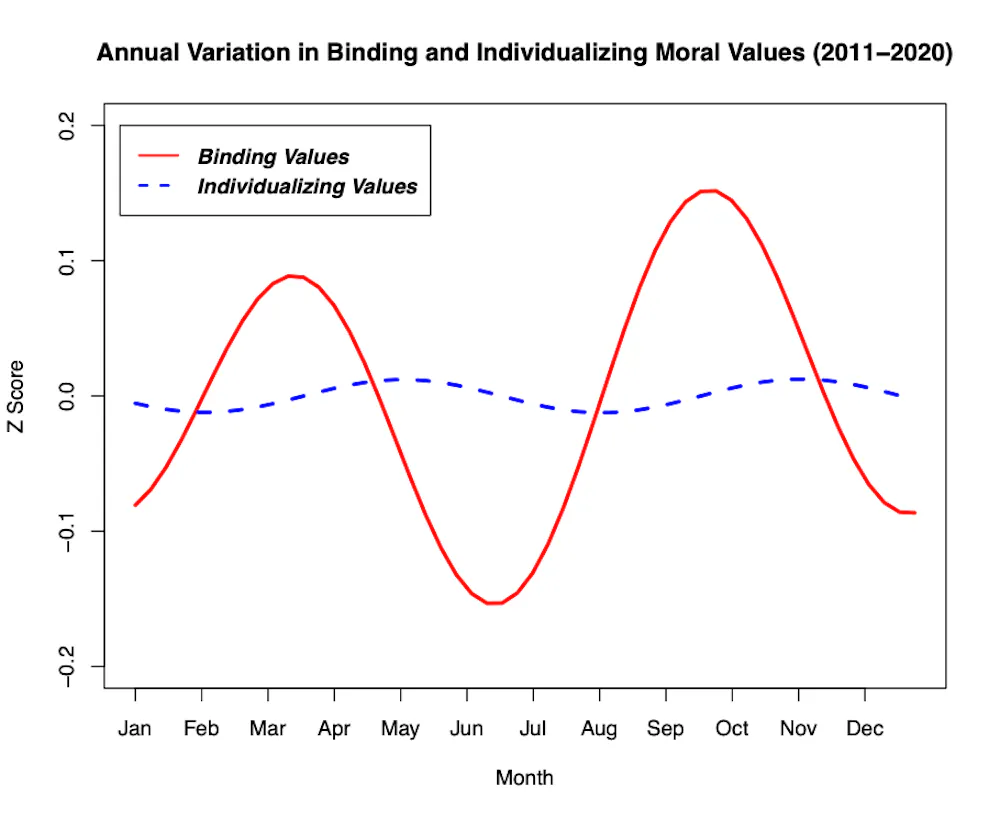
    Our analyses focused on the values reported by 232,975 respondents in the United States across a decade (2011-20) of data. The results revealed no apparent seasonal cycle in Americans’ endorsement of individualizing values, but there was clear and consistent seasonal cycle in Americans’ endorsement of all three binding moral values.

    This seasonal cycle was bimodal, with two peaks and two valleys each year: Americans endorsed binding moral values (valuing loyalty, authority and group traditions) most strongly in the spring and autumn, and least strongly in midsummer and midwinter. This bimodal seasonal cycle in binding moral values showed up again and again in the data, year after year.

    A graph depicting Americans’ endorsement of binding and individualizing moral values.
    (I. Hohm and M. Schaller), CC BY

    This seasonal cycle in binding moral values wasn’t unique to the U.S. either. Additional analyses on data from Canada and Australia revealed similar patterns: Canadians and Australians also endorsed binding moral values most strongly in the spring and autumn, and least strongly in midsummer and midwinter.

    Anxiety patterns

    What might explain this seasonal cycle in people’s endorsement of binding moral values? One possibility is that it has something to do with the perception of threat, which encourages people to close ranks within a group. Previous research has linked this to increased endorsement of binding moral values.

    To test this idea, we analyzed data on an emotion associated with threat perception: anxiety. Results revealed that Americans’ self-reported anxiety showed the same bimodal seasonal cycle, and so did 10 years of data on Americans’ Google searches for anxiety-related words. This seasonal cycle in anxiety helps to explain the seasonal cycle in binding values.

    Anxiety tends to change with the seasons, decreasing in summer and midwinter.
    (Shutterstock)

    This explanation raises a new question: what might explain the seasonal cycle in anxiety? Although we can only speculate, our analyses on moral values revealed an intriguing clue. The summertime dip in Americans’ endorsement of binding moral values was bigger in places with more extreme seasonal changes in the temperature. There was no such effect on the size of the midwinter dip.

    Perhaps something similar might be going on with anxiety: maybe that summertime decrease is the result of pleasant weather, whereas the midwinter decrease is more of a holiday effect.

    Double-edged sword

    Regardless of the cause, seasonal cycles in binding moral values could have consequences that affect people’s lives, for better or worse. Binding moral values promote cohesion, conformity and co-operation within groups, which can be beneficial, especially when coping with crises.

    The implication is that groups might cope better with crises that emerge in the spring and autumn, compared to those that occur in the summer and winter.

    But binding moral values also promote distrust of people who fail to adhere to group norms and traditions. The implication is that there may also be seasonal cycles in prejudices against immigrants, racial minorities, LGBTQ+ individuals and anybody else who is perceived to be different.

    People who more strongly endorse binding moral values are also more punitive, so there could be seasonal effects on judicial decision-making in the millions of legal cases that occur every year.

    And given the link between binding moral values and conservative attitudes, there are potential implications for politics. One intriguing possibility: the timing of political elections (whether they are scheduled for summer or autumn, for instance) might have some subtle effect on some votes — which, for an election that is especially tight, might even influence its outcome.

    Mark Schaller receives funding from the Social Sciences and Humanities Research Council of Canada.

    Ian Hohm does not work for, consult, own shares in or receive funding from any company or organisation that would benefit from this article, and has disclosed no relevant affiliations beyond their academic appointment.

    ref. Seasonal change can affect people’s moods — and their moral values – https://theconversation.com/seasonal-change-can-affect-peoples-moods-and-their-moral-values-236626

    MIL OSI – Global Reports

  • MIL-OSI USA: NIH launches large study to tackle type 2 diabetes in young people

    Source: US Department of Health and Human Services – 2

    News Release

    Wednesday, October 9, 2024

    Effort to identify risk factors for youth-onset type 2 diabetes to improve prevention and treatment.

    The National Institutes of Health has launched a nationwide consortium to address the dramatic rise in youth diagnosed with type 2 diabetes over the past two decades, a trend that is expected to continue. The effort aims to advance understanding of the biologic, social, and environmental drivers of youth-onset type 2 diabetes, with the goals of determining which children are at highest risk for developing the disease and how to better prevent, screen for, and manage type 2 diabetes in young people.

    “Our children who are overweight or have obesity are at risk, but we don’t know how best to identify the children who will progress to type 2 diabetes,” said Rose Gubitosi-Klug, M.D., Ph.D., study lead, and chief of pediatric endocrinology at Case Western Reserve University/Rainbow Babies and Children’s Hospital, Cleveland. “This study will bring us closer to our goal of prevention of type 2 diabetes in future generations of youth.”

    The observational study is funded by the NIH’s National Institute of Diabetes and Digestive and Kidney Diseases (NIDDK) and builds on previous NIDDK-funded research indicating that youth-onset type 2 diabetes is more challenging to treat and progresses more aggressively compared to adult-onset type 2 diabetes. In youth with type 2 diabetes, good blood glucose control is harder to achieve, and the ability of the pancreas to secrete insulin declines much more rapidly. Many young people with type 2 diabetes also don’t respond well to metformin, the drug most commonly used as the first-line treatment for diabetes in adults. In addition, youth-onset type 2 diabetes is associated with earlier development of diabetes-related complications, such as damage to the eyes, kidneys, and nerves.  

    “These factors all create a picture of a disease that is much more aggressive in youth than in adults, but we don’t understand what drives these differences,” said Barbara Linder, M.D., Ph.D., NIDDK program director who is overseeing the study. “Consequently, young people are developing devastating complications of the disease during what should be the most productive years of their life.”

    The study will aim to identify unique drivers of youth-onset type 2 diabetes distinguishing it from the disease in adults, which will help clinicians better understand which children will develop the disease and guide more effective, targeted prevention and intervention strategies. Study sites across the country will recruit 3,600 participants, ages 9 to 14, who are considered at risk for developing type 2 diabetes. They must have started puberty, have overweight or obesity, and have high-normal to above-normal hemoglobin A1c (HbA1c) levels but not high enough for a diagnosis of diabetes. The participants will reflect the U.S. population of youth with type 2 diabetes, including people from diverse racial and ethnic, socioeconomically disadvantaged, and underserved rural populations.

    The research team is also seeking extensive input from youth, young adults, and parents with lived experience of type 2 diabetes on both study design and conduct, including how to best recruit and retain participants, how frequently participants should be seen during the study, what questionnaires should be used to collect data, and more.

    In addition to looking at biological factors, the study team will gather comprehensive data from participants and their families to understand what social and environmental factors may be adversely contributing to health disparities and poor outcomes among youth with type 2 diabetes. Research has suggested that these social determinants of health—the conditions in which people are born, grow, work, live, and age—have a powerful influence on shaping health outcomes. For example, people without access to healthy food and safe places to engage in physical activity may be more likely to develop obesity, which is associated with type 2 diabetes.

    “Most children we currently consider ‘at-risk’ for developing type 2 diabetes will not actually do so, so we need to better understand what factors define who is at risk and would benefit from targeted prevention strategies,” said Dr. Linder. “These efforts are critical to lessen the immense burden, not just on young people and their families, but also the U.S. healthcare system, arising from the growing numbers of youth living with this disease and its debilitating complications.”

    For more information about the study, known as DISCOVERY of Risk Factors for Type 2 Diabetes in Youth, please visit discovery.bsc.gwu.edu.

    Funding: DISCOVERY is funded through NIH grants DK134971, DK134984, DK134975, DK134996, DK134958, DK134967, DK135002, DK134982, DK135007, DK134988, DK134978, DK134981, DK135012, DK135015, DK134976, and DK134966.

    The NIDDK, a component of the NIH, conducts and supports research on diabetes and other endocrine and metabolic diseases; digestive diseases, nutrition and obesity; and kidney, urologic and hematologic diseases. Spanning the full spectrum of medicine and afflicting people of all ages and ethnic groups, these diseases encompass some of the most common, severe, and disabling conditions affecting Americans. For more information about the NIDDK and its programs, see https://www.niddk.nih.gov.

    About the National Institutes of Health (NIH): NIH, the nation’s medical research agency, includes 27 Institutes and Centers and is a component of the U.S. Department of Health and Human Services. NIH is the primary federal agency conducting and supporting basic, clinical, and translational medical research, and is investigating the causes, treatments, and cures for both common and rare diseases. For more information about NIH and its programs, visit http://www.nih.gov.

    NIH…Turning Discovery Into Health®

    ###

    MIL OSI USA News

  • MIL-OSI USA: NASA Terminal Transmits First Laser Communications Uplink to Space 

    Source: NASA

    NASA’s LCOT (Low-Cost Optical Terminal), a ground station made of modified commercial hardware, transmitted its first laser communications uplink to the TBIRD (TeraByte Infrared Delivery), a tissue box-sized payload formerly in low Earth orbit.
    During the first live sky test, NASA’s LCOT produced enough uplink intensity for the TBIRD payload to identify the laser beacon, connect, and maintain a connection to the ground station for over three minutes. This successful test marks an important achievement for laser communications: connecting LCOT’s laser beacon from Earth to TBIRD required one milliradian of pointing accuracy, the equivalent of hitting a three-foot target from over eight American football fields away.
    The test was one of many laser communications achievements TBIRD made possible during its successful, two-year mission. Prior to its mission completion on Sept. 15, 2024, the payload transmitted at a record-breaking 200 gigabits per second. In an actual use case, TBIRD’s three-minute connection time with LCOT would be sufficient to return over five terabytes of critical science data, the equivalent of over 2,500 hours of high-definition video in a single pass. As the LCOT sky test demonstrates, the ultra-high-speed capabilities of laser communications will allow science missions to maintain their connection to Earth as they travel farther than ever before.

    NASA’s SCaN (Space Communications and Navigation) program office is implementing laser communications technology in various orbits, including the upcoming Artemis II mission, to demonstrate its potential impact in the agency’s mission to explore, innovate, and inspire discovery.
    “Optical, or laser, communications can transfer 10 to 100 times more data than radio frequency waves,” said Kevin Coggins, deputy associate administrator and SCaN program manager. “Literally, it’s the wave of the future, as it’ll enable scientists to realize an ever-increasing amount of data from their missions and will serve as our critical lifeline for astronauts traveling to and from Mars.” 

    Historically, space missions have used radio frequencies to send data to and from space, but with science instruments capturing more data, communications assets must meet increasing demand. The infrared light used for laser communications transmits the data at a shorter wavelength than radio, meaning ground stations on Earth can send and receive more data per second. 
    The LCOT team continues to refine pointing capabilities through additional tests with NASA’s LCRD (Laser Communications Relay Demonstration). As LCOT and the agency’s other laser communications missions continue to reach new milestones in connectivity and accessibility, they demonstrate laser communications’ potential to revolutionize scientists’ access to new data about Earth, our solar system, and beyond. 
    “It’s a testament to the hard work and skill of the entire team,” said Dr. Haleh Safavi, project lead for LCOT. “We work with very complicated and sensitive transmission equipment that must be installed with incredible precision. These results required expeditious planning and execution at every level.” 

    Experiments like TBIRD and LCRD are only two of SCaN’s multiple in-space demonstrations of laser communications, but a robust laser communications network relies on easily reconfigurable ground stations on Earth. The LCOT ground station showcases how the government and aerospace industry can build and deploy flexible laser communications ground stations to meet the needs of a wide variety of NASA and commercial missions, and how these ground stations open new doors for communications technology and extremely high data volume transmission. 
    NASA’s LCOT is developed by the agency’s Goddard Space Flight Center in Greenbelt, Maryland. TBIRD was developed in partnership with the Massachusetts Institute of Technology Lincoln Laboratory (MIT-LL) in Lexington. TBIRD was flown and operated as a collaborative effort among NASA Goddard; NASA’s Ames Research Center in California’s Silicon Valley; NASA’s Jet Propulsion Laboratory in Southern California; MIT-LL; and Terran Orbital Corporation in Irvine, California. Funding and oversight for LCOT and other laser communications demonstrations comes from the (SCaN) Space Communications and Navigation  program office within the Space Operations Mission Directorate at NASA Headquarters in Washington. 

    MIL OSI USA News

  • MIL-OSI USA: Artemis I Radiation Measurements Validate Orion Safety for Astronauts

    Source: NASA

    NASA’s Orion spacecraft is designed to keep astronauts safe in deep space, protecting them from the unforgiving environment far from Earth. During the uncrewed Artemis I mission, researchers from NASA, along with several collaborators, flew payloads onboard Orion to measure potential radiation exposure to astronauts.
    Radiation measurements were taken inside Orion by 5,600 passive sensors and 34 active radiation detectors during its 25.5-day mission around the Moon and back, which provided important data on exposure within the Earth’s Van Allen radiation belt. These detailed findings were published in a recent scientific article through a collaborative effort by NASA’s Space Radiation Analysis Group, the DLR (German Space Center), and ESA (European Space Agency). The measurements show that while radiation exposure can vary depending on location within Orion, the spacecraft can protect its crew from potentially hazardous radiation levels during lunar missions.
    Space radiation could pose major risks to long-duration human space flights, and the findings from the Artemis I mission represent a crucial step toward future human exploration beyond low Earth orbit, to the Moon, and eventually to Mars.
    NASA’s HERA (Hybrid Electronic Radiation Assessor) and Crew Active Dosimeter, which were tested previously on the International Space Station, and ESA’s Active Dosimeter, were among the instruments used to measure radiation inside Orion. HERA’s radiation sensor can warn crew members need to take shelter in the case of a radiation event, such as a solar flare. The Crew Active Dosimeter can collect real-time radiation dose data for astronauts and transmit it back to Earth for monitoring. Radiation measurements were conducted in various areas of the spacecraft, each offering different levels of shielding.

    In addition, the Matroshka AstroRad Radiation Experiment, a collaboration between NASA and DLR, involved radiation sensors placed on and inside two life-sized manikin torsos to simulate the impact of radiation on human tissue. These manikins enabled measurements of radiation doses on various body parts, providing valuable insight into how radiation may affect astronauts traveling to deep space.

    Researchers found that Orion’s design can protect its crew from potentially hazardous radiation levels during lunar missions. Though the spacecraft’s radiation shielding is effective, the range of exposure can greatly vary based on spacecraft orientation in specific environments. When Orion altered its orientation during an engine burn of the Interim Cryogenic Propulsion Stage, radiation levels dropped nearly in half due to the highly directional nature of the radiation in the Van Allen belt.
    “These radiation measurements show that we have an effective strategy for managing radiation risks in the Orion spacecraft. However, key challenges remain, especially for long-duration spaceflights and the protection of astronauts on spacewalks,” said Stuart George, NASA’s lead author on the paper.
    NASA’s long-term efforts and research in mitigating space radiation risks are ongoing, as radiation measurements on future missions will depend heavily on spacecraft shielding, trajectory, and solar activity. The same radiation measurement hardware flown on Artemis I will support the first crewed Artemis mission around the Moon, Artemis II, to better understand the radiation exposure seen inside Orion and ensure astronaut safety to the Moon and beyond.
    For more information on NASA’s Artemis campaign, visit:
    https://www.nasa.gov/artemis

    MIL OSI USA News

  • MIL-OSI Economics: 2024 IADC/SPE Managed Pressure Drilling & Underbalanced Operations Conference Convenes in Brazil

    Source: International Association of Drilling Contractors – IADC

    Headline: 2024 IADC/SPE Managed Pressure Drilling & Underbalanced Operations Conference Convenes in Brazil

    The 2024 IADC/SPE Managed Pressure Drilling & Underbalanced Operations Conference & Exhibition took place on 17-18 September in Rio de Janeiro, Brazil.

    Over two days, esteemed subject matter experts and young professionals came together to discuss:

    • Case Studies
    • Human Factors & Training
    • Non-Conventional MPD Operations
    • Riser Gas Handling
    • Completions
    • Design & Optimization
    • MPD Equipment & Control Systems
    • UBD
    • Well Control & Well Integrity

    Drilling Contractor Interviews from the 2024 IADC/SPE MPD & UBO Conference

    Last year, the IADC Underbalanced Operations and Managed Pressure Drilling (UBO &MPD) Committee published the Riser Gas Handling Guidelines to address challenges associated with gas in the riser during deepwater drilling while utilizing surface back pressure MPD or installed riser gas handling systems. During the 2024 IADC/SPE MPD & UBO Conference in Rio de Janeiro, members of IADC’s Gas in the Riser Subcommittee presented a series of papers discussing the underlying concepts behind the guidelines and the practical applications of the guidelines in the field.

    Speaking to DC from the conference, Mario Teixeira, Senior Engineer – Drilling and Wells at Equinor and a member of the subcommittee, spoke about these concepts. Some of these, he noted, are little known in industry or inconsistently applied in field operations. In particular, he discussed the uncontrolled riser unloading that can result from unaddressed gas-in-riser events and why it is important for industry to better understand the risks involved.

    Focusing on the human element is critical to preventing errors within any operation, including those involving managed pressure drilling (MPD). As automated systems decrease human interactions with complex equipment while increasing cognitive workloads, the need to account for human factors has become even more important. Understanding human factors and its role in safe drilling operations can help provide a path for drillers to mitigate errors and identify the root causes of those errors should they occur, said Matt Kvalo, VP of Engineering and Technology at Stasis Drilling Solutions.

    In this interview with DC from the 2024 IADC/SPE MPD & UBO Conference, Mr. Kvalo talks about how the definition of human factors has changed, from one that identifies the root cause of most errors to a model that identifies errors as a systemic problem.

    The IADC Underbalanced Operations and Managed Pressure Drilling (UBO & MPD) Committee is working on a number of initiatives aimed at helping the industry better understand the challenges associated with MPD operations. In this interview with DC taken from the 2024 IADC/SPE MPD & UBO Conference, Andre Alonso Fernandes, Chairman of the Committee, explains the IADC Riser Gas Handling Guidelines, a resource that was released last year. He also discusses the committee’s goal for opening a dialogue with industry and academia on the feasibility of the guidelines, plus any further challenges with gas-in-riser incidents that may need to be addressed in the future. Mr. Fernandes also spoke about the committee’s work in revising API RP 92M and API RP 92S, which each address MPD operations with surface back pressure.

    Thank you to everyone who attended, presented, exhibited, sponsored, and organized this conference! 

    MIL OSI Economics

  • MIL-OSI Canada: Government of Canada commits to purchase carbon dioxide removal services to green government operations and achieve net-zero emissions

    Source: Government of Canada News (2)

    News release

    October 9, 2024 – Ottawa, Ontario – Treasury Board of Canada Secretariat

    Today at the Carbon Removal Canada’s “Procuring with Purpose: Canada’s Opportunity to Shape the Carbon Removal Market” report launch event, the Honourable Anita Anand, President of the Treasury Board and Minister of Transport, announced the Government of Canada’s commitment to purchase carbon dioxide removal (CDR) services as part of the Greening Government Strategy. The federal government will purchase at least $10 million in carbon removal services between now and 2030 to help reach its goal of net-zero emissions in Government operations by 2050.

    The Greening Government Strategy commits the federal government to reducing its operational emissions to as close to zero as possible and then balance out any remaining emissions with an equivalent amount of carbon dioxide removal. To redouble these efforts, Minister Anand also announced the Government’s intention to work with public and private leaders to advance the development and responsible deployment of carbon dioxide removal solutions in Canada.

    This investment will enable the Government to lower its emissions, while supporting the development of these critical technologies and markets so they are available when we need them the most.

    With climate change being one of the greatest global challenges of our time, the Government of Canada is leading by example by reducing greenhouse gas emissions and fostering a low-carbon, climate-resilient and clean-growth economy.

    Quotes

    “Today, we are taking another step to demonstrate our government’s leadership in greening Government operations and fighting climate change. In addition to lowering our emissions, we are adopting carbon removal solutions to ensure we reach our goal to be net-zero emissions by 2050. By working together and innovating, we are building a greener, cleaner future for all generations.”

    –        The Honourable Anita Anand, President of the Treasury Board and Minister of Transport

    Quick facts

    • Carbon dioxide removal refers to human activities that remove carbon dioxide from the atmosphere (for example, direct air capture, enhanced carbon mineralization) and durably store it in natural reservoirs or in products. 

    • The Greening Government Strategy, under the responsibility of the Centre for Greening Government at Treasury Board Secretariat is a set of commitments that apply to all core government departments, agencies and Crown corporations, and support the Government of Canada’s commitment for net-zero emissions by 2050.

    • The purchases in carbon removal services will be made through TBS’ Low-Carbon Fuel Procurement Program (LCFPP), an eight-year, $134.9 million initiative to reduce emissions from federal air and marine operations. This investment follows the Budget 2024 decision to expand the LCFPP to include the procurement of carbon dioxide removal services in addition to low-carbon intensity fuels.  

    • Through the LCFPP, the Government of Canada will work with public and private sector leaders to use their purchasing power to advance the development and responsible deployment of CDR solutions in Canada.

    • As stated in Canada’s Carbon Management Strategy, Canada needs to scale up solutions that permanently remove emissions from the atmosphere, since some residual emissions are likely to remain despite aggressive mitigation efforts, including in agriculture, aviation, and shipping. The removal of CO2 from the atmosphere is also the only way to directly address historical emissions, which have accumulated in the atmosphere over centuries of industrial activity and continue to contribute to global temperature rise.

    Associated links

    Contacts

    Myah Tomasi
    Press Secretary
    Office of the President of the Treasury Board
    myah.tomasi@tbs-sct.gc.ca
    343-543-7210

    Media Relations
    Treasury Board of Canada Secretariat
    Telephone: 613-369-9400
    Toll-free: 1-855-TBS-9-SCT (1-855-827-9728)
    Email: media@tbs-sct.gc.ca

    Stay connected
    X: @TBS_Canada
    Facebook: https://www.facebook.com/TBSCanada
    LinkedIn: https://www.linkedin.com/company/tbs-sct/

    MIL OSI Canada News

  • MIL-OSI USA: CBO’s Recent Publications and Work in Progress as of September 30, 2024

    Source: US Congressional Budget Office

    To provide the Congress with a comprehensive review of its work, the Congressional Budget Office publishes quarterly reports that highlight the agency’s recent publications and summarize its work in progress.  Over the past three months, CBO has produced a variety of budget and economic analyses, fulfilling the agency’s core mission of supporting the Congress during each stage of the legislative process. The agency’s work takes many forms, including technical assistance to committees and Members when they are crafting legislation, cost estimates of legislation, testimonies, reports, and other analytic products.

    MIL OSI USA News

  • MIL-OSI USA: Feenstra Recognizes National 4-H Week

    Source: United States House of Representatives – Representative Randy Feenstra (IA-04)

    HULL, IOWA — Today, U.S. Rep. Randy Feenstra (R-Hull) issued the following statement recognizing National 4-H Week:

    “4-H is an incredible organization that helps our future leaders — especially the next generation of Iowa farmers and producers — develop lifelong skills and reach their full potential,” said Rep. Feenstra. “This week, we recognize the positive impact that 4-H has had on millions of young Americans and the importance of investing in the future of our nation.”

    ###

    MIL OSI USA News

  • MIL-OSI USA: Treasurer Stacy Garrity Announces Major Milestone for Keystone Scholars

    Source: US State of Pennsylvania

    October 09, 2024Pittsburgh, PA

    Treasurer Stacy Garrity Announces Major Milestone for Keystone Scholars

    Treasurer Stacy Garrity joined representatives of Neighborhood Allies and Point Park University to celebrate more than $100 million saved by Keystone Scholars families in companion PA 529 College and Career Savings Program accounts.

    Keystone Scholars automatically provides a $100 education investment for every baby born to, or adopted by, a Pennsylvania family since January 1, 2019, using no taxpayer money. PA 529 accounts provide a tax-advantaged way to save for post-high school education.

    “Keystone Scholars is designed to encourage families to save early for education, and today’s announcement shows that it’s working,” Treasurer Garrity said. “Our oldest Keystone Scholars are already in kindergarten, and our youngest were born today. It’s tremendous to see so many families claiming their accounts and committing to saving for the future. Saving early and often will really pay off when a child picks their career path – no matter where it leads, whether it’s a four-year degree at Point Park University, community college, technical training, or an apprenticeship. Taking the first step is often the hardest part of saving, but Keystone Scholars does that for you.”

    Speakers Include:
    Stacy Garrity, Pennsylvania Treasurer
    Toni Corinealdi, Senior Program Manager of Empowerment and Outreach, Neighborhood Allies
    Presley Gillespie, President and CEO, Neighborhood Allies
    Marlin Collingwood, VP of Enrollment Management, Point Park
    University

    MIL OSI USA News

  • MIL-OSI USA: Governor Shapiro Encourages Travelers to Visit Pennsylvania’s State Parks and Experience Peak Fall Foliage, Unveils New Color-Correcting Viewfinders at Black Moshannon State Park

    Source: US State of Pennsylvania

    October 09, 2024Philipsburg, PA

    Governor Shapiro Encourages Travelers to Visit Pennsylvania’s State Parks and Experience Peak Fall Foliage, Unveils New Color-Correcting Viewfinders at Black Moshannon State Park

    Governor Josh Shapiro and First Lady Lori Shapiro joined Department of Conservation and Natural Resources (DCNR) Secretary Cindy Adams Dunn at Black Moshannon State Park in Centre County to encourage travelers to visit Pennsylvania’s state parks this fall as trees reach peak color, showing once again that Pennsylvania is the Great American Getaway. While at Black Moshannon State Park, Governor Shapiro and First Lady unveiled new viewfinders installed at nine state parks that help visitors who are colorblind see the vibrant colors of Pennsylvania’s spectacular fall foliage.

    “Pennsylvania is the place to be in the fall, with more than two million acres of state park forests and woodlands offering visitors one of the most colorful, brilliant displays of foliage anywhere in the world,” said Governor Shapiro. “Within a few hours’ drive for over 70 million Americans, Pennsylvania is the Great American Getaway – and we want everyone to be able to enjoy everything we have to offer. That’s why our team at DCNR has installed new viewfinders at nine state parks to help people with red-green colorblindness experience the full splendor of fall in Pennsylvania.”

    This summer, Governor Shapiro launched Pennsylvania’s state tourism brand – The Great American Getaway – showcasing all the Commonwealth has to offer as a premier weekend getaway destination with thousands of attractions. Outdoor recreation adds $17 billion to Pennsylvania’s economy annually, supporting 164,000 jobs. Two weeks ago, the Shapiro Administration launched a new fall travel campaign to lean into Pennsylvania’s premier position as the place to experience the very best of autumn – from unrivaled fall foliage and the nation’s most historical haunts to the season’s best scents and treats.

    Speakers Include:
    Mathias Weinzen, Black Moshannon State Park Manager
    Cindy Adams Dunn, DCNR Secretary
    Ta Enos, President and CEO, PA Wilds Center for Entrepreneurship
    Representative Paul Takac
    Scott Kolesar, Park Visitor Living with Colorblindness
    Governor Josh Shapiro

    MIL OSI USA News

  • MIL-OSI USA: Governor Polis and Department of Higher Education Announce Waived College Application Fees Oct. 15-17

    Source: US State of Colorado

    DENVER – To encourage Coloradans to continue their education, Governor Jared Polis and the Department of Higher Education announced today that all 32 public colleges and universities in Colorado and several private institutions will allow students to apply for free from Tuesday, Oct. 15 through Thursday, Oct. 17, 2024, as part of the seventh annual Colorado Free Application Days. View Gov. Polis’ announcement in English and Spanish. 

    “We want to help Coloradans save money on college, and Free Application Days do exactly that. I encourage every Colorado student to take advantage of this opportunity to avoid application fees. In Colorado, we are focused on breaking down barriers to accessible, affordable education and connecting Coloradans to the skills necessary for a good-paying job and power Colorado’s thriving economy,” said Governor Polis. 

    The Colorado Department of Higher Education (CDHE) has posted admissions application and fee waiver information for each college and university that allows students to apply, from Oct. 15-17 only, with no application fees to as many participating institutions as they are interested in. For the fourth consecutive year, the program has been extended from one day to three days. 

    The Free Application Days campaign is a conscious effort by the state, designed to increase Colorado’s college-going and FAFSA and CASFA completion rates. This statewide push strategically aims to support low-income and first-generation students, while keeping Colorado students in state. According to 2023 numbers from CDHE’s Pathways to Prosperity Report, 49.9% of high school graduates enrolled in postsecondary education the fall after graduation (a slight decrease from 2020) – race and ethnicity enrollment gaps persist. 

    “We want Coloradans to shoot for the stars. Free Application Days supports students in achieving their postsecondary goals,” said Dr. Angie Paccione, executive director of CDHE. “If we increase FAFSA and CASFA completion through these two campaigns, then not only do our students and families benefit but Colorado benefits as a whole.” 

    During last year’s campaign, students turned in nearly 65,000 applications, and 44% came from students of color and over a third from first-generation students. Statewide, 2023 applications were up 1% compared to 2022. 

    By waiving application fees—a common barrier to higher education—Colorado Free Application Days aims to improve access to further education and training, which is becoming increasingly critical in the state’s rapidly changing economy. The 2023 Colorado Talent Pipeline Report identified that 94.7% of Tier 1 Top Jobs and 64.7% of Tier 2 Top Jobs required some type of postsecondary education past a high school diploma or equivalent to be relevant for a particular role and 70.4% of Tier 2 top jobs require a credential beyond high school. According to the Lumina Foundation, 60.5% of Coloradans 25 and older hold a postsecondary credential, indicating a supply-and-demand gap for some occupations. 

    In response to these workforce demands, the Colorado Commission on Higher Education set a strategic goal to increase the number of Coloradans benefiting from valuable career skills, obtained while in high school or via postsecondary education, that –at a minimum– enable additional lifetime earnings greater than the cost of attendance, in its statewide plan for higher education, Building Skills for an Evolving Economy. Increasing postsecondary enrollment and reducing equity gaps—the racial disparities in educational attainment—are priority strategies to improve access and reduce costs for Coloradans. 

    For more information, visit the Colorado Free Application Day webpage. 

    ###

    MIL OSI USA News

  • MIL-OSI USA: Lt. Governor Austin Davis Kicks Off Listening Tour to Inform the Work of the Office of Gun Violence Prevention

    Source: US State of Pennsylvania

    October 08, 2024Harrisburg, PA

    Lt. Governor Austin Davis Kicks Off Listening Tour to Inform the Work of the Office of Gun Violence Prevention

    Lieutenant Governor Austin Davis and the Pennsylvania Commission on Crime and Delinquency (PCCD) joined the Departments of Health, Human Services, Community and Economic Development, State Police, Military and Veterans Affairs, Office of the Victim Advocate and advocacy organizations CeaseFirePA, Everytown for Gun Safety, GIFFORDS, Johns Hopkins Center for Gun Violence Solutions, and others to kick off the first in a series of listening sessions that will inform the work of PCCD’s Office of Gun Violence Prevention.

    “I believe every Pennsylvanian deserves to be safe and feel safe in their communities – and my Administration took real action to re-establish Pennsylvania’s Office of Gun Violence Prevention and put real resources behind this effort,” said Governor Shapiro. “Under Lieutenant Governor Davis’ leadership at PCCD, we are listening to Pennsylvanians about their experiences with gun violence and bringing together public safety and public health experts, gun violence survivors and advocates, and leaders from state and local agencies to address and prevent violence across the Commonwealth. We’re going to continue to work together to ensure that every Pennsylvanian has the real freedom that comes when you can walk down the street in your community without worrying about gun violence.”

    List of Speakers:
    Lt. Governor Austin Davis
    PA Commission on Crime & Delinquency Executive Director Mike Pennington
    PA Commission on Crime & Delinquency Interim Director Samantha Koch
    Department of Health Secretary Dr. Debra Bogen
    Department of Human Services Executive Deputy Secretary Andrew Barnes
    Department of Education Secretary Dr. Khalid Mumin
    Office of Victim Advocate Suzanne Estrella
    Department of Human Services Deputy Secretary Andrew Barnes
    Department of Community & Economic Development Deputy Secretary Rick Vilello

    MIL OSI USA News

  • MIL-OSI USA: Congressman Johnson Re-Introduces Bill To Protect Innocent Americans From Execution

    Source: United States House of Representatives – Representative Hank Johnson (GA-04)

    Congressman files legislation that allows death row inmates the ability to introduce new evidence

    WASHINGTON, D.C. – Rep. Hank Johnson (D-GA) announced that he has re-introduced the Effective Death Penalty Appeals Act, which would ensure that death row inmates have the opportunity to present newly discovered evidence of innocence.

    Under current law, an inmate on death row can be stranded with no procedural options to appeal a conviction, even if there is compelling new evidence that he or she is innocent. Many states do not allow the accused to present newly uncovered evidence of innocence. The Effective Death Penalty Appeals Act would fix that injustice.

    “We’ve got innocent people on death row right now with no opportunity to show compelling new evidence of innocence. The status quo is inhumane and unconstitutional,” said Rep. Johnson, ranking member of the Courts subcommittee. As a young lawyer just out of law school, Rep. Johnson successful defend a man on death row and won his freedom.

    “I believe we should completely abolish the death penalty, but while 25 states – half of which are in the South – still have some form of capital punishment on their books and some states like Alabama, Texas and Georgia continue to hold state executions – America needs the Effective Death Penalty Appeals Act to help wrongly convicted people on death row present newly discovered evidence that they are innocent.” said Johnson.

    The Effective Death Penalty Appeals Act would:

    (1) empower the federal courts to grant habeas corpus relief for a prisoner on death row who presents newly discovered evidence that demonstrates probable innocence; and

    (2) allow prisoners on death row to file successive federal habeas petitions if, and only if, they present newly discovered evidence that a federal three-judge panel determines may be reasonably expected to demonstrate innocence.

    (3) in reaction to the Supreme Court case of Shinn v. Ramirez, this bill includes one additional provision. Some states do not allow ineffective assistance of counsel claims on direct appeal. Then in their habeas case, the court says they cannot rule on the issue because there is no evidence. This bill provides that death row inmates from those states who raise an ineffective assistance of counsel claim can have an evidentiary hearing on the issue.

    If a federal court were to grant such a habeas corpus petition, the case would likely return to its original jurisdiction for retrial.

    The release of more than 200 death row inmates in the United States since 1973 shows that our justice system is far from perfect. And since 1989, there have been more than 367 post-conviction DNA exonerations in the United States – 21 of which were prisoners on death row. The death penalty is the most final of sentences, and we have no way of knowing how many innocent people have been executed because of flaws in the system.

    “When it comes to a human life, the courts must always be able to take a closer look at evidence that supports claims of innocence. We should never put an innocent person to death,” said Rep. Johnson.

    Original Cosponsors: Chellie Pingree (ME), Eleanor Holmes Norton (DC), Schakowsky (IL).

    Read the full text HERE.

    ###

    MIL OSI USA News

  • MIL-OSI USA: Rep. Adams to Host Military Service Academy Day

    Source: United States House of Representatives – Congresswoman Alma Adams (12th District of North Carolina)

    CHARLOTTE – Congresswoman Alma S. Adams, Ph.D. (NC-12) invites students, families, and teachers to attend the 12th Congressional District Military Service Academy Day. More information can be found below. 

    WHO:  

    • Congresswoman Alma S. Adams, Ph.D. 

    • Students, families, and teachers in the 12th district with interest in U.S. Service Academies. 

    Representatives from:  

    • US Air Force Academy 

    • US Naval Academy 

    • US Coast Guard Academy

    WHAT: An event providing a comprehensive overview of the Military Academies, the application processes, and nominations. Academy representatives will be present to discuss their respective programs. 

    WHERE: West Charlotte High School; 2219 Senior Drive, Charlotte, NC, 28216 

    WHEN: Saturday, October 19, 2024, 10am -11:30am 

    RSVPs: Please submit RSVPs here or or email adams.press@mail.house.gov 

    ### 

    Congresswoman Alma S. Adams, Ph.D. represents North Carolina’s 12th Congressional District (Charlotte, Mecklenburg County, Cabarrus County) and serves on the House Committee on Agriculture and the House Committee on Education & the Workforce, where she serves as ranking member of the Workforce Protections Subcommittee. For more information contact the Office of Congresswoman Alma Adams: (202)225-1510. 

    MIL OSI USA News

  • MIL-OSI USA: Floridians Must Listen to Local Authorities as Hurricane Milton Makes Landfall; FEMA Administrator Traveling to Florida Tonight Ahead of Landfall

    Source: US Federal Emergency Management Agency

    Headline: Floridians Must Listen to Local Authorities as Hurricane Milton Makes Landfall; FEMA Administrator Traveling to Florida Tonight Ahead of Landfall

    Floridians Must Listen to Local Authorities as Hurricane Milton Makes Landfall; FEMA Administrator Traveling to Florida Tonight Ahead of Landfall

    Hurricane Milton will be catastrophic; FEMA is working in close coordination with state and local officials 

    WASHINGTON – Ahead of Hurricane Milton’s landfall, FEMA Administrator Criswell will travel to Florida tonight to work alongside state and local officials as they prepare for the impacts of this catastrophic storm. Floridians in the storm’s path must continue following the instructions of local officials, as the storm is expected to bring destructive storm surge along portions of Florida’s west coast as well as devastating hurricane-force winds, heavy rainfall and life-threatening flooding across the Florida Peninsula. 

    Floridians in Milton’s path in vulnerable parts of the state have been ordered to evacuate. Those who have stayed behind are urged to go immediately. Many residents outside of mandatory evacuation zones will experience significant rain and hurricane force winds. 

    FEMA has over 1,000 responders on the ground in Florida supporting Milton and previous disasters. There are over 1,400 search and rescue personnel pre-staged to support Milton response efforts.

    FEMA and its federal partners are leaning forward and already pre-positioned resources to support local and state response efforts ahead of Hurricane Milton. FEMA pre-staged seven FEMA Incident Management Assistance Teams, eight federal Urban Search & Rescue and swift water rescue teams, three U.S. Coast Guard Swift Water Rescue teams, 10 HealthCare System Assessment Teams, two U.S Army Corps of Engineers temporary power teams, debris experts, Environmental Protection Agency wastewater experts, over 400 ambulances, 20 helicopters prepared to support media requirements following landfall, and 60 High Water Vehicles with ladders from the Department of Defense. 

    Additionally, FEMA has five incident staging bases with commodities including food and water. Right now, FEMA has 20 million meals and 40 million liters of water ready to deploy to address ongoing Helene and Milton response efforts with capacity to expand as needed.

    President Biden granted emergency declarations for the state of Florida and the Seminole Tribe of Florida for Hurricane Milton, enabling FEMA to provide direct assistance to the state, local and tribal response, preposition supplies and response assets and mobilize hundreds of personnel in the state, many of whom were already in place supporting the Hurricane Helene response.

    Stay Safe in the Storm

    Those in the path of Hurricane Milton should take every precaution as the storm passes through.

    • Move to higher ground: Free shuttles are operating this morning in Manatee, Pinellas, Pasco, Hillsborough and Sarasota counties. To locate shuttle locations, visit www.FloridaDisaster.org/updates.  Residents may also use Uber code MILTONRELIEF to receive free Uber ride to a shelter.
    • Shelter in place: Do not attempt to travel during the storm. Hurricane winds are expected to impact a significant portion of the state, far away from the eye of the storm. Flash flooding, tornadoes, high-velocity debris, fallen trees and power lines will pose a significant danger.
    • If you do not feel safe in your home: A list of emergency shelters, including those that can accommodate people who need assistance and those who have pets can be found at Shelter Status | Florida Disaster. If you plan to go to a shelter, do so before the storm arrives. 
    • Stay out of floodwater: Walking or driving through flood waters is extremely dangerous. Standing water may be electrically charged from underground or downed power lines or contain hazards such as wild or stray animals, human and livestock waste, and chemicals that can lead to illness. 
    • Be prepared for service outages:
      • Fill and freeze empty water bottles to help keep food cool in the event of a power outage. Fill your bathtub so you have a clean water supply in the event of water service disruption.
      • Charge all electronic devices, then put them in low power or battery saver mode. While cell service and power may be disrupted during the storm, your phone is a lifeline to family, friends, emergency assistance and alerts. Preserve your batteries so your devices are ready if you need them. Text messages or social network sites may be the best way to get in touch with family and friends as Hurricane Milton moves through the state.
      • Use only flashlights or battery-powered lanterns for emergency lighting. Never use candles during a blackout or power outage due to extreme risk of fire.
      • When using generators, always use them outdoors and at least 20 feet from windows, doors and attached garages. Make sure to keep the generator dry and protected from rain or flooding.

    mashana.davis

    MIL OSI USA News

  • MIL-OSI Canada: Seizure of contraband and unauthorized items at Mission Institution – medium-security unit

    Source: Government of Canada News

    On October 5, 2024, as a result of the vigilance of staff members, a package containing contraband and unauthorized items was seized in the medium-security unit at Mission Institution.

    October 9, 2024 – Mission, British Columbia – Correctional Service Canada

    On October 5, 2024, as a result of the vigilance of staff members, a package containing contraband and unauthorized items was seized in the medium-security unit at Mission Institution.

    The contraband and unauthorized items seized included 816 grams of crystal methamphetamine, four SD cards, two charging cables, and one charging block. The total estimated institutional value of these seizures is $575,500.

    The police have been notified and the institution is investigating.

    CSC is heightening measures to prevent contraband from entering its institutions in order to help ensure a safe and secure environment for everyone. CSC also works in partnership with the police to take action against those who attempt to introduce contraband into correctional institutions.

    CSC has also set up a telephone tip line for all federal institutions so that it may receive additional information about activities relating to security at CSC institutions. These activities may be related to drug use or trafficking that may threaten the safety and security of visitors, inmates, and staff members working at CSC institutions.

    The toll-free number, 1‑866‑780‑3784, helps ensure that the information shared is protected and that callers remain anonymous.

    Reina Linares
    Assistant Warden Management Services
    Mission Institution
    604-820-5856

    MIL OSI Canada News

  • MIL-OSI Canada: Minister Wilkinson to Participate in Clean Energy–Related Engagements in Toronto

    Source: Government of Canada News

    The Minister of Energy and Natural Resources, the Honourable Jonathan Wilkinson, will be participating in a fireside chat with the Toronto Regional Board of Trade.

    TORONTO — The Minister of Energy and Natural Resources, the Honourable Jonathan Wilkinson, will be participating in a fireside chat with the Toronto Regional Board of Trade.

    Date: October 10, 2024

    Time: 9:30 a.m. ET         

    Later that day, Minister Wilkinson and Julie Dabrusin, Parliamentary Secretary to the Minister of Environment and Climate Change and Parliamentary Secretary to the Minister of Energy and Natural Resources, will make a clean energy announcement. A media availability will follow.

    Date: October 10, 2024

    Time: 2 p.m. ET

    All accredited media are asked to pre-register for the afternoon announcement by emailing media@nrcan-rncan.gc.ca. A dial-in line is available for media and will be provided upon registration.  

    MIL OSI Canada News

  • MIL-OSI Canada: Message from the Minister of Health and the Minister of Mental Health and Addictions and Associate Minister of Health – Breast Cancer Awareness Month, October 2024

    Source: Government of Canada News

    Statement

    October 9, 2024 | Ottawa, Ontario | Public Health Agency of Canada

    October is Breast Cancer Awareness Month, a period when we come together to support and honor those impacted by this disease.

    Breast cancer is one of the most common forms of cancer and the second leading cause of cancer-related death among womenFootnote * living in Canada. One in eight women is expected to be diagnosed with breast cancer in their lifetime.

    Raising awareness of breast cancer screening, which aims to detect cancer at an earlier, more treatable stage, is crucial for the Government of Canada. We are dedicated to advancing women’s health through comprehensive breast cancer screening and prevention efforts. We are also taking action by collaborating with partners and stakeholders to address identified gaps in breast cancer research.

    The Canadian Institutes of Health Research has invested almost $140 million over the past five years to advance breast cancer research in Canada. Through more than 500 grants and awards, these investments are supporting cutting-edge research to prevent, detect, and treat breast cancer more effectively.

    For example, researchers from Sunnybrook Hospital Research Institute are using artificial intelligence to develop more personalized breast cancer screening strategies; a team from the University of Saskatchewan is developing new techniques that combine radiation therapy and the body’s immune system to target breast cancer; and a project led by McGill researchers is examining how to prevent breast cancer from spreading to surrounding tissues. With support from the Government of Canada, the Canadian Partnership Against Cancer is refining its OncoSim-Breast microsimulation model, a tool used in the development of more effective breast cancer prevention and treatment policies.

    The Public Health Agency of Canada (PHAC) is working closely with Statistics Canada to conduct analyses of national cancer trends. They are looking at differences in breast cancer rates based on where people live, their age and ethnicity, and how advanced it is when people are diagnosed. Statistics Canada is also examining data on access to, and participation in, breast cancer screening by mammography to fill identified data gaps. These initiatives will enhance our understanding of the current state of breast cancer in Canada.

    Breast cancer touches the lives of so many, either through a personal diagnosis or that of a loved one. We strongly believe that nobody should have to face this alone. If you or a loved one is having difficulty coping with a cancer diagnosis, there are many ways you can seek support. Visit Canada.ca/mental-health or visit the Canadian Cancer Society’s community services locator, which helps cancer patients, caregivers and healthcare providers find the services they need to feel supported.

    Let’s empower everyone to make informed health care decisions, supported by the best available science and evidence.

    Reference

    Footnote *

    Cisgendered women and other adults assigned female at birth, such as transgender men and nonbinary people

    Return to footnote * referrer

    Contact

    Matthew Kronberg
    Press Secretary
    Office of the Honourable Mark Holland
    Minister of Health
    343-552-5654

    Yuval Daniel
    Director of Communications
    Office of the Honourable Ya’ara Saks
    Minister of Mental Health and Addictions and Associate Minister of Health
    819-360-6927

    Media Relations
    Health Canada
    613-957-2983
    media@hc-sc.gc.ca

    MIL OSI Canada News

  • MIL-OSI Video: AUSA 2024 Opening Ceremony Livestream

    Source: US Army (video statements)

    About the U.S. Army:
    The Army Mission – our purpose – remains constant: To deploy, fight and win our nation’s wars by providing ready, prompt & sustained land dominance by Army forces across the full spectrum of conflict as part of the joint force.

    Interested in joining the U.S. Army?
    Visit: https://www.goarmy.com/?iom=BNL7-22-0029_N_OSOC_OCPA_AL_ocpagen_xx_xx

    Connect with the U.S. Army online:
    Web: https://www.army.mil
    Facebook: https://www.facebook.com/USarmy/
    Twitter: https://twitter.com/USArmy
    Instagram: https://www.instagram.com/usarmy/
    LinkedIn: https://www.linkedin.com/company/us-army
    Flickr: https://www.flickr.com/photos/soldiersmediacenter

    #USArmy

    https://www.youtube.com/watch?v=bwVdrvyKnfM

    MIL OSI Video

  • MIL-OSI Security: Peru Woman Sentenced to 15 Years for Selling More Than 1.5 Kilos of Methamphetamine to Undercover Officer

    Source: Federal Bureau of Investigation (FBI) State Crime News

    PORTLAND, Maine: A Peru, Maine woman was sentenced today in U.S. District Court in Portland for trafficking methamphetamine and for possessing a firearm in furtherance of a drug trafficking crime.

    U.S. District Judge Nancy Torresen sentenced Mandy Lynn Shorey, 43, to 180 months to be followed by five years of supervised release.

    According to court records, between July 2022 and January 2023, Shorey sold approximately 1.5 kilograms of methamphetamine to an undercover officer across four controlled buys. For three of the buys, the purity of the methamphetamine Shorey sold to police approached 100%. During one of the buys, Shorey explained that she carried a firearm with her for protection when she met with new drug customers and removed the firearm from a bag and placed it in her waistband. During another exchange, she told the undercover officer that meeting her to conduct their next transaction would be safe because she would “bring one armed man to back me up that they will never see, just in case.” When Shorey was arrested, she was in possession of a Charter Arms .22 revolver.

    The FBI Safe Streets Task Force investigated the case.

    ###


    Updated 10/9/24 to correct defendant’s city of residence at time of arrest from Windham, ME to Peru, ME 

    MIL Security OSI

  • MIL-OSI USA: SBA Disaster Assistance Available to the San Carlos Apache Tribe Private Nonprofit Organizations

    Source: United States Small Business Administration

    SACRAMENTO, Calif. – Low-interest federal disaster loans are now available to certain private nonprofit organizations in the San Carlos Apache Tribe following President Biden’s federal disaster declaration for Public Assistance as a result of the Watch Fire that occurred from July 10-17, announced Administrator Isabella Casillas Guzman of the U.S. Small Business Administration. Private nonprofits that provide essential services of a governmental nature are eligible for assistance.

    “Private nonprofit organizations should contact the San Carlos Apache Tribe by calling (928) 475-1600 or visiting https://www.scat-nsn.gov to obtain information about applicant briefings,” said Francisco Sánchez Jr., associate administrator for the Office of Disaster Recovery and Resilience at the Small Business Administration. “At the briefings, private nonprofit representatives will need to provide information about their organization,” continued Sánchez. The Federal Emergency Management Agency will use that information to determine if the private nonprofit provides an “essential governmental service” and is a “critical facility” as defined by law. FEMA may provide the private nonprofit with a Public Assistance grant for their eligible costs. SBA encourages all private nonprofit organizations to apply with SBA for disaster loan assistance.

    SBA may lend private nonprofits up to $2 million to repair or replace damaged or destroyed real estate, machinery and equipment, inventory and other business assets.

    For certain private nonprofit organizations of any size, SBA offers Economic Injury Disaster Loans to help with meeting working capital needs caused by the disaster. Economic Injury Disaster Loans may be used to pay fixed debts, payroll, accounts payable and other bills that cannot be paid because of the disaster’s impact. Economic injury assistance is available regardless of whether the nonprofit suffered any property damage.

    “SBA’s disaster loan program offers an important advantage–the chance to incorporate measures that can reduce the risk of future damage,” Sánchez added. “Work with contractors and mitigation professionals to strengthen your property and take advantage of the opportunity to request additional SBA disaster loan funds for these proactive improvements.”

    The interest rate is 3.25 percent with terms up to 30 years. The deadline to apply for property damage is Dec. 3, 2024. The deadline to apply for economic injury is July 7, 2025.

    Interest does not begin to accrue until 12 months from the date of the first disaster loan disbursement. SBA disaster loan repayment begins 12 months from the date of the first disbursement.

    Applicants may apply online and receive additional disaster assistance information at SBA.gov/disaster. Applicants may also call SBA’s Customer Service Center at (800) 659-2955 or email disastercustomerservice@sba.gov for more information on SBA disaster assistance. For people who are deaf, hard of hearing, or have a speech disability, please dial 7-1-1 to access telecommunications relay services.

    ###

    About the U.S. Small Business Administration
    The U.S. Small Business Administration helps power the American dream of business ownership. As the only go-to resource and voice for small businesses backed by the strength of the federal government, the SBA empowers entrepreneurs and small business owners with the resources and support they need to start, grow, expand their businesses, or recover from a declared disaster. It delivers services through an extensive network of SBA field offices and partnerships with public and private organizations. To learn more, visit http://www.sba.gov.

    MIL OSI USA News

  • MIL-OSI Canada: Manitoba Government Introduces Legislation That Would Make it Harder to Purchase Machetes and Other Long-Blade Weapons

    Source: Government of Canada regional news

    Manitoba Government Introduces Legislation That Would Make it Harder to Purchase Machetes and Other Long-Blade Weapons

    – – –
    Proposed Legislation Aims to Improve Public Safety by Regulating Retail Sale of Machetes, Knives, Swords: Wiebe


    The Manitoba government is introducing legislation that would regulate the retail sale of long-bladed weapons, including machetes, knives and swords, Justice Minister Matt Wiebe announced today. 

    “Our government is committed to getting tough on crime and this new legislation would help keep our communities safer by restricting access to weapons such as machetes, knives and swords,” said Wiebe. “We’ve heard loud and clear: the purchase of these weapons needs to be restricted. We’re pleased to be moving forward to take real action to make our streets safer.” 

    Bill 39, the long-bladed weapon control act, aims to limit the supply of long-bladed weapons to individuals with dangerous intentions by:

    • requiring retailers to securely store long-bladed weapons in a way that prevents the public from accessing them without assistance;
    • prohibiting the retail sale of long-bladed weapons to minors under 18;
    • requiring purchasers to provide photo identification; and
    • requiring retailers to retain records, including purchaser information and transaction details, for a minimum of two years.

    “Manitoba has seen significant success in deterring crime through regulating the retail sale of products targeted for criminal purposes,” said Wiebe. “Access controls, age restrictions and identification and record-keeping requirements have proven effective at combatting crime. Our government is expanding this approach to address long-bladed weapon violence in the province.” 

    The bill defines long-bladed weapons as having a metal blade at least 30 centimetres in length. The minister noted the definition could be expanded through regulation to include certain features or characteristics, in response to emerging community safety needs. 

    “Ensuring the safety and well-being of our AMC member nations is paramount. I want to recognize and applaud the efforts of the minister of justice to address the concerns put forth by First Nations leadership with this long blade weapons control act,” said Acting Grand Chief Betsy Kennedy, Assembly of Manitoba Chiefs (AMC). “The AMC looks forward to continue being a part of this conversation and to work with Manitoba to draft a regulatory framework that prioritizes the protection of First Nation citizens in Manitoba.”

    The legislation would also apply to online retailers shipping long-bladed weapons to Manitoba addresses, added Wiebe.

    “The Manitoba Association of Chiefs of Police strongly supports provincial legislation that restricts the purchase of long-bladed machetes or knives by those who are acquiring with the intent to use for an unlawful or violent purpose,” said Scot Halley, president, Manitoba Association of Chiefs of Police. “Edged weapon and machete attacks have dramatically increased in the last number of years, the consequences of which can cause significant life-altering injuries or sometimes be fatal. This legislation is another tool to assist law enforcement in keeping these weapons out of the hands of the gang and criminal elements.” 

    If passed through the legislature, the bill would take effect on proclamation and be accompanied by regulations that would include additional long-bladed weapon features and characteristics, as well as exemptions where necessary, noted Wiebe. The minister added the province plans to consult retail businesses, law enforcement and Indigenous leadership to develop the regulations in the coming months. 

    – 30 –

    MIL OSI Canada News

  • MIL-OSI USA: SEC Charges “Magic Mushroom” Company and Two Individuals with Multimillion Dollar Pump-and-Dump Scheme

    Source: Securities and Exchange Commission

    The Securities and Exchange Commission today charged Minerco Inc. (former over-the-counter ticker: MINE), Bobby Shumake Japhia, and Julius Makiri Jenge, for their roles in an alleged pump-and-dump scheme that defrauded investors out of approximately $8 million while generating millions of dollars in ill-gotten proceeds from sales of Minerco stock.

    According to the SEC’s complaint, in the fall of 2019, Shumake, who was formerly known as Robert Samuel Shumake, Jr., secretly gained control of a large stock position in Minerco, an inactive penny stock company, and then arranged for Jenge to assume control of Minerco. The defendants then began pumping Minerco’s stock price by promoting Minerco as the “first publicly traded company focused on the research, production, and distribution of psilocybin mushrooms.” Psilocybin is the principal psychoactive component in “magic mushrooms,” a plant-based hallucinogen.

    From 2020 to 2021, the defendants allegedly continued to pump Minerco stock by making public statements and disclosures that contained false and misleading information. For example, Shumake and Minerco allegedly issued press releases falsely suggesting that an independent third party had valued Minerco at $1 billion and that Minerco had partnered with a Jamaican company that would lend expertise in growing a unique strain of psilocybin and bequeath to Minerco its Jamaican cannabis licenses. The SEC’s complaint also alleges that Jenge and Minerco falsely claimed in public disclosures that Minerco was an active Nevada company when, in reality, its charter had been revoked. Finally, Shumake allegedly engaged an offshore company to “dump” his Minerco shares and ultimately transfer at least $3.4 million in ill-gotten gains to an entity Shumake controlled. 

    “As alleged here, pump-and-dumps often begin when cheap stock of dormant companies is suddenly touted by a promoter as the next big thing,” said Melissa Hodgman, Associate Director of the Division of Enforcement. “Today’s action serves as an important reminder that the SEC will remain steadfast in its efforts to root out of the market stock offerings that are more about hype than substance.”

    The SEC previously obtained an Order compelling Jenge to produce documents and appear for testimony pursuant to an investigative subpoena issued by the SEC.

    The SEC’s complaint, filed in the United States District Court for the District of Columbia, charges Minerco, Shumake, and Jenge with violating the antifraud provisions of Section 17(a) of the Securities Act of 1933 and Section 10(b) of the Securities Exchange Act of 1934 and Rule 10b-5 thereunder. The complaint seeks permanent injunctions, disgorgement with prejudgment interest, and civil monetary penalties against each defendant, as well as conduct-based injunctions and penny stock and officer-and-director bars against Shumake and Jenge.

    The SEC’s investigation, which is ongoing, is being conducted by Adam Eisner, Brittany Garmyn, Keith O’Donnell, and Zachary Scrima and supervised by C. Joshua Felker and Ms. Hodgman. Damon Taaffe will lead the litigation team under the supervision of David Nasse. The SEC appreciates the assistance of FINRA, OTC Markets Group, the Securities Commission of The Bahamas, the Jamaica Financial Services Commission, the Québec Autorité des Marchés Financiers, the Capital Markets Board of Türkiye, and the Belize Financial Services Commission.

    The SEC encourages investors to take certain steps to identify pump-and-dump schemes involving the stocks of dormant shell companies.

    MIL OSI USA News

  • MIL-OSI USA: Salazar and Colleagues Call on IMF to Create New Argentina Program

    Source: United States House of Representatives – Congresswoman María Elvira Salazar’s (FL-27)

    WASHINGTON, D.C. – Today, Western Hemisphere Subcommittee Chairwoman María Elvira Salazar (R-FL) was joined by Republican members of Congress to urge the International Monetary Fund (IMF) to open new negotiations with the Republic of Argentina to create a robust financial package in order to support Argentina on their economic path to recovery. Joining Congresswoman Salazar on the letter were Representatives Chris Smith (R-NJ), Carlos Giménez (R-FL), Bill Huizenga (R-MI), Mario Diaz-Balart (R-FL), Mike Lawler (R-NY), Mike Waltz (R-FL), Joe Wilson (R-SC), Tom Kean, Jr. (R-NJ), and Keith Self (R-TX).  

    In their letter to Dr. Kristalina Georgieva, Managing Director of the IMF, the Representatives commended President Milei’s efforts to restore reliability as an economic borrower and end Argentina’s historical financial mismanagement under previous socialist administrations. The Members highlighted Milei’s background as an economist, his already-enacted measures to curtail inflation, and his Déficit Cero budget austerity plan as positive steps taken to accomplish those outcomes. 

    “The United States is the largest shareholder of the International Monetary Fund and therefore takes a keen interest in its activities. In Argentina, President Milei has vowed to restore his country’s reputation as a country that pays its debts and belongs in the club of countries that are reliable borrowers,” wrote the legislators. “According to reports, the economic adjustment plans he has implemented through the executive branch and the legislature are already curtailing inflation, hopefully setting Argentina on a path that ensures it will not miss any international financial obligations. As such, we ask that you consider these positive measures as you assist Argentina in charting the course ahead.”

    Below is the text of the letter. The full letter can be found HERE.

    Dear Managing Director Georgieva,

    As members of Congress of the United States who oversee foreign affairs issues, we write to you concerning the Republic of Argentina’s stated commitment to putting its fiscal house in order and righting the ship of state. The United States is the largest shareholder of the International Monetary Fund and therefore takes a keen interest in its activities. In Argentina, President Milei has vowed to restore his country’s reputation as a country that pays its debts and belongs in the club of countries that are reliable borrowers. According to reports, the economic adjustment plans he has implemented through the executive branch and the legislature are already curtailing inflation, hopefully setting Argentina on a path that ensures it will not miss any international financial obligations. As such, we ask that you consider these positive measures as you assist Argentina in charting the course ahead.

    We are encouraged that President Milei appears to be working toward meeting Argentina’s international obligations.

    As an economist, President Milei knows what the necessary measures are to tame inflation and ensure Argentina meets its commitments to the International Monetary Fund and other international creditors. In fact, should his Déficit Cero budget austerity plan be implemented in its entirety, the result would go beyond what the IMF has requested, cutting spending across the board and responsibly tackling Argentina’s economic challenges. 

    We believe that the IMF was generous with past profligate socialist governments.

    Since the Presidency of socialist Néstor Kirchner, the IMF has treated Argentina with incredible generosity, despite refusals of consecutive socialist governments to cut spending. The few times these governments did pay, it was because they printed more of the Argentine peso (ARS), a strategy which many economists believe caused a painful inflation crisis which wrecked Argentina’s economy. Nonetheless, these profligate governments received deals for $21.6 billion in 2001, $15.6 billion in 2003 and most recently $44 billion in 2022. Despite the IMF’s generosity, the Kirchner government was in default from 2007-2015. We are encouraged by President Milei’s stated commitment to leaving this shameful and damaging legacy where it belongs – in the past.

    President Milei’s government appears to be reinstituting fiscal responsibility after decades of mismanagement, but needs support.

    The current $800 million disbursement provided earlier this year is helpful. To repair the years of corruption and mismanagement, we believe that Argentina will need robust multilateral bank support, such as through a comprehensive IMF program, that would support Argentina’s difficult path toward economic health. Within all applicable rules and regulations, we respectfully request that you assess whether such support would both complement and reward the tough decisions that President Milei has made toward promoting Argentina’s long-term solvency and prosperity.

    We appreciate President Milei’s efforts to pay down Argentina’s debt and bring prosperity to his country. We think that these efforts could be bolstered by time and help from multilateral financial institutions such as the IMF.

    ###

    MIL OSI USA News

  • MIL-Evening Report: Our new study shows life expectancy is stagnating for Australians under 50

    Source: The Conversation (Au and NZ) – By Sergey Timonin, Research Fellow in Demography, School of Demography, Australian National University

    Global life expectancy has increased dramatically over the past century, with Australia among the best performing countries.

    But during the last two decades, some high-income countries have reported stagnation or even declining life expectancy, particularly the United States and the United Kingdom.

    Could this indicate a broader decline in health advancements in English-speaking countries? Our new study compared life expectancy between English-speaking countries and against other high-income countries.

    We found Australians born between 1930 and 1969 continue to do exceptionally well for life expectancy. But the picture for those under 50 is not so rosy – life expectancy is stagnating for that younger group.

    Why measure life expectancy?

    Life expectancy is a valuable and widely used measure to examine health trends and patterns over time and compare different places or population groups.

    It estimates the average number of years a person would be expected to live. This is calculated using the mortality – or death rates – across different age groups within a specific period. When death rates fall, life expectancy rises, and vice versa.

    Life expectancy can tell a story about a population’s overall health.
    Christian Wiediger/Shutterstock

    Not only does life expectancy tell us about mortality in a population, it is indirectly a measure of overall population health. Most leading causes of death in high-income countries are chronic diseases. These typically affect the health of a person for multiple years before their death.

    Stagnations or reversals in life expectancy can be warning signs of both longstanding and emerging health problems.

    Nobel Prize-winning economist Amartya Sen has also pointed to mortality as a key indicator of economic success and failure. This makes it a powerful tool for researchers and policymakers.

    Thanks to a long and largely standardised tradition of collecting mortality statistics across high-income countries, researchers are able to carry out in-depth, comparative studies. This can help uncover how specific causes of death have contributed to the changes in life expectancy.

    What we did

    In our study, we analysed mortality trends and patterns in a broader group of English-speaking countries and compared them with other high-income countries. English-speaking countries have shown similarities in recent mortality trends and their causes, such as patterns of drug overdose and obesity prevalence.

    Our analysis focuses on six high-income English-speaking countries: Australia, Canada, Ireland, New Zealand, the UK and US. We compared them with the average in 14 other high-income, low-mortality countries from Western Europe (such as France and Norway), plus Japan. This was the “comparison group”.

    We used data from 1970 onwards from well-established, comprehensive sources of high-quality mortality data: the Human Mortality Database and World Health Organization Mortality Database.

    For each English-speaking country and the comparison group, we estimated:

    • life expectancy at birth
    • partial life expectancy between ages 0 and 50 years
    • remaining life expectancy at age 50
    • average length of life.

    Looking at average length of life helps to compare the mortality of the birth cohorts (people born in the same calendar year) as they age. This measure is the closest way to estimate how long people in different populations actually live, and can be used to assess the differences in survival between populations.

    First we looked at how age and causes of death were contributing to a gap between English-speaking countries and the comparison group. Then we compared the average length of life of different birth cohorts.

    What we found

    In the pre-COVID period, both men and women in Australia had a higher life expectancy at birth, compared to the non-English speaking comparison group (the average between those 14 countries). This was also true for men in Ireland, New Zealand and Canada. In the UK and US, however, life expectancy at birth was lower for both men and women, compared to the non-English speaking group.

    But the most striking finding was the difference in mortality for those under 50 in English-speaking versus non-English speaking countries.

    Relatively high death rates for those under 50 dragged the overall life expectancy at birth down for each English-speaking country, including Australia. Suicides and drug or alcohol-related deaths were the main reason for these trends.

    But over age 50, Australia performs exceptionally well in life expectancy for both men and women. Australians born in the 1930s-60s are likely to live longer than those in the non-English speaking comparison group and all other English-speaking countries. But Australians born in the 1970s onwards had lower life expectancy than the comparison group.

    This means overall, life expectancy at birth in Australia is higher than the average for the non-English group. But when you break it down by age, the results show a clear distinction in life expectancy according to when you were born.

    For example, in 2017-19 , male life expectancy between ages 0 and 50 years was 0.3 years lower in Australia compared to the average for the non-English group, while remaining life expectancy at age 50 was 1.45 years higher.

    What this means

    Our study shows a worrying trend for people born from the 1970s onwards. This is true in all English-speaking countries, even before accounting for the negative impacts of the COVID pandemic in places like the UK and US.

    In Australia, the results point to significant generational differences in life expectancy compared to other high-income countries. If the relatively high mortality rates of Australians born from the 1970s onwards continue into the future, then the gains in Australian life expectancy will likely slow. Our status as having one of the highest life expectancies of any country will diminish.

    Our research aimed to examine trends and potential causes of stagnating life expectancy, rather than make policy recommendations.

    But the results suggest real improvement could come through measures that reduce inequality and structural disadvantages that lead to poor health outcomes, such as improving access to education and security of employment and housing, supporting mental health and drug-related safety, and addressing diseases like obesity and diabetes.

    Sergey Timonin receives funding from the Australian Research Council (DP210100401).

    Tim Adair receives funding from the Australian Research Council.

    ref. Our new study shows life expectancy is stagnating for Australians under 50 – https://theconversation.com/our-new-study-shows-life-expectancy-is-stagnating-for-australians-under-50-240790

    MIL OSI AnalysisEveningReport.nz

  • MIL-OSI Canada: Federal government invests in flood mitigation for the Raisin River

    Source: Government of Canada News

    News release

    Cornwall, Ontario October 9, 2024 — Flood mitigation measures are being put in place to reduce the likelihood, frequency, and severity of flooding to residents and businesses located on the south branch of the Raisin River in Cornwall, after an investment of $783,360 from the federal government.

    A new culvert will significantly decrease the likelihood of flooding from the south branch of the river. This will reduce sewer overflows and the risk of wastewater moving into storm water systems. Once upgraded, the culvert will have an increased life span and reduced maintenance requirements.

    This project aligns with the 2022 City of Cornwall Climate Change Action Plan.

    Making adaptation investments now not only keeps Canadians safe but also has major economy-wide benefits later. Every dollar that is invested in adapting and preparing for climate-related disasters can return as much as $13 to $15 in benefits.

    Quotes

    “As we deal with the growing impacts of climate change, we need to work with communities to keep them safe from potential natural disasters. A new culvert for the south branch of the Raisin River will do just that for the residents and business of Cornwall.”

    The Honourable Sean Fraser, Minister of Housing, Infrastructure and Communities

    “We appreciate the support of the federal government in the replacement of our culvert located on McConnell Avenue. This project not only enhances the safety and resilience of our community but also underscores a shared commitment to proactive disaster preparedness and sustainable development.”

    Justin Towndale, Mayor of Cornwall

    Quick facts

    • The federal government is investing $783,360 in this project through the Disaster Mitigation and Adaptation Fund (DMAF).

    • The DMAF program supports projects that include new construction of public infrastructure or the modification or reinforcement of existing public infrastructure that helps communities withstand natural disasters and climate-related risks.

    • Eligible recipients include municipalities, local governments, provinces and territories, public sector bodies, Indigenous organizations, not-for-profit, and for-profit organizations in partnership with other eligible applicants outside the private sector. Projects must have a minimum of $1 million in total eligible costs to be considered eligible.

    • Since 2018, the federal government has committed over $3 billion to the Disaster Mitigation and Adaptation Fund. Part of this commitment is $489.1 million in funding from the Adaptation Action Plan, which was released in November 2022 alongside Canada’s National Adaptation Strategy: Building Resilient Communities and a Strong Economy. Overall, the National Adaptation Strategy commits $1.6 billion in new federal funding to help address both immediate and future climate risks to Canadian communities.

    Associated links

    Contacts

    For more information (media only), please contact:

    Sofia Ouslis
    Communications Advisor
    Office of the Minister of Housing, Infrastructure and Communities
    Sofia.ouslis@infc.gc.ca

    Media Relations
    Housing, Infrastructure and Communities Canada
    613-960-9251
    Toll free: 1-877-250-7154
    Email: media-medias@infc.gc.ca
    Follow us on XFacebookInstagram and LinkedIn
    Web: Housing, Infrastructure and Communities Canada

    City of Cornwall
    communications@cornwall.ca

    MIL OSI Canada News

  • MIL-OSI USA: Sinema, Kelly Announce $300k From Bipartisan Infrastructure Law for the City of Glendale to Increase Energy Efficiency

    US Senate News:

    Source: United States Senator Kyrsten Sinema (Arizona)
    Bipartisan infrastructure law led by Sinema and shaped by Kelly provides $300,000 to lower energy costs and improve operations at the City of Glendale’s water treatment facility. 
    WASHINGTON – $300,000 will be invested in the City of Glendale to perform a detailed energy analysis and replace two chillers at the city’s water treatment facility from bipartisan Infrastructure Investment and Jobs led by Senator Kyrsten Sinema and shaped by Senator Mark Kelly.
    The City of Glendale will receive $300,000 through the Industrial Training and Assessment Centers (ITAC) Implementation Grant Program – a program supported by Sinema and Kelly’s bipartisan infrastructure to help small- and medium-sized manufacturers make improvements at their facilities to save energy, reduce carbon pollution, lower costs, and strengthen our domestic manufacturing sector.  
    “We’re proud to deliver these funds to lower energy costs and increase efficiency at Glendale’s water treatment facility,” said Sinema, co-author and lead negotiator of the bipartisan infrastructure law.  
    “These kinds of investments are exactly what we need to modernize our energy infrastructure and secure Arizona’s water future,” said Kelly. “These federal resources will help local facilities optimize their energy usage and bring down costs for Arizonans.”  
    Sinema led bipartisan Senate negotiations with Republican Senator Rob Portman of Ohio that included Senator Kelly and senators from both parties.
    For more than four decades, the ITAC program has supported small and medium-sized manufacturers who are looking to make investments in energy efficiency and modern manufacturing processes. The Bipartisan Infrastructure Law provided $80 million to support the ongoing goals of the ITAC program.
    The bipartisan infrastructure law was supported by groups including The U.S. Chamber of Commerce, Business Roundtable, The National Association of Manufacturers, The AFL-CIO, The National Retail Federation, The Bipartisan Policy Center, North America’s Building Trades Unions, the Outdoor Industry Association, The American Hotel and Lodging Association, The National Education Association, as well as hundreds of mayors across all 50 states.

    MIL OSI USA News

  • MIL-OSI USA: Markey, Massachusetts Delegation Secure Nearly $60 Million in Federal Funding to Fight the Opioid Crisis

    US Senate News:

    Source: United States Senator for Massachusetts Ed Markey

    Funding will support efforts to mitigate the overdose crisis in Massachusetts, which has one of the highest overdose mortality rates in the country

    Boston (October 7, 2024) – Senators Edward J. Markey (D-Mass.) and Elizabeth Warren (D-Mass.), along with Representatives Katherine Clark (D-Mass.), Richard Neal (D-Mass.), Jim McGovern (D-Mass.), Stephen Lynch (D-Mass.), Bill Keating (D-Mass.), Seth Moulton (D-Mass.), Lori Trahan (D-Mass.), Ayanna Pressley (D-Mass.), and Jake Auchincloss (D-Mass.), today announced the Massachusetts Department of Public Health and Mashpee Wampanoag Tribe will receive nearly $60 million in federal grants for state and tribal opioid response and prevention from the U.S. Department of Health and Human Services’ Substance Abuse and Mental Health Services Administration.

    The Substance Abuse and Mental Health Services Administration’s 2022 National Survey on Drug Use and Health revealed that over 48 million people experienced substance use disorder in the past year, but only a quarter of those in need of substance use disorder treatment services actually received them.

    “The opioid crisis is indiscriminate in the impact it has on communities across Massachusetts, but the most effective solutions are driven by the communities on the frontline, living through the devastation that addiction and overdose can cause. The funding that the Massachusetts Department of Public Health and Mashpee Wampanoag Tribe will receive will fuel strategies for prevention, expanding access to treatment, and providing holistic care that puts people’s health and dignity first. In short, this funding can help save lives,” said Senator Markey.

    “The opioid crisis is something we feel deeply across this country, especially in Massachusetts,” said Senator Warren. “Thanks to the Biden-Harris Administration’s leadership, we can provide vital resources to hard-hit communities in Massachusetts, and I’ll keep fighting for more resources that allow us to address this crisis like the public health crisis it is.”

    “The opioid epidemic has devastated families and entire communities in Massachusetts and across America,” said Democratic Whip Katherine Clark. “Under the steadfast leadership of the Biden-Harris administration, we are expanding access to treatment options for Americans struggling with substance use disorder and ensuring they receive the care they deserve. This award builds upon that progress, and I am proud to have partnered with local and state champions to bring these critical dollars back home.”

    Every community here in Massachusetts and across our nation has been impacted by the immense grief and hardship caused by the opioid crisis. The disease of addiction is a battle that no family should have to bear alone,” said Congresswoman Lori Trahan. “Critical investments like these that support prevention and treatment programs are instrumental in expanding access to treatment, supporting recovery, and preventing tragic overdose deaths.”

    The funds will be used to address the overdose crisis in Massachusetts and in tribal communities through prevention, harm reduction, treatment, and recovery support. This includes opioid reversal drugs such as naloxone, as well as medications for opioid use disorder.

    MIL OSI USA News

  • MIL-OSI USA: The University of Kansas Must Immediately Fire Professor Who Said Men Who Don’t Vote For Kamala Should be ‘Lined Up and Shot’

    US Senate News:

    Source: United States Senator for Kansas Roger Marshall

    Washington, D.C. – U.S. Senator Roger Marshall, M.D. is calling for the immediate termination of a University of Kansas professor after a disturbing video circulated of the professor saying men who don’t vote for Kamala Harris should be ‘lined up and shot’ to a class at a KU lecture. 
    “The University of Kansas must fire this professor immediately. Anyone who says that people who don’t vote for Kamala Harris should be ‘lined up and shot’ are completely deranged and shouldn’t be around students nor in academia. This promotion of political violence should be met with quick action by KU,” Senator Marshall said.
    You may click HERE or on the tweet above to see the video.

    MIL OSI USA News