Category: Americas

  • MIL-OSI Submissions: How the Catholic Church helped change the conversation about capital punishment in the United States

    Source: The Conversation – USA (3) – By Austin Sarat, William Nelson Cromwell Professor of Jurisprudence and Political Science, Amherst College

    Helen Prejean has been one of the most high-profile opponents of the death penalty for decades. Brooks Kraft LLC/Sygma via Getty Images

    Thirty years ago, the film “Dead Man Walking” had its debut in movie theaters around the United States. It was a box office hit, and critics lavished it with praise. Lead actress Susan Sarandon won an Academy Award for her portrayal of Sister Helen Prejean, the spiritual adviser to a death row inmate played by Sean Penn.

    But the film’s impact went far beyond the artistic realm. It exposed a mass audience to a perspective on the death penalty informed by the Catholic faith of a devout, if somewhat unconventional, nun.

    The actual Sister Helen had published her memoir, “Dead Man Walking,” two years before, raising her profile as an activist against the death penalty. Recalling her experience outside the execution chamber of Elmo Patrick Sonnier, one of the people she counseled, Prejean later wrote, “I touched him in the only way I could. I told him: ‘Look at my face. I will be the face of Christ, the face of love for you.’”

    She made it her mission to show that “everybody’s worth more than the worst thing they’ve ever done in their life.” As she once told an interviewer, “Jesus said, ‘Love your enemy.’ Jesus didn’t say, ‘Execute the hell out of the enemy.’”

    That belief was featured prominently in the film and offered a counterpoint to the popular tough-on-crime rhetoric of the 1990s. Back then, 80% of the American public supported capital punishment.

    Today, that is no longer true. Support for the death penalty has declined to around 50%.

    As a death penalty scholar, I have studied those changes. The church’s anti-death penalty teaching has helped provide both a moral foundation and political respectability for those working to end the death penalty.

    The 1995 film was inspired by Prejean’s memoir.

    Church teachings

    But that teaching is relatively new in the church, dating back to the past half-century. For most of its history, the Catholic Church did not oppose the death penalty.

    During the Middle Ages, the church endorsed the execution of heretics and held firm that secular authorities could and should put people to death for serious crimes. And in the early 20th century, Vatican City’s penal code permitted the death penalty for anyone who attempted to kill a pope. Pope Paul VI changed that in 1969.

    When John Paul II became pope a decade later, he pushed the church further away from its historic embrace of the death penalty, calling it “cruel and unnecessary.” And in 2018, under Pope Francis, the Vatican revised the section on capital punishment in the Catechism, the summary of Catholic doctrine.

    The death penalty “is inadmissible because it is an attack on the inviolability and dignity of the person,” and deprives “the guilty of the possibility of redemption,” the new version says. This teaching committed the church to work for its abolition.

    In his 2020 encyclical Fratelli Tutti, Francis stated that the death penalty is “inadequate from a moral standpoint and no longer necessary from that of penal justice.” In 2024, he again called for “the abolition of the death penalty, a provision at odds with Christian faith and one that eliminates all hope of forgiveness and rehabilitation.”

    Impact in the US

    The changed situation of capital punishment in this country is largely attributable to a change in the strategy and tactics of the abolitionist movement. Instead of talking about the death penalty in abstract terms, activists began to focus on the day-to-day realities of its administration.

    Today, advocates in what I have called the “new abolitionism” focus on the prospect of executing the innocent, racial discrimination in capital sentencing, and the financial costs associated with the death penalty. Among Catholics working to end the death penalty, however, the moral questions about state killing have long been a central focus.

    The U.S. Conference of Catholic Bishops focused on morality in its own campaign to end capital punishment, which was launched in 2005. And from time to time, popes have made special appeals to government officials in the U.S., asking them to spare the life of someone awaiting execution.

    A seminarian attends a public hearing in Connecticut in 2011 on legislation to replace capital punishment with life in prison for certain murders.
    AP Photo/Jessica Hill

    Legal historian Sara Mayeux argues that Catholic anti-death penalty activism in the U.S. has been less intense than anti-abortion work. Nevertheless, the impact of the church is reflected in the fact that in the past 50 years, Catholic support for capital punishment fell more than it did among evangelicals, mainline Protestants, Black Protestants and other religious groups.

    In December 2024, as the term of President Joe Biden, a devout Catholic, was coming to a close, the Catholics Mobilizing Network, which advocates against capital punishment, called on the president to commute the sentences of the 40 people then on federal death row. Francis, too, publicly prayed for their sentences to be commuted.

    Biden did so for 37 federal death row inmates, changing their sentences to life in prison without parole.

    Anti-death penalty superstar

    As the church’s official position against capital punishment has evolved, Prejean has been a consistent voice asking Americans to recognize and respond to the humanity of all those touched by murder. She is, in words I am sure she would resist, a superstar in the movement, thanks to her countless public appearances, interviews, protests and actions to lobby legislators.

    Sister Helen Prejean talks to detainees during a discussion of ‘Dead Man Walking’ at Department Of Corrections Division 11 in Chicago.
    AP Photo/Nam Y. Huh

    In 2021, she wrote, “I’m on fire to abolish government killing because I’ve seen it far too close-up, and I have a pretty good idea by now how it works – or doesn’t.”

    Thirty years ago, “Dead Man Walking” gave its viewers a chance to see capital punishment “close-up.” It didn’t preach or hit anyone over the head with an overtly abolitionist message. Instead, it asked viewers to see the death penalty from many sides and make up their own minds about whether anyone should be put to death, even for the most horrible crimes.

    Between then and now, America has undertaken precisely the kind of conversation about capital punishment that the film exemplified and inspired.

    Austin Sarat does not work for, consult, own shares in or receive funding from any company or organization that would benefit from this article, and has disclosed no relevant affiliations beyond their academic appointment.

    ref. How the Catholic Church helped change the conversation about capital punishment in the United States – https://theconversation.com/how-the-catholic-church-helped-change-the-conversation-about-capital-punishment-in-the-united-states-260481

    MIL OSI

  • MIL-OSI Submissions: How the Catholic Church helped change the conversation about capital punishment in the United States

    Source: The Conversation – USA (3) – By Austin Sarat, William Nelson Cromwell Professor of Jurisprudence and Political Science, Amherst College

    Helen Prejean has been one of the most high-profile opponents of the death penalty for decades. Brooks Kraft LLC/Sygma via Getty Images

    Thirty years ago, the film “Dead Man Walking” had its debut in movie theaters around the United States. It was a box office hit, and critics lavished it with praise. Lead actress Susan Sarandon won an Academy Award for her portrayal of Sister Helen Prejean, the spiritual adviser to a death row inmate played by Sean Penn.

    But the film’s impact went far beyond the artistic realm. It exposed a mass audience to a perspective on the death penalty informed by the Catholic faith of a devout, if somewhat unconventional, nun.

    The actual Sister Helen had published her memoir, “Dead Man Walking,” two years before, raising her profile as an activist against the death penalty. Recalling her experience outside the execution chamber of Elmo Patrick Sonnier, one of the people she counseled, Prejean later wrote, “I touched him in the only way I could. I told him: ‘Look at my face. I will be the face of Christ, the face of love for you.’”

    She made it her mission to show that “everybody’s worth more than the worst thing they’ve ever done in their life.” As she once told an interviewer, “Jesus said, ‘Love your enemy.’ Jesus didn’t say, ‘Execute the hell out of the enemy.’”

    That belief was featured prominently in the film and offered a counterpoint to the popular tough-on-crime rhetoric of the 1990s. Back then, 80% of the American public supported capital punishment.

    Today, that is no longer true. Support for the death penalty has declined to around 50%.

    As a death penalty scholar, I have studied those changes. The church’s anti-death penalty teaching has helped provide both a moral foundation and political respectability for those working to end the death penalty.

    The 1995 film was inspired by Prejean’s memoir.

    Church teachings

    But that teaching is relatively new in the church, dating back to the past half-century. For most of its history, the Catholic Church did not oppose the death penalty.

    During the Middle Ages, the church endorsed the execution of heretics and held firm that secular authorities could and should put people to death for serious crimes. And in the early 20th century, Vatican City’s penal code permitted the death penalty for anyone who attempted to kill a pope. Pope Paul VI changed that in 1969.

    When John Paul II became pope a decade later, he pushed the church further away from its historic embrace of the death penalty, calling it “cruel and unnecessary.” And in 2018, under Pope Francis, the Vatican revised the section on capital punishment in the Catechism, the summary of Catholic doctrine.

    The death penalty “is inadmissible because it is an attack on the inviolability and dignity of the person,” and deprives “the guilty of the possibility of redemption,” the new version says. This teaching committed the church to work for its abolition.

    In his 2020 encyclical Fratelli Tutti, Francis stated that the death penalty is “inadequate from a moral standpoint and no longer necessary from that of penal justice.” In 2024, he again called for “the abolition of the death penalty, a provision at odds with Christian faith and one that eliminates all hope of forgiveness and rehabilitation.”

    Impact in the US

    The changed situation of capital punishment in this country is largely attributable to a change in the strategy and tactics of the abolitionist movement. Instead of talking about the death penalty in abstract terms, activists began to focus on the day-to-day realities of its administration.

    Today, advocates in what I have called the “new abolitionism” focus on the prospect of executing the innocent, racial discrimination in capital sentencing, and the financial costs associated with the death penalty. Among Catholics working to end the death penalty, however, the moral questions about state killing have long been a central focus.

    The U.S. Conference of Catholic Bishops focused on morality in its own campaign to end capital punishment, which was launched in 2005. And from time to time, popes have made special appeals to government officials in the U.S., asking them to spare the life of someone awaiting execution.

    A seminarian attends a public hearing in Connecticut in 2011 on legislation to replace capital punishment with life in prison for certain murders.
    AP Photo/Jessica Hill

    Legal historian Sara Mayeux argues that Catholic anti-death penalty activism in the U.S. has been less intense than anti-abortion work. Nevertheless, the impact of the church is reflected in the fact that in the past 50 years, Catholic support for capital punishment fell more than it did among evangelicals, mainline Protestants, Black Protestants and other religious groups.

    In December 2024, as the term of President Joe Biden, a devout Catholic, was coming to a close, the Catholics Mobilizing Network, which advocates against capital punishment, called on the president to commute the sentences of the 40 people then on federal death row. Francis, too, publicly prayed for their sentences to be commuted.

    Biden did so for 37 federal death row inmates, changing their sentences to life in prison without parole.

    Anti-death penalty superstar

    As the church’s official position against capital punishment has evolved, Prejean has been a consistent voice asking Americans to recognize and respond to the humanity of all those touched by murder. She is, in words I am sure she would resist, a superstar in the movement, thanks to her countless public appearances, interviews, protests and actions to lobby legislators.

    Sister Helen Prejean talks to detainees during a discussion of ‘Dead Man Walking’ at Department Of Corrections Division 11 in Chicago.
    AP Photo/Nam Y. Huh

    In 2021, she wrote, “I’m on fire to abolish government killing because I’ve seen it far too close-up, and I have a pretty good idea by now how it works – or doesn’t.”

    Thirty years ago, “Dead Man Walking” gave its viewers a chance to see capital punishment “close-up.” It didn’t preach or hit anyone over the head with an overtly abolitionist message. Instead, it asked viewers to see the death penalty from many sides and make up their own minds about whether anyone should be put to death, even for the most horrible crimes.

    Between then and now, America has undertaken precisely the kind of conversation about capital punishment that the film exemplified and inspired.

    Austin Sarat does not work for, consult, own shares in or receive funding from any company or organization that would benefit from this article, and has disclosed no relevant affiliations beyond their academic appointment.

    ref. How the Catholic Church helped change the conversation about capital punishment in the United States – https://theconversation.com/how-the-catholic-church-helped-change-the-conversation-about-capital-punishment-in-the-united-states-260481

    MIL OSI

  • MIL-OSI Submissions: ‘Big Beautiful Bill’ will have Americans paying higher prices for dirtier energy

    Source: The Conversation – USA (2) – By Daniel Cohan, Professor of Civil and Environmental Engineering, Rice University

    Congress passed Donald Trump’s tax and spending bill on July 3, 2025. Kevin Carter/Getty Images

    When congressional Republicans decided to cut some Biden-era energy subsidies to help fund their One Big Beautiful Bill Act, they could have pruned wasteful subsidies while sparing the rest. Instead, they did the reverse. Americans will pay the price with higher costs for dirtier energy.

    The nearly 900-page bill that President Donald Trump signed on July 4, 2025, slashes incentives for wind and solar energy, batteries, electric cars and home efficiency while expanding subsidies for fossil fuels and biofuels. That will leave Americans burning more fossil fuels despite strong public and scientific support for shifting to renewable energy.

    As an environmental engineering professor who studies ways to confront climate change, I think it is important to distinguish which energy technologies could rapidly cut emissions or need a financial boost to become viable from those that are already profitable but harm the environment. Unfortunately, the Republican bill favors the latter while stifling the former.

    The Spring Creek Mine in Decker, Mont., is just one mine in the Powder River Basin, the most productive coal-producing region in the U.S.
    AP Photo/Matthew Brown

    Cuts to renewable electricity

    Wind and solar power, often paired with batteries, provide over 90% of the new electricity added nationally and around the world in recent years. Natural gas turbines are in short supply, and there are long lead times to build nuclear power plants. Wind and solar energy projects – with batteries to store excess power until it’s needed – offer the fastest way to satisfy growing demand for power. Recent technological breakthroughs put geothermal power on the verge of rapid growth.

    However, the One Big Beautiful Bill Act rescinds billions of dollars that the Inflation Reduction Act, enacted in 2022, devoted to boosting domestic manufacturing and deployments of renewable energy and batteries.

    It accelerates the phaseout of tax credits for factories that manufacture equipment needed for renewable energy and electric vehicles. That would disrupt the boom in domestic manufacturing projects that had been stimulated by the Inflation Reduction Act.

    Efforts to build new wind and solar farms will be hit even harder. To receive any tax credits, those projects will need to commence construction by mid-2026 or come online by the end of 2027. The act preserves a slower timeline for phasing out subsidies for nuclear, geothermal and hydrogen projects, which take far longer to build than wind and solar farms.

    However, even projects that could be built soon enough will struggle to comply with the bill’s restrictions on using Chinese-made components. Tax law experts have called those provisions “unworkable,” since some Chinese materials may be necessary even for projects built with as much domestic content as possible. For example, even American-made solar panels may rely on components sourced from China or Chinese-owned companies.

    Princeton University professor Jesse Jenkins estimates that the bill will mean wind and solar power generate 820 fewer terawatt-hours in 2035 than under previous policies. That’s more power than all U.S. coal-fired power plants generated in 2023.

    That’s why BloombergNEF, an energy research firm, called the bill a “nightmare scenario” for clean energy proponents.

    However, one person’s nightmare may be another man’s dream. “We’re constraining the hell out of wind and solar, which is good,” said U.S. Rep. Chip Roy, a Texas Republican who is backed by the oil and gas industry.

    Federal tax credits for homeowners who install solar panels will now expire at the end of 2025.
    AP Photo/Michael Conroy

    Electric cars and efficiency

    Cuts fall even harder on Americans who are trying to reduce their carbon footprints and energy costs. The quickest phaseout comes for tax credits for electric vehicles, which will end on Sept. 30, 2025. And since the bill eliminates fines on car companies that fail to meet fuel economy standards, other new cars are likely to guzzle more gas.

    Tax credits for home efficiency improvements such as heat pumps, efficient windows and energy audits will end at the end of 2025. Homeowners will also lose tax credits for installing solar panels at the end of the year, seven years earlier than under the previous law.

    The bill also rescinds funding that would have helped cut diesel emissions and finance clean energy projects in underserved communities.

    Federal tax credits for buying electric vehicles will end on Sept. 30, 2025.
    AP Photo/Jae C. Hong

    Support for biofuels and fossil fuels

    Biofuels and fossil fuels fared far better under the bill. Tens of billions of dollars will be spent to extend tax credits for biofuels such as ethanol and biodiesel.

    Food-based biofuels do little good for the climate because growing, harvesting and processing crops requires fertilizers, pesticides and fuel. The bill would allow forests to be cut to make room for crops because it directs agencies to ignore the effects of biofuels on land use.

    Meanwhile, the bill opens more federal lands and waters to leasing for oil and gas drilling and coal mining. It also slashes the royalties that companies pay to the federal government for fuels extracted from publicly owned land. And a new tax credit will subsidize metallurgical coal, which is mainly exported to steelmakers overseas.

    The bill also increases subsidies for using captured carbon dioxide to extract more oil and gas from the ground. That makes it less likely that captured emissions will only be sequestered to combat climate change.

    Summing it up

    With fewer efficiency improvements, fewer electric vehicles and less clean power on the grid, Princeton’s Jenkins projects that the law will increase household energy costs by over $280 per year by 2035 above what they would have been without the bill. The extra fossil fuel-burning will negate 470 million tons of anticipated emissions reductions that year, a 7% bump.

    The bill will also leave America’s clean energy transition further behind China, which is deploying more solar and wind power and electric vehicles than the rest of the world combined.

    No one expected President Joe Biden’s Inflation Reduction Act to escape unscathed with Republicans in the White House and dominating both houses of Congress, even though many of its projects were in Republican-voting districts. Still, pairing cuts to clean energy with support for fossil fuels makes Trump’s bill uniquely harmful to the world’s climate and to Americans’ wallets.

    This article includes some material previously published on June 10, 2025.

    Daniel Cohan receives research funding from the Carbon Hub at Rice University. He previously received research funding from Project InnerSpace, the Mitchell Foundation, the National Science Foundation, NASA, and the Environmental Protection Agency.

    ref. ‘Big Beautiful Bill’ will have Americans paying higher prices for dirtier energy – https://theconversation.com/big-beautiful-bill-will-have-americans-paying-higher-prices-for-dirtier-energy-260588

    MIL OSI

  • MIL-OSI Submissions: ‘Big Beautiful Bill’ will have Americans paying higher prices for dirtier energy

    Source: The Conversation – USA (2) – By Daniel Cohan, Professor of Civil and Environmental Engineering, Rice University

    Congress passed Donald Trump’s tax and spending bill on July 3, 2025. Kevin Carter/Getty Images

    When congressional Republicans decided to cut some Biden-era energy subsidies to help fund their One Big Beautiful Bill Act, they could have pruned wasteful subsidies while sparing the rest. Instead, they did the reverse. Americans will pay the price with higher costs for dirtier energy.

    The nearly 900-page bill that President Donald Trump signed on July 4, 2025, slashes incentives for wind and solar energy, batteries, electric cars and home efficiency while expanding subsidies for fossil fuels and biofuels. That will leave Americans burning more fossil fuels despite strong public and scientific support for shifting to renewable energy.

    As an environmental engineering professor who studies ways to confront climate change, I think it is important to distinguish which energy technologies could rapidly cut emissions or need a financial boost to become viable from those that are already profitable but harm the environment. Unfortunately, the Republican bill favors the latter while stifling the former.

    The Spring Creek Mine in Decker, Mont., is just one mine in the Powder River Basin, the most productive coal-producing region in the U.S.
    AP Photo/Matthew Brown

    Cuts to renewable electricity

    Wind and solar power, often paired with batteries, provide over 90% of the new electricity added nationally and around the world in recent years. Natural gas turbines are in short supply, and there are long lead times to build nuclear power plants. Wind and solar energy projects – with batteries to store excess power until it’s needed – offer the fastest way to satisfy growing demand for power. Recent technological breakthroughs put geothermal power on the verge of rapid growth.

    However, the One Big Beautiful Bill Act rescinds billions of dollars that the Inflation Reduction Act, enacted in 2022, devoted to boosting domestic manufacturing and deployments of renewable energy and batteries.

    It accelerates the phaseout of tax credits for factories that manufacture equipment needed for renewable energy and electric vehicles. That would disrupt the boom in domestic manufacturing projects that had been stimulated by the Inflation Reduction Act.

    Efforts to build new wind and solar farms will be hit even harder. To receive any tax credits, those projects will need to commence construction by mid-2026 or come online by the end of 2027. The act preserves a slower timeline for phasing out subsidies for nuclear, geothermal and hydrogen projects, which take far longer to build than wind and solar farms.

    However, even projects that could be built soon enough will struggle to comply with the bill’s restrictions on using Chinese-made components. Tax law experts have called those provisions “unworkable,” since some Chinese materials may be necessary even for projects built with as much domestic content as possible. For example, even American-made solar panels may rely on components sourced from China or Chinese-owned companies.

    Princeton University professor Jesse Jenkins estimates that the bill will mean wind and solar power generate 820 fewer terawatt-hours in 2035 than under previous policies. That’s more power than all U.S. coal-fired power plants generated in 2023.

    That’s why BloombergNEF, an energy research firm, called the bill a “nightmare scenario” for clean energy proponents.

    However, one person’s nightmare may be another man’s dream. “We’re constraining the hell out of wind and solar, which is good,” said U.S. Rep. Chip Roy, a Texas Republican who is backed by the oil and gas industry.

    Federal tax credits for homeowners who install solar panels will now expire at the end of 2025.
    AP Photo/Michael Conroy

    Electric cars and efficiency

    Cuts fall even harder on Americans who are trying to reduce their carbon footprints and energy costs. The quickest phaseout comes for tax credits for electric vehicles, which will end on Sept. 30, 2025. And since the bill eliminates fines on car companies that fail to meet fuel economy standards, other new cars are likely to guzzle more gas.

    Tax credits for home efficiency improvements such as heat pumps, efficient windows and energy audits will end at the end of 2025. Homeowners will also lose tax credits for installing solar panels at the end of the year, seven years earlier than under the previous law.

    The bill also rescinds funding that would have helped cut diesel emissions and finance clean energy projects in underserved communities.

    Federal tax credits for buying electric vehicles will end on Sept. 30, 2025.
    AP Photo/Jae C. Hong

    Support for biofuels and fossil fuels

    Biofuels and fossil fuels fared far better under the bill. Tens of billions of dollars will be spent to extend tax credits for biofuels such as ethanol and biodiesel.

    Food-based biofuels do little good for the climate because growing, harvesting and processing crops requires fertilizers, pesticides and fuel. The bill would allow forests to be cut to make room for crops because it directs agencies to ignore the effects of biofuels on land use.

    Meanwhile, the bill opens more federal lands and waters to leasing for oil and gas drilling and coal mining. It also slashes the royalties that companies pay to the federal government for fuels extracted from publicly owned land. And a new tax credit will subsidize metallurgical coal, which is mainly exported to steelmakers overseas.

    The bill also increases subsidies for using captured carbon dioxide to extract more oil and gas from the ground. That makes it less likely that captured emissions will only be sequestered to combat climate change.

    Summing it up

    With fewer efficiency improvements, fewer electric vehicles and less clean power on the grid, Princeton’s Jenkins projects that the law will increase household energy costs by over $280 per year by 2035 above what they would have been without the bill. The extra fossil fuel-burning will negate 470 million tons of anticipated emissions reductions that year, a 7% bump.

    The bill will also leave America’s clean energy transition further behind China, which is deploying more solar and wind power and electric vehicles than the rest of the world combined.

    No one expected President Joe Biden’s Inflation Reduction Act to escape unscathed with Republicans in the White House and dominating both houses of Congress, even though many of its projects were in Republican-voting districts. Still, pairing cuts to clean energy with support for fossil fuels makes Trump’s bill uniquely harmful to the world’s climate and to Americans’ wallets.

    This article includes some material previously published on June 10, 2025.

    Daniel Cohan receives research funding from the Carbon Hub at Rice University. He previously received research funding from Project InnerSpace, the Mitchell Foundation, the National Science Foundation, NASA, and the Environmental Protection Agency.

    ref. ‘Big Beautiful Bill’ will have Americans paying higher prices for dirtier energy – https://theconversation.com/big-beautiful-bill-will-have-americans-paying-higher-prices-for-dirtier-energy-260588

    MIL OSI

  • MIL-OSI USA: FALQs: The 80th Anniversary of the Arab League

    Source: US Global Legal Monitor

    The following is a guest post by George Sadek, a senior foreign law specialist at the Law Library of Congress covering covering laws of Arabic-speaking countries and Islamic law. George has written numerous posts for In Custodia Legis, including the New Multinational Report on the Acquisition of Citizenship through International Adoption, FALQS: Qatar’s New Counterterrorism Law, and FALQ: Saudi Arabia Imposes Enhanced Penalties on Violators of Hajj Regulation. This post is part of our Frequently Asked Legal Questions series. 

    The Arab League, also known as the League of Arab States, was formed in Cairo on March 22, 1945, initially with seven members: Egypt, Iraq, Jordan, Lebanon, Saudi Arabia, Syria, and Yemen. This year (2025), it celebrates its 80th anniversary. I thought this occasion would be a good opportunity to address the purpose of the Arab League, its members, its headquarters, Secretary General, and charter.

    Who are the members of the Arab League?

    The Arab league has 22 members. In addition to the founding members listed above, the members include Algeria, Bahrain, Comoros, Djibouti, Kuwait, Libya, Mauritania, Morocco, Oman, the Palestinian Authority, Qatar, Somalia, Sudan, Tunisia, and United Arab Emirates.

    What is the purpose of the Arab League?

    The main purpose of the Arab League is to enhance cooperation among Arab countries. For instance, in April 1950, members of the Arab League signed a joined defense agreement among themselves. Additionally, in April 1983, members of the Arab League signed the Riyadh Arab Agreement for judicial cooperation.

    Article 3 of the charter of the Arab League provides that the league assists member states to cooperate in the following matters:

    1-Economic and financial affairs, including commercial relations, customs, currency and questions of agriculture and industry;

    2-Communications, railroads, roads, aviation, navigation, and telegraphs;

    3-Cultural affairs;

    4- Passports, visas, execution of judgments, and extradition of criminals;

    5-Social and health affairs.

    Who is the current secretary general of the Arab League?

    Ahmed Aboul Gheit is the current secretary general of the Arab League. He assumed this position in July 2016. He is the former minister of foreign affairs of the Arab Republic of Egypt from between 2004 and 2011.

    Where is the Arab League headquarters located?

    According to article 10 of the charter of the Arab League, the headquarters of the Arab League is in Cairo, Egypt. However, there has been a recent debate among Arab countries as to whether the headquarters should moved to Saudi Arabia or Qatar.

    Where can I find additional resources?

    For legal developments taking place in countries that are members of the Arab League, please consult the Law Library resource, the Global Legal Monitor.

    If you have a question regarding laws of Arab countries, you can also submit it using the  Ask a Librarian form on our website.

    MIL OSI USA News

  • MIL-OSI Security: Mexican Man Pleads Guilty to Violating Federal Kingpin Statute and Money Laundering in Connection with Arizona-Based Transnational Drug Trafficking Organization

    Source: US FBI

    PITTSBURGH, Pa. – A Mexican national illegally residing in Phoenix, Arizona, pleaded guilty in federal court on July 7, 2025, to charges of violating the federal “Kingpin” statute for operating a continuing criminal enterprise as well as money laundering, Acting United States Attorney Troy Rivetti announced today.

    Marcos Monarrez-Mendoza, 55, pleaded guilty before United States District Judge J. Nicholas Ranjan. Monarrez-Mendoza was among 35 individuals charged through a Second Superseding Indictment unsealed in January 2024 for their participation in a domestic and international narcotics and money laundering conspiracy involving substantial quantities of fentanyl, methamphetamine, and cocaine (read the Second Superseding Indictment news release here).

    In connection with the guilty plea, the Court was advised that, at various times from September 2022 to November 2022, Monarrez-Mendoza—a co-leader, along with his son Marcos Monarrez Jr., of the Phoenix-based Monarrez Drug Trafficking Organization—was intercepted over a federal wiretap obtaining hundreds of pounds of methamphetamine, millions of fentanyl pills, and kilograms of cocaine from a Mexican national drug supplier. Monarrez-Mendoza provided the drugs to a network of subordinate drug distributors who redistributed them throughout the country, including into western Pennsylvania. Additionally, Monarrez-Mendoza provided over $100,000 in proceeds from the drug sales to couriers who smuggled the money into Mexico to promote the drug trafficking operation.

    Judge Ranjan scheduled sentencing for December 5, 2025. The law provides for a sentence of not less than 20 years and up to life in prison, a fine of up to $2 million, or both. Under the federal Sentencing Guidelines, the actual sentence imposed is based upon the seriousness of the offenses and the prior criminal history, if any, of the defendant.

    Assistant United States Attorneys Arnold P. Bernard Jr. and Tonya S. Goodman are prosecuting this case on behalf of the government.

    Homeland Security Investigations and the Federal Bureau of Investigation conducted the investigation that led to the prosecution of Monarrez-Mendoza.

    This case is part of Operation Take Back America, a nationwide initiative that marshals the full resources of the Department of Justice to achieve the total elimination of cartels and transnational criminal organizations, combat illegal immigration, and protect our communities from the perpetrators of violent crime. Operation Take Back America streamlines efforts and resources from the Department’s Organized Crime Drug Enforcement Task Forces (OCDETFs) and Project Safe Neighborhood (PSN). OCDETF identifies, disrupts, and dismantles the highest-level drug traffickers, money launderers, gangs, and transnational criminal organizations that threaten the United States by using a prosecutor-led, intelligence-driven, multi-agency approach that leverages the strengths of federal, state, and local law enforcement agencies against criminal networks.
     

    MIL Security OSI

  • MIL-OSI Analysis: AI and art collide in this engineering course that puts human creativity first

    Source: The Conversation – USA (2) – By Francesco Fedele, Associate Professor of Civil and Environmental Engineering, Georgia Institute of Technology

    A Georgia Tech University course links art and artificial intelligence. Yuichiro Chino/Moment via Getty Images

    Uncommon Courses is an occasional series from The Conversation U.S. highlighting unconventional approaches to teaching.

    Title of course:

    Art and Generative AI

    What prompted the idea for the course?

    I see many students viewing artificial intelligence as humanlike simply because it can write essays, do complex math or answer questions. AI can mimic human behavior but lacks meaningful engagement with the world. This disconnect inspired the course and was shaped by the ideas of 20th-century German philosopher Martin Heidegger. His work highlights how we are deeply connected and present in the world. We find meaning through action, care and relationships. Human creativity and mastery come from this intuitive connection with the world. Modern AI, by contrast, simulates intelligence by processing symbols and patterns without understanding or care.

    In this course, we reject the illusion that machines fully master everything and put student expression first. In doing so, we value uncertainty, mistakes and imperfection as essential to the creative process.

    This vision expands beyond the classroom. In the 2025-26 academic year, the course will include a new community-based learning collaboration with Atlanta’s art communities. Local artists will co-teach with me to integrate artistic practice and AI.

    The course builds on my 2018 class, Art and Geometry, which I co-taught with local artists. The course explored Picasso’s cubism, which depicted reality as fractured from multiple perspectives; it also looked at Einstein’s relativity, the idea that time and space are not absolute and distinct but part of the same fabric.

    What does the course explore?

    We begin with exploring the first mathematical model of a neuron, the perceptron. Then, we study the Hopfield network, which mimics how our brain can remember a song from just listening to a few notes by filling in the rest. Next, we look at Hinton’s Boltzmann Machine, a generative model that can also imagine and create new, similar songs. Finally, we study today’s deep neural networks and transformers, AI models that mimic how the brain learns to recognize images, speech or text. Transformers are especially well suited for understanding sentences and conversations, and they power technologies such as ChatGPT.

    In addition to AI, we integrate artistic practice into the coursework. This approach broadens students’ perspectives on science and engineering through the lens of an artist. The first offering of the course in spring 2025 was co-taught with Mark Leibert, an artist and professor of the practice at Georgia Tech. His expertise is in art, AI and digital technologies. He taught students fundamentals of various artistic media, including charcoal drawing and oil painting. Students used these principles to create art using AI ethically and creatively. They critically examined the source of training data and ensured that their work respects authorship and originality.

    Students also learn to record brain activity using electroencephalography – EEG – headsets. Through AI models, they then learn to transform neural signals into music, images and storytelling. This work inspired performances where dancers improvised in response to AI-generated music.

    The Improv AI performance at Georgia Tech on April 15, 2025. Dancers improvised to music generated by AI from brain waves and sonified black hole data.

    Why is this course relevant now?

    AI entered our lives so rapidly that many people don’t fully grasp how it works, why it works, when it fails or what its mission is.

    In creating this course, the aim is to empower students by filling that gap. Whether they are new to AI or not, the goal is to make its inner algorithms clear, approachable and honest. We focus on what these tools actually do and how they can go wrong.

    We place students and their creativity first. We reject the illusion of a perfect machine, but we provoke the AI algorithm to confuse and hallucinate, when it generates inaccurate or nonsensical responses. To do so, we deliberately use a small dataset, reduce the model size or limit training. It’s in these flawed states of AI that students step in as conscious co-creators. The students are the missing algorithm that takes back control of the creative process. Their creations do not obey AI but reimagine it by the human hand. The artwork is rescued from automation.

    What’s a critical lesson from the course?

    Students learn to recognize AI’s limitations and harness its failures to reclaim creative authorship. The artwork isn’t generated by AI, but it’s reimagined by students.

    Students learn chatbot queries have an environmental cost because large AI models use a lot of power. They avoid unnecessary iterations when designing prompts or using AI. This helps reducing carbon emissions.

    The Improv AI performance on April 15, 2025, featured dancer Bekah Crosby responding to AI-generated music from brain waves.

    What will the course prepare students to do?

    The course prepares students to think like artists. Through abstraction and imagination they gain the confidence to tackle the engineering challenges of the 21st century. These include protecting the environment, building resilient cities and improving health.

    Students also realize that while AI has vast engineering and scientific applications, ethical implementation is crucial. Understanding the type and quality of training data that AI uses is essential. Without it, AI systems risk producing biased or flawed predictions.

    Francesco Fedele does not work for, consult, own shares in or receive funding from any company or organization that would benefit from this article, and has disclosed no relevant affiliations beyond their academic appointment.

    ref. AI and art collide in this engineering course that puts human creativity first – https://theconversation.com/ai-and-art-collide-in-this-engineering-course-that-puts-human-creativity-first-256673

    MIL OSI Analysis

  • MIL-OSI NGOs: ​​​​​​​‘Do not invest in US gas exports’ Greenpeace warns EU, backed by new report

    Source: Greenpeace Statement –

    ‘Do not invest in US gas exports’ Greenpeace warns EU, backed by new report

    Brussels – As European leaders and companies are pushing for increased imports of US liquefied gas (LNG), a new report by Greenpeace USA, Earthworks, and Oil Change International highlights the climate threats and financial risks posed by five major new liquefied gas export projects proposed for the US Gulf Coast, most of them still awaiting a final investment decision.[1]

    “What we found was crystal clear – any further investment in LNG is not compatible with a livable climate,” said Andres Chang, Senior Research Specialist at Greenpeace USA and lead author of the report. “The massive growth in infrastructure along the Texas and Louisiana Gulf Coast has already created significant public health and ecosystem impacts, threatening entire coastal communities. But it doesn’t stop there. We believe this report shows that, if built, these projects would put global climate goals even further out of reach.”

    The report analyses five major US LNG projects – Venture Global CP2, Cameron LNG Phase II, Sabine Pass Stage V, Cheniere Corpus Christi LNG Midscale 8-9, and Freeport LNG Expansion – and finds that each would fail the climate test derived from models in the US Department of Energy’s 2024 LNG Export public interest studies.[2] Each would increase greenhouse gas emissions by edging out renewable energy and driving up global fossil fuel use, undermining the world’s ability to meet the Paris Agreement targets and driving more frequent and intense extreme weather events. The report suggests that future US administrations could therefore revoke export authorisations issued under current US President Trump.

    Pressured by Trump and facing the threat of sweeping tariffs, the EU Commission is proposing increased LNG imports.[3] It has also agreed to look into direct public investments by the EU and its member states in gas export facilities outside the EU – including potentially the five US LNG projects analysed in this report – in its Affordable Energy Action Plan released in February 2025.[4]

    “Increasing US gas imports will deepen Europe’s dependence on the US, making the EU and national governments even more vulnerable to Trump’s political extortion. EU leaders must break free from fossil fuel dependency and take control of Europe’s future by investing in a renewable, secure and peaceful energy system. A ban on all new fossil fuel projects in the EU would be the right first step, certainly not funding projects abroad,” said Thomas Gelin, Greenpeace EU climate and energy campaigner.

    Another result of Trump’s pressure is the calls by some Member States and other EU policymakers to weaken the EU methane regulation, which was adopted just last year, in order to continue importing US liquefied gas despite the fact that its production – mostly coming from fracking – is associated with particularly high methane emissions.[5][6]

    “This report adds to a rapidly growing body of evidence that financing U.S. LNG is not a sound decision for insurers, investors, or purchasers – something the EU and America’s Asian allies must keep in mind as President Trump pressures them to increase their imports of U.S. LNG under threat of sweeping tariffs. Countries with climate commitments, such as those in the EU, should be very wary of the climate cost of importing US LNG,” said Dr Dakota Raynes, Senior Manager of Research, Policy, and Data at Earthworks.

    European energy companies have already signed long-term purchase agreements for four of the projects analysed in the report. These contracts extend well beyond 2035, the year by which Europe must phase-out fossil gas if it is serious about meeting its international climate commitments. These companies include SEFE (Germany), BASF (Germany), GASTRADE S.A. (Greece), DTEK (Ukraine), TotalEnergies (France), PKN Orlen (Poland), Gap (Portugal) and Equinor (Norway) – several of which are fully or partially state-owned.[7] 

    “Fossil fuel dependency has long externalized its true costs, forcing communities to bear the burden of pollution, sickness, and economic instability,” says James Hiatt, founder and director of For a Better Bayou. “For decades the oil and gas industry has known about the devastating health and climate impacts of its operations, yet it continues to expand, backed by billions in private and public financing. These harms are not isolated – they’re systemic, and they threaten all of us. This report is a call to conscience. It’s time we stop propping up deadly false solutions and start investing in a transition to energy systems that sustain life, not sacrifice it.”

    Greenpeace calls on EU leaders to stop new long-term purchase agreements for liquefied gas and drop the proposal for direct financial investments in gas export facilities. Instead, the EU should impose a ban on all new fossil fuel projects, including new liquefied gas import terminals, stop all public investments in fossil fuel infrastructure and agree to end fossil gas by 2035 at the latest.

    ENDS

    Notes

    Read the full report: Failing the climate test: LNG projects awaiting final investment decision do not stand up to US Government analysis

    Read the European media briefing

    Watch the press conference recording

    [1] At the time of drafting of the report, all five were awaiting a final investment decision. On June 24, 2025, Cheniere Corpus Christi LNG announced a positive final investment decision.

    [2] December 2024 | ENERGY, ECONOMIC, AND ENVIRONMENTAL ASSESSMENT OF US LNG EXPORTS

    [3] Trump says EU must buy $350B of US energy to get tariff relief – POLITICO

    [4] Action Plan for Affordable Energy 

    [5] The Member States are: Bulgaria, Czechia, Greece, Hungaria, Romania, Slovakia and Slovenia.

    [6] Liquefied natural gas carbon footprint is worse than coal | Cornell Chronicle

    [7] Source: Sierra Club US LNG Export Tracker, date as of 4 June 2025

    Contacts

    Greenpeace International Press Desk: [email protected], +31 (0) 20 718 2470 (available 24 hours)

    Katie Nelson, Senior Communications Specialist, Greenpeace USA, [email protected], +1 (678) 644-1681, (GMT -8)

    MIL OSI NGO

  • MIL-OSI Analysis: Exploring questions of meaning, ethics and belief through Japanese anime

    Source: The Conversation – USA (2) – By Ronald S. Green, Professor and Chair of the Department of Philosophy and Religious Studies, Coastal Carolina University

    A still from the Japanese anime ‘Spirited Away.’ Choo Yut Shing via Flickr, CC BY

    Uncommon Courses is an occasional series from The Conversation U.S. highlighting unconventional approaches to teaching.

    Title of course:

    Anime and Religious Identity: Cultural Aesthetics in Japanese Spiritual Worlds

    What prompted the idea for the course?

    As a scholar who studies Japanese religion and has a lifelong love of visual storytelling, I started using anime in my class to spark conversations around the Buddhist ideas of karma and Shintō notions of “kami,” or spirits in nature.

    When I introduced the idea of karma, a scene from “Mob Psycho 100” – a Japanese manga and anime series from 2016 to 2022 about a shy teenage boy with powerful psychic abilities – came up in discussion. It sparked a conversation about how our intentions and actions carry real moral weight. In Buddhism, karma is not just about punishment or reward in a future life. It is believed to play out in the present – shaping how we relate to others and how we grow or get stuck as people.

    Later, when I explained kami in Shintō, a quiet moment from “Mushishi” helped students think differently about the world around them. “Mushishi” is a slow-paced, atmospheric anime about a wandering healer who helps people affected by mysterious spiritlike beings called mushi. These beings are not gods or monsters but part of nature itself – barely seen, yet always present. The series gave students a visual language for imagining how spiritual forces might exist in ordinary places.

    The Japanese animation movie ‘Mushishi.’

    Over the years, two moments convinced me to create a full course. First was my students’ strong reaction to Gyōmei Himejima, the Pure Land Buddhist priest in “Demon Slayer.” He is a gentle but powerful guardian who refuses to hate the demons he must fight. His actions lead to honest and thoughtful conversations about compassion, fear and the limits of violence.

    One student asked, “If Gyōmei doesn’t hate even the demons, does that mean violence can be compassionate?” Another pointed out that Gyōmei’s strength does not come from anger, but from grief and empathy. These kinds of insights showed me that anime was helping students think through complex ethical questions that would have been harder to engage through abstract theory alone.

    The second moment came from watching “Dragon Ball Daima.” In this 2024 series, familiar heroes are turned into children. This reminded me of Buddhist stories about being reborn and starting over, and it prompted new questions: If someone loses all the strength they had built up over time, are they still the same person? What, if anything, remains constant about the self, and what changes?

    What does the course explore?

    This course helps students explore questions of meaning, ethics and belief that anime brings to life. It examines themes such as what happens when the past resurfaces? What does it mean to carry the weight of responsibility? How should we act when our personal desires come into conflict with what we know is right? And how can suffering become a path to transformation?

    What materials does the course feature?

    We start with “Spirited Away,” a 2001 animated film about a young girl who becomes trapped in a spirit world after her parents are transformed into pigs. The story draws on Shintō ideas such as purification, sacred space and kami. Students learn how these religious concepts are expressed through the film’s visual design, soundscape and narrative structure.

    Later in the semester, we watch “Your Name,” a 2016 film in which two teenagers mysteriously begin switching bodies across time and space. It’s a story about connection, memory and longing. The idea of “musubi,” a spiritual thread that binds people and places together, becomes central to understanding the film’s emotional impact.

    Attack on Titan,” which first aired in 2013, immerses students in a world marked by moral conflict, sacrifice and uncertainty. The series follows a group of young soldiers fighting to survive in a society under siege by giant humanoid creatures known as Titans. Students are often surprised to learn that this popular series engages with profound questions drawn from Buddhism and existential thought, such as the meaning of freedom, the tension between destiny and individual choice, and the deeper causes of human violence.

    The characters in these stories face real struggles. Some are spirit mediums or time travelers. But all of them must make hard decisions about who they are and what they believe.

    As the semester goes on, students develop visual or written projects such as short essays, podcasts, zines or illustrated stories. These projects help them explore the same questions as the anime, but in their own voices.

    Why is this course relevant now?

    Anime has become a global phenomenon. But even though millions of people watch it, many do not realize how deeply it draws on Japanese religious traditions. In this course, students learn to look closely at what anime is saying about life, morality and the choices we make.

    Through these characters’ journeys, students learn that religion is not just something found in ancient texts or sacred buildings. It can also live in the stories we tell, the art we create and the questions we ask about ourselves and the world.

    Ronald S. Green does not work for, consult, own shares in or receive funding from any company or organization that would benefit from this article, and has disclosed no relevant affiliations beyond their academic appointment.

    ref. Exploring questions of meaning, ethics and belief through Japanese anime – https://theconversation.com/exploring-questions-of-meaning-ethics-and-belief-through-japanese-anime-260035

    MIL OSI Analysis

  • MIL-OSI Analysis: My city was one of hundreds expecting federal funds to help manage rising heat wave risk – then EPA terminated the grants

    Source: The Conversation – USA – By Brian G. Henning, Professor of Philosophy and Environmental Studies and Science, Gonzaga University

    The Pacific Northwest heat wave of 2021 left cities across Washington state sweltering in dangerous temperatures. AP Photo/Ted S. Warren

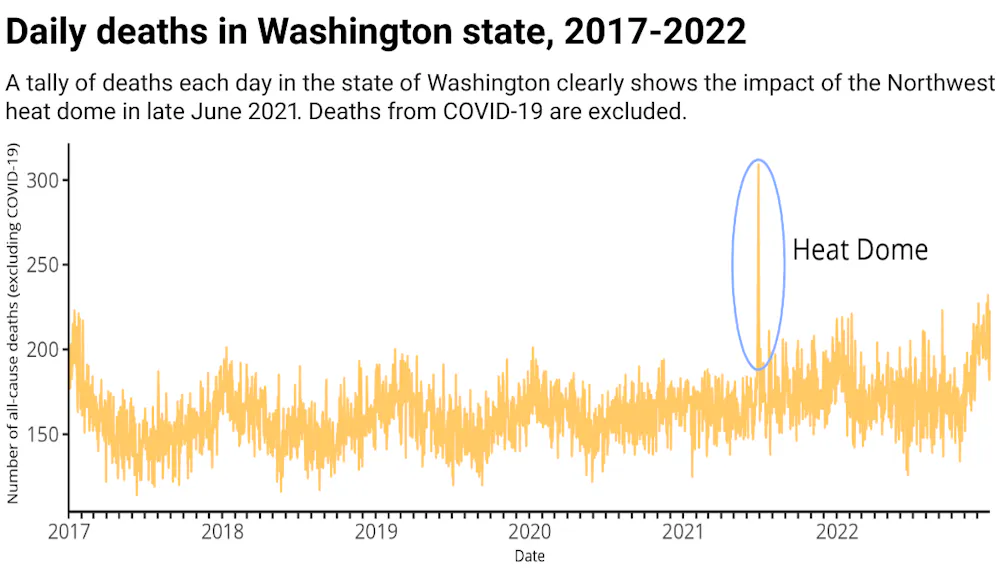
    In June 2021, a deadly heat wave pushed temperatures to 109 degrees Fahrenheit (43 Celsius) in Spokane, Washington, a northern city near the Idaho border where many homes weren’t built with central air conditioning.

    As the heat lingered for over a week, 19 people died in Spokane County and about 300 visited hospitals with signs of heat-related illnesses.

    Scientists say it’s not a matter of if, but when, another deadly heat wave descends on the region. To help save lives, the city teamed up with my university, Gonzaga, to start preparing for a hotter future.

    A chart of all deaths, excluding COVID-19, shows the extraordinary impact the 2021 heat dome had in Washington.
    ‘In the Hot Seat’ report, 2022

    We were excited and relieved when the community was awarded a US$19.9 million grant from the Environmental Protection Agency to help it take concrete steps to adapt to climate change and boost the local economy in the process. The grant would help establish resilience hubs with microgrids and help residents without air conditioning install energy-efficient cooling systems. The city doesn’t have the means to make these improvements on its own, even if they would save lives and money in the long run.

    Less than a year later, the Trump administration abruptly terminated the funding.

    Spokane’s grant wasn’t the only one eliminated – about 350 similar grants that had been awarded to help communities across the country manage climate changes, from extreme heat and wildfire smoke to rising seas and flooding, were also terminated on the grounds that they don’t meet the White House’s priorities. Many other grants to help communities have also been terminated.

    Many of the communities that lost funding are like Spokane: They can’t afford to do this kind of work on their own.

    Why cities like Spokane need the help

    Like many communities in the American West, Spokane was founded in the late 19th century on wealth from railroads and resource extraction, especially gold, silver and timber.

    Today, it is a city of 230,000 in a metro area of a half-million people, the largest on the I-90 corridor between Minneapolis and Seattle. In many ways, Spokane could be on the cusp of a renaissance.

    In January 2025, the U.S. Department of Commerce announced a $48 million grant to develop a tech hub that could put the Inland Northwest on a path to become a global leader in advanced aerospace materials. But then, in May, the Trump administration rescinded that grant as well.

    The lost grants left the economy – and Spokane’s ability to adapt fast enough to keep up with climate changes – uncertain.

    Heat waves are becoming a growing risk in Spokane, known for its river and falls that tumble near downtown.
    Roman Eugeniusz/Wikimedia Commons, CC BY-SA

    This is not a wealthy area. The median household income is nearly $30,000 less than the state average. More than 13 out of every 100 people in Spokane live in poverty, above the national average, and over 67% of the children are eligible for free or reduced lunch.

    The city is a light blue island in a dark red sea, politically speaking, with a moderate mayor. Its congressional district has voted Republican by wide margins since 1995, the year that then-House Speaker Tom Foley lost his reelection bid.

    Lessons from the 2021 heat dome

    The 2021 heat wave was a catalyzing event for the community. The newly formed Gonzaga Institute for Climate, Water and the Environment brought together a coalition of government and community partners to apply for the EPA’s Climate and Environmental Justice Community Change Grant Program. The grants, funded by Congress under the Inflation Reduction Act of 2022, were intended to help communities most affected by pollution and climate change build adaptive capacity and boost the safety of their residents.

    A key lesson from the 2021 heat dome was that temporary, or pop-up, cooling centers don’t work well. People just weren’t showing up. Our research found that the best approach is to strengthen existing community facilities that people already turn to in moments of difficulty.

    Half the $19.9 million award was for outfitting five resilience hubs in existing libraries and community centers with solar arrays and battery backup microgrids, allowing them to continue providing a safe, cool space during a heat wave if the power shuts down.

    The locations and plans for five resilience hubs to serve Spokane, and the infrastructure they would receive.
    Gonzaga Institute for Climate, Water and the Environment

    Another $8 million in grant funding was meant to provide 300 low- to moderate-income homeowners with new high-efficiency electric heat pump heating, ventilation and air conditioning systems, providing more affordable utility bills while improving their ability to cool their homes and reducing fossil fuel emissions.

    Communities are left with few options

    Now, this and other work is at risk in Spokane and cities and towns like it around the country that also lost funding.

    According to the Trump administration, the program – designed to help hundreds of communities around the country become safer – was “no longer consistent with EPA funding priorities.”

    A class action lawsuit was recently filed over the termination of the grants by a coalition that includes Earth Justice and the Southern Environmental Law Center. If the case is successful, Spokane could see its funding restored.

    Meanwhile, the city and my team know we have to move fast, with whatever money and other resources we can find, to help Spokane prepare for worsening heat. We formed the Spokane Climate Resilience Collaborative – a partnership between community organizations, health officials and the city – as one way to advance planning for and responding to climate hazards such as extreme heat and wildfire smoke.

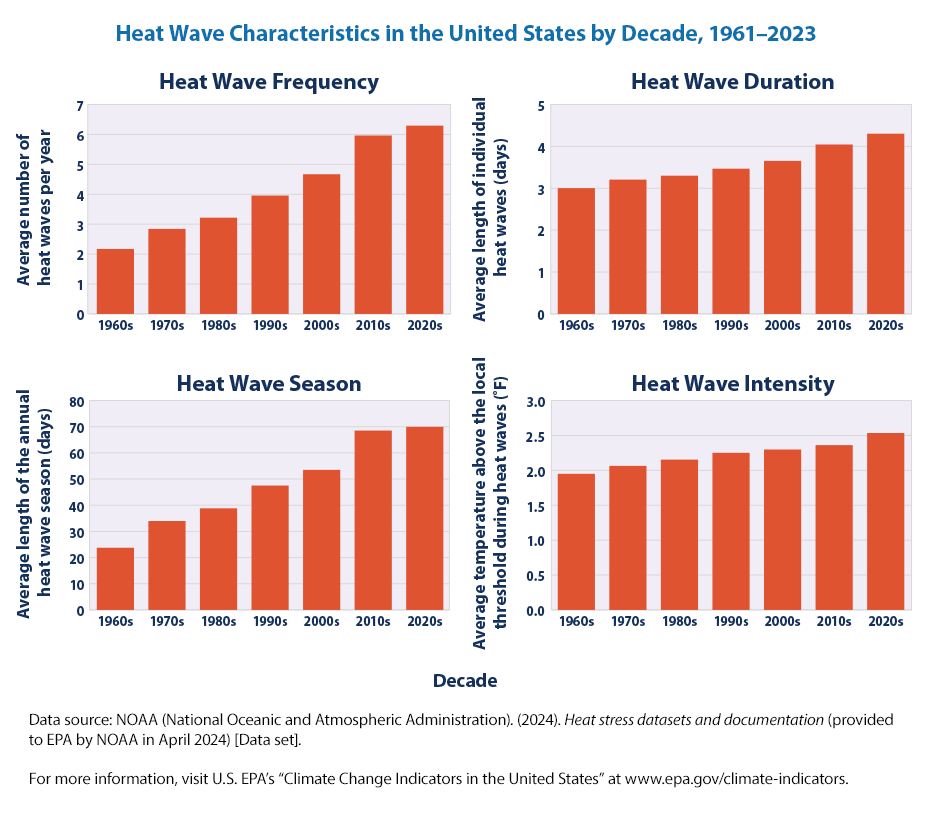
    As concentrations of heat-trapping gasses accumulate in the atmosphere, both the frequency and severity of heat waves increase. It is only a matter of time before another deadly heat dome arrives.

    Brian G. Henning receives funding from the Environmental Protection Agency.

    ref. My city was one of hundreds expecting federal funds to help manage rising heat wave risk – then EPA terminated the grants – https://theconversation.com/my-city-was-one-of-hundreds-expecting-federal-funds-to-help-manage-rising-heat-wave-risk-then-epa-terminated-the-grants-259009

    MIL OSI Analysis

  • MIL-OSI Analysis: Trump administration’s lie detector campaign against leakers is unlikely to succeed and could divert energy from national security priorities

    Source: The Conversation – USA – By Brian O’Neill, Professor of Practice, International Affairs, Georgia Institute of Technology

    The Department of Homeland Security and FBI are reportedly using polygraphs aggressively to identify dissenters. standret/Getty Images

    The Trump administration has recently directed that a new wave of polygraphs be administered across the executive branch, aimed at uncovering leaks to the press.

    As someone who has taken roughly a dozen polygraphs during my 27-year career with the CIA, I read this development with some skepticism.

    Polygraphs carry an ominous, almost mythological reputation among Americans. The more familiar and unofficial term – lie detector tests – likely fuels that perception. Television crime dramas have done their part, too, often portraying the device as an oracle for uncovering the truth when conventional methods fail.

    In those portrayals, the polygraph is not merely a tool – it’s a window into the soul.

    Among those entering government service, especially in national security, the greater anxiety is not the background check but passing the polygraph. My advice is always the same: Don’t lie.

    It’s the best – and perhaps only – guidance for a process that most assessments have concluded is a more subjective interpretation than empirical science.

    Why the polygraph persists

    Polygraphs are “pseudo-scientific” in that they measure physiological responses such as heart rate, blood pressure and perspiration. The assumption is that liars betray themselves through spikes in those signals. But this presumes a kind of psychological transparency that simply doesn’t hold up. A person might sweat and tremble simply from fear, anger or frustration – not deceit.

    There also are no specific physiological reactions associated with lying. The National Academy of Sciences in 2003, and the American Psychological Association in a 2004 review, concluded that the polygraph rests more on theater than fact. Recent assessments, published in 2019, have reached the same conclusion.

    Accordingly, polygraph results are not generally admissible in U.S. courts. Only a handful of states – such as Georgia, Arizona and California – permit their use even under limited conditions. And they typically require that both parties agree to admission and a judge to approve it. Unconditional admissibility remains the exception, not the rule.

    And yet, inside many national security agencies, polygraphs remain central to the clearance process – a fact I observed firsthand during my time overseeing personnel vetting and analytic hiring within the intelligence community.

    While not treated as conclusive, polygraph results often serve as a filter. A candidate’s visible discomfort – or the examiner’s subjective judgment that a response seems evasive – can stall or end the hiring process. For instance, I know that government agencies have halted clearances after an examiner flagged elevated reactions to questions about past drug use or foreign contacts, even when no disqualifying behavior was ultimately documented.

    The FBI’s J. Edgar Hoover headquarters building in Washington in 2016.
    AP Photo/Cliff Owen

    In some cases, an examiner’s suggestion that a chart shows an anomaly has led otherwise strong applicants to volunteer details they hadn’t planned to share – such as minor security infractions, undeclared relationships, or casual drug use from decades earlier – that, while not disqualifying on their own, reshape how their trustworthiness is perceived.

    The polygraph’s power lies in creating the conditions under which deception is confessed.

    A predictable pattern

    No administration has been immune to the impulse to investigate leaks. The reflex is bipartisan and familiar: An embarrassing disclosure appears in the press – contradicting official statements or exposing internal dissent – and the White House vows to identify and punish the source. Polygraphs are often part of this ritual.

    During his first term, Trump intensified efforts to expose internal dissent and media leaks. Department guidelines were revised to make it easier for agencies to obtain journalists’ phone and email records, and polygraphs were reportedly used to pressure officials suspected of talking to the press. That trend has continued – and, in some areas, escalated.

    Recent policies at the Pentagon now restrict unescorted press access, revoke office space for major outlets and favor ideologically aligned networks. The line between legitimate leak prevention and the surveillance or sidelining of critical press coverage has grown increasingly blurred.

    At agencies such as the Department of Homeland Security and the FBI, polygraphs are reportedly being used more frequently – and more punitively – to identify internal dissenters. Even “cold cases,” such as the leak of the Supreme Court’s Dobbs opinion ahead of its overturning of Roe v. Wade, have been reopened, despite prior investigations yielding no definitive source.

    Government reaction varies

    Not all leaks are treated the same. Disclosures that align with official narratives or offer strategic advantage may be quietly tolerated, even if unauthorized. Others, especially those that embarrass senior officials or reveal dysfunction, are more likely to prompt formal investigation.

    In 2003, for example, the leak of CIA officer Valerie Plame’s identity – widely seen as retaliation for her husband’s criticism of the Iraq War – triggered a federal investigation. The disclosure embarrassed senior officials, led to White House aide Scooter Libby’s conviction for perjury, later commuted, and drew intense political scrutiny.

    Lewis Libby, Vice President Dick Cheney’s chief of staff, rides in the backseat of a limousine on Oct. 27, 2005, in McLean, Va.
    Win McNamee/Getty Images

    Leaks involving classified material draw the sharpest response when they challenge presidential authority or expose internal disputes. That was the case in 2010 with Chelsea Manning, whose disclosure of diplomatic cables and battlefield reports embarrassed senior officials and sparked global backlash. Government reaction often depends less on what was disclosed than on who disclosed it – and to what effect.

    A narrow set of disclosures, such as those involving espionage or operational compromise, elicit broad consensus as grounds for prosecution. But most leaks fall outside that category. Most investigations fade quietly. The public rarely learns what became of them. Occasionally, there is a vague resignation, but direct accountability is rare.

    What the future holds

    Trump’s polygraph campaign is not likely to eliminate leaks to the press. But they may have a chilling effect that discourages internal candor while diverting investigative energy away from core security priorities.

    Even if such campaigns succeed in reducing unauthorized disclosures, they may come at the cost of institutional resilience. Historically, aggressive internal enforcement has been associated with declining morale and reduced information flow – factors that can hinder adaptation to complex threats.

    Some researchers have suggested that artificial intelligence may eventually offer reliable tools for detecting deception. One recent assessment raised the possibility, while cautioning that the technology is nowhere near operational readiness.

    For now, institutions will have to contend with the tools they have – imperfect, imprecise and more performative than predictive.

    As a former US intelligence officer, I am required to submit any written draft, before sharing it with other persons, for prepublication review. I submitted this draft to CIA’s Prepublication Review Board, which responded on 11 June: “No classified information was identified. Therefore, no changes are required for publication or sharing with others.”

    ref. Trump administration’s lie detector campaign against leakers is unlikely to succeed and could divert energy from national security priorities – https://theconversation.com/trump-administrations-lie-detector-campaign-against-leakers-is-unlikely-to-succeed-and-could-divert-energy-from-national-security-priorities-259128

    MIL OSI Analysis

  • MIL-OSI: Banzai Appoints Dean Ditto as Chief Financial Officer

    Source: GlobeNewswire (MIL-OSI)

    SEATTLE, July 09, 2025 (GLOBE NEWSWIRE) — Banzai International, Inc. (NASDAQ: BNZI) (“Banzai” or the “Company”), a leading marketing technology company that provides essential marketing and sales solutions, today announced the appointment of Dean Ditto, CPA, as Chief Financial Officer of the Company, effective July 14, 2025. Mr. Ditto replaces Interim Chief Financial Officer, Alvin Yip, who will continue with the Company in the role of Chief Accounting Officer.

    Dean Ditto has over 30 years’ experience as a strategic financial leader with a track record of implementing critical business initiatives that drive profitable growth at both public and private companies. Prior to joining Banzai, Mr. Ditto was Chief Financial Officer of Akerna Corp. a SaaS technology company where he led a corporate restructuring plan that produced cost savings of $6 million annually. Previously, he was CFO of Mydecine Innovations Group, Inc., a biotech and life sciences company, where he raised $40 million through public and private offerings to support drug and IP development and operations. As CFO of Sigue Corporation, a closely-held Fintech provider, Mr. Ditto worked to improve the business planning, budgeting and financial analysis processes. He has also served in financial leadership roles at OSI Systems, Dental Lab Holdings, KARL STORZ Endoscopy-America, Countrywide Home Loans, Giant Bicycle USA, and Ford Motor Company. Mr. Ditto holds a Bachelor of Arts in Economics and Management from Albion College, and holds a Master of Business Administration from the Kelley School of Business at Indiana University.

    “On behalf of our board and management team, I would like to welcome Dean to the position. We are privileged to have someone of his caliber and financial skill set serve as our CFO,” said Joe Davy, Founder and CEO of Banzai. “I would like to thank Alvin for his contribution in leading us to this inflection point, and welcome Dean’s capabilities in scaling public technology companies. His achievements as well as expertise in financial management of listed companies will make a significant addition to the strategic operation and development of Banzai going forward.”

    Mr. Ditto added, “I am excited to be appointed as CFO as we prepare Banzai for the future in a rapidly evolving market. I look forward to working with Joe, the executive team, and the finance team as we continue to execute on our strategic and financial priorities focused on value-added growth and our commitments to all shareholders.”

    About Banzai

    Banzai is a marketing technology company that provides AI-enabled marketing and sales solutions for businesses of all sizes. On a mission to help their customers grow, Banzai enables companies of all sizes to target, engage, and measure both new and existing customers more effectively. Banzai has over 90,000 customers including RBC, Dell Technologies, New York Life, Thermo Fisher Scientific, Thinkific, and ActiveCampaign. Learn more at www.banzai.io. For investors, please visit https://ir.banzai.io.

    Forward-Looking Statements

    This press release contains forward-looking statements within the meaning of the Private Securities Litigation Reform Act of 1995. Forward-looking statements often use words such as “believe,” “may,” “will,” “estimate,” “target,” “continue,” “anticipate,” “intend,” “expect,” “should,” “would,” “propose,” “plan,” “project,” “forecast,” “predict,” “potential,” “seek,” “future,” “outlook,” and similar variations and expressions. Forward-looking statements are those that do not relate strictly to historical or current facts. Examples of forward-looking statements may include, among others, statements regarding Banzai International, Inc.’s (the “Company’s”): future financial, business and operating performance and goals; annualized recurring revenue and customer retention; ongoing, future or ability to maintain or improve its financial position, cash flows, and liquidity and its expected financial needs; potential financing and ability to obtain financing; acquisition strategy and proposed acquisitions and, if completed, their potential success and financial contributions; strategy and strategic goals, including being able to capitalize on opportunities; expectations relating to the Company’s industry, outlook and market trends; total addressable market and serviceable addressable market and related projections; plans, strategies and expectations for retaining existing or acquiring new customers, increasing revenue and executing growth initiatives; and product areas of focus and additional products that may be sold in the future. Because forward-looking statements relate to the future, they are subject to inherent uncertainties, risks and changes in circumstances that are difficult to predict and many of which are outside of our control. Forward-looking statements are not guarantees of future performance, and our actual results of operations, financial condition and liquidity and development of the industry in which the Company operates may differ materially from those made in or suggested by the forward-looking statements. Therefore, investors should not rely on any of these forward-looking statements. Factors that may cause actual results to differ materially include changes in the markets in which the Company operates, customer demand, the financial markets, economic, business and regulatory and other factors, such as the Company’s ability to execute on its strategy. More detailed information about risk factors can be found in the Company’s Annual Report on Form 10-K and the Company’s Quarterly Reports on Form 10-Q under the heading “Risk Factors,” and in other reports filed by the Company, including reports on Form 8-K. The Company does not undertake any duty to update forward-looking statements after the date of this press release.

    Investor Relations
    Chris Tyson
    Executive Vice President
    MZ Group – MZ North America
    949-491-8235
    BNZI@mzgroup.us
    www.mzgroup.us

    Media
    Nancy Norton
    Chief Legal Officer, Banzai
    media@banzai.io

    The MIL Network

  • MIL-OSI Russia: China, Egypt Should Deepen Strategic Coordination for Common Interests: Chinese Premier

    Translation. Region: Russian Federal

    Source: People’s Republic of China in Russian – People’s Republic of China in Russian –

    An important disclaimer is at the bottom of this article.

    Source: People’s Republic of China – State Council News

    CAIRO, July 9 (Xinhua) — China and Egypt, as important members of the Global South, should further strengthen strategic coordination to safeguard common interests, Chinese Premier Li Qiang said on Wednesday upon his arrival in Cairo for an official visit to Egypt at the invitation of his Egyptian counterpart Mostafa Madbouly.

    Noting that China and Egypt are ancient civilizations, the Chinese premier said that since the establishment of diplomatic ties nearly 70 years ago, the two countries have remained close friends who support each other and strategic partners with a shared destiny.

    In recent years, under the strategic leadership of Chinese President Xi Jinping and Egyptian President Abdel Fattah el-Sisi, China-Egypt relations have flourished, their traditional friendship has become stronger over time, political mutual trust has deepened, practical cooperation has yielded fruitful results, and multilateral coordination has become increasingly close and effective, he said.

    According to Li Qiang, the two countries have created a model of solidarity, unity, self-reliance, mutual benefit and mutual support for major developing countries.

    He noted that last year, the two heads of state met twice and reached an important consensus on advancing the construction of a China-Egypt community with a shared future in the new era, which opened up new opportunities for bilateral relations.

    As global changes accelerate unseen in a century and various challenges emerge, China and Egypt, as key members of the Global South, should also jointly promote peace and prosperity, the Chinese premier said.

    Li Qiang noted that China is willing to work with Egypt to deepen cooperation in all fields under the strategic leadership of the two heads of state, continuously enrich the content of the China-Egypt comprehensive strategic partnership, give strong impetus to development and national revival, and actively promote regional and global peace and stability.

    The Egyptian prime minister and senior government officials met Li Qiang at the airport and held a welcoming ceremony in his honor. Before arriving in Egypt, the Chinese premier attended the 17th BRICS summit in Rio de Janeiro, Brazil. –0–

    Please note: This information is raw content obtained directly from the source of the information. It is an accurate report of what the source claims and does not necessarily reflect the position of MIL-OSI or its clients.

    .

    MIL OSI Russia News

  • MIL-OSI USA: Governor Newsom deploys firefighter strike team to support Oregon wildfire response

    Source: US State of California 2

    Jul 8, 2025

    SACRAMENTO — As wildfire conditions intensify across the Pacific Northwest, Governor Newsom has directed the deployment of a CAL FIRE Type 3 engine strike team to assist firefighting efforts in southern Oregon. The deployment includes five fire engines and a strike team leader who will join suppression operations just north of the California–Oregon border.

    “Just as Oregon supported our state during the Los Angeles firestorms, we’re glad to support our Northern neighbors with strike teams and fire engines to aid in their wildfire response efforts. I’m proud California can lend a helping hand to fellow Americans in their time of need.” 

    Governor Gavin Newsom

    CAL FIRE engines being sent to support wildfire suppression in Oregon

    This mobilization comes in response to a significant lightning event that ignited numerous wildfires across the region. Southern Oregon has experienced more than 2,000 lightning strikes in recent days, compounded by high temperatures and gusty winds. The National Weather Service has issued Red Flag Warnings through July 8 for much of southern and central Oregon, signaling elevated fire danger and the need for immediate firefighting reinforcements.

    Upon arrival in Medford, CAL FIRE resources will seamlessly integrate into Oregon’s Department of Forestry command structure to support suppression efforts on active fires. This response is part of a long-standing interstate mutual aid agreement that strengthens wildfire readiness across the western United States.

    California remains prepared to send additional resources should conditions escalate.

    “We stand with Oregon during this critical time, just as they’ve stood with us during some of California’s toughest fire seasons,” said Anale Burlew, Chief Deputy Director of CAL FIRE. “These mutual aid partnerships are built on trust, coordination, and a shared commitment to public safety.”

    Press releases, Recent news

    Recent news

    News What you need to know: The $101 million being made available today will support the development of affordable multifamily rental housing in Los Angeles, prioritizing the needs of displaced residents in the fire-devastated regions. Los Angeles, California – Six…

    News SACRAMENTO – Governor Gavin Newsom today announced the deployment of an additional 18 highly skilled Urban Search and Rescue Team members to Texas to assist with ongoing response efforts related to severe flooding impacts.The deployment includes a total of four…

    News Perris, California — On June 18, 2025, the First Partner visited the Inland Empire to meet with California communities impacted by the Trump Administration’s federal immigration raids. The First Partner visited TODEC, a local nonprofit organization that’s become…

    Jul 8, 2025

    What you need to know: The passage of Proposition 1 by California voters adds rocket fuel to Governor Gavin Newsom’s transformational overhaul of the state’s behavioral health system. These reforms refocus existing funds to prioritize Californians with the most serious mental health and substance use issues, who are too often experiencing homelessness. They also fund more than 11,150 new behavioral health beds and supportive housing units and 26,700 outpatient treatment slots.

    Los Angeles, California – California took a major step forward in correcting the damage from 50 years of neglect to the state’s mental health system with the passage of Proposition 1. This historic measure — a signature priority of Governor Gavin Newsom — adds rocket fuel to California’s overhaul of the state’s behavioral health systems. It provides a full range of mental health and substance abuse care, with new accountability metrics to ensure local governments deliver for their communities.

    This is the biggest reform of the California mental health system in decades and will finally equip partners to deliver the results all Californians need and deserve. Treatment centers will prioritize mental health and substance use support in the community like never before. Now, it’s time to roll up our sleeves and begin implementing this critical reform – working closely with city and county leaders to ensure we see results.

    Governor Gavin Newsom

    newsom-news-template
    IMG_3682-min
    contact-governor-landing
    workers-FxAJ5fkakAAtVI3
    priorities-and-progress-image
    economy-F-isBKpbsAAxdab
    gun-violence-San Diego Guns Package 2.18.22_2

    What they’re saying: 

    • Sacramento Mayor Darrell Steinberg, original author of the Mental Health Services Act: “Twenty years ago, I never could have dreamed that we would have the strong leadership we have today, committing billions and making courageous policy changes that question the conventional wisdom on mental health. Now, with the passage of Proposition 1. California is delivering on decades old promises to help people living with brain-based illnesses, to live better lives, to live independently and to live with dignity in our communities. This is a historic moment and the hard work is ahead of us.“
    • Senator Susan Eggman (D-Stockton), author of Senate Bill 326: “Today marks a day of hope for thousands of Californians who are struggling with mental illness – many of whom are living unhoused. I am tremendously grateful to my fellow Californian’s for passing this important measure.  And I am very appreciative of this Governor’s leadership to transform our behavioral health care system!”
    • Assemblymember Jacqui Irwin (D-Thousand Oaks), author of Assembly Bill 531: “This started as an audacious proposal to address the root cause of homelessness and today, Californians can be proud to know that they did the right thing by passing Proposition 1. Now, it’s time for all of us to get to work, and make sure these reforms are implemented and that we see results.”

    Bigger picture: Transforming the Mental Health Services Act into the Behavioral Health Services Act and building more community mental health treatment sites and supportive housing is the last main pillar of Governor Newsom’s Mental Health Movement – pulling together significant recent reforms like 988 crisis line, CalHOPE, CARE Court, conservatorship reform, CalAIM behavioral health expansion (including mobile crisis care and telehealth), Medi-Cal expansion to all low-income Californians, Children and Youth Behavioral Health Initiative (including expanding services in schools and on-line), Older Adult Behavioral Health Initiative, Veterans Mental Health Initiative, Behavioral Health Community Infrastructure Program, Behavioral Health Bridge Housing, Health Care Workforce for All and more.

    More details on next step here

    Press releases, Recent news

    Recent news

    News What you need to know: The $101 million being made available today will support the development of affordable multifamily rental housing in Los Angeles, prioritizing the needs of displaced residents in the fire-devastated regions. Los Angeles, California – Six…

    News SACRAMENTO – Governor Gavin Newsom today announced the deployment of an additional 18 highly skilled Urban Search and Rescue Team members to Texas to assist with ongoing response efforts related to severe flooding impacts.The deployment includes a total of four…

    News Perris, California — On June 18, 2025, the First Partner visited the Inland Empire to meet with California communities impacted by the Trump Administration’s federal immigration raids. The First Partner visited TODEC, a local nonprofit organization that’s become…

    Jul 8, 2025

    What you need to know: The passage of Proposition 1 by California voters adds rocket fuel to Governor Gavin Newsom’s transformational overhaul of the state’s behavioral health system. These reforms refocus existing funds to prioritize Californians with the most serious mental health and substance use issues, who are too often experiencing homelessness. They also fund more than 11,150 new behavioral health beds and supportive housing units and 26,700 outpatient treatment slots.

    Los Angeles, California – California took a major step forward in correcting the damage from 50 years of neglect to the state’s mental health system with the passage of Proposition 1. This historic measure — a signature priority of Governor Gavin Newsom — adds rocket fuel to California’s overhaul of the state’s behavioral health systems. It provides a full range of mental health and substance abuse care, with new accountability metrics to ensure local governments deliver for their communities.

    This is the biggest reform of the California mental health system in decades and will finally equip partners to deliver the results all Californians need and deserve. Treatment centers will prioritize mental health and substance use support in the community like never before. Now, it’s time to roll up our sleeves and begin implementing this critical reform – working closely with city and county leaders to ensure we see results.

    Governor Gavin Newsom

    newsom-news-template
    IMG_3682-min
    contact-governor-landing
    workers-FxAJ5fkakAAtVI3
    priorities-and-progress-image
    economy-F-isBKpbsAAxdab
    gun-violence-San Diego Guns Package 2.18.22_2

    What they’re saying: 

    • Sacramento Mayor Darrell Steinberg, original author of the Mental Health Services Act: “Twenty years ago, I never could have dreamed that we would have the strong leadership we have today, committing billions and making courageous policy changes that question the conventional wisdom on mental health. Now, with the passage of Proposition 1. California is delivering on decades old promises to help people living with brain-based illnesses, to live better lives, to live independently and to live with dignity in our communities. This is a historic moment and the hard work is ahead of us.“
    • Senator Susan Eggman (D-Stockton), author of Senate Bill 326: “Today marks a day of hope for thousands of Californians who are struggling with mental illness – many of whom are living unhoused. I am tremendously grateful to my fellow Californian’s for passing this important measure.  And I am very appreciative of this Governor’s leadership to transform our behavioral health care system!”
    • Assemblymember Jacqui Irwin (D-Thousand Oaks), author of Assembly Bill 531: “This started as an audacious proposal to address the root cause of homelessness and today, Californians can be proud to know that they did the right thing by passing Proposition 1. Now, it’s time for all of us to get to work, and make sure these reforms are implemented and that we see results.”

    Bigger picture: Transforming the Mental Health Services Act into the Behavioral Health Services Act and building more community mental health treatment sites and supportive housing is the last main pillar of Governor Newsom’s Mental Health Movement – pulling together significant recent reforms like 988 crisis line, CalHOPE, CARE Court, conservatorship reform, CalAIM behavioral health expansion (including mobile crisis care and telehealth), Medi-Cal expansion to all low-income Californians, Children and Youth Behavioral Health Initiative (including expanding services in schools and on-line), Older Adult Behavioral Health Initiative, Veterans Mental Health Initiative, Behavioral Health Community Infrastructure Program, Behavioral Health Bridge Housing, Health Care Workforce for All and more.

    More details on next step here

    Press releases, Recent news

    Recent news

    News What you need to know: The $101 million being made available today will support the development of affordable multifamily rental housing in Los Angeles, prioritizing the needs of displaced residents in the fire-devastated regions. Los Angeles, California – Six…

    News SACRAMENTO – Governor Gavin Newsom today announced the deployment of an additional 18 highly skilled Urban Search and Rescue Team members to Texas to assist with ongoing response efforts related to severe flooding impacts.The deployment includes a total of four…

    News Perris, California — On June 18, 2025, the First Partner visited the Inland Empire to meet with California communities impacted by the Trump Administration’s federal immigration raids. The First Partner visited TODEC, a local nonprofit organization that’s become…

    MIL OSI USA News

  • MIL-OSI USA: Office of the Governor – News Release – Gov. Green Signs Landmark Legislation Pertaining to Maui Wildfires Settlement and Fire Marshal

    Source: US State of Hawaii

    Governor Josh Green, M.D., today enacted legislation to solidify the global settlement for claims relating to the August 2023 Maui wildfires and to further codify the role of Hawai‘i’s first State Fire Marshal in nearly 46 years.

    “Today we are re-envisioning the path forward in the roadmap of wildfire prevention and recovery,” said Governor Green. “We are taking action from both ends of the wildfire spectrum — building a more robust fire prevention framework within the state and enacting historic legislation that will aid in timely access to compensation following disaster. This crisis impacts us on many fronts, and it is time we tackle it the same way, from multiple directions.”

    HB 1001: RELATING TO SETTLEMENT OF CLAIMS RELATED TO THE MAUI WILDFIRES
    House Bill 1001 (Act 301) establishes the Maui Wildfires Settlement Trust Fund to provide dedicated funding for those affected by the 2023 Maui wildfires. The bill appropriates $807.5 million to support the state’s contribution in the settlement of claims, which shall be deposited into the trust fund. Additional contributions to the state fund include funding from the County of Maui, Hawaiian Electric, Kamehameha Schools, Charter Communications/Spectrum, Hawaiian Telcom and West Maui Land Company.

    Governor Green sought to establish this funding to provide timely compensation for survivors’ claims as an alternative to lengthy litigation, ensuring those affected do not have to wait years to rebuild their lives. Recipients of compensation from the settlement trust fund shall agree to release the state and any additional parties that contribute to the fund from all further liability arising from the Maui wildfires.

    “This legislation is a huge win and sets a new precedent for swift settlement of claims for wildfire victims,” said Governor Green. “It should not take years for people to see compensation or begin rebuilding. This is about healing, restoring trust and helping families recover as quickly as possible in the place they call home.”

    The measure emphasizes providing meaningful compensation by specifying that property and casualty insurance companies can only recover payments made to a policyholder through a statutory lien. This provision demonstrates the state’s commitment to prioritizing the individuals affected by the wildfire to receive claims directly.

    The settlement agreement totals $4.037 billion and resolves claims of liability against multiple defendants, including the County of Maui. The agreement aims to reduce the legal load of the judicial system while avoiding the high costs associated with litigation.

    HB 1064: RELATING TO FIRE PROTECTION
    In accordance with the Fire Safety Research Institute’s three-phase report — developed to improve fire preparedness and response following the August 2023 Maui wildfires —  House Bill 1064 (Act 302) effectuates the recommendations provided in “Phase 3” of the report. Phase 3 focuses on the forward-looking portion of the investigation and proposes improvements to the Office of the State Fire Marshal, which was originally established under Act 209, Session Law of Hawai‘i 2024.

    Under Act 302, the Office of the State Fire Marshal is transferred to the Department of Law Enforcement and will be led by the State Fire Marshal. The legislation further clarifies the roles, duties, and discretionary authority of both the Office and the State Fire Marshal, supporting the state’s efforts to provide coordinated, statewide fire prevention and readiness strategies. To enhance coordination between the Office of the State Fire Marshal and the State Fire Council, the bill outlines responsibilities and the organizational structure related to matters such as reporting and recommending amendments to the state fire code.

    The bill requires the Fire Chief of each county to investigate and maintain an annual record of fire occurrences. These records must be submitted to the Office of the State Fire Marshal for centralized analysis. The county submissions will assist the State Fire Marshal in compiling biennial statistical reports, including those made available to the public and those submitted to the Legislature.

    “Last month, I appointed Dori Booth as Hawai‘i’s new State Fire Marshal, reviving a critical public safety position that has been vacant for nearly 46 years,” said Governor Green. “This appointment marks a turning point as we redefine the role — empowering the office with clear authority and resources to better protect our state through fire prevention strategies and analysis.”

    “My first month in office has been both eye-opening and incredibly encouraging,” said State Fire Marshal Dori Booth. “I’ve had the opportunity to meet with dedicated state and county partners, as well as private stakeholders, who are all working tirelessly to enhance fire prevention, readiness, and resiliency across our islands. These conversations have been instrumental in shaping my initial assessments and understanding the unique strengths each organization brings to the table. The feedback I’ve received has affirmed the vital role the Fire Marshal’s Office can play — not only in supporting these existing efforts, but also in unifying them to build a stronger, more resilient Hawai‘i. HB 1064 is a meaningful step forward, and I’m honored to stand with so many committed partners as we move toward a safer future together.”

    Lastly, HB 1064 establishes the State Fire Marshal Selection Commission and defines its roles and structure. The selection commission will be given the authority to appoint and remove the State Fire Marshal, evaluate the State Fire Marshal’s performance, and address matters of public interest.

    “With the State Fire Marshal position re-established for the first time in nearly five decades, this legislation gives the office the structure, authority, and support it needs to succeed,” said Senator Brandon Elefante (Senate District 16 – ‘Aiea, ‘Aiea Heights, Hālawa, Pearlridge, Newtown, Royal Summit, Waimalu, Waiau, Momilani, Pacific Palisades, and Pearl City), who chairs the Senate Public Safety and Military Affairs Committee. “It’s a significant step in building a stronger, more coordinated approach to fire prevention and public safety across Hawai‘i.”

    There is $2.2 million appropriated in fiscal year 2026 and an equal amount for fiscal year 2027 to support the establishment and operations of the Office and State Fire Marshal.

    Video of the bill signing can be seen here.
    The slide deck presented by the Governor can be viewed here.
    Photos of the bill signing ceremonies, courtesy Office of the Governor, will be uploaded here.

    MIL OSI USA News

  • MIL-OSI USA: Governor Newsom commits $101 million to jumpstart critical rebuilding efforts after LA Fires

    Source: US State of California 2

    Jul 8, 2025

    What you need to know: The $101 million being made available today will support the development of affordable multifamily rental housing in Los Angeles, prioritizing the needs of displaced residents in the fire-devastated regions.

    Los Angeles, California – Six months after the LA Fires, Governor Gavin Newsom and the California Department of Housing and Community Development (HCD) announced the release of $101 million to help rapidly rebuild critically needed, affordable multifamily rental housing in the fire-devastated Los Angeles region. Thousands of families are still displaced by the wildfires that raged through the Greater Los Angeles Region in January 2025, placing an incredible strain on an already tight rental market.

    Tomiquia Moss, Secretary of the California Business, Consumer Services and Housing Agency: “The State’s special Multifamily Finance Super NOFA will galvanize the collective public-private response to the wildfires in Los Angeles County, expediting and expanding opportunities to build affordable housing for low-income residents. By prioritizing affordable housing projects that are ready to go, these funds will accelerate household stability, climate and health outcomes in communities.”

    Today’s funding

    HCD’s Multifamily Finance Super NOFA (MFSN) allows affordable housing developers to apply to multiple funding programs through a single application. In February 2025, HCD released a MFSN Notice of Funding Availability (NOFA) announcing $382 million available for development of affordable multifamily rental housing statewide. A separate $50 million Tribal MFSN was released in March 2025.

    The special MFSN NOFA announced today (MFSN-LA Disaster) provides an additional $101 million in funding to support recovery and rebuilding efforts from 2025 wildfires within Los Angeles County. This MFSN-LA Disaster NOFA has been designed to meet the immediate housing needs of disaster-impacted areas and residents in Los Angeles as quickly as possible by prioritizing projects that are: close to wildfire burn areas; ready to begin construction immediately upon award; and include a resident preference for households displaced by the Los Angeles County wildfires.

    HCD Director Gustavo Velasquez: “HCD has taken a program built on efficiency and further refined it specifically to help the Los Angeles region rebuild from unimaginable tragedy. Our team has gone above and beyond to ensure this program is designed to provide housing stability for fire-displaced families as quickly as possible.”

    This MFSN-LA Disaster NOFA provides a two-phase award process to accelerate the delivery of affordable housing. If funds remain after all applications for shovel-ready projects have been assessed, applications will continue to be accepted for all eligible projects until the funds are expended.

    Funding available through this MFSN-LA Disaster NOFA includes grants for the infrastructure needed to facilitate housing development with a focus on disaster resilience and mitigation, low-interest loans for the development of new multifamily units affordable to low-income and very low-income households, and operating subsidy reserves to support the long-term financial feasibility of the projects. All projects will be required to remain affordable for at least 55 years.

    Multifamily Finance Super NOFA (MFSN)

    This year marks the third round of MFSN, which provides applicants the opportunity to apply simultaneously for a combination of awards from the Multifamily Housing Program (MHP), Supportive Housing MHP, Infill Infrastructure Grant Program, Transit-Oriented Development Program, and Veterans Housing and Homelessness Prevention Program. This is the first MFSN round to offer capitalized operating subsidy reserve funding through MHP to support operations.   

    MFSN makes funds more accessible to developers (including emerging and community-based developers), enables the funding to further serve the lowest-income Californians, and increases the range of potential applicants and target populations to achieve better outcomes in health, climate, and household stability.

    Application materials for MFSN-LA Disaster will be available July 21, 2025. Applicants applying for the first phase of funding must upload all required application documents to the HCD website no later than August 21, 2025, at 4:00 p.m. PDT.

    For more information, including webinars and workshops, please visit HCD’s Multifamily Finance Super NOFA webpage.

    Historic fire recovery 

    Today’s announcement builds on Governor Newsom’s broader efforts to cut red tape and expedite the rebuilding of homes and businesses to support disaster survivors.

    Yesterday, the governor announced the substantial completion of the public debris removal program from more than 10,000 fire damaged parcels — marking the fastest major disaster cleanup in American history. The Governor also signed an executive order removing more barriers to rebuilding homes and schools. He also joined local officials to unveil a new blueprint for recovery, a step-by-step plan to accelerate rebuilding and provide support to impacted families and communities. The near-completion of the public debris removal program comes months ahead of schedule.

    Recent news

    News SACRAMENTO – Governor Gavin Newsom today announced the deployment of an additional 18 highly skilled Urban Search and Rescue Team members to Texas to assist with ongoing response efforts related to severe flooding impacts.The deployment includes a total of four…

    News Perris, California — On June 18, 2025, the First Partner visited the Inland Empire to meet with California communities impacted by the Trump Administration’s federal immigration raids. The First Partner visited TODEC, a local nonprofit organization that’s become…

    News SACRAMENTO – Governor Gavin Newsom today announced the deployment of skilled Urban Search and Rescue Team members to Texas to assist with ongoing response efforts related to severe flooding impacts. “California stands with all those who have lost loved ones,…

    MIL OSI USA News

  • MIL-OSI USA: Governor Newsom announces additional crews to assist Texas search and rescue operations

    Source: US State of California 2

    Jul 8, 2025

    SACRAMENTO – Governor Gavin Newsom today announced the deployment of an additional 18 highly skilled Urban Search and Rescue Team members to Texas to assist with ongoing response efforts related to severe flooding impacts.

    The deployment includes a total of four units of Human Remains Detection (HRD) Teams, which also include a total of eight canines. The deployed teams are from the Los Angeles County, Riverside City, Menlo Park and Orange County Fire Departments.   

    The 18 Urban Search and Rescue Team members sent today are in addition to the 9 members deployed yesterday from Riverside City and Oakland City

    The scale of loss and devastation Texas is experiencing right now is unfathomable. California is proud to lend a helping hand to our fellow Americans.

    Governor Gavin Newsom

    During this deployment to Texas, California personnel will use their highly-developed and specialized skills to assist emergency operations in and around the hardest hit areas based on priorities and direction of state and local officials to assist with search and rescue operations.  In close coordination with Texas and through the Emergency Management Assistance Compact (EMAC), the California Governor’s Office of Emergency Services (Cal OES) is deploying these crews.

    “Cal OES deploys these experienced teams to help those in need in Texas,” said Cal OES Director Nancy Ward. “These search and rescue professionals have the training needed to navigate extreme conditions.”

    Potential exists for additional flood impacts in the area. California stands ready to send additional resources as requested.

    Since 1992, California-based resources have been deployed to a long list of state, national, and even international disasters including 2017’s Hurricanes Harvey, Irma and Maria, 1992 Hurricane Iniki (Hawaii), the 1994 Northridge Earthquake, the September 11, 2001 attacks, the World Trade Center, Hurricane Katrina and Hurricane Rita, Hurricane Ian, the Camp Fire in Paradise, the Oklahoma City Bombing, and the Montecito Mudslides.

    This deployment does not impact California’s emergency response and firefighting capabilities.

    Press releases, Recent news

    Recent news

    News Perris, California — On June 18, 2025, the First Partner visited the Inland Empire to meet with California communities impacted by the Trump Administration’s federal immigration raids. The First Partner visited TODEC, a local nonprofit organization that’s become…

    News SACRAMENTO – Governor Gavin Newsom today announced the deployment of skilled Urban Search and Rescue Team members to Texas to assist with ongoing response efforts related to severe flooding impacts. “California stands with all those who have lost loved ones,…

    News What you need to know: California added area the equivalent of Glacier National Park to its conserved lands and coastal waters in just the last year – marking significant progress toward its goal of 30% conservation by 2030. SACRAMENTO – Governor Gavin Newsom…

    MIL OSI USA News

  • MIL-OSI USA: Secretary Noem Hosts Press Conference at Ronald Reagan National Airport

    Source: US Department of Homeland Security

    Headline: Secretary Noem Hosts Press Conference at Ronald Reagan National Airport

    Secretary Noem Hosts Press Conference at Ronald Reagan National Airport
    aunica.brockel

    Secretary Kristi Noem announces a new policy from the Transportation Security Agency that will make screening easier for passengers, improve traveler satisfaction, and will reduce wait times.

    Watch on YouTube

    MIL OSI USA News

  • MIL-OSI USA: MEDIA RELEASE: HAWAIʻI ARMY NATIONAL GUARD READY TO SUPPORT FIRE SUPPRESSION MISSION IF NEEDED

    Source: US State of Hawaii

    MEDIA RELEASE: HAWAIʻI ARMY NATIONAL GUARD READY TO SUPPORT FIRE SUPPRESSION MISSION IF NEEDED

    Posted on Jul 8, 2025 in Latest Department News, Newsroom

    STATE OF HAWAI‘I

    KA MOKU ʻĀINA O HAWAIʻI


    HAWAI‘I DEPARTMENT OF DEFENSE

    KA ʻOIHANA PILI KAUA

    OFFICE OF THE ADJUTANT GENERAL

    JOSH GREEN, M.D.

    GOVERNOR

    KE KIAʻĀINA

    MAJOR GENERAL STEPHEN F. LOGAN

    ADJUTANT GENERAL

    KA ʻAKUKANA KENELALA

    BRIGADIER GENERAL PHILLIP L. MALLORY

    DEPUTY ADJUTANT GENERAL

    KA HOPE ʻAKUKANA KENELALA


    HAWAIʻI ARMY NATIONAL GUARD READY TO SUPPORT FIRE SUPPRESSION MISSION IF NEEDED


    FOR IMMEDIATE RELEASE

    July 8, 2025

    #2025-003

    WAHIAWĀ, HAWAIʻI ­­­­­­­­­— Due to concerns with recent repeated wildfire emergency responses in the West Oʻahu and South Maui areas, Gov. Josh Green, M.D., Commander in Chief of the Hawai‘i National Guard, activated aircrew members to provide additional aerial firefighting capabilities to augment county and state level first responder elements.

    Gov. Green issued the 24th Emergency Proclamation related to wildfires to facilitate the state’s response. Today’s decision enables assets to posture for an immediate response, which increases our capacity to contain and extinguish a fire in its early stage.

    The Hawaiʻi Emergency Management Agency and the Hawaiʻi National Guard are in communication with the affected counties and stand ready to support.

    ###

    Media contact:
    Maj. (Ret) Jeffrey D. Hickman
    Director, Public Affairs
    State of Hawai‘i, Department of Defense
    Office: 808-441-7000
    Direct: 808-779-8008
    [email protected]

    MIL OSI USA News

  • MIL-OSI Banking: Secretary-General of ASEAN Meets with the Minister of Foreign Affairs of Uruguay

    Source: ASEAN – Association of SouthEast Asian Nations

    Secretary-General of ASEAN, Dr. Kao Kim Hourn, today held a bilateral meeting with Minister of Foreign Affairs of Uruguay, Mario Lubetkin, on the sidelines of the 58th ASEAN Foreign Ministers’ Meeting (AMM) and Related Meetings in Kuala Lumpur, Malaysia. They discussed ways to enhance ASEAN- Uruguay cooperation, following Uruguay’s accession to the Treaty of Amity and Cooperation in Southeast Asia.

    The post Secretary-General of ASEAN Meets with the Minister of Foreign Affairs of Uruguay appeared first on ASEAN Main Portal.

    MIL OSI Global Banks

  • MIL-OSI USA: DHS to End ‘Shoes-Off’ Travel Policy

    Source: US Federal Emergency Management Agency

    Headline: DHS to End ‘Shoes-Off’ Travel Policy

    lass=”text-align-center”>Passengers can now keep their shoes on at TSA security checkpoints
    WASHINGTON—Homeland Security Secretary Kristi Noem announced a new policy today which will allow passengers traveling through domestic airports to keep their shoes on while passing through security screening at TSA checkpoints

    The new policy will increase hospitality for travelers and streamline the TSA security checkpoint process, leading to lower wait times

    “Ending the ‘Shoes-Off’ policy is the latest effort DHS is implementing to modernize and enhance traveler experience across our nation’s airports,” said Secretary Noem

    “We expect this change will drastically decrease passenger wait times at our TSA checkpoints, leading to a more pleasant and efficient passenger experience

    As always, security remains our top priority

    Thanks to our cutting-edge technological advancements and multi-layered security approach, we are confident we can implement this change while maintaining the highest security standards

    This initiative is just one of many the Trump administration is pursuing to usher in the President’s vision for a new Golden Age of American travel


    Other aspects of TSA’s layered security approach will still apply during the TSA checkpoint process

    For example, passengers subject must still clear identity verification, Secure Flight vetting, and other processes

    Ending the “Shoes-Off” policy is the latest in a series of changes DHS has implemented since the Trump administration entered office

    On July 2nd, TSA announced its “Serve with Honor, Travel with Ease” program which provides special benefits to uniformed service members and their families, including a TSA PreCheck enrollment discount and expedited access lanes at select airports

    In May, TSA began implementation of REAL ID at airport checkpoints which has seen a 94 percent compliance rate which has led to a more efficient security process

    # # #

    MIL OSI USA News

  • MIL-OSI USA: Mondelēz Global LLC Conducts U.S. Voluntary Recall of Four Carton Sizes of RITZ Peanut Butter Cracker Sandwiches Due to Labeling Error

    Source: US Food and Drug Administration

    Summary

    Company Announcement Date:
    July 08, 2025
    FDA Publish Date:
    July 08, 2025
    Product Type:
    Food & BeveragesAllergens
    Reason for Announcement:

    Recall Reason Description
    Undeclared Allergen – Peanut

    Company Name:
    Mondelez Global LLC
    Brand Name:

    Brand Name(s)
    Ritz

    Product Description:

    Product Description
    Peanut butter cracker sandwiches

    Company Announcement
    EAST HANOVER, N.J., July 8, 2025 – Mondelēz Global LLC announced today a voluntary recall of four carton sizes of RITZ Peanut Butter Cracker Sandwiches (8-pack, 20-pack, and 40pack cartons of RITZ Peanut Butter Cracker Sandwiches, as well as the 20-pack RITZ Filled Cracker Sandwich Variety Pack carton) manufactured in the United States and sold nationwide. The affected cartons include individually wrapped packs that may be incorrectly labeled as Cheese variety even though the product may be a Peanut Butter variety. People who have an allergy or severe sensitivity to peanuts may risk serious or life-threatening allergic reactions by consuming this product.
    All outer cartons affected are labeled correctly and provide an allergen advisory statement indicating that the product “contains peanuts.”
    This recall is exclusively for the 8-pack, 20-pack, and 40-pack RITZ Peanut Butter Cracker Sandwich cartons and the 20-pack RITZ Filled Cracker Sandwich Variety Pack carton, with Best When Used By Dates listed in the grid below, available at retail stores nationwide. No other RITZ products or Mondelēz Global LLC products are included in, or affected by, this recall.

    Product Description 

    Retail UPC 

    Best When Used By Dates 

    Product Images 

    11.4 oz. RITZ Peanut Butter Cracker Sandwiches- 8 Count (8 x 1.38-oz. 6-pack carton)

    0 44000 88210 5

    1 NOV 25 – 9 NOV 25“AE” Plant Code Only (located on top of package)

    See Image Below

    27.6 oz. RITZ Peanut Butter Cracker Sandwiches- 20 Count (20 x 1.38-oz. 6-pack carton)

    0 44000 07584 2

    1 NOV 25 – 9 NOV 252 JAN 26 – 22 JAN 26“AE” Plant Code Only (located on top of package)

    See Image Below

    55.2 oz. RITZ Peanut Butter Cracker Sandwiches– 40 Count (40 x 1.38-oz. 6-pack carton)

    0 44000 07819 5

    1 NOV 25 – 9 NOV 252 JAN 26 – 22 JAN 26“AM” Plant Code Only (located on top of package)

    See Image Below

    27.3 oz. RITZ Filled Cracker Sandwich20-Count Variety Pack(20 packs of 10 Cheese 1.38-oz. packsand 10 Peanut Butter 1.38-oz. packs)

    0 44000 08095 2

    2 NOV 25 – 9 NOV 25“RJ” Plant Code Only (located on top of package)

    See Image Below

    The individually wrapped package incorrectly labeled as Cheese variety inside the cartons identified in the grid above may look like this:

    Product Description 

    Retail UPC 

    Best When Used By Dates 

    Product Images 

    RITZ Cheese Cracker Sandwiches (1.38oz. pack)

    0 44000 00211 4

    1 NOV 25 – 9 NOV 252 JAN 26 – 22 JAN 26“AE” Plant Code Only (located on side of package)

    See Image Below

    Cartons containing only RITZ Cheese Cracker Sandwiches are not affected by this recall. In addition, cartons containing either RITZ Peanut Butter Cracker Sandwiches or RITZ Filled Cracker Sandwich Variety Pack with different Best When Used By Dates and Plant Codes than those listed in the above grid are also not affected by this recall.
    There have been no reports of injury or illness reported to Mondelēz Global LLC to date related to this product, and we are issuing this recall as a precaution.
    The recall was initiated after Mondelēz Global LLC discovered that film packaging rolls used to package individually wrapped products containing peanut butter may contain defects due to a supplier error. Corrective actions are being taken to help ensure this issue does not recur.
    Consumers who have a peanut allergy should not eat these products and should discard any product identified in the grid above. Consumers can contact the company at 1-844-366-1171, 24 hours a day, 7 days per week to get more information about the recall. Consumer Relations specialists are also available Monday–Friday, 9 am to 6 pm ET.
    This recall is being conducted with the knowledge of the U.S. Food and Drug Administration.
    About Mondelēz International
    Mondelēz International, Inc. (Nasdaq: MDLZ) empowers people to snack right in over 150 countries around the world. With 2024 net revenues of approximately $36.4 billion, MDLZ is leading the future of snacking with iconic global and local brands such as OREO, RITZ, LU, CLIF BAR and TATE’S BAKE SHOP biscuits and baked snacks, as well as CADBURY DAIRY MILK, MILKA and TOBLERONE chocolate. Mondelēz International is a proud member of the Standard and Poor’s 500, Nasdaq 100 and Dow Jones Sustainability Index. Visit www.mondelezinternational.com or follow the company on X at www.x.com/MDLZ.

    Company Contact Information

    Consumers:
    Consumer Relations
    1-844-366-1171

    Product Photos

    Content current as of:
    07/08/2025

    Regulated Product(s)

    Topic(s)

    Follow FDA

    MIL OSI USA News

  • MIL-OSI USA: Continuing the Quest for Clays

    Source: NASA

    Written by Eleanor Moreland, Ph.D. Student Collaborator at Rice University

    For the past month and a half, Perseverance has been exploring the Krokodillen plateau in search of clay-bearing rocks. An earlier blog discussed that these rocks could hold clues to Mars’ watery past, and Perseverance has been exploring multiple potential locations to find a suitable target to sample. When a coring target could not be found at the previous outcrop, the Science Team decided to return to the “Main Topsail” locality. In a single drive to this area, Perseverance drove 411.7 meters (1,350.7 feet, or just over a quarter mile) — the longest driving distance ever accomplished by a robotic vehicle on another planet. Go, Percy, go! 
    Back in the region near “Main Topsail” and “Salmon Point,” the team attempted to abrade and sample the clay-bearing rocks at a few different targets. These rocks, however, are proving very breakable and difficult to sample and abrade. Perseverance has experienced challenging fine-grained rocks before, such as during the fan front campaign inside Jezero crater. In that scenario and this one, the Science and Engineering teams work together diligently to find the highest priority targets and find rocks that could withstand the abrasion and coring processes. In this case, the team has decided to return to the site of a previous abrasion, “Strong Island,” to sample the rock we have already abraded and analyzed. This abrasion showed the strong clay signature the team is looking to sample, and we will make another coring attempt this week. 

    This past week, the Perseverance team hosted two very special visitors, Madeline and Joshua, and had the unique honor of fulfilling their wishes through the Make-A-Wish foundation. During their visits to JPL, Madeline and Joshua were named honorary Mars 2020 Operations Team Members. They visited the test rovers in the JPL Mars Yard, watched data arrive from the rover with the Perseverance operations team, and attended a rover planning meeting, collaborating with the science and engineering team members on campus. Madeline and Joshua will forever be connected to the Mars 2020 mission, as each selected the name of one of our planning targets. Madeline’s target, “Jigging Cove,” was a target for Mastcam-Z and SuperCam “all techniques” analysis, including LIBS, VISIR, and RMI. Joshua’s selection, “Gallants,” will be used for the next coring target. Carrying forward the resilience shown by Madeline and Joshua, Perseverance will attempt to sample this clay-rich bedrock before continuing the investigation along the Jezero crater rim. 

    MIL OSI USA News

  • MIL-OSI United Nations: Guyana’s National Consultative Workshop to Strengthen Early Warning Systems for All

    Source: UNISDR Disaster Risk Reduction

    The Government of Guyana, through the Civil Defence Commission (CDC), in collaboration with the United Nations Office for Disaster Risk Reduction (UNDRR), World Meteorological Organization (WMO), International Telecommunication Union (ITU), International Federation of Red Cross and Red Crescent Societies (IFRC), and Caribbean Disaster Emergency Management Agency (CDEMA) recently convened a National Consultative Workshop to launch the Early Warning for All (EW4ALL) and take stock on the status of Multi-Hazard Early Warning Systems (MHEWS) in Guyana. This landmark workshop that took place during the period June 24 to 26, 2025, brought together national stakeholders and regional and international partners to enhance Guyana’s national framework for early warning and disaster preparedness and response.

    The event opened with welcome remarks from Colonel Nazrul Hussain, Director-General of the Civil Defence Commission (CDC), followed by opening remarks by Ms. Jean Kamau, UN Resident Coordinator to Guyana. The keynote address was delivered by Dr. Alfred King, Permanent Secretary of the Office of the Prime Minister, whose address reaffirmed the government’s commitment to strengthening national resilience and promoting climate adaptation through early warning systems to save and protect lives.

    The workshop forms part of Guyana’s ongoing efforts to build a comprehensive, people-centred Early Warning System (EWS), aligned with international good practices. The aim is to ensure timely alerting protocols and effective preparedness and response measures to safeguard lives, livelihoods, and critical infrastructure from the impacts of multiple hazards.

    Key themes of the workshop included:

    • Improved institutional coordination for early warning at the national and local levels;
    • Integrated approach to multi-hazard risk knowledge, monitoring and forecasting, preparedness and response, and governance;
    • Enhancing warning dissemination and communication protocols using multiple platforms, including common altering protocol, digital alerts, cell broadcasting, community radios, SMS, and other high- and low-tech solutions;
    • Empowering vulnerable and marginalized communities through training and inclusive planning;
    • Aligning national actions with global frameworks such as the Sendai Framework for Disaster Risk Reduction.

    During the three days workshop, participants reviewed preliminary gaps identified for Guyana based on the globally adopted EW4All Checklist for Gap Analysis. Participants also discussed strategies and approaches to operationalise an integrated and sustainable EWS that addresses multiple hazards within the Guyana context.

    Guyana is currently confronting heightened climate variability and an increase in disaster risks. This workshop represents a critical advancement in ensuring that all individuals have access to EWS and are adequately prepared for potential disasters, emphasising the importance of inclusivity in these efforts.

    MIL OSI United Nations News

  • MIL-OSI: Accountants play a critical role in building trust in AI

    Source: GlobeNewswire (MIL-OSI)

    TORONTO, July 09, 2025 (GLOBE NEWSWIRE) — As artificial intelligence (AI) becomes more embedded in everyday life, concerns around privacy, bias and misuse are mounting—and Chartered Professional Accountants (CPAs) are uniquely positioned to help bridge the trust gap.

    A new joint publication from CPA Canada and the American Institute of CPAs (AICPA) explores the pressing need for trusted oversight of AI and highlights how CPA-led assurance services can address key risks—an approach already being embraced by firms like PwC.

    “Confidence in AI isn’t just about easing public concern, it’s essential to reducing the risk of financial loss, regulatory penalties and reputational damage,” says Melissa Robertson, CPA Canada’s AI expert and co-author of the paper. “These risks are especially high in Canada, where AI literacy ranks among the lowest in the world.”

    One of the most effective ways to build trust is through independent assurance: a service that CPAs have long provided in other high-risk areas. Assurance can offer third-party validation that complex systems are designed and operating as intended. Now, this expertise is being extended to AI.

    “We have well-established processes, professional standards and tools to ensure quality,” Robertson adds. “As a regulated profession grounded in trust, CPAs bring the skills, oversight and objectivity that AI systems demand.”

    CPAs already apply assurance and compliance frameworks to help organizations assess essential technologies, including HR platforms, financial systems and cloud-based storage services. These evaluations draw on proven CPA auditing practices and trusted tools like the System and Organization Controls (SOC) suite of services, which address critical areas such as security, privacy and reliability, offering peace of mind to clients and regulators alike.

    “Most organizations already rely on SOC reports to validate their systems,” says Robertson. “Now we’re seeing growing demand from major players for the same level of assurance around AI. Today, many CPA firms are still exploring AI assurance as a service—tomorrow, they’ll be delivering it.”

    To request a copy of the research paper or arrange an interview with Melissa Robertson, principal of research and thought leadership at CPA Canada, please contact media@cpacanada.ca.

    About the paper

    Closing the AI trust gap: The role of the CPA in AI assurance is the third and final paper in CPA Canada and the AICPA’s artificial intelligence series. It outlines how CPAs can apply their assurance expertise—including established standards, oversight models and professional judgment—to help organizations build trust in AI systems. The paper is intended for business leaders, regulators and technology stakeholders seeking practical, independent approaches to AI oversight.

    The MIL Network

  • MIL-OSI Economics: Secretary-General of ASEAN Attends the Signing Ceremony of the Instrument of Accession to the TAC by Algeria and Uruguay

    Source: ASEAN

    Secretary-General of ASEAN, Dr. Kao Kim Hourn, today witnessed the signing of the Instrument of Accession to the Treaty of Amity and Cooperation in Southeast Asia (TAC) by the People’s Democratic Republic of Algeria and the Oriental Republic of Uruguay. The Instruments were signed by the Ministers of Foreign Affairs of Algeria and Uruguay, on the margins of the 58th ASEAN Foreign Ministers’ Meeting and Related Meetings in Kuala Lumpur today. The accession of Algeria and Uruguay brings the number of High Contracting Parties to the TAC to 57. The signing ceremony underscores the growing importance and interest that external partners place on ASEAN, as well as their commitment to uphold the principles and values enshrined in the TAC.

    The post Secretary-General of ASEAN Attends the Signing Ceremony of the Instrument of Accession to the TAC by Algeria and Uruguay appeared first on ASEAN Main Portal.

    MIL OSI Economics

  • MIL-OSI USA: Happy Father’s Day from Amata

    Source: United States House of Representatives – Congresswoman Aumua Amata (Western Samoa)

    Washington, D.C. – Congresswoman Uifa’atali Amata is sending greetings and well-wishes to all the fathers over this Father’s Day weekend: 

    “Happy Father’s Day to all the dads and grandfathers in American Samoa and everywhere. You have an important role in guiding our young people and being great examples for each generation, often quietly but with great impact. I speak from time to time of how my own father influenced me, including the field of public service, and the admiration that our fathers inspire in us. Thank you to all fathers throughout our islands for your hard work and support in the lives of your families. You are loved, respected and honored. Enjoy this weekend and the lifelong blessings of being fathers.”

    ‘Grandchildren are the crown of the aged, and the glory of children are their fathers.’ Proverbs 17:6

    ‘The righteous man walks in his integrity; his children are blessed after him.’ Proverbs 20:7

    ###

    MIL OSI USA News

  • MIL-OSI USA: Amata’s Statement for the Juneteenth Celebration of Freedom

    Source: United States House of Representatives – Congresswoman Aumua Amata (Western Samoa)

    Pago Pago – Congresswoman Uifa’atali Amata is highlighting Juneteenth, which became an official national holiday through bipartisan votes by Congress in 2021, and released the following statement:

    “On Juneteenth, we celebrate shared ideals of freedom that can give us powerful unity as a country. Freedom is a cherished value that America’s founders declared a God-given right, but those blessings of freedom were not yet available to all. That freedom became the life’s mission and calling for many American abolitionists, but it did not become a nationwide reality until after hundreds of thousands of lives were lost in a long and bloody Civil War. 

    “The cause of freedom prevailed then, and has been defended since. Our great nation, including our own Toa o Samoa, lifts up the enduring cause of freedom today throughout the world. 

    “On Juneteenth, we send our love and goodwill to African American countrymen and women that descend from that Civil War history. We celebrate ‘life, liberty and the pursuit of happiness’ together, and our dedication to a strong, united country for the generations ahead.”

    History: Juneteenth is a celebration of freedom. The date is in commemoration of June 19, 1865, when news of freedom finally reached the last known place practicing slavery in the United States — two and a half years after President Abraham Lincoln issued the Emancipation Proclamation on New Year’s Day, 1863. The two largest Confederate armies had surrendered to Union forces in April of that same year, ending all major fighting of the Civil War.

    ###

    MIL OSI USA News

  • MIL-OSI USA: Amata Highlights Capitol Visit for 2025 Malofie Congressional Art Competition Winner Deborah Vaiotu

    Source: United States House of Representatives – Congresswoman Aumua Amata (Western Samoa)

    Washington, D.C. – On behalf of Congresswoman Uifa’atali Amata, Chief of Staff Leafaina Tavai welcomed the 2025 winner of the Malofie Congressional Art Competition, Deborah Vaiotu of Tafuna High School and Malaeloa Village, to the U.S. Capitol for the opening of her artwork last week, accompanied by her sister Evoline. Deborah’s outstanding artwork titled “Motherhood” is now on display for the next year.

    Judges

    American Samoa’s competition was judged in March with over 25 strong entries from local students. The winners from congressional districts all over the nation are invited yearly to the Capitol to see their artwork on display, attend a national reception, and other activities. 

    Motherhood

    “Congratulations to Deborah for her beautiful and especially heartwarming artwork, which represents American Samoa so well,” said Congresswoman Amata. “Everyone exclaims over her lovely depiction of a strong Samoan mother with a baby.”

    “Thank you to all of the competition participants, and I know this year had so many good entries, which is a credit to these creative students and their excellent art teachers,” she continued. 

    The winning artwork is displayed where thousands of Capitol tour groups each year will see the rows of work by skilled young people all over the country. Members of Congress will walk by the display wall many times over the year ahead. 

    “As I return to Washington, it will be wonderful to see all the new art in place showcasing originality and cultural influences from all over the country,” concluded Amata. “Thank you again to this year’s generous sponsors making this opportunity available to our students.”

    Congresswoman Amata’s office works in partnership with the American Samoa Department of Education to hold the competition, select several standouts, and determine one to represent American Samoa in Washington. American Samoa’s public and private high schools are invited to send entries for the competition.

    ###

    MIL OSI USA News

  • MIL-OSI USA: Amata’s Statement in Support of Minnesota Resolution

    Source: United States House of Representatives – Congresswoman Aumua Amata (Western Samoa)

    Washington, D.C. – Congresswoman Uifa’atali Amata is expressing support for the bipartisan resolution sponsored by the Minnesota delegation to Congress deploring political violence in the wake of the recent shocking attack on two state legislators and their spouses. 

    Led by Rep. Kelly Morrison (D-MN-03) with the bipartisan support of the other seven Members of the delegation, including House Majority Whip Tom Emmer (R-MN-06), H. Res. 519 condemns the attacks on Minnesota lawmakers in Brooklyn Park and Champlin, Minnesota, and calls for unity and the rejection of political violence in Minnesota and across the United States. 

    “I was grieved to hear of this terrible attack while I was home in American Samoa. I support my Minnesota colleagues in this, and I appreciate the bipartisan spirit of this Resolution to express the sense of the full House of Representatives,” said Congresswoman Amata. “Americans reject political violence. Instead, we embrace constitutionally protected free dialogue, and advancing change through voting, advocacy, representation, and lawmaking.”

    She continued, “I will never forget the shock of the news of the 2017 attack on Republican Members of Congress preparing for the yearly charitable congressional baseball game, about this time of year that June, where my friend Majority Leader Steve Scalise was severely wounded and Capitol Police officers performed their duties admirably to save lives. Every time I drive to the Capitol, I pass right by that park, a reminder of that terrible event, but also a reminder of courage and resilience in the face of violence.”

    “I support our leadership’s important efforts on stepping up and reviewing security measures, as congressional security is an ongoing concern, and I appreciate our Capitol Police who train to keep Members, staff and visitors to the Capitol safe,” Amata concluded. 

    Congresswoman Amata’s father, the late Governor Uifa’atali Peter T. Coleman, served on the Capitol Police force, between his World War II service and his years in leadership in the Pacific.

    ###

    MIL OSI USA News