Category: Americas

  • MIL-OSI: Bitfarms Announces Results of Annual General and Special Meeting of Shareholders

    Source: GlobeNewswire (MIL-OSI)

    This news release constitutes a “designated news release” for the purposes of the Company’s second amended and restated prospectus supplement dated December 17, 2024, to its short form base shelf prospectus dated November 10, 2023.

    TORONTO, Ontario, July 01, 2025 (GLOBE NEWSWIRE) — Bitfarms Ltd. (Nasdaq/TSX: BITF) (the “Company”), a global vertically integrated Bitcoin data center company, today announces the results of its annual general and special meeting of shareholders (the “Meeting”), held virtually on June 30, 2025. A total of 224,085,154 common shares, representing 43.9% of the issued and outstanding common shares (“Common Shares”) of the Company, were represented at the Meeting in person or by proxy. All items of business set forth in the Management Information Circular dated May 23, 2025 (the “Circular”) were approved by shareholders at the Meeting.

    Based on the proxies received and the votes cast at the Meeting, six directors (the “Directors”) were elected for the ensuing year. The following is a tabulation of the votes submitted:

    Nominee Votes For Votes Withheld*
    Brian Howlett 151,857,664 6,458,730
    Andrew J. Chang 151,870,218 6,446,175
    Amy Freedman 151,872,656 6,443,738
    Ben Gagnon 151,064,598 7,251,797
    Edie Hofmeister 151,042,254 7,274,141
    Fanny Philip 149,617,634 8,698,761

    *Proxies representing a total of: (i) 85,768,759 Common Shares were not voted in respect of the elections of Benjamin Gagnon, Edith Hofmeister, and Fanny Philip as director; (ii) 85,768,760 Common Shares were not voted in respect of the elections of Brian Howlett and Amy Freedman as director; and (iii) 85,768,761 Common Shares were not voted in respect of the elections of Andrew J. Chang as director.

    Shareholders also voted in favor of reappointing PricewaterhouseCoopers LLP as independent auditors of the Company for the ensuing year and authorized the Directors to fix their remuneration, with votes “For” totaling 236,832,671 Common Shares and votes “Withheld” totaling 7,252,479 Common Shares.

    With votes “For” totaling 131,083,589 Common Shares and 27,232,799 “Against”, shareholders voted in favor of an ordinary resolution approving the Company’s new omnibus incentive plan and the unallocated entitlements thereunder for a period of three (3) years, as more particularly described in the Circular.

    With votes “For” totaling 202,494,926 common shares and 41,590,225 “Against”, shareholders voted in favor of a special resolution to approve a future consolidation of the Common Shares on the basis of one (1) post-consolidation Common Share for up to ten (10) pre-consolidation Common Shares, if, and at such time following the date of the Meeting up to and including June 30, 2027, as may be determined by the board of directors of the Company in its sole discretion, as more particularly described in the Circular.

    About Bitfarms Ltd.
    Founded in 2017, Bitfarms is a North American energy and compute infrastructure company that develops, owns, and operates vertically integrated data centers. Bitfarms currently operates 15 data centers situated in four countries, which currently mine Bitcoin: the United States, Canada, Argentina and Paraguay.

    To learn more about Bitfarms’ events, developments, and online communities:

    www.bitfarms.com
    https://www.facebook.com/bitfarms/
    http://x.com/Bitfarms_io
    https://www.instagram.com/bitfarms/
    https://www.linkedin.com/company/bitfarms/

    Forward-Looking Statements  
    This news release contains certain “forward-looking information” and “forward-looking statements” (collectively, “forward-looking information”) that are based on expectations, estimates and projections as at the date of this news release and are covered by safe harbors under Canadian and United States securities laws. The statements and information in this release regarding the results of the Meeting, adoption of the Company’s new omnibus incentive plan, the consolidation of the Company’s common shares, growth opportunities and prospects for the Company, and other statements regarding future growth, plans and objectives of the Company are forward-looking information.

    Any statements that involve discussions with respect to predictions, expectations, beliefs, plans, projections, objectives, assumptions, future events or performance (often but not always using phrases such as “expects”, or “does not expect”, “is expected”, “anticipates” or “does not anticipate”, “plans”, “budget”, “scheduled”, “forecasts”, “estimates”, “prospects”, “believes” or “intends” or variations of such words and phrases or stating that certain actions, events or results “may” or “could”, “would”, “might” or “will” be taken to occur or be achieved) are not statements of historical fact and may be forward-looking information. This forward-looking information is based on assumptions and estimates of management of Bitfarms at the time they were made, and involves known and unknown risks, uncertainties and other factors which may cause the actual results, performance, or achievements of Bitfarms to be materially different from any future results, performance or achievements expressed or implied by such forward-looking information. Such factors, risks and uncertainties include, among others: an inability to apply the Company’s data centers to HPC/AI opportunities on a profitable basis; a failure to secure long-term contracts associated with HPC/AI customers on terms which are economic or at all; the construction and operation of new facilities may not occur as currently planned, or at all; expansion of existing facilities may not materialize as currently anticipated, or at all; an inability to satisfy the Panther Creek location related milestones which are conditions to loan drawdowns under the Macquarie Group financing facility; an inability to deploy the proceeds of the Macquarie Group financing facility to generate positive returns at the Panther Creek location; the construction and operation of new facilities may not occur as currently planned, or at all; expansion of existing facilities may not materialize as currently anticipated, or at all; new miners may not perform up to expectations; revenue may not increase as currently anticipated, or at all; the ongoing ability to successfully mine digital currency is not assured; failure of the equipment upgrades to be installed and operated as planned; the availability of additional power may not occur as currently planned, or at all; expansion may not materialize as currently anticipated, or at all; the power purchase agreements and economics thereof may not be as advantageous as expected; potential environmental cost and regulatory penalties due to the operation of the former Stronghold plants which entail environmental risk and certain additional risk factors particular to the former business and operations of Stronghold including, land reclamation requirements may be burdensome and expensive, changes in tax credits related to coal refuse power generation could have a material adverse effect on the business, financial condition, results of operations and future development efforts, competition in power markets may have a material adverse effect on the results of operations, cash flows and the market value of the assets, the business is subject to substantial energy regulation and may be adversely affected by legislative or regulatory changes, as well as liability under, or any future inability to comply with, existing or future energy regulations or requirements, the operations are subject to a number of risks arising out of the threat of climate change, and environmental laws, energy transitions policies and initiatives and regulations relating to emissions and coal residue management, which could result in increased operating and capital costs and reduce the extent of business activities, operation of power generation facilities involves significant risks and hazards customary to the power industry that could have a material adverse effect on our revenues and results of operations, and there may not have adequate insurance to cover these risks and hazards, employees, contractors, customers and the general public may be exposed to a risk of injury due to the nature of the operations, limited experience with carbon capture programs and initiatives and dependence on third-parties, including consultants, contractors and suppliers to develop and advance carbon capture programs and initiatives, and failure to properly manage these relationships, or the failure of these consultants, contractors and suppliers to perform as expected, could have a material adverse effect on the business, prospects or operations; the digital currency market; the ability to successfully mine digital currency; it may not be possible to profitably liquidate the current digital currency inventory, or at all; a decline in digital currency prices may have a significant negative impact on operations; an increase in network difficulty may have a significant negative impact on operations; the volatility of digital currency prices; the anticipated growth and sustainability of hydroelectricity for the purposes of cryptocurrency mining in the applicable jurisdictions; the inability to maintain reliable and economical sources of power to operate cryptocurrency mining assets; the risks of an increase in electricity costs, cost of natural gas, changes in currency exchange rates, energy curtailment or regulatory changes in the energy regimes in the jurisdictions in which Bitfarms operates and the potential adverse impact on profitability; future capital needs and the ability to complete current and future financings, including Bitfarms’ ability to utilize an at-the-market offering program ( “ATM Program”) and the prices at which securities may be sold in such ATM Program, as well as capital market conditions in general; share dilution resulting from an ATM Program and from other equity issuances; the risks of debt leverage and the ability to service and eventually repay the Macquarie Group financing facility; volatile securities markets impacting security pricing unrelated to operating performance; the risk that a material weakness in internal control over financial reporting could result in a misstatement of financial position that may lead to a material misstatement of the annual or interim consolidated financial statements if not prevented or detected on a timely basis; risks related to the Company ceasing to qualify as an “emerging growth company”; risks related to unsolicited investor interest, takeover proposals, shareholder activism or proxy contests relating to the election of directors; risks relating to lawsuits and other legal proceedings and challenges; historical prices of digital currencies and the ability to mine digital currencies that will be consistent with historical prices; and the adoption or expansion of any regulation or law that will prevent Bitfarms from operating its business, or make it more costly to do so. For further information concerning these and other risks and uncertainties, refer to Bitfarms’ filings on www.sedarplus.ca (which are also available on the website of the U.S. Securities and Exchange Commission (the “SEC“) at www.sec.gov), including the Company’s annual information form for the year ended December 31, 2024, management’s discussion & analysis for the year-ended December 31, 2024 and the management’s discussion and analysis for the three months ended March 31, 2025. Although Bitfarms has attempted to identify important factors that could cause actual results to differ materially from those expressed in forward-looking statements, there may be other factors that cause results not to be as anticipated, estimated or intended, including factors that are currently unknown to or deemed immaterial by Bitfarms. There can be no assurance that such statements will prove to be accurate as actual results, and future events could differ materially from those anticipated in such statements. Accordingly, readers should not place undue reliance on any forward-looking information. Bitfarms does not undertake any obligation to revise or update any forward-looking information other than as required by law. Trading in the securities of the Company should be considered highly speculative. No stock exchange, securities commission or other regulatory authority has approved or disapproved the information contained herein. Neither the Toronto Stock Exchange, Nasdaq, or any other securities exchange or regulatory authority accepts responsibility for the adequacy or accuracy of this release.

    Investor Relations Contact:
    Laine Yonker
    lyonker@bitfarms.com

    Media Contact:
    Caroline Brady Baker
    cbaker@bitfarms.com
    The MIL Network

  • MIL-OSI: Amalgamated Financial Corporation Welcomes Steven S. SaLoutos and Tony Wells to its Board of Directors

    Source: GlobeNewswire (MIL-OSI)

    NEW YORK, July 01, 2025 (GLOBE NEWSWIRE) — Amalgamated Financial Corp. (“Amalgamated” or the “Company”) (Nasdaq: AMAL), today announced the addition of two new board members to their Board of Directors, Steven SaLoutos and Tony Wells. They will also serve on the Board of Directors of Amalgamated Bank.

    “We are thrilled to welcome Steven and Tony to our Board of Directors,” said Lynne Fox, Chair of the Board. “Our board has always included industry experts who know that profitability and social impact are not mutually exclusive. Steven and Tony have demonstrated this throughout their respective careers, and we know that they both will make valuable contributions to our board and future growth.”

    Mr. SaLoutos brings extensive expertise in the banking industry and a strong background in directorship. He is presently the Chief Financial Officer of ProSight Financial Association, following a distinguished 38-year career at U.S. Bank, N.A. His most recent position there was Executive Vice President and Midwest Regional Executive in Consumer and Business Banking.

    An active community supporter, Mr. SaLoutos is a member and former Chairperson of Wisconsin Women Business Initiative Corporation (WWBIC), a Community Development Financial Institution (CDFI) focused on startup and early-stage business lending for and education of women and minority-owned businesses throughout Wisconsin. Mr. SaLoutos holds a BBA degree from the University of Wisconsin-Whitewater, and an MBA, from the University of Wisconsin-Madison.

    Mr. Wells brings nearly four decades of executive leadership across highly regulated industries including banking, payment services, telecommunications, and energy. He currently serves as a Venture Partner at AZ-VC, Arizona’s largest venture capital fund, and sits on the boards of publicly traded Nexstar Media Group (NASDAQ: NXST), Yelp (NYSE: YELP) and private ad-tech company TripleLift.

    Previously, Mr. Wells served as Chief Media Officer at Verizon from 2021 to 2023, and as a senior marketing executive at USAA from 2017 to 2021, culminating in his role as Chief Brand Officer. While at USAA, he also chaired both the USAA Foundation and the USAA Education Foundation, advancing initiatives in financial literacy, diversity, and customer trust. A former Marine Corps infantry officer, Mr. Wells holds a B.S. from the United States Naval Academy and a Management Certificate from Johns Hopkins University Carey School of Business.

    “Both men bring a wealth of expertise across multiple industries and disciplines, along with powerful strategic perspectives. Their insights will be invaluable as we continue to accelerate our growth and expand our impact.” said Priscilla Sims Brown, CEO of Amalgamated Bank

    “The passion and purpose they’ve demonstrated align with those of Amalgamated, and we are excited to welcome them as valued members of our board.”

    About Amalgamated Financial Corp:
    Amalgamated Financial Corp. is a Delaware public benefit corporation and a bank holding company engaged in commercial banking and financial services through its wholly owned subsidiary, Amalgamated Bank. Amalgamated Bank is a New York-based full-service commercial bank and a chartered trust company with a combined network of five branches across New York City, Washington D.C., and San Francisco, and a commercial office in Boston. Amalgamated Bank was formed in 1923 as Amalgamated Bank of New York by the Amalgamated Clothing Workers of America, one of the country’s oldest labor unions. Amalgamated Bank provides commercial banking and trust services nationally and offers a full range of products and services to both commercial and retail customers. Amalgamated Bank is a proud member of the Global Alliance for Banking on Values and is a certified B Corporation®. As of March 31, 2025, our total assets were $8.3 billion, total net loans were $4.6 billion, and total deposits were $7.4 billion. Additionally, as of March 31, 2025, our trust business held $35.7 billion in assets under custody and $14.2 billion in assets under management.

    Investor Contact:
    Jamie Lillis
    Solebury Strategic Communications
    shareholderrelations@amalgamatedbank.com
    800-895-4172

    The MIL Network

  • MIL-OSI: Prospect Capital Corporation Acquires QC Holdings, Inc.

    Source: GlobeNewswire (MIL-OSI)

    NEW YORK, July 01, 2025 (GLOBE NEWSWIRE) — Prospect Capital Corporation (“Prospect”) (NASDAQ: PSEC) has announced the closing of the acquisition of QC Holdings, Inc. (“QC Holdings”), a provider of consumer credit, by Prospect on June 30, 2025. In accordance with the previously announced definitive merger agreement, Prospect has acquired QC Holdings in an all-cash transaction for a total enterprise value of approximately $115 million.

    The common stock for QC Holdings is no longer listed on a stock exchange. QC Holdings, as a portfolio company of Prospect, will remain headquartered in Lenexa, Kansas. The QC Holdings management team members, led by Darrin Andersen, President and Chief Executive Officer, will continue to lead QC Holdings post-acquisition in their current roles.

    QC Holdings has been advised that stockholders of record on June 30, 2025 (i) with certificated shares will be mailed a letter of transmittal for submission of stock certificates within 3-5 business days and (ii) holding shares through direct registration with Computershare, the stock transfer agent for QC Holdings, should receive payment of the merger price per share held by each such stockholder from Computershare, as Paying Agent, within 3-5 business days. Investors holding shares through brokerage accounts should contact their broker regarding timing of receipt of payment.

    Blank Rome LLP served as legal advisor to Prospect. Stinson LLP served as legal advisor to QC Holdings.

    About Prospect Capital Corporation
    Prospect is a business development company lending to and investing in private businesses. Prospect’s investment objective is to generate both current income and long-term capital appreciation through debt and equity investments.

    Prospect has elected to be treated as a business development company under the Investment Company Act of 1940. Prospect has elected to be treated as a regulated investment company under the Internal Revenue Code of 1986.

    About QC Holdings, Inc.
    QC Holdings specializes in consumer-focused alternative financial services and credit solutions and, for more than 40 years, has been providing credit options for people underserved by traditional banking institutions. Its core products include a variety of short-term loans and financial services. In the United States, QC Holdings operates as “LendNation” through more than 325 retail locations in 12 states. In Canada, QC Holdings offers loans through 19 retail locations and online.

    For further information, contact:

    Grier Eliasek, President and Chief Operating Officer, Prospect Capital Corporation
    grier@prospectcap.com
    (212) 448-0702

    Darrin J. Andersen, President / Chief Executive Officer, QC Holdings, Inc.
    Darrin.andersen@qcholdings.com
    (913) 234-5122

    Joshua C. Ditmore, General Counsel, QC Holdings, Inc.
    Joshua.ditmore@qcholdings.com
    (913) 234-5174

    The MIL Network

  • MIL-OSI Europe: Audiences

    Source: The Holy See

    Audiences, 01.07.2025

    This morning, the Holy Father Leo XIV received in audience:
    – Archbishop Odelir José Magri, M.C.C.J., of Chapecó, Brazil;
    – Archbishop Gil Antônio Moreira of Juiz de Fora, Brazil;
    – Archbishop Gilberto Alfredo Vizcarra Mori, S.J., of Trujillo, Peru;
    – Bishop Giovanni d’Ercole, F.D.P., emeritus of Ascoli Piceno, Italy;
    – His Eminence Cardinal Pedro Ricardo Barreto Jimeno, S.J., emeritus of Huancayo, Peru, president of the Ecclesial Conference of Amazonia (CEAMA);
    – His Eminence Cardinal Jaime Spengler, O.F.M., archbishop of Porto Alegre, Brazil, president of the Latin American Episcopal Conference (CELAM), with: His Eminence Cardinal Filipe Neri António Sebastião do Rosário Ferrão, archbishop of Goa and Damão, India, president of the Federation of Asian Bishops’ Conferences (FABC); His Eminence Cardinal Fridolin Ambongo Besungu, O.F.M. Cap., archbishop of Kinshasa, Democratic Republic of the Congo, president of the Symposium of Episcopal Conferences of Africa and Madagascar (SECAM); Bishop Lizardo Estrada Herrara, O.S.A., titular of Ausuccura, auxiliary of Cuzco, Peru, secretary general of CELAM; Msgr. Josef Sayer:
    – His Eminence Cardinal Blase Joseph Cupich, archbishop of Chicago, United States of America;
    – Members of the Ordinary Synod of Bishops of the Syriac Patriarchal Church of Antioch.

    MIL OSI Europe News

  • MIL-OSI Europe: Audiences

    Source: The Holy See

    Audiences, 01.07.2025

    This morning, the Holy Father Leo XIV received in audience:
    – Archbishop Odelir José Magri, M.C.C.J., of Chapecó, Brazil;
    – Archbishop Gil Antônio Moreira of Juiz de Fora, Brazil;
    – Archbishop Gilberto Alfredo Vizcarra Mori, S.J., of Trujillo, Peru;
    – Bishop Giovanni d’Ercole, F.D.P., emeritus of Ascoli Piceno, Italy;
    – His Eminence Cardinal Pedro Ricardo Barreto Jimeno, S.J., emeritus of Huancayo, Peru, president of the Ecclesial Conference of Amazonia (CEAMA);
    – His Eminence Cardinal Jaime Spengler, O.F.M., archbishop of Porto Alegre, Brazil, president of the Latin American Episcopal Conference (CELAM), with: His Eminence Cardinal Filipe Neri António Sebastião do Rosário Ferrão, archbishop of Goa and Damão, India, president of the Federation of Asian Bishops’ Conferences (FABC); His Eminence Cardinal Fridolin Ambongo Besungu, O.F.M. Cap., archbishop of Kinshasa, Democratic Republic of the Congo, president of the Symposium of Episcopal Conferences of Africa and Madagascar (SECAM); Bishop Lizardo Estrada Herrara, O.S.A., titular of Ausuccura, auxiliary of Cuzco, Peru, secretary general of CELAM; Msgr. Josef Sayer:
    – His Eminence Cardinal Blase Joseph Cupich, archbishop of Chicago, United States of America;
    – Members of the Ordinary Synod of Bishops of the Syriac Patriarchal Church of Antioch.

    MIL OSI Europe News

  • MIL-OSI Russia: US Tightens Policy on Cuba

    Translation. Region: Russian Federal

    Source: People’s Republic of China in Russian – People’s Republic of China in Russian –

    Source: People’s Republic of China – State Council News

    HOUSTON, July 1 (Xinhua) — U.S. President Donald Trump on Monday signed a memorandum to tighten policies toward Cuba, including restrictions on some financial transactions and travel.

    According to a White House fact sheet, the memo prohibits tourist travel by U.S. citizens to Cuba, requires mandatory records of all travel-related transactions for at least five years and regular compliance audits.

    The Trump administration seeks to end economic practices that disproportionately benefit the Cuban government, military, intelligence, and security services.

    The memorandum prohibits direct or indirect financial transactions with entities controlled by the Cuban military, such as Grupo de Administracion Empresarial SA /GAESA/ and its subsidiaries. A growing number of Cubans and entities are now prohibited from doing business with Americans as the decades-long U.S. economic embargo intensifies.

    D. Trump has always taken a tough stance on Cuba. On the first day of his second term, he returned the island nation to the U.S. list of state sponsors of terrorism, reversing the decision of his predecessor, Joseph Biden.

    In the final days of his first presidential term in 2021, D. Trump called Cuba a “state sponsor of terrorism.”

    Cuban Foreign Minister Bruno Rodriguez Parrilla called the memorandum “criminal behavior that violates the human rights of the entire nation.”

    “The presidential memorandum against Cuba, released today by the US government, intensifies the aggression and economic blockade that punishes the entire Cuban people and is the main obstacle to our development,” Minister X wrote on social media. –0–

    MIL OSI Russia News

  • MIL-OSI USA: DBEDT NEWS RELEASE: Visitor Arrivals and Expenditures Increased in May 2025

    Source: US State of Hawaii

    DBEDT NEWS RELEASE: Visitor Arrivals and Expenditures Increased in May 2025

    Posted on Jun 30, 2025 in Latest Department News, Newsroom

    STATE OF HAWAIʻI

    KA MOKU ʻĀINA O HAWAIʻI


    JOSH GREEN, M.D.
    GOVERNOR

    KE KIAʻĀINA

    DEPARTMENT OF BUSINESS, ECONOMIC DEVELOPMENT AND TOURISM

    KA ʻOIHANA HOʻOMOHALA PĀʻOIHANA, ʻIMI WAIWAI A HOʻOMĀKAʻIKAʻI


    RESEARCH AND ECONOMIC ANALYSIS DIVISION


    JAMES KUNANE TOKIOKA

    DIRECTOR

    KA LUNA HOʻOKELE


    VISITOR ARRIVALS AND EXPENDITURES INCREASED IN MAY 2025


    FOR IMMEDIATE RELEASE

    June 30, 2025


    HONOLULU – According to preliminary statistics from the Department of Business, Economic Development and Tourism (DBEDT), total visitor arrivals and total visitor spending in May 2025 increased compared to May 2024. There were 771,038 visitors to the Hawaiian Islands in May 2025, up slightly by 1.0 percent from the same month last year. Total visitor spending measured in nominal dollars was $1.68 billion, a 3.7 percent growth from May 2024. May 2025 total visitor arrivals represent a 91.0 percent recovery compared to pre-pandemic May 2019 and total visitor spending was higher than May 2019 ($1.41 billion, +18.9%).

    In May 2025, 766,377 visitors arrived by air service, mainly from the U.S. West and U.S. East. Additionally, 4,661 visitors came via out-of-state cruise ships. In comparison, 757,841 visitors (+1.1%) arrived by air and 5,420 visitors (-14.0%) came by cruise ships in May 2024, and 836,058 visitors (-8.3%) arrived by air and 11,338 visitors (-58.9%) came by cruise ships in May 2019. The average length of stay by all visitors in May 2025 was 8.47 days, compared to 8.51 days (-0.5%) in May 2024 and 8.37 days (+1.2%) in May 2019. The statewide average daily census was 210,695 visitors in May 2025, compared to 209,543 visitors (+0.5%) in May 2024 and 228,768 visitors (-7.9%) in May 2019.

    In May 2025, 411,318 visitors arrived from the U.S. West, an increase compared to May 2024 (403,981 visitors, +1.8%) and May 2019 (387,844 visitors, +6.1%). U.S. West visitor spending of $831.1 million grew from May 2024 ($767.9 million, +8.2%) and was much higher than May 2019 ($564.0 million, +47.4%). Daily spending by U.S. West visitors in May 2025 ($248 per person) was up compared to May 2024 ($233 per person, +6.4%) and was considerably more than May 2019 ($174 per person, +42.7%).

    In May 2025, 207,445 visitors arrived from the U.S. East, a decline from May 2024 (209,711 visitors, -1.1%), but an increase compared to May 2019 (199,344 visitors, +4.1%). U.S. East visitor spending of $540.5 million rose slightly from May 2024 ($539.4 million, +0.2%) and was much greater than May 2019 ($392.4 million, +37.7%). Daily spending by U.S. East visitors in May 2025 ($279 per person) was higher than May 2024 ($274 per person, +1.8%) and up significantly from May 2019 ($211 per person, +32.3%).

    There were 45,895 visitors from Japan in May 2025, a slight drop from May 2024 (46,124 visitors, -0.5%) and much lower than May 2019 (113,226 visitors, -59.5%). Visitors from Japan spent $67.1 million in May 2025, compared to $68.4 million (-1.8%) in May 2024 and $162.4 million (-58.7%) in May 2019. Daily spending by Japanese visitors in May 2025 ($244 per person) was higher than May 2024 ($237 per person, +3.0%) and similar to May 2019 ($244 per person, +0.3%).

    In May 2025, 18,672 visitors arrived from Canada, a decrease compared to May 2024 (20,301 visitors, -8.0%) and May 2019 (26,424 visitors, -29.3%). Visitors from Canada spent $40.0 million in May 2025, down from May 2024 ($44.6 million, -10.2%) and May 2019 ($48.3 million, -17.1%). Daily spending by Canadian visitors in May 2025 ($221 per person) was lower than May 2024 ($225 per person, -1.7%), but considerably more than May 2019 ($170 per person, +29.8%).

    There were 83,047 visitors from all other international markets in May 2025, which included visitors from Oceania, Other Asia, Europe, Latin America, Guam, the Philippines, and the Pacific Islands. In comparison, there were 77,725 visitors (+6.8%) from all other international markets in May 2024 and 109,220 visitors (-24.0%) in May 2019.

    In May 2025, a total of 4,771 transpacific flights with 1,060,288 total seats serviced the Hawaiian Islands. There was a similar number of total flights (4,770, 0.0%) but fewer total seats (1,070,804, -1.0%) compared to May 2024. Air capacity in May 2025 decreased in comparison to May 2019 (5,085 total flights, -6.2% with 1,118,421 total seats, -5.2%).

    Year-to-Date 2025

     A total of 4,060,004 visitors arrived in the first five months of 2025, which was a 2.8 percent growth from 3,949,483 visitors in the first five months of 2024. Total arrivals declined 3.9 percent when compared to 4,224,071 visitors in the first five months of 2019.

    In the first five months of 2025, total visitor spending was $8.99 billion, which was an increase compared to $8.44 billion (+6.5%) in the first five months of 2024 and $7.23 billion (+24.3%) in the first five months of 2019.

    VIEW FULL NEWS RELEASE AND TABLES


    Statement by DBEDT Director James Kunane Tokioka

    May 2025 saw a modest increase in total visitors (+1.0%), led by growth from the U.S. West, which offset fewer arrivals from U.S. East (-1.1%), Japan (-0.5%) and Canada (-8.0%). Visitor expenditures in May 2025 were higher compared to May 2024.

    As we go into the summer months, air service from U.S., Japan and Canada is scheduled to decrease. Combined with political and economic uncertainties, both nationally and globally, we are expecting to see a soft summer. We have been hearing from our partners that the average booking window for a trip to Hawai‘i is about 120 days, however, they are still seeing bookings in the month for the month.


    # # #


    Media Contacts:


    Laci Goshi

    Communications Officer

    Department of Business, Economic Development and Tourism

    Cell: 808-518-5480

    Email: [email protected]


    Jennifer Chun

    Director of Tourism Research

    Department of Business, Economic Development and Tourism

    Phone: 808-973-9446

    Email: [email protected]

    MIL OSI USA News

  • MIL-OSI Africa: SA, US strengthen working relations

    Source: South Africa News Agency

    SA, US strengthen working relations

    The Deputy Minister of Trade, Industry and Competition, Zuko Godlimpi, has engaged with the Assistant United States Trade Representative responsible for Africa, Connie Hamilton, on the sidelines of the recently held United States of America-Africa Summit in Luanda, Angola.

    The meeting followed the submission by South Africa on a proposed Framework Deal with the US on 20 May 2025, which outlines measures to enhance mutually beneficial trade and investment relations with the US.

    The submission of the Framework Deal was immediately followed by an engagement between President Cyril Ramaphosa and President Donald Trump in Washington on 21 May 2025.

    The Framework Deal addresses US concerns relating to, among others, non-tariff barriers, trade deficit, and commercial relations though two-way procurement or import of strategic goods. It aims to also resolve long-standing market access issues of interests to both sides, and to promote bilateral investments in a mutually beneficial manner.

    South Africa is also seeking, through the Framework Deal, to have some of the key export products exempted from the Sections 232 duties, including autos and auto parts, and steel and aluminium through tariff rate quotas.

    South Africa is also seeking the maximum tariff application of 10%, as a worst-case situation. The Framework also seeks exemption for small and medium enterprises, counter-seasonal products and products that the US does not have productive capacity for.

    South Africa used the meeting with the US to continue to raise its concerns with the impact of the reciprocal tariffs, especially on African countries. 

    In this regard, one of the key issues that emerged from the meeting is that the US is developing a trade-matters template that will be the basis for its engagements with countries in sub-Saharan Africa. 

    It was advised that the template will be shared as soon as it has gone through the internal approval processes within the US Administration. South Africa welcomed this indication and expressed preparedness to engage with the said template once finalised.

    In view of this development, including the limited time between now and the deadline for the expiry of the 90-day pause, scheduled for 9 July 2025, African countries, including South Africa, have advocated for the extension of the 90-day deadline to enable countries to prepare their proposed Deals in accordance with the new template. 

    “In this regard, we are of the view that South Africa may need to re-submit its Framework Deal in accordance with the new template. It is thus expected that the deadline may be shifted.

    “We urge South African industry to exercise strategic patience and not take decisions in haste, and that government will continue to use every avenue to engage the US government to find amicable solutions to safeguard South African interests in the US market,” said Trade, Industry and Competition Minister, Parks Tau. – SAnews.gov.za

    Edwin

    MIL OSI Africa

  • MIL-OSI Analysis: Row over damage to Iran’s nuclear programme raises questions about intelligence

    Source: The Conversation – UK – By Robert Dover, Professor of Intelligence and National Security & Dean of Faculty, University of Hull

    The ongoing debate over whether Iranian nuclear sites were “obliterated”, as the US president and his team insist, or merely “damaged”, as much of the intelligence suggest, should make us pause and think about the nature and purpose of intelligence.

    As Donald Rumsfeld famously said “if it was a fact it wouldn’t be called intelligence”.

    The recorded fate of the Iranian nuclear sites will be decided by the collection and assessment of difficult to reach raw intelligence feeds. These will include imagery, technical, communications and human intelligence, among many secret techniques.

    The classified conclusions of these efforts are unlikely to make their way into the public realm, unless there is Congressional or Senate inquiry, like the one held after 9/11.

    So, why does it matter?

    There has been strong public interest in intelligence assessments since 9/11 and the 2003 invasion of Iraq. Intelligence is often only seen in public when something has gone wrong – either that something was missed or the public has been misled. Inquiries into 9/11 criticised intelligence agencies for not putting together single strands of intelligence into a whole picture, revealing the plot and the attack.

    Inquiries into the approach to the 2003 Iraq war suggested intelligence agencies had allowed their assessments to become shaped by political need, or had failed to adequately caution about what they did not know.

    Successful intelligence operations nearly always mean that something damaging to the country or the public has been prevented. If agencies celebrated these successes loudly they might reveal something about their techniques and reach that is useful to our adversaries. So, our understanding of intelligence tends to be framed by popular culture – or by the inquiries around intelligence failures.

    From these two sources, intelligence is simultaneously all-seeing and deeply flawed. Add in narratives around the “deep state” – a shorthand that accuses unnamed and publicly unaccountable government officials of frustrating the will of the people – and it should be no surprise that the public and politicians are sometimes confused about security intelligence and published assessmements.

    In the case of the Iranian nuclear facilities, the importance of the intelligence picture is focused around politics, diplomacy and security. Donald Trump would obviously prefer an official narrative that his decision and orders have put back the Iranian nuclear programme by years. This is why he talks about the sites being obliterated. And it’s why his director of national intelligence, Tulsi Gabbard, has affirmed that her intelligence-led assessment agrees. That said, she has opted not to give testimony to the Senate.

    When it comes diplomacy, the judgement of intelligence officials could do one of two things. It could either place Iran in a poorer negotiating position with no nuclear programme to provide it with the ultimate security. Or it could allow Tehran to present the country as an emerging nuclear power, with the added muscle that implies. This judgement will have an impact on Israel’s need to preemptively contain Iran. And in security terms, the classified judgement will also help to shape the next steps of the US president, his diplomats and his armed forces.

    Tulsi Gabbard, the US director of niitonal intellgence, delivers the annual threat assessment. She testifies that Iran is not actively building a nuclear weapon.

    The assessment given to the public may well be different from the one held within the administration. While uncomfortable for us outside of government circles, this is often a perfectly reasonable choice for a government to make. Security diplomacy is best done behind closed doors. Or at least, this used to be the case. Now Trump appears to be remaking the art of statecraft in public with his TruthSocial posts and his earthy and authentic language in press conferences.

    Misinformation and public mistrust

    Having a large gap between the secret intelligence assessment and the publicly acknowledged position can have stark consequences for a government. The 1971 Pentagon Papers are a good example of this.

    These were prepared for the government about the progress of the Vietnam war and leaked to the press. The leaks highlighted the inaccuracy in government reporting to the American public about the progress of the war. The fallout included a number of official inquiries that shone a negative light on intelligence agencies. They also resulted in a strengthening of media freedoms.

    Similarly, the 2003 Iraq war damaged the credibility of the US intelligence community. It became clear to that the unequivocal statements about Iraqi possession of weapons of mass destruction turned out to be overstated and under-evidenced. The loss of trust, limitations on the executive use of intelligence and the losses to the US in blood and treasure in the Iraq campaign are still being felt in American politics.

    Last, the Snowden leaks of 2013 highlighted the mismatch between what was understood about intelligence intrusion into private communications data, including internet browsing activities, and what was happening in the National Security Agency through programmes such as Prism.

    The Snowden leaks had an impact on America’s standing with its allies and resulted in the USA Freedom Act in 2015. This imposed some limits on the data that US intelligence agencies can collect on American citizens and also clarified the use of wiretaps and tracking “lone wolf” terrorists.

    The Snowden affair also fuelled a growing narrative about unaccountable deep state activity that has foregrounded online phenomena such as the conspiracy site QAnon. It has also boosted some populist politics that point to, and feed off the public suspicion on, mass surveillance and hidden government activities.

    The lessons for the current debate are clear. The first is that using intelligence assessments to justify military actions contain enduring hazards for governments, given the propensity among public servants for leaking.

    From that, it naturally follows that when published intelligence is shown to be incorrect, the unintended consequence for governments is a loss of trust and having fewer freedoms to make use of intelligence to protect the nation state.

    Robert Dover has previously received research funding from the AHRC to examine lessons that can be drawn from intelligence and he and Michael Goodman published an edited collection from this project.

    ref. Row over damage to Iran’s nuclear programme raises questions about intelligence – https://theconversation.com/row-over-damage-to-irans-nuclear-programme-raises-questions-about-intelligence-260021

    MIL OSI Analysis

  • MIL-OSI Analysis: Row over damage to Iran’s nuclear programme raises questions about intelligence

    Source: The Conversation – UK – By Robert Dover, Professor of Intelligence and National Security & Dean of Faculty, University of Hull

    The ongoing debate over whether Iranian nuclear sites were “obliterated”, as the US president and his team insist, or merely “damaged”, as much of the intelligence suggest, should make us pause and think about the nature and purpose of intelligence.

    As Donald Rumsfeld famously said “if it was a fact it wouldn’t be called intelligence”.

    The recorded fate of the Iranian nuclear sites will be decided by the collection and assessment of difficult to reach raw intelligence feeds. These will include imagery, technical, communications and human intelligence, among many secret techniques.

    The classified conclusions of these efforts are unlikely to make their way into the public realm, unless there is Congressional or Senate inquiry, like the one held after 9/11.

    So, why does it matter?

    There has been strong public interest in intelligence assessments since 9/11 and the 2003 invasion of Iraq. Intelligence is often only seen in public when something has gone wrong – either that something was missed or the public has been misled. Inquiries into 9/11 criticised intelligence agencies for not putting together single strands of intelligence into a whole picture, revealing the plot and the attack.

    Inquiries into the approach to the 2003 Iraq war suggested intelligence agencies had allowed their assessments to become shaped by political need, or had failed to adequately caution about what they did not know.

    Successful intelligence operations nearly always mean that something damaging to the country or the public has been prevented. If agencies celebrated these successes loudly they might reveal something about their techniques and reach that is useful to our adversaries. So, our understanding of intelligence tends to be framed by popular culture – or by the inquiries around intelligence failures.

    From these two sources, intelligence is simultaneously all-seeing and deeply flawed. Add in narratives around the “deep state” – a shorthand that accuses unnamed and publicly unaccountable government officials of frustrating the will of the people – and it should be no surprise that the public and politicians are sometimes confused about security intelligence and published assessmements.

    In the case of the Iranian nuclear facilities, the importance of the intelligence picture is focused around politics, diplomacy and security. Donald Trump would obviously prefer an official narrative that his decision and orders have put back the Iranian nuclear programme by years. This is why he talks about the sites being obliterated. And it’s why his director of national intelligence, Tulsi Gabbard, has affirmed that her intelligence-led assessment agrees. That said, she has opted not to give testimony to the Senate.

    When it comes diplomacy, the judgement of intelligence officials could do one of two things. It could either place Iran in a poorer negotiating position with no nuclear programme to provide it with the ultimate security. Or it could allow Tehran to present the country as an emerging nuclear power, with the added muscle that implies. This judgement will have an impact on Israel’s need to preemptively contain Iran. And in security terms, the classified judgement will also help to shape the next steps of the US president, his diplomats and his armed forces.

    Tulsi Gabbard, the US director of niitonal intellgence, delivers the annual threat assessment. She testifies that Iran is not actively building a nuclear weapon.

    The assessment given to the public may well be different from the one held within the administration. While uncomfortable for us outside of government circles, this is often a perfectly reasonable choice for a government to make. Security diplomacy is best done behind closed doors. Or at least, this used to be the case. Now Trump appears to be remaking the art of statecraft in public with his TruthSocial posts and his earthy and authentic language in press conferences.

    Misinformation and public mistrust

    Having a large gap between the secret intelligence assessment and the publicly acknowledged position can have stark consequences for a government. The 1971 Pentagon Papers are a good example of this.

    These were prepared for the government about the progress of the Vietnam war and leaked to the press. The leaks highlighted the inaccuracy in government reporting to the American public about the progress of the war. The fallout included a number of official inquiries that shone a negative light on intelligence agencies. They also resulted in a strengthening of media freedoms.

    Similarly, the 2003 Iraq war damaged the credibility of the US intelligence community. It became clear to that the unequivocal statements about Iraqi possession of weapons of mass destruction turned out to be overstated and under-evidenced. The loss of trust, limitations on the executive use of intelligence and the losses to the US in blood and treasure in the Iraq campaign are still being felt in American politics.

    Last, the Snowden leaks of 2013 highlighted the mismatch between what was understood about intelligence intrusion into private communications data, including internet browsing activities, and what was happening in the National Security Agency through programmes such as Prism.

    The Snowden leaks had an impact on America’s standing with its allies and resulted in the USA Freedom Act in 2015. This imposed some limits on the data that US intelligence agencies can collect on American citizens and also clarified the use of wiretaps and tracking “lone wolf” terrorists.

    The Snowden affair also fuelled a growing narrative about unaccountable deep state activity that has foregrounded online phenomena such as the conspiracy site QAnon. It has also boosted some populist politics that point to, and feed off the public suspicion on, mass surveillance and hidden government activities.

    The lessons for the current debate are clear. The first is that using intelligence assessments to justify military actions contain enduring hazards for governments, given the propensity among public servants for leaking.

    From that, it naturally follows that when published intelligence is shown to be incorrect, the unintended consequence for governments is a loss of trust and having fewer freedoms to make use of intelligence to protect the nation state.

    Robert Dover has previously received research funding from the AHRC to examine lessons that can be drawn from intelligence and he and Michael Goodman published an edited collection from this project.

    ref. Row over damage to Iran’s nuclear programme raises questions about intelligence – https://theconversation.com/row-over-damage-to-irans-nuclear-programme-raises-questions-about-intelligence-260021

    MIL OSI Analysis

  • MIL-OSI Submissions: Haiti on the brink: Gangs fill power vacuum as current solutions fail a nation in crisis

    Source: The Conversation – Canada – By Greg Beckett, Associate Professor of Anthropology, Western University

    Haiti is facing a multifaceted crisis unlike any in the country’s modern history.

    Haiti recently marked the one-year anniversary of Haiti’s Presidential Transitional Council’s (CPT) new government — an internationally backed effort to restore governance in the country after Prime Minister Ariel Henry was ousted by gangs.

    But rather than charting a path to stability, the CPT remains mired in dysfunction as Haiti’s crisis deepens with no end in sight. Armed gangs now control most of the capital, more than a million Haitians have been displaced and half the country faces acute food insecurity.

    Criminal gangs have taken control of most of the capital city of Port-au-Prince and significant parts of the country. Since 2021, gangs have killed more than 15,000 people and forcibly displaced over a million people.

    Beyond the security situation, there is a dire humanitarian emergency as more than half the country faces severe food insecurity.

    The United Nations says the country may be reaching a point of no return and risks falling into “total chaos.”

    Haitian friends tell me their whole country feels as blocked as the barricaded streets and choke points used by the gangs to control the capital.

    A security crisis paralyzing everything

    The impasse is undoubtedly shaped by entrenched gang violence. Armed groups have been used by political players for political ends in Haiti for decades.

    But now, new, well-organized armed gangs have emerged as political entities in their own right.

    For example, the G9 Alliance, the most notorious of gangs — actually a federation of gangs — is led by former police officer Jimmy “Barbecue” Chérizier.

    Chérizier presents himself on social media as a revolutionary figure fighting the elites, but in the streets of Port-au-Prince most, see him as a violent criminal.

    Last year, the G9 merged with rivals to form a coalition called Viv Ansamn (Live Together). Led by Chérizier and others, the group forced Prime Minister Ariel Henry from power. Henry had become prime pinister after the assassination of Haiti’s last elected head of state, President Jovenel Moïse, in July 2021, despite himself being implicated in the assassination.

    Both Henry and Moïse were accused of paying gangs to maintain control.

    Viv Ansamn’s takeover of the capital confirms gangs have become an autonomous political force. They have since expanded their power through their control over fuel supplies, critical infrastructure and key choke points.

    It’s telling that the gangs have become so powerful despite the presence of a UN-approved, Kenya-led Multinational Security Support (MSS) mission. The mission has been in Haiti since shortly after Henry was forced out of power.

    But with limited scope and funding from donor countries, including the United States, Canada and Ecuador, the mission has failed to achieve any major successes. Indeed, by the UN’s own estimates, gang violence continues to have a “devastating impact” on the population, despite the presence of the mission.

    Last month, the U.S. government designated Viv Ansamn and Gran Grif, Haiti’s two most powerful armed gangs, as terrorist organizations. Canada and others have also imposed sanctions on politicians and gang leaders, and perhaps this could lead to more sanctions against those who most directly benefit from the crisis. But for residents of Port-au-Prince, little has changed on the ground, where many feel the gangs are holding the country hostage.

    Democratic vacuum with no clear path forward

    A common saying in Haiti goes like this: peyi’m pa gen leta, my country has no state. Once a criticism of a particular government, it now feels literal. Haiti has no elected national officials.

    The CPT was established by the Organization of American States after Henry’s ousting, but has has done little to restore democracy. Elections are impossible under the current security conditions.

    Instead, the CPT has become another obstacle to resolution. Mired in internal conflict, some members have been accused of bribery. With no framework for political compromise, the council reflects a system where some key players actually benefit from the political impasse.

    Governing structures that can’t govern

    Haiti is now in uncharted territory. The CPT operates in a legal vacuum, making decisions without a clear mandate or authority.

    Still, the council is moving forward with a controversial plan to rewrite the Haitian constitution. The proposed changes will fundamentally alter Haiti’s government structure, including abolishing the senate and the prime minister, allowing presidents to hold consecutive terms, changing election procedures and allowing dual citizens and Haitians living abroad to run for office.

    This constitutional reform highlights the paradox at the heart of Haiti’s crisis: an institution with questionable legitimacy is attempting to redesign the very framework that would determine its own authority.

    These aren’t just procedural problems: they represent fundamental questions about who has the authority to govern and how decisions get made in a country where democratic institutions have always been fragile.

    International responses miss the mark

    International groups, including the UN, the Organization of American States and the Core Group that includes the United States, Canada and France, have overseen Haiti’s politics for decades. But their influence has often backfired. Many in Haiti see the international community as directly responsible for the current crisis.

    Whatever internal problems have given rise to the current crisis, the role played by the international community in Haiti has undoubtedly contributed to the impasse.

    The MSS mission is a stop gap at best and a liability at worst. It is insufficient for the scale of the crisis.

    Some observers have called for a full UN peacekeeping mission, but there is little support for it and such a mission would likely face resistance within Haiti given the country’s fraught history with international interventions.

    Can the international community undo the damage it has already done? And can Haiti make it through the impasse without the international community?

    Beyond the impasse: What needs to change

    There are no easy solutions. Addressing gang violence without legitimate governing institutions won’t create lasting stability. Yet the path to a legitimate government remains unclear as organizing elections without basic security is unrealistic.

    The international community must stop treating Haiti as a series of separate crises requiring separate responses. The current piecemeal approach treats symptoms while ignoring the underlying causes that block political resolutions.

    For Haitians, the stakes could not be higher. The question isn’t whether change is needed, but whether the international community and Haitian leaders can move beyond the impasse before the situation deteriorates even further.

    Greg Beckett receives funding from the Social Sciences and Humanities Research Council of Canada.

    ref. Haiti on the brink: Gangs fill power vacuum as current solutions fail a nation in crisis – https://theconversation.com/haiti-on-the-brink-gangs-fill-power-vacuum-as-current-solutions-fail-a-nation-in-crisis-257948

    MIL OSI

  • MIL-OSI Submissions: How pterosaurs learned to fly: scientists have been looking in the wrong place to solve this mystery

    Source: The Conversation – Global Perspectives – By Davide Foffa, Research Fellow in Palaeobiology, University of Birmingham

    Ever since the first fragments of pterosaur bone surfaced nearly 250 years ago, palaeontologists have puzzled over one question: how did these close cousins of land-bound dinosaurs take to the air and evolve powered flight? The first flying vertebrates seemed to appear on the geological stage fully formed, leaving almost no trace of their first tentative steps into the air.

    Taken at face value, the fossil record implies that pterosaurs suddenly originated in the later part of the Triassic period (around 215 million years ago), close to the equator on the northern super-continent Pangaea. They then spread quickly between the Triassic and the Jurassic periods, about 10 million years later, in the wake of a mass extinction that was most likely caused by massive volcanic activity.

    Most of the handful of Triassic specimens come from narrow seams of dark shale in Italy and Austria, with other fragments discovered in Greenland, Argentina and the southwestern US. These skeletons appear fully adapted for flight, with a hyper-elongated fourth finger supporting membrane-wings. Yet older rocks show no trace of intermediate gliders or other transitional forms that you might expect as evidence of pterosaurs’ evolution over time.

    There are two classic competing explanations for this. The literal reading says pterosaurs evolved elsewhere and did not reach those regions where most have been discovered until very late in the Triassic period, by which time they were already adept flyers. The sceptical reading notes that pterosaurs’ wafer-thin, hollow bones could easily vanish from the fossil record, dissolve, get crushed or simply be overlooked, creating this false gap.

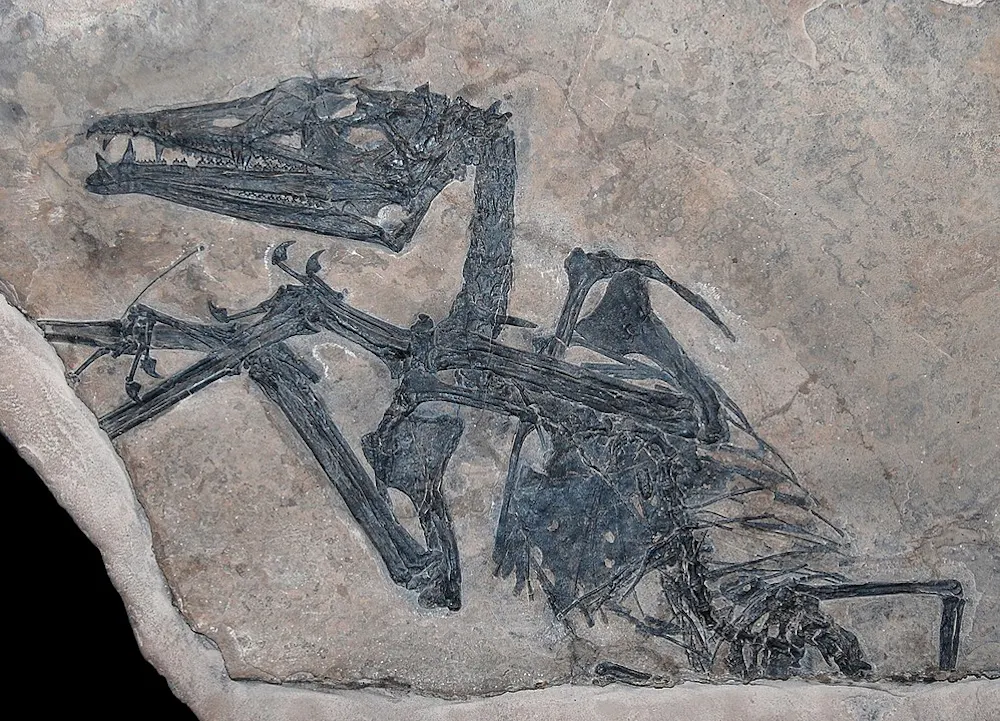
    Eudimorphodon ranzii fossil from Bergamo in 1973 is one of many pterosaur discoveries from southern Europe.
    Wikimedia, CC BY-SA

    For decades, the debate stalled as a result of too few fossils or too many missing rocks. This impasse began to change in 2020, when scientists identified the closest relatives of pterosaurs in a group of smallish upright reptiles called lagerpetids.

    From comparing many anatomical traits across different species, the researchers established that pterosaurs and lagerpetids shared many similarities including their skulls, skeletons and inner ears. While this discovery did not bring any “missing link” to the table, it showed what the ancestor of pterosaurs would have looked like: a rat-to-dog-sized creature that lived on land and in trees.

    This brought new evidence about when pterosaurs may have originated. Pterosaurs and lagerpetids like Scleromochlus, a small land-dwelling reptile, diverged at some point after the end-Permian mass extinction. It occurred some 250 million years ago, 35 million years before the first pterosaur appearance in the fossil record.

    Scleromochlus is one of the lagerpetids, the closest known relatives to the pterosaurs.
    Gabriel Ugueto

    Pterosaurs and their closest kin did not share the same habitats, however. Our new study, featuring new fossil maps, shows that soon after lagerpetids appeared (in southern Pangaea), they spread across wide areas, including harsh deserts, that many other groups were unable to get past. Lagerpetids lived both in these deserts and in humid floodplains.

    They tolerated hotter, drier settings better than any early pterosaur, implying that they had evolved to cope with extreme temperatures. Pterosaurs, by contrast, were more restricted. Their earliest fossils cluster in the river and lake beds of the Chinle and Dockum basins (southwest US) and in moist coastal belts fringing the northern arm of the Tethys Sea, a huge area that occupied today’s Alps.

    Scientists have inferred from analysing a combination of fossil distributions, rock features and climate simulations that pterosaurs lived in areas that were warm but not scorching. The rainfall would have been comparable to today’s tropical forests rather than inland deserts.

    This suggests that the earliest flying dinosaurs may have lived in tree canopies, using foliage both for take-off and to protect themselves from predators and heat. As a result of this confined habitat, the distances that they flew may have been quite limited.

    Changing climates

    We were then able to add a fresh dimension to the story using a method called ecological niche modelling. This is routinely used in modern conservation to project where endangered animals and plants might live as the climate gets hotter. By applying this approach to later Triassic temperatures, rainfall and coastlines, we asked where early pterosaurs lived, regardless of whether they’ve shown up there in the fossil record.

    Many celebrated fossil sites in Europe emerge as poor pterosaur habitat until very late in the Triassic period: they were simply too hot, too dry or otherwise inhospitable before the Carnian age, around 235 million years ago. The fact that no specimens have been discovered there that are more than about 215 million years old may be because the climate conditions were still unsuitable or simply because we don’t have the right type of rocks preserved of that age.

    In contrast, parts of the south-western US, Morocco, India, Brazil, Tanzania and southern China seem to have offered welcoming environments several million years earlier than the age of our oldest discoveries. This rewrites the search map. If pterosaurs could have thrived in those regions much more than 215 million years ago, but we have not found them there, the problem may again lie not with biology but with geology: the right rocks have not been explored, or they preserve fragile fossils only under exceptional conditions.

    Our study flags a dozen geological formations, from rivers with fine sediment deposits to lake beds, as potential prime targets for the next breakthrough discovery. They include the Timezgadiouine beds of Morocco, the Guanling Formation of south-west China and, in South America, several layers of rock from the Carnian age, such as the Santa Maria Formation, Chañares Formation and Ischigualasto Formation.

    Pterosaurs were initially confined to tropical treetops near the equator. When global climates shifted and forested corridors opened, pterosaurs’ wings catapulted them into every corner of the planet and ultimately carried them through one of Earth’s greatest extinctions. What began as a tale of missing fossils has become a textbook example of how climate, ecology and evolutionary science have come together to illuminate a fragmentary history that has intrigued paleontologists for over two centuries.

    Davide Foffa is funded by Marie Skłodowska-Curie Actions: Individual (Global) Fellowship (H2020-MSCA-IF-2020; No.101022550), and by the Royal Commission for the Exhibition of 1851–Science Fellowship

    Alfio Alessandro Chiarenza receives funding from The Royal Society (Newton International Fellowship NIFR1231802)

    Emma Dunne does not work for, consult, own shares in or receive funding from any company or organisation that would benefit from this article, and has disclosed no relevant affiliations beyond their academic appointment.

    ref. How pterosaurs learned to fly: scientists have been looking in the wrong place to solve this mystery – https://theconversation.com/how-pterosaurs-learned-to-fly-scientists-have-been-looking-in-the-wrong-place-to-solve-this-mystery-259063

    MIL OSI

  • MIL-OSI Submissions: ‘Making decisions closer to the wharf’ can ensure the sustainability of Canada’s fisheries and oceans

    Source: The Conversation – Canada – By Matthew Robertson, Research Scientist, Fisheries and Marine Institute, Memorial University of Newfoundland

    The harbour in Bonavista, Newfoundland. Major reforms could fundamentally reshape fisheries science and management in Canada (Sally LeDrew/Wikimedia commons), CC BY-SA

    During the federal election campaign, Canadian Prime Minister Mark Carney announced that if elected, he would look into restructuring Fisheries and Oceans Canada (DFO). Carney stated that he understood the importance of DFO and of “making decisions closer to the wharf.”

    Carney’s statement was made in response to protesting fish harvesters in Newfoundland and Labrador who decried recent DFO decision-making for multiple fisheries, including Northern cod and snow crab.

    Although addressing industry concerns is important, any change to DFO decision-making must serve the broader public interest, which includes commitments to reconciliation and conserving biodiversity.

    Major reforms could fundamentally reshape fisheries science and management in Canada, yet most Canadians are unaware of how DFO’s science-management process works, or why change might be needed.

    The DFO’s dual mandate

    DFO has long been criticized for its dual mandate, which involves both supporting economic growth and conserving the environment.

    For organizations like DFO to be trusted by the public, they need to produce information and policies that are credible, relevant and legitimate.

    However, DFO’s dual mandates have been viewed as antithetical and have at the least created a perceived conflict of interest. The issue at stake is how science advice from DFO can be considered independent, if it is also supposed to serve commercial interests.

    One solution to this problem would be to shift control over the economic viability of fisheries to provinces. This is not a radical idea by any means, as most of the economic value of the fishery arises after fish are brought to harbour.

    Fishing boats in the town of Clarke’s Harbour, located on Cape Sable Island, Nova Scotia in July 2011.
    (Dennis G. Jarvis/Wikimedia commons), CC BY-SA

    For example, licences to process groundfish like cod, haddock and halibut —which Nova Scotia has just announced will be opened for new entrants following decades of a moratorium — as well as policies governing the purchase of seafood already fall to provinces.

    In 2024, all 13 ministers from the Canadian Council of Fisheries and Aquaculture Ministers indicated a desire for “joint management” between provinces and DFO.

    This was driven driven by a concern that the department has not focused enough on provincial and territorial fisheries issues. This shouldn’t be seen as a criticism of DFO, but rather an opportunity to embrace differentiated responsibility.

    DFO could maintain regulatory control for fisheries, like enforcing the Fisheries Act, defining licence conditions and performing long-term monitoring and assessments. As included in the modernized Fisheries Act, it could still consider the social and economic objectives in decision-making.

    Regional decision-making

    DFO is structured into regions with their own science and management branches, but many decisions end up being made by staff at DFO headquarters in Ottawa. In addition, the federal fisheries minister retains ministerial discretion for almost every decision, something that has been criticized as being inequitable.

    During an interview with researchers looking into fisheries management policy, a regional manager stated that they no longer make decisions:

    “Because of…risk aversion, much more of the decision-making has now been bumped up to higher levels. So I like to facetiously state that I am no longer a manager, I am a recommender.”

    Centralized decision-making can limit communication between regional scientists and managers and federal government policymakers.

    This communication gap can make it difficult for managers to use the latest science and adjust policies quickly and it can also lead to recommended policies that are challenging to implement at the local level.

    Handing management decision-making power to regional fisheries managers could therefore benefit science and policy, and contribute to decisions that are deemed more equitable by those impacted.

    A map representing DFO’s regional structure.
    (Fisheries and Oceans Canada)

    Other countries use a regional management approach. In the United States, marine fisheries are managed by eight regional fishery management councils that use scientific advice from the National Marine Fisheries Service. Although not without their flaws, the successful rebuilding of overfished stocks in the U.S. has been attributed, in part, to the regional council system.

    Governance systems that have multiple but connected centres of decision-making are generally expected to be more participatory, flexible to respond to changes and have improved spatial fit between knowledge and policy actions.

    This type of approach could shift the focus of Ottawa-based managers and the fisheries minister to ensuring national consistency.

    Local stakeholder involvement

    Canada’s current methods for inclusion of social and economic considerations are limited and have produced scientific advice that is not fully separable from rights holder and stakeholder input.

    Most of DFO’s scientific peer-review process is focused on ecological science conducted by DFO scientists. The peer-review process often also involves rights holders and stakeholders. While Indigenous rights holders and community stakeholders may not be trained in the presented analyses, they often contribute to these meetings by describing their knowledge and experiences.

    However, because the meetings are focused on DFO ecological science, they are not designed to formally consider stakeholder and rights holder knowledge. This can lead to two key issues. First, it may blur the line between peer-reviewed science and rights holder and stakeholder input, reducing the credibility of the scientific advice.

    Second, the valuable information provided by rights holders and stakeholders may be overlooked since it is not shared in a setting designed to incorporate it.

    The lack of review of alternative Indigenous knowledge sources and social and economic science during peer-review processes inherently limits the advice that can be provided. It suggests that the government is not benefiting from the opportunity to incorporate diverse knowledge bases.

    These problems could be addressed by developing procedures through which stakeholders and rights holders contribute their local and traditional knowledge to better inform ecological and socio-economic considerations.

    By increasing the number of peer-review platforms, rights holder and stakeholder input could be reviewed similarly to ecological science. This change would likely increase the credibility, legitimacy and salience of information used to inform fishery managers.

    Regardless of how rights holders and stakeholders perspectives are included, the process should be clearly structured and documented.

    By reconsidering DFO’s mandate, decentralizing management decision-making and improving the scientific consideration of varied forms of knowledge, DFO could make decisions that are closer to the wharf.

    Matthew Robertson receives funding from the Canadian Natural Sciences and Engineering Research Council of Canada (NSERC) Discovery Grant and the Fisheries & Oceans Canada (DFO) Atlantic Fisheries Fund (AFF).

    Megan Bailey receives research funding from multiple sources, including NSERC, SSHRC, CIRNAC, Genome Atlantic, Nippon Foundation Ocean Nexus Centre, Ocean Frontier Institute (through a Canada First Research Excellence Fund), and the Canada Research Chairs program.

    Tyler Eddy receives funding from the Natural Sciences and Engineering Research Council of Canada (NSERC) Discovery Grant, Fisheries & Oceans Canada (DFO) Atlantic Fisheries Fund (AFF) and Sustainable Fisheries Science Fund (SFSF), the Canada First Research Excellence Fund (CFREF), and the Crown Indigenous Relations and Northern Affairs Canada (CIRNAC) Indigenous Community-Based Climate Monitoring (ICBCM) Program.

    ref. ‘Making decisions closer to the wharf’ can ensure the sustainability of Canada’s fisheries and oceans – https://theconversation.com/making-decisions-closer-to-the-wharf-can-ensure-the-sustainability-of-canadas-fisheries-and-oceans-254874

    MIL OSI

  • MIL-OSI Submissions: Air India crash in Ahmedabad sends reverberations to Canadian families of Air India Flight 182

    Source: The Conversation – Canada – By Chandrima Chakraborty, Professor, English and Cultural Studies; Director, Centre for Global Peace, Justice and Health, McMaster University

    The June 12 Air India crash in Ahmedabad, Gujarat, India, with 230 passengers and 12 crew members aboard is sending deep reverberations through a group of Canadians who know all too well the shock, grief and horror of losing loved ones in hauntingly similar circumstances.

    They are the families of those killed in the bombing of Air India Flight 182 en route from Canada to India 40 years ago this month.

    I work closely with these families as a researcher and advocate. I began interviewing these families in 2014 and have witnessed firsthand their pain, advocacy and emotional turmoil of living in the shadow of a historical event.

    As reports of the Ahmedabad crash came in, the WhatsApp account of the Air India Flight 182 families immediately flooded with expressions of shock, concern, sympathy and memories triggered by the latest incident.

    On June 23, 1985, Flight 182 was brought down by terrorist bombs created and planted on Canadian soil. The devastating mid-air explosion occurred over the Atlantic Ocean near Ireland. It killed all 329 passengers and crew, including 268 Canadians. The crew and most of the passengers were of Indian origin.

    Investigations into the causes of the crash of Air India Flight 171, en route to London’s Gatwick airport, shortly after take-off are still underway. At least 279 people died in the crash, which also impacted people on the ground.

    Acknowledging losses as significant

    A recent public conference at McMaster University commemorated the 40th anniversary of Flight 182, bringing together Indian and Canadian families, researchers, creative artists and community members.

    Book cover for ‘Remembering Air India The Art of Public Mourning,’ edited by Chandrima Chakraborty, Amber Dean and Angela Failler.
    University of Alberta Press

    The conference dealt with critical themes, including the challenge of Flight 182 families recovering from their losses within a climate of broad indifference among their fellow Canadians.

    Regardless of what may have caused the more recent crash in western India, these Canadian families know the shock and loss that a new set of victims’ families are facing, and how important it is to support them.

    Hopefully, the home countries of last week’s crash victims — most of them Indian and British citizens, with at least one Canadian reported to have been aboard — will regard their deaths as significant losses. If so, this would be unlike what the 1985 victims’ families experienced in Canada.

    A little-mourned Canadian tragedy

    In Canada, we have a national day to remember on June 23, 1985. The bombing has been called a Canadian tragedy in a public inquiry report.

    Yet according to a 2023 Angus Reid poll, “nine out of 10 Canadians say they have little or no knowledge of the worst single instance of the mass killing of their fellow citizens.” That essentially means the bombing has yet to penetrate the consciousness of everyday Canadians or evoke shared grief or public mourning.

    The families continue to carry the torch of remembrance as they organize annual memorial vigils every June 23. Few others attend. Many victims’ relatives have died since 1985. Some spouses, siblings or parents are now in their 80s, wondering why the bombing is still not widely discussed in schools or in public discourse.

    The grinding and unsatisfying criminal proceedings, the belated public inquiry and the welcome but lukewarm apology by the Canadian government 25 years after the fact have all contributed to the failure of this tragedy to adhere more solidly to the Canadian consciousness. In fact, many continue to deny the Canadian significance of Flight 182 and view the bombing as a foreign event.

    A torch of remembrance

    At last month’s conference, my research team launched the Air India Flight 182 archive to counter this collective amnesia and lack of acknowledgement.

    Canadian archival consultant and writer Laura Millar has said that archives act as “touchstones to memory” and can aid the process of transforming individual memories into collective remembering. Adopting NYU professor Carol Gilligan’s ethics of care for the archive, we have been consulting with families to find ways to share their grief with the public.

    The Flight 182 memory archive — both physical and digital — serves as a repository for artefacts, first-person narratives, memorabilia and creative works related to the tragedy produced by family members. Family donations of artefacts such as dance videos and pilot wings redirect notions of archives away from a documental deposit. Hopefully, they can move the public to learn and care for the impacts of the Flight 182 bombing.

    The archive is a publicly accessible record of the tragedy, where scholars and everyday citizens can learn about the victims and their families.

    Since the past involves both the present and the future, the archive will enable a meaningful recognition of marginalized voices and histories. It can offer a form of memory justice for those who would otherwise be forgotten by sustaining memory from generation to generation.

    While the archive articulates the demand from families that the bombing of Flight 182 and its aftermath be incorporated into Canadian national consciousness, establishing this archive alone will not be enough to elevate the memory of Flight 182 to the place it deserves.

    But at least it establishes a rich, permanent academic and personal legacy for the community of mourners, and for the Canadian and global public to find it, use it and learn from its many lessons.

    Families of those on board the 1985 flight are preparing to commemorate the 40th anniversary of the terror bombing of Flight 182 that has devastated their lives.

    As we learn more about the tragic Air India Flight 171 crash on June 12, the lessons of Flight 182 will hopefully prevent a new set of families from feeling the pain of indifference on top of the unimaginable agony of loss they’re already experiencing.

    Chandrima Chakraborty receives funding from the Social Sciences and Humanities Research Council of Canada.

    ref. Air India crash in Ahmedabad sends reverberations to Canadian families of Air India Flight 182 – https://theconversation.com/air-india-crash-in-ahmedabad-sends-reverberations-to-canadian-families-of-air-india-flight-182-258991

    MIL OSI

  • MIL-OSI Submissions: Plastics threaten ecosystems and human health, but evidence-based solutions are under political fire

    Source: The Conversation – Canada – By Tony Robert Walker, Professor, School for Resource and Environmental Studies, Dalhousie University

    Negotiations toward a global, legally binding plastics treaty are set to resume this summer, with the United Nations Environment Programme announcing that the Intergovernmental Negotiating Committee on plastic pollution will reconvene in August.

    The committee was established to develop an international legally binding instrument — known as the plastics treaty — to end plastic pollution, one of the fastest-growing environmental threats.


    Read more:
    Here’s how the new global treaty on plastic pollution can help solve this crisis


    Globally, 40 per cent of plastics production goes into the production of single-use plastic packaging, which is the single largest source of plastic waste and is a threat to wildlife and human health. Without meaningful action, global plastic waste is projected to nearly triple by 2060, reaching an estimated 1.2 billion tonnes.

    As the world prepares for another round of talks, Canada’s own plastic problem reveals what’s at stake, and what’s possible for the future.

    Canada’s plastic problem

    Canada is no exception to the global plastic crisis. Nearly half (47 per cent) of all plastic waste in Canada comes from the food and drink sector, contributing 3,268 million tonnes annually. Canadians use 15 billion plastic bags annually and nearly 57 million straws daily, yet only nine per cent of plastics are recycled — a figure that is not expected to improve.

    Most of Canada’s plastic — except for plastic bottles made of PET (polyethylene terephthalate) — are uneconomical or difficult to recycle because of the complexity of mixed plastics used in our economy. As a result, 2.8 million tonnes of plastic waste — equivalent to the weight of 24 CN Towers — end up in landfills every year.

    This is not a trivial problem, as Ontario is projected to run out of landfill space by 2035. Plastic pollution poses growing risks to both urban and rural infrastructure.

    In addition to landfill overflow, around one per cent of Canada’s plastic waste leaks into the environment. In 2016, this was 29,000 tonnes of plastic pollution. Once in the environment, plastics disintegrate into tiny particles, called microplastics (small pieces of plastic less than five millimetres long).

    We drink those tiny microplastic particles in our tap water, and eat them in our fish dinners. Some are even making their way into farmland.

    Plastics are everywhere, including inside us

    More than 93 per cent of Canadians have expressed concerns over single-use plastics used in food packaging and have supported government bans. There is a good reason for concern over the mounting levels of plastics in the environment, in our food and in us.

    Growing evidence indicates that plastics can cause harmful health effects in humans and animals. Microplastics and smaller nanoplastics (less than one micron in length) have been found in humans, including infants and breast milk. They can cause metabolic disorders, interfere with our immune and reproductive systems and cause behavioural problems.

    These health problems may be caused by chemicals added to plastics, including single-use plastics, of which 4,200 chemicals have been identified as posing a hazard to human and ecosystem health.

    It is for these reasons that the Canadian government introduced a ban on single-use plastics in 2022 as part of a plan to reach zero plastic waste in Canada by 2030.

    The decision was based extensive public and industry consultation, as well as decades of data on plastic pollution gathered from the Great Canadian Shoreline Cleanup. This data shows the most common plastic litter items found in the environment across Canada, known as the “dirty dozen” list.

    Six of these items were included in the federal ban. Three eastern Canadian provinces had already implemented single-use plastic bag bans before the federal government, with little to no public or industry opposition. Prince Edward Island was the first Canadian province to implement a province-wide plastic bag ban in July 2019, closely followed by Newfoundland and Labrador and Nova Scotia in October 2020.

    The politics of plastic

    Despite overwhelming scientific consensus, debates around plastic pollution are becoming increasingly politicized.

    In February in the United States, President Donald Trump signed an executive order directing the U.S. government to “stop purchasing paper straws and ensure they are no longer provided within federal buildings.”

    Trump told reporters at the White House: “I don’t think plastic is going to affect a shark very much, as they’re munching their way through the ocean.” Almost 2,000 peer-reviewed studies have reported, however, that more than 4,000 species have ingested or been entangled by plastic litter.

    In Canada, plastic has also become a political flashpoint. During the recent federal election, Conservative Leader Pierre Poilievre said he would scrap the federal government’s ban on single-use plastics and bring back plastic straws and grocery bags. He argued the government’s ban was about “symbolism” rather than “science,” saying, “the Liberals’ plastics ban is not about the environment, it’s about cost and control.”

    His promise would have harmed Canadians by dismissing the overwhelming scientific evidence showing that plastics in our bodies are linked to health impacts. Legislation to ban single-use plastics can be highly effective, ranging from 33 to 96 per cent reductions in plastic waste and pollution in the environment, depending on the policy and jurisdiction.

    Canada’s single-use plastics ban is a great example of evidence-based policymaking. The latest data from the conservation group Ocean Wise shows there was a 32 per cent drop in plastic straws found on Canadian shorelines in 2024 compared to the previous year.

    Science-based policies are needed

    It is indisputable that growing plastic production is directly related to plastic pollution in the environment and in human beings. Increasing plastic pollution is a global threat to human and ecosystem health, regardless of borders and political affiliation.

    As negotiators gear up for another round of talks to finalize a Global Plastics Treaty to end plastic pollution, the need for policies that are supported by scientific evidence is more urgent than ever.

    Future generations deserve a healthy and sustainable planet. The path towards a healthy and sustainable planet requires supporting action based on scientific evidence, not misinforming people with catchy phrases and political rhetoric.

    Tony Robert Walker receives funding from the Natural Sciences and Engineering Research Council of Canada, Canada Foundation for Innovation, and Research Nova Scotia. He is also a non-remunerated member of the Scientists’ Coalition for an Effective Plastics Treaty.

    Miriam L Diamond receives funding from Natural Sciences and Engineering Research Council, Ontario Ministry of Environment, Conservation and Parks, Future Earth, and Environment and Climate Change Canada. She is affiliated with the University of Toronto, serves as a paid expert for the Scientific and Technical Advisory Panel of the Global Environment Facility, and has non-remunerated positions with the International Panel on Chemical Pollution (Vice-Chair), is a member of the Scientist Coalition for an Effective Plastics Treaty, and sits on the board of the Canadian Environmental Law Association.

    ref. Plastics threaten ecosystems and human health, but evidence-based solutions are under political fire – https://theconversation.com/plastics-threaten-ecosystems-and-human-health-but-evidence-based-solutions-are-under-political-fire-256764

    MIL OSI

  • MIL-OSI Submissions: The 28 Days Later franchise redefined zombie films. But the undead have an old, rich and varied history

    Source: The Conversation – Global Perspectives – By Christopher White, Historian, The University of Queensland

    The history of the dead – or, more precisely, the history of the living’s fascination with the dead – is an intriguing one.

    As a researcher of the supernatural, I’m often pulled aside at conferences or at the school gate, and told in furtive whispers about people’s encounters with the dead.

    The dead haunt our imagination in a number of different forms, whether as “cold spots”, or the walking dead popularised in zombie franchises such as 28 Days Later.

    The franchise’s latest release, 28 Years Later, brings back the Hollywood zombie in all its glory – but these archetypal creatures have a much wider and varied history.

    Zombis, revenants and the returning dead

    A zombie is typically a reanimated corpse: a category of the returning dead. Scholars refer to them as “revenants”, and continue to argue over their exact characteristics.

    In the Haitian Vodou religion, the zombi is not the same as the Hollywood zombie. Instead, zombi are people who, as a religious punishment, are drugged, buried alive, then dug out and forced into slavery.

    The Hollywood zombie, however, draws more from medieval European stories about the returning dead than from Vodou.

    A perfect setting for a ‘zombie’ film

    In 28 Years Later, the latest entry in Danny Boyle’s blockbuster horror franchise, the monsters technically aren’t zombies because they aren’t dead. Instead, they are infected by a “rage virus”, accidentally released by a group of animal rights activists in the beginning of the first film.

    This third film focuses on events almost three decades after the first film. The British Isles is quarantined, and the young protagonist Spike (Alfie Williams) and his family live in a village on Lindisfarne Island. This island, one of the most important sites in early medieval British Christianity, is isolated and protected by a tidal causeway that links it to the mainland.

    Aaron Taylor-Johnson and Alfie Williams star in the new film, out in Australian cinemas today.
    Sony Pictures

    The film leans heavily on how we imagine the medieval world, with scenes showing silhouetted fletchers at work making arrows, children training with bows, towering ossuaries and various memento mori. There’s also footage from earlier depictions of medieval warfare. And at one point, the characters seek sanctuary in the ruins of Fountains Abbey, in Yorkshire, which was built in 1132.

    The medieval locations and imagery of 28 Years Later evoke the long history of revenants, and the returned dead who once roved medieval England.

    Early accounts of the medieval dead

    In the medieval world, or at least the parts that wrote in Latin, the returning dead were usually called spiritus (“spirit”), but they weren’t limited to the non-corporeal like today’s ghosts are.

    Medieval Latin Christians from as early as the 3rd century saw the dead as part of a parallel society that mirrored the world of the living, where each group relied on the other to aid them through the afterlife.

    Depiction of the undead from a medieval manuscript.
    British Library, Yates Thompson MS 13

    While some medieval ghosts would warn the living about what awaited sinners in the afterlife, or lead their relatives to treasure, or prophesise the future, some also returned to terrorise the living.

    And like the “zombies” affected by the rage virus in 28 Years Later, these revenants could go into a frenzy in the presence of the living.

    Thietmar, the Prince-Bishop of Merseburg, Germany, wrote the Chronicon Thietmari (Thietmar’s Chronicle) between 1012 and 1018, and included a number of ghost stories that featured revenants.

    Although not all of them framed the dead as terrifying, they certainly didn’t paint them as friendly, either. In one story, a congregation of the dead at a church set the priest upon the altar, before burning him to ashes – intended to be read as a mirror of pagan sacrifice.

    These dead were physical beings, capable of seizing a man and sacrificing him in his own church.

    A threat to be dealt with

    The English monastic historian William of Newburgh (1136–98) wrote revenants were so common in his day that recording them all would be exhausting. According to him, the returned dead were frequently seen in 12th century England.

    So, instead of providing a exhausting list, he offered some choice examples which, like most medieval ghost stories, had a good Christian moral attached to them.

    William’s revenants mostly killed the people of the towns they lived, returning to the grave between their escapades. But the medieval English had a method for dealing with these monsters; they dug them up, tore out the heart and then burned the body.

    Other revenants were dealt with less harshly, William explained. In one case, all it took was the Bishop of Lincoln writing a letter of absolution to stop a dead man returning to his widow’s bed.

    These medieval dead were also thought to spread disease – much like those infected with the rage virus – and were capable of physically killing someone.

    Depiction of the undead from a medieval manuscript.
    British Library, Arundel MS 83.

    The undead, further north

    In medieval Scandinavia and Iceland, the undead draugr were extremely strong, hideous to look at and stunk of decomposition. Some were immune to human weapons and often killed animals near their tombs before building up to kill humans. Like their English counterparts, they also spread disease.

    But according to the Eyrbyggja saga, an anonymous 13th or 14th century text written in Iceland, all it took was a type of community court and the threat of legal action to drive off these returned dead.

    It’s a method the survivors in 28 Years Later didn’t try.

    The dead live on

    The first-hand zombie stories that were common during the medieval period started to dwindle in the 16th century with the Protestant Reformation, which focused more on individuals’ behaviours and salvation.

    Nonetheless, their influence can still be felt in Catholic ritual practices today, such as in prayers offered for the dead, and the lighting of votive candles.

    We still tell ghost stories, and we still worry about things that go bump in the night. And of course, we continue to explore the undead in all its forms on the big screen.

    Christopher White does not work for, consult, own shares in or receive funding from any company or organisation that would benefit from this article, and has disclosed no relevant affiliations beyond their academic appointment.

    ref. The 28 Days Later franchise redefined zombie films. But the undead have an old, rich and varied history – https://theconversation.com/the-28-days-later-franchise-redefined-zombie-films-but-the-undead-have-an-old-rich-and-varied-history-247900

    MIL OSI

  • MIL-OSI Submissions: Decolonizing history and social studies curricula has a long way to go in Canada

    Source: The Conversation – Canada – By Sara Karn, Postdoctoral Fellow, Department of History, McMaster University

    In June 2015, 10 years ago, the Truth and Reconciliation Commission of Canada (TRC) called for curriculum on Indigenous histories and contemporary contributions to Canada to foster intercultural understanding, empathy and respect. This was the focus of calls to action Nos. 62 to 65.

    As education scholars, we are part of a project supported by the Social Sciences and Humanities Research Council called Thinking Historically for Canada’s Future. This project involves researchers, educators and partner organizations from across Canada, including Indigenous and non-Indigenous team members.

    As part of this work, we examined Canadian history and social studies curricula in elementary, middle and secondary schools with the aim of understanding how they address — and may better address in future — the need for decolonization.

    We found that although steps have been made towards decolonizing history curricula in Canada, there is still a long way to go. These curricula must do far more to challenge dominant narratives, prompt students to critically reflect on their identities and value Indigenous world views.


    Read more:
    Looking for Indigenous history? ‘Shekon Neechie’ website recentres Indigenous perspectives


    Reimagining curriculum

    As white settler scholars and educators, we acknowledge our responsibility to unlearn colonial ways of being and learn how to further decolonization in Canada.

    In approaching this study, we began by listening to Indigenous scholars, such as Cree scholar Dwayne Donald. Donald and other scholars call for reimagining curriculum through unlearning colonialism and renewing relationships.


    Read more:
    Leaked Alberta school curriculum in urgent need of guidance from Indigenous wisdom teachings


    The late Arapaho education scholar Michael Marker suggested that in history education, renewing relations involves learning from Indigenous understandings of the past, situated within local meanings of time and place.

    History, social studies curricula

    Curricula across Canada have been updated in the last 10 years to include teaching about treaties, Indian Residential Schools and the cultures, perspectives and experiences of Indigenous Peoples over time.

    Thanks primarily to the work of Indigenous scholars and educators, including Donald, Marker, Mi’kmaw educator Marie Battiste, Anishinaabe scholar Nicole Bell and others, some public school educators are attentive to land-based learning and the importance of oral history.

    But these teachings are, for the most part, ad hoc and not supported by provincial curriculum mandates.

    Our study revealed that most provincial history curricula are still focused on colonial narratives that centre settler histories and emphasize “progress” over time. Curricula are largely inattentive to critical understandings of white settler power and to Indigenous ways of knowing and being.

    Notably, we do not include the three territories in this statement. Most of the territorial history curricula have been co-created with local Indigenous communities, and stand out with regard to decolonization.

    For example, in Nunavut’s Grade 5 curriculum, the importance of local knowledge tied to the land is highlighted throughout. There are learning expectations related to survival skills and ecological knowledge.

    Members of our broader research team are dedicated to analyzing curricula in Nunavut, the Northwest Territories and the Yukon. Their work may offer approaches to be adapted for other educational contexts.

    Dominant narratives

    In contrast, we found that provincial curricula often reinforce dominant historical narratives, especially surrounding colonialism. Some documents use the term “the history,” implying a singular history of Canada (for example, Manitoba’s Grade 6 curriculum).

    Historical content, examples and guiding questions are predominantly written from a Euro-western perspective, while minimizing racialized identities and community histories. In particular, curricula often ignore illustrations of Indigenous agency and experience.


    Read more:
    Moving beyond Black history month towards inclusive histories in Québec secondary schools


    Most curricula primarily situate Indigenous Peoples in the past, without substantial consideration for present-day implications of settler colonialism, as well as Indigenous agency and experiences today.

    For example, in British Columbia’s Grade 4 curriculum, there are lengthy discussions of the harms of colonization in the past. Yet, there is no mention of the ongoing impacts of settler colonialism or the need to engage in decolonization today.

    To disrupt these dominant narratives, we recommend that history curricula should critically discuss the ongoing impacts of settler colonialism, while centring stories of Indigenous resistance and survival over time.

    Identity and privilege

    There are also missed opportunities within history curricula when it comes to critical discussions around identity, including systemic marginalization or privilege.

    Who we are informs how we understand history, but curricula largely does not prompt student reflection in these ways, including around treaty relationships.

    In Saskatchewan’s Grade 5 curriculum, students are expected to explain what treaties are and “affirm that all Saskatchewan residents are Treaty people.”

    However, there is no mention of students considering how their own backgrounds, identities, values and experiences shape their understandings of and responsibilities for treaties. Yet these discussions are essential for engaging students in considering the legacies of colonialism and how they may act to redress those legacies.

    A key learning outcome could involve students becoming more aware of how their own personal and community histories inform their historical understandings and reconciliation commitments.

    Indigenous ways of knowing and being

    History curricula generally ignore Indigenous ways of knowing and being. Most curricula are inattentive to Indigenous oral traditions, conceptions of time, local contexts and relationships with other species and the environment.

    Instead, these documents reflect Euro-western, settler colonial worldviews and educational values. For example, history curricula overwhelmingly ignore local meanings of time and place, while failing to encourage opportunities for land-based and experiential learning.

    In Prince Edward Island’s Grade 12 curriculum, the documents expect that students will “demonstrate an understanding of the interactions among people, places and the environment.” While this may seem promising, environmental histories in this curriculum and others uphold capitalist world views by focusing on resource extraction and economic progress.

    To disrupt settler colonial relationships with the land and empower youth as environmental stewards, we support reframing history curricula in ways that are attentive to Indigenous ways of knowing the past and relations with other people, beings and the land.

    Ways forward

    Schools have been, and continue to be, harmful spaces for many Indigenous communities, and various aspects of our schooling beg questions about how well-served both Indigenous and non-Indigenous students are for meeting current and future challenges.

    If, as a society, we accept the premise that the transformation of current curricular expectations is possible for schools, then more substantive engagement is required in working toward decolonization.

    Decolonizing curricula is a long-term, challenging process that requires consideration of many things: who sits on curriculum writing teams; the resources allocated to supporting curricular reform; broader school or board-wide policies; and ways of teaching that support reconciliation.

    We encourage history curriculum writing teams to take up these recommendations as part of a broader commitment to reconciliation.

    While not exhaustive, recommendations for curricular reform are a critical step in the future redesign of history curricula. The goal is a history education committed to listening and learning from Indigenous communities to build more inclusive national stories of the past, and into the future.

    This is a corrected version of a story originally published June 17, 2025. The earlier story said Michael Marker was from the Lummi Nation instead of saying he was an Arapaho scholar.

    Sara Karn receives funding from the Social Sciences and Humanities Research Council (SSHRC).

    Kristina R. Llewellyn receives funding from the Social Sciences and Humanities Research Council (SSHRC).

    Penney Clark receives funding from the Social Sciences and Humanities Research Council of Canada (SSHRC).

    ref. Decolonizing history and social studies curricula has a long way to go in Canada – https://theconversation.com/decolonizing-history-and-social-studies-curricula-has-a-long-way-to-go-in-canada-253679

    MIL OSI

  • MIL-OSI Submissions: B.C.’s mental health law is on trial — and so is our commitment to human rights

    Source: The Conversation – Canada – By Anne Levesque, Associate professor, Faculty of Law, L’Université d’Ottawa/University of Ottawa

    The British Columbia Supreme Court has begun hearing a long-awaited constitutional challenge to the province’s Mental Health Act.

    The case, nearly a decade in the making, is now drawing greater attention in the wake of the tragedy at the Filipino Lapu Lapu Day street festival earlier this year that left 11 people dead in Vancouver.

    The event has shaken many in the community, leaving behind grief and fear. Furthermore, in light of reports that the person accused of the crime was under Mental Health Act supervision, difficult questions arise. The pain is real, and any conversation about mental health must begin with compassion for all of those affected.


    Read more:
    Vancouver SUV attack exposes crowd management falldowns and casts a pall on Canada’s election


    At the same time, it’s important to ensure this moment of reckoning leads to thoughtful dialogue, not reactive policy. Unfortunately, much of the public discourse has become mired in fear and misinformation, creating a false and dangerous choice: that Canada must sacrifice individual rights in order to protect public safety.

    As a legal scholar in equality rights and public interest litigation, I don’t believe Canadians have to choose. A mental health system that respects Canada’s Charter of Rights and Freedoms can also promote safety.

    What’s the case is about?

    The case currently before the B.C. Supreme Court was initiated by the Council of Canadians with Disabilities (CCD), a national human rights organization led by people with disabilities. The group is fighting provisions in the province’s Mental Health Act that strip patients of any right to choose their own health care, or to appoint a loved one to make health care decisions on their behalf.

    The CCD’s motto — “Nothing about us without us” — reflects a longstanding commitment to ensuring that people most affected by policies and systems have a voice in shaping them. This litigation will amplify the voices of people who underwent psychiatric treatment without consent and to shine a light on the deep and lasting harms they have suffered.

    Let’s be clear about what this Charter challenge actually seeks and what it doesn’t. It doesn’t aim to eliminate involuntary hospitalization. It does not change who can be detained, how long they can be held or the legal criteria for involuntary admission.

    What it does seek is something far more modest and humane: to ensure that when psychiatric care is forced, it is delivered with dignity, oversight and the involvement of trusted supporters in accordance with the Canadian Charter of Rights and Freedoms.

    One of the key reforms that CCD has long advocated for is the right for people to name a family member or friend to be involved in treatment decisions. Far from undermining care, this kind of involvement can help bridge the gap between medical necessity and personal dignity.

    It’s a safeguard that respects patients’ values and builds trust, which the current system desperately lacks. And yes, it could even enhance public safety. Reports suggest that a family member of the man accused in the Lapu Lapu mass murders in April was concerned about his deteriorating mental health and had reached out for help just before the tragedy occurred. A more responsive system with the embedded involvement of trusted decision-makers might have made a difference.


    Read more:
    Fraudulent crowdfunding after the Lapu Lapu tragedy highlights the need for vigilance and oversight


    Reforming the Mental Health Act

    British Columbia is currently an outlier in Canada. It’s the only province where people detained under mental health laws are automatically deemed to consent to any treatment authorized by the facility — regardless of their actual wishes or capacity.

    There’s no right to name a substitute decision-maker, no ability to appeal a treatment decision, no independent oversight, and treatment is often imposed through isolation, physical restraints or security force.

    Advocates have been calling for change for decades. But in the wake of the Lapu Lapu attack, some politicians are proposing not a more compassionate or rights-respecting approach, but harsher, more coercive powers over people with mental health issues. That would be a mistake.

    The current system, which experts have long said is inconsistent with human rights, did nothing to prevent this tragedy. Violating the rights of people in crisis did not and will not keep the public safer.

    B.C. Premier David Eby has acknowledged the shortcomings in the current system, but has said that engaging in law reform while litigation is undergoing would pose a risk. Instead, he says it’s better to wait to hear what the court decides before changing the law.

    That logic is arguably akin to a citizen saying it’s risky to stop driving at a speed they know is over the lawful limit until they’re pulled over.

    Pointless to wait

    Waiting for the courts to force change wastes precious time, and public resources, that could be better spent on designing a new, Charter-compliant mental health system in collaboration with experts, service providers, families and people with lived experiences.

    Meanwhile, substantial public funds are being spent on government lawyers to fight a legal battle defending a regime that is clearly unconstitutional and fails both patients and public safety.

    That money would be far better spent consulting with experts, families and people with lived experiences and developing legislation that upholds constitutional rights and keeps communities safe.

    The time for delay is over. The B.C. government must act now to rewrite the Mental Health Act in order to protect the public and respect Charter rights.

    Anne Levesque is co-chair of the Disability Justice Litigation Initiative of the Council of Canadians with Disabilities.

    ref. B.C.’s mental health law is on trial — and so is our commitment to human rights – https://theconversation.com/b-c-s-mental-health-law-is-on-trial-and-so-is-our-commitment-to-human-rights-258671

    MIL OSI

  • MIL-OSI Submissions: Somaliland’s 30-year quest for recognition: could US interests make the difference?

    Source: The Conversation – Africa (2) – By Aleksi Ylönen, Professor, United States International University

    More than three decades after unilaterally declaring independence from Somalia, Somaliland still seeks international recognition as a sovereign state. Despite a lack of formal acknowledgement, the breakaway state has built a relatively stable system of governance. This has drawn increasing interest from global powers, including the United States. As regional dynamics shift and great-power competition intensifies, Somaliland’s bid for recognition is gaining new currency. Aleksi Ylönen has studied politics in the Horn of Africa and Somaliland’s quest for recognition. He unpacks what’s at play.


    What legal and historical arguments does Somaliland use?

    The Somali National Movement is one of the main clan-based insurgent movements responsible for the collapse of the central government in Somalia. It claims the territory of the former British protectorate of Somaliland. The UK had granted Somaliland sovereign status on 26 June 1960.

    The Somali government tried to stomp out calls for secession. It orchestrated the brutal killing of hundreds of thousands of people in northern Somalia between 1987 and 1989.

    But the Somali National Movement declared unilateral independence on 18 May 1991 and separated from Somalia.

    With the collapse of the Somali regime in 1991, the movement’s main enemy was gone. This led to a violent power struggle between various militias.

    This subsided only after the politician Mohamed Egal consolidated power. He was elected president of Somaliland in May 1993.

    Egal made deals with merchants and businessmen, giving them tax and commercial incentives to accept his patronage. As a result, he obtained the economic means to consolidate political power and to pursue peace and state-building. It’s something his successors have kept up with since his death in 2002.

    What has Somaliland done to push for recognition?

    Successive Somaliland governments continue to engage in informal diplomacy. They have aligned with the west, particularly the US, which was the dominant power after the cold war, and the former colonial master, the UK. Both countries host significant Somaliland diaspora communities.

    The US and the UK have for decades flirted with the idea of recognising Somaliland, which they consider a strategic partner. However, they have been repeatedly thrown back by their respective Somalia policies. These have favoured empowering the widely supported Mogadishu government to reassert its authority and control over Somali territories.

    This Somalia policy has been increasingly questioned in recent years, in part due to Mogadishu’s security challenges. In contrast, the Hargeisa government of Somaliland has largely shown it can provide security and stability. It has held elections and survived as a state for the last three decades, though it has faced political resistance and armed opposition.


    Read more:
    Somaliland elections: what’s at stake for independence, stability and shifting power dynamics in the Horn of Africa


    As new global powers rise, Somaliland administrations have pursued an increasingly diverse foreign policy, with one goal: international recognition.

    Hargeisa hosts consulates and representative offices of Djibouti, Ethiopia, Kenya, Taiwan, the UK and the European Union, among others.

    The government has also engaged in informal foreign relations with the United Arab Emirates. The Middle Eastern monarchy serves as a business hub and a destination of livestock exports. Many Somalilanders migrate there.

    Somaliland maintains representative offices in several countries. These include Canada, the US, Norway, Sweden, the UK, Saudi Arabia, Turkey and Taiwan. Hargeisa has alienated China because it has collaborated with Taiwan since 2020. Taiwan is a self-ruled island claimed by China.

    On 1 January 2024, Somaliland’s outgoing president Muse Bihi signed a memorandum of understanding with Ethiopian prime minister Abiy Ahmed for increased cooperation. Bihi implied that Ethiopia would be the first country to formally recognise Somaliland. The deal caused a sharp deterioration of relations between Addis Ababa and Mogadishu.

    Abiy later moderated his position and, with Turkish mediation, reconciled with his Somalia counterpart, President Hassan Mohamud.

    What’s behind US interest in Somaliland?

    The US, like other great powers, has been interested in Somaliland because of its strategic location. It is on the African shores of the Gulf of Aden, across from the Arabian Peninsula. Its geographical position has gained currency recently as Yemeni Houthi rebels strike maritime traffic in the busy shipping lanes. Somaliland is also well located to curb piracy and smuggling on this global trade route.

    The US Africa Command set up its main Horn of Africa base at Camp Lemonnier in Djibouti in 2002. This followed the 11 September 2001 attacks.


    Read more:
    Somaliland’s quest for recognition: UK debate offers hint of a sea change


    In 2017, China, which had become the main foreign economic power in the Horn of Africa, set up a navy support facility in Djibouti. This encouraged closer collaboration between American and Somaliland authorities. The US played with the idea of establishing a base in Berbera, which hosts Somaliland’s largest port.

    With Donald Trump winning the US presidential election in 2024, there were reports of an increased push for US recognition of Somaliland. This would allow the US to deepen its trade and security partnerships in the volatile Horn of Africa region.

    Since March 2025, representatives of the Trump administration have engaged in talks with Somaliland officials to establish a US military base near Berbera. This would be in exchange for a formal but partial recognition of Somaliland.

    What are the risks of US recognition of Somaliland?

    Stronger US engagement with Somaliland risks neglecting Somalia.

    Mogadishu depends on external military assistance in its battle against the advancing violent Islamist extremist group, Al-Shabaab. It also faces increasing defiance from two federal regions, Puntland and Jubaland.

    US recognition would reward Hargeisa for its persistent effort to maintain stability and promote democracy. However, it could encourage other nations to recognise Somaliland. This would deliver a blow to Somali nationalists who want one state for all Somalis.

    Aleksi Ylönen is affiliated with the Center for International Studies, Iscte-Instituto Universitário de Lisboa, and is an associate fellow at the HORN International Institute for Strategic Studies.

    ref. Somaliland’s 30-year quest for recognition: could US interests make the difference? – https://theconversation.com/somalilands-30-year-quest-for-recognition-could-us-interests-make-the-difference-255399

    MIL OSI

  • MIL-OSI Submissions: We have drugs to manage HIV. So why are we spending millions looking for cures?

    Source: The Conversation – Global Perspectives – By Bridget Haire, Associate Professor, Public Health Ethics, School of Population Health, UNSW Sydney

    Alim Yakubov/Shutterstock

    Over the past three decades there have been amazing advances in treating and preventing HIV.

    It’s now a manageable infection. A person with HIV who takes HIV medicine consistently, before their immune system declines, can expect to live almost as long as someone without HIV.

    The same drugs prevent transmission of the virus to sexual partners.

    There is still no effective HIV vaccine. But there are highly effective drugs to prevent HIV infection for people without HIV who are at higher risk of acquiring it.

    These drugs are known as as “pre-exposure prophylaxis” or PrEP. These come as a pill, which needs to be taken either daily, or “on demand” before and after risky sex. An injection that protects against HIV for six months has recently been approved in the United States.

    So with such effective HIV treatment and PrEP, why are we still spending millions looking for HIV cures?

    Not everyone has access to these drugs

    Access to HIV drugs and PrEP depends on the availability of health clinics, health professionals, and the means to supply and distribute the drugs. In some countries, this infrastructure may not be secure.

    For instance, earlier this year, US President Donald Trump’s dissolution of the USAID foreign aid program has threatened the delivery of HIV drugs to many low-income countries.

    This demonstrates the fragility of current approaches to treatment and prevention. A secure, uninterrupted supply of HIV medicine is required, and without this, lives will be lost and the number of new cases of HIV will rise.

    Another example is the six-monthly PrEP injection just approved in the US. This drug has great potential for controlling HIV if it is made available and affordable in countries with the greatest HIV burden.

    But the prospect for lower-income countries accessing this expensive drug looks uncertain, even if it can be made at a fraction of its current cost, as some researchers say.

    So despite the success of HIV drugs and PrEP, precarious health-care systems and high drug costs mean we can’t rely on them to bring an end to the ongoing global HIV pandemic. That’s why we also still need to look at other options.

    Haven’t people already been ‘cured’?

    Worldwide, at least seven people have been “cured” of HIV – or at least have had long-term sustained remission. This means that after stopping HIV drugs, they did not have any replicating HIV in their blood for months or years.

    In each case, the person with HIV also had a life-threatening cancer needing a bone marrow transplant. They were each matched with a donor who had a specific genetic variation that resulted in not having HIV receptors in key bone marrow cells.

    After the bone marrow transplant, recipients stopped HIV drugs, without detectable levels of the virus returning. The new immune cells made in the transplanted bone marrow lacked the HIV receptors. This stopped the virus from infecting cells and replicating.

    But this genetic variation is very rare. Bone marrow transplantation is also risky and extremely resource-intensive. So while this strategy has worked for a few people, it is not a scalable prospect for curing HIV more widely.

    So we need to keep looking for other options for a cure, including basic laboratory research to get us there.

    How about the ‘breakthrough’ I’ve heard about?

    HIV treatment stops the HIV replication that causes immune damage. But there are places in the body where the virus “hides” and drugs cannot reach. If the drugs are stopped, the “latent” HIV comes out of hiding and replicates again. So it can damage the immune system, leading to HIV-related disease.

    One approach is to try to force the hidden or latent HIV out into the open, so drugs can target it. This is a strategy called “shock and kill”. And an example of such Australian research was recently reported in the media as a “breakthrough” in the search for an HIV cure.

    Researchers in Melbourne have developed a lipid nanoparticle – a tiny ball of fat – that encapsulates messenger RNA (or mRNA) and delivers a “message” to infected white blood cells. This prompts the cells to reveal the “hiding” HIV.

    In theory, this will allow the immune system or HIV drugs to target the virus.

    This discovery is an important step. However, it is still in the laboratory phase of testing, and is just one piece of the puzzle.

    We could say the same about many other results heralded as moving closer to a cure for HIV.

    Further research on safety and efficacy is needed before testing in human clinical trials. Such trials start with small numbers and the trialling process takes many years. This and other steps towards a cure are slow and expensive, but necessary.

    Importantly, any cure would ultimately need to be fairly low-tech to deliver for it to be feasible and affordable in low-income countries globally.

    So where does that leave us?

    A cure for HIV that is affordable and scalable would have a profound impact on human heath globally, particularly for people living with HIV. To get there is a long and arduous path that involves solving a range of scientific puzzles, followed by addressing implementation challenges.

    In the meantime, ensuring people at risk of HIV have access to testing and prevention interventions – such as PrEP and safe injecting equipment – remains crucial. People living with HIV also need sustained access to effective treatment – regardless of where they live.

    Bridget Haire has received funding from the National Health and Medical Research Council. She is a past president of the Australian Federation of AIDS Organisations (now Health Equity Matters).

    Benjamin Bavinton receives funding from the National Health and Medical Research Council, the Australian government, and state and territory governments. He also receives funding from ViiV Healthcare and Gilead Sciences, both of which make drugs or drug classes mentioned in this article. He is a Board Director of community organisation, ACON, and is on the National PrEP Guidelines Panel coordinated by ASHM Health.

    ref. We have drugs to manage HIV. So why are we spending millions looking for cures? – https://theconversation.com/we-have-drugs-to-manage-hiv-so-why-are-we-spending-millions-looking-for-cures-258391

    MIL OSI

  • MIL-OSI Submissions: Trump’s worldview is causing a global shift of alliances – what does this mean for nations in the middle?

    Source: The Conversation – Global Perspectives – By Dilnoza Ubaydullaeva, Lecturer in Government – National Security College, Australian National University

    Since US President Donald Trump took office this year, one theme has come up time and again: his rule is a threat to the US-led international order.

    As the US political scientist John Mearsheimer famously argued, the liberal international order

    was destined to fail from the start, as it contained the seeds of its own destruction.

    This perspective has gained traction in recent years. And now, Trump’s actions have caused many to question whether a new world order is emerging.

    Trump has expressed a desire for a new international order defined by multiple spheres of influence — one in which powers like the US, China and Russia each exert dominance over distinct regions.

    This vision aligns with the idea of a “multipolar” world, where no single state holds overarching global dominance. Instead, influence is distributed among several great powers, each maintaining its own regional sphere.

    This architecture contrasts sharply with earlier periods – the bipolar world of the Cold War, dominated by the US and the Soviet Union; and the unipolar period that followed, dominated by the US.

    What does this mean for the world order moving forward?

    Shifting US spheres of influence

    We’ve seen this shift taking place in recent months. For example, Trump has backed away from his pledge to end the war between Russia and Ukraine and now appears to be leaving it to the main protagonists, and Europe, to find a solution.

    Europe, which once largely spoke in a unified voice with the US, is also showing signs of policy-making which is more independent. Rather than framing its actions as protecting “Western democratic principles”, Europe is increasingly focused on defining its own security interests.

    In the Middle East, the US will likely maintain its sphere of influence. It will continue its unequivocal support for Israel under Trump.

    Amid shifting global alliances, the Trump administration will continue to support Israel, led by Prime Minister Benjamin Netanyahu.
    noamgalai/Shutterstock

    The US will also involve itself in the region’s politics when its interests are at stake, as we witnessed in its recent strikes on Iranian nuclear facilities.

    This, along with increasing economic ties between the US and Gulf states, suggests US allies in the region will remain the dominant voices shaping regional dynamics, particularly now with Iran weakened.

    Yet it’s clear Trump is reshaping US dynamics in the region by signaling a desire for reduced military and political involvement, and criticising the nation building efforts of previous administrations.

    The Trump administration now appears to want to maintain its sphere of influence primarily through strong economic ties.

    Russia and China poles emerging elsewhere

    Meanwhile, other poles are emerging in the Global South. Russia and China have deepened their cooperation, positioning themselves as defenders against what they frame as Western hegemonic bullying.

    Trump’s trade policies and sanctions against many nations in the Global South have fuelled narratives (spread by China and Russia) that the US does not consistently adhere to the rules it imposes on others.

    Trump’s decision to slash funding to USAID has also opened the door to China, in particular, to become the main development partner for nations in Africa and other parts of the world.

    And on the security front, Russia has become more involved in many African and Middle Eastern countries, which have become less trustful and reliant on Western powers.

    Russian President Vladimir Putin and Chinese leader Xi Xinping see opportunities to spread their influence in the Global South.
    plavi011/Shutterstock

    In the Indo-Pacific, much attention has been given to the rise of China and its increasingly assertive posture. Many of Washington’s traditional allies are nervous about its continued engagement in the region and ability to counter China’s rise.

    Chinese leader Xi Jinping has sought to take advantage of the current environment, embarking on a Vietnam, Malaysia and Cambodia push earlier this year. But many nations continue to be wary of China’s increasing influence, in particular the Philippines, which has clashed with China over the South China Sea.

    Strategic hedging

    Not all countries, however, are aligning themselves neatly with one pole or another.

    For small states caught between great powers, navigating this multipolar environment is both a risk and an opportunity.

    Ukraine is a case in point. As a sovereign state, Ukraine should have the freedom to decide its own alignments. Yet, it finds itself ensnared in great power politics, with devastating consequences.

    Other small states are playing a different game — pivoting from one power to another based on their immediate interests.

    Slovakia, for instance, is both a NATO and EU member, yet its leader, Robert Fico, attended Russia’s Victory Day Parade in May and told President Vladimir Putin he wanted to maintain “normal relations” with Russia.

    Then there is Central Asia, which is the centre of a renewed “great game,” with Russia, China and Europe vying for influence and economic partnerships.

    Yet if any Central Asian countries were to be invaded by Putin, would other powers intervene? It’s a difficult question to answer. Major powers are reluctant to engage in direct conflict unless their core interests or borders are directly threatened.

    As a result, Central Asian states are hedging their bets, seeking to maintain relations with multiple poles, despite their conflicting agendas.

    A future defined by regional power blocs?

    While it is still early to draw definitive conclusions, the events of the past few months underscore a growing trend. Smaller countries are expressing solidarity with one power, but pragmatic cooperation with another, when it suits their national interests.

    For this reason, regional power blocs seem to be of increasing interest to countries in the Global South.

    For instance, the China-led Shanghai Cooperation Organisation has become a stronger and larger grouping of nations across Eurasia in recent years.

    Trump’s focus on making “America Great Again,” has taken the load off the US carrying liberal order leadership. A multipolar world may not be the end of the liberal international order, but it may be a reshaped version of liberal governance.

    How “liberal” it can be will likely depend on what each regional power, or pole, will make of it.

    Dilnoza Ubaydullaeva does not work for, consult, own shares in or receive funding from any company or organisation that would benefit from this article, and has disclosed no relevant affiliations beyond their academic appointment.

    ref. Trump’s worldview is causing a global shift of alliances – what does this mean for nations in the middle? – https://theconversation.com/trumps-worldview-is-causing-a-global-shift-of-alliances-what-does-this-mean-for-nations-in-the-middle-257113

    MIL OSI

  • MIL-OSI Submissions: Ancient DNA reveals Maghreb communities preserved their culture and genes, even in a time of human migration

    Source: The Conversation – Africa (2) – By Giulio Lucarini, Senior Researcher, Institute of Heritage Science, National Research Council (CNR)

    Doukanet el Khoutifa, Tunisia, where some of the remains were found. Giulio Lucarini, CC BY-NC-ND

    The Neolithic period began in southwest Asia around 12,000 years ago. It marked a major shift in human history as societies transitioned from hunting and gathering to farming. This sparked migrations across Europe and dramatically reshaped the continent’s gene pool.

    For a long time, North Africa was seen as a passive participant in this transformation. The dominant narrative suggested that farming economies never fully took root there.

    Some studies proposed that North African communities actively resisted agriculture, except perhaps in the Nile Delta and the western Maghreb (modern-day Morocco). They continued to rely on land snails, wild plants, and hunting for survival. Only later, they also began herding domesticated sheep, goats, and cattle, introduced from southwest Asia.

    Genetic studies have only recently tested this reconstruction in North Africa. This has never been done in the eastern Maghreb (modern-day Tunisia and eastern Algeria) – until now.

    A burial at one of the study sites, SHM-1 (Hergla) in Tunisia.
    Simone Mulazzani, CC BY-NC-ND

    As an Africanist archaeologist, I specialise in the study of ancient societies across Mediterranean Africa and the Sahara. My focus is on how humans adapted to their environments and the rise of food production in these regions. I recently conducted research in the eastern Maghreb alongside an international team of archaeologists, geneticists, and physical anthropologists to trace ancient population movements.

    Our new study has just been published in Nature. We analysed the ancient genomes (complete DNA sequences) of nine individuals who lived in the eastern Maghreb between 15,000 and 6,000 years ago.

    This may seem like a small sample. But, in the field of ancient DNA research, even a few well-preserved genomes can provide significant insights. They serve as reference points for tracing genetic lineages and identifying ancestral connections.

    By adding genetic evidence to broader archaeological findings, we reconstructed patterns of population continuity, interaction and change over thousands of years.

    Our results were striking. It’s clear from these genomes that some influence from farmers did reach north Africa from across the Mediterranean. But much of the genetic makeup of the eastern Maghreb populations remained rooted in their ancient foraging heritage.

    This challenges the long-held narrative about migration into and out of north Africa before and during the Neolithic. It deepens our understanding of the past and highlights the incredible complexity of human movement and cultural exchange.

    As we continue to unravel the genetic legacy of our ancestors, studies like this remind us of the complexity of human history. They show that the history of agriculture in the Mediterranean was not merely one of population replacement. Rather, it was a tale of cultural exchange, adaptation and continuity.

    And researching these ancient human movements is more than just a matter of understanding history. It also provides insights into the patterns of migration and adaptation that can help us understand similar processes today.

    Extraction and analysis

    A map of the eastern Maghreb showing the study sites (1: Afalou Bou Rhummel; 2: Djebba; 3: Doukanet el Khoutifa; 4: SHM-1, Hergla)
    Giulio Lucarini, CC BY-NC-ND

    We worked with ancient genomes extracted from human skeletal remains housed in museum or heritage institution collections. They came from excavations at four sites Afalou Bou Rhummel, Djebba, Doukanet el Khoutifa and SHM-1 (Hergla), all in the eastern Maghreb.

    We chose the specimens because they were well-preserved, which is not always the case with ancient DNA.

    The analysis found that some of the sampled individuals possessed European farmer ancestry around 7,000 years ago. Europeans contributed some genes to the region – but no more than 20% per individual.

    Excavation of human remains at Doukanet el Khoutifa, Tunisia.
    Giulio Lucarini, CC BY-NC-ND

    This is a modest genetic influence compared to ancient western Maghreb populations where, at some sites, European farmer ancestry can reach as high as 80%.

    Our findings suggest that food-producing economies were introduced to the eastern Maghreb not by a large-scale replacement of the population (as seen in Europe) but more gradually. Change happened through sporadic migrations, mixing of cultures, and the spread of knowledge.

    Across sea and land

    One of the most intriguing discoveries was the genetic trace of European hunter-gatherers found in one individual from Djebba, Tunisia, dating to around 8,000 years ago. This suggests that early European and north African populations could interact via seafaring routes across the Strait of Sicily.

    Researchers have long known that cultural exchange took place across the Mediterranean. We see this from the spread of technologies such as the so-called pressure technique – a method of shaping stone tools by carefully applying force with a pointed implement rather than striking the stone directly.

    The discovery in Tunisia of obsidian (volcano glass) from Pantelleria, a small island in the Strait of Sicily, strengthens the link between the Mediterranean’s northern and southern shores.

    Prehistoric wooden artefacts are seldom preserved over time. This may explain the absence of boat remains from this period in North Africa. However, dugout canoes from similar periods found in central Italy (Bracciano Lake) suggest that seafaring skills were well established around the Mediterranean. While there is no direct evidence linking these specific canoes to connections between Europe and North Africa, they support the idea that navigation was within the technological capabilities of the time.

    Our study is the first time the connections suggested by this existing evidence have been substantiated genetically.


    Read more:
    Discovery of 5,000-year-old farming society in Morocco fills a major gap in history – north-west Africa was a central player in trade and culture


    Another exciting aspect of our study is the identification of early Levantine (modern southwest Asia)-related ancestry in the eastern Maghreb. This was detected in human remains dated to around 6,800 years ago. It’s a genetic signature that postdates the arrival of European farmer ancestry by several centuries. It likely reflects the movement of people associated with early pastoralism, who introduced domesticated animals, such as sheep and goats, to the region.

    Backing up archaeological evidence

    It is especially rewarding to see the genetic evidence aligning with the archaeological record. This underscores the value of multidisciplinary research in uncovering past human dynamics.

    What emerges overall is a region of strong genetic and cultural resilience, consistent with archaeological evidence.

    Giulio Lucarini receives funding for this study from the National Research Council of Italy (CNR) and ISMEO – International Association for Mediterranean and Oriental Studies, Italy. He is affiliated with the National Research Council of Italy, Institute of Heritage Science (CNR-ISPC).

    This study resulted from a collaboration between the following institutions: Harvard University, USA; the Max Planck Institute, Germany; the National Research Council of Italy (CNR); the Institut National du Patrimoine (INP), Tunisia; the Centre National de Recherche Préhistorique, Anthropologique et Historique (CNRPAH), Algeria; the Institut de Paléontologie Humaine (IPH), France; the University of Vienna, Austria; Sapienza University of Rome, Italy; and ISMEO – International Association for Mediterranean and Oriental Studies, Italy.

    ref. Ancient DNA reveals Maghreb communities preserved their culture and genes, even in a time of human migration – https://theconversation.com/ancient-dna-reveals-maghreb-communities-preserved-their-culture-and-genes-even-in-a-time-of-human-migration-248338

    MIL OSI

  • MIL-OSI Submissions: Dinosaur tracks, made 140 million years ago, have been found for the first time in South Africa’s Western Cape

    Source: The Conversation – Africa (2) – By Guy Plint, Professor Emeritus, Earth Sciences, Western University

    Guy Plint examines one of the dinosaur tracks, which is above his head. Annemarie Plint, CC BY-NC-ND

    Dinosaurs have captured people’s imagination ever since their bones and teeth were first scientifically described in 1822 by geologist and palaeontologist Gideon Mantell in England.

    Dinosaur bones have taught us a great deal about these animals from the “age of dinosaurs”, the Mesozoic Era, which stretched from approximately 252 million years ago to 65 million years ago. However, there’s something especially appealing about a different kind of dinosaur fossil: their tracks, which show researchers what the animals were doing while they were alive.

    Ichnology is the study of tracks and traces and, since 2008, the Cape South Coast Ichnology Project has documented more than 370 vertebrate tracksites on South Africa’s southern coast. These sites are from the Pleistocene Epoch, which stretched from approximately 2.6 million years ago to 11,700 years ago, much more recent than the Mesozoic.

    We knew that this coastline contained Mesozoic sedimentary rocks, some of which include non-marine sediments that could potentially preserve dinosaur tracks. We are both familiar with dinosaur tracks from our research in Canada, so we decided to investigate the possibility of tracks in South Africa’s Western Cape.

    We found some – and, once we knew what to look for, it was evident that the tracks were not rare. In a new paper published in the journal Ichnos, we describe our findings in detail, presenting evidence of tracks of sauropods (enormous plant-eating dinosaurs) and possibly ornithopods (another group of large herbivorous dinosaurs).

    The tracks were found in a rugged, remote, breathtakingly spectacular coastal setting. They were made by dinosaurs in a variety of estuarine settings. Some were walking on sandy, inter-tidal channel bars. Others walked on the bottom of tidal channels, their feet sinking down into soft mud forming the bed of the channel. Other vague “squishy” structures were formed by dinosaurs wading, or even wallowing in the muddy fill of abandoned channels.

    These tracks are around 140 million years old, from the very beginning of the Cretaceous period when the African and South American tectonic plates were starting to pull apart. Southern Africa has an extensive record of Mesozoic vertebrate fossils, but that record ends at around 180 million years ago in the Early Jurassic with the eruption of voluminous lava flows. To the best of our knowledge, all the southern African dinosaur tracks known until now are from the Triassic and Jurassic periods, so they pre-date these eruptions.

    That means these tracks are not only the first from the Western Cape. They also appear to be the youngest – that is, the most recent – thus far reported from southern Africa.

    Knowing where to look

    After deciding to hunt for potential dinosaur tracks, we visited a few likely sites on the Cape south coast in 2022, choosing areas with non-marine deposits of the appropriate age, mostly in the eastern coastal portion of the Western Cape. We found a few promising spots on that visit and, in 2023, undertook a dedicated examination.

    Large horizontal bedding surface exposures in this area are very rare. We knew that, if we were to find dinosaur tracks, they would be evident mostly in profile in vertical cliff exposures.


    Read more:
    Footprints take science a step closer to understanding southern Africa’s dinosaurs


    In the public imagination a dinosaur trackway extends across a level surface and toe impressions are visible. Some may also know that the infill of dinosaur tracks can occur on what are today the ceilings of overhangs or cave roofs. However, there are also distinctive features that allow tracks to be identified in profile. That’s because the animals’ footfalls deformed underlying layers in a distinctive manner.

    The problem is that other mechanisms, such as earthquakes, are capable of generating broadly similar deformation structures.

    The deposits we were examining had probably also been affected by seismic activity. The challenge was for us to differentiate between the two types of deformation.

    The Early Cretaceous rocks that we examined had been studied and reported on decades ago, and the deformation structures had been attributed to origins such as earthquakes rather than living organisms. Since then, however, scientists have developed a better appreciation of what dinosaur tracks look like in profile.

    After careful examination, our conclusion was straightforward: both dinosaur-generated and earthquake-generated types of deformation were present in the Cretaceous rocks.

    One of the sauropod tracks identified by the researchers. Scale bar is 20 cm.
    Guy Plint, CC BY-NC-ND

    Further evidence that we were looking at dinosaur tracks comes from the region’s bone fossil record. Cretaceous bone material has been reported from the region, mostly in the Kirkwood area in the Eastern Cape province. Two dinosaur bones have also been reported from the Knysna area in the Western Cape. One of these, a theropod tooth, was found – and correctly identified – by a 13-year-old boy.


    Read more:
    Dinosaur tracksite in Lesotho: how a wrong turn led to an exciting find


    Clearly, dinosaurs were present in the Western Cape area. That means our discovery of ichnological evidence of their presence is not entirely surprising, but it is still extremely exciting.

    Keep exploring

    Our team plans to keep exploring deposits of suitable age in the region for evidence of more dinosaur tracks. We also hope that our discovery will inspire a new generation of dinosaur trackers to continue the quest and keep exploring.

    The authors do not work for, consult, own shares in or receive funding from any company or organisation that would benefit from this article, and have disclosed no relevant affiliations beyond their academic appointment.

    ref. Dinosaur tracks, made 140 million years ago, have been found for the first time in South Africa’s Western Cape – https://theconversation.com/dinosaur-tracks-made-140-million-years-ago-have-been-found-for-the-first-time-in-south-africas-western-cape-250660

    MIL OSI

  • MIL-OSI China: Foreign Minister Lin hosts welcome luncheon for former Japanese Economic Security Minister and current Representative Kobayashi

    Source: Republic of Taiwan – Ministry of Foreign Affairs

    Foreign Minister Lin hosts welcome luncheon for former Japanese Economic Security Minister and current Representative Kobayashi

    • Date:2025-06-27
    • Data Source:TAIWAN-JAPAN RELATIONS ASSOCIATION

    June 27, 2025 

    No. 223 

    Minister of Foreign Affairs Lin Chia-lung hosted a welcome luncheon on June 26 for Takayuki Kobayashi, former Japanese Minister in Charge of Economic Security and current member of the House of Representatives. They exchanged views on issues such as integrated diplomacy, response strategies for countering gray-zone tactics, and Taiwan-Japan cooperation in third countries.

    Minister Lin stated that since assuming office, he had been proactively implementing integrated diplomacy. He said that the policy combined the strengths of the public and private sectors to expand Taiwan’s international presence and promote the Diplomatic Allies Prosperity Project, which aimed to deepen substantive and mutually beneficial relations with diplomatic allies and like-minded countries. He added that Taiwan was pleased that the Japanese government had recently bolstered strategic partnerships with Palau, Paraguay, Guatemala, and other diplomatic allies of Taiwan, and thanked Japan for actively advancing cooperative relations with Taiwan’s allies. He emphasized that Taiwan and Japan faced similar regional security and economic challenges and that the two sides should enhance collaboration and joint strategic responses.

    Furthermore, he indicated that the industries of Taiwan and Japan were highly complementary and that, in the face of China’s aggressive pursuit of global high-tech industry dominance, Taiwan and Japan should work together to build non-red supply chains and boost economic resilience and industrial competitiveness to ensure that democracies steadily keep pace with technological developments worldwide.

    Representative Kobayashi stated that Taiwan and Japan had a close friendship in terms of history, the economy, and personnel exchanges. He expressed hope that the visit would increase his understanding of Taiwan. In addition, he affirmed his desire to help further Taiwan-Japan ties in the future, which would contribute to safeguarding regional peace and stability.

    Also in attendance at the luncheon were Taipei University of Marine Technology President Lu Yao-zhi, Institute for National Defense and Security Research Chief Secretariat Office Director Lin Yen-hung, and Japan-Taiwan Exchange Association Taipei Office Chief Representative Kazuyuki Katayama. The atmosphere was lively and cordial. (E)

    MIL OSI China News

  • MIL-OSI Europe: Written question – Energy-intensive industries – E-002514/2025

    Source: European Parliament

    Question for written answer  E-002514/2025
    to the Commission
    Rule 144
    Harald Vilimsky (PfE), Georg Mayer (PfE)

    The draft resolution on energy-intensive industries (2025/2536 (RSO)) raises questions about dependence on third countries, energy prices, the EU supply chain law and new sustainability guidelines. Reducing dependence on Russia was declared a strategic goal, but new dependencies on third countries such as China and the USA have developed instead. Energy prices in the EU are extraordinarily high by global standards. This has led to companies either cutting back on production or relocating to third countries. The EU supply chain law and new sustainability guidelines represent a massive hurdle for companies.

    • 1.How does the Commission intend to prevent energy-intensive industries from becoming even more dependent on China and the USA if locations in the EU become unattractive due to the high costs?
    • 2.What specific measures does the Commission plan to take to immediately and sustainably relieve energy-intensive industries of the enormous burden of energy costs?
    • 3.Why do EU companies have to comply with ever more reporting obligations, while competitors from outside the EU are exempt from these rules?

    Submitted: 23.6.2025

    Last updated: 1 July 2025

    MIL OSI Europe News

  • MIL-OSI Europe: Study – Geopolitical aspects of the EU-Mercosur agreement – 30-06-2025

    Source: European Parliament

    This paper analyses the geopolitical implications of the Agreement between the European Union and the Southern Common Market (Mercosur), focusing on its potential for enhanced interregional cooperation. It explores how this agreement aligns with each region’s strategic interests, expanding on opportunities that arise while remaining realistic about the likelihood of implementation. This assessment takes place in a fluid geopolitical context, characterised by the United States of America’s major revision of the post-1945 world order, an increasing assertiveness displayed by China and Russia and a relative decline of Europe and Latin America both in terms of economic output and contributions to global governance. The paper concludes by discussing various ratification scenarios and offering a set of policy recommendations.

    MIL OSI Europe News

  • MIL-OSI Europe: Written question – Responding to concerns about the recent judicial elections in Mexico – E-002500/2025

    Source: European Parliament

    Question for written answer  E-002500/2025
    to the Commission
    Rule 144
    Jorge Martín Frías (PfE)

    The judicial elections in Mexico have raised concerns among observers and institutions[1]. The turnout was alarmingly low – barely 13 %[2] – which raises doubts about the process’ legitimacy and people’s trust in the system[3].

    There is information indicating that some elected candidates have direct links to the government[4] or to organised crime groups, including drug cartels. For example, Silvia Delgado, Joaquín ‘El Chapo’ Guzmán’s former lawyer, ran for judicial office[5]. This highlights the risk of criminal influence in the judiciary.

    In light of the EU’s commitment to the rule of law and to promoting democratic standards globally, and considering the strategic and economic importance of relations between the EU and Latin America (given the upcoming signature of the modernised Global Agreement):

    • 1.Is the Commission concerned about the low turnout and lack of transparency in these elections?
    • 2.Have the EU Delegation to Mexico or any other partners provided any information about, or an assessment of, any irregularities in the election process or its credibility?
    • 3.Does the Commission intend to halt the signing of the modernised Global Agreement if it is confirmed that judges linked to cartels, or with a history of links to organised crime, have been chosen?

    Submitted: 23.6.2025

    • [1] https://apnews.com/article/mexico-elecciones-judiciales-america-latina-justicia52452b227241af31f6239e5a59ff5113.
    • [2] https://www.reuters.com/world/americas/mexicos-judicial-election-turnout-likely-around-13-electoral-authority-says-2025-06-02/.
    • [3] https://apnews.com/article/mexico-election-judges-morena-vote-sheinbaum-candidates668c893433d2cd8dbae07a039c47293b.
    • [4] https://www.washingtonpost.com/world/2025/06/03/mexico-judicial-election-sheinbaum-democracy/.
    • [5] https://www.washingtonpost.com/world/2025/05/12/mexico-judicial-election-narco-ties/.
    Last updated: 1 July 2025

    MIL OSI Europe News

  • MIL-OSI USA: Rep. María Salazar Launches Bill to Protect Honduran Democracy

    Source: United States House of Representatives – Congresswoman María Elvira Salazar’s (FL-27)

    span>This week, Rep. María Elvira Salazar (R-FL) introduced the bipartisan PROTECT HONDURAN DEMOCRACY ACT along with Rep. Joaquín Castro (D-TX), Rep. Chris Smith (R-NJ), Rep. Norma Torres (D-CA), Rep. Mike Lawler (R-NY) and Rep. Mark Green (R-TN). The bill aims to defend democracy in the Western Hemisphere by ensuring international observation of the Honduran presidential elections in November 2025. It seeks to prevent the current socialist government from stealing the elections.

    “The Honduran people don’t deserve yet another power grab by the corrupt and authoritarian Zelaya family,” said Congresswoman Salazar. “They have the right to choose their leaders freely and fairly. By protecting democracy in Honduras, we help prevent instability before it spreads, because what happens there affects South Florida and threatens America’s national security.”

    “Democratic governance depends on the integrity of elections. As Honduras prepares for its 2025 presidential elections, it is critical that all stakeholders—domestic and international—support efforts to ensure a free, fair, and transparent electoral process,” said Congressman Castro. “The United States reaffirms its bipartisan commitment to working with the Honduran people, civil society, and institutions to uphold the rule of law.”

    The PROTECT HONDURAN DEMOCRACY ACT prevents instability in the Western Hemisphere by:

    • Expressing concerns of Congress about the potential for fraud in the elections.
    • Directing the State Department to create a strategy for monitoring the elections.
    • Authorizing the State Department to work with international organizations on election monitoring.
    • Cancelling U.S. visas of Honduran officials who commit fraud.
    • Authorizing $1 million for the State Department to use for monitoring the elections.

    Background

    Instability in the Western Hemisphere affects not just South Florida, it threatens America’s national security. In Honduras, the Zelaya family first came to power in 2006 when ex-president Manuel Zelaya won the elections. He spent three years pushing a socialist agenda until 2009, when the military removed him after he attempted to change the constitution to stay in power. His wife, Xiomara Castro de Zelaya, has served as president since 2022 and has worked to align Honduras with authoritarian regimes like Venezuela and Nicaragua. Numerous issues with the March 2025 primary elections raised questions about the legitimacy of the results.

    You can read the full bill here.

    MIL OSI USA News

  • From Ghana to Brazil: PM Modi’s tour to cement South-South cooperation

    Source: Government of India

    Source: Government of India (4)

    Prime Minister Narendra Modi is set to embark on a five-nation tour on Tuesday covering Ghana, Trinidad and Tobago, Argentina, Brazil and Namibia, marking an important push to strengthen India’s ties with Africa, Latin America and the Caribbean.

    First Indian PM visit to Ghana in three decades

    Prime Minister Modi will begin his tour with an official visit to Ghana on July 2 and 3- the first visit by an Indian Prime Minister to the West African nation in 30 years.

    The Ministry of External Affairs (MEA) said the visit holds special significance as Ghana’s President John Dramani Mahama recently assumed office after a decisive electoral victory. PM Modi and President Mahama, who share a history of engagement since the India-Africa Forum Summit in 2015, will discuss ways to deepen bilateral ties.

    Key areas on the agenda include agriculture, defence cooperation, critical minerals, and a possible vaccine hub to serve West Africa. India’s capacity-building initiatives like the ITEC programme have long contributed to Ghana’s human resource development. Officials expect the two sides to sign MoUs in areas such as traditional medicine, standards and cultural exchange.

    Trinidad and Tobago: marking 180 years of Indian arrival

    From July 3 to 4, PM Modi will visit Trinidad and Tobago, marking the first bilateral visit by an Indian Prime Minister since 1999. The visit coincides with the 180th anniversary of the arrival of Indian immigrants to the island nation, which hosts one of the largest Indian-origin communities in the Caribbean.

    In Port of Spain, PM Modi will hold wide-ranging discussions with President Christine Carla Kangaloo, and Prime Minister Kamala Prasad Bisessar, both of whom are of Indian origin. Talks will cover cooperation in pharmaceuticals, renewable energy, digital public infrastructure, agriculture, disaster resilience, education and culture.

    Highlighting the shared heritage, PM Modi will address a joint session of the Trinidad and Tobago Parliament and interact with the vibrant Indian diaspora.

    Argentina visit: tapping new opportunities

    PM Modi’s next stop will be Argentina on July 4 and 5 – the first standalone bilateral visit by an Indian PM to Argentina in nearly six decades.

    Officials said the visit is timely as Argentina pursues major economic reforms and offers new avenues for partnership. PM Modi will hold talks with President Javier Milei, focusing on boosting cooperation in defence manufacturing, digital technology, telemedicine, mining and renewable energy.

    Argentina’s vast reserves of lithium, copper and rare earths align with India’s push for secure and sustainable critical mineral supplies. India’s KABIL has already secured mining concessions in Argentina this year. Discussions will also cover food security, green energy, infrastructure, science and technology.

    Brazil: BRICS summit and bilateral talks

    PM Modi will then travel to Brazil to attend the 17th BRICS Summit in Rio de Janeiro on July 6 and 7. The theme for this year’s summit — “Strengthening Global South Cooperation for Inclusive and Sustainable Governance” — aligns with India’s foreign policy priorities.

    Leaders will deliberate on reforming global governance, peace and security, climate change and artificial intelligence. India expects key outcomes including a Leaders’ Declaration and frameworks for climate finance and socially determined diseases.

    On July 8, PM Modi will pay a state visit to Brasilia for bilateral talks with President Luiz Inácio Lula da Silva. India and Brazil will review trade ties, currently valued at $12.2 billion, and aim to push the target to $20 billion. Cooperation in oil and gas, renewable energy, critical minerals, defence, agriculture, traditional medicine, and digital public infrastructure are expected to feature prominently.

    Namibia: energy, minerals, digital pay on radar

    PM Modi will conclude his tour with a landmark visit to Namibia on July 9- the first by an Indian Prime Minister in 27 years.

    India has long supported Namibia’s independence struggle and has maintained strong economic ties. Trade stands at around $600 million, with Indian investments of nearly $800 million, mostly in minerals like zinc and diamonds.

    During the visit, PM Modi will hold bilateral talks with President Netumbo Nandi-Ndaitwah and address Namibia’s Parliament. A key highlight will be a technology agreement enabling unified payment interoperability between the two countries — deepening fintech and digital cooperation.

    Namibia’s reserves of uranium, copper, cobalt and rare earths, and recent oil discoveries make it an attractive partner as India diversifies its energy and mineral supplies. The Cheetah translocation project from Namibia to India’s Kuno National Park remains a symbol of trust and collaboration.

  • MIL-OSI USA: Garamendi Statement on Israel-Iran Conflict

    Source: United States House of Representatives – Congressman John Garamendi – Representing California’s 3rd Congressional District

    WASHINGTON DC – Today, Representative John Garamendi (D-CA-8) released the following statement regarding the Israel-Iran conflict.   

    “America cannot afford to repeat the mistakes of the past. We must not allow Prime Minister Netanyahu to sucker us into another endless Middle East war. We must de-escalate and return to the negotiating table to achieve what we all want: an Iran that never obtains a nuclear weapon.”

    “Israel’s attack was a dangerous escalation that has already resulted in the deaths of hundreds of civilians in both Iran and Israel. War with Iran is not in the interest of the United States, and robust diplomacy remains the best option for achieving long-term peace, regional stability and an Iran with no nuclear weapons. Further escalation is a threat to regional stability, risks drawing the U.S. into a wider conflict, and puts thousands of American servicemembers in harm’s way.

    “The JCPOA negotiated by President Obama was our best chance at ensuring that Iran could not build a nuclear weapon. Unfortunately, Donald Trump ripped up this critical treaty. Trump may have killed that signature deal that was negotiated by Russia, China, France, the U.K., Germany, the European Union and the United States. There is still room for the administration to negotiate a new deal to prevent Iran from developing a nuclear weapon. We should be focused on reviving diplomatic efforts—not threatening military escalation or considering the use of bunker buster bombs. This is a dangerous path.”  

    ### 

    MIL OSI USA News