Category: Americas

  • MIL-OSI Canada: Statement by Minister Guilbeault on Filipino Heritage Month

    Source: Government of Canada News

    OTTAWA, June 1, 2025

    Today marks the start of Filipino Heritage Month. This is an opportunity to highlight the achievements and experiences of the third largest Asian community in the country.

    The Filipino community in Canada is one of the fastest-growing populations, now representing nearly one million people. This community has played a vital role in helping build a stronger and more vibrant Canada.

    Tragically, this year’s celebrations are overshadowed by the horrific attack at Vancouver’s Lapu-Lapu Festival on April 26, which claimed the lives of 11 people and left many others injured. This senseless act of violence has deeply affected not only the Filipino community, but all Canadians.

    As we share in your sorrow and loss, we also stand in solidarity and hope. May this month continue to be a symbol of unity, resilience and strength in the face of adversity.

    Filipino Canadians have made lasting contributions to this country’s vibrant history and continue to shape its future. Members of the community have made their mark in diverse fields including health care, entrepreneurship, the arts, sport, science, finance, social justice and politics. They are integral to our country and have played a key role in building the unified, inclusive society that, today, makes us so proud to be Canadian.

    Throughout June, I encourage everyone to learn more about the rich traditions and history of the Filipino-Canadian community. And to those celebrating Philippine independence on June 12, I wish you a joyful 127th anniversary.

    Magkakasama tayo – we are in this together!

    MIL OSI Canada News

  • MIL-OSI Canada: Statement by Prime Minister Carney on Canadian Armed Forces Day

    Source: Government of Canada – Prime Minister

    “For generations, the Canadian Armed Forces have answered the call to serve – upholding our sovereignty with unwavering resolve. On Canadian Armed Forces Day, we honour their sacrifice and service to our great nation.

    “In an increasingly dangerous and divided world, the new government will rebuild, rearm, and reinvest in the Canadian Armed Forces. We will rapidly procure new equipment and technology, secure the Arctic, build our defence industrial capacity, create new partnerships, and support our people by making the Armed Forces a lifelong career.

    “Our investments will be spent strategically and effectively to put Canada on track to exceed our NATO defence spending target by 2030.

    “Now more than ever, we need to defend our sovereignty and invest in the Canadian Armed Forces. We are indebted to those who serve, and we affirm our responsibility to serve them in return.”

    MIL OSI Canada News

  • MIL-OSI Canada: Statement by Minister Guilbeault on Italian Heritage Month

    Source: Government of Canada News

    OTTAWA, June 1, 2025

    In June, we celebrate Italian Heritage Month. People of Italian descent have been in Canada since the 1880s and are an integral part of our society, making it more dynamic.

    Our country’s first Italian community numbered around 2,000 people at the end of the 19th century. In the 2021 census, more than 1.5 million people claimed Italian origins. Home to one of the largest Italian diasporas in the world, Canada is proud of this community’s vibrant, shared culture. For generations, people of Italian descent have enriched Canadian society, thanks in part to the Little Italy neighbourhoods in many major Canadian cities that have helped make our country more diverse and more open to the world.

    The contributions made by people of Italian descent don’t stop at the gates of these neighbourhoods. They have also made notable impacts in finance, politics, cuisine, music, entrepreneurship, education, science and many other fields.

    Italian Heritage Month is a time to recognize the rich culture and traditions of Italian Canadians and to celebrate the spirit of community that brings us together. Let’s take this opportunity to come together and learn about the heritage of our neighbours of Italian ancestry!

    Happy Italian Heritage Month everyone!

    MIL OSI Canada News

  • MIL-OSI Canada: Statement by Minister Guilbeault on Portuguese Heritage Month

    Source: Government of Canada News

    OTTAWA, June 1, 2025

    In June, we are pleased to mark Portuguese Heritage Month, an opportunity to celebrate the history and culture of the Luso-Canadian community, an integral part of our national fabric.

    Portuguese people have made Canada their home since the early 1950s—most of them from the Azores and Madeira—in search of a better life. Armed with their courage and will, they settled on Canadian soil to help create the country we cherish today.

    More than 500 years after the first Portuguese explorers set foot in Canada, there are now almost 500,000 people of Portuguese origin living here. Present in all our major cities, they form one of the largest Portuguese diasporas in the world. They also excel in a variety of fields; from education and politics to the arts, finance and community service, members of Luso-Canadian communities are making Canada stronger through their vitality and hard work.

    Throughout June, I invite everyone to celebrate the heritage and culture of Luso-Canadians and to mark Portugal Day on June 10. Dia de Portugal, de Camões e das Comunidades Portuguesas is the perfect time to reflect on what unites us and recognize just how significantly our fellow citizens of Portuguese origin have contributed to our culture and diversity.

    Happy Portuguese Heritage Month!

    MIL OSI Canada News

  • MIL-OSI Canada: Premier’s, parliamentary secretary’s statements on Pride season

    Premier David Eby has issued the following statement celebrating Pride season:

    “From Vancouver Island to northern B.C. to the Kootenays, people throughout British Columbia are starting to celebrate Pride.

    “June 1 marks the beginning of Pride season in many parts of Canada and around the world, and is a time for all of us to recognize and celebrate the many victories gained by 2SLGBTQIA+ people over the decades. 

    “People around the province will be taking part in events in their communities – from Pets for Pride in Kelowna and Pride Roller Disco in the Alberni Valley, to the iconic Vancouver Pride Parade, which draws tens of thousands of spectators and participants from around the world.

    “Pride season is much more than a celebration. It is also a declaration that hate and discrimination have no place in British Columbia, and everyone has the right to live in safety without fear of violence or discrimination. Our government is committed to protecting the rights of everyone to be who they truly are and love who they love.

    “I look forward to attending Pride events this year with my family and I encourage everyone to get out in their community and take part with their friends and neighbours.

    “To everyone celebrating this season, happy Pride!”

    Jennifer Blatherwick, parliamentary secretary for gender equity, said:

    “Pride is a season to celebrate and embrace all people for who they are. As we celebrate Pride, let’s continue to support services and lift up safe spaces for our 2SLGBTQIA+ community.

    “Thank you to everyone who works hard to make Pride a success in communities throughout our province and to those who advocate for 2SLGBTQIA+ rights year-round.”

    MIL OSI Canada News

  • MIL-OSI Canada: Joint Statement by Ministers Alty, Chartrand, Gull-Masty, and Guilbeault on National Indigenous History Month

    Source: Government of Canada News

    Ottawa, Ontario (June 1, 2025) — Traditional unceded Algonquin Territory

    The Honourable Rebecca Alty, Minister of Crown-Indigenous Relations, the Honourable Rebecca Chartrand, Minister of Northern and Arctic Affairs, the Honourable Mandy Gull-Masty, Minister of Indigenous Services, and the Honourable Steven Guilbeault, Minister of Canadian Identity and Culture and Minister responsible for Official Languages, issued the following statement:

    “Today marks the start of National Indigenous History Month, a time to honour and celebrate the unique histories and diverse cultures of First Nations, Inuit and Métis. To move Canada forward, we must continue to learn from Indigenous Peoples, their experiences, and build on the significant contributions Indigenous Peoples make in advancing Canada. Our everlasting relationship is based on respect for Indigenous rights. We must reflect on the lasting harms caused by colonization and consider the role we each play in advancing reconciliation.

    This month is also a celebration of the beauty and diversity of Indigenous languages. We recognize that the preservation and promotion of Indigenous languages are paramount to community connections, identity, and histories. We honour the voices and contributions of Indigenous leaders, Elders, Knowledge Keepers, artists, business owners, and youth, who continue to shape the unique fabric of this country in profound and inspiring ways.

    National Indigenous History Month invites us to reflect on what unites us: equity, respect for human rights, diversity, and a shared hope for a more inclusive future. It also calls on us to recognize the vital role Indigenous Peoples play as stewards of the environment, and to learn from their deep, enduring connection to the land. We must build a brighter, stronger, more inclusive Canada for future generations, by embracing the journey of reconciliation in true partnership with First Nations, Inuit and Métis.”

    MIL OSI Canada News

  • MIL-OSI Canada: Statement from Minister McGuinty on Canadian Armed Forces Day

    Source: Government of Canada News

    June 1, 2025 – Ottawa, Ontario

    The Honourable David J. McGuinty, Minister of National Defence, issued the following statement today in recognition of Canadian Armed Forces Day:

    “Today, we honour the brave members of the Canadian Armed Forces and thank them for their unwavering dedication to our country. Whether serving at home or abroad, they uphold peace, freedom, and democracy with professionalism, resilience, and a deep commitment to Canadian values.

    Members of the Canadian Armed Forces work tirelessly to protect Canada’s sovereignty, support communities in times of crisis, and stand shoulder to shoulder with our allies to promote global peace and security.

    In a world of growing threats, we must secure Canadian sovereignty by strengthening our military. That’s why we are making historic investments in our defence capabilities—modernizing equipment, embracing cutting-edge technology, and reinforcing security infrastructure in the North. These efforts ensure that our Forces are ready to meet today’s challenges and those of tomorrow.

    Supporting our military means supporting its people. We are working to improve housing, childcare, health care, and career opportunities for CAF members and their families—because their well-being is a national priority.

    To all current and former members of the Canadian Armed Forces, and to your families: thank you. Your service and sacrifices represent the very best of Canada. I am proud to stand with you and deeply grateful for all you do in service to our nation.”

    MIL OSI Canada News

  • MIL-OSI Canada: No inspection, no launch

    Source: Government of Canada regional news (2)

    MIL OSI Canada News

  • MIL-OSI Canada: Premier’s, minister’s, MLA’s statements on Filipino Heritage Month

    Source: Government of Canada regional news

    Premier David Eby has released the following statement in celebration of Filipino Heritage Month:

    “June is Filipino Heritage Month, a time to celebrate the rich history, vibrant culture and invaluable contributions of the Filipino community in British Columbia and beyond.

    “This year, we hold this celebration alongside deep sorrow, under the backdrop of the tragic attack that took place at the Lapu Lapu Day Festival in Vancouver. Our hearts continue to grieve with the Filipino community, and we are committed to supporting all those affected in every way we can.

    “We have witnessed communities across British Columbia coming together to heal, lift each other up and show compassion. This strength in unity – ‘bayanihan’ – is at the heart of the Filipino spirit. It is defined by deep caring for one another and resilience in the face of hardship. These values have not only shaped the Filipino experience in B.C., but have also enriched the cultural fabric of our province’s history and culture over decades.

    “The ‘kapwa’ represents a shared humanity in Filipino culture. This month, more than ever, let us honour the community by coming together, learning and working to create a more inclusive province for everyone.”

    Niki Sharma, Attorney General, said:

    “The celebration of the Filipino Heritage Month this year carries the weight of the tragedy after the Lapu Lapu Day Festival in Vancouver. In this moment of grief and healing, we stand in solidarity with the Filipino community in B.C.

    “From early migration in the 1880s, with the first settlements on Bowen Island and New Westminster, to more than 174,000 people calling B.C. home today, the Filipino community is one of the fastest-growing in Canada. We are proud to be home to the second-largest Filipino diaspora in the country.

    “During this month, let us honour the community by supporting, learning from, and celebrating Filipino culture together.”

    Mable Elmore, MLA for Vancouver-Kensington, said:

    “The Filipino spirit is defined by compassion, resilience and unity. As we mark Filipino Heritage Month, we honour the memories of those lost after the Lapu Lapu Day Festival and carry with us the values that make our community strong.

    “As the MLA for Vancouver-Kensington, I mourn for my community and remain committed to supporting all those affected by this tragedy. We are healing, we are rising and we are emerging stronger. I am so proud to stand with the community and to represent all the Filipinos who came before me to make B.C. the vibrant and diverse province we call home.

    “Filipino Heritage Month is a chance to learn about our culture, heritage and the incredible contributions our community makes to the cultural mosaic that defines our province. Let us embody the values of the ‘kapwa’ and come together in support and celebration.”

    MIL OSI Canada News

  • MIL-OSI USA: Celebrating LGBTQ+ Pride Month

    Source: US State of New York

    overnor Kathy Hochul directed state office buildings and landmarks to illuminate in the colors of the Pride flag and raise LGBTQ+ progress Pride flags today, June 1, to celebrate New York’s LGBTQ+ community and mark the beginning of Pride month. The Governor also issued a proclamation designating June 2025 as LGBTQ+ Pride Month in the Empire State. The Pride flag will be raised at the State Capitol, the Empire State Plaza and the Governor’s Executive Mansion.

    “New York is the birthplace of the LGBTQ+ rights movement — members of the community have marched for equality since 1969, and every year one of the world’s largest Pride marches takes place in New York City,” Governor Hochul said. “Now more than ever, we are fighting to protect LGBTQ+ rights and protections — all New Yorkers deserve to be safe, heard and valued regardless of who they love or how they identify. New York is proud of its history and will always celebrate Pride.”

    The following State landmarks will illuminate various colors of the Pride flag on June 1 and June 23-30, and Capital region landmarks will be lit the weekend of June 7-9:

    • One World Trade Center
    • Governor Mario M. Cuomo Bridge
    • Kosciuszko Bridge
    • The H. Carl McCall SUNY Building
    • State Education Building
    • Alfred E. Smith State Office Building
    • Empire State Plaza
    • State Fairgrounds – Main Gate & Expo Center
    • Niagara Falls
    • The “Franklin D. Roosevelt” Mid-Hudson Bridge
    • Grand Central Terminal – Pershing Square Viaduct
    • Albany International Airport Gateway
    • MTA LIRR – East End Gateway at Penn Station
    • Fairport Lift Bridge over the Erie Canal
    • Moynihan Train Hall
    • Walkway Over the Hudson State Historic Park

    The Pride flag will be flown at the following State agencies and office buildings throughout New York State:

    • New York State Capitol
    • Empire State Plaza
    • Governor’s Executive Mansion
    • Alfred E. Smith State Office Building
    • New York State Office of General Services
    • New York State Department Of Transportation
    • New York State Office for People With Developmental Disabilities
    • New York State Workers’ Compensation Board
    • Hampton Plaza
    • Harriman Campus
    • Ten Eyck
    • Binghamton State Office Building
    • Dulles State Office Building
    • Henderson-Smith State Office Building
    • State Preparedness Training Center (Oriskany)
    • Homer Folks Facility
    • Senator John H. Hughes State Office Building
    • Utica State Office Building
    • Adam Clayton Powell, Jr. State Office Building
    • Eleanor Roosevelt State Office Building
    • Hudson Valley Transportation Management Center
    • Perry B. Duryea State Office Building

    Additionally, Governor Hochul announced that the Pride flag will be flown at the following State parks across New York State:

    • Allegany State Park
    • Artpark
    • Bayard Cutting Arboretum
    • Belmont Lake State Park
    • Bethpage State Park
    • Caleb Smith State Park
    • Clay Pit Ponds State Park Preserve
    • Clermont State Historic Site
    • Connetquot River State Park
    • DF Riverbank State Park
    • FDR Four Freedoms State Park
    • FDR State Park
    • Gantry Plaza State Park
    • Green Lakes State Park
    • Hamlin State Park
    • Hempstead Lake State Park
    • Hither Hills State Park
    • Jones Beach State Park
    • Lake Taghkanic State Park
    • Letchworth State Park
    • Marsha P Johnson State Park
    • Mills-Norrie State Park
    • Montauk Downs State Park
    • Niagara Falls State Park
    • Orient Beach State Park
    • Philipse Manor Hall
    • Planting Fields State Park
    • Robert Moses State Park
    • Roberto Clemente State Park
    • Saratoga Spa State Park
    • Shirley Chisholm State Park
    • Sunken Meadow State Park
    • Taconic State Park State Park
    • Valley Stream State Park
    • Wellesley Island State Park

    Throughout her positions in local and state government, Governor Hochul has championed policies and made investments to support marginalized New Yorkers. A national leader in advocating for LGBTQ+ rights, she signed legislation to make New York a safe haven for LGBTQ+ youth and paved the way for an Equal Rights Amendment to be embedded in the New York State Constitution.

    The LGBTQ+ community has been no stranger to the Trump administration’s attacks and the federal government’s pursuit to strip away rights and protections from people who are trying to be themselves. These attacks have dismantled years of civil rights progress and advocacy, rolling back protections for LGBTQ+ individuals and sheltering accessibility to information for individuals who are seeking to learn more about their identity and receive gender-affirming care.

    Every year, New York City is home to one of the world’s largest Pride marches and Pride events in the world. This year, the Pride march will take place on June 29 — annually, the last Sunday in June — and throughout June, Empire State Development’s Division of Tourism/I LOVE NY will continue to encourage tourists to discover all the events and destinations awaiting them across New York State through I LOVE NY LGBTQ. The I LOVE NY LGBTQ website features travel guides, blogs and a Pride event calendar with events taking place throughout New York State. For more information on LGBTQ travel and Pride events, click here.

    MIL OSI USA News

  • MIL-OSI Global: ‘Pax Americana’ in Toronto: How speculative art can help us navigate threats

    Source: The Conversation – Canada – By Pascal Michelberger, Postdoctoral Scholar, Western Academy for Advanced Research, Western University

    Artist Dara Vandor’s futuristic, commemorative historical plaques on Toronto streets project a U.S.-annexed Canada. (Dara Vandor)

    As part of her ongoing public art series, Pax Americana, Toronto visual artist Dara Vandor has been posting aluminum signs in public spaces.

    These are plaques that reimagine, as the artist writes, the city as “a site of future conflict and occupation” by the United States. The signage, in the style of commemorative historical markers, echoes U.S. President Donald Trump’s recent and repeated threats to annex Canada and “is meant to serve as a dark warning, inviting contemplation on the fragility of nationhood.”

    For example, one plaque, posted on a bridge on Spadina Ave., informs passersby:

    “This spot served as the center of operations for United States Army snipers during Operation McKinley, the campaign to liberate the northern territory formerly known as Canada. From February to May 2035, this site, code-named ‘The Hot Dog Stand,’ served as a concealed sniper’s nest, providing precision fire support, disrupting insurgent movements, and protecting advancing American units.”

    Vandor’s thought-provoking project, which she told CBC News was sparked by anger at Trump’s threats to Canadian sovereignty, underlines how storytelling can be a powerful tool in times of conflict, especially when it affords itself the artistic freedom to envision potential futures before they can become reality.

    Psychological effects

    In order to understand how exactly stories such as the one portrayed on Vandor’s plaques can make a real impact on the way we navigate moments of crisis, we can turn to the work of conflict analysis experts such as Solon Simmons.

    In his recent book on conflict storytelling, Simmons introduces the concept of post-plot pressure.

    The term describes the psychological effect that a story can have on its readers after they finish reading. As Simmons puts it:

    “What makes stories so important (as opposed to just interesting or entertaining) is the effect of the story, and this effect doesn’t end when the story ends. It leaves the viewer/reader/listener with a feeling.”

    Simmons also explains that the kind and amount of post-plot pressure placed upon an audience depends on the type of story being told.

    Projected unhappy ending exerts pressure

    A story, for example, featuring a struggle in which the antagonist eventually triumphs over the protagonist is what Simmons calls a “satirical struggle story.”

    “Satirical” in this context does not necessarily mean that stories of this kind include elements of mockery or sarcasm. Rather, the label goes back to the influential research contributions of Canadian literary theorist Northrop Frye and American historian Hayden White, from which Simmons derives his own framework.

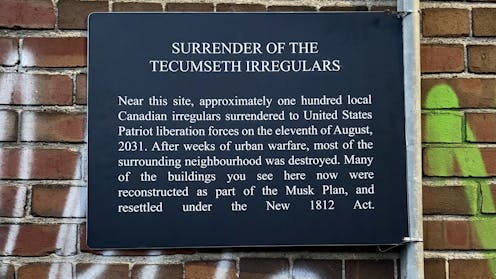
    This is exactly how to understand the story told over its several episodes on Vandor’s Pax Americana plaques: the U.S., as the story’s antagonist, abuses its power and ends up getting away with it, defeating Canadian resistance and annexing what is now only referred to as the “northern territory.”

    As Simmons suggests, conflict stories like this one, where what is viewed as injustice is allowed to prevail, exercise a relatively high level of post-plot pressure. This is mainly because the unhappy ending leaves audiences dissatisfied and with a sense of loss to grapple with.

    Reader reactions

    Simmons also explains that not all readers react to this particular kind of post-plot pressure in the same way. Vandor’s project, for example, has brought out some critical and upset responses.

    As the artist told Toronto Today, some people have called the plaques pro-American propaganda; one online commenter said they should be taken down.

    Julian Bleecker — a researcher, author, designer and engineer with a PhD in history of consciousness whose design studio offers services around future imagining and planning — voiced his objection to the project in a blog post.

    In his opinion, the antagonistic and fatalistic vision of the future portrayed on the plaques runs the risk of “playing into the hands of the very forces that are at work to make the world a less habitable place.”


    Read more:
    The theatre we want in 2040? We used ‘strategic foresight’ to plan on the Prairies


    But, as Simmons argues, conflict stories in which the happy ending never comes can also leave readers with a productive sense of post-plot pressure. In that case, feeling dissatisfied with the story’s outcome can instead motivate people to mobilize and strategize against the perceived injustice.

    Seen in this light, the plaques’ imagined collapse of Canadian sovereignty can therefore also serve as a stark and urgent inspiration, begging response.

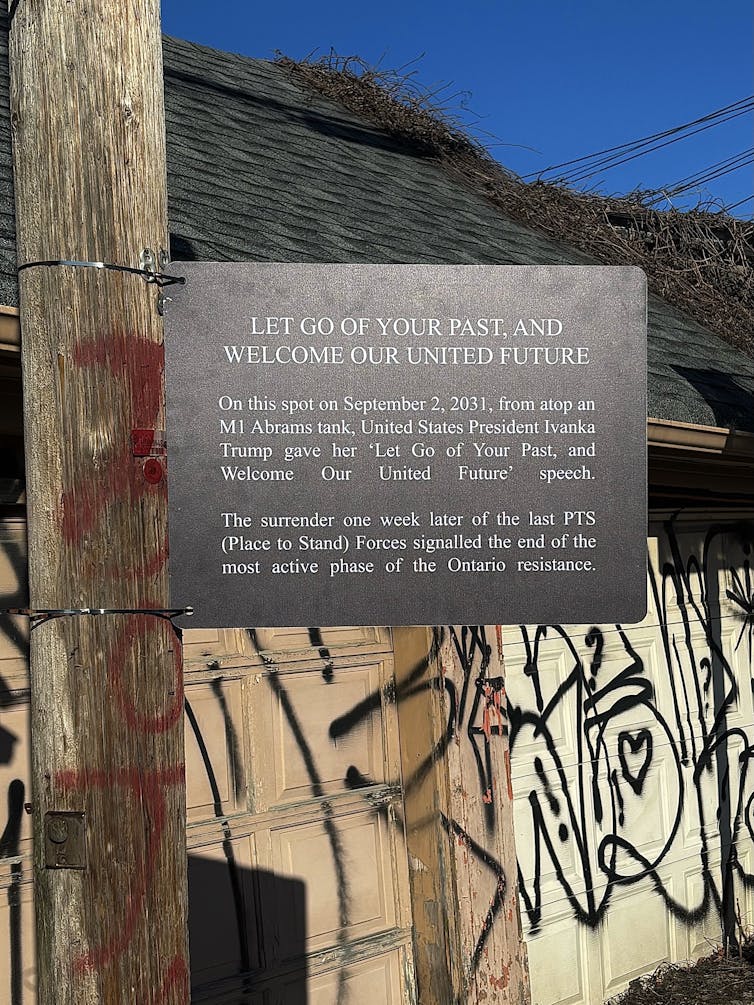
    A sign in an alleyway says 'let go of your past, and welcome to our united future.'
    In Dara Vandor’s speculative future, U.S. President Ivanka Trump, standing on a tank, exhorts Torontonians to ‘Let go of your past, and welcome to our united future.’
    (Dara Vandor)

    A cautionary tale

    Fictional storytelling is often viewed as a useful tool that allows us to make sense of real moments of conflict that happened in the past. Think, for example, of Erich Maria Remarque’s famous war novel All Quiet on the Western Front, which was turned into an Oscar-winning film directed by Edward Berger in 2022.

    Our understanding of these kinds of stories as useful comes with the acknowledgement that there is nothing we can do to prevent past conflict. At the same time, the underlying assumption here is that by learning about the past, we can learn from the past and hopefully stop similar crises from ever happening again.


    Read more:
    How stories about alternate worlds can help us imagine a better future: Don’t Call Me Resilient EP 7 transcript


    What makes Vandor’s ongoing project especially valuable is that it moves its reflections on the past into an imagined future. The actual conflict that the plaques refer to is still part of the present, and its future still undecided. Whatever lessons we draw from their cautionary tale about Canadian annexation, we still have time to act upon them before that imagined future can become reality.

    Importance of resistance in the present

    This is exactly what leads historian Camille Bégin to conclude that the project’s appeal to the importance of resistance in the present is particularly strong:

    “It really shows us that the future is not written, that it’s in our hands to act in the present to forge the future that we want.”

    Even though Vandor’s project tells a story of Canadian defeat, it also highlights that Canadians did resist, a thought that should appeal to anyone opposed to Trump’s vision of territorial expansion.

    Or, and this is perhaps the most hopeful reflection coming out of the project, if Canadians come together and resist now, Trump’s threat of annexation may never get that far.

    The Conversation

    Pascal Michelberger does not work for, consult, own shares in or receive funding from any company or organisation that would benefit from this article, and has disclosed no relevant affiliations beyond their academic appointment.

    ref. ‘Pax Americana’ in Toronto: How speculative art can help us navigate threats – https://theconversation.com/pax-americana-in-toronto-how-speculative-art-can-help-us-navigate-threats-256755

    MIL OSI – Global Reports

  • MIL-OSI Global: Experimenting with generative AI to kibbitz and futz towards more inclusive futures

    Source: The Conversation – Canada – By Nathaniel Laywine, Assistant Professor, Communication and Media Studies, York University, Canada

    Generative AI draws from limited datasets, often reproducing errors and bias. (Shutterstock)

    What does it mean to think, act and work as a Jewish professor when human freedoms are under siege and authoritarian power gains ground? And how can we draw on our Jewish identities to navigate the sweeping encroachment of new technologies like AI?

    As communication scholars, colleagues and collaborators, we have spent a lot of time trying to answer these questions in our scholarship by taking cues from the intellectual lineage of our shared culture.


    Read more:
    Philosopher Hannah Arendt provokes us to rethink what education is for in the era of AI


    Lately, Donald Trump’s administration has demonstrated a heavy investment in cataloguing and categorizing Jewish professors. In April, the Equal Employment Opportunity Commission (EEOC) sent text messages to the personal cellphones of faculty and staff at Barnard College, asking them to self-identify as Jewish and/or Israeli. The text message also asked them to disclose any instances of antisemitic discrimination or harassment they had experienced.

    Presumably, the text message inquiry itself was not recognized by its senders as an instance of such harassment.

    We do not believe being a Jewish professor means silencing our students as they protest atrocities in Gaza, and it certainly doesn’t mean revoking their visas or deporting them. Rather, it means drawing upon the tools of our forebears to question systems of oppression, wherever and however they may arise.

    We simultaneously occupy both privileged and marginal positions within the university and North American society at large. This makes us acutely aware of how fragile conditional tolerance is, and how quickly a list of names can be used to justify repression or violence.

    Collection and use of data

    As communication and media scholars, we’re often critical of how data are aggregated, stored and disseminated. The EEOC questionnaire concerns us because it reduces the complexities of Jewish identity and the profound harms of antisemitism to a handful of abstract and ideologically determined data points.

    Our recent research on generative AI (genAI) and its incompatibility with Jewish cultural expression shows that meaningful efforts to combat antisemitism — and other forms of oppression — must centre the knowledge and experiences of affected communities.

    Our research found that outputs of chatbots such as ChatGPT are unable to tell jokes in a Jewish comedic style without resorting to offensive tropes. In another forthcoming study, we argue that genAI is equally incapable of representing the multifaceted “intersectional identities” of Jewish people except by smashing together rudimentary cultural signifiers (such as rainbows for queerness or bagels for Jewishness).

    In each case, these platforms rely on datasets to determine what Jewishness is, and these datasets originate from the narratives that other people tell about Jewish people, rather than the ones we tell about ourselves.

    Futzing is a Yiddish word that means messing around via hands-on experimentation.
    (Shutterstock)

    Critical strategies

    These platforms have increasingly become parts of daily life and communicative infrastructure. To investigate them, we adopted two critical strategies from our shared heritage as Ashkenazi Jews: kibbitzing and futzing.

    Both terms are Yiddish. Kibbitzing is a lively, informal way of thinking and talking together. It’s somewhere between joking, arguing and exchanging ideas. It is grounded in our relationships, histories and biases; kibbitzing is how we make shared meaning together through many voices.

    Kibbitzing values contradiction, humour and the messiness of human conversation. Unlike AI chatbots, which follow scripted, dialogic, question-and-answer routines based on quantifiable patterns in data, kibbitzing is unpredictable, non-linear and intentionally disorganized.

    When we kibbitz, we build understanding by challenging one another and reflecting on what each of us brings to the table. In the age of genAI, kibbitzing offers a way to talk that is full of friction, laughter and deep, collective insight.

    Futzing means messing around via hands-on experimentation, with no set agenda and no official guidance. This unstructured inquiry is an acknowledgement of Jews’ historical role as outsiders within European society. As we write in our forthcoming article, these practices reflect what social theorist Michel de Certeau calls “making do,” a tactical means of collective empowerment in a hostile society.

    Using futzing as a methodology, we started exploring genAI, drawing on our curiosity to see what might happen by playing, testing and responding in real time.

    Futz first, then kibbitz

    Each of us futzed on our own at first, with no ambition to crack the code or reverse-engineer the algorithm. Later, when we began kibbitzing together, we realized our scattered efforts were actually circling around shared concerns. Futzing helped us see patterns, surprises and contradictions — things we might have missed with a more rigid approach. Kibbitzing helped us connect those patterns and reconcile the contradictions.

    Drawing on our culture this way allows us to imagine inclusive, anti-oppressive Jewish epistemologies that respond to the complexity of the current political moment. Jewish identity — like all identities — is porous and resistant to fixed form. Our shared North American Ashkenazi identity is just one of many possible perspectives that comprise a broader identity of Jewishness.

    That is not a problem to be solved. Rather, it is a strength and a bond between us. Readers may well see their own cultural traditions, vernaculars and ancestral practices in this light too, as techniques of resilience and joy in the face of hardship and oppression.

    There is an irony here. The deeper we dig into the intellectual roots of our own culture, the more common ground we might discover with everyone else’s. And that makes us feel a whole lot safer than getting a text from the EEOC ever could.

    The authors do not work for, consult, own shares in or receive funding from any company or organisation that would benefit from this article, and have disclosed no relevant affiliations beyond their academic appointment.

    ref. Experimenting with generative AI to kibbitz and futz towards more inclusive futures – https://theconversation.com/experimenting-with-generative-ai-to-kibbitz-and-futz-towards-more-inclusive-futures-252553

    MIL OSI – Global Reports

  • MIL-OSI Global: ‘Pax Americana’ in Toronto? Speculative art can help us navigate threats

    Source: The Conversation – Canada – By Pascal Michelberger, Postdoctoral Scholar, Western Academy for Advanced Research, Western University

    Artist Dara Vandor’s futuristic, commemorative historical plaques on Toronto streets project a U.S.-annexed Canada. (Dara Vandor)

    As part of her ongoing public art series, Pax Americana, Toronto visual artist Dara Vandor has been posting aluminum signs in public spaces.

    These are plaques that reimagine, as the artist writes, the city as “a site of future conflict and occupation” by the United States. The signage, in the style of commemorative historical markers, echoes U.S. President Donald Trump’s recent and repeated threats to annex Canada and “is meant to serve as a dark warning, inviting contemplation on the fragility of nationhood.”

    For example, one plaque, posted on a bridge on Spadina Ave., informs passersby:

    “This spot served as the center of operations for United States Army snipers during Operation McKinley, the campaign to liberate the northern territory formerly known as Canada. From February to May 2035, this site, code-named ‘The Hot Dog Stand,’ served as a concealed sniper’s nest, providing precision fire support, disrupting insurgent movements, and protecting advancing American units.”

    Vandor’s thought-provoking project, which she told CBC News was sparked by anger at Trump’s threats to Canadian sovereignty, underlines how storytelling can be a powerful tool in times of conflict, especially when it affords itself the artistic freedom to envision potential futures before they can become reality.

    Psychological effects

    In order to understand how exactly stories such as the one portrayed on Vandor’s plaques can make a real impact on the way we navigate moments of crisis, we can turn to the work of conflict analysis experts such as Solon Simmons.

    In his recent book on conflict storytelling, Simmons introduces the concept of post-plot pressure.

    The term describes the psychological effect that a story can have on its readers after they finish reading. As Simmons puts it:

    “What makes stories so important (as opposed to just interesting or entertaining) is the effect of the story, and this effect doesn’t end when the story ends. It leaves the viewer/reader/listener with a feeling.”

    Simmons also explains that the kind and amount of post-plot pressure placed upon an audience depends on the type of story being told.

    Projected unhappy ending exerts pressure

    A story, for example, featuring a struggle in which the antagonist eventually triumphs over the protagonist is what Simmons calls a “satirical struggle story.”

    “Satirical” in this context does not necessarily mean that stories of this kind include elements of mockery or sarcasm. Rather, the label goes back to the influential research contributions of Canadian literary theorist Northrop Frye and American historian Hayden White, from which Simmons derives his own framework.

    This is exactly how to understand the story told over its several episodes on Vandor’s Pax Americana plaques: the U.S., as the story’s antagonist, abuses its power and ends up getting away with it, defeating Canadian resistance and annexing what is now only referred to as the “northern territory.”

    As Simmons suggests, conflict stories like this one, where what is viewed as injustice is allowed to prevail, exercise a relatively high level of post-plot pressure. This is mainly because the unhappy ending leaves audiences dissatisfied and with a sense of loss to grapple with.

    Reader reactions

    Simmons also explains that not all readers react to this particular kind of post-plot pressure in the same way. Vandor’s project, for example, has brought out some critical and upset responses.

    As the artist told Toronto Today, some people have called the plaques pro-American propaganda; one online commenter said they should be taken down.

    Julian Bleecker — a researcher, author, designer and engineer with a PhD in history of consciousness whose design studio offers services around future imagining and planning — voiced his objection to the project in a blog post.

    In his opinion, the antagonistic and fatalistic vision of the future portrayed on the plaques runs the risk of “playing into the hands of the very forces that are at work to make the world a less habitable place.”


    Read more:
    The theatre we want in 2040? We used ‘strategic foresight’ to plan on the Prairies


    But, as Simmons argues, conflict stories in which the happy ending never comes can also leave readers with a productive sense of post-plot pressure. In that case, feeling dissatisfied with the story’s outcome can instead motivate people to mobilize and strategize against the perceived injustice.

    Seen in this light, the plaques’ imagined collapse of Canadian sovereignty can therefore also serve as a stark and urgent inspiration, begging response.

    In Dara Vandor’s speculative future, U.S. President Ivanka Trump, standing on a tank, exhorts Torontonians to ‘Let go of your past, and welcome to our united future.’
    (Dara Vandor)

    A cautionary tale

    Fictional storytelling is often viewed as a useful tool that allows us to make sense of real moments of conflict that happened in the past. Think, for example, of Erich Maria Remarque’s famous war novel All Quiet on the Western Front, which was turned into an Oscar-winning film directed by Edward Berger in 2022.

    Our understanding of these kinds of stories as useful comes with the acknowledgement that there is nothing we can do to prevent past conflict. At the same time, the underlying assumption here is that by learning about the past, we can learn from the past and hopefully stop similar crises from ever happening again.


    Read more:
    How stories about alternate worlds can help us imagine a better future: Don’t Call Me Resilient EP 7 transcript


    What makes Vandor’s ongoing project especially valuable is that it moves its reflections on the past into an imagined future. The actual conflict that the plaques refer to is still part of the present, and its future still undecided. Whatever lessons we draw from their cautionary tale about Canadian annexation, we still have time to act upon them before that imagined future can become reality.

    Importance of resistance in the present

    This is exactly what leads historian Camille Bégin to conclude that the project’s appeal to the importance of resistance in the present is particularly strong:

    “It really shows us that the future is not written, that it’s in our hands to act in the present to forge the future that we want.”

    Even though Vandor’s project tells a story of Canadian defeat, it also highlights that Canadians did resist, a thought that should appeal to anyone opposed to Trump’s vision of territorial expansion.

    Or, and this is perhaps the most hopeful reflection coming out of the project, if Canadians come together and resist now, Trump’s threat of annexation may never get that far.

    Pascal Michelberger does not work for, consult, own shares in or receive funding from any company or organisation that would benefit from this article, and has disclosed no relevant affiliations beyond their academic appointment.

    ref. ‘Pax Americana’ in Toronto? Speculative art can help us navigate threats – https://theconversation.com/pax-americana-in-toronto-speculative-art-can-help-us-navigate-threats-256755

    MIL OSI – Global Reports

  • MIL-OSI Global: Kids care deeply about our planet, so adults need to start listening

    Source: The Conversation – Canada – By Jen Kostuchuk, PhD Candidate, Sociology, University of Victoria

    “I wish adults knew that I really care about the environment and want to help, but I sometimes feel like my ideas don’t matter because I’m just a kid.”

    This is what a nine-year-old respondent told us when we asked how they feel about the environment.

    In today’s current political climate, many adults seem resigned to climate catastrophe and even dabble in climate change denialism. However, our survey of 1,000 youth aged eight to 14 from Canada and the United States found that children care deeply about the planet and are ready to take action.

    The findings from our report were produced as part of an ongoing study with the Humanity in Motion Society, a Canadian non-profit organization focused on engaging youth as key stakeholders in advancing environmental stewardship.

    Almost 90 per cent of the kids we spoke to recognize climate change as a real and urgent problem, calling for intergenerational collaboration and bolder environmental mitigation and adaptation commitments.

    It turns out that our nine-year-old respondent speaks for many children. Kids know what’s at stake, want a seat at the table and need adults to act with them.

    What kids told us

    Some of the kids in the survey talk about the action they want adults to take to tackle climate change. (Humanity in Motion Society)

    Many of the kids told us they regularly take action to mitigate their carbon footprint, including recycling, embracing reusable items and conserving energy. Their accounts are consistent with numerous academic studies on youth involvement in environmental citizenship.

    However, many understand individual action alone is not enough. In fact, most kids recognize that systemic accountability is necessary to tackle the climate crisis. As one kid in Grade 6 shared:

    “I wish big industry and governments would stop asking us to do something when they continue to fly in private jets [and] drill for oil and more; we are asked to recycle.”

    Kids have a deep understanding of current political issues, including the cost-of-living crisis and the harmful “drill baby drill” sentiments, but also underscore a stark disconnect: while we instil environmentally responsible values in our children, elected leaders remain consistently inactive on these very same issues.


    Read more:
    The oil and gas industry has been lying about global warming for decades — accountability is long overdue


    Kids play active roles in knowledge sharing

    The kids in this study display impressive knowledge about the steps that need to be taken to address the climate crisis. Our findings demonstrate that youth are not just passive recipients of knowledge but, rather, play an active role in being climate communicators.

    For example, two thirds of our respondents say their friends learn about climate change directly from them. Even though many children note that they do not have climate clubs at school, they are curious about the role of big oil, deforestation and corporate greed in the ongoing climate crisis.

    In addition to teachers and parents being the most influential sources of knowledge for children, social media content has an impact on kids’ environmental behaviour and feelings of empowerment.

    Specifically, our data shows that talking to others online has a significant positive relationship with reported sustainable behaviour, and that watching videos has a significant positive relationship with how much kids feel they can make a difference. One young girl reflected on using Tiktok for insights on climate change while also capturing an awareness among her generation:

    “I would say if there’s a really big issue, like, I know there’s something called the Climate Clock in New York…I mean, the thing with social media, you never know what’s true and untrue, but that thing [Climate Clock] came on my ‘For You’ page…and everybody in the comments, they were saying ‘this is very real, we have to do something about it.’”

    This shows that kids would benefit greatly from spaces to continue in-person environmental discussions with adults in the room. One young respondent captured the potential for meaningful engagement:

    “There are a lot of things that can be done, curriculum integrations…sustainable skills like critical thinking, problem-solving, collaboration, and maybe explore the ecosystems and biodiversities and actually encourage students to design and implement climate-friendly projects and carry out field trips and organize visits to renewable energy sites or environmental organizations and sometimes, maybe occasionally, the school can invite climate experts, activists or scientists.”

    These ideas were shared by others who called on adults to lead more experiential approaches to climate education inside the classroom and beyond.

    Adults can help by providing opportunities in the classroom and beyond for kids to discuss cliamte change.
    (Shutterstock)


    Read more:
    Teachers need bolder action from our school boards to educate in and for a climate emergency


    Five calls to action

    Here are five ways to help bring about change:

    1. Adults need to step up. Adults play a critical role in shaping how youth engage in climate action. Our report found that teachers and parents, in addition to the internet, are among the most influential learning sources for youth today. Kids often take pro-environmental values, actions and cues from their parents.

    2. Apathy is not an option if we want change. Youth are looking to leaders and elected officials to invest heavily in infrastructure and education to improve our environment.

    3. Intergenerational collaboration promotes better environmental values. Despite the consequences of climate change, youth share a sense of optimism and emphasize the need for intergenerational responsibility.

    4. Provide spaces for youth to take leadership roles and engage in climate dialogue. Kids want to do more to build a sustainable future, but don’t know where to begin. Providing opportunities in the classroom and beyond are critical next steps to raise the next generation of climate leaders.

    5. Promote bold action. Kids should be able to answer the call of many climate activists who recognize the need to pursue a greener economy by working together.

    Our survey findings highlight a hopeful message about young people’s engagement in climate action, underscoring their impressive knowledge of the systemic changes required to address the crisis.

    As adults across the political spectrum bicker about climate policy, young people are growing impatient and hoping to lead the way. Our results refocus attention on the future we’re creating and challenge us to listen seriously to children when they seek to address what may be their generation’s greatest crisis.

    Sean Lyons has received funding from Mitacs in support of an earlier iteration of the study discussed here.

    Erik Steiner and Jen Kostuchuk do not work for, consult, own shares in or receive funding from any company or organisation that would benefit from this article, and have disclosed no relevant affiliations beyond their academic appointment.

    ref. Kids care deeply about our planet, so adults need to start listening – https://theconversation.com/kids-care-deeply-about-our-planet-so-adults-need-to-start-listening-257304

    MIL OSI – Global Reports

  • MIL-OSI Global: Preventing urinary tract infections after menopause: What every woman should know

    Source: The Conversation – Canada – By Erin A. Brennand, Gynecologist & Associate Professor, Cumming School of Medicine, University of Calgary

    There is more information available about urinary tract infections today than ever before. (Shutterstock)

    After menopause, urinary tract infections (UTIs) can be more frequent, yet most Canadian women (82 per cent in a recent survey) don’t realize the two are associated.

    At the Sex, Gender and Women’s Health Research Hub, our team’s advocacy aims to increase awareness and highlight proven strategies to help prevent UTIs for women later in life.

    Why are UTIs more common after menopause?

    The main culprit for increased UTIs in menopausal women is the drop in estrogen levels. Estrogen plays a crucial role in maintaining urinary tract tissue health.

    As estrogen declines, the lining of the urethra — the tube through which urine flows out of the body — becomes thinner and more fragile. Also, there are fewer infection-fighting blood cells in the urinary tract, and mucosal immunity — the specialized immune defences present at the mucosal surfaces lining the urinary tract that include physical and chemical barriers, cellular receptors and antibodies — is reduced.

    This weakens the local immune response, making it easier for bacteria to cause infections. Additionally, changes in vaginal flora — the bacteria that naturally protect against infections — results in the urinary tract being vulnerable.

    Knowledge is power during menopause.
    Servier Medical Art, CC BY

    Other factors can contribute to UTI risk at this stage of life, too. Women whose bladder muscles have weakened with age, or who have developed pelvic organ prolapse, can experience incomplete bladder emptying. This leads to urine retention and an increased chance of bacterial growth.


    Read more:
    Women having surgery to treat pelvic organ prolapse don’t always need a hysterectomy


    Similarly, if women experience urinary incontinence, the leakage and moisture on incontinence pads or underwear can create an environment where bacteria thrive. And while sexual activity itself does not directly cause UTIs, it can introduce bacteria into the urinary tract, increasing the risk of infection.

    Signs of a UTI

    Bacteria in the urine without symptoms is called asymptomatic bacteriuria. It is not a UTI and should not be treated; a UTI is only diagnosed when bacteria and symptoms are both present. The most obvious symptoms include:

    • A new, strong, persistent urge to urinate;
    • A burning sensation while urinating;
    • Frequent urination in small amounts;
    • Pelvic discomfort or pressure.

    In severe cases, UTIs can lead to kidney infections, so when symptoms include fever, chills and back pain, it is essential to seek immediate medical attention.

    For women in their 80s or older, or sometimes younger women who are living with medical conditions such as dementia, urinary tract infections can manifest as behavioural changes such as confusion, withdrawal or reduced appetite. However, new onset delirium should always be investigated by a medical team rather than assumed to be a UTI.

    Evidence-based strategies to prevent UTIs

    Several medical and lifestyle interventions can make a significant difference:

    1. Vaginal estrogen therapy

    One of the most effective ways to prevent recurrent UTIs in postmenopausal women is vaginal estrogen therapy, which delivers small doses of estrogen directly to the vaginal tissues through creams, tablets or rings. Studies have shown that vaginal estrogen can restore the natural protective barrier of the urinary tract, reducing UTI risk significantly. It can be used by breast cancer survivors as it does not have the same risks associated with menopause hormone therapy (MHT).

    2. Non-antibiotic prevention

    Methenamine hippurate (one gram orally, twice-a-day) is effective in reducing UTIs by creating an environment that prevents bacterial growth. In Canada, women need to obtain this medication from a compounding pharmacy.

    3. Low-dose antibiotic
    Doctors may prescribe low-dose antibiotics – about half the standard dose – for several months. If sexual activity is a trigger for UTIs, antibiotics can be used episodically after sex. However, antibiotics can cause side-effects and create antibiotic-resistant bacteria.
    4. Diet supplements
    Scientific evidence on consuming cranberry-based products to prevent UTIs is mixed. Some studies suggest that certain compounds in cranberries (proanthocyanidins, or PACs) prevent bacteria from adhering to the bladder lining, while others show no benefit. If trying these products, women should choose brands with high concentrations of PACs, the active ingredient.

    Similarly, probiotics, especially those containing Lactobacillus strains, may help maintain a healthy vaginal microbiome, which in turn can lower UTI risk. However, research is still evolving.

    5. Hygiene and lifestyle habits
    Though there is limited evidence, simple everyday habits may help in preventing UTIs:

    • Staying hydrated – Drinking water helps to flush bacteria from the urinary tract. For women who drink a low volume of fluids each day (less than 1.5 litres), increasing water intake may help.
    • Urinating regularly – Avoid holding urine for long periods and aim to void every three to four hours during the day.
    • Urinating after sex – This helps clear bacteria introduced during intercourse.
    • Choosing breathable underwear – Cotton underwear and loose-fitting clothes reduce build up of moisture, which in turn reduces bacterial growth.

    More innovations on the horizon

    Vaccines are one of the most promising developments for preventing recurrent UTIs. In one early trial, overall recurrences decreased by 75 per cent for women given an oral vaccine, with no major side-effects reported.

    Trials are currently under way in Canada, and researchers hope vaccines will provide a more effective and long-term solution.

    Treatment and support for UTIs.
    People illustrations by Storyset, CC BY

    When to see a doctor

    Any woman who is experiencing frequent UTIs — defined as two infections in six months or three in a year — in menopause should talk to their doctor or primary care provider. Together, they can determine the best preventive targeted strategies.

    Knowledge is power, and there is more information available today than ever before. UTIs are not an inevitable part of aging. With the right combination of medical treatments and lifestyle changes, women can reduce postmenopausal risk.

    Erin A. Brennand receives funding from the Canadian Institutes of Health Research, Social Sciences and Humanities Research Council, the Calgary Health Foundation, and the MSI Foundation (all paid to institution).

    Jayna Holroyd-Leduc has received funding from CIHR and Alberta Innovates. She holds the BSF Chair in Geriatric Medicine at the University of Calgary.

    Pauline McDonagh Hull does not work for, consult, own shares in or receive funding from any company or organisation that would benefit from this article, and has disclosed no relevant affiliations beyond their academic appointment.

    ref. Preventing urinary tract infections after menopause: What every woman should know – https://theconversation.com/preventing-urinary-tract-infections-after-menopause-what-every-woman-should-know-255762

    MIL OSI – Global Reports

  • MIL-OSI Global: Blind box toys are booming: Are they just child’s play or something more concerning?

    Source: The Conversation – Canada – By Eugene Y. Chan, Associate Professor of Marketing, Toronto Metropolitan University

    Collectible figurines on display at Pop Mart in Ivano-Frankivsk, Ukraine, on April 29, 2025. (Shutterstock)

    If you’ve seen videos of people tearing into tiny toy packages online, or noticed teens obsessing over pastel-coloured figurines at the mall, you’ve probably encountered the global craze for blind box toys.

    These small collectibles — usually figures of cartoonish characters — are sold in sealed packaging that hides which specific item is inside. You might get the one you want, or you might not. That uncertainty is part of the thrill.

    Unlike traditional toys, these figures are marketed as collectibles. Many are part of themed series, with some designs labelled as “rare” or “secret,” appearing in as few as one in every 144 boxes. This sense of exclusivity fuels repeat purchases and has spawned a resale market where rare figures can command hundreds of dollars.

    Popular among children and adults alike, blind box toys have grown into a billion-dollar industry. One of the more popular brands is Pop Mart, a Chinese toy company founded in 2010 known for its collectible designer toys sold in mystery packs.

    Gen Z consumers, in particular, have embraced blind box toys both as a nostalgic pastime and as a form of legitimate collecting. The proliferation of unboxing videos on platforms like TikTok and YouTube, where creators open dozens of blind boxes on camera, has added to their appeal.

    For many fans, these toys offer more than just cuteness: they also provide suspense, surprise and a rush of dopamine with every box opened. But how did this niche product become a global obsession?

    From Tokyo streets to western malls

    The origins of blind box toys trace back to East Asia. Capsule toy vending machines called gashapon originated in Japan in the 1960s. By the 1980s, they had become a cultural fixture. These machines dispense small toys in opaque plastic balls, with customers never quite sure which item they’ll receive.

    In the early 2010s, Chinese companies like Pop Mart adapted the gashapon model for the mainstream retail space. Instead of vending machines, they began selling artist-designed vinyl toys in blind boxes at dedicated boutiques.

    A tourist uses a gashapon machine in Osaka, Japan, in 2024. Gashapon machines are similar to the coin-operated toy vending machines seen outside grocery stores and other retailers in North America.
    (Shutterstock)

    Pop Mart’s success helped transform the blind box into a mainstream commercial phenomenon. Characters like Molly, Skullpanda and Dimoo became instant hits, combining Japanese kawaii esthetics with western pop art sensibilities.

    Pop Mart figures have since developed a cult-like following. Many consumers treat the toys as affordable art objects, displayed in cabinets, on purses or traded online.

    Today, blind box retail stores have expanded globally from Asia to Europe and North America. In October 2024, Pop Mart opened its first store in the Midwestern United States, located on Chicago’s Magnificent Mile at The Shops at North Bridge. The store offers exclusive products and taps into the growing demand for collectibles among American consumers.

    The psychology behind the mystery

    What makes blind box toys so hard to resist?

    Their success relies on a psychological principle known as variable-ratio reinforcement — the same reward pattern that makes slot machines so addictive.

    You never know exactly when you’ll score the item you’re after, but the possibility that the next box might contain it keeps people coming back. This unpredictability keeps people engaged, especially when the potential reward is framed as rare or valuable.

    Cconsumer psychology research also suggests that anticipation plays a major role. Studies show that dopamine, the brain’s reward chemical, spikes not just when we get what we want, but when we anticipate it. The sealed packaging, the suspense of unwrapping and the hope for a rare figure all heighten this effect.

    Sonny Angels on display in a store in Shenzhen, China, in March 2019.
    (Shutterstock)

    For younger collectors, the excitement of “the chase” can foster compulsive buying habits. This effect is amplified by the social influence of watching unboxings online or seeing friends complete their sets, and it becomes a powerful loop.

    Even when buyers don’t get the figure they want, the sunk cost fallacy — the feeling that they’ve already invested too much time or money to walk away — keeps them buying more.

    The hidden costs of blind boxes

    As blind box toys surge in popularity, they have drawn criticism from consumer advocates, psychologists and environmentalists alike.

    Some worry that blind boxes normalize gambling-like behaviours, especially among children. The randomness, excitement and promise of rare rewards closely mirror the mechanisms behind loot boxes in video games — another product that has sparked global concern over youth exposure to gambling psychology.

    Several countries, including Belgium and the Netherlands, have regulated loot boxes under gambling laws. Blind boxes, though currently unregulated, may be next in line for scrutiny.


    Read more:
    Blind bags: how toy makers are making a fortune with child gambling


    There are also environmental concerns. Many blind box toys come in excessive packaging — plastic wraps, foil bags, cardboard boxes — most of which is discarded immediately. The collectibles themselves are often made of non-recyclable plastics, raising questions about sustainability in an era of rising consumer awareness over waste.

    Even among adult fans, some critics question whether blind boxes are designed less to bring joy and more to trigger compulsive consumption. The joy of collecting, they argue, is increasingly overshadowed by the mechanics of engineered desire.

    What should we make of the blind box boom?

    Blind box toys are not inherently harmful, and for many, they’re a source of fun, nostalgia and self-expression. They also offer an accessible way for consumers to engage with designer art in a collectible, miniature form, as many of them are created by individual artists.

    But blind box toys also raise deeper questions about how modern marketing leverages psychological triggers associated with gambling, especially when it comes to children.

    As these toys continue to gain traction in the West, it’s worth asking more critical questions, like: are we buying into mystery or are we being sold obsession and compulsion?

    The blind box trend reflects broader shifts in how products are marketed, how value is perceived and how consumer behaviour is shaped in a digital, attention-driven economy. Understanding the forces at play may be the first step toward more informed — and perhaps more mindful — collecting.

    Eugene Y. Chan does not work for, consult, own shares in or receive funding from any company or organisation that would benefit from this article, and has disclosed no relevant affiliations beyond their academic appointment.

    ref. Blind box toys are booming: Are they just child’s play or something more concerning? – https://theconversation.com/blind-box-toys-are-booming-are-they-just-childs-play-or-something-more-concerning-257611

    MIL OSI – Global Reports

  • Piyush Goyal commences official visit to France, Italy to boost economic ties

    Source: Government of India

    Source: Government of India (4)

    Union Commerce and Industry Minister Piyush Goyal began his three-day official visit to France on Sunday as part of a five-day tour of France and Italy from June 1 to 5. The visit is aimed at further strengthening India’s strategic and economic partnerships with key European nations.

    During his stay in France, the Minister will hold bilateral meetings with senior French officials, including Minister of Economy Eric Lombard and Trade Minister Laurent Saint-Martin. The discussions will focus on enhancing Indo-French economic ties, trade collaboration, and exploring investment opportunities in priority sectors.

    As part of his engagements, Goyal will participate in the India-France Business Round Table and the India-France CEO Forum. He is expected to meet senior leadership from leading French companies such as Vicat, TotalEnergies, L’Oréal, Renault, Valeo, EDF and ATR. The forums aim to deepen industry-level cooperation and foster greater dialogue between businesses from both countries.

    Speaking ahead of the visit, Goyal said, “France is a longstanding partner in India’s growth journey. This visit is an opportunity to reinforce our economic collaboration, encourage two-way investments, and support innovation-led partnerships.”

    The Minister will also represent India at the informal gathering of World Trade Organization (WTO) Ministers, held on the sidelines of the OECD Ministerial Council Meeting in Paris. He will articulate India’s views on key global trade issues, including reform of the multilateral trading system and inclusive growth.

    Goyal will hold a series of bilateral meetings with international counterparts during the visit. These include the UK Secretary of State for Business and Trade Jonathan Reynolds, Singapore’s Deputy Prime Minister and Minister for Trade and Industry Gan Kim Yong, and Saudi Arabia’s Minister of Commerce Dr. Majid bin Abdullah Al-Kasabi.

    The Minister will also meet Israel’s Minister for Trade and Investment Nir Barkat, Nigeria’s Minister for Trade, Industry and Investment Dr. Jumoke Oduwole OON, and Brazil’s Foreign Minister Mr. Mauro Luis Iecker Vieira. These interactions are expected to advance India’s global trade outreach and provide momentum to the ongoing India-EU Free Trade Agreement negotiations.

    In addition, Goyal will engage with senior EU officials, including European Commissioner for Trade and Economic Security Maroš Šefčovič and Agriculture Commissioner Christophe Hansen. The talks will focus on boosting India-EU cooperation in trade, technology, and agriculture.

    Goyal will continue the second leg of his visit in Italy from June 3, where further engagements with industry leaders and government officials are scheduled.

  • MIL-OSI Russia: China introduces visa-free regime for 5 Latin American and Caribbean countries

    Translation. Region: Russian Federal

    Source: People’s Republic of China in Russian – People’s Republic of China in Russian –

    Source: People’s Republic of China – State Council News

    BEIJING, June 1 (Xinhua) — China launched a trial visa-free regime for citizens of Brazil, Argentina, Chile, Peru and Uruguay on Sunday, which will last until May 31, 2026.

    This is the first time that China has extended its visa-free policy to Latin American and Caribbean countries. Thus, China has now unilaterally introduced a visa-free regime for 43 countries.

    During the above-mentioned period, citizens of these five countries with their ordinary passports can enter China without a visa for the purpose of doing business, making tourist trips, visiting relatives and friends, conducting exchanges and visits, and for transit, and their stay in the country should not exceed 30 days.

    Recently, the Chinese side also announced that a visa-free policy will be introduced on a trial basis from June 9, 2025 to June 8, 2026 for those holding ordinary passports from Saudi Arabia, Oman, Kuwait and Bahrain. -0-

    MIL OSI Russia News

  • MIL-OSI Russia: Israeli army confirms killing of Hamas leader and two commanders in Gaza

    Translation. Region: Russian Federal

    Source: People’s Republic of China in Russian – People’s Republic of China in Russian –

    Source: People’s Republic of China – State Council News

    JERUSALEM, June 1 (Xinhua) — The Israeli military on Saturday confirmed the death of Mohammed Sinwar, a senior Hamas commander and head of the group’s military wing in Gaza, in an airstrike earlier this month.

    A joint statement from the Israel Defense Forces (IDF) and the country’s Shin Bet security service said Sinwar was killed on May 13 in a targeted attack on an underground command center located beneath the European Hospital in the southern Gaza Strip. The Israeli military accused Hamas of using the hospital as a cover, putting civilians at risk.

    According to the IDF, M. Sinwar, 49, is one of Hamas’s most senior and longest-serving military leaders, and played a key role in planning the October 7, 2023 attack on Israel that led to the current conflict.

    Israeli Prime Minister Benjamin Netanyahu announced Sinwar’s death earlier this week in a speech to the Israeli parliament.

    The strike also killed two other senior Hamas commanders: Muhammad Shabana, who led the Rafah Brigade, and Mahdi Quara, commander of the Khan Younis Battalion. The IDF said both men were involved in the October 7, 2023, attack and later led attacks on Israeli troops, including hostage-taking and rocket fire.

    Earlier, Gaza health authorities said the Israeli strike had killed at least six people and wounded 40. Hamas has not issued an official statement confirming Sinwar’s death.

    M. Sinwar was the younger brother of Yahya Sinwar, the former leader of the Hamas movement in the Gaza Strip, who was killed in a clash with the IDF in October 2024. –0–

    MIL OSI Russia News

  • MIL-OSI Russia: Israeli army says it killed five militants in Gaza

    Translation. Region: Russian Federal

    Source: People’s Republic of China in Russian – People’s Republic of China in Russian –

    Source: People’s Republic of China – State Council News

    JERUSALEM, June 1 (Xinhua) — The Israel Defense Forces (IDF) said Saturday that five militants were killed in operations in the Gaza Strip over the past 24 hours.

    According to the statement, a combat team from the IDF’s Paratroopers Brigade found four armed men in the surrounding area on Friday and killed them during a clash.

    The IDF added that it had struck and killed Hamas militant Khalil Farwan in the Gaza neighborhood of Sabra, saying he was in charge of weapons production at the movement’s headquarters.

    According to the statement, the military also dismantled weapons and explosive devices planted in the ground and destroyed infrastructure, some of which was underground. –0–

    MIL OSI Russia News

  • MIL-OSI Video: POV: SOAR to the rescue!

    Source: US Army (video statements)

    160th SOAR training with the USCG Advanced Helicopter Rescue School.

    About the U.S. Army: The Army Mission – our purpose – remains constant: To deploy, fight and win our nation’s wars by providing ready, prompt & sustained land dominance by Army forces across the full spectrum of conflict as part of the joint force. Interested in joining the U.S. Army? Visit:
    spr.ly/6001igl5L
    Connect with the U.S. Army online: Web:
    https://www.army.mil
    Facebook:
    https://www.facebook.com/USarmy/
    X:

    Instagram:
    https://www.instagram.com/usarmy/
    LinkedIn:
    https://www.linkedin.com/company/us-army
    #USArmy #Soldiers #Military #Shorts #Army

    https://www.youtube.com/watch?v=w7TTC7Yn7o4

    MIL OSI Video

  • MIL-OSI USA: Mfume, House and Senate Democrats Send Letter Calling on GAO to Investigate Federal Worker Firings

    Source: United States House of Representatives – Congressman Kweisi Mfume (MD-07)

    WASHINGTON, D.C. –  In response to the Trump Administration’s unprecedented purge of tens of thousands of federal workers without cause, Ranking Member of the House Committee on Oversight and Government Reform Subcommittee on Government Operations Rep. Kweisi Mfume (MD-07), Ranking Member of the House Appropriations Subcommittee on Financial Services and General Government (FSGG) Congressman Steny H. Hoyer (MD-05), Ranking Member of the Senate Appropriations Subcommittee on Commerce, Justice, Science, and Related Agencies Senator Chris Van Hollen (D-MD), Ranking Member of the Senate Appropriations Subcommittee on FSGG Senator Jack Reed (D-RI), Ranking Member of the Senate Committee on Homeland Security and Governmental Affairs Senator Gary Peters (D-MI), Acting Ranking Member on the House Committee on Oversight and Government Reform Rep. Stephen F. Lynch (MA-08), and Ranking Member of the House Committee on Oversight and Government Reform Subcommittee on Delivering On Government Efficiency (DOGE) Rep. Melanie Stansbury (NM-01) led more than 30 Democrats in sending a letter to Comptroller General of the United States Gene L. Dodaro calling on the Government Accountability Office (GAO) to provide Congress with regular updates on how the Trump Administration’s personnel actions are affecting the federal workforce.

    “Over the past several months, the civil service has undergone an unprecedented level of change as tens of thousands of federal employees have been terminated, resigned, or placed on administrative leave,” the Members wrote. “Americans are already feeling the consequences – longer wait times for Social Security assistance, delayed veterans’ benefits, and disrupted disaster response are just a few examples of how these personnel actions are impacting people across the country. We are deeply concerned about the impact these actions will have on our government’s capacity to design, develop and deliver efficient services that connect agencies with the people they serve and meet the needs of the public.”

    Signatories include: Senator Angela D. Alsobrooks; Rep. Yassamin Ansari; Rep. Wesley Bell; Rep. Donald Beyer; Rep. Sanford D. Bishop, Jr.; Senator Richard Blumenthal; Rep. Shontel Brown; Rep. Greg Casar; Rep. Jasmine Crockett; Rep. Sarah Elfreth; Rep. Maxwell Frost; Rep. Robert Garcia; Rep. Glenn Ivey; Senator Timothy Kaine; Rep. Ro Khanna; Rep. Raja Krishnamoorthi; Rep. Summer Lee; Rep. April McClain Delaney; Rep. Jennifer McClellan; Rep. Dave Min; Senator Patty Murray; Rep. Eleanor Holmes Norton; Senator Alex Padilla; Rep. Emily Randall; Rep. Jamie Raskin; Senator Bernard Sanders; Senator Brian Schatz; Rep. Lateefah Simon; Rep. Suhas Subramanyam; Rep. Rashida Tlaib; Rep. Eugene Vindman; and Senator Mark R. Warner.

    The full text of the letter is included below:

    May 29, 2025
     

    The Honorable Gene L. Dodaro
    Comptroller General of the United States
    Government Accountability Office
    441 G Street, N.W.
    Washington D.C. 20548

    Dear Comptroller General Dodaro:

    The 2 million federal employees who work across our country are the backbone of our federal government and are responsible for delivering vital services to the American people. These individuals dedicate their lives to public service and ensure our government fulfills its mission to make our country safer, healthier and more prosperous.

    Over the past several months, the civil service has undergone an unprecedented level of change as tens of thousands of federal employees have been terminated, resigned, or placed on administrative leave. Americans are already feeling the consequences – longer wait times for Social Security assistance, delayed veterans’ benefits, and disrupted disaster response are just a few examples of how these personnel actions are impacting people across the country. We are deeply concerned about the impact these actions will have on our government’s capacity to design, develop and deliver efficient services that connect agencies with the people they serve and meet the needs of the public.

    To assist our oversight of the federal government’s personnel actions, we request that the Government Accountability Office provide us with regular briefings to ensure Congress has timely data and information on the status of the federal workforce. Specifically, we request that GAO begin providing the information following each quarter through the end of fiscal year 2028 to be scheduled in coordination with applicable staff. Information on the total number of the following groups of federal employees in the 24 CFO agencies categorized by agency of employment, location, occupation and tenure by quarter –

    a. All terminated federal employees who are separated for any reason;

    b. Federal employees who took the deferred resignation program offer;

    c. Federal employees in their probationary period;

    d. Federal employees in their probationary period who were terminated;

    e. Federal employees on administrative leave.

    f. Federal employees hired.

    Any difficulties experienced by the Office of Personnel Management (OPM) in its collection, analysis, and publication of human capital data.

    Thank you for your attention to this matter.

    Sincerely,

    ###

    MIL OSI USA News

  • MIL-OSI USA: Senator Marshall Visits Southern Border Alongside Kansas Law Enforcement Officials

    US Senate News:

    Source: United States Senator for Kansas Roger Marshall

    Washington – U.S. Senator Roger Marshall, M.D. (R-Kansas) visited Sierra Vista, Arizona yesterday to tour the Joint Task Force-Southern Border Command offices, thank members of Kansas’ own 1st Infantry Division from Fort Riley, participate in tours along the southern border, receive briefings, and take an aerial tour of the border near Arizona with several Kansas law enforcement officials.
    Below are photos from Senator Marshall’s visit. Click HERE and HERE for b-roll videos.

    Senator Marshall with members of Joint Task Force Southern Border.

    Senator Marshall prepares to view the border from the air.

    Senator Marshall at the border wall with detectives from the Cochise County Sheriff’s Office.

    Senator Marshall with members of Kansas law enforcement at the southern border wall.
    From left to right: Sheriff Billy Tomasi, Director Brian Peete, Sheriff Jeff Easter, Sheriff Scott Braun, Senator Roger Marshall, Chief Karl Oakman, Director Tony Mattivi, and Chief Courtney Leslie.
    “Having visited the southern border multiple times under the Biden-Harris Administration, I witnessed chaos, lawlessness, and a system overwhelmed by over 10 million illegal crossings –including individuals on the FBI’s terrorist watchlist,” said Senator Marshall. “But during my most recent trip, the difference was clear. Since President Trump returned to office, we’ve already seen a dramatic shift with illegal border crossings dropping 93% compared to last year. What I’ve witnessed firsthand at the border proves that President Trump’s bold leadership is delivering results, and he is keeping his promises. To continue delivering on the President’s agenda, the Senate must pass the ‘One Big, Beautiful Bill’ – legislation that will provide critical funding our border agencies need to keep America safe.”
    Since President Trump took office in January 2025, the number of illegal immigrant crossings at the southern border has dropped dramatically. In April 2024, there were 128,900 crossings at the border, while in April 2025, there were only 8,400.
    The Kansas law enforcement officers who accompanied Senator Marshall included Kansas Bureau of Investigation (KBI) Director Tony Mattivi, Director of the Riley County Police Department Brian Peete, Sedgwick County Sheriff Jeffery Easter, Crawford County Sheriff Billy Tomasi, Ellis County Sheriff and Kansas Sheriffs’ Association President Scott Braun, Hugoton Police Chief and Kansas Association of Chiefs of Police President Courtney Leslie, and Kansas City, Kansas Police Chief Karl Oakman.
    “I was honored to join Senator Marshall and several sheriffs and police chiefs in experiencing firsthand the challenges at our southern border,” said KBI Director Tony Mattivi. “We know every fentanyl pill sold in Kansas is trafficked by Mexican drug cartels through this border. Every single pill that kills a Kansan enters the country here, so we must continue the fight to keep dangerous and violent criminals out.”
    “Senator Marshall champions law enforcement and public safety efforts. He understands the unique role the Riley County Police Department plays in protecting national security and operational readiness because of our ties to NBAF and Fort Riley,” said Riley County Police Department Director Brian Peete. “This opportunity has helped the department forge new strategic plans and procedures to keep our county safe from narcotic and human trafficking, as well as foreign terrorist organizations. My sincerest thanks to both he and his team.”
    “The experience was very informative. It was amazing to me to see what 4 years of an unsecured border looked like and the issues it created for the United States,” said Sedgwick County Sheriff Jeffrey Easter. “This trip highlighted the absolute cooperation between the U.S military, Border Patrol, and the Cochise County Sheriff’s Office. These men and women are on the front lines protecting Kansans from the fentanyl and methamphetamine scourge that has gripped Sedgwick County. I am very appreciative of Senator Marshall inviting me to observe and understand the situation at our border.”
    “We’ve learned where it’s coming in from, we’ve learned where it’s being transported to, and this is a hub where it’s coming out of,” said Crawford County Sheriff Billy Tomasi. “Like I told the voters when I came on, that I am going to learn about this and I’m going to start taking it off the streets, and that’s my goal. And I appreciate the opportunity from Senator Marshall allowing me to come down here with him to learn this, to bring back to our community.”
    “Our visit to the Arizona border with the dedicated military – including soldiers from Fort Riley –and border agencies, was eye-opening. The fight against illegal immigrants and the deadly flow of fentanyl is real.  It’s happening on the ground, and it’s impacting Kansas communities every day. The brave men and women on the front lines deserve our full support as they work to protect our borders and save lives back home,” said Hugoton Police Chief and Kansas Association of Chiefs of Police President Courtney Leslie. “I am extremely grateful to Senator Marshall and his staff for the opportunity to see firsthand the fight against the cartels that are trafficking fentanyl across our border daily. The fight against these cartels is not just a border issue – it is a fight for the safety of every Kansas community.”
    “I would like to thank Senator Marshall for the opportunity to see firsthand the great work being done by our men and women of law enforcement, border patrol, and the military,” said Kansas Police Chief Karl Oakman. “Eliminating drug smuggling is still a major challenge at the border, and additional resources are needed.”
    Background:

    Senator Marshall spoke out against Joe Biden’s reckless border policies continuously during his four disastrous years in office, calling it the “number one” most immediate national security threat.
    Senator Marshall supports President Donald Trump’s ‘One, Big Beautiful Bill,’ which includes the largest border security investment in history, empowers ICE to deport the millions of illegal immigrants who entered under the Biden-Harris Administration, and provides funding for at least one million annual removals.
    Recently, Senator Marshall reintroduced the Justice for Angel Families Act, legislation that would amend the Crime Victims Fund (CVF) to expand financial coverage for Angel Families – the immediate relatives of victims killed by illegal aliens.
    In 2024, he introduced legislation the Demanding Citizenship in D.C. Elections Act, which would require anyone who votes in a municipal election in the District of Columbia to be a U.S. Citizen and require proof of citizenship. 
    In 2024, Senator Marshall also went to the Senate Floor demanding the immediate passage of his resolution declaring an invasion at the southern border.
    In an op-ed for FOX News in 2019, then-Congressman Marshall detailed his border visit with fellow doctors in Congress stating, “Our systems are simply overwhelmed, and there appears to be no break in the near future… until we build a wall, and until we turn off the laws that only serve as magnets, all the money in the world will not have a huge humanitarian impact.”

    MIL OSI USA News

  • MIL-OSI USA: U.S. Department of Energy Issues 202(c) Emergency Order to Safeguard Electric Grid Reliability in PJM Interconnection

    Source: US Department of Energy

    WASHINGTON— The U.S. Department of Energy (DOE) today issued an emergency order under section 202(c) of the Federal Power Act. The order directs PJM Interconnection (PJM) to operate specified generation units at the Eddystone, Pennsylvania Generation Station past their planned retirement. This order follows recent statements from PJM warning that its system faces a “growing resource adequacy concern” due to load growth, the retirement of dispatchable resources, and other factors.

    “Maintaining access to affordable, reliable, and secure power is always our top priority, particularly during the summer months when electricity demand reaches its peak,” said U.S. Secretary of Energy Chris Wright. “Americans should never be left wondering whether they will be able to turn on their lights or air conditioning. This emergency order helps keep money in consumers’ pockets while keeping their homes and businesses fully powered. Energy shortfalls or unnecessary price increases are not options in this Administration.”

    DOE’s order states that PJM shall, in coordination with Constellation Energy, run specified units at the Eddystone Generating Station, when PJM deems necessary, past their planned retirement date of May 31, 2025. DOE issued the order due to resource adequacy concerns given the timing of the retirement of the generation units coinciding with sustained increased energy demand.

    Background:

    PJM has recently stated its system faces “growing resource adequacy concern” due to load growth, the retirement of dispatchable resources, and other factors. Upcoming retirements, including the planned retirement of Unit 3 and Unit 4 of the Eddystone Generating Station in Eddystone, Pennsylvania, will exacerbate these resource adequacy issues.

    In its February 2023 assessment, PJM also highlighted the increasing resource adequacy concerns and reliability risks in the coming years due to the potential timing mismatch between resource retirements, load growth and the pace of new generation entry.

    MIL OSI USA News

  • MIL-OSI USA: DAUPHIN COUNTY – Governor Shapiro, PennDOT Secretary to Highlight Importance of Investing in Mass Transit to Connect Communities, Power Pennsylvania’s Economy

    Source: US State of Pennsylvania

    June 02, 2025Harrisburg, PA

    ADVISORY – DAUPHIN COUNTY – Governor Shapiro, PennDOT Secretary to Highlight Importance of Investing in Mass Transit to Connect Communities, Power Pennsylvania’s Economy

    Governor Josh Shapiro and Secretary of PennDOT Mike Carroll will visit Capital Area Transit to highlight the importance of investing in mass transit to create jobs, connect communities, and grow Pennsylvania’s economy. The Governor’s 2025-26 Budget Proposal calls for significant investments in mass transit and road and bridge infrastructure all across the Commonwealth to ensure Pennsylvanians can get where they need to go.

    WHO:
    Governor Josh Shapiro
    Secretary Mike Carroll, PennDOT
    Senator Patty Kim
    Richard Farr, Executive Director of the Susquehanna Regional Transportation Authority

    WHERE:
    Capital Area Transit
    901 N. Cameron Street,
    Harrisburg, PA 17101

    WHEN:
    Monday, June 2, 2025, at 11:00 AM
    LIVE STREAM:
    pacast.com/live/gov
    governor.pa.gov/live/

    RSVP:
    Press who are interested in attending must RSVP with the names and phone numbers for each member of their team to ra-gvgovpress@pa.gov.

    MIL OSI USA News

  • MIL-OSI USA: Rep. Mike Levin Honors Rohen Vargo as May 2025 Constituent of the Month

    Source: United States House of Representatives – Representative Mike Levin (CA-49)

    May 31, 2025

    San Clemente, CA – Today, Rep. Mike Levin (CA-49) announced Rohen Vargo as his May 2025 Constituent of the Month for launching “Health in Your Hands,” a public health initiative that provides free blood pressure clinics in low-income neighborhoods in South Orange County.

    Rohen Vargo

    See below for Rep. Levin’s statement recognizing Rohen Vargo in the Congressional Record:

    “M. Speaker, I am proud to recognize Rohen Vargo as my May 2025 Constituent of the Month.

    “As Rohen grew up, he often took the blood pressure of his grandfather, who has Parkinson’s Disease. After learning about healthcare disparities in Orange County, Rohen felt called to action and launched ‘Health in Your Hands,’ a student-run blood pressure screening clinic that operates in low-income neighborhoods in South Orange County.

    “Health in Your Hands screens for hypertension and distributes free blood pressure cuffs and educational pamphlets. To date, they have screened over 90 adults and distributed over 400 free blood pressure cuffs.

    “Rohen’s dedication to helping others has made the community a healthier place, and I am proud to honor him as my Constituent of the Month.”

    ABOUT THE CONSTITUENT OF THE MONTH PROGRAM:

    Rep. Levin’s Constituent of the Month program recognizes outstanding North County San Diego and South Orange County residents who have gone above and beyond to help their neighbors, give back to their community, and represent the best of our country. Rep Levin’s April 2025 Constituent of the Month was Amanda Reuther, an advocate for children with disabilities, and his March 2025 Constituent of the Month was Michelle Gonzalez, President and CEO of TrueCare.

    ###

    MIL OSI USA News

  • MIL-OSI Global: Forecasters expect a busy 2025 hurricane season – a storm scientist explains why and what meteorologists are watching

    Source: The Conversation – USA – By Colin Zarzycki, Associate Professor of Meteorology and Climate Dynamics, Penn State

    U.S. forecasters with the National Oceanic and Atmospheric Administration are expecting an above-normal 2025 Atlantic hurricane season, with 13 to 19 named storms, and 6 to 10 of those becoming hurricanes.

    But, how do they know what’s likely to happen months in the future?

    I’m an atmospheric scientist who studies extreme weather. Let’s take a look at what Atlantic hurricane forecasts are based on and why those forecasts can shift during the season, which runs from June 1 to Nov. 30.

    What goes into a seasonal forecast

    Think of the preseason hurricane forecast as the 30,000-foot view: It can’t predict if or when a storm will hit a particular location, but it can offer insight into how many storms are likely to form throughout the entire Atlantic, and how active the season overall might be.

    These outlooks rely heavily on two large-scale climate factors.

    The first is the sea surface temperature in areas where tropical cyclones tend to form and grow. Hurricanes draw their energy from warm ocean water. So when the Atlantic is unusually warm, as it has been in recent years, it provides more fuel for storms to form and intensify.

    Once water temperatures are 79 degrees Fahrenheit (26 degrees Celsius), hurricanes can form. Most of the Gulf was above that by late May 2025.
    NOAA/NESDIS

    The second key ingredient that meteorologists have their eye on is the El Niño–Southern Oscillation, which forecasters refer to as ENSO. ENSO is a climate cycle that shifts every few years between three main phases: El Niño, La Niña, and a neutral space that lives somewhere in between.

    During El Niño, winds over the Atlantic high up in the troposphere – roughly 25,000 to 40,000 feet – strengthen and can disrupt storms and hurricanes. La Niña, on the other hand, tends to reduce these winds, making it easier for storms to form and grow. When you look over the historical hurricane record, La Niña years have tended to be busier than their El Niño counterparts, as we saw from 2020 through 2023.

    We’re in the neutral phase as the 2025 hurricane season begins, and probably will be for at least a few more months. That means upper-level winds aren’t particularly hostile to hurricanes, but they’re not exactly rolling out the red carpet either.

    At the same time, sea surface temperatures are running warmer than the 30-year average, but not quite at the record-breaking levels seen in some recent seasons.

    Taken together, these conditions point to a moderately above-average hurricane season.

    It’s important to emphasize that these factors merely load the dice, tilting the odds toward more or fewer storms, but not guaranteeing an outcome. A host of other variables influence whether a storm actually forms, how strong it becomes, and whether it ever threatens land.

    The smaller influences forecasters can’t see yet

    Once hurricane season is underway, forecasters start paying close attention to shorter-term influences.

    These subseasonal factors evolve quickly enough that they don’t shape the entire season. However, they can noticeably raise or lower the chances for storms developing in the coming two to four weeks.

    One factor is dust lofted from the Sahara Desert by strong winds and carried from east to west across the Atlantic.

    These dust plumes tend to suppress hurricanes by drying out the atmosphere and reducing sunlight that reaches the ocean surface. Dust outbreaks are next-to-impossible to predict months in advance, but satellite observations of growing plumes can give forecasters a heads-up a couple weeks before the dust reaches the primary hurricane development region off the coast of Africa.

    Dust blowing in from the Sahara Desert can tamp down hurricane activities by shading the ocean over the main development region for hurricanes and drying out the atmosphere, just off the African coast. This plume spread over 2,000 miles in June 2020.
    NASA

    Another key ingredient that doesn’t go into seasonal forecasts but becomes important during the season are African easterly waves. These “waves” are clusters of thunderstorms that roll off the West African coast, tracking from east to west across the ocean. Most major storms in the Atlantic basin, especially in the peak months of August and September, can trace their origins back to one of these waves.

    Forecasters monitor strong waves as they begin their westward journey across the Atlantic, knowing they can provide some insight about potential risks to U.S. interests one to two weeks in advance.

    Also in this subseasonal mix is the Madden–Julian Oscillation. The MJO is a wave-like pulse of atmospheric activity that moves slowly around the tropics every 30 to 60 days. When the MJO is active over the Atlantic, it enhances the formation of thunderstorms associated with hurricanes. In its suppressed phase, storm activity tends to die down. The MJO doesn’t guarantee storms – or a lack of them – but it turns up or down the odds. Its phase and position can be tracked two or three weeks in advance.

    Lastly, forecasters will talk about the Loop Current, a deep river of warm water that flows from the Caribbean into the Gulf of Mexico.

    When storms pass over the Loop Current or its warm eddies, they can rapidly intensify because they are drawing energy from not just the warm surface water but from warm water that’s tens of meters deep. The Loop Current has helped power several historic Gulf storms, including Hurricanes Katrina in 2005 and Ida in 2021.

    The Loop Current stretched well into the Gulf in May 2022. The scale, in meters, shows the maximum depth at which temperatures were 78 F (26 C) or greater.
    Nick Shay/University of Miami, CC BY-ND

    But the Loop Current is always shifting. Its strength and location in early summer may look very different by late August or September.

    Combined, these subseasonal signals help forecasters fine-tune their outlooks as the season unfolds.

    Where hurricanes form shifts over the months

    Where storms are most likely to form and make landfall also changes as the pages of the calendar turn.

    In early summer, the Gulf of Mexico warms up faster than the open Atlantic, making it a notable hotspot for early-season tropical storm development, especially in June and July. The Texas coast, Louisiana, and the Florida Panhandle often face a higher early-season risk than locations along the Eastern seaboard.

    These are generally the busiest areas during each month of hurricane season, but that doesn’t mean hurricanes won’t make landfall elsewhere.
    NOAA

    By August and September, the season reaches its peak. This is when those waves moving off the coast of Africa become a primary source of storm activity. These long-track storms are sometimes called “Cape Verde hurricanes” because they originate near the Cape Verde Islands off the African coast. While many stay over open water, others can gather steam and track toward the Caribbean, Florida or the Carolinas.

    Later in the hurricane season, storms are more likely to form in the western Atlantic or Caribbean, where waters are still warm and upper-level winds remain favorable. These late-season systems have a higher probability of following atypical paths, as Sandy did in 2012 when it struck the New York City region and Milton did in 2024 before making landfall in Florida.

    At the end of the day, the safest way to think about hurricane season is this: If you live along the coast, don’t let your guard down. Areas susceptible to hurricanes are never totally immune from hurricanes, and it only takes one to make it a dangerous – and unforgettable – season.

    Colin Zarzycki’s research lab receives funding from the U.S. National Science Foundation, Department of Energy, and National Oceanic and Atmospheric Administration.

    ref. Forecasters expect a busy 2025 hurricane season – a storm scientist explains why and what meteorologists are watching – https://theconversation.com/forecasters-expect-a-busy-2025-hurricane-season-a-storm-scientist-explains-why-and-what-meteorologists-are-watching-257223

    MIL OSI – Global Reports

  • MIL-OSI USA: SBA Offers Disaster Assistance to Kansas Small Businesses, Private Nonprofits and Residents Affected by May Storms

    Source: United States Small Business Administration

    SACRAMENTO, Calif. – The U.S. Small Business Administration (SBA) announced the availability of low interest federal disaster loans to Kansas small businesses, private nonprofits and residents to offset physical and economic losses from the severe storm and tornado occurring May 18. The SBA issued a disaster declaration in response to a request SBA received from Gov. Laura Kelly on May 28.

    The disaster declaration covers the Kansas counties of Gove, Graham, Lane, Logan, Ness, Scott, Sheridan, Thomas and Trego.

    Businesses and nonprofits are eligible to apply for business physical disaster loans and may borrow up to $2 million to repair or replace disaster-damaged or destroyed real estate, machinery and equipment, inventory, and other business assets.

    Homeowners and renters are eligible to apply for home and personal property loans and may borrow up to $100,000 to replace or repair personal property, such as clothing, furniture, cars, and appliances. Homeowners may apply for up to $500,000 to replace or repair their primary residence.

    Applicants may be eligible for a loan increase of up to 20% of their physical damages, as verified by the SBA, for mitigation purposes. Eligible mitigation improvements include insulating pipes, walls and attics, weather stripping doors and windows, and installing storm windows to help protect property and occupants from future disasters.

    SBA’s Economic Injury Disaster Loan (EIDL) program is available to eligible small businesses, small agricultural cooperatives, nurseries and private nonprofit (PNP)organizations impacted by financial losses directly related to this disaster. The SBA is unable to provide disaster loans to agricultural producers, farmers, or ranchers, except for aquaculture enterprises.

    EIDLs are for working capital needs caused by the disaster and are available even if the business or PNP did not suffer any physical damage. They may be used to pay fixed debts, payroll, accounts payable, and other bills not paid due to the disaster.

    Interest rates are as low as 4% for businesses, 3.62% for nonprofits, and 2.81% for homeowners and renters with terms up to 30 years. Interest does not begin to accrue, and payments are not due until 12 months from the date of the first loan disbursement. The SBA sets loan amounts and terms based on each applicant’s financial condition.

    “When disasters strike, SBA’s Disaster Loan Outreach Centers play a vital role in helping small businesses and their communities recover,” said Chris Stallings, associate administrator of the Office of Disaster Recovery and Resilience at the SBA. “At these centers, SBA specialists assist business owners and residents with disaster loan applications and provide information on the full range of recovery programs available.”

    Beginning Tuesday, June 3, SBA customer service representatives will be on hand at the Disaster Loan Outreach Center (DLOC) to answer questions about SBA’s disaster loan program, explain the application process and help each individual complete their application. Walk-ins are accepted, but you can schedule an in-person appointment in advance at appointment.sba.gov.

    The DLOC hours of operations are as follows.

    GOVE COUNTY
    Disaster Loan Outreach Center
    Grinnell Senior Center
    105 S. Adams St.
    Grinnell, KS  67738

    Opens at 11 a.m., Tuesday, June 3

    Mondays – Fridays, 8:00 a.m. – 4:30 p.m.

    Closes at 4:30 p.m., Wednesday, June 25

    To apply online, visit sba.gov/disaster. Applicants may also call SBA’s Customer Service Center at (800) 659-2955 or email disastercustomerservice@sba.gov for more information on SBA disaster assistance. For people who are deaf, hard of hearing, or have a speech disability, please dial 7-1-1 to access telecommunications relay services.

    The deadline to return physical damage applications is July 28, 2025. The deadline to return economic injury applications is March 2, 2026.

    ###

    About the U.S. Small Business Administration

    The U.S. Small Business Administration makes the American dream of business ownership a reality. As the only go-to resource and voice for small businesses backed by the strength of the federal government, the SBA empowers entrepreneurs and small business owners with the resources and support they need to start, grow or expand their businesses, or recover from a declared disaster. It delivers services through an extensive network of SBA field offices and partnerships with public and private organizations. To learn more, visit www.sba.gov.

    MIL OSI USA News

  • MIL-OSI USA: SBA Opens Disaster Loan Outreach Center in Benton

    Source: United States Small Business Administration

    SACRAMENTO, Calif. – The U.S. Small Business Administration (SBA) announced today the opening of a Disaster Loan Outreach Center (DLOC) in Saline County to assist small businesses, private nonprofit (PNP) organizations and residents affected by severe storms, tornadoes and flooding occurring April 2-22.

    Beginning Monday, June 2, SBA customer service representatives will be on hand at the Disaster Loan Outreach Center in Benton to answer questions and assist with the disaster loan application process. No appointment is necessary, walk-ins are welcome. Those who prefer to schedule an in-person appointment in advance can do so at appointment.sba.gov.

    The center’s hours of operation are as follows:

    SALINE COUNTY
    Disaster Loan Outreach Center
    Saline County Career and Technical Campus
    Conference Room B202
    13600 I-30 North
    Benton, AR  72015

    Opens at 8:00 a.m., Monday, June 2

    Mondays – Fridays, 8:00 a.m. – 4:30 p.m.

    Closes at 4:30 p.m., Friday, June 20

    The following DLOCs are open and continue to serve survivors:

    SHARP COUNTY
    Disaster Loan Outreach Center
    City Hall – Cave City
    Conference Room
    Entrance and parking at back of building
    201 S. Main St.
    Cave City, AR  72521

    Mondays – Fridays, 9:00 a.m. – 6:00 p.m.
    Saturdays, 9:00 a.m. – 1:00 p.m.

    SHARP COUNTY
    Disaster Loan Outreach Center
    Hardy Fire Station
    203 Church St.
    Hardy, AR  72542

    Mondays – Fridays, 9:00 a.m. – 6:00 p.m.
    Saturdays, 9:00 a.m. – 1:00 p.m.

    “When disasters strike, SBA’s Disaster Loan Outreach Centers perform an important role by assisting small businesses and their communities,” said Chris Stallings, associate administrator of the Office of Disaster Recovery and Resilience at the U.S. Small Business Administration. “At these centers, our SBA specialists help business owners and residents apply for disaster loans and learn about the full range of programs available to support their recovery.”

    Businesses and nonprofits are eligible to apply for business physical disaster loans and may borrow up to $2 million to repair or replace disaster-damaged or destroyed real estate, machinery and equipment, inventory, and other business assets.

    Homeowners and renters are eligible to apply for home and personal property loans and may borrow up to $100,000 to replace or repair personal property, such as clothing, furniture, cars, and appliances. Homeowners may apply for up to $500,000 to replace or repair their primary residence.

    Applicants may be eligible for a loan increase of up to 20% of their physical damages, as verified by the SBA, for mitigation purposes. Eligible mitigation improvements include insulating pipes, walls and attics, weather stripping doors and windows, and installing storm windows to help protect property and occupants from future disasters.

    The SBA’s Economic Injury Disaster Loan (EIDL) program is available to small businesses, small agricultural cooperatives, nurseries, and private nonprofit organizations impacted by financial losses directly related to these disasters. The SBA is unable to provide disaster loans to agricultural producers, farmers, or ranchers, except for small aquaculture enterprises.

    EIDLs are available for working capital needs caused by the disaster and are available even if the business or PNP did not suffer any physical damage. The loans may be used to pay fixed debts, payroll, accounts payable, and other bills not paid due to the disaster.

    Interest rates are as low as 4% for small businesses, 3.62% for nonprofits, and 2.75% for homeowners and renters with terms up to 30 years. Interest does not begin to accrue, and payments are not due until 12 months from the date of the first loan disbursement. The SBA determines eligibility and sets loan amounts and terms based on each applicant’s financial condition.

    To apply online, visit sba.gov/disaster. Applicants may also call SBA’s Customer Service Center at (800) 659-2955 or email disastercustomerservice@sba.gov for more information on SBA disaster assistance. For people who are deaf, hard of hearing, or have a speech disability, please dial 7-1-1 to access telecommunications relay services.

    The deadline to return physical damage applications is July 21, 2025. The deadline to return economic injury applications is Feb. 23, 2026.

    ###

    About the U.S. Small Business Administration

    The U.S. Small Business Administration helps power the American dream of business ownership. As the only go-to resource and voice for small businesses backed by the strength of the federal government, the SBA empowers entrepreneurs and small business owners with the resources and support they need to start, grow, expand their businesses, or recover from a declared disaster. It delivers services through an extensive network of SBA field offices and partnerships with public and private organizations. To learn more, visit www.sba.gov.

    MIL OSI USA News

  • MIL-OSI USA: Cantwell, Colleagues Urge Additional Funding to Keep Communities Safe

    US Senate News:

    Source: United States Senator for Washington Maria Cantwell
    05.31.25
    Cantwell, Colleagues Urge Additional Funding to Keep Communities Safe
    WASHINGTON, D.C. – U.S. Senator Maria Cantwell (D-WA), ranking member of the Senate Committee on Commerce, Science, and Transportation and senior member of the Senate Finance Committee, joined 29 Senate Democratic colleagues in urging the Senate Committee on Appropriations to fund the Community Oriented Policing Services (COPS) Hiring Program at a minimum of $270 million for Fiscal Year 2026.
    In Fiscal Year 2024, six police departments in Washington state received a total of $3.75M to hire 31 police officers.
    Amid a nationwide shortage of police officers, the COPS Hiring Program is critical for keeping communities safe and reducing taxpayer costs related to crime by providing funding directly to law enforcement agencies to increase their community policing capacity and crime prevention efforts.
    “The COPS Hiring Program represents a fiscally responsible solution to ensure that our communities remain safe. CHP provides funds directly to law enforcement agencies to hire new or rehire additional career law enforcement officers and to increase their community policing capacity and crime-prevention efforts,” the lawmakers wrote.
    “When officers establish a presence on their patrols using community-policing principles, they can develop positive relationships with the communities they serve.  In turn, these relationships increase law enforcement’s ability to solve local crimes and resolve public safety problems,” the lawmakers continued. “This proactive approach to policing prevents crime from occurring, saving taxpayers the high societal costs associated with crime, incarceration, and services for victims.”
    Sen. Cantwell is a longtime champion of the COPS program and the Byrne Memorial Justice Assistance Grants (JAG) program, which help equip and enable local law enforcement to address drug trafficking.
    The National Fraternal Order of Police, National Association of Police Organizations, the U.S. Conference of Mayors, Federal Law Enforcement Officers Association, and the Major Cities Chiefs Association support the Senators’ funding request.
    Led by Senator Ben Ray Luján (D-NM), the letter was also signed by U.S. Senators Jacky Rosen (D-NV), Ruben Gallego (D-AZ), Tina Smith (D-MN), Raphael Warnock (D-GA), Tim Kaine (D-VA), Tammy Baldwin (D-WI), Kirsten Gillibrand (D-NY), Mark Warner (D-VA), Angus King (I-ME), Ron Wyden (D-OR) Michael Bennet (D-CO), Tammy Duckworth (D-IL), Brian Schatz (D-HI), Jack Reed (D-RI), Jeff Merkley (D-OR), Chris Coons (D-DE), Mark Kelly (D-AZ), Sheldon Whitehouse (D-RI), Andy Kim (D-NJ), Richard Durbin (D-IL), Elissa Slotkin (D-MI), Ed Markey (D-MA), Amy Klobuchar (D-MN), Richard Blumenthal (D-CT), Maggie Hassan (D-NH), Catherine Cortez Masto (D-NV), Alex Padilla (D-CA), and Elizabeth Warren (D-MA).
    The full text of the letter can be found HERE and below:
    Dear Chairman Moran and Ranking Member Van Hollen:
    As you consider funding levels for Fiscal Year 2026, we urge you to fund the Community Oriented Policing Services (COPS) Hiring Program at a minimum of $270 million.
    The COPS Hiring Program represents a fiscally responsible solution to ensure that our communities remain safe. CHP provides funds directly to law enforcement agencies to hire new or rehire additional career law enforcement officers and to increase their community policing capacity and crime-prevention efforts. When officers establish a presence on their patrols using community-policing principles, they can develop positive relationships with the communities they serve.  In turn, these relationships increase law enforcement’s ability to solve local crimes and resolve public safety problems.  This proactive approach to policing prevents crime from occurring, saving taxpayers the high societal costs associated with crime, incarceration, and services for victims.
    To date, the COPS Office has been appropriated more than $20 billion to advance community policing including grants awarded to more than 15,000 state, local, and tribal law enforcement agencies to fund the hiring and redeployment of more than 136,000 officers. In 2024, the program awarded 235 grants across all 50 states and the District of Columbia. In total, the program allowed for the funding of 1193 officer positions. COPS Hiring plays an essential role in our federal government’s support for local law enforcement and should therefore receive the highest possible level of funding.
    We are supported in this request by law enforcement organizations including the National Fraternal Order of Police, National Association of Police Organizations, the U.S. Conference of Mayors, Federal Law Enforcement Officers Association, and the Major Cities Chiefs Association.  We appreciate the hard work and leadership that you have shown on these issues. Ongoing crime and violence across the country demonstrates the vital need for increased police protection in our communities.  Therefore, as you determine the funding levels for this program, we ask that you support funding for the COPS Hiring Program at the highest possible level.
    Thank you for your consideration of this request.

    MIL OSI USA News