NewzIntel.com

    • Checkout Page
    • Contact Us
    • Default Redirect Page
    • Frontpage
    • Home-2
    • Home-3
    • Lost Password
    • Member Login
    • Member LogOut
    • Member TOS Page
    • My Account
    • NewzIntel Alert Control-Panel
    • NewzIntel Latest Reports
    • Post Views Counter
    • Privacy Policy
    • Public Individual Page
    • Register
    • Subscription Plan
    • Thank You Page

Category: Americas

  • MIL-OSI Russia: Interview with Alexey Overchuk for Rossiyskaya Gazeta

    Translation. Region: Russian Federal

    Source: Government of the Russian Federation – An important disclaimer is at the bottom of this article.

    Alexey Overchuk: Developing the economy together with Eurasian partners is more profitable than doing it alone

    S. Bolotov: What were the countries striving for when they agreed to establish the union and did they manage to get what they wanted?

    A. Overchuk: The Eurasian Union is an economic integration association of five states of Northern Eurasia. If we proceed from the theory of integration, then the development of economies and the improvement of people’s living standards depend on freedom of trade and accessibility to large foreign markets. Russia is a large market, due to which it is an economic center of attraction for neighboring economies. For the countries of the region, Russia is the geographically closest country, whose trade accessibility is determined by its decision to develop common markets for goods, services, capital and labor with them. At the same time, Russia receives benefits not only from economic integration, but also other advantages. By promoting the well-being of our neighbors, we create conditions for our own creative development, and this is no longer just an economic category.

    The processes taking place in the post-Soviet space have deeper roots than the framework of interaction defined by the EAEU law. In some ways, this promotes the development of integration, and in others, it slows it down. Therefore, the joint advancement of the countries of the Eurasian five is a constant testing of a possible path of coordinated development based on mutual respect for interests and consensus decision-making. States never have completely coinciding interests, so the results of integration do not always coincide with their expectations, but all participants share an understanding of the fundamental reasons for integration and receive benefits from it.

    Imagine if we didn’t have the EAEU today? It would mean that we are fenced off from our closest neighbors by customs barriers and technical regulations. Manufacturers from Russia and partner countries would incur much higher costs for moving goods across borders, and they would need to specifically adapt their products to the requirements of individual country markets. As a result, they would have worse competitive conditions in the markets of neighboring countries and less income.

    The GDP growth in the EAEU member states in recent years speaks for itself – plus 4.4% for the EAEU as a whole in 2024. This is significantly higher than the global average rate, estimated at 3.3%.

    Our countries are jointly strengthening transport and logistics connectivity both within the EAEU and with our closest neighbors. The plan to connect the EAEU with China’s “One Belt, One Road” initiative is being implemented, and we are jointly developing the “North-South” international transport corridor, as well as other transcontinental land routes that allow us to better realize our competitive advantages in Greater Eurasia.

    Last year, we took a very important step towards stimulating the development of industrial cooperation ties and creating conditions for the inclusion of small economies of the union in this process.

    GDP growth in the EAEU member states speaks for itself – 4.4% in 2024 against the world average of 3.3%

    The EAEU has moved to practical support for industry by subsidizing the interest rate on loans for projects involving representatives of three or more EAEU member states. Business is beginning to master this tool, which allows for lower lending costs. The first projects have already been approved.

    The issue of extending similar support measures to agriculture is currently being considered at the Eurasian Economic Commission. I do not rule out that in the future we will put forward a proposal to stimulate the strengthening of cooperative ties in the construction of transport and logistics facilities.

    S. Bolotov: Economists say that a market of at least 300 million people is needed for serious investments in modern production to pay off. The USA, the European Union, China or India have such a population and market, but the EAEU countries have about 185 million people. Where can we find more consumers?

    A. Overchuk: Our union is a large common market, where all five member states are interested in the growth of their economies. To do this, it is necessary not only to create better conditions for doing business in the common domestic market, but also to promote goods from the EAEU for export. Access to foreign markets is necessary to gain advantages from the economy of size, increase sales and income growth, and to do this, it is necessary to negotiate better conditions with foreign partners. When it comes to concluding free trade agreements, our five countries together have a stronger negotiating position.

    The EAEU already has such agreements with Vietnam and Serbia, and another one has been in force since May 15, 2025, with Iran. This is in addition to our 185 million people, plus approximately another 190 million. We are now close to signing agreements with two countries, and negotiations are still underway, which will also improve the accessibility of foreign markets for EAEU producers. Of course, there is no direct calculation here, each agreement is unique and in each case covers certain product positions, but in general, this expands the opportunities for investment recoupment.

    At the same time, it is not only free access to the market and its capacity that are important. Interest in purchasing the final imported product also depends on the participation of a particular country in the international supply chain, the availability of investments and corresponding jobs on its territory. Then you get a competitive product that will be produced, bought and consumed. This is precisely why we are developing industrial cooperation and transport connectivity both within the EAEU and the CIS, and with the countries of Greater Eurasia.

    S. Bolotov: How big can a free trade area become?

    A. Overchuk: Perhaps we should not speak in terms of creating a large free trade zone. The signing of each agreement is the result of an agreed balance of benefits and losses that may arise if it comes into force. There are economies with which our five, for various reasons, will probably not come to such decisions very soon.

    At the same time, we see that Eurasia has enormous creative potential, where the countries of the north and south strive for development and do a lot for this. There are such international associations as the SCO and ASEAN, BRICS, building relations on mutual respect of the participating parties. For our part, we consider the EAEU as the center of economic crystallization of Northern Eurasia, which has achieved a high level of social and economic development, and has also generally solved the problems of food and energy security. This makes our five an attractive partner for the countries of the Global South, which still cannot overcome the consequences of colonial dependence on the countries of Western Europe.

    Eurasia has enormous creative potential, where the countries of the north and south strive for development and do a lot for this

    Many of these countries are drawn to Russia. We see this both from the number of world leaders who visited our country on May 9 and from the participation and discussions within the framework of the Russia-Africa forums. These are dozens of states with a population of billions of people, and each of them has its own characteristics and interests. The world is diverse, and approaches to building mutually beneficial and respectful relations can be much more variable than the creation of free trade zones.

    In 2015, President Vladimir Vladimirovich Putin put forward the initiative of the Greater Eurasian Partnership. Its implementation involves the creation of an open integration circuit on the Eurasian continent through the consolidation of the efforts of all states and regional associations based on the EAEU, SCO and ASEAN. This is about linking national and regional projects, creating conditions for socio-economic progress and equalizing the levels of development of individual countries based on strengthening transport and logistics connectivity, technological re-equipment and strengthening cultural and humanitarian ties. This is a major civilizational project that is just beginning to take shape, and work on it is more comprehensive than negotiations on the creation of free trade zones with individual countries.

    S. Bolotov: And the EAEU itself does not plan to expand?

    A. Overchuk: The attractiveness of international integration associations is determined by their benefits for the participating states and how they position themselves. The EAEU is a young integration association, it is only ten years old. It is still in the formation stage. Many issues still need to be resolved, and much still needs to be agreed upon.

    The business community and people in the five EAEU countries are beginning to realize the advantages of union integration. They see that intra-union trade has fewer barriers and is more convenient than trade with third countries, which is proven by its faster growth rates. This is especially noticeable in the example of Armenia and Kyrgyzstan, which joined somewhat later and in a short time, thanks to the accessibility of a large market, have significantly raised their economies and living standards. The economy of Kazakhstan is actively developing, where a large number of significant industrial, energy, and transport and logistics investment projects are being implemented and where agriculture is reaching a new level. Belarus, with which Russia has deep integration relations within the Union State, is successfully developing high-added-value production. In the context of the formation of a multipolar world, the growth of tariff barriers, the decline in the effectiveness of the WTO system, the breakdown of international supply chains and the growth of economic threats, all countries of the world will strive to find regional partners with whom they can establish sustainable integration ties. As global challenges mount, our neighbors will want greater predictability for their economies and will see the EAEU as a kind of “safe haven” where they are treated with respect and their interests are taken into account.

    It is also necessary to understand that our integration association is developing on the basis of a balance of interests of the five member states. It has already managed to turn into a very complex system, has formed its own law, has acquired requirements and is actively promoting international trade and economic relations. The accession of new states to the union will already be a more complex process than, for example, several years ago. If someone decides to go this way, then they will have to do a lot to comply with our standards and rules.

    At the same time, when coordinating the possibility of joining a particular country, member states will decide what level of integration and with whom best meets their interests. We also understand that this is a mutual process. For our part, by granting interested countries the status of an observer state, we allow them to get a better idea of the internal structure of the EAEU and make a more informed choice. Today, Iran, Uzbekistan and Cuba are observers of the EAEU.

    Along with this, due to deep historical, cultural, humanitarian and economic ties, there is a high degree of integration with the CIS member states, which allows them to a large extent to receive similar integration advantages from proximity to Russia. The EAEU member states form the backbone of the CIS, which predetermines the trajectory of convergence of the EAEU and CIS law. Such work is underway.

    The EAEU is open not only to the countries of the post-Soviet space. In addition, the EAEU member states are already adopting multilateral agreements that are accessible for accession by states that are not part of our integration association. So there are many ways for mutually beneficial integration.

    S. Bolotov: Prices for gas, other fuel and raw materials, as well as food from Russia for partners in the EAEU are significantly lower than on the international market. Will it not turn out that our country will give them more than it receives in return?

    A. Overchuk: These are our allies and closest neighbors. Our well-being largely depends on their proximity to Russia. We are interested in our countries developing together, their standard of living rising, their economy growing, and us all prospering together. If the EAEU consists of successful countries connected by numerous threads, then we will ensure our peaceful development. Accessibility of resources and a common market are the basis for the common well-being of us and our neighbors.

    Such mutual dependence imposes a special responsibility on Russia as the largest economy in our integration. It is necessary to calculate the consequences of decisions taken for countries that have transferred part of their sovereignty to the level of the EAEU. Therefore, we have introduced a rule to check all regulatory legal acts being prepared for compliance with the law of the union.

    S. Bolotov: No one objects to the free movement of goods, but when it comes to labor migration, doubts arise. Will this not harm Russia’s national interests?

    A. Overchuk: This is indeed a very complex topic, and there are different points of view. The demographic situation, demand for labor and its cost are such that in order to develop the economy and curb inflation, it is necessary to attract labor migrants. Of course, part of this problem can be solved by introducing advanced technologies and increasing labor productivity, but this is a longer-term solution that requires investments, which are especially expensive today.

    On the other hand, all over the world, and Russia is no exception, the influx of labor migrants creates problems caused not only by the peculiarities of the labor market, but also by cultural differences, ignorance of laws and the language barrier, which leads to the formation of isolated national diasporas, an increase in crime and conflict situations. We are all watching how the replacement of the indigenous population in Europe is taking place, and many do not feel positive about it. The question is how to make the problems of labor migration less painful for society.

    The EAEU law helps to relieve some of the tension associated with the movement of labor between countries. It allows citizens of Armenia, Belarus, Kazakhstan, Kyrgyzstan, and Russia working outside their countries to enjoy the same rights as citizens of the country where they live and work. They are subject to the same personal income taxes. The absence of differences in the treatment of citizens of the EAEU member states creates better conditions for the integration of these people into our society, affects their quality of life, makes them confident in their rights, less dependent on diasporas, and largely cuts the ground from under the feet of crime associated with labor migration. This largely explains why we would like to expand the EAEU at the expense of countries that send us the largest number of labor migrants.

    Of course, there are differences due to traditions and culture. Knowledge of the language of the host country is also very important. Historically, in the former USSR, Russian is the language of interethnic communication, which, in addition to familiarization with the great Russian literature, culture, science and education, allows people from different countries to communicate with each other, live side by side, develop together, conduct business, work, negotiate and avoid conflicts.

    Unfortunately, perhaps, in all post-Soviet countries the establishment of independence was associated with distancing from Russia and a reduction in the use of the Russian language. Attempts to displace the Russian language from the spheres of education, culture and public administration are still ongoing. To a large extent, this is facilitated by countries unfriendly to us, striving to reduce Russia’s influence in the region by dividing our peoples and perfectly understanding the importance of the Russian language as a link between the entire space of Northern Eurasia.

    At the same time, knowledge of foreign languages opens access to new knowledge, cultures and better employment conditions. In our region, the truth is that the successful development of post-Soviet countries is directly dependent on their proximity to Russia, access to the Russian education system, culture and ability to communicate with each other in Russian.

    Today, having received some negative experience, our neighbors are coming to understand the importance of the Russian language and the Russian education system for their further development. There is a growing awareness that the distance from Russia has had a negative impact on the quality of education. Hence, neighbors are seeing an increased demand for children to study in schools with instruction in Russian, especially if the classes are taught by teachers who have come from Russia.

    That is why we receive requests to send Russian teachers, conduct internships in Russia for Russian language teachers, build Russian schools that operate according to Russian educational standards, organize branches of Russian universities, increase quotas for admission of young people to Russian universities, hold days of Russian culture, support Russian theater in their countries, and much more. And this is what our departments are actively engaged in today.

    The Russian language is the common heritage of all countries of Northern Eurasia, and the International Organization for the Russian Language was established by the CIS member states to disseminate and protect it.

    We must not fall for the bait of those who, acting on the principle of “divide and rule”, seek to distance post-Soviet states and people from Russia, who just over thirty years ago had the same passports as us and who continue to gravitate towards Russia. Many can still say that we were born in the same country, we are united by a common history, values and belonging to a single civilization, they want their children and grandchildren to think the same way – this is what we strive to preserve. So why follow the lead of those who seek to destroy it? Therefore, we patiently carry out creative work to preserve and spread the Russian language, our education and culture in the countries of the former USSR.

    It is these efforts that will provide the level of knowledge necessary for the conflict-free integration of labor migrants into our society. And this is most important, since the success of economic integration and the common future of our countries depend on the relations between people.

    Historically, in the former USSR, Russian is the language of interethnic communication

    S. Bolotov: What is better for Russia, to be the most European country in Asia or the most Asian country in Europe?

    A. Overchuk: Our history spans many centuries, during which the peoples inhabiting Northern Eurasia, including the Slavs, absorbed much from both Asia and Europe. At the same time, unlike the Western civilization that places itself above others and the colonial empires built by the Europeans, the peoples of our countries developed at the expense of their own resources and mutual trade, generously shared among themselves, as was the case under the USSR, even the latter, and carefully treated the traditions and culture of all the peoples inhabiting the vast space from the Carpathians to the Pacific Ocean. This is precisely why a unique civilizational community of peoples was formed in Northern Eurasia, which for many centuries has retained the ability to self-recovery, maintain human relationships and develop together.

    The Mongol Empire, which had united this vast space, broke up into separate uluses, leaving behind elements of state administration and a financial system that still exist today, memories of the Great Silk Road, and a tolerant attitude towards diverse cultures and religions. Parts of this eastern empire were gathered by the Moscow Principality into the Russian Empire, which took much from the West and passed the baton to the Soviet Union, under which the peoples who inhabited it, having made a leap in their social and economic development, formed the basis that allowed them to transform into new independent states.

    Modern Northern Eurasia, of which Russia is a part, consists of independent states that are united by a common great history, values, trade and economic ties and belonging to a unique Eurasian civilization that cannot be called either Asian or European. And the task of Eurasian integration is to preserve this heritage and create conditions for a common prosperous future for the numerous peoples inhabiting this vast space.

    Source – “Rossiyskaya Gazeta”

    Please note: This information is raw content directly from the source of the information. It is exactly what the source states and does not reflect the position of MIL-OSI or its clients.
    MIL OSI Russia News –

    May 28, 2025
  • MIL-OSI Economics: Zanubis in motion: Tracing the active evolution of the Android banking malware

    Source: Securelist – Kaspersky

    Headline: Zanubis in motion: Tracing the active evolution of the Android banking malware

    Introduction

    Zanubis is a banking Trojan for Android that emerged in mid-2022. Since its inception, it has targeted banks and financial entities in Peru, before expanding its objectives to virtual cards and crypto wallets.

    The main infection vector of Zanubis is impersonating legitimate Peruvian Android applications and then misleading the user into enabling the accessibility permissions. Once these permissions are granted, the malware gains extensive capabilities that allow its operators to steal the user’s banking data and credentials, as well as perform remote actions and control the device without the user’s knowledge.

    This Android malware is undergoing continuous development, and we have seen new samples extending their data exfiltration and remote-control functionality as well as new obfuscation methods and deceptive tactics. The threat actors behind Zanubis continue to refine its code – adding features, switching between encryption algorithms, shifting targets, and tweaking social engineering techniques to accelerate infection rates. These updates are often aligned with recurring campaigns, suggesting a deliberate effort to keep the malware relevant and effective.

    To understand how the Trojan reached its current stage, we need to look back at its origins and the early signs of what was to come. Join us in this blogpost as we take a closer look at the malware’s evolution over time.

    2022: From zero to threat

    Zanubis was first observed in the wild around August 2022, initially targeting financial institutions and cryptocurrency exchange users in Peru. At the time of its discovery, the malware was distributed through apps disguised as a PDF reader, using the logo of a well-known application to appear legitimate and lure victims into installing it.

    In its early stages, Zanubis used to employ a much simpler and more limited approach compared to the functionality we would explore later. The malware retrieved its configuration and the package names of all the targeted applications by reaching a hardcoded pastebin site and parsing its data in XML/HTML format.

    Upon startup, the malware would collect key information from the infected device. This included the contact list, the list of installed applications, and various device identifiers, such as the manufacturer, model, and fingerprint. The Trojan also performed specific checks to identify whether the device was a Motorola, Samsung, or Huawei, suggesting tailored behavior or targeting based on brand.

    Additionally, the malware attempted to collect and bypass battery optimization settings, likely to ensure it could continue running in the background without interruption. All of the gathered information was then formatted and transmitted to a remote server using the WebSocket protocol. For that, Zanubis used a hardcoded initial URL to establish communication and exfiltrate the collected data and also received a small set of commands from the C2 server.

    The malware operated as an overlay-based banking Trojan that abused Android’s accessibility service. By leveraging accessibility permissions, the malware was able to run silently in the background, monitoring which applications were currently active on the device. When it detected that a targeted application was opened, it immediately displayed a pre-generated overlay designed to mimic the legitimate interface. This overlay captured the user’s credentials as they were entered, effectively stealing sensitive information without raising suspicion.

    Zanubis targeted 40 banking and financial applications in Peru. The malware maintained a predefined list of package names corresponding to these institutions, and used this list to trigger overlay attacks. This targeting strategy reflected a focused campaign aimed at compromising users of financial services through credential theft.

    At that point, the malware appeared to be under active development – code obfuscation had not yet been implemented, making the samples fully readable upon decompilation. Additionally, several debugging functions were still present in the versions captured in the wild.

    2023: Multi-feature upgrade

    In April 2023, we identified a new campaign featuring a revamped version of Zanubis. This time, the malicious package masqueraded as the official Android application of SUNAT (Superintendencia Nacional de Aduanas y de Administración Tributaria), Peru’s national tax and customs authority. It copied both the name and icon of the legitimate app, making it appear authentic to unsuspecting users.

    Shift to obfuscation

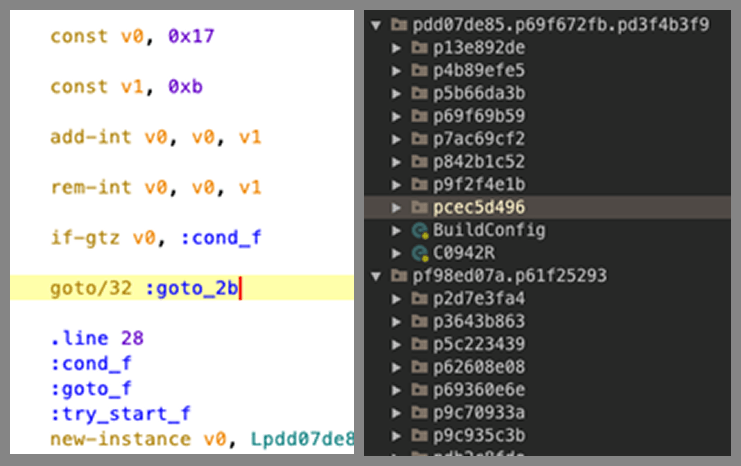
    Unlike earlier versions, this variant introduced significant changes in terms of stealth. The code was fully obfuscated, making manual analysis and detection more difficult. After decompilation, it became clear that in order to sophisticate the malware analysis, the threat actors used Obfuscapk, a widely used obfuscation framework for Android APKs. Obfuscapk combines multiple techniques, including a range of obfuscators and so-called “confusers”. These techniques vary in complexity: from basic measures like renaming classes, adding junk code, and replacing method signatures, to more advanced strategies such as code RC4 encryption and control-flow obfuscation. The goal was to hinder reverse engineering and slow down both static and dynamic analysis, giving the operators more time to execute their campaigns undetected.

    Junk code (on the left) and renaming (on the right) obfuscation methods applied to the malicious implant

    Once installed and executed, the malware began setting up its internal components, including various classes, functions, and the SharedPreferences object, which are essential for the Trojan’s operation. The latter typically stores sensitive configuration data such as C2 server URLs, encryption keys, API endpoints, and communication ports.

    Deceptive tricks

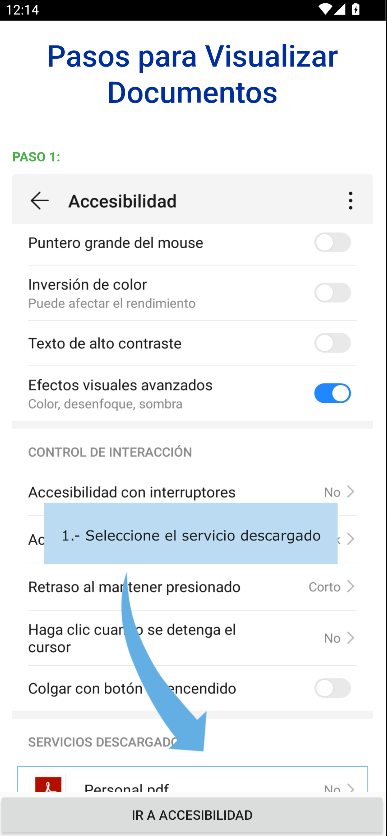
    Throughout all versions of Zanubis, a key step in its execution flow has been to ensure it has accessibility service permissions, which are crucial for its overlay attacks and background monitoring. To obtain these, the malware checks if it is running for the first time and whether the necessary permissions have been granted. If not, it employs a deceptive tactic to manipulate the user into enabling them, a feature that varies between versions.

    In the 2023 version, the malware displayed a fake instructional webpage using WebView, claiming that additional permissions were needed to view a document – a plausible excuse, given the app’s disguise as an official application. On this page, a prominent button labeled “Ir a Accesibilidad” (“Go to Accessibility”) was presented. Once tapped, the button triggered a redirection to the system’s Accessibility Settings screen or directly to the specific panel for enabling accessibility features for the malicious app, depending on the device model.

    Instructions to trick the user into enabling Accessibility Permissions

    Translation:

    “Steps to view documents”, “1. Select the downloaded file”.

    This trick relies heavily on social engineering, leveraging trust in the app’s appearance and the user’s lack of awareness about Android’s permission system. Once accessibility permissions are granted, the malware silently enables additional settings to bypass battery optimization, ensuring it can remain active in the background indefinitely, ready to execute its malicious functions without user intervention.

    With background access secured, the malware loads a legitimate SUNAT website used by real users to check debts and tax information. By embedding this trusted page in a WebView, the app reinforces its disguise and avoids raising suspicion, appearing as a normal, functional part of SUNAT’s official services while continuing its malicious activity in the background.

    Data harvesting

    Just like earlier versions, the malware began by collecting device information and connecting to its C2 server to await further instructions. Communication with the C2 API was encrypted with RC4 using a hardcoded key and Base64-encoded. Once initialization was complete, the malware entered a Socket.IO polling loop, sleeping for 10 seconds between checks for incoming events emitted by the C2 server. This time, however, the list of available commands had grown significantly, expanding the malware’s capabilities far beyond previous versions.

    When a targeted app was detected running on the device, this version of Zanubis took one of two actions to steal user data, depending on its current settings. The first method involved keylogging by tracking user interface events such as taps, focus changes, and text input, effectively capturing sensitive information like credentials or personal data. These logs were stored locally and later sent to the C2 server upon request. Alternatively, Zanubis could activate screen recording to capture everything the user did within the app, sending both visuals and interaction data directly to the server.

    SMS hijacking

    Another new feature introduced in this campaign is SMS hijacking, a critical technique for compromising bank accounts and services that rely on SMS for two-factor authentication. Once instructed by the C2 server, Zanubis set itself as the default SMS app on the device, allowing it to intercept all incoming messages via a custom receiver. This gave the malware access to verification codes sent by banks and other sensitive services, and even the ability to delete them before the user could see them, effectively hiding its activity.

    These actions remained completely hidden from the user. Even if the user attempted to regain control and set their default SMS app back to normal, Zanubis would block that possibility.

    Fake updates

    One of the most invasive and deceptive behaviors exhibited by Zanubis was triggered through the bloqueoUpdate (“update lockout” in English) event, which simulated a legitimate Android system update. When activated, the malware locked the device and prevented any normal interaction, rendering it almost completely unusable. Attempts to lock or unlock the screen were detected and locked, making it nearly impossible for the user to interrupt the process.

    Before displaying the fake update overlay, the malware could send a warning notification claiming that an urgent update was about to be installed, advising the user not to interact with the device. This increased the credibility of the ruse and reduced the chances of user interference.

    Behind this fake update, Zanubis continued operating silently in the background, performing malicious tasks such as uninstalling apps, intercepting SMS messages, changing system settings, and modifying permissions, all without the victim’s awareness.

    Fake update blocking the user from making use of the phone

    Translation:

    “Some screen components are being updated, please keep your device connected to the internet and wait approximately 30 minutes for the update to finish”. “Do not lock or interact with the device”.

    2024: Continuous development

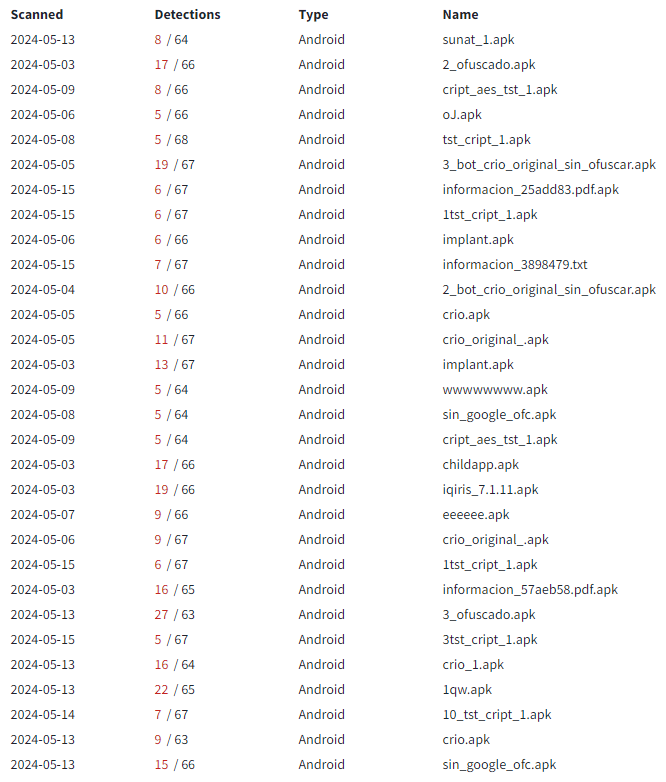
    During 2024, we continued monitoring Zanubis on various resources, including third-party platforms. In early May, we detected the appearance of new variants in the wild, particularly observed on VirusTotal. Over 30 versions of the malware were uploaded from Peru, revealing the developer’s efforts to test and implement new functionalities and features into the malware.

    Samples uploaded to VirusTotal

    Reinforced encryption

    In these newer iterations of Zanubis, the developers implemented mechanisms to protect hardcoded strings, aiming to complicate analysis and reduce detection rates. The threat actors used a key derived via PBKDF2 to encrypt and decrypt strings on-the-fly, relying on AES in ECB mode. This method allowed the implant to keep critical strings hidden during static analysis, only revealing them when needed during execution.

    Source strings were not the only data encrypted in these new implants. The communication between the C2 and the malware was also protected using AES in ECB mode, which indicates a shift from the use of RC4 in previous samples. Unlike the hardcoded key used for string encryption, in this case, a new 32-byte key was randomly generated each time data was about to be sent.

    Device credential stealing

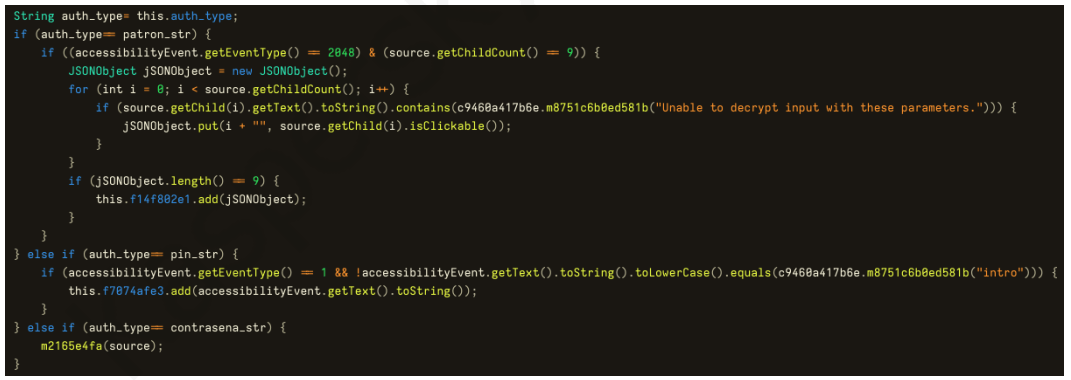
    Among the most critical actions performed by this version of Zanubis was the theft of device credentials. Once active in the background, the malware constantly monitored system events triggered by other applications. When it detected activity related to authentication that needed the input of a PIN, password, or pattern, it attempted to identify the type of authentication being used and captured the corresponding input.

    The malware monitored specific signals that indicated the user was interacting with the lock screen or a secure input method. When these were identified, the malware actively collected the characters entered or gestures used. If it detected that the input was invalid, it reset the authentication tracking to avoid storing invalid data. Once the input process was completed and the user moved on, the malware sent the collected credentials to the C2 server.

    Device credentials collected by Zanubis

    Expanding scope

    This version of the malware continued to target banking applications and financial institutions in Peru, expanding its reach to include virtual card providers, as well as digital and cryptocurrency wallets. This update added 14 new targeted applications, increasing the scope of its attacks and broadening the range of financial services it can exploit.

    2025: Latest campaign

    In mid-January of 2025, we identified new samples indicating an updated version of Zanubis. The updates range from changes in the malware distribution and deception strategy to code modifications, new C2 commands, and improved filtering of target applications for credential theft.

    New distribution tactics

    Zanubis previously impersonated Peru’s tax authority, SUNAT. However, in this new campaign, we have identified two new Peruvian entities being spoofed: a company in the energy sector and a bank that was not previously abused.

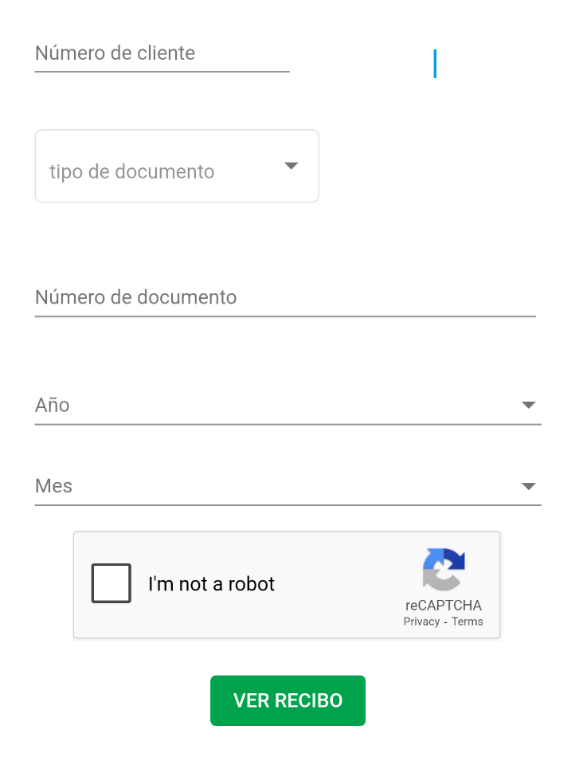
    The Trojan initially disguises itself as two legitimate apps from the targeted companies, each crafted to exploit a specific user need. For the energy company, the malicious APK is distributed under names like “Boleta_XXXXXX” (“bill”) or “Factura_XXXXXX” (“invoice”), deceiving users into believing they are verifying a supposed bill or invoice.

    Fake screen designed to verify invoices

    Meanwhile, for the bank, victims are enticed to download the malware under the guise of instructions from a fake bank advisor. This setup acts as the initial dropper for the malware, using familiar, trusted contexts to ensure successful installation.

    Follow your advisor’s instructions message from the fake bank app

    Silent installation

    Once the user downloads and launches the lure app, a screen appears with the company’s logo, stating that necessary checks are in progress. Meanwhile, in the background, the dropper attempts to silently install the final payload, Zanubis, which is embedded in the initial malware’s internal resources (res/raw/). To retrieve the APK, the dropper leverages the PackageInstaller class. This installation process occurs without any user involvement, as there are no prompts or warnings to alert the victim. By utilizing PackageInstaller, the malware writes the APK to the device in the background and completes the installation automatically, unnoticed. This technique is employed to evade detection. After installation, an intent is sent to signal that the package has been successfully installed.

    Sharpening targets

    In the latest iteration of the malware, the scope of targeted entities has been significantly narrowed, with a clear focus on banks and financial institutions. The once-broad range of targets, including cryptocurrency wallets, has been abandoned.

    This strategic shift suggests an intention to streamline the attack efforts and concentrate on sectors that manage the most sensitive and valuable data, such as banking credentials and financial transactions. By honing in on these high-stakes targets, the malware becomes even more dangerous, as it now focuses on the most lucrative avenues for cybercriminals.

    Who’s behind?

    Based on our ongoing analysis of Zanubis, several indicators suggest that the threat actors behind the malware may be operating from Peru. These indicators include, for instance, the consistent use of Latin American Spanish in the code, knowledge of Peruvian banking and government agencies, and telemetry data from our systems and VirusTotal.

    The focus on Peruvian entities as targets also strongly indicates that the threat actors behind Zanubis are likely based in Peru. These regional indicators, combined with the malware’s ongoing financial fraud campaigns, point to a well-organized operation focused on exploiting local institutions.

    Conclusions

    Zanubis has demonstrated a clear evolution, transitioning from a simple banking Trojan to a highly sophisticated and multi-faceted threat. The malware has been continuously refined and enhanced, incorporating new features and capabilities. Its focus remains on high-value targets, particularly banks and financial institutions in Peru, making it a formidable adversary in the region.

    Furthermore, the attackers behind Zanubis show no signs of slowing down. They continue to innovate and adjust their tactics, shifting distribution methods to ensure the malware reaches new victims and executes silently. This constant refinement demonstrates that Zanubis is not a transient threat but an ongoing, persistent menace, capable of further mutations to fulfill the financial goals of its developers.

    As Zanubis continues to evolve and adapt, it is crucial for users and organizations alike to stay vigilant. The threat landscape is constantly changing, and this malware’s ability to evolve and target new victims makes it an ever-present risk that cannot be ignored.

    Indicators of compromise

    Zanubis 2025 version
    81f91f201d861e4da765bae8e708c0d0
    fd43666006938b7c77b990b2b4531b9a
    8949f492001bb0ca9212f85953a6dcda
    45d07497ac7fe550b8b394978652caa9
    03c1e2d713c480ec7dc39f9c4fad39ec
    660d4eeb022ee1de93b157e2aa8fe1dc
    8820ab362b7bae6610363d6657c9f788
    323d97c876f173628442ff4d1aaa8c98
    b3f0223e99b7b66a71c2e9b3a0574b12
    7ae448b067d652f800b0e36b1edea69f
    0a922d6347087f3317900628f191d069
    0ac15547240ca763a884e15ad3759cf1
    1b9c49e531f2ad7b54d40395252cbc20
    216edf4fc0e7a40279e79ff4a5faf4f6
    5c11e88d1b68a84675af001fd4360068
    628b27234e68d44e01ea7a93a39f2ad3
    687fdfa9417cfac88b314deb421cd436
    6b0d14fb1ddd04ac26fb201651eb5070
    79e96f11974f0cd6f5de0e7c7392b679
    84bc219286283ca41b7d229f83fd6fdc
    90221365f08640ddcab86a9cd38173ce
    90279863b305ef951ab344af5246b766
    93553897e9e898c0c1e30838325ecfbd
    940f3a03661682097a4e7a7990490f61
    97003f4dcf81273ae882b6cd1f2839ef
    a28d13c6661ca852893b5f2e6a068b55
    b33f1a3c8e245f4ffc269e22919d5f76
    bcbfec6f1da388ca05ec3be2349f47c7
    e9b0bae8a8724a78d57bec24796320c0
    fa2b090426691e08b18917d3bbaf87ce

    MIL OSI Economics –

    May 28, 2025
  • MIL-OSI Africa: President Ramaphosa highlights importance of US Working Visit

    Source: South Africa News Agency

    President Cyril Ramaphosa has underscored the significance of his recent working visit to the United States, telling Parliament that the engagement was both necessary and timely, given the critical role the US continues to play in South Africa’s economic landscape. 

    “The United States continues to play such a big role in the life of our economy. It was necessary and important for us to go and engage with them, because many of our people’s jobs are dependent on our economic dealings with the United States,” President Ramaphosa said on Tuesday.

    The President was responding to questions from Members of the National Assembly, with economic growth and the cost of living being among issues for deliberation.

    Last week, the President concluded a successful working visit to the United States of America, supported by a delegation of Ministers, eminent South Africans, business and labour. 

    The visit was aimed at resetting and revitalising bilateral relations between South Africa and the US.

    The President explained that the objective of the trip was to engage with the US government to discuss tariffs, investments, and other related matters. It was also to encourage the US President to attend the G20 Summit which South Africa will host and to promote investment by American companies in South Africa and South African companies in the US. 

    He reiterated that the primary goal of the working visit was to reset the relationship between the two countries, recognising the significant economic and political ties. 

    The delegation aimed to address the deteriorating relationship, which was a concern for many in South Africa, and to ensure mutual economic benefits.

    “The issue of relations between South Africa and the United States was an issue that occupied many people’s minds in our country, and many had raised concerns about the deteriorating relationship between our two countries, having recognised the important role that both our countries play in each other’s economy, apart from various political relations, diplomatic relations, and we realised that the impact on our country’s economy would be adverse unless we were able to repair or reset the relationship between our two countries,” the President said. 

    The President highlighted the importance of the United States as a trading partner, with over 600 American companies invested in South Africa, and vice versa.

    READ | SA and US have ‘everything to gain’ from closer relations

    On the economic and sectoral impact, President Ramaphosa detailed that the sectors that would be affected by the relationship with the United States including the agriculture and automotive sector.

    He added that the visit aimed to protect jobs and investments in these sectors by maintaining strong economic ties.

    “A number of our jobs, some of the sectors that would be affected would be agriculture, the auto sector and steel and aluminium sector, and a number of other sectors that make machines, and the mining sector, where we sell critical minerals to the United States, would be adversely affected if the relations were not straightened out. So it was to this end that we were motivated to reset that relationship,” the President explained.

    President Ramaphosa said the second objective was to set up a process of engagement between the United States and South Africa. 

    “There had hitherto been a process of disengaging, where we were no longer really engaging at government level to deal with issues that governments normally deal with on an ongoing basis. And we wanted to engage on tariffs, on investments and related matters,” the President said.

    G20 and resetting relations

    On the Group of Twenty (G20) the President said that the trip aimed to highlight the significance of the G20 process and to encourage US participation.

    “The third objective was to discuss the G20 and to highlight the important role that a country like the United States, which is the largest economy in the world, plays in the activities of the G20 which we are so deeply immersed in and having the responsibility of leading and that it’s important for the United States to engage with the G20 process, and ultimately to entice the leader of the United States to come to the leaders’ summit at the end of the year,” the President said. 

    The President emphasised that despite public perceptions, the delegation had meaningful discussions with President Trump and his representatives, fostering ongoing engagement. 

    He added that the engagement process initiated after the trip has led to discussions on tariffs and investments, indicating a positive reset of relations.

    The reset of relations is believed to have been achieved, with ongoing discussions expected to continue through the G20 process.
    “We do believe that we achieved those objectives. The engagement with the American government has started soon after we left Washington…and there are discussions that are happening in relation to tariffs, in relation to investments, and we’ve believed that we have reset the relationship. 

    “Despite what we could have seen on television, we were able to have a much more meaningful discussion and meeting with President Trump and his representatives during the quiet room where we had lunch together and had meaningful exchanges on a number of issues. And we do believe that the engagement will continue through the G20 process,” the President said.  – SAnews.gov.za

    MIL OSI Africa –

    May 28, 2025
  • MIL-OSI: Canadian Credit Market Reaches $2.5 Trillion in Outstanding Balances, with Gen Z Canadians Accounting for 10% of Credit Growth

    Source: GlobeNewswire (MIL-OSI)

    Key findings from TransUnion report:

    • New-to-credit Canadians led to greater credit participation, accounting for $2.6 billion in new credit balances in Q1 2025
    • Subprime consumers are almost twice as likely to go delinquent within 12 months of opening new credit cards, compared to their pre-pandemic cohorts
    • Growing concerns around Canadian consumers experiencing economic strain

    TORONTO, May 28, 2025 (GLOBE NEWSWIRE) — The first quarter of 2025 saw mixed outcomes in the Canadian credit market, according to TransUnion’s Q1 2025 Credit Industry Insights Report (CIIR). Growth was fuelled by increased borrowing from young Canadians and newcomers. Consumer balances for non-mortgage products rose across most products, driven primarily by below prime consumers. Subprime consumers continued to struggle as their delinquency rates rose at significantly higher rates than prime and above consumers. Regional differences in cost of living and economic conditions also led to varying delinquency trends across provinces.

    Gen Z Consumers Accelerated Overall Credit Participation with 30.6% Year-Over-Year Growth in New Balances

    After the decline in interest rates and inflation in late 2024, Canadians’ total outstanding balances across all credit products grew by 4.7% year-over-year (YoY) and total outstanding credit debt reached $2.5 trillion in Q1 2025. Continued credit expansion, propelled by younger consumers, including new Canadians entering the credit market, was a key driver of this growth.

    As Gen Z consumers continued to participate in the credit market, outstanding balances within this generation have grown 30.6% from the prior year, contributing $12 billion or 10.3% of total new balance growth. Canadian newcomers also represent a significant portion of the growing credit market, driving $2.6 billion in new credit balances, a 6.3% increase YoY.

    “As a growing share of Gen Z consumers actively engage with credit, lenders face a pivotal opportunity to shape lifelong financial relationships,” said Matt Fabian, director of financial services research and consulting at TransUnion Canada. “This generation values digital-first experiences, personalized education and brands that align with their values. Prioritizing credit education, fostering early loyalty and offering seamless, mobile-friendly solutions will be key to staying relevant and building trust with these new-to-market borrowers.”

    Non-Mortgage Balances Continue to Grow, Driven by Below Prime Consumers

    Non-mortgage debt grew 2.4% as consumer balances continued to increase across most products. However, total non-mortgage debt did not grow equally across all risk tiers. Below prime average consumer balances grew 4.4%, with subprime consumers contributing the highest increase at 6.3%, while prime plus and super prime consumer balances remained mostly flat.

    Risk Tier Avg. Non-Mortgage Balances per Consumer YoY Change in Non-Mortgage Balances YoY Change in Consumer Card Balances YoY Change in Consumer Personal Loan Balances
    Super Prime $26,355 0.10%   -0.30%   4.50%  
    Prime Plus $26,301 0.10%   1.10%   4.50%  
    Prime $24,983 3.30%   6.20%   4.90%  
    Near Prime $29,681 3.80%   5.90%   4.70%  
    Subprime $23,638 6.30%   5.50%   6.70%  

    The YoY growth in average balances among below prime consumers may be due to these consumers utilizing more credit to augment disposable income in the face of elevated prices. This trend was seen particularly with the growth in credit card and personal loan balances, as these are traditionally the products used by consumers for liquidity. Below prime consumer average balances across these products grew at a faster rate than overall borrower balance growth during this period.

    Additionally, the data shows regional disparities in the YoY growth rates of non-mortgage debt, although province rankings did not change from the previous quarter. P.E.I. and Newfoundland had the highest average debt per borrower, while Quebec and Manitoba had the lowest. While the gap between the highest and lowest average debt balances across provinces may not appear substantial, even modest differences in average debt per consumer can significantly influence delinquency rates. Consumers in provinces with higher average debt levels may be more susceptible to increases in interest rates as well as higher everyday living costs, making them more vulnerable to financial strain and increasing the likelihood of delinquency, particularly during economic downturns.

    “The rise in balances from higher-risk and more vulnerable credit consumers signals a critical moment for lenders to reassess risk strategies and engagement models. Proactive credit monitoring, tailored financial support and early intervention tools can mitigate potential delinquencies while still maintaining consumer access to credit,” said Fabian. “At the same time, consumers should continue to build financial resilience by understanding their credit profiles, seeking guidance when needed and using credit responsibly. Empowered, informed borrowers are key to a healthier credit ecosystem.”

    Ranking Average Consumer Non-Mortgage Debt Balance by Province
           
      Q1 2024 Q1 2025 YoY Change
    Canada $25,786 $26,415 2.44%  
    PEI $27,696 $29,364 6.02%  
    NL $27,876 $28,775 3.23%  
    BC $27,656 $28,585 3.36%  
    AB $28,304 $28,403 0.35%  
    ON $26,880 $27,544 2.47%  
    SK $26,683 $26,972 1.08%  
    NS $24,266 $24,929 2.73%  
    NB $23,675 $24,497 3.47%  
    QC $22,152 $22,756 2.72%  
    MB $20,268 $20,802 2.63%  

    Lower Canada Consumer Credit Index Reflects Weakening Market Conditions

    Economic uncertainty has recently muted credit demand while supply remains strong. Additionally, uncertainty has shifted some credit behaviours as consumers balances have increased while credit performance has remained relatively stable from prior year, driving the Canada Consumer Credit Index to 100.3, down almost 6 points from the prior year.

    Differing Impact of Economic Volatility Across Risk Tiers

    A widening financial divide is emerging among credit consumers across Canada. While recent improvements in inflation and interest rates have provided relief for some, enabling them to reduce debt and strengthen their financial positions, others continue to face significant challenges. These consumers are still grappling with the prolonged effects of past economic volatility, highlighting an uneven recovery and growing disparity in financial resilience.

    Overall consumer-level serious delinquency (consumers 60 days or more delinquent on any credit product) was up 11 basis points YoY to 2.71% in Q1 2025. This increase was driven in part by the recent growth in new-to-credit consumers, who generally carry higher risk in their early years due to their limited credit experience. Even with the recent increase, the current levels of delinquency are similar to those seen prior to the pandemic.

    Subprime consumers have become more likely to experience delinquency soon after opening a new product, with the delinquency rate within the first six months of opening a new credit account doubling between 2020 and 2024. This is particularly evident for below prime credit card and personal loans, where consumers may be more sensitive to interest rates. Subprime consumers that opened a credit card in 2023 or 2024 were 1.7x–2.0x as likely to go delinquent within the first 12 months of holding that card than those who opened a card in 2020. These findings further demonstrate the increased vulnerability that subprime borrowers have to macroeconomic factors such as higher interest rates and increased cost of living.

    Delinquency (90+ DPD) in the First 12 Months on Subprime Card Originations
      Q1 2020 Q1 2021 Q1 2022 Q1 2023 Q1 2024
    12 Months on Book 6.46%  9.18%  11.86%  12.68%  10.76% 

    Geography is also playing a role in the vulnerability or resilience of consumers. A 16 basis point YoY increase in serious consumer delinquencies led to Alberta continuing to have the highest rate across all provinces in Q1 2025, driven by the volatility in oil and gas prices that play a large role in Alberta’s economy. While Quebec remained the province with the lowest rate of delinquencies, it had a seven basis point increase YoY.

    “We’ve seen volatility in delinquency rates attributed to a mix of regional economic pressures and demographic factors. Regional variations in both cost of living as well as wage growth, along with pressure from macro-economic cycles, disproportionately impact specific regions, and hence some provinces have had more volatile consumer credit performance,” Fabian said. “These findings underscore the importance of regionally tailored lending policies and support systems to address the unique challenges faced by those households. Additionally, consumers in more vulnerable areas should stay vigilant in keeping current on payments, monitoring credit and building emergency savings.”

    About TransUnion (NYSE: TRU)

    TransUnion is a global information and insights company with over 13,000 associates operating in more than 30 countries, including Canada, where we’re the credit bureau of choice for the financial services ecosystem and most of Canada’s largest banks. We make trust possible by ensuring each person is reliably represented in the marketplace. We do this by providing an actionable view of consumers, stewarded with care.

    Through our acquisitions and technology investments we have developed innovative solutions that extend beyond our strong foundation in core credit into areas such as marketing, fraud, risk and advanced analytics. As a result, consumers and businesses can transact with confidence and achieve great things. We call this Information for Good® — and it leads to economic opportunity, great experiences and personal empowerment for millions of people around the world.

    For more information visit: www.transunion.ca

    For more information or to request an interview, contact:

    Contact: Katie Duffy
    E-mail: katie.duffy@ketchum.com
    Telephone: +1 647-772-0969

    Photos accompanying this announcement are available at

    https://www.globenewswire.com/NewsRoom/AttachmentNg/a2ac9d72-919c-465a-a6a5-bd6b61735e35

    https://www.globenewswire.com/NewsRoom/AttachmentNg/d0b862de-42f0-43d1-91d5-95001a3f413e

    The MIL Network –

    May 28, 2025
  • MIL-OSI Russia: SpaceX Loses Both Rocket Stages in Third Consecutive Starship Test Failure

    Translation. Region: Russian Federal

    Source: People’s Republic of China in Russian – People’s Republic of China in Russian –

    Source: People’s Republic of China – State Council News

    SACRAMENTO, U.S., May 28 (Xinhua) — SpaceX’s third consecutive Starship rocket launch ended in another failure on Tuesday evening, dealing a fresh blow to the company’s ambitions to colonize Mars.

    The 122-metre-tall Starship rocket lifted off at 19:37 local time on Tuesday /03:37 GMT on Wednesday/ from the Starbase launch site near Boca Chica, Texas. Both stages of the vehicle, the Super Heavy booster and the Starship itself, were lost during the test flight. The mission was the first attempt to reuse the super heavy launch vehicle in the Starship program.

    “We lost control,” SpaceX spokesman Dan Huot said during the company’s livestream. He said the spacecraft also “had a fuel leak.”

    The first stage of the Super Heavy rocket, powered by 33 methane-fueled engines, failed when its engines ignited for a splashdown in the Gulf of Mexico. SpaceX had deliberately programmed the rocket for a more intense descent trajectory as part of the test.

    Starship’s booster initially worked well. However, during the flight, the ship’s cargo bay door failed to open fully, preventing the launch of eight Starlink satellite simulators.

    The failure of the ninth test flight continues a troubling trend involving the design of SpaceX’s Block 2 Starship. Repeated failures have created serious problems for NASA’s Artemis program, which is using a modified version of Starship to land astronauts on the moon by 2027. –0–

    MIL OSI Russia News –

    May 28, 2025
  • MIL-OSI Africa: APO Group Celebrates Africa Day with a Bold Reminder: We’ve Been Leading Strategic Communications across the Continent for Almost Two Decades

    Source: Africa Press Organisation – English (2) – Report:

    JOHANNESBURG, South Africa, May 28, 2025/APO Group/ —

    Africa Day is here, bringing with it the flood of inspirational quotes, curated pan-African playlists, and the sudden resurgence of brands eager to celebrate the continent, if only for a day.

    But for some of us, Africa is not a campaign. It’s not a market. It’s home.

    At APO Group, we don’t just “show up” for Africa Day. We’ve been here, every day, for almost two decades, amplifying African stories, building brands and reputations, and connecting the continent to the world.

    Africa is not a monolith. It is 54 nations, over 2,000 languages, and countless nuances that demand deep respect. Understanding it takes commitment.  And APO Group, the leading, award-winning pan-African media relations and communications consultancy, has it.

    APO Group has helped thousands of African CEOs land global coverage, launch pan-African unicorns, and turn local brands into international headlines. This Africa Day, we’re not launching a campaign. We’re just reminding everyone that if you want to do communications in Africa, it helps to know Africa.

    At a time when global PR firms headquartered in the USA are announcing their new Africa-focused teams — complete with four pins on a map and a flurry of buzzwords — APO Group is celebrating the one thing no one can copy overnight: authentic, home-grown, on-the-ground experience.

    From Dakar to Dar es Salaam, Cairo to Cape, APO Group’s pan-African team has been delivering real impact across the continent; not just in press releases, but in powerful results. With expert consultants in every region, local insights and expertise, and a reputation built on trust, APO Group is more than a communications consultancy.  It is Africa’s most established strategic communications powerhouse.

    “Africa Day is a reminder of what makes this continent extraordinary – its people, its voices and its unstoppable momentum”, said Rania El Rafie, Vice President of Public Relations and Strategic Communications at APO Group. “Africa is more than a continent to us — it’s our home, our expertise, and our commitment.” “While others are hiring team members for Africa, our people are already embedded in the culture, language, and industries that drive the continent forward.”

    With clients spanning multinational corporations, African companies and organisations, public sector institutions, NGOs, and other stakeholders, APO Group has earned its reputation as the leading communications partner of choice for organisations serious about Africa. What sets us apart is our remarkable performance:

    • A network that spans all 54 African countries, with local experts in every region;
    • Strategic guidance grounded in local insight;
    • A legacy of hundreds of successful campaigns, from strategic communications to crisis response;
    • Longstanding media partnerships that foster transparency, credibility, and positive storytelling.

    “We believe great communication in Africa starts with listening, not just broadcasting. And it takes consistency, not just campaigns,” said Laila Bastati, Chief Commercial Officer at APO Group. “This is why we’ve built trust with stakeholders from all over, by showing up year after year, and delivering every time.” While others are just mapping out how to enter Africa’s fast-moving markets, APO Group is already there — co-creating growth stories with African businesses, institutions, and communities.

    “For us, Africa isn’t a new frontier — it’s the centre of everything we do,” added Bastati. “Our track record speaks for itself. This Africa Day, we’re building on a legacy.”

    APO Group is reflecting on a proven track record and preparing for the next decade of growth and storytelling that elevates Africa on the global stage.

    “This Africa Day, we’re not launching — we’re reaffirming,” said Bastati. “Reaffirming our commitment to the continent, to our clients, and to the people and stories that shape Africa’s future.”

    Work with the team that’s already there!

    Happy Africa Day. From Africa’s strategic communications leader.

    MIL OSI Africa –

    May 28, 2025
  • MIL-OSI Banking: Samsung Launches One UI 8 Beta Program: The First-Generation Upgrade Starting With the New Galaxy Foldables

    Source: Samsung

    One UI 8 is coming, and early access is now available through its beta program — kicking off a new era of software intelligence that brings a true multimodal AI agent designed for various Samsung Galaxy form factors.
     
    One UI is Samsung’s integrated software platform, designed to help Galaxy devices simplify everyday routines and enhance productivity and convenience. Thanks to the mutual partnership between Samsung and Google, One UI 8 will debut on Samsung’s newest foldables this summer and will gradually expand to more Galaxy devices so users can now enjoy an enriched, more personalized mobile experience with the latest version of Android.
     
    Through open communication, Samsung and Google actively shared their respective design systems and real-time feedback with one another, accelerating software development that made One UI 8 one of the first UI platforms to adopt Android 16.
     
    In addition to being the first generation of upgrades to launch alongside new foldable devices, the launch of One UI 8 also initiates a new rhythm for Samsung’s software evolution with major UX and AI updates. You can get a first glimpse of this innovation by signing up for the beta program kicking off today, starting with the Galaxy S25, S25+ and S25 Ultra in Germany, Korea, the United Kingdom and the United States.
     
     
    Personalized AI for Seamless, Natural Interactions

     
    The official rollout of One UI 8 will introduce an AI experience that will make your everyday smarter and more convenient by enhancing the AI features first introduced in the Galaxy S25 series. There are three main factors that realize this: multimodal capabilities, UX tailored to different device form factors, and personalized, proactive suggestions. Intelligent multimodality enables you to have natural, seamless communication with AI that understands what you’re looking at or watching in the moment. The updated UX is optimized for the unique form factors across the Galaxy product portfolio, boosting your everyday productivity and efficiency. One UI 8 will also recognize your context, offering personalized, proactive suggestions that support your unique daily routine. Features like Now Bar1 and Now Brief2 will deliver even more customized insights and suggestions to help you stay on top of tasks and support your daily routine, through curated AI information.
     
    This intelligent, personalized AI experience did not just come out of nowhere. It is made possible by robust security that safeguards your data. Samsung Knox Vault combines a dedicated secure processor with secure memory to isolate sensitive data from the rest of your user data and ensure that no one else can physically or remotely reach your personal information. One UI 8 also provides settings where you can choose to process data only on the device, as many of our Galaxy AI experiences use both on-device and cloud-based AI processing. With transparency and user choice at its core, One UI 8 will deliver a personalized AI experience without compromising privacy.
     
     
    Enhanced Everyday Convenience

     
    One UI 8 is not only about providing the AI experience, but also includes convenient, intuitive tools designed to make your day-to-day experiences with your mobile devices even more seamless. Auracast3 — a broadcast audio technology based on Bluetooth LE Audio4  — will support effortless audio connection via QR code scanning and sharing, allowing multiple Auracast devices5 — like Galaxy Buds3 and hearing aids — to join a shared audio stream without the hassle of a complex manual setup. Additionally, customer support at repair centers will be faster and more convenient, thanks to QR- and NFC-enabled support6 accessible right in Samsung Account. You can now register with QR or NFC without having to write any registration forms, reducing wait times and simplifying service requests.

     
    The Reminder app will be your travel supporter with more convenient and intuitive features. If you are planning a trip to New York with your family, you can manage all your reminders in one place as soon as you open the app with a UX that is easy-looking even for first-time users. You can also share a list of to-dos for your trip with the press of a button. When your hands are full of shopping bags, you can use your voice to add reminders on the go as it is voice enabled.
     
    Sharing memories with family and friends will also be easier than ever with enhanced Quick Share.7 A single tap of the Quick Share button in the Quick settings panel will let you instantly send and receive files.
     
    The future of Galaxy AI starts now. Sign up through the Samsung Members app to be among the first to experience the power of One UI 8.
     
     
    1 Availability of functions supported may vary by country and model. Some functions may require a network connection and/or Samsung Account login.
    2 Now Brief feature requires a Samsung Account login. Service availability may vary by country, language, device model or apps. Some features may require a network connection.
    3 The quality of the Auracast audio stream may vary depending on the application, network connection and other factors.
    4 Available on devices with Bluetooth 5.2 and above that support Auracast.
    5 Auracast Transmitter/Assistant supported devices: Samsung Galaxy flagship smartphones, tablets released in 2023 or later with Samsung One UI version 6.1 or above. Auracast Receiver supported devices: Galaxy Buds3, Buds3 Pro, Buds2 Pro. May require software update. Availability may vary by market and model.
    6 Available on 36 countries: U.S., Argentina, Austria, Brazil, Chile, Colombia, Czech Republic, Ecuador, France, Greece, Guatemala, Hungary, India, Indonesia, Kenya, Korea, Malaysia, Mexico, Netherlands, New Zealand, Nigeria, Pakistan, Panama, Peru, Philippines, Poland, Portugal, Singapore, South Africa, Spain, Taiwan, Thailand, Türkiye, Ukraine, Uzbekistan, Vietnam. Availability may vary by country. The feature availability will expand to more countries via further updates. The feature is available in limited number of repair shops, and will be expanded further afterwards. Available on with Android 10 or above, NFC availability may vary by device, Samsung Account app is available on devices with Android 10 or above. Availability may vary by NFC Memory support availability.
    7 Bluetooth Low Energy and Wi-Fi connection are both required for Quick Share. Number of devices Quick Share can share to at the same time may vary depending on the Wi-Fi chip hardware of the sharing device. Actual speed may vary depending on device, network condition and user environment.

    MIL OSI Global Banks –

    May 28, 2025
  • MIL-OSI United Kingdom: UK-South America partnership to help prevent cocaine smuggling

    Source: United Kingdom – Executive Government & Departments

    News story

    UK-South America partnership to help prevent cocaine smuggling

    Security Minister signs agreement with Ecuador to affirm international commitment to crackdown on organised criminal gangs.

    The UK will be better protected from deadly cocaine as the government strengthens crucial partnerships with Colombia and Ecuador to tackle drug smuggling at source.

    Security Minister Dan Jarvis struck a co-operation agreement as part of the first ever visit by a security minister to the 2 countries.

    Colombia remains the world’s largest cocaine producer while Ecuador has emerged as a key smuggling route, with organised crime groups targeting UK borders.

    As part of efforts to tackle the trade upstream, Home Office International Operations, Border Force officers and UK law enforcement have been stationed in Colombia and Ecuador. Officers have provided training, equipment and support to enhance the capabilities of South American law enforcement – better preventing cocaine from reaching British borders.

    This UK law enforcement presence has had a significant impact on cocaine seizures. Of the 64 tonnes seized by the ports and airports division of anti-narcotics police in Colombia, 50.5 tonnes can be attributed to activity supported by Home Office International Operations. In Ecuador, Home Office International supported the seizure of nearly 95 out of the 300 tonnes seized by police last year.

    During his visit, Minister Jarvis signed a memorandum of understanding with Ecuador, cementing both countries’ commitment to dismantling and disrupting violent criminal networks, which threaten the safety of communities in Britain and South America alike.

    On behalf of the UK, Minister Jarvis donated further equipment to Ecuador’s law enforcement unit to aid their operations to disrupt illegal activity. 

    Security Minister Dan Jarvis said:

    We will not tolerate criminal gangs exploiting international routes and bringing harmful drugs into our communities. That’s why this government is deepening our security partnerships with Colombia and Ecuador to strengthen our frontline fight against organised crime.

    Our agreement marks a step forward in our international efforts to prevent drugs reaching the UK. We are making strong progress on this with cocaine seizures by Border Force in England increasing by 75% since last year.

    As part of our Safer Streets Mission, we will leave no stone unturned in our efforts to prevent cocaine from crossing our border and strengthening our security, a cornerstone of this government’s Plan for Change.

    In a speech, Minister Jarvis recognised the sacrifices and bravery of frontline officers in South America to disrupt and dismantle organised crime gangs. Officers are continuing to protect their local communities but also communities across the world as the war on drugs continues. The UK, Colombia and Ecuador all remain resolute in their commitment to tackling illegal drug smuggling.

    In Colombia, Border Force officers provided bespoke training to a team who had previously seized only 14kg of cocaine destined for UK ports last year. Following a 2-week training course in March this year, the team have already prevented 1.4 tonnes from reaching the UK.

    This international action comes as cocaine-related deaths in England and Wales rose by 31% between 2022 and 2023. As part of the Plan for Change, the government is committed to making streets safer by driving down drug misuse and harms through prevention and treatment.

    UK Border Force are also taking action to prevent cocaine from reaching the UK border and harming communities. In January 2025, Border Force’s National Deep Rummage team seized 1.5 tonnes of cocaine on a ship travelling from Ecuador, with an estimated street value of just under £60 million.

    There have also been record seizures of cocaine in recent years, with over 26 tonnes seized by Border Force in England, a 75% increase compared to the year before.

    Share this page

    The following links open in a new tab

    • Share on Facebook (opens in new tab)
    • Share on Twitter (opens in new tab)

    Updates to this page

    Published 28 May 2025

    MIL OSI United Kingdom –

    May 28, 2025
  • Chhath’s eternal melody: Dr. Sharda Sinha awarded Padma Vibhushan posthumously

    Source: Government of India

    Source: Government of India (4)

    In a solemn ceremony at Rashtrapati Bhavan on Tuesday, President Droupadi Murmu conferred the Padma Vibhushan, India’s second-highest civilian honour, posthumously on the celebrated folk exponent Dr. Sharda Sinha. The award recognises her unparalleled contributions to the preservation and popularisation of India’s rich folk music traditions.

    Known affectionately as “Bihar Kokila” and “Swar Kokila,” Dr. Sinha’s voice transcended generations and boundaries, establishing her as one of the most revered figures in India’s folk music tradition. Her songs, steeped in cultural richness and social narratives, have become an inseparable part of Indian festivals, especially Chhath Puja, with her soulful melodies gracing homes across Bihar, Uttar Pradesh, and Indian communities around the world.

    Born on November 1, 1952, in Hulas village of Bihar’s Supaul district, Sharda Sinha began her musical journey under the guidance of Pandit Raghu Jha of the Panchgachiya Gharana. She later honed her skills with stalwarts like Pandit Sitaram Hari Dandekar and Panna Devi, a contemporary of Begum Akhtar, learning the classical intricacies of khayal, thumri, and dadra. Her academic accomplishments include a Master’s degree in Indian Classical Vocal Music, a Ph.D., and a Nritya Visharad in Manipuri dance.

    Dr. Sinha’s breakthrough came with the release of her Maithili composition “Dularua Bhaiya” in 1971, which heralded a new era in regional music. Her fame grew internationally after her 1983 tribute to poet Vidyapati, resonating with audiences in Russia, China, the UK, and the US. Between 1985 and 1989, she released several albums—“Kekra Se Kahan Mile Jala,” “Piritiya,” “Mehndi,” “Bhajan Sagar,” “Chhathi Maiya”—many of which remain etched in public memory. Songs like “Paniya Ke Jahaj,” “Koyal Bin Bagiya,” and “Patna Se Baida” have become timeless, cherished across generations.

    Her voice carried not only melody but also the stories, rituals, and ethos of Indian life. This unique ability earned her titles such as “Bhojpuri Ki Sita,” “Sanskritik Paharua,” and “Bihar Ki Lata Mangeshkar.” Her contribution extended beyond the folk tradition into mainstream Bollywood, with memorable songs in films like “Maine Pyar Kiya,” “Hum Aapke Hain Koun,” “Gangs of Wasseypur-2,” “Kaagaz” and a special appearance in the web series “Maharani-2.”

    As a cultural ambassador for the Government of India, she represented India’s musical heritage in Mauritius and Suriname in 1988, and later in Germany, Belgium, the Netherlands, Egypt, and again in Suriname in 2003. A “Top Grade” artist of All India Radio, she performed at countless concerts and cultural festivals across the nation, and inspired a generation of musicians during her four-decade-long teaching tenure at the Women’s College in Samastipur under L.N.M.U. Darbhanga, which awarded her an honorary Doctor of Literature in 2018.

    Over the years, Dr. Sinha was honoured with numerous accolades including the Padma Shri (1991), the Sangeet Natak Akademi Award (2000), and the Padma Bhushan (2018). She also received state and national recognitions such as Folk Queen of Bharat, Bihar Kala Puraskar, Bhojpuri Ratna, and Mithila Vibhuti Samman, among others.

    Dr. Sharda Sinha passed away on November 5, 2024. Her legacy, however, continues to echo in the hearts of millions through her voice and vision.

    May 28, 2025
  • MIL-OSI Asia-Pac: Canadian firms urged to re-domicile

    Source: Hong Kong Information Services

    On day two of his Canada visit, Secretary for Financial Services & the Treasury Christopher Hui urged two Canadadian-based insurance companies to consider re-domiciling their companies to Hong Kong to enjoy the relevant legal and taxation convenience, as well as to lower their compliance costs for satisfying two sets of regulatory requirements.


    During yesterday’s duty visit, Mr Hui met Manulife President & Chief Executive Officer Phil Witherington and Chief Financial Officer Colin Simpson, as well as SunLife Executive Vice-President & Chief Financial Officer Tim Deacon and Executive Vice-President & Chief Strategy & Enablement Officer Linda Doughety.


    Both companies are Canadian-based and have extended their business to Hong Kong.


    Mr Hui introduced them to the newly enacted legislation on re-domiciliation of companies, adding that on the very first day the company re-domiciliation regime came into effect last Friday, an international insurance group immediately announced its plan to re-domicile its company to Hong Kong.


    He pointed out that this news was the best testament to the regime’s effectiveness in enhancing companies’ operational efficiency, thereby consolidating Hong Kong’s position as a leading international financial centre.


    Under the new regime, non-Hong Kong-incorporated companies may apply to re-domicile to Hong Kong if they fulfil requirements concerning company background, integrity, member and creditor protection, solvency, etc, while maintaining their legal identity as a body corporate to ensure business continuity.


    If the company’s actual similar profits are also taxed in Hong Kong after re-domiciliation, the Government will provide the company with unilateral tax credits to eliminate double taxation.


    Mr Hui highlighted that Hong Kong has a strong foundation in investment and trade, making it an ideal location for global enterprises to access insurance, reinsurance and risk management services, as well as to establish captive insurers. He also noted that there are vast opportunities for insurance companies in Hong Kong.


    Mr Hui then attended a business luncheon organised by the Hong Kong Economic & Trade Office (Toronto), Invest Hong Kong (Canada) and the National Club.


    He gave a presentation themed “Hong Kong as an anchor of stability amid the changing world” to showcase to the attending financial leaders the stellar figures recorded in the financial market, and banking and monetary markets.


    Mr Hui talked about the Government’s efforts in aligning with international standards and boosting the development of green and sustainable finance and the virtual asset market. He highlighted that with its competitive advantages and proactive measures, as well as the stability and predictability of its financial market, Hong Kong has been earning the confidence of global investors.


    Additionally, Mr Hui met Ontario Securities Commission (OSC) Chief Executive Officer Grant Vingoe and both agreed that in today’s shifting global landscape, collaboration with trusted allies would ensure capital markets remain robust and resilient.


    The Securities & Futures Commission of Hong Kong entered into a memorandum of understanding with the OSC in mid-May to include Ontario of Canada in its list of acceptable inspection regimes for strengthening the regulatory collaboration and exchange of information between the two regulators.


    In the evening, Mr Hui had a dinner meeting with Hong Kong-Canada Business Association (Toronto Chapter) President Joseph Chaung, and the association’s board members to brief them on the latest developments and future direction of Hong Kong’s financial market.


    Mr Hui also paid a courtesy call on Consul-General of the People’s Republic of China in Toronto Luo Weidong. Both expressed their anticipation that Hong Kong, with the support of the nation and its solid foundation and forward-looking measures in financial areas, will engage in more co-operation with Canada.

    MIL OSI Asia Pacific News –

    May 28, 2025
  • MIL-OSI: SQM Reports Earnings for the Three Months Ended March 31, 2025

    Source: GlobeNewswire (MIL-OSI)

    Highlights
    • SQM reported total revenues for the three months ended March 31, 2025 of US$1,036.6 million compared to total revenues of US$1,084.5 million for the same period last year.
    • Net income for the three months ended March 31, 2025 of US$137.5 million or US$0.48 per share, compared to net loss(1) of US$(869.5) million or US$(3.04) per share for the same period last year.
    • Record-high iodine sales price
    • Record first-quarter lithium sales volumes reflect strong market demand
    SQM will hold a conference call to discuss these results on Wednesday, May 28, 2025 at 12:00pm EDT (12:00pm Chile time).
    Participant Call link: https://register-conf.media-server.com/register/BI6159b9c8909e448cb6684738c5d43086
    Webcast: https://edge.media-server.com/mmc/p/kosehsfr

    SANTIAGO, Chile, May 28, 2025 (GLOBE NEWSWIRE) — Sociedad Química y Minera de Chile S.A. (SQM) (NYSE: SQM; Santiago Stock Exchange: SQM-B, SQM-A) reported today net income for the three months ended March 31, 2025, of US$137.5 million or US$0.48 per share, compared to a loss1 of US$(869.5) million or US$(3.04) per share reported for the same period last year.

    Gross profit(2) reached US$304.7 million (29.4% of revenues) for the three months ended March 31, 2025, lower than US$368.5 million (34.0% of revenues) recorded for the three months ended March 31, 2024. Revenues totaled US$1,036.6 million for the three months ended March 31, 2025, representing a decrease of 4.4% compared to US$1,084.5 million reported for the three months ended March 31, 2024.

    SQM’s Chief Executive Officer, Ricardo Ramos, stated, “We closed the first quarter with strong growth—approximately 27% year-on-year—in lithium sales volumes. This is a reflection of the strong demand growth seen during the past few months, driven by the electric vehicle market, particularly in China, along with new demand coming from energy storage systems. Despite the fact that average prices reported during the first quarter 2025 were similar to those reported at the end of last year, we have seen lower prices during the past few weeks, as consequence of a continuously oversupplied market. Therefore, we expect lower realized prices in the second quarter of 2025.”

    He continued: “On the production side, things are evolving as expected. The commissioning of the Mount Holland refinery plant is on track to deliver first product in the upcoming months, meanwhile we are actively selling spodumene concentrate in the market. In Chile we continue working to reach a total capacity of 240,000 metric tons of lithium carbonate and 100,000 metric tons of lithium hydroxide. All of this while we continue to process lithium sulfate in China.”

    Mr. Ramos added: “We are very pleased with the performance of our iodine business. We continue to see steady market growth, driven by strong demand that is putting upward pressure on prices. However, global supply remains limited, and we expect demand to grow by 1% to 2% annually. In this context, we anticipate maintaining stable sales volumes while prices remain at elevated levels. Construction of our seawater pipeline is moving full steam ahead and will be key to unlocking additional production capacity in the coming years, in the meantime, we are focused on improving operational efficiencies to better respond to market needs2.”

    ___________________________
    1 Includes the net effect of accounting adjustments for payments related to the specific mining tax for lithium exploitation as of March 31, 2024, for a total amount of US$1,097.6 million. See more in section Income Tax Expenses, below in the document.
    2 To see full press release please visit our website: https://ir.sqm.com/

    The MIL Network –

    May 28, 2025
  • MIL-OSI: The UK, the Netherlands, Egypt and Saudi Arabia among likely winners in the changing world order

    Source: GlobeNewswire (MIL-OSI)

    LONDON, May 28, 2025 (GLOBE NEWSWIRE) — The Global Business Complexity Index (GBCI) studies over 250 indicators of complexity in 79 jurisdictions that represent 94% of the world’s GDP. The complexity that the report measures is a dead-weight burden on business that stifles local innovation and deters foreign direct investment with no obvious societal benefit. The report has consistently shown that countries in Southern Europe and Latin America are the most complex for doing business and that continues to be true in 2025. At the other end of the scale, the least complex places to do business tend to be in Northern Europe and several of the offshore investment hubs. These all compete for investment on the basis of the ease of doing business there and have adopted less onerous requirements, as well as more efficient ways for firms to manage them.

    The report notes that complexity is relatively straightforward to navigate, at least for larger multinationals able to absorb the cost of complying with local rules. What is much harder to deal with is uncertainty. US-led sanctions, lockdowns in China and the Suez blockage had already begun a shift in globalisation towards more diversified supply chains, with companies seeking to reduce their reliance on single countries for sourcing, building or selling their products. A part of that solution noted in last year’s report was the rise of connector economies like Mexico, Philippines and Vietnam, bridging trade between China and the US in the so-called ‘China plus one’ strategy. That strategy has now fallen foul of US tariffs, set to reflect a country’s trade surplus in goods with the US and so punishing countries with connector status.

    Even if tariffs abate, their launch and rapid shifts point to an underlying risk for companies trading from countries with a high US trade surplus. The report notes a drop in confidence in stability, with the majority of jurisdictions (55%) reporting prioritisation of trade corridor diversity. It identifies a number of countries that might now emerge as the new connectors — with low levels of complexity pointing to business-friendly rules, a low US trade surplus pointing to less likely retaliatory action, a reasonable size and sophistication of economy to support a variety of activity at scale and absorb investment without tipping heavily into US trade surplus, and a multipolar stance that should allow them to trade across different blocs. Those countries include the UK and the Netherlands in Europe, Egypt and Saudi Arabia in the Middle East and Australia and Hong Kong in Asia Pacific.

    The report finally notes that at a time of great uncertainty for global trade — and in particular, trade with the US — governments should focus on making their countries less complex places to do business whilst seeking trade agreements across different blocs to encourage cross-investment. It also notes that companies will need to further diversify their supply chains. That will add to their internal complexity and costs. At the same time, companies can help themselves by simplifying their arrangements for managing those supply chains, with many having excessive numbers of legal entities for their geographic scope along with large numbers of suppliers to help manage them.

    TMF Group’s CEO Mark Weil, said:

    “The real challenge for businesses today isn’t complexity, it’s uncertainty. With rising trade tensions, a shifting geopolitical landscape and economic unpredictability, companies are forced to make decisions in an environment that can change overnight. Tariffs are just the latest signal of the risks of supply chain concentration. Diversification is a necessity in this context, although it comes with a cost. The good news is that businesses can offset some of the complexities of diversification by reducing their own internal intricacies. Our benchmarking reveals stark differences in structural complexity among similar firms. We see an opportunity here: by simplifying their structures and support models — for example, by having fewer legal entities and a few trusted global partners — businesses can gain flexibility. Done right, this can improve efficiency and agility as firms navigate an uncertain world.”

    Media Contacts
    Marina Llibre Martin, Global PR Manager
    marina.llibremartin@tmf-group.com

    The MIL Network –

    May 28, 2025
  • MIL-OSI China: China, ASEAN, GCC forge innovative trilateral cooperation amid global risks

    Source: People’s Republic of China – State Council News

    KUALA LUMPUR, May 28 — Amid escalating global challenges, China, the Association of Southeast Asian Nations (ASEAN), and the Gulf Cooperation Council (GCC) countries have forged a groundbreaking path in cross-regional cooperation.

    In a historic move, they convened a landmark trilateral summit in Kuala Lumpur, the capital of Malaysia — ASEAN’s current chair — marking a bold step toward collective resilience, economic synergy, and a shared vision for prosperity.

    At the inaugural ASEAN-China-GCC Summit on Tuesday, Chinese Premier Li Qiang called on the three parties to set a global benchmark in openness, development cooperation and cross-civilization integration.

    His call comes at a critical juncture, as rising protectionism and escalating geopolitical tensions threaten to fracture the international order.

    Amid global economic headwinds and mounting uncertainties, Li noted that by strengthening connectivity and collaboration, the three sides can forge a vibrant economic circle and a powerful engine for growth, which holds profound significance not only for their respective prosperity but also for advancing peace and development across Asia and the world.

    “As some countries are becoming more protectionist and isolationist, the summit was a good initiative and effort to counter these emerging trends,” said Lee Pei May, a political expert at the International Islamic University Malaysia.

    “The summit proves that economies can complement rather than compete with one another, easing the worries that countries can only develop if they turn inward,” Lee added.

    At the tripartite gathering, Li urged all sides to work together to build a model of global cooperation and development in three aspects — creating a model of cross-region openness, forging a model of cooperation across different development stages, and fostering a model of cross-civilization integration.

    At the summit, the leaders committed to further strengthening Belt and Road cooperation, with a focus on deepening ties in connectivity, trade, industrial and supply chains, agriculture, energy, finance, and the digital economy. They pledged to accelerate trilateral integration, fostering robust, inclusive, and sustainable development for all.

    The summit adopted a joint statement, which was hailed as “detailed, elaborate” and a strong message of trilateral solidarity and cooperation by Malaysian Prime Minister Anwar Ibrahim.

    In the joint statement, the relevant countries acknowledged their joint efforts to promote closer cooperation between ASEAN, GCC and China, and China’s vision to build a closer ASEAN-China community with a shared future and a China-Arab community with a shared future in the new era.

    Andrew Kam Jia Yi, senior research fellow with the Institute of Malaysian and International Studies at the National University of Malaysia, said the summit highlights how the strengths of each party can complement one another.

    “The GCC’s energy and financial resources, ASEAN’s growing consumer base, and China’s technological and financial capacities together create more resilient supply chains and boost food and energy security for all,” he said.

    Following the summit, Li also delivered remarks at the opening ceremony of the ASEAN-China-GCC Economic Forum 2025.

    He emphasized China’s commitment to energizing trilateral cooperation through its high-quality development, pledging to firmly expand high-level opening up, promote mutual reinforcement between domestic and international circulations and share the opportunities of China’s development with countries of ASEAN and GCC, and enterprises from around the world.

    The trilateral cooperation mechanism not only fosters collaborative agreements across regions, but creates a novel platform of communication and dialogue for the Global South countries to closely coordinate on regional and international affairs and amplify their voices on the global stage.

    The joint statement recognizes the need to strengthen confidence in the rules-based multilateral trading system with the World Trade Organization at its core, and reaffirms the countries’ resolve to make economic globalization more open, inclusive, balanced, and beneficial to their peoples and future generations.

    During talks with other leaders on the sidelines of the summit, the Chinese premier voiced China’s readiness to push for a greater role of the Global South in improving global governance.

    In his meeting with Vietnamese Prime Minister Pham Minh Chinh, Li said that China looks to strengthen communication and cooperation with Vietnam and jointly protect the common interests of the Global South countries.

    During their meeting a day before the summit, Li told Sheikh Sabah Al-Khaled Al-Hamad Al-Sabah, crown prince of Kuwait, that China is committed to strengthening communication and coordination with Kuwait through various multilateral platforms to push for more just and equitable global governance and a more harmonious, stable and prosperous world.

    The trilateral summit “encourages other regions to pursue similar models of collaboration,” Kam said.

    “It is a sign of growing solidarity, where countries of the Global South are working together to shape their own futures, assert their priorities on the global stage, and build a more equitable and stable world order from the ground up,” the scholar added.

    MIL OSI China News –

    May 28, 2025
  • MIL-OSI Economics: Kazuo Ueda: Opening remarks – BOJ-IMES conference 2025

    Source: Bank for International Settlements

    I. Introduction

    We are pleased to welcome all of you, distinguished speakers and guests, to the 2025 BOJIMES Conference. Thank you very much for your participation.

    The first BOJ-IMES Conference was held in 1983, and while it was held biennially in some cases, this year marks the 30th edition. Since its inception, the conference has brought together participants from central banks, international institutions, and academia, providing a valuable platform for candid and active discussions on central banking in the context of the evolving global landscape.

    The theme of this anniversary conference is “New Challenges for Monetary Policy.” I have just returned from the G7 meeting in Canada, where many of my colleagues expressed confidence in the progress made toward fulfilling their mandates, though they also acknowledged new challenges such as heightened trade policy uncertainty and dealing effectively with more frequent supply shocks.

    To be honest, I felt slightly left out, though not for the first time, because here in Japan we are still grappling with the longstanding challenge of achieving our 2 percent inflation target in a sustainable manner, while being mindful of the implications of the zero lower bound of policy interest rates.

    That said, the nature of our challenge has evolved considerably in recent years. We are now closer to the target than at any time during the last three decades, though we are not quite there. Our recent path has been affected in a unique way by supply shocks.

    MIL OSI Economics –

    May 28, 2025
  • MIL-OSI Russia: On mos.ru you can now watch giant otters from the Moscow Zoo

    Translation. Region: Russian Federal

    Source: Moscow Government – Government of Moscow –

    On May 28, World Otter Day, the mos.ru portal published broadcasts with giant otters. These fearless, active and friendly animals are exhibited at the Moscow Zoo for the first time in 161 years. Anyone can observe the two young males, Fidel and Vasco, as well as the female Sevil, every day during the institution’s opening hours.

    “The giant otter exhibit opened in the new area at the end of April, it is located next to the pedestrian bridge. The enclosure is decorated to resemble the tropical forest of the Amazon basin, where this species lives. The animals often swim close to the glass, look at visitors with interest and willingly show themselves,” shared Svetlana Akulova, General Director of the Moscow Zoo.

    A new enclosure has been built for the giant otters, which meets the animals’ needs. It has a spacious pool with fresh water, where live fish are released. In addition, the enclosure has heated areas of land and a large log on which Fidel, Vasco and Sevil exercise. Several areas, separated by sides, are filled with soil: sand, earth and tree bark. The giant otters like to dig there.

    To observe the animals, specialists installed three cameras, the video stream from which is broadcast on mos.ru. Until the end of May, the broadcast can be seen from 09:00 to 21:00, from June 1 from 07:30 to 22:00.

    “The inhabitants of the Moscow Zoo have long won the hearts of not only the capital’s residents, but also millions of Russians. Now everyone has a unique opportunity to watch the amazing giant otters. These animals have their own page on zoo.mos.ru: in addition to the video broadcast, interesting facts about them and photos are also available there. This format allows you not only to see the animals, but also to learn about their character traits and habits in conditions as close to natural as possible,” said Boris Frolov, Deputy Head of the Moscow Department of Information Technology.

    Giant (or Brazilian) otters live in fresh water bodies of South America. They feed mainly on fish, but can also catch crustaceans, snakes and small birds. Adults grow up to one and a half to two meters in length, weighing from 25 to 30 kilograms.

    The giant otter is the largest freshwater mustelid, capable of confronting such a predator as the caiman. These animals are always noisy and active, because they have nothing to fear even in the Amazon forest. Few would dare to attack such a group of agile and friendly predators armed with sharp teeth. They usually get their food in the water. Otters have an intensive metabolism, they need to eat food daily in an amount of up to 10 percent of their own weight.

    The body structure of these animals helps them dive to get food. Otters have webbed feet, a torpedo-shaped body, thick fur, and a strong paddle-shaped tail. When diving deep, the ears and nose close.

    Brazilian otters live in family groups consisting of two parents and immature offspring. The head of the family is the female. The family usually lives on the shore of a reservoir, arranging burrows with a system of simple tunnels.

    Broadcasts from the Moscow Zoo enclosures appeared on zoo.mos.ru in the fall of 2024. The list of animals that can be admired is gradually expanding. In addition to giant otters, everyone can watch online the Pallas’s cat, East Siberian lynx, tiger, lions, giant pandas, red panda, Himalayan bears, raccoons, honey badgers, meerkats, capybaras, llamas, vicunas and guanacos, as well as elephants, pygmy hippopotamuses, orangutans and gorillas.

    Get the latest news quicklyofficial telegram channel the city of Moscow.

    Please note: This information is raw content directly from the source of the information. It is exactly what the source states and does not reflect the position of MIL-OSI or its clients.

    Please Note; This Information is Raw Content Directly from the Information Source. It is access to What the Source Is Stating and Does Not Reflect

    https: //vv.mos.ru/nevs/ite/154425073/

    MIL OSI Russia News –

    May 28, 2025
  • MIL-OSI Russia: Mexico will defend its independence and sovereignty from American interference – President

    Translation. Region: Russian Federal

    Source: People’s Republic of China in Russian –

    Source: People’s Republic of China – State Council News

    MEXICO CITY, May 28 (Xinhua) — Mexican President Claudia Sheinbaum on Tuesday once again vowed to defend the country’s independence and sovereignty from U.S. interference.

    At her daily morning press conference, she said that to prevent any kind of foreign interference, “the most important thing is the strength of the government.” “We have great strength, and that is because we have never betrayed and will never betray the people of Mexico,” the head of state emphasized.

    The activities of U.S. agents in Mexico have been regulated since the time of the previous president, Andres Manuel Lopez Obrador, who ruled from 2018 to 2024, she said, adding that provisions to that effect were included in the constitution.

    Today, American agents have a “very clear” understanding of how to operate in Mexico, Sheinbaum said, noting that any foreign agent must request permission from the Foreign Ministry and comply with local laws. –0–

    MIL OSI Russia News –

    May 28, 2025
  • MIL-OSI USA: Quigley, Garbarino Introduce Bill to Combat Wildlife Trafficking

    Source: United States House of Representatives – Representative Mike Quigley (IL-05)

    On Wednesday, Congressmen Mike Quigley (D-IL-05) and Andrew Garbarino (R-NY-02) introduced the Wildlife Confiscations Network Act of 2025, legislation to support federal law enforcement in combating wildlife trafficking and ensure the proper placement and care of confiscated live animals.

    From 2015 to 2019, the U.S. Fish and Wildlife Service (USFWS) handled 834 live wildlife interdiction cases, involving nearly 49,000 individual animals—an average of nearly 30 per day. Many of these animals require immediate medical care, secure quarantine, and long-term placement, often beyond the capacity of U.S. ports of entry.

    The USFWS and the Association of Zoos and Aquariums (AZA) launched a limited pilot Wildlife Confiscations Network in Southern California in 2023. While the pilot has helped coordinate placement in more than 135 cases and provided care for over 4,100 animals, its scope remains geographically narrow and operationally constrained. The Wildlife Confiscations Network Act of 2025 would build on this initial framework and expand the program nationwide—ensuring law enforcement agencies across the country can access a coordinated, professional network of care for confiscated wildlife.

    “The Wildlife Confiscations Network has already placed over 4,100 confiscated animals into quality facilities,” said Quigley. “I am proud to introduce legislation that expands this law enforcement network nationwide, ensuring that law enforcement officers are not unduly placed in harms way, and animals receive the care they need.”

    “Our border agents and federal inspectors work tirelessly to stop illegal wildlife trafficking, but they lack the resources and infrastructure to properly care for seized animals,” said Garbarino. “This bill will strengthen the federal response, relieve logistical burdens on law enforcement, and ensure that trafficked animals are treated humanely and professionally.”

    Specifically, the Wildlife Confiscations Network Act of 2025 would:

    • Establish a Wildlife Confiscations Network within the Department of the Interior, in partnership with a professional zoological accrediting association;
    • Create a voluntary, nationwide program to coordinate the placement and care of confiscated wildlife seized at U.S. borders and ports of entry;
    • Designate a single point of contact to assist federal law enforcement in placement coordination;
    • Maintain a database of qualified facilities—including zoos, aquariums, sanctuaries, rescues, and rehabilitation centers—that can provide immediate and long-term care;
    • Create a review committee to evaluate applications from facilities seeking to join the Network;
    • Authorize $5 million annually from FY2026 to FY2030 to implement and operate the Network.

    The bill is endorsed by 58 leading organizations across the conservation and zoological community, including the Association of Zoos and Aquariums, Wildlife Conservation Society, National Aquarium, San Diego Zoo Wildlife Alliance, American Association of Zoo Veterinarians, and Biologists Without Borders. Other supporters include Akron Zoological Park, Amphibian and Reptile Conservancy, Birmingham Zoo, Brookfield Zoo Chicago, California Academy of Sciences, Center for Great Apes, Charles Paddock Zoo, Cincinnati Zoo & Botanical Garden, Cleveland Metroparks Zoo, Dallas Zoo, Dazzle Africa, Delaware Zoological Society, Denver Zoo Conservation Alliance, Detroit Zoological Society, Fresno Chaffee Zoo, Great Plains Zoo, Houston Zoo, International Fund for Animal Welfare, Jenkinson’s Aquarium, Lee G. Simmons Wildlife Safari Park, Lemur Conservation Foundation, Lincoln Park Zoo, The Living Desert Zoo and Gardens, Lockwood Animal Rescue Center, Louisville Zoo, Museum of Life and Science, Nashville Zoo, Niabi Zoo, Northwest Trek Wildlife Park, Oakland Zoo, Oklahoma City Zoo and Botanical Garden, Omaha’s Henry Doorly Zoo and Aquarium, Oregon Coast Aquarium, Oregon Zoo, Philadelphia Zoo, The Phoenix Zoo, Point Defiance Zoo & Aquarium, Racine Zoo, Roger Williams Park Zoo, Saint Louis Zoo, San Diego Zoo Wildlife Alliance, San Francisco Zoological Society, Santa Barbara Zoo, SEE Turtles, Sequoia Park Zoo, Tennessee Aquarium, Turtle Conservancy, Wild Tomorrow Fund, Inc., Wildlife Conservation Society, Wildlife Defense, Wildlife Jewels, Woodland Park Zoo, Zoo Atlanta, and Zoo Knoxville.

    “We are grateful to Congressmen Garbarino and Quigley for sponsoring the Wildlife Confiscations Network Act,” said Dan Ashe, president and CEO for the Association of Zoos and Aquariums. “This bill will allow an already proven program to go national, permitting law enforcement officers at the border to focus on catching criminals and curbing wildlife trafficking, while our expert Wildlife Confiscation Network partners provide emergency medical treatment, critical rehabilitation, and new homes focused on the wellbeing of these confiscated, and often traumatized, animals. When law enforcement and animal experts collaborate, we can put the criminals behind bars, help rehabilitate the animal victims of wildlife trafficking that are ripped from their homes, and reduce the impact on wild populations of threatened and endangered species. The Association of Zoos and Aquariums looks forward to working with Congress to pass this important bill.”

    The full text of the bill can be found here. 

    ###

    MIL OSI USA News –

    May 28, 2025
  • Operation Sindoor outreach: Tharoor-led delegation highlights India’s anti-terror stand in Panama

    Source: Government of India

    Source: Government of India (4)

    An all-party Indian parliamentary delegation led by Congress MP Shashi Tharoor began its official engagements in Panama with a visit to the Indian Cultural Centre in Panama City, where they offered prayers at a local temple.

    The visit was marked by a powerful moment of interfaith harmony as members from different religious backgrounds joined together in devotion.

    Taking to social media platform X, Tharoor posted, “The multi-party MPs’ delegation visited the Indian Cultural Centre in Panama City and offered devotions at the beautiful temple there. It was moving to see our Muslim colleague Sarfraz Ahmed join his Hindu and Sikh colleagues at the temple. As he later told the audience, “jab bulane walon ko koi aitraaz nahin, toh jaane walo ko aitraaz kyon hoga?”

    The delegation arrived in Panama on Tuesday, to begin a key leg of its international outreach. Upon arrival at the airport, the delegation was warmly received and welcomed by India’s Ambassador to Panama, Dr. Sumit Seth, and members of the Indian diplomatic mission.

    The visit carries a significant diplomatic message, with the delegation tasked with conveying India’s firm stance of zero tolerance towards terrorism.

    The delegation also held high-level meetings with Panama’s President of the National Assembly, Dana Castañeda, along with senior members of Parliament Edwin Vergara and Julio de la Guardia, the latter a former Ambassador to India.

    Tharoor noted that he explained the purpose of the delegation’s visit and received “strong assurances of understanding and support for India’s war against terror.”

    The visit included signing the visitors’ book and a tour of the main hall of Panama’s National Assembly.

    “A positive start to our Panama visit,” said Tharoor, summing up the day’s events.

    Earlier, Ambassador Dr Sumit Seth briefed them on various facets of India-Panama bilateral relations, as well as key areas of cooperation.

    The delegation’s visit to Panama is part of India’s wider outreach, aiming to bolster diplomacy and cooperation in the global fight against terrorism.

    (With inputs from IANS)

    May 28, 2025
  • Trump administration moves to cut all remaining federal contracts with Harvard

    Source: Government of India

    Source: Government of India (4)

    U.S. President Donald Trump’s administration plans to terminate the federal government’s remaining contracts with Harvard University, according to a letter sent to federal agencies on Tuesday.

    The letter, from the U.S. General Services Administration (GSA), directs all federal agencies to review and potentially terminate or reallocate their contracts with Harvard, which an official valued at about $100 million.

    Harvard did not immediately respond to a request for comment.

    The move marked the latest instance of the Republican administration attempting to undermine the financial stability and global standing of the oldest and wealthiest U.S. university after it pushed back on government demands for vast policy changes.

    The government has already terminated nearly $3 billion in federal research grants for the Ivy League school and moved last week to revoke its ability to enroll international students. Those roughly 6,800 students make up about 27% of Harvard’s total enrollment.

    A federal judge in Boston on Friday temporarily blocked the U.S. Department of Homeland Security from revoking foreign student enrollment ahead of a Thursday hearing. During a brief hearing on Tuesday, a U.S. Department of Justice lawyer said the administration is complying with that order and was weighing its options.

    Even so, the Trump administration has ordered its missions abroad to stop scheduling new appointments for student and exchange visitor visa applicants.

    Several hundred demonstrators, including Harvard students and teachers, gathered at the university on Tuesday to show support for foreign students and protest the Trump funding cuts.

    Following graduation events led by Harvard President Alan Garber, one of the protesting students, Jacob Miller, climbed onto a makeshift stage and said the ban on international enrollments had nothing to do with combating antisemitism, which was given as one of the official reasons for the crackdown on foreign students. “We will not allow our identities to be invoked to destroy Harvard,” said Miller, who is Jewish. “If there is anything to learn from the Jewish history, it’s that when we push people out of our schools because of their identity, it’s a symptom of a morally bankrupt politics.”

    Another protest organizer, Harvard student Rae Trainer, said many international students were afraid to demonstrate because they risk deportations. Some international students recorded statements to be read by classmates who are U.S. citizens.

    The GSA’s letter accused the school of engaging in discriminatory admissions practices even after the U.S. Supreme Court, in its 2023 decision ending affirmative action in higher education, rejected Harvard’s use of race as an admissions factor to boost campus diversity.

    The letter from Josh Gruenbaum, commissioner of the GSA’s federal acquisition service, also accused Cambridge, Massachusetts-based Harvard of discriminatory hiring practices and of failing to protect Jewish students from harassment.

    The GSA sent the letter to federal agencies Tuesday morning, said an administration official familiar with the matter. The letter directs agencies to submit a list of contract cancellations by June 6 and says contracts for critical services would be transitioned to other vendors.

    Harvard, which is suing to challenge the administration’s actions, has argued that its rush to punish the school has run afoul of various procedures and violates free speech rights under the U.S. Constitution’s First Amendment by trying to assert control over its staff, curriculum and enrollment.

    Garber, the Harvard president, said in an NPR interview released on Tuesday that despite campus problems that it needs to address, the administration’s decisions to cancel grant funding were “perplexing.”

    “As long as there has been a United States of America, Harvard has thought that its role is to serve the nation,” he said.

    (Reuters) 

    May 28, 2025
  • MIL-OSI USA: Congressman Harris Statement on Present Vote

    Source: United States House of Representatives – Congressman Andy Harris (MD-01)

    Washington, D.C. – Today, Congressman Harris, M.D, released the followig statment on his present vote. 

    Statement:

    “I voted to move the bill along in the process for the President. There is still a lot of work to be done in deficit reduction and ending waste, fraud, and abuse in the Medicaid program.”

    For media inquiries, please contact Anna Adamian at Anna.A@mail.house.gov 

    # # # 

    MIL OSI USA News –

    May 28, 2025
  • MIL-OSI USA: Congressman Harris Announces 2025 Art Competition Winner

    Source: United States House of Representatives – Congressman Andy Harris (MD-01)

    Washington, D.C. – Today, Congressman Harris, M.D., announced Madison Gorski of Kent Island High School as the winner of the First Congressional District of Maryland’s 2025 Congressional Art Competition. Entitled “He so loved the world” Madison’s work will be displayed in the halls of Congress for one year, and she will be honored at the annual award winner’s ceremony in Washington, D.C.

    Statement From Congressman Harris:

    “Congratulations to Madison on winning the 2025 Congressional Art Competition. I selected Madison’s artwork for its creativity, technical skill,  intrinsic beauty, and expression. This piece of art is also a reminder of the love, humanity, and sacrifice Jesus gave to the world. Thank you to all the talented high school students across my district who submitted artwork for the competition.”

    For media inquiries, please contact Anna Adamian at Anna.A@mail.house.gov

    MIL OSI USA News –

    May 28, 2025
  • President of Paraguay to undertake first-ever state visit to India from June 2-4

    Source: Government of India

    Source: Government of India (4)

    At the invitation of Prime Minister Narendra Modi, the President of Paraguay, Santiago Peña Palacios, will pay a State Visit to India from the 2nd to the 4th of June. This marks President Peña’s first visit to India and only the second-ever visit by a Paraguayan head of state to the country.

    The visiting dignitary will be accompanied by a high-level delegation comprising ministers, senior government officials, and business representatives. In addition to engagements in the national capital, President Peña will also visit Mumbai before concluding his visit on June 4.

    During the visit, President Peña is scheduled to hold delegation-level talks with Prime Minister Narendra Modi on June 2. The leaders will undertake a comprehensive review of the entire spectrum of bilateral relations. Prime Minister Modi is also expected to host a lunch in honour of the visiting President.

    President Peña will also call on the Hon’ble President of India, Droupadi Murmu, who will host a banquet in his honour. The Vice President Jagdeep Dhankhar and the External Affairs Minister Dr. S. Jaishankar are also expected to meet the visiting leader during his stay in New Delhi.

    India and Paraguay share warm and friendly ties since the establishment of diplomatic relations on September 13, 1961. The bilateral partnership spans across a range of sectors including trade, agriculture, healthcare, pharmaceuticals, and information technology. Paraguay is considered an important trading partner for India in the Latin American region.

    Indian companies, particularly in the automobile and pharmaceutical sectors, have a growing presence in Paraguay. Similarly, Paraguayan firms — including those operating through joint ventures — have expanded their footprint in India, contributing positively to the economic engagement between the two nations.

    India and Paraguay also share converging views on a range of global issues, including United Nations reforms, climate change, promotion of renewable energy, and the fight against terrorism.

    During his visit to Mumbai, President Peña is scheduled to interact with state-level political leadership, business and industry representatives, startups, and leaders from the technology and innovation sectors.

    May 28, 2025
  • MIL-OSI Video: Can you SMELL the freedom?

    Source: US Army (video statements)

    About the U.S. Army:

    The Army Mission – our purpose – remains constant: To deploy, fight and win our nation’s wars by providing ready, prompt & sustained land dominance by Army forces across the full spectrum of conflict as part of the joint force.

    Interested in joining the U.S. Army?
    Visit: spr.ly/6001igl5L

    Connect with the U.S. Army online:
    Web: https://www.army.mil
    Facebook: https://www.facebook.com/USarmy/
    X: https://www.twitter.com/USArmy
    Instagram: https://www.instagram.com/usarmy/
    LinkedIn: https://www.linkedin.com/company/us-army
    #USArmy #Soldiers #Military #Shorts #Army

    https://www.youtube.com/watch?v=wWKOCX3GHmM

    MIL OSI Video –

    May 28, 2025
  • MIL-OSI Asia-Pac: SFST urges Toronto companies to re-domicile (with photos)

    Source: Hong Kong Government special administrative region

    SFST urges Toronto companies to re-domicile  
    He visited two Canada-based insurance companies that have extended their business to Hong Kong. Mr Hui met separately with the President and Chief Executive Officer, Mr Phil Witherington, and the Chief Financial Officer, Mr Colin Simpson, of Manulife; as well as the Executive Vice-President and Chief Financial Officer, Mr Tim Deacon, and the Executive Vice-President and Chief Strategy and Enablement Officer, Ms Linda Doughety, of SunLife. He introduced them to the newly enacted legislation on re-domiciliation of companies, encouraging them to consider re-domiciling their companies to Hong Kong to enjoy the relevant legal and taxation convenience, as well as to lower their compliance costs for satisfying two sets of regulatory requirements. He also mentioned that on the very first day the company re-domiciliation regime came into effect last Friday, an international insurance group immediately announced its plan to re-domicile its company to Hong Kong. This news was the best testament to the regime’s effectiveness in enhancing companies’ operational efficiency, thereby consolidating Hong Kong’s position as a leading international financial centre.
     
    Under the new regime, non-Hong Kong-incorporated companies may apply to re-domicile to Hong Kong if they fulfil requirements concerning company background, integrity, member and creditor protection, solvency, etc, while maintaining their legal identity as a body corporate to ensure business continuity. If the company’s actual similar profits are also taxed in Hong Kong after re-domiciliation, the Government will provide the company with unilateral tax credits to eliminate double taxation.
     
    Mr Hui pointed out that Hong Kong has a strong foundation in investment and trade, making it an ideal location for global enterprises to access insurance, reinsurance and risk management services, as well as to establish captive insurers. There are vast opportunities for insurance companies in Hong Kong. 
     
    At noon, Mr Hui attended a business luncheon organised by the Hong Kong Economic and Trade Office (Toronto), Invest Hong Kong (Canada) and the National Club. He gave a presentation themed “Hong Kong as an anchor of stability amid the changing world” to showcase to the attending financial leaders the stellar figures recorded in the financial market, and banking and monetary markets. He also talked about the Government’s efforts in aligning with international standards and boosting the development of green and sustainable finance and the virtual asset market. He said that, with its competitive advantages and proactive measures, as well as the stability and predictability of its financial market, Hong Kong has been earning the confidence of global investors. Mr Hui also had a fireside chat with the President of the National Club, Mr Arnie Guha, and answered questions from the floor. The luncheon was well received. Participants were attracted by the various new developments in Hong Kong’s financial markets introduced by Mr Hui.
     
    In the afternoon, Mr Hui met with the Chief Executive Officer of the Ontario Securities Commission (OSC), Mr Grant Vingoe, and OSC representatives. The Securities and Futures Commission of Hong Kong entered into a Memorandum of Understanding with the OSC in mid-May to include Ontario of Canada in its list of acceptable inspection regimes for strengthening the regulatory collaboration and exchange of information between the two regulators. Both Mr Hui and Mr Vingoe agreed that in today’s shifting global landscape, collaboration with trusted allies would ensure capital markets remain robust and resilient.
     
    In the evening, Mr Hui had a dinner meeting with the President of the Hong Kong-Canada Business Association (HKCBA) (Toronto Chapter), Mr Joseph Chaung, and board members to brief them on the latest developments and future direction of Hong Kong’s financial market. The HKCBA has members in eight Canadian cities to foster bilateral trade.
     
    Mr Hui also paid a courtesy call to the Consul-General of the People’s Republic of China in Toronto, Mr Luo Weidong. Both expressed their anticipation that Hong Kong, with the support of the nation and its solid foundation and forward-looking measures in financial areas, will engage in more co-operation with Canada.
     
    On May 28 (Toronto Time), Mr Hui will travel to Ottawa to meet with government financial officials.
    Issued at HKT 12:26

    NNNN

    CategoriesMIL-OSI

    MIL OSI Asia Pacific News –

    May 28, 2025
  • MIL-OSI USA: Murray, Cantwell, Health Care Providers and Advocates Slam Republican Health Care Cuts Threatening to Kick Nearly 14 Million Americans Off Their Health Insurance—Including 274,000 People in WA

    US Senate News:

    Source: United States Senator for Washington State Patty Murray
    At least 274,000 people in Washington state could lose their health insurance under the Republican plan through steep cuts to Medicaid and the Affordable Care Act, according to nonpartisan estimates
    Parent of young Washington state resident on Medicaid: “It is absolutely devastating to think that a singular vote from a group of people who don’t know Nate, and don’t fully understand the terrifying impact losing Medicaid could have, could take this all away from him, all in the name of reducing waste.”
    *** VIDEO OF FULL PRESS CONFERENCE HERE***
    ***PHOTOS AND B-ROLL FROM EVENT HERE***
    Seattle, WA — Today, U.S. Senator Patty Murray (D-WA), Vice Chair of the Senate Appropriations Committee, and Senator Maria Cantwell (D-WA), senior member of the Senate Finance Committee and ranking member of the Senate Commerce Committee, held a press conference laying out how Republicans’ reconciliation bill that passed through the House this week will be devastating for Washington state’s health care system and the 1.95 million people across Washington state who rely on Apple Health, Washington state’s Medicaid program, and the 300,000+ Washingtonians who access coverage through the state’s Affordable Care Act marketplace (Washington Healthplanfinder).
    The legislation passed by House Republicans last week would cut nearly $1 trillion from America’s health care system and is the largest cut to Medicaid in history. The nonpartisan Congressional Budget Office (CBO) estimates that the legislation will lead to 13.7 million Americans getting kicked off their health insurance—between the drastic cuts to Medicaid and the sabotage of the Affordable Care Act and refusal to expand tax credits Democrats passed to lower health insurance premiums.
    At least 274,000 people in Washington state could lose their health insurance under the Republican plan, according to estimates based on the nonpartisan CBO’s analysis. That includes approximately 194,000 people in Washington state who will lose Medicaid coverage, and approximately 79,000 people who will lose ACA coverage. This figure doesn’t even account for the more sweeping health care cuts that House Republicans slotted in and passed at the last minute in the early morning of May 22nd. Among other things, Republicans’ bill would institute work reporting requirements, which have been proven not to increase employment and just strip health care coverage from people who are already working or exempt—this would put more than 620,000 Washingtonians at risk of losing their health care coverage or having it delayed because of a wall of new paperwork. The Republican bill would also reduce the federal match rate by 10 percent for states like Washington that provide health care coverage to noncitizens—this would be a devastating $460 million annual loss in federal Medicaid funding for Washington state, or nearly a $2 billion loss over the next four years. Additionally, the Republican bill includes a provision to defund Planned Parenthood, threatening the closure of up to 200 health centers across the country. Planned Parenthood runs 26 health centers in Washington state. Republicans are advancing the legislation through the budget reconciliation process, which only requires a simple majority to pass in both chambers of Congress.
    “The legislation Republicans are pushing through Congress is the largest cut to Medicaid in American history—let that sink in. In Washington state, we are looking at: at least 194,000 people losing their Apple Health coverage under this bill. And that number rises to a quarter of a million people in our state getting kicked off their health care if you include all the ways Republicans are sabotaging the ACA in this bill and letting important health care tax credits for middle class families expire. Under Republicans’ bill, Washington state would lose an estimated 2 billion dollars in federal Medicaid funding over the next four years—that’s catastrophic for our state’s budget,” said Senator Murray. “Altogether, the health care cuts in Republicans’ mega-bill will mean hospitals and nursing homes shutting down—especially in rural areas—millions of people getting kicked off Medicaid or their coverage under the Affordable Care Act, people blocked from accessing the benefits they are rightly eligible for because of a new wall of paperwork and red tape, Planned Parenthood health centers closing their doors, kids with disabilities losing out on the care they need, medical debt skyrocketing, and insurers leaving the Marketplace, leaving families and small business owners with little or no options for coverage. Needless to say—all of that means higher costs and less access to care for everyone, not just people on Medicaid.”
    “For the life of me I do not understand how some of the same Republicans who represent the areas of our state most reliant on Medicaid ever looked at this bill, looked at what it would do to the people they serve and said, ‘count me in!’ The fact of the matter is not complicated. Republicans want to pass a bill that will hurt the middle class and working families, to give a handout to some of the richest companies on the planet. Republicans know that is bad policy. They know that is massively unpopular—they know they are adding trillions to the national debt. That is why they are trying to jam this through with as little scrutiny as possible. Remember, we managed to stop Trump and Republicans from repealing the Affordable Care Act back in 2017. Public outcry matters—we have seen that even this administration is not totally immune from public pressure. We need to show Republicans that the American people are watching, and they will have to answer to their constituents,” Senator Murray continued.
    “The people here in Washington who have to deal with this issue — who know that their rural hospitals could go under, or their health clinics could be affected, or the cost of care could go up in their communities and make everything more expensive — they know that we also have to stop this legislation. We need to say to the President of the United States: He has to stop trying to dismantle the Affordable Care Act. He cannot propose ideas that literally will leave these providers without resources,” Senator Cantwell said. “We do not need to have Robin Hood in reverse. We do not need to steal from Medicaid the stability of our health care system and give a tax break to big corporations. We need to stop this effort as soon as possible. Senator Murray and I will be fighting every day on the Senate floor to convince our colleagues that this is not only a wrongheaded approach — it is going to cost the American people.”
    One in five adults, three in five nursing home residents, and three in eight people with disabilities in Washington are covered by Apple Health. Medicaid provides health care for over 800,000 children in Washington state—nearly half of children—and more than 45 percent of births in Washington state are covered by Medicaid—in rural Washington, that number goes up to more than 70 percent on births. Medicaid is also largest payer for opioid use disorder treatment in Washington state. Washington state spends approximately $21 billion on Medicaid annually—approximately $8 billion of that is paid for by the state, and approximately $13 billion is paid for by the federal government.
    “As a physician, I see firsthand how lack of health insurance leads to delayed care, resulting in more death, more advanced diseases that are significantly more expensive to treat, and more economic burden. Denying access to health insurance shifts the financial burden to emergency services and public systems, ultimately increasing overall healthcare costs for taxpayers,” said Dr. Jesus Iniguez, Medical Director at Sea Mar Community Health Centers.
    “Nurses are present at every level of care delivery. We are on the front line, and deal with the consequences when patients avoid care because of a lack of coverage. These cuts are not only cruel – they are harmful to the stability of our entire healthcare system and will not only impact those who are on Medicaid. We will all feel it. The ripple effect of something as monumental as the cuts they are currently proposing would send shock waves throughout the entire health care system, reducing access to care for millions,” said Edna Cortez, a pediatric nurse and member of the Washington State Nurses Association (WSNA).
    “If the bill that passed the US House last week becomes law, it will be one of the most devastating attacks on health care access in American history. By banning Planned Parenthood from seeing Medicaid patients, the bill targets our organization and the patients who rely on us for care every day. The people who passed this bill wish for Planned Parenthood health centers to close their doors, and for people to lose access to affordable health care – and for many, access to health care altogether. And if this bill becomes law, their unbelievably cruel wish will be granted. Health centers will close, maybe even here in Washington. Planned Parenthood Federation of America estimates that 200 health centers will close nationwide, 90 percent of which are located in states like Washington where abortion is still legal. As you’ve heard today, people will lose their insurance coverage through cuts to Medicaid and the Affordable Care Act,” said Brita Lund, Manager of Planned Parenthood Northgate Health Center. “Nearly 40 percent of our affiliate’s patients in Western Washington are Medicaid recipients. This is about much more than abortion, which already cannot be covered by federal Medicaid dollars. This money goes to birth control, cancer screenings, and STI testing. All of which are now at risk. Every single day at the health center I manage in Northgate, we help people sign up for Apple Health and Medicaid. Not just help them access services – we ask them a few screening questions and then show them how to enroll in the program, because when they walked through the door, they did not have insurance – and many did not even know it was an option available to them. Our front desk receptionist is the longest tenured employee in our Planned Parenthood affiliate, and might be the longest tenured Planned Parenthood employee in the state. She estimates that she personally enrolls one to three people every single work day. Over her career of 36 years, that means she has likely enrolled more than 1800 people. And that’s just her. There are providers and staff like her at every Planned Parenthood health center in the country, and at places like Sea Mar, who help patients sign up for Medicaid. Because everyone deserves to get the care they need, no matter what. If this bill becomes law, hospitals will close. Clinics will close. Long term care facilities will close. And everyone, not just Medicaid recipients, will be punished.”
    “Nate is 20 years old and autistic. He has an intellectual disability and requires support throughout the day to ensure his needs are met, much of which he receives through Home and Community Based Waiver services. Nate has a job at our local neighborhood pizza shop, where he works four hours a week building pizza boxes and doing other odd jobs with the support of a job coach. He of course gets a paycheck for his work, but he also gets a free slice of pizza and a coke after every shift, which he loves. He adores his job and is so proud of the ways he contributes to his community. Building the life of his dreams, and filling his days with enrichment and social connection when school ends, will not be easy, but with the help of Medicaid services the way they are now, Medicaid services such as health insurance, employment support, personal care, and home and community based waiver services, we’re starting to see a pathway to making it a reality. It’s a steep one, but the pathway is there,” said Rachel Nemhauser, parent of Nate and the Director of Family Support Services at The Arc of King County. Nate is one of the almost 280,000 adults with disabilities on Medicaid in Washington state, and Rachel shared his story with his permission. “But if the proposed Medicaid cuts go through, this dream vanishes. It threatens to reduce or eliminate the job support he counts on, making it impossible for him to stay employed. It threatens to reduce his access to health care, making it harder for people with vulnerable health to stay healthy and continue to work. It threatens to create paperwork and administrative barriers so burdensome and complicated that it’s almost impossible not to make a mistake once in a while. It is absolutely devastating to think that a singular vote from a group of people who don’t know Nate, and don’t fully understand the terrifying impact losing Medicaid could have, could take this all away from him, all in the name of reducing waste.”
    Nationwide, nearly half of children in America are enrolled in Medicaid and the Children’s Health Insurance Program (CHIP), and Medicaid pays for nearly half of births in the U.S. Medicaid also pays for services for 2 in 3 nursing home residents and pays for home-based services for close to 2 million seniors—allowing them to age safely at home—as well as close to 3 million people with disabilities and other health conditions. Medicaid also covers 1 in 4 people with a mental health or substance use disorder, and serves as the largest payer for mental health and substance use services for communities nationwide amid an ongoing overdose and opioid epidemic made worse by an influx of fentanyl.
    Recent polling from KFF Health found 82 percent of adults think Medicaid funding should either increase or stay the same and large majorities of people across parties, those who voted for Trump in 2024, and adults living in rural areas say the program is “very important” for their local community. Polling from Hart Research found that 71 percent of voters who backed Trump said cutting Medicaid would be unacceptable, and voters overall were even more opposed to it.
    Senator Murray’s full remarks at today’s press conference are below:
    “Republicans are looking to make history of the absolute worst kind.
    “Last week, overnight, House Republicans passed the single largest transfer of wealth from the poor to the rich in the history of our country.
    “Reading this bill, you realize pretty quickly why did this in the dead of night. At least 7.6 million people losing Medicaid coverage, millions more losing health coverage and seeing costs go up, students having their Pell Grants cut, not to mention the biggest cut to SNAP in history—all to help fuel up corporate jets and executive bonuses with tax cuts for billionaires.
    “But—bad news for Republicans—we are not going to let them keep the American people in the dark. We are going to put a bright and burning spotlight on this big, ugly, disaster of a bill. The legislation Republicans are pushing through Congress is the largest cut to Medicaid in American history—let that sink in.
    “In Washington state, we are looking at least 194,000 people losing their Apple Health coverage under this bill. And that number rises to a quarter of a million people in our state getting kicked off their health care if you include all the ways Republicans are sabotaging the ACA in this bill and letting important health care tax credits for middle class families expire.
    “Under Republicans’ bill, Washington state would lose an estimated 2 billion dollars in federal Medicaid funding over the next four years—that’s catastrophic for our state’s budget. And on top of all that Republicans’ bill would defund Planned Parenthood—a longtime goal of anti-abortion extremists that would be absolutely devastating for women’s health care in our state and across the country. Defunding Planned Parenthood would put 200 health centers at risk of closure across the country and put critical cancer screenings and birth control even further out of reach. And by the way, it would actually cost taxpayers money $300 million dollars over the next decade, according to nonpartisan estimates.
    “Altogether, the health care cuts in Republicans’ mega-bill will mean: hospitals and nursing homes shutting down—especially in rural areas; millions of people getting kicked off Medicaid or their coverage under the Affordable Care Act; people blocked from accessing the benefits they are rightly eligible for because of a new wall of paperwork and red tape; Planned Parenthood health centers closing their doors; kids with disabilities losing out on the care they need; medical debt skyrocketing; and insurers leaving the Marketplace, leaving families and small business owners with little or no options for coverage.
    “Needless to say, all of that means higher costs and less access to care for everyone, not just people on Medicaid. But I have to say, for the life of me, I do not understand how some of the same Republicans who represent the areas of our state most reliant on Medicaid—ever—looked at this bill, looked at what it would do to the people they serve, and said, “count me in!”
    “Now, it’s worth noting, House Republicans did make some last-minute changes, but not what you might expect. They made sure more people will lose their health care sooner. And they made sure it will be more expensive to get health coverage on the exchanges. Oh, and don’t forget they got rid of a tax on gun silencers. Seriously—of all things!?
    “The people at the top? The billionaires and biggest corporations? They are doing fine. You don’t need to shower them with money taken out of the pockets of struggling families.
    “And you know what? If you want to help American businesses, all you have to do is pass legislation to stop Trump’s trade war which is hurting businesses and driving up costs. Doesn’t that sound better than taking food from hungry kids to give Elon Musk another tax break? Doesn’t that make more sense than kicking seniors out of nursing homes? Doesn’t that seem a little more reasonable that cutting patients off from their health care?
    “The fact of the matter is not complicated. Republicans want to pass a bill that will hurt the middle class and working families, to give and handout to some of the richest companies on the planet. Republicans know that is bad policy. They know that is massively unpopular. They know they are adding trillions to the national debt. That is why they are trying to jam this through with as little scrutiny as possible.
    “But we are putting this heist on full blast and fighting back against it with everything we’ve got. Remember, we managed to stop Trump and Republicans from repealing the Affordable Care Act back in 2017.
    “So, my message to everyone is—now is the time to get loud, speak out, talk to your friends and family in Republican districts, call your Member of Congress. And remember, you are not powerless.
    “Public outcry matters—we have seen that even this administration is not totally immune from public pressure. We need to show Republicans that the American people are watching, and they will have to answer to their constituents.”

    MIL OSI USA News –

    May 28, 2025
  • MIL-OSI China: Full text: Remarks by Chinese Premier Li Qiang at the ASEAN-China-GCC Summit

    Source: People’s Republic of China – State Council News

    KUALA LUMPUR, May 28 — Chinese Premier Li Qiang on Tuesday addressed the ASEAN (the Association of Southeast Asian Nations)-China-GCC (the Gulf Cooperation Council) Summit in Kuala Lumpur, Malaysia.

    The following is the full text of his remarks at the summit:

    Remarks by H.E. Li Qiang

    Premier of the State Council of the People’s Republic of China

    At the ASEAN-China-GCC Summit

    Kuala Lumpur, May 27, 2025

    Your Honorable Prime Minister Dato’ Seri Anwar Ibrahim,

    Your Highness Crown Prince Sabah Khalid Al-Hamad Al-Sabah,

    Colleagues,

    It gives me great pleasure to join you in Kuala Lumpur. First of all, the Chinese side would like to extend sincere appreciation to Prime Minister Anwar Ibrahim for his vision in proposing the ASEAN-China-GCC Summit. We also wish to express our heartfelt thanks to the Malaysian government for the dedicated efforts and thoughtful arrangements made for the summit.

    China, ASEAN and GCC countries have a long history of friendly interactions, with exchanges and cooperation between us spanning thousands of years from the ancient Silk Road to the Belt and Road Initiative. Today, against a volatile international landscape and sluggish global growth, the establishment of the ASEAN-China-GCC Summit creates a platform for exchanges and a mechanism for cooperation. It is a groundbreaking initiative in regional economic cooperation that has carried forward the legacy of history, and more importantly, answered the call of the times. If we take a look at the world map and draw a line between China, ASEAN and the GCC, we will get a big triangle. As we know, triangle is the most stable structure. By enhancing connectivity and cooperation, we can pool our resources, production capacity and markets to foster a vibrant economic circle and growth pole. This is highly important both to our respective economic prosperity and to peace and development in Asia and the world. We should firmly seize this historic opportunity to enrich the trilateral cooperation, and set a fine example for global cooperation and development in this era.

    First, we should set a fine example of opening up across regions. Together, China, ASEAN and the GCC account for roughly a quarter of the world’s population and economic output. Our markets, if fully connected, will generate even greater space for development and more substantial economies of scale. The China-ASEAN Free Trade Area 3.0 upgrade negotiations have been fully concluded. It is hoped that the negotiations for the China-GCC Free Trade Agreement can also be concluded as early as possible to take trilateral trade to a higher level. We should firmly expand regional opening up, and develop a big market with more efficient mobility of resources, technologies and talents and enhanced trade and investment liberalization and facilitation to fully unlock the huge potential of open development.

    Second, we should set a fine example of cooperation across development stages. Countries of the three sides are at different stages of development, yet we should not let these differences stand in the way of our cooperation, but transform them into complementary strengths that we can harness. China is ready to, on the basis of mutual respect and equality, work with ASEAN and the GCC to strengthen the alignment of development strategies, increase macro policy coordination, and deepen collaboration on industrial specialization. We should make efforts to turn our respective strengths into collective strengths, and help each other tackle development challenges. We should create a new model of international industrial and economic cooperation, and strive for coordinated development where everyone does its level best, efficiency is multiplied, and benefits are shared.

    Third, we should set a fine example of inter-civilization integration. Countries of the three sides have diverse civilizations. At the same time, we all belong to the same Asian family and share the same Asian values of peace, cooperation, openness and inclusiveness. We should deepen people-to-people exchanges to further consolidate the foundation for mutual trust. We should effectively manage differences in the spirit of mutual understanding, advance win-win cooperation through the exchange of ideas, and explore a new way for promoting the inclusiveness and common progress of different civilizations. China actively supports Prime Minister Anwar’s initiative on Islam-Confucianism dialogue. We are ready to work with ASEAN and the GCC to implement the Global Civilization Initiative, promote mutual learning among civilizations, and pool more consensus and strengths for peace and development.

    Today, we have established the trilateral cooperation mechanism and drawn up a promising vision of joint development. What’s more important now is for all sides to take concrete actions and advance substantive cooperation.

    Between our three sides, we should work together to promote cooperation in key areas and achieve more effective common development. China is ready to discuss with ASEAN and the GCC a trilateral action plan on high-quality Belt and Road cooperation. We should enhance synergy and connectivity in infrastructure, market rules and payment systems, actively consider establishing a regional business council, deepen economic integration, and make development more resilient and efficient. While expanding cooperation in traditional areas such as energy and agriculture, we also need to step up cooperation in emerging areas such as AI, the digital economy, and green and low-carbon development to foster and cultivate new growth drivers. We should also respond to our people’s aspiration for enduring friendship, and deepen people-to-people exchanges. To promote travels and people-to-people bond between the three sides, China has decided to roll out an “ASEAN visa” for Southeast Asian countries offering five-year multiple-entry visas to eligible applicants for business and other purposes, and to extend unilateral visa-free policy to Saudi Arabia, Oman, Kuwait, and Bahrain on a trial basis, which will effectively give visa-free status to all GCC countries.

    At the global level, we should always stand on the right side of history and add more positive energy to world peace and development. We should pursue equal, mutually beneficial, open, inclusive, practical and efficient cooperation, and, through our example, encourage the international community to uphold multilateralism and free trade and reject unilateralism and protectionism. China will work with ASEAN and GCC countries to step up communication and coordination in multilateral mechanisms including the United Nations, vigorously defend the common interests of developing countries, categorically oppose hegemonism and power politics, and make global governance more just and equitable.

    As President Xi Jinping noted, “For us to break through the mist and embrace a bright future, the biggest strength comes from cooperation, and the most effective way is through solidarity.” China will join ASEAN and the GCC in fostering synergies that multiply rather than simply add our individual strengths, and inject strong impetus into our common development and prosperity. I am confident that through our concerted efforts, trilateral cooperation will continue to produce positive results and deliver more benefits to our people, thereby making greater contributions to peace and development in Asia and the world.

    Thank you.

    MIL OSI China News –

    May 28, 2025
  • MIL-OSI: Brooge Energy Limited Announces Proposed Sale of BPGIC FZE and BPGIC Phase III FZE

    Source: GlobeNewswire (MIL-OSI)

    DUBAI, May 27, 2025 (GLOBE NEWSWIRE) — Brooge Energy Limited, (“BEL“) (NASDAQ: BROG), a Cayman Islands-based infrastructure provider, which is engaged in Clean Petroleum Products and Biofuels and Crude Oil storage and related services, today announced entering into a conditional sale and purchase agreement (the “Acquisition Agreement“) for the proposed sale of 100% of the total issued share capital of each of Brooge Petroleum and Gas Investments Company FZE (“BPGIC FZE“) and Brooge Petroleum and Gas Investment Company Phase III FZE (“BPGIC Phase III FZE“, collectively with their subsidiaries referred to as the “BPGIC Group“), to Gulf Navigation Holding PJSC (“GulfNav“) (the “Transaction“).

    Key highlights:  This acquisition is part of GulfNav’s long-term vision to become a key player in the energy sector by expanding its storage and logistics capabilities with BPGIC Group’s state-of-the-art infrastructure, which includes advanced facilities for the storage of fuel oil, crude oil, and petroleum products. These assets will complement GulfNav’s existing operations and allow them to provide an integrated storage and transportation solution. The integration of the two businesses is expected to drive operational efficiencies, enhance service offerings, and create substantial value for stakeholders.

    BEL’s Board of Directors commented, “We are pleased to be nearing the closing of our strategic transaction with GulfNav. After careful diligence by both parties, we have outlined the proposed terms and conditions the Board believes is in the best interest of ensuring long-term value creation for our shareholders.”

    Principal Terms and Conditions of the Acquisition Agreement

    Consideration Structure  

    The total consideration (the “Consideration“) payable under the Transaction amounts to c. USD 884 million (AED 3,245,000,000). This Consideration will be satisfied through the following means:

    1. Cash Consideration: c. USD 125.3 million (AED 460,000,000) in cash, which will be paid as follows:
      1. c. USD 65 million (AED 239,650,000) will be paid into the Completion Escrow Account (subject to any deductions of transaction expenses and for known leakage (if any)); and
          1. c. USD 60 million (AED 220,350,000) will be paid into an escrow account for the benefit of ASMA Capital Partners B.S.C.(c) (“ASMA“) in connection with the settlement of certain outstanding liabilities of BPGIC Holdings Limited (under liquidation) to ASMA’s subsidiary, MENA Energy Services Holdings Limited, in order to facilitate the conclusion of the Transaction.
            1. Consideration Shares: The allotment and issue on completion of 358,841,476 ordinary shares in the share capital of GulfNav, credited as fully paid, at a price of USD 0.34 (AED 1.25) per share, with a total subscription price of c. USD 122 million (AED 449 million).    
            1. Mandatory Convertible Bonds: c. USD 636 million (AED 2,336 million) to be satisfied by the issue by GulfNav on completion of Mandatory Convertible Bonds, which will convert into ordinary shares in the share capital of GulfNav in accordance with the terms of such Mandatory Convertible Bonds. The Mandatory Convertible Bonds (upon their conversion into shares in GulfNav) will entitle the holder to the same economic benefits as the Consideration Shares.

            The Consideration Shares and any Mandatory Convertible Bonds which will convert into shares in the share capital of GulfNav will be subject to a 12-month lock-up period from their date of issuance or conversion, as the case may be.

            The Consideration is expected to be distributed by way of dividend at an appropriate time following completion.

            Conditions to completion of the Transaction

            Under the terms of the Acquisition Agreement, completion of the Transaction is conditional upon customary conditions, including:

            (a)                Shareholder Approval – GulfNav’s shareholders passing a special resolution to approve the amendment of its articles of association to remove any foreign ownership restrictions;

            (b)               Regulatory Approval – GulfNav obtaining all necessary regulatory approvals of the Transaction, including an mandatory tender offer waiver, issuance and transferability of the Mandatory Convertible Bonds and the admission of the Consideration Shares;

            (c)                GulfNav Consents – GulfNav obtaining written consent to the Transaction from certain third parties;

            (d)               First Mandatory Convertible Bond Offering – GulfNav successfully completing a capital raise (via the issuance of mandatory convertible bonds to existing shareholders) in order to fund the Cash Consideration element of the Consideration;

            (e)                BEL Consents – BEL obtaining written consent to the Transaction from certain third parties, including bondholders;

            (f)                Settlement of Claims – BEL entering into formal agreements for the full and final settlement of certain claims related to the BPGIC Group; and

            (g)               Commercial Registration – completion of the commercial registration process with the Fujairah Free Zone Authority to transfer the shares of the BPGIC Group by BEL to GulfNav.

            Other noteworthy terms

            BEL and GulfNav will each provide a customary set of warranties, as is typical in transactions of similar nature. 

            Completion is expected to occur within five Business Days after the satisfaction (or, if capable of waiver, waiver) of any applicable conditions in accordance with the terms of the Acquisition Agreement.

            BEL and GulfNav will endeavor to complete the Transaction as soon as practicable, and in any event prior to the Long Stop Date, being the date falling three months from the date of the Acquisition Agreement unless otherwise agreed by the parties.

            Following completion, each  party is expected to have pro-rata representation on the board of directors of GulfNav in accordance with applicable laws and regulations in the United Arab Emirates.

            BEL expects to provide further information regarding the distribution of the Consideration to BEL’s shareholders and other beneficiaries nearer the time of completion.  The Consideration Shares and Mandatory Convertible Bonds and other securities of GulfNav have not been and will not be registered under the US Securities Act of 1933, as amended (the “Securities Act“), and may not be offered or sold in the United States except pursuant to an applicable exemption from, or in a transaction not subject to the registration requirements of the Securities Act. The issuer of the securities has not registered, and does not intend to register, any portion of the offering in the United States, and does not intend to conduct a public offering of securities in the United States.

            About Brooge Energy Limited

            BEL is a Cayman Islands-based infrastructure provider which is engaged in Clean Petroleum Products and Biofuels and Crude Oil storage and related services. BEL conducts the business and operations through its subsidiary BPGIC FZE. BPGIC FZE is strategically located outside the Strait of Hormuz at the Port of Fujairah in the Emirate of Fujairah in the UAE. Its business differentiates itself from competitors by providing customers with fast order processing times, excellent customer service and high accuracy blending services with low product losses.

            About Gulf Navigation Holding PJSC

            GulfNav is a prominent maritime and shipping company based in Dubai, UAE. With a diverse fleet and comprehensive services, GulfNav is committed to delivering excellence in the maritime industry.

            Forward-Looking Statements

            This press release contains statements that are not historical facts and constitute “forward-looking statements” within the meaning of the safe harbor provisions of the U.S. Private Securities Litigation Reform Act of 1995. Such statements reflect management’s current views based on certain assumptions, and they involve risks and uncertainties. Actual results, events or performance may differ materially from the forward-looking statements due to a number of important factors, and will be dependent upon a variety of factors, including risks described in public reports filed by BEL with the SEC. Readers are cautioned not to place undue reliance upon any forward-looking statements, which speak only as of the date made. BEL does not undertake any obligation to update or revise the forward-looking statements, whether as a result of new information, future events or otherwise.

            Investor Contact
            KCSA Strategic Communications
            Valter Pinto, Managing Director
            +1 212-896-1254
            BROG@kcsa.com

        The MIL Network –

    May 28, 2025
  • MIL-OSI Russia: CPPCC National Committee Vice Chairman Calls for Strengthening China-Latin America Community of Shared Future

    Translation. Region: Russian Federal

    Source: People’s Republic of China in Russian – People’s Republic of China in Russian –

    Source: People’s Republic of China – State Council News

    MONTEVIDEO, May 27 (Xinhua) — He Baoxiang, vice chairman of the National Committee of the Chinese People’s Political Consultative Conference (CPPCC), has called for consolidating the China-Latin America community with a shared future.

    As He Baoxiang pointed out when he visited Mexico and Uruguay from May 21 to 27 as the head of a delegation, China attaches great importance to relations with these two countries.

    He said China stands ready to work with Mexico and Uruguay to implement the important consensus reached by Chinese President Xi Jinping and the leaders of the two countries, as well as the results of the 4th ministerial meeting of the China-CELAC Forum (Community of Latin American and Caribbean States), deepening practical cooperation in various fields.

    The CPPCC is ready to make its contribution to these efforts, the CPPCC National Committee vice-chairman stressed.

    During his stay in Mexico, He Baoxiang met with the President of the Chamber of Senators (upper house of parliament) Gerardo Fernandez Noronha and the Vice-Presidents of the Chamber of Deputies (lower house of parliament) Dolores Padierna, Kenia Lopez and Luisa Mendoza.

    In Uruguay, He Baoxiang met with the country’s President Yamandu Orsi, Vice President, Speaker of the General Assembly (parliament) and the Chamber of Senators (upper house of parliament) Carolina Cossé, and Speaker of the House of Representatives (lower house of parliament) Sebastian Valdomir.

    Officials from Mexico and Uruguay expressed understanding and support for China’s core interests and major concerns, and expressed their willingness to work with China to implement the results of the 4th China-CELAC Forum Ministerial Meeting and promote the further development of bilateral relations and relations between Latin America and China, so as to benefit the peoples of both sides. –0–

    MIL OSI Russia News –

    May 28, 2025
  • MIL-OSI USA: Senators Coons, Lee, colleagues applaud U.S. Sentencing Commission’s amendment on supervised release

    US Senate News:

    Source: United States Senator for Delaware Christopher Coons
    WASHINGTON – U.S. Senators Chris Coons (D-Del.), Mike Lee (R-Utah), Thom Tillis (R-N.C.), Roger Wicker (R-Miss.), and Kevin Cramer (R-N.D.), along with Representative Barry Moore (R-Ala.), released the following statement to applaud the United States Sentencing Commission’s unanimously finalized recent amendment to the United States Sentencing Guidelines regarding federal supervised release:
    “This is an important step by the U.S. Sentencing Commission. This amendment regarding federal supervised release better aligns our system with parts of our Safer Supervision Act. It is a meaningful move to restore federal supervision to the system that Congress originally intended and focus supervision on those who need it most. This is an illustration of how we can work together to improve our justice system by promoting rehabilitation, fairness, and public safety. We look forward to continuing this effort and ensuring that the entire Safer Supervision Act becomes law.”
    Federal supervised release is a form of supervision after incarceration that was originally designed to be used “for those, and only those, who [need] it,” according to the U.S. Supreme Court. Currently, however, supervised release is imposed in nearly every case, resulting in an overburdened system with more than 110,000 people in supervision at any moment, and nearly 50,000 people cycling into it each year. The result is a system that does not provide appropriate supervision to the high-risk individuals who most need it, while creating counterproductive burdens on low-risk individuals that inhibit their ability to reintegrate. 
    On April 30, 2025, the United States Sentencing Commission transmitted to Congress an amendment to the Guidelines that encourages courts to impose supervised release on the basis of individualized circumstances, provides courts with factors to consider in assessing potential early termination, and increases courts’ discretion on how to address supervised release violations. These changes are aligned with certain portions of the Safer Supervision Act, a bipartisan, bicameral bill that will ensure that supervision resources are directed in a way that best promotes rehabilitation and public safety. The Commission initially proposed this amendment in January, and the aforementioned members of Congress filed a comment in March in support of the Sentencing Commission’s proposal. The proposal received favorable comments at a public hearing in March from law enforcement and advocates across the political spectrum. The finalized amendment will go into effect on November 1, 2025.
    Senator Coons is a member of the Senate Judiciary Committee and Co-Chair of the Senate Law Enforcement Caucus.

    MIL OSI USA News –

    May 28, 2025
  • MIL-OSI USA: Photo & Video Chronology — May 25, 2025 — Kīlauea Episode 23

    Source: US Geological Survey

    Episode 23 at the summit of Kīlauea occurred on May 25, 2025. Over about six hours, from 4:15 p.m. to 10:25 p.m. HST, high fountains and lava flows erupted from both the north and south vents. Lava fountains from the north vent reached heights of more than 1,000 feet (300 meters). 

    MIL OSI USA News –

    May 28, 2025
←Previous Page
1 … 584 585 586 587 588 … 1,925
Next Page→
NewzIntel.com

NewzIntel.com

MIL Open Source Intelligence

  • Blog
  • About
  • FAQs
  • Authors
  • Events
  • Shop
  • Patterns
  • Themes

Twenty Twenty-Five

Designed with WordPress