Category: Americas

  • MIL-OSI USA: Pennsylvania Department of Transportation (PennDOT) Secretary Mike Carroll holds virtual media update on REAL ID

    Source: US State of Pennsylvania

    April 23, 2025Harrisburg, PA

    Pennsylvania Department of Transportation (PennDOT) Secretary Mike Carroll holds virtual media update on REAL ID

    Pennsylvania Department of Transportation (PennDOT) Secretary Mike Carroll held a virtual media update on REAL ID, part of a series of virtual updates to be held regularly in the weeks leading up to the start of federal enforcement on May 7. The updates are streamed live on PACast and the PennDOT Facebook page.

    MIL OSI USA News

  • MIL-OSI Global: Trump’s obsession with trade deficits has no basis in economics. And it’s a bad reason for tariffs

    Source: The Conversation – UK – By Nigel Driffield, Professor of International Business, Warwick Business School, University of Warwick

    Those of us who study trade and investment for a living are, I suspect, becoming exasperated with both the White House stance on tariffs and the way that this is reported in much of the media. US president Donald Trump believes that if a country has a trade surplus with the US it is somehow playing unfairly and needs to be dealt with. But anyone who understands the basics of international economics will recognise the fallacy in both of these beliefs.

    Trade takes place based on what economists call “comparative advantage” – countries import those goods that are otherwise relatively expensive for them to produce. And they export what they produce cheaply relative to other countries.

    So the UK, for example, has a trade surplus in services but a deficit in goods that are made in low-cost locations. This is similar to the position of the US.

    To understand what the US is seeking to achieve, the first questions must be: what are tariffs designed to do? And when are they typically applied? These issues lead to another point. If Trump is so convinced that his tariffs will produce a win-win, why haven’t they succeeded before?

    Trade policy in the form of tariffs is designed to make imports more expensive and encourage buyers to switch to domestic producers. This may be an attempt to protect or support local industry, or as part of a bargaining strategy to access others’ markets.

    But this assumes two things. First, that the demand for such imports is relatively price sensitive (that is, buyers will be put off by price rises). And second, that there are domestic producers able to fill this gap at an appropriate price.

    But tariffs can also cause what is known as “trade substitution” – where the country imports the goods from alternative sources instead.

    To illustrate how this can work in practice, the US has long applied tariffs on European whisky, ranging from 10% to 25% in recent years.

    The US already produces various drinks that are considered to be similar to whisky. So the reason for importing is likely for variety, or possibly the allure of consuming a premium product like a Scottish single malt. As such, price increases may not encourage substitution away from imports – or it may trigger substitution to other imports with lower tariffs.

    An alternative example of the case for tariffs is the steel industry. Many countries believe that they should have a steel industry for strategic reasons, but also because steel is an input into so many aspects of the economy.

    There have also been concerns globally in the industry about the pricing of Chinese steel, and whether it should attract tariffs to balance what is seen as unfair competition. Chinese steel receives subsidies from the Chinese government, after all.

    While this may be a valid concern, it also forces governments to make choices about what they see as “strategic industries”. A good example of this is the desire to protect steel jobs in richer countries, in contrast to the willingness to import cheap clothes from Asia in order to keep inflation down.

    This is typically why, if tariffs are used at all, they tend to be targeted to certain industries.

    The wrinkle in Trump’s plan

    So will the US tariffs plan work? Unfortunately for Trump, the answer is probably not. This type of trade policy has been tried, but has seldom been shown to be effective.

    The second point is whether the president of a large global power should be concerned about its trade balance with another country. Unless he believes that the country is engaging in large-scale subsidy in order to dump goods on foreign markets, the answer is almost certainly no.

    Casual inspection of trade statistics for the US and Canada suggests that the most common exports from Canada to the US include crude petroleum, petroleum gas, refined petroleum and motor vehicle parts and accessories.

    Tariffs on the first three will simply push prices up for US consumers. The last one demonstrates, often to the frustration of policymakers who seek to intervene on trade, that there is little that governments can do to influence modern supply chains, unless they seek to break them all together.

    ‘We don’t need anything Canada has.’

    Firms will locate activities based on combinations of efficiency and where their customers are. So seeking to change these patterns through tariffs will simply increase the cost of imported inputs and make production in the US less competitive.

    In simple terms, complaining that you have a trade deficit with one country is like complaining that you have a trade deficit with your corner shop. They sell you things, you give them money, but they never buy from you. They provide goods that you want for money that you earn elsewhere.

    You could shop elsewhere (and have a deficit with the new shop), you can give up your job and even grow your own food. But were you to impose a “tariff” on your corner shop, it would simply put up the prices that you have to pay.

    That the US has a trade deficit is not a sign that the rest of the world is “ripping it off”. It is a reflection of an affluent society with relatively high wages buying products from countries that can produce them more cheaply. Trump’s tariffs will hurt Americans first – basic international economics is clear on that too.

    Nigel Driffield receives funding from the Economic and Social Research Council. He is an inactive member of the Labour Party and an advisor to the mayor of the West Midlands

    ref. Trump’s obsession with trade deficits has no basis in economics. And it’s a bad reason for tariffs – https://theconversation.com/trumps-obsession-with-trade-deficits-has-no-basis-in-economics-and-its-a-bad-reason-for-tariffs-254512

    MIL OSI – Global Reports

  • MIL-OSI Global: How Pope Francis changed the Catholic Church’s foreign policy

    Source: The Conversation – UK – By Massimo D’Angelo, Research Associate in the Institute for Diplomacy and International Affairs, Loughborough University

    Pope Francis greets visitors at Saint Peter’s Square, Vatican City. Ricardo Perna / Shutterstock

    When the late Pope Francis first stepped on to the balcony of Saint Peter’s Basilica following his election 12 years ago, he remarked that he had been called almost from the “end of the world”. He was the first non-European pontiff since Gregory III, elected in AD731, who was of Syrian origin. And he was the first pope in history to come from Latin America.

    This is not merely a biographical detail. His papacy was transformative in shaping a Catholic Church that was not focused solely on Europe. He shifted its attention from the old continent to the world’s peripheries, aspiring to create a truly global church.

    Before his election, Pope Francis was called Jorge Mario Bergoglio and had, since 1998, held the office of Archbishop of Buenos Aires. In Argentina, he worked to expand and support the efforts of priests serving in the slums.

    The Catholic Church has maintained a presence in the peripheries of Buenos Aires since the 1960s, when a group called Priests for the Third World established itself in impoverished neighbourhoods. These priests advocated for the rights of their parishioners and preached liberation theology, a movement that aligns the Catholic Church with the struggles of marginalised groups.

    The theme of the peripheries became a defining thread of Pope Francis’s papacy. Days before he became pope, Francis told the cardinals that elected him that the Church must “come out of herself and to go to the peripheries, not only geographically, but also the existential peripheries”.

    Without doing so, he warned, the Church risks becoming structurally disconnected from the ambivalent and contradictory processes that shape the modern global era.


    Read more:
    Pope Francis dies: an unconventional pontiff who sought to modernise Catholicism


    Pope Francis navigated a complex relationship with liberation theology. Some interpretations of the movement, which gained prominence in the late 1960s, incorporate Marxist elements. This raised concerns within the Church hierarchy and among western governments during the cold war.

    As a young Jesuit in Argentina, Bergoglio was influenced by the 1969 Declaration of San Miguel. This rejected Marxist interpretations of liberation theology and developed an alternative called the “theology of the people”. Rather than drawing on Marxist analysis, it emphasises the faith, culture and spiritual expressions of ordinary people, especially the poor.

    And from 1976 to 1983, when Argentina was ruled by a military dictatorship, Bergoglio distanced himself from radical priests engaged in liberation theology. His caution not to alienate military hierarchy led to tensions, most notably in the 1976 abduction of two Jesuits, Orlando Yorio and Franz Jalics.

    The then Father Bergoglio was accused of withdrawing his protection from the priests, which allegedly left them exposed to the regime. In 2005, a secret dossier was anonymously circulated among cardinals accusing him of complicity in the abduction, based on a complaint by human rights lawyer Marcelo Parrilli.

    Some sources claimed this was smear campaign orchestrated by Jesuits who had previously clashed with Bergoglio. And in his testimony, Bergoglio stated that he met on two occasions with the dictators and members of the military, Jorge Videla and Emilio Massera, but to intercede on behalf of the detained priests. The Vatican denied he was guilty of any wrongdoing.

    Despite his cautious stance, Bergoglio consistently upheld the Church’s priority of addressing the needs of the poor. This was a principle that later defined his papacy. As Pope Francis, he softened the Vatican’s previous opposition to liberation theology, reaffirming its emphasis on social justice while distancing it from Marxist rhetoric.

    A post-European Pope

    Pope Francis’s predecessor, Joseph Ratzinger, maintained a profound engagement with Europe. This shaped his thinking as a theologian, cardinal and later as Pope Benedict XVI. His papacy was marked by numerous visits across the continent, where he delivered significant speeches on the Church’s role and Europe’s intellectual and spiritual challenges.

    One of his most notable speeches, delivered at the University of Regensburg in Germany in 2006, sparked considerable controversy in the Muslim world. The lecture explored Europe’s relationship with Christianity and its future responsibilities.

    But it became infamous for his quotation of Manuel II Palaiologos, a Byzantine emperor who characterised aspects of Islam as violent. This remark provoked widespread anger and protests across the Muslim world, highlighting the sensitivities surrounding interfaith dialogue and the role of religion in global politics.

    In contrast, Pope Francis recognised that Christians must go “beyond the walls” to embrace humanity as a whole. In his vision, the Church should function as a “field hospital”, extending its care even to the so-called “churches of the decimal point” – those with only a tiny percentage of Catholics relative to the populations in which they exist.

    Under his leadership, the Vatican’s geopolitical focus shifted significantly. The composition of the College of Cardinals, which will elect his successor, has changed. The historic European influence has been diluted.

    The regional distribution of the 135 cardinal electors now includes 23 from Asia, 20 from North America, 18 each from South America and Africa, and three from Oceania. Europe, which comprised a slight majority of the body when Francis was elected in 2013, has 53 cardinals.

    This diversification aligns with Francis’s vision of a Church that is truly present across the globe. Pope Francis’s apostolic journeys further reflected this global reorientation, taking him to places such as Iraq, Kazakhstan, the United Arab Emirates and South Korea.

    Pope Francis during his visit to Iraq in 2021.
    Jon_photographi / Shutterstock

    Another major transformation has been in the Church’s relationship with political power. While Ratzinger often saw alliances with political parties as necessary to safeguard the Church’s survival in an era of secular decline, Francis rejected this approach.

    As he stated in Kazakhstan in 2022, “the sacred must not be instrumentalised by the profane”. This stance has drawn criticism, particularly in relation to his responses to conflicts in Ukraine and Gaza. His constant appeals for peace, rather than direct condemnation of religious or political leaders, led some to perceive his position as one of “neutralism” or even pro-Russian.

    Yet his approach appears to have been rooted in the conviction that dialogue is essential, even with the most controversial figures. This was evident in his willingness to engage with General Min Aung Hlaing, the head of Myanmar’s military government, further underscoring his effort to desacralise worldly power.

    Massimo D’Angelo does not work for, consult, own shares in or receive funding from any company or organisation that would benefit from this article, and has disclosed no relevant affiliations beyond their academic appointment.

    ref. How Pope Francis changed the Catholic Church’s foreign policy – https://theconversation.com/how-pope-francis-changed-the-catholic-churchs-foreign-policy-255051

    MIL OSI – Global Reports

  • MIL-OSI USA: Gov. Kemp Announces Hall County Solicitor General Appointment

    Source: US State of Georgia

    Atlanta, GA – Governor Brian P. Kemp today announced the appointment of Inez Grant as the Solicitor General of Hall County, filling the vacancy created by the resignation of Stephanie Woodard.


    Inez Grant has served the Hall County area since becoming a member of the State Bar of Georgia in 1992.  She began her legal career as a front-line prosecutor in the Hall County Solicitor General’s Office, where she helped establish Hall County’s Domestic Violence Taskforce. Grant eventually rose to chief assistant under former Solicitor General Jerry Rylee before going on to serve for several years as chief assistant Solicitor General in Forsyth County. Grant practiced both felony and misdemeanor prosecution for 17 years before leaving her beloved line of work for family reasons. Since leaving full-time prosecution, Grant has managed a successful private practice in Hall County focusing on domestic litigation, criminal defense, immigration law, Guardian Ad Litem work, and Juvenile Court matters. In addition, Grant serves as the Solicitor for the City Court of Gainesville and City of Oakwood.

    Grant graduated from Brenau University before obtaining her law degree from Atlanta’s John Marshall Law School. When not in court, she enjoys spending time with her family and her beautiful granddaughters. Grant coached high school mock trial teams and was recognized by the State Bar for her work with the Unauthorized Practice of Law Committee. She also currently sits on Brenau University’s Conflict Resolution and Legal Studies Advisory Board.

    MIL OSI USA News

  • MIL-OSI: Charli Capital Acclaimed in the 2025 WPC 5-Star WealthTech Providers

    Source: GlobeNewswire (MIL-OSI)

    NEW YORK, April 23, 2025 (GLOBE NEWSWIRE) — Charli Capital, a leader in AI-powered market intelligence, today announced its recognition as a 5-Star WealthTech Provider by Wealth Professional Canada—a prestigious honor that highlights the most innovative and impactful firms shaping the future of the wealth industry. Wealth Professional Canada conducted a far-reaching analysis of the wealth industry, recognized Charli Capital as one of the standout performers, and celebrated their exemplary professional abilities and expertise.

    Following an in-depth analysis of the sector, Wealth Professional Canada named Charli Capital as a winner, citing its trailblazing technology and tangible results for wealth management professionals.

    Chris Sweeney, Managing Editor for Special Reports at Wealth Professional, shared his insights on the selection process, stating, “The standard of innovation and solutions across the nominees was thoroughly impressive. Charli Capital stood out for their ability to solve problems for wealth management professionals, by delivering a product that is unique and also a proven success.”  

    Wealth Professional Canada’s 30+ strong Intelligence Unit compiled the final winners list after the completion of a rigorous process, canvassing the opinions of objective industry experts and collating leading-edge research. The prestigious list of honourees was then matched with the 5-Star WealthTech Providers’ precise criteria.

    Charli Capital receives this honor with pleasure and is delighted to be included among the wealth management industry’s top performers.

    “Charli AI provides in-depth automated analysis for both public and private companies, driving 80% + productivity gains and enabling customers to grow their business by handling a greater number of clients, client portfolios, and assets under management.”, said Kevin Collins, Chief Executive Officer.

    This award is a true testament to the professionalism and commitment Charli Capital brings to the industry and showcases their desire to maintain their first-rate standards.

    About Charli Capital
    Charli Capital is redefining the future of private investing with a first-of-its-kind dual-sided network—powered by Charli’s multidimensional AI. Our platform empowers investors to uncover hidden opportunities, access high-quality deal flow, and engage in a new era of data-driven, intelligent capital allocation. Charli Capital is where next-generation investment decisions begin.

    About 2025 WPC 5-Star WealthTech Providers:
    Wealth Professional invited technology service providers from around Canada to submit nominations, detailing the problems or pain points their offering is designed to solve or relieve for wealth management professionals and how their solution differs from those offered by competitors. The WP team objectively assessed each entry for detailed information, true innovation, and proven success – along with benchmarking against the other entries – to determine the 5-Star Wealth Tech Providers. 

    Media Contact:
    Fatema Bhabrawala 
    Director of Media Relations
    fbhabrawala@allianceadvisors.com

    The MIL Network

  • MIL-OSI: Premium Global Income Split Corp. Announces Successful Overnight Offering of Preferred Shares and Class A Shares

    Source: GlobeNewswire (MIL-OSI)

    Not for distribution to U.S. newswire services or for dissemination in the United States.

    TORONTO, April 23, 2025 (GLOBE NEWSWIRE) — (TSX: PGIC.PR.A; PGIC) – Premium Global Income Split Corp. (the “Fund”) is pleased to announce a successful overnight treasury offering of 2,100,000 Preferred Shares and 2,100,000 Class A Shares for gross proceeds of approximately $35,175,000. The Preferred Shares and Class A Shares will continue to trade on the Toronto Stock Exchange (the “TSX”) under the existing symbols PGIC.PR.A and PGIC, respectively.

    The offering is expected to close on or about April 30, 2025, and is subject to certain closing conditions including approval by the Toronto Stock Exchange (“TSX”). The Preferred Shares were offered at a price of $10.35 per Preferred Share and the Class A Shares were offered at a price of $6.40 per Class A Share.

    The Fund invests in a diversified portfolio of primarily large capitalization global equity securities actively selected by the Manager. To generate additional returns above the dividend income earned on the Fund’s portfolio, the Fund will selectively write covered call and put options in respect of some or all of the common shares in the Fund’s portfolio. The manager and investment manager of the Fund is Mulvihill Capital Management Inc.

    The Preferred Shares pay fixed cumulative preferential monthly cash distributions in the amount of $0.0625 per Preferred Share representing a yield of 7.50% on the original issue price of $10.00. The Class A Shares pay monthly cash distributions targeted to be 12% per annum based on the initial $8.00 net asset value per Class A Share.

    The syndicate of agents for the offering was co-led by National Bank Financial Inc., CIBC Capital Markets, RBC Capital Markets and Scotiabank.

    For further information, please contact Investor Relations at 416.681.3966, toll free at 1.800.725.7172, email at info@mulvihill.com or visit www.mulvihill.com.

    A short form base shelf prospectus containing important detailed information about the securities being offered has been filed with securities commissions or similar authorities in each of the provinces of Canada. Copies of the short form base shelf prospectus may be obtained from a member of the syndicate. The Fund intends to file a supplement to the short form base shelf prospectus and investors should read the short form base shelf prospectus and the prospectus supplement before making an investment decision. There will not be any sale or any acceptance of an offer to buy the securities being offered until the prospectus supplement has been filed with the securities commissions or similar authorities in each of the provinces of Canada.

    You will usually pay brokerage fees to your dealer if you purchase or sell shares of the investment fund on the TSX. If shares of the Fund are purchased or sold on the TSX, investors may pay more than the current net asset value when buying shares of the investment fund and may receive less than the current net asset value when selling them.

    There are ongoing fees and expenses associated with owning shares of an investment fund. An investment fund must prepare disclosure documents that contain key information about the fund. You can find more detailed information about the investment fund in these documents. Investment funds are not guaranteed, their values change frequently and past performance may not be repeated. The securities offered have not been registered under the U.S. Securities Act of 1933, as amended, and may not be offered or sold in the United States absent registration or any applicable exemption from the registration requirements. This news release does not constitute an offer to sell or the solicitation of an offer to buy securities nor will there be any sale of such securities in any state in which such offer, solicitation or sale would be unlawful.

    John Germain, Senior Vice-President & CFO                      Mulvihill Capital Management Inc.
    121 King Street West
    Suite 2600
    Toronto, Ontario, M5H 3T9
         

    The MIL Network

  • MIL-OSI Global: US universities lose millions of dollars chasing patents, research shows

    Source: The Conversation – USA – By Joshua M. Pearce, John M. Thompson Chair in Information Technology and Innovation and Professor, Western University

    Every year, American universities spend millions of dollars patenting inventions developed on their campuses. Big names such as Stanford and the University of California system lead the pack in patent activity, but hundreds of other universities are also trying to strike gold by monetizing intellectual property. The idea is simple: By investing in patents and selling or licensing them to industry, the university will profit.

    But in practice, this strategy rarely pays off.

    Indeed, the results of a recent study I conducted using full-cost accounting shows the average American research university is losing millions of dollars on patents annually. One school I examined as a case study lost a staggering $9 million on intellectual property investments in one year.

    These findings come at a critical moment. Universities across the U.S. are under serious financial strain and at risk of losing federal funding under the current administration. Speaking as an engineer and innovation expert, I believe universities can no longer afford to be losing money on schemes meant to generate revenue.

    How universities got into the patent business

    The current system was born out of the 1980 Bayh-Dole Act, which standardized federal policy to encourage university grant recipients to patent their inventions. The goal was to commercialize taxpayer-funded research and to make universities money in the process.

    One result was the rapid expansion of technology transfer offices at universities across the country. These offices are designed to support the commercialization of academic research and development.

    On the surface, this strategy might seem promising. Years of data from the Association of University Technology Managers, which surveys tech transfer offices, suggested large, growing revenues from licensing intellectual property.

    But there’s a major caveat: It costs money for a university to do all this, and the association’s figures don’t take all of those costs into account. They exclude big expenses such as the costs of running technology transfer offices and litigation. When these are included, previous research has shown, just under half of the tech transfer offices pay for themselves.

    And even these analyses are incomplete, as they ignore the opportunity costs to faculty participating in the time-consuming patenting process. After all, every hour a professor spends on patenting is an hour not spent writing grant proposals.

    This raises a crucial question: Do university investments in patenting, taking into account all the costs, actually deliver a positive return on investment?

    To answer this, I developed a formula to determine exactly how much universities spend in patenting, including the costs of faculty time. I then applied that formula to an average R1 research university − about halfway down the list of annual National Science Foundation funding − using real numbers.

    The hidden cost of faculty time

    For the case study university, I found that every single cost category exceeded the intellectual property-related income. The opportunity cost for writing patents instead of grants was more than 33 times the income realized.

    This means that the average U.S. university is literally losing millions of dollars pursuing patents. Research universities could increase research income by simply ignoring intellectual property entirely.

    Using this full-cost accounting method is something university administrators would be wise to consider in their decision-making, given the real opportunity costs of faculty time.

    Administrators may argue that because faculty are salaried, there’s no additional cost to making them spend time writing patents. But this ignores reality: Faculty are among the university’s most productive assets. They generate income through tuition and research grants. Their time isn’t free − and using it inefficiently can come at a steep cost.

    My study looked only at one university that happens to have a very high invention disclosure rate and would, if viewed from afar, seem to be doing really well on intellectual property investment. When all costs are accounted for the university, it becomes apparent that its intellectual property policy is causing the school to hemorrhage money.

    The easy-to-follow methodology I set up can be used by any university to determine its intellectual property’s real return on income. Each university will be slightly different, but for the vast majority, the return on investment will be strongly negative.

    As the costs of university education become increasingly challenging for many Americans, I think it’s time to take a hard look at university “investments” in technology transfer with a negative return.

    Joshua M. Pearce has received funding for research from the Natural Sciences and Engineering Research Council of Canada, the Canada Foundation for Innovation, Mitacs, the U.S. Department of Energy and the Advanced Research Projects Agency-Energy, U.S. Department of Defense, The Defense Advanced Research Projects Agency, and the National Science Foundation. His past and present consulting work and research is funded by the United Nations, the National Academies of Science, Engineering and Medicine, and many companies in the energy and solar photovoltaic fields. He does not have any direct conflicts of interest.

    ref. US universities lose millions of dollars chasing patents, research shows – https://theconversation.com/us-universities-lose-millions-of-dollars-chasing-patents-research-shows-244270

    MIL OSI – Global Reports

  • MIL-OSI Global: Trump administration pauses new mine safety regulation − here’s how those rules benefit companies as well as workers

    Source: The Conversation – USA – By Jeremy M. Gernand, Associate Professor of Environmental Health and Safety Engineering, Penn State

    Federal officials in white hard hats speak with miners in an Indiana coal mine in 2015. AP Photo/Timothy D. Easley

    President Donald Trump’s administration has announced its intention to pause or reverse regulations on mine safety, saying it wants to loosen rules that constrain companies. But as a scholar of both engineering and public policy, with a focus on the risk of exposures to air pollutants and other safety issues, I have seen how safety regulations are designed to benefit not only workers but also companies and the public as a whole.

    Federal laws and other regulations require that rules written by federal agencies use scientific evidence about how to minimize risk. And under an executive order signed by President Bill Clinton in 1993 that is still in effect, regulations must be evaluated to make sure they produce more economic benefit for the nation than they cost.

    This is not a simple or quick process. Let’s look at one rule as an example of how this plays out, and how the democratic process of scientific study, public debate and comment helps regulators arrive at a rule that balances the needs and interests of workers, companies and the public.

    Silica dust exposure in mines

    The Trump administration is pausing enforcement of a rule that requires coal-mining companies to protect their workers from exposure to silica dust, a fine powder generated when pulverizing rock that can damage their lungs to the point of needing supplemental oxygen or a lung transplant. Since the 1930s, federal officials have warned about this problem, which was identified in miners as far back as 1700.

    In 1938, the U.S. secretary of labor made a short video warning miners of the dangers of inhaling silica dust.

    The first U.S. regulations about miners’ exposure to silica dust were created in the early 1970s. But over time, safety practices and technology advances become less costly. And life expectancy and national wealth increase, raising the value of preventing a fatality or a disability.

    Efforts to tighten the regulations began in earnest in 1996. Much of that work involved research into how inhaling silica affects a person’s health and how much exposure is required to lead to disease.

    In 2019, the federal Mine Safety and Health Administration, part of the U.S. Department of Labor, opened an opportunity for the public, including mining companies, independent experts, regular citizens and anyone interested, to comment on the idea of reducing mine workers’ exposure to silica.

    Based on all that information, in July 2023 the agency published a proposed rule. Then the agency held three public hearings – in Virginia, West Virginia and Colorado – which were collectively attended by 525 people, with 48 speakers and 157 submissions of written comments.

    In April 2024 the agency published a final rule, which included responses to those comments. It was slated to take effect in April 2025 for coal mines and April 2026 for other types of mines. That final rule runs to 268 pages in the Federal Register, the official publication of all federal documents. It cut in half the amount of silica dust allowed in the air in mines from 100 micrograms per cubic meter to 50.

    The rule was set to begin protecting coal miners on April 14, 2025. But just days before that deadline, the Trump administration announced it would pause enforcement of the rule for an undetermined period.

    National Black Lung Association President Gary Hairston speaks during a public hearing hosted by the federal Mine Safety and Health Administration in August 2023 about its draft rule to limit worker exposure to silica dust.
    AP Photo/Leah Willingham

    Costs and benefits

    Evaluating costs and benefits of rule changes can be complicated. Each instance of injury, illness or death that is avoided doesn’t need medical treatment, doesn’t cause people to miss work, earn less and be less productive, and doesn’t shorten someone’s life.

    The Mine Safety and Health Administration estimated that across the mining industry, its rule would avoid 531 deaths and 1,836 cases of silica-related illnesses over the next 60 years. Officials calculated those benefits were worth $294 million a year.

    Regulations do have costs. Some rules may require buying equipment, such as new respirators, ventilation machinery and sensors to monitor dust levels in mines. Workers need to be trained on new procedures and equipment, too. Often, as with the silica dust rule, companies must monitor employees’ health to ensure the measures are working and take steps to correct problems that arise. The estimated total cost of the silica dust rule to all affected companies was $89 million a year.

    The value of the benefits and the expenses of the costs, including of this regulation, often end up being debated in court. Ultimately, the estimated costs of compliance with the rule not only are far less than the estimated benefits, but are just 0.07% of the $124.2 billion in estimated annual revenues for the mining industry.

    Uneven effects

    The effects of the costs and benefits are not always spread evenly. Some companies that are struggling to remain profitable and are using aging, inefficient equipment or working in a particularly challenging mining environment may not have enough money to comply. They might have to shut down operations or sell to a new owner.

    But companies that are more successful would have the money to invest to comply – and perhaps less need for new or upgraded equipment to meet the standards while keeping their workers productive.

    And in fact, many companies already met the standard, even before it was slated to take effect. In a study running from 2016 to 2021, the Mine Safety and Health Administration found that more than 93% of coal miners were exposed to lower levels of silica dust than the proposed new limit. But that meant that about 7% of coal miners were not – and 1.3% of them were exposed to levels higher than the then-current limit of 100 micrograms per cubic meter.

    The effect of a reversal

    When regulations are paused or rescinded, companies may be able to save a little money. They don’t have to immediately take action to reduce exposure and avoid fines.

    Rescinding a regulation is not a trivial task. That process must also involve risk assessment and economic justifications, according to the Administrative Procedure Act.

    And even if a rule is paused or reversed, the dangers still exist. The documentation in the rulemaking history provides a ready recipe for a liability claim against an organization that ignores that information. A worker who developed cancer due to heightened silica exposure would have a mountain of public evidence available for a lawsuit seeking damages.

    Why are regulations necessary?

    Regulations help workers by giving them an understanding of the risks they face in these jobs. Workers don’t have the time, equipment or expertise to conduct their own analyses in each mine operated by each company.

    Regulations also help companies: They ensure competition is on an even playing field by preventing some firms from cutting corners and lowering their prices at the expense of worker safety and health. The companies also have a lower risk of losing experienced workers to illness, injury, death or better working conditions elsewhere. More experienced workers are more productive, earning the companies more money. And longtime workers contribute to safer workplaces, which incur fewer company costs for workers’ compensation claims.

    The public benefits too. Without regulations, companies may be able to escape paying the long-term costs of chronic diseases that appear years after exposure. That cost then falls on the overall health insurance marketplace, or on taxpayer-funded Medicare and Medicaid services, driving up expenses for everyone.

    Jeremy M. Gernand receives funding from the Health Effects Institute and the National Institute for Occupational Safety and Health.

    ref. Trump administration pauses new mine safety regulation − here’s how those rules benefit companies as well as workers – https://theconversation.com/trump-administration-pauses-new-mine-safety-regulation-heres-how-those-rules-benefit-companies-as-well-as-workers-254178

    MIL OSI – Global Reports

  • MIL-OSI Global: Controlled burns reduce wildfire risk, but they require trained staff and funding − this could be a rough year

    Source: The Conversation – USA – By Laura Dee, Associate Professor of Ecology, University of Colorado Boulder

    Prescribed burns like this one are intentional, controlled fires used to clear out dry grass and underbrush that could fuel more destructive wildfires. Ethan Swope/Getty Images

    Red skies in August, longer fire seasons and checking air quality before taking my toddler to the park. This has become the new norm in the western United States as wildfires become more frequent, larger and more catastrophic.

    As an ecologist at the University of Colorado Boulder, I know that fires are part of the natural processes that forests need to stay healthy. But the combined effects of a warmer and drier climate, more people living in fire-prone areas and vegetation and debris built up over years of fire suppression are leading to more severe fires that spread faster. And that’s putting humans, ecosystems and economies at risk.

    To help prevent catastrophic fires, the U.S. Forest Service issued a 10-year strategy in 2022 that includes scaling up the use of controlled burns and other techniques to remove excess plant growth and dry, dead materials that fuel wildfires.

    However, the Forest Service’s wildfire management activities have been thrown into turmoil in 2025 with funding cuts and disruptions and uncertainty from the federal government.

    The planet just saw its hottest year on record. If spring and summer 2025 are also dry and hot, conditions could be prime for severe fires again.

    More severe fires harm forest recovery and people

    Today’s severe wildfires have been pushing societies, emergency response systems and forests beyond what they have evolved to handle.

    Extreme fires have burned into cities, including destroying thousands of homes in the Los Angeles area in 2025 and near Boulder, Colorado, in 2021. They threaten downstream public drinking water by increasing sediments and contaminants in water supplies, as well as infrastructure, air quality and rural economies. They also increase the risk of flooding and mudslides from soil erosion. And they undermine efforts to mitigate climate change by releasing carbon stored in these ecosystems.

    In some cases, fires burned so hot and deep into the soil that the forests are not growing back.

    While many species are adapted to survive low-level fires, severe blazes can damage the seeds and cones needed for forests to regrow. My team has seen this trend outside of Fort Collins, Colorado, where four years after the Cameron Peak fire, forests have still not come back the way ecologists would expect them to under past, less severe fires. Returning to a strategy of fire suppression − or trying to “go toe-to-toe with every fire” − will make these cases more common.

    Parts of Cameron Peak, burned in a severe fire in 2020, still showed little evidence of recovery in 2024. Efforts have been underway to try to replant parts of the burned areas by hand.
    Bella Oleksy/University of Colorado

    Proactive wildfire management can help reduce the risk to forests and property.

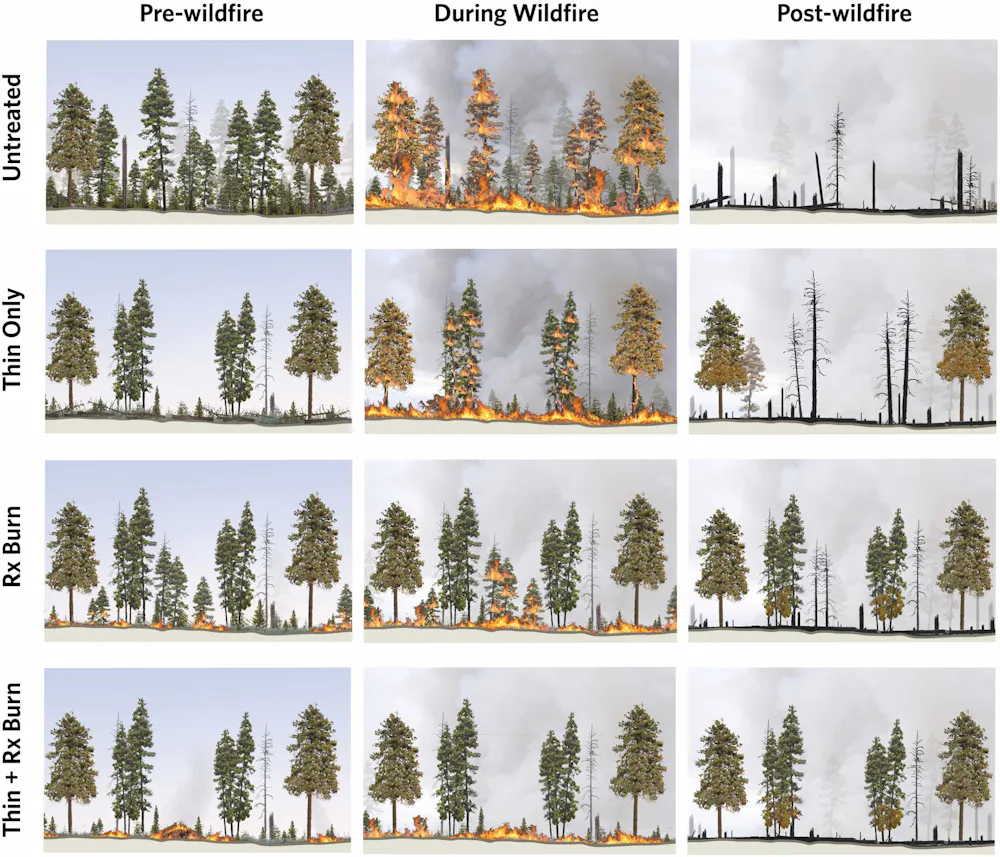
    Measures such as prescribed burns have proven to be effective for maintaining healthy forests and reducing the severity of subsequent wildfires. A recent review found that selective thinning followed by prescribed fire reduced subsequent fire severity by 72% on average, and prescribed fire on its own reduced severity by 62%.

    Prescribed burns and forest thinning tend to reduce the risk of extremely destructive wildfires.
    Kimberley T. Davis, et al., Forest Ecology and Management, 2024, CC BY

    But managing forests well requires knowing how forests are changing, where trees are dying and where undergrowth has built up and increased fire hazards. And, for federal lands, these are some of the jobs that are being targeted by the Trump administration.

    Some of the Forest Service staff who were fired or put in limbo by the Trump administration are those who do research or collect and communicate critical data about forests and fire risk. Other fired staff provided support so crews could clear flammable debris and carry out fuel treatments such as prescribed burns, thinning forests and building fire breaks.

    Losing people in these roles is like firing all primary care doctors and leaving only EMTs. Both are clearly needed. As many people know from emergency room bills, preventing emergencies is less costly than dealing with the damage later.

    Logging is not a long-term fire solution

    The Trump administration cited “wildfire risk reduction” when it issued an emergency order to increase logging in national forests by 25%.

    But private − unregulated − forest management looks a lot different than managing forests to prevent destructive fires.

    Logging, depending on the practice, can involve clear-cutting trees and other techniques that compromise soils. Exposing a forest’s soils and dead vegetation to more sunlight also dries them out, which can increase fire risk in the near term.

    Forest-thinning operations involve carefully removing young trees and brush that could easily burn, with a goal of creating conditions less likely to send fire into the crowns of trees.
    AP Photo/Godofredo A. Vásquez

    In general, logging that focuses on extracting the highest-value trees leaves thinner trees that are more vulnerable to fires. A study in the Pacific Northwest found that replanting logged land with the same age and size of trees can lead to more severe fires in the future.

    Research and data are essential

    For many people in the western U.S., these risks hit close to home.

    I’ve seen neighborhoods burn and friends and family displaced, and I have contended with regular air quality warnings and red flag days signaling a high fire risk. I’ve also seen beloved landscapes, such as those on Cameron Peak, transform when conifers that once made up the forest have not regrown.

    Recovery has been slow on Cameron Peak after a severe fire in 2020. This photo was taken in 2024.
    Bella Oleksy/University of Colorado

    My scientific research group and collaborations with other scientists have been helping to identify cost-effective solutions. That includes which fuel-treatment methods are most effective, which types of forests and conditions they work best in and how often they are needed. We’re also planning research projects to better understand which forests are at greatest risk of not recovering after fires.

    This sort of research is what robust, cost-effective land management is based on.

    When careful, evidence-based forest management is replaced with a heavy emphasis on suppressing every fire or clear-cutting forests, I worry that human lives, property and economies, as well as the natural legacy of public lands left to every American, are at risk.

    Laura Dee receives funding from NASA.

    ref. Controlled burns reduce wildfire risk, but they require trained staff and funding − this could be a rough year – https://theconversation.com/controlled-burns-reduce-wildfire-risk-but-they-require-trained-staff-and-funding-this-could-be-a-rough-year-251705

    MIL OSI – Global Reports

  • MIL-OSI Global: Trump is stripping protections from marine protected areas – why that’s a problem for fishing’s future, and for whales, corals and other ocean life

    Source: The Conversation – USA – By David Shiffman, Faculty Research Associate in Marine Biology, Arizona State University

    The coral reefs of Palmyra Atoll, part of Pacific Islands Heritage Marine National Monument, provide nurseries for many fish species. Andrew S. Wright/U.S. Fish and Wildlife Service via Flickr, CC BY-SA

    The single greatest threat to the diversity of life in our oceans over the past 50 years, more than climate change or plastic pollution, has been unsustainable fishing practices.

    In much of the ocean, there is little to no regulation or oversight of commercial fishing or other human activities. That’s part of the reason about a tenth of marine plant and animal species are considered threatened or at risk.

    It’s also why countries around the world have been creating marine protected areas.

    These protected areas, covering over 11.6 million square miles (30 million square kilometers) in 16,000 locations, offer refuge away from human activities for a wide variety of living creatures, from corals to sea turtles and whales. They give fish stocks a place to thrive, and those fish spread out into the surrounding waters, which helps fishing industries and local economies.

    In the U.S., however, marine protection is being dismantled by President Donald Trump.

    Marine protected areas as of 2022. Fully or highly protected areas represented less than 3% of the ocean, according to the Marine Protection Atlas.
    Marine Conservation Institute via Wikimedia Commons, CC BY-SA

    Trump issued a proclamation on April 17, 2025, titled “Unleashing American commercial fishing in the Pacific,” ordering the removal of key protections to allow commercial fishing in parts of a nearly-500,000-square-mile marine protected area called the Pacific Island Heritage National Marine Monument.

    He also called for a review of all other marine national monuments to decide if they should be opened to commercial fishing too. In addition, the Trump administration is proposing to redefine “harm” under the Endangered Species Act in a way that would allow for more damage to these species’ habitats.

    I’m a marine biologist and scuba diver, and it’s no accident that all my favorite dive sites are within marine protected areas. I’ve found what scientific studies from across the world show: Protected areas have much healthier marine life populations and healthier ecosystems.

    What’s at risk in the Pacific

    The Pacific Island Heritage National Marine Monument, about 750 miles west of Hawaii, is dotted by coral reefs and atolls, with species of fish, marine mammals and birds rarely found anywhere else.

    It is home to protected and endangered species, including turtles, whales and Hawaiian monk seals. Palmyra Atoll and Kingman Reef, both within the area, are considered among the most pristine coral reefs in the world, each providing habitats for a wide range of fish and other species.

    These marine species are able to thrive there and spread out into the surrounding waters because their habitats have been protected.

    A tour of several marine protected areas and their inhabitants in 2016.

    President George W. Bush, a conservative Republican, created this protected area in 2009, restricting fishing there, and President Barack Obama later expanded it. Trump, whose administration has made no secret of its aim to strip away environmental protections across the country’s land and waters, is now reopening much of the marine protected area to industrial-scale fishing.

    The risks from industrial fishing

    When too many fish are killed and too few young fish are left to replace them, it’s considered overfishing, and this has become a growing problem around the world.

    In 1974, about 10% of the world’s fish stocks were overfished. By 2021, that number had risen to 37.7%, according to the United Nations Food and Agriculture Organization’s annual State of Fisheries and Aquaculture Report.

    A fishing net caught on a coral reef can destroy habitat.
    Kampee Patisena/Moment/Getty Images

    Modern industrial-scale fishing practices can also harm other species.

    Bycatch, or catching animals that fishermen don’t want but are inadvertently caught up in nets and other gear, is a threat to many endangered species. Many seabirds, sea turtles and whales die this way each year. Some types of fishing gear, such as trawls and dredges that drag along the sea floor to scoop up sea life, can destroy ocean habitat itself.

    Without regulations or protected areas, fishing can turn into a competitive free-for-all that can deplete fish stocks.

    How marine protected areas protect species

    Marine protected areas are designed to safeguard parts of the ocean from human impacts, including offshore oil and gas extraction and industrial fishing practices.

    Studies have found that these areas can produce many benefits for both marine life and fishermen by allowing overfished species to recover and ensuring their health for the future.

    A decade after Mexico established the Cabo Pulmo protected area, for example, fish biomass increased by nearly 500%.

    How marine protected areas help marine life and local economies.

    Successful marine protected areas tend to have healthier habitats, more fish, more species of fish, and bigger fish than otherwise-similar unprotected areas. Studies have found the average size of organisms to be 28% bigger in these areas than in fished areas with no protections. How many babies a fish has is directly related to the size of the mother.

    All of this helps create jobs through ecotourism and support local fishing communities outside the marine protected area.

    Marine protected areas also have a “spillover effect” – the offspring of healthy fish populations that spawn inside these areas often spread beyond them, helping fish populations outside the boundaries thrive as well.

    Ultimately, the fishing industry benefits from a continuing supply. And all of this happens at little cost.

    A need for more protected areas, not fewer

    Claims by the Trump administration that marine protected areas are a heavy-handed restriction on the U.S. fishing industry do not hold water. As science and my own experience show, these refuges for sea life can instead help local economies and the industry by allowing fish populations to thrive.

    For the future of the planet’s whales, sea turtles, coral reefs and the health of fishing itself, scientists like me recommend creating more marine protected areas to help species thrive, not dismantling them.

    David Shiffman has consulted for many environmental non-profit groups including the Ocean Conservancy, as well as fishing industry groups and fisheries managment agencies.

    ref. Trump is stripping protections from marine protected areas – why that’s a problem for fishing’s future, and for whales, corals and other ocean life – https://theconversation.com/trump-is-stripping-protections-from-marine-protected-areas-why-thats-a-problem-for-fishings-future-and-for-whales-corals-and-other-ocean-life-254925

    MIL OSI – Global Reports

  • MIL-OSI Global: From help to harm: How the government is quietly repurposing everyone’s data for surveillance

    Source: The Conversation – USA – By Nicole M. Bennett, Ph.D. Candidate in Geography and Assistant Director at the Center for Refugee Studies, Indiana University

    DOGE has been key to attempts to consolidate Americans’ personal data for the government. Jim Watson/AFP via Getty Images

    A whistleblower at the National Labor Relations Board reported an unusual spike in potentially sensitive data flowing out of the agency’s network in early March 2025 when staffers from the Department of Government Efficiency, which goes by DOGE, were granted access to the agency’s databases. On April 7, the Department of Homeland Security gained access to Internal Revenue Service tax data.

    These seemingly unrelated events are examples of recent developments in the transformation of the structure and purpose of federal government data repositories. I am a researcher who studies the intersection of migration, data governance and digital technologies. I’m tracking how data that people provide to U.S. government agencies for public services such as tax filing, health care enrollment, unemployment assistance and education support is increasingly being redirected toward surveillance and law enforcement.

    Originally collected to facilitate health care, eligibility for services and the administration of public services, this information is now shared across government agencies and with private companies, reshaping the infrastructure of public services into a mechanism of control. Once confined to separate bureaucracies, data now flows freely through a network of interagency agreements, outsourcing contracts and commercial partnerships built up in recent decades.

    These data-sharing arrangements often take place outside public scrutiny, driven by national security justifications, fraud prevention initiatives and digital modernization efforts. The result is that the structure of government is quietly transforming into an integrated surveillance apparatus, capable of monitoring, predicting and flagging behavior at an unprecedented scale.

    Executive orders signed by President Donald Trump aim to remove remaining institutional and legal barriers to completing this massive surveillance system.

    DOGE and the private sector

    Central to this transformation is DOGE, which is tasked via an executive order to “promote inter-operability between agency networks and systems, ensure data integrity, and facilitate responsible data collection and synchronization.” An additional executive order calls for the federal government to eliminate its information silos.

    By building interoperable systems, DOGE can enable real-time, cross-agency access to sensitive information and create a centralized database on people within the U.S. These developments are framed as administrative streamlining but lay the groundwork for mass surveillance.

    Key to this data repurposing are public-private partnerships. The DHS and other agencies have turned to third-party contractors and data brokers to bypass direct restrictions. These intermediaries also consolidate data from social media, utility companies, supermarkets and many other sources, enabling enforcement agencies to construct detailed digital profiles of people without explicit consent or judicial oversight.

    Palantir, a private data firm and prominent federal contractor, supplies investigative platforms to agencies such as Immigration and Customs Enforcement, the Department of Defense, the Centers for Disease Control and Prevention and the Internal Revenue Service. These platforms aggregate data from various sources – driver’s license photos, social services, financial information, educational data – and present it in centralized dashboards designed for predictive policing and algorithmic profiling. These tools extend government reach in ways that challenge existing norms of privacy and consent.

    The role of AI

    Artificial intelligence has further accelerated this shift.

    Predictive algorithms now scan vast amounts of data to generate risk scores, detect anomalies and flag potential threats.

    These systems ingest data from school enrollment records, housing applications, utility usage and even social media, all made available through contracts with data brokers and tech companies. Because these systems rely on machine learning, their inner workings are often proprietary, unexplainable and beyond meaningful public accountability.

    Data privacy researcher Justin Sherman explains the astonishing amount of information data brokers have about you.

    Sometimes the results are inaccurate, generated by AI hallucinations – responses AI systems produce that sound convincing but are incorrect, made up or irrelevant. Minor data discrepancies can lead to major consequences: job loss, denial of benefits and wrongful targeting in law enforcement operations. Once flagged, individuals rarely have a clear pathway to contest the system’s conclusions.

    Digital profiling

    Participation in civic life, applying for a loan, seeking disaster relief and requesting student aid now contribute to a person’s digital footprint. Government entities could later interpret that data in ways that allow them to deny access to assistance. Data collected under the banner of care could be mined for evidence to justify placing someone under surveillance. And with growing dependence on private contractors, the boundaries between public governance and corporate surveillance continue to erode.

    Artificial intelligence, facial recognition systems and predictive profiling systems lack oversight. They also disproportionately affect low-income individuals, immigrants and people of color, who are more frequently flagged as risks.

    Initially built for benefits verification or crisis response, these data systems now feed into broader surveillance networks. The implications are profound. What began as a system targeting noncitizens and fraud suspects could easily be generalized to everyone in the country.

    Eyes on everyone

    This is not merely a question of data privacy. It is a broader transformation in the logic of governance. Systems once designed for administration have become tools for tracking and predicting people’s behavior. In this new paradigm, oversight is sparse and accountability is minimal.

    AI allows for the interpretation of behavioral patterns at scale without direct interrogation or verification. Inferences replace facts. Correlations replace testimony.

    The risk extends to everyone. While these technologies are often first deployed at the margins of society – against migrants, welfare recipients or those deemed “high risk” – there’s little to limit their scope. As the infrastructure expands, so does its reach into the lives of all citizens.

    With every form submitted, interaction logged and device used, a digital profile deepens, often out of sight. The infrastructure for pervasive surveillance is in place. What remains uncertain is how far it will be allowed to go.

    Nicole Bennett is affiliated with Indiana University’s Center for Refugee Studies and the Indiana University Refugee Task Force.

    ref. From help to harm: How the government is quietly repurposing everyone’s data for surveillance – https://theconversation.com/from-help-to-harm-how-the-government-is-quietly-repurposing-everyones-data-for-surveillance-254690

    MIL OSI – Global Reports

  • MIL-OSI Global: Justice Department lawyers work for justice and the Constitution – not the White House

    Source: The Conversation – USA – By Cassandra Burke Robertson, Professor of Law and Director of the Center for Professional Ethics, Case Western Reserve University

    The U.S. flag flies above Department of Justice headquarters on Jan. 20, 2024, in Washington. J. David Ake/Getty Images

    In the 1970s, President Richard Nixon tried to fire the Department of Justice prosecutor leading an investigation into the president’s involvement in wiretapping the Democratic National Committee’s headquarters.

    Since then, the DOJ has generally been run as an impartial law enforcement agency, separated from the executive office and partisan politics.

    Those guardrails are now being severely tested under the Trump administration.

    In February 2025, seven DOJ attorneys resigned, rather than follow orders from Attorney General Pam Bondi to dismiss corruption charges against New York Mayor Eric Adams. Adams was indicted in September 2024, during the Biden administration, for alleged bribery and campaign finance violations.

    One DOJ prosecutor, Hagan Scotten, wrote in his Feb. 15 resignation letter that while he held no negative views of the Trump administration, he believed the dismissal request violated DOJ’s ethical standards.

    Among more than a dozen DOJ attorneys who have recently been terminated, the DOJ fired Erez Reuveni, acting deputy chief of the department’s Office of Immigration Litigation, on April 15. Reuveni lost his job for speaking honestly to the court about the facts of an immigration case, instead of following political directives from Bondi and other superiors.

    Reuveni was terminated for acknowledging in court on April 14 that the Department of Homeland Security had made an “administrative error” in deporting Kilmar Abrego Garcia to El Salvador, against court orders. DOJ leadership placed Reuveni on leave the very next day.

    Bondi defended the decision, arguing that Reuveni had failed to “vigorously advocate” for the administration’s position.

    I’m a legal ethics scholar, and I know that as more DOJ lawyers face choices between following political directives and upholding their profession’s ethical standards, they confront a critical question: To whom do they ultimately owe their loyalty?

    President Donald Trump speaks before Pam Bondi is sworn in as attorney general at the White House on Feb. 5, 2025.
    Andrew Harnik/Getty Images

    Identifying the real client

    All attorneys have core ethical obligations, including loyalty to clients, confidentiality and honesty to the courts. DOJ lawyers have additional professional obligations: They have a duty to seek justice, rather than merely win cases, as well as to protect constitutional rights even when inconvenient.

    DOJ attorneys typically answer to multiple authorities, including the attorney general. But their highest loyalty belongs to the U.S. Constitution and justice itself.

    The Supreme Court established in a 1935 case that DOJ attorneys have a special mission to ensure that “justice shall be done.”

    DOJ attorneys reinforce their commitment to this mission by taking an oath to uphold the Constitution when they join the department. They also have training programs, internal guidelines and a long-standing institutional culture that emphasizes their unique responsibility to pursue justice, rather than simply win cases.

    This creates a professional identity that goes beyond simply carrying out the wishes of political appointees.

    Playing by stricter rules

    All lawyers also follow special professional rules in order to receive and maintain a license to practice law. These professional rules are established by state bar associations and supreme courts as part of the state-based licensing system for attorneys.

    But the more than 10,000 attorneys at the DOJ face even tougher standards.

    The McDade Amendment, passed in 1998, requires federal government lawyers to follow both the ethics rules of the state where they are licensed to practice and federal regulations. This includes rules that prohibit DOJ attorneys from participating in cases where they have personal or political relationships with involved parties, for example.

    This law also explicitly subjects federal prosecutors to state bar discipline. Such discipline could range from private reprimands to suspension or even permanent disbarment, effectively ending an attorney’s legal career.

    This means DOJ lawyers might have to refuse a supervisor’s orders if those directives would violate professional conduct standards – even at the risk of their jobs.

    This is what Assistant U.S. Attorney Danielle Sassoon wrote in a Feb. 12, 2025, letter to Bondi, explaining why she could not drop the charges against Adams. Sassoon instead resigned from her position at the DOJ.

    “Because the law does not support a dismissal, and because I am confident that Adams has committed the crimes with which he is charged, I cannot agree to seek a dismissal driven by improper considerations … because I do not see any good-faith basis for the proposed position, I cannot make such arguments consistent with my duty of candor,” Sassoon wrote.

    As DOJ’s own guidance states, attorneys “must satisfy themselves that their behavior comports with the applicable rules of professional conduct” regardless of what their bosses say.

    Post-Watergate principles under pressure

    The president nominates the attorney general, who must be confirmed by the U.S. Senate.

    That can create the perception and even the reality that the attorney general is indebted to, and loyal to, the president. To counter that, Attorney General Griffin Bell, in 1978, spelled out three principles established after Watergate to maintain a deliberate separation between the White House and the Justice Department.

    First, Bell called for procedures to prevent personal or partisan interests from influencing legal judgments.

    Second, Bell said that public confidence in the department’s objectivity is essential to democracy, with DOJ serving as the “acknowledged guardian and keeper of the law.”

    Third, these principles ultimately depend on DOJ lawyers committed to good judgment and integrity, even under intense political pressure. These principles apply to all employees throughout the department – including the attorney general.

    Recent ethics tests

    These principles face a stark test in the current political climate.

    The March 2025 firing of Elizabeth Oyer, a career pardon attorney with the Justice Department, raises questions about the boundaries between political directives and professional obligations.

    Oyer was fired by Bondi shortly after declining to recommend the restoration of gun rights to actor Mel Gibson, a known Donald Trump supporter. Gibson lost his gun rights after pleading no contest to a misdemeanor domestic battery charge in 2011.

    Oyer initially expressed concern to her superiors about restoring Gibson’s gun rights without a sufficient background investigation, particularly given Gibson’s history of domestic violence.

    When Oyer later agreed to testify before Congress in a hearing about the White House’s handling of the Justice Department, the administration initially planned to send armed U.S. Marshals officers to deliver a warning letter to her home, saying that she could not disclose records about firearms rights to lawmakers.

    Oyer was away from home when she received an urgent alert that the marshals were en route to her home, where her teenage child was alone. Oyer’s attorney described this plan as “both unprecedented and completely inappropriate.”

    Officials called off the marshals only after Oyer confirmed receipt of the letter via email.

    Elizabeth Oyer, a former U.S. pardon attorney at the Justice Department, speaks at a Senate hearing on April 7, 2025, in Washington.
    Kayla Bartkowski/Getty Images

    Why independence matters

    In my research, I found that lawyers sometimes have lapses in judgment because of the “partisan kinship,” conscious or not, they develop with clients. This partisan kinship can lead attorneys to overlook serious red flags that outsiders would easily spot.

    When lawyers become too politically aligned with clients – or their superiors – their judgment suffers. They miss ethical problems and legal flaws that would otherwise be obvious. Professional distance allows attorneys to provide the highest quality legal counsel, even if that means saying “no” to powerful people.

    That’s why DOJ attorneys sometimes make decisions that frustrate political objectives. When they refuse to target political opponents, when they won’t let allies off easily, or when they disclose information their superiors wanted hidden, they’re not being insubordinate.

    They’re fulfilling their highest ethical duties to the Constitution and rule of law.

    Cassandra Burke Robertson does not work for, consult, own shares in or receive funding from any company or organization that would benefit from this article, and has disclosed no relevant affiliations beyond their academic appointment.

    ref. Justice Department lawyers work for justice and the Constitution – not the White House – https://theconversation.com/justice-department-lawyers-work-for-justice-and-the-constitution-not-the-white-house-254763

    MIL OSI – Global Reports

  • MIL-OSI Global: VAT hikes can raise tax without hurting the poor: an economist sets out the evidence

    Source: The Conversation – Africa – By Imraan Valodia, Pro Vice-Chancellor, Climate, Sustainability and Inequality and Director, Southern Centre for Inequality Studies, University of the Witwatersrand

    South Africa’s 2025-6 budget has been subjected to more comment than usual. This is due to the political tensions generated by a proposed increase in value added tax (VAT).

    South Africa’s choices on how it manages the revenue and expenditure issues in the budget are critical for how the larger issues of the country’s debt and its economic policies are handled. As things stand, the economy is locked into a low-growth trajectory which make the debt, revenue and expenditure issues more difficult to deal with.

    This piece draws on a longer article which explores these issues in greater detail. Here, I focus only on the VAT issue.

    The finance minister originally tabled an increase of 2 percentage points, then changed it to 0.5 percentage points. Still, it is threatening to end the country’s government of national unity, which was set up after elections in 2024.


    Read more:
    South Africa’s finance minister wanted to raise VAT: the pros and cons of a tricky tax


    Most commentators, including the political parties that have opposed the proposal, many academics, and non-governmental organisations claiming to represent low-income groups, have argued that an increase in VAT places an undue burden on low-income groups. This would make it regressive.

    Based on work as an academic economist over the past three decades, I believe that the debate has been based largely on conjecture and ideological opposition to VAT, rather than on the evidence of its impact.

    This is a pity as there is empirical evidence rooted in research that a VAT increase is, in fact, not regressive and is therefore a good policy decision.

    Tax experts usually refer to the three Es in taxes – equity, efficiency and ease of administration – for evaluating tax policy proposals. New taxes should ideally promote equity (they should be progressive and not regressive), be efficient and be easy to administer.

    An increase in VAT in South Africa ticks all these boxes.

    First, contrary to what many commentators have been arguing, VAT isn’t always regressive – it depends on how it’s implemented. As proposed by the finance minister it would not be regressive because, while it would add to the burden of low-income households, most of the VAT would be collected from higher-income households. Added to this is that the proposed expansion of the existing list of zero-rated items would protect the lowest-income households.

    Second, VAT is a very efficient tax. For relatively low increases in the rate, government is able to raise a large amount of revenue.

    Finally, the system is easy to administer and adds very little cost to collection.

    Key to its efficacy is the way VAT is implemented, including the choice of products to zero rate, and the political credibility of government.

    The case for a VAT increase

    VAT is a consumption tax, so it only affects the income that a household consumes.

    According to the International Monetary Fund (IMF), VAT is now the mainstay of tax systems in over 160 countries, raising on average one-third of total government revenues.

    In theory, there are good reasons to be concerned about the impact of VAT. First, it can place a high burden on low-income households because they spend a large proportion of their incomes on consumption goods such as food.

    Second, VAT may also place a heavy burden of tax on women. In South Africa and many other countries, women-led households tend to be clustered in the lower end of the income distribution. And women disproportionately take responsibility for feeding and caring for family members.

    So, at least in theory, VAT is a regressive tax. But is it really so in practice?

    Three studies that have explored this issue in some detail have concluded that, in South Africa, VAT is not regressive.

    In 2008, I worked with colleagues in eight countries (South Africa, Ghana, Uganda, Morocco, Mexico, Argentina, India and the United Kingdom) on the gender issues related to tax. In particular we looked at the burden of VAT on low-income and women-headed households.

    Our findings were that, in general, VAT is regressive and discriminates against women, but it depends on how it is implemented.

    In South Africa, the zero-rating of basic consumption goods is very effective, protecting low-income and female-headed households from VAT. It’s an example of a VAT system that is neutral – neither regressive nor progressive.

    A more recent study by South African economist Ingrid Woolard and colleagues reached a similar conclusion in 2018.

    A third study was done in the same year when VAT was increased from 14% to 15%. Following a similar emotive debate, the finance minister appointed an independent committee which I served on and which was chaired by Woolard, to advise on further zero-rating.

    Our conclusion – again – was that zero-rating is highly effective at protecting low-income groups from the deleterious effects of VAT.

    How it’s done matters

    The challenge with zero-rating is that while low-income households benefit, high-income households benefit more (because they spend more, in absolute terms, on zero-rated goods). Large amounts of potential VAT revenue are lost to high-income groups that don’t need protection.

    The trick is to find a basket of goods that low-income households consume a lot of, but which high-income households don’t consume in large quantities. Some typical examples are beans, canned pilchards and cabbage. These are all goods that low-income households consume and high-income households do not.

    National Treasury’s proposals for increasing the basket of goods to be zero-rated are based on solid research.

    A good example of the trade-offs to consider is the case of chicken. Chicken is an important source of protein for low-income households, but also for high-income households. So, if all chicken were zero-rated, this would protect poor households, but a large amount of VAT revenue would be lost.

    In our 2018 zero-rating report, at 2018 prices and consumption patterns, we calculated that zero-rating all chicken products would be equivalent to R1.3 billion (US$67.6 million) but government would lose R4.6 billion (US$244.4 million) to high income households.

    Not a good trade-off.

    However, some chicken products, such as chicken heads and feet, are mostly consumed by low-income groups, and are therefore good candidates for zero-rating.

    The two other Es – efficiency and ease of administration – of taxes are also key to consider.

    On these two considerations, VAT has big advantages.

    It’s very difficult to avoid or evade VAT because it’s collected along the chain of production. There’s evidence that South Africa has very little leakage in the system.

    So it is relatively easy to increase the VAT rate without needing to invest additional resources to collect the tax.

    Credibility is key

    Apart from the economic considerations, tax policy has to be politically credible. People should believe that their tax contributions are being used effectively, and government should be seen to be acting in line with this.

    If people don’t believe in government’s ability to spend wisely, resistance to taxes increases. Then tax avoidance and evasion increases.

    It would be fair to say that, with the high levels of corruption in South Africa’s political system, government’s credibility is low.

    Thus, if VAT is to be increased, government has to do a lot more to improve its credibility and reassure South Africans that the tax revenues will be well spent.

    Imraan Valodia receives funding from a number of foundations and governments that support academic research.

    ref. VAT hikes can raise tax without hurting the poor: an economist sets out the evidence – https://theconversation.com/vat-hikes-can-raise-tax-without-hurting-the-poor-an-economist-sets-out-the-evidence-254213

    MIL OSI – Global Reports

  • MIL-OSI Global: Celebrity Traitors: my research shows voting behaviour could help identify faithfuls

    Source: The Conversation – UK – By Robin Kramer, Senior Lecturer in the School of Psychology, University of Lincoln

    With the lineup of the upcoming celebrity series of The Traitors recently leaked online, people are once again debating the best strategies that players might use to succeed. But a player’s voting history can also reveal the psychological dynamics at play, particularly alliances they may be subconsciously forming.

    For those who aren’t familiar, the premise of the show is that each player is given the role of either “faithful” or “traitor”. Only the traitors know everyone’s roles in the game. If the faithful players eliminate all of the traitors by the end of the game, they divide the prize money equally among themselves. However, if one or more traitors remain by the end, all of the money goes to them instead.

    There are two ways for someone to be eliminated from the game. First, all of the players vote on who to “banish” at the round table each day. Second, the traitors decide on one person to “murder” overnight, who is then removed from the game before breakfast the following morning. There are also occasional tweaks to this format depending on the stage of the game.

    Ideally, faithful players would spot the lies that traitors tell. However, research shows that people don’t fare much better than chance at doing this, although certain individuals (who are often found to be working in law enforcement) or specialised groups, such as members of the US Secret Service, may be.


    Read more:
    Why we’re so bad at spotting lies – most of us only perform slightly better than chance


    Instead, players may base their decisions on unreliable biases. In a game where there’s so little to go on, they risk being blinded by the trustworthiness of a (fake) Welsh accent, for example, or drawing suspicions for simply being too quiet or too noisy. After all, there is a lot of behaviour that people often incorrectly link with deception. For instance, westerners commonly associate someone averting their gaze with lying but researchers have shown that looking away isn’t linked to deception.

    Spotting traitors is no easy task if you’re a faithful.
    Andrii Yalanskyi/Shutterstock

    Using voting behaviour as evidence

    Information from interactions with other players can be unreliable, but players also get to see how others vote at the round table. And this is where real evidence can be found.

    The faithful players have little to go on, so they end up voting for anyone – faithful and traitors alike. In contrast, traitors can direct their votes only at the faithful. If we combine these ideas, we see that traitors are more likely to be voted for by faithful players, even if this is by accident.

    The traitors don’t tend to vote for each other because they naturally form an alliance, working together to shape the game. Their secret meetings in Traitors’ Tower, shared uniform (a cloak and hood), and power to murder the faithful, construct a sense of “us versus them”. In fact, very little is needed for people to start behaving this way. Known as the minimal group paradigm, research has shown that simply segregating people based on their preference for certain artists or their eye colour is enough to change the way they behave towards each other.

    They may be happy to deceive the faithful, but the traitors are generally willing to trust each other. This mirrors a 2018 study where “deviant” study participants (who cheated on a task) felt connected to their team and trusted its members when the team engaged in coordinated acts of deviance (helping each other to cheat). Although they knew logically that their team shouldn’t be trusted, their sense of connection led to a feeling of trust nonetheless.

    Do voting records actually reveal players’ roles?

    Conveniently, all of the voting records for the show have been collated online. Let’s first exclude voting rounds which restrict the traitors’ options. During a round table which results in a traitor’s banishment, most players have voted for that traitor. There is good reason for other traitors to jump on the bandwagon at that point, to blend in and appear more faithful. Similarly, voting is limited after a tie, where the remaining options may force particular decisions.

    After excluding these two types of voting context, I investigated the votes for players who were traitors at the time of voting (rather than switching to this role later on) for the three series of the UK show. I also considered other completed series of English-language versions of the show: the US, Australia, Canada and New Zealand.

    Altogether, 95% of the 76 votes for traitors were cast by faithful players. Remember Jake from series three earlier this year? As a faithful player, he voted for Linda right at the beginning of the game. When Linda was later revealed as a traitor, Jake’s abilities were championed by the other players, earning him the nickname “traitor hunter” and convincing them that he was faithful.

    So whenever a traitor is banished, players should consider who voted for that traitor in previous round tables – as we’ve seen, those votes probably came from the faithful. However, as the game progresses, there’s always the possibility that a faithful player could later be “seduced” into becoming a traitor, so it’s important to keep this in mind too.

    Players may not be able to rely on spotting “tells” or other cues to deception in the game, but there are always patterns in the ways people behave. You just need to know where to look.

    Robin Kramer does not work for, consult, own shares in or receive funding from any company or organisation that would benefit from this article, and has disclosed no relevant affiliations beyond their academic appointment.

    ref. Celebrity Traitors: my research shows voting behaviour could help identify faithfuls – https://theconversation.com/celebrity-traitors-my-research-shows-voting-behaviour-could-help-identify-faithfuls-223229

    MIL OSI – Global Reports

  • MIL-OSI Africa: VAT hikes can raise tax without hurting the poor: an economist sets out the evidence

    Source: The Conversation – Africa – By Imraan Valodia, Pro Vice-Chancellor, Climate, Sustainability and Inequality and Director, Southern Centre for Inequality Studies, University of the Witwatersrand

    South Africa’s 2025-6 budget has been subjected to more comment than usual. This is due to the political tensions generated by a proposed increase in value added tax (VAT).

    South Africa’s choices on how it manages the revenue and expenditure issues in the budget are critical for how the larger issues of the country’s debt and its economic policies are handled. As things stand, the economy is locked into a low-growth trajectory which make the debt, revenue and expenditure issues more difficult to deal with.

    This piece draws on a longer article which explores these issues in greater detail. Here, I focus only on the VAT issue.

    The finance minister originally tabled an increase of 2 percentage points, then changed it to 0.5 percentage points. Still, it is threatening to end the country’s government of national unity, which was set up after elections in 2024.


    Read more: South Africa’s finance minister wanted to raise VAT: the pros and cons of a tricky tax


    Most commentators, including the political parties that have opposed the proposal, many academics, and non-governmental organisations claiming to represent low-income groups, have argued that an increase in VAT places an undue burden on low-income groups. This would make it regressive.

    Based on work as an academic economist over the past three decades, I believe that the debate has been based largely on conjecture and ideological opposition to VAT, rather than on the evidence of its impact.

    This is a pity as there is empirical evidence rooted in research that a VAT increase is, in fact, not regressive and is therefore a good policy decision.

    Tax experts usually refer to the three Es in taxes – equity, efficiency and ease of administration – for evaluating tax policy proposals. New taxes should ideally promote equity (they should be progressive and not regressive), be efficient and be easy to administer.

    An increase in VAT in South Africa ticks all these boxes.

    First, contrary to what many commentators have been arguing, VAT isn’t always regressive – it depends on how it’s implemented. As proposed by the finance minister it would not be regressive because, while it would add to the burden of low-income households, most of the VAT would be collected from higher-income households. Added to this is that the proposed expansion of the existing list of zero-rated items would protect the lowest-income households.

    Second, VAT is a very efficient tax. For relatively low increases in the rate, government is able to raise a large amount of revenue.

    Finally, the system is easy to administer and adds very little cost to collection.

    Key to its efficacy is the way VAT is implemented, including the choice of products to zero rate, and the political credibility of government.

    The case for a VAT increase

    VAT is a consumption tax, so it only affects the income that a household consumes.

    According to the International Monetary Fund (IMF), VAT is now the mainstay of tax systems in over 160 countries, raising on average one-third of total government revenues.

    In theory, there are good reasons to be concerned about the impact of VAT. First, it can place a high burden on low-income households because they spend a large proportion of their incomes on consumption goods such as food.

    Second, VAT may also place a heavy burden of tax on women. In South Africa and many other countries, women-led households tend to be clustered in the lower end of the income distribution. And women disproportionately take responsibility for feeding and caring for family members.

    So, at least in theory, VAT is a regressive tax. But is it really so in practice?

    Three studies that have explored this issue in some detail have concluded that, in South Africa, VAT is not regressive.

    In 2008, I worked with colleagues in eight countries (South Africa, Ghana, Uganda, Morocco, Mexico, Argentina, India and the United Kingdom) on the gender issues related to tax. In particular we looked at the burden of VAT on low-income and women-headed households.

    Our findings were that, in general, VAT is regressive and discriminates against women, but it depends on how it is implemented.

    In South Africa, the zero-rating of basic consumption goods is very effective, protecting low-income and female-headed households from VAT. It’s an example of a VAT system that is neutral – neither regressive nor progressive.

    A more recent study by South African economist Ingrid Woolard and colleagues reached a similar conclusion in 2018.

    A third study was done in the same year when VAT was increased from 14% to 15%. Following a similar emotive debate, the finance minister appointed an independent committee which I served on and which was chaired by Woolard, to advise on further zero-rating.

    Our conclusion – again – was that zero-rating is highly effective at protecting low-income groups from the deleterious effects of VAT.

    How it’s done matters

    The challenge with zero-rating is that while low-income households benefit, high-income households benefit more (because they spend more, in absolute terms, on zero-rated goods). Large amounts of potential VAT revenue are lost to high-income groups that don’t need protection.

    The trick is to find a basket of goods that low-income households consume a lot of, but which high-income households don’t consume in large quantities. Some typical examples are beans, canned pilchards and cabbage. These are all goods that low-income households consume and high-income households do not.

    National Treasury’s proposals for increasing the basket of goods to be zero-rated are based on solid research.

    A good example of the trade-offs to consider is the case of chicken. Chicken is an important source of protein for low-income households, but also for high-income households. So, if all chicken were zero-rated, this would protect poor households, but a large amount of VAT revenue would be lost.

    In our 2018 zero-rating report, at 2018 prices and consumption patterns, we calculated that zero-rating all chicken products would be equivalent to R1.3 billion (US$67.6 million) but government would lose R4.6 billion (US$244.4 million) to high income households.

    Not a good trade-off.

    However, some chicken products, such as chicken heads and feet, are mostly consumed by low-income groups, and are therefore good candidates for zero-rating.

    The two other Es – efficiency and ease of administration – of taxes are also key to consider.

    On these two considerations, VAT has big advantages.

    It’s very difficult to avoid or evade VAT because it’s collected along the chain of production. There’s evidence that South Africa has very little leakage in the system.

    So it is relatively easy to increase the VAT rate without needing to invest additional resources to collect the tax.

    Credibility is key

    Apart from the economic considerations, tax policy has to be politically credible. People should believe that their tax contributions are being used effectively, and government should be seen to be acting in line with this.

    If people don’t believe in government’s ability to spend wisely, resistance to taxes increases. Then tax avoidance and evasion increases.

    It would be fair to say that, with the high levels of corruption in South Africa’s political system, government’s credibility is low.

    Thus, if VAT is to be increased, government has to do a lot more to improve its credibility and reassure South Africans that the tax revenues will be well spent.

    – VAT hikes can raise tax without hurting the poor: an economist sets out the evidence
    – https://theconversation.com/vat-hikes-can-raise-tax-without-hurting-the-poor-an-economist-sets-out-the-evidence-254213

    MIL OSI Africa

  • MIL-OSI USA: Welch Joins Schiff, Reed, Lawmakers Call on Trump Administration to Reverse Plans to Defund Libraries and Museums

    US Senate News:

    Source: United States Senator Peter Welch (D-Vermont)
    “The consequences of eliminating IMLS will be devastating for states, local communities, and the millions of Americans who rely on these institutions every day.”
    WASHINGTON, D.C. – U.S. Senator Peter Welch (D-Vt.) joined U.S. Senators Adam Schiff (D-Calif.), Jack Reed (D-R.I.) and 23 lawmakers in writing to the Acting Director of the Institute of Museum and Library Services (IMLS) about serious concerns regarding President Trump’s call to eliminate IMLS which was created by a Republican-led Congress in 1996 and is the only federal agency dedicated to supporting the nation’s libraries and museums. In the letter, the Senators call on the Administration to ensure there is continued funding in accordance with federal law for libraries and museums and to reverse any actions that jeopardize their provision of critical services on which many communities rely on. 
    “The consequences of eliminating IMLS will be devastating for states, local communities, and the millions of Americans who rely on these institutions every day. These institutions are critical pillars of educational opportunity, cultural preservation, civic engagement, and economic development in our communities,” wrote the lawmakers.  
    “We urge you to uphold the law, immediately disburse all LSTA grant funding to our states, including California, Connecticut and Washington, and reverse any actions that jeopardize the future of the libraries and museums our communities rely on,” the lawmakers concluded.  
    Libraries serve as essential lifelines for families, students, and workers throughout California providing literacy programs, access to technology, job training, small business support, and more. 
    This letter is also signed by U.S. Senators Alex Padilla (D-Calif.), Richard Blumenthal (D-Conn.), Tammy Duckworth (D-Ill.), Kristen Gillibrand (D-N.Y.), Amy Klobuchar (D-Minn.), Jeff Merkley (D-Ore.), Jacky Rosen (D-Nev.), and Bernie Sanders (I-Vt.). In the U.S. House of Representatives, this letter is signed by Representatives Eric Swalwell (D-Calif.-15), Julia Brownley (D-Calif.-26), Scott Peters (D-Calif.-50), Jim Costa (D-Calif.-21), Raul Ruiz (D-Calif.-25), Juan Vargas (D-Calif.-52), Mark Takano (D-Calif.-39), George Whitesides (D-Calif.-27), Mike Thompson (D-Calif.-04), Norma Torres (D-Calif.-35), Jimmy Gomez (D-Calif.-34), J. Luis Correa (D-Calif.-46), Salud Carbajal (D-Calif.-24) Nanette Barragan (D-Calif.-44) and Zoe Lofgren (D-Calif.-18). 
    The full text of the letter is available here and below.   
    Dear Mr. Sonderling,
    We write to express our serious concerns regarding President Trump’s call to eliminate the Institute of Museum and Library Services (IMLS), the only federal agency dedicated to supporting the nation’s libraries and museums. On March 14, 2025 President Trump issued the Executive Order “Continuing the Reduction of the Federal Bureaucracy” which includes IMLS to be eliminated “to the maximum extent consistent with applicable law” and for IMLS to submit a report to the Office of Management and Budget (OMB) to confirm compliance. We are reminding the Administration of its obligation to fully execute the law as authorized by Congress under the Museum and Library Services Act (MLSA) of 2018 (PL 115-40), as signed by President Trump. Beginning on April 3, 2025, several grantees— including the states of California, Connecticut and Washington— received written notice from IMLS that their federal Fiscal Year 2024–25 grants under the Library Services and Technology Act (LSTA) had been terminated. We strongly urge the Administration to reverse these terminations and ensure continued funding in accordance with federal law.
    For Fiscal Year 2024, Congress appropriated $294.8 million for IMLS, specifying funding should be allotted across the programs in the following manner:
    Library Services Technology Act
    Grants to States                                                                                            $180,000,000
    Native American Library Services                                                             $5,763,000
    National Leadership: Libraries                                                                  $15,287,000
    Laura Bush 21st Century Librarian                                                            $10,000,000
    Museum Services Act
    Museums for America                                                                                 $30,330,000      
    Native American/Native Hawaiian Museum Services                           $3,772,000
    National Leadership: Museums                                                                 $9,348,000
    African American History and Culture Act                                                $6,000,000
    National Museum of the American Latino Act                                         $6,000,000
    Research, Analysis, and Data Collection                                                   $5,650,000
    Program Administration                                  $22,650,000
    We expect the Administration to fully implement the Full-Year Continuing Appropriations and Extensions Act of 2025 consistent with the Fiscal Year 2024 allocations. We also urge the Administration to allow IMLS to continue to engage with and support libraries and museums as Congress intended and as authorized in the MLSA, including maintaining the expertise of the IMLS staff to carry out the functions of the agency.
    Libraries and museums are deeply embedded in local communities across the country and millions of Americans rely on their services and programs, particularly the most rural and underserved areas. In 2024, IMLS funding reached 140,000 libraries and museums across all 50 states and U.S. territories. Public, school, academic, and specialty libraries provide a wide range of local services such as summer reading programs for youth, high-speed internet, workforce training, and support for small businesses. Libraries are especially vital for low-income families, students, and workers who depend on them for free access to technology, educational resources, and job search support. In California, local libraries serve as critical lifelines for families experiencing homelessness and those displaced by natural disasters, offering space for community gathering and access to emergency information. Every year, more than 1.2 billion people visit libraries in-person—and they are deeply valued by the American public.
    Museums serve as crucial sources of information for history, art, science, and culture and have broad public support. In fact, 96 percent of surveyed Americans believe lawmakers should support museums. Museums support more than 726,000 American jobs and contribute $50 billion to the U.S. economy every year. Beyond their cultural significance, museums play a vital role in education, offering hands-on learning opportunities for students of all ages and providing resources that supplement school curricula, especially in underserved communities. For states like California, Connecticut, and Washington, museums are essential pillars of local identity, tourism, and community development.
    The consequences of eliminating IMLS will be devastating for states, local communities, and the millions of Americans who rely on these institutions every day. These institutions are critical pillars of educational opportunity, cultural preservation, civic engagement, and economic development in our communities.
    As such, please provide us with a written response to the questions below no later than May 1, 2025.
    How many IMLS employees have been fired, put on administrative leave, accepted the deferred resignation program offer, or accepted the Voluntary Early Retirement Authority or Voluntary Separation Incentive Payment offer since January 20, 2025?  Please provide the number of employees in each category.
    How many individuals are currently employed at the agency?  Please provide their titles and duties.
    How many of these employees were responsible for, or assisted in, administering grants?
    Which officials at IMLS were involved in the staffing reduction decisions and what planning, if any, was undertaken prior to these reductions?
    What factors are being used to determine the cancellation of grants, including the Grants to States funding?
    Please provide a full list of cancelled grants, including the date of cancellation, type of grant, and dollar amount.
    Please share what the agency’s “updated priorities” are and how grants are being assessed for alignment and plans for grant competitions in Fiscal Year 25.
    Which officials at IMLS are involved in developing the report to the Director of OMB?
    What are such officials’ expertise in IMLS administration and the Museum and Library Services Act statute?
    Please share with Congress the report detailing the functions of IMLS and what is statutorily required and to what extent.
    Museums and libraries are the cornerstone of our society that serve as protected spaces for people to learn, engage with their community, and build curiosity. We urge you to uphold the law, immediately disburse all awarded LSTA grant funding to our states, including California, Connecticut and Washington, and reverse any actions that jeopardize the future of the libraries and museums our communities rely on.

    MIL OSI USA News

  • MIL-OSI USA: Distillate and jet fuel contribute to record U.S. petroleum product exports in 2024

    Source: US Energy Information Administration

    In-brief analysis

    April 23, 2025


    In 2024, U.S. exports of total petroleum products increased to a record 6.6 million barrels per day (b/d) annual average. Annual U.S. petroleum product exports increased by 495,000 b/d as U.S. exports of distillate fuel oil, typically sold as diesel, and jet fuel increased compared with 2023, while exports of total motor gasoline decreased. Imports of major petroleum products, including gasoline, distillate fuel oil, and jet fuel, decreased by 210,000 b/d in 2024 compared with 2023.

    Distillate fuel oil accounts for the largest share of U.S. transportation fuel exports and is the second-largest petroleum export by volume, after propane. Distillate exports increased 182,000 b/d to about 1.30 million b/d in 2024, still less than the annual record of 1.38 million b/d in 2017.

    The largest destination for U.S. distillate exports is Mexico, which accounted for 272,000 b/d (21%) in 2024. Other major destinations included Chile (110,000 b/d), the Netherlands (103,000 b/d), the UK (81,000 b/d), and Peru (74,000 b/d).


    Brazil was the second-largest destination for U.S. distillate exports over the previous 10 years (2014–23), but it only received 41,000 b/d of U.S. exports in 2024. This decrease indirectly reflects sanctions by European countries on Russia’s distillate imports. Brazil increased imports of discounted and displaced distillate from Russia last year, reducing its own imports from the United States. At the same time, major European hubs in the Netherlands and the UK imported significantly more distillate from the United States. The Netherlands imported 103,000 b/d of distillate from the United States in 2024, and UK distillate imports averaged 81,000 b/d. In 2021, the Netherlands imported just 12,000 b/d of U.S. distillate, and the UK imported only 23,000 b/d.

    In 2024, exports of U.S. motor gasoline, including both finished motor gasoline and motor gasoline blending components, totaled 877,000 b/d, or 24,000 b/d less than in 2023. Mexico is the largest destination for U.S. gasoline exports, accounting for more than half of 2024 exports at 495,000 b/d. Other destinations for U.S. gasoline exports are generally concentrated in the Western Hemisphere, such as Guatemala, Colombia, Canada, and Panama—the next-largest destinations by volume in 2024.

    Data source: U.S. Energy Information Administration, Petroleum Supply Monthly
    Note: Total motor gasoline exports are calculated as the sum of exports of finished motor gasoline and exports of motor gasoline blending components.

    Jet fuel exports in 2024 increased relative to 2023, rising to a total of 209,000 b/d but remaining below pre-pandemic levels. Major destinations for jet fuel exports are elsewhere in the Americas, and as with the other fuels, Mexico has historically been the largest single destination, constituting 63,000 b/d (30%) of 2024 exports. U.S. annual exports of jet fuel to Mexico were their highest on record last year.

    Principal contributor: Kevin Hack

    MIL OSI USA News

  • MIL-OSI: EY US Unveils Balaji Sreenivasan of Aurigo Software as an Entrepreneur Of The Year® 2025 Finalist

    Source: GlobeNewswire (MIL-OSI)

    AUSTIN, Texas, April 23, 2025 (GLOBE NEWSWIRE) — Ernst & Young LLP (EY US) announced the finalists for the prestigious Entrepreneur Of The Year® 2025 Gulf South Award. Now in its 40th year, the Entrepreneur Of The Year program celebrates the bold leaders who disrupt markets through the world’s most groundbreaking companies, revolutionizing industries and making a profound impact on communities. The program honors bold entrepreneurs whose innovations shape the future and pave the way for a thriving economy and a hopeful tomorrow.

    The Gulf South program celebrates entrepreneurs from Central and South Texas, Louisiana, and Mississippi. An independent panel of judges selected Balaji Sreenivasan for his entrepreneurial spirit, purpose, growth, and lasting impact in building long-term value.

    “Building Aurigo has been one of the greatest joys of my life. Entrepreneurship, to me, is about solving meaningful problems and creating something that lasts. We’re building AI-powered software that’s transforming how the world plans and delivers infrastructure, and I’m grateful every day to work with such a brilliant, passionate team. This recognition is really a reflection of our team and what we’ve built together.”

    — Balaji Sreenivasan, Founder and CEO, Aurigo Software Technologies Inc.

    Aurigo Software is a leading AI-powered software company that helps infrastructure and facility owners around the world plan and build better. With a vision to build a better tomorrow, Aurigo’s platform supports some of the largest capital improvement and infrastructure programs globally, transforming how critical assets are managed, delivered, and optimized.

    Entrepreneur Of The Year honors business leaders for their ingenuity, courage, and entrepreneurial spirit. The program celebrates original founders who bootstrapped their business from inception or who raised outside capital to grow their company; transformational CEOs who infused innovation into an existing organization to catapult its trajectory; and multigenerational family business leaders who reimagined a legacy business model to strengthen it for the future.

    Regional award winners will be announced on June 12 during a special celebration in Houston and will become lifetime members of an esteemed community of Entrepreneur Of The Year alumni from around the world. The winners will then be considered by the National judges for the Entrepreneur Of The Year National Awards, which will be presented in November at the annual Strategic Growth Forum®, one of the nation’s most prestigious gatherings of high-growth, market-leading companies.

    Sponsors
    Founded and produced by Ernst & Young LLP, the Entrepreneur Of The Year Awards include presenting sponsors PNC Bank, Cresa, LLC, Marsh McLennan Agency, and SAP. In the Gulf South, sponsors also include Platinum sponsors ADP, DFIN, DLA Piper, and VCFO and Silver sponsors Big Picture and Pierpont Communications.

    About Entrepreneur Of The Year
    Founded in 1986, Entrepreneur Of The Year has celebrated more than 11,000 ambitious visionaries who are leading successful, dynamic businesses in the US, and it has since expanded to nearly 60 countries globally.

    The US program consists of 17 regional programs whose panels of independent judges select the regional award winners every June. Those winners compete for national recognition at the Strategic Growth Forum® in November, where National finalists and award winners are announced. The overall National winner represents the US at the EY World Entrepreneur Of The Year™ competition. Visit www.ey.com/us/eoy.

    About EY
    EY is building a better working world by creating new value for clients, people, society and the planet, while building trust in capital markets.

    Enabled by data, AI and advanced technology, EY teams help clients shape the future with confidence and develop answers for the most pressing issues of today and tomorrow.

    EY teams work across a full spectrum of services in assurance, consulting, tax, strategy, and transactions. Fueled by sector insights, a globally connected, multi-disciplinary network, and diverse ecosystem partners, EY teams can provide services in more than 150 countries and territories.

    All in to shape the future with confidence.

    EY refers to the global organization, and may refer to one or more of the member firms of Ernst & Young Global Limited, each of which is a separate legal entity. Ernst & Young Global Limited, a UK company limited by guarantee, does not provide services to clients. Information about how EY collects and uses personal data and a description of the rights individuals have under data protection legislation are available via ey.com/privacy. EY member firms do not practice law where prohibited by local laws. For more information about our organization, please visit www.ey.com.

    About Aurigo Software
    Aurigo builds software that helps build the world. Aurigo provides modern, cloud-based solutions for capital infrastructure and private owners to help them plan with confidence and build with quality. With more than $450 billion of capital programs under management, Aurigo’s solutions are trusted by over 300 customers in transportation, water and utilities, healthcare, higher education, and the government, with over 40,000 projects across North America. Aurigo helps capital program executives make better decisions based on proprietary artificial intelligence and machine learning technology. Aurigo is a privately held U.S. corporation headquartered in Austin, Texas, with global offices in Canada and India. Learn more at www.aurigo.com.

    A photo accompanying this announcement is available at https://www.globenewswire.com/NewsRoom/AttachmentNg/be9703fc-711e-48cb-a5d5-8ea80e2a73de

    The MIL Network

  • MIL-OSI: BTQ Technologies Corp. to Present at the OTCQX Best 50 Virtual Investor Conference April 24th

    Source: GlobeNewswire (MIL-OSI)

    VANCOUVER, British Columbia, April 23, 2025 (GLOBE NEWSWIRE) — BTQ Technologies Corp. (OTCQX: BTQQF) (CBOE CA: BTQ) (FSE: NG3), a global quantum technology company focused on securing mission-critical networks, today announced that Nicolas Roussy Newton, Co-Founder and COO will present live at the AI & Technology Virtual Investor Conference hosted by VirtualInvestorConferences.com, on April 24th, 2025.

    This live presentation, led by COO Nicolas Roussy Newton, will cover BTQ’s strategic growth plan, outline its global research initiatives currently underway and detail recent acquisitions and partnerships aimed at accelerating the commercialization of its advanced post quantum solutions.

    DATE: Thursday April 24, 2025
    TIME: 1:00am EST
    LINK: CLICK HERE TO REGISTER

    This will be a live, interactive online event where investors are invited to ask the company questions in real-time. If attendees are not able to join the event live on the day of the conference, an archived webcast will also be made available after the event.

    It is recommended that online investors pre-register and run the online system check to expedite participation and receive event updates.

    Learn more about the event at www.virtualinvestorconferences.com.

    Recent BTQ Highlights:

    About BTQ
    BTQ was founded by a group of post-quantum cryptographers with an interest in addressing the urgent security threat posed by large-scale universal quantum computers. With the support of leading research institutes and universities, BTQ is combining software and hardware to safeguard critical networks using unique post-quantum services and solutions.

    Connect with BTQ: Website | LinkedIn

    About Virtual Investor Conferences®
    Virtual Investor Conferences (VIC) is the leading proprietary investor conference series that provides an interactive forum for publicly traded companies to seamlessly present directly to investors.

    Providing a real-time investor engagement solution, VIC is specifically designed to offer companies more efficient investor access. Replicating the components of an on-site investor conference, VIC offers companies enhanced capabilities to connect with investors, schedule targeted one-on-one meetings and enhance their presentations with dynamic video content. Accelerating the next level of investor engagement, Virtual Investor Conferences delivers leading investor communications to a global network of retail and institutional investors.

    CONTACTS:
    BTQ Technologies Corp.
    Bill Mitoulas
    Investor Relations
    +1.416.479.9547
    bill@btq.com

    Virtual Investor Conferences
    John M. Viglotti
    SVP Corporate Services, Investor Access
    OTC Markets Group
    (212) 220-2221
    johnv@otcmarkets.com

    Neither CBOE Canada nor its Regulation Services Provider accepts responsibility for the adequacy or accuracy of this release.

    The MIL Network

  • MIL-OSI USA: Law Library Publishes New Report, “Minimum Wages for Seafarers on Foreign-Registered Vessels”

    Source: US Global Legal Monitor

    The staff of the Global Legal Research Directorate of the Law Library of Congress has recently completed a comparative report examining the laws of countries around the globe to identify those that have adopted specific requirements regarding foreign seafarers’ wages. Out of 84 jurisdictions surveyed, only four, Australia, France, the Netherlands, and the United Kingdom, passed legislation affecting foreign seafarers’ wages, with Norway having pending legislation.

    According to the report, Minimum Wages for Seafarers on Foreign-Registered Vessels, the implementation of wage requirements in the countries identified was conditioned upon certain geographical requirements and/or the existence of a nexus between the government and the vessel’s operating service in terms of the number of landings in the country’s ports or between the seafarer and the country.

    The report contains individual country surveys of the scope of application and the type of required wages in the countries where wage requirements for seafarers on foreign-registered vessels exist. In addition, the report contains information on recommended international law standards and a table summarizing the findings and providing citations to laws and pending legislation.

    We invite you to review the information provided in our report, here.

    The report is an addition to the Law Library’s Legal Reports (Publications of the Law Library of Congress) collection, which includes over 4,000 historical and contemporary legal reports covering a variety of jurisdictions, researched and written by foreign law specialists with expertise in each area. To receive alerts when new reports are published, you can subscribe to email updates and the RSS feed for Law Library Reports (click the “subscribe” button on the Law Library’s website). The Law Library also regularly publishes articles related to wages and hours in the Global Legal Monitor.


    Subscribe to In Custodia Legis – it’s free! – to receive interesting posts drawn from the Law Library of Congress’s vast collections and our staff’s expertise in U.S., foreign, and international law.

    MIL OSI USA News

  • MIL-OSI USA: NIH researchers supercharge ordinary clinical device to get a better look at the back of the eye

    Source: US Department of Health and Human Services – 2

    News Release
    Wednesday, April 23, 2025

    New technique brings retina into sharper focus .

    Scientists at the National Institutes of Health (NIH) have leveraged artificial intelligence to transform a device designed to see tissues in the back of the eye into one sharp enough to make out individual cells. The technique provides imaging resolution that rivals the most advanced devices available and is cheaper, faster, and doesn’t require specialized equipment or expertise. The strategy has implications for early detection of disease and for the monitoring of treatment response by making what was once invisible now visible.  
    “AI potentially puts next-generation imaging in the hands of standard eye clinics. It’s like adding a high-resolution lens to a basic camera.” said Johnny Tam, Ph.D., investigator at NIH’s National Eye Institute and senior author of the study report, which published in Communications Medicine.
    Imaging devices, known as ophthalmoscopes, are widely used to examine the light-sensing retina in the back of the eye. A scanning laser ophthalmoscope is standard in eye clinics, but its resolution can only make out structures at the tissue level—things such as lesions, blood vessels, and the optic nerve head. Next-generation ophthalmoscopes enabled with adaptive optics—a technology that compensates for light distortion—can make out cellular features, providing greater diagnostic information. However, adaptive optics-enabled imaging is still in the experimental phase.
    Tam and collaborators developed a custom AI system to digitally enhance images of a layer of tissue beneath the light-sensing photoreceptors, known as the retina’s pigmented epithelium (RPE). The first step was to teach the system to recognize image quality as poor, moderate, or good. The researchers did this by feeding the system more than 1,400 images from different areas of the retina, obtained using adaptive-optics ophthalmoscopy. Next, they fed the system corresponding images from the same retinal locations but obtained using standard ophthalmoscopy. An image sharpness test showed that AI improved clarity eightfold.
    “Our system used what it learned from rating the images obtained from adaptive optics to digitally enhance images obtained with standard ophthalmoscopy,” said Tam. “It’s important to point out that the system is not creating something from nothing. Features that we see in RPE cells with standard imaging are there, they’re just unclear.”
    These techniques involve injection of a dye called indocyanine green (ICG) into the bloodstream to increase contrast of anatomical features. In the eye clinic, ICG is usually used to image the blood vessels of the eye.
    “Our ICG imaging strategy allows RPE cells to be quickly and routinely assessed in the clinic,” said Joanne Li, Ph.D., first author of the report and a biomedical engineer in Tam’s lab. “With AI, high quality images of the RPE cells can be obtained in a matter of seconds, using standard clinical imaging instruments.”
    The RPE cells’ function is to nourish and support photoreceptors. A variety of blinding conditions first affect RPE cells, including age-related macular degeneration, vitelliform macular dystrophy, and Stargardt disease. However, RPE cells cannot be easily imaged in the clinic. AI-enhanced ICG ophthalmoscopy puts RPE imaging within reach of the typical eye clinic.##
    This press release describes a basic research finding. Basic research increases our understanding of human behavior and biology, which is foundational to advancing new and better ways to prevent, diagnose, and treat disease. Science is an unpredictable and incremental process— each research advance builds on past discoveries, often in unexpected ways. Most clinical advances would not be possible without the knowledge of fundamental basic research. To learn more about basic research, visit https://www.nih.gov/news-events/basic-research-digital-media-kit.
    NEI leads the federal government’s efforts to eliminate vision loss and improve quality of life through vision research…driving innovation, fostering collaboration, expanding the vision workforce, and educating the public and key stakeholders. NEI supports basic and clinical science programs to develop sight-saving treatments and to broaden opportunities for people with vision impairment. For more information, visit   https://www.nei.nih.gov.  
    About the National Institutes of Health (NIH): NIH, the nation’s medical research agency, includes 27 Institutes and Centers and is a component of the U.S. Department of Health and Human Services. NIH is the primary federal agency conducting and supporting basic, clinical, and translational medical research, and is investigating the causes, treatments, and cures for both common and rare diseases. For more information about NIH and its programs, visit www.nih.gov.
    NIH…Turning Discovery Into Health®

    References
    Li J, Liu J, Das V, Le H, Aguilera N, Bower Aj, Giannini JP, Lu R, Abouassali S, Chew EY, Brooks BP, Zein WM, Huryn LA, Volkov A, Liu T, Tam J “Artificial intelligence assisted clinical fluorescence imaging achieves in vivo cellular resolution comparable to adaptive optics ophthalmology”. Published April 28, 2025, Communications Medicine

    ###

    MIL OSI USA News

  • MIL-OSI: Volta Finance Limited – Net Asset Value(s) as at 31 March 2025

    Source: GlobeNewswire (MIL-OSI)

    Volta Finance Limited (VTA / VTAS)
    March 2025 monthly report

    NOT FOR RELEASE, DISTRIBUTION, OR PUBLICATION, IN WHOLE OR PART, IN OR INTO THE UNITED STATES

    Guernsey, April 23rd, 2025

    AXA IM has published the Volta Finance Limited (the “Company” or “Volta Finance” or “Volta”) monthly report for March 2025. The full report is attached to this release and will be available on Volta’s website shortly (www.voltafinance.com).

    Performance and Portfolio Activity

    Dear Investors,

    Volta Finance’s net performance for the month of March was negative -2.9%, taking the Aug 2024-to-date performance at +9.7%. Both our investments in CLO Debt and CLO Equity were impacted by the broader volatility and risk repricing across global markets. In line with its dividend policy, Volta declared a 15.5c quarterly dividend through the month.

    CLO markets exhibited classic cyclical patterns characterized by spread tightening in January followed by some widening towards the end of the Quarter. However, market movements in March extended beyond typical seasonal dynamics as geopolitical tensions and uncertainties surrounding President Trump’s trade policies had a significant impact. The announcement of tariffs targeting Canada, Mexico and increased levies on China in February shook Equity markets across the globe and triggered a general repricing of risk. March saw additional tariff threats hinting towards a total revamp of US trade agreements in the making. Major Equity indices sold off, with pressures on technology, automotive and consumer discretionary sectors notably. These announcements overshadowed positive news on the inflation front (cooling PCE), while the Fed maintained its key rate on March 19. Lower GDP growth projections were on everybody’s mind, while markets were left in limbo ahead of the tariff announcements of the US administration due to take place on April 2nd.

    It was no surprise to see Credit markets repricing in March as well: the European High Yield index (Xover) closed around 40bps wider at 328bps. In the loan market, Euro Loans dropped c. 1pt to about 97.80px (Morningstar European Leveraged Loan Index) while US Loans felt by 85cts down to 96.30px. The primary CLO market remained active as many transactions were executed, although levels moved wider across the capital structure, notably BBs towards +600bps (from +475bps context). In terms of performance, BBs had a total return of -1.5%, US High Yield returned -1.07% and Euro High Yield were down by -1%.

    Looking at Volta Finance’s cashflow, the portfolio generated c. €28m equivalent of interests and coupons over the last six months, representing c.21% of February’s NAV on an annualized basis. Over the month, Volta’s CLO Equity tranches returned -4.3%** while CLO Debt tranches returned -0.5% performance**, cash representing c. 10% of the NAV.

    Volta is around 21% exposed to USD, the March currency moves having a meaningful impact on the overall funds’ performance (-0.94%).

    As of end of March 2025, Volta’s NAV was €269.6m, i.e. €7.37 per share.

    *It should be noted that approximately 0.29% of Volta’s GAV comprises investments for which the relevant NAVs as at the month-end date are normally available only after Volta’s NAV has already been published. Volta’s policy is to publish its NAV on as timely a basis as possible to provide shareholders with Volta’s appropriately up-to-date NAV information. Consequently, such investments are valued using the most recently available NAV for each fund or quoted price for such subordinated notes. The most recently available fund NAV or quoted price was 0.18% as at 28 February 2025, 0.11% as at 30 September 2024.

    ** “performances” of asset classes are calculated as the Dietz-performance of the assets in each bucket, taking into account the Mark-to-Market of the assets at period ends, payments received from the assets over the period, and ignoring changes in cross-currency rates. Nevertheless, some residual currency effects could impact the aggregate value of the portfolio when aggregating each bucket.

    CONTACTS

    For the Investment Manager
    AXA Investment Managers Paris
    François Touati
    francois.touati@axa-im.com
    +33 (0) 1 44 45 80 22

    Olivier Pons
    Olivier.pons@axa-im.com
    +33 (0) 1 44 45 87 30

    Company Secretary and Administrator
    BNP Paribas S.A, Guernsey Branch
    guernsey.bp2s.volta.cosec@bnpparibas.com 
    +44 (0) 1481 750 853

    Corporate Broker
    Cavendish Securities plc
    Andrew Worne
    Daniel Balabanoff
    +44 (0) 20 7397 8900

    *****
    ABOUT VOLTA FINANCE LIMITED

    Volta Finance Limited is incorporated in Guernsey under The Companies (Guernsey) Law, 2008 (as amended) and listed on Euronext Amsterdam and the London Stock Exchange’s Main Market for listed securities. Volta’s home member state for the purposes of the EU Transparency Directive is the Netherlands. As such, Volta is subject to regulation and supervision by the AFM, being the regulator for financial markets in the Netherlands.

    Volta’s Investment objectives are to preserve its capital across the credit cycle and to provide a stable stream of income to its Shareholders through dividends that it expects to distribute on a quarterly basis. The Company currently seeks to achieve its investment objectives by pursuing exposure predominantly to CLO’s and similar asset classes. A more diversified investment strategy across structured finance assets may be pursued opportunistically. The Company has appointed AXA Investment Managers Paris an investment management company with a division specialised in structured credit, for the investment management of all its assets.

    *****

    ABOUT AXA INVESTMENT MANAGERS
    AXA Investment Managers (AXA IM) is a multi-expert asset management company within the AXA Group, a global leader in financial protection and wealth management. AXA IM is one of the largest European-based asset managers with 2,800 professionals and €859 billion in assets under management as of the end of June 2024.  

    *****

    This press release is published by AXA Investment Managers Paris (“AXA IM”), in its capacity as alternative investment fund manager (within the meaning of Directive 2011/61/EU, the “AIFM Directive”) of Volta Finance Limited (the “Volta Finance”) whose portfolio is managed by AXA IM.

    This press release is for information only and does not constitute an invitation or inducement to acquire shares in Volta Finance. Its circulation may be prohibited in certain jurisdictions and no recipient may circulate copies of this document in breach of such limitations or restrictions. This document is not an offer for sale of the securities referred to herein in the United States or to persons who are “U.S. persons” for purposes of Regulation S under the U.S. Securities Act of 1933, as amended (the “Securities Act”), or otherwise in circumstances where such offer would be restricted by applicable law. Such securities may not be sold in the United States absent registration or an exemption from registration from the Securities Act. Volta Finance does not intend to register any portion of the offer of such securities in the United States or to conduct a public offering of such securities in the United States.

    *****

    This communication is only being distributed to and is only directed at (i) persons who are outside the United Kingdom or (ii) investment professionals falling within Article 19(5) of the Financial Services and Markets Act 2000 (Financial Promotion) Order 2005 (the “Order”) or (iii) high net worth companies, and other persons to whom it may lawfully be communicated, falling within Article 49(2)(a) to (d) of the Order (all such persons together being referred to as “relevant persons”). The securities referred to herein are only available to, and any invitation, offer or agreement to subscribe, purchase or otherwise acquire such securities will be engaged in only with, relevant persons. Any person who is not a relevant person should not act or rely on this document or any of its contents. Past performance cannot be relied on as a guide to future performance.

    *****
    This press release contains statements that are, or may deemed to be, “forward-looking statements”. These forward-looking statements can be identified by the use of forward-looking terminology, including the terms “believes”, “anticipated”, “expects”, “intends”, “is/are expected”, “may”, “will” or “should”. They include the statements regarding the level of the dividend, the current market context and its impact on the long-term return of Volta Finance’s investments. By their nature, forward-looking statements involve risks and uncertainties and readers are cautioned that any such forward-looking statements are not guarantees of future performance. Volta Finance’s actual results, portfolio composition and performance may differ materially from the impression created by the forward-looking statements. AXA IM does not undertake any obligation to publicly update or revise forward-looking statements.

    Any target information is based on certain assumptions as to future events which may not prove to be realised. Due to the uncertainty surrounding these future events, the targets are not intended to be and should not be regarded as profits or earnings or any other type of forecasts. There can be no assurance that any of these targets will be achieved. In addition, no assurance can be given that the investment objective will be achieved.

    The figures provided that relate to past months or years and past performance cannot be relied on as a guide to future performance or construed as a reliable indicator as to future performance. Throughout this review, the citation of specific trades or strategies is intended to illustrate some of the investment methodologies and philosophies of Volta Finance, as implemented by AXA IM. The historical success or AXA IM’s belief in the future success, of any of these trades or strategies is not indicative of, and has no bearing on, future results.

    The valuation of financial assets can vary significantly from the prices that the AXA IM could obtain if it sought to liquidate the positions on behalf of the Volta Finance due to market conditions and general economic environment. Such valuations do not constitute a fairness or similar opinion and should not be regarded as such.

    Editor: AXA INVESTMENT MANAGERS PARIS, a company incorporated under the laws of France, having its registered office located at Tour Majunga, 6, Place de la Pyramide – 92800 Puteaux. AXA IMP is authorized by the Autorité des Marchés Financiers under registration number GP92008 as an alternative investment fund manager within the meaning of the AIFM Directive.

    *****

    Attachment

    The MIL Network

  • MIL-OSI: Vantage Drilling International Ltd. – Announcement of Conditional Letter of Award

    Source: GlobeNewswire (MIL-OSI)

    Dubai, April 23, 2025 (GLOBE NEWSWIRE) — Vantage Drilling International Ltd. (the “Company”) announces it has received a conditional letter of award (”CLOA”) for the Platinum Explorer with a 90 day validity period. The contract value is circa $80M with an anticipated 260 days required to render the campaign, inclusive of mobilization time, paid-for contract preparation time and demobilization time. A material portion of the contract value, covering mobilisation and paid-for contract preparation, is reimbursed based on the cost incurred and a limited margin amount.

    The award of the contract is subject to the following conditions:

    • the terms and conditions of the contract having been mutually agreed between the Client and the Company;
    • the Client having received: (i) all necessary internal board approvals; and (ii) all necessary state, governmental and administrative approvals;

    The CLOA shall remain in effect until the earlier of the execution of the contract for services or the expiration of the validity period.

    This information is considered to be inside information pursuant to the EU Market Abuse Regulation and is subject to disclosure requirements pursuant to section 5-12 of the Norwegian Securities Trading Act. The information was submitted for publication by Alaric Harrell, Chief Accounting Officer of the Company on the date and time as set out above.

    About the Company
    Vantage Drilling International Ltd., a Bermuda exempted company, is an offshore drilling contractor. Vantage Drilling’s primary business is to contract drilling units, related equipment and work crews primarily on a dayrate basis to drill oil and natural gas wells globally for major, national and independent oil and gas companies. Vantage Drilling also markets, operates and provides management services in respect of drilling units owned by others. For more information about the Company, please refer to the Company’s website, www.vantagedrilling.com  

    Attachment

    The MIL Network

  • MIL-OSI USA: SPC Apr 23, 2025 Day 4-8 Severe Weather Outlook

    Source: US National Oceanic and Atmospheric Administration

    Day 4-8 Severe Weather Outlook Issued on Apr 23, 2025

    Updated: Wed Apr 23 08:17:02 UTC 2025

     .

    D4
    Sat, Apr 26, 2025 – Sun, Apr 27, 2025
    D7
    Tue, Apr 29, 2025 – Wed, Apr 30, 2025

    D5
    Sun, Apr 27, 2025 – Mon, Apr 28, 2025
    D8
    Wed, Apr 30, 2025 – Thu, May 01, 2025

    D6
    Mon, Apr 28, 2025 – Tue, Apr 29, 2025
    (All days are valid from 12 UTC – 12 UTC the following day)

    Note: A severe weather area depicted in the Day 4-8 period indicates 15%, 30% or higher probability for severe thunderstorms within 25 miles of any point.

    PREDICTABILITY TOO LOW is used to indicate severe storms may be possible based on some model scenarios. However, the location or occurrence of severe storms are in doubt due to: 1) large differences in the deterministic model solutions, 2) large spread in the ensemble guidance, and/or 3) minimal run-to-run continuity.

    POTENTIAL TOO LOW means the threat for a regional area of organized severe storms appears unlikely (i.e., less than 15%) for the forecast day.

     Forecast Discussion

    ZCZC SPCSWOD48 ALL
    ACUS48 KWNS 230815
    SPC AC 230815

    Day 4-8 Convective Outlook
    NWS Storm Prediction Center Norman OK
    0315 AM CDT Wed Apr 23 2025

    Valid 261200Z – 011200Z

    …DISCUSSION…
    …Days 5-7/Sun-Tue — Great Plains to the Midwest…

    Forecast guidance is in good agreement that a deepening upper trough
    over the western states will eject eastward across the Plains and
    Midwest early next week. Beginning Day 5/Sun, the upper trough will
    extend from the central Rockies to the Southwest, with a belt of
    strong southeasterly flow emerging over the central/southern High
    Plains Sunday night. Surface lee low development is forecast over
    the northern/central Plains Sunday afternoon, with the low moving
    into SD/NE by Monday morning. Southerly low-level flow will
    transport ample moisture northward across the Plains and Mid-MO
    Valley on Sunday, with a sharpening dryline extending southward from
    western NE into western TX. Some severe potential could develop
    along the dryline and near the surface low/triple point. However,
    forecast soundings maintain strong capping and any convective
    development could be rather sparse. For now, this will preclude
    severe probabilities for Day 5/Sun.

    On Day 6/Mon, the upper trough will continue eastward, moving into
    the Plains by Tuesday morning. Ahead of the trough, a belt of strong
    southwesterly flow aloft will extend from OK into the Upper Midwest.
    A deepening surface low over SD will shift east/northeast through
    the period, with a trailing cold front shifting east/southeast
    across the Plains. Rich boundary layer moisture within a moderate to
    strongly unstable airmass and favorable shear parameter space will
    support an all-hazards severe weather episode across a fairly broad
    area from OK to MN/WI Monday afternoon into Monday night.

    Severe potential is likely to continue into Day 7/Tue, though some
    differences within medium range guidance with the evolution of the
    upper trough and key surface features does result in a bit more
    uncertainty compared to Monday, especially on the eastward extent of
    severe potential. Nevertheless, strong forcing atop a broad warm
    sector ahead of an eastward advancing cold front will continue to
    support severe potential from northeast Texas into Lower MI.

    ..Leitman.. 04/23/2025

    CLICK TO GET WUUS48 PTSD48 PRODUCT

    MIL OSI USA News

  • MIL-OSI USA: SPC – No MDs are in effect as of Wed Apr 23 12:02:02 UTC 2025

    Source: US National Oceanic and Atmospheric Administration

    Current Mesoscale DiscussionsUpdated:  Wed Apr 23 12:02:07 UTC 2025 No Mesoscale Discussions are currently in effect.

    Notice:  The responsibility for Heavy Rain Mesoscale Discussions has been transferred to the Weather Prediction Center (WPC) on April 9, 2013. Click here for the Service Change Notice.
    Archived Convective ProductsTo view convective products for a previous day, type in the date you wish to retrieve (e.g. 20040529 for May 29, 2004). Data available since January 1, 2004.

    MIL OSI USA News

  • MIL-OSI USA: SPC – No watches are valid as of Wed Apr 23 12:02:02 UTC 2025

    Source: US National Oceanic and Atmospheric Administration

    Current Convective Watches (View What is a Watch? clip)Updated:  Wed Apr 23 12:02:05 UTC 2025 No watches are currently valid

    Archived Convective ProductsTo view convective products for a previous day, type in the date you wish to retrieve (e.g. 20040529 for May 29, 2004). Data available since January 1, 2004.

    MIL OSI USA News

  • MIL-OSI: Asure Software Launches New Canadian Payroll Tax Solution to Support Global Enterprises

    Source: GlobeNewswire (MIL-OSI)

    AUSTIN, Texas, April 23, 2025 (GLOBE NEWSWIRE) — Asure Software, Inc. (NASDAQ: ASUR), a leading provider of cloud-based Human Capital Management (HCM) solutions, today announced the launch of its new Canadian payroll tax filing solution, designed specifically for large Canadian companies and global enterprises with employees in Canada.

    This innovative solution expands Asure’s capability to serve enterprise clients with international workforces, seamlessly integrating payroll tax services into major platforms such as Workday, Oracle, and SAP. Asure’s Canadian tax product leverages Luna, the company’s proprietary AI-powered virtual agent, marking a significant advancement as the first of its kind in the Canadian market.

    “We developed this product incredibly fast due to our API-first approach and strategic partnership with Amazon Web Services (AWS),” said Pat Goepel, CEO of Asure Software. “The scalability, reliability, and flexibility provided by AWS have been instrumental in accelerating our innovation cycle and enabling rapid delivery to our customers.”

    The Canadian payroll tax solution addresses critical compliance needs for organizations managing cross-border payroll processes, reducing complexity and ensuring accurate, timely filing. The integration of Luna provides intelligent automation, further simplifying workflows and improving operational efficiency.

    “Our focus remains on empowering organizations to thrive by simplifying complex payroll and tax compliance challenges, especially across international borders,” Goepel continued. “This solution reinforces our commitment to innovation and our ability to quickly respond to evolving market needs.”

    To learn more about Asure Software’s Canadian Payroll Tax Solution and broader suite of international payroll and HCM offerings, visit www.asuresoftware.com.

    About Asure Software
    Asure (NASDAQ: ASUR) provides cloud-based Human Capital Management (HCM) software solutions that assist organizations of all sizes in streamlining their HCM processes. Asure’s suite of HCM solutions includes HR, payroll, time and attendance, benefits administration, payroll tax management, and talent management. The company’s approach to HR compliance services incorporates AI technology to enhance scalability and efficiency while prioritizing client interactions. For more information, please visit www.asuresoftware.com

    Investor Relations Contact: 
    Patrick McKillop
    Asure Investor Relations 
    617-335-5058
    patrick.mckillop@asuresoftware.com 

    The MIL Network

  • MIL-OSI: Cloudbrink Supercharges Work from Anywhere with High-Performance ZTNA in LATAM, Korea, and Africa Through Strategic Channel Expansion

    Source: GlobeNewswire (MIL-OSI)

    SUNNYVALE, Calif., April 23, 2025 (GLOBE NEWSWIRE) — Cloudbrink, a leader in high-performance secure connectivity, today announced further global expansion through strategic channel agreements and a new in-country office in Brazil. Cloudbrink strengthened its commitment to partner-led ZTNA growth by signing exclusive Korea partner WITHX, a LATAM distribution agreement with partner BAMM Technologies, and African distribution via OneTic.

    “Cloudbrink solves the last-mile latency and reliability issues that channel partners in LATAM, Africa, and APAC face on a regular basis,” said Mark Craven, Channel Chief for Cloudbrink. “We are committed to a channel-first distribution strategy because for Cloudbrink it isn’t just about geographic expansion. It’s about enabling remote and hybrid workforces in regions that have been underserved by legacy solutions. Our goal is to bring world-class performance to emerging markets through the channel, not around it.”

    Game-changing performance that scales globally

    Cloudbrink’s new partnerships bring game-changing edge performance and security to global markets where infrastructure is a bottleneck. As announced today, Cloudbrink has achieved industry-leading SASE performance, providing its partners and their customers with a per-datacenter capacity of 300 Gbps and per-user throughput of 1 Gbps.

    Deploying and expanding traditional physical Points of Presence (PoPs) can be a time-intensive process, often taking several months or weeks to complete or sometimes years. With Cloudbrink’s software-defined FAST (Flexible, Autonomous, Smart, and Temporary) Edges, partners can rapidly deploy PoPs, based on user locations, by leveraging existing infrastructures from multiple telcos and public cloud providers. This approach allows Cloudbrink to provide users with edge latency as low as 4-7 milliseconds, significantly enhancing the work-from-anywhere experience.

    “WITHX is pleased to be the exclusive partner for Cloudbrink in Korea”, said KiHwan Lee, CEO, WITHX. “As hybrid work becomes the norm, demand for high-performance and reliable connectivity continues to rise – no matter where the end user is located. We are confident that Cloudbrink’s Personal SASE provide companies can deliver the fast, secure access their employees expect, with the security they need for little to no management overhead. We believe this partnership will help accelerate the adoption of more flexible and agile work environment in Korea as well.”

    LATAM and Africa expansion

    Cloudbrink’s expansion into Africa and Latin America are anchored by two partnerships, and a new physical presence in Brazil. Cloudbrink’s distribution agreement with OneTic Africa empowers African businesses to embrace digital transformation and compete on a global scale. In Latin America the increasing demand for secure connectivity is strong enough to support the company’s new office in Osasco, Sao Paulo in Brazil, as well as its new distribution partner, BAMM Technologies.

    “Cloudbrink is ZTNA that works,” said Miguel Daud, CEO of BAMM Technologies. “The impressive performance gains we can offer with Cloudbrink mean that we’re not just enabling a good work from anywhere experience for our customers, we’re enabling innovation anywhere. That’s the type of offering that creates great value for customers and helps us build long-term strategic relationships.”

    Channel Commitment

    Cloudbrink’s commitment to a channel-first go-to-market strategy reduces onboarding friction and increases the speed to value for customers in new markets. Channel partners like WITHX, BAMM Technologies, and OneTic offer local language support, cultural familiarity, and boots-on-the-ground expertise for deployment, troubleshooting, and integration ensuring an overall better hybrid work experience for customers and their end users.

    The new partnerships enable regional VARs, MSPs, and SIs to capitalize on Cloudbrink’s differentiated AI-powered ZTNA platform — addressing performance gaps in hybrid work environments, especially where traditional VPNs and SD-WANs struggle. Cloudbrink’s differentiated ZTNA + performance optimization technology enables partners to offer a solution that brings healthy margins, recurring revenue, and the potential for additional services such as managed access, onboarding, and optimization.

    “By working with regional distributors, we’re not just shipping software — we’re delivering a local experience that scales globally,” Craven added.

    About Cloudbrink
    Cloudbrink delivers a high-performance secure connectivity solution that significantly enhances productivity for the work-from-anywhere generation. The Personal SASE service offers up to a 30-fold increase in network performance and ensures a secure, seamless, in-office experience for employees, no matter where they are. With a focus on speed, simplicity, security, and savings, Cloudbrink streamlines management and support while providing edge-native zero-trust access for users and devices for simplified operations, reduced complexity, and fewer support calls. For more information go to www.cloudbrink.com.

    Media contact:
    Chris Fucanan
    AquaLab PR for Cloudbrink
    chris@aqualabpr.com
    916-345-3475

    The MIL Network

  • MIL-OSI: Best Loan Affiliate Program in USA 2025: Why Lead Stack Media Stands Out

    Source: GlobeNewswire (MIL-OSI)

    NEW YORK, April 23, 2025 (GLOBE NEWSWIRE) — Payday Ventures, the company behind Lead Stack Media, has officially launched new affiliate tools and performance features for 2025, reinforcing its position as the top loan & debt affiliate network in the United States. If you’ve been searching for the most trusted and highest-paying loan affiliate program in the USA, your search ends here.

    In 2025, Lead Stack Media stands tall as the #1 choice for affiliates looking to earn real commissions from personal loan and payday loan traffic. With unmatched payouts, a strong track record, and tools designed for performance, Lead Stack Media is not just another network—it’s the network to partner with.

    Join Lead Stack Media now >>

    Best Loan Affiliate Program in USA: Lead Stack Media

    High Payouts – Up to $300 Per Lead

    One of the biggest reasons affiliates love Lead Stack Media is the money. Unlike other networks that promise big and pay small, Lead Stack Media delivers up to $300 per accepted lead, making it one of the highest-paying loan affiliate programs available in the US.

    Whether you’re driving traffic from your blog, YouTube channel, social media, or paid ads, those commissions can stack up fast.

    Join Lead Stack Media now >>

    Wide Range of Loan Offers (20+ Direct Offers)

    At Lead Stack Media, affiliates get access to over 20 direct personal loan and debt relief offers—no brokers or middlemen. This means better conversion rates and better earnings. From payday loans to installment loans, the platform caters to a wide variety of customer needs, making it easier for affiliates to match the right offer to their audience.

    Join Lead Stack Media now >>

    Contact: Mukesh Bhardwaj
    Address: New York, United States
    Email: business@leadstackmedia.com

    Disclaimer: Lead Stack Media is a product from Payday Ventures. This release is for informational purposes only. Earnings, terms, and program details are subject to change. Please verify with the official source.

    The MIL Network

  • MIL-OSI USA: Guatemalan alien illegally residing in the US and convicted of sexual battery indicted for fraudulently obtaining custody of an unaccompanied alien child in the United States, following ICE, joint law enforcement partner investigation

    Source: US Immigration and Customs Enforcement

    WASHINGTON — A federal grand jury indicted an illegal alien, April 17, for his alleged role in smuggling an unaccompanied alien child to the United States and for allegedly submitting a sponsorship application with false statements to the Department of Health and Human Services’ Office of Refugee Resettlement to gain custody of the minor after she entered the United States, following a U.S. Immigration and Customs Enforcement, FBI, investigation.

    “This case is a testament to ICE’s commitment to hold predators accountable for the harm they inflict on children,” said ICE acting Director Todd Lyons. “We are making every effort to ensure the safety of children released to sponsors across the United States. This is vital work and through their victim centered approach, ICE Homeland Security Investigations special agents are perfectly positioned to uncover any similar crimes by predatory sponsors.”

    “The prior administration’s border policies created an environment that enabled human trafficking and allowed bad actors to take advantage of at-risk children,” said Attorney General Pamela Bondi. “We are committed to protecting children from the scourge of human trafficking and will not rest until we deliver justice for those who suffered during the border crisis.”

    According to the indictment, Juan Tiul Xi, 26, a Guatemalan national illegally residing in Cleveland, illegally entered the United States in 2023. Thereafter, Tiul Xi allegedly encouraged and induced a 14-year-old Guatemalan girl to illegally enter the United States and to use the identity of Tiul Xi’s sister as her alias. As a UAC, the Guatemalan girl was placed in the care and custody of ORR. As alleged, Tiul Xi then falsely stated on documents submitted to ORR when he applied to sponsor and obtain custody of the girl that he was the UAC’s brother and that her alias was her actual name. ORR relied on Tiul Xi’s alleged false statements when, on or about Sept. 5, 2023, ORR released the UAC to Tiul Xi’s care.

    Tiul Xi is charged with one count of encouraging or inducing illegal entry for financial gain, one count of making a false, fictitious, or fraudulent statement, and one count of aggravated identity theft. If convicted, he faces a maximum penalty of 10 years in prison on the illegal entry count, a maximum penalty of five years in prison on the false statement count, and a mandatory consecutive penalty of two years in prison on the aggravated identity theft count. A federal district court judge will determine any sentence after considering the U.S. Sentencing Guidelines and other statutory factors.

    “The Office of Refugee Resettlement is committed to continuing vital policy changes that promote the safety and welfare of unaccompanied alien children related into the Unites States,” said ORR Acting Director Angie M. Salazar. “We have significantly increased sponsor vetting with the wellbeing of the child at the core of our process. We hope that our commitment is evident by our collaboration with law enforcement to right previous wrongs and help bring these crimes to light.”

    The indictment is the result of the coordinated efforts of Joint Task Force Alpha (JTFA). JTFA, a partnership with the Department of Homeland Security, has been elevated and expanded by the Attorney General with a mandate to target cartels and other transnational criminal organizations to eliminate human smuggling and trafficking networks operating in Mexico, Guatemala, El Salvador, Honduras, Panama, and Colombia that impact public safety and the security of our borders. JTFA currently comprises detailees from U.S. Attorneys’ Offices along the southwest border. Dedicated support is provided by numerous components of the Justice Department’s Criminal Division, led by HRSP and supported by the Money Laundering and Asset Recovery Section, the Office of Enforcement Operations, and the Office of International Affairs, among others. JTFA also relies on substantial law enforcement investment from DHS, FBI, DEA, and other partners. To date, JTFA’s work has resulted in more than 360 domestic and international arrests of leaders, organizers, and significant facilitators of alien smuggling; more than 325 U.S. convictions; more than 270 significant jail sentences imposed; and forfeitures of substantial assets.

    The ICE HSI and FBI Cleveland field offices are jointly investigating with assistance from HSI’s Attaché team in Guatemala. Additionally, HSI’s Center for Countering Human Trafficking in Washington, D.C. and ORR have provided valuable assistance.

    Senior Trial Attorney Christian Levesque of the Criminal Division’s Human Rights and Special Prosecutions Section, Joint Task Force Alpha detailee/Trial Attorney Spencer M. Perry of the Criminal Division’s Fraud Section, and Acting U.S. Attorney Carol Skutnik and Criminal Division Chief Michael L. Collyer for the Northern District of Ohio are prosecuting the case, with assistance from HRSP Analyst/Latin America Specialist Joanna Crandall.

    This case is part of Operation Take Back America, a nationwide initiative that marshals the full resources of the Department of Justice to repel the invasion of illegal immigration, achieve the total elimination of cartels and other transnational criminal organizations, and protect our communities from the perpetrators of violent crime. Operation Take Back America streamlines efforts and resources from the Department’s Project Safe Neighborhood.

    An indictment is merely an allegation. All defendants are presumed innocent until proven guilty beyond a reasonable doubt in a court of law.

    Individuals across the world can report suspicious criminal activity to the ICE Tip Line at 866-DHS-2-ICE, 24 hours a day, seven days a week. Highly trained specialists take reports from both the public and law enforcement agencies on more than 400 laws enforced by ICE.

    MIL OSI USA News