This vaccine is designed to protect young infants from severe RSV (respiratory syncytial virus). It does so by generating the production of antibodies against RSV in the mother, which then travel across the placenta to the baby.
While the RSV vaccine is a new addition to the National Immunisation Program, it’s one of three vaccines provided free for pregnant women under the program, alongside ones for influenza and whooping cough. Each offers important protection for newborn babies.
The RSV vaccine
RSV is the most common cause of lower respiratory infections (bronchiolitis and pneumonia) in infants. It’s estimated that of every 100 infants born in Australia each year, at least two will be hospitalised with RSV by six months of age.
RSV infection is most common roughly between March and August in the southern hemisphere, but infection can occur year-round, especially in tropical areas.
The vaccine works by conferring passive immunity (from the mother) as opposed to active immunity (the baby’s own immune response). By the time the baby is born, their antibodies are sufficient to protect them during the first months of life when they are most vulnerable to severe RSV disease.
The RSV vaccine registered for use in pregnant women in Australia, Abrysvo, has been used since 2023 in the Americas and Europe. Real-world experience there shows it’s working well.
For example, over the 2024 RSV season in Argentina, it was found to prevent 72.7% of lower respiratory tract infections caused by RSV and requiring hospitalisation in infants aged 0–3 months, and 68% among those aged 0–6 months. This research noted three deaths from RSV, all in infants whose mothers did not receive the RSV vaccine during pregnancy.
This was similar to protection seen in a large multinational clinical trial that compared babies born to mothers who received this RSV vaccine with babies born to mothers who received a placebo. This study found the vaccine prevented 82.4% of severe cases of RSV in infants aged under three months, and 70% under six months, and that the vaccine was safe.
In addition to the maternal vaccine, nirsevimab, a long-acting monoclonal antibody, provides effective protection against severe RSV disease. It’s delivered to the baby by an intramuscular injection, usually in the thigh.
Nirsevimab is recommended for babies born to women who did not receive an RSV vaccine during pregnancy, or who are born within two weeks of their mother having received the shot (most likely if they’re born prematurely). It may also be recommended for babies who are at higher risk of RSV due to a medical condition, even if their mother was vaccinated.
But now we have a safe and effective RSV vaccine for pregnancy, all pregnant women should be encouraged to receive it as the first line of prevention. This will maximise the number of babies protected during their first months of life.
Flu and whooping cough
It’s also important pregnant women continue to receive flu and whooping cough vaccines in 2025. Like the RSV vaccine, these protect infants by passing antibodies from mother to baby.
The whooping cough vaccine, given in combination with diphtheria and tetanus, prevents more than 90% of whooping cough cases in babies too young to receive their first whooping cough vaccine dose.
Similarly, influenza can be deadly in young babies, and maternal flu vaccination substantially reduces hospital visits associated with influenza for babies under six months. Flu can also be serious for pregnant women, so the vaccine offers important protection for the mother as well.
The RSV vaccine is now available for pregnant women under the National Immunisation Program. Olga Rolenko/Shutterstock
We know vaccination rates have declined in a variety of groups since the pandemic, and there’s evidence emerging that suggests this trend has occurred in pregnant women too.
A recent preprint (a study yet to be peer-reviewed) found a decrease of nearly ten percentage points in flu vaccine coverage among pregnant women in New South Wales, from 58.8% in 2020 to 49.1% in 2022. The research showed a smaller drop of 1.4 percentage points for whooping cough, from 79% in 2020 to 77.6% in 2022.
It’s important to work to improve vaccination rates during pregnancy to give babies the best protection in their first months of life.
We know pregnant women would like to receive information about new and routine maternal vaccines early in pregnancy. In particular, many pregnant women want to understand how vaccines are tested for safety, and their effectiveness, which was evident during COVID.
GPs and midwives are trusted sources of information on vaccines in pregnancy. There’s also information available online on Sharing Knowledge About Immunisation, a collaboration led by the National Centre for Immunisation Research and Surveillance.
Archana Koirala is the chair of the Vaccination Special Interest Group and an executive member of the Australia and New Zealand Paediatric Infectious Diseases group of the Australasian Society of Infectious Diseases. She has received funding to her institution from the Australian government Department of Health and Aged Care and NSW government for her research activities.
Bianca Middleton is a member of Vaccination Special Interest Group of the Australasian Society of Infectious Diseases. She is an investigator on several research studies funded by NHMRC/ MRFF, and also an investigator on an industry-sponsored clinical vaccine trial. She does not receive any direct funding from industry.
Prof Margie Danchin receives funding from NHMRC, MRFF, Victorian and Commonwealth government and DFAT and WHO. She is a member of Vaccination Special Interest Group of the Australasian Society of Infectious Diseases (ASID), Australian Technical Advisory Group on Immunisation (ATAGI).
Peter McIntyre receives funding from the Health Research Council (New Zealand) and the Otago Medical Research Foundation and until the end of 2024 was a member of the WHO Strategic Advisory Group of Experts for immunisation
Rebecca Doyle does not work for, consult, own shares in or receive funding from any company or organisation that would benefit from this article, and has disclosed no relevant affiliations beyond their academic appointment.
The 2024 US presidential election saw a historic shift to the right, driven by the largest swing of young male voters in two decades. Analysts attribute this partly to podcasters like Joe Rogan, whose unfiltered, conversational content bypassed traditional media to mobilise this demographic.
Our own research shows that Donald Trump’s podcast strategy during the election campaign boosted his support by 1% to 2.6%, with more than half of this linked to Rogan’s platform. In contrast, Kamala Harris’s reliance on traditional, curated media lacked the authenticity that resonated with Trump’s base.
This trend has clear parallels in Australia, where media strategy has long mirrored the US. In 1949, Robert Menzies used radio to reassure the public, much like Franklin D. Roosevelt’s “fireside chats”. In the 1980s, television brought Bob Hawke into voters’ homes, showcasing charisma akin that of John F. Kennedy in his earlier televised debates. Kevin Rudd’s 2007 “Kevin 07” campaign effectively mirrored Barack Obama’s use of social media to engage younger voters. Similarly, Scott Morrison’s 2019 campaign emulated Trump-style microtargeting on Facebook to connect with specific demographics.
Today, podcasts have become the latest battleground for political influence. Their conversational, long-form format enables politicians to address complex issues in a direct, personal manner. This medium resonates particularly with younger voters, who are increasingly turning away from traditional media.
The 2025 federal election will likely see a turning point in the influence of podcasts on election campaigns, and even the outcome.
The Australian podcasting landscape
Podcast consumption in Australia continues to rise, with listenership increasing by 8.7% in early 2024. This comes after reaching a record 43% in 2023, up from 17% in 2017.
Dubbed “the world’s most avid podcast listeners”, Australian men aged 18–34 dominate the audience, drawn to popular news and politics podcasts such as ABC News Top Stories and The Party Room, as well as global hits like The Joe Rogan Experience.
Podcasts appeal through their intimacy and authenticity, fostering a “close-knit friend group” atmosphere. Younger voters increasingly use podcasts to explore issues such as housing affordability and climate change.
Rogan’s podcast exemplifies this appeal, particularly among young Australian men. With 80% of his audience male, and half aged 18–34, Rogan’s unapologetic masculinity and focus on topics such as combat sports, hunting and societal controversies position him as a counterbalance to identity politics. His “living room” style, seen during Trump’s three-hour appearance, makes polarising or extremist ideas more palatable. This reflects a broader cultural shift among young men toward what they see as “traditional values”.
While podcasts often feature diverse viewpoints, their unregulated nature can expose listeners to harmful ideologies, fostering echo chambers or radicalisation. Misinformation spreads more easily in these spaces, as evidenced by the US, where fragmented media contributed to the rise of Trumpism. Although Australia’s stricter campaign finance laws and media regulations reduce such risks, they cannot eliminate them entirely.
As the 2025 election nears, understanding how podcasts shape voter behaviour is critical for balanced political discourse and social cohesion.
Australia’s political landscape
Recent polls show the Liberal-National Coalition leading Labor 53.1% to 46.9% in two-party preferred voting, with 39% of voters preferring Peter Dutton as prime minister compared with Anthony Albanese’s 34%. While the Coalition uses Trump-style strategies, Albanese appears to have a problem with male voters.
Dutton emulates Trump in using podcasts to connect directly with young male voters and amplify culture war themes, anti-woke sentiment, and populist rhetoric.
His Elon Musk-inspired push for a “government efficiency” department mirrors Trump’s populist promises of cutting “wasteful spending”.
The Coalition has tapped into a broader cultural shift among young men. Many of these men have gravitated toward influencers like Andrew Tate – alleged rapist and human trafficker with ambitions to become UK prime minister – whose divisive rhetoric reinforces regressive ideals.
Surveys reveal 28% of Australian teenage boys admire Tate, while 36% find him relatable. Moreover, half of surveyed schools link his influence to negative behavioural changes.
These strategies seem to work, with polls showing increased male voter support for the Coalition (52.7% to Labor’s 47.3%).
Australia’s compulsory voting and multi-party preferential system encourage broad-based appeals. But they also risk amplifying polarisation.
Australia’s concentrated media ownership, dominated by Rupert Murdoch’s News Corp, further shapes public discourse by amplifying conservative perspectives.
Although younger Australians – especially women – remain a strong progressive base for Labor, the rise of right-wing podcasts and their impact on young male voters poses a significant challenge. The Coalition’s ability to connect with this demographic via podcasts, leveraging dissatisfaction and cultural shifts, could shape the election’s outcome.
Opportunity and risk
Podcasts present both opportunities and risks for Australian politics. They offer a powerful platform for politicians to engage younger voters on crucial issues, fostering deeper connections. However, their unregulated nature enables the spread of misinformation and the normalisation of polarising ideas.
To address this, voters should critically evaluate podcast content, fact-check claims using resources such as RMIT ABC Fact Check and AAP FactCheck, and seek diverse perspectives. Politicians, meanwhile, must use podcasts strategically, balancing authenticity with accountability.
Progressive ideas could better resonate with young male audiences by reframing topics such as climate action, housing affordability and workplace equity as opportunities for leadership, empowerment and responsibility. Partnering with relatable influencers and using accessible, conversational podcast formats can help progressives connect with this demographic.
The authors do not work for, consult, own shares in or receive funding from any company or organisation that would benefit from this article, and have disclosed no relevant affiliations beyond their academic appointment.
Many people think of psychology as being primarily about mental health, but its story goes far beyond that.
As the science of the mind, psychology has played a pivotal role in shaping artificial intelligence, offering insights into human cognition, learning and behaviour that have profoundly influenced AI’s development.
These contributions not only laid the foundations for AI but also continue to guide its future development. The study of psychology has shaped our understanding of what constitutes intelligence in machines, and how we can address the complex challenges and benefits associated with this technology.
Machines mimicking nature
The origins of modern AI can be traced back to psychology in the mid-20th century. In 1949, psychologist Donald Hebb proposed a model for how the brain learns: connections between brain cells grow stronger when they are active at the same time.
This idea gave a hint of how machines might learn by mimicking nature’s approach.
Psychologist Frank Rosenblatt designed the perceptron in imitation of the connections in the human brain. Frank Rosenblatt / Wikimedia
The perceptron was the first artificial neural network ever made. It ran on the same principle as modern AI systems, in which computers learn by adjusting connections within a network based on data rather than relying on programmed instructions.
A scientific understanding of intelligence
In the 1980s, psychologist David Rumelhart improved on Rosenblatt’s perceptron. He applied a method called backpropagation, which uses principles of calculus to help neural networks improve through feedback.
Backpropagation was originally developed by Paul Werbos, who said the technique “opens up the possibility of a scientific understanding of intelligence, as important to psychology and neurophysiology as Newton’s concepts were to physics”.
Rumelhart’s 1986 paper, coauthored with Ronald Williams and Geoffrey Hinton, is often credited with sparking the modern era of artificial neural networks. This work laid the foundation for deep learning innovations such as large language models.
In 2024, the Nobel Prize for Physics was awarded to Hinton and John Hopfield for work on artificial neural networks. Notably, the Nobel committee, in its scientific report, highlighted the crucial role psychologists played in the development of artificial neural networks.
Hinton, who holds a degree in psychology, acknowledged standing on the shoulders of giants such as Rumelhart when receiving his prize.
Self-reflection and understanding
Psychology continues to play an important role in shaping the future of AI. It offers theoretical insights to address some of the field’s biggest challenges, including reflective reasoning, intelligence and decision-making.
Microsoft founder Bill Gates recently pointed out a key limitation of today’s AI systems. They can’t engage in reflective reasoning, or what psychologists call metacognition.
In the 1970s, developmental psychologist John Flavell introduced the idea of metacognition. He used it to explain how children master complex skills by reflecting on and understanding their own thinking.
Decades later, this psychological framework is gaining attention as a potential pathway to advancing AI.
Fluid intelligence
Psychological theory is increasingly being applied to improve AI systems, particularly by enhancing their capacity for solving novel problems.
For instance, computer scientist François Chollet highlights the importance of fluid intelligence, which psychologists define as the ability to solve new problems without prior experience or training.
An example question from a test of ‘fluid intelligence’ designed by Francois Chollet. ARC Prize
In late 2024, OpenAI’s o3 model demonstrated notable success on Chollet’s test, showing progress in creating AI systems that can adapt and solve a wider range of problems.
The risk of explanations
Another goal of current research is to make AI systems more able to explain their output. Here, too, psychology offers valuable insights.
Computer scientist Edward Lee has drawn on the work of psychologist Daniel Kahneman to highlight why requiring AI systems to explain themselves might be risky.
Kahneman showed how humans often justify their decisions with explanations created after the fact, which don’t reflect their true reasoning. For example, studies have found that judges’ rulings fluctuate depending on when they last ate — despite their firm belief in their own impartiality.
Lee cautions that AI systems could produce similarly misleading explanations. Because rationalisations can be deceptive, Lee argues AI research should focus on reliable outcomes instead.
Technology shaping our minds
The science of psychology remains widely misunderstood. In 2020, for example, the Australian government proposed reclassifying it as part of the humanities in universities.
As people increasingly interact with machines, AI, psychology and neuroscience may hold key insights into our future.
Our brains are extremely adaptable, and technology shapes how we think and learn. Research by psychologist and neuroscientist Eleanor Maguire, for example, revealed that the brains of London taxi drivers are physically altered by using a car to navigate a complex city.
As AI advances, future psychological research may reveal how AI systems enhance our abilities and unlock new ways of thinking.
By recognising psychology’s role in AI, we can foster a future in which people and technology work together for a better world.
The authors do not work for, consult, own shares in or receive funding from any company or organisation that would benefit from this article, and have disclosed no relevant affiliations beyond their academic appointment.
New Zealand’s superannuation is no longer enough to live on for the country’s retirees. Research has found people need hundreds of thousands in savings to live a comfortable life after work.
But the KiwiSaver scheme, introduced in 2007 to encourage New Zealanders to build their retirement savings, continues to be a political football. Since its creation, there have been multiple tweaks to the scheme, threatening to undermine its core purpose: supporting New Zealanders in their retirement.
In late 2024, the government proposed changes that would make it easier for KiwiSaver managers to invest in private assets.
But the changes required to enable investing in private assets – such as reduced transparency around fees – are concerning and may not be worth the limited benefits it would bring to KiwiSaver members.
Expanding KiwiSaver
At the moment KiwiSaver managers predominantly invest in publicly traded assets, specifically stocks and bonds.
The changes would open up KiwiSaver investors to a wide range of opportunities such as infrastructure projects (for example, toll roads), unlisted companies (KiwiBank has already been suggested by one provider) and property investments, among others.
Increasing private asset exposure from the current 2-3% of funds under management to a level similar to Australian super funds (15%+) could unlock significant investment for infrastructure or business capital.
But while there is definite appeal in using more KiwiSaver money to build roads and other essential infrastructure, the benefits to investors may be more modest.
The Ministry of Business, Innovation and Employment argues private assets may increase fund returns and should reduce risk for investors by reducing fund exposure to stock and bond markets.
But to achieve these possible outcomes KiwiSaver members risk being locked into a fund provider or having their funds split across providers when they opt to move. There is also the concern that transparency around the fees being charged by managers could worsen.
Gumming up the works
The advantage of the current system of investing in publicly traded assets is that they are relatively cheap to trade, can be bought or sold quickly and their market value is constantly known.
Private assets are none of these things.
Fund managers are currently required to release your funds within ten days when you opt to switch manager. Large investments in private assets that can not be sold quickly, or even worse, may be distressed (where the value is currently significantly below what it was bought for), could create a liquidity issue for a fund if a lot of investors decide to switch.
To encourage managers to invest in private assets the proposed changes would allow your existing fund manager to hold onto a portion of your investment until private assets could be liquidated if they deemed it in your best interest.
Essentially, you may have to stay with a fund manager for an indeterminate period even if you want to change, presumably while still paying them fees on the funds they are looking after.
New Zealand’s retirees rely on KiwiSaver to top up insufficient superannuation payments. Stramp/Shutterstock
Hiding fees
The government’s changes also suggest allowing managers to change the way the fees they report is calculated.
To encourage managers to invest in private assets, the government has proposed allowing them to exclude the costs associated with private assets from their reported fees. Why? Because private asset investing is significantly more expensive.
Managers may need to build specialised teams to evaluate private asset investments. There are substantial costs (consultants, lawyers, experts etc) incurred when evaluating these investments in the same way that a home buyer faces costs such as builder and valuer reports.
Additionally, managers will need to hire valuers periodically to reevaluate the value of the assets, resulting in more costs.
Removing private asset costs from disclosures will make it harder for New Zealanders to compare the fees on different funds.
Multiple other problems
Several other problems also exist with the plan.
The KiwiSaver market is relatively fragmented with 21 providers, nearly half of which manage less than NZ$1 billion in assets. Many private asset investments would require tens of millions, which means funds run the risk of becoming heavily exposed to just a few large investments. Only a handful of funds currently have the size to effectively use private assets to reduce investor risk.
There is also the difficulty in valuing private assets. Valuers can provide a best guess, but it will depend largely on what the market is willing to pay at the time you come to sell.
What is also unclear is how the value of private assets will be reflected in the unit prices that impact the price at which you buy into or sell out of fund. This introduces yet more opacity to a system that is currently transparent.
KiwiSaver will increasingly become a critical aspect of New Zealanders’ retirement. Changes to it need to be carefully considered and evaluated to avoid undermining confidence in KiwiSaver and to ensure that they support the primary goal, ensuring financial security in retirement. It is not clear that this change meets that threshold.
Aaron Gilbert does not work for, consult, own shares in or receive funding from any company or organisation that would benefit from this article, and has disclosed no relevant affiliations beyond their academic appointment.
Sultan Barakat, a professor at Qatar’s Hamad Bin Khalifa University, says the release of Palestinian prisoners is a “symbolic win” rather than a victory for the Palestinians, primarily showing the inhumane conditions they live under.
“Israel can capture people in the West Bank and Gaza because they all live in a confinement area under the control of Israel,” he told Al Jazeera.
Dr Barakat discussed the way Palestinians were “arbitrarily rounded up, taken to prison and treated badly” by Israel.
A total of 183 Palestinian prisoners were released today from Israeli jails as part of the exchange for three Israeli hostages under the ceasefire deal between Hamas and Israel.
They included 18 serving life sentences and 54 serving lengthy sentences, as well as 111 detained in Gaza since 7 October 2023.
Barakat stressed that the release of prisoners also “shows the unity of the Palestinians in the face of occupation”.
“The prisoners are not all necessarily Hamas sympathisers — some were at odds with Hamas for a long time,” the academic said.
“But they are united in their refusal of occupation and standing up to Israel,” he added.
Hamas ‘needs to stay in power’ Another academic, Dr Luciano Zaccara, an associate professor at Qatar University’s Gulf Studies Center, told Al Jazeera that Hamas needed to stay in power for the ceasefire agreement to be implemented in full.
“How are you going to reconstruct Gaza without Hamas? How are you going to make this deal complied [with] if Hamas is not there?” he questioned.
Dr Zaccara also said Israel seemed to have no plan on what to do in Gaza after the war.
“There was never a plan,” he said, adding that Israel did not want Hamas or the Palestinian Authority in the enclave running the administration.
The Israeli newspaper Ha’aretz, quoting a security source, reported that the Red Cross had expressed “outrage” at how the Israel Prison Service handled the Palestinian prisoners being released from Ketziot Prison.
Ha’aretz said the Red Cross alleged that the prisoners were led handcuffed with their hands above their heads and bracelets with the inscription “Eternity does not forget”.
The newspaper quoted the Israel Prison Service spokesman as saying that “the prison warders are dealing with the worst of Israel’s enemies, and until the last moment on Israeli soil, they will be treated under prison-like rule.
“We will not compromise on the security of our people.”
Prime Minister Anthony Albanese in conversation with Michelle Grattan.
Anthony Albanese has outlined his pitch to improve his and his government’s standing among men, as he insists he can hold onto majority government at the election to be held in April or May.
In a wide-ranging interview on The Conversation’s Politics podcast, canvassing both his plans and current issues, the Prime Minister addresses the gender voter gap the polls have been showing, which is worrying Labor strategists.
On a two-party basis, a December Essential poll had the Coalition on 51% among men, and Labor on 44%, with 4% undecided. Among women, Labor was on 49% and the Coalition on 46%, with 5% undecided.
In a Resolve poll on preferred prime minister, Peter Dutton polled 40% among men, and Albanese 34%. Among women, Albanese was on 36% and Dutton on 31%.
Albanese tells the podcast: “One of the things that we will be really campaigning very hard on is the impact on blue collar workers of the Coalition promises to get rid of same job, same pay [law], the definition of casual in employment [and] their plan to essentially go back to wages going backwards, not forwards.”
Targeting younger voters
As Labor crafts its election policy, Albanese also flags he is looking to do more for young people.
Asked who he feels is being “left behind” in Australia at the moment, he points to the issue of “intergenerational equity”.
“I think that young people feel like they’ve got the rough end of the pineapple compared with previous generations,” he says. This is “something I’m really conscious of”.
Outlining what the government has done or announced already on student debt, housing supply, schools, the universities accord and free TAFE, he suggests there will be further policies targeted towards younger voters.
The likeliest election dates
Albanese confirms he has not locked in an election date. “We make decisions when we finalise them and I’ll consult,” he says.
“But I’ve always said […] one of the problems with three year terms is that they are too short.”
The speculation is the election will be either April 12, or one of the first three Saturdays in May, with May 17 the last practical date.
April 12 would mean scrapping the scheduled March 25 budget. “We certainly are working to hand down a budget in March,” Albanese says. “The ERC [Expenditure Review Committee] will be meeting this week, as it met last week.”
Asked whether he is confident he could still deliver his program if the election resulted in a minority Labor government, Albanese says: “I’m confident that we can achieve an ongoing majority government at this election. I think there are seats that we currently hold that we have good prospects in.”
He names two Victorian Liberal seats he had just visited – Menzies and Deakin – among those he believes Labor can win from the Coalition. (After the redistribution, Menzies is notionally a Labor seat by a tiny margin.)
Watching for a rate cut and trade wars
Asked when Australia might come out of the present per capital recession, Albanese says things are “heading in a positive direction”, but does not nominate a time.
He sounds confident about interest rates falling soon:
All of the economic commentators are saying that that is the most likely prediction of markets. It’s not up to me as prime minister to tell the independent Reserve Bank what to do, but I’m certain that we have created the conditions through, as well as our responsible economic management, producing two budget surpluses – the massive turnaround that we have seen, compared with what the Morrison 2022 budget handed down by the Coalition […] was predicting.
Prompted about the Reserve Bank’s next meeting on February 18, he says “I’m certainly conscious of that date”.
With United States President Donald Trump slapping tariffs on Canada, Mexico and China while foreshadowing wider tariffs, Albanese recalls his phone conversation after Trump was elected, in which he reminded the incoming president that America has a trade surplus with Australia. Australia would “put our arguments forward very clearly” if it faced the threat of tariffs, Albanese says.
Looking ahead
Looking ahead to this fortnight’s parliamentary sitting, Albanese confirmed to The Conversation that he will not proceed with the Nature Positive legislation. It had been strongly opposed by the Western Australian government, which has its election on March 8.
But he hopes the Senate will pass the legislation for political donation and spending caps, indicating the government is willing to compromise to get the bill through.
Looking to a second term, Albanese highlights in particular the opportunities presented by the energy transition.
“We are positioned better than anywhere else in the world to benefit, in my view, from this transition that’s occurring.”
He contrasts Dutton’s energy plan, which he describes as a “myopic vision” to make Australia smaller.
“I want Australia to be more successful, to be enlarged in our optimism and our vision. And I want to lead a government that does that.”
Michelle Grattan does not work for, consult, own shares in or receive funding from any company or organisation that would benefit from this article, and has disclosed no relevant affiliations beyond their academic appointment.
A flooded street in TownsvilleJohn Wilkinson/Facebook
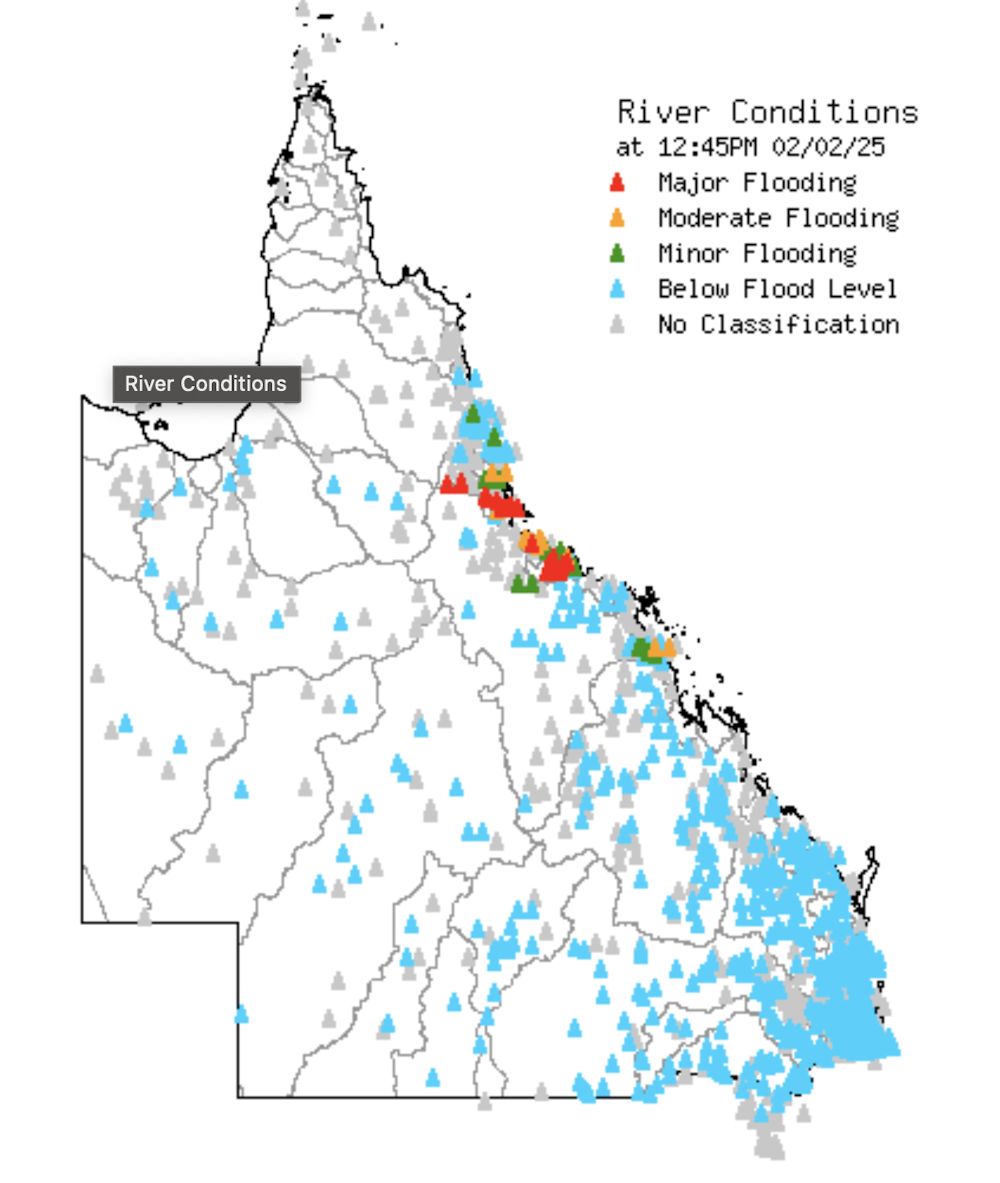
Record-breaking floods across north Queensland have now turned deadly, with one woman drowning while being rescued on Sunday morning. And the floodwaters are still rising, with rain set to continue.
Over the 48 hours to Sunday, there were reports of up to 1 metre of rainfall in parts of northeast Queensland. The torrential rain continues, particularly in the Herbert Coast region and north to around Tully.
Major flooding in northern Queensland rivers, as of 12.45pm February 2. Bureau of Meteorology
Residents of Ingham and nearby towns, about 100km from Townsville, are witnessing flooding from the nearby Herbert River. This morning, it was at 15 metres and rising. With more heavy rain forecast for the next 24 hours, the Herbert River is likely to break the 1967 record of 15.2 metres later today.
Queensland Premier David Crisafulli – who grew up on his family’s sugar cane farm in Ingham – has said the floods will be a “once in a century” event for the town. To make matters worse, authorities say the town has lost power and an extended outage is likely.
The atmospheric factors behind these floods are very similar to recent floods in the region – and climate change is no doubt playing a role.
The flood level for the Herbert River at Ingham set in 1967 was 15.2 metres. It’s likely to be breached this afternoon (Sunday February 2). Australian Bureau of Meteorology, CC BY
Where are the floods hitting?
For many people in Townsville – the largest city in Northern Australia – the unfolding emergency will bring back memories of the devastating February 2019 floods, which caused A$1.24 billion in damage. Residents have been asked to evacuate from several low-lying suburbs which were inundated in 2019.
Authorities in Townsville asked all residents in the low-lying black zone to evacuate by midday Sunday February 2. Floodwaters could reach second-storey heights in this zone. Residents in pink suburbs have been asked to be on standby. Townsville Council, CC BY
It is too early to say if this flood event will be worse. Fortunately, water levels in the city’s Ross River Dam are much lower than 2019. Townsville Airport has recorded 545mm of rain over the past 48 hours, with many northwest suburbs recording much higher levels. The township of Rollingstone – 60km northwest of Townsville – recorded a whopping 702mm over the 24 hours to 9am Sunday.
Further north in the Cairns to Daintree region, residents are watching with concern, with many still raw after the record-breaking floods of December 2023.
What triggered each of these floods was prolonged heavy rain falling on the southeast flank of a stationary tropical low weather system. Normally, tropical lows bring wind and rain, but move through quite quickly. But in recent years, we have seen a tendency for these systems to stall, sitting in place over or near land and dumping huge volumes of rain.
Last week, the Bureau of Meteorology warned that five tropical lows were forming around northern Australia. Most tropical cyclones form from tropical lows embedded in the region’s monsoon trough, a large low pressure band which forms over summer and draws in warm, moist air from the adjacent tropical seas.
But significant rain events like this one don’t necessarily require a tropical cyclone. Slow-moving deep monsoon lows over land can also deliver huge amounts of rain and widespread flooding.
These atmospheric conditions allow intense rain bands to form between converging winds: warm, moist winds from the northeast and southeast winds originating from the Coral Sea. As the winds collide, they push the moist air up into the cooler parts of the atmosphere where it condenses and falls as torrential rain.
More extreme rainfall and higher frequencies of flooded rivers and flash floods around the world have a clear link to climate change and ongoing global heating.
The main drivers behind these events include warming of the atmosphere. For every 1°C of warming, the atmosphere holds 7% more water vapour. Recent research suggests this figure could be even higher for short duration rainfall.
Hotter oceans hold more energy, meaning they can also amplify the global water cycle when atmospheric conditions are suitable.
This year’s latest ever monsoon
This year, sea surface temperatures in the northwest Coral Sea are 1-2°C above average. Ocean temperatures have risen because of a lack of cloud cover and rain last month. In northwestern Australia, this has given rise to an intensifying marine heatwave.
This ocean heat is likely to be driven by the Australian monsoon’s latest ever arrival. The monsoon brings heavy rains to northern Australia, triggering the wet season. When it arrives, sea surface temperatures generally drop due to a combination of high cloud cover and the cooling effect of rainwater.
After a slow start, the North Australian monsoon season is now in full swing.
The Bureau of Meteorology is monitoring an active monsoon trough for any low pressure systems, which may develop into tropical cyclones over the next week or so. If any cyclone does form, it will gain energy from warmer than usual sea surface temperatures.
What’s next for north Queensland?
The flood emergency in north Queensland is far from over. All global circulation models predict heavy rain to continue in the region, extending up towards Cape York and the Gulf Country as an active monsoon surge moves in from Indonesia.
As river catchments get saturated, more and more water will run off and engorge rivers. Forecasts are for rain to continue well into tonight and the next few days. We are likely to see more flooding in more places this week.
A flooded street in TownsvilleJohn Wilkinson/Facebook
Record-breaking floods across north Queensland have now turned deadly, with one woman drowning while being rescued on Sunday morning. And the floodwaters are still rising, with rain set to continue.
Over the 48 hours to Sunday, there were reports of up to 1 metre of rainfall in parts of northeast Queensland. The torrential rain continues, particularly in the Herbert Coast region and north to around Tully.
Major flooding in northern Queensland rivers, as of 12.45pm February 2. Bureau of Meteorology
Residents of Ingham and nearby towns, about 100km from Townsville, are witnessing flooding from the nearby Herbert River. This morning, it was at 15 metres and rising. With more heavy rain forecast for the next 24 hours, the Herbert River is likely to break the 1967 record of 15.2 metres later today.
Queensland Premier David Crisafulli – who grew up on his family’s sugar cane farm in Ingham – has said the floods will be a “once in a century” event for the town. To make matters worse, authorities say the town has lost power and an extended outage is likely.
The atmospheric factors behind these floods are very similar to recent floods in the region – and climate change is no doubt playing a role.
The flood level for the Herbert River at Ingham set in 1967 was 15.2 metres. It’s likely to be breached this afternoon (Sunday February 2). Australian Bureau of Meteorology, CC BY
Where are the floods hitting?
For many people in Townsville – the largest city in Northern Australia – the unfolding emergency will bring back memories of the devastating February 2019 floods, which caused A$1.24 billion in damage. Residents have been asked to evacuate from several low-lying suburbs which were inundated in 2019.
Authorities in Townsville asked all residents in the low-lying black zone to evacuate by midday Sunday February 2. Floodwaters could reach second-storey heights in this zone. Residents in pink suburbs have been asked to be on standby. Townsville Council, CC BY
It is too early to say if this flood event will be worse. Fortunately, water levels in the city’s Ross River Dam are much lower than 2019. Townsville Airport has recorded 545mm of rain over the past 48 hours, with many northwest suburbs recording much higher levels. The township of Rollingstone – 60km northwest of Townsville – recorded a whopping 702mm over the 24 hours to 9am Sunday.
Further north in the Cairns to Daintree region, residents are watching with concern, with many still raw after the record-breaking floods of December 2023.
What triggered each of these floods was prolonged heavy rain falling on the southeast flank of a stationary tropical low weather system. Normally, tropical lows bring wind and rain, but move through quite quickly. But in recent years, we have seen a tendency for these systems to stall, sitting in place over or near land and dumping huge volumes of rain.
Last week, the Bureau of Meteorology warned that five tropical lows were forming around northern Australia. Most tropical cyclones form from tropical lows embedded in the region’s monsoon trough, a large low pressure band which forms over summer and draws in warm, moist air from the adjacent tropical seas.
But significant rain events like this one don’t necessarily require a tropical cyclone. Slow-moving deep monsoon lows over land can also deliver huge amounts of rain and widespread flooding.
These atmospheric conditions allow intense rain bands to form between converging winds: warm, moist winds from the northeast and southeast winds originating from the Coral Sea. As the winds collide, they push the moist air up into the cooler parts of the atmosphere where it condenses and falls as torrential rain.
More extreme rainfall and higher frequencies of flooded rivers and flash floods around the world have a clear link to climate change and ongoing global heating.
The main drivers behind these events include warming of the atmosphere. For every 1°C of warming, the atmosphere holds 7% more water vapour. Recent research suggests this figure could be even higher for short duration rainfall.
Hotter oceans hold more energy, meaning they can also amplify the global water cycle when atmospheric conditions are suitable.
This year’s latest ever monsoon
This year, sea surface temperatures in the northwest Coral Sea are 1-2°C above average. Ocean temperatures have risen because of a lack of cloud cover and rain last month. In northwestern Australia, this has given rise to an intensifying marine heatwave.
This ocean heat is likely to be driven by the Australian monsoon’s latest ever arrival. The monsoon brings heavy rains to northern Australia, triggering the wet season. When it arrives, sea surface temperatures generally drop due to a combination of high cloud cover and the cooling effect of rainwater.
After a slow start, the North Australian monsoon season is now in full swing.
The Bureau of Meteorology is monitoring an active monsoon trough for any low pressure systems, which may develop into tropical cyclones over the next week or so. If any cyclone does form, it will gain energy from warmer than usual sea surface temperatures.
What’s next for north Queensland?
The flood emergency in north Queensland is far from over. All global circulation models predict heavy rain to continue in the region, extending up towards Cape York and the Gulf Country as an active monsoon surge moves in from Indonesia.
As river catchments get saturated, more and more water will run off and engorge rivers. Forecasts are for rain to continue well into tonight and the next few days. We are likely to see more flooding in more places this week.
A flooded street in TownsvilleJohn Wilkinson/Facebook
Record-breaking floods across north Queensland have now turned deadly, with one woman drowning while being rescued on Sunday morning. And the floodwaters are still rising, with rain set to continue.
Over the 48 hours to Sunday, there were reports of up to 1 metre of rainfall in parts of northeast Queensland. The torrential rain continues, particularly in the Herbert Coast region and north to around Tully.
Major flooding in northern Queensland rivers, as of 12.45pm February 2. Bureau of Meteorology
Residents of Ingham and nearby towns, about 100km from Townsville, are witnessing flooding from the nearby Herbert River. This morning, it was at 15 metres and rising. With more heavy rain forecast for the next 24 hours, the Herbert River is likely to break the 1967 record of 15.2 metres later today.
Queensland Premier David Crisafulli – who grew up on his family’s sugar cane farm in Ingham – has said the floods will be a “once in a century” event for the town. To make matters worse, authorities say the town has lost power and an extended outage is likely.
The atmospheric factors behind these floods are very similar to recent floods in the region – and climate change is no doubt playing a role.
The flood level for the Herbert River at Ingham set in 1967 was 15.2 metres. It’s likely to be breached this afternoon (Sunday February 2). Australian Bureau of Meteorology, CC BY
Where are the floods hitting?
For many people in Townsville – the largest city in Northern Australia – the unfolding emergency will bring back memories of the devastating February 2019 floods, which caused A$1.24 billion in damage. Residents have been asked to evacuate from several low-lying suburbs which were inundated in 2019.
Authorities in Townsville asked all residents in the low-lying black zone to evacuate by midday Sunday February 2. Floodwaters could reach second-storey heights in this zone. Residents in pink suburbs have been asked to be on standby. Townsville Council, CC BY
It is too early to say if this flood event will be worse. Fortunately, water levels in the city’s Ross River Dam are much lower than 2019. Townsville Airport has recorded 545mm of rain over the past 48 hours, with many northwest suburbs recording much higher levels. The township of Rollingstone – 60km northwest of Townsville – recorded a whopping 702mm over the 24 hours to 9am Sunday.
Further north in the Cairns to Daintree region, residents are watching with concern, with many still raw after the record-breaking floods of December 2023.
What triggered each of these floods was prolonged heavy rain falling on the southeast flank of a stationary tropical low weather system. Normally, tropical lows bring wind and rain, but move through quite quickly. But in recent years, we have seen a tendency for these systems to stall, sitting in place over or near land and dumping huge volumes of rain.
Last week, the Bureau of Meteorology warned that five tropical lows were forming around northern Australia. Most tropical cyclones form from tropical lows embedded in the region’s monsoon trough, a large low pressure band which forms over summer and draws in warm, moist air from the adjacent tropical seas.
But significant rain events like this one don’t necessarily require a tropical cyclone. Slow-moving deep monsoon lows over land can also deliver huge amounts of rain and widespread flooding.
These atmospheric conditions allow intense rain bands to form between converging winds: warm, moist winds from the northeast and southeast winds originating from the Coral Sea. As the winds collide, they push the moist air up into the cooler parts of the atmosphere where it condenses and falls as torrential rain.
More extreme rainfall and higher frequencies of flooded rivers and flash floods around the world have a clear link to climate change and ongoing global heating.
The main drivers behind these events include warming of the atmosphere. For every 1°C of warming, the atmosphere holds 7% more water vapour. Recent research suggests this figure could be even higher for short duration rainfall.
Hotter oceans hold more energy, meaning they can also amplify the global water cycle when atmospheric conditions are suitable.
This year’s latest ever monsoon
This year, sea surface temperatures in the northwest Coral Sea are 1-2°C above average. Ocean temperatures have risen because of a lack of cloud cover and rain last month. In northwestern Australia, this has given rise to an intensifying marine heatwave.
This ocean heat is likely to be driven by the Australian monsoon’s latest ever arrival. The monsoon brings heavy rains to northern Australia, triggering the wet season. When it arrives, sea surface temperatures generally drop due to a combination of high cloud cover and the cooling effect of rainwater.
After a slow start, the North Australian monsoon season is now in full swing.
The Bureau of Meteorology is monitoring an active monsoon trough for any low pressure systems, which may develop into tropical cyclones over the next week or so. If any cyclone does form, it will gain energy from warmer than usual sea surface temperatures.
What’s next for north Queensland?
The flood emergency in north Queensland is far from over. All global circulation models predict heavy rain to continue in the region, extending up towards Cape York and the Gulf Country as an active monsoon surge moves in from Indonesia.
As river catchments get saturated, more and more water will run off and engorge rivers. Forecasts are for rain to continue well into tonight and the next few days. We are likely to see more flooding in more places this week.
The Indonesian government’s proposal to grant amnesty to pro-independence rebels in West Papua has stirred scepticism as the administration of new President Prabowo Subianto seeks to deal with the country’s most protracted armed conflict.
Without broader dialogue and accountability, critics argue, the initiative could fail to resolve the decades-long unrest in the resource-rich region.
Yusril Ihza Mahendra, coordinating Minister for Law, Human Rights, Immigration and Corrections, announced the amnesty proposal last week.
On January 21, he met with a British government delegation and discussed human rights issues and the West Papua conflict.
“Essentially, President Prabowo has agreed to grant amnesty . . . to those involved in the Papua conflict,” Yusril told reporters last week.
On Thursday, he told BenarNews that the proposal was being studied and reviewed.
“It should be viewed within a broader perspective as part of efforts to resolve the conflict in Papua by prioritising law and human rights,” Yusril said.
‘Willing to die for this cause’ Sebby Sambom, a spokesman for the West Papua National Liberation Army (TPNPB) rebels, dismissed the proposal as insufficient.
“The issue isn’t about granting amnesty and expecting the conflict to end,” Sambom told BenarNews. “Those fighting in the forests have chosen to abandon normal lives to fight for Papua’s independence.
“They are willing to die for this cause.”
Despite the government offer, those still engaged in guerrilla warfare would not stop, Sambon said.
Papua, Indonesia’s easternmost region that makes up the western half of New Guinea island, has been a flashpoint of tension since its controversial incorporation into the archipelago nation in 1969.
Papua, referred to as “West Papua” by Pacific academics and advocates, is home to a distinct Melanesian culture and vast natural resources and has seen a low-level indpendence insurgency in the years since.
The Indonesian government has consistently rejected calls for Papua’s independence. The region is home to the Grasberg mine, one of the world’s largest gold and copper reserves, and its forests are a critical part of Indonesia’s climate commitments.
Papua among poorest regions Even with its abundant resources, Papua remains one of Indonesia’s poorest regions with high rates of poverty, illiteracy and infant mortality.
Critics argue that Jakarta’s heavy-handed approach, including the deployment of thousands of troops, has only deepened resentment.
President Prabowo Subianto . . . “agreed to grant amnesty . . . to those involved in the Papua conflict.” Image: Kompas
Yusril, the minister, said the new proposal was separate from a plan announced in November 2024 to grant amnesty to 44,000 convicts, and noted that the amnesty would be granted only to those who pledged loyalty to the Indonesian state.
He added that the government was finalising the details of the amnesty scheme, which would require approval from the House of Representatives (DPR).
Prabowo’s amnesty proposal follows a similar, albeit smaller, move by his predecessor, Joko “Jokowi” Widodo, who granted clemency to several Papuan political prisoners in 2015.
While Jokowi’s gesture was initially seen as a step toward reconciliation, it did little to quell violence. Armed clashes between Indonesian security forces and pro-independence fighters have intensified in recent years, with civilians often caught in the crossfire.
Cahyo Pamungkas, a Papua researcher at the National Research and Innovation Agency (BRIN), argued that amnesty, without prior dialogue and mutual agreements, would be ineffective.
“In almost every country, amnesty is given to resistance groups or government opposition groups only after a peace agreement is reached to end armed conflict,” he told BenarNews.
No unilateral declaration Yan Warinussy, a human rights lawyer in Papua, agreed.
“Amnesty, abolition or clemency should not be declared unilaterally by one side without a multi-party understanding from the start,” he told BenarNews.
Warinussy warned that without such an approach, the prospect of a Papua peace dialogue could remain an unfulfilled promise and the conflict could escalate.
Usman Hamid, director of Amnesty International Indonesia, said that while amnesty was a constitutional legal instrument, it should not apply to those who have committed serious human rights violations.
“The government must ensure that perpetrators of gross human rights violations in Papua and elsewhere are prosecuted through fair and transparent legal mechanisms,” he said.
Papuans Behind Bars, a website tracking political prisoners in Papua, reported 531 political arrests in 2023, with 96 political prisoners still detained by the end of the year.
Only 11 linked to armed struggle Most were affiliated with non-armed groups such as the West Papua National Committee (KNPB) and the Papua People’s Petition (PRP), while only 11 were linked to the armed West Papua National Liberation Army (TPNPB).
The website did not list 2024 figures.
Anum Siregar, a lawyer who has represented Papuan political prisoners, said that the amnesty proposal has sparked interest.
“Some of those detained outside Papua are requesting to be transferred to prisons in Papua,” she said.
Meanwhile, Agus Kossay, leader of the National Committee for West Papua, which campaigns for a referendum on self-determination, said Papuans would not compromise on “their God-given right to determine their own destiny”.
In September 2019, Kossay was arrested for orchestrating a riot and was sentenced to 11 months in jail. More recently, in 2023, he was arrested in connection with an internal dispute within the KNPB and was released in September 2024 after serving a sentence for incitement.
“The right to self-determination is non-negotiable and cannot be challenged by anyone. As long as it remains unfulfilled, we will continue to speak out,” Kossay told BenarNews.
Victor Mambor and Tria Dianti are BenarNews correspondents. Republished with permission.
Why has any discussion about Israel, its violations of international law, and the international legal expectations for third party states to hold IDF soldiers accountable not been addressed in Aotearoa New Zealand?
ANALYSIS:By Katrina Mitchell-Kouttab
Palestine Solidarity Network Aotearoa national chair John Minto’s campaign to identify Israeli Defence Force (IDF) soldiers in New Zealand and then call a PSNA number hotline has come under intense criticism from the likes of Winston Peters, Stephen Rainbow, the Jewish Council and NZ media outlets. Accusations of antisemitism have been made.
Despite making it clear that holding IDF soldiers accountable for potential war crimes is his goal, not banning all Israelis or targeting Jewish people, there are many just concerns regarding Minto’s campaign. He is clear that his focus remains on justice, not on creating divisions or fostering discrimination, but he has failed to provide strict criteria to distinguish between individuals directly involved in human rights violations and those who are innocent, or to ground the campaign in legal frameworks and due process.
Any allegations of participation in war crimes should be submitted through proper legal channels, not through the PSNA. Broader advocacy could have been used to address concerns of accountability and to minimise any risk that the campaign could lead to profiling based on religion, ethnicity, or language.
While there are many concerns that need to be addressed with PSNA’s campaign, why has the conversation stopped there? Why has the core issue of this campaign been ignored? Namely, that IDF soldiers who have committed war crimes in Gaza have been allowed into New Zealand?
PSNA’s controversial Gaza “genocide hotline” . . . why has the conversation stopped there? Why has the core issue about war crimes been ignored? Image: PSNA screenshot APR
Why has any discussion about Israel, its violations of international law, and the international legal expectations for third party states to hold IDF soldiers accountable not been addressed? Why is criticism of Israel being conflated with racism, even though many Jewish people oppose Israel’s war crimes, and what about Palestinians, what does this mean for a people experiencing genocide?
Concerns should be discussed but they must not be used to protect possible war criminals and shield Israel’s crimes.
It is true that PSNA’s campaign may possibly target individuals, including targeting individuals solely based on their nationality, religion, or language. This is not acceptable. But it has also uncovered the exceptionally biased, racist, and unjust views towards Palestinians.
Racism against Palestinians ignored Palestinians have been dehumanised by Israel for decades, but real racism against Palestinians is being ignored. As a Christian Palestinian I know all too well what it is like to be targeted.
In fact, it was only recently at a New Zealand First State of the Nation gathering last year that Winston Peter’s followers called me a terrorist for being Palestinian and told me that all Muslims were Hamas lovers and were criminals.
The question that has been ignored in this very public debate is simple: are Israeli soldiers who have participated in war crimes in Aotearoa, if so, why, and what does this mean for the New Zealand Palestinian population and the upholding of international law?
By refusing to address concerns of IDF soldiers the focus is deliberately shifted away from the actual genocide happening in Gaza. If IDF soldiers have engaged in rape, extrajudicial executions, torture, destruction of homes, or killing of civilians, they should be investigated and held accountable.
Countries have a legal and moral duty to prevent war criminals from using their nations as safe havens.
Since 1948, Palestinians have been subjected to systematic oppression, apartheid, ethnic cleansing, violence and now, genocide. From its creation and currently with Israel’s illegal occupation, Palestinian massacres have been frequent and unrelenting.
This includes the execution of my great grandmother on the steps of our Katamon home in Jerusalem. Land has been stolen from Palestinians over the decades, including well over 42 percent of the West Bank. Palestinians have been denied the right to return to their country, the right to justice, accountability, and self-determination.
Living under illegal military law We are still forced to live under illegal military law, face mass arrests and torture, and our history, identity, culture and heritage are targeted.
Almost 10 children lose one or both of their legs every day in Gaza according to the UN agency for Palestinian refugees (UNWRA). 2.2 million people are starving because Israel refuses them access to food. 95 percent of Gaza’s population have been forced onto the streets, with only 25 percent of Gaza’s shelters needs being met, according to the Norwegian Refugee Council.
One out of 20 people in Gaza have been injured and 18,000 children have been murdered. 6500 Palestinians from the Gaza Strip were taken hostage by Israel who also stole 2300 bodies from numerous cemeteries. 87,000 tons of explosives have been dropped on all regions in the Gaza Strip.
Dr Ghassan Abu-Sittah, a British Palestinian reconstructive surgeon who worked in Al Shifa and Al Ahly Baptist hospital and who is part of Medicine Sans Frontiers, estimates as many as 300,000 Palestinian civilians, most of them children, have been murdered by Israel.
This is because official numbers do not include those bodies that cannot be recognised or are blown to a pulp, those buried under the rubble and those expected to die and have died of disease, starvation and lack of medicine — denied by Israel to those with chronic illnesses.
‘A Genocidal Project’: real death toll closer to 300,000. Video: Democracy Now!
As a signatory to the Geneva Convention, the Rome Statute of the International Criminal Court (ICC), and UN resolutions, New Zealand is expected to investigate, prosecute and deport any individual accused of these serious crimes. This government has an obligation to deny entry to any individual suspected of war crimes, crimes against humanity or genocide.
IDF has turned war crimes into entertainment Israel has violated all of these, its IDF soldiers filming themselves committing such atrocities and de-humanising Palestinians over the last 15 months on social media.
IDF soldiers have posted TikTok videos mocking their Palestinian victims, celebrating destruction, and making jokes about killing civilians, displaying a disturbing level of dehumanisation and cruelty. They have filmed themselves looting Palestinian homes, vandalising property, humiliating detainees, and posing with dead bodies.
They have turned war crimes into entertainment while Palestinian families suffer and mourn. Israel has deliberately targeted civilians, bombing schools, hospitals, refugee camps, and even designated safe zones, then lied about their operations, showing complete disregard for human life.
Israel and the IDF’s global reputation among ordinary people are not positive. Out on the streets over 15 months, millions have been demonstrating against Israel. They do not like what its army has done, and rightly so. Many want to see justice and Israel and its army held accountable, something this government has ignored.
Israel’s state forced conscription or imprisonment, enforced military service that contributes to the occupation, ethnic cleansing, systematic oppression of a people, war crimes and genocide is fascism on display. Israel is a totalitarian, apartheid, military state, but this government sees no problems with that.
The UN and human rights organisations like Amnesty International and Human Rights Watch have repeatedly condemned Israeli military operations, including the indiscriminate killing of civilians, the use of white phosphorus, and sexual violence by Israeli forces.
While not all IDF soldiers may have committed direct atrocities, those serving in occupied Palestinian territories are complicit in enforcing illegal occupation, which itself is a violation of international law.
Following orders not an excuse The precedent set by international tribunals, such as Nuremberg, establishes that following orders is not an excuse for war crimes — meaning IDF soldiers who have participated in military actions in occupied areas should be subject to scrutiny.
This government has a duty to protect Palestinian communities from further harm, this includes preventing known perpetrators of ethnic cleansing from entering New Zealand. The presence of IDF soldiers in New Zealand is a direct threat to the safety, dignity, and well-being of our communities.
Many Palestinian New Zealanders have lost family members, homes, and entire communities due to the IDF’s actions. Seeing known war criminals walking freely in New Zealand re-traumatises those who have suffered from Israel’s illegal military brutality.
Survivors of ethnic cleansing should not have to live in fear of encountering the very people responsible for their suffering. This was not acceptable after the Second World War, throughout modern history, and is not acceptable now.
IDF soldiers are also trained in brutal tactics, including arbitrary arrests, sexual violence, and the assassination of Palestinian civilians. The presence of war criminals in any society creates a climate of fear and intimidation.
Given their history, there is a concern within New Zealand that these soldiers will engage in racist abuse, Islamophobia, or Zionist hate crimes not only against Palestinians and Arabs, but other communities of colour.
New Zealand society should be scrutinising not just this government’s response to the genocide against Palestinians, but also our political parties.
Moral bankruptcy and xenophobia This moral bankruptcy and neutral stance in the face of genocide and racism has been clearly demonstrated this week in Parliament with both Shane Jones and Peter’s xenophobic remarks, and responses to the PSNA’s campaign.
Winston Peter’s tepid response to Israel’s behaviour and its violations is a staggering display of double standards and hypocrisy. Racism it seems, is clearly selective.
His comments about Mexicans in Parliament this week were xenophobic and violate the principles of responsible governance by promoting discrimination. Peters’ comments that immigrants should be grateful creates a hierarchy of worthiness.
Similarly, Shane Jones calling for Mexicans to go home does not uphold diplomatic and professional standards, reinforces harmful racial stereotypes and discriminates based on one’s nationality. Mexicans, Māori, and Palestinians are not on equal standing as others when it comes to human rights.
Why is there a defence of foreign soldiers who may have participated in genocide or war crimes in the occupied Palestinian territories, but then migrants and refugees are attacked?
“John Minto’s call to identify people from Israel . . . is an outrageous show of fascism, racism, and encouragement of violence and vigilantism. New Zealand should never accept this kind of extreme totalitarian behaviour in our country”. Why has Winston Peter’s never condemned the actual racism Palestinians are facing — including ethnic cleansing, forced displacement, and apartheid?
Why has he never used such strong language and outrage to condemn Israel’s actions despite evidence of violations of international law? Instead, he directs outrage at a human rights activist who is pointing out the shortcomings of the government’s response to Israels violations.
IDF soldiers’ documented atrocities ignored Peters has completely ignored IDF soldiers’ documented atrocities and distorted the campaign’s purpose for legal accountability to that of violence.
There has been no mention of Palestinian suffering associated with the IDF and Israel, nor has the government been transparent in admitting that there are no security measures in place when it comes to Israel.
For Peters, killing Palestinians in their thousands is not racist but an activist wanting to prevent war criminals from entering New Zealand is?
Recently, Simon Court of the ACT party in response to Minto wrote: “Undisguised antisemitic behaviour is not acceptable . . . military service is compulsory for Israeli citizens . . . any Israeli holidaying, visiting family or doing business in New Zealand could be targeted . . . it is intimidation towards Jewish visitors . . . and should be condemned by parties across Parliament.”
This comment is misleading, and hypocritical.
PSNA’s campaign is not targeting Jewish people, something the Jewish Council has also misrepresented. It is about identifying Israeli soldiers who have actively participated in human rights violations and war crimes in the occupied Palestinian territories.
It intentionally blurs the lines between Israeli soldiers and Jewish civilians, as the lines between Palestinian civilians and Hamas have been blurred.
Erases distinction between civilians and a militant group Even MFAT cannot use the word “Palestinian” but identifies us all as “Hamas” on its website. This erases the distinction between civilians and a militant group, and conflates Israeli military personnel with Jewish civilians, which is both deceptive and dangerous.
The MFAT website states the genocide in Gaza is an “Israel-Hamas” conflict, denying the intentional targeting of Palestinian civilians and erasing our humanity.
Israel’s assault has purposely killed thousands of children, women and men, all innocent civilians. Israel has not provided any evidence of any of its claims that it is targeting “Hamas” and has even been caught out lying about the “mass rapes and burned babies”, the tunnels under the hospitals and militants hiding behind Palestinian toddlers and whole generations of families.
Despite this, MFAT had not condemned Israeli war crimes. This is not a just war. It is a genocide against Palestinians which is also being perpetrated in the West Bank. There is no Hamas in the West Bank.
The ACT Party has been silent or outright supportive of Israel’s atrocities in Gaza and the West Bank, despite overwhelming evidence of war crimes. If they were truly concerned about targeting individuals as they are with Minto’s campaign, then they would have called for an end to Israel’s assaults against Palestinians, sanctioned Israel for its war crimes, and called for investigations into Israeli soldiers for mass killings, sexual violence and starving the Palestinian people.
What is clear from Court and Seymour (who has also openly supported Israel alongside members of the Zionist Federation), is that Palestinian lives are irrelevant, we should silently accept our genocide, and that we do not deserve justice. That Israeli IDF soldiers should be given impunity and should be able to spend time in New Zealand with no consequences for their crimes.
This is simply xenophobic, dangerous and “not acceptable in a liberal democracy like New Zealand”.
New Zealand cartoonist Malcolm Evans with two of his anti-Zionism placards at yesterday’s “march for the martyrs” in Auckland . . . politicians’ silence on Israel’s war crimes and violations of international law fails to comply with legal norms and expectations. Image: Asia Pacific Report
Erased the voice of Jewish critics ACT, alongside Peters, Prime Minister Christopher Luxon, Labour leader Chris Hipkins, and the Jewish council have erased the voice of Jewish people who oppose Israel and its crimes and who do not associate being Jewish with being Israeli.
There is a clear distinction, something Alternative Jewish Voices, Jewish Voices for Peace, Holocaust survivors and Dayenu have clearly reiterated. Equating Zionism with Judaism, and identifying Israeli military actions with Jewish identity, is dangerously antisemitic.
By failing to distinguish Judaism from Zionism, politicians and the Jewish Council are in danger of fuelling the false narrative that all Jewish people support Israel’s actions, which ultimately harms Jewish communities by increasing resentment and misunderstanding.
Antisemitism should never be weaponised or used to silence criticism of Israel or justify Israel’s impunity. This is harmful to both Palestinians and Jews.
Seymour’s upcoming tenure as deputy prime minister should also be questioned due to his unwavering support and active defence of a regime committing mass atrocities. This directly contradicts New Zealand’s values of justice and accountability demonstrating a complete disregard for human rights and international law.
His silence on Israel’s war crimes and violations of international law fails to comply with legal norms and expectations. He has positioned himself away from representing all New Zealanders.
While we focus on Minto, let’s be fair and ensure Palestinians are also being protected from discrimination and targeting in New Zealand. Are the Zionist Federation, the New Zealand Jewish Council, and the Holocaust Centre supporting Israel economically or culturally, aiding and abetting its illegal occupation, and do they support the genocide?
Canada investigated funds linked to illegal settlements Canada recently investigated the Jewish National Fund (JNF) of Canada for potentially violating charitable tax laws by funding projects linked to Israeli settlements in the occupied Palestinian territories, which are illegal under international law.
In August 2024, the Canada Revenue Agency (CRA) revoked the Jewish National Fund of Canada’s (JNF Canada) charitable status after a comprehensive audit revealed significant non-compliance with Canadian tax laws.
On the 31 January 2025, Haaretz reported that Israel had recruited the Jewish National Fund to illegally secretly buy Palestinian land in the Occupied Palestinian Territories. What does that mean for the New Zealand branch of the Jewish National Fund?
None of these organisations should be funnelling resources to illegal settlements or supporting Israel’s war machine. A full investigation into their financial and political activities is necessary to ensure any money coming from New Zealand is not supporting genocide, land theft or apartheid.
The government has already investigated Palestinians sending money to relatives in Gaza, the same needs to be done to organisations supporting Israel. Are any of these groups supporting war crimes under the guise of charity?
While Jewish communities and Palestinians have rallied together and supported each other these last 15 months, we have received no support from the Jewish Council or the Holocaust Centre, who have remained silent or have supported Israel’s actions. Dayenu, and Alternative Jewish voices have vocally opposed Israel’s genocide in Gaza and reached out to us. As Jews dedicated to human rights, justice, and the prevention of genocide because of their own history, they unequivocally condemn Israel’s actions.
Given the Holocaust, you would expect the Holocaust Centre and the Jewish Council to oppose any acts of violence, especially that on such an industrial scale. You would expect them to oppose apartheid, ethnic cleansing, and the dehumanisation of Palestinians as the other Jewish organisations are doing.
Genocide, war crimes must not be normalised War crimes and genocide must never be normalised. Israel must not be shielded and the suffering and dehumanisation of Palestinians supported.
We must ensure that all New Zealanders, whether Jewish, Israeli or Palestinian are not targeted, and are protected from discrimination, racism, violence and dehumanisation. All organisations are subject to scrutiny, but only some have been.
Instead of just focusing on John Minto, the ACT Party, NZ First, National, and Labour should be answering why Israeli soldiers who may have committed atrocities, are allowed into New Zealand in the first place.
Israel and its war criminals should not be treated any differently to any other country.
We must shift the focus back to Israel’s genocide, apartheid, and impunity, while exposing the hypocrisy of those who defend Israel but attack Palestinian solidarity.
UN Special Rapporteur to the Occupied Palestinian Territory Francesca Albanese has hailed the formation of The Hague Group, describing it as the “best news” from a coalition of policymakers “in a long time”.
Formed on Friday in the city of its namesake, The Hague Group’s members — Belize, Bolivia, Colombia, Cuba, Honduras, Malaysia, Namibia, Senegal and South Africa — have joined together to “end Israeli occupation of the State of Palestine”.
The groups said in a joint statement that they could not “remain passive in the face of such international crimes” committed by Israel against the Palestinians.
They said they would work to see the “realisation of the inalienable right of the Palestinian people to self-determination, including the right to their independent State of Palestine”.
Albanese said on social media: “Let’s make it real. And let’s keep growing.”
“The Hague Group’s formation sends a clear message — no nation is above the law, and no crime will go unanswered,” said the South African Minister of International Relations and Cooperation Ronald Lamola.
South Africa filed a case before the International Court of Justice alleging genocide in 2023 and an interim ruling in January 2024 said that there was “plausible genocide” and accepted the case for substantive judgment. Since then, 14 countries have joined the proceedings in support of South Africa and Palestine.
Joyful scenes erupted today as buses carrying Palestinian prisoners released under last month’s Gaza ceasefire deal arrived in Ramallah, in the occupied West Bank. A total of 183 prisoners were due to be freed today.
Three captives — Keith Siegel, Ofer Kalderon and Yarden Bibas– were earlier released in two separate locations in southern and northern Gaza.
Samoan artist Michel Mulipola with his characteristic clutch of protest flags at the “march of the martyrs” in Auckland today . . . latest addition is the flag of the Democratic Republic of Congo to acknowledge a brutal war being waged by M23 rebels. Image: David Robie/APR
NZ ‘march of the martyrs’ protest In New Zealand’s largest city Auckland Tāmaki Makaurau today, hundreds of pro-Palestinian protesters staged a vigil and march for the more than 47,000 Palestinians killed in Israel’s war on Gaza — mostly women and children.
Hamas released three more hostages from Gaza today – a total of 14 since the ceasefire. Image: Al Jazeera screenshot APR
More than 44,500 names of the victims of the genocidal war were spread out on the pavement of Te Komititanga Square in the heart of Auckland and one of the organisers, Dr Abdallah Gouda, said: “It is important to honour the names, they are people, families — they are not just numbers, statistics.”
A canvas with an outline of Palestine flag was also spread out and protesters invited to dip their fingers in black, red and green paint — the colours of the Palestinian flag — and daub the ensign with their collective fingerprints.
This was part of a global campaign to “stamp my imprint” for the return to Palestine.
“Each mark represents solidarity and remembrance for those who have lost their lives in the struggle for justice,” said the campaign.
“As you add your fingerprint, please take a moment to reflect on their sacrifice and the collective desire for peace and freedom.
“This canvas will become a living tribute with each fingerprint contributing to a powerful symbol of unity and support.”
Today’s Palestinian and decolonisation “march of the martyrs” in Auckland. Image: David Robie/APR
The protesters followed with a “march for the martyrs” through central streets of Auckland past the consulate of the United States, main backer and arms supplier to Israel, and beside the city’s iconic harbourside.
A young girl keeps vigil over more than 44,000 names from the 47,000 people killed in Israel’s war on Gaza at today’s pro-Palestinian demonstration in Auckland today. Image: David Robie/APR
UNRWA chief “salutes’ aid staff defying Israeli ban Meanwhile, Al Jazeera reports that the head of the UN’s agency for Palestinian refugees (UNRWA) has hailed staff for continuing to work despite an Israeli ban on their operations coming into force on Thursday.
In a post on social media, Philippe Lazzarini said: “I salute the commitment of UNRWA staff”.
“We remain committed to upholding the humanitarian principles and fulfil our mandate,” Lazzarini said.
He noted that nearly 500,000 Palestinians in the occupied West Bank, including occupied East Jerusalem, continued to access healthcare provided by UNRWA.
Since the start of the ceasefire in Gaza, UNRWA has ensured that humanitarian food supplies entering the territory under bombardment have reached more than 600,000 people, he said.
“UNRWA must be allowed to do its work until Palestinian institutions are empowered and capable within a Palestine State,” he added.
Israel passed a law in October that came into effect this week, banning UNRWA from operating on Israeli territory — including in East Jerusalem where its headquarters is located — and prohibiting contact with Israeli authorities.
However, Israel is occupying the Palestinian territories illegally in defiance of many UN resolutions ordering it to leave.
UNRWA has said that it is mandated by the UN General Assembly and is committed to staying open and delivering services to Palestinians despite Israel’s prohibitions.
Israeli Prime Minister Benjamin Netanyahu as he was portrayed on a banner at the Palestinian “march of the martyrs” in Auckland today . . . he is “wanted” by the International Criminal Court to face charges of war crimes and crimes against humanity. Image: APR
Prime Minister Anthony Albanese has dumped – for the second time – the government’s controversial “Nature Positive” legislation, which had run into strong opposition from the Western Australian Labor government.
Albanese, speaking on The Conversation’s Politics podcast ahead of a fortnight parliamentary sitting starting next week, said there was not enough support for the legislation, which had been on the draft list of bills for next week, circulated by the government.
This is the second time the Prime Minister has pulled back from the legislation. Late last year he also said it did not have enough support, despite Environment Minister Tanya Plibersek believing she had a deal with the Greens and crossbench for its passage.
The legislation would set up a federal Environment Protection Agency, which has riled miners who claim it would add to bureaucracy and delay approvals.
In recent days WA premier Roger Cook, who was instrumental in heading off the legislation last year, has been lobbying the federal government again. WA faces an election on March 8.
In an interview on Saturday, Albanese told The Conversation: “I can’t see that it has a path to success. So at this stage, I can say that we won’t be proceeding with it this term. There simply isn’t a [Senate] majority, as there wasn’t last year.
“The Greens Party on one hand have changed their views”, making another demand during the week, he said. While the Liberals – who began the review of the present Environment Protection Act – “have chosen an obstructionist path,” he said.
Albanese said the government would continue to discuss the issue with stakeholders in the next term of parliament.
“Does the environment and protection act need revision from where it was last century? Quite clearly it does. Everyone says that that’s the case. It’s a matter of working to, in a practical way, a commonsense reform that delivers something that supports industry.
“I want to see faster approvals. We in fact have speeded up approvals substantially.
“But we also want proper sustainability as well.”
Albanese also flagged the government might cut back its legislation to reform rules covering electoral donations and spending in order to get a deal to pass it.
Special Minister of State Don Farrell and the Liberals had been on the brink of a deal in the final week of parliament last year, but negotiations imploded at the eleventh hour.
Albanese told The Conversation he hoped the legislation could still be passed. “I spoke with [Farrell] today, he is consulting with people across the parliament.
“What I would say is that we are looking to get reform through. Now whether that is a bigger, broader reform or whether it needs to be narrowed down, we’ll wait and see.
“But we’re very serious about the reform which would lower the donation declarations, that would put a cap on donations, a cap on expenditure, that would lead to more transparency as well. It’s an important part of supporting our democracy.
“We see overseas and we’ve seen people like Clive Palmer here spend over $100 million on a campaign. That’s a distortion of democracy – if one person can spend that much money to try to influence an election and we don’t find out all of that information till much later on.”
The reforms would not start operating until the next term of parliament.
Albanese said he thought the reform would have “overwhelming support” with the public “and I hope that it receives overwhelming support in the Senate as well”.
Michelle Grattan does not work for, consult, own shares in or receive funding from any company or organisation that would benefit from this article, and has disclosed no relevant affiliations beyond their academic appointment.
There has rightly been much debate and analysis over New Zealand’s decision to review the aid it gives to Kiribati.
It’s a big deal. So much is at stake, especially for the I-Kiribati people who live with many challenges and depend on the $100 million aid projects New Zealand delivers.
It would be clearly unwise for New Zealand to threaten or cut aid to Kiribati — but it has every right to expect better engagement than it has been getting over the past year.
What has been disturbing is the airtime and validation given to a Kiribati politician, newly appointed Minister of Women, Youth, Sport and Social Affairs Ruth Cross Kwansing.
It’s helpful to analyse where this is coming from so let’s make this very clear.
She supports and is currently a minister of a government that in 2022 suspended Chief Justice William Hastings and Justice David Lambourne of the High Court, and justices Peter Blanchard, Rodney Hansen and Paul Heath of the Court of Appeal.
She supports and is part a government that deported Lambourne, who is married to Opposition Leader Tessie Lambourne — and they have I-Kiribati children. (He is Australian but has been in the Kiribati courts since 1995).
She supports and is part of a government that requires all journalists — should they get a visa to go there — to hand over copies of all footage/information collected.
She also benefits from a 220 percent pay rise that her government passed for MPs in 2021.That same year, ministers were gifted cars with China Aid embossed on the side, as well as a laptop from Beijing.
Amidst a gushing post about a president who recently gave this rookie MP a ministerial post, Cross Kwansing wrote of the “media manufactured drama” and “the New Zealand media, in its typical fashion, seized the opportunity to patronise Kiribati, and the familiar whispers about Chinese influence began to circulate”.
These comments shouldn’t come as any surprise as blaming the media is a common tactic of politicians and Cross Kwansing is no different.
Just because the new minister doesn’t like what New Zealand has decided to do doesn’t mean it must be “media manufactured”.
Her comment that “the New Zealand media, in its typical fashion, seized the opportunity to patronise Kiribati” is also ridiculous.
The journalist that broke the story — myself — is half I-Kiribati and incredibly proud of her heritage and the gutsy country that she was born in and grew up in, with family who still live there.
Cross Kwansing has been a member of parliament for less than six months. To not discuss the geopolitical implications with China, given the way the world is evolving and Kiribati’s close ties, would be naive and ignorant.
Pacific leaders frustrated It is not just New Zealand that Maamau has refused to meet. Over the last two years, Pacific Island leaders have spoken of frustration in trying to engage with the president.
Maamau is known to be a pleasant man and enjoyable to converse with. But, for whatever reason, he has chosen not to engage with many leaders or foreign ministers.
Cross Kwansing has helpfully shared that the president announced to his cabinet ministers that he would delegate international engagements to his vice president so he could concentrate “intently on domestic matters”.
Fair enough. Except that Maamau has chosen to hang on to the foreign minister portfolio.
It is quite right that New Zealand Foreign Minister Winston Peters would expect to engage with his Kiribati counterpart — especially given the level of investment and numerous attempts being made, and then a date finally agreed on by Maamau himself.
Six days before Peters was meant to arrive in Kiribati, the island nation’s Secretary of Foreign Affairs told the NZ High Commission there that the president was now “unavailable”. In the diplomatic world, especially given the attempts that had preceded it, that is hugely disrespectful.
There are different strategies the New Zealand government could have chosen to take to deal with this. Peters has had enough and chosen a hardline course that is likely to have negative impacts on New Zealand in the long term, but it’s a risk he obviously thinks is worth taking.
Cross Kwansing has spoken about prioritising cooperation and mutual respect over ego and political posturing. Absolutely right — except that this piece of helpful advice should also be taken by her own government. It works both ways for the sake of the people.
Barbara Dreaver is of Kiribati and Cook Islands descent. She was made an Officer of the New Zealand Order of Merit in 2024 for services to investigative journalism and Pacific communities. This TVNZ News column has been republished with permission.
With only a few weeks until Germany’s election, Elon Musk has unambiguously thrown his support behind the far-right Alternative for Germany (AfD) party. In a video address to a party rally last week, he appeared to urge Germans to “move on” from any “past guilt” related to the Holocaust.
It’s good to be proud of German culture, German values, and not to lose that in some sort of multiculturalism that dilutes everything.
Troublingly, the AfD is now firmly entrenched as Germany’s second-most popular political party, behind the centre-right Christian Democratic Union (CDU). Like all parties in German elections, however, it cannot win an outright majority. It is also unlikely to be invited to join any ruling coalition that emerges from the February 23 election.
But the AfD’s anti-migrant, anti-government sloganeering has already seriously distorted Germany’s public debate and democratic culture, leaving many to ask whether it even needs to win elections to see its policies implemented.
This was evident following a dramatic week in Germany’s Bundestag.
First, in a radical break with Germany’s political norms, opposition leader Friedrich Merz deliberately drew on the votes of the AfD on Wednesday to ram a radical anti-asylum seeker motion through the parliament.
It was the first time in the history of the Bundestag that a parliamentary majority was reached with the help of the far right. Merz’s action was widely condemned as a “taboo-breaking” step towards legitimising the AfD.
Merz tried to take this a step further with a far-reaching bill to tighten immigration controls on Friday. Although the bill narrowly failed, all of the AfD voted with Merz. Twelve members of his own CDU party refused to back him.
Merz’s courting of the far right is widely seen as politically unnecessary, given his conservative CDU is already leading the national polls, making him the favourite to succeed the Social Democratic Party (SDP)‘s Olaf Scholz as chancellor.
This raises a couple crucial questions heading into the election. Is it insiders or outsiders that are playing the biggest role in bringing the far right into the mainstream? And just how big a role will the AfD play after the election?
The Musk effect
Musk’s embrace of the AfD should come as no surprise, given the integral part he played in Donald Trump’s election victory in the United States. In the German context, however, his behaviour and statements have taken on darker hues.
Germans know only too well what is at stake when democracy is eroded by those who abuse its freedoms to attack it. Had Musk’s now notorious Nazi salutes following Trump’s inauguration been performed in Berlin, for example, he might have faced up to three years in prison.
The catchphrase “never again” has underpinned German politics since the second world war. Yet, the response to Musk’s recent provocations was oddly muted in some sections of the German media.
With a few notable exceptions, it was left to activists to remind Germans of the severity of this gesture – projecting an image of Musk’s salute on a German Tesla plant, alongside the word “heil”.
Given the seriousness with which Germany patrols representations of its Nazi past, it was surprising just how few journalists were prepared to state without equivocation that “a Hitler salute is a Hitler salute is a Hitler salute”.
Merz’s embrace of the far right
Initially, there were some signs Germany’s main political leaders would decry Musk’s attempts to normalise far-right politics in the country.
Scholz has continued to label Musk’s blatant attempts to influence German politics as “unacceptable” and “disgusting”.
Merz claims to be keeping his distance from Musk. But it appears his strategy for winning the election is not far from what Musk is suggesting – mimicking AfD policies and collaborating with the party on anti-immigration votes.
In his most radical break with the centrism that characterised the CDU under former Chancellor Angela Merkel, Merz cracked the “firewall” against working with the far-right this week. Knowing just what it meant, he used the AfD’s support to pass the starkly worded nationalist border protection motion in the Bundestag.
Democratic party leaders, meanwhile, registered their shock and dismay. Merkel herself spoke out against Merz, saying it was “wrong” to “knowingly” work with the AfD.
Her intervention appears to have been critical to the immigration bill failing on Friday, with many of her former supporters in the CDU withholding their votes.
What AfD’s rise could mean
Given the two votes in the past week and Musk’s high-profile intervention, many in Germany now fear a CDU victory in the election could signal more collaboration with the AfD.
The Greens’ Robert Habeck, Germany’s vice chancellor, has said Merz’s nationalist coalition would “destroy Europe”. He has also warned Musk to keep his “hands off our democracy”, prompting Musk to label Habeck “a traitor to the German people”.
Musk is by no means the cause of the AfD’s popularity, but his embrace of the extremist party has given it a global profile and credibility in circles that might not have otherwise considered supporting it.
As some commentators have suggested, it is probably not coincidental the AfD’s plans for the German economy would benefit Musk’s business interests. Economic self-interest alone seems insufficient, however, to explain why Musk has gravitated to the extreme right.
The same might be said of Merz. Electoral calculations alone cannot explain his risky courting of the far right. He has long been the frontrunner to win the next election. Cosying up to the AfD will only make it harder to form a coalition with either Scholz’s Social Democratic Party or the Greens.
If these two parties refuse to deal with Merz, the only other bloc large enough to deliver his party control of the government would be the AfD. Would he go so far?
Whether it is formally part of the next government or not, the AfD and its camp followers (such as Musk) could be set to have a much bigger influence on German politics. How this will change Germany in the long term remains to be seen.
Matt Fitzpatrick receives funding from the Australian Research Council.
One of the key early leaders of a national Palestinian solidarity network in Aotearoa New Zealand today praised the “heroic” resilience and sacrifice of the people of Gaza in the face of Israel’s ruthless attempt to destroy the besieged enclave of more than 2 million people.
Speaking at the first solidarity rally in Auckland Tāmaki Makaurau since the fragile ceasefire came into force last Sunday, Janfrie Wakim of the Palestine Solidarity Network Aotearoa (PSNA) also paid tribute to New Zealand protesters who have supported the Palestine cause for the 68th week.
“Thank you all for coming to this rally — the first since 7 October 2023 when no bombs are dropping on Gaza,” she declared.
“The ceasefire in Gaza is fragile but let’s celebrate the success of the resistance, the resilience, and the fortitude — the sumud [steadfastness] — of the heroic Palestinian people.”
Wakim was formerly a member of Palestine Human Rights Campaign (PHRC) in Auckland which began in the 1970s. This was later absorbed into the nationwide movement PSNA at a conference in 2013.
“Israel has failed,” she continued. “It has not achieved its aims — in the longest war [15 weeks] in its history — even with $40 billion in aid from the United States.
“It has failed to depopulate the north of Gaza, it has a crumbling economy, and 1 million Israelis [out if 9 million] have left already.”
Wakim said that the resistance and success in defeating Israel’s “deadly objectives” had come at a “terrible cost”.
“We mourn those with families here and in Gaza and now in the West Bank who made the ultimate sacrifice with their lives — 47,000 people killed, 18,000 of them children, thousands unaccounted for in the rubble and over 100,000 injured.
Grieving for journalists, humanitarian workers “We grieve for but salute the journalists and the humanitarian workers who have been murdered serving humanity.”
Janfrie Wakim speaking at today’s Palestine rally in Tamaki Makaurau. Video: APR
She said the genocide had been enabled by the wealthiest countries in the world and the Western media — “including our own with few exceptions”.
“Without its lies, its deflections, its failure to report the agonising reality of Palestinians suffering, Israel would not have been able to commit its atrocities,” Wakim said.
“And now while we celebrate the ceasefire there’s been an escalation on the West Bank — air strikes, drones, snipers, ethnic cleansing in Jenin with homes and infrastructure being demolished.
“Checkpoints have doubled to over 900 — sealing off communities. And still the Palestinians resist.
“And we must too. Solidarity. Unity of purpose is all important. Bury egos. Let humanity triumph.”
Palestinian liberation advocate Janfrie Wakim . . . “Without its lies, its deflections, its failure to report the agonising reality of Palestinians suffering, Israel could not have been able to commit its atrocities.” Image: David Robie/APR
90-year-old supporter During her short speech, Wakim introduced to the crowd the first Palestinian she had met in New Zealand, Ghazi Dassouki, who is now aged 90.
She met him at a Continuing Education seminar at the University of Auckland in 1986 that addressed the topic of “The Palestine Question”. It shocked the establishment of the time with Zionist complaints and intimidation of staff which prevented any similar academic event until 2006.
Wakim called for justice for the Palestinians.
“Freedom from occupation. Liberation from apartheid. And peace at last after 76 years of subjugation and oppression by Israel and its allies,” she said
She called on supporters to listen to what was being suggested for local action — “do what suits your situation and energy. Our task is to persist, as Howard Zinn put it”.
“When we organise with one another, when we get involved, when we stand up and speak out together, we can create a power no government can suppress,” she said.
“We don’t have to engage in grand, heroic actions to participate in the process of change. Small acts, when multiplied by millions of people, can transform the world.”
Introduced to the Auckland protest crowd today . . . Ghazi Dassouki, who is now aged 90.
As a symbol for peace and justice in Palestine, slices of water melon and dates were handed out to the crowd.
Calls to block NZ visits by IDF soldiers Among many nationwide rallies across Aotearoa New Zealand this weekend, were many calls for the government to suspend entry to the country from soldiers in the Israeli Defence Forces (IDF).
“New Zealand should not be providing rest and recreation for Israeli soldiers fresh from the genocide in Gaza,” said PSNA national chair John Minto.
“We wouldn’t allow Russian soldiers to come here for rest and recreation from the invasion of Ukraine so why would we accept soldiers from the genocidal, apartheid state of Israel?”
As well as the working holiday visa, since 2019 Israelis have been able to enter New Zealand for three months without needing a visa at all.
This visa-waiver is used by Israeli soldiers for “rest and recreation” from the genocide in Gaza.
Minto stressed that IDF soldiers had killed at least 47,000 Palestinians — 70 percent of them women and children.
“All these red flags for genocide have been visible for months but the government is still giving the green light to those involved in war crimes to enter New Zealand,” Minto said.
Last month, PSNA again wrote to the government asking for the suspension of travel to New Zealand for all Israeli soldiers and reservists.
Meanwhile, 200 Palestinian prisoners held in Israeli jails have been set free under the terms of the Gaza ceasefire deal between Israel and Hamas. Seventy of them will be deported to countries in the region, reports Al Jazeera.
Masses of people have congregated in Ramallah, celebrating the return of the released Palestinian prisoners.
A huge crowd waved Palestinian flags, shouted slogans and captured the joyful scene with their phones and live footage shows.
The release came after Palestinian fighters earlier handed over four female Israeli soldiers who had been held in Gaza to the International Red Cross in Palestine Square.
The smiling and waving soldiers appeared to be in good health and were in high spirits.
Source: The Conversation (Au and NZ) – By Markus Wagner, Professor of Law and Director of the UOW Transnational Law and Policy Centre, University of Wollongong
It’s official. On February 1, US President Donald Trump will introduce a sweeping set of new 25% tariffs on imports from Canada and Mexico. China will also face new tariffs of 10%.
During the presidential campaign, Trump threatened tariffs against all three countries, claiming they weren’t doing enough to prevent an influx of “drugs, in particular fentanyl” into the US, while also accusing Canada and Mexico of not doing enough to stop “illegal aliens”.
There will be some nuance. On Friday, Trump said tariffs on oil and gas would come into effect later, on February 18, and that Canadian oil would likely face a lower tariff of 10%.
This may only be the first move against China. Trump has previously threatened the country with 60% tariffs, asserting this will bring jobs back to America.
But the US’ move against its neighbours will have an almost immediate impact on the three countries involved and the landscape of North American trade. It marks the beginning of what could be a radical reshaping of international trade and political governance around the world.
What Trump wants from Canada and Mexico
While border security and drug trade concerns are the official rationale for this move, Trump’s tariffs have broader motivations.
The first one is protectionist. In all his presidential campaigning, Trump portrayed himself as a champion of US workers. Back in October, he said tariff was “the most beautiful word in the dictionary”.
Trump hasn’t hidden his fondness for protectionist trade measures.
This reflects the ongoing scepticism toward international trade that Trump – and politicians more generally on both ends of the political spectrum in the US – have held for some time.
It’s a significant shift in the close trade links between these neighbours. The US, Mexico and Canada are parties to the successor of the North American Free Trade Agreement (NAFTA): the United States-Mexico-Canada Agreement (USMCA).
Trump has not hidden his willingness to use tariffs as a weapon to pressure other countries to achieve unrelated geopolitical goals. This is the epitome of what a research project team I co-lead calls “Weaponised Trade”.
This was on full display in late January. When the president of Colombia prohibited US military airplanes carrying Colombian nationals deported from the US to land, Trump successfully used the threat of tariffs to force Colombia to reverse course.
The volume of trade between the US, Canada, and Mexico is enormous, encompassing a wide range of goods and services. Some of the biggest sectors are automotive manufacturing, energy, agriculture, and consumer goods.
In 2022, the value of all goods and services traded between the US and Canada came to about US$909 billion (A$1.46 trillion). Between the US and Mexico that same year, it came to more than US$855 billion (A$1.37 trillion).
One of the hardest hit industries will be the automotive industry, which depends on cross-border trade. A car assembled in Canada, Mexico or the US relies heavily on a supply of parts from throughout North America.
Tariffs will raise costs throughout this supply chain, which could lead to higher prices for consumers and make US-based manufacturers less competitive.
There could also be ripple effects for agriculture. The US exports billions of dollars in corn, soybeans, and meat to Canada and Mexico, while importing fresh produce such as avocados and tomatoes from Mexico.
Tariffs may provoke retaliatory measures, putting farmers and food suppliers in all three countries at risk.
Trump’s decision to delay and reduce tariffs on oil was somewhat predictable. US imports of Canadian oil have increased steadily over recent decades, meaning tariffs would immediately bite US consumers at the fuel pump.
We’ve been here before
This isn’t the first time the world has dealt with Trump’s tariff-heavy approach to trade policy. Looking back to his first term may provide some clues about what we might expect.
In his first term, Trump imposed major tariffs on US steel imports. ABCDstock/Shutterstock
Canada and Mexico imposed retaliatory tariffs. Ultimately, all countries removed tariffs on steel and aluminium in the process of finalising the United States-Mexico-Canada Agreement.
This signalled a bipartisan scepticism of unfettered trade and a shift toward on-shoring or re-shoring in US policy circles.
The options for Canada and Mexico
This time, Canada and Mexico’s have again responded with threats of retaliatorytariffs.
But they’ve also made attempts to mollify Trump – such as Canada launching a “crackdown” on fentanyl trade.
Generally speaking, responses to these tariffs could range from measured diplomacy to aggressive retaliation. Canada and Mexico may target politically sensitive industries such as agriculture or gasoline, where Trump’s base could feel the pinch.
There are legal options, too. Canada and Mexico could pursue legal action through the United States-Mexico-Canada Agreement’s dispute resolution mechanisms or the World Trade Organization (WTO).
Both venues provide pathways for challenging unfair trade practices. But these practices can be slow-moving, uncertain in their outcomes and are susceptible to being ignored.
A more long-term option for businesses in Canada and Mexico is to diversify their trade relationships to reduce reliance on the US market. However, the facts of geography, and the large base of consumers in the US mean that’s easier said than done.
The looming threat of a global trade war
Trump’s latest tariffs underscore a broader trend: the widening of the so-called “Overton window” to achieve unrelated geopolitical goals.
The Overton Window refers to the range of policy options politicians have because they are accepted among the general public.
Arguments for bringing critical industries back to the US, protecting domestic jobs, and reducing reliance on foreign supply chains gained traction after the ascent of China as a geopolitical and geoeconomic rival.
These arguments picked up steam during the COVID-19 pandemic and have increasingly been turned into actual policy.
The potential for a broader trade war looms large. Trump’s short-term goal may be to leverage tariffs as a tool to secure concessions from other jurisdictions.
Trump’s threats against Denmark – in his quest to obtain control over Greenland – are a prime example. The European Union (EU), a far more potent economic player, has pledged its support for Denmark.
A North American trade war – foreshadowed by the Canadian and Mexican governments – might then only be harbinger of things to come: significant economic harm, the erosion of trust among trading partners, and increased volatility in global markets.
Markus Wagner receives funding from the Department of Defence, Australia as a Chief Investigator on a project titled Weaponised Trade.
The former Papua New Guinea Defence Force (PNGDF) commander who defied a government decision to send mercenaries to Bougainville during the civil war in the late 1990s has paid tribute to Sir Julius Chan, prime minister at the time.
Retired Major-General Jerry Singirok, who effectively ended the Bougainville War and caused Sir Julius to step aside as Prime Minister in 1997, expressed his condolences, saying he had the highest respect for Sir Julius — who died on Thursday aged 85 — for upholding the constitution when the people demanded it.
“Today, I mourn with his family, the people of New Ireland and the nation for his loss. We are for ever grateful for such a selfless servant as Sir Julius Chan,” he said.
Retired Major-General Jerry Singirok . . . “We are for ever grateful for such a selfless servant as Sir Julius Chan.” Image: PNG Post-Courier
As a captain, Jerry Singirok had served on the PNGDF’s first-ever overseas combat deployment in Vanuatu to quell an independence rebellion.
The decision to send PNGDF forces to Vanuatu was made when Sir Julius was prime minister in 1980.
Seventeen years later, again under Sir Julius’ leadership, the 38-year-old Singirok was elevated to be the PNGDF commander as the government struggled to put an end to the decade-long Bougainville War.
Under the arrangement, 44 British, South African and Australian mercenaries supported by the PNGDF, would be sent in to Bougainville to end the conflict.
Singirok disagreed with the decision, disarmed and arrested the mercenaries during the night of 16 March 1997, and with the backing of the army he called for Sir Julius to step aside as prime minster. Sir Julius’ defiance triggered violent protests.
“Yes, I disagreed with him and opposed the use of mercenaries on Bougainville and the nation mobilised and expelled Sandline mercenaries,” he said.
“But it did not once dampen my respect for him.”
Under immense public pressure, Sir Julius stepped aside.
Throughout the period of unrest, Singirok maintained that the military operation called “Opareisen Rausim Kwik” (Tok Pisin for “Get rid of them quickly”), was aimed at expelling mercenaries and was not a coup against the government.
His book about the so-called Sandline affair, A Matter of Conscience, was published in 2023.
This article is republished under a community partnership agreement with RNZ.
Both Egypt and Jordan have stated that this is a non-starter and will not happen.
Israeli extremists have welcomed Trump’s comments with the hope that the forced expulsion of Palestinians would pave the way for Jewish settlements in Gaza.
But the truth is that Israeli leaders likely feel deceived by Trump more than anything else. Benjamin Netanyahu and most of Israeli society were once clamouring for Donald Trump.
Since then, Israeli leaders and Israeli society, are seemingly taken aback by Trump’s more restrained approach toward the Middle East and desire for a ceasefire.
While the current ceasefire in place is a precarious endeavour at best, Israeli reactions to the cessation of hostilities highlight a profound point: not only did Netanyahu misread Trump’s intentions, but the entire Israeli political system itself seemingly only thrives during conflict in which the US provides it with unfettered military and diplomatic support.
Geostrategic calculus Firstly, Israel believed that Trump’s second term would likely be a continuation of his first — where the US based its geostrategic calculus in the Middle East around Israel’s interests. This gave Israeli leaders the impression that Trump would give them the green light to attack Iran, resettle and starve Gaza, and formally annex the West Bank.
Trump blessing an Israel-Iran showdown seems to be off the table. Trump himself stated this and is backing up his words by appointing Washington-based analyst Mike DiMino as a top Department of Defence advisor.
The Trump effect As it pertains to his vision for the Middle East, Trump has been adamant about expanding the Abraham Accords, deepening US military ties with Saudi Arabia, and possibly pioneering Saudi-Israeli “normalisation”.
While there is an explicit pro-Israel angle to all these components, none of Trump’s objectives for the Middle East would be feasible if the genocide in Gaza continued or if the US allowed Israel to formally annex the occupied West Bank, something Trump stopped during his first term.
Witkoff’s willingness to meet with PA, along with the quiet yet growing relationship between Trump and Abbas, was likely something Netanyahu did not anticipate and may have also factored into Netanyahu’s acquiescence in Gaza.
Of equal importance, the Gaza ceasefire deal proves that Israeli politics can only survive if it’s engaged in perpetual war.
Brutal occupation This is evidenced by its brutal occupation of the Palestinians, destroying Gaza, and attacking its neighbours in Syria and Lebanon. Now that Israel is forced to stop its genocide in Gaza, at least for the time being, fissures within the Israeli government are already growing.
Such dynamics within the Israeli government and its necessity for conflict are only possible because the US allows it to happen.
In providing Israel with unfettered military and diplomatic support, the US allows Israel to torment the Palestinian people. Now that Israel cannot punish Gaza, it has shifted their focus to the West Bank.
Since the ceasefire’s implementation, the Israeli army has engaged in deadly raids in the Jenin refugee camp which had displaced over 2000 Palestinians. The Israeli army has also imposed a complete siege on the West Bank, shutting down checkpoints to severely restrict the movement of Palestinians.
All of Israel’s genocidal practices are a direct result of the impunity granted to them by the Biden administration; who willingly refused to impose any consequences for Israel’s blatant violation of US law.
Joe Biden could have enforced either the Leahy Law or Section 620 I of the Foreign Assistance Act at any time, which would ban weapons from flowing to Israel due to their impediment of humanitarian aid into Gaza and use of US weapons to facilitate grave human rights abuses in Gaza.
Instead, he chose to undermine US laws to ensure that Israel had everything it facilitate their mass slaughter of Palestinians in Gaza.
The United States has always held all the cards when it comes to Israel’s hawkish political composition. Israel was simply the executioner of the US’s devastating policies towards Gaza and the broader Palestinian national movement.
Abdelhalim Abdelrahman is a freelance Palestinian journalist. His work has appeared in The New Arab, The Hill, MSN, and La Razon. Tis article was first published by The New Arab and is republished under Creative Commons.
A West Papuan advocacy group is calling for an urgent international inquiry into allegations that Indonesian security forces have used the chemical weapon white phosphorus against West Papuans for a second time.
The allegations were made in the new documentary, Frontier War,by Paradise Broadcasting.
In the film, West Papuan civilians give testimony about a number of children dying from sickness in the months folllowing the 2021 Kiwirok attack.
They say that “poisoning . . . occurred due to the bombings”, that “they throw the bomb and . . . chemicals come through the mouth”, said United Liberation Movement for West Papua (ULMWP) interim president Benny Wenda.
They add that this was “the first time they’re throwing people up are not dying, but between one month later or two months later”, he said in a statement.
Bombings produced big “clouds of dust” and infants suffering the effects could not stop coughing up blood.
“White phosphorus is an evil weapon, even when used against combatants. It burns through skin and flesh and causes heart and liver failure,” said Wenda.
‘Crimes against defenceless civilians’ “But Indonesia is committing these crimes against humanity against defenceless civilians, elders, women and children.
“Thousands of Papuans in the border region were forced from their villages by these attacks, adding to the over 85,000 who are still internally displaced by militarisation.”
Journalists uncovered that victims were suffering deep burns down to the bone, typical with that weapon, as well as photographing yellow tipped bombs which military sources confirmed “appear to be incendiary or white phosphorus”.
The same yellow-tipped explosives were discovered in Kiwirok, and the fins from the recovered munitions are consistent with white phosphorus.
“As usual, Indonesia lied about using white phosphorus in Nduga,” said Wenda.
“They have also lied about even the existence of the Kiwirok attack — an operation that led to the deaths of over 300 men, women, and children.
“They lie, lie, lie.”
Frontier War/ Inside the West Papua Liberation Army Video: Paradise Broadcasting
Proof needed after ‘opening up’ Wenda said the movement would not be able to obtain proof of these attacks — “of the atrocities being perpetrated daily against my people” — until Indonesia opened West Papua to the “eyes of the world”.
“West Papua is a prison island: no journalists, NGOs, or aid organisations are allowed to operate there. Even the UN is totally banned,” Wenda said.
Indonesia’s entire strategy in West Papua is secrecy. Their crimes have been hidden from the world for decades, through a combination of internet blackouts, repression of domestic journalists, and refusal of access to international media.”
Wenda said Indonesia must urgently facilitate the long-delayed UN Human Rights visit to West Papua, and allow journalists and NGOs to operate there without fear of imprisonment or repression.
“The MSG [Melanesian Spearhead Group], PIF [Pacific Islands Forum] and the OACPS [Organisation of African, Caribbean and Pacific States] must again increase the pressure on Indonesia to allow a UN visit,” he said. “The fake amnesty proposed by [President] Prabowo Subianto is contradictory as it does not also include a UN visit. Even if 10, 20 activists are released, our right to political expression is totally banned.”
Wenda said that Indonesia must ultimately “open their eyes” to the only long-term solution in West Papua — self-determination through an independence referendum.
Scenes from the Paradise Broadcasting documentary Frontier War. Images: Screenshots APR
On 27 December last year, astronomers using the ATLAS survey telescope in Chile discovered a small asteroid moving away from Earth. Follow up observations have revealed that the asteroid, 2024 YR4, is on a path that might lead to a collision with our planet on 22 December 2032.
In other words, the newly-discovered space rock poses a significant impact threat to our planet.
It sounds like something from a bad Hollywood movie. But in reality, there’s no need to panic – this is just another day living on a target in a celestial shooting gallery.
So what’s the story? What do we know about 2024 YR4? And what would happen if it did collide with Earth?
A target in the celestial shooting gallery
As Earth moves around the Sun, it is continually encountering dust and debris that dates back to the birth of the Solar system. The system is littered with such debris, and the meteors and fireballs seen every night are evidence of just how polluted our local neighbourhood is.
But most of the debris is far too small to cause problems to life on Earth. There is far more tiny debris out there than larger chunks – so impacts from objects that could imperil life on Earth’s surface are much less frequent.
The most famous impact came some 66 million years ago. A giant rock from space, at least 10 kilometres in diameter, crashed into Earth – causing a mass extinction that wiped out something like 75% of all species on Earth.
Impacts that large are, fortunately, very rare events. Current estimates suggest that objects like the one which killed the dinosaurs only hit Earth every 50 million years or so. Smaller impacts, though, are more common.
On 30 June 1908, there was a vast explosion in a sparsely populated part of Siberia. When explorers later reached the location of the explosion, they found an astonishing site: a forest levelled, with all the trees fallen in the same direction. As they moved around, the direction of the fallen trees changed – all pointing inwards towards the epicentre of the explosion.
The Tunguska event flattened trees over an area of around 2,200 square kilometres. Leonid Kulik / Wikimedia
In total, the Tunguska event levelled an area of almost 2,200 square kilometres – roughly equivalent to the area of greater Sydney. Fortunately, that forest was extremely remote. While plants and animals were killed in the blast zone, it is thought that, at most, only three people perished.
Estimates vary of how frequent such large collisions should be. Some argue that Earth should experience a similar impact, on average, once per century. Others suggest such collisions might only happen every 10,000 years or so. The truth is we don’t know – but that’s part of the fun of science.
The explosion, about 30 kilometres above the Earth’s surface, generated a powerful shock-wave and extremely bright flash of light. Buildings were damaged, windows smashed, and almost 1,500 people were injured – although there were no fatalities.
It served as a reminder, however, that Earth will be hit again. It’s only a question of when.
Which brings us to our latest contender – asteroid 2024 YR4.
The 1-in-77 chance of collision to watch
2024 YR4 has been under close observation by astronomers for a little over a month. It was discovered just a few days after making a relatively close approach to our planet, and it is now receding into the dark depths of the Solar system. By April, it will be lost to even the world’s largest telescopes.
The observations carried out over the past month have allowed astronomers to extrapolate the asteroid’s motion forward over time, working out its orbit around the Sun. As a result, it has become clear that, on 22 December 2032, it will pass very close to our planet – and may even collide with us.
At present, our best models of the asteroid’s motion have an uncertainty of around 100,000 kilometres in its position at the time it would be closest to the Earth. At around 12,000 kilometres in diameter, our planet falls inside that region of uncertainty.
Calculations suggest there is currently around a 1-in-77 chance that the asteroid will crash into our planet at that time. Of course, that means there is still a 76-in-77 chance it will miss us.
When will we know for sure?
With every new observation of 2024 YR4, astronomers’ knowledge of its orbit improves slightly – which is why the collision likelihoods you might see quoted online keep changing. We’ll be able to follow the asteroid as it recedes from Earth for another couple of months, by which time we’ll have a better idea of exactly where it will be on that fateful day in December 2032.
But it is unlikely we’ll be able to say for sure whether we’re in the clear at that point.
Recent observations of 2024 YR4 – the faint unmoving dot in the centre of the image. ESO, CC BY
Fortunately, the asteroid will make another close approach to the Earth in December 2028 – passing around 8 million kilometres from our planet. Astronomers will be ready to perform a wide raft of observations that will help us to understand the size and shape of the asteroid, as well as giving an incredibly accurate overview of where it will be in 2032.
At the end of that encounter, we will know for sure whether there will be a collision in 2032. And if there is to be a collision that year, we’ll be able to predict where on Earth that collision will be – likely to a precision of a few tens of kilometres.
How big would the impact be?
At the moment, we don’t know the exact size of 2024 YR4. Even through Earth’s largest telescopes, it is just a single tiny speck in the sky. So we have to estimate its size based on its brightness. Depending on how reflective the asteroid is, current estimates place it as being somewhere between 40 and 100 metres across.
What does that mean for a potential impact? Well, it would depend on exactly what the asteroid is made of.
The most likely scenario is that the asteroid is a rocky pile of rubble. If that turns out to be the case, then the impact would be very similar to the Tunguska event in 1908.
The asteroid would detonate in the atmosphere, with a shockwave blasting Earth’s surface as a result. The Tunguska impact was a “city killer” type event, levelling forest across a city-sized patch of land.
Meteor Crater in Arizona is believed to have been created by a 50m metallic meteorite impact around 50,000 years ago. NASA Earth Observatory / Wikimedia
A less likely possibility is that the asteroid is made of metal. Based on its orbit around the Sun, this seems unlikely – but we can’t rule it out.
In that case, the asteroid would make it through the atmosphere intact, and crash into Earth’s surface. If it hit on the land, it would carve out a new impact crater, probably more than a kilometre across and a couple of hundred metres deep – something similar to Meteor Crater in Arizona.
Again, this would be quite spectacular for the region around the impact – but that would be about it.
Living in a remarkable time
This all sounds like doom and gloom. After all, we know that the Earth will be hit again – either by 2024 YR4 or something else. But there’s a real positive to take out of all this.
There has been life on Earth for more than 3 billion years. In all that time, impacts have come along and caused destruction and devastation many times.
But there has never been a species, to our knowledge, that understood the risk, could detect potential threats in advance, and even do something about the threat. Until now.
In just the past few years, we have discovered 11 asteroids before they hit our planet. In each case, we have predicted where they would hit, and watched the results.
We have also, in recent years, demonstrated a growing capacity to deflect potentially threatening asteroids. NASA’s DART mission (the Double Asteroid Redirection Test) was an astounding success.
For the first time in more than 3 billion years of life on Earth, we can do something about the risk posed by rocks from space. So don’t panic! But instead, sit back and watch the show.
Jonti Horner does not work for, consult, own shares in or receive funding from any company or organisation that would benefit from this article, and has disclosed no relevant affiliations beyond their academic appointment.
One of United States President Donald Trump’s more startling claims since taking office for his second term – and there have been many – is his insistence that the US will take control of Greenland.
Both prior to taking office and since, Trump has spoken about a desire for the US to acquire Greenland, an autonomous territory that is part of Denmark. This revives a proposal he floated in 2019, and is now being advanced with serious intent.
Trump’s interest in Greenland is framed around US security. The island is strategically located in the GIUK (Greenland-Iceland-United Kingdom) Gap. The gap gained prominence during the Cold War as an area where Soviet nuclear submarines could operate in the Atlantic Ocean proximate to the US and its NATO partners. Denmark’s limited naval capacity meant these Soviet submarine incursions were uncontested.
Washington has always appreciated the strategic significance of Greenland. It was used during the second world war as a US military staging point due to its relative safety from the European theatre of war and its capacity as a stopover for aircraft to refuel.
Later, during the Cold War, the Thule US Airbase was constructed on its northwest coast, later becoming the Pituffik Space Base.
Trump is particularly concerned about Russian and Chinese ships operating offshore near Greenland in the Arctic Ocean, and with ensuring US access to rare earth minerals on the island.
All of these are legitimate US security and strategic interests. It is often forgotten that the US is an Arctic nation by virtue of Alaska, and Greenland is adjacent to North America.
However, Greenland is not terra nullius ripe for American colonisation. It is recognised as Danish territory. Any dispute over a Danish claim to the island was resolved by an international court in 1933, and since that time Denmark has overseen Greenlandic affairs without challenge. Any suggestion Denmark’s sovereignty over Greenland is contested has no foundation.
While Denmark has been a colonial power, there has been an active process underway to grant the 57,000 Greenlanders increased autonomy from Copenhagen. Home rule has been granted, a legislature has been created, and a road map exists for self-determination that may eventually see the emergence of an independent Greenland.
Seeking to honour the responsibility Copenhagen feels for ushering Greenlanders through this process, Denmark has made clear that Greenland is not for sale.
The most breathtaking aspect of Trump’s Greenland territorial ambitions has been the refusal to rule out the US using economic or military means to acquire it.
This ignores the fact that Greenland is part of Denmark (a NATO member) and that indigenous Greenlanders possess a right of self-determination. Moreover, any use of US military force to take Greenland would be in violation of both the 1949 North Atlantic Treaty on which NATO is founded and the 1945 United Nations Charter.
Respect for territorial integrity was one of foundations on which the UN Charter was built. The intention of the UN’s founders during the San Francisco Conference was to ensure military force could not be used to acquire territory through an act of aggression resulting in the annexation of territory.
Other than Denmark, its Scandinavian neighbours and some NATO members, Trump’s Greenland territorial ambitions have been met with diplomatic silence. What is taking place behind closed doors and in the foreign ministries of US allies and partners can only be imagined.
For Australia, this raises fundamental issues regarding the US alliance. Would Australia be prepared to stand beside the US if it used its economic and military might to acquire Greenland?
Australia has a bipartisan position of both supporting the American alliance and the “rules-based” international order on which the UN is based. AUKUS is founded on these assumptions. Any US economic or military aggression over Greenland may force Australia into making a choice between America or the rule of law.
Donald Rothwell receives funding from the Australian Research Council.
Young people’s access to gender-affirming medical care has been making headlines this week.
Today, federal Health Minister Mark Butler announced a review into health care for trans and gender-diverse children and adolescents. The National Health and Medical Research council will conduct the review.
Yesterday, The Australian published an open letter to Prime Minister Anthony Albanese calling for a federal inquiry, and a nationwide pause on puberty blockers and hormone therapy for minors.
This followed Queensland Health Minister Tim Nicholls earlier this week announcing an immediate pause on access to puberty blockers and hormone therapies for new patients under 18 in the state’s public health system, pending a review.
In the United States, President Donald Trump signed an executive order this week directing federal agencies to restrict access to gender-affirming care for anyone under 19.
This recent wave of political attention might imply gender-affirming care for young people is risky, controversial, perhaps even new.
But Australian courts have already extensively tested questions about its legitimacy, the conditions under which it can be provided, and the scope and limits of parental powers to authorise it.
What are puberty blockers?
Puberty blockers suppress the release of oestrogen and testosterone, which are primarily responsible for the physical changes associated with puberty. They are generally safe and used in paediatric medicine for various conditions, including precocious (early) puberty, hormone disorders and some hormone-sensitive cancers.
International and domestic standards of care state that puberty blockers are reversible, non-harmful, and can prevent young people from experiencing the distress of undergoing a puberty that does not align with their gender identity. They also give young people time to develop the maturity needed to make informed decisions about more permanent medical interventions further down the line.
Young people in Australia need a medical diagnosis of gender dysphoria to receive this care. Gender dysphoria is defined as the psychological distress that can arise when a person’s gender identity does not align with their sex assigned at birth. This diagnosis is only granted after an exhaustive and often onerous medical assessment.
After a diagnosis, treatment may involve hormones such as oestrogen or testosterone and/or puberty-blocking medications.
Hormone therapies involving oestrogen and testosterone are only prescribed in Australia once a young person has been deemed capable of giving informed consent, usually around the age of 16. For puberty blockers, parents can consent at a younger age.
Gender dysphoria comes with considerable psychological distress. slexp880/Shutterstock
Can a child legally access puberty blockers?
Gender-affirming care has been the subject of extensive debate in the Family Court of Australia (now the Federal Circuit and Family Court).
In research for my forthcoming book, I found the Family Court has heard at least 99 cases about a young person’s gender-affirming care since 2004. Across these cases, the court examined the potential risks of gender-affirming treatment and considered whether parents should have the authority to consent on their child’s behalf.
When determining whether parents can consent to a particular medical procedure for their child, the court must consider whether the treatment is “therapeutic” and whether there is a significant risk of a wrong decision being made.
However, in a landmark 2017 case, the court ruled that judicial oversight was not required because gender-affirming treatments meet the standards of normal medical care.
Sometimes parents disagree with decisions about gender-affirming care made by their child, or each other.
As with all forms of health care, under Australian law, parents and legal guardians are responsible for making medical decisions on behalf of their children. That responsibility usually shifts once those children reach a sufficient age and level of maturity to make their own decisions.
However, in another landmark case in 2020, the court ruled gender-affirming treatments cannot be given to minors without consent from both parents, even if the child is capable of providing their own consent. This means that if there is any disagreement among parents and the young person about either their capacity to consent or the legitimacy of the treatment, only a judge can authorise it.
In such instances, the court must assess whether the proposed treatment is in the child’s best interests and make a determination accordingly. Again, these principals apply today.
Across the at least 99 cases the court has heard about gender-affirming care since 2004, 17 have involved a parent opposing the treatment and one has involved neither parent supporting it.
Regardless of parental support, in every case, the court has been responsible for determining whether gender-affirming treatment was in the child’s best interests. These decisions were based on medical evidence, expert testimony, and the specific circumstances of the young person involved.
In all cases bar one, the court has found overwhelming evidence to support gender-affirming care, and approved it.
Supporting transgender young people
The history of Australia’s legal debates about gender-affirming care show it has already been the subject of intense legal and medical scrutiny.
If this article has raised issues for you, or if you’re concerned about someone you know, call Lifeline on 13 11 14. For LGBTQIA+ peer support and resources, you can also contact Switchboard, QLife (call 1800 184 527), Queerspace, Transcend Australia (support for trans, gender-diverse, and non-binary young people and their families) or Minus18 (resources and community support for LGBTQIA+ young people).
Matthew Mitchell has a contract with Bristol University Press for a forthcoming book on the legal regulation of gender-affirming hormones for transgender young people in Australia.
Long live the king and long may he reign, so goes the traditional proclamation. In Tonga, King Tupou VI has shown he has every intention of doing that.
After a tumultuous and tense year of the chess board of politics, the monarch appears to have won, with ordinary citizens and democratic rule taking a backward step.
With the swearing in of Tonga’s new cabinet, including the appointment of his son Crown Prince Tupouto’a ‘Ulukalaka from outside Parliament to the defence and foreign affairs portfolios, the king has triumphed.
It’s almost 12 months since the king withdrew “confidence and consent” in then prime minister Siaosi Sovaleni, as armed forces minister, along with Fekita ‘Utoikamanu, the country’s first female foreign affairs minister. The move appeared to overstep the reduced royal powers outlined in the country’s 2010 constitution.
No details for the withdrawal of confidence and consent were disclosed. Noticeably neither Sovaleni or ‘Ulukalaka are aristocrats and the roles of foreign affairs and defense have traditionally been held by a male noble or members of the royal family.
Last February, Tupou VI acted against Sovaleni while he was overseas, seeking medical treatment. His cabinet responded by rejecting the king’s position, issuing a legal opinion from Tonga’s attorney general stating it was “contrary” to the constitution.
One thing seemed to be clear, that Tupou VI was reasserting his role in the affairs of state in a way not seen since the constitutional reform in 2010.
King has his way A year later, and the king has had his way. Solaveni stood down as prime minister on Christmas Eve as he faced a no confidence motion in Parliament. It would likely have passed with the support of a bloc of noble MPs, appointed by the king, allied with opposition members.
Now Tonga faces an uncertain nine months with newly elected Prime Minister ‘Aisake Eke at the reins until elections in November. The 65-year-old was formally appointed by Tupou VI as Tonga’s 19th prime minister at the Nuku’alofa Palace, after he was elected by Parliament in December.
The much awaited announcement of who would be in cabinet was delayed several times, with the process of getting the king to approve each minister taking much longer than usual or expected.
The prime minister has the power to recommend up to four people outside parliament to his ministry, and he did, including the crown prince. He also recommended two women — ‘Ana ‘Akau’ola as Minister of Health and Sinaitakala Tu’itahi as Minister of Internal Affairs — the most ever in cabinet.
Tonga in 2010 amended its constitution to remove many of the monarch’s powers and allowed elections after more than 150 years of absolute rule. The move to greater democracy occurred with the cooperation of the then monarch George V.
The nation of about 107,000 people is the only Pacific island nation with an Indigenous monarch.
Previously, the monarch had almost absolute power with the right to appoint the prime minister, cabinet ministers and members of parliament, except nine MPs elected as the peoples’ representatives.
King retains some powers Under the new constitution, cabinet ministers are appointed or removed by the king on the prime minister’s recommendation, or a vote of no confidence in Parliament. But the king — defined as a sacred person in Tonga’s constitution — retained some powers including veto over government legislation and the right to appoint about a third of Parliament’s members, who are nobles.
Another major constitutional change was to increase the number of elected people’s representatives from nine to 17, while the number of noble representatives remained at nine. This meant that if the people’s representatives could stand together on any issue, they could form a majority and dominate the 26-seat chamber.
But that has not often been the case in the past 15 years, with the people’s representatives at odds with each other. As a result the nobles have held the balance of power, as in the recent standoff in Parliament over the proposed vote of no confidence that led to the eventual resignation of Sovaleni.
The group of MPs that came together to eventually force his exit were not united by a political vision, and were not so much “pro-Eke” as “anti-Sovaleni.”
Seven of the nine nobles voting against then former prime minister Sovaleni in December was a clear sign of the involvement of the king in this latest political turmoil. The nobles almost always act in Parliament according to what they understand as “the wish of His Majesty.”
“I hope there will be a time when we’ll work together,” he said pointedly, acknowledging the noble representatives.
‘There’s still enslavement’ “I thought this land had been granted freedom, but there’s still enslavement,” Sovaleni continued through tears. He added that he was quitting “for the good of the country and moving Tonga forward.”
Sovaleni suggested that the people’s representatives should see this as an opportunity to collaborate. “If the nobles can pull themselves together, I don’t know why can’t we overcome our differences,” he said.
Eke after his election travelled to New Zealand for an audience with the king, but the king decided to take his time. What used to be a prompt and routine formality to swear in the government and cabinet was delayed. And a month later the king now has what he sought in February last year.
The late George V declared that the 2010 reform was to make Tonga “more democratic”. Despite these changes, Tonga’s taste of democracy under his brother has, in the past 15 years, been a bitter-sweet journey that started with good intentions, but has now turned from bad to ugly.
Tongan-born Kalafi Moala has been a journalist and author for 35 years, establishing the country’s first independent newspaper, Taimi ‘o Tonga, writing on the country’s social, cultural and political history, and campaigning for media freedom at home and in the Pacific region. This article was first published by BenarNews and is republished with permission.
On Wednesday night US time, a passenger jet and US Army helicopter collided at a low altitude near Ronald Reagan Washington National Airport, and crashed into the the Potomac River.
A total of 60 passengers – including US and Russian champion figure skaters – and four crew were on board the American Airlines flight AA5342 from Wichita, Kansas. Three military personnel were in the chopper, which was conducting a routine training flight. Authorities say no one on board either aircraft survived.
This crash comes just over a month after a passenger jet crashed in South Korea – possibly as a result of a bird strike – killing all but two of the 181 people on board. The two incidents have focused attention on aviation safety around the world.
In the case of the most recent tragedy in the US, technology exists that is designed to help pilots avoid midair collisions with other aircraft. It is known as the Traffic Collision Avoidance System – or TCAS.
So how does it work? And why might it have failed to prevent disaster in this case?
What is a TCAS?
A TCAS is an aircraft safety system that monitors the airspace around a plane for other aircraft equipped with transponders. These are devices that listen for and respond to incoming electronic signals.
The system – also sometimes referred to as an ACAS (Airborne Collision Avoidance System) – operates independently of an external air traffic control system. Its purpose is to alert pilots immediately to nearby aircraft and potential midair collisions.
Since the technology was developed in 1974, it has undergone a number of advances.
The first generation technology, known as TCAS I, monitors what’s around an aircraft. It provides information on the bearing and altitude of any nearby aircraft. If there is a risk of collision, it generates what’s known as a “Traffic Advisory” – or TA. When a TA is issued, the pilot is notified of the threat, but must themselves determine the best evasive action to take.
The second generation technology, known as TCAS II, goes a step further: it provides a pilot with specific instructions on how to avoid a collision with a nearby aircraft or conflict with traffic, either by descending, climbing, turning or adjusting their speed.
These newer systems are also able to communicate with each other. This ensures the advice given to each aircraft is coordinated.
Any aircraft used for commercial purposes must be equipped with a TCAS in accordance with international regulations under what’s known as the Chicago Convention. There are specific provisions under the convention for noncommercial aircraft.
Military helicopters are not subject to the provisions of the Chicago Convention (although they are subject to domestic laws and regulations). And there are reports the military helicopter did not have a TCAS system on board.
Limitations of TCAS at low altitudes
Regardless of whether the military helicopter involved in the crash was fitted with a TCAS, the technology still has limitations. In particular, it is inhibited at altitudes below roughly 300 metres.
The last recorded altitude of American Airlines flight AA5342 was roughly 90 metres. The last recorded altitude of the US military helicopter that collided with the plane was roughly 60 metres.
It is not an accident that a TCAS is inhibited at low altitudes. In fact, this is part of the design of the technology.
This is primarily because the system relies on radio altimeter data, which measures altitude and becomes less accurate near the ground. This could potentially result in unreliable collision-avoidance instructions.
Another issue is that an aircraft at such a low altitude cannot descend any further to avoid a collision.
The site of several near misses
Ronald Reagan Washington National Airport is one of the busiest airports in the United States. Commercial, military and private aircraft share very limited airspace and corridors.
For example, in April 2024, a commercial plane pilot coming into land had to take evasive action to avoid a helicopter that was roughly 100 metres beneath it. In an incident report, the pilot said:
We never received a warning of the traffic from (air traffic control) so we were unaware it was there.
Many people, including Democratic US senator Tim Kaine, pointed to this near miss as evidence of why a plan to allow more flights into Ronald Reagan Washington National Airport should not proceed. Despite this, the plan was approved the following month.
All of this will undoubtedly be examined as part of the investigation by the National Transportation Safety Board into this disaster.
Chrystal Zhang does not work for, consult, own shares in or receive funding from any company or organisation that would benefit from this article, and has disclosed no relevant affiliations beyond their academic appointment.
We were polarised by the United States last week, but in the same way that a windscreen wiper distracts you from the rain, our Pacific news cycle and local coconut wireless became dominated by a whirlwind of speculation after New Zealand’s Deputy Prime Minister and Foreign Affairs Minister Winston Peters announced a review of New Zealand’s aid to Kiribati.
This followed what was perceived as a snub by our President Taneti Maamau.
The New Zealand media, in its typical fashion, seized the opportunity to patronise Kiribati, and the familiar whispers about Chinese influence began to circulate.
Amidst this media manufactured drama, I found myself reflecting on “that” recent experience which offered stark contrast to the geopolitical noise.
We had the privilege of attending the ordination of a Catholic Priest in Onotoa, where the true spirit of Kiribati was exemplified in the splendour of simplicity. Despite limited resources, the island community, representing various faiths, came together to celebrate this sacred event with unparalleled joy, hilariousness and hospitality from silent hands that blessed you with love.
Hands that built thatched huts for us to sleep in, wove mats, cooked food, made pillows and hung bananas in maneabas to provide for guests from all over Kiribati and Nauru. Our President, himself a Protestant, had prioritised and actively participated, embodying by example, the unity and peace that Bishop Simon Mani so eloquently spoke of.
We laughed, we cried, and we felt the spirit of our loving God.
Spirit of harmony That spirit of harmony and hope we carried from recent experiences felt shaken overnight by news of New Zealand’s potential aid withdrawal. Social media in Kiribati erupted with questions and concerns, fuelled by an article claiming that New Zealand was halting aid due to President Maamau “snubbing” of Deputy Prime Minister Peters.
Importantly: President Maamau would never in a millennium intentionally “snub” New Zealand or any foreign minister. The reality is far more nuanced.
At the end of 2024, President Maamau announced to his Cabinet Ministers that he would delegate international bilateral engagements to Vice-President Dr Teuea Toatu or other Ministers and Ambassadors appropriately. Thereby enabling him to focus intently on domestic matters, including the workplan for our national necessities outlined in the KV20 vision and 149 deliverables of his party manifesto.
NZ’s Foreign Minister Winston Peters . . . his spat with Kiribati described as a “storm in a teacup”. Image: RNZ/Reece Baker
While the Vice-President was prepared to receive the New Zealand delegation, it seems Minister Peters was insistent on meeting with the President himself, leading to the cancellation of his trip.
This insistence on bypassing established protocol is not only unusual but also, well let’s just say it with as much love as possible: It’s disrespectful to Kiribati’s sovereignty.
It is also worth noting that the Deputy Prime Minister of Australia recently visited Kiribati and engaged with the Vice-President and Cabinet Ministers without any such reluctance.
New Zealand’s subsequent announcement of an aid review, including a potential threat to the $2 million funded RSE scheme, has understandably caused serious anxiety in Kiribati.
Devastating impact The potential loss of funding for critical sectors like health, education, fisheries, economic development and climate resilience would of course have a devastating impact on our people.
After committing $102 million between 2021-2024 these are major threats to public health where $20 million was invested in initiatives like rebuilding the Betio Hospital, training doctors, building clinics, NCD strategic planning and more, $10 million in education, $4 million in developing the fisheries sector, it’s an expansive and highly impactful list of critical support for capacity strengthening to our country.
While New Zealand has every right to review its aid programme to Kiribati or any developing country, it is crucial that these kinds of decisions are based on genuine development processes and not used as a tool for political pressure.
Linking Pacific aid to access to political leaders sets a questionable precedent and undermines the principles of partnership, mutual respect and “mana” that underpins the inextricably linked relationships between Pacific nations.
The reference to potential impacts on I-Kiribati workers in New Zealand under the RSE scheme is particularly concerning. These hardworking individuals contribute significantly to the New Zealand economy in a mutually beneficial arrangement.
We deserve to be treated with fairness and respect, not weaponised to cut at the heart of what drives our political motivations — providing for our people, who are providing for our children.
Despite this unfortunate situation, I believe that dialogue and understanding along with truth and love will prevail.
Greater humility needed In the spirit of the “effectiveness, inclusiveness, resilience, and sustainability” that upholds New Zealand’s own development principles, we should all revisit this issue with greater humility and a commitment to resolving such misunderstandings.
As a New Zealand-born, Australian/Tuvaluan, I-Kiribati politician representing the largest constituency in Kiribati, I have zero pride or ego and will never be too proud to beg for the needs of the people I serve, who placed their faith in a government that would put them first.
We would love to host Deputy Prime Minister Winston Peters and a New Zealand government delegation in Kiribati, and we are indescribably grateful for the kinds of support provided since we gained independence in 1979. Our history stretches back even further than that, when New Zealand’s agricultural industry was nourished by phosphate from Banaba, and we continue to treasure the intertwined links between our nations.
Let us prioritise cooperation and mutual respect over ego and political posturing. Let’s drink fresh coconuts and eat raw fish together and talk about how we can change the world by changing ourselves first.
The “tea party” of Pacific partnership must continue to strengthen, and deepen, ESPECIALLY when challenged to overcome misunderstandings. It should always be one where Pacific voices are heard and respected lovingly, while we work towards a collective vision of health, peace and prosperity for all.
But if development diplomacy ever fails, we’ll remember that I-Kiribati people are some of the most determined and resilient on this planet. Our ancestors navigated to these “isolated isles of the Pacific” surrounded by 3.5 million km of ocean and found “Tungaru” which means “a place of JOY”.
We arrived in this world with nothing, and we’ll leave it with nothing, and we get to live our whole lives not feeling sorry for ourselves in this island paradise of ours, this place of joy, where we are wealthy in ways that money cannot buy.
We will survive
Ruth Maryanne Cross Kwansing was elected an independent member of Parliament in Kiribati in 2024. She later joined the Tobwaan Kiribati Party.
As night falls over Australia’s forests, grasslands and backyards, the hidden world of nocturnal insects stirs to life. In many ecosystems, overall insect activity actually peaks at night, especially in warmer regions of the world.
These nighttime creatures play essential roles in ecosystems, providing services such as pollination, waste decomposition, and pest control. Here are some of the remarkable insects that come out after dark – and why they matter.
Moths: the stars of the night shift
While their flashier daytime relatives, the butterflies, often steal the spotlight, moths are the hidden stars of the night shift.
An estimated 22,000 species of moth call Australia home, and most are nocturnal, although some are diurnal (day active) or crepuscular (active at dawn and dusk).
Many species feed on flower nectar using their long, straw-like mouthparts, transferring pollen between flowers as they go.
In the Snowy Mountains, for instance, scientists found moths carry pollen from 19 different plant species.
While some moths feed on a wide variety of plants, others have evolved highly specialised relationships with specific flowers.
For instance, more than 500 species of leaf flower trees (Phyllanthus) across tropical Asia, Africa, Australia, and the Pacific are dependent on tiny leaf flower moths (Epicephala) for their pollination.
The trees’ flowers attract moths by producing nectar at night, when the moths are most active.
The larvae of moths, caterpillars, also play a vital role in ecosystems. For example, the larvae of Mallee moths (Oecophoridae) feed on dry leaves in the leaf litter, making them essential for the decomposition of tough, dry plant material.
Without their tireless work breaking down organic matter, leaf litter can accumulate to problematic levels.
Although most caterpillars feed on plant material, some have unusual diets. Trisyntopa neossophila caterpillars, for example, feeds on the faeces of parrots nesting in termite mounds.
Some caterpillars are even predators. The larvae of the brown scale moth (Mataeomera coccophaga), for instance, eats scale insects.
Once so abundant they famously blanketed the 2000 Sydney Olympics, large bogong swarms have become increasingly rare, putting at risk species that depend on them for essential nutrients.
Busy night beetles
Seeing the tiny, flashing lights of fireflies dancing through the darkness on a summer night is a magical experience.
Fireflies are actually beetles in the family Lampyridae, and 25 species call Australia home.
Each firefly species uses its own distinctive flash pattern to communicate with potential mates.
When large numbers of the same species gather, they can synchronise their light pulses, creating a breathtaking light show.
The fireflies’ distinctive light is produced through a biochemical reaction involving a molecule called luciferin and an enzyme called luciferase. When these interact in the presence of oxygen, they emit light.
Adult fireflies do not eat but firefly larvae mostly eat snails, which helps keep snail populations under control.
Beetles in the scarab family are often active at night. Large numbers of Christmas beetles (Anoplognathus spp) flying around porch lights used to be a common sight, but numbers appear to be in decline.
Some native dung beetles, such as the five-horned dung beetle (Onthophagus pentacanthus), are also nocturnal. Hardworking dung beetles play a vital role by breaking down animal dung, helping to recycle nutrients and improve soil health.
Lacewings and mantisflies
Lacewings belong to an ancient group of insects (Neuroptera) named for the delicate, lace-like net pattern of veins on their wings.
Most adult lacewings are nocturnal predators, feeding on smaller insects using their hollow, scissor-shaped mouthparts to catch and suck the nutrients from their prey.
Several lacewing species are effective pest controllers and are used in agriculture to manage pests such as aphids and mealybugs.
Mantid lacewings, also known as mantisflies, resemble a strange hybrid between a mantis and a fly but are actually in the same group as lacewings.
The larvae of mantisflies are poorly studied, but most species are believed to be predators of insects, although some are predators of spider eggs. By eating other insects, mantisflies may play a role in controlling pest populations.
Protecting these night shift workers
Artificial lights at night are causing serious disruption to insects on the night shift.
Insects often become disoriented, flying in endless circles around bright lights, burning energy they cannot afford to lose. This confusion can lead to exhaustion or death.
Artificial lighting at night can also disrupt nocturnal insect reproduction. And, predators such as owls and bats may learn to hunt around artificial lights where prey becomes more concentrated and vulnerable.
The exact reasons why nocturnal insects are drawn to light remain unclear, but recent research suggests that some nocturnal insects use light to maintain stable, level flight by orienting their bodies so light hits their upper surface.
This system works well when the only lights present at night are the Moon and stars, but fails when artificial lights disrupt the night.
We can help protect nocturnal insects by:
turning off unnecessary outdoor lights at night, especially during summer when many insects are breeding
using motion-activated lights to reduce light pollution
reducing or eliminating the use of insecticides in our gardens.
Small changes can make a big difference to help protect the insects working hard overnight to keep our ecosystems healthy.
Tanya Latty co-founded and volunteers for conservation organisation Invertebrates Australia, is former president of the Australasian Society for the Study of Animal Behaviour and is on the Education committee for the Australian Entomological Society. She receives funding from the Australian Research Council, NSW Saving our Species, and Agrifutures Australia.
Source: The Conversation (Au and NZ) – By Sharon McLennan, Senior Research and Teaching Fellow, School of Health, Te Herenga Waka — Victoria University of Wellington
Fiji’s minister of health declared an official HIV outbreak in January, citing 1,093 new cases from January to September 2024 – triple the number from the same period in 2023.
The World Health Organization defines a disease outbreak based on the number of cases being in excess of normal expectations. Similar to an epidemic, an outbreak typically refers to a more limited geographic area.
Declaring an outbreak enables prompt public health response measures and mobilises domestic and international resources to respond to the crisis.
Preliminary Ministry of Health data show half of the newly diagnosed individuals receiving anti-retroviral therapy contracted HIV through injecting drugs.
However, the crisis extends beyond drug use. Increasing urbanisation, homelessness and unemployment, coupled with disconnection from traditional land and culture, contribute to risky health behaviours.
Low HIV awareness and social stigma compound these factors. Many Fijians are reluctant to get tested and, if positive, to receive care. Knowledge of HIV prevention is low: a 2021 survey found less than a third of those aged between 15 and 24 had comprehensive HIV knowledge.
Fiji is a regional hub for education and business, attracting students and economic migrants from across the region. There’s a real risk the virus will spread to other island nations via returning workers and students, potentially undetected for long periods.
Fiji is also a major tourist destination. Unsuspecting visitors, whose fun in the sun extends to drug use or unsafe sexual activities, may be at risk.
There is also a risk of reputational damage for the tourism industry, whose success relies on marketing Fiji as a safe and happy destination. With Fiji still recovering from COVID’s impact on tourism, the new crisis is a major threat.
Fiji is also experiencing significant outward migration (5% net in 2023), mostly to Australia and New Zealand. This raises the risk of virus spread through established migration pathways, including labour mobility policies such as the Pacific Australia Labour Mobility scheme and New Zealand’s Recognised Seasonal Employer schemes.
The HIV surge will be costly for the country and the region. HIV/AIDS strains household finances through lost income and increased healthcare costs, diverts public spending from other areas, with flow-on impacts for national and regional economies.
What is being done to combat the outbreak?
The Ministry of Health’s 90-day HIV Outbreak Response Plan fast-tracks high-impact interventions. These include harm-reduction programs, condom distribution, and prophylactic pre-exposure treatment.
This complements the HIV Surge Strategy 2024–2027, a long-term road map for strengthening Fiji’s health system based on the United Nations’ global “95-95-95” targets: 95% rates of testing, treatment and viral suppression in the population.
However, as the health minister noted, the outbreak declaration “reflects the alarming reality that HIV is evolving faster than our current services can cater for”.
Funding is starting to trickle down to the front lines. For example, with support from Australia and New Zealand, the Fiji Reproductive and Family Health Association is working with experts on awareness, prevention and care strategies to reverse the surge.
Duty of care: Australian Prime Minister Anthony Albanese at the Pacific Islands Forum in Suva, 2022. Getty Images
What can Australia and New Zealand do at home?
Both countries bear particular responsibility and face specific risks. Their domestic drug markets drive regional trafficking, fuelling Fiji’s meth crisis and the HIV outbreak.
Continued support for regional anti-narcotics initiatives is crucial, as is addressing domestic drug demand.
As beneficiaries of Fijian labour migration, Australia and New Zealand also have a duty of care for migrants. This includes education, screening and treatment for Pacific communities, and access to preventive treatments which are currently not funded for migrants in either country.
Finally, tourists and travellers need to be educated about the risks, and take precautions.
The outbreak declaration demonstrates Fiji’s commitment to addressing the crisis but success will require regional cooperation.
Australia and New Zealand are key stakeholders whose domestic policies and support can significantly affect the outbreak’s trajectory, contribute to a unified Pacific response and protect regional public health.
Sharon McLennan gratefully acknowledges the valuable input and guidance of Avendra Prakash (Chair, Reproductive & Family Health Association of Fiji), Dr Akisi Ravono (University of Fiji) and Dr Johanna Thomas-Maude (Victoria University of Wellington).
Sharon McLennan receives funding from the Royal Society Te Apārangi.
If you scroll through YouTube and watch sporting contests from yesteryear, one of the first things you’ll likely notice is how slow the games are compared to modern sports.
Not just the athletes’ speed (or lack of), but the pace of ball movement.
There is no universal definition of game speed, but it is often measured using metrics such as passing rate, ball velocity or average player movement speed during games.
Faster ball and average player speeds have been shown in many field sports including AFL, soccer and basketball.
Faster action followed by longer recovery breaks is the way many sports have evolved over the past few decades.
In National Hockey League ice hockey games, for example, there are around 300 player rotations (shifts) per team. Shift lengths decreased by 7% to about 45 seconds each during a 10-year period to 2010 as the game sped up.
Shorter shifts mean higher game speed before players can recover on the bench.
Spectators report a preference for fast action and seem happy to have this interrupted by longer breaks as players catch their breath.
What about speed in soccer?
I recently studied this phenomenon in World Cup soccer matches. I found passing rates and ball speed were consistently increasing for both men and women over multiple World Cup tournaments.
The study showed passing rates increased by 19% for men and 26% for women across the past nine tournaments. Average ball speed increased by 7% for men and 18% for women over the same time.
It is clear men’s and women’s soccer matches are speeding up.
The benefits of fast attacking play
The need for speed is driven by scoring benefits: if a team can move the ball often and with accuracy, this reduces the time for opposition teams to organise defensively.
Disorganised defensive structures are easier to penetrate, as gaps open among opposition players.
For example, faster passing rates in basketball have been linked to more scoring attempts and baskets scored. This is especially crucial after a turnover, when defences are poorly organised.
Faster play requires quick and precise decision-making, such as perfect timing to move to the best position to receive the ball, or to draw dangerous opposition players away from the action.
This quicker play requires delivering better skills at high speeds, such as catching or trapping the ball on the run. It involves anticipating where to move and when to react with stealth-like movements.
It also involves greater physical fitness and the ability to repeat high-intensity efforts – a fitter player can recover quicker and accumulate less fatigue. This can help the athlete use optimal power and with fewer skill errors.
On top of that, evidence shows player “density” is increasing in many field sports, which both reduces the time to react and mandates superior skills in the congested player traffic.
Accurate passing and precision timing through this crowded space is essential.
Even moving your own body through clogged space requires agility and power. Because of this, much of the training time for professionals is dedicated to games on reduced field space to improve these requirements and to refine decision-making skills.
In elite sport, those who are efficient in these areas generally remain in the sport while others fall by the wayside.
Managers in the English Premier League look for a minimal passing efficiency (finding a teammate with each pass) of 70%. Less than this can have disastrous consequences for the athlete.
Moving offensively with speed means the attacking team is also vulnerable to counterattack if they lose possession: when an attacking team turns the ball over, they, in turn, are out of (defensive) position and vulnerable to quick movement by the opposition.
So knowing when to move fast and when to progress more steadily are also key skills and regularly rehearsed.
Colliding with opposition players involves increased kinetic energy that must be absorbed by athletes’ bodies. This can result in bone fractures and concussion rates that are elevated with fast impact forces.
The increasing speed of sports could have several impacts in the future, namely in the talent identification and player recruitment space, and in women’s sports.
Due to genetic constraints, athletes generally can’t improve their speed as easily as other physical attributes like endurance or strength. This means recruiters are likely to prioritise fast athletes in a spiralling pace race.
In some sports, including our soccer study, the speed of women’s sport was found to be increasing at a faster rate than men’s.
Over a comparatively short history of professional sport, women have demonstrated dramatic and impressive gains. This may mean the speed and style of women’s sports will increasingly resemble the speed and style of the men’s games.
Kevin Norton has received funding from sporting organisations including AFL, NRL, ARU, IRB, ESL.
Source: The Conversation (Au and NZ) – By Shelley J. Walker, Postdoctoral Research Fellow in Justice Health, National Drug Research Institute, Curtin University
Many of us have tried to move on quickly from the pandemic, putting lockdowns and restrictions far behind us.
But for some Australians, this hasn’t been possible. Among the pandemic’s lingering impacts is the burden of outstanding fines, issued for breaking COVID restrictions.
Our new research involved surveys and in-depth interviews with people who used drugs during the pandemic. They reported feeling targeted by police and even harassed while trying to access drug treatments – and years later, many still have fines they’re unable to pay.
This is not the case in Victoria. In June 2023, around 30,000 fines were outstanding in Victoria, and to our knowledge the situation hasn’t changed since then.
Feeling targeted
We know that people who use drugs already face increased police scrutiny in general, due to the criminalisation of drug use.
We conduct two long-term studies with people who use drugs in Victoria, which involves participating in an annual survey.
During the pandemic we asked additional questions about people’s interactions with police. Between March 2020 and May 2022, 1,130 participants responded to our survey.
Our new research found one in ten reported being stopped by police.
A third of these received at least one COVID-related fine – mostly for breaking curfews, failing to wear a face mask or breaching travel restrictions – a rate we calculated as nearly three times higher than the general population.
However, this is a crude estimate, as accurate data on the numbers of fines in the general population is not publicly available.
Of those who received fines, most were unemployed, more than a quarter were in unstable housing or homeless, and more than half had been to prison.
We also did in-depth interviews with 76 participants. Many told us they felt the pandemic gave police an “excuse” to target them, leading to serious and lasting effects on their lives.
Fined while accessing services
Interactions with police were described as fraught with discrimination and harassment. Participants reported being stopped, searched and fined while trying to go about their daily lives. This may be partly because their circumstances meant they were more likely to be using public spaces – and therefore were more visible to police.
Daniel, aged 41, was fined $1,652 for breaching COVID rules he told us he didn’t understand. He said:
it was so obvious they were looking for drugs – it felt like they were doing everything they could to find a reason to fine us.
For people who use drugs, accessing harm-reduction services and drug treatment programs (such as methadone to replace opioids) is vital to their health. Some participants told us they were fined while doing so, despite carrying medical exemptions.
Natasha, aged 39, was homeless. She said she was fined while travelling to a needle and syringe program, despite being within the permitted travel zone.
Police issued her a fine for leaving the home for non-essential purposes. Natasha found the situation absurd, asking “how can you be (fined for being) outside if you sleep outside?”
Ryan, aged 45, was fined $1,800 while collecting methadone. He described the encounter as “humiliating” and unnecessary, saying police appeared more interested in finding drugs than enforcing public health measures.
The financial and emotional toll
In our study, the financial burden of COVID fines was devastating.
Most could not afford to pay fines or lacked the confidence to navigate appeals processes to contest them, leading to further entanglement with the criminal legal system.
For example, Sally, who received multiple fines while collecting her methadone during the pandemic, said:
at the end of the day, they’re government authority and I’m a nobody – the chances of me winning would be slim to none.
As a result, unpaid fines for some reportedly led to court orders, some were arrested, and a few even reported serving prison time.
The emotional toll was equally severe, with feelings of being targeted and harassed by police further eroding their trust in public institutions.
The Conversation contacted Victoria Police about our study, noting participants thought police were using the pandemic as an excuse to target them.
In response, a police spokesperson said: “At the time officers were performing duties on behalf of the Chief Health Officer’s direction.”
The burden can be lifted
Public health responses should be designed to protect people, not punish them. As we move forward, it is crucial to address the lasting impacts of COVID fines.
Shelley Walker is the recipient of an ARC Discovery Early Career Award (project number DE240101056) funded by the Australian Government. The study presented in this article was funded by the National Health and Medical Research Council NHMRC (#2003255). The SuperMIX and VMAX studies are funded by the NHMRC; #545891, #1126090, #1148170)
Paul Dietze receives funding from the NHMRC and government and non-government organisations for the conduct of research into the impacts of alcohol and other drug use.
Lisa Maher does not work for, consult, own shares in or receive funding from any company or organisation that would benefit from this article, and has disclosed no relevant affiliations beyond their academic appointment.