Category: Analysis Assessment

  • MIL-Evening Report: Not too big, not too small: why modern humans are the ideal size for speed

    Source: The Conversation (Au and NZ) – By Christofer Clemente, Assistant Professor in Evolutionary Biomechanics, University of the Sunshine Coast

    The fastest animal on land is the cheetah, capable of reaching top speeds of 104 kilometres per hour. In the water, the fastest animals are yellowfin tuna and wahoo, which can reach speeds of 75 and 77 km per hour respectively. In the air, the title of the fastest level flight (excluding diving) goes to the white-throated needletail swift, at more than 112 km per hour.

    What do all of these speedy creatures have in common? None of them are particularly big, nor particularly small for the group of animals they represent. In fact, they are all intermediately sized.

    The reason for this is a bit of a mystery. As animals increase in mass, several biological features change as well. For example, in general leg length steadily increases. But clearly long legs are not the answer, since the largest land animals, like elephants, are not the fastest.

    But my colleagues and I have taken a key step towards solving this mystery. By using a scaleable, virtual model of the human body, we were able to explore the movement of the limbs and muscles, find out what limits speed, and gain important insights into the evolution of the human form over thousands of years.

    From a mouse-sized human to a giant

    Since the early 2000s scientists have been building OpenSim – a freely available, virtual model of the human body, complete with all its bones, muscles and tendons.

    This model has been used in various scientific studies to understand human movement, explore exercise science and to help model the effects of surgery on soft tissues.

    In 2019 a group of Belgium researchers took this one step further, and built a physics-based simulation using OpenSim. Rather than telling the model how to move, they asked it to move forward at a certain speed. The model then figured out which combinations of muscles to activate so it could walk, or run, at the prescribed speed.

    But what if we took this even further and scaled the model down to the size of a mouse? Or what if we scaled the model up to the size of an elephant? Then we could see which models could run – and how fast.

    Predictive muscle-driven simulations of 5kg, 50kg, and 500kg musculoskeletal models moving at 2.25 metres per second.

    This is exactly what my team did. We took the standard human model (75kg), and made smaller and smaller models down to 100 grams. We also made the models bigger, up to 2,000kg, and challenged them to run as fast as they could.

    Getting the mass just right

    Several fascinating things happened when we did this.

    First, the 2,000kg model couldn’t move. Nor could the 1,000kg model. In fact, the largest model that could move was 900kg, suggesting an upper limit to the human form. Beyond this size we need to change shape in order to move.

    We also found that the fastest model was not the biggest nor smallest. Instead, it was around 47kg, a similar weight to an average cheetah. Crucially, we could look under the hood and see why this was so.

    The curve that explains the shape of the maximum running speed with mass is the same shape as the curve, which explains the max ground force with mass. This makes sense: to move faster, you need to push off the ground harder.

    So why couldn’t larger models push harder off the ground? It appeared the larger models were limited by their muscles.

    A muscle’s ability to produce force depends on the cross sectional area of that muscle. And as animals increase in size, the mass of their muscles gets bigger faster than their cross-sectional area.

    This means the muscles of larger animals are relatively weaker. The muscles begin to “max out” above the max speed – and so the model has to slow down.

    At the other end of the spectrum, the miniature models have relatively stronger muscles, but have a problem with gravity. They are just too light. They try to push on the ground to produce a large force, but this just causes their body to leave the ground earlier.

    To try to produce more force on the ground, they crouch their limbs, just like mice or cats do. This allows them to stay on the ground longer and so produce more force, just like you might when doing a standing jump. But this takes time. And the longer you take to produce force, the slower your stride will be and you still won’t run faster.

    So a trade off between ground force and stride frequency begins, and doesn’t end until you reach the intermediate size, where your mass is just right.
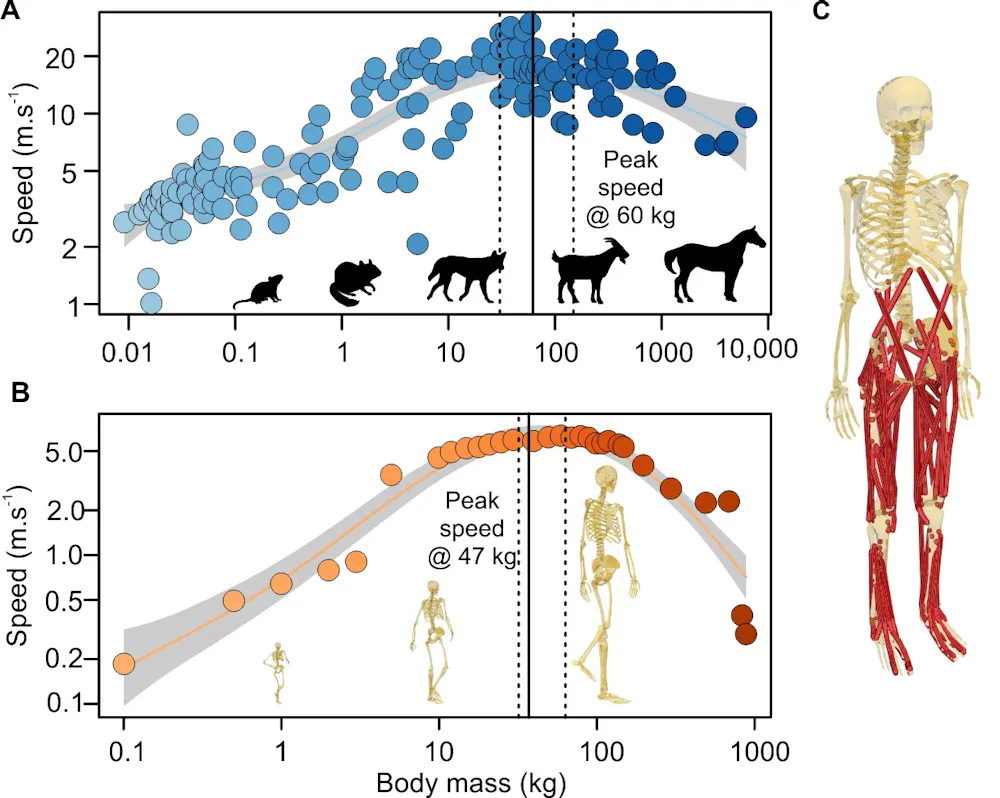
    The pattern of speed and size for running animals (in blue), showing intermediately size species (like the cheetah) are typically the fastest. Computer-generated models of humans (right), which are then scaled in size from a mouse to a horse (orange dots), show the same pattern, revealing the underlying biomechanical reasons.
    Christofer Clemente et al.

    As fast as we will get

    What might all of this say about human evolution?

    We know throughout history that the size of modern humans and extinct human species – a collective group known as “hominins” – has varied significantly, from the roughly 30kg Australopithecus afarensis that existed roughly 3.5  million years ago, to the roughly 80kg Homo erectus  from nearly 2 million years ago.

    So generally body mass has tended to increase – and presumably so too has our running speed. Homo naledi, which existed around 300,000 years ago and weighed around 37kg, and Homo floresiensis, which existed around 50,000 years ago and weighed around 27kg, must have had to sacrifice some speed for their small size.

    The average body mass of modern adult humans is around 62kg – a little heavier than the 47kg peak weight that our modelling found, but still close to that ideal size.

    Interestingly, many of our fastest long distance runners such as Eliud Kipchoge weigh around 50kg.

    So based on our new research, we now know humans today are about as fast as we will get – without large changes to our muscular form.

    Christofer Clemente receives funding from an ARC Discovery grant (DP230101886)

    ref. Not too big, not too small: why modern humans are the ideal size for speed – https://theconversation.com/not-too-big-not-too-small-why-modern-humans-are-the-ideal-size-for-speed-241668

    MIL OSI AnalysisEveningReport.nz

  • MIL-Evening Report: Not the time to share: NZ needs to rethink multi-bed hospital rooms

    Source: The Conversation (Au and NZ) – By Cindy Towns, Senior Lecturer, University of Otago Wellington, University of Otago

    As New Zealand agonises over its hospitals – where they are, how they should be staffed and how they should be funded – a key element in the debate is being missed: the need for single rooms in all public hospitals.

    It’s currently normal for patients to stay in shared rooms with up to five other people. In some hospitals this includes accommodating men and women in the same room, despite serious safety and ethical concerns.

    But it shouldn’t be this way. For a number of reasons, including infection control, privacy and cost, new hospitals and renovations need to be based on single occupancy rooms.

    Our new research brings together both the clinical and ethical arguments for single rooms for all patients as the most basic standard of care.

    Infection control

    Many may view shared rooms as a cost saving. But one of the key arguments for individual rooms in hospitals is the cost and harm of infections and bacterial resistance.

    Single rooms reduce risks by eliminating exposure to shared infection sources such as touched surfaces, unfiltered air, toilets and water systems.

    They also reduce the need for room transfers within the hospital which increase the risk for infection transmission between patients.

    There is strong evidence single occupancy rooms result in reduced infections in intensive care units. And further research has also found single occupancy reduces hospital transmission of COVID-19.

    In New Zealand, single rooms are prioritised for patients known to be infectious. But the key word here is known. This policy fails to recognise that a large proportion of transmissible infections are unknown at the time of ward placement.

    However, even when infection is known, our hospitals cannot meet basic guidelines due to the lack of single rooms. Only 30% of Wellington and Hutt hospital rooms are single occupancy, for example.

    Without single occupancy as the standard in hospitals, infection control will remain compromised.

    Delirium and dementia

    Individual rooms are also required for older adults. New Zealand’s population is ageing; as a result, patients with delirium and dementia needing hospitalisation will increase.

    Delirium affects about 25% of patients in hospital and is associated with a longer stay, more complications and an increased risk for death.

    Delirium prevention and management requires a low-stimulus environment, undisrupted sleep, and control of light and noise which cannot be achieved in shared hospital rooms.

    Research has shown a reduction in delirium with single rooms.

    The behavioural and psychological symptoms of dementia also pose significant challenges in hospital. Symptoms include hallucinations, delusions, sleep disturbance, depression, inappropriate sexual behaviour and aggression.

    These can be highly distressing for the patient and those around them and – like delirium – cannot be managed to a basic standard of care within a shared room.

    Dementia prevalence will more than double by 2050. And yet New Zealand hospitals are ill-prepared to accommodate this rise in demand.

    The right to security, privacy and dignity

    Shared rooms in hospitals clearly undermine clinical care, but they also violate human and patient rights.

    One of the most fundamental human rights is “security of person”. Nobody should have to share rooms with patients who are agitated, aggressive or sexually inappropriate due to delirium or dementia.

    Unfortunately, patients frequently share with those who are unable to manage their own behaviour. While the risks to women have been highlighted, no patient should be endangered or frightened by another patient’s behaviour.

    Dignity and privacy are also a fundamental patient rights, with privacy covered by by both the Health Information Privacy Code and the Health and Disability patient Code of Rights.

    Hospital patients often need assistance with dressing, showering and toileting. Many admissions involve vomiting, diarrhoea or incontinence. And design that relies on curtains to maintain privacy renders this right farcical.

    Research and complaints clearly show patients do not believe their privacy is adequately protected in shared spaces.

    Some may argue for multi-bed rooms on the basis that some patients prefer company. However patient surveys on privacy and confidentiality are overwhelmingly in favour of single occupancy.

    Factoring in cost

    While there is an increase in up-front costs when building single rooms due to the larger hospital footprint, research has found there is no convincing economic evidence in favour of multi-bed rooms.

    The potential savings for future pandemics – in mortality, patient transfers and disease transmission – should not be underestimated. Improved management of delirium and dementia, will also decrease length of stay and cost.

    The argument for single occupancy hospital rooms on clinical, ethical and legal grounds is collectively unequivocal.

    New Zealand needs to follow international best practice and introduce single occupancy rooms as a basic standard for new hospital builds and upgrades.

    Not doing so would ignore the lessons learnt in the COVID-19 pandemic, fail to account for the needs of an ageing population and continue to render New Zealand’s code of patient rights a fairy tale.

    The authors do not work for, consult, own shares in or receive funding from any company or organisation that would benefit from this article, and have disclosed no relevant affiliations beyond their academic appointment.

    ref. Not the time to share: NZ needs to rethink multi-bed hospital rooms – https://theconversation.com/not-the-time-to-share-nz-needs-to-rethink-multi-bed-hospital-rooms-241573

    MIL OSI AnalysisEveningReport.nz

  • MIL-Evening Report: Australia’s new digital ID scheme falls short of global privacy standards. Here’s how it can be fixed

    Source: The Conversation (Au and NZ) – By Ashish Nanda, Research Fellow, Deakin Cyber Research and Innovation Centre, Deakin University

    mayam_studio/Shutterstock

    Australia’s new digital ID system promises to transform the way we live. All of our key documents, such as driver’s licences and Medicare cards, will be in a single digital wallet, making it easier for us to access a range of services.

    The federal government is still developing the system, with a pilot expected to run next year. Known as the “Trust Exchange”, it is part of the Trusted Digital Identity Framework, which is designed to securely verify people’s identities using digital tokens.

    Earlier this year, in a speech to the National Press Club in Canberra, Federal Minister for Government Services Bill Shorten, called the new digital ID system “world leading”. However, it has several privacy issues, especially when compared to international standards like those in the European Union.

    So how can it be fixed?

    What is Trust Exchange?

    Trust Exchange – or TEx – is designed to simplify how we prove who we are online. It will work alongside the myID (formerly myGovID) platform, where Australians can store and manage their digital ID documents.

    The platform is intended to be both secure and convenient. Users would be able to access services ranging from banking to applying for government services without juggling paperwork.

    Think of the system as a way to prove your identity and share personal information such as your age, visa status or licence number — without handing over any physical documents or revealing too much personal information.

    For example, instead of showing your full driver’s licence to enter a licensed premises, you can use a digital token that confirms, “Yes, this person is over 18”.

    But what will happen to all that sensitive data behind the scenes?

    Falling short of global standards

    The World Wide Web Consortium sets global standards around digital identity management. These standards ensure people only share the minimum required information and retain control over their digital identities without relying on centralised bodies.

    The European Union’s digital identity system regulation builds on these standards. It creates a secure, privacy-centric digital identity framework across its member states. It is decentralised, giving users full control over their credentials.

    In its proposed form, however, Australia’s digital ID system falls short of these global standards in several key ways.

    First, it is a centralised system. Everything will be monitored, managed and stored by a single government agency. This will make it more vulnerable to breaches and diminishes users’ control over their digital identities.

    Second, the system does not align with the World Wide Web Consortium’s verifiable credentials standards. These standards are meant to give users full control to selectively disclose personal attributes, such as proof of age, revealing only the minimum personal information needed to access a service.

    As a result, the system increases the likelihood of over-disclosure of personal information.

    Third, global standards emphasise preventing what’s known as “linkability”. This means users’ interactions with different services remain distinct, and their data isn’t aggregated across multiple platforms.

    But the token-based system behind Australia’s digital ID system creates the risk that different service providers could track users across services and potentially profile their behaviours. By comparison, the EU’s system has explicit safeguards to prevent this kind of tracking – unless explicitly authorised by the user.

    Finally, Australia’s framework lacks the stringent rules found in the EU which require explicit consent for collecting and processing biometric data, including facial recognition and fingerprint data.

    Filling the gaps

    It is crucial the federal government addresses these issues to ensure its digital ID system is successful. Our award-winning research offers a path forward.

    The digital ID system should simplify the verification process by automating the selection of an optimal, varied set of credentials for each verification.

    This will reduce the risk of user profiling, by preventing a single credential from being overly associated with a particular service. It will also reduce the risk of a person being “singled out” if they are using an obscure credential, such as an overseas drivers licence.

    Importantly, it will make the system easier to use.

    The system should also be decentralised, similar to the EU’s, giving users control over their digital identities. This reduces the risk of centralised data breaches. It also ensures users are not reliant on a single government agency to manage their credentials.

    Australia’s digital ID system is a step in the right direction, offering greater convenience and security for everyday transactions. However, the government must address the gaps in its current framework to ensure this system also balances Australians’ privacy and security.

    The work has been supported by the Cyber Security Cooperative Research Centre Limited, whose activities are partially funded by the Australian government’s Cooperative Research Centres Programme.

    The work has been supported by the Cyber Security Cooperative Research Centre Limited whose activities are partially funded by the Australian government’s Cooperative Research Centres Programme.

    The work has been supported by the Cyber Security Cooperative Research Centre Limited, whose activities are partially funded by the Australian government’s Cooperative Research Centres Programme.

    ref. Australia’s new digital ID scheme falls short of global privacy standards. Here’s how it can be fixed – https://theconversation.com/australias-new-digital-id-scheme-falls-short-of-global-privacy-standards-heres-how-it-can-be-fixed-241797

    MIL OSI AnalysisEveningReport.nz

  • MIL-Evening Report: Commonwealth takes bold step to protect freedom of expression

    Talamua Media

    The Commonwealth Heads of Government adopted the Commonwealth Principles on Freedom of Expression and the Role of the Media in Good Governance at their summit meeting in Apia, Samoa, last week.

    These Principles highlight the importance of freedom of expression and media freedom to democracy.  They state that Commonwealth governments “should consider repealing or amending laws which unduly restrict the right to freedom of expression”.

    The Commonwealth Human Rights Initiative and the Commonwealth Journalists Association called on states to take practical and effective steps to end arbitrary and excessive restrictions on free expression. The Commonwealth as a whole must audit progress and engage with civil society to ensure that these Principles are implemented in reality.

    Freedom of expression is not just a right in itself — it is the foundation that allows us to exercise and defend all other human rights, and is safeguarded under international law.

    However, as we know all too well, this right is under threat.

    According to UNESCO, in Commonwealth countries alone, 178 journalists were killed between 2006 and 2020. Furthermore, the impunity rate for the killings of journalists during that same time is 96 percent — which is notably higher than the global impunity rate of 87 percent.

    Reporters Without Borders (RSF) has documented 547 journalists imprisoned globally as of the end of 2023, with legal harassment often used as a tool to stifle dissent and investigative reporting.

    Restrictive, colonial-era laws
    Many Commonwealth countries still maintain restrictive, colonial-era laws that curtail free expression, suppress diverse voices, and inhibit the transparency that is essential for democracy.

    In the Commonwealth:

    • 41 countries continue to criminalise defamation; 48 countries still retain laws related to sedition; and
    • 37 still have blasphemy or blasphemy-like laws.
    Who Controls The Narrative? cover. Image: APR screenshot

    These details are set out in a soon to be released report by the Commonwealth Human Rights Initiative (CHRI) and the Commonwealth Journalists Association (CJA), with other Commonwealth partners, entitled Who Controls the Narrative? Legal Restrictions on Freedom of Expression in the Commonwealth.

    “These laws, often enforced through criminal sanctions, have a chilling effect on activists, journalists, iand others who fear retaliation for speaking truth to power”, said William Horsley of the Commonwealth Journalists Association.

    “This has led to an alarming rise in self-censorship and a decline in the independent and dissenting voices that are vital for holding governments accountable.”

    Civil society response
    The Principles were first put forward by a group of civil society organisations in response to  a general deterioration in legal protections and the working environment for journalists.

    The CJA convened other civil society organisations, including the CHRI, Commonwealth Lawyers Association and the Institute of Commonwealth Studies, before Commonwealth member states reviewed and adopted the Principles in the form which was adopted by heads of government at the 2024 CHOGM.

    States are “urged to take concrete and meaningful steps to implement them within their domestic frameworks, as set out in the CHOGM Samoa Communiqué“.

    The joint report Who Controls the Narrative? Legal Restrictions on Freedom of Expression in the Commonwealth reveals the increasing use of criminal law provisions, including those related to defamation, sedition, blasphemy, and national security, to restrict freedom of expression and media freedom within the Commonwealth.

    The report is the product of extensive collaboration between Commonwealth partners, legal experts, academics, human rights advocates, and media professionals, and provides a comprehensive analysis of the legal frameworks governing freedom of expression and outlines clear pathways for reform.

    In addition to analysing legal restrictions on free speech in Commonwealth states, the report puts forward actionable recommendations for reform.

    These include regional and national-level proposals, as well as broader Commonwealth-wide recommendations aimed at strengthening legal frameworks, promoting judicial independence, encouraging media pluralism, and enhancing international accountability mechanisms.

    Reforms essential
    These reforms are essential for establishing an environment where free expression can thrive, allowing individuals to speak without fear of reprisal.

    “While many member states share a colonial legal legacy that includes repressive laws still in effect today, they also share a commitment to democratic governance and the rule of law as set out in the Commonwealth Charter,” said Sneh Aurora, director of the Commonwealth Human Rights Initiative.

    “The Commonwealth has the potential to lead by example in promoting freedom of expression through legal reform, ensuring that criminal laws are not misused to silence dissent.

    “The Principles provide an important opportunity for Commonwealth governments to bring their national laws in line with international human rights laws.”

    Republished with permission from Talamua Online.

    MIL OSI AnalysisEveningReport.nz

  • MIL-Evening Report: Pacific leaders’ mission to Nouméa – Mapou says New Caledonia at ‘turning point’

    By Lydia Lewis, RNZ Pacific presenter/Bulletin editor

    A three-day fact-finding mission, headed by three Pacific leaders, has wrapped up in Nouméa, and New Caledonia’s President Louis Mapou says the French territory is at a “turning point”.

    The semi-autonomous Pacific territory has been riddled with violent unrest since May.

    While tensions have reportedly eased for now, the main political decision-making body for the Pacific region has been in Nouméa this week on a “strictly observational” but “critical mission”.

    New Caledonia’s President Louis Mapou . . . “They willingly shared their own history.” Image: 1ère TV

    Territorial President Louis Mapou told reporters why the Pacific Islands Forum (PIF) “troika -plus” visit was so important.

    “They have a shared intention with government members, drawing on their own experience in the region: the Cook Islands, which are in free association with New Zealand; Tonga, a country that was never colonised; and the Solomon Islands, which have experienced interethnic conflicts in the northern part, where youth played a significant role,” he said.

    “And finally, Fiji, which gained independence, decided to withdraw from the Commonwealth, and is now re-evaluating its connection with the British Crown. So, they willingly shared their own history.

    “They pointed out that in each of these histories, it was often the internal decisions of the populations involved that ultimately shaped the choices made about their country’s future.”

    What a pleasant honour to have Hon. Prime Minister @slrabuka welcomed by @LegionEtrangere & @RSMA_NC , writing a poem about his visit in New-Caledonia as a member of the @ForumSEC high level Troïka-Plus information mission . pic.twitter.com/HVVoebqPfA

    — Véronique Roger-Lacan (@rogerlacanv) October 28, 2024

    Hope and perspective
    Local government spokesperson Charles Wea said the visit brought hope and perspective.

    “It is important that that people from New Caledonia can arrive to express their views, and also the political perspectives, in terms of political future,” he said.

    “The process of decolonisation, for example, which is quite a major subject topic that will be in the discussion with a mission”

    Tongan Prime Minister Hu’akavameiliku Siaosi Sovaleni led the PPIF troika-plus delegation — Rabuka was the “plus” factor.

    “We are not there to judge you or to tell them what to do right now. It is a preliminary visit. So, basically, we just want to listen.”

    While it is a fact-finding mission, there are some indisputable facts, such as New Caledonia being on the United Nations Decolonisation List.

    Tuvalu MP Simon Kofe has expressed his thoughts on this.

    Pacific ‘needs to support decolonisation’
    “My position is for independence, we need to continue supporting the decolonisation of the Pacific,” Kofe told RNZ Pacific.

    Hu’akavameiliku’s views were somewhat more diplomatic.

    “I do believe that there is a way of having some sovereignty and control of your country. There are various models in the Pacific. You have Niue and Cook Islands. Then you have American Samoa.

    “We are not the ones who will tell [New Caledonia] what is working and what is not. We respect their sovereignty.”

    But amid the politicking, a Kanak leader from the Protestant Church of Kanaky New Caledonia, Billy Wetewea, said people were struggling.

    In particular, the indigenous population, who were battling inequities in education, employment and health, he said.

    “The destruction that the youth have made since May, was a kind of expression of the frustration towards all of these social injustices,” he said.

    “We are fighting for our humanity. So, it’s for the dignity of our humanity, and our humanity is the humanity of everyone.”

    ‘Neither marginalised nor mistreated’
    The pro-France loyalists, however, have a different perspective.

    “Contrary to what some separatists suggest, the Kanak people are neither marginalised nor mistreated,” they said in a statement.

    “On the contrary, [Kanaky people are] one of the most advantaged in our Oceanian region.”

    Wea said the Pacific leaders had the chance to hear from all sides involved in the unrest.

    The findings will be presented to the 18 Pacific leaders at next year’s leaders meeting.

    This article is republished under a community partnership agreement with RNZ.

    MIL OSI AnalysisEveningReport.nz

  • MIL-Evening Report: Martha Stewart paved the way for influencers. But not everyone finds her brand empowering

    Source: The Conversation (Au and NZ) – By Di Yang, Doctoral student, School of Economics, Finance, and Marketing, RMIT University

    From showing us how to cook the perfect turkey to mastering the art of folding a fitted sheet, Martha Stewart’s name has long been a byword for doing things well at home – “how very ‘Martha Stewart’ of you”.

    New Netflix documentary, Martha, promises insights into her extraordinary life – from a teenage model to the original influencer and America’s first self-made female billionaire, with a prison stay and friendship with Snoop Dogg along the way.

    Behind the expertly folded linens and immaculately set tables lies something more.

    Martha Stewart created a brand empire that redefined the domestic lifestyle, monetised it and paved the way for others.

    Beginnings and barriers

    Stewart’s connection to the domestic arts began early.

    Raised in New Jersey, she learned essential homemaking skills like cooking and sewing from her mother, while her father introduced her to gardening.

    She studied art and architectural history yet Stewart started her career as a stockbroker. But her passion for the domestic realm led her to entrepreneurship.

    As she once reflected, “the life of the homemaker was more interesting to me than the life of Wall Street”.

    In 1972, she launched a catering business from the suburbs of Connecticut. It soon gained recognition for its elegant food presentations. A publisher client led to her 1982 book, Entertaining. It included notes for how to prepare a clambake for 30, a cocktail party for 200 and ranked presentation as highly as the food itself.

    Book success sealed a partnership with Kmart in 1987 and eventually took her homewares brand into millions of American homes.

    By 1999, she took her company, Martha Stewart Living Omnimedia (which encompassed her television show, magazines, websites and merchandising product lines) public, becoming America’s first self-made female billionaire – albeit momentarily.

    A few years later, Stewart was embroiled in scandal. She received a five-month prison sentence for insider trading and obstruction of justice. Many expected this to mark the end of her career – but Stewart defied the odds.

    Breaking new ground

    After her release from prison, she didn’t shy away from her past. Instead, she continued sharing skills including those she honed during her time at prison camp – whether it was crocheting or experimenting with new recipes. As always, Stewart seized every opportunity to expand her brand.

    Her genius lies in her ability to “sense a void in the culture” and turn a personal touch into commercial success.

    Since selling her namesake brand, Stewart has stayed in the spotlight, sometimes sharing it with rapper Snoop Dogg. The unlikely duo struck up a seemingly genuine friendship that produced a television potluck series, appearances and prison jokes.

    She continues to connect with millions of followers on platforms like Instagram and TikTok, where her long-term influence is perhaps most evident.

    The OG influencer

    Stewart’s living legacy is unmistakable in today’s digital world. Scrolling through social media, you’ll find traces of her in meticulously arranged tablescapes or perfectly organised cabinets.

    Popular “cleanfluencers” like Mrs Hinch and Australia’s Mama Mila have built massive followings by turning domestic tasks into visually captivating content.

    Minimalist tidy maven Marie Kondo took the world by storm, with her philosophy of keeping only what “sparks joy”. Her global brand follows Stewart’s signature collection model. Stewart’s clean and white aesthetic and multichannel branding can be seen in Gwyneth Paltrow’s Goop too.

    When housework is repackaged as life-changing and transformative, it transcends private duty to become a public, respected and potentially profitable business.

    But is this feminism?

    Yet, the rise of domestic lifestyle influencers also raises critical questions in feminist circles.

    As far back as Simone de Beauvoir’s The Second Sex, published in 1949, housework has been seen as part of the trap of domestic femininity.

    Figures like Stewart may represent success stories in economic terms. But their ventures risk reinforcing the stereotype that homemaking is inherently women’s work, often packaged alongside an ever-growing array of consumer products designed to perfect it.

    Stewart’s vision of domestic success – immaculate homes, flawless dinners, and perfect organisation – sets a standard that is unattainable for most. Scholars argue her media empire presents an upper-class fantasy, where the appearance of a wealthy lifestyle is emphasised over the reality of it.

    Focusing on domesticity is not inherently regressive, but what happens when the standards of success are too high to reach?

    The “solution” is often hidden in the consumerism trap, with women endlessly buying goods to chase an idealised lifestyle.

    Stewart’s embrace of perfectionism fuelled her success. In her words, “being a perfectionist can be profitable”. Yet for women and consumers, the pursuit of “Martha Stewartness” often feels out of reach.

    Martha is streaming on Netflix from today.

    Di Yang does not work for, consult, own shares in or receive funding from any company or organisation that would benefit from this article, and has disclosed no relevant affiliations beyond their academic appointment.

    ref. Martha Stewart paved the way for influencers. But not everyone finds her brand empowering – https://theconversation.com/martha-stewart-paved-the-way-for-influencers-but-not-everyone-finds-her-brand-empowering-241802

    MIL OSI AnalysisEveningReport.nz

  • MIL-Evening Report: Inflation is sinking ever lower. Now that it’s official what’s the RBA going to do?

    Source: The Conversation (Au and NZ) – By John Hawkins, Senior Lecturer, Canberra School of Politics, Economics and Society, University of Canberra

    Lower petrol prices and an electricity rebate have contributed to a further fall in the quarterly measure of inflation, the Consumer Price Index.

    The rate in the September quarter dropped to 2.8%, putting it for the first time within the Reserve Bank’s target range of two-point-something since the March quarter of 2020.

    The fall was broadly in keeping with market expectations, and keeps low the likelihood of an interest rate cut this year. The next Reserve Bank meeting is scheduled for Tuesday.

    The bank pays more attention to the long-running quarterly measure of the CPI than the more volatile monthly version which already dropped into its target range in August.

    The monthly measure dropped further, to 2.1%, in September.


    The quarterly CPI is also more important because it is included in all sorts of workplace and other contracts and indexation formulas.

    The main reason for the fall in inflation was the electricity rebates announced in the federal budget and by some states.

    Also helping were the falls in petrol prices, mainly reflecting declines in global oil prices. Cheaper or free public transport in Brisbane, Canberra, Hobart and Darwin also contributed.


    Preventing a larger fall were the continuing strong growth in insurance costs and rent. The rise in insurance costs reflects a series of extreme weather events such as bushfires and floods. It is a way in which climate change is exacerbating inflation.

    Contrary to what many people think, the increase in rents is not due to landlords passing on higher interest rates. Landlords may want to do this but they are only able if vacancy rates are low, otherwise tenants just move elsewhere.

    History shows it is low vacancy rates that drive up rent regardless of the level of interest rates. The inability of landlords to pass on interest rate increases has been confirmed by a study just published by the Reserve Bank using tax return data.

    It showed that only three cents of every dollar in extra interest costs is passed on.

    The fall in inflation to a rate significantly below the 4% at which wages are increasing means that the cost of living crisis is abating, although not yet over.

    The dramatically lower inflation rate puts Australia in a comparable position to the United States, whose inflation rate is 2.4%, the United Kingdom, whose inflation rate is 1.7% and New Zealand where it is 2.2%.

    The US, UK and New Zealand all have inflation targets (or midpoints) of 2%, so inflation is now only slightly above the target in the US and New Zealand. It is actually below it in the UK. In response all three have cut their key policy interest rates.

    Yet it is unlikely that the Reserve Bank will follow their lead until next year, despite growing pressure.

    One reason is that, even after their cuts, interest rates in our three peers are still higher than in Australia, at around 4.75% to 5%.

    But more importantly, the Bank has stressed recently that it pays more attention to the “underlying” rate of inflation, which looks through temporary measures such as the electricity subsidies. The Bank will only cut interest rates when they are “confident that inflation was moving sustainably towards the target range”.

    The bank’s preferred measure of underlying inflation, the so-called trimmed mean, has also fallen.

    But at 3.5%, it is still above the target. A positive aspect is that it has reached 3.5% ahead of the Bank’s most recent forecast which had 3.5% only being reached by the end of 2024.


    Monetary policy, however, has in Milton Friedman’s famous words “long and variable lags”.

    As the then future governor Glenn Stevens remarked back in 1999,
    “the long lags associated with the full impact of monetary policy changes mean that policy changes today must be made with a view not just to what is happening now, but what is likely to be happening in a year’s time and even beyond then”.

    In other words we want to drive by looking ahead rather than just at the rear view mirror. The Bank is like a footballer who needs to head to where the ball will be rather than where it is now.

    There is therefore a risk that if the Reserve Bank keeps interest rates high until inflation reaches the middle of the target, it will be too late to prevent the economy slowing too much and inflation will undershoot the target. This would likely be associated with unnecessarily high unemployment.

    That is why the Reserve Bank board faces a difficult balancing act in taking its decisions.

    John Hawkins was formerly a senior economist and forecaster in the Reserve Bank and the Australian Treasury.

    ref. Inflation is sinking ever lower. Now that it’s official what’s the RBA going to do? – https://theconversation.com/inflation-is-sinking-ever-lower-now-that-its-official-whats-the-rba-going-to-do-240336

    MIL OSI AnalysisEveningReport.nz

  • MIL-Evening Report: We can’t solve family violence until we include violence between siblings in the conversation

    Source: The Conversation (Au and NZ) – By Hayley Boxall, Research Fellow, Australian National University

    Shutterstock

    Domestic and family violence (DFV) has received increasing attention in recent years. It is most commonly associated with intimate partner violence between current and former partners, followed by abuse perpetrated against children by their parents and carers.

    But what about sibling violence?

    International estimates suggest that sibling violence (also known as sibling-to-sibling violence) is one of the most common forms of DFV globally. Yet in Australia and internationally, there is very little conversation or research about it. This means our understanding of when, why and how it occurs remains underdeveloped, and this in turn affects the development of effective policy and practice.

    To improve understandings of sibling violence in Australia, we analysed data collected as part of a national study of 16–20-year-olds’ use and experiences of DFV in the home. Of the 5,021 young people we surveyed, 4,340 said they had siblings.

    What is sibling violence?

    One of the biggest barriers to better understanding sibling violence is differentiating between sibling rivalry and conflict, and abuse. Research suggests abuse is often minimised by family members and clinicians, even when the behaviours are described as “extreme” and persistent.

    For our study, guided by the literature, we defined sibling violence as involving serious and high-harm behaviours. This includes:

    • threats to kill
    • threats to hurt someone close to the young person
    • non-fatal strangulation or sexual abuse
    • persistent and frequent forms of other abusive behaviour (for example, verbal, emotional physical, property damage and threats to harm/hurt a sibling).

    Overall, 303 young people in the sample self-reported they had been subjected to or used sibling violence by the time they were 18. Within this, 58% said they had used sibling violence, 60% said they had been subjected to it, while 18% said they experienced both victimisation and perpetration.

    Sibling violence is multifaceted

    The most common form of sibling violence reported by young people was verbal abuse. Of our respondents, 72% reported experiencing verbal abuse from a sibling, while 74% reported using verbal abuse against a sibling. Physical violence was the next most common form of sibling violence reported, with 64% reporting experiencing physical abuse from a sibling, and 73% reporting using physical abuse against a sibling.

    Although less common, a significant proportion of young people also reported experiences of:

    • threats to kill (victimisation: 26%; perpetration: 9%)
    • non-fatal strangulation (victimisation: 14%; perpetration: 3%)
    • sexual abuse (victimisation: 13%; perpetration: 2%).

    Almost all young people who had experienced sibling violence reported experiencing multiple and overlapping forms of abuse. Indeed, our study finds that sibling violence is rarely experienced as an isolated act of abuse. Rather, it is often experienced as part of a broader patterns of behaviours encompassing physical, sexual and non-physical abuse.

    More than half young people who had experienced sibling violence also experienced violence from another family member.
    Shutterstock

    Sibling violence is gendered

    The findings from our study highlight that like other forms of DFV, sibling violence is gendered.

    A significantly larger proportion of cis female (47%) and trans/non-binary young people (50%) reported they had been subjected to sibling violence, compared to cis males (25%).

    Meanwhile, a larger proportion of cis males (59%) said they had used sibling violence compared to cis female (35%) and trans/non-binary young people (32%).

    Sibling violence often co-occurs with other forms of DFV within families

    Over 90% of young people in our study reported they had experienced DFV between other family members, such as intimate partner violence between their parents.

    Also, over half of the young people who had been subjected to sibling violence reported they had experienced other forms of maltreatment by another family member, most frequently by their mothers and fathers.

    Sibling violence has significant impacts on young people

    Young people in our study reported that sibling violence and other forms of DFV had significant impacts on them. It affected their social, emotional and physical wellbeing, and education achievements.

    Relationships between siblings have important developmental implications for young people’s understandings of familial relationships. The strength of sibling relationships has been linked to longer-term health and social wellbeing outcomes. While our siblings can sometimes feel like our greatest enemies, they can also be our strongest supports in life.

    An emerging body of research has also found that young people who use sibling violence are at higher risk of perpetrating abusive behaviours against their intimate partner(s) and family members later in life.

    Sibling violence can have significant impacts, including trauma, anxiety and poor mental health, eating disorders, and the misuse of alcohol and drugs on those who experience it.

    What is needed?

    Our study builds new understandings of sibling violence in Australia. It highlights the importance of early interventions for young people who experience DFV during childhood. This includes ensuring effective responses for young people who use violence against their siblings.

    Without effective early intervention, we are missing opportunities to address the negative consequences of such experiences, including an increased risk of future perpetration of intimate partner violence.

    To facilitate improved identification and early intervention, frontline screening for DFV among individuals and families must include sibling violence.

    Given the substantial overlap of intimate partner violence, other forms of child maltreatment, child-to-parent abuse and sibling violence, we need holistic interventions that address the support needs of all family members.

    These responses must extend to supporting children and families’ recovery from DFV and seek to break the cycle of inter-generational violence in the home.

    Hayley Boxall currently receives research funding from the Queensland Law Reform Commission, Australia’s National Research Organisation for Women’s Safety and the ACT Justice and Community Safety Directorate.

    Kate has received funding for family violence-related research from the Australian Research Council, Australian Institute of Criminology, Australia’s National Research Organisation for Women’s Safety, the Victorian, Queensland and ACT governments, the Commonwealth Department of Social Services and the Victorian Women’s Trust. This piece is written by Kate Fitz-Gibbon in her role at Monash University and is wholly independent of Kate Fitz-Gibbon’s role as Chair of Respect Victoria.

    Silke Meyer currently receives research funding from Australia’s National Research Organisation for Women’s Safety, the Queensland Mental Health Commission, and the Department of Child Safety, Seniors and Disability Services (Qld).

    ref. We can’t solve family violence until we include violence between siblings in the conversation – https://theconversation.com/we-cant-solve-family-violence-until-we-include-violence-between-siblings-in-the-conversation-242384

    MIL OSI AnalysisEveningReport.nz

  • MIL-Evening Report: In failing to probe Robodebt, Australia’s anti-corruption body fell at the first hurdle. It now has a second chance

    Source: The Conversation (Au and NZ) – By William Partlett, Associate Professor of Public Law, The University of Melbourne

    The inspector of the National Anti-Corruption Commission (NACC) has released her long-awaited report on the failure of the commission to investigate the Robodebt scandal.

    The report finds the commissioner of the NACC committed “officer misconduct”. He failed to fully remove himself from the decision not to investigate the scandal.

    In response, the NACC has agreed to appoint an “independent eminent person” to reconsider its decision not to investigate the Robodebt scandal.

    It’s an embarrassing moment for the Commonwealth’s newly created anti-corruption watchdog.

    But it’s also an opportunity for the NACC to do what the public expects of it: act decisively to protect public trust in government.

    How did we get here?

    The NACC was created in 2022 after a federal election campaign that often focused on transparency and integrity in government.

    Earlier this year, the commission announced it would not be looking into the Robodebt scandal.

    This was despite the Royal Commission into Robodebt referring six people to the commission for further investigation.

    The commission is monitored by an inspector, independent of the commission and the government. After receiving hundreds of complaints, Inspector Gail Furness launched an investigation into why the NACC didn’t look into Robodebt.

    The issue was the first big test for the oversight body.

    The inspector is legally limited as to what it can look at, but its finding of “officer misconduct” offers a broader opportunity for NACC to change course.

    Robodebt was a clear breach of the public trust, with thousands of Australians feeling betrayed by the way the Morrison government acted. NACC now has a second chance to look into the scandal.

    Unique anti-corruption tradition

    NACC’s decision not to investigate was a departure from a long history of anti-corruption oversight in Australia.

    It has its roots in corruption scandals in the late 1980s in Queensland, Western Australia and New South Wales.

    These scandals involved the vast misuse of public power and resources by powerful executive branch officials. The response was far-reaching.

    In Queensland, explosive allegations of police and government involvement in gambling and corruption led to the creation of an inquiry led by Tony Fitzgerald.

    This inquiry made a number of wide-ranging recommendations, including the creation of a commission. It would eventually would become today’s Crime and Corruption Commission.


    Read more:
    Thirty years on, the Fitzgerald Inquiry still looms large over Queensland politics


    In NSW, high-ranking ministers and police were caught embezzling funds and misusing public influence.

    Public outrage led to the creation of Australia’s first anti-corruption commission, the powerful Independent Commission Against Corruption (ICAC).

    In parliament, the NSW premier explained that ICAC was established “independent of the Executive Government and responsible only to Parliament”.

    He went on to argue that its role was not to prosecute crime, but instead to enforce the public trust and dispel a “cloud of suspicion” that hung over the NSW government.

    In WA in the 1980s, allegations emerged that executive branch officials were using their control of public resources to enrich themselves and preserve their own power.

    In response, a royal commission in the early 1990s made a number of recommendations, including the creation of an anti-corruption commission. The commission would be an “independent parliamentary agency” responsible to parliament in carrying out its oversight duties.

    Since then, all ten Australian jurisdictions have adopted anti-corruption commissions. Many of these commissions are described as officers of parliament intended to investigate breaches of the public trust.

    In all states and territories, excluding Victoria and (recently) South Australia, “breaches of the public trust” or “dishonest or improper” conduct can be investigated by these agencies. Anti-corruption agencies have therefore emerged as important guardians of public trust in government.

    Anti-corruption amnesia

    However, we seem to have forgotten this tradition in recent years.

    In South Australia, a 2021 law strippedthe state’s intergrity body of the power to investigate “maladministration” and “misconduct” in public administration and confined its scope to criminal activity.

    In Victoria, then-Premier Daniel Andrews downplayed the significant breaches of public trust found by Victoria’s anti-corruption agency as being merely “educational”.

    Most recently, the NACC’s refusal to review the Robodebt scandal also suggests it is unaware of the traditional purpose of Australian anti-corruption oversight.

    The Robodebt scandal rivals the scandals of the 1980s in its threat to public trust.

    One submission to the Royal Commission report put it clearly:

    I feel utterly betrayed by the government for this […] myself, and everyone else who turned up to every meeting they had to, jumped through every hoop and tried to do the right thing, were treated like criminals and cheats, when all the while it was the department’s scheme that was illegal.

    The NACC now has the opportunity to change course and broadly inquire into the Robodebt scandal.

    This includes more than just an inquiry into the referrals from the Robodebt Royal Commission. It can also look into the way that a scandal of this magnitude happened and how we can prevent it in the future.

    Failing to ask these questions endangers what the WA Royal Commission 30 years ago described as the “trust principle”. It said:

    institutions of government and the officials and agencies of government exist for the public, to serve the interests of the public.

    The NACC has been given a second chance to serve the public through properly investigating Robodebt.

    If it chooses to take it, it will signal that the commission understands it plays a key role in preserving one of the most valuable commodities in Australian democracy: trust in government.

    William Partlett is the Stephen Charles Fellow at The Centre for Public Integrity.

    ref. In failing to probe Robodebt, Australia’s anti-corruption body fell at the first hurdle. It now has a second chance – https://theconversation.com/in-failing-to-probe-robodebt-australias-anti-corruption-body-fell-at-the-first-hurdle-it-now-has-a-second-chance-236147

    MIL OSI AnalysisEveningReport.nz

  • MIL-Evening Report: US elections: Editorial writers at LA Times, Washington Post resign after billionaire owners block Kamala Harris endorsements

    Democracy Now!

    This is Democracy Now!, “War, Peace and the Presidency.” I am Amy Goodman, with Juan González:

    The Los Angeles Times and The Washington Post newspapers are facing mounting backlash after the papers’ publishers announced no presidential endorsements would be made this year. The LA Times is owned by billionaire Patrick Soon-Shiong, and The Washington Post is owned by Amazon’s Jeff Bezos.

    National Public Radio (NPR) is reporting more than 200,000 people have cancelled their Washington Post subscriptions, and counting.

    A number of journalists have also resigned, including the editorials editor at the Los Angeles Times, Mariel Garza, who wrote, “How could we spend eight years railing against Trump and the danger his leadership poses to the country and then fail to endorse the perfectly decent Democrat challenger — who we previously endorsed for the U.S. Senate?”

    Veteran journalists Robert Greene and Karin Klein have also resigned from the L.A. Times editorial board.

    At The Washington Post, David Hoffman and Molly Roberts both resigned on Monday from the Post editorial board. Michele Norris also resigned as a Washington Post columnist, and Robert Kagan resigned as editor-at-large.

    David Hoffman, who just won a Pulitzer Prize for his series “Annals of Autocracy,” wrote, “I believe we face a very real threat of autocracy in the candidacy of Donald Trump. I find it untenable and unconscionable that we have lost our voice at this perilous moment.”

    David Hoffman joins us now, along with former Los Angeles Times editorials editor Mariel Garza.

    David Hoffman, let’s begin with you. Explain why you left The Washington Post editorial board. Oh, and at the same time, congratulations on your Pulitzer Prize.

    DAVID HOFFMAN: Thank you very much.

    I worked for 12 years writing editorials in which I said over and over again, “We cannot be silent in the face of dictatorship, not anywhere.” And I wrote about dissidents who were imprisoned for speaking out.

    And I felt that I couldn’t write another editorial decrying silence if we were going to be silent in the face of Trump’s autocracy. And I feel very, very strongly that the campaign has exposed his intention to be an autocrat.

    JUAN GONZÁLEZ: And, David Hoffman, is there any precedent for the publisher of The Washington Post overruling their own editorial board?

    DAVID HOFFMAN: Yeah, there’s lots of precedent. It’s entirely within the right of the publisher and the owner to do this. Previous owners have often told the editorial board what to say, because we are the voice of the institution and its owner. So, there’s nothing wrong with that.

    What’s wrong here is the timing. If they had made this decision early in the year and announced, as a principle, they don’t want to issue endorsements, nobody would have even blinked. A lot of papers don’t. People have rightly questioned whether they actually have any impact.

    What matters here was, we are right on the doorstep of the most consequential election in our lifetimes. To pull the plug on the endorsement, to go silent against Trump days before the election, that to me was just unconscionable.

    JUAN GONZÁLEZ: And, Mariel Garza, could you talk about the situation at the LA Times and your reaction when you heard of the owner’s decision?

    MARIEL GARZA: Certainly. It was a long conversation over the course of many weeks. We presented our proposal to endorse Kamala Harris. And, of course, there was — to us, there was no question that we would endorse her. We spent nine years talking about the dangers of Trump, called him unfit in 5 million ways, and Kamala Harris is somebody that we know. She’s a California elected official.

    We’ve had a lot of conversations with her. We’ve seen her career evolved. We were going to — we were going to endorse her. And there was no indication that we were going to suddenly shift to a neutral position, certainly not within a few weeks or months of the election.

    At first, we didn’t get a clear answer — sounds like it’s the same situation that happened at The Washington Post — until we pressed for one. We presented an outline with — these are the points we’re going to make — and an argument for why not only was it important for us, an editorial board whose mission is to speak truth to power, to stand up to tyranny — our readers expect it.

    We’re a very liberal paper. There is no — there is no question what the editorial board believes, that Donald Trump should not be president ever.

    AMY GOODMAN: Mariel, I wanted to —

    MARIEL GARZA: So, it was perplexing. It was mystifying. It was — go ahead.

    AMY GOODMAN: Mariel, I wanted to get your response to the daughter of the LA Times owner. On Saturday, Los Angeles Times owner Patrick Soon-Shiong’s daughter Nika Soon-Shiong posted a message online suggesting that her father’s decision was linked to Kamala Harris’s support for Israel’s war on Gaza.

    Nika wrote, “Our family made the joint decision not to endorse a presidential candidate. This was the first and only time I have been involved in the process.

    “As a citizen of a country openly financing genocide, and as a family that experienced South African Apartheid, the endorsement was an opportunity to repudiate justifications for the widespread targeting of journalists and ongoing war on children,” she wrote.

    Her father, Patrick Soon-Shiong, later disputed her claim, saying that she has no role at the Los Angeles Times. Mariel Garza, your response?

    MARIEL GARZA: Look, I really don’t know what to say, because I have — that was — if that was the case, it was never communicated to us. I do not know what goes on in the conversation in the Soon-Shiong household. I know that she is not — she does not participate in deliberations of the editorial board, as far as I know. I’ve never spoken to her.

    We all know how she feels about Gaza, because she’s a prolific tweeter. So, I really can’t say. And this is part of the bigger problem, is we were never given a reason for why we were being silent.

    If there was a reason — say it was Israel — we could have explained that to readers. Instead, we remain silent. And that’s — I mean, this is not a time in American history where anybody can remain silent or neutral.

    JUAN GONZÁLEZ: And, David Hoffman, this whole issue has been raised by some critics of Jeff Bezos that his company has a lot of business with the US government, and whether that had any impact on Bezos’s decision. I’m wondering your thoughts.

    DAVID HOFFMAN: I can’t be inside his mind. His company does have big business, and he’s acknowledged it’s a complicating factor in his ownership. But I can’t really understand why he made this decision, and I don’t think it’s been very well explained. His explanation published today was that he wants sort of more civic quiet, and he thought an endorsement would add to the sense of anxiety and the poisonous atmosphere.

    But I disagree with that. I think, like in the LA Times, I think readers have come to expect us to be a voice of reason, and they’ve looked to endorsements at least for some clarity. So, frankly, I also feel that we’re still lacking an explanation.

    AMY GOODMAN: You know, you have subtitle, the slogan of The Washington Post, of course, “Democracy Dies in Darkness.” It’s being mocked all over social media. One person wrote, “Hello Darkness My Old Friend.”

    David Hoffman, your response to that? But also, you won the Pulitzer Prize for your series “Annals of Autocracy,” and you talk about digital billionaires, as well, and what this means. How does this fit into your investigations?

    DAVID HOFFMAN: You know, I would hope everybody would understand and acknowledge that we’ve done a lot of good for democracy and human rights. You know, I’ve had governments react sharply to a single editorial. When we call them out for imprisoning dissidents, it matters that we are very widely read.

    And that’s another reason why I feel this was a big mistake, because we actually were on a path, for decades, of championing democracy and human rights as an institution.

    And, you know, I have to tell you, I wrote a book in Russia about oligarchs. I understand how difficult it is when you have a lively and independent group of journalists. And ownership really matters. And, you know, we’re not just another widget company.

    This is actually a group of very, very deep-thinking and oftentimes very aggressive people that have a desire to change the world. That’s the kind of journalism that The Washington Post has sponsored and engaged in.

    In 2023, we published a series of editorials that took a look deep inside how China, Russia, Burma, you know, other places — how these autocracies function. One of the findings was that many of these dictatorships are using technology to clamp down on dissent, even things as tiny as a single tweet.

    Young people, young college students are being thrown in prison in Cuba, in Belarus, in Vietnam. And I documented these to show how this technology actually isn’t becoming a force for freedom, but it’s being turned on its head by dictatorship.

    AMY GOODMAN: We have to leave it there, David Hoffman, Washington Post reporter, stepped down from the Post editorial board when they refused to endorse a presidential candidate; Mariel Garza, LA Times editorials editor who just resigned.

    I’m Amy Goodman, with Juan González.

    This programme is republished under a Creative Commons Attribution-Noncommercial-No Derivative Works 3.0 United States Licence.

    MIL OSI AnalysisEveningReport.nz

  • MIL-Evening Report: Autocrats and cities: how capitals have become a battleground for protest and control

    Source: The Conversation (Au and NZ) – By David Jackman, Departmental Lecturer in Development Studies, University of Oxford

    Prime Minister Sheikh Hasina, the world’s longest reigning female political leader, fled Bangladesh on 5 August 2024 for the safety of India. Meanwhile, hundreds of thousands of protesters descended on Bangladesh’s capital city, Dhaka. The crowds ransacked her official residence, occupied the nation’s parliament and burnt down her family home.

    Hasina, who had ruled the country for more than 20 years in total, had been widely accused of turning autocratic and clamping down severely on any opposition to her rule.

    For many, the Bangladesh revolution offers hope in the context of growing global authoritarianism. It illustrates the power of the youth to confront entrenched leaders, and the fragility of authoritarianism. It also highlights a striking feature of contemporary global politics: how central capital cities are to the political life of nations.

    In our new book, Controlling the Capital: Political Dominance in the Urbanizing World, a diverse range of scholars argue that capital cities are crucial political sites. They’re where governing elites seek to assert and maintain political control, and they are also stages for political contestation.

    The book is focused on sub-Saharan Africa and South Asia, the two fastest-urbanising regions of the world.

    Authors explore the strategies and tactics used by ruling elites to politically dominate their capital cities in Bangladesh, Ethiopia, Sri Lanka, Uganda, Zambia and Zimbabwe.

    The authors also consider how urban populations have engaged with these efforts. People may resist authority, but they can also cooperate with it in ways that benefit themselves – which sometimes reinforces or supports authoritarian control.

    This is increasingly important in the context of two contemporary trends. First, authoritarianism is growing globally. Just 10 years ago under half of the world’s population lived under authoritarian rule; now the figure is at 71%. The second trend is the ongoing rapid urbanisation of the world’s population, with the majority of us globally now living in urban areas.

    Urban unrest

    Over the past year we’ve seen how capital cities are spaces for contestation.

    Some pro-democracy movements draw from their own histories of struggle and the paths that have been carved by those before them. The template of Bangladesh’s 2024 revolution is ingrained in politics from the ways in which liberation was fought and how later struggles against authoritarian rule were won. The capital city has also been crucial, and students at Dhaka University were key mobilisers in such movements.

    In other contexts, the link between political resistance and urban areas is a relatively new and surprising route to political change. One example is “the struggle” seen in Sri Lanka’s capital Colombo and the unseating of the Rajapaksa family, who were perceived as increasingly authoritarian rulers of the country. The Colombo chapter in this volume highlights how such protests emerged in a context where urban unrest had rarely threatened those in power before.

    Even where anti-authoritarian protests have proved futile time and again, urban populations rarely remain quiet.

    In Kampala, Uganda, demonstrations prior to the 2021 elections resulted in a horrifying government crackdown. Inspired by events in neighbouring Kenya, protesters took to the streets once more in July 2024 to demonstrate against corruption.


    Read more:
    Kenya’s protests happened in every major urban centre – why these spaces are explosive


    The protests that erupted in Nairobi from late June 2024 against tax rises engulfed the capital city. They continued for some time, fuelled by the brutal police response. Similarly, Nigeria’s 2020 #EndSARS protests against police brutality created a powerful movement in cities such as Abuja and Lagos which shook government, and resonated across much of the continent.

    In an age of social media, learning and mimicry across national borders is increasingly common. One of the defining images of Kenya’s 2024 urban uprising was of a group of men with their arms raised and crossed at the wrists – a gesture of anti-authoritarian protest that gained particular resonance several years back during neighbouring Ethiopia’s own uprising.

    As urban protest seems set to continue and spread – often taking intentionally similar forms – techniques of urban authoritarian control are more varied and complex.

    Strategies to dominate and control city populations can be dramatic and repressive – such as the brute force of police violence – and they can also be subtle, deeply ingrained, and sometimes difficult to discern.

    Authoritarian tactics

    Our book argues that authoritarian leaders are increasingly aware of the power of the urban masses. As a result, they are using a range of subtle, and not-so-subtle, tactics to entrench their domination in capital cities.

    We broadly described two types of interventions that elites use.

    The first are policies and favours that actively build support among urban groups. These can range from inclusion in political parties to investments in social provisions or infrastructure to win support. The book’s chapter on Addis Ababa shows how the latter were particularly striking under the previous governing regime in Ethiopia.

    The second are repressive interventions that aim to crush opposition. These are also diverse, and include violent crackdowns, but also surveillance and intimidation.

    In practice, the two types of interventions often overlap. The line also blurs through various forms of manipulation. For instance, misinformation or the delivery of goods in exchange for performances of political loyalty, underpinned by implicit threats of coercion.

    We also highlight the significance of urban geography.

    Ruling elites often seek to divide city populations (for example inner-city dwellers versus the peripheries). This is evident in our book’s chapter on Colombo, Sri Lanka. The Rajapaksas tried to consolidate power by appealing to the new middle class suburbanites through “beautification” projects. But these displaced and excluded the inner-city poor.

    Chapters on Harare and Kampala also show how particular peripheral areas have become central to efforts to build an urban support base by Zanu-PF and the National Resistance Movement. This often plays out through the informal parcelling out of land to supporters.

    Contesting autocratic rule

    Concerns about authoritarian politics are at an all-time high.

    The above Google Ngram highlights the perilous rise in the use of the term “autocratization” in published work over the past decade.

    Meanwhile, the contestation of autocratic rule will continue to erupt in cities, especially in rapidly urbanising parts of the world. In this context, the need to understand how autocracy and urbanisation collide could hardly be more important.

    If pro-democracy forces are to have any hope of prevailing against efforts by authoritarian ruling elites to entrench their position, there is a crucial need to better understand their urban strategies and tactics.

    David Jackman received funding from the Leverhulme Trust.

    Tom Goodfellow is currently a Senior Research Fellow at the Foreign, Commonwealth and Development Office, which funded part of the research on which this book is based.

    ref. Autocrats and cities: how capitals have become a battleground for protest and control – https://theconversation.com/autocrats-and-cities-how-capitals-have-become-a-battleground-for-protest-and-control-240377

    MIL OSI AnalysisEveningReport.nz

  • MIL-Evening Report: Freddy Krueger at 40 – the ultimate horror movie monster (and Halloween costume)

    Source: The Conversation (Au and NZ) – By Adam Daniel, Associate Lecturer in Communications, Western Sydney University

    IMDB/New Line Cinema

    Movie monsters have captivated audiences since the days of early cinema. They evoke fascination and terror, allowing audiences to confront their fears from the safety of the movie theatre or living room.

    Arguably one of the most enduring and captivating of these monsters is Freddy Krueger, the villain of the A Nightmare on Elm Street series who celebrates his 40th screen birthday this November.

    Memorably played by Robert Englund, Freddy quickly became a cultural icon of the 1980s and 1990s. Beyond his burned face and iconic bladed glove, Freddy’s dark humour and acidic personality set him apart from other silent, faceless killers of the era, such as Michael Myers in Halloween or Jason Vorhees in Friday the 13th.

    Written and directed by horror maven Wes Craven, 1984’s A Nightmare on Elm Street garnered positive reviews for its innovative concept: Freddy stalked and attacked his victims in their dreams, making him inescapable and allowing him to tap into their deepest fears. The series (seven films plus a 2010 remake and Freddy vs. Jason spin offs) blended supernatural horror and surrealism with a dark and twisted sense of humour.

    Scary … but funny

    Humour was key to Freddy’s “popularity”. Both sinister and strangely charismatic, Freddy’s psychological torture of his adolescent victims often oscillated between terrifying and amusing.

    A famous kill scene from 1987’s A Nightmare on Elm Street 3: Dream Warriors demonstrates this paradox.

    Aspiring actress Jennifer drifts off to sleep while watching a talk show on TV. In her dream, the host of the talk show suddenly transforms into Freddy, who attacks his guest before the TV blinks out. When Jennifer timidly approaches the TV set, Freddy’s head and clawed hands emerge from the device, snatching her while delivering an iconic one-liner: “This is it, Jennifer – your big break in TV!”

    Freddy turns his victims’ fears or aspirations – their dreams – against them.

    ‘Whatever you do, don’t fall asleep.’

    Creating a monster

    Craven has shared how the character of Krueger came to life in Never Sleep Again: The Elm Street Legacy, an oral history of the series.

    He described a childhood experience of seeing a strange mumbling man walking past his childhood home. The man stopped, he said, and looked directly at him “with a sick sense of malice”. This deeply unsettling experience helped shape Freddy’s menacing presence.

    The character’s creation also emerged from the filmmaker’s interest in numerous reports of Southeast Asian refugees dying in their sleep after experiencing vivid nightmares.

    In the film, Krueger’s origin story reveals him as a child murderer who was apprehended but released due to a technicality in his arrest. Seeking justice, the parents of his victims take matters into their own hands, and form a vigilante mob. They corner him in his boiler room and burn him alive. But Freddy’s spirit survives to haunt and kill the children of his executioners.


    Read more:
    Halloween films: the good, the bad and the truly scary


    Cultural repression, expressed on film

    Film critic and essayist Robin Wood argued horror films often bring to the surface elements society has repressed. These fears, desires, or cultural taboos are not openly acknowledged.

    But movie monsters act as manifestations of what society suppresses, such as sexuality, violence or deviant behaviour. American academic Gary Heba argues Freddy is:

    an example of America’s political unconscious violently unleashed upon itself, manifesting everything that is unspeakable and repressed in the master narrative (perversion, child abuse and murder, vigilantism, the breakdown of rationality, order, and the family, among others), but still always present in the collective unconscious of the dominant culture.

    Actor Robert Englund calls Freddy Krueger ‘the gift that keeps on giving’.

    The monster decades

    The 1970s and 1980s marked a golden era for the creation of horror film nasties like Krueger, Myers, The Texas Chainsaw Massacre’s Leatherface and killer doll Chucky.

    Since then, the landscape of horror has shifted, with fewer singular monsters emerging. The diversification of horror sub-genres (zombie virus horror, anyone?), the rise of psychological horror (Hereditary), and an emphasis on human-driven terror (Wolf Creek) or supernatural forces all contribute to this shift.

    While modern horror continues to thrive, few characters have achieved the same iconic status as Freddy – although some would argue Art the Clown from the recent Terrifier franchise and the reinvigorated Pennywise from IT could join this exclusive group.

    ‘Five, six, grab your crucifix.’ A 2010 Nightmare on Elm St reboot failed to fire.

    Happy Halloween!

    Despite a failed reboot in 2010, the legacy of A Nightmare on Elm Street is strong, having influenced numerous filmmakers with its skilful mix of surrealism and slasher horror.

    However, it’s the orchestrator of the titular nightmares whose legacy is perhaps the strongest.

    With each Halloween, new fans choose Freddy for their costume. All it takes is a tattered striped sweater, a brown fedora hat, and a glove with sharp, finger-lengthening blades. Don’t forget makeup to re-create Krueger’s grisly facial burns. Sweet dreams!

    Adam Daniel does not work for, consult, own shares in or receive funding from any company or organisation that would benefit from this article, and has disclosed no relevant affiliations beyond their academic appointment.

    ref. Freddy Krueger at 40 – the ultimate horror movie monster (and Halloween costume) – https://theconversation.com/freddy-krueger-at-40-the-ultimate-horror-movie-monster-and-halloween-costume-240905

    MIL OSI AnalysisEveningReport.nz

  • MIL-Evening Report: What is necro-branding? And what’s it got to do with Elvis, Princess Diana and Taylor Swift?

    Source: The Conversation (Au and NZ) – By Chris Baumann, Professor in Business, Macquarie University

    bissig/Shutterstock

    Do you own any memorabilia depicting Elvis, Princess Diana, David Bowie, Prince or Michael Jackson? Perhaps a beloved t-shirt, a favourite mug, a special keyring or a novelty plate? You might not know it, but you are participating in something known as “necro-branding”.

    Necro-branding is where the image of a celebrity is sold to the public, perhaps by their estate or by their fans, long after the celebrity has died.

    These necro-branded items act almost like talismans, helping us preserve the past and remind us of an era long gone.

    Necro-branding is also shaping up to be a multibillion-dollar industry. Even the stars of today – such as Taylor Swift – will inevitably one day become the necro-brands of tomorrow.

    And with the astonishingly rapid development of artificial intelligence (AI), we can expect celebrities’ images to be “reincarnated” even more in the future, and their legacies extended far beyond death.

    Necro-branding is everywhere

    As colleagues and I argued in our recent paper in the journal Celebrity Studies, the quintessential necro-branded celebrity is Elvis Presley.

    From Elvis impersonators to countless items of Elvis memorabilia, the Elvis brand has only increased after the star’s death. Elvis-themed postage stamps issued by the US Postal Service reportedly became the top-selling commemorative postage stamps of all time. He’s also appeared on stamps issued by countries all around the world, such as the Republic of Congo, Rwanda, and Burundi.

    As we explain in our recent paper:

    At the time of his death, Elvis was worth an estimated US$5 million dollars ($40  million in today’s terms), but by 2022, it was estimated that Elvis Presley Enterprises has a net worth of between $400 million and $500 million. The use of his image on merchandise and memorabilia contributes to the continuation of his legacy.

    And it’s not just necro-branding marketed to older fans; younger generations are also a target with Elvis marketing.

    Think, for example, of the stratospherically successful early-2000s dance track version of A Little Less Conversation, by Dutch musician Junkie XL. Or, for instance, of the way Elvis tracks are woven throughout the Disney animated movie Lilo and Stitch.

    Of course, Elvis is not the only necro-branded celebrity. David Bowie, Prince, Michael Jackson, John Lennon and Johnny Cash are other obvious examples, with countless pieces of merchandise bearing their images. Their brand value has increased once the star has passed away.

    Deceased royals – such as Princess Diana and, more recently, Queen Elizabeth – are another obvious example, especially because living royals already enjoy such massive brand values.

    Necro-branding works because of the deep connection fans feel with celebrities. One study of fans of NBA basketballer Kobe Bryant found that as fans’ grief and shock waned, other stronger emotional responses, such as love, actually increased.

    Another 2024 study analysing fans of Johnny Cash and John Lennon suggested that fans acted “religiously” in honouring the memories of these beloved musicians.

    Marilyn Monroe is another heavily necro-branded celebrity. As we argue in our recent paper

    Her brand has shown strong durability in terms of earnings and is now licensed to the same management group that owns the bulk of the Elvis brand, Authentic Brands Group (ABG). Monroe often made the top ten list of earners in the Dead Celebrities List from 2001 to 2008.

    Necro-branding and AI

    AI already plays a pivotal role in branding of celebrities, alive and dead, and will no doubt be used more in future to extend the marketability of today’s celebrities.

    Think, for instance, of the way some of the recordings from the past are imperfect. Elvis footage from the 1970s often has good sound quality, but the actual video footage reflects the technology of the time.

    While this can be partially rectified with remastering, future AI-powered technology will allow entire reproductions of shows, with all imperfections removed.

    Perhaps, many decades from now, an AI-generated version of Taylor Swift will be performing for fans of that era. Whole personas can be altered to meet the demands of different generations of fans, maintaining their legacy indefinitely.

    Brand new songs can be performed by a necro-celebrity who never actually sang them, or songs from other entertainers (dead or alive) can be performed by the avatar of a dead singer.

    AI has already been used to create a version of the song Barbie Girl sung in the “voice” of Johnny Cash, alongside a medley of other pop hits.

    A whole new frontier

    Even if you’re new to the term, you’re already part of the necro-branding market. And there is more to come once AI advances and consumers can no longer distinguish between fake and real.

    The lines will become blurry, as the branding of necro-celebrities become a whole new frontier for marketing and AI develops ever faster and better.

    Joanne Soviner, a year 12 student at North Sydney Girls High School, contributed to this article.

    Chris Baumann does not work for, consult, own shares in or receive funding from any company or organisation that would benefit from this article, and has disclosed no relevant affiliations beyond their academic appointment.

    ref. What is necro-branding? And what’s it got to do with Elvis, Princess Diana and Taylor Swift? – https://theconversation.com/what-is-necro-branding-and-whats-it-got-to-do-with-elvis-princess-diana-and-taylor-swift-240989

    MIL OSI AnalysisEveningReport.nz

  • MIL-Evening Report: Why is my kid using a baby voice? How can I manage it?

    Source: The Conversation (Au and NZ) – By Elizabeth Westrupp, Associate Professor in Psychology, Deakin University

    MIA Studio/ Shutterstock

    Pweeeeese! I want cwacker!

    If you’ve ever found yourself cringing when your child suddenly starts talking in a high-pitched, baby-like voice, you’re not alone.

    Many parents and caregivers find this behaviour jarring — and yes, a little bit annoying.

    Why do older children sometimes revert to baby talk? And what can you do to manage it?

    Why do kids use a baby voice?

    Children may revert to speaking like a baby when they are seeking comfort, affection and reassurance.

    For children, being a baby reminds them of a time when they were safe, and all their needs were taken care of. When they revert to using a baby voice, they are signalling to us they’re feeling vulnerable, tired, stressed, uncertain or overwhelmed, and are wanting more connection and practical help from us.

    Most regressions are normal, and very common. In fact, healthy learning and development is never perfectly linear. This is reflected in nature, where there are cycles of rapid growth followed by periods of rest and dormancy. After a burst of development, children can be tired, or miss having the same level of support from us.

    Children are also more likely to use a baby voice when they’re managing a change or stressful life event. For example, the birth of a new baby in the family, starting school, moving house, or parents separating, are common times when children need more support.

    Using baby talk could be a sign your child is feeling stressed or vulnerable.
    Fizkes/Shutterstock

    Help! Why is a baby voice so annoying?

    As parents and carers, it can be confusing and grating when our older, capable child seems to be moving backwards in development, and using a voice they used many years ago.

    Parents might associate a baby voice with neediness, or immaturity, and feel anxious about what this means for their child’s development.

    In the past, this behaviour was viewed as a problem.

    So the advice was to ignore it and only respond when children use their normal voice. However, this can can create shame in our child and make them afraid to express their feelings and needs.

    If your child is using a baby voice, they may need more comforting and attention.
    Media_Photos/ Shutterstock

    Tips for managing baby voice

    Developmentally, there’s no problem with children occasionally using a baby voice, so we don’t need to try to stop this behaviour.

    Instead, we can be curious. What might be happening for our child?

    1. Acknowledge their feelings: we can empathise with, validate and accept our child’s underlying emotions. And then try to meet their need for safety and connection. We might say:

    Oh my love, sounds like you’re finding everything hard today, and can’t manage putting your shoes on? Are you feeling tired?

    2. Meet their needs: if they’re wanting extra help or connection, we should give it. We can think of this as a “refuelling” pit stop – they might need a little extra care as they manage their current stage of development, or cope with a change. We can say:

    I’d love to help you put your shoes on, let’s do it together. How about you do the socks, and I’ll tie your laces?

    Remember, providing extra help doesn’t mean you’ll always have to do so. Children have a natural drive towards skill development and independence. When they have the energy, they’ll want to keep practising their skills.

    3. Be kind to yourself: if your child’s baby voice is getting on your nerves, it’s understandable, and normal. Providing extra care can be taxing, and sometimes it’s hard to find that extra energy. We can remind our child that we all need rest.

    I hear you’re so tired today and want my help. The problem is I’m feeling so tired too! I wonder if we can help each other? Can we start with a big cuddle?

    4. If in doubt, seek help: if your child shows other signs of developmental regression for more than two weeks, talk to your GP.

    Depending on age, this might include lost skills related to language and communication, walking and balance, self-care (such as dressing, toileting), sleeping, or becoming more clingy, having meltdowns and losing interest in interacting or playing with others.

    Elizabeth Westrupp receives funding from the National Health and Medical Research Council. She is affiliated with the Parenting and Family Research Alliance, and is a registered clinical psychologist.

    ref. Why is my kid using a baby voice? How can I manage it? – https://theconversation.com/why-is-my-kid-using-a-baby-voice-how-can-i-manage-it-240436

    MIL OSI AnalysisEveningReport.nz

  • MIL-Evening Report: You can keep your ghosts and ghouls – the ‘Cordyceps’ fungus creates real-life zombies

    Source: The Conversation (Au and NZ) – By Gregory Moore, Senior Research Associate, School of Agriculture, Food and Ecosystem Sciences, The University of Melbourne

    annguyen87, Shutterstock

    I have never really been interested in ghosts, mummies or zombies, not even at Halloween. But as October 31 approaches each year I am reminded of a biological tale involving all three. It’s the real-life horror story of a flesh-eating, brain-warping fungus from the genus Cordyceps, which inspired the zombie-apocalypse video game and TV series The Last of Us.

    Worldwide, there are hundreds of species of Cordyceps. Most of them prey on insects. They’re famous for hijacking the brains of some ants. Once the fungus takes over, it directs the ant to climb to a high point on a plant and then bite down on the stem or twig in a macabre death grip. The reproductive structures of this parasitic fungus will soon burst out of the ant’s head, spreading its spores to infect another unsuspecting host.

    But the species with which I am most familiar (Cordyceps gunnii) doesn’t attack ants – it parasitises insects such as rather large “ghost” caterpillars. This species doesn’t force its victims to climb, but takes control when they are buried in the soil.

    You might spot a grotesque-looking dead caterpillar pushing up through the earth as if rising from the grave, with a large fungal growth emerging from its head. Some are about the size of an adult finger, but cream and dark brown in colour. It is truly a thing that could trigger nightmares.

    ‘Zombie’ Parasite Cordyceps Fungus Takes Over Insects Through Mind Control | National Geographic.

    Consuming the ghostly host

    Unsuspecting insects become infected with Cordyceps when they eat them by mistake, or when spores attach to their bodies.

    The caterpillar of the Australian ghost moth (Abantiades labrynthicus) tends to burrow straight down into the soil to graze on roots of gum trees and some other species related to eucalypts. So it probably picks up the fungus as it burrows into the earth. The fungus then penetrates the exoskeleton or digestive tract of the insect with a thin, needle-like tube.

    Once inside the caterpillar, the fungus starts to grow rapidly. It produces very fine threads (hyphae) that spread through the body of the insect, replacing its structure. The fungus expands to fill the available space, assuming ultimate control. Exactly how the fungus takes control of the insect brain is not fully understood, but we know the fungus produces a range of chemicals that influence the brain in a way that meets the environmental and reproductive needs of the fungus.

    The caterpillar is doomed as soon as the fungus starts to grow inside it. After being taken over by another life form, the zombie caterpillar dies. All of this happens out of sight, under the soil surface.

    But Cordyceps is not done with the caterpillar just yet. It consumes all the resources the insect can offer, then pushes antler-like reproductive structures out through the caterpillar’s head. These spore-producing structures can be more than 10cm long. They’re clearly visible above ground, but can be hard to spot as they look a bit like a twig. Wind carries the spores to infect more unwary caterpillars.

    These fungus-filled caterpillars are now fully mummified. Nothing remains of the caterpillar but a brittle exoskeleton.

    As the reproductive structures dry and wither, they gently tug on the mummy to which they are still attached. If the soil is dry, the now empty exoskeleton of the caterpillar emerges from its hole. As it does so, the fungal reproductive structures are often lost and all you see remaining is the empty husk.

    The Last of Us: Could it happen? Infectious disease doctor explains cordyceps (UC Davis Health).

    Half animal, half vegetable

    Members of the genus Cordyceps boast the unusual common name of vegetable caterpillars. This strange name comes from a belief, which persisted until the 1800s, that the caterpillars had somehow transformed from insects to fungi, or from animal to plant.

    This was a much debated and widely written about example of transmutation, a theory that was not uncommon in pre-Darwinian times. It was not until the early 1900s that the true, full and gruesome nature of the relationship between Cordyceps and its insect victims was revealed.

    On the lookout for Cordyceps

    Cordyceps gunnii is the most commonly seen species of vegetable caterpillar in southeastern Australia, found in several states.

    Another less conspicuous species, the fawn vegetable caterpillar, Cordyceps hawkesii, occurs along Autralia’s east coast, often under wattles, but is even harder to see. Naturalists hunting for this vegetable caterpillar often find they have already inadvertently trampled over it before they spot it.

    Yet another species, Cordyceps taylori, can also be regularly seen emerging from large ghost moth caterpillars in Victoria. When the husks of these dead, mummified caterpillars appear to emerge from their holes in the ground, they look particularly striking.

    The classification of these vegetable caterpillar fungi is still being debated by experts. It is likely not all are closely related. Some are now placed in a new genus, Ophiocordyceps, but regardless of the name, they are all capable of making zombies and mummies of their victims.

    You can join in the process of hunting for and mapping these elusive species through citizen science projects such as he Great Aussie Fungi Hunt or iNaturalist Australia.

    Traditional medicines and the vegetable caterpillar

    As Halloween approaches, you may be wondering whether humans need worry about being zombified and mummified by Cordyceps fungi. Could the naturalists hunting the vegetable caterpillars become the hunted? The answer is a resounding no. In fact, the opposite is true – these macabre creatures have a long history in traditional medicine.

    Cordyceps sinensis, a Chinese vegetable caterpillar very similar to C. gunnii, has been used in traditional medicine for centuries. Modern research shows there may be benefits from its use (or extracts from it) in treatments associated with autoimmune responses. While the fungus has been cultivated for about 40 years, naturally growing, wild fungi can be very expensive as they are still relatively rare and difficult to find. A kilogram can retail for A$30,000, driving a fungal gold rush across the Himalayas.

    Members of the genus Coryceps, or more correctly the Ophiocordyceps genus, have been around for more than 45 million years. Despite their depiction in The Last of Us, humans have nothing to worry about. The fungi are quite particular about their victims. But if you are a certain species of ant or ghost moth, then Halloween may take on a whole new meaning.

    Gregory Moore does not work for, consult, own shares in or receive funding from any company or organisation that would benefit from this article, and has disclosed no relevant affiliations beyond their academic appointment.

    ref. You can keep your ghosts and ghouls – the ‘Cordyceps’ fungus creates real-life zombies – https://theconversation.com/you-can-keep-your-ghosts-and-ghouls-the-cordyceps-fungus-creates-real-life-zombies-241901

    MIL OSI AnalysisEveningReport.nz

  • MIL-Evening Report: Gender is playing a crucial role in this US election – and it’s not just about Kamala Harris

    Source: The Conversation (Au and NZ) – By Carol Johnson, Emerita Professor, Department of Politics and International Relations, University of Adelaide

    Having a female presidential candidate has made gender obvious in this US presidential election, even to many who normally neglect its role. The specific contest between Kamala Harris and Donald Trump, along with the prominence of issues such as abortion, has resulted in a particularly large gender voting gap. Far more women have consistently indicated support for Harris and far more men for Trump.

    However, gender has always been crucial in US presidential elections, not just because of gender voting patterns but because competing performances of masculinity have always played a major role.

    Role of masculinity in 2020 election

    The last presidential election saw Joe Biden’s form of kind and caring protective masculinity being explicitly contrasted with Trump’s divisive, hyper-masculine one.

    Furthermore, strong male leaders are meant to protect the people from physical, social and economic harm. I have argued that one factor that contributed to Trump’s 2020 electoral defeat was a protective masculinity failure, especially in regard to COVID.

    For example, former President Barack Obama argued that, unlike Biden, Trump could not be counted on to protect Americans:

    Eight months into this pandemic, new cases are breaking records. Donald Trump isn’t going to suddenly protect all of us. He can’t even take the basic steps to protect himself […]. Joe understands […] that the first job of a president is to keep us safe from all threats: domestic, foreign, and microscopic.

    Trump’s re-energised protective masculinity

    However, since his 2020 electoral defeat, Trump has resurrected himself as a strong masculine protector. He claims that “our enemies” are trying to use legal charges to take away his freedom and silence him because he “will always stand” in the way of their attempt to silence the American people and take away their freedom.

    He will also be a vengeful protector, declaring:

    I am your warrior. I am your justice. And for those who have been wronged and betrayed: I am your retribution. I will totally obliterate the deep state.

    Trump has long appealed to men who feel that traditional masculinity, and its related entitlements, are under threat.

    He is currently courting white males, the youth manosphere, “techno bros”, “crypto bros”, conservative male unionists threatened by globalisation and offshoring, and conservative black and Latino men.

    He has been explicitly mobilising misogyny, including by making lewd references to Harris. JD Vance has assisted Trump’s efforts.

    Nonetheless, Trump claims that he will be a strong male protector of women, protecting them from illegal immigrants, crime, foreign threats and other anxieties:

    You will be protected and I will be your protector. Women will be happy, healthy, confident and free.

    Trump has even promised that, as a result, women “will no longer be thinking about abortion.” This is all despite his own alleged history of sexual assault.

    Harris, gender and the women’s vote

    By 2024, Biden’s apparent physical and cognitive decline meant that he was no longer a convincing masculine protector (or viable ongoing presidential candidate).

    The choice of Harris as his replacement candidate had advantages, but it was also a gamble given the combined roles of gender and race. After all, despite the long history of US racism, it still proved easier to elect a black man (Obama) to the presidency than a white woman (Hillary Clinton).

    However, the women’s vote is particularly important this election. As well as Harris’ appeal to younger and black women, Democrats have emphasised the importance of her appeal to white women, including some who previously voted Republican. Anti-Trump Republicans such as Liz Cheney are assisting Harris in appealing to the latter.

    Issues such as abortion are crucial. The overturning of Roe v Wade abortion rights, enabled by Trump stacking the Supreme Court, also puts IVF at risk by not clarifying when life begins (with implications for frozen embryos). Senate Republicans have twice blocked a vote on a Democrat-led bill designed to protect IVF. Harris has pledged to sign a law protecting abortion rights (if Congress passes it).

    Trump claims he supports IVF, won’t bring in a national ban on abortion and believes in abortion “exceptions for rape, incest, and life of the mother”.

    However, Trump Republicans are courting, and influenced by, the American religious right on abortion. There aren’t such exceptions in several Republican states, as Harris’s heartrending accounts of the impact on women and their health reveals. Furthermore, Missouri, Kansas and Idaho are also trying to drastically reduce legal access to the abortion drug mifepristone.

    Harris also emphasises other issues of particular significance for women, such as affordable childcare and better pay for care workers.

    Harris and “tonic” masculinity

    Given the role of competing masculinities in US presidential elections, Harris’ campaign has intentionally appealed to a very different form of protective masculinity from Trump’s.

    Vice presidential candidate, Tim Walz’s, “America’s dad” image (of being a warm, caring but sports loving coach, national guard serving, gun owning, hunter) is used to contrast his “tonic masculinity” with Trump’s “toxic” masculinity. Harris’s husband, Doug Emhoff, is depicted as a supportive “wife-guy” who has “reshaped the perception of masculinity” (while strongly denying allegations he once slapped a woman).

    Despite conservative claims of men being economically left behind, the Biden/Harris administration argues it has revitalised manufacturing and male jobs along with it and Harris will continue to do so. Meanwhile, Obama has urged black men to get behind Harris and the Harris campaign has highlighted its policies benefiting black men.

    Can Harris mobilise protective femininity?

    Given the major role of gender in US presidential elections, a key issue is whether Harris can successfully evoke a caring, motherly, protective femininity that promises security and economic benefits to voters and helps to counter Trump’s protective masculinity.

    Other women politicians have been able to (for example, Germany’s Angela Merkel). Women leaders particularly mobilised protective femininity during the COVID health crisis (for example, New Zealand’s Jacinda Ardern). However, it always seemed likely masculinist leadership stereotypes would re-emerge once the economy needed rebuilding after the pandemic.

    Harris has pledged she will “create an opportunity economy” and “protect our fundamental rights and freedoms, including the right of a woman to make decisions about her own body and not have her government tell her what to do”. She promises to be the kind of president “who cares about you and is not putting themselves first”. Whether such electoral pitches are successful remains to be seen.

    Why the outcome of this election is crucial for gender equality.

    A woman US president is long overdue after 46 male ones. A Trump victory would have major implications for abortion, IVF and women’s rights generally, including progress on the Biden/Harris National Strategy on Gender Equity and Equality. Immigrant and black women will be particularly vulnerable. A Trump victory would also have major implications for which models of masculinity are publicly endorsed.

    A Trump victory would embolden conservative so-called anti-gender ideology campaigns. The Trump campaign has recently spent US $21 million (A$31.9 million) on ads associating Harris with LGBTIQ+ equality, especially transgender rights.

    The Trump campaign asserts that “Kamala’s for they/them. President Trump is for you.” While Trump has also pledged that “we will get critical race theory and transgender insanity the hell out of our schools.”

    A Trump victory will influence the future US economy, including risking increasing gender inequality in an Elon Musk-style unregulated technopoly.

    Finally, academic commentators have drawn attention to the way in which socially conservative views on gender have been mobilised to support new forms of authoritarian regimes in Europe and elsewhere.

    In short, this presidential election is a crucial one for the American people generally, but for the female half of the population in particular.

    Carol Johnson does not work for, consult, own shares in or receive funding from any company or organisation that would benefit from this article, and has disclosed no relevant affiliations beyond their academic appointment.

    ref. Gender is playing a crucial role in this US election – and it’s not just about Kamala Harris – https://theconversation.com/gender-is-playing-a-crucial-role-in-this-us-election-and-its-not-just-about-kamala-harris-242113

    MIL OSI AnalysisEveningReport.nz

  • MIL-Evening Report: Vanuatu AG condemns Trump’s Paris climate treaty exit as ‘troubling precedent’

    By Harry Pearl of BenarNews

    Vanuatu’s top lawyer has called out the United States for “bad behavior” after newly inaugurated President Donald Trump withdrew the world’s biggest historic emitter of greenhouse gasses from the Paris Agreement for a second time.

    The Pacific nation’s Attorney-General Arnold Loughman, who led Vanuatu’s landmark International Court of Justice climate case at The Hague last month, said the withdrawal represented an “undeniable setback” for international action on global warming.

    “The Paris Agreement remains key to the world’s efforts to combat climate change and respond to its effects, and the participation of major economies like the US is crucial,” he told BenarNews in a statement.

    The withdrawal could also set a “troubling precedent” regarding the accountability of rich nations that are disproportionately responsible for global warming, said Loughman.

    “At the same time, the US’ bad behavior could inspire resolve on behalf of developed countries to act more responsibly to try and safeguard the international rule of law,” he said.

    “Ultimately, the whole world stands to lose if the international legal framework is allowed to erode.”

    Vanuatu’s Attorney-General Arnold Loughman at the International Court of Justice last month . . . “The whole world stands to lose if the international legal framework is allowed to erode.” Image: ICJ-CIJ

    Trump’s announcement on Monday came less than two weeks after scientists confirmed that 2024 was the hottest year on record and the first in which average temperatures exceeded 1.5 degrees Celsius above pre-industrial levels.

    Agreed to ‘pursue efforts’
    Under the Paris Agreement adopted in 2015, leaders agreed to “pursue efforts” to limit warming under the 1.5°C threshold or, failing that, keep rises “well below” 2°C  by the end of the century.

    Fiji Prime Minister Sitiveni Rabuka said on Wednesday in a brief comment that Trump’s action would “force us to rethink our position” but the US president must do “what is in the best interest of the United States of America”.

    Other Pacific leaders and the Pacific Islands Forum (PIF) regional intergovernmental body have not responded to BenarNews requests for comment.

    The forum — comprising 18 Pacific states and territories — in its 2018 Boe Declaration said: “Climate change remains the single greatest threat to the livelihoods, security and wellbeing of the peoples of the Pacific and [we reaffirm] our commitment to progress the implementation of the Paris Agreement.”

    Fiji Prime Minister Sitiveni Rabuka speaks at the opening of the new Nabouwalu Water Treatment Plant this week . . . Trump’s action would “force us to rethink our position”. Image: Fiji govt

    Trump’s executive order sparked dismay and criticism in the Pacific, where the impacts of a warming planet are already being felt in the form of more intense storms and rising seas.

    Jacynta Fa’amau, regional Pacific campaigner with environmental group 350 Pacific, said the withdrawal would be a diplomatic setback for the US.

    “The climate crisis has for a long time now been our greatest security threat, especially to the Pacific,” she told BenarNews.

    A clear signal
    “This withdrawal from the agreement is a clear signal about how much the US values the survival of Pacific nations and all communities on the front lines.”

    New Zealand’s former Minister for Pacific Peoples, Aupito William Sio, said that if the US withdrew from its traditional leadership roles in multilateral organisations China would fill the gap.

    “Some people may not like how China plays its role,” wrote the former Labour MP on Facebook. “But when the great USA withdraws from these global organisations . . . it just means China can now go about providing global leadership.”

    Analysts and former White House advisers told BenarNews last year that climate change could be a potential “flashpoint” between Pacific nations and a second Trump administration at a time of heightened geopolitical competition with China.

    Trump’s announcement was not unexpected. During his first term he withdrew the US from the Paris Agreement, only for former President Joe Biden to promptly rejoin in 2021.

    The latest withdrawal puts the US, the world’s largest historic emitter of greenhouse gases, alongside only Iran, Libya and Yemen outside the climate pact.

    In his executive order, Trump said the US would immediately begin withdrawing from the Paris Agreement and from any other commitments made under the UN Framework Convention on Climate Change.

    US also ending climate finance
    The US would also end its international climate finance programme to developing countries — a blow to small Pacific island states that already struggle to obtain funding for resilience and mitigation.

    Press releases by the Biden administration were removed from the White House website immediately after President Donald Trump’s inauguration. Image: White House website/Screen capture on Monday

    A fact sheet published by the Biden administration on November 17, which has now been removed from the White House website, said that US international climate finance reached more than US$11 billion in 2024.

    Loughman said the cessation of climate finance payments was particularly concerning for the Pacific region.

    “These funds are essential for building resilience and supporting adaptation strategies,” he said. “Losing this support could severely hinder ongoing and future projects aimed at protecting our vulnerable ecosystems and communities.”

    George Carter, deputy head of the Department of Pacific Affairs at the Australian National University and member of the COP29 Scientific Council, said at the centre of the Biden administration’s re-engagement with the South Pacific was a regional programme on climate adaptation.

    “While the majority of climate finance that flows through the Pacific comes from Australia, Japan, European Union, New Zealand — then the United States — the climate networks and knowledge production from the US to the Pacific are substantial,” he said.

    Sala George Carter (third from right) hosted a panel discussion at COP29 highlighting key challenges Indigenous communities face from climate change last November. Image: Sera Sefeti/BenarNews

    Climate actions plans
    Pacific island states, like all other signatories to the Paris Agreement, will this year be submitting Nationally Determined Contributions, or NDCs, outlining their climate action plans for the next five years.

    “All climate actions, policies and activities are conditional on international climate finance,” Carter said.

    Pacific island nations are being disproportionately affected by climate change despite contributing just 0.02 percent of global emissions, according to a UN report released last year.

    Low-lying islands are particularly vulnerable to rising sea levels and extreme weather events like cyclones, floods and marine heatwaves, which are projected to occur more frequently this century as a result of higher average global temperatures.

    On January 10, the World Meteorological Organisation (WMO) confirmed that last year for the first time the global mean temperature tipped over 1.5°C above the 1850-1900 average.

    WMO experts emphasised that a single year of more than 1.5°C does not mean that the world has failed to meet long-term temperature goals, which are measured over decades, but added that “leaders must act — now” to avert negative impacts.

    Harry Pearl is a BenarNews journalist. This article was first published by BenarNews and is republished at Asia Pacific Report with permission.

    MIL OSI AnalysisEveningReport.nz

  • MIL-Evening Report: Wenda praises PNG’s Marape over ‘brave ambush’ over West Papua

    Asia Pacific Report

    An exiled West Papuan leader has praised Papua New Guinea Prime Minister James Marape for his “brave ambush” in questioning new Indonesian President Prabowo Subianto over West Papua.

    Prabowo offered an “amnesty” for West Papuan pro-independence activists during Marape’s revent meeting with Prabowo on the fringes of the inauguration, the PNG leader revealed.

    The offer was reported by Asia Pacific Report last week.

    Wenda, a London-based officer of the United Liberation Movement for West Papua (ULMWP), said in a statement that he wanted to thank Marape on behalf of the people of West Papua for directly raising the issue of West Papua in his meeting with President Prabowo.

    “This was a brave move on behalf of his brothers and sisters in West Papua,” Wenda said.

    “The offer of amnesty for West Papuans by Prabowo is a direct result of him being ambushed by PM Marape on West Papua.

    “But what does amnesty mean? All West Papuans support Merdeka, independence; all West Papuans want to raise the [banned flag] Morning Star; all West Papuans want to be free from colonial rule.”

    Wenda said pro-independence actions of any kind were illegal in West Papua.

    ‘Beaten, arrested or jailed’
    “If we raise our flag or call for self-determination, we are beaten, arrested or jailed. If the offer of amnesty is real, it must involve releasing all West Papuan political prisoners.

    “It must involve allowing us to peacefully struggle for our freedom without the threat of imprisonment.” 

    Wenda said that in the history of the occupation, it was very rare for Melanesian leaders to openly confront the Indonesian President about West Papua.

    “Marape can become like Moses for West Papua, going to Pharoah and demanding ‘let my people go!’.

    “West Papua and Papua New Guinea are the same people, divided only by an arbitrary colonial line. One day the border between us will fall like the Berlin Wall and we will finally be able celebrate the full liberation of New Guinea together, from Sorong to Samarai.

    “By raising West Papua at Prabowo’s inauguration, Marape is inhabiting the spirit of Melanesian brotherhood and solidarity,” Wenda said.

    Vanuatu Prime Minister and the Melanesian Spearhead Group (MSG) chair Charlot Salwai and Solomon Islands Prime Minister Jeremiah Manele were also there as a Melanesian delegation.

    “To Prabowo, I say this: A true amnesty means giving West Papua our land back by withdrawing your military, and allowing the self-determination referendum we have been denied since the 1960s.”

    MIL OSI AnalysisEveningReport.nz

  • MIL-Evening Report: Inquiry warns distrustful public wouldn’t accept COVID measures in future pandemic

    Source: The Conversation (Au and NZ) – By Michelle Grattan, Professorial Fellow, University of Canberra

    The government-appointed inquiry into Australia’s COVID response has warned public trust won’t be so high in a future pandemic and people would be unlikely to accept again many of the measures taken.

    “That means there is a job to be done to rebuild trust, and we must plan a response based on the Australia we are today, not the Australia we were before the pandemic,” the report released on Tuesday said.

    The inquiry was conducted by former NSW public servant Robyn Kirk, epidemiologist Catherine Bennett, and economist Angela Jackson. It examined the health and economic responses; while it did not directly delve into the state responses, it did cover the federal-state interface.

    The overall takeout from the inquiry is that “Australia did well relative to other nations, that experienced larger losses in human life, health system collapse and more severe economic downturns”.

    But “the pandemic response was not as effective as it could have been” for an event for which there was “no playbook for pivotal actions.”

    The inquiry said “with the benefit of hindsight, there was excessive fiscal and monetary policy stimulus provided throughout 2021 and 2022, especially in the construction sector. Combined with supply side disruptions, this contributed to inflationary pressures coming out of the pandemic.”

    The inquiry criticised the Homebuilder program’s contribution to inflation, as well as Jobkeeper’s targeting, and said blanket access to superannuation should not be repeated.

    The government – which might have originally expected the inquiry to have been more critical of the Morrison government – quickly seized on the report’s economic criticisms.

    The panel has made a set of recommendations to ensure better preparation for a future pandemic.

    It highlighted the “tail” the pandemic has left, especially its effect on children, who suffered school closures.

    “Children faced lower health risks from COVID-19; however, broader impacts on the social and emotional development of children are ongoing. These include impacts on mental health, school attendance and academic outcomes for some groups of children.”

    The report noted that the Australian Health Protection Principal Committee had never recommended widespread school closures.

    A lack of clear communication about risks had created the environment for states to decide to go to remote learning.

    The impacts on children should be considered in future pandemic preparations, the inquiry said.

    It strongly backed making permanent the interim Australian Centre for Disease Control. The government will legislate next year for the CDC, to start on January 1 2026, as an independent statutory agency.

    The CDC would be important in rebuilding trust, the report said, as well as “strengthening resilience and preparedness”. It would provide “national coordination to gather evidence necessary to undertake the assessments that can guide the proportionality of public health responses in future crises”.

    The report said trust in government was essential for a successful response to a pandemic.

    At COVID’s outset, the public largely did what was asked of them, complying with restrictive public health orders.

    But the initial strengthening of trust in government did not continue through the pandemic. By the second year, restrictions on personal freedom were less accepted.

    Reasons for the decrease in trust included a lack of transparency in decision making, poor communication, the stringency and duration of restrictions, implementation of mandated measures, access to vaccines and inconsistencies in responses across jurisdictions.

    Michelle Grattan does not work for, consult, own shares in or receive funding from any company or organisation that would benefit from this article, and has disclosed no relevant affiliations beyond their academic appointment.

    ref. Inquiry warns distrustful public wouldn’t accept COVID measures in future pandemic – https://theconversation.com/inquiry-warns-distrustful-public-wouldnt-accept-covid-measures-in-future-pandemic-242383

    MIL OSI AnalysisEveningReport.nz

  • MIL-Evening Report: Australia’s COVID inquiry shows why a permanent ‘centre for disease control’ is more urgent than ever

    Source: The Conversation (Au and NZ) – By Jocelyne Basseal, Associate Director, Sydney Infectious Diseases Institute (Sydney ID), Faculty of Medicine and Health, University of Sydney

    Christie Cooper/Shutterstock

    The long-awaited independent inquiry into Australia’s COVID response was released today, with lessons on how the nation could better prepare for future pandemics.

    The 868-page report outlined nine guiding recommendations and 26 actions, including 19 set for implementation over the next 12 to 18 months. These form the foundation for future pandemic preparedness.

    With initial strong national solidarity, Australia acted quickly to close national borders, the inquiry found. This bought crucial time, but Australia was not adequately prepared for a crisis of the scale of the COVID pandemic.

    Australia’s response lacked strong central co-ordination and leadership. Communication about public health advice was often conflicting or not appropriately communicated with the most vulnerable groups. Public trust was further undermined by a lack of transparency in decision-making, such as disease modelling, which underpinned important public health responses.

    In hindsight, the inquiry concluded a fully fledged Australian Centre for Disease Control (CDC) could have made a huge difference. In response, the federal government today committed A$251 milion to establish such a centre in Canberra.

    What did the inquiry find?

    1. Early rapid response and consensus helped keep us safe. As an inland nation, Australia was able to close its borders while preparing for the ultimate inevitable population-wide spread of SARS CoV-2. But it was unprepared for pandemic-related quarantines.

    2. Initially, the communication was clear and consistent. This didn’t last. Huge uncertainties, rapidly changing circumstances, differing opinions among experts and the politicisation of the response undermined communication strategies. Communication with diverse ethnic groups and vulnerable populations groups were often sub-optimal. In future, misinformation and disinformation needs to be addressed through improving health literacy and proactive communication.

    3. Our health-care infrastructure was lacking and couldn’t cope with emergency surge capacity, the inquiry found, although health-care workers “pulled together” remarkably. Aged care facilities were particularly vulnerable and had poor infection-control practices. More broadly, there were supply chain issues and inadequate stockpiles of essential infection prevention and control equipment, such as masks and gloves. Australia was unable to manufacture these and was left at the mercy of foreign providers.

    4. Analysing the genetic material of the virus and widespread testing were critical to tracking viral evolution and spread. Pathogen genomics in New South Wales and Victoria, for instance, allowed accurate tracking of virus variants and local transmission. But there was poor exchange of data between jurisdictions and limited national coordination to optimise data interpretation and response.

    5. Transparent, evidence-based decision-making was lacking. Disease models that informed key decisions were opaque and not open to scrutiny or peer review.

    6. Vulnerable populations, including children, suffered disproportionately. COVID-related school closures were particularly harmful as they affected learning, socialising and development, and disproportionately affected children from lower socioeconomic backgrounds. Strict social isolation also increased the risk of family violence, along with anxiety and other mental health impacts. Aboriginal and Torres Strait Islander people experienced higher risks due to the inequity of service provision and the social determinants of health.

    7. Research is important and should be rapidly scalable. Good surveillance systems for emerging infectious diseases and future pandemic threats should be in place. Patient specimens need to be stored so we can rapidly explore the mechanisms of disease and develop essential diagnostic tests. The inquiry recognised the need for Australia to develop its own vaccines and for access to mRNA technology was recognised as an important health security measure, given challenges in vaccine access.

    8. Global solidarity and co-operation create a safer word for all.
    The stark inequities in COVID vaccine access, opened major fault lines in international relationships and still complicate the drafting of a global pandemic treaty.

    9. Emerging diseases with a One Health focus should be recognised as a ‘standing threat’. In our modern interconnected world, with highly concentrated human and animal populations combined with stressed ecosystems, new diseases with pandemic potential will continue to emerge at an unprecedented rate. This requires a gobal focus.

    How could a CDC make a difference?

    One of the inquiry’s key take-home messages is that the lack of strong, independent, central co-ordination hampered our pandemic response.

    The inadequate flow of data between jurisdictions were major shortcomings that limited the ability to target responses. This is needed to understand:

    • transmission dynamics
    • the vulnerabilities in those with severe disease
    • the circulating viral variants.

    The inquiry also emphasised the need to analyse data in near real time.

    Good data drive evidence-informed and transparent policy. This is a crucial area for a future Australian CDC to address. The CDC will function as a “data hub”, with Canberra offering the ideal location supporting a multi-jurisdictional “hub-and-spoke” model.

    Australia’s new CDC is expected to be launched by January 2026, pending legislation approval. The ongoing challenge will be to ensure it delivers optimal long-term health benefits for all Australians.

    The authors do not work for, consult, own shares in or receive funding from any company or organisation that would benefit from this article, and have disclosed no relevant affiliations beyond their academic appointment.

    ref. Australia’s COVID inquiry shows why a permanent ‘centre for disease control’ is more urgent than ever – https://theconversation.com/australias-covid-inquiry-shows-why-a-permanent-centre-for-disease-control-is-more-urgent-than-ever-239498

    MIL OSI AnalysisEveningReport.nz

  • MIL-Evening Report: View from The Hill: ‘identity politics’ has challenged the Labor Party to define its identity

    Source: The Conversation (Au and NZ) – By Michelle Grattan, Professorial Fellow, University of Canberra

    Saturday’s Queensland result provides the latest evidence of the dual tugs on the modern Labor Party, coming from its different constituencies.

    The smallest swing against the Miles government was in inner Brisbane; the swing became bigger in the outer suburbs, and larger again in the regions. The broad state figures were: south-east Queensland 6.3%; rural/regional Queensland 9.2%. The awings in the city were: inner Brisbane 5.0%; outer Brisbane 7.7%.

    This sort of divide reflects a challenge, first recognised decades ago, that’s highlighted by former Labor senator and minister Kim Carr, in his just-published A Long March. In a scathing critique of Labor’s problems, Carr calls this a “cultural crisis.”

    “The Labor ship has struck the rock of identity politics,” Carr writes, “with too many of its spokespeople adopting a censorious tone to those who fail to embrace their particular social policy agendas”.

    From the left, old school and former factional heavyweight, Carr argues Labor has sought to build a new constituency without paying sufficient attention to its traditional support base.

    Over decades, the once-working class party has taken up causes that appeal to the wealthier, better-educated middle- class voters, and these people have moved their support to it. The cost has been an erosion of outer suburban votes, the people now being aggressively targeted by opposition leader Peter Dutton.

    Meanwhile, in inner urban areas Labor has come under increasing pressure from the Greens. The danger for the ALP, Carr believes, is by trying to compete with the Greens on identity politics it will inevitably be outmanoeuvred.

    “The profound challenge for the Labor Party in the 2020s is to find a way to bind together its more affluent and educated support base in the inner and middle suburbs of the big cities with its less well-off and less formally educated supporters in the outer suburbs and regional cities,” Carr says.

    Political historian Paul Strangio, however, warns that while obviously Labor has to straddle constituencies, “there is no returning to an imagined ‘heartland’. The outer suburbs Carr seems to want Labor to focus upon are themselves radically changing. They are not a repository of old-fashioned working class values and priorities, and nor on their own are they sufficient to provide a basis for the party to hold government.”

    Carr says the issue is how to build Labor’s primary vote in its heartland communities.

    On what we’ve seen in recent politics, this appears a formidable, if not insurmountable, hope for any time soon.

    Voters don’t trust parties, let alone join them. The popularity of “community candidates” has seen a record-sized crossbench in the House of Representatives, with an expanded Greens presence and disillusionment with the Liberals making a strong contribution to the number in 2022. Next year’s election will test whether this trend is entrenched.

    Carr points out that Labor has a party membership that’s wealthier and older than the general community. Its membership is “thin” in the outer suburbs and the regions compared with the inner areas.

    Among the consequences is that the messages coming up through the party may not gell with the preoccupations of the broader community, he says.

    Over the years the ALP rank and file has not just shrunk numerically but been deprived of most of the not-inconsiderable power it once had within the party.

    In terms of clout, Labor’s national conference, which sets the platform, is a diminished beast, though massively swollen numerically. The party membership’s power over preselections has been greatly reduced, thanks to factional deal-making and frequent intervention by the party’s national executive. In just one significant way has the rank and file gained power: it now has a 50% voice in electing the party’s leader, so far exercised once, in 2013, when Bill Shorten and Anthony Albanese faced off.

    Given the shrinkage and balkanisation of the party, there is currently not the interest in internal party reform that erupted periodically and often heatedly in earlier years.

    Labor veteran Race Mathews’ career, documented by his wife Iola in Race Mathews: A Life in Politics, has an extraordinarily broad political CV: a staffer for federal and state leaders, MP for the federal seat of Casey (elected on the 1972 Whitlam wave and defeated in the 1975 post-dismissal rout), and a Victorian state minister. An enduring preoccupation for Mathews, who was part of an influx of young, well-educated middle-class activists attracted to Labor in the 1960s and early 1970s, was fighting to make the Labor Party fit for purpose and more internally democratic.

    Serving on Gough Whitlam’s staff in the late 1960s, Mathews was in the thick of the then-opposition leader’s tumultuous battle with the troglodytes of the Victorian party, who preferred political impotence to the power of government. Whitlam knew that unless the ALP organisation was reformed, Labor’s road to office would be obstructed.

    Way back when, the party’s organisation, in which the left flexed a lot of muscle, liked to signal that the MPs were under its thumb. In 1963, then-opposition leader Arthur Calwell and Whitlam, his deputy, were embarrassed when photographed outside a Canberra hotel waiting for the party’s special national conference (to which they were not delegates) to decide Labor’s attitude to the North West Cape joint facility. The ultimate decision was not the problem – the line it was made by “36 faceless men” was.

    Mathews later highlighted the significance of the 1970 federal intervention in Victoria, saying it had led to important reforms in that state and elsewhere. “Good people were brought into parliament and membership was a rewarding experience.” But then factionalism “ossified” the party and “if you weren’t part of the factions, you were marginalised”.

    In his 70s Mathews (who is now aged 89 and suffering from Alzheimer’s Disease) was still fighting for democratisation of Labor’s organisation, which he described as “archaic and decrepit”. While party leaders and others were supportive in principle, the quest for a new wave of change ultimately brought only limited outcomes.

    Iola Mathews quotes her husband’s Facebook answer to those who wondered why he, at 80, he was still in these trenches.

    He wrote: “The fact is that nobody ever changed the party other than from inside it, or ever will. And shaping it closer to our heart’s desire is the only game in town.”

    The truth is, however, it’s a game those who run the Labor Party these days have no serious interest in pursuing. As Strangio observes, “the age of the mass party has passed”.

    Michelle Grattan does not work for, consult, own shares in or receive funding from any company or organisation that would benefit from this article, and has disclosed no relevant affiliations beyond their academic appointment.

    ref. View from The Hill: ‘identity politics’ has challenged the Labor Party to define its identity – https://theconversation.com/view-from-the-hill-identity-politics-has-challenged-the-labor-party-to-define-its-identity-242215

    MIL OSI AnalysisEveningReport.nz

  • MIL-Evening Report: Echoes of a Lost Gaza – Al Jazeera documentary on a brutal war

    Pacific Media Watch

    Mariam Shahin has been making films about Gaza for more than 30 years.

    She has also made many documentaries and short films for Al Jazeera English since it launched in 2006.

    When she moved to Gaza in 2005, she felt a powerful sense of optimism following the Israeli withdrawal.

    Mariam Shahin . . . revisiting the Gaza people and lives the film maker has met over the years. Image: MS

    But by 2009, war had badly damaged its infrastructure, neighbourhoods, businesses and communities — and that optimism had evaporated.

    Now, in the wake of the even more destructive war that began on 7 October 2023, Shahin seeks out the people she has met in Gaza over the years.

    She reflects on the wasted potential and devastated lives after 16 years of blockade and a year of one of the most destructive wars in Middle East history.


    Echoes of a Lost Gaza: 2005-2024.     Video: Al Jazeera

    MIL OSI AnalysisEveningReport.nz

  • MIL-OSI Reportage: New app set to slash merchant payment fees and transform how NZers manage their money

    Source: BNZ statements

    Imagine running a bustling café where every transaction not only saves you money on fees, but also automatically updates your loyalty programme, provides smart sales insights, and even puts you on the map for potential new customers.

    Meanwhile, your regulars can pay their brunch bill without even bringing a wallet, quickly send their share of the brunch tab to friends, manage their bank accounts, loyalty cards and gift vouchers seamlessly in one place, and easily track their daily flat white habits.

    Soon this will be the reality for New Zealand businesses and their customers with the launch of Payap – the country’s first digital wallet and Point of Sale (POS) app compatible with all New Zealand banks.

    Leveraging the power of open banking, Payap offers a new lower cost, contactless way to pay and get paid. Payap makes transactions effortless: users simply scan QR codes dynamically generated on an EFTPOS terminal, enabling instant cash transfers directly from their bank account. It also provides a low-cost ecommerce solution, making it easy and affordable for businesses to accept payments online.


    With Payap’s 0.39% payment acceptance rate, a retail business turning over $100,000 monthly could save up to $7,320 annually compared to the average 1% merchant service fee reported by the Commerce Commission. For ecommerce businesses, Payap’s 0.59% fee is approximately 80% cheaper than the percentage fees charged by some other providers.

    • Businesses using Payap also have access to a suite of powerful features, including:
    • The ability to create and manage loyalty programmes, making it easy to reward customers and build brand loyalty
    • Enhanced visibility over transactions and the ability to manage discounts and refunds through a dedicated portal
    • Increased visibility with Payap’s ‘store finder’ map, showcasing location, business details, and available offers to app users
    • Use existing hardware – Payap is supported by all leading EFTPOS providers

    For consumers, Payap brings together all your accounts from New Zealand banks, as well as loyalty, and even gift cards in one easy-to-use digital wallet. It allows seamless payments from any linked account and offers a range of features that simplify money management:

    • Manage your bank accounts, loyalty, and gift cards in one place
    • Split a payment across multiple sources, combining different bank accounts, debit cards, or gift card balances, all managed seamlessly within Payap
    • Easily split bills or manage shared expenses with friends with peer-to-peer payments
    • Log all your receipts in one place and get smart insights to gain a clear view of your spending patterns
    • Level up your loyalty, with rewards automatically applied during transactions


    Powered by New Zealand fintech Centrapay and backed by BNZ, Payap is now available for business sign-ups ahead of the March 2025 consumer launch. The onboarding process is quick and free, and businesses are encouraged to register their interest. Payap is available to all businesses regardless of who they bank with.

    “Payap is the country’s first comprehensive digital payment service that leverages the power of open banking to fill a clear gap in the New Zealand market,” says Centrapay CEO Greg Beehre.

    “We’re excited to introduce this innovative solution that will transform how businesses accept payments and how we manage our money.”

    BNZ Executive Customer Products and Services, Karna Luke, says the potential Payap offers to both businesses and consumers is impressive.

    “Our team is working closely with our business customers to onboard them before the consumer launch, and we expect thousands of businesses to be on the platform on day one when their customers start using the app.

    “Payap is designed to benefit businesses across Aotearoa, and we welcome all interested businesses – from small street vendors to enterprise retailers and everything in between – to get in touch with us to explore how it can enhance their payment system and customer experience.”

    Core payments, acceptance and rewards features will be available at launch, with additional capabilities like peer-to-peer payments being rolled out progressively throughout 2025.

    Businesses interested in learning more about Payap can visit www.payap.com or www.bnz.co.nz/payap

    The post New app set to slash merchant payment fees and transform how NZers manage their money appeared first on BNZ Debrief.

    MIL OSI Analysis

  • MIL-Evening Report: You’ve heard of Asterix and Obelix, but who really were the Gauls? And why were they such a problem for Rome?

    Source: The Conversation (Au and NZ) – By Frederik Juliaan Vervaet, Associate Professor of Ancient History, The University of Melbourne

    JayC75/Shutterstock

    The year is 50 BC. Gaul is entirely occupied by the Romans. Well, not entirely. One small village of indomitable Gauls still holds out against the invaders.

    So begins the Asterix comic series, which positions Julius Caesar as the power-lusting dictator of the mighty Roman Empire who conquered all of Gaul. All except, of course, for one heroic village, where Asterix, Obelix and Dogmatix are among the Gauls (or Gaul dogs) frustrating Rome’s hapless legions.

    Well, that’s the comic book version.

    But who really were the Gauls? And why were they such a problem for Rome?

    The Gauls are the most famous group of Celtic peoples who occupied most of the lands west of the Rhine, thus causing this area to be known in antiquity as Gaul.

    They sported long blonde or reddish dreadlocks (often washing their hair in lime-water and pulling it back to the nape of the neck), handlebar moustaches on the men, colourful shirts and striped coats. The ethnonym Galli is believed to derive from a Celtic root gal- meaning “power” or “ability”, and has been linked to the Irish word gal, meaning “bravery” or “courage”.

    Fearsome warriors

    From the fifth to third centuries BCE, the Celtic tribes of central Europe were among the continent’s most fearsome warriors.

    This 1842 illustration depicts Gaul warriors with their customary large shields, swords, long hair and distinctive helmets.
    Wattier/Marzolino/Shutterstock

    From their heartlands around what is now the Czech Republic (Bohemia derives its name from the powerful Boii Gallic tribe), they conquered the British Isles, all of France and Belgium (Gaul proper) and parts of Spain. They also conquered the fertile alluvial plains of what became known to Romans as Cisalpine Gaul, meaning “Gaul this side of the Alps”.

    The Gauls even conquered lands as far afield as in present-day Turkey. The descendants from these once mighty peoples still live in Ireland (Gaelic comes from the word Gaul), Wales and Brittany.

    The Gauls had a very warlike reputation. They produced tall and muscular warriors who often wore helmets that, according to the Greek historian Diodorus Siculus, sometimes had horns attached or “images of the fore-parts of birds or four-footed animals”. He also wrote that:

    The women of the Gauls are not only like the men in their great stature but they are a match for them in courage as well.

    Gauls fought with long broad-swords, barbed spears, and chariots drawn by two horses. They fastened the severed heads of their enemies about the necks of their horses.

    Possessing huge quantities of alluvial gold, Gallic nobles wore heavy necklaces (known as “torcs”) of solid gold and consumed untold amounts of imported wine, fabulously enriching Italian merchants.

    Their acts of bravery were immortalised by lyric poets called bards, and they put great stock in their shamans, called druids, who also presided over regular human sacrifices.

    In 387 BCE, Gallic raiders from Cisalpine Gaul sacked Rome. They only failed to take the Capitol because of a hostile incursion into their own homelands, forcing them to break camp and return – not before, however, exacting a crippling price in gold from the profoundly humiliated Romans.

    The Romans were so impressed with Gallic military kit they resorted to wholesale plagiarism. The iconic armour of Roman republican legionaries was largely of Celtic origin.

    The Gauls had a very warlike reputation.
    J. Photos/Shutterstock

    Rome rallies against the Gauls

    In 295 BCE, the Senones (a Gallic tribe) inhabiting the Adriatic coastline south of Cisalpine Gaul were part of an alliance soundly defeated by the Roman Republic in the battle of Sentinum.

    This represented a watershed moment on the road to Roman hegemony in the Italian peninsula.

    In 232, against the backdrop of renewed hostilities with the Cisalpine Gauls, leading Roman politician Gaius Flaminius passed legislation redistributing land won from the Senones (following their final defeat in 283) among Romans from the lower property classes.

    To ease Roman colonisation, the same Flaminius in 220 commissioned the construction of the Via Flaminia, a paved speedway from Rome all the way to Rimini, at the doorstep of Cisalpine Gaul.

    Fearing the same fate as the Senones, the Cisalpine Gauls united against Rome, aided by some Transalpine Gauls.

    By 225, this alliance became strong enough to invade peninsular Italy, ravage Tuscany, and threaten Rome itself.

    This famously triggered the Romans to muster all Roman and Italian manpower at their disposal (about 800,000 draftable men, according to ancient the historian Pliny).

    Being now superior in every respect, the Romans and their Italian allies decisively defeated the Cisalpine Gauls in 223 and 222. The Roman general Marcus Claudius Marcellus even managed to kill a Gallic king in single combat.

    The vanquished Cisalpine Gauls then joined the feared Carthaginian general Hannibal, who at the time posed a great risk to Rome and defeated its forces in many battles. They joined Hannibal en masse after he crossed the Alps to invade Italy in 218.

    But Hannibal failed to vanquish Rome and was later defeated. The Roman conquest of Cisalpine Gaul continued after Roman forces defeated Hannibal’s brother Hasdrubal at the Metaurus River in 207.

    To secure their rich holdings in Cisalpine Gaul and the land corridor to their Spanish provinces, the Romans subsequently conquered first Liguria and next southern Gaul, incorporated as the Province of Transalpine Gaul. The area was so thoroughly colonised it is still known today as La Provence (“the province”).

    Caesar’s self-interested war on the Gauls

    Julius Caesar, eager to amass glory and wealth, subjugated all of Gaul in less than a decade (from 58 to 50 BCE).

    He sold this outright aggression to the Senate and people in Rome as a war waged in defence of tribes allied with Rome, a necessary pre-emptive strike of sorts.

    In addition to enslaving perhaps up to one million Gauls, Caesar proudly claimed to have killed well over another million, a staggering casualty rate considered by Pliny the Elder “a prodigious even if unavoidable wrong inflicted on the human race”.

    Julius Caesar subjugated all of Gaul in less than a decade.
    Paolo Gallo/Shutterstock

    Caesar got away with mass murder because he shamelessly played into lingering feelings of metus Gallicus, or “Gallic fear”.

    The Roman fear of Gauls was heightened by the so-called Cimbric War that took place in earlier years, when a formidable confederacy of Germanic and Gallic tribes inflicted a series of costly defeats upon Rome, threatening Italy itself.

    But Rome would triumph in the end. Under the leadership of Gaius Marius, the Romans destroyed these tribes in 102/101 BCE in Transalpine and Cisalpine Gaul.

    Turned into a Roman province in final stages of this war, Cisalpine Gaul eventually became so heavily Romanised it was incorporated into Roman Italy proper in 42 BCE.

    Frederik Juliaan Vervaet receives funding from the Australian Research Council.

    ref. You’ve heard of Asterix and Obelix, but who really were the Gauls? And why were they such a problem for Rome? – https://theconversation.com/youve-heard-of-asterix-and-obelix-but-who-really-were-the-gauls-and-why-were-they-such-a-problem-for-rome-233447

    MIL OSI AnalysisEveningReport.nz

  • MIL-Evening Report: Why building more big dams is a costly gamble for our future water security and the environment

    Source: The Conversation (Au and NZ) – By John Kandulu, Research Fellow, College of Business, Government and Law, Flinders University

    Climate change and biodiversity loss are mounting threats to Australia’s water security. So ee often hear calls for more dams. But is that the answer?

    Our recent research reveals large dam projects are costly gambles with public money. They often fail to deliver promised economic benefits. They also have major environmental, financial and social impacts.

    In New South Wales, some members of the Lower Lachlan River community were concerned about plans to expand Wyangala Dam. They first asked us in 2020 to investigate its full costs and benefits, with findings presented at a local workshop in 2022.

    The first WaterNSW estimate of capital and operating costs was A$620 million in 2018. Within a few years, it had soared to as much as $2.1 billion. In 2023, the project was scrapped because it wasn’t economically viable.

    Similar concerns surround other projects overseas and in Australia, including Hells Gate Dam in Queensland, and Dungowan Dam and Snowy Hydro 2.0 in NSW.

    To avoid repeating costly mistakes and mismanaging taxpayers’ money, we need a smarter approach to major water projects. This includes independent assessments and greater transparency, with business cases made public and decision-making open to scrutiny. And planning for climate change must become a priority.

    Lessons from past mistakes

    Inadequate economic assessments of big dam projects are a global problem. The Grand Ethiopian Renaissance Dam and India’s Subansiri Lower Hydroelectric Project promised big, but had rising price tags and devastating impacts on ecosystems.

    In Australia and worldwide, big dam cost overruns can be up to 825%. The average overrun is 120%. This casts serious doubt on such projects’ financial and social viability. Public costs for private gains are a major concern.

    Our study reviewed the original business case for the Wyangala Dam expansion. The original study had concluded there would be net social benefits and gave the project the green light.

    Our review found the business case was seriously flawed. It overestimated benefits and grossly underestimated physical capital and environmental costs.

    Estimated building costs blew out by 239%. If the project had gone ahead, the costs would undoubtedly have increased.

    On top of this, assessments of impacts on rivers and wetlands were poor and superficial. They greatly undervalued the environmental effects of expanding the dam, particularly on downstream wetlands.

    On the other side of the equation, its benefits were overblown, particularly for water security and agriculture.

    Local voices believed many of their concerns had been ignored. There were deep concerns that flood-dependent farmers downstream might lose some of their livelihoods. Indigenous communities were worried about their cultural sites being destroyed.

    Our analysis provided a more rigorous assessment of benefits and costs of the Wyangala Dam expansion.

    We found total project costs were underestimated by at least 116%. The benefits were inflated by 56%. This meant the true impacts on the environment, agriculture and local communities were misrepresented.

    Rethinking Australia’s water future

    Our analysis provides a salutary lesson on why we need to rethink water security. Instead of sinking billions into dams, we should find smart and sustainable ways to manage our water.

    The fixation on building and expanding dams means innovative alternatives are often ignored. These other options include recycling water, managing demand and carefully recharging aquifers (using aquifers as underground dams).

    The National Water Grid Fund exemplifies the misguided “build more dams” mindset. Its portfolio of 61 large water projects has a total capital cost estimate of up to $10 billion.

    Despite this massive investment, only 23 of these projects have publicly available business cases. It leaves more than $1.7 billion in committed funding shrouded in secrecy.

    This lack of transparency is alarming, given the history of cost overruns and inadequate assessment of environmental damage. It points to the urgent need to reassess our approach to water security. The public has a right to know that their governments are spending wisely.

    To avoid repeating costly mistakes and mismanaging taxpayers’ money, we need a smarter approach. Independent business cases should be mandated for all major water projects.

    We also need a strong public sector capable of transparent evaluation. Promised new National Environmental Standards as part of reforms to environmental protection laws are likely to require rigorous scrutiny too. We must embrace transparency by opening decision-making to public scrutiny and diverse perspectives, including local voices and Indigenous stakeholders, from the start.

    Finally, infrastructure planning must account for long-term climate impacts on water availability. Planning for climate change is vital.

    As projects such as the proposed Wyangala Dam expansion demonstrate, Australia can no longer afford to gamble its water future on outdated, costly and environmentally destructive solutions. It’s time to end the wasteful spending.

    Instead, we need to channel our efforts into truly effective, sustainable and transparent water management. Strategies must give priority to community needs, First Nations’ water rights, environmental protection and long-term climate resilience.

    John Kandulu is a recipient of funding from various sources, such as state and Commonwealth governments, as well as non-profit organisations. His affiliations include the Centre for Social Impact at Flinders University and the Environment Institute at the University of Adelaide.

    Richard Kingsford receives funding from a range of organisations, including the Australian Research Council, state and Commonwealth governments, non-government organisations, including World Wide Fund for Nature and Australian Conservation Foundation. He is a member of the Wentworth Group of Concerned Scientists and a councillor on the Biodiversity Council.

    Sarah Ann Wheeler receives funding from a range of organisations, including the Australian Research Council, state and Commonwealth governments and non-government organisations.

    ref. Why building more big dams is a costly gamble for our future water security and the environment – https://theconversation.com/why-building-more-big-dams-is-a-costly-gamble-for-our-future-water-security-and-the-environment-239106

    MIL OSI AnalysisEveningReport.nz

  • MIL-Evening Report: 6 reasons why people enjoy horror movies

    Source: The Conversation (Au and NZ) – By Shane Rogers, Lecturer in Psychology, Edith Cowan University

    Tero Vesalainen/Shutterstock

    The creeping shadows and haunting decorations transform the everyday into something eerie at Halloween. And you might be thinking about scaring yourself with a good horror movie.

    Grotesque imagery, extreme violence, startling jump scares and menacing characters are common elements, making viewers feel fear, dread and disgust.

    We generally aim to avoid these negative emotions in our everyday lives.

    So why would some people seek them out, and enjoy them, in horror movies?

    1. Fear can be thrilling

    There is lots of overlap between the emotions of fear and excitement. In both, stress hormones are released that can produce physical symptoms such as increased heart and breathing rates, sweating and muscle tension. People also feel more alert and “on edge”.

    Research has consistently shown people with personalities that crave intense emotional experiences, including fear and excitement, tend to enjoy horror movies.

    But for more fearful people, the jump scares and violent scenes can be too intense. This can result in coping behaviours such as looking away or putting their hands over the ears, especially if they are highly immersed in the movie.

    Although, if they also happen to enjoy intense emotion, they may still enjoy the thrill of the ride.

    Movie makers work hard to get these ‘jump scares’ just right. And viewers enjoy the thrill.

    2. There’s a sense of relief

    People may enjoy horror movies because of a sense of relief after a scary moment has passed.

    Watching a horror movie can be a bit of an emotional rollercoaster, with distinct peaks and troughs of fear and relief over the course of the film.

    For example, in the 2017 movie It the main protagonists survive a series of scary encounters with a demonic clown. The scary moments are separated by calmer scenes, prompting a rollercoaster of emotions.

    In the classic 1975 movie Jaws, viewers experience relief from the scary moments, only to be scared again and again.

    Jaws is a rollercoaster of emotions.

    3. They satisfy our morbid curiosity

    Many horror movies feature supernatural themes and characters such as zombies, werewolves and vampires. So horror movies can help satiate a morbid curiosity.

    The violence, death, destruction and grotesque elements can provide curious people a safe space to explore things that are not safe (or socially appropriate) in the real world.

    Horror movies can help people satisfy their curiosity about death. But why are they curious in the first place?

    4. We can work out our limits

    Horror movies can reflect our deepest fears and prompt introspection about our personal thresholds of fear and disgust.

    So some people may enjoy watching them to get a better understanding of their own limits.

    Watching horror might also be a way to push personal boundaries to potentially become less fearful or grossed out by things in real life.

    In a study one of us (Coltan) conducted, horror movie fans reported less psychological distress during the early months of the COVID pandemic compared with people not identifying as a horror movie fan.

    5. They can be social

    Some people say the social aspect of watching horror movies with others is a big part of their appeal.

    Watching with others might help some people feel safer. Alternatively, this might help amplify the emotional experience by feeding off the emotions of people around them.

    Horror movies are also a common pick as a date night movie. Being scared together gives a good excuse to snuggle and take comfort in each other.

    6. They give us pleasure in other people’s misery

    Horror movies can provide the pleasurable emotion we feel when witnessing the misfortune of others, known as schadenfreude. This occurs most when we feel the person experiencing misfortune deserves it.

    In many horror movies the characters that suffer a gruesome fate are only side characters. Much of the time these unfortunate souls are made out to be unlikeable and often make foolish choices before their grisly end.

    For example, in the 1996 teen witch movie The Craft, the character Chris Hooker is portrayed as being cruel to women. Then he dies by being blasted out of a window.

    Despite the grisly nature of horror movies, a study by one of us (Coltan) found horror fans seem to have the same levels of empathy as anyone else.

    In The Craft, viewers enjoy witnessing the misfortune of others, particularly if the character is a ‘baddy’.

    What do I make of all this?

    Horror movies allow us to confront our deepest fears through the safety of make-believe.

    People enjoy them for lots of different reasons. And the precise combination of reasons differs depending on the specific movie, and the person or people watching it.

    What is certain though, is the increasing popularity of horror movies, with many to choose from.

    The authors do not work for, consult, own shares in or receive funding from any company or organisation that would benefit from this article, and have disclosed no relevant affiliations beyond their academic appointment.

    ref. 6 reasons why people enjoy horror movies – https://theconversation.com/6-reasons-why-people-enjoy-horror-movies-241480

    MIL OSI AnalysisEveningReport.nz

  • MIL-Evening Report: What is AI superintelligence? Could it destroy humanity? And is it really almost here?

    Source: The Conversation (Au and NZ) – By Flora Salim, Professor, School of Computer Science and Engineering, inaugural Cisco Chair of Digital Transport & AI, UNSW Sydney

    Maxim Berg / Unsplash

    In 2014, the British philosopher Nick Bostrom published a book about the future of artificial intelligence (AI) with the ominous title Superintelligence: Paths, Dangers, Strategies. It proved highly influential in promoting the idea that advanced AI systems – “superintelligences” more capable than humans – might one day take over the world and destroy humanity.

    A decade later, OpenAI boss Sam Altman says superintelligence may only be “a few thousand days” away. A year ago, Altman’s OpenAI cofounder Ilya Sutskever set up a team within the company to focus on “safe superintelligence”, but he and his team have now raised a billion dollars to create a startup of their own to pursue this goal.

    What exactly are they talking about? Broadly speaking, superintelligence is anything more intelligent than humans. But unpacking what that might mean in practice can get a bit tricky.

    Different kinds of AI

    In my view the most useful way to think about different levels and kinds of intelligence in AI was developed by US computer scientist Meredith Ringel Morris and her colleagues at Google.

    Their framework lists six levels of AI performance: no AI, emerging, competent, expert, virtuoso and superhuman. It also makes an important distinction between narrow systems, which can carry out a small range of tasks, and more general systems.

    A narrow, no-AI system is something like a calculator. It carries out various mathematical tasks according to a set of explicitly programmed rules.

    There are already plenty of very successful narrow AI systems. Morris gives the Deep Blue chess program that famously defeated world champion Garry Kasparov way back in 1997 as an example of a virtuoso-level narrow AI system.


    Some narrow systems even have superhuman capabilities. One example is Alphafold, which uses machine learning to predict the structure of protein molecules, and whose creators won the Nobel Prize in Chemistry this year.

    What about general systems? This is software that can tackle a much wider range of tasks, including things like learning new skills.

    A general no-AI system might be something like Amazon’s Mechanical Turk: it can do a wide range of things, but it does them by asking real people.

    Overall, general AI systems are far less advanced than their narrow cousins. According to Morris, the state-of-the-art language models behind chatbots such as ChatGPT are general AI – but they are so far at the “emerging” level (meaning they are “equal to or somewhat better than an unskilled human”), and yet to reach “competent” (as good as 50% of skilled adults).

    So by this reckoning, we are still some distance from general superintelligence.

    How intelligent is AI right now?

    As Morris points out, precisely determining where any given system sits would depend on having reliable tests or benchmarks.

    Depending on our benchmarks, an image-generating system such as DALL-E might be at virtuoso level (because it can produce images 99% of humans could not draw or paint), or it might be emerging (because it produces errors no human would, such as mutant hands and impossible objects).

    There is significant debate even about the capabilities of current systems. One notable 2023 paper argued GPT-4 showed “sparks of artificial general intelligence”.

    OpenAI says its latest language model, o1, can “perform complex reasoning” and “rivals the performance of human experts” on many benchmarks.

    However, a recent paper from Apple researchers found o1 and many other language models have significant trouble solving genuine mathematical reasoning problems. Their experiments show the outputs of these models seem to resemble sophisticated pattern-matching rather than true advanced reasoning. This indicates superintelligence is not as imminent as many have suggested.

    Will AI keep getting smarter?

    Some people think the rapid pace of AI progress over the past few years will continue or even accelerate. Tech companies are investing hundreds of billions of dollars in AI hardware and capabilities, so this doesn’t seem impossible.

    If this happens, we may indeed see general superintelligence within the “few thousand days” proposed by Sam Altman (that’s a decade or so in less scifi terms). Sutskever and his team mentioned a similar timeframe in their superalignment article.

    Many recent successes in AI have come from the application of a technique called “deep learning”, which, in simplistic terms, finds associative patterns in gigantic collections of data. Indeed, this year’s Nobel Prize in Physics has been awarded to John Hopfield and also the “Godfather of AI” Geoffrey Hinton, for their invention of Hopfield Networks and Boltzmann machine, which are the foundation for many powerful deep learning models used today.

    General systems such as ChatGPT have relied on data generated by humans, much of it in the form of text from books and websites. Improvements in their capabilities have largely come from increasing the scale of the systems and the amount of data on which they are trained.

    However, there may not be enough human-generated data to take this process much further (although efforts to use data more efficiently, generate synthetic data, and improve transfer of skills between different domains may bring improvements). Even if there were enough data, some researchers say language models such as ChatGPT are fundamentally incapable of reaching what Morris would call general competence.

    One recent paper has suggested an essential feature of superintelligence would be open-endedness, at least from a human perspective. It would need to be able to continuously generate outputs that a human observer would regard as novel and be able to learn from.

    Existing foundation models are not trained in an open-ended way, and existing open-ended systems are quite narrow. This paper also highlights how either novelty or learnability alone is not enough. A new type of open-ended foundation model is needed to achieve superintelligence.

    What are the risks?

    So what does all this mean for the risks of AI? In the short term, at least, we don’t need to worry about superintelligent AI taking over the world.

    But that’s not to say AI doesn’t present risks. Again, Morris and co have thought this through: as AI systems gain great capability, they may also gain greater autonomy. Different levels of capability and autonomy present different risks.

    For example, when AI systems have little autonomy and people use them as a kind of consultant – when we ask ChatGPT to summarise documents, say, or let the YouTube algorithm shape our viewing habits – we might face a risk of over-trusting or over-relying on them.

    In the meantime, Morris points out other risks to watch out for as AI systems become more capable, ranging from people forming parasocial relationships with AI systems to mass job displacement and society-wide ennui.

    What’s next?

    Let’s suppose we do one day have superintelligent, fully autonomous AI agents. Will we then face the risk they could concentrate power or act against human interests?

    Not necessarily. Autonomy and control can go hand in hand. A system can be highly automated, yet provide a high level of human control.

    Like many in the AI research community, I believe safe superintelligence is feasible. However, building it will be a complex and multidisciplinary task, and researchers will have to tread unbeaten paths to get there.

    Flora Salim receives funding from Australian Research Council and Cisco. She acknowledges the support from the ARC Centre of Excellence for Automated Decision-Making and Society (ADM+S) (CE200100005).

    ref. What is AI superintelligence? Could it destroy humanity? And is it really almost here? – https://theconversation.com/what-is-ai-superintelligence-could-it-destroy-humanity-and-is-it-really-almost-here-240682

    MIL OSI AnalysisEveningReport.nz

  • MIL-Evening Report: Where’s the harm in that? How we think about workplace hazards hampers the application of health and safety law

    Source: The Conversation (Au and NZ) – By Louise Deacon, PhD Graduand, Te Kunenga ki Pūrehuroa – Massey University

    Current thinking about workplace problems, mental health and the law is hindering New Zealand’s ability to prevent job-related mental harm.

    The inclusion of mental health in New Zealand’s Health and Safety at Work Act (HSWA) is meant to protect workers from the risk of harm arising from exposure to workplace psychosocial hazards.

    These arise from the way work is designed, managed and led, and the context in which work is carried out. They can cause psychological, social or physical harm. Common examples include long work hours, role ambiguity, emotional demands, job insecurity and bullying.

    Our research examined how the most senior company decision-makers understood their legal duties as they relate to mental health.

    Under the HSWA, these officers – including company directors and chief executives – must exercise due diligence to ensure their company is compliant with the law.

    But most of the 24 research participants, who were officers of large companies, expressed uncertainty and ambiguity about the meaning of “mental health” within the HSWA.

    The harms of work

    Exposure to psychosocial hazards is commonly reported by New Zealand workers.

    Those working in jobs such as policing, nursing and teaching, for example, report high levels of emotional demands.

    Māori and Pacific workers, workers in retail, and workers in their 30s report higher than average levels of job insecurity.

    The harm caused by exposure to these these hazards typically presents as psychological. But it has also been strongly linked to cardiovascular disease and musculoskeletal disorders.

    Lack of expertise

    Managerial decisions relating to how work is designed, organised and managed influence how people experience work and the psychosocial hazards they may face.

    Psychosocial risk often stems from operational and performance decisions relating to things like intensification, staffing, production and market demands.

    In many organisations, these decisions are made in the boardroom – far removed from where the core work of the business is carried out.

    Many of the research participants felt the uncertainty about the meaning of mental health within the HSWA arose from a lack of expertise in New Zealand’s health and safety workforce, a lack of clear regulatory guidance, and the complexity of psychosocial risk.

    As one participant said:

    There’s no boundaries, there’s no playbook, there’s no formula they can follow, it’s hard and it’s complex and it’s different for each person, and there’s nobody who you can point to and go, “They’ve absolutely nailed it”.

    But our analysis also found that uncertainty and ambiguity arose from other factors.

    These included a belief that the risk of exposure was often rooted in the personal characteristics and behaviours of workers rather than in their work. There was also a focus on fixing harm rather than preventing it and the conflation of psychosocial risks with other risks.

    Unfortunately, these beliefs also limited the application of the HSWA.

    Instead of addressing work-related risk, senior managers became distracted by workers’ personal lives and focused on reactive management strategies rather than preventative ones. They adopted an approach to risk management that emphasised “risks to the organisation” rather than “risks to workers”.

    Bullying in the workplace

    These limits were most clearly evident when participants described their oversight of organisational responses to bullying and harassment.

    Many of the causes of bullying and harassment lie in the way work is organised, managed and led.

    However, in detailing their performance of due diligence, participants described ensuring such risks were managed by recounting conflict reporting and resolution systems, support for victims, and organisational policy stressing “zero tolerance” for poor workplace behaviour.

    While these responses might form part of a comprehensive approach to bullying and harassment (although in practice these could be unjust, ineffective or even counterproductive), on their own they may also be inadequate when the problem is considered under work health and safety law.

    The risk-based, preventative nature of the HSWA requires that harm is prevented through understanding, anticipating and intervening in the contributing factors within the work environment.

    Research has firmly established that bullying is more likely in organisations where there are unreasonable workloads, high job demands and job insecurity, along with laissez-faire or “hands off” management, or management strategies that relentlessly require workers do more with less.

    Consideration of these risks may be relevant in the current context of job insecurity and job cuts across the public sector which could result in increased demands on remaining workers.

    The link between hazards and harm

    Risk assessment must focus on what can, and ought to be, known about the relationship between these psychosocial hazards and potential harm. Risk management must aim to eliminate or minimise risks as far as reasonably practicable.

    Importantly, acting on risk does not require evidence of harm. Responding to harm once it has happened is contrary to the overall purpose of the HSWA.

    But addressing deeper organisational factors is much more difficult and uncomfortable for those in charge.

    Preventing bullying and harassment requires considering how decisions about the design, organisation and management of work may contribute to the risk of harm.

    Prevention can therefore explicitly question the decisions and practices of company directors, executives and managers – not traditionally considered within the remit of work health and safety.

    As a result, bullying and harassment tend to be framed as an interpersonal problem between workers and their managers. This is less challenging than bringing the decisions relating to the management and governance of a company into question.

    The preventative focus is then placed on correcting and improving behaviour rather than managing or changing the conditions of work which give rise to bullying and harassment.

    Louise Deacon received a grant from Health and Safety Association of New Zealand and a Massey University Doctoral Scholarship for this research.

    Bevan Catley has recieved funding in the past from The Health Research Council of New Zealand and WorkSafe New Zealand concerning work-related psychosocial risks.

    David Tappin has received research funding in the past from The Health Research Council of New Zealand and WorkSafe New Zealand concerning work-related psychosocial risks.

    ref. Where’s the harm in that? How we think about workplace hazards hampers the application of health and safety law – https://theconversation.com/wheres-the-harm-in-that-how-we-think-about-workplace-hazards-hampers-the-application-of-health-and-safety-law-240794

    MIL OSI AnalysisEveningReport.nz

  • MIL-Evening Report: ‘Sexual precarity’: how insecure work puts migrants at risk of being sexually harassed, assaulted or trafficked

    Source: The Conversation (Au and NZ) – By Anna Boucher, Associate Professor in Public Policy and Political Science, University of Sydney

    wiratho/Shutterstock

    Some of the ways migrants are exploited in the workforce get a lot of public attention. We hear tragic stories about wage theft, forced unpaid overtime, unsafe work conditions or discrimination. And we are likely to hear more such grim stories revealed at a NSW parliamentary inquiry that will examine modern slavery in Australia.

    These vulnerabilities all relate to what researchers call workplace precarity – insecurity or uncertainty at work. But too often, a major piece of this picture gets overlooked.

    My recent analysis of more than 900 court cases brought by migrant workers shines a light on migrants being sexually harassed, sexually assaulted or trafficked for sexual reasons in their workplaces.

    Yet, with the exception of a recent landmark research report on sexual harassment experienced by migrant women, this issue has not received the attention it deserves.

    The taboo nature of sexual crimes likely plays a role in this neglect. When it is covered, there is often a somewhat sensationalist focus by the media on the sex work industry.

    In the process, we may overfocus on sex work and neglect many other workplaces in which migrant workers can face forms of sexual violence. Any reckoning with workplace precarity more broadly cannot afford to ignore the risk of sexual exploitation.


    Read more:
    Migrant workers have long been too scared to report employer misconduct. A new visa could change this


    What is ‘precarity’?

    Workplace “precarity” – insecurity or uncertainty at work – can affect us all.

    It can encompass a wide range of aspects, including a lack of workplace protections, job insecurity and social or economic instability at work.

    Visa status, a lack of knowledge of local laws and language barriers can all make migrants more vulnerable to workplace precarity.

    Unscrupulous employers may exploit these known vulnerabilities to extract favours and take advantage.

    Many theories of economic precarity do not consider sexual risk at all.

    Migrants can face unique vulnerabilities in the workforce.
    Chiarascura/Shutterstock

    What my research uncovered

    My research, drawn from more than 900 court cases brought by migrant workers, uncovered some harrowing examples.

    In one case in Canada, an employer sexually harassed and in one case raped two migrant women who worked in his business as fish filleters. One of the women felt she had to comply with demands for fellatio to avoid deportation back to Mexico.

    Following a ruling, the women were awarded damages under Ontario human rights law.

    In another highly publicised case in Australia, a farmer was found guilty of raping a young British backpacker, threatening refusal to sign off on her farm work if she did not comply.

    Such a “sign off” is required for a working holiday maker to be able to extend their visa for an additional year.

    Sex slavery

    A further case concerned sex slavery. Two Thai women entered Australia fraudulently on tourist visas with the intention of undertaking sex work. The sex work began, with their consent.

    However, they came to be subjected to work that went beyond what had been contracted in terms of the number of clients, the nature of sexual services provided, frequency and rest periods.

    One woman suffered damage to her sexual organs. They also had their mobile phones removed. After several legal appeals, this behaviour was found to amount to sex trafficking and the defendant employer was imprisoned.

    An attempt to overturn the conviction was refused.

    Recent research by the NSW Anti Slavery Commissioner’s Office with migrant workers on NSW farms also suggests allegations of sexual violence could be unreported due to a perceived risk of retaliation.

    Interwoven risks

    These cases, and many others, all demonstrate that economic and sexual exploitation can commingle for migrant workers.

    In such cases, employers may use economic and visa vulnerability to extract sexual favours. At times in these cases, there are also egregious examples of underpayment or even non-payment.

    To capture this relationship in migration systems, I developed the term sexual precarity. This has five core components:

    1. restrictive visa conditions
    2. debt bondage
    3. live-in arrangements that heighten exposure to employers during non-working hours
    4. entrapment and slavery
    5. the combination of sexual violence with economic exploitation or other forms of physical injury.

    What needs to be done?

    First, as with broader migrant worker rights, education campaigns for migrants are required.

    These would extend beyond making them better informed about their rights on economic exploitation to issues of discrimination and protection from sexual exploitation.

    Second, practical safeguards can be put in place to protect migrant women in isolated workplaces.

    This might include female-only sleeping dorms, female-only agriculture workforces, support person rules for meetings with male employers and general advice on sexual consent laws for both employers and employees.

    Third, policymakers could consider whether sexual offences that are accompanied by a visa threat should suffer additional penalties under criminal or immigration law.

    This has already been made the case with recent changes to visa sponsorship where employers who coerce migrants into breaching their visa conditions are subjected to certain penalties.

    Anna Boucher received funding from the Australian Research Council and the University of Sydney that funded this prior research. She is Vice President (Independent) on the Australian Institute of Employment Rights. 2023-4 she was on the NSW Anti-Slavery Commissioner’s Advisory Panel.

    ref. ‘Sexual precarity’: how insecure work puts migrants at risk of being sexually harassed, assaulted or trafficked – https://theconversation.com/sexual-precarity-how-insecure-work-puts-migrants-at-risk-of-being-sexually-harassed-assaulted-or-trafficked-238880

    MIL OSI AnalysisEveningReport.nz