Category: Analysis Assessment

  • MIL-Evening Report: Glucose monitors for diabetes have finally been funded – but a chronic workforce shortage will limit the benefits

    Source: The Conversation (Au and NZ) – By Lynne Chepulis, Associate Professor, Health Sciences, University of Waikato

    Pharmac’s decision to fund continuous glucose monitors and automated insulin delivery systems for the approximately 18,000 people who currently live with type 1 diabetes in Aotearoa New Zealand is good news.

    The decision comes after years of advocacy from patient groups and clinicians.

    But there are problems within the broader system – particularly around workforce shortages – that mean full patient access to training on how to use the insulin pumps will likely take years.

    Failing to address these issues will also perpetuate health inequities for Māori and Pacific people, who are less likely to have used the monitor and pump in the past, and may have to wait longer for training. These delays could mute the positive effect of Pharmac’s funding decision.

    A complex balance

    Type 1 diabetes is an autoimmune disorder that causes a person’s pancreas to stop producing insulin. This all-important hormone is needed to move glucose into every cell in the body.

    Without insulin, the cells (and the person) “starve”. While the current approach to the management of type 1 diabetes – finger pricking to test blood glucose levels and injecting insulin – works, it’s complex.

    Inject too much insulin and you’ll get low blood sugar (hypoglycaemia). This leaves a person with type 1 feeling shaky and weak, or possibly even in a coma. Don’t inject enough and you have ongoing high blood sugar (hyperglycaemia). This leads to long-term health complications.

    Figuring out the right amount of insulin is elusive. Needs constantly vary according to time of day, diet, exercise, illness, caffeine, alcohol, stress and other factors. This can take a toll psychologically and physiologically.

    Modern solutions

    Continuous monitors track blood glucose levels 24 hours a day through a sensor just under your skin, replacing finger-prick testing. They are widely funded and used overseas.

    The monitors alert users to low blood glucose and have significantly reduced hospitalisations for people with type 1 diabetes.

    Combining the monitors with a pump and appropriate algorithm automates the delivery of insulin when glucose levels rise higher than a patient’s target range – significantly reducing the day-to-day burden of treatment.

    But the continuous monitors and insulin pumps are expensive.

    Prior to Pharmac’s decision, the monitors were completely unfunded. Prices ranged between NZ$2,600 and $4,800 per year. Insulin pumps were funded, but only for a small group of people.

    This created an ever-widening equity gap. Māori and Pacific people with type 1 diabetes were less likely to access monitors and pumps. They were also more likely to have recurrent hospitalisations for diabetes-related events.

    A workforce shortage

    When compared with other countries, New Zealand has been slow to fund the monitors.

    Unfortunately, the diabetes workforce is also significantly understaffed when compared to international guidelines.

    There is a shortage of all qualified health care professionals for type 1 diabetes including endocrinologists, nurse practitioners, diabetes nurse specialists, dietitians, psychologists, social workers and podiatrists.

    To meet international recommendations, New Zealand would have to more than double the clinical workforce.

    Most people with type 1 diabetes will be able to rapidly access the monitors because these can be prescribed through GPs as well as by diabetes specialists. However, insulin pumps and automated insulin delivery will only be accessible through specialists.

    While insulin pumps offer advantages for managing glucose levels, learning to use the device takes time and requires support from clinicians. This will likely be a problem, particularly for those who already have challenges accessing healthcare services in this country.

    An equity issue

    Māori and Pacific people with type 1 diabetes are less likely to be current insulin pump users. This means there is a clear risk of workforce shortages causing those who would benefit most from automated insulin delivery to be among the last to have access.

    Increasingly, evidence on continuous glucose monitors and automated insulin delivery shows they improve managing type 1 diabetes for everyone.

    Monitor use has been shown to reduce the differences in the management of glucose levels between Māori and non-Māori children with type 1 diabetes.

    Automated insulin delivery can also be an effective tool for children and adolescents with very high-risk glucose levels.

    So, thank you Pharmac. Funded devices are a game changer. New Zealand has moved from an outdated, inequitable system of technology funding in type 1 diabetes to a progressive and fair system. But so much more needs to be done to support everyone with this disease.

    Lynne Chepulis receives funding from the Health Research Council of New Zealand. She is an executive member of the New Zealand Society for the Study of Diabetes.

    Hamish Crocket receives funding from the Health Research Council of New Zealand. He is an executive member of the New Zealand Society for the Study of Diabetes and is the chairperson of Nightscout New Zealand, a diabetes advocacy group. Hamish has been living with type one diabetes since 2013.

    Martin de Bock receives funding from Novo Nordisk, Medtronic, Ypsomed, Dexcom, and Insulet. Honoraria, travel expenses or speaking fees from Novo Nordisk, Sanofi, Pfizer, Medtronic, Boerhinger Ingelheim, Ypsomed, Dexcom, and Insulet. Advisory Boards for Tandem and Dexcom, Tautoko Tech, Nascence biomedical.

    ref. Glucose monitors for diabetes have finally been funded – but a chronic workforce shortage will limit the benefits – https://theconversation.com/glucose-monitors-for-diabetes-have-finally-been-funded-but-a-chronic-workforce-shortage-will-limit-the-benefits-241113

    MIL OSI AnalysisEveningReport.nz

  • MIL-Evening Report: Social media footage reveals little-known ‘surfing’ whales in Australian waters

    Source: The Conversation (Au and NZ) – By Vanessa Pirotta, Postdoctoral Researcher and Wildlife Scientist, Macquarie University

    Sapphire Coastal Adventures

    As humpback and southern right whales return to Antarctica at the tail end of their annual migration, east coast whale watchers may think the show will soon be over. But some whale species are still here, possibly year-round. And we need to find out more about them.

    My team’s new research concerns one of these little-known species – the Bryde’s whale. You may have seen it feeding, breaching or surfing, without realising what it was.

    My colleagues and I wanted to learn more about where Bryde’s whales can be found in Australian waters. So we tapped into observations shared on social media, including drone footage and photographs from whale-watching tours. We also gathered observations from scientists.

    We discovered a wealth of information. It includes evidence of feeding and “surfing” behaviours possibly never documented before. Findings from this research will directly help inform conservation efforts to protect this species, which we still know so little about in Australian waters.

    A Bryde’s whale rides the surf after feeding in shallow waters.
    Taylor Arnell and Austin Ihle @takethemap

    Observing whales through citizen science

    Scientists can’t always be out in the field, or on the water. That’s why the data gathered by everyday people, known as “citizen scientists”, can be so useful. It captures valuable information about wildlife that can be used later by professional researchers.

    Citizen science projects involving marine life have grown over recent years. They include people documenting humpback whale recovery by counting northward migrating humpback whales off Sydney, and people watching sharks off Bondi Beach via the @DroneSharkApp.

    Hungry hungry whales

    Like humpback whales, these giants are “baleen” whales, meaning they are toothless. But Bryde’s whales have a much pointier mouth and lack that famous hump.

    A preference for warmer waters means Bryde’s whales are also known as tropical whales. They can be found in tropical or subtropical waters.

    Around the world, Bryde’s whales have demonstrated interesting feeding behaviours, from high-speed seafloor chases to “pirouette feeding”.

    Bryde’s whale in shallow waters near baitfish.
    Taylor Arnell and Austin Ihle @takethemap.

    Hanging out in shallow and deep waters

    Our study documented Bryde’s whales feeding in both deep and shallow waters off the east coast of Australia, alone or sometimes with other whales.

    We tapped into more than an hour of drone vision and more than 200 photos of Bryde’s whales shared by citizen scientists on social media platforms such as Facebook, Instagram and YouTube.

    In offshore environments, Bryde’s whales were typically seen “side lunging” – where they propel themselves forward and turn onto their side then open their mouth to engulf their food. They also swam from below and scooped up their prey, much like humpback whales.

    Lunging Bryde’s whale feeding on small baitfish in New South Wales waters.
    Brett Dixon

    In shallow waters, Bryde’s whales were observed feeding directly within or behind the surf break.

    We believe this is a new feeding behaviour for this species. We call it “shallow water surf feeding”.

    Whales may be using the surf to assist with their feeding efforts, or, perhaps they are there because that’s where the bait fish are hanging out.

    Regardless, it’s impressive to see such a large whale in the surf and in shallow waters.

    Spotted: mums with their calves

    We also documented mothers with calves. This indicates some parts of the Australian east coast could possibly serve as an important area for nursing mothers with their young. They could also be using these waters for calving.

    We don’t yet fully understand the species’ movements around Australia, and whether they swim in New Zealand waters. For example, the world-famous white humpback whale Migaloo has been known to swim across the Tasman Sea.

    Bryde’s whale mother with calf in NSW waters escorted by dolphins.
    Brett Dixon

    Could these Bryde’s whales we see here in Australian waters be the same ones seen in New Zealand waters? Are they calving in New Zealand or Australia and moving between the two? If so, what does this mean for their protection?

    Whales don’t recognise international boundaries. They go where they want, when they want. This is why collaborative research like this is important for our growing knowledge of this species.

    The more we know, the better we can protect

    This is the first dedicated paper on both the occurrence and feeding behaviour of Bryde’s whale in Australian waters.

    As humans continue to expand our footprint in the ocean through activities such as offshore wind energy, shipping, fishing and tourism, knowledge of this species and others can help inform future decisions in our blue backyard.

    Findings of this study will directly contribute to Australia’s efforts to protect whales. One immediate action will be contributing information to the federal review of Biological Important Areas for protected marine species. The more we know, the better we can target conservation efforts to provide for a species we know relatively little about in Australian waters.

    And even though the humpbacks and southern rights are headed back south to Antarctica for the summer, it’s still worth keeping your eyes on the water. You might be the next person to spot a Bryde’s whale in Australian waters. Let us know if you do!

    An example of shallow water surf feeding by a Bryde’s whale.
    Taylor Arnell and Austin Ihle @takethemap

    Vanessa Pirotta does not work for, consult, own shares in or receive funding from any company or organisation that would benefit from this article, and has disclosed no relevant affiliations beyond their academic appointment.

    ref. Social media footage reveals little-known ‘surfing’ whales in Australian waters – https://theconversation.com/social-media-footage-reveals-little-known-surfing-whales-in-australian-waters-241347

    MIL OSI AnalysisEveningReport.nz

  • MIL-Evening Report: Mysterious black balls have washed up on Sydney’s Coogee beach. Are they the result of an oil spill, or something else?

    Source: The Conversation (Au and NZ) – By Sharon Hook, Principal Research Scientist, CSIRO

    Sydney’s popular Coogee beach has been closed until further notice after hundreds of strange black balls washed up on the shoreline.

    The black balls were discovered on Tuesday afternoon.
    Randwick City Council

    The balls were discovered on Tuesday afternoon. The local authority, Randwick City Council, says samples have been collected for testing, and the incident has been reported to the Environment Protection Authority and Beachwatch NSW.

    A council spokesperson said the debris may be “tar balls” formed when oil comes into contact with debris and water – typically the result of oil spills or seepage.

    I am a senior research scientist at CSIRO, specialising in environmental toxicity. While the objects could be tar balls, in my view, it is also possible they are something else. But in any case, the debris poses a potential risk to marine life and the public, and authorities were right to close the beach.

    What are tar balls?

    Tar balls are typically dark, sticky blobs found on beaches after an oil spill. They occur when oil comes into contact with the ocean’s surface and becomes weathered by wind and waves. This breaks the oil patches into smaller pieces.

    Tar balls usually form in a variety of shapes and sizes – ranging from big, flat pancakes to tiny spheres. The image below shows a typically irregular tar ball that washed up on an island in the United States.

    Tarballs, such as this one found on Dauphin Island, Alabama, usually form in a variety of shapes and sizes.
    NOAA

    On this basis, I am not certain the pieces of debris found at Coogee are tar balls. They certainly might be. I haven’t seen them in person, but from the publicly available images, the objects appear to be relatively uniform, perfectly round shapes. That would be very unusual for tar balls – but not impossible.

    The balls could be plastic debris washed off a container ship, such as squash balls or plastic used in manufacturing. But obviously, we have to wait until tests have been conducted on the objects before we can determine their origin and composition.

    And finally, the balls appear to have washed up only at Coogee beach. It would be uncommon for oil spill remnants to drift to a single location unless the spill happened very close to shore.

    What are the potential harms?

    Whatever the objects are, they could pose a hazard to marine life.

    If the objects are sticky or oily, they may coat animals that come into contact with them. An animal that ate the objects may also be harmed. The balls would be difficult to digest and might stay in the animal’s stomach for a long time, preventing it from eating other food.

    If the objects are in fact tar balls, this is dangerous to animals because oil can be carcinogenic.

    What should be done?

    Every precaution should be taken until we know exactly what these mysterious objects are.

    Authorities are doing the right thing in keeping people away from the beach as the cleanup and testing continue. The public should heed official advice not to enter the beach and especially, not to touch the spheres.

    At this stage, it appears no other beach is affected, so there are plenty of other nearby options for beach-lovers.

    In the meantime, we should let the forensic scientists and other experts do their job.

    Sharon Hook does not work for, consult, own shares in or receive funding from any company or organisation that would benefit from this article, and has disclosed no relevant affiliations beyond their academic appointment.

    ref. Mysterious black balls have washed up on Sydney’s Coogee beach. Are they the result of an oil spill, or something else? – https://theconversation.com/mysterious-black-balls-have-washed-up-on-sydneys-coogee-beach-are-they-the-result-of-an-oil-spill-or-something-else-241470

    MIL OSI AnalysisEveningReport.nz

  • MIL-Evening Report: Claims that Qantas is greenwashing build a case for carbon assurance: here’s what it is

    Source: The Conversation (Au and NZ) – By Md Safiullah (Safi), Senior Lecturer in Finance, RMIT University

    ChristianChan/Shutterstock

    Qantas is being taken to Australia’s consumer regulator over its claim it is committed to achieving net zero emissions by 2050.

    The Environmental Defenders Office and the advocacy group Climate Integrity say the claim is “not backed up by credible targets or substantiating strategies” making it potentially misleading and in breach of the Australian Consumer Law.

    The Australian Competition and Consumer Commission has yet to decide whether to investigate the complaint, and Qantas has yet to respond.

    The complaint follows a ruling by a Dutch Court earlier this year that the airline KLM had misled consumers by creating the false impression it was sustainable.

    The win has spurred the European Commission to write to 20 airlines identifying potentially misleading claims and inviting them to bring their practices in line.

    Of most concern to the European regulators are claims the carbon emissions caused by flights can be offset by climate projects and the use of sustainable fuels, to which the consumers can contribute by paying additional fees.

    Carbon assurance assesses claims ahead of time

    These kinds of complaints would be much easier for airlines (and other compnies) to deal with if they had submitted themselves to a process known as carbon assurance ahead of time.

    Usually entered into voluntarily, and conducted by an independent assessor in accordance with an international standard, the process verifies the accuracy, transparency, and credibility of an organisation’s carbon emissions claims.

    My own research with Linh Nguyen, just published in Finance Research Letters, finds firms with high carbon assurance scores are more likely to obtain more trade credit from their suppliers.

    Europe and Australia are moving towards making carbon assurance mandatory for large corporations.

    Few firms submit themselves to it

    A survey by KPMG International finds that while nearly all of the world’s 250 largest firms report on the sustainability of their operations, only two-thirds submit themselves to carbon assurance.

    Another survey of 5,183 companies from 42 countries that publish emissions data finds half don’t engage a carbon assuror.

    This could be because they are afraid of what the assuror will find.

    An international survey of 750 companies that sought some level of external assurance found just 14% received a reasonable assurance.

    Many firms aren’t ready

    Assessors are hard to find.
    NattapongPunna/Shutterstock

    Assurors, and the skills within the organisation to handle the process are hard to find. While international standards are in place, there isn’t yet a professional or regulatory body to certify assurors.

    The Australian government intends to make assurance reports for the
    Scope 1 and Scope 2 emissions of large firms mandatory from July 2026.

    Scope 1 and scope 2 emissions are the direct and indirect emissions of the corporation itself.

    The government intends to make Scope 3 emissions (those in other parts of the corporation’s supply and distribution chain) mandatory from July 2030.

    It will be important to get the systems in place.

    While what the firms report will matter a lot, what will matter almost as much is an assurance we can believe what they report.

    Md Safiullah (Safi) does not work for, consult, own shares in or receive funding from any company or organisation that would benefit from this article, and has disclosed no relevant affiliations beyond their academic appointment.

    ref. Claims that Qantas is greenwashing build a case for carbon assurance: here’s what it is – https://theconversation.com/claims-that-qantas-is-greenwashing-build-a-case-for-carbon-assurance-heres-what-it-is-239592

    MIL OSI AnalysisEveningReport.nz

  • MIL-Evening Report: Charles III will be the first king of Australia to visit our shores. He could also be the last

    Source: The Conversation (Au and NZ) – By Jess Carniel, Associate professor in Humanities, University of Southern Queensland

    King Charles III and Queen Camilla’s upcoming visit to Australia is significant for several reasons. It is Charles’ first visit since ascending to the throne – as well as the first time a British male head of state has visited Australia.

    Some observers are also wondering whether it might be one of the last royal tours, as debates about Australia potentially becoming a republic are reignited.

    As the monarchy tries to “modernise” alongside growing support for republicanism, this visit will be one to watch.

    The curse of the Antipodes?

    As Prince of Wales, Charles had a long and successful track record of royal tours to Australia, having visited 16 times. The visits included a term attending Geelong Grammar School in 1966, as well as the 1983 tour with Princess Diana that saw Australians caught up in Di-mania – and Charles reportedly gripped by jealousy.

    But Charles’ royal predecessors weren’t as lucky in their trips down under. His own grandfather, King George VI, planned to visit Australia in the late 1940s with Queen Elizabeth and Princess Margaret, but the tour was postponed due to his poor health. While he had previously visited as the Duke of York, George VI never made it here as king.

    King George VI was born in 1895 and reigned from 1936 until his death in 1952.
    Wikimedia

    The very first royal visit to Australia – Prince Alfred’s 1867 tour – had all appearance of being cursed. One of his crew members drowned during the first stop in South Australia. Several more people died in a major fire accident and a Catholic-Protestant skirmish in Melbourne.

    Most memorably – certainly for Alfred – was an assassination attempt on the prince in Sydney. This, interestingly, is an experience King Charles has also had.


    Read more:
    Royal visits to Australia can be disaster magnets. In the first one, the prince barely made it out alive


    During Charles’ 1994 visit, student protester David Kang fired blanks from a starter pistol in protest of Australia’s treatment of Cambodian refugees. The then Prince of Wales wasn’t harmed and Kang went on to become a barrister.

    For non-British royals, however, Sydney has been a lucky location. King Frederick X’s decidedly modern romance with Tasmania-born Queen Mary famously began when they met at a bar during the Sydney Olympics in 2000.

    Prince or king – does it matter?

    This will be Charles’ seventeenth visit to Australia, but his first as reigning monarch. This means he is visiting not on behalf of the head of state, but as the head of state.

    The royal couple’s planned Australian engagements are as strategic as they are symbolic. They reflect carefully curated and ostensibly “non-political” issues such as environmental sustainability, cancer research and family violence.

    The visit also includes a meeting with Indigenous representatives. Notably, it is the first royal tour to not use the term “walkabout” to describe public meet-and-greets, as this term had been criticised as cultural appropriation.

    It seems Charles’ modernised monarchy is seeking to distance itself from overtly colonial language – as much as a foreign monarchy can, anyway. The king has yet to respond to Indigenous leaders calling for an apology for British colonisers’ genocides of First Nations peoples.


    Read more:
    Should King Charles apologise for the genocide of First Nations people when he visits Australia?


    Although the Australian media has focused on the stops in Canberra and Sydney, the main purpose of the tour is for the king to attend the Commonwealth Heads of Government Meeting in Samoa between October 21 and 26.

    It is the first time the meeting will be hosted by a Pacific Island state. The talks are an important opportunity for the king to highlight issues such as climate change, to which small island states in the Pacific are particularly vulnerable.

    Are people happy about the visit?

    All six state premiers have declined their invitations to meet the king at his welcome reception in Canberra, citing other commitments. Their excuses might be genuine in some cases. For example, Queensland Premier Steven Miles is in the last few weeks of an election campaign.

    However, critics from the monarchist camp have viewed the move as a political response to debates over whether Australia should remain a constitutional monarchy with the king as its head of state.

    A YouGov Australia poll published on the first anniversary of Charles’s ascension showed Australians are divided on republicanism. While 32% want to become a republic “as soon as possible”, 35% preferred to remain a constitutional monarchy and 12% wanted to become a republic after the king’s death. The remaining respondents didn’t know.

    Notably, the poll found republican sentiment had increased since Queen Elizabeth II’s death in September 2022.

    The Albanese government established an assistant minister for the republic upon entering office in 2022 (although the portfolio was abolished with this year’s reshuffle). Upon taking the role, assistant minister Matt Thistlethwaite suggested the “twilight of [Queen Elizabeth’s] reign” presented “a good opportunity for a serious discussion about what comes next for Australia”.

    Charles doesn’t seem to be taking all this too personally. In a letter responding to the Australian Republican Movement in March this year, his private secretary said the king viewed this as “a matter for the Australian public to decide”.

    The royal tour and the meeting in Samoa will be important opportunities for the monarchy to connect with Australia and other Commonwealth nations.

    By presenting itself as a modern institution engaged with contemporary issues such as climate change, the monarchy will also have to engage with the possibility of new political identities for its former colonies.

    Jess Carniel does not work for, consult, own shares in or receive funding from any company or organisation that would benefit from this article, and has disclosed no relevant affiliations beyond their academic appointment.

    ref. Charles III will be the first king of Australia to visit our shores. He could also be the last – https://theconversation.com/charles-iii-will-be-the-first-king-of-australia-to-visit-our-shores-he-could-also-be-the-last-241345

    MIL OSI AnalysisEveningReport.nz

  • MIL-Evening Report: Politics with Michelle Grattan: ‘It’s going to be a bad result for Labor’ – Antony Green and Michael McKenna on the Qld election

    Source: The Conversation (Au and NZ) – By Michelle Grattan, Professorial Fellow, University of Canberra

    Queenslanders vote on October 26 when, according to the polls, the almost decade-long Labor government is expected to be defeated.

    Last year, in a bid to improve its chances, Labor dumped long-time premier Annastacia Palaszczuk in favour of Steven Miles.

    Miles has handed out or promised extensive and expensive cost-of-living support, including $1000 rebates on electricity bills, 50-cent fares, and now promising free school lunches.

    But even all this seems to have failed to drastically change the mood in the electorate.

    To discuss what’s happening on the ground, the potential outcome and what that could mean for the federal Labor government, we’re joined by the ABC’s election specialist, Antony Green and The Australian’s Queensland editor, Michael McKenna.

    Green says:

    The swing has shifted from being catastrophic to just being very bad.[…] the odds are the government’s going to lose.

    All the government’s marginal seats are in the regions, in the regional cities in the north of the state. If it’s a 5 or 6% swing uniform, then all those regional city seats will be knocked out. And once they’ve lost a couple of seats in Brisbane’s belt as well, they’re out of government. So they’re in a very difficult position.

    On what a poor result for the Labor party could mean federally, Green says:

    Labor won the last federal election without doing well in Queensland – [there] was always a view that they couldn’t win an election without doing well in Queensland. They did well in WA instead. Can Labor do worse in Queensland at the next federal election? Well that’s a tough ask, it’s hard to see how. You would have to be back to the level of the defeat of the Whitlam government or the Keating government to do worse in Queensland, and I’m not sure that it’s that level of disaster for the Labor Party. I think there will be a lot of comment on that. But I mean this is a Queensland election and it’s fought on and very much based around sort of Queensland issues.

    Michael McKenna says of the general mood:

    I think for the first time in a few years, I’m seeing a real mood for change in government. Labor is seeking a fourth term on the trot. You can see it in the published polling, which for about the last two years has shown that Labor’s support is sliding and the Liberal National Party has the momentum. I think there’s a real ‘it’s time’ factor.

    What we’ve seen is that Labor’s brand is still seemingly on the nose, particularly in the regions. And Steven Miles, […] he’s given a red hot go, but so far, I’m not seeing much evidence that he’s going to pull out a miracle win.

    McKenna highlights Opposition Leader David Crisafulli’s strategy:

    There’s no doubt that he has adopted a small target strategy to, in one way, focus people’s attention on the failings of a government which has a record of ten years, and there’s always going to be failings and things that are going to make people angry. But I would say that this is arguably the smallest of small target strategies that we’ve ever seen.

    David Crisafulli really only wants to talk […] about the issues that he wants to talk about, and those are crime, particularly youth crime, cost of living, housing and health. But he doesn’t like to be pushed onto any other issues, and he’s done a good job in one sense in that he’s probably the most disciplined conservative party leader I’ve seen in decades in Queensland.

    Michelle Grattan does not work for, consult, own shares in or receive funding from any company or organisation that would benefit from this article, and has disclosed no relevant affiliations beyond their academic appointment.

    ref. Politics with Michelle Grattan: ‘It’s going to be a bad result for Labor’ – Antony Green and Michael McKenna on the Qld election – https://theconversation.com/politics-with-michelle-grattan-its-going-to-be-a-bad-result-for-labor-antony-green-and-michael-mckenna-on-the-qld-election-241478

    MIL OSI AnalysisEveningReport.nz

  • MIL-Evening Report: View from The Hill: Albanese would be better off if the story wasn’t ‘all about him’

    Source: The Conversation (Au and NZ) – By Michelle Grattan, Professorial Fellow, University of Canberra

    Unless the government pulls up its political socks, Anthony Albanese could find himself spending a good deal of time in his  spectacular new home, with its uninterrupted ocean views, sooner than he wishes.

    This week’s Newspoll has the Coalition moving in front on a two-party basis for the first time, with Labor’s primary vote at 31%.

    Albanese would hope for another full term as prime minister. But if Labor fell into minority government at next year’s election, there would likely be pressure before too long to replace him. He would not be seen as a good bet for the 2028 election.

    If Peter Dutton pulled off a miracle win in a few months, Albanese could be regularly whale watching this time next year.

    Since the PM’s purchase of the $4.3 million house at the wonderfully-named Copacabana, was revealed on Tuesday,  two narratives have contended.

    Critics denounce Albanese as “tone deaf” in his timing during a housing affordability crisis.

    It was more than awkward that just hours after the news broke, Albanese was appearing with minister Clare O’Neil in Queensland to make an announcement about  housing.


    from Realestate.com, CC BY

    The Copacabana house is a story made for that renter-in-perpetuity, Greens spokesman Max Chandler-Mather.

    Dutton, who has bought and sold a few properties in his time, is careful with his words, knowing others will stir the outrage.

    The alternative narrative is that Albanese, marrying for a second time next year, is entitled to a private life. This involves reordering his property arrangements ahead of a wedding.

    Moreover, some observe, the criticism of him is the “politics of envy” or the “tall poppy syndrome”.

    But there’s another narrative. Suddenly, Albanese’s story has become “all about him” again, as it regularly does when he reverts to talking about his humble origins.

    Stressed voters could be forgiven for being impatient, or cynical about Albanese’s protestations this week that although he now has a good income, “I also know what it’s like to struggle”.

    My mum lived in the one public housing that she was born in for all of her 65 years. And I know what it’s like, which is why I want to help all Australians into a home, whether it be public homes or private rentals or home ownership.

    Unfairly or not, the house story will be read by some as a prime minister spending time on his own affairs.

    Buying a house is a major and reasonably time-consuming process, unless it was outsourced it to partner, Jodie Haydon. The Central Coast was chosen because her family lives there.

    The narrative can also be cast to look like Albanese is preparing for his post-political life while he is still the most important individual in politics.

    Whether this is accurate becomes beside the point, in this era when perceptions can be paramount.


    from Realestate.com, CC BY

    Unsurprisingly, he was asked whether he planned to retire at the house. “I’m planning to be in my current job for a very long period of time,” he said.

    In mid-1991 Bob Hawke purchased a property overlooking Sydney Harbour with a jetty and “stunning views”, and a price tag of $1.23 million.

    Hawke’s leadership was already on the decline – by year’s end he was replaced by Paul Keating.

    Apart from the bad publicity for Albanese, the house affair has taken a good deal of attention from what the government wanted to talk about, notably, what it’s doing to protect consumers and the like.

    It has meant his ministerial colleagues are forced to defend him when they are confronted with awkward questions.

    Energy Minister Chris Bowen tried to make the best fist of it that he could, when quizzed during an interview.

    “Every Australian is entitled to buy and sell property. Now Anthony cops it when he sells the property. He cops it when he provides a rent holiday to his tenants. He cops it when he buys a property,” he said.

    “I think most average Australians say, fair enough. You know, this is what aspiration is about, most average Australians say, well, you know, we all buy and sell properties.”

    When you are in the public eye it is not, however, such an ordinary story.

    By the way, when Albanese goes to the G20 in Rio de Janeiro next month, he can get to see the real Copacabana.

    Michelle Grattan does not work for, consult, own shares in or receive funding from any company or organisation that would benefit from this article, and has disclosed no relevant affiliations beyond their academic appointment.

    ref. View from The Hill: Albanese would be better off if the story wasn’t ‘all about him’ – https://theconversation.com/view-from-the-hill-albanese-would-be-better-off-if-the-story-wasnt-all-about-him-241479

    MIL OSI AnalysisEveningReport.nz

  • MIL-Evening Report: Austerity and recession: 3 simple graphs that explain New Zealand’s economic crisis

    Source: The Conversation (Au and NZ) – By Geoff Bertram, Visiting Scholar, School of History, Philosophy, Political Science and International Relations, Te Herenga Waka — Victoria University of Wellington

    Getty Images

    Economists working on macroeconomic policy – things like taxes and spending, interest rates and border controls on flows of trade and money – often refer to a set of key relationships governments can influence. In the textbooks, each of those relationships is drawn as a curve in a graph.

    First is the IS (“investment–saving”) curve. This says that if everything else stays the same, the Reserve Bank can increase economic output and employment by lowering the interest rate. Or it can cause a recession by raising the interest rate. (For simplicity’s sake, the curves here are depicted as straight lines.)


    Second comes the Phillips Curve, which is usually drawn sloping upwards to suggest that if everything else stays the same, inflation will rise during economic booms and fall in recessions. In other words, the Reserve Bank or the government can apparently bring inflation down by causing a recession.


    Third comes the trade balance – the current account of the balance of payments (investment income and traded goods and services between New Zealand and the rest of the world).

    If everything else stays the same here, as the exchange rate of the dollar falls, the current account strengthens by moving towards or expanding a surplus. If the exchange rate rises, the current account weakens: exports fall and imports increase.


    However, it’s a mistake to suppose each of these relationships will stay where it is while the government and Reserve Bank each tinker with their own policy settings. So, what could go wrong?

    The effect of austerity

    Start with the IS curve – the way output and employment are affected by interest rates, assuming the government makes no big budgetary changes. But what if the government embarks on an austerity program, slashing its spending and cancelling projects, which shrinks the economy?


    At any given interest rate, output and employment will be lower, shifting the whole curve “leftwards” towards lower economic activity (see above).

    Even if the Reserve Bank lowers the interest rate, that won’t expand the economy because the government’s fiscal policy is killing off its expansionary effect. The recession created by the austerity program rolls on.

    Along the way, it increases costs to government from unemployment, paying other benefits, and lower tax revenue. If the government responds with further austerity, we enter a downward self-reinforcing spiral.

    Wages and inflation

    Second, take the Phillips Curve and ask what happens if inflation isn’t, in fact, sensitive to how the economy is doing.


    In this case, driving the economy into recession has no effect on the inflation rate. When the Reserve Bank changes the interest rate, inflation just stays where it is because the Phillips Curve is flat, not upward-sloping. Reducing inflation requires completely different policy interventions.

    Back when the Phillips Curve was invented, it was reasonable to think inflation fell during recessions because workers could get higher wage increases in booms than in slumps.

    Bringing on a recession would reduce the bargaining power of workers, result in slower wage growth, and thereby tame inflation (given that wages are an important part of the costs of production).

    But workers today have lost the bargaining power they used to have when unions were strong and welfare-state thinking prevailed.

    In a paper fellow economist Bill Rosenberg and I published this year, we show the bargaining power of labour was killed off in 1991 by the Employment Contracts Act and has not recovered since. Wages no longer drive inflation in contemporary New Zealand.

    Interest rates and inflation

    Could the Phillips Curve work because producers of goods and services push up prices and profits faster in booms and cut their margins in recessions?

    It’s possible: there’s plenty of evidence of big companies using their market power to price-gouge consumers. But it’s not clear this exercise of market power is greater in booms and lesser in slumps.

    In fact, the opposite could be true. Small businesses are most likely to be driven out of the market in recessions, leaving big companies with increased market share and less competitive pressure on their margins.

    Forces both locally and in international markets have clearly been pushing the Phillips Curve down, producing lower inflation. Local forces include the current government’s abrupt cancellation of major construction activities, dismissal of public servants, the constant negative messaging on the state of the economy, and rising outward migration as a consequence of all these.

    International markets, including falling prices for imports such as oil, have also clearly been pushing the Phillips Curve down. While the Reserve Bank will claim credit, it’s not at all clear the bank’s interest rate policy has made that much difference.

    Finally, what about the international balance of payments? One thing the Reserve Bank can do by changing the interest rate is change the exchange rate between the New Zealand dollar and other currencies.

    If New Zealand’s interest rates increase relative to elsewhere in the world, short-term money flows in to take advantage of the higher rates. This raises the exchange rate, and in turn weakens the external balance by cutting the return on exports and increasing the volume of cheaper imports.

    Producers of goods and services that face international competition are squeezed. Meanwhile, what used to be called the “sheltered” or “non-tradeable” industries – including the big banks, insurance companies, electricity suppliers, supermarkets, consultancies – are unscathed.

    Deeper recession

    The Reserve Bank may not have much effect on inflation, but it can certainly affect the structure of the economy. Using the interest rate as the weapon against inflation squeezes manufacturers, tourism and farmers, but leaves non-tradables largely untouched.

    Right now in New Zealand, the IS curve is remorselessly shifting left as the economy plunges into a deeper recession exacerbated by government austerity – an ideologically driven quest for instant fiscal surpluses, low public debt and a shrinking public sector relative to GDP.

    Falling interest rates will struggle to make expansionary headway against that austerity.

    Meanwhile, corporate profiteering and rising government charges continue to put upward pressure on the Phillips Curve, and the balance of payments is weakening. This means the country as a whole is piling up increasing debts to the rest of the world (largely through the Australian-owned banks).

    The question is, does the current government understand where its policies are taking us?

    Geoff Bertram does not work for, consult, own shares in or receive funding from any company or organisation that would benefit from this article, and has disclosed no relevant affiliations beyond their academic appointment.

    ref. Austerity and recession: 3 simple graphs that explain New Zealand’s economic crisis – https://theconversation.com/austerity-and-recession-3-simple-graphs-that-explain-new-zealands-economic-crisis-241259

    MIL OSI AnalysisEveningReport.nz

  • MIL-Evening Report: China’s government is about to spend big on stimulus – can it turn around the country’s sluggish economy?

    Source: The Conversation (Au and NZ) – By Wenting He, PhD candidate of International Relations, Australian National University

    Sanga Park/Shutterstock

    China’s relentless economic growth used to be the marvel of the world. Oh, what a memory.

    The past couple of years have seen China contend with an economic slowdown amid colliding crises, many of which make it internationally unique. Consumer prices have been approaching deflationary territory, there’s an oversupply of housing, and youth unemployment has soared.

    Mounting pressure has forced the Chinese government to step in. Over the past month, Beijing has put forward a set of significant economic stimulus measures aimed at reviving China’s faltering economy.

    According to a research note by Deutsche Bank, this stimulus could potentially become “the largest in history” in nominal terms. But there’s still a lot we don’t know. So what kinds of measures that are in this package so far, and has China been here before?

    What’s in the package?

    On September 24, Pan Gongsheng, governor of China’s central bank, unveiled the country’s boldest intervention to boost its economy since the pandemic.

    The initiatives included reducing mortgage rates for existing homes and reducing the amount of cash commercial banks are required to hold in reserves. The latter is expected to inject about 1 trillion yuan (A$210 billion) into the financial market by letting the banks lend out more.

    China has been grappling with an oversupply of housing and a property sector crisis.
    Charles Bowman/Shutterstock

    On top of this, 800 billion yuan (A$168 billion) was announced to strengthen China’s capital market.

    This comprised a new 500 billion yuan (A$105 billion) monetary policy facility to help institutions more easily access funds to buy stocks, and a 300 billion yuan (A$63 billion) re-lending facility to help speed up sales of unsold housing.

    Further signs of economic revitalisation became evident at a Politburo meeting of China’s top government officials, two days after this announcement.

    Chinese President Xi Jinping stressed the urgency of economic revival. Xi even encouraged officials to “go bold in helping the economy” without having to fear the consequences.

    That same day, seven government departments released a joint policy package to stabilise China’s 500 billion yuan (A$105 billion) dairy industry, which has been severely impacted by declining milk and beef prices since 2023.

    A market rollercoaster

    Initially, the market’s response was overwhelmingly positive. Perhaps too positive. In the last week of September, stock markets in Shanghai, Shenzhen, and Hong Kong saw their biggest weekly rise in 16 years.

    On October 8, following China’s National Day holiday, turnover on the Shanghai and Shenzhen stock exchanges hit an unprecedented 3.43 trillion yuan (A$718 billion). However, expectations for further stimulus measures were met with disappointment.

    China’s National Development and Reform Commission brought forward 100 billion yuan (A$21 billion) in spending from the 2025 budget. That wasn’t enough to sustain market optimism. On October 9, Chinese stocks saw their most severe drop in 27 years.

    This downturn only worsened a few days later, when China’s Ministry of Finance hinted there was “ample room” to raise debts but did not specify any new stimulus measures.

    Still thin on the details

    The market remains deeply uncertain about the future direction of China’s economic policies and what they might mean for the world. Hopes that more details might be released over the weekend were largely dashed.

    Back in July, Chinese authorities asserted in their Third Plenary Session communique that China “must remain firmly committed” to achieving this year’s economic growth target of 5%. Compared to the country’s reform-era economic performance, that’s a modest goal.

    But facing a persistently sluggish economic outlook, Xi later seemed to subtly shift the tone, changing the language from “remain firmly committed” to “strive to fulfill” in September.

    Over the past decades, China has frequently employed massive-scale stimulus measures to revive its economy during downturns. These policies have been able to significantly rejuvenate the economy, though occasionally with some worrying side effects.

    In response to the 2008 global financial crisis, China’s State Council released a 4 trillion yuan (A$837 billion) stimulus package. This successfully helped China stand firm through the crisis and was credited as a key stabiliser of the global economy.

    But it also accumulated trillions of yuan in debt through local government financing and accelerated the rise of “shadow banking” – unregulated financial activities.

    China also spent big on stimulating its economy in 2015, following stock market turbulence, and then again in the wake of the pandemic.

    What should we expect?

    What should we expect this time? How balanced or sustainable will any ensuing growth be?

    We are still waiting on many of the details about the size and scope of the package, but any big increase in Chinese economic demand will likely have “spillover” effects.

    As we’ve discussed, many of the measures announced to date will have their most immediate effect on borrowing, lending and liquidity in China’s stock markets.

    That suggests we should watch for what’s called the “wealth effect” in economics. This is the theory that rising asset prices – such as for housing or shares – make people feel wealthier and therefore spend more.

    If China’s big stimulus spend causes sustained increases in asset values, it could give rise to economic optimism. Chinese consumers – and investors – may become less anxious about the future.

    From Australia’s point of view, that could see increases in demand in areas where our economies are interlinked – iron ore, tourism, education and manufactured food exports.

    More broadly, Chinese demand could contribute to growth in other global economies, with a self-reinforcing effect on the world as a whole.

    Beware financialisation

    On the other hand, China’s shift to depending more on volatile asset price rises in its capital markets to sustain growth could have destabilising effects. Where asset price increases benefit those at the “top end of town,” they can breed inequities and imbalances of their own.

    China’s “Black Monday” stock market crash in 2015 raised alarm in Beijing. Partly reflecting a wariness of excess financialisation, Xi cautioned at the time that “housing is for living in, not for speculation”.

    So far, China is still navigating its path towards a more sustainable development model, striving to strike a balance between sustaining economic growth and stabilising its domestic markets and political landscape. As for the outcome, it remains a profound uncertainty for us all – perhaps China itself included.

    Wesley Widmaier receives funding from the Australian Research Council.

    Wenting He does not work for, consult, own shares in or receive funding from any company or organisation that would benefit from this article, and has disclosed no relevant affiliations beyond their academic appointment.

    ref. China’s government is about to spend big on stimulus – can it turn around the country’s sluggish economy? – https://theconversation.com/chinas-government-is-about-to-spend-big-on-stimulus-can-it-turn-around-the-countrys-sluggish-economy-241260

    MIL OSI AnalysisEveningReport.nz

  • MIL-Evening Report: AI is creeping into the visual effects industry – and it could take the human touch out of film and TV

    Source: The Conversation (Au and NZ) – By AD Narayan, Visual Effects Artist and Lecturer in Digital Communication, Auckland University of Technology

    IMDB

    From the mind-bending reality warps of Doctor Strange in the Multiverse of Madness (2022) to the breathtaking alien vistas of Avatar: The Way of Water (2022), visual effects have transported us to worlds beyond imagination. Yet the future of visual effects (VFX) could hang in the balance as artificial intelligence is subsumed into screen production processes.

    Lionsgate’s recent partnership with AI startup Runway has sparked controversy in the visual effects industry.

    By allowing Runway to train AI on Lionsgate’s vast film and TV catalogue, the collaboration promises increased efficiency and financial savings – but at what cost?

    Growing apprehension among workers

    According to a research report published in January, 75% of 300 entertainment industry leaders surveyed said generative AI tools, software and models had contributed to the elimination, reduction or consolidation of jobs within their business divisions.

    The report highlighted the visual effects sector as being particularly vulnerable, as AI techniques are often applied in post-production processes. This vulnerability was typified in our own research published today.

    Our work reveals visual effects artists have serious concerns about generative AI’s integration into screen production. These include worries over job insecurity, creative devaluation, and the potential for AI to produce derivative content that fails to meet audience expectations.

    Challenges of AI in the VFX industry

    Our findings reflect growing concerns that AI’s use in filmmaking could magnify existing industry problems. It could, for instance, exacerbate unfair working conditions. Or it could undermine creativity if artists are expected to “clean up” AI-generated work rather than create their own.

    Visual effects artists, who have typically been early adopters of new technologies, acknowledge AI could bring both opportunities and challenges. While it could help streamline certain tasks, it could equally impact on the overall quality of their work.

    The artists we spoke to were worried a reliance on AI might stifle creativity and skill development, by making the work “more mechanical and less creative”. In a recent example, the AI-generated title sequence for Marvel’s Secret Invasion series was widely criticised for lacking artistic merit.

    There were also questions about how artists would be compensated if their work is used to train AI models.

    Some senior supervisors were particularly concerned about the ethical and legal considerations of using AI on commercial projects. They were uncertain around intellectual property rights for AI-generated content, as well as the potential for copyright infringement.

    On the creative and technical front, artists recognised AI’s value in generating ideas and automating repetitive tasks. However, nearly all of them said AI tools weren’t yet production-ready, and highlighted difficulties with integrating said tools into existing pipelines.

    The next steps

    The VFX industry was already struggling with profits and sustainability before the AI boom. Visual effects companies often face bankruptcy – even Oscar-winning ones. In many cases, artists will get laid off once a project is complete.

    Life of Pi (2012) won an Oscar for its visual effects work – but the company responsible for it went bankrupt.
    IMDB

    The partnership between Lionsgate and Runway represents the industry’s collective failure to address concerns over AI. But there’s still time to fix things.

    The first step is developing clear industry guidelines for AI’s use in visual effects. Above all else, AI should help augment human creativity, rather than replace it. And artists should be fairly compensated if their work is used to train AI models.

    Investment in training programs could also help artists adapt to new AI tools without compromising their creativity. As one interviewee told us, human expertise and creativity remain important in visual effects.

    “Understanding the why behind certain choices, the creative decision making, that’s something I haven’t really seen AI effectively do,” they said.

    As the industry stands at a technological crossroads, it must balance the pursuit of efficiency with genuine creativity. Otherwise, we risk losing the human touch that brings our favourite films to life.

    The authors do not work for, consult, own shares in or receive funding from any company or organisation that would benefit from this article, and have disclosed no relevant affiliations beyond their academic appointment.

    ref. AI is creeping into the visual effects industry – and it could take the human touch out of film and TV – https://theconversation.com/ai-is-creeping-into-the-visual-effects-industry-and-it-could-take-the-human-touch-out-of-film-and-tv-240112

    MIL OSI AnalysisEveningReport.nz

  • MIL-Evening Report: Three letters, one number, a knife and a stone bridge: how a graffitied equation changed mathematical history

    Source: The Conversation (Au and NZ) – By Robyn Arianrhod, Affiliate, School of Mathematics, Monash University

    William Murphy / Flickr, CC BY

    On October 16 1843, the Irish mathematician William Rowan Hamilton had an epiphany during a walk alongside Dublin’s Royal Canal. He was so excited he took out his penknife and carved his discovery right then and there on Broome Bridge.

    It is the most famous graffiti in mathematical history, but it looks rather unassuming:

    ²

     = j 

    ²

     = k 

    ²

     = ijk = 

    –1

    Yet Hamilton’s revelation changed the way mathematicians represent information. And this, in turn, made myriad technical applications simpler – from calculating forces when designing a bridge, an MRI machine or a wind turbine, to programming search engines and orienting a rover on Mars. So, what does this famous graffiti mean?

    Rotating objects

    The mathematical problem Hamilton was trying to solve was how to represent the relationship between different directions in three-dimensional space. Direction is important in describing forces and velocities, but Hamilton was also interested in 3D rotations.

    Mathematicians already knew how to represent the position of an object with coordinates such as x, y and z, but figuring out what happened to these coordinates when you rotated the object required complicated spherical geometry. Hamilton wanted a simpler method.

    He was inspired by a remarkable way of representing two-dimensional rotations.
    The trick was to use what are called “complex numbers”, which have a “real” part and an “imaginary” part. The imaginary part is a multiple of the number i, “the square root of minus one”, which is defined by the equation i ² = –1.

    By the early 1800s several mathematicians, including Jean Argand and John Warren, had discovered that a complex number can be represented by a point on a plane. Warren had also shown it was mathematically quite simple to rotate a line through 90° in this new complex plane, like turning a clock hand back from 12.15pm to 12 noon. For this is what happens when you multiply a number by i.

    When a complex number is represented as a point on a plane, multiplying the number by i amounts to rotating the corresponding line by 90° anticlockwise.
    The Conversation, CC BY

    Hamilton was mightily impressed by this connection between complex numbers and geometry, and set about trying to do it in three dimensions. He imagined a 3D complex plane, with a second imaginary axis in the direction of a second imaginary number j, perpendicular to the other two axes.

    It took him many arduous months to realise that if he wanted to extend the 2D rotational wizardry of multiplication by i he needed four-dimensional complex numbers, with a third imaginary number, k.

    In this 4D mathematical space, the k-axis would be perpendicular to the other three. Not only would k be defined by k ² = –1, its definition also needed k = ij = –ji. (Combining these two equations for k gives ijk = –1.)

    Putting all this together gives i ² = j ² = k ² = ijk = –1, the revelation that hit Hamilton like a bolt of lightning at Broome Bridge.

    Quaternions and vectors

    Hamilton called his 4D numbers “quaternions”, and he used them to calculate geometrical rotations in 3D space. This is the kind of rotation used today to move a robot, say, or orient a satellite.

    But most of the practical magic comes into it when you consider just the imaginary part of a quaternion. For this is what Hamilton named a “vector”.

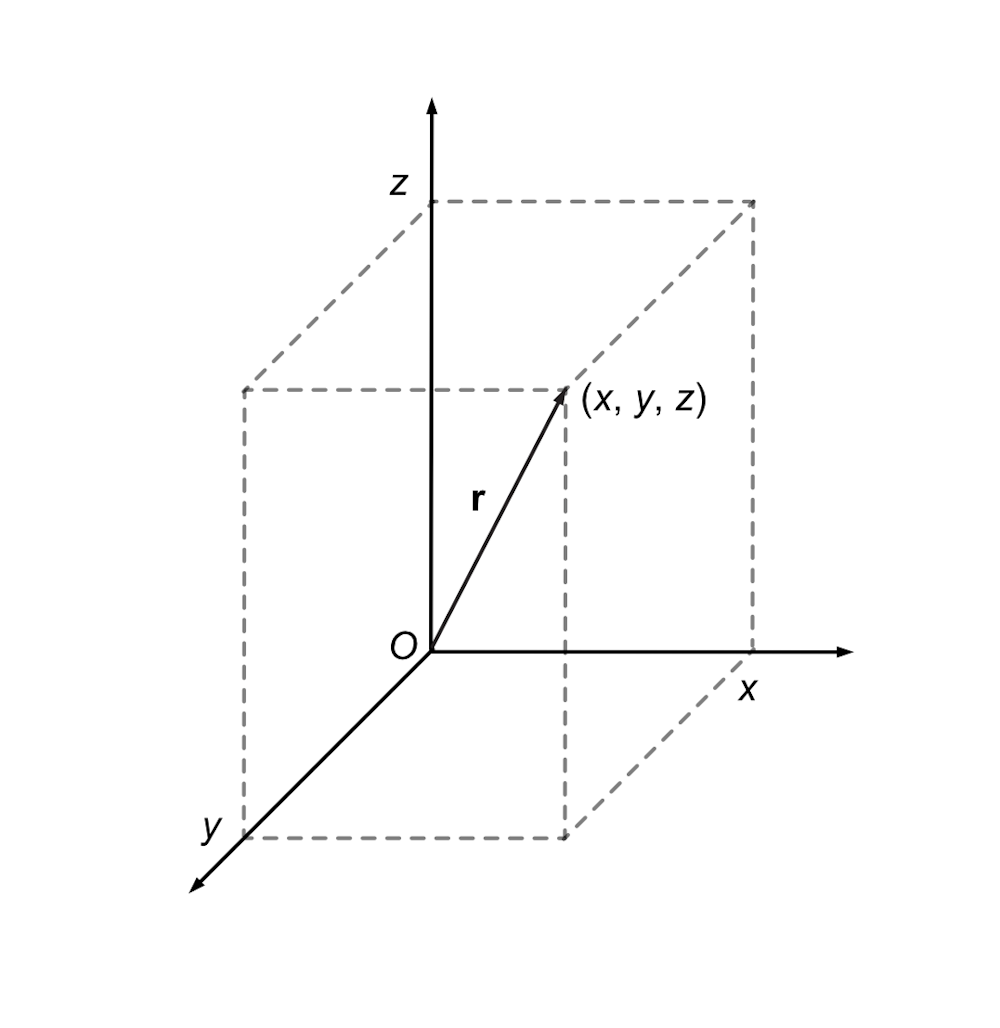
    A vector encodes two kinds of information at once, most famously the magnitude and direction of a spatial quantity such as force, velocity or relative position. For instance, to represent an object’s position (xyz) relative to the “origin” (the zero point of the position axes), Hamilton visualised an arrow pointing from the origin to the object’s location. The arrow represents the “position vector” x i + y j + z k.

    This vector’s “components” are the numbers x, y and z – the distance the arrow extends along each of the three axes. (Other vectors would have different components, depending on their magnitudes and units.)

    A vector (r) is like an arrow from the point O to the point with coordinates (x, y, z).
    The Conversation, CC BY

    Half a century later, the eccentric English telegrapher Oliver Heaviside helped inaugurate modern vector analysis by replacing Hamilton’s imaginary framework i, j, k with real unit vectors, i, j, k. But either way, the vector’s components stay the same – and therefore the arrow, and the basic rules for multiplying vectors, remain the same, too.

    Hamilton defined two ways to multiply vectors together. One produces a number (this is today called the scalar or dot product), and the other produces a vector (known as the vector or cross product). These multiplications crop up today in a multitude of applications, such as the formula for the electromagnetic force that underpins all our electronic devices.

    A single mathematical object

    Unbeknown to Hamilton, the French mathematician Olinde Rodrigues had come up with a version of these products just three years earlier, in his own work on rotations. But to call Rodrigues’ multiplications the products of vectors is hindsight. It is Hamilton who linked the separate components into a single quantity, the vector.

    Everyone else, from Isaac Newton to Rodrigues, had no concept of a single mathematical object unifying the components of a position or a force. (Actually, there was one person who had a similar idea: a self-taught German mathematician named Hermann Grassmann, who independently invented a less transparent vectorial system at the same time as Hamilton.)

    Hamilton also developed a compact notation to make his equations concise and elegant. He used a Greek letter to denote a quaternion or vector, but today, following Heaviside, it is common to use a boldface Latin letter.

    This compact notation changed the way mathematicians represent physical quantities in 3D space.

    Take, for example, one of Maxwell’s equations relating the electric and magnetic fields:


    ×


    E


    = –∂
    B
    /∂

    t

    With just a handful of symbols (we won’t get into the physical meanings of ∂/∂t and ∇ ×), this shows how an electric field vector (E) spreads through space in response to changes in a magnetic field vector (B).

    Without vector notation, this would be written as three separate equations (one for each component of B and E) – each one a tangle of coordinates, multiplications and subtractions.

    The expanded form of the equation. As you can see, vector notation makes life much simpler.
    The Conversation, CC BY

    The power of perseverance

    I chose one of Maxwell’s equations as an example because the quirky Scot James Clerk Maxwell was the first major physicist to recognise the power of compact vector symbolism. Unfortunately, Hamilton didn’t live to see Maxwell’s endorsement. But he never gave up his belief in his new way of representing physical quantities.

    Hamilton’s perseverance in the face of mainstream rejection really moved me, when I was researching my book on vectors. He hoped that one day – “never mind when” – he might be thanked for his discovery, but this was not vanity. It was excitement at the possible applications he envisaged.

    A plaque on Dublin’s Broome Bridge commemorate’s Hamilton’s flash of insight.
    Cone83 / Wikimedia, CC BY-SA

    He would be over the moon that vectors are so widely used today, and that they can represent digital as well as physical information. But he’d be especially pleased that in programming rotations, quaternions are still often the best choice – as NASA and computer graphics programmers know.

    In recognition of Hamilton’s achievements, maths buffs retrace his famous walk every October 16 to celebrate Hamilton Day. But we all use the technological fruits of that unassuming graffiti every single day.

    Robyn Arianrhod does not work for, consult, own shares in or receive funding from any company or organisation that would benefit from this article, and has disclosed no relevant affiliations beyond their academic appointment.

    ref. Three letters, one number, a knife and a stone bridge: how a graffitied equation changed mathematical history – https://theconversation.com/three-letters-one-number-a-knife-and-a-stone-bridge-how-a-graffitied-equation-changed-mathematical-history-241034

    MIL OSI AnalysisEveningReport.nz

  • MIL-Evening Report: Has Kamala Harris reached the ceiling of her ability to make gains against Trump?

    Source: The Conversation (Au and NZ) – By Jared Mondschein, Director of Research, US Studies Centre, University of Sydney

    With less than three weeks to go before Election Day, the polling at this point is clear: Kamala Harris and Donald Trump are effectively tied.

    Harris has led the Democratic ticket for less than three months, but in that short time she has galvanised Democratic voters and significantly increased the popularity of the Democratic ticket. Yet, current levels of US political polarisation and, perhaps more notably, calcification, make one wonder just how much more support she could win.

    In other words, few Americans are undecided in their views of Donald Trump – he galvanises both his base and his opponents alike – so there are simply not many American voters remaining for Harris to try to win over.

    Initial momentum has plateaued

    When 81-year-old Joe Biden led the Democratic ticket in early 2024, only 55% of Democrats and Democratic-leaning voters were enthusiastic about the election.

    While the 2020 presidential election between Biden and Trump broke records for US voter turnout, the 2024 redux was looking like it would break the opposite sort of records – for voter disinterest.

    That is, at least, until Harris assumed the top of the Democratic ticket on 21 July 2024. Within a month of Biden stepping down as the party’s nominee, Democratic enthusiasm for their significantly younger candidate jumped 23 points to 78%. This eclipsed not only levels of enthusiasm that Democrats had for Barack Obama in 2008, but also the levels of enthusiasm that Republicans currently have for Donald Trump.

    Harris’ momentum saw the race quickly move on from deep analysis of the “double haters” – the record 25% US voters who disliked both Trump and Biden and were simply deciding which they hated less. With a much closer contest now likely, attention shifted to key swing states such as Pennsylvania, where Harris closed Trump’s five-point lead over Biden to now be around even.

    Small changes can make a big difference

    Harris’ ability to make the Democratic ticket competitive should not be undervalued. After all, as recently as June 2024, she was one of the few Democratic politicians who actually had a lower national approval rating than Joe Biden.

    With that said, the momentum for Harris should not be seen as a sea change across the country. As much as she energised a previously lacklustre Democratic ticket, approval of Harris among self-described Independent voters only increased from 36% to 43% in the same timeframe. Republican approval of Harris decreased slightly from 6% to 4% over the same period.

    Ultimately, even the slightest of changes can completely shift the nature of the race, particularly given how slim the margins have been in the last two presidential elections. In the 2016 presidential election, for example, Trump’s margin of victory was some 75,000 votes across three swing states. In 2020, Biden’s margin of victory was about 45,000 votes across three swing states.

    Harris or Trump’s 2024 margin of victory very well may be less than 0.03% of the US electorate, making this potentially the closest US election in decades.

    Has support for Harris peaked?

    For the first half of 2024, Trump polled considerably ahead of Biden in the key swing states that will most likely decide the US election. Then, within weeks of Harris becoming the presidential nominee in July, the difference in the swing states between Trump and his opponent shrank to around 1-2 percentage points.

    Now, nearly three months later, the polling is essentially unchanged – remaining well within the standard margin of error of around ±3%.

    As much as Harris has eclipsed Biden in the race against Trump, there is no denying the statistical reality that Harris is no longer gaining ground on Trump in the way that she was in the early weeks of her candidacy.

    Some have argued that Harris’ liabilities – and perhaps the reason she has stalled in the polls – are that Americans remain fairly negative on the economy, she is in the incumbent administration instead of on an outsider ticket, and that many view her as simply too progressive.

    Yet judging by the fact that Harris appears to be polling better than “a generic Democrat” – who generally are more popular than any other Democrats because they are not real people with real positions – it’s perhaps more likely that in these polarised and calcified times, Harris very well may have simply peaked as high as any other Democratic candidate possibly could.

    With American voter intentions barely shifting after an insurrection, pandemic and assassination attempts, it’s hard to imagine Harris can do much better than she already is doing.

    Harris’ best strategy for success on November 5 may therefore need to be less focused on winning over more of the very few undecided voters remaining, and instead more focused on simply getting her energised supporters to turn up on Election Day.

    Jared Mondschein does not work for, consult, own shares in or receive funding from any company or organisation that would benefit from this article, and has disclosed no relevant affiliations beyond their academic appointment.

    ref. Has Kamala Harris reached the ceiling of her ability to make gains against Trump? – https://theconversation.com/has-kamala-harris-reached-the-ceiling-of-her-ability-to-make-gains-against-trump-240902

    MIL OSI AnalysisEveningReport.nz

  • MIL-Evening Report: An immediate ban has been issued for the herbicide dacthal. What are the health risks?

    Source: The Conversation (Au and NZ) – By Ian Musgrave, Senior lecturer in Pharmacology, University of Adelaide

    Last week the Australian government cancelled the registration of all products containing chlorthal dimethyl, a weedkiller commonly known as dacthal.

    No phase out period applies. The cancellation is immediate, due to the risks it poses to human health – primarily unborn babies.

    This means using dacthal as a chemical agricultural product “is now illegal”, according the Australian Pesticides and Veterinary Medicines Authority.

    So what has changed? What are the health risks of being exposed to dacthal – and how long have we known about them?

    What is dacthal?

    Dacthal and chlorthal dimethyl are alternative names for dimethyl tetrachloroterephthalate, or DCPA. This is a herbicide registered to control weeds in both agricultural and non-agricultural settings.

    Dacthal works by inhibiting auxin, a growth hormone in plants which promotes the development of buds, roots and lengthening cells.

    It is used to selectively kill annual grasses and many other common weeds, without killing turf grasses, flowers, fruits and vegetables. Dacthal is applied before weeds emerge, often when still in their seed stage.

    In Australia it is used in twelve herbicide products. All have been cancelled as of October 10 2024.

    Farmers and retailers are allowed to hold products until they’re recalled, but must not use them. The government says it will provide information about product recall shortly.

    What are the health risks?

    As dacthal targets a hormone found only in plants, for adult humans and mammals the chemical has limited acute and subchronic toxicity. This means brief exposure to high levels of dacthal, or longer-term exposure to modestly high levels, have no effect.

    However there is a health risk for unborn babies whose mothers have been directly exposed. This could be through mixing the chemical, loading and applying it, or from residue on treated crops – for up to five days after first applied.

    The chemical has been linked to low birth weight, and life-long impacts, which can include impaired brain development and motor skills.

    The government has advised pregnant agricultural workers who are concerned to speak to their clinician.

    What changed?

    Safety data for chemicals such as pesticides are periodically reevaluated. This is to see if any new risks have become apparent with advances in technology and our understanding of biology.

    In 2013, the United States Environmental Protection Agency called for fresh safety data to look at effects of dacthal on thyroid hormones.

    Fast forward to 2022. In that time, the company producing dacthal had failed to produce the required study. So the US Environmental Protection Agency issued a notice it would suspend technical-grade products containing dacthal.

    In response, the company submitted a thyroid study performed in rats. This study showed dacthal could affect thyroid function at doses lower than previously known.

    The US government determined this did not change recommendations for adults. However dacthal may affect thyroid function of a fetus at lower doses than those those that harm adults.

    What did the study in rats find?

    Dacthal was found to inhibit two thyroid hormones in rat pups whose mother had been exposed while pregnant.

    There was a 35-53% decrease in the hormone triiodothyronine, known as T3. And for thyroxine (T4), rat pups experienced a 29-66% decrease after their mother’s exposure.

    Decreases in these two hormones are associated with risks to unborn children including low birth weight and impaired brain development, IQ and motor skills.

    Of particular concern was the effects occurred at much lower levels than previously thought. The decreases in T3 and T4 occurred in rat pups exposed to levels of dacthal ten times lower than the safe threshold for their mothers. This means pregnant rats exposed to dacthal at those levels had no adverse effects, but their unborn babies did.

    Exactly how the chemical caused decreases in T3 and T4 in rat pups is not clear.

    However the Australian Pesticides and Veterinary Medicines Authority considers this study relevant to humans. The changes in regulation are based on the potential harms if unborn babies are exposed via their mothers.

    The health risk is to the development of an unborn baby exposed to dachtal via their mother.
    Fox_Ana/Shutterstock

    What exposure is safe?

    The rat study was used to calculate maximum levels of exposure for pregnant workers. This maximum – 0.001 mg dachtal/kg body weight/day – was considered appropriate to reduce risk to the unborn child (and was not expected to harm adults).

    However, the maximum acceptable level was exceeded in all estimates of exposure to dachtal. This was the case even when the person was wearing protective clothing, gloves, and using a respirator.

    Even under stringent safety conditions, potential harms to an unborn child could not be ruled out. For this reason the US stopped sale of dacthal via an Emergency Order on 6 August 2024. Australia has since followed suit with its own ban.

    How long have we known about this?

    The US government only received the thyroid information in 2022. It then had to determine whether the levels of exposure under real world conditions would equate to risk in humans.

    This is not straightforward, as the pesticide is used under a variety of conditions, including:

    • mixing and preparing the pesticide using personal protective equipment
    • downstream spay drift
    • treatment of lawns and exposure to the lawn after treatment.

    Each of these scenarios requires careful analysis of potential risks.

    In addition, exposure can be through inhalation and/or skin contact. All this must be taken into account and these calculations take time.

    Should I be worried?

    If you were not pregnant and using personal protective clothing while using or applying dacthal herbicides, this is little cause for worry. Your exposure is below the maximum limit.

    But if you were pregnant when using dacthal pesticides, please consider consulting your child’s paediatrician.

    Ian Musgrave has received funding from the National health and Medical Research Council to study contaminants in herbal medicines. He has received ARC funding for studying Alzheimer’s disease in the recent past. He is a member of the Science Communicators South Australian Branch.

    ref. An immediate ban has been issued for the herbicide dacthal. What are the health risks? – https://theconversation.com/an-immediate-ban-has-been-issued-for-the-herbicide-dacthal-what-are-the-health-risks-241257

    MIL OSI AnalysisEveningReport.nz

  • MIL-Evening Report: Australian schools need to address racism. Here are 4 ways they can do this

    Source: The Conversation (Au and NZ) – By Aaron Teo, Lecturer in Curriculum and Pedagogy, University of Southern Queensland

    The Australian Human Rights Commission wants to see schools address racism, as part of a broader push to address the problem across Australian society.

    As it says in a recent report,

    People are not born with racist attitudes or beliefs […] Addressing racism in schools is crucial to ensure that victims do not leave education facing lifelong disadvantage, and perpetrators do not enter adulthood believing racist behaviours are acceptable […].

    But racism is hardly mentioned in the Australian Curriculum – for example, it is noted in passing in the health and physical education curriculum for years 5 to 8. However, there is no consistent approach across subject areas, or at the state level.

    This means teaching about racism is largely left up to individual schools and teachers.

    Yet research shows they can be reluctant to speak about these issues with students. This is for a range of reasons, such as worrying they will say the wrong thing.

    How should school systems, schools and teachers address racism? Here are four ways.

    1. Teach racial literacy

    We know children demonstrate stereotyping and prejudice from an early age and students from racial minorities are frequently targets of racism and discrimination at school.

    In Australia, racism debates can also involve dangerous and ill-informed opinions.

    So we need to start teaching children and young people about racial literacy skills from the first year of schooling. This means they grow up to have the knowledge and language to talk about and confront racism.

    Some of these skills include:

    • being able to identify how racism appears in everyday interactions, the media and society more broadly

    • debunking common myths about racism, such as it is a “thing of the past”. Or “everyone has equal access to the same opportunities and outcomes if they work hard enough”

    • understanding the impacts of racism, including on people’s opportunities, education and their health and wellbeing

    • understanding how our own backgrounds, privilege and bias can influence how we confront or don’t confront racism.

    Students also need to learn how racism can be structural, systemic and institutional. This means racism is not just about an individuals’ beliefs or actions. Laws, policies, the way organisations are run and cultural norms can all result in inequitable treatment, opportunities and outcomes.

    2. Teach students how to react

    We also need to teach children how to react when they witness racism with age-appropriate tools.

    For both primary and secondary students, the first question should always be, “Is it safe for me to act?”, followed by “Am I the best person to act in this situation?”. Depending on their answers, they could:

    • report the incident to an appropriate adult or person in authority

    • show solidarity with the victim by comforting them and letting them know what happened was not OK

    • interrupt, distract or redirect the perpetrator

    • seek help from friends, a passerby or teacher.

    3. Create safe classrooms and playgrounds

    Teachers need to ensure classrooms and schools are safe spaces to discuss racism.

    This can include:

    • acknowledging how our own experiences, biases and privileges shape our world views

    • clearly defining the purpose of a discussion and the ground rules

    • using inclusive language.

    In particular, schools have a unique duty of care for minority students, who need to know they can talk openly about these issues with their peers and teachers without fear or judgement.

    This includes addressing sensitive topics like how they might experience or witness racism, the effect it can have on their health and wellbeing and those around them, and the consequences of talking about or reporting racism.

    4. Develop teachers’ skills

    As part of creating safe classrooms, teachers need to be able to confidently discuss tricky topics in an age-appropriate way.

    Our work has shown some teachers deny racism or perpetuate racist stereotypes. Others may avoid the topic, worrying they will say or do the wrong thing.

    Our current (as yet unpublished) research on anti-racism training with classroom teachers suggests they can increase their confidence to talk and teach about racism if given appropriate, and sustained training.

    What needs to happen now?

    We need anti-racism education to be an official part of school curricula. To accompany this, we need genuine commitments and modelling from policymakers, school leaders, teachers, parents and carers to address racism in schools.

    We need to talk openly about racism in schools. That means explicitly naming it, calling it out, and not getting defensive when it is identified and action is required.

    Aaron Teo is Convenor for the Australian Association for Research in Education Social Justice Special Interest Group, Queensland Convenor for the Asian Australian Alliance, member of the Challenging Racism Project, and member of the Advisory Committee for the Australian Human Rights Commission’s study into racism in Australian universities

    Rachel Sharples has received funding from the Australian Research Council and the NSW Department of Education. She is a member of the Challenging Racism Project (CRP) and the Centre for Resilient and Inclusive Communities (CRIS).

    ref. Australian schools need to address racism. Here are 4 ways they can do this – https://theconversation.com/australian-schools-need-to-address-racism-here-are-4-ways-they-can-do-this-239823

    MIL OSI AnalysisEveningReport.nz

  • MIL-Evening Report: Albanese government promises to ban ‘dodgy’ trading practices

    Source: The Conversation (Au and NZ) – By Michelle Grattan, Professorial Fellow, University of Canberra

    Hard on the heels of pledging a crackdown on excessive surcharges, the Albanese government has promised legislation to ban unfair trading practices.

    The government said this would include specific prohibitions on various “dodgy” practices.

    “From concert tickets to hotel rooms to gym memberships, Australians are fed up with businesses using tricky tactics that make it difficult to end subscriptions or add hidden fees to purchases,” the prime minister, treasurer and assistant treasurer said in a statement.

    “These practices can distort purchasing decisions, or result in additional costs, putting more pressure on the cost of living.”

    They said the government would deal with

    • “subscription traps” that make it difficult to cancel a subscription

    • “drip pricing” characterised by hidden fees or fees added during the purchase

    • deceptive and manipulative online practices. These aim to confuse consumers, such as for example by creating a false sense of urgency, warning there is only a limited time to purchase

    • dynamic pricing, where a price changes during the transaction

    • requiring a consumer to set up an account and provide unnecessary information for an online purchase

    • a business making it difficult for a consumer to contact it when they have a problem with the product.

    Earlier this week Arts Minister Tony Burke said on the ABC the government was not looking at “dynamic pricing” in the music industry.

    Asked on Four Corners whether dynamic pricing should be allowed in Australia, Burke said: “Surge pricing is something that, as consumers, people have always dealt with.

    “I don’t love it, but I think we have to be realistic, it’s always been there. It’s not something we’re looking at, at the moment.”

    Asked about the discrepancy, a government spokesperson said the Four Corners interview “was recorded a month ago, before this policy existed”.

    Treasury will consult on the design of the planned changes. The government on Wednesday will put out a consultation paper on reforms for greater protections for consumers and small businesses under the consumer guarantees and supplier indemnification in the Australian Consumer Law.

    The government says it will work with the states to have a final reform proposal in the first half of next year.

    There will be penalties for suppliers that refuse to give consumers a remedy such as a replacement product or a refund when legally required.

    “Currently, it can be difficult for consumers to obtain a remedy, especially when engaging in the digital economy,” the government statement said.

    The reforms would empower the Australian Competition and Consumer Commission and state and territory agencies to pursue breaches of consumer guarantees and supplier indemnification provisions.

    Prime Minister Anthony Albanese said “hidden fees and traps are putting even more pressure on the cost of living and it needs to stop”.

    Michelle Grattan does not work for, consult, own shares in or receive funding from any company or organisation that would benefit from this article, and has disclosed no relevant affiliations beyond their academic appointment.

    ref. Albanese government promises to ban ‘dodgy’ trading practices – https://theconversation.com/albanese-government-promises-to-ban-dodgy-trading-practices-234142

    MIL OSI AnalysisEveningReport.nz

  • MIL-Evening Report: ‘Awful reality’: Albanese government injects $95 million to fight the latest deadly bird flu

    Source: The Conversation (Au and NZ) – By Michelle Wille, Senior research fellow, The University of Melbourne

    The Australian government has committed A$95 million to fight a virulent strain of bird flu wreaking havoc globally.

    With the arrival of millions of migratory birds this spring, there is an increased risk of a deadly strain arriving in Australia, known as highly pathogenic avian influenza (HPAI) H5N1.

    Australia is the only continent free of this rapidly spreading strain. Overseas, HPAI H5N1 has been detected in poultry, wild birds and a wide range of mammals, including humans. But our reprieve will likely not last forever.

    As Environment Minister Tanya Plibersek warned on Monday, “the awful reality of this disease is that – like the rest of the world – we will not be able to prevent its arrival”. HPAI H5N1 is like nothing we’ve seen in Australia. The extra funding, which is in addition to Australia’s current biosecurity budget, will help us prepare and respond.

    A trail of destruction

    Avian influenza is a virus that infects birds, but can infect other animals.

    In Australia we have various strains of avian influenza that don’t cause disease, referred to as low pathogenic avian influenza. While these viruses occur naturally Australian wild birds, it is the disease-causing strains, such as HPAI H5N1 and HPAI H7 we are worried about. These HPAI strains have enormous consequences for wild birds, domestic animals, and animal producers and workers.

    HPAI H5N1 first emerged in Asia in 1996, and has been circulating in Asian poultry for decades. Following genetic changes in the virus, it repeatedly jumped into wild birds in 2014, 2016 and again in 2020, after which it caused an animal pandemic, or panzootic.

    Starting in 2021, the virus rapidly spread. First, from Europe to North America in 2021. Then into South America in 2022. There, in South America, the virus caused the death of more than 500,000 wild birds and 30,000 marine mammals.

    While we had seen large outbreaks in wild birds globally, the huge outbreaks in seals and sea lions in South America was unprecedented. With this came substantial concern that the virus was spreading from mammal to mammal, rather than just bird to bird or bird to mammal, as was happening elsewhere.

    About a year after arriving in South America, the virus was detected in the sub-Antarctic, and a few months later, on the Antarctic Peninsula.

    Australia and New Zealand are still free of the virus, for now.

    The rising death toll

    Beyond wildlife, HPAI H5N1 is having a huge impact on poultry.

    In 2022 alone, it caused 130 million poultry across 67 countries to die of the illness or be euthanased because they were infected.

    In contrast, earlier this year Australia’s biggest avian influenza outbreak to date – caused by a different strain, HPAI H7 – caused the death or destruction of 1.5 million chickens. That’s a drop in the bucket compared to what is occurring globally.

    Concerningly, in the United States, the virus has jumped into dairy cattle and so far has affected more than 200 dairy herds in 14 states. It has also jumping into humans: in the past ten days alone, six human cases have occurred – all in dairy workers in California.

    Given HPAI H5N1 has spread around the globe, the risk of the virus entering Australia has increased.

    In a recent risk assessment, my colleague and I identified two main pathways for H5N1 into Australia.

    The most likely route is that H5N1 is brought in from Asia by long-distance migratory birds. Birds such as shorebirds and seabirds arrive in the millions each spring from Asia (and in some cases as far away as Alaska).

    A second route is with ducks. If the virus spreads across the Wallace Line (a biogeographical boundary that runs through Indonesia), it will come into contact with endemic Australian duck species.

    Unlike shorebirds and seabirds, ducks are not long-distance migrants, and don’t migrate between Asia and Australia. That endemic Australian ducks are not exposed to this virus because they don’t migrate to Asia may be one of the reasons why H5N1 has not yet arrived in Australia.

    So, what’s the plan?

    The Australian government’s new $95 million funding commitment is a crucial response to the heightened level of risk, and the dire consequences if H5N1 entered the country.

    The funding is divided between environment, agriculture and human health – the three pillars of the “One Health” approach.

    Broadly, the money will be spent on:

    • enhancing surveillance to ensure timely detection and response if the disease enters and spreads in animals within Australia

    • strengthening preparedness and response capability to reduce harm to the production sector and native wildlife

    • supporting a nationally coordinated approach to response and communications

    • taking proactive measures to protect threatened iconic species from extinction

    • investing in more pre-pandemic vaccines to protect human health.

    Importantly, the funding covers preparedness, surveillance and response.

    Preparedness includes proactive measures to protect threatened birds – for example, vaccination or reducing other threats to these species) and improving biosecurity.

    Surveillance is essential to catch the virus as soon as it arrives and track its spread. Australia already has a wild bird surveillance program which, among other things, investigates sick and dead wildlife as well as sampling “healthy” wild birds. The additional commitment will bolster these activities.

    Response will include things like better and faster tests. It will also include funding for practical on-ground actions to limit the spread and impacts of HPAI H5N1 for susceptible wildlife. This might include a vaccination program for vulnerable threatened species, as an example.

    Work has already begun

    This funding is a long-term investment, and mostly allocated to future activities. In the short term, my colleagues and I have already begun our spring surveillance program.

    We aim to test about 1,000 long-distance migratory birds arriving in Australia for avian influenza. Based on our risk assessments, we are focusing on long-distance migratory seabirds such as the short-tailed shearwater, and various shorebirds including red-necked stints, arriving from breeding areas in Siberia.

    This surveillance program is supported by, and contributes to, the national surveillance program managed by Wildlife Health Australia

    In addition to our active surveillance, we need your help! If you see sick or dead wild birds or marine mammals, call the Emergency Animal Disease Watch Hotline on 1800 675 888.

    In addition, the Wildlife Health Australia website offers current advice for:

    For more information, visit birdflu.gov.au or Wildlife Health Australia’s avian influenza page

    Michelle Wille receives funding from Department of Agriculture, Fisheries and Forestry and Wildlife Health Australia.

    ref. ‘Awful reality’: Albanese government injects $95 million to fight the latest deadly bird flu – https://theconversation.com/awful-reality-albanese-government-injects-95-million-to-fight-the-latest-deadly-bird-flu-241243

    MIL OSI AnalysisEveningReport.nz

  • MIL-Evening Report: The AI sexbot industry is just getting started. It brings strange new questions – and risks

    Source: The Conversation (Au and NZ) – By Raffaele F Ciriello, Senior Lecturer in Business Information Systems, University of Sydney

    DALL-E via Shutterstock

    Artificial intelligence (AI) is getting personal. Chatbots are designed to imitate human interactions, and the rise of realistic voice chat is leading many users to form emotional attachments or laugh along with virtual podcast hosts.

    And that’s before we get to the really intimate stuff. Research has shown that sexual roleplaying is one of the most common uses of ChatGPT, and millions of people interact with AI-powered systems designed as virtual companions, such as such as Character.AI, Replika, and Chai.AI.

    What does this mean for the future of (human) romance? The prospects are alarming.

    Better be nice to your AI overlord

    The most prominent AI companion service is Replika, which allows some 30 million users to create custom digital girlfriends (or boyfriends).

    While early studies indicate most Replika users are male, Caucasian and under 30, other demographics are catching up. Male sex robots have been in the making for some years. And they’re more than just vibrators with integrated jar openers.

    For a subscription fee, users can exchange intimate messages or pictures with their AI partners. Over half a million users had subscribed before Replika temporarily disabled its “erotic roleplay” module in early 2023, fearing regulatory backlash — a move that users dubbed “The Lobotomy.”

    The Replika “lobotomy” highlights a key feature of virtual companions: their creators have complete control over their behaviour. The makers of apps can modify or shut down a user’s “partner” – and millions of others – at any moment. These systems also read everything users say, to tailor future interactions and, of course, ads.

    AI is coming to the physical sexbot industry too.
    Shutterstock

    However, these caveats don’t appear to be holding the industry back. New products are proliferating. One company, Kindroid, now offers voice chats with up to ten virtual companions simultaneously.

    The digital world isn’t the limit either. Sex doll vendors such as Joy Love Dolls offer interactive real-life sexbots, with not only customisable skin colour and breast size, but also “complete control” of features including movement, heating, and AI-enabled “moans, squeals, and even flirting from your doll, making her a great companion”.

    For now, virtual companions and AI sexbots remain a much smaller market than social media, with millions of users rather than billions. But as the history of the likes of Facebook, Google and Amazon has taught us, today’s digital quirks could become tomorrow’s global giants.

    Towards ethically sourced AI girlfriends?

    The availability of AI-driven relationships is likely to usher in all manner of ethically dubious behaviour from users who won’t have to face the real-world consequences.

    Soon, you might satisfy any kink with your AI girlfriend for an extra fee. If your AI wife becomes troublesome, just ask the corporate overlord to deactivate her envy module — for a price, of course. Or simply delete her and start fresh with as many AI mistresses as you like in parallel.

    The way people form relationships has already been disrupted by dating apps such as Tinder and Bumble.

    What will happen if, in the future, people looking for love are competing against perfect synthetic lovers that are always available and horny? Well, at least they’ll be able to create virtual replicas of those hot dates they didn’t land.

    And for those who lack the skills to create their own virtual companions, there will be plenty of off-the-shelf alternatives.

    An ABC investigation revealed the use of generative AI to create fake influencers by manipulating women’s social media images is already widespread. This is generally done without consent to sell pornographic content. Much of this content depicts unattainable body ideals, and some depicts people who appear to be at best barely of consenting age.

    Another likely application? Using AI sexbot technology to bring celebrities such as Marilyn Monroe and Clara Bow back to life. After all, dead people cannot deny consent anymore.

    Replika itself was inspired by its founder’s desire to recreate her late best friend through a chatbot. Many use the app to keep deceased loved ones around. What a time to be alive (or dead)!

    The potential for emotional manipulation by inventive catfishers and dictators is alarming. Imagine the havoc if figures like Russia’s Vladimir Putin or North Korea’s Kim Jong-un harness this technology to complement their nations’ already extensive cyber-espionage operations.

    Perhaps before long we will see corporations offering “responsibly sourced” AI girlfriends for the more ethical consumer – organically grown from consensually harvested content, promoting socially acceptable smut.

    Society and the state must act now

    With loneliness rising to epidemic levels — surveys suggest up to one in four people in OECD countries lack human connection — the demand for sexbots is only going to grow. Corporations will meet this demand unless society and the state set clear boundaries on what’s acceptable.

    Sex and technology have always co-evolved. Just as prostitution is “the oldest profession”, porn sites are some of the oldest corners of the internet. However, the dystopian potential of sexbots for mass-customised, corporate-controlled monetisation of our most intimate sphere is unprecedented.

    Users aren’t entirely blameless, either. There’s something vicious about replacing a real human being with a totally submissive lust machine.

    Early studies suggest narcissism is prevalent among users of this technology. Normalising harmful sexual behaviours such as rape, sadism or paedophilia is bad news for society.

    However, going after users isn’t likely to be the best way to tackle the issue. We should treat sexbot use like other potentially problematic behaviours, such as gambling.

    As with other problematic behaviours where the issue lies more with providers than users, it’s time to hold sexbot providers accountable. As our links to AI are growing ever more intimate, there’s not much time to waste.

    Raffaele F Ciriello does not work for, consult, own shares in or receive funding from any company or organisation that would benefit from this article, and has disclosed no relevant affiliations beyond their academic appointment.

    ref. The AI sexbot industry is just getting started. It brings strange new questions – and risks – https://theconversation.com/the-ai-sexbot-industry-is-just-getting-started-it-brings-strange-new-questions-and-risks-238998

    MIL OSI AnalysisEveningReport.nz

  • MIL-Evening Report: Two decades after decriminalisation, NZ’s sex workers still need protection from discrimination

    Source: The Conversation (Au and NZ) – By Lynzi Armstrong, Senior Lecturer in Criminology, Te Herenga Waka — Victoria University of Wellington

    It has been two decades since New Zealand decriminalised sex work. And while sex workers have workplace rights, they still worry about the risks of discrimination in everyday life.

    In my recent research, local sex workers explained the benefits of decriminalisation – and what still needs to change. Their experiences highlight that while much has changed for the better, stigma remains an issue. Further change is needed to better protect sex workers from it.

    New Zealand’s experience is relevant right now, as a number of governments elsewhere are reviewing their laws around sex work.

    Scotland, for example, is considering a proposal that would criminalise the purchase of sex – known as the Nordic model due to its initial adoption in some Nordic countries.

    Supporters argue this will help sex workers and extend gender equality. But evidence suggests the Nordic model actually harms sex workers: it impedes safety strategies, increases the risk of violence, limits access to justice, and enables discrimination.

    What is decriminalisation?

    The other options are decriminalisation and legalisation. While these terms are often used interchangeably, they are different. Legalisation of sex work (in Germany and the Netherlands, for example) means legalising an act that was previously against the law.

    For sex workers, this means restrictive government regulation and control, which may include mandatory registration with authorities, compulsory sexual health checks, and permission to work in specific areas only.

    Decriminalisation, on the other hand, means repealing laws that make an act or behaviour a crime, but not necessarily introducing restrictive regulations specific to the sex industry.

    That said, decriminalisation does not mean there is no regulation. Instead, regulations are comparable to other businesses. The focus is not on regulating sex workers, but providing them with rights.

    Under New Zealand’s Prostitution Reform Act (2003) it is an offence to induce or compel a person to do sex work. Sex workers have the right to refuse to see clients for any reason at any time. If a sex worker wishes to stop doing sex work, they can access unemployment benefits immediately (rather than having the normal stand down period ).

    Impacts of decriminalisation in New Zealand

    Research three years after the law came into force found a majority of participants felt they had more rights and were more able to refuse to see clients than before. Several participants felt police attitudes towards them had improved.

    Subsequent research found relationships between street-based sex workers and police had improved. Decriminalisation supported the safety strategies of these sex workers better.

    There have also been several high-profile cases where sex workers have exercised their legal rights. Brothel-based sex workers won sexual harassment cases against business owners, and convictions of rape against two clients who covertly removed condoms during their bookings.

    Among the 26 sex workers we interviewed in New Zealand, participants described feeling fortunate to work in the decriminalised context. They also felt working conditions for sex workers were better than in other countries.

    One participant said:

    I also feel that we shouldn’t have to say “oh we’re so lucky” but we are compared to other people in other countries.

    Another felt decriminalisation gave sex workers a “protective layer”.

    This meant, as one participant put it, “we have rights, full stop”.

    Participants appreciated sex work being defined as work and the rights that accompany this. Decriminalisation was considered both ideal and normalised. As another explained,

    it’s been decriminalised for a long time now, like it’s part of our reality.

    Room for improvement?

    While participants felt grateful to work in the decriminalised context, this doesn’t mean there weren’t issues.

    Decriminalisation in New Zealand doesn’t include legal protection from discrimination. Sex workers have little recourse if they are treated unfairly because of their job.

    The sex workers we spoke with believed the social stigma of sex work was gradually fading, and instances of discrimination described by participants were rare. But they still feared the consequences of discrimination (such as being denied accommodation or premises to work from if their work became known to a landlord).

    They supported further legal protection from discrimination. For one participant this meant,

    I could tell people my job without […] any fear of backlash, and that would be fantastic.

    Participants also wanted the protections of decriminalisation extended to temporary migrants. People who hold temporary visas face deportation if they are found to be working in the sex industry, making them vulnerable to exploitation.

    Falling behind

    After two decades of decriminalisation, New Zealand risks falling behind as more jurisdictions (such as Victoria and Queensland in Australia) adopt decriminalised frameworks that build in protection from discrimination.

    Such protections mean it is no longer legal to deny a person accommodation or a job based on their sex work experience, or deny them a bank loan or mortgage.

    To keep up, New Zealand needs to follow suit. The next step is therefore to strengthen and expand the rights sex workers have.

    Perhaps then, in another 20 years, the country will still be seen as one that put the human rights of sex workers first and showed the rest of the world what equality really looks like.

    Lynzi Armstrong received funding from the Royal Society of New Zealand Marsden Fund (2019-2024)

    ref. Two decades after decriminalisation, NZ’s sex workers still need protection from discrimination – https://theconversation.com/two-decades-after-decriminalisation-nzs-sex-workers-still-need-protection-from-discrimination-240787

    MIL OSI AnalysisEveningReport.nz

  • MIL-Evening Report: Lessons for the next pandemic: where did Australia go right and wrong in responding to COVID?

    Source: The Conversation (Au and NZ) – By Adrian Esterman, Professor of Biostatistics and Epidemiology, University of South Australia

    Igor Corovic/Shutterstock

    With COVID still classified as an ongoing pandemic, it’s difficult to contemplate the next one. But we need to be prepared. We’ve seen several pandemics in recent decades and it’s fair to expect we’ll see more.

    For the final part in a series of articles on the next pandemic, we’ve asked a range of experts what Australia got right and wrong it its response to COVID. Here they share their thoughts on the country’s COVID response – and what we can learn for the next pandemic.


    Quarantine

    The federal government mandated 14 days of quarantine for all international arrivals between March 2020 and November 2021. During that period, 452,550 people passed through the system.

    The states and Northern Territory were given just 48 hours to set up their quarantine systems. The states chose hotel quarantine, while the Northern Territory repurposed an old miner’s camp, Howard Springs, which had individual cabins with outdoor verandas. The ACT had very few international arrivals, while Tasmania only had hotel quarantine for domestic travellers.

    During the first 15 months of the program, at least 22 breaches occurred in five states (New South Wales, Victoria, Queensland, Western Australia and South Australia). An inquiry into Victoria’s hotel quarantine found the lack of warning and planning to set up the complex system resulted in breaches that caused Victoria’s second COVID wave of 2020, leading to almost 800 deaths. A breach at Sydney airport led to the introduction of the Delta variant into Australia.

    In the next pandemic, mistakes from COVID need to be avoided. They included failure to protect hotel residents and staff from airborne transmission through ventilation and mask usage. Protocols need to be consistent across the country, such as the type of security staff used, N95 masks for staff and testing frequency.

    These protocols need to be included in a national pandemic preparedness plan, which is frequently reviewed and tested through simulations. This did not occur with the pre-COVID preparedness plan.

    Dedicated quarantine centres like Howard Springs already exist in Victoria and Queensland. Ideally, they should be constructed in every jurisdiction.

    Michael Toole


    Treatments

    Scientists had to move quickly after COVID was discovered to find effective treatments.

    Many COVID treatments involved repurposing existing drugs designed for other viruses. For example, the HIV drug ritonavir is a key element of the antiviral Paxlovid, while remdesivir was originally developed to treat hepatitis C.

    At the outset of the pandemic, there was a lot of uncertainty about COVID treatment among Australian health professionals. To keep up with the rapidly developing science, the National Clinical Evidence Taskforce was established in March 2020. We were involved in its COVID response with more than 250 clinicians, consumers and researchers.

    Unusually for evidence-based guidelines, which are often updated only every five years or so, the taskforce’s guidelines were designed to be “living” – updated as new research became available. In April 2020 we released the first guidelines for care of people with COVID, and over the next three years these were updated more than 100 times.

    While health-care professionals always had access to up-to-date guidance on COVID treatments, this same information was not as accessible for the public. This may partly explain why many people turned to unproven treatments. The taskforce’s benefits could have been increased with funding to help the community understand COVID treatments.

    COVID drugs faced other obstacles too. For example, changes to the virus itself meant some treatments became less effective as new variants emerged. Meanwhile, provision of antiviral treatments has not been equitable across the country.

    COVID drugs have had important, though not game-changing, impacts. Ultimately, effective vaccines played a much greater role in shifting the course of the pandemic. But we might not be so fortunate next time.

    In any future pandemic it will be crucial to have a clear pathway for rapid, reliable methods to develop and evaluate new treatments, disseminate that research to clinicians, policymakers and the public, and ensure all Australians can access the treatments they need.

    Steven McGloughlin and Tari Turner, Monash University


    Vaccine rollout

    COVID vaccines were developed in record time, but rolling them out quickly and seamlessly proved to be a challenge. In Australia, there were several missteps along the way.

    First, there was poor preparation and execution. Detailed planning was not finalised until after the rollout had begun.

    Then the federal government had overly ambitious targets. For example, the goal of vaccinating four million people by the end of March 2021 fell drastically short, with less than one-fifth of that number actually vaccinated by that time.

    There were also supply issues, with the European Union blocking some deliveries to Australia.

    Unfortunately, the government was heavily reliant on the AstraZeneca vaccine, which was found, in rare cases, to lead to blood clots in younger people.

    Despite all this, Australia ultimately achieved high vaccination rates. By the end of December 2021, more than 94% of the population aged 16 and over had received at least one dose.

    This was a significant public health achievement and saved thousands of lives.

    But over the past couple of years, Australia’s initially strong vaccine uptake has been waning.

    The Australian Technical Advisory Group on Immunisation recommends booster doses for vulnerable groups annually or twice annually. However, only 30% of people aged 75 and over (for whom a booster is recommended every six months) have had a booster dose in the past six months.

    There are several lessons to be learned from the COVID vaccine rollout for any future pandemic, though it’s not entirely clear whether they are being heeded.

    For example, several manufacturers have developed updated COVID vaccines based on the JN.1 subvariant. But reports indicate the government will only be purchasing the Pfizer JN.1 booster. This doesn’t seem like the best approach to shore up vaccine supply.

    Adrian Esterman, University of South Australia


    Mode of transmission

    Nearly five years since SARS-CoV-2 (the virus that causes COVID) first emerged, we now know airborne transmission plays a far greater role than we originally thought.

    In contrast, the risk of SARS-CoV-2 being transmitted via surfaces is likely to be low, and perhaps effectively non-existent in many situations.

    Early in the pandemic, the role contaminated surfaces and inanimate objects played in COVID transmission was overestimated. The main reason we got this wrong, at least initially, was that in the absence of any direct experience with SARS-CoV-2, we extrapolated what we believed to be true for other respiratory viruses. This was understandable, but it proved to be inadequate for predicting how SARS-CoV-2 would behave.

    One of the main consequences of overestimating the role of surface transmission was that it resulted in a lot of unnecessary anxiety and the adoption of what can only be viewed in retrospect as over-the-top cleaning practices. Remember the teams of people who walked the streets wiping down traffic light poles? How about the concern over reusable coffee cups?

    Considerable resources that could have been better invested elsewhere were directed towards disinfecting surfaces. This also potentially distracted our focus from other preventive measures that were likely to have been more effective, such as wearing masks.

    We now understand COVID spreads predominantly through the air.
    Kate Trifo/Pexels

    The focus on surface transmission was amplified by a number of studies published early in the pandemic that documented the survival of SARS-CoV-2 for long periods on surfaces. However, these were conducted in the lab with little similarity to real-world conditions. In particular, the amounts of virus placed on surfaces were greater than what people would likely encounter outside the lab. This inflated viral survival times and therefore the perception of risk.

    The emphasis on surface transmission early in the pandemic ultimately proved to be a miscalculation. It highlights the challenges in understanding how a new virus spreads.

    Hassan Vally, Deakin University


    National unity

    Initially, Commonwealth, state and territory leaders were relatively united in their response to the COVID pandemic. The establishment of the National Cabinet in March 2020 indicated a commitment to consensus-based public health policy. Meanwhile, different jurisdictions came together to deliver a range of measures aimed at supporting businesses and workers affected by COVID restrictions.

    But as the pandemic continued, tensions gave way to deeper ideological fractures between jurisdictions and individuals. The issues of vaccine mandates, border closures and lockdowns all created fragmentation between governments, and among experts.

    The blame game began between and within jurisdictions. For example, the politicisation of quarantine regulations on cruise ships revealed disunity. School closures, on which the Commonwealth and state and territory governments took different positions, also generated controversy.

    These and other instances of polarisation undermined the intent of the newly established National Cabinet.

    The COVID pandemic showed us that disunity across the country threatens the collective work needed for an effective response in the face of emergencies.

    The COVID response inquiry, due to release its results soon, will hopefully help us work toward national uniform legislation that may benefit Australia in the event of any future pandemics.

    This doesn’t necessarily mean identical legislation across the country – this won’t always be appropriate. But a cohesive, long-term approach is crucial to ensure the best outcomes for the Australian federation in its entirety.

    Guzyal Hill and Kim M Caudwell, Charles Darwin University


    This article is part of a series on the next pandemic.

    Adrian Esterman receives funding from the NHMRC, MRFF and ARC.

    Michael Toole receives funding from the National Health and Medical Research Council.

    Steven McGloughlin works with the Australian Living Evidence Collaboration and is a consultant for the World Health Organisation Health Emergencies Program.

    Tari Turner receives funding from MRFF; NHMRC; the Victorian, WA and Commonwealth governments; and philanthropy.

    Guzyal Hill, Hassan Vally, and Kim M Caudwell do not work for, consult, own shares in or receive funding from any company or organisation that would benefit from this article, and have disclosed no relevant affiliations beyond their academic appointment.

    ref. Lessons for the next pandemic: where did Australia go right and wrong in responding to COVID? – https://theconversation.com/lessons-for-the-next-pandemic-where-did-australia-go-right-and-wrong-in-responding-to-covid-239819

    MIL OSI AnalysisEveningReport.nz

  • MIL-Evening Report: The government spent twice what it needed to on economic support during COVID, modelling shows

    Source: The Conversation (Au and NZ) – By Chris Murphy, Visiting Fellow, Economics (modelling), Australian National University

    ChristieCooper/Shutterstock

    The independent inquiry into the government’s COVID response is due to report on October 25.

    As part of its investigation into the government’s economic responses, I briefed it on the findings of my economic modelling, using the sort of model I helped design for the Australian Treasury and consulting firms including Econtech and Independent Economics, specially customised for this study.

    I found that government responses such as JobKeeper and the Jobseeker Supplement were initially successful. They reduced the peak rate of unemployment by two percentage points, or by more if we count workers who are stood down as employed.

    But they lingered too long, ultimately providing $2 of compensation for every $1 of private income lost to COVID.

    Government support was essential

    Some parts of the economy were deeply affected by the COVID shutdowns which began in early 2020, others much less so.

    It is widely accepted that the best response to that (unusual) circumstance is to replace the income those workers and businesses lose. This means, for example, when movie theatres close, the government should replace the incomes of their workers.

    This has two benefits. The first is to allow movie theatre workers to maintain their normal spending, stopping the downturn spreading to unrestricted industries. The second is to ensure movie theatre workers don’t have to bear an unfair share of the cost of measures put in place to protect everyone’s health.

    Around one sixth of the Australian economy was severely restricted by government measures in the early months of COVID.

    This made measures such as JobKeeper, the Boosting Cash Flow for Employers program and the JobSeeker Supplement appropriate.

    Too much support for some, too little for others

    The government spent $144 billion on these three programs, and my modelling finds the total was about right to compensate for the early losses of income.
    But the pattern of compensation was wide of the mark, with a mix of overcompensation and undercompensation.

    JobKeeper was designed to guarantee workers a minimum income rather than compensate them for lost income. This meant typical full-time workers were undercompensated while typical part-time workers were overcompensated.

    For businesses, the compensation for lost profits depended on workers being active, which meant the firms that lost the most because they had suspended their entire operations got no compensation for losing their entire profits even though some of their expenses continued.

    Better programs were put in place in 2021 when the Delta wave of COVID struck. A COVID disaster payment more accurately compensated workers for lost hours, and programs such as NSW JobSaver more accurately targeted lost profits.

    Extra support for the entire economy wasn’t needed

    In principle, well-designed compensation for the parts of the economy that were actually shut down would have been enough to support the rest of the economy, but despite this, the government also announced broader supports aimed at the entire economy.

    Among them were bringing forward the so-called Stage 2 tax cuts and allowing businesses to immediately expense equipment.

    These general stimulus measures almost doubled the size of stimulus from $219 billion to $428 billion. Besides being large and unnecessary, most of the general stimulus was delivered late, after the worst of the pandemic was over.

    How it could have been done better

    I have modelled what could have happened if the government had only spent on the health measures that were clearly warranted and had limited its compensation to income actually lost at the time it was lost.

    This so-called shorter stimulus scenario also includes a more usual response to economic recovery by the Reserve Bank in which it began lifting interest rates one year earlier, in May 2021 instead of May 2022.

    In the shorter stimulus scenario, the Reserve Bank’s cash rate would by now be 2.85% instead of 4.35% because of lower inflation. Equally, in two or three years interest rates are similar in both scenarios once the economy has stabilised.


    Australia’s unemployment rate would be higher than it is now at about 5.1% instead of 4.2% as it glides towards a sustainable equilibrium rather than having been pushed below it.

    This glide path keeps inflation lower by avoiding a boom and bust and results in the same endpoint for unemployment.


    Inflation would have peaked much lower at about 5% instead of about 7%.

    About 1.4% percentage points of the reduction would have been due to better fiscal (spending and taxing) policy and about 0.7 points due to better management of interest rates.


    In addition, the government would have saved about $209 billion in avoidable spending and government debt.

    Nevertheless, even if the government had limited its response to the more targeted measures modelled in the shorter stimulus scenario, inflation would have reached 5% and interest rates and government debt would have still climbed, but by less.

    Hindsight can help

    The government’s responses to COVID were developed quickly at a time when no one knew what was going to happen, which makes some overcompensation understandable.

    But this doesn’t mean we shouldn’t examine what happened in order to work out how it could have been done better.

    Australia will be hit by future pandemics and pandemic-like crises, which means it’s important to learn from our mistakes. Next time the government should concentrate on replacing income where and when it is lost.

    Chris Murphy assisted the COVID-19 Response Inquiry.

    ref. The government spent twice what it needed to on economic support during COVID, modelling shows – https://theconversation.com/the-government-spent-twice-what-it-needed-to-on-economic-support-during-covid-modelling-shows-240999

    MIL OSI AnalysisEveningReport.nz

  • MIL-Evening Report: 100 years of surrealism: how a French writer inspired by the avant-garde changed the world forever

    Source: The Conversation (Au and NZ) – By Alexander Howard, Senior Lecturer, Discipline of English and Writing, University of Sydney

    Andre Breton

    A century ago, French writer André Breton published a manifesto that would go on to become one of the most influential artistic texts of the 20th century. Breton’s Manifesto of Surrealism launched a movement that transformed not only visual art, but also literature, theatre and film.

    Surrealism drew on developments in psychology to herald a revolutionary new way of doing, seeing and being. It is, as art critic Jonathan Jones once noted, “the only modern movement that changed the way we talk and think about life”.

    Surrealism also fundamentally changed the way we make art. Its cultural impact and legacy can be felt in, to pluck three random examples, the cinematic dreamscapes of David Lynch, the lyrical cut-ups of Bob Dylan and the monumental sculptures of Louise Bourgeois.

    The term itself has entered our everyday lexicon. By the same token, some question its significance and aesthetic merits. Moreover, to borrow a couple of rhetorical questions posed by Mark Polizzotti in a book marking the movement’s centenary: “Does Surrealism still matter? Has it ever mattered?”

    These questions are hardly new. They’ve been around since the movement’s inception – and continue to be asked in our historical moment of catastrophe. As Polizzotti writes:

    young people of the 21st century could hardly be faulted for wondering what a bunch of eccentric writers and artists showing off their dream states could have to do with such pressing concerns as social and racial injustice, a faltering job market, gross economic inequities, the decimation of our civil liberties, questions of gender identity and equality, environmental devastation, education reform, or, once again […] the spectre of world war.

    The answer, Polizzotti points out, is simple: “Surrealism engaged with all of these crises.”

    While Surrealism started as a literary movement, it quickly evolved into a formidable platform for critiquing dominant sociopolitical inequalities and systems of oppression.

    In both word and deed, the surrealists opposed warmongering and colonial expansion. They railed against religious dogma and championed the freedom of sexual expression.

    Breton perhaps put it best in 1935. “From where we stand,” he said, while tipping his hat to Karl Marx, “we maintain that the activity of interpreting the world must continue to be linked with the activity of changing the world.”

    WWI and meeting Jacques Vaché

    Born in Normandy in 1896, André Breton was the only child of a policeman and a seamstress.

    While studying medicine, Breton developed an interest in mental illness. He also had a passion for poetry. At an early age, he started exchanging letters with the prominent avant-gardist Guillaume Apollinaire, who coined the term “surrealism” in 1917.

    André Breton, a founder of the surrealist movement, died in Paris in 1966.
    Wikimedia

    Breton’s interests were disrupted when he was conscripted into the French army in 1914. During World War I, he served as a stretcher bearer, dealing firsthand with shellshocked soldiers. He also worked as a nurse in Nantes, France, where he met a wounded Jacques Vaché.

    According to art historian Susan Laxton, the dandyish Vaché was in equal measure “disdainful and deeply cynical”, seeming to live “in a perpetual state of insubordination”. His unconventional approach to life and creativity had a profound impact on Breton’s thinking about Surrealism.

    Vaché had little patience for most writers and artists. He was, however, a big fan of Alfred Jarry – best known for his scandalous drama Ubu Roi (1896). Jarry is frequently cited as an influence on Dadaism, an anarchic art movement that was developed in Europe in 1915 and led by Tristan Tzara.

    The Dadaists thumbed their noses at convention and embraced chaos, irrationality and spontaneity. As Tzara explained, Dadaism was vehemently opposed to “greasy objectivity, and harmony, the science that finds everything in order”.

    Breton was impressed. Keen to establish his credentials as an artist, he set out to build his own avant-garde coalition.

    The rise of automatism

    Enlisting Louis Aragon and Philippe Soupault, Breton set up Littérature. Running from 1919 to 1924, this review published many key surrealist works, including excerpts of Breton and Soupault’s book The Magnetic Fields (1920).

    Drawing on Sigmund Freud’s concept of the unconscious, this groundbreaking collaboration marked the first sustained use of a practice called surrealist automatism.

    The Magnetic Fields was written in secret over the course of a single spring week in 1919. The guidelines Breton and Soupault established for themselves were simple. They would engage in writing sessions that could last for several hours at a time – often inducing a state of shared euphoria – without any chance for reflection or correction.

    The aim was to bypass rational modes of thinking and tap directly into the imagination, thereby producing a revolutionary new kind of poetry. In the words of art historian David Hopkins, this practice “was predicated on the conviction that the speed of writing is equivalent to the speed of thought”.

    Following this breakthrough, Breton and the surrealists continued to refine the technique, pushing it further into new, untrammelled realms of creative possibility. With the subsequent publication of the Manifesto of Surrealism, Breton solidified the movement’s core principles. In it, he offers a definition:

    Surrealism is based on the belief in the superior reality of certain forms of previously neglected associations, in the omnipotence of dreams, in the disinterested play of thought. It tends to ruin once and for all all other psychic mechanisms and to substitute itself for them in solving all the principle problems of life.

    In other words, Surrealism was not just an artistic endeavour, but a philosophical stance that sought to radically rethink experience and existence.

    One example of early surrealist filmmaking.

    Elsewhere in the manifesto, Breton introduces the key surrealist concept of “the marvellous”. For the surrealists, the marvellous could be found in poems, paintings, photographs and everyday objects. It was experienced as a shock or jolt, a moment of recognition that allowed one to transcend the ordinary and glimpse the sublime hidden within the apparently mundane.

    By rejecting traditional modes of understanding and embracing the unconscious, the surrealists attempted to upend the established order of things. They viewed automatism and the marvellous as ways to access deeper truths, free from the constraints of rationality which they believed had long dominated Western thought.

    A movement transcending borders

    The events that followed the publication of Breton’s Manifesto of Surrealism supported his claim, made during a 1934 lecture, that the movement had “spread like wildfire, on pursuing its course, not only in art but in life”.

    Surrealism’s public profile expanded internationally, along with its adherents. Luis Buñuel, Frida Kahlo, Aimé Césaire, Lee Miller, Salvador Dalí and Leonor Fini are just some of the important figures who embraced the movement.

    Salvador Dalí’s 1931 painting The Persistence of Memory is one of the most famous surrealist artworks.
    Salvador Dali

    And as the raft of high-profile exhibitions currently taking place confirms, the surrealist spirit lives on, decades after the movement wound down. Unabated, the search for the marvellous continues.

    Alexander Howard does not work for, consult, own shares in or receive funding from any company or organisation that would benefit from this article, and has disclosed no relevant affiliations beyond their academic appointment.

    ref. 100 years of surrealism: how a French writer inspired by the avant-garde changed the world forever – https://theconversation.com/100-years-of-surrealism-how-a-french-writer-inspired-by-the-avant-garde-changed-the-world-forever-237464

    MIL OSI AnalysisEveningReport.nz

  • MIL-Evening Report: Giving First Nations names to our bird species is a lot more complex – and contentious – than you might think

    Source: The Conversation (Au and NZ) – By Stephen Garnett, Professor of Conservation and Sustainable Livelihoods, Charles Darwin University

    Shuterstock

    First Peoples’ names for animals and plants undeniably enrich Australian culture. But to date, few names taken from a language of Australia’s First Peoples have been widely applied to birds.

    About 2,000 Australian bird species and subspecies occur in Australia and its territories. However, just 35 of these have common names taken directly from First Peoples’ languages. These names are variations of just a handful of First Peoples words: galah, gang-gang, budgerigar, currawong, brolga, kookaburra, chowchilla, Kalkadoon and mukarrthippi.

    By contrast, many more bird names promote colonial power, by memorialising (mostly male) foreign explorers, naturalists, administrators or royalty – some of whom never even visited Australia.

    There is growing interest in the use of First Peoples’ words, as a global movement to decolonise the common names of species gathers pace. But as we and our colleagues explain in a paper published today, the practice is far more complex, and sometimes contentious, than it might appear.

    Budgerigar is one of eight First Peoples words used for Australian bird names.
    Shutterstock

    A bird by many names

    In Aoteoroa/New Zealand, many birds are known by their Māori names. Kiwis have never been known by any other name, and nor have kākāpō or kākā.

    It seems natural to assume using Indigenous names for our flora would help recognise First Peoples’ rights and knowledge, and their important role in Australian bird conservation.

    But we should proceed with both caution and respect.

    More than 250 First Peoples languages exist in Australia. This is unlike New Zealand where there is one Māori language (though many dialects).

    Most Australian birds occur on Country of more than one First Peoples’ group, and each group is likely to have at least one name for each species.

    The galah is a good example. For the first 100 years after Europeans arrived, naturalists most commonly used the name rose-breasted cockatoo.

    Gradually, however, the name used by the Yuwaarlaraay of north-western New South Wales – gilaa – took hold. In 1926, the Royal Australasian Ornithologists Union, now BirdLife Australia, adopted a variant of this, galah, as the official Australian name for the species.

    Since then, galahs have become deeply embedded into the national psyche. When Home and Away character Alf Stewart calls someone a “flamin’ galah” most Australians knows he is being uncomplimentary.

    Similarly, there could be no mistaking which species a survey respondent was referring to when they stated their favourite bird was a “glar”.

    But in the Kimberley region, the Gooniyandi peoples call galahs girlinygirliny. In the NSW Riverina, the Wemba-Wemba name is wilek-wilek.

    Galahs are known by myriad names.
    Shutterstock

    Likewise, the white-throated grasswren is known by the name yirlinkirrkkirr or yirrindjirrin in the Kunwinjku dialect. It’s also known as djirnidjirnirrinjken in the Kune dialect, from the Bininj Kunwok language group. The Jawoyn name for the same species is nyirrnyirr.

    The situation is even more complicated for birds shared with other countries.

    These multiple words for a species mean governments and other organisations could be seen as favouring one group over another if they recognise a particular First Peoples’ name.

    So sometimes it’s best to keep the English name, even though First Peoples’ names exist. This was the case with the endangered golden-shouldered parrot, known by Queensland’s Olkola people as alwal.

    The bird is highly significant in the Olkola creation story. However, a team working on the species’ recovery, chaired by an Olkola representative, decided to stick with the English name because neighbouring language groups refer to the bird by other names.

    Sadly, the parrots themselves no longer occur on the Country of some First Peoples, and only the name of the bird remains.

    Golden-shouldered parrots no longer occur on the Country of some First Peoples.
    Shutetrstock

    Protecting the secret and sacred

    The words First Peoples use to describe species may have special cultural significance.

    First Peoples’ names for birds, and other species, are often built around the birds’ relationships with people, kin and with Country. For example, the name may describe:

    • a connection between a person and a species
    • a group of people’s relationship with each other which is related to a shared ancestor
    • relationships between people and a sacred site or Dreaming track.

    Sometimes the names have sacred or secret meanings – and these can change with the place or with the speaker.

    For these reasons, First Peoples may not want names from their language to be publicly available or used in official documents without their consent.

    Permission is key

    There are cases where English names should and can be replaced by a First Peoples’ name.

    For example, in 2020 the bird now known as the mukarrthippi grasswren was recognised as a separate subspecies and needed its own common name. Australia’s rarest bird, it is known from just a few sand dunes on Country of the Ngiyampaa people in western New South Wales.

    Ngiyampaa elders together settled on the name mukarrthippi. It is a combination of Ngiyampaa words – mukarr or spinifex (the spiny grass in which the grasswrens live) and thippi which means little bird.

    Across Australia, 14 other bird subspecies have only ever been known from Country of a single First Peoples group. This means conversations with elders could be had about ascribing a First Peoples’ name to these birds.

    In other cases, language users from multiple First Peoples groups could decide together on a name.

    Where First Peoples offer alternative names for animal and plant species, governments should embrace the change. But no new First Peoples’ names should be adopted for species without explicit permission of the speakers of the language.

    Stephen Garnett receives funding from the Australian Research Council. He is affiliated with BirdLife Australia where he is a board member.

    Sophie is a proud Alywarr woman currently working at CSIRO

    ref. Giving First Nations names to our bird species is a lot more complex – and contentious – than you might think – https://theconversation.com/giving-first-nations-names-to-our-bird-species-is-a-lot-more-complex-and-contentious-than-you-might-think-238432

    MIL OSI AnalysisEveningReport.nz

  • MIL-Evening Report: This year’s Nobel prize in economics awarded to team that examined what makes some countries rich and others poor

    Source: The Conversation (Au and NZ) – By John Hawkins, Senior Lecturer, Canberra School of Politics, Economics and Society, University of Canberra

    Daron Acemoglu, Simon Johnson and James A. Robinson Nobel Prize Outreach

    The 2024 Nobel Prize in Economics has been awarded to three US-based economists who examined the advantages of democracy and the rule of law, and why they are strong in some countries and not others.

    Daron Acemoglu is a Turkish-American economist at the Massachusetts Institute of Technology, Simon Johnson is a British economist at the Massachusetts Institute of Technology and James Robinson is a British-American economist at the University of Chicago.

    The citation awards the prize “for studies of how institutions are formed and affect prosperity”, making it an award for research into politics and sociology as much as economics.

    At a time when democracy appears to be losing support, the Nobel committee has rewarded work that demonstrates that, on average, democratic countries governed by the rule of law have wealthier citizens.


    Johan Jarnestad/Nobel Prize Outreach

    The committee says the richest 20% of the world’s countries are now around 30 times richer than the poorest 20%. Moreover, the income gap is persistent; although the poorest countries have become richer, they are not catching up with the most prosperous.

    Acemoglu, Johnson and Robinson have connected this difference to differences in institutions, and they find this derives from differences in the behaviour of European colonisers in different parts of the world centuries ago.

    The denser the indigenous population, the greater the resistance that could be expected and the fewer European settlers moved there. On the other hand, the large indigenous population – once defeated – ofered lucrative opportunities for cheap labour.

    This meant the institutions focused on benefiting a small elite at the expense of the wider population. There were no elections and limited political rights.


    Read more:
    Sidelined no longer, Claudia Goldin wins the 2023 Nobel Prize in Economics for examining why gender pay gaps persist


    In the places that were more sparsely populated and offered less resistance, more colonisers settled and established inclusive institutions that incentivised hard work and led to demands for political rights.

    The committee says, paradoxically, this means the parts of the colonised world that were the most prosperous around 500 years ago are now relatively poor. Prosperity was greater in Mexico under the Aztecs than it was at the same time in the part of North America that is now called Canada and the United States.


    Johan Jarnestad/Nobel Prize Outreach

    More so than in previous years, this year’s winners have written for the public as well as the profession. Acemoglu and Robinson are probably best known for their 2013 best-seller Why Nations Fail: The Origins of Power, Prosperity and Poverty.(It has pictures and no equations.)

    Last year Acemoglu and Johnson published Power and Progress: Our Thousand-Year Struggle Over Technology and Prosperity.

    In May this year Acemoglu wrote about artificial intelligence, putting forward the controversial position that its effects on productivity would be “nontrivial but modest”, which is another way of saying “tiny”. Its effect on wellbeing might be even smaller and it was unlikely to reduce inequality.

    Royal Swedish Academy of Sciences.

    This year’s award makes the cohort of Nobel winners a little less US-dominated.

    Although all three are currently working at American universities, Acemoglu is from Turkey and the others are British. There is even an Australian link. Robinson taught economics at The University of Melbourne between 1992 and 1995.

    Winning the prize is life-changing for more reasons than the 11 million Swedish kroner (about $A 1.5 million) the winners share. As Nobel winners, they will have a higher profile. Their opinions will be accorded more respect by most but not all.

    Sixteen former winners recently issued a widely reported statement saying they were “deeply concerned about the risks of a second Trump administration for the US economy”. Rather than address their arguments, the Trump campaign called them “worthless out-of-touch Nobel prize winners”.

    The new winners might get the same treatment. Johnson has critiqued Trump’s proposal to raise tariffs. Acemoglu has called Trump “a threat to democracy”.

    John Hawkins does not work for, consult, own shares in or receive funding from any company or organisation that would benefit from this article, and has disclosed no relevant affiliations beyond their academic appointment.

    ref. This year’s Nobel prize in economics awarded to team that examined what makes some countries rich and others poor – https://theconversation.com/this-years-nobel-prize-in-economics-awarded-to-team-that-examined-what-makes-some-countries-rich-and-others-poor-240890

    MIL OSI AnalysisEveningReport.nz

  • MIL-Evening Report: Albanese government has surcharges in its sights, as it pursues the votes of consumers

    Source: The Conversation (Au and NZ) – By Michelle Grattan, Professorial Fellow, University of Canberra

    The Albanese government has announced a first step in what it says is a crackdown on excessive card surcharges and threatened a ban on surcharges for debit cards from early 2026.

    In the latest of its cost-of-living measures, the government will provide $2.1 million for the Australian Competition and Consumer Commission “to tackle excessive surcharges”.

    The government also says it is prepared to ban debit card surcharges from January 1 2026, subject to further work by the Reserve Bank and “safeguards to ensure both small businesses and consumers can benefit from lower costs”.

    The government is not considering a ban on credit card surcharges, although the ACCC scrutiny will cover both debit and credit cards.

    The bank is reviewing merchant card payment costs and surcharging. Its first consultation paper will be released on Tuesday.

    The government said in a statement: “the declining use of cash and the rise of electronic payments means that more Australians are getting slugged by surcharges, even when they use their own money”.

    “The RBA’s review is an important step to reduce the costs small businesses face when processing payments. We want to ease costs for consumers without added costs for small businesses, or unintended consequences for the broader economy,” the statement from the prime minister, treasurer and assistant treasurer said.

    Funding for the ACCC “will enable the consumer watchdog to crack down on illegal and unfair surcharging practices and increase education and compliance activities”.

    The Reserve Bank required card providers such as Visa and Mastercard to remove their no‐surcharge rules in 2003 allowing retailers to directly pass on the costs of accepting card payments.

    With the spread of payments by card, surcharges have become ubiquitous.

    In a parliamentary hearing in August the head of the National Australia Bank Andrew Irvine complained about having to pay a 10% surcharge when he bought a cup of coffee in Sydney.

    He told an inquiry it was “outrageous”, saying he didn’t like “the lack of transparency and lack of consistency”.

    The ACCC regulates surcharges and can require merchants prove a surcharge is justified. It can take merchants to court to enforce the regulations governing surcharges, and has done so. But many charges are still higher than they are supposed to be.

    The European Union bans surcharges.

    Treasurer Jim Chalmers said: “Consumers shouldn’t be punished for using cards or digital payments, and at the same time, small businesses shouldn’t have to pay hefty fees just to get paid themselves”.

    The total cost to Australian consumers of surcharges is disputed – the RBA review will look at the likely cost.

    Michelle Grattan does not work for, consult, own shares in or receive funding from any company or organisation that would benefit from this article, and has disclosed no relevant affiliations beyond their academic appointment.

    ref. Albanese government has surcharges in its sights, as it pursues the votes of consumers – https://theconversation.com/albanese-government-has-surcharges-in-its-sights-as-it-pursues-the-votes-of-consumers-241251

    MIL OSI AnalysisEveningReport.nz

  • MIL-Evening Report: Do people trust AI on financial decisions? We found it really depends on who they are

    Source: The Conversation (Au and NZ) – By Gertjan Verdickt, Lecturer, Business School, University of Auckland, Waipapa Taumata Rau

    When it comes to investing and planning your financial future, are you more willing to trust a person or a computer?

    This isn’t a hypothetical question any more.

    Big banks and investment firms are using artificial intelligence (AI) to help make financial predictions and give advice to clients.

    Morgan Stanley uses AI to mitigate the potential biases of its financial analysts when it comes to stock market predictions. And one of the world’s biggest investment banks, Goldman Sachs, recently announced it was trialling the use of AI to help write computer code, though the bank declined to say which division it was being used in. Other companies are using AI to predict which stocks might go up or down.

    But do people actually trust these AI advisers with their money?

    Our new research examines this question. We found it really depends on who you are and your prior knowledge of AI and how it works.

    Despite the growing sophistication of artificial intelligence, investors prefer human expertise when it comes to stock market predictions, according to a new study.

    Trust differences

    To examine the question of trust when it comes to using AI for investment, we asked 3,600 people in the United States to imagine they were getting advice about the stock market.

    In these imagined scenarios, some people got advice from human experts. Others got advice from AI. And some got advice from humans working together with AI.

    In general, people were less likely to follow advice if they knew AI was involved in making it. They seemed to trust the human experts more.

    But the distrust of AI wasn’t universal. Some groups of people were more open to AI advice than others.

    For example, women were more likely to trust AI advice than men (by 7.5%). People who knew more about AI were more willing to listen to the advice it provided (by 10.1%). And politics mattered – people who supported the Democratic Party were more open to AI advice than others (by 7.3%).

    We also found people were more likely to trust simpler AI methods.

    When we told our research participants the AI was using something called “ordinary least squares” (a basic mathematics technique in which a straight line is used to estimate the relationship between two variables), they were more likely to trust it than when we said it was using “deep learning” (a more complex AI method).

    This might be because people tend to trust things they understand. Much like how a person might trust a simple calculator more than a complex scientific instrument they have never seen before.

    Trust in the future of finance

    As AI becomes more common in the financial world, companies will need to find ways to improve levels of trust.

    This might involve teaching people more about how the AI systems work, being clear about when and how AI is being used, and finding the right balance between human experts and AI.

    Furthermore, we need to tailor how AI advice is presented to different groups of people and show how well AI performs over time compared to human experts.

    The future of finance might involve a lot more AI, but only if people learn to trust it. It’s a bit like learning to trust self-driving cars. The technology might be great, but if people don’t feel comfortable using it, it won’t catch on.

    Our research shows that building this trust isn’t just about making better AI. It’s about understanding how people think and feel about AI. It’s about bridging the gap between what AI can do and what people believe it can do.

    As we move forward, we’ll need to keep studying how people react to AI in finance. We’ll need to find ways to make AI not just a powerful tool, but a trusted advisor that people feel comfortable relying on for important financial decisions.

    The world of finance is changing fast, and AI is a big part of that change. But in the end, it’s still people who decide where to put their money. Understanding how to build trust between humans and AI will be key to shaping the future of finance.

    Gertjan Verdickt does not work for, consult, own shares in or receive funding from any company or organisation that would benefit from this article, and has disclosed no relevant affiliations beyond their academic appointment.

    ref. Do people trust AI on financial decisions? We found it really depends on who they are – https://theconversation.com/do-people-trust-ai-on-financial-decisions-we-found-it-really-depends-on-who-they-are-240900

    MIL OSI AnalysisEveningReport.nz

  • MIL-Evening Report: Is Australia’s trade war with China now over? The answer might be out of our hands

    Source: The Conversation (Au and NZ) – By Peter Draper, Professor, and Executive Director: Institute for International Trade, and Jean Monnet Chair of Trade and Environment, University of Adelaide

    YULIYAPHOTO/Shutterstock

    Finally, Australia’s rock lobster industry will be able to export to China again, following a deal struck on the sidelines of the ASEAN summit in Laos last week.

    It will take some weeks to finalise the paperwork, but Chinese diners can expect to eat our high-quality crustaceans as we devour our Christmas roast turkeys.

    The breakthrough brings a particularly nasty chapter in Australia-China trade relations to a close. Tariffs on rock lobsters were the only remaining major restriction of a raft of trade barriers imposed by China in 2020.

    It might be tempting to celebrate, but we should tread carefully. Our situation remains hostage to Beijing’s relationship with Washington. Whether Australia’s trade woes with China are actually over may ultimately be out of our hands.


    Read more:
    China removes block on Australian lobster, in last big bilateral trade breakthrough


    Australia’s reversal of fortunes

    The past couple of years have been a whirlwind.

    The Albanese government has seen China systematically undo the export restrictions it had imposed on Australia in 2020 – including on barley, wine, beef, and now lobster – without giving away much of substance in return.

    Yes, Australia suspended two cases it had brought against China at the World Trade Organization, concerning barley and wine duties China had imposed. But those cases can be resumed if the Chinese government backslides.

    China will resume imports of Australian lobster by the end of this year.
    Abdul Razak Latif/Shutterstock

    And true, the Albanese government did not oppose China’s bid to join the Comprehensive and Progressive Agreement for Trans-Pacific Partnership – an important regional free trade agreement of which Australia is a founding member. But neither did it endorse China’s bid.

    It seems we’ve come a long way since 2020, when China tabled its infamous “14 grievances” against Australia. This deliberately leaked document publicly criticised Australia on a whole range of fronts, including foreign investment decisions, alleged interference in China’s affairs, research funding and media coverage.

    A more sobering picture elsewhere

    This reopening of trade might make it seem like things are looking up for Australia. In some cases, our business community has bounced back with gusto, notably wine exports to China.

    Zooming out, however, paints a more sobering picture of global trade relations. In the near term, the decisions of our key allies – namely the United States – may come to matter more than our own.

    The Biden administration has long hoped to place a “floor” under America’s geopolitical competition with China. Neither side wants things to get ugly.

    But in Washington, strong bipartisan consensus remains that China must be confronted. The US has continued to take coercive actions against Chinese exports and investment.

    For example, the US recently imposed a 100% import duty on electric vehicles produced by Chinese-owned companies. Similarly, it imposed a 25% import duty on imports of Chinese container cranes. Strategic distrust will escalate no matter who wins the White House on November 5.

    This animosity is mirrored in Beijing. China’s security state is expanding ever more into business, while its private sector retreats. China’s own coercive activities are also escalating in regional disputes over the South and East China seas, as well as in its trade retaliations against Western markets.

    Widening tensions

    These tensions are also playing out in Europe and the Middle East. International relations scholars worry that the West must now confront an authoritarian axis comprising Russia, Iran, North Korea and China.

    China’s “no limits” partnership with Russia has spooked most European elites. Western sanctions on Russia, meant to erode the Kremlin’s war machine, are likely being circumvented by China’s unmatched industrial capacities.

    Iran’s military support for Russia supplements the Kremlin’s war-fighting capacities at Ukraine’s expense.

    Unsurprisingly, economic security concerns are rapidly eclipsing free trade considerations for the US.

    Advanced manufacturing capabilities – such as semiconductor production – are increasingly important strategic assets.
    genkur/Shutterstock

    When US National Security Advisor Jake Sullivan introduced the 2022 National Security Strategy, he adopted a selectively restrictive approach he called “small yard, high fence”.

    He was talking about export controls and inward restrictions on investment, applied to high-technology products.

    Since then, the “yard” has grown wider, and the “fence” has expanded. More sectors and products are being thrown into the mix, from energy security, through critical minerals, to food production.

    The challenge with digital technologies, able to be used for both military and civilian purposes, is that the yard can be very large indeed.

    Middle power problems

    The US has the economic and military weight to confront China. As the European Union is learning, having the economic weight is necessary. But being politically united is essential, and they remain far from that.

    Australia is a middle power, without the necessary economic weight or military heft to confront China. That means we must support the rules-based multilateral trading system – preserving the authority of institutions like the World Trade Organisation (WTO) – to constrain the actions of the great powers and preserve as much of our open trade posture as possible.

    Washington, however, increasingly expects its allies to fall into line. How else can one explain Canada’s decision to follow the US and impose 100% import duties on electric vehicles produced by Chinese owned companies?

    Like Australia, Canada is also a middle power. It is also a strong supporter of the rules-based multilateral trading system. But Canada’s action violates WTO rules.

    The fact that Washington’s actions also violate these rules is taken for granted these days.

    Australia must pay attention

    Global trade cooperation is deteriorating, and the world is fracturing into two “values-based” trading blocs. While there could be positive upswings in our bilateral trade relations with China, the medium term trend is down.

    As Napoleon Bonaparte is reputed to have said:

    China is a sleeping giant; let him sleep, for if he wakes he will shake the world.

    China has changed, and the world with it.

    Australian business needs to pay attention. Our East Asian partners, notably Japan and South Korea, have long spoken of the need for a “China plus one” (or more) business strategy – making sure trade and investment is diversified into other countries, as well.

    Such diversification will be increasingly important in the years to come.

    Peter Draper does not work for, consult, own shares in or receive funding from any company or organisation that would benefit from this article, and has disclosed no relevant affiliations beyond their academic appointment.

    ref. Is Australia’s trade war with China now over? The answer might be out of our hands – https://theconversation.com/is-australias-trade-war-with-china-now-over-the-answer-might-be-out-of-our-hands-241117

    MIL OSI AnalysisEveningReport.nz

  • MIL-Evening Report: The US isn’t the only country voting on Nov 5. This small Pacific nation is also holding an election – and China is watching

    Source: The Conversation (Au and NZ) – By Graeme Smith, Associate professor, Australian National University

    The Capitol building in the Pacific island nation of Palau.
    Erika Bisbocci

    The United States isn’t the only country with a big election on November 5. Palau, a tourism-dependent microstate in the north Pacific, will also vote for a new president, Senate and House of Delegates that day.

    Why does this election matter? Palau is one of the few remaining countries that has diplomatic relations with Taiwan.

    In addition, elections in the Pacific – and the horse-trading to form government that follows – often present a chance for China to steal an ally away from Taiwan in its efforts to further reduce the self-ruling island’s diplomatic space.

    For example, there was speculation Tuvalu could flip its allegiance from Taipei to Beijing based on the outcome of January’s election, but the government decided to remain in Taiwan’s camp.

    Another Pacific nation, Nauru, did flip from Taiwan to China in January, less than 48 hours after Taiwan’s own presidential election.

    I recently visited Palau as part of a research project examining China’s growing extraterritorial reach, and was curious to see if the balance is shifting towards Beijing in the lead-up to this year’s election.

    What’s at stake in Palau’s election?

    Palau, a nation of 16,000 registered voters, has close ties to the US. It was under US administration after the second world war and recently signed a “Compact of Free Association” with the US. Palau also has a similar presidential system of government, with a president directly elected by the people every four years.

    However, there are also some key differences: there are no political parties in Palau, nor is there any replica of the absurd Electoral College voting system.

    The archipelago also has extremely polite yard signs (“Please consider[…]”, “Please vote for […]” and “Moving forward together”). Alliances are based more on clan and kinship relations than ideology (although that’s not entirely dissimilar to the US).

    This year’s presidential race is between the “two juniors”: the incumbent, Surangel Whipps Junior, and the challenger, Tommy Remengensau Junior. If either man were facing a different opponent, he would win easily. Nearly all of Palau’s political insiders deem this contest too close to call.

    Whipps has been in office since 2021. Accompanied by his beloved father, a former president of the Senate and speaker of the House in Palau, he is expected to door-knock each household at least four times.

    Remengensau isn’t a political newbie, either. He’s been president for 16 of Palau’s 30 years as an independent state. In the comments section of the YouTube live feed of a recent presidential debate, one person asked, “you’ve had four terms, how many more do you need?”

    Whipps copped flak for his tax policy, but the comments and the debate itself reached Canadian levels of politeness. As the debate wound up, the rivals embraced warmly – befitting their closeness (they are actually brothers-in-law) and their lack of discernible ideological differences.

    2024 Palau presidential debate.

    A ‘pro-Beijing’ candidate in the race?

    However, there is one issue that has the potential to drive a wedge between the two candidates: the China–Taiwan rivalry.

    In a recent article for the Australian Strategic Policy Institute (ASPI), Remengensau was described as a “pro-Beijing” candidate who might be inclined to switch Palau’s diplomatic relations to Beijing, cheered on by the “China-sympathetic” national newspaper, Tia Belau.

    Remengensau’s reaction to the ASPI piece was genuine fury, and aside from a few fly-in lobbyists from the US, no one in the country has taken the characterisation seriously. Yes, he is less pro-US than Whipps, reciting the “friends to all, enemies to none” mantra beloved by Pacific leaders in the debate. But that’s some distance from being “pro-Beijing”.

    Other outside commentators have also weighed in with similar viewpoints. Recent pieces by right-wing think tanks, the Heritage Foundation and the Federation for the Defence of Democracies, have pushed a similar line that every Pacific nation is just “one election away from a [People’s Republic of China]-proxy assuming power and dismantling democracy”.

    What’s really behind concerns of Chinese influence

    The basis for both allegations in the ASPI piece is a fascinating investigation by the Organized Crime and Corruption Reporting Project (OCCRP). The story detailed an influence attempt led by a local businessman from China, Hunter Tian, to set up a media conglomerate in Palau with the owner of the newspaper Tia Belau, a man named Moses Uludong. (I played a small part in the investigation.)

    The proposed conglomerate had eyebrow-raising links to China’s secret police and military. But COVID killed the deal, and today, the newspaper runs press releases from Taiwan’s embassy without changing a word.

    Palau’s media is also ranked as the most free in the Pacific, and Tia Belau is a central part of this healthy media ecosystem.

    Uludong is a pragmatic businessman who’s no simple cheerleader for Beijing, explaining to OCCRP’s journalists last year:

    The Chinese, they have a way of doing business. They are really not open.

    This doesn’t mean Chinese operations in Palau will stop, though. Representatives of the Chinese government like Tian, who is the president of the Palau Overseas Chinese Federation and has impressive family links to the People’s Liberation Army, will keep trying to influence Palau’s elites and media.

    Evidence uncovered by Palau’s media suggests some of their elites are vulnerable to capture. In recent months, the immigration chief stepped down for using his position “for private gain or profit”, while the speaker of the House of Delegates was ordered to pay US$3.5 million (A$5.2 million) for a tax violation, in part due to an irregular lease to a Chinese national.

    Chinese triads are also now involved in scam compounds and drug trafficking in Palau, which has done little to burnish China’s image among Palauans.

    Playing into China’s hands

    So, can we expect a dramatic Palau diplomatic flip after November’s election? Not anytime soon.

    But labelling respected leaders and media outlets as “pro-Beijing” with no basis, and fabricating a Manichean struggle in a nation where there’s plenty of goodwill for the US, won’t cause China’s boosters in Palau to lose sleep.

    Egging on US agencies to “do something” to counter Chinese influence in the Pacific, such as a poorly thought-out influence operation run by the Pentagon in the Philippines during the pandemic, will just play into Beijing’s hands. In the Pacific, secrets don’t stay secret for long. And if you call someone “pro-China” for long enough, one day you might get your wish.

    Graeme Smith works for the Australian National University’s Department of Pacific Affairs, which is partially funded by DFAT through the Pacific Research Programme.

    ref. The US isn’t the only country voting on Nov 5. This small Pacific nation is also holding an election – and China is watching – https://theconversation.com/the-us-isnt-the-only-country-voting-on-nov-5-this-small-pacific-nation-is-also-holding-an-election-and-china-is-watching-237321

    MIL OSI AnalysisEveningReport.nz

  • MIL-Evening Report: The federal government has left Indigenous Treaties to the states. How are they progressing?

    Source: The Conversation (Au and NZ) – By Bartholomew Stanford, Lecturer in Political Science/Indigenous Politics (First Peoples), Griffith University

    Since the Voice to Parliament referendum last year, there has been a lack of leadership on Indigenous policy from the Australian government.

    With this absence, the states and territories now present greater opportunity for Indigenous groups in seeking rights recognition. This is the level where agreements are being made and Treaty proposed.

    It is important to take stock of the progress that is being made in agreement-making and Treaty in Australian states and territories. While this is an area of Indigenous policy that has been set aside of late, it has great potential to deliver self-determination for First Nations people.

    First Nations agreement-making in Australia

    Agreement-making is relatively new in the context of First Nations relations with the Australian state.

    The recognition of Indigenous land rights in law has enabled First Nations people and Australian governments to enter legally binding agreements across matters such as:

    • land use and access

    • Indigenous cultural heritage protection

    • co-management of land and sea

    • economic development

    • employment

    • resolving land claims.

    First Nations groups in Australia have made hundreds of these agreements with Australian governments at all levels.

    However, there is a type of agreement that these parties are entering that is advancing the cause more generally. They are called settlement agreements.

    What is a settlement agreement?

    Victoria and Western Australia have been signing settlement agreements with First Nations groups since 2010.

    These agreements are more comprehensive than other agreements, including terms that cover numerous matters like those listed above, and often include financial packages aimed at supporting First Nations governance institutions.

    In Victoria, settlement agreements are made under state legislation. So far, four First Nations groups have entered these agreements with the Victorian government.

    In Western Australia, three settlement agreements have been made between the WA government and First Nations under Commonwealth native title legislation. The largest of these, known as the Noongar Settlement, is worth $1.3 billion and has been characterised by legal scholars as “Australia’s first Treaty”.

    Victoria and WA are the only jurisdictions that have these agreements and there are two main reasons why they were successfully signed. The first is the success of First Nations groups in mobilising political power to lobby the state. The second is the willingness of governments to enter negotiations because of economic and political motivations.

    A crucial question is whether existing settlement agreements will form an important basis for developing Treaty in the states and territories.

    How is Treaty different?

    According to legal academics Harry Hobbs and George Williams, Treaty involves three elements:

    • recognition of First Nations as distinct polities

    • negotiation in good faith

    • a settlement that deals with claims and that enables Indigenous self-government.

    Treaties are different from other agreements, as they provide scope to recognise Indigenous sovereignty, enable some limited forms of autonomy, and create a framework for Indigenous/government relations.

    Australia has not signed treaties with Aboriginal and Torres Strait Islander peoples. Canada, New Zealand and the United States began signing treaties centuries ago, so why is Australia so far behind?

    There are several reasons why Indigenous treaties were never signed in Australia.

    First, Australia was colonised in different circumstances, established as a penal colony and not initially a part of European expansionism.

    In North America, numerous European powers were competing for control over the continent. The British, French, Spanish and others fought against each other and procured First Nations warriors for their military ranks through treaties.

    Trade was also a motivating factor for Treaty-making in North America. Europeans coveted the animal pelts produced by First Nations people for sale in the European fashion markets.

    Today, it is arguable that Australia stands out as uniquely opposed to Indigenous rights recognition relative to other British settler states. This idea is supported by our most recent referendum result.

    So why are Australian governments engaging in Treaty discussions now?

    What’s happening across the country?

    There is currently a combination of Indigenous political action and leverage enabled through Indigenous land rights recognition. Some governments are also beginning to see value in Indigenous Knowledge, especially with regard to environmental management.

    Treaty, however, is deeply political in Australia, and since the referendum last year it has come under increased political scrutiny and attack.

    Days after the referendum result, the Queensland Liberal National party walked back support for a state-based Treaty.

    If the LNP wins government at this month’s election (as polls are predicting), Treaty will likely be shelved.

    This move would undo the years of work the state government has undertaken as part of its Tracks to Treaty initiative.

    Victoria has made the most progress on Treaty of any Australian state or territory. This is due to the leadership of the First Peoples’ Assembly of Victoria, which has spearheaded Treaty in the state.

    A Treaty negotiation framework has been developed by the assembly and Victorian government. This will guide negotiations towards a state-wide Treaty in the near future.

    Other Australian jurisdictions have made far less progress. The referendum result seems to have stalled any momentum that existed prior.

    In the Northern Territory, there’s been no progress since the NT Treaty Commission lodged a report with government in 2022. As the newly elected Country Liberal government doesn’t support a Treaty, it won’t happen anytime soon.

    In South Australia, the First Nations Voice to Parliament is expected to lead the development of Treaty. The first election was held in March of this year, and First Nations elected members had their first meeting in June 2024.

    New South Wales recruited Treaty commissioners earlier this year. They’re now embarking on a 12-month consultation process before reporting back to government.

    Governments in Tasmania and the ACT have committed to Treaty, but haven’t made any meaningful progress yet, while WA has made no formal commitment.

    Where to from here?

    Although there are notable setbacks emerging from the referendum result, it has not discouraged First Nations from working towards agreements and Treaty with Australian governments.

    With the proliferation of native title determinations, there is grounds for agreement-making, whether that be through settlement agreements or Treaty.

    There is also growing interest in how Indigenous Knowledge can inform our responses to climate change, food security and foreign relations. Accessing this knowledge will require governments to formalise relations with First Nations through agreements.

    Bartholomew Stanford does not work for, consult, own shares in or receive funding from any company or organisation that would benefit from this article, and has disclosed no relevant affiliations beyond their academic appointment.

    ref. The federal government has left Indigenous Treaties to the states. How are they progressing? – https://theconversation.com/the-federal-government-has-left-indigenous-treaties-to-the-states-how-are-they-progressing-240552

    MIL OSI AnalysisEveningReport.nz

  • MIL-Evening Report: Does drinking coffee while pregnant cause ADHD? Our study shows there’s no strong link

    Source: The Conversation (Au and NZ) – By Gunn-Helen Moen, Post-doctoral research fellow in genetic epidemiology, The University of Queensland

    Velishchuk/Shutterstock

    International guidelines recommend people limit how much coffee they drink during pregnancy. Consuming caffeine – a stimulant – while pregnant has been linked to how the baby’s brain develops.

    Some studies have shown increased coffee consumption during pregnancy is associated with the child having neurodevelopmental difficulties. These may include traits linked to attention-deficit hyperactivity disorder (ADHD), such as difficulties with language, motor skills, attention, hyperactivity and impulsive behaviour.

    But is coffee the cause? Our new research aimed to clear up the sometimes confusing advice about drinking coffee during pregnancy.

    We studied tens of thousands of pregnant women over two decades. The results showed – when other factors like genes and income were accounted for – no causal link between drinking coffee during pregnancy and a child’s neurodevelopmental difficulties. That means it’s safe to keep drinking your daily latte according to current recommendations.

    What we were trying to find out

    Past research has identified a link between drinking coffee during pregnancy and a child’s neurodevelopmental difficulties. But it hasn’t been able to establish caffeine as the direct cause.

    Biological changes during pregnancy reduce caffeine metabolism. This means the caffeine molecules and metabolites (the molecules produced while breaking down the caffeine) take longer to be cleared from the body.

    Additionally, past studies have shown caffeine and its by-products can cross the placenta. The fetus does not have the necessary enzymes to clear them, and so it was thought that caffeine metabolites may impact the developing baby.

    However it can be hard to identify whether coffee directly causes changes to the fetus’s brain development. Pregnant women who drink coffee may differ from those who don’t in a number of other ways. And it could be these variables – not coffee – that affect neurodevelopment.

    These variables, known as “confounding factors” might include how much people drink or smoke while pregnant, or a parent’s income and education. For example, we know people who tend to drink coffee also tend to drink more alcohol and smoke more cigarettes than those who don’t drink coffee.

    Our study aimed to look at the effect of drinking coffee on neurodevelopmental difficulties, isolated from these confounding factors.

    What we did

    We know genes play a role in how many cups of coffee a person consumes per day. Our study used genetics to compare the development of children whose mothers did and did not carry genes linked to increased coffee consumption.

    The study looked at tens of thousands of families registered in the Norwegian Mother, Father and Child Cohort Study. All pregnant women in Norway between 1999 and 2008 were invited to participate and 58,694 women took part with their child.

    Parents reported how much coffee they drank before and during pregnancy. Mothers also completed questionnaires about their child’s neurodevelopmental traits between six months and eight years of age.

    The questions covered many traits, including difficulties with attention, communication, behavioural flexibility, regulation of activity and impulses, as well as motor and language skills.

    The parents and children also provided genetic samples. This allowed us to control for genetic variants shared between mother and child and isolate the behaviour of coffee drinking.

    The study used reports from mothers about their child’s neurodevelopmental traits over more than seven years.
    Ann in the uk/Shutterstock

    What we found

    We were able to look at causality through this method of adjusting for potential confounding factors in the environment (the mother smoking or drinking alcohol, the parents’ education and income).

    The results showed no strong causal link between increased maternal coffee consumption and children’s neurodevelopmental difficulties.

    The difference in findings between our and previous studies may be explained by our work separating the effect of coffee from the effect of other variables, as well as genetic predisposition to neurodevelopmental conditions.

    Our study has limitations. Importantly, we were only able to rule out strong effects of coffee on neurodevelopmental difficulties, and it is possible small effects may exist.

    We only investigated offspring neurodevelopmental traits, and coffee consumption during pregnancy could impact the mother or child in other ways.

    However we have previously shown coffee consumption during pregnancy did not have strong causal effects on birth weight, gestational duration, risk of miscarriage or stillbirth. But other outcomes – such as mental health or a child’s risk for heart disease and stroke later in life – should be investigated.

    Overall, our study supports current clinical guidelines that state low to moderate consumption of coffee during pregnancy is safe for the mother and developing baby.

    For most people, that means sticking below 200mg of caffeine per day – usually equivalent to one espresso or two instant coffees – should be safe. If you have concerns, it’s best to speak to your clinician.

    Gunn-Helen Moen receives funding from the Australian Research Council and the Research Council of Norway.

    Shannon D’Urso does not work for, consult, own shares in or receive funding from any company or organisation that would benefit from this article, and has disclosed no relevant affiliations beyond their academic appointment.

    ref. Does drinking coffee while pregnant cause ADHD? Our study shows there’s no strong link – https://theconversation.com/does-drinking-coffee-while-pregnant-cause-adhd-our-study-shows-theres-no-strong-link-241015

    MIL OSI AnalysisEveningReport.nz

  • MIL-Evening Report: Winston Peters’ $100 billion infrastructure fund is the right idea. Politics-as-usual is the problem

    Source: The Conversation (Au and NZ) – By Timothy Welch, Senior Lecturer in Urban Planning, University of Auckland, Waipapa Taumata Rau

    New Zealand’s infrastructure woes are a constant political pain point. From ageing water systems to congested roads and assets increasingly threatened by climate change, the country faces mammoth upgrading and future-proofing challenges.

    Enter Winston Peters and NZ First with a surprise proposal for a NZ$100 billion “Future Fund” dedicated to infrastructure investment. Sounds promising – but the proposal’s success will hinge on getting the details right and, more importantly, getting the politics out of infrastructure planning.

    Unveiled at NZ First’s annual convention last weekend, the idea bears striking similarities to challenges previously highlighted by urban planning and infrastructure experts.

    The country currently has an estimated infrastructure deficit of over $100 billion, which aligns eerily with the scale of Peters’ proposed fund.

    The Future Fund proposal sounds impressive on paper. Ring-fenced from political meddling and focused on national interests, it’s billed as a silver bullet for infrastructure funding problems.

    Peters claims he’s taken a page from the Singapore and Ireland playbooks – potentially breaking New Zealand’s habit of treating big infrastructure projects like they’re part of a three-year plan.

    Long-term savings

    As always, the devil is in the details – and the Future Fund is light on them. How exactly would this fund be financed? How would projects be selected and prioritised? And, crucially, how would it be insulated from the political interference it claims to avoid?

    The potential benefits are significant. Research suggests that a stable, long-term approach to infrastructure investment and better utilisation of existing assets could unlock substantial savings – potentially up to 40% of total project costs.

    A well-managed $100 billion fund could provide the certainty and consistency needed to achieve these efficiencies.

    The scale of the fund also aligns with the urgent need for a comprehensive infrastructure overhaul. From modernising water systems to expanding road and rail networks, and ensuring resilience against climate change, the required investment is indeed massive.

    Politics is the problem

    Yet the proposal faces significant hurdles, not the least of which is from NZ First’s own coalition partners.

    The National Party’s previous commitments to curb borrowing seem at odds with a fund of this magnitude. Peters argues that debt for wealth creation and infrastructure differs from debt for consumption.

    That’s a valid point, but one that may struggle to gain traction in a political environment focused on reducing overall government debt.

    The proposal also raises questions about how it would interact with existing initiatives, such as the National Investment Agency set up by Infrastructure Minister Chris Bishop. It’s unclear whether these entities would complement each other or create redundancies and inefficiencies.

    Perhaps the most critical question is whether this fund, despite its claimed independence, can rise above the political cycle. We have a long and exhausting history of proposing infrastructure for political gain, where one government’s “vital infrastructure” becomes the next’s “wasteful spending”.

    Time for a 30-year plan

    While the Future Fund could be a big move in the right direction, we must also rethink how we plan (and pay) for infrastructure completely.

    A good start would be a 30-year plan that all political parties can get behind, like the United Kingdom’s National Infrastructure Assessment. This would give us a real long-term vision rather than promises that change with each election cycle.

    We should also look at more innovative ways to fund projects. Value capture, which leverages rising property values near new infrastructure to help finance its development, helped build London’s Crossrail. And Australia is “asset recycling” from old infrastructure into new projects.

    These aren’t just theoretical ideas. They could change how we build what New Zealand needs without the risks of entirely relying on taxpayers.

    Ending the boom-bust cycle

    Efficiency must also be a priority. Time-of-use charges for roads, already implemented in cities such as Stockholm and Singapore and proposed for Auckland, could reduce congestion and wasteful spending on unnecessary road expansions.

    Volumetric charging for water, as seen in the Kāpiti Coast, can significantly reduce water waste without massive new investments.

    New Zealand could also break free from its boom-bust infrastructure cycle by establishing an agency outside the political realm to manage the cash Winston Peters is proposing.

    A truly independent infrastructure body, similar to Infrastructure Australia, could provide the continuity and expertise needed to see projects through political cycles.

    Money isn’t the only issue here. Politics is the real roadblock. Right now, every election cycle, priorities change, projects fly out the window, and the bill for desperately needed infrastructure only gets bigger.

    The Future Fund seems like a step in the right direction. But without also overhauling how we make decisions about infrastructure, it could end up being just another political football.

    Timothy Welch does not work for, consult, own shares in or receive funding from any company or organisation that would benefit from this article, and has disclosed no relevant affiliations beyond their academic appointment.

    ref. Winston Peters’ $100 billion infrastructure fund is the right idea. Politics-as-usual is the problem – https://theconversation.com/winston-peters-100-billion-infrastructure-fund-is-the-right-idea-politics-as-usual-is-the-problem-241346

    MIL OSI AnalysisEveningReport.nz