Category: Analysis Assessment

  • MIL-Evening Report: Partisanship dominates as federal parliament fights over Middle East war

    Source: The Conversation (Au and NZ) – By Michelle Grattan, Professorial Fellow, University of Canberra

    Federal parliament has split on partisan lines over the Middle East crisis, just a day after the anniversary of the Hamas atrocities against Israelis.

    After discussions between Anthony Albanese and Peter Dutton failed to reach agreement, the government’s wide-ranging motion passed the House of Representatives with the Coalition voting against it.

    The Greens abstained from voting. Almost all the crossbench voted with the government, although “teal” MP Allegra Spender said “I wish that we as a parliament could come together and lead unitedly”.

    The division between Labor and Coalition over the escalating war has increasingly widened over recent months, with Dutton giving unqualified backing to Israel’s strategy and using the issue to paint the prime minister as a “weak” leader.

    The government, while backing Israel’s right to defend itself, has had a more qualified position, including supporting calls for a ceasefire.

    The long motion reiterated “unequivocal condemnation” of the Hamas’ terror attacks, and called for the immediate release of the remaining hostages.

    It condemned antisemitism “in all its forms and stands with Jewish Australians who have felt the cold shadows of antisemitism reaching into the present day”.

    It also recognised the number of Palestinian civilians killed in Gaza, and supported international efforts to provide humanitarian assistance in Gaza and Lebanon.

    It condemned Iran’s attacks on Israel and recognised Israel’s right to defend itself.

    Backing international efforts for a ceasefire in Gaza and in Lebanon, the motion reaffirmed “support for a two-state solution, a Palestinian State alongside Israel, so that Israelis and Palestinians can live securely within internationally recognised borders, as the only option to ensuring a just and enduring peace”.

    As well, the motion recognised the deep distress the Middle East situation was causing many in Australia.

    Albanese told parliament the government would continue to call for de-escalating the violence and conflict in the region. “Tragically, we are seeing the situation worsening.”

    “Further hostilities put civilians at risk. We cannot accept the callous arithmetic of so-called acceptable casualties.”

    Dutton said the motion was supposed to be about what had happened on October 7.

    “The prime minister is trying to speak out of both sides of his mouth.”

    “There has been a position of bipartisanship on these issues, and your predecessors would have had the decency to respect the Jewish community in a way that you have not done today. And for that, prime minister, you should stand condemned.”

    He accused Albanese of rejecting the opposition’s position “for his own political domestic advancement”.

    A later attempt by Dutton to move his alternative motion was shut down by the government.

    In the Senate Greens senators held up placards with the words “SANCTIONS NOW”. Some Greens wore keffiyehs.

    Crossbencher Lidia Thorpe accused Foreign Minister Penny Wong of being “complicit in genocide”.

    Michelle Grattan does not work for, consult, own shares in or receive funding from any company or organisation that would benefit from this article, and has disclosed no relevant affiliations beyond their academic appointment.

    ref. Partisanship dominates as federal parliament fights over Middle East war – https://theconversation.com/partisanship-dominates-as-federal-parliament-fights-over-middle-east-war-240791

    MIL OSI AnalysisEveningReport.nz

  • MIL-Evening Report: From mass deportations to huge tariff hikes, here’s what Trump’s economic program would do the US and to Australia

    Source: The Conversation (Au and NZ) – By Peter Martin, Visiting Fellow, Crawford School of Public Policy, Australian National University

    Prashantrajsingh/Shutterstock

    It’s time to take Donald Trump seriously. Betting markets say it’s as likely as not he will be elected US president four weeks from today.

    And unlike in 2016 when his program wasn’t clearly defined, he has set out plainly what he intends to do. Which means it’s possible to model the consequences.

    The three Trump promises with the greatest economic impact are

    • the deportation of millions of US residents

    • steep restrictions on imports, especially from China

    • presidential influence over interest rates.

    The best way to model the consequences is with an established model of the kind used by the International Monetary Fund and central banks around the world rather than one set up for the purpose that could be seen as designed to favour or not favour Trump.

    The Washington-based Peterson Institute for International Economics has just done that, noting that during Trump’s first term as president he “by and large” did what he said he would do.

    It finds

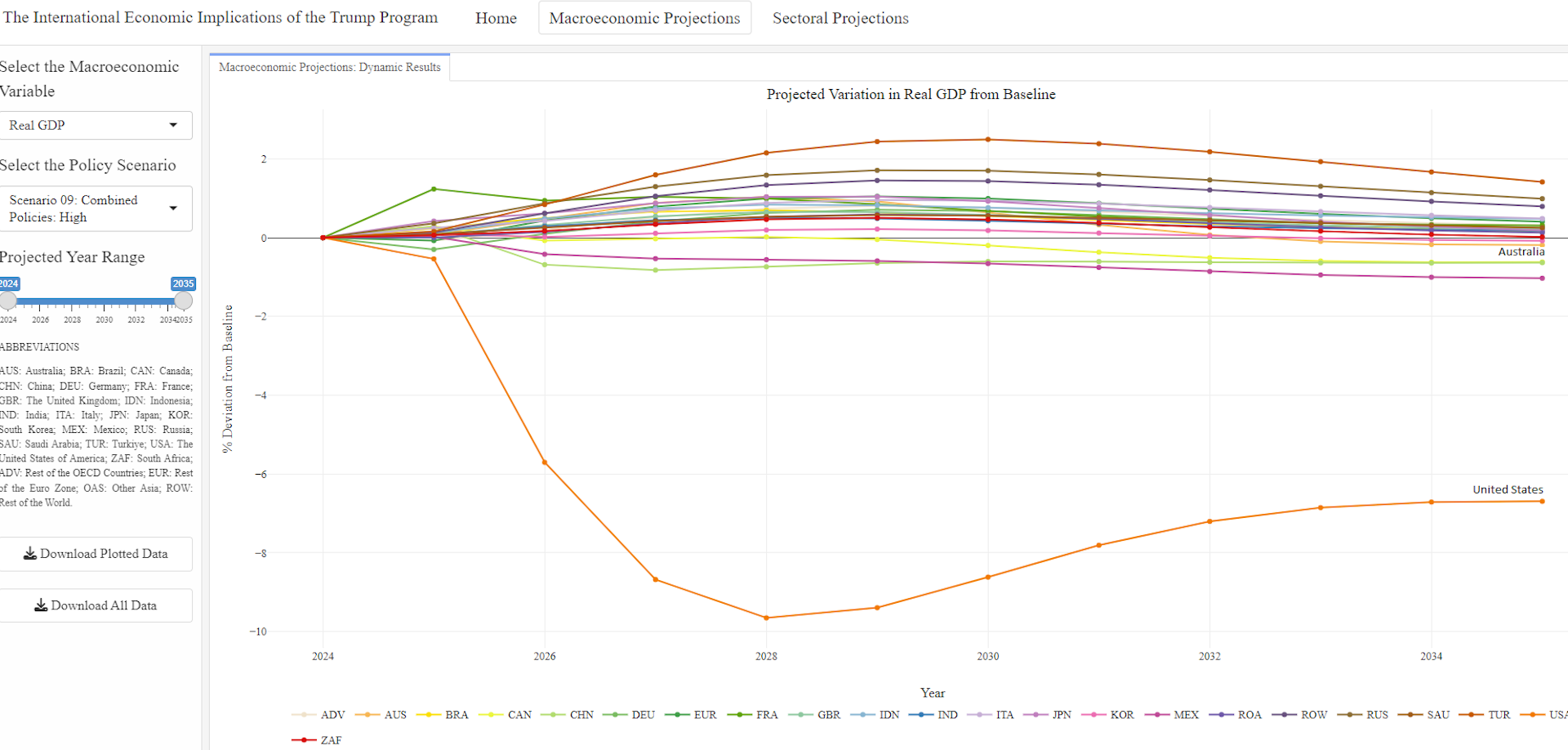
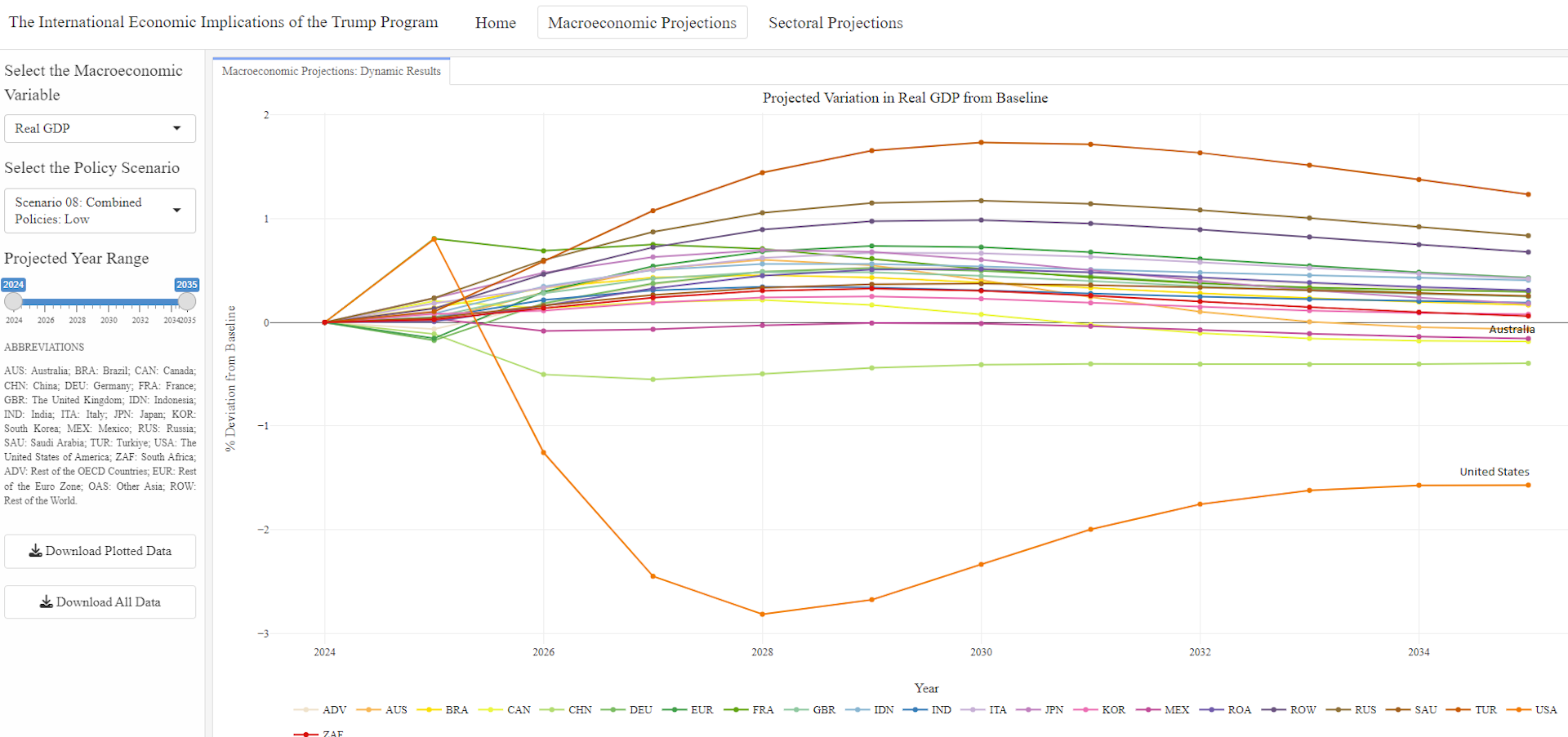
    ironically, despite his ‘make the foreigners pay rhetoric’, Trump’s package of policies does more damage to the US economy than to any other in the world.

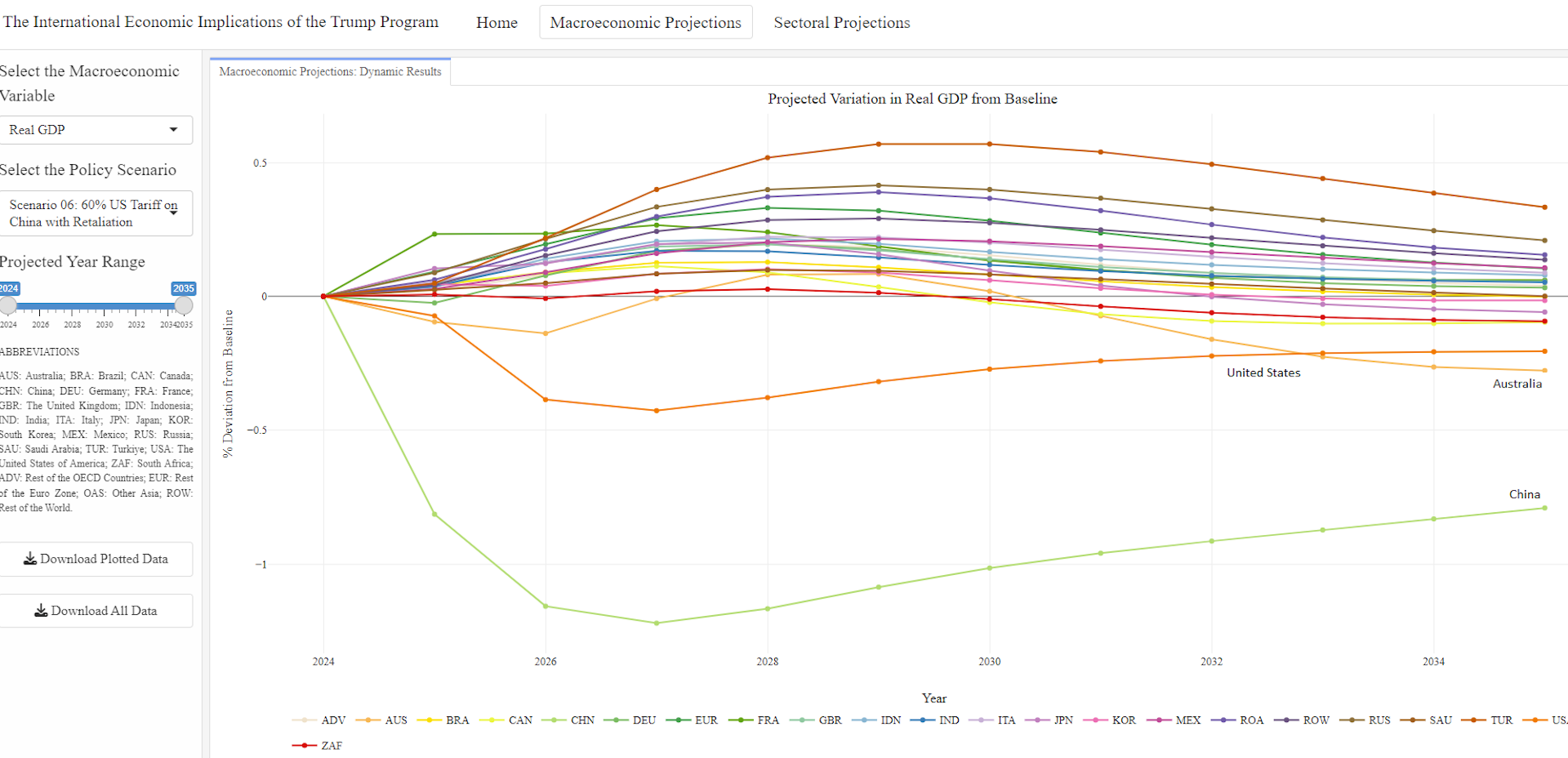
    No other country in the world would be hurt by Trump’s program as much as the US – not even China – although several US allies would suffer, including Australia, which would be the fourth-worst hit by the most extreme version of what Trump is proposing.

    Peterson Institute for International Economics.

    Mass deportations

    Trump has repeatedly promised the “largest domestic deportation operation in American history,” targeting up to 20 million unauthorised immigrants, including about 8.3 million thought to be in the workforce.

    He says his model is Operation Wetback – a 1956 Eisenhower administration program that used military-style tactics to deport 1.3 million Mexicans.

    The institute says Eisenhower’s success makes it easy to believe Trump could remove 1.3 million immigrant workers. It has modelled two scenarios: removing 1.3 million and 8.3 million, both over two years in 2025 and 2026.

    Both slash employment, including the employment of non-immigrants, both push up inflation, which eventually is brought under control, and both make the US a less attractive place to invest, which benefits much of the rest of the world.

    The institute says the low and high scenarios differ “only by the degree of damage inflicted on people, households, firms, and the overall economy”.

    Huge tariff hikes

    Trump wants to increase every tariff on goods imported to the US by 10 percentage points, including where there is at present no tariff. And he wants at least a 60% tariff on imports from China. The institute has modelled both, with and without retaliatory tariffs from China and the rest of the world.

    It finds, unsurprisingly, that extra tariffs push up the price of US imports and the prices of US-produced goods that compete with imports. Many are used as inputs in manufacturing, which means US manufacturing suffers (which is probably not what Trump had in mind).

    Fewer imports mean less demand for foreign exchange within the US, which means a higher US dollar which makes US exports less competitive. The US economy is weaker as a result, although China’s is weaker still and Australia’s is weakened as much as the US given its role in providing resources to China.

    Nobbling the Fed

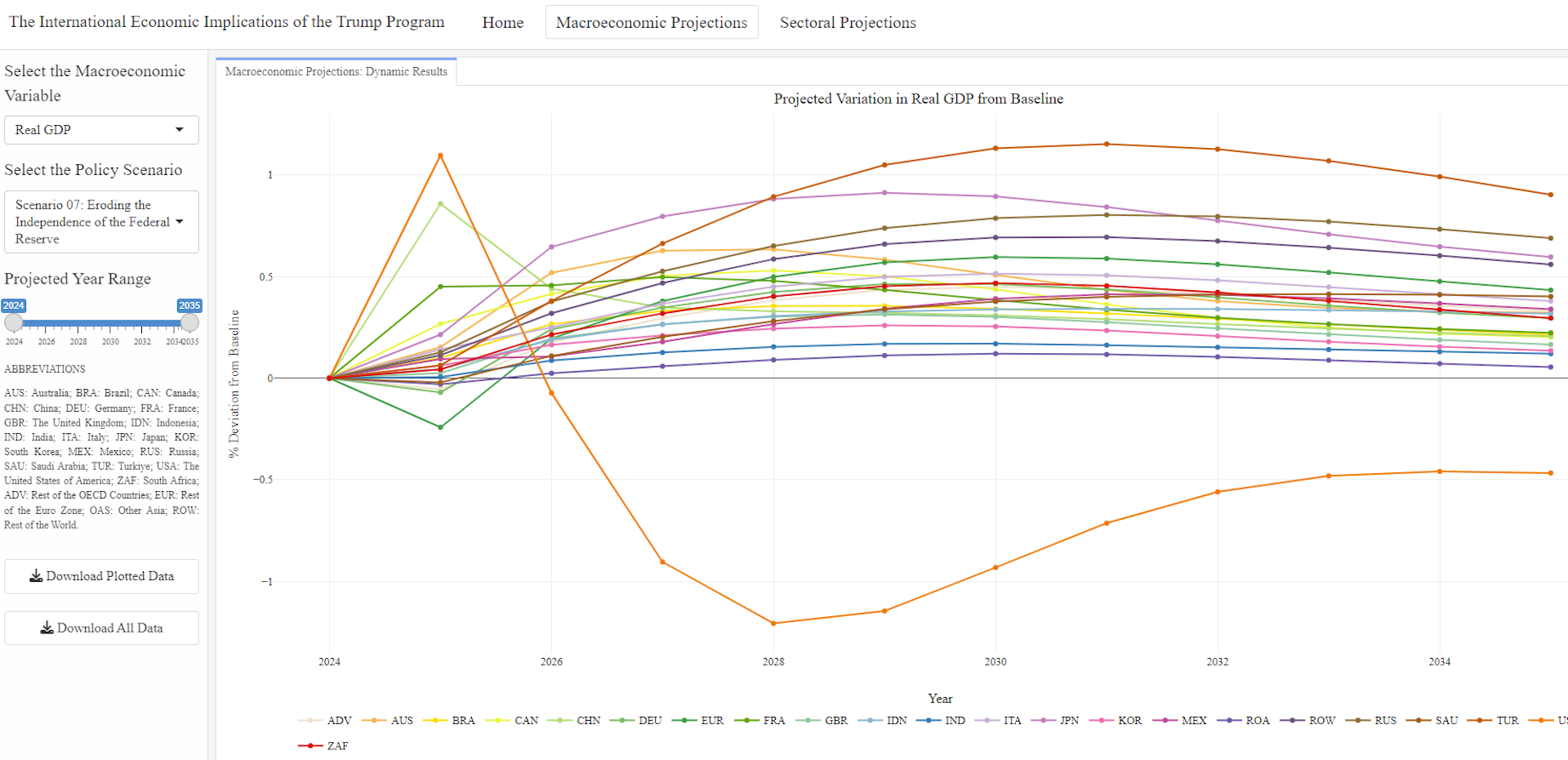
    Trump has raised the prospect of more presidential influence over interest rates, saying he thinks he has “a better instinct than, in many cases” the board of US Federal Reserve. This could be achieved by requiring the president to be consulted on rate decisions or by appointing a compliant chair.

    However it’s done, the institute’s “conservative” assumption based on what happens in developing countries with less central bank independence is that it will push inflation two percentage points higher.

    The modelled result is capital flight. While the US economy is initially stronger than it would have been because of the Fed’s willingness to tolerate higher inflation, after a few years it is weaker and every other economy is stronger.

    When all the measures are combined, under the extreme scenarios the US economy is 6.7% weaker than it would have been by 2035 and Australia’s is 0.2% weaker. Under the more modest scenarios, the US economy is 1.6% weaker and Australia’s is 0.06% weaker.

    Why not examine Harris?

    Despite a history of non-partisanship, the Peterson Institute is prepared for criticism. It points out that the economic model it used is regarded as the best in the world for scenario planning and is Australian, built by Warwick McKibbin of the Australian National University.

    And it says it has modelled the Trump policies rather than the Harris policies because only Trump’s represent a departure from business as usual.

    As the Institute’s president Adam Posen put it in Washington last month, the Harris campaign has said it will not impose across-the-board tariffs, will not engage in mass deportations and will not interfere with the independence of the US Federal Reserve.

    The Trump campaign has indicated it will do all three.

    It’s entirely possible that in office Trump wouldn’t do everything he proposed while campaigning, and it’s entirely possible that he would change course if what was doing damaged the US in the way the modelling suggests.

    But there’s something to be said for taking people at their word, at least to get an idea of what we could be in store for after a knife-edge election.

    Peter Martin is Economics Editor of The Conversation.

    ref. From mass deportations to huge tariff hikes, here’s what Trump’s economic program would do the US and to Australia – https://theconversation.com/from-mass-deportations-to-huge-tariff-hikes-heres-what-trumps-economic-program-would-do-the-us-and-to-australia-240650

    MIL OSI AnalysisEveningReport.nz

  • MIL-Evening Report: From mass deportations to huge tariff hikes, here’s what Trump’s economic program would do to the US and Australia

    Source: The Conversation (Au and NZ) – By Peter Martin, Visiting Fellow, Crawford School of Public Policy, Australian National University

    Prashantrajsingh/Shutterstock

    It’s time to take Donald Trump seriously. Betting markets say it’s as likely as not he will be elected US president four weeks from today.

    And unlike in 2016 when his program wasn’t clearly defined, he has set out plainly what he intends to do. Which means it’s possible to model the consequences.

    The three Trump promises with the greatest economic impact are

    • the deportation of millions of US residents

    • steep restrictions on imports, especially from China

    • presidential influence over interest rates.

    The best way to model the consequences is with an established model of the kind used by the International Monetary Fund and central banks around the world rather than one set up for the purpose that could be seen as designed to favour or not favour Trump.

    The Washington-based Peterson Institute for International Economics has just done that, noting that during Trump’s first term as president he “by and large” did what he said he would do.

    It finds

    ironically, despite his ‘make the foreigners pay rhetoric’, Trump’s package of policies does more damage to the US economy than to any other in the world.

    No other country in the world would be hurt by Trump’s program as much as the US – not even China – although several US allies would suffer, including Australia, which would be the fourth-worst hit by the most extreme version of what Trump is proposing.

    Peterson Institute for International Economics.

    Mass deportations

    Trump has repeatedly promised the “largest domestic deportation operation in American history,” targeting up to 20 million unauthorised immigrants, including about 8.3 million thought to be in the workforce.

    He says his model is Operation Wetback – a 1956 Eisenhower administration program that used military-style tactics to deport 1.3 million Mexicans.

    The institute says Eisenhower’s success makes it easy to believe Trump could remove 1.3 million immigrant workers. It has modelled two scenarios: removing 1.3 million and 8.3 million, both over two years in 2025 and 2026.

    Both slash employment, including the employment of non-immigrants, both push up inflation, which eventually is brought under control, and both make the US a less attractive place to invest, which benefits much of the rest of the world.

    The institute says the low and high scenarios differ “only by the degree of damage inflicted on people, households, firms, and the overall economy”.

    Huge tariff hikes

    Trump wants to increase every tariff on goods imported to the US by 10 percentage points, including where there is at present no tariff. And he wants at least a 60% tariff on imports from China. The institute has modelled both, with and without retaliatory tariffs from China and the rest of the world.

    It finds, unsurprisingly, that extra tariffs push up the price of US imports and the prices of US-produced goods that compete with imports. Many are used as inputs in manufacturing, which means US manufacturing suffers (which is probably not what Trump had in mind).

    Fewer imports mean less demand for foreign exchange within the US, which means a higher US dollar which makes US exports less competitive. The US economy is weaker as a result, although China’s is weaker still and Australia’s is weakened as much as the US given its role in providing resources to China.

    Nobbling the Fed

    Trump has raised the prospect of more presidential influence over interest rates, saying he thinks he has “a better instinct than, in many cases” the board of US Federal Reserve. This could be achieved by requiring the president to be consulted on rate decisions or by appointing a compliant chair.

    However it’s done, the institute’s “conservative” assumption based on what happens in developing countries with less central bank independence is that it will push inflation two percentage points higher.

    The modelled result is capital flight. While the US economy is initially stronger than it would have been because of the Fed’s willingness to tolerate higher inflation, after a few years it is weaker and every other economy is stronger.

    When all the measures are combined, under the extreme scenarios the US economy is 6.7% weaker than it would have been by 2035 and Australia’s is 0.2% weaker. Under the more modest scenarios, the US economy is 1.6% weaker and Australia’s is 0.06% weaker.

    Why not examine Harris?

    Despite a history of non-partisanship, the Peterson Institute is prepared for criticism. It points out that the economic model it used is regarded as the best in the world for scenario planning and is Australian, built by Warwick McKibbin of the Australian National University.

    And it says it has modelled the Trump policies rather than the Harris policies because only Trump’s represent a departure from business as usual.

    As the Institute’s president Adam Posen put it in Washington last month, the Harris campaign has said it will not impose across-the-board tariffs, will not engage in mass deportations and will not interfere with the independence of the US Federal Reserve.

    The Trump campaign has indicated it will do all three.

    It’s entirely possible that in office Trump wouldn’t do everything he proposed while campaigning, and it’s entirely possible that he would change course if what was doing damaged the US in the way the modelling suggests.

    But there’s something to be said for taking people at their word, at least to get an idea of what we could be in store for after a knife-edge election.

    Peter Martin is Economics Editor of The Conversation.

    ref. From mass deportations to huge tariff hikes, here’s what Trump’s economic program would do to the US and Australia – https://theconversation.com/from-mass-deportations-to-huge-tariff-hikes-heres-what-trumps-economic-program-would-do-to-the-us-and-australia-240650

    MIL OSI AnalysisEveningReport.nz

  • MIL-Evening Report: Government to put pressure on opposition with legislation to ensure NBN stays in public hands

    Source: The Conversation (Au and NZ) – By Michelle Grattan, Professorial Fellow, University of Canberra

    The Albanese government on Wednesday will introduce legislation to ensure the NBN remains in government ownership.

    The move is designed to set up a test for the Coalition, putting pressure on the opposition ahead of the election to declare whether it would try to privatise the NBN.

    The government said in a statement from Prime Minister Anthony Albanese, Finance Minister Katy Gallagher and Communications Minister Michelle Rowland: “The Coalition rushed to declare the NBN ‘complete’ so they could put it on the block for sale – selling out Australian consumers and regional communities.

    “The Albanese government won’t let that happen. This legislation will ensure the NBN is owned by who it belongs to – the Australian people.”

    The upgrades the government had undertaken “are already making a real difference in the lives of Australians through faster, more reliable internet access. Keeping the NBN in public hands will lock in affordable and accessible high speed internet for all Australians for generations to come.”

    Albanese said:“The Coalition made a mess of the NBN – my government is getting on with the job of fixing it and making sure it stays in public hands, where it belongs.”

    Rowland said: “Australians don’t trust the Coalition not to flog off the NBN just like they did with Telstra, resulting in higher prices and poorer services, especially in the regions.”

    Downgraded

    The Rudd Labor government announced what was to be a predominantly fibre-to-the-home wholesale network in 2009, promising it would cost $43 billion and later be privatised to claw back the expense.

    In 2010 Communications Minister Stephen Conroy said Labor “remained firmly committed to selling its stake in NBN Co after the network was fully built and operational, subject to market conditions and security considerations”.

    By 2020 the government was estimated to have spent $51 billion on a scaled-down version of the project completed using a mix of technologies.

    In June that year a review by the Parliamentary Budget Office put its fair value at $8.7 billion.

    Michelle Grattan does not work for, consult, own shares in or receive funding from any company or organisation that would benefit from this article, and has disclosed no relevant affiliations beyond their academic appointment.

    ref. Government to put pressure on opposition with legislation to ensure NBN stays in public hands – https://theconversation.com/government-to-put-pressure-on-opposition-with-legislation-to-ensure-nbn-stays-in-public-hands-240807

    MIL OSI AnalysisEveningReport.nz

  • MIL-Evening Report: Physics Nobel awarded to neural network pioneers who laid foundations for AI

    Source: The Conversation (Au and NZ) – By Aaron J. Snoswell, Research Fellow in AI Accountability, Queensland University of Technology

    The 2024 Nobel Prize in Physics has been awarded to scientists John Hopfield and Geoffrey Hinton “for foundational discoveries and inventions that enable machine learning with artificial neural networks”.

    Inspired by ideas from physics and biology, Hopfield and Hinton developed computer systems that can memorise and learn from patterns in data. Despite never directly collaborating, they built on each other’s work to develop the foundations of the current boom in machine learning and artificial intelligence (AI).

    What are neural networks? (And what do they have to do with physics?)

    Artificial neural networks are behind much of the AI technology we use today.

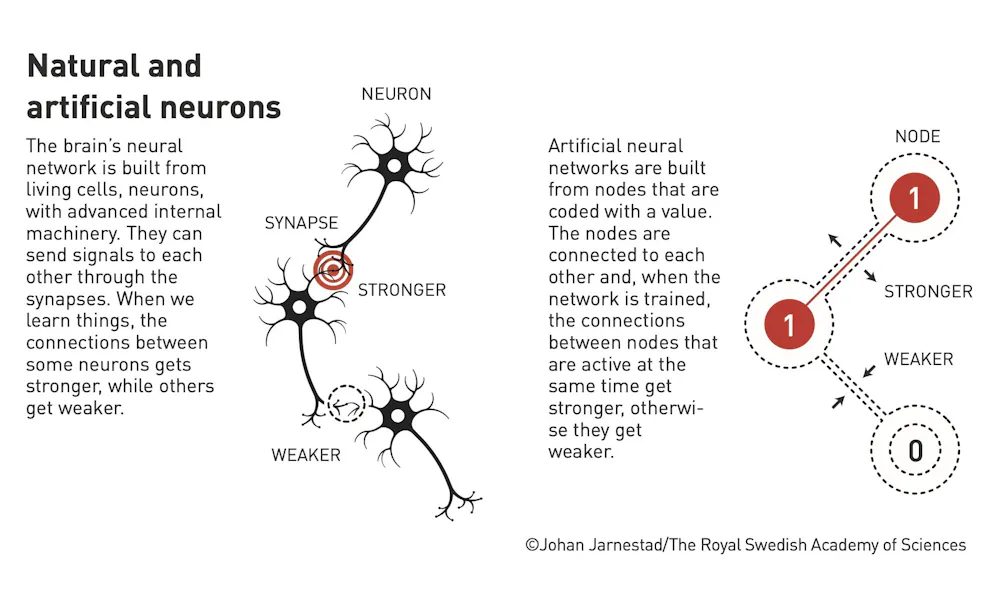
    In the same way your brain has neuronal cells linked by synapses, artificial neural networks have digital neurons connected in various configurations. Each individual neuron doesn’t do much. Instead, the magic lies in the pattern and strength of the connections between them.

    Neurons in an artificial neural network are “activated” by input signals. These activations cascade from one neuron to the next in ways that can transform and process the input information. As a result, the network can carry out computational tasks such as classification, prediction and making decisions.


    Johan Jarnestad / The Royal Swedish Academy of Sciences

    Most of the history of machine learning has been about finding ever more sophisticated ways to form and update these connections between artificial neurons.

    While the foundational idea of linking together systems of nodes to store and process information came from biology, the mathematics used to form and update these links came from physics.

    Networks that can remember

    John Hopfield (born 1933) is a US theoretical physicist who made important contributions over his career in the field of biological physics. However, the Nobel Physics prize was for his work developing Hopfield networks in 1982.

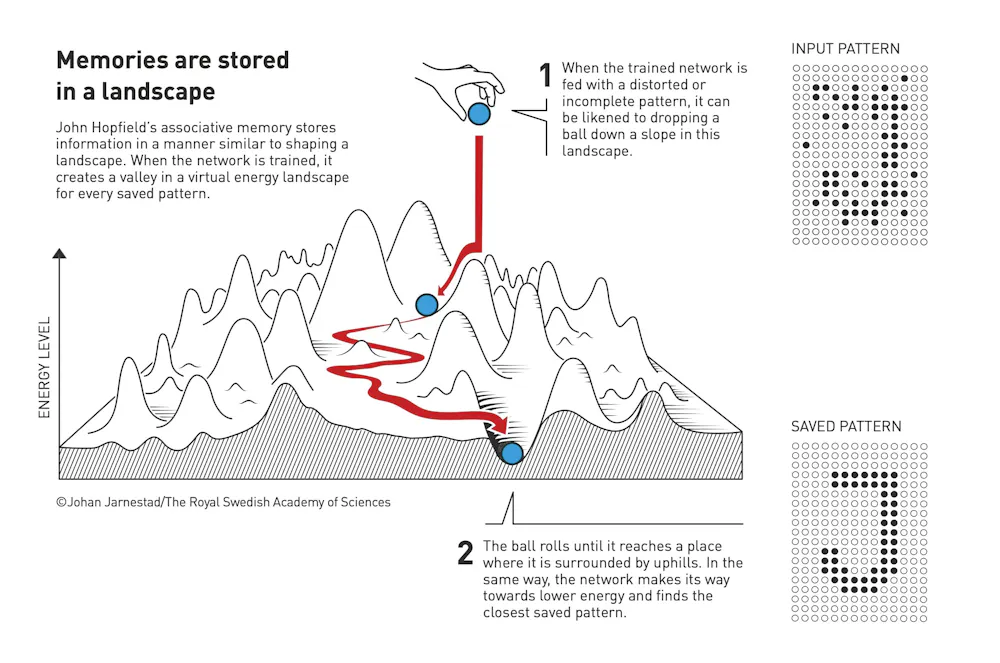
    Hopfield networks were one of the earliest kinds of artificial neural networks. Inspired by principles from neurobiology and molecular physics, these systems demonstrated for the first time how a computer could use a “network” of nodes to remember and recall information.

    The networks Hopfield developed could memorise data (such as a collection of black and white images). These images could be “recalled” by association when the network is prompted with a similar image.

    Although of limited practical use, Hopfield networks demonstrated that this type of ANN could store and retrieve data in new ways. They laid the foundation for later work by Hinton.


    Johan Jarnestad / The Royal Swedish Academy of Sciences

    Machines that can learn

    Geoff Hinton (born 1947), sometimes called one of the “godfathers of AI”, is a British-Canadian computer scientist who has made a number of important contributions to the field. In 2018, along with Yoshua Bengio and Yann LeCun, he was awarded the Turing Award (the highest honour in computer science) for his efforts to advance machine learning generally, and specifically a branch of it called deep learning.

    The Nobel Prize in Physics, however, is specifically for his work with Terrence Sejnowski and other colleagues in 1984, developing Boltzmann machines.

    These are an extension of the Hopfield network that demonstrated the idea of machine learning – a system that lets a computer learn not from a programmer, but from examples of data. Drawing from ideas in the energy dynamics of statistical physics, Hinton showed how this early generative computer model could learn to store data over time by being shown examples of things to remember.


    Johan Jarnestad / The Royal Swedish Academy of Sciences

    The Boltzmann machine, like the Hopfield network before it, did not have immediate practical applications. However, a modified form (called the restricted Boltzmann machine) was useful in some applied problems.

    More important was the conceptual breakthrough that an artificial neural network could learn from data. Hinton continued to develop this idea. He later published influential papers on backpropagation (the learning process used in modern machine learning systems) and convolutional neural networks (the main type of neural network used today for AI systems that work with image and video data).

    Why this prize, now?

    Hopfield networks and Boltzmann machines seem whimsical compared to today’s feats of AI. Hopfield’s network contained only 30 neurons (he tried to make one with 100 nodes, but it was too much for the computing resources of the time), whereas modern systems such as ChatGPT can have millions. However, today’s Nobel prize underscores just how important these early contributions were to the field.

    While recent rapid progress in AI – familiar to most of us from generative AI systems such as ChatGPT – might seem like vindication for the early proponents of neural networks, Hinton at least has expressed concern. In 2023, after quitting a decade-long stint at Google’s AI branch, he said he was scared by the rate of development and joined the growing throng of voices calling for more proactive AI regulation.

    After receiving the Nobel prize, Hinton said AI will be “like the Industrial Revolution but instead of our physical capabilities, it’s going to exceed our intellectual capabilities”. He also said he still worries that the consequences of his work might be “systems that are more intelligent than us that might eventually take control”.

    Aaron J. Snoswell receives funding from OpenAI in 2024.

    ref. Physics Nobel awarded to neural network pioneers who laid foundations for AI – https://theconversation.com/physics-nobel-awarded-to-neural-network-pioneers-who-laid-foundations-for-ai-240833

    MIL OSI AnalysisEveningReport.nz

  • MIL-Evening Report: Too good to be true? New study shows people reject freebies and cheap deals for fear of hidden costs

    Source: The Conversation (Au and NZ) – By Andrew Vonasch, Senior Lecturer in Psychology, University of Canterbury

    If you’re offered a free cookie, you might say yes. But if you’re paid to eat a free cookie, would your response be the same?

    In our new research, twice as many people were willing to eat a cookie when they weren’t offered payment compared with when they were.

    From a purely economic perspective, our findings reflect irrational decision making. Objectively, a cookie plus money is better than just a cookie.

    But people aren’t purely economic. They’re social animals with a tendency to look for hidden reasons behind other people’s behaviours.

    In the case of overly generous deals, people are expecting a “phantom cost” – one hidden in the initial offer. And this expectation influences their decision to accept something or not.

    Research participants who were offered a free cookie plus payment thought maybe the cookies were poisoned. Or maybe someone spat on them. Or they expected they would then owe a favour to the person handing out the treats once the cookie was eaten.

    Too good to be true

    Our cookies study was just one of ten experiments involving 4,205 participants in the United States and Iran.

    We tested how phantom costs influenced people’s choices to accept or reject overly generous economic offers.

    Each study gave people an offer. They had to decide whether to accept or not, and then explain why.

    One study asked participants to imagine they were a truck driver and looking online for a job. All the jobs were described the same way, but we varied the wage. People offered the normal US$15 per hour were perfectly willing to take the job.

    Others were offered more than the normal wage. The participants in this group imagined phantom costs. And the higher the wage they were offered, the worse the costs they imagined.

    When offered $20 or $25 per hour, participants imagined the role involved more responsibilities or harder work. But they considered this to be worth it. Most people preferred a job that paid a bit more than normal, despite the expectation of phantom costs.

    However, when we offered way too much money – more than $900 per hour – most people rejected the job they were willing to do for $15.

    Why? They imagined far worse phantom costs: driving for the mob, carrying dangerous radioactive waste or smuggling drugs across the border. A suspiciously high hourly rate or wage can end up putting people off.

    Suspicion is global

    We repeated this experiment with different jobs, different normal wages, and in different countries.

    In both the US and Iran, despite very different types of economy, people showed the same pattern of suspicion and rejected very high wages. The only difference was that in Iran the expected wages were lower, so the wages didn’t have to be high by US standards to become suspicious.

    Another experiment tested how phantom costs could affect purchases of plane tickets involving a hypothetical choice between three flights.

    One cost $235, another $275. When the third option was $205, most people chose that. However, if the third option was $15, hardly anyone chose the cheapest flight. They rejected it because they imagined horrible phantom costs such as terrorists and plane crashes.

    However, when we provided a reason for the low price – very uncomfortable seats – most people preferred the $15 flight. Uncomfortable seats are not usually a selling point. But they explained the cheap price, so people didn’t search for other, dangerous explanations.

    Sufficient explanations for something being a great deal remove people’s tendency to imagine phantom costs.

    A good offer, not a suspicious one

    Businesses face a balancing act when it comes to offering customers a good deal.

    On the one hand, the expectation of phantom costs decreases interest in the offer. On the other hand, price-sensitive consumers are often looking for ways to get the best deal.

    To avoid the pitfalls of phantom costs, businesses need to communicate their reasons for offering a particularly good deal. A “holiday sale” or “end-of-season sale”, for example, may explain why items are discounted.

    In the job market, identifying “good performance” as a reason for an employee’s pay raise can sidestep the expectation of hidden downsides – such as an increased workload.

    It’s clear people are not merely self-interested economic beings. We’re savvy, psychological beings capable of reading into the motivations of others to protect ourselves from offers that seem too good to be true.

    Andrew Vonasch does not work for, consult, own shares in or receive funding from any company or organisation that would benefit from this article, and has disclosed no relevant affiliations beyond their academic appointment.

    ref. Too good to be true? New study shows people reject freebies and cheap deals for fear of hidden costs – https://theconversation.com/too-good-to-be-true-new-study-shows-people-reject-freebies-and-cheap-deals-for-fear-of-hidden-costs-238869

    MIL OSI AnalysisEveningReport.nz

  • MIL-Evening Report: Failure to launch: why the Albanese government is in trouble

    Source: The Conversation (Au and NZ) – By Carol Johnson, Emerita Professor, Department of Politics and International Relations, University of Adelaide

    It wasn’t meant to be like this.

    In her 2022 study of Anthony Albanese, Katharine Murphy describes a prime minister who thought he’d be successfully managing an idealistic, collaborative and positive “new politics” that would favour the Teal independents rather than Dutton’s Liberals. Albanese seemed confident that Labor was destined for an extended period in office. Given he later appointed Murphy to his communications team, he apparently approved of her analysis.

    However, even at the time Murphy’s Lone Wolf: Albanese and the New Politics was published, various commentators, including myself, queried the “new politics” scenario. While the Teals may represent a new politics, it is clear that the old Liberal politics — of culture wars and denouncing Labor’s economic and climate change policies — is also still very much with us.

    Labor and the Liberals are now neck-and-neck in some polls, with minority government (or worse) potentially looming for Labor. Meanwhile, Gareth Evans and Bill Kelty, key figures from the Hawke/Keating period, have excoriated the Albanese government’s allegedly lacklustre performance.

    How did it all go so wrong?

    Great expectations; modest reality

    Some of the reasons can be traced back to difficulties addressing unrealistic expectations in Labor’s 2022 election strategy. Albanese went to the 2022 election with a “new politics”, collaborative style agenda that sought to bring all Australians, including business, labour, Indigenous and non-Indigenous Australians together. It was a small target strategy based on assumed common interests, kindness and compassion rather than divisiveness.

    As a result, Labor successfully countered Scott Morrison’s populist, “us versus them” campaign strategy. However, Labor’s approach was to prove easier to implement as an election strategy than in government, as three examples show.

    First, Albanese was channelling Bob Hawke when it came to bringing business and labour together. Yet, the Hawke government’s rapprochement with business was based on business being able to pay lower wages, because workers would be compensated by a government-funded “social wage” in the form of benefits and entitlements.

    By contrast, the Albanese government pledged to end the wage stagnation of the Liberal years and generally increase wages. A major emphasis was placed on improving the wages of low-paid women workers. In the process, Labor tackled issues that arose from Keating’s flawed, neoliberal-influenced, enterprise bargaining model.

    However, key business groups criticised Labor’s resulting industrial relations measures, including multi-employer bargaining, increases in the minimum wage, and measures designed to address precarious and contract work. The Liberals have largely sided with business critiques.

    Second, Labor’s attempts to bring Indigenous and non-Indigenous Australians together, via the Voice referendum, fell victim to a divisive, populist campaign by Dutton and others. Dutton depicted the Voice proposal not as arising from a major national meeting of Indigenous representatives but as being an elite “Canberra voice” that would give special rights to Indigenous Australians that were denied to others. Furthermore, he argued that government was so focused on elite “woke” issues such as the Voice, it was neglecting Australian workers’ cost-of-living crisis. Labor’s strategy for countering right-wing populism was in disarray.

    Albanese’s response to the Voice loss was to go even more “small target” in ways that alienated progressive supporters. He abandoned key commitments ranging from the Indigenous Makarrata commission process of Treaty and Truth-telling, to protecting LGBTQI+ teachers and students from being sacked by religious schools. The debacle over including gender identity questions in the census was another result.

    Third, international events, and other parties’ politicisation of them, have impeded the government’s attempts at social cohesion. Australian political debate has become so polarised over developments in the Middle East that the Albanese government is accused of abandoning support for Israel by the Liberals and the Murdoch press, while simultaneously being accused of being “complicit in Israel’s genocide” by the Greens and pro-Palestinian groups.

    Narrative failure

    As its original story of bringing Australians together has been increasingly undermined, the government has floundered when it comes to telling a clear narrative about itself. By contrast, Dutton’s relentless, focused and simply expressed negativity has been cutting through.

    Part of Labor’s problem in countering Dutton is that he is targeting them for things that are often beyond their control.

    For example, Dutton’s claim the government has been too distracted by so-called “woke” issues to address the cost-of-living crisis has been particularly electorally damaging for Labor. So have his claims that Labor’s renewable energy policies are fuelling inflation and pushing up the cost of living still further.

    The government argues it has been providing extensive cost-of-living relief in the form of tax cuts, energy bill relief, rental assistance, wage increases, cheaper medicines and reduced child care costs. However, the problem is that such government measures are being continually undercut by inflation, price increases, high interest rates, and the housing affordability and supply crisis.

    Yet, the housing affordability and supply crisis has been aggravated by decades of poor housing policy that long predate the Albanese government. Furthermore, Labor’s attempts to address it are currently being stymied by a combination of Coalition and Greens opposition, once again sandwiching Labor.

    Meanwhile, the Coalition argues that government spending is exacerbating inflation and high interest rates. However, even the independent Reserve Bank, which sets cash interest rates and is also critical of government spending, has drawn attention to multiple international factors playing a role in inflation. Price increase gouging by some businesses to augment their profits has exacerbated the problem.

    Furthermore, Treasurer Jim Chalmers argues that existing government spending levels have been essential to preventing Australia sliding into recession, while still enabling a budget surplus.

    Chalmers has struggled to cut through in the way that Keating’s messages did. However, Keating benefited from the Coalition largely agreeing with his neoliberal-influenced “reform” agenda, despite arguing it wasn’t going far enough. By contrast, Chalmers has been facing a fundamentally hostile opposition, unsympathetic to key influences on his thought, such as Mariana Mazzucato.

    Labor has also had trouble selling the government’s achievements because, as I argue in a recent book, some of the Albanese government’s most successful reform measures have been in gender equality (although much more still needs to be done). Despite women making up more than half of the population, reforms that affect women tend to be undervalued in what is still a male defined political culture. Furthermore, the working class is often conceived in terms of blue collar male employment, so benefits for women workers are not being adequately recognised. This is particularly the case in Dutton’s hyper-masculine, strongman discourse.

    Mobilising gendered leadership stereotypes has been central to Dutton’s populist “us” versus “them” politics. Dutton consistently depicts Albanese as an emasculated “weak” leader on issues ranging from addressing the cost of living crisis to detaining asylum seekers freed by a High Court decision, and supporting Israel. By contrast, Dutton is depicted as the strong leader who will stand up for everyday Australians allegedly abandoned by Labor and the so-called elites.

    This does not look like a “new politics” at all and it is a divisive, populist terrain that Labor is finding very difficult to negotiate.

    Carol Johnson has received past funding from the Australian Research Council for work on Labor governments and on gender equality policy. .

    ref. Failure to launch: why the Albanese government is in trouble – https://theconversation.com/failure-to-launch-why-the-albanese-government-is-in-trouble-239730

    MIL OSI AnalysisEveningReport.nz

  • MIL-Evening Report: One of science’s greatest achievements: how the rapid development of COVID vaccines prepares us for future pandemics

    Source: The Conversation (Au and NZ) – By Paul Griffin, Professor, Infectious Diseases and Microbiology, The University of Queensland

    Since COVID was first reported in December 2019, there have been more than 775 million recorded infections and more than 7 million deaths from the disease. This makes COVID the seventh-deadliest pandemic in recorded history.

    Factors including climate change, disruption of animal habitats, poverty and global travel mean we’re only likely to see more pandemics in the future.

    It’s impossible to predict exactly when the next pandemic will happen, or what it will be. But experts around the world are working to prepare for this inevitable “disease X”.

    One of the cornerstones of being prepared for the next pandemic is being in the best possible position to design and deploy a suitable vaccine. To this end, scientists and researchers can learn a lot from COVID vaccine development.

    A look back

    After SARS-CoV-2 (the virus that causes COVID) was discovered, vaccine development moved very quickly. In February 2020 the first batch of vaccines was completed (from Moderna) and the first clinical trials began in March.

    An mRNA vaccine from Pfizer/BioNTech was the first to be approved, on December 2 2020 in the United Kingdom. Approvals for this and other vaccines, including shots developed by Moderna (another mRNA vaccine) and Oxford/AstraZeneca (a viral vector vaccine), followed elsewhere soon afterwards.

    Previously the fastest vaccine developed took around four years (for mumps in the 1960s). Had COVID vaccines taken this long it would mean we would only just be rolling them out this year.

    An estimated 13.72 billion COVID vaccine doses have now been administered, with more than 70% of the world’s population having received at least one dose.

    The rapid development and rollout of COVID vaccines is likely to be one of the greatest achievements of medical science ever. It also means we are in a much better position to respond to future emerging pathogens.

    New vaccine technology

    A lot of work over many years prepared us to develop COVID vaccines as quickly as we did. This included developing new platforms such as viral vector and mRNA vaccines that can be adapted quickly to new pathogens.

    While scientists had been working on mRNA vaccines for decades before the COVID pandemic, the COVID shots from Pfizer/BioNTech and Moderna were the first mRNA vaccines to be approved for human use.

    These vaccines work by giving our body instructions (the “m” in mRNA stands for messenger) to make SARS-CoV-2 spike proteins. These are proteins on the surface of the virus which it uses to attach to our cells. This means when we encounter SARS-CoV-2, our immune system is poised to respond.

    This technology will almost certainly be used to protect against other diseases, and could potentially help with a future pandemic.

    In the meantime, scientists are working to improve mRNA technology even further. For example, “self-amplifying RNA” has the potential to enhance immune responses at lower doses compared with conventional mRNA.

    mRNA vaccines teach our bodies to make SARS-CoV-2’s spike protein.
    Kateryna Kon/Shutterstock

    While our current COVID vaccines are safe and very effective at protecting against severe disease, they’re not perfect. We may never be able to achieve a “perfect” vaccine, but some additional properties we’d like to see in future COVID vaccines include being better at reducing transmission, lasting longer, and needing to be updated less often as new variants emerge.

    Even now there are many COVID vaccines in clinical trials. So hopefully, COVID vaccines that improve on the initial shots will be available relatively soon.

    Other desirable attributes include vaccines we can administer by alternate routes to needles. For COVID and other diseases such as influenza, we’re seeing significant developments locally and internationally on vaccines than can be administered via skin patches, through the nose, and even orally.

    Some challenges

    Developing vaccines for COVID was a huge challenge, but one that can mostly be judged a success. Research has estimated COVID vaccines saved 14.4 million lives across 185 countries in just their first year.

    However, the story of COVID vaccination has also had many other challenges, and arguably a number of failures.

    First, the distribution of vaccines was not equitable. Analysis of the initial rollout suggested nearly 80% of eligible people in high-income countries were vaccinated, compared with just over 10% in low-income nations.

    Supply of vaccines was an issue in many parts of the world, so expanding local capacity to enable more rapid production and distribution of vaccines will be important for the next pandemic.

    Further, adverse events linked to COVID vaccines, such as rare blood clots after the AstraZeneca vaccine, affected perceptions of vaccine safety. While every serious adverse event is significant, these incidents were very rare.

    However, these issues exacerbated other challenges that hampered vaccine uptake, including the spread of misinformation.

    Misinformation remains a problem now and will probably still be prevalent whenever we face the next pandemic. Addressing this challenge involves understanding what’s deterring people from getting vaccinated, then informing and educating, addressing misinformation both about vaccination and the risks of the disease itself.

    Restoring and building trust in public health authorities also needs to continue to be a focus. Trust in governments and health authorities declined during the COVID pandemic, and evidence shows lower trust is associated with lower vaccine uptake.

    The COVID vaccine rollout faced a variety of challenges.
    Yuganov Konstantin/Shutterstock

    Ongoing preparation

    There’s no doubt our recent experience with COVID, particularly the rapid development of multiple safe and effective vaccines, has put us in a better position for the next pandemic.

    This didn’t happen by accident. There was a lot of preparation even before COVID was first discovered that facilitated this. Organisations like the Coalition for Epidemic Preparedness Innovations (CEPI) have been supporting research to develop vaccines rapidly to respond to a new threat for some time.

    CEPI has an ongoing program that aims to be able to develop a vaccine against a new threat, or disease X, in just 100 days. While COVID vaccines have been a huge achievement, work continues in the hope we will be able to develop a vaccine even faster next time.

    This article is part of a series on the next pandemic.

    Paul Griffin is a director and scientific advisory board member of the immunisation coalition. He has served on Medical Advisory Boards including for AstraZeneca, GSK, MSD, Moderna, Biocelect/Novavax, Seqirus and Pfizer and has received speaker honoraria including from Seqirus, Novartis, Gilead, Sanofi, MSD and Janssen.

    ref. One of science’s greatest achievements: how the rapid development of COVID vaccines prepares us for future pandemics – https://theconversation.com/one-of-sciences-greatest-achievements-how-the-rapid-development-of-covid-vaccines-prepares-us-for-future-pandemics-228787

    MIL OSI AnalysisEveningReport.nz

  • MIL-Evening Report: I think my child might need a tutor. What do I need to consider first?

    Source: The Conversation (Au and NZ) – By Matthew White, Lecturer and Researcher Australian Catholic University, Australian Catholic University

    School tutoring is a huge business. Australian estimates suggest it was worth more than of A$1.5 billion as of 2021.

    In Australia, we see frequent media reports of parents using tutors to help their children through school.

    How can you tell if tutoring is right for your child?

    What is tutoring?

    Private tutoring can be take many forms, but involves parents paying for additional lessons outside of schools hours. These are either one-to-one or in small groups.

    There are services available for students in primary school through to senior high school.

    Some tutoring services target specific skills, such as literacy or numeracy. Others offer support for young people with organisation skills and homework or preparation for certain exams.

    Tutoring can go for a short burst over a few weeks to prepare for an exam or it may be regular and ongoing to maintain learning.

    Tutoring could be to catch up on one element of school, such as handwriting or reading.
    Deyan Georgiev/ Shutterstock

    Why do people get tutoring?

    Families can get tutoring for a student for a wide range of reasons.

    A child may be struggling with certain elements of schooling – such as reading, writing, or maths. Tutoring can provide an opportunity to catch-up with tailored support.

    Tutoring can also help children prepare for tests and exams, such as NAPLAN or Year 12.

    Tutoring is used to prepare students for government selective school programs or private school scholarship exams.

    Researchers have highlighted some cultural backgrounds see investing in tutoring as an essential part of educating their children and helping them reach their full potential.

    The tutoring debate

    Tutoring can be expensive and time consuming for families. Families may pay between $30 and $200 a session, depending on the subject and qualifications of the tutor.

    Some argue this gives some children an unfair advantage and students should instead rely on their natural ability.

    Despite the criticism, there are benefits to tutoring. This includes giving students extra opportunities to consolidate their knowledge – we know this can help students learn.

    It can also help build their confidence if a tutor can step through learning in a less pressured environment. As my research has shown, academic progress relies heavily on a students’ belief in their capacity to succeed.

    Does my child need a tutor?

    All students can benefit from personalised support and coaching in whatever they wish to peruse. However, all students do not need a tutor. The choice to engage a tutor should be attached to a goal that you and your child agree on.

    If the young person does not want to engage in tutoring having a tutor is not going to help. Rather, it is more likely to lead to stress and arguments.

    It may help to talk to your child’s teacher and review school reports before starting with a tutor to work out which particular areas need extra attention.

    Depending on what you need, your child’s tutor may be a university student or someone who has made a career out of tutoring.
    Dmytro Zinkevvych/Shutterstock

    If your shared goal is to catch up or help with certain academic skills, it is important to find a tutor who is experienced and can explain the approach they take and what evidence it is based on.

    If the goal is organisation, homework or even just to improve confidence, you could at first try a university student who has past success themselves or with other students. For more specialised goals, seek out tutors who are open about their qualifications, experience and past success.

    Child safety should also be a consideration. The Australian Tutoring Association provides practical advice for parents choosing a tutor and a code of conduct for tutors.

    There is no requirement for tutors to be a member of the association. So parents should make sure any tutor has a current Working with Children check. You can of course also talk to other parents and teachers for recommendations.

    Matthew White does not work for, consult, own shares in or receive funding from any company or organisation that would benefit from this article, and has disclosed no relevant affiliations beyond their academic appointment.

    ref. I think my child might need a tutor. What do I need to consider first? – https://theconversation.com/i-think-my-child-might-need-a-tutor-what-do-i-need-to-consider-first-240091

    MIL OSI AnalysisEveningReport.nz

  • MIL-Evening Report: Ocean protection accounts for 10% of fish in the world’s coral reefs – but we could save so much more

    Source: The Conversation (Au and NZ) – By Joshua Cinner, Professor & ARC Laureate Fellow, Thriving Oceans Research Hub, School of Geosciences, University of Sydney

    Ocean fish populations have fallen dramatically in the past half-century, and climate change is expected to make the problem worse. Governments have designated “marine protected areas”, where where human activity is constrained to protect ocean life. But have these efforts worked?

    About 8% of Earth’s oceans are protected, including about 3% where fishing is banned altogether. Our new study of nearly 2,600 tropical coral reefs around the world is the first to examine whether these areas have helped fish populations.

    We found about one in ten kilograms of fish on coral reefs is the result of efforts such as marine protected areas and other restrictions on fishing. This is promising news. But our study also reveals great room for improvement.

    A video discussing how Earth’s fish stocks are declining.

    Getting to grips with marine protection

    Maintaining healthy fish populations is important. Many communities depend on fishing for their food and livelihoods. And fish play a vital role in ocean ecosystems.

    Marine protected areas are a key policy tool used to increase fish populations. They cover a range of ocean areas including lagoons, coastal waters, deep seabed waters and coral reefs.

    The areas go by several names, including marine parks and conservation zones. Some, where fishing is prohibited, are known as no-take zones.

    Governments often quote figures on the area of ocean protected when seeking to tout their conservation policies. For example in Australia, we are told the federal, state and territory governments have established marine parks covering 4.3 million square kilometres or 48% of our oceans.

    But the extent to which marine protected areas actually conserve marine life varies enormously from place to place. So simply counting up the protected ocean area doesn’t tell you much about what has actually been achieved.


    Measuring success

    We and our colleagues wanted to assess the extent to which marine protection efforts have increased the amount of fish on coral reefs.

    We developed a computer model based on about 2,600 reefs across the global tropics, which includes reefs in the Pacific, Indian, and Atlantic oceans. From that, we estimated the amount of fish currently on each reef – measured in the kilograms of fish per hectare, or “biomass”.

    The estimations were based on information such as:

    • environmental conditions such as ocean temperature and the type of habitat where the reef is located

    • the intensity of fishing activity, known as “fishing pressure”

    • how strong the protection is – for example whether it bans fishing, or just restricts it

    • the level of compliance with no-take zones.

    We then simulated what would happen if we changed the type of protection strategy in each location while keeping everything else the same.

    We ran a few scenarios:

    • no coral reef conservation existed anywhere and all reefs could be fished without constraint

    • sites currently fished without constraint (which amounted to over half of our sites) had restrictions in place

    • fishing was prohibited on 30% of all reefs.

    And the results?

    We found both marine protected areas and other fishing restrictions account for about 10% of the fish “biomass” on reefs. In other words, about one in ten kilograms of fish on coral reefs is due to protection efforts.

    No-take zones punch above their weight. Of the fish biomass attributable to protection efforts, about 20% comes from just 3% of sites in no-take zones. This proportion would be even higher if illegal fishing in no-take zones was stamped out.

    But we found any type of fishing restriction was useful. If everywhere currently fished without constraint was subject to some level of protection – such as banning nets or spear guns – the biomass of fish globally would be another 10.5% higher, our study found. This essentially matches all conservation efforts to date.

    Our modelling also showed fish on coral reefs could be increased by up to 28% globally if the area of no-take zones rose to 30%.

    But these reefs must be chosen strategically. That’s because protection strategies can lead to wildly different results, depending on local conditions. For example, sites with lower fishing pressure in the surrounding seascape got a bigger boost from protection than places surrounded by intensive fishing effort.

    This may be because at heavily fished locations, algae often overtakes coral as the dominant feature. Algae is less fish-friendly than coral, so fish populations may not bounce back quickly even when fishing pressure is reduced.

    Grounds for optimism

    Our study tested the mettle of global coral reef conservation. On one hand, we found conservation efforts have made a contribution to the amount of fish on global coral reefs, which provides grounds for cautious optimism.

    But on the other hand, this contribution is quite modest. Our study shows much greater gains could be made not only by expanding protected marine areas, but also by improving compliance in existing ones.

    Most nations have signed a global agreement to protect 30% of Earth’s land and waters by 2030. That means the amount of ocean in marine protected areas globally will increase nearly fourfold in just six years.

    As governments continue this task, we hope our results help identify ocean sites that will benefit most from protection.

    Joshua Cinner receives funding from the Australian Research Council and National Geographic Society. He is a Fellow of the Academy of Social Sciences in Australia and the International Coral Reef Society.

    Iain R. Caldwell is affiliated with the Wildlife Conservation Society

    ref. Ocean protection accounts for 10% of fish in the world’s coral reefs – but we could save so much more – https://theconversation.com/ocean-protection-accounts-for-10-of-fish-in-the-worlds-coral-reefs-but-we-could-save-so-much-more-239188

    MIL OSI AnalysisEveningReport.nz

  • MIL-Evening Report: Still with the Tony Soprano memes? Young audiences are watching the series with fresh eyes

    Source: The Conversation (Au and NZ) – By Alexander H. Beare, Lecturer in Media, University of Adelaide

    HBO’s latest crime drama The Penguin came with a flood of memes on TikTok, X and Instagram. They compare actor Colin Farrell’s Oswald Cobblepot to James Gandolfini’s Tony Soprano.

    It’s true, there are undeniable similarities between the two portrayals and shows. HBO’s official TikTok account went so far as to upload an edit of The Penguin trailer cut to the rhythm of Alabama 3’s Woke Up This Morning – the title theme for The Sopranos.

    Running for six seasons from 1999 to 2007, The Sopranos is enjoying a sustained cultural relevancy in 2024 – something other prestige dramas of the same era such as Six Feet Under and The Shield have not achieved. A new two-part documentary about the making of the The Sopranos just premiered on HBO, 25 years after the show made its debut.

    For the last couple of years, fans have been discovering the show and making it their own. But how does it fit the present moment?

    The Sopranos as catharsis

    My research and upcoming book is based on in-depth interviews with a group of new Sopranos fans all aged between 19–26. In other words, not old enough to have watched the show when it first aired.

    During the pandemic, The Sopranos saw a surge in viewership and interest that outstripped its contemporaries like Deadwood.

    Superficially, the show is visually comparable to COVID lockdown. Tony and his kids are regularly shown sleeping in, dressed in baggy clothes, and shuffling around the kitchen picking at cold cuts.

    For those I spoke with, viewing The Sopranos wasn’t a way to escape from lockdown: it was a way to purge pent-up emotion.

    For Darcy, the show became:

    Like a cathartic tool, like, I can relate, this is how life feels right now […] A bit of relief, and a sense of relatability, you know? It was always comforting when things are not good.

    Tom shared this feeling:

    One of the cool things about The Sopranos is that a lot of the stuff is really mundane […] It’s about drudgery more than anything […] That’s what lockdown feels like – and it definitely is what a lot of daily life feels like […] it’s those moments of opening up the fridge and just eating like 20 slices of gabagool because you can’t be fucked making something to eat.

    The Sopranos as nostalgia

    The Sopranos is a profoundly negative show and yet it was being viewed by the young people I spoke to through quite an optimistic lens.

    Alannah said:

    It makes me feel nostalgic for a time when things felt a little bit like […] simpler, even though they have complications. It just seemed like a good stage of history to be in.

    In a similar vein, Callum positively characterised this feeling as an “added bonus” that “drew him into watching the show”. Selina fondly remembered the fashion and music of the show.

    Watching with a new lens

    During its original run, The Sopranos was often lauded by scholars for its deconstruction of patriarchal masculinity. This was not so much the case for the people I spoke to.

    Alannah worried The Sopranos could easily be placed in the toxic online “manosphere”:

    [The Sopranos is] like Fight Club and American Psycho. White dudes will watch it and be like, ‘Yeah, this is fucking sick – that’s me man’. And it’s like, you don’t want to be these people! You have to criticise it yourself because it is not overt in my opinion.

    Stuart expressed a similar concern about The Sopranos’ ability to be a dangerous power fantasy.

    In his experience with online Sopranos content, he observed:

    [There are fans] who see Tony Soprano as the ideal man and don’t notice that the show is supposed to be critiquing his behaviour.

    These concerns about “misunderstanding” the show very much reflect current anxieties. The reporting about how the 2019 Joker film might incite violence from white men provides a salient reference point for these worries.

    For the new viewers I spoke to, there was a real concern The Sopranos could combine dangerously with today’s toxic misogynistic online content. They were worried Tony Soprano could be interpreted as a celebration of patriarchal masculinity rather than a critique.

    Born under a bad sign

    In 2024, The Sopranos is still managing to click with new audiences. But these fans interpret the show differently and take new meaning from it. When we look at their responses, we can see how The Sopranos intersects with the attitudes and anxieties of modern audiences.

    Next time you see a meme about Tony Soprano, consider what context today’s viewers place him in – and whether an audience from 20 years ago would have done the same. Today, he might be considered even more dangerous.

    Alexander H. Beare does not work for, consult, own shares in or receive funding from any company or organisation that would benefit from this article, and has disclosed no relevant affiliations beyond their academic appointment.

    ref. Still with the Tony Soprano memes? Young audiences are watching the series with fresh eyes – https://theconversation.com/still-with-the-tony-soprano-memes-young-audiences-are-watching-the-series-with-fresh-eyes-237982

    MIL OSI AnalysisEveningReport.nz

  • MIL-OSI Reportage: New path to home ownership on Māori land: BNZ expands innovative funding framework

    Source: BNZ statements

    More Māori and whānau across Aotearoa will benefit from home ownership opportunities, thanks to an expanded funding framework that enables lending for housing on Māori freehold land.

    Under the expanded model, individuals and whānau who meet BNZ’s standard home lending criteria can secure a home loan for housing on Māori land managed by land trusts or incorporations, at standard home loan interest rates.

    This is an extension to Bank of New Zealand’s (BNZ) innovative funding model, initially developed in collaboration with Ngāti Whātua Ōrākei, to support more Māori to achieve home ownership on their whenua (land).

    Whetu Rangi, BNZ Head of Māori Business, says the initiative is step forward in addressing the unique challenges Māori face when seeking finance to build homes on their whenua.

    “It’s about more than just providing loans; it’s about empowering our people to create sustainable, thriving communities on their whenua.”

    About Māori land trusts and incorporations

    Māori land trusts and incorporations play a crucial role in the management of Māori freehold land, which covers approximately 1.4 million hectares—about 5% of New Zealand’s land area. This differs from iwi-owned land, which is typically held by an iwi post settlement entity as a result of Treaty of Waitangi settlements.

    A significant portion of Māori freehold land is held in trusts and incorporations, which manage the land on behalf of multiple owners. These owners are generally connected through whakapapa (genealogy) and can number in the hundreds or even thousands for a single land block.

    The collective ownership structure of Māori land has historically posed challenges for lending. This, combined with restrictions on land transferability, including those in Te Ture Whenua Māori Act 1993, has created barriers to using Māori land as security for loans. As a result, whānau have faced significant obstacles in obtaining individual home loans on collectively owned land, impeding housing development on ancestral lands for generations.

    Overcoming barriers to lending

    To address this, the BNZ framework uses leasehold mortgage lending practices that align with Māori land ownership legislation and enshrines agreements that ensure property is controlled by the Māori land trust, incorporations and owners, which would take over in the event of a distressed mortgage.

    This approach balances the bank’s security requirements with the land rights of shareholders and beneficiaries of Māori land.

    BNZ CEO Dan Huggins says extending the framework is about supporting Māori aspirations.

    “Developing this framework has taken several years, requiring a significant amount of legal work, and a full understanding of the unique aspects of Māori land ownership. This model respects the collective ownership structures of Māori land and ensures that the land remains a taonga tuku iho—a treasure passed down through generations,” he says.

    “We’re proud that we’ve managed to develop a solution that not only can facilitate home ownership on whenua Māori but also acknowledges and protects the deep connection Māori have with their whenua. We hope this approach is the first of many innovative solutions enabling Māori home ownership.”

    The post New path to home ownership on Māori land: BNZ expands innovative funding framework appeared first on BNZ Debrief.

    MIL OSI Analysis

  • MIL-Evening Report: A year of devastation: with hope and trust shattered, what can bring an end to the violence in Israel-Palestine?

    Source: The Conversation (Au and NZ) – By Eyal Mayroz, Senior Lecturer in Peace and Conflict Studies, University of Sydney

    On October 7 2023, Hamas launched a savage attack on southern Israel, massacring around 1,200 people, mostly civilians, and abducting another 240 people. The following day, I wrote in an analysis for The Conversation:

    For many Palestinians, this weekend’s events offered Israelis a small taste of what their own lives have been like under decades of occupation. However, the early celebrations will likely soon turn into anger and frustration as the numbers of Palestinian civilian casualties will continue to rise. Violence begets violence.

    As the Israeli retaliation had only just begun, no one could have imagined how devastating it would end up being for the people of Gaza. There are now well over 40,000 Palestinians dead, mostly civilians, and countless wounded. Nearly 2 million people have been displaced within the coastal strip.

    The ferociousness of the Israel Defence Forces’ aerial bombings – and its subsequent ground invasion of Gaza – triggered intense global pressure to stop the violence. This was coupled with a worldwide campaign to end Israel’s decades-long illegal occupation of Palestinian territories.

    This popular movement was able to place its agenda at the forefront of the international media’s attention and sustain it there for many months.

    A year later, however, concern for the people of Gaza – and for the dozens of Israeli hostages still locked up in Hamas’ tunnels – has begun to wane. The world’s focus is shifting to the fast-expanding misery along the Israel–Lebanon border, and to a possible full-scale war between Israel and Iran.

    As the fighting in Gaza grinds on with no end in sight, the prospects for resolving the most intractable conflict in the world between Israeli-Jews and Palestinians seem ever dimmer. But is it so?

    One conflict, two peoples and many onlookers

    In a century-long struggle between two societies over the same small parcel of land, the cycle of violence has barely stopped.

    The challenges today remain frustratingly robust – entrenched territorial claims, grave errors by leaders on both sides and many missed opportunities. Years of polarising narratives have also bred mistrust, competing accounts of victimisation, debilitating fears and animosity — to the point of mutual dehumanisation.

    On the Israeli-Jewish side, there’s a strong sense of an existential security threat, compounded by the inter-generational trauma of the Holocaust and ongoing fears of terrorist attacks. This sharply contrasts with Palestinians’ experiences of decades of dispossession, humiliation, continuous rights violations and feelings of abandonment by the world.

    To further undermine a solution to the conflict, religious and radical nationalist influences – on both sides – have turned an already complex, asymmetric conflict into an unyielding impasse.

    Over the years, international failures to help resolve the conflict drove many states to recalibrate their foreign policies away from constructive engagement. Arguably, this was to avoid harmful impacts to their reputations over future failures, or accusations of bias, from one or both sides.

    Fear, victimhood and tit-for-tat revenge

    The 1948 Nakba, or “catastrophe”, followed by decades of oppressive Israeli occupation, have inflicted immeasurable suffering on Palestinians. In turn, this occupation has also inflicted significant and often unappreciated damage to Israel’s social fabric, cohesion, economy, international standing, security and moral stature.

    Hamas’ brutal massacres and Israel’s vicious retaliations have only exacerbated these effects, for both sides. And they are now threatening to extinguish what tiny hope may have existed before October 2023 for a path towards a liveable future for both people.

    Should the tit-for-tat cycle of violence continue, the blowback will hurt not only Israel’s efforts to attain safety and security for its citizens, but the prospects for a political future for the Palestinians, as well.

    Arguably, existential fear may be the most underappreciated and damaging element behind the conflict’s intractability.

    Outside observers tend to view security concerns rationally, and as a national concern, based on the threat to the state or to the people as a whole.

    But in the Israel-Palestine conflict, people react to such fears emotionally, focusing first on their own safety. And the fear is ever-present – a rocket exploding in my house, or my child being shot at by a sniper on the way to school.

    These worries and experiences have been etched in the minds of generations of Palestinians and Israelis. We need to appreciate this fact to make sense of how both sides have dehumanised one another and excluded the “other” from their spheres of moral concern, particularly following the October 7 attack and in the weeks and months after.

    The late Israeli Prime Minister Yitzhak Rabin, assassinated in 1995 by a Jewish extremist for engaging in peace efforts, once said you don’t make peace with friends, but with enemies.

    However, absent a minimum sense of safety and trust – if not in the other side, than at least in the mediators and future outside guarantors – the security arrangements required to sustain a peace agreement would be difficult, if not impossible, for both sides to agree on.


    Read more:
    10 books to help you understand Israel and Palestine, recommended by experts


    Entrenched views and dangerous simplifications

    As the war in Gaza has not yet ended, a detailed assessment of the successes and failures of the campaign for a Palestinian state is still ahead of us.

    During the fighting, misinformation and disinformation have been rife. With both sides waging a propaganda war, the manipulation of facts ratcheted up divisions and increased polarisation between “pro-Israel” and “pro-Palestine” groups across the globe.

    Selectively embracing information that could validate one’s own position and omitting or rejecting everything else have become the norm.

    Once we choose a side, we can go to great lengths to defend its actions. Our conditioned responses challenge or cast doubt on any claim or information put forth by the other side. And the more emotionally invested we become, the harder it is for us to empathise with the suffering of the “other”.

    Simplistic misconceptions, for example, that an aggressor cannot also be a victim or vice versa, have added fuel to the fire and to the conflict’s polarisation. This has had negative consequences for empathy, reconciliation, trust and peace-building.

    We could debate without end who has suffered more. But how useful would that be, at this stage, for the prospects of a future peace?

    Despite the strong emphasis in the global debate on the “pro-Palestinian” versus “pro-Israeli” dichotomy, an important reality is that meeting the basic needs of one side could never be achieved without addressing those of the other.

    These needs for peace, safety, security and dignity are mutual. As such, they should be promoted in the public debate over the incompatible needs ramped up by minorities in the two camps.

    Rather than taking sides, efforts should focus on reconciling both parties’ objectives: a ceasefire in Gaza, an end to the unjust occupation, self-determination for Palestinians, and safety and security for Israelis.

    As the future welfare of one side is inextricably linked to the security needs of the other, zero-sum solutions won’t achieve anything. Rather, they will only fan the suspicions, animosities and victimhood grievances on both sides, and lead to more violence.


    Read more:
    Why is the Gaza war tearing us apart?


    It’s the world’s turn

    Most Palestinians and Israelis have lost what little desire or capacity they had prior to October 7 for trusting or empathising with the misery of the other. The anger, fear and suffering today are too overwhelming.

    In the short term, meaningful solutions must come from the outside.

    In addition to a critically needed change of leadership on both sides, it is time for more sincere collaborative efforts by key states in the international community.

    It is time to replace years of empty condemnations with more meaningful and sustained commitments.

    It is time to help both societies, through carrots but also strong sticks, to free themselves from the chokeholds of illusory, all-or-nothing radical ideologies that have brought so much suffering and devastation to all.

    It is time for a better future for both Palestinian and Israeli children, even at the price of painful concessions. And concessions will have to be made on both sides for the promise of a lasting peace.

    To pressure governments to do more, protests should continue, but their voices should call for peace for all and against harming innocents on all sides, regardless of who they are.

    Peace, or at this stage an end to violence, has to come first – even if this would slow down (not prevent!) accountability and justice for all victims.

    Hate comes easily in the face of injustices. It is hard to empathise with the misfortunes of “others” who may or may not have brought their miseries upon themselves. But selective denunciation of crimes perpetrated by the other side, based on one’s support or rejection of a cause, is not only morally flawed, but counterproductive.

    Those who have been severely aggrieved by this human tragedy may struggle to apply the same yardstick to others, certainly in the near future. But the rest of us can, and should, do better.

    Eyal Mayroz does not work for, consult, own shares in or receive funding from any company or organisation that would benefit from this article, and has disclosed no relevant affiliations beyond their academic appointment.

    ref. A year of devastation: with hope and trust shattered, what can bring an end to the violence in Israel-Palestine? – https://theconversation.com/a-year-of-devastation-with-hope-and-trust-shattered-what-can-bring-an-end-to-the-violence-in-israel-palestine-239204
    MIL OSI AnalysisEveningReport.nz

  • MIL-Evening Report: Getting antivirals for COVID too often depends on where you live and how wealthy you are

    Source: The Conversation (Au and NZ) – By Peter Breadon, Program Director, Health and Aged Care, Grattan Institute

    CGN089/Shutterstock

    Medical experts recommend antivirals for people aged 70 and older who get COVID, and for other groups at risk of severe illness and hospitalisation from COVID.

    But many older Australians have missed out on antivirals after getting sick with COVID. It is yet another way the health system is failing the most vulnerable.

    Who missed out?

    We analysed COVID antiviral uptake between March 2022 and September 2023. We found some groups were more likely to miss out on antivirals including Indigenous people, people from disadvantaged areas, and people from culturally and linguistically diverse backgrounds.

    Some of the differences will be due to different rates of infection. But across this 18-month period, many older Australians were infected at least once, and rates of infection were higher in some disadvantaged communities.

    How stark are the differences?

    Compared to the national average, Indigenous Australians were nearly 25% less likely to get antivirals, older people living in disadvantaged areas were 20% less likely to get them, and people with a culturally or linguistically diverse background were 13% less likely to get a script.

    People in remote areas were 37% less likely to get antivirals than people living in major cities. People in outer regional areas were 25% less likely.

    Dispensing rates by group.
    Grattan Institute

    Even within the same city, the differences are stark. In Sydney, people older than 70 in the affluent eastern suburbs (including Vaucluse, Point Piper and Bondi) were nearly twice as likely to have had an antiviral as those in Fairfield, in Sydney’s south-west.

    Older people in leafy inner-eastern Melbourne (including Canterbury, Hawthorn and Kew) were 1.8 times more likely to have had an antiviral as those in Brimbank (which includes Sunshine) in the city’s west.

    Why are people missing out?

    COVID antivirals should be taken when symptoms first appear. While awareness of COVID antivirals is generally strong, people often don’t realise they would benefit from the medication. They wait until symptoms get worse and it is too late.

    Frequent GP visits make a big difference. Our analysis found people 70 and older who see a GP more frequently were much more likely to be dispensed a COVID antiviral.

    Regular visits give an opportunity for preventive care and patient education. For example, GPs can provide high-risk patients with “COVID treatment plans” as a reminder to get tested and seek treatment as soon as they are unwell.

    Difficulty seeing a GP could help explain low antiviral use in rural areas. Compared to people in major cities, people in small rural towns have about 35% fewer GPs, see their GP about half as often, and are 30% more likely to report waiting too long for an appointment.

    Just like for vaccination, a GP’s focus on antivirals probably matters, as does providing care that is accessible to people from different cultural backgrounds.

    Care should go those who need it

    Since the period we looked at, evidence has emerged that raises doubts about how effective antivirals are, particularly for people at lower risk of severe illness. That means getting vaccinated is more important than getting antivirals.

    But all Australians who are eligible for antivirals should have the same chance of getting them.

    These drugs have cost more than A$1.7 billion, with the vast majority of that money coming from the federal government. While dispensing rates have fallen, more than 30,000 packs of COVID antivirals were dispensed in August, costing about $35 million.

    Such a huge investment shouldn’t be leaving so many people behind. Getting treatment shouldn’t depend on your income, cultural background or where you live. Instead, care should go to those who need it the most.

    Getting antivirals shouldn’t depend on who your GP is.
    National Cancer Institute/Unsplash

    People born overseas have been 40% more likely to die from COVID than those born here. Indigenous Australians have been 60% more likely to die from COVID than non-Indigenous people. And the most disadvantaged people have been 2.8 times more likely to die from COVID than those in the wealthiest areas.

    All those at-risk groups have been more likely to miss out on antivirals.

    It’s not just a problem with antivirals. The same groups are also disproportionately missing out on COVID vaccination, compounding their risk of severe illness. The pattern is repeated for other important preventive health care, such as cancer screening.

    A 3-step plan to meet patients’ needs

    The federal government should do three things to close these gaps in preventive care.

    First, the government should make Primary Health Networks (PHNs) responsible for reducing them. PHNs, the regional bodies responsible for improving primary care, should share data with GPs and step in to boost uptake in communities that are missing out.

    Second, the government should extend its MyMedicare reforms. MyMedicare gives general practices flexible funding to care for patients who live in residential aged care or who visit hospital frequently. That approach should be expanded to all patients, with more funding for poorer and sicker patients. That will give GP clinics time to advise patients about preventive health, including COVID vaccines and antivirals, before they get sick.

    Third, team-based pharmacist prescribing should be introduced. Then pharmacists could quickly dispense antivirals for patients if they have a prior agreement with the patient’s GP. It’s an approach that would also work for medications for chronic diseases, such as cardiovascular disease.

    COVID antivirals, unlike vaccines, have been keeping up with new variants without the need for updates. If a new and more harmful variant emerges, or when a new pandemic hits, governments should have these systems in place to make sure everyone who needs treatment can get it fast.

    In the meantime, fairer access to care will help close the big and persistent gaps in health between different groups of Australians.

    Grattan Institute has been supported in its work by government, corporates, and philanthropic gifts.

    A full list of supporting organisations is published at http://www.grattan.edu.au.

    ref. Getting antivirals for COVID too often depends on where you live and how wealthy you are – https://theconversation.com/getting-antivirals-for-covid-too-often-depends-on-where-you-live-and-how-wealthy-you-are-239497

    MIL OSI AnalysisEveningReport.nz

  • MIL-Evening Report: Australia has an extraordinary 13 million spare bedrooms. Here’s how to use at least some of them to ease the housing crisis

    Source: The Conversation (Au and NZ) – By Lyndall Bryant, Lecturer in Property Economics, Queensland University of Technology

    While there’s little relief in sight for Australia’s housing crisis, with new projects years away from completion, there appear to be as many as 13 million unused spare bedrooms across the country.

    In a new briefing paper for the QUT Centre for Justice I suggest that, at least in the interim, these spare rooms ought to be part of the solution.

    Here’s where you find them. The census says about 3.2 million Australian homes have one spare bedroom, another 3 million have two spare rooms and 1.2 million have three spare bedrooms or more.

    They are more common in the homes of older than younger Australians.

    A survey by the Australian Housing and Urban Research Institute found that more than three-quarters of homeowners aged 74 and older had spare rooms compared to less than two-thirds of homeowners aged 55 and younger.

    These older owners are often “asset rich and income poor”. Most rely at least in part on the age pension and could do with the income that would come from renting out a room, so long as it didn’t cut into their pension or present them with a capital gains tax bill when their home is eventually sold.

    My work suggests these fears are largely unfounded, even though it’s hard to convince many older Australians of that.

    Rent needn’t mean income tax

    The Tax Office has long provided for “domestic arrangements” and other arrangements where board and lodging provided at non-commercial rates is not considered assessable income for taxation purposes.

    The downside is that expenses are not tax deductible.

    These arrangements are said to occur when all residents including the owner bear an appropriate proportion of the costs actually incurred on food, electricity, heating and other costs of running the home.

    “Homestay” for international students is an example. Homestay hosts can receive about $350 per week for providing a fully furnished room, main meals and utilities in an arrangement the Tax Office has ruled need not be taxable.

    Rent needn’t cut off the pension

    All pensioners are currently eligible for the work bonus scheme that allows additional earnings of up to $504 a fortnight for singles and $660 per fortnight for couples without loss of any pension.

    It ought to be easy enough to apply the scheme to rent as well as income from work, as it arguably already does given that renting out spare bedrooms is a form of self-employment and hence “work”.

    As important would be making pensioners aware of any changes or clarifications to the rules in a way that normalised “taking in boarders”.

    Rent needn’t mean capital gains tax

    Anecdotal evidence suggests homeowners fear that renting out a spare bedroom will make their home liable for the capital gains tax that applies to rented properties when they are eventually sold.

    While this may be true in some situations, it is somewhat of an urban myth, and the amounts of tax involved can be small.

    According to the Tax Office

    • capital gains tax only applies to properties bought after September 20 1985

    • any gain is taxed only at the marginal rate in the year the property is sold

    • only half of each gain is taxed

    • gains can be offset against capital losses

    • only the net gain is taxed after costs.

    And capital gains tax only applies for the portion of the home that is rented out, and for the portion of time it is rented out.

    In my paper I explain how an apparent capital gain of $100,000 is taxed less where a room is only let for one year in five and is one of three bedrooms in the home, cutting the taxable capital gain to just $3,333.

    If the very concept of the calculation remains a barrier, it might be possible to offer homeowners who let out rooms a short-term “capital gains tax holiday” for the next three to five years while new housing stock is being built.

    Rules for safety and boarder matching essential

    Another barrier is concern about safety, both personal and financial for older homeowners. Surprisingly, there are few rules governing boarding, with tenancy legislation saying little, forcing homeowners and tenants to rely on common law.

    Australians letting out rooms need legislated protections from elder abuse and spurious claims of cohabitation and other rights.

    Tenant matching and management systems could make the process simpler.

    Imagine being able to walk into your local real estate agency and list your spare room to rent. If the agency offered boarder management services you could outline your preferences and ask it to put forward a list of candidates to interview.

    Good matches would provide benefits for both older Australians and younger companions. Boarder management could become a new business model for real estate agents as well as non-profits.


    Please note: This article does not provide tax or financial advice. It is general in nature and should not be relied on for taxation or financial purposes.

    Lyndall Bryant does not work for, consult, own shares in or receive funding from any company or organisation that would benefit from this article, and has disclosed no relevant affiliations beyond their academic appointment.

    ref. Australia has an extraordinary 13 million spare bedrooms. Here’s how to use at least some of them to ease the housing crisis – https://theconversation.com/australia-has-an-extraordinary-13-million-spare-bedrooms-heres-how-to-use-at-least-some-of-them-to-ease-the-housing-crisis-239490

    MIL OSI AnalysisEveningReport.nz

  • MIL-Evening Report: Australia is hosting the world’s first ‘nature positive’ summit. What is it, and why does it matter?

    Source: The Conversation (Au and NZ) – By Andrew Lowe, Director, Environment Institute, University of Adelaide

    MPIX, Shutterstock

    This week, Australia hosts the inaugural Global Nature Positive Summit in Sydney. It comes at a crucial time: biodiversity loss and ecosystem collapse is one of the biggest risks the world faces in the next decade.

    The event, which begins tomorrow, brings together leaders from government, business, academia, environment groups and Indigenous Peoples. Together, they will seek ways to drive investment in nature and improve its protection and repair.

    More than half the world’s economy directly depends on nature. Biodiversity loss threatens global financial stability, putting at least US$44 trillion (A$64 trillion) of economic value at risk.

    Industries such as agriculture, fishing, forestry, tourism, water and resources rely heavily on nature. But ultimately, all of humanity depends on the natural world – for clean air, water, food, and a liveable climate.

    In Australia significant investment is needed to reverse the decline in our natural environment. It will require action from governments, landholders and the private sector.

    That’s why this week’s summit is so important. Nature conservation and restoration is expensive and often difficult. The task is beyond the capacity of governments alone.

    What’s going on at the summit?

    According to the World Economic Forum, “nature positive” is an economic worldview that goes beyond limiting environmental damage and aims to actually improve ecosystems.

    Under the Kunming-Montreal Global Biodiversity Framework, to which almost 200 countries have signed up, at least 30% of land and waters must be protected or restored by 2030. The summit is exploring ways to realise this global commitment, which is also known as the 30×30 target.

    The federal and New South Wales governments are co-hosting the event.

    Federal Environment Minister Tanya Plibersek will address the summit on day one, outlining her government’s Nature Positive Plan. It commits to the 30×30 target as well as “zero new extinctions”. Achieving these commitments involves environmental law reform, setting up a Nature Repair Market and establishing a national Environment Protection Agency.

    Delegates are expected to demonstrate their commitment and progress towards the 30×30 goal. They will then turn to the main point of the summit: building consensus on the economic settings needed to increase private investment in nature.

    Finance models and corporate partnerships are on the agenda, along with how to make this work, including how to measure, monitor and report on progress and manage risk.

    Sessions will focus on specific sectors of the environment such as agriculture and farming, cities, oceans and forests. On Thursday, delegates will visit nature sites around Sydney.

    Creating a market to incentivise biodiversity investment | 7.30.

    Investing in a market for nature repair

    Substantial co-investment from the private sector, including landholders, will be required to repair and protect nature at the scale required.

    Market-based approaches can drive private investment in natural resources. But most existing environmental markets focus on water and carbon. A more holistic approach, including nature repair, is needed.

    Australia’s Nature Positive Plan includes building a nature repair market. This world-first measure is a legislated, national, voluntary biodiversity market in which individuals and organisations undertake nature repair projects to generate a tradeable certificate. The certificate can be sold to generate income. Demand for certificates is expected to grow over time.

    But the role the government will take remains unclear. For example, will the government both regulate market prices and decide what, in a scientific sense, amounts to repairing nature?

    On day two, the summit explores how nature markets can unlock new sources of finance. We can expect this discussion to include ways carbon and biodiversity markets can work together: so-called “carbon-plus” outcomes.

    For example, when landholders conserve vegetation, the plants can both draw carbon dioxide from the atmosphere and provide habitat for animals, preventing biodiversity loss. Markets could be designed so landholders are rewarded for achieving these dual results.

    Significant economic returns

    Under optimistic estimates, the global nature-positive transition will unlock business opportunities worth an estimated US$10 trillion (almost A$15 trillion) a year and create 395 million jobs by 2030.

    The potential benefits for Australia are also substantial. They include benefits to nature such as restoring habitat for wildlife, while storing carbon. It can also provide returns for agriculture, by improving land value, yield and quality.

    A strong nature-positive stance from Australia will also help safeguard our access to global markets. For example, the European Union has already established trade barriers to imports that damage forests. This could have serious consequences for the Australian beef industry.

    So the potential benefits have to be weighed against the risks of not doing anything. The summit is a chance to get a wide range of people on board, working towards a shared vision of a more positive future.

    It’s time for a nature-positive mindset

    The Albanese Labor government came to power promising to overhaul Australia’s national environment laws, following a scathing independent review.

    When the summit was conceived, the government may have envisaged having cause for celebration by now. But some proposed reforms stalled in the Senate.

    Nonetheless, the Nature Repair Market, a significant government win, is taking shape.

    This week’s summit offers Australia an opportunity to show the world we have embraced the nature-positive mindset. There really is no time to waste.

    Australia, the sixth most biodiverse country in the world, has listed 2,224 species and ecological communities as threatened with extinction. These losses are predicted to escalate if we continue business as usual and allow continued decline of ecosystems.

    Despite having pledged to end deforestation by 2030, Australia is the only deforestation hotspot among developed nations. Land clearing continues apace in northern Australia, often without being assessed under national environmental laws.

    We desperately need to reverse the decline in nature, once and for all.

    Andrew Lowe receives funding from a range of national and international funding sources including the Australian Research Council, Australian Centre for International Agricultural Research, The International Tropical Timber Organization.

    This article was crafted following conversations with the Advisory Committee of the Nature Positive Economy CRC bid, including Daisy Mallett – Lawyer / International Abitrator; Ian Overton – Principal, Natural Economy Consulting; Professor Hugh Possingham – University of Queensland; Nicki Hutley – Climate Council; Cheryl Hayman – Beston Global Food Company; Robert Waterworth – FLINTPro; Kate Andrews – NRM Regions Australia; Tim King – Melior Investment Management; Peter Boyd – Rozetta Institute; David Shelmerdine – ClimateWorks; Wendy Mackay – Pollination Group; Tim Jarvis – Fauna & Flora International; Jody Gunn – Australian Land Conservation Alliance; Joshua Bishop – University of Sydney; Phil Duncan – University of Canberra; Dr Paul Dalby – Rozetta Project Director.

    ref. Australia is hosting the world’s first ‘nature positive’ summit. What is it, and why does it matter? – https://theconversation.com/australia-is-hosting-the-worlds-first-nature-positive-summit-what-is-it-and-why-does-it-matter-236236

    MIL OSI AnalysisEveningReport.nz

  • MIL-Evening Report: Could NZ foreign policy be Trumped? Why the government will be hoping Kamala Harris wins the US election

    Source: The Conversation (Au and NZ) – By Robert G. Patman, Professor of International Relations, University of Otago

    Getty Images

    One of the political ironies of the race for the White House is that the foreign policy interests of New Zealand’s centre-right government are probably best served by Democratic candidate Kamala Harris winning.

    Since the end of World War II, all New Zealand governments have supported multilateralism and an international rules-based order enshrined in the institutions of the United Nations.

    The relationship with the United States has reflected that, and tends to outlast the periodic fluctuations associated with changes in government and policy in Wellington or Washington.

    New Zealand’s current National-led coalition inherited close relations with the US, too. American visitor numbers were second only to Australians last year. The US is our third largest export market. And the two countries remain strategically linked within the Five Eyes intelligence sharing arrangement.

    Nevertheless, one of the key foreign policy goals of the coalition is to strengthen alignment with traditional allies such as the US. Given the very different worldviews of Kamala Harris and Donald Trump, the November 5 election will have a large bearing on how successful any push for closer relations with the US can be.

    Closer relations in the balance

    On the one hand, Republican candidate Trump is opposed to multilateral institutions, unless they explicitly serve US national interests. And he wants to reverse the impact of globalisation by constraining immigration, free trade and global governance.

    Nationalist slogans like “America First” promise a return to a so-called golden era of patriotism and sovereignty: a top-down world where the greatest power of all is unencumbered and free to assert its dominance.

    On the other hand, Harris would seem to support a more traditional US foreign policy agenda. This recognises the importance of international institutions and alliances in a world where “isolation is not insulation”.

    Whoever occupies the White House next, then, is likely to have a significant impact on New Zealand foreign policy.

    Isolation and dominance: Trump plays the immigration card at Republican National Convention in July 18.
    Getty Images

    Power plays and the Pacific

    First, Trump’s belief in an international system run by great powers would seem to be a recipe for depriving smaller states like New Zealand of a voice on international issues that affect them.

    Second, New Zealand’s regional focus on ties with Pacific Island nations – underpinned by close people-to-people links and a significant proportion of the country’s overseas development aid programme – is more likely to be complemented by a Harris foreign policy.

    Outgoing president Joe Biden reversed decades of US neglect of much of the Pacific, which had played to the advantage of other external powers – notably China.

    The Biden team launched the annual US-Pacific Islands Summit in 2022. And Kamala Harris played an active role in delivering US$800 million in development and climate assistance to Pacific Island nations in 2022-23.

    Whether Trump will maintain this enhanced diplomatic and economic engagement in the Pacific (and elsewhere) is questionable. Similarly, after Biden rejoined the Paris Climate Accord, Trump will probably quit it for a second time.

    Kamala Harris hosts Ukraine’s Volodymyr Zelenskyy at the White House in September.
    Getty Images

    AUKUS and Ukraine

    Third, the New Zealand government faces the delicate task of navigating relations with an increasingly assertive China – the country’s biggest trade partner – while pursuing its goal of moving closer to the US.

    Since March 2023, successive New Zealand governments have been considering joining an arrangement to share advanced defence technologies under pillar two of the AUKUS security partnership that aims to deter a rising China in the Indo-Pacific region.

    It remains to be seen how China would react if New Zealand did join. But Trump’s insistence on US primacy in any multilateral agreement could make it more difficult for the government to win domestic support for pillar two membership.

    Even outside the AUKUS debate, Trump is more likely to insist allies spend more on defence than they did traditionally.

    Fourth, New Zealand has a big stake in the failure of Russia’s attempted annexation of Ukraine. Wellington’s interests are clearly more in line with Harris’ pledge to maintain support for Ukraine to restore its territorial integrity.

    Trump’s promise to end the war within 24 hours, on the other hand, could probably only be achieved by giving Vladimir Putin what he wants.

    The Middle East and the UN

    Finally, there do not seem to be substantive policy differences between Trump and Harris on the catastrophic situation in Gaza, and increasingly Lebanon.

    There remains a slim possibility a Harris administration might recognise unconditional support for the Israeli government of Benjamin Netanyahu is not sustainable for a superpower whose foreign policy is supposed to be driven by universal values and respect for international law.

    But this would be near impossible for Trump. Indeed, he would probably provide Netanyahu with even greater support.

    Overall, the foreign policy interests of the National-led coalition seem to align more with a Harris presidency than one led by Trump.

    But even if Harris wins, the alignment of interests will not be perfect. US exceptionalism – an informal ideology that claims the nation is a political exemplar for the rest of the world – and Washington’s veto power in the UN security Council are likely to remain constraining factors on the New Zealand-US relationship.

    The authors do not work for, consult, own shares in or receive funding from any company or organisation that would benefit from this article, and have disclosed no relevant affiliations beyond their academic appointment.

    ref. Could NZ foreign policy be Trumped? Why the government will be hoping Kamala Harris wins the US election – https://theconversation.com/could-nz-foreign-policy-be-trumped-why-the-government-will-be-hoping-kamala-harris-wins-the-us-election-240538

    MIL OSI AnalysisEveningReport.nz

  • MIL-Evening Report: Kamala Harris maintains narrow lead in key states in US presidential race

    Source: The Conversation (Au and NZ) – By Adrian Beaumont, Election Analyst (Psephologist) at The Conversation; and Honorary Associate, School of Mathematics and Statistics, The University of Melbourne

    The United States presidential election will be held on November 5. In analyst Nate Silver’s aggregate of national polls, Democrat Kamala Harris leads Republican Donald Trump by 49.3–46.2, a slight gain for Trump since last Monday, when Harris led Trump by 49.3–46.0.

    Joe Biden’s final position before his withdrawal as Democratic candidate on July 21 was a national poll deficit against Trump of 45.2–41.2.

    In economic data, the US added 254,000 jobs in September and the unemployment rate slid 0.1% to 4.1%. The unemployment rate had peaked at 4.3% in July.

    The US president isn’t elected by the national popular vote, but by the Electoral College, in which each state receives electoral votes equal to its federal House seats (population based) and senators (always two). Almost all states award their electoral votes as winner-takes-all, and it takes 270 electoral votes to win (out of 538 total).

    Relative to the national popular vote, the Electoral College is biased to Trump, with Harris needing at least a two-point popular vote win to be the Electoral College favourite in Silver’s model.

    In the key states, Harris remains ahead in Silver’s poll aggregates by one to two points in Pennsylvania (19 electoral votes), Michigan (15), Wisconsin (ten) and Nevada (six). If Harris wins these four states, she probably wins the Electoral College by at least 276–262. Trump leads by 0.5 points in North Carolina (16 electoral votes), one point in Georgia (16) and 1.2 points in Arizona (11).


    Read more:
    Kamala Harris the slight favourite to win US election as she narrowly leads in key states


    In Silver’s model, Harris has a 56% chance to win the Electoral College, unchanged since last Monday’s article. The FiveThirtyEight model was more favourable to Harris in September, but now gives her a 55% chance to win. It’s close to a 50–50 probability for either candidate, but Harris remains a slight favourite.

    There are still more than four weeks to go until the election, so there’s time for the polls to change and for one candidate to have a decisive Electoral College advantage on election day. Or the polls could be understating either Harris or Trump, in which case the candidate that benefits from the poll error could have a decisive win.

    Thumping lead for LNP in Queensland

    The Queensland state election is on October 26. A Freshwater poll for The Financial Review, conducted September 26–29 from a sample of 1,067, gave the Liberal National Party (LNP) a 56–44 lead, a five-point gain for the LNP since the previous Freshwater poll in July 2023.

    Primary votes were 43% LNP (up three), 30% Labor (down four), 12% Greens (up one), 8% One Nation (up one) and 7% for all Others (down one).

    Labor Premier Steven Miles had a net approval of -5, while LNP leader David Crisafulli had a +15 net approval. Crisafulli led Miles by 46–38 as preferred premier.

    The poll asked about the federal leaders’ Queensland ratings, with Anthony Albanese at net -17, while Peter Dutton was at net zero. Queensland is a Coalition-friendly state at federal elections relative to the national results.

    Federal Newspoll quarterly data

    On September 30, The Australian released aggregate data for the four Newspolls taken from July to September, which had a combined sample size of 5,035. The Poll Bludger said the Coalition led in New South Wales by 51–49, unchanged on the June quarter.

    In Victoria, Labor led by 52–48, a two-point gain for the Coalition. In Queensland, the Coalition led by an unchanged 54–46. In Western Australia, Labor led by an unchanged 52–48. In South Australia, Labor led by 54–46, a one-point gain for Labor.

    The Poll Bludger’s BludgerTrack data shows the results by educational attainment. In the September quarter, Labor led by 53–47 among university-educated people, a one-point gain for Labor. With TAFE-educated people, there was a 50–50 tie, a one-point gain for the Coalition. Those with no tertiary education favoured the Coalition by 51–49, a one-point gain for the Coalition.

    Coalition gains lead in Morgan poll

    A national Morgan poll, conducted September 23–29 from a sample of 1,668, gave the Coalition a 51–49 lead, a 1.5-point gain for the Coalition since the September 16–22 Morgan poll.

    Primary votes were 38% Coalition (up 0.5), 30% Labor (down two), 13.5% Greens (up one), 4.5% One Nation (down 0.5), 9.5% independents (steady) and 4.5% others (up one).

    The headline figure uses respondent preferences. But if preferences were assigned using the 2022 election flows, Labor led by 51.5–48.5, a 0.5-point gain for the Coalition. There was an unusually large gap last week between the two measures.

    Resolve poll on Middle East conflict

    Voting intentions have not yet been released from a national Resolve poll for Nine newspapers that was conducted October 1–5 from a sample of 1,606. Regarding the political response in Australia to the Middle East conflict, 22% thought Dutton and the Liberals had responded best, 18% Albanese and Labor and 6% Adam Bandt and the Greens, while 55% said none had responded best or were unsure.

    On Australia’s actions, 23% thought we should voice in-principle support for Israel, 12% Gaza and 65% both or none. On accepting refugees, 52% don’t want any refugees accepted, 24% would accept refugees from either Israel or Gaza, 13% Gaza only and 11% Israel only.

    Adrian Beaumont does not work for, consult, own shares in or receive funding from any company or organisation that would benefit from this article, and has disclosed no relevant affiliations beyond their academic appointment.

    ref. Kamala Harris maintains narrow lead in key states in US presidential race – https://theconversation.com/kamala-harris-maintains-narrow-lead-in-key-states-in-us-presidential-race-240117

    MIL OSI AnalysisEveningReport.nz

  • MIL-Evening Report: Why a portrait of a former NRL great could spark greater concussion awareness in Australia

    Source: The Conversation (Au and NZ) – By Stephen Townsend, Research Fellow, UQ School of Human Movement and Nutrition Sciences, The University of Queensland

    A new portrait of NRL legend Wally Lewis conveys a striking message about the consequences of brain trauma in sport.

    The portrait, created by visual artist Jamie van Leeuwen in cooperation with Lewis, is currently entered in the 2024 Brisbane Portrait Prize.

    It uses artificial intelligence (AI) and traditional photography to depict Lewis contemplating his own brain, prompting viewers to consider the consequences of athletes subjecting their bodies (and brains) to a lifetime of physical trauma in contact sports.

    It further suggests that art has an important role to play in science communication.

    Heavy lies the crown

    Lewis is one of Queensland’s most beloved figures and one of Australia’s greatest rugby league players.

    His intelligence was matched by a rugged playing style. He thrilled crowds by appearing to relish hard tackles and seeking confrontation.

    Lewis’ State of Origin performances for Queensland, the Australian representative team, and multiple clubs earned him the nickname “The King” and the “Emperor of Lang Park,” where he is celebrated with a life-size statue.

    In short, it is difficult to overstate the affection many Queenslanders have for Lewis and the magnitude of his reputation in the Australian rugby league community.

    The King speaks

    Although rugby league gave a lot to Lewis, it also took a heavy toll.

    After retiring he moved into broadcasting, becoming the long-term sports anchor for Channel Nine in Queensland.

    In late 2006, he had two successive epileptic episodes on live television.

    Following the second episode, Lewis announced publicly that he had been diagnosed with epilepsy during his playing career but hid the condition for decades. He further revealed his epilepsy was caused by repeated concussions.

    Wally Lewis has spoken out about his epilepsy struggles.

    More recently, Lewis has become one of the most prominent figures in the broader conversation around brain trauma in sport, particularly following his 2023 diagnosis of traumatic encephalopathy syndrome (TES), the symptomatic precursor of the brain disease chronic traumatic encephalopathy (CTE).

    This diagnosis is likely linked to his lifetime accumulation of brain trauma in rugby league.

    Who is listening?

    Many Australian sports and athletes are being impacted by concussion, with a cacophony of experts and advocates attempting to make themselves heard.

    Scientists, researchers, doctors, athletes, parents, families, and politicians are all straining to communicate the potentially serious consequences of brain trauma to the sporting public.

    This portrait of Lewis cuts through the noise and conveys a complex and sometimes controversial narrative: the neurological consequences of contact sport can outweigh its benefits.

    This is a particularly fraught conversation in light of a recent study that argued the opposite.

    The King’s Battle

    The portrait conveys the duality of contact sport in an instant.

    As the artist states, the meaning of the piece is “about legacy […] both sides of legacy.”

    Lewis’ successes are evidenced by the 1987 Maroons jersey he wears and the crown atop his head.

    The costs are equally visible.

    His wearied expression, the blood and grime on his collar and the disembodied brain resting in his palms prompt the viewer to imagine Lewis’s thoughts.

    Is he re-imagining past victories? Planning an uncertain future? Harbouring fears for his fellow athletes?

    After viewing the image for the first time, Lewis said:

    It pretty much tells the story straight away […] there is great hope in the future that I’m going to be able to deal with some of the difficulties.

    The image is emotionally freighted in a way that researchers and medical practitioners usually try to avoid, particularly in discussions about sports concussion where advocates for player safety have been accused of being overly emotional or scare-mongering.

    The King’s Battle reminds us brain trauma is an emotional issue as much as a scientific one.

    As ANU science media researcher Matt Ventresca says, some of the most effective advocates for player welfare are former and current athletes who “in the absence of scientific certainty, express fear about the health of their brains.”

    Art and the future of science

    Arts and science are often viewed as contradictory, but creative expressions like The King’s Battle should play a role in science communication.

    Think Susan Sontag’s brilliant essay Illness as Metaphor or the haunting lyrical description of cancer in Blood by Australian band The Middle East.

    “Blood”, by Australian indie band The Middle East, became the band’s signature song.

    The concussion crisis is a potent space for artistic representation – the 2015 film Concussion starring Will Smith is a landmark in public perceptions of brain trauma in sport.

    The upcoming ABC television program Plum also tells the story of a brain damaged former sports star.

    A 2024 portrait of former Australian NFL player Colin Scotts shows the consequences of a life in contact sport.

    Artistic representations such as The King’s Battle are important because they bring home the consequences of brain trauma in ways that traditional science communication struggles to achieve.

    It reminds us that understanding the emotion of health is just as important as understanding its scientific and medical aspects.

    For CTE researchers, van Leeuwen’s portrait also carries abstract echoes of another hope for the future.

    His use of AI technology to disembody Lewis’ brain in the artwork is reminiscent of current methods of CTE diagnosis: post-mortem removal and dissection of the brain.

    The difference in The King’s Battle is that Lewis can look on the damage done to his brain while still very much alive.

    In much the same way, we hope in the near future that technological advances will allow us to see CTE in the brains of living athletes and help them to live better lives with the disease.

    Alan Pearce is currently unfunded. Alan is a non-executive director for the Concussion Legacy Foundation (unpaid position) and Adjunct research manager for the Australian Sports Brain Bank (unpaid position). He has previously received funding from Erasmus+ strategic partnerships program (2019-1-IE01-KA202-051555), Sports Health Check Charity (Australia), Australian Football League, Impact Technologies Inc., and Samsung Corporation, and is remunerated for expert advice to medico-legal practices.

    Stephen Townsend does not work for, consult, own shares in or receive funding from any company or organisation that would benefit from this article, and has disclosed no relevant affiliations beyond their academic appointment.

    ref. Why a portrait of a former NRL great could spark greater concussion awareness in Australia – https://theconversation.com/why-a-portrait-of-a-former-nrl-great-could-spark-greater-concussion-awareness-in-australia-238882

    MIL OSI AnalysisEveningReport.nz

  • MIL-Evening Report: NASA is launching a major mission to look for habitable spots on Jupiter’s moon Europa

    Source: The Conversation (Au and NZ) – By James Lloyd, Research Fellow, ARC CoE Plants for Space, School of Molecular Sciences, The University of Western Australia

    Illustration of the spacecraft above Europa’s icy surface. NASA/JPL-Caltech

    On October 10, NASA is launching a hotly anticipated new mission to Jupiter’s fourth-largest moon, Europa.

    Called Europa Clipper, the spacecraft will conduct a detailed study of the moon, looking for potential places where Europa might host alien life.

    It’s the largest planetary exploration spacecraft NASA has ever made: as wide as a basketball court when its solar sails are unfolded. It has a mass of about 6,000 kilograms – the weight of a large African elephant.

    But why are we sending a hulking spacecraft all the way to Europa?

    Looking for life away from Earth

    The search for life in places other than Earth usually focuses on our neighbour Mars, a planet that’s technically in the “habitable zone” of our Solar System. But Mars is not an attractive place to live, due to its lack of atmosphere and high levels of radiation. However, it’s close to Earth, making it relatively easy to send missions to explore it.

    But there are other places in the Solar System that could support life – some of the moons of Jupiter and Saturn. Why? They have liquid water.

    Here on Earth, water is the solvent of life: water dissolves salts and sugars, and facilitates the chemical reactions needed for life on Earth to proceed. It’s possible life forms exist elsewhere that rely on liquid methane or carbon dioxide or something else, but life as we know it uses water.

    The reason there’s liquid water so far out in the Solar System is because Jupiter and Saturn, the gas giants, wield immense gravitational power over their moons.

    Saturn’s moons, Titan and Enceladus, are stretched and compressed by gravity as they go around their host planet. This movement results in vast underground oceans with a surface of solid ice, with plumes of water vapour exploding 9,600 kilometres from the surface.

    It is strongly suspected that Europa is the same. While we know a lot about Europa from more than four centuries of observation, we have not confirmed it has an under-ice liquid ocean like Titan and Enceladus.

    But all clues point to yes. Europa has a smooth surface despite being hit by many meteors, suggesting the surface is young, recently replaced. Ice volcanoes raining down water over the surface would make sense.

    It also has a magnetic field, suggesting that like Earth, Europa has a liquid layer inside (on Earth, this liquid is molten rock).

    This artist’s concept (not to scale) shows what Europa’s insides might look like: an outer shell of ice, perhaps with plumes venting out; a deep layer of liquid water; and a rocky interior, potentially with hydrothermal vents on the seafloor.
    NASA/JPL-Caltech

    What will Europa Clipper do?

    At the surface, Europa is bombarded by high levels of space radiation, concentrated by Jupiter. But deeper down, the thick ice sheet could be protecting life in the liquid subsurface ocean.

    This means it would be difficult for us to find concrete evidence for life without drilling down deep. But where to look? Through flybys of the icy moon, Europa Clipper will be looking at areas where life could be dwelling under the icy shell.

    To achieve this, Europa Clipper has nine scientific instruments. These include a wide-angle camera to study geologic activity and a thermal imaging system to measure surface texture and detect warmer regions on the surface.

    There’s also a spectrometer for looking at the chemical composition of the gases and surface of Europa, and for any explosive plumes of water from the surface. The mission also has tools for mapping the moon’s surface.

    Other instruments will measure the depth and salt levels of the moon’s ocean and the thickness of its ice shell, and also how Europa flexes within the strong gravitational pull of Jupiter.

    Excitingly, a mass spectrometer will analyse the gases of the moon’s faint atmosphere and potential plumes of water. By examining the material ejected from the plumes, we can understand what is hidden within the under-ice oceans of Europa.

    A dust analyser will also look at matter that has been ejected from Europa’s surface by tiny meteorites or released from the plumes.

    Unfortunately, we will have to wait a while for any discoveries. Europa Clipper will take more than five years to reach Jupiter. And the mission is only equipped to look for the potential of life, not life itself. If we see evidence that might point towards life, we will need future missions to return and explore Europa in depth.

    So we must be patient. But this is an exciting opportunity for humanity to get one step closer to find life beyond our own home planet.

    James Lloyd does not work for, consult, own shares in or receive funding from any company or organisation that would benefit from this article, and has disclosed no relevant affiliations beyond their academic appointment.

    ref. NASA is launching a major mission to look for habitable spots on Jupiter’s moon Europa – https://theconversation.com/nasa-is-launching-a-major-mission-to-look-for-habitable-spots-on-jupiters-moon-europa-239928

    MIL OSI AnalysisEveningReport.nz

  • MIL-Evening Report: Is owning a dog good for your health?

    Source: The Conversation (Au and NZ) – By Tania Signal, Professor of Psychology, School of Health, Medical and Applied Sciences, CQUniversity Australia

    Pogodina Natalia/Shutterstock

    Australia loves dogs. We have one of the highest rates of pet ownership in the world, and one in two households has at least one dog.

    But are they good for our health?

    Mental health is the second-most common reason cited for getting a dog, after companionship. And many of us say we “feel healthier” for having a dog – and let them sleep in our bedroom.

    Here’s what it means for our physical and mental health to share our homes (and doonas) with our canine companions.

    Are there physical health benefits to having a dog?

    Having a dog is linked to lower risk of death over the long term. In 2019, a systematic review gathered evidence published over 70 years, involving nearly four million individual medical cases. It found people who owned a dog had a 24% lower risk of dying from any cause compared to those who did not own a dog.

    Having a dog may help lower your blood pressure through more physical activity.
    Barnabas Davoti/Pexels

    Dog ownership was linked to increased physical activity. This lowered blood pressure and helped reduce the risk of stroke and heart disease.

    The review found for those with previous heart-related medical issues (such as heart attack), living with a dog reduced their subsequent risk of dying by 35%, compared to people with the same history but no dog.

    Another recent UK study found adult dog owners were almost four times as likely to meet daily physical activity targets as non-owners. Children in households with a dog were also more active and engaged in more unstructured play, compared to children whose family didn’t have a dog.

    Exposure to dirt and microbes carried in from outdoors may also strengthen immune systems and lead to less use of antibiotics in young children who grow up with dogs.

    Children in households with a dog were often more active.
    Maryshot/Shutterstock

    Health risks

    However, dogs can also pose risks to our physical health. One of the most common health issues for pet owners is allergies.

    Dogs’ saliva, urine and dander (the skin cells they shed) can trigger allergic reactions resulting in a range of symptoms, from itchy eyes and runny nose to breathing difficulties.

    A recent meta-analysis pooled data from nearly two million children. Findings suggested early exposure to dogs may increase the risk of developing asthma (although not quite as much as having a cat does). The child’s age, how much contact they have with the dog and their individual risk all play a part.

    Slips, trips and falls are another risk – more people fall over due to dogs than cats.

    Having a dog can also expose you to bites and scratches which may become infected and pose a risk for those with compromised immune systems. And they can introduce zoonotic diseases into your home, including ring worm and Campylobacter, a disease that causes diarrhoea.

    For those sharing the bed there is an elevated the risk of allergies and picking up ringworm. It may result in lost sleep, as dogs move around at night.

    On the other hand some owners report feeling more secure while co-sleeping with their dogs, with the emotional benefit outweighing the possibility of sleep disturbance or waking up with flea bites.

    Proper veterinary care and hygiene practices are essential to minimise these risks.

    Many of us don’t just share a home with a dog – we let them sleep in our beds.
    Claudia Mañas/Unsplash

    What about mental health?

    Many people know the benefits of having a dog are not only physical.

    As companions, dogs can provide significant emotional support helping to alleviate symptoms of anxiety, depression and post-traumatic stress. Their presence may offer comfort and a sense of purpose to individuals facing mental health challenges.

    Loneliness is a significant and growing public health issue in Australia.

    In the dog park and your neighbourhood, dogs can make it easier to strike up conversations with strangers and make new friends. These social interactions can help build a sense of community belonging and reduce feelings of social isolation.

    For older adults, dog walking can be a valuable loneliness intervention that encourages social interaction with neighbours, while also combating declining physical activity.

    However, if you’re experiencing chronic loneliness, it may be hard to engage with other people during walks. An Australian study found simply getting a dog was linked to decreased loneliness. People reported an improved mood – possibly due to the benefits of strengthening bonds with their dog.

    Walking a dog can make it easier to talk to people in your neighbourhood.
    KPegg/Shutterstock

    What are the drawbacks?

    While dogs can bring immense joy and numerous health benefits, there are also downsides and challenges. The responsibility of caring for a dog, especially one with behavioural issues or health problems, can be overwhelming and create financial stress.

    Dogs have shorter lifespans than humans, and the loss of a beloved companion can lead to depression or exacerbate existing mental health conditions.

    Lifestyle compatibility and housing conditions also play a significant role in whether having a dog is a good fit.

    The so-called pet effect suggests that pets, often dogs, improve human physical and mental health in all situations and for all people. The reality is more nuanced. For some, having a pet may be more stressful than beneficial.

    Importantly, the animals that share our homes are not just “tools” for human health. Owners and dogs can mutually benefit when the welfare and wellbeing of both are maintained.

    Tania Signal does not work for, consult, own shares in or receive funding from any company or organisation that would benefit from this article, and has disclosed no relevant affiliations beyond their academic appointment.

    ref. Is owning a dog good for your health? – https://theconversation.com/is-owning-a-dog-good-for-your-health-238888

    MIL OSI AnalysisEveningReport.nz

  • MIL-Evening Report: People don’t like a ‘white saviour’, but does it affect how they donate to charity?

    Source: The Conversation (Au and NZ) – By Robert Hoffmann, Professor of Economics, Tasmanian Behavioural Lab, University of Tasmania

    Shutterstock

    Efforts to redress global inequality are facing an unexpected adversary: the white saviour. It’s the idea that people of colour, whether in the Global South or North, need “saving” by a white Western person or aid worker.

    An eclectic mix of white activists have been publicly accused of being white saviours for trying to help different causes in the Global South. They include celebrities who adopted orphaned children, organised benefit concerts such as Live Aid, or called out rights abuses.

    Others include professional and volunteer charity workers and journalists reporting on poverty in Africa. Even activism at home can earn the white saviour label, like efforts to refine the proposal for the Indigenous Voice to Parliament in Australia.

    We conducted a series of studies with 1,991 representative Australians to find out what people thought made a white saviour, how charity appeal photographs create this impression, and how it affected donations.

    White saviourism and charities

    The concern is that white people’s overseas charity, even when well-meaning, can inadvertently hurt rather than help the cause. It could perpetuate harmful stereotypes of white superiority, disempower local people, or misdirect resources to make helpers feel good rather than alleviating genuine need.

    The fear of being labelled a white saviour could make people think twice about giving time or money to worthy causes. It might stop aid organisations using proven appeals to raise donations they need.

    Médecins Sans Frontières (MSF), for instance, released a video apologising for using photos depicting white people in aid settings and which aren’t representative of the majority local staff they employ.

    Therein lies the dilemma: white donors can relate to photos of white helpers, but this is easily interpreted as white savourism.

    What makes someone a white saviour?

    Very little research exists into exactly what white saviourism means. Broadly, it seems to describe people in the Global North who support international causes for selfish reasons, to satisfy their own sentimentality and need for a positive image. We wanted to go deeper.

    In the first of our studies, we showed our participants 26 photographs depicting different Global South aid settings with a white helper.

    The helpers that participants thought of as highly “white saviour” typically had these characteristics:

    • they appeared to be privileged and superior

    • they gave help sentimentally and tokenistically

    • they conformed to the colonial stereotype of the helpless local and powerful foreigner.

    Further analysis showed these characteristics boil down to two essential features: ineffectiveness of the help and entitlement of the helpers.

    These two perceptions of the white saviour explain the problem for charity. Behavioural economics research has identified two main reasons for donating, and these perceptions undermine both.

    Why do people donate at all?

    So to see how much white saviourism affects charities, we need to know why people donate in the first place.

    One reason for giving is pure altruism, the desire to help others with no direct benefit to oneself. The effective altruism movement encourages people to make every donated dollar count – getting the maximum bang for the buck in terms of measurable outcomes for those in need.

    The difficulty for effective altruists is in assessing the impact of different charities vying for their donations. There are now websites that list charities by lives saved per dollar donated.


    Read more:
    How white saviourism harms international development


    Alternatively, donors might look at a charity’s appeal images for clues of how effectively it will use their dollars.

    Depicting white people as saviours can create the impression of tokenistic aid that only serves the helper’s sentimental needs. Evidence shows people resent impure motives in others (including organisations) and might try to penalise them.

    Behavioural economics research also shows, as you might expect, that some people are more concerned about themselves than others when giving. This is known as “warm glow” giving.

    Warm glow givers have several self-serving motivations. They include giving to gain self-respect or social status.

    People also have a desire to meet their social obligations. For richer folks this could include charitable giving. And giving can reduce guilt they might feel about their privilege.

    Just like the effective altruist, the warm glow giver could be put off by any sign of white saviourism. They don’t want to be seen to be endorsing it.

    Do people still donate?

    All this suggests that seeing a white saviour depiction in a charitable appeal will make people donate less.

    We examined this in another study, in which participants were shown each of the previous photos. This time they were asked, for every photo, if they were willing to donate to a charity that uses it.

    And as we thought, the photos previously rated as high in white saviourism had low intentions to donate.

    Participants were shown photos of white aid workers in the Global South.
    Shutterstock

    But intentions do not always equal actions, as psychologist have demonstrated for many years.

    To overcome this, we measured real donations in another study. Again participants saw the same photos, but this time they had the chance to donate part of their participation fee to a real charity when seeing them.

    What we found surprised us: the white saviour effect disappeared. How high a photo was on the white saviour scale had no impact on how much participants donated when seeing it.

    Does the end justify the motivation?

    Our results summarise the dilemma. Donors might object to white saviourism by charities, but in the end feel that it’s the help that counts, not the motivation behind it.

    We found some evidence for this when we asked participants about their general views of white saviourism.

    Almost 70% agreed that white saviour motives are common in Western help and that this was problematic for recipients. But interestingly, only 42% thought helpers with these motives deserved criticism.

    Together, this might suggest that people feel white saviour help is better than no help. There are voices in the charity community who echo this sentiment: imposing conditions on charitable giving will serve to reduce it.

    In an interview with the Wall Street Journal, Elise Westhoff, president of the Philanthropy Roundtable in the United States, said “by imposing those ‘musts’ and ‘shoulds’, you really limit human generosity”.

    But this doesn’t mean there are no legitimate concerns. There are, but it’s not hard for charities to address them.

    Our results show that white saviour perceptions do not affect actual donations, so read another way, suggests charities can safely replace highly white saviour images without losing donations for their causes.

    The authors do not work for, consult, own shares in or receive funding from any company or organisation that would benefit from this article, and have disclosed no relevant affiliations beyond their academic appointment.

    ref. People don’t like a ‘white saviour’, but does it affect how they donate to charity? – https://theconversation.com/people-dont-like-a-white-saviour-but-does-it-affect-how-they-donate-to-charity-239307

    MIL OSI AnalysisEveningReport.nz

  • MIL-Evening Report: XEC is now in Australia. Here’s what we know about this hybrid COVID variant

    Source: The Conversation (Au and NZ) – By Lara Herrero, Research Leader in Virology and Infectious Disease, Griffith University

    Kateryna Kon/Shutterstock

    Over the nearly five years since COVID first emerged, you’d be forgiven if you’ve lost track of the number of new variants we’ve seen. Some have had a bigger impact than others, but virologists have documented thousands.

    The latest variant to make headlines is called XEC. This omicron subvariant has been reported predominantly in the northern hemisphere, but it has now been detected in Australia too.

    So what do we know about XEC?

    Is COVID still a thing?

    People are now testing for COVID less and reporting it less. Enthusiasm to track the virus is generally waning.

    Nonetheless, Australia is still collecting and reporting COVID data. Although the number of cases is likely to be much higher than the number documented (around 275,000 so far this year), we can still get some idea of when we’re seeing significant waves, compared to periods of lower activity.

    Australia saw its last COVID peak in June 2024. Since then cases have been on the decline.

    But SARS-CoV-2, the virus that causes COVID, is definitely still around.

    Which variants are circulating now?

    The main COVID variants circulating currently around the world include BA.2.86, JN.1, KP.2, KP.3 and XEC. These are all descendants of omicron.

    The XEC variant was first detected in Italy in May 2024. The World Health Organization (WHO) designated it as a variant “under monitoring” in September.

    Since its detection, XEC has spread to more than 27 countries across Europe, North America and Asia. As of mid-September, the highest numbers of cases have been identified in countries including the United States, Germany, France, the United Kingdom and Denmark.

    XEC is currently making up around 20% of cases in Germany, 12% in the UK and around 6% in the US.

    The virus behind COVID continues to evolve.
    Photo by Centre for Ageing Better/Pexels

    Although XEC remains a minority variant globally, it appears to have a growth advantage over other circulating variants. We don’t know why yet, but reports suggest it may be able to spread more easily than other variants.

    For this reason, it’s predicted XEC could become the dominant variant worldwide in the coming months.

    How about in Australia?

    The most recent Australian Respiratory Surveillance Report noted there has been an increasing proportion of XEC sequenced recently.

    In Australia, 329 SARS-CoV-2 sequences collected from August 26 to September 22 have been uploaded to AusTrakka, Australia’s national genomics surveillance platform for COVID.

    The majority of sequences (301 out of 329, or 91.5%) were sub-lineages of JN.1, including KP.2 (17 out of 301) and KP.3 (236 out of 301). The remaining 8.5% (28 out of 329) were recombinants consisting of one or more omicron sub-lineages, including XEC.

    Estimates based on data from GISAID, an international repository of viral sequences, suggests XEC is making up around 5% of cases in Australia, or 16 of 314 samples sequenced.

    Queensland reported the highest rates in the past 30 days (8%, or eight of 96 sequences), followed by South Australia (5%, or five out of 93), Victoria (5%, or one of 20) and New South Wales (3%, or two of 71). WA recorded zero sequences out of 34. No data were available for other states and territories.

    What do we know about XEC? What is a recombinant?

    The XEC variant is believed to be a recombinant descendant of two previously identified omicron subvariants, KS.1.1 and KP.3.3. Recombinant variants form when two different variants infect a host at the same time, which allows the viruses to switch genetic information. This leads to the emergence of a new variant with characteristics from both “parent” lineages.

    KS.1.1 is one of the group commonly known as “FLiRTvariants, while, KP.3.3 is one of the “FLuQE” variants. Both of these variant groups have contributed to recent surges in COVID infections around the world.

    The WHO’s naming conventions for new COVID variants often use a combination of letters to denote new variants, particularly those that arise from recombination events among existing lineages. The “X” typically indicates a recombinant variant (as with XBB, for example), while the letters following it identify specific lineages.

    We know very little so far about XEC’s characteristics specifically, and how it differs from other variants. But there’s no evidence to suggest symptoms will be more severe than with earlier versions of the virus.

    What we do know is what mutations this variant has. In the S gene that encodes for the spike protein we can find a T22N mutation (inherited from KS.1.1) as well as Q493E (from KP.3.3) and other mutations
    known to the omicron lineage.

    Will vaccines still work well against XEC?

    The most recent surveillance data doesn’t show any significant increase in COVID hospitalisations. This suggests the current vaccines still provide effective protection against severe outcomes from circulating variants.

    As the virus continues to mutate, vaccine companies will continue to update their vaccines. Both Pfizer and Moderna have updated vaccines to target the JN.1 variant, which is a parent strain of the FLiRT variants and therefore should protect against XEC.

    However, Australia is still waiting to hear which vaccines may become available to the public and when.

    In the meantime, omicron-based vaccines such as the the current XBB.1.5 spikevax (Moderna) or COMIRNATY (Pfizer) are still likely to provide good protection from XEC.

    It’s hard to predict how XEC will behave in Australia as we head into summer. We’ll need more research to understand more about this variant as it spreads. But given XEC was first detected in Europe during the northern hemisphere’s summer months, this suggests XEC might be well suited to spreading in warmer weather.

    Lara Herrero receives funding from NHMRC.

    ref. XEC is now in Australia. Here’s what we know about this hybrid COVID variant – https://theconversation.com/xec-is-now-in-australia-heres-what-we-know-about-this-hybrid-covid-variant-239292

    MIL OSI AnalysisEveningReport.nz

  • MIL-Evening Report: What are the greatest upsets in NRL grand final history?

    Source: The Conversation (Au and NZ) – By Wayne Peake, Adjunct research fellow, School of Humanities and Communication Arts, Western Sydney University

    The Penrith Panthers and Melbourne Storm will contest the National Rugby League (NRL) grand final on Sunday.

    Betting markets have them pretty much equal favourites. However, history shows grand finals don’t always go to plan.

    But what are the biggest upsets in NRL grand final history?

    Using a combination of formlines during the season and in finals, betting odds, media coverage and past performances, here are some of the most outlandish upsets in rugby league’s history.

    1944: Balmain 12, Newtown 8

    In 1944, Newtown was the minor premier while Balmain was second.

    Newtown entered the finals series as hot favourite and looked even hotter after destroying third-placed St George 55–7 in the first semi-final.

    However, in the final, Balmain won 19–6. That wasn’t the end of the story, though.

    Under the rules of the day, Newtown, as minor premier, could seek a rematch in a grand final “challenge”.

    Newton fielded a much stronger side and most expected it to reverse the final result. However, Balmain won again, 12–8.

    1952: Western Suburbs 22, South Sydney 12

    In 1952, Wests were minor premiers, while Souths finished third.

    Souths won the first semi-final 18–10 but Wests, as minor premiers, went straight to the grand final challenge three weeks later anyway. Meanwhile, Souths beat North Sydney to advance.

    According to the Sydney Truth, Wests were “regarded in some quarters as rank outsiders”.

    Then, rumours spread that Wests had “thrown” the first game and the referee assigned to the decider, George Bishop, had placed £400 on them, causing their price to shorten.

    Bishop sent off a player from each team ten minutes into the second half. Souths scored a try with 20 minutes to go to take the lead before Wests scored four tries in the last ten minutes to win.

    Bishop retired after the grand final.

    1963: St George 8, Western Suburbs 3

    In 1963, St George was minor premiers, while Wests were second. However, Wests, which had lost the previous two grand finals to St George, had beaten them twice in the regular rounds and again in the major semi-final, and went into the game favourite.

    On grand final day, the field deteriorated into a quagmire and led to the famous post-match “gladiators” photograph of captains Arthur Summons and Norm Provan shaking hands while coated in mud.

    The foul conditions contributed to a low-scoring game, which St George won 8–3.

    Once more it was suspected the referee, this time Darcy Lawler, had a financial interest in the outcome. He, too, retired immediately.

    Today we view St George’s victory in the context of a huge winning streak of premierships from 1955 to 1966.

    1989: Canberra 19, Balmain 14

    South Sydney had been minor premiers while Balmain finished third, one point clear of Canberra.

    Balmain were generally considered to have been more impressive than Canberra and were favourites for the grand final.

    One media expert, Harry Craven, was so confident Balmain would win he had his “weatherboard” (house) on the Tigers.

    In the grand final, Balmain led 14-8 with 15 minutes to play before Canberra levelled at 14–14 with 90 seconds remaining.

    After 20 minutes of extra time, Canberra won 19–14 and became the first team to win from further back than third in the regular season.

    1995: Canterbury 17, Manly 4

    Possibly the hottest grand final favourites of the past half-century, Manly lost just two games in the regular season and shared the minor premiership with Canberra.

    Canterbury (officially, the “Sydney Bulldogs” in 1995) were sixth and needed to win four straight games to be premier.

    The two sides met once in the regular season, with Manly winning 26-0.

    In the grand final, the Bulldogs led 6–4 at half-time and disaster loomed when Terry Lamb was sin-binned early in the second term.

    Somehow, the Dogs held Manly out until his return, then gained the ascendancy and won comfortably.

    1997: Newcastle 22, Manly 16

    In 1997 we had the first season of the News Limited-funded “Super League”.

    The glamourous Manly side was once more expected to be easy winners over Newcastle, which was contesting its first grand final.

    Only two teams in 70 years had won at their first attempt, while Manly had won its past 11 matches against the Knights.

    The grand final followed its anticipated plot until Newcastle’s Robbie O’Davis evened the score at 16–16. Newcastle missed with two field goal attempts, but after the second, Darren Albert regathered the ball and pierced the Manly defence to score under the posts with six seconds remaining.

    In 1997, the Newcastle Knights secured a maiden title against the Manly Sea Eagles.

    1999: Melbourne 20, St George Illawarra 18

    Odds for the 1999 grand final are unknown but the press anointed St George “hot favourites” while Canterbury champion Ricky Stuart rated them “unbeatable”.

    Melbourne was in just its second year of NRL competition and had never beaten St George.

    Melbourne had pulled off “escapes” against Canterbury and Parramatta to make the decider but the Saints were winning with ease and even crushed Melbourne 34–10 in the qualifying final.

    In the decider, St George led 14–0 and was looking good. Then, in the 51st minute, Anthony Mundine kicked the ball to a vacant try line but fumbled it touching down.

    The Melbourne Storm shocked the NRL world when they won the 1999 grand final.

    Nevertheless, St George maintained an 18–6 advantage midway through the second half, before a Storm fightback.

    With minutes remaining, Melbourne received a penalty try which it converted to win the game.

    The biggest upset: 1969, Balmain 11, South Sydney 2

    Most agree the biggest grand final upset is Balmain’s 11-2 defeat of South Sydney in 1969.

    Bookies had Souths as heavy favourites – they had won the previous two grand finals, while Balmain was a young team lacking grand final experience.

    However, the form lines of the two teams were not dissimilar.

    At the end of the regular season, South Sydney was the minor premier with Balmain just one win behind them.

    Souths defeated Balmain by one point in the semi-final, and a week later, Balmain beat Manly by a point to scrape into the grand final.

    Despite South’s heavy favouritism, Balmain were not friendless. Of six “experts” whose opinion was sought by one newspaper on the morning of the game, two picked Balmain outright and another conceded them an even-money chance.

    It was perhaps the circumstances of the game, as much as the result, that has lent the 1969 grand final its legend status.

    Souths, noted for their attacking potency, were unable to score a try. Balmain scored a single try early in the second half but then several Balmain players set about disrupting the Souths attack by, allegedly, feigning injuries to give their teammates a breather.

    The game has since become known as the “sit-down grand final”.

    Wayne Peake does not work for, consult, own shares in or receive funding from any company or organisation that would benefit from this article, and has disclosed no relevant affiliations beyond their academic appointment.

    ref. What are the greatest upsets in NRL grand final history? – https://theconversation.com/what-are-the-greatest-upsets-in-nrl-grand-final-history-239380

    MIL OSI AnalysisEveningReport.nz

  • MIL-Evening Report: How we created a beautiful native wildflower meadow in the heart of the city using threatened grassland species

    Source: The Conversation (Au and NZ) – By Katherine Horsfall, PhD Candidate, School of Agriculture, Food and Ecosystem Sciences, The University of Melbourne

    Matthew Stanton, CC BY-NC

    A city street may seem an unusual place to save species found in critically endangered grasslands. My new research, though, shows we can use plants from these ecosystems to create beautiful and biodiverse urban wildflower meadows. This means cities, too, can support nature repair.

    Species-rich grassy ecosystems are some of the most threatened plant communities on the planet. Occupying easily developed flat land, grassy ecosystems are routinely sacrificed as our cities expand.

    In south-east Australia, the volcanic plains that support Melbourne’s northern and western suburbs were once grasslands strewn with wildflowers, “resembling a nobleman’s park on a gigantic scale”, according to early explorer Thomas Mitchell. But these exceptionally diverse, critically endangered ecosystems have been reduced to less than 1% of their original area. The few remnants continue to be lost to urban development and weed invasion.

    A mix of the seeds used to create the meadow.
    Hui-Anne Tan, CC BY-NC

    Unfortunately, efforts to restore the grasslands around Melbourne have had mixed results. In 2020 the City of Melbourne took matters into its own hands. Recognising it is possible to enrich the diversity of birds, bats and insects by providing low-growing native plants, the council set a goal to increase understorey plants by 20% on the land it manages.

    Creating a large native grassland in inner-city Royal Park would help achieve this goal. Adopting a technique used by wildflower meadow designers, we sowed a million seeds of more than two dozen species from endangered grasslands around Melbourne. All but one of these species established in the resulting native wildflower meadow.

    The recreated native wildflower meadow is close to an inner-city road.
    Matthew Stanton, CC BY-NC

    What were the challenges at this site?

    Existing restoration techniques remove nutrient-enriched topsoils full of weed seeds before sowing native seeds. The target plant community can then establish with less competition from nutrient-hungry weeds.

    However, this approach could not be used at the Royal Park site. Topsoil removal cannot be used on many urban sites where soils are contaminated or there are underground services. Alternative approaches are needed to reduce weed competition while minimising soil disturbance.

    I saw a possible answer in the horticultural approaches used to create designed wildflower meadows.

    Preparing the selected site in Royal Park by raking away mulch.
    Hui-Anne Tan, CC BY-NC

    While still rare in Australia, designed wildflower meadows can increase the amenity and biodiversity of urban environments. They also reduce the costs of managing and mowing turf grass. These meadows are designed to be infrequently mown or burnt.

    Wildflower meadow designers typically use an international suite of species that can be established from seed and persist without fertiliser or regular irrigation. An abundance of flowers makes people more accepting of “messy” vegetation. Recognising this, designers select a mix of species that will flower for as much of the year as possible.

    Seed being spread by hand across the prepared area in April 2020.
    Hui-Anne Tan, CC BY-NC

    To reduce competition from weeds, these meadows are often created on a layer of sand that covers the original site soils. The low-nutrient sand buries weed seeds and creates a sowing surface that resists weed invasion from the surrounding landscape.

    However, the grasslands around Melbourne grow on clay soils, not sand. Would these techniques work for plants from these ecosystems?

    A deep sand layer controls weeds and slugs

    To find out we sowed more than a million seeds on sites with two depths of sand (10mm and 80mm) and one without a sand layer in Royal Park. Within one year, 26 of the 27 species sown had established to form a dense, flowering meadow across all sand depths. These plants included three threatened species.

    The hoary sunray, Leucochrysum albicans subsp. tricolor, is one of the endangered species in the native wildflower meadow.
    Marc Freestone/Royal Botanic Gardens Victoria, CC BY-NC-SA

    Crucially, the deepest sand layer reduced weed numbers and therefore time spent weeding.

    Interestingly, slugs played a role in determining the diversity of the native meadow. South-east Australia’s grasslands have largely evolved without slugs. As a result, seedlings lack chemical or physical defences against grazing by slugs, which can greatly reduce species diversity in native meadows.

    Again, sand provided a real benefit. Fewer slugs occurred on the deepest sand layer compared to bare soil. The suggestion that sand can deter slugs is consistent with meadow research in Europe.

    By September 2020, seedlings are growing on the prepared plots. The roof tile in the foreground is for monitoring slug numbers.
    Hui-Anne Tan, CC BY-NC

    Now to repair nature in all our cities

    Our research gives us another technique to reinstate critically endangered plant communities. We can use it to bring nature back to city parks and streets.

    Working in urban contexts also unlocks other advantages. There’s ready access to irrigation while the meadow gets established and to communities keen to care for natural landscapes. Creating native wildflower meadows in cities also helps native animals survive, including threatened species that call our cities home.

    People will be able to engage with beautiful native plants that are now rare in cities. Enriching our experience of nature can enhance our health and wellbeing.

    The meadow’s plant community was established by November 2020, six months after sowing.
    David Hannah, CC BY-NC

    My colleagues and I trialled these approaches with the support of the City of Melbourne. We are continuing our research to improve the scale and sustainability of native wildflower meadows in other municipalities.

    Native wildflower meadows and grassland restoration projects could genuinely help Australia meet its commitment to restore 30% of degraded landscapes. But first we need to invest much more in seed production. Reinstating native species on degraded land requires a lot of seed.

    Once seed supply is more certain, we will be able to bring back native biodiversity and beauty to streets, parks and reserves across the country.


    I would like to acknowledge the Traditional Custodians of the land on which the project took place, the Wurundjeri and Bunurong people of the Kulin Nations, and we pay our respects to their Elders, past, present and emerging. I also acknowledge my colleagues listed as co-authors on the research paper that formed the basis of this article: urban ecologists Nicholas S.G. Williams and Stephen Livesley, and seed ecologists Megan Hirst and John Delpratt.

    Katherine Horsfall received funding from the City of Melbourne to undertake this research and receives funding from the Australian Research Training Program.

    ref. How we created a beautiful native wildflower meadow in the heart of the city using threatened grassland species – https://theconversation.com/how-we-created-a-beautiful-native-wildflower-meadow-in-the-heart-of-the-city-using-threatened-grassland-species-240332

    MIL OSI AnalysisEveningReport.nz

  • MIL-Evening Report: From cheeky thrill to grande dame – the Moulin Rouge celebrates 135 years of scandal and success

    Source: The Conversation (Au and NZ) – By Will Visconti, Teacher and researcher, Art History, University of Sydney

    Henri de Toulouse-Lautrec At the Moulin Rouge – The Dance, 1890 Henri de Toulouse-Lautrec/Wikimedia Commons

    When the Moulin Rouge first opened on October 6 1889, it drew audiences from across classes and countries.

    The Moulin offered an array of fin-de-siècle (end-of-the-century) entertainments to Paris locals and visitors. Located in Montmartre, its name, the “red windmill”, alluded to Montmartre’s history as a rural idyll. The neighbourhood was also associated with artistic bohemia, crime, and revolutionary spirit. This setting added a certain thrill for bourgeois audiences.

    From irreverent newcomer to a French institution, the Moulin Rouge has survived scandal, an inferno and found new ways to connect with audiences.


    Read more:
    How the Eiffel Tower became silent cinema’s icon


    Red and electric

    In 1889, the Moulin Rouge was not the only red landmark to open in Paris. The Eiffel Tower, built as part of the Universal Exhibition and originally painted red, had opened earlier that same year. What set them apart, however, was their popularity.

    The Moulin Rouge was an instant hit, capitalising on the global popularity of a dance called the cancan. Dancers like Moulin Rouge headliner La Goulue (“The Glutton”, real name Louise Weber) were seen as more appropriate emblems for the city than the Tower, which many considered an eyesore.

    In an illustration from Le Courrier Français newspaper, a dancer modelled on a photograph of La Goulue holds her leg aloft, flashing her underwear with the caption “Greetings to the provinces and abroad!”.

    Every aspect of the Moulin spoke to the zeitgeist, from its design to the performances, the use of electric lights that adorned its façade, and its advertising.

    Its managers, the impresario team of Joseph Oller and Charles Harold Zidler, had a string of successful venues and businesses to their names. They recognised the importance of modern marketing, using print media, publicity photographs, and posters to spark public interest.

    Among the most iconic images of the Moulin is Henri de Toulouse-Lautrec’s 1891 poster. At its centre is La Goulue, kicking her legs amid swirling petticoats.

    Henri Toulouse-Lautrec’s 1891 poster.
    Shutterstock

    She certainly can cancan

    Found primarily in working-class dance halls from as early as the 1820s, the cancan became a staple of popular entertainment the world over.

    Part of the dance’s thrill lay in the dancers’ freedom of movement and titillation of spectators, as well as its anti-establishment energy. Women used the cancan to thumb their nose at authority via steps like the coup de cul (“arse flash”) or coup du chapeau (removing men’s hats with a high kick).

    The cancan was not the only attraction at the Moulin. There were themed spaces, sideshows, and variety performances ranging from belly dancers and conjoined twins to Le Pétomane (“The Fartomaniac”) who was a flatulist and the highest-paid performer. People watching was equally popular.

    Famous farter, Le Pétomane (Joseph Pujol).
    Wikimedia Commons

    Scandals, riots, and royalty

    Over the years, the Moulin has been no stranger to controversy.

    In its early years, it cultivated an air of misbehaviour and featured in pleasure guides for visiting sex tourists.

    In 1893 it hosted the Bal des Quat’z’Arts (Four-Arts Ball) held by students from local studios. Accusations of public indecency were made against the models and dancers in attendance, and violent protests followed after the women were arrested.

    In 1907 the writer Colette appeared onstage at the Moulin in an Egyptian-inspired pantomime with her then-lover, Missy, the Marquise de Belbeuf. When the act culminated in a passionate kiss, a riot broke out.

    Historical footage shows the Moulin Rouge as it was.

    Kicking on and on

    Over time, the Moulin Rouge shows changed their format to keep pace with public taste, though the cancan remained. The venue hosted revues and operettas, and various stars including Edith Piaf, Ella Fitzgerald, Frank Sinatra and Liza Minnelli.

    Famous guests have included British royalty: from Edward VII (while Prince of Wales) to his great-granddaughter, Queen Elizabeth II, and her son, Prince Edward.

    Since its opening, the Moulin’s fortunes have waxed and waned.

    In 1915 the Moulin Rouge burned down but was rebuilt in 1921. Its famous windmill sails fell off overnight earlier this year but were swiftly repaired.

    In the 1930s, it survived the Depression and rise of cinema (also capturing the attention of several filmakers). It also survived the Nazi occupation of Paris in the 1940s.

    By the early 1960s, Jacki Clerico was managing the Moulin’s show after his father had revamped the venue as a dinner theatre destination. The younger Clérico oversaw additions like a giant aquarium where dancers swam with snakes, and its now-famous “nude line” – a chorus of topless dancers – in its shows.

    In 1963, the Moulin Rouge struck upon a winning formula: revues, all named by Clérico with titles beginning with the letter “F” – from Frou Frou to Fantastique and Formidable. Since 1999, the revue Féerie (“Fairy”, also a French genre of stage extravaganza) has been performed almost without interruption.

    The Moulin Rouge or ‘red mill’ today, with its famous windmill.
    Rafa Barcelos/Shutterstock

    Ticket sales were boosted thanks to Baz Luhrmann’s 2001 film Moulin Rouge! and more recently Moulin Rouge! The Musical.

    Since COVID, the Moulin Rouge management have diversified. The windmill’s interior has been rented out via AirBnB and the Moulin’s dance troupe has performed on France’s televised New Year’s Eve celebrations. This year, the Moulin Rouge and its dancers were part of the Paris Olympics celebrations, dancing in heavy rain.

    Though people have come to appreciate the Eiffel Tower too, the Moulin Rouge can still argue its status as the pinnacle of live entertainment in the French capital: immediately recognisable, internationally visible, and quintessentially Parisian.

    Will Visconti is the author of Beyond the Moulin Rouge: The Life & Legacy of La Goulue (2022), published by the University of Virginia Press.

    ref. From cheeky thrill to grande dame – the Moulin Rouge celebrates 135 years of scandal and success – https://theconversation.com/from-cheeky-thrill-to-grande-dame-the-moulin-rouge-celebrates-135-years-of-scandal-and-success-239849

    MIL OSI AnalysisEveningReport.nz

  • MIL-Evening Report: 71% of Australian uni staff are using AI. What are they using it for? What about those who aren’t?

    Source: The Conversation (Au and NZ) – By Stephen Hay, Senior Lecturer, School of Education and Professional Studies, Griffith University

    Yanz Island/Shutterstock

    Since ChatGPT was released at the end of 2022, there has been a lot of speculation about the actual and potential impact of generative AI on universities.

    Some studies have focused on students’ use of AI. There has also been research on what it means for teaching and assessment.

    But there has been no large-scale research on how university staff in Australia are using AI in their work.

    Our new study surveyed more than 3,000 academic and professional staff at Australian universities about how they are using generative AI.

    Our study

    Our survey was made up of 3,421 university staff, mostly from 17 universities around Australia.

    It included academics, sessional academics (who are employed on a session-by-session basis) and professional staff. It also included adjunct staff (honorary academic positions) and senior staff in executive roles.

    Academic staff represented a wide range of disciplines including health, education, natural and physical sciences, and society and culture. Professional staff worked in roles such as research support, student services and marketing.

    The average age of respondents was 44.8 years and more than half the sample was female (60.5%).

    The survey was open online for around eight weeks in 2024.

    We surveyed academic and professional staff at universities around Australia.
    Panitan/Shutterstock

    Most university staff are using AI

    Overall, 71% of respondents said they had used generative AI for their university work.

    Academic staff were more likely to use AI (75%) than professional staff (69%) or sessional staff (62%). Senior staff were the most likely to use AI (81%).

    Among academic staff, those from information technology, engineering, and management and commerce were most likely to use AI. Those from agriculture and environmental studies, and natural and physical sciences, were least likely to use it.

    Professional staff in business development, and learning and teaching support, were the most likely to report using AI. Those working in finance and procurement, and legal and compliance areas, were least likely to use AI.

    Given how much publicity and debate there has been about AI in the past two years, the fact that nearly 30% of university staff had not used AI suggests adoption is still at an early stage.

    What tools are staff using?

    Survey respondents were asked which AI tools they had used in the previous year. They reported using 216 different AI tools, which was many more than we anticipated.

    Around one-third of those using AI had only used one tool, and a further quarter had used two. A small number of staff (around 4%) had used ten tools or more.

    General AI tools were by far the most frequently reported. For example, ChatGPT was used by 88% of AI users and Microsoft Copilot by 37%.

    University staff are also commonly using AI tools with specific purposes such as image creation, coding and software development, and literature searching.

    We also asked respondents how frequently they used AI for a range of university tasks. Literature searching, writing and summarising information were the most common, followed by course development, teaching methods and assessment.

    ChatGPT was the most common generative AI tool used by our respondents.
    Monkey Business Images/ Shutterstock

    Why aren’t some staff using AI?

    We asked staff who had not yet used AI for work to explain their thinking. The most common reason they gave was AI was not useful or relevant to their work. For example, one professional staff member stated:

    While I have explored a couple of chat tools (Chat GPT and CoPilot) with work-related questions, I’ve not needed to really apply these tools to my work yet […].

    Others said they weren’t familiar with the technology, were uncertain about its use or didn’t have time to engage. As one academic told us plainly, “I don’t feel confident enough yet”.

    Ethical objections to AI

    Others raised ethical objections or viewed the technology as untrustworthy and unreliable. As one academic told us:

    I consider generative AI to be a tool of plagiarism. The uses to date, especially in the creative industries […] have involved machine learning that uses the creative works of others without permission.

    They also also raised about AI undermining human activities such as writing, critical thinking and creativity – which they saw as central to their professional identities. As one sessional academic said:

    I want to think things through myself rather than trying to have a computer think for me […].

    Another academic echoed:

    I believe that writing and thinking is fundamental to the work we do. If we’re not doing that, then […] why do we need to exist as academics?

    How should universities respond?

    Universities are at a crucial juncture with generative AI. They face an uneven uptake of the technology by staff in different roles and divided opinions on how universities should respond.

    These different views suggest universities need to have a balanced response to AI that addresses both the benefits and concerns around this technology.

    Despite differing opinions in our survey, there was still agreement among respondents that universities need to develop clear, consistent policies and guidelines to help staff use AI. Staff also said it was crucial for universities to prioritise staff training and invest in secure AI tools.

    Alicia Feldman receives an Australian Government Research Training Program Scholarship and Fee Offset.

    Paula McDonald receives funding from the Australian Research Council.

    Abby Cathcart and Stephen Hay do not work for, consult, own shares in or receive funding from any company or organisation that would benefit from this article, and have disclosed no relevant affiliations beyond their academic appointment.

    ref. 71% of Australian uni staff are using AI. What are they using it for? What about those who aren’t? – https://theconversation.com/71-of-australian-uni-staff-are-using-ai-what-are-they-using-it-for-what-about-those-who-arent-240337

    MIL OSI AnalysisEveningReport.nz

  • MIL-Evening Report: Is big tech harming society? To find out, we need research – but it’s being manipulated by big tech itself

    Source: The Conversation (Au and NZ) – By Timothy Graham, Associate Professor in Digital Media, Queensland University of Technology

    AlexandraPopova/Shutterstock

    For almost a decade, researchers have been gathering evidence that the social media platform Facebook disproportionately amplifies low-quality content and misinformation.

    So it was something of a surprise when in 2023 the journal Science published a study that found Facebook’s algorithms were not major drivers of misinformation during the 2020 United States election.

    This study was funded by Facebook’s parent company, Meta. Several Meta employees were also part of the authorship team. It attracted extensive media coverage. It was also celebrated by Meta’s president of global affairs, Nick Clegg, who said it showed the company’s algorithms have “no detectable impact on polarisation, political attitudes or beliefs”.

    But the findings have recently been thrown into doubt by a team of researchers led by Chhandak Bagch from the University of Massachusetts Amherst. In an eLetter also published in Science, they argue the results were likely due to Facebook tinkering with the algorithm while the study was being conducted.

    In a response eLetter, the authors of the original study acknowledge their results “might have been different” if Facebook had changed its algorithm in a different way. But they insist their results still hold true.

    The whole debacle highlights the problems caused by big tech funding and facilitating research into their own products. It also highlights the crucial need for greater independent oversight of social media platforms.

    Merchants of doubt

    Big tech has started investing heavily in academic research into its products. It has also been investing heavily in universities more generally. For example, Meta and its chief Mark Zuckerberg have collectively donated hundreds of millions of dollars to more than 100 colleges and universities across the United States.

    This is similar to what big tobacco once did.

    In the mid-1950s, cigarette companies launched a coordinated campaign to manufacture doubt about the growing body of evidence which linked smoking with a number of serious health issues, such as cancer. It was not about falsifying or manipulating research explicitly, but selectively funding studies and bringing to attention inconclusive results.

    This helped foster a narrative that there was no definitive proof smoking causes cancer. In turn, this enabled tobacco companies to keep up a public image of responsibility and “goodwill” well into the 1990s.

    Big tobacco ran a campaign to manufacture doubt about the health effects of smoking.
    Ralf Liebhold/Shutterstock

    A positive spin

    The Meta-funded study published in Science in 2023 claimed Facebook’s news feed algorithm reduced user exposure to untrustworthy news content. The authors said “Meta did not have the right to prepublication approval”, but acknowledged that The Facebook Open Research and Transparency team “provided substantial support in executing the overall project”.

    The study used an experimental design where participants – Facebook users – were randomly allocated into a control group or treatment group.

    The control group continued to use Facebook’s algorithmic news feed, while the treatment group was given a news feed with content presented in reverse chronological order. The study sought to compare the effects of these two types of news feeds on users’ exposure to potentially false and misleading information from untrustworthy news sources.

    The experiment was robust and well designed. But during the short time it was conducted, Meta changed its news feed algorithm to boost more reliable news content. In doing so, it changed the control condition of the experiment.

    The reduction in exposure to misinformation reported in the original study was likely due to the algorithmic changes. But these changes were temporary: a few months later in March 2021, Meta reverted the news feed algorithm back to the original.

    In a statement to Science about the controversy, Meta said it made the changes clear to researchers at the time, and that it stands by Clegg’s statements about the findings in the paper.

    Unprecedented power

    In downplaying the role of algorithmic content curation for issues such as misinformation and political polarisation, the study became a beacon for sowing doubt and uncertainty about the harmful influence of social media algorithms.

    To be clear, I am not suggesting the researchers who conducted the original 2023 study misled the public. The real problem is that social media companies not only control researchers’ access to data, but can also manipulate their systems in a way that affects the findings of the studies they fund.

    What’s more, social media companies have the power to promote certain studies on the very platform the studies are about. In turn, this helps shape public opinion. It can create a scenario where scepticism and doubt about the impacts of algorithms can become normalised – or where people simply start to tune out.

    This kind of power is unprecedented. Even big tobacco could not control the public’s perception of itself so directly.

    All of this underscores why platforms should be mandated to provide both large-scale data access and real-time updates about changes to their algorithmic systems.

    When platforms control access to the “product”, they also control the science around its impacts. Ultimately, these self-research funding models allow platforms to put profit before people – and divert attention away from the need for more transparency and independent oversight.

    Timothy Graham receives funding from the Australian Research Council (ARC) for his Discovery Early Career Researcher Award, ‘Combatting Coordinated Inauthentic Behaviour on Social Media’. He also receives ARC funding for the Discovery Project, ‘Understanding and combatting “Dark Political Communication”‘ (2024–2027).

    ref. Is big tech harming society? To find out, we need research – but it’s being manipulated by big tech itself – https://theconversation.com/is-big-tech-harming-society-to-find-out-we-need-research-but-its-being-manipulated-by-big-tech-itself-240110

    MIL OSI AnalysisEveningReport.nz

  • MIL-Evening Report: Down and under pressure: US and UK artists are taking over Australian charts, leaving local talent behind

    Source: The Conversation (Au and NZ) – By Tim Kelly, PhD Candidate, University of Technology Sydney

    Shutterstock

    Missy Higgins’ recent ARIA number-one album, The Second Act, represents an increasingly rare sighting: an Australian artist at the top of an Australian chart.

    My recently published analysis of Australia’s best-selling singles and albums from 2000 to 2023 shows a significant decline in the representation of artists from Australia and non-English-speaking countries.

    The findings suggest music streaming in Australia – together with algorithmic recommendation – is creating a monoculture dominated by artists from the United States and United Kingdom. This could spell bad news for our music industry if things don’t change.

    Who dominates Australian charts?

    In 2023, Australia’s recorded music industry was worth about A$676 million, up 10.9% year on year.

    Building a strong local music industry is important, not only to support diverse cultural expression, but also to create jobs and boost Australia’s reputation on a global stage.

    When Australian artists succeed, this attracts global investment, which in turn stimulates all aspects of the local music industry. Conversely, a weak music economy can lead to global disinvestment, thereby disadvantaging local companies, artists and consumers.

    My research shows how the rise of music streaming – which became the dominant format for Australian recorded music sales in 2017 – has had a noticeable impact on the diversity of artists represented in the ARIA top 100 single and album charts.

    In the year 2000, the top 100 singles chart featured hits from 14 different countries. By contrast, only seven countries were represented in 2023.

    The percentage of Australian and New Zealand artists in the top 100 single charts declined from an average of 16% in 2000–16 to around 10% in 2017–23, and just 2.5% in 2023.

    Album share also declined from an average of 29% in 2000–16 to 18% in 2017–23, and 4% in 2023.

    This chart shows changes in diveristy in the ARIA top 100 albums chart over 22 years.
    Author provided

    Similarly, the proportion of artists from outside the Anglo bloc of North America, the UK and Australia/New Zealand declined from an average of 11.1% in 2000–16 to 7.3% in 2017–23 – while album share declined from 5% in 2000–16 to 2.3% in 2017–23.

    My study also found representation of Indigenous artists remained low, but stable, over the period studied – and in line with population ratios.

    Concetration of power

    The findings suggest the decline in Australian and non-Anglo representation in the ARIA top 100 charts is linked.

    Some economists and academics have argued easier access to independent music and global distribution via streaming will lead to greater diversity in music. But this hasn’t been the case in Australia, at least as far as chart-topping artists are concerned.

    The global recorded music industry has consolidated in recent years. In the early 2000s there were five major music labels. Currently there are just three: Universal, Sony and Warner.

    Last year, these three labels were responsible for more than 95% of the Australian top 100 single and album charts. Meanwhile, Spotify, Apple Music and YouTube make up an estimated 97% of the Australian streaming market.

    These concentrations of power allow a handful of record labels and distributors to have a disproportionate influence over music design, production, distribution and governance – thereby limiting opportunities for diversity.

    The need for new policy

    My findings align with European research that found markets with a strong cultural differentiator of language are showing increased national diversity with streaming.

    However, countries without a distinctive language are being increasingly dominated by global music production. In Australia’s case, we’re becoming reliant on the star-making machinery of the US.

    Recently, Australia’s live music crisis came under scrutiny at a federal government inquiry, which highlighted the significant power imbalance between artists and multinational promoters.

    As I and many others have suggested, targeted cultural policies are necessary to combat our highly concentrated and US-dependent market.

    Relying on labels and streaming platforms will do little to preserve and promote our nation’s unique musical and cultural identity.

    Previous employment at Sony Music, Universal Music, Inertia Music. ARIA Chart Committee member 2005-2017. Employment at these labels ceased by 2017. No continued professional relationship with any of the companies.

    ref. Down and under pressure: US and UK artists are taking over Australian charts, leaving local talent behind – https://theconversation.com/down-and-under-pressure-us-and-uk-artists-are-taking-over-australian-charts-leaving-local-talent-behind-239822

    MIL OSI AnalysisEveningReport.nz

  • MIL-Evening Report: ADHD prescribing has changed over the years – a new guide aims to bring doctors up to speed

    Source: The Conversation (Au and NZ) – By Brenton Prosser, Professor of Public Policy and Leadership, UNSW Sydney

    Ketut Subiyanto/Pexels

    Attention-deficit hyperactivity disorder (ADHD) is the most diagnosed childhood neurological disorder in Australia.

    Over the years, it has been the subject of controversy about potential misdiagnosis and overdiagnosis. There has also been variation in levels of diagnosis and drug prescription, depending on where you live and your socioeconomic status.

    To address these concerns and improve consistency in ADHD diagnosis and prescribing, the Australasian ADHD Professionals Association has released a new prescribing guide. This will help the health-care workforce to consistently get the right treatment to the right people, with the right mix of medical and non-medical supports.

    Here’s how ADHD prescribing has changed over time and what the new guidelines mean.

    What is ADHD and how is it treated?

    Up to one in ten young Australians experience ADHD. It is diagnosed due to inattention, hyperactivity and impulsivity that has negative effects at home, school or work.

    Psychostimulant medication is a central pillar of ADHD treatment.

    However, the internationally recognised approach is to combine medicines with non-medical interventions in a multimodal approach. These non-medical interventions include cognitive behavioural therapy (CBT), occupational therapy, educational strategies and other supports.

    Medication use has changed over time

    In Australia, Ritalin (methylphenidate) was originally the most prescribed ADHD medication. This changed in the 1990s after the introduction of dexamphetamine, along with the subsequent availability of Vyvance (lisdexamfetamine).

    Perhaps the most significant change has come with “slow release” versions of the above medications that can last more than eight hours (longer than a school day).

    When following clinical guidelines, prescribing medication for ADHD is safe practice. Yet the use of amphetamines to treat young people with ADHD has caused public concern. This highlights the importance of consistent guidelines for prescribing professionals.

    Medication for ADHD can be combined with other non-drug approaches.
    Caleb Woods/Unsplash

    Growth in diagnosis and prescribing

    Starting from low levels, there was a dramatic rise in diagnosis and drug treatment in the 1990s. Much of this was overseen by a small number of psychiatrists and paediatricians in each state or territory. While this promised the potential of consistency in the early days, it also raised concerns about best practice.

    This led to the development of the first ADHD clinical guidelines by the National Medical Health and Research Council in 1997.

    It was followed by several refinements as prescription expanded due to changing diagnostic criteria (expanding to include a dual diagnosis with autism) and the need for best practice with the growing prescription by GPs. These guidelines enhanced the consistency of approaches nationally and reduced the likelihood of misdiagnosis or overdiagnosis.

    However, a recent Senate inquiry found diagnosis and drug treatment continued to grow substantially in the five years to 2022. It emphasised the need for a more consistent approach to diagnosis and prescribing.

    First the ingredients, then the recipe

    The most recent clinical guidelines, released by the Australasian ADHD Professionals Association in 2022, outlined a roadmap for ADHD clinical practice, research and policy. They did so by drawing on the lived experience of those with ADHD. They also emphasised broader health questions, such as how to respond to ADHD as a holistic condition.

    It remains difficult to predict individual responses to different medication. So the new prescribing guide offers practical advice about safe and responsible prescribing. This aims to reduce the potential for incorrect prescribing, dosing and adjusting of ADHD medication, across different age groups, settings and individuals.

    To put this visually, the clinical guidelines describe what the ingredients of the cake should be, while the prescribing guidelines provide step-by-step recipes.

    So what do they recommend?

    An important principle in both these documents is that medication should not be the first and only treatment. Not every drug works the same way for every child. In some cases they do not work at all.

    The possible side effects of medication vary and include poor appetite, sleep problems, headaches, stomach aches, moodiness and irritability. These guidelines assist in adapting medication to reduce these side effects.

    Medication provides an important window of opportunity for many young people to gain maximum value from psychosocial and psychoeducational supports. These supports can, among others, include:

    Support for ADHD can also include parent training. This is not to suggest parents cause ADHD. Rather, they can support more effective treatment, especially since the rigours of ADHD can be a challenge to even the “perfect” parent.

    Getting the right diagnosis

    There have been reports of people seeking to use TikTok to self-diagnose, as well as a rise in people using ADHD stimulants without a prescription.

    However, the message from these new guidelines is that ADHD diagnosis is a complex process that takes a specialist at least three hours. Online sources might be useful to prompt people to seek help, but diagnosis should come from a qualified health-care professional.

    Finally, while we have moved beyond unhelpful past debate about whether ADHD is real to consolidate best diagnostic and prescribing practice, there is some way to go in reducing stigma and changing negative community attitudes to ADHD.

    Hopefully in future we’ll be better able to cherish diversity and difference, and not just see it as a deficit.

    Brenton Prosser is a Board Member of the Council of Academic Public Health Institutions Australasia and affiliated with the School of Population Health at UNSW.

    ref. ADHD prescribing has changed over the years – a new guide aims to bring doctors up to speed – https://theconversation.com/adhd-prescribing-has-changed-over-the-years-a-new-guide-aims-to-bring-doctors-up-to-speed-240313

    MIL OSI AnalysisEveningReport.nz