Category: Analysis Assessment

  • MIL-OSI Analysis: AI and art collide in this engineering course that puts human creativity first

    Source: The Conversation – USA (2) – By Francesco Fedele, Associate Professor of Civil and Environmental Engineering, Georgia Institute of Technology

    A Georgia Tech University course links art and artificial intelligence. Yuichiro Chino/Moment via Getty Images

    Uncommon Courses is an occasional series from The Conversation U.S. highlighting unconventional approaches to teaching.

    Title of course:

    Art and Generative AI

    What prompted the idea for the course?

    I see many students viewing artificial intelligence as humanlike simply because it can write essays, do complex math or answer questions. AI can mimic human behavior but lacks meaningful engagement with the world. This disconnect inspired the course and was shaped by the ideas of 20th-century German philosopher Martin Heidegger. His work highlights how we are deeply connected and present in the world. We find meaning through action, care and relationships. Human creativity and mastery come from this intuitive connection with the world. Modern AI, by contrast, simulates intelligence by processing symbols and patterns without understanding or care.

    In this course, we reject the illusion that machines fully master everything and put student expression first. In doing so, we value uncertainty, mistakes and imperfection as essential to the creative process.

    This vision expands beyond the classroom. In the 2025-26 academic year, the course will include a new community-based learning collaboration with Atlanta’s art communities. Local artists will co-teach with me to integrate artistic practice and AI.

    The course builds on my 2018 class, Art and Geometry, which I co-taught with local artists. The course explored Picasso’s cubism, which depicted reality as fractured from multiple perspectives; it also looked at Einstein’s relativity, the idea that time and space are not absolute and distinct but part of the same fabric.

    What does the course explore?

    We begin with exploring the first mathematical model of a neuron, the perceptron. Then, we study the Hopfield network, which mimics how our brain can remember a song from just listening to a few notes by filling in the rest. Next, we look at Hinton’s Boltzmann Machine, a generative model that can also imagine and create new, similar songs. Finally, we study today’s deep neural networks and transformers, AI models that mimic how the brain learns to recognize images, speech or text. Transformers are especially well suited for understanding sentences and conversations, and they power technologies such as ChatGPT.

    In addition to AI, we integrate artistic practice into the coursework. This approach broadens students’ perspectives on science and engineering through the lens of an artist. The first offering of the course in spring 2025 was co-taught with Mark Leibert, an artist and professor of the practice at Georgia Tech. His expertise is in art, AI and digital technologies. He taught students fundamentals of various artistic media, including charcoal drawing and oil painting. Students used these principles to create art using AI ethically and creatively. They critically examined the source of training data and ensured that their work respects authorship and originality.

    Students also learn to record brain activity using electroencephalography – EEG – headsets. Through AI models, they then learn to transform neural signals into music, images and storytelling. This work inspired performances where dancers improvised in response to AI-generated music.

    The Improv AI performance at Georgia Tech on April 15, 2025. Dancers improvised to music generated by AI from brain waves and sonified black hole data.

    Why is this course relevant now?

    AI entered our lives so rapidly that many people don’t fully grasp how it works, why it works, when it fails or what its mission is.

    In creating this course, the aim is to empower students by filling that gap. Whether they are new to AI or not, the goal is to make its inner algorithms clear, approachable and honest. We focus on what these tools actually do and how they can go wrong.

    We place students and their creativity first. We reject the illusion of a perfect machine, but we provoke the AI algorithm to confuse and hallucinate, when it generates inaccurate or nonsensical responses. To do so, we deliberately use a small dataset, reduce the model size or limit training. It’s in these flawed states of AI that students step in as conscious co-creators. The students are the missing algorithm that takes back control of the creative process. Their creations do not obey AI but reimagine it by the human hand. The artwork is rescued from automation.

    What’s a critical lesson from the course?

    Students learn to recognize AI’s limitations and harness its failures to reclaim creative authorship. The artwork isn’t generated by AI, but it’s reimagined by students.

    Students learn chatbot queries have an environmental cost because large AI models use a lot of power. They avoid unnecessary iterations when designing prompts or using AI. This helps reducing carbon emissions.

    The Improv AI performance on April 15, 2025, featured dancer Bekah Crosby responding to AI-generated music from brain waves.

    What will the course prepare students to do?

    The course prepares students to think like artists. Through abstraction and imagination they gain the confidence to tackle the engineering challenges of the 21st century. These include protecting the environment, building resilient cities and improving health.

    Students also realize that while AI has vast engineering and scientific applications, ethical implementation is crucial. Understanding the type and quality of training data that AI uses is essential. Without it, AI systems risk producing biased or flawed predictions.

    Francesco Fedele does not work for, consult, own shares in or receive funding from any company or organization that would benefit from this article, and has disclosed no relevant affiliations beyond their academic appointment.

    ref. AI and art collide in this engineering course that puts human creativity first – https://theconversation.com/ai-and-art-collide-in-this-engineering-course-that-puts-human-creativity-first-256673
    MIL OSI Analysis

  • MIL-OSI Analysis: Exploring questions of meaning, ethics and belief through Japanese anime

    Source: The Conversation – USA (2) – By Ronald S. Green, Professor and Chair of the Department of Philosophy and Religious Studies, Coastal Carolina University

    A still from the Japanese anime ‘Spirited Away.’ Choo Yut Shing via Flickr, CC BY

    Uncommon Courses is an occasional series from The Conversation U.S. highlighting unconventional approaches to teaching.

    Title of course:

    Anime and Religious Identity: Cultural Aesthetics in Japanese Spiritual Worlds

    What prompted the idea for the course?

    As a scholar who studies Japanese religion and has a lifelong love of visual storytelling, I started using anime in my class to spark conversations around the Buddhist ideas of karma and Shintō notions of “kami,” or spirits in nature.

    When I introduced the idea of karma, a scene from “Mob Psycho 100” – a Japanese manga and anime series from 2016 to 2022 about a shy teenage boy with powerful psychic abilities – came up in discussion. It sparked a conversation about how our intentions and actions carry real moral weight. In Buddhism, karma is not just about punishment or reward in a future life. It is believed to play out in the present – shaping how we relate to others and how we grow or get stuck as people.

    Later, when I explained kami in Shintō, a quiet moment from “Mushishi” helped students think differently about the world around them. “Mushishi” is a slow-paced, atmospheric anime about a wandering healer who helps people affected by mysterious spiritlike beings called mushi. These beings are not gods or monsters but part of nature itself – barely seen, yet always present. The series gave students a visual language for imagining how spiritual forces might exist in ordinary places.

    The Japanese animation movie ‘Mushishi.’

    Over the years, two moments convinced me to create a full course. First was my students’ strong reaction to Gyōmei Himejima, the Pure Land Buddhist priest in “Demon Slayer.” He is a gentle but powerful guardian who refuses to hate the demons he must fight. His actions lead to honest and thoughtful conversations about compassion, fear and the limits of violence.

    One student asked, “If Gyōmei doesn’t hate even the demons, does that mean violence can be compassionate?” Another pointed out that Gyōmei’s strength does not come from anger, but from grief and empathy. These kinds of insights showed me that anime was helping students think through complex ethical questions that would have been harder to engage through abstract theory alone.

    The second moment came from watching “Dragon Ball Daima.” In this 2024 series, familiar heroes are turned into children. This reminded me of Buddhist stories about being reborn and starting over, and it prompted new questions: If someone loses all the strength they had built up over time, are they still the same person? What, if anything, remains constant about the self, and what changes?

    What does the course explore?

    This course helps students explore questions of meaning, ethics and belief that anime brings to life. It examines themes such as what happens when the past resurfaces? What does it mean to carry the weight of responsibility? How should we act when our personal desires come into conflict with what we know is right? And how can suffering become a path to transformation?

    What materials does the course feature?

    We start with “Spirited Away,” a 2001 animated film about a young girl who becomes trapped in a spirit world after her parents are transformed into pigs. The story draws on Shintō ideas such as purification, sacred space and kami. Students learn how these religious concepts are expressed through the film’s visual design, soundscape and narrative structure.

    Later in the semester, we watch “Your Name,” a 2016 film in which two teenagers mysteriously begin switching bodies across time and space. It’s a story about connection, memory and longing. The idea of “musubi,” a spiritual thread that binds people and places together, becomes central to understanding the film’s emotional impact.

    Attack on Titan,” which first aired in 2013, immerses students in a world marked by moral conflict, sacrifice and uncertainty. The series follows a group of young soldiers fighting to survive in a society under siege by giant humanoid creatures known as Titans. Students are often surprised to learn that this popular series engages with profound questions drawn from Buddhism and existential thought, such as the meaning of freedom, the tension between destiny and individual choice, and the deeper causes of human violence.

    The characters in these stories face real struggles. Some are spirit mediums or time travelers. But all of them must make hard decisions about who they are and what they believe.

    As the semester goes on, students develop visual or written projects such as short essays, podcasts, zines or illustrated stories. These projects help them explore the same questions as the anime, but in their own voices.

    Why is this course relevant now?

    Anime has become a global phenomenon. But even though millions of people watch it, many do not realize how deeply it draws on Japanese religious traditions. In this course, students learn to look closely at what anime is saying about life, morality and the choices we make.

    Through these characters’ journeys, students learn that religion is not just something found in ancient texts or sacred buildings. It can also live in the stories we tell, the art we create and the questions we ask about ourselves and the world.

    Ronald S. Green does not work for, consult, own shares in or receive funding from any company or organization that would benefit from this article, and has disclosed no relevant affiliations beyond their academic appointment.

    ref. Exploring questions of meaning, ethics and belief through Japanese anime – https://theconversation.com/exploring-questions-of-meaning-ethics-and-belief-through-japanese-anime-260035

    MIL OSI Analysis

  • MIL-OSI Analysis: My city was one of hundreds expecting federal funds to help manage rising heat wave risk – then EPA terminated the grants

    Source: The Conversation – USA – By Brian G. Henning, Professor of Philosophy and Environmental Studies and Science, Gonzaga University

    The Pacific Northwest heat wave of 2021 left cities across Washington state sweltering in dangerous temperatures. AP Photo/Ted S. Warren

    In June 2021, a deadly heat wave pushed temperatures to 109 degrees Fahrenheit (43 Celsius) in Spokane, Washington, a northern city near the Idaho border where many homes weren’t built with central air conditioning.

    As the heat lingered for over a week, 19 people died in Spokane County and about 300 visited hospitals with signs of heat-related illnesses.

    Scientists say it’s not a matter of if, but when, another deadly heat wave descends on the region. To help save lives, the city teamed up with my university, Gonzaga, to start preparing for a hotter future.

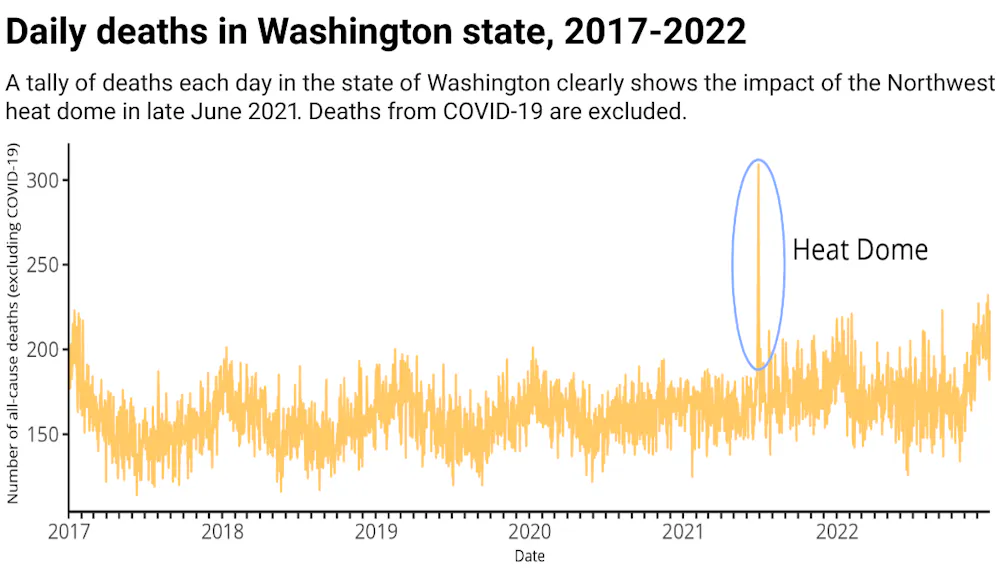
    A chart of all deaths, excluding COVID-19, shows the extraordinary impact the 2021 heat dome had in Washington.
    ‘In the Hot Seat’ report, 2022

    We were excited and relieved when the community was awarded a US$19.9 million grant from the Environmental Protection Agency to help it take concrete steps to adapt to climate change and boost the local economy in the process. The grant would help establish resilience hubs with microgrids and help residents without air conditioning install energy-efficient cooling systems. The city doesn’t have the means to make these improvements on its own, even if they would save lives and money in the long run.

    Less than a year later, the Trump administration abruptly terminated the funding.

    Spokane’s grant wasn’t the only one eliminated – about 350 similar grants that had been awarded to help communities across the country manage climate changes, from extreme heat and wildfire smoke to rising seas and flooding, were also terminated on the grounds that they don’t meet the White House’s priorities. Many other grants to help communities have also been terminated.

    Many of the communities that lost funding are like Spokane: They can’t afford to do this kind of work on their own.

    Why cities like Spokane need the help

    Like many communities in the American West, Spokane was founded in the late 19th century on wealth from railroads and resource extraction, especially gold, silver and timber.

    Today, it is a city of 230,000 in a metro area of a half-million people, the largest on the I-90 corridor between Minneapolis and Seattle. In many ways, Spokane could be on the cusp of a renaissance.

    In January 2025, the U.S. Department of Commerce announced a $48 million grant to develop a tech hub that could put the Inland Northwest on a path to become a global leader in advanced aerospace materials. But then, in May, the Trump administration rescinded that grant as well.

    The lost grants left the economy – and Spokane’s ability to adapt fast enough to keep up with climate changes – uncertain.

    Heat waves are becoming a growing risk in Spokane, known for its river and falls that tumble near downtown.
    Roman Eugeniusz/Wikimedia Commons, CC BY-SA

    This is not a wealthy area. The median household income is nearly $30,000 less than the state average. More than 13 out of every 100 people in Spokane live in poverty, above the national average, and over 67% of the children are eligible for free or reduced lunch.

    The city is a light blue island in a dark red sea, politically speaking, with a moderate mayor. Its congressional district has voted Republican by wide margins since 1995, the year that then-House Speaker Tom Foley lost his reelection bid.

    Lessons from the 2021 heat dome

    The 2021 heat wave was a catalyzing event for the community. The newly formed Gonzaga Institute for Climate, Water and the Environment brought together a coalition of government and community partners to apply for the EPA’s Climate and Environmental Justice Community Change Grant Program. The grants, funded by Congress under the Inflation Reduction Act of 2022, were intended to help communities most affected by pollution and climate change build adaptive capacity and boost the safety of their residents.

    A key lesson from the 2021 heat dome was that temporary, or pop-up, cooling centers don’t work well. People just weren’t showing up. Our research found that the best approach is to strengthen existing community facilities that people already turn to in moments of difficulty.

    Half the $19.9 million award was for outfitting five resilience hubs in existing libraries and community centers with solar arrays and battery backup microgrids, allowing them to continue providing a safe, cool space during a heat wave if the power shuts down.

    The locations and plans for five resilience hubs to serve Spokane, and the infrastructure they would receive.
    Gonzaga Institute for Climate, Water and the Environment

    Another $8 million in grant funding was meant to provide 300 low- to moderate-income homeowners with new high-efficiency electric heat pump heating, ventilation and air conditioning systems, providing more affordable utility bills while improving their ability to cool their homes and reducing fossil fuel emissions.

    Communities are left with few options

    Now, this and other work is at risk in Spokane and cities and towns like it around the country that also lost funding.

    According to the Trump administration, the program – designed to help hundreds of communities around the country become safer – was “no longer consistent with EPA funding priorities.”

    A class action lawsuit was recently filed over the termination of the grants by a coalition that includes Earth Justice and the Southern Environmental Law Center. If the case is successful, Spokane could see its funding restored.

    Meanwhile, the city and my team know we have to move fast, with whatever money and other resources we can find, to help Spokane prepare for worsening heat. We formed the Spokane Climate Resilience Collaborative – a partnership between community organizations, health officials and the city – as one way to advance planning for and responding to climate hazards such as extreme heat and wildfire smoke.

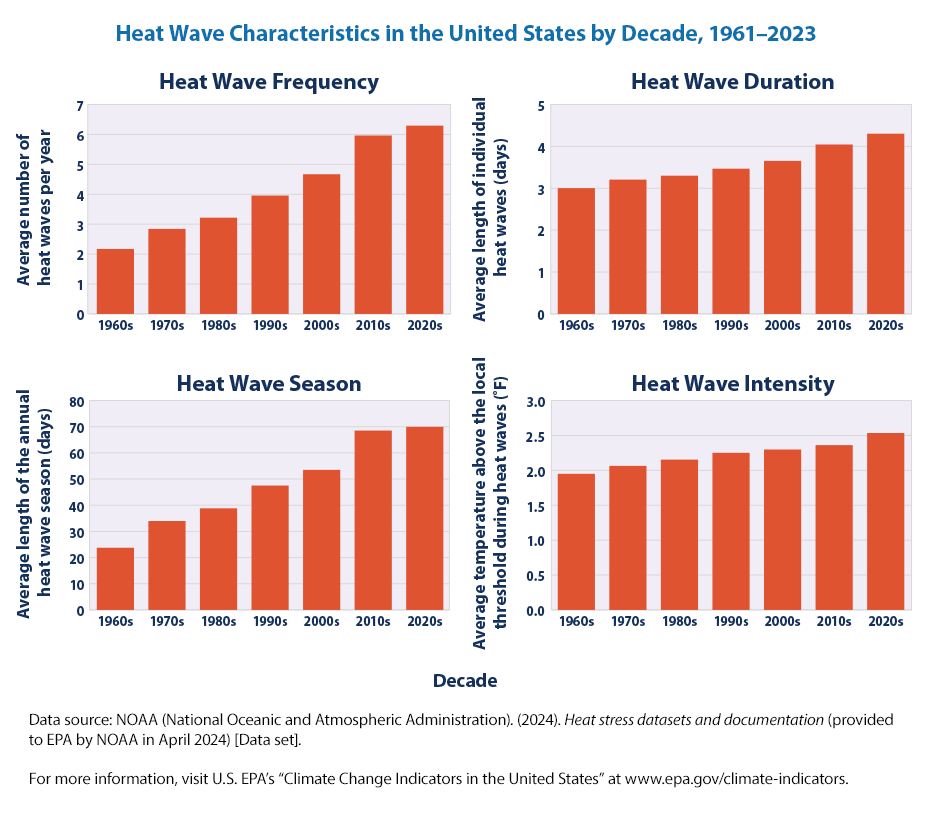
    As concentrations of heat-trapping gasses accumulate in the atmosphere, both the frequency and severity of heat waves increase. It is only a matter of time before another deadly heat dome arrives.

    Brian G. Henning receives funding from the Environmental Protection Agency.

    ref. My city was one of hundreds expecting federal funds to help manage rising heat wave risk – then EPA terminated the grants – https://theconversation.com/my-city-was-one-of-hundreds-expecting-federal-funds-to-help-manage-rising-heat-wave-risk-then-epa-terminated-the-grants-259009

    MIL OSI Analysis

  • MIL-OSI Analysis: Trump administration’s lie detector campaign against leakers is unlikely to succeed and could divert energy from national security priorities

    Source: The Conversation – USA – By Brian O’Neill, Professor of Practice, International Affairs, Georgia Institute of Technology

    The Department of Homeland Security and FBI are reportedly using polygraphs aggressively to identify dissenters. standret/Getty Images

    The Trump administration has recently directed that a new wave of polygraphs be administered across the executive branch, aimed at uncovering leaks to the press.

    As someone who has taken roughly a dozen polygraphs during my 27-year career with the CIA, I read this development with some skepticism.

    Polygraphs carry an ominous, almost mythological reputation among Americans. The more familiar and unofficial term – lie detector tests – likely fuels that perception. Television crime dramas have done their part, too, often portraying the device as an oracle for uncovering the truth when conventional methods fail.

    In those portrayals, the polygraph is not merely a tool – it’s a window into the soul.

    Among those entering government service, especially in national security, the greater anxiety is not the background check but passing the polygraph. My advice is always the same: Don’t lie.

    It’s the best – and perhaps only – guidance for a process that most assessments have concluded is a more subjective interpretation than empirical science.

    Why the polygraph persists

    Polygraphs are “pseudo-scientific” in that they measure physiological responses such as heart rate, blood pressure and perspiration. The assumption is that liars betray themselves through spikes in those signals. But this presumes a kind of psychological transparency that simply doesn’t hold up. A person might sweat and tremble simply from fear, anger or frustration – not deceit.

    There also are no specific physiological reactions associated with lying. The National Academy of Sciences in 2003, and the American Psychological Association in a 2004 review, concluded that the polygraph rests more on theater than fact. Recent assessments, published in 2019, have reached the same conclusion.

    Accordingly, polygraph results are not generally admissible in U.S. courts. Only a handful of states – such as Georgia, Arizona and California – permit their use even under limited conditions. And they typically require that both parties agree to admission and a judge to approve it. Unconditional admissibility remains the exception, not the rule.

    And yet, inside many national security agencies, polygraphs remain central to the clearance process – a fact I observed firsthand during my time overseeing personnel vetting and analytic hiring within the intelligence community.

    While not treated as conclusive, polygraph results often serve as a filter. A candidate’s visible discomfort – or the examiner’s subjective judgment that a response seems evasive – can stall or end the hiring process. For instance, I know that government agencies have halted clearances after an examiner flagged elevated reactions to questions about past drug use or foreign contacts, even when no disqualifying behavior was ultimately documented.

    The FBI’s J. Edgar Hoover headquarters building in Washington in 2016.
    AP Photo/Cliff Owen

    In some cases, an examiner’s suggestion that a chart shows an anomaly has led otherwise strong applicants to volunteer details they hadn’t planned to share – such as minor security infractions, undeclared relationships, or casual drug use from decades earlier – that, while not disqualifying on their own, reshape how their trustworthiness is perceived.

    The polygraph’s power lies in creating the conditions under which deception is confessed.

    A predictable pattern

    No administration has been immune to the impulse to investigate leaks. The reflex is bipartisan and familiar: An embarrassing disclosure appears in the press – contradicting official statements or exposing internal dissent – and the White House vows to identify and punish the source. Polygraphs are often part of this ritual.

    During his first term, Trump intensified efforts to expose internal dissent and media leaks. Department guidelines were revised to make it easier for agencies to obtain journalists’ phone and email records, and polygraphs were reportedly used to pressure officials suspected of talking to the press. That trend has continued – and, in some areas, escalated.

    Recent policies at the Pentagon now restrict unescorted press access, revoke office space for major outlets and favor ideologically aligned networks. The line between legitimate leak prevention and the surveillance or sidelining of critical press coverage has grown increasingly blurred.

    At agencies such as the Department of Homeland Security and the FBI, polygraphs are reportedly being used more frequently – and more punitively – to identify internal dissenters. Even “cold cases,” such as the leak of the Supreme Court’s Dobbs opinion ahead of its overturning of Roe v. Wade, have been reopened, despite prior investigations yielding no definitive source.

    Government reaction varies

    Not all leaks are treated the same. Disclosures that align with official narratives or offer strategic advantage may be quietly tolerated, even if unauthorized. Others, especially those that embarrass senior officials or reveal dysfunction, are more likely to prompt formal investigation.

    In 2003, for example, the leak of CIA officer Valerie Plame’s identity – widely seen as retaliation for her husband’s criticism of the Iraq War – triggered a federal investigation. The disclosure embarrassed senior officials, led to White House aide Scooter Libby’s conviction for perjury, later commuted, and drew intense political scrutiny.

    Lewis Libby, Vice President Dick Cheney’s chief of staff, rides in the backseat of a limousine on Oct. 27, 2005, in McLean, Va.
    Win McNamee/Getty Images

    Leaks involving classified material draw the sharpest response when they challenge presidential authority or expose internal disputes. That was the case in 2010 with Chelsea Manning, whose disclosure of diplomatic cables and battlefield reports embarrassed senior officials and sparked global backlash. Government reaction often depends less on what was disclosed than on who disclosed it – and to what effect.

    A narrow set of disclosures, such as those involving espionage or operational compromise, elicit broad consensus as grounds for prosecution. But most leaks fall outside that category. Most investigations fade quietly. The public rarely learns what became of them. Occasionally, there is a vague resignation, but direct accountability is rare.

    What the future holds

    Trump’s polygraph campaign is not likely to eliminate leaks to the press. But they may have a chilling effect that discourages internal candor while diverting investigative energy away from core security priorities.

    Even if such campaigns succeed in reducing unauthorized disclosures, they may come at the cost of institutional resilience. Historically, aggressive internal enforcement has been associated with declining morale and reduced information flow – factors that can hinder adaptation to complex threats.

    Some researchers have suggested that artificial intelligence may eventually offer reliable tools for detecting deception. One recent assessment raised the possibility, while cautioning that the technology is nowhere near operational readiness.

    For now, institutions will have to contend with the tools they have – imperfect, imprecise and more performative than predictive.

    As a former US intelligence officer, I am required to submit any written draft, before sharing it with other persons, for prepublication review. I submitted this draft to CIA’s Prepublication Review Board, which responded on 11 June: “No classified information was identified. Therefore, no changes are required for publication or sharing with others.”

    ref. Trump administration’s lie detector campaign against leakers is unlikely to succeed and could divert energy from national security priorities – https://theconversation.com/trump-administrations-lie-detector-campaign-against-leakers-is-unlikely-to-succeed-and-could-divert-energy-from-national-security-priorities-259128

    MIL OSI Analysis

  • MIL-Evening Report: Ice baths are booming in popularity – but they come with health risks

    Source: The Conversation (Au and NZ) – By Samuel Cornell, PhD Candidate in Public Health & Community Medicine, School of Population Health, UNSW Sydney

    Michele Ursi/Getty Images

    Walk through any trendy suburb and you might find a new “wellness” studio offering ice baths or “contrast therapy” (a sauna and ice bath combo).

    Scroll social media, and you’re likely to come across influencers preaching the cold plunge gospel with cult-like zeal.

    Ice baths have gone mainstream. Initially practised mainly among high-performance athletes, cold water immersion is now a booming business model: sold as recovery, discipline and therapy all in one.

    But the benefits are questionable and, importantly, ice baths can have health risks – particularly for people who have limited experience using them.

    From Roman times to today

    Cold water immersion isn’t a new concept.

    The “frigidarium” – a room with a cold plunge pool or bath – was a feature in most Roman bathhouses.

    For decades, athletes have used cold water immersion, such as swims in cold water, for recovery.

    But in recent years, with the proliferation of commercial cold plunge centres, there’s been an explosion in people using ice baths recreationally.

    Many people are even setting up their own ice baths at home. The global cold plunge tub market was valued at close to US$338 million in 2024 and is projected to reach nearly $483 million by 2033.

    Social media shows serene influencers meditating through the pain, claiming it boosts mental health, serotonin, testosterone, and their metabolism. But does the evidence stack up?

    Ice baths can reduce muscle soreness after intense training, however the effect is modest and short-lived.

    Some research shows cold water immersion can improve mood after a single exposure in young, healthy people, but other research doesn’t find these benefits.

    Most claims about mental health, testosterone and weight loss aren’t backed by strong evidence. Rather, they’re anecdotal and amplified by influencers.


    Read more:
    Cold water therapy: what are the benefits and dangers of ice baths, wild swimming and freezing showers?


    What does an ice bath involve?

    At commercial establishments, patrons can often use the ice baths as they please during a booked session. Ice bath temperatures often range anywhere from 3°C to 15°C. There normally isn’t actual ice in the bath, but some people add blocks of ice to their ice baths at home.

    Businesses offering ice baths don’t always actively supervise patrons or monitor a person’s time in the ice bath. They may leave their customers to self-regulate, assuming people will know to get out of the water before they pass their body’s limits.

    So what are the risks?

    Cold water immersion triggers a powerful physiological response. When you hit cold water below 15°C, your body launches into cold shock. Gasping occurs and breathing becomes rapid and uncontrollable. Heart rate spikes. Blood pressure rises.

    Staying in the water for too long can lead to hypothermia, a condition where a person’s core body temperature drops dangerously low.

    Shivering may begin within minutes in cold water. Confusion or fainting are more serious signs that hypothermia may be developing.

    Occasionally, this “cold shock” response can lead to a heart attack or stroke – especially if you have an undiagnosed condition affecting your heart, blood vessels or brain.

    As far back as 1969, researchers found even experienced swimmers could struggle after just a few minutes in cold water. Participants were immersed in water at 4.7°C while fully clothed and asked to swim as if trying to reach safety. Some developed serious respiratory distress and had to stop swimming within as little as 90 seconds, well before any measurable drop in core body temperature.

    Even after you get out, your core temperature can continue to fall – a phenomenon known as afterdrop. So you can encounter problems, such as collapse, even after leaving the water.

    And even young, healthy people can be caught off guard. The body isn’t designed to endure freezing water for extended periods.

    Recently one of us (Sam Cornell) had to provide first aid at an ice bath venue in Sydney. A young man collapsed after staying in an ice bath for ten minutes. He was shivering uncontrollably and clearly suffering from cold shock.

    Cold exposure can also cause long-term damage to nerves and blood vessels in the hands and feet, known as non-freezing cold injury. This is more likely if someone spends an extended period immersed in cold water. Symptoms such as numbness, pain and sensitivity to cold can persist for years.

    6 tips for safer recreational ice bath use

    The ice bath trend is part of a broader wellness movement, promoted to young men in particular, where discomfort is repackaged as discipline. Push through the pain. Master your body. If you feel terrible, you must be doing it right.

    But behind the hype lies a less appealing truth. Ice baths can be dangerous.

    We advise caution, but if you do choose to try an ice bath, treat it seriously and follow these tips to reduce the risk of harm.

    1. Talk to your doctor: get checked out first. If you or your family have any heart, stroke or respiratory risk, skip it

    2. Know your limits: being fit doesn’t protect you from cold shock

    3. Start gradually: begin with short warm to cold showers before full immersion

    4. Never go alone: always have someone with you, especially if you’re new to ice baths

    5. Keep it short and watch the temperature: limit sessions to 3–5 minutes and remember, problems can still occur after you get out

    6. Recognise the signs of danger: symptoms such as shivering, numbness and confusion can all seem like part of the experience to someone bent on pushing themselves. But these can be signs of hypothermia.

    Samuel Cornell receives funding from Meta Platforms, Inc. His research is supported by a University of New South Wales Sydney, University Postgraduate Award. His research is supported by Royal Life Saving Society – Australia to aid in the prevention of drowning. Research at Royal Life Saving Society – Australia is supported by the Australian government. He has been affiliated with Surf Life Saving Australia and Surf Life Saving NSW in a paid and voluntary capacity.

    Michael Tipton has previously received funding from organisations working in drowning prevention and water safety. He is Chair of the UK National Water Safety Forum, hosted by the Royal Society for the Prevention of Accidents (RoSPA), and a member of Council of the Royal National Lifeboat Institution (RNLI).

    ref. Ice baths are booming in popularity – but they come with health risks – https://theconversation.com/ice-baths-are-booming-in-popularity-but-they-come-with-health-risks-260206

    MIL OSI AnalysisEveningReport.nz

  • MIL-Evening Report: Israel’s Rafah camp – ‘humanitarian city’ or crime against humanity?

    Source: The Conversation (Au and NZ) – By Shannon Bosch, Associate Professor (Law), Edith Cowan University

    Israel’s Defence Minister Israel Katz has announced a controversial plan to move up to 600,000 Palestinians in Gaza into a designated “humanitarian area” on the ruins of the southern city of Rafah.

    Access to the camp would be through strict security screening to ensure entrants were not Hamas operatives. Once inside, the perimeter would be sealed off by the Israeli military. Palestinians would not be allowed to leave.

    Eventually the camp would house the entire 2.1 million population of Gaza.

    Camp construction would begin during the proposed 60-day ceasefire being negotiated by Israel and Hamas

    ‘Illegal and inhumane’

    The plan is illegal, inhumane and risks worsening the humanitarian crisis in Gaza.

    The forced displacement and containment of any civilian population in an occupied territory is a violation of international humanitarian law.

    Done on this scale would constitute a war crime and a crime against humanity under the Rome Statute.

    The UN Security Council, UN General Assembly and UN Commission on Human Rights have all condemned instances of forced transfer in armed conflicts.

    So too, the International Committee of the Red Cross and the Red Crescent, which have stressed the fundamental prohibition of forced displacement of a civilian population and the need for all parties to respect this prohibition.

    For their own protection?

    Katz is describing the camp as a “humanitarian city”. The Israeli military says Palestinians would only be contained for their own protection.

    As we have seen, civilian displacement is prohibited. But there is an exception if a case can be made either for military reasons or the protection of the population.

    However, this exception only exists for as long as the conditions warrant for it to exist. Anyone subject to such an evacuation must be transferred back to their homes as soon as possible.

    Imperative military reasons never justify the removal of a civilian population in order to persecute it. The Guiding Principles on Internal Displacement entrenches the duty of international actors to avoid creating the conditions that might lead to the displacement of people.

    Aid dilemma

    Katz has indicated international organisations would be responsible for managing aid and services inside the area.

    But Israel has a history of defying even orders from the International Court of Justice to allow humanitarian aid to reach the Palestinians in Gaza.

    If international humanitarian agencies were called upon to service the camp, they would face a dilemma.

    They would need to decide whether to cooperate in managing aid under conditions that compromise their neutrality and ethical standards, deny basic human rights and are built on violations of international law.

    Aid groups would risk being complicit in a process that sets up a transit camp for Palestinians before possibly expelling them from Gaza altogether.

    This “humanitarian city” would essentially become an open-air prison. Palestinians would be reliant on international aid under strict Israeli military control.

    Mass expulsion?

    Could the Rafah camp be a precursor to mass expulsion from Gaza and what does international law say about that?

    Katz has been quoted saying Israel aims to implement “the emigration plan, which will happen” – meaning Gazans will eventually be forced to leave for other countries.

    Changing the demographic composition of a territory – ethnic cleansing – achieved through the displacement of the civilian population of a territory is strictly prohibited under international law.

    The idea of displacing Palestinians has long been part of Israeli strategic thinking, but this announcement signals a dangerous escalation and intention to permanently alter Gaza’s demographic landscape through displacement and containment.

    Voluntary exodus?

    According to Katz, Gazans would have the option of “voluntary” emigration.

    Indeed, speaking at the White House this week, Prime Minister Benjamin Netanyahu said there would be no forced exodus from Gaza:

    If people want to stay, they can stay, but if they want to leave, they should be able to leave.

    But the scale of the humanitarian crisis in Gaza is incomprehensible.

    The population has been displaced multiple times and 90% of homes in Gaza are damaged or destroyed. The healthcare, water, sanitation and hygiene systems have collapsed.

    On average 100 Palestinians are killed daily as they try to access food.

    These crisis circumstances negate the voluntary nature of any person’s consent to either the transfer to the Rafah camp or ultimately, the departure from Gaza.

    According to Amos Goldberg, historian of the Holocaust at the Hebrew University of Jerusalem, what the defence minister laid out was clear plans for the ethnic cleansing of Gaza:

    [it is] a transit camp for Palestinians before they expel them. It is neither humanitarian nor a city.

    Shannon Bosch does not work for, consult, own shares in or receive funding from any company or organisation that would benefit from this article, and has disclosed no relevant affiliations beyond their academic appointment.

    ref. Israel’s Rafah camp – ‘humanitarian city’ or crime against humanity? – https://theconversation.com/israels-rafah-camp-humanitarian-city-or-crime-against-humanity-260809

    MIL OSI AnalysisEveningReport.nz

  • MIL-Evening Report: Can’t fill your ADHD script? Here’s why, and what to do while the shortage persists

    Source: The Conversation (Au and NZ) – By Jack Janetzki, Lecturer in Pharmacy and Pharmacology, University of South Australia

    Attention-deficit hyperactivity disorder (ADHD) diagnoses are rising across Australia.

    But after finally getting a diagnosis, many people are discovering the medicine they’ve been prescribed isn’t available at the pharmacy.

    Australia faces a nation-wide shortage of methylphenidate (sold as Concerta and Ritalin).

    What does it mean for people with ADHD?

    ADHD medication shortages have persisted since 2023, with shortages of lisdexamfetamine (Vyvanse), and are now affecting more people.

    Many people with ADHD have to call multiple pharmacies to find their medication. They might be put on waiting lists to access their prescribed medications, or have to contact their doctor or their child’s doctor to get a new script for a different medication.

    Some people with ADHD are switching between strengths or changing to different medicines. This can mean starting again with slow dose changes, and can result in poor symptom control and more side effects.

    Some people have had to skip doses or go without medicine altogether, making it hard to concentrate, stay organised and manage emotions.

    Shortages can also increase inequality. People in rural areas with fewer pharmacies, for example, have more difficulty accessing these medications.

    And people with fewer financial resources are less able to access alternative medications that aren’t subsidised.

    Increasing access to diagnosis and treatment

    Around 8% of children and 2.5% of adults in Australia have ADHD. It makes it hard to focus, sit still, and/or control impulses. For many, medication helps manage these symptoms.

    Diagnosis has often involved seeing a specialist such as psychiatrist or paediatrician.

    But from September, GPs in New South Wales will be able to continue ADHD prescriptions without needing specialist approval. In 2026, GPs in South Australia and Western Australia will be able to diagnose ADHD and start treatment.

    However, ongoing shortages may still stop people from getting the medicine they need.

    Why are these medicines running out?

    These shortages are largely due to manufacturing issues – including problems sourcing raw ingredients and production quotas in the United States.

    When one brand runs out, it puts pressure on other brands. This creates a domino effect across the supply chain.

    There is also increasing demand.

    In 2022-2023 almost 470,000 Australians were prescribed ADHD medications. That’s four times the number from nine years earlier.

    From January 2024 to May 2025, the number of prescriptions filled increased further, by 60% for dexamfetamine, 88% for methylphenidate and 140% for lisdexamfetamine.

    Scripts filled for ADHD stimulants from January 2024 to May 2025.
    CC BY

    Shortages of several strengths and brands of menthylphenidate (Concerta and Ritalin) and are expected to continue into late 2025. Both the long-acting and short-acting types are affected.

    Pharmacies can’t always help

    Stimulants to treat ADHD are tightly controlled. Pharmacies can only supply one-month of medicine at a time.

    In some states such as NSW, paper prescriptions for tightly controlled medicines must be filled at the same pharmacy each time. So patients have not been able to get their medicine elsewhere even if it’s in stock.

    In response to the methylphenidate shortages, NSW Health has allowed pharmacies to transfer paper prescriptions to other pharmacists that have stock available. This change is temporary but helpful.

    This rule is different in other states such as Victoria and South Australia, where people are able to visit or call other pharmacies to see if they have stock.

    However, ideally a patient will be able to build a rapport with one main pharmacy – and the pharmacy will know exactly how many regular patients they need to get stock for.

    What are regulators doing about it?

    The national medicines regulator, the Therapeutic Goods Administration (TGA) has set up a group called the Medicine Shortage Action Groups to respond to the methylphenidate shortage.

    This group includes members from health professional groups and peak bodies. It will give advice to health professionals and are creating resources for patients, families and schools about the shortages and how to reduce disruptions to their or their child’s treatment.

    The TGA has also recently approved the temporary use of some methylphenidate brands from overseas.

    Some of these are now listed on the Pharmaceutical Benefits Scheme, which means they are available at a subsidised price.

    The body representing physicians, the Royal Australasian College of Physicians, has called for early warnings about shortages. That way, doctors can help patients change to alternatives before it’s too late.

    What can you do if you can’t get a script filled?

    If you’re finding it hard to get your ADHD medicine:

    • talk to your pharmacist. They may be able to order an overseas-registered alternative or suggest a different brand

    • speak with your GP, psychiatrist or your child’s paediatrician. They might adjust your or your child’s dose or suggest a different medication for their ADHD. This might mean changing to another stimulant that is available in a short- or long-acting formulation or by changing to a medicine for ADHD that is not a stimulant. Ask your physician to contact the pharmacy to see what they have in stock while you’re at your appointment

    • check the TGA’s Medicine Shortage Reports Database for updates on when the medicine might become available.

    If you’re calling around to find stock:

    • call mid-morning to see if they’ve got stock. Pharmacies are generally less busy after the morning rush

    • say exactly what medicine, strength and brand you are looking for. If you don’t mind which brand be sure to tell the pharmacist

    • keep a list of pharmacies so you don’t double up

    • if you live in a rural area and find that a pharmacy in a nearby town has stock, ask if they can courier the medication to you.

    Jack Janetzki works for Pharmaceutical Defence Limited and The Barossa Pharmacist in the Mall (Nuriootpa, South Australia). He is a member of Pharmaceutical Defence Limited, the Australasian Pharmaceutical Science Association, the Pharmaceutical Society of Australia and the Observational Health Data Science Informatics network.

    Lisa Kalisch Ellett is president of the Australasian Pharmaceutical Science Association and a member of the Pharmaceutical Society of Australia.

    ref. Can’t fill your ADHD script? Here’s why, and what to do while the shortage persists – https://theconversation.com/cant-fill-your-adhd-script-heres-why-and-what-to-do-while-the-shortage-persists-259911

    MIL OSI AnalysisEveningReport.nz

  • MIL-Evening Report: Medicinal cannabis is big business. But the latest clampdown won’t curb unsafe prescribing

    Source: The Conversation (Au and NZ) – By Carmen Lim, NHMRC Emerging Leadership Fellow, National Centre for Youth Substance Use Research, The University of Queensland

    Nuva Frames/Shutterstock

    Australia’s key regulator of health professionals has announced it’s clamping down on unsafe prescribing of medicinal cannabis in the wake of surging patient demand.

    The Australian Health Practitioner Regulation Agency, known as Ahpra, today warned health professionals they would need to put patients’ wellbeing ahead of profits.

    Among its concerns were aggressive marketing strategies by clinics prescribing medicinal cannabis, and consultations lasting between a few seconds and a few minutes, before prescribing.

    Such concerns have led to eight practitioners issuing more than 10,000 scripts in a six-month window, and one who appeared to have issued more than 17,000 scripts.

    Ahpra’s other concerns include reports of patients with psychosis after taking medicinal cannabis, prescribing high doses, and prescribing to family members or people under 18.

    However, overservicing, inappropriate prescribing and the health issues that can arise are issues we’ve known about for years.

    Our research, for example, looked at multiple websites that offered medicinal cannabis in Australia. We found widespread examples of aggressive and misleading marketing. Some clinics breached regulatory guidelines. Others bent the rules.

    Yet Ahpra’s latest announcement doesn’t tighten existing prescribing or marketing rules for medicinal cannabis. It just reminds doctors, nurse practitioners and pharmacists what the rules are.

    What is the regulator concerned about?

    According to the 2022–23 National Drug Strategy Household Survey, 3% of Australians aged 14 or over had used cannabis for medical purposes in the previous 12 months, equating to around 700,000 people.

    Australians spent more than A$400 million on medicinal cannabis products in the first half of 2024 alone.

    But Ahpra is concerned too many health practitioners are prescribing medicinal cannabis when a patient requests it, rather than whether this is the right product for them.

    It suggests too few practitioners are assessing patients thoroughly, formulating and implementing a management plan, facilitating coordination and continuity of care, maintaining medical records, recommending treatments only where there is an identified therapeutic need, and ensuring medicinal cannabis is not a first-line treatment.

    So Ahpra says it will investigate practitioners with high rates of prescribing any scheduled medicine, including medicinal cannabis, even if it has not received a complaint.

    We found lots of aggressive marketing

    Medicinal cannabis has been legally available in Australia since 2016. This means doctors can prescribe it for any medical condition when other approved treatments have not worked. Now patients can be prescribed medicinal cannabis as a capsule, oil or dried flower, for example, often via a website.

    But when we analysing the websites of 54 private medicinal cannabis clinics in Australia, an alarming picture emerged.

    We found multiple examples of websites that breached marketing rules, or skirted around them. This included making unsubstantiated health claims about the products they offered, such as they could treat anxiety, depression, or other mental health symptoms.

    Websites often allowed people to assess if medicinal cannabis was for them. This self-assessment may mislead people into believing they would benefit from it, inadvertently “coaching” them on which medical conditions might warrant a prescription.

    Other marketing tactics we found included promises of same-day or after-hours delivery, no GP referrals required, discounted consultation fees, and
    targeted advertisements on social media.

    What we’d like to see

    Ahpra’s aim of safer prescribing of medicinal cannabis is welcome. But by merely repeating the rules, rather than tightening them, this doesn’t go far enough. So Ahpra has missed out on a real opportunity to safeguard patients’ health.

    For instance, we’d like to see greater emphasis on banning targeted advertisements on social media for medicinal cannabis. In a study that we’ve submitted for publication, we found this a particular concern.

    We found many private clinics are using ads to reach young people, including those as young as 18. One company ran more than 170 active ads this month alone across Facebook, Instagram and Threads.

    Ads we’ve seen include cryptic messaging, such as “we can’t shout about it, but our patients are smiling”, paired with bright colours and wellness-themed imagery.

    One pairs an Australian sports celebrity with the tagline “move differently!” and the name of the product.

    Another one promises “real doctors, real care” and “fast approvals & express delivery”, with consultations at $19.

    While these ads do not mention medicinal cannabis directly, the messaging is clearly designed to spark curiosity and build brand recognition, especially among younger audiences.

    We’d also like to see Ahpra:

    • broaden its focus beyond prescribing patterns to include digital marketing and advertising practices that target young people

    • provide clear guidelines to medicinal cannabis clinics and prescribers on acceptable promotional practices

    • support stronger consequences for repeat offenders, including prescribers who continue to engage in misleading advertising after being sanctioned.

    Carmen Lim receives funding from the National Medical Health Research Council (2024-2028). She has not received any funding from the alcohol, cannabis, pharmaceutical, tobacco or vaping industries.

    ref. Medicinal cannabis is big business. But the latest clampdown won’t curb unsafe prescribing – https://theconversation.com/medicinal-cannabis-is-big-business-but-the-latest-clampdown-wont-curb-unsafe-prescribing-260803

    MIL OSI AnalysisEveningReport.nz

  • MIL-Evening Report: Are ‘ghost stores’ haunting your social media feed? How to spot and avoid them

    Source: The Conversation (Au and NZ) – By Gary Mortimer, Professor of Marketing and Consumer Behaviour, Queensland University of Technology

    CC BY

    The offer pops up in your social media feed. The website is professional and the imagery illustrates an Australian coastal region, or chic inner-CBD scene.

    The brand name indicates this exclusive fashion retailer is based in Melbourne, Sydney, Adelaide, or an exclusive enclave such as Double Bay or Byron Bay.

    The businesses have history, having apparently been “established” 30–40 years ago, and a story. The owners have reluctantly decided to close or relocate, resulting in significant discounts.

    However, behind the illusion of prestige and luxury, is cheap, poorly manufactured clothing from Chinese factories.

    The recent growth of these online “ghost stores” has led the Australian Consumer and Competition Commission to issue public warning notices about four websites.

    Everly-melbourne.com, willowandgrace-adelaide.com, sophie-claire.com and doublebayboutique.com are the four named.

    A new type of scam

    The ACCC’s Targeting Scams report estimated Australians lost A$2.74 billion in 2023. Most losses were from investment scams ($1.3 billion), remote access scams ($256 million), and romance scams ($201.1 million).


    Read more:
    3.5 million Australians experienced fraud last year. This could be avoided through 6 simple steps


    However, online ghost store scams are so new, researchers and government agencies have not yet had time to measure the financial impact these businesses are having on consumers or legitimate fashion businesses.

    It is possible a consumer, once stung by a ghost store scam, will be less likely to shop with a legitimate online fashion retailer.

    This type of emerging scam was touched on in a 2015 report called Framework for a Taxonomy of Fraud. The report noted there were businesses selling “worthless or non-existent products”. Their sites made:

    misleading claims about products that are exaggerated, undervalued, or non-existent.

    Since the beginning of 2025, the ACCC reports it has received at least 360 complaints about 60 online ghost retailers. It says many more may be operating across several social media sites.

    Tricky tactics

    Ghost stores use a variety of tactics to attract unsuspecting customers.

    Price: Customers regularly assume higher prices mean higher quality. Most customers seeing a “leather” jacket for $19.74 on Temu would expect low quality. However, a silk maxi-dress from Everly Melbourne reduced from $209.95 to $82.95 – a 60% saving – seems reasonable and reflective of normal mid-season clearance pricing. That fact it’s still priced at more than $80 also implies good quality.

    Cosmopolitan localism: Researchers have reported that so-called cosmopolitan localism fosters meaningful consumer relationships with brands. Consumers are more likely to trust a business based in Melbourne or Byron Bay over one based internationally.

    Adding images of a physical store front creates credibility and “realness”. Customers feel confident to buy from a little business based in Melbourne, Sydney or somewhere well known to them.

    Storytelling: Storytelling can influence shoppers’ emotions and affect purchasing. It helps stimulate deeper emotional connections to a brand. Ghost stores will regularly create a narrative around “going out of business” to justify price discounts and pull on heart-strings.

    Layout: A professionally developed website, with high-quality images, detailed product information, online payment methods and order tracking, creates the illusion of authenticity. Researchers have found luxury brand website designs can create a strong sense of luxury. This increases a willingness to buy.

    How to spot a “ghost”

    When the post indicates “closing today” or “closing down sale ends tonight”, it is very easy to impulsively jump in to take advantage of the savings. However, before you click, check for these red flags:

    1. The website does not provide a contact phone number or physical address for the store. There might just be an email address or web form. Simply entering the suspected store into google maps will indicate no physical location.

    2. The website domain is “.com” rather than “.com.au”. This indicates the store is not an Australian-based business.

    3. Is the business registered? ABN Lookup is the free public view of the Australian Business Register – a quick search will identify that the Double Bay designer isn’t registered locally.

    4. Review platforms, including Trustpilot, often have negative reviews for the business, whereas the business’ website only features very positive reviews.

    5. The images of products or even the owner maybe AI generated. For example, Harry – Melbourne, is apparently an artisan watchmaker. However, simply right-clicking on the image reveals Harry is an AI-generated image.

    A cautionary note

    Online shopping is risky. You can’t physically touch or interact with the product to determine its quality. Three types of risks are common when shopping online. These are performance risk (it doesn’t work, doesn’t fit well, or the quality is poor), financial risk (losing your money on a poor-quality product), and time-loss risk (refund processing takes weeks).

    As such, customers must trust the online retailer to act honestly and describe products accurately. When trust is breached, consumers will naturally become cautious even about legitimate online retailers.

    As ghost stores scams increasingly populate social media feeds, unsuspecting consumers will continue to get caught out. This will leave legitimate retailers exposed to scepticism and mistrust.

    Gary Mortimer receives funding from the Building Employer Confidence and Inclusion in Disability Grant, AusIndustry Entrepreneurs’ Program, National Clothing Textiles Stewardship Scheme, National Retail Association and Australian Retailers Association.

    ref. Are ‘ghost stores’ haunting your social media feed? How to spot and avoid them – https://theconversation.com/are-ghost-stores-haunting-your-social-media-feed-how-to-spot-and-avoid-them-260583

    MIL OSI AnalysisEveningReport.nz

  • MIL-Evening Report: NZ Post is the latest company to drop its climate targets – another sign business is struggling to decarbonise

    Source: The Conversation (Au and NZ) – By Pii-Tuulia Nikula, Associate Professor, School of Business, Eastern Institute of Technology

    Getty Images

    NZ Post committed to cutting its emissions by 32% by 2030 (based on 2018 levels), but recently announced it would abandon its climate target.

    The company was part of the Science Based Target initiative (SBTi), the leading international body allowing businesses worldwide to set and validate targets which they can then promote as backed by science.

    More than 10,000 businesses have joined SBTi and the database currently includes 36 New Zealand businesses with active targets or commitments.

    In recent years, however, well known businesses have been abandoning SBTi. NZ Post’s decision follows Air New Zealand’s announcement to withdraw last year and Auckland Airport’s less publicised decision not to renew its SBTi target.

    NZ Post was one of the early adopters of SBTi in New Zealand. Its initial commitment in 2018 included not only the company’s own direct emissions (known as scope 1) but also purchased energy (scope 2) and other indirect emissions (known as scope 3, such as emissions from air freight or waste disposal).

    In the past few years, NZ Post has signalled its intention to update its target to pursue even greater reductions of 42%. In 2023, it made a commitment to align itself with a pathway to achieve net zero by 2050.

    But the company has now decided to fully withdraw from SBTi. NZ Post’s website announcement states:

    After careful consideration and a thorough assessment of both technical feasibility and financial implications, it has become clear that our target is no longer feasible at a technical level and, given the scale of investment required, under present economic conditions.

    NZ Post seems to have found itself in the contradiction between economic objectives and climate action. Ambitious climate action seems to rarely win such a battle.

    The company was already questioning its ability to meet its SBTi targets in its 2022 and 2023 climate disclosures. Its parcel volumes were growing and it struggled with emissions associated with heavy freight and aviation.

    It also stated its emissions had increased due to the acquisition of Fliway Group, improved supply-chain data, and emission factor changes. This indicated it would struggle to meet even less ambitious climate targets.

    Why this is a problem

    One might commend NZ Post for their transparency in disclosing their decision to withdraw from SBTi. However, so far the announcement hasn’t been included in the company’s media releases and remains tucked away in the sustainability section.

    The broader issue is that businesses can use SBTi to gain reputational value without following up with required decarbonisation. The current SBTi setup has some limitations that allow such behaviour.

    For instance, companies can make an SBTi commitment and promote it for two years before having to submit an actual target for validation. Businesses can also promote their SBTi targets for years without making required progress. Finally, some SBTi businesses provide limited reporting, making assessment of their progress difficult.

    In a 2025 consultation, SBTi acknowledged some of these problems and signalled its plan to enhance tracking and accountability.

    Climate action vs profitability

    There are other issues that make transparency limited. For instance, businesses such as Air New Zealand seem to be able to withdraw from the SBTi and fully disappear from the SBTi public target dashboard, making it difficult to track those that have decided to withdraw.

    While most SBTi businesses are probably not joining the scheme with the intention of “carbonwashing”, the ability of many to meet their targets seems uncertain.

    In business contexts, climate action remains subordinate to profitability and revenue growth objectives. Hence, not many businesses are willing to pursue all potential ways to meet their targets as this would require making difficult decisions around economic objectives.

    Many companies struggle to make progress towards science-based goals or don’t have credible transition plans aligned with the goal to keep overall warming at 1.5°C.

    The question remains whether the current SBTi engagement of businesses genuinely reflects ambitious climate action or whether it is merely designed to give stakeholders the impression of global progress through symbolic commitments.

    In its 2024 climate disclosure NZ Post states:

    The more organisations committed to the science-based reductions, the greater our collective ability to achieve decarbonisation.

    The opposite is true as well. The decision of NZ Post and other companies to drop their SBTi targets may diminish the collective ability of businesses in New Zealand to achieve decarbonisation aligning with global climate goals.

    SBTi’s plan to implement new monitoring and reporting mechanisms would enhance accountability. However, it will not make meeting targets any easier. Committing to and promoting ambitious but potentially unrealistic targets can cause reputational damage.

    A safer pathway for many businesses wanting to do as much as they can within the boundaries of the current economic system may be a public disclosure of their support for climate action, transparency about the actions the business is taking, and providing transparent and detailed emissions reporting.

    Pii-Tuulia Nikula does not work for, consult, own shares in or receive funding from any company or organisation that would benefit from this article, and has disclosed no relevant affiliations beyond their academic appointment.

    ref. NZ Post is the latest company to drop its climate targets – another sign business is struggling to decarbonise – https://theconversation.com/nz-post-is-the-latest-company-to-drop-its-climate-targets-another-sign-business-is-struggling-to-decarbonise-260589

    MIL OSI AnalysisEveningReport.nz

  • MIL-Evening Report: ER Report: A Roundup of Significant Articles on EveningReport.nz for July 9, 2025

    ER Report: Here is a summary of significant articles published on EveningReport.nz on July 9, 2025.

    Teeth record the hidden history of your childhood climate and diet
    Source: The Conversation (Au and NZ) – By Tanya M. Smith, Professor in the Australian Research Centre for Human Evolution & Griffith Centre for Social and Cultural Research, Griffith University Douglas Sacha / Getty Images The climate we live in affects our lives in profound ways: hot summers, cold winters, dry spells and wet weather

    Netflix’s Shark Whisperer wants us to think ‘sexy conservation’ is the way to save sharks – does it have a point?
    Source: The Conversation (Au and NZ) – By Susan Hopkins, Senior Lecturer in Education (Curriculum and Pedagogy), University of the Sunshine Coast Netflix In the new Netflix documentary Shark Whisperer, the great white shark gets an image makeover – from Jaws villain to misunderstood friend and admirer. But the star of the documentary is not

    How do coronial inquests work? Here’s what they can and can’t do
    Source: The Conversation (Au and NZ) – By Marc Trabsky, Associate Professor of Law, Monash University Northern Territory Coroner Elizabeth Armitage’s inquest findings into the death of Kumanjayi Walker have sparked conversations across Australia. The coroner found the NT police officer who shot Walker, Zachary Rolfe, was “racist”, and she couldn’t exclude the possibility that

    Greek and Roman nymphs weren’t just sexy nature spirits. They had other important jobs too
    Source: The Conversation (Au and NZ) – By Kitty Smith, PhD Candidate in Classical Greek and Roman History, University of Sydney Acteon, having accidentally seen the goddess Diana and her nymphs bathing, begins to change into a stag. Metropolitan Museum of Art, Gift of Mrs. George S. Amory, Object Number: 64.208. Could you ever be

    American science is in crisis. It’s a great opportunity for Australia to snap up top scientists
    Source: The Conversation (Au and NZ) – By Kylie Walker, Visiting Fellow, National Centre for the Public Awareness of Science, Australian National University Stellalevi / Getty Images Science in the United States in in trouble. The National Science Foundation, a key research funding agency, has suffered devastating funding cuts under the current administration. Critics say

    Some young people sexually abuse. Here’s how to reduce reoffending by up to 90%
    Source: The Conversation (Au and NZ) – By Jesse Cale, Associate Professor of Criminology, Deputy Director Research (Griffith Youth Forensic Service), Griffith University When we think about who’s responsible for sexual abuse in Australia, we usually picture adults. But young people are responsible for a substantial proportion of sexual offences nationwide. Up to a third

    XFG could become the next dominant COVID variant. Here’s what to know about ‘Stratus’
    Source: The Conversation (Au and NZ) – By Paul Griffin, Professor, Infectious Diseases and Microbiology, The University of Queensland visualspace/Getty Images Given the number of times this has happened already, it should come as little surprise that we’re now faced with yet another new subvariant of SARS-CoV-2, the virus responsible for COVID. This new subvariant

    Can a pizza box go in the yellow bin – or not? An expert answers this and other messy recycling questions
    Source: The Conversation (Au and NZ) – By Pooria Pasbakhsh, Research Fellow in Polymer Upcycling, The University of Melbourne ViDCan/Shutterstock Have you ever gone to toss something into the recycling bin – a jam jar, a pizza box, a takeaway container encrusted with yesterday’s lunch – and wondered if you’re doing it right? Perhaps you

    AI is driving down the price of knowledge – universities have to rethink what they offer
    Source: The Conversation (Au and NZ) – By Patrick Dodd, Professional Teaching Fellow, Business School, University of Auckland, Waipapa Taumata Rau For a long time, universities worked off a simple idea: knowledge was scarce. You paid for tuition, showed up to lectures, completed assignments and eventually earned a credential. That process did two things: it

    Academic slams NZ government over ‘compromised’ foreign policy
    Asia Pacific Report A prominent academic has criticised the New Zealand coalition government for compromising the country’s traditional commitment to upholding an international rules-based order due to a “desire not to offend” the Trump administration. Professor Robert Patman, an inaugural sesquicentennial distinguished chair and a specialist in international relations at the University of Otago, has

    Interest rates are on hold at 3.85%, as the Reserve Bank opts for caution over mortgage relief
    Source: The Conversation (Au and NZ) – By Stella Huangfu, Associate Professor, School of Economics, University of Sydney Thurtell/Getty Images The Reserve Bank of Australia has kept the cash rate at 3.85%, after cutting it in February and May. Those earlier moves were aimed at supporting the economy as growth slowed and inflation eased. This

    The US has high hopes for a new Gaza ceasefire, but Israel’s long-term aims seem far less peaceful
    Source: The Conversation (Au and NZ) – By Ali Mamouri, Research Fellow, Middle East Studies, Deakin University US President Donald Trump has hosted Israeli Prime Minister Benjamin Netanyahu for dinner at the White House, where he has declared talks to end the war in Gaza are “going along very well”. In turn, Netanyahu revealed he

    What makes a good AI prompt? Here are 4 expert tips
    Source: The Conversation (Au and NZ) – By Sandra Peter, Director of Sydney Executive Plus, Business School, University of Sydney FOTOSPLASH/Shutterstock “And do you work well with AI?” As tools such as ChatGPT, Copilot and other generative artificial intelligence (AI) systems become part of everyday workflows, more companies are looking for employees who can answer

    Saying goodbye is never easy: why we mourn the end of our favourite TV series
    Source: The Conversation (Au and NZ) – By Adam Gerace, Senior Lecturer and Head of Course – Positive Psychology, CQUniversity Australia Netflix Has the ending of Squid Game left you feeling downhearted? The South Korean megahit struck a nerve with audiences worldwide, with millions logging in to Netflix to follow protagonist Seong Gi-hun and fellow

    Are chemicals to blame for cancer in young people? Here’s what the evidence says
    Source: The Conversation (Au and NZ) – By Sarah Diepstraten, Senior Research Officer, Blood Cells and Blood Cancer Division, WEHI (Walter and Eliza Hall Institute of Medical Research) Cancer is traditionally known as a disease affecting mostly older people. But some worrying trends show cancer rates in younger people aged under 50 are on the

    ER Report: A Roundup of Significant Articles on EveningReport.nz for July 8, 2025
    ER Report: Here is a summary of significant articles published on EveningReport.nz on July 8, 2025.

    MIL OSI AnalysisEveningReport.nz

  • MIL-Evening Report: ER Report: A Roundup of Significant Articles on EveningReport.nz for July 9, 2025

    ER Report: Here is a summary of significant articles published on EveningReport.nz on July 9, 2025.

    Teeth record the hidden history of your childhood climate and diet
    Source: The Conversation (Au and NZ) – By Tanya M. Smith, Professor in the Australian Research Centre for Human Evolution & Griffith Centre for Social and Cultural Research, Griffith University Douglas Sacha / Getty Images The climate we live in affects our lives in profound ways: hot summers, cold winters, dry spells and wet weather

    Netflix’s Shark Whisperer wants us to think ‘sexy conservation’ is the way to save sharks – does it have a point?
    Source: The Conversation (Au and NZ) – By Susan Hopkins, Senior Lecturer in Education (Curriculum and Pedagogy), University of the Sunshine Coast Netflix In the new Netflix documentary Shark Whisperer, the great white shark gets an image makeover – from Jaws villain to misunderstood friend and admirer. But the star of the documentary is not

    How do coronial inquests work? Here’s what they can and can’t do
    Source: The Conversation (Au and NZ) – By Marc Trabsky, Associate Professor of Law, Monash University Northern Territory Coroner Elizabeth Armitage’s inquest findings into the death of Kumanjayi Walker have sparked conversations across Australia. The coroner found the NT police officer who shot Walker, Zachary Rolfe, was “racist”, and she couldn’t exclude the possibility that

    Greek and Roman nymphs weren’t just sexy nature spirits. They had other important jobs too
    Source: The Conversation (Au and NZ) – By Kitty Smith, PhD Candidate in Classical Greek and Roman History, University of Sydney Acteon, having accidentally seen the goddess Diana and her nymphs bathing, begins to change into a stag. Metropolitan Museum of Art, Gift of Mrs. George S. Amory, Object Number: 64.208. Could you ever be

    American science is in crisis. It’s a great opportunity for Australia to snap up top scientists
    Source: The Conversation (Au and NZ) – By Kylie Walker, Visiting Fellow, National Centre for the Public Awareness of Science, Australian National University Stellalevi / Getty Images Science in the United States in in trouble. The National Science Foundation, a key research funding agency, has suffered devastating funding cuts under the current administration. Critics say

    Some young people sexually abuse. Here’s how to reduce reoffending by up to 90%
    Source: The Conversation (Au and NZ) – By Jesse Cale, Associate Professor of Criminology, Deputy Director Research (Griffith Youth Forensic Service), Griffith University When we think about who’s responsible for sexual abuse in Australia, we usually picture adults. But young people are responsible for a substantial proportion of sexual offences nationwide. Up to a third

    XFG could become the next dominant COVID variant. Here’s what to know about ‘Stratus’
    Source: The Conversation (Au and NZ) – By Paul Griffin, Professor, Infectious Diseases and Microbiology, The University of Queensland visualspace/Getty Images Given the number of times this has happened already, it should come as little surprise that we’re now faced with yet another new subvariant of SARS-CoV-2, the virus responsible for COVID. This new subvariant

    Can a pizza box go in the yellow bin – or not? An expert answers this and other messy recycling questions
    Source: The Conversation (Au and NZ) – By Pooria Pasbakhsh, Research Fellow in Polymer Upcycling, The University of Melbourne ViDCan/Shutterstock Have you ever gone to toss something into the recycling bin – a jam jar, a pizza box, a takeaway container encrusted with yesterday’s lunch – and wondered if you’re doing it right? Perhaps you

    AI is driving down the price of knowledge – universities have to rethink what they offer
    Source: The Conversation (Au and NZ) – By Patrick Dodd, Professional Teaching Fellow, Business School, University of Auckland, Waipapa Taumata Rau For a long time, universities worked off a simple idea: knowledge was scarce. You paid for tuition, showed up to lectures, completed assignments and eventually earned a credential. That process did two things: it

    Academic slams NZ government over ‘compromised’ foreign policy
    Asia Pacific Report A prominent academic has criticised the New Zealand coalition government for compromising the country’s traditional commitment to upholding an international rules-based order due to a “desire not to offend” the Trump administration. Professor Robert Patman, an inaugural sesquicentennial distinguished chair and a specialist in international relations at the University of Otago, has

    Interest rates are on hold at 3.85%, as the Reserve Bank opts for caution over mortgage relief
    Source: The Conversation (Au and NZ) – By Stella Huangfu, Associate Professor, School of Economics, University of Sydney Thurtell/Getty Images The Reserve Bank of Australia has kept the cash rate at 3.85%, after cutting it in February and May. Those earlier moves were aimed at supporting the economy as growth slowed and inflation eased. This

    The US has high hopes for a new Gaza ceasefire, but Israel’s long-term aims seem far less peaceful
    Source: The Conversation (Au and NZ) – By Ali Mamouri, Research Fellow, Middle East Studies, Deakin University US President Donald Trump has hosted Israeli Prime Minister Benjamin Netanyahu for dinner at the White House, where he has declared talks to end the war in Gaza are “going along very well”. In turn, Netanyahu revealed he

    What makes a good AI prompt? Here are 4 expert tips
    Source: The Conversation (Au and NZ) – By Sandra Peter, Director of Sydney Executive Plus, Business School, University of Sydney FOTOSPLASH/Shutterstock “And do you work well with AI?” As tools such as ChatGPT, Copilot and other generative artificial intelligence (AI) systems become part of everyday workflows, more companies are looking for employees who can answer

    Saying goodbye is never easy: why we mourn the end of our favourite TV series
    Source: The Conversation (Au and NZ) – By Adam Gerace, Senior Lecturer and Head of Course – Positive Psychology, CQUniversity Australia Netflix Has the ending of Squid Game left you feeling downhearted? The South Korean megahit struck a nerve with audiences worldwide, with millions logging in to Netflix to follow protagonist Seong Gi-hun and fellow

    Are chemicals to blame for cancer in young people? Here’s what the evidence says
    Source: The Conversation (Au and NZ) – By Sarah Diepstraten, Senior Research Officer, Blood Cells and Blood Cancer Division, WEHI (Walter and Eliza Hall Institute of Medical Research) Cancer is traditionally known as a disease affecting mostly older people. But some worrying trends show cancer rates in younger people aged under 50 are on the

    ER Report: A Roundup of Significant Articles on EveningReport.nz for July 8, 2025
    ER Report: Here is a summary of significant articles published on EveningReport.nz on July 8, 2025.

    MIL OSI AnalysisEveningReport.nz

  • MIL-Evening Report: Netflix’s Shark Whisperer wants us to think ‘sexy conservation’ is the way to save sharks – does it have a point?

    Source: The Conversation (Au and NZ) – By Susan Hopkins, Senior Lecturer in Education (Curriculum and Pedagogy), University of the Sunshine Coast

    Netflix

    In the new Netflix documentary Shark Whisperer, the great white shark gets an image makeover – from Jaws villain to misunderstood friend and admirer.

    But the star of the documentary is not so much the shark, but the model and marine conservationist Ocean Ramsey (yes, that’s her real name).

    The film centres on Ramsey’s self-growth journey, with the shark co-starring as a quasi-spiritual medium for finding meaning and purpose (not to mention celebrity status).

    The film, and some in it, are happy to attribute Ramsey’s success as a shark conservation activist to how driven and photogenic she is. Ramsey says “People look first and listen second. I’ll use my appearance, I’ll put myself out there for a cause.”

    Her husband, the photographer Juan Oliphant, enthuses she is good for sharks partly because she is so beautiful and uses all the attention she attracts in the selfless service of sharks.

    The image of the long-haired, long-limbed young woman in a bikini swimming above an outsized great white shark is not a new one.

    Primal fears and fantasies

    Since Jaws (1975), generations have been fascinated and titillated by filmic images and promotional materials of bikini-clad young women juxtaposed with dangerous sharks.

    The heroine of Deep Blue Sea (1999) is a neuroscientist – however the film and its promotional materials still require her to appear in a wet t-shirt and underwear while pursued by a massive shark monster.

    The poster for 1999’s Deep Blue Sea.
    IMDB

    The Shallows (2016) presents countless images of its bikini-clad heroine, with partially exposed bottom and long legs marked by bite marks as a kind of meat to be consumed – not least by the voyeuristic lens of the camera.

    The poster for 47 Meters Down: Uncaged (2019) features a bikini-clad young woman with legs dangling precariously in front of the gaping jaws of an unnaturally large great white.

    I have previously explored the psychosexual symbolism of these films and images. These films were never really about actual sharks. They are about very human fears and fantasies about being exposed and vulnerable.

    Whisperer and the Ocean Ramsey website tap into the collective fascination with dangerous sharks fuelled by popular culture. Many online images show Ramsey in a bikini or touching sharks – she’s small, and vulnerable in the face of great whites. As with forms of celebrity humanitarianism, what I have dubbed “sexy conservationism” leaves itself open to criticism about its methods – even if its intentions are good.

    The paradox of Shark Whisperer – and indeed the whole Ocean Ramsey empire – is it both resists and relies on Jaws mythology and iconography to surf the image economy of new media.

    Saving, not stalking

    Ramsey and Oliphant are on a mission not just to save individual sharks, but to change the public perception of great whites to a more positive one.

    This mission is reiterated in Shark Whisperer and in the Saving Jaws documentary linked to the website, which also promotes a book, accessories and shark-diving tours.

    Shark Whisperer both resists and relies on the mythical status of the shark brought to us by Jaws.
    Netflix

    It is reassuring to know proceeds from the bikini you buy from the official website are donated to shark conservation. But the (often sexualised) media attention which fuels the whole enterprise still depends on tapping into the legacy of popular culture representations of great whites as fearsome monsters.

    In footage, Ramsey seems to spend most of her time with smaller tiger sharks, yet her website and the Shark Whisperer film foreground her rare close encounters with an “enormous” or “massive” great white as the climax and cover shot.

    Shark Whisperer also includes the kind of “money shots” we have come to expect: images of a large great white tearing at flesh (here, a whale carcass) with blood in the water. Images like these arouse our collective cultural memory of the filmic great white as the ultimate bestial predator.

    In its climactic scene, Whisperer strategically deploys eerie music to build the suspense and foretell the appearance of the enormous great white which rises from the depths. Again echoes of Jaws are used to stimulate viewing pleasures and sell the mixed messages of sexy shark conservation.

    A story of (personal) growth

    The self-growth narrative which underpins Whisperer will feel familiar to shark film fans. Jaws was always about overcoming fears and past traumas, as in the scene where Quint and Brody compare their real and metaphorical scars.

    The poster for the 2022 film Shark Bait.
    IMDB

    Over the past decade, a new generation of post-feminist shark films have used sharks as metaphorical stalkers to tell stories about women overcoming past trauma, grief, “inner darkness” or depression.

    In The Reef: Stalked (2022) the heroine must overcome the murder of her sister. In Shark Bait (2022) the heroine must rise above a cheating partner. In The Shallows, the heroine is processing grief.

    Whisperer also leans into the idea of Ramsey fighting inner demons on a journey to self-actualisation.

    And while Ramsey has undoubtedly raised the profile of shark conservation, as a model-designer-conservationist-entrepreneur she has also disseminated another more dubious message: that the way to enact influence and activism is through instagrammable images of beautiful models in high risk situations.

    Happy endings

    The end credits of Whisperer are a montage of happy endings: Ramsey frolics with sharks and shows off her diamond ring. There is even an ocean-themed wedding scene.

    Yet beneath all the glossy surface lies a sombre reality: globally at least 80 million sharks are killed every year.

    The Ramsey website and the film rightly remind us of this. They also remind us that, thanks in part to the hashtag activism of Ocean Ramsey and her millions of fans and followers, Hawaii was the first state in the United States to outlaw shark fishing.

    So, Ramsey may be right to argue her ends justify the means.

    Susan Hopkins does not work for, consult, own shares in or receive funding from any company or organisation that would benefit from this article, and has disclosed no relevant affiliations beyond their academic appointment.

    ref. Netflix’s Shark Whisperer wants us to think ‘sexy conservation’ is the way to save sharks – does it have a point? – https://theconversation.com/netflixs-shark-whisperer-wants-us-to-think-sexy-conservation-is-the-way-to-save-sharks-does-it-have-a-point-260290

    MIL OSI AnalysisEveningReport.nz

  • MIL-Evening Report: Teeth record the hidden history of your childhood climate and diet

    Source: The Conversation (Au and NZ) – By Tanya M. Smith, Professor in the Australian Research Centre for Human Evolution & Griffith Centre for Social and Cultural Research, Griffith University

    Douglas Sacha / Getty Images

    The climate we live in affects our lives in profound ways: hot summers, cold winters, dry spells and wet weather all leave their mark.

    For growing children, one way seasons and storms are recorded is in their teeth. As we have shown in new research, teeth contain a week-by-week climatic history of their owner’s childhood.

    To establish this, we studied the teeth of wild chimpanzees, captive macaque monkeys, and a woman born in Brisbane in January 1990. Her infancy included distinctive weather events – but its more powerful use is to reveal the climates that shaped individual lives thousands or even millions of years ago.

    How does it work?

    You wouldn’t know it, but changes in rainfall and temperature cause subtle changes in drinking water. Specifically, they affect the proportions of different atomic variants of oxygen (the isotopes oxygen-18 and oxygen-16).

    Under a microscope, you can see tiny lines inside teeth that correspond to daily layers of growth. Using a machine called the Sensitive High Resolution Ion MicroProbe (SHRIMP) at the Australian National University, we vaporised spots of enamel corresponding to these lines and analysed the oxygen isotopes in the vapour.

    Once we know about the balance of oxygen isotopes, we can work backwards to determine changes in drinking water and the corresponding climatic conditions.

    Top: Teeth start to develop before birth, forming mineralised layers with visible growth lines. Middle: the balance of oxygen isotopes from tiny spots in the enamel are sampled with the SHRIMP. Bottom: isotopic values reveal cycles of wetter (dark blue) and drier (light blue) seasons during the development of the tooth.
    Smith et al. 2025 / Geochimica et Cosmochimica Acta

    Brisbane, 1990

    Our Australian tooth donor began her life during a wet summer during which a cyclone dumped enormous amounts of rain on Brisbane and surrounds, and months of high rainfall in the region persisted through to autumn.

    Oxygen isotopes (red) in a child’s tooth enamel compared to local rainfall (blue). Isotopic values decrease with rainfall and become higher during dry seasons.
    Smith et al. 2025 / Geochimica et Cosmochimica Acta

    Her tooth enamel formed during the summer of 1990 showed oxygen isotope trends that were consistent with the rainfall patterns at the time. The minimum values occurred close in time to the wettest period, and the maximum values happened towards the end of the long dry spell that began later in the year.

    After she reached her first birthday, these climate markers became more challenging to interpret. This likely happened because she began to consume more cooked foods, which carry a different isotope balance from raw food and breast milk.

    Diet records

    Thankfully, the SHRIMP can also help us learn more about these dietary changes by measuring nitrogen isotopes in the tooth dentine (which is found under the outer layer of enamel). There is a known relationship between the balance of nitrogen-15 and nitrogen-14 and the protein in a child’s diet.

    In an earlier study, we looked at these records in the same tooth. Mothers’ milk contains high levels of nitrogen-15, and our donor showed a clear signal of rising values from birth. Shortly after six months of age, her nitrogen isotope ratio began to fall, as her mother gradually began offering her fruits and vegetables to supplement her exclusive milk diet.

    Nitrogen isotopes (red) in a child’s tooth compared to breastfeeding history (grey bars), showing higher values during intensive nursing and decreases as milk was gradually replaced with weaning foods.
    Smith et al. 2024 / American Journal of Biological Anthropology

    During our donor’s second year of life, she was fed more solid foods, including bread, cheese, eggs, and yogurt – leading to a further decline in the isotopic ratio. She continued breastfeeding at night for a few months into her third year, and finally as she ceased nursing entirely, her nitrogen values reached a minimum.

    From 35 years ago to 17 million years ago

    Fine-scaled isotopic studies such as these are a world first. Teeth are typically sampled with hand-held drills or small saws to measure inputs from water and food.

    These coarse sampling methods are relatively common and inexpensive, but they cannot show short-term changes in the composition of teeth. This limits how well they can be used to identify important environmental or dietary changes.

    Our new technique has many applications. We’ve studied Neanderthal children from the Rhône basin of southeastern France, who experienced some rough seasons 250,000 years ago. By SHRIMPing thin tooth slices, and relating this to enamel formation ages, we were even able to estimate the seasons in which one child was born and weaned 2.5 years later.

    Designed for geological studies, the Sensitive High Resolution Ion MicroProbe (SHRIMP) can be used to determine the balance of different atomic variants in many different kinds of material – including teeth.
    Tanya Smith / Australian Academy of Science

    We have just begun to produce isotopic weaning curves for humans who lived several hundred to several thousand years ago, yielding new insights into ancient maternal behaviour and infant health.

    This technology can also be applied to much more ancient fossils, including apes who lived in Africa 17 million years ago. In this instance, isotopic differences between fossils were consistent with other evidence that a changing climate played an important role in influencing the anatomy and development of humanity’s forebears.

    Teeth hold many more tales, and technological breakthroughs such as those at the Australian National University will continue to reveal hidden details of our ancient humanity as well as the unintended consequences of our modern lifestyles.

    Tanya M. Smith receives funding from the Australian Research Council.

    Ian Stuart Williams has previously received funding from the Australian Research Council.

    ref. Teeth record the hidden history of your childhood climate and diet – https://theconversation.com/teeth-record-the-hidden-history-of-your-childhood-climate-and-diet-258707

    MIL OSI AnalysisEveningReport.nz

  • MIL-OSI Analysis: Netflix’s Shark Whisperer wants us to think ‘sexy conservation’ is the way to save sharks – does it have a point?

    Source: The Conversation – Global Perspectives – By Susan Hopkins, Senior Lecturer in Education (Curriculum and Pedagogy), University of the Sunshine Coast

    Netflix

    In the new Netflix documentary Shark Whisperer, the great white shark gets an image makeover – from Jaws villain to misunderstood friend and admirer.

    But the star of the documentary is not so much the shark, but the model and marine conservationist Ocean Ramsey (yes, that’s her real name).

    The film centres on Ramsey’s self-growth journey, with the shark co-starring as a quasi-spiritual medium for finding meaning and purpose (not to mention celebrity status).

    The film, and some in it, are happy to attribute Ramsey’s success as a shark conservation activist to how driven and photogenic she is. Ramsey says “People look first and listen second. I’ll use my appearance, I’ll put myself out there for a cause.”

    Her husband, the photographer Juan Oliphant, enthuses she is good for sharks partly because she is so beautiful and uses all the attention she attracts in the selfless service of sharks.

    The image of the long-haired, long-limbed young woman in a bikini swimming above an outsized great white shark is not a new one.

    Primal fears and fantasies

    Since Jaws (1975), generations have been fascinated and titillated by filmic images and promotional materials of bikini-clad young women juxtaposed with dangerous sharks.

    The heroine of Deep Blue Sea (1999) is a neuroscientist – however the film and its promotional materials still require her to appear in a wet t-shirt and underwear while pursued by a massive shark monster.

    The poster for 1999’s Deep Blue Sea.
    IMDB

    The Shallows (2016) presents countless images of its bikini-clad heroine, with partially exposed bottom and long legs marked by bite marks as a kind of meat to be consumed – not least by the voyeuristic lens of the camera.

    The poster for 47 Meters Down: Uncaged (2019) features a bikini-clad young woman with legs dangling precariously in front of the gaping jaws of an unnaturally large great white.

    I have previously explored the psychosexual symbolism of these films and images. These films were never really about actual sharks. They are about very human fears and fantasies about being exposed and vulnerable.

    Whisperer and the Ocean Ramsey website tap into the collective fascination with dangerous sharks fuelled by popular culture. Many online images show Ramsey in a bikini or touching sharks – she’s small, and vulnerable in the face of great whites. As with forms of celebrity humanitarianism, what I have dubbed “sexy conservationism” leaves itself open to criticism about its methods – even if its intentions are good.

    The paradox of Shark Whisperer – and indeed the whole Ocean Ramsey empire – is it both resists and relies on Jaws mythology and iconography to surf the image economy of new media.

    Saving, not stalking

    Ramsey and Oliphant are on a mission not just to save individual sharks, but to change the public perception of great whites to a more positive one.

    This mission is reiterated in Shark Whisperer and in the Saving Jaws documentary linked to the website, which also promotes a book, accessories and shark-diving tours.

    Shark Whisperer both resists and relies on the mythical status of the shark brought to us by Jaws.
    Netflix

    It is reassuring to know proceeds from the bikini you buy from the official website are donated to shark conservation. But the (often sexualised) media attention which fuels the whole enterprise still depends on tapping into the legacy of popular culture representations of great whites as fearsome monsters.

    In footage, Ramsey seems to spend most of her time with smaller tiger sharks, yet her website and the Shark Whisperer film foreground her rare close encounters with an “enormous” or “massive” great white as the climax and cover shot.

    Shark Whisperer also includes the kind of “money shots” we have come to expect: images of a large great white tearing at flesh (here, a whale carcass) with blood in the water. Images like these arouse our collective cultural memory of the filmic great white as the ultimate bestial predator.

    In its climactic scene, Whisperer strategically deploys eerie music to build the suspense and foretell the appearance of the enormous great white which rises from the depths. Again echoes of Jaws are used to stimulate viewing pleasures and sell the mixed messages of sexy shark conservation.

    A story of (personal) growth

    The self-growth narrative which underpins Whisperer will feel familiar to shark film fans. Jaws was always about overcoming fears and past traumas, as in the scene where Quint and Brody compare their real and metaphorical scars.

    The poster for the 2022 film Shark Bait.
    IMDB

    Over the past decade, a new generation of post-feminist shark films have used sharks as metaphorical stalkers to tell stories about women overcoming past trauma, grief, “inner darkness” or depression.

    In The Reef: Stalked (2022) the heroine must overcome the murder of her sister. In Shark Bait (2022) the heroine must rise above a cheating partner. In The Shallows, the heroine is processing grief.

    Whisperer also leans into the idea of Ramsey fighting inner demons on a journey to self-actualisation.

    And while Ramsey has undoubtedly raised the profile of shark conservation, as a model-designer-conservationist-entrepreneur she has also disseminated another more dubious message: that the way to enact influence and activism is through instagrammable images of beautiful models in high risk situations.

    Happy endings

    The end credits of Whisperer are a montage of happy endings: Ramsey frolics with sharks and shows off her diamond ring. There is even an ocean-themed wedding scene.

    Yet beneath all the glossy surface lies a sombre reality: globally at least 80 million sharks are killed every year.

    The Ramsey website and the film rightly remind us of this. They also remind us that, thanks in part to the hashtag activism of Ocean Ramsey and her millions of fans and followers, Hawaii was the first state in the United States to outlaw shark fishing.

    So, Ramsey may be right to argue her ends justify the means.

    Susan Hopkins does not work for, consult, own shares in or receive funding from any company or organisation that would benefit from this article, and has disclosed no relevant affiliations beyond their academic appointment.

    ref. Netflix’s Shark Whisperer wants us to think ‘sexy conservation’ is the way to save sharks – does it have a point? – https://theconversation.com/netflixs-shark-whisperer-wants-us-to-think-sexy-conservation-is-the-way-to-save-sharks-does-it-have-a-point-260290

    MIL OSI Analysis

  • MIL-OSI Analysis: XFG could become the next dominant COVID variant. Here’s what to know about ‘Stratus’

    Source: The Conversation – Global Perspectives – By Paul Griffin, Professor, Infectious Diseases and Microbiology, The University of Queensland

    visualspace/Getty Images

    Given the number of times this has happened already, it should come as little surprise that we’re now faced with yet another new subvariant of SARS-CoV-2, the virus responsible for COVID.

    This new subvariant is known as XFG (nicknamed “Stratus”) and the World Health Organization (WHO) designated it a “variant under monitoring” in late June. XFG is a subvariant of Omicron, of which there are now more than 1,000.

    A “variant under monitoring” signifies a variant or subvariant which needs prioritised attention and monitoring due to characteristics that may pose an additional threat compared to other circulating variants.

    XFG was one of seven variants under monitoring as of June 25. The most recent addition before XFG was NB.1.8.1 (nicknamed “Nimbus”), which the WHO declared a variant under monitoring on May 23.

    Both nimbus and stratus are types of clouds.

    Nimbus is currently the dominant subvariant worldwide – but Stratus is edging closer. So what do you need to know about Stratus, or XFG?

    A recombinant variant

    XFG is a recombinant of LF.7 and LP.8.1.2 which means these two subvariants have shared genetic material to come up with the new subvariant. Recombinants are designated with an X at the start of their name.

    While recombination and other spontaneous changes happen often with SARS-CoV-2, it becomes a problem when it creates a subvariant that is changed in such a way that its properties cause more problems for us.

    Most commonly this means the virus looks different enough that protection from past infection (and vaccination) doesn’t work so well, called immune evasion. This basically means the population becomes more susceptible and can lead to an increase in cases, and even a whole new wave of COVID infections across the world.

    XFG has four key mutations in the spike protein, a protein on the surface of SARS-CoV-2 which allows it to attach to our cells. Some are believed to enhance evasion by certain antibodies.

    Early laboratory studies have suggested a nearly two-fold reduction in how well antibodies block the virus compared to LP.8.1.1.

    Where is XFG spreading?

    The earliest XFG sample was collected on January 27.

    As of June 22, there were 1,648 XFG sequences submitted to GISAID from 38 countries (GISAID is the global database used to track the prevalence of different variants around the world). This represents 22.7% of the globally available sequences at the time.

    This was a significant rise from 7.4% four weeks prior and only just below the proportion of NB.1.8.1 at 24.9%. Given the now declining proportion of viral sequences of NB.1.8.1 overall, and the rapid rise of XFG, it would seem reasonable to expect XFG to become dominant very soon.

    According to Australian data expert Mike Honey, the countries showing the highest rates of detection of XFG as of mid-June include India at more than 50%, followed by Spain at 42%, and the United Kingdom and United States, where the subvariant makes up more than 30% of cases.

    In Australia as of June 29, NB.1.8.1 was the dominant subvariant, accounting for 48.6% of sequences. In the most recent report from Australia’s national genomic surveillance platform, there were 24 XFG sequences with 12 collected in the last 28 days meaning it currently comprises approximately 5% of sequences.

    The big questions

    When we talk about a new subvariant, people often ask questions including if it’s more severe or causes new or different symptoms compared to previous variants. But we’re still learning about XFG and we can’t answer these questions with certainty yet.

    Some sources have reported XFG may be more likely to course “hoarseness” or a scratchy or raspy voice. But we need more information to know if this association is truly significant.

    Notably, there’s no evidence to suggest XFG causes more severe illness compared to other variants in circulation or that it is necessarily any more transmissible.

    Will vaccines still work against XFG?

    Relatively frequent changes to the virus means we have continued to update the COVID vaccines. The most recent update, which targets the JN.1 subvariant, became available in Australia from late 2024. XFG is a descendant of the JN.1 subvariant.

    Fortunately, based on the evidence available so far, currently approved COVID vaccines are expected to remain effective against XFG, particularly against symptomatic and severe disease.

    Because of SARS-CoV-2’s continued evolution, the effect of this on our immune response, as well as the fact protection from COVID vaccines declines over time, COVID vaccines are offered regularly, and recommended for those at the highest risk.

    One of the major challenges we face at present in Australia is low COVID vaccine uptake. While rates have increased somewhat recently, they remain relatively low, with only 32.3% of people aged 75 years and over having received a vaccine in the past six months. Vaccination rates in younger age groups are significantly lower.

    Although the situation with XFG must continue to be monitored, at present the WHO has assessed the global risk posed by this subvariant as low. The advice for combating COVID remains unchanged, including vaccination as recommended and the early administration of antivirals for those who are eligible.

    Measures to reduce the risk of transmission, particularly wearing masks in crowded indoor settings and focusing on air quality and ventilation, are worth remembering to protect against COVID and other viral infections.

    Paul Griffin has been the principal investigator for clinical trials of 8 COVID-19 vaccines. He has previously participated in medical advisory boards for COVID-19 vaccines. Paul Griffin is a director and medical advisory board member of the immunisation coalition.

    ref. XFG could become the next dominant COVID variant. Here’s what to know about ‘Stratus’ – https://theconversation.com/xfg-could-become-the-next-dominant-covid-variant-heres-what-to-know-about-stratus-260499

    MIL OSI Analysis

  • MIL-OSI Analysis: Greek and Roman nymphs weren’t just sexy nature spirits. They had other important jobs too

    Source: The Conversation – Global Perspectives – By Kitty Smith, PhD Candidate in Classical Greek and Roman History, University of Sydney

    Acteon, having accidentally seen the goddess Diana and her nymphs bathing, begins to change into a stag. Metropolitan Museum of Art, Gift of Mrs. George S. Amory, Object Number: 64.208.

    Could you ever be truly alone in the woods of ancient Greece or Rome? According to myth, the ancient world was filled with wild animals, terrifying monsters, and mischievous deities. Among them were nymphs: semi-divine female figures that personified elements of the natural world.

    But nymphs offer us more than just stories of sexy nature spirits.

    They can reveal how ancient people thought about their world and connected with their landscape through mythology.

    Personifying elements of nature

    Nymph was a broad category in myth. It encompassed almost every semi-divine woman and girl in myth, including a number of goddesses. The sea goddess Thetis and the underworld river Styx were both sea nymphs as well as goddesses.

    Nymphs were typically portrayed as young, exceptionally beautiful women in art and literature. The word “nymph” in ancient Greek could even be used to mean “young girl” or “unmarried woman” when applied to mortal women.

    Despite this etymological connection, many nymphs were married or mothers or gods. Amphitrite was the wife of Poseidon, and her sister Metis, the personification of wisdom, was Zeus’ first wife, according to Hesiod’s Theogony. Maia was the mother of Hermes, the messenger god.

    What links all nymphs was their connection with the natural world. Nymphs typically personified elements of nature, like bodies of water, mountains, forests, the weather, or specific plants.

    This carving derives from a passage in The Iliad that describes the nereid Thetis, mother of the hero Achilles, and other nereids carrying newly forged armour to her son.
    The Metropolitan Museum of Art, The Bothmer Purchase Fund, 1993, Object Number: 1993.11.2

    The nymph Daphne

    One of the most quintessential nymphs was Daphne (or Laurel, in Latin). According to the Roman poet Ovid in his poem the Metamorphoses, Daphne was a stunningly beautiful nymph who lived in the forest.

    Daphne had chosen to follow in the footsteps of Artemis (Diana), the goddess of the hunt, by being a huntress and abstaining from sex and marriage. But her beauty would be her downfall.

    One day the god Apollo saw Daphne and immediately tried to pursue her. Daphne did not feel similarly and fled through the forest. Apollo chased and nearly caught her.

    But Daphne’s father Peneus, a river god, saved his daughter by transforming her into the laurel tree.

    Like many nymphs, Daphne’s myth was an origin story for her namesake tree and its significance to the god Apollo.

    But her story also followed one of the most common tropes in nymph myths – the trope a nymph transformed into her namesake after running away from a male deity.

    Different nymphs for trees, water, mountains, stars

    There were even special names for different types of nymph.

    Daphne was a dryad, or tree nymph. Oreads (mountain nymphs) are referenced in Homer’s Iliad. There were three different types of water nymph: the saltwater oceanids and nereids, and the freshwater naiads.

    Nymphs lived in the wilderness. These untamed places could be dangerous but they also held precious natural resources that nymphs personified, such as special trees and springs.

    Spring nymphs personified one of the most precious resources of all: freshwater.

    It was hard to find freshwater in the ancient world, especially in places without human infrastructure. Cities were often built around springs.

    The nymph Arethusa was the personification of the spring Arethusa in Sicily. Today, you can visit the Fountain of Arethusa in modern day Syracuse.

    No matter where you looked in the ancient landscape, there were nymphs – even in the sky.

    The Pleiades and Hyades were two sets of daughters of the god Atlas who eventually were transformed into stars.

    Their myths gave an origin for two sets of constellations that were used for navigation and divination.

    The Pleiades and Hyades constellations were visible to the naked eye, and can still be seen today.

    This painting depicts the god Bacchus (the Roman equivalent of the wine god Dionysus) lounging with some nymphs in a landscape.
    Abraham van Cuylenborch/The Metropolitan Museum of Art/Object Number: 25.110.37

    The divine presence in nature

    Although myths may feel like a fictional story told to kids, nymph myths show that ancient myth is inseparable from the ancient landscape and ancient people.

    The natural world was imbued with a divine presence from the gods who physically made it – Gaia (Earth) was literally the soil underfoot. Nymphs were a part of this divine presence.

    This divine presence brought with it a very special boon: the gift of inspiration.

    Some writers (such as Plato) referred to this sort of natural inspiration as being “seized by the nymphs” (νυμφόληπτος or nympholeptus).

    Being present in nature and present in places with nymphs could bring about divine inspiration for philosophers, poets and artists alike.

    So, if you ever do find yourself alone in a Grecian wood, you may find yourself inspired and in good company – as long as you remain respectful.

    Kitty Smith is a member of the Australian Society for Classical Studies and of Australasian Women in Ancient World Studies.

    ref. Greek and Roman nymphs weren’t just sexy nature spirits. They had other important jobs too – https://theconversation.com/greek-and-roman-nymphs-werent-just-sexy-nature-spirits-they-had-other-important-jobs-too-258287

    MIL OSI Analysis

  • MIL-OSI Analysis: AI is driving down the price of knowledge – universities have to rethink what they offer

    Source: The Conversation – Global Perspectives – By Patrick Dodd, Professional Teaching Fellow, Business School, University of Auckland, Waipapa Taumata Rau

    For a long time, universities worked off a simple idea: knowledge was scarce. You paid for tuition, showed up to lectures, completed assignments and eventually earned a credential.

    That process did two things: it gave you access to knowledge that was hard to find elsewhere, and it signalled to employers you had invested time and effort to master that knowledge.

    The model worked because the supply curve for high-quality information sat far to the left, meaning knowledge was scarce and the price – tuition and wage premiums – stayed high.

    Now the curve has shifted right, as the graph below illustrates. When supply moves right – that is, something becomes more accessible – the new intersection with demand sits lower on the price axis. This is why tuition premiums and graduate wage advantages are now under pressure.


    According to global consultancy McKinsey, generative AI could add between US$2.6 trillion and $4.4 trillion in annual global productivity. Why? Because AI drives the marginal cost of producing and organising information toward zero.

    Large language models no longer just retrieve facts; they explain, translate, summarise and draft almost instantly. When supply explodes like that, basic economics says price falls. The “knowledge premium” universities have long sold is deflating as a result.

    Employers have already made their move

    Markets react faster than curriculums. Since ChatGPT launched, entry-level job listings in the United Kingdom have fallen by about a third. In the United States, several states are removing degree requirements from public-sector roles.

    In Maryland, for instance, the share of state-government job ads requiring a degree slid from roughly 68% to 53% between 2022 and 2024.

    In economic terms, employers are repricing labour because AI is now a substitute for many routine, codifiable tasks that graduates once performed. If a chatbot can complete the work at near-zero marginal cost, the wage premium paid to a junior analyst shrinks.

    But the value of knowledge is not falling at the same speed everywhere. Economists such as David Autor and Daron Acemoglu point out that technology substitutes for some tasks while complementing others:

    • codifiable knowledge – structured, rule-based material such as tax codes or contract templates – faces rapid substitution by AI

    • tacit knowledge – contextual skills such as leading a team through conflict – acts as a complement, so its value can even rise.

    Data backs this up. Labour market analytics company Lightcast notes that one-third of the skills employers want have changed between 2021 and 2024. The American Enterprise Institute warns that mid-level knowledge workers, whose jobs depend on repeatable expertise, are most at risk of wage pressure.

    So yes, baseline knowledge still matters. You need it to prompt AI, judge its output and make good decisions. But the equilibrium wage premium – meaning the extra pay employers offer once supply and demand for that knowledge settle – is sliding down the demand curve fast.

    What’s scarce now?

    Herbert Simon, the Nobel Prize–winning economist and cognitive scientist, put it neatly decades ago: “A wealth of information creates a poverty of attention.” When facts become cheap and plentiful, our limited capacity to filter, judge and apply them turns into the real bottleneck.

    That is why scarce resources shift from information itself to what machines still struggle to copy: focused attention, sound judgement, strong ethics, creativity and collaboration.

    I group these human complements under what I call the C.R.E.A.T.E.R. framework:

    • critical thinking – asking smart questions and spotting weak arguments

    • resilience and adaptability – staying steady when everything changes

    • emotional intelligence – understanding people and leading with empathy

    • accountability and ethics – taking responsibility for difficult calls

    • teamwork and collaboration – working well with people who think differently

    • entrepreneurial creativity – seeing gaps and building new solutions

    • reflection and lifelong learning – staying curious and ready to grow.

    These capabilities are the genuine scarcity in today’s market. They are complements to AI, not substitutes, which is why their wage returns hold or climb.

    What universities can do right now

    1. Audit courses: if ChatGPT can already score highly on an exam, the marginal value of teaching that content is near zero. Pivot the assessment toward judgement and synthesis.

    2. Reinvest in the learning experience: push resources into coached projects, messy real-world simulations, and ethical decision labs where AI is a tool, not the performer.

    3. Credential what matters: create micro-credentials for skills such as collaboration, initiative and ethical reasoning. These signal AI complements, not substitutes, and employers notice.

    4. Work with industry but keep it collaborative: invite employers to co-design assessments, not dictate them. A good partnership works like a design studio rather than a boardroom order sheet. Academics bring teaching expertise and rigour, employers supply real-world use cases, and students help test and refine the ideas.

    Universities can no longer rely on scarcity setting the price for the curated and credentialed form of information that used to be hard to obtain.

    The comparative advantage now lies in cultivating human skills that act as complements to AI. If universities do not adapt, the market – students and employers alike – will move on without them.

    The opportunity is clear. Shift the product from content delivery to judgement formation. Teach students how to think with, not against, intelligent machines. Because the old model, the one that priced knowledge as a scarce good, is already slipping below its economic break-even point.

    Patrick Dodd does not work for, consult, own shares in or receive funding from any company or organisation that would benefit from this article, and has disclosed no relevant affiliations beyond their academic appointment.

    ref. AI is driving down the price of knowledge – universities have to rethink what they offer – https://theconversation.com/ai-is-driving-down-the-price-of-knowledge-universities-have-to-rethink-what-they-offer-260493

    MIL OSI Analysis

  • MIL-OSI Analysis: A Shakespearean, small-town murder: why Australia became so obsessed with the Erin Patterson mushroom case

    Source: The Conversation – Global Perspectives – By Xanthe Mallett, Criminologist, CQUniversity Australia

    The “mushroom murder trial”, as it has popularly become known, has gripped Australia over the past 11 weeks. More than that, it’s prompted worldwide headlines, multiple daily podcasts, and even YouTube videos of self-proclaimed “body language experts” assessing defendant Erin Patterson’s every move.

    There’s an ABC drama series in the works. Acclaimed Australian author Helen Garner has been in the courtroom.

    But why did this tragedy, in which three people died and a fourth was lucky to survive, grip the public consciousness in way no other contemporary Australian case has?


    Read more:
    Erin Patterson has been found guilty in the mushroom murder trial. Legal experts explain why


    A not-so-wholesome family lunch

    On July 29 2023, in a sleepy town called Leongatha in the foothills of the Strzelecki Ranges in Victoria, a very normal woman called Erin Patterson made an ostensibly very normal lunch of beef Wellington.

    She was cooking for her in-laws, Gail and Don Patterson, Gail’s sister Heather Wilkinson, and Heather’s husband Ian. Erin’s estranged husband, Simon Patterson, was also invited, but chose not to attend.

    Simon and Erin had two children, a boy and a girl, who did not attend the lunch either.

    Shortly after the lunch, all four guests were admitted to hospital with suspected gastroenteritis. Erin Patterson also presented to hospital, but refused to be admitted.

    Within a few days, Gail, Don, and Heather all died as a result of what was later confirmed as poisoning with Amanita phalloides, better known as death cap mushrooms.

    Ian survived, but he was lucky. He spent seven weeks in hospital and needed a liver transplant.

    The questions became, how did the mushrooms get into the beef Wellington? Was this an awful accident or something more sinister?

    Public obsession

    These questions became the focus of very significant public and media attention.

    Erin Patterson spoke to the media in the days after the incident. She presented as your typical, average woman of 50.

    That is, in my opinion, where the obsession with this case began.

    This case had the feel of a Shakespearean drama: multiple deaths within one family, death by poison, and a female protagonist.

    The juxtaposition between the normality of a family lunch (and the sheer vanilla-ness of the accused) and the seriousness of the situation sent the media into overdrive.

    Then there were the lies. Patterson lied about foraging for mushrooms, and about having cancer to encourage the guests to attend.

    The location also played a huge part. Leongatha is known for its staggering natural beauty and thriving food and wine scene. It’s hardly a place where the world expected a mass murderer to live.

    However, the perception that rural areas are utopias of safety and social cohesion, and cities are dark and dangerous places, is a myth.

    One study by the Australian Institute of Health and Welfare paints a different picture.

    For serious assault cases that resulted in hospitalisation, for major cities the rates were 65 per 100,000 people. In rural areas, this rose to 1,244 people per 100,000. And for murder, in very remote areas the rate was five per 100,000 population, but fewer than one per 100,000 in urban areas.

    Then there was Erin Patterson’s unusual behaviour. She disposed of the desiccator in which the mushrooms she had foraged were dehydrated. She used multiple phones, one of which underwent multiple factory resets on in the days following the lunch. One of these resets was done remotely after police seized her phone.

    There are also the much-discussed plates. The court heard she prepared her meal on a different-coloured plate to those of her other guests so they were easily identifiable.

    The public latched onto these details, each providing a new talking point around water coolers or spurring new Reddit threads dedicated to unpacking their significance.

    The courtroom as a stage

    Ultimately, after three months, Erin Patterson was charged with three counts of murder and one count of attempted murder. She pleaded not guilty.

    The trial lasted 40 days. The prosecution alleged Patterson intentionally poisoned her guests, whereas the defence suggested it was all an awful, tragic accident.

    The jury took six and a half days to deliberate. During that time, various media outlets did everything they could to keep the story on the front page.

    Bizarre pieces began appearing online from credible sources such as the ABC, profiling people who had attended court. They included stories of people turning down work to attend the court daily, cases of friendships blossoming during the trial between regular attendees, and the outfit choices of locals turning up every day to watch the drama unfold.

    There were also articles profiling local cafe owners and how they felt about being at the centre of the legal theatrics. The daily podcasts continued even when news from the courtroom didn’t.

    The vibe felt more appropriate for a royal visit than a triple murder trial.

    It seemed everyone in Australia was gripped by one event, united in a way few other things could manage. We all waited with bated breath to see what the 12 men and women of the jury would decide.


    Read more:
    Justice on demand? The true crime podcasts serving up Erin Patterson’s mushroom murder trial


    Humanity behind the spectacle

    The end to this strange and unique criminal case came on Monday July 7.

    The result? Guilty on all four counts. Erin Patterson is formally a mass murderer, though many in the court of public opinion had reached the same conviction months earlier.

    Leongatha will always be known for being the setting of (arguably) the most infamous multiple murder case in Australian history. It will join Snowtown in South Australia (home of the “bodies in the barrell” murder case), Kendall in New South Wales (where William Tyrrell disappeared), and Claremont in Western Australia (the murder or disappearance of three women) as places forever linked to tragic crimes.

    While the trial is over, there’s much more content still to come, the public’s appetite yet to be satiated.

    But the final word should be saved for the Patterson and Wilkinson families. This is an awful tragedy, and there are no winners. Ian and Simon have lost loved ones. The Patterson children have lost grandparents and now have to come to terms with the fact their mother caused those deaths intentionally.

    Amid the spectacle, it’s easy to lose sight of the humanity at the centre. As the media spotlight dims, may the families get the privacy and respect they deserve.

    Xanthe Mallett does not work for, consult, own shares in or receive funding from any company or organisation that would benefit from this article, and has disclosed no relevant affiliations beyond their academic appointment.

    ref. A Shakespearean, small-town murder: why Australia became so obsessed with the Erin Patterson mushroom case – https://theconversation.com/a-shakespearean-small-town-murder-why-australia-became-so-obsessed-with-the-erin-patterson-mushroom-case-259982

    MIL OSI Analysis

  • MIL-Evening Report: How do coronial inquests work? Here’s what they can and can’t do

    Source: The Conversation (Au and NZ) – By Marc Trabsky, Associate Professor of Law, Monash University

    Northern Territory Coroner Elizabeth Armitage’s inquest findings into the death of Kumanjayi Walker have sparked conversations across Australia.

    The coroner found the NT police officer who shot Walker, Zachary Rolfe, was “racist”, and she couldn’t exclude the possibility that his “values […] contributed to his decision to pull the trigger”.

    For many, the findings have raised questions about the history, role, purpose and limitations of coronial inquests. So what are they, and what do they do?

    What is a coroners court?

    The office of coroner emerged in England in 1194. Coroners were powerful officers of the realm – collecting taxes, adjudicating treasure troves and investigating deaths.

    During the industrial revolution, they became known as the “Magistrates of the Poor”, holding governments and corporations to account for causing sudden, unnatural or violent deaths.

    In the 21st century, each state and territory in Australia has its own coroners court. A coroners court consists of a state coroner or chief coroner, who is the equivalent of a judge, and other coroners, who hold the position of a magistrate (beneath a judge in the court hierarchy).

    All coroners are legally trained. In the 19th century, all coroners in Australia were doctors. There is no longer a requirement for coroners to have medical qualifications.

    The office of the coroner came about in England centuries ago.
    Getty

    Coroners investigate unexpected, unnatural, violent and accidental deaths. In Victoria, for instance, this is about 7,400 deaths each year.

    Legislation requires coroners to determine the who, when, where, what and how of such “reportable” deaths.

    This means they need to determine the identity of the deceased, when and where that person died, what caused their death, and the circumstances or manner in which they died. In many instances, they make recommendations for reducing preventable deaths in the future.

    Police help coroners in their investigations by providing a brief of evidence, but the coroners court is separate from the police, just as other law courts are. Forensic pathologists assist coroners in finding the medical cause of death.


    Read more:
    What happens in an autopsy? A forensics expert explains


    Since 2005, first in Victoria and then elsewhere in Australia, forensic pathologists and radiologists have used postmortem CT scans to determine cause of death. This has greatly reduced the need for invasive autopsies.

    Coroners can make findings “on the papers” – which means investigations won’t proceed to an inquest – or deliver findings at the conclusion of an inquest.

    So what is a coronial inquest?

    A coronial inquest is a formal public hearing into why someone (or sometimes a group of people) died. It’s often held across multiple days, during which the facts can be examined, witnesses can be questioned, and the community can come together to understand how a person died.

    What is unique about the Coroners Court is that it’s inquisitorial, not adversarial. This means there shouldn’t be any warring parties.

    In addition, inquests have an expansive scope compared to a criminal trial. They can investigate the wider institutional, social and economic contexts of a death, examining what may have contributed to it, and comment on factors connected to the death, such as public health and safety.

    Not all investigations proceed to an inquest. In fact, the number of inquests across Australia has been steadily declining since the early 2000s. In New South Wales there were 142 held in 2013 and only 103 in 2023. This is despite the number of investigations over that period increasing by 37%.

    The former Deputy State Coroner of NSW, Hugh Dillon, cites a lack of funding, delays due to backlog, and structural design flaws as some reasons for the decline in holding inquests into reportable deaths.

    Juries were a feature of inquests in Australia in the 19th century. They were no longer compulsory in the early 20th century, and were formally abolished in NSW in 1999.

    Coroners must hold an inquest in certain circumstances. For example:

    • where the deceased was in custody or care immediately before death

    • where the identity of the deceased is unknown

    • or where there is suspicion that the death was due to homicide (though in this situation an inquest will most likely be superseded by a criminal trial).

    Coroners are prohibited from making findings of guilt or liability. The purpose of the investigation is to issue findings of facts about unnatural deaths, not to determine questions of law.

    Researcher Rebecca Scott Bray points out that coronial proceedings have the potential to be positive experiences, especially for grieving families.

    But these processes can fail to live up to that potential, particularly with respect to inquests into deaths in custody.

    Why does all this matter?

    There is little understanding of the purpose of the Coroners Court in Australian society. More research is required to ascertain why this is the case, but even law graduates have a low level of literacy about the powers and limitations of coroners. They are seldom taught about the coroner in law school.

    This results in misunderstandings that coroners can find someone guilty of causing a death, or that coronial recommendations for preventing similar deaths in the future must be implemented.

    It isn’t mandatory, for instance, for the NT government to implement any of Coroner Armitage’s 32 recommendations for preventing deaths in custody in the future.

    Coronial investigations matter for families and friends of the bereaved: discovering the “truth” of how a person died, memorialising their life, and hoping their death prevents similar deaths from occurring in future.

    It also matters for Australian society: improving health and safety for all, healing a community amid tragedy, and giving voice to the dead.

    Marc Trabsky’s research for this article received funding from an Australian Research Council Discovery Early Career Researcher Award (DE220100064).

    ref. How do coronial inquests work? Here’s what they can and can’t do – https://theconversation.com/how-do-coronial-inquests-work-heres-what-they-can-and-cant-do-260692

    MIL OSI AnalysisEveningReport.nz

  • MIL-Evening Report: Greek and Roman nymphs weren’t just sexy nature spirits. They had other important jobs too

    Source: The Conversation (Au and NZ) – By Kitty Smith, PhD Candidate in Classical Greek and Roman History, University of Sydney

    Acteon, having accidentally seen the goddess Diana and her nymphs bathing, begins to change into a stag. Metropolitan Museum of Art, Gift of Mrs. George S. Amory, Object Number: 64.208.

    Could you ever be truly alone in the woods of ancient Greece or Rome? According to myth, the ancient world was filled with wild animals, terrifying monsters, and mischievous deities. Among them were nymphs: semi-divine female figures that personified elements of the natural world.

    But nymphs offer us more than just stories of sexy nature spirits.

    They can reveal how ancient people thought about their world and connected with their landscape through mythology.

    Personifying elements of nature

    Nymph was a broad category in myth. It encompassed almost every semi-divine woman and girl in myth, including a number of goddesses. The sea goddess Thetis and the underworld river Styx were both sea nymphs as well as goddesses.

    Nymphs were typically portrayed as young, exceptionally beautiful women in art and literature. The word “nymph” in ancient Greek could even be used to mean “young girl” or “unmarried woman” when applied to mortal women.

    Despite this etymological connection, many nymphs were married or mothers or gods. Amphitrite was the wife of Poseidon, and her sister Metis, the personification of wisdom, was Zeus’ first wife, according to Hesiod’s Theogony. Maia was the mother of Hermes, the messenger god.

    What links all nymphs was their connection with the natural world. Nymphs typically personified elements of nature, like bodies of water, mountains, forests, the weather, or specific plants.

    This carving derives from a passage in The Iliad that describes the nereid Thetis, mother of the hero Achilles, and other nereids carrying newly forged armour to her son.
    The Metropolitan Museum of Art, The Bothmer Purchase Fund, 1993, Object Number: 1993.11.2

    The nymph Daphne

    One of the most quintessential nymphs was Daphne (or Laurel, in Latin). According to the Roman poet Ovid in his poem the Metamorphoses, Daphne was a stunningly beautiful nymph who lived in the forest.

    Daphne had chosen to follow in the footsteps of Artemis (Diana), the goddess of the hunt, by being a huntress and abstaining from sex and marriage. But her beauty would be her downfall.

    One day the god Apollo saw Daphne and immediately tried to pursue her. Daphne did not feel similarly and fled through the forest. Apollo chased and nearly caught her.

    But Daphne’s father Peneus, a river god, saved his daughter by transforming her into the laurel tree.

    Like many nymphs, Daphne’s myth was an origin story for her namesake tree and its significance to the god Apollo.

    But her story also followed one of the most common tropes in nymph myths – the trope a nymph transformed into her namesake after running away from a male deity.

    Different nymphs for trees, water, mountains, stars

    There were even special names for different types of nymph.

    Daphne was a dryad, or tree nymph. Oreads (mountain nymphs) are referenced in Homer’s Iliad. There were three different types of water nymph: the saltwater oceanids and nereids, and the freshwater naiads.

    Nymphs lived in the wilderness. These untamed places could be dangerous but they also held precious natural resources that nymphs personified, such as special trees and springs.

    Spring nymphs personified one of the most precious resources of all: freshwater.

    It was hard to find freshwater in the ancient world, especially in places without human infrastructure. Cities were often built around springs.

    The nymph Arethusa was the personification of the spring Arethusa in Sicily. Today, you can visit the Fountain of Arethusa in modern day Syracuse.

    No matter where you looked in the ancient landscape, there were nymphs – even in the sky.

    The Pleiades and Hyades were two sets of daughters of the god Atlas who eventually were transformed into stars.

    Their myths gave an origin for two sets of constellations that were used for navigation and divination.

    The Pleiades and Hyades constellations were visible to the naked eye, and can still be seen today.

    This painting depicts the god Bacchus (the Roman equivalent of the wine god Dionysus) lounging with some nymphs in a landscape.
    Abraham van Cuylenborch/The Metropolitan Museum of Art/Object Number: 25.110.37

    The divine presence in nature

    Although myths may feel like a fictional story told to kids, nymph myths show that ancient myth is inseparable from the ancient landscape and ancient people.

    The natural world was imbued with a divine presence from the gods who physically made it – Gaia (Earth) was literally the soil underfoot. Nymphs were a part of this divine presence.

    This divine presence brought with it a very special boon: the gift of inspiration.

    Some writers (such as Plato) referred to this sort of natural inspiration as being “seized by the nymphs” (νυμφόληπτος or nympholeptus).

    Being present in nature and present in places with nymphs could bring about divine inspiration for philosophers, poets and artists alike.

    So, if you ever do find yourself alone in a Grecian wood, you may find yourself inspired and in good company – as long as you remain respectful.

    Kitty Smith is a member of the Australian Society for Classical Studies and of Australasian Women in Ancient World Studies.

    ref. Greek and Roman nymphs weren’t just sexy nature spirits. They had other important jobs too – https://theconversation.com/greek-and-roman-nymphs-werent-just-sexy-nature-spirits-they-had-other-important-jobs-too-258287

    MIL OSI AnalysisEveningReport.nz

  • MIL-Evening Report: Can a pizza box go in the yellow bin – or not? An expert answers this and other messy recycling questions

    Source: The Conversation (Au and NZ) – By Pooria Pasbakhsh, Research Fellow in Polymer Upcycling, The University of Melbourne

    ViDCan/Shutterstock

    Have you ever gone to toss something into the recycling bin – a jam jar, a pizza box, a takeaway container encrusted with yesterday’s lunch – and wondered if you’re doing it right? Perhaps you asked yourself: should I scrub the jar with hot water? Scrape the mozzarella off the box? Wash off that palak paneer?

    Research shows most Australians believe they are good recyclers. But only 25% of people separate waste correctly and up to 35% of recycling goes to landfill unnecessarily. And one in four Australians tends not to rinse or empty food containers before sending them to the bin.

    The problem is not helped by different recycling practices between councils, which causes public confusion.

    So just how well does recycling need to be rinsed? What should you do with your plastic lids and pizza boxes? And will robots one day work it all out for us?

    One in four Australians tends not to rinse or empty food containers before recycling them.
    ThamKC/Shutterstock

    The problem of contamination

    Mechanical recycling methods – such as shredding and melting – struggle to operate when food and other residues are present.

    In fact, one spoiled item might ruin the entire cycling batch. Queensland’s Goondiwindi Regional Council, for example, said nearly a quarter of its kerbside recyclables collected in 2022–23 was contaminated and sent to landfill.

    Some councils use “advanced materials recovery” that can tolerate lightly soiled recyclables. These facilities use mechanical and automated sorting processes, including optical sorters and artificial intelligence.

    But other councils still rely on human sorting, or basic mechanical systems, which require items to be relatively clean.

    Some recycling is still sorted by hand.
    Adwo/Shutterstock

    Be a tip-top recycler

    While local recycling capabilities come into play, as a general rule, rinse containers when you can. As well as avoiding contamination, it helps reduce smells and keep bins clean.

    The best pre-cleaning method for recycling depends on the type of packaging.

    Paper and cardboard: these items must be clean and dry – no exceptions. Paper and cardboard absorbs contamination more than other materials. So if it gets wet or greasy, it can’t be recycled – though it may be compostable.

    So for pizza boxes, for example, recycle the clean parts and bin the parts that are greasy or have food stuck to them.

    Unfortunately, traditional cardboard coffee cups are not usually recyclable in Australia. That’s because the plastic lining inside is bonded tightly to the paper, making it difficult to separate during standard paper recycling.

    However in some areas, programs such as Simply Cups collect coffee cups and recycle them into sustainable products such as asphalt, concrete and building products.

    And in some states, such as South Australia and Western Australia, single-use cups lined with polymer are banned and only compostable cups can be used.

    The plastic lining in disposable coffee cups is tightly bonded to the paper, making recycling difficult.
    maxbelchenko/Shutterstock

    Glass and metals: these items are washed and processed at extremely high temperatures, so can tolerate a bit of residue. But too much residue can contaminate paper and cardboard in the bin. So rinse glass and plastic to remove visible food and empty liquids. Just a quick rinse is enough – there’s no need to scrub or use hot water.

    But not all glass and metals can be recycled. Mirrors and light bulbs, for instance, are treated in such a way that they melt at different temperatures to other glass. So check before you chuck.

    Plastics: rinse plastics before putting them in the recycling bin. It’s important to know that the numbers 1 to 7 on plastics, inside a recycling symbol, do not necessarily mean the item can be recycled in your area. The number is a code that identifies what plastic the item is made from. Check if your council can recycle that type of plastic.

    Complicating matters further is the question of plastic lids. On this, guidelines differ across Australia, so check your local rules.

    Some councils recycle plastic coffee-cup lids while others don’t.

    Likewise, the rules on plastic bottle lids differ. Some councils allow bottle-lid recycling, but even then, the processes vary. In the Australian Capital territory, for example, a lid larger than a credit card can be put in the recycling bin, but consumers are asked to remove the lid from the bottle. But Brisbane City Council asks consumers to leave the lids on.

    Meanwhile, organisations such as Lids4Kids collect plastic lids and make them into new products.

    Some organisations collect plastic lids and make them into new products.
    Chutima Chaochaiya/Shutterstock

    The future of recycling

    Recycling methods are evolving.

    Advanced chemical recycling breaks plastic down into its chemical building blocks. It can process plastic types that traditional methods can’t, such as soft plastics, and turn it into valuable new products.

    AI and automation are also reshaping recycling, by improving sorting and reducing contamination. And closed-loop washing systems, which filter and reuse water, can clean lightly soiled recyclables.

    Other innovations are emerging, too, such as dissolvable packaging and AI-enabled “smart bins” that might one day identify and sort materials – and maybe even tell consumers if items need rinsing!

    And goods can also be “upcycled” into higher value products such asnanomaterials” or hydrogen.

    But upcycling still requires clean, well-sorted streams to be viable. And until all these technologies are widespread, each of us must help keep our recycling systems working well.

    Pooria Pasbakhsh is also affiliated with Monash University Malaysia as an Adjunct Associate Professor. He received funding from CRC-P project entitled “Upcycling of Convoluted Subsea Flexible Flow Lines”, Grant number: 108439.

    ref. Can a pizza box go in the yellow bin – or not? An expert answers this and other messy recycling questions – https://theconversation.com/can-a-pizza-box-go-in-the-yellow-bin-or-not-an-expert-answers-this-and-other-messy-recycling-questions-258301

    MIL OSI AnalysisEveningReport.nz

  • MIL-Evening Report: Can a pizza box go in the yellow bin – or not? An expert answers this and other messy recycling questions

    Source: The Conversation (Au and NZ) – By Pooria Pasbakhsh, Research Fellow in Polymer Upcycling, The University of Melbourne

    ViDCan/Shutterstock

    Have you ever gone to toss something into the recycling bin – a jam jar, a pizza box, a takeaway container encrusted with yesterday’s lunch – and wondered if you’re doing it right? Perhaps you asked yourself: should I scrub the jar with hot water? Scrape the mozzarella off the box? Wash off that palak paneer?

    Research shows most Australians believe they are good recyclers. But only 25% of people separate waste correctly and up to 35% of recycling goes to landfill unnecessarily. And one in four Australians tends not to rinse or empty food containers before sending them to the bin.

    The problem is not helped by different recycling practices between councils, which causes public confusion.

    So just how well does recycling need to be rinsed? What should you do with your plastic lids and pizza boxes? And will robots one day work it all out for us?

    One in four Australians tends not to rinse or empty food containers before recycling them.
    ThamKC/Shutterstock

    The problem of contamination

    Mechanical recycling methods – such as shredding and melting – struggle to operate when food and other residues are present.

    In fact, one spoiled item might ruin the entire cycling batch. Queensland’s Goondiwindi Regional Council, for example, said nearly a quarter of its kerbside recyclables collected in 2022–23 was contaminated and sent to landfill.

    Some councils use “advanced materials recovery” that can tolerate lightly soiled recyclables. These facilities use mechanical and automated sorting processes, including optical sorters and artificial intelligence.

    But other councils still rely on human sorting, or basic mechanical systems, which require items to be relatively clean.

    Some recycling is still sorted by hand.
    Adwo/Shutterstock

    Be a tip-top recycler

    While local recycling capabilities come into play, as a general rule, rinse containers when you can. As well as avoiding contamination, it helps reduce smells and keep bins clean.

    The best pre-cleaning method for recycling depends on the type of packaging.

    Paper and cardboard: these items must be clean and dry – no exceptions. Paper and cardboard absorbs contamination more than other materials. So if it gets wet or greasy, it can’t be recycled – though it may be compostable.

    So for pizza boxes, for example, recycle the clean parts and bin the parts that are greasy or have food stuck to them.

    Unfortunately, traditional cardboard coffee cups are not usually recyclable in Australia. That’s because the plastic lining inside is bonded tightly to the paper, making it difficult to separate during standard paper recycling.

    However in some areas, programs such as Simply Cups collect coffee cups and recycle them into sustainable products such as asphalt, concrete and building products.

    And in some states, such as South Australia and Western Australia, single-use cups lined with polymer are banned and only compostable cups can be used.

    The plastic lining in disposable coffee cups is tightly bonded to the paper, making recycling difficult.
    maxbelchenko/Shutterstock

    Glass and metals: these items are washed and processed at extremely high temperatures, so can tolerate a bit of residue. But too much residue can contaminate paper and cardboard in the bin. So rinse glass and plastic to remove visible food and empty liquids. Just a quick rinse is enough – there’s no need to scrub or use hot water.

    But not all glass and metals can be recycled. Mirrors and light bulbs, for instance, are treated in such a way that they melt at different temperatures to other glass. So check before you chuck.

    Plastics: rinse plastics before putting them in the recycling bin. It’s important to know that the numbers 1 to 7 on plastics, inside a recycling symbol, do not necessarily mean the item can be recycled in your area. The number is a code that identifies what plastic the item is made from. Check if your council can recycle that type of plastic.

    Complicating matters further is the question of plastic lids. On this, guidelines differ across Australia, so check your local rules.

    Some councils recycle plastic coffee-cup lids while others don’t.

    Likewise, the rules on plastic bottle lids differ. Some councils allow bottle-lid recycling, but even then, the processes vary. In the Australian Capital territory, for example, a lid larger than a credit card can be put in the recycling bin, but consumers are asked to remove the lid from the bottle. But Brisbane City Council asks consumers to leave the lids on.

    Meanwhile, organisations such as Lids4Kids collect plastic lids and make them into new products.

    Some organisations collect plastic lids and make them into new products.
    Chutima Chaochaiya/Shutterstock

    The future of recycling

    Recycling methods are evolving.

    Advanced chemical recycling breaks plastic down into its chemical building blocks. It can process plastic types that traditional methods can’t, such as soft plastics, and turn it into valuable new products.

    AI and automation are also reshaping recycling, by improving sorting and reducing contamination. And closed-loop washing systems, which filter and reuse water, can clean lightly soiled recyclables.

    Other innovations are emerging, too, such as dissolvable packaging and AI-enabled “smart bins” that might one day identify and sort materials – and maybe even tell consumers if items need rinsing!

    And goods can also be “upcycled” into higher value products such asnanomaterials” or hydrogen.

    But upcycling still requires clean, well-sorted streams to be viable. And until all these technologies are widespread, each of us must help keep our recycling systems working well.

    Pooria Pasbakhsh is also affiliated with Monash University Malaysia as an Adjunct Associate Professor. He received funding from CRC-P project entitled “Upcycling of Convoluted Subsea Flexible Flow Lines”, Grant number: 108439.

    ref. Can a pizza box go in the yellow bin – or not? An expert answers this and other messy recycling questions – https://theconversation.com/can-a-pizza-box-go-in-the-yellow-bin-or-not-an-expert-answers-this-and-other-messy-recycling-questions-258301

    MIL OSI AnalysisEveningReport.nz

  • MIL-Evening Report: XFG could become the next dominant COVID variant. Here’s what to know about ‘Stratus’

    Source: The Conversation (Au and NZ) – By Paul Griffin, Professor, Infectious Diseases and Microbiology, The University of Queensland

    visualspace/Getty Images

    Given the number of times this has happened already, it should come as little surprise that we’re now faced with yet another new subvariant of SARS-CoV-2, the virus responsible for COVID.

    This new subvariant is known as XFG (nicknamed “Stratus”) and the World Health Organization (WHO) designated it a “variant under monitoring” in late June. XFG is a subvariant of Omicron, of which there are now more than 1,000.

    A “variant under monitoring” signifies a variant or subvariant which needs prioritised attention and monitoring due to characteristics that may pose an additional threat compared to other circulating variants.

    XFG was one of seven variants under monitoring as of June 25. The most recent addition before XFG was NB.1.8.1 (nicknamed “Nimbus”), which the WHO declared a variant under monitoring on May 23.

    Both nimbus and stratus are types of clouds.

    Nimbus is currently the dominant subvariant worldwide – but Stratus is edging closer. So what do you need to know about Stratus, or XFG?

    A recombinant variant

    XFG is a recombinant of LF.7 and LP.8.1.2 which means these two subvariants have shared genetic material to come up with the new subvariant. Recombinants are designated with an X at the start of their name.

    While recombination and other spontaneous changes happen often with SARS-CoV-2, it becomes a problem when it creates a subvariant that is changed in such a way that its properties cause more problems for us.

    Most commonly this means the virus looks different enough that protection from past infection (and vaccination) doesn’t work so well, called immune evasion. This basically means the population becomes more susceptible and can lead to an increase in cases, and even a whole new wave of COVID infections across the world.

    XFG has four key mutations in the spike protein, a protein on the surface of SARS-CoV-2 which allows it to attach to our cells. Some are believed to enhance evasion by certain antibodies.

    Early laboratory studies have suggested a nearly two-fold reduction in how well antibodies block the virus compared to LP.8.1.1.

    Where is XFG spreading?

    The earliest XFG sample was collected on January 27.

    As of June 22, there were 1,648 XFG sequences submitted to GISAID from 38 countries (GISAID is the global database used to track the prevalence of different variants around the world). This represents 22.7% of the globally available sequences at the time.

    This was a significant rise from 7.4% four weeks prior and only just below the proportion of NB.1.8.1 at 24.9%. Given the now declining proportion of viral sequences of NB.1.8.1 overall, and the rapid rise of XFG, it would seem reasonable to expect XFG to become dominant very soon.

    According to Australian data expert Mike Honey, the countries showing the highest rates of detection of XFG as of mid-June include India at more than 50%, followed by Spain at 42%, and the United Kingdom and United States, where the subvariant makes up more than 30% of cases.

    In Australia as of June 29, NB.1.8.1 was the dominant subvariant, accounting for 48.6% of sequences. In the most recent report from Australia’s national genomic surveillance platform, there were 24 XFG sequences with 12 collected in the last 28 days meaning it currently comprises approximately 5% of sequences.

    The big questions

    When we talk about a new subvariant, people often ask questions including if it’s more severe or causes new or different symptoms compared to previous variants. But we’re still learning about XFG and we can’t answer these questions with certainty yet.

    Some sources have reported XFG may be more likely to course “hoarseness” or a scratchy or raspy voice. But we need more information to know if this association is truly significant.

    Notably, there’s no evidence to suggest XFG causes more severe illness compared to other variants in circulation or that it is necessarily any more transmissible.

    Will vaccines still work against XFG?

    Relatively frequent changes to the virus means we have continued to update the COVID vaccines. The most recent update, which targets the JN.1 subvariant, became available in Australia from late 2024. XFG is a descendant of the JN.1 subvariant.

    Fortunately, based on the evidence available so far, currently approved COVID vaccines are expected to remain effective against XFG, particularly against symptomatic and severe disease.

    Because of SARS-CoV-2’s continued evolution, the effect of this on our immune response, as well as the fact protection from COVID vaccines declines over time, COVID vaccines are offered regularly, and recommended for those at the highest risk.

    One of the major challenges we face at present in Australia is low COVID vaccine uptake. While rates have increased somewhat recently, they remain relatively low, with only 32.3% of people aged 75 years and over having received a vaccine in the past six months. Vaccination rates in younger age groups are significantly lower.

    Although the situation with XFG must continue to be monitored, at present the WHO has assessed the global risk posed by this subvariant as low. The advice for combating COVID remains unchanged, including vaccination as recommended and the early administration of antivirals for those who are eligible.

    Measures to reduce the risk of transmission, particularly wearing masks in crowded indoor settings and focusing on air quality and ventilation, are worth remembering to protect against COVID and other viral infections.

    Paul Griffin has been the principal investigator for clinical trials of 8 COVID-19 vaccines. He has previously participated in medical advisory boards for COVID-19 vaccines. Paul Griffin is a director and medical advisory board member of the immunisation coalition.

    ref. XFG could become the next dominant COVID variant. Here’s what to know about ‘Stratus’ – https://theconversation.com/xfg-could-become-the-next-dominant-covid-variant-heres-what-to-know-about-stratus-260499

    MIL OSI AnalysisEveningReport.nz

  • MIL-Evening Report: Some young people sexually abuse. Here’s how to reduce reoffending by up to 90%

    Source: The Conversation (Au and NZ) – By Jesse Cale, Associate Professor of Criminology, Deputy Director Research (Griffith Youth Forensic Service), Griffith University

    When we think about who’s responsible for sexual abuse in Australia, we usually picture adults.

    But young people are responsible for a substantial proportion of sexual offences nationwide. Up to a third of all child sexual abuse is perpetrated by people under 18. So too are a quarter of sexual assaults against both teens and adults.

    New research shows there are effective treatment options for perpetrators under the age of 18 to help prevent them offending again in future.

    Our study found young people who received specialist forensic treatment were up to 90% less likely to sexually reoffend, compared with similar peers who did not receive the service.

    The findings suggest more children can be protected from the harms of sexual abuse by preventing repeat offending. It also shows many young people who commit these crimes can be safely treated in the community.

    Our study

    In our paper, published in the Journal of Criminal Justice, we evaluated administrative data from more than 1,400 young people who were processed for sexual offences, such as indecent treatment of a child and sexual assault, in Queensland between 2010 and 2024.

    We securely accessed more than a decade of anonymised youth justice records and applied advanced statistical techniques across treatment and control groups.

    Across five separate statistical approaches, the findings were consistent. Griffith Youth Forensic Service treatment significantly reduced reoffending across different categories of offending, and most importantly, sexual offences.

    Key findings showed a 78–90% reduction in sexual reoffending, a 34–44% reduction in overall offending, and additional reductions in violent and non-violent offending.

    The treatment group also showed longer follow-up periods without offending. This indicates not just fewer offences, but sustained behavioural change.

    The study is among the most scientifically rigorous to look into this issue, which is often hard to research due to the sensitivity of the subject and lack of high-quality data.

    What did the treatment involve?

    The Griffith Youth Forensic Service has operated in Queensland since 2001. It delivers specialised assessment and treatment for young people aged 10–17 who have been sentenced for sexual offences.

    Supported by a partnership between the Department of Youth Justice and Victim Support and Griffith University, the service runs statewide, often in remote or under-resourced communities, and prioritises high-risk cases.

    Clinicians at the service use trauma-informed, evidence-based methods. But what makes the service unique is its individualised approach. Each young person is treated in the context of their family, school, peer group and community.

    The treatment is highly tailored to the circumstances of the young person involved.
    Shutterstock

    Two young people referred to treatment for sexually abusive behaviour may present with very different life histories and contributing factors. They therefore require tailored intervention approaches.

    The goal is to address the underlying drivers of offending, not just to manage behaviour.

    The service also helps produce research aimed at improving policy and frontline responses to youth sexual offending.

    Why it matters

    Sexually harmful and abusive behaviours often occur in the context of trauma, family dysfunction or developmental disruption, and do not always continue into adulthood.

    But without intervention, some young people go on to reoffend. The consequences for victims and communities can be devastating.

    This study offers evidence that specialist, community-based treatment can help break that cycle.

    And because the treatment model also appears to reduce general reoffending, its benefits likely extend beyond preventing sexual harm to preventing other types of harm too.

    It’s a flow-on effect: this treatment is promoting safer outcomes across the board.

    Treatment over jail time

    The study comes at a time of growing public concern about youth crime, and growing interest in solutions that go beyond punishment.

    In Queensland, where this research was done, “adult time for adult crime” laws trying to drive down the rate of youth offending featured prominently in the 2024 election campaign.

    The measures have been roundly criticised, including by the United Nations.

    This research shows properly resourced rehabilitative strategies can be highly effective in reducing youth offending, often more so than punishment.

    Other studies also show community-based ways to deal with the problem, albeit not looking at sexual offending specifically.

    We know mental health support is hugely helpful for reducing recidivism through keeping children out of a cycle of incarceration.

    There have also been studies of preschool programs that suggest specific types of early childhood education can prevent children going on to commit crimes.

    Where to from here?

    The particular focus of our study, the Griffith Youth Forensic Service, is only in Queensland, but the findings are relevant for other jurisdictions.

    In New South Wales, New Street Services provide therapeutic interventions across the state for adolescents aged 10–17 who have engaged in harmful sexual behaviour.

    Importantly, specialised services aren’t available in all states, and very few include the same built-in research and evaluation components as the Griffith Youth Forensic Service.

    The results of our study support continued national investment in:

    • specialist, evidence-based programs tailored to young people

    • community-based and trauma-informed approaches

    • improving service accessibility, especially in remote or underserved areas.

    The study also highlights the importance of rigorous evaluation in guiding youth justice and broader government policy and funding decisions.

    This service works, and now we have data to prove it.

    Jesse Cale is the Deputy Director of the Griffith Youth Forensic Service.

    Benoit Leclerc is Director of the Griffith Youth Forensic Service

    Francisco Perales works for the Queensland Department of Youth Justice and Victim Support. The contributions made to this piece and the underlying research are however in his capacity as Adjunct Professor at Griffith University and are independent of his role at the department. The views expressed in this piece are therefore those of the author and may not reflect those of the department.

    Tyson Whitten is a Senior Research Fellow at Childlight, UNSW.

    ref. Some young people sexually abuse. Here’s how to reduce reoffending by up to 90% – https://theconversation.com/some-young-people-sexually-abuse-heres-how-to-reduce-reoffending-by-up-to-90-260084

    MIL OSI AnalysisEveningReport.nz

  • MIL-Evening Report: American science is in crisis. It’s a great opportunity for Australia to snap up top scientists

    Source: The Conversation (Au and NZ) – By Kylie Walker, Visiting Fellow, National Centre for the Public Awareness of Science, Australian National University

    Stellalevi / Getty Images

    Science in the United States in in trouble. The National Science Foundation, a key research funding agency, has suffered devastating funding cuts under the current administration. Critics say the cuts risk losing an entire generation of young scientists.

    In addition, about 280,000 scientists and engineers have been affected by US federal workforce cuts. Billions of dollars in further cuts have been proposed to US hospitals, universities and research institutions.

    The US has long been the global destination for science. But perhaps no longer. The rest of the world, including Australia, is looking to lure scientists from the US.

    And many of those scientists are looking to move. In March, a Nature survey suggested more than 75% of US researchers were considering leaving the country.

    What moves are under way to capitalise on this American brain drain? Where does Australia sit – and, importantly, are we doing enough?

    What are other countries doing?

    In May, the European Commission announced a two-year, €500 million package to woo scientists and researchers called Choose Europe. The announcement of the package highlighted how “academic and scientific freedom is increasingly under threat”, and offers researchers higher allowances, longer contracts and reduced regulatory barriers to innovation.

    Canada also has active efforts. The Toronto-based University Hospital Network, for example, aims to raise C$30 million to attract and recruit clinician scientists and medical talent.

    China, too, is actively seeking US scientists with dedicated recruitment programs and large salaries. This is accelerating the existing trend of Chinese-born scientists leaving the US.

    Programs such as the EU’s and Canada’s ostensibly aim to attract and recruit top talent from “around the world”. Given the timing, however, it’s no secret which country’s scientists they have their eyes on.

    What about Australia?

    In Australia, the scientific community is understandably concerned about events in the US and their impact on Australian research. The US is Australia’s largest research partner, with a conservatively estimated A$386 million in funding for Australian research organisations coming from the US government.

    At the same time, the US cuts represent an opportunity for Australia as for other countries. The Australian Academy of Science recently launched its Global Talent Attraction Program to take advantage of “a rare opportunity to strengthen our nation by attracting world-leading researchers to our shores”. The program will offer relocation packages for selected researchers, together with research funding, access to Australian infrastructure and family relocation support.

    As well as attracting US talent, it may also be an opportunity to reverse the brain drain and bring back talented Australians who may have moved to the US for what were once better career prospects.

    The global picture

    Attracting, recruiting and retaining US researchers and innovators at all levels is the right thing for Australia to pursue right now. But broader international relationships are also worth some effort, including with countries in our region such as Japan, South Korea and Singapore, as well as in Europe.

    These can be facilitated through existing initiatives such as the strategic arm of the Global Science and Technology Diplomacy Fund. Backed by the Australian government and delivered by the Australian Academy of Technological Sciences and Engineering (where I am the CEO) and the Australian Academy of Science, the fund brings together innovators and research initiatives in priority partner countries and Australia. Areas of interest include advanced manufacturing, artificial intelligence and hydrogen production.

    With the US pulling out of international collaborations, there is a chance for Australia to establish itself as a science and technology hub within our region.

    Australia has much to offer the world. We can provide insights into the behaviour and management of bushfires, floods and droughts. We bring a sophisticated understanding of extreme weather modelling, and are a global gateway to exceptional oceans and atmospheric research.

    We have huge clout in renewable energy and battery technologies. Australian-invented solar panels represent the majority of household solar around the world and Australian batteries technology is among the best.

    Australian researchers, policymakers and citizens are right to be concerned by what’s happening in the US. But we don’t need to wait anxiously. We have an extremely rare opportunity to foster talent in Australia on our terms.

    Kylie Walker is CEO of the Australian Academy of Technological Sciences and Engineering and previously worked for the Australian Academy of Science (2011–2016).

    ref. American science is in crisis. It’s a great opportunity for Australia to snap up top scientists – https://theconversation.com/american-science-is-in-crisis-its-a-great-opportunity-for-australia-to-snap-up-top-scientists-260593

    MIL OSI AnalysisEveningReport.nz

  • MIL-OSI Analysis: How Philadelphia’s current sanitation strike differs from past labor disputes in the city

    Source: The Conversation – USA – By Francis Ryan, Associate Professor of Labor Studies and Employment Relations, Rutgers University

    Curbside trash collection has been on pause in Philadelphia since July 1, 2025. AP Photo/Matt Slocum

    As the Philadelphia municipal worker strike enters its second week, so-called “Parker piles” – large collections of garbage that some residents blame on Mayor Cherelle Parker – continue to build up in neighborhoods across the city.

    The AFSCME District Council 33 union on strike represents about 9,000 blue-collar workers in the city, including sanitation workers, 911 dispatchers, city mechanics and water department staff.

    The Conversation U.S. asked Francis Ryan, a professor of labor studies at Rutgers University and author of “AFSCME’s Philadelphia Story: Municipal Workers and Urban Power in Philadelphia in the Twentieth Century,” about the history of sanitation strikes in Philly and what makes this one unique.

    Has anything surprised you about this strike?

    This strike marks the first time in the history of labor relations between the City of Philadelphia and the AFSCME District Council 33 union where social media is playing a significant role in how the struggle is unfolding.

    The union is getting their side of the story out on Instagram and other social media platforms, and citizens are taking up or expressing sympathy with their cause.

    Some city residents are referring to the garbage build-up sites as ‘Parker piles.’
    AP Photo/Tassanee Vejpongsa

    How successful are trash strikes in Philly or other U.S. cities?

    As I describe in my book, Philadelphia has a long history of sanitation strikes that goes back to March 1937. At that time, a brief work stoppage brought about discussions between the city administration and an early version of the current union.

    When over 200 city workers were laid off in September 1938, city workers called a weeklong sanitation strike. Street battles raged in West Philadelphia when strikers blocked police-escorted trash wagons that were aiming to collect trash with workers hired to replace the strikers.

    Philadelphia residents, many of whom were union members who worked in textile, steel, food and other industries rallied behind the strikers. The strikers’ demands were met, and a new union, the American Federation of State, County and Municipal Employees, or AFSCME, was formally recognized by the city.

    This strike was a major event because it showed how damaging a garbage strike could be. The fact that strikers were willing to fight in the streets to stop trash services showed that such events had the potential for violence, not to mention the health concerns from having tons of trash on the streets.

    There was another two-week trash strike in Philadelphia in 1944, but there wouldn’t be another for more than 20 years.

    However, a growing number of sanitation strikes popped up around the country in the 1960s, the most infamous being the 1968 Memphis Sanitation Strike.

    Black sanitation workers peacefully march wearing placards reading ‘I Am A Man’ during the Memphis sanitation strike in 1968.
    Bettmann via Getty Images

    In Memphis, a majority African American sanitation workforce demanded higher wages, basic safety procedures and recognition of their union. Dr. Martin Luther King, Jr. rallied to support the Memphis workers and their families as part of his Poor Peoples’ Campaign, which sought to organize working people from across the nation into a new coalition to demand full economic and political rights.

    On April 4, 1968, Dr. King was assassinated. His death put pressure on Memphis officials to settle the strike, and on April 16 the the strikers secured their demands.

    Following the Memphis strike, AFSCME began organizing public workers around the country and through the coming years into the 1970s, there were sanitation strikes and slowdowns across the nation including in New York City, Atlanta, Cleveland and Washington, D.C. Often, these workers, who were predominantly African American, gained the support of significant sections of the communities they served and secured modest wage boosts.

    By the 1980s, such labor actions were becoming fewer. In 1986, Philadelphia witnessed a three-week sanitation strike that ended with the union gaining some of its wage demands, but losing on key areas related to health care benefits.

    Workers begin removing mounds of trash after returning to work after the 18-day strike in Philadelphia in July 1986.
    Bettmann via Getty Images

    How do wages and benefits for DC33 workers compare to other U.S. cities?

    DC 33 president Greg Boulware has said that the union’s members make an average salary of $46,000 per year. According to MIT’s Living Wage Calculator, that is $2,000 less than what a single adult with no kids needs to reasonably support themselves living in Philadelphia.

    Sanitation workers who collect curbside trash earn a salary of $42,500 to $46,200, or $18-$20 an hour. NBC Philadelphia reports that those wages are the lowest of any of the major cities they looked at. Hourly wages in the other cities they looked at ranged from $21 an hour in Dallas to $25-$30 an hour in Chicago.

    Unlike other eras, the fact that social media makes public these personal narratives and perspectives – like from former sanitation worker Terrill Haigler, aka “Ya Fav Trashman” – is shaping the way many citizens respond to these disruptions. I see a level of support for the strikers that I believe is unprecedented going back as far as 1938.

    What do you think is behind this support?

    The pandemic made people more aware of the role of essential workers in society. If the men and women who do these jobs can’t afford their basic needs, something isn’t right. This may explain why so many people are seeing things from the perspective of striking workers.

    At the same time, money is being cut from important services at the federal, state and local levels. The proposed gutting of the city’s mass transit system by state lawmakers is a case in point. Social media allows people to make these broader connections and start conversations.

    If the strike continues much longer, I think it will gain more national and international attention, and bring discussions about how workers should be treated to the forefront.

    Francis Ryan does not work for, consult, own shares in or receive funding from any company or organization that would benefit from this article, and has disclosed no relevant affiliations beyond their academic appointment.

    ref. How Philadelphia’s current sanitation strike differs from past labor disputes in the city – https://theconversation.com/how-philadelphias-current-sanitation-strike-differs-from-past-labor-disputes-in-the-city-260676

    MIL OSI Analysis

  • MIL-Evening Report: AI is driving down the price of knowledge – universities have to rethink what they offer

    Source: The Conversation (Au and NZ) – By Patrick Dodd, Professional Teaching Fellow, Business School, University of Auckland, Waipapa Taumata Rau

    For a long time, universities worked off a simple idea: knowledge was scarce. You paid for tuition, showed up to lectures, completed assignments and eventually earned a credential.

    That process did two things: it gave you access to knowledge that was hard to find elsewhere, and it signalled to employers you had invested time and effort to master that knowledge.

    The model worked because the supply curve for high-quality information sat far to the left, meaning knowledge was scarce and the price – tuition and wage premiums – stayed high.

    Now the curve has shifted right, as the graph below illustrates. When supply moves right – that is, something becomes more accessible – the new intersection with demand sits lower on the price axis. This is why tuition premiums and graduate wage advantages are now under pressure.


    According to global consultancy McKinsey, generative AI could add between US$2.6 trillion and $4.4 trillion in annual global productivity. Why? Because AI drives the marginal cost of producing and organising information toward zero.

    Large language models no longer just retrieve facts; they explain, translate, summarise and draft almost instantly. When supply explodes like that, basic economics says price falls. The “knowledge premium” universities have long sold is deflating as a result.

    Employers have already made their move

    Markets react faster than curriculums. Since ChatGPT launched, entry-level job listings in the United Kingdom have fallen by about a third. In the United States, several states are removing degree requirements from public-sector roles.

    In Maryland, for instance, the share of state-government job ads requiring a degree slid from roughly 68% to 53% between 2022 and 2024.

    In economic terms, employers are repricing labour because AI is now a substitute for many routine, codifiable tasks that graduates once performed. If a chatbot can complete the work at near-zero marginal cost, the wage premium paid to a junior analyst shrinks.

    But the value of knowledge is not falling at the same speed everywhere. Economists such as David Autor and Daron Acemoglu point out that technology substitutes for some tasks while complementing others:

    • codifiable knowledge – structured, rule-based material such as tax codes or contract templates – faces rapid substitution by AI

    • tacit knowledge – contextual skills such as leading a team through conflict – acts as a complement, so its value can even rise.

    Data backs this up. Labour market analytics company Lightcast notes that one-third of the skills employers want have changed between 2021 and 2024. The American Enterprise Institute warns that mid-level knowledge workers, whose jobs depend on repeatable expertise, are most at risk of wage pressure.

    So yes, baseline knowledge still matters. You need it to prompt AI, judge its output and make good decisions. But the equilibrium wage premium – meaning the extra pay employers offer once supply and demand for that knowledge settle – is sliding down the demand curve fast.

    What’s scarce now?

    Herbert Simon, the Nobel Prize–winning economist and cognitive scientist, put it neatly decades ago: “A wealth of information creates a poverty of attention.” When facts become cheap and plentiful, our limited capacity to filter, judge and apply them turns into the real bottleneck.

    That is why scarce resources shift from information itself to what machines still struggle to copy: focused attention, sound judgement, strong ethics, creativity and collaboration.

    I group these human complements under what I call the C.R.E.A.T.E.R. framework:

    • critical thinking – asking smart questions and spotting weak arguments

    • resilience and adaptability – staying steady when everything changes

    • emotional intelligence – understanding people and leading with empathy

    • accountability and ethics – taking responsibility for difficult calls

    • teamwork and collaboration – working well with people who think differently

    • entrepreneurial creativity – seeing gaps and building new solutions

    • reflection and lifelong learning – staying curious and ready to grow.

    These capabilities are the genuine scarcity in today’s market. They are complements to AI, not substitutes, which is why their wage returns hold or climb.

    What universities can do right now

    1. Audit courses: if ChatGPT can already score highly on an exam, the marginal value of teaching that content is near zero. Pivot the assessment toward judgement and synthesis.

    2. Reinvest in the learning experience: push resources into coached projects, messy real-world simulations, and ethical decision labs where AI is a tool, not the performer.

    3. Credential what matters: create micro-credentials for skills such as collaboration, initiative and ethical reasoning. These signal AI complements, not substitutes, and employers notice.

    4. Work with industry but keep it collaborative: invite employers to co-design assessments, not dictate them. A good partnership works like a design studio rather than a boardroom order sheet. Academics bring teaching expertise and rigour, employers supply real-world use cases, and students help test and refine the ideas.

    Universities can no longer rely on scarcity setting the price for the curated and credentialed form of information that used to be hard to obtain.

    The comparative advantage now lies in cultivating human skills that act as complements to AI. If universities do not adapt, the market – students and employers alike – will move on without them.

    The opportunity is clear. Shift the product from content delivery to judgement formation. Teach students how to think with, not against, intelligent machines. Because the old model, the one that priced knowledge as a scarce good, is already slipping below its economic break-even point.

    Patrick Dodd does not work for, consult, own shares in or receive funding from any company or organisation that would benefit from this article, and has disclosed no relevant affiliations beyond their academic appointment.

    ref. AI is driving down the price of knowledge – universities have to rethink what they offer – https://theconversation.com/ai-is-driving-down-the-price-of-knowledge-universities-have-to-rethink-what-they-offer-260493

    MIL OSI AnalysisEveningReport.nz

  • MIL-OSI Analysis: The Edwardians: Age of Elegance – a glimpse into royal patronage of the arts in the early 20th century

    Source: The Conversation – UK – By Jane Hamlett, Professor of Modern British History, Royal Holloway University of London

    King Edward VII, the son of Queen Victoria, ascended the throne upon her death in 1901, but unlike his mother, he ruled for a very short period and died in 1910. His reign, along with the years immediately before the outbreak of the first world war in 1914, are known as the Edwardian period.

    Taking in this particular era, The Edwardians: Age of Elegance at the King’s Gallery in Buckingham Palace, focuses on the artistic patronage of Edward VII and his wife Alexandra of Denmark, and their son George V and his wife Mary of Teck.


    Looking for something good? Cut through the noise with a carefully curated selection of the latest releases, live events and exhibitions, straight to your inbox every fortnight, on Fridays. Sign up here.


    Edward and Alexandra were married in 1863, and as Prince and Princess of Wales the pair were leading tastemakers in Victorian upper-class society in the years before Edward came to the throne at the beginning of the 20th century.

    This is often regarded as a golden age before the carnage and disruption of the great war saw the world indelibly change. However, the exhibition is not confined to these years and also reaches back into the Victorian period (1837-1901).

    Those hoping to experience some of the glamour of the royal family won’t be disappointed. The first room takes visitors into the heady atmosphere of the Marlborough House set which centred around Edward and Alexandra’s residence in St James’s. One case commemorates the 1871 Waverley Ball which marked the centenary of popular Scottish novelist Sir Walter Scott. Alexandra’s elaborate Mary Queen of Scots costume – a silk dress with gold lacings – is on display.

    The pageantry of the court is communicated through a series of stunning narrative paintings including the Danish artist Laurits Tuxen’s The Garden Party at Buckingham Palace (1897-1900) and The Family of Queen Victoria in 1887 (1887) painted for her golden jubilee in 1887.

    This theme is picked up in the second large room, which focuses on the lavish world of the court. Here, the opulent 1911 coronation robes of George and Mary and a case of necklaces and jewellery take centre stage. This exhibit is the star of the show with plenty of visitors posing for photographs in front of it.

    Royals as art collectors

    But beneath all the glitz and glamour there’s a subtler story about how the royal family worked as collectors and their wider role in Britain and beyond. One of the most interesting things about the exhibition is that it reveals the personal taste of the royals, through what they chose to collect.

    Horses, dogs and yachts are prominent. Edward’s dog Caesar, the wire-haired fox terrier who famously followed his funeral procession in 1910, appears in several images, and his race horse Persimmon is also represented.

    Edward and Alexandra were patrons of leading artists of the day – he owned a number of works by the popular Victorian painter Frederic Leighton, while she collected art by the Pre-Raphaelite artist Edward Burne Jones. Alexandra also supported Minton’s pottery studio in the 1870s, which employed many women artists.

    The exhibition also reveals Alexandra’s personal artistic activities. Like many upper-class Victorian women, she was a keen photographer and creator of photo albums. In the second half of the 19th century, album-making offered women an outlet for creativity and emotional expression. An album of designs made by Alexandra in the 1860s features photos arranged in a spiders web, with family and friends transformed into butterflies and insects.

    Royal patronage was often about international connections. Alexandra’s Danish heritage is expressed through pieces from the Royal Copenhagen porcelain manufacturing company, including a massive porcelain cabinet, featuring an ornamental roof topped by a group of dancing monkeys surrounding a large swan.

    A larger room is devoted to objects amassed on visits and through diplomatic exchange with the colonies which at the time included India, part of Africa, Australia, Canada and New Zealand. Increasingly speedy travel networks brought the world closer in the late 19th century and the royal family were able to travel further and more frequently than ever before. These visits played an important role in Britain’s imperial identity, and underlined the nation’s global power.

    Between 1875 and 1876 Edward toured India. This trip produced a dazzling array of diplomatic gifts, such as a case filled with ornately decorated Indian weapons. After the visit Edward created a special Indian room for them at Marlborough House. Today, they sparkle in their cabinet for the exhibition’s visitors.

    The exhibition does a good job of revealing the importance of imperial connections to the royal collections and the role of the royals in the larger colonial project, but in places I would have liked to know more about the stories behind these objects.

    There’s a tension between the precise attribution of the work of British and European artists and the objects that have been gifted from the colonies – almost all labelled “unidentified maker”.

    The absence of such information is the product of longstanding curatorial habits that shaped these collections in the past and continue to determine what we know about them today. This does mean that there are some absences about the origins and makers of these things, which could have been acknowledged more in some of the exhibition text.

    This was particularly evident when looking at a large portrait of the Maori dancer Terewai Horomona by Gottfried Lindauer. The image has an elaborate frame with a plaque declaring it was presented to the Prince of Wales by the New Zealand commissioner for the Colonial and India Exhibition, 1886.

    The commentary states that Edward was “enchanted” with the portrait which was “promptly gifted” to him. But this might have been better used as an opportunity to give some thought to the woman whose image was framed, presented and exchanged.

    Overall, though, this is an enjoyable exhibition that reveals the royal social world, patronage and imperial connections, and tells a fascinating story about the artistic taste and activities of the lesser-known monarchs of the early 20th century.

    Jane Hamlett does not work for, consult, own shares in or receive funding from any company or organisation that would benefit from this article, and has disclosed no relevant affiliations beyond their academic appointment.

    ref. The Edwardians: Age of Elegance – a glimpse into royal patronage of the arts in the early 20th century – https://theconversation.com/the-edwardians-age-of-elegance-a-glimpse-into-royal-patronage-of-the-arts-in-the-early-20th-century-259909

    MIL OSI Analysis

  • MIL-OSI Analysis: Golden eagles were reintroduced to Ireland, but without prey they’re now struggling to thrive

    Source: The Conversation – UK – By Fiona McAuliffe, Lecturer of Ecology, Scotland’s Rural College

    Dennis Jacobsen/Shutterstock

    In the early 2000s, golden eagles soared once again over the hills of Donegal in northwest Ireland, for the first time in nearly a century. Their return was celebrated as a landmark in Irish conservation, a hopeful sign that one of the island’s most iconic predators was back.

    But two decades on, the reality is sobering. The population remains small with just five territorial pairs and an estimated total population of just 20-25 birds. Breeding success is poor, and the golden eagle’s future in Ireland is uncertain. So what went wrong?

    Our research published in the Irish Naturalists’ Journal suggests the problem isn’t with the eagles themselves – it’s with the landscape they were released into. On paper, Donegal’s uplands looked ideal: open terrain, low human disturbance and ample wild prey. But over time, key parts of that ecosystem have quietly unravelled.

    Golden eagles rely on a steady supply of prey to thrive and raise chicks – notably red grouse and Irish hares. Yet, during our recent surveys along transects (predetermined lines through an area) and footage from camera traps in and around Glenveagh national park, the uplands seemed eerily quiet. Not just quiet of eagles, but of the smaller animals they prey on for food. The landscape looked wild, but had lost some of its vital living components.

    When comparing the available prey biomass, that’s the combined weight of grouse and hares per unit area, Donegal had 74-83% less prey than equivalent areas in the Scottish Highlands where golden eagles are thriving. That’s an enormous shortfall. Without enough food, adult eagles must travel further to hunt and spend more energy – and so are less likely to raise chicks successfully. A few lean years can tip a small population like this into crisis.

    Why is prey so scarce? One of the main culprits is overgrazing. Red deer numbers have exploded across Ireland in recent decades. In places such as Donegal, their constant browsing and grazing has severely degraded upland habitats. This damages the heather moorlands that grouse and hares depend on, leaving them with less cover and fewer food sources.

    Red deer were the most common species recorded during camera trap surveys.
    Queen’s University Belfast

    Add to this the growing pressure from medium-sized predators, including foxes and badgers. Without apex predators such as wolves or lynx to keep them in check, these “mesopredators” flourish. This well-documented phenomenon is known as mesopredator release where populations of mid-sized predators increase after the loss of top predators, often leading to greater pressure on prey species, such as ground-nesting birds and young hares, compounding the challenges for these struggling prey species.

    And while Ireland’s conservation laws look strong on paper, implementation often lags behind. Some protected areas remain heavily grazed, burned or unmanaged. Management plans are either missing, unenforced or outdated. This weakens the very protections meant to sustain wildlife.

    A lesson for rewilding

    The reintroduction of golden eagles was based on the best available knowledge at the time. But ecosystems aren’t static. What may have been viable habitat in the 1990s no longer meets the needs of a breeding eagle population today.

    Reintroducing a species isn’t enough. The systems that sustain it also need to be restored. The clichéd paradigm that nature-is-good and humans-are-bad isn’t helpful. Instead modern landscapes are often so degraded that they can’t recover if left alone.

    Upland areas within Glenveagh national park are overgrazed, leading to exposed peat and erosion.
    Fiona McAuliffe

    Conservation can facilitate active recovery. Real rewilding is about more than simply “putting animals back” and “letting nature take its course”. It is about putting systems back: predators, prey, plants and the processes that connect them.

    Despite the challenges, the golden eagle population has not failed in Ireland – not yet at least. To turn the tide, conservation efforts must go beyond charismatic species and focus on landscape restoration. That means reducing overgrazing, supporting prey recovery, rebalancing predator dynamics and making sure protected areas are actually protected.

    Encouragingly, Glenveagh national park has begun some of this work, by reducing deer overgrazing and regenerating native woodlands. If this landscape restoration is sustained and expanded, golden eagles could still thrive in a more balanced, functioning upland ecosystem.

    These birds are more than just a symbol of wildness. They are a litmus test of ecosystem health. Right now, they’re telling us something important. Something those calling for the reintroduction of other top predators, including wolves, would do well to consider.


    Don’t have time to read about climate change as much as you’d like?

    Get a weekly roundup in your inbox instead. Every Wednesday, The Conversation’s environment editor writes Imagine, a short email that goes a little deeper into just one climate issue. Join the 45,000+ readers who’ve subscribed so far.


    The authors do not work for, consult, own shares in or receive funding from any company or organisation that would benefit from this article, and have disclosed no relevant affiliations beyond their academic appointment.

    ref. Golden eagles were reintroduced to Ireland, but without prey they’re now struggling to thrive – https://theconversation.com/golden-eagles-were-reintroduced-to-ireland-but-without-prey-theyre-now-struggling-to-thrive-258832

    MIL OSI Analysis