Category: Analysis Assessment

  • MIL-Evening Report: Why manufacturing consent for war with Iran failed this time

    COMMENTARY: By Ahmad Ibsais

    On June 22, American warplanes crossed into Iranian airspace and dropped 14 massive bombs.

    The attack was not in response to a provocation; it came on the heels of illegal Israeli aggression that took the lives of more than 600 Iranians.

    This was a return to something familiar and well-practised: an empire bombing innocents across the orientalist abstraction called “the Middle East”.

    That night, US President Donald Trump, flanked by his vice-president and two state secretaries, told the world: “Iran, the bully of the Middle East, must now make peace”.

    There is something chilling about how bombs are baptised with the language of diplomacy and how destruction is dressed in the garments of stability. To call that peace is not merely a misnomer; it is a criminal distortion.

    But what is peace in this world, if not submission to the West? And what is diplomacy, if not the insistence that the attacked plead with their attackers?

    In the 12 days that Israel’s illegal assault on Iran lasted, images of Iranian children pulled from the wreckage remained absent from the front pages of Western media. In their place were lengthy features about Israelis hiding in fortified bunkers.

    Victimhood serving narrative
    Western media, fluent in the language of erasure, broadcasts only the victimhood that serves the war narrative.

    And that is not just in its coverage of Iran. For 20 months now, the people of Gaza have been starved and incinerated. By the official count, more than 55,000 lives have been taken; realistic estimates put the number at hundreds of thousands.

    Every hospital in Gaza has been bombed. Most schools have been attacked and destroyed.

    Leading human rights groups like Amnesty International and Human Rights Watch have already declared that Israel is committing genocide, and yet, most Western media would not utter that word and would add elaborate caveats when someone does dare say it live on TV.

    Presenters and editors would do anything but recognise Israel’s unending violence in an active voice.

    Despite detailed evidence of war crimes, the Israeli military has faced no media censure, no criticism or scrutiny. Its generals hold war meetings near civilian buildings, and yet, there are no media cries of Israelis being used as “human shields”.

    Israeli army and government officials are regularly caught lying or making genocidal statements, and yet, their words are still reported as “the truth”.

    Bias over Palestinian deaths
    A recent study found that on the BBC, Israeli deaths received 33 times more coverage per fatality than Palestinian deaths, despite Palestinians dying at a rate of 34 to 1 compared with Israelis. Such bias is no exception, it is the rule for Western media.

    Like Palestine, Iran is described in carefully chosen language. Iran is never framed as a nation, only as a regime. Iran is not a government, but a threat — not a people, but a problem.

    The word “Islamic” is affixed to it like a slur in every report. This is instrumental in quietly signalling that Muslim resistance to Western domination must be extinguished.

    Iran does not possess nuclear weapons; Israel and the United States do. And yet only Iran is cast as an existential threat to world order.

    Because the problem is not what Iran holds, but what it refuses to surrender. It has survived coups, sanctions, assassinations, and sabotage. It has outlived every attempt to starve, coerce, or isolate it into submission.

    It is a state that, despite the violence hurled at it, has not yet been broken.

    And so the myth of the threat of weapons of mass destruction becomes indispensable. It is the same myth that was used to justify the illegal invasion of Iraq. For three decades, American headlines have whispered that Iran is just “weeks away” from the bomb, three decades of deadlines that never arrive, of predictions that never materialise.

    Fear over false ‘nuclear threat’
    But fear, even when unfounded, is useful. If you can keep people afraid, you can keep them quiet. Say “nuclear threat” often enough, and no one will think to ask about the children killed in the name of “keeping the world safe”.

    This is the modus operandi of Western media: a media architecture not built to illuminate truth, but to manufacture permission for violence, to dress state aggression in technical language and animated graphics, to anaesthetise the public with euphemisms.

    Time Magazine does not write about the crushed bones of innocents under the rubble in Tehran or Rafah, it writes about “The New Middle East” with a cover strikingly similar to the one it used to propagandise regime change in Iraq 22 years ago.

    But this is not 2003. After decades of war, and livestreamed genocide, most Americans no longer buy into the old slogans and distortions. When Israel attacked Iran, a poll showed that only 16 percent of US respondents supported the US joining the war.

    After Trump ordered the air strikes, another poll confirmed this resistance to manufactured consent: only 36 percent of respondents supported the move, and only 32 percent supported continuing the bombardment

    The failure to manufacture consent for war with Iran reveals a profound shift in the American consciousness. Americans remember the invasions of Afghanistan and Iraq that left hundreds of thousands of Afghans and Iraqis dead and an entire region in flames. They remember the lies about weapons of mass destruction and democracy and the result: the thousands of American soldiers dead and the tens of thousands maimed.

    They remember the humiliating retreat from Afghanistan after 20 years of war and the never-ending bloody entanglement in Iraq.

    Low social justice spending
    At home, Americans are told there is no money for housing, healthcare, or education, but there is always money for bombs, for foreign occupations, for further militarisation. More than 700,000 Americans are homeless, more than 40 million live under the official poverty line and more than 27 million have no health insurance.

    And yet, the US government maintains by far the highest defence budget in the world.

    Americans know the precarity they face at home, but they are also increasingly aware of the impact US imperial adventurism has abroad. For 20 months now, they have watched a US-sponsored genocide broadcast live.

    They have seen countless times on their phones bloodied Palestinian children pulled from rubble while mainstream media insists, this is Israeli “self-defence”.

    The old alchemy of dehumanising victims to excuse their murder has lost its power. The digital age has shattered the monopoly on narrative that once made distant wars feel abstract and necessary. Americans are now increasingly refusing to be moved by the familiar war drumbeat.

    The growing fractures in public consent have not gone unnoticed in Washington. Trump, ever the opportunist, understands that the American public has no appetite for another war.

    ‘Don’t drop bombs’
    And so, on June 24, he took to social media to announce, “the ceasefire is in effect”, telling Israel to “DO NOT DROP THOSE BOMBS,” after the Israeli army continued to attack Iran.

    Trump, like so many in the US and Israeli political elites, wants to call himself a peacemaker while waging war. To leaders like him, peace has come to mean something altogether different: the unimpeded freedom to commit genocide and other atrocities while the world watches on.

    But they have failed to manufacture our consent. We know what peace is, and it does not come dressed in war. It is not dropped from the sky.

    Peace can only be achieved where there is freedom. And no matter how many times they strike, the people remain, from Palestine to Iran — unbroken, unbought, and unwilling to kneel to terror.

    Ahmad Ibsais is a first-generation Palestinian American and law student who writes the newsletter State of Siege.
    MIL OSI AnalysisEveningReport.nz

  • MIL-Evening Report: ‘Bridge for peace – not more bombs,’ say CNMI Gaza protesters

    By Bryan Manabat in Saipan

    Advocacy groups in the Commonwealth of the Northern Mariana Islands (CNMI) disrupted the US Department of Defense’s public meeting this week, which tackled proposed military training plans on Tinian, voicing strong opposition to further militarisation in the Marianas.

    Members of the Marianas for Palestine, Prutehi Guahan and Commonwealth670 burst into the public hearing at the Crowne Plaza hotel in Garapan, chanting, “No build-up! No war!” and “Free, free, Palestine!”

    As the chanting echoed throughout the venue on Wednesday, the DOD continued the proceedings to gather public input on its CNMI Joint Military Training proposal.

    The US plan includes live-fire ranges, a base camp, communications infrastructure, and a biosecurity facility. Officials said feedback from Tinian, Saipan and Rota communities would help shape the final environmental impact statement.

    Salam Castro Younis, of Chamorro-Palestinian descent, linked the military expansion to global conflicts in Gaza and Iran.

    “More militarisation isn’t the answer,” Younis said. “We don’t need to lose more land. Diplomacy and peace are the way forward – not more bombs.”

    Saipan-born Chamorro activist Anufat Pangelinan echoed Younis’s sentiment, citing research connecting climate change and environmental degradation to global militarisation.

    ‘No part of a war’
    “We don’t want to be part of a war we don’t support,” he said. “The Marianas shouldn’t be a tip of the spear – we should be a bridge for peace.”

    The groups argue that CJMT could make Tinian a target, increasing regional hostility.

    “We want to sustain ourselves without the looming threat of war,” Pangelinan added.

    In response to public concerns from the 2015 draft EIS, the DOD scaled back its plans, reducing live-fire ranges from 14 to 2 and eliminating artillery, rocket and mortar exercises.

    Mark Hashimoto, executive director of the US Marine Corps Forces Pacific, emphasised the importance of community input.

    “The proposal includes live-fire ranges, a base camp, communications infrastructure and a biosecurity facility,” he said.

    Hashimoto noted that military lease lands on Tinian could support quarterly exercises involving up to 1000 personnel.

    Economic impact concerns
    Tinian residents expressed concerns about economic impacts, job opportunities, noise, environmental effects and further strain on local infrastructure.

    The DOD is expected to issue a Record of Decision by spring 2026, balancing public feedback with national security and environmental considerations.

    In a joint statement earlier this week, the activist groups said the people of Guam and the CNMI were “burdened by processes not meant to serve their home’s interests”.

    The groups were referring to public input requirements for military plans involving the use of Guam and CNMI lands and waters for war training and testing.

    “As colonies of the United States, the Mariana Islands continue to be forced into conflicts not of our people’s making,” the statement read.

    “ After decades of displacement and political disenfranchisement, our communities are now in subservient positions that force an obligation to extend our lands, airspace, and waters for use in America’s never-ending cycle of war.”

    They also lamented the “intense environmental degradation” and “growing housing and food insecurity” resulting from military expansion.

    “Like other Pacific Islanders, we are also overrepresented disproportionately in the military and in combat,” they said.

    “Meanwhile, prices on imported food, fuel, and essential goods will continue to rise with inflation and war.”

    Republished from Pacific Island Times.

    MIL OSI AnalysisEveningReport.nz

  • MIL-Evening Report: A return to Nature.

    Headline: A return to Nature. – 36th Parallel Assessments

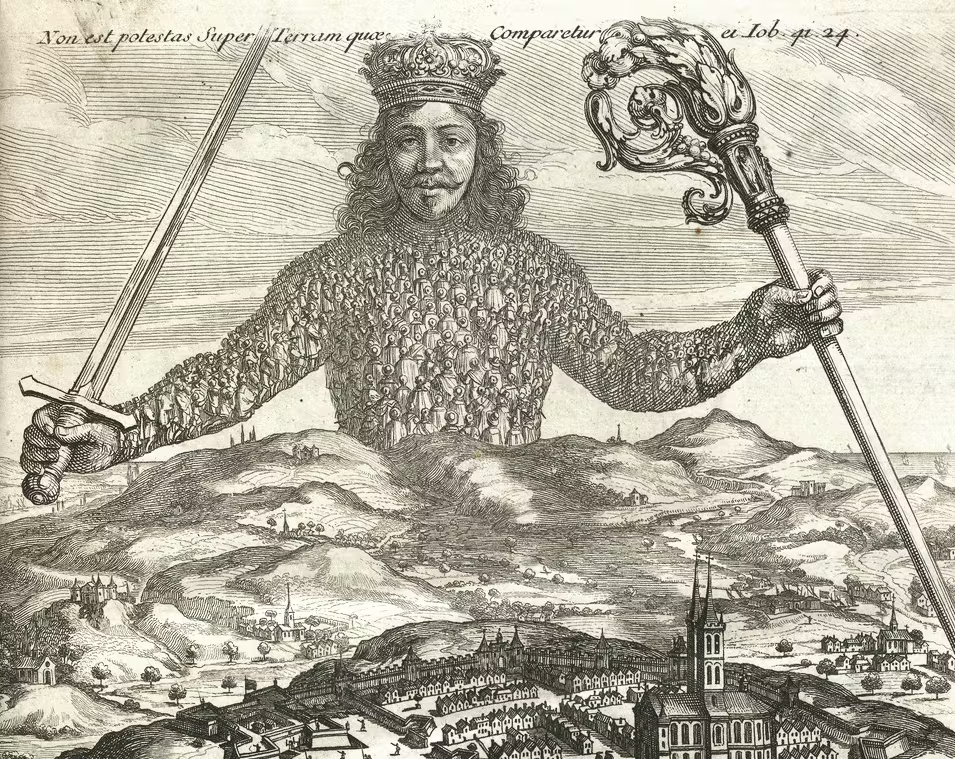
    Thomas Hobbes wrote his seminal work Leviathan in 1651. In it he describes the world system as it was then as being in “a state of nature,” something that some have interpreted as anarchy. However, anarchy has order and purpose. It is not chaos. In fact, if we think of Adam Smith’s “invisible hand of the market” we get something similar to what anarchy is in practice: the aggregate of individual acts of self-interest can lead to the optimisation of value and outcomes at the collective level. Anarchy clears; chaos does not.

    For Hobbes, the state of nature was chaos. Absent a “Sovereign” (i.e. a government) that could impose order on global and domestic societies, humans were destined to lead lives the were “solitary, poor, nasty, brutish and short.” This has translated into notions of “might makes right,” “survival of the fittest,” “to the victor goes the spoils” and other axioms of so-called power politics. The most elaborate of these, international relations realism, is a school of thought that is based on the belief that because the international system has no superseding Sovereign in the form of world government with comprehensive enforcement powers, and because there are no universally shared values and mores throughout the globe community that ideologically bind cultures, groups and individuals, global society exists as a state of nature where, even if there are attempts to manage the relationships between States (and other actors) via rules, norms, institutions and the like, the bottom line is that States (and other actors) have interests, not friends.

    Interests are pursued in a context of power differentials. Alliances are temporary and based on the convergence of mutual interests. Values are not universal and so are inconsequential. International exchange is transactional, not altruistic. Actors with greater resources at their disposal (human, natural, intellectual) prevail over those that have less. In case of resource parity between States or other actors, balances of power become systems regulators, but these are fluid and contingent, not permanent. Geography matters in that regard, which is why geopolitics (the relationship of power to geography) is the core of international relations.

    It is worth remembering this when evaluating contemporary international relations. It has been well established by now that the liberal international order of the post WW2 era has largely been dismantled in the context of increasing multipolarity in inter-State relations and the rise of the Global South within the emerging order. As I have written before, the long transition and systemic realignment in international affairs has led to norm erosion, rules violations, multinational institutional and international organizational decay or irrelevance and the rise of conflict (be it in trade, diplomacy or armed force) as the new systems regulator.

    These developments have accentuated over the last decade and now have a catalyst for a full move into a new global moment–but not into a multipolar or multiplex constellation arrangement in which rising and established powers move between multilateral blocs depending on the issues involved. Instead, the move appears to be one towards a modern Hobbesian state of nature, with the precipitant being the MAGA administration of Donald Trump and its foreign policy approach.

    We must be clear that it is not Trump who is the architect of this move. As mentioned in pervious posts, he is an empty vessel consumed by his own self-worth. That makes him a useful tool of far smarter people than he, people who work in the shadow of relative anonymity and who cut their teeth in rightwing think tanks and policy centres. In their view the liberal internationalist order placed too many constraints on the exercise of US power while at the same time requiring the US to over-extend itself as the “world’s policeman” and international aid donor . Bound by international conventions on the one hand and besieged by foreign rent-seekers and adversaries on the other, the US was increasingly bent under the weight of overlapped demands in which existential national interests were subsumed to a plethora of frivolous diversions (such as human rights and democracy promotion).

    For these strategists, the solution to the dilemma was not to be found in any new multipolar (or even technopolar) constellation but in a dismantling of the entire edifice of international order, something that was based on an architecture of rules, institutions and norms nearly 500 years in the making. Many have mentioned Trump’s apparent mercantilist inclinations and his admiration for former US president William McKinley’s tariff policies in the late 1890s. Although that may be true, the Trump/MAGA agenda is far broader in scope than trade. In fact, the US had its greatest period of (neo-imperial) expansion during McKinley’s tenure as president (1897-1901), winning the Spanish-American War and annexing Hawai’i, Puerto Rico, Guam, American Samoa and the Philippines, so Trump’s admiration for him may well be based on notions of territorial expansionism as well.

    Whatever Trump’s views of McKinley, the basic idea under-riding his foreign policy team’s approach is that in a world where the exercise of power is the ultimate arbiter of a State’s international status, the US remains the greatest Power of them all. It does not matter if the PRC or Russia challenge the US or if other emerging powers join the competition. Without the hobbling effect of its liberal obligations the US can and will dominate them all. This involves trade but also the exercise of raw (neo) imperialist ambitions in places like Greenland, the Panama Canal and even Canada. It involves sidelining the UN, NATO, EU and other international organisations where the US had to share equal votes with lesser powers who flaunted the respect and tribute that should naturally be given in recognition of the US’s superior power base.

    There appears to be a belief in this approach that the US can be a new hegemon–but not Sovereign–in a unipolar world, even more so than during the post-USSR-pre 9/11 interregnum. In a new state of nature it can sit at the core of the international system, orbited by constellations of lesser Great Powers like the PRC, Russia, the EU, perhaps India, who in turn would be circled by lesser powers of various stripes. The US will not seek to police the world or waste time and resources on well-meaning but ultimately futile soft power exercises like those involving foreign aid and humanitarian assistance. Its power projection will be sharp on all dimensions, be it trade, diplomacy or in military-security affairs. It will use leverage, intimidation and varying degrees of coercion as well as persuasion (and perhaps even bribery) as diplomatic tools. It will engage the world primarily in bilateral fashion, eschewing multilateralism for others to pursue according to their own interests and power capabilities. That may suit them, but for the US multilateralism is just another obsolescent vestige of the liberal internationalist past.

    Source: Northrop-Grumman.

    A possible (and partial) explanation for the change in the US foreign policy approach may be the learning effect in the US of Russia’s invasion of Ukraine and Israel’s scorched earth campaign in Gaza. Trump and his advisors may have learned that impunity has its own rewards, that no country or group of countries other than the US (if it has the will) can effectively confront a state determined to pursue its interests regardless of international law, the laws of war or institutional censorship (say, by the UN or International Criminal Court), or any other type of countervailing power. The Russians and Israelis have gotten away with their behaviour because, all rhetoric and hand-wringing aside, there is no actor or group of actors who have the will or capability to stop them. For Trump strategists, these lesser powers are pursuing their interests regardless of diplomatic niceties and international conventions, and they are prevailing precisely because of that. Other than providing military assistance to Ukraine, no one has lifted a serious finger against the Russians other than the Ukrainians themselves, and even fewer have seriously moved to confront Israel’s now evident ethnic cleansing campaign in part because the US has backed Israel unequivocally. The exercise of power in each case occurred in a norm enforcement vacuum in spite of the plethora of agencies and institutions designed to prevent such egregious violations of international standards.

    Put another way: if Israel and Russia can get away with their disproportionate and indiscriminate aggression, imagine what the US can do.

    If we go on to include the PRC’s successful aggressive military “diplomacy” in East/SE Asia, the use of targeted assassinations, hacking, disinformation and covert direct influence campaigns overseas by various States and assorted other unpunished violations of international conventions, then it is entirely plausible that Trump’s foreign policy brain trust sees the moment as ripe for finally breaking the shackles of liberal internationalism. Also recall that many in Trump’s inner circle subscribe to chaos or disruption theory, in which a norms-breaking “disruptor” like Trump seizes the opportunities presented by the breakdown of the status quo ante.

    Before the US could hollow out liberal internationalism abroad and replace it with a modern international state of nature it had to crush liberalism at home. Using Executive Orders as a bludgeon and with a complaint Republican-dominated Congress and Republican-adjacent federal courts. the Trump administration has openly exercised increasingly authoritarian control powers with the intention of subjugating US civil society to its will. Be it in its deportation policies, rollbacks of civil rights protections, attacks on higher education, diminishing of federal government capacity and services (except in the security field), venomous scapegoating of opponents and vulnerable groups, the Trump/MAGA domestic agenda not only seeks to turn the US into a illiberal or “hard” democracy (what Spanish language scholars call a “democradura” as a play on words mixing the terms democracia and dura (hard)). It also serves notice that the US under Trump/MAGA is willing to do whatever is necessary to re-impose its supremacy in world affairs, even if it means hurting its own in order to prove the point. By its actions at home Trump’s administration demonstrates capability, intent and steadfast resolve as it establishes a reputation for ruthless pursuit of its policy agenda. Foreign interlocutors will have to take note of this and adjust accordingly. Hence, for Trump’s advisors, authoritarianism at home is the first step towards undisputed supremacy abroad.

    The Trump embrace of international state of nature differs from Hobbes because it does not see the need for a superseding global governance network but instead believes that the US can dominate the world without the encumbrances of power-sharing with lesser players. In this view hegemony means domination, no more or less. It implies no attempt at playing the role of a Sovereign imposing order on a disorderly and recalcitrant community of Nation-States and non-State actors that do not share common values, much less interests.

    This is the core of the current US foreign policy approach. It is not about reorganising the international order within the extant frameworks as given. It is about removing those frameworks entirely and replacing them with an America First, go it alone agenda where the US, by virtue of its unrivalled power differential relative to all other States and global actors, can maximise its self-interest in largely unconstrained fashion. Some vestiges of the old international order may remain, but they will be marginalised and crippled the longer the US project is in force.

    What does not seem to be happening in Trump’s foreign policy circle are three things. First, recognition that other States and international actors may band together against the US move to unipolarity in a new state of nature and that for all its talk the US may not be able to impose unipolar dominance over them. Second, understanding that States like the PRC, Russia and other Great Powers and communities (like the EU) may resist the US move and challenge it before it can consolidate the new international status quo. Third, foreseeing that the technology titans who today are influential in the Trump administration may decide to transfer there loyalties elsewhere, especially if Trump’s ego starts becoming a hindrance to their (economic and digital) power bases. The fusion of private technology control and US State power may not be as compatible over time as presently appears to be the case, something that may not occur with States such as the PRC, India or Japan that have different corporate cultures and political structures. As the current investment in the Middle Eastern oligarchies shows, the fusion of State and private techno power may be easier to accomplish in those contexts rather than the US.

    In any event, whether it be a short-term interlude or a longue durée feature of international life, a modern state of nature is now our new global reality.

    Analysis syndicated by 36th Parallel Assessments

    MIL OSI AnalysisEveningReport.nz

  • MIL-Evening Report: ER Report: A Roundup of Significant Articles on EveningReport.nz for June 29, 2025

    ER Report: Here is a summary of significant articles published on EveningReport.nz on June 29, 2025.

    Do all Iranians hate the regime? Hate America? Life inside the country is more complex than that
    Source: The Conversation (Au and NZ) – By Simon Theobald, Postdoctoral researcher, Institute for Ethics and Society, University of Notre Dame Australia From 2015 to 2018, I spent 15 months doing research work in Mashhad, Iran’s second-largest city. As an anthropologist, I was interested in everyday life in Iran outside the capital Tehran. I was

    Talks result in PNG and Bougainville signing ‘Melanesian Agreement’
    RNZ Pacific The leaders of Bougainville and Papua New Guinea have signed a deal that may bring the autonomous region’s quest for independence closer. Called “Melanesian Agreement”, the deal was developed earlier this month in 10 days of discussion at the New Zealand army base at Burnham, near Christchurch. Both governments have agreed that the

    Eugene Doyle: Why Asia-Pacific should be cheering for Iran and not US bomb-based statecraft
    ANALYSIS: By Eugene Doyle Setting aside any thoughts I may have about theocratic rulers (whether they be in Tel Aviv or Tehran), I am personally glad that Iran was able to hold out against the US-Israeli attacks this month. The ceasefire, however, will only be a pause in the long-running campaign to destabilise, weaken and

    ER Report: A Roundup of Significant Articles on EveningReport.nz for June 28, 2025
    ER Report: Here is a summary of significant articles published on EveningReport.nz on June 28, 2025.

    MIL OSI AnalysisEveningReport.nz

  • MIL-Evening Report: ER Report: A Roundup of Significant Articles on EveningReport.nz for June 29, 2025

    ER Report: Here is a summary of significant articles published on EveningReport.nz on June 29, 2025.

    Do all Iranians hate the regime? Hate America? Life inside the country is more complex than that
    Source: The Conversation (Au and NZ) – By Simon Theobald, Postdoctoral researcher, Institute for Ethics and Society, University of Notre Dame Australia From 2015 to 2018, I spent 15 months doing research work in Mashhad, Iran’s second-largest city. As an anthropologist, I was interested in everyday life in Iran outside the capital Tehran. I was

    Talks result in PNG and Bougainville signing ‘Melanesian Agreement’
    RNZ Pacific The leaders of Bougainville and Papua New Guinea have signed a deal that may bring the autonomous region’s quest for independence closer. Called “Melanesian Agreement”, the deal was developed earlier this month in 10 days of discussion at the New Zealand army base at Burnham, near Christchurch. Both governments have agreed that the

    Eugene Doyle: Why Asia-Pacific should be cheering for Iran and not US bomb-based statecraft
    ANALYSIS: By Eugene Doyle Setting aside any thoughts I may have about theocratic rulers (whether they be in Tel Aviv or Tehran), I am personally glad that Iran was able to hold out against the US-Israeli attacks this month. The ceasefire, however, will only be a pause in the long-running campaign to destabilise, weaken and

    ER Report: A Roundup of Significant Articles on EveningReport.nz for June 28, 2025
    ER Report: Here is a summary of significant articles published on EveningReport.nz on June 28, 2025.

    MIL OSI AnalysisEveningReport.nz

  • MIL-Evening Report: Do all Iranians hate the regime? Hate America? Life inside the country is more complex than that

    Source: The Conversation (Au and NZ) – By Simon Theobald, Postdoctoral researcher, Institute for Ethics and Society, University of Notre Dame Australia

    From 2015 to 2018, I spent 15 months doing research work in Mashhad, Iran’s second-largest city. As an anthropologist, I was interested in everyday life in Iran outside the capital Tehran. I was also interested in understanding whether the ambitions of the 1979 Revolution lived on among “ordinary” Iranians, not just political elites.

    I first lived on a university campus, where I learned Persian, and later with Iranian families. I conducted hundreds of interviews with people who had a broad spectrum of political, social and religious views. They included opponents of the Islamic Republic, supporters, and many who were in between.

    What these interviews revealed to me was both the diversity of opinion and experience in Iran, and the difficulty of making uniform statements about what Iranians believe.

    Measuring the depth of antipathy for the regime

    When Israel’s strikes on Iran began on June 13, killing many top military commanders, many news outlets – both international and those run by the Iranian diaspora – featured images of Iranians cheering the deaths of these hated regime figures.

    Friends from my fieldwork also pointed to these celebrations, while not always agreeing with them. Many feared the impact of a larger conflict between Iran and Israel.

    Trying to put these sentiments in context, many analysts have pointed to a 2019 survey by the GAMAAN Institute, an independent organisation based in the Netherlands that tracks Iranian public opinion. This survey showed 79% of Iranians living in the country would vote against the Islamic Republic if a free referendum were held on its rule.

    Viewing these examples as an indicator of the lack of support for the Islamic Republic is not wrong. But when used as factoids in news reports, they become detached from the complexities of life in Iran. This can discourage us from asking deeper questions about the relationships between ideology and pragmatism, support and opposition to the regime, and state and society.

    A more nuanced view

    The news reporting on Iran has encouraged a tendency to see the Iranian state as homogeneous, highly ideological and radically separate from the population.

    But where do we draw the line between the state and the people? There is no easy answer to this.

    When I lived in Iran, many of the people who took part in my research were state employees – teachers at state institutions, university lecturers, administrative workers. Many of them had strong and diverse views about the legacy of the revolution and the future of the country.

    They sometimes pointed to state discourse they agreed with, for example Iran’s right to national self-determination, free from foreign influence. They also disagreed with much, such as the slogans of “death to America”.

    This ambivalence was evident in one of my Persian teachers. An employee of the state, she refused to attend the annual parades celebrating the anniversary of the revolution. “We have warm feelings towards America,” she said. On the other hand, she happily attended protests, also organised by the government, in favour of Palestinian liberation.

    Or take the young government worker I met in Mashhad: “We want to be independent of other countries, but not like this.”

    In a narrower sense, discussions about the “state” may refer more to organisations like the Islamic Revolutionary Guard Corps (IRGC) and the Basij, the paramilitary force within the IRGC that has cracked down harshly on dissent in recent decades. Both are often understood as being deeply ideologically committed.

    Said Golkar, a US-based Iranian academic and author, for instance, calls Iran a “captive society”. Rather than having a civil society, he believes Iranians are trapped by the feared Basij, who maintain control through their presence in many institutions like universities and schools.

    Again, this view is not wrong. But even among the Basij and Revolutionary Guard, it can be difficult to gauge just how ideological and homogeneous these organisations truly are.

    For a start, the IRGC relies on both ideologically selected supporters, as well as conscripts, to fill its ranks. They are also not always ideologically uniform, as the US-based anthropologist Narges Bajoghli, who worked with pro-state filmmakers in Tehran, has noted.

    As part of my research, I also interviewed members of the Basij, which, unlike the IRGC proper, is a wholly volunteer organisation.

    Even though ideological commitment was certainly an important factor for some of the Basij members I met, there were also pragmatic reasons to join. These included access to better jobs, scholarships and social mobility. Sometimes, factors overlapped. But participation did not always equate to a singular or sustained commitment to revolutionary values.

    For example, Sāsān, a friend I made attending discussion groups in Mashhad, was quick to note that time spent in the Basij “reduced your [compulsory] military service”.

    This isn’t to suggest there are not ideologically committed people in Iran. They clearly exist, and many are ready to use violence. Some of those who join these institutions for pragmatic reasons use violence, too.

    Looking in between

    In addition, Iran is an ethnically diverse country. It has a population of 92 million people, a bare majority of whom are Persians. Other minorities include Azeris, Kurds, Arabs, Baloch, Turkmen and others.

    It is also religiously diverse. While there is a sizeable, nominally Shi’a majority, there are also large Sunni communities (about 10-15% of the population) and smaller communities of Christians, Jews, Zoroastrians, Baha’is and other religions.

    Often overlooked, there are also important differences in class and social strata in Iran, too.

    One of the things I noticed about state propaganda was that it flattened this diversity. James Barry, an Australian scholar of Iran, noticed a similar phenomenon.

    State propaganda made it seem like there was one voice in the country. Protests could be dismissed out of hand because they did not represent the “authentic” view of Iranians. Foreign agitators supported protests. Iranians supported the Islamic Republic.

    Since leaving Iran, I have followed many voices of Iranians in the diaspora. Opposition groups are loud on social media, especially the monarchists who support Reza Pahlavi, the son of the deposed Shah.

    In following these groups, I have noticed a similar tendency to speak as though they represent the voice of all Iranians. Iranians support the shah. Or Iranians support Maryam Rajavi, leader of a Paris-based opposition group.

    Both within Iran, and in the diaspora, the regime, too, is sometimes held to be the imposition of a foreign conspiracy. This allows the Islamic Republic and the complex relations it has created to be dismissed out of hand. Once again, such a view flattens diversity.

    Over the past few years, political identities and societal divisions seem to have become harder and clearer. This means there is an increasing perception among many Iranians of a gulf between the state and Iranian society. This is the case both inside Iran, and especially in the Iranian diaspora.

    Decades of intermittent protests and civil disobedience across the country also show that for many, the current system no longer represents the hopes and aspirations of many people. This is especially the case for the youth, who make up a large percentage of the population.

    I am not an Iranian, and I strongly believe it is up to Iranians to determine their own futures. I also do not aim to excuse the Islamic Republic – it is brutal and tyrannical. But its brutality should not let us shy away from asking complex questions.

    If the regime did fall tomorrow, Iran’s diversity means there is little unanimity of opinion as to what should come next. And if a more pluralist form of politics is to emerge, it must encompass the whole of Iran’s diversity, without assuming a uniform position.

    It, too, will have to wrestle with the difficult questions and sometimes ambivalent relations the Islamic Republic has created.

    Simon Theobald received funding from the Australian National University during his research.

    ref. Do all Iranians hate the regime? Hate America? Life inside the country is more complex than that – https://theconversation.com/do-all-iranians-hate-the-regime-hate-america-life-inside-the-country-is-more-complex-than-that-259554

    MIL OSI AnalysisEveningReport.nz

  • MIL-OSI Analysis: Iran emerged weakened and vulnerable after war with Israel − and that could mean trouble for country’s ethnic minorities

    Source: The Conversation – Global Perspectives – By Shukriya Bradost, Ph.D. Student of Planning, Governance and Globalization, Virginia Tech

    Iranians celebrate the ceasefire in downtown Tehran, but many blame their own leaders for the escalation. Morteza Nikoubazl/NurPhoto via Getty Images

    The 12-day confrontation between Iran and Israel in June 2025 may not have escalated into a full-scale regional war, but it marks a potentially critical turning point in Iran’s internal political landscape.

    Though the Islamic Republic has entered into direct conflict with a foreign adversary before, it has never done so while so militarily weakened, internally fractured and increasingly alienated from its own population.

    And unlike the Iran-Iraq war of the 1980s, when national unity coalesced around the defense of Iranian sovereignty, this time the government appeared to fight without significant public support. While accurate polling from within Iran is hard to come by, the lack of pro-government rallies, the low approval numbers for the government ahead of the war and the government’s subsequent crackdown since tell their own stories.

    As a researcher of different ethnic groups within the country, I know that many Iranians – especially those from historically marginalized communities – viewed the conflict with Israel not as a defense of the nation but as a reckless consequence of the government’s ideological adventurism and regional proxy campaigns. It puts the Islamic Republic in its most vulnerable position since its establishment after the Iranian Revolution in 1979.

    Hard and soft power diminished

    It is worth taking a snapshot of just how diminished the Iranian government is following the recent series of blows.

    Its soft power – once built on revolutionary legitimacy, Shiite ideological influence and anti-Western propaganda – has eroded dramatically.

    For decades, the Islamic Republic relied on a powerful narrative: that it was the only government bold enough to confront the United States and Israel, defend Muslim causes globally and serve as the spiritual leader of the Islamic world. This image, projected through state media, proxy militias and religious rhetoric, helped the government justify its foreign interventions and massive military spending, particularly on nuclear development and regional militias.

    But that narrative no longer resonates the way it once did. The leaders of Iran can no longer claim to inspire unity at home or fear abroad. Even among Shiite populations in Lebanon, Iraq and Yemen, support during the Israel-Iran confrontation was muted. Inside Iran, meanwhile, propaganda portraying Israel as the existential enemy has lost its grip, especially among the youth, who increasingly identify with human rights movements rather than government slogans.

    It is also clear that Iran’s hard power is getting weaker. The loss of senior commanders and the destruction of important military infrastructure have shown that the government’s intelligence and security systems are severely compromised.

    Even before Israel’s attack, a number of reports showed that Iran’s military was in its weakest state in decades. The real surprise in the recent war came not from the scale of the damage by Israeli and U.S. bombs but from how deeply Israel had penetrated the upper echelons of the Iranian military and intelligence sectors. The recent conflict amounted to a security as well as a military failure.

    Externally defeated, internally adrift

    As its power across the region appears diminished, so too is the Iranian government’s grip loosening internally. A 2024 survey by Iran’s Ministry of Culture revealed “discontent” among the population, with over 90% of Iranians “dissatisfied” with the country’s current position. Elections in November 2024 saw a turnout of under 40%, further underscoring Iranians’ discontent with the political process.

    And reporting from inside Iran suggests many Iranians blame government policies for the war with Israel. “I place the blame on this country’s decision-makers,” one resident of Rasht told Reuters, “their policies have brought war and destruction upon us.”

    The government has responded with a tactic it has used before: repression. According to government-aligned media, over 700 people were arrested during and immediately after the conflict, accused of collaborating with the Mossad, the Israeli intelligence agency.

    As in past crackdowns, ethnic minority regions – particularly Kurdish areas – have been targeted.

    One day after the ceasefire with Israel, the government executed three Kurdish cross-border laborers who rely on smuggling goods to survive in Iran’s underdeveloped Kurdish provinces.

    These executions, which were done without a trial or legal counsel, fit a pattern of how the government uses ethnic scapegoating to stay in power. And it echoes a historic pattern: When the government feels threatened, it strikes the Kurds first.

    A historical pattern of repression

    Kurds are estimated to number 10-12 million in Iran, composing roughly 12% to 15% of the country’s total population – making them the third-largest ethnic group after Persians and Azeris. Iran also includes significant Baluch and Arab minorities.

    When the Islamic Republic was established in 1979, many ethnic groups supported the revolution. They hoped for a more inclusive and democratic Iran than what preceded it – the brutal autocracy of the shah that had frequently targeted minorities.

    Those hopes were quickly dashed. By rejecting pluralism and promoting a unifying ideology centered on Shiite Islam and Persian identity, Ayatollah Ruhollah Khomeini marginalized non-Persian and non-Shiite groups.

    Other ethnic groups were viewed with suspicion, while Shiite Azerbaijanis were mainly co-opted into the system.

    Khomeini declared jihad against Kurdish resistance groups, labeling them infidels, separatists and agents of Israel and the United States.

    Armed with advanced weaponry inherited from the last Pahlavi shah, the government launched a military campaign in Kurdistan province. Many Kurdish villages and towns were destroyed, and approximately 50,000 Iranian Kurds were killed between 1979 and 1988.

    The region was turned into a militarized zone – a status that continues today.

    Campaign against Kurds

    After the Iran-Iraq war ended in August 1988, the government – economically strained and militarily weakened – feared a domestic uprising.

    But instead of embracing political reform, it responded with one of the most brutal crackdowns in Iran’s history. Khomeini issued a fatwa, or religious edict, ordering the execution of political prisoners, including large numbers of Kurdish dissidents.

    Between late July and September 1988, thousands of political prisoners were executed – many without trial or any legal process. At least 5,000 people were killed and buried in unmarked mass graves, according to Amnesty International.

    Khomeini labeled them “mohareb,” or “warriors against God,” and criticized the Revolutionary Courts for not sentencing them to death sooner. This mass execution campaign signaled the government’s resolve to eliminate all dissent, regardless of legal precedent or human rights norms.

    In the years that followed, the government systematically assassinated prominent Kurdish leaders and other opposition leaders, both in Iran and overseas.

    This targeted elimination of Kurdish leadership, combined with the mass executions of political prisoners, was a deliberate strategy to decapitate any organized opposition before it could challenge the government’s survival.

    A new crisis, the same strategy

    The Islamic Republic appears to be using the same playbook now, but under far more fragile conditions.

    Given the precarious state of the government, it is fair to ask why there are not more protests now, especially in ethnic minority regions. For many, the answer is fear over what happens next.

    Many Kurds have learned from previous uprisings – particularly the 2022 “Women, Life, Freedom” movement – that when they lead protests, they face the harshest crackdown. Over 56% of those killed and persecuted in the subsequent crackdown were Kurds.

    Meanwhile, the overall opposition remains fractured and leaderless, both along ethnic lines and in terms of goals. The main opposition groups have traditionally been reluctant to acknowledge ethnic rights, let alone include them in any vision for a future Iran. Rather, they insist on “territorial integrity” as a precondition for any dialogue, echoing the Islamic Republic’s rhetoric.

    This is a key legacy of the Islamic Republic: Its propaganda has not only shaped domestic opinion but also influenced the opposition, dividing Iranians at home and abroad. And it has long mobilized the dominant ethnic group against minorities, especially Kurds, by portraying them as internal enemies.

    Shukriya Bradost does not work for, consult, own shares in or receive funding from any company or organization that would benefit from this article, and has disclosed no relevant affiliations beyond their academic appointment.

    ref. Iran emerged weakened and vulnerable after war with Israel − and that could mean trouble for country’s ethnic minorities – https://theconversation.com/iran-emerged-weakened-and-vulnerable-after-war-with-israel-and-that-could-mean-trouble-for-countrys-ethnic-minorities-259753

    MIL OSI Analysis

  • MIL-Evening Report: Talks result in PNG and Bougainville signing ‘Melanesian Agreement’

    RNZ Pacific

    The leaders of Bougainville and Papua New Guinea have signed a deal that may bring the autonomous region’s quest for independence closer.

    Called “Melanesian Agreement”, the deal was developed earlier this month in 10 days of discussion at the New Zealand army base at Burnham, near Christchurch.

    Both governments have agreed that the national Parliament in PNG has a key role in the decision over the push for independence.

    They recognise that the Bougainville desire for independence is legitimate, as expressed in a 2019 independence referendum result, and that this is a unique situation in PNG.

    That is the agreement’s attempt to overcome pressure from other parts of PNG that are also talking about autonomy.

    The parties say they are committed to maintaining a close, peaceful and enduring relationship between PNG and Bougainville.

    Both sides said that to bring referendum results to the national Parliament both governments would develop a sessional order, which was a the temporary adjustment of Parliament’s rules.

    Bipartisan Parliamentary Committee
    They said that a Bipartisan Parliamentary Committee on Bougainville, which would provide information to MPs and the general public about the Bougainville conflict and resolution, is a vital body.

    The parties said they would explore the joint creation of a Melanesian framework with agreed timelines, for a pathway forwards, that may form part of the Joint Consultations Report presented to the 11th National Parliament.

    Once the Bipartisan Committee completes its work, the results of the referendum and the Joint Consultation Report would be taken to the Parliament.

    The parties said they would accept the decision of the national Parliament, in the first instance, regarding the referendum results, and then commit to further consultations if needed, and this would be in an agreed timeline.

    In the meantime, institutional strengthening and institutional building within Bougainville would continue.

    To ensure progress is made and political commitment is sustained, the monitoring of this Melanesian Agreement could include an international component, a Parliamentary component, and the Bipartisan Parliamentary Committee, all with UN support.

    This article is republished under a community partnership agreement with RNZ.

    MIL OSI AnalysisEveningReport.nz

  • MIL-Evening Report: Talks result in PNG and Bougainville signing ‘Melanesian Agreement’

    RNZ Pacific

    The leaders of Bougainville and Papua New Guinea have signed a deal that may bring the autonomous region’s quest for independence closer.

    Called “Melanesian Agreement”, the deal was developed earlier this month in 10 days of discussion at the New Zealand army base at Burnham, near Christchurch.

    Both governments have agreed that the national Parliament in PNG has a key role in the decision over the push for independence.

    They recognise that the Bougainville desire for independence is legitimate, as expressed in a 2019 independence referendum result, and that this is a unique situation in PNG.

    That is the agreement’s attempt to overcome pressure from other parts of PNG that are also talking about autonomy.

    The parties say they are committed to maintaining a close, peaceful and enduring relationship between PNG and Bougainville.

    Both sides said that to bring referendum results to the national Parliament both governments would develop a sessional order, which was a the temporary adjustment of Parliament’s rules.

    Bipartisan Parliamentary Committee
    They said that a Bipartisan Parliamentary Committee on Bougainville, which would provide information to MPs and the general public about the Bougainville conflict and resolution, is a vital body.

    The parties said they would explore the joint creation of a Melanesian framework with agreed timelines, for a pathway forwards, that may form part of the Joint Consultations Report presented to the 11th National Parliament.

    Once the Bipartisan Committee completes its work, the results of the referendum and the Joint Consultation Report would be taken to the Parliament.

    The parties said they would accept the decision of the national Parliament, in the first instance, regarding the referendum results, and then commit to further consultations if needed, and this would be in an agreed timeline.

    In the meantime, institutional strengthening and institutional building within Bougainville would continue.

    To ensure progress is made and political commitment is sustained, the monitoring of this Melanesian Agreement could include an international component, a Parliamentary component, and the Bipartisan Parliamentary Committee, all with UN support.

    This article is republished under a community partnership agreement with RNZ.

    MIL OSI AnalysisEveningReport.nz

  • MIL-Evening Report: Eugene Doyle: Why Asia-Pacific should be cheering for Iran and not US bomb-based statecraft

    ANALYSIS: By Eugene Doyle

    Setting aside any thoughts I may have about theocratic rulers (whether they be in Tel Aviv or Tehran), I am personally glad that Iran was able to hold out against the US-Israeli attacks this month.

    The ceasefire, however, will only be a pause in the long-running campaign to destabilise, weaken and isolate Iran. Regime change or pariah status are both acceptable outcomes for the US-Israeli dyad.

    The good news for my region is that Iran’s resilience pushes back what could be a looming calamity: the US pivot to Asia and a heightened risk of a war on China.

    There are three major pillars to the Eurasian order that is going through a slow, painful and violent birth.  Iran is the weakest.  If Iran falls, war in our region — intended or unintended – becomes vastly more likely.

    Mainstream New Zealanders and Australians suffer from an understandable complacency: war is what happens to other, mainly darker people or Slavs.

    “Tomorrow”, people in this part of the world naively think, “will always be like yesterday”.

    That could change, particularly for the Australians, in the kind of unfamiliar flash-boom Israelis experienced this month following their attack on Iran. And here’s why.

    US chooses war to re-shape Middle East
    Back in 2001, as many will recall, retired General Wesley Clark, former Supreme Commander of NATO forces in Europe, was visiting buddies in the Pentagon. He learnt something he wasn’t supposed to: the Bush administration had made plans in the febrile post 9/11 environment to attack seven Muslim countries.

    In the firing line were: Saddam Hussein’s Iraq, the Assad regime in Syria, Hezbollah-dominated Lebanon, Gaddafi’s Libya, Somalia, Sudan and the biggest prize of all — the Islamic Republic of Iran.

    One would have to say that the project, pursued by successive presidents, both Democrat and Republican, has been a great success — if you discount the fact that a couple of million human beings, most of them civilians, many of them women and children, nearly all of them innocents, were slaughtered, starved to death or otherwise disposed of.

    With the exception of Iran, those countries have endured chaos and civil strife for long painful years.  A triumph of American bomb-based statecraft.

    Now — with Muammar Gaddafi raped and murdered (“We came, we saw, he died”, Hillary Clinton chuckled on camera the same day), Saddam Hussein hanged, Hezbollah decapitated, Assad in Moscow, the genocide in full swing in Palestine — the US and Israel were finally able to turn their guns — or, rather, bombs — on the great prize: Iran.

    Iran’s missiles have checked US-Israel for time being
    Things did not go to plan. Former US ambassador to Saudi Arabia Chas Freeman pointed out this week that for the first time Israel got a taste of the medicine it likes to dispense to its neighbours.

    Iran’s missiles successfully turned the much-vaunted Iron Dome into an Iron Sieve and, perhaps momentarily, has achieved deterrence. If Iran falls, the US will be able to do what Barack Obama and Joe Biden only salivated over — a serious pivot to Asia.

    Could great power rivalry turn Asia-Pacific into powderkeg?
    For us in Asia-Pacific a major US pivot to Asia will mean soaring defence budgets to support militarisation, aggressive containment of China, provocative naval deployments, more sanctions, muscling smaller states, increased numbers of bases, new missile systems, info wars, threats and the ratcheting up rhetoric — all of which will bring us ever-closer to the powderkeg.

    Sounds utterly mad? Sounds devoid of rationality? Lacking commonsense? Welcome to our world — bellum Americanum — as we gormlessly march flame in hand towards the tinderbox. War is not written in the stars, we can change tack and rediscover diplomacy, restraint, and peaceful coexistence. Or is that too much to ask?

    Back in the days of George W Bush, radical American thinkers like Robert Kagan, Dick Cheney and Donald Rumsfeld created the Project for a New American Century and developed the policy, adopted by succeeding presidents, that promotes “the belief that America should seek to preserve and extend its position of global leadership by maintaining the preeminence of US military forces”.

    It reconfirmed the neoconservative American dogma that no power should be allowed to rise in any region to become a regional hegemon; anything and everything necessary should be done to ensure continued American primacy, including the resort to war.

    What has changed since those days are two crucial, epoch-making events: the re-emergence of Russia as a great power, albeit the weakest of the three, and the emergence of China as a genuine peer competitor to the USA. Professor  John Mearsheimer’s insights are well worth studying on this topic.

    The three pillars of multipolarity
    A new world order really is being born. As geopolitical thinkers like Professor Glenn Diesen point out, it will, if it is not killed in the cradle, replace the US unipolar world order that has existed since the dissolution of the Soviet Union in 1991.

    Many countries are involved in its birthing, including major players like India and Brazil and all the countries that are part of BRICS.  Three countries, however, are central to the project: Iran, Russia and, most importantly, China.  All three are in the crosshairs of the Western empire.

    If Iran, Russia and China survive as independent entities, they will partially fulfill Halford MacKinder’s early 20th century heartland theory that whoever dominates Eurasia will rule the world. I don’t think MacKinder, however, foresaw cooperative multipolarity on the Eurasian landmass — which is one of the goals of the SCO (Shanghai Cooperation Organisation) – as an option.

    That, increasingly, appears to be the most likely trajectory with multiple powerful states that will not accept domination, be that from China or the US.  That alone should give us cause for hope.

    Drunk on power since the collapse of the Soviet Union, the US has launched war after war and brought us to the current abandonment of economic sanity (the sanctions-and-tariff global pandemic) and diplomatic normalcy (kill any peace negotiators you see) — and an anything-goes foreign policy (including massive crimes against humanity).

    We have also reached — thanks in large part to these same policies — what a former US national security advisor warned must be avoided at all costs. Back in the 1990s, Zbigniew Brzezinski said, “The most dangerous scenario would be a grand coalition of China, Russia, and perhaps Iran.”

    Belligerent and devoid of sound strategy, the Biden and Trump administrations have achieved just that.

    Can Asia-Pacific avoid being dragged into an American war on China?
    Turning to our region, New Zealand and Australia’s governments cleave to yesterday: a white-dominated world led by the USA.  We have shown ourselves indifferent to massacres, ethnic cleansing and wars of aggression launched by our team.

    To avoid war — or a permanent fear of looming war — in our own backyards, we need to encourage sanity and diplomacy; we need to stay close to the US but step away from the military alliances they are forming, such as AUKUS which is aimed squarely at China.

    Above all, our defence and foreign affairs elites need to grow new neural pathways and start to think with vision and not place ourselves on the losing side of history. Independent foreign policy settings based around peace, defence not aggression, diplomacy not militarisation, would take us in the right direction.

    Personally I look forward to the day the US and its increasingly belligerent vassals are pushed back into the ranks of ordinary humanity. I fear the US far more than I do China.

    Despite the reflexive adherence to the US that our leaders are stuck on, we should not, if we value our lives and our cultures, allow ourselves to be part of this mad, doomed project.

    The US empire is heading into a blood-drenched sunset; their project will fail and the 500-year empire of the White West will end — starting and finishing with genocide.

    Every day I atheistically pray that leaders or a movement will emerge to guide our antipodean countries out of the clutches of a violent and increasingly incoherent USA.

    America is not our friend. China is not our enemy. Tomorrow gives birth to a world that we should look forward to and do the little we can to help shape.

    Eugene Doyle is a writer based in Wellington. He has written extensively on the Middle East, as well as peace and security issues in the Asia Pacific region. He contributes to Asia Pacific Report and Café Pacific, and hosts the public policy platform solidarity.co.nz

    MIL OSI AnalysisEveningReport.nz

  • MIL-Evening Report: ER Report: A Roundup of Significant Articles on EveningReport.nz for June 28, 2025

    ER Report: Here is a summary of significant articles published on EveningReport.nz on June 28, 2025.

    Israeli soldiers ‘ordered’ to fire at Gaza aid seekers – 70 killed across Strip
    Israeli soldiers have said that they were ordered to open fire at unarmed Palestinian civilians desperately seeking aid at designated distribution sites in Gaza, a report in the Ha’aretz newspaper has revealed. The report came as 70 Palestinians were killed across the Gaza Strip — mostly at aid sites belonging to the widely condemned Gaza

    RFK Junior is stoking fears about vaccine safety. Here’s why he’s wrong – and the impact it could have
    Source: The Conversation (Au and NZ) – By Julie Leask, Professor, School of Public Health, University of Sydney The United States used to be a leader in vaccine research, development and policymaking. Now US Secretary of Health Robert F. Kennedy Jr is undermining the country’s vaccine program at the highest level and supercharging vaccine skepticism.

    The ‘Godfather of Human Rights’ Ken Roth on genocide, Trump and standing up for democracy
    By Richard Larsen, RNZ News producer — 30′ with Guyon Espiner The former head of Human Rights Watch — and son of a Holocaust survivor — says Israel’s military campaign in Gaza will likely meet the legal definition of genocide, citing large-scale killings, the targeting of civilians, and the words of senior Israeli officials. Speaking

    The sentencing of Cassius Turvey’s killers shows courts still struggle to deal with racism
    Source: The Conversation (Au and NZ) – By Thalia Anthony, Professor of Law, University of Technology Sydney Aboriginal and Torres Strait Islander readers are advised this article contains names and images of deceased people. The brutal homicide of 15-year-old Noongar Yamatji boy, Cassius Turvey, by a group of white men revealed the racial schisms in

    1 in 3 Tuvaluans is bidding for a new ‘climate visa’ to Australia – here’s why everyone may ultimately end up applying
    Source: The Conversation (Au and NZ) – By Jane McAdam, Scientia Professor and ARC Laureate Fellow, Kaldor Centre for International Refugee Law, UNSW Sydney Photo by Fiona Goodall/Getty Images for Lumix In just four days, one-third of the population of Tuvalu entered a ballot for a new permanent visa to Australia. This world-first visa will

    Celebrities, blue jeans and couture: how Anna Wintour changed fashion over 37 years at Vogue
    Source: The Conversation (Au and NZ) – By Jye Marshall, Lecturer, Fashion Design, School of Design and Architecture, Swinburne University of Technology After 37 years at the helm, fashion industry heavyweight Anna Wintour is stepping down from her position as editor-in-chief of American Vogue. It’s not a retirement, though, as Wintour will maintain a leadership

    Antoinette Lattouf win against ABC a victory for all truth-tellers
    By Isaac Nellist of Green Left Magazine Australian-Lebanese journalist and commentator Antoinette Lattouf’s unfair dismissal case win against the public broadcaster ABC in the Federal Court on Wednesday is a victory for all those who seek to tell the truth. It is a breath of fresh air, after almost two years of lies and uncritical

    Caitlin Johnstone: The fictional mental illness that only affects enemies of the Western empire
    Report by Dr David Robie – Café Pacific. – COMMENTARY: By Caitlin Johnstone Within the storytelling of Western politics and punditry there exists a fictional type of mental illness which only affects people the US empire doesn’t like. If Iran gets a nuclear weapon, its crazy lunatic government will flip out and nuke us all.

    A strange bright burst in space baffled astronomers for more than a year. Now, they’ve solved the mystery
    Source: The Conversation (Au and NZ) – By Clancy William James, Senior Lecturer (astronomy and astroparticle physics), Curtin University CSIRO’s ASKAP radio telescope on Wajarri Country. © Alex Cherney/CSIRO Around midday on June 13 last year, my colleagues and I were scanning the skies when we thought we had discovered a strange and exciting new

    Do all Iranians hate the regime? Hate America? Life inside the country is much more complex and nuanced
    Source: The Conversation (Au and NZ) – By Simon Theobald, Postdoctoral researcher, Institute for Ethics and Society, University of Notre Dame Australia From 2015 to 2018, I spent 15 months doing research work in Mashhad, Iran’s second-largest city. As an anthropologist, I was interested in everyday life in Iran outside the capital Tehran. I was

    MIL OSI AnalysisEveningReport.nz

  • MIL-Evening Report: ER Report: A Roundup of Significant Articles on EveningReport.nz for June 28, 2025

    ER Report: Here is a summary of significant articles published on EveningReport.nz on June 28, 2025.

    Israeli soldiers ‘ordered’ to fire at Gaza aid seekers – 70 killed across Strip
    Israeli soldiers have said that they were ordered to open fire at unarmed Palestinian civilians desperately seeking aid at designated distribution sites in Gaza, a report in the Ha’aretz newspaper has revealed. The report came as 70 Palestinians were killed across the Gaza Strip — mostly at aid sites belonging to the widely condemned Gaza

    RFK Junior is stoking fears about vaccine safety. Here’s why he’s wrong – and the impact it could have
    Source: The Conversation (Au and NZ) – By Julie Leask, Professor, School of Public Health, University of Sydney The United States used to be a leader in vaccine research, development and policymaking. Now US Secretary of Health Robert F. Kennedy Jr is undermining the country’s vaccine program at the highest level and supercharging vaccine skepticism.

    The ‘Godfather of Human Rights’ Ken Roth on genocide, Trump and standing up for democracy
    By Richard Larsen, RNZ News producer — 30′ with Guyon Espiner The former head of Human Rights Watch — and son of a Holocaust survivor — says Israel’s military campaign in Gaza will likely meet the legal definition of genocide, citing large-scale killings, the targeting of civilians, and the words of senior Israeli officials. Speaking

    The sentencing of Cassius Turvey’s killers shows courts still struggle to deal with racism
    Source: The Conversation (Au and NZ) – By Thalia Anthony, Professor of Law, University of Technology Sydney Aboriginal and Torres Strait Islander readers are advised this article contains names and images of deceased people. The brutal homicide of 15-year-old Noongar Yamatji boy, Cassius Turvey, by a group of white men revealed the racial schisms in

    1 in 3 Tuvaluans is bidding for a new ‘climate visa’ to Australia – here’s why everyone may ultimately end up applying
    Source: The Conversation (Au and NZ) – By Jane McAdam, Scientia Professor and ARC Laureate Fellow, Kaldor Centre for International Refugee Law, UNSW Sydney Photo by Fiona Goodall/Getty Images for Lumix In just four days, one-third of the population of Tuvalu entered a ballot for a new permanent visa to Australia. This world-first visa will

    Celebrities, blue jeans and couture: how Anna Wintour changed fashion over 37 years at Vogue
    Source: The Conversation (Au and NZ) – By Jye Marshall, Lecturer, Fashion Design, School of Design and Architecture, Swinburne University of Technology After 37 years at the helm, fashion industry heavyweight Anna Wintour is stepping down from her position as editor-in-chief of American Vogue. It’s not a retirement, though, as Wintour will maintain a leadership

    Antoinette Lattouf win against ABC a victory for all truth-tellers
    By Isaac Nellist of Green Left Magazine Australian-Lebanese journalist and commentator Antoinette Lattouf’s unfair dismissal case win against the public broadcaster ABC in the Federal Court on Wednesday is a victory for all those who seek to tell the truth. It is a breath of fresh air, after almost two years of lies and uncritical

    Caitlin Johnstone: The fictional mental illness that only affects enemies of the Western empire
    Report by Dr David Robie – Café Pacific. – COMMENTARY: By Caitlin Johnstone Within the storytelling of Western politics and punditry there exists a fictional type of mental illness which only affects people the US empire doesn’t like. If Iran gets a nuclear weapon, its crazy lunatic government will flip out and nuke us all.

    A strange bright burst in space baffled astronomers for more than a year. Now, they’ve solved the mystery
    Source: The Conversation (Au and NZ) – By Clancy William James, Senior Lecturer (astronomy and astroparticle physics), Curtin University CSIRO’s ASKAP radio telescope on Wajarri Country. © Alex Cherney/CSIRO Around midday on June 13 last year, my colleagues and I were scanning the skies when we thought we had discovered a strange and exciting new

    Do all Iranians hate the regime? Hate America? Life inside the country is much more complex and nuanced
    Source: The Conversation (Au and NZ) – By Simon Theobald, Postdoctoral researcher, Institute for Ethics and Society, University of Notre Dame Australia From 2015 to 2018, I spent 15 months doing research work in Mashhad, Iran’s second-largest city. As an anthropologist, I was interested in everyday life in Iran outside the capital Tehran. I was

    MIL OSI AnalysisEveningReport.nz

  • MIL-Evening Report: Israeli soldiers ‘ordered’ to fire at Gaza aid seekers – 70 killed across Strip

    Israeli soldiers have said that they were ordered to open fire at unarmed Palestinian civilians desperately seeking aid at designated distribution sites in Gaza, a report in the Ha’aretz newspaper has revealed.

    The report came as 70 Palestinians were killed across the Gaza Strip — mostly at aid sites belonging to the widely condemned Gaza Humanitarian Foundation (GHF) — in the last 24 hours.

    Soldiers said that instead of using crowd control measures, they shot at crowds of civilians to prevent them from approaching certain areas.

    One soldier, who was not named in the report, described the distribution site as a “killing field,” adding that “where I was, between one and five people were killed every day”.

    The soldier said that they targeted the crowds as if they were “an attacking force,” instead of using other non-lethal weapons to organise and disperse crowds.

    “We communicate with them through fire,” he continued, noting that heavy machine guns, grenade launchers and mortars were used on people, including the elderly, women and children.

    The increased attacks, particularly those targeting aid-seekers, come as Gaza’s government Media Office said at least 549 Palestinians had been killed by Israeli forces while trying to get their hands on emergency aid in the last four weeks.

    ‘Evil of moral army’
    Al Jazeera’s senior political analyst Marwan Bishara described what was happening in Gaza was more than the genocode.

    “It is the evil of the most moral army in the world,” he said.

    Israeli forces continued their attacks across the Gaza Strip on Friday, killing at least three Palestinians in an attack on Khan Younis, in the south, while also heavily bombing residential buildings east of Jabalia in the north.

    Medical sources also said a Palestinian fisherman was killed, and others wounded, by Israeli naval gunfire off the al-Shati refugee camp, while he was working.

    Gaza’s Ministry of Interior responded to the attacks with a statement, accusing Israel of “seeking to spread chaos and destabilise the Gaza Strip”.

    Malnutrition soars
    Gazans have continued to desperately seek aid provided by the US and Israel-backed Gaza Humanitarian Foundation, despite the hundreds of people killed at its sites, as malnutrition soars in the territory.

    Two infants have died this week due to malnutrition and the ongoing blockade on Gaza.

    “It’s a killing field” claims a headline in Ha’aretz newspaper. Image: Ha’aretz screenshot APR

    For weeks now, health officials in the enclave have raised the alarm over the critical shortage of baby formula, but aid continued to be obstructed.

    The two infants were buried on Thursday evening, after they were pronounced dead at the Nasser Hospital in Khan Younis. Medical staff said the cause of death was a lack of basic nutrition and access to essential medical care.

    One of the infants, identified as Nidal, was only five months old, while the other, Kinda, was only 10 days old.

    Mohammed al-Hams, Kinda’s father, told local media that children are dying due to severe malnutrition, sarcastically labelling them “the achievements of Netanyahu and his war”.

    “Not a second goes by without a funeral prayer being held in the Gaza Strip,” he continued.

    Malnutrition ‘catastrophic’
    On Wednesday, Gaza’s Ministry of Health said the humanitarian situation in Gaza had reached “catastrophic” levels, noting that there had been a sharp increase in malnutrition among children, particularly in infants.

    According to Palestinian official figures, at least 242 people have died in Gaza due to food and medicine shortages, with the majority of them being elderly and children.

    Israel’s war on Gaza has killed at least 61,700 Palestinians since October 2023. The war has levelled entire neighbourhoods, and has been called a genocide by leading rights groups, including Amnesty International.

    In Auckland last night, visiting Palestinian journalist, author, academic and community advocate Dr Yousef Aljamal spoke about “The unheard voices of Palestinian child prisoners”.

    Dr Aljamal, who edited If I Must Die, a compilation of poetry and prose by Refaat Alareer, the poet who was assassinated by the Israelis in 6 December 2023, also described the humanitarian crisis as a “catastrophe” and called for urgent sanctions and political pressure on Israel by governments, including New Zealand.


    Soldiers admit Israeli army is targeting aid seekers       Video: Al Jazeera

    Article by AsiaPacificReport.nz

    MIL OSI AnalysisEveningReport.nz

  • MIL-Evening Report: RFK Junior is stoking fears about vaccine safety. Here’s why he’s wrong – and the impact it could have

    Source: The Conversation (Au and NZ) – By Julie Leask, Professor, School of Public Health, University of Sydney

    The United States used to be a leader in vaccine research, development and policymaking. Now US Secretary of Health Robert F. Kennedy Jr is undermining the country’s vaccine program at the highest level and supercharging vaccine skepticism.

    Two weeks ago, RFK Jr sacked the entire Advisory Committee on Immunization Practices responsible for reviewing the latest scientific evidence on vaccines. RFK Jr alleged conflicts of interest and hand-picked a replacement panel.

    On Wednesday, RFK Jr announced the US would stop funding the global vaccine alliance, Gavi, because he claimed that “when the science was inconvenient today, Gavi ignored the science”. RFK Jr questioned the safety of COVID vaccines for pregnant women, as well as the diphtheria, tetanus and pertussis vaccine.

    On Thursday, when the new Advisory Committee on Immunization Practices met, the person who first drew RFK Jr into vaccine scepticism, Lyn Redwood, shared disproved claims about a chemical called thimerosal in flu vaccines being harmful.

    The undermining of regulation, advisory processes and funding changes will have global impacts, as debunked claims are given new levels of apparent legitimacy. Some of these impacts will be slow and insidious.

    So what should we make of these latest claims and funding cuts?

    Thiomersal is a distraction

    Thiomersal (thimerosal in the the US) is a safe and effective preservative that prevents bacterial and fungal contamination of the vaccine contained in a multi-dose vial. It’s a salt that contains a tiny amount of mercury in a safe form.

    Thiomersal is no longer used as a preservative in any vaccines routinely given in Australia. But it’s still used in the Q fever vaccine.

    Other countries use multi-dose vials with thiomersal when single-dose vials are too expensive.

    In the US, just 4% of adult influenza vaccines contain thiomersal. So focusing on removing vaccines containing thimerosal is a distraction for the committee.

    COVID vaccines in pregnancy prevent severe illness

    On Wednesday, RFK criticised Gavi’s encouragement of pregnant women to receive COVID-19 vaccines.

    A COVID-19 infection before and during pregnancy can increase the risk of miscarriage two- to four-fold, even if it’s only a mild infection.

    Conversely, there is good evidence vaccination during pregnancy is safe and can reduce the chance of hospitalisation of pregnant people and of infants by passing antibodies through the placenta.

    In Australia, pregnant people who have never received a primary COVID-19 vaccine are recommended to have one. However, they are not generally recommended to have booster unless they have underlying risk conditions or prefer to have one. This is due to population immunity.

    COVID-19 vaccine advice should adapt to changes in disease risk and vaccine benefit. It doesn’t mean previous decisions were wrong, nor that vaccine boosters are unsafe.

    RFK’s criticism of COVID-19 vaccines in pregnancy may influence choices individuals make in other countries, even when unvaccinated pregnant women are encouraged to consider vaccination.

    The diphtheria, tetanus and pertussis vaccine is safe

    RFK Jr also questioned the safety of the combined diphtheria, tetanus and pertussis (DTP) vaccine as he announced the withdrawal of US funding support for Gavi.

    In the early 2000s, three community-based observational studies reported a possible association between increased chance of death in infants and use of the DTP vaccine.

    A few subsequent studies also reported associations, with higher risk in girls, prompting a World Health Organization (WHO) review of safety.

    Real world studies are complicated and the data can be difficult to interpret correctly. Often, the very factors that influence whether someone gets vaccinated can also be associated with other health risks.

    When the WHO committee reviewed all the studies on DTP safety in 2014, it did not indicate serious adverse events. It concluded there was substantial evidence against these claims.

    What will de-funding Gavi mean for vaccination rates?

    Gavi, the vaccine alliance, supports vaccine purchasing in low-income countries.

    The US has historically accounted for 13% of all donor funds.

    However, RFK Jr said Gavi needed to re-earn the public trust and “consider the best science available” before the US would contribute funding again.

    Gavi predicted in March that the impact of US funding cuts could result in one million deaths through missed vaccines.

    Could something like this happen in Australia?

    Australia is fortunate to be buffered from these impacts.

    Our vaccine advisory body, the Australian Technical Advisory Group on Immunisation, has people with deep expertise in vaccination. We have robust decision processes that weigh evidence critically and make careful recommendations to government.

    Our governments remain committed to vaccination. The federal government released the National Immunisation Strategy in mid-June with a comprehensive plan to continue to strengthen our program.

    The federal government also announced A$386 million to support the work of Gavi from 2026 to 2030.

    All of this keeps our vaccine policies strong, preventing disease and increasing life expectancy here and overseas.

    But to mitigate the possible influence of the US in Australia, our governments, health professionals and the public need to be ready to rapidly tackle the misinformation, distortions and half-truths RFK Jr cleverly packages – with quality information.

    Julie Leask receives research funding from NHMRC, WHO, US CDC, NSW Ministry of Health. She received funding from Sanofi for travel to an overseas meeting in 2024. She has consulting fees from RTI International and the Task Force for Global Health.

    Catherine Bennett has received honoraria for contributing to independent advisory panels for Moderna and AstraZeneca, and has received NHMRC, VicHealth and MRFF funding for unrelated projects. She was the health lead on the Independent Inquiry into the Australian Government COVID-19 Response .

    ref. RFK Junior is stoking fears about vaccine safety. Here’s why he’s wrong – and the impact it could have – https://theconversation.com/rfk-junior-is-stoking-fears-about-vaccine-safety-heres-why-hes-wrong-and-the-impact-it-could-have-259986

    MIL OSI AnalysisEveningReport.nz

  • MIL-OSI Analysis: The UK has published a ten-year industrial strategy to boost key sectors of the economy – here’s what the experts think

    Source: The Conversation – UK – By Michael A. Lewis, Professor of Operations and Supply Management, University of Bath

    PBabic/Shutterstock

    The UK government has published a ten-year strategy outlining how it aims to boost productivity and innovation across eight key sectors of the economy. From the future of AI to energy security and net zero, it’s a broad and ambitious plan. Our experts assess what it tells us about how the UK economy – and the jobs it offers – could look in future.

    Nuclear placed firmly in the centre of the UK’s low-carbon future

    Doug Specht, Reader in Cultural Geography and Communication, University of Westminster

    For clean energy and industrial growth, the strategy presents an ambitious and comprehensive vision. And it seeks to establish the UK as a global leader in clean energy manufacturing and innovation. A key strength lies in its substantial investment commitments, however this includes £14.2 billion for the controversial Sizewell C nuclear power station and more than £2.5 billion for a Small Modular Reactor (SMR) programme.

    Nuclear energy remains controversial – nevertheless, the strategy firmly places it as a central pillar for low-carbon, reliable energy and national security.

    The strategy also targets high-growth sectors, prioritises regional development and introduces support schemes and regulatory reforms to tackle high electricity costs for industry, and slow grid connections. Yet despite these potential strengths, there are notable challenges. Implementation risks are significant, given the ten-year timeframe and potential shifts in political priorities.

    And regional disparities and social inequalities may not be fully addressed, as the focus is on high-potential city regions. Some areas could be left behind. Skills shortages in engineering and digital sectors persist, and there is not enough detail on reskilling and lifelong learning. The importance of supply chain resilience, especially for the critical minerals needed for the green transition is acknowledged but not fully assured.

    Overall, the strategy is ambitious and well-structured. But a reliance on nuclear rather than true renewables is seeking a quick win with high risks and high costs. A more radical and inclusive plan that expanded green infrastructure, and provided details of resilient growth across all regions and sectors, would have been welcomed.


    Read more:
    Nuclear energy is a risky investment, but that’s no reason for the UK government to avoid it


    An innovation boost for the UK’s world-leading creative industries

    Bernard Hay, Head of Policy at the Creative Industries Policy and Evidence Centre, Newcastle University

    The plan for the creative industries is a significant step forward for this critical sector. With multiple new commitments announced on areas ranging from scale-up finance and AI to skills, exports and freelance support, there is a lot to welcome for the sector. After all, it already accounts for over 5% of the UK’s annual gross value added (or GVA – which measures the value of goods and services) and 14% of its services exports.

    One key aspect is boosting creative industries’ research and development (R&D), which is a driver of innovation, productivity and growth. This includes £100 million for the Arts and Humanities Research Council’s clusters programme, which supports location-based, creative R&D partnerships between universities and industry.

    And by the end of the year, HMRC will publish clarification on what types of activity are eligible for R&D tax relief, to include arts activities that meet certain criteria. This is a nuanced change, but together with the other plans, it could have a catalytic effect on innovation in the sector.

    Supporting regional creative economies is a golden thread running through this plan. A new £4 billion group capital initiative from the British Business Bank, announced earlier in the spending review, will be an important source of scale-up finance for small and medium-sized creative businesses that face barriers in accessing capital.

    It is also welcome to see the government both increasing creative industries investment in several city-regions and supporting places to join up and work together through “creative corridors”. Coupled with the ongoing devolution of powers and funding in England, the next decade provides a huge opportunity for local policy innovation. This includes sharing and scaling proven strategies in growing regional creative economies.

    An effective industrial strategy relies on high-quality data and analysis to support it. This is especially true when dealing with a rapidly evolving part of the economy such as the creative industries. The new plan includes commitments to strengthen the evidence base, including by increasing access to official statistics. This is good news not only for researchers, but for the whole sector.

    The Lowry in Salford is part of a creative cluster in the north-west of England.
    Debu55y/Shutterstock

    Advanced manufacturing: promising plans, but persistent problems

    Michael Lewis, Professor of Operations and Supply Management, University of Bath

    The government plans to invest £4.3 billion in advanced manufacturing. This covers research-driven production in sectors including automotive, aerospace and advanced materials (engineered substances that are especially useful in these industries). Some firms may also get energy cost relief through green levy exemptions.

    A long-term plan is overdue, but the challenges are huge. Automotive production is targeted to rise substantially, but the sector will still depend heavily on a range of critical imports. The aerospace sector will start 40,000 apprenticeships by 2035, yet further education funding remains below 2010 levels. Much of the promised investment appears to be the repackaging of existing funding.

    Most importantly, how to deliver these changes remains unclear. There are good ideas, like £99 million to expand the relatively successful Made Smarter Adoption programme to help small and medium-sized enterprises employ digital technology. But when helping small firms adopt basic digital tools counts as policy success, it shows how far UK manufacturing has fallen behind competitors. Likewise, when you need a new “connections accelerator service” just to help companies connect to the grid, it shows the scale of basic infrastructure problems that undermine grander ambitions.

    Overall, the strategy marks real progress. However, without clear delivery plans, it reads more like a wish list than an action plan. This explains why industry reactions have been cautiously optimistic at best.

    A chance to take the lead in the global AI race

    Kamran Mahroof, Associate Professor of Supply Chain Analytics and Programme Leader for the MSc in the Applied Artificial Intelligence and Data Analytics, University of Bradford

    From a digital and technologies perspective, the industrial strategy appears to signal a strong commitment to anchoring the nation at the forefront of the global AI race. The proposed Sovereign AI Unit shows an intent to ensure national control and access to critical AI infrastructure, computational power and expertise.

    This is pivotal, not only for research and development, but also for national security and economic resilience in an increasingly AI-driven world. It points to a recognition that relying solely on external providers for cutting-edge AI capabilities carries inherent risks.

    Besides, some of the world’s most innovative AI businesses are based in the UK. British companies are pushing the limits of what is feasible, from Synthesia’s advances in synthetic media to DeepMind’s developments in machine learning. In sectors including public safety, insurance and defence, smaller firms like Faculty, Tractable and Mind Foundry are also having a significant impact.

    Complementing this, the AI Growth Zones are designed to act as regional magnets for investment and innovation, particularly in the realm of data centres and high-density computational facilities. By streamlining planning and providing preferential access to energy, these zones could accelerate the development of the physical infrastructure needed.

    This decentralised approach has received more than 200 bids already from local authorities. It also has the potential to spread the economic benefits of AI beyond established tech hubs, encouraging new regional powerhouses and creating high-skilled jobs right across the UK.

    Taken as a whole, these projects show a deliberate effort to develop core competencies and draw in private-sector funding. This puts the UK in a position to benefit from AI’s potential. This effort to develop national AI capabilities is not a new idea – it echoes the US AI executive order and the EU’s AI Act.

    However, given the dominance of global tech giants, the UK needs to define “sovereignty” in practice and decide whether it is willing to provide large-scale funding. At a time when debates continue around the UK’s defence budget — a field now deeply intertwined with AI – more transparency is needed on how these ambitions will be funded.

    Growth plans for financial services – and moves to share the benefits beyond London

    Sarah Hall, 1931 Professor of Geography, University of Cambridge

    One of the most striking elements of the new plan is that it places financial services much more centrally compared to previous approaches.

    There are good reasons for doing this. Financial services are a vital component of the UK economy, contributing close to 9% of economic output in 2023. Clearly then, an industrial strategy without one of the most important economic sectors would make little sense.

    There is also a welcome emphasis on the ways in which financial services can grow, not only as a sector in its own right, but also to be better integrated in supporting the growth of other parts of the economy. Some important policy moves have already been announced, such as changes to pension funds aimed at increasing their investment in large infrastructure projects.

    In order to meet these ambitions, the strategy is right to note that financial services need to be supported, not only in London but also across the many clusters around the UK. These include, for example, Edinburgh, Manchester and Bristol.

    There will be more details in the sector plan, released alongside Chancellor Rachel Reeves’ Mansion House speech on July 15. At that point, we will be able to assess the measures intended to grapple with two longstanding issues for UK financial services. That is, how does the government bridge the gap between finance and the “real” economy (goods and non-financial services)? And how does it bridge the gap between London and the rest of the UK?

    Michael A. Lewis receives funding from AHRC, EPSRC and ESRC.

    Bernard Hay is Head of Policy at the Creative PEC, a partnership between Newcastle University and the Royal Society of Arts, which is funded by the UKRI via Arts and Humanities Research Council.

    Sarah Hall receives funding from an ESRC Fellowship grant.

    Doug Specht and Kamran Mahroof do not work for, consult, own shares in or receive funding from any company or organisation that would benefit from this article, and have disclosed no relevant affiliations beyond their academic appointment.

    ref. The UK has published a ten-year industrial strategy to boost key sectors of the economy – here’s what the experts think – https://theconversation.com/the-uk-has-published-a-ten-year-industrial-strategy-to-boost-key-sectors-of-the-economy-heres-what-the-experts-think-259741

    MIL OSI Analysis

  • MIL-OSI Analysis: The UK has published a ten-year industrial strategy to boost key sectors of the economy – here’s what the experts think

    Source: The Conversation – UK – By Michael A. Lewis, Professor of Operations and Supply Management, University of Bath

    PBabic/Shutterstock

    The UK government has published a ten-year strategy outlining how it aims to boost productivity and innovation across eight key sectors of the economy. From the future of AI to energy security and net zero, it’s a broad and ambitious plan. Our experts assess what it tells us about how the UK economy – and the jobs it offers – could look in future.

    Nuclear placed firmly in the centre of the UK’s low-carbon future

    Doug Specht, Reader in Cultural Geography and Communication, University of Westminster

    For clean energy and industrial growth, the strategy presents an ambitious and comprehensive vision. And it seeks to establish the UK as a global leader in clean energy manufacturing and innovation. A key strength lies in its substantial investment commitments, however this includes £14.2 billion for the controversial Sizewell C nuclear power station and more than £2.5 billion for a Small Modular Reactor (SMR) programme.

    Nuclear energy remains controversial – nevertheless, the strategy firmly places it as a central pillar for low-carbon, reliable energy and national security.

    The strategy also targets high-growth sectors, prioritises regional development and introduces support schemes and regulatory reforms to tackle high electricity costs for industry, and slow grid connections. Yet despite these potential strengths, there are notable challenges. Implementation risks are significant, given the ten-year timeframe and potential shifts in political priorities.

    And regional disparities and social inequalities may not be fully addressed, as the focus is on high-potential city regions. Some areas could be left behind. Skills shortages in engineering and digital sectors persist, and there is not enough detail on reskilling and lifelong learning. The importance of supply chain resilience, especially for the critical minerals needed for the green transition is acknowledged but not fully assured.

    Overall, the strategy is ambitious and well-structured. But a reliance on nuclear rather than true renewables is seeking a quick win with high risks and high costs. A more radical and inclusive plan that expanded green infrastructure, and provided details of resilient growth across all regions and sectors, would have been welcomed.


    Read more:
    Nuclear energy is a risky investment, but that’s no reason for the UK government to avoid it


    An innovation boost for the UK’s world-leading creative industries

    Bernard Hay, Head of Policy at the Creative Industries Policy and Evidence Centre, Newcastle University

    The plan for the creative industries is a significant step forward for this critical sector. With multiple new commitments announced on areas ranging from scale-up finance and AI to skills, exports and freelance support, there is a lot to welcome for the sector. After all, it already accounts for over 5% of the UK’s annual gross value added (or GVA – which measures the value of goods and services) and 14% of its services exports.

    One key aspect is boosting creative industries’ research and development (R&D), which is a driver of innovation, productivity and growth. This includes £100 million for the Arts and Humanities Research Council’s clusters programme, which supports location-based, creative R&D partnerships between universities and industry.

    And by the end of the year, HMRC will publish clarification on what types of activity are eligible for R&D tax relief, to include arts activities that meet certain criteria. This is a nuanced change, but together with the other plans, it could have a catalytic effect on innovation in the sector.

    Supporting regional creative economies is a golden thread running through this plan. A new £4 billion group capital initiative from the British Business Bank, announced earlier in the spending review, will be an important source of scale-up finance for small and medium-sized creative businesses that face barriers in accessing capital.

    It is also welcome to see the government both increasing creative industries investment in several city-regions and supporting places to join up and work together through “creative corridors”. Coupled with the ongoing devolution of powers and funding in England, the next decade provides a huge opportunity for local policy innovation. This includes sharing and scaling proven strategies in growing regional creative economies.

    An effective industrial strategy relies on high-quality data and analysis to support it. This is especially true when dealing with a rapidly evolving part of the economy such as the creative industries. The new plan includes commitments to strengthen the evidence base, including by increasing access to official statistics. This is good news not only for researchers, but for the whole sector.

    The Lowry in Salford is part of a creative cluster in the north-west of England.
    Debu55y/Shutterstock

    Advanced manufacturing: promising plans, but persistent problems

    Michael Lewis, Professor of Operations and Supply Management, University of Bath

    The government plans to invest £4.3 billion in advanced manufacturing. This covers research-driven production in sectors including automotive, aerospace and advanced materials (engineered substances that are especially useful in these industries). Some firms may also get energy cost relief through green levy exemptions.

    A long-term plan is overdue, but the challenges are huge. Automotive production is targeted to rise substantially, but the sector will still depend heavily on a range of critical imports. The aerospace sector will start 40,000 apprenticeships by 2035, yet further education funding remains below 2010 levels. Much of the promised investment appears to be the repackaging of existing funding.

    Most importantly, how to deliver these changes remains unclear. There are good ideas, like £99 million to expand the relatively successful Made Smarter Adoption programme to help small and medium-sized enterprises employ digital technology. But when helping small firms adopt basic digital tools counts as policy success, it shows how far UK manufacturing has fallen behind competitors. Likewise, when you need a new “connections accelerator service” just to help companies connect to the grid, it shows the scale of basic infrastructure problems that undermine grander ambitions.

    Overall, the strategy marks real progress. However, without clear delivery plans, it reads more like a wish list than an action plan. This explains why industry reactions have been cautiously optimistic at best.

    A chance to take the lead in the global AI race

    Kamran Mahroof, Associate Professor of Supply Chain Analytics and Programme Leader for the MSc in the Applied Artificial Intelligence and Data Analytics, University of Bradford

    From a digital and technologies perspective, the industrial strategy appears to signal a strong commitment to anchoring the nation at the forefront of the global AI race. The proposed Sovereign AI Unit shows an intent to ensure national control and access to critical AI infrastructure, computational power and expertise.

    This is pivotal, not only for research and development, but also for national security and economic resilience in an increasingly AI-driven world. It points to a recognition that relying solely on external providers for cutting-edge AI capabilities carries inherent risks.

    Besides, some of the world’s most innovative AI businesses are based in the UK. British companies are pushing the limits of what is feasible, from Synthesia’s advances in synthetic media to DeepMind’s developments in machine learning. In sectors including public safety, insurance and defence, smaller firms like Faculty, Tractable and Mind Foundry are also having a significant impact.

    Complementing this, the AI Growth Zones are designed to act as regional magnets for investment and innovation, particularly in the realm of data centres and high-density computational facilities. By streamlining planning and providing preferential access to energy, these zones could accelerate the development of the physical infrastructure needed.

    This decentralised approach has received more than 200 bids already from local authorities. It also has the potential to spread the economic benefits of AI beyond established tech hubs, encouraging new regional powerhouses and creating high-skilled jobs right across the UK.

    Taken as a whole, these projects show a deliberate effort to develop core competencies and draw in private-sector funding. This puts the UK in a position to benefit from AI’s potential. This effort to develop national AI capabilities is not a new idea – it echoes the US AI executive order and the EU’s AI Act.

    However, given the dominance of global tech giants, the UK needs to define “sovereignty” in practice and decide whether it is willing to provide large-scale funding. At a time when debates continue around the UK’s defence budget — a field now deeply intertwined with AI – more transparency is needed on how these ambitions will be funded.

    Growth plans for financial services – and moves to share the benefits beyond London

    Sarah Hall, 1931 Professor of Geography, University of Cambridge

    One of the most striking elements of the new plan is that it places financial services much more centrally compared to previous approaches.

    There are good reasons for doing this. Financial services are a vital component of the UK economy, contributing close to 9% of economic output in 2023. Clearly then, an industrial strategy without one of the most important economic sectors would make little sense.

    There is also a welcome emphasis on the ways in which financial services can grow, not only as a sector in its own right, but also to be better integrated in supporting the growth of other parts of the economy. Some important policy moves have already been announced, such as changes to pension funds aimed at increasing their investment in large infrastructure projects.

    In order to meet these ambitions, the strategy is right to note that financial services need to be supported, not only in London but also across the many clusters around the UK. These include, for example, Edinburgh, Manchester and Bristol.

    There will be more details in the sector plan, released alongside Chancellor Rachel Reeves’ Mansion House speech on July 15. At that point, we will be able to assess the measures intended to grapple with two longstanding issues for UK financial services. That is, how does the government bridge the gap between finance and the “real” economy (goods and non-financial services)? And how does it bridge the gap between London and the rest of the UK?

    Michael A. Lewis receives funding from AHRC, EPSRC and ESRC.

    Bernard Hay is Head of Policy at the Creative PEC, a partnership between Newcastle University and the Royal Society of Arts, which is funded by the UKRI via Arts and Humanities Research Council.

    Sarah Hall receives funding from an ESRC Fellowship grant.

    Doug Specht and Kamran Mahroof do not work for, consult, own shares in or receive funding from any company or organisation that would benefit from this article, and have disclosed no relevant affiliations beyond their academic appointment.

    ref. The UK has published a ten-year industrial strategy to boost key sectors of the economy – here’s what the experts think – https://theconversation.com/the-uk-has-published-a-ten-year-industrial-strategy-to-boost-key-sectors-of-the-economy-heres-what-the-experts-think-259741

    MIL OSI Analysis

  • MIL-OSI Analysis: Climate, conflict and energy security – our research shows how the EU’s industrial policy must change to face this polycrisis

    Source: The Conversation – UK – By Richard Bärnthaler, Lecturer (Assistant Professor) in Ecological Economics, University of Leeds

    Green energy sites like Flevoland in the Netherlands will be part of the EU’s industrial future. fokke baarssen/Shutterstock

    Industrial policy is back – it’s currently central to the agendas of both the EU and the UK. This resurgence comes amid a polycrisis marked by climate breakdown, social inequality, energy insecurity and geopolitical instability. And it reflects a wider shift. Governments across G20 countries are stepping in more actively to shape their economies, moving away from the idea that markets should be left to run themselves.

    This is an important development. But current frameworks for industrial policy risk deepening the crises they are meant to solve.

    In our research with Sebastian Mang of the New Economics Foundation, we have found that in the case of the EU, its industrial policy framework is riddled with contradictions.

    It seeks resilience, yet fails to strengthen essential public services that underpin stability. It aims for strategic autonomy, yet reinforces resource dependencies. And while it gestures towards sustainability, it remains tethered to private-sector strategies that delay the phase-out of harmful industries.

    Eroding foundations

    EU industrial policy aims to strengthen the resilience of the bloc’s single market by preventing supply chain disruptions. It rightly views Europe’s economy as an interconnected ecosystem, where shocks in one sector ripple across others. But it fails to prioritise the foundational sectors that sustain everyday life. These include essential services such as food, utilities, housing, healthcare and public transport.

    Two core issues drive this failure. First, deregulation in the single market has often extended to essential services, pushing providers to operate like private businesses. For example, liberalisation of the energy sector has contributed to volatile prices and energy poverty. And EU competition law and state aid rules have historically constrained social housing provision.

    Yet social resilience — the capacity of communities to withstand and recover from crises — and, by extension market resilience, rely on these essential services. But affordable housing, universal healthcare and affordable energy for households are often not prioritised.

    Second, EU industrial policy lacks a clear definition of which sectors are “critical” and why. This results in inconsistent lists of priority industries and technologies, while foundational sectors like energy and housing often remain overlooked.

    These blind spots have real consequences. Around 40% of Europe’s workforce is employed in foundational sectors. These sectors are where low-income households spend about two-thirds of their income. Yet they often remain precarious and undervalued, leaving Europe more exposed to economic shocks.

    To build real resilience, industrial policy must reassert public control over essential services and recognise them as priorities. This means redefining what counts as “critical”, supporting jobs in foundational sectors and accelerating public investment. This investment could be enabled through measures such as reforming the fiscal rules and with joint borrowing by member states.

    The scramble for resources

    Europe is pushing for strategic autonomy (the capacity of the bloc to act in strategically important areas, without being dependent on non-member countries). The aim is to reduce reliance on imports in key industries such as green technology.

    But to make this happen, the EU should put reducing demand for resources and energy at the centre of its industrial policy. Instead, however, its Critical Raw Materials Act foresees skyrocketing consumption of rare earths, lithium and other inputs.

    This strategy is self-defeating. It increases the likelihood of European aggression towards the rest of the world and ultimately threatens long-term security and peace for all. These tensions are already surfacing. Export restrictions on things such as nickel, cobalt and rare earth minerals are multiplying. In an era of geopolitical ruptures, these tendencies are likely to intensify.

    At the same time, resource conflicts are also escalating within Europe itself. Tensions are emerging in countries including Serbia, Portugal and Greece over lithium and copper, and the environmental and social costs of mining them. And indigenous communities such as the Sámi in northern Europe face threats to their land and rights.

    This is not to argue against increasing the extraction of raw materials within Europe. However, without an absolute reduction in energy and material use, these contradictions will deepen. To avoid these problems, the EU must centre industrial policy on reducing unnecessary demand. Some key moves could include investing in public transport instead of subsidising cars, prioritising retrofitting over new building, ending planned obsolescence and backing agro-ecology over industrial farming.

    Investing in public rather than private transport will help European nations reduce their demand on energy and materials.
    The Global Guy/Shutterstock

    Research shows that this kind of strategy could significantly lower Europe’s energy use. It could also drastically cut reliance on critical imports and contribute to achieving energy independence by 2050. This is all without compromising basic quality of life.

    If Europe wants peace and security, demand reduction is a rational approach that must be at the heart of the EU’s industrial strategy. This should be adopted alongside strengthening ties of cooperation and integration with the rest of Eurasia and the global south, rather than ramping up antagonism towards these neighbours.

    Green transition

    The EU’s vision of “competitive sustainability” rests on the belief that market incentives and the private sector can drive the green transition. Yet despite decades of efficiency improvements, high-income countries have not decoupled material use and emissions from economic growth at the speed and scale required.

    The EU remains reliant on derisking – using public subsidies, guarantees and looser regulations to make green investments attractive to private finance. But as this approach leaves both the pace and direction of change to private capital, it slows the phase-out of harmful industries.

    What’s missing is more effective economic planning to restore public control over decarbonisation. Achieving this means building on existing mechanisms capable of delivering change — such as public credit guidance. This sets rules to limit the flow of finance from commercial banks to damaging sectors while directing investment toward sustainable ones.

    China offers an example whereby the central bank has used public credit guidance to shift finance to cleaner sectors. The European Central Bank also experimented with credit guidance between 2022 and 2023, introducing climate scores for companies. And post-war France used planned credit to modernise infrastructure over two decades.

    Europe and the UK are rearming, climate shocks are intensifying and global power dynamics are shifting. This moment demands a new industrial strategy — one that prioritises foundational sectors and creates fiscal space to build resilience. Reducing demand must be a prerequisite for security, peace and strategic autonomy. And reviving economic planning tools, such as public credit guidance, can accelerate the green transition.

    Without these shifts, Europe and the UK face an increasingly unstable future. Industrial policy must change because the stakes are existential.

    The authors do not work for, consult, own shares in or receive funding from any company or organisation that would benefit from this article, and have disclosed no relevant affiliations beyond their academic appointment.

    ref. Climate, conflict and energy security – our research shows how the EU’s industrial policy must change to face this polycrisis – https://theconversation.com/climate-conflict-and-energy-security-our-research-shows-how-the-eus-industrial-policy-must-change-to-face-this-polycrisis-259477

    MIL OSI Analysis

  • MIL-OSI Analysis: Climate, conflict and energy security – our research shows how the EU’s industrial policy must change to face this polycrisis

    Source: The Conversation – UK – By Richard Bärnthaler, Lecturer (Assistant Professor) in Ecological Economics, University of Leeds

    Green energy sites like Flevoland in the Netherlands will be part of the EU’s industrial future. fokke baarssen/Shutterstock

    Industrial policy is back – it’s currently central to the agendas of both the EU and the UK. This resurgence comes amid a polycrisis marked by climate breakdown, social inequality, energy insecurity and geopolitical instability. And it reflects a wider shift. Governments across G20 countries are stepping in more actively to shape their economies, moving away from the idea that markets should be left to run themselves.

    This is an important development. But current frameworks for industrial policy risk deepening the crises they are meant to solve.

    In our research with Sebastian Mang of the New Economics Foundation, we have found that in the case of the EU, its industrial policy framework is riddled with contradictions.

    It seeks resilience, yet fails to strengthen essential public services that underpin stability. It aims for strategic autonomy, yet reinforces resource dependencies. And while it gestures towards sustainability, it remains tethered to private-sector strategies that delay the phase-out of harmful industries.

    Eroding foundations

    EU industrial policy aims to strengthen the resilience of the bloc’s single market by preventing supply chain disruptions. It rightly views Europe’s economy as an interconnected ecosystem, where shocks in one sector ripple across others. But it fails to prioritise the foundational sectors that sustain everyday life. These include essential services such as food, utilities, housing, healthcare and public transport.

    Two core issues drive this failure. First, deregulation in the single market has often extended to essential services, pushing providers to operate like private businesses. For example, liberalisation of the energy sector has contributed to volatile prices and energy poverty. And EU competition law and state aid rules have historically constrained social housing provision.

    Yet social resilience — the capacity of communities to withstand and recover from crises — and, by extension market resilience, rely on these essential services. But affordable housing, universal healthcare and affordable energy for households are often not prioritised.

    Second, EU industrial policy lacks a clear definition of which sectors are “critical” and why. This results in inconsistent lists of priority industries and technologies, while foundational sectors like energy and housing often remain overlooked.

    These blind spots have real consequences. Around 40% of Europe’s workforce is employed in foundational sectors. These sectors are where low-income households spend about two-thirds of their income. Yet they often remain precarious and undervalued, leaving Europe more exposed to economic shocks.

    To build real resilience, industrial policy must reassert public control over essential services and recognise them as priorities. This means redefining what counts as “critical”, supporting jobs in foundational sectors and accelerating public investment. This investment could be enabled through measures such as reforming the fiscal rules and with joint borrowing by member states.

    The scramble for resources

    Europe is pushing for strategic autonomy (the capacity of the bloc to act in strategically important areas, without being dependent on non-member countries). The aim is to reduce reliance on imports in key industries such as green technology.

    But to make this happen, the EU should put reducing demand for resources and energy at the centre of its industrial policy. Instead, however, its Critical Raw Materials Act foresees skyrocketing consumption of rare earths, lithium and other inputs.

    This strategy is self-defeating. It increases the likelihood of European aggression towards the rest of the world and ultimately threatens long-term security and peace for all. These tensions are already surfacing. Export restrictions on things such as nickel, cobalt and rare earth minerals are multiplying. In an era of geopolitical ruptures, these tendencies are likely to intensify.

    At the same time, resource conflicts are also escalating within Europe itself. Tensions are emerging in countries including Serbia, Portugal and Greece over lithium and copper, and the environmental and social costs of mining them. And indigenous communities such as the Sámi in northern Europe face threats to their land and rights.

    This is not to argue against increasing the extraction of raw materials within Europe. However, without an absolute reduction in energy and material use, these contradictions will deepen. To avoid these problems, the EU must centre industrial policy on reducing unnecessary demand. Some key moves could include investing in public transport instead of subsidising cars, prioritising retrofitting over new building, ending planned obsolescence and backing agro-ecology over industrial farming.

    Investing in public rather than private transport will help European nations reduce their demand on energy and materials.
    The Global Guy/Shutterstock

    Research shows that this kind of strategy could significantly lower Europe’s energy use. It could also drastically cut reliance on critical imports and contribute to achieving energy independence by 2050. This is all without compromising basic quality of life.

    If Europe wants peace and security, demand reduction is a rational approach that must be at the heart of the EU’s industrial strategy. This should be adopted alongside strengthening ties of cooperation and integration with the rest of Eurasia and the global south, rather than ramping up antagonism towards these neighbours.

    Green transition

    The EU’s vision of “competitive sustainability” rests on the belief that market incentives and the private sector can drive the green transition. Yet despite decades of efficiency improvements, high-income countries have not decoupled material use and emissions from economic growth at the speed and scale required.

    The EU remains reliant on derisking – using public subsidies, guarantees and looser regulations to make green investments attractive to private finance. But as this approach leaves both the pace and direction of change to private capital, it slows the phase-out of harmful industries.

    What’s missing is more effective economic planning to restore public control over decarbonisation. Achieving this means building on existing mechanisms capable of delivering change — such as public credit guidance. This sets rules to limit the flow of finance from commercial banks to damaging sectors while directing investment toward sustainable ones.

    China offers an example whereby the central bank has used public credit guidance to shift finance to cleaner sectors. The European Central Bank also experimented with credit guidance between 2022 and 2023, introducing climate scores for companies. And post-war France used planned credit to modernise infrastructure over two decades.

    Europe and the UK are rearming, climate shocks are intensifying and global power dynamics are shifting. This moment demands a new industrial strategy — one that prioritises foundational sectors and creates fiscal space to build resilience. Reducing demand must be a prerequisite for security, peace and strategic autonomy. And reviving economic planning tools, such as public credit guidance, can accelerate the green transition.

    Without these shifts, Europe and the UK face an increasingly unstable future. Industrial policy must change because the stakes are existential.

    The authors do not work for, consult, own shares in or receive funding from any company or organisation that would benefit from this article, and have disclosed no relevant affiliations beyond their academic appointment.

    ref. Climate, conflict and energy security – our research shows how the EU’s industrial policy must change to face this polycrisis – https://theconversation.com/climate-conflict-and-energy-security-our-research-shows-how-the-eus-industrial-policy-must-change-to-face-this-polycrisis-259477

    MIL OSI Analysis

  • MIL-OSI Analysis: Why experts expect Russian interference in upcoming election on Ukraine’s borders

    Source: The Conversation – UK – By Stefan Wolff, Professor of International Security, University of Birmingham

    When Moldovans go to the polls in parliamentary elections on September 28, it will be the third time in less than a year – after a referendum on future EU membership and presidential elections last autumn.

    In both of the recent elections pro-European forces scraped to victory, thanks to a strong turnout among Moldovan diaspora voters, primarily in western Europe and north America. And in both elections, Russian interference was a significant factor. This is unlikely to change in the upcoming parliamentary vote. Moldova is too important a battleground in Russia’s campaign to rebuild a Soviet-style sphere of influence in eastern Europe.

    Wedged between EU and Nato member Romania to the west and Ukraine to the east, Moldova has its own aspirations for EU accession. But with a breakaway region in Transnistria, which is host to a Russian military base and “peacekeeping force” and whose population is leaning heavily towards Russia, this will not be a straightforward path to membership.

    What’s more, a Euro-sceptic and Moscow-friendly government after the next elections might allow the Kremlin to increase its military presence in the region and thereby pose a threat not only to Ukraine but also to Romania. While not quite equivalent to Russia’s unsinkable aircraft carrier of Kaliningrad, a more Russia-friendly Moldovan government would be a major strategic asset for Moscow.

    Unsurprisingly, Moldova’s president, Maia Sandu, and her Ukrainian counterpart, Volodymyr Zelensky have little doubt that further destabilisation is at the top of Russia’s agenda. Fears about a Russian escalation in the months before the elections are neither new nor unfounded.

    There were worries that Moldova and Transnistria might be next on the Kremlin’s agenda as far back as the aftermath of Russia’s illegal annexation of Crimea in 2014. These worries resurfaced when Moscow, rather prematurely, announced the beginning of stage two of its war against Ukraine in late April, 2022.

    Russia’s hopes of capturing all of southern Ukraine may not have materialised yet, but they are not off the Kremlin’s agenda. And a track record of false-flag operations in Transnistria and a coup attempt in Moldova do not bode well in the run-up to the elections.

    Knife-edge elections are nothing new in Moldova. The country is not only physically divided along the river Nistru, but even in the territory controlled by the government, opinions over its future geopolitical orientation remain split.

    With no pre-1991 history of independent statehood, parts of Moldova were part of Ukraine, Romania and the Soviet Union. Russian is widely spoken and, while declining in number, Moldovan labour migrants to Russia remain important contributors of remittances, which accounted for over 12 percent of the country’s GDP in 2023.

    A large number of Moldovans are, therefore, not keen on severing all ties with Russia. This does not mean they are supporters of Russia’s aggression against Ukraine or opponents of closer relations with the European Union. But as the referendum and presidential elections in October 2024, if pushed to make a choice between Russia and Europe and manipulated by Russian fear-mongering and vote buying, pro-European majorities remain slim.

    This is despite the significant support that the EU has provided to Moldova, including €1.9 billion (£1.6 billion) in financial support to facilitate reforms as part of the country’s efforts to join the EU. And there’s also nearly €200 million in military assistance over the past four years, including a €20 million package for improved air defences announced in April.

    Russian interference in the 2024 election was well documented.

    The EU has also provided several emergency aid packages to assist the country’s population during repeated energy crises triggered by Russia. Since then, the Moldovans and Brussels have agreed on comprehensive energy strategy that will make the country immune to Russian blackmail.

    This pattern of competitive influence seeking by Russia and the EU is long-standing and has not produced any decisive, lasting breakthroughs for either side.

    When the current president of Moldova, Maia Sandu, won in 2020, she defeated her opponent, Igor Dodon, by a decisive 58% to 42% margin, equivalent to some 250,000 votes that separated the candidates in the second round. Sandu’s Party of Action and Solidarity (PAS) obtained almost 53% of votes in the 2021 parliamentary elections and gained 63 seats in the 101-seat parliament. Not since the 2005 elections, won by the communist party under then-president Vladimir Voronin, had there been a a majority single-party government in Moldova. According to current opinion polls, PAS remains the strongest party with levels of support between 27% and 37%.

    In a crowded field of political parties and their leaders in which disappointment and doubt are the prevailing negative emotions among the electorate, Sandu and PAS remain the least unpopular choices. They have weathered the fall-out from the war in Ukraine well so far – managing the influx of refugees, keeping relations with Transnistria stable, and steering Moldova through a near-constant cost-of-living and energy crisis. Anti-government protests in 2022-23 eventually fizzled out.

    Russia’s election interference in 2024 was ultimately not successful in cheating pro-European voters out of their victories in the presidential elections and the referendum on future EU membership. But this is unlikely to stop the Kremlin from trying again in the run-up to parliamentary elections in September.

    Moscow will try to disrupt and delay Moldova’s already bumpy road to EU membership. A weakened pro-European government after parliamentary elections would be a very useful tool for Russia. Moldova and its European allies are in for an unusually hot summer.

    Stefan Wolff is a past recipient of grant funding from the Natural Environment Research Council of the UK, the United States Institute of Peace, the Economic and Social Research Council of the UK, the British Academy, the NATO Science for Peace Programme, the EU Framework Programmes 6 and 7 and Horizon 2020, as well as the EU’s Jean Monnet Programme. He is a Trustee and Honorary Treasurer of the Political Studies Association of the UK and a Senior Research Fellow at the Foreign Policy Centre in London.

    ref. Why experts expect Russian interference in upcoming election on Ukraine’s borders – https://theconversation.com/why-experts-expect-russian-interference-in-upcoming-election-on-ukraines-borders-258445

    MIL OSI Analysis

  • MIL-OSI Analysis: China is constructing a new hero cult – here’s why that matters

    Source: The Conversation – UK – By Vincent K.L. Chang, Assistant Professor of the History and International Relations of Modern China, Leiden University

    A tour guide competition was held in the central Chinese city of Wuhan in late May. This was not some fun contest. According to Chinese state media, it was a carefully conceived effort to “attract and cultivate a group of politically firm and professionally skilled storytellers of heroes and martyrs in the new era”.

    It symbolises the ambitious and far-reaching campaign launched by the Chinese state to revive the country’s pantheon of national heroes and martyrs. The aim is to unite and mobilise the nation in what Chinese leadership see as the crucial final phase in the quest to become a modern global superpower.

    On the same day as the Wuhan competition, but 750 miles further inland in Sichuan province, children from a kindergarten gathered with martyrs’ family members to engage in traditional crafts. The official newspaper of the Chinese Communist party, the People’s Daily, explained how this activity helped “pass on the torch of heroes” to young generations.

    And two weeks earlier, in China’s eastern province of Shandong, representatives from the official state news agency, Xinhua, attended an immersive training session on hero spirit. By coming “face to face” with heroes of the past, the trainees were able to grasp the “spirit” that had guided the extraordinary deeds of these ordinary people.

    This “facing up” to past heroes increasingly takes place through digital means. Thanks to developments in AI, and with the help of universities, museums and various government units, numerous Chinese people have now been “reunited” or become “acquainted” with family members martyred decades ago.

    Activities such as these have become commonplace in recent years. They are encouraged, guided and overseen by an expanding architecture of laws and regulations. There are at least two reasons why the campaign to build a new “spirit” of heroism and sacrifice requires attention beyond China-watchers.

    Chinese memory politics

    The first reason is the increasingly global reach of the campaign. Just as China’s economic statecraft is affecting global trade and finance, so too are Chinese memory politics spreading across the globe and reshaping the transnational memory landscape.

    Beijing has become an active sponsor of commemorations that are concerned more with shaping the future than looking into the past. Recent examples include Victory Day celebrations in Moscow and Minsk, and joint commemorations in the Serbian capital, Belgrade, of the Chinese “martyrs” of Nato’s bombing of the Chinese embassy there in 1999.


    Read more:
    Russia-China ties on full display on Victory Day – but all is not as well as Putin is making out


    China is also fostering bilateral memory partnerships in south-east Asia and Africa. And it has even resorted to memory diplomacy in seeking improved relations with the US by invoking the spirit of Sino-US cooperation during the second world war.

    China’s historical statecraft operates globally in the legal realm, too. Laws have come into effect that aim to promote patriotism and spread “core socialist values” among Chinese communities worldwide.

    Chinese embassies and consulates are required to locate Chinese martyrs buried in their host jurisdictions, and erect and maintain memorials for them. They are also expected to organise commemorations involving local Chinese diasporic and expat communities.

    Recent laws have been used to detain Chinese citizens living abroad. One example is Chinese artist Gao Zhen. Gao had been a permanent US resident for 13 years when he was detained in China in 2024 for his critical depictions of Mao Zedong a decade earlier.

    Gao was charged with the crime of “slandering China’s heroes and martyrs” under a law that did not exist when he created and exhibited his artwork.

    The second reason why China’s martyrs and heroes campaign matters globally is possibly more disturbing. China has become an example of a growing body of cases where state actors seek to shape and control historical memory.

    With several democracies beginning to show signs of democratic backsliding, the Chinese case is one of many that show that polar distinctions between “liberal” and “illiberal” systems are untenable.

    Perhaps the most obvious example of a democracy in democratic recession is the US. Donald Trump, a constitutionally elected president, is relying on a series of executive orders to consolidate power and hamper critical debate.

    One such directive, issued late in Trump’s first term, entails a proposal to build a so-called “national garden of American heroes”. The proposal was revived recently with an executive order on “restoring truth and sanity to American history”.

    The order aims to remove what the administration deems divisive and anti-American ideologies from national museums and public monuments.

    Washington’s efforts to control how history is presented seem to come straight out of Beijing’s playbook. In 2020, during his July 4 address, Trump claimed: “Our nation is witnessing a merciless campaign to wipe out our history, defame our heroes, erase our values, and indoctrinate our children.”

    These words eerily resemble those used previously by Chinese president Xi Jinping to justify his campaign against what he calls “historical nihilism” – attempts to “destroy” the Chinese nation by eradicating its history.

    Memory laws have also been adopted across Europe. The European Parliament, for example, has codified its own historical interpretations of the causes of the second world war in an attempt to counter what it labels Russian disinformation.

    The causes and consequences of war have always been and will continue to be hotly debated among historians, and there is no need for the EU’s bureaucracy to unilaterally “resolve” these debates.

    A problem with these bureaucratic efforts to codify historical interpretation is that they feed memory wars and fuel escalation. Even more damaging is that they emulate authoritarian practices of “dictating” history and restricting debate.

    These examples show that distinctions between authoritarian and democratic regimes are not as pristine as is often claimed. Increasingly, global memory practices are evolving and possibly converging on a fluid spectrum between these two poles.

    China’s new hero cult is an important case for shedding light on these dynamics.

    Vincent K.L. Chang receives research funding from the Dutch government.

    ref. China is constructing a new hero cult – here’s why that matters – https://theconversation.com/china-is-constructing-a-new-hero-cult-heres-why-that-matters-259075

    MIL OSI Analysis

  • MIL-OSI Analysis: China is constructing a new hero cult – here’s why that matters

    Source: The Conversation – UK – By Vincent K.L. Chang, Assistant Professor of the History and International Relations of Modern China, Leiden University

    A tour guide competition was held in the central Chinese city of Wuhan in late May. This was not some fun contest. According to Chinese state media, it was a carefully conceived effort to “attract and cultivate a group of politically firm and professionally skilled storytellers of heroes and martyrs in the new era”.

    It symbolises the ambitious and far-reaching campaign launched by the Chinese state to revive the country’s pantheon of national heroes and martyrs. The aim is to unite and mobilise the nation in what Chinese leadership see as the crucial final phase in the quest to become a modern global superpower.

    On the same day as the Wuhan competition, but 750 miles further inland in Sichuan province, children from a kindergarten gathered with martyrs’ family members to engage in traditional crafts. The official newspaper of the Chinese Communist party, the People’s Daily, explained how this activity helped “pass on the torch of heroes” to young generations.

    And two weeks earlier, in China’s eastern province of Shandong, representatives from the official state news agency, Xinhua, attended an immersive training session on hero spirit. By coming “face to face” with heroes of the past, the trainees were able to grasp the “spirit” that had guided the extraordinary deeds of these ordinary people.

    This “facing up” to past heroes increasingly takes place through digital means. Thanks to developments in AI, and with the help of universities, museums and various government units, numerous Chinese people have now been “reunited” or become “acquainted” with family members martyred decades ago.

    Activities such as these have become commonplace in recent years. They are encouraged, guided and overseen by an expanding architecture of laws and regulations. There are at least two reasons why the campaign to build a new “spirit” of heroism and sacrifice requires attention beyond China-watchers.

    Chinese memory politics

    The first reason is the increasingly global reach of the campaign. Just as China’s economic statecraft is affecting global trade and finance, so too are Chinese memory politics spreading across the globe and reshaping the transnational memory landscape.

    Beijing has become an active sponsor of commemorations that are concerned more with shaping the future than looking into the past. Recent examples include Victory Day celebrations in Moscow and Minsk, and joint commemorations in the Serbian capital, Belgrade, of the Chinese “martyrs” of Nato’s bombing of the Chinese embassy there in 1999.


    Read more:
    Russia-China ties on full display on Victory Day – but all is not as well as Putin is making out


    China is also fostering bilateral memory partnerships in south-east Asia and Africa. And it has even resorted to memory diplomacy in seeking improved relations with the US by invoking the spirit of Sino-US cooperation during the second world war.

    China’s historical statecraft operates globally in the legal realm, too. Laws have come into effect that aim to promote patriotism and spread “core socialist values” among Chinese communities worldwide.

    Chinese embassies and consulates are required to locate Chinese martyrs buried in their host jurisdictions, and erect and maintain memorials for them. They are also expected to organise commemorations involving local Chinese diasporic and expat communities.

    Recent laws have been used to detain Chinese citizens living abroad. One example is Chinese artist Gao Zhen. Gao had been a permanent US resident for 13 years when he was detained in China in 2024 for his critical depictions of Mao Zedong a decade earlier.

    Gao was charged with the crime of “slandering China’s heroes and martyrs” under a law that did not exist when he created and exhibited his artwork.

    The second reason why China’s martyrs and heroes campaign matters globally is possibly more disturbing. China has become an example of a growing body of cases where state actors seek to shape and control historical memory.

    With several democracies beginning to show signs of democratic backsliding, the Chinese case is one of many that show that polar distinctions between “liberal” and “illiberal” systems are untenable.

    Perhaps the most obvious example of a democracy in democratic recession is the US. Donald Trump, a constitutionally elected president, is relying on a series of executive orders to consolidate power and hamper critical debate.

    One such directive, issued late in Trump’s first term, entails a proposal to build a so-called “national garden of American heroes”. The proposal was revived recently with an executive order on “restoring truth and sanity to American history”.

    The order aims to remove what the administration deems divisive and anti-American ideologies from national museums and public monuments.

    Washington’s efforts to control how history is presented seem to come straight out of Beijing’s playbook. In 2020, during his July 4 address, Trump claimed: “Our nation is witnessing a merciless campaign to wipe out our history, defame our heroes, erase our values, and indoctrinate our children.”

    These words eerily resemble those used previously by Chinese president Xi Jinping to justify his campaign against what he calls “historical nihilism” – attempts to “destroy” the Chinese nation by eradicating its history.

    Memory laws have also been adopted across Europe. The European Parliament, for example, has codified its own historical interpretations of the causes of the second world war in an attempt to counter what it labels Russian disinformation.

    The causes and consequences of war have always been and will continue to be hotly debated among historians, and there is no need for the EU’s bureaucracy to unilaterally “resolve” these debates.

    A problem with these bureaucratic efforts to codify historical interpretation is that they feed memory wars and fuel escalation. Even more damaging is that they emulate authoritarian practices of “dictating” history and restricting debate.

    These examples show that distinctions between authoritarian and democratic regimes are not as pristine as is often claimed. Increasingly, global memory practices are evolving and possibly converging on a fluid spectrum between these two poles.

    China’s new hero cult is an important case for shedding light on these dynamics.

    Vincent K.L. Chang receives research funding from the Dutch government.

    ref. China is constructing a new hero cult – here’s why that matters – https://theconversation.com/china-is-constructing-a-new-hero-cult-heres-why-that-matters-259075

    MIL OSI Analysis

  • MIL-OSI Analysis: Five surprising facts about AI chatbots that can help you make better use of them

    Source: The Conversation – UK – By Cagatay Yildiz, Postdoctoral Researcher, Cluster of Excellence “Machine Learning”, University of Tübingen

    Robert Way / Shutterstock

    AI chatbots have already become embedded into some people’s lives, but how many really know how they work? Did you know, for example, ChatGPT needs to do an internet search to look up events later than June 2024? Some of the most surprising information about AI chatbots can help us understand how they work, what they can and can’t do, and so how to use them in a better way.

    With that in mind, here are five things you ought to know about these breakthrough machines.

    1. They are trained by human feedback

    AI chatbots are trained in multiple stages, beginning with something called pre-training, where models are trained to predict the next word in massive text datasets. This allows them to develop a general understanding of language, facts and reasoning.

    If asked: “How do I make a homemade explosive?” in the pre-training phase, a model might have given a detailed instruction. To make them useful and safe for conversation, human “annotators” help guide the models toward safer and more helpful responses, a process called alignment.

    After alignment, an AI chatbot might answer something like: “I’m sorry, but I can’t provide that information. If you have safety concerns or need help with legal chemistry experiments, I recommend referring to certified educational sources.”

    Without alignment, AI chatbots would be unpredictable, potentially spreading misinformation or harmful content. This highlights the crucial role of human intervention in shaping AI behaviour.

    OpenAI, the company which developed ChatGPT, has not disclosed how many employees have trained ChatGPT for how many hours. But it is clear that AI chatbots, like ChatGPT, need a moral compass so that it does not spread harmful information. Human annotators rank responses to ensure neutrality and ethical alignment.

    Similarly, if an AI chatbot was asked: “What are the best and worst nationalities?” Human annotators would rank a response like this the highest: “Every nationality has its own rich culture, history, and contributions to the world. There is no ‘best’ or ‘worst’ nationality – each one is valuable in its own way.”


    Read more:
    Where did the wonder go – and can AI help us find it?


    2. They don’t learn through words – but with the help of tokens

    Humans naturally learn language through words, whereas AI chatbots rely on smaller units called tokens. These units can be words, subwords or obscure series of characters.

    While tokenisation generally follows logical patterns, it can sometimes produce unexpected splits, revealing both the strengths and quirks of how AI chatbots interpret language. Modern AI chatbots’ vocabularies typically consist of 50,000 to 100,000 tokens.

    The sentence “The price is $9.99.” is tokenised by ChatGPT as “The”, “ price”, “is”, “$” “ 9”, “.”, “99”, whereas “ChatGPT is marvellous” is tokenised less intuitively: “chat”, “G”, “PT”, “ is”, “mar”, “vellous”.

    Human feedback is used in the training of AI chatbots.
    Thapana_Studio / Shutterstock

    3. Their knowledge is outdated every passing day

    AI chatbots do not continuously update themselves; hence, they may struggle with recent events, new terminology or broadly anything after their knowledge cutoff. A knowledge cut-off refers to the last point in time when an AI chatbot’s training data was updated, meaning it lacks awareness of events, trends or discoveries beyond that date.

    The current version of ChatGPT has its cutoff on June 2024. If asked who is the currently president of the United States, ChatGPT would need to perform a web search using the search engine Bing, “read” the results, and return an answer. Bing results are filtered by relevance and reliability of the source. Likewise, other AI chatbots uses web search to return up-to-date answers.

    Updating AI chatbots is a costly and fragile process. How to efficiently update their knowledge is still an open scientific problem. ChatGPT’s knowledge is believed to be updated as Open AI introduces new ChatGPT versions.

    4. They hallucinate really easily

    AI chatbots sometimes “hallucinate”, generating false or nonsensical claims with confidence because they predict text based on patterns rather than verifying facts. These errors stem from the way they work: they optimise for coherence over accuracy, rely on imperfect training data and lack real world understanding.

    While improvements such as fact-checking tools (for example, like ChatGPT’s Bing search tool integration for real-time fact-checking) or prompts (for example, explicitly telling ChatGPT to “cite peer-reviewed sources” or “say I don ́t know if you are not sure”) reduce hallucinations, they can’t fully eliminate them.

    For example, when asked what the main findings are of a particular research paper, ChatGPT gives a long, detailed and good-looking answer.

    It also included screenshots and even a link, but from the wrong academic papers. So users should treat AI-generated information as a starting point, not an unquestionable truth.

    5. They use calculators to do maths

    A recently popularised feature of AI chatbots is called reasoning. Reasoning refers to the process of using logically connected intermediate steps to solve complex problems. This is also known as “chain of thought” reasoning.

    Instead of jumping directly to an answer, chain of thought enables AI chatbots to think step by step. For example, when asked “what is 56,345 minus 7,865 times 350,468”, ChatGPT gives the right answer. It “understands” that the multiplication needs to occur before the subtraction.

    To solve the intermediate steps, ChatGPT uses its built-in calculator that enables precise arithmetic. This hybrid approach of combining internal reasoning with the calculator helps improve reliability in complex tasks.

    Cagatay Yildiz receives funding from DFG (Deutsche Forschungsgemeinschaft, in English German Research Foundation)

    ref. Five surprising facts about AI chatbots that can help you make better use of them – https://theconversation.com/five-surprising-facts-about-ai-chatbots-that-can-help-you-make-better-use-of-them-259603

    MIL OSI Analysis

  • MIL-OSI Analysis: The psychology of debt in Squid Game – and what your love or hatred of the show means

    Source: The Conversation – UK – By Edward White, PhD Candidate in Psychology, Kingston University

    “Mister. Would you like to play a game with me?” These seemingly innocuous words to debt-ridden Gi-hun (Lee Jung-Jae) by a mysterious recruiter (Gong-Yoo) lead him to an opportunity for financial salvation – at the expense of human lives, including possibly his own.

    Squid Game’s third and final season has now been released, and fans can’t wait to see more green tracksuits and brutal games. But here’s what’s really driving the obsession: the show perfectly captures how financial stress warps our minds. It reveals the dark psychology of how money problems affect every decision we make.

    As a researcher studying the intersection of cognitive psychology and media dissemination, I’ve been fascinated by Squid Game’s unprecedented global impact. My work on how emotional regulation affects decision-making and moral reasoning provides a unique lens for understanding why this particular show resonated so powerfully with audiences worldwide. Especially during a time of economic uncertainty.


    Looking for something good? Cut through the noise with a carefully curated selection of the latest releases, live events and exhibitions, straight to your inbox every fortnight, on Fridays. Sign up here.


    Scientists have discovered that financial stress decreases cognitive function. Recent research analysing more than 111,000 people found that financial stress reduced their performance when completing basic tasks.

    This isn’t about poorer people being less intelligent, but rather an effect called “bandwidth hijacking” that causes mental fatigue when worrying about rent and debt. Worrying about unpaid bills mean less processing power is left for anything else, including moral reasoning and long-term thinking.

    Sounds familiar? This research is brought to life in Squid Game. Take Sang-woo, (Park Hae-soo) in season one. The brilliant Seoul National University graduate’s crippling debt (caused by bad investments) leads him to become a participant in the brutal Squid Games. Abandoning the etiquette of his high-flying circles, he manipulates and maliciously betrays fellow contestant Ali (Anupam Tripathi) in the marble game, pushes a man to his death on the glass bridge, and ultimately tries to kill his childhood friend, Gi-hun.

    Sang-woo’s intelligence becomes laser-focused on survival, leaving no mental space for the moral reasoning that would typically guide his decisions.

    The trailer for Squid Game season three.

    Squid Game shows how financial desperation dehumanises people. Bodies have piled up throughout the seasons, but the players barely react to the carnage. They’re transfixed by something else entirely: the digital display showing their prize money growing with each death.

    Such reminders of the financial stakes lead to reduced requests for help and reduced help towards others. This “tunnel vision” phenomenon occurs in real life too, leading to the abandonment of empathy and moral considerations.

    Sang-woo doesn’t betray Ali because he’s evil – he does it because financial desperation has hijacked his moral reasoning. Look at Ali’s face during the marble game: confused, trusting, unable to process that his “hyung” (older brother, a term of respect) would manipulate him. Ali represents what we lose when desperation turns humans into competitors rather than a community.

    Even Gi-hun, the supposed moral centre of the show, experiences this. When he and elderly contestant Il-nam (O Yeong-su) play marbles, Gi-hun lies and manipulates the old man he’s grown to care about. The extreme pressure – both financial and mortal – has consumed so much of his cognitive bandwidth that even basic human compassion becomes secondary to survival.

    Why we couldn’t look away

    Squid Game season one premiered during the COVID pandemic when millions around the world faced unemployment, eviction and financial ruin. Suddenly, extreme economic scenarios didn’t feel so remote. Audiences weren’t just watching entertainment – they saw their own psychological struggles reflected back at them.

    The show has been such a success because it reveals uncomfortable truths about how money doesn’t just change what we can do, but fundamentally alters who we become when survival depends on it.

    Every character in Squid Game represents a different response to economic trauma. Take season one. Gi-hun tries to maintain his humanity but repeatedly compromises (lying to his mother about money, manipulating Il-nam). Sang-woo sacrifices everything for survival (from securities fraud to literal murder). And some find strength in solidarity, as in Sae-byeok (HoYeon Jung) and Ji-yeong’s (Lee Yoo-mi) heartbreaking marble game, where Ji-yeong deliberately loses because Sae-byeok has more to live for.

    The genius is in the details. Players refer to each other by numbers instead of names, a metaphor for how economic systems reduce humans to data points. The guards wear masks, becoming faceless enforcers of the system. Even the organ-harvesting subplot shows how far commodification can go, turning human bodies into black market goods.

    Three seasons later, Squid Game itself has become a commodity. Netflix turned an anti-capitalist critique into a billion-dollar franchise, complete with reality TV spinoffs that recreate the exploitation of the show (without the murder!) in real life. Game shows offer high-risk, high-reward opportunities, where people admire the boldness and accept that unethical behaviour should not be vilified but encouraged.

    The spectacle of humiliation is normalised by the genre’s focus on competition and transformation. Failure becomes entertainment, as is echoed in the show itself by the VIPs who, so bored with their wealth, place bets on human lives for “fun”.

    Research has also found that people who enjoy reality TV are more likely to feel self-important, vindicated, or free from moral constraints. They are attracted to shows that stimulate these values.

    What your Squid Game obsession or hatred means

    If you’re fascinated by Squid Game, it isn’t just morbid curiosity at play – it’s recognition. On some level, it’s likely that you understand that the psychological pressure cooker of the games reflects real mechanisms happening in your own life when money gets tight.

    If you found yourself repulsed by the violence or bored by the hype, your reaction may reveal something important about how you process economic anxiety. Research on adult viewers shows that people with stronger financial security and emotional regulation are more likely to avoid media content that triggers economic stress responses. Others dismiss it as “unrealistic” – what psychologists call “optimism-bias”, where you may unconsciously distance yourself from economic vulnerability.

    Modern research confirms that financial scarcity creates measurable changes in how we think, plan and relate to others. The show’s genius was amplifying these subtle psychological effects to their logical extreme.

    In a world where economic inequality continues to rise, Squid Game isn’t just entertainment – it’s a mirror for our collective financial anxieties.

    Edward White is affiliated with Kingston University.

    ref. The psychology of debt in Squid Game – and what your love or hatred of the show means – https://theconversation.com/the-psychology-of-debt-in-squid-game-and-what-your-love-or-hatred-of-the-show-means-259941

    MIL OSI Analysis

  • MIL-OSI Analysis: Netflix drama ‘Secrets We Keep’ exposes the dangers of domestic migrant work

    Source: The Conversation – Canada – By Reena Kukreja, Associate Professor, Global Development Studies, Queen’s University, Ontario

    In Secrets We Keep, the hidden world of domestic work and abuse is exposed. Here Excel Busano who plays Angel, Cecilia’s au pair and Ruby’s best friend in Denmark speaks with her community on the phone. Tine Harden/Netflix

    Secrets We Keep (Reservatet), a Danish suspense series on Netflix created by Ingeborg Topsøe, delves into the disappearance of a Filipina au pair from an elite suburb of Copenhagen — and delivers a sharp social commentary on racial and class entitlements.

    Moving fluidly between English, Danish and Tagalog, the six-part drama is a nuanced indictment of the lack of moral accountability among the rich. On display are the prejudices and complicity of white women in enabling a culture of toxic masculinity that treats Filipina migrant women as sexualized and disposable commodities.

    The story starts with a tearful Ruby Tan — a Filipina au pair who works for the affluent Rasmus (Lars Ranthe) and Katarina (Danica Curcic) — asking for some help with her employers from her neighbour, Cecilie (Marie Bach Hansen).

    Cecilie is a successful non-profit manager and mother of two married to a high-profile lawyer. She employs Angel (Excel Busano), a Filipina au pair. Cecilie tells Ruby (Donna Levkovski) she cannot get involved.

    The next day, Ruby vanishes without a trace.

    The series is propelled by Cecilie’s guilt in refusing to help Ruby. She is shocked at her neighbours’ apparent lack of concern for Ruby’s disappearance.

    Cecilie begins to sleuth for clues regarding Ruby’s disappearance and she eventually decides to assist Aicha (Sara Fanta Traore), a racialized policewoman assigned to find the missing au pair. Cecilie discovers a pregnancy kit by a trash bin where she had last seen Ruby. And she soon suspects Ruby’s employer, Rasmus, of raping her.

    While the series lacks true suspense due to its predictable story arc peppered with clues about Ruby’s disappearance, it is amply compensated by a sharp critique on the moral decay of modern society, systemic racism and the complicity of women in upholding white masculine privilege.

    Warped racist view of the world

    Secrets We Keep lays bare the warped world view of rich, white privilege, racism and the sexual fetishism of Asian women.

    At a dinner party one night, Rasmus and Katarina do not seem concerned about their missing au pair. Katarina labels Filipina au pairs as whores working in brothels. When discussing Ruby, Katarina says, “she probably ran off to do porn.”

    In one uncomfortable scene, Rasmus taunts Cecilia’s husband, Mike (Simon Sears), about his sexual preferences. Mike responds by saying: “I don’t have ‘yellow fever.’” Cecilia sits silently beside Mike.

    Katarina also calls Aicha (Sara Fanta Traore), the policewoman, “the little brown one.”

    At a formal dinner, Rasmus tells Cecilia: “We stick together. We are from the same world, and we are loyal to each other.”

    High rates of violence against women

    The reduction of Ruby into a sexual object in the show reflects the high rates of sexual violence against Filipina au pairs in Scandinavia.

    It led the Philippines to ban the participation of Scandinavian countries in its “informal labour” arrangement in 1998. Though the ban was lifted in 2010, Au Pair Network, an advocacy group, reveals that the program is still riddled with abuse.

    The Nordic Paradox is a term used to describe how Scandinavian countries, including Denmark, rank the highest in the Gender Equality Index yet suffer from very high rates of violence against women and intimate partner violence in Europe.

    At a recent gender studies conference in Stockholm, Ardis Ingvars, a sociologist at the University of Iceland who worked as an au pair for a year in the United States just after she turned 18, recalls her anxiety and apprehension as she moved to Boston.

    She said:

    “Au pairs hope to be lucky with the family turning out OK. What is difficult to take is the attitude of ‘ownership’ that the children and families display over the au pairs as an unquestioned entitlement.”

    Ingvars said asymmetrical power relations embedded within the au pair system reinforce racial and class hierarchies.

    This is reflected in Secrets We Keep. Midway during Aicha’s investigation, as she hits roadblock after roadblock, she cries out in frustration: “She’s a fucking nobody in their world.”

    Aicha Petersen (Sara Fanta Traore) is the police investigator charged with finding Ruby in ‘Secrets We Keep’.
    Netflix

    Feminized labour exploitation

    Economic globalization, neoliberal policies and an increased dependence on the remittance economy fuses with the care gap in the Global North to fuel the feminized care migration from the Global South, many of them Filipino women.

    Au pairs are placed with host families who provide free board and meals in return for up to 30 hours a week of housework and child care as they learn the host language and customs. The au pairs are paid “pocket money” of Danish Kroner 5,000 per month (approx $1,000 Canadian) out of which they also pay local taxes.

    One scene shows one of Cecilie’s work meetings. A junior staff member expresses surprise that Cecilie has an au pair, labelling it a relic of colonial era racial hierarchies.

    Cecilie defends herself, and says the system survives because of the failure of men to keep up their domestic bargain and thus the need for women like her “to outsource care.”

    She argues the Filipina au pairs “are dependable” and she is “a much better mother” because of Angel. But Cecilie doesn’t acknowledge her privilege — that to be with her children and have a career is predicated on the exploitative extraction of care from Global South women.

    The female au pairs in Denmark must be between 18-29 years of age, childless, never married and at the end of two years, return home. Almost 50 to 75 per cent of au pairs in Denmark are Filipino women

    Cecilie’s shock at finding out that Angel has a son whom she left behind in the Philippines is part of her denial. In the end, Cecilie is unable to confront her own complicity and decides to release Angel from their au pair arrangement.

    “You know nothing about my world…You are very lucky,” cries Angel in anguish as Cecilie hands her the return ticket and an extra three months’ pay to demonstrate her magnanimity.

    Secrets We Keep reveals the brutal reality for Global South au pairs as well as upper-class white women and their entitlements. It indicates that even though these white wealthy women may see mistreatment, they maintain their silence and participate in wilful gendered violence to hold onto that privilege, while maintaining a façade of compassion towards the disposable racial migrant other.

    Reena Kukreja receives funding from SSHRC.

    ref. Netflix drama ‘Secrets We Keep’ exposes the dangers of domestic migrant work – https://theconversation.com/netflix-drama-secrets-we-keep-exposes-the-dangers-of-domestic-migrant-work-258556

    MIL OSI Analysis

  • MIL-OSI Analysis: Netflix drama ‘Secrets We Keep’ exposes the dangers of domestic migrant work

    Source: The Conversation – Canada – By Reena Kukreja, Associate Professor, Global Development Studies, Queen’s University, Ontario

    In Secrets We Keep, the hidden world of domestic work and abuse is exposed. Here Excel Busano who plays Angel, Cecilia’s au pair and Ruby’s best friend in Denmark speaks with her community on the phone. Tine Harden/Netflix

    Secrets We Keep (Reservatet), a Danish suspense series on Netflix created by Ingeborg Topsøe, delves into the disappearance of a Filipina au pair from an elite suburb of Copenhagen — and delivers a sharp social commentary on racial and class entitlements.

    Moving fluidly between English, Danish and Tagalog, the six-part drama is a nuanced indictment of the lack of moral accountability among the rich. On display are the prejudices and complicity of white women in enabling a culture of toxic masculinity that treats Filipina migrant women as sexualized and disposable commodities.

    The story starts with a tearful Ruby Tan — a Filipina au pair who works for the affluent Rasmus (Lars Ranthe) and Katarina (Danica Curcic) — asking for some help with her employers from her neighbour, Cecilie (Marie Bach Hansen).

    Cecilie is a successful non-profit manager and mother of two married to a high-profile lawyer. She employs Angel (Excel Busano), a Filipina au pair. Cecilie tells Ruby (Donna Levkovski) she cannot get involved.

    The next day, Ruby vanishes without a trace.

    The series is propelled by Cecilie’s guilt in refusing to help Ruby. She is shocked at her neighbours’ apparent lack of concern for Ruby’s disappearance.

    Cecilie begins to sleuth for clues regarding Ruby’s disappearance and she eventually decides to assist Aicha (Sara Fanta Traore), a racialized policewoman assigned to find the missing au pair. Cecilie discovers a pregnancy kit by a trash bin where she had last seen Ruby. And she soon suspects Ruby’s employer, Rasmus, of raping her.

    While the series lacks true suspense due to its predictable story arc peppered with clues about Ruby’s disappearance, it is amply compensated by a sharp critique on the moral decay of modern society, systemic racism and the complicity of women in upholding white masculine privilege.

    Warped racist view of the world

    Secrets We Keep lays bare the warped world view of rich, white privilege, racism and the sexual fetishism of Asian women.

    At a dinner party one night, Rasmus and Katarina do not seem concerned about their missing au pair. Katarina labels Filipina au pairs as whores working in brothels. When discussing Ruby, Katarina says, “she probably ran off to do porn.”

    In one uncomfortable scene, Rasmus taunts Cecilia’s husband, Mike (Simon Sears), about his sexual preferences. Mike responds by saying: “I don’t have ‘yellow fever.’” Cecilia sits silently beside Mike.

    Katarina also calls Aicha (Sara Fanta Traore), the policewoman, “the little brown one.”

    At a formal dinner, Rasmus tells Cecilia: “We stick together. We are from the same world, and we are loyal to each other.”

    High rates of violence against women

    The reduction of Ruby into a sexual object in the show reflects the high rates of sexual violence against Filipina au pairs in Scandinavia.

    It led the Philippines to ban the participation of Scandinavian countries in its “informal labour” arrangement in 1998. Though the ban was lifted in 2010, Au Pair Network, an advocacy group, reveals that the program is still riddled with abuse.

    The Nordic Paradox is a term used to describe how Scandinavian countries, including Denmark, rank the highest in the Gender Equality Index yet suffer from very high rates of violence against women and intimate partner violence in Europe.

    At a recent gender studies conference in Stockholm, Ardis Ingvars, a sociologist at the University of Iceland who worked as an au pair for a year in the United States just after she turned 18, recalls her anxiety and apprehension as she moved to Boston.

    She said:

    “Au pairs hope to be lucky with the family turning out OK. What is difficult to take is the attitude of ‘ownership’ that the children and families display over the au pairs as an unquestioned entitlement.”

    Ingvars said asymmetrical power relations embedded within the au pair system reinforce racial and class hierarchies.

    This is reflected in Secrets We Keep. Midway during Aicha’s investigation, as she hits roadblock after roadblock, she cries out in frustration: “She’s a fucking nobody in their world.”

    Aicha Petersen (Sara Fanta Traore) is the police investigator charged with finding Ruby in ‘Secrets We Keep’.
    Netflix

    Feminized labour exploitation

    Economic globalization, neoliberal policies and an increased dependence on the remittance economy fuses with the care gap in the Global North to fuel the feminized care migration from the Global South, many of them Filipino women.

    Au pairs are placed with host families who provide free board and meals in return for up to 30 hours a week of housework and child care as they learn the host language and customs. The au pairs are paid “pocket money” of Danish Kroner 5,000 per month (approx $1,000 Canadian) out of which they also pay local taxes.

    One scene shows one of Cecilie’s work meetings. A junior staff member expresses surprise that Cecilie has an au pair, labelling it a relic of colonial era racial hierarchies.

    Cecilie defends herself, and says the system survives because of the failure of men to keep up their domestic bargain and thus the need for women like her “to outsource care.”

    She argues the Filipina au pairs “are dependable” and she is “a much better mother” because of Angel. But Cecilie doesn’t acknowledge her privilege — that to be with her children and have a career is predicated on the exploitative extraction of care from Global South women.

    The female au pairs in Denmark must be between 18-29 years of age, childless, never married and at the end of two years, return home. Almost 50 to 75 per cent of au pairs in Denmark are Filipino women

    Cecilie’s shock at finding out that Angel has a son whom she left behind in the Philippines is part of her denial. In the end, Cecilie is unable to confront her own complicity and decides to release Angel from their au pair arrangement.

    “You know nothing about my world…You are very lucky,” cries Angel in anguish as Cecilie hands her the return ticket and an extra three months’ pay to demonstrate her magnanimity.

    Secrets We Keep reveals the brutal reality for Global South au pairs as well as upper-class white women and their entitlements. It indicates that even though these white wealthy women may see mistreatment, they maintain their silence and participate in wilful gendered violence to hold onto that privilege, while maintaining a façade of compassion towards the disposable racial migrant other.

    Reena Kukreja receives funding from SSHRC.

    ref. Netflix drama ‘Secrets We Keep’ exposes the dangers of domestic migrant work – https://theconversation.com/netflix-drama-secrets-we-keep-exposes-the-dangers-of-domestic-migrant-work-258556

    MIL OSI Analysis

  • MIL-OSI Analysis: Netflix drama ‘Secrets We Keep’ exposes the dangers of domestic migrant work

    Source: The Conversation – Canada – By Reena Kukreja, Associate Professor, Global Development Studies, Queen’s University, Ontario

    In Secrets We Keep, the hidden world of domestic work and abuse is exposed. Here Excel Busano who plays Angel, Cecilia’s au pair and Ruby’s best friend in Denmark speaks with her community on the phone. Tine Harden/Netflix

    Secrets We Keep (Reservatet), a Danish suspense series on Netflix created by Ingeborg Topsøe, delves into the disappearance of a Filipina au pair from an elite suburb of Copenhagen — and delivers a sharp social commentary on racial and class entitlements.

    Moving fluidly between English, Danish and Tagalog, the six-part drama is a nuanced indictment of the lack of moral accountability among the rich. On display are the prejudices and complicity of white women in enabling a culture of toxic masculinity that treats Filipina migrant women as sexualized and disposable commodities.

    The story starts with a tearful Ruby Tan — a Filipina au pair who works for the affluent Rasmus (Lars Ranthe) and Katarina (Danica Curcic) — asking for some help with her employers from her neighbour, Cecilie (Marie Bach Hansen).

    Cecilie is a successful non-profit manager and mother of two married to a high-profile lawyer. She employs Angel (Excel Busano), a Filipina au pair. Cecilie tells Ruby (Donna Levkovski) she cannot get involved.

    The next day, Ruby vanishes without a trace.

    The series is propelled by Cecilie’s guilt in refusing to help Ruby. She is shocked at her neighbours’ apparent lack of concern for Ruby’s disappearance.

    Cecilie begins to sleuth for clues regarding Ruby’s disappearance and she eventually decides to assist Aicha (Sara Fanta Traore), a racialized policewoman assigned to find the missing au pair. Cecilie discovers a pregnancy kit by a trash bin where she had last seen Ruby. And she soon suspects Ruby’s employer, Rasmus, of raping her.

    While the series lacks true suspense due to its predictable story arc peppered with clues about Ruby’s disappearance, it is amply compensated by a sharp critique on the moral decay of modern society, systemic racism and the complicity of women in upholding white masculine privilege.

    Warped racist view of the world

    Secrets We Keep lays bare the warped world view of rich, white privilege, racism and the sexual fetishism of Asian women.

    At a dinner party one night, Rasmus and Katarina do not seem concerned about their missing au pair. Katarina labels Filipina au pairs as whores working in brothels. When discussing Ruby, Katarina says, “she probably ran off to do porn.”

    In one uncomfortable scene, Rasmus taunts Cecilia’s husband, Mike (Simon Sears), about his sexual preferences. Mike responds by saying: “I don’t have ‘yellow fever.’” Cecilia sits silently beside Mike.

    Katarina also calls Aicha (Sara Fanta Traore), the policewoman, “the little brown one.”

    At a formal dinner, Rasmus tells Cecilia: “We stick together. We are from the same world, and we are loyal to each other.”

    High rates of violence against women

    The reduction of Ruby into a sexual object in the show reflects the high rates of sexual violence against Filipina au pairs in Scandinavia.

    It led the Philippines to ban the participation of Scandinavian countries in its “informal labour” arrangement in 1998. Though the ban was lifted in 2010, Au Pair Network, an advocacy group, reveals that the program is still riddled with abuse.

    The Nordic Paradox is a term used to describe how Scandinavian countries, including Denmark, rank the highest in the Gender Equality Index yet suffer from very high rates of violence against women and intimate partner violence in Europe.

    At a recent gender studies conference in Stockholm, Ardis Ingvars, a sociologist at the University of Iceland who worked as an au pair for a year in the United States just after she turned 18, recalls her anxiety and apprehension as she moved to Boston.

    She said:

    “Au pairs hope to be lucky with the family turning out OK. What is difficult to take is the attitude of ‘ownership’ that the children and families display over the au pairs as an unquestioned entitlement.”

    Ingvars said asymmetrical power relations embedded within the au pair system reinforce racial and class hierarchies.

    This is reflected in Secrets We Keep. Midway during Aicha’s investigation, as she hits roadblock after roadblock, she cries out in frustration: “She’s a fucking nobody in their world.”

    Aicha Petersen (Sara Fanta Traore) is the police investigator charged with finding Ruby in ‘Secrets We Keep’.
    Netflix

    Feminized labour exploitation

    Economic globalization, neoliberal policies and an increased dependence on the remittance economy fuses with the care gap in the Global North to fuel the feminized care migration from the Global South, many of them Filipino women.

    Au pairs are placed with host families who provide free board and meals in return for up to 30 hours a week of housework and child care as they learn the host language and customs. The au pairs are paid “pocket money” of Danish Kroner 5,000 per month (approx $1,000 Canadian) out of which they also pay local taxes.

    One scene shows one of Cecilie’s work meetings. A junior staff member expresses surprise that Cecilie has an au pair, labelling it a relic of colonial era racial hierarchies.

    Cecilie defends herself, and says the system survives because of the failure of men to keep up their domestic bargain and thus the need for women like her “to outsource care.”

    She argues the Filipina au pairs “are dependable” and she is “a much better mother” because of Angel. But Cecilie doesn’t acknowledge her privilege — that to be with her children and have a career is predicated on the exploitative extraction of care from Global South women.

    The female au pairs in Denmark must be between 18-29 years of age, childless, never married and at the end of two years, return home. Almost 50 to 75 per cent of au pairs in Denmark are Filipino women

    Cecilie’s shock at finding out that Angel has a son whom she left behind in the Philippines is part of her denial. In the end, Cecilie is unable to confront her own complicity and decides to release Angel from their au pair arrangement.

    “You know nothing about my world…You are very lucky,” cries Angel in anguish as Cecilie hands her the return ticket and an extra three months’ pay to demonstrate her magnanimity.

    Secrets We Keep reveals the brutal reality for Global South au pairs as well as upper-class white women and their entitlements. It indicates that even though these white wealthy women may see mistreatment, they maintain their silence and participate in wilful gendered violence to hold onto that privilege, while maintaining a façade of compassion towards the disposable racial migrant other.

    Reena Kukreja receives funding from SSHRC.

    ref. Netflix drama ‘Secrets We Keep’ exposes the dangers of domestic migrant work – https://theconversation.com/netflix-drama-secrets-we-keep-exposes-the-dangers-of-domestic-migrant-work-258556

    MIL OSI Analysis

  • MIL-OSI Analysis: What a 19th-century atlas teaches me about marine ecosystems

    Source: The Conversation – UK – By Ruth H. Thurstan, Associate Professor in Marine and Historical Ecology, University of Exeter

    Ruth Thurstan holds the Piscatorial Atlas Credit: Lee Raby, CC BY-NC-ND

    What stands out most about the book I’m carrying under my arm, as I meander through the exhibits at the National Maritime Museum Cornwall in Falmouth, is its awkwardly large size. The Piscatorial Atlas, authored by Ole Theodor Olsen and published in 1883, contains 50 beautifully illustrated charts of the seas around Great Britain. These show the locations exploited at that time for a variety of fish species, alongside the typical vessels or fishing gear used. This information was collated from fishermen in the decade before the atlas was published.

    The atlas isn’t a book made for travel. Luckily, it can be readily admired online. But leafing through its carefully curated pages, which contain the collective knowledge of so many people who have long since passed away, feels special, and is why I chose it to show to the programme producers today.

    I’ve always loved old books, but I never imagined they would become such an integral part of my work. My interest in marine historical ecology – the use of historical archives to make sense of how our ocean ecosystems are changing – started 18 years ago when I read The Unnatural History of the Sea by Professor Callum Roberts. Within its pages it details how historical perspectives provide critical insights into the deteriorating health of our seas.


    Local science, global stories.

    This article is part of a series, Secrets of the Sea, exploring how marine scientists are developing climate solutions.

    In collaboration with the BBC, Anna Turns travels around the West Country coastline to meet ocean experts making exciting discoveries beneath the waves.


    In recent decades, fishery declines, degradation of coastal habitats and the loss of large predators show that exploitation, coastal development, pollution and climate change are exacting their toll on marine ecosystems.

    Yet information extracted from old books, reports, and even newspaper articles, show us that many of these issues started long ago. We have exploited the seas for thousands of years, but in Britain, the 19th-century introduction of steam power was a watershed moment. A point in time when our ability to exploit the seas abruptly and dramatically increased. My research aims to uncover how our use of this technological advance – and those that followed – have affected the functioning of marine ecosystems and their continued ability to support our needs.

    Transformation of the seas

    These negative effects are profound. Towards the end of the Piscatorial Atlas is a page dedicated to the native oyster (Ostrea edulis). It is my favourite of the charts. A gradation of colour indicates where oysters were found in abundance at this time. Colour surrounds the coastal seas of Britain and further afield. Strikingly, there is an enormous area of oyster ground delineated in the southern North Sea.

    Today, the native oyster ecosystem is defined as collapsed. The decline of nearshore oyster reefs was well underway by the time the Piscatorial Atlas was published, and the loss of the large North Sea oyster ground – so clear on Olsen’s chart – swiftly followed. As those with the knowledge of these once prolific grounds passed away, the memory of the once vast oyster habitats was lost. This problem was further compounded by science. In the late 19th century, studies of oyster grounds were rare, and scientific surveys almost always occurred after the habitat had been destroyed. Low densities of oysters became the scientific norm.

    Recent research I was involved in with a team of experts used historical sources from across Europe to show just how much change has occurred. We showed that reported native oyster habitat once covered tens of thousands of square kilometres and was a dominant feature of some coastal ecosystems. Multiple layers of old oyster shell, consolidated by a layer of living oysters, provided raised reefs that supported a diverse range of species.

    The economic and cultural significance of oysters created a more visible historical record than many other species. Yet, the history of marine declines is not limited to oysters. Historical sources quote fishermen concerned about the expansion of trawling and fishing effort. They described the efficiency with which sail trawlers and early steam-powered vessels extracted fish and non-target species from the seafloor.

    The impact of land-based activities, such as sediment and pollutant run-off and coastal development, also increased as societies industrialised. These placed marine ecosystems under further pressure, yet regulations governing sustainable management of our seas failed to keep up. These influences, coupled with a collective societal amnesia regarding what we have lost, facilitated the hidden transformation of marine ecosystems.

    Using old books and other deep-time approaches, researchers are increasingly making these transformations visible. Reading the words of people from centuries ago, we learn that their experiences of marine ecosystems were often fundamentally different from our own. Understanding the scale of this difference, where species and habitats existed, and in what abundances, can help make the case for their conservation and restoration.

    People have always made use of the seas. For me, looking to the past isn’t just about understanding what we have lost, it is also about taking positive lessons from the past, such as the myriad ways in which societies benefited from the presence of healthy marine ecosystems. Heeding these lessons from history helps us visualise the full range of possible futures available to us, including the many benefits that more ambitious conservation and restoration of our ocean ecosystems could bring, should we choose this path.

    Ruth H. Thurstan works for The University of Exeter. She receives funding from the Convex Seascape Survey and the European Research Council (ERC) under the European Union’s Horizon 2020 research and innovation programme (grant agreement no. 856488).

    ref. What a 19th-century atlas teaches me about marine ecosystems – https://theconversation.com/what-a-19th-century-atlas-teaches-me-about-marine-ecosystems-251184

    MIL OSI Analysis

  • MIL-OSI Analysis: What a 19th-century atlas teaches me about marine ecosystems

    Source: The Conversation – UK – By Ruth H. Thurstan, Associate Professor in Marine and Historical Ecology, University of Exeter

    Ruth Thurstan holds the Piscatorial Atlas Credit: Lee Raby, CC BY-NC-ND

    What stands out most about the book I’m carrying under my arm, as I meander through the exhibits at the National Maritime Museum Cornwall in Falmouth, is its awkwardly large size. The Piscatorial Atlas, authored by Ole Theodor Olsen and published in 1883, contains 50 beautifully illustrated charts of the seas around Great Britain. These show the locations exploited at that time for a variety of fish species, alongside the typical vessels or fishing gear used. This information was collated from fishermen in the decade before the atlas was published.

    The atlas isn’t a book made for travel. Luckily, it can be readily admired online. But leafing through its carefully curated pages, which contain the collective knowledge of so many people who have long since passed away, feels special, and is why I chose it to show to the programme producers today.

    I’ve always loved old books, but I never imagined they would become such an integral part of my work. My interest in marine historical ecology – the use of historical archives to make sense of how our ocean ecosystems are changing – started 18 years ago when I read The Unnatural History of the Sea by Professor Callum Roberts. Within its pages it details how historical perspectives provide critical insights into the deteriorating health of our seas.


    Local science, global stories.

    This article is part of a series, Secrets of the Sea, exploring how marine scientists are developing climate solutions.

    In collaboration with the BBC, Anna Turns travels around the West Country coastline to meet ocean experts making exciting discoveries beneath the waves.


    In recent decades, fishery declines, degradation of coastal habitats and the loss of large predators show that exploitation, coastal development, pollution and climate change are exacting their toll on marine ecosystems.

    Yet information extracted from old books, reports, and even newspaper articles, show us that many of these issues started long ago. We have exploited the seas for thousands of years, but in Britain, the 19th-century introduction of steam power was a watershed moment. A point in time when our ability to exploit the seas abruptly and dramatically increased. My research aims to uncover how our use of this technological advance – and those that followed – have affected the functioning of marine ecosystems and their continued ability to support our needs.

    Transformation of the seas

    These negative effects are profound. Towards the end of the Piscatorial Atlas is a page dedicated to the native oyster (Ostrea edulis). It is my favourite of the charts. A gradation of colour indicates where oysters were found in abundance at this time. Colour surrounds the coastal seas of Britain and further afield. Strikingly, there is an enormous area of oyster ground delineated in the southern North Sea.

    Today, the native oyster ecosystem is defined as collapsed. The decline of nearshore oyster reefs was well underway by the time the Piscatorial Atlas was published, and the loss of the large North Sea oyster ground – so clear on Olsen’s chart – swiftly followed. As those with the knowledge of these once prolific grounds passed away, the memory of the once vast oyster habitats was lost. This problem was further compounded by science. In the late 19th century, studies of oyster grounds were rare, and scientific surveys almost always occurred after the habitat had been destroyed. Low densities of oysters became the scientific norm.

    Recent research I was involved in with a team of experts used historical sources from across Europe to show just how much change has occurred. We showed that reported native oyster habitat once covered tens of thousands of square kilometres and was a dominant feature of some coastal ecosystems. Multiple layers of old oyster shell, consolidated by a layer of living oysters, provided raised reefs that supported a diverse range of species.

    The economic and cultural significance of oysters created a more visible historical record than many other species. Yet, the history of marine declines is not limited to oysters. Historical sources quote fishermen concerned about the expansion of trawling and fishing effort. They described the efficiency with which sail trawlers and early steam-powered vessels extracted fish and non-target species from the seafloor.

    The impact of land-based activities, such as sediment and pollutant run-off and coastal development, also increased as societies industrialised. These placed marine ecosystems under further pressure, yet regulations governing sustainable management of our seas failed to keep up. These influences, coupled with a collective societal amnesia regarding what we have lost, facilitated the hidden transformation of marine ecosystems.

    Using old books and other deep-time approaches, researchers are increasingly making these transformations visible. Reading the words of people from centuries ago, we learn that their experiences of marine ecosystems were often fundamentally different from our own. Understanding the scale of this difference, where species and habitats existed, and in what abundances, can help make the case for their conservation and restoration.

    People have always made use of the seas. For me, looking to the past isn’t just about understanding what we have lost, it is also about taking positive lessons from the past, such as the myriad ways in which societies benefited from the presence of healthy marine ecosystems. Heeding these lessons from history helps us visualise the full range of possible futures available to us, including the many benefits that more ambitious conservation and restoration of our ocean ecosystems could bring, should we choose this path.

    Ruth H. Thurstan works for The University of Exeter. She receives funding from the Convex Seascape Survey and the European Research Council (ERC) under the European Union’s Horizon 2020 research and innovation programme (grant agreement no. 856488).

    ref. What a 19th-century atlas teaches me about marine ecosystems – https://theconversation.com/what-a-19th-century-atlas-teaches-me-about-marine-ecosystems-251184

    MIL OSI Analysis

  • MIL-OSI Analysis: What a 19th-century atlas teaches me about marine ecosystems

    Source: The Conversation – UK – By Ruth H. Thurstan, Associate Professor in Marine and Historical Ecology, University of Exeter

    Ruth Thurstan holds the Piscatorial Atlas Credit: Lee Raby, CC BY-NC-ND

    What stands out most about the book I’m carrying under my arm, as I meander through the exhibits at the National Maritime Museum Cornwall in Falmouth, is its awkwardly large size. The Piscatorial Atlas, authored by Ole Theodor Olsen and published in 1883, contains 50 beautifully illustrated charts of the seas around Great Britain. These show the locations exploited at that time for a variety of fish species, alongside the typical vessels or fishing gear used. This information was collated from fishermen in the decade before the atlas was published.

    The atlas isn’t a book made for travel. Luckily, it can be readily admired online. But leafing through its carefully curated pages, which contain the collective knowledge of so many people who have long since passed away, feels special, and is why I chose it to show to the programme producers today.

    I’ve always loved old books, but I never imagined they would become such an integral part of my work. My interest in marine historical ecology – the use of historical archives to make sense of how our ocean ecosystems are changing – started 18 years ago when I read The Unnatural History of the Sea by Professor Callum Roberts. Within its pages it details how historical perspectives provide critical insights into the deteriorating health of our seas.


    Local science, global stories.

    This article is part of a series, Secrets of the Sea, exploring how marine scientists are developing climate solutions.

    In collaboration with the BBC, Anna Turns travels around the West Country coastline to meet ocean experts making exciting discoveries beneath the waves.


    In recent decades, fishery declines, degradation of coastal habitats and the loss of large predators show that exploitation, coastal development, pollution and climate change are exacting their toll on marine ecosystems.

    Yet information extracted from old books, reports, and even newspaper articles, show us that many of these issues started long ago. We have exploited the seas for thousands of years, but in Britain, the 19th-century introduction of steam power was a watershed moment. A point in time when our ability to exploit the seas abruptly and dramatically increased. My research aims to uncover how our use of this technological advance – and those that followed – have affected the functioning of marine ecosystems and their continued ability to support our needs.

    Transformation of the seas

    These negative effects are profound. Towards the end of the Piscatorial Atlas is a page dedicated to the native oyster (Ostrea edulis). It is my favourite of the charts. A gradation of colour indicates where oysters were found in abundance at this time. Colour surrounds the coastal seas of Britain and further afield. Strikingly, there is an enormous area of oyster ground delineated in the southern North Sea.

    Today, the native oyster ecosystem is defined as collapsed. The decline of nearshore oyster reefs was well underway by the time the Piscatorial Atlas was published, and the loss of the large North Sea oyster ground – so clear on Olsen’s chart – swiftly followed. As those with the knowledge of these once prolific grounds passed away, the memory of the once vast oyster habitats was lost. This problem was further compounded by science. In the late 19th century, studies of oyster grounds were rare, and scientific surveys almost always occurred after the habitat had been destroyed. Low densities of oysters became the scientific norm.

    Recent research I was involved in with a team of experts used historical sources from across Europe to show just how much change has occurred. We showed that reported native oyster habitat once covered tens of thousands of square kilometres and was a dominant feature of some coastal ecosystems. Multiple layers of old oyster shell, consolidated by a layer of living oysters, provided raised reefs that supported a diverse range of species.

    The economic and cultural significance of oysters created a more visible historical record than many other species. Yet, the history of marine declines is not limited to oysters. Historical sources quote fishermen concerned about the expansion of trawling and fishing effort. They described the efficiency with which sail trawlers and early steam-powered vessels extracted fish and non-target species from the seafloor.

    The impact of land-based activities, such as sediment and pollutant run-off and coastal development, also increased as societies industrialised. These placed marine ecosystems under further pressure, yet regulations governing sustainable management of our seas failed to keep up. These influences, coupled with a collective societal amnesia regarding what we have lost, facilitated the hidden transformation of marine ecosystems.

    Using old books and other deep-time approaches, researchers are increasingly making these transformations visible. Reading the words of people from centuries ago, we learn that their experiences of marine ecosystems were often fundamentally different from our own. Understanding the scale of this difference, where species and habitats existed, and in what abundances, can help make the case for their conservation and restoration.

    People have always made use of the seas. For me, looking to the past isn’t just about understanding what we have lost, it is also about taking positive lessons from the past, such as the myriad ways in which societies benefited from the presence of healthy marine ecosystems. Heeding these lessons from history helps us visualise the full range of possible futures available to us, including the many benefits that more ambitious conservation and restoration of our ocean ecosystems could bring, should we choose this path.

    Ruth H. Thurstan works for The University of Exeter. She receives funding from the Convex Seascape Survey and the European Research Council (ERC) under the European Union’s Horizon 2020 research and innovation programme (grant agreement no. 856488).

    ref. What a 19th-century atlas teaches me about marine ecosystems – https://theconversation.com/what-a-19th-century-atlas-teaches-me-about-marine-ecosystems-251184

    MIL OSI Analysis

  • MIL-OSI Analysis: Palestine Action: what it means to proscribe a group, and what the effects could be

    Source: The Conversation – UK – By Brian J. Phillips, Reader (Associate Professor) in International Relations, University of Essex

    The UK’s home secretary, Yvette Cooper, plans to proscribe the protest group Palestine Action under anti-terror law. This move, if approved by parliament, would criminalise the group’s existence, making it a crime to be a member of the group or to support it in any way.

    Palestine Action emerged in 2020, first drawing attention when its members broke into and spray painted red the UK headquarters of Elbit Systems, an Israeli defence contractor. In the years since, the group has sprayed paint, blockaded or otherwise vandalised a number of institutions it sees as complicit in Israeli military actions, such as a Lockheed Martin facility and two Barclays branches.

    The group’s website describes it as a “direct action movement committed to ending global participation in Israel’s genocidal and apartheid regime”.

    The term “direct action” has historically been used for tactics ranging from legal protest to traffic obstruction and property damage, such as animal rights activists smashing laboratory equipment used for experiments on animals. Or, more recently, the roadblocks carried out by Extinction Rebellion.

    Palestine Action’s campaign has caused substantial property damage. Five activists were jailed after a 2022 protest at a Glasgow weapons equipment factory that caused more than an estimated £1 million in damage due to pyrotechnics thrown inside the building.

    Activists are also accused of causing £1 million in damages to Elbit property near Bristol in 2024. Eighteen face charges of aggravated burglary and criminal damage, 16 of whom also face a charge of violent disorder. Nine have pleaded not guilty, while others have not yet entered a plea. During the Bristol attack, one person was accused of assaulting police officers with a sledgehammer, and has pleaded not guilty to causing grievous bodily harm with intent.

    The group’s recent spray-painting of two military jets at RAF Brize Norton – reportedly causing millions of pounds in damage, combined with the military nature of the target – seems to have been the breaking point for the home secretary.

    The question is whether all this makes the group a terrorist organisation.

    The terrorist list criteria

    The UK’s list of proscribed groups currently contains 81 organisations, from radical Islamists such as al-Qaida to neo-Nazis such as the Base.

    The legislation behind the list, the Terrorism Act 2000, imposes serious punishments for proscribed organisations’ members or supporters, from a fine to a maximum sentence of 14 years in prison. Even wearing clothing or publishing an image supporting a proscribed group can be punished by up to six months in prison or a fine of up to £5,000.

    For a group to be proscribed, it needs to be determined by the secretary of state to be “concerned in terrorism”, basically meaning committing or planning terrorist acts. The definition of terrorism is long and legalistic, but is, essentially, the politically-motivated use or threat of actions to intimidate the government or public through violence or destruction, including “serious damage to property”.

    This latter justification, serious property damage, has been invoked by the home secretary in discussing Palestine Action’s planned proscription. So, technically, Palestine Action appears to meet the criteria.

    But there are a variety of groups carrying out serious property damage that have not (yet) been proscribed under anti-terrorism law. Following the same logic, the government could theoretically proscribe Extinction Rebellion and other groups that might not be widely thought of as terrorist organisations.

    Whether it makes sense to proscribe the group, however, is a matter of debate. Proscribing Palestine Action on the basis of its alleged property damage would set a precedent in legally declaring that this type of direct action – vandalism – is considered significant enough to invoke the Terrorism Act in this way.

    Palestine Action is different in an important way from currently proscribed terrorist organisations.

    In Palestine Action’s five years of attacks, it has never killed anyone, or apparently attempted to do so. There have, though, been several injuries allegedly associated with the group. Two people were charged with assaulting an emergency worker at a protest – after the intention to proscribe the group was announced. At some of the group’s actions, members have been charged with assaulting security guards.

    In her statement to parliament, Cooper cited the group’s “impact on innocent members of the public fleeing for safety and subjected to violence”. But the primary focus of the government’s intention to proscribe the group seems to be around serious damage to property, particularly related to national security.

    Many currently proscribed groups have killed thousands of people, from al-Qaida on September 11 or 7/7 to groups like Hamas or Hezbollah attacking Israelis or Boko Haram’s killing sprees in Nigeria.

    There are some less violent proscribed groups. For example, UK-based Islamist group al-Ghurabaa (and the related Saved Sect, also known as al-Muhajiroun) have not been clearly linked to actual violence, although the group is accused of glorifying violence, for example celebrating the 9/11 attacks. It has also apparently inspired terrorist attacks.

    The government’s choice to start using serious property damage as sufficient criteria for terrorist designation would be a substantial change in how anti-terrorism law is applied.

    What happens next?

    If Palestine Action were to be proscribed, the consequences could be substantial.

    Since any support of the group would be a crime, a protest in support of the group – like the one that happened June 23 – could lead to thousands of arrests. If supporters failed to turn out, and the members stopped participating out of fear, it could lead to the end of the group.

    Or the group might shift to strictly legal or less damaging direct actions, like permitted marches or blockades. This would be a clear victory for the government.

    An ultimate goal of proscription is to keep dissident groups protesting legally. It sometimes works. Al-Muhajiroun and other local groups seemingly often tried to walk the fine line of being as extreme as possible, while staying “just within the law”.

    It is also possible that current Palestine Action members form renamed groups and carry on with criminal direct actions. Fragmenting and renaming groups is a common response to proscription, as we have seen with al-Ghurabaa, and with armed groups abroad like Lashkar-e-Taiba, as my own research with my colleague Muhammad Feyyaz has shown.

    This results in counter-terrorism officials playing Whac-A-Mole, frequently updating legislation with aliases and chasing many smaller groups or a broader movement instead of one organisation.

    Overall, the government might be legally justified to proscribe Palestine Action. What parliament must decide, however, is if the group poses enough of a threat to warrant this change to precedent. And officials should think about whether the action is likely to bring about the desired consequences, or if it could radicalise supporters into more violent action.

    Brian J. Phillips works on a research project that receives funding from the Economic and Social Research Council.

    ref. Palestine Action: what it means to proscribe a group, and what the effects could be – https://theconversation.com/palestine-action-what-it-means-to-proscribe-a-group-and-what-the-effects-could-be-259619

    MIL OSI Analysis