Category: Analysis

  • MIL-Evening Report: Jaws at 50: the first summer blockbuster is still a film that bites – even when the shark didn’t work

    Source: The Conversation (Au and NZ) – By Will Jeffery, Sessional Academic, Discipline of Film Studies, University of Sydney

    Photo by Sunset Boulevard/Corbis via Getty Images

    When I was eight years old, on a Saturday night before surf lifesaving training, my dad put on the film Jaws and it changed my life forever.

    Unlike the generations of filmgoers who were afraid of sharks and going into the water during its initial release in 1975, I fell in love with the water and sharks.

    Steven Spielberg’s film was the first summer blockbuster, received Academy Awards for sound, editing and music, and became the first film to earn US$100 million at the United States box office.

    It was only the third film for the 28-year-old Steven Spielberg, and his second theatrical release (his first film, Duel, was made for TV), and success arrived only after much trouble.

    Jaws was only the second feature film for Spielberg, pictured here on set.
    Photo by Sunset Boulevard/Corbis via Getty Image

    A marketed behemoth

    Chief of Police Martin Brody (Roy Scheider) has recently moved from New York City to Amity Island with his wife, Ellen (Lorriane Gary), and their two children. As the small town prepares for its crucial 4th of July celebrations, a series of shark attacks threatens the festivities – and the town’s summer economy.

    Mayor Larry Vaughan (Murray Hamilton) insists on keeping the beaches open for “summer dollars”. When the shark strikes again, local fisherman Quint (Robert Shaw) is hired to hunt it down. Brody and visiting marine biologist Matt Hooper (Richard Dreyfuss) insist on joining the expedition to save the island.

    The film was advertised as a suspense and horror monster movie. In what director Spielberg described as a marketing “blitzkrieg” campaign, Jaws, was released in the summer – peak swimming season.

    Universal Pictures made sure every household knew about the film. There were multiple TV spots, a cover on Time Magazine, talk show appearances from cast and crew, and a wave of merchandise. It was the most money the company had ever spent on a film’s pre-release marketing.

    The first American film released in more than 400 theatres at once, Jaws found its audience with overwhelmingly positive reviews and word of mouth – because Jaws was also extremely well made.

    Wrangling the shark

    Peter Benchley was hired to adapt his novel, but another screenwriter, Carl Gottlieb, was brought in to redraft Benchley’s more serious narrative and provide comic relief.

    Jaws was initially planned for 55 days of shooting, but ballooned to 159 days and $8 million over budget. The main reason: the shark.

    Apart from one scene using real underwater shark footage from Australians Ron and Valerie Taylor, the shark was mechanical. There were three sharks made for the film, all nicknamed “Bruce” after Spielberg’s lawyer.

    Martha’s Vineyard in Massachusetts depicted the fictional Amity Island, and much of the second half was shot in water.

    Much of the second half of the film was shot on the water.
    Photo by Universal Studios/Courtesy of Getty Images

    The mechanical shark sank … a lot. No wonder Spielberg named the temperamental and unreliable shark after his lawyer.

    With the lack of a functioning shark, Spielberg made the artistic decision – echoing Alfred Hitchcock – to suggest the shark’s presence rather than show it outright in the film’s first half.

    Spielberg even quotes Hitchcock’s Vertigo shot (a dolly zoom) in the scene when Brody realises a shark attack is unfolding under his watch.

    Even without appearing onscreen, the shark has an overwhelming presence and effect on the audience, thanks to John Williams’ music: most of the film’s cues are associated with the shark.

    Tension onscreen

    One of my favourite moments in the film is in the aftermath of an attack on the young Alex Kintner (and poor dog Pippet!). Brody is slapped in the face by the mother of the slain Alex – but this is followed by a cute and wholesome encounter between Chief Brody and his son Sean.

    As a father, Brody’s failure to prevent the attack on Alex reflects his loss of authority to capitalism. The water is the island’s summer revenue, and the hungry shark swims in it.

    The film could have seen an early shark attack and immediately launched a shark hunt. However, the shark doesn’t appear much at all for a monster movie due to its malfunctioning. This worked in the film’s favour.

    Instead, the film relied on good writing and strong performances to heighten the tension and build anticipation for the rare moments the shark has onscreen.

    A lot of the film’s success comes from the dynamic and well-written trio of Brody, Hooper and Quint. In the final act set at sea with just the three leads on a boat surrounded by the shark, they needed to deliver – and they did, arguably stealing the movie from the shark.

    Possibly the most famous scene in the entire film comes when the shark is fully revealed for the first time. Startled by its size, Brody backs into the cabin and delivers an improvised line: “you’re gonna need a bigger boat”.

    Dreyfuss and Shaw famously didn’t get along in real life. You can see that tension play out onscreen. It arguably enhances their performances.

    Still, one of the most iconic moments comes when Dreyfuss’s Hooper is left speechless by Quint’s USS Indianapolis monologue, describing being in the water with sharks after the warship was torpedoed.

    The monologue was scripted, but Shaw improvised much of it.

    A cinema classic

    Jaws is now a cinema classic.

    It launched Spielberg’s illustrious career, scared an entire generation from going into the water, and also inspired a new generation of marine activists – such as myself – who love sharks and the ocean.

    I hope you’ll join me in revisiting Amity Island one more time to watch this timeless film that, apart from its mechanical shark, completely works.

    Will Jeffery does not work for, consult, own shares in or receive funding from any company or organisation that would benefit from this article, and has disclosed no relevant affiliations beyond their academic appointment.

    ref. Jaws at 50: the first summer blockbuster is still a film that bites – even when the shark didn’t work – https://theconversation.com/jaws-at-50-the-first-summer-blockbuster-is-still-a-film-that-bites-even-when-the-shark-didnt-work-246247

    MIL OSI AnalysisEveningReport.nz

  • MIL-Evening Report: Jaws at 50: the first summer blockbuster is still a film that bites – even when the shark didn’t work

    Source: The Conversation (Au and NZ) – By Will Jeffery, Sessional Academic, Discipline of Film Studies, University of Sydney

    Photo by Sunset Boulevard/Corbis via Getty Images

    When I was eight years old, on a Saturday night before surf lifesaving training, my dad put on the film Jaws and it changed my life forever.

    Unlike the generations of filmgoers who were afraid of sharks and going into the water during its initial release in 1975, I fell in love with the water and sharks.

    Steven Spielberg’s film was the first summer blockbuster, received Academy Awards for sound, editing and music, and became the first film to earn US$100 million at the United States box office.

    It was only the third film for the 28-year-old Steven Spielberg, and his second theatrical release (his first film, Duel, was made for TV), and success arrived only after much trouble.

    Jaws was only the second feature film for Spielberg, pictured here on set.
    Photo by Sunset Boulevard/Corbis via Getty Image

    A marketed behemoth

    Chief of Police Martin Brody (Roy Scheider) has recently moved from New York City to Amity Island with his wife, Ellen (Lorriane Gary), and their two children. As the small town prepares for its crucial 4th of July celebrations, a series of shark attacks threatens the festivities – and the town’s summer economy.

    Mayor Larry Vaughan (Murray Hamilton) insists on keeping the beaches open for “summer dollars”. When the shark strikes again, local fisherman Quint (Robert Shaw) is hired to hunt it down. Brody and visiting marine biologist Matt Hooper (Richard Dreyfuss) insist on joining the expedition to save the island.

    The film was advertised as a suspense and horror monster movie. In what director Spielberg described as a marketing “blitzkrieg” campaign, Jaws, was released in the summer – peak swimming season.

    Universal Pictures made sure every household knew about the film. There were multiple TV spots, a cover on Time Magazine, talk show appearances from cast and crew, and a wave of merchandise. It was the most money the company had ever spent on a film’s pre-release marketing.

    The first American film released in more than 400 theatres at once, Jaws found its audience with overwhelmingly positive reviews and word of mouth – because Jaws was also extremely well made.

    Wrangling the shark

    Peter Benchley was hired to adapt his novel, but another screenwriter, Carl Gottlieb, was brought in to redraft Benchley’s more serious narrative and provide comic relief.

    Jaws was initially planned for 55 days of shooting, but ballooned to 159 days and $8 million over budget. The main reason: the shark.

    Apart from one scene using real underwater shark footage from Australians Ron and Valerie Taylor, the shark was mechanical. There were three sharks made for the film, all nicknamed “Bruce” after Spielberg’s lawyer.

    Martha’s Vineyard in Massachusetts depicted the fictional Amity Island, and much of the second half was shot in water.

    Much of the second half of the film was shot on the water.
    Photo by Universal Studios/Courtesy of Getty Images

    The mechanical shark sank … a lot. No wonder Spielberg named the temperamental and unreliable shark after his lawyer.

    With the lack of a functioning shark, Spielberg made the artistic decision – echoing Alfred Hitchcock – to suggest the shark’s presence rather than show it outright in the film’s first half.

    Spielberg even quotes Hitchcock’s Vertigo shot (a dolly zoom) in the scene when Brody realises a shark attack is unfolding under his watch.

    Even without appearing onscreen, the shark has an overwhelming presence and effect on the audience, thanks to John Williams’ music: most of the film’s cues are associated with the shark.

    Tension onscreen

    One of my favourite moments in the film is in the aftermath of an attack on the young Alex Kintner (and poor dog Pippet!). Brody is slapped in the face by the mother of the slain Alex – but this is followed by a cute and wholesome encounter between Chief Brody and his son Sean.

    As a father, Brody’s failure to prevent the attack on Alex reflects his loss of authority to capitalism. The water is the island’s summer revenue, and the hungry shark swims in it.

    The film could have seen an early shark attack and immediately launched a shark hunt. However, the shark doesn’t appear much at all for a monster movie due to its malfunctioning. This worked in the film’s favour.

    Instead, the film relied on good writing and strong performances to heighten the tension and build anticipation for the rare moments the shark has onscreen.

    A lot of the film’s success comes from the dynamic and well-written trio of Brody, Hooper and Quint. In the final act set at sea with just the three leads on a boat surrounded by the shark, they needed to deliver – and they did, arguably stealing the movie from the shark.

    Possibly the most famous scene in the entire film comes when the shark is fully revealed for the first time. Startled by its size, Brody backs into the cabin and delivers an improvised line: “you’re gonna need a bigger boat”.

    Dreyfuss and Shaw famously didn’t get along in real life. You can see that tension play out onscreen. It arguably enhances their performances.

    Still, one of the most iconic moments comes when Dreyfuss’s Hooper is left speechless by Quint’s USS Indianapolis monologue, describing being in the water with sharks after the warship was torpedoed.

    The monologue was scripted, but Shaw improvised much of it.

    A cinema classic

    Jaws is now a cinema classic.

    It launched Spielberg’s illustrious career, scared an entire generation from going into the water, and also inspired a new generation of marine activists – such as myself – who love sharks and the ocean.

    I hope you’ll join me in revisiting Amity Island one more time to watch this timeless film that, apart from its mechanical shark, completely works.

    Will Jeffery does not work for, consult, own shares in or receive funding from any company or organisation that would benefit from this article, and has disclosed no relevant affiliations beyond their academic appointment.

    ref. Jaws at 50: the first summer blockbuster is still a film that bites – even when the shark didn’t work – https://theconversation.com/jaws-at-50-the-first-summer-blockbuster-is-still-a-film-that-bites-even-when-the-shark-didnt-work-246247

    MIL OSI AnalysisEveningReport.nz

  • MIL-Evening Report: Is there any hope for a fairer carve-up of the GST between the states?

    Source: The Conversation (Au and NZ) – By Saul Eslake, Vice-Chancellor’s Fellow, University of Tasmania

    When the Western Australian state government handed down its state budget on Thursday, it showed a balance sheet solidly in the black with a A$2.5 billion surplus. But, as it has for seven years, the state has received an outsized boost to its coffers from the federal government.

    In 2018, the Morrison government – with the full support of the then Labor opposition – handed WA a special deal for the distribution of income from the goods and service tax (GST).

    Under the deal, WA gets a much greater share of the centrally collected GST revenue than it would have been entitled to under the methods previously used by the Commonwealth Grants Commission.

    So what can be done to ensure a return to a fairer distribution of the GST revenue?

    How the GST carve-up is supposed to work

    The 2018 deal upended a principle known as “horizontal fiscal equalisation”. This principle seeks to ensure each state and territory has the fiscal capacity to provide its residents with a broadly similar range and quality of public services, while levying a similar level of state taxes. This applies to states with different populations and needs.

    That principle is the main reason why the quality of health care, schooling and policing in your community depends much less on which state you happen to live in, compared with other countries with a federal system. Just think of the United States.

    But that principle was jettisoned in the pursuit, by both major parties, of seats from WA in the House of Representatives, which in effect determined the outcome of the 2016, 2019 and 2022 elections.


    WA gets a much greater share of GST revenue than under methods once used by the Commonwealth Grants Commission.

    Holding onto the mineral wealth

    During the mining boom starting in 2000, WA became rich. While it previously received extra grants from other states, it was now having to share income from mining royalties with other states.

    But the 2018 amendment changed how the GST revenue is distributed. Instead of equalising all states to have the fiscal strength of the strongest state (such as WA during the boom), funds were now equalised to the stronger of New South Wales or Victoria. States are also guaranteed a minimum per capita share of revenue.

    The only state that benefits from these changes is Australia’s richest state: WA. Since 2018-19 it has received A$24.2 billion more than it would have done had the 2018 changes not been made.

    Combined with the $58.3 billion it has collected in mineral royalties over the past seven years, that has enabled WA to rack up cash surpluses totalling more than $18 billion. Every other state and territory recorded cash deficits over that time.

    Over the next four years, WA will receive $26.3 billion more from the carve-up of GST revenues than it would otherwise have done.

    No one worse off?

    To cajole the other states and territories into accepting this “deal”, the Morrison government agreed to “top up” the revenue from the GST to ensure none would be any worse off than if the long-standing system had remained in place.

    It estimated this “No Worse Off guarantee” (or NoWO as it is now called) would cost the federal budget $8 billion over the nine years to 2026-27, when NoWO would expire.

    To avoid expected pushback from the other states, the Albanese government agreed in 2023 to extend NoWO by another three years. It is now expected it will have cost the federal budget almost $60 billion by its scheduled expiry in 2029-30.

    This is the biggest blow-out in the cost of any single policy decision, with the exception of the National Disability Insurance Scheme (NDIS). This $52 billion blowout from the GST carve-up represents a massive drain on the federal budget, at a time when it is forecast to be in deficit for the next ten years, to appease the greed of Australia’s richest, and luckiest, state.

    A government that truly believed in equity, and was committed to prudent and responsible budget outcomes, would scrap this appalling piece of public policy. And an Opposition that was sincere in its claims to stand for fiscal responsibility would support any move by the government to do so.

    The system is not working as intended

    The 2018 legislation requires the Productivity Commission to report, by the end of 2026, on whether the new system is working “efficiently, effectively and as intended”. Since it clearly wasn’t intended for the changes to cost anywhere near as much as they have done, the answer to that question must surely be a resounding “no”.

    But rather than giving it such a narrow remit, the Treasurer could, and should, task the Productivity Commission with devising a way of achieving the long-standing objective of “horizontal fiscal equalisation” in a simpler, more transparent and more predictable way.

    This should be possible by reference to fewer than a dozen readily available economic, demographic and social indicators. These could replace the “black box” processes currently used by the Commonwealth Grants Commission to allocate GST. WA has been able to exploit this lack of transparency in pursuit of its claims on an unjustified share of GST revenue.

    Steven Kennedy, in his new role as head of the Department of Prime Minister and Cabinet, is reportedly open to considering controversial tax changes, including the GST carve-up. Hopefully he will be making this suggestion to the Prime Minister.

    An inquiry by the Productivity Commission along these lines would enable the government to step away from the 2018 changes in the 2027-28 budget. That would, in turn, represent a substantial contribution towards the task of budget repair. And it would reinstate a principle that has helped make Australia a fairer, and better, country than it would otherwise have been.

    Saul Eslake does not work for, consult, own shares in or receive funding from any company or organisation that would benefit from this article, and has disclosed no relevant affiliations beyond their academic appointment.

    ref. Is there any hope for a fairer carve-up of the GST between the states? – https://theconversation.com/is-there-any-hope-for-a-fairer-carve-up-of-the-gst-between-the-states-258913

    MIL OSI AnalysisEveningReport.nz

  • MIL-Evening Report: Is there any hope for a fairer carve-up of the GST between the states?

    Source: The Conversation (Au and NZ) – By Saul Eslake, Vice-Chancellor’s Fellow, University of Tasmania

    When the Western Australian state government handed down its state budget on Thursday, it showed a balance sheet solidly in the black with a A$2.5 billion surplus. But, as it has for seven years, the state has received an outsized boost to its coffers from the federal government.

    In 2018, the Morrison government – with the full support of the then Labor opposition – handed WA a special deal for the distribution of income from the goods and service tax (GST).

    Under the deal, WA gets a much greater share of the centrally collected GST revenue than it would have been entitled to under the methods previously used by the Commonwealth Grants Commission.

    So what can be done to ensure a return to a fairer distribution of the GST revenue?

    How the GST carve-up is supposed to work

    The 2018 deal upended a principle known as “horizontal fiscal equalisation”. This principle seeks to ensure each state and territory has the fiscal capacity to provide its residents with a broadly similar range and quality of public services, while levying a similar level of state taxes. This applies to states with different populations and needs.

    That principle is the main reason why the quality of health care, schooling and policing in your community depends much less on which state you happen to live in, compared with other countries with a federal system. Just think of the United States.

    But that principle was jettisoned in the pursuit, by both major parties, of seats from WA in the House of Representatives, which in effect determined the outcome of the 2016, 2019 and 2022 elections.


    WA gets a much greater share of GST revenue than under methods once used by the Commonwealth Grants Commission.

    Holding onto the mineral wealth

    During the mining boom starting in 2000, WA became rich. While it previously received extra grants from other states, it was now having to share income from mining royalties with other states.

    But the 2018 amendment changed how the GST revenue is distributed. Instead of equalising all states to have the fiscal strength of the strongest state (such as WA during the boom), funds were now equalised to the stronger of New South Wales or Victoria. States are also guaranteed a minimum per capita share of revenue.

    The only state that benefits from these changes is Australia’s richest state: WA. Since 2018-19 it has received A$24.2 billion more than it would have done had the 2018 changes not been made.

    Combined with the $58.3 billion it has collected in mineral royalties over the past seven years, that has enabled WA to rack up cash surpluses totalling more than $18 billion. Every other state and territory recorded cash deficits over that time.

    Over the next four years, WA will receive $26.3 billion more from the carve-up of GST revenues than it would otherwise have done.

    No one worse off?

    To cajole the other states and territories into accepting this “deal”, the Morrison government agreed to “top up” the revenue from the GST to ensure none would be any worse off than if the long-standing system had remained in place.

    It estimated this “No Worse Off guarantee” (or NoWO as it is now called) would cost the federal budget $8 billion over the nine years to 2026-27, when NoWO would expire.

    To avoid expected pushback from the other states, the Albanese government agreed in 2023 to extend NoWO by another three years. It is now expected it will have cost the federal budget almost $60 billion by its scheduled expiry in 2029-30.

    This is the biggest blow-out in the cost of any single policy decision, with the exception of the National Disability Insurance Scheme (NDIS). This $52 billion blowout from the GST carve-up represents a massive drain on the federal budget, at a time when it is forecast to be in deficit for the next ten years, to appease the greed of Australia’s richest, and luckiest, state.

    A government that truly believed in equity, and was committed to prudent and responsible budget outcomes, would scrap this appalling piece of public policy. And an Opposition that was sincere in its claims to stand for fiscal responsibility would support any move by the government to do so.

    The system is not working as intended

    The 2018 legislation requires the Productivity Commission to report, by the end of 2026, on whether the new system is working “efficiently, effectively and as intended”. Since it clearly wasn’t intended for the changes to cost anywhere near as much as they have done, the answer to that question must surely be a resounding “no”.

    But rather than giving it such a narrow remit, the Treasurer could, and should, task the Productivity Commission with devising a way of achieving the long-standing objective of “horizontal fiscal equalisation” in a simpler, more transparent and more predictable way.

    This should be possible by reference to fewer than a dozen readily available economic, demographic and social indicators. These could replace the “black box” processes currently used by the Commonwealth Grants Commission to allocate GST. WA has been able to exploit this lack of transparency in pursuit of its claims on an unjustified share of GST revenue.

    Steven Kennedy, in his new role as head of the Department of Prime Minister and Cabinet, is reportedly open to considering controversial tax changes, including the GST carve-up. Hopefully he will be making this suggestion to the Prime Minister.

    An inquiry by the Productivity Commission along these lines would enable the government to step away from the 2018 changes in the 2027-28 budget. That would, in turn, represent a substantial contribution towards the task of budget repair. And it would reinstate a principle that has helped make Australia a fairer, and better, country than it would otherwise have been.

    Saul Eslake does not work for, consult, own shares in or receive funding from any company or organisation that would benefit from this article, and has disclosed no relevant affiliations beyond their academic appointment.

    ref. Is there any hope for a fairer carve-up of the GST between the states? – https://theconversation.com/is-there-any-hope-for-a-fairer-carve-up-of-the-gst-between-the-states-258913

    MIL OSI AnalysisEveningReport.nz

  • MIL-Evening Report: Despite decades of cost cutting, governments spend more than ever. How can we make sense of this?

    Source: The Conversation (Au and NZ) – By Ian Lovering, Lecturer in International Relations, Te Herenga Waka — Victoria University of Wellington

    Getty Images

    Recent controversies over New Zealand’s Ka Ora, Ka Ako school lunch program have revolved around the apparent shortcomings of the food and its delivery. Stories of inedible meals, scalding packaging and general waste have dominated headlines.

    But the story is also a window into the wider debate about the politics of “fiscal responsibility” and austerity politics.

    As part of the mission to “cut waste” in government spending, ACT leader and Associate Education Minister David Seymour replaced the school-based scheme with a centralised program run by a catering corporation. The result was said to have delivered “saving for taxpayers” of $130 million – in line with the government’s overall drive for efficiency and cost cutting.

    While Finance Minister Nicola Willis dislikes the term “austerity”, her May budget cut the government’s operating allowance in half, to $1.3 billion. This came on top of budget cuts last year of around $4 billion.

    Similar policy doctrines have been subscribed to by governments of all political persuasions for decades. As economic growth (and the tax revenue it brings) has been harder for OECD countries to achieve over the past 50 years, governments have looked to make savings.

    What is strange, though, is that despite decades of austerity policies reducing welfare and outsourcing public services to the most competitive corporate bidder, state spending has kept increasing.

    New Zealand’s public expense as a percentage of GDP increased from 25.9% in 1972 to 35.9% in 2022. And this wasn’t unusual. The OECD as a whole saw an increase from 18.9% in 1972 to 29.9% in 2022.

    How can we make sense of so-called austerity when, despite decades of cost cutting, governments spend more than ever?

    Austerity and managerialism

    In a recent paper, I argued that the politics of austerity is not only about how much governments spend. It is also about who gets to decide how public money is used.

    Austerity sounds like it is about spending less, finding efficiencies or living within your means. But ever rising budgets mean it is about more than that.

    In particular, austerity is shaped by a centralising system that locks in corporate and bureaucratic control over public expenditure, while locking out people and communities affected by spending decisions. In other words, austerity is about democracy as much as economics.

    We typically turn to the ideology of neoliberalism – “Rogernomics” being the New Zealand variant – to explain the history of this. The familiar story is of a revolutionary clique taking over a bloated postwar state, reorienting it towards the global market, and making it run more like a business.

    Depending on your political persuasion, the contradiction of austerity’s growing cost reflects either the short-sightedness of market utopianism or the stubbornness of the public sector to reform.

    But while the 1980s neoliberal revolution was important, the roots of austerity’s managerial dimension go back further. And it was shaped less by a concern that spending was too high, and more by a desire to centralise control over a growing budget.

    Godfather of ‘rational’ budgeting: US Secretary of Defense Robert McNamara at a Vietnam War briefing in 1964.
    Getty Images

    Many of the managerial techniques that have arrived in the public sector over the austerity years – such as results-based pay, corporate contracting, performance management or evaluation culture – have their origins in a budgetary revolution that took place in the 1960s at the US Department of Defense.

    In the early 1960s, Defense Secretary Robert McNamara was frustrated with being nominally in charge of budgeting but having to mediate between the seemingly arbitrary demands of military leaders for more tanks, submarines or missiles.

    In response, he called on the RAND Corporation, a US think tank and consultancy, to remake the Defense Department’s budgetary process to give the secretary greater capacity to plan.

    The outcome was called the Planning Programming Budgeting System. Its goal was to create a “rational” budget where policy objectives were clearly specified in quantified terms, the possible means to achieve them were fully costed, and performance indicators measuring progress were able to be reviewed.

    This approach might have made sense for strategic military purposes. But what happens when you apply the same logic to planning public spending in healthcare, education, housing – or school lunches? The past 50 years have largely been a process of finding out.

    What began as a set of techniques to help McNamara get control of military spending gradually diffused into social policy. These ideas travelled from the US and came to be known as the “New Public Management” framework that transformed state sectors all over the world.

    What are budgets for?

    Dramatic moments of spending cuts – such as the 1991 “Mother of all Budgets” in New Zealand or Elon Musk’s recent DOGE crusade in the US – stand out as major exercises in austerity. And fiscal responsibility is a firmly held conviction within mainstream political thinking.

    Nevertheless, government spending has become a major component of OECD economies. If we are to make sense of austerity in this world of permanent mass expenditure, we need a broader idea of what public spending is about.

    Budgets are classically thought to do three things. For economists, they are a tool of macroeconomic stabilisation: if growth goes down, “automatic stabilisers” inject public money into the economy to pick it back up.

    For social reformers, the budget is a means of progressively redistributing resources through tax and welfare systems. For accountants, the budget is a means of cost accountability: it holds a record of public spending and signals a society’s future commitments.

    But budgeting as described here also fulfils a fourth function – managerial planning. Decades of reform have made a significant portion of the state budget a managerial instrument for the pursuit of policy objectives.

    From this perspective, underlying common austerity rhetoric about eliminating waste, or achieving value for money, is a deeper political struggle over who decides how that public money is used.

    To return to New Zealand’s school lunch program, any savings achieved should not distract from the more significant democratic question of who should plan school lunches – and public spending more broadly.

    Should it be the chief executives of corporatised public organisations and outsourced conglomerates managing to KPIs on nutritional values and price per meal, serving the directives of government ministers? Or should it be those cooking, serving and eating the lunches?

    Ian Lovering is affiliated with the Tertiary Education Union Te Hautū Kahurangi o Aotearoa.

    ref. Despite decades of cost cutting, governments spend more than ever. How can we make sense of this? – https://theconversation.com/despite-decades-of-cost-cutting-governments-spend-more-than-ever-how-can-we-make-sense-of-this-258902

    MIL OSI AnalysisEveningReport.nz

  • MIL-Evening Report: Despite decades of cost cutting, governments spend more than ever. How can we make sense of this?

    Source: The Conversation (Au and NZ) – By Ian Lovering, Lecturer in International Relations, Te Herenga Waka — Victoria University of Wellington

    Getty Images

    Recent controversies over New Zealand’s Ka Ora, Ka Ako school lunch program have revolved around the apparent shortcomings of the food and its delivery. Stories of inedible meals, scalding packaging and general waste have dominated headlines.

    But the story is also a window into the wider debate about the politics of “fiscal responsibility” and austerity politics.

    As part of the mission to “cut waste” in government spending, ACT leader and Associate Education Minister David Seymour replaced the school-based scheme with a centralised program run by a catering corporation. The result was said to have delivered “saving for taxpayers” of $130 million – in line with the government’s overall drive for efficiency and cost cutting.

    While Finance Minister Nicola Willis dislikes the term “austerity”, her May budget cut the government’s operating allowance in half, to $1.3 billion. This came on top of budget cuts last year of around $4 billion.

    Similar policy doctrines have been subscribed to by governments of all political persuasions for decades. As economic growth (and the tax revenue it brings) has been harder for OECD countries to achieve over the past 50 years, governments have looked to make savings.

    What is strange, though, is that despite decades of austerity policies reducing welfare and outsourcing public services to the most competitive corporate bidder, state spending has kept increasing.

    New Zealand’s public expense as a percentage of GDP increased from 25.9% in 1972 to 35.9% in 2022. And this wasn’t unusual. The OECD as a whole saw an increase from 18.9% in 1972 to 29.9% in 2022.

    How can we make sense of so-called austerity when, despite decades of cost cutting, governments spend more than ever?

    Austerity and managerialism

    In a recent paper, I argued that the politics of austerity is not only about how much governments spend. It is also about who gets to decide how public money is used.

    Austerity sounds like it is about spending less, finding efficiencies or living within your means. But ever rising budgets mean it is about more than that.

    In particular, austerity is shaped by a centralising system that locks in corporate and bureaucratic control over public expenditure, while locking out people and communities affected by spending decisions. In other words, austerity is about democracy as much as economics.

    We typically turn to the ideology of neoliberalism – “Rogernomics” being the New Zealand variant – to explain the history of this. The familiar story is of a revolutionary clique taking over a bloated postwar state, reorienting it towards the global market, and making it run more like a business.

    Depending on your political persuasion, the contradiction of austerity’s growing cost reflects either the short-sightedness of market utopianism or the stubbornness of the public sector to reform.

    But while the 1980s neoliberal revolution was important, the roots of austerity’s managerial dimension go back further. And it was shaped less by a concern that spending was too high, and more by a desire to centralise control over a growing budget.

    Godfather of ‘rational’ budgeting: US Secretary of Defense Robert McNamara at a Vietnam War briefing in 1964.
    Getty Images

    Many of the managerial techniques that have arrived in the public sector over the austerity years – such as results-based pay, corporate contracting, performance management or evaluation culture – have their origins in a budgetary revolution that took place in the 1960s at the US Department of Defense.

    In the early 1960s, Defense Secretary Robert McNamara was frustrated with being nominally in charge of budgeting but having to mediate between the seemingly arbitrary demands of military leaders for more tanks, submarines or missiles.

    In response, he called on the RAND Corporation, a US think tank and consultancy, to remake the Defense Department’s budgetary process to give the secretary greater capacity to plan.

    The outcome was called the Planning Programming Budgeting System. Its goal was to create a “rational” budget where policy objectives were clearly specified in quantified terms, the possible means to achieve them were fully costed, and performance indicators measuring progress were able to be reviewed.

    This approach might have made sense for strategic military purposes. But what happens when you apply the same logic to planning public spending in healthcare, education, housing – or school lunches? The past 50 years have largely been a process of finding out.

    What began as a set of techniques to help McNamara get control of military spending gradually diffused into social policy. These ideas travelled from the US and came to be known as the “New Public Management” framework that transformed state sectors all over the world.

    What are budgets for?

    Dramatic moments of spending cuts – such as the 1991 “Mother of all Budgets” in New Zealand or Elon Musk’s recent DOGE crusade in the US – stand out as major exercises in austerity. And fiscal responsibility is a firmly held conviction within mainstream political thinking.

    Nevertheless, government spending has become a major component of OECD economies. If we are to make sense of austerity in this world of permanent mass expenditure, we need a broader idea of what public spending is about.

    Budgets are classically thought to do three things. For economists, they are a tool of macroeconomic stabilisation: if growth goes down, “automatic stabilisers” inject public money into the economy to pick it back up.

    For social reformers, the budget is a means of progressively redistributing resources through tax and welfare systems. For accountants, the budget is a means of cost accountability: it holds a record of public spending and signals a society’s future commitments.

    But budgeting as described here also fulfils a fourth function – managerial planning. Decades of reform have made a significant portion of the state budget a managerial instrument for the pursuit of policy objectives.

    From this perspective, underlying common austerity rhetoric about eliminating waste, or achieving value for money, is a deeper political struggle over who decides how that public money is used.

    To return to New Zealand’s school lunch program, any savings achieved should not distract from the more significant democratic question of who should plan school lunches – and public spending more broadly.

    Should it be the chief executives of corporatised public organisations and outsourced conglomerates managing to KPIs on nutritional values and price per meal, serving the directives of government ministers? Or should it be those cooking, serving and eating the lunches?

    Ian Lovering is affiliated with the Tertiary Education Union Te Hautū Kahurangi o Aotearoa.

    ref. Despite decades of cost cutting, governments spend more than ever. How can we make sense of this? – https://theconversation.com/despite-decades-of-cost-cutting-governments-spend-more-than-ever-how-can-we-make-sense-of-this-258902

    MIL OSI AnalysisEveningReport.nz

  • MIL-Evening Report: Bribe or community benefit? Sweeteners smoothing the way for renewables projects need to be done right

    Source: The Conversation (Au and NZ) – By Hugh Breakey, Deputy Director, Institute for Ethics, Governance & Law, Griffith University

    Louise Beaumont/Getty

    When a renewable energy developer announces a new project, there’s one big question mark – how will nearby communities react?

    Community pushback has scuttled many renewables projects. Sometimes, communities are angry landowners hosting infrastructure will be paid, but neighbours and those further afield may not.

    As a result, renewable projects often involve schemes where the developer gives funding or resources to local community initiatives.

    Australia has dozens of these schemes, with many more to come as the clean energy transition accelerates. The Clean Energy Council estimates developers contribute about A$1,050 to communities for every megawatt of wind and about $850 for solar.

    The problem is, research shows poorly designed schemes can look a lot like bribery. Developers dish out money to gain community acceptance. Our new research points to a clear solution: design these schemes carefully.

    How do these schemes work?

    Renewable developers usually structure community-benefit schemes in one of three ways:

    • community funds, where a developer offers a one-time or ongoing payment for local infrastructure such as roads, services or community projects

    • in-kind benefits, such as investment in local sports fields or tourism initiatives

    • local ownership models, such as offering community members preferential access to shares in the company or a community co-ownership model of the project.

    In Australia, a number of community schemes are already established or planned.

    More are on their way. The Queensland government has introduced laws which require wind and solar farm developers enter into community benefit agreements.

    Worldwide, offshore wind farms have for many years involved community benefit sharing. Australia is very likely to follow suit as this industry emerges.

    Developers will sometimes set up more targeted neighbour payment schemes where funding is given to nearby landowners.

    What are they for?

    There are three reasons why benefit sharing can be a good idea overall. They are:

    1. Impact on locals: solar farms take up large areas of land, while wind farms on land or sea draw the eye and can compete with other uses of the space. Community benefit schemes can help counterbalance these impacts.

    2. Benefits are centralised: solar, wind and battery developments generate significant economic value. But this is largely captured by the developer. Benefit schemes can make residents feel the deal is fairer.

    3. Acceptance: change of any kind is often hard. Offering incentives to towns and communities can make the change easier.

    Payments to communities hosting renewable projects can look like bribes if not done carefully.
    myphotobank.com.au/Shutterstock

    Straying into bribery?

    The definition of a bribe is a benefit which influences or intends to influence a person to violate their role-based obligations. Offering money to a police officer to avoid losing your licence would count as a bribe.

    Community benefit sharing isn’t a bribe in a strict legal sense. But the payments can resemble bribes if they influence community members to accept the new development. Improving community acceptance is often a central goal of such schemes.

    The accusation is common. In the United Kingdom, researchers observe these schemes are regularly seen:

    as an attempt by local developers to ‘bribe’ local communities to ‘buy’ support for their wind farm development.

    Community members may decry a scheme as a “paltry bribe” or “shut up candy”. Some insist their “principles are not for sale”.

    Developers recognise this too. As one says:

    you don’t just turn up in a community and say, don’t worry, we’ll buy you a new rugby pitch […] because it really does look like you’re trying to buy them off.

    But do local communities have obligations which accepting a renewables project might violate?

    As part of a democracy, residents have civic obligations to make public-spirited decisions, evaluating policies and developments based not on self-interest but in a principled way.

    This is why it’s illegal to pay someone to vote for a particular candidate in an election, for instance.

    Offering money for community initiatives isn’t intrinsically wrong. As a community objector to a wind farm proposal put it:

    Of course it is a relevant planning consideration if a wind power company is offering to pour significant sums of money into a community for the life of a wind farm […] Why should that not be recognised as a good thing?

    But any economic boon to a town must be considered alongside other important concerns, rather than wiping them away.

    If these schemes operate by influencing citizens to ignore their civic duties, that’s intrinsically wrong. Worse still, it risks a backlash from offended community members.

    In the worst cases, benefit sharing operates as a pay-off, where uneasy communities are given money to reduce their resistance.

    Offshore wind farm developers overseas often set up community benefit schemes.
    Tupungato/Shutterstock

    Achieving fairness, avoiding bribery

    The solutions are straightfoward: design these schemes strategically so they are fair and avoid eroding civic obligations. Here are four aims:

    1. Minimise self-interest. Schemes should avoid large up-front payments and focus on in-kind benefits.

    2. Respect the community. Employ and contract local staff, keep the community informed and respond transparently to complaints.

    3. Encourage community involvement. Big renewable projects should stack up on energy, environmental, economic and community grounds. Robust and genuine community consultation should be used when designing any benefit scheme.

    4. Ensure integrity. Development and implementation of any scheme should be genuine, transparent and accountable.

    Getting it right

    As climate change intensifies, Australia’s clean energy transition has a clear moral urgency. But this cannot be done by steamrolling local residents or buying them off with cash for community projects.

    When community benefit schemes are sensibly designed with local input, it will boost both climate action and civic legitimacy.

    Hugh Breakey receives funding from the Blue Economy CRC. This research was funded through the project ‘Pre-conditions for the Development of Offshore Wind Energy in Australia’ by the Blue Economy Cooperative Research Centre.

    Charles Sampford receives funding from the Australian Research Council, the Professional Services Council and the Blue Economy CRC.

    Larelle Bossi does not work for, consult, own shares in or receive funding from any company or organisation that would benefit from this article, and has disclosed no relevant affiliations beyond their academic appointment.

    ref. Bribe or community benefit? Sweeteners smoothing the way for renewables projects need to be done right – https://theconversation.com/bribe-or-community-benefit-sweeteners-smoothing-the-way-for-renewables-projects-need-to-be-done-right-258903

    MIL OSI AnalysisEveningReport.nz

  • MIL-Evening Report: Bribe or community benefit? Sweeteners smoothing the way for renewables projects need to be done right

    Source: The Conversation (Au and NZ) – By Hugh Breakey, Deputy Director, Institute for Ethics, Governance & Law, Griffith University

    Louise Beaumont/Getty

    When a renewable energy developer announces a new project, there’s one big question mark – how will nearby communities react?

    Community pushback has scuttled many renewables projects. Sometimes, communities are angry landowners hosting infrastructure will be paid, but neighbours and those further afield may not.

    As a result, renewable projects often involve schemes where the developer gives funding or resources to local community initiatives.

    Australia has dozens of these schemes, with many more to come as the clean energy transition accelerates. The Clean Energy Council estimates developers contribute about A$1,050 to communities for every megawatt of wind and about $850 for solar.

    The problem is, research shows poorly designed schemes can look a lot like bribery. Developers dish out money to gain community acceptance. Our new research points to a clear solution: design these schemes carefully.

    How do these schemes work?

    Renewable developers usually structure community-benefit schemes in one of three ways:

    • community funds, where a developer offers a one-time or ongoing payment for local infrastructure such as roads, services or community projects

    • in-kind benefits, such as investment in local sports fields or tourism initiatives

    • local ownership models, such as offering community members preferential access to shares in the company or a community co-ownership model of the project.

    In Australia, a number of community schemes are already established or planned.

    More are on their way. The Queensland government has introduced laws which require wind and solar farm developers enter into community benefit agreements.

    Worldwide, offshore wind farms have for many years involved community benefit sharing. Australia is very likely to follow suit as this industry emerges.

    Developers will sometimes set up more targeted neighbour payment schemes where funding is given to nearby landowners.

    What are they for?

    There are three reasons why benefit sharing can be a good idea overall. They are:

    1. Impact on locals: solar farms take up large areas of land, while wind farms on land or sea draw the eye and can compete with other uses of the space. Community benefit schemes can help counterbalance these impacts.

    2. Benefits are centralised: solar, wind and battery developments generate significant economic value. But this is largely captured by the developer. Benefit schemes can make residents feel the deal is fairer.

    3. Acceptance: change of any kind is often hard. Offering incentives to towns and communities can make the change easier.

    Payments to communities hosting renewable projects can look like bribes if not done carefully.
    myphotobank.com.au/Shutterstock

    Straying into bribery?

    The definition of a bribe is a benefit which influences or intends to influence a person to violate their role-based obligations. Offering money to a police officer to avoid losing your licence would count as a bribe.

    Community benefit sharing isn’t a bribe in a strict legal sense. But the payments can resemble bribes if they influence community members to accept the new development. Improving community acceptance is often a central goal of such schemes.

    The accusation is common. In the United Kingdom, researchers observe these schemes are regularly seen:

    as an attempt by local developers to ‘bribe’ local communities to ‘buy’ support for their wind farm development.

    Community members may decry a scheme as a “paltry bribe” or “shut up candy”. Some insist their “principles are not for sale”.

    Developers recognise this too. As one says:

    you don’t just turn up in a community and say, don’t worry, we’ll buy you a new rugby pitch […] because it really does look like you’re trying to buy them off.

    But do local communities have obligations which accepting a renewables project might violate?

    As part of a democracy, residents have civic obligations to make public-spirited decisions, evaluating policies and developments based not on self-interest but in a principled way.

    This is why it’s illegal to pay someone to vote for a particular candidate in an election, for instance.

    Offering money for community initiatives isn’t intrinsically wrong. As a community objector to a wind farm proposal put it:

    Of course it is a relevant planning consideration if a wind power company is offering to pour significant sums of money into a community for the life of a wind farm […] Why should that not be recognised as a good thing?

    But any economic boon to a town must be considered alongside other important concerns, rather than wiping them away.

    If these schemes operate by influencing citizens to ignore their civic duties, that’s intrinsically wrong. Worse still, it risks a backlash from offended community members.

    In the worst cases, benefit sharing operates as a pay-off, where uneasy communities are given money to reduce their resistance.

    Offshore wind farm developers overseas often set up community benefit schemes.
    Tupungato/Shutterstock

    Achieving fairness, avoiding bribery

    The solutions are straightfoward: design these schemes strategically so they are fair and avoid eroding civic obligations. Here are four aims:

    1. Minimise self-interest. Schemes should avoid large up-front payments and focus on in-kind benefits.

    2. Respect the community. Employ and contract local staff, keep the community informed and respond transparently to complaints.

    3. Encourage community involvement. Big renewable projects should stack up on energy, environmental, economic and community grounds. Robust and genuine community consultation should be used when designing any benefit scheme.

    4. Ensure integrity. Development and implementation of any scheme should be genuine, transparent and accountable.

    Getting it right

    As climate change intensifies, Australia’s clean energy transition has a clear moral urgency. But this cannot be done by steamrolling local residents or buying them off with cash for community projects.

    When community benefit schemes are sensibly designed with local input, it will boost both climate action and civic legitimacy.

    Hugh Breakey receives funding from the Blue Economy CRC. This research was funded through the project ‘Pre-conditions for the Development of Offshore Wind Energy in Australia’ by the Blue Economy Cooperative Research Centre.

    Charles Sampford receives funding from the Australian Research Council, the Professional Services Council and the Blue Economy CRC.

    Larelle Bossi does not work for, consult, own shares in or receive funding from any company or organisation that would benefit from this article, and has disclosed no relevant affiliations beyond their academic appointment.

    ref. Bribe or community benefit? Sweeteners smoothing the way for renewables projects need to be done right – https://theconversation.com/bribe-or-community-benefit-sweeteners-smoothing-the-way-for-renewables-projects-need-to-be-done-right-258903

    MIL OSI AnalysisEveningReport.nz

  • MIL-Evening Report: New cases of meningococcal disease have been detected. What are the symptoms? And who can get vaccinated?

    Source: The Conversation (Au and NZ) – By Archana Koirala, Paediatrician and Infectious Diseases Specialist; Clinical Researcher, University of Sydney

    Two Tasmanian women have been hospitalised with invasive meningococcal disease, bringing the number of cases nationally so far this year to 48. Health authorities are urging people to watch for symptoms and to check if they’re eligible for vaccination.

    Invasive meningococcal disease is a rare but life-threatening illness caused by the bacteria Neisseria meningitidis. Invasive means the infection spreads rapidly through the blood and into your organs.

    Early emergency medical care is important for survival and to reduce the chance of long-term complications. Even in those who survive, up to 30% suffer permanent cognitive, physical or psychological disabilities.

    Thankfully, vaccines are available to protect against it.

    How do you catch it?

    Around one in ten people carry the meningococcal bacteria in their nose or throats.

    The bacteria does not easily pass from person to person by breathing the same air or sharing drinks or food – and the bacteria do not survive well outside the human body.

    It is spread through close and prolonged contact of oral and respiratory secretions, such as saliva, from others who live in your household or through deep, intimate kissing.

    There is no way to know if you carry the bacteria, as carriers don’t have symptoms.

    Who is most at risk?

    Meningococcal disease can affect anyone.

    But infants under one, adolescents and young adults aged 15–25 years, and people without a spleen or who are immunosuppressed are at a higher risk of developing invasive disease.

    Meningococcal disease notifications by age and sex

    Babies and teens are more likely to contract the disease than other age groups.
    National Notifiable Disease Surveillance System

    Although sensitive to common antibiotics such as penicillin, the meningococcal bacteria can cause severe infection and death in a matter of hours. The difficulty in picking up meningococcal disease early is that, early on, it can mimic common viral illnesses that people would recover from without any treatment.

    Most people experience a sudden onset of fever, difficulty looking at light and/or a rash. The rash is non-blanching, meaning it doesn’t fade when you apply pressure to it. But early in the illness, it can start out as a blanching rash that fades with pressure.

    Young infants may also become irritable, have difficulty waking up, or refuse to feed.

    The bacteria usually causes a meningitis – inflammation of the lining around the brain and spinal cord – or a bloodstream infection, called septicemia or sepsis. But sometimes it can cause an infection of the bone, lungs (pneumonia) or eyes (conjunctivitis).

    Protection against different strains

    There are 13 types of meningococcal bacteria that cause invasive disease, but types A, B, C, W and Y cause the most illness.

    The rapid disease progression occurs because the bacteria has a sugar capsule which allows it to evade the immune system.

    But each of the 13 types has its own unique capsule. So immunity to one strain does not offer immunity to other strains.

    Currently, two types of vaccines are available: a vaccine that protects against meningococcal A, C, W and Y (MenACWY); and another vaccine that protects against meningococcal B.

    The vaccines are manufactured differently and therefore have different mechanisms of protection.

    The MenACWY vaccine uses parts of the sugar capsule within each of the bacteria and joins them to a protein. This is called a “conjugate vaccine” and allows for a better immune response, especially in young infants.

    The MenB vaccine does not contain the sugar capsule but includes four other proteins from the surface of the meningococcal B bacteria.

    Both vaccines are registered for all people aged six months and older, and are safe for immunocompromised people.

    The vaccines can be given from six months.
    lavizzara/Shutterstock

    MenACWY vaccine

    The MenACWY vaccine is funded under the National Immunisation Program, and given for free, to all infants aged 12 months. There is also a free catch-up program for teens in Year 10.

    The MenACWY vaccine protects against disease and also decreases the bacteria load in the throat, reducing the likelihood of transmission to others.

    MenB vaccine

    The MenB vaccine recommended for all infants aged six weeks or more. But it’s only available for free to infants in South Australia and Queensland, through state-based programs, and to Aboriginal and Torres Strait Islander infants nationally, via the National Immunisation Program.

    Parents of non-Indigenous infants in other states will pay around A$220–270 for two doses of the MenB vaccine.

    The MenB vaccine is highly protective against invasive disease for the person who receives the vaccine. But it does not eradicate the bacteria from the throat, nor does it decrease spread of the bacteria to others.

    Reducing meningococcal disease

    Other people who are at high risk of meningococcal exposure are also recommended for vaccination: people without a functional spleen, those with certain immunocompromising conditions, certain travellers and some lab workers.

    Since the rollout of the conjugate MenC vaccine in 2001 and the MenACWY in 2018, rates of invasive meningococcal disease have dropped dramatically, from 684 cases in 2002, to 136 cases in 2024. The most common strain to cause disease is now meningococcal B.

    Meningococcal notifications by jurisdiction

    Vaccination has reduced case numbers.
    National Notifiable Disease Surveillance System

    Another reason for adults to get vaccinated

    The MenB vaccine has also been shown to lower rates of another bacterial infection, gonorrhoea, by 33–47%. This is because the gonococcal bacteria is closely related and shares similar surface protein structures to meningococcal bacteria.

    In Australia, rates of gonorrhea have doubled over the past ten years , with higher rates among young Aboriginal and Torres Islander people.

    The Northern Territory began offering the vaccine to people aged 14 to 19 last year as part of a research trial.

    Further research is underway in Australia to better understand the meningococcal bacteria, its capability to evade the immune system and the cross protection against gonorrhoea.

    Archana Koirala has worked on research funded by the Australian Department of Health and Aged Care and NSW health. She is the chair of the Vaccination Special Interest Group through the Australasian Society for Infectious Diseases.

    ref. New cases of meningococcal disease have been detected. What are the symptoms? And who can get vaccinated? – https://theconversation.com/new-cases-of-meningococcal-disease-have-been-detected-what-are-the-symptoms-and-who-can-get-vaccinated-259049

    MIL OSI AnalysisEveningReport.nz

  • MIL-Evening Report: New cases of meningococcal disease have been detected. What are the symptoms? And who can get vaccinated?

    Source: The Conversation (Au and NZ) – By Archana Koirala, Paediatrician and Infectious Diseases Specialist; Clinical Researcher, University of Sydney

    Two Tasmanian women have been hospitalised with invasive meningococcal disease, bringing the number of cases nationally so far this year to 48. Health authorities are urging people to watch for symptoms and to check if they’re eligible for vaccination.

    Invasive meningococcal disease is a rare but life-threatening illness caused by the bacteria Neisseria meningitidis. Invasive means the infection spreads rapidly through the blood and into your organs.

    Early emergency medical care is important for survival and to reduce the chance of long-term complications. Even in those who survive, up to 30% suffer permanent cognitive, physical or psychological disabilities.

    Thankfully, vaccines are available to protect against it.

    How do you catch it?

    Around one in ten people carry the meningococcal bacteria in their nose or throats.

    The bacteria does not easily pass from person to person by breathing the same air or sharing drinks or food – and the bacteria do not survive well outside the human body.

    It is spread through close and prolonged contact of oral and respiratory secretions, such as saliva, from others who live in your household or through deep, intimate kissing.

    There is no way to know if you carry the bacteria, as carriers don’t have symptoms.

    Who is most at risk?

    Meningococcal disease can affect anyone.

    But infants under one, adolescents and young adults aged 15–25 years, and people without a spleen or who are immunosuppressed are at a higher risk of developing invasive disease.

    Meningococcal disease notifications by age and sex

    Babies and teens are more likely to contract the disease than other age groups.
    National Notifiable Disease Surveillance System

    Although sensitive to common antibiotics such as penicillin, the meningococcal bacteria can cause severe infection and death in a matter of hours. The difficulty in picking up meningococcal disease early is that, early on, it can mimic common viral illnesses that people would recover from without any treatment.

    Most people experience a sudden onset of fever, difficulty looking at light and/or a rash. The rash is non-blanching, meaning it doesn’t fade when you apply pressure to it. But early in the illness, it can start out as a blanching rash that fades with pressure.

    Young infants may also become irritable, have difficulty waking up, or refuse to feed.

    The bacteria usually causes a meningitis – inflammation of the lining around the brain and spinal cord – or a bloodstream infection, called septicemia or sepsis. But sometimes it can cause an infection of the bone, lungs (pneumonia) or eyes (conjunctivitis).

    Protection against different strains

    There are 13 types of meningococcal bacteria that cause invasive disease, but types A, B, C, W and Y cause the most illness.

    The rapid disease progression occurs because the bacteria has a sugar capsule which allows it to evade the immune system.

    But each of the 13 types has its own unique capsule. So immunity to one strain does not offer immunity to other strains.

    Currently, two types of vaccines are available: a vaccine that protects against meningococcal A, C, W and Y (MenACWY); and another vaccine that protects against meningococcal B.

    The vaccines are manufactured differently and therefore have different mechanisms of protection.

    The MenACWY vaccine uses parts of the sugar capsule within each of the bacteria and joins them to a protein. This is called a “conjugate vaccine” and allows for a better immune response, especially in young infants.

    The MenB vaccine does not contain the sugar capsule but includes four other proteins from the surface of the meningococcal B bacteria.

    Both vaccines are registered for all people aged six months and older, and are safe for immunocompromised people.

    The vaccines can be given from six months.
    lavizzara/Shutterstock

    MenACWY vaccine

    The MenACWY vaccine is funded under the National Immunisation Program, and given for free, to all infants aged 12 months. There is also a free catch-up program for teens in Year 10.

    The MenACWY vaccine protects against disease and also decreases the bacteria load in the throat, reducing the likelihood of transmission to others.

    MenB vaccine

    The MenB vaccine recommended for all infants aged six weeks or more. But it’s only available for free to infants in South Australia and Queensland, through state-based programs, and to Aboriginal and Torres Strait Islander infants nationally, via the National Immunisation Program.

    Parents of non-Indigenous infants in other states will pay around A$220–270 for two doses of the MenB vaccine.

    The MenB vaccine is highly protective against invasive disease for the person who receives the vaccine. But it does not eradicate the bacteria from the throat, nor does it decrease spread of the bacteria to others.

    Reducing meningococcal disease

    Other people who are at high risk of meningococcal exposure are also recommended for vaccination: people without a functional spleen, those with certain immunocompromising conditions, certain travellers and some lab workers.

    Since the rollout of the conjugate MenC vaccine in 2001 and the MenACWY in 2018, rates of invasive meningococcal disease have dropped dramatically, from 684 cases in 2002, to 136 cases in 2024. The most common strain to cause disease is now meningococcal B.

    Meningococcal notifications by jurisdiction

    Vaccination has reduced case numbers.
    National Notifiable Disease Surveillance System

    Another reason for adults to get vaccinated

    The MenB vaccine has also been shown to lower rates of another bacterial infection, gonorrhoea, by 33–47%. This is because the gonococcal bacteria is closely related and shares similar surface protein structures to meningococcal bacteria.

    In Australia, rates of gonorrhea have doubled over the past ten years , with higher rates among young Aboriginal and Torres Islander people.

    The Northern Territory began offering the vaccine to people aged 14 to 19 last year as part of a research trial.

    Further research is underway in Australia to better understand the meningococcal bacteria, its capability to evade the immune system and the cross protection against gonorrhoea.

    Archana Koirala has worked on research funded by the Australian Department of Health and Aged Care and NSW health. She is the chair of the Vaccination Special Interest Group through the Australasian Society for Infectious Diseases.

    ref. New cases of meningococcal disease have been detected. What are the symptoms? And who can get vaccinated? – https://theconversation.com/new-cases-of-meningococcal-disease-have-been-detected-what-are-the-symptoms-and-who-can-get-vaccinated-259049

    MIL OSI AnalysisEveningReport.nz

  • MIL-OSI Global: How to stay safe during heat waves – and the heat stroke warning signs to watch for

    Source: The Conversation – USA – By Brian Bossak, Professor of Public Health, College of Charleston

    Extreme heat can become lethal quickly. A young man cools off at Washington, D.C.’s Yards Park during a heat wave in 2021. Olivier Douliery/AFP via Getty Images

    Beach trips, cookouts and other outdoor activities are in full swing as summer heats up and the first widespread heat wave of 2025 arrives.

    For many people, summer is their favorite time of year. However, summer also brings the risk of dangerously high temperatures that can become lethal.

    In the U.S., hundreds of people working or playing outside – even those who seem healthy – succumb to heat-related illnesses each year. Older adults and people in areas that historically haven’t needed air conditioning tend to see the highest rates of illnesses during heat waves, as Chicago saw in 1995 when at least 700 people died in a heat wave.

    Even in places where heat is recognized as a dangerous health threat, people can be caught off guard as the thermometer creeps higher, on average, each year. In some cases, dangerous heat can arise quickly. In 2021, a young family died of heat stroke on a California trail after setting out for a hike when temperatures were still in the 70s Fahrenheit (low to mid 20s Celsius).

    I study health risks in a warming climate as a professor of public health, and I’ve seen heat become a growing concern. Here are some of the key warning signs to watch for when temperatures rise – and ways to keep cool when the heat and humidity get too high.

    Signs of heat-related illness to watch for

    Heat-related illnesses occur across a spectrum, and mild heat stress can quickly progress to life-threatening heat stroke if a person is exposed to dangerous conditions for too long.

    Mild forms of heat-related illness include heat cramps and heat rash, both of which can be caused by extensive sweating during hot conditions. Cooling the body and drinking cool fluids can help.

    When heat-related illnesses progress into heat exhaustion, the situation is more serious. Heat exhaustion includes symptoms such as dizziness, nausea, excessive sweating, feeling weak, thirst and getting a headache.

    Construction workers are often out in the heat for long periods of time while wearing long sleeves, durable long pants, gloves and hard hats considered necessary to stay safe. This worker faces a heat wave in Los Angeles in July 2024.
    Etienne Laurent/AFP via Getty Images

    Heat exhaustion is a signal that the body is losing its ability to maintain a stable core temperature. Immediate action such as moving to a cool, ideally air-conditioned space, drinking liquids, loosening clothes and applying wet cloths are some of the recommended steps that can help keep heat exhaustion from progressing to the most dangerous form of heat-related illness, heat stroke.

    Heat stroke is a medical emergency. At this point, the body can no longer maintain a stable core temperature. A body with heat stroke can reach 106 degrees Fahrenheit or higher rapidly, and that heat can quickly damage the brain, heart and kidneys.

    Signs of heat exhaustion and heat stroke, from the National Weather Service and Centers for Disease Control and Prevention.
    NOAA/CDC

    Typically, someone suffering heat stroke has exhausted their reserves of sweat and salt to stay cool, so sweating eventually stops during heat stroke. Their cognitive ability fails, and they cannot remove themselves from danger. Heat stroke can cause seizures or put someone into a coma as their core temperature rises. If the condition is not treated immediately, and the core temperature continues to rise, heat stroke becomes fatal.

    Because heat exhaustion can lead to heat stroke, addressing heat-related illnesses before they progress is vital.

    How to tell when the heat is too high

    Heat risk isn’t just about temperature – humidity also increases the risk of heat-related illnesses because it affects how well sweating will cool the human body when it gets hot.

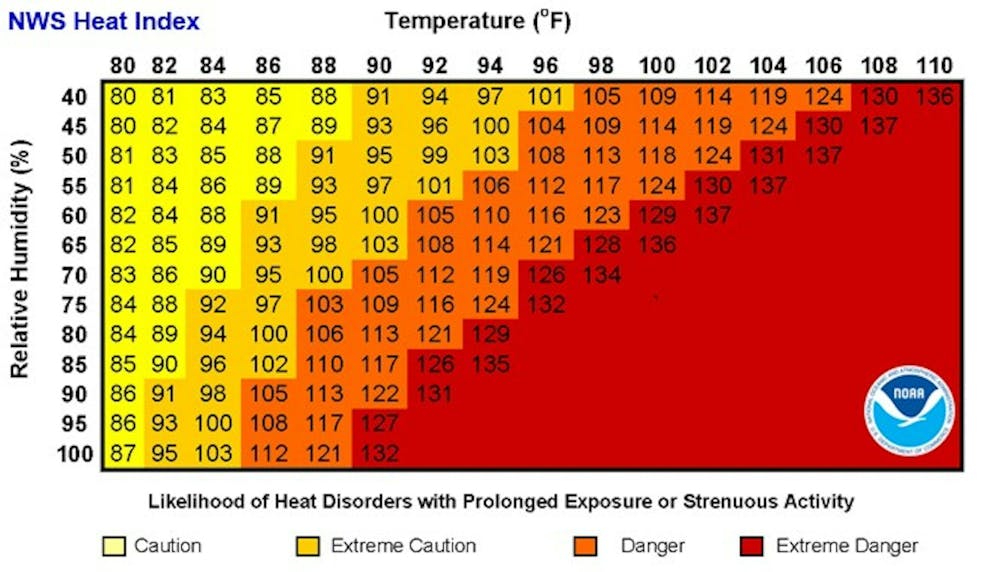
    Instead of just looking at temperature when planning outdoor activities, check the heat index, which accounts for heat illness risk associated with temperature and relative humidity.

    It doesn’t take very high temperatures or very high humidity for the heat index to enter dangerous territory.

    A heat index chart shows how heat and humidity combine for dangerous conditions.
    NOAA

    However, the heat index is still a conservative measure of the impact of heat on humans, particularly for outdoor workers and athletes at summer practices. This is because temperature measurements used in weather forecasting are taken in the shade and are not exposed to direct sunlight. If someone is outside and exposed to the direct sun, the actual heat index can be as much as 15 F higher than the heat index chart indicates.

    A more sophisticated measurement of heat effects on human health is what’s known as the wet-bulb globe temperature, which takes into account other variables, such as wind speed and cloud cover. Neither takes into account a person’s physical exertion, which also raises their body temperature, whether working at a construction site or playing soccer.

    Tips for staying safe in a heat wave

    How can you stay cool when heat waves set in? The answer depends in part on where you are, but the main points are the same:

    • Avoid strenuous outdoor activities in high temperatures if possible. If you start to feel symptoms of heat-related illnesses, drink fluids that will hydrate you. Find shade, rest, and use cool, damp cloths to lower your body temperature. If you see signs of heat stroke in someone else, call for medical help.

    • Be careful with fans. Fans can be useful if the temperature isn’t too high because they wick sweat away from the body and induce evaporative cooling. But at very high temperatures, they can accelerate heat buildup in the body and lead to dangerous conditions. If indoor temperatures reaches 95 degrees or higher, using fans can actually be dangerous and raise the risk of heat-related illnesses.

    • Find a cooling center, library or community center where you can get inside and rest in an air-conditioned space in the hottest hours. In places such as Phoenix, where high temperatures are a regular hazard, cooling centers are typically opened in summer. Northern cities are also opening cooling centers as heat waves occur there more frequently than they did in the past. Urban areas with a lot of pavement and buildings – known as heat islands – can have temperatures well above the city’s average.

    • Hydrate, hydrate, hydrate! Drink plenty of fluids, and don’t forget about the importance of electrolytes. Heat-related dehydration can occur when people sweat excessively, losing water and necessary salts from the body. Some sports drinks or rehydration fluids restore electrolytes and hydration levels.

    Older adults and people with disabilities often face higher risks from heat waves, particularly if they can’t easily move to a cooler environment. Communities and neighbors can help protect vulnerable populations by providing cooling centers and bottled water and making regular wellness checks during high heat.

    Summer can be a season of fun. Just remember the risks, keep an eye on your friends and neighbors when temperatures rise, and plan ahead so you can beat the heat.

    Brian Bossak is not currently receiving relevant external funding for heat-related illness research. In 2017-2019, he served as a consultant on a heat-related research award from the Southeastern Coastal Center for Agricultural Health and
    Safety at the University of Florida.

    ref. How to stay safe during heat waves – and the heat stroke warning signs to watch for – https://theconversation.com/how-to-stay-safe-during-heat-waves-and-the-heat-stroke-warning-signs-to-watch-for-257708

    MIL OSI – Global Reports

  • MIL-OSI Global: Catholic school board’s regressive flag policy sets back reconciliation in a post-Papal visit Canada

    Source: The Conversation – Canada – By Erenna Morrison, PhD Candidate, Curriculum and Pedagogy, Ontario Institute for Studies in Education, University of Toronto

    Following the release of the Truth and Reconciliation Commission’s 94 Calls to Action in 2015, some Catholic school boards have made commitments to reconciliation in education. These boards include the Dufferin-Peel Catholic District School Board (DPCDSB).

    However, the DPCDSB — located in the Greater Toronto area — has also introduced a flag policy that raises serious questions about a commitment to the wider progress being made in welcoming all students and promoting reconciliation.

    On Jan. 28, 2025 — following advocacy in different parts of Ontario and the country against the presence of the Pride flag — the board’s trustees voted in nine to one to add more restrictions to its flag policies. These restrictions stipulated that only flags representing Canada, the provinces, territories and the school board can be be displayed inside schools or other DPCDSB facilities.

    Acts of erasure

    The developments in Peel Region follow earlier policy changes to restrict the presence of the Pride flag and other flags at schools.

    Advocates from the board defending flag restrictions have said that in Catholic schools, the icon of the cross is the only symbol that should be promoted and that this represents inclusion and acceptance of all.

    However, members of the 2SLGBTQI+ community and opponents of restrictive flag policies argue that the Pride flag is needed to signal a welcoming environment. They say its removal is an act of erasure and that it calls into question how the board affirms the rights, dignity and visibility of 2SLGBTQI+ people and how it fosters their safety. The board says, and believes, its practices and policies comply with the Ontario human rights code, adding that supports are available for students who identify as 2SLGBTQI.

    The erasure of the Pride flag has the simultaneous effect of banning other important flags, such as Every Child Matters flags, Indigenous Nation flags and MMIWG2S flags (drawing attention to ending violence, disappearance and murder of First Nations women, girls and two-spirit people).

    In our analysis, this restrictive flag policy expresses colonial violence. We rely on the work of Sandra Styres, researcher of Iethi’nihsténha Ohwentsia’kékha (Land), Resurgence, Reconciliation and the Politics of Education, who examines how colonial violence is expressed in academic settings through “micro-aggressions, purposeful ignorance, structural racism, lateral violence, isolation” and also in “representations and spaces.”

    Crucial time for righting relationships

    Our concern is informed by our combined research and personal engagement focused around reconciliatory education in elementary Catholic schools (Erenna) and Anishinaabe Catholic expressions of self-determination in the Church (Noah). Erenna is a settler and Noah is a member of Michipicoten First Nation.

    We are married writing partners who travelled to Québec City in July 2022 to witness the long-awaited penitential pilgrimage of the late Pope Francis. We left with an awareness that this is a critical time for the righting of relationships that have been severely fractured by a Church complicit in genocide.

    The DPCDSB flag policy speaks to an unwillingness of many to sever emotional attachments to the white imperialism that preserves a western way of thinking, doing and being, in the name of faith.

    When a major Catholic entity like the DPCDSB introduces policies that may cause harm, concerned people, regardless of creed, must pay attention to such injustices.

    Revised flag policy

    Delegate Melanie Cormier, representing the DPCSB’s Indigenous Education Network, shared a statement relaying that the board’s restrictive flag policy fails to acknowledge the Mississaugas of the Credit First Nation whose traditional and treaty territory where the board resides. She states: “Your flag policy is in violation of our jurisdiction. To say that any of our flags can not be flown in our own territories is unacceptable.”

    Brea Corbet, the only trustee with voting power who did not vote to restrict the Pride flag, told an earlier bylaw policies meeting: “When we remove rainbow flags and heritage flags, we are not protecting our Catholic identity; we are revealing institutional fragility. The Pride flag does not threaten Catholic education, policies of exclusion do.”

    Three student trustees also opposed the restrictive policy, but their votes unfortunately aren’t counted. We argue this too speaks to the suppression of student voice within the board.

    This fragility disproportionately threatens the safety of Indigenous, 2SLGBTQI+ and marginalized students and staff as they are overlooked and dismissed by the flag policy.


    Read more:
    New Brunswick’s LGBTQ+ safe schools debate makes false opponents of parents and teachers


    Nurturing all students

    Kanienʼkehá:ka (Mohawk) education professor Frank Deer speaks of educational programming “that is congruent with the identity of the local community.” This programming, he writes, must go beyond curricula to address the school environment as well. Student safety, inclusion and identity affirmation must be prioritized in all aspects of school life.

    Jennifer Brant, a Kanienʼkehà:ka interdisciplinary scholar, speaks in depth about how silence during times like these equates to complicity in accepting injustices that are taking place within “the communities in which we live, the broader society and global communities.”

    Inaction in response to this policy is negligent.

    Detrimental ramifications may also extend to reconciliation efforts in religious spaces more generally. This regressive policy poses lingering questions about the longevity of Catholic schools if they fail to protect and nurture all students.

    Impacts on reconciliation

    The primary target of the DPCDSB’s sweeping flag policy is the 2SLGBTQI+ community. In addition, the flag ban attacks Indigenous sovereignty and Anishinaabek nationhood, perpetuating attitudes tied to the Doctrine of Discovery still present in the Catholic ethos.


    Read more:
    The Vatican just renounced a 500-year-old doctrine that justified colonial land theft … Now what? — Podcast


    Flying the flags of First Nations (at their request) is not only a matter of inclusion, it is a matter of respect — respect for the land, the people and the treaties that connect us.

    In denying this step towards relationality, this governing body of a Catholic school board sets back the Church’s reconciliation efforts riding on the momentum of the papal visit.


    Read more:
    Pope Francis showed in deeds and words he wanted to face the truth in Canada


    The board’s ignorance of how this policy risks damaging relationships with students, families and staff at the board, as well as the broader public, partly reflects an indifference that Pope Francis warned Catholics about during his visit:

    “I trust and pray that Christians and civil society in this land may grow in the ability to accept and respect the identity and the experience of the Indigenous Peoples. It is my hope that concrete ways can be found to make those peoples better known and esteemed, so that all may learn to walk together.”

    Walking together in solidarity

    As we write this piece, we can see through the window a local Toronto Catholic Distric School Board elementary school, where an Every Child Matters flag is flown alongside a Pride and Canadian flag.

    Catholic education, despite its sordid history and contested perspectives about interpreting and practising Church doctrine, can be a tool to drive reconciliation.

    Catholics cannot let a narrow vision overshadow Pope Francis’s pilgrimage and the global Church movement he, the Church’s bishops and Catholic lay people have participated in — via a global synod — to respond to the call to walk together in solidarity with Indigenous, 2SLGBTQI+ and other marginalized people.

    Counter-narratives of hope and possibility

    We wish to continue to hear counter-narratives of hope and possibility for Catholic education. We wish to see active changes that move the DPCDSB, as scholar Sheila Cote-Meek of the Teme-Augama Anishinabai, writes, “to a drastically different way of being, doing and working.”

    As other Catholic boards in Ontario initiate flag debates of their own, we are left with the lingering question. What is the future of Catholic education if it’s not intended to support the physical, emotional, mental and spiritual well-being of all those entrusted to its care?

    The authors do not work for, consult, own shares in or receive funding from any company or organisation that would benefit from this article, and have disclosed no relevant affiliations beyond their academic appointment.

    ref. Catholic school board’s regressive flag policy sets back reconciliation in a post-Papal visit Canada – https://theconversation.com/catholic-school-boards-regressive-flag-policy-sets-back-reconciliation-in-a-post-papal-visit-canada-256765

    MIL OSI – Global Reports

  • MIL-OSI Global: Catholic school board’s regressive flag policy sets back reconciliation in a post-Papal visit Canada

    Source: The Conversation – Canada – By Erenna Morrison, PhD Candidate, Curriculum and Pedagogy, Ontario Institute for Studies in Education, University of Toronto

    Following the release of the Truth and Reconciliation Commission’s 94 Calls to Action in 2015, some Catholic school boards have made commitments to reconciliation in education. These boards include the Dufferin-Peel Catholic District School Board (DPCDSB).

    However, the DPCDSB — located in the Greater Toronto area — has also introduced a flag policy that raises serious questions about a commitment to the wider progress being made in welcoming all students and promoting reconciliation.

    On Jan. 28, 2025 — following advocacy in different parts of Ontario and the country against the presence of the Pride flag — the board’s trustees voted in nine to one to add more restrictions to its flag policies. These restrictions stipulated that only flags representing Canada, the provinces, territories and the school board can be be displayed inside schools or other DPCDSB facilities.

    Acts of erasure

    The developments in Peel Region follow earlier policy changes to restrict the presence of the Pride flag and other flags at schools.

    Advocates from the board defending flag restrictions have said that in Catholic schools, the icon of the cross is the only symbol that should be promoted and that this represents inclusion and acceptance of all.

    However, members of the 2SLGBTQI+ community and opponents of restrictive flag policies argue that the Pride flag is needed to signal a welcoming environment. They say its removal is an act of erasure and that it calls into question how the board affirms the rights, dignity and visibility of 2SLGBTQI+ people and how it fosters their safety. The board says, and believes, its practices and policies comply with the Ontario human rights code, adding that supports are available for students who identify as 2SLGBTQI.

    The erasure of the Pride flag has the simultaneous effect of banning other important flags, such as Every Child Matters flags, Indigenous Nation flags and MMIWG2S flags (drawing attention to ending violence, disappearance and murder of First Nations women, girls and two-spirit people).

    In our analysis, this restrictive flag policy expresses colonial violence. We rely on the work of Sandra Styres, researcher of Iethi’nihsténha Ohwentsia’kékha (Land), Resurgence, Reconciliation and the Politics of Education, who examines how colonial violence is expressed in academic settings through “micro-aggressions, purposeful ignorance, structural racism, lateral violence, isolation” and also in “representations and spaces.”

    Crucial time for righting relationships

    Our concern is informed by our combined research and personal engagement focused around reconciliatory education in elementary Catholic schools (Erenna) and Anishinaabe Catholic expressions of self-determination in the Church (Noah). Erenna is a settler and Noah is a member of Michipicoten First Nation.

    We are married writing partners who travelled to Québec City in July 2022 to witness the long-awaited penitential pilgrimage of the late Pope Francis. We left with an awareness that this is a critical time for the righting of relationships that have been severely fractured by a Church complicit in genocide.

    The DPCDSB flag policy speaks to an unwillingness of many to sever emotional attachments to the white imperialism that preserves a western way of thinking, doing and being, in the name of faith.

    When a major Catholic entity like the DPCDSB introduces policies that may cause harm, concerned people, regardless of creed, must pay attention to such injustices.

    Revised flag policy

    Delegate Melanie Cormier, representing the DPCSB’s Indigenous Education Network, shared a statement relaying that the board’s restrictive flag policy fails to acknowledge the Mississaugas of the Credit First Nation whose traditional and treaty territory where the board resides. She states: “Your flag policy is in violation of our jurisdiction. To say that any of our flags can not be flown in our own territories is unacceptable.”

    Brea Corbet, the only trustee with voting power who did not vote to restrict the Pride flag, told an earlier bylaw policies meeting: “When we remove rainbow flags and heritage flags, we are not protecting our Catholic identity; we are revealing institutional fragility. The Pride flag does not threaten Catholic education, policies of exclusion do.”

    Three student trustees also opposed the restrictive policy, but their votes unfortunately aren’t counted. We argue this too speaks to the suppression of student voice within the board.

    This fragility disproportionately threatens the safety of Indigenous, 2SLGBTQI+ and marginalized students and staff as they are overlooked and dismissed by the flag policy.


    Read more:
    New Brunswick’s LGBTQ+ safe schools debate makes false opponents of parents and teachers


    Nurturing all students

    Kanienʼkehá:ka (Mohawk) education professor Frank Deer speaks of educational programming “that is congruent with the identity of the local community.” This programming, he writes, must go beyond curricula to address the school environment as well. Student safety, inclusion and identity affirmation must be prioritized in all aspects of school life.

    Jennifer Brant, a Kanienʼkehà:ka interdisciplinary scholar, speaks in depth about how silence during times like these equates to complicity in accepting injustices that are taking place within “the communities in which we live, the broader society and global communities.”

    Inaction in response to this policy is negligent.

    Detrimental ramifications may also extend to reconciliation efforts in religious spaces more generally. This regressive policy poses lingering questions about the longevity of Catholic schools if they fail to protect and nurture all students.

    Impacts on reconciliation

    The primary target of the DPCDSB’s sweeping flag policy is the 2SLGBTQI+ community. In addition, the flag ban attacks Indigenous sovereignty and Anishinaabek nationhood, perpetuating attitudes tied to the Doctrine of Discovery still present in the Catholic ethos.


    Read more:
    The Vatican just renounced a 500-year-old doctrine that justified colonial land theft … Now what? — Podcast


    Flying the flags of First Nations (at their request) is not only a matter of inclusion, it is a matter of respect — respect for the land, the people and the treaties that connect us.

    In denying this step towards relationality, this governing body of a Catholic school board sets back the Church’s reconciliation efforts riding on the momentum of the papal visit.


    Read more:
    Pope Francis showed in deeds and words he wanted to face the truth in Canada


    The board’s ignorance of how this policy risks damaging relationships with students, families and staff at the board, as well as the broader public, partly reflects an indifference that Pope Francis warned Catholics about during his visit:

    “I trust and pray that Christians and civil society in this land may grow in the ability to accept and respect the identity and the experience of the Indigenous Peoples. It is my hope that concrete ways can be found to make those peoples better known and esteemed, so that all may learn to walk together.”

    Walking together in solidarity

    As we write this piece, we can see through the window a local Toronto Catholic Distric School Board elementary school, where an Every Child Matters flag is flown alongside a Pride and Canadian flag.

    Catholic education, despite its sordid history and contested perspectives about interpreting and practising Church doctrine, can be a tool to drive reconciliation.

    Catholics cannot let a narrow vision overshadow Pope Francis’s pilgrimage and the global Church movement he, the Church’s bishops and Catholic lay people have participated in — via a global synod — to respond to the call to walk together in solidarity with Indigenous, 2SLGBTQI+ and other marginalized people.

    Counter-narratives of hope and possibility

    We wish to continue to hear counter-narratives of hope and possibility for Catholic education. We wish to see active changes that move the DPCDSB, as scholar Sheila Cote-Meek of the Teme-Augama Anishinabai, writes, “to a drastically different way of being, doing and working.”

    As other Catholic boards in Ontario initiate flag debates of their own, we are left with the lingering question. What is the future of Catholic education if it’s not intended to support the physical, emotional, mental and spiritual well-being of all those entrusted to its care?

    The authors do not work for, consult, own shares in or receive funding from any company or organisation that would benefit from this article, and have disclosed no relevant affiliations beyond their academic appointment.

    ref. Catholic school board’s regressive flag policy sets back reconciliation in a post-Papal visit Canada – https://theconversation.com/catholic-school-boards-regressive-flag-policy-sets-back-reconciliation-in-a-post-papal-visit-canada-256765

    MIL OSI – Global Reports

  • MIL-OSI Global: Light-powered reactions could make the chemical manufacturing industry more energy-efficient

    Source: The Conversation – USA – By Arindam Sau, Ph.D. Candidate in Chemistry, University of Colorado Boulder

    Plants use light to make energy – and a team of scientists is using the same principle to power chemical reactions. fhm/Moment via Getty Images

    Manufactured chemicals and materials are necessary for practically every aspect of daily life, from life-saving pharmaceuticals to plastics, fuels and fertilizers. Yet manufacturing these important chemicals comes at a steep energy cost.

    Many of these industrial chemicals are derived primarily from fossil fuel-based materials. These compounds are typically very stable, making it difficult to transform them into useful products without applying harsh and energy-demanding reaction conditions.

    As a result, transforming these stubborn materials contributes significantly to the world’s overall energy use. In 2022, the industrial sector consumed 37% of the world’s total energy, with the chemical industry responsible for approximately 12% of that demand.

    Conventional chemical manufacturing processes use heat to generate the energy needed for reactions that take place at high temperatures and pressures. An approach that uses light instead of heat could lower energy demands and allow reactions to be run under gentler conditions — like at room temperature instead of extreme heat.

    Sunlight represents one of the most abundant yet underutilized energy sources on Earth. In nature, this energy is captured through photosynthesis, where plants convert light into chemical energy. Inspired by this process, our team of chemists at the Center for Sustainable Photoredox Catalysis, a research center funded by the National Science Foundation, has been working on a system that uses light to power reactions commonly used in the chemical manufacturing industry. We published our results in the journal Science in June 2025.

    We hope that this method could provide a more economical route for creating industrial chemicals out of fossil fuels. At the same time, since it doesn’t rely on super-high temperatures or pressures, the process is safer, with fewer chances for accidents.

    Plants capture sunlight to convert carbon dioxide from the air into carbohydrates, or sugars.
    Wattcle, Nefronus/Wikimedia Commons, CC BY-SA

    How does our system work?

    The photoredox catalyst system that our team has developed is powered by simple LEDs, and it operates efficiently at room temperature.

    At the core of our system is an organic photoredox catalyst: a specialized molecule that we know accelerates chemical reactions when exposed to light, without being consumed in the process.

    Much like how plants rely on pigments to harvest sunlight for photosynthesis, our photoredox catalyst absorbs multiple particles of light, called photons, in a sequence.

    These photons provide bursts of energy, which the catalyst stores and then uses to kick-start reactions. This “multi-photon” harvesting builds up enough energy to force very stubborn molecules into undergoing reactions that would otherwise need highly reactive metals. Once the reaction is complete, the photocatalyst resets itself, ready to harvest more light and keep the process going without creating extra waste.

    Designing molecules that can absorb multiple photons and react with stubborn molecules is tough. One big challenge is that after a molecule absorbs a photon, it only has a tiny window of time before that energy fades away or gets lost. Plus, making sure the molecule uses that energy the right way is not easy. The good news is we’ve found that our catalyst can do this efficiently at room temperature.

    Center for Sustainable Photoredox Catalysis researcher Amreen Bains performs a light-driven photoredox catalyzed reaction.
    John Cline, Colorado State University Photography

    Enabling greener chemical manufacturing

    Our work points toward a future where chemicals are made using light instead of heat. For example, our catalyst can turn benzene — a simple component of crude oil — into a form called cyclohexadienes. This is a key step in making the building blocks for nylon. Improving this part of the process could reduce the carbon footprint of nylon production.

    Imagine manufacturers using LED reactors or even sunlight to power the production of essential chemicals. LEDs still use electricity, but they need far less energy compared with the traditional heating methods used in chemical manufacturing. As we scale things up, we’re also figuring out ways to harness sunlight directly, making the entire process even more sustainable and energy-efficient.

    Right now, we’re using our photoredox catalysts successfully in small lab experiments — producing just milligrams at a time. But to move into commercial manufacturing, we’ll need to show that these catalysts can also work efficiently at a much larger scale, making kilograms or even tons of product. Testing them in these bigger reactions will ensure that they’re reliable and cost-effective enough for real-world chemical manufacturing.

    Similarly, scaling up this process would require large-scale reactors that use light efficiently. Building those will first require designing new types of reactors that let light reach deeper inside. They’ll need to be more transparent or built differently so the light can easily get to all parts of the reaction.

    Our team plans to keep developing new light-driven techniques inspired by nature’s efficiency. Sunlight is a plentiful resource, and by finding better ways to tap into it, we hope to make it easier and cleaner to produce the chemicals and materials that modern life depends on.

    The authors do not work for, consult, own shares in or receive funding from any company or organization that would benefit from this article, and have disclosed no relevant affiliations beyond their academic appointment.

    ref. Light-powered reactions could make the chemical manufacturing industry more energy-efficient – https://theconversation.com/light-powered-reactions-could-make-the-chemical-manufacturing-industry-more-energy-efficient-257796

    MIL OSI – Global Reports

  • MIL-OSI Global: Light-powered reactions could make the chemical manufacturing industry more energy-efficient

    Source: The Conversation – USA – By Arindam Sau, Ph.D. Candidate in Chemistry, University of Colorado Boulder

    Plants use light to make energy – and a team of scientists is using the same principle to power chemical reactions. fhm/Moment via Getty Images

    Manufactured chemicals and materials are necessary for practically every aspect of daily life, from life-saving pharmaceuticals to plastics, fuels and fertilizers. Yet manufacturing these important chemicals comes at a steep energy cost.

    Many of these industrial chemicals are derived primarily from fossil fuel-based materials. These compounds are typically very stable, making it difficult to transform them into useful products without applying harsh and energy-demanding reaction conditions.

    As a result, transforming these stubborn materials contributes significantly to the world’s overall energy use. In 2022, the industrial sector consumed 37% of the world’s total energy, with the chemical industry responsible for approximately 12% of that demand.

    Conventional chemical manufacturing processes use heat to generate the energy needed for reactions that take place at high temperatures and pressures. An approach that uses light instead of heat could lower energy demands and allow reactions to be run under gentler conditions — like at room temperature instead of extreme heat.

    Sunlight represents one of the most abundant yet underutilized energy sources on Earth. In nature, this energy is captured through photosynthesis, where plants convert light into chemical energy. Inspired by this process, our team of chemists at the Center for Sustainable Photoredox Catalysis, a research center funded by the National Science Foundation, has been working on a system that uses light to power reactions commonly used in the chemical manufacturing industry. We published our results in the journal Science in June 2025.

    We hope that this method could provide a more economical route for creating industrial chemicals out of fossil fuels. At the same time, since it doesn’t rely on super-high temperatures or pressures, the process is safer, with fewer chances for accidents.

    Plants capture sunlight to convert carbon dioxide from the air into carbohydrates, or sugars.
    Wattcle, Nefronus/Wikimedia Commons, CC BY-SA

    How does our system work?

    The photoredox catalyst system that our team has developed is powered by simple LEDs, and it operates efficiently at room temperature.

    At the core of our system is an organic photoredox catalyst: a specialized molecule that we know accelerates chemical reactions when exposed to light, without being consumed in the process.

    Much like how plants rely on pigments to harvest sunlight for photosynthesis, our photoredox catalyst absorbs multiple particles of light, called photons, in a sequence.

    These photons provide bursts of energy, which the catalyst stores and then uses to kick-start reactions. This “multi-photon” harvesting builds up enough energy to force very stubborn molecules into undergoing reactions that would otherwise need highly reactive metals. Once the reaction is complete, the photocatalyst resets itself, ready to harvest more light and keep the process going without creating extra waste.

    Designing molecules that can absorb multiple photons and react with stubborn molecules is tough. One big challenge is that after a molecule absorbs a photon, it only has a tiny window of time before that energy fades away or gets lost. Plus, making sure the molecule uses that energy the right way is not easy. The good news is we’ve found that our catalyst can do this efficiently at room temperature.

    Center for Sustainable Photoredox Catalysis researcher Amreen Bains performs a light-driven photoredox catalyzed reaction.
    John Cline, Colorado State University Photography

    Enabling greener chemical manufacturing

    Our work points toward a future where chemicals are made using light instead of heat. For example, our catalyst can turn benzene — a simple component of crude oil — into a form called cyclohexadienes. This is a key step in making the building blocks for nylon. Improving this part of the process could reduce the carbon footprint of nylon production.

    Imagine manufacturers using LED reactors or even sunlight to power the production of essential chemicals. LEDs still use electricity, but they need far less energy compared with the traditional heating methods used in chemical manufacturing. As we scale things up, we’re also figuring out ways to harness sunlight directly, making the entire process even more sustainable and energy-efficient.

    Right now, we’re using our photoredox catalysts successfully in small lab experiments — producing just milligrams at a time. But to move into commercial manufacturing, we’ll need to show that these catalysts can also work efficiently at a much larger scale, making kilograms or even tons of product. Testing them in these bigger reactions will ensure that they’re reliable and cost-effective enough for real-world chemical manufacturing.

    Similarly, scaling up this process would require large-scale reactors that use light efficiently. Building those will first require designing new types of reactors that let light reach deeper inside. They’ll need to be more transparent or built differently so the light can easily get to all parts of the reaction.

    Our team plans to keep developing new light-driven techniques inspired by nature’s efficiency. Sunlight is a plentiful resource, and by finding better ways to tap into it, we hope to make it easier and cleaner to produce the chemicals and materials that modern life depends on.

    The authors do not work for, consult, own shares in or receive funding from any company or organization that would benefit from this article, and have disclosed no relevant affiliations beyond their academic appointment.

    ref. Light-powered reactions could make the chemical manufacturing industry more energy-efficient – https://theconversation.com/light-powered-reactions-could-make-the-chemical-manufacturing-industry-more-energy-efficient-257796

    MIL OSI – Global Reports

  • MIL-OSI Global: What UK involvement in Iran could look like – and the political questions it raises

    Source: The Conversation – UK – By Geraint Hughes, Reader in Diplomatic and Military History, King’s College London

    Lauren Hurley / No 10 Downing Street, CC BY-NC-ND

    At the time of writing, US President Donald Trump is deliberating over whether to join Israel’s air campaign to destroy Iran’s suspected nuclear weapons programme. This is already a contentious issue within Washington DC and the Trump administration. But if the president decides to take the US into a war with Iran, it will have significant implications for the US’s allies, not least the UK.

    As the recent strategic defence review emphasises, the US is Britain’s main ally, an essential partner in defence and intelligence.

    However, the Trump administration has made clear to its European allies that it no longer regards the defence of the continent as a US national security priority. And the president’s commitment to Nato is uncertain.

    It is possible that Britain and other European allies could be publicly pressured by Trump to support any intervention on Israel’s side. The US may expect this in return for the US’s continued involvement in Nato and its readiness to honour article 5 (the collective defence principle, which obliges collective retaliation to aggression against one member) for its allies.


    Get your news from actual experts, straight to your inbox. Sign up to our daily newsletter to receive all The Conversation UK’s latest coverage of news and research, from politics and business to the arts and sciences.


    Given the importance of American military power in deterring wider Russian aggression in Europe – and Trump’s transactional character – this would present Keir Starmer with a particularly stark dilemma.

    A purely US air campaign against Iran is feasible. The US Navy will soon have two carrier strike groups in the Middle East region. And the US Air Force’s B2 strategic bombers can launch raids across the globe from bases in the continental US.

    The US also has several military bases in the region. However, as was the case with the 1991 and 2003 wars with Iraq, Washington DC will need permission from Gulf Arab allies to use them.

    Nonetheless, the Trump administration could request authorisation from the UK’s Labour government to use US airbases in the UK and its overseas territories to support an air campaign against Iran. This would not involve the UK deploying forces, but would require the UK to approve the use of the airbases.

    The Diego Garcia airbase in the Indian Ocean would be a useful asset in this case. But its employment would reopen the controversy over its establishment in the 1960s.

    It could also call into question the diplomatic deal the UK made with Mauritius last month to cede sovereignty of the Chagos Islands, while keeping this base open. The Mauritians are likely to oppose US airstrikes on Iran.

    Britain also has options for direct participation. RAF Typhoon jets stationed at Britain’s airbase in Akrotiri, Cyprus provided air defence support for Israel during the Iranian missile and drone strikes in April and October 2024. They could conduct similar missions now.

    But from the Royal Navy’s perspective, it would be difficult to divert the aircraft carrier HMS Prince of Wales from its deployment to the Indo-Pacific, partly because the task group it sails with is a multinational one.

    Given that the British armed forces are already overstretched, it is difficult to see whether the UK could provide more than basing rights and air support to the Israelis (if requested).

    A discreet commitment of UK special forces (the 22nd Special Air Service regiment and the Special Boat Service) on the ground is conceivable. This can be – and indeed has been – authorised by previous governments without parliamentary debate. But any further British military commitment is likely to cause a political row.

    Legal and political ramifications

    The key question for Starmer and his ministers will not be whether Britain could back a US war against Iran but whether it should. After the debacle of the Iraq war and the ensuing Chilcot inquiry, it is difficult to see how any government – let alone a Labour one – can take Britain into a major interstate conflict on this scale without firm parliamentary support and a solid case in international law.

    To this end, the Attorney General Richard Hermer has reportedly questioned the legality of Israel’s preemptive attack on Iran, and has argued that any British military intervention should be limited to the defence of its allies.

    We should not forget that Starmer was a human rights lawyer and the head of the Crown Prosecution Service before he became a politician.

    Another legacy of Iraq is that it is customary (though not a legal requirement) for prime ministers to seek parliamentary approval for any major military operation. David Cameron lost a vote in the House of Commons to approve airstrikes against Bashar al-Assad’s regime in Syria in August 2013. But he gained parliamentary support for Britain’s commitment to the fight against Islamic State in 2015.

    A similar debate now is unlikely to lead to approval of British military intervention in this case. Within the Labour party, there is already widespread condemnation of Israeli tactics and Palestinian civilian casualties in Gaza.

    There is little popular appetite for sending British sailors and airmen into a war with Iran. And, given the US vice-president’s own dismissive comments about the military experiences of European allies, the public is also entitled to ask why British servicemen should die or risk breaching international law for an administration that probably will not appreciate their sacrifice.

    Geraint Hughes does not work for, consult, own shares in or receive funding from any company or organisation that would benefit from this article, and has disclosed no relevant affiliations beyond their academic appointment.

    ref. What UK involvement in Iran could look like – and the political questions it raises – https://theconversation.com/what-uk-involvement-in-iran-could-look-like-and-the-political-questions-it-raises-259420

    MIL OSI – Global Reports

  • MIL-OSI Global: Trump’s unpredictable approach to Iran could seriously backfire

    Source: The Conversation – UK – By Michelle Bentley, Professor of International Relations, Royal Holloway University of London

    US president Donald Trump has now publicly approved a plan of attack against Iran, which includes a strike against its underground nuclear facility at Fordow (though, at the time of writing, a final decision to go ahead hasn’t been made).

    The world is now waiting to see whether Trump will put this plan into action. And that’s exactly what Trump wants. This is not a case of indecision or buying time. Trump has long based his foreign policy on being unpredictable. Iran is another example of his strategy to be as elusive as possible. Yet, his approach has always been difficult – and now threatens to destabilise an already fractious conflict.

    One interpretation of Trump’s new public threat towards Iran could be deterrence. Trump is warning Iran that there would be significant consequences if they do not reverse their nuclear ambitions. Change or you will regret it.

    If this is Trump’s plan, then he is doing it badly. Successful deterrence relies on clearly communicating the exact penalties of not complying. While Trump has specified a possible attack on Fordow, the rest of the plan is extremely hazy. Trump said he wants “better than a ceasefire”.


    Get your news from actual experts, straight to your inbox. Sign up to our daily newsletter to receive all The Conversation UK’s latest coverage of news and research, from politics and business to the arts and sciences.


    But what does that mean? Just Fordow? Boots on the ground? Regime change? His ambiguity creates problems for deterrence because if your adversary doesn’t know what the outcomes of their actions will be, they can’t formulate a response or will think you just aren’t serious.

    But current US foreign policy on Iran is more than bad deterrence. Trump’s vague rhetoric and his refusal to commit reflects his long-standing strategy of being unreliable when it comes to foreign policy.

    Trump’s prevarication has all the hallmarks of his unpredictability doctrine – which states that you should never let anyone know what you will do. The doctrine is also about uncertainty. The idea being that you unnerve your opponents by making them unsure, allowing you to take the advantage while they have no idea what to do themselves.

    Trump’s rhetoric on Iran reflects that unpredictability doctrine. Trump actively said of his future action: “I mean, nobody knows what I’m going to do.”

    This would not be the first time he has used unpredictability in relation to Iran. In 2018, Trump withdrew the US from the joint comprehensive plan of action (JCPOA). This agreement – signed by the US, France, Germany, the UK, China, Russia and the EU – was designed to limit Iran’s nuclear activity in return for sanctions relief. The US withdrawal was seen as disruptive and creating unnecessary uncertainty, not just for Iran but also US allies.

    Will the strategy work?

    Being unpredictable is a dangerous way of doing foreign policy. Stable international politics depends on knowing what everyone else will do. You can’t do that with Trump.

    The downsides of unpredictability will be even worse in a conflict. In the case of Iran, adding even more uncertainty to a fragile situation will only add fuel to what is already a massive fire.


    Read more:
    China positions itself as a stable economic partner and alternative to ‘unpredictable’ Trump


    Trump’s refusal to specify exactly what the US response would be is more proverbial petrol. The insinuation that this could escalate to regime change may be true or not (or just unpredictable bluster).

    It’s also the case that only 14% of Americans support military intervention and so a more aggressive policy may not be realistic. But if Iran is led to think that Trump is directly threatening their state, this could encourage them to hunker down as opposed to changing their nuclear policy – risking greater military action on both sides.

    Donald Trump being unclear about whether the US is going to bomb Iran.

    Even just the implicit threat of US military intervention will damage what little relations there are between America and Iran. Iran’s supreme leader, Ayatollah Ali Khamenei, has said: “Any US military intervention will undoubtedly cause irreparable damage.” Unpredictability then undermines any diplomatic negotiations or solution to the crisis.

    Trump is also risking his foreign policy relations beyond Iran. While preventing a new member of the nuclear club is a laudable aim, any US attack on a state over weapons of mass destruction (WMD) will lie in the difficult shadow of the “war on terror”, the US-led military campaign launched after 9/11.

    With the International Atomic Energy Agency questioning Iran’s capacity to build a nuclear bomb, the US’s legacy of intervention over the WMD in Iraq that never were still looms large. Trump will need to be fully transparent and clear if any action over nuclear arms is going to be seen as legitimate. Unpredictability does not allow for that.

    Trump’s fellow state leaders are going to feel disrupted by yet another example of unpredictability. Even if they support curbing Iran, they may find it difficult to back someone they simply can’t depend on. And if they feel cautious about the Iran situation because they can’t rely on Trump, Trump needs to start asking whether he can rely on them for support in whatever his next move is.

    Michelle Bentley does not work for, consult, own shares in or receive funding from any company or organisation that would benefit from this article, and has disclosed no relevant affiliations beyond their academic appointment.

    ref. Trump’s unpredictable approach to Iran could seriously backfire – https://theconversation.com/trumps-unpredictable-approach-to-iran-could-seriously-backfire-259399

    MIL OSI – Global Reports

  • MIL-OSI Global: Trump’s unpredictable approach to Iran could seriously backfire

    Source: The Conversation – UK – By Michelle Bentley, Professor of International Relations, Royal Holloway University of London

    US president Donald Trump has now publicly approved a plan of attack against Iran, which includes a strike against its underground nuclear facility at Fordow (though, at the time of writing, a final decision to go ahead hasn’t been made).

    The world is now waiting to see whether Trump will put this plan into action. And that’s exactly what Trump wants. This is not a case of indecision or buying time. Trump has long based his foreign policy on being unpredictable. Iran is another example of his strategy to be as elusive as possible. Yet, his approach has always been difficult – and now threatens to destabilise an already fractious conflict.

    One interpretation of Trump’s new public threat towards Iran could be deterrence. Trump is warning Iran that there would be significant consequences if they do not reverse their nuclear ambitions. Change or you will regret it.

    If this is Trump’s plan, then he is doing it badly. Successful deterrence relies on clearly communicating the exact penalties of not complying. While Trump has specified a possible attack on Fordow, the rest of the plan is extremely hazy. Trump said he wants “better than a ceasefire”.


    Get your news from actual experts, straight to your inbox. Sign up to our daily newsletter to receive all The Conversation UK’s latest coverage of news and research, from politics and business to the arts and sciences.


    But what does that mean? Just Fordow? Boots on the ground? Regime change? His ambiguity creates problems for deterrence because if your adversary doesn’t know what the outcomes of their actions will be, they can’t formulate a response or will think you just aren’t serious.

    But current US foreign policy on Iran is more than bad deterrence. Trump’s vague rhetoric and his refusal to commit reflects his long-standing strategy of being unreliable when it comes to foreign policy.

    Trump’s prevarication has all the hallmarks of his unpredictability doctrine – which states that you should never let anyone know what you will do. The doctrine is also about uncertainty. The idea being that you unnerve your opponents by making them unsure, allowing you to take the advantage while they have no idea what to do themselves.

    Trump’s rhetoric on Iran reflects that unpredictability doctrine. Trump actively said of his future action: “I mean, nobody knows what I’m going to do.”

    This would not be the first time he has used unpredictability in relation to Iran. In 2018, Trump withdrew the US from the joint comprehensive plan of action (JCPOA). This agreement – signed by the US, France, Germany, the UK, China, Russia and the EU – was designed to limit Iran’s nuclear activity in return for sanctions relief. The US withdrawal was seen as disruptive and creating unnecessary uncertainty, not just for Iran but also US allies.

    Will the strategy work?

    Being unpredictable is a dangerous way of doing foreign policy. Stable international politics depends on knowing what everyone else will do. You can’t do that with Trump.

    The downsides of unpredictability will be even worse in a conflict. In the case of Iran, adding even more uncertainty to a fragile situation will only add fuel to what is already a massive fire.


    Read more:
    China positions itself as a stable economic partner and alternative to ‘unpredictable’ Trump


    Trump’s refusal to specify exactly what the US response would be is more proverbial petrol. The insinuation that this could escalate to regime change may be true or not (or just unpredictable bluster).

    It’s also the case that only 14% of Americans support military intervention and so a more aggressive policy may not be realistic. But if Iran is led to think that Trump is directly threatening their state, this could encourage them to hunker down as opposed to changing their nuclear policy – risking greater military action on both sides.

    Donald Trump being unclear about whether the US is going to bomb Iran.

    Even just the implicit threat of US military intervention will damage what little relations there are between America and Iran. Iran’s supreme leader, Ayatollah Ali Khamenei, has said: “Any US military intervention will undoubtedly cause irreparable damage.” Unpredictability then undermines any diplomatic negotiations or solution to the crisis.

    Trump is also risking his foreign policy relations beyond Iran. While preventing a new member of the nuclear club is a laudable aim, any US attack on a state over weapons of mass destruction (WMD) will lie in the difficult shadow of the “war on terror”, the US-led military campaign launched after 9/11.

    With the International Atomic Energy Agency questioning Iran’s capacity to build a nuclear bomb, the US’s legacy of intervention over the WMD in Iraq that never were still looms large. Trump will need to be fully transparent and clear if any action over nuclear arms is going to be seen as legitimate. Unpredictability does not allow for that.

    Trump’s fellow state leaders are going to feel disrupted by yet another example of unpredictability. Even if they support curbing Iran, they may find it difficult to back someone they simply can’t depend on. And if they feel cautious about the Iran situation because they can’t rely on Trump, Trump needs to start asking whether he can rely on them for support in whatever his next move is.

    Michelle Bentley does not work for, consult, own shares in or receive funding from any company or organisation that would benefit from this article, and has disclosed no relevant affiliations beyond their academic appointment.

    ref. Trump’s unpredictable approach to Iran could seriously backfire – https://theconversation.com/trumps-unpredictable-approach-to-iran-could-seriously-backfire-259399

    MIL OSI – Global Reports

  • MIL-OSI Global: Israel’s attacks have exposed weaknesses in Iran, but it’s in little danger of collapsing

    Source: The Conversation – UK – By Farhang Morady, Principal Lecturer in International Development, University of Westminster

    The Israeli prime minister, Benjamin Netanyahu, has said that his country’s campaign in Iran “could certainly” lead to regime change. In an interview with Fox News on June 15, he called the government in Tehran “very weak” and added that, given the opportunity, “80% of the [Iranian] people would throw these theological thugs out”.

    Israel’s military actions so far indicate that its goals probably do extend beyond eliminating Iran’s nuclear programme. Airstrikes have targeted military leadership, internal security facilities and the headquarters of Iran’s state broadcaster. Israel’s aim is seemingly to destabilise the regime by inciting a popular uprising and fragmenting elite support.

    Tehran, meanwhile, has been eager to project an image of strength and stability. It has sought to illustrate its resilience and unity through constant coverage by state media, highlighting its military readiness while also broadcasting public displays of loyalty. Government officials have also visited affected regions.

    This raises the question: is more than four decades of theocratic rule in Iran really as close to collapse as Netanyahu says it is?


    Get your news from actual experts, straight to your inbox. Sign up to our daily newsletter to receive all The Conversation UK’s latest coverage of news and research, from politics and business to the arts and sciences.


    The Israeli attacks have exposed weaknesses in the Iranian state. Several senior military officials and top nuclear scientists have been killed, while Israel has been able to strike targets in the Iranian capital, Tehran, with relative ease after crippling Iran’s air defences.

    Strategic sites in Iran have proven vulnerable, with nuclear sites and military command headquarters hit hard. Many residents of Tehran have fled to other cities fearful that the situation will worsen.

    However, despite inflicting significant damage, the strikes have not caused the downfall of the regime’s core institutions. The deaths of at least 20 key commanders prompted the Iranian supreme leader, Ayatollah Ali Khamenei, to reshuffle Iran’s military leadership to maintain stability and control. New appointments were made swiftly.

    And, at least publicly, the Iranian elite is maintaining its position that the country can endure the crisis without giving in to foreign pressure. Khamenei has even warned the US president, Donald Trump, that the US will “face irreparable harm” should it become involved in the conflict.

    Diplomatic manoeuvres behind the scenes, however, suggest the regime is demonstrating a willingness to compromise to ensure its survival. An unverified Iranian diplomatic statement on June 16 even indicated that the regime would be willing to suspend uranium enrichment to maintain itself.

    The Iranian government is probably displaying confidence in public as a strategic move to prevent domestic unrest. Iran is facing significant economic, political and social challenges. Over 60% of its population is under 30 years old, and this demographic is increasingly disconnected from the principles promoted by the regime.

    Widespread protests erupted in 2022 following the death of a young woman called Mahsa Amini while she was in police custody for allegedly violating hijab regulations. The protests demonstrated deep-seated discontent with the regime and its morality laws that dictate women’s attire and public behaviour.

    The protests were suppressed, but underlying discontent remains. Israeli leaders hope that striking Iran might start a chain reaction leading to an uprising that topples the Islamic Republic. Israel’s defence minister, Israel Katz, hinted as much on June 19. He said the military has been instructed to intensify strikes on targets in Tehran in order to destabilise the “Ayatollah regime”.

    No imminent collapse

    Despite immense pressure, the collapse of Iran’s theocratic regime is not imminent. It continues to hold authority over its military and controls the media. The regime sustains itself through its powerful institutional base rather than public approval.

    Opposition movements are also fragmented and lack an organised structure. Groups like Mojahedin-e-Khalq and the movement led by Reza Pahlavi, the exiled eldest son of the last shah of Iran, have sought to gain influence with western support. However, they lack popular backing within Iran.

    The Islamic Republic appears to be on a path of gradual deterioration rather than complete collapse. However, Trump does appear to be warming to the idea of helping Israel overthrow the government in Tehran. And any US involvement would intensify pressure on the regime significantly.

    On June 17, Trump described Khamenei as an “easy target” who is safe only “for now”. Trump has since said his patience with Iran had run out, saying “I may do it, I may not do it” when asked a question about US involvement in Iran.

    The US possesses the 30,000-pound “bunker buster” bomb capable of damaging Iran’s deep-lying uranium enrichment facilities and the B-2 stealth bomber to carry it. And it has been moving military assets to its bases in the Middle East.

    It is uncertain whether these actions represent direct provocation or simply an attempt by Trump to exert more pressure on Iran to negotiate an end to the conflict.

    Trump’s camp is split over potential US involvement in Iran. Some US military and intelligence officials – including the director of national intelligence, Tulsi Gabbard – have expressed concerns about a direct confrontation.

    It is also possible that Israeli and US attempts to impose a change of government in Iran could even unite the regime. The Islamic Republic has a history of using foreign pressure to justify domestic crackdowns and increase its domestic control.

    The external efforts to accelerate the collapse of the regime could, somewhat counterintuitively, help the regime survive in the short-term while deeper internal problems continue to exist.

    Farhang Morady does not work for, consult, own shares in or receive funding from any company or organisation that would benefit from this article, and has disclosed no relevant affiliations beyond their academic appointment.

    ref. Israel’s attacks have exposed weaknesses in Iran, but it’s in little danger of collapsing – https://theconversation.com/israels-attacks-have-exposed-weaknesses-in-iran-but-its-in-little-danger-of-collapsing-259230

    MIL OSI – Global Reports

  • MIL-OSI Global: Israel’s attacks have exposed weaknesses in Iran, but it’s in little danger of collapsing

    Source: The Conversation – UK – By Farhang Morady, Principal Lecturer in International Development, University of Westminster

    The Israeli prime minister, Benjamin Netanyahu, has said that his country’s campaign in Iran “could certainly” lead to regime change. In an interview with Fox News on June 15, he called the government in Tehran “very weak” and added that, given the opportunity, “80% of the [Iranian] people would throw these theological thugs out”.

    Israel’s military actions so far indicate that its goals probably do extend beyond eliminating Iran’s nuclear programme. Airstrikes have targeted military leadership, internal security facilities and the headquarters of Iran’s state broadcaster. Israel’s aim is seemingly to destabilise the regime by inciting a popular uprising and fragmenting elite support.

    Tehran, meanwhile, has been eager to project an image of strength and stability. It has sought to illustrate its resilience and unity through constant coverage by state media, highlighting its military readiness while also broadcasting public displays of loyalty. Government officials have also visited affected regions.

    This raises the question: is more than four decades of theocratic rule in Iran really as close to collapse as Netanyahu says it is?


    Get your news from actual experts, straight to your inbox. Sign up to our daily newsletter to receive all The Conversation UK’s latest coverage of news and research, from politics and business to the arts and sciences.


    The Israeli attacks have exposed weaknesses in the Iranian state. Several senior military officials and top nuclear scientists have been killed, while Israel has been able to strike targets in the Iranian capital, Tehran, with relative ease after crippling Iran’s air defences.

    Strategic sites in Iran have proven vulnerable, with nuclear sites and military command headquarters hit hard. Many residents of Tehran have fled to other cities fearful that the situation will worsen.

    However, despite inflicting significant damage, the strikes have not caused the downfall of the regime’s core institutions. The deaths of at least 20 key commanders prompted the Iranian supreme leader, Ayatollah Ali Khamenei, to reshuffle Iran’s military leadership to maintain stability and control. New appointments were made swiftly.

    And, at least publicly, the Iranian elite is maintaining its position that the country can endure the crisis without giving in to foreign pressure. Khamenei has even warned the US president, Donald Trump, that the US will “face irreparable harm” should it become involved in the conflict.

    Diplomatic manoeuvres behind the scenes, however, suggest the regime is demonstrating a willingness to compromise to ensure its survival. An unverified Iranian diplomatic statement on June 16 even indicated that the regime would be willing to suspend uranium enrichment to maintain itself.

    The Iranian government is probably displaying confidence in public as a strategic move to prevent domestic unrest. Iran is facing significant economic, political and social challenges. Over 60% of its population is under 30 years old, and this demographic is increasingly disconnected from the principles promoted by the regime.

    Widespread protests erupted in 2022 following the death of a young woman called Mahsa Amini while she was in police custody for allegedly violating hijab regulations. The protests demonstrated deep-seated discontent with the regime and its morality laws that dictate women’s attire and public behaviour.

    The protests were suppressed, but underlying discontent remains. Israeli leaders hope that striking Iran might start a chain reaction leading to an uprising that topples the Islamic Republic. Israel’s defence minister, Israel Katz, hinted as much on June 19. He said the military has been instructed to intensify strikes on targets in Tehran in order to destabilise the “Ayatollah regime”.

    No imminent collapse

    Despite immense pressure, the collapse of Iran’s theocratic regime is not imminent. It continues to hold authority over its military and controls the media. The regime sustains itself through its powerful institutional base rather than public approval.

    Opposition movements are also fragmented and lack an organised structure. Groups like Mojahedin-e-Khalq and the movement led by Reza Pahlavi, the exiled eldest son of the last shah of Iran, have sought to gain influence with western support. However, they lack popular backing within Iran.

    The Islamic Republic appears to be on a path of gradual deterioration rather than complete collapse. However, Trump does appear to be warming to the idea of helping Israel overthrow the government in Tehran. And any US involvement would intensify pressure on the regime significantly.

    On June 17, Trump described Khamenei as an “easy target” who is safe only “for now”. Trump has since said his patience with Iran had run out, saying “I may do it, I may not do it” when asked a question about US involvement in Iran.

    The US possesses the 30,000-pound “bunker buster” bomb capable of damaging Iran’s deep-lying uranium enrichment facilities and the B-2 stealth bomber to carry it. And it has been moving military assets to its bases in the Middle East.

    It is uncertain whether these actions represent direct provocation or simply an attempt by Trump to exert more pressure on Iran to negotiate an end to the conflict.

    Trump’s camp is split over potential US involvement in Iran. Some US military and intelligence officials – including the director of national intelligence, Tulsi Gabbard – have expressed concerns about a direct confrontation.

    It is also possible that Israeli and US attempts to impose a change of government in Iran could even unite the regime. The Islamic Republic has a history of using foreign pressure to justify domestic crackdowns and increase its domestic control.

    The external efforts to accelerate the collapse of the regime could, somewhat counterintuitively, help the regime survive in the short-term while deeper internal problems continue to exist.

    Farhang Morady does not work for, consult, own shares in or receive funding from any company or organisation that would benefit from this article, and has disclosed no relevant affiliations beyond their academic appointment.

    ref. Israel’s attacks have exposed weaknesses in Iran, but it’s in little danger of collapsing – https://theconversation.com/israels-attacks-have-exposed-weaknesses-in-iran-but-its-in-little-danger-of-collapsing-259230

    MIL OSI – Global Reports

  • MIL-OSI Global: Jaws helped spur a fishing frenzy – so how have the world’s sharks fared since the 1975 release?

    Source: The Conversation – UK – By David Sims, Professor of Marine Ecology, University of Southampton

    Steven Spielberg’s Jaws opened across North America on June 20 1975, and immediately tapped into the primal human fear of being hunted by a huge, savvy predator.

    Set on a fictional island off the coast of New England, the film depicts an epic battle between three men on a boat and an enormous great white shark. Jaws was hugely popular, grossing a record US$100 million in its first 59 days.

    Young and already mad about sharks, I left the film wanting to know more about their behaviour and ecology. But films affect people in different ways, and the movie has since spawned what social scientists call “the Jaws effect”.

    This contended that sharks became widely demonised as a result of the film’s depiction of them as relentless killers obsessed with attacking humans. Director Spielberg’s inspired use of fleeting glimpses of the shark’s fin knifing through the water, accompanied by the film’s sinister and unforgettable music, heightened those feelings. That’s how Jaws affected us. But 50 years on, how have shark populations fared?


    Get your news from actual experts, straight to your inbox. Sign up to our daily newsletter to receive all The Conversation UK’s latest coverage of news and research, from politics and business to the arts and sciences.


    Both Spielberg and Peter Benchley, Jaws author and screenplay contributor, regretted the film’s influence on public perception of sharks. Indeed, Benchley became an advocate for shark conservation who enjoyed working with scientists (I was invited onto his radio show to discuss my research satellite-tracking basking sharks).

    In the years following the film’s release, increasing numbers of sharks – including the movie’s great white – were reportedly killed in shark fishing tournaments that had risen in popularity.

    Sharks grow slowly, take a long time to reach sexual maturity and have relatively few offspring. This makes many species vulnerable to overfishing. Fishing at this level removes too many sharks from the population too quickly, such that the remaining sharks cannot replace them fast enough, and the population declines. A recorded decline can be relatively large if the starting population size is already small, like that of top predators such as the great white shark.

    Several data sources, including rod-and-reel and longline fishing, indicate a significant decline in the abundance of white sharks in the 1970s and 1980s along the US east coast where the film is set. The Jaws effect in action?

    Actually, rapid declines were not limited to US waters. White shark catches in bather protection nets off the southeast coast of Australia recorded a similarly large decrease in the mid-1970s. And this particular source suggests white shark populations had begun declining from the mid-1950s, 20 years before Jaws.

    Additional factors, such as commercial overfishing, were obviously at play. The film’s influence probably exacerbated white shark declines that were already happening.

    Globally, the white shark has been assessed as vulnerable by conservationists, with a decreasing population trend. Fortunately, there are signs of recovery.

    National protection measures for white sharks were implemented in the 1990s where these animals were formerly abundant, like the US, South Africa and Australia, and worldwide protections came a few years later.

    Since the 1990s, there have been apparent increases in abundance off the US east coast (when populations are so small and data so sparse, a short-term increase may not be a lasting trend). Welcome signs that measures such as prohibiting catches in 1997 are having a positive effect following decades of over-exploitation. But this species is still vulnerable to incidental capture, so protection measures must be maintained and enforced to sustain any recoveries.

    The Jaws effect was not limited to great white sharks. Many other large sharks were captured and killed in shark fishing tournaments that became more common following the film. Unfortunately, the killing continues in remaining US tournaments today.

    But over the past few decades the overwhelming cause of large shark declines globally, particularly in the open ocean far from shore, has been the expansion of industrial-scale commercial fisheries targeting sharks for their fins and meat.

    It was estimated in 2024 that fishing vessels are killing around 100 million sharks a year – a number that rose during the last decade. Nearly a third of shark species are now threatened with extinction.

    It was estimated in 2021 that the global abundance of shark and ray species which prowl the open ocean (such as the oceanic whitetip or shortfin mako) has declined by an average of 71% since 1970 due to rocketing fishing pressure on the high seas (areas beyond national jurisdictions).

    My own research analysing shark satellite tracks in collaboration with over 150 shark scientists, showed that 24% of the space used by these sharks each month on average falls under the footprint of surface longline fisheries. These include vessels that can deploy lines 100km-long carrying 1,000 baited hooks for up to 24 hours. We found the overlap was even greater, about 75%, for commercially valuable species such as the blue shark.

    More sharks die in these overlap hotspots than in adjacent areas, according to more recent research.

    Demystifying Jaws

    Are there any signs of recovery for these species under existing management measures? For many oceanic sharks, the answer is still no.

    At present, measures in place (if any) on the high seas are insufficient to safeguard populations. There is very little or no protection of shark activity hotspots. And some of the measures, such as shark finning bans, have been shown to be ineffective.

    My colleagues and I revealed that catches of internationally protected species are sometimes 90 times greater than official reports.

    So there is still a very long way to go to rebuild global shark populations.

    Jaws helped promote a negative image of sharks that has no basis in reality. Rather, shark behaviour appears as complex in some cases as that of birds and mammals.

    Tracking sharks revealed they can migrate thousands of kilometres to feed in specific remote habitats, before returning to the very same place they left months before. Some prefer to hang out with familiar individuals, and sharks even form persistent social networks. Giant basking sharks take part in speed-dating-like behaviour when they form courtship swimming circles at the end of summer.

    The serial killer image has probably made it harder to convince people to sympathise with the plight of sharks. Jaws came at a time when very little was known about sharks, so fiction filled the void.

    But there are now more shark scientists thanks to Jaws. Demystifying these creatures has been the first step to their potential recovery.


    Don’t have time to read about climate change as much as you’d like?

    Get a weekly roundup in your inbox instead. Every Wednesday, The Conversation’s environment editor writes Imagine, a short email that goes a little deeper into just one climate issue. Join the 45,000+ readers who’ve subscribed so far.


    David Sims has received funding from the European Research Council, the European Commission’s Horizon Europe programme and the UK Natural Environment Research Council.

    ref. Jaws helped spur a fishing frenzy – so how have the world’s sharks fared since the 1975 release? – https://theconversation.com/jaws-helped-spur-a-fishing-frenzy-so-how-have-the-worlds-sharks-fared-since-the-1975-release-255444

    MIL OSI – Global Reports

  • MIL-OSI Global: Israel’s conflict with Iran escalates as Trump considers US involvement

    Source: The Conversation – UK – By Sam Phelps, Commissioning Editor, International Affairs

    This article was first published in The Conversation UK’s World Affairs Briefing email newsletter. Sign up to receive weekly analysis of the latest developments in international relations, direct to your inbox.


    Israel’s attack on Iranian nuclear facilities and military leadership last week has quickly escalated into the most severe conflict between the two foes in decades. They have been trading missile attacks, with Israel now hinting that it seeks to overthrow the government in Tehran.

    On June 19, after an Iranian missile struck a hospital in the Israeli city of Beersheba, Israel’s defence minister, Israel Katz, announced that he had instructed the military to increase the intensity of attacks against Iran. The goal, he said, was to “undermine the regime”.

    Israel has long made it clear that it would like to see a change of government in Tehran – though not necessarily through direct military action. Katz’s comments, which also involved saying that the Iranian supreme leader, Ayatollah Ali Khamenei, “will pay for his crimes”, are the first time Israel has claimed regime change as an official goal since the conflict with Iran began.


    Sign up to receive our weekly World Affairs Briefing newsletter from The Conversation UK. Every Thursday we’ll bring you expert analysis of the big stories in international relations.


    We asked Farhang Morady, a lecturer in international development at the University of Westminster, how precarious the Iranian government’s grip on power really is. He explains that, despite being under immense pressure, the regime is not at imminent risk of collapse.

    Israeli strikes have inflicted significant damage, Morady says. But they have not caused the downfall of the regime’s core institutions. Khamenei has reshuffled Iran’s military leadership to maintain stability and control, swiftly appointing successors to replace assassinated commanders.

    At least publicly, Morady writes, the Iranian elite is eager to demonstrate its position that the country is capable of enduring the crisis without giving in to foreign pressure. At the same time, the regime has been employing back-channel diplomacy to ensure its survival. It has even reportedly indicated that it is willing to suspend uranium enrichment to maintain itself.


    Read more:
    Israel’s attacks have exposed weaknesses in Iran, but it’s in little danger of collapsing


    However, pressure on the regime could be set to intensify. US president Donald Trump has made it clear that he is considering joining Israel’s campaign against Iran.

    As part of a string of social media posts, which followed his early exit from the G7 summit in Canada, Trump described Khamenei as an “easy target” who is safe “for now”. Then, on June 18, when asked a question about the US striking Iran, Trump said: “I may do it, I may not do it.”

    Whether Trump’s antics are a bluff to force Iran to negotiate an end to the conflict – or, in his own words, an “unconditional surrender” – remains to be seen.

    But in the view of Natasha Lindstaedt, a professor in the department of government at the University of Essex, Trump’s statements suggest he is being won over by the Israeli government’s pressure campaign to convince Washington that the time is right for a joint military assault on Iran.

    The US possesses the 30,000-pound “bunker buster” bomb, and the B-2 stealth bomber to carry it, capable of destroying Iran’s deep-lying uranium enrichment sites. Lindstaedt sees a situation arising soon where Israel’s prime minister, Benjamin Netanyahu, convinces Trump to use this weapon against Iran.


    Read more:
    Trump breaks from western allies at G7 summit as US weighs joining Iran strikes


    Any American military action in Iran has the potential to cause a split in Trump’s base of support, says Richard Hargy, an expert on US politics at Queen’s University Belfast. In this piece, Hargy details how Trump’s condemnation of former US presidents for leading the US into foreign wars won him plaudits with his “make America great again” (Maga) base.

    These people remain fiercely opposed to US involvement in another conflict in the Middle East. Steve Bannon, an America-first backer and staunch Trump ally, has warned that US action in Iran would “blow up” Trump’s coalition of support.

    At the same time, Hargy says Trump has several prominent Republican hawks urging him to take military action against Iran. Senator Lindsey Graham, for example, has this week called on Trump to go “all in” to help “Israel eliminate the [Iranian] nuclear threat”.

    Whatever Trump decides over Iran will be a pivotal moment for his presidency.


    Read more:
    Iran air strikes: Republicans split over support for Trump and another ‘foreign war’


    Confrontation was inevitable

    A direct conflict between Israel and Iran has been a long time coming. Tensions between the two countries have been simmering for years. But why did Israel chose to act now? Matthew Moran and Wyn Bowen, professors of international security at King’s College London, say two factors have converged that made this confrontation all but inevitable.

    First, Iran’s regime has been left exposed by events over the past 12 months or so. Israeli strikes in October 2024 seriously degraded Iran’s air defences, while Israel’s military response to the October 7 Hamas attacks has decimated Iran’s regional proxy network. These events have undermined Iran’s ability to deter adversaries and have emboldened Israel.

    And second, Iran’s nuclear programme has advanced since Trump withdrew the US from a deal negotiated during Barack Obama’s presidency that greatly rolled back Iran’s nuclear capabilities.

    Moran and Bowen point to a recent report by the Washington-based Institute for Science and International Security that suggests Iran could convert its current stock of 60% enriched uranium into enough weapons-grade uranium for seven nuclear weapons. This could be done in as little as three weeks.

    US national intelligence and the International Atomic Energy Agency say there is no evidence to suggest Iran is, in fact, looking to build a nuclear bomb. Nevertheless, even the possibility that Iran was close to developing one crossed an Israeli red line and triggered action.

    In the words of Moran and Bowen: “Iran’s brinkmanship around its effort to hedge its bets on a nuclear option meant it was always operating in a dangerous space.”


    Read more:
    Israeli aggression and Iranian nuclear brinkmanship made this confrontation all but inevitable


    According to Brian Brivati of Kingston University, there is one other factor may have encouraged Israel to take action against Iran: the collapsing credibility of the international legal order.

    In this piece, Brivati traces how the Israeli and US governments have systematically weakened the global institutions designed to uphold international law over the past few years. The Israeli government has ignored court rulings over its actions in Gaza, while the US has disabled the mechanisms of accountability.

    This has created a situation in which states can act with impunity, confident that international mechanisms can be ignored. Israel’s initial attack on Iran, which was conducted without authorisation from the UN security council, is a symptom of this. And other global powers like Russia and China may now look to follow its lead.

    We have arrived at a moment so stark, Brivati says, that it should be seen as a turning point for the international order.


    Read more:
    Israel, Iran and the US: why 2025 is a turning point for the international order


    World Affairs Briefing from The Conversation UK is available as a weekly email newsletter. Click here to get updates directly in your inbox.


    ref. Israel’s conflict with Iran escalates as Trump considers US involvement – https://theconversation.com/israels-conflict-with-iran-escalates-as-trump-considers-us-involvement-259201

    MIL OSI – Global Reports

  • MIL-OSI Global: The great coral reef relocation

    Source: The Conversation – UK – By Jack Marley, Environment + Energy Editor, UK edition

    An Acropora coral during a spawning event. Coral Brunner/Shutterstock

    This article was first published in The Conversation’s Imagine email newsletter. Sign up to receive a weekly roundup of the academic research on climate action.


    Underwater cities. Rainforests of the sea. Bulwarks against the ocean’s fury and sponsors of its bounty. Canaries in the coal mine that show how rapidly the once mild global climate is changing.

    Tropical coral reefs encrust the coastlines of islands and continents near Earth’s equator but this zone, which has offered sufficient light and warmth for corals to evolve over hundreds of millions of years, is no longer hospitable.

    The fourth global coral bleaching event is under way, thanks to unusually high ocean temperatures that have persisted since 2023. All of these events have happened in the last 30 years (2024-2025, 2014-2017, 2010 and 1998), hence the canary analogy.

    Scientists have seized on an idea for saving reefs. What if corals can do as many other species are doing and migrate out of the boiling tropics?

    What if we helped them move?


    This roundup of The Conversation’s climate coverage comes from our award-winning weekly climate action newsletter. Every Wednesday, The Conversation’s environment editor writes Imagine, a short email that goes a little deeper into just one climate issue. Join the 45,000+ readers who’ve subscribed.


    A quick biology lesson courtesy of Jörg Wiedenmann and Cecilia D’Angelo, ocean scientists at the University of Southampton. “Stony corals are soft-bodied animals made up of many individual polyps that live together as a colony,” they explain.


    Read more:
    How do coral reefs thrive in parts of the ocean that are low in nutrients? By eating their algal companions


    Corals that build reefs often share their calcium carbonate skeleton with tiny algae that photosynthesise like plants on land. The coral host gains food, the algae shelter. These algae are also responsible for the dazzling colour of reefs, but when conditions are too stressful – like during the ongoing marine heatwave – the algae depart and leave a bleached-white reef behind.

    The reef will die if conditions remain poor for too long.

    Going with the flow

    “While adult corals build solid structures that are firmly attached to the sea floor, baby corals are not confined to their reefs,” says Noam Vogt-Vincent, a
    postdoctoral fellow in marine biology at the University of Hawaii.

    These intrepid larvae carry with them the fate of their home, and one of Earth’s most wildlife-rich habitats. They can travel hundreds of miles before settling in a new location. This is what allows the distribution of corals to shift over time, and the fossil record shows coral reef expansions have happened before, Vogt-Vincent notes.

    Where larvae go is largely determined by ocean currents.


    Read more:
    Coral reefs face an uncertain recovery from the 4th global mass bleaching event – can climate refuges help?


    “Major ocean currents can carry baby corals to temperate seas. If new coral reefs form there as the waters warm, these areas might act as refuges for tropical corals, reducing the corals’ risk of extinction,” he says.

    Suitable water temperatures for coral are expected to expand outwards from the tropics by 25 miles (40km) per decade. So, if waters are warming in the subtropics and temperate seas to accommodate them, could a tropical coral exodus be the answer?

    To find out, Vogt-Vincent combined field and lab data on the conditions corals need to thrive with data on ocean currents. He and his colleagues created a global simulation to represent how corals are likely to respond to changing environmental conditions, and then added future climate projections.

    “We found that it will take centuries for coral reefs to shift away from the tropics. This is far too slow for temperate seas to save tropical coral species – they are facing severe threats right now and in the coming decades,” he says.

    A helping hand

    Could people expedite this migration and help corals to settle and thrive on new patches of seabed? This has been tried to some success before.

    South Sulawesi in Indonesia once hosted some of the world’s most vibrant and diverse coral reefs. They were decimated by dynamite fishing in the 1990s. However, divers working for the Mars coral restoration programme at Pulau Bontosua have kickstarted their recovery by transplanting healthy coral fragments into the sea by hand.


    Read more:
    Restored coral reefs can grow as fast as healthy reefs after just four years – new study


    When a marine heatwave struck the water south of Florida in July 2023, a heroic effort was launched to move young corals out of harm’s way. These included the fragments of coral kept and nurtured in artificial “nurseries” for transplantation on reefs.

    “Divers have been in the water every day, collecting thousands of corals from ocean nurseries along the Florida Keys reef tract and moving them to cooler water and into giant tanks on land,” said Michael Childress, a Clemson University coral scientist.


    Read more:
    The heroic effort to save Florida’s coral reef from extreme ocean heat as corals bleach across the Caribbean


    Sadly, Vogt-Vincent is doubtful.

    “Our research suggests that coral range expansion is mainly limited by slower coral growth at higher latitudes, not by dispersal,” he says.

    “Away from the equator, light intensity falls and temperature becomes more variable, reducing growth, and therefore the rate of range expansion, for many coral species.”

    What’s more, there are already species of coral living in temperate seas.

    “Establishing tropical corals within those ecosystems might disrupt existing species, so rapid expansions might not be a good thing in the first place,” Vogt-Vincent says.

    His team’s simulation suggests coral populations could expand in a few locations, particularly in southern Australia. But the expected loss of coral (roughly 10 million acres, or 4 million hectares) dwarfs the expected gain (6,000 acres, or 2,400 hectares).

    Coral reefs teeming with biodiversity are on the frontline of the climate crisis.
    Olendro heikham/Shutterstock

    There is another option that could drastically improve the outlook for tropical coral reefs. Perhaps you’ve already guessed it.

    “Our study suggests that reducing emissions at a faster pace, in accordance with the Paris climate agreement, could cut the coral loss by half compared with current policies,” Vogt-Vincent says. “That could boost reef health for centuries to come.”

    There is still hope for tropical coral reefs, but it depends on rapidly ending humanity’s reliance on fossil fuels for energy.

    ref. The great coral reef relocation – https://theconversation.com/the-great-coral-reef-relocation-258714

    MIL OSI – Global Reports

  • MIL-OSI Global: Information overload: smartphones are exposing children to an avalanche of irrelevance

    Source: The Conversation – UK – By Dorje C. Brody, Professor of Mathematics, University of Surrey

    Aleksandra Suzi/Shutterstock

    More than 80% of children aged ten to 12 in the UK own a smartphone, according to a recent report by media watchdog Ofcom. Many people think this is a bad thing: there has been much debate about whether children should be allowed to have smartphones.

    The discussions around the potential negative aspects of children’s smartphone use often focus on the possible mental health risks of social media, or how spending too much time glued to a screen rather than in nature or interacting with others might affect children. On the other hand, smartphones may help children stay connected and interact with supportive communities.

    But there’s another aspect to this debate: information overload.

    My research is in the science of information. Here we encounter one of the most fundamental laws of nature, commonly known as the second law of thermodynamics. It says that over time, order is replaced by disorder, and information is overshadowed by noise.


    Get your news from actual experts, straight to your inbox. Sign up to our daily newsletter to receive all The Conversation UK’s latest coverage of news and research, from politics and business to the arts and sciences.


    To understand this idea in the context of messaging, think of the development of communication facilities. A long time ago, when it was difficult to disseminate information – mainly through handwritten letters that might take months to arrive – people would do so only if the information was of importance.

    You wouldn’t expect a friend living a thousand miles away to inform you that their dog had just barked at a neighbour’s cat if it meant that missive would physically have to make a journey of a thousand miles.

    Printing, wire communications, the internet and mobile devices have changed this. With each innovation that eases communication, the quality of information that is transmitted reduces.

    Nowadays, much of the information surrounding us is noise. By noise, I mean insignificant and irrelevant information that no one needs to know. Nowadays, we know not only that our friend’s neighbour’s cat has been antagonising a dog, but about the lives of the cats and dogs of countless internet acquaintances and strangers.

    Increasing noise contamination is a consequence of the law of nature that cannot be beaten easily, if at all. That said, with concerted efforts, sometimes the effect can be reversed momentarily.

    Measuring information content

    If irrelevant and insignificant information is “noise”, we can – using the terminology of communication theory – call information of interest the “signal”.

    Imagine a child wanting to look up specific information on a smartphone for a school project – one of the planets in the Solar System, perhaps. The webpage they end up on contains a huge amount of unrelated information – reader comments, links to other content, maybe advertisements or videos. To reach the knowledge they are looking for, they will have to wade through, and end up absorbing, a huge amount of unnecessary information.

    Information online is accompanied by a lot of irrelevant ‘noise’.
    Ground Picture/Shutterstock

    You can think of the proportion of relevant versus irrelevant or incorrect information as the signal-to-noise ratio. A calculation shows that typically, if the noise level doubles, you will have to consume about twice the amount of information to obtain the same level of relevant knowledge. That amounts to doubling your screen time.

    So, if the noise level were to grow exponentially, as is inevitable from the second law, then you’ll have to consume exponentially more messages to get the same amount of relevant information. You’ll have to be glued to your smartphone 24-7. This is obviously something we want to avoid – for us and our children.

    To make matters worse, the information we consume will affect what we consume next, and information overload can negatively affect this process. When this happens, it becomes all too easy to end up hopping from one site to another without gathering any useful information.

    So is there a way out? Well, the answer, in theory, is simple. We just have to keep the level of noise low.

    Biological systems in natural environments – that is, without human intervention – tend to maintain stable communication without increasing noise level very much. This is because the methods of communication between animals, typically through sound, olfactory, or visual signals, or between green plants, typically through volatile organic compounds, have hardly changed for thousands of years. Only humans are capable of advancing technologies that significantly increase confusion.

    Limiting children’s access to these technologies means their environment becomes a lot less noisy and more calm. The same, of course, applies to adults. An outright ban on smartphones for children is impractical and possibly unhelpful – but creating an environment in which parents can comfortably say “no” to a smartphone, or alternatively in which parents can have an open and transparent dialogue with their children on their smartphone use, might work better.

    Dorje C. Brody does not work for, consult, own shares in or receive funding from any company or organisation that would benefit from this article, and has disclosed no relevant affiliations beyond their academic appointment.

    ref. Information overload: smartphones are exposing children to an avalanche of irrelevance – https://theconversation.com/information-overload-smartphones-are-exposing-children-to-an-avalanche-of-irrelevance-244604

    MIL OSI – Global Reports

  • MIL-OSI Global: Silent night: anatomical solutions for snoring

    Source: The Conversation – UK – By Michelle Spear, Professor of Anatomy, University of Bristol

    Yuri A/Shutterstock.com

    Snoring is often dismissed as a harmless quirk – or the punchline of bedtime jokes – but it can signal deeper issues that go beyond mere acoustic annoyance.

    Snoring occurs when turbulent airflow causes soft tissue in the upper airway to vibrate during sleep. It can stem from something as minor as a blocked nose, but it can also hint at more serious concerns like obstructive sleep apnoea. This condition is linked to an increased risk of stroke and heart disease, impaired thinking, and fatigue that lasts all day.

    For partners sharing a bed (it affects about 40% of men and 24% of women) the relentless drone of disrupted airflow can cause broken sleep, affecting mood, productivity and emotional wellbeing.

    Addressing snoring is not just about restoring peace and quiet, it’s about improving your health. Understanding the anatomy involved opens the door to effective, non-invasive solutions.


    Read more:
    How Cpap machines work: the anatomical science behind a noisy night-time lifesaver


    The nose

    The problem often starts at the nose. When nasal breathing is impeded by allergies, polyps or a deviated septum, the body switches to mouth breathing. This increases airflow turbulence as it bypasses the nasal turbinates – bones covered by soft tissue that normally regulate airflow.

    Nasal turbinates explained.

    Saline nasal rinses and sprays can help clear allergens and mucus, promoting smooth airflow. And mechanical aids, such as nasal strips or nostril dilators, widen the nasal aperture, encouraging nose breathing. Even the simple act of practising nasal breathing during the day can help reduce snoring.

    The jaw

    A lower jaw that sits too far back – whether due to genetics or possibly injury – can cause the tongue to fall backwards during sleep and block the airway. If the mouth also falls open, it throws off the balance between the space in the mouth and the surrounding soft tissues, making snoring more likely.

    Sleeping on your side counteracts this gravitational collapse, and “mandibular advancement devices” subtly reposition the jaw forward, mechanically enlarging the space behind the tongue – the so-called retroglossal airway.

    For chronic mouth breathing, gently closing the lips with hypoallergenic tape can promote nasal breathing and help stabilise the jaw, when used safely.

    The tongue

    The tongue is no passive passenger during sleep. As we fall into deeper sleep, the muscles that keep it in place relax. In people with a large tongue, weak tongue muscles or a loose tongue tie, the tongue can fall backwards and block part of the airway. This makes the air passage smaller, causing air to rush through faster and increasing the vibrations that lead to snoring.

    Targeted exercises can improve tongue strength and control, reducing this effect. One such exercise is the “tongue push-up”, where the tongue is pressed against the roof of the mouth and held for several seconds before relaxing.

    Another involves sticking the tongue out as far as possible and moving it in different directions – up, down and side to side – to enhance flexibility and tone. For those prone to mouth breathing, mouth taping also plays a role by ensuring the tongue remains in its natural position, preventing it from collapsing backwards.

    The soft palate

    Just behind the mouth is the soft palate – a flexible, muscular part that continues from the hard roof of your mouth and ends in the uvula (the little dangly bit you often see in cartoons when a character screams or snores).

    These soft tissues help control airflow and stop food or liquid from going up into the nose when you swallow. But during sleep – especially in REM sleep – the muscles in the throat that normally lift it become relaxed. In some people, this causes the soft palate to flap or sag into the airway, making breathing noisy and difficult.

    A long soft palate or an enlarged uvula can make the problem worse. However, doing exercises to strengthen the muscles in this area can help stop them from collapsing during sleep. Singing, especially using sounds like “la” and “ka”, is a simple and effective way to do this.

    Balloon blowing is another useful technique, as the resistance required to inflate a balloon tones the muscles of the palate and throat. A simpler approach is to mimic chewing motions while pressing the tongue to the roof of the mouth, which engages and strengthens the muscles in this area.

    The pharynx

    Deeper still lies the pharynx – a muscular conduit linking the nasal and oral cavities to the larynx and oesophagus. Unlike the bony nasal cavity, the pharynx is a collapsible tube. Its walls are lined with soft tissues such as the tonsils and adenoids, which, when enlarged, create bottlenecks.

    The muscles in the throat help keep the airways open when you’re awake, but they relax during sleep. As we get older, or after drinking alcohol or taking sedatives, these muscles can become weaker.

    In people who are overweight, extra fat around the neck can also create external pressure on the airway, especially when lying down. Doing specific breathing and voice exercises can help strengthen these muscles to keep the airway from collapsing.

    Doesn’t have to be this way

    Snoring may be the soundtrack of sleep for many, but it doesn’t have to be the norm.

    Beneath the nightly noise lies a fascinating anatomy, one that, when understood, offers simple, effective solutions. From strengthening sleepy muscles to fine-tuning the way we breathe, the path to quieter nights doesn’t always require surgery or machines.

    Sometimes, all it takes is a shift in sleeping position, a splash of saline or even a balloon. So if you’re dreaming of a silent night, start by getting to know your airway.

    Michelle Spear does not work for, consult, own shares in or receive funding from any company or organisation that would benefit from this article, and has disclosed no relevant affiliations beyond their academic appointment.

    ref. Silent night: anatomical solutions for snoring – https://theconversation.com/silent-night-anatomical-solutions-for-snoring-247729

    MIL OSI – Global Reports

  • MIL-OSI Global: British holidaymaker dies from rabies: what you need to know about the disease and getting the jab if you’re going abroad this summer

    Source: The Conversation – UK – By Dan Baumgardt, Senior Lecturer, School of Physiology, Pharmacology and Neuroscience, University of Bristol

    Olexandr Panchenko/Shutterstock.com

    The recent death of a British woman from rabies after a holiday in Morocco is a sobering reminder of the risks posed by this almost universally fatal disease, once symptoms begin.

    If you’re considering travelling to a country where rabies is endemic, understanding how rabies works – and how to protect yourself – may go a long way in helping you stay safe.


    Get your news from actual experts, straight to your inbox. Sign up to our daily newsletter to receive all The Conversation UK’s latest coverage of news and research, from politics and business to the arts and sciences.


    Rabies is a zoonotic disease – meaning it is transmitted from animals to humans – and is caused by a viral infection. In 99% of cases the source of the infection is a member of the canidae family (such as dogs, foxes and wolves). Bats are another animal group strongly associated with rabies, as the virus is endemic in many bat populations.

    Even in countries that are officially rabies-free, including in their domestic animal populations – such as Australia, Sweden and New Zealand – the virus may still be found in native bat species. Other animals known to transmit rabies include raccoons, cats and skunks.

    Rabies is caused by lyssaviruses (lit. rage or fury viruses), which are found in the saliva of infected animals. Transmission to humans can occur through bites, scratches or licks to broken skin or mucous membranes, such as those in the mouth. Once inside the body, the virus spreads to eventually reach the nervous system.

    Because it causes inflammation of the brain and spinal cord, symptoms are primarily neurological, often stemming from damage to the nerve pathways responsible for sensation and muscle control.

    Patients who develop rabies symptoms often experience altered skin sensation and progressive paralysis. As the virus affects the brain, it can also cause hallucinations, and unusual or erratic behaviours. One particularly distinctive symptom – hydrophobia, a serious aversion to water – is believed to result from severe pain and difficulty associated with swallowing.

    Once rabies symptoms appear, the virus has already caused irreversible damage. At this stage, treatment is limited to supportive intensive care aimed at easing discomfort – such as providing fluids, sedation and relief from pain and seizures. Death typically results from progressive neurological deterioration, which ultimately leads to respiratory failure.

    It’s important to note that rabies symptoms can take several weeks, or even months, to appear. During this incubation period, there may be no signs that prompt people to seek medical help. However, this window is crucial as it offers the best chance to administer treatment and prevent the virus from progressing.

    Another danger lies in how the virus is transmitted. Even animals that don’t appear rabid – the classical frothing mouth and aggressive behaviour for instance – can still transmit the virus.

    Rabies can be transmitted through even superficial breaks in the skin, so minor wounds should not be dismissed or treated less seriously. It’s also important to remember that bat wounds can often be felt but not seen. This makes them easy to overlook, should there be no bleeding or clear mark on the skin.

    Don’t be tempted to pet stray animals in rabies endemic countries, not matter how cute they appear.
    cristi180884/Shutterstock.com

    The vaccine

    The good news is that there are proven and effective ways to protect yourself from rabies – either before travelling to a higher-risk area, or after possible exposure to an infected animal.

    Modern rabies vaccines are far easier to administer than older versions, which some may recall – often with discomfort. In the past, treatment involved multiple frequent injections (over 20 in all) into the abdomen using a large needle. This was the case for a friend of mine who grew up in Africa and was one day bitten by a dog just hours after it had been attacked by a hyena.

    The vaccine can now be given as an injection into a muscle, for instance in the shoulder, and a typical preventative course requires three doses. Since the protective effect can wane with time, booster shots may be needed for some individuals to maintain protection.

    Sustaining a bite from any animal should always be taken seriously. Aside from rabies, animals carry many potentially harmful bacteria in their mouths, which can cause skin and soft tissue infections – or sepsis if they spread to the bloodstream.


    Read more:
    How to treat a wound – without using superglue, grout or vodka, like some people


    First aid and wound treatment is the first port of call, and seeking urgent medical attention for any bites, scratches or licks to exposed skin or mucous membranes sustained abroad. In the UK, this also applies to any injuries sustained from bats.

    A doctor will evaluate the risk based on the wound, the animal involved, whether the patient has had previous vaccines, and in which country they were bitten, among other things. This will help to guide treatment, which might include vaccines alone or combined with an infusion of immunoglobulin infusions – special antibodies that target the virus.

    Timing is crucial. The sooner treatment is started, the better the outcome. This is why it is so important to seek medical help immediately.

    In making the decision whether you should get a vaccine before going on holiday, there are recommendations, but ultimately the choice is individual. Think about what the healthcare is like where you are going and whether you’ll be able to get treatment easily if you need it.

    Vaccines can have side-effects, though these tend to be relatively minor, and the intended benefits vastly exceed the costs. And of course avoid contact with stray animals while on holiday, despite how tempting it may be to pet them.

    Several rules of thumb can counteract the dangers of rabies: plan your holiday carefully, seek travel advice from your GP, and always treat animal bites and scrapes seriously.

    Dan Baumgardt does not work for, consult, own shares in or receive funding from any company or organisation that would benefit from this article, and has disclosed no relevant affiliations beyond their academic appointment.

    ref. British holidaymaker dies from rabies: what you need to know about the disease and getting the jab if you’re going abroad this summer – https://theconversation.com/british-holidaymaker-dies-from-rabies-what-you-need-to-know-about-the-disease-and-getting-the-jab-if-youre-going-abroad-this-summer-259325

    MIL OSI – Global Reports

  • MIL-OSI Global: Jaws at 50: a thinly disguised western by a nerdy young filmmaker that helped to rejuvenate Hollywood

    Source: The Conversation – UK – By Barry Monahan, Senior Lecturer, Department of Film and Screen Media, University College Cork

    The collapse of classical Hollywood’s studio system in the 1960s mirrored much of America’s cultural and political uncertainties at the time. The assassinations of the Kennedys and Martin Luther King, the civil rights movement and the escalating Vietnam war provided a background that destabilised the optimism with which the decade began.

    It’s not surprising that narratives of many films at the time may have been hinting at an ominous dystopian turn.

    The decade opened with Hitchcock’s premature dispatching of his heroine in Psycho (1960) and ended with the haphazard slaughter of Dennis Hopper’s protagonists in Easy Rider and George Roy Hill’s outgunned antiheroes in Butch Cassidy and the Sundance Kid (both 1969).

    En route, Arthur Penn’s conclusion for Bonnie Parker and Clyde Barrow, plus Mike Nichols’ finale for graduate Benjamin Braddock and Elaine Robinson in 1967, did little to reassure audiences that all was well in society or the cinema.


    Looking for something good? Cut through the noise with a carefully curated selection of the latest releases, live events and exhibitions, straight to your inbox every fortnight, on Fridays. Sign up here.


    But the 1970s offered some shoots of optimism. A new pack of filmmakers – versed in the best of international cinema – inveigled their way by luck, acumen or raw talent into the confidence of executives who were willing to give nerdy young cinephiles like Martin Scorsese, Brian de Palma, Frances Ford Coppola, Steven Spielberg and George Lucas a shot with studio funding.

    Despite the concerns of executives at Universal Studios, Spielberg began shooting on the adaptation of Peter Benchley’s bestseller Jaws in May 1974. By the following summer it was an enormous hit with the public and critics. The blockbuster had arrived and a new kind of studio system was born.

    Jaws is 50 years old this year, and it has earned the “classic” epithet. It invokes certain nostalgia for cinephiles and original audiences, many of whom fondly remember their first viewing.

    Aside from any cultural wistfulness, however, feelings towards the film may very well be a harkening back to a pre-neoliberal era when the embers of baby-boomer optimism still smouldered.

    Championing the everyman

    The film ultimately supports the blue collar “everyman” who has idealism, moral courage and emotional empathy: an ordinary protagonist, predating movie superheroes, Jedi knights, muscular macho men and cyborgs, who could still take on the system and its vices and defeat the villain (on land or sea).

    Most of the intense dramatic action – the battle between good and evil – is situated on the water. This displacement facilitates a useful comparative character study. On the ocean, police chief Martin Brody (Roy Scheider), marine biologist Matt Hooper (Richard Dreyfuss) and old sea-dog Quint (Robert Shaw) are strategically detached from the political and economic incentives that initiated the crisis in the first place.

    Working-class tough guy, middle-class intellectual and honest, reliable cop, they are brave, determined and morally strong, representing a microcosm of the society they’ve left behind, and hope to save. True to the thinly disguised western that Spielberg’s film is, the fate of each man positions the film’s compass as it sails a course between the values of an evolved society and the forces of primitive nature, pitting one of the youngest evolved mammals against one of the oldest evolved fish.

    However, it is in the first section of the film, set on dry land, where the political machinations of corruption, the distortion of truth for financial profit, the disregard of expertise and a manipulation of the media, are played out.

    A key scene in the early part of the narrative frames the duplicity that led to the avoidable death of the first victims. After the first shark attack, pressure is put on Chief Brody by Amity’s Mayor Vaughn (Murray Hamilton) to reopen the beaches despite the threat to holidaymakers on the island.

    Mayor Vaughn We’re really a little anxious that you’re, eh, rushing into something serious here. This is your first summer, you know.

    Chief Brody What does that mean?

    Mayor Vaughn I’m only trying to say that Amity is a summer town. We need summer dollars.

    The message is simple: economic prosperity takes precedence over human life. The strategy is straightforward: deride and deny allegations, falsify the evidence, use media spin to conceal the truth and platform the politician’s personal agenda.

    The propulsion of the plot into the second half of the film hinges on a later critical scene, which follows another shark attack. When their own boys become near victims of the predator, a shaken Vaughn is forcefully compelled by Brody to sign an agreement to pay a bounty hunter to find and kill the shark.

    The rise of neoliberalism (the political and economic ideology that advocates free-market capitalism) in the late 1970s and 1980s brought about the reconfiguration of the middle class in the US. Without consciously predicting the impending political transformations, the film – released before these wider ideological and economic changes took hold – idealistically offers hope for that social group.

    And while it may have been differently constituted under the Reagan and Thatcher governments, the public service sector (to which Brody belongs) existed in both America and Britain. Jaws implicitly and unproblematically acknowledged the reality of working-class sacrifice in Quint, while peddling the heroic survival of blue-collar police chief Brody.

    In holding out hope for the affirmative action of the dedicated, moral hero, Jaws might have been too idealistic, even narratively conservative: real-world good guys don’t always win.

    The phenomenal box office success of the film ran parallel with critical acclaim that has been reiterated in the five decades since its release. However, it marked the rejuvenation of a broken studio system that would soon energetically endorse the Reaganite neoliberalism of the following decade with films like The Empire Strikes Back (1980), Rambo: First Blood (1982), The Terminator (1984), Top Gun (1986) and Die Hard (1987).

    The film has undeniably stood the test of time as a remarkable cinematic feat, but crucially, it ushered in a new age for Hollywood’s seduction of global audiences with sophisticated, aggressive marketing strategies. Jaws may have irredeemably villainised nature’s most enduring predator, but Spielberg’s blockbuster played a pivotal role in making Hollywood great again.

    Barry Monahan does not work for, consult, own shares in or receive funding from any company or organisation that would benefit from this article, and has disclosed no relevant affiliations beyond their academic appointment.

    ref. Jaws at 50: a thinly disguised western by a nerdy young filmmaker that helped to rejuvenate Hollywood – https://theconversation.com/jaws-at-50-a-thinly-disguised-western-by-a-nerdy-young-filmmaker-that-helped-to-rejuvenate-hollywood-257751

    MIL OSI – Global Reports

  • MIL-OSI Global: Jaws at 50: the Jewish sensibility that shaped Spielberg’s blockbuster and transformed cinema

    Source: The Conversation – UK – By Nathan Abrams, Professor of Film Studies, Bangor University

    It’s hard to believe Steven Spielberg was just 27 when he directed Jaws. Before that he’d mostly worked in television, helming episodes of detective show Columbo and the acclaimed TV movie Duel. He’d made just one theatrical feature, The Sugarland Express.

    Then came Jaws, a technically ambitious shoot set on open water with a mechanical shark that barely worked. But the result was a record-breaking blockbuster that redefined what Hollywood could be.

    Adapted from Peter Benchley’s 1974 novel, the film almost didn’t happen. When Spielberg first read it he said he found himself rooting for the shark because the human characters were so unlikable.

    What followed was a series of creative rewrites and re-castings that gave Jaws its distinctive personality and enduring power.

    Spielberg brought in Howard Sackler, a writer and scuba diver, to work on the script. Sackler left early without a screen credit. The director then turned to actor Carl Gottlieb, originally hired to play a toadying local newspaper editor, to redraft the script. Screenwriter and director John Milius, a second world war expert, also contributed.

    John Williams added what became an iconic musical score. Its simple two-note motif created suspense and became one of the most recognisable cinematic themes of all time.

    Jaws’ opening shark attack featuring its iconic score by John Williams.

    As a researcher of Jewishness in popular culture, I argue that many of these creatives brought a Jewish sensibility that lurked beneath the surface of the film.

    Spielberg took Benchley’s bitter, cynical and pessimistic novel and gave it a more hopeful vibe. He even humanised the shark, giving it the name Bruce after his lawyer, Bruce Ramer, a powerful and influential Los Angeles attorney specialising in entertainment law, also Jewish.

    That choice layers in unexpected meanings, from the “loan shark” stereotype to echoes of Shakespeare’s Shylock from The Merchant of Venice.

    Hooper v Quint

    Spielberg cast Jewish actor Richard Dreyfuss as Matt Hooper, the young ichthyologist and oceanographer. Against him stood Robert Shaw as Quint, the grizzled boat captain, who is a sexist, misogynistic, racist macho drunk. Hooper is everything Quint is not. Making up the triumvirate is Roy Scheider as police captain Martin Brody. Together, the three seek to capture and kill the shark that is menacing the town of Amity.

    The casting of Dreyfuss as Hooper, whom Spielberg called “my alter ego”, significantly changed the character and the tone of the film. Together, Dreyfuss, Gottlieb and Spielberg fleshed out Hooper’s part, making him much more sympathetic than in the novel. He became a “nebbishy novice on a swift learning curve”.

    For Spielberg, Hooper “represents the underdog in all of us”. Benchley, however, was less than impressed, describing him as “an insufferable, pedantic little schmuck”. It’s telling that Benchley used a Yiddish epithet to describe Hooper as if recognising his underlying Jewishness.

    Together, Spielberg and Gottlieb used Hooper as a mouthpiece to voice a social perspective. Brody wishes to close the beaches but is prevented from doing so by the mayor and the town council because Amity needs the business. The mayor puts commerce before human life. In a shift from Benchley’s novel where the pressure to keep the beaches open comes from shadowy pseudo-Mafia figures in the background, Spielberg placed the blame firmly on Amity’s merchants and civic representatives.

    Throughout, Spielberg undermines the dominant masculinity of the screen action hero of the 1970s. This was an era dominated by men like Burt Reynolds, Clint Eastwood and Gene Hackman. Nerdy Hooper outlives Quint, who becomes the shark’s fifth victim (hence his name, which is Latin for five or fifth). To show his contempt for Quint, Spielberg gives him a particularly gruesome death.

    Quint gets eaten.

    And because Spielberg identified with the shark, we see things from its subjective perspective. This was also dictated by pragmatic concerns as the mechanical shark kept breaking down. Shooting the killings from the shark’s point of view was a cinematic device borrowed from A Study in Terror (1965), a British thriller about Jack the Ripper.

    Jaws was a box office smash, breaking records previously set by The Godfather and The Exorcist and becoming the first film to reach the US$100 million (£74.5 million) mark at the American box office.


    Read more:
    Jaws at 50: a cinematic masterpiece – and an incredible piece of propaganda


    Before Jaws, studios typically released major films in the autumn and winter, leaving the summer for lower-quality movies. Jaws proved that it could be a prime time for big-budget, high-profile releases, leading to the current dominance of tentpole films during the summer season.

    It pioneered the strategy of opening a film in a wide release, rather than a gradual rollout. This helped it break box office records and redefine Hollywood’s practices. It was something that people got excited about, planned for and lined up for tickets in advance.

    Why has the film lasted?

    Half a century on, Jaws still has the power to shock. When I took my kids to see the 3D re-release, we all jumped during the scene when the decapitated head bobbed out of the sunken boat – even though I knew it was coming.

    Another reason why the film has lasted is the shark itself. It’s a primal, prehistoric creature that taps into our deepest fears. Quint calls it a thing with “lifeless eyes, black eyes, like a doll’s eyes”. It’s a chilling line.


    Read more:
    50 years after ‘Jaws,’ researchers have retired the man-eater myth and revealed more about sharks’ amazing biology


    But the film also works as allegory. The shark is a floating (or swimming) signifier, open to interpretation. Amity, the town it terrorises, is all white picket fences and small-town harmony. The shark’s arrival punctures that illusion.

    There’s also a political undercurrent. Hooper becomes the conscience of the film, voicing the dangers of civic denial and inaction.

    And in the end, Jaws isn’t just about a shark. It’s about masculinity, morality and capitalism. It’s about the stories we tell ourselves to feel safe. That’s why it endures. That, and one of the most iconic scores in cinema history – John Williams’ two-note motif that still makes swimmers glance nervously at the waterline to this day.

    Nathan Abrams receives and has previously received external funding from charities and government-funded, foundation or research council grants.

    ref. Jaws at 50: the Jewish sensibility that shaped Spielberg’s blockbuster and transformed cinema – https://theconversation.com/jaws-at-50-the-jewish-sensibility-that-shaped-spielbergs-blockbuster-and-transformed-cinema-253292

    MIL OSI – Global Reports

  • MIL-OSI Global: Why Israel — and potentially the U.S. — are sure to encounter the limits of air power in Iran

    Source: The Conversation – Canada – By James Horncastle, Assistant Professor and Edward and Emily McWhinney Professor in International Relations, Simon Fraser University

    As the war between Israel and Iran escalates, Israel is increasing its calls on the United States to become involved in the conflict.

    Former Israeli officials are appearing on U.S. news outlets, exhorting the American public to support Israel’s actions.

    President Donald Trump has signalled a willingness for the U.S. to become involved in the conflict. He’s gone so far, in fact, to suggest in social media posts that he could kill Iran’s supreme leader if he wanted to.

    Segment on Trump’s threats against Iran’s leader. (BBC News)

    The American military could certainly make an impact in any air campaign against Iran. The problem from a military standpoint, however, is that the U.S., based on its forces’ deployment, will almost certainly seek to keep its involvement limited to its air force to avoid another Iraq-like quagmire.

    While doing so could almost certainly disrupt Iran’s nuclear program, it will likely fall short of Israel’s goal of regime change.

    In fact, it could reinforce the Iranian government and draw the U.S. into a costly ground war.


    Read more:
    Why is there so much concern over Iran’s nuclear program? And where could it go from here?


    Israel’s need for American support

    The initial stated reason for Israel’s bombing campaign — Iran’s nuclear capabilities — appears specious at best.

    Israeli Prime Minister Benjamin Netanyahu has argued several times in the past, without evidence, that Iran is close to achieving a nuclear weapon. U.S. intelligence, however, have assessed that Iran is three years away from deploying a nuclear weapon.

    Regardless of the veracity of the claims, Israel initiated the offensive and now requires American support.

    Israel’s need for U.S. assistance rests on two circumstances:

    1. While Israel succeeded in eliminating key figures from the Iranian military in its initial strikes, Iran’s response appears to have exceeded Israel’s expectations with their Arrow missile interceptors nearing depletion.

    2. Israel’s air strikes can only achieve so much in disrupting Iran’s nuclear ambitions. Most analysts note that Israel’s bombings are only likely to delay the Iranian nuclear program by a few months. This is due to the fact that Israeli missiles are incapable of penetrating the Fordow Fuel Enrichment Plant, which estimates place close to 300 feet underground.

    The United States, however, possesses munitions that could damage, or even destroy, the Fordow facility. Most notably, the GBU-57A/B Massive Ordnance Penetrator (more commonly known as a bunker buster) has a penetration capability of 200 feet.

    Multiple strikes by said munition would render Fordow inoperable, if not outright destroyed.

    Romanticizing air power

    The efficacy of air power has been vastly overrated in the popular media and various air forces of the world. Air power is great at disrupting an opponent, but has significant limitations in influencing the outcome of a war.

    Specifically, air power is likely to prove an inadequate tool for one of the supposed Israeli and American objectives in the war: regime change. For air power to be effective at bringing about regime change, it needs to demoralize the Iranian people to the point that they’re willing to oppose their own government.

    Early air enthusiasts believed that a population’s demoralization would be an inevitable consequence of aerial bombardment. Italian general Giulio Douhet, a prominent air power theorist, argued that air power was so mighty that it could destroy cities and demoralize an opponent into surrendering.

    Douhet was correct on the first point. He was wrong on the second.

    Recent history provides evidence. While considerable ink has been spilled to demonstrate the efficacy of air power during the Second World War, close examination of the facts demonstrate that it had a minimal impact. In fact, Allied bombing of German cities in several instances created the opposite effect.

    More recent bombing campaigns replicated this failure. The U.S. bombing of North Vietnam during the Vietnam War did not significantly damage North Vietnamese morale or war effort. NATO’s bombing of Serbia in 1999, likewise, rallied support for the unpopular Slobodan Milosevic due to its perceived injustice — and continues to evoke strong emotions to this day.

    Iran’s political regime may be unpopular with many Iranians, but Israeli and potentially American bombing may shore up support for the Iranian government.

    Nationalism is a potent force, particularly when people are under attack. Israel’s bombing of Iran will rally segments of the population to the government that would otherwise oppose it.

    Few positive options

    The limitations of air power to fuel significant political change in Iran should give Trump pause about intervening in the conflict.

    Some American support, such as providing weapons, is a given due to the close relationship between the U.S. and Israel. But any realization of American and Israeli aspirations of a non-nuclear Iran and a new government will likely require ground forces.

    Recent American experiences in Afghanistan and Iraq show such a ground forces operation won’t lead to the swift victory that Trump desires, but could potentially stretch on for decades.

    James Horncastle does not work for, consult, own shares in or receive funding from any company or organisation that would benefit from this article, and has disclosed no relevant affiliations beyond their academic appointment.

    ref. Why Israel — and potentially the U.S. — are sure to encounter the limits of air power in Iran – https://theconversation.com/why-israel-and-potentially-the-u-s-are-sure-to-encounter-the-limits-of-air-power-in-iran-259348

    MIL OSI – Global Reports

  • MIL-OSI Global: Indigenous engagement is essential for small modular nuclear reactor projects

    Source: The Conversation – Canada – By Rhea Desai, Post Doctoral Fellow, Department of Biology, McMaster University

    Urban Indigenous gathering for community well-being, showing the importance of interconnectedness in Indigenous Communities in Hamilton, Ont. in August 2021. This way of being must be reflected in nuclear projects to better work alongside Indigenous Peoples. (Michelle Webb)

    With climate change-fuelled natural disasters becoming more frequent and devastating for communities around the world, the need for cleaner energy solutions is more urgent than ever.

    When it comes to transitioning away from fossil fuels, much of the focus tends to be on solar, wind or hydroelectricity. However, small modular reactors (SMRs) are an emerging technology showing promise globally.

    SMRs are a specific type of nuclear reactor that, as the name suggests, are small in energy output and modular in their manufacturing. Provinces like New Brunswick, Alberta and Saskatchewan have made progress on strategic plans to make SMRs part of their provincial climate action plans.

    Unlike traditional nuclear reactors that generally produce more than 1,000 megawatts of electricity, SMRs are designed to produce as low as five megawatts. The modularity of such reactors allows for manufacturing off-site and installation at the desired location. This can decrease construction time, manufacturing costs and certain environmental costs associated with building on site.

    This means SMRs are more feasible for many off-grid communities that lack reliable access to electricity, many of which are Indigenous. In 2023, the Canada Energy regulator said there were 178 remote Indigenous and northern communities not connected to the North American electricity grid and natural gas infrastructure.

    In an effort to shift reliability from carbon-emitting resources to nuclear power, SMRs provide an exciting alternative, but implementation needs effective engagement with Indigenous communities to flourish.

    Small modular reactors (SMRs) could be relatively feasible way to generate power for many off-grid communities.
    (A. Vargas/IAEA)

    Engaging Indigenous communities

    Much of Canada’s electricity is already generated from low-carbon emission sources. However, there are still areas in northern Canada that are reliant on diesel, and therefore SMR plans are often aimed at providing electricity to these communities.

    While on paper, this might sound like the perfect solution, there’s a lot to consider about SMR siting from an environmental perspective in these remote communities. These considerations include but are not limited to potential locations, source term, refuelling and waste management.

    As research continues into the engineering and science behind SMR technology, meaningful community engagement with Indigenous communities is also required.

    Thoughtfully considered and integrated consultations are necessary to ensure projects respect treaties, land rights and the surrounding environment. Consultation is needed to understand the needs and goals of the community for creating an energy transition plan.

    In addition, incorporating traditional ecological knowledge in environmental risk assessments is vital. Ultimately, projects designed alongside Indigenous communities should strive for Indigenous sovereignty over growing infrastructure.

    Why community engagement is important

    Indigenous communities continue to face challenges as a result of colonization. The Truth and Reconciliation Commission’s (TRC) seventh Call to Action highlights the need to eliminate educational and employment disparity between Indigenous and non-Indigenous Canadians.

    A direct way to address in terms of Canada’s nuclear landscape is to train members of those communities in technical roles related to the planning, deployment and sustained use of a nuclear facility. Specifically, training today’s Indigenous youth so they can fulfil these roles in their future careers.

    The TRC’s Call to Action 92 calls on Canada’s corporate sector to engage in meaningful consultation, respectful relationship-building and equitable access to training and education opportunities that will contribute to long-term benefits from any economic development projects.

    Through understanding the need for this relationship-building, there is a lot that western practices can learn from adopting Indigenous ways of knowing. Indigenous people have a long history of sustainable practices in their culture and traditions, and although western science now consider sustainable practices, it is not deeply woven into community and industrial initiatives.

    As nuclear projects advance in Canada, it’s vital to respect Indigenous knowledge through weaving with western science. Projects can adopt a Two-Eyed seeing approach. This refers to viewing a problem with one eye using an Indigenous knowledge perspective and the other with a western knowledge lens. There is much to learn from understanding the philosophy behind Indigenous ways of knowing that can be applied to protect the environment.

    Indigenous knowledge varies across Canada and comes with different insights, but a commonality is the teaching that all living things are interconnected and must be respected and cared for. This perspective is necessary for the future of nuclear projects to ensure the environment is sustained to support the biodiversity of regions throughout Canada.

    This informed approach of protecting the environment, together with an ecosystem approach that considers the uniqueness and interconectedness of each organism, will ultimately lead to improved nuclear policies and safety.

    The actions that institutions and private industry take today to build strong relationships with Indigenous communities and work towards an increasingly sustainable future will support already resilient communities so they can see growth well beyond the deployment of SMRs. A path to a cleaner future is in reach, but only if we walk beside Indigenous leaders, knowledge holders, community members and, especially, youth.

    The authors do not work for, consult, own shares in or receive funding from any company or organisation that would benefit from this article, and have disclosed no relevant affiliations beyond their academic appointment.

    ref. Indigenous engagement is essential for small modular nuclear reactor projects – https://theconversation.com/indigenous-engagement-is-essential-for-small-modular-nuclear-reactor-projects-252134

    MIL OSI – Global Reports