Category: Analysis

  • MIL-OSI Global: Trump–Xi call boosts Chinese president’s tough man image — and may have handed him the upper hand in future talks

    Source: The Conversation – Global Perspectives – By Linggong Kong, Ph.D. Candidate in Political Science, Auburn University

    Presidents Xi Jinping and Donald Trump at the G20 Summit on July 7, 2017, in Hamburg, Germany. Mikhail Svetlov/Getty Images

    On June 5, U.S. President Donald Trump held a phone call with Chinese President Xi Jinping. It marked the first direct conversation between the two leaders since Trump began his second term — and the first since tensions sharply escalated in 2025’s U.S.-China trade war.

    After the call, Trump was quick to frame it as a success for his administration, posting on social media that it led to “a very positive conclusion for both Countries.” He later told reporters that Xi had agreed to resume exports of rare earth minerals and magnets to the U.S. — allaying the fears of the auto industry, which had previously warned that parts suppliers were facing severe and immediate risks to production.

    The presidential phone call also yielded an invitation for Trump and first lady Melania to visit China, an invitation that Trump reciprocated.

    But aside from the easing of some trade tension and surface-level niceties, the call conveyed subtle messages about an imbalance in the bilateral dispute. As an expert on U.S.-China relations, I believe these subtleties point to Xi having the upper hand in U.S.-China talks and also using Trump as a foil to burnish his own image as a strong leader at home and abroad.

    A rare earths ace

    The Trump-Xi call should not distract from the fragile state of China-U.S. relations — and the willingness of Beijing to play its “rare earth materials card.”

    Beijing suspended rare earth shipments to prominent American companies following the U.S. imposition of tariffs on China.

    Although China and U.S. delegations reached a 90-day tariff truce in Geneva on May 12, negotiations between the two countries remain ongoing. As many observers have noted, deep-rooted and structural differences — such as disputes over currency manipulation, export subsidies and other nontariff barriers — continue to cast a long shadow over the prospects of U.S-China trade talks.

    U.S. auto assembly lines are reliant on rare earth materials from China.
    Jeff Kowalsky/AFP via Getty Images

    Under the terms of the Geneva deal, China agreed to suspend or lift its export ban on rare earths — something the U.S. accuses China of dragging its feet on.

    Beijing, in turn, accuses the U.S. of breaking the Geneva agreement first and blames Washington for rolling out a wave of discriminatory measures against China after the talks, including new export controls on artificial intelligence chips, a ban on selling electronic design automation software to Chinese companies, and plans to revoke visas for Chinese students.

    Trump’s order banning American companies from using AI chips by China-based Huawei — issued just one day after the Geneva agreement on May 12 — was seen by many in Beijing as directly countering the spirit of the agreement. Indeed, it may well have prompted Beijing to delay the resumption of rare earth exports to the U.S. in the first place.

    Aside from the actual effect of the resumption of rare earth exports, Trump’s apparent priority given to the issue signals to Beijing just how reliant the U.S. is on China in this regard — something that would not have gone unnoticed by Xi.

    Xi never came calling

    Just one day before the June 5 call, Trump wrote on social media: “I like President XI of China, always have, and always will, but he is VERY TOUGH, AND EXTREMELY HARD TO MAKE A DEAL WITH!!!”

    His conversation with the Chinese leader would have further reinforced Xi’s tough image — not just for a Chinese audience, but for international observers as well.

    This was certainly encouraged by how China described the call. According to China’s official statement, Xi “took a phone call from U.S. President Donald J. Trump” – the subtle implication being that it was Trump who initiated the call.

    This framing promotes the idea that Xi holds the upper hand. The Chinese statement also highlighted that the Geneva talks were “at the suggestion of the U.S. side,” implying that China did not back down in the face of Trump’s trade pressure — and that it was Trump who ultimately blinked first.

    China’s message is particularly significant given that, as the U.S.-China trade war intensified in April, Washington believed it could gain “escalation dominance” by imposing tariffs on Chinese goods — perhaps underestimating China’s ability to retaliate effectively and assuming Beijing would be eager to negotiate.

    Prior to the June 5 communication, Trump repeatedly expressed hope that Xi would call him, yet Xi never took the initiative. On April 22, Trump told Time magazine that Xi had phoned him — an assertion that Beijing quickly denied.

    Throughout the trade standoff, Xi refrained from initiating contact with Trump, and in the end, it was Trump who reached out.

    This undoubtedly enhanced Xi’s image back home — and potentially undermined Trump’s negotiating posture.

    The official Chinese statement following the talks noted: “The Chinese side is sincere about this, and at the same time has its principles. The Chinese always honor and deliver what has been promised. Both sides should make good on the agreement reached in Geneva.”

    Those words appear aimed at signaling to the international community that it is the U.S. — not China — that failed to uphold its end of the Geneva agreement.

    The second-to-last paragraph of the Chinese statement on the phone call noted: “President Trump said that he has great respect for President Xi, and the U.S.-China relationship is very important. The U.S. wants the Chinese economy to do very well. The U.S. and China working together can get a lot of great things done. The U.S. will honor the one-China policy. The meeting in Geneva was very successful, and produced a good deal. The U.S. will work with China to execute the deal. The U.S. loves to have Chinese students coming to study in America.”

    While much of this language may be standard diplomatic rhetoric, it clearly aims to box in Trump as the supplicant in the current dispute and implies that he is moving closer to China’s positions, including key nontrade issues like U.S. visas for Chinese students.

    A game of telephone?

    Aside from the optics or broader question of who is “winning” the dispute, the Trump-Xi call has certainly eased some tensions on both sides — at least temporarily.

    For the U.S., concerns over rare earth supplies were alleviated. Since the call, it has been reported that China has issued temporary export licenses to companies that supply rare earth materials to America’s three largest automakers.

    For China, Trump’s remarks seemingly helped reduce anxiety over issues such as Taiwan and student visa restrictions.

    But given the deep and fundamental differences between the two countries on trade and economic matters — and recalling how trade negotiations repeatedly stalled and restarted during Trump’s first term — there is good reason to believe that future talks could face similar setbacks.

    But what is clear now, especially compared with the trade war during Trump’s first administration, is that Beijing appears better prepared and more skilled at leveraging its rare earth exports as a bargaining chip.

    In many ways, Trump faces the greater pressure in his handling of Xi. Should talks collapse, any resulting supply chain disruptions could lead to rising inflation, market volatility and economic woe for the U.S. — with the associated risks of political fallout ahead of the midterm elections. Xi will know this and, in rare earth materials, has an ace up his sleeve to pull out when needed.

    Indeed, Trump may find himself needing to reach out to Xi again in the future in an effort to revive troubled trade negotiations. But doing so would only reinforce Xi’s image as the tougher and more dominant figure.

    Linggong Kong does not work for, consult, own shares in or receive funding from any company or organization that would benefit from this article, and has disclosed no relevant affiliations beyond their academic appointment.

    ref. Trump–Xi call boosts Chinese president’s tough man image — and may have handed him the upper hand in future talks – https://theconversation.com/trump-xi-call-boosts-chinese-presidents-tough-man-image-and-may-have-handed-him-the-upper-hand-in-future-talks-258437

    MIL OSI – Global Reports

  • MIL-OSI Global: Skip the ice bath if you want bigger muscles

    Source: The Conversation – UK – By Michelle Spear, Professor of Anatomy, University of Bristol

    Mariusz Szczygiel/Shutterstock.com

    Ice baths are everywhere in modern fitness culture. From professional athletes to weekend warriors, many swear by the post-workout plunge, hoping the icy shock will ease soreness, calm inflammation and help their bodies bounce back faster. But recent research from the Netherlands reveals a surprising downside: those freezing dips might actually slow muscle growth.

    When you expose your body to cold, like during an ice bath, your blood vessels constrict. This can reduce swelling, flush out waste products from your workout and ease the muscle soreness that occurs a day or two after intense exercise. That post-workout ache is a sign that your muscles are repairing. So when it fades, it feels like you’re ready to hit the gym again, which helps explain why ice baths are so popular.

    But there’s a twist. The very inflammation that causes soreness is also part of how your muscles heal and grow. Shut it down too soon and you might be holding back your progress.

    In the recent study, researchers at Maastricht University tested how cold temperatures affect nutrient delivery and muscle-building signals. Twelve healthy young men each did a strength workout using just one leg. Immediately afterwards, each immersed that leg in 8°C water for 20 minutes, while the other leg sat in 30°C water (the “control”). The scientists then measured blood flow and tracked how the muscles used protein to see how the cold affected recovery and muscle-building processes.

    The results were clear: right after the ice bath, blood flow in the cold-exposed leg dropped by about 60% compared with the warm-water leg.


    Get your news from actual experts, straight to your inbox. Sign up to our daily newsletter to receive all The Conversation UK’s latest coverage of news and research, from politics and business to the arts and sciences.


    Even three hours after the workout, blood flow to the muscle that had been cooled was still noticeably lower. Since muscles rely on blood to deliver nutrients, such as amino acids and oxygen, this meant they were getting less of what they needed to grow. In fact, the researchers found about 30% less of the building blocks of protein being used by the muscle.

    After strength training, blood flow to your muscles normally increases – a response known as hyperemia. This rush of blood brings important nutrients like amino acids, oxygen and insulin, all of which help to trigger the muscle-building process.

    But when you expose your muscles to cold right after a workout, the blood vessels tighten – a reaction called vasoconstriction – which limits how much of those nutrients get through. That means your muscles may miss out during an important window for growth and recovery.

    After a workout, a bit of inflammation is actually a good thing – it signals your body to start the repair process. Immune cells release special proteins called cytokines – chemical messengers that help spark muscle repair.

    But cooling the muscles too soon, like with an ice bath, can reduce this natural response. It dampens the signals and slows the activation of those repair cells, which may lead to slower progress and less muscle growth over time.

    Not all ice baths are equal

    Most athletes who use ice baths jump in within minutes after a workout, usually soaking in water between 8°C and 15°C for ten to 20 minutes. This is the standard protocol, although coaches and athletes often adjust the timing and temperature, depending on their goals.

    Waiting at least an hour before taking an ice bath might be a smart move as it gives the body time to initiate important muscle-building signals and absorb nutrients without interference. Also, using milder cold water (around 15°C) is gentler on blood flow compared with very cold water. That means it can still help ease soreness without slowing muscle growth as much as colder temperatures might.

    How often you use ice baths makes a difference too. In the Maastricht study and others like it, participants used cold plunges after every workout, which led to less muscle growth over time. But if you save ice baths for especially tough days, like during competitions or intense training weeks, athletes can avoid some of those negative effects while still getting recovery benefits when they need them most.

    If the goal is to stay sharp and recover quickly – rather than building maximum muscle – then a slight drop in muscle growth might be a fair trade-off for feeling fresher and bouncing back faster.

    There’s still a lot we don’t know about ice baths and muscle growth. Most studies so far have focused on young men, so it’s unclear if women, older adults or people with muscle loss due to health conditions respond the same way. More research is needed to understand how cold therapy affects different groups of people.

    Most research so far has focused on soaking just one arm or leg, but full-body ice baths might cause different reactions in the body, such as changes in hormones like adrenaline and cortisol, that could affect how muscles adapt. Bigger studies are needed to figure out the best timing, temperature and how different people respond to cold therapy.

    The allure of ice baths is understandable: who doesn’t want to feel less sore after a gruelling training session? But current data should serve as a cautionary tale – muscles need blood, nutrients and even inflammation to grow. By plunging immediately into icy water, athletes risk dampening the very signals that drive muscle growth.

    For people who want to maximise muscle size and strength, it might be best to skip the ice bath or delay it by at least an hour. But for athletes facing tough competition schedules who need to recover quickly, carefully timed ice baths can be a helpful tool. Ultimately, each athlete must weigh the benefits of feeling less sore against the possibility of slower muscle growth and adjust how they use cold therapy based on their personal goals and training demands.

    Michelle Spear does not work for, consult, own shares in or receive funding from any company or organisation that would benefit from this article, and has disclosed no relevant affiliations beyond their academic appointment.

    ref. Skip the ice bath if you want bigger muscles – https://theconversation.com/skip-the-ice-bath-if-you-want-bigger-muscles-258407

    MIL OSI – Global Reports

  • MIL-OSI Global: Juliet and Romeo strains to be meaningful but never earns its emotional crescendos

    Source: The Conversation – UK – By Emily Rowe, Lecturer in Early Modern Literature, King’s College London

    The new musical film Juliet and Romeo arrives on screen with lavish visuals, saccharine pop songs and a reworked Shakespearean plot that tries to dazzle. With its vivid colour palette and dreamy masquerade aesthetic, this is Verona as filtered through a Eurovision lens: glittering, melodramatic and frequently overwrought.

    Writer and director Timothy Scott Bogart and composer Evan Kidd join a lineage of Romeo and Juliet adaptations that blend music with spectacle. Who could forget Harold Perrineau’s drag rendition of Young Hearts Run Free as Mercutio in Baz Luhrmann’s Romeo + Juliet (1996)? More recently, the stage show & Juliet (2019) used the iconic songwriting of Max Martin for a jukebox musical meets feminist retelling of the tragedy. So where does Juliet and Romeo fall in comparison?

    Let’s begin with the fair, before turning to the foul. Shot on location in the real Verona, Juliet and Romeo makes excellent use of its scenery, with inventive sets and clever staging that breathe some vitality into its world.


    Looking for something good? Cut through the noise with a carefully curated selection of the latest releases, live events and exhibitions, straight to your inbox every fortnight, on Fridays. Sign up here.


    Verona’s jewel tones, candlelit street parties and endless twisting streets grant the film its fairytale quality. There’s a tactile richness to the production design that occasionally feels immersive, evoking a heightened world somewhere between Shakespeare’s imagined Verona and a perfume advert. The array of fight, dance, and crowd scenes are well-choreographed and the camera often moves with an energetic theatricality that hints at what the musical could have been.

    Unfortunately, the music doesn’t keep pace. While the pop soundtrack is relentlessly inoffensive – think bubblegum ballads and power choruses – it lacks the lyrical bite or emotional weight needed to sustain a tragedy.

    With sugary harmonies and banal lyrics, these numbers evoke more Eurovision than Elizabethan drama – not inherently a bad thing, but in this case, it results in emotional flatness. For example, a number like Better Than This, led with verve by Martina Ortiz Luis as Veronica, stands out slightly with its charming melody and joyful choreography. It’s a moment of brightness that briefly lifts the energy. But even that slips into the overall sameness of the score. At its best, the music is cutesy; at its worst, it’s filler.

    The trailer for Juliet & Romeo.

    The character work is similarly uneven. Juliet (Clara Rugaard) emerges as the most compelling figure – wry, self-aware, and played with just enough spunk to avoid cliché. Romeo (Jamie Ward), by contrast, is a forgettable boy-band archetype, rebelling weakly against a domineering father (Jason Isaacs channelling medieval Lucius Malfoy) and contributing little beyond brooding charm.

    Derek Jacobi’s gravitas is squandered on narration and playing the hapless Friar Lawrence. Juliet and Romeo opens with a flurry of historical exposition delivered by Jacobi: medieval Italy, papal politics, the splintering of city-states, and the threat of “mighty Rome” coming for Verona. It’s an ambitious – if unnecessary – reframing that sets up a late-stage twist that gestures toward a sequel.

    The supporting cast is also a mix of intriguing choices and tonal confusion. Mercutio’s (Nicholas Podany) subplot, involving his own forbidden love and tense relationship with an adoptive Montague patriarch, hints at deeper parallels to the central couple, but is never fully developed. The apothecary (Dan Fogler), bafflingly, gets a solo about alchemical experiments that feels lifted from a mid-tier Disney sequel. Meanwhile, the nurse (Sara Lazzaro), usually a comedic gem, is stripped of humour entirely.

    The Mask I Wear from Juliet & Romeo.

    A standout number comes from Rebel Wilson’s Lady Capulet and Verona’s women, who lament in The Mask I Wear about the constraints of femininity in well-arranged harmony. Yet the song’s emotional resonance is blunted by underwritten character arcs. The women sing beautifully, but we barely know why they’re angry.

    In the end, Juliet and Romeo is a musical that strains to be meaningful but never earns its emotional crescendos. It gestures toward political intrigue, feminist revision and star-crossed romance, but settles for spectacle. Still, with its sparkling visuals and glossy score, for fans of unapologetic musical fanfare, there’s some joy to be found in the glitter.

    Emily Rowe does not work for, consult, own shares in or receive funding from any company or organisation that would benefit from this article, and has disclosed no relevant affiliations beyond their academic appointment.

    ref. Juliet and Romeo strains to be meaningful but never earns its emotional crescendos – https://theconversation.com/juliet-and-romeo-strains-to-be-meaningful-but-never-earns-its-emotional-crescendos-258507

    MIL OSI – Global Reports

  • MIL-OSI Global: Why burning waste to power a giant greenhouse really could be a greener way of growing food

    Source: The Conversation – UK – By Alex Newman, Postdoctoral Research Associate, Sustainability Assessment at the Grantham Centre, University of Sheffield

    Tomatoes could be grown at an industrial scale using heat generated from burning household waste in Essex, UK. Jenoche/Shutterstock

    A new project in Bradwell, Essex, aims to change how we grow food and how we deal with our rubbish. Slated to begin operations in 2027, the Rivenhall greenhouse project could become Europe’s largest low-carbon horticulture facility.

    While smaller scale applications already exist, primarily in the Netherlands, a proposal of this size is ambitious: to use heat from waste incineration to power and warm a massive 40-hectare greenhouse to produce up to 30,000 tonnes of tomatoes a year (around 6% of the UK’s current consumption).

    The idea is to close two loops at once. By processing most of Essex’s household waste, the region’s reliance on landfill can be reduced – this cuts the amount of biodegradable waste decomposing to release methane (a greenhouse gas far more potent than carbon dioxide). Also, by diverting the energy from that waste to grow food locally, less produce will need to be imported from regions increasingly vulnerable to climate-related stresses like drought and water scarcity.

    The giant greenhouse will sit next to the Rivenhall integrated waste management facility, operated by waste company Indaver. Household waste will be incinerated on site, producing steam. Some of that steam will drive turbines to generate electricity and power the greenhouse. The rest of the steam will heat the greenhouse at a constant temperature all year round.


    Get your news from actual experts, straight to your inbox. Sign up to our daily newsletter to receive all The Conversation UK’s latest coverage of news and research, from politics and business to the arts and sciences.


    To further reduce greenhouse gas emissions, a carbon capture system (separates CO₂ from other gases in exhaust streams) will extract around 20,000 tonnes of carbon dioxide annually from the incinerator’s flue gases. Rather than releasing this into the atmosphere, the captured carbon dioxide will be piped into the greenhouse to enhance plant growth.

    Still, the scale of carbon capture is modest and not a quick fix. The 20,000 tonnes of carbon dioxide expected to be captured annually represents less than 10% of typical emissions from similar-scale waste facilities.

    The facility will include 13 hectares of artificially lit greenhouse space for winter growing and a vertical farm (growing crops in stacked layers) converted from a former RAF hangar to grow leafy greens. In theory, this creates a resilient, year-round food production system largely decoupled from fossil fuels and climate-sensitive imports.

    Burning waste to grow tomatoes might sound counterintuitive. Incinerators still release emissions after all. As a method of electricity generation, incineration of waste has a higher carbon footprint than burning coal. But in the context of current waste management and food import practices, it may make sense.

    According to the UK government’s Department for Environment Food and Rural Affairs, around 30.8% of England’s household waste went to landfill in 2023 (around 8 million tonnes). Landfill emissions (primarily methane) are not just large – they’re long-lived and hard to capture.

    A modern waste incineration plant.
    Below the Sky/Shutterstock

    Rivenhall’s model claims to reduce total greenhouse gas emissions by roughly 20% compared to landfill. When electricity, heat, and food outputs are factored in, and carbon capture included, emissions per kilogram of tomato could be substantially lower than those from conventional imports or fossil-powered greenhouses.

    But low-carbon status is not a badge that companies claim, it’s a result that needs to be verified. In lifecycle assessment (a method for measuring the environmental impacts of a product, service, or system, and the focus of my research), low-carbon status only applies if net emissions per kilogram of tomato are demonstrably lower than those from the realistic baseline.

    That baseline, be it landfill, composting, anaerobic digestion, or recycling, must be clearly defined. If incinerated waste includes material better suited to recycling, the claimed benefits narrow or vanish.

    The success of this particular project hinges not just on technical integration, but on accurate emissions accounting and efficient performance of carbon capture systems.

    According to the waste hierarchy, the most sustainable strategy for reducing waste-related emissions is not incineration, but waste prevention and reduction. Energy recovery is better than landfill, but less preferable than eliminating waste altogether.

    The bigger picture

    In the Netherlands, greenhouses often run on combined heat and power systems. In Canada, some horticultural operations use industrial waste heat. But Rivenhall’s scale and its tight integration with waste management infrastructure makes it unusual. If it works, it could serve as a blueprint for how regions can simultaneously tackle food security and waste while keeping the environmental cost of consumption closer to home.

    Beyond greenhouse gas emissions, there are other environmental considerations. Even modern incinerators produce air-polluting nitrogen oxides and particulates, which must be rigorously controlled to avoid human health problems such as lung disease. To comply with the UK’s biodiversity net gain rules, natural habitats and wildlife populations around this site must be enhanced, not degraded.

    While delivering on its technical promises, Rivenhall must also prove that its low-carbon credentials are more than just hot air. Even so, projects like this are no substitute for upstream solutions like waste prevention, reduced consumption and circular design.


    Don’t have time to read about climate change as much as you’d like?

    Get a weekly roundup in your inbox instead. Every Wednesday, The Conversation’s environment editor writes Imagine, a short email that goes a little deeper into just one climate issue. Join the 45,000+ readers who’ve subscribed so far.


    Alex Newman does not work for, consult, own shares in or receive funding from any company or organisation that would benefit from this article, and has disclosed no relevant affiliations beyond their academic appointment.

    ref. Why burning waste to power a giant greenhouse really could be a greener way of growing food – https://theconversation.com/why-burning-waste-to-power-a-giant-greenhouse-really-could-be-a-greener-way-of-growing-food-258241

    MIL OSI – Global Reports

  • MIL-OSI Global: Europe is perfectly placed to lead a world abandoned by the US – but will it meet the moment?

    Source: The Conversation – UK – By Francesco Grillo, Academic Fellow, Department of Social and Political Sciences, Bocconi University

    Shutterstock/Coffeemil

    I believe we Europeans feel far too safe. Europe’s political and economic leadership in the world, which was still unchallenged at the beginning of the century, has long since ceased to exist. Will the dominant cultural influence of Europe be maintained? I think not, unless we defend it and adjust ourselves to new conditions; history has shown that civilisations are all too perishable.

    It is astonishing how much these words used in 1956 by Konrad Adenauer, one of the founding fathers of the European Union, still sound valid today. They perfectly define the current state of the union. Europeans are still struggling to adjust to new conditions – and the conditions to which they need to adjust also continue to change dramatically.

    The battle for technological leadership is the current version of this struggle. Success in this domain could transform Europe, yet the continent remains complacent about its decline into backwardness. The European commission itself calculates that of the 19 digital platforms that have more than 45 million EU users, only one (Zalando) is from the EU.

    Information is (economic and political) power and losing control means to gradually lose both market share and the ability to protect European democracies. Brussels has produced a mass of regulation on digital services, yet American digital platforms are getting away with what European leaders themselves call the manipulation of democratic elections, with very little repercussions. Elon Musk’s X, was banned in Brazil for less – refusing to ban accounts accused of spreading misinformation.

    This decline, however, has been slow enough to lull European leaders into complacency about the future.

    Meanwhile, Donald Trump has a point when he laments that the European Union has been slow to engage in the negotiations he imposed on trade. Indeed, even on trade – one of the very few areas in which the European Union has a mandate from the member states to deal directly with third parties – progress is generally stuttering. The commissioner in charge has to constantly find a common denominator with the agendas of 27 member states, each of which has a different industrial agenda.

    Europe’s decision-making processes are sub-optimal. Indeed, they were built for a different age. There is no shared voice on foreign policy – the EU has been able to say far less on Gaza than individual countries like Spain or the UK, for example. This may have the practical consequence of eroding the “moral leadership” that should still be Europe’s soft advantage.

    Crisis of confidence

    Europe’s failure to respond to real-world changes is due to sub-optimal institutional settings. However the current paralysis in the face of clear need for action may be due to an even more fundamental question of trust in its own capabilities.

    On one hand, there still seems room for complacency. As Stanley Pignal, the Charlemagne columnist for The Economist, recently put it, Europe can take a moderate amount of satisfaction from its continued status as a place where people are free to pursue “life, liberty, and the pursuit of happiness”. Yet, it is evident that the institutions needed to concretely achieve those objectives are crumbling: healthcare systems and welfare; robust and independent media; energy and military autonomy in a world without order.

    On the other hand, Europe is increasingly resigned. A global poll taken by Gallup International shows that when responding to the question “do you think that your children will live better than you?” seven of the most pessimistic countries of the world are from the EU. Only 16% of Italians and 24% of French respondents answered “yes” to this question.

    According to Ipsos, less than half of young Europeans feel prepared to enter the job market. And they blame the education system for that. The picture may well be even worse now – this survey was taken in 2019, before the pandemic, war in Europe and, more importantly, AI made the picture even more uncertain.

    Europe has no alternative, as even far-right and far-left parties seem to acknowledge. Note that France’s Rassemblement National and Italy’s Lega no longer talk about exiting the EU but about changing it from the inside. Individual nation states simply do not have the minimum scale to even try to take leadership in a world looking for a new order.

    In a world abandoned by the US, Europe stands a real chance. However, it urgently needs to be creative enough to imagine new mechanisms through which EU institutions take decisions and EU citizens have their say. This in turn requires an entire society to somehow recover the reasonable hope that decline is not inevitable (although we also must be aware that it may even nastily accelerate).

    Finally, young people are absolutely crucial in the process. The rhetoric of “listening to them” must now be replaced by a call for them to govern. They are today what Karl Marx would have probably defined as a class – with very specific demographic, cultural, economic and linguistic characteristics. These must be turned into a political agenda and a new vision of what Europe of the future could look like.


    The challenges ahead for the European Union will be the subject of the forthcoming conference on the Europe of the future in Siena, Italy. This will feed into a seven-point paper that will be discussed with EU institutions.

    Francesco Grillo is associated to VISION think tank.

    ref. Europe is perfectly placed to lead a world abandoned by the US – but will it meet the moment? – https://theconversation.com/europe-is-perfectly-placed-to-lead-a-world-abandoned-by-the-us-but-will-it-meet-the-moment-258030

    MIL OSI – Global Reports

  • MIL-OSI Global: For Trump’s ‘no taxes on tips,’ the devil is in the details

    Source: The Conversation – USA – By Jay L. Zagorsky, Associate Professor Questrom School of Business, Boston University

    President Donald Trump’s promise to eliminate taxes on tips may sound like a windfall for service workers — but the fine print in Congress’ latest tax bill tells a more complex story.

    Right now, Republican lawmakers are advancing the “One Big Beautiful Bill Act” — a sprawling, 1,100-page proposal that aims to change everything from tax incentives for electric vehicles to health care. It also includes a proposal to end taxes on tips, which could potentially affect around 4 million American workers. The Senate has recently passed its own version – the No Tax on Tips Act.

    The idea started getting attention when Trump raised it during a 2024 campaign stop in Las Vegas, a place where tipping is woven into the economy. And the headlines and press releases sound great — especially if you’re a waiter, bartender or anyone else who depends on tips for a living. That may be why both Democrats and Republicans alike broadly support the concept. However, like most of life, the devil is in the details.

    I’m a business-school economist who has written about tipping, and I’ve looked closely at the language of the proposed laws. So, what exactly has Trump promised, and how does it measure up to what’s in the bills? Let’s start with his pledge.

    The promise of money that’s ‘100% yours’

    Back in January 2025, Trump said, “If you’re a restaurant worker, a server, a valet, a bellhop, a bartender, one of my caddies … your tips will be 100% yours.” That sounds like a boost in tipped workers’ income.

    But when you look at the current situation, it becomes clear that the reality is far more complicated.

    First, the new tax break only applies to tips the government knows about — and a lot of that income currently flies under the radar. Tipped workers who get cash tips are supposed to report it to the IRS via form 4137 if their employer doesn’t report it for them. If a worker gets a cash tip today and doesn’t report it, they already get 100% of the money. No one really knows what percentage of tips are unreported, but an old IRS estimate pegs it at about 40%.

    What’s more, the current tax code defines tips only as payments where the customer determines the tip amount. If a restaurant charges a fixed 18% service charge, or there’s an extra fee for room service, those aren’t tips in the government’s eyes. This means some tipped workers who think service charges are tips will overestimate the new rule’s impact on their finances.

    How the new bills would affect tipped workers

    The “Big Beautiful Bill” would create a new tax code section under “itemized deductions” This area of the tax code already includes text that creates health savings accounts and gives students deductions for interest on their college loans.

    What’s in the new section?

    First, the bill specifies that this tax break applies just to “any cash tip.” The IRS classifies payments by credit card, debit card and even checks as “cash tips.” Unfortunately for workers in Las Vegas, noncash tips, like casino chips, aren’t part of the bill.

    While the House bill limits the deduction to people earning less than US$160,000 the Senate bill caps the deduction to the first $25,000 of tips earned. Everything over that is taxed.

    Second, the current House bill ends this special tax-free deal on Dec. 31, 2028. That means these special benefits would only last three years, unless Congress extends the law. The Senate bill does not include such a deadline.

    Third, the exemption is only available to jobs that typically receive tips. The Treasury secretary is required to define the list of tipped occupations. If an occupation isn’t on the list, the law doesn’t apply.

    I wonder how many occupations won’t make the list. For example, some camp counselors get tips at the end of the summer. But it’s unclear the Treasury Department will include these workers as a covered group, since counselors only make up a proportion of summer camp staff. Not making the list is a real problem.

    And while the new proposal gives workers an income tax break, there’s nothing in either bill about skipping FICA payments on the tipped earnings. Workers are still required to contribute slightly more than 7% in Social Security and Medicare taxes on all tips they report, which won’t benefit them until retirement. This isn’t an oversight — the bill specifically says employees must furnish a valid Social Security number to get the tax benefits.

    There are a few other ways the legislation might benefit workers less than it seems at first glance. Instituting no taxes on tips could mean tipped employees feel more pressure to split their tips with other employees, like busboys, chefs and hosts. After all, these untipped workers also contribute to the customer experience, and often at low wages.

    And finally, many Americans are tired of tipping. Knowing that servers don’t have to pay taxes might make some to cut back on it even more.

    The specifics of any piece of legislation are subject to change until the moment Congress sends it to the president to be signed. However, as now written, I think the bills aren’t as generous to tipped workers as Trump made it sound on the campaign trail.

    Jay L. Zagorsky does not work for, consult, own shares in or receive funding from any company or organization that would benefit from this article, and has disclosed no relevant affiliations beyond their academic appointment.

    ref. For Trump’s ‘no taxes on tips,’ the devil is in the details – https://theconversation.com/for-trumps-no-taxes-on-tips-the-devil-is-in-the-details-258276

    MIL OSI – Global Reports

  • MIL-OSI Global: Ancient fossils show how the last mass extinction forever scrambled the ocean’s biodiversity

    Source: The Conversation – USA – By Stewart Edie, Research Geologist and Curator of Paleobiology, Smithsonian Institution

    Even bivalves looked different during the time of the dinosaurs, as these fossils of an ultra-fortified oyster, left, and armored cockle show. Smithsonian Institution

    About 66 million years ago – perhaps on a downright unlucky day in May – an asteroid smashed into our planet.

    The fallout was immediate and severe. Evidence shows that about 70% of species went extinct in a geological instant, and not just those famous dinosaurs that once stalked the land. Masters of the Mesozoic oceans were also wiped out, from mosasaurs – a group of aquatic reptiles topping the food chain – to exquisitely shelled squid relatives known as ammonites.

    Even groups that weathered the catastrophe, such as mammals, fishes and flowering plants, suffered severe population declines and species loss. Invertebrate life in the oceans didn’t fare much better.

    But bubbling away on the seafloor was a stolid group of animals that has left a fantastic fossil record and continues to thrive today: bivalves – clams, cockles, mussels, oysters and more.

    What happened to these creatures during the extinction event and how they rebounded tells an important story, both about the past and the future of biodiversity.

    Surprising discoveries on the seafloor

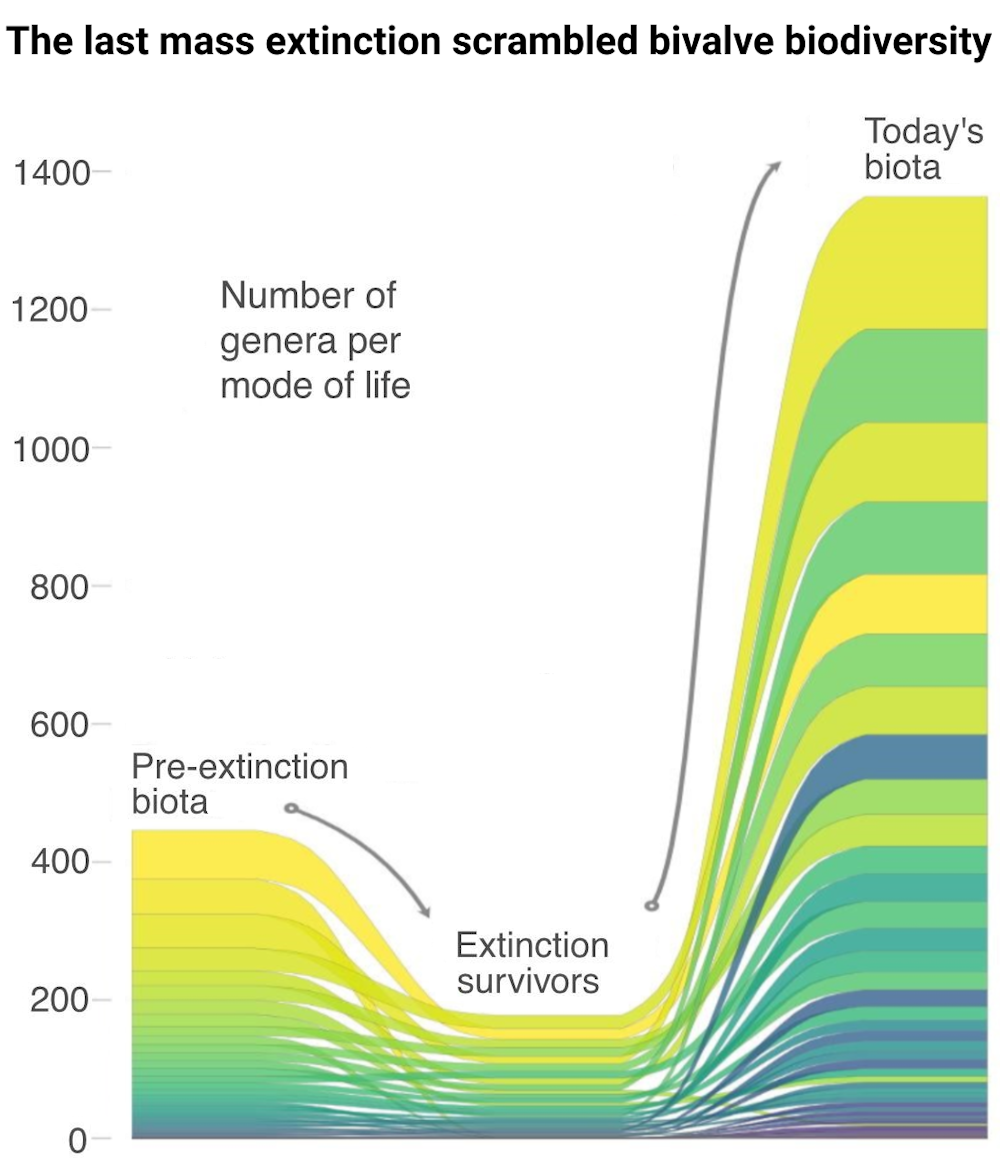
    Marine bivalves lost around three-quarters of their species during this mass extinction, which marked the end of the Cretaceous Period. My colleagues and I – each of us paleobiologists studying biodiversity – expected that losing so many species would have severely cut down the variety of roles that bivalves play within their environments, what we call their “modes of life.”

    But, as we explain in a study published in the journal Sciences Advances, that wasn’t the case. In assessing the fossils of thousands of bivalve species, we found that at least one species from nearly all their modes of life, no matter how rare or specialized, squeaked through the extinction event.

    Statistically, that shouldn’t have happened. Kill 70% of bivalve species, even at random, and some modes of life should disappear.

    Most bivalves happily burrow into the sand and mud, feeding on phytoplankton they strain from the water. But others have adopted chemosymbionts and photosymbionts – bacteria and algae that produce nutrients for the bivalves from chemicals or sunlight in exchange for housing. A few have even become carnivorous. Some groups, including the oysters, can lay down a tough cement that hardens underwater, and mussels hold onto rocks by spinning silken threads.

    We thought surely these more specialized modes of life would have been snuffed out by the effects of the asteroid’s impact, including dust and debris likely blocking sunlight and disrupting a huge part of the bivalves’ food chain: photosynthetic algae and bacteria. Instead, most persisted, although biodiversity was forever scrambled as a new ecological landscape emerged. Species that were once dominant struggled, while evolutionary newcomers rose in their place.

    The reasons some species survived and others didn’t leave many questions to explore. Those that filtered phytoplankton from the water column suffered some of the highest species losses, but so did species that fed on organic scraps and didn’t rely as much on the Sun’s energy. Narrow geographic distributions and different metabolisms may have contributed to these extinction patterns.

    Biodiversity bounces back

    Life rebounded from each of the Big Five mass extinctions throughout Earth’s history, eventually punching through past diversity highs. The rich fossil record and spectacular ecological diversity of bivalves gives us a terrific opportunity to study these rebounds to understand how ecosystems and global biodiversity rebuild in the wake of extinctions.

    The extinction caused by the asteroid strike knocked down some thriving modes of life and opened the door for others to dominate the new landscape.

    The rebound from the extinction wasn’t so straightforward. Some modes of life lost nearly all their species, never to recover their past diversity. Others rose to take the top ranks. Genera is the plural of genus.
    Adapted from Edie et al. 2025, Science Advances

    While many people lament the loss of the dinosaurs, we malacologists miss the rudists.

    These bizarrely shaped bivalves resembled giant ice cream cones, sometimes reaching more than 3 feet (1 meter) in size, and they dominated the shallow, tropical Mesozoic seas as massive aggregations of contorted individuals, similar to today’s coral reefs. At least a few harbored photosymbiotic algae, which provided them with nutrients and spurred their growth, much like modern corals.

    An ancient fossil of a rudist from before the last mass extinction. These bivalves could grow to a meter high.
    Smithsonian Institution

    Today, giant clams (Tridacna) and their relatives fill parts of these unique photosymbiotic lifestyles once occupied by the rudists, but they lack the rudists’ astonishing species diversity.

    Mass extinctions clearly upend the status quo. Now, our ocean floors are dominated by clams burrowed into sand and mud, the quahogs, cockles and their relatives – a scene far different from that of the seafloor 66 million years ago.

    New winners in a scrambled ecosystem

    Ecological traits alone didn’t fully predict extinction patterns, nor do they entirely explain the rebound. We also see that simply surviving a mass extinction didn’t necessarily provide a leg up as species diversified within their old and sometimes new modes of life – and few of those new modes dominate the ecological landscape today.

    Like the rudists, trigoniid bivalves had lots of different species prior to the extinction event. These highly ornamented clams built parts of their shells with a super strong biomaterial called nacre – think iridescent pearls – and had fractally interlocking hinges holding their two valves together.

    An ancient fossil of a pearly but tough trigoniid bivalve from the last mass extinction. The two matching shells show their elaborate hinge.
    Smithsonian Institution

    But despite surviving the extinction, which should have placed them in a prime position to accumulate species again, their diversification sputtered. Other types of bivalves that made a living in the same way proliferated instead, relegating this once mighty and global group to a handful of species now found only off the coast of Australia.

    Lessons for today’s oceans

    These unexpected patterns of extinction and survival may offer lessons for the future.

    The fossil record shows us that biodiversity has definite breaking points, usually during a perfect storm of climatic and environmental upheaval. It’s not just that species are lost, but the ecological landscape is overturned.

    Many scientists believe the current biodiversity crisis may cascade into a sixth mass extinction, this one driven by human activities that are changing ecosystems and the global climate. Corals, whose reefs are home to nearly a quarter of known marine species, have faced mass bleaching events as warming ocean water puts their future at risk. Acidification as the oceans absorb more carbon dioxide can also weaken the shells of organisms crucial to the ocean food web.

    Findings like ours suggest that, in the future, the rebound from extinction events will likely result in very different mixes of species and their modes of life in the oceans. And the result may not align with human needs if species providing the bulk of ecosystem services are driven genetically or functionally extinct.

    The global oceans and their inhabitants are complex, and, as our team’s latest research shows, it is difficult to predict the trajectory of biodiversity as it rebounds – even when extinction pressures are reduced.

    Billions of people depend on the ocean for food. As the history recorded by the world’s bivalves shows, the upending of the pecking order – the number of species in each mode of life – won’t necessarily settle into an arrangement that can feed as many people the next time around.

    Stewart Edie receives funding from the Smithsonian Institution.

    ref. Ancient fossils show how the last mass extinction forever scrambled the ocean’s biodiversity – https://theconversation.com/ancient-fossils-show-how-the-last-mass-extinction-forever-scrambled-the-oceans-biodiversity-258389

    MIL OSI – Global Reports

  • MIL-OSI Global: How the ‘Big Beautiful Bill’ positions US energy to be more costly for consumers and the climate

    Source: The Conversation – USA – By Daniel Cohan, Professor of Civil and Environmental Engineering, Rice University

    Proposed revisions to U.S. energy policy would likely raise consumer prices and climate-warming emissions. zpagistock/Moment via Getty Images

    When it comes to energy policy, the “One Big Beautiful Bill Act” – the official name of a massive federal tax-cut and spending bill that House Republicans passed in May 2025 – risks raising Americans’ energy costs and greenhouse gas emissions.

    The 1,100-page bill would slash incentives for green technologies such as solar, wind, batteries, electric cars and heat pumps while subsidizing existing nuclear power plants and biofuels. That would leave the country and its people burning more fossil fuels despite strong popular and scientific support for a rapid shift to renewable energy.

    The bill may still be revised by the Senate before it moves to a final vote. But it is a picture of how President Donald Trump and congressional Republicans want to reshape U.S. energy policy.

    As an environmental engineering professor who studies ways to confront climate change, I think it is important to distinguish which technologies could rapidly cut emissions or are on the verge of becoming viable from those that do little to fight climate change. Unfortunately, the House bill favors the latter while nixing support for the former.

    Renewable energy

    Wind and solar power, often paired with batteries, are providing over 90% of the new electricity currently being added to the grid nationally and around the world. Geothermal power is undergoing technological breakthroughs. With natural gas turbines in short supply and long lead times to build other resources, renewables and batteries offer the fastest way to satisfy growing demand for power.

    However, the House bill rescinds billions of dollars that the Inflation Reduction Act, enacted in 2022, devoted to boosting domestic manufacturing and deployments of renewable energy and batteries.

    It would terminate tax credits for manufacturing for the wind industry in 2028 and for solar and batteries in 2032. That would disrupt the boom in domestic manufacturing projects that was being stimulated by the Inflation Reduction Act.

    Deployments would be hit even harder. Wind, solar, geothermal and battery projects would need to commence construction within 60 days of passage of the bill to receive tax credits.

    In addition, the bill would deny tax credits to projects that use Chinese-made components. Financial analysts have called those provisions “unworkable,” since some Chinese materials may be necessary even for projects built with as much domestic content as possible.

    Analysts warn that the House bill would cut new wind, solar and battery installations by 20% compared with the growth that had been expected without the bill. That’s why BloombergNEF, an energy research firm, called the bill a “nightmare scenario” for clean energy proponents.

    However, one person’s nightmare may be another man’s dream. “We’re constraining the hell out of wind and solar, which is good,” said Rep. Chip Roy, a Texas Republican backed by the oil and gas industry.

    Wind turbines and solar panels generate renewable energy side by side near Palm Springs, Calif.
    Mario Tama/Getty Images

    Efficiency and electric cars

    Cuts fall even harder on Americans who are trying to reduce their carbon footprints and energy costs. The bill repeals aid for home efficiency improvements such as heat pumps, efficient windows and energy audits. Homeowners would also lose tax credits for installing solar panels and batteries.

    For vehicles, the bill would not only repeal tax credits for electric cars, trucks and chargers, but it also would impose a federal $250 annual fee on vehicles, on top of fees that some states charge electric-car owners. The federal fee is more than the gas taxes paid by other drivers to fund highways and ignores air-quality and climate effects.

    Combined, the lost credits and increased fees could cut projected U.S. sales of electric vehicles by 40% in 2030, according to modeling by Jesse Jenkins of Princeton University.

    Nuclear power

    Meanwhile, the bill partially retains a tax credit for electricity from existing nuclear power plants. Those plants may not need the help: Electricity demand is surging, and companies like Meta are signing long-term deals for nuclear energy to power data centers. Nuclear plants are also paid to manage their radioactive waste, since the country lacks a permanent place to store it.

    For new nuclear plants, the bill would move up the deadline to 2028 to begin construction. That deadline is too soon for some new reactor designs and would rush the vetting of others. Nuclear safety regulators are awaiting a study from the National Academies on the weapons proliferation risks of the type of uranium fuel that some developers hope to use in newer designs.

    The House-passed bill would protect government subsidies for existing nuclear power plants, like the one in the background, while limiting support for wind turbines.
    Scott Olson/Getty Images

    Biofuels

    While cutting funding for electric vehicles, the bill would spend $45 billion to extend tax credits for biofuels such as ethanol and biodiesel.

    Food-based biofuels do little good for the climate because growing, harvesting and processing crops requires fertilizers, pesticides and fuel. The bill would allow forests to be cut to make room for crops because it directs agencies to ignore the impacts of biofuels on land use.

    Hydrogen

    The bill would end tax credits for hydrogen production. Without that support, companies will be unlikely to invest in the seven so-called “hydrogen hubs” that were allocated a combined $8 billion under the Bipartisan Infrastructure Law in 2021. Those hubs aim to attract $40 billion in private investments and create tens of thousands of jobs while developing cleaner ways to make hydrogen.

    The repealed tax credits would have subsidized hydrogen made emissions-free by using renewable or nuclear electricity to split water molecules. They also would have subsidized hydrogen made from natural gas with carbon capture, whose benefits are impaired by methane emissions from natural gas systems and incomplete carbon capture.

    However it’s made, hydrogen is no panacea. As the world’s smallest molecule, hydrogen is prone to leaking, which can pose safety challenges and indirectly warm the climate. And while hydrogen is essential for making fertilizers and potentially useful for making steel or aviation fuels, vehicles and heating are more efficiently powered by electricity than by hydrogen.

    Still, European governments and China are investing heavily in hydrogen production.

    As Congress deliberates on the One Big Beautiful Bill Act, the nation’s energy agenda is one of many issues being hotly debated.
    Kevin Carter/Getty Images

    Summing it up

    The conservative Tax Foundation estimates that the House bill would cut the Inflation Reduction Act’s clean energy tax credits by about half, saving the government $50 billion a year. But with fewer efficiency improvements, fewer electric vehicles and less clean power on the grid, Princeton’s Jenkins projects American households would pay up to $415 more per year for energy by 2035 than if the bill’s provisions were not enacted. If the bill’s provisions make it into law, the extra fossil fuel-burning would leave annual U.S. greenhouse gas emissions 1 billion tons higher by then.

    No one expected former President Joe Biden’s Inflation Reduction Act to escape unscathed with Republicans in the White House and dominating both houses of Congress. Still, the proposed cuts target the technologies Americans count on to protect the climate and save consumers money.

    Daniel Cohan receives funding from the Carbon Hub at Rice University.

    ref. How the ‘Big Beautiful Bill’ positions US energy to be more costly for consumers and the climate – https://theconversation.com/how-the-big-beautiful-bill-positions-us-energy-to-be-more-costly-for-consumers-and-the-climate-257783

    MIL OSI – Global Reports

  • MIL-OSI Global: LGBTQ+ patients stay up-to-date on preventive care when their doctors are supportive, saving money and lives throughout society

    Source: The Conversation – USA – By Nathaniel M. Tran, Assistant Professor of Health Policy and Administration, University of Illinois Chicago

    Getting cancer screenings, vaccinations and HIV tests is easier when you can trust your doctor. Hit Stop Media/iStock via Getty Images Plus

    When LGBTQ+ patients are unsure if they can be open about their identity and related health needs, it becomes more difficult for them to access high-quality health care.

    In our recently published research, my colleagues and I found that how LGBTQ+ people are treated at the doctor’s office has a measurable effect on whether they stay up to date with lifesaving preventive care like flu shots, colorectal cancer screenings and HIV testing.

    Results of affirming care

    We examined how LGBTQ+ adults rated their health care provider across three areas: LGBTQ+ cultural competency, such as if providers used inclusive language on forms and in person; LGBTQ+ clinical competency, such as their doctor’s knowledge on all aspects of their health; and experiences of discrimination, such as being told to seek care elsewhere.

    After analyzing survey data on the experiences of more than 950 LGBTQ+ adults from across the U.S., we saw that three clear patterns emerged.

    First, 34% of participants reported having positive health care experiences – meaning their providers were culturally and clinically competent about LGBTQ+ health needs, and did not discriminate against them. These patients were more likely to be up to date on at least one preventive service recommended by the U.S. Preventive Services Task Force, compared to those receiving neutral or discriminatory care.

    Second, 60% of participants reported having neutral experiences, when their providers were clinically competent about LGBTQ+ health needs and didn’t discriminate against them, but were not culturally competent. These patients were 43% less likely to get an HIV test compared to patients reporting affirming care.

    Third, 6% of participants reported experiencing discrimination, when their providers were neither culturally nor clinically competent on LGBTQ+ health. These patients were 24% less likely to get a colorectal cancer screening compared to patients reporting affirming care.

    Most LGBTQ+ adults in our study reported neutral or even discriminatory care, which leads to avoidable health risks and higher costs for the health system. This provides additional evidence that being supportive of LGBTQ+ patients has measurable improvements for health outcomes.

    Fear of discrimination can lead to delayed and missed diagnoses.

    Why preventive care matters

    Preventive care saves lives and saves money. When diseases like colorectal cancer or HIV are caught early, treatments are often simpler, more effective and less expensive.

    When LGBTQ+ patients are made to feel unwelcome or unsafe, we found that they are less likely to get routine preventive care, ultimately driving up long-term costs across the health system. States like North Carolina and Georgia that have more health systems participating in the Human Rights Campaign’s Healthcare Equality Index, which evaluates policies and practices around LGBTQ+ care, had higher rates of LGBTQ+ patients reporting positive care experiences compared to states with few participating health systems, such as Tennessee and Alabama.

    Other researchers have found that health systems participating in the Healthcare Equality Index have lower rates of nurse burnout and better quality of care, along with higher patient satisfaction among all patients.

    Affirming care benefits not just patients, but society as a whole.
    Renata Angerami/iStock via Getty Images Plus

    Public health in crisis

    This study was originally funded by the National Institute on Aging, but it was among the first LGBTQ+-focused projects terminated by the Trump administration in its efforts to eliminategender ideology.”

    Our team has continued the work independently to ensure that the over 1,250 participants who already shared their experiences and data would not have this information sit idly.

    Our findings reinforce what many LGBTQ+ patients already know – nonjudgmental and competent care is not a luxury, but a public health necessity.

    Nathaniel M. Tran received funding from the National Institute on Aging and Vanderbilt University.

    ref. LGBTQ+ patients stay up-to-date on preventive care when their doctors are supportive, saving money and lives throughout society – https://theconversation.com/lgbtq-patients-stay-up-to-date-on-preventive-care-when-their-doctors-are-supportive-saving-money-and-lives-throughout-society-258338

    MIL OSI – Global Reports

  • MIL-OSI Global: Binge drinking brake found in mouse brains, offering future path to treating alcohol abuse – new research

    Source: The Conversation – USA – By Gilles Martin, Associate Professor of Neurobiology, UMass Chan Medical School

    Millions of people abuse alcohol. South_agency/E+ via Getty Images

    Despite the profound human, social and economic costs of alcohol abuse, existing treatments have failed to provide meaningful relief. Excessive alcohol consumption remains a leading cause of death and disability worldwide. In the U.S. alone, 16.4 million people age 12 and older reported binge drinking on five or more days in the past month.

    Although there are several drugs available to those seeking to stop or lower their alcohol consumption, their effectiveness is limited, and they often have significant side effects. Over the past three decades, efforts to treat excessive drinking have focused primarily on developing drugs that target proteins that can control how neurons respond to stimuli. Because these proteins are present in almost every neuron throughout the brain, the drugs also affect neurons that aren’t directly responsible for regulating alcohol’s effects. This often leads to unwanted side effects like headache, fatigue, drowsiness or insomnia.

    In my work as a neurobiologist, I study the idea that pinpointing the specific brain circuits that play a role in suppressing alcohol consumption is critical to developing targeted treatments with limited side effects. In my newly published research, my team and I identified a small cluster of neurons responsible for suppressing binge drinking.

    A map of binge drinking neurons

    Researchers have identified several brain regions that play a key role in alcohol abuse. But there has been strong evidence that only a very small number of neurons within these regions underpinned the effects of the drug on brain function.

    Small populations of neurons, called neuronal ensembles, have been shown to play a key role in memory formation and experiencing fear. However, researchers haven’t known whether the neuronal ensembles activated during binge drinking also influence binge drinking behavior.

    The brain’s binge drinking brakes can go awry.
    Victoria Kotlyarchuk/iStock via Getty Images Plus

    Considering the billions of neurons contained in the brain, the task of identifying these neurons is akin to finding a needle in a haystack. To solve this challenge, my colleagues and I used a genetically modified mouse model that, upon exposure to alcohol, activates a gene coding for a red fluorescent protein that is selectively expressed in alcohol-sensitive neurons. By tracing these fluorescent neurons, we were able to make a map of the precise locations of affected neurons.

    We identified a discrete number of neurons that respond to binge drinking in a brain region called the medial orbitofrontal cortex. This area is known for its key role in controlling decision-making and adapting behavior to a changing environment.

    We also found that turning this neuronal ensemble off resulted in a sharp increase of alcohol consumption in mice. This means that the brain has, in essence, a built-in regulation system that is activated during alcohol drinking to act as a brake on its consumption. Should these neurons misfire, the regulatory system would fail, possibly leading to uncontrolled drinking.

    Future treatments

    Although this study advances our understanding of how and where binge drinking modulates brain function in mice, it remains unclear whether human brains are also equipped with the same neuronal ensemble. If they are, stimulating these neurons may provide a path toward helping people who experience difficulty controlling their alcohol intake.

    Although selective control of neuronal activity is a formidable challenge, progress in gene therapy for patients with cancer and other rare diseases offers hope for more effective alcohol use disorder treatments with fewer side effects.

    Gilles Martin receives funding from the National Institute on Alcohol Abuse and Alcoholism, which is part of the National Institutes of Health.

    ref. Binge drinking brake found in mouse brains, offering future path to treating alcohol abuse – new research – https://theconversation.com/binge-drinking-brake-found-in-mouse-brains-offering-future-path-to-treating-alcohol-abuse-new-research-257217

    MIL OSI – Global Reports

  • MIL-OSI Global: Where is the center of the universe?

    Source: The Conversation – USA – By Rob Coyne, Teaching Professor of Physics, University of Rhode Island

    In space, there are four dimensions: length, width, height and time. scaliger/iStock/NASA via Getty Images Plus

    About a century ago, scientists were struggling to reconcile what seemed a contradiction in Albert Einstein’s theory of general relativity.

    Published in 1915, and already widely accepted worldwide by physicists and mathematicians, the theory assumed the universe was static – unchanging, unmoving and immutable. In short, Einstein believed the size and shape of the universe today was, more or less, the same size and shape it had always been.

    But when astronomers looked into the night sky at faraway galaxies with powerful telescopes, they saw hints the universe was anything but that. These new observations suggested the opposite – that it was, instead, expanding.

    Scientists soon realized Einstein’s theory didn’t actually say the universe had to be static; the theory could support an expanding universe as well. Indeed, by using the same mathematical tools provided by Einstein’s theory, scientists created new models that showed the universe was, in fact, dynamic and evolving.

    I’ve spent decades trying to understand general relativity, including in my current job as a physics professor teaching courses on the subject. I know wrapping your head around the idea of an ever-expanding universe can feel daunting – and part of the challenge is overriding your natural intuition about how things work. For instance, it’s hard to imagine something as big as the universe not having a center at all, but physics says that’s the reality.

    The universe gets bigger every day.

    The space between galaxies

    First, let’s define what’s meant by “expansion.” On Earth, “expanding” means something is getting bigger. And in regard to the universe, that’s true, sort of. Expansion might also mean “everything is getting farther from us,” which is also true with regard to the universe. Point a telescope at distant galaxies and they all do appear to be moving away from us.

    What’s more, the farther away they are, the faster they appear to be moving. Those galaxies also seem to be moving away from each other. So it’s more accurate to say that everything in the universe is getting farther away from everything else, all at once.

    This idea is subtle but critical. It’s easy to think about the creation of the universe like exploding fireworks: Start with a big bang, and then all the galaxies in the universe fly out in all directions from some central point.

    But that analogy isn’t correct. Not only does it falsely imply that the expansion of the universe started from a single spot, which it didn’t, but it also suggests that the galaxies are the things that are moving, which isn’t entirely accurate.

    It’s not so much the galaxies that are moving away from each other – it’s the space between galaxies, the fabric of the universe itself, that’s ever-expanding as time goes on. In other words, it’s not really the galaxies themselves that are moving through the universe; it’s more that the universe itself is carrying them farther away as it expands.

    A common analogy is to imagine sticking some dots on the surface of a balloon. As you blow air into the balloon, it expands. Because the dots are stuck on the surface of the balloon, they get farther apart. Though they may appear to move, the dots actually stay exactly where you put them, and the distance between them gets bigger simply by virtue of the balloon’s expansion.

    It’s the space between the dots that’s growing.
    NASA/JPL-Caltech, CC BY

    Now think of the dots as galaxies and the balloon as the fabric of the universe, and you begin to get the picture.

    Unfortunately, while this analogy is a good start, it doesn’t get the details quite right either.

    The 4th dimension

    Important to any analogy is an understanding of its limitations. Some flaws are obvious: A balloon is small enough to fit in your hand – not so the universe. Another flaw is more subtle. The balloon has two parts: its latex surface and its air-filled interior.

    These two parts of the balloon are described differently in the language of mathematics. The balloon’s surface is two-dimensional. If you were walking around on it, you could move forward, backward, left, or right, but you couldn’t move up or down without leaving the surface.

    Now it might sound like we’re naming four directions here – forward, backward, left and right – but those are just movements along two basic paths: side to side and front to back. That’s what makes the surface two-dimensional – length and width.

    The inside of the balloon, on the other hand, is three-dimensional, so you’d be able to move freely in any direction, including up or down – length, width and height.

    This is where the confusion lies. The thing we think of as the “center” of the balloon is a point somewhere in its interior, in the air-filled space beneath the surface.

    But in this analogy, the universe is more like the latex surface of the balloon. The balloon’s air-filled interior has no counterpart in our universe, so we can’t use that part of the analogy – only the surface matters.

    Trying to figure out how the universe works? Start by contemplating a balloon.
    Kristopher_K/iStock via Getty Images Plus

    So asking, “Where’s the center of the universe?” is somewhat like asking, “Where’s the center of the balloon’s surface?” There simply isn’t one. You could travel along the surface of the balloon in any direction, for as long as you like, and you’d never once reach a place you could call its center because you’d never actually leave the surface.

    In the same way, you could travel in any direction in the universe and would never find its center because, much like the surface of the balloon, it simply doesn’t have one.

    Part of the reason this can be so challenging to comprehend is because of the way the universe is described in the language of mathematics. The surface of the balloon has two dimensions, and the balloon’s interior has three, but the universe exists in four dimensions. Because it’s not just about how things move in space, but how they move in time.

    Our brains are wired to think about space and time separately. But in the universe, they’re interwoven into a single fabric, called “space-time.” That unification changes the way the universe works relative to what our intuition expects.

    And this explanation doesn’t even begin to answer the question of how something can be expanding indefinitely – scientists are still trying to puzzle out what powers this expansion.

    So in asking about the center of the universe, we’re confronting the limits of our intuition. The answer we find – everything, expanding everywhere, all at once – is a glimpse of just how strange and beautiful our universe is.

    Rob Coyne receives funding from the National Aeronautics and Space Administration (NASA) and the US National Science Foundation (NSF).

    ref. Where is the center of the universe? – https://theconversation.com/where-is-the-center-of-the-universe-252695

    MIL OSI – Global Reports

  • MIL-OSI Global: Do you know how to prepare for your digital life after death? CU Boulder’s student-run clinic has some advice

    Source: The Conversation – USA – By Dylan Thomas Doyle, Information Science Researcher, University of Colorado Boulder

    Older adults have large digital archives that can be hard to access after their deaths. picture alliance/Getty Images

    From family photos in the cloud to email archives and social media accounts, the digital lives of Americans are extensive and growing.

    According to recent studies by the password management companies NordPass and Dashlane, the average internet user maintains more than 150 online accounts. Individuals produce hundreds of gigabytes of data each year. But few people have plans for what happens to that digital legacy after they die.

    Unlike physical possessions, online assets often don’t pass smoothly from one generation to the next. Loved ones struggle to access important accounts or recover treasured photos. Many families face these challenges while already overwhelmed with grief.

    Most tech companies haven’t kept up with this reality. Fewer than 15% of popular online platforms have clear systems for handling a user’s death, and customer support is often limited, according to our new study. As people’s “digital footprints” expand, the lack of planning has become both a practical and emotional burden for families. This is especially true for older adults who may not be aware of the steps required to manage their digital estate.

    We are an associate professor of information science and a researcher at the University of Colorado Boulder. We are researching how to design technologies for people engaged in end-of-life planning for their data.

    First clinic of its kind

    We realized there was no organization or comprehensive website to help people navigate the technical, privacy or practical challenges they were facing. In response, we launched what we believe is a first-of-its-kind solution: the Digital Legacy Clinic.

    Just as writing a will helps manage physical possessions after death, planning your digital legacy ensures that your online life is handled according to your wishes.

    Our clinic opened in late 2024. The free clinic offers support both to people planning for the end of their digital lives and to those managing the digital estates of loved ones who have died.

    Led by students and housed in the University of Colorado, Boulder’s Information Science department, the clinic operates much like a pro bono law clinic. Community members in the Denver and Boulder areas, as well as from across the country, can contact the clinic for help.

    First, a person interested in getting support fills out a simple form. Then, a member of the clinic will send a follow-up email to clarify and offer preliminary advice. Since every case is different, often clinic workers will then meet via Zoom with a client to create a personalized plan for them and their family.

    How the clinic helps

    The clinic offers guidance on a wide range of digital estate concerns, including setting up digital legacy tools such as trusted contacts on Google and Apple or legacy contacts on Facebook – someone you choose to manage your main profile after you’ve died. People can also get guidance on how to memorialize or delete social media or other online accounts after a loved one has died.

    For example, Facebook allows you to either memorialize an account or request its removal. To memorialize it, you’ll need to submit a form with the person’s name, date of death, proof of passing, such as an obituary, and verify your relationship to the deceased. Including these steps can help your loved ones manage a digital legacy with clarity and care.

    The clinic also helps people recover and preserve digital assets. That includes photos, videos, emails and other important documents, such as legal documents stored on a Google Drive.

    For those who are planning for after they die, the clinic can guide them in creating a digital estate plan. That plan might include inventorying online accounts, documenting login credentials and leaving instructions for account closure, or determining steps to email the documents to your lawyer.

    Students supporting their community

    The ongoing work of the clinic is run entirely by undergraduate and graduate students, who build and maintain the clinic’s website, manage the client intake process and research solutions tailored to each case.

    For the students, it’s a hands-on learning opportunity that connects academic work to real-world needs. The experience is also professionally valuable. Students learn how to communicate complex tech topics with empathy, navigate privacy laws and manage sensitive data responsibly.

    A resource for older adults

    While the Digital Legacy Clinic is available to people across the country, its location in Boulder makes it especially accessible to older adults in the Boulder and Denver areas who may prefer or benefit from in-person support.

    For older adults, the Digital Legacy Clinic can help them organize their digital lives and make passing their digital archives on to their families easier.
    Robert Alexander/Getty Images

    For older adults, the clinic can play a crucial role in helping them organize their digital lives while they’re still alive. This can reduce confusion for loved ones later and even help prevent issues such as identity theft or account misuse. Many older adults now maintain extensive online presences, but they may not have the tools or knowledge to ensure their accounts are secure and accessible to people they trust.

    Jed Brubaker currently receives research funding from the National Science Foundation and Google. In the past he has recieved research funding from Facebook and Mozilla. During 2014-2020 he worked as a research for the Legacy Contact and Memorialized Profile features at Facebook.

    Dylan Thomas Doyle does not work for, consult, own shares in or receive funding from any company or organization that would benefit from this article, and has disclosed no relevant affiliations beyond their academic appointment.

    ref. Do you know how to prepare for your digital life after death? CU Boulder’s student-run clinic has some advice – https://theconversation.com/do-you-know-how-to-prepare-for-your-digital-life-after-death-cu-boulders-student-run-clinic-has-some-advice-257867

    MIL OSI – Global Reports

  • MIL-OSI Global: 100 years ago, the Social Gospel movement pushed to improve workers’ lives – but also to promote its vision of Christian America

    Source: The Conversation – USA – By Christina Littlefield, Associate Professor of Communication and Religion, Pepperdine University

    Immigrant children from Central Europe at a settlement house in St. Louis. Thomasa.nagel/Wikimedia Commons

    President Donald Trump has praised the Gilded Age, which he believes was a time of immense national prosperity thanks to tariffs, no income tax, and few regulations on business.

    Similar to today, the late 19th century was a time where a small group of men enjoyed immense wealth, privilege and power to shape the nation. It was a time of immense inequality, as factory and housing conditions crushed the lives of the poor.

    And it was a time of white Christian nationalism.

    In Northern cities, reformers saw the wealth gap, the plight of workers and the squalid conditions in tenements as undermining their vision of a Christian America. Fueled by faith, the Social Gospel movement worked to expand labor rights and improve living conditions at the turn of the 20th century.

    At the same time, many of these white Protestant activists believed their own culture and race to be superior, and this prejudice hindered their efforts. They often spouted anti-Catholic and anti-immigrant rhetoric, and mostly ignored Black workers’ plight.

    One of Jacob Riis’ many photographs of living conditions on New York’s Lower East Side.
    Bettmann via Getty Images

    Ever since the Puritans landed, white Christian nationalism has informed how many Protestants try to shape their country – a history I trace with church historian Richard T. Hughes in the book “Christian America and the Kingdom of God.” But Christian nationalism has taken dramatically different forms over time. The progressive Social Gospellers of a century ago are a particularly striking contrast to the conservative Christian right that has shaped U.S. politics for half a century, up to today.

    Guardians of a Christian nation

    There are many differences between Christian nationalism then and now. Like many conservative Christians today, however, the Social Gospellers believed that the United States was uniquely chosen and blessed by God, and called to be a Christian nation. They saw themselves as the rightful guardians of that mission. And though the country was still overwhelmingly Protestant, they feared they were losing influence.

    New research explored the history of the Bible – research that many Christians feared would undermine people’s trust in Scripture as the word of God, by emphasizing its human composition. New scientific ideas about the Earth’s creation and human evolution challenged their visions of an all-powerful, all-knowing God. Meanwhile, rapid industrialization and urbanization had created new social challenges, such as workers’ safety and living conditions, leading some to reject faith as irrelevant to their needs.

    Social Gospellers wanted to vindicate Christianity and show it was still relevant to modern life. But white leaders’ vision of what a Christian America should look like conflated their Protestant faith with their race and culture.

    Josiah Strong, for example, was a Congregationalist minister known for promoting factory safety. But he stoked fear of Catholic immigrants and endorsed the expansion of the U.S. as a benevolent empire. The Anglo-Saxon race “is destined to dispossess many weaker races, assimilate others, and mold the remainder,” Strong argued in his 1885 book, “Our Country.”

    Baptist reformer Walter Rauschenbusch.
    Library of Congress/Corbis/VCG via Getty Images

    Another Social Gospel reformer, Northern Baptist theologian Walter Rauschenbusch, railed against unrestrained greed, political corruption, militarism and contempt between elites and the working class. But he shared the white supremacy of his age. God was favoring Germanic and Anglo-Saxon people, he claimed, to enact God’s purposes.

    “Other races are as dear to God as we and he may be holding them in reserve to carry His banner when we drop it,” he wrote in an undated article. But it was part of God’s plan, he believed, for Northern Europeans to “hold the larger part of the world’s wealth and power in the hollow of their hands and the larger share of the world’s intellectual and spiritual possessions in the hollow of their heads.”

    The ‘right’ kind of Christian

    Though many white Protestants felt threatened by the challenges of immigration, they were still a clear majority, and they presumed that most Americans would endorse applying Christian ethics to public policy and social reform.

    Jane Addams speaks to visitors in 1935 at Hull House, a settlement house in Chicago that she co-founded in 1889.
    National Archives via Wikimedia Commons

    What’s more, women gaining the right to vote in 1920 meant Social Gospel leaders expanded Protestants’ power at the ballot box. Many Social Gospel leaders embraced women’s suffrage because women were already leading supporters for their causes: For example, Frances Willard, who promoted temperance and workers’ rights; and Jane Addams, who ran a Christian “settlement house,” or community center, for the poor.

    But in another sense, demographics were not on their side. The U.S. might have been a very white and Christian country, but in some Social Gospellers’ minds, the era’s waves of immigrants were not the “right” kind of Christian: Northern European and Protestant. Immigration was shifting from Great Britain, Ireland and Germany to Russia, Poland, Hungary and Italy. While Protestants far outnumbered Catholics nationally, Strong wrote that they were double the Protestant population in major cities like New York, Chicago and Philadelphia.

    A Polish mother and her nine children waiting at Ellis Island.
    U.S. National Park Service

    Strong argued that Catholic immigrants were lazy, prone to alcoholism and criminal activity, and willing to sell their vote to corrupt city politicians. He claimed they would corrupt the morals of Anglo-Saxon Americans, and that if the Catholic population grew, it would undermine Protestants’ religious liberty.

    Nativist views like these led to the National Origins Act of 1924, which restricted the number of immigrants. Quotas for each country were based on the profile of the American population in 1890 – an attempt to maintain Protestant dominance against Catholic and Jewish immigration from Southern and Eastern Europe. That distrust also kept Social Gospellers from partnering with Roman Catholic leaders on shared concern for workers.

    Flourishing for all, or some?

    Still, when it came to workers’ basic needs, reformers cared deeply about improving circumstances for the “least of these.” The movement was strongly influenced by the biblical parable of the sheep and the goats: verses in the Book of Matthew where Jesus promotes feeding the hungry, caring for the sick, clothing the naked and visiting those in prison.

    Social Gospellers aimed to prove that Christianity could answer the social challenges caused by industrialization, urbanization and immigration. For the most part, they sought to use their privilege in ways that promoted the flourishing of all Americans, such as expanding labor rights and providing services to the poor through settlement houses.

    A photograph by Jacob Riis in a small New York City sweatshop in the 1880s.
    Bettmann via Getty Images

    In 1908, for example, the Federal Council of Churches adopted a 14-point statement called the “Social Creed,” affirming that churches should support reforms “to lift the crushing burdens of the poor, and to reduce the hardships and uphold the dignity of labor.” While some of the reforms they called for are taken for granted today — like one day off per week — other calls, like a living wage for all, are yet to be realized.

    Over the past half-century, the modern Christian right, too, has feared that its vision for the nation is eroding. Conservative churches have seen their influence drop as more Americans move away from organized religion and reject their rejection of LGBTQ+ people.

    I — along with other scholars — argue that these fears have helped fuel resurgent Christian nationalism today. Since merging with the tea party movement during the Obama administration, the Christian right has increasingly embraced an anti-immigration and anti-minority stance, fearing the loss of its own standing.

    Like the Social Gospellers of a century ago, the Christian nationalists of recent decades are wary of religious and racial change in their country. Yet the movement’s priorities – often focused around its vision of families, sex and gender – are starkly more limited than the broader quality-of-life issues that Social Gospellers addressed.

    Both groups desired an America rooted in biblical values. But each interpreted Scripture through its own lens, seeking to remake America in its own, white Protestant image.

    Christina Littlefield does not work for, consult, own shares in or receive funding from any company or organization that would benefit from this article, and has disclosed no relevant affiliations beyond their academic appointment.

    ref. 100 years ago, the Social Gospel movement pushed to improve workers’ lives – but also to promote its vision of Christian America – https://theconversation.com/100-years-ago-the-social-gospel-movement-pushed-to-improve-workers-lives-but-also-to-promote-its-vision-of-christian-america-255216

    MIL OSI – Global Reports

  • MIL-Evening Report: Amnesty slams Israel for flouting international law with ‘chilling contempt’ over Madleen

    Asia Pacific Report

    Amnesty International secretary-general Agnès Callamard has condemned Israel’s interception and detention of the 12 crew members aboard the Gaza Freedom Flotilla’s humanitarian aid yacht Madleen.

    The crew detained include Swedish activist Greta Thunberg, who has been designated by Amnesty International as an “Ambassador of Conscience”, reports Amnesty International in a statement.

    She has since been reported to have been deported back to her country via France.

    Madleen’s crew were trying to break Israel’s illegal blockade on the occupied Gaza Strip and take in desperately needed humanitarian supplies.

    They were illegally detained by Israeli forces in international waters while en route.

    In response, Secretary General Agnès Callamard said:

    “By forcibly intercepting and blocking the Madleen which was carrying humanitarian aid and a crew of solidarity activists, Israel has once again flouted its legal obligations towards civilians in the occupied Gaza Strip and demonstrated its chilling contempt for legally binding orders of the International Court of Justice,” secretary-general Callamard said.

    Operation ‘violates international law’
    “The operation carried out in the middle of the night and in international waters violates international law and put the safety of those on the boat at risk.

    “The crew were unarmed activists and human rights defenders on a humanitarian mission, they must be released immediately and unconditionally.

    “They must also be protected from torture and other ill-treatment pending their release.

    Callamard said that during its voyage over the past few days the Madleen’s mission emerged as a powerful symbol of solidarity with besieged, starved and suffering Palestinians amid persistent international inaction.

    “However, this very mission is also an indictment of the international community’s failure to put an end to Israel’s inhumane blockade.

    “Activists would not have needed to risk their lives had Israel’s allies translated their rhetoric into forceful action to allow aid into Gaza.”

    Global calls for safe passage
    Israel’s interception of the Madleen despite global calls for it to be granted safe passage underscored the longstanding impunity Israel enjoyed which has emboldened it to continue to commit genocide in Gaza and to maintain a suffocating, illegal blockade on Gaza for 18 years, Callamard said.

    “Until we see real concrete steps by states worldwide signalling an end to their blanket support for Israel, it will have carte blanche to continue inflicting relentless death and suffering on Palestinians.”

    Amnesty International in New Zealand also called on Foreign Minister Winston Peters to stand up and call out the enforced starvation and genocide that Israel was imposing on Palestinians.

    MIL OSI AnalysisEveningReport.nz

  • MIL-Evening Report: Te Pāti Māori condemns Israel for Gaza ‘horrific violence’ over Madleen arrest

    Asia Pacific Report

    Aotearoa New Zealand’s Te Pāti Māori has condemned the Israeli navy’s armed interception of the Madleen, a civilian aid vessel attempting to carry food, medical supplies, and international activists to Gaza, including Sweden’s climate activist Greta Thunberg.

    In a statement after the Madleen’s communications were cut, the indigenous political party said it was not known if the crew were safe and unharmed.

    However, Israel has begun deportations of the activists and has confiscated the yacht and its aid supplies for Gaza.

    “This is the latest act in a horrific string of violence against civilians trying to access meagre aid,” said Te Pāti Māori co-leader Debbie Ngarewa-Packer.

    “Since May 27, more than 130 civilians have murdered been while lining up for food at aid sites.

    “This is not an arrest [of the Madleen crew], it as an abduction. We have grave concerns for the safety of the crew.

    “Israel [has] proven time again they aren’t above committing violence against civilians.

    “Blocking baby formula and prosthetics while a people are deliberately starved is not border patrol, it is genocide.”

    Te Pāti Māori said it called on the New Zealand government to:

    • Demand safe release of all crew;
    • Demand safe passage of Aid to Gaza;
    • Name this blockade and starvation campaign for what it is — genocide; and
    • Sanction Israel for their crimes against humanity

    MIL OSI AnalysisEveningReport.nz

  • MIL-Evening Report: Albanese announces first woman Treasury secretary and a ‘roundtable’ on boosting productivity

    Source: The Conversation (Au and NZ) – By Michelle Grattan, Professorial Fellow, University of Canberra

    Treasury head Steven Kennedy will become Anthony Albanese’s right-hand bureaucrat, while Treasury will get its first female secretary, with the appointment of Jenny Wilkinson, who currently heads the Finance Department.

    Kennedy, to be the new secretary of the Department of the Prime Minister and Cabinet, replaces Glyn Davis, who announced after the election he was leaving the post after just three years.

    Kennedy, 60, has had a close working relationship with Treasurer Jim Chalmers. He also served Chalmers’ Liberal predecessor, Josh Frydenberg, during the pandemic, when the Treasury was the main bureaucratic architect of the JobKeeper scheme that provided subsidies to business to keep on workers.

    Wilkinson, 58, has been secretary of the Finance Department since August 2022. She was previously a deputy secretary in Treasury, where she worked on the pandemic economic stimulus measures. She is also a former head of the Parliamentary Budget Office.

    As Treasury secretary, Wilkinson will take Stevens’ place on the Reserve Bank.

    Chalmers described Kennedy and Wilkinson as “the best of the best”, saying they were “outstanding public servants”.

    Finance Minister Katy Gallagher said Wilkinson’s appointment not only recognised her talent, skills and expertise, “but it also serves as an important reminder for women and girls across the country that all positions in the Australian Public Service – no matter how senior – are roles that women can hold”.

    The prime minister announced the bureaucratic reshuffle during his Tuesday address to the National Press Club on his second term agenda.

    With Chalmers already having named productivity as his primary priority for this term, Albanese said he had asked the treasurer to convene “a roundtable to support and shape our government’s growth and productivity agenda”.

    The summit, at Parliament House in August, will bring together a group of leaders from business, unions and civil society. More details will come in a speech on productivity by Chalmers next week.

    “This will be a more streamlined dialogue than the Jobs and Skills Summit, dealing with a more targeted set of issues,” Albanese said.

    “We want to build the broadest possible base of support for further economic reform, to drive growth, boost productivity, strengthen the budget, and secure the resilience of our economy, in a time of global uncertainty.

    “What we want is a focused dialogue and constructive debate that leads to concrete and tangible actions.”

    Albanese said the government’s starting point was clear, “Our plan for economic growth and productivity is about Australians earning more and keeping more of what they earn.” The aim was for growth, wages and productivity to rise together.

    The Productivity Commission recently released 15 “priority reform areas” to further explore as part of the five productivity inquiries that the government has commissioned it to undertake.

    The commission’s March quarterly bulletin shows a 0.1% decline in labour productivity in the December quarter, and a 1.2% decline over the year.

    COVID produced a temporary lift in productivity but that soon passed.

    In general Australia’s labour productivity has not significantly increased in more than a decade.

    Welcoming the roundtable, Australian Industry Group Chief Executive Innes Willox said it was “critical that this tripartite summit focus on getting private sector investment moving again. Our economy and labour market has been unsustainably reliant on government spending for a prolonged period now.”

    Michelle Grattan does not work for, consult, own shares in or receive funding from any company or organisation that would benefit from this article, and has disclosed no relevant affiliations beyond their academic appointment.

    ref. Albanese announces first woman Treasury secretary and a ‘roundtable’ on boosting productivity – https://theconversation.com/albanese-announces-first-woman-treasury-secretary-and-a-roundtable-on-boosting-productivity-257334

    MIL OSI AnalysisEveningReport.nz

  • MIL-Evening Report: In Trump’s America, the shooting of a journalist is not a one-off. Press freedom itself is under attack

    Source: The Conversation (Au and NZ) – By Peter Greste, Professor of Journalism and Communications, Macquarie University

    The video of a Los Angeles police officer shooting a rubber bullet at Channel Nine reporter Lauren Tomasi is as shocking as it is revealing.

    In her live broadcast, Tomasi is standing to the side of a rank of police in riot gear. She describes the way they have begun firing rubber bullets to disperse protesters angry with US President Donald Trump’s crackdown on illegal immigrants.

    As Tomasi finishes her sentence, the camera pans to the left, just in time to catch the officer raising his gun and firing a non-lethal round into her leg. She said a day later she is sore, but otherwise OK.

    Although a more thorough investigation might find mitigating circumstances, from the video evidence, it is hard to dismiss the shot as “crossfire”. The reporter and cameraman were off to one side of the police, clearly identified and working legitimately.

    The shooting is also not a one-off. Since the protests against Trump’s mass deportations policy began three days ago, a reporter with the LA Daily News and a freelance journalist have been hit with pepper balls and tear gas.

    British freelance photojournalist Nick Stern also had emergency surgery to remove a three-inch plastic bullet from his leg.

    In all, the Los Angeles Press Club has documented more than 30 incidents of obstruction and attacks on journalists during the protests.

    Trump’s assault on the media

    It now seems assaults on the media are no longer confined to warzones or despotic regimes. They are happening in American cities, in broad daylight, often at the hands of those tasked with upholding the law.

    But violence is only one piece of the picture. In the nearly five months since taking office, the Trump administration has moved to defund public broadcasters, curtail access to information and undermine the credibility of independent media.

    International services once used to project democratic values and American soft power around the world, such as Voice of America, Radio Free Europe and Radio Free Asia, have all had their funding cut and been threatened with closure. (The Voice of America website is still operational but hasn’t been updated since mid-March, with one headline on the front page reading “Vatican: Francis stable, out of ‘imminent danger’ of death”).

    The Associated Press, one of the most respected and important news agencies in the world, has been restricted from its access to the White House and covering Trump. The reason? It decided to defy Trump’s directive to change the name of the Gulf of Mexico to Gulf of America.

    Even broadcast licenses for major US networks, such as ABC, NBC and CBS, have been publicly threatened — a signal to editors and executives that political loyalty might soon outweigh journalistic integrity.

    The Committee to Protect Journalists is more used to condemning attacks on the media in places like Russia. However, in April, it issued a report headlined: “Alarm bells: Trump’s first 100 days ramp up fear for the press, democracy”.

    A requirement for peace

    Why does this matter? The success of American democracy has never depended on unity or even civility. It has depended on scrutiny. A system where power is challenged, not flattered.

    The First Amendment to the US Constitution – which protects freedom of speech – has long been considered the gold standard for building the institutions of free press and free expression. That only works when journalism is protected — not in theory but in practice.

    Now, strikingly, the language once reserved for autocracies and failed states has begun to appear in assessments of the US. Civicus, which tracks declining democracies around the world, recently put the US on its watchlist, alongside the Democratic Republic of Congo, Italy, Serbia and Pakistan.

    The attacks on the journalists in LA are troubling not only for their sake, but for ours. This is about civic architecture. The kind of framework that makes space for disagreement without descending into disorder.

    Press freedom is not a luxury for peacetime. It is a requirement for peace.

    Peter Greste is Professor of Journalism at Macquarie University and the Executive Director for the advocacy group, the Alliance for Journalists’ Freedom.

    ref. In Trump’s America, the shooting of a journalist is not a one-off. Press freedom itself is under attack – https://theconversation.com/in-trumps-america-the-shooting-of-a-journalist-is-not-a-one-off-press-freedom-itself-is-under-attack-258578

    MIL OSI AnalysisEveningReport.nz

  • MIL-Evening Report: hMPV is likely one of the viruses making us sick this winter. Here’s what to know about human metapneumovirus

    Source: The Conversation (Au and NZ) – By Lara Herrero, Associate Professor and Research Leader in Virology and Infectious Disease, Griffith University

    svetikd/Getty Images

    As winter settles over Australia, it’s not just the drop in temperature we notice – there’s also a sharp rise in respiratory illnesses. Most of us are familiar with the usual winter players such as COVID, influenza and RSV (respiratory syncytial virus), which often dominate news headlines and public health messaging.

    But scientists are now paying closer attention to another virus that’s been spreading somewhat under the radar: human metapneumovirus (hMPV).

    Although it’s not new, hMPV is now being recognised as a significant contributor to seasonal respiratory infections, especially among young children, older people, and people with weaker immune systems.

    So what do you need to know about this winter lurgy?

    What does a hMPV infection look like?

    hMPV is a close relative of RSV, and can cause infections in the upper or lower respiratory tracts.

    Like other respiratory viruses, hMPV infection causes symptoms such as cough, fever, sore throat and nasal congestion. While most people experience relatively mild illness and recover in about a week, hMPV can lead to serious illness – such as bronchiolitis or pneumonia – in babies, older adults, and people with weakened immune systems.

    hMPV spreads much like the flu or SARS-CoV-2 (the virus that causes COVID) – through tiny droplets from coughs and sneezes, and potentially by touching surfaces where the virus has landed and then touching your mouth, nose, or eyes.

    Most people will catch it at some point in their lives, commonly more than once. While an infection confers some immunity, this wanes over time.

    hMPV generally follows a seasonal pattern, tending to peak in winter and spring.

    hMPV around the world

    By the end of 2024, China saw a surprising spike in cases of hMPV – enough to catch the attention of public health experts. While there were some suggestions hospitals were becoming overwhelmed, exact numbers were not clear.

    The World Health Organization subsequently issued a statement in January indicating this rise in hMPV infections in China aligned with expected seasonal trends.

    Other countries, such as the United States, have also noted increases in hMPV infections since the COVID pandemic. Realising hMPV might be playing a more significant role in seasonal illness than we’d previously thought, and with improvements in diagnostic technology, global health agencies have ramped up their monitoring.


    Read more:
    hMPV may be spreading in China. Here’s what to know about this virus – and why it’s not cause for alarm


    In Australia, comprehensive national data on hMPV is limited because hMPV is not one of the viruses with mandatory reporting. In other words, if a patient is found to have hMPV (through a PCR swab sent to a pathology lab) there’s no requirement for the doctor or the pathology lab to make a public health report of a positive result, as they would with another illness such as influenza, RSV or measles.

    However, selected medical clinics voluntarily participate in systematic data collection on specific health conditions, which give us an idea of the proportion of people of people who may be infected (though not the absolute numbers).

    The Australian Sentinel Practice Research Network (ASPREN) is a national surveillance system funded by the federal department of health. In 2024, up to December 15, based on ASPREN data, 7.8% of patients presenting with fever and cough symptoms tested positive for hMPV.

    This year, to June 1, ASPREN data shows us hMPV has made up 4.2% of infections among people with flu-like illness, behind RSV (7.7%), COVID (10.9%), influenza (19%) and rhinovirus (a virus which causes the common cold, 46.1%).

    hMPV can hit harder in young children.
    Tomsickova Tatyana/Shutterstock

    What about vaccines and treatments?

    hMPV is likely to be part of the array of respiratory viruses circulating in Australia this winter. If you have a cold or flu-like illness and have done one of those at-home rapid tests for COVID, flu and RSV but came up all negative, it’s possible hMPV is the culprit.

    There’s currently no specific treatment or vaccine for hMPV. Most cases are mild and can be managed at home with rest and symptom relief such as taking medication (paracetamol or ibuprofen) for pain and fever. But more serious infections may require hospital care.

    If your baby or young child has a respiratory infection and is having trouble breathing, you should take them to the emergency department.

    Researchers and companies such as Moderna, Pfizer and Vicebio are actively working on vaccines for hMPV, however they’re not yet available.

    The best way to protect yourself and others against hMPV and other respiratory viruses is through simple hygiene practices. These include washing your hands often, covering coughs and sneezes, staying home if you’re sick, cleaning shared surfaces regularly, and considering wearing a mask in crowded indoor spaces during virus season.

    Lara Herrero receives funding from the National Health and Medical Research Council.

    ref. hMPV is likely one of the viruses making us sick this winter. Here’s what to know about human metapneumovirus – https://theconversation.com/hmpv-is-likely-one-of-the-viruses-making-us-sick-this-winter-heres-what-to-know-about-human-metapneumovirus-257802

    MIL OSI AnalysisEveningReport.nz

  • MIL-Evening Report: Australia should stand up for our feta and prosecco in trade talks with the EU

    Source: The Conversation (Au and NZ) – By Hazel Moir, Honarary Associate Professor; economics of patents, geographical indications and other “IP”; trade treaties, Australian National University

    TY Lim/Shutterstock

    Trade Minister Don Farrell has confirmed Australia and the European Union will restart negotiations for a free trade agreement immediately. Two years ago, Australia walked away over a disappointing market access offer for our beef, sheep, dairy and sugar exporters.

    But with US President Donald Trump’s unilateral tariff increases, the world has changed. The chances of successfully completing the negotiations with the EU on increasing access for some agricultural products and cutting red tape now seem good.

    Australia wants improved access for its beef and lamb exports to Europe, but European farmers have significant political influence. The 2023 offer from the EU would have accounted for just 0.3% of its agricultural imports. It was also less than that offered to other trading partners.

    Another major stumbling block was the EU’s demand that Australia give up naming rights for hundreds of food and drink products.

    The EU wants Australia to adopt its system of regulating names for regional food and spirit specialties. If accepted, this could negatively impact on consumers, Australian dairies and boutique spirit makers.

    What is the EU asking for?

    The EU wants Australia to adopt its so-called “geographical indications” approach to protect the names of European products. It has listed 170 food names and 236 spirit names for Australia to give up.

    The EU argues Australia should allow only Greek feta to be sold here; currently Australian, Greek, Danish and Bulgarian feta are all sold in our shops. It also wants the names prosecco and parmesan reserved for European producers.

    Australia approaches food product labels differently, mainly through consumer protection laws. Further, there is little culture of fraud here, while the European system was originally introduced for wines because of widespread fraud, before it spread to food products.

    Problems arise with the specific food and spirit names the EU wants reserved for their producers. Australia argues these are common names for the food items and we shouldn’t lose access to them.

    Intellectual property privileges limit what other producers can do. So there is always a process to allow other parties to object. Our trade agreements also provide for objections processes.

    In 2019, the Australian government called for producers to raise any objections, but provided no follow-up and no process for the resolution of objections. Producers have received no feedback. This denies those affected by the European naming demands access to due process of law.

    The problem with parmesan

    The worst problems are with the common names that, in Australia, are recognised as generic product names.

    Prosecco grapes growing in the Veneto region of Italy. The EU wants to restrict use of the name prosecco.
    StevanZZ/Shutterstock

    The EU does recognise many food names as common names, such as gouda, brie, edam and camembert cheese. But they want Australia to declare that feta, parmesan and prosecco are not common names in Australia. Australian producers, retailers and consumers would disagree.

    The Europeans argue parmesan is a translation of its geographical indication, Parmigiano Reggiano. It refuses to accept that in Australia consumers recognise parmesan as the common name for a hard cheese while Parmigiano Reggiano is an Italian cheese.

    In 2024, the Singapore Court of Appeal ruled parmesan is not a translation of Parmigiano Reggiano in Singapore and is available for use in Singapore as a common name. It is also clearly recognised as a common name in the EU-Korea trade agreement.

    Carve-outs for feta producers

    Feta is not a place name (it means slice). Canada solved the feta problem in its trade deal with Europe by accepting feta as a geographical indication, but grandfathered the right of all existing Canadian producers to continue to produce and sell feta. Vietnam achieved similar safeguards.

    Australia could ask for the same deal as provided to Canada, and this would ensure no negative impacts on producers or Australian consumers. To protect Australian consumers, who are currently also able to buy Danish and Bulgarian feta, Australia should ensure this exception includes companies exporting into Australia.

    Who can make prosecco?

    Prosecco is specified as a grape variety in the 1994 Australia-Europe bilateral wine treaty, and in Italy until 2009.

    Since then the Italian government took action to privatise the name prosecco and the EU endorsed prosecco as a proprietary name.

    However, all treaties with geographical indications provisions recognise that animal breed and plant variety names should remain free for common use. Our prosecco producers make wine with the prosecco grape, and should be allowed to label it as such. Just like pinot noir is labelled as pinot noir, the grape variety, and not Burgundy, the region.

    If the EU does not provide better access to its agricultural markets, and demands naming provisions which hurt Australian dairies and consumers, and our boutique spirits industry, we would be better to walk away from the proposed treaty.

    Hazel Moir is affiliated with the Centre for European Studies in the Research School of Social Sciences at the Australian National University. From 2017-2019 she was lead researcher in a co-funded ANU and EU’s Erasmus+ Programme study which involved a meta-analysis of the available empirical evidence on the impact of GIs on farmers and regional development. The project funding was purely for research costs and involved no personal remuneration.

    John Power worked for the Department of Agriculture, Fisheries and Forestry from 2003 to 2019. He contributed to negotiations of the 2010 Australia-EU Trade in Wine Agreement and Australia’s FTAs. John led the amendments of the Wine Australia Act 2013 that introduced an objections process for wine GIs. In 2020 he joined the Department of Foreign Affairs and Trade as a GI specialist negotiator.

    ref. Australia should stand up for our feta and prosecco in trade talks with the EU – https://theconversation.com/australia-should-stand-up-for-our-feta-and-prosecco-in-trade-talks-with-the-eu-258392

    MIL OSI AnalysisEveningReport.nz

  • MIL-Evening Report: Australia’s government is pledging better protection for our vulnerable seas – but will it work?

    Source: The Conversation (Au and NZ) – By Carissa Klein, Associate Professor in Conservation Biology, The University of Queensland

    Nigel Marsh/Getty

    Ahead of this week’s crucial United Nations ocean conference, federal Environment Minister Murray Watt promised that by 2030, 30% of Australian waters would be “highly protected”.

    This is a telling pledge. After all, 52% of Australian waters are now protected following years of rapid expansion. But many are “paper parks” – lines on a map with very little real protection.

    Watt is proposing to expand the area under gold-standard protection, meaning fishing, mining and drilling would be banned inside the parks. This is welcome. But it must be done strategically, protecting ecologically representative and high biodiversity areas.

    If Watt is serious, he must ensure these upgraded marine parks cover poorly protected habitats important for biodiversity. These include shallow coastal zones, submarine canyons, seamounts and rocky reefs on the continental shelf. It’s not just about protecting 30% of the seas – marine parks must protect the full range of species and habitats in Australia.

    Bottom trawling and other fishing practices can do great damage to underwater ecosystems.
    mjstudio.lt/Shutterstock

    Impressive on paper

    Australia’s waters cover all five of the world’s climate zones, from the coral reefs of the tropics to the icy shores of Antarctica. At least 33,000 marine species are found in the nation’s marine boundaries – the most on Earth. Australia also has the most endemic marine species.

    For more than 30 years, successive federal and state governments in Australia have claimed global leadership roles in conserving ocean areas. Just last year, the Albanese government claimed the latest expansion meant Australia now protected “more ocean than any other country on earth”.

    When 196 countries committed to the goal of “30% by 2030” – the effective protection and management of at least 30% of the world’s coastal and marine areas by decade’s end – Australia was already well past that in terms of the size of areas considered marine protected areas.

    About 45% of marine waters were protected in 2022, up from 7% in 2002. Now that figure is 52%.

    Job done? Not even close. Even as Australia’s marine protected areas have rapidly expanded, marine species populations have shrunk while entire ecosystems hover on the brink.

    More than half of Australia’s marine parks allow commercial fishing and mining. The latest large protection around the sub-Antarctic Heard and McDonald Islands doesn’t give strong protection to species-rich areas such as seamounts and undersea canyons.

    Losses everywhere

    Tasmania’s giant kelp forests once ringed the island state. At least 95% have vanished since the 1990s, wiped out by warmer waters and voracious sea urchins.

    Before European settlement, oyster reefs carpeted shallow sea floors in temperate east coast waters. But 99% of these have gone.

    Half the Great Barrier Reef’s coral cover died between 1995 and 2017 – a period with only two mass bleaching events. Bleaching has become more regular and more severe since then.

    Many marine species are in serious trouble. The most comprehensive assessment to date found populations of 57% of species living on coral, rocky and kelp reefs had fallen between 2011 and 2021. In 2020, a Tasmanian endemic species, the smooth handfish, became the first marine fish officially listed as extinct on the IUCN Red List of Threatened Species.

    As the oceans get hotter, coral reefs are forecast to be wiped out. Poor marine water quality is drowning coastal species and ecosystems in sediments, nutrients, chemicals, and pathogens, including in The Great Barrier Reef.

    That’s not to say marine park expansion and other government efforts have been worthless. Far from it.

    Some whales have rebounded strongly due to the moratorium on commercial whaling. Good management of the southern bluefin tuna led to its removal from the threatened species list last year.

    Efforts to phase out gill net fishing are bearing fruit, while water quality has improved a little in the Great Barrier Reef.

    But these wins don’t offset an overall rapid decline.

    Action needed on climate and improving marine parks

    Giving Australia’s marine parks better protection won’t solve the problem of hotter, more acidic oceans due to climate change.

    Australia’s current emission target is consistent with a 2°C warming pathway. That level of warming would mean the loss of 99% of the world’s coral reefs.

    Australia is one of the world’s biggest producers of coal and liquefied natural gas and still has one of the world’s highest rates of land clearing, accounting for up to 12% of the country’s total emissions in some years.

    Protecting life in the seas means Australia must dramatically reduce emissions, end widespread land clearing and halt the approval of new coal and gas projects.

    Better protection inside marine parks will stop other major threats, such as seabed mining, gas and oil exploration and fishing.

    To date, Australia’s marine parks with high levels of protection are typically in remote areas with minimal human activity threatening biodiversity.

    From paper parks to real conservation leadership

    For decades, Australian leaders have touted their efforts to protect the seas. It’s now abundantly clear that paper protection isn’t enough.

    To arrest the steep decline in marine life, Australia must properly protect its marine areas by preventing fishing and mining in areas important for all marine species, while expanding its highly protected marine parks to save unprotected ecosystems.

    Minister Watt’s pledge is welcome. But it must actually prevent damaging human activities such as fishing and oil and gas extraction which are major contributors to the extinction crisis.

    Leaders must also focus on sustainable production and consumption of seafood and ramp up their ambition to tackle climate change and marine pollution.

    If Australia continues to expand paper parks without doing the hard work of genuine protection, it will set a dangerous precedent.

    Carissa Klein receives funding from the Australian Research Council

    James Watson has received funding from the Australian Research Council, National Environmental Science Program, South Australia’s Department of Environment and Water, Queensland’s Department of Environment, Science and Innovation as well as from Bush Heritage Australia, Queensland Conservation Council, Australian Conservation Foundation, The Wilderness Society and Birdlife Australia. He serves on the scientific committee of BirdLife Australia and has a long-term scientific relationship with Bush Heritage Australia and Wildlife Conservation Society. He serves on the Queensland government’s Land Restoration Fund’s Investment Panel as the Deputy Chair.

    Amelia Wenger does not work for, consult, own shares in or receive funding from any company or organisation that would benefit from this article, and has disclosed no relevant affiliations beyond their academic appointment.

    ref. Australia’s government is pledging better protection for our vulnerable seas – but will it work? – https://theconversation.com/australias-government-is-pledging-better-protection-for-our-vulnerable-seas-but-will-it-work-258286

    MIL OSI AnalysisEveningReport.nz

  • MIL-Evening Report: There are clear laws on enforcing blockades – Israel’s interception of the Madleen raises serious questions

    Source: The Conversation (Au and NZ) – By Shannon Bosch, Associate Professor (Law), Edith Cowan University

    On June 9, the Madleen, a UK-flagged civilian ship carrying humanitarian aid to Gaza, was stopped by Israeli forces in international waters, about 200 kilometres off the coast.

    The Freedom Flotilla Coalition had organised the voyage, setting sail from Sicily on June 1. The vessel’s 12 passengers included climate activist Greta Thunberg, European Parliament member Rima Hassan, two French journalists and several other activists from around the world.

    The Israeli military boarded the ship and diverted it to the Israeli port of Ashdod. The aid it carried — baby formula, food, medical supplies, water desalination kits — was confiscated. All passengers were detained and now face deportation.

    This interception has sparked international condemnation. Importantly, it also raises questions about whether Israel’s actions comply with international law.

    Legal conditions for naval blockades

    Naval blockades are not automatically illegal. Under the San Remo Manual on International Law Applicable to Armed Conflicts at Sea (1994), a blockade may be used in wartime, but only if five legal conditions are met:

    • it must be formally declared and publicly notified
    • it must be effectively enforced in practice
    • it must be applied impartially to all ships
    • it must not block access to neutral ports or coastlines
    • it must not stop the delivery of humanitarian aid to civilians.

    If even one of these conditions is not met, the blockade may be considered illegal under customary international humanitarian law.

    The fifth condition is especially important here. According to a comprehensive study of international humanitarian law conducted by the International Committee of the Red Cross, the parties to a conflict must allow the rapid and unimpeded delivery of humanitarian relief to civilians in need.

    A blockade that prevents this could be in breach of international law.

    Israel and Egypt have imposed a blockade of varying degrees on Gaza since 2007 when Hamas came to power. Israeli Defence Minister Israel Katz claims the purpose of the blockade is to “prevent the transfer of weapons to Hamas”. Critics say it amounts to collective punishment.

    The Madleen was operating in compliance with three binding International Court of Justice orders (from January 2024, March 2024 and May 2024) requiring unimpeded humanitarian access to Gaza.

    Freedom of navigation

    International law also strongly protects the freedom of navigation, particularly in international waters beyond any state’s territorial limits.

    There are only a few exceptions when a country can lawfully stop a foreign ship in international waters – if it is involved in piracy, slave trading, unauthorised broadcasting, or the vessel itself is stateless. A country can also stop a ship if it is enforcing a lawful blockade or acting in self-defence under Article 51 of the UN Charter.

    So, if Israel’s actions do not fully meet the international legal requirements for enforcing a blockade during wartime, it would not have the right to intercept the Madleen in international waters.

    Protections for humanitarian workers

    More broadly speaking, international humanitarian law, including the Fourth Geneva Convention, protects civilians during conflict. This protection extends to people delivering humanitarian aid, so long as they do not directly take part in hostilities.

    To be considered directly participating in hostilities, a person must:

    • intend to cause military harm
    • have a direct causal link to that harm, and
    • be acting in connection with one side of the conflict.

    Bringing aid to civilians, even if politically controversial, does not meet this legal threshold. As a result, the Madleen’s passengers remain protected civilians and should not be treated as combatants or detained arbitrarily.

    International law also sets out how civilians detained in conflict situations must be treated. Under the Fourth Geneva Convention, detainees must be given access to medical care, lawyers and consular representatives. They must also not be punished without fair legal processes.

    Reports that Madleen passengers have been detained and are facing deportation raise concerns about whether these standards are being upheld.

    In response to the ship’s interception, the Hind Rajab Foundation, a nonprofit advocacy group, has filed a complaint with the UK Metropolitan Police War Crimes Unit. The complaint alleges a number of breaches of international humanitarian law, including forcible detention, obstruction of humanitarian relief, and degrading treatment.

    Previous flotilla intercepted

    This is not the first time Israel has stopped an aid ship and faced accusations of violating the law of the sea and humanitarian law.

    In 2010, the Israeli military raided a flotilla of six ships organised by international activists aiming to deliver humanitarian aid to Gaza and challenge the blockade.

    Violence broke out on the largest vessel, the Mavi Marmara, resulting in the deaths of nine Turkish nationals and injuries to dozens of others. The incident drew international condemnation. Israel agreed to ease its blockade after the incident.

    A fact-finding mission established by the UN Human Rights Council found that Israel violated a number of international laws and that its blockade was “inflicting disproportionate damage upon the civilian population”.

    This is not just a political or moral issue – it’s a legal one. International law lays out clear rules for when and how a country can enforce blockades, intercept vessels and treat civilians.

    Based on these rules, serious legal questions remain about Israel’s handling of the Madleen and its passengers.

    Shannon Bosch does not work for, consult, own shares in or receive funding from any company or organisation that would benefit from this article, and has disclosed no relevant affiliations beyond their academic appointment.

    ref. There are clear laws on enforcing blockades – Israel’s interception of the Madleen raises serious questions – https://theconversation.com/there-are-clear-laws-on-enforcing-blockades-israels-interception-of-the-madleen-raises-serious-questions-258562

    MIL OSI AnalysisEveningReport.nz

  • MIL-Evening Report: ER Report: A Roundup of Significant Articles on EveningReport.nz for June 10, 2025

    ER Report: Here is a summary of significant articles published on EveningReport.nz on June 10, 2025.

    Why won’t my cough go away?
    Source: The Conversation (Au and NZ) – By David King, Senior Lecturer in General Practice, The University of Queensland Mladen Zivkovic/Shutterstock A persistent cough can be embarrassing, especially if people think you have COVID. Coughing frequently can also make you physically tired, interfere with sleep and trigger urinary incontinence. As a GP, I have even

    Bangarra Dance Theatre’s Illume is spectacle with heart and spirit, a thrilling manifestation of Country
    Source: The Conversation (Au and NZ) – By Erin Brannigan, Associate Professor, Theatre and Performance, UNSW Sydney Bangarra/Daniel Boud The stage is covered in stars that fill the depth of the space. When the 18 dancers slowly gather, they move through a night sky. This sky, and the scenes that unfold in Bangarra’s Illume are

    Starlink is transforming Pacific internet access – but in some countries it’s still illegal
    Source: The Conversation (Au and NZ) – By Amanda H.A. Watson, Fellow, Department of Pacific Affairs, Australian National University Solomon aligning the Starlink dish on the roof of his friend’s home in Vanuatu. Paul Basant In the past few years, Starlink’s satellite internet service has become available across much of the Pacific. This has created

    9 myths about electric vehicles have taken hold. A new study shows how many people fall for them
    Source: The Conversation (Au and NZ) – By Christian Bretter, Senior Research Fellow in Environmental Psychology, The University of Queensland More people believe misinformation about electric vehicles than disagree with it and even EV owners tend to believe the myths, our new research shows. We investigated the prevalence of misinformation about EVs in four countries

    Keith Rankin Analysis – Remembering New Zealand’s Missing Tragedy
    Analysis by Keith Rankin. Every country has its tragedies. A few are highly remembered. Most are semi-remembered. Others are almost entirely forgotten. Sometimes the loss of memory is due to these tragedies being to a degree international, seemingly making it somebody else’s ‘duty’ to remember them. This could have been the case with the Air

    A 10-fold increase in rocket launches would start harming the ozone layer – new research
    Source: The Conversation (Au and NZ) – By Laura Revell, Associate Professor in Atmospheric Chemistry, University of Canterbury Han Jiajun/VCG via Getty Images The international space industry is on a growth trajectory, but new research shows a rapid increase in rocket launches would damage the ozone layer. Several hundred rockets are launched globally each year

    For the first time, fossil stomach contents of a sauropod dinosaur reveal what they really ate
    Source: The Conversation (Au and NZ) – By Stephen Poropat, Research Associate, School of Earth and Planetary Sciences, Curtin University Artist’s reconstruction of Judy. Travis Tischler Since the late 19th century, sauropod dinosaurs (long-necks like Brontosaurus and Brachiosaurus) have been almost universally regarded as herbivores, or plant eaters. However, until recently, no direct evidence –

    The Racial Discrimination Act at 50: the bumpy, years-long journey to Australia’s first human rights laws
    Source: The Conversation (Au and NZ) – By Azadeh Dastyari, Director, Research and Policy, Whitlam Institute, Western Sydney University On June 11, Australia marks 50 years since the Racial Discrimination Act became law. This important legislation helps make sure people are treated equally no matter their race, skin colour, background, or where they come from.

    Fake news and real cannibalism: a cautionary tale from the Dutch Golden Age
    Source: The Conversation (Au and NZ) – By Garritt C. Van Dyk, Senior Lecturer in History, University of Waikato The Corpses of the De Witt Brothers, attributed to Jan de Baen, c. 1672-1675. Rijksmuseum The Dutch Golden Age, beginning in 1588, is known for the art of Rembrandt, the invention of the microscope, and the

    Some economists have called for a radical ‘global wealth tax’ on billionaires. How would that work?
    Source: The Conversation (Au and NZ) – By Venkat Narayanan, Senior Lecturer – Accounting and Tax, RMIT University Rudy Balasko/Shutterstock Earlier this year, I attended a housing conference in Sydney. The event’s opening address centred on the way Australia seems to be becoming like 18th-century England – a country where inheritance largely determines one’s opportunities

    Australia’s whooping cough surge is not over – and it doesn’t just affect babies
    Source: The Conversation (Au and NZ) – By Niall Johnston, Conjoint Associate Lecturer, Faculty of Medicine, UNSW Sydney Tomsickova Tatyana/Shutterstock Whooping cough (pertussis) is always circulating in Australia, and epidemics are expected every three to four years. However, the numbers we’re seeing with the current surge – which started in 2024 – are higher than

    As livestock numbers grow, wild animal populations plummet. Giving all creatures a better future will take a major rethink
    Source: The Conversation (Au and NZ) – By Clive Phillips, Adjunct Professor in Animal Welfare, Curtin University Toa55/Shutterstock As a teenager in the 1970s, I worked on a typical dairy farm in England. Fifty cows grazed on lush pastures for most of their long lives, each producing about 12 litres of milk daily. They were

    Johannesburg’s problems can be solved – but it’s a long journey to fix South Africa’s economic powerhouse
    Source: The Conversation (Au and NZ) – By Philip Harrison, Professor School of Architecture and Planning, University of the Witwatersrand South African president Cyril Ramaphosa met senior leaders of Johannesburg and Gauteng, the province it’s located in, in March 2025 to discuss ways to arrest the steep decline in South Africa’s largest city. Ramaphosa announced

    Albanese says the government’s focus on delivering commitments is essential to reinforce faith in democracy
    Source: The Conversation (Au and NZ) – By Michelle Grattan, Professorial Fellow, University of Canberra Prime Minister Anthony Albanese says his second term government is “focused on delivery” of its commitments, declaring this is important not only for the economy but also for Australians’ faith in our democracy. In a speech to the National Press

    Why Israel’s ‘humane’ propaganda is such a sinister facade
    COMMENTARY: By Cole Martin in Occupied Bethlehem Many people have been closely following the journey this week of the Madleen, a small humanitarian yacht seeking to break Israel’s illegal blockade of Gaza with a crew of 12 on board, including humanitarian activists and journalists. This morning we woke to the harrowing, yet not unexpected, news

    Trump has long speculated about using force against his own people. Now he has the pretext to do so
    Source: The Conversation (Au and NZ) – By Emma Shortis, Adjunct Senior Fellow, School of Global, Urban and Social Studies, RMIT University “You just [expletive] shot the reporter!” Australian journalist Lauren Tomasi was in the middle of a live cross, covering the protests against the Trump administration’s mass deportation policy in Los Angeles, California. As

    Palestinian supporters in NZ accuse Israel of ‘state piracy’ and condemn silence
    Asia Pacific Report Israel’s military attack and boarding of the humanitarian boat Madleen attempting to deliver food and medical aid to the besieged people of Gaza has been condemned by New Zealand Palestinian advocacy groups as a “staggering act of state piracy”. The vessel was in international waters, carrying aid workers, doctors, journalists, and supplies

    MIL OSI AnalysisEveningReport.nz

  • MIL-Evening Report: What is the World Test Championship and how did Australia qualify for the final?

    Source: The Conversation (Au and NZ) – By Vaughan Cruickshank, Senior Lecturer in Health and Physical Education, University of Tasmania

    HENRY NICHOLLS/AFP via Getty Images

    Cricket’s third World Test Championship final will begin on Wednesday night in London. Reigning champions Australia will compete with South Africa to be crowned the world’s best men’s Test cricket team.

    This new tournament has faced controversy because of the points system used to determine the two finalists, with South Africa also criticised in recent years for allowing many key players to compete in T20 tournaments instead of Test matches.

    Despite this, South Africa has earned its right to take on the Australians at Lord’s Cricket Ground.

    What is the World Test Championship?

    The World Test Championship is a tournament played between nine full members of the International Cricket Council (ICC): Australia, Bangladesh, England, India, New Zealand, Pakistan, South Africa, Sri Lanka and the West Indies.

    The previous winners were New Zealand (2021) and Australia (2023).

    The ICC introduced this tournament as a way to increase the relevance and importance of Test cricket in a world dominated by popular Twenty 20 tournaments such as the Big Bash and Indian Premier League.

    Each country plays three series of between two and five Test matches at home, and three away.

    The tournament takes two years to complete because each Test match can take five days and there are no dedicated times for Test match cricket throughout the year. This is because many cricketers also play in T20 and one-day tournaments.

    Teams are awarded points for wins (12 points), ties (six) and draws (four) – there are zero points for a loss. Teams lose points if they bowl their overs too slowly.

    While this point system is simple enough, ranking teams in the results table is more confusing, because some teams play more Tests than others.

    Bigger, wealthier countries such as England, India and Australia commonly play four or five Tests in a series, whereas less affluent countries often play series with only two or three Tests.

    Because of this difference, the results table is based on the percentage of points teams have won (how many points they won divided by how many points they could have won).

    For example, if a team played ten tests, the maximum points they could earn would be 120 (10 x 12 points for each win). If they earned 60 points, then they would be ranked on the results table as winning 50% (60 divided by 120).

    How did Australia and South Africa reach the final?

    South Africa finished on top of the table by winning series against the West Indies, Bangladesh, Sri Lanka and Pakistan. They also drew with India and lost to New Zealand.

    Australia beat Pakistan and India at home and New Zealand and Sri Lanka away. They also drew series with England (away) and the West Indies (home).

    The final will be played at the “home of cricket”: Lord’s in London.

    Neutral territory

    Test matches are rarely played at neutral venues but the World Test Championship final is played in England for a variety of reasons.

    The current two-year World Test Championship cycle ends in June, which is early summer in England and winter or monsoon season in most other major cricket nations.

    England also offers good infrastructure, strong crowds, a time zone that aligns favourably with prime time viewing hours in India, and pitches that offer a fair contest between bat and ball, allowing for exciting and competitive cricket.

    Despite these reasons, the repeated scheduling of finals in England has been criticised, predominantly by India.

    Criticisms of the championship

    South Africa’s qualification for the final has been criticised because they have played the least number of Tests and avoided playing some stronger teams.

    While these criticisms are not unfounded, they are also not South Africa’s fault: the ICC is responsible for ensuring scheduling is fair.

    Richer countries such as Australia, England and India face a dilemma in that five-Test series between them are generally high quality, exciting and profitable but are also difficult to win.

    Smaller nations playing two-Test series receive less interest and money but also easier opponents and less fixture fatigue. This situation can make it easier for smaller, less affluent teams to have a higher winning percentage.

    Other criticisms have focused on the points deductions for slow overs and the exclusion of Test playing nations Afghanistan, Ireland and Zimbabwe. When the World Test Championship was launched in 2019, only the nine full members were included. No specific reasons were given for the exclusion of Zimbabwe, Afghanistan and Ireland.

    Including these countries and having two six-team divisions – with teams being relegated and promoted each year – has been suggested as way to make the Test championship more fair and more competitive.

    However, this idea has also been criticised as focusing on profits instead of protecting and nurturing the game around the world.

    These deductions and divisions, and other potential changes, were considered at a recent ICC meeting but no changes were made.

    Final preparations

    Australian players have prepared for the final in a variety of ways, such as playing in the IPL, county cricket in the United Kingdom and practice sessions at home.

    They are favourites for the final and have a strong squad to choose from.

    South Africa also has a strong team with several key players returning from injuries and a drugs ban.

    A win for Australia would solidify its standing as the premier Test cricket team in the world. For South Africa, a victory would showcase a remarkable turnaround after being criticised for picking a weak squad for a tour of New Zealand, with most of its better players instead competing in T20 tournaments.

    There is also record prize money at stake.

    If the match is a draw, tie or washed out, Australia and South Africa will share the trophy. But there is a reserve day available in case of wet weather.

    Vaughan Cruickshank does not work for, consult, own shares in or receive funding from any company or organisation that would benefit from this article, and has disclosed no relevant affiliations beyond their academic appointment.

    ref. What is the World Test Championship and how did Australia qualify for the final? – https://theconversation.com/what-is-the-world-test-championship-and-how-did-australia-qualify-for-the-final-256999

    MIL OSI AnalysisEveningReport.nz

  • MIL-Evening Report: What is cricket’s World Test Championship and how did Australia qualify for the final?

    Source: The Conversation (Au and NZ) – By Vaughan Cruickshank, Senior Lecturer in Health and Physical Education, University of Tasmania

    HENRY NICHOLLS/AFP via Getty Images

    Cricket’s third World Test Championship final will begin on Wednesday night in London. Reigning champions Australia will compete with South Africa to be crowned the world’s best men’s Test cricket team.

    This new tournament has faced controversy because of the points system used to determine the two finalists, with South Africa also criticised in recent years for allowing many key players to compete in T20 tournaments instead of Test matches.

    Despite this, South Africa has earned its right to take on the Australians at Lord’s Cricket Ground.

    What is the World Test Championship?

    The World Test Championship is a tournament played between nine full members of the International Cricket Council (ICC): Australia, Bangladesh, England, India, New Zealand, Pakistan, South Africa, Sri Lanka and the West Indies.

    The previous winners were New Zealand (2021) and Australia (2023).

    The ICC introduced this tournament as a way to increase the relevance and importance of Test cricket in a world dominated by popular Twenty 20 tournaments such as the Big Bash and Indian Premier League.

    Each country plays three series of between two and five Test matches at home, and three away.

    The tournament takes two years to complete because each Test match can take five days and there are no dedicated times for Test match cricket throughout the year. This is because many cricketers also play in T20 and one-day tournaments.

    Teams are awarded points for wins (12 points), ties (six) and draws (four) – there are zero points for a loss. Teams lose points if they bowl their overs too slowly.

    While this point system is simple enough, ranking teams in the results table is more confusing, because some teams play more Tests than others.

    Bigger, wealthier countries such as England, India and Australia commonly play four or five Tests in a series, whereas less affluent countries often play series with only two or three Tests.

    Because of this difference, the results table is based on the percentage of points teams have won (how many points they won divided by how many points they could have won).

    For example, if a team played ten tests, the maximum points they could earn would be 120 (10 x 12 points for each win). If they earned 60 points, then they would be ranked on the results table as winning 50% (60 divided by 120).

    How did Australia and South Africa reach the final?

    South Africa finished on top of the table by winning series against the West Indies, Bangladesh, Sri Lanka and Pakistan. They also drew with India and lost to New Zealand.

    Australia beat Pakistan and India at home and New Zealand and Sri Lanka away. They also drew series with England (away) and the West Indies (home).

    The final will be played at the “home of cricket”: Lord’s in London.

    Neutral territory

    Test matches are rarely played at neutral venues but the World Test Championship final is played in England for a variety of reasons.

    The current two-year World Test Championship cycle ends in June, which is early summer in England and winter or monsoon season in most other major cricket nations.

    England also offers good infrastructure, strong crowds, a time zone that aligns favourably with prime time viewing hours in India, and pitches that offer a fair contest between bat and ball, allowing for exciting and competitive cricket.

    Despite these reasons, the repeated scheduling of finals in England has been criticised, predominantly by India.

    Criticisms of the championship

    South Africa’s qualification for the final has been criticised because they have played the least number of Tests and avoided playing some stronger teams.

    While these criticisms are not unfounded, they are also not South Africa’s fault: the ICC is responsible for ensuring scheduling is fair.

    Richer countries such as Australia, England and India face a dilemma in that five-Test series between them are generally high quality, exciting and profitable but are also difficult to win.

    Smaller nations playing two-Test series receive less interest and money but also easier opponents and less fixture fatigue. This situation can make it easier for smaller, less affluent teams to have a higher winning percentage.

    Other criticisms have focused on the points deductions for slow overs and the exclusion of Test playing nations Afghanistan, Ireland and Zimbabwe. When the World Test Championship was launched in 2019, only the nine full members were included. No specific reasons were given for the exclusion of Zimbabwe, Afghanistan and Ireland.

    Including these countries and having two six-team divisions – with teams being relegated and promoted each year – has been suggested as way to make the Test championship more fair and more competitive.

    However, this idea has also been criticised as focusing on profits instead of protecting and nurturing the game around the world.

    These deductions and divisions, and other potential changes, were considered at a recent ICC meeting but no changes were made.

    Final preparations

    Australian players have prepared for the final in a variety of ways, such as playing in the IPL, county cricket in the United Kingdom and practice sessions at home.

    They are favourites for the final and have a strong squad to choose from.

    South Africa also has a strong team with several key players returning from injuries and a drugs ban.

    A win for Australia would solidify its standing as the premier Test cricket team in the world. For South Africa, a victory would showcase a remarkable turnaround after being criticised for picking a weak squad for a tour of New Zealand, with most of its better players instead competing in T20 tournaments.

    There is also record prize money at stake.

    If the match is a draw, tie or washed out, Australia and South Africa will share the trophy. But there is a reserve day available in case of wet weather.

    Vaughan Cruickshank does not work for, consult, own shares in or receive funding from any company or organisation that would benefit from this article, and has disclosed no relevant affiliations beyond their academic appointment.

    ref. What is cricket’s World Test Championship and how did Australia qualify for the final? – https://theconversation.com/what-is-crickets-world-test-championship-and-how-did-australia-qualify-for-the-final-256999

    MIL OSI AnalysisEveningReport.nz

  • MIL-Evening Report: Bangarra Dance Theatre’s Illume is spectacle with heart and spirit, a thrilling manifestation of Country

    Source: The Conversation (Au and NZ) – By Erin Brannigan, Associate Professor, Theatre and Performance, UNSW Sydney

    Bangarra/Daniel Boud

    The stage is covered in stars that fill the depth of the space. When the 18 dancers slowly gather, they move through a night sky.

    This sky, and the scenes that unfold in Bangarra’s Illume are tied to the Goolarrgon clan of the Bardi Jawi people, the First Peoples of the Dampier Peninsula on the west coast of the Kimberley. Choreographer Frances Rings chose as her primary collaborator visual artist Darrell Sibosado who brings his cultural knowledge of that Country to the work, alongside cultural consultants Trevor Sampi and Audrey (Pippi) Bin Swani, also from Bardi Country.

    The 70-minute work moves through 11 sections, and over three phases. A short synopsis for each in the program guides visitors through this manifestation of Country.

    The opening segments are immersive, integrated worlds where the dancers move at one with the design elements.

    In Niman Aarl (Many Fish), a thrilling whirlpool of tiny light fish spiral around a giant conch shell. The dancers spiral among them with flowing, fluid movements.

    The central section, Light Pollution, interrupts the flow, representing the displacement caused by settler invasion. The dancers carry brown blocks, simply and effectively introducing inorganic and uniform shapes into this natural environment. They are suggestive of bricks, burdens and baggage. Movements depict trauma and a burning crucifix-like form that brings religious movements (as if seated at prayer) and music themes (church bells) to a dramatic climax.

    Brown blocks are suggestive of bricks, burdens and baggage.
    Bangarra/Daniel Boud

    The final sections return us to the sea and land. The work culminates with a beautifully crafted kaleidoscope of mother of pearl opalescence that washes over the front scrim.

    Bringing remote cultures to broad audiences

    Coinciding with Sydney’s Vivid light festival, the difference could not be starker between the tired, candy-coloured neon display spilling across Sydney Harbour and the immersive, detailed and sometimes breathtaking light (designed by Damien Cooper) and video design (from Craig Wilkinson) that gives this work its name.

    The stage floor shimmers: Charles Davis’ set is a reflective surface that amplifies the stunning light work. Upstage left, poles cluster like a stand of trees and occasionally pulse with light in time with the score from Brendon Boney.

    On the back scrim, lights twinkle and constellate. Many images emerge, including what seem to be fragments of a stuttering calligraphy.

    The stage floor shimmers.
    Bangarra/Daniel Boud

    In the final moments of the work, the lights consolidate into an intriguing set of symbols. These echo previous work of Sibosado, such as Galalan at Gumiri featured at the 2024 Biennale of Sydney.

    Blocky, maze-like, and recalling Aztec or Indonesian patterns, these designs appear like a collision of more familiar Indigenous pattern work, south-east Asian influences, and contemporary abstraction.

    Sibosado works primarily with Bardi Jawi riji – pearl shell carving designs from his Country Lullmardinard/Lombadina. He enlarges the small pearl carvings in scale and fabricates them using contemporary materials such as metal and light.

    Designs appear like a collision of Indigenous pattern work, south-east Asian influences, and contemporary abstraction.
    Bangarra/Daniel Boud

    Sibosado is an alumnus of NAISDA, Australia’s National Indigenous dance college and feeder program for the Bangarra company. He has described how he brings story elements usually held in dance and song into his visual art, demonstrating an integration of the creative disciplines characteristic of many NAISDA graduates’ work.

    NAISDA’s practice of working with Indigenous communities from across the country makes the College a living repository of ephemeral and material culture.

    This approach to First Peoples’ culture continues at Bangarra. Bangarra’s deep dive into the traditional knowledges of the Bardi Jawi people through the creative practice of Sibosado, alongside cultural consultants Trevor Sampi and Audrey (Pippi) Bin Swani, brings remote cultures to broad audiences.

    Ambitious, smart and timely

    Watching the show from the dress circle, the impact of all the elements was clear but it was difficult to distinguish individual dancers. The large company was well rehearsed with some stellar performances throughout. However, the choreographic detail was largely absorbed into the overall effects of the work.

    Rings demonstrates her finely tuned attention to movement language specific to each section. From the snaking arms forming the branches of the Manawan or Wollybutt trees, to the south-east Asian inflections in the Mother of Pearl (Guan) sections referencing the pearl divers from that region who were part of the local industry (sometimes against their will), Rings’ choreographic vision is clear – if not always given space and focus among the design.

    Rings demonstrates her finely tuned attention to movement language.
    Bangarra/Daniel Boud

    Rings’ ability to lead a collaborative vision is made possible through the creative team she has gathered. Rings’ and Sibosado’s vision is supported by the set, lighting and video design. Costume designer Elizabeth Gadsby, working with emerging costumer Rika Hamaguchi, has produced unique looks for each section of the work. Boney’s compositions strike a balance between ancient sounds and rhythms and a synthetic sheen that parallels the glossy production elements.

    Illume is ambitious, smart and timely, with its powerful combination of visual and choreographic arts and stories from the ecologically precious and precarious Kimberley region.

    Bangarra is our leading Indigenous performing arts company whose work extends from a rich education and outreach program to their stellar track in international touring. With this work, Bangarra is giving Australia’s other major performing arts companies an object lesson in spectacle with heart and spirit.

    Illume is at the Sydney Opera House until June 14, then touring nationally.

    Erin Brannigan does not work for, consult, own shares in or receive funding from any company or organisation that would benefit from this article, and has disclosed no relevant affiliations beyond their academic appointment.

    ref. Bangarra Dance Theatre’s Illume is spectacle with heart and spirit, a thrilling manifestation of Country – https://theconversation.com/bangarra-dance-theatres-illume-is-spectacle-with-heart-and-spirit-a-thrilling-manifestation-of-country-257963

    MIL OSI AnalysisEveningReport.nz

  • MIL-Evening Report: Why won’t my cough go away?

    Source: The Conversation (Au and NZ) – By David King, Senior Lecturer in General Practice, The University of Queensland

    Mladen Zivkovic/Shutterstock

    A persistent cough can be embarrassing, especially if people think you have COVID.

    Coughing frequently can also make you physically tired, interfere with sleep and trigger urinary incontinence. As a GP, I have even treated patients whose repetitive forceful coughing has caused stress fractures in their ribs.

    So, why do some coughs linger so long? Here are some of the most common causes – and signs you should get checked for something more serious.

    Why do we cough?

    The cough reflex is an important protective mechanism. Forcefully expelling air helps clear our lungs and keep them safe from irritants, infections and the risk of choking.

    Some people who have long-term conditions, such as chronic bronchitis or bronchiectasis, have to cough frequently. This is because the lung’s cilia – tiny hair-like structures that move mucus, debris and germs – no longer work to clear the lungs.

    A wet or “productive” cough means coughing up a lot of mucus.

    A cough can also be dry or “unproductive”. This happens when the cough receptors in the airways, throat and upper oesophagus have become overly sensitised, triggering a cough even when there’s no mucus to clear.

    Causes of a chronic cough

    A cough is considered chronic when it lasts longer than eight weeks in adults, or four weeks in children.

    The three most common causes are:

    • post-nasal drip (where mucus drips from the back of the nose into the throat)
    • asthma
    • acid reflux from the stomach.

    These often go together. One study found 23% of people with chronic cough had two of these conditions, and 3% had all three.

    This makes sense – people prone to airway allergies are more likely to develop both asthma and hayfever (allergic rhinitis). Hayfever is probably the main cause of persistent post-nasal drip.

    Meanwhile, prolonged, vigorous coughing can also cause reflux, possibly triggering further coughing.

    Chronic cough is the primary symptom of two other conditions, although these can be more challenging to diagnose: cough-variant asthma and eosinophilic bronchitis. Both conditions inflame the airways. However, they don’t rapidly improve with ventolin (the standard clinic test to diagnose asthma).

    Allergies can cause inflammation that triggers a chronic cough.
    Kmpzzz/Shutterstock

    Coughs after respiratory infections

    Coughs can also persist long after a viral or bacterial infection. In children with colds, one systematic review found it took 25 days for more than 90% to be free of their cough.

    After an infection, cough hypersensitivity may develop thanks to inflamed airways and over-responsive cough receptors. Even minor irritants will then trigger the coughing reflex.

    The body’s response to infection makes the mucus more sticky – and more difficult for the overworked, recovering cilia to clear. Allergens in the air can also more easily penetrate the upper airway’s damaged lining.

    This can trigger an unhelpful feedback loop that slows the body’s recovery after an infection. Excessive and unhelpful coughing tends to further fatigue the recovering cilia and irritate the airway lining.

    Could I still have an infection?

    When a cough persists, a common concern is whether a secondary bacterial infection has followed the first viral infection, requiring antibiotics.

    Simply coughing up yellow or green phlegm is not enough to tell.

    To diagnose a serious chest infection, your doctor will consider the whole picture of your symptoms. For example, whether you also have shortness of breath, worsening fever or your lungs make abnormal sounds through a stethoscope.

    The possibility you have undiagnosed asthma or allergies should also be considered.


    Read more:
    Health Check: why do I have a cough and what can I do about it?


    What treats a persistent cough?

    People with a persistent cough who are otherwise healthy may request and be prescribed antibiotics. But these rarely shorten how long your cough lasts, as irritation – not infection – is the primary cause of cough.

    The most effective treatments for shifting sticky mucus from the airways are simple ones: saline nose sprays and washes, steam inhalation and medicated sore throat sprays.

    Honey has also been shown to reduce throat irritation and the need to cough.

    The effectiveness of cough syrup is less clear. As these mixtures have potential side effects, they should be used with care.

    The most effective treatments are simple ones, including steam inhalation.
    New Africa/Shutterstock

    Signs of something more serious

    Sometimes, a cough that won’t go away could be the sign of a serious condition, including lung cancer or unusual infections. Fortunately, these aren’t common.

    To rule them out, Australia’s chronic cough guidelines recommend a chest x-ray and spirometry (which tests lung volume and flow) for anyone presenting to their doctor with a chronic cough.

    You should seek prompt medical attention if, in addition to your cough, you:

    • cough up blood
    • produce a lot of phlegm
    • are very short of breath, especially when resting or at night
    • have difficulty swallowing
    • lose weight or have a fever
    • have recurring pneumonia
    • are a smoker older than 45, with a new or changed cough.

    What if there’s no clear cause?

    Very occasionally, despite thorough testing and treatment, a cough persists. This is called refractory chronic cough.

    When no cause can be identified, it’s known as unexplained chronic cough. In the past, unexplained cough may have been diagnosed as a “psychogenic” or “habit” cough, a term which has fallen from favour.

    We now understand that cough hypersensitivity makes a person cough out of proportion to the trigger, and that both the peripheral and central nervous systems play a role in this. But our understanding of the relationship between hypersensitivity and chronic cough remains incomplete.

    These are disabling conditions and should be referred to a respiratory clinic or a chronic cough specialist. Speech pathology treatments may also be effective for refractory and unexplained coughs.

    There are a class of new medications in the pipeline that block cough receptors, and seem promising for persisting, troublesome coughs.

    I was on the team that updated the chronic cough guidelines for the Lung foundation (CICADA position statement 2022). I received no payment for this work, and I’m not a member or currently associated with the Lung Foundation.

    ref. Why won’t my cough go away? – https://theconversation.com/why-wont-my-cough-go-away-241899

    MIL OSI AnalysisEveningReport.nz

  • MIL-OSI Global: Trump orders Marines to Los Angeles as protests escalate over immigration raids, demonstrating the president’s power to deploy troops on US soil

    Source: The Conversation – USA – By William C. Banks, Professor Emeritus of Public Administration and International Affairs, Syracuse University

    National Guard members watch protests in Los Angeles on June 9, 2025. Luke Johnson/Los Angeles Times via Getty Images

    President Donald Trump ordered a contingent of about 700 Marines to Los Angeles on June 9, 2025, in response to what Secretary of Defense Pete Hegseth described as “increased threats to federal law enforcement officers and federal buildings.”

    This dramatic escalation of the military presence in Los Angeles followed Trump’s June 7 order to send about 2,000 National Guard troops into the city.

    Both measures were Trump’s response to what he called “numerous incidents of violence and disorder” by those protesting his administration’s actions rounding up and deporting immigrants in the Los Angeles area.

    State and local officials decried Trump’s actions, with California Gov. Gavin Newsom calling the move “purposefully inflammatory,” as well as “an illegal act.” California sued the Trump administration on June 9 to block its deployment of National Guard members. Other critics of Trump’s actions said the scale and character of the protests did not warrant such extreme measures.

    Amy Lieberman, a politics and society editor at The Conversation U.S., spoke with William C. Banks, a scholar of the role of the military in domestic affairs, to understand the extent of a president’s power to send American troops to Los Angeles.

    Hundreds of protesters march in Los Angeles on June 9, 2025, demanding an end to Immigration and Customs Enforcement workplace raids.
    Tayfun Coskun/Anadolu via Getty Images

    Can American troops be used inside the country?

    They can, but it is an extraordinary exercise of authority to use troops domestically. It has rarely been done in the U.S. as a way of responding to a civil disturbance.

    Congress has delegated that authority of deploying American troops domestically to the president in limited circumstances. Otherwise, the only authority is exercised by governors, who have control of the National Guard.

    Why was American law set up this way?

    The U.S. was founded in response to heavy-handed English use of the military by King George to interfere with the civil liberties and rights of the colonists in the lead-up to the American Revolution. So, when the founders created the U.S. Constitution, they were very careful to insert roadblocks that would make it difficult for the government to use troops to carry out its own programs.

    The country’s framers also understood there might be occasions when it would be necessary to use the military domestically. They did a couple of things to control the exercise of military authority. One was to ensure that the commander in chief of the military was a civilian. Second, they gave the authority to call up the National Guard, what was known as the “militia” in those days, to Congress, not to the president, in order to create a separation of powers.

    Under what circumstances can the president deploy troops to an American city?

    Under the Insurrection Act, which was signed into law in 1807, a president can deploy troops during what is called an insurrection, simply meaning when all hell breaks loose. The president can decide that it is “impracticable,” according to the Insurrection Act, to enforce the laws of the U.S. in a given city, and he may call forth the military or the National Guard to help restore law and order.

    In order to invoke the Insurrection Act, the president first has to make a proclamation to those he calls the insurrectionists to cease and desist. Unless the alleged insurrectionists immediately do what the president says, the president then has the authority to deploy forces.

    Trump has repeatedly called the protesters in Los Angeles “insurrectionists,” but has also walked those remarks back and hasn’t made any kind of formal proclamation yet. When Trump ordered California’s National Guard members to deploy to Los Angeles on June 7, he did so on a narrow statutory authority to protect federal buildings, properties and personnel that were trying to enforce immigration laws.

    What is the Posse Comitatus Act and how does it apply to the current situation in Los Angeles?

    Congress passed the Posse Comitatus Act in 1878. This act’s name derives from an arcane Latin term that means “the power of the county.” This law establishes a legal presumption in the U.S. that the military, if it is deployed domestically, should not engage in law enforcement.

    This act is an important part of American law. It means that the military and National Guard are trained on this principle that they are not to engage in domestic law enforcement activities. Those are reserved for police, sheriffs and marshals. Invoking the Insurrection Act is the principal exception to this law.

    So the Insurrection Act allows the military to act as law enforcement officials?

    That’s right. By invoking the Insurrection Act the military could act as cops and have the right to arrest, investigate and detain civilians, with only the Constitution as a check on its power.

    This is not a situation that California National Guard members have trained for. They are trained to fight actual wildfires, but this is something entirely different.

    Demonstrators hold signs and fly flags, facing California National Guard members, in Los Angeles on June 9, 2024.
    Apu Gomes/AFP via Getty Images

    Are there any legal roadblocks that could curb the president’s authority to send U.S. troops to Los Angeles?

    The short answer to this question is no.

    Can state governors or other elected officials prevent U.S. troops from being sent to their cities?

    In many ways that is the main question right now. California’s governor, Gavin Newsom, has said that the state doen’t need these military forces. Newsom’s June 9 lawsuit against the Trump administration argues that the authority over the National Guard is reserved for states, “unless the State requests or consents to federal control.” That has not happened in this case.

    William C. Banks does not work for, consult, own shares in or receive funding from any company or organization that would benefit from this article, and has disclosed no relevant affiliations beyond their academic appointment.

    ref. Trump orders Marines to Los Angeles as protests escalate over immigration raids, demonstrating the president’s power to deploy troops on US soil – https://theconversation.com/trump-orders-marines-to-los-angeles-as-protests-escalate-over-immigration-raids-demonstrating-the-presidents-power-to-deploy-troops-on-us-soil-258527

    MIL OSI – Global Reports

  • MIL-Evening Report: 9 myths about electric vehicles have taken hold. A new study shows how many people fall for them

    Source: The Conversation (Au and NZ) – By Christian Bretter, Senior Research Fellow in Environmental Psychology, The University of Queensland

    More people believe misinformation about electric vehicles than disagree with it and even EV owners tend to believe the myths, our new research shows.

    We investigated the prevalence of misinformation about EVs in four countries – Australia, the United States, Germany and Austria. Unfortunately, we found substantial agreement with misinformation across all countries.

    People who endorsed false claims about EVs were, not surprisingly, significantly less likely to consider buying one.

    Electric vehicles are vital in the fight against climate change. But pervasive misinformation is a significant challenge to the technology’s uptake and has serious implications for the shift away from fossil fuels.

    Widespread agreement with false EV claims

    We conducted a survey of 4,200 people across the four countries who did not own an electric vehicle. We measured the extent to which they agreed with these nine misleading claims about electric vehicles:

    What we found

    The most widely believed myth was that electric vehicles are more likely to catch fire than petrol cars. Some 43–56% of people agreed with the statement, depending on the country.

    To tally the results, we looked at participants’ responses for all nine misinformation statements – more than 36,000 responses in all. We then calculated how many of these responses indicated agreement or disagreement.

    Of the 36,000 responses, 36% were in agreement with a statement and 23% were in disagreement. A further 24% were undecided and 17% did not know.

    Misinformation agreement was highest in Germany and lowest in the US, but the differences between nations were small.

    Agreement with misinformation was strongly correlated with a lack of support for electric vehicle policies and a lack of intention to buy an EV in future.

    A separate part of the research involved 2,100 people in the US, about half of whom owned an electric vehicle. Surprisingly, EV owners did not significantly differ in their agreement with misinformation compared to non-owners. This underscores how embedded the problem has become.

    Agreement with misinformation was strongly correlated with a lack of buying intention.
    Photo by Sebastian Ng/SOPA Images/LightRocket via Getty Images

    It’s not about education

    We also examined the factors that make individuals more susceptible to EV misinformation.

    The strongest predictor was people who scored highly on a “conspiracy mentality” – in other words, they believed conspiracies were common in society, they saw the world through a lens of corruption and secret agendas, and distrusted institutions.

    People with progressive political and environmental views were less likely to endorse misinformation about EVs.

    A person’s scientific knowledge or level of education was not a predictor. This finding aligns with previous research, and suggests the pervasive endorsement of misinformation stems from distrust in institutions and expertise rather than from a lack of education.

    People with progressive political views were less likely to endorse EV misinformation.
    Costfoto/NurPhoto via Getty Images

    Grounds for optimism

    We tested whether misinformation could be reduced with two interventions among a different sample of US participants. One group was asked to converse with ChatGPT about their views on EV misinformation. The second was asked to read a traditional EV fact sheet from the US Department of Energy. On a third “control” group, no intervention was tested.

    Participants who engaged with either ChatGPT or the fact sheet before we surveyed them showed significantly lower endorsement of EV misinformation compared to the control group. This persisted at a follow-up session ten days after the survey.

    Notably, ChatGPT did not produce any misinformation about EVs. These results build upon existing research demonstrating ChatGPT’s potential to reduce endorsement of conspiracy theories.

    Misinformation about EVs poses significant challenges to uptake of the technology.
    Florian Wiegand/Getty Images

    How to tackle EV misinformation

    Our findings show misinformation about electric vehicles has a substantial foothold in Western nations. Susceptibility is not a matter of education or knowledge, but rather stems from distrust of established institutions and expertise.

    We also found people who engage with facts about electric vehicles are less likely to endorse misinformation.

    This suggests a dual strategy is needed to reduce misinformation about EVs. First, those who deliberately spread misinformation should be held accountable. And second, evidence-based information, including accessible AI tools, can be used to build public resilience against false claims.

    Matthew Hornsey receives funding from the Australian Research Council.

    Christian Bretter and Samuel Pearson do not work for, consult, own shares in or receive funding from any company or organisation that would benefit from this article, and have disclosed no relevant affiliations beyond their academic appointment.

    ref. 9 myths about electric vehicles have taken hold. A new study shows how many people fall for them – https://theconversation.com/9-myths-about-electric-vehicles-have-taken-hold-a-new-study-shows-how-many-people-fall-for-them-257557

    MIL OSI AnalysisEveningReport.nz

  • MIL-Evening Report: Starlink is transforming Pacific internet access – but in some countries it’s still illegal

    Source: The Conversation (Au and NZ) – By Amanda H.A. Watson, Fellow, Department of Pacific Affairs, Australian National University

    Solomon aligning the Starlink dish on the roof of his friend’s home in Vanuatu. Paul Basant

    In the past few years, Starlink’s satellite internet service has become available across much of the Pacific. This has created new challenges for regulators in Pacific Island countries: some have promoted Starlink while others have banned it.

    What is Starlink?

    Elon Musk founded the space technology company SpaceX in 2002, and owns about 44% of it.

    Among other projects, SpaceX has launched thousands of satellites into low-Earth orbit, where they circle the globe and enable internet connectivity at ground level. This service is offered through Starlink, a subsidiary of SpaceX.

    The first satellites were launched in 2019. Later the same year, Musk demonstrated the use of Starlink internet.

    It took a few years for access to be available in the Pacific region. The first known use was in Tonga in 2022, after a volcanic eruption and tsunami.

    Satellite internet in the Pacific

    Starlink is not the only company offering internet access via satellite technology. However, it is well known and has generated much interest in the Pacific.

    Other companies use satellites in low-Earth orbit, such as OneWeb. Another consumer offering comes from Kacific, which provides internet access via a geostationary satellite high above the Pacific. This type of satellite moves at the same speed as Earth spins, so it appears to stay in the same place from ground level.

    Starlink access is available in many of the 18 member countries of the Pacific Islands Forum, such as Fiji, Tonga and Vanuatu. In several of those, there are both resellers and retailers.

    Authorised resellers can sell Starlink products and services, meaning customers can buy Starlink kits and pay their monthly Starlink charges through these companies. Authorised retailers can only sell Starlink equipment.

    Gateways and barriers

    Nauru and Kosrae (a state in the Federated States of Micronesia) have recently launched more powerful Starlink connections called community gateways to improve internet access for their communities.

    Nauru’s gateway, reportedly the first in the Pacific, went live in December 2024. Kosrae’s followed in February 2025.

    In Niue, the government has banned the use of Starlink, warning users of fines or imprisonment for unauthorised use. Satellite provider Kacific continues to operate legally on the island.

    In Papua New Guinea, Starlink licensing is before the courts.

    Education and disasters

    Remote schools across Fiji and Solomon Islands are using Starlink services to improve connectivity in the hope it will enable access to online learning and digital resources. In Fiji, six rural schools now have internet access.

    In Malaita, in the Solomon Islands, Starlink is being used in classrooms, funded and supported by an initiative to make education more accessible. Kacific’s satellite internet service has also been used to connect schools in the Pacific.

    Starlink has been used for disaster communications. It is proving to be a crucial backup for undersea cables, which are vulnerable to natural disasters and service disruptions.

    Immediately after a 7.3 magnitude earthquake struck Vanuatu on December 17 2024, causing an outage of the country’s sole submarine cable, Starlink was used to maintain communication. As traditional internet services failed, more than 300 Starlink units were quickly deployed, restoring connectivity for residents, businesses and emergency services.

    Fast-moving change

    Governance responses to Starlink have differed across the Pacific, impacting access for consumers.

    Where Starlink has been approved, people can buy equipment and pay monthly usage fees in local currency.

    In some countries, Starlink has been approved but no local resellers or retailers have been established yet. In these cases, people can access the service by ordering a kit directly from the official Starlink website, which offers international shipping to approved locations.

    Internet access options across the Pacific are changing rapidly. In several countries, Starlink has not yet officially launched.

    Further change is likely. For now, governance of Starlink among Pacific countries remains a mixed bag.

    Amanda H.A. Watson receives research funding from the Australian government’s Department of Foreign Affairs and Trade through the Pacific Research Program.

    Atishnal Elvin Chand does not work for, consult, own shares in or receive funding from any company or organisation that would benefit from this article, and has disclosed no relevant affiliations beyond their academic appointment.

    ref. Starlink is transforming Pacific internet access – but in some countries it’s still illegal – https://theconversation.com/starlink-is-transforming-pacific-internet-access-but-in-some-countries-its-still-illegal-257905

    MIL OSI AnalysisEveningReport.nz