Category: Analysis

  • MIL-OSI Analysis: Togo’s ‘Nana-Benz’: how cheap Chinese imports of African fabrics have hurt the famous women traders

    Source: The Conversation – Africa – By Fidele B. Ebia, Postdoctoral fellow, Duke Africa Initiative, Duke University

    The manufacturing of African print textiles has shifted to China in the 21st century. While they are widely consumed in African countries – and symbolic of the continent – the rise of “made in China” has undermined the African women traders who have long shaped the retail and distribution of this cloth.

    For many decades Vlisco, the Dutch textile group which traces its origins to 1846 and whose products had been supplied to west Africa by European trading houses since the late 19th century, dominated manufacture of the cloth. But in the last 25 years dozens of factories in China have begun to supply African print textiles to west African markets. Qingdao Phoenix Hitarget Ltd, Sanhe Linqing Textile Group and Waxhaux Ltd are among the best known.

    We conducted research to establish how the rise of Chinese-made cloth has affected the African print textiles trade. We focused on Togo. Though it’s a tiny country with a population of only 9.7 million, the capital city, Lomé, is the trading hub in west Africa for the textiles.

    We conducted over 100 interviews with traders, street sellers, port agents or brokers, government officials and representatives of manufacturing companies to learn about how their activities have changed.

    “Made in China” African print textiles are substantially cheaper and more accessible to a wider population than Vlisco fabric. Our market observations in Lomé’s famous Assigamé market found that Chinese African print textiles cost about 9,000 CFA (US$16) for six yards – one complete outfit. Wax Hollandais (50,000 CFA or US$87) cost over five times more.

    Data is hard to come by, but our estimates suggest that 90% of imports of these textiles to Lomé port in 2019 came from China.

    One Togolese trader summed up the attraction:

    Who could resist a cloth that looked similar, but that cost much less than real Vlisco?

    Our research shows how the rise of China manufactured cloth has undermined Vlisco’s once dominant market share as well as the monopoly on the trade of Dutch African print textiles that Togolese traders once enjoyed.

    The traders, known as Nana-Benz because of the expensive cars they drove, once enjoyed an economic and political significance disproportionate to their small numbers. Their political influence was such that they were key backers of Togo’s first president, Sylvanus Olympio – himself a former director of the United Africa Company, which distributed Dutch cloth.

    In turn, Olympio and long-term leader General Gnassingbé Eyadéma provided policy favours – such as low taxes – to support trading activity. In the 1970s, African print textile trade was considered as significant as the phosphate industry – the country’s primary export.

    Nana-Benz have since been displaced – their numbers falling from 50 to about 20. Newer Togolese traders – known as Nanettes or “little Nanas” – have taken their place. While they have carved out a niche in mediating the textiles trade with China, they have lower economic and political stature. In turn, they too are increasingly threatened by Chinese competition, more recently within trading and distribution as well.

    China displaces the Dutch

    Dating back to the colonial period, African women traders have played essential roles in the wholesale and distribution of Dutch cloth in west African markets. As many countries in the region attained independence from the 1950s onwards, Grand Marché – or Assigamé – in Lomé became the hub for African print textile trade.

    While neighbouring countries such as Ghana limited imports as part of efforts to promote domestic industrialisation, Togolese traders secured favourable conditions. These included low taxes and use of the port.


    Read more:
    West Africans ditch Dutch wax prints for Chinese ‘real-fakes’


    Togolese women traders knew the taste of predominantly female, west African customers better than their mostly male, Dutch designers. The Nana-Benz were brought into the African print textile production and design process, selecting patterns and giving names to designs they knew would sell.

    They acquired such wealth from this trade that they earned the Nana-Benz nickname from the cars they purchased and which they used to collect and move merchandise.

    Nana-Benz exclusivity of trading and retailing of African print textiles cloth in west African markets has been disrupted. As Vlisco has responded to falling revenues – over 30% in the first five years of the 21st century – due to its Chinese competition, Togolese traders’ role in the supply chain of Dutch cloth has been downgraded.

    In response to the flood of Chinese imports, the Dutch manufacturer re-positioned itself as a luxury fashion brand and placed greater focus on the marketing and distribution of the textiles.

    Vlisco has opened several boutique stores in west and central Africa, starting with Cotonou (2008), Lomé (2008) and Abidjan (2009). The surviving Nana-Benz – an estimated 20 of the original 50 – operate under contract as retailers rather than traders and must follow strict rules of sale and pricing.

    While newer Togolese traders known as Nanettes are involved in the sourcing of textiles from China, they have lower economic and political stature. Up to 60 are involved in the trade.

    Former street sellers of textiles and other petty commodities, Nanettes began travelling to China in the early to mid-2000s to source African print textiles. They are involved in commissioning and advising on the manufacturing of African print textiles in China and the distribution in Africa.

    While many Nanettes order the common Chinese brands, some own and market their own. These include what are now well-known designs in Lomé and west Africa such as “Femme de Caractère”, “Binta”, “Prestige”, “Rebecca Wax”, “GMG” and “Homeland”.

    Compared to their Nana-Benz predecessors, the Nanettes carve out their business from the smaller pie available from the sale of cheaper Chinese cloth. Though the volumes traded are large, the margins are smaller due to the much lower final retail price compared to Dutch cloth.

    After procuring African print textiles from China, Nanettes sell wholesale to independent local traders or “sellers” as well as traders from neighbouring countries. These sellers in turn break down the bulk they have purchased and sell it in smaller quantities to independent street vendors.

    All African print textiles from China arrive in west Africa as an incomplete product – as six-yard or 12-yard segments of cloth, not as finished garments. Local tailors and seamstresses then make clothes according to consumer taste. Some fashion designers have also opened shops where they sell prêt-à-porter (ready-to-wear) garments made from bolts of African print and tailored to local taste. Thus, even though the monopoly of the Nana-Benz has been eroded, value is still added and captured locally.

    Since the COVID-19 pandemic, Chinese actors have become more involved in trading activity – and not just manufacturing. The further evolution of Chinese presence risks an even greater marginalisation of locals, already excluded from manufacturing, from the trading and distribution end of the value chain. Maintaining their role – tailoring products to local culture and trends and linking the formal and informal economy – is vital not just for Togolese traders, but also the wider economy.

    Rory Horner receives funding from the British Academy Mid-Career Fellowship. He is also a Research Associate at the Department of Geography, Environmental Management and Energy Studies at the University of Johannesburg.

    Fidele B. Ebia does not work for, consult, own shares in or receive funding from any company or organisation that would benefit from this article, and has disclosed no relevant affiliations beyond their academic appointment.

    ref. Togo’s ‘Nana-Benz’: how cheap Chinese imports of African fabrics have hurt the famous women traders – https://theconversation.com/togos-nana-benz-how-cheap-chinese-imports-of-african-fabrics-have-hurt-the-famous-women-traders-260924
    MIL OSI Analysis

  • MIL-Evening Report: Israel waging ‘horror show’ starvation campaign in Gaza, says UN chief

    This is Democracy Now!. I’m Amy Goodman.

    More than 100 humanitarian groups are demanding action to end Israel’s siege of Gaza, warning mass starvation is spreading across the Palestinian territory.

    The NGOs, including Amnesty International, Oxfam, Doctors Without Borders, warn, “illnesses like acute watery diarrhea are spreading, markets are empty, waste is piling up, and adults are collapsing on the streets from hunger and dehydration.”

    Their warning came as the Palestinian Ministry of Health said the number of starvation-related deaths has climbed to at least 111 people.

    This is Ghada al-Fayoumi, a displaced Palestinian mother of seven in Gaza City.

    GHADA AL-FAYOUMI: “[translated] My children wake up sick every day. What do I do? I get saline solution for them. What can I do?

    “There’s no food, no bread, no drinks, no rice, no sugar, no cooking oil, no bulgur, nothing. There is no kind of any food available to us at all.”

    AMY GOODMAN: Thousands of antiwar protesters marched on Tuesday in Tel Aviv outside Israel’s military headquarters, demanding an end to Israel’s assault and a lifting of the Gaza siege. This is Israeli peace activist Alon-Lee Green with the group Standing Together.

    ALON-LEE GREEN: “We are marching now in Tel Aviv, holding bags of flour and the pictures of these children that have been starved to death by our government and our army.

    “We demand to stop the starvation in Gaza. We demand to stop the annihilation of Gaza. We demand to stop the daily killing of children and innocent people in Gaza.

    “This cannot go on. We are Israelis, and this does not serve us. This only serves the Messianic people that lead us.”

    AMY GOODMAN: This comes as the World Health Organisation has released a video showing the Israeli military attacking WHO facilities in central Gaza’s Deir al-Balah. A WHO spokesperson condemned the attack, called for the immediate release of a staff member abducted by Israeli forces.

    TARIK JAŠAREVIĆ: “Male staff and family members were handcuffed, stripped, interrogated on the spot and screened at gunpoint.

    “Two WHO staff and two family members were detained.”

    AMY GOODMAN: Meanwhile, health officials in Gaza say Israeli attacks over the past day killed more than 70 people, including five more people seeking food at militarised aid sites. Amid growing outrage worldwide, UN Secretary-General António Guterres said on Tuesday the situation in Gaza right now is a “horror show”.

    UN SECRETARY-GENERAL ANTÓNIO GUTERRES: “We need look no further than the horror show in Gaza, with a level of death and destruction without parallel in recent times.

    “Malnourishment is soaring. Starvation is knocking on every door.”

    AMY GOODMAN: For more, we’re joined by Michael Fakhri, the UN Special Rapporteur on the Right to Food. He is a professor of law at University of Oregon, where he leads the Food Resiliency Project.


    Israel waging ‘fastest starvation campaign’ in modern history    Video: Democracy Now!

    Dr Michael Fakhri, welcome back to Democracy Now! If you can respond to what’s happening right now, the images of dying infants starving to death, the numbers now at over 100, people dropping in the streets, reporters saying they can’t go on?

    Agence France-Presse’s union talked about they have had reporters killed in conflict, they have had reporters disappeared, injured, but they have not had this situation before with their reporters starving to death.

    DR MICHAEL FAKHRI: Amy, the word “horror” — I mean, we’re running out of words of what to say. And the reason it’s horrific is it was preventable. We saw this coming. We’ve seen this coming for 20 months.

    Israel announced its starvation campaign back in October 2023. And then again, Prime Minister Netanyahu announced on March 1 that nothing was to enter Gaza. And that’s what happened for 78 days. No food, no water, no fuel, no medicine entered Gaza.

    And then they built these militarised aid sites that are used to humiliate, weaken and kill the Palestinians. So, what makes this horrific is it has been preventable, it was predictable. And again, this is the fastest famine we’ve seen, the fastest starvation campaign we’ve seen in modern history.

    AMY GOODMAN: So, can you talk about what needs to be done at this point and the responsibility of the occupying power? Israel is occupying Gaza right now. What it means to have to protect the population it occupies?

    DR FAKHRI: The International Court of Justice outlined Israel’s duties in its decisions over the last year. So, what Israel has an obligation to do is, first, end its illegal occupation immediately. This came from the court itself.

    Second, it must allow humanitarian relief to enter with no restrictions. And this hasn’t been happening. So, usually, we would turn to the Security Council to authorise peacekeepers or something similar to assist.

    But predictably, again, the United States keeps vetoing anything to do with a ceasefire. When the Security Council is in a deadlock because of a veto, the General Assembly, the UN General Assembly, has the authority to call for peacekeepers to accompany humanitarian convoys to enter into Gaza and to end Israel’s starvation campaign against the Palestinian people.

    AMY GOODMAN: People actually protested outside the house of UN Secretary-General António Guterres yesterday. People protested all over the world yesterday against the Palestinians being starved and bombed to death. Those in front of the UN Secretary-General’s house said they don’t dispute that he has raised this issue almost every day, but they say he can do more.

    Finally, Michael Fakhri, what does the UN need to do — the US, Israel, the world?

    DR FAKHRI: So, as I mentioned, first and foremost, they can authorise peacekeepers to enter to stop the starvation. But, second, they need to create consequences.

    The world has a duty to prevent this starvation. The world has a duty to prevent and end this genocide. And as a result, then, what the world can do is impose sanctions.

    And again, this is supported by the International Court of Justice. The world needs to impose wide-scale sanctions against the state of Israel to force it to end the starvation and genocide of civilians, of Palestinian civilians in Gaza today.

    AMY GOODMAN: Well, I want to thank you so much for being with us, Michael Fakhri, UN Special Rapporteur on the Right to Food, speaking to us from Eugene, Oregon.

    Article by AsiaPacificReport.nz

    MIL OSI AnalysisEveningReport.nz

  • MIL-Evening Report: Reserve Bank says unemployment rise was not a shock, inflation on track

    Source: The Conversation (Au and NZ) – By John Hawkins, Head, Canberra School of Government, University of Canberra

    Reserve Bank Governor Michele Bullock has fleshed out the central bank’s thinking behind its surprise decision to keep interest rates on hold this month.

    In a speech today to the Anika Foundation, Bullock said there has been:

    meaningful progress in bringing inflation down.

    But the Reserve Bank is waiting for confirmation that underlying inflation has actually moved back towards the mid-point of its 2% to 3% target band:

    We still think it will show inflation declining slowly towards 2.5%, but we are looking for data to support this expectation.

    The governor was pleased to see the progress on inflation did not come at the cost of jobs growth. Employment has remained around an all-time high as a proportion of the population. Comparable countries have not managed as well as this.

    The Reserve Bank has cut interest rates twice this year, and said policy is leaning towards further cuts by the end of the year.

    The dual mandate

    The Reserve Bank’s 2-3% inflation target is well known. But it is not the sole focus of policymakers. The bank actually has a dual mandate of inflation and employment, which was the topic of Bullock’s annual speech to Sydney’s financial community.

    The Reserve Bank Act charges the bank’s monetary policy board with setting monetary policy:

    in a way that, in the Board’s opinion, best contributes to:

    (i) price stability in Australia; and

    (ii) the maintenance of full employment in Australia.

    Full employment has been enshrined in legislation as a goal of the central bank since the 1940s.

    Last week, the monthly employment report unexpectedly showed a jump in unemployment to 4.3% in June after five months as 4.1% as more people looked for work.

    In her speech, Bullock said while some of the coverage suggested the increase was a shock, the employment figures over the whole of the June quarter were in line with the bank’s forecasts.

    She did not think it would have meant a different decision at the last board meeting if it had been known then.

    Are the twin goals in conflict or complementary?

    Some other central banks, such as the US Federal Reserve, also have dual mandates.

    In the long run, there is no conflict between these goals. In the governor’s words:

    Low and stable inflation – or price stability – is a prerequisite for strong and sustainable employment growth because it creates favourable conditions for households and businesses to plan, invest and create jobs without having to worry about inflation.

    Even in the short run, the two goals often involve no conflict. When the economy is overheating, inflation is high and unemployment low, so it is clear interest rates should be raised. During a recession, inflation is low and unemployment high, so it is clear interest rates should be lowered.

    But there are times when the implications from the two goals clash. A surge in oil prices, for example, could lead to both higher inflation (suggesting interest rates should be raised) and weaker economic activity (suggesting interest rates should be lowered).

    The governor said the bank’s response may depend on the likely longevity of such a shock:

    If a supply disruption is temporary and modest, monetary policy should mostly ‘look through’ it. Raising interest rates makes little sense if inflation is expected to ease once temporary supply disruptions are resolved – it would only weaken the job market.

    By contrast, when a supply shock is likely to have a longer lasting effect on the economy and inflation there may be stronger grounds for monetary policy to respond.

    The outlook

    In its latest published forecasts, in May, the bank said that if, as markets expected, it lowers its cash rate target to 3.4% by the end of the year, then unemployment would rise marginally, to 4.3%, while its preferred measure of underlying inflation drops to 2.6%.

    The Reserve Bank will release its updated forecasts after its next policy meeting on August 12, when it is also expected to cut interest rates.

    Better monthly inflation data on the way

    The Reserve Bank governor has made clear she regards the quarterly inflation series as a better guide than the current monthly series. At her May press conference she said:

    We get four readings on inflation a year.

    The Australian Bureau of Statistics has announced it is upgrading the monthly consumer price index (CPI) with effect from the October 2025 reading. It will then have the same coverage as the current quarterly CPI. But it will still be a more volatile measure than the quarterly.

    The bank will go through a learning experience becoming familiar with the new monthly series.


    Read more:
    Australia’s inflation rate is to go monthly. Be careful what you wish for


    John Hawkins was formerly a senior economist at the Reserve Bank.

    ref. Reserve Bank says unemployment rise was not a shock, inflation on track – https://theconversation.com/reserve-bank-says-unemployment-rise-was-not-a-shock-inflation-on-track-261759

    MIL OSI AnalysisEveningReport.nz

  • MIL-Evening Report: The Murray–Darling Basin Plan Evaluation is out. The next step is to fix the land, not just the flows

    Source: The Conversation (Au and NZ) – By Michael Stewardson, CEO One Basin CRC, The University of Melbourne

    Yarramalong Weir is one of many barriers to the passage of fish in the Murray-Darling Basin. Geoff Reid, One Basin CRC

    A report card into the A$13 billion Murray–Darling Basin Plan has found much work is needed to ensure the ecology of Australia’s largest river system is properly restored.

    The assessment, by the Murray–Darling Basin Authority, is the most comprehensive to date.

    The authority says the river system is doing better now than it would have without the plan, which aims to ensure sustainable water use for the environment, communities and industries. But it found there is more to be done.

    We are water, economics and environmental researchers with many years of experience working in the Murray-Darling Basin. We agree more work is needed, but with a more local focus, to restore the basin to health.

    This requires more than just more water for the environment. Coordinated local efforts to restore rivers and the surrounding land are desperately needed. There’s so much more to the river system than just the water it contains.

    Preparing for the 2026 Basin Plan Review (Murray–Darling Basin Authority)

    What’s the plan?

    The Murray-Darling Basin is Australia’s food bowl. But for too long, the health of environment was in decline – rivers were sick and wildlife was suffering. The river stopped flowing naturally to the sea because too much water was being taken from it.

    Poor land management has also degraded the river system over time. Floodplain vegetation has been damaged, the river channel has been re-engineered, and pest plants and animals have been introduced.

    The Murray-Darling Basin Plan was established in 2012. It aimed to recover water for the environment and safeguard the long-term health of the river system, while continuing to support productive agriculture and communities. It demanded more water for the environment and then described how this water would be delivered, in the form of targeted “environmental flows”.

    Since 2012, the allocation of water to various uses has gradually changed. So far, 2,069 billion litres (gigalitres) of surface water has been recovered for the environment. Combined with other earlier water recovery, a total of about 28% of water previously diverted for agriculture, towns and industry is now being used by the environment instead.

    A mixed report card

    The evaluation released today is the first step towards a complete review of the plan next year. The 2026 review will make recommendations to Environment and Water Minister Murray Watt. It will then be up to him to decide whether any changes are needed.

    It is a mixed report card. Ecological decline has been successfully halted at many sites. But sustained restoration of ecosystems across the basin is yet to be achieved, and native fish populations are in poor condition across 19 of the basin’s 23 catchments.

    Climate change is putting increasing pressure on water resources. More intense and frequent extreme climate events and an average 20–30% less streamflow (up to 50% in some rivers) are expected by mid-century.

    The evaluation also called for better policy and program design. Specifically, flexible programs have proven more effective than prescriptive, highly regulated programs.

    Finally, the report also highlights that the cost of water reform is increasing.

    Direct buybacks of water licences, mostly from irrigators, account for around two-thirds of the water recovered for the environment under the basin plan. Buybacks are the simplest and most cost-effective way to recover water but are controversial because of concerns about social and economic impacts.

    Much of the remaining water has been recovered through investment in more efficient water supply infrastructure, with water savings reserved for environmental use.

    The authority suggests different approaches will be needed for additional water recovery.

    Having plenty of native vegetation on river banks is important for river health.
    Geoff Reid, One Basin CRC

    Healthy rivers need more than water

    For the past two decades, measures to restore the Murray-Darling Basin have focused largely on water recovery. But research suggests attention now needs to be paid to other, more local actions.

    In March, one author of this article – Samantha Capon – identified nine priority actions to restore Australia’s inland river and groundwater ecosystems at local levels. They included:

    • revegetating land alongside waterways
    • retiring some farmland
    • modifying barriers to fish movements
    • installing modern fish screens on irrigation pumps.

    The study estimated such actions would cost around A$2.9 billion a year, if completed over the next 30 years.

    Works to restore vegetation or other environmental conditions at these critical habitats will only occur with landholders, as well as Traditional Owners.

    That’s because most of the basin’s wetlands and floodplain areas are on private property, including in irrigation districts.

    Irrigator involvement is needed to place fish screens on private irrigation pumps or retire farmland. There is a growing interest and some early experience in using private irrigation channels to deliver environmental water. This also requires local partnerships.

    The basin plan should include targets for environmental outcomes, not just water recovery. This will allow the benefits from local restoration measures and environmental flows to be included when tracking the plan.

    Such ecosystem accounting tools already exist. Research is urgently needed to make these tools both locally relevant and suitable for the basin plan.

    Time for a local approach

    To date, water for the environment under the basin plan has been recovered largely through centralised government-led programs. Decisions around the delivery of environmental flows are also largely in the hands of government agencies.

    But other local restoration actions are also needed.

    A business-as-usual approach would leave responsible agencies struggling to complete these vital local measures with limited funding, resources and accountability.

    Michael Stewardson is a member of the Advisory Committee on Social, Economic and Environmental Science, which advises the Murray Darling Basin Authority,, although he is not representing the views of this committee in this article. The committee is established under Section 203 of the Water Act 2007.
    Michael Stewardson is the CEO of the One Basin CRC, which is jointly funded under the commonwealth Cooperative Research Centre Program and by its partners listed here: https://onebasin.com.au/
    These partners include: state and federal government agencies including the Murray Darling Basin Authority; irrigation infrastructure operators (government owned and non-government), natural resource management agencies (government and non-government); agriculture businesses, industry organisation and R&D organisations; local government organisations; consulting companies in the water sector; technology companies; education and training organisations; and research organisation. Partners contribute to the One Basin CRC in the form of in-kind and cash contributions. The One Basin CRC is also funded by the Commonwealth Environmental Water Office under its FlowMER program. The views in this article do not necessarily represent the views of these partner and funding organisations.
    Michael Stewardson has previously received research funding from the Australian Research Council and both state and federal government agencies.

    Neville Crossman is a Program Leader for Adaptation and Innovation in the One Basin CRC. He is a past employee of the Murray-Darling Basin Authority (2018-2024). He has worked closely with a range of State and federal government agencies and many researchers, industry and community members in the Murray-Darling Basin throughout his career.

    Samantha Capon receives funding from the federal Department of Climate Change, Energy Efficiency, the Environment and Water (DCCEEW), NSW DCCEEW, the Cotton Research and Development Corporation. She is a member of the Murray-Darling Basin Authority’s Advisory Committee for Social, Economic and Environmental Science (ACSEES), but is not representing the view of this committee in this article. Samantha has worked closely with NRM agencies, a range of State and federal government agencies and many researchers, industry and community members in the Murray-Darling Basin throughout her career.

    Seth Westra is the Research Director for the One Basin CRC. He receives funding from the federal Department of Climate Change, Energy Efficiency, the Environment and Water (DCCEEW), NSW DCCEEW and the South Australian Department for Environment and Water (DEW). Seth is Research Director of the One Basin Cooperative Research Centre, Director of the Systems Cooperative, and has worked closely with NRM agencies, a range of State and federal government agencies and many researchers, industry and community members in the Murray-Darling Basin throughout his career.

    ref. The Murray–Darling Basin Plan Evaluation is out. The next step is to fix the land, not just the flows – https://theconversation.com/the-murray-darling-basin-plan-evaluation-is-out-the-next-step-is-to-fix-the-land-not-just-the-flows-261840

    MIL OSI AnalysisEveningReport.nz

  • Historic ruling finds climate change ‘imperils all forms of life’ and puts laggard nations on notice

    Source: ForeignAffairs4

    Source: The Conversation – Global Perspectives – By Jacqueline Peel, Professor of Law and Director, Melbourne Climate Futures, The University of Melbourne

    Hilaire Bule/Getty

    Climate change “imperils all forms of life” and countries must tackle the problem or face consequences under international law, the International Court of Justice (ICJ) has found.

    The court delivered its long-awaited advisory opinion overnight. The momentous case opens the door for countries impacted by climate disasters to sue major emitting countries for reparations.

    And citizens could seek to hold governments to account for a failure to safeguard their human rights if their own or other countries fail to take adequate action to ensure a safe climate.

    Here’s what the court ruled – and the global ramifications likely to flow from it.

    man giving speech in front of demonstration.
    Vanuatu’s Climate Change Minister Ralph Regenvanu delivers a speech at a demonstration before the International Court of Justice issued its first advisory opinion on state’s legal obligations to address climate change.
    John Thys/AFP

    Climate change breaches human rights

    The ICJ case was instigated by law students at the University of the South Pacific in Vanuatu in 2019. They successfully launched a campaign for the court to examine two key issues: the obligations of countries to protect the climate from greenhouse gases, and the legal consequences for failing to do so.

    The court found a clean, healthy and sustainable environment is essential for the enjoyment of many other human rights. As such, it found, the full enjoyment of human rights cannot be ensured without the protection of the climate system and other parts of the environment.

    The ruling confirms climate change is much more than a legal problem. Rather, the justices concluded, it is an:

    existential problem of planetary proportions that imperils all forms of life and the very health of our planet.

    Most nations have signed up to global human rights agreements such as the International Covenant on Civil and Political Rights. The ICJ ruling means parties to those agreements must take measures to protect the climate system and other parts of the environment.

    An advisory opinion from the International Court of Justice is not legally binding. But it is an authoritative description of the state of the law and the rights of countries to seek reparations if the law is breached. As such, it carries great legal weight.

    Just as climate science assessments of the Intergovernmental Panel on Climate Change have become the gold standard for understanding the causes and impacts of climate change, the court’s ruling provides a clear baseline against which to assess countries’ action, or inaction, on climate change.

    Keeping 1.5°C alive?

    In recent years, many states’ emissions reduction targets under the Paris Agreement have seemed to “settle” at levels which would hold global temperature increases to 2°C at best.

    But the International Court of Justice ruled the much more ambitious 1.5°C goal had become the scientifically based consensus target under the Paris Agreement.

    Some countries argued formal emissions targets should be left to the discretion of each government. However, the court found against this. Rather, each nation’s targets had to be in line with – and make an adequate contribution to – the global goal of holding heating to 1.5°C.

    The court found each state’s emissions reduction pledges should be judged against a stringent “due diligence” standard. The standard takes into account each country’s historical contributions to emissions, level of development and national circumstances, among other factors.

    The ruling means rich countries, such as Australia, will be required under international law to make more ambitious emission-reduction pledges under the Paris Agreement, such as for the 2035 target currently under consideration by the Albanese government.

    The court decision also provides a measure of climate justice for small island states, which have historically low emissions but face a much higher risk of damage from climate change than other nations.

    Holding states accountable for inaction

    Because climate change is global, it is difficult – but not impossible – to attribute damage from extreme weather to the actions of any one nation or group of nations.

    On this question, the court said while climate change is caused by the cumulative impact of many human activities, it is scientifically possible to determine each nation’s total contribution to global emissions, taking into account both historical and current emissions.

    If a nation experiences damage caused by the failure of another nation, or group of nations, to fulfil international climate obligations, the ruling means legal proceedings may be launched against the nations causing the harm. It may result in compensation or other remedies.

    For small, climate-vulnerable nations such as those in the Alliance of Small Island States, this opens more legal options in their efforts to encourage high-emitting nations to properly address climate change.

    Importantly, the court made clear nations can be legally liable even if damage from climate change comes from many causes, including from the activities of private actors such as companies.

    That means nations cannot seek an exemption because others have contributed to the problem. They must also act to regulate companies and other entities under their jurisdiction whose activities contribute to climate change.

    pacific island, palm trees and beach.
    Pacific Island nations emit very little but face huge threats from climate change.
    Luca Turati/Unsplash, CC BY-NC-ND

    Paris Agreement quitters aren’t safe

    One line of argument put to the court by Australia and other states was that climate treaties represented the only obligations to tackle climate change under international law.

    But the court found this was not the case. Rather, other international laws applied.

    The United States pulled out of the Paris Agreement earlier this year. The court’s opinion means the US and other nations are still accountable for climate harms under other international laws by which all countries are bound.

    Could this lead to greater climate action?

    The International Court of Justice has produced a truly historic ruling.

    It will set a new baseline in terms what countries need to do to address climate change and opens up new avenues of recourse against high-emitting states not doing enough on climate change.

    The Conversation

    Jacqueline Peel receives funding from the Australian Research Council under her Australian Laureate Fellowship and Kathleen Fitzpatrick Award on ‘Transforming International Law for Corporate Climate Accountability’.

    ref. Historic ruling finds climate change ‘imperils all forms of life’ and puts laggard nations on notice – https://theconversation.com/historic-ruling-finds-climate-change-imperils-all-forms-of-life-and-puts-laggard-nations-on-notice-261848

  • MIL-OSI Submissions: Historic ruling finds climate change ‘imperils all forms of life’ and puts laggard nations on notice

    Source: The Conversation – Global Perspectives – By Jacqueline Peel, Professor of Law and Director, Melbourne Climate Futures, The University of Melbourne

    Hilaire Bule/Getty

    Climate change “imperils all forms of life” and countries must tackle the problem or face consequences under international law, the International Court of Justice (ICJ) has found.

    The court delivered its long-awaited advisory opinion overnight. The momentous case opens the door for countries impacted by climate disasters to sue major emitting countries for reparations.

    And citizens could seek to hold governments to account for a failure to safeguard their human rights if their own or other countries fail to take adequate action to ensure a safe climate.

    Here’s what the court ruled – and the global ramifications likely to flow from it.

    Vanuatu’s Climate Change Minister Ralph Regenvanu delivers a speech at a demonstration before the International Court of Justice issued its first advisory opinion on state’s legal obligations to address climate change.
    John Thys/AFP

    Climate change breaches human rights

    The ICJ case was instigated by law students at the University of the South Pacific in Vanuatu in 2019. They successfully launched a campaign for the court to examine two key issues: the obligations of countries to protect the climate from greenhouse gases, and the legal consequences for failing to do so.

    The court found a clean, healthy and sustainable environment is essential for the enjoyment of many other human rights. As such, it found, the full enjoyment of human rights cannot be ensured without the protection of the climate system and other parts of the environment.

    The ruling confirms climate change is much more than a legal problem. Rather, the justices concluded, it is an:

    existential problem of planetary proportions that imperils all forms of life and the very health of our planet.

    Most nations have signed up to global human rights agreements such as the International Covenant on Civil and Political Rights. The ICJ ruling means parties to those agreements must take measures to protect the climate system and other parts of the environment.

    An advisory opinion from the International Court of Justice is not legally binding. But it is an authoritative description of the state of the law and the rights of countries to seek reparations if the law is breached. As such, it carries great legal weight.

    Just as climate science assessments of the Intergovernmental Panel on Climate Change have become the gold standard for understanding the causes and impacts of climate change, the court’s ruling provides a clear baseline against which to assess countries’ action, or inaction, on climate change.

    Keeping 1.5°C alive?

    In recent years, many states’ emissions reduction targets under the Paris Agreement have seemed to “settle” at levels which would hold global temperature increases to 2°C at best.

    But the International Court of Justice ruled the much more ambitious 1.5°C goal had become the scientifically based consensus target under the Paris Agreement.

    Some countries argued formal emissions targets should be left to the discretion of each government. However, the court found against this. Rather, each nation’s targets had to be in line with – and make an adequate contribution to – the global goal of holding heating to 1.5°C.

    The court found each state’s emissions reduction pledges should be judged against a stringent “due diligence” standard. The standard takes into account each country’s historical contributions to emissions, level of development and national circumstances, among other factors.

    The ruling means rich countries, such as Australia, will be required under international law to make more ambitious emission-reduction pledges under the Paris Agreement, such as for the 2035 target currently under consideration by the Albanese government.

    The court decision also provides a measure of climate justice for small island states, which have historically low emissions but face a much higher risk of damage from climate change than other nations.

    Holding states accountable for inaction

    Because climate change is global, it is difficult – but not impossible – to attribute damage from extreme weather to the actions of any one nation or group of nations.

    On this question, the court said while climate change is caused by the cumulative impact of many human activities, it is scientifically possible to determine each nation’s total contribution to global emissions, taking into account both historical and current emissions.

    If a nation experiences damage caused by the failure of another nation, or group of nations, to fulfil international climate obligations, the ruling means legal proceedings may be launched against the nations causing the harm. It may result in compensation or other remedies.

    For small, climate-vulnerable nations such as those in the Alliance of Small Island States, this opens more legal options in their efforts to encourage high-emitting nations to properly address climate change.

    Importantly, the court made clear nations can be legally liable even if damage from climate change comes from many causes, including from the activities of private actors such as companies.

    That means nations cannot seek an exemption because others have contributed to the problem. They must also act to regulate companies and other entities under their jurisdiction whose activities contribute to climate change.

    Pacific Island nations emit very little but face huge threats from climate change.
    Luca Turati/Unsplash, CC BY-NC-ND

    Paris Agreement quitters aren’t safe

    One line of argument put to the court by Australia and other states was that climate treaties represented the only obligations to tackle climate change under international law.

    But the court found this was not the case. Rather, other international laws applied.

    The United States pulled out of the Paris Agreement earlier this year. The court’s opinion means the US and other nations are still accountable for climate harms under other international laws by which all countries are bound.

    Could this lead to greater climate action?

    The International Court of Justice has produced a truly historic ruling.

    It will set a new baseline in terms what countries need to do to address climate change and opens up new avenues of recourse against high-emitting states not doing enough on climate change.

    Jacqueline Peel receives funding from the Australian Research Council under her Australian Laureate Fellowship and Kathleen Fitzpatrick Award on ‘Transforming International Law for Corporate Climate Accountability’.

    ref. Historic ruling finds climate change ‘imperils all forms of life’ and puts laggard nations on notice – https://theconversation.com/historic-ruling-finds-climate-change-imperils-all-forms-of-life-and-puts-laggard-nations-on-notice-261848

    MIL OSI

  • MIL-Evening Report: Historic ruling finds climate change ‘imperils all forms of life’ and puts laggard nations on notice

    Source: The Conversation (Au and NZ) – By Jacqueline Peel, Professor of Law and Director, Melbourne Climate Futures, The University of Melbourne

    Hilaire Bule/Getty

    Climate change “imperils all forms of life” and countries must tackle the problem or face consequences under international law, the International Court of Justice (ICJ) has found.

    The court delivered its long-awaited advisory opinion overnight. The momentous case opens the door for countries impacted by climate disasters to sue major emitting countries for reparations.

    And citizens could seek to hold governments to account for a failure to safeguard their human rights if their own or other countries fail to take adequate action to ensure a safe climate.

    Here’s what the court ruled – and the global ramifications likely to flow from it.

    Vanuatu’s Climate Change Minister Ralph Regenvanu delivers a speech at a demonstration before the International Court of Justice issued its first advisory opinion on state’s legal obligations to address climate change.
    John Thys/AFP

    Climate change breaches human rights

    The ICJ case was instigated by law students at the University of the South Pacific in Vanuatu in 2019. They successfully launched a campaign for the court to examine two key issues: the obligations of countries to protect the climate from greenhouse gases, and the legal consequences for failing to do so.

    The court found a clean, healthy and sustainable environment is essential for the enjoyment of many other human rights. As such, it found, the full enjoyment of human rights cannot be ensured without the protection of the climate system and other parts of the environment.

    The ruling confirms climate change is much more than a legal problem. Rather, the justices concluded, it is an:

    existential problem of planetary proportions that imperils all forms of life and the very health of our planet.

    Most nations have signed up to global human rights agreements such as the International Covenant on Civil and Political Rights. The ICJ ruling means parties to those agreements must take measures to protect the climate system and other parts of the environment.

    An advisory opinion from the International Court of Justice is not legally binding. But it is an authoritative description of the state of the law and the rights of countries to seek reparations if the law is breached. As such, it carries great legal weight.

    Just as climate science assessments of the Intergovernmental Panel on Climate Change have become the gold standard for understanding the causes and impacts of climate change, the court’s ruling provides a clear baseline against which to assess countries’ action, or inaction, on climate change.

    Keeping 1.5°C alive?

    In recent years, many states’ emissions reduction targets under the Paris Agreement have seemed to “settle” at levels which would hold global temperature increases to 2°C at best.

    But the International Court of Justice ruled the much more ambitious 1.5°C goal had become the scientifically based consensus target under the Paris Agreement.

    Some countries argued formal emissions targets should be left to the discretion of each government. However, the court found against this. Rather, each nation’s targets had to be in line with – and make an adequate contribution to – the global goal of holding heating to 1.5°C.

    The court found each state’s emissions reduction pledges should be judged against a stringent “due diligence” standard. The standard takes into account each country’s historical contributions to emissions, level of development and national circumstances, among other factors.

    The ruling means rich countries, such as Australia, will be required under international law to make more ambitious emission-reduction pledges under the Paris Agreement, such as for the 2035 target currently under consideration by the Albanese government.

    The court decision also provides a measure of climate justice for small island states, which have historically low emissions but face a much higher risk of damage from climate change than other nations.

    Holding states accountable for inaction

    Because climate change is global, it is difficult – but not impossible – to attribute damage from extreme weather to the actions of any one nation or group of nations.

    On this question, the court said while climate change is caused by the cumulative impact of many human activities, it is scientifically possible to determine each nation’s total contribution to global emissions, taking into account both historical and current emissions.

    If a nation experiences damage caused by the failure of another nation, or group of nations, to fulfil international climate obligations, the ruling means legal proceedings may be launched against the nations causing the harm. It may result in compensation or other remedies.

    For small, climate-vulnerable nations such as those in the Alliance of Small Island States, this opens more legal options in their efforts to encourage high-emitting nations to properly address climate change.

    Importantly, the court made clear nations can be legally liable even if damage from climate change comes from many causes, including from the activities of private actors such as companies.

    That means nations cannot seek an exemption because others have contributed to the problem. They must also act to regulate companies and other entities under their jurisdiction whose activities contribute to climate change.

    Pacific Island nations emit very little but face huge threats from climate change.
    Luca Turati/Unsplash, CC BY-NC-ND

    Paris Agreement quitters aren’t safe

    One line of argument put to the court by Australia and other states was that climate treaties represented the only obligations to tackle climate change under international law.

    But the court found this was not the case. Rather, other international laws applied.

    The United States pulled out of the Paris Agreement earlier this year. The court’s opinion means the US and other nations are still accountable for climate harms under other international laws by which all countries are bound.

    Could this lead to greater climate action?

    The International Court of Justice has produced a truly historic ruling.

    It will set a new baseline in terms what countries need to do to address climate change and opens up new avenues of recourse against high-emitting states not doing enough on climate change.

    Jacqueline Peel receives funding from the Australian Research Council under her Australian Laureate Fellowship and Kathleen Fitzpatrick Award on ‘Transforming International Law for Corporate Climate Accountability’.

    ref. Historic ruling finds climate change ‘imperils all forms of life’ and puts laggard nations on notice – https://theconversation.com/historic-ruling-finds-climate-change-imperils-all-forms-of-life-and-puts-laggard-nations-on-notice-261848

    MIL OSI AnalysisEveningReport.nz

  • Why Texas Hill Country, where a devastating flood killed more than 135 people, is one of the deadliest places in the US for flash flooding

    Source: ForeignAffairs4

    Source: The Conversation – USA (2) – By Hatim Sharif, Professor of Civil and Environmental Engineering, The University of Texas at San Antonio

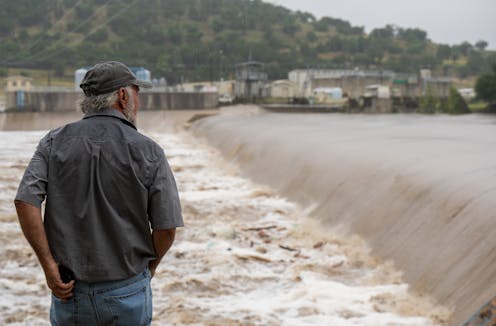
    A Kerrville, Texas, resident watches the flooded Guadalupe River on July 4, 2025. Eric Vryn/Getty Images

    Texas Hill Country is known for its landscapes, where shallow rivers wind among hills and through rugged valleys. That geography also makes it one of the deadliest places in the U.S. for flash flooding.

    In the early hours of July 4, 2025, a flash flood swept through an area of Hill Country dotted with summer camps and small towns about 70 miles northwest of San Antonio. More than 135 people died in the flooding. The majority of them were in Kerr County, including more than two dozen girls and counselors at one summer camp, Camp Mystic. Dozens more people were still unaccounted for a week later.

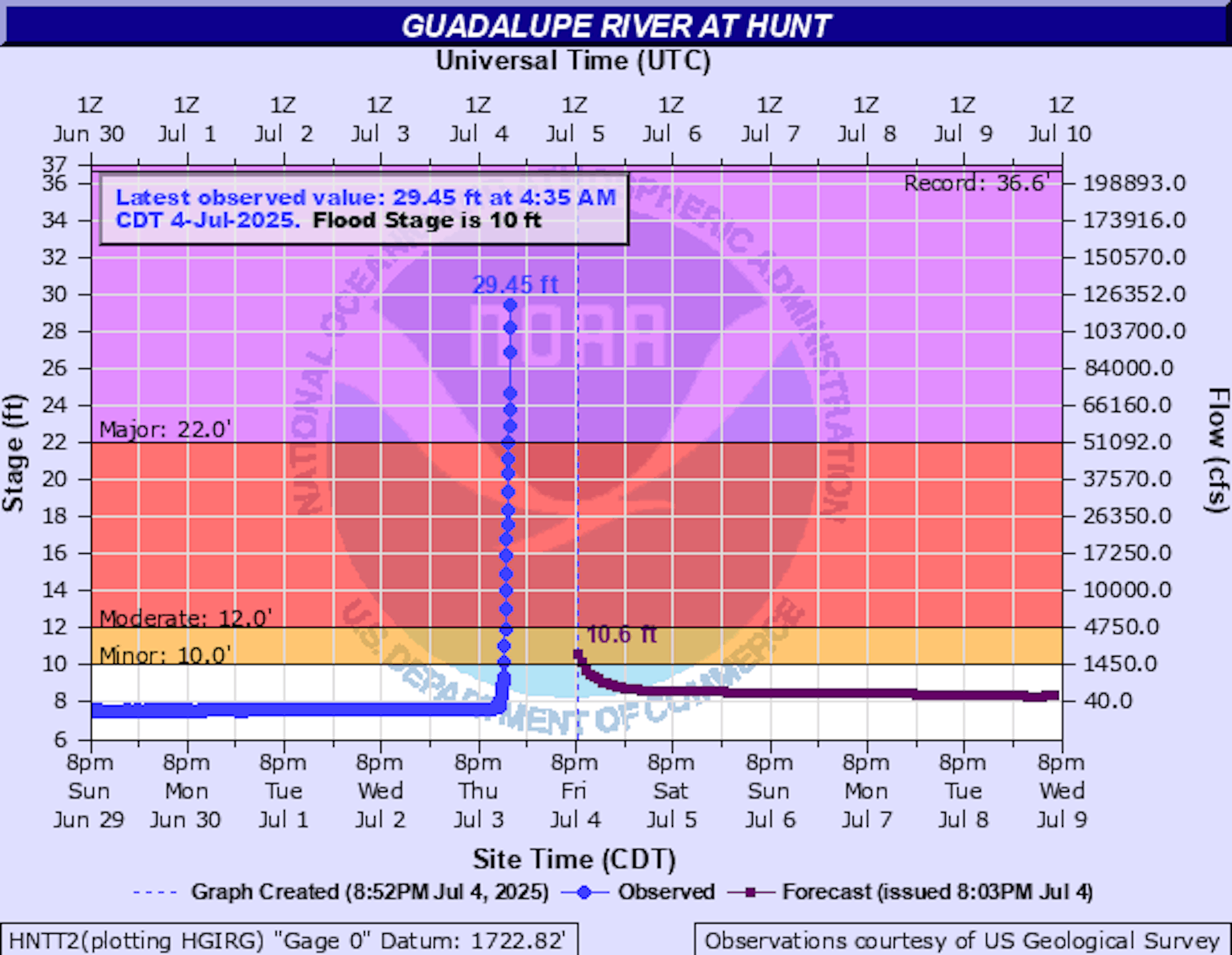
    The flooding began with a heavy downpour, with more than 10 inches of rain in some areas, that sent water sheeting off the hillsides and into creeks. The creeks poured into the Guadalupe River.

    A river gauge at Hunt, Texas, near Camp Mystic, showed how quickly the river flooded: Around 3 a.m. on July 4, the Guadalupe River was rising about 1 foot every 5 minutes at the gauge, National Weather Service data shows. By 4:30 a.m., it had risen more than 20 feet. As the water moved downstream, it reached Kerrville, where the river rose even faster.

    Flood expert Hatim Sharif, a hydrologist and civil engineer at the University of Texas at San Antonio, explains what makes this part of the country, known as Flash Flood Alley, so dangerous.

    What makes Hill Country so prone to flooding?

    Texas as a whole leads the nation in flood deaths, and by a wide margin. A colleague and I analyzed data from 1959 to 2019 and found 1,069 people had died in flooding in Texas over those six decades. The next highest total was in Louisiana, with 693.

    Many of those flood deaths have been in Hill County. It’s part of an area known as Flash Flood Alley, a crescent of land that curves from near Dallas down to San Antonio and then westward.

    The hills are steep, and the water moves quickly when it floods. This is a semi-arid area with soils that don’t soak up much water, so the water sheets off quickly and the shallow creeks can rise fast.

    When those creeks converge on a river, they can create a surge of water that wipes out homes and washes away cars and, unfortunately, anyone in its path.

    Hill Country has seen some devastating flash floods. In 1987, heavy rain in western Kerr County quickly flooded the Guadalupe River, triggering a flash flood similar to the one in 2025. Ten teenagers being evacuated from a camp died in the rushing water.

    San Antonio, at the eastern edge of Hill Country, was hit with a flash flood on June 12, 2025, that killed 13 people whose cars were swept away by high water from a fast-flooding creek near an interstate ramp in the early morning.

    Why does the region get such strong downpours?

    One reason Hill Country gets powerful downpours is the Balcones Escarpment.

    The escarpment is a line of cliffs and steep hills created by a geologic fault. When warm air from the Gulf rushes up the escarpment, it condenses and can dump a lot of moisture. That water flows down the hills quickly, from many different directions, filling streams and rivers below.

    As temperature rise, the warmer atmosphere can hold more moisture, increasing the downpour and flood risk.

    A tour of the Guadalupe River and its flood risk.

    The same effect can contribute to flash flooding in San Antonio, where the large amount of paved land and lack of updated drainage to control runoff adds to the risk.

    What can be done to improve flash flood safety?

    First, it’s important for people to understand why flash flooding happens and just how fast the water can rise and flow. In many arid areas, dry or shallow creeks can quickly fill up with fast-moving water and become deadly. So people should be aware of the risks and pay attention to the weather.

    Improving flood forecasting, with more detailed models of the physics and water velocity at different locations, can also help.

    Probabilistic forecasting, for example, can provide a range of rainfall scenarios, enabling authorities to prepare for worst-case scenarios. A scientific framework linking rainfall forecasts to the local impacts, such as streamflow, flood depth and water velocity, could also help decision-makers implement timely evacuations or road closures.

    Education is particularly essential for drivers. One to two feet of moving water can wash away a car. People may think their trucks and SUVs can go through anything, but fast-moving water can flip a truck and carry it away.

    Officials can also do more to barricade roads when the flood risk is high to prevent people from driving into harm’s way. We found that 58% of the flood deaths in Texas over the past six decades involved vehicles. The storm on June 12 in San Antonio was an example. It was early morning, and drivers had poor visibility. The cars were hit by fast-rising floodwater from an adjacent creek.

    This article, originally published July 5, 2025, has been updated with the death toll rising.

    The Conversation

    Hatim Sharif does not work for, consult, own shares in or receive funding from any company or organization that would benefit from this article, and has disclosed no relevant affiliations beyond their academic appointment.

    ref. Why Texas Hill Country, where a devastating flood killed more than 135 people, is one of the deadliest places in the US for flash flooding – https://theconversation.com/why-texas-hill-country-where-a-devastating-flood-killed-more-than-135-people-is-one-of-the-deadliest-places-in-the-us-for-flash-flooding-260555

  • MIL-Evening Report: Australia says US beef will soon be welcome here again. It’s unlikely we’ll buy much of it

    Source: The Conversation (Au and NZ) – By Felicity Deane, Professor of Trade Law and Taxation, Queensland University of Technology

    DarcyMaulsby/Getty

    The Albanese government has today confirmed it will lift biosecurity restrictions on beef imports from the United States. The timing of this decision has raised some eyebrows.

    Back in April, US President Donald Trump had singled out what he characterised as an Australian “ban” on US beef as he announced 10% baseline tariffs on imports from Australia.

    Responding to today’s announcement, Nationals leader David Littleproud said it appeared the restrictions have been “traded away to appease Donald Trump”.

    But Trade Minister Don Farrell said there was “nothing suspicious about this”. And some Australian industry groups have since expressed their confidence in the decision.

    So, has Australia’s beef industry been sold out for the benefit of a trade deal? Or is it just a poorly timed announcement at the end of a review into Australia’s restrictions?

    Biosecurity concerns

    Australia’s biosecurity rules, particularly around beef products, have long been a source of friction with the United States. These rules date back to the late 1990s and were strengthened following a US mad cow disease scare in 2003.

    In 2019, a ban was lifted on beef products from cattle that had been born, raised and slaughtered in the US. However, a ban remained on any products from cattle originating in Mexico or Canada that had been slaughtered in the US.

    This was a cause for some tension, because the traceability requirements in the US were not as stringent as in Australia. That meant it wasn’t always possible to determine the origins of US products. So the 2019 change effectively only applied to shelf-stable products – not fresh meat.

    Last month, the Albanese government made assurances Australia’s biosecurity rules wouldn’t be compromised in trade negotiations. But it also confirmed a review of the rules was underway.

    The National Farmers’ Federation acknowledged the government’s decision in a statement today:

    The report released today is the result of a long-standing, science-based review by the Australian Government into the biosecurity risks posed by cattle raised in Canada and Mexico, but processed in and exported from the US.

    Speaking on ABC Radio, Cattle Australia chief executive Will Evans acknowledged “a lot of people” may feel “blindsided” by the government’s decision, but expressed his confidence in the government’s process.

    Boom times for Australian beef

    Australians are some of the highest per-capita consumers of beef products in the world. But Australia is also the world’s second-largest beef exporter, trailing only Brazil.

    In contrast, the US is the world’s second-largest importer of beef, behind only China.

    That poses the question: how much do we actually need beef from the US? Is it even worth lifting this ban, if it will impact so few people?

    The beef industry might be fair to question whether this is for the benefit of their industry, when it seems the existing 10% baseline tariffs have had no impact on the volumes of beef being exported from Australia. Quite the opposite.

    In June, Australia’s beef exports broke an all-time monthly record, and the US continued to be our largest export market.

    In addition, it is important to recognise the US tariffs on beef would theoretically be absorbed by the consumer, rather than the exporter.

    The trade war rages on

    Theory suggests that international trade is a good thing (though not everyone is a “winner”). Where there is trade between nations, competitive pricing is encouraged and consumers may enjoy more product variety.

    Most restrictions on trade are viewed unfavourably by economists, but there are some notable exceptions. The health and safety of food products and assurance of biosecurity standards are such concerns.

    Overnight, comments from the Trump administration suggest the 10% tariffs on imports from Australia could be raised, with a new baseline tariff rate of 15%.

    To apply these to Australian beef is in direct conflict with the Australia and United States Free Trade Agreement (AUSFTA). This agreement progressively removed tariffs on Australian beef, with all tariffs eliminated by 2023.

    Consequently, any new US tariff would violate these terms, threatening a trade relationship that has seen beef exports to the US flourish.

    Is our reputation on the line?

    It is important to note that the biosecurity rules in Australia and the traceability requirements for our producers are a point of national pride.

    Central to Australia’s biosecurity framework is the Biosecurity Act 2015 and the National Livestock Identification System, which ensures traceability, food safety, disease control and animal welfare.

    This imposes strict requirements on Australian beef producers – and as a result, imposes costs. It also means Australian beef is considered a premium product in much of the world.

    Australians should hope the evidence from the government’s review fully supports this action.

    Given the unpredictability of the Trump administration, it remains to be seen whether lifting these restrictions will win Australia any concessions on trade anyway.

    Felicity Deane does not work for, consult, own shares in or receive funding from any company or organisation that would benefit from this article, and has disclosed no relevant affiliations beyond their academic appointment.

    ref. Australia says US beef will soon be welcome here again. It’s unlikely we’ll buy much of it – https://theconversation.com/australia-says-us-beef-will-soon-be-welcome-here-again-its-unlikely-well-buy-much-of-it-261836

    MIL OSI AnalysisEveningReport.nz

  • MIL-Evening Report: Jet ski accidents are tragic but preventable. Here’s how to reduce the risk

    Source: The Conversation (Au and NZ) – By Milad Haghani, Associate Professor & Principal Fellow in Urban Risk & Resilience, The University of Melbourne

    Richard Hamilton Smith/Getty

    Two teenage boys were thrown from a jet ski during a ride on the Georges River in Sydney’s south this week. One died at the scene. The other lost an arm, and was rushed to hospital in a serious condition.

    The exact cause of the crash is being investigated and a report will be prepared for the coroner.

    Sadly, this tragic incident is not isolated. While fatal jet ski crashes are relatively rare, serious injuries are not.

    Here’s what we know about jet ski accidents, who’s at risk, and how to prevent them.

    Jet skis are now more common

    Jet skis have become a familiar sight on Australian waterways, with sales peaking during the early years of the COVID pandemic. There are now almost 100,000 registered jet skis nationwide.

    So what was once a niche summer thrill has become a more mainstream recreational activity, particularly for young Australians.

    As the number of jet skis on our waterways grows, so too will the risks.

    How often do accidents happen?

    Most jet ski crashes occur in daylight hours, are twice as likely on weekends, and tend to spike during warmer months. Injuries typically happen close to shore (often within 50 metres) where crowded conditions increase the risk of colliding with other vessels, swimmers or fixed obstacles.

    Fatal jet ski accidents in Australia have claimed the lives of riders, passengers, swimmers and kayakers.

    Across New South Wales, Queensland and Victoria, there are up to three deaths per 100,000 licence holders. There are an estimated 19–26 serious injuries per 100,000 licence holders, depending on the state.

    But these figures likely understate the true picture as many non-fatal injuries go unreported unless hospitalised.

    For example, data from research sponsored by the United States Coast Guard suggest that for every moderate injury captured in accident reports, more than 30 actually occur. For every severe injury, it’s likely 1.65 actually occur.

    Who is at risk?

    Global jet ski statistics indicate about 85% of jet ski injuries involve male riders.

    Risk-taking behaviour and being an inexperienced rider are also risk factors, with young adults dominating injury statistics.

    One review found about 60% of jet ski crashes involved the rider drinking alcohol.

    What types of injuries?

    Recreational riders often typically travel at 60–80 kilometres per hour. But these machines can reach speeds above 100km/h. This can generate immense force in the event of a collision.

    In a crash, riders are ejected from the jet ski or collide directly with water, the craft, another vessel or fixed objects. So the leading causes of death and serious injury on jet skis are from these traumatic impacts.

    A study from a US trauma centre looked at 127 people injured in jet ski incidents and found most injuries involved broken bones. The legs were most commonly affected, followed by arms, spine and hips.

    Hitting the handlebars was a major cause of open fractures (when a broken bone pierces the skin), some of which later became infected.

    Women and children face particular risks

    However, there is a distinct and concerning injury pattern for female passengers.

    Women riding on the back of a jet ski (as a passenger) are especially at risk of serious injuries to the genital and anal area. This can happen if they fall off backwards and land directly on the powerful stream of water coming from the jet nozzle.

    Case reports describe incidents of vaginal lacerations, rectal injuries and pelvic floor damage. Such injuries are rare but can be devastating and life-threatening. Sometimes there are permanent complications, such as the risk of infertility or incontinence.

    Children also face unique and often severe risks. A US study looked at 66 children hospitalised in jet ski accidents. It found most were boys with the average age of around 12 years old, and nearly three-quarters operated the jet ski themselves. About 70% of injuries involved collisions with another vessel or object. Four children died, all from head trauma after crashing into stationary objects. More than 40% were left with some degree of disability.

    What now?

    The risks from jet skis are real and too often underestimated. But many injuries can be prevented:

    • we need public education campaigns to remind riders of the risks and to promote better behaviour. This would remind riders to slow down in congested areas, avoid reckless turns, and be especially careful with passengers. As alcohol is a common factor in crashes, drinking in moderation before riding should also be stressed

    • women are recommended to wear neoprene protective shorts, or wetsuits, instead of ordinary swimwear. A growing number of medical professionals are now backing this as essential safety gear, not optional, to reduce the risk of perineal injuries from water jets

    • manufacturers can redesign handlebars to reduce the severity of impact injuries. They can also build in safeguards that reduce jet pressure when no one is seated at the rear (to safeguard the health of a passenger who falls off backwards)

    • states also need consistent rules on minimum rider age, training and licensing. The laws vary widely. These inconsistent regulations create confusion and loopholes, especially when riders cross borders.

    The authors do not work for, consult, own shares in or receive funding from any company or organisation that would benefit from this article, and have disclosed no relevant affiliations beyond their academic appointment.

    ref. Jet ski accidents are tragic but preventable. Here’s how to reduce the risk – https://theconversation.com/jet-ski-accidents-are-tragic-but-preventable-heres-how-to-reduce-the-risk-261746

    MIL OSI AnalysisEveningReport.nz

  • MIL-OSI Submissions: Why Texas Hill Country, where a devastating flood killed more than 135 people, is one of the deadliest places in the US for flash flooding

    Source: The Conversation – USA (2) – By Hatim Sharif, Professor of Civil and Environmental Engineering, The University of Texas at San Antonio

    A Kerrville, Texas, resident watches the flooded Guadalupe River on July 4, 2025. Eric Vryn/Getty Images

    Texas Hill Country is known for its landscapes, where shallow rivers wind among hills and through rugged valleys. That geography also makes it one of the deadliest places in the U.S. for flash flooding.

    In the early hours of July 4, 2025, a flash flood swept through an area of Hill Country dotted with summer camps and small towns about 70 miles northwest of San Antonio. More than 135 people died in the flooding. The majority of them were in Kerr County, including more than two dozen girls and counselors at one summer camp, Camp Mystic. Dozens more people were still unaccounted for a week later.

    The flooding began with a heavy downpour, with more than 10 inches of rain in some areas, that sent water sheeting off the hillsides and into creeks. The creeks poured into the Guadalupe River.

    A river gauge at Hunt, Texas, near Camp Mystic, showed how quickly the river flooded: Around 3 a.m. on July 4, the Guadalupe River was rising about 1 foot every 5 minutes at the gauge, National Weather Service data shows. By 4:30 a.m., it had risen more than 20 feet. As the water moved downstream, it reached Kerrville, where the river rose even faster.

    Flood expert Hatim Sharif, a hydrologist and civil engineer at the University of Texas at San Antonio, explains what makes this part of the country, known as Flash Flood Alley, so dangerous.

    What makes Hill Country so prone to flooding?

    Texas as a whole leads the nation in flood deaths, and by a wide margin. A colleague and I analyzed data from 1959 to 2019 and found 1,069 people had died in flooding in Texas over those six decades. The next highest total was in Louisiana, with 693.

    Many of those flood deaths have been in Hill County. It’s part of an area known as Flash Flood Alley, a crescent of land that curves from near Dallas down to San Antonio and then westward.

    The hills are steep, and the water moves quickly when it floods. This is a semi-arid area with soils that don’t soak up much water, so the water sheets off quickly and the shallow creeks can rise fast.

    When those creeks converge on a river, they can create a surge of water that wipes out homes and washes away cars and, unfortunately, anyone in its path.

    Hill Country has seen some devastating flash floods. In 1987, heavy rain in western Kerr County quickly flooded the Guadalupe River, triggering a flash flood similar to the one in 2025. Ten teenagers being evacuated from a camp died in the rushing water.

    San Antonio, at the eastern edge of Hill Country, was hit with a flash flood on June 12, 2025, that killed 13 people whose cars were swept away by high water from a fast-flooding creek near an interstate ramp in the early morning.

    Why does the region get such strong downpours?

    One reason Hill Country gets powerful downpours is the Balcones Escarpment.

    The escarpment is a line of cliffs and steep hills created by a geologic fault. When warm air from the Gulf rushes up the escarpment, it condenses and can dump a lot of moisture. That water flows down the hills quickly, from many different directions, filling streams and rivers below.

    As temperature rise, the warmer atmosphere can hold more moisture, increasing the downpour and flood risk.

    A tour of the Guadalupe River and its flood risk.

    The same effect can contribute to flash flooding in San Antonio, where the large amount of paved land and lack of updated drainage to control runoff adds to the risk.

    What can be done to improve flash flood safety?

    First, it’s important for people to understand why flash flooding happens and just how fast the water can rise and flow. In many arid areas, dry or shallow creeks can quickly fill up with fast-moving water and become deadly. So people should be aware of the risks and pay attention to the weather.

    Improving flood forecasting, with more detailed models of the physics and water velocity at different locations, can also help.

    Probabilistic forecasting, for example, can provide a range of rainfall scenarios, enabling authorities to prepare for worst-case scenarios. A scientific framework linking rainfall forecasts to the local impacts, such as streamflow, flood depth and water velocity, could also help decision-makers implement timely evacuations or road closures.

    Education is particularly essential for drivers. One to two feet of moving water can wash away a car. People may think their trucks and SUVs can go through anything, but fast-moving water can flip a truck and carry it away.

    Officials can also do more to barricade roads when the flood risk is high to prevent people from driving into harm’s way. We found that 58% of the flood deaths in Texas over the past six decades involved vehicles. The storm on June 12 in San Antonio was an example. It was early morning, and drivers had poor visibility. The cars were hit by fast-rising floodwater from an adjacent creek.

    This article, originally published July 5, 2025, has been updated with the death toll rising.

    Hatim Sharif does not work for, consult, own shares in or receive funding from any company or organization that would benefit from this article, and has disclosed no relevant affiliations beyond their academic appointment.

    ref. Why Texas Hill Country, where a devastating flood killed more than 135 people, is one of the deadliest places in the US for flash flooding – https://theconversation.com/why-texas-hill-country-where-a-devastating-flood-killed-more-than-135-people-is-one-of-the-deadliest-places-in-the-us-for-flash-flooding-260555

    MIL OSI

  • Bali is built on informal and ‘illegal’ settlements. Bulldozing Bingin Beach misses the real threat of overdevelopment

    Source: ForeignAffairs4

    Source: The Conversation – Global Perspectives – By Kim Dovey, Professor of Architecture and Urban Design, The University of Melbourne

    Balinese officials have begun the demolition of more than 40 businesses at Bingin Beach, a popular tourist spot in the Uluwatu region.

    In June, the Balinese House of Representatives determined the settlement is on public land, and is therefore illegal and needs to be demolished. But I’d argue it doesn’t.

    The ‘illegal’ settlement

    The Bingin Beach coastal settlement began development in the 1970s as an informal surfer hub at the base of a steep escarpment. The beach is a few hundred metres long and largely disappears at high tide.

    Originally lined with a string of makeshift warungs (small food stores) and cheap accommodations, the settlement has grown incrementally over the decades, up and along the escarpment, with an intensive mix of surf shops, restaurants and small hotels.

    The steepness of the slope precludes vehicle access. The only public access is via two somewhat narrow pedestrian stairways.

    While it initially served the surfer community, the settlement now caters to a broader tourist market, with some rooms going for upwards of US$150 per night.

    But after more than 50 years of incremental development, the House of Representatives has declared the settlement was illegally constructed on state land, and has ordered the demolition of 45 buildings – effectively the entire settlement.

    While most of the buildings seem highly durable, the demolition order is based on illegality, and not durability. A spokesperson for the traders argues most of the businesses are locally owned, and livelihoods are at stake.

    The ‘legal’ settlement

    The former farmland at the top of the escarpment is also covered with tourist developments that mostly emerged since 2010, and now extend up to a kilometre inland. This is a much more familiar landscape for Bali: a mix of walled hotel compounds and private villas, with manicured gardens and swimming pools.

    However, one could scarcely call this larger settlement “planned”. Shops and restaurants emerge wherever they can find a market along the narrow roads. There are no sidewalks and pedestrians are constantly engaged in an anxious game of negotiated passing.

    The infrastructure of roads and lanes has also been designed incrementally, across the former farm fields, as the settlement developed. The resulting street network is convoluted and largely unwalkable. The most common street sign is “no beach access this way”.

    What is informality?

    I’m an academic, architect and urban planner who studies informal settlements and informal urbanism more generally. In this context “informal” can mean illegal, makeshift and unplanned, but it can also mean incremental, adaptive and inventive.

    Informal settlement is the means by which a large proportion of Indonesians produce affordable housing. It is also the most traditional form of indigenous housing globally.

    After many decades of governments trying to demolish such settlements, the overwhelming consensus across the United Nations Human Settlements Programme is that wholesale demolition is rarely an answer. On-site formalisation and upgrading is the more sustainable pathway.

    When engaging with informal settlements, we need to preserve the infrastructures that work and only demolish where necessary. The Bingin Beach escarpment settlement has proven sustainable and has become an integral part of the local heritage.

    Its demolition will destroy livelihoods and displace the surfing market, while feathering other nests.

    So why is it being demolished? Perhaps to clear the ground for the next round of up-market resorts – what urban studies research calls “accumulation by disposession”. Bingin is widely seen as a major real estate hotspot for investment.

    What is overdevelopment?

    One of the key dangers of informal settlement is “overdevelopment”. Without
    formal planning codes, density can escalate to destroy the very attraction that produced the settlement.

    Most buildings along the Bingin Beach escarpment are two to four storeys, and step back with the slope of the escarpment. The exception is the 2019 addition of the Morabito Art Cliff hotel that rises more than six storeys, obscuring the natural landscape, blocking views, and setting a precedent for more of the same.

    If everyone in the area built like this, the Bingin settlement would be replaced with a cliff of buildings. To demolish this one building would set a useful precedent of containing the settlement to a sustainable scale.

    The Impossibles dream

    A few hundred metres south-west of Bingin Beach, a different story unfolds near the beach known as Impossibles. Here, a precarious limestone cliff largely precludes access to the beach, and the clifftop has long been lined with low-rise tourist compounds.

    An aeriel view of the Uluwatu coast shows Bingin Beach and the Impossibles.
    Map data: Google, 2025 Maxar Technologies

    This earlier layer of development is now being demolished and replaced with larger, denser resorts as part of the Amali project which claims a “rare cliff-front location”. The location is “rare” because about half of the 50-metre-high cliff has been excavated to construct villa units quite literally in the cliff.

    This excavation was well underway when, in May 2024, it caused much of the remaining natural cliff face to collapse onto the beach and into the ocean. It remains unclear whether the excavation was formally approved. Either way, it prompts the question: what if everyone did that?

    The Bingin escarpment and the Impossibles cliff face represent very different kinds of development. One is incremental, irregular and geared to its social and environmental context, while the other is large-grain and environmentally destructive. It makes no sense to demolish the former in order to make way for the latter.

    It is imperative to not only save the Bingin Beach settlement, which is part of Bali’s surfing heritage, but also to awaken from the impossible dream of building more and more villas on this fragile and limited coastland.

    The Conversation

    Kim Dovey does not work for, consult, own shares in or receive funding from any company or organisation that would benefit from this article, and has disclosed no relevant affiliations beyond their academic appointment.

    ref. Bali is built on informal and ‘illegal’ settlements. Bulldozing Bingin Beach misses the real threat of overdevelopment – https://theconversation.com/bali-is-built-on-informal-and-illegal-settlements-bulldozing-bingin-beach-misses-the-real-threat-of-overdevelopment-261755

  • MIL-Evening Report: Bali is built on informal and ‘illegal’ settlements. Bulldozing Bingin Beach misses the real threat of overdevelopment

    Source: The Conversation (Au and NZ) – By Kim Dovey, Professor of Architecture and Urban Design, The University of Melbourne

    Balinese officials have begun the demolition of more than 40 businesses at Bingin Beach, a popular tourist spot in the Uluwatu region.

    In June, the Balinese House of Representatives determined the settlement is on public land, and is therefore illegal and needs to be demolished. But I’d argue it doesn’t.

    The ‘illegal’ settlement

    The Bingin Beach coastal settlement began development in the 1970s as an informal surfer hub at the base of a steep escarpment. The beach is a few hundred metres long and largely disappears at high tide.

    Originally lined with a string of makeshift warungs (small food stores) and cheap accommodations, the settlement has grown incrementally over the decades, up and along the escarpment, with an intensive mix of surf shops, restaurants and small hotels.

    The steepness of the slope precludes vehicle access. The only public access is via two somewhat narrow pedestrian stairways.

    While it initially served the surfer community, the settlement now caters to a broader tourist market, with some rooms going for upwards of US$150 per night.

    But after more than 50 years of incremental development, the House of Representatives has declared the settlement was illegally constructed on state land, and has ordered the demolition of 45 buildings – effectively the entire settlement.

    While most of the buildings seem highly durable, the demolition order is based on illegality, and not durability. A spokesperson for the traders argues most of the businesses are locally owned, and livelihoods are at stake.

    The ‘legal’ settlement

    The former farmland at the top of the escarpment is also covered with tourist developments that mostly emerged since 2010, and now extend up to a kilometre inland. This is a much more familiar landscape for Bali: a mix of walled hotel compounds and private villas, with manicured gardens and swimming pools.

    However, one could scarcely call this larger settlement “planned”. Shops and restaurants emerge wherever they can find a market along the narrow roads. There are no sidewalks and pedestrians are constantly engaged in an anxious game of negotiated passing.

    The infrastructure of roads and lanes has also been designed incrementally, across the former farm fields, as the settlement developed. The resulting street network is convoluted and largely unwalkable. The most common street sign is “no beach access this way”.

    What is informality?

    I’m an academic, architect and urban planner who studies informal settlements and informal urbanism more generally. In this context “informal” can mean illegal, makeshift and unplanned, but it can also mean incremental, adaptive and inventive.

    Informal settlement is the means by which a large proportion of Indonesians produce affordable housing. It is also the most traditional form of indigenous housing globally.

    After many decades of governments trying to demolish such settlements, the overwhelming consensus across the United Nations Human Settlements Programme is that wholesale demolition is rarely an answer. On-site formalisation and upgrading is the more sustainable pathway.

    When engaging with informal settlements, we need to preserve the infrastructures that work and only demolish where necessary. The Bingin Beach escarpment settlement has proven sustainable and has become an integral part of the local heritage.

    Its demolition will destroy livelihoods and displace the surfing market, while feathering other nests.

    So why is it being demolished? Perhaps to clear the ground for the next round of up-market resorts – what urban studies research calls “accumulation by disposession”. Bingin is widely seen as a major real estate hotspot for investment.

    What is overdevelopment?

    One of the key dangers of informal settlement is “overdevelopment”. Without
    formal planning codes, density can escalate to destroy the very attraction that produced the settlement.

    Most buildings along the Bingin Beach escarpment are two to four storeys, and step back with the slope of the escarpment. The exception is the 2019 addition of the Morabito Art Cliff hotel that rises more than six storeys, obscuring the natural landscape, blocking views, and setting a precedent for more of the same.

    If everyone in the area built like this, the Bingin settlement would be replaced with a cliff of buildings. To demolish this one building would set a useful precedent of containing the settlement to a sustainable scale.

    The Impossibles dream

    A few hundred metres south-west of Bingin Beach, a different story unfolds near the beach known as Impossibles. Here, a precarious limestone cliff largely precludes access to the beach, and the clifftop has long been lined with low-rise tourist compounds.

    An aeriel view of the Uluwatu coast shows Bingin Beach and the Impossibles.
    Map data: Google, 2025 Maxar Technologies

    This earlier layer of development is now being demolished and replaced with larger, denser resorts as part of the Amali project which claims a “rare cliff-front location”. The location is “rare” because about half of the 50-metre-high cliff has been excavated to construct villa units quite literally in the cliff.

    This excavation was well underway when, in May 2024, it caused much of the remaining natural cliff face to collapse onto the beach and into the ocean. It remains unclear whether the excavation was formally approved. Either way, it prompts the question: what if everyone did that?

    The Bingin escarpment and the Impossibles cliff face represent very different kinds of development. One is incremental, irregular and geared to its social and environmental context, while the other is large-grain and environmentally destructive. It makes no sense to demolish the former in order to make way for the latter.

    It is imperative to not only save the Bingin Beach settlement, which is part of Bali’s surfing heritage, but also to awaken from the impossible dream of building more and more villas on this fragile and limited coastland.

    Kim Dovey does not work for, consult, own shares in or receive funding from any company or organisation that would benefit from this article, and has disclosed no relevant affiliations beyond their academic appointment.

    ref. Bali is built on informal and ‘illegal’ settlements. Bulldozing Bingin Beach misses the real threat of overdevelopment – https://theconversation.com/bali-is-built-on-informal-and-illegal-settlements-bulldozing-bingin-beach-misses-the-real-threat-of-overdevelopment-261755

    MIL OSI AnalysisEveningReport.nz

  • MIL-OSI Submissions: Bali is built on informal and ‘illegal’ settlements. Bulldozing Bingin Beach misses the real threat of overdevelopment

    Source: The Conversation – Global Perspectives – By Kim Dovey, Professor of Architecture and Urban Design, The University of Melbourne

    Balinese officials have begun the demolition of more than 40 businesses at Bingin Beach, a popular tourist spot in the Uluwatu region.

    In June, the Balinese House of Representatives determined the settlement is on public land, and is therefore illegal and needs to be demolished. But I’d argue it doesn’t.

    The ‘illegal’ settlement

    The Bingin Beach coastal settlement began development in the 1970s as an informal surfer hub at the base of a steep escarpment. The beach is a few hundred metres long and largely disappears at high tide.

    Originally lined with a string of makeshift warungs (small food stores) and cheap accommodations, the settlement has grown incrementally over the decades, up and along the escarpment, with an intensive mix of surf shops, restaurants and small hotels.

    The steepness of the slope precludes vehicle access. The only public access is via two somewhat narrow pedestrian stairways.

    While it initially served the surfer community, the settlement now caters to a broader tourist market, with some rooms going for upwards of US$150 per night.

    But after more than 50 years of incremental development, the House of Representatives has declared the settlement was illegally constructed on state land, and has ordered the demolition of 45 buildings – effectively the entire settlement.

    While most of the buildings seem highly durable, the demolition order is based on illegality, and not durability. A spokesperson for the traders argues most of the businesses are locally owned, and livelihoods are at stake.

    The ‘legal’ settlement

    The former farmland at the top of the escarpment is also covered with tourist developments that mostly emerged since 2010, and now extend up to a kilometre inland. This is a much more familiar landscape for Bali: a mix of walled hotel compounds and private villas, with manicured gardens and swimming pools.

    However, one could scarcely call this larger settlement “planned”. Shops and restaurants emerge wherever they can find a market along the narrow roads. There are no sidewalks and pedestrians are constantly engaged in an anxious game of negotiated passing.

    The infrastructure of roads and lanes has also been designed incrementally, across the former farm fields, as the settlement developed. The resulting street network is convoluted and largely unwalkable. The most common street sign is “no beach access this way”.

    What is informality?

    I’m an academic, architect and urban planner who studies informal settlements and informal urbanism more generally. In this context “informal” can mean illegal, makeshift and unplanned, but it can also mean incremental, adaptive and inventive.

    Informal settlement is the means by which a large proportion of Indonesians produce affordable housing. It is also the most traditional form of indigenous housing globally.

    After many decades of governments trying to demolish such settlements, the overwhelming consensus across the United Nations Human Settlements Programme is that wholesale demolition is rarely an answer. On-site formalisation and upgrading is the more sustainable pathway.

    When engaging with informal settlements, we need to preserve the infrastructures that work and only demolish where necessary. The Bingin Beach escarpment settlement has proven sustainable and has become an integral part of the local heritage.

    Its demolition will destroy livelihoods and displace the surfing market, while feathering other nests.

    So why is it being demolished? Perhaps to clear the ground for the next round of up-market resorts – what urban studies research calls “accumulation by disposession”. Bingin is widely seen as a major real estate hotspot for investment.

    What is overdevelopment?

    One of the key dangers of informal settlement is “overdevelopment”. Without
    formal planning codes, density can escalate to destroy the very attraction that produced the settlement.

    Most buildings along the Bingin Beach escarpment are two to four storeys, and step back with the slope of the escarpment. The exception is the 2019 addition of the Morabito Art Cliff hotel that rises more than six storeys, obscuring the natural landscape, blocking views, and setting a precedent for more of the same.

    If everyone in the area built like this, the Bingin settlement would be replaced with a cliff of buildings. To demolish this one building would set a useful precedent of containing the settlement to a sustainable scale.

    The Impossibles dream

    A few hundred metres south-west of Bingin Beach, a different story unfolds near the beach known as Impossibles. Here, a precarious limestone cliff largely precludes access to the beach, and the clifftop has long been lined with low-rise tourist compounds.

    An aeriel view of the Uluwatu coast shows Bingin Beach and the Impossibles.
    Map data: Google, 2025 Maxar Technologies

    This earlier layer of development is now being demolished and replaced with larger, denser resorts as part of the Amali project which claims a “rare cliff-front location”. The location is “rare” because about half of the 50-metre-high cliff has been excavated to construct villa units quite literally in the cliff.

    This excavation was well underway when, in May 2024, it caused much of the remaining natural cliff face to collapse onto the beach and into the ocean. It remains unclear whether the excavation was formally approved. Either way, it prompts the question: what if everyone did that?

    The Bingin escarpment and the Impossibles cliff face represent very different kinds of development. One is incremental, irregular and geared to its social and environmental context, while the other is large-grain and environmentally destructive. It makes no sense to demolish the former in order to make way for the latter.

    It is imperative to not only save the Bingin Beach settlement, which is part of Bali’s surfing heritage, but also to awaken from the impossible dream of building more and more villas on this fragile and limited coastland.

    Kim Dovey does not work for, consult, own shares in or receive funding from any company or organisation that would benefit from this article, and has disclosed no relevant affiliations beyond their academic appointment.

    ref. Bali is built on informal and ‘illegal’ settlements. Bulldozing Bingin Beach misses the real threat of overdevelopment – https://theconversation.com/bali-is-built-on-informal-and-illegal-settlements-bulldozing-bingin-beach-misses-the-real-threat-of-overdevelopment-261755

    MIL OSI

  • Cycling’s governing body is introducing new rules to slow down elite riders. Not everyone’s happy

    Source: ForeignAffairs4

    Source: The Conversation – Global Perspectives – By Popi Sotiriadou, Associate Professor of Sport Management – Director Business Innovation, Griffith University

    MARCO BERTORELLO/AFP via Getty Images

    Most sports look to support their athletes to become “faster, higher, stronger” – in reference to the Olympic Games’ original motto – so it is perhaps surprising that cycling’s world governing body is trying to slow down elite riders.

    However, there’s good reason the Union Cycliste Internationale (UCI) recently announced new rules to slow riders down.

    These rules – which apply to elite road and cyclo-cross mass-start events for men and women such as the Tour de France – come into place shortly and are aimed at improving rider safety.


    Read more:
    I rode the Tour de France to study its impact on the human body – here’s what I learned


    What are the new rules?

    From August 1, a new bicycle gearing regulation will kick in.

    Professional cyclists will only be allowed to use a 54-tooth front chainring with an 11-tooth rear cog.

    This replaces the current common setup of 54-10.

    To put this into context, a 54-tooth chainring is the big front gear on a bike and the 11-tooth cog is a small rear gear. Moving to a slightly bigger cog (54-11) makes it harder to hit top speeds: the change from a 54-10 to a 54-11 gear setup could reduce the top speed by about 2.4 kilometres per hour.

    Pro riders can reach incredible speeds during descents, sometimes surpassing 130 kilometres per hour.

    Then, from January 1 2026, handlebars must become wider, increasing from a minimum 350–360 millimetres width (depending on the event) to at least 400mm wide.

    The handlebar width affects how a rider controls their bike: narrower bars reduce frontal surface area, making a rider more aerodynamic which again means a faster ride.

    This is especially useful in time trials or sprints.

    Wider bars offer better stability and control, helping navigate tight turns, peloton traffic, or crosswinds.

    The UCI has also announced plans to introduce a formal helmet approval protocol in 2027, which will include separate standards for helmets used in mass-start events and time trials.

    This shift suggests helmets may soon be subject to the same pre-race approval process as frames and wheels, potentially leading to safer, more regulated head protection.

    New rules, different opinions

    Professional cycling is getting faster due to stronger athletes, better training and advanced, lighter equipment.

    As a result, high-speed crashes, especially downhill or in crowded sprint finishes, have become more common and more dangerous.

    The UCI maintain the new regulations are part of a broader strategy to mitigate speed-related risks, enhance safety and uphold the integrity of the sport.

    However, these measures have sparked debate within the cycling community.

    Some elite cyclists, particularly those who have suffered severe crashes and injuries, suggest it is time safety caught up with technology.

    Wout van Aert, who suffered a severe knee injury in September 2024 during a wet descent, said:

    Limiting the number of gears would make the sport much safer.

    Chris Froome, four-time Tour de France winner, also said he supported strategies “to keep the speeds down on the descents”.

    The Professional Cycling Council supports testing gear ratio limits.

    It is also likely these changes could limit cutting-edge innovations that only wealthy teams can afford. This would in turn narrow technological disparities across teams.

    Former pro Michael Barry though believes gear restrictions are not the answer, and the UCI should instead focus on improved course design and inspection, better barriers and crash protective clothing.

    Technology experts agree, arguing speed is determined more by a rider’s power output and aerodynamic drag than by gear ratios. To enhance safety, they propose alternative solutions such as real-time rider tracking, crash-protective clothing, improved course design and inspection and faster medical response.

    The wider handlebar rule has also stirred controversy, especially among smaller-framed riders, many of whom are women, who typically ride with 360–380mm handlebars for better comfort and control.

    Under the new regulation, those forced to use bars that exceed their optimal fit range could end up suffering from poor wrist alignment, increased fatigue and a higher risk of repetitive strain injuries.

    Despite the growth of women’s cycling, the UCI has not made exemptions for smaller riders, raising concerns a one-size-fits-all solution may compromise inclusively and safety.

    Even though regular riders can continue to use the equipment they prefer, what happens in the pro world often shapes non-elite rider preferences and trends, and the bikes sold in stores. If narrower bars are banned at the top level, manufacturers may stop offering them.

    Historically, advancements in aerodynamics, gear ratios and component weights seen in the pro peloton have become standard features on consumer bikes.

    A delicate balance

    The UCI’s new regulations mark a likely shift towards standardised equipment and heightened safety. This deliberate emphasis on safety naturally elevates awareness among all cyclists about the crucial link between equipment choices and rider wellbeing.

    While these restrictions may foster a more level playing field, they also risk curbing the sport’s long-standing tradition of engineering innovation.

    The very appeal of professional cycling has often been intrinsically tied to the relentless pursuit of technological advancements that yield even fractional competitive advantages.

    Striking a balance between ensuring safety and preserving this spirit of ingenuity remains a crucial challenge for the sport’s future.

    The Conversation

    Popi Sotiriadou does not work for, consult, own shares in or receive funding from any company or organisation that would benefit from this article, and has disclosed no relevant affiliations beyond their academic appointment.

    ref. Cycling’s governing body is introducing new rules to slow down elite riders. Not everyone’s happy – https://theconversation.com/cyclings-governing-body-is-introducing-new-rules-to-slow-down-elite-riders-not-everyones-happy-260917

  • MIL-Evening Report: World’s highest court issues groundbreaking ruling for climate action. Here’s what it means for Australia

    Source: The Conversation (Au and NZ) – By Wesley Morgan, Research Associate, Institute for Climate Risk and Response, UNSW Sydney

    JOHN THYS/AFP via Getty Images

    The world’s highest court says countries are legally obliged to prevent harms caused by climate change, in a ruling that repudiates Australia’s claims it is not legally responsible for emissions from our fossil fuel exports.

    The landmark ruling overnight by the International Court of Justice (ICJ) will reverberate in courts, parliaments and boardrooms the world over.

    In a closely watched case at The Hague, the judges were asked to clarify the legal obligations countries have to protect the Earth’s climate system for current and future generations. They were also asked to clarify the legal consequences for nations that fail to do this.

    At issue was the scope of legal obligations. During the court’s deliberations, Australia sided with other fossil fuel exporters and major emitters – including Saudi Arabia, the United States and China – to argue state obligations on climate change are restricted to those set out in climate-specific treaties such as the Paris Agreement.

    But the court disagreed. It found countries have additional obligations to protect the climate and take action to prevent climate harm inside and outside their boundaries. These obligations arise in human rights law, the law of the sea, and general principles of international law.

    This clear statement will have groundbreaking consequences. It means Australia must set a 2035 emissions reduction target in line with the best available science, as required under the Paris Agreement. But it must also go further, by regulating the fossil fuel industry to prevent further harm.

    Australia’s arguments rejected

    The ICJ is the primary legal organ of the United Nations. Its key role is to settle disputes between countries and clarify international law as it applies to nation states.

    While weighing up the obligations of countries to address the climate crisis, the court heard legal arguments from almost 100 countries, making it the largest case ever heard by the ICJ.

    The case threatened major implications for fossil-fuel producers such as Australia, which is heavily reliant on coal and gas exports.

    In his oral presentation to the ICJ, Australian Solicitor-General Stephen Donaghue told the court only the Paris Agreement should apply when it comes to mitigating climate change. Under the Paris rules, countries must set targets to cut domestic emissions, but they are not required to report emissions created when their fossil fuel exports are burned overseas.

    Donaghue and the Australian delegation also suggested responsibility for harms caused by climate change could not be pinned on individual states. Australia also argued protecting human rights does not extend to obligations to tackle climate change.

    The ICJ largely rejected these arguments.

    The ICJ judges largely rejected Australia’s arguments. Pictured: ICJ President Yuji Iwasawa (third from right) and members issuing their advisory opinion.
    JOHN THYS/AFP via Getty Images

    Fossil fuel era is over

    The court found Australia, and other fossil fuel producers, are obliged under international law to prevent fossil fuel companies in their territory from causing significant climate harm.

    This will essentially require a managed phase out of fossil fuel production. As the ICJ ruling says:

    Failure of a State to take appropriate action to protect the climate system from [greenhouse gas] emissions – including through fossil fuel production, fossil fuel consumption, the granting of fossil fuel exploration licences or the provision of fossil fuel subsidies – may constitute an internationally wrongful act which is attributable to that State.

    Australia is one of the world’s largest exporters of coal and gas. When burned overseas, emissions from Australia’s fossil fuel exports are more than double those of its entire domestic economy.

    Australia has approved hundreds of oil, gas and coal projects in recent decades. Dozens more are in the approvals pipeline. Final federal approval is still pending for Woodside’s massive Northwest Shelf gas project – which is set to add millions of tonnes of greenhouse gas emissions every year, for decades.

    The Australian government must heed the message from the Hague. The days of impunity for the fossil fuel industry are coming to an end.

    Woodside’s massive Northwest Shelf gas project is set to add millions of tonnes of greenhouse gas emissions every year.
    GREG WOOD/AFP via Getty Images

    A spark of hope from the Pacific

    Today’s ruling is remarkable for where it originated.

    In 2019, 27 law students at the University of the South Pacific in Vanuatu were given a challenge: find the most ambitious legal pathways towards climate justice.

    Each year, Vanuatu faces the prospect of cyclones, earthquakes, tsunamis, volcanoes, flooding rain and drought. Climate change compounds the risk to island communities – people who have done the least to contribute to the problem.

    The students decided to file a case with the world court. And so began a legal campaign that travelled from Vanuatu’s capital, Port Vila, through the halls of the United Nations in New York and to the world court in the Hague.

    In 2023 Vanuatu and other island nations succeeded in passing a UN General Assembly resolution. It asked the ICJ to give an advisory opinion on countries’ obligations to protect the climate system and legal consequences for states causing “significant harm” to Earth’s climate.

    This week’s ruling delivers poetic justice to Vanuatu and other vulnerable island states.

    The ruling delivers poetic justice to Vanuatu and other vulnerable island states. Pictured: representatives of Pacific states outside the International Court of Justice in December 2024.
    Michel Porro/Getty Images

    A new era for climate justice

    The court’s findings are likely to influence a wave of climate litigation worldwide. It could shape legal reasoning in Australia, too.

    Last week, a Federal Court judge found the Australian government has no legal duty of care to protect Torres Strait Islanders from climate change. If that case is appealed, a superior court may revisit the government’s obligations – and have regard to the ICJ ruling in doing so.

    The ICJ decision will also be relevant for the Queensland Land Court, which this week began hearing a challenge to stop a greenfield mine proposed by Whitehaven Coal – citing environmental and human rights impacts of the project’s emissions.

    Clarified international law obligations should also guide policymakers in the Australian parliament. With a huge majority in the House of Representatives and a climate-friendly Senate crossbench, the Albanese government has a mandate to implement policy in line with Australia’s international law obligations.

    Wesley Morgan is a fellow with the Climate Council of Australia

    Gillian Moon is a regular donor to the Australian Conservation Foundation, which is a party in the Whitehaven Coal case.

    ref. World’s highest court issues groundbreaking ruling for climate action. Here’s what it means for Australia – https://theconversation.com/worlds-highest-court-issues-groundbreaking-ruling-for-climate-action-heres-what-it-means-for-australia-261842

    MIL OSI AnalysisEveningReport.nz

  • MIL-Evening Report: ER Report: A Roundup of Significant Articles on EveningReport.nz for July 24, 2025

    ER Report: Here is a summary of significant articles published on EveningReport.nz on July 24, 2025.

    World’s highest court issues groundbreaking ruling for climate action. Here’s what it means for Australia
    Source: The Conversation (Au and NZ) – By Wesley Morgan, Research Associate, Institute for Climate Risk and Response, UNSW Sydney JOHN THYS/AFP via Getty Images The world’s highest court says countries are legally obliged to prevent harms caused by climate change, in a ruling that repudiates Australia’s claims it is not legally responsible for emissions

    Politics with Michelle Grattan: Chris Bowen on why it’s ‘a little frustrating’ bidding for COP 31
    Source: The Conversation (Au and NZ) – By Michelle Grattan, Professorial Fellow, University of Canberra Energy and climate issues are front and centre for both sides of politics. The government is struggling with pushback from some regional communities against the rollout of transmission lines and wind farms. At the same time, it will soon have

    Cycling’s governing body is introducing new rules to slow down elite riders. Not everyone’s happy
    Source: The Conversation (Au and NZ) – By Popi Sotiriadou, Associate Professor of Sport Management – Director Business Innovation, Griffith University MARCO BERTORELLO/AFP via Getty Images Most sports look to support their athletes to become “faster, higher, stronger” – in reference to the Olympic Games’ original motto – so it is perhaps surprising that cycling’s

    Swirling nebula of two dying stars revealed in spectacular detail in new Webb telescope image
    Source: The Conversation (Au and NZ) – By Benjamin Pope, Associate Professor, School of Mathematical and Physical Sciences, Macquarie University The day before my thesis examination, my friend and radio astronomer Joe Callingham showed me an image we’d been awaiting for five long years – an infrared photo of two dying stars we’d requested from

    UN’s highest court finds countries can be held legally responsible for emissions
    By Jamie Tahana in The Hague for RNZ Pacific The United Nations’ highest court has found that countries can be held legally responsible for their greenhouse gas emissions, in a ruling highly anticipated by Pacific countries long frustrated with the pace of global action to address climate change. In a landmark opinion delivered yesterday in

    Five arms, no heart and a global family: what DNA revealed about the weird deep-sea world of brittle stars
    Source: The Conversation (Au and NZ) – By Tim O’Hara, Senior Curator of Marine Invertebrates, Museums Victoria Research Institute A brittle star of the species _Gorgonocephalus eucnemis_. Lagunatic Photo / Getty Images You may have read that the deep sea is a very different environment from the land and shallow water. There is no light,

    Birds use hidden black and white feathers to make themselves more colourful
    Source: The Conversation (Au and NZ) – By Simon Griffith, Professor of Avian Behavioural Ecology, Macquarie University The green-headed tanager (_Tangara seledon_) has a hidden layer of plumage that is white underneath the orange feathers and black underneath the blue and green feathers. Daniel Field Birds are perhaps the most colourful group of animals, bringing

    Is sleeping a lot actually bad for your health? A sleep scientist explains
    Source: The Conversation (Au and NZ) – By Charlotte Gupta, Senior Postdoctoral Research Fellow, Appleton Institute, HealthWise Research Group, CQUniversity Australia Walstrom, Susanne/Getty We’re constantly being reminded by news articles and social media posts that we should be getting more sleep. You probably don’t need to hear it again – not sleeping enough is bad

    From grasslands to killing fields: why trees are bad news for one of Australia’s most stunning birds
    Source: The Conversation (Au and NZ) – By Gabriel Crowley, Adjunct Associate Professor in Geography, University of Adelaide JJ Harrison/Wikimedia, CC BY Picture this. A small, rainbow-coloured chick emerges from its nest for the first time. It stretches its wings and prepares to take flight. But before the fledgling’s life in the wild has begun,

    As seas rise and fish decline, this Fijian village is finding new ways to adapt
    Source: The Conversation (Au and NZ) – By Celia McMichael, Professor in Geography, The University of Melbourne Celia McMichael, CC BY-NC-ND In the village of Nagigi, Fiji, the ocean isn’t just a resource – it’s part of the community’s identity. But in recent years, villagers have seen the sea behave differently. Tides are pushing inland.

    After 70 years, twisted gothic thriller The Night of the Hunter remains as disturbing and beguiling as ever
    Source: The Conversation (Au and NZ) – By Ben McCann, Associate Professor of French Studies, University of Adelaide United Artists/Getty Images In 1955, director Charles Laughton crafted one of the darkest, strangest fairytales ever to come out of Hollywood. The Night of the Hunter remains visually exquisite and profoundly unsettling. Shortly before Ben Harper is

    Almost a third of NZ households face energy hardship – reform has to go beyond cheaper off-peak power
    Source: The Conversation (Au and NZ) – By Kimberley O’Sullivan, Senior Research Fellow, He Kainga Oranga – Housing and Health Research Programme, University of Otago Igor Suka/Getty Images The spotlight is again on New Zealand’s energy sector, with a group of industry bodies and independent retailers pushing for a market overhaul, saying the sector was

    Immigration courts hiding the names of ICE lawyers goes against centuries of precedent and legal ethics requiring transparency in courts
    Source: The Conversation (Au and NZ) – By Cassandra Burke Robertson, Professor of Law and Director of the Center for Professional Ethics, Case Western Reserve University Some immigration courts have allowed ICE attorneys to conceal their names during proceedings. Jacob Wackerhausen/iStock via Getty Images Something unusual is happening in U.S. immigration courts. Government lawyers are

    How the UK’s immigration system splits families apart – by design
    Source: The Conversation (Au and NZ) – By Nando Sigona, Professor of International Migration and Forced Displacement and Director of the Institute for Research into International Migration and Superdiversity, University of Birmingham arda savasciogullari/Shutterstock The letter that arrived for eleven-year-old Guilherme in June 2025 was addressed personally to him. The UK Home Office was informing

    4.48 Psychosis revival: the play’s window into a mind on the edge is as brutal as ever
    Source: The Conversation (Au and NZ) – By Leah Sidi, Associate Professor of Health Humanities, UCL Under bright lights, the audience looks at a bare stage on two planes. Below, a small stage is white and empty, occupied only by a table and two chairs. Above, a huge, slanted mirror reflects a bird’s-eye view of

    Togo’s ‘Nana-Benz’: how cheap Chinese imports of African fabrics has hurt the famous women traders
    Source: The Conversation (Au and NZ) – By Fidele B. Ebia, Postdoctoral fellow, Duke Africa Initiative, Duke University The manufacturing of African print textiles has shifted to China in the 21st century. While they are widely consumed in African countries – and symbolic of the continent – the rise of “made in China” has undermined

    2 ways cities can beat the heat: Which is best, urban trees or cool roofs?
    Source: The Conversation (Au and NZ) – By Ian Smith, Research Scientist in Earth & Environment, Boston University Trees like these in Boston can help keep neighborhoods cooler on hot days. Yassine Khalfalli/Unsplash, CC BY When summer turns up the heat, cities can start to feel like an oven, as buildings and pavement trap the

    Indonesian military set to complete Trans-Papua Highway under Prabowo’s rule
    By Julian Isaac The Indonesian Military (TNI) is committed to supporting the completion of the Trans-Papua Highway during President Prabowo Subianto’s term in office. While the military is not involved in construction, it plays a critical role in securing the project from threats posed by pro-independence Papuan resistance groups in “high-risk” regions. Spanning a total

    View from The Hill: Nationals’ mavericks ensure the Coalition is the issue in parliament’s first week
    Source: The Conversation (Au and NZ) – By Michelle Grattan, Professorial Fellow, University of Canberra For almost as long anyone can remember, the Nationals have caused the Coalition grief on climate and energy policy. Still, for Barnaby Joyce to bring on a fresh load of trouble – with a private member’s bill to scrap Australia’s

    Childcare centres will have funding stripped if they’re not ‘up to scratch’. Is this enough?
    Source: The Conversation (Au and NZ) – By Erin Harper, Lecturer, School of Education and Social Work, University of Sydney Maskot/Getty Images Childcare centres will lose their eligibility for fee subsidies if they don’t meet safety standards, according to a new bill introduced to parliament on Wednesday. As Education Minister Jason Clare told parliament: it

    MIL OSI AnalysisEveningReport.nz

  • MIL-Evening Report: ER Report: A Roundup of Significant Articles on EveningReport.nz for July 24, 2025

    ER Report: Here is a summary of significant articles published on EveningReport.nz on July 24, 2025.

    World’s highest court issues groundbreaking ruling for climate action. Here’s what it means for Australia
    Source: The Conversation (Au and NZ) – By Wesley Morgan, Research Associate, Institute for Climate Risk and Response, UNSW Sydney JOHN THYS/AFP via Getty Images The world’s highest court says countries are legally obliged to prevent harms caused by climate change, in a ruling that repudiates Australia’s claims it is not legally responsible for emissions

    Politics with Michelle Grattan: Chris Bowen on why it’s ‘a little frustrating’ bidding for COP 31
    Source: The Conversation (Au and NZ) – By Michelle Grattan, Professorial Fellow, University of Canberra Energy and climate issues are front and centre for both sides of politics. The government is struggling with pushback from some regional communities against the rollout of transmission lines and wind farms. At the same time, it will soon have

    Cycling’s governing body is introducing new rules to slow down elite riders. Not everyone’s happy
    Source: The Conversation (Au and NZ) – By Popi Sotiriadou, Associate Professor of Sport Management – Director Business Innovation, Griffith University MARCO BERTORELLO/AFP via Getty Images Most sports look to support their athletes to become “faster, higher, stronger” – in reference to the Olympic Games’ original motto – so it is perhaps surprising that cycling’s

    Swirling nebula of two dying stars revealed in spectacular detail in new Webb telescope image
    Source: The Conversation (Au and NZ) – By Benjamin Pope, Associate Professor, School of Mathematical and Physical Sciences, Macquarie University The day before my thesis examination, my friend and radio astronomer Joe Callingham showed me an image we’d been awaiting for five long years – an infrared photo of two dying stars we’d requested from

    UN’s highest court finds countries can be held legally responsible for emissions
    By Jamie Tahana in The Hague for RNZ Pacific The United Nations’ highest court has found that countries can be held legally responsible for their greenhouse gas emissions, in a ruling highly anticipated by Pacific countries long frustrated with the pace of global action to address climate change. In a landmark opinion delivered yesterday in

    Five arms, no heart and a global family: what DNA revealed about the weird deep-sea world of brittle stars
    Source: The Conversation (Au and NZ) – By Tim O’Hara, Senior Curator of Marine Invertebrates, Museums Victoria Research Institute A brittle star of the species _Gorgonocephalus eucnemis_. Lagunatic Photo / Getty Images You may have read that the deep sea is a very different environment from the land and shallow water. There is no light,

    Birds use hidden black and white feathers to make themselves more colourful
    Source: The Conversation (Au and NZ) – By Simon Griffith, Professor of Avian Behavioural Ecology, Macquarie University The green-headed tanager (_Tangara seledon_) has a hidden layer of plumage that is white underneath the orange feathers and black underneath the blue and green feathers. Daniel Field Birds are perhaps the most colourful group of animals, bringing

    Is sleeping a lot actually bad for your health? A sleep scientist explains
    Source: The Conversation (Au and NZ) – By Charlotte Gupta, Senior Postdoctoral Research Fellow, Appleton Institute, HealthWise Research Group, CQUniversity Australia Walstrom, Susanne/Getty We’re constantly being reminded by news articles and social media posts that we should be getting more sleep. You probably don’t need to hear it again – not sleeping enough is bad

    From grasslands to killing fields: why trees are bad news for one of Australia’s most stunning birds
    Source: The Conversation (Au and NZ) – By Gabriel Crowley, Adjunct Associate Professor in Geography, University of Adelaide JJ Harrison/Wikimedia, CC BY Picture this. A small, rainbow-coloured chick emerges from its nest for the first time. It stretches its wings and prepares to take flight. But before the fledgling’s life in the wild has begun,

    As seas rise and fish decline, this Fijian village is finding new ways to adapt
    Source: The Conversation (Au and NZ) – By Celia McMichael, Professor in Geography, The University of Melbourne Celia McMichael, CC BY-NC-ND In the village of Nagigi, Fiji, the ocean isn’t just a resource – it’s part of the community’s identity. But in recent years, villagers have seen the sea behave differently. Tides are pushing inland.

    After 70 years, twisted gothic thriller The Night of the Hunter remains as disturbing and beguiling as ever
    Source: The Conversation (Au and NZ) – By Ben McCann, Associate Professor of French Studies, University of Adelaide United Artists/Getty Images In 1955, director Charles Laughton crafted one of the darkest, strangest fairytales ever to come out of Hollywood. The Night of the Hunter remains visually exquisite and profoundly unsettling. Shortly before Ben Harper is

    Almost a third of NZ households face energy hardship – reform has to go beyond cheaper off-peak power
    Source: The Conversation (Au and NZ) – By Kimberley O’Sullivan, Senior Research Fellow, He Kainga Oranga – Housing and Health Research Programme, University of Otago Igor Suka/Getty Images The spotlight is again on New Zealand’s energy sector, with a group of industry bodies and independent retailers pushing for a market overhaul, saying the sector was

    Immigration courts hiding the names of ICE lawyers goes against centuries of precedent and legal ethics requiring transparency in courts
    Source: The Conversation (Au and NZ) – By Cassandra Burke Robertson, Professor of Law and Director of the Center for Professional Ethics, Case Western Reserve University Some immigration courts have allowed ICE attorneys to conceal their names during proceedings. Jacob Wackerhausen/iStock via Getty Images Something unusual is happening in U.S. immigration courts. Government lawyers are

    How the UK’s immigration system splits families apart – by design
    Source: The Conversation (Au and NZ) – By Nando Sigona, Professor of International Migration and Forced Displacement and Director of the Institute for Research into International Migration and Superdiversity, University of Birmingham arda savasciogullari/Shutterstock The letter that arrived for eleven-year-old Guilherme in June 2025 was addressed personally to him. The UK Home Office was informing

    4.48 Psychosis revival: the play’s window into a mind on the edge is as brutal as ever
    Source: The Conversation (Au and NZ) – By Leah Sidi, Associate Professor of Health Humanities, UCL Under bright lights, the audience looks at a bare stage on two planes. Below, a small stage is white and empty, occupied only by a table and two chairs. Above, a huge, slanted mirror reflects a bird’s-eye view of

    Togo’s ‘Nana-Benz’: how cheap Chinese imports of African fabrics has hurt the famous women traders
    Source: The Conversation (Au and NZ) – By Fidele B. Ebia, Postdoctoral fellow, Duke Africa Initiative, Duke University The manufacturing of African print textiles has shifted to China in the 21st century. While they are widely consumed in African countries – and symbolic of the continent – the rise of “made in China” has undermined

    2 ways cities can beat the heat: Which is best, urban trees or cool roofs?
    Source: The Conversation (Au and NZ) – By Ian Smith, Research Scientist in Earth & Environment, Boston University Trees like these in Boston can help keep neighborhoods cooler on hot days. Yassine Khalfalli/Unsplash, CC BY When summer turns up the heat, cities can start to feel like an oven, as buildings and pavement trap the

    Indonesian military set to complete Trans-Papua Highway under Prabowo’s rule
    By Julian Isaac The Indonesian Military (TNI) is committed to supporting the completion of the Trans-Papua Highway during President Prabowo Subianto’s term in office. While the military is not involved in construction, it plays a critical role in securing the project from threats posed by pro-independence Papuan resistance groups in “high-risk” regions. Spanning a total

    View from The Hill: Nationals’ mavericks ensure the Coalition is the issue in parliament’s first week
    Source: The Conversation (Au and NZ) – By Michelle Grattan, Professorial Fellow, University of Canberra For almost as long anyone can remember, the Nationals have caused the Coalition grief on climate and energy policy. Still, for Barnaby Joyce to bring on a fresh load of trouble – with a private member’s bill to scrap Australia’s

    Childcare centres will have funding stripped if they’re not ‘up to scratch’. Is this enough?
    Source: The Conversation (Au and NZ) – By Erin Harper, Lecturer, School of Education and Social Work, University of Sydney Maskot/Getty Images Childcare centres will lose their eligibility for fee subsidies if they don’t meet safety standards, according to a new bill introduced to parliament on Wednesday. As Education Minister Jason Clare told parliament: it

    MIL OSI AnalysisEveningReport.nz

  • MIL-OSI Submissions: Cycling’s governing body is introducing new rules to slow down elite riders. Not everyone’s happy

    Source: The Conversation – Global Perspectives – By Popi Sotiriadou, Associate Professor of Sport Management – Director Business Innovation, Griffith University

    MARCO BERTORELLO/AFP via Getty Images

    Most sports look to support their athletes to become “faster, higher, stronger” – in reference to the Olympic Games’ original motto – so it is perhaps surprising that cycling’s world governing body is trying to slow down elite riders.

    However, there’s good reason the Union Cycliste Internationale (UCI) recently announced new rules to slow riders down.

    These rules – which apply to elite road and cyclo-cross mass-start events for men and women such as the Tour de France – come into place shortly and are aimed at improving rider safety.


    Read more:
    I rode the Tour de France to study its impact on the human body – here’s what I learned


    What are the new rules?

    From August 1, a new bicycle gearing regulation will kick in.

    Professional cyclists will only be allowed to use a 54-tooth front chainring with an 11-tooth rear cog.

    This replaces the current common setup of 54-10.

    To put this into context, a 54-tooth chainring is the big front gear on a bike and the 11-tooth cog is a small rear gear. Moving to a slightly bigger cog (54-11) makes it harder to hit top speeds: the change from a 54-10 to a 54-11 gear setup could reduce the top speed by about 2.4 kilometres per hour.

    Pro riders can reach incredible speeds during descents, sometimes surpassing 130 kilometres per hour.

    Then, from January 1 2026, handlebars must become wider, increasing from a minimum 350–360 millimetres width (depending on the event) to at least 400mm wide.

    The handlebar width affects how a rider controls their bike: narrower bars reduce frontal surface area, making a rider more aerodynamic which again means a faster ride.

    This is especially useful in time trials or sprints.

    Wider bars offer better stability and control, helping navigate tight turns, peloton traffic, or crosswinds.

    The UCI has also announced plans to introduce a formal helmet approval protocol in 2027, which will include separate standards for helmets used in mass-start events and time trials.

    This shift suggests helmets may soon be subject to the same pre-race approval process as frames and wheels, potentially leading to safer, more regulated head protection.

    New rules, different opinions

    Professional cycling is getting faster due to stronger athletes, better training and advanced, lighter equipment.

    As a result, high-speed crashes, especially downhill or in crowded sprint finishes, have become more common and more dangerous.

    The UCI maintain the new regulations are part of a broader strategy to mitigate speed-related risks, enhance safety and uphold the integrity of the sport.

    However, these measures have sparked debate within the cycling community.

    Some elite cyclists, particularly those who have suffered severe crashes and injuries, suggest it is time safety caught up with technology.

    Wout van Aert, who suffered a severe knee injury in September 2024 during a wet descent, said:

    Limiting the number of gears would make the sport much safer.

    Chris Froome, four-time Tour de France winner, also said he supported strategies “to keep the speeds down on the descents”.

    The Professional Cycling Council supports testing gear ratio limits.

    It is also likely these changes could limit cutting-edge innovations that only wealthy teams can afford. This would in turn narrow technological disparities across teams.

    Former pro Michael Barry though believes gear restrictions are not the answer, and the UCI should instead focus on improved course design and inspection, better barriers and crash protective clothing.

    Technology experts agree, arguing speed is determined more by a rider’s power output and aerodynamic drag than by gear ratios. To enhance safety, they propose alternative solutions such as real-time rider tracking, crash-protective clothing, improved course design and inspection and faster medical response.

    The wider handlebar rule has also stirred controversy, especially among smaller-framed riders, many of whom are women, who typically ride with 360–380mm handlebars for better comfort and control.

    Under the new regulation, those forced to use bars that exceed their optimal fit range could end up suffering from poor wrist alignment, increased fatigue and a higher risk of repetitive strain injuries.

    Despite the growth of women’s cycling, the UCI has not made exemptions for smaller riders, raising concerns a one-size-fits-all solution may compromise inclusively and safety.

    Even though regular riders can continue to use the equipment they prefer, what happens in the pro world often shapes non-elite rider preferences and trends, and the bikes sold in stores. If narrower bars are banned at the top level, manufacturers may stop offering them.

    Historically, advancements in aerodynamics, gear ratios and component weights seen in the pro peloton have become standard features on consumer bikes.

    A delicate balance

    The UCI’s new regulations mark a likely shift towards standardised equipment and heightened safety. This deliberate emphasis on safety naturally elevates awareness among all cyclists about the crucial link between equipment choices and rider wellbeing.

    While these restrictions may foster a more level playing field, they also risk curbing the sport’s long-standing tradition of engineering innovation.

    The very appeal of professional cycling has often been intrinsically tied to the relentless pursuit of technological advancements that yield even fractional competitive advantages.

    Striking a balance between ensuring safety and preserving this spirit of ingenuity remains a crucial challenge for the sport’s future.

    Popi Sotiriadou does not work for, consult, own shares in or receive funding from any company or organisation that would benefit from this article, and has disclosed no relevant affiliations beyond their academic appointment.

    ref. Cycling’s governing body is introducing new rules to slow down elite riders. Not everyone’s happy – https://theconversation.com/cyclings-governing-body-is-introducing-new-rules-to-slow-down-elite-riders-not-everyones-happy-260917

    MIL OSI

  • MIL-Evening Report: Cycling’s governing body is introducing new rules to slow down elite riders. Not everyone’s happy

    Source: The Conversation (Au and NZ) – By Popi Sotiriadou, Associate Professor of Sport Management – Director Business Innovation, Griffith University

    MARCO BERTORELLO/AFP via Getty Images

    Most sports look to support their athletes to become “faster, higher, stronger” – in reference to the Olympic Games’ original motto – so it is perhaps surprising that cycling’s world governing body is trying to slow down elite riders.

    However, there’s good reason the Union Cycliste Internationale (UCI) recently announced new rules to slow riders down.

    These rules – which apply to elite road and cyclo-cross mass-start events for men and women such as the Tour de France – come into place shortly and are aimed at improving rider safety.


    Read more:
    I rode the Tour de France to study its impact on the human body – here’s what I learned


    What are the new rules?

    From August 1, a new bicycle gearing regulation will kick in.

    Professional cyclists will only be allowed to use a 54-tooth front chainring with an 11-tooth rear cog.

    This replaces the current common setup of 54-10.

    To put this into context, a 54-tooth chainring is the big front gear on a bike and the 11-tooth cog is a small rear gear. Moving to a slightly bigger cog (54-11) makes it harder to hit top speeds: the change from a 54-10 to a 54-11 gear setup could reduce the top speed by about 2.4 kilometres per hour.

    Pro riders can reach incredible speeds during descents, sometimes surpassing 130 kilometres per hour.

    Then, from January 1, 2026, handlebars must become wider, increasing from a minimum 350–360 millimetres width (depending on the event) to at least 400mm wide.

    The handlebar width affects how a rider controls their bike: narrower bars reduce frontal surface area, making a rider more aerodynamic which again means a faster ride.

    This is especially useful in time trials or sprints.

    Wider bars offer better stability and control, helping navigate tight turns, peloton traffic, or crosswinds.

    The UCI has also announced plans to introduce a formal helmet approval protocol in 2027, which will include separate standards for helmets used in mass-start events and time trials.

    This shift suggests helmets may soon be subject to the same pre-race approval process as frames and wheels, potentially leading to safer, more regulated head protection.

    New rules, different opinions

    Professional cycling is getting faster due to stronger athletes, better training and advanced, lighter equipment.

    As a result, high-speed crashes, especially downhill or in crowded sprint finishes, have become more common and more dangerous.

    The UCI maintain the new regulations are part of a broader strategy to mitigate speed-related risks, enhance safety and uphold the integrity of the sport.

    However, these measures have sparked debate within the cycling community.

    Some elite cyclists, particularly those who have suffered severe crashes and injuries, suggest it is time safety caught up with technology.

    Wout van Aert, who suffered a severe knee injury in September 2024 during a wet descent, said:

    Limiting the number of gears would make the sport much safer.

    Chris Froome, four-time Tour de France winner, also said he supported strategies “to keep the speeds down on the descents”.

    The Professional Cycling Council supports testing gear ratio limits.

    It is also likely these changes could limit cutting-edge innovations that only wealthy teams can afford. This would in turn narrow technological disparities across teams.

    Former pro Michael Barry though believes gear restrictions are not the answer, and the UCI should instead focus on improved course design and inspection, better barriers and crash protective clothing.

    Technology experts agree, arguing speed is determined more by a rider’s power output and aerodynamic drag than by gear ratios. To enhance safety, they propose alternative solutions such as real-time rider tracking, crash-protective clothing, improved course design and inspection and faster medical response.

    The wider handlebar rule has also stirred controversy, especially among smaller-framed riders, many of whom are women, who typically ride with 360–380mm handlebars for better comfort and control.

    Under the new regulation, those forced to use bars that exceed their optimal fit range could end up suffering from poor wrist alignment, increased fatigue and a higher risk of repetitive strain injuries.

    Despite the growth of women’s cycling, the UCI has not made exemptions for smaller riders, raising concerns a one-size-fits-all solution may compromise inclusively and safety.

    Even though regular riders can continue to use the equipment they prefer, what happens in the pro world often shapes non-elite rider preferences and trends, and the bikes sold in stores. If narrower bars are banned at the top level, manufacturers may stop offering them.

    Historically, advancements in aerodynamics, gear ratios and component weights seen in the pro peloton have become standard features on consumer bikes.

    A delicate balance

    The UCI’s new regulations mark a likely shift towards standardised equipment and heightened safety. This deliberate emphasis on safety naturally elevates awareness among all cyclists about the crucial link between equipment choices and rider wellbeing.

    While these restrictions may foster a more level playing field, they also risk curbing the sport’s long-standing tradition of engineering innovation.

    The very appeal of professional cycling has often been intrinsically tied to the relentless pursuit of technological advancements that yield even fractional competitive advantages.

    Striking a balance between ensuring safety and preserving this spirit of ingenuity remains a crucial challenge for the sport’s future.

    Popi Sotiriadou does not work for, consult, own shares in or receive funding from any company or organisation that would benefit from this article, and has disclosed no relevant affiliations beyond their academic appointment.

    ref. Cycling’s governing body is introducing new rules to slow down elite riders. Not everyone’s happy – https://theconversation.com/cyclings-governing-body-is-introducing-new-rules-to-slow-down-elite-riders-not-everyones-happy-260917

    MIL OSI AnalysisEveningReport.nz

  • MIL-Evening Report: Politics with Michelle Grattan: Chris Bowen on why it’s ‘a little frustrating’ bidding for COP 31

    Source: The Conversation (Au and NZ) – By Michelle Grattan, Professorial Fellow, University of Canberra

    Energy and climate issues are front and centre for both sides of politics. The government is struggling with pushback from some regional communities against the rollout of transmission lines and wind farms. At the same time, it will soon have to produce its 2035 target under the Paris climate agreement.

    Meanwhile, the opposition is fractured over whether to stick by its commitment to net zero emissions by 2050.

    We’re joined on this podcast by the Minister for Climate Change and Energy Chris Bowen.

    Bowen remains upbeat about the energy transition:

    I think it’s going well. We can always do more, and there’s always more effort needed, and the job is far from done. But when you consider what we’ve achieved over the first three years, I would say pleased but not yet satisfied. We are, by and large, on track for our 43% emissions reduction. Just in the last couple of days, [we saw] some excellent figures about the amount of new renewable electricity connected to the grid.

    So all this is a very significant turnaround from 2022, but I’m far from mission accomplished. There’s still a lot more to do. This is the biggest economic transition our country has undertaken, and you don’t sort of do three years’ work and put your feet up. This is a constant effort, and that’s an effort on which I’m entirely focused.

    Just now, Bowen is also focused on preliminary work for Treasurer Jim Chalmers’ Economic Reform Roundtable in August.

    Bowen announces he’ll be hosting two roundtables of his own, feeding into the broad August 19-21 meeting:

    I’ll be holding two roundtables, one on electricity and one on climate adaptation which is going to be an increasing focus of this government and future governments because tragically the world has left it too late to avoid the impacts of climate change. We can hopefully avoid the worst catastrophic impacts of more than 1.5 and two to three degrees.

    On Australia’s bid to host COP in 2026, Bowen says Australia has the votes against the other contender, Turkey, but the decision-making process is informal:

    So one of the things about the process to decide COPs I’ve learnt is it’s quite opaque and there’s no particular timeline and no particular rules to the ballot. I will say, I’ve said before, we’ve got very strong support. So it’s not a matter of going out and getting more votes.

    But there’s no agreed time or process for a ballot. It’s meant to work on a consensus, sort of an old world, sort of gentlemanly approach to say whoever loses will withdraw.

    Despite the delay, Bowen says Australia will be ready if the bid is successful:

    Having said that, the last COP, the one last year, in Azerbaijan, I accept Azerbaijan is a very different country to Australia, but they found out a year in advance as well. And logistically, physically, they put on a very good COP, that can be done. And I know the Premier of South Australia is a very, very enthusiastic supporter of hosting the COP.

    On the Coalition potentially dropping its commitment to net zero by 2050, Bowen calls the target “the basic bare minimum of action”:

    It’s what the IPCC has recommended as what is absolutely necessary to avoid […] the worst catastrophic impacts of [climate change]. To be debating net zero 2050 in Australia this year is like debating whether the sun should come up. It’s the most basic framework. It’s nowhere near enough.

    I think it’s got strong support, and it’s retaining that. I mean, the election result shows that. That we were told to get on with it. Keep going basically.

    I’ll just say this. At least Peter Dutton had net zero as a policy objective. I mean, Sussan may be indicating maybe she won’t. I used to say Peter Dutton would be the worst prime minister for climate than Tony Abbott, and I was correct at the time, but now it’s starting to look like Sussan Ley would be even worse.

    Michelle Grattan does not work for, consult, own shares in or receive funding from any company or organisation that would benefit from this article, and has disclosed no relevant affiliations beyond their academic appointment.

    ref. Politics with Michelle Grattan: Chris Bowen on why it’s ‘a little frustrating’ bidding for COP 31 – https://theconversation.com/politics-with-michelle-grattan-chris-bowen-on-why-its-a-little-frustrating-bidding-for-cop-31-261763

    MIL OSI AnalysisEveningReport.nz

  • MIL-Evening Report: Swirling nebula of two dying stars revealed in spectacular detail in new Webb telescope image

    Source: The Conversation (Au and NZ) – By Benjamin Pope, Associate Professor, School of Mathematical and Physical Sciences, Macquarie University

    The day before my thesis examination, my friend and radio astronomer Joe Callingham showed me an image we’d been awaiting for five long years – an infrared photo of two dying stars we’d requested from the Very Large Telescope in Chile.

    I gasped – the stars were wreathed in a huge spiral of dust, like a snake eating its own tail.

    The coils of Apep as captured by the European Space Observatory’s Very Large Telescope.
    ESO/Callingham et al., CC BY

    We named it Apep, for the Egyptian serpent god of destruction. Now, our team has finally been lucky to use NASA’s James Webb Space Telescope (JWST) to look at Apep.

    If anything could top the first shock of seeing its beautiful spiral nebula, it’s this breathtaking new image, with the JWST data now analysed in two papers on arXiv.

    Violent star deaths

    Right before they die as supernovae, the universe’s most massive stars violently shed their outer hydrogen layers, leaving their heavy cores exposed.

    These are called Wolf-Rayet stars after their discoverers, who noticed powerful streams of gas blasting out from these objects, much stronger than the stellar wind from our Sun. The Wolf-Rayet stage lasts only millennia – a blink of the eye in cosmic time scales – before they violently explode.

    Unlike our Sun, many stars in the universe exist in pairs known as binaries. This is especially true of the most massive stars, such as Wolf-Rayets.

    When the fierce gales from a Wolf-Rayet star clash with their weaker companion’s wind, they compress each other. In the eye of this storm forms a dense, cool environment in which the carbon-rich winds can condense into dust. The earliest carbon dust in the cosmos – the first of the material making up our own bodies – was made this way.

    The dust from the Wolf-Rayet is blown out in almost a straight line, and the orbital motion of the stars wraps it into a spiral-shaped nebula, appearing exactly like water from a sprinkler when viewed from above.

    We expected Apep to look like one of these elegant pinwheel nebulas, discovered by our colleague and co-author Peter Tuthill. To our surprise, it did not.

    The ‘pinwheel’ nebula of the triple Wolf-Rayet star system WR104.
    Peter Tuthill

    Equal rivals

    The new image was taken using JWST’s infrared camera, like the thermal cameras used by hunters or the military. It represents hot material as blue, and colder material in green through to red.

    It turns out Apep isn’t just one powerful star blasting a weaker companion, but two Wolf-Rayet stars. The rivals have near-equal strength winds, and the dust is spread out in a very wide cone and wrapped into a wind-sock shape.

    When we originally described Apep in 2018, we noted a third, more distant star, speculating whether it was also part of the system or a chance interloper along the line of sight.

    The dust appeared to be moving much slower than the winds, which was hard to explain. We suggested the dust might be carried on a slow, thick wind from the equator of a fast-spinning star, rare today but common in the early universe.

    The new, much more detailed data from JWST reveals three more dust shells zooming farther out, each cooler and fainter than the last and spaced perfectly evenly, against a background of swirling dust.

    The Apep nebula in false colour, displaying infrared data from JWST’s MIRI camera.
    Han et al./White et al./Dholakia; NASA/ESA

    New data, new knowledge

    The JWST data are now published and interpreted in a pair of papers, one led by Caltech astronomer Yinuo Han, and the other by Macquarie University Masters student Ryan White.

    Han’s paper reveals how the nebula’s dust cools, links the background dust to the foreground stars, and suggests the stars are farther away from Earth than we thought. This implies they are extraordinarily bright, but weakens our original claim about the slow winds and rapid rotation.

    In White’s paper, he develops a fast computer model for the shape of the nebula, and uses this to decode the orbit of the inner stars very precisely.

    He also noticed there’s a “bite” taken out out of the dust shells, exactly where the wind of the third star would be chewing into them. This proves the Apep family isn’t just a pair of twins – they have a third sibling.

    An illustration of the cavity carved by the third star companion in the Apep system.
    White et al. (2025)

    Understanding systems like Apep tells us more about star deaths and the origins of carbon dust, but these systems also have a fascinating beauty that emerges from their seemingly simple geometry.

    The violence of stellar death carves puzzles that would make sense to Newton and Archimedes, and it is a scientific joy to solve them and share them.

    Benjamin Pope receives funding from the Australian Research Council and the Big Questions Institute.

    ref. Swirling nebula of two dying stars revealed in spectacular detail in new Webb telescope image – https://theconversation.com/swirling-nebula-of-two-dying-stars-revealed-in-spectacular-detail-in-new-webb-telescope-image-258314

    MIL OSI AnalysisEveningReport.nz

  • Swirling nebula of two dying stars revealed in spectacular detail in new Webb telescope image

    Source: ForeignAffairs4

    Source: The Conversation – Global Perspectives – By Benjamin Pope, Associate Professor, School of Mathematical and Physical Sciences, Macquarie University

    The day before my thesis examination, my friend and radio astronomer Joe Callingham showed me an image we’d been awaiting for five long years – an infrared photo of two dying stars we’d requested from the Very Large Telescope in Chile.

    I gasped – the stars were wreathed in a huge spiral of dust, like a snake eating its own tail.

    An orange swirl on a black background with a blue dot in the middle.
    The coils of Apep as captured by the European Space Observatory’s Very Large Telescope.
    ESO/Callingham et al., CC BY

    We named it Apep, for the Egyptian serpent god of destruction. Now, our team has finally been lucky to use NASA’s James Webb Space Telescope (JWST) to look at Apep.

    If anything could top the first shock of seeing its beautiful spiral nebula, it’s this breathtaking new image, with the JWST data now analysed in two papers on arXiv.

    Violent star deaths

    Right before they die as supernovae, the universe’s most massive stars violently shed their outer hydrogen layers, leaving their heavy cores exposed.

    These are called Wolf-Rayet stars after their discoverers, who noticed powerful streams of gas blasting out from these objects, much stronger than the stellar wind from our Sun. The Wolf-Rayet stage lasts only millennia – a blink of the eye in cosmic time scales – before they violently explode.

    Unlike our Sun, many stars in the universe exist in pairs known as binaries. This is especially true of the most massive stars, such as Wolf-Rayets.

    When the fierce gales from a Wolf-Rayet star clash with their weaker companion’s wind, they compress each other. In the eye of this storm forms a dense, cool environment in which the carbon-rich winds can condense into dust. The earliest carbon dust in the cosmos – the first of the material making up our own bodies – was made this way.

    The dust from the Wolf-Rayet is blown out in almost a straight line, and the orbital motion of the stars wraps it into a spiral-shaped nebula, appearing exactly like water from a sprinkler when viewed from above.

    We expected Apep to look like one of these elegant pinwheel nebulas, discovered by our colleague and co-author Peter Tuthill. To our surprise, it did not.

    A black backfground with a swirling red spiral in the centre that brightens to an orange globe.
    The ‘pinwheel’ nebula of the triple Wolf-Rayet star system WR104.
    Peter Tuthill

    Equal rivals

    The new image was taken using JWST’s infrared camera, like the thermal cameras used by hunters or the military. It represents hot material as blue, and colder material in green through to red.

    It turns out Apep isn’t just one powerful star blasting a weaker companion, but two Wolf-Rayet stars. The rivals have near-equal strength winds, and the dust is spread out in a very wide cone and wrapped into a wind-sock shape.

    When we originally described Apep in 2018, we noted a third, more distant star, speculating whether it was also part of the system or a chance interloper along the line of sight.

    The dust appeared to be moving much slower than the winds, which was hard to explain. We suggested the dust might be carried on a slow, thick wind from the equator of a fast-spinning star, rare today but common in the early universe.

    The new, much more detailed data from JWST reveals three more dust shells zooming farther out, each cooler and fainter than the last and spaced perfectly evenly, against a background of swirling dust.

    Three shells of dust, looking like coiled snakes, the middle one yellow and the outer ones red against a background of blue stars.
    The Apep nebula in false colour, displaying infrared data from JWST’s MIRI camera.
    Han et al./White et al./Dholakia; NASA/ESA

    New data, new knowledge

    The JWST data are now published and interpreted in a pair of papers, one led by Caltech astronomer Yinuo Han, and the other by Macquarie University Masters student Ryan White.

    Han’s paper reveals how the nebula’s dust cools, links the background dust to the foreground stars, and suggests the stars are farther away from Earth than we thought. This implies they are extraordinarily bright, but weakens our original claim about the slow winds and rapid rotation.

    In White’s paper, he develops a fast computer model for the shape of the nebula, and uses this to decode the orbit of the inner stars very precisely.

    He also noticed there’s a “bite” taken out out of the dust shells, exactly where the wind of the third star would be chewing into them. This proves the Apep family isn’t just a pair of twins – they have a third sibling.

    An illustration of the cavity carved by the third star companion in the Apep system.
    White et al. (2025)

    Understanding systems like Apep tells us more about star deaths and the origins of carbon dust, but these systems also have a fascinating beauty that emerges from their seemingly simple geometry.

    The violence of stellar death carves puzzles that would make sense to Newton and Archimedes, and it is a scientific joy to solve them and share them.

    The Conversation

    Benjamin Pope receives funding from the Australian Research Council and the Big Questions Institute.

    ref. Swirling nebula of two dying stars revealed in spectacular detail in new Webb telescope image – https://theconversation.com/swirling-nebula-of-two-dying-stars-revealed-in-spectacular-detail-in-new-webb-telescope-image-258314

  • MIL-OSI Submissions: Swirling nebula of two dying stars revealed in spectacular detail in new Webb telescope image

    Source: The Conversation – Global Perspectives – By Benjamin Pope, Associate Professor, School of Mathematical and Physical Sciences, Macquarie University

    The day before my thesis examination, my friend and radio astronomer Joe Callingham showed me an image we’d been awaiting for five long years – an infrared photo of two dying stars we’d requested from the Very Large Telescope in Chile.

    I gasped – the stars were wreathed in a huge spiral of dust, like a snake eating its own tail.

    The coils of Apep as captured by the European Space Observatory’s Very Large Telescope.
    ESO/Callingham et al., CC BY

    We named it Apep, for the Egyptian serpent god of destruction. Now, our team has finally been lucky to use NASA’s James Webb Space Telescope (JWST) to look at Apep.

    If anything could top the first shock of seeing its beautiful spiral nebula, it’s this breathtaking new image, with the JWST data now analysed in two papers on arXiv.

    Violent star deaths

    Right before they die as supernovae, the universe’s most massive stars violently shed their outer hydrogen layers, leaving their heavy cores exposed.

    These are called Wolf-Rayet stars after their discoverers, who noticed powerful streams of gas blasting out from these objects, much stronger than the stellar wind from our Sun. The Wolf-Rayet stage lasts only millennia – a blink of the eye in cosmic time scales – before they violently explode.

    Unlike our Sun, many stars in the universe exist in pairs known as binaries. This is especially true of the most massive stars, such as Wolf-Rayets.

    When the fierce gales from a Wolf-Rayet star clash with their weaker companion’s wind, they compress each other. In the eye of this storm forms a dense, cool environment in which the carbon-rich winds can condense into dust. The earliest carbon dust in the cosmos – the first of the material making up our own bodies – was made this way.

    The dust from the Wolf-Rayet is blown out in almost a straight line, and the orbital motion of the stars wraps it into a spiral-shaped nebula, appearing exactly like water from a sprinkler when viewed from above.

    We expected Apep to look like one of these elegant pinwheel nebulas, discovered by our colleague and co-author Peter Tuthill. To our surprise, it did not.

    The ‘pinwheel’ nebula of the triple Wolf-Rayet star system WR104.
    Peter Tuthill

    Equal rivals

    The new image was taken using JWST’s infrared camera, like the thermal cameras used by hunters or the military. It represents hot material as blue, and colder material in green through to red.

    It turns out Apep isn’t just one powerful star blasting a weaker companion, but two Wolf-Rayet stars. The rivals have near-equal strength winds, and the dust is spread out in a very wide cone and wrapped into a wind-sock shape.

    When we originally described Apep in 2018, we noted a third, more distant star, speculating whether it was also part of the system or a chance interloper along the line of sight.

    The dust appeared to be moving much slower than the winds, which was hard to explain. We suggested the dust might be carried on a slow, thick wind from the equator of a fast-spinning star, rare today but common in the early universe.

    The new, much more detailed data from JWST reveals three more dust shells zooming farther out, each cooler and fainter than the last and spaced perfectly evenly, against a background of swirling dust.

    The Apep nebula in false colour, displaying infrared data from JWST’s MIRI camera.
    Han et al./White et al./Dholakia; NASA/ESA

    New data, new knowledge

    The JWST data are now published and interpreted in a pair of papers, one led by Caltech astronomer Yinuo Han, and the other by Macquarie University Masters student Ryan White.

    Han’s paper reveals how the nebula’s dust cools, links the background dust to the foreground stars, and suggests the stars are farther away from Earth than we thought. This implies they are extraordinarily bright, but weakens our original claim about the slow winds and rapid rotation.

    In White’s paper, he develops a fast computer model for the shape of the nebula, and uses this to decode the orbit of the inner stars very precisely.

    He also noticed there’s a “bite” taken out out of the dust shells, exactly where the wind of the third star would be chewing into them. This proves the Apep family isn’t just a pair of twins – they have a third sibling.

    An illustration of the cavity carved by the third star companion in the Apep system.
    White et al. (2025)

    Understanding systems like Apep tells us more about star deaths and the origins of carbon dust, but these systems also have a fascinating beauty that emerges from their seemingly simple geometry.

    The violence of stellar death carves puzzles that would make sense to Newton and Archimedes, and it is a scientific joy to solve them and share them.

    Benjamin Pope receives funding from the Australian Research Council and the Big Questions Institute.

    ref. Swirling nebula of two dying stars revealed in spectacular detail in new Webb telescope image – https://theconversation.com/swirling-nebula-of-two-dying-stars-revealed-in-spectacular-detail-in-new-webb-telescope-image-258314

    MIL OSI

  • Sweet spot for daily steps is lower than often thought, new study finds

    Source: ForeignAffairs4

    Source: The Conversation – UK – By Jack McNamara, Senior Lecturer in Clinical Exercise Physiology, University of East London

    Focus and blur.

    Your fitness tracker might be lying to you. That 10,000-step target flashing on your wrist? It didn’t come from decades of careful research. It came from a Japanese walking club and a marketing campaign in the 1960s.

    A major new study has found that 7,000 steps a day dramatically cuts your risk of death and disease. And more steps bring even greater benefits.

    People hitting 7,000 daily steps had a 47% lower risk of dying prematurely than those managing just 2,000 steps, plus extra protection against heart disease, cancer and dementia.

    The findings come from the biggest review of step counts and health ever done. Researchers gathered data from 57 separate studies tracking more than 160,000 people for up to two decades, then combined all the results to spot patterns that individual studies might miss. This approach, called a systematic review, gives scientists much more confidence in their conclusions than any single study could.

    So where did that magic 10,000 number come from? A pedometer company called Yamasa wanted to cash in on 1964 Tokyo Olympics fever. It launched a device called Manpo-kei – literally “10,000 steps meter”. The Japanese character for 10,000 resembles a walking person, while 10,000 itself is a memorable round number. It was a clever marketing choice that stuck.

    At that time, there was no robust evidence for whether a target of 10,000 steps made sense. Early research suggested that jumping from a typical 3,000 to 5,000 daily steps to 10,000 would burn roughly 300 to 400 extra calories a day. So the target wasn’t completely random – just accidentally reasonable.

    This latest research paper looked across a broad spectrum – not just whether people died, but heart disease, cancer, diabetes, dementia, depression and even falls. The results tell a fascinating story. Even tiny increases matter. Jump from 2,000 to 4,000 steps daily and your death risk drops by 36%. That’s a substantial improvement.

    But here’s where it gets interesting. The biggest health benefits happen between zero and 7,000 steps. Beyond that, benefits keep coming, but they level off considerably. Studies have found meaningful benefits starting at just 2,517 steps per day. For some people, that could be as little as a 20-minute stroll around the block.

    Age changes everything, too. If you’re over 60, you hit maximum benefits at 6,000 to 8,000 daily steps. Under 60? You need 8,000 to 10,000 steps for the same protection. Your 70-year-old neighbour gets 77% lower heart disease risk at just 4,500 steps daily.

    The real secret of why fitness targets often fail? People give up on them.

    Research comparing different step goals found a clear pattern. Eighty-five per cent of people stuck with 10,000 daily steps. Bump it to 12,500 steps and only 77% kept going. Push for 15,000 steps and you lose nearly a third of people.

    One major study followed middle-aged adults for 11 years. Those hitting 7,000 to 9,999 steps daily had 50-70% lower death risk. But getting beyond 10,000 steps? No extra benefit. All that extra effort for nothing. Other researchers watching people over a full year saw the same thing. Step programmes worked brilliantly at first, then people slowly drifted back to old habits as targets felt unrealistic.

    Commuters walking across London Bridge.
    Steps easily accumulate from everyday activities.
    Marius Comanescu/Shutterstock.com

    Most steps happen without you realising it

    Here’s something that might surprise you. Most of your daily steps don’t come from structured walks or gym sessions. Eighty per cent happen during everyday activities – tidying up, walking to the car, general movement around the house.

    People naturally build steps through five main routes: work (walking between meetings), commuting (those train station treks), household chores, evening strolls and tiny incidental movements. People using public transport clock up 19 minutes of walking daily just getting around.

    Research has also found something else interesting. Frequent short bursts of activity work as well as longer walks. Your body doesn’t care if you get steps from one epic hike or dozens of trips up the stairs. This matters because it means you don’t need to become a completely different person. You just need to move a bit more within your existing routine.

    So, what does this mean for you? Even 2,500 daily steps brings real health benefits. Push up to 4,000 and you’re in serious protection territory. Hit 7,000 and you’ve captured most of the available benefits.

    For older people, those with health conditions, or anyone starting from a sedentary baseline, 7,000 steps is brilliant. It’s achievable and delivers massive health returns. But if you’re healthy and can manage more, keep going. The benefits climb all the way up to 12,000 steps daily, cutting death risk by up to 55%.

    The 10,000-step target isn’t wrong exactly. It’s just not the magic threshold everyone thinks it is.

    What started as a Japanese company’s clever marketing trick has accidentally become one of our most useful health tools. Decades of research have refined that original guess into something much more sophisticated: personalised targets based on your age, health and what you can actually stick to.

    The real revelation? You don’t need to hit some arbitrary target to transform your health. You just need to move more than you do now. Every single step counts.

    The Conversation

    Jack McNamara does not work for, consult, own shares in or receive funding from any company or organisation that would benefit from this article, and has disclosed no relevant affiliations beyond their academic appointment.

    ref. Sweet spot for daily steps is lower than often thought, new study finds – https://theconversation.com/sweet-spot-for-daily-steps-is-lower-than-often-thought-new-study-finds-261605

  • MIL-Evening Report: UN’s highest court finds countries can be held legally responsible for emissions

    By Jamie Tahana in The Hague for RNZ Pacific

    The United Nations’ highest court has found that countries can be held legally responsible for their greenhouse gas emissions, in a ruling highly anticipated by Pacific countries long frustrated with the pace of global action to address climate change.

    In a landmark opinion delivered yesterday in The Hague, the president of the International Court of Justice, Yuji Iwasawa, said climate change was an “urgent and existential threat” that was “unequivocally” caused by human activity with consequences and effects that crossed borders.

    The court’s opinion was the culmination of six years of advocacy and diplomatic manoeuvring which started with a group of Pacific university students in 2019.

    They were frustrated at what they saw was a lack of action to address the climate crisis, and saw current mechanisms to address it as woefully inadequate.

    Their idea was backed by the government of Vanuatu, which convinced the UN General Assembly to seek the court’s advisory opinion on what countries’ obligations are under international law.

    The court’s 15 judges were asked to provide an opinion on two questions: What are countries obliged to do under existing international law to protect the climate and environment, and, second, what are the legal consequences for governments when their acts — or lack of action — have significantly harmed the climate and environment?

    The International Court of Justice in The Hague yesterday . . . landmark non-binding rulings on the climate crisis. Image: X/@CIJ_ICJ

    Overnight, reading a summary that took nearly two hours to deliver, Iwasawa said states had clear obligations under international law, and that countries — and, by extension, individuals and companies within those countries — were required to curb emissions.

    Iwasawa said the environment and human rights obligations set out in international law did indeed apply to climate change.

    ‘Precondition for human rights’
    “The protection of the environment is a precondition for the enjoyment of human rights,” he said, adding that sea-level rise, desertification, drought and natural disasters “may significantly impair certain human rights, including the right to life”.

    To reach its conclusion, judges waded through tens of thousands of pages of written submissions and heard two weeks of oral arguments in what the court said was the ICJ’s largest-ever case, with more than 100 countries and international organisations providing testimony.

    They also examined the entire corpus of international law — including human rights conventions, the law of the sea, the Paris climate agreement and many others — to determine whether countries have a human rights obligation to address climate change.

    The president of the International Court of Justice (ICJ), Yuji Iwasawa, delivering the landmark rulings on climate change. Image: X/@CIJ_ICJ

    Major powers and emitters, like the United States and China, had argued in their testimonies that existing UN agreements, such as the Paris climate accord, were sufficient to address climate change.

    But the court found that states’ obligations extended beyond climate treaties, instead to many other areas of international law, such as human rights law, environmental law, and laws around restricting cross-border harm.

    Significantly for many Pacific countries, the court also provided an opinion on what would happen if sea levels rose to such a level that some states were lost altogether.

    “Once a state is established, the disappearance of one of its constituent elements would not necessarily entail the loss of its statehood.”

    Significant legal weight
    The ICJ’s opinion is legally non-binding. But even so, advocates say it carries significant legal and political weight that cannot be ignored, potentially opening the floodgates for climate litigation and claims for compensation or reparations for climate-related loss and damage.

    Individuals and groups could bring lawsuits against their own countries for failing to comply with the court’s opinion, and states could also return to the International Court of Justice to hold each other to account.

    The opinion would also be a powerful precedent for legislators and judges to call on as they tackle questions related to the climate crisis, and give small countries greater weight in negotiations over future COP agreements and other climate mechanisms.

    Outside the court, several dozen climate activists, from both the Netherlands and abroad, had gathered on a square as cyclists and trams rumbled by on the summer afternoon. Among them was Siaosi Vaikune, a Tongan who was among those original students to hatch the idea for the challenge.

    “Everyone has been waiting for this moment,” he said. “It’s been six years of campaigning.

    “Frontline communities have demanded justice again and again,” Vaikune said. “And this is another step towards that justice.”

    Vanuatu’s Climate Change Minister Ralph Regenvanu (cenbtre) speaks to the media after the International Court of Justice (ICJ) rulings on climate change in The Hague yesterday. Image: X/CIJ_ICJ

    ‘It gives hope’
    Vanuatu’s Climate Minister Ralph Regenvanu said the ruling was better than he expected and he was emotional about the result.

    “The most pleasing aspect is [the ruling] was so strong in the current context where climate action and policy seems to be going backwards,” Regenvanu told RNZ Pacific.

    “It gives such hope to the youth, because they were the ones who pushed this.

    “I think it will regenerate an entire new generation of youth activists to push their governments for a better future for themselves.”

    Regenvanu said the result showed the power of multilateralism.

    “There was a point in time where everyone could compromise to agree to have this case heard here, and then here again, we see the court with the judges from all different countries of the world all unanimously agreeing on such a strong opinion, it gives you hope for multilateralism.”

    He said the Pacific now has more leverage in climate negotiations.

    “Communities on the ground, who are suffering from sea level rise, losing territory and so on, they know what they want, and we have to provide that,” Regenvanu said.

    “Now we know that we can rely on international cooperation because of the obligations that have been declared here to assist them.”

    The director of climate change at the Pacific Community (SPC), Coral Pasisi, also said the decision was a strong outcome for Pacific Island nations.

    “The acknowledgement that the science is very clear, there is a direct clause between greenhouse gas emissions, global warming and the harm that is causing, particularly the most vulnerable countries.”

    She said the health of the environment is closely linked to the health of people, which was acknowledged by the court.

    This article is republished under a community partnership agreement with RNZ.

    MIL OSI AnalysisEveningReport.nz

  • MIL-OSI Submissions: Sweet spot for daily steps is lower than often thought, new study finds

    Source: The Conversation – UK – By Jack McNamara, Senior Lecturer in Clinical Exercise Physiology, University of East London

    Focus and blur.

    Your fitness tracker might be lying to you. That 10,000-step target flashing on your wrist? It didn’t come from decades of careful research. It came from a Japanese walking club and a marketing campaign in the 1960s.

    A major new study has found that 7,000 steps a day dramatically cuts your risk of death and disease. And more steps bring even greater benefits.

    People hitting 7,000 daily steps had a 47% lower risk of dying prematurely than those managing just 2,000 steps, plus extra protection against heart disease, cancer and dementia.

    The findings come from the biggest review of step counts and health ever done. Researchers gathered data from 57 separate studies tracking more than 160,000 people for up to two decades, then combined all the results to spot patterns that individual studies might miss. This approach, called a systematic review, gives scientists much more confidence in their conclusions than any single study could.

    So where did that magic 10,000 number come from? A pedometer company called Yamasa wanted to cash in on 1964 Tokyo Olympics fever. It launched a device called Manpo-kei – literally “10,000 steps meter”. The Japanese character for 10,000 resembles a walking person, while 10,000 itself is a memorable round number. It was a clever marketing choice that stuck.

    At that time, there was no robust evidence for whether a target of 10,000 steps made sense. Early research suggested that jumping from a typical 3,000 to 5,000 daily steps to 10,000 would burn roughly 300 to 400 extra calories a day. So the target wasn’t completely random – just accidentally reasonable.

    This latest research paper looked across a broad spectrum – not just whether people died, but heart disease, cancer, diabetes, dementia, depression and even falls. The results tell a fascinating story. Even tiny increases matter. Jump from 2,000 to 4,000 steps daily and your death risk drops by 36%. That’s a substantial improvement.

    But here’s where it gets interesting. The biggest health benefits happen between zero and 7,000 steps. Beyond that, benefits keep coming, but they level off considerably. Studies have found meaningful benefits starting at just 2,517 steps per day. For some people, that could be as little as a 20-minute stroll around the block.

    Age changes everything, too. If you’re over 60, you hit maximum benefits at 6,000 to 8,000 daily steps. Under 60? You need 8,000 to 10,000 steps for the same protection. Your 70-year-old neighbour gets 77% lower heart disease risk at just 4,500 steps daily.

    The real secret of why fitness targets often fail? People give up on them.

    Research comparing different step goals found a clear pattern. Eighty-five per cent of people stuck with 10,000 daily steps. Bump it to 12,500 steps and only 77% kept going. Push for 15,000 steps and you lose nearly a third of people.

    One major study followed middle-aged adults for 11 years. Those hitting 7,000 to 9,999 steps daily had 50-70% lower death risk. But getting beyond 10,000 steps? No extra benefit. All that extra effort for nothing. Other researchers watching people over a full year saw the same thing. Step programmes worked brilliantly at first, then people slowly drifted back to old habits as targets felt unrealistic.

    Steps easily accumulate from everyday activities.
    Marius Comanescu/Shutterstock.com

    Most steps happen without you realising it

    Here’s something that might surprise you. Most of your daily steps don’t come from structured walks or gym sessions. Eighty per cent happen during everyday activities – tidying up, walking to the car, general movement around the house.

    People naturally build steps through five main routes: work (walking between meetings), commuting (those train station treks), household chores, evening strolls and tiny incidental movements. People using public transport clock up 19 minutes of walking daily just getting around.

    Research has also found something else interesting. Frequent short bursts of activity work as well as longer walks. Your body doesn’t care if you get steps from one epic hike or dozens of trips up the stairs. This matters because it means you don’t need to become a completely different person. You just need to move a bit more within your existing routine.

    So, what does this mean for you? Even 2,500 daily steps brings real health benefits. Push up to 4,000 and you’re in serious protection territory. Hit 7,000 and you’ve captured most of the available benefits.

    For older people, those with health conditions, or anyone starting from a sedentary baseline, 7,000 steps is brilliant. It’s achievable and delivers massive health returns. But if you’re healthy and can manage more, keep going. The benefits climb all the way up to 12,000 steps daily, cutting death risk by up to 55%.

    The 10,000-step target isn’t wrong exactly. It’s just not the magic threshold everyone thinks it is.

    What started as a Japanese company’s clever marketing trick has accidentally become one of our most useful health tools. Decades of research have refined that original guess into something much more sophisticated: personalised targets based on your age, health and what you can actually stick to.

    The real revelation? You don’t need to hit some arbitrary target to transform your health. You just need to move more than you do now. Every single step counts.

    Jack McNamara does not work for, consult, own shares in or receive funding from any company or organisation that would benefit from this article, and has disclosed no relevant affiliations beyond their academic appointment.

    ref. Sweet spot for daily steps is lower than often thought, new study finds – https://theconversation.com/sweet-spot-for-daily-steps-is-lower-than-often-thought-new-study-finds-261605

    MIL OSI

  • MIL-OSI Analysis: How public development banks could narrow inequality gaps between the Global North and South

    Source: The Conversation – Canada – By Alicja Paulina Krubnik, PhD Candidate, Political Science, McMaster University

    The United Nations’ Fourth International Conference on Financing for Development (FFD4) recently concluded in Seville, Spain. It gathered global leaders from government, development, academia and civil society to discuss key barriers to sustainable development and shape collaborative efforts to address them.

    FFD4 comes at a crucial time, when the Action Agenda from the last FFD3, set 10 years ago, must be built upon and upheld. With only five years left to meet the UN’s Sustainable Development Goals (SDGs), more than 80 per cent are off track. More tangibly, 2030 is a key deadline for global emissions reduction.

    The global aid environment is also in crisis, just as low- and middle-income countries face mounting pressures due to the interconnected impacts of climate change, environmental damage, poverty and inequality.

    Boosting global co-operation

    FFD4 was an opportunity to revitalize and transform international development co-operation to help states meet these challenges and pursue sustainable development.

    Achieving this requires more than decarbonizing development financing. FFD4 faced its most testing challenge yet: how to reform the global financial systems that direct development resources.

    Key factors include aligning funding with the sustainable development needs of low- and middle-income countries, increasing access to long-term concessional financing — loans or other forms of financing provided on terms more favourable than those in the market — and reducing public debt burdens.

    Public development banks offer crucial leadership here. They provide affordable financing, direct resources where urgently needed and align funding with long-term development strategies, giving them significant potential to democratize project ownership.

    Urgent human development needs

    At the FFD4 gathering, many representatives, especially from Global South and climate-vulnerable countries, highlighted the inadequacy of development financing. Seedy Keita, the minister for finance and economic affairs from The Gambia, told the conference that as developing countries are being urged to invest more in climate and human development initiatives, they lack the tools to do so.

    The countries facing the worst climate impacts also struggle with urgent human development needs. Adapting to and mitigating climate breakdown are inseparable from economic and social development, with human welfare — access to food, water and clean air, avoiding displacement and the safety of women and girls — intimately linked to climate.

    Yet climate-vulnerable states receive a small share of global development financing, particularly for adaptation projects that yield lower returns. Additionally, resources for building value-added industries in low- and middle-income countries remain insufficient.

    Scant commitment to action

    Simply increasing financing is not enough. At the launch of the latest SDGs Report, UN Secretary General António Guterres stated:

    “There is something fundamentally wrong in the structure of the economic and financial architecture and in the way it operates to the detriment of developing countries.”

    In short, it’s too rigid and unresponsive to the Global South’s unique needs, ultimately constraining their ability to act on the SDGs.

    The most ambitious and pressing outcome of FFD4, the “Sevilla Commitment,” addresses key issues in efforts to reform international financial systems but lacks commitment to strong, transformative action.

    Too much priority is given to enabling low- and middle-income countries to access private finance for development. Using public development finance to mobilize private investments and lending has failed to close the financing gap.

    Poverty and inequality worsens

    Private support for the structural green transformation needed for long-term economic development in low- and middle-income countries remains inadequate, widening the divide between the Global North and South. The strategy of catalyzing private finance has shifted risk to public balance sheets while reserving most of the profits for private, often multinational corporations — what’s known as “de-risking.”

    A privatized development strategy has pushed fiscal austerity measures on Global South countries to access international capital markets to fund development initiatives. Many of these countries are struggling with alarming debt, forcing them to divert scarce funds from essential services like health and education to service debts, which worsens poverty and inequality.

    FFD4’s efforts to create a fairer debt system include scaling up debt swaps and forming an alliance between creditor countries and multilateral banks to implement debt “pause clauses” during crises. While many states called for deeper debt reforms and a UN convention on sovereign debt, several wealthy countries resisted bold changes.

    They largely overlooked the Global North’s climate debt — estimated at $192 trillion. The Sevilla Commitment proposes launching a UN-led intergovernmental process, opening a potential path for creditor action.

    As Spain’s economy minister put it, FFD4 is a “launchpad for action” not a “landing zone.”

    Directing money to where it’s needed most

    Public development banks have the potential to lead this action for a more prosperous and equitable future. They can mobilize under-utilized public resources more economically, rapidly and effectively to serve development goals in a climate-forward way.

    These banks can direct finance to where it’s most needed, aligning with development priorities across diverse low- and middle-income countries.

    Public development banks are also well-positioned to co-ordinate at multilateral, regional and national levels and to align global decarbonization goals to local demands. The largest coalition of banks, the Finance in Commons group, was recognized in the Sevilla Commitment. The group called for strengthening public development banks’ co-operation and leadership at the FFD4. Already a leader in global climate financing, further co-ordination among public debate banks could amplify its impact.


    Read more:
    Your essential guide to climate finance


    Supporting green, equitable development

    Structural change requires the long-term, affordable and counter-cyclical financing that public development banks can provide.

    For indebted developing countries facing high borrowing costs, steadfast concessional financing is crucial. Beyond finance, public development banks have a privileged role in knowledge formation and dissemination, which can be leveraged alongside their financial power to support green and equitable development.

    As public organizations, public development banks offer greater potential for transparency and accountability to democratic decision-making, aligning financing with public values. Beyond simply de-risking, these banks can leverage their financial power to generate broader public benefits.

    Alicja Paulina Krubnik receives funding from the Social Sciences and Humanities Research Council and the International Development Research Centre.

    ref. How public development banks could narrow inequality gaps between the Global North and South – https://theconversation.com/how-public-development-banks-could-narrow-inequality-gaps-between-the-global-north-and-south-261160

    MIL OSI Analysis

  • How public development banks could narrow inequality gaps between the Global North and South

    Source: ForeignAffairs4

    Source: The Conversation – Canada – By Alicja Paulina Krubnik, PhD Candidate, Political Science, McMaster University

    The United Nations’ Fourth International Conference on Financing for Development (FFD4) recently concluded in Seville, Spain. It gathered global leaders from government, development, academia and civil society to discuss key barriers to sustainable development and shape collaborative efforts to address them.

    FFD4 comes at a crucial time, when the Action Agenda from the last FFD3, set 10 years ago, must be built upon and upheld. With only five years left to meet the UN’s Sustainable Development Goals (SDGs), more than 80 per cent are off track. More tangibly, 2030 is a key deadline for global emissions reduction.

    The global aid environment is also in crisis, just as low- and middle-income countries face mounting pressures due to the interconnected impacts of climate change, environmental damage, poverty and inequality.

    Boosting global co-operation

    FFD4 was an opportunity to revitalize and transform international development co-operation to help states meet these challenges and pursue sustainable development.

    Achieving this requires more than decarbonizing development financing. FFD4 faced its most testing challenge yet: how to reform the global financial systems that direct development resources.

    Key factors include aligning funding with the sustainable development needs of low- and middle-income countries, increasing access to long-term concessional financing — loans or other forms of financing provided on terms more favourable than those in the market — and reducing public debt burdens.

    Public development banks offer crucial leadership here. They provide affordable financing, direct resources where urgently needed and align funding with long-term development strategies, giving them significant potential to democratize project ownership.

    Urgent human development needs

    At the FFD4 gathering, many representatives, especially from Global South and climate-vulnerable countries, highlighted the inadequacy of development financing. Seedy Keita, the minister for finance and economic affairs from The Gambia, told the conference that as developing countries are being urged to invest more in climate and human development initiatives, they lack the tools to do so.

    The countries facing the worst climate impacts also struggle with urgent human development needs. Adapting to and mitigating climate breakdown are inseparable from economic and social development, with human welfare — access to food, water and clean air, avoiding displacement and the safety of women and girls — intimately linked to climate.

    Yet climate-vulnerable states receive a small share of global development financing, particularly for adaptation projects that yield lower returns. Additionally, resources for building value-added industries in low- and middle-income countries remain insufficient.

    Scant commitment to action

    Simply increasing financing is not enough. At the launch of the latest SDGs Report, UN Secretary General António Guterres stated:

    “There is something fundamentally wrong in the structure of the economic and financial architecture and in the way it operates to the detriment of developing countries.”

    In short, it’s too rigid and unresponsive to the Global South’s unique needs, ultimately constraining their ability to act on the SDGs.

    The most ambitious and pressing outcome of FFD4, the “Sevilla Commitment,” addresses key issues in efforts to reform international financial systems but lacks commitment to strong, transformative action.

    Too much priority is given to enabling low- and middle-income countries to access private finance for development. Using public development finance to mobilize private investments and lending has failed to close the financing gap.

    Poverty and inequality worsens

    Private support for the structural green transformation needed for long-term economic development in low- and middle-income countries remains inadequate, widening the divide between the Global North and South. The strategy of catalyzing private finance has shifted risk to public balance sheets while reserving most of the profits for private, often multinational corporations — what’s known as “de-risking.”

    A privatized development strategy has pushed fiscal austerity measures on Global South countries to access international capital markets to fund development initiatives. Many of these countries are struggling with alarming debt, forcing them to divert scarce funds from essential services like health and education to service debts, which worsens poverty and inequality.

    FFD4’s efforts to create a fairer debt system include scaling up debt swaps and forming an alliance between creditor countries and multilateral banks to implement debt “pause clauses” during crises. While many states called for deeper debt reforms and a UN convention on sovereign debt, several wealthy countries resisted bold changes.

    They largely overlooked the Global North’s climate debt — estimated at $192 trillion. The Sevilla Commitment proposes launching a UN-led intergovernmental process, opening a potential path for creditor action.

    As Spain’s economy minister put it, FFD4 is a “launchpad for action” not a “landing zone.”

    Directing money to where it’s needed most

    Public development banks have the potential to lead this action for a more prosperous and equitable future. They can mobilize under-utilized public resources more economically, rapidly and effectively to serve development goals in a climate-forward way.

    These banks can direct finance to where it’s most needed, aligning with development priorities across diverse low- and middle-income countries.

    Public development banks are also well-positioned to co-ordinate at multilateral, regional and national levels and to align global decarbonization goals to local demands. The largest coalition of banks, the Finance in Commons group, was recognized in the Sevilla Commitment. The group called for strengthening public development banks’ co-operation and leadership at the FFD4. Already a leader in global climate financing, further co-ordination among public debate banks could amplify its impact.


    Read more:
    Your essential guide to climate finance


    Supporting green, equitable development

    Structural change requires the long-term, affordable and counter-cyclical financing that public development banks can provide.

    For indebted developing countries facing high borrowing costs, steadfast concessional financing is crucial. Beyond finance, public development banks have a privileged role in knowledge formation and dissemination, which can be leveraged alongside their financial power to support green and equitable development.

    As public organizations, public development banks offer greater potential for transparency and accountability to democratic decision-making, aligning financing with public values. Beyond simply de-risking, these banks can leverage their financial power to generate broader public benefits.

    The Conversation

    Alicja Paulina Krubnik receives funding from the Social Sciences and Humanities Research Council and the International Development Research Centre.

    ref. How public development banks could narrow inequality gaps between the Global North and South – https://theconversation.com/how-public-development-banks-could-narrow-inequality-gaps-between-the-global-north-and-south-261160

  • MIL-Evening Report: After 70 years, twisted gothic thriller The Night of the Hunter remains as disturbing and beguiling as ever

    Source: The Conversation (Au and NZ) – By Ben McCann, Associate Professor of French Studies, University of Adelaide

    United Artists/Getty Images

    In 1955, director Charles Laughton crafted one of the darkest, strangest fairytales ever to come out of Hollywood. The Night of the Hunter remains visually exquisite and profoundly unsettling.

    Shortly before Ben Harper is hanged for robbing a bank and killing two men, he hides the $10,000 loot in the toy doll of his young daughter Pearl. Only Pearl and her brother John know the secret – until the deranged serial killer-priest Harry Powell hears about the money and sets out to recover it.

    Harry marries Willa, Harper’s widow, and then, after killing her, pursues John and Pearl relentlessly across West Virginia.

    Set in the Depression-hit 1930s, The Night of the Hunter is, to quote film critic Pauline Kael, “one of the most frightening movies ever made”. Mitchum’s depiction of pure evil is one of cinema’s most vivid creations, with LOVE and HATE tattooed on the fingers of each hand.

    But this is no simple chase film. It’s about the fight for the souls of two children between the forces of evil and good.

    Gothic nightmares

    Laughton was an odd choice to adapt Davis Grubb’s original 1952 novel – the Oscar-winning British actor had never directed before. Yet Laughton’s “outsider” status meant he wasn’t bound by Hollywood convention and could follow his surreal instincts.

    The film draws heavily from German Expressionist cinema, especially in the use of stark black-and-white contrast and exaggerated shadows. Cinematographer Stanley Cortez described it as his best work, and rightly so: the film often feels more like a dream (or a nightmare).

    Laughton and Cortez craft a series of remarkable images: Pearl and John fleeing down the river, watched over by owls, frogs and rabbits; Powell’s looming shadow cast across a bedroom wall; the slain Willa’s blonde hair floating under the river after her death.

    The film is deeply allegorical. It plays with Christian imagery, ideas of sin and salvation and the vulnerability of the innocent.

    Laughton’s masterstroke was to pit the predatory adult world against the instinctual wisdom and resilience of children.

    Powell (played by Robert Mitchum in his greatest role) is no monster or madman, but a religious fanatic who murders under the guise of righteousness. He embodies the Gothic trope of the corrupt or false preacher. His looming menace turns small-town America into a place of paranoia, dread and moral confusion.

    Rachel Cooper (the silent film star Lillian Gish, never better), who protects the children in the second half of the film, stands as the maternal, angelic counterpoint to Powell’s demonic figure. Her role emphasises another key point of the film: the redemptive, almost sacred, power of kindness.

    A perfect performance

    As Powell, Mitchum drew on his uncanny knack at exuding charm and menace. Many actors would have clashed with Laughton’s expressionistic style, but Mitchum hit the perfect tone: heightened and theatrical, but never camp.

    His delivery is hypnotic, musical and terrifying.

    At a time when many stars were protective of their public image, Mitchum had no problem playing a child-killing religious maniac.

    Known for his rebellious streak and brushes with scandal (including a marijuana arrest in 1948), Mitchum wasn’t bound by Hollywood’s moral expectations. That gave him the freedom to push into darker territory with no vanity.

    That moral delusion, delivered with conviction, is what makes Powell so frightening. Mitchum’s Powell anticipates later predators like Norman Bates (Psycho) or Max Cady (the role he would play in the 1962 version of Cape Fear), but he also echoes much older archetypes: the Big Bad Wolf, the false prophet and the devil in a black coat.

    A flop turned masterpiece

    The film was a critical and commercial failure. Laughton’s bold and unconventional choices were risky. His blend of German Expressionism, Southern Gothic Americana and psychological horror was unlike anything American cinema had seen before.

    It did not align with the mainstream tastes of the era – the top grossing Hollywood films of 1955 were family-friendly, comforting offerings like Oklahoma! and Lady and the Tramp.

    Audiences and reviewers didn’t know what to make of this abnormal mix of fairy tale logic, nightmarish imagery and biblical allegory.

    So heartbroken was Laughton by the savage reception the film received (“a horrible yarn […] a repulsive picture”, one reviewer called it), he never directed again. Yet the reputation of his one-hit wonder has only grown over time.

    Successive generations of critics and filmmakers have caught on to its brilliance. Critic Roger Ebert said it was “one of the greatest of all American films”. In 2008, French film magazine Cahiers du cinéma voted it as the second-best film of all time, behind only Citizen Kane (1941).

    A long-lasting legacy

    Margaret Atwood, David Lynch and the Coen Brothers have all cited the film as a major influence. Spike Lee paid homage to LOVE and HATE in Do The Right Thing (1989). And surely James Cameron admired it, for what is Terminator 2 (1991) if not a rehash of Powell’s insistent chase-down of children?

    Its depiction of a charming, violent manipulator speaks to contemporary fears about religious hypocrisy and the abuse of moral authority. And it reminds us the bucolic innocence of rural America can hide evil in plain sight.

    It’s often the case that films which are misunderstood on first release are ahead of their time, and never fully appreciated until many years later.

    That’s the case with The Night of the Hunter. It remains unsettlingly modern, 70 years on.

    Ben McCann does not work for, consult, own shares in or receive funding from any company or organisation that would benefit from this article, and has disclosed no relevant affiliations beyond their academic appointment.

    ref. After 70 years, twisted gothic thriller The Night of the Hunter remains as disturbing and beguiling as ever – https://theconversation.com/after-70-years-twisted-gothic-thriller-the-night-of-the-hunter-remains-as-disturbing-and-beguiling-as-ever-251049

    MIL OSI AnalysisEveningReport.nz