Category: Analysis

  • MIL-OSI Submissions: Trump has fired the head of the Library of Congress, but the 225-year-old institution remains a ‘library for all’ – so far

    Source: The Conversation – USA – By Alex H. Poole, Associate Professor of Information Science, Drexel University

    The main reading room is seen at the Library of Congress on June 13, 2025, in Washington. Kevin Carter/Getty Images

    Carla Hayden, the 14th librarian of Congress, who has held the position since 2016, received an unexpected email on May 8, 2025.

    “Carla, on behalf of President Donald J. Trump, I am writing to inform you that your position as the Librarian of Congress is terminated effective immediately. Thank you for your service,” wrote Trent Morse, deputy director of presidential personnel at the White House.

    White House Press Secretary Karoline Leavitt later explained that Hayden, who was the first woman, Black person and professionally trained librarian to oversee the Library of Congress, had done “quite concerning things,” on the job, including “putting inappropriate books in the library for children.”

    Democratic politicians sharply criticized Hayden’s termination, saying the firing was unjust. It was actually about Trump punishing civil servants “who don’t bend to his every will,” New York Sen. Chuck Schumer said.

    An information science scholar, I have written extensively about the history of libraries and archives, including the Library of Congress. To fully understand the role Hayden played for the past nine years, I think it is important to understand what the Library of Congress does, and the overlooked and underappreciated role it has played in American life.

    Carla Hayden, the recently fired librarian of Congress, attends an event in March 2025 in Washington.
    Shannon Finney/Getty Images

    The Library of Congress’ work

    The Library of Congress is an agency that was first established, by an act of Congress, in 1800. The act provided for “the purchase of such books as may be necessary for the use of Congress at the said city of Washington, and for fitting up a suitable apartment for containing them.” Its chief librarian is appointed by the president and confirmed by the Senate.

    The library has six buildings in Washington that hold a print and online collection of nearly 26 million books, as well as more than 136 million other items, including manuscripts, maps, sheet music and prints and photographs.

    It also houses historic documents, like Thomas Jefferson’s rough draft of the Declaration of Independence and James Madison’s notes on the 1787 Constitutional Convention.

    The library is the property of the American people. Anyone over the age of 16 with a government-issued photo identification can enter its buildings and read or view its materials on-site. The Library of Congress was partially designed as a research institution to suit the needs of members of Congress, and only Congress members can borrow items from the library and take them home.

    The Library of Congress has an annual budget of about US$900 million, with a staff of 3,263. In 2024, the library’s staff helped acquire 1,437,832 million new items, issue nearly 69,000 library cards and answer more than 764,000 reference requests, among other tasks.

    The library’s deep roots

    The library has evolved alongside the U.S. itself. Five years before the Constitutional Convention of 1787, future president James Madison called for a library to provide materials to help inform Congress and its members. In 1800, President John Adams signed a bill that established the institution, which began with a $5,000 government appropriation, equivalent to more than $127,000 today.

    The library’s first collection included 152 works in 740 volumes imported from England. It occupied a space in a Washington Senate office that measured just 22 feet by 34 feet.

    The British army torched the infant library and its collection that had grown to 3,000 books in 1814, during the War of 1812. In response, former president Thomas Jefferson sold his personal collection of 6,479 books to the library, which he called “unquestionably the choicest collection of books in the U.S.

    Tragedy struck again in 1851, with a fire that incinerated two-thirds of the library’s 55,000 volumes, including most of Jefferson’s personal collection.

    The organization rebounded in the next few years, as it purchased the 40,000-volume Smithsonian library in 1866, among other new acquisitions.

    Ainsworth Spofford, the sixth librarian of Congress, boosted the library’s national image in the late 1800s when he tried to centralize the country’s patchwork copyright system.

    Spofford also successfully lobbied Congress to pass the Copyright Act of 1870, which stipulated that any party registering a work for copyright needed to deposit two copies of that work with the library.

    A growing place in American life

    As its collections burgeoned in both scale and scope in the latter part of the 19th century, the library assumed an increasingly visible role and became known by some as “the nation’s library.” By 1900, it had nearly 1 million printed books and other materials.

    The opening of a new library building in 1897, offering services to blind people with a designated reading room containing 500 raised character – or braille – books and music items, epitomized the library’s new status.

    President Theodore Roosevelt said in 1901 that the library was “the one national library of the United States” and that was “a unique opportunity to render to the libraries of this country – to American scholarship – service of the highest importance.”

    The library’s work, and global approach, continued to grow during the 20th century.

    By the late 1900s, the library held materials in more than 450 languages.

    It continued to add remarkable items to its collection, including a Gutenberg Bible, the first book printed in Europe from movable metal type, a kind of printing technology, in 1455.

    Documenting the evolution of democracy, the library also assumed stewardship of 23 presidents’ official papers, from George Washington to Calvin Coolidge, during this time frame.

    A public service

    While primarily designated a research institution for Congress, the library has also catered to a diverse range of patrons, including by mail and telephone.

    As one Science Digest writer noted in 1960, reference staff members fielded questions ranging from “What was the color of a mastodon’s eye?” to “How many words are there in the English language?” and “Could you suggest a name for twins?”

    The library’s register of copyrights received similarly diverse and even humorous inquiries. One older woman seeking to publish her poetry wrote in 1954 to request “a poetic license” to ensure her work conformed to the law.

    In the late 20th century, the library focused on a new democratic national and international mission, as it embraced a new role. Daniel Boorstin, the librarian from 1975 to 1987, termed that role a “multimedia encyclopedia.”

    A congressional resolution marking the Library of Congress’s bicentennial in 2000 noted that it was “the largest and most inclusive library in human history,” as it digitized its collections to extend its reach still further with the growth of the internet.

    As the library marks its 225th year, it continues to represent, as David Mearns, chief of the library’s manuscript division, said in 1947, “the American story.”

    The Thomas Jefferson Building of the Library of Congress is seen on June 11, 2025, in Washington.
    Kevin Carter/Getty Images

    A library for all

    Following Hayden’s dismissal, Trump appointed Deputy Attorney General Todd Blanche, his former personal lawyer, as acting librarian of Congress.

    Hayden has contended that her dismissal, which occurred alongside other firings of top civil servants, including the national archivist, represents a broad threat to people’s right to easily access free information.

    Democracies are not to be taken for granted,” Hayden said in June. She explained in an interview with CBS that she never had a problem with a presidential administration and is not sure why she was dismissed.

    “And the institutions that support democracy should not be taken for granted,” Hayden added.

    In her final annual report as librarian, Hayden characterized the institution as “truly, a library for all.” So far, even without her leadership, it remains just that.

    Alex H. Poole does not work for, consult, own shares in or receive funding from any company or organization that would benefit from this article, and has disclosed no relevant affiliations beyond their academic appointment.

    ref. Trump has fired the head of the Library of Congress, but the 225-year-old institution remains a ‘library for all’ – so far – https://theconversation.com/trump-has-fired-the-head-of-the-library-of-congress-but-the-225-year-old-institution-remains-a-library-for-all-so-far-257508

    MIL OSI

  • MIL-OSI Submissions: Ozzy Osbourne’s spirit of defiance changed music forever

    Source: The Conversation – UK – By Douglas Schulz, Lecturer in Sociology and Criminology, University of Bradford

    Ozzy Osbourne’s death is not just the passing of another rock star. It marks the end of an era – the fading of a figure who helped shape an entire music genre and subculture.

    Both as a member of Black Sabbath and as a solo artist, Osbourne’s legacy lies not only in music history but how we understand performance, rebellion, and the expressive power of sound itself.

    Despite a long battle with Parkinson’s disease and several health setbacks over the years, the news of his death was a shock to the whole metal community. Just weeks before his death on July 22, Osbourne delivered his final performance with Black Sabbath in the place it all began – Villa Park in Birmingham.

    In the hours following the announcement of his death, countless bands and musicians flooded their social media channels to pay their respects.

    Osbourne’s life was a testament to reinvention, grit, and the power of artistic authenticity – going from a working-class kid in Aston to the biggest name in heavy metal, writing the soundtrack to so many people’s lives. His distinctive voice, theatrical presence, and sheer will and determination shaped heavy metal music – inspiring generations of musicians and fans.


    Looking for something good? Cut through the noise with a carefully curated selection of the latest releases, live events and exhibitions, straight to your inbox every fortnight, on Fridays. Sign up here.


    When Black Sabbath emerged in the early 1970s, they played a role in making rock music more menacing, grittier and heavier. The Birmingham band didn’t just turn up the amplifiers and played louder guitars – they introduced a new aesthetic. They were known for their doomy riffs and lyrics about war, madness and the occult. Osbourne, with his uncanny voice and stage presence, was at the front and centre.

    This sound was destined to become the blueprint for heavy metal. But Osbourne’s contribution went beyond his voice. He gave the genre its face, theatricality – and above all, its spirit of defiance.

    Whether he was biting off the head of a bat on stage, stumbling through reality television with absurd but relatable quotes, or delivering genre-defining performances, Osbourne embodied contradictions. He was a mix of menace and mischief, tragedy and comedy, myth and man.

    Heavy metal music has existed in tension with mainstream culture ever since its emergence in the UK in the late 1960s. It has been regarded as too aggressive, too loud, too weird. But Osbourne’s presence forced metal into the public discourse – whether through moral panics in the 1970s and ’80s, or through his television appearances in the 2000s. The Osbournes, a reality show following the family which aired on MTV, was a huge hit in the US and around the world, making Ozzy famous to a whole new audience.

    Throughout his long career, Osbourne helped shift heavy metal from the margins into the mainstream, without ever diluting its transgressive edge.

    A symbol of inspiration

    Osbourne’s stage persona carved out space for other artists to follow. His willingness to be ridiculous, to speak openly about his addictions, health struggles and family dysfunction made him oddly relatable. It is that relatability that allowed Osbourne to be metal’s court jester and elder statesman in one.

    Over time, bands like Slipknot, Ghost, Sleep Token, as well as more introspective bands like Deftones or Gojira, owe much to the groundwork Osbourne and Black Sabbath laid: a template for authenticity, theatricality, and emotional openness wrapped in spectacle and distortion. They helped define the core rhythms, riffs, themes and aesthetics that generations of metal bands followed.

    But Osbourne’s cultural influence cannot be measured only in record sales (although those were plenty), Grammy wins, or his induction into the US Rock and Roll Hall of Fame. His influence lies in how his image, sound and attitude reshaped music scenes across continents.

    In countries where metal is censored or underground, Osbourne was a symbol of resistance. In places where metal was accepted, he was the genre’s most unpredictable ambassador.

    The Prince of Darkness, as he was known, may have left the stage but his legacy will live on. His music is still looped on Tiktok videos, and memes still make rounds on social media.

    Young metal-heads will continue to emulate his style and irreverence. As long as people pick up guitars and look for a way to scream back at the world, Ozzy will be there – in spirit, in sound, and in spectacle.

    Douglas Schulz does not work for, consult, own shares in or receive funding from any company or organisation that would benefit from this article, and has disclosed no relevant affiliations beyond their academic appointment.

    ref. Ozzy Osbourne’s spirit of defiance changed music forever – https://theconversation.com/ozzy-osbournes-spirit-of-defiance-changed-music-forever-261775

    MIL OSI

  • I teach college and report on Colorado media — there should be more professors doing the same in other states

    Source: ForeignAffairs4

    Source: The Conversation – USA (2) – By Corey Hutchins, Manager, Colorado College Journalism Institute, Colorado College

    Newsletters that cover a state’s media landscape are few and far between, according to a new report. iStock / Getty Images Plus

    Over the years, the crisis facing local news has meant the disappearance of reporting on the arts, politics, sports and local government.

    Newspapers have disappeared from many local communities, and the ranks of individual local journalists have plummeted over the past two decades.

    The retrenchment has also led to a loss of something else: reporters and columnists at local news organizations who decades ago regularly focused on their local media as a beat.

    There are very few of them left.

    I’m an instructor at Colorado College, where I manage the Journalism Institute. I also compulsively keep track of our state’s shifting media landscape.

    Recently, I produced a nationwide study called “Local News as a Public Good: Increasing Visibility Through University-Led Statewide Newsletters.”

    The Center for Community News at the University of Vermont solicited and published the report. The goal was to find out who is doing similar work and where.

    The Center for Community News is interested in fostering partnerships between academic programs and local newsrooms. The center is also seeking to find other ways higher-ed institutions are supporting their state’s media ecosystem — so they were especially interested in media newsletters being produced at a college or university.

    Few state-based newsletters

    The problem is, there weren’t many to track. I found just six, including my own, while researching for the report.

    Very few states, it turns out, “have a dedicated publication, site, or newsletter that regularly and independently reports on and analyzes ongoing developments in the local media scene,” the report found.

    A screenshot of the Substack newsletter Corey Hutchins publishes every week.
    ‘Inside the News in Colorado’ is the author’s newsletter, in which he obsessively tracks the media landscape in Colorado.
    Corey Hutchins via Substack

    My own weekly Substack newsletter is called “Inside the News in Colorado.” Each week, I report on, comment on and analyze the goings on in Colorado’s media scene. I connect local developments to what’s happening nationally, and I explore what makes the state’s local news ecosystem unique.

    My newsletter also pokes and prods, critiques and uplifts, and seeks to spark debate and a better understanding about the practice of local journalism. And it maintains a weekly running tab on the health of the state’s media landscape.

    Other newsletters across the country include NC Local, authored by Catherine Komp. The Newsroom Digest, out of the Center for Cooperative Media at Montclair State University in New Jersey, is another. Gateway Journalism Review from Southern Illinois University Carbondale’s School of Journalism, in the College of Arts and Media made the list. And Media Nation by Northeastern University professor Dan Kennedy in Massachusetts is another.

    Kennedy has been producing Media Nation for more than 20 years and writes more about national media issues. But he mixes it with plenty of local and regional happenings.

    If someone were to, say, leak an internal email from The Boston Globe, it is likely they would do so with Media Nation.

    The NC Local newsletter’s format is a mix of digestible roundups and some original reporting.

    A recurring item titled “Well Done” offers “noteworthy work from the NC news & information ecosystem.” The most-clicked links each week tend to come from a bulletin board section where Komp rounds up job postings and opportunities.

    The chunky Newsroom Digest newsletter highlights notable local journalism in New Jersey. It comes with a “Media Moves” section that introduces its audience to new local journalists and tracks newsroom personnel changes.

    While they differ in style and delivery, each is filling a gap in coverage in their state or region by reporting on an important industry: their own.

    “When I was at the (Boston) Phoenix, I think all of us at the alternative press thought big local media were a powerful local institution that ought to be held to account just like big business and everything else,” Media Nation’s Kennedy said for the report.

    Where to house the news about the news?

    I believe colleges and universities make good places to produce these kinds of state-based media newsletters.

    Journalism departments in particular are likely equipped to run them, especially if they have practitioners on the faculty. They are outside of a state’s established media organizations but also adjacent to them.

    Richard Watts, the director of the Center for Community News, commissioned the “Local News as a Public Good” study. He says there are important reasons for more newsletters consistently reporting on local media in individual states.

    “They draw attention to the key role local news plays by writing about the stories and the impact of those stories,” he said. “They help amplify and they showcase the importance of the media ecosystem for a vibrant democracy.”

    Furthermore, such newsletters can serve as the “canary in the coal mine to draw attention to media platforms in trouble, or actions by unscrupulous owners,” Watts added. “And they can share ideas and best practices across the system to help strengthen individual media platforms. And, lastly, they help create a community of stakeholders committed to the importance of a free press.”

    To that end, the Center for Community News at the University of Vermont is looking to help anyone in a higher-ed program who might be interested in launching a state-based media newsletter.

    “I think a really good person to do something like this is, first, someone who is doing more than just reporting on the industry or ecosystem,” said Komp of NC Local in the Center for Community News study.

    “It does need to be somebody who is engaging with journalists, with publishers, with journalism educators, with students, with funders, in ways that are not just reporting on what’s happening but in ways that are looking to always find solutions and address challenges.”

    Read more of our stories about Colorado.

    The Conversation

    Corey Hutchins consults for the Center for Community News at the University of Vermont where he is working on a project to help colleges and universities create state-based media newsletters.

    ref. I teach college and report on Colorado media — there should be more professors doing the same in other states – https://theconversation.com/i-teach-college-and-report-on-colorado-media-there-should-be-more-professors-doing-the-same-in-other-states-260891

  • Caution in the C-suite: How business leaders are navigating Trump 2.0

    Source: ForeignAffairs4

    Source: The Conversation – USA (2) – By Erran Carmel, Professor of Business, American University Kogod School of Business

    In the first months of Donald Trump’s second term as president, his policies – from sweeping tariffs and aggressive immigration enforcement to attacks on diversity, equity and inclusion – have thrown U.S. businesses into turmoil, leading to a 26-point decline in CEO confidence.

    Yet despite this volatility, many American corporations have remained notably restrained in their public responses.

    This might come as a surprise. After all, in recent decades, CEOs have become increasingly willing to speak out about social and political issues. But while some universities and law firms have publicly pushed back against the Trump administration, business leaders are seemingly opting for caution.

    What would it take for these titans of corporate America to speak out against Trump’s policies? We are a professor and a graduate student who study business, and back in 2018, one of us – Dr. Carmel – conducted an analysis asking this very question. More recently, we gathered new data looking at how business leaders are responding to Trump’s second term.

    The 2018 analysis, involving data from about 200 leading U.S. CEOs, found that most business leaders remained publicly neutral on Trump, and only a handful expressed strong opposition. Silence was often a strategic choice, with many leaders staying mum due to fear of retaliation. The evidence also suggested that Trump could one day cross a line that would prompt a broader CEO backlash.

    Seven years later, that line hasn’t yet appeared, even as Trump’s footprint on corporate America is now far more direct and substantial.

    Most notable are Trump’s tariffs, first announced in April 2025, which have roiled global markets and unnerved CEOs. And there are many other ripples: Some companies, such as CBS’ parent company, Paramount – which is seeking the Trump administration’s approval for a merger – have decided to self-censor. Others, including Disney and Meta, gave in to Trump’s lawsuits and paid multimillion-dollar settlements, against the counsel of many outside experts. CEOs also have to deal with the threat of backlash from both the right and left.

    Against this backdrop, we collected new public data to see how corporate leaders are responding to the second Trump administration. Just as in 2018, we examined the 232 companies that make up the Business Roundtable – a club of the most powerful American businesses.

    We assessed the actions that these companies took regarding DEI and whether they experienced any backlash. We focused on these criteria as a way to assess whether CEOs are seeking either to support or placate Trump, or to stand on other principles. We also collected other data, including public statements from CEOs and campaign donations.

    DEI as a bellwether

    Corporate DEI actions were an early, useful way to gauge a business’s stances, since, from the outset, the Trump administration identified DEI as a “scourge” to be eliminated. Although the White House’s anti-DEI directives have applied to the executive branch and federal contractors, some private businesses rushed to make changes as well.

    By May, just a bit over 100 days into Trump’s second term, a significant number of companies had decided to go along with Trump’s preferences. Sixty-nine of the 232 companies in the Business Roundtable rolled back their DEI initiatives in some way, while just 20 companies announced that they kept their DEI programs in place. There’s no information either way on the remaining 61% – likely because they decided it’s better to stay out of the news.

    DEI-related actions have tapered off since May, but there’s still an impact. For example, the Federal Communications Commission pressured T-Mobile to eliminate DEI. Only then was its merger approved.

    Companies that scaled back their DEI initiatives sometimes pointed to the political environment as a factor. Meta, for example, said in an internal memo that it was ending its DEI efforts due to a “shifting legal and policy landscape.” Other companies, including Verizon and Comcast, reportedly rolled back DEI programs because they feared legal action by the federal government.

    Some corporations announced changes through internal announcements, legal filings or quiet updates to their websites, suggesting they want to stay out of the media spotlight.

    A small number of Business Roundtable companies stood firm on their DEI policies – to mixed results. When Marriott’s CEO voiced support for DEI at a corporate leadership event, he reportedly received 40,000 appreciative emails from employees. On the other hand, after Coca-Cola reiterated its “commitment to sponsoring an inclusive workplace,” the right-wing activist Robby Starbuck — who The New York Times has described as “the anti-DEI agitator that companies fear most” – said Coca-Cola “should be very nervous about continuing with its woke policies.”

    Bracing for backlash

    Overall, 22% of Business Roundtable companies saw some sort of backlash to their actions. Most came from the political right: 36 companies were called out by conservatives, another eight by progressives, and eight more faced bipartisan backlash.

    With more than three years left in Trump’s second term, it’s worth asking what lies ahead. We think the most likely scenario is that companies will continue to try to stay off the president’s radar and placate him when they must. After all, following the split with Elon Musk, Trump quite explicitly threatened to use presidential powers to hurt Musk’s businesses. Any CEO gets the implications.

    While our analysis primarily focused on social issues, policies at the business core may push U.S. companies to confront Trump. Tariff policy is a prime example. Back in April, major retailers like Walmart quietly warned Trump that tariffs could lead to empty shelves and higher prices. More recently, the CEO of Goldman Sachs publicly warned that tariffs “have raised the level of uncertainty to a degree I do not think is healthy for investment and growth.”

    These are voices of criticism – but worded quite softly.

    The Conversation

    The authors do not work for, consult, own shares in or receive funding from any company or organization that would benefit from this article, and have disclosed no relevant affiliations beyond their academic appointment.

    ref. Caution in the C-suite: How business leaders are navigating Trump 2.0 – https://theconversation.com/caution-in-the-c-suite-how-business-leaders-are-navigating-trump-2-0-260557

  • 2 ways cities can beat the heat: Which is best, urban trees or cool roofs?

    Source: ForeignAffairs4

    Source: The Conversation – USA (2) – By Ian Smith, Research Scientist in Earth & Environment, Boston University

    Trees like these in Boston can help keep neighborhoods cooler on hot days. Yassine Khalfalli/Unsplash, CC BY

    When summer turns up the heat, cities can start to feel like an oven, as buildings and pavement trap the sun’s warmth and vehicles and air conditioners release more heat into the air.

    The temperature in an urban neighborhood with few trees can be more than 10 degrees Fahrenheit (5.5 Celsius) higher than in nearby suburbs. That means air conditioning works harder, straining the electrical grid and leaving communities vulnerable to power outages.

    There are some proven steps that cities can take to help cool the air – planting trees that provide shade and moisture, for example, or creating cool roofs that reflect solar energy away from the neighborhood rather than absorbing it.

    But do these steps pay off everywhere?

    We study heat risk in cities as urban ecologists and have been exploring the impact of tree-planting and reflective roofs in different cities and different neighborhoods across cities. What we’re learning can help cities and homeowners be more targeted in their efforts to beat the heat.

    The wonder of trees

    Urban trees offer a natural defense against rising temperatures. They cast shade and release water vapor through their leaves, a process akin to human sweating. That cools the surrounding air and reduces afternoon heat.

    Adding trees to city streets, parks and residential yards can make a meaningful difference in how hot a neighborhood feels, with blocks that have tree canopies nearly 3 F (1.7 C) cooler than blocks without trees.

    Two maps of New York City show how vegetation matches cooler areas by temperature.
    Comparing maps of New York’s vegetation and temperature shows the cooling effect of parks and neighborhoods with more trees. In the map on the left, lighter colors are areas with fewer trees. Light areas in the map on the right are hotter.
    NASA/USGS Landsat

    But planting trees isn’t always simple.

    In hot, dry cities, trees often require irrigation to survive, which can strain already limited water resources. Trees must survive for decades to grow large enough to provide shade and release enough water vapor to reduce air temperatures.

    Annual maintenance costs – about US$900 per tree per year in Boston – can surpass the initial planting investment.

    Most challenging of all, dense urban neighborhoods where heat is most intense are often too packed with buildings and roads to grow more trees.

    How cool roofs can help on hot days

    Another option is “cool roofs.” Coating rooftops with reflective paint or using light-colored materials allows buildings to reflect more sunlight back into the atmosphere rather than absorbing it as heat.

    These roofs can lower the temperature inside an apartment building without air conditioning by about 2 to 6 F (1 to 3.3 C), and can cut peak cooling demand by as much as 27% in air-conditioned buildings, one study found. They can also provide immediate relief by reducing outdoor temperatures in densely populated areas. The maintenance costs are also lower than expanding urban forests.

    Two workers apply paint to a flat roof.
    Two workers apply a white coating to the roof of a row home in Philadelphia.
    AP Photo/Matt Rourke

    However, like trees, cool roofs come with limits. Cool roofs work better on flat roofs than sloped roofs with shingles, as flat roofs are often covered by heat-trapping rubber and are exposed to more direct sunlight over the course of an afternoon.

    Cities also have a finite number of rooftops that can be retrofitted. And in cities that already have many light-colored roofs, a few more might help lower cooling costs in those buildings, but they won’t do much more for the neighborhood.

    By weighing the trade-offs of both strategies, cities can design location-specific plans to beat the heat.

    Choosing the right mix of cooling solutions

    Many cities around the world have taken steps to adapt to extreme heat, with tree planting and cool roof programs that implement reflectivity requirements or incentivize cool roof adoption.

    In Detroit, nonprofit organizations have planted more than 166,000 trees since 1989. In Los Angeles, building codes now require new residential roofs to meet specific reflectivity standards.

    In a recent study, we analyzed Boston’s potential to lower heat in vulnerable neighborhoods across the city. The results demonstrate how a balanced, budget-conscious strategy could deliver significant cooling benefits.

    For example, we found that planting trees can cool the air 35% more than installing cool roofs in places where trees can actually be planted.

    However, many of the best places for new trees in Boston aren’t in the neighborhoods that need help. In these neighborhoods, we found that reflective roofs were the better choice.

    By investing less than 1% of the city’s annual operating budget, about US$34 million, in 2,500 new trees and 3,000 cool roofs targeting the most at-risk areas, we found that Boston could reduce heat exposure for nearly 80,000 residents. The results would reduce summertime afternoon air temperatures by over 1 F (0.6 C) in those neighborhoods.

    While that reduction might seem modest, reductions of this magnitude have been found to dramatically reduce heat-related illness and death, increase labor productivity and reduce energy costs associated with building cooling.

    Not every city will benefit from the same mix. Boston’s urban landscape includes many flat, black rooftops that reflect only about 12% of sunlight, making cool roofs that reflect over 65% of sunlight an especially effective intervention. Boston also has a relatively moist growing season that supports a thriving urban tree canopy, making both solutions viable.

    Two aerial images show very different building coloring in two cities.
    Phoenix, left, already has a lot of light-colored roots, compared with Boston, right, where roofs are mostly dark.
    Imagery © Google 2025.

    In places with fewer flat, dark rooftops suitable for cool roof conversion, tree planting may offer more value. Conversely, in cities with little room left for new trees or where extreme heat and drought limit tree survival, cool roofs may be the better bet.

    Phoenix, for example, already has many light-colored roofs. Trees might be an option there, but they will require irrigation.

    Getting the solutions where people need them

    Adding shade along sidewalks can do double-duty by giving pedestrians a place to get out of the sun and cooling buildings. In New York City, for example, street trees account for an estimated 25% of the entire urban forest.

    Cool roofs can be more difficult for a government to implement because they require working with building owners. That often means cities need to provide incentives. Louisville, Kentucky, for example, offers rebates of up to $2,000 for homeowners who install reflective roofing materials, and up to $5,000 for commercial businesses with flat roofs that use reflective coatings.

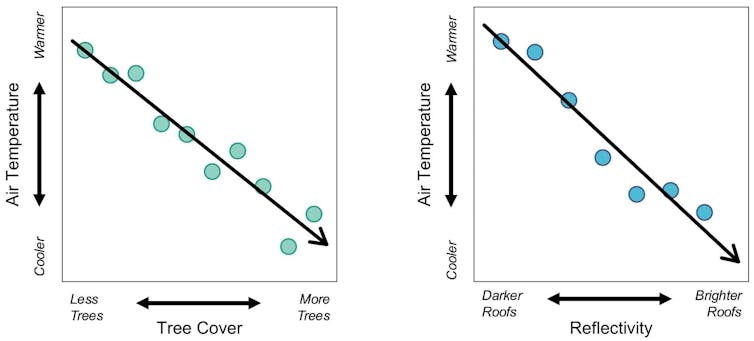
    Two charts show improvements
    In Boston, planting trees, left, and increasing roof reflectivity, right, were both found to be effective ways to cool urban areas.
    Ian Smith et al. 2025

    Efforts like these can help spread cool roof benefits across densely populated neighborhoods that need cooling help most.

    As climate change drives more frequent and intense urban heat, cities have powerful tools for lowering the temperature. With some attention to what already exists and what’s feasible, they can find the right budget-conscious strategy that will deliver cooling benefits for everyone.

    The Conversation

    Lucy Hutyra has received funding from the U.S. federal government and foundations including the World Resources Institute and Burroughs Wellcome Fund for her scholarship on urban climate and mitigation strategies. She was a recipient of a 2023 MacArthur Fellowship for her work in this area.

    Ian Smith does not work for, consult, own shares in or receive funding from any company or organization that would benefit from this article, and has disclosed no relevant affiliations beyond their academic appointment.

    ref. 2 ways cities can beat the heat: Which is best, urban trees or cool roofs? – https://theconversation.com/2-ways-cities-can-beat-the-heat-which-is-best-urban-trees-or-cool-roofs-260188

  • How the nature of environmental law is changing in defense of the planet and the climate

    Source: ForeignAffairs4

    Source: The Conversation – USA (2) – By Dana Zartner, Professor of International Studies, University of San Francisco

    A 2017 New Zealand law recognizes inherent rights of the Whanganui River. Jason Pratt, CC BY-SA

    While the dangerous effects of climate change continue to worsen, legal efforts to address a range of environmental issues are also on the rise.

    Headlines across the globe tout many of these legal actions: South Korea’s Climate Law Violates Rights of Future Generations; Ukraine is Ground Zero in Battle for Ecocide Law; Paris Wants to Grant the River Seine Legal Personhood; and Montana Court Rules Children Have the Right to a Healthy Environment, to name a few recent examples.

    As an environmental lawyer, I see that most of these suits use one of five legal strategies that have been developed over the past couple of decades. These approaches vary in terms of who is filing the lawsuit, against whom, and whether the underlying legal perspective is based on protecting human rights or the rights of the environment itself. But they all share an innovative approach to protect all life on this planet.

    1. Right to a healthy environment

    In 2022, the United Nations declared that humans have “the right to a clean, healthy and sustainable environment … essential to protecting human life, well-being and dignity.” More than 150 countries have similar declarations in their constitutions or laws, often alongside protections for other human rights, such as those to education and medical care.

    These rights are held by humans, so people can sue for alleged violations. Typically they sue one or more government agencies, whose responsibility it is to protect human rights.

    One recent case using this approach was Held v. Montana, in which a group of young people in 2024 won a lawsuit against the state of Montana for violating the state constitution’s right to a “clean and healthful environment.” The state Supreme Court agreed with the plaintiffs and struck down a law barring the consideration of climate effects when evaluating proposals for fossil fuel extraction. Similar cases have been heard in the U.S. and other countries around the world.

    A young woman and two young boys listen as lawyers talk. Young people fill two rows of benches behind them in the small court room.
    Rikki Held, the lead plaintiff in the Montana case, center seated, confers with the Our Children’s Trust legal team before the start of the trial on June 12, 2023.
    William Campbell/Getty Images

    2. The rights of future generations

    A legal concept called “intergenerational equity” is the idea that present generations must “responsibly use and conserve natural resources for the benefit of future generations.” First codified in international law in the 1972 Stockholm Declaration, the principle has been gaining popularity in recent decades. International organizations and national governments have enshrined this principle in law.

    Focused on humans’ rights, these laws allow people and groups to bring claims, usually against governments, for allowing activities that are altering the environment in ways that will harm future generations. One well-known case that relied on this legal principle is Future Generations v. Ministry of the Environment and Others, in which a Colombian court in 2018 agreed with young people who had sued, finding that the Colombian government’s allowance of “rampant deforestation in the Amazon” violated the pact of intergenerational equity.

    3. Government responsibility

    Another human-centered approach is the public trust doctrine, which establishes “that certain natural and cultural resources are preserved for public use” and that governments have a responsibility to protect them for everyone’s benefit.

    While the concept of “public trust” has long existed in the law, recently it has been used to bring suit against governments for their failure to address climate change and other environmental degradation. In Urgenda Foundation v. the State of the Netherlands, a Dutch court held in 2019 that the government has a responsibility to mitigate the effects of climate change due to the “severity of the consequences of climate change and the great risk of climate change occurring.” Since the decision, the Dutch government has sought to reduce emissions by phasing out the use of coal, increasing reliance on renewable energy and aiming to achieve carbon neutrality by 2050.

    Government responsibility for the public trust was also a basis of the Juliana v. U.S. case, where a group of young people sued the U.S. government for breaching the public trust by not doing enough to curb greenhouse gas emissions. The U.S. Supreme Court ultimately declined to hear an appeal of a lower court’s ruling, but the lack of a specific ruling by the nation’s highest court has given continued hope to new cases, which continue to be filed based on the same principle.

    A documentary examining the movement to protect the rights of nature.

    4. Rights of nature

    The rights of nature is one of the fastest-growing environmental legal strategies of the past decade. Since Ecuador recognized the rights of Pachamama, the Quechua name for Mother Earth, in its Constitution in 2008, more than 500 laws on the rights of nature have been enacted around the world.

    The principle recognizes the legal rights of natural entities, such as rivers, mountains, ecosystems or even something as specific as wild rice. The laws that grant these rights don’t focus on humans but rather nature itself, often including language that the natural entity has the right to “exist and persist.”

    The laws then provide a mechanism for the natural entity – whether through a specific group assigned legal guardianship or other community efforts – to protect itself by filing lawsuits in court. In the 2018 Colombian case, the court found that the Amazon ecosystem has rights, which must be respected and protected.

    Similarly, in Bangladesh in 2019 the courts recognized the rights of all the country’s rivers, requiring, among other things, a halt on damaging development along the rivers that block their natural flow. The court also created a commission to serve as legal guardians of the country’s rivers.

    People walk through an area of rocks to a grassy plain.
    The destruction of a dam in Ukraine, which emptied this former reservoir, is being investigated as a possible crime of ecocide.
    Tarasov/Ukrinform/Future Publishing via Getty Images

    5. Defining a new crime: Ecocide

    In 2024, the governments of Vanuatu, Fiji and Samoa formally proposed that the international community recognize a new crime under international law. Called “ecocide,” the principle takes a nature-focused approach and includes any unlawful act committed with “the knowledge that there is a substantial likelihood of severe and either widespread or long-term damage to the environment.”

    Put another way, what genocide is to humans, ecocide is to nature. It is being proposed as an addition to the 2002 Rome Statute, which created the International Criminal Court to prosecute war crimes, genocide and crimes against humanity.

    While the idea is relatively new, in addition to the international efforts, several countries have incorporated ecocide into their laws – including Vietnam, France, Chile and Ukraine. A Ukrainian prosecutor is currently investigating the June 2023 destruction of a dam in a Russian-occupied area of the country as a potential crime of ecocide, because of the widespread flooding and habitat destruction that resulted.

    The European Union has also incorporated ecocide into its Environmental Crime Directive, which applies to all EU member countries, providing them with a mechanism to hear ecocide claims in their national courts.

    Using these ideas

    Each of these legal concepts has the potential to increase protection for the environment – and the people who live in it. But determining which strategy has the greatest chance of success depends on the details of the existing law and legal system in each community.

    All of these legal strategies have a role in the fight to protect and preserve the environment as an integral, interdependent living thing that is vitally important to us as humans but also in its own right.

    The Conversation

    Dana Zartner is a volunteer with the Earth Law Center assisting with the editing of toolkits and guides, but has not worked on any of its lawsuits.

    ref. How the nature of environmental law is changing in defense of the planet and the climate – https://theconversation.com/how-the-nature-of-environmental-law-is-changing-in-defense-of-the-planet-and-the-climate-258982

  • Trump has fired the head of the Library of Congress, but the 225-year-old institution remains a ‘library for all’ – so far

    Source: ForeignAffairs4

    Source: The Conversation – USA – By Alex H. Poole, Associate Professor of Information Science, Drexel University

    The main reading room is seen at the Library of Congress on June 13, 2025, in Washington. Kevin Carter/Getty Images

    Carla Hayden, the 14th librarian of Congress, who has held the position since 2016, received an unexpected email on May 8, 2025.

    “Carla, on behalf of President Donald J. Trump, I am writing to inform you that your position as the Librarian of Congress is terminated effective immediately. Thank you for your service,” wrote Trent Morse, deputy director of presidential personnel at the White House.

    White House Press Secretary Karoline Leavitt later explained that Hayden, who was the first woman, Black person and professionally trained librarian to oversee the Library of Congress, had done “quite concerning things,” on the job, including “putting inappropriate books in the library for children.”

    Democratic politicians sharply criticized Hayden’s termination, saying the firing was unjust. It was actually about Trump punishing civil servants “who don’t bend to his every will,” New York Sen. Chuck Schumer said.

    An information science scholar, I have written extensively about the history of libraries and archives, including the Library of Congress. To fully understand the role Hayden played for the past nine years, I think it is important to understand what the Library of Congress does, and the overlooked and underappreciated role it has played in American life.

    A middle-aged woman with light brown skin and dark hair stands and smiles with her hands clasped together.
    Carla Hayden, the recently fired librarian of Congress, attends an event in March 2025 in Washington.
    Shannon Finney/Getty Images

    The Library of Congress’ work

    The Library of Congress is an agency that was first established, by an act of Congress, in 1800. The act provided for “the purchase of such books as may be necessary for the use of Congress at the said city of Washington, and for fitting up a suitable apartment for containing them.” Its chief librarian is appointed by the president and confirmed by the Senate.

    The library has six buildings in Washington that hold a print and online collection of nearly 26 million books, as well as more than 136 million other items, including manuscripts, maps, sheet music and prints and photographs.

    It also houses historic documents, like Thomas Jefferson’s rough draft of the Declaration of Independence and James Madison’s notes on the 1787 Constitutional Convention.

    The library is the property of the American people. Anyone over the age of 16 with a government-issued photo identification can enter its buildings and read or view its materials on-site. The Library of Congress was partially designed as a research institution to suit the needs of members of Congress, and only Congress members can borrow items from the library and take them home.

    The Library of Congress has an annual budget of about US$900 million, with a staff of 3,263. In 2024, the library’s staff helped acquire 1,437,832 million new items, issue nearly 69,000 library cards and answer more than 764,000 reference requests, among other tasks.

    The library’s deep roots

    The library has evolved alongside the U.S. itself. Five years before the Constitutional Convention of 1787, future president James Madison called for a library to provide materials to help inform Congress and its members. In 1800, President John Adams signed a bill that established the institution, which began with a $5,000 government appropriation, equivalent to more than $127,000 today.

    The library’s first collection included 152 works in 740 volumes imported from England. It occupied a space in a Washington Senate office that measured just 22 feet by 34 feet.

    The British army torched the infant library and its collection that had grown to 3,000 books in 1814, during the War of 1812. In response, former president Thomas Jefferson sold his personal collection of 6,479 books to the library, which he called “unquestionably the choicest collection of books in the U.S.

    Tragedy struck again in 1851, with a fire that incinerated two-thirds of the library’s 55,000 volumes, including most of Jefferson’s personal collection.

    The organization rebounded in the next few years, as it purchased the 40,000-volume Smithsonian library in 1866, among other new acquisitions.

    Ainsworth Spofford, the sixth librarian of Congress, boosted the library’s national image in the late 1800s when he tried to centralize the country’s patchwork copyright system.

    Spofford also successfully lobbied Congress to pass the Copyright Act of 1870, which stipulated that any party registering a work for copyright needed to deposit two copies of that work with the library.

    A growing place in American life

    As its collections burgeoned in both scale and scope in the latter part of the 19th century, the library assumed an increasingly visible role and became known by some as “the nation’s library.” By 1900, it had nearly 1 million printed books and other materials.

    The opening of a new library building in 1897, offering services to blind people with a designated reading room containing 500 raised character – or braille – books and music items, epitomized the library’s new status.

    President Theodore Roosevelt said in 1901 that the library was “the one national library of the United States” and that was “a unique opportunity to render to the libraries of this country – to American scholarship – service of the highest importance.”

    The library’s work, and global approach, continued to grow during the 20th century.

    By the late 1900s, the library held materials in more than 450 languages.

    It continued to add remarkable items to its collection, including a Gutenberg Bible, the first book printed in Europe from movable metal type, a kind of printing technology, in 1455.

    Documenting the evolution of democracy, the library also assumed stewardship of 23 presidents’ official papers, from George Washington to Calvin Coolidge, during this time frame.

    A public service

    While primarily designated a research institution for Congress, the library has also catered to a diverse range of patrons, including by mail and telephone.

    As one Science Digest writer noted in 1960, reference staff members fielded questions ranging from “What was the color of a mastodon’s eye?” to “How many words are there in the English language?” and “Could you suggest a name for twins?”

    The library’s register of copyrights received similarly diverse and even humorous inquiries. One older woman seeking to publish her poetry wrote in 1954 to request “a poetic license” to ensure her work conformed to the law.

    In the late 20th century, the library focused on a new democratic national and international mission, as it embraced a new role. Daniel Boorstin, the librarian from 1975 to 1987, termed that role a “multimedia encyclopedia.”

    A congressional resolution marking the Library of Congress’s bicentennial in 2000 noted that it was “the largest and most inclusive library in human history,” as it digitized its collections to extend its reach still further with the growth of the internet.

    As the library marks its 225th year, it continues to represent, as David Mearns, chief of the library’s manuscript division, said in 1947, “the American story.”

    A large building is seen with the sun shining on it on a clear day.
    The Thomas Jefferson Building of the Library of Congress is seen on June 11, 2025, in Washington.
    Kevin Carter/Getty Images

    A library for all

    Following Hayden’s dismissal, Trump appointed Deputy Attorney General Todd Blanche, his former personal lawyer, as acting librarian of Congress.

    Hayden has contended that her dismissal, which occurred alongside other firings of top civil servants, including the national archivist, represents a broad threat to people’s right to easily access free information.

    Democracies are not to be taken for granted,” Hayden said in June. She explained in an interview with CBS that she never had a problem with a presidential administration and is not sure why she was dismissed.

    “And the institutions that support democracy should not be taken for granted,” Hayden added.

    In her final annual report as librarian, Hayden characterized the institution as “truly, a library for all.” So far, even without her leadership, it remains just that.

    The Conversation

    Alex H. Poole does not work for, consult, own shares in or receive funding from any company or organization that would benefit from this article, and has disclosed no relevant affiliations beyond their academic appointment.

    ref. Trump has fired the head of the Library of Congress, but the 225-year-old institution remains a ‘library for all’ – so far – https://theconversation.com/trump-has-fired-the-head-of-the-library-of-congress-but-the-225-year-old-institution-remains-a-library-for-all-so-far-257508

  • How germy is the public pool? An infectious disease expert weighs in on poop, pee and perspiration – and the deceptive smell of chlorine

    Source: ForeignAffairs4

    Source: The Conversation – USA (3) – By Lisa Cuchara, Professor of Biomedical Sciences, Quinnipiac University

    A 2023 CDC report tracked more than 200 pool-associated outbreaks over a four-year period. But a few basic precautions can ward off these dangers. Maria Korneeva/Moment via Getty Images

    On hot summer days, few things are more refreshing than a dip in the pool. But have you ever wondered if the pool is as clean as that crystal blue water appears?

    As an immunologist and infectious disease specialist, I study how germs spread in public spaces and how to prevent the spread. I even teach a course called “The Infections of Leisure” where we explore the risks tied to recreational activities and discuss precautions, while also taking care not to turn students into germophobes.

    Swimming, especially in public pools and water parks, comes with its own unique set of risks — from minor skin irritations to gastrointestinal infections. But swimming also has a plethora of physical, social and mental health benefits. With some knowledge and a little vigilance, you can enjoy the water without worrying about what might be lurking beneath the surface.

    The reality of pool germs

    Summer news headlines and social media posts often spotlight the “ick-factor” of communal swimming spaces. These concerns do have some merit.

    The good news is that chlorine, which is widely used in pools, is effective at killing many pathogens. The not-so-good news is that chlorine does not work instantly – and it doesn’t kill everything.

    Every summer, the Centers for Disease Control and Prevention issues alerts about swimming-related outbreaks of illness caused by exposure to germs in public pools and water parks. A 2023 CDC report tracked over 200 pool-associated outbreaks from 2015 to 2019 across the U.S., affecting more than 3,600 people. These outbreaks included skin infections, respiratory issues, ear infections and gastrointestinal distress. Many of the outcomes from such infections are mild, but some can be serious.

    Germs and disinfectants

    Even in a pool that’s properly treated with chlorine, some pathogens can linger for minutes to days. One of the most common culprits is Cryptosporidium, a microscopic germ that causes watery diarrhea. This single-celled parasite has a tough outer shell that allows it to survive in chlorine-treated water for up to 10 days. It spreads when fecal matter — often from someone with diarrhea — enters the water and is swallowed by another swimmer. Even a tiny amount, invisible to the eye, can infect dozens of people.

    Collection of visual symbols for pool rules
    Showering before and after swimming in a public pool helps avoid both bringing in and taking out pathogens and body substances.
    Hafid Firman Syarif/iStock via Getty Images Plus

    Another common germ is Pseudomonas aeruginosa, a bacterium that causes hot tub rash and swimmer’s ear. Viruses like norovirus and adenovirus can also linger in pool water and cause illness.

    Swimmers introduce a range of bodily residues to the water, including sweat, urine, oils and skin cells. These substances, especially sweat and urine, interact with chlorine to form chemical byproducts called chloramines that may pose health risks.

    These byproducts are responsible for that strong chlorine smell. A clean pool should actually lack a strong chlorine odor, as well as any other smells, of course. It is a common myth that a strong chlorine smell is a good sign of a clean pool. In fact, it may actually be a red flag that means the opposite – that the water is contaminated and should perhaps be avoided.

    How to play it safe at a public pool

    Most pool-related risks can be reduced with simple precautions by both the pool staff and swimmers. And while most pool-related illnesses won’t kill you, no one wants to spend their vacation or a week of beautiful summer days in the bathroom.

    These 10 tips can help you avoid germs at the pool:

    • Shower before swimming. Rinsing off for at least one minute removes most dirt and oils on the body that reduce chlorine’s effectiveness.

    • Avoid the pool if you’re sick, especially if you have diarrhea or an open wound. Germs can spread quickly in water.

    • Try to keep water out of your mouth to minimize the risk of ingesting germs.

    • Don’t swim if you have diarrhea to help prevent the spread of germs.

    • If diagnosed with cryptosporidiosis, often called “crypto,” wait two weeks after diarrhea stops before returning to the pool.

    • Take frequent bathroom breaks. For children and adults alike, regular bathroom breaks help prevent accidents in the pool.

    • Check diapers hourly and change them away from the pool to prevent fecal contamination.

    • Dry your ears thoroughly after swimming to help prevent swimmer’s ear.

    • Don’t swim with an open wound – or at least make sure it’s completely covered with a waterproof bandage to protect both you and others.

    • Shower after swimming to remove germs from your skin.

    The Conversation

    Lisa Cuchara is affiliated with American Society for Microbiology

    ref. How germy is the public pool? An infectious disease expert weighs in on poop, pee and perspiration – and the deceptive smell of chlorine – https://theconversation.com/how-germy-is-the-public-pool-an-infectious-disease-expert-weighs-in-on-poop-pee-and-perspiration-and-the-deceptive-smell-of-chlorine-260996

  • Ozzy Osbourne’s spirit of defiance changed music forever

    Source: ForeignAffairs4

    Source: The Conversation – UK – By Douglas Schulz, Lecturer in Sociology and Criminology, University of Bradford

    Ozzy Osbourne’s death is not just the passing of another rock star. It marks the end of an era – the fading of a figure who helped shape an entire music genre and subculture.

    Both as a member of Black Sabbath and as a solo artist, Osbourne’s legacy lies not only in music history but how we understand performance, rebellion, and the expressive power of sound itself.

    Despite a long battle with Parkinson’s disease and several health setbacks over the years, the news of his death was a shock to the whole metal community. Just weeks before his death on July 22, Osbourne delivered his final performance with Black Sabbath in the place it all began – Villa Park in Birmingham.

    In the hours following the announcement of his death, countless bands and musicians flooded their social media channels to pay their respects.

    Osbourne’s life was a testament to reinvention, grit, and the power of artistic authenticity – going from a working-class kid in Aston to the biggest name in heavy metal, writing the soundtrack to so many people’s lives. His distinctive voice, theatrical presence, and sheer will and determination shaped heavy metal music – inspiring generations of musicians and fans.


    Looking for something good? Cut through the noise with a carefully curated selection of the latest releases, live events and exhibitions, straight to your inbox every fortnight, on Fridays. Sign up here.


    When Black Sabbath emerged in the early 1970s, they played a role in making rock music more menacing, grittier and heavier. The Birmingham band didn’t just turn up the amplifiers and played louder guitars – they introduced a new aesthetic. They were known for their doomy riffs and lyrics about war, madness and the occult. Osbourne, with his uncanny voice and stage presence, was at the front and centre.

    This sound was destined to become the blueprint for heavy metal. But Osbourne’s contribution went beyond his voice. He gave the genre its face, theatricality – and above all, its spirit of defiance.

    Whether he was biting off the head of a bat on stage, stumbling through reality television with absurd but relatable quotes, or delivering genre-defining performances, Osbourne embodied contradictions. He was a mix of menace and mischief, tragedy and comedy, myth and man.

    Heavy metal music has existed in tension with mainstream culture ever since its emergence in the UK in the late 1960s. It has been regarded as too aggressive, too loud, too weird. But Osbourne’s presence forced metal into the public discourse – whether through moral panics in the 1970s and ’80s, or through his television appearances in the 2000s. The Osbournes, a reality show following the family which aired on MTV, was a huge hit in the US and around the world, making Ozzy famous to a whole new audience.

    Throughout his long career, Osbourne helped shift heavy metal from the margins into the mainstream, without ever diluting its transgressive edge.

    A symbol of inspiration

    Osbourne’s stage persona carved out space for other artists to follow. His willingness to be ridiculous, to speak openly about his addictions, health struggles and family dysfunction made him oddly relatable. It is that relatability that allowed Osbourne to be metal’s court jester and elder statesman in one.

    Over time, bands like Slipknot, Ghost, Sleep Token, as well as more introspective bands like Deftones or Gojira, owe much to the groundwork Osbourne and Black Sabbath laid: a template for authenticity, theatricality, and emotional openness wrapped in spectacle and distortion. They helped define the core rhythms, riffs, themes and aesthetics that generations of metal bands followed.

    But Osbourne’s cultural influence cannot be measured only in record sales (although those were plenty), Grammy wins, or his induction into the US Rock and Roll Hall of Fame. His influence lies in how his image, sound and attitude reshaped music scenes across continents.

    In countries where metal is censored or underground, Osbourne was a symbol of resistance. In places where metal was accepted, he was the genre’s most unpredictable ambassador.

    The Prince of Darkness, as he was known, may have left the stage but his legacy will live on. His music is still looped on Tiktok videos, and memes still make rounds on social media.

    Young metal-heads will continue to emulate his style and irreverence. As long as people pick up guitars and look for a way to scream back at the world, Ozzy will be there – in spirit, in sound, and in spectacle.

    The Conversation

    Douglas Schulz does not work for, consult, own shares in or receive funding from any company or organisation that would benefit from this article, and has disclosed no relevant affiliations beyond their academic appointment.

    ref. Ozzy Osbourne’s spirit of defiance changed music forever – https://theconversation.com/ozzy-osbournes-spirit-of-defiance-changed-music-forever-261775

  • Binary star systems are complex astronomical objects − a new AI approach could pin down their properties quickly

    Source: ForeignAffairs4

    Source: The Conversation – USA – By Andrej Prša, Professor of Astrophysics and Planetary Science, Villanova University

    In a binary star system, two stars orbit around each other. ESO/L. Calçada, CC BY

    Stars are the fundamental building blocks of our universe. Most stars host planets, like our Sun hosts our solar system, and if you look more broadly, groups of stars make up huge structures such as clusters and galaxies. So before astrophysicists can attempt to understand these large-scale structures, we first need to understand basic properties of stars, such as their mass, radius and temperature.

    But measuring these basic properties has proved exceedingly difficult. This is because stars are quite literally at astronomical distances. If our Sun were a basketball on the East Coast of the U.S., then the closest star, Proxima, would be an orange in Hawaii. Even the world’s largest telescopes cannot resolve an orange in Hawaii. Measuring radii and masses of stars appears to be out of scientists’ reach.

    Enter binary stars. Binaries are systems of two stars revolving around a mutual center of mass. Their motion is governed by Kepler’s harmonic law, which connects three important quantities: the sizes of each orbit, the time it takes for them to orbit, called the orbital period, and the total mass of the system.

    I’m an astronomer, and my research team has been working on advancing our theoretical understanding and modeling approaches to binary stars and multiple stellar systems. For the past two decades we’ve also been pioneering the use of artificial intelligence in interpreting observations of these cornerstone celestial objects.

    Measuring stellar masses

    Astronomers can measure orbital size and period of a binary system easily enough from observations, so with those two pieces they can calculate the total mass of the system. Kepler’s harmonic law acts as a scale to weigh celestial bodies.

    An animation of a large star, which appears stationary, with a smaller, brighter star orbiting around it and eclipsing it when it passes in front.
    Binary stars orbit around each other, and in eclipsing binary stars, one passes in front of the other, relative to the telescope lens.
    Merikanto/Wikimedia Commons, CC BY-SA

    Think of a playground seesaw. If the two kids weigh about the same, they’ll have to sit at about the same distance from the midpoint. If, however, one child is bigger, he or she will have to sit closer, and the smaller kid farther from the midpoint.

    It’s the same with stars: The more massive the star in a binary pair, the closer to the center it is and the slower it revolves about the center. When astronomers measure the speeds at which the stars move, they can also tell how large the stars’ orbits are, and as a result, what they must weigh.

    Measuring stellar radii

    Kepler’s harmonic law, unfortunately, tells astronomers nothing about the radii of stars. For those, astronomers rely on another serendipitous feature of Mother Nature.

    Binary star orbits are oriented randomly. Sometimes, it happens that a telescope’s line of sight aligns with the plane a binary star system orbits on. This fortuitous alignment means the stars eclipse one another as they revolve about the center. The shapes of these eclipses allow astronomers to find out the stars’ radii using straightforward geometry. These systems are called eclipsing binary stars.

    By taking measurements from an eclipsing binary star system, astronomers can measure the radii of the stars.

    More than half of all Sun-like stars are found in binaries, and eclipsing binaries account for about 1% to 2% of all stars. That may sound low, but the universe is vast, so there are lots and lots of eclipsing systems out there – hundreds of millions in our galaxy alone.

    By observing eclipsing binaries, astronomers can measure not only the masses and radii of stars but also how hot and how bright they are.

    Complex problems require complex computing

    Even with eclipsing binaries, measuring the properties of stars is no easy task. Stars are deformed as they rotate and pull on each other in a binary system. They interact, they irradiate one another, they can have spots and magnetic fields, and they can be tilted this way or that.

    To study them, astronomers use complex models that have many knobs and switches. As an input, the models take parameters – for example, a star’s shape and size, its orbital properties, or how much light it emits – to predict how an observer would see such an eclipsing binary system.

    Computer models take time. Computing model predictions typically takes a few minutes. To be sure that we can trust them, we need to try lots of parameter combinations – typically tens of millions.

    This many combinations requires hundreds of millions of minutes of compute time, just to determine basic properties of stars. That amounts to over 200 years of computer time.

    Computers linked in a cluster can compute faster, but even using a computer cluster, it takes three or more weeks to “solve,” or determine all the parameters for, a single binary. This challenge explains why there are only about 300 stars for which astronomers have accurate measurements of their fundamental parameters.

    The models used to solve these systems have already been heavily optimized and can’t go much faster than they already do. So, researchers need an entirely new approach to reducing computing time.

    Using deep learning

    One solution my research team has explored involves deep-learning neural networks. The basic idea is simple: We wanted to replace a computationally expensive physical model with a much faster AI-based model.

    First, we computed a huge database of predictions about a hypothetical binary star – using the features that astronomers can readily observe – where we varied the hypothetical binary star’s properties. We are talking hundreds of millions of parameter combinations. Then, we compared these results to the actual observations to see which ones best match up. AI and neural networks are ideally suited for this task.

    In a nutshell, neural networks are mappings. They map a certain known input to a given output. In our case, they map the properties of eclipsing binaries to the expected predictions. Neural networks emulate the model of a binary but without having to account for all the complexity of the physical model.

    Neural networks detect patterns and use their training to predict an output, based on an input.

    We train the neural network by showing it each prediction from our database, along with the set of properties used to generate it. Once fully trained, the neural network will be able to accurately predict what astronomers should observe from the given properties of a binary system.

    Compared to a few minutes of runtime for the physical model, a neural network uses artificial intelligence to get the same result within a tiny fraction of a second.

    Reaping the benefits

    A tiny fraction of a second works out to about a millionfold runtime reduction. This brings the time down from weeks on a supercomputer to mere minutes on a single laptop. It also means that we can analyze hundreds of thousands of binary systems in a couple of weeks on a computer cluster.

    This reduction means we can obtain fundamental properties – stellar masses, radii, temperatures and luminosities – for every eclipsing binary star ever observed within a month or two. The big challenge remaining is to show that AI results really give the same results as the physical model.

    This task is the crux of my team’s new paper. In it we’ve shown that, indeed, the AI-driven model yields the same results as the physical model across over 99% of parameter combinations. This result means the AI’s performance is robust. Our next step? Deploy the AI on all observed eclipsing binaries.

    Best of all? While we applied this methodology to binaries, the basic principle applies to any complex physical model out there. Similar AI models are already speeding up many real-world applications, from weather forecasting to stock market analysis.

    The Conversation

    Andrej Prša receives funding from the National Aeronautics and Space Administration.

    ref. Binary star systems are complex astronomical objects − a new AI approach could pin down their properties quickly – https://theconversation.com/binary-star-systems-are-complex-astronomical-objects-a-new-ai-approach-could-pin-down-their-properties-quickly-253387

  • MIL-Evening Report: Indonesian military set to complete Trans-Papua Highway under Prabowo’s rule

    By Julian Isaac

    The Indonesian Military (TNI) is committed to supporting the completion of the Trans-Papua Highway during President Prabowo Subianto’s term in office.

    While the military is not involved in construction, it plays a critical role in securing the project from threats posed by pro-independence Papuan resistance groups in “high-risk” regions.

    Spanning a total length of 4330 km, the Trans-Papua road project has been under development since 2014.

    However, only 3446 km of the national road network has been connected after more than a decade of construction.

    “Don’t compare Papua with Jakarta, where there are no armed groups. Papua is five times the size of Java, and not all areas are secure,” TNI spokesman Major-General Kristomei Sianturi told a media conference at the Ministry of Public Works on Monday.

    One of the currently active segments is the Jayapura–Wamena route — specifically the Mamberamo–Elim section, which stretches 50 km.

    The project is being carried out through a public-private partnership and was awarded to PT Hutama Karya, with an investment of Rp3.3 trillion (about US$202 million) and a 15-year concession. The segment is expected to be completed within two years, targeting finalisation next year.

    Security an obstacle
    General Kristomei said that one of the main obstacles was security in the vicinity of construction sites.

    Out of 50 regencies/cities in Papua, at least seven are considered high-risk zones. Since its inception, the Trans-Papua road project has claimed 17 lives, due to clashes in the region.

    In addition to security challenges, the delivery of construction materials remains difficult due to limited infrastructure.

    “Transporting goods from one point to another in Papua is extremely difficult because there are no connecting roads. We’re essentially building from scratch,” General Kristomei said.

    In May 2024, President Joko Widodo convened a limited cabinet meeting at the Merdeka Palace to discuss accelerating development in Papua. The government agreed on the urgent need to improve education, healthcare, and security in the region.

    The Minister of National Development Planning, Suharso Monoarfa, announced that the government would ramp up social welfare programmes in Papua in coordination with then Vice-President Ma’ruf Amin, who chairs the Agency for the Acceleration of Special Autonomy in Papua (BP3OKP).

    ‘Welfare based approaches’
    “We are gradually implementing welfare-based approaches, including improvements in education and health, with budgets already allocated to the relevant ministries and agencies,” Suharso said in May last year.

    As of March 2023, the Indonesian government has disbursed Rp 1,036 trillion for Papua’s development.

    This funding has supported major infrastructure initiatives such as the 3462 km Trans-Papua Highway, 1098 km of border roads, the construction of the 1.3 km Youtefa Bridge in Jayapura, and the renovation of Domine Eduard Osok Airport in Sorong.

    Republished from the Indonesia Business Post.

    MIL OSI AnalysisEveningReport.nz

  • Calling university postgrad and undergrad students – apply to showcase your big ideas in Dubai

    Source: ForeignAffairs4

    Source: The Conversation – UK – By Matt Warren, Managing Director, Universal Impact, The Conversation

    Share your thoughts. Shutterstock

    We believe in the power of research to change the world for the better. But we also understand that research needs to be shared – effectively and accessibly – if it is to have its greatest impact.

    As the Conversation UK’s specialist communications subsidiary, Universal Impact’s mission is to enable researchers to communicate their work, in a targeted way, to a wide range of different audiences. Which is why we’re currently working with Prototypes for Humanity. This Dubai-based academic forum and event promotes innovative scientific solutions and enables international research collaboration.

    In April, we blogged about how the forum was seeking applicants for its Professors’ Programme. But applications to join this year’s Prototypes for Humanity annual gathering are now open to current university students on any undergraduate or postgraduate course – as well as graduates who completed their qualifications within the past two years.

    The key is that your work potentially offers a tangible solution to a real world problem.

    That’s you? Apply now…

    Participation is free and successful applicants will showcase their innovative solutions at the Jumeirah Emirates Towers, Dubai, from November 17 to 20, 2025. Flight and accommodation costs are covered by the organiser.

    There is also a US$100,000 prize fund to help the best projects roll out in the real world – and the opportunity to connect with a wide range of potential partners, funders and collaborators.

    The evaluation criteria are threefold, stating that the successful applicants will be able to show:

    Positive impact on people, communities or the planet: Whether addressing social issues, environmental concerns, or community development, demonstrating the project’s potential positive impact will be a crucial factor.

    Rigour of academic research: We are seeking projects that demonstrate a deep understanding of the challenges addressed, and the students’ ability to propose meaningful and innovative solutions through structured research.

    Application of technology: Innovative and effective use of technology (High-tech or Low-tech) is key, whether incorporating cutting-edge advancements or utilising simple yet efficient solutions.

    More than 2,700 entries landed in The Prototypes for Humanity programme’s inbox last year. And researchers from 800 universities, many members of The Conversation’s international network, applied.


    Read more:
    Prototypes for Humanity showcases solutions-based projects from universities around the world – in Dubai


    More than 100 projects were chosen to present at that event – and a similar number will be selected for this November’s showcase. The Conversation UK’s editor, Stephen Khan was at the 2024 event and blogged afterwards:

    For The Conversation, it was an introduction to some projects that I expect you’ll hear and read more about in our content in the months to come.

    While we rightly assess and explain events as they happen, delivering information about new research, and particularly innovative solutions that are born in the labs, studios and seminars of our partner universities is also a central element of our mission as we strive to be the comprehensive conveyor of academic knowledge.

    Indeed, two researchers who presented their work – on sustainable batteries – at the 2024 event recently featured on The Conversation Weekly’s award-winning podcast. We expect many more to write about their work for The Conversation down the line.


    Read more:
    What will batteries of the future be made of? Four scientists discuss the options – podcast


    You can submit research projects as an individual or group, or ask your professor to submit on your behalf. You can find the application link here and more information on the programme here. The deadline is July 31, 2025.

    Good luck.


    Universal Impact is a commercial subsidiary of The Conversation UK, offering specialist training, mentoring and research communication services and donating profits back to our parent charity. If you’re a researcher or research institution and you’re interested in working together, please get in touch – or subscribe to our weekly newsletter to find out more.

    The Conversation

    ref. Calling university postgrad and undergrad students – apply to showcase your big ideas in Dubai – https://theconversation.com/calling-university-postgrad-and-undergrad-students-apply-to-showcase-your-big-ideas-in-dubai-261706

  • MIL-OSI Analysis: Calling university postgrad and undergrad students – apply to showcase your big ideas in Dubai

    Source: The Conversation – UK – By Matt Warren, Managing Director, Universal Impact, The Conversation

    Share your thoughts. Shutterstock

    We believe in the power of research to change the world for the better. But we also understand that research needs to be shared – effectively and accessibly – if it is to have its greatest impact.

    As the Conversation UK’s specialist communications subsidiary, Universal Impact’s mission is to enable researchers to communicate their work, in a targeted way, to a wide range of different audiences. Which is why we’re currently working with Prototypes for Humanity. This Dubai-based academic forum and event promotes innovative scientific solutions and enables international research collaboration.

    In April, we blogged about how the forum was seeking applicants for its Professors’ Programme. But applications to join this year’s Prototypes for Humanity annual gathering are now open to current university students on any undergraduate or postgraduate course – as well as graduates who completed their qualifications within the past two years.

    The key is that your work potentially offers a tangible solution to a real world problem.

    That’s you? Apply now…

    Participation is free and successful applicants will showcase their innovative solutions at the Jumeirah Emirates Towers, Dubai, from November 17 to 20, 2025. Flight and accommodation costs are covered by the organiser.

    There is also a US$100,000 prize fund to help the best projects roll out in the real world – and the opportunity to connect with a wide range of potential partners, funders and collaborators.

    The evaluation criteria are threefold, stating that the successful applicants will be able to show:

    Positive impact on people, communities or the planet: Whether addressing social issues, environmental concerns, or community development, demonstrating the project’s potential positive impact will be a crucial factor.

    Rigour of academic research: We are seeking projects that demonstrate a deep understanding of the challenges addressed, and the students’ ability to propose meaningful and innovative solutions through structured research.

    Application of technology: Innovative and effective use of technology (High-tech or Low-tech) is key, whether incorporating cutting-edge advancements or utilising simple yet efficient solutions.

    More than 2,700 entries landed in The Prototypes for Humanity programme’s inbox last year. And researchers from 800 universities, many members of The Conversation’s international network, applied.


    Read more:
    Prototypes for Humanity showcases solutions-based projects from universities around the world – in Dubai


    More than 100 projects were chosen to present at that event – and a similar number will be selected for this November’s showcase. The Conversation UK’s editor, Stephen Khan was at the 2024 event and blogged afterwards:

    For The Conversation, it was an introduction to some projects that I expect you’ll hear and read more about in our content in the months to come.

    While we rightly assess and explain events as they happen, delivering information about new research, and particularly innovative solutions that are born in the labs, studios and seminars of our partner universities is also a central element of our mission as we strive to be the comprehensive conveyor of academic knowledge.

    Indeed, two researchers who presented their work – on sustainable batteries – at the 2024 event recently featured on The Conversation Weekly’s award-winning podcast. We expect many more to write about their work for The Conversation down the line.


    Read more:
    What will batteries of the future be made of? Four scientists discuss the options – podcast


    You can submit research projects as an individual or group, or ask your professor to submit on your behalf. You can find the application link here and more information on the programme here. The deadline is July 31, 2025.

    Good luck.


    Universal Impact is a commercial subsidiary of The Conversation UK, offering specialist training, mentoring and research communication services and donating profits back to our parent charity. If you’re a researcher or research institution and you’re interested in working together, please get in touch – or subscribe to our weekly newsletter to find out more.

    ref. Calling university postgrad and undergrad students – apply to showcase your big ideas in Dubai – https://theconversation.com/calling-university-postgrad-and-undergrad-students-apply-to-showcase-your-big-ideas-in-dubai-261706

    MIL OSI Analysis

  • MIL-Evening Report: View from The Hill: Nationals’ mavericks ensure the Coalition is the issue in parliament’s first week

    Source: The Conversation (Au and NZ) – By Michelle Grattan, Professorial Fellow, University of Canberra

    For almost as long anyone can remember, the Nationals have caused the Coalition grief on climate and energy policy. Still, for Barnaby Joyce to bring on a fresh load of trouble – with a private member’s bill to scrap Australia’s commitment to net zero emissions by 2050 – in Sussan Ley’s first parliamentary week as opposition leader was beyond provocative.

    And for Michael McCormack to support him reinforced the impression the Nationals don’t give a fig about the wider interests of a Coalition confronting very dark days.

    The bill will go nowhere but the issue will tear at the opposition.

    Both Joyce and McCormack are former leaders, and they are former rivals. In 2021 Joyce overthrew McCormack as leader. McCormack used to be a supporter of net zero. Joyce, a deputy prime minister, did a deal with then prime minister Scott Morrison for the Nationals to back net zero before Morrison went to the Glasgow COP conference in 2021. The Nationals are their own game of snakes and ladders.

    Now Joyce says he never supported the net zero target – which is sort of correct, because his own position during that deal (involving the trade off of promised huge infrastructure spending) was near impossible to fathom.

    On why stir the issue in the first parliamentary week, Joyce says, “Now is the time, when the agenda has not been set”.

    McCormack says he supported net zero in 2021 because Australia was suffering the trade restrictions imposed by China and needed to expand its exports to Europe, where many countries required the commitment. The farmers in his Riverina electorate wanted him to support it, he says.

    Despite disclaimers, this undermines the authority of Nationals leader David Littleproud, already weakened by the events around the temporary split in the Coalition after the election. The Nationals obtained their several policy demands (that didn’t relate to net zero) but Littleproud came in for a good deal of criticism.

    The Nationals are split over net zero, but it is looking increasingly difficult for those who want to preserve the commitment to hold the line. Joyce says he hopes the numbers are there in the party room to ditch it, and he suspects they are but “I don’t know”. McCormack believes the numbers are there.

    While Littleproud says he is waiting for the party’s own review, under net zero opponent senator Matt Canavan, he suggested the net zero commitment was “trying to achieve the impossible rather than doing what’s sensible”.

    The Liberals are divided too, but those wanting to end the commitment are in a minority. Former frontbencher Jane Hume spoke out on Wednesday, stressing how important the commitment was. “Over and over, the electorate has told us that they want to see a net zero energy future,” she told Sky. “My personal opinion is that this is profoundly important for not just the electorate, but also for our country.”

    But if the Nationals repudiated the net zero target, that would embolden the Liberal critics and probably add to their number. It would drive a wedge into the Coalition, and might be serious enough to split it.

    The Ley critics within the Liberals won’t be shedding any tears over the damage, now and later, that this issue will do her. Neither will Littleproud – it’s well known the two are not close.

    Ley herself can only say the opposition has a working group looking at energy and emissions reduction policy. But she knows this is simply a holding position. It’s impossible to think that the working group, headed by energy spokesman Dan Tehan, can come up with any policy position that unites two diametrically opposed positions.

    Tehan said of Joyce and McCormack, “They’re two steers fighting in the neighbour’s paddock”. The flaw with this dismissal is that the steers are actually part of the broad Coalition herd.

    In the first question time of the new parliament, the opposition wasn’t able to score any hits on the government. The prime minister and other ministers were able to shrug off questions about Labor’s proposed tax on unrealised capital gains on big superannuation balances, and other issues. Energy Minister Chris Bowen had been handed ammunition to deploy against the opposition.

    The overwhelming message of the day was that the opposition had made itself the issue. From the Coalition’s point of view, the problem is this damaging conversation will go on a long time.

    Michelle Grattan does not work for, consult, own shares in or receive funding from any company or organisation that would benefit from this article, and has disclosed no relevant affiliations beyond their academic appointment.

    ref. View from The Hill: Nationals’ mavericks ensure the Coalition is the issue in parliament’s first week – https://theconversation.com/view-from-the-hill-nationals-mavericks-ensure-the-coalition-is-the-issue-in-parliaments-first-week-261099

    MIL OSI AnalysisEveningReport.nz

  • MIL-Evening Report: Childcare centres will have funding stripped if they’re not ‘up to scratch’. Is this enough?

    Source: The Conversation (Au and NZ) – By Erin Harper, Lecturer, School of Education and Social Work, University of Sydney

    Maskot/Getty Images

    Childcare centres will lose their eligibility for fee subsidies if they don’t meet safety standards, according to a new bill introduced to parliament on Wednesday.

    As Education Minister Jason Clare told parliament:

    it will give us the power to cut off funding to childcare centres that aren’t up to scratch.

    The bill follows recent allegations a Victorian childcare worker abused children in his care. There have also been allegations of abuse in centres in New South Wales and Queensland. Labor has warned lower house MPs it can expect late nights next week, to try to get this bill and the governments’ plan to cut HELP debts through parliament.

    What’s in the bill? What does it mean for families? And what’s missing?

    What’s in the bill?

    Clare told parliament the federal government’s childcare subsidy currently covers about 70% of the average cost of running a centre.

    This legislation gives the federal education department the power to suspend or cancel that funding if a centre “is not meeting the quality, safety and other compliance requirements,” according to the national system of early childhood regulation.

    The department could also stop a childcare operator from opening a new service if there are problems with existing services.

    It applies to all types of early childhood services from daycare centres to family daycare, and also before and after school care.

    The federal education department will also have new powers to do spot checks in services (this is on top of state authorities who can already do checks).

    There are strong, new measures

    It is positive to see strengthened measures to take a providers’ track record into account before saying “yes you can open another service”. This is a slightly more proactive measure, in addition to punishments for services that do not comply.

    We are also seeing more transparency. The bill will provide new powers to publicise when a provider is refused approval for a new service.

    It can also publish other compliance action taken against providers, such as when conditions are applied – and the details of those conditions. Or if a fine has been imposed.

    This means families and the broader public – including any shareholders – will also be more aware of what is going on in childcare services.

    Is this enough?

    While the Coalition and the Greens are broadly supportive of the bill, they also want to see further changes.

    Clare told parliament the bill is not the only measure the federal government was making around childcare standards.

    State and federal education ministers are due to meet next month to discuss child safety. This includes a national register to track early childhood workers from centre to centre, mandatory “child safety training”, CCTV for centres and other recommendations from the recent Wheeler review on the NSW early childhood sector.

    Attorneys general will also meet next month to discuss how to improve working with children checks.


    Read more:
    What are working with children checks? Why aren’t they keeping kids safe at daycare?


    What about the impact on families?

    We also need to think about the practical consequences of the bill. If the childcare subsidy was removed from any service – whether they are private or not-for-profit – they would quickly become unviable.

    Without the subsidy (which reduces out-of-pocket costs for parents), many families would not be able to afford childcare.

    If a service is going to have access to the subsidy taken away, how much notice should families get? These details need thoughtful consideration.

    If the federal education department is going to have a team of people doing checks on services, we also need to ask, how will this work? How quickly will they be able to do these checks? One of the issues with the current system is there are long delays between assessments. This suggests it will need careful planning and it will also cost some money.

    The bigger picture

    Beyond these questions, there is the bigger picture of childcare quality in Australia. The system is complex but people who educate and care for children are at the heart of it.

    My recent research has revealed educators are only spending 30% of their time on undistracted and uninterrupted time with children. This is due to the heavy and sometimes competing demands of their work, including administrative and cleaning duties. Educators say this diminishes their capacity to provide quality education and care.

    Heavy and distracting workloads, along with widespread reports of understaffing and breaches to minimum staff-to-child ratios, makes it difficult for educators to keep children safe.

    So meaningful reform must consider educators’ experiences, and include strategies to increase support for educators to do their jobs well.

    Erin Harper does not work for, consult, own shares in or receive funding from any company or organisation that would benefit from this article, and has disclosed no relevant affiliations beyond their academic appointment.

    ref. Childcare centres will have funding stripped if they’re not ‘up to scratch’. Is this enough? – https://theconversation.com/childcare-centres-will-have-funding-stripped-if-theyre-not-up-to-scratch-is-this-enough-261761

    MIL OSI AnalysisEveningReport.nz

  • MIL-Evening Report: Gaza – an open question for NZ’s foreign minister Winston Peters

    OPEN QUESTION: By Bryan Bruce

    Dear Rt Hon Winston Peters,

    There was a time when New Zealanders stood up for what was morally right. There are memorials around our country for those who died fighting fascism, we wrote parts of the UN Charter of Human Rights, we took an anti-nuclear stance in 1984, and three years prior to that, many of us stood against apartheid in South Africa by boycotting South African products and actively protesting against the 1981 Springbok Rugby Tour.

    To call out the Israeli government for genocide and ethnic cleansing in Gaza is not to be antisemitic. Nor is it to be pro- Hamas. It is to simply to be pro-human.

    While acknowledging the peace and humanitarian initiatives on the Foreign Affairs website, I note there is no calling out of the genocide and ethnic cleansing that cannot be denied is happening in Gaza.

    The Israeli government is systematically demolishing whole towns and cities — including churches, mosques, even removing trees and vegetation — to deprive the Palestinian people the opportunity to return to their homeland; and there have been constant blocks to humanitarian aid as part of a policy forced starvation.

    There is no doubt crimes against international law have been committed, which is why the International Criminal Court (ICC) in The Hague has issued warrants for the arrest of Israeli Prime Minister Benjamin Netanyahu and Yoav Gallant, his former defence minister, for alleged crimes against humanity.

    So, my question to you is: why are you not pictured standing in this photograph (below) alongside the representatives from 33 nations at the July 16 2025 Gaza emergency conference in Bogotá?

    The nations that took part in the Gaza emergency summit in were:

    Norway, Portugal, Slovenia, Spain, Turkey, Colombia, South Africa, Bolivia, Cuba, Honduras, Malaysia, Namibia, Algeria, Bangladesh, Botswana, Brazil, Chile, China, Djibouti, Indonesia, Iraq, Ireland, Lebanon, Libya, Mexico, Nicaragua, Oman, Pakistan, Palestine, Qatar, Saint Vincent and the Grenadines, Uruguay and Venezuela.

    Representatives from 33 nations at the July 16 2025 Gaza emergency conference in Bogotá. Image: bryanbruce.substack.com

    MIL OSI AnalysisEveningReport.nz

  • MIL-Evening Report: Gaza – an open question for NZ’s foreign minister Winston Peters

    OPEN QUESTION: By Bryan Bruce

    Dear Rt Hon Winston Peters,

    There was a time when New Zealanders stood up for what was morally right. There are memorials around our country for those who died fighting fascism, we wrote parts of the UN Charter of Human Rights, we took an anti-nuclear stance in 1984, and three years prior to that, many of us stood against apartheid in South Africa by boycotting South African products and actively protesting against the 1981 Springbok Rugby Tour.

    To call out the Israeli government for genocide and ethnic cleansing in Gaza is not to be antisemitic. Nor is it to be pro- Hamas. It is to simply to be pro-human.

    While acknowledging the peace and humanitarian initiatives on the Foreign Affairs website, I note there is no calling out of the genocide and ethnic cleansing that cannot be denied is happening in Gaza.

    The Israeli government is systematically demolishing whole towns and cities — including churches, mosques, even removing trees and vegetation — to deprive the Palestinian people the opportunity to return to their homeland; and there have been constant blocks to humanitarian aid as part of a policy forced starvation.

    There is no doubt crimes against international law have been committed, which is why the International Criminal Court (ICC) in The Hague has issued warrants for the arrest of Israeli Prime Minister Benjamin Netanyahu and Yoav Gallant, his former defence minister, for alleged crimes against humanity.

    So, my question to you is: why are you not pictured standing in this photograph (below) alongside the representatives from 33 nations at the July 16 2025 Gaza emergency conference in Bogotá?

    The nations that took part in the Gaza emergency summit in were:

    Norway, Portugal, Slovenia, Spain, Turkey, Colombia, South Africa, Bolivia, Cuba, Honduras, Malaysia, Namibia, Algeria, Bangladesh, Botswana, Brazil, Chile, China, Djibouti, Indonesia, Iraq, Ireland, Lebanon, Libya, Mexico, Nicaragua, Oman, Pakistan, Palestine, Qatar, Saint Vincent and the Grenadines, Uruguay and Venezuela.

    Representatives from 33 nations at the July 16 2025 Gaza emergency conference in Bogotá. Image: bryanbruce.substack.com

    MIL OSI AnalysisEveningReport.nz

  • MIL-Evening Report: Time to ditch splitting the bill? Shouting a close friend could actually make you happier

    Source: The Conversation (Au and NZ) – By Aimee E. Smith, Postdoctoral Research Fellow in the Net Zero Observatory, The University of Queensland

    Jose Calsina/Shutterstock

    When an outing calls for upfront payment, such as admission to the cinema, a play or a theme park, the question of who covers it can shape the tone before the fun even begins.

    Navigating payment with others – whether colleagues, close friends or new acquaintances – can be tricky and interrupt the social dynamic that makes shared experiences so valuable.

    Our new research, published in Psychology and Marketing, suggests the way you approach splitting upfront costs could have some surprising impacts.

    In some cases, despite the dent in your bank account, covering the full cost of an experience for yourself and someone else could actually make you happier.

    But this won’t always be the case. And it likely comes down to the different norms and expectations we have for different kinds of relationships.

    The experience economy

    When times are tough financially, psychology suggests people would prefer to spend their money on material goods rather than experiences.

    Yet despite ongoing cost-of-living pressures, there’s evidence to suggest many Australians are prioritising experiences.

    Experiences are often shared with other people.
    Tsuguliev/Shutterstock

    Experiences are not just services, but rather about creating memorable events. Compared with material goods, experiences are consistently linked to improved happiness.

    A big part of the benefit we derive from such experiences hinges on the fact that we share them with other people. Putting money towards experiences lets us spend time with other people and relate to them in ways just buying “stuff” often can’t match.

    So much so, that factors like who we go with, the quality of conversations an experience leads to, or the clarity we have about the other person’s interests can have as much of an effect on happiness as the experience content itself.

    In shared experiences, where money is unavoidable, how does “who pays” affect their well-being benefits? This is the question we posed in our latest research, coauthored with Belinda Barton and Natalina Zlatevska.

    Going to the movies

    We conducted three experiments with 2,640 people and presented them with a common scenario: they would be going to the cinema with either their best friend or a casual acquaintance.

    We told half of the participants they would split the cost (that is, pay only for their own admission). The other half were told they would cover the whole cost for both themselves and the other person. We then asked them how happy they would be with this purchase.

    Across the three studies, when participants were with their best friend, they reported they would be happier paying the full amount than they would be splitting the cost. In contrast, when participants were with an acquaintance, we found that how the cost was split had no effect on happiness.

    Could paying for someone else’s ticket actually make you happier?
    andresr/Getty

    The ‘close friends’ effect

    With closer friends, unlike acquaintances and strangers, we often have a different set of norms and expectations – especially surrounding reciprocity.

    Interactions with close friends usually follow “communal norms”. This is where people help each other based on care and need, without expecting something in return.

    On the other hand, interactions with strangers and acquaintances are more likely to follow “exchange norms”, which prioritise balance and direct repayment.

    In line with this, we found when participants were with their best friends, their expectations of repayment were lower than with acquaintances when they paid for them. Where participants had higher expectations of repayment, they noted they would be less happy.

    Other possibilities

    We also tested other ideas, such as whether who pays would affect how smooth the conversation felt or whether it created awkwardness in the dynamic.

    We also examined whether the payment felt like an investment in the relationship, or whether it made the other person think more positively of the participant.

    We found that none of these really changed depending on who paid and how close the two people were, so they didn’t seem to explain why paying for a close friend felt better.

    Instead, norms around reciprocity in different types of relationships can make paying feel more transactional than a kind gesture. This, in turn, affects how happy it makes us feel.

    So, should I spend all my money on my friends?

    While our research suggests paying for others can make you happier, we don’t recommend budgeting your life savings for this cause.

    We limited our experiments to inexpensive experiences (that is, the cinema). So, it’s unlikely paying for your friend’s 2026 Europe trip will bring you ultimate happiness.

    Also, if your friend already owes you money, you might expect them to pay you back sooner, and footing the bill again could start to wear thin on your happiness.

    Aimee E. Smith does not work for, consult, own shares in or receive funding from any company or organisation that would benefit from this article, and has disclosed no relevant affiliations beyond their academic appointment.

    ref. Time to ditch splitting the bill? Shouting a close friend could actually make you happier – https://theconversation.com/time-to-ditch-splitting-the-bill-shouting-a-close-friend-could-actually-make-you-happier-261557

    MIL OSI AnalysisEveningReport.nz

  • MIL-Evening Report: Young Japanese voters embrace right-wing populist parties, leaving the prime minister on the brink

    Source: The Conversation (Au and NZ) – By Craig Mark, Adjunct Lecturer, Faculty of Economics, Hosei University

    Japan’s ruling coalition suffered the widely expected loss of its majority in the July 20 election, as young voters shifted to the populist right. As a result, Shigeru Ishiba’s prime ministership now hangs in the balance.

    The election was for half of the 248 members of the House of Councillors, the upper house of the National Diet, Japan’s parliament. The Liberal Democratic Party (LDP) secured 39 seats, and its minor coalition partner, the Komeito Party, just eight. This left it three seats short of the 50 required to maintain its majority, as populist opposition parties made dramatic gains.

    The LDP is now confronted with minorities in both houses of the Diet for the first time in the party’s 70-year history. It is a huge decline from its postwar dominance of Japanese politics.

    In a press conference on Monday, Ishiba said he would not resign, as the LDP remained the largest party in the upper house. He also insisted he needed to stay in office to complete negotiations with the Trump administration, which had threatened to continue harsh trade tariffs after August 1.

    But Ishiba is facing calls from disgruntled LDP Diet members to step down. He had already led the LDP into minority government in last October’s election for the lower house of the Diet, the House of Representatives. He called the snap election in the wake of securing LDP leadership last September.


    Read more:
    Why did Japan’s new leader trigger snap elections only a week after taking office? And what happens next?


    However, the main opposition Constitutional Democratic Party of Japan (CDP) was not responsible for this latest defeat – it managed only to retain its 22 seats. Instead, the LDP and Komeito instead lost out to the two rising populist parties: the centre-right Democratic Party for the People (DPFP), which went from four to 17 seats, and the far-right Sanseito party, which made the most dramatic gains, from one to 14 seats.

    Main opposition leader Yoshihiko Noda now needs to again consider whether to bring on a motion of no confidence in the Ishiba cabinet in the lower house. Last month, he backed away from doing so. Such a motion would likely succeed with the support of the other opposition parties, and immediately trigger a snap lower house election. But it would also be highly risky, as it could allow the two right-wing parties to again overshadow the main opposition.

    The young shift to the right

    Exit polls showed younger people voted in greater numbers for the two right-wing parties. Their dissatisfaction erupted against the political status quo that has long favoured older generations. Older Japanese remain the main supporters for the two major parties, as well as the smaller Komeito and the declining Japanese Communist Party.

    Many voters were angry about declining wages, persistent inflation, and a growing tax burden to fund the straining pension and welfare system that disproportionately benefits the elderly.

    The leaders of the two right-wing parties, 56-year-old Yuichiro Tamaki and 47-year-old Sohei Kamiya, more effectively used social media to exploit this electoral discontent and push their populist messages.

    Sanseito emerged at the start of the COVID pandemic in March 2020. It promoted anti-vaccination conspiracy theories and xenophobia through its campaign slogan of “Japanese First”.

    As more people have expressed frustration with Japan’s record tourist numbers, Sanseito and the smaller far-right Conservative Party of Japan sought to scapegoat the relatively small foreign resident population of waging a “silent invasion”.

    This includes spreading false stories about them causing local crime waves, depressing wages, hiking real estate prices, and abusing welfare.

    The number of foreign-born residents, mostly from other Asian countries, has steadily risen to 3.8 million to meet the demands of the shrinking labour force. However, it still only comprises about 3% of Japan’s (ageing and shrinking) population.

    Despite running and electing a majority of female candidates, Sanseito has also attracted criticism for wanting to end gender equality so as to raise the birth rate. It also wants to remove democratic protections from the postwar constitution and return to an imperial form of government.

    The success of the two right-wing parties, along with the nationalist neoliberal Japan Innovation Party, threatens to transform Japanese politics.

    However, it remains to be seen whether they will be able to cooperate effectively in the Diet with other parties to enact their policy agenda. This includes cutting the consumption tax rate while boosting subsidies to support families and farmers, and restricting immigration.

    Uncertainty reigns

    The increased political uncertainty will raise concerns about Japan’s ability to continue its strategic reorientation. It has pledged to increase its defence spending to 2% of gross domestic product (GDP). It also wants to increase security cooperation with Europe, India and Australia.

    The LDP’s Diet members will hold a full party meeting on July 31 to assess the election. If a majority of LDP members across both houses and representatives of the party’s prefectural chapters petition for a leadership ballot, they could mount a spill against Ishiba.

    Ishiba now needs to continue to negotiate with opposition parties to pass legislation in both houses of the Diet. US President Donald Trump’s sudden announcement that a “massive” deal has been struck with Japan for a reciprocal tariff rate of 15% may yet give him a temporary political reprieve.

    But as his post-election approval rating hits a record low 23%, his ailing premiership looks even more vulnerable.

    Craig Mark does not work for, consult, own shares in or receive funding from any company or organisation that would benefit from this article, and has disclosed no relevant affiliations beyond their academic appointment.

    ref. Young Japanese voters embrace right-wing populist parties, leaving the prime minister on the brink – https://theconversation.com/young-japanese-voters-embrace-right-wing-populist-parties-leaving-the-prime-minister-on-the-brink-261673

    MIL OSI AnalysisEveningReport.nz

  • MIL-Evening Report: ER Report: A Roundup of Significant Articles on EveningReport.nz for July 23, 2025

    ER Report: Here is a summary of significant articles published on EveningReport.nz on July 23, 2025.

    Hard labour conditions of online moderators directly affect how well the internet is policed – new study
    Source: The Conversation (Au and NZ) – By Tania Chatterjee, Joint PhD Candidate at Indian Institute of Technology, Delhi, The University of Queensland Getty Images/GCShutter Big tech platforms often present content moderation as a seamless, tech‑driven system. But human labour, often outsourced to countries such as India and the Philippines, plays a pivotal role in

    Ghosted by a friend? 4 expert tips on how to handle the hurt
    Source: The Conversation (Au and NZ) – By Megan Willis, Associate Professor, School of Behavioural and Health Sciences, Australian Catholic University martin-dm/Getty When we talk about “ghosting”, we usually think it relates to dating. But what happens when you’ve been ghosted by someone you’ve known for years – your childhood best friend, a parent, a

    Labor’s new bill would cut HELP loans by 20%. But it also risks locking some graduates into a ‘debt treadmill’
    Source: The Conversation (Au and NZ) – By Andrew Norton, Professor of Higher Education Policy, Monash University The Albanese government’s 20% cut to student debt is the first bill introduced to the new federal parliament. It is clever politics. In the government’s first term, the 3 million Australians with a student debt turned high indexation

    ICJ climate crisis ruling: Will world’s top court back Pacific-led call to hold governments accountable?
    By Jamie Tahana in The Hague for RNZ Pacific In 2019, a group of law students at the University of the South Pacific, frustrated at the slow pace with which the world’s governments were moving to address the climate crisis, had an idea — they would take the world’s governments to court. They arranged a

    ‘Maybe this is the last minutes you are living’: how the war is impacting young Ukrainians
    Source: The Conversation (Au and NZ) – By Ashley Humphrey, Lecturer in Social Sciences, Monash University Now into its fourth year, the war that followed Russia’s invasion of Ukraine has taken a devastating toll. An estimated 60,000 to 100,0000 Ukrainian lives have been lost and more than 10 million citizens displaced, and entire cities have

    Auckland is NZ’s ‘primate city’ but its potential remains caged in by poor planning and vision
    Source: The Conversation (Au and NZ) – By Timothy Welch, Senior Lecturer in Urban Planning, University of Auckland, Waipapa Taumata Rau Getty Images The recent report comparing Auckland to nine international peer cities delivered an uncomfortable truth: our largest city is falling behind, hampered by car dependency, low-density housing and “weak economic performance”. The Deloitte

    Climate disasters are pushing people into homelessness – but there’s a lot we can do about it
    Source: The Conversation (Au and NZ) – By Timothy Heffernan, Lecturer in Anthropology, Australian National University Almost half of all Australian properties are at risk of bushfire, while 17,500 face risk of coastal erosion. By 2030, more than 3 million will face riverine flood risk. Meanwhile, housing demand continues to outpace supply. With climate-related disasters

    UK bans Gaza protest group – could the same thing happen in Australia?
    Source: The Conversation (Au and NZ) – By Shannon Bosch, Associate Professor (Law), Edith Cowan University More than 100 people were arrested in the United Kingdom on the weekend for supporting Palestine Action, a protest group that opposes Britain’s support of Israel. Palestine Action was recently proscribed as a terrorist organisation, placing it in the

    The incredible impact of Ozzy Osbourne, from Black Sabbath to Ozzfest to 30 years of retirement tours
    Source: The Conversation (Au and NZ) – By Lachlan Goold, Senior Lecturer in Contemporary Music, University of the Sunshine Coast Ozzy Osbourne photographed in London in 1991. Martyn Goodacre/Getty Images Ozzy Osbourne, the “prince of darkness” and godfather of heavy metal, has died aged 76, just weeks after he reunited with Black Sabbath bandmates for

    Could the latest ‘interstellar comet’ be an alien probe? Why spotting cosmic visitors is harder than you think
    Source: The Conversation (Au and NZ) – By Sara Webb, Lecturer, Centre for Astrophysics and Supercomputing, Swinburne University of Technology Comet 3I/ATLAS International Gemini Observatory/NOIRLab/NSF/AURA/K. Meech/Jen Miller/Mahdi Zamani, CC BY On July 1, astronomers spotted an unusual high-speed object zooming towards the Sun. Dubbed 3I/ATLAS, the surprising space traveller had one very special quality: its

    Should Australia lower the voting age to 16 like the UK? We asked 5 experts
    Source: The Conversation (Au and NZ) – By Pandanus Petter, Postdoctoral Research Fellow, School of Politics and International Relations, Australian National University The government in the UK is introducing legislation into parliament to lower the voting age to 16. If passed, the new age rules will be in place for the next general election, expected

    Doctors shouldn’t be allowed to object to medical care if it harms their patients
    Source: The Conversation (Au and NZ) – By Julian Savulescu, Visiting Professor in Biomedical Ethics, Murdoch Children’s Research Institute; Distinguished Visiting Professor in Law, University of Melbourne; Uehiro Chair in Practical Ethics, The University of Melbourne HRAUN/Getty A young woman needs an abortion and the reasons, while urgent, are not medical. A United States Navy

    Ultra fast fashion could be taxed to oblivion in France. Could Australia follow suit?
    Source: The Conversation (Au and NZ) – By Rowena Maguire, Professor of Law and Director of the Centre of Justice, Queensland University of Technology Ryan McVay/Getty For centuries, clothes were hard to produce and expensive. People wore them as long as possible. But manufacturing advances have steadily driven down the cost of production. These days,

    Central bank independence and credibility matters. Here’s why
    Source: The Conversation (Au and NZ) – By John Simon, Adjunct Fellow in Economics, Macquarie University Olga Kashubin/Shutterstock In the United States, President Donald Trump has been pressuring the chairman of the US Federal Reserve, Jerome Powell, to slash interest rates. This is partly to ease the interest payments on the ballooning US government debt.

    Kneecap’s stance on Gaza extends a long history of the Irish supporting other oppressed peoples
    Source: The Conversation (Au and NZ) – By Ciara Smart, PhD Graduand in Australasian Irish History, University of Tasmania Love them or hate them, there’s no doubt Irish hip-hop trio Kneecap are having a moment. Their music – delivered in a powerful fusion of English and Irish – is known for its gritty lyrics about

    Do countries have a duty to prevent climate harm? The world’s highest court is about to answer this crucial question
    Source: The Conversation (Au and NZ) – By Nathan Cooper, Associate Professor of Law, University of Waikato Getty Images The International Court of Justice (ICJ) will issue a highly anticipated advisory opinion overnight to clarify state obligations related to climate change. It will answer two urgent questions: what are the obligations of states under international

    Gaza not a religious issue – it’s a massive violation of international law, say accord critics
    Asia Pacific Report Groups that have declined to join the government-sponsored “harmony accord” signed yesterday by some Muslim and Jewish groups, say that the proposed new council is “misaligned” with its aims. The signed accord was presented at Government House in Auckland. About 70 people attended, including representatives of the New Zealand Jewish Council, His

    Flying the flags for Palestine – NZ protesters take message to Devonport
    The Devonport Flagstaff About 200 people marched in Devonport last Saturday in support of Palestine. Pro-Palestine flags and placards were draped on the band rotunda at Windsor Reserve as speakers, including Green Party co-leader Chlöe Swarbrick and the people power manager of Amnesty International Aotearoa New Zealand Margaret Taylor, a Devonport local, encouraged the crowd

    View from The Hill: How much can Jim Chalmers get out of the economic reform roundtable?
    Source: The Conversation (Au and NZ) – By Michelle Grattan, Professorial Fellow, University of Canberra We’re now less than a month away from the start of the Albanese government’s “economic reform” (aka “productivity”) roundtable, but it has become quite hard to get a fix on exactly what this gathering will amount to. The guest list

    Israeli settlers beat to death 2 Palestinians in latest lynchings
    BEARING WITNESS: By Cole Martin in occupied West Bank Two young Palestinians were beaten to death on their land by Israeli settlers in the occupied West Bank on Friday. A funeral was held on Sunday for Sayfollah “Saif” Mussalet, 20, and Muhammad Shalabi, 23, who were brutally killed by a large group of settlers in

    MIL OSI AnalysisEveningReport.nz

  • MIL-Evening Report: Labor’s new bill would cut HELP loans by 20%. But it also risks locking some graduates into a ‘debt treadmill’

    Source: The Conversation (Au and NZ) – By Andrew Norton, Professor of Higher Education Policy, Monash University

    The Albanese government’s 20% cut to student debt is the first bill introduced to the new federal parliament. It is clever politics.

    In the government’s first term, the 3 million Australians with a student debt turned high indexation of their loan balances into a major issue. The proposed 20% cut flipped a political negative into a positive ahead of the May 2025 federal election.

    The 20% cut legislation, introduced on Wednesday, will also change how student debt is repaid. All the 1.2 million people currently repaying student loans will pay less per year as a result.

    How does the cut work, and what does it mean in practice for current students and people with student debt?

    Beware the fine print

    These changes come with disadvantages. The 20% cut is not well targeted. It will deliver major benefits to recent graduates, but much less to current students or earlier graduates, and nothing to future students.

    While repaying less HELP debt per year sounds good, more graduates will be caught on a debt treadmill, repaying less than the annual indexation on their HELP balance. Both HELP changes will also be costly for government.

    Meanwhile, the government has not changed the cost of degrees. Arts, law and business students continue to accrue debts of about $17,000 per year of study.

    How does the cut work?

    The 20% cut applies to all student loan schemes, including the five HELPs now operating in higher education – HECS-HELP, FEE-HELP, OS-HELP, SA-HELP and START-UP HELP. These cover student fees as well as other programs to assist with overseas study or amenities fees.

    The loans to be cut by 20% will be based on amounts owed as at June 1 2025. As a guide to the amounts of money involved, the table below shows balances as at June 30 2024.

    Why the cut is not fair

    The benefits of the 20% cut will be distributed in a random and inequitable way, as a recent analysis from economic think tank the e61 Institute shows.

    The biggest beneficiaries will be people who recently completed their degrees: their borrowing has peaked but they have not made any significant repayments. Graduates who are partway through clearing their debt, and current students, will receive some benefit. People who recently completed their repayments, and future students, will receive no benefit at all.

    Other winners from the 20% cut will be current and former students of private higher education institutions, as they pay relatively high fees via the FEE-HELP scheme. So too do people who have borrowed to finance postgraduate degrees. Although most student debtors are women, men on average have higher debts, so they will benefit more from the 20% cut.

    A new repayment scheme

    The government is also changing how student debt is repaid.

    The income threshold at which repayments start will increase from A$56,156 to $67,000 a year for 2025–26. People with incomes between these levels who currently repay via employer salary deductions can stop after the legislation comes into force. Any unnecessary repayments will be refunded when 2025–26 tax returns are processed.

    Once the first income threshold is passed, the way repayments are calculated will also change. Under the current system, the repayment is a percentage of the person’s total income. At the $56,156 threshold the repayment rate is 1%, leading to a repayment of $561.56. These percentages increase incrementally up to 10% on incomes of $164,712 or more. The jagged repayment amounts in the chart below are the percentage of income rates changing 18 times on their way to 10%.

    The current repayment system was criticised as “unfair” by the Universities Accord final report in 2024, as an increase in income can result in lower take-home pay.

    Under the proposed system nobody will take home less money after a pay rise. Repayment will be based only on marginal income – the amount above the threshold. People with student debt will pay 15 cents in the dollar for all they earn between $67,000 and $124,999. From $125,000 the rate lifts to 17 cents in the dollar.

    The government has capped annual repayments at no more than 10% of the person’s total income. This ensures nobody pays more under the new repayment system.

    Slower repayments mean more debt in the end

    But there’s a catch.

    A Parliamentary Budget Office costing released in April 2025 estimates the effects of the new system on HELP repayment times. Obviously, if people repay less each year it will take them longer to clear their debt.

    For a HELP debtor consistently earning an average graduate income, the budget office estimates full repayment would take one more year, to 11 years in total. But for people starting their careers on lower incomes, below the $67,000 first threshold, repayment times could increase by much more, dragging out full repayment time from 32 to 40 years.

    What happens early in graduate careers is a major concern with the new system.

    Consider an arts graduate who finishes their degree with a HELP debt of $50,000. Indexation at the current inflation rate of 2.4% would be $1,200. Under the current repayment system, an arts graduate earning $65,000 would cover their indexation and reduce their debt by $100. Under the proposed system, arts graduates will see their debt increase through indexation unless they earn at least $75,000. For context, the median full-time salary for an arts graduate in 2023 was $69,400.

    The worry is many people will get stuck on a HELP debt treadmill, seeing their debt increase each year as they repay nothing or less than the indexation amount.

    The cost of these reforms

    In another report, the Parliamentary Budget Office estimated the initial debt waiver will cost $9 billion, plus the loss of future indexation.

    But quantifying the total cost of these changes is not straightforward, as it involves estimating the future income and consequent HELP repayments of 3 million people.

    As most HELP debtors will repay less each year under the new system, for the government it means delayed repayments and higher bad debt. The budget office thinks in 2025–26, repayments of loan principal will decline by $820 million compared to the current system.

    What about the Job-ready Graduates scheme?

    This highlights the need for a more coherent funding approach, which integrates debts and repayments in ways that are fair to students while moderating the cost to government.

    The Universities Accord final report recommended student contributions should be realigned with graduate earnings.

    Ideally, graduates working full-time should complete repayments within similar ranges of years, regardless of which course they took. That is far from what happens under the current system – known as the Job-ready Graduates scheme – set up under the Morrison government. With the annual humanities student contribution for 2026 set at $17,399, many arts graduates will struggle to ever get their debt under control.

    The government has promised but postponed changes to student contribution levels. The new Australian Tertiary Education Commission will advise the government on this matter.

    But student contributions alone cannot fix the problem. The repayment system must also be realistic about what different types of debtors earn. Especially with student loans now also serving vocational education, the $67,000 first threshold risks creating a larger group of people with permanent student debt.

    Andrew Norton does not work for, consult, own shares in or receive funding from any company or organisation that would benefit from this article, and has disclosed no relevant affiliations beyond their academic appointment.

    ref. Labor’s new bill would cut HELP loans by 20%. But it also risks locking some graduates into a ‘debt treadmill’ – https://theconversation.com/labors-new-bill-would-cut-help-loans-by-20-but-it-also-risks-locking-some-graduates-into-a-debt-treadmill-261472

    MIL OSI AnalysisEveningReport.nz

  • MIL-Evening Report: Ghosted by a friend? 4 expert tips on how to handle the hurt

    Source: The Conversation (Au and NZ) – By Megan Willis, Associate Professor, School of Behavioural and Health Sciences, Australian Catholic University

    martin-dm/Getty

    When we talk about “ghosting”, we usually think it relates to dating. But what happens when you’ve been ghosted by someone you’ve known for years – your childhood best friend, a parent, a child?

    These disappearances can be harder to explain, and even harder to heal from.

    It’s also surprisingly common. For instance, one study showed 38.6% of people have been ghosted by a friend.

    So why do people ghost those closest to them? What impact does it have on those left behind? How do you begin to move on?

    What is ghosting?

    Ghosting is when someone abruptly, or gradually, cuts off all communication without explanation. Whether it’s a friend, family member or love interest, the signs are much the same – messages left on read or calls ignored. Sometimes you’re blocked.

    Ghosting doesn’t just happen online. It can also play out in person, when someone deliberately ignores you – avoiding eye contact, refusing attempts to engage in conversation, pretending you’re not there.

    Unlike relationships that gradually wither over time, or end abruptly after an argument, ghosting is a one-sided withdrawal from a relationship that happens without closure.

    For the person left behind, it can feel like grief.

    Why do people ghost family and friends?

    People often ghost friends for the same reasons they ghost romantic partners.

    Ghosting is more common – and considered more acceptable – in brief or casual romantic relationships or friendships. That’s when people may ghost because they lose interest, wish to avoid confrontation, or find it easier than facing the discomfort of ending things directly.

    In longer-term relationships, ghosting may stem from incompatibility, be prompted by different priorities, physical distance, or growing apart over time.

    Major life transitions – such as becoming a parent, entering the workforce, moving, or going through a divorce – can often provide the catalyst for someone to shrink their social network.

    In some cases, ghosting is driven by self-preservation or concerns for personal safety, particularly when ghosting involves family members.

    People report ghosting in response to toxic, emotionally draining, or abusive relationships, often when previous attempts to resolve issues were met with abuse or aggression. In such instances, ghosting isn’t so much an avoidance strategy, but a last resort to preserve someone’s safety and psychological wellbeing.

    Ghosting has also been linked to certain personality traits. One study found people who reported ghosting others tended to score higher in narcissism (tend towards entitlement and lack of empathy) and borderline traits (so have trouble regulating emotions and are impulsive).

    Why does it hurt so much?

    People often ghost as they hope to spare the other person the pain of rejection. But that is rarely the case.

    Being ghosted by someone you’ve been close to for a long time is often associated with grief, much like the death of the loved one. After the initial shock, there is often anger and sadness.

    Ghosting also involves “ambiguous loss”. This ambiguity – the uncertainty and lack of closure – can almost freeze the grief process, making it particularly hard to move on.

    In addition to grief-like emotions, ghosting is also often associated with self-blame, rumination, feelings of worthlessness, and trust issues that can affect how someone relates to others in the future.

    How to cope if you’ve been ghosted

    There’s no easy fix and you can’t force someone to communicate with you if they don’t want to. But research points to some strategies that may help you move on and ease the pain:

    1. Acknowledge your feelings. Grief-like emotions are a normal reaction to being ghosted. Accept your emotions and express them in healthy ways. This is better than suppressing them, which is linked to depression, low self-esteem and reduced wellbeing.

    2. Seek social support. Social support is linked to a range of mental health benefits. Talk about your experience with friends, family or a mental health professional. This can help reduce feeling of isolation, and low self-worth. Greater social support is also associated with post-traumatic growth – positive psychological change that can emerge after a challenging life event.

    3. Choose self-compassion over rumination. It’s easy to get caught in the trap of replaying what happened and wondering what went wrong. But this can prolong distress and make it harder to move on. Instead treat yourself as you would a close friend – with kindness, compassion and care. Self-compassion has been linked to reduced rumination, anxiety and depression. Exercise, mindfulness and spending time in nature are examples of self-care with similar
      psychological benefits.

    4. Create your own closure. Being ghosted can often leave you stuck in a cycle of uncertainty and unanswered questions. You may never get an explanation and waiting for answers will only make it harder to move on. Writing a letter you don’t send can help create closure. This form of expressive writing can help you articulate your thoughts and emotions and make sense of your experience – and is linked to a range of psychological benefits.

    Megan Willis does not work for, consult, own shares in or receive funding from any company or organisation that would benefit from this article, and has disclosed no relevant affiliations beyond their academic appointment.

    ref. Ghosted by a friend? 4 expert tips on how to handle the hurt – https://theconversation.com/ghosted-by-a-friend-4-expert-tips-on-how-to-handle-the-hurt-260300

    MIL OSI AnalysisEveningReport.nz

  • MIL-Evening Report: Hard labour conditions of online moderators directly affect how well the internet is policed – new study

    Source: The Conversation (Au and NZ) – By Tania Chatterjee, Joint PhD Candidate at Indian Institute of Technology, Delhi, The University of Queensland

    Getty Images/GCShutter

    Big tech platforms often present content moderation as a seamless, tech‑driven system. But human labour, often outsourced to countries such as India and the Philippines, plays a pivotal role in making judgements that involve understanding context. Technology alone can’t do this.

    Behind closed doors, hidden human moderators are tasked with filtering some of the internet’s most harmful material. They often do so with minimal mental health support and under strict non-disclosure agreements.

    After receiving vague training, moderators are expected to make decisions within seconds, keeping in mind a platform’s constantly changing content policies and ensuring at least 95% accuracy.

    Do these working conditions affect moderating decisions? To date, we don’t have much data on this. In a new study published in New Media & Society, we examined the everyday decision-making process of commercial content moderators in India.

    Our results shed light on how the employment conditions of moderators do shape the outcomes of their work – and three key arguments that emerged from our interviews.

    Efficiency over appropriateness

    “Would never recommend de-ranking content as it would take time.”

    —A 28-year-old audio moderator working for an Indian social media platform

    As moderators work under high productivity targets, it compels them to prioritise content that can be handled quickly without drawing attention from supervisors.

    In the above excerpt, the moderator explained she avoided content and processes that required more time to maintain her pace. While observing her work over a screen-share session, we noticed that reducing the visibility of content (de-ranking) involved four steps. Meanwhile ending live streams or removing posts required only two steps.

    To save time, she skipped the content flagged to be de-ranked. As a result, content marked for reduced visibility, such as impersonations, often remained on the platform until another moderator intervened.

    This shows how productivity pressures in the moderation industry easily lead to problematic content staying online.

    Decontextualised decisions

    “Ensure that none of the highlighted yellow words remained on the profile”

    —Instructions received by a text/image moderator

    Moderation work often includes automation tools that can detect certain words in text, transcribe speech, or use image recognition to scan the contents of pictures.

    These tools are supposed to assist moderators by flagging potential violations for further judgement that takes context into account. For example, is the potentially offensive language simply a joke, or does it actually violate any policies?

    In practice we found that under tight timelines, moderators frequently follow the tools’ cues mechanically rather than exercising independent judgement.

    The quoted moderator above described instructions from her supervisor to simply remove text detected by the software. During a screen-share, we observed her removing flagged words without evaluating the context.

    Often the automation tools that queue content and organise it for human moderators will also detach it from the broader conversational context. This makes it even harder for the moderator to make a context-based judgement on content that gets flagged but was actually innocent – despite that judgement being one of the reasons human moderators are hired in the first place.

    Impossibility of thorough judgements

    “If you guys can’t do the work and complete the targets, you may leave”

    —Work group message of a freelance content moderator

    Precarious employment compels moderators to mould their decision‑making processes around job security.

    They are compelled to use strategies that allow them to decide quickly and appropriately. In turn, this influences their future decisions.

    For instance, we found that over time, moderators develop a list of “dos and don’ts”. They may dilute expansive moderation guidelines into an easily remembered list of ethically unambiguous violations which they can quickly follow.

    These strategies reveal how the very structure of the moderation industry impedes thoughtful decisions and makes thorough judgement impossible.

    What should we take away from this?

    Our findings show that moderation decisions aren’t just shaped by platform policies. The precarious working conditions of moderators play a crucial role in how content gets moderated.

    Online platforms can’t put into place consistent and thorough moderation policies if the moderation industry’s employment practices are not improved too. We argue that content moderation and its effectiveness are as much a labour issue as it is a policy challenge.

    For truly effective moderation, online platforms must address the economic pressures on moderators, such as strict performance targets and insecure employment.

    We need greater transparency around how much platforms spend on human labour in trust and safety, both in‑house and outsourced. Currently, it’s not clear whether their investment in human resources is truly proportionate to the volume of content flowing through their platforms.

    Beyond employment conditions, platforms should also redesign their moderation tools. For example, integrating quick‑access rulebooks, implementing violation‑specific content queues, and standardising the steps required for different enforcement actions would streamline decision-making, so that moderators don’t default to faster options just to save time.

    The authors do not work for, consult, own shares in or receive funding from any company or organisation that would benefit from this article, and have disclosed no relevant affiliations beyond their academic appointment.

    ref. Hard labour conditions of online moderators directly affect how well the internet is policed – new study – https://theconversation.com/hard-labour-conditions-of-online-moderators-directly-affect-how-well-the-internet-is-policed-new-study-261386

    MIL OSI AnalysisEveningReport.nz

  • Doctors shouldn’t be allowed to object to medical care if it harms their patients

    Source: ForeignAffairs4

    Source: The Conversation – Global Perspectives – By Julian Savulescu, Visiting Professor in Biomedical Ethics, Murdoch Children’s Research Institute; Distinguished Visiting Professor in Law, University of Melbourne; Uehiro Chair in Practical Ethics, The University of Melbourne

    HRAUN/Getty

    A young woman needs an abortion and the reasons, while urgent, are not medical. A United States Navy nurse at Guantánamo Bay is ordered to force-feed a defiant detainee on hunger strike.

    These very different real-life cases have one connecting thread: the question of whether a health professional can conscientiously object to carrying out a patient’s request.

    Freedom of conscience is often held up as a purely noble principle. But when it’s used to deny health care, it means a single person’s beliefs are dictating what is best for another person’s physical and mental health – which can have devastating, even fatal, results.

    In our recent book, Rethinking Conscientious Objection in Healthcare, colleagues and I conclude doctors should not be free to make medical decisions based on their personal beliefs.

    It’s not noble to refuse care

    Freedom of conscience is strongly – but not absolutely – protected under international human rights law. It is enshrined in the Universal Declaration of Human Rights.

    This principle has often been used for moral purposes: for example, to resist orders to torture or kill.

    But after researching use of conscientious objection by health professionals, I have concluded it is seriously flawed when used to deny patients health services. This is especially so when particular doctors have a monopoly on service provision, as is the case with abortion and assisted dying in many rural and regional areas of Australia.

    In Australia, doctors are allowed to conscientiously object to abortion, although nearly all states require referral to other service providers or information about how to access the relevant service.

    In practice, these laws are not enforced and sometimes disregarded.

    A doctor’s refusal can mean patients can be denied the standard of care they need, or indeed, any care at all.

    Health-care professionals are not like pacifists refusing conscription into the military, opposing something forced upon them. They freely choose health-care careers that come with obligations and with ethical stances already established by professional codes of conduct.

    People are free to hold whatever beliefs they choose, but those beliefs will inevitably close off some options for them. For example, a vegetarian will not be able to work in an abattoir. That is true for every one of us. But what shouldn’t happen is a doctor’s personal beliefs closing off legitimate options for their patient.

    4 guiding questions

    Instead of personal values, there are four key secular principles we propose that doctors should rely on when deciding how to advise patients about sensitive procedures:

    • is it legal?

    • is it a just and fair use of any resources that might be limited?

    • is it in the interests of the patient’s wellbeing?

    • is it what the patient has themselves decided they want?

    Of course, there will be times when some of these principles are in conflict – that is when it is important to apply the most crucial ones, the wellbeing of the patient and the patient’s own wishes.

    In Ireland in 2012, a young woman named Savita Halappanavar went to an Irish hospital for treatment for her miscarriage. Doctors knew there was no hope of the pregnancy surviving but refused to evacuate her uterus while there was still a fetal heartbeat, for fear of breaching Ireland’s anti-abortion laws. The result: Savita died of septicaemia at 31.

    If doctors had put the patient’s wellbeing first, they would have given her that termination, despite the law, and it would have saved her life.

    These are the principles that should have been applied to the examples above: the woman seeking an abortion for career reasons or the nurse refusing to force-feed prisoners.

    The doctor (or nurse) should ask: Is it what the patient has autonomously decided they want? Will it lead to the best outcome for both their physical and their mental health?

    If abortion will promote a woman’s wellbeing, it is in her interests. Hunger strikers should not be force-fed because it violates their autonomy.

    An unfair burden

    While doctors’ personal values are important, they should not dictate care at the bedside. Not only can this disadvantage the patient, but it places an unfair burden on colleagues who do accept such work, and must carry a disproportionate load of procedures they might find unpleasant and financially unrewarding.

    It also creates injustice. Patients who are educated, wealthy and well-connected already find it easier to access health care. Conscientious objection intensifies that unfairness in large swathes of the country because it further limits options.

    Two countries with excellent health-care systems, Sweden and Finland, do not permit conscientious objection by medical professionals.

    In Australia, it is time we do the same and strongly limit conscientious objection as a legal right for health professionals. We should also ensure those entering the discipline are prepared to take on all procedures relevant to their specialty.

    And lastly, but most importantly, we should educate them that the patient’s interests and values must always come first. An individual doctor’s sense of moral authority should not be permitted to morph into medical and moral authoritarianism.

    The Conversation

    Julian Savulescu does not work for, consult, own shares in or receive funding from any company or organisation that would benefit from this article, and has disclosed no relevant affiliations beyond their academic appointment.

    ref. Doctors shouldn’t be allowed to object to medical care if it harms their patients – https://theconversation.com/doctors-shouldnt-be-allowed-to-object-to-medical-care-if-it-harms-their-patients-260003

  • Could the latest ‘interstellar comet’ be an alien probe? Why spotting cosmic visitors is harder than you think

    Source: ForeignAffairs4

    Source: The Conversation – Global Perspectives – By Sara Webb, Lecturer, Centre for Astrophysics and Supercomputing, Swinburne University of Technology

    Comet 3I/ATLAS International Gemini Observatory/NOIRLab/NSF/AURA/K. Meech/Jen Miller/Mahdi Zamani, CC BY

    On July 1, astronomers spotted an unusual high-speed object zooming towards the Sun. Dubbed 3I/ATLAS, the surprising space traveller had one very special quality: its orbit showed it had come from outside our Solar System.

    For only the third time ever, we had discovered a true interstellar visitor. And it was weird.

    3I/ATLAS breaking records

    3I/ATLAS appeared to be travelling at 245,000 kilometres per hour, making it the fastest object ever detected in our Solar System.

    It was also huge. Early estimates suggest the object could be up to 20km in size. Finally, scientists believe it may even be older than our Sun.

    Davide Farnocchia, navigation engineer at NASA’s JPL, explains the discovery of 3I/ATLAS.

    Could it be alien?

    Our first assumption when we see something in space is that it’s a lump of rock or ice. But the strange properties of 3I/ATLAS have suggested to some that it may be something else entirely.

    Harvard astrophysics professor Avi Loeb and colleagues last week uploaded a paper titled Is the Interstellar Object 3I/ATLAS Alien Technology? to the arXiv preprint server. (The paper has not yet been peer reviewed.)

    Loeb is a controversial figure among astronomers and astrophysicists. He has previously suggested that the first known interstellar object, 1I/ʻOumuamua, discovered in 2017, may also have been an alien craft.

    Among other oddities Loeb suggests may be signs of deliberate alien origin, he notes the orbit of 3I/ATLAS takes it improbably close to Venus, Mars and Jupiter.

    The trajectory of comet 3I/ATLAS as it passes through the Solar System, with its closest approach to the Sun in October.
    NASA/JPL-Caltech

    We’ve sent out our own alien probes

    The idea of alien probes wandering the cosmos may sound strange, but humans sent out a few ourselves in the 1970s. Both Voyager 1 and 2 have officially left our Solar System, and Pioneer 10 and 11 are not far behind.

    So it’s not a stretch to think that alien civilisations – if they exist – would have launched their own galactic explorers.

    However, this brings us to a crucial question: short of little green men popping out to say hello, how would we actually know if 3I/ATLAS, or any other interstellar object, was an alien probe?

    Detecting alien probes 101

    The first step to determining whether something is a natural object or an alien probe is of course to spot it.

    Most things we see in our Solar System don’t emit light of their own. Instead, we only see them by the light they reflect from the Sun.

    Larger objects generally reflect more sunlight, so they are easier for us to see. So what we see tends to be larger comets and asteroid, especially farther from Earth.

    It can be very difficult to spot smaller objects. At present, we can track objects down to a size of ten or 20 metres out as far from the Sun as Jupiter.

    Our own Voyager probes are about ten metres in size (if we include their radio antennas). If an alien probe was similar, we probably wouldn’t spot it until it was somewhere in the asteroid belt between Jupiter and Mars.

    If we did spot something suspicious, to figure out if it really were a probe or not we would look for a few telltales.

    A streak of coloured light against a background of stars.
    Viewing 3I/ATLAS through coloured filters reveals the colours that make up its tail.
    International Gemini Observatory/NOIRLab/NSF/AURA/K. Meech (IfA/U. Hawaii) / Jen Miller & Mahdi Zamani (NSF NOIRLab), CC BY

    First off, because a natural origin is most likely, we would look for evidence that no aliens were involved. One clue in this direction might be if the object were emitting a “tail” of gas in the way that comets do.

    However, we might also want to look for hints of alien origin. One very strong piece of evidence would be any kind of radio waves coming from the probe as a form of communication. This is assuming the probe was still in working order, and not completely defunct.

    We might also look for signs of electrostatic discharge caused by sunlight hitting the probe.

    Another dead giveaway would be signs of manoeuvring or propulsion. An active probe might try to correct its course or reposition its antennas to send and receive signals to and from its origin.

    And a genuine smoking gun would be an approach to Earth in a stable orbit. Not to brag, but Earth is genuinely the most interesting place in the Solar System – we have water, a healthy atmosphere, a strong magnetic field and life. A probe with any decision-making capacity would likely want to investigate and collect data about our interesting little planet.

    We may never know

    Without clear signs one way or the other, however, it may be impossible to know if some interstellar objects are natural or alien-made.

    Objects like 3I/ATLAS remind us that space is vast, strange, and full of surprises. Most of them have natural explanations. But the strangest objects are worth a second look.

    For now, 3I/ATLAS is likely just an unusually fast, old and icy visitor from a distant system. But it also serves as a test case: a chance to refine the way we search, observe and ask questions about the universe.

    The Conversation

    Sara Webb does not work for, consult, own shares in or receive funding from any company or organisation that would benefit from this article, and has disclosed no relevant affiliations beyond their academic appointment.

    ref. Could the latest ‘interstellar comet’ be an alien probe? Why spotting cosmic visitors is harder than you think – https://theconversation.com/could-the-latest-interstellar-comet-be-an-alien-probe-why-spotting-cosmic-visitors-is-harder-than-you-think-261656

  • Do countries have a duty to prevent climate harm? The world’s highest court is about to answer this crucial question

    Source: ForeignAffairs4

    Source: The Conversation – Global Perspectives – By Nathan Cooper, Associate Professor of Law, University of Waikato

    Getty Images

    The International Court of Justice (ICJ) will issue a highly anticipated advisory opinion overnight to clarify state obligations related to climate change.

    It will answer two urgent questions: what are the obligations of states under international law to protect the climate and environment from greenhouse gas emissions, and what are the legal consequences for states that have caused significant harm to Earth’s atmosphere and environment?

    ICJ advisory opinions are not legally binding. But coming from the world’s highest court, they provide an authoritative opinion on serious issues that can be highly persuasive.

    This advisory opinion marks the culmination of a campaign that began in 2019 when students and youth organisations in Vanuatu – one of the most vulnerable nations to climate-related impacts – persuaded their government to seek clarification on what states should be doing to protect them.

    Led by Vanuatu and co-sponsored by 132 member states, including New Zealand and Australia, the United Nations General Assembly formally requested the advisory opinion in March 2023.

    More than two years of public consultation and deliberation ensued, leading to this week’s announcement.

    What to expect

    Looking at the specific questions to be addressed, at least three aspects stand out.

    First, the sources and areas of international law under scrutiny are not confined to the UN’s climate change framework. This invites the ICJ to consider a broad range of law – including trans-boundary environmental law, human rights law, international investment law, humanitarian law, trade law and beyond – and to draw on both treaty-related obligations and customary international law.

    Such an encyclopaedic examination could produce a complex and integrated opinion on states’ obligations to protect the environment and climate system.

    Second, the opinion will address what obligations exist, not just to those present today, but to future generations. This follows acknowledgement of the so-called “intertemporal characteristics” of climate change in recent climate-related court decisions and the need to respond effectively to both the current climate crisis and its likely ongoing consequences.

    Third, the opinion won’t just address what obligations states have, but also what the consequences should be for nations:

    where they, by their acts and omissions have caused significant harm to the climate system and other parts of the environment.

    Addressing consequences as well as obligations should cause states to pay closer attention and make the ICJ’s advisory more relevant to domestic climate litigation and policy discussions.

    Representatives from Pacific island nations gathered outside the International Court of Justice during the hearings.
    Representatives from Pacific island nations gathered outside the International Court of Justice during the hearings.
    Michel Porro/Getty Images

    Global judicial direction

    Two recent court findings may offer clues as to the potential scope of the ICJ’s findings.

    Earlier this month, the Inter-American Court of Human Rights published its own advisory opinion on state obligations in response to climate change.

    Explicitly connecting fundamental human rights with a healthy ecosystem, this opinion affirmed states have an imperative duty to prevent irreversible harm to the climate system. Moreover, the duty to safeguard the common ecosystem must be understood as a fundamental principle of international law to which states must adhere.

    Meanwhile last week, an Australian federal court dismissed a landmark climate case, determining that the Australian government does not owe a duty of care to Torres Strait Islanders to protect them from the consequences of climate change.

    The court accepted the claimants face significant loss and damage from climate impacts and that previous Australian government policies on greenhouse gas emissions were not aligned with the best science to limit climate change. But it nevertheless determined that “matters of high or core government policy” are not subject to common law duties of care.

    Whether the ICJ will complement the Inter-American court’s bold approach or opt for a more constrained and conservative response is not certain. But now is the time for clear and ambitious judicial direction with global scope.

    Implications for New Zealand

    Aotearoa New Zealand aspires to climate leadership through its Climate Change Response (Zero Carbon) Amendment Act 2019. This set 2050 targets of reducing emissions of long-lived greenhouse gases (carbon dioxide and nitrous oxide) to net zero, and biogenic methane by 25-47%.

    However, actions to date are likely insufficient to meet this target. Transport emissions continue to rise and agriculture – responsible for nearly half of the country’s emissions – is lightly regulated.

    Although the government plans to double renewable energy by 2050, it is also in the process of lifting a 2018 ban on offshore gas exploration and has pledged $200 million to co-invest in the development of new fields.

    Critics also point out the government has made little progress towards its promise to install 10,000 EV charging stations by 2030 while axing a clean-investment fund.

    Although a final decision is yet to be made, the government is also considering to lower the target for cuts to methane emissions from livestock, against advice from the Climate Change Commission.

    With the next global climate summit coming up in November, the ICJ opinion may offer timely encouragement for states to reconsider their emissions targets and the ambition of climate policies.

    Most countries have yet to submit their latest emissions reduction pledges (known as nationally determined contributions) under the Paris Agreement. New Zealand has made its pledge, but it has been described as “underwhelming”. This may present a chance to adjust ambition upwards.

    If the ICJ affirms that states have binding obligations to prevent climate harm, including trans-boundary impacts, New Zealand’s climate change policies and progress to date could face increased legal scrutiny.

    The Conversation

    The authors do not work for, consult, own shares in or receive funding from any company or organisation that would benefit from this article, and have disclosed no relevant affiliations beyond their academic appointment.

    ref. Do countries have a duty to prevent climate harm? The world’s highest court is about to answer this crucial question – https://theconversation.com/do-countries-have-a-duty-to-prevent-climate-harm-the-worlds-highest-court-is-about-to-answer-this-crucial-question-261396

  • Here’s why 3-person embryos are a breakthrough for science – but not LGBTQ+ families

    Source: ForeignAffairs4

    Source: The Conversation – Global Perspectives – By Jennifer Power, Principal Research Fellow, Australian Research Centre in Sex, Health and Society, La Trobe University

    Last week, scientists announced the birth of eight healthy babies in the United Kingdom conceived with DNA from three people. Some headlines have called it “three-person IVF”.

    The embryo uses the DNA from the egg and sperm of the intended father and mother, as well as cells from the egg of a second woman (the donor).

    This process – known as mitochondrial replacement therapy – allows women with certain genetic disorders to conceive a child without passing on their condition.

    While it’s raised broader questions about “three-parent” babies, it’s not so simple. Here’s why it’s unlikely this development will transform the diverse ways LGBTQ+ people are already making families.

    What this technology is – and isn’t

    The UK became the first country in the world to allow mitochondrial donation for three-person embryos ten years ago, in 2015.

    In other countries, such donations are banned or strictly controlled. In Australia, a staged approach to allow mitochondrial donation was introduced in 2022. Stage one will involve clinical trials to determine safety and effectiveness, and establish clear ethical guidelines for donations.

    These restrictions are based on political and ethical concerns about the use of human embryos for research, the unknown health impact on children, and the broader implications of allowing genetic modification of human embryos.

    There are also concerns about the ethical or legal implications of creating babies with “three parents”.

    Carefully and slowly considering these ethical issues is clearly important. But it’s inaccurate to suggest this process creates three parents.

    First, the amount of DNA the donor provides is tiny, only 0.1% of the baby’s DNA. The baby will not share any physical characteristics with the donor.

    While it is significant that two women’s DNA has been used in creating an embryo, it doesn’t mean lesbian couples will be rushing to access this particular in vitro fertilisation (IVF) technology.

    This technique is only used for people affected by mitochondrial disease and is closely regulated. It is not available more widely and in Australia, is not yet available even for this use.

    Second, while biological lineage is an important part of many people’s identity and sense of self, DNA alone does not make a parent.

    As many adoptive, foster and LGBTQ+ parents will attest, parenting is about love, connection and everyday acts of care for a child.

    How do rainbow families use IVF?

    Existing IVF is already expensive and medically invasive. Many fertility services offer a range of additional treatments purported to aid fertility, but extra interventions add more costs and are not universally recommended by doctors.

    While many lesbian couples and single women use fertility services to access donor sperm, not everyone will need to use IVF.

    Less invasive fertilisation techniques, such as intrauterine insemination, may be available for women without fertility problems. This means inserting sperm directly into the uterus, rather than fertilising an egg in a clinic and then implanting that embryo.

    Same-sex couples who have the option to create a baby with a sperm donor they know – rather than from a register – may also choose home-based insemination, the proverbial turkey baster. This is a cheaper and more intimate way to conceive and many women prefer a donor who will have some involvement in their child’s life.

    In recent years, “reciprocal” IVF has also grown in popularity among lesbian couples. This means an embryo is created using one partner’s egg, and the other partner carries it.

    Reciprocal IVF’s popularity suggests biology does play a role for LGBTQ+ women in conceiving a baby. When both mothers share a biological connection to the child, it may help overcome stigmatisation of “non-birth” mothers as less legitimate.

    But biology is by no means the defining feature of rainbow families.

    LGBTQ+ people are already parents

    The 2021 census showed 17% of same-sex couples had children living with them; among female same-sex couples it was 28%. This is likely an underestimate, as the census only collects data on couples that live together.

    Same-sex couples often conceive children using donor sperm or eggs, and this may involve surrogacy. But across the LGBTQ+ community, there are diverse ways people become parents.

    Same-sex couples are one part of the LGBTQ+ community. Growing numbers of trans and non-binary people are choosing to carry a baby (as gestational parents), as well as single parents who use donors or fertility services. Many others conceive children through sex, including bi+ people or others who conceive within a relationship.

    While LGBTQ+ people can legally adopt children in Australia, adoption is not common. However, many foster parents are LGBTQ+.

    When they donate eggs or sperm to others, some LGBTQ+ people may stay involved in the child’s life as a close family friend or co-parent.

    Connection and care, not DNA

    While mitochondrial replacement therapy is a remarkable advance in gene technology, it is unlikely to open new pathways to parenthood for LGBTQ+ people in Australia.

    Asserting the importance of families based on choice – not biology or what technology is available – has been crucial to the LGBTQ+ community’s story and to rainbow families’ fight to be recognised.

    Decades of research now shows children raised by same-sex couples do just as well as any other child. What matters is parents’ consistency, love and quality of care.

    The Conversation

    Jennifer Power receives funding from the Australian Department of Health, Disability and Aged Care and the Australian Research Council.

    ref. Here’s why 3-person embryos are a breakthrough for science – but not LGBTQ+ families – https://theconversation.com/heres-why-3-person-embryos-are-a-breakthrough-for-science-but-not-lgbtq-families-261462

  • MIL-OSI Submissions: Doctors shouldn’t be allowed to object to medical care if it harms their patients

    Source: The Conversation – Global Perspectives – By Julian Savulescu, Visiting Professor in Biomedical Ethics, Murdoch Children’s Research Institute; Distinguished Visiting Professor in Law, University of Melbourne; Uehiro Chair in Practical Ethics, The University of Melbourne

    HRAUN/Getty

    A young woman needs an abortion and the reasons, while urgent, are not medical. A United States Navy nurse at Guantánamo Bay is ordered to force-feed a defiant detainee on hunger strike.

    These very different real-life cases have one connecting thread: the question of whether a health professional can conscientiously object to carrying out a patient’s request.

    Freedom of conscience is often held up as a purely noble principle. But when it’s used to deny health care, it means a single person’s beliefs are dictating what is best for another person’s physical and mental health – which can have devastating, even fatal, results.

    In our recent book, Rethinking Conscientious Objection in Healthcare, colleagues and I conclude doctors should not be free to make medical decisions based on their personal beliefs.

    It’s not noble to refuse care

    Freedom of conscience is strongly – but not absolutely – protected under international human rights law. It is enshrined in the Universal Declaration of Human Rights.

    This principle has often been used for moral purposes: for example, to resist orders to torture or kill.

    But after researching use of conscientious objection by health professionals, I have concluded it is seriously flawed when used to deny patients health services. This is especially so when particular doctors have a monopoly on service provision, as is the case with abortion and assisted dying in many rural and regional areas of Australia.

    In Australia, doctors are allowed to conscientiously object to abortion, although nearly all states require referral to other service providers or information about how to access the relevant service.

    In practice, these laws are not enforced and sometimes disregarded.

    A doctor’s refusal can mean patients can be denied the standard of care they need, or indeed, any care at all.

    Health-care professionals are not like pacifists refusing conscription into the military, opposing something forced upon them. They freely choose health-care careers that come with obligations and with ethical stances already established by professional codes of conduct.

    People are free to hold whatever beliefs they choose, but those beliefs will inevitably close off some options for them. For example, a vegetarian will not be able to work in an abattoir. That is true for every one of us. But what shouldn’t happen is a doctor’s personal beliefs closing off legitimate options for their patient.

    4 guiding questions

    Instead of personal values, there are four key secular principles we propose that doctors should rely on when deciding how to advise patients about sensitive procedures:

    • is it legal?

    • is it a just and fair use of any resources that might be limited?

    • is it in the interests of the patient’s wellbeing?

    • is it what the patient has themselves decided they want?

    Of course, there will be times when some of these principles are in conflict – that is when it is important to apply the most crucial ones, the wellbeing of the patient and the patient’s own wishes.

    In Ireland in 2012, a young woman named Savita Halappanavar went to an Irish hospital for treatment for her miscarriage. Doctors knew there was no hope of the pregnancy surviving but refused to evacuate her uterus while there was still a fetal heartbeat, for fear of breaching Ireland’s anti-abortion laws. The result: Savita died of septicaemia at 31.

    If doctors had put the patient’s wellbeing first, they would have given her that termination, despite the law, and it would have saved her life.

    These are the principles that should have been applied to the examples above: the woman seeking an abortion for career reasons or the nurse refusing to force-feed prisoners.

    The doctor (or nurse) should ask: Is it what the patient has autonomously decided they want? Will it lead to the best outcome for both their physical and their mental health?

    If abortion will promote a woman’s wellbeing, it is in her interests. Hunger strikers should not be force-fed because it violates their autonomy.

    An unfair burden

    While doctors’ personal values are important, they should not dictate care at the bedside. Not only can this disadvantage the patient, but it places an unfair burden on colleagues who do accept such work, and must carry a disproportionate load of procedures they might find unpleasant and financially unrewarding.

    It also creates injustice. Patients who are educated, wealthy and well-connected already find it easier to access health care. Conscientious objection intensifies that unfairness in large swathes of the country because it further limits options.

    Two countries with excellent health-care systems, Sweden and Finland, do not permit conscientious objection by medical professionals.

    In Australia, it is time we do the same and strongly limit conscientious objection as a legal right for health professionals. We should also ensure those entering the discipline are prepared to take on all procedures relevant to their specialty.

    And lastly, but most importantly, we should educate them that the patient’s interests and values must always come first. An individual doctor’s sense of moral authority should not be permitted to morph into medical and moral authoritarianism.

    Julian Savulescu does not work for, consult, own shares in or receive funding from any company or organisation that would benefit from this article, and has disclosed no relevant affiliations beyond their academic appointment.

    ref. Doctors shouldn’t be allowed to object to medical care if it harms their patients – https://theconversation.com/doctors-shouldnt-be-allowed-to-object-to-medical-care-if-it-harms-their-patients-260003

    MIL OSI

  • MIL-OSI Submissions: Doctors shouldn’t be allowed to object to medical care if it harms their patients

    Source: The Conversation – Global Perspectives – By Julian Savulescu, Visiting Professor in Biomedical Ethics, Murdoch Children’s Research Institute; Distinguished Visiting Professor in Law, University of Melbourne; Uehiro Chair in Practical Ethics, The University of Melbourne

    HRAUN/Getty

    A young woman needs an abortion and the reasons, while urgent, are not medical. A United States Navy nurse at Guantánamo Bay is ordered to force-feed a defiant detainee on hunger strike.

    These very different real-life cases have one connecting thread: the question of whether a health professional can conscientiously object to carrying out a patient’s request.

    Freedom of conscience is often held up as a purely noble principle. But when it’s used to deny health care, it means a single person’s beliefs are dictating what is best for another person’s physical and mental health – which can have devastating, even fatal, results.

    In our recent book, Rethinking Conscientious Objection in Healthcare, colleagues and I conclude doctors should not be free to make medical decisions based on their personal beliefs.

    It’s not noble to refuse care

    Freedom of conscience is strongly – but not absolutely – protected under international human rights law. It is enshrined in the Universal Declaration of Human Rights.

    This principle has often been used for moral purposes: for example, to resist orders to torture or kill.

    But after researching use of conscientious objection by health professionals, I have concluded it is seriously flawed when used to deny patients health services. This is especially so when particular doctors have a monopoly on service provision, as is the case with abortion and assisted dying in many rural and regional areas of Australia.

    In Australia, doctors are allowed to conscientiously object to abortion, although nearly all states require referral to other service providers or information about how to access the relevant service.

    In practice, these laws are not enforced and sometimes disregarded.

    A doctor’s refusal can mean patients can be denied the standard of care they need, or indeed, any care at all.

    Health-care professionals are not like pacifists refusing conscription into the military, opposing something forced upon them. They freely choose health-care careers that come with obligations and with ethical stances already established by professional codes of conduct.

    People are free to hold whatever beliefs they choose, but those beliefs will inevitably close off some options for them. For example, a vegetarian will not be able to work in an abattoir. That is true for every one of us. But what shouldn’t happen is a doctor’s personal beliefs closing off legitimate options for their patient.

    4 guiding questions

    Instead of personal values, there are four key secular principles we propose that doctors should rely on when deciding how to advise patients about sensitive procedures:

    • is it legal?

    • is it a just and fair use of any resources that might be limited?

    • is it in the interests of the patient’s wellbeing?

    • is it what the patient has themselves decided they want?

    Of course, there will be times when some of these principles are in conflict – that is when it is important to apply the most crucial ones, the wellbeing of the patient and the patient’s own wishes.

    In Ireland in 2012, a young woman named Savita Halappanavar went to an Irish hospital for treatment for her miscarriage. Doctors knew there was no hope of the pregnancy surviving but refused to evacuate her uterus while there was still a fetal heartbeat, for fear of breaching Ireland’s anti-abortion laws. The result: Savita died of septicaemia at 31.

    If doctors had put the patient’s wellbeing first, they would have given her that termination, despite the law, and it would have saved her life.

    These are the principles that should have been applied to the examples above: the woman seeking an abortion for career reasons or the nurse refusing to force-feed prisoners.

    The doctor (or nurse) should ask: Is it what the patient has autonomously decided they want? Will it lead to the best outcome for both their physical and their mental health?

    If abortion will promote a woman’s wellbeing, it is in her interests. Hunger strikers should not be force-fed because it violates their autonomy.

    An unfair burden

    While doctors’ personal values are important, they should not dictate care at the bedside. Not only can this disadvantage the patient, but it places an unfair burden on colleagues who do accept such work, and must carry a disproportionate load of procedures they might find unpleasant and financially unrewarding.

    It also creates injustice. Patients who are educated, wealthy and well-connected already find it easier to access health care. Conscientious objection intensifies that unfairness in large swathes of the country because it further limits options.

    Two countries with excellent health-care systems, Sweden and Finland, do not permit conscientious objection by medical professionals.

    In Australia, it is time we do the same and strongly limit conscientious objection as a legal right for health professionals. We should also ensure those entering the discipline are prepared to take on all procedures relevant to their specialty.

    And lastly, but most importantly, we should educate them that the patient’s interests and values must always come first. An individual doctor’s sense of moral authority should not be permitted to morph into medical and moral authoritarianism.

    Julian Savulescu does not work for, consult, own shares in or receive funding from any company or organisation that would benefit from this article, and has disclosed no relevant affiliations beyond their academic appointment.

    ref. Doctors shouldn’t be allowed to object to medical care if it harms their patients – https://theconversation.com/doctors-shouldnt-be-allowed-to-object-to-medical-care-if-it-harms-their-patients-260003

    MIL OSI

  • MIL-OSI Submissions: Could the latest ‘interstellar comet’ be an alien probe? Why spotting cosmic visitors is harder than you think

    Source: The Conversation – Global Perspectives – By Sara Webb, Lecturer, Centre for Astrophysics and Supercomputing, Swinburne University of Technology

    Comet 3I/ATLAS International Gemini Observatory/NOIRLab/NSF/AURA/K. Meech/Jen Miller/Mahdi Zamani, CC BY

    On July 1, astronomers spotted an unusual high-speed object zooming towards the Sun. Dubbed 3I/ATLAS, the surprising space traveller had one very special quality: its orbit showed it had come from outside our Solar System.

    For only the third time ever, we had discovered a true interstellar visitor. And it was weird.

    3I/ATLAS breaking records

    3I/ATLAS appeared to be travelling at 245,000 kilometres per hour, making it the fastest object ever detected in our Solar System.

    It was also huge. Early estimates suggest the object could be up to 20km in size. Finally, scientists believe it may even be older than our Sun.

    Davide Farnocchia, navigation engineer at NASA’s JPL, explains the discovery of 3I/ATLAS.

    Could it be alien?

    Our first assumption when we see something in space is that it’s a lump of rock or ice. But the strange properties of 3I/ATLAS have suggested to some that it may be something else entirely.

    Harvard astrophysics professor Avi Loeb and colleagues last week uploaded a paper titled Is the Interstellar Object 3I/ATLAS Alien Technology? to the arXiv preprint server. (The paper has not yet been peer reviewed.)

    Loeb is a controversial figure among astronomers and astrophysicists. He has previously suggested that the first known interstellar object, 1I/ʻOumuamua, discovered in 2017, may also have been an alien craft.

    Among other oddities Loeb suggests may be signs of deliberate alien origin, he notes the orbit of 3I/ATLAS takes it improbably close to Venus, Mars and Jupiter.

    The trajectory of comet 3I/ATLAS as it passes through the Solar System, with its closest approach to the Sun in October.
    NASA/JPL-Caltech

    We’ve sent out our own alien probes

    The idea of alien probes wandering the cosmos may sound strange, but humans sent out a few ourselves in the 1970s. Both Voyager 1 and 2 have officially left our Solar System, and Pioneer 10 and 11 are not far behind.

    So it’s not a stretch to think that alien civilisations – if they exist – would have launched their own galactic explorers.

    However, this brings us to a crucial question: short of little green men popping out to say hello, how would we actually know if 3I/ATLAS, or any other interstellar object, was an alien probe?

    Detecting alien probes 101

    The first step to determining whether something is a natural object or an alien probe is of course to spot it.

    Most things we see in our Solar System don’t emit light of their own. Instead, we only see them by the light they reflect from the Sun.

    Larger objects generally reflect more sunlight, so they are easier for us to see. So what we see tends to be larger comets and asteroid, especially farther from Earth.

    It can be very difficult to spot smaller objects. At present, we can track objects down to a size of ten or 20 metres out as far from the Sun as Jupiter.

    Our own Voyager probes are about ten metres in size (if we include their radio antennas). If an alien probe was similar, we probably wouldn’t spot it until it was somewhere in the asteroid belt between Jupiter and Mars.

    If we did spot something suspicious, to figure out if it really were a probe or not we would look for a few telltales.

    Viewing 3I/ATLAS through coloured filters reveals the colours that make up its tail.
    International Gemini Observatory/NOIRLab/NSF/AURA/K. Meech (IfA/U. Hawaii) / Jen Miller & Mahdi Zamani (NSF NOIRLab), CC BY

    First off, because a natural origin is most likely, we would look for evidence that no aliens were involved. One clue in this direction might be if the object were emitting a “tail” of gas in the way that comets do.

    However, we might also want to look for hints of alien origin. One very strong piece of evidence would be any kind of radio waves coming from the probe as a form of communication. This is assuming the probe was still in working order, and not completely defunct.

    We might also look for signs of electrostatic discharge caused by sunlight hitting the probe.

    Another dead giveaway would be signs of manoeuvring or propulsion. An active probe might try to correct its course or reposition its antennas to send and receive signals to and from its origin.

    And a genuine smoking gun would be an approach to Earth in a stable orbit. Not to brag, but Earth is genuinely the most interesting place in the Solar System – we have water, a healthy atmosphere, a strong magnetic field and life. A probe with any decision-making capacity would likely want to investigate and collect data about our interesting little planet.

    We may never know

    Without clear signs one way or the other, however, it may be impossible to know if some interstellar objects are natural or alien-made.

    Objects like 3I/ATLAS remind us that space is vast, strange, and full of surprises. Most of them have natural explanations. But the strangest objects are worth a second look.

    For now, 3I/ATLAS is likely just an unusually fast, old and icy visitor from a distant system. But it also serves as a test case: a chance to refine the way we search, observe and ask questions about the universe.

    Sara Webb does not work for, consult, own shares in or receive funding from any company or organisation that would benefit from this article, and has disclosed no relevant affiliations beyond their academic appointment.

    ref. Could the latest ‘interstellar comet’ be an alien probe? Why spotting cosmic visitors is harder than you think – https://theconversation.com/could-the-latest-interstellar-comet-be-an-alien-probe-why-spotting-cosmic-visitors-is-harder-than-you-think-261656

    MIL OSI