Category: Analysis

  • MIL-OSI Global: Syria faces renewed sectarian violence as government fails to deliver inclusivity

    Source: The Conversation – UK – By Katya Alkhateeb, Senior Researcher in International Human Rights Law & Humanitarian Law at Essex Law School and Human Rights Centre, University of Essex

    A recent surge in violence against Syria’s Druze religious community has reportedly seen over 100 people killed since the start of May. This is a grim extension of sectarian targeting that began with the massacre of Alawite civilians in March.

    Both crises are grounded in the same religious justifications, revealing problems in Syria’s transition following the end of the Assad family’s 53-year rule.

    Specifically these atrocities are linked by the misuse of nafir aam – a general call to arms or mass mobilisation. It is an Arabic term rooted in classical Islamic jurisprudence, especially in discussions about jihad and collective defence.

    It is declared only when the Muslim community faces an existential threat, such as an invasion or overwhelming danger from an enemy.


    Get your news from actual experts, straight to your inbox. Sign up to our daily newsletter to receive all The Conversation UK’s latest coverage of news and research, from politics and business to the arts and sciences. Join The Conversation for free today.


    Recently though, it has been used by extremist groups such as Islamic State and al-Qaeda to summon Muslims to fight supposed enemies of the faith. These enemies have, in most cases, been innocent civilians.

    In March, when gunmen loyal to Syria’s former leader Bashar al-Assad (who is an Alawite) clashed with security forces, the transitional government issued a nafir aam. Loudspeakers in mosques across northern Syria broadcast mobilisation calls, tribal groups pledged support, and recruitment links flooded social media.

    The UK-based Syrian Observatory for Human Rights reported that close to 1,400 Alawite civilians were subsequently murdered, with the final death toll likely to be much higher.

    A post on the Telegram channel of Syria’s ruling Hayat Tahrir al-Sham organisation reading: ‘General mobilisation now being announced via loudspeakers in Idlib and Aleppo toward the coast. Listen to the important and urgent announcement directly.’
    Telegram

    The same sectarian machinery has now been turned against the Druze. This latest wave of violence was triggered by the unproven allegation that a Druze cleric was responsible for an audio recording containing anti-Islamic remarks. Despite the cleric’s immediate denial, armed groups launched assaults on Druze areas near Syria’s capital, Damascus.

    Israel’s prime minister, Benjamin Netanyahu, vowed to protect the Druze and the Israeli military subsequently carried out a series of airstrikes across Syria. These included strikes near the presidential palace. While Netanyahu has positioned these actions as protecting a vulnerable minority, they risk further destabilising Syria’s fragile transition.

    Deeply entrenched sectarianism

    Syria’s transitional government is led by the Islamist group Hayat Tahrir al-Sham (HTS). Following its campaign against Assad, HTS has been implementing a new policy of tolerance towards minority groups. The Syrian president, Ahmed al-Sharaa, has vowed to protect minorities and pursue more inclusive policies.

    But HTS is arguably failing to deliver the inclusive governance it promised when seizing control of the country in December 2024. The seven-member committee for the national dialogue conference, which began in February to discuss a new path for the nation, lacked Alawite, Kurdish and Druze representation.

    The resulting constitutional declaration offered no explicit protections for Syria’s religious diversity. It also centralises power in ways that undermine pluralism.

    Article 3 of the constitutional declaration states that the “religion of the president of the republic is Islam” and “Islamic jurisprudence is the principal source of legislation”. Officials have clarified that any future parliament would remain subordinate to Islamic law.

    The ideological basis and policy for sectarian violence in Syria remains deeply entrenched. A 14th-century fatwa (a religious edict) by Sunni Muslim scholar Ibn Taymiyyah branded Alawites as “infidels”. This fatwa continues to circulate in areas under government control.

    At the Brussels donors’ conference on Syria in March, Syrian foreign minister Asaad al-Shibani blamed “54 years of minority rule” for mass displacement and deaths – raising concerns about sectarian narratives. And the integrity of the investigation into the recent massacres have been questioned, notably by the Syrians for Truth and Justice human rights group.

    Criticisms have also been made over the inclusion of controversial figures to the newly formed Civil Peace Committee, which is tasked with healing the sectarian wounds left by Assad family rule. One of these figures, Sheikh Anas Ayrout, was reported 12 years ago to have made inciting comments against Alawites.

    Civil society organisations, including the Syrian Observatory for Human Rights, have called on the government to issue protective religious rulings for minority communities. But their appeals have gone unanswered. And violence, particularly against Alawites in Homs and Aleppo, has surged dramatically.

    Five months after Assad’s fall, it seems that Syria is not witnessing the long hoped for fruition of its 2011 revolution, where pro-democracy protests swept through the country, but rather its continuing unravelling.

    The groups now in power had little to do with the revolution’s early democratic hopes. They have emerged from transnational jihadist networks with a radically different vision for Syria’s future.

    In the view of prominent Syrian intellectual Yassin al-Haj Saleh, Syria urgently needs a period of de-escalation and genuine political concessions. He argues for “taking two or three steps back … to move more firmly forward”. Political solutions must precede the creation of public institutions, not the other way around.

    If the cycle of sectarian violence is not broken, Syria risks sliding deeper into communal bloodshed that could permanently fracture the nation’s social fabric.

    The international community must act decisively. It has to apply concrete political pressure that makes the protection of all Syrians – regardless of sect – a non-negotiable foundation for Syria’s path forward.

    The authors do not work for, consult, own shares in or receive funding from any company or organisation that would benefit from this article, and have disclosed no relevant affiliations beyond their academic appointment.

    ref. Syria faces renewed sectarian violence as government fails to deliver inclusivity – https://theconversation.com/syria-faces-renewed-sectarian-violence-as-government-fails-to-deliver-inclusivity-255974
    MIL OSI – Global Reports

  • MIL-OSI Global: How the weather got ‘stuck’ over the UK – and produced an unusually dry and warm spring

    Source: The Conversation – UK – By Simon H. Lee, Lecturer in Atmospheric Science, University of St Andrews

    Wildfires have ignited in forests and on moorland across the UK in recent months. LSP EM/Shutterstock

    A “blocking” weather system lingering high above the UK has produced one of the driest, warmest and brightest starts to spring on record.

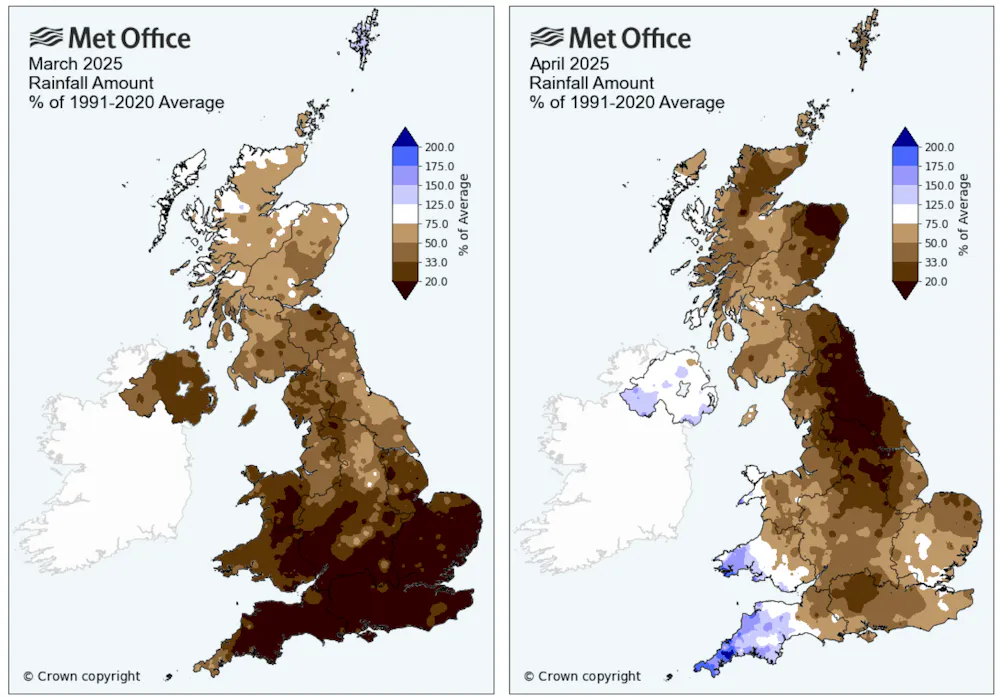
    April 2025 was the sunniest since records began in 1910. This followed the third-sunniest March, and both months saw temperatures well above average nationwide. On May 1, the temperature reached 29.3°C in Kew Gardens in London – a new record for the date.

    Meteorologists are warning of the potential for a summer drought, as the UK has seen roughly half its usual amount of rainfall for March and April. While farmers fret about this year’s harvest, some water companies are urging customers to help reservoir levels recover by limiting water use.

    Meanwhile, wildfires have engulfed forest and moorland in areas of Scotland, Wales and England.

    Most of the UK has experienced a record-dry spring so far.
    Met Office

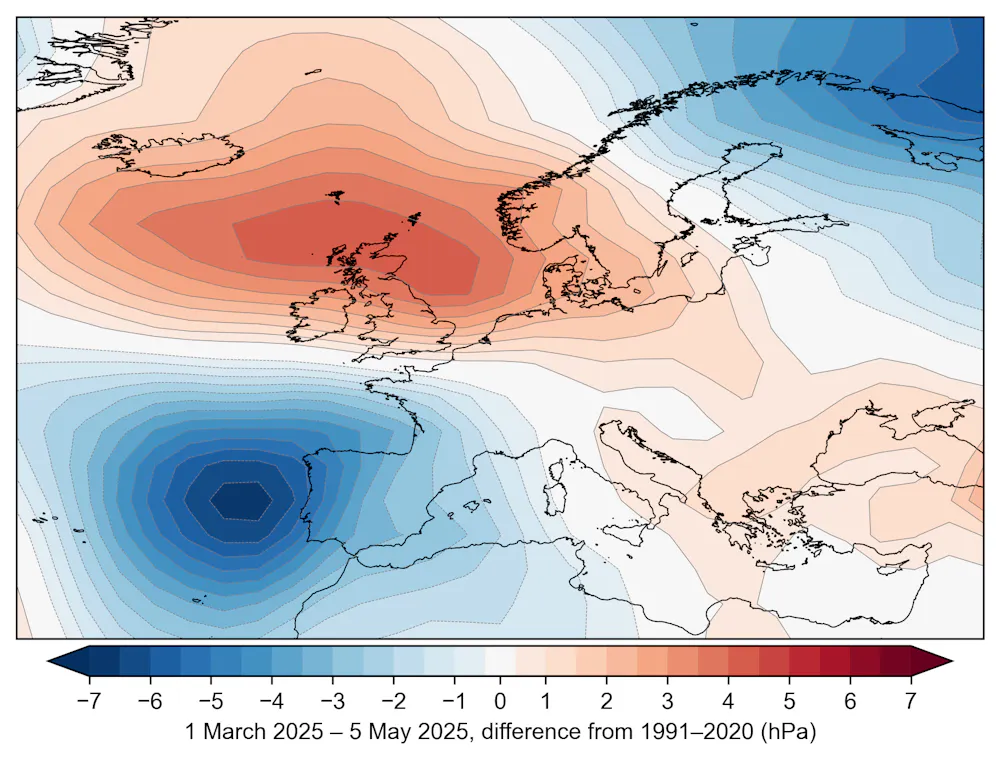
    For several weeks, a stubborn area of high pressure over the UK has diverted the usual flow of mild, moist air from the North Atlantic like a boulder in a river. This is known as a blocking weather system.

    Within it, air descends, warms and dries, which is why this weather pattern tends to be linked to heatwaves and drought. Blocking is usually persistent, making it seem like the weather is stuck.

    Here’s how climate change may have played a role in setting up this unusual spring.


    Get your news from actual experts, straight to your inbox. Sign up to our daily newsletter to receive all The Conversation UK’s latest coverage of news and research, from politics and business to the arts and sciences. Join The Conversation for free today.


    The human fingerprint

    The warming climate means that unusually warm weather is occurring more often and becoming more intense. At the same time, we can expect more periods of both severe drought and extreme rainfall. Sudden changes from drought to deluge, termed “weather whiplash”, are due to the intensification of the water cycle in a warmer atmosphere that can hold more water vapour.

    However, certain weather patterns are necessary to produce extreme weather. More blocking events in future could increase the chance of heatwaves or drought. But are blocking weather patterns becoming more common?

    It’s difficult to determine how weather patterns will change as a result of the rising concentration of greenhouse gases in the atmosphere, which is predominantly caused by the burning of fossil fuels.

    Part of the difficulty arises from the fact that weather patterns vary year to year. Several years in a row with more blocking events than usual could make it seem like blocking is increasing due to climate change, but it could simply be down to chance.

    As a result, it is difficult to detect the fingerprint of human activity from weather observations alone. For example, blocking weather patterns over Greenland during summer have happened more often in recent decades, which can enhance the melting of the ice sheet. But it isn’t clear that this trend is the result of human-induced climate change.

    Climate models do suggest future changes in the occurrence of blocking, however. These computer simulations, consisting of equations that describe the fundamental physics of the atmosphere, are the main tool scientists use to perform experiments that parse how the climate will behave in future.

    The blocking system is visible in the area of high pressure over Britain and Ireland.
    National Centers for Environmental Prediction/National Center for Atmospheric Research/NOAA Physical Sciences Laboratory, CC BY

    When scientists run climate model simulations with increased greenhouse gas concentrations the results consistently show a decrease in blocking events. But blocking generally happens more often in real life than model simulations, which reduces the confidence scientists have in future projections.

    Keeping track of the jet stream

    The movement of weather systems in Earth’s mid-latitudes – including over the UK – is linked to the jet stream, which is a fast-flowing river of air driven by the contrast in temperature between the poles and mid-latitudes.

    Some researchers have suggested that, because the Arctic is warming faster than the tropics, the jet stream may weaken and become more “wavy”, increasing the occurrence of blocking events, contrary to what most climate models show.

    Outside of the scientific community, this idea has become popular. However, the hypothesis remains controversial among scientists, and observational evidence has weakened in recent years.

    In fact, tens of kilometres above the Earth’s surface, near commercial aircraft cruising altitudes, the opposite trends are occurring: the temperature difference between the Arctic and mid-latitudes is increasing, acting to increase the strength of the jet stream.

    There are considerable challenges with understanding how climate change is affecting the large-scale atmospheric patterns which drive the weather we experience. These include large natural variability and imperfect climate models. Models mostly suggest a decline in blocking events with climate change, though this remains relatively uncertain compared with other aspects of the science.

    Overall, we can be confident that climate change is bringing warmer conditions in all seasons. Scientists also have strong evidence to suggest that drought conditions will become more common. These changes are already affecting food production, energy generation and water availability and these impacts will continue to worsen with climate change.


    Don’t have time to read about climate change as much as you’d like?

    Get a weekly roundup in your inbox instead. Every Wednesday, The Conversation’s environment editor writes Imagine, a short email that goes a little deeper into just one climate issue. Join the 45,000+ readers who’ve subscribed so far.


    Simon H. Lee has received funding from the Natural Environment Research Council and the National Science Foundation.

    Matthew Patterson receives funding from the Natural Environment Research Council in the UK via the the National Centre for Atmospheric Science.

    ref. How the weather got ‘stuck’ over the UK – and produced an unusually dry and warm spring – https://theconversation.com/how-the-weather-got-stuck-over-the-uk-and-produced-an-unusually-dry-and-warm-spring-255987

    MIL OSI – Global Reports

  • MIL-OSI Global: AI can guess racial categories from heart scans – they’re detecting bias not biological differences

    Source: The Conversation – UK – By Tiarna Lee, Doctoral Candidate, School of Biomedical Engineering & Imaging Sciences, King’s College London

    Radiological imaging/Shutterstock

    Imagine an AI model that can use a heart scan to guess what racial category you’re likely to be put in – even when it hasn’t been told what race is, or what to look for. It sounds like science fiction, but it’s real.

    My recent study, which I conducted with colleagues, found that an AI model could guess whether a patient identified as Black or white from heart images with up to 96% accuracy – despite no explicit information about racial categories being given.

    It’s a striking finding that challenges assumptions about the objectivity of AI and highlights a deeper issue: AI systems don’t just reflect the world – they absorb and reproduce the biases built into it.


    Get your news from actual experts, straight to your inbox. Sign up to our daily newsletter to receive all The Conversation UK’s latest coverage of news and research, from politics and business to the arts and sciences. Join The Conversation for free today.


    First, it’s important to be clear: race is not a biological category. Modern genetics shows there is more variation within supposed racial groups than between them.

    Race is a social construct, a set of categories invented by societies to classify people based on perceived physical traits and ancestry. These classifications don’t map cleanly onto biology, but they shape everything from lived experience to access to care.

    Despite this, many AI systems are now learning to detect, and potentially act on, these social labels, because they are built using data shaped by a world that treats race as if it were biological fact.

    AI systems are already transforming healthcare. They can analyse chest X-rays, read heart scans and flag potential issues faster than human doctors – in some cases, in seconds rather than minutes. Hospitals are adopting these tools to improve efficiency, reduce costs and standardise care.

    Bias isn’t a bug – it’s built in

    But no matter how sophisticated, AI systems are not neutral. They are trained on real-world data – and that data reflects real-world inequalities, including those based on race, gender, age, and socioeconomic status. These systems can learn to treat patients differently based on these characteristics, even when no one explicitly programs them to do so.

    One major source of bias is imbalanced training data. If a model learns primarily from lighter skinned patients, for example, it may struggle to detect conditions in people with darker skin.
    Studies in dermatology have already shown this problem.

    Even language models like ChatGPT aren’t immune: one study found evidence that some models still reproduce outdated and false medical beliefs, such as the myth that Black patients have thicker skin than white patients.

    Sometimes AI models appear accurate, but for the wrong reasons – a phenomenon called shortcut learning. Instead of learning the complex features of a disease, a model might rely on irrelevant but easier to spot clues in the data.

    Imagine two hospital wards: one uses scanner A to treat severe COVID-19 patients, another uses scanner B for milder cases. The AI might learn to associate scanner A with severe illness – not because it understands the disease better, but because it’s picking up on image artefacts specific to scanner A.

    Now imagine a seriously ill patient is scanned using scanner B. The model might mistakenly classify them as less sick – not due to a medical error, but because it learned the wrong shortcut.

    This same kind of flawed reasoning could apply to race. If there are differences in disease prevalence between racial groups, the AI could end up learning to identify race instead of the disease – with dangerous consequences.

    In the heart scan study, researchers found that the AI model wasn’t actually focusing on the heart itself, where there were few visible differences linked to racial categories. Instead, it drew information from areas outside the heart, such as subcutaneous fat as well as image artefacts – unwanted distortions like motion blur, noise, or compression that can degrade image quality. These artefacts often come from the scanner and can influence how the AI interprets the scan.

    In this study, Black participants had a higher-than-average BMI, which could mean they had more subcutaneous fat, though this wasn’t directly investigated. Some research has shown that Black individuals tend to have less visceral fat and smaller waist circumference at a given BMI, but more subcutaneous fat. This suggests the AI may have been picking up on these indirect racial signals, rather than anything relevant to the heart itself.

    This matters because when AI models learn race – or rather, social patterns that reflect racial inequality – without understanding context, the risk is that they may reinforce or worsen existing disparities.

    This isn’t just about fairness – it’s about safety.

    Solutions

    But there are solutions:

    Diversify training data: studies have shown that making datasets more representative improves AI performance across groups – without harming accuracy for anyone else.

    Build transparency: many AI systems are considered “black boxes” because we don’t understand how they reach their conclusions. The heart scan study used heat maps to show which parts of an image influenced the AI’s decision, creating a form of explainable AI that helps doctors and patients trust (or question) results – so we can catch when it’s using inappropriate shortcuts.

    Treat race carefully: researchers and developers must recognise that race in data is a social signal, not a biological truth. It requires thoughtful handling to avoid perpetuating harm.

    AI models are capable of spotting patterns that even the most trained human eyes might miss. That’s what makes them so powerful – and potentially so dangerous. It learns from the same flawed world we do. That includes how we treat race: not as a scientific reality, but as a social lens through which health, opportunity and risk are unequally distributed.

    If AI systems learn our shortcuts, they may repeat our mistakes – faster, at scale and with less accountability. And when lives are on the line, that’s a risk we cannot afford.

    Tiarna Lee receives funding from the EPSRC.

    ref. AI can guess racial categories from heart scans – they’re detecting bias not biological differences – https://theconversation.com/ai-can-guess-racial-categories-from-heart-scans-theyre-detecting-bias-not-biological-differences-254416

    MIL OSI – Global Reports

  • MIL-OSI Global: Is matcha a healthier alternative to coffee? Here’s what you need to know

    Source: The Conversation – UK – By Anthony Booker, Reader in Ethnopharmacology, University of Westminster

    Ekateryna Zubal/Shutterstock

    Matcha, with its vibrant green hue and centuries-old tradition, is often celebrated as a health boosting superfood. But what exactly sets it apart from regular green tea, or even your morning coffee?

    Like green and black tea, matcha comes from
    the camellia sinensis plant. The difference lies in how it’s grown and processed. While black tea is fermented and regular green tea is simply dried, matcha is shade-grown for several weeks before harvest.

    This unique method alters the plant’s chemistry, boosting certain compounds like chlorophyll and amino acids and giving matcha its distinct flavour and rich green colour. The leaves are then dried and finely ground into a powder – hence its name, which literally translates to “powdered tea” in Japanese.


    Get your news from actual experts, straight to your inbox. Sign up to our daily newsletter to receive all The Conversation UK’s latest coverage of news and research, from politics and business to the arts and sciences. Join The Conversation for free today.


    Although widely associated with Japanese culture and Zen tea ceremonies, matcha actually originated in China. It was brought to Japan in the 12th century by Buddhist monks, who used it to support meditation. Over time, it became a staple in Japanese tea culture, especially in formal tea ceremonies.

    From a health perspective, matcha offers many of the same benefits as green tea – thanks to its high content of polyphenols, including flavonoids, which are known antioxidants. However, because the leaves are consumed whole in powdered form, matcha may provide a more concentrated dose of these beneficial compounds.

    Lots of potential, relatively little research

    Matcha is touted for its wide range of potential health benefits: antioxidant, antimicrobial, anti-inflammatory, anti-obesity and even anti-cancer effects, as well as potential improvements in brain function, stress relief, heart health and blood sugar regulation.

    But there’s a catch: most of the evidence supporting these claims comes from lab studies (on cells or animals), not robust clinical trials in humans. So while the early research is promising, it’s far from conclusive.

    One thing we do know: matcha contains caffeine – more than regular green tea, though typically less than coffee. Caffeine itself has well documented health benefits when consumed in moderation, including improved focus, mood, metabolism and even reduced risk of certain diseases like Alzheimer’s and Parkinson’s.

    But high doses can cause side effects like insomnia, anxiety and elevated blood pressure. The “more is better” approach doesn’t apply here, and the optimal dose of caffeine remains unclear.

    When comparing matcha to coffee, both offer similar antioxidant properties and cardiovascular benefits. However, coffee has been studied more extensively, with clearer guidelines: three to four cups a day appears to be a safe upper limit for most people.

    For matcha, the guidance is slightly more conservative, with sources suggesting one to three cups a day, probably due to the higher levels of polyphenols.


    Read more:
    All the reasons a cup of coffee really can be good for you


    Tannins and polyphenols in both tea and coffee can interfere with iron absorption, especially from plant-based foods. Drinking large amounts regularly, particularly around mealtimes, may increase the risk of iron-deficiency anaemia.

    That’s why it’s recommended to enjoy these beverages at least two hours before or after meals, especially for people who follow a predominantly plant-based diet or are already prone to low iron levels.

    Jitter-free

    Another consideration: both coffee and matcha are mildly acidic and can cause digestive discomfort or reflux in people with sensitive stomachs. That said, matcha may be a better choice for some. Unlike coffee, it contains L-theanine, an amino acid that promotes relaxation and may counteract the jittery effects of caffeine, making it a gentler alternative for people prone to anxiety.

    Both matcha and coffee have potential health benefits and the right choice depends on your personal needs and preferences. Coffee is better studied and may be ideal for those who tolerate caffeine well and enjoy several cups a day. Matcha, on the other hand, is a great option for those looking to consume less caffeine while still benefiting from antioxidants – and without the crash or jitters.

    Just remember to enjoy either in moderation, especially if you’re managing iron levels or digestive issues.

    Anthony Booker does not work for, consult, own shares in or receive funding from any company or organisation that would benefit from this article, and has disclosed no relevant affiliations beyond their academic appointment.

    ref. Is matcha a healthier alternative to coffee? Here’s what you need to know – https://theconversation.com/is-matcha-a-healthier-alternative-to-coffee-heres-what-you-need-to-know-255729

    MIL OSI – Global Reports

  • MIL-OSI Global: The Climate Fiction Prize 2025: the five shortlisted books reviewed by our experts

    Source: The Conversation – UK – By Louisa Egbunike, Associate Professor in African Literature, Durham University

    Five novels have been shortlisted for the 2025 Climate Fiction Prize. Our academics review the finalists ahead of the announcement of the winner on May 14.

    And So I Roar by Abi Daré

    Abi Daré’s poignant second novel, And So I Roar, charts the parallel stories of Tia, an environmental advocate, and Adunni, a Nigerian teenager first introduced in The Girl with the Louding Voice (2020).

    Now under Tia’s care in Lagos, Adunni has escaped child marriage and domestic abuse.

    When she returns to her village, Ikati, where she and other girls are blamed for the drought and face the threat of violence, the novel unravels long-held secrets. Daré masterfully explores how environmental crises intersect with gendered violence, showing how impoverished women disproportionately bear the burden of climate change.

    And So I Roar highlights intergenerational, inter-ethnic and cross-class solidarity, celebrating the courage of women and girls who defy society’s expectations. It is a powerful testament to resilience, as women and girls confront injustice and find the strength to lift their voices and, finally, roar.

    By Louisa Uchum Egbunike, associate professor in African literature

    The Morningside by Téa Obreht

    Obreht’s The Morningside is a quietly dazzling piece of climate fiction – more adjacent to our world than removed from it, and all the more unsettling for it.

    Set in Island City, a place marked by an unnamed tragedy, the novel centres on Sil, an 11-year-old girl who moves into the Morningside apartment complex with her mother.

    Both are climate refugees, though the novel wears this reality lightly – what matters more are the small acts of home-making, the search for belonging and the ghosts that travel with them. Magical realism is deftly handled here, interlaced with hints of folklore that feel entirely plausible within the book’s fragile ecology.

    The Morningside is deeply readable – generous, tender and brimming with quiet unease. It never tips into bleakness, but its warnings are clear enough. “The things you had, the things you saw,” Sil’s mother tells us, “will probably be gone by the time [your children are] born.”

    By Sam Illingworth, professor of creative pedagogies

    Briefly Very Beautiful by Roz Dineen

    Roz Dineen’s Briefly Very Beautiful immerses readers in a world that both is and is not a familiar fiction. Crisply written, in direct, unfussy prose, it is, at one level, a story of a woman, Cass, trying to protect her children as her relationship unravels.

    At the same time, a parallel social collapse triggered by climate change puts the ordinary in an extraordinary frame.

    Much of the effect of this novel comes from Cass’s utterly believable responses to what is taking place around her, her almost peripheral awareness of other people fleeing the city, her own craving for fresh air “like she’d craved things in pregnancy, with a scary gorging hunger”.

    Briefly Very Beautiful is a novel brave enough to recognise that there is no simple, heroic response to some situations. That sometimes, the determination to live an ordinary life is the truly heroic course of action.

    By Christopher Morash, professor of Irish writing

    Orbital by Samantha Harvey

    Samantha Harvey’s Orbital skilfully exposes the human cost of space flight, set against the urgency of the climate crisis. While a typhoon of life-threatening proportions gathers across south-east Asia, six cosmonauts hurtle around Earth on the International Space Station.

    Their everyday routine of tasteless food and laboratory work is in stark contrast to the awesome spectacle of the blue planet, oscillating between night and day, dark and light, where international borders are meaningless.

    While they teach laboratory mice to orient themselves in micro-gravity, they rigorously document their own bodily functions to satisfy some “grand abstract dream of interplanetary life” away from “the planet held hostage by humans, a gun to its vitals”. These are humans, Harvey tells us, “with a godly view that’s the blessing and also the curse”. Harvey has written a novel for the end of the world as we know it. The hope it offers is that we might learn to know it differently.

    By Debra Benita Shaw, reader in cultural theory

    The Ministry of Time by Kaliane Bradley

    The best novels defy easy categorisation, and The Ministry of Time covers many genres: climate fiction, sci-fi, speculative fiction, romance, action.

    It tells the story of a female civil servant who is a handler for one of five people plucked from history before their death. It was fun to imagine how today’s world would be perceived from various perspectives, including a zesty young lesbian woman from the 17th century, a shy young lieutenant from the first world war and a 19th-century naval officer.

    The story adopts the usual dystopian tropes of a world that has destroyed itself through greed, power-seeking and over-indulgence. In the final plea to the reader not to let this terrible future unfold, the assumption is that if we’re scared enough, we’ll all give up red meat, stop flying and campaign for climate policies.

    My research, and psychological studies of fear caution us that the response is just as likely to be voting for far-right leaders, marginalisation of innocent victims, and buying up all the toilet rolls. I loved this book, but to inspire greener behaviour, showing visions of what a sustainable society might look like if we did things right would be a welcome change.

    By Denise Baden, professor of sustainable business


    Looking for something good? Cut through the noise with a carefully curated selection of the latest releases, live events and exhibitions, straight to your inbox every fortnight, on Fridays. Sign up here.


    The authors do not work for, consult, own shares in or receive funding from any company or organisation that would benefit from this article, and have disclosed no relevant affiliations beyond their academic appointment.

    ref. The Climate Fiction Prize 2025: the five shortlisted books reviewed by our experts – https://theconversation.com/the-climate-fiction-prize-2025-the-five-shortlisted-books-reviewed-by-our-experts-253056

    MIL OSI – Global Reports

  • MIL-OSI Global: Medetomidine: what you need to know about the animal sedative turning up in opioid deaths

    Source: The Conversation – UK – By Paul Chazot, Professor of Pharmacology, Durham University

    Michael O’Keene/Shutterstock.com

    The opioid crisis, increasingly driven by synthetic opioids, continues to claim tens of thousands of lives annually in the US alone. Similar crises have arisen all over the western world.

    The crisis has become more complex as powerful synthetic opioids like fentanyl, nitazenes and oxycodone are now being “cut” (mixed) with other drugs that slow brain activity, including animal tranquillisers.

    The emergence of medetomidine as a new contaminant in the US illicit drug market signals a worrying development in this escalating crisis. When public health officials in Philadelphia first began testing for the drug in May last year, medetomidine was found in 29% of fentanyl samples analysed. Six months later, the drug was found in 87% of fentanyl samples.

    Medetomidine, a drug approved only for veterinary use as a sedative and painkiller, has increasingly been implicated in illicit fentanyl-related overdoses.


    Get your news from actual experts, straight to your inbox. Sign up to our daily newsletter to receive all The Conversation UK’s latest coverage of news and research, from politics and business to the arts and sciences. Join The Conversation for free today.


    Like xylazine – another veterinary tranquilliser recently detected in street drugs – it is believed that medetomidine is added to fentanyl to boost its euphoric effects and hence make it more appealing to users. However, medetomidine is even more potent and longer-lasting than xylazine.

    An overdose of medetomidine can cause extreme sleepiness, very low blood pressure, slow heart rate, trouble breathing (respiratory failure), and even coma or death. This is because medetomidine rapidly depresses the central nervous system and slows the heart rate significantly.

    When medetomidine is used with opioids, the risk is even greater because both drugs can slow breathing, and together they can make it much worse.

    Overdose-reversing drugs

    Police and paramedics use naloxone to reverse fentanyl overdoses. But if the drug is mixed with medetomidine, naloxone won’t work because medetomidine affects the body in a different way.

    Naloxone won’t reverse the effects of animal tranquillisers.
    oasisamuel / Shutterstock.com

    Atipamezole can reverse the effects of medetomidine – such as sedation, slowed breathing and slowed heart rate – but it’s only been tested in dogs. The US Food and Drug Administration has not approved the drug for human use.

    Overdoses from fentanyl and high-potency nitazenes are also common in the UK and across Europe. The spread of medetomidine in street drugs in other parts of the world needs urgent attention.

    The first death in the UK involving xylazine was reported by the National Programme on Substance Abuse Deaths in December 2022. Between April 2023 and January 2024, 17 cases were reported in the UK, in a range of opioid tablets and powders, including codeine, tramadol and heroin.

    So far, no confirmed cases involving medetomidine have been reported in the UK. If trends in the US are reliable indicators, the UK may face similar challenges soon.

    Paul Chazot does not work for, consult, own shares in or receive funding from any company or organisation that would benefit from this article, and has disclosed no relevant affiliations beyond their academic appointment.

    ref. Medetomidine: what you need to know about the animal sedative turning up in opioid deaths – https://theconversation.com/medetomidine-what-you-need-to-know-about-the-animal-sedative-turning-up-in-opioid-deaths-256015

    MIL OSI – Global Reports

  • MIL-OSI Global: Deadly blood clots, risky treatments: The high-stakes battle against deep vein thrombosis in sports and beyond

    Source: The Conversation – Canada – By Peter Anthony Andrisani, PhD Candidate, Medical Sciences, McMaster University

    Seven-time NBA all-star Damian Lillard, 34, recently joined a growing list of NBA athletes to be sidelined by a diagnosis of deep-vein thrombosis, or DVT.

    The Milwaukee Bucks player joins Victor Wembanyama, 21, a rising star in the NBA who was diagnosed with the life-threatening condition earlier this season, along with Chris Bosh and Brandon Ingram, who were also sidelined with DVT during their careers.

    DVT in athletes

    DVT is caused by blood clots in the veins of the arms or legs. The condition is commonly associated with age, decreased mobility, obesity, some estrogen-containing medications and smoking, among other factors. Repetitive arm action above the head, like throwing a basketball, can also increase the risk of DVT.

    Typically, DVT causes swelling, pain and bruising in the affected limb. DVT on its own is not lethal, but left untreated, it can have serious consequences.

    Without treatment, pieces of blood clots that cause DVT can break off and travel to the lungs in a condition called pulmonary embolism (PE), which can result in severe damage to the lungs. Both DVT and PE are venous thromboembolic diseases, which are the third most common cause of deaths associated with the vascular system after heart attack and stroke.

    Tennis superstar Serena Williams developed PE twice. Like many people who develop it, she had trouble breathing, shortness of breath and chest pain.

    Although it might be scary to be diagnosed with DVT or PE, there are effective medicines to treat the conditions.

    My lab’s research focuses on identifying new blood-thinning drugs to treat blood-clotting conditions like DVT and stroke. Surgery and blood thinners are often combined to combat DVT and PE by removing the original blood clot and reducing the chances of a new clot forming.

    Despite their name, blood thinners do not literally make blood thinner. Instead, they make it harder for blood clots to form. Three general classes of blood thinners can be prescribed for DVT and PE: vitamin K antagonists such as warfarin, heparin and direct oral anticoagulants.

    Despite the help blood thinners provide, they create risks of their own, as they can increase the risk of bleeding, because blood clotting is a normal and necessary physiological process.

    Clot risks vs. bleeding risks

    Taking blood thinners is like walking a tightrope. The person taking the blood thinner is in a constant state of balance between preventing abnormal blood clots and excessive bleeding, which depends on the strength of the blood thinner. If you lean too far in either direction, you might fall off the tightrope, with serious consequences.

    The challenges of managing bleeding risk while preventing DVT was amplified in the case of Williams. Immediately after delivering her second child, Williams underwent a PE event and was placed on intravenous heparin. While heparin did prevent blood clots, Williams did have significant bleeding at the site of her C-section.

    The risk of bleeding often extends past the hospital. Typically, blood thinners are given to people with DVT for months, even years, to prevent ongoing risk of clot formation. The risk of bleeding persists as long as the person is taking the drug.

    Athletes on blood thinners playing contact sports are more vulnerable to injuries compared to others. Players commonly fall, which is more likely to cause potentially life-threatening internal bleeding.

    Due to this risk, athletes often must take to the sidelines to avoid injury after a DVT diagnosis.

    Balanced blood thinners

    The challenge of creating balanced blood-thinning drugs is of great interest to my lab at McMaster University’s Thrombosis and Atherosclerosis Research Institute. A promising candidate for treating clotting disorders is ADAMTS13. It’s a protein that plays a role in the typical maintenance of blood clots but shows great potential as a blood-thinning medication.

    Previous research with this protein has found that in acute blood-clotting conditions such as ischemic stroke, ADAMTS13 is effective at breaking apart blood clots but does not result in the same risk of bleeding. Further testing on the protein in chronic conditions like DVT still needs to be performed, but there is potential for it to act as a long-term blood thinner.

    The use of safer blood thinners will not only allow athletes like Lillard and Wembanyama to continue playing their respective sports, but will also help the general population.

    Approximately seven million new blood-thinner prescriptions for DVT and other conditions are written each year in Canada, highlighting the need for better therapeutics across the board.

    Peter Anthony Andrisani receives funding from CanVECTOR.

    Colin Kretz receives funding from the Canadian Institutes of Health Research, the Natural Sciences and Engineering Research Council of Canada, and the National Heart, Lung, and Blood Institute of the National Institutes of Health (R01HL172780).

    ref. Deadly blood clots, risky treatments: The high-stakes battle against deep vein thrombosis in sports and beyond – https://theconversation.com/deadly-blood-clots-risky-treatments-the-high-stakes-battle-against-deep-vein-thrombosis-in-sports-and-beyond-253985

    MIL OSI – Global Reports

  • MIL-OSI Global: The Moomins drift through time like a myth – that’s why they resist meaning and endure

    Source: The Conversation – UK – By Steve Nash, Lecturer in Literature, Media, and Creative Writing, Leeds Beckett University

    The Moomins may look like hippos in aprons and top hats, but they’re more than just adorable characters from children’s books. Over the decades, these gentle creatures have become part of a living mythology – one that drifts across time, borders and generations.

    Created by Finnish-Swedish author Tove Jansson in the 1940s, the Moomins live in stories that blur the lines between fairy tale, folk wisdom and quiet philosophy. And perhaps that’s the secret to their enduring appeal: they resist being pinned down.

    Unlike traditional children’s characters tied to a tidy moral or neat storyline, the Moomins meander literally and metaphorically. Their world is one of seasonal migrations, long silences, floods, comets and unexpected departures.


    This is part of a series of articles celebrating the 80th anniversary of the Moomins. Want to celebrate their birthday with us? Join The Conversation and a group of experts on May 23 in Bradford for a screening of Moomins on the Riviera and a discussion of the refugee experience in Tove Jansson’s work. Click here for more information and tickets.


    Moominvalley isn’t a safe haven – it’s a landscape shaped by change. In that sense, Jansson’s stories echo something far older than modern literature: the mythic rhythms of Nordic storytelling, where time loops, endings blur and characters return in altered forms.

    A myth that moves

    The Viking sagas, for instance, were not written down at first but passed from voice to voice, reshaped with each telling. They weren’t concerned with tidy endings or moral clarity. Characters disappeared and reappeared. Time looped and fragmented.

    Similarly, Jansson’s stories don’t build to a climax. They wander. One book might end with a mystery, a quiet mood or a long silence. It’s a narrative style that feels strangely modern – and yet deeply ancient.

    Jansson herself resisted giving her stories a single message. In letters and interviews, she said she disliked moralising and preferred ambiguity. “A good story,” she wrote, “has no need to be explained; its truth lies in its telling, not in its conclusion.” That idea – of a truth that doesn’t depend on being pinned down – is at the heart of what makes the Moomins mythic.

    Of course, myths evolve. And the Moomins have evolved spectacularly. After the books found international success, the characters were adapted into Japanese anime, Nordic theatre, British radio and global branding campaigns.

    Each version tells a slightly different story. In Japan, the Moomins became symbols of warmth and nostalgia – gentle mascots of a simpler life. In the UK and US, early translations softened the melancholy and existential tones. More recently, new editions and critical reappraisals have returned to Jansson’s deeper themes of loss, solitude and transformation.

    The many lives of the Moomins

    This global journey has parallels with the evolution of Viking mythology. Once oral stories shared around fires, Norse myths have been repackaged for everything from national pride to Hollywood action. Like the Moomins, they’ve become flexible cultural symbols – used and re-used in ways that often have little to do with their original context.

    But unlike the fierce warriors of Norse myth, the Moomins are gentle, uncertain creatures. They worry. They drift. They don’t fight monsters – they reflect, explore, adapt. In Moominland Midwinter, Moomintroll wakes from hibernation to find the world cold and unfamiliar.

    His journey isn’t about conquering the landscape, it’s about learning how to live in it. That emotional honesty resonates with readers of all ages. It also reflects something uniquely Nordic: an existential awareness of solitude, change and survival.

    Folklore, loneliness and the Groke

    One character, the Groke, captures this beautifully. She’s a shadowy figure who creates frost wherever she walks. She’s not a villain, she’s just lonely. Children often fear her, but readers grow to understand her.

    She recalls Nordic spirits like the huldra or tomte – ghostly beings that live in the forests, blurring the line between human and otherworldly. In Jansson’s hands, this folklore becomes a way to explore anxiety, estrangement and the human need for warmth.

    The Moomins’ refusal to settle – geographically or philosophically – also speaks to today’s world of cultural fluidity. Jansson was from Finland’s Swedish-speaking minority and grew up between languages, cultures and post-war upheaval.

    Her books reflect that liminal identity, and they’ve found a home among readers who don’t always fit neatly into one place. That might be why the Moomins are particularly popular in countries dealing with identity shifts or cultural nostalgia.

    A myth for a shifting world

    As with all mythologies, there’s also a commercial side. The Moomins are now a global brand, with theme parks, merchandise, museums and a thriving fanbase. Some of this has softened their original complexity.

    But even through plush toys and animation, something essential remains: the feeling that these characters, like the stories they inhabit, can’t be reduced to one message. They are always slightly mysterious, slightly out of reach.

    In a world that often demands quick answers and strong opinions, the Moomins offer something gentler: ambiguity, openness and quiet reflection. They remind us that not all stories are meant to be solved with a neat conclusion. Some are meant to be returned to – revisited like familiar places in the mind, reshaped each time we arrive.

    That’s what makes the Moomins mythic. Not just their age or popularity, but their ability to change – and to change us – with every retelling. They invite us to wander, like Snufkin, and to sit still, like Moominmamma.

    They show us that myth isn’t just about gods and monsters – it’s about living with uncertainty, embracing return, and finding meaning in the stories that help us feel at home in the world.

    Steve Nash works for Leeds Beckett University.

    ref. The Moomins drift through time like a myth – that’s why they resist meaning and endure – https://theconversation.com/the-moomins-drift-through-time-like-a-myth-thats-why-they-resist-meaning-and-endure-254742

    MIL OSI – Global Reports

  • MIL-OSI Global: Nineteen Eighty-Four and Brave New World should be read in tandem to understand today’s troubled times

    Source: The Conversation – UK – By Emrah Atasoy, Associate Fellow of English and Comparative Literary Studies & Honorary Research Fellow of IAS, University of Warwick

    Is there any past work of fiction that can help us make sense of today’s troubling trends? Taking into account the proliferation of references to obfuscating “Newspeak”, Big Brother-style leaders and impossible-to-circumvent surveillance systems in newspaper articles, this question cries out for a simple answer: “Yes – and that work is George Orwell’s Nineteen Eighty-Four.”

    People on both the political left and right see Orwell’s 1949 novel as the book from the last century that speaks to the present most powerfully. But there are others who regard consumer culture and social media obsession as the primary concerns of today. They have a different answer: “Yes – and that work is Aldous Huxley’s Brave New World.”

    We, however, think the answer is “both”.


    Looking for something good? Cut through the noise with a carefully curated selection of the latest releases, live events and exhibitions, straight to your inbox every fortnight, on Fridays. Sign up here.


    In the long-running debate over who was the most prophetic writer of their era, Orwell, who was a pupil of Huxley’s at Eton, is generally the favourite.

    One reason for this is that international alliances that long seemed stable are now in flux. In Nineteen Eighty-Four, his final novel, Orwell envisioned a future tri-polar world divided into competing blocks with shifting allegiances.

    In the short time since the US president, Donald Trump, began his second term, his policies and statements have triggered surprising realignments. The US and Canada, close partners for more than a century, have faced off against each other. And in April, an official from Beijing joined with his counterparts from South Korea and Japan to push back as an unlikely trio against Trump’s new tariffs.

    That is perhaps why there is a booming field of “Orwell studies”, with its own academic journal, but not “Huxley studies”. It also probably explains why Nineteen Eighty-Four, but not Brave New World, keeps making its way on to bestseller lists – sometimes in tandem with Margaret Atwood’s The Handmaid’s Tale (1985). “Orwellian” (unlike the rarely heard “Huxleyan”) has few competitors other than “Kafkaesque” as an immediately recognisable adjective linked to a 20th-century author.

    Trailer for the film 1984, an adaptation of Orwell’s novel.

    As wonderful as Atwood and Kafka are, we are convinced that combining Orwell’s vision with Huxley’s offers scope for deeper analysis. This is true in part because of, not despite, how common it has been to contrast the modes of autocracy Orwell and Huxley describe.

    Orwellian and Huxleyan visions as one world

    We live in an era when all sorts of systems of control limit our freedoms of expression, identity and religion. Many do not quite fit the template that either Orwell or Huxley imagined, but instead combine elements.

    There are certainly places, such as Myanmar, where those in power rely on techniques that immediately bring Orwell to mind, with his focus on fear and surveillance. There are others, such as Dubai, that more readily evoke Huxley, with his focus on pleasure and distraction. In many cases, though, we find a mixture.

    This is especially clear if you take a global view. That’s something we specialise in as international and interdisciplinary researchers – a literary scholar from Turkey based in the UK, and a Californian cultural historian of China who has also published on southeast Asia.

    Like Orwell, Huxley wrote many books that were not dystopian fiction, but his foray into that genre became his most influential. Brave New World was well known throughout the cold war. In courses and commentaries, it was commonly paired with Nineteen Eighty-Four as a narrative illustrating a shallow society based on indulgence and consumerism, as opposed to the bleaker Orwellian world of suppression of desire and strict control.

    While it is common to approach the two books via their contrasts, they can be treated as interconnected and entangled works as well.

    Trailer for an adaptation of Brave New World, released in 2020.

    During the cold war, some commentators felt that Brave New World showed where capitalist consumerism in the age of television could lead. The west, according to this interpretation, could become a world in which autocrats like those in the novel stayed on top. They would do this by keeping people busy and divided among themselves, happily distracted by entertainment and the drug “soma”.

    Orwell, by contrast, seemed to provide a key to unlock the harder mode of control in non-capitalist, Communist Party-run lands, especially those of the Soviet bloc.

    Huxley himself in Brave New World Revisited, a non-fiction book he published in the 1950s, thought it was important to think about ways the techniques of power and societal engineering in the two novels could be combined, approached and analysed. And there is even more value in combining the approaches now, when capitalism has gone so global and the autocratic wave keeps reaching new shores in the so-called post-truth era.

    Orwellian hard-edged and Huxleyan soft-edged approaches to control and social engineering can be and often are combined. We see this within countries such as China, where the crude repressive methods of a Big Brother state are used against the Uyghur population, while cities such as Shenzhen evoke Brave New World.

    We see this mixing of dystopian elements in many countries – variations on the way that science fiction writer William Gibson, author of novels such as Neuromancer (1984), wrote about Singapore with a phrase that had a soft-edged first half and a hard-edged second: “Disneyland with the death penalty.”

    This can be a useful first step toward better understanding, and perhaps beginning to try to find a way of improving the troubling world of the mid-2020s. A world in which the smartphone in your pocket both keeps track of your actions and provides an endless set of enticing distractions.

    The authors do not work for, consult, own shares in or receive funding from any company or organisation that would benefit from this article, and have disclosed no relevant affiliations beyond their academic appointment.

    ref. Nineteen Eighty-Four and Brave New World should be read in tandem to understand today’s troubled times – https://theconversation.com/nineteen-eighty-four-and-brave-new-world-should-be-read-in-tandem-to-understand-todays-troubled-times-253872

    MIL OSI – Global Reports

  • MIL-OSI Global: UK’s India trade deal offers wider access to a surging economy – and could make food imports cheaper

    Source: The Conversation – UK – By Sangeeta Khorana, Professor of International Trade Policy, Aston University

    India’s economy is growing rapidly. Radiokafka/Shutterstock

    After more than three years and 14 rounds of negotiations, the UK and India have finally announced a free trade agreement (FTA). UK Prime Minister Keir Starmer will formally sign the deal on a visit to India later this year. This is the biggest and most economically significant bilateral trade deal the UK has struck since leaving the EU. It will have implications for both businesses and workers.

    In 2024, the UK’s trade with India was worth £43 billion – £17.1 billion of exports and £25.5 billion of imports. Government modelling estimates that trade between the nations will increase by as much as 39% and the UK’s GDP will expand by £4.8 billion or 0.1 percentage points per year as a result.

    India’s economy is growing fast. It is expected to expand by 6% annually, becoming the world’s third largest economy by 2028 after the US and China. This certainly makes the deal with the UK very timely.

    With a population of more than 1.4 billion and a growing middle class, the country offers huge market potential. Its import demand is predicted to grow by 144% between 2021 and 2035. This combination of strong economic growth and increasing numbers of citizens with disposable cash makes a compelling case for the deal.


    Get your news from actual experts, straight to your inbox. Sign up to our daily newsletter to receive all The Conversation UK’s latest coverage of news and research, from politics and business to the arts and sciences. Join The Conversation for free today.


    Both the UK and India have agreed to reduce tariffs under the deal. India will immediately lower its 150% tariffs on Scotch whisky and gin to 75%, and then to 40% within ten years. Tariffs on foodstuffs such as lamb, salmon and cheeses will fall from around 30% to zero.

    Simplified trade rules, including faster customs processing, reduced barriers such as complex labelling requirements, and enhanced support for small businesses should bring gains for companies. Timely customs clearance will support exports of perishable items like Scottish salmon, where delays reduce the product’s shelf life. Similarly, exporters of things like biscuits and cheese will benefit from streamlined paperwork and be able to compete in India’s growing market.

    There will no longer be limits on the number of UK businesses allowed to provide telecommunications, environmental and construction services. And UK businesses will not need to set up a company in India or be a resident in India to supply their services in these sectors.

    Once the FTA comes into force, which could take up to a year, the UK will allow 99% of Indian imports duty-free access into the UK. The sectors set to benefit most are footwear, textiles and clothing, as well as processed prawns, basmati rice and ready meals. These reductions will mean lower prices for UK consumers, given tariffs on clothing and footwear are 12% and 16% respectively.

    Clothing and textile imports to the UK will have tariff-free access.
    Yevhen Prozhyrko/Shutterstock

    Tariffs on luxury cars will also be reduced from more than 100% to 10% under quotas on both sides. The FTA locks in zero tariffs on industrial machinery, advanced materials for use in hi-tech industries, and components for electric vehicles. This will position British suppliers inside a manufacturing market ranked the world’s second-most attractive after China.

    In terms of workers, there were well publicised fears that the agreement might lead to UK workers being undercut by Indian counterparts. Plans for a so-called “double contribution convention” grants a three-year exemption from national insurance contributions for Indian employees temporarily working in the UK. But this is a reciprocal deal and is likely to apply only to workers who are seconded from one country to the other, so should not result in UK workers being more expensive to hire.

    And although no changes to immigration policy are planned, the FTA will offer easier movement for skilled workers. UK providers of services like construction and telecoms will have access to India’s growing market.

    Both countries have committed to encouraging the recognition of professional qualifications. A professional services working group for UK and Indian government officials will provide a forum to monitor and support this initiative.

    Timing is everything

    Against a backdrop of rising protectionism and geopolitical tensions, the UK-India FTA stands out as a strategic deal. It is also a significant milestone in Britain’s Indo-Pacific “tilt”. This approach gives UK firms a hedge against over-reliance on any single region or country-centric supply chains, to keep trade flowing in the event of more US tariff shocks, for example.

    With the US fixation on tariffs, and global supply chains facing continued disruption, securing preferential access to the world’s fastest-growing major economy is a strategic win for the UK. From India’s perspective, the trade deal is aligned with its rise as a “China-plus-one” manufacturing hub (where businesses diversify to ensure they do not invest only in China).

    The UK and India share historical ties that are underpinned by cultural, educational and people-to-people links. The UK-India FTA marks a new phase in this relationship, where shared economic interests define a forward-looking partnership between the two countries.

    And in terms of its ongoing talks with the EU, India could use the agreement to showcase its willingness to negotiate ambitious trade deals. For the UK, given its own upcoming trade and cooperation talks with the EU, the FTA with India demonstrates that new partnerships can be built while maintaining vital European ties.

    Sangeeta Khorana has received funding from UK-ESRC, EU and other international organisations. She is affiliated with Chartered Institute of Export and International Trade as a Trustee Director.

    ref. UK’s India trade deal offers wider access to a surging economy – and could make food imports cheaper – https://theconversation.com/uks-india-trade-deal-offers-wider-access-to-a-surging-economy-and-could-make-food-imports-cheaper-256387

    MIL OSI – Global Reports

  • MIL-OSI Global: From Zoo Quest to Ocean: The evolution of David Attenborough’s voice for the planet

    Source: The Conversation – UK – By Neil J. Gostling, Associate Professor in Evolution and Palaeobiology, University of Southampton

    Over the course of seven decades, Sir David Attenborough’s documentaries have reshaped how we see the natural world, shifting from colonial-era collecting trips to urgent calls for environmental action.

    His storytelling has inspired generations, but has only recently begun to confront the scale of the ecological crisis. To understand how far nature broadcasting has come, it helps to return to where it started.

    When Attenborough’s broadcasting career began in the 1950s, Austrian filmmakers Hans and Lotte Hass were already pushing the boundaries of what was possible by taking cameras below the sea and touring the world aboard their schooner, the Xafira.

    In one of their 1953 Galapagos films, a crewman handled a sealion pup, having crawled across the volcanic rock of Fernandina honking at sealions to attract them. A penguin and giant tortoise were brought on board Xafira. And as Lotte Hass took photographs, she’d beseech some poor creature to “not be frightened” and “look pleasant”.

    This is a world away from today’s expectations, where both research scientists and amateur naturalists are taught to observe without touching or disturbing wildlife. When the Hasses visited the Galápagos, it was still five years before the creation of the national park and the founding of the island’s conservation organisation Charles Darwin Foundation. Now, visitors must stay at least two metres from all animals – and never approach them.


    Get your news from actual experts, straight to your inbox. Sign up to our daily newsletter to receive all The Conversation UK’s latest coverage of news and research, from politics and business to the arts and sciences. Join The Conversation for free today.


    At the same time, television was beginning to shape public perceptions of the natural world. In 1954, Attenborough was working as a young producer on Zoo Quest. By chance, he became its presenter when zoologist Jack Lester became ill.

    The programme followed zoologists collecting animals from around the world for London Zoo. Zoo Quest was filmed in exotic locations around the world and then in the studio where the animals found on the expedition were shown “up close”.

    Attenborough has since acknowledged that Zoo Quest reflected attitudes that would not be acceptable today. The series showed animals being captured from the wild and transported to London Zoo – practices which mirrored extractive, colonial-era approaches to science.

    David Attenborough’s Zoo Quest for a Dragon aired in 1956.

    Yet, Zoo Quest was also groundbreaking. The series brought viewers face-to-face with animals they might never have seen before and pioneered a visual style that made natural history television both entertaining and educational. It helped establish Attenborough’s reputation as a compelling communicator and laid the foundations for a new genre of science broadcasting – one that has evolved, like its presenter, over time.

    After a decade in production, Attenborough returned to presenting with Life on Earth (1979), a landmark series that traced the evolution of life from single-celled organisms to birds and apes. Drawing on his long-standing interest in fossils, the series combined zoology, palaeobiology and natural history to create an ambitious new template for science broadcasting.

    Life on Earth helped cement Attenborough’s reputation as a trusted communicator and became the foundation of the BBC’s “blue-chip” natural history format – big-budget, internationally produced films that put high-quality cinematic wildlife footage at the forefront of the story. The series did not simply document the natural world. It reframed it, using presenter-led storytelling and global spectacle to shape how audiences understood evolutionary processes.

    For much of his career, Attenborough has been celebrated for showcasing the beauty of the natural world. Yet, he has also faced criticism for sidestepping the environmental crises threatening it. Commentators such as the environmental journalist George Monbiot argued that his earlier documentaries, while visually stunning, often avoided addressing the human role in climate change, presenting nature as untouched and avoiding difficult truths about ecological decline.

    Building on the legacy of Life on Earth, Attenborough’s later series began to respond to these critiques. Blue Planet (2001) expanded the scope of nature storytelling, revealing the mysteries of the ocean’s most remote and uncharted ecosystems. Its 2017 sequel, Blue Planet II, introduced a more urgent tone, highlighting the scale of plastic pollution and the need for marine conservation.

    Although Blue Planet II significantly increased viewers’ environmental knowledge, it did not lead to measurable changes in plastic consumption behaviour – a reminder that awareness alone does not guarantee action. The subsequent Wild Isles (2023) continued the shift towards conservation messaging. While the main series aired in five parts, a sixth episode – Saving Our Wild Isles – was released separately and drew controversy amid claims the BBC had sidelined it for being too political. In reality, the episode delivered a clear call to action.

    Attenborough’s latest film, Ocean, continues in this more urgent register, pairing breathtaking imagery with an unflinching assessment of ocean health. After decades of gentle narration, he now speaks with sharpened clarity about the scale of the crisis and the need to act.

    A voice for action

    In recent years, Attenborough has taken on a new role – not just as a broadcaster, but as a powerful voice in environmental diplomacy. He has addressed world leaders at major summits such as the UN climate conference Cop24 and the World Economic Forum, calling for urgent action on climate change. He was also appointed ambassador for the UK government’s review on the economics of biodiversity.

    On the subject of environmemtal diplomacy, Monbiot recently wrote: “A few years ago, I was sharply critical of Sir David for downplaying the environmental crisis on his TV programmes. Most people would have reacted badly but remarkably, at 92, he took this and similar critiques on board and radically changed his approach.”

    Attenborough not only speaks. He listens. This is part of his charm and popularity. He is learning and evolving as much as his audience.

    What makes Attenborough stand out is the way he speaks. While official climate treaties often rely on technical or legal language, he communicates in emotional, accessible terms – speaking plainly about responsibility, urgency and the moral imperative to protect life on Earth. His calm authority and familiar voice make complex issues easier to grasp and harder to dismiss.

    Frequently named Britain’s most trusted public figure, Attenborough has become something of an unofficial diplomat for the planet – apolitical, measured, and often seen as a voice of reason amid populist noise. Despite his criticisms, Attenborough’s documentaries walk a careful line between fragility and resilience, using emotionally ambivalent imagery to prompt reflection. He shares his wonder with the natural world and brings people along with him

    Ocean shows our blue planet in more spectacular fashion than Lotte and Hans Hass could ever have imagined. But it is also Attenborough’s most direct reckoning with environmental collapse. With clarity and urgency, it confronts the damage wrought by industrial trawling and habitat destruction.

    After 70 years of gently guiding viewers through the natural world, Attenborough’s voice has sharpened. If he once opened our eyes to nature’s wonders, he now challenges us not to look away. As he puts it: “If we save the sea, we save our world. After a lifetime filming our planet, I’m sure that nothing is more important.”


    Don’t have time to read about climate change as much as you’d like?

    Get a weekly roundup in your inbox instead. Every Wednesday, The Conversation’s environment editor writes Imagine, a short email that goes a little deeper into just one climate issue. Join the 45,000+ readers who’ve subscribed so far.


    The authors do not work for, consult, own shares in or receive funding from any company or organisation that would benefit from this article, and have disclosed no relevant affiliations beyond their academic appointment.

    ref. From Zoo Quest to Ocean: The evolution of David Attenborough’s voice for the planet – https://theconversation.com/from-zoo-quest-to-ocean-the-evolution-of-david-attenboroughs-voice-for-the-planet-251727

    MIL OSI – Global Reports

  • MIL-OSI Global: Keir Starmer’s immigration plans: research shows you don’t beat the far right by becoming them

    Source: The Conversation – UK – By Katy Brown, Research Fellow in Language and Social Justice, Manchester Metropolitan University

    Keir Starmer gives press conference on migration Flickr/Number 10, CC BY-NC-ND

    As British prime minister Keir Starmer vowed to “finally take back control of our borders” in a landmark speech on immigration on May 12, it felt a little like déjà vu.

    Some nine years earlier, we had heard those exact words repeated over and over in the build-up to the Brexit referendum from former prime minister Boris Johnson and the Leave campaign. It was a refrain also used by Nigel Farage and UKIP.

    Of course, this direct reference was the point. Starmer used it to claim that the Labour government’s white paper on immigration was finally going to deliver on what had been promised and desired for many years.

    In these opening lines, the tone was set. And as the speech went on, there were echoes of far-right language and ideas reverberating throughout. Starmer lamented the “squalid” state of contemporary politics, the “forces” pulling the country apart, and the previous government’s so-called “experiment in open borders”.

    This speech and the white paper that it unveiled are but the latest indication of the rightward direction of travel within UK politics, led by mainstream and far-right parties alike – as exemplified in recent months by the footage released of immigration raids and deportations.

    Some will argue this is Labour’s response to the rising threat of Reform UK, with results in the recent local elections seen as evidence of the far right’s growing popularity. So the story goes, Labour is proving that they can be tough on immigration, showing would-be Reform defectors that they can be trusted after all.

    This familiar narrative seems to follow a prevailing wisdom which is parroted in political, media and public debates – that appeasing the far right is the way to defeat it. Rather than beating the far right at their own game, however, research shows that these techniques simply legitimise their key talking points and further normalise exclusionary politics.

    Starmer’s speech is a case in point. In using “take back control” from the outset, there was no hiding the intended audience or message. Starmer claimed that this project would “close the book on a squalid chapter for our politics, our economy, and our country”, implying that excessive immigration has directly caused these problems and that stopping it solves them. This chimes with classic far-right narratives where migration is framed as the root of all societal ills.

    When these kinds of ideas are pushed by those in government, with great authority and influence, they are given greater credence and weight. A strikingly clear example of this came in the summer of 2024 when participants in racist riots waved posters containing the slogan “stop the boats” (a phrase popularised by the previous Tory government).

    Another component of the speech that was reminiscent of far-right tropes was the idea that increased immigration was a deliberate tactic by the previous government. Starmer suggested that the Conservatives were actively pursuing a “one-nation experiment in open borders” while deceiving the British public of their intentions.

    Far-right conspiracies are often premised on the idea that elites are deliberately encouraging mass immigration. It’s not hard to see how Starmer’s words could act as a dog whistle in this scenario.

    These claims are especially damaging when we think about the draconian measures introduced under former Conservative governments, such as the Rwanda policy. Labour is now indicating that these proposals didn’t go far enough.

    To justify bringing far stricter immigration rules, Starmer stated that “for the vast majority of people in this country, that is what they have long wanted to see”. As far-right parties so often do, Labour suggests that they are delivering on “people’s priorities”. Yet are they really a priority for people, or are we told that they are a priority which then makes them more of a priority?

    Research by Aurelien Mondon, senior lecturer in politics at the University of Bath, illustrates how people’s personal and national priorities differ dramatically. When people in the UK were asked to name the two most important issues facing them personally, immigration didn’t even make it into the top ten.

    However, when asked the same question about the issues facing their country, immigration topped the list. How can something that doesn’t affect you in your day-to-day life suddenly become a top priority for your country? We need to challenge the narrative that the government is simply acting on people’s wishes and acknowledge its own capacity to set the agenda.

    Other priorities

    Some will say that harsher anti-immigration policies are a necessary evil to defeat the far right. However, if people’s personal priorities are really the cost of living, housing and education, why is the government not focusing more of its energy on these things rather than scapegoating migrants?

    What’s more, research shows that even based on these terms, these strategies are ineffective and can actually boost the success of the far right electorally. After all, its ideas are being repeatedly normalised.

    In all this tactical talk, we lose sight of the fact that people are living the consequences of this rhetoric and policies right now. Rather than focus on Reform’s potential performance in a general election that is probably years away, we should recognise the immediate consequences of the rhetoric that has accompanied this white paper. Even if this did put a dent in Reform’s prospects, what is the meaning of defeating them if the policies they promote become part of the mainstream in the process?

    The bottom line is that you do not beat the far right by becoming them. It doesn’t work electorally or ideologically, and even if it did, minoritised communities suffer the consequences regardless. The far right is not some threat lying waiting in the future – its normalisation is happening now.

    Katy Brown has received funding from UK Research and Innovation and the Irish Research Council. She is affiliated with the Reactionary Politics Research Network and Manchester Centre for Research in Linguistics.

    ref. Keir Starmer’s immigration plans: research shows you don’t beat the far right by becoming them – https://theconversation.com/keir-starmers-immigration-plans-research-shows-you-dont-beat-the-far-right-by-becoming-them-256499

    MIL OSI – Global Reports

  • MIL-OSI Global: ‘Elbows up’ in Canada means sustainable resource development

    Source: The Conversation – Canada – By Steven J Cooke, Canada Research Professor, Conservation Physiology, Carleton University

    “Elbows up” means many things today in Canada, including using the country’s rich natural resources more effectively to support a strong, independent economy that benefits people and society.

    We agree with the need to ensure economic stability and independence in Canada — but as scientists, we know this is only possible if resource development and exploitation are done responsibly and sustainably. Otherwise, Canada will be burdening itself and future generations with immeasurable costs to the economy, health and quality of life.

    Politicians and decision-makers from across Canada have called for radical changes to how development proposals are evaluated. The recent federal election saw the leaders of the major parties all signalling that they intend to get resource development projects done faster.

    Several provinces have already brought forward legislation in recent days, including British Columbia’s Infrastructure Projects Act, while an Ontario act aimed ostensibly at “unleashing the economy” is under consideration by the provincial government.

    Cutting red tape can certainly speed up new development, but environmental regulations are not just red tape. They are designed to ensure the short- and long-term potential consequences of development decisions are fully considered, and are then minimized or avoided.

    Without strong environmental impact assessments, development can have devastating impacts on human health, resource sustainability and the rich natural resources Canadians rely upon. We are fearful of a future where obsolete infrastructure and exhausted resources are abandoned by the proponents of development, burdening the public with the cleanup or long-term consequences.

    Resources aren’t infinite

    Canada has a large land mass bordering three oceans and bountiful freshwater resources, including the Great Lakes. But its resources are not infinite.

    Impacts of resource development also extend to people. Effective impact assessment must recognize Indigenous rights and sovereignty, in keeping with the right to self-determination reinforced by the United Nations Declaration on the Rights of Indigenous Peoples.

    Effective land stewardship by Indigenous nations is the foundation of Canada’s rich natural heritage. When Canadian politicians talk about fast-tracking developments and resource exploitation, they inherently ignore the moral and legal rights of Indigenous Peoples and governments that are enshrined in Canada’s Constitution and in international law.


    Read more:
    Mark Carney wants to make Canada an energy superpower — but what will be sacrificed for that goal?


    Circular economy

    Outdated business models that threaten health and the future of resources won’t propel Canada into a new era of prosperity.

    Canada lags behind in innovation and labour productivity growth (GDP per person hour worked), which are predictors of standard of living. This lag is known as Canada’s “innovation problem.”

    Simply harvesting and selling raw logs or minerals as fast as possible will not solve it. However, Canada can escape its innovation problem by using resources more efficiently in a value-added, circular economy.


    Read more:
    Recycling more than pop cans: A circular economy for our energy landscapes


    The boreal forests and wetlands found in Canada represent the lungs and kidneys of the planet. Canada’s boreal forest is the largest intact forest in the world.

    Canada also contains 20 per cent of the Earth’s surface freshwater — more than any other nation — and 10 per cent of the world’s glacial waters.

    Canada’s wildlife is iconic and careful management of our wildlife benefits both Canada and the world. Canada’s current environmental policies and regulations represent the collective effort of opposing political parties that have recognized the shared need for clean air and water are non-partisan issues.

    Environmental requirements

    As Canada aggressively explores markets other than the United States for its resources, including the European Union, it will gain a competitive advantage by ensuring exports are sustainable and extracted without harming the environment and local people.

    That’s because markets like the European Union now require that all importers of many agricultural and household products prove that their production did not contribute to deforestation. As other jurisdictions see the fallacy of short-term gains at the expense of the environment, Canada can be ahead of the curve in providing sustainable products.

    The long-term health of Canada’s economy relies on sustainable resource management, and polling repeatedly shows that Canadians want a healthy environment. Sustainable resource extraction can deliver long-term benefits for nature and future generations, rather than short-term, financial benefits to only a select few.

    Boom-and-bust policies have failed before — think about the collapse of the Atlantic cod fishery, the acid rain crisis associated with unchecked emissions or the Klondike gold rush.

    We implore politicians to ensure that development decisions are informed by rigorous and diverse forms of evidence, and robust and equitable policies that consider environmental justice. They should refrain from focusing solely on the short-term economic windfall. Instead, they must plan for resource use that is sustainable and equitable over the long term.

    Four ways to ensure sustainability

    We recognize that resource development is integral to maintaining Canadian prosperity and sovereignty — and the good news is that it can be done sustainably.

    The details may be complex, but the big picture is simple:

    1. Ensure that Indigenous rights-holders are not simply consulted but actively involved in planning, managing and leading development activities.
    2. Maintain strong environmental protection while cutting truly unnecessary red tape.
    3. Ensure that development does not cause harm to individuals, species or landscapes.
    4. Embrace evidence-informed decision-making processes that are robust, transparent and inclusive.

    Some of Canada’s international neighbours are enacting short-term actions, including cutting environmental regulations and spurring unfettered resource development.

    These actions are simultaneously a threat to Canada and an opportunity for Canadians to reject that approach and do better. If Canada chooses that path, it can gain a distinct competitive advantage today and long into the future and become less vulnerable to the political whims of other countries.

    Elbows up, Canada — let’s be proud of protecting what we have.

    Steven J Cooke receives funding from various government, NGO and industry partners. He is affiliated with the Great Lakes Fishery Commission, the Collaboration for Environmental Evidence, KeepFishWet, and the Canadian Centre for Evidence-Informed Conservation.

    Christina Davy receives funding from various Canadian government, NGO and industry partners. She is affiliated with the Canadian Herpetological Society.

    Dalal Hanna receives funding from various Canadian Government and NGO partners. She is affiliated with Ripara.

    Joseph Bennett receives funding from various government and NGO sources. He is affiliated with the Canadian Institute for Ecology and Evolution and the Canadian Centre for Evidence-Informed Conservation.

    ref. ‘Elbows up’ in Canada means sustainable resource development – https://theconversation.com/elbows-up-in-canada-means-sustainable-resource-development-255669

    MIL OSI – Global Reports

  • MIL-OSI Global: How Donald Trump could remain president of the United States

    Source: The Conversation – Canada – By Pascal Lupien, Assistant Professor, Political Science, University of Alberta

    United States President Donald Trump has repeatedly floated the idea of remaining in office after his second term ends in 2029. Since the 22nd Amendment of the U.S. Constitution was ratified in 1951, no U.S. president has challenged the two-term limit it established.

    However, attempts to circumvent constitutional term limits are not unprecedented elsewhere.

    Virtually every country in Latin America has enshrined constitutional term limits as a safeguard against tyranny. These rules vary: some allow only a single term, some permit two, while others enable non-consecutive re-election. Yet several presidents have managed to defy these provisions.

    Recent examples include Daniel Ortega in Nicaragua, Hugo Chávez in Venezuela, Evo Morales in Bolivia, Rafael Correa in Ecuador and Nayib Bukele in El Salvador.

    Although the institutional norms and political cultures of these countries differ from those of the U.S., examining how term limits have been dismantled offers valuable insights into how any similar efforts by Trump might unfold.

    How presidents have overstayed their term

    The most common tactic is for presidents to first ensure their political party in the legislature is fully subservient to them, and then leverage a loyal majority to amend the constitution — a move that has already been initiated in the U.S.

    Ortega and Correa successfully used their legislative majorities to pass constitutional amendments that eliminated term limits in Nicaragua and Ecuador.

    Whether Trump has achieved the same level of unwavering loyalty among Republicans is debatable, but getting amendments through the U.S. Congress is significantly more difficult. The process requires a two-thirds majority vote in both houses, followed by ratification from three-quarters of state legislatures.

    In contrast, Nicaragua’s constitution can be amended with a 60 per cent majority and, as in Ecuador, sub-national jurisdictions have no say in the matter.

    Another crucial step involves co-opting or capturing the judiciary. In Bolivia, Morales achieved a controversial third term in 2014 supported by a partisan Constitutional Tribunal. More recently, El Salvador’s Bukele secured a 2021 Supreme Court ruling (from judges he appointed) allowing him to seek immediate re-election in 2024, despite a constitutional prohibition on consecutive terms.

    We have seen a worrying pattern of subservience to Trump by the U.S. Supreme Court. The limits of this deference are increasingly uncertain.

    Securing popular support

    Some presidents have turned to plebiscites to legitimize constitutional tampering by appealing directly to the electorate and framing the move as a democratic exercise. Chávez employed this strategy in Venezuela, winning a 2009 referendum to abolish term limits.

    The absence of a national referendum mechanism in the U.S. — where popular consultations are organized at the sub-national (state) level — limits the options available to a president seeking to remove term limits through this type of populist ploy.

    Related to this, populist presidents who have successfully circumvented term limits have typically done so while enjoying extraordinarily high levels of public support.

    Correa maintained approval ratings near 70 per cent during much of his presidency, while independent polls have put Bukele’s support at well over 80 per cent. Both, along with Morales and Chávez, leveraged their popularity to justify constitutional changes through legislative and judicial channels, framing their actions as carrying out the will of the people.

    In contrast, Trump’s approval ratings have consistently remained far lower. Currently, his favourability sits in the low 40s, making any attempt to claim a broad popular mandate for a third term both dubious and precarious.

    The military matters

    Due to inevitable opposition, military support is central to any leader’s attempt to defy the constitution. In much of Latin America, the military is highly politicized, and armed forces have historically been shaped by doctrines of internal control rather than external defence.

    Rooted in Cold War-era national security ideologies, this orientation casts domestic dissenters (“socialists,” Indigenous movements, unionists) as internal enemies, legitimizing repression as a patriotic duty.

    In some countries, military oaths reflect this politicization. In both Nicaragua and Venezuela, these oaths increasingly emphasize loyalty to the president or ruling party and their revolutionary legacy, undermining institutional neutrality.

    By contrast, in the U.S., military personnel swear an oath to defend the Constitution, not the president. While they must follow orders, these must align with constitutional and legal boundaries.

    The absence of a tradition of using soldiers against American citizens and an institutional culture of constitutional loyalty and political neutrality may, at least in principle, provide some protection against the authoritarian overreach that has allowed certain Latin American presidents to remain in power indefinitely.

    But a substantial portion of the U.S. armed forces leans politically to the right, like their counterparts in Latin America, raising concerns that partisan sympathies within the military could influence its response to a constitutional crisis.

    Furthermore, the increasing use of non-military security forces — such as local police and Immigration and Customs Enforcement (ICE) — against civilians demonstrates that the state has a range of instruments at its disposal for exercising control.

    The U.S. government’s use of ICE is reminiscent of how governments in countries like Venezuela and Nicaragua have used police and paramilitary units loyal to the president with impunity to suppress dissent.


    Read more:
    How ICE is becoming a secret police force under the Trump administration


    The perils of complacency

    Many in the West still hold on to the belief that constitutional erosion is something that only happens in the Global South. Some believe that American institutions are uniquely resilient and therefore capable of withstanding any attempt to subvert the constitution.

    For much of U.S. history, this confidence may have been justified, but today, it’s not only complacent but dangerous.

    The strength of democratic institutions depends on the political will to defend them. Time will tell if the barriers that exist in the U.S. are strong enough to withstand the pressures now being placed upon them. What is clear is that relying on increasingly tenuous institutional resilience or historical exceptionalism is no substitute for vigilance and active defence of democratic norms.

    Pascal Lupien does not work for, consult, own shares in or receive funding from any company or organisation that would benefit from this article, and has disclosed no relevant affiliations beyond their academic appointment.

    ref. How Donald Trump could remain president of the United States – https://theconversation.com/how-donald-trump-could-remain-president-of-the-united-states-255589

    MIL OSI – Global Reports

  • MIL-OSI Global: What causes inequality in African countries? New book traces a vicious cycle

    Source: The Conversation – Africa – By Murray Leibbrandt, UCT Chair in Poverty and Inequality Research; Director of ARUA’s African Centre of Excellence for Inequality Resaearch with the Southern Africa Labour and Development Research Unit., University of Cape Town

    Inequality is a problem that exists in various forms in sub-Saharan Africa.

    Inequality is created by, among other factors, where you are born and live. Alongside this, income, assets, and access to education and healthcare differ among and between populations. These inequalities reinforce each other. The result is persistent poverty, lack of social mobility across generations, increased exposure to climate change, and a lack of inclusive economic growth.

    Our recently published book Inequalities in Sub-Saharan Africa: Multidimensional Perspectives and Future Challenges presents an overview of the current situation. It identifies the key dimensions, challenges and causes of inequalities in the region. The book also proposes some solutions for equitable and sustainable development. These include progressive taxation and policies that address inequalities at their roots.

    The impact of inequality

    Migration: On a global scale, the greatest determinant of individual incomes – and thus of inequalities between individuals – is place of birth. More than half of income’s variability is explained by the country of residence and by the given circumstances at birth. These include being born in a rural environment.

    In sub-Saharan Africa, especially in low-income countries, internal migration remains the most prevalent migration pattern. Migration is often the chosen route for people seeking to escape poverty. The rural exodus that characterises many countries in sub-Saharan Africa illustrates this well. Young people in Africa, faced with high unemployment rates, often see migration as the only opportunity for social mobility.

    The dynamics of international migration are more complex. Given the high costs involved, international migration concerns only 2.5% of the population in sub-Saharan Africa. This is mostly intra-continental.

    Labour market: Access to the labour market remains the main
    determinant of inequalities in sub-Saharan Africa.

    Labour markets in the region are characterised by high proportions of informal employment. Formal sectors are relatively small (about 15% of total employment on the continent). Since the turn of the century, countries like Kenya have seen their share of informal employment increase significantly (from 73% in 2001 to 83% in 2017). At the same time formal wage employment has declined.

    This amplifies inequality because the informal sector is characterised by a lack of protection and high vulnerability. But not all informal activities are precarious. Some serve as springboards into formal jobs.

    In the formal sector, wage inequality in Africa is among the highest in the world.
    In South Africa, workers in high-skilled jobs earn nearly five times more than those in low-skilled jobs.

    Young people entering the labour market have much higher unemployment rates and little chance of regular employment.

    Gender inequality: Many gender inequalities persist, particularly access to the labour market. Unpaid care work makes women’s work invisible. In many African countries, women and girls spend more time on unpaid care which limits their economic opportunities.

    These inequalities are reinforced by inequalities in access to resources. About 38% of African women report owning land, compared to 51% of African men.

    Climate change: Africa is suffering the most severe impacts – droughts, floods and food insecurity – while contributing less than 5% of global carbon emissions.

    Arid conditions affect 43.5% of agricultural land in sub-Saharan Africa compared to an estimated global average of 29%. Similarly, climate change mitigation costs, such as finding alternatives to hydroelectric power, are higher for low-income countries.

    In sub-Saharan Africa, the richest 10% emit seven times more tonnes of carbon dioxide than the poorest 50%. Disadvantaged groups are more vulnerable to adverse climate effects as their housing and wealth are more likely to be damaged by storms and floods.

    Skewed economic growth benefits: Economic growth has led to notably lower reductions in poverty in African countries than elsewhere. Unequal distribution of growth and its capture by those at the top of the income distribution ladder are evidence of non-inclusive economic growth. The richest 1% of Africans received 27% of the total revenue from growth on the continent.

    What needs to be done

    It is vital to give priority to promoting social and economic inclusion in the development strategies of African countries. Importantly, multidimensional inequalities such as income and health persist because they reinforce each other. Tackling them therefore requires coordinated and coherent policies.

    Murray Leibbrandt receives funding from the National Research Foundation of South Africa, the Agence Française de Développement, UK Research and Innovation, the World Institute for Development Economics Research and the International Inequalities Institute of the London School of Economics. He is affiliated with the United Nations University’s World Institute for Development Economics Research and the Jackson School of Global Affairs at Yale University.

    Anda David, Rawane Yasser, and Vimal Ranchhod do not work for, consult, own shares in or receive funding from any company or organisation that would benefit from this article, and have disclosed no relevant affiliations beyond their academic appointment.

    ref. What causes inequality in African countries? New book traces a vicious cycle – https://theconversation.com/what-causes-inequality-in-african-countries-new-book-traces-a-vicious-cycle-253376

    MIL OSI – Global Reports

  • MIL-OSI Global: Marketing unhealthy food as good for kids is fuelling obesity in South Africa: how to curb it

    Source: The Conversation – Africa – By Aisosa Jennifer Omoruyi, Research fellow, University of the Western Cape

    Childhood overweight and obesity are a growing public health challenge in South Africa. In 2016, 13% of the country’s children were reported to be obese. This is predicted to double by 2030.

    This problem has been linked to the regular consumption of calorie-dense foods high in sugar, salt and fat.
    South African children are growing up in a food environment that tends to cause obesity.

    One of its key features is intense marketing of unhealthy food and beverages, using various channels and appealing strategies. Misleading health and nutrition claims are sometimes made.

    Children are considered lucrative consumers because they can sometimes buy food themselves, influence their parents’ food purchases (they have “pester power”, for one thing), and are future consumers.

    Marketers use several strategies that children find appealing, such as cartoon characters, brand mascots, bright colours, colourful packages, catchy songs and slogans.

    Although there is no specific regulation of marketing to children in South Africa, the Consumer Protection Act 58 of 2008 has important provisions that guide the marketing of goods and services. The law prohibits false, deceptive marketing.

    As a researcher into children’s rights and nutrition I coauthored a recent paper examining how the Consumer Protection Act could be used to address the misleading marketing of unhealthy foods and beverages to children.

    In our view, the South African consumer protection legal framework has the necessary scope to address misleading forms of marketing of unhealthy foods to children. But there needs to be better enforcement.


    Read more:
    Profit versus health: 4 ways big global industries make people sick


    Health claims: not always the full package

    A common strategy in food marketing is the use of misleading health or nutrition claims. These are often written (“contains vitamin C”, “high fibre”, “boosts immunity”, “supports brain health”), or implied by images of fruits and vegetables on the packaging of products.

    Some studies in South Africa have demonstrated the misleading use of these claims in television and magazine
    advertisements and food packages, including products meant for children.

    For instance, fruit juices often claim to be rich in vitamin C, but they have a high sugar content. Dairy products typically boast a high calcium content, but are also high in added sugar. Breakfast cereals frequently highlight their fibre content, despite being ultra-processed and containing a high amount of total carbohydrates and added sugar.

    Packaged foods often contain nutrition labels, but the printed words are small and usually obscured by the “healthy” claims. Those are positioned more prominently to capture the attention of the consumer.

    Health and nutrition claims can strongly influence purchasing decisions, especially in the South African context. Research has shown that many South African consumers do not read nutrition labels on packaged foods.


    Read more:
    Half of all South Africans are overweight or obese. Warning labels on unhealthy foods help change that


    What the law says

    Firstly, the Consumer Protection Act recognises children as vulnerable or disadvantaged consumers who deserve special protection (section 3(1)(b)(iii). This is because they have limited capacity to understand marketing strategies or defend themselves against their persuasive effects.

    Secondly, the Consumer Protection Act, in sections 29 and 41, prohibits the marketing of goods in a way that is reasonably likely to imply a false or misleading representation of facts such as their ingredients, benefits and qualities.

    Thirdly, the Consumer Protection Act provisions do not require a consumer to show that they were actually misled by the claim or that children’s health was negatively affected by consuming the food product. It is enough that it has been marketed in a manner that is reasonably likely to mislead children or their parents or caregivers into buying the product.

    Consumers have various ways to seek redress for misleading marketing. These include the Consumer Goods and Services Ombud and the Advertising Regulatory Board, the National Consumer Commission, the National Consumer Tribunal and the courts.

    However, delays and poor compliance with decisions can put consumers off.


    Read more:
    South Africa must ban sugary drinks sales in schools. Self regulation is failing


    Food for thought: the way forward

    Mandatory front-of-pack labels are needed in South Africa. They should be easy to understand and highlight nutrients of concern – salt, fat, sugar and artificial sweeteners – to reflect the overall nutritional profile of food products. They can also override the misleading “health halo” effect generated by health or nutrition claims.

    The public should support the Draft Regulation R3337 Relating to the Labelling and Advertising of Foodstuffs made under the Foodstuffs, Cosmetic, and Disinfectant Act 54 of 1972. It specifically prohibits marketing unhealthy food to children.

    The act needs to be used more and this requires much greater consumer activism.

    Dispute mechanisms could be stronger and the processes could be streamlined to encourage consumer participation.

    The government and public interest organisations need to create greater public awareness of consumer rights.

    Aisosa Jennifer Omoruyi is a Research Fellow at the Dullah Omar Institute, University of the Western Cape, which receives funding from the Global Center for Legal Innovation on Food Environments at the O’Neill Institute for National and Global Health Law, Georgetown University Law Center, Washington, DC.

    ref. Marketing unhealthy food as good for kids is fuelling obesity in South Africa: how to curb it – https://theconversation.com/marketing-unhealthy-food-as-good-for-kids-is-fuelling-obesity-in-south-africa-how-to-curb-it-253994

    MIL OSI – Global Reports

  • MIL-OSI Global: US funding cuts have crippled our HIV work – what’s being lost

    Source: The Conversation – Africa – By Glenda Gray, Distinguished Professor, Infectious Disease and Oncology Research Institute, Faculty of Heath Sciences, University of the Witwatersrand, Executive Director Perinatal HIV Research Unit, Chief Scientific Officer, South African Medical Research Council

    The loss of research capability means losing an understanding of how to prevent or treat HIV. Photo by sergey mikheev on Unsplash

    The Trump administration’s cuts to funding for scientific research have left many scientists reeling and very worried. At the National Institutes of Health in the US, which has an annual budget of US$47 billion to support medical research both in the US and around the world, nearly 800 grants have been terminated. The administration is considering cutting the overall budget of the National Institutes of Health by 40%.

    In South Africa, where tensions are running high with the new Trump administration over land reform and other diplomatic fault lines, scientists have had research grants from the National Institutes of Health suspended. Glenda Gray, who has been at the forefront of HIV/Aids scientific research for decades, assesses the impact of these cuts.

    How have the cuts affected your research? When did you start worrying?

    There was subliminal fear that started to percolate at the end of January. I said to my team, we need to start looking at our grants. We need to start looking at our exposure.

    The first institute to go under the Trump administration’s cuts was USAID. The multibillion-dollar agency that fought poverty and hunger around the world was the first to face the chop.

    As a result, a USAID-funded US$46 million consortium on HIV vaccine discovery and experimental medicine to evaluate first in Africa or first in human HIV vaccines was terminated.

    Then in mid-April, funding for a clinical trial in Soweto near Johannesburg in South Africa was marked as “pending”. The unit was involved in trials for HIV vaccines. On top of that,  four global research networks on HIV/Aids prevention and treatment strategies were told by the National Institutes of Health in the US that they could no longer spend any money in South Africa. The Soweto unit was affiliated with those networks.

    So basically you can’t start new studies in South Africa?

    There is a great deal of uncertainty. I’m sitting on many calls, working out how we survive in the next couple of months.

    I’m going from bankrupt to absolutely bankrupt in terms of our ability to do work.

    We’ve been doing scenario planning, looking at all our contingencies, but it’s very hard to know exactly what you’re doing until you have the relevant documentation in front of you.

    To all intents and purposes for the next period, South Africa is eliminated from the National Institutes of Health networks and its scientific agenda.

    How is the South African government responding?

    The government doesn’t have the kind of money to replace the substantial amount of finances that we got through the National Institutes of Health competitive processes. However scientists have been working together with the Medical Research Council, Treasury and various government departments to plot the best way forward.

    Everyone’s been writing grant proposals, speaking to the Gates Foundation, speaking to the Wellcome Trust, looking at public-private partnerships, talking to other philanthropists. But the bottom line is that funding is never going to be at the kind of level that will replace the research infrastructure that we’ve got.

    To get money from the National Institutes of Health we had to compete with all scientists all over the world. This wasn’t just aid being doled out to us.

    Where does this leave the future of research in South Africa for HIV vaccine trials?

    South Africa has been able to contribute to global guidelines to improve care. The loss of research capability means that you lose the knowledge or the value of understanding HIV prevention, HIV vaccines or therapeutics.

    We in South Africa have the infrastructure, we have the burden of disease, the sciences, the regulator and ethical environment and the ability to answer these questions. And so it’s going to take the world a lot longer to answer these questions without South Africa.

    If we slow down research, we slow down HIV vaccine research, we slow down cures and we slow down other HIV prevention methodologies.

    And so basically you slow down the process of knowledge generation.

    What does it feel like to be a scientist right now in South Africa?

    South African scientists are resilient. We’ve had to weather many storms, from the explosion of HIV to Aids denialism … watching people die, getting people onto treatment, having vaccine trials that have failed.

    You have to be resilient to be a scientist in this field.

    It’s going to be very hard to bring the fight against HIV/Aids back to the current level again.

    It feels now like we are deer in the headlights because we don’t know how to pivot.

    This is an edited transcript of an interview with Professor Gray aired in a podcast produced by The Conversation UK. You can listen to the full podcast here.

    Glenda Gray receives funding from US-NIH which is currently being evaluated. .

    ref. US funding cuts have crippled our HIV work – what’s being lost – https://theconversation.com/us-funding-cuts-have-crippled-our-hiv-work-whats-being-lost-255645

    MIL OSI – Global Reports

  • MIL-OSI Global: Trump heads to the Gulf aiming to bolster trade ties – but side talks on Tehran, Gaza could drive a wedge between US and Israel

    Source: The Conversation – Global Perspectives – By Asher Kaufman, Professor of History and Peace Studies, University of Notre Dame

    President Donald Trump and Saudi Arabia’s Crown Prince Mohammed Bin Salman attend the G20 Summit in Japan in 2019. Eliot Blondet/AFP via Getty Images

    President Donald Trump will sit down with the Saudi crown prince and Emirati and Qatari leaders on May 14, 2025, in what is being heavily touted as a high-stakes summit. Not invited, and watching warily, will be Israeli Prime Minister Benjamin Netanyahu.

    Like many other members of his right-wing coalition, Netanyahu appeared delighted at the election of Trump as U.S. president in November, believing that the Republican’s Middle East policies would undoubtedly favor Israeli interests and be coordinated closely with Netanyahu himself.

    But it hasn’t quite played out that way. Of course, Washington remains – certainly in official communications – Israel’s strongest global ally and chief supplier of arms. But Trump is promoting a Middle East policy that is, at times, distinctly at odds with the interests of Netanyahu and his government.

    In fact, in pushing for an Iran nuclear deal – a surprise reversal from Trump’s first administration – Trump is undermining long-held Netanyahu positions. Such is the level of alarm in Israeli right-wing circles that rumors have been circulating of Trump announcing unilateral U.S. support for a Palestinian state ahead of the Riyadh visit – something that would represent a clear departure for Washington.

    As a historian of Israel and the broader Middle East, I recognize that in key ways Trump’s agenda in Riyadh represents a continuation of the U.S. policies, notably in pursuing security relationships with Arab Gulf monarchies – something Israel has long accepted if not openly supported. But in the process, the trip could also put significant daylight between Trump and Netanyahu.

    Trump’s official agenda

    The four-day trip to the Gulf, Trump’s first policy-driven foreign visit since being elected president, is on the surface more about developing economic and security ties between the U.S. and traditional allies in the Persian Gulf.

    Trump is expected to cement trade deals worth tens of billions of dollars between the U.S. and Arab Gulf States, including unprecedented arms purchases, Gulf investments in the U.S. and even the floated Qatari gift of a palatial 747 intended for use as Air Force One.

    There is also the possibility of a security alliance between the U.S. and Saudi Arabia.

    So far, so good for Israel’s government. Prior to the Oct. 7 attacks, Israel was already in the process of forging closer ties to the Gulf states, with deals and diplomatic relations established with the United Arab Emirates and Bahrain through the Abraham Accords that the Trump administration itself facilitated in September 2020. A potential normalization of ties with Saudi Arabia was also in the offing.

    Dealing with Tehran

    But central to the agenda this week in Riyadh will be issues where Trump and Netanyahu are increasingly not on the same page. And that starts with Iran.

    While the country won’t be represented, Iran will feature heavily at Trump’s summit, as it coincides with the U.S. administration’s ongoing diplomatic talks with Tehran over its nuclear program. Those negotiations have now concluded four rounds. And despite clear challenges, American and Iranian delegations continue to project optimism about the possibility of reaching a deal.

    The approach marks a change of course for Trump, who in 2018 abandoned a similar deal to the one he is now largely looking to forge. It also suggests the U.S. is currently opposed to the idea of direct armed confrontation with Iran, against Netanayhu’s clear preference.

    Diplomacy with Tehran is also favored by Gulf states as a way of containing Iran’s nuclear ambitions. Even Saudi Arabia – Tehran’s long-term regional rival that, like Israel, opposed the Obama-era Iran nuclear diplomacy – is increasingly looking for a more cautious engagement with Iran. In April, the Saudi defense minister visited Tehran ahead of the recent U.S.-Iranian negotiations.

    Netanyahu has built his political career on the looming threat from a nuclearized Iran and the necessity to nip this threat in the bud. He unsuccessfully tried to undermine President Barack Obama’s initial efforts to reach an agreement with Iran – resulting in 2015’s Iran nuclear deal. But Netanyahu had more luck with Obama’s successor, helping convince Trump to withdraw from the agreement in 2018.

    So Trump’s about-turn on Iran talks has irked Netanyahu – not only because it happened, but because it happened so publicly. In April, the U.S. president called Netanyahu to the White House and openly embarrassed him by stating that Washington is pursuing diplomatic negotiations with Tehran.

    Split over Yemen

    A clear indication of the potential tension between the Trump administration and the Israeli government can be seen in the ongoing skirmishes involving the U.S., Israel and the Houthis in Yemen.

    After the Houthis fired a missile at the Tel Aviv airport on May 4 – leading to its closure and the cancellation of multiple international flights – Israel struck back, devastating an airport and other facilities in Yemen’s capital.

    But just a few hours after the Israeli attack, Trump announced that the U.S. would not strike the Houthis anymore, as they had “surrendered” to his demands and agreed not to block passage of U.S. ships in the Red Sea.

    It became clear that Israel was not involved in this new understanding between the U.S. and the Houthis. Trump’s statement was also notable in its timing, and could be taken as an effort to calm the region in preparation of his trip to Saudi Arabia. The fact that it might help smooth talks with Iran too – Tehran being the Houthis’ main sponsor – was likely a factor as well.

    Timing is also relevant in Israel’s latest attack on Yemeni ports. They took place on May 11 – the eve of Trump setting off for his visit to Saudi Arabia. In so doing, Netanyahu may be sending a signal not only to the Houthis but also to the U.S. and Iran. Continuing to attack the Houthis might make nuclear talks more difficult.

    Bibi’s political survival-first approach

    Critical observers of Netanyahu have long argued that he prioritizes continued war in Gaza over regional calm for the sake of holding together his far-right coalition, members of which desire full control of the Gaza Strip and de-facto annexation of the West Bank.

    Israel’s Prime Minister Benjamin Netanyahu warns of the Iran nuclear threat at the United Nations in 2012.
    Mario Tama/Getty Images

    This, many political commentators have argued, is the main reason why Netanyahu backed off from the last stage of the ceasefire agreement with Hamas in March – something which would have required the withdrawal of the Israeli army from the Gaza Strip.

    Since the collapse of the ceasefire, Israel’s army has mobilized in preparation for a renewed Gaza assault, scheduled to start after the end of Trump’s trip to the Gulf.

    With members of the Netanayhu government openly supporting the permanent occupation of the strip and declaring that bringing back the remaining Israeli hostages is no longer a top priority, it seems clear to me that deescalation is not on Netanyahu’s agenda.

    Trump himself has noted recently both the alarming state of the hostages and the grave humanitarian crisis in Gaza. Now, in addition to the release of Israeli-American hostage Edan Alexander, the U.S. is also engaged in negotiations with Hamas over ceasefire and aid – ignoring Netanyahu in the process.

    The bottom dollar

    Current U.S. policy in the region may all be serving a greater aim for Trump: to secure billions of dollars of Gulf money for the American economy and, some have said, himself. But to achieve that requires a stable Middle East, and continued war in Gaza and Iran inching closer to nuclear capabilities might disrupt that goal.

    Of course, a diplomatic agreement over Tehran’s nuclear plans is still some way off. And Trump’s foreign policy is notably prone to abrupt turns. But whether guided by a dealmaker’s instincts to pursue trade and economic deals with wealthy Gulf states, or by a genuine – and related – desire to stabilize the region, his administration is increasingly pursuing policies that go against the interests of the current Israeli government.

    Asher Kaufman does not work for, consult, own shares in or receive funding from any company or organization that would benefit from this article, and has disclosed no relevant affiliations beyond their academic appointment.

    ref. Trump heads to the Gulf aiming to bolster trade ties – but side talks on Tehran, Gaza could drive a wedge between US and Israel – https://theconversation.com/trump-heads-to-the-gulf-aiming-to-bolster-trade-ties-but-side-talks-on-tehran-gaza-could-drive-a-wedge-between-us-and-israel-256371

    MIL OSI – Global Reports

  • MIL-OSI Global: If you really want to close the US trade deficit, try boosting innovation in rural manufacturing

    Source: The Conversation – USA – By Amitrajeet A. Batabyal, Distinguished Professor, Arthur J. Gosnell Professor of Economics, & Interim Head, Department of Sustainability, Rochester Institute of Technology

    President Donald Trump has long been preoccupied by the trade deficit — the gap between what the U.S. sells to the rest of the world and what it buys from it. He recently declared the issue a national emergency and used trade deficit data to calculate so-called “reciprocal tariffs” targeting nearly 100 countries. Although those specific tariffs are now on pause, Trump’s concern with the trade deficit persists.

    As an economist, I know there are two basic ways for a country to reduce a trade deficit: import less or export more. While Trump has focused on the former strategy, a more productive path may lie in the latter – especially by looking at untapped opportunities in rural America.

    Economists have long studied the differences between rural and urban regions. But while research shows that urban areas tend to be more technologically advanced, fast-growing and economically dynamic, economists have historically paid less attention to how regional differences affect export performance.

    New research is starting to fill that gap. Economists recently found that urban businesses export significantly more than rural ones – a difference with significant implications for national trade.

    The urban-rural export gap

    Looking at data from the Census Bureau’s Annual Business Survey as well as trade statistics from 2017 to 2020, researchers used econometric techniques to measure the urban-rural export gap. They also examined two categories of potential causes – “explained” and “unexplained.”

    The first is due to differences in what economists call “endowments” – for example, a region’s digital infrastructure, its access to renewable energy and its opportunities for high-tech employment. These endowments can be observed and therefore explained.

    The second is due to what economists call “structural advantage.” This refers to attributes of a region that matter for export performance but can’t be observed and, as a result, remain unexplained.

    They found that most of the urban-rural export gap is due to explained differences. That means rural businesses could close the export gap if they were provided with similar endowments – meaning comparable access to renewable energy, similar digital infrastructure and analogous opportunities for high-tech employment – to their urban counterparts.

    Even more strikingly, the unexplained component was negative – which means rural businesses outperform expectations given their characteristics. That suggests rural regions have significant untapped export potential.

    Several factors collectively account for the urban export advantage. First, urban regions have a greater concentration of highly educated science and technology workers. Urban businesses also tend to be larger and more tech-savvy, and because they have better access to broadband, they use cloud technology more frequently. Urban areas also have more foreign-born business owners who may leverage their international networks.

    However, many of these differences suggest possible policy solutions. For instance, since cloud adoption depends on broadband availability, it follows that investing in digital infrastructure could boost rural exports. Also, rural manufacturers, especially in sectors like metals manufacturing, show comparable or higher export intensity per worker than their urban counterparts. So encouraging rural manufacturing would be one way to reduce the urban-rural export gap.

    Rethinking trade and rural development

    I think this research has important policy implications.

    First, it shifts some of the focus away from other countries as the root cause of the trade deficit. And second, it bolsters the case for what economists call “place-based policies” targeting specific geographic areas – as opposed to “people-based policies,” which provide support directly to individuals.

    Even though many economists dislike place-based policies, they are increasingly attracting both academic and governmental attention.

    The 2022 CHIPS and Science Act had special significance to rural areas.

    During the Biden administration, three major laws – the Inflation Reduction Act, the CHIPS and Science Act and the Infrastructure Investment and Jobs Act – directed significant federal funds to rural areas. About 43% of funds from those laws – or US$440 billion – was designated as either “rural relevant” or as “rural stipulated,” meaning the funds were either geographically targeted or designed to address disproportionately rural challenges.

    Such massive investments in rural regions have led researchers and policymakers to question whether rural export underperformance stems from differences in observable endowments – in other words, things like access to broadband – or from inherent disadvantages that are much harder to deal with.

    In my view, this research provides compelling evidence that much of the urban-rural export gap is due to unequal distribution of productive assets, rather than inherent rural disadvantages. With appropriate investments in digital infrastructure, human capital and support for export-capable industries, America’s rural regions could play a much larger role in global trade. These findings also suggest the value of continued federal support for rural development efforts.

    In other words, if the U.S. wants to shrink its trade deficit, one answer could be more innovation in rural manufacturing.

    Amitrajeet A. Batabyal does not work for, consult, own shares in or receive funding from any company or organization that would benefit from this article, and has disclosed no relevant affiliations beyond their academic appointment.

    ref. If you really want to close the US trade deficit, try boosting innovation in rural manufacturing – https://theconversation.com/if-you-really-want-to-close-the-us-trade-deficit-try-boosting-innovation-in-rural-manufacturing-255851

    MIL OSI – Global Reports

  • MIL-OSI Global: Smartwatches promise all kinds of quality-of-life improvements − here are 5 things users should keep in mind

    Source: The Conversation – USA – By James Gilmore, Associate Professor of Media and Technology Studies, Clemson University

    That smarts! Photo by Lorena Sopena/Anadolu via Getty Images

    Smartwatches and other wearable devices can feel almost magical. Strap on a Fitbit, Apple Watch or Samsung Gear and you’re suddenly presented with a stream of data generated by – and about – your body: step counts, heart rate, blood oxygen level, calories burned and more.

    Wearables offer tools that help people monitor and understand their bodies and, so the promise goes, improve their lives. Apple CEO Tim Cook has even said the technology company aspires to save your life.

    As a professor who studies technology, I’ve spent the past decade researching smartwatches and other wearables. My new book, “Bringers of Order: Wearable Technologies and the Manufacturing of Everyday Life,” considers the gap between what these products promise and what they actually do.

    Wearables rely on complicated sets of sensors and computer systems to create data for each user. As these devices become more common – and more complex – I worry that people may be tempted to think less about how they work. As a result, they might accept data at face value without considering how it was generated, whether it’s accurate, or even if it could put them at risk.

    So to get the maximum value from wearable technologies, it’s worth reflecting on the differences between what these devices seem to do and what’s actually happening behind the screen. Here are a few key points to remember.

    1. Steps aren’t really steps

    Wearable fitness trackers gained popularity in the early 2010s for their ability to count steps and measure things such as distance, calories burned and flights of stairs climbed. While it’s tempting to think so-called step counts reflect the number of times a wearer’s feet have completed the action of taking a step, that is not the case.

    In reality, a combination of sensors and algorithms work together to produce a data point called “a step.” In most instances, something called an accelerometer measures change in the wearable’s velocity. This is checked against an algorithm, which provides an automatic assessment of whether enough velocity has been reached to count as a step. These components measure how much the wearable moves, not the person. Shaking one’s wrist very quickly can sometimes create a “step,” while walking in place might not count steps.

    2. Some skin tones don’t ‘work’ as well as others

    Blood oxygen sensors have become incorporated into many smartwatches. They use a process called photoplethysmography, which uses tiny green LED lights on the underside of a smartwatch to track how blood flows through your wrist.

    In 2022, a lawsuit alleged Apple was perpetuating racial bias, as its blood oxygen sensors didn’t work as well on darker skin. The case was dismissed, partly because these limitations of blood oxygen sensors have been known to researchers and medical practitioners for years. In other words, it is accepted that some features will not work as well for some people.

    3. Your location may not be a secret

    There’s an entire industry made up of people called data brokers who buy large datasets from technology companies and then sell them to advertisers, market analysts or other groups that may be interested in acquiring them.

    While some companies have taken more steps to reduce or eliminate the sharing of data with third parties, and government agencies have offered strategies for users to limit location sharing, others may still share data among affiliates and service providers.

    It’s important to check all settings for options to reduce or eliminate data sharing. Otherwise, your private information might not remain private for long. In 2018, for example, the exercise app Strava released a “heat map” showing the running and cycling routes of all its users through the location data it had collected – and accidentally disclosed the location of multiple secret military bases around the world.

    4. Wearables for consumers aren’t medical grade

    With wearables, as with other tech, it’s important to look carefully at the terms of use.

    Most devices include boilerplate language about how the data they provide the wearer should be used recreationally and not replace formal diagnostics from doctors. Even though Apple has received FDA clearance for some of its health testing features and they may be quite useful for monitoring purposes, if you’re relying on data for health purposes, it’s important to consult a doctor.

    5. Wearables can’t predict the future

    OK, maybe this seems like it should be obvious. But it’s not.

    Oura Ring, which pioneered measurements such as “restfulness” that try to measure how well you sleep, recently added a “symptom radar” to try to detect when you might be getting sick.

    These technologies use sensors such as heart rate monitors and thermometers to detect changes in a wearer’s baseline. While these sickness forecasts may be helpful, they’re like weather reports for the body, detecting changes in the body’s internal atmosphere using available sensors and algorithms. Any claim to predict the future is based on looking for patterns in information from the past.

    While wearable tech can offer powerful insights, understanding how devices work is crucial for making sense of the data they produce. A little skepticism goes a long way: It can challenge inflated promises and protect users. In the end, wearables are best understood as interesting but imperfect tools − not magic wands.

    James Gilmore does not work for, consult, own shares in or receive funding from any company or organization that would benefit from this article, and has disclosed no relevant affiliations beyond their academic appointment.

    ref. Smartwatches promise all kinds of quality-of-life improvements − here are 5 things users should keep in mind – https://theconversation.com/smartwatches-promise-all-kinds-of-quality-of-life-improvements-here-are-5-things-users-should-keep-in-mind-251754

    MIL OSI – Global Reports

  • MIL-OSI Global: Population explosions and declines are related to the stability of the economy and the environment

    Source: The Conversation – Canada – By Ken G. Drouillard, Professor, Great Lakes Institute for Environmental Research and Director of the School of the Environment, University of Windsor

    A country’s population is affected by, and in turn affects, environmental and economic issues. (Shutterstock)

    For 200 years, we’ve been warned of unchecked population growth and how it leads to environmental instability. On the other hand, today some countries face decreasing populations, alongside increasing proportions of elderly people, causing economic instability.

    These two facets of population crises — explosions and declines — are occurring in different parts of the world, and have a global impact on the environment and on economies. Discussions about achieving economic and environmental sustainability must consider population changes, technology and the environment, given these concepts are closely interwoven.

    Population explosions and declines are related to both environmental and economic instability; some countries make reactionary choices that trade off short-term domestic economic progress over the environment.

    The crisis of population explosions

    In 1798, English economist Thomas Malthus warned of a population explosion, inferring that population growth will outstrip agricultural production. Malthus’s ideas became re-popularized by American scientist Paul R. Ehrlich in his book published at the height of population growth in the 1960s. Both predicted that a population explosion would cause shortages in resources and escalating environmental damage.

    Like Malthus, Ehrlich was criticized for a crisis “that never happened” because human ingenuity, a byproduct of population, overcomes the worst fears of environmentalists. This counter-argument relies on technological advances making more efficient use of resources while lowering the environmental impacts.

    This is best exemplified by efficiency gains of agriculture that have continued to feed a growing world. Ehrlich’s predictions of cumulative environmental damage are best illustrated by the growing intensity of climate change and species loss as the global population continues to grow even though the current growth rate is slower than it was in the 1960s.

    A graph reflecting how population growth, species diversity and global temperature correlate over time.
    (K. Drouillard), CC BY

    Unified growth theory describes how economies change over the long term. It starts with a period of slow technological progress, low income growth and high population growth. Over time, these conditions give way to a modern growth phase, where technology improves quickly, income rises steadily and population growth slows as societies go through a demographic transition towards stable population sizes.

    Technological progress positively contributes to national economies over the long term. However, early adoption of green technology often relies on finance and government incentives that may imply short-term economic burdens. Yet when green technology is implemented and coupled to slowing population growth, it leads to decreasing national environmental footprints that pave a way towards joint environmental and economic sustainability.

    The crisis of population declines

    Declining populations cause inverted age pyramids with larger numbers of elderly people. These shifting demographics cause economic instability. They also constrain technological progress and social security.

    Population declines work against the gains described by unified growth theory. Presently, 63 countries have reached their peak population and 48 more are expected to peak within 30 years. Fears of population decline are also being forecast at the global scale.

    The global population is predicted to peak between the mid-2060s to 2100, stabilizing at 10.2 billion from its present 8.2 billion.

    In their book, Empty Planet, political scientist Darrell Bricker and political commentator John Ibbitson warn that zero population growth will happen even faster. They argue once a country decreases its fertility to below replacement (2.1 children per woman), the social reinforcements of increasing urbanization, costs of raising children and increased empowerment over family planning make it almost impossible to increase the birth rate.

    For highly affluent countries, the per capita GDP is decreasing as the proportion of elderly in the population increases. Although this pattern doesn’t hold when less affluent countries are added, the figure demonstrates tangible economic impacts for countries grappling with aging populations.

    A graph showing the percentage of elderly people in a country’s population, correlated with GDP and adjusted for inflation.
    (K. Drouillard), CC BY

    Simultaneous explosions and declines

    Affluent nations facing decline can react to economic instability in ways that counter global economic and environmental sustainability.

    In the past, affluent nations were the drivers of green technology. However, economic instability from population declines can cause reluctance to invest, adopt and share green technology crucial for mitigating environmental damage at the global scale.

    The issue is compounded by the fact that many countries overlook how their own decline in population growth contributes to economic instability. They instead focus on short-term solutions to their economic situation that may include unsustainable resource use.

    Left unaddressed, the real issue of population decline becomes unresolved, allowing social anxieties against immigration and global trade to grow. This can exacerbate the issue halting technology sharing, slowing economic growth and increasing economic inequality and environmental damage.

    The above is exemplified by policies now being implemented by the United States. Where immigration was previously used as a backstop against low fertility, growing cultural backlash to immigration pressures rooted in anxiety about economic uncertainties have generated new policies causing the deportation of millions of immigrants and closing borders. This will most likely accelerate a population decline in the U.S., as highlighted by a Congressional Budget Office report.

    At the same time, the U.S. is shifting its energy policy away from increased shares of renewable, green energy sources back to a focus on fossil fuels that will worsen climate damage.

    Climate damage costs are currently two per cent of global GDP, and may increase to between two to 21 per cent of some countries’ incomes by the end of the century. The growing applications of artificial intelligence (AI) and its high energy use will add to climate damage. AI may also contribute to the economic challenges related to population decline if it replaces, rather than supports, labour.

    Finally, tariff wars add new barriers against green technology sharing.

    Canada’s lowered immigration

    Canada, which already has a low fertility rate and is reacting to the U.S. trade war, has its own challenges. This year, immigration targets were decreased by 19 per cent. The lack of support for and subsequent removal of the carbon tax and possible extension of pipeline infrastructure could generate similar delays in the transition away from fossil fuels.


    Read more:
    Who really killed Canada’s carbon tax? Friends and foes alike


    In the most recent federal election, discussions about environmental policy were largely side-tracked by economic issues.

    Our research indicates that Canada and other affluent nations need to establish longer-term solutions to economic instabilities that mitigate environmental damage while promoting sustainable national and global economies.

    The United Nations Sustainable Development Goals offer pathways for economic, social and environmental sustainability. However, realizing these goals requires society to fully acknowledge the intertwined relationships between population growth, economy, environment and international technology-sharing in ways that transcend short-term national interests and reactionary policies.

    The past decade has seen strong momentum from social and natural sciences as well as international organizations, business and civil society. Unfortunately, the current climate of economic uncertainty is halting this progress — unless the public can force broader discussions about sustainable approaches back into the political sphere.

    Ken G. Drouillard receives funding from Natural Science and Engineering Research Council of Canada (NSERC), Canadian Water Agency, Environment and Climate Change Canada, St. Clair River Conservation Authority and North Shore of Lake Superior Remedial Action Plans.

    Claudio N. Verani receives/has received funding from the U.S. National Science Foundation (NSF), U.S. Department of Energy (DoE), Petroleum Research Fund (ACS-PRF), and the Natural Science and Engineering Research Council of Canada (NSERC).

    Marcelo Arbex has received funding from University of Windsor UW-SSHRC Explore.

    ref. Population explosions and declines are related to the stability of the economy and the environment – https://theconversation.com/population-explosions-and-declines-are-related-to-the-stability-of-the-economy-and-the-environment-253302

    MIL OSI – Global Reports

  • MIL-OSI Global: Colossal Bioscience’s attempt to de-extinct the dire wolf is a dangerously deceptive publicity stunt

    Source: The Conversation – Canada – By David Coltman, Professor, Western University

    Colossal Biosciences, a Texas-based biotech company, made headlines this April after falsely claiming to resurrect the extinct dire wolf. The company presents this as a breakthrough for conservation biology. However, our team of conservation geneticists at the University of Western Ontario — along with many other academics views it as a dangerous deception.


    Read more:
    ‘Return’ of the dire wolf is an impressive feat of genetic engineering, not a reversal of extinction


    Colossal’s so-called dire wolf is not a resurrected species. It’s a genetically modified grey wolf. Its creation is a publicity stunt designed to generate profit, with serious consequences.

    TIME reports on claims that Colossal Biosciences has brought back the dire wolf.

    Jenga approach to conservation

    Conservation aims to safeguard ecosystems by preserving the networks of interaction between animals and their environment. Human activity has caused widespread habitat loss, driving extinction rates to levels estimated to be about 1,000 times higher than the natural background rate. We are living through a biodiversity crisis, and conservation remains our only real defence against further declines.

    Colossal proposes de-extinction to combat this crisis, using a Jenga-block metaphor to explain their approach. The ecosystem is a Jenga tower, with each species representing a block — and losing a species weakens the structure, pushing it closer to collapse. Colossal Biosciences proposes that inserting a de-extinct species where a block was lost could help restore ecosystem stability and prevent collapse.

    The premise isn’t entirely flawed; in some cases, introducing an animal into an unstable ecosystem to fill a lost ecological role can help restore balance. This is similar to reintroducing a species to an area where it once lived, which is a well-established conservation strategy.

    Conservation and cloning

    Likewise, cloning technology has the potential to aid in meaningful conservation projects. The U.S. Fish and Wildlife Service has successfully used the technology to help restore the black-footed ferret, a species once considered extinct.

    Every year scientists release 150 to 200 black-footed ferrets into their native habitat, with cloned individuals and their future offspring expected to strengthen the species’ chances of survival.

    The flaw in Colossal’s plan is that the animals they focus on — Ice Age megafauna like the mammoth and dire wolf — no longer belong to any modern ecosystem. Most of the species they once interacted with disappeared, along with their habitats, roughly 10,000 years ago.

    These synthetic animals are the wrong shape for our unstable Jenga tower. Forcing them into the gap might make the ecosystem more likely to collapse.

    ‘Frankensheep’: A cautionary tale

    A warning tale of misused cloning technology comes from Montana rancher Arthur Schubarth, who illegally cloned hybrid bighorn sheep — “Frankensheep” — for trophy hunting. His operation not only exploited endangered species for profit, but also triggered outbreaks of infectious disease, demonstrating the risks that unchecked cloning technology poses to wildlife and ecosystems.

    One of the most damaging aspects of Colossal’s announcement is the perpetuation of a decades-old myth that technology will save us. It would be comforting to believe we can genetically engineer our way out of the current biodiversity crisis, but that is not our reality.

    Introducing Ice Age animals would have unpredictable and potentially damaging consequences. And even if we focused on more suitable animals — those whose ecosystems still exist and could benefit from de-extinction — we could never keep pace with the current rate of biodiversity loss.

    Colossal’s de-extinction project also doesn’t tackle the forces driving extinction like climate change, habitat loss, exploitation, pollution and invasive species.

    That’s not the story Colossal wants the public to understand. They brand themselves as leaders in conservation to sell content — catchy memes, viral videos, photoshoots with Game of Thrones author George R.R. Martin and banter with Elon Musk about his future pet woolly mammoth.

    Concerning implications

    Valued at US$10.2 billion, Colossal is now contacting zoos about putting its pups on display.

    The Toronto Zoo and the Association of Zoos and Aquariums have issued warnings against participating in the development or display of de-extinct animals. Still, some zoos may jump at the opportunity to boost ticket sales by offering the public a glimpse of this sci-fi spectacle.

    As Colossal profits from marketing its greenwashed construct and hints at the creation of “Pleistocene Parks,” it is still unclear what this technology really means for the future of conservation.

    Worse still, the de-extinction myth provides a guise for undermining habitat protection.

    U.S. President Donald Trump’s administration has already cited Colossal’s announcement as justification for weakening the Endangered Species Act.

    Proposed changes to the act would give industrial activities greater freedom to destroy the habitats endangered species depend on — at a time when habitat loss remains the leading threat to species. A project marketed to rescue biodiversity could, instead, help speed up its decay.

    We are deeply concerned about the implications of Colossal’s announcement, but we hope this moment drives more public interest and funding toward the difficult and less glamorous work that needs to be done to protect habitat and conserve biodiversity. The fanfare around Colossal’s genetic engineering feat should not distract from the global biodiversity crisis, which remains truly dire.

    David Coltman receives funding from NSERC, Genome Canada and Ontario Genomics.

    Carson Mitchell, Liam Alastair Wayde Carter, and Tommy Galfano do not work for, consult, own shares in or receive funding from any company or organisation that would benefit from this article, and have disclosed no relevant affiliations beyond their academic appointment.

    ref. Colossal Bioscience’s attempt to de-extinct the dire wolf is a dangerously deceptive publicity stunt – https://theconversation.com/colossal-biosciences-attempt-to-de-extinct-the-dire-wolf-is-a-dangerously-deceptive-publicity-stunt-255046

    MIL OSI – Global Reports

  • MIL-OSI Global: Space law doesn’t protect historical sites, mining operations and bases on the Moon – a space lawyer describes a framework that could

    Source: The Conversation – USA – By Michelle L.D. Hanlon, Professor of Air and Space Law, University of Mississippi

    Craters in the lunar surface are visible in this photo taken during the Apollo 11 mission. NASA via AP

    April 2025 was a busy month for space.

    Pop icon Katy Perry joined five other civilian women on a quick jaunt to the edge of space, making headlines. Meanwhile, another group of people at the United Nations was contemplating a critical issue for the future of space exploration: the discovery, extraction and utilization of natural resources on the Moon.

    At the end of April, a dedicated Working Group of the United Nations Committee on the Peaceful Uses of Outer Space released a draft set of recommended principles for space resource activities. Essentially, these are rules to govern mining on the Moon, asteroids and elsewhere in space for elements that are rare here on Earth.

    As a space lawyer and co-founder of For All Moonkind, a nonprofit dedicated to protecting human heritage in outer space, I know that the Moon could be the proving ground for humanity’s evolution into a species that lives and thrives on more than one planet. However, this new frontier raises complex legal questions.

    Space, legally

    Outer space – including the Moon – from a legal perspective, is a unique domain without direct terrestrial equivalent. It is not, like the high seas, the “common heritage of humankind,” nor is it an area, like Antarctica, where commercial mining is prohibited.

    Instead, the 1967 Outer Space Treaty – signed by more than 115 nations, including China, Russia and the United States – establishes that the exploration and use of space are the “province of all humankind.” That means no country may claim territory in outer space, and all have the right to access all areas of the Moon and other celestial bodies freely.

    The fact that, pursuant to Article II of the treaty, a country cannot claim territory in outer space, known as the nonappropriation principle, suggests to some that property ownership in space is forbidden.

    Can this be true? If your grandchildren move to Mars, will they never own a home? How can a company protect its investment in a lunar mine if it must be freely accessible by all? What happens, as it inevitably will, when two rovers race to a particular area on the lunar surface known to host valuable water ice? Does the winner take all?

    As it turns out, the Outer Space Treaty does offer some wiggle room. Article IX requires countries to show “due regard” for the corresponding interests of others. It is a legally vague standard, although the Permanent Court of Arbitration has suggested that due regard means simply paying attention to what’s reasonable under the circumstances.

    First mover advantage – it’s a race

    The treaty’s broad language encourages a race to the Moon. The first entity to any spot will have a unilateral opportunity to determine what’s legally “reasonable.” For example, creating an overly large buffer zone around equipment might be justified to mitigate potential damage from lunar dust.

    On top of that, Article XII of the Outer Space Treaty assumes that there will be installations, like bases or mining operations, on the Moon. Contrary to the free access principle, the treaty suggests that access to these may be blocked unless the owner grants permission to enter.

    Both of these paths within the treaty would allow the first person to make it to their desired spot on the Moon to keep others out. The U.N. principles in their current form don’t address these loopholes.

    The draft U.N. principles released in April mirror, and are confined by, the language of the Outer Space Treaty. This tension between free access and the need to protect – most easily by forbidding access – remains unresolved. And the clock is ticking.

    The Moon’s vulnerable legacy

    The U.S. Artemis program aims to return humans to the Moon by 2028, China has plans for human return by 2030, and in the intervening years, more than 100 robotic missions are planned by countries and private industry alike. For the most part, these missions are all headed to the same sweet spot: the lunar south pole. Here, peaks of eternal light and deep craters containing water ice promise the best mining, science and research opportunities.

    Regions of the lunar south pole, left, and north pole, right, contain water in the form of ice (blue), which could be useful for space agencies hoping to set up lunar bases.
    NASA

    In this excitement, it’s easy to forget that humans already have a deep history of lunar exploration. Scattered on the lunar surface are artifacts displaying humanity’s technological progress.

    After centuries of gazing at our closest celestial neighbor with fascination, in 1959 the Soviet spacecraft, Luna 2, became the first human-made object to impact another celestial body. Ten years later, two humans, Neil Armstrong and Buzz Aldrin, became the first ever to set foot upon another celestial body.

    More recently, in 2019, China’s Chang’e 4 achieved the first soft landing on the Moon’s far side. And in 2023, India’s Chandrayaan-3 became the first to land successfully near the lunar south pole.

    These sites memorialize humanity’s baby steps off our home planet and easily meet the United Nations definition of terrestrial heritage, as they are so “exceptional as to transcend national boundaries and to be of common importance for present and future generations of all humanity.”

    The international community works to protect such sites on Earth, but those protection protocols do not extend to outer space.

    Astronaut footprints are still intact on the lunar surface because the Moon doesn’t have weather. But nearby spacecraft or rovers could kick up dust and cover them.
    AP Photo

    The more than 115 other sites on the Moon that bear evidence of human activity are frozen in time without degradation from weather, animal or human activity. But this could change. A single errant spacecraft or rover could kick up abrasive lunar dust, erasing bootprints or damaging artifacts.

    Protection and the Outer Space Treaty

    In 2011, NASA recommended establishing buffer, or safety zones, of up to 1.2 miles (2 kilometers) to protect certain sites with U.S. artifacts.

    Because it understood that outright exclusion violates the Outer Space Treaty, NASA issued these recommendations as voluntary guidelines. Nevertheless, the safety zone concept, essentially managing access to and activities around specific areas, could be a practical tool for protecting heritage sites. They could act as a starting point to find a balance between protection and access.

    The U.N. Committee on the Peaceful Uses of Outer Space recently proposed new principles for space resource use.
    United States Mission to International Organizations in Vienna, CC BY-NC-ND

    One hundred and ninety-six nations have agreed, through the 1972 World Heritage Convention, on the importance of recognizing and protecting cultural heritage of universal value found here on Earth.

    Building on this agreement, the international community could require specific access protocols — such as a permitting process, activity restrictions, shared access rules, monitoring and other controls — for heritage sites on the Moon. If accepted, these protective measures for heritage sites could also work as a template for scientific and operational sites. This would create a consistent framework that avoids the perception of claiming territory.

    At this time, the draft U.N. principles released in April 2025 do not directly address the opposing concepts of access and protection. Instead, they defer to Article I of the Outer Space Treaty and reaffirm that everyone has free access to all areas of the Moon and other celestial bodies.

    As more countries and companies compete to reach the Moon, a clear lunar legal framework can guide them to avoid conflicts and preserve historical sites. The draft U.N. principles show that the international community is ready to explore what this framework could look like.

    Michelle L.D. Hanlon is affiliated with For All Moonkind, a not-for-profit organization committed to protecting human cultural heritage in outer space starting with the Apollo lunar landing sites.

    ref. Space law doesn’t protect historical sites, mining operations and bases on the Moon – a space lawyer describes a framework that could – https://theconversation.com/space-law-doesnt-protect-historical-sites-mining-operations-and-bases-on-the-moon-a-space-lawyer-describes-a-framework-that-could-255757

    MIL OSI – Global Reports

  • MIL-OSI Global: Calorie counts on menus and food labels may not help consumers choose healthier foods, new research shows

    Source: The Conversation – USA – By Deidre Popovich, Associate Professor of Marketing, Texas Tech University

    Fitness apps make it easy to track the number of calories in a meal. d3sign/Moment via Getty Images

    Knowing the calorie content of foods does not help people understand which foods are healthier, according to a study I recently co-authored in the Journal of Retailing. When study participants considered calorie information, they rated unhealthy food as less unhealthy and healthy food as less healthy. They were also less sure in their judgments.

    In other words, calorie labeling didn’t help participants judge foods more accurately. It made them second-guess themselves.

    Across nine experiments with over 2,000 participants, my colleague and I tested how people use calorie information to evaluate food. For example, participants viewed food items that are generally deemed healthier, such as a salad, or ones that tend to be less healthy, such as a cheeseburger, and were asked to rate how healthy each item was. When people did not consider calorie information, participants correctly saw a big gap between the healthy and unhealthy foods. But when they considered calorie information, those judgments became more moderate.

    In another experiment in the study, we found that asking people to estimate the calorie content of food items reduced self-reported confidence in their ability to judge how healthy those foods were − and that drop in confidence is what led them to rate these food items more moderately. We observed this effect for calories but not for other nutrition metrics such as fat or carbohydrates, which consumers tend to view as less familiar.

    This pattern repeated across our experiments. Instead of helping people sharpen their evaluations, calorie information seemed to create what researchers call metacognitive uncertainty, or a feeling of “I thought I understood this, but now I’m not so sure.” When people aren’t confident in their understanding, they tend to avoid extreme judgments.

    People’s calorie needs vary widely.

    Because people see calorie information so often, they believe they know how to use it effectively. But these findings suggest that the very familiarity of calorie counts can backfire, creating a false sense of understanding that leads to more confusion, not less. My co-author and I call this the illusion of calorie fluency. When people are asked to judge how healthy a food item is based on calorie data, that confidence quickly unravels and their healthiness judgments become less accurate.

    Why it matters

    These findings have important implications for public health and for the businesses that are investing in calorie transparency. Public health policies assume that providing calorie information will drive more informed choices. But our research suggests that visibility isn’t enough – and that calorie information alone may not help. In some cases, it might even lead people to make less healthy choices.

    This does not mean that calorie information should be removed. Rather, it needs to be supported with more context and clarity. One possible approach is pairing calorie numbers with decision aids such as a traffic light indicator or an overall nutrition score, which both exist in some European countries. Alternatively, calorie information about an item could be accompanied by clear reference points explaining how much of a person’s recommended daily calories it contains – though this may be challenging because of how widely daily calorie needs vary.

    Our study highlights a broader issue in health communication: Just because information is available doesn’t mean it’s useful. Realizing that calorie information can seem easier to understand than it actually is can help consumers make more informed, confident decisions about what they eat.

    What still isn’t known

    In our studies, we found that calorie information is especially prone to creating an illusion of understanding. But key questions remain.

    For example, researchers don’t yet know how this illusion interacts with the growing use of health and wellness apps, personalized nutrition tools or AI-based food recommendations. Future research could look at whether these tools actually help people feel more sure of their choices – or just make them feel confident without truly understanding the information.

    The Research Brief is a short take on interesting academic work.

    Deidre Popovich does not work for, consult, own shares in or receive funding from any company or organization that would benefit from this article, and has disclosed no relevant affiliations beyond their academic appointment.

    ref. Calorie counts on menus and food labels may not help consumers choose healthier foods, new research shows – https://theconversation.com/calorie-counts-on-menus-and-food-labels-may-not-help-consumers-choose-healthier-foods-new-research-shows-256054

    MIL OSI – Global Reports

  • MIL-OSI Global: In death penalty cases, the quest for justice is not America’s highest value

    Source: The Conversation – USA – By Austin Sarat, William Nelson Cromwell Professor of Jurisprudence and Political Science, Amherst College

    Between 1976 and 2015, 80% of Louisiana’s capital sentences were later reversed. Bernd Obermann/Getty Images

    Jimmie Christian Duncan learned in April 2025 that a Louisiana judge had dismissed his capital murder conviction and he would no longer face the prospect of execution. In 1998, a jury convicted Duncan of murdering his girlfriend’s 23-month-old daughter, and he had been on death row ever since.

    Louisiana has a long and troubled death penalty history. From 1976 to 2015, 80% of the state’s capital sentences were reversed on appeal, and 12 people have been exonerated from its death row.

    But the Bayou State is not the only death penalty state with a wrongful conviction problem. Death row exonerations – when someone is released after being sentenced – have become more common in the United States. More than 200 people have been freed in the past half-century.

    DNA evidence has been involved in only a handful of those cases, but not Duncan’s. Most of the others have happened when defense lawyers discovered new evidence of faulty eyewitness identification, or when prosecutorial misconduct cast doubt on the legality of the conviction.

    Duncan’s case stands out because it was the first successful use of Louisiana’s 2021 factual innocence statute. Under that law, reconsideration of convictions can be based on new facts rather than just constitutional or legal violations of a defendant’s rights.

    As Louisiana District Judge Alvin Sharp explained in his April 2025 opinion in Duncan’s case, “To possibly be successful on a ‘factual innocence’ claim, a Petitioner shall present new, reliable, and non-cumulative evidence that would be legally admissible at trial and that was not known or discoverable at or prior to trial…”

    In overturning Duncan’s conviction, Sharp highlighted new understandings about the unreliability of so-called bite mark analysis that played a key role in Duncan’s case. He also cited the testimony of “a very compelling witness” who testified that the child’s death was “accidental drowning,” not homicide.

    It might seem odd that it took the factual innocence statute in 2021 to make what Sharp did possible. But as a death penalty scholar, I believe it’s the latest reminder that, even in capital cases, the quest for justice has not always been the United States’ highest value.

    The shadow of Herrera v. Collins

    States such as Louisiana have enacted factual innocence statutes because there is no nationwide, constitutional bar to executing people who are factually innocent. More than three decades ago, the U.S. Supreme Court turned back a challenge to the constitutionality of executing people who might not have committed the crime for which they were sentenced to death.

    In February 1992, 10 years after his conviction, Leonel Herrera filed a writ of habeas corpus – a legal action used to challenge the legality of a person’s imprisonment. Herrera said he had new evidence showing he had not committed the murder for which he had been sentenced to death.

    Herrera’s lawyers argued that executing a factually innocent person would violate the Eighth Amendment, prohibiting cruel and unusual punishment. He also said it would violate the Fourteenth Amendment’s guarantee of due process of law.

    Herrera wanted the courts to consider affidavits given long after Herrera’s conviction. Those affidavits claimed that Raul Herrera, Leonel Herrera’s brother, had said before he died that he, not Leonel, was guilty of the killing for which Leonel had been convicted.

    But the Supreme Court refused to consider that evidence.

    A 6–3 majority concluded that evidence of actual innocence was “not relevant … absent some other constitutional violation.” This ruling means that so long as applicable legal procedures are followed, it doesn’t matter whether the outcome is correct.

    In 1992, the Supreme Court rejected a challenge to the constitutionality of executing people who might not have committed the crime for which they were sentenced to death.
    AP Photo/Alex Brandon

    Making a place for actual innocence

    Not surprisingly, death penalty abolitionists were appalled by the outcome in Herrera’s case. They saw it as condoning the execution of the innocent.

    And in 2013, the Supreme Court opened the door for litigating actual innocence claims under the Antiterrorism and Effective Death Penalty Act, which restricts prisoners’ habeas corpus rights.

    The court allowed prisoners who can show proof of innocence to file a habeas petition even after the normal time limit for filing one. But it did not say that executing the innocent would violate the Constitution.

    States have responded to this by enacting laws that allow people convicted of crimes to bring actual innocence claims, based on newly discovered DNA evidence.

    In 2012, Massachusetts passed a law allowing prisoners to seek “forensic or scientific analysis” of evidence in support of a claim of “factual innocence of the crime for which the person has been convicted.”

    Five other states – Louisiana, Maryland, Texas, Virginia and Utah – have passed laws allowing post-conviction actual innocence claims, even without DNA evidence.

    Under the Louisiana statute that Duncan invoked, “A petitioner who has been convicted of an offense may seek post-conviction relief on the grounds that he is factually innocent of the offense for which he was convicted.”

    In Louisiana, new evidence can be “scientific, forensic, physical, or nontestimonial documentary evidence.” Under some conditions, testimonial evidence is also admissible to prove innocence in post-conviction cases.

    Someone seeking such relief must prove “by clear and convincing evidence that, had the new evidence been presented at trial, no rational juror would have found the petitioner guilty beyond a reasonable doubt.”

    A prison warden discusses the gurney used for lethal injections at the Louisiana State Penitentiary in Angola in September 2009.
    AP Photo/Judi Bottoni

    Opposition to actual innocence

    Many people oppose allowing convicted criminals to reopen their cases, even if they are, like Duncan, on death row.

    In the Herrera case, for example, Chief Justice William Rehnquist said that doing so would have a “very disruptive effect … on the need for finality in capital cases.”

    It looks like Louisiana will again be weighing the value of finality and justice in capital cases.

    Louisiana Gov. Jeff Landry wants to see its actual innocence law repealed, calling it a “woke, hug-a-thug policy” and arguing that “once a verdict has been finalized, there are no more ‘get out of jail free’ cards.”

    A bill in the Louisiana Legislature to change the law has been introduced in the 2025 legislative session.

    The stakes could not be higher.

    As former Supreme Court Justice Harry Blackmun wrote in his Herrera dissent, “Just as an execution without adequate safeguards is unacceptable, so too is an execution when the condemned prisoner can prove that he is innocent. The execution of a person who can show that he is innocent comes perilously close to simple murder.”

    Louisiana will soon have to decide how close it is willing to come to producing that tragic result.

    Austin Sarat does not work for, consult, own shares in or receive funding from any company or organization that would benefit from this article, and has disclosed no relevant affiliations beyond their academic appointment.

    ref. In death penalty cases, the quest for justice is not America’s highest value – https://theconversation.com/in-death-penalty-cases-the-quest-for-justice-is-not-americas-highest-value-256042

    MIL OSI – Global Reports

  • MIL-OSI Global: From defenders to skeptics: The sharp decline in young Americans’ support for free speech

    Source: The Conversation – USA – By Jacob Mchangama, Research Professor of Political Science and Executive Director of The Future of Free Speech, Vanderbilt University

    Support among young people for allowing controversial or offensive speech has dropped sharply. J Studios/Getty Images

    For much of the 20th century, young Americans were seen as free speech’s fiercest defenders. But now, young Americans are growing more skeptical of free speech.

    According to a March 2025 report by The Future of Free Speech, a nonpartisan think tank where I am executive director, support among 18- to 34-year-olds for allowing controversial or offensive speech has dropped sharply in recent years.

    In 2021, 71% of young Americans said people should be allowed to insult the U.S. flag, which is a key indicator of support for free speech, no matter how distasteful. By 2024, that number had fallen to just 43% – a 28-point drop. Support for pro‑LGBTQ+ speech declined by 20 percentage points, and tolerance for speech that offends religious beliefs fell by 14 points.

    This drop contributed to the U.S. having the third-largest decline in free speech support among the 33 countries that The Future of Free Speech surveyed – behind only Japan and Israel.

    Why has this support diminished so dramatically?

    Shift from past generations

    In the 1960s, college students led what was called the free speech movement, demanding the right to speak freely about political matters on campus, often clashing with older, more censorious generations.

    Sociologist Jean Twenge has tracked changes in attitudes using data from the General Social Survey, a biennial survey conducted by the University of Chicago’s National Opinion Research Center.

    Since the 1970s, this survey has asked Americans whether controversial figures – racists, communists and anti-religionists – should be allowed to speak. Support for such rights generally increased from the Greatest Generation, born between 1900-1924, to Gen X, born between 1965-1979.

    But Gen Z, those born between 1995-2004, has reversed that trend. Despite the fact that the Cold War, which pitted the communist Soviet Union and its allies against the democratic West, ended more than three decades ago, even support for the free speech rights of communists has declined.

    Political drift and cultural realignment

    At the same time, some data suggests that young Americans may be drifting rightward politically.

    A Harvard Institute of Politics poll in late 2024 found that men ages 18–24 now identify as slightly more conservative than those ages 25–29. Another Gallup survey showed that Gen Z teens are twice as likely as millennials to describe themselves as more conservative than their parents were at the same age.

    This shift may help explain changes in speech attitudes.

    Today’s young Americans may be less likely to instinctively defend speech aligned with liberal or progressive causes. For example, support among 18- to 29-year-olds for same-sex marriage, generally considered a liberal or progressive cause, fell from 79% in 2018 to 71% in 2022, according to Pew Research.

    Attitudes toward hate speech

    The Future of Free Speech study found that younger Americans are especially hesitant to defend speech that offends minority groups.

    Only 47% of those ages 18 to 34 said such speech should be allowed, compared with 70% of those over 55.

    Similarly, tolerance for religiously offensive speech was 57% among younger respondents, down from 71% in 2021.

    This concern over harmful or bigoted speech is not new. A 2015 Pew survey found that 40% of millennials believed the government should be able to prevent offensive speech about minorities.

    More recently, a 2024 report by the nonpartisan free speech advocacy group FIRE found that 70% of U.S. college students supported disinviting speakers perceived as bigoted. Over a quarter said violence could be acceptable to stop campus speech in some cases.

    Broader implications

    Why does this matter?

    The First Amendment protects unpopular speech. It does not just shield offensive ideas, but it safeguards movements that once seemed fringe. Whether it’s civil rights, LGBTQ+ rights or anti-war protests, history shows that ideas seen as dangerous or radical in one era often become widely accepted in another.

    Today’s younger Americans will soon shape policies in universities, media, government, tech and the public square. If a growing share believes speech should be regulated to prevent offense, that could signal a shift in how free speech is interpreted and enforced in American institutions.

    To be sure, support for free speech in principle remains strong. The Future of Free Speech report found that 89% of Americans said people should be allowed to criticize government policy. But tolerance for more provocative or offensive speech appears to be eroding, especially among young people.

    This raises questions about whether these changes reflect a life-stage effect − will today’s young people become more speech-tolerant as they age? Or are we seeing a deeper generational shift?

    The data suggests Americans across all generations still value free speech. But for younger Americans, especially, that support seems increasingly conditional.

    Jacob Mchangama receives funding from The John Templeton Foundation. He is affiliated with the Foundation for Individual Rights and Expression.

    ref. From defenders to skeptics: The sharp decline in young Americans’ support for free speech – https://theconversation.com/from-defenders-to-skeptics-the-sharp-decline-in-young-americans-support-for-free-speech-254953

    MIL OSI – Global Reports

  • MIL-OSI Global: Right now, space law doesn’t protect historical sites, mining operations and bases on the Moon – a space lawyer describes a framework that could

    Source: The Conversation – USA – By Michelle L.D. Hanlon, Professor of Air and Space Law, University of Mississippi

    Craters in the lunar surface are visible in this photo taken during the Apollo 11 mission. NASA via AP

    April 2025 was a busy month for space.

    Pop icon Katy Perry joined five other civilian women on a quick jaunt to the edge of space, making headlines. Meanwhile, another group of people at the United Nations was contemplating a critical issue for the future of space exploration: the discovery, extraction and utilization of natural resources on the Moon.

    At the end of April, a dedicated Working Group of the United Nations Committee on the Peaceful Uses of Outer Space released a draft set of recommended principles for space resource activities. Essentially, these are rules to govern mining on the Moon, asteroids and elsewhere in space for elements that are rare here on Earth.

    As a space lawyer and co-founder of For All Moonkind, a nonprofit dedicated to protecting human heritage in outer space, I know that the Moon could be the proving ground for humanity’s evolution into a species that lives and thrives on more than one planet. However, this new frontier raises complex legal questions.

    Space, legally

    Outer space – including the Moon – from a legal perspective, is a unique domain without direct terrestrial equivalent. It is not, like the high seas, the “common heritage of humankind,” nor is it an area, like Antarctica, where commercial mining is prohibited.

    Instead, the 1967 Outer Space Treaty – signed by more than 115 nations, including China, Russia and the United States – establishes that the exploration and use of space are the “province of all humankind.” That means no country may claim territory in outer space, and all have the right to access all areas of the Moon and other celestial bodies freely.

    The fact that, pursuant to Article II of the treaty, a country cannot claim territory in outer space, known as the nonappropriation principle, suggests to some that property ownership in space is forbidden.

    Can this be true? If your grandchildren move to Mars, will they never own a home? How can a company protect its investment in a lunar mine if it must be freely accessible by all? What happens, as it inevitably will, when two rovers race to a particular area on the lunar surface known to host valuable water ice? Does the winner take all?

    As it turns out, the Outer Space Treaty does offer some wiggle room. Article IX requires countries to show “due regard” for the corresponding interests of others. It is a legally vague standard, although the Permanent Court of Arbitration has suggested that due regard means simply paying attention to what’s reasonable under the circumstances.

    First mover advantage – it’s a race

    The treaty’s broad language encourages a race to the Moon. The first entity to any spot will have a unilateral opportunity to determine what’s legally “reasonable.” For example, creating an overly large buffer zone around equipment might be justified to mitigate potential damage from lunar dust.

    On top of that, Article XII of the Outer Space Treaty assumes that there will be installations, like bases or mining operations, on the Moon. Contrary to the free access principle, the treaty suggests that access to these may be blocked unless the owner grants permission to enter.

    Both of these paths within the treaty would allow the first person to make it to their desired spot on the Moon to keep others out. The U.N. principles in their current form don’t address these loopholes.

    The draft U.N. principles released in April mirror, and are confined by, the language of the Outer Space Treaty. This tension between free access and the need to protect – most easily by forbidding access – remains unresolved. And the clock is ticking.

    The Moon’s vulnerable legacy

    The U.S. Artemis program aims to return humans to the Moon by 2028, China has plans for human return by 2030, and in the intervening years, more than 100 robotic missions are planned by countries and private industry alike. For the most part, these missions are all headed to the same sweet spot: the lunar south pole. Here, peaks of eternal light and deep craters containing water ice promise the best mining, science and research opportunities.

    Regions of the lunar south pole, left, and north pole, right, contain water in the form of ice (blue), which could be useful for space agencies hoping to set up lunar bases.
    NASA

    In this excitement, it’s easy to forget that humans already have a deep history of lunar exploration. Scattered on the lunar surface are artifacts displaying humanity’s technological progress.

    After centuries of gazing at our closest celestial neighbor with fascination, in 1959 the Soviet spacecraft, Luna 2, became the first human-made object to impact another celestial body. Ten years later, two humans, Neil Armstrong and Buzz Aldrin, became the first ever to set foot upon another celestial body.

    More recently, in 2019, China’s Chang’e 4 achieved the first soft landing on the Moon’s far side. And in 2023, India’s Chandrayaan-3 became the first to land successfully near the lunar south pole.

    These sites memorialize humanity’s baby steps off our home planet and easily meet the United Nations definition of terrestrial heritage, as they are so “exceptional as to transcend national boundaries and to be of common importance for present and future generations of all humanity.”

    The international community works to protect such sites on Earth, but those protection protocols do not extend to outer space.

    Astronaut footprints are still intact on the lunar surface because the Moon doesn’t have weather. But nearby spacecraft or rovers could kick up dust and cover them.
    AP Photo

    The more than 115 other sites on the Moon that bear evidence of human activity are frozen in time without degradation from weather, animal or human activity. But this could change. A single errant spacecraft or rover could kick up abrasive lunar dust, erasing bootprints or damaging artifacts.

    Protection and the Outer Space Treaty

    In 2011, NASA recommended establishing buffer, or safety zones, of up to 1.2 miles (2 kilometers) to protect certain sites with U.S. artifacts.

    Because it understood that outright exclusion violates the Outer Space Treaty, NASA issued these recommendations as voluntary guidelines. Nevertheless, the safety zone concept, essentially managing access to and activities around specific areas, could be a practical tool for protecting heritage sites. They could act as a starting point to find a balance between protection and access.

    The U.N. Committee on the Peaceful Uses of Outer Space recently proposed new principles for space resource use.
    United States Mission to International Organizations in Vienna, CC BY-NC-ND

    One hundred and ninety-six nations have agreed, through the 1972 World Heritage Convention, on the importance of recognizing and protecting cultural heritage of universal value found here on Earth.

    Building on this agreement, the international community could require specific access protocols — such as a permitting process, activity restrictions, shared access rules, monitoring and other controls — for heritage sites on the Moon. If accepted, these protective measures for heritage sites could also work as a template for scientific and operational sites. This would create a consistent framework that avoids the perception of claiming territory.

    At this time, the draft U.N. principles released in April 2025 do not directly address the opposing concepts of access and protection. Instead, they defer to Article I of the Outer Space Treaty and reaffirm that everyone has free access to all areas of the Moon and other celestial bodies.

    As more countries and companies compete to reach the Moon, a clear lunar legal framework can guide them to avoid conflicts and preserve historical sites. The draft U.N. principles show that the international community is ready to explore what this framework could look like.

    Michelle L.D. Hanlon is affiliated with For All Moonkind, a not-for-profit organization committed to protecting human cultural heritage in outer space starting with the Apollo lunar landing sites.

    ref. Right now, space law doesn’t protect historical sites, mining operations and bases on the Moon – a space lawyer describes a framework that could – https://theconversation.com/right-now-space-law-doesnt-protect-historical-sites-mining-operations-and-bases-on-the-moon-a-space-lawyer-describes-a-framework-that-could-255757

    MIL OSI – Global Reports

  • MIL-Evening Report: PSNA says broadcast ruling a warning to NZ news media to be wary of ‘Israeli propaganda’

    Asia Pacific Report

    A decision by the Broadcasting Standards Authority to uphold a complaint against a 1News broadcast last November is a warning to news media, says the Palestine Solidarity Network Aotearoa.

    The authority ruled that a TVNZ news item on violence in Amsterdam in the Netherlands breached BSA rules.

    1News described violence in the streets of Amsterdam on November 7 and 8 following a soccer match as “disturbing” and ‘antisemitic’ and stated the graphic video of beatings were Maccabi Tel Aviv fans under attack just for being Jewish.

    Videographers who took the footage which 1News had used, complained to their news agencies that this description was wrong. The violence had been perpetrated by the Israeli Maccabi Tel Aviv fans against those they suspected of being Arab or supporters of Palestine.

    The visiting Israelis were the attackers — not the victims, said the PSNA statement, as widely reported by global media correcting initial reports.

    Before the match these same Maccabi fans had gathered in large groups to chant “Death to Arabs” — a racist genocidal chant which if used with the races reversed (“Arabs” replaced by Jews”) “would have been rightly condemned in purple prose by Western news media such as TVNZ”, said PSNA co-chair John Minto in the statement.

    “But no such sympathy for Palestinians or Arabs,” he added.

    Requested broadcast correction
    PSNA said in its statement that it had immediately requested that TVNZ broadcast a correction. TVNZ refused, though admitting they had got the story wrong.

    PSNA then referred a complaint to the BSA which upheld the complaint as failing to meet the accuracy standard.

    Minto said in the statement that the BSA decision should be seen as a warning to news media to be aware that Israel was using “fabricated charges of antisemitism, to justify and divert attention from its genocide in Gaza and silence its critics”.

    “Just because [Israeli Prime Minister] Benjamin Netanyahu and the then US President Joe Biden made statements turning Amsterdam attackers into victims, doesn’t mean TVNZ news should automatically parrot them,” Minto said.

    “That’s effectively what the BSA concluded.”


    Framing violence: How Israel shaped the narrative and the impact on Dutch politics   Video: Al Jazeera

    Minto also pointed to what he called a recent fabricated hysteria about antisemitism in Sydney, which the New South Wales police found to be completely based on hoaxes by a criminal gang.

    “In the US, Trump is using the same charge as an excuse to close down university courses and expel anyone who protests against the Israeli genocide in Gaza,” Minto said.

    “Of course, we strongly condemn the real antisemitism of anti-Jewish, Nazi-type Islamophobic groups,” Minto says.

    Call for media ‘self education’
    “It should be easy for professional reporters and editors to tell the difference between criticism of Israeli apartheid, ethnic cleansing and violence on one hand, and on the other hand Nazis and their fellow travellers who condemn Jews because they are Jews.

    “The BSA is, in effect, demanding the news media educate themselves.”

    In a half-hour report on 16 November 2024 headlined “Media bias, inaccuracy and the violence in Amsterdam”, Al Jazeera’s global mediawatch programme The Listening Post said “one night of violence revealed … Western media’s failings on Israel and Palestine”.

    “In the wake of an ugly eruption of violence on the streets of Amsterdam, the media coverage of the story [was] put under the microscope with editors scrambling to revise headlines, rework narratives, and reframe video content.”

    In an investigative documentary, The Full Report, on 22 January 2025, Al Jazeera’s Dutch correspondent Step Vaessen reported how Israel had framed the violence, shaped the narrative, manipulated the global media, and impacted on Dutch politics.

    MIL OSI AnalysisEveningReport.nz

  • MIL-OSI Global: As US doubles down on fossil fuels, communities will have to adapt to the consequences − yet climate adaptation funding is on the chopping block

    Source: The Conversation – USA – By Bethany Bradley, Professor of Biogeography and Spatial Ecology, UMass Amherst

    Salt marshes protect shorelines, but they’re already struggling to survive sea-level rise. John Greim/LightRocket via Getty Images

    It’s no secret that warming temperatures, wildfires and flash floods are increasingly affecting lives across the United States. With the U.S. government now planning to ramp up fossil fuel use, the risks of these events are likely to become even more pronounced.

    That leaves a big question: Is the nation prepared to adapt to the consequences?

    For many years, federally funded scientists have been developing solutions to help reduce the harm climate change is causing in people’s lives and livelihoods. Yet, as with many other science programs, the White House is proposing to eliminate funding for climate adaptation science in the next federal budget, and reports suggest that the firing of federal climate adaptation scientists may be imminent.

    As researchers and directors of regional Climate Adaptation Science Centers, funded by the U.S. Geological Survey since 2011, we have seen firsthand the work these programs do to protect the nation’s natural resources and their successes in helping states and tribes build resilience to climate risks.

    Here are a few examples of the ways federally funded climate adaptation science conducted by university and federal researchers helps the nation weather the effects of climate change.

    Protecting communities against wildfire risk

    Wildfires have increasingly threatened communities and ecosystems across the U.S., exacerbated by worsening heat waves and drought.

    In the Southwest, researchers with the Climate Adaptation Science Centers are developing forecasting models to identify locations at greatest risk of wildfire at different times of year.

    Knowing where and when fire risks are highest allows communities to take steps to protect themselves, whether by carrying out controlled burns to remove dry vegetation, creating fire breaks to protect homes, managing invasive species that can leave forests more prone to devastating fires, or other measures.

    The solutions are created with forest and wildland managers to ensure projects are viable, effective and tailored to each area. The research is then integrated into best practices for managing wildfires. The researchers also help city planners find the most effective methods to reduce fire risks in wildlands near homes.

    Wildland firefighters and communities have limited resources. They need to know where the greatest risks exist to take preventive measures.
    Ethan Swope/Getty Images

    In Hawaii and the other Pacific islands, adaptation researchers have similarly worked to identify how drought, invasive species and land-use changes contribute to fire risk there. They use these results to create maps of high-risk fire zones to help communities take steps to reduce dry and dead undergrowth that could fuel fires and also plan for recovery after fires.

    Protecting shorelines and fisheries

    In the Northeast, salt marshes line large parts of the coast, providing natural buffers against storms by damping powerful ocean waves that would otherwise erode the shoreline. Their shallow, grassy waters also serve as important breeding grounds for valuable fish.

    However, these marshes are at risk of drowning as sea level rises faster than the sediment can build up.

    As greenhouse gases from burning fossil fuels and from other human activities accumulate in the atmosphere, they trap extra heat near Earth’s surface and in the oceans, raising temperatures. The rising temperatures melt glaciers and also cause thermal expansion of the oceans. Together, those processes are raising global sea level by about 1.3 inches per decade.

    Adaptation researchers with the Climate Adaptation Science Centers have been developing local flood projections for the regions’ unique oceanographic and geophysical conditions to help protect them. Those projections are essential to help natural resource managers and municipalities plan effectively for the future.

    Researchers are also collaborating with local and regional organizations on salt marsh restoration, including assessing how sediment builds up each marsh and creating procedures for restoring and monitoring the marshes.

    Saving salmon in Alaska and the Northwest

    In the Northwest and Alaska, salmon are struggling as temperatures rise in the streams they return to for spawning each year. Warm water can make them sluggish, putting them at greater risk from predators. When temperatures get too high, they can’t survive. Even in large rivers such as the Columbia, salmon are becoming heat stressed more often.

    Adaptation researchers in both regions have been evaluating the effectiveness of fish rescues – temporarily moving salmon into captivity as seasonal streams overheat or dry up due to drought.

    In Alaska, adaptation scientists have built broad partnerships with tribes, nonprofit organizations and government agencies to improve temperature measurements of remote streams, creating an early warning system for fisheries so managers can take steps to help salmon survive.

    Managing invasive species

    Rising temperatures can also expand the range of invasive species, which cost the U.S. economy billions of dollars each year in crop and forest losses and threaten native plants and animals.

    Researchers in the Northeast and Southeast Climate Adaptation Science Centers have been working to identify and prioritize the risks from invasive species that are expanding their ranges. That helps state managers eradicate these emerging threats before they become a problem. These regional invasive species networks have become the go-to source of climate-related scientific information for thousands of invasive species managers.

    The rise in the number of invasive species projected by 2050 is substantial in the Northeast and upper Midwest. Federally funded scientists develop these risk maps and work with local communities to head off invasive species damage.
    Regional Invasive Species and Climate Change Network

    The Northeast is a hot spot for invasive species, particularly for plants that can outcompete native wetland and grassland species and host pathogens that can harm native species.

    Without proactive assessments, invasive species management becomes more difficult. Once the damage has begun, managing invasive species becomes more expensive and less effective.

    Losing the nation’s ability to adapt wisely

    A key part of these projects is the strong working relationships built between scientists and the natural resource managers in state, community, tribal and government agencies who can put this knowledge into practice.

    With climate extremes likely to increase in the coming years, losing adaptation science will leave the United States even more vulnerable to future climate hazards.

    Bethany Bradley receives funding from the US Geological Survey as the University Director of the Northeast Climate Adaptation Science Center.

    Jia Hu has receives funding from the US Geological Survey as the University Director of the Southwest Climate Adaptation Science Center.

    Meade Krosby receives funding from the US Geological Survey as the University Director of the Northwest Climate Adaptation Science Center.

    ref. As US doubles down on fossil fuels, communities will have to adapt to the consequences − yet climate adaptation funding is on the chopping block – https://theconversation.com/as-us-doubles-down-on-fossil-fuels-communities-will-have-to-adapt-to-the-consequences-yet-climate-adaptation-funding-is-on-the-chopping-block-256307

    MIL OSI – Global Reports

  • MIL-OSI Global: When does a kid become an adult?

    Source: The Conversation – USA – By Jonathan B. Santo, Professor of Psychology, University of Nebraska Omaha

    They might not be grown-ups yet. Klaus Vedfelt/DigitalVision via Getty Images

    Curious Kids is a series for children of all ages. If you have a question you’d like an expert to answer, send it to CuriousKidsUS@theconversation.com.


    When does a kid become an adult? – Avery, age 8, Los Angeles


    Not everyone grows up at the same pace, even though U.S. law holds that you reach adulthood when you turn 18. This is the age where you are treated like an adult in terms of criminal responsibility. However, states differ on the “civil age of majority,” which means that you don’t necessarily get all the rights and privileges reserved for grown-ups at that point.

    For example, U.S. citizens may vote or get a tattoo without their parents’ consent when they’re 18, but they can’t legally buy or consume alcohol until their 21st birthday. Young Americans are subject to extra restrictions and fees if they want to rent a car before they’re 25 – even if they got a driver’s license when they turned 16 and have been earning a living for years.

    Even physical signs of maturity don’t provide an easy answer to this question. Puberty brings about physical changes associated with adulthood like facial hair or breast development. It also marks the onset of sexual maturity – being able to have children.

    Those changes don’t happen at the same time for everyone.

    For example, girls typically start going through puberty and beginning to look like adults at an earlier age than boys. Some people don’t look like grown-ups until they’re well into their 20s.

    In my view, as a professor of developmental psychology, what really matters in terms of becoming an adult is how people feel and behave, and the responsibilities they handle.

    Even if you’ve developed a sophisticated palate by the time you turn 18, you still aren’t necessarily a full-fledged adult.
    nedomacki/Getty Images

    Age at milestones may vary

    Because everybody is unique, there’s no standard timeline for growing up. Some people learn how to control their emotions, develop the judgment to make good decisions and manage to earn enough to support themselves by the age of 18.

    Others take longer.

    Coming of age also varies due to cultural differences. In some families, it’s expected that you’ll remain financially dependent on your parents until your mid-20s as you get a college education or job training.

    Even within one family, your personality, experiences, career path and specific circumstances can influence how soon you’d be expected to shoulder adult responsibilities.

    Drew Barrymore attends a movie premiere at the age of 15 – one year after a judge declared her to be an adult in the eyes of the law through emancipation.
    Ron Galella, Ltd. via GettyImages

    Some young people technically enter adulthood before they turn 18 through a process called “emancipation” – a legal status indicating that a young person is responsible for their own financial affairs and medical obligations.

    Economic independence is hard to attain for young teens, however, because child labor is restricted and regulated in the U.S. by federal law, with states setting some of these rules. States also determine how old you have to be to get married. In most states, that’s 18 years old. But some states allow marriage at any age.

    Differentiating between kids and adults

    Understanding the differences between how children and adults think can help explain when a kid becomes an adult.

    For example, children tend to think concretely and may struggle more than adults with abstract concepts like justice or hypothetical scenarios.

    Kids and teens also have shorter attention spans than adults and are more easily distracted, whereas adults are generally better at filtering out distractions.

    What’s more, children, especially little ones, tend to have more trouble controlling their emotions. They’re more prone to crying or screaming when they are frustrated or upset than adults.

    One reason why being fully grown up by the time you turn 18 or even 21 might not be possible is because of our brains. The prefrontal cortex, which is a part of the brain that plays a crucial role in planning and weighing risks, doesn’t fully develop in most people before their 25th birthday.

    Making choices that have lifelong consequences

    The delay in the brain’s maturity can make it hard for young adults to fully consider the real-world consequences of their actions and choices. This mismatch may explain why adolescents and people in their early 20s often engage in risky or even reckless behavior – such as driving too fast, not wearing a seatbelt, using dangerous drugs, binge drinking or stealing things.

    Despite the medical evidence about the late maturation of the brain, the law doesn’t provide any leeway for whether someone has truly matured if they’re accused of a breaking the law. Once they’re 18 years old, Americans can be tried legally as adults for serious crimes, including murder.

    These still-developing parts of the brain also help explain why children are more susceptible to peer pressure. For instance, adolescents are more prone to confess to crimes they didn’t commit under police interrogation, partly because they can’t properly weigh the long-term consequences of their decisions.

    However, there are benefits to adolescents’ having a higher tolerance to risks and risk-taking. This can help explain why many young people are motivated to engage in protests regarding climate change and other causes.

    Feeling like a real adult

    In North America, some young people who by many standards are adults – in that they are over 20 years old, own a car and have a job – may not feel like they’re grown-ups regardless of what the law has to say about it. The psychologist Jeffrey Arnett coined the term “emerging adults” to describe Americans who are 21-25 years old but don’t yet feel like they’re grown-ups.

    When someone becomes an adult, regardless of what the law says, really depends on the person.

    There are 25-year-olds with full-time jobs and their own children who may still not feel like adults and still rely on their parents for a lot of things grown-ups typically handle. There are 17-year-olds who make all of their own doctor’s appointments, take care of their younger siblings or grandparents, and do all the grocery shopping, meal planning and laundry for their household. They probably see themselves as adults.

    Growing up is about gaining experiences, making mistakes and learning from them, while also taking responsibility for your own actions. As there’s no single definition of adulthood, everyone has to decide for themselves whether or not they’ve turned into a grown-up yet.


    Hello, curious kids! Do you have a question you’d like an expert to answer? Ask an adult to send your question to CuriousKidsUS@theconversation.com. Please tell us your name, age and the city where you live.

    And since curiosity has no age limit – adults, let us know what you’re wondering, too. We won’t be able to answer every question, but we will do our best.

    Jonathan B. Santo does not work for, consult, own shares in or receive funding from any company or organization that would benefit from this article, and has disclosed no relevant affiliations beyond their academic appointment.

    ref. When does a kid become an adult? – https://theconversation.com/when-does-a-kid-become-an-adult-246287

    MIL OSI – Global Reports