Category: Analysis

  • MIL-OSI Global: ‘STOP the American takeover of Canada!’ — Inspiration and humour from a London, Ont. art movement

    Source: The Conversation – Canada – By Ruth Skinner, Sessional instructor, School for Advanced Studies in the Arts & Humanities, Western University

    Facing American tariffs and taunts of becoming the 51st state, Canada can look inward for inspiration, humour and reassurance.

    On social media, many arts figures or associations have shared versions of Canadian artist Greg Curnoe’s (1936-92) Map of North America.

    As seen on accounts that include the Arts Canada Institute, the Banff Centre’s Derek Beaulieu, filmmaker Stephen Broomer, the Embassy Cultural House, the Curnoe estate and others, the map erases the United States from the continent. It re-imagines the longest border to lie between Canada and Mexico.

    Curnoe’s Map of North America, first created in 1972, is inseparable from his hometown of London, Ont. The work, artist and city offer valuable insights for navigating this new relationship with our nearest neighbour. My recent doctoral dissertation explores the cosmopolitan outlook of London’s artists and arts publishers, both historic and present. This includes their incisive commentary on Canada-U.S. relations.

    London as test market

    London is a leading test market for Canadian and American retailers. This is thanks to its moderate size, demographic composition and proximity to major cities, highways and the border.

    Test marketing involves localized experience with a concept or product before incurring large-scale expense. A landmark example for London was the development of Wellington Square, North America’s first enclosed shopping centre, in 1961.

    A 1967 cover of the London arts publication 20 Cents Magazine satirically celebrated this “test market” status. It also chided the reader: “Are you getting your share of the business, for fair?” Artists of London have long played with the local flavour of their city, and the city has a distinct arts scene.

    Distinct arts scene

    Curator and author Barry Lord profiled the city in a 1969 Art in America feature entitled “What London, Ontario Has That Everywhere Else Needs.” Lord positioned London as “younger than Montréal, livelier than Toronto, vying with Vancouver in variety and sheer quantity of output [and] in many ways the most important of the four.”

    This scene included the burgeoning London Regionalist movement — an art movement of which Curnoe was a feature — and the birth of Canadian Artists’ Representation (now Canadian Artists’ Representation/Le Front des artistes canadiens). Lord lauded London artists as “indelibly Canadian, and perhaps among the first global villagers.”

    Nationalist with wicked humour

    What would Curnoe make of the present dynamic between Canada and its closest neighbour?

    “I think he would be fired up,” says Jennie Kraehling, associate director of Michael Gibson Gallery, which represents the Curnoe estate.

    Kraehling continues: “Greg would be making a lot of statements, and I think he’d be very passionate. Just knowing his devout patriotism, his interest in the local and his pro-Canadian sentiments, I think that he would be trying to get a movement going.” Rather than anti-American, however, Kraehling describes Curnoe as a nationalist with a wicked sense of humour.

    As the late journalist Robert Fulford wrote in a 2001 column, in the early 80s Curnoe noted: “My work is about resisting as much as possible the tendency of American culture to overwhelm other cultures.”

    Social critique

    Historian Judith Rodger emphasizes Curnoe’s Map as “tongue-in-cheek” even as it levies sharp social critique. Observing the negotiations between Canada, the U.S. and Mexico that would lead to the North American Free Trade Agreement, Curnoe revisited the work through the 1980s and 1990s in lithographs and clay.

    Curnoe’s Nihilist Party of Canada (NPC), an absurdist political movement formed in 1963, advertised regularly in 20 Cents magazine. One ad encouraged the reader to “STOP the American takeover of Canada,” and to “Stop Pollution, Stop Killing, Stop Exploitation … Get off your Butt – Do Something! THINK NEGATIVELY.”

    Rodger notes that despite its strong politics, the party had “no platform and no candidates.”

    The NPC preceded the Nihilist Spasm Band, an internationally lauded, multi-member noise band that inspired a second generation of artistic collaboration. Members have included performers John Boyle, Murray Favro, John Clement, Bill Exley, Art Pratten, Aya Onishi, as well as the late Hugh McIntyre, Archie Leitch and Curnoe.

    The track “Destroy the Nations” opens their 1968 No Record album. It begins with Pratten railing: “Destroy the nations! Destroy America! England is dead! Destroy America! AHHHHHH!” The NSB’s performance is a howl against imperial servitude and corporate greed.

    In a city forever mimicking the topography and titles of an older London, and so close to the U.S., Ontario’s Londoners are aware of an implied second-fiddle position. Yet Curnoe volleyed his pro-Canadian attitude at the border, just 200 kilometres south. In one of his bicycle series paintings, Mariposa 10 Speed No. 2 (1973), the words “CLOSE THE 49th PARALLEL ETC.” are emblazoned across Curnoe’s bike’s top tube.

    Canada, U.S. markets and fine art

    Yet the situation is not entirely insular, nor is it comparable with the “Buy Canadian” encouragement seen at supermarkets, liquor stores and other retail outlets today.

    Canada’s art market is, in the words of Mackenzie Sinclair of the Art Dealers Association of Canada, “a fragile ecosystem.” Canada’s GDP (including its art) is deeply integrated with the U.S.: many Canadian artists have American dealers, show in American galleries and use American-made materials.

    With ongoing threats of American tariffs and export restrictions, Canadian collectors and galleries are abstaining from American art fairs and seeking stronger connections with European markets. Canada’s only international art fair, Art Toronto, is fostering a special new partnership with Mexican galleries, enacting a version of Curnoe’s Map of North America in real time.

    Curation about nationalist rhetoric

    Curnoe’s nationalist perspective is an important one right now. However, nationalism can quickly devolve into dangerous and exclusivist rhetoric.

    Until recently, London-based artist Angie Quick was in a group exhibition curated by Andil Gosine for Washington’s Art Museum of the Americas. The show was abruptly cancelled. Speaking with the Globe and Mail, Gosine speculated this was due to due to the museum pre-emptively bending to the new political order in D.C. in light of the exhibition’s queer perspectives.

    For Quick, this cancellation signals a transnational warning. She notes that The Museum of the Americas is an arm of the Organization of the American States, a regional organization that brings together North and South American governments including Canada, the U.S. and Mexico.

    The call to cancel, she says, far exceeds a phenomena happening only in the U.S.:

    “It is a reminder of what role funding has in liberation politics when it comes to the arts. And as we [Canadians] like to other ourselves from the U.S. it’s just as important to remember we are just as much at risk to nationalism dictating values in the arts.”

    Ruth Skinner has received funding from The Social Sciences and Humanities Research Council of Canada (SSHRC) and the London Arts Council (LAC).

    ref. ‘STOP the American takeover of Canada!’ — Inspiration and humour from a London, Ont. art movement – https://theconversation.com/stop-the-american-takeover-of-canada-inspiration-and-humour-from-a-london-ont-art-movement-252980

    MIL OSI – Global Reports

  • MIL-OSI Global: Growing threats faced by women candidates undermine our democracy

    Source: The Conversation – Canada – By Inessa De Angelis, PhD Student, Faculty of Information, University of Toronto

    As Liberal MP Pam Damoff prepares to leave politics, she joins other Canadian women MPs in warning that growing threats and harassment are driving them out of politics.

    Their call adds to the voices of other politicians in Australia and the United Kingdom who caution that misogyny and threats of violence, especially on social media, have caused them to refrain from seeking re-election.

    With the Canadian federal election approaching, campaigns expose politicians to increased online incivility and abuse. Nearly 19 per cent of tweets analyzed by the Samara Centre for Democracy during the 2021 campaign contained harassment.

    Harassment undermines democracy and threatens the equal participation of women in politics. When women politicians don’t seek re-election, we lose key voices advocating for a more equitable future.

    Despite threats to our democracy being a key theme of the ongoing federal election campaign, barely anyone is talking about the threat harassment poses.

    Harassment is a threat to representation

    Women remain underrepresented in Canadian Parliament. Canada currently ranks 70th out of 190 countries for representation of women in politics. Following the federal election in 2021, women held only 30.9 per cent of the seats in the House of Commons.

    While research shows women who run for office are just as likely to win as their male counterparts, women require more convincing to step up and put their name on the ballot.

    Once women politicians are elected, they face more barriers in Parliament. Some of these barriers include family obligations and fewer promotions to high-profile roles.

    However, gender-based heckling, violence and harassment are additional barriers.

    Shaping voter behaviour

    Violence against women politicians aims to silence and exclude women from participating in politics simply because they are women.

    And while men and women politicians receive similar amounts of online harassment, online attacks against women politicians tend to be more personal and sexist in tone.

    Online harassment isn’t just driving women out of politics; it’s also shaping voter behaviour.

    In fact, research shows that women voters are less likely to participate in political discussions on social media because they fear getting harassed as women politicians are.

    These findings align with outgoing Liberal MP Jennifer O’Connell’s letter to her constituents that cites online threats of sexual violence fuelled by misinformation and disinformation as rationale for not seeking re-election.

    Increasing security

    The rising threats of harassment against all politicians led the Privy Council Office to offer private-sector security services for candidates who feel intimidated and threatened during the 2025 campaign.

    The goal of private security is to offer an extra level of protection when the threshold for police protection is not met. Through the program, candidates can get an unarmed guard to watch their surroundings and manage risks.

    Which metrics are used to determine if the threshold is met? Private security services should protect all candidates equally. However, the lived experiences and concerns of women politicians are often discounted and not taken seriously.

    A new way to measure harassment

    Defining and quantifying types of harassment is hard. Hate speech is recognized as explicit harassment, but this raises questions about who gets to decide which less explicit incidents count as harassment.

    There are more subtle forms of harassment like sexist microaggressions that threaten women candidates just as much as blatant hate speech. But these subtle microaggressions are often brushed off as not being harassment.

    With no single definition or agreed-upon way to measure harassment, I developed a seven-point scale to categorize nuanced forms of online harassment. This scale takes into account more subtle forms of harassment, including social media comments that question the authority of women politicians to explicit hate speech.

    I found that 86 per cent of replies to tweets sent to women MPs contained some form of harassment.

    We cannot view each incident of harassment such as threatening social media comments, volunteers being screamed at or signs being vandalized as isolated events. Understanding all of these incidents, regardless of their severity, as being connected allows us to track the growing forms and impacts of violence.

    Legislation needed

    Steps have already been taken at Parliament to fight harassment through Bill C-65, which strengthens federal workplace protections against violence and sexual harassment. But more should be done on the campaign trail.

    The Privy Council Office’s new private-sector security service is a start. However, candidates should not be expected to quantify how threats make them feel to receive help. Political parties and the Privy Council Office should proactively offer more support to all candidates.

    Social media platforms must take greater responsibility for applying their terms of service to minimize harmful content.

    New legislation should be drafted to address threats faced by politicians. Regardless of who forms the next government, all parties need to work together to pass online harms legislation.

    Harassment is used as a barrier to stop women from running for office. This is fundamentally about making sure their voices are heard in our democracy.

    Inessa De Angelis receives funding from the Social Sciences and Humanities Research Council of Canada and the Province of Ontario.

    ref. Growing threats faced by women candidates undermine our democracy – https://theconversation.com/growing-threats-faced-by-women-candidates-undermine-our-democracy-254371

    MIL OSI – Global Reports

  • MIL-Evening Report: ‘They are like my children’: research reveals 4 types of indoor plant owners. Which one are you?

    Source: The Conversation (Au and NZ) – By Brianna Le Busque, Lecturer in Environmental Science, University of South Australia

    maramorosz/Shutterstock

    Walk into any home or workplace today, and you’re likely to find an array of indoor plants. The global market for indoor plants is growing fast – projected to reach more than US$28 billion (A$44 billion) by 2031.

    People keep indoor plants inside for a variety of reasons, including as decoration, to clean the air and for stress relief. But my colleagues and I wanted to delve further. What sort of relationships do people have with indoor plants? And what can this tell us about ties between humans and nature?

    We surveyed indoor plant owners in Australia, and found many of us form highly meaningful connections with our leafy companions. Some people even consider their plants as family, get anxious about their health and mourn a plant when it dies.

    Some people worry about the wellbeing of their indoor plants.
    Yurii_Yarema/Shutterstock

    A blooming hobby

    People have grown plants inside for thousands of years.

    Evidence suggests Egyptians brought plants indoors in the 3rd century BC. The remains of the former city of Pompeii reveal indoor plants used there more than 2,000 years ago, and in medieval England, indoor plants were used in medicine and cooking.

    The keeping of indoor plants became widespread across the world in the second half of the 20th century. The practice was particularly popular during the COVID-19 pandemic, likely due to a desire to connect with nature when access to outdoor green spaces was limited.

    The benefits of indoor plants go beyond nature connection. Studies show they can increase positive emotions, reduce stress, enhance productivity, and even decrease physical discomfort such as pain.

    However, people have varying levels of connection to their plants, as research by my colleagues and I shows.

    Why we love indoor plants

    We surveyed 115 Australian adults, recruited through social media posts and poster advertisements at the University of South Australia. Participants were roughly 69% female, 30% male and 1% non-binary, and ranged in age from 18 to 69.

    On average, participants owned 15 indoor plants. Some owned a single indoor plant and one person owned a whopping 500!

    Between them, respondents kept 51 different varieties of house plants. The most common were succulents, devil’s ivy and monstera. They most commonly kept the plants in the living room, kitchen or bedroom.

    Across all participants, 11 benefits of having indoor plants were reported.

    Half the respondents described the aesthetic appeal of indoor plants. Comments included that indoor plants were “nice to look at”, “soften rooms” and “add colour”. Participants also reported air quality benefits, and that they found indoor plants calming.

    Other less commonly reported benefits were that the plants helped the respondents set habits, improved their physical health, provided distraction, relieved fatigue and had a pleasant smell.

    4 types of relationships with indoor plants

    Our research identified four types of relationships people have with their indoor plants:

    1. Highly connected (14% of respondents)

    These people typically described a deep personal connection to their plants. Comments included:

    They are like my children. (male, 28)

    I often water them and take care of them as family members. (female, 26)

    Well I cried over my plants leaf getting broken off today, so you could say I’m pretty attached
    to her. (female, 21)

    I feel terrible if one dies, I feel as though I have let it down and generally bury it in the garden. (female, 34)

    2. Engaged (42% of respondents)

    These people enjoyed and tended to their plants, but without deep emotional attachment. For example:

    Watering them and watching them grow is exciting, I feel proud to keep them alive so long (female, 22)

    I get sad when one dies or is looking droopy, I feel happy when they look alive and freshly
    watered. (female, 22)

    One respondent said his plants were ‘like my children’.
    pikselstock/Shutterstock

    3. Limited engagement (23%)

    These respondents enjoyed having indoor plants but spent minimal time caring for them and reported minimal emotional connections to them. One participant said:

    Feel like indoor plants are fine but through our large windows we can see our outdoor plants and that’s more important to us. (female, 45)

    4. No relationship (12%)

    Participants who did not have a relationship with their indoor plants said:

    Hardly watered it as it’s a succulent. (male, 21)

    They are all gifts rather than something I’ve gone out to buy. (male, 21)

    (For the remaining 9% of participants, their responses to the question of their relationship with house plants were invalid and not included.)

    A minority of survey participants said they had no relationship with their indoor plants.
    Sophia Floerchinger/Shutterstock

    Unlocking the potential of indoor plants

    Our research suggests indoor plants can enrich our lives in ways we are only beginning to understand.

    It’s important to note that data for our study were collected in 2020, during the COVID-19 pandemic. This context may have influenced our results. For example, some participants may have felt particularly connected to their indoor plants because their access to outdoor green space was curtailed. So, further research is needed in the post-pandemic context.

    Human–nature relationships are an emerging field of research. By understanding the relationship between people and plants, we may help unlock the potential for nature to improve our health and wellbeing.

    Brianna Le Busque does not work for, consult, own shares in or receive funding from any company or organisation that would benefit from this article, and has disclosed no relevant affiliations beyond their academic appointment.

    ref. ‘They are like my children’: research reveals 4 types of indoor plant owners. Which one are you? – https://theconversation.com/they-are-like-my-children-research-reveals-4-types-of-indoor-plant-owners-which-one-are-you-252387

    MIL OSI AnalysisEveningReport.nz

  • MIL-Evening Report: New Aussie film The Correspondent is an extraordinary retelling of Peter Greste’s story

    Source: The Conversation (Au and NZ) – By Andrea Jean Baker, Senior Lecturer in Journalism, Monash University

    Maslow Entertainment

    The Correspondent is a film every journalist should see.

    There are no spoiler alerts. It is based on the globally-publicised jailing in Cairo in 2013 of Australian journalist Peter Greste (played by Richard Roxburgh) and his Al Jazeera English colleagues, Canadian journalist Mohamed Fahmy (Julian Maroun) and local reporter Baher Mohamed (Rahel Romahn).

    The trio were jailed for over 400 days. They were accused of allegedly working without media accreditation, spreading fake news in the aftermath of the Arab Spring and associating with the banned Muslim Brotherhood.

    Skilfully directed by Kriv Stenders, The Correspondent follows Greste’s 2017 memoir. Roxburgh’s performance as the embattled journalist is breathtaking and career defining. With a tight screenplay by Peter Duncan, the film is a masterclass in political subtlety.

    Authenticity in truth telling

    At its world premiere at Adelaide Film Festival in October, Greste said The Correspondent “paid huge respect” to his memoir.

    The film begins with Greste’s surprise arrest in 2013 by Egyptian authorities at the Marriott hotel in Cairo. This is juxtaposed with historical snippets of the Arab Spring uprising in Tahrir Square in January 2011, which ended the 30-year dictatorship of President Hosni Mubarak.

    The next president after Mubarak was Mohamed Morsi, leader of the Freedom and Justice Party. This party was affiliated with the Brotherhood, the country’s oldest and largest Islamist organisation.

    In June 2013, a militarised coup d’état in Egypt was led by Abdel Fattah al-Sisi’s regime. Morsi was jailed by the freshly minted President al-Sisi. By December, the Brotherhood was blacklisted and declared a terrorist organisation.

    The Correspondent argues the Al Jazeera English journalists were political pawns for the new Egyptian regime. The regime had a problematic relationship with its wealthy neighbour, Qatar, a country that partially funds Al Jazeera and publicly supported the Muslim Brotherhood.

    Working from a media bunker in the Marriott because their offices were subject to a series of raids and closed down by local police, the trio were accused of illegally mastering a grand conspiracy against al-Sisi’s authoritarian regime.

    Struggle for justice and risky business

    Set between the grimy underworld of the Egyptian jail and the endless circus of Egyptian court trials, The Correspondent is a look into the psychological torment of Greste and his colleagues.

    Between card playing, sarcastic humour and planned hunger strikes, the ritual reality of cell life sets in. Friendships are tested and forged between the journalists, student activist detainees and prison authorities.

    Greste spent decades writing headlines from conflict zones before becoming a headline himself.

    A repetitive motif in The Correspondent is Greste’s flashbacks to his BBC
    days during 2005 in Mogadishu, Somalia, where his producer Kate Peyton (Yael Stone) was killed outside the Sahafi Hotel. In these flashbacks, we are privy to Greste’s guilt-driven internal monologues.

    Roxburgh’s performance as the embattled journalist is breathtaking and career defining.
    Maslow Entertainment

    In three studies, I examined the reportage by the ABC, the BBC and the Al Jazeera network about Greste’s case. Across these publications, the safety of journalists received minimal coverage.

    Coverage focused on the innocence of the trio, impact of Greste’s sentencing on his ageing parents and press freedom. All these facets of the story are reflected in The Correspondent.

    Safety of journalists

    The Correspondent is a wake-up call about the safety of journalists.

    This month, the International Federation of Journalists said at least 156 journalists and media workers have been killed in the current war in Palestine. In December, the Committee to Protect Journalists put the number at more than 137, “making it the deadliest period for journalists since [the committee] began gathering data in 1992”.

    Imprisonment of a Western foreign correspondent often generates international headlines, but most journalists who are imprisoned are local journalists. Foreign correspondents rely on these local journalists, wrote Greste, “when they land in a new, dangerous environment”.

    In focusing tightly on Greste, the film omits the story of the local journalists imprisoned at the same time.
    Maslow Entertainment

    Local journalists hold power to account, as Greste describes it in “ways far more dangerous than any of us in more secure environments could possibly imagine”.

    In focusing tightly on Greste’s story, The Correspondent fails to shine a light on the dozens of local journalists imprisoned at the same time.

    As Greste said during the #FreeAJStaff campaign:

    Rarely have so many of us been imprisoned and beaten up, intimidated or murdered in the course of our duties.

    The Correspondent is an extraordinary film about human resilience and the importance of global diplomacy in the ongoing fight for press freedom.

    The Correspondent is in cinemas from today.

    Andrea Jean Baker does not work for, consult, own shares in or receive funding from any company or organisation that would benefit from this article, and has disclosed no relevant affiliations beyond their academic appointment.

    ref. New Aussie film The Correspondent is an extraordinary retelling of Peter Greste’s story – https://theconversation.com/new-aussie-film-the-correspondent-is-an-extraordinary-retelling-of-peter-grestes-story-237476

    MIL OSI AnalysisEveningReport.nz

  • MIL-Evening Report: With the end of Flybuys NZ, what happens to the personal data of nearly 3 million Kiwis?

    Source: The Conversation (Au and NZ) – By Lisa M. Katerina Asher, Doctoral Candidate, Business School, University of Sydney

    JuSun/Getty Images

    After almost three decades in New Zealand, loyalty programme Flybuys announced it would be closing in 2024. The company behind the scheme, Loyalty New Zealand, has since entered liquidation, leaving the future of one of Flybuys’ key assets uncertain.

    That asset is a customer database containing sensitive personal information about millions of New Zealanders. So what happens to it matters.

    Founded in 1996, some 2.9 million New Zealanders representing 74% of the nation’s households eventually signed up to Flybuys. Members collected points at affiliated retailers which they could then redeem through the Flybuys website.

    But over the past decade, partners such as Air New Zealand, Mitre 10 and New World pulled out of the scheme to either join other loyalty programmes or start their own.

    In May last year, Loyalty New Zealand announced it was closing Flybuys New Zealand and liquidators were called in to manage the company’s end. Flybuys Australia continues to operate, jointly owned by Coles Group and Wesfarmers (which owns retailers K-mart and Bunnings).

    According to the first liquidator’s report from early April, Loyalty New Zealand is solvent. This means it is not bankrupt and can pay all debts in full.

    Once creditors are paid, the remaining funds will go to shareholders – Z Energy, BNZ, IAG and Foodstuffs Ventures (NZ), a joint subsidiary of Foodstuffs North Island and Foodstuffs South Island.

    However, the report is silent on Flybuys’ customer database. That data likely includes years of shopping histories, behavioural profiles and potentially sensitive demographic or inferred financial information.

    When the end of Flybuys was announced, Loyalty New Zealand assured customers and retailers it would manage private data according to the New Zealand Privacy Act. But with the liquidation of the company, it is unclear what will now happen to this information.

    While no one has publicly said the information will be sold, there is no assurance it will be deleted either. And the database is arguably Loyalty New Zealand’s most valuable, albeit intangible, asset. Unless liquidators explicitly commit to deletion, the data could potentially be transferred or sold.

    Loyalty schemes such as Flybuys can gather a great deal of information on those who sign-up. That information can become a valuable – and potentially tradable – asset.
    Zamrznuti tonovi/Shutterstock

    Data ownership, privacy and sovereignty

    The risks are far from theoretical. In March this year, DNA ancestry company 23andMe filed for bankruptcy. The genetic data held by the company was put up for sale as an asset, exposing users and their relatives to substantial privacy risks.

    While privacy laws vary by country, the 23andMe case showed how personal data can make customers vulnerable. Flybuys’ data may not be genetic, but it is similarly rich, detailed and easily re-identifiable when combined with other datasets.

    If sold or reused without proper controls or oversight, it might potentially expose former members to discriminatory insurance profiling, targeted scams, manipulative political advertising and algorithmic credit scoring.

    In extreme cases, such data can be used to infer sensitive customer characteristics such as financial stress or health-related behaviours. This could lead to political profiling or surveillance captialism – the collection and commodification of personal data.

    New Zealand’s Privacy Act 2020 is designed to protect personal information. If data is reused for purposes beyond its original intent, or transferred without proper consent, it may breach the law. But the act does not clearly prohibit the sale of data during a liquidation. Nor is it clear on how the rules could be enforced.

    Australia’s Privacy Act 1988 offers even less protection. It allows companies to send personal data overseas if they take “reasonable steps” to ensure recipients follow similar privacy rules. This means Australian Flybuys’ data could be sent to countries such as the United States.

    That is especially worrying given the power of US tech giants, which routinely collect, profile and monetise data with little oversight. In the wrong hands, Flybuys’ trove of shopping habits, preferences and behavioural patterns could be repurposed to build invasive consumer profiles without people’s knowledge or control.

    Setting a global standard

    If Flybuys New Zealand’s data is treated as an asset during the liquidation process, could set a precedent and shape future regulatory standards internationally.

    We have seen this before. In November 2022, Deliveroo Australia entered voluntary administration, raising concerns about how it would handle its extensive customer data. Users were told they had six months to download their own information, but there was no clarity on whether the data would then be deleted, retained or sold.

    This lack of transparency revealed a gap in Australia’s data protection laws during liquidation. While the ultimate fate of the data remains publicly unknown, experts have suggested it was transferred to Deliveroo’s UK-based parent company.

    While Australia’s 1988 Privacy Act requires organisations to handle personal information responsibly, it does not clearly regulate the sale or transfer of data during insolvencies or liquidations. There is a legal grey area which leaves customers and consumers vulnerable, as their data could be treated as a tradable asset without their consent.

    The need for ethical stewardship

    Customer data accumulation is the product of a relationship built on trust that should end when the company and relationship does. Ethical stewardship demands deletion, not redistribution.

    This aligns with global norms such as the “right to be forgotten” under the European Union’s General Data Protection Regulation.

    When a company winds down, users should be clearly informed of their options: to retrieve their data, delete it or consent to its transfer. That decision should rest with the member or customer, not be made behind closed doors for potential financial gain.

    The authors do not work for, consult, own shares in or receive funding from any company or organisation that would benefit from this article, and have disclosed no relevant affiliations beyond their academic appointment.

    ref. With the end of Flybuys NZ, what happens to the personal data of nearly 3 million Kiwis? – https://theconversation.com/with-the-end-of-flybuys-nz-what-happens-to-the-personal-data-of-nearly-3-million-kiwis-254568

    MIL OSI AnalysisEveningReport.nz

  • MIL-Evening Report: People are ‘microdosing’ weight-loss drugs. A GP explains what to watch out for

    Source: The Conversation (Au and NZ) – By Natasha Yates, General Practitioner, PhD Candidate, Bond University

    MillaF/Shutterstock

    Injectable medications originally developed for the treatment of diabetes are also effective for weight loss, and have surged in popularity for this purpose around the world.

    In Australia, Ozempic is approved for the treatment of type 2 diabetes, while Wegovy is approved for weight management. Both are formulations of the drug semaglutide, which mimics the action of the naturally occurring GLP-1 hormone on GLP-1 receptors in the gut and the brain, helping regulate appetite and making you feel fuller for longer.

    However these medications are expensive, and sometimes hard to get. They also come with side effects. For these reasons, people are taking to “microdosing” weight-loss drugs, or using less than the dose recommended by the manufacturer.

    But is this effective, and is it safe? As a GP, people are asking me these questions. Here’s what we know – and what we don’t know yet.

    Why are people microdosing weight-loss drugs?

    Microdosing usually refers to psychedelic medication, where people take a low dose of a psychedelic drug to enhance performance, or reduce symptoms of stress and anxiety.

    However, the term is increasingly being used to describe the use of weight-loss injectables at lower-than-recommended doses.

    Three common reasons come up when I ask patients why they microdose weight-loss drugs.

    Cost: injectables used for weight loss are not covered by the Pharmaceutical Benefits Scheme, so patients must pay for these out-of-pocket. Costs start from A$260 per month and increase from there.

    Availability: worldwide shortages of these injectable medications have led doctors and patients to seek alternative solutions.

    Side-effects: side-effects are common, and can include nausea, vomiting, bowel habit changes and reflux. Lower doses cause fewer side-effects, which is why the recommended dosing schedule starts low and gradually builds up.

    Weight-loss drugs can cause a range of gastrointestinal side-effects.
    PeopleImages.com – Yuri A/Shutterstock

    How do people microdose weight-loss drugs?

    A standard dose of semaglutide is 2.4mg, but we start patients on much lower doses (0.25mg) and gradually build up to this by increasing the dose each month. This is because starting at the full dose invariably causes bad side-effects.

    Injectables come in an adjustable auto-injector pen which is twisted until the dose counter shows the prescribed dose in milligrams. There’s a click every time the dial is turned. Once the prescribed dose is showing, it’s injected under the skin.

    To microdose, patients simply turn the dial fewer times than recommended for the full dose. They estimate a microdose by “counting clicks”, which means they’re turning it according to the clicks they hear rather than until they see the dial showing the correct dose has been reached.

    Weight-loss drugs come in an adjustable auto-injector pen.
    myskin/Shutterstock

    Alternatively, they may inject the full recommended dose but do so less often than once per week.

    Is it safe?

    Using injectables in this way has not been researched, so the safety has not been established. However, it’s unlikely lower doses would lead to higher safety concerns.

    In fact, logically, lower doses are likely to mean fewer side-effects.

    But these drugs do expire after a few weeks, and microdosing could increase the risk of inadvertently using them after their expiration date. Injecting out-of-date medication can be a significant health risk. For example, it could cause infection if bacteria has started to grow.

    The biggest concern around the safety of microdosing is if patients are doing it without the knowledge of their treating team (such as their GP, dietitian and pharmacist).

    Because there are no clear guidelines around microdosing, patients should only try it with caution and under medical care. Their team can assist with issues such as accounting for the limited shelf-life of the medication.

    Is it effective?

    As lower doses than recommended for weight loss have not been tested, we cannot answer this question yet. However, reduced side-effects at lower doses make it likely there are also reduced therapeutic effects.

    In my experience there’s a reason patients increase their doses as recommended: they simply don’t lose enough weight on the starting doses.

    It’s best to seek advice from your medical team before making any dose changes.
    AnnaStills/Shutterstock

    At the height of semaglutide shortages in 2023, experts from the American Diabetes Association published recommendations around how to prescribe lower doses for patients with diabetes. But these recommendations were for diabetes management, not for patients using the drug for weight loss.

    It’s also important to note that for patients using Wegovy to reduce heart attack and stroke risk – which Australia’s Therapeutic Goods Administration recently approved it for – there’s no evidence that cardiovascular benefits will be achieved at lower-than-recommended doses.

    Is there any role for microdosing weight-loss drugs?

    There may be a role for microdosing in a few scenarios:

    When side-effects are not manageable: when side-effects are intolerable for patients, even on the lowest introductory dose, there may be a role for individualised approaches. But this is best done with clear communication and regular monitoring, so patients are not under-treated.

    Supply disruption: if there’s a supply disruption, lowering the dose or lengthening the time between doses may be preferable to ceasing the medication altogether.

    Maintenance of weight loss: once therapeutic levels have helped patients achieve their goal weight, lowering the dose may be a helpful longer-term way of keeping them there. We know stopping these drugs altogether results in rebound weight gain. We await evidence for microdosing for weight maintenance.

    So what’s the take-home message?

    Patients who use injectables as part of their approach to weight loss should be under the care of an experienced team, including a GP, who can monitor their progress and ensure they achieve their weight loss in a safe and sustainable way.

    Microdosing weight-loss drugs currently has no clear evidence base, but if a person wants to attempt it, they should do so with the full knowledge of their treating team.

    Natasha Yates wishes to thank Dr Terri-Lynne South – a GP, dietician, and the chair of the Royal Australian College of General Practitioners’ specific interest group in obesity management – for providing feedback and peer review on this article.

    Natasha Yates is affiliated with the Royal Australian College of General Practitioners.

    ref. People are ‘microdosing’ weight-loss drugs. A GP explains what to watch out for – https://theconversation.com/people-are-microdosing-weight-loss-drugs-a-gp-explains-what-to-watch-out-for-253955

    MIL OSI AnalysisEveningReport.nz

  • MIL-Evening Report: State of the states: six experts on how the campaign is playing out around Australia

    Source: The Conversation (Au and NZ) – By David Clune, Honorary Associate, Government and International Relations, University of Sydney

    The federal election campaign has passed the halfway mark, with politicians zig-zagging across the country to spruik their policies and achievements.

    Where politicians choose to visit (and not visit) give us some insight into their electoral priorities and strategy.

    Here, six experts analyse how the campaign has looked so far in New South Wales, Queensland, South Australia, Tasmania, Victoria and Western Australia.

    New South Wales

    David Clune, honorary associate, government and international relations, University of Sydney

    Opposition Leader Peter Dutton’s strategy in NSW seems to include a tacit concession Liberal heartland seats won by the Teals in 2022 are unlikely to come back.

    Instead, the Liberals are hoping to make inroads into Western Sydney electorates held by Labor. It’s a fast-growing, diverse area where families are struggling to pay the mortgage and household bills, and young people have difficulty renting or buying homes. Dutton and Prime Minister Anthony Albanese have concentrated their campaigning in this area, both claiming to be the best choice for cost-of-living relief and housing affordability.

    Many of these seats are among Labor’s safest. Most would require a two-party preferred swing of 6% or more to be lost. Historically speaking, swings of this size are unlikely, although nevertheless possible.

    Labor is putting much effort into “sandbagging” marginal coastal seats. A major issue is Labor’s emphasis on renewables versus the Coalition’s policy of building nuclear power plants, including one in the Hunter Valley.

    Dutton’s messaging in the early part of the campaign was confusing, combining pragmatic politics, such as cutting the excise on petrol, with right-wing ideology, such as slashing the public service. The former resonated in the marginals, the latter did not. Albanese, by contrast, stayed on message, releasing a stream of expensive handouts to win the votes of battling Sydneysiders.

    A wildcard is the emergence of Muslim lobby groups, The Muslim Vote and Muslim Votes Matter. These were formed to support pro-Palestine candidates in safe Labor seats in Western Sydney where there is a large Muslim population, such as Blaxland and Watson.

    One factor that won’t be influential is the state government. Premier Chris Minns leads a Labor administration whose performance has generally been lacklustre, but which is not notably unpopular. Unlike in Victoria, NSW voters seem to have their baseball bats in the closet.

    The opinion polls continue to show the trend developing since February of a swing back to Labor in NSW, mirroring the national trend. According to an aggregate of polling data, as at April 15 the Labor two-party preferred vote in NSW was 51.9%, an increase of 1.7% since the March federal budget.

    Queensland

    Paul Williams, associate professor of politics and journalism, Griffith University

    The fact neither Albanese nor Dutton has spent a disproportionate amount of time campaigning in Queensland underscores the view the Sunshine State is not a pathway to The Lodge.

    But the fact both leaders have made several visits – Albanese campaigned here four times in 12 days – also indicates neither leader is taking any seat for granted.

    Indeed, Albanese has visited normally tough-to-win seats, such as Leichhardt in far north Queensland (held by the Coalition for 26 of the past 29 years), which reveals an emboldened Labor Party. With the retirement of popular Coalition MP Warren Entsch, and held by just 3.44%, Labor thinks Leichhardt is “winnable”, especially after reports the LNP candidate Jeremy Neal had posted questionable comments regarding China and Donald Trump on social media.

    If so – and given the growing lead Labor boasts in national polls – the LNP would be also at least a little concerned in Longman (3.1%), Bonner (3.4%), Flynn (3.8%), Forde (4.2%) and Petrie (4.4%).

    At least the opposition can placate itself with this week’s Resolve Strategic poll, which indicates it still leads Labor in Queensland by six points after preferences, 53% to 47%. That’s just a one-point swing to Labor since 2022. However, it would be concerned that the LNP’s lead has been slashed ten points from the previous YouGov poll.

    But most concerning must surely be a uComms poll in Dutton’s own seat of Dickson, held by a slender 1.7%, which forecast the opposition leader losing to high-profile Labor candidate Ali France, 51.7 to 48.3%. The entry of the Climate 200-backed independent candidate Ellie Smith appears to have disrupted preference flows.

    Labor’s own polling indicated a closer contest at 50% each, while the LNP’s polling indicates an easy win for Dutton, 57% to 43%, despite Labor spending A$130,000 on France’s campaign.

    An alleged terror plot against Dutton in Brisbane doesn’t appear to have shifted the dial. But voters’ potential to conflate Dutton with Trump may well have, especially given Trump’s tariffs now threaten Queensland beef producers’ $1.4 billion trade with the United States. In the closing weeks, watch as Dutton draws on the new and popular Premier David Crisafulli for electoral succour.

    South Australia

    Rob Manwaring, associate professor of politics and public policy, Flinders University

    Is there a federal election campaign taking place? In South Australia, there is a something of an elusive air about the current festival of democracy, with many voters disengaged. The lack of excitement reflects the fact that only two seats in the state are marginal: Sturt (0.5%) and Boothby (3.3%).

    The party campaigns have sparkled and flickered, but not really caught alight. The signature move was Albanese’s early announcement of the $150 million new healthcare centre at Flinders, in the seat of Boothby. For the ALP, this neatly coalesced around Labor’s campaign on Medicare.

    Federal Labor also sees its strongest asset in the state in Premier Peter Malinauskas, who was prominent during the recent AFL gather round – the round played entirely in Adelaide and its surrounds.

    In a welcome development for the state, Labor’s announcement Adelaide would be put forward to host the next Climate COP conference in 2026 was an interesting flashpoint. Locally, many businesses welcomed the announcement, as it potentially will generate significant footfall and economic activity.

    Yet, the Coalition quickly announced they would not support the bid, trying to shift the attention away from climate to cost-of-living issues.

    More generally, there is a perception the Coalition has been struggling to build campaign momentum. Notably, in a recent visit by members of the shadow cabinet, energies appear to be focused more on sandbagging the seat of Sturt than on winning Boothy, which Labor holds with a nominal 3.3%.

    Other factors also might explain a sense of indifference in South Australia. There have been key developments in state politics, for example, notably the ongoing criminal case against former Liberal leader David Speirs, and independent MP, and former Liberal, Nick McBride, who faces assault charges related to family and domestic violence (to which he’s yet to enter a plea).

    Tasmania

    Robert Hortle, deputy director of the Tasmanian Policy Exchange, University of Tasmania

    The Labor and Liberal campaign strategies started quite differently across Tasmania’s five electorates.

    Labor is desperate to defend Lyons and Franklin and hopeful of picking up Braddon (though perhaps overly ambitious, given the 8% margin).

    Its candidates have focused on promoting Labor’s big, national-level policies. In the first couple of weeks of the campaign, this meant pushing its flagship healthcare and childcare policies. Following the campaign launches on the weekend, housing is the new flavour.

    The Liberal Party – there is no Coalition in Tassie – is focused on winning super marginal Lyons (0.9%) and holding Braddon and Bass. In contrast to Labor, the Liberal campaign was initially defined by lots of community-level funding announcements and Tasmania-specific infrastructure support.

    Since the Coalition’s plan to halve the fuel excise was announced, the approach has changed somewhat. Tasmanian Liberal candidates are now swinging in behind this and other national policy pronouncements about – you guessed it – housing.

    Both major party candidates have been pretty quiet on the controversial issue of salmon farming. This is surprising given the national spotlight on Braddon’s Macquarie Harbour and the waterways of Franklin. The only exception is Braddon Labor candidate Anne Urquhart’s very vocal support for the salmon industry.

    For the Greens, the goal is to build on their 2022 vote share and turn one Senate seat into two, although this is a long shot. They have campaigned hard on issues – mainly salmon farming and native forest logging – where agreement between the Labor and Liberal parties has left space for a dissenting voice.

    Although the Greens’ chances of winning any of the lower house seats are slim, they will be hoping these issues help them make further inroads into the declining primary vote share of the major parties.

    Victoria

    Zareh Ghazarian, senior lecturer in politics, school of social sciences, Monash University

    Victoria has several seats that can potentially change hands at this election. As ABC election analyst Antony Green reminds us, the state is home to at least a dozen seats the major parties hold by a margin of 6% or less. Additionally, the independents in Kooyong and Goldstein are also on thin margins (2.2% and 3.3% respectively).

    Within this context, the campaign in Victoria has been marked by several visits by the major party leaders. The challenge, however, has been how they have worked with their state counterparts.

    State Liberal Leader Brad Battin has fallen short of explicitly supporting the Coalition’s focus on nuclear energy. Instead, he says he’s ready to have an “adult conversation” about the prospect. Coal currently provides more than 60% of electricity in Victoria.

    Dutton was, however, happy to campaign alongside Battin and also visited a petrol station with the state leader while in Melbourne.

    The Labor Party in Victoria, on the other hand, has been grappling with a drop in support in the polls, with Premier Jacinta Allan’s popularity falling. As a result, there’s been much speculation among political commentators about whether Albanese would want to be campaigning with a leader seemingly struggling to attract support.

    In one of the first visits to the state, Albanese did not campaign with Allan. This was even though he had been happy to be with the premiers of South Australia and Western Australia while campaigning there.

    According to Albanese, it was the fact that parliament was sitting that made it impossible for Allan to join him on the campaign trail. Both leaders were together at a subsequent visit, but this elicited questions about the impact of Allan’s leadership on Labor’s standing in Victoria.

    Western Australia

    Narelle Miragliotta, associate professor in politics, Murdoch University

    Reports the state’s 16 seats will decide which party grouping will form government has resulted in WA voters being treated to regular visits by the major party leaders, including Labor’s campaign launch.

    The campaign context in WA is shaped by its mining economy. Perth is the fastest growing capital in the country, which has led to strong growth in the median housing price and an expensive rental market.

    While the state’s economic prosperity is one of the drivers of cost-of-living pressures, some of this has been offset by relief measures from the state Labor government, relatively low unemployment and some of the highest average weekly incomes in the country.

    On top of this two potentially divisive issues – the nature positive laws and North West shelf gas expansion – have been defused by federal Labor. The party has backtracked in the case of the former. In the case of the latter, it has merely delayed (not without criticism, however) what is likely to be an eventual approval.

    Clearer differences have emerged on future of the WA live sheep trade. But while important to communities directly affected by the phasing out of the practice, the issue does not appear to be capturing the attention of most metropolitan voters.

    What might we expect? Labor’s two-party-preferred margin is comfortable in eight of the nine seats it holds. The five Liberal-held seats are on much slimmer margins. Polling suggests little improvement in their state-wide share of the two party preferred vote since 2022.

    To the extent the polls portend the outcome, the Liberals’ lack of electoral momentum in WA suggests it will be a struggle to regain the target seats of Curtin and Tangney. Only the outcome in WA’s newest seat, Bullwinkel, remains uncertain.

    Paul Williams is a research associate with the TJ Ryan Foundation.

    David Clune, Narelle Miragliotta, Rob Manwaring, Robert Hortle, and Zareh Ghazarian do not work for, consult, own shares in or receive funding from any company or organisation that would benefit from this article, and have disclosed no relevant affiliations beyond their academic appointment.

    ref. State of the states: six experts on how the campaign is playing out around Australia – https://theconversation.com/state-of-the-states-six-experts-on-how-the-campaign-is-playing-out-around-australia-253124

    MIL OSI AnalysisEveningReport.nz

  • MIL-Evening Report: Cracks in social cohesion – the major parties must commit to reinvigorating multiculturalism

    Source: The Conversation (Au and NZ) – By Andrew Jakubowicz, Emeritus Professor of Sociology, University of Technology Sydney

    In the run up to the May 3 election, questions are being raised about the value of multiculturalism as a public policy in Australia.

    They’ve been prompted by community tensions arising from the Israeli/Palestinian conflict and the sharp increase in antisemitic and Islamophobic hate crimes.

    Is the erosion of social cohesion a consequence of multiculturalism? Or is multiculturalism the most effective approach to minimising the fissures opening up in the Australian community?

    Can Australia still pride itself on being one of the world’s most successful multicultural societies? Or will reinvigorating Australian multiculturalism be one of the great policy challenges for the next government?

    Landmark review

    It could be argued the election of the Albanese government three years ago was only possible because new multicultural candidates unexpectedly won in marginal electorates.

    Yet, the 2022 campaign barely mentioned multicultural policies apart from Labor’s pledge for a Multicultural Framework Review. That pledge was announced the day before the election. It was the first detailed examination of the state of Australia’s multicultural society in 40 years.

    Its report last year recommended the existing structures for managing multiculturalism be replaced. A Multicultural Affairs Commission and a standalone Department of Multicultural Affairs should be established.

    The existing Australian Multicultural Council was criticised as having “limited influence under Home Affairs”. Its proposed replacement, a renamed Multicultural Community Advisory Council, would be better armed to provide strategic advice. It would also have legislated powers to implement institutional change.

    But the government ignored the recommendation. It has persisted with the current Council with a slightly revised membership. Labor hasn’t indicated how it plans to overcome the problem of the Council’s ineffectual influence on multicultural affairs.

    The review stressed the importance of bipartisanship and found discrimination and prejudice is “stubbornly common” in Australia.

    But bipartisanship has been hard to find. Shadow Citizenship Minister Dan Tehan complained the review failed to deal with antisemitism. Nor did it tackle the strains on social cohesion. He blamed this on pro-Palestine civic action, hate speech and intimidation.

    Shifting focus

    The review was rapidly overtaken by events, especially public tensions associated with the Israel/Gaza war and local outbreaks of vandalism. Many grassroots initiatives proposed by the review to promote multiculturalism have been supplanted by urgent action to repair community facilities and improve safety.

    Two government-appointed envoys against antisemitism and Islamophobia have been crossing the country talking to communities, and testing the capacity of institutions to support their aspirations.

    This hive of activity around social cohesion distracts from the limited action on multiculturalism and the persistence and pervasiveness of racism in Australia.

    Last month’s federal budget funded increased security and support for multicultural communities. But the government has failed to rework the institutional infrastructure needed to move forward on the deeper issues raised by the review.

    Multicultural battleground

    There are signs in the first weeks of the campaign that the parties are aware of the issues facing particular communities. However, multiculturalism may struggle to flourish, whoever wins the election.

    Opposition Leader Peter Dutton launched a preemptive attack on diversity, equity and inclusion (DEI), by threatening to sack DEI positions in the Australian Public Service. And he nailed his colours to the mast by declaring he won’t stand in front of Aboriginal and Torres Strait Islander flags if he is elected prime minister.

    The Coalition may have painted itself into a tight corner after Liberal Senator Dave Sharma declared Islamophobia in Australia was “fictitious”. He contradicted the envoy on Islamophobia and potentially alienated hundreds of thousands of conservative Muslim voters.

    Nor has Labor been served well by its initial small target position on multiculturalism and its lethargic implementation of the framework review.

    It’s been wedged on the Middle East conflict: pilloried by the Coalition for its perceived weakness on antisemitism, and condemned by the Greens, who accuse it of a morally questionable position on Gaza and Palestinian issues.

    Labor also suffered a setback with Senator Fatima Payman’s desertion to the cross bench over its approach to the war in Gaza. This was shadowed by rising hostility from the “Arab street”, which could put some Western Sydney seats at risk.

    For its part, the coalition is targeting Teal seats with Jewish communities, while the contest to secure the Chinese-Australian vote could be critical in up to ten seats.

    Muliticultralism post election

    Multicultural policy cannot be allowed to drift, let alone be degraded. High levels of political alienation in many communities across the country suggest a much more fractured electorate.

    It is critical for Australians’ sense of community cohesion, inclusion and social justice that a more robust multicultural strategy be articulated by the major parties. A Multicultural Community Advisory Council with the heft to influence debate must be adopted, as should the recommendation for a legislated Australian Multicultural Commission.

    Silence on multicultural policy will not deliver these outcomes. At the moment the sound of that silence is deafening.


    This is the ninth article in our special series, Australia’s Policy Challenges. You can read the other articles here

    Andrew Jakubowicz was a consultant to the Multicultural Framework Review on research.

    ref. Cracks in social cohesion – the major parties must commit to reinvigorating multiculturalism – https://theconversation.com/cracks-in-social-cohesion-the-major-parties-must-commit-to-reinvigorating-multiculturalism-250635

    MIL OSI AnalysisEveningReport.nz

  • MIL-OSI Global: How single-stream recycling works − your choices can make it better

    Source: The Conversation – USA – By Alex Jordan, Associate Professor of Plastics Engineering, University of Wisconsin-Stout

    Successful recycling requires some care. Alejandra Villa Loarca/Newsday RM via Getty Images

    Every week, millions of Americans toss their recyclables into a single bin, trusting that their plastic bottles, aluminum cans and cardboard boxes will be given a new life.

    But what really happens after the truck picks them up?

    Single-stream recycling makes participating in recycling easy, but behind the scenes, complex sorting systems and contamination mean a large percentage of that material never gets a second life. Reports in recent years have found 15% to 25% of all the materials picked up from recycle bins ends up in landfills instead.

    Plastics are among the biggest challenges. Only about 9% of the plastic generated in the U.S. actually gets recycled, according to the Environmental Protection Agency. Some plastic is incinerated to produce energy, but most of the rest ends up in landfills instead.

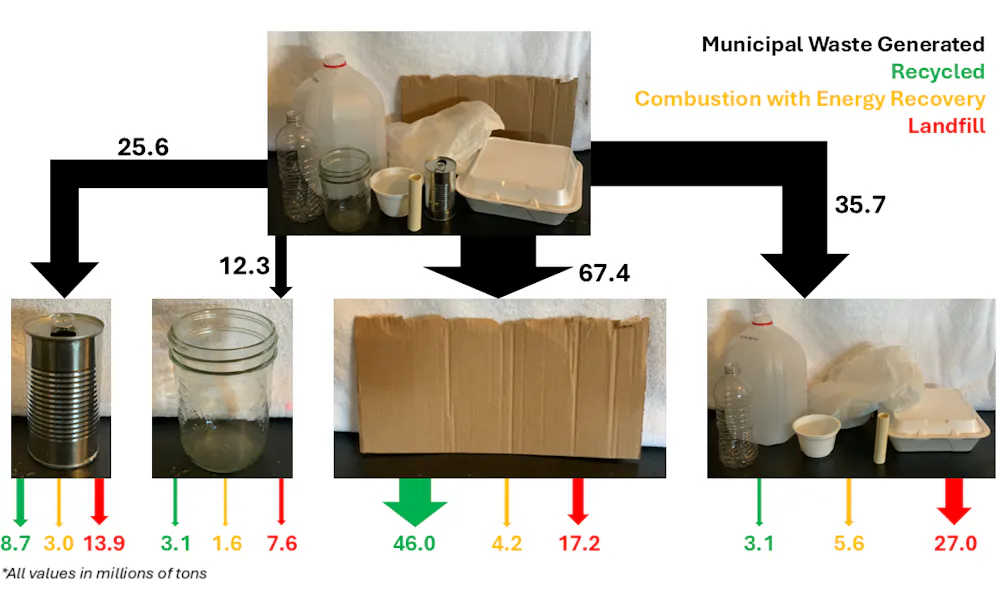
    A breakdown of U.S. recycling by millions of tons shows about two-thirds of all paper and cardboard gets a second life, but only about a third of metal, a quarter of glass and less than 10% of plastics do.
    Alex Jordan/University of Wisconsin-Stout

    So, what makes plastic recycling so difficult? As an engineer whose work focuses on reprocessing plastics, I have been exploring potential solutions.

    How does single-stream recycling work?

    In cities that use single-stream recycling, consumers put all of their recyclable materials − paper, cardboard, plastic, glass and metal − into a single bin. Once collected, the mixed recyclables are taken to a materials recovery facility, where they are sorted.

    First, the mixed recyclables are shredded and crushed into smaller fragments, enabling more effective separation. The mixed fragments pass over rotating screens that remove cardboard and paper, allowing heavier materials, including plastics, metals and glass, to continue along the sorting line.

    The basics of a single-stream recycling system in Pennsylvania. Source: Van Dyk Recycling Solutions.

    Magnets are used to pick out ferrous metals, such as steel. A magnetic field that produces an electrical current with eddies sends nonferrous metals, such as aluminum, into a separate stream, leaving behind plastics and glass.

    The glass fragments are removed from the remaining mix using gravity or vibrating screens.

    That leaves plastics as the primary remaining material.

    While single-stream recycling is convenient, it has downsides. Contamination, such as food residue, plastic bags and items that can’t be recycled, can degrade the quality of the remaining material, making it more difficult to reuse. That lowers its value.

    Having to remove that contamination raises processing costs and can force recovery centers to reject entire batches.

    Plastic bags, food residue and items that can’t be recycled can contaminate a recycling stream.
    City of Greenville, N.C./Flickr

    Which plastics typically can’t be recycled?

    Each recycling program has rules for which items it will and won’t take. You can check which items can and cannot be recycled for your specific program on your municipal page. Often, that means checking the recycling code stamped on the plastic next to the recycling icon.

    These are the toughest plastics to recycle and most likely to be excluded in your local recycling program:

    • Symbol 3 – Polyvinyl chloride, or PVC, found in pipes, shower curtains and some food packaging. It may contain harmful additives such as phthalates and heavy metals. PVC also degrades easily, and melting can release toxic fumes during recycling, contaminating other materials and making it unsafe to process in standard recycling facilities.

    • Symbol 4 – Low-density polyethylene, or LDPE, is often used in plastic bags and shrink-wrap. Because it’s flexible and lightweight, it’s prone to getting tangled in sorting machinery at recycling plants.

    • Symbol 6 – Polystyrene, often used in foam cups, takeout containers and packing peanuts. Because it’s lightweight and brittle, it’s difficult to collect and process and easily contaminates recycling streams.

    Which plastics to include

    That leaves three plastics that can be recycled in many facilities:

    However, these aren’t accepted in some facilities for reasons I’ll explain.

    Taking apart plastics, bead by bead

    Some plastics can be chemically recycled or ground up for reprocessing, but not all plastics play well together.

    Simple separation methods, such as placing ground-up plastics in water, can easily remove your soda bottle plastic (PET) from the mixture. The ground-up PET sinks in water due to the plastic’s density. However, HDPE, used in milk jugs, and PP, found in yogurt cups, both float, and they can’t be recycled together. So, more advanced and expensive technology, such as infrared spectroscopy, is often required to separate those two materials.

    Once separated, the plastic from your soda bottle can be chemically recycled through a process called solvolysis.

    It works like this: Plastic materials are formed from polymers. A polymer is a molecule with many repeating units, called monomers. Picture a pearl necklace. The individual pearls are the repeating monomer units. The string that runs through the pearls is the chemical bond that joins the monomer units together. The entire necklace can then be thought of as a single molecule.

    During solvolysis, chemists break down that necklace by cutting the string holding the pearls together until they are individual pearls. Then, they string those pearls together again to create new necklaces.

    Other chemical recycling methods, such as pyrolysis and gasification, have drawn environmental and health concerns because the plastic is heated, which can release toxic fumes. But chemical recycling also holds the potential to reduce both plastic waste and the need for new plastics, while generating energy.

    The problem of yogurt cups and milk jugs

    The other two common types of recycled plastics − items such as yogurt cups (PP) and milk jugs (HDPE) − are like oil and water: Each can be recycled through reprocessing, but they don’t mix.

    If polyethylene and polypropylene aren’t completely separated during recycling, the resulting mix can be brittle and generally unusable for creating new products.

    Chemists are working on solutions that could increase the quality of recycled plastics through mechanical reprocessing, typically done at separate facilities.

    One promising mechanical method for recycling mixed plastics is to incorporate a chemical called a compatibilizer. Compatibilizers contain the chemical structure of multiple different polymers in the same molecule. It’s like how lecithin, commonly found in egg yolks, can help mix oil and water to make mayonnaise − part of the lecithin molecule is in the oil phase and part is in the water phase.

    In the case of yogurt cups and milk jugs, recently developed block copolymers are able to produce recycled plastic materials with the flexibility of polyethylene and the strength of polypropylene.

    Improving recycling

    Research like this can make recycled materials more versatile and valuable and move products closer to a goal of a circular economy without waste.

    However, improving recycling also requires better recycling habits.

    You can help the recycling process by taking a few minutes to wash off food waste, avoiding putting plastic bags in your recycling bin and, importantly, paying attention to what can and cannot be recycled in your area.

    Alex Jordan received funding in in the past from TotalEnergies. He has worked on projects to create PP-PE block copolymers.

    ref. How single-stream recycling works − your choices can make it better – https://theconversation.com/how-single-stream-recycling-works-your-choices-can-make-it-better-250017

    MIL OSI – Global Reports

  • MIL-OSI Global: The gap between wages and housing prices is widening, fuelling the affordability crisis

    Source: The Conversation – Canada – By Patrick Michael Condon, Professor and UBC James Taylor Chair in Landscape and Livable Environments., University of British Columbia

    Racial disparities played a significant role in shaping unequal COVID-19 mortality rates. What is less widely understood is how overcrowded housing conditions were an even deadlier variable.

    In California’s Bay Area, for instance, residents of overcrowded apartments — many of them recent immigrants — were found to be significantly more likely to die from COVID-19 than residents of demographically similar, but less crowded, apartments.

    ‘Broken City: Land Speculation, Inequality, and Urban Crisis’ by Patrick M. Condon.
    (UBC Press)

    Even less examined is the root cause of this overcrowding. Overcrowding is not just a matter of zoning or population growth, but something more systemic and difficult to confront: the speculative financial forces acting on the land beneath our feet.

    Urban land is now assessed by people not for its consumption value for a home but for its ability to hold and increase in cash value — in other words, its “speculative value.”

    My recent book, Broken City, paints a picture of how the same market logics that defined the Gilded Age of the late 19th century have quietly returned in our own century, with similarly corrosive consequences for urban life.

    Echoes of the Gilded Age

    A growing share of average workers’ incomes is being swallowed up by housing costs, often for homes that fail to meet their basic needs. This is not the result of natural scarcity, but mechanical economic processes that inform the price of urban land.

    We now find ourselves in circumstances uncomfortably close to those of Victorian England or Gilded Age America, when mass migrations to urban centres were driven by the need for jobs.


    Read more:
    What’s behind Canada’s housing crisis? Experts break down the different factors at play


    Back then, as now, a small number of urban landowners were able to extract enormous wealth — what political economist Henry George called the unearned increment — from the labour of others by virtue of owning the right patch of ground.

    A portrait photograph of Henry George, taken after 1885.
    (Wikimedia Commons)

    The demands for the unearned increment, George explained, was only limited by how much a region’s wage-earners and entrepreneurs collectively produced. Almost all of that value eventually went into land price.

    Today, we appear to be experiencing the same phenomenon. The social and epidemiological pressures produced by inflated land prices are no longer confined to historically marginalized racial or ethnic groups.

    As my book explains, millennials and Gen Xers, who are increasingly working service-sector jobs that dominate today’s economy, especially in countries like Canada and the U.S., are facing housing pressures once reserved only for the poor.

    In short, housing precarity has gone mainstream.

    Skyrocketing land prices

    At the heart of the housing crisis lies a deeper problem: runaway urban land prices are not just a crisis of housing affordability, but a problem of equitable urban design. They are eroding our political capacity to solve many urban problems.

    The same inflated land values that burden tenants and aspiring homeowners also restrict what cities can do to address housing and transportation needs, whether through planning, taxation or direct provision.

    Urban land prices are spiralling due to the collision of two long-term trends. First, the global economy has shifted from being primarily driven by wages earned through labour to one dominated by returns on assets. Urban land is now the single largest category of fixed capital asset in the world.

    Second, this asset-driven economy has widened the gap between wages and home prices, and helped drive the explosion in inequality. Housing has become the primary site where that inequality is expressed.

    Public frustration over this yawning gap between stagnant incomes and sky-high housing costs has erupted into political conflict. Many now blame local governments and planning regulations for blocking the supply of new homes. If only we could build more, they argue, prices would fall.

    But the evidence tells a different story. Take Vancouver, a city that has tripled its housing stock since the 1960s, largely through infill development. If the supply theory held true, Vancouver should be the most affordable city in North America. Instead, it is the least affordable.

    A landmark study published in March by the National Bureau of Economic Research found that supply constraints didn’t explain rising housing prices or housing growth across American cities. In other words, building more housing isn’t enough to bring down prices.

    A path out of the housing crisis

    My book offers several solutions and examples for how cities can reclaim land wealth for the common good.

    One promising approach lies in tying new housing approvals to affordability requirements. This policy framework — known as inclusionary zoning — requires developers to include a certain number of permanently affordable units as a condition for increased density.

    Without such requirements, upzoning — meaning increasing the maximum building size the city authorizes for a parcel — can inflate the value of land, rewarding speculation and driving prices further out of reach.

    Examples of effective inclusionary zoning abound. In Cambridge, Mass., an affordable housing overlay mandates 100 per cent affordability in exchange for permission to double density across the city. In Vancouver, new legislation related to inclusive zoning was introduced in 2024 and a development tax on new high-density projects has helped finance non-market housing directly.

    The path forward is not mysterious. But it does require confronting the truth that the housing crisis is not the result of broken systems — but of a speculative financial systems working exactly as designed.

    Patrick Michael Condon does not work for, consult, own shares in or receive funding from any company or organisation that would benefit from this article, and has disclosed no relevant affiliations beyond their academic appointment.

    ref. The gap between wages and housing prices is widening, fuelling the affordability crisis – https://theconversation.com/the-gap-between-wages-and-housing-prices-is-widening-fuelling-the-affordability-crisis-252157

    MIL OSI – Global Reports

  • MIL-OSI Global: Amplifying delusions: How social media can negatively impact our mental well-being

    Source: The Conversation – Canada – By Bernard Crespi, Professor, Evolutionary Biology, Simon Fraser University

    Social media is an evolutionary novelty, like M&M’s, e-cigarettes, fentanyl and H-bombs. Each comes with novel risks to health and well-being that humans are entirely unaccustomed to. (Shutterstock)

    Imagine a tribe of uncontacted hunter-gatherers in the deepest Amazon rainforest. Anthropologists airdrop dozens of smartphones loaded with social media apps, with solar chargers, simple instructions in their native language and Wi-Fi just within the tribe. What would happen to their culture and their mental health?

    Such an experiment appears fanciful, but a similar one has been unfolding in our world for about 20 years. For the first time in human evolution, everyday social interactions have changed from face-to-face to disembodied experiences, from in-person to digital and from social reality to whatever someone puts online.

    Social media is an evolutionary novelty, like M&M’s, e-cigarettes, fentanyl and H-bombs. Each comes with novel risks to health and well-being to which humans are entirely unaccustomed.

    What, then, are the risks of seemingly innocuous behaviours such as sharing posts, giving likes, making oneself look good in pictures, and, in general, interacting virtually rather than physically? The short answer is that we don’t know — yet — especially because our big experiment has no control group.

    But we can try to find out.

    Social media and mental disorders

    We recently investigated the question of what mental disorders are associated with high social media use. To do so, we conducted a systematic review — an objective way to find and evaluate all of the relevant literature. We hypothesized that social media use should be higher among people whose psychology, and psychiatric traits and disorders, were more socially mentalistic.

    Mentalism refers to within-brain traits like theory of mind, inferring intentions or emotions of others and empathizing. Social media is expected to be mentalistic because it involves disembodied thoughts, feelings and associated images, intended to connect us with other humans. Mentalistic thinking contrasts with the mechanistic cognition of scientists plying their trade of cause and effect in the physical, non-mentalistic world of things.

    To test our hypothesis, we scrutinized hundreds of scientific articles, and a curious picture emerged. High social media use was strongly associated with a subset of mentalistic traits and disorders: narcissism, erotomania (the belief that some celebrity loves you), paranoia, body dysmorphia and anorexia.

    These traits and disorders seem unrelated, but we noticed they all centrally involve delusions: false beliefs about reality, held despite absent or contradictory evidence. Some delusions can be mental (narcissism, paranoia, and erotomania), or physical (body dysmorphia and anorexia). Some are positively valanced (narcissism and erotomania) and some are negative (paranoia, body dysmorphia and anorexia).

    Why, then, was social media associated with delusionality?

    Social delusions

    Like other mental traits, delusions exist in one’s brain for a reason. What these mental disorders also appear to share, psychologically, is an underdeveloped and fragile sense and construction of the self, which happens during early life through social interactions with family, friends, and others.

    If one’s mental and perceived bodily self is underdeveloped in childhood, it can, later, be bolstered, and this commonly happens through social interactions that involve beliefs that, though false, make oneself feel better.

    Low self-image and self-esteem can be shored up through admiration or love from outside — with extremes of narcissism or erotomania. Perceived embodiment and body image problems can be enhanced through fictitious beliefs about appearance — with extremes of body dysmorphia and anorexia.

    What better way to do any of these things than with social media and the internet, where users can pursue likes and followers to their heart’s content, and present themselves mentally and physically as they wish, using applications designed specifically for that purpose?

    Most importantly, social media allows users to delusionally “improve” themselves because it circumvents reality testing: the direct, face-to-face interactions we engage in when physically interacting with other people.

    Social media allows one to delusionally ‘improve’ oneself because it circumvents reality testing: the direct, face to face interactions we engage in when physically interacting with other people.
    (Shutterstock)

    Delusion amplification

    As we outline in our paper, the processes just described represent a “Delusion Amplification by Social Media” model that can help explain why and how high social media use is linked with a specific subset of mental disorders that involve delusions and an underdeveloped self.

    By this model, some people are relatively vulnerable, psychologically, to the negative effects of social media, because they are drawn to it, and because it amplifies and exacerbates their problems. This exacerbation is, of course, not benign or accidental; the goal of many social media companies is, after all, to keep us online, scrolling, striving and seeking hits of social pleasure and self-validation.

    What, then, then can be done, aside from cutting the virtual social umbilical cord? First and most crucial is enhanced awareness of our own psychological makeups and how they are affected by specific platforms or apps. The problem with delusions, of course, is lack of awareness that our reality is false — but we can still become more cognizant of the rifts between perceived and actual worlds and what drives them.

    Second is more research, to extend the delusion amplification model, and to better determine the psychological and neurological differences between in-person and virtual interactions, and what mental problems they can cause.

    If we find that social media really is ruining mental health, as suggested by recent increases in narcissism, body dysmorphia and other disorders among young people, then the research will need to be incorporated into policy, so we can regain control over our social lives, our brains and our social worlds.

    The authors do not work for, consult, own shares in or receive funding from any company or organisation that would benefit from this article, and have disclosed no relevant affiliations beyond their academic appointment.

    ref. Amplifying delusions: How social media can negatively impact our mental well-being – https://theconversation.com/amplifying-delusions-how-social-media-can-negatively-impact-our-mental-well-being-252137

    MIL OSI – Global Reports

  • MIL-OSI Global: Human connections to seagrass meadows date back 180,000 years, study reveals

    Source: The Conversation – UK – By Benjamin Jones, Chief Conservation Officer, Project Seagrass & Research Affiliate, Swansea University

    Benjamin Jones/Project Seagrass, CC BY

    For millennia, humans lived as hunter-gatherers. Savannas and forests are often thought of as the cradle of our lineage, but beneath the waves, a habitat exists that has quietly supported humans for over 180,000 years.

    Archaeological evidence suggests that early humans migrated along coasts, avoiding desert and tundra. So, as Homo spread from Africa, they inevitably encountered seagrasses – flowering plants evolved to inhabit shallow coastal environments that form undersea meadows teeming with life.

    Our recently published research pieces together historical evidence from across the globe, revealing that humans and seagrass meadows have been intertwined for millennia – providing food, fishing grounds, building materials, medicine and more throughout our shared history.

    Our earliest known links to seagrass date back around 180,000 years. Tiny seagrass-associated snails were discovered in France at Paleolithic cave sites used by Neanderthals. Too small to be a consequence of food remains, these snails were likely introduced with Posidonia oceanica leaves used for bedding – a type of seagrass found only in the Mediterranean. Neanderthals didn’t just use seagrass to make sleeping comfortable – 120,000 year old evidence suggests they harvested seagrass-associated scallops too.

    A bountiful supply of food

    Seagrass meadows provide shelter and food for marine life, such as fish, invertebrates, reptiles and marine mammals. Because they inhabit shallow waters close to shore, seagrass meadows have been natural fishing grounds and places where generations have speared, cast nets, set traps and hand-gathered food to survive and thrive.

    Long before modern fishing fleets, ancient communities recognised the value of these underwater grasslands. Around 6,000 years ago, the people of eastern Arabia depended on seagrass meadows to hunt rabbitfish – a practice so prevalent here that remnants of their fishing traps are still visible from space.

    Seagrass meadows have even been directly harvested as food. Around 12,000 years ago, some of the first human cultures in North America, settling on Isla Cedros off the coast of Baja California, gathered and consumed seeds from Zostera marina, a species commonly called eelgrass. These seeds were milled into a flour and baked into breads and cakes, a process alike to wheat milling today.

    Further north, the Indigenous Kwakwaka’wakw peoples, as far back as 10,000 years ago, developed a careful and sustainable way of gathering eelgrass for consumption. By twisting a pole into the seagrass, they pulled up the leaves, and broke them off near the rhizome – the underground stem that is rich in sugary carbohydrates. After removing the roots and outer leaves, they wrapped the youngest leaves around the rhizome, dipping it in oil before eating. Remarkably, this method was later found to promote seagrass health, encouraging new growth and resilience.


    Read more:
    Seagrass, protector of shipwrecks and buried treasure


    Today, seagrass meadows remain a lifeline for coastal communities, particularly across the Indian and Pacific Oceans. Here, fishing within seagrass habitats is shown to be more reliable than other coastal habitats and women often sustain their families by gleaning – a fishing practice that involves carefully combing seagrass meadows for edible shells and other marine life. For these communities, seagrass fishing is vital during periods when fishing at sea is not possible, for example, during tropical storms.

    When seagrasses returned to the sea around 100 million years ago, they evolved to have specialised leaves to tolerate both saltwater submergence and periods of time exposed to the sun during tidal cycles. This allowed seagrasses to flourish across our coastlines, but also made them useful resources for humans.

    Seagrass leaves, once dry, are relatively moist- and rot-proof – properties likely discovered by ancient civilisations when exploring the uses of plants for different purposes. Bronze age civilizations like the Minoans, used seagrass in building construction, reinforcing mudbricks with seagrass. Analysis of these reveal superior thermal properties of seagrass mudbricks compared to bricks made with other plant fibres – they kept buildings warmer in winter and cooler in summer.

    These unique properties may have been why early humans used seagrass for bedding and by the 16th century, seagrass-stuffed mattresses were prized for pest resistance, requested even by Pope Julius III.

    By the 17th century, Europeans were using seagrass to thatch roofs and insulate their homes. North American colonialists took this knowledge with them, continuing the practice. In the 19th century, commercial harvesting of tens of thousands of tonnes of seagrass began across North America and northern Europe.

    In the US, Boston’s Samuel Cabot Company patented an insulation material called Cabot’s “Quilt”, sandwiching dried seagrass leaves between two layers of paper. These quilts were used to insulate buildings across the US, including New York’s Rockefeller Center and the Capitol in Washington DC.

    A legacy ecosystem – and a living one

    The prevalence of seagrass throughout human civilisation has fostered spiritual and cultural relations with these underwater gardens, manifesting in rituals and historical customs. In Neolithic graves in Denmark, scientists found human remains wrapped in seagrass, representing a close connection with the sea.

    Our new research tells us that seagrass meadows are not just biodiversity hotspots or carbon storage systems. They are ancient human allies. This elevates their value beyond conservation – they’re repositories of cultural heritage and traditional knowledge. They were practical, valuable, and deeply integrated into human cultures.

    We have depended on seagrass for 180,000 years – for food, homes, customs – so investing in their conservation and restoration is not just ecological, it’s deeply human.


    Don’t have time to read about climate change as much as you’d like?

    Get a weekly roundup in your inbox instead. Every Wednesday, The Conversation’s environment editor writes Imagine, a short email that goes a little deeper into just one climate issue. Join the 45,000+ readers who’ve subscribed so far.


    Nicole Foster receives funding from the European Union’s Horizon Europe Training and mobility actions.

    Oscar Serrano receives funding from the Spanish National Research Council

    Benjamin Jones does not work for, consult, own shares in or receive funding from any company or organisation that would benefit from this article, and has disclosed no relevant affiliations beyond their academic appointment.

    ref. Human connections to seagrass meadows date back 180,000 years, study reveals – https://theconversation.com/human-connections-to-seagrass-meadows-date-back-180-000-years-study-reveals-253307

    MIL OSI – Global Reports

  • MIL-OSI Global: Nayib Bukele: El Salvador’s strongman leader doing Donald Trump’s legwork abroad

    Source: The Conversation – UK – By Amalendu Misra, Professor of International Politics, Lancaster University

    The US president, Donald Trump, has unleashed a string of controversial policies since returning to the White House that have put his administration at odds with most of the world. He has, at the same time, forged an alliance with one country that is willing to do his bidding abroad.

    This country is El Salvador, a tiny central American nation nestled between Guatemala and Honduras. El Salvador has found itself at the forefront of overseeing Trump’s contentious drive to deport undocumented migrants.

    In recent months, hundreds of foreign-born men have been deported from the US to the Center for Terrorism Confinement (Cecot) mega-prison in Tecoluca, El Salvador. This is part of an agreement between Trump and the self-declared “world’s coolest dictator”, Nayib Bukele.

    Such is the warmth between Trump and El Salvador’s leader that the US secretary of state, Marco Rubio, recently hailed their alliance as “an example for security and prosperity in our hemisphere”.

    The comment came shortly before Bukele met with Trump at the White House and said he will not return Kilmar Abrego García, a man that the US government admits was mistakenly deported. Bukele referred to the suggestion as “preposterous”.

    This is despite a US Supreme Court ruling that the Trump administration “facilitate” García’s return. The US government says a court does not have the power to order the release of a person in a foreign prison.

    Bukele, the grandson of Palestinian Christian immigrants, is considered something of a maverick. His background is in advertising. Through his business, Obermet, Bukele advertised two election campaigns for the ruling Farabundo Martí National Liberation Front (FMLN) in the 2000s.

    He joined the FMLN as a member in 2012, and was elected as mayor of El Salvador’s capital, San Salvador, three years later. Bukele’s relationship with the FMLN soon became strained. After several public spats, he was expelled from the party. This included calling Luis Martínez, the country’s then attorney-general, a “gangster, very corrupt, [and] the worst of the worst”.

    Bukele subsequently launched his own political front, Nuevas Ideas. And when the country’s electoral court refused to register the party for the 2019 presidential elections, he ran as the candidate for the right-wing Grand Alliance for National Unity. Bukele won with 53% of the vote and, since then, his political fortunes have been in constant ascent.

    While many outside El Salvador see Bukele as a serial human rights abuser, his countrymen consider him a political messiah. His popularity is such that he won an unprecedented second presidential term in 2024 with over 84% of the vote.

    The country’s constitution had previously restricted a sitting president from contesting two terms in a row. Bukele’s critics say he circumvented the rules by using his congressional majority to replace Supreme Court judges.

    The court later ruled that the president can serve two consecutive terms in office. In the past, Bukele has remarked that restrictions on re-election only exist in developing countries.

    Bukele’s popularity stems from having rid his country of gang violence. El Salvador was once known for having the highest per capita homicide rate in the world, with 105 murders per 100,000 people in 2015. But under Bukele’s leadership, it is now considered a haven of peace in an otherwise unstable region.

    In 2022, after a spate of gang killings, Bukele declared a state of emergency. The decree curtailed the right to be informed of the reason for arrest and access to a lawyer upon being detained. It also allowed for administrative detention of more than 72 hours.

    Tens of thousands of people were rounded up and thrown in jail without trial. El Salvador now has the highest incarceration rate in the world, with roughly 110,000 people in jail. The proportion of its population that is incarcerated is twice that of the next nearest country, Cuba.

    Many of the alleged criminals – as well as those deported from the US – are held in Cecot. The prison has been described by activists as “a black hole of human rights”. When Bukele first unveiled the facility, he said prisoners would receive “not one ray of sunlight”.

    Bukele’s tough anti-criminal stance has been lauded across Latin America. Many regional leaders have embraced Bukele-style policies to tackle criminal violence in their respective countries. His policies have also clearly been appreciated by Trump.


    Read more:
    Latin America: several countries look to combat gang violence by fighting fire with fire


    Alliance of convenience

    Bukele and Trump share the same ideological persuasion. Both are conservative right-wing populists. But while there is a deep convergence in their ideology, their alliance is also one of convenience.

    Trump wants to rid the US of undocumented migrants from south of the border. El Salvador has, so far, provided a convenient avenue to address his administration’s needs.

    And for Bukele, it is financially worthwhile to house deportees from the US. The Bukele and Trump administrations have reportedly signed an agreement that will pay El Salvador US$20,000 (£15,000) per prisoner. This is a significant sum for El Salvador’s economy.

    His alliance with Trump will also help him shore up his political position at home and consolidate his image as a “do gooder” in an otherwise violent continent.

    Bukele’s security strategy has certainly rid El Salvador of gang violence. However, opening up El Salvador as a destination to address other countries’ criminality sets a bad precedent.

    Encouraged by Bukele’s policies, more states could choose to violate human rights and ignore judicial process by simply dumping their own citizens and others in prisons abroad. This is a reality that more courts may soon struggle to prevent.

    Amalendu Misra is a recipient of British Academy and Nuffield Foundation fellowships.

    ref. Nayib Bukele: El Salvador’s strongman leader doing Donald Trump’s legwork abroad – https://theconversation.com/nayib-bukele-el-salvadors-strongman-leader-doing-donald-trumps-legwork-abroad-254629

    MIL OSI – Global Reports

  • MIL-OSI Global: Why were people so drawn to phrenology?

    Source: The Conversation – UK – By Fenneke Sysling, Assistant Professor in History of Science, Medicine and Colonialism, Leiden University

    B.erne/Shutterstock

    It’s hard to imagine now, but people once believed that the bumps on your head could reveal your personality. For one thing, it’s so hard to locate the bumps on your head, let alone the thirty or so bumps the phrenologists said could be discerned. So why was phrenology such an attractive idea for such a long time?

    Phrenology was the belief that the brain’s activity could be studied by examining the bumps on the skull, in places where the brain pushed outwards. Phrenologists claimed they could read your personality based on how big different bumps were. Initially, after German physiologist Franz Joseph Gall developed the new doctrine around 1800, it was a subject of serious scientific debate. But it was soon labelled quackery by the academic elite.

    But that wasn’t the end of phrenology. In fact, it became more popular in the 19th century, thanks to physician Johann Gaspar Spurzheim who wrote books and gave public lectures in Britain and France – focusing less on skulls and brains, and more on reading the living people. It remained a popular pastime for more than a century, mainly in English-speaking parts of the world but also outside it, for example in China.

    Front page of the American Phrenological Journal and Science of Health, 1880.
    AKaiser/Shutterstock

    Part of the appeal of phrenology was that it gave people a vocabulary to understand themselves and others. With urbanisation and a growing middle class, outside rigid class and religious structures, people were curious about new ways to categorise humankind. In the city, you wouldn’t necessarily know everyone nearby or even your neighbours, so your place in society was less determined.

    This may have led to more freedom but also to insecurity about what your and everyone else’s place was. Phrenology was a new way of classifying others. But it was not only meant to study others, it was also a way to know yourself, just like diary writing which also gained popularity in this period. With the help of phrenology, people could now see themselves as having an individual self, reflected in the shape of their head.

    Those interested could go to a lecture or read a book about phrenology or – if you lived in New York – visit the Phrenological Cabinet, a display of skulls, busts and portraits. If you really wanted to learn something about yourself, you asked a phrenologist for an examination. In the US this would cost you about half a dollar, (US$20 dollars (£15) today). Many popular phrenologists in the UK and the US offered readings. They were often itinerant, setting up shop in hotel rooms or at Brighton Pier in southern England.

    After a reading, clients sometimes received a written assessment, but more usually
    received a cheaper standardised chart that detailed their characteristics. On it, they received a score for typical phrenological characteristics such as adhesiveness (or friendship), spirituality, benevolence and time (the ability to judge the lapse of time, “essential for musicians”).

    The score was based on the phrenologist’s approach. They tended to gauge the size of the bumps in relative size, compared to your other bumps and to other people’s bumps. They claimed that this was a scientific approach, but it gave phrenologists a great deal of freedom in interpretation.

    And – surprise surprise – my analysis of about 160 charts between 1840 and 1940 showed that every single person who received a chart scored above average in most if not all traits.

    The positive results partly explain the appeal of a visit to the phrenologist. Another explanation, writes history professor Michael Sokal, is the Barnum effect. This is the tendency of people to rate descriptions of their personality that supposedly are tailored for them as accurate. In fact, they are often so vague and general that they would apply to almost all people.

    Many people, for example, would agree with the suggestion that they are of above-average intelligence but also experience anxiety and self-doubt sometimes. And, indeed, in my collections of phrenological charts, the trait that on average gets the lowest score was “self-esteem”. If only you work a bit on your self-esteem, is the implicit message, you can be an even better version of yourself.

    Phrenologists were often deterministic when they judged criminals or non-white
    people, based on the skulls or busts they had of people from these categories. Their irregular features or skull shapes apparently condemned them to a life in prison or in slavery.

    But they took a different approach to the middle-class visitors of their offices. The character trait of “destructiveness”, for example, was seen the trait of a murderer, but for a middle-class individual was usually explained as energy for overcoming difficulties.

    According to phrenologists, everyone could play a role in their destiny and people could use their self-knowledge for improvement. Taking time to reflect on the relationship between cause and effect, for example, could slowly increase the size of your “causality” bump, phrenologists said.

    According to early 20th-century phrenologist Stephen Tracht, it took three weeks for a child, three years for a young man, and more once you were 45 or 50, to develop a specific part of the brain.

    These practices show how in phrenology self-knowledge and self-improvement came to be seen as two sides of the same coin. And while not everyone will have accepted their phrenological assessment as an absolute truth and customers often took only the information from it that they liked, phrenology did become part of people’s vocabulary, and with it the message that with the right tools, they could become a better version of themselves.

    Fenneke Sysling received funding from the Dutch Research Council

    ref. Why were people so drawn to phrenology? – https://theconversation.com/why-were-people-so-drawn-to-phrenology-246646

    MIL OSI – Global Reports

  • MIL-OSI Global: Low iron is common in teenage girls – with vegans and vegetarians at greatest risk, according to our research in Sweden

    Source: The Conversation – UK – By Moa Wolff, Postdoctoral Fellow, Family Medicine and Community Medicine, Lund University

    Teenage girls are particularly at risk of iron deficiency. Perfect Wave/ Shutterstock

    Teenage girls who avoid meat in favour of a plant-based diet are at higher risk of developing an iron deficiency, according to our latest research.

    Our study confirmed that iron deficiency is common among teenage girls, with 38% of participants affected. We also found that risk of iron deficiency was strongly associated with both eating patterns and menstrual blood loss. Girls who reported heavy periods and followed a meat-restricted diet – meaning they were vegetarian, vegan, pescatarian or avoided red meat – had by far the highest risk of developing iron deficiency. We found that nearly 70% of vegans and vegetarians had iron deficiency.

    As a growing number of young people turn to sustainable eating practices, this condition could become even more common. This is why it’s important teenagers are properly informed about the risks of low iron – and how they can get enough iron even while following a plant-based diet.

    The idea for this study came from the personal experience of one of us, whose teenage daughter struggled with fatigue, low mood and poor stamina. After months of assuming it was stress or excess screen time, blood tests revealed the cause: iron deficiency anaemia. The experience made us wonder whether the issue is more widespread. This sparked a research collaboration that brought together clinical and nutritional expertise.

    The study included 475 female high school students from southern Sweden. Participants completed questionnaires about their diet, what supplements they used, as well as their menstrual patterns. They also provided blood samples, which were analysed for haemoglobin and ferritin – the key markers used to assess iron status.

    The body contains about as much iron as a two-inch nail. Around two-thirds of the body’s iron is used in red blood cells to carry oxygen from the lungs to the rest of body. This is why a deficiency can cause tiredness, pale skin and shortness of breath.

    But iron isn’t just about oxygen. The remaining one-third plays a key role in brain function, energy metabolism and nerve signalling. Studies show that even without anaemia, low iron can lead to fatigue, poor concentration, reduced academic performance and physical tiredness. Treating iron deficiency has been linked to reduced fatigue.

    Teenage girls are at particular risk of iron deficiency. There are several reasons for this.

    First, the body needs extra iron to keep up with the rapid growth that happens during puberty. Second, menstruation leads to iron loss, with periods often heavy during the first years after menarche (a woman’s first period). Third, diet plays a key role. Many girls also change their eating habits during adolescence, often reducing their intake of red meat or animal products. But even among omnivores, iron intake tends to be too low. It’s not just about what they avoid – it’s that many simply aren’t getting enough iron overall.

    Those who avoided animal proteins were at the highest risk of iron deficiency.
    nadianb/ Shutterstock

    While our findings are from Sweden, the issue is not unique to the country. A European school-based study from 2006-2007 found iron deficiency in 26% of girls aged between 12 and 17. Data from the United States also found that around 17% of girls aged 12 to 21 have low iron stores. Study methods may differ, but the trend is consistent: adolescent girls across countries are at risk of iron deficiency – often without knowing it.

    Despite how common iron deficiency is, several persistent myths can prevent young people from getting the help they need.

    One common belief is that eliminating animal products is inherently healthy, without acknowledging the need to replace the nutrients they supply.

    A plant-based diet can absolutely be healthy and sustainable. But when animal sources of iron are removed, it’s essential to include iron-rich plant foods and to combine them with certain foods for better absorption. Without that knowledge, even well-intentioned choices can lead to nutritional gaps.

    Another common belief is that low iron would be obvious – that you’d feel if you had it.

    In reality, iron deficiency and anaemia often develops slowly and the body adapts over time. Symptoms such as tiredness, poor concentration and low mood can sneak up gradually and become the new normal.

    A third misconception is that iron supplements are dangerous or unnecessary.

    For those diagnosed with a deficiency, supplements are often essential and safe when used properly. Treatment usually needs to continue for at least three months to restore the body’s iron stores.

    Iron intake

    So, what can be done? Here are three simple, evidence-based tips for a sustainable iron-rich diet:

    1. Make iron part of your daily routine. Whole grains, legumes and leafy greens (such as spinach, kale and chard) are good plant-based sources of iron. Even in a balanced diet, where a person consumes a maximum of 500g of red meat per week, more than 80% of daily iron intake comes from plant-based sources.

    2. Help your body absorb it. Plant-based iron is often tightly bound to phytic acid and needs help to be released. So it’s important to combine iron-rich meals with enhancers such as vitamin C (citrus fruits, peppers and cruciferous vegetables) or natural acids (citrus juice, vinegar, soy sauce, miso, kimchi or sauerkraut). These enhancers help improve iron absorption. You can also use fermentation to your advantage. Foods such as sourdough bread have gone through processes that reduce phytic acid, making iron more accessible.

    3. Avoid iron blockers. Skip tea or coffee with meals. The tannins they contain can significantly reduce iron absorption.

    With the right knowledge, young people can eat both sustainably and healthily – and avoid iron deficiency and its consequences.

    Moa Wolff receives funding from the Southern Health Care Region of Sweden, the Lions Research Fund Skåne, and Regional Funding for Clinical Research (USVE). She has also received an honorarium from Pharmacosmos for giving an educational webinar.

    Anna Stubbendorff does not work for, consult, own shares in or receive funding from any company or organisation that would benefit from this article, and has disclosed no relevant affiliations beyond their academic appointment.

    ref. Low iron is common in teenage girls – with vegans and vegetarians at greatest risk, according to our research in Sweden – https://theconversation.com/low-iron-is-common-in-teenage-girls-with-vegans-and-vegetarians-at-greatest-risk-according-to-our-research-in-sweden-253878

    MIL OSI – Global Reports

  • MIL-OSI Global: Four ways to get out of bed in the morning – and beat grogginess

    Source: The Conversation – UK – By Trudy Meehan, Lecturer, Centre for Positive Psychology and Health, RCSI University of Medicine and Health Sciences

    Studio Romantic/Shutterstock

    If you feel like “waking up is the hardest thing I do all day” then you’re not alone. The experience has been termed “sleep inertia” and while it’s a normal part of the sleep-wake experience, it can be frustrating to wake up feeling tired.

    Much of the research on sleep inertia focuses on reducing the risk of performance impairment and we are yet to find clear empirical evidence to support the use of any one single reactive countermeasure.

    The most promising evidence is for the use of caffeine: taken before a short nap of less than 30 minutes, it has been shown to reduce the effects of sleep inertia. While this is helpful if you need to recover after a rest during the day, heading back to bed for a nap just after waking up isn’t very practical for most of us.

    So here are some more practical tips that you can use to help you get out of bed.

    Get an alarm clock

    If you’re struggling to get out of bed in the morning the first thing to ask is, where is your smart phone? Do you keep it next to the bed as an alarm clock? Make getting an old fashioned alarm clock your priority.

    The mere presence of the phone near you as you sleep reduces sleep quality – if it’s nearby, it’s too hard to resist. It’s not just through disruptive notifications (putting it on silent isn’t good enough). Having the phone next to you as you sleep can induce anticipatory anxiety and increase emotional arousal. Just knowing it’s there will keep you at a level of alertness that is not conducive to falling off into a deep sleep.

    There’s an additional benefit to keeping the phone out of your room: you are less likely to check it first thing in the morning. There are many reasons to avoid this habit, one of the most compelling centres around the problem of micro-dosing ourselves with dopamine before we even get enough motivation to get out of the bed.

    Dopamine plays a central role in motivation and craving. It peaks and troughs throughout our day, dopamine dips are functional because we feel discomfort and that propels us to seek relief. Think cave men and women needing the motivation to leave the safety of the cave to find food, water or a mate. Leaving the cave was high risk, and the push from our dopamine drop discomfort would have been essential to get us up and out.

    We forget how much of our brain still works in these ancient ways. Humans still rely on the same system to get out of bed. When we reach for a smartphone, we’re met with rapid, bite-sized dopamine hits – notifications, beautiful people, likes, novel information. These micro-stimuli may blunt the natural dip in dopamine, circumventing the discomfort we need to motivate us to get moving. Instead of experiencing a rise in drive, we feel artificially satisfied, making it easier to stay curled up under the warm covers.

    Don’t hit snooze

    You’ve got the devices out of your bedroom – but now you need to work on your relationship with your alarm clock. Don’t hit snooze.

    Hitting snooze increases the likelihood of dropping back into a deep sleep phase and will induce regular sleep disruptions and unwanted sleep stage transitions. These all increase the impact of sleep inertia and reduce vigour.

    If you really struggle to avoid the seductive snooze button, there are alarm clocks available that usually come with wheels that will take themselves out of your reach. A bit of movement to help get you out of bed as a bonus.

    Or, think about getting an alarm clock that opens your curtains to let in the morning light. Brief bright light exposure has been shown to improve alertness and energy

    Remember when your parents pulled the covers off the bed?

    Anyone who had older siblings, or a parent or caregiver involved in getting them out of bed when you were an adolescent will have experienced having the cover pulled off the bed as a last ditch effort to move you along. It turns out that there may have been some wisdom to this method.

    Cooling the extremities immediately after waking up is a promising way to accelerate recovery from sleep inerita. And while we are staying old school, if all else fails, wash your face.

    Maybe you need to stay in bed?

    Most importantly of all, maybe you are just tired and need to stay in bed. That’s not a moral failing or a collapse of your will power. You might just actually need more rest.

    If you’re someone who is genuinely sleep deprived or living with an energy sapping illness or a life event that’s taking all your resources, maybe you need to make space for staying in bed. Critical disability scholar Ellen Samuels writes about “crip time”. Sometimes illness or disability change our relationship with time and we need to go at a different pace. Samuels and other scholars reflect on the paradox of needing to slow down in order to keep up.

    So sometimes the problem is the expectation that we force our minds and bodies into unrealistic performances of competency and productivity – and sometimes it’s going to have to be okay to not get out of bed.

    Trudy Meehan does not work for, consult, own shares in or receive funding from any company or organisation that would benefit from this article, and has disclosed no relevant affiliations beyond their academic appointment.

    ref. Four ways to get out of bed in the morning – and beat grogginess – https://theconversation.com/four-ways-to-get-out-of-bed-in-the-morning-and-beat-grogginess-254334

    MIL OSI – Global Reports

  • MIL-OSI Global: New form of dark matter could solve decades-old Milky Way mystery

    Source: The Conversation – UK – By Shyam Balaji, Postdoctoral Research Fellow of Physics, King’s College London

    Susan Stolovy (SSC/Caltech) et al., NASA SPitzer/IRAC

    Astronomers have long been puzzled by two strange phenomena at the heart of our galaxy. First, the gas in the central molecular zone (CMZ), a dense and chaotic region near the Milky Way’s core, appears to be ionised (meaning it is electrically charged because it has lost electrons) at a surprisingly high rate.

    Second, telescopes have detected a mysterious glow of gamma rays with an energy of 511 kilo-electronvolts (keV) (which corresponds to the energy of an electron at rest).

    Interestingly, such gamma rays are produced when an electron and its antimatter counterpart (all fundamental charged particles have antimatter versions of themselves that are near identical, but with opposite charge), the positron, collide and annihilate in a flash of light.

    The causes of both effects have remained unclear, despite decades of observation. But in a new study, published in Physical Review Letters, we show that both could be linked to one of the most elusive ingredients in the universe: dark matter. In particular, we propose that a new form of dark matter, less massive than the types astronomers typically look for, could be the culprit.

    Hidden process

    The CMZ spans almost 700 light years and contains some of the most dense molecular gas in the galaxy. Over the years, scientists have found that this region is unusually ionised, meaning the hydrogen molecules there are being split into charged particles (electrons and nuclei) at a much faster rate than expected.

    This could be the result of sources such as cosmic rays and star light that bombard the gas. However, these alone don’t seem to be able to account for the observed levels.

    The other mystery, the 511keV emission, was first observed in the 1970s, but still has no clearly identified source. Several candidates have been proposed, including supernovas, massive stars, black holes and neutron stars. However, none fully explain the pattern or intensity of the emission.

    We asked a simple question: could both phenomena be caused by the same hidden process?

    Dark matter makes up around 85% of the matter in the universe, but it does not emit or absorb light. While its gravitational effects are clear, scientists do not yet know what it is made of.

    One possibility, often overlooked, is that dark matter particles could be very light, with masses just a few million electronvolts, far lighter than a proton, and still play a cosmic role. These light dark matter candidates are generally called sub-GeV (giga electronvolts) dark matter particles.

    Such dark matter particles may interact with their antiparticles. In our work, we studied what would happen if these light dark matter particles come in contact with their own antiparticles in the galactic centre and annihilate each other, producing electrons and positrons.

    In the dense gas of the CMZ, these low-energy particles would quickly lose energy and ionise the surrounding hydrogen molecules very efficiently by knocking off their electrons. Because the region is so dense, the particles would not travel far. Instead, they would deposit most of their energy locally, which matches the observed ionisation profile quite well.

    Using detailed simulations, we found that this simple process, dark matter particles annihilating into electrons and positrons, can naturally explain the ionisation rates observed in the CMZ.

    Even better, the required properties of the dark matter, such as its mass and interaction strength, do not conflict with any known constraints from the early universe. Dark matter of this kind appears to be a serious option.

    The positron puzzle

    If dark matter is creating positrons in the CMZ, those particles will eventually slow down and eventually annihilate with electrons in the environment, producing gamma-rays at exactly 511keV energy. This would provide a direct link between the ionisation and the mysterious glow.

    We found that while dark matter can explain the ionisation, it may also be able to replicate some amount of 511keV radiation as well. This striking finding suggests that the two signals may potentially originate from the same source, light dark matter.

    The exact brightness of the 511keV line depends on several factors, including how efficiently positrons form bound states with electrons and where exactly they annihilate though. These details are still uncertain.

    A new way to test the invisible

    Regardless of whether the 511keV emission and the CMZ ionisation share a common source, the ionisation rate in the CMZ is emerging as a valuable new observation to study dark matter. In particular, it provides a way to test models involving light dark matter particles, which are difficult to detect using traditional laboratory experiments.

    Move observations of the Milky Way could help test theories of dark matter.
    ESO/Y. Beletsky, CC BY-SA

    In our study, we showed that the predicted ionisation profile from dark matter is remarkably flat across the CMZ. This is important, because the observed ionisation is indeed spread relatively evenly.

    Point sources such as the black hole at the centre of the galaxy or cosmic ray sources like supernovas (exploding stars) cannot easily explain this. But a smoothly distributed dark matter halo can.

    Our findings suggest that the centre of the Milky Way may offer new clues about the fundamental nature of dark matter.

    Future telescopes with better resolution will be able to provide more information on the spatial distribution and relationships between the 511 keV line and the CMZ ionisation rate. Meanwhile, continued observations of the CMZ may help rule out, or strengthen, the dark matter explanation.

    Either way, these strange signals from the heart of the galaxy remind us that the universe is still full of surprises. Sometimes, looking inward, to the dynamic, glowing centre of our own galaxy, reveals the most unexpected hints of what lies beyond.

    Shyam Balaji receives funding from the STFC under grant ST/X000753/1. He is affiliated with King’s College London.

    ref. New form of dark matter could solve decades-old Milky Way mystery – https://theconversation.com/new-form-of-dark-matter-could-solve-decades-old-milky-way-mystery-252194

    MIL OSI – Global Reports

  • MIL-OSI Global: How could Canada deter an invasion? Nukes and mandatory military service

    Source: The Conversation – Canada – By Aisha Ahmad, Associate Professor, Political Science, University of Toronto

    United States President Donald Trump has been loud and clear. America’s liberal democratic allies cannot rely on the U.S. to protect them.

    Trump has also suggested using illegal force to achieve his own imperialist ambitions, even against former allies.

    Message received.

    Canadians and Europeans understand the American partnership is over.

    They’re now processing the implications of America’s apparent democratic collapse for global security.

    Does Trump’s stance mean that liberal democracies are now vulnerable to invasions, annexations and theft of natural resources? Yes, it does.


    Read more:
    An American military invasion of Canada? No longer unthinkable, but highly unlikely


    International security scholarship shows that, unless they are deterred, predatory superpowers use force to seize territory and natural resources for the purpose of aggrandizement.

    While an invasion of Canada is not imminent, the threats to democratic nations are now fully detectable and predictable.

    The responsible time to deter these threats is right now.

    Asymmetric deterrence

    Deterrence works when the imposed cost of an action is higher than its expected benefit. That means a hostile power won’t attack Canada if the risks of invasion are higher than the value of seizing our natural resources.

    Given that Canada is extremely resource-rich, that’s a challenge.

    While the Canadian government can make smart choices on military procurement, there is little any Canadian leader can do to transform the Canadian Armed Forces into a superpower army.

    Even if Canada redirected every penny of its budget to defence spending, it could not catch up with American, Russian or Chinese military power. Given this asymmetry, is deterrence possible?

    Absolutely.

    To get there, Canada must take two big steps: first, adopt a “whole-of-society” defence system to protect the homeland; and second, contribute to a democratic nuclear umbrella.


    Read more:
    Amid U.S. threats, Canada’s national security plans must include training in non-violent resistance


    Whole-of-society defence

    In “whole-of-society” defence, all citizens play a role in national security and emergency response. This approach requires mandatory military service and nationwide civil defence preparations.

    Whole-of-society defence not only improves societal resilience, but it also scares away potential invaders.

    Ordinary citizens can in fact defeat superpowers using nothing more than small arms and light weapons. The U.S. and Russia have both been trounced in the past by well-armed resistance movements.

    For a power-drunk dictator, whole-of-society defence is a sobering reality check.

    The presence of a large, well-armed and well-trained domestic population promises invaders a bloody, expensive and protracted ground war. That means high risks, low rewards, skyrocketing costs and decades-long timelines.

    That’s enough to deter a predatory superpower.


    Read more:
    Why annexing Canada would destroy the United States


    Many of Canada’s democratic allies have already embraced whole-of-society defence. Norway, Finland, Sweden and Switzerland all have mandatory military service and civil defence, and sensible gun regulations that allow law-abiding citizens to contribute to national security.

    Canada has every reason to adopt the Scandinavian approach to national defence, including mandatory military and civil service and the removal of some restrictions on Canadian firearms. An excellent model to consider is Sweden’s brand new “Total Defence” system.

    Norwegians, Finns and Swedes are peaceful people who have learned to survive next to a dangerous superpower. Canadians must look at their own vulnerabilities and see the logic and wisdom behind the Scandinavian approach.

    A democratic nuclear umbrella

    Although the 1968 Non-Proliferation Treaty prohibits nuclear weapons development, the Trump administration’s utter disdain for democratic allies has prompted a global rethink. Trump has demanded NATO countries stop relying on the U.S. military and spend more on their own defence.

    Nuclear weapons acquisition complies with his demand.

    Germany and Poland have reopened the nuclear debate, but most European democracies lack the materials to develop their own weapons. Instead, they are looking to France and the United Kingdom to create a new European nuclear umbrella.

    Some Canadians hope the U.K. and French umbrellas could protect Canada, too.

    That’s the wrong mentality.

    The U.K. and France have a combined 515 nuclear weapons. Russia has 5,580.

    Instead of asking the U.K. and France to further stretch their limited arsenals, Canada could step up and contribute to the solution.

    Canada is already a nuclear-threshold state with both the know-how and raw materials to develop a nuclear weapon. It would take time and money, but Canada is in a better position to help than most other European countries.

    Once across the nuclear threshold, Canada would have a bulletproof defence of its homeland. It could then work with the U.K. and France as an equal and reliable partner, contributing to a democratic nuclear umbrella to protect vulnerable allies.

    This would require formal withdrawal from the Non-Proliferation Treaty, but that action doesn’t need to be provocative or unilateral. Canada could co-ordinate its withdrawal with European allies as part of a collective defence of liberal democracies.

    In the face of rising tyranny and superpower conquest, Canada can either choose to be a burden on its overstretched French and British allies or a source of renewed safety for its democratic friends.

    Defending democracy

    Deterrence is hard work, but it is infinitely better than the horrors of invasion.

    Mandatory military service and nuclear weapons may be new ideas for Canadians, but other friendly democracies have been using these strategies for decades.

    The good news is that successful deterrence means stability and peace, so citizens can relax and carry on with their lives. Canadians want this safety for themselves, and for their allies, too.

    The time for Canada to act is now, when threats are foreseeable but not imminent. Waiting until an army amasses at the border is too late.

    To deter aggression, Canadians need to step up and be a little more like their Scandinavian, British and French allies. That is the price of continued freedom.

    Aisha Ahmad receives funding from the Social Sciences and Humanities Research Council of Canada.

    ref. How could Canada deter an invasion? Nukes and mandatory military service – https://theconversation.com/how-could-canada-deter-an-invasion-nukes-and-mandatory-military-service-253414

    MIL OSI – Global Reports

  • MIL-Evening Report: Fiji defence minister draws flak for six-week trip to meet peacekeepers

    RNZ Pacific

    Fiji’s Minister for Defence and Veteran Affairs is facing a backlash after announcing that he was undertaking a multi-country, six-week “official travel overseas” to visit Fijian peacekeepers in the Middle East.

    Pio Tikoduadua’s supporters say he should “disregard critics” for his commitment to Fijian peacekeepers, which “highlights a profound dedication to duty and leadership”.

    However, those who oppose the 42-day trip say it is “a waste of time”, and that there are other pressing priorities, such as health and infrastructure upgrades, where taxpayers money should be directed.

    Tikoduadua has had to defend his travel, saying that the travel cost was “tightly managed”.

    He said that, while he accepts that public officials must always be answerable to the people they serve, “I will not remain silent when cheap shots are taken at the dignity of our troops, or when assumptions are passed off as fact.”

    “Let me speak plainly: I am not travelling abroad for a vacation,” he said in a statement.

    “I am going to stand shoulder-to-shoulder with our men and women in uniform — Fijians who serve in some of the harshest, most dangerous corners of the world, far away from home and family, under the blue flag of the United Nations and the red, white and blue of our own.

    ‘I know what that means’
    Tikoduadua, a former soldier and peacekeeper, said, “I know what that means [to wear the Fiji Military Forces uniform].”

    “I marched under the same sun, carried the same weight, and endured the same silence of being away from home during moments that mattered most.

    “This trip spans multiple countries because our troops are spread across multiple missions — UNDOF in the Golan Heights, UNTSO in Jerusalem and Tiberias, and the MFO in Sinai. I will not pick and choose which deployments are ‘worth the airfare’. They all are.”

    He added the trip was not about photo opportunities, but about fulfilling his duty of care — to hear peacekeepers’ concerns directly.

    “To suggest that a Zoom call can replace that responsibility is not just naïve — it is offensive.”

    However, the opposition Labour Party has called it “unbelievably absurd”.

    “Six weeks is a long, long time for a highly paid minister to be away from his duties at home,” the party said in a statement.

    Standing ‘shoulder to shoulder’
    “To make it worse, [Tikoduadua] adds that he is . . . ‘not going on a vacation but to stand shoulder to shoulder with our men and women in uniform’.

    “Minister, it’s going to cost the taxpayer thousands to send you on this junket as we see it.”

    Tikoduadua confirmed that he is set to receive standard overseas per diem as set by government policy, “just like any public servant representing the country abroad”.

    “That allowance covers meals, local transport, and incidentals-not luxury. There is no ‘bonus’, no inflated figure, and certainly no special payout on top of my salary.

    As a cabinet minister, the Defence Minister is entitled to business class travel and travel insurance for official meetings. He is also entitled to overseas travelling allowance — UNDP subsistence allowance plus 50 percent, according to the Parliamentary Remunerations Act 2014.

    Tikoduadua said that he had heard those who had raised concerns in good faith.

    “To those who prefer outrage over facts, and politics over patriotism — I suggest you speak to the families of the soldiers I will be visiting,” he said.

    “Ask them if their sons and daughters are worth the minister’s time and presence. Then tell me whether staying behind would have been the right thing to do.”

    Responding to criticism on his official Facebook page, Tikoduadua said: “I do not travel to take advantage of taxpayers. I travel because my job demands it.”

    His travel ends on May 25.

    This article is republished under a community partnership agreement with RNZ.

    MIL OSI AnalysisEveningReport.nz

  • MIL-OSI Global: Africa’s traditional fermented foods – and why we should keep consuming them

    Source: The Conversation – Africa – By Florence Malongane, Senior lecturer, University of South Africa

    Fermentation is a process where microorganisms like bacteria and yeast work together to break down complex carbohydrates and protein into simpler, more digestible forms.

    The fermentation process not only extends the shelf life of food but also enhances its nutritional content. During fermentation, beneficial microorganisms produce essential vitamins and minerals.

    Fermented foods have many benefits and have been shown to reduce inflammation and infections.

    As nutrition researchers we undertook an in-depth assessment of fermented African foods and their potential to improve human health cost-effectively.

    By gaining a deeper understanding of the diverse microbiomes present in various fermented indigenous African foods, we aim to enhance human health through targeted dietary interventions.

    Going back in history

    Fermentation as a preservation method can be traced back a long way.

    In the Middle East, between 1,000 and 15,000 years ago, people moved from foraging and hunting to organised food cultivation and production.

    Evidence of the alcoholic fermentation of barley into beer and grapes into wine dates back to between 2000 and 4000 BC.

    In the Middle East and the Indian subcontinent milk was fermented to create yoghurt and other sweet and savoury fermented milks. White cabbage pickles and fermented olives are very popular in the Middle East.

    In India and the Philippines, rice flour was fermented to produce products like noodles.

    Africa’s traditions

    In Africa, fermented foods hold great cultural significance and health benefits, yet this topic has not been thoroughly researched.

    Foods are mostly fermented at home and trends vary by region.

    The primary ingredients in African fermented foods are mainly cereals, tubers and milk.

    Most of the fermented foods are plants that grow on their own in the wild and are often considered weeds in cropped and cultivated land. These include amaranths, Bidens pilosa, cleome and Corchorus species. The increased availability of African indigenous foods could expand the range of commercially available fermented African foods.

    While some products like marula beer have entered the commercial market, the overall consumption of fermented foods among Africans has declined.

    This drop is largely due to the widespread availability of refrigeration systems and a growing loss of interest in traditional African foods.

    Improving health in Africa

    Fermented root plants such as cassava and yam have been shown to decrease creatinine levels, which may indicate enhanced renal function and kidney health. This suggests that the fermentation process not only enriches these root plants with probiotics, but also promotes better physiological responses in the body.

    Among the diverse array of fruits native to Africa, baobab and marula are the most popular fermented fruits. Fermenting them enhances their protein and fibre content. Consuming fermented baobab fruits has been shown to reduce the activity of α-amylase, an enzyme that may have implications for regulating blood sugar.

    Millet, maize, African rice and sorghum are the most fermented grains in Africa. When these foods are fermented, they can help reduce blood glucose levels, serum triglycerides and cholesterol.

    Amahewu is a traditional beverage produced through the fermentation of sorghum or maize, mostly enjoyed in South Africa and Zimbabwe for its tangy flavour and smooth texture.

    In Kenya, a similar fermented cereal beverage known as uji is made of millet and flavoured with milk, adding to its rich and nutritious profile.

    Ghana boasts its own version called akasa, which is prepared from a combination of sorghum, corn and millet and known for its unique taste and cultural significance.

    In Sudan, the beverage referred to as abreh varies in preparation but shares the same essence of fermentation, while in Nigeria, ogi is another fermented cereal paste, from similar small grains like sorghum and millet, which produce a creamy beverage.

    Fermenting sorghum and millet provides essential nutrients and supports metabolic health and gut function.

    In Nigeria, fermented cereal beverages are widely used to control diarrhoea in young children.

    Sour milk is the most fermented food in Africa, celebrated for its rich flavour and numerous health benefits.

    During the fermentation process, bacteria convert the milk sugar, called lactose, into lactic acid.

    Kulenaoto, a traditional fermented milk drink enjoyed in Kenya, is known for its creamy texture and slightly tangy flavour. South Africa produces sour milk known as amasi. Nigeria and Togo share a common fermented dairy product known as wara, which is made from fermented soybeans and is often served as a snack.

    In Ghana, nyamie is a rich, thick yogurt-like product. In Cameroon, pendidam is a unique fermented milk product that is cherished for its distinctive taste and nutritional benefits, making it a staple in many households.

    Regular consumption of fermented sour milk can play a significant role in weight management, decreasing visceral (gut) fat, which is a risk factor for cardiovascular diseases.

    Moreover, fermented milk offers valuable protection against folate deficiency.

    Looking forward

    African fermented foods could be the easiest and least expensive way of introducing beneficial microbes to the gastrointestinal tract, replacing expensive pharmaceutical probiotics.

    These processes should be encouraged, and younger generations need to be exposed to the benefits of these traditions.

    Vanishing plants could be preserved and distributed through seed banks.

    The tradition of fermentation should be encouraged at both household and commercial levels to promote overall health.

    The authors do not work for, consult, own shares in or receive funding from any company or organisation that would benefit from this article, and have disclosed no relevant affiliations beyond their academic appointment.

    ref. Africa’s traditional fermented foods – and why we should keep consuming them – https://theconversation.com/africas-traditional-fermented-foods-and-why-we-should-keep-consuming-them-243287

    MIL OSI – Global Reports

  • MIL-OSI Global: Have Trump’s tariffs affected his popularity? Here’s what approval data shows

    Source: The Conversation – UK – By Paul Whiteley, Professor, Department of Government, University of Essex

    When Donald Trump launched a trade war on April 2, he produced enormous volatility in stock markets around the world, but since then upheaval in the bond market has forced him to row back on some of his tariffs.

    Investors traditionally consider US Treasury bonds to be a safe asset with a guaranteed return and therefore preferable to stocks when the latter are falling in price. However, instead of buying these bonds investors have been selling them, and this produced a rapid fall in their price.

    While stock prices have recovered somewhat in Europe and Asia they have continued to fall in the US. But what do US consumers make of all this? Has the shifting of the bond market and economic uncertainty affected voter confidence, and approval, in the US president?

    A round up of recent polls suggest US voters expect to see higher prices for goods as a result of the tariffs, with 75% expecting short-term price hikes, and 48% long-term. While 51% like Trump’s trade goals, only 37% approve of his approach. Meanwhile, 91% of Republicans think the president has a clear plan for tariffs and trade, but only 16% of Democrats and 43% of independent voters do. Republican voters are also much more willing to take a longer time to make up their minds about Trump’s trade policy, with 49% saying they will assess it in a year’s time or longer, compared to 36% of independents and 21% of Democrats who are willing to wait that long.

    The latest Morning Consult poll on April 14 gives Trump his lowest approval rating yet for his second term, at 45%. A few weeks ago it was clear from the polls that there were massive differences between Democrats and Republicans when it came to approval for Trump’s handling of his job. An Economist/YouGov poll completed on March 18 showed that 6% of Democrats, 90% of Republican and 37% of independents approved of his performance at that time.

    A more recent Economist/YouGov poll, completed on April 8 after the trade war began, shows a significant change in the views of independent voters. The Democrat and Republican approval/disapproval ratings are about the same as in the earlier survey by the Economist, but approval among voters who class themselves as independents has fallen by 5% to 32%.

    Put simply, the nonaligned voters in America have shifted against Trump over tariffs. This is significant because they are the largest political group in the US, at 37% of electors compared with 34% Democrats and 29% Republicans. Also significant is that, according to Morning Consult, the average voter is more likely to hold positive than negative views about Democrats in Congress, for the first time since the 2024 election, at 47% to 46%.

    If this shift continues, and independent voters support Democrat candidates in the 2026 mid-term elections, it means that the Democrats are likely to take control of Congress. This will give them greater opportunity to block presidential initiatives to introduce new bills, which must be passed by both the House of Representatives and the Senate to became law

    If, at some point, the Democratic party wanted to try and impeach Trump they would need far more Congressional votes than they currently have. The Republicans currently have majorities in both Houses. Impeachment requires a simple majority in the House of Representatives, but a two-thirds majority in the Senate, so it is not an easy thing to do.

    That said, the point is often made that Trump is a transactional politician and as a result attracts little personal loyalty from many of the people around him, particularly in Congress. However, if his approval ratings started to rapidly deteriorate, and the midterm elections turn into a disaster for their party, some Republicans may be ready to turn on Trump.

    Presidential approval and mid terms

    We can get an idea of the likelihood of a midterm swing by looking at the relationship between presidential approval and support for the president’s party in all 20 midterm elections since the second world war.

    Presidential approval in October and changes in House seats in November midterm elections in the US (1946-2022)

    The chart above compares presidential approval ratings in the month prior to elections with seat changes in the president’s party in the House of Representatives. There are 435 members of the House, and they are all up for re-election next year.

    It is clear that there is a strong positive relationship between presidential approval and the success of his party in the mid-term elections (correlation = 0.57). In other words when the president is popular his party does well and when he is unpopular it does badly.

    Donald Trump did rather badly in the midterm elections in 2018 during his first term of office. On that occasion the Republicans lost 40 House seats, a significantly greater number than the post-war average loss of 23 seats for Republican presidents. The last time the Republicans lost more seats than 2018 was in 1974 after Gerald Ford took over from Richard Nixon following the Watergate scandal.

    Currently, the president’s current approval ratings might suggest that the loss of seats by Republicans is likely to be greater in next year’s midterm elections than it was in 2018. In October 2018 Trump’s approval rating was 41%, whereas it currently stands at 45% (with 52% disapproving) in the Economist/YouGov survey.

    However, the current approval rating does not take into account the medium to longer term effects of the economic turmoil and market instability triggered by his policies. Tariffs, in particular, are very likely to increase inflation and slow economic growth both in the US and the rest of the world. This is likely to damage his approval ratings.

    In the UK Conservative prime minister Liz Truss spooked the bond market in the autumn of 2022 by proposing large unfunded tax cuts. She was rapidly removed by her party from the job of leader and prime minister. This was followed by a crushing defeat for the party in the 2024 election. The same could happen to the Republicans, although the voters will have to wait until next year to make their presence felt.

    Paul Whiteley has received funding from the British Academy and the Economic & Social Research Council.

    ref. Have Trump’s tariffs affected his popularity? Here’s what approval data shows – https://theconversation.com/have-trumps-tariffs-affected-his-popularity-heres-what-approval-data-shows-254725

    MIL OSI – Global Reports

  • MIL-OSI Global: Denying compensation to ‘Waspi’ women over pension changes could be a missed opportunity

    Source: The Conversation – UK – By Jane Falkingham, Dean of the Faculty of Social, Human and Mathematical Sciences, University of Southampton

    Serenity Images23/Shutterstock

    Governments around the world have addressed the challenge of increasing life expectancy and declining birth rates by raising the pension age. The UK is no exception. The challenge this creates for governments is the thorny dual issue of rising care costs for the ageing population while fewer taxpayers support the economy.

    Between the 1940s and 2010, the UK state pension age was 65 for men and 60 for women. This gender difference reflected long-standing norms about men’s and women’s employment patterns, as well as typical age differences at marriage.

    These days, there is more acceptance of an equal age for women and men to receive the state pension. But in the process of levelling the playing field, some women feel they have been penalised by the government. So how did it happen?

    The Pensions Act 1995 equalised things, setting out a plan to gradually increase women’s state pension age to 65. But ten years later, an independent Pensions Commission report found that a state pension age fixed at 65 was no longer sustainable or affordable.

    Between 2007 and 2014 the law changed three times. This accelerated the equalisation of women’s and men’s state pension age, bringing forward the increase from 65 to 66 by five and a half years to 2020.

    Further changes accelerated the increase in the state pension age for both men and women to 67 by 2028. This was eight years earlier than the previous timetable. Another review suggested increasing the state pension age from 67 to 68 in 2039. This would bring it forward by seven years in response to continued gains in life expectancy.

    The Waspi campaign

    These changes in the state pension age led to a long-running campaign by a group known as the Waspi (Women Against State Pension Inequality) women. This group claims that women born between April 6 1950 and April 5 1960 have been badly affected by the way the government equalised the state pension ages.

    They are campaigning for compensation – but the government has repeatedly refused to pay out the recommended amounts of up to £2,950 per woman. These payment could have cost the government more than £10 billion.

    The group’s argument rests on the way the increases in the state pension age were communicated and the amount of notice women were given to plan their finances in retirement. Some women in this cohort were affected by more than one increase in the state pension age.

    The Waspi group estimates that about 3.8 million women are affected. Analysis from the House of Commons puts that figure just above 1.5 million women.

    Analysis of data from the UK’s largest household panel study, the UK Household Longitudinal Study, shows that the impact of the rise in the state pension age has been positive for older women’s employment rates. But it has been harmful for their wellbeing.

    The government’s analysis has also shown that younger women in the 1950-58 birth cohort have stayed in employment for longer.

    Studies analysing the Family Resources Survey have shown that the women affected by the increased state pension age have a reduced household income, and this effect is larger for those in lower-income households.

    The changes in the state pension age, and their effect on women born in the 1950s, has been the topic of both parliamentary debates and (unsuccessful) legal challenges by women affected by these changes.

    In March 2024, the Parliamentary and Health Service Ombudsman found the Department for Work and Pensions had demonstrated maladministration in its communication about the 1995 Pensions Act. This resulted in women losing opportunities to make informed decisions about their future. But it found that this did not result in an injustice or the women suffering direct financial loss.

    How the UK state pension age was equalised – and raised

    Whatever the outcome of the debate about women born in the 1950s, this topic raises broader issues – and lessons – about social policy. Change in social policies is inevitable. Social structures shift, as do norms and patterns in a population’s health and economic circumstances.

    However, introducing change in a way that is both informed by evidence and transparent is vital for ensuring that reforms are acceptable.

    Far from always creating “winners and losers”, social policy change can be a tool that demonstrates a collective sense of responsibility and adaptability to changing times.

    Gender differences have consistently permeated employment and pensions, and women tend to fare worse than men. More women are working in the UK than ever before and benefit from state, workplace and personal pensions. But gender gaps are persistent across areas that directly affect someone’s ability to have enough money to live comfortably in later life.

    Women are still less likely to work and to work full-time than men. And they are more likely to provide informal care within and beyond the household (except from age 75 and over). These realities result in lower earnings and a lower capacity to save for later life.

    In the broader context of stubborn financial gender inequalities over lifetimes, the issue of changing the state retirement age for women born in the 1950s is a missed opportunity. The government could play a critical part in evening out gender differences for the Waspi women – and for the millions of others coming up after them.

    Jane Falkingham receives funding from the Economic and Social Research Council.

    Athina Vlachantoni receives funding from the Economic and Social Research Council.

    Yifan Ge receives funding from the Economic and Social Research Council.

    ref. Denying compensation to ‘Waspi’ women over pension changes could be a missed opportunity – https://theconversation.com/denying-compensation-to-waspi-women-over-pension-changes-could-be-a-missed-opportunity-254018

    MIL OSI – Global Reports

  • MIL-OSI Global: The world could stop central Africa’s deadly mpox outbreak if it wanted to

    Source: The Conversation – UK – By Chloe Orkin, Professor of Infection and Inequities, Centre for Immunobiology, Blizard Institute, Faculty of Medicine and Dentistry, Queen Mary University of London

    MIA Studio/Shutterstock

    The global outbreak of mpox in 2022-23 affected more than 100 countries and grabbed the attention of the scientific community. Research on mpox has intensified since.

    The virus behind the outbreak, technically mpox clade IIb, is spread through close physical contact. During the 2022 outbreak it was found in both sperm and vaginal fluid for the first time. This suggests it is sexually transmissible.

    Overall, deaths in the 2022 outbreak were very low: 0.1%. However, in people with very weak immune systems – such as those with advanced HIV – deaths were much higher, at around 15%.

    The outbreak was curtailed through public health agencies and doctors working in partnership with those most at risk of the disease – sexually active men who have sex with men. Key interventions included ensuring that people knew what signs to look for and how to protect themselves, as well as offering vaccinations.

    The more a virus spreads, the greater the likelihood it will mutate. Mutations can allow the virus to be more easily transmissible. This happened with the clade II virus, which branched into two and resulted in the clade IIb global outbreak in 2022. Something very similar has now happened with clade I. Clade I virus caused 14,626 mpox cases and 654 deaths in 2023.

    Health inequality is a killer

    Doctors in the Democratic Republic of the Congo (DRC) have been battling to contain exponentially rising cases of the more severe clade I mpox, mainly affecting children under 15 and their caregivers.

    Mpox can be lethal, especially for children under five years old. The mortality rate for clade I is between 3% and 10%. The variation in mortality rates is due to differences in access to healthcare, such as access to antibiotics, as well as specialist care in hospital and intensive care.

    This strain, which has caused significant harm in central African countries such as the DRC, has not attracted the world’s attention in the same way as it has in the west – even though the number of people with the disease was rising year on year. Sadly, it’s very common in global public health for infectious diseases to be neglected unless they affect people in wealthy countries.

    Clade I virus is transmitted through close physical contact, respiratory droplets and contact with infected materials like bedding and infected animals. Historically affected countries, like the DRC, have not had access to the vaccine that helped curtail the outbreak in the US, Europe and the UK.

    The vaccine – called Jynneos in the US and Imvanex in Europe – has not been made or sold in Africa so far. And at US$100 per dose (£76), it is beyond the affordability of most low- and middle-income countries.

    These countries have relied on donations from philanthropic organisations or from governments. However, during the 2022 mpox outbreak, insufficient vaccines were donated to African countries, and local laboratory capacity – needed to test, monitor and respond to cases – was not significantly strengthened. According to experts, wealthier nations, international health agencies and global health donors should have taken the lead in addressing these gaps, but their support fell far short of what was needed.

    In 2024, the mpox virus spread very quickly from the Kivu area of the DRC, which is on the eastern border with Uganda, Burundi and Rwanda – and caused over 16,000 new cases and 511 deaths. The rapid spread among heterosexual people who were moving across porous borders with neighbouring countries – and within camps of internally displaced people – prompted scientists to study the virus to see if it had mutated.

    The virus has changed significantly enough to warrant being named as a new sub-variant: clade Ib.

    These changes may have enabled the rapid spread to several other African countries and the first ever case of clade I virus in Europe (Sweden) in a returning traveller.

    Vaccine accessibility

    So what does this mean for people in wealthy countries? The risk to the general population is very low. However, travellers to affected countries who mix with affected communities are at risk of contracting mpox and transmitting it to close contacts on return.

    We live in an interconnected world, so cases of the new strain are extremely likely to be identified in the coming weeks and months in many countries. But this does not make a global outbreak of clade Ib inevitable. The tools needed to limit the virus from spreading are in use already: community engagement, contact tracing, laboratory surveillance of new cases to monitor spread of clade Ib virus, and vaccination.

    Anyone who develops symptoms after being in contact with a returning traveller should isolate and follow national guidance on where to attend for medical care. It’s essential to do this as soon as possible after noticing symptoms because being vaccinated within four days of exposure can limit the likelihood of getting mpox and the severity – and length – of infection.

    Mpox causes skin lesions that look like blisters which become filled with pus after a few days – and it can cause ulcers in the mouth and on the genitals and bottom. People diagnosed with mpox should isolate and limit close physical and sexual contact while they have lesions.

    Stopping this outbreak is possible if affected countries are equipped with three things: access to free diagnostic tests, laboratory capacity to determine the mpox clade so the extent of the outbreak can be monitored and, most important, equal access to the vaccine.

    Millions of doses will be needed to protect people in affected countries. The declaration of a public health emergency of international concern by the World Health Organization will allow better coordination of the international response, such as emergency licensing of the vaccine in all countries and greater capacity to buy and make the vaccine where it is needed most.

    Chloe Orkin does not work for, consult, own shares in or receive funding from any company or organisation that would benefit from this article, and has disclosed no relevant affiliations beyond their academic appointment.

    ref. The world could stop central Africa’s deadly mpox outbreak if it wanted to – https://theconversation.com/the-world-could-stop-central-africas-deadly-mpox-outbreak-if-it-wanted-to-236981

    MIL OSI – Global Reports

  • MIL-OSI Global: King Charles visits the Vatican: my research shows countries that cut ties with the Catholic Church perform better

    Source: The Conversation – UK – By Jason Garcia-Portilla, Lecturer in Business Management, University of Winchester

    King Charles’s recent visit to the Vatican may appear to be simply a symbolic gesture of ecumenical goodwill. But moments like this provide an opportunity to look at the long-term consequences of church-state relations around the world.

    Britain, of course, has a complicated history with the Catholic church. Edward VII (Charles’s great-great-grandfather) was the first UK monarch to visit the Vatican since the Protestant Reformation in the 16th century.

    The UK (and much of western Europe) is largely secular today, but this is a global exception: 85% of the world’s population identifies as religious. These beliefs are often passed down through generations, not necessarily chosen freely.

    Today’s religious identities have more to do with political decisions made centuries ago than with personal faith. Spain and Portugal are predominantly Catholic not because of the individual choices of their population, but because their monarchs aligned (and maintained the hegemony) of the Roman Catholic church-state. In England, on the other hand, King Henry VIII broke away from Rome in the 1530s, challenging (“protesting”) against the universal papal authority and leading to the establishment of the Church of England.

    This religious split also carried over to former colonies. Compare the US, (a Protestant country) to Mexico or Brazil (Catholic countries), and you’ll see the long shadow of these old decisions. My research shows the profound and lasting consequences of religion on these societies.

    Diverging nations

    In my book Ye Shall Know Them by Their Fruits, I analysed data from 65 countries across Europe and the Americas using both qualitative and quantitative methods.

    My findings suggest that countries with historical and legal alignments with the Catholic church — such as Spain, Portugal, Austria, Ireland and much of Latin America — tend to underperform on a number of metrics, including inequality and education, and have more political corruption compared to states that maintained institutional separation (such as through the Protestant Reformation). Historical Protestant countries include the UK, Switzerland, Scandinavian and North American countries.

    In particular, countries with strong traditional links to the Catholic church tend to exhibit higher levels of corruption and inequality. They also perform weaker in education, sustainability and competitiveness compared to Protestant countries.

    Prosperity and educational differences between Protestants and Roman Catholics are evident even within countries. In Switzerland, the Protestant cantons (such as Geneva and Zurich) are currently the most competitive, while the Roman Catholic cantons (such as Ticino and Valais) are the least competitive. In Germany, Protestants are more educated (0.8 years more) and more prosperous (5.4% higher income) than Catholics.

    Differences in economic prosperity and education are even higher comparing data across Protestant and Catholic countries.

    Before the Reformation, literacy in England was below 10%, and the Roman church largely monopolised education. The Protestant emphasis on individual reading – especially of the Bible – dramatically increased literacy rates and access to knowledge. This paved the way for broader democratic participation, industrialisation and innovation.

    Protestantism similarly proved influential in historical law revolutions, gradually separating society from feudal institutions and papalist medieval canon law.

    In Britain, the Reformation was not just a theological shift, but a political one, breaking institutional ties with Rome and affirming national sovereignty. The long-term effects of that decision have echoed through the UK’s democratic and economic development.

    Church-state relations

    The Vatican’s political influence is often underestimated. The Roman Catholic church is the only religious body that is, at the same time, a sovereign political state – with ambassadors, diplomatic immunity and seats at international forums. The pope holds absolute executive, legislative and judicial authority.

    Many of today’s Catholic-majority countries maintain formal relations with the Roman See through bilateral treaties called concordats. These agreements exert the power of the church in countries that have them, and are rarely democratically consulted with the population.

    In Colombia, for example, concordats throughout history have linked religion and politics, have given church-influenced groups power over the economy, and allowed Rome to control what is taught in public and private education at all levels.

    Since then, liberal efforts have reestablished much of the state’s power. But the effects are still evident in the strong cultural identity and presence of Catholicism in the country. Colombia has one of the highest proportions of adults raised as Roman Catholics in the world (92%), after Paraguay (94%).

    The Vatican remains a political actor whose influence is often underestimated.
    Collection Maykova/Shutterstock

    Historically, informal gestures of religious diplomacy have laid the groundwork for further cooperation and formal agreements with Rome.

    But King Charles’s recent Vatican visit is more diplomatic than anything. It reflects modern efforts to maintain and strengthen state-to-state relations and discuss shared global concerns like climate change and peacebuilding.

    It is for this reason that the king’s visit matters – not because a formal treaty is on the table, but because it shows the strength of the UK’s experience since the Reformation. An exemplary model of the success of church-state separation, British democracy and prosperity have thrived for centuries – without formal entanglements with the Catholic church.

    Dr Jason Garcia-Portilla earned his PhD in Organization Studies and Cultural Theory at the University of St. Gallen (Switzerland), financed with a Swiss Government Excellence Scholarship–ESKAS. Additionally, he holds an MSc in Climate Change and Policy from the University of Sussex in the UK (funded by the British Chevening Scholarship).

    ref. King Charles visits the Vatican: my research shows countries that cut ties with the Catholic Church perform better – https://theconversation.com/king-charles-visits-the-vatican-my-research-shows-countries-that-cut-ties-with-the-catholic-church-perform-better-254357

    MIL OSI – Global Reports

  • MIL-OSI Global: Culture can build a better world: four key issues on Africa’s G20 agenda

    Source: The Conversation – Africa – By Ribio Nzeza Bunketi Buse, Associate Professor, University of Kinshasa

    The cultural and creative industries are a growing source of income and job creation around the world, generating tens of millions of jobs. The cultural sector is also linked to soft power, to relations between countries.

    Because of this, culture is an active part of the agenda of the G20 global economic forum. Under the presidency of South Africa in 2025, the G20 has chosen four key culture focus areas: heritage restitution; socio-economic strategies for inclusivity; digital technologies; and climate action.

    Here, as a scholar of the sector, I outline why these four priorities are relevant to both the G20 and the African continent, and to South Africa itself as the host country, in the light of current global trends and issues.

    G20 and culture

    The relationship between culture and development is increasingly emphasised. The 2022 Unesco World Conference on Cultural Policies and Sustainable Development – or Mondiacult – recommended that culture be a “stand-alone” sustainable development goal.

    This proposal is underlined by the UN’s Pact for the Future, adopted in 2024. The 17 sustainable development goals, adopted by the UN in 2015, are to ensure peace and prosperity for all people by 2030. They include goals like zero hunger and reduced inequalities.


    Read more:
    What is Mondiacult? 6 take-aways from the world’s biggest cultural policy gathering


    As the global order shifts, new actors from the global south are emerging as the Brics group. However, the G20 is the only forum that includes countries from both the global north and south.

    The G20, like the G7 and Brics, has a tradition of including culture among the items for discussion at ministerial level, supported by a working group.

    Under Brazil’s presidency in 2024, the G20 Culture Working Group highlighted the relationship between education and culture. This was in line with Unesco’s Framework for Culture and Arts Education. Taking over the G20 presidency, South Africa has expanded on the cultural agenda.

    Cultural heritage

    Priority 1: the safeguarding and restitution of cultural heritage to protect human rights.

    This relates to cultural property, mainly stolen during colonisation and displayed in global south museums. It’s one of the key issues in the heritage sector today.

    After years of demands by formerly colonised countries, there’s a growing list of high profile objects being sent back home. France returned 26 Dahomey Kingdom royal treasures to Benin and the saber of El Hadj Omar Tall to Senegal; 119 Benin bronzes came from the Netherlands to Nigeria. Akan cultural objects were restituted from Japan to Côte d’Ivoire.

    This global issue has particularly affected African countries. South Africa, too, knows its importance, with the repatriation of the human remains of Saartjie Baartman by France.

    The Mondiacult 2022 declaration calls the return of cultural heritage an “ethical imperative”. It’s part of the respect for cultural rights and human rights.

    For South Africa, one of the most influential countries on the continent, this is a good way to support the 2023 position of the African Union (AU) on the urgent return of this heritage. Improving the relationship between the global north and south requires this kind of debate.

    Inclusive development

    Priority 2: integrating cultural policies in socio-economic strategies to ensure inclusive, rights-based development.

    The importance of cultural goods and services in national and international trade has been highlighted many times. Statistics show they make up a healthy share of a country’s gross domestic product (GDP).

    A 2021 study found that the cultural and creative industries contributed 4.3% to South Africa’s GDP. At African level, they are estimated to generate US$45.35 billion in income and 15.87 million jobs. According to the 2024 UN Creative Economy Outlook, exports of creative services globally rose to $1.4 trillion in 2022, an increase of 29% since 2017. Exports of creative goods reached US$713 billion, an increase of 19%.


    Read more:
    South Africa has taken over the G20 presidency from Brazil – what lessons can it learn?


    With the development of an African Continental Free Trade Area, the AU revised its plan for action on cultural and creative industries.

    South Africa can play a leading role in this priority, having drafted a national policy paper on trade agreements involving the creative and cultural industries. The country’s Creative Industries Vision 2040 aims for an annual growth rate of 6.8% of GDP for these industries.

    However, the creative economy should be rights-based development and inclusive of local communities, young people and women. The G20 countries will need to work together to support policies that enhance sustainability and equity for creative workers. This is especially important in Africa where the creative economy is largely informal and unprotected.

    Digital technologies

    Priority 3: harnessing digital technologies for the protection and promotion of culture and sustainable economies.

    Digital technology is transforming the creative economy value chain. In my survey of the COVID era’s harsh impact on creative workers, I found that digital media, online games, music and audiovisual content were able to be resilient. Their value chains, from creator to user, don’t require high levels of face-to-face interaction, and online tools can be used effectively.

    In 2024 the UN Conference on Trade and Development reported that, in 2022, the most exported creative services globally were software services (41.3%), research and development (30.7%), advertising, market research and architecture (15.5%), audiovisual services (7.9%), information services (4%) and cultural, recreational and heritage services (0.6%).

    While digital technologies like artificial intelligence (AI) can be seen as a threat to creativity and intellectual property, they can also be used to promote respect for communities and creators. The development of monitoring software for collecting music rights payments is an example.

    In 2021 the UN Educational, Scientific and Cultural Organization adopted a recommendation on the ethics of AI. It proposes that AI tools be used for the benefit of the promotion, preservation, enrichment and accessibility of intangible or tangible cultural heritage. This issue is crucial because Mondiacult 2022 declared that culture is a “global public good” and the G20 must fund research and development of the most appropriate and advanced AI tools.

    Climate change

    Priority 4: the intersection of culture and climate change – shaping global responses.

    The challenges of climate change require a range of responses. Intangible cultural heritage (like oral traditions, social practices, rituals) can help to teach how ancient societies organised their relationships with nature and how they dealt with changes.

    Art, theatre, film, gaming and many other cultural forms can educate and raise awareness about this urgent issue. The African continent has a rich cultural diversity and is a potential source of many unexpected and insightful solutions.

    Keeping it relevant

    These four priorities reflect what is important on the continent. Africa will benefit from the collective efforts of the G20 countries in implementing such priorities. The presence of the AU as a permanent member of the G20 will support South Africa’s leadership and advance the continent’s cause.

    The challenge to the culture working group is to come up with relevant recommendations that can be endorsed by the G20 Ministerial Meeting. The 2024 G7 Ministerial Meeting on Culture, along with the AU and the African Development Bank, has set the tone. Their Naples Statement on culture for the sustainable development of Africa and the world notes that the G7 countries “intend to work with African governments to harness culture as a key driver of sustainable development”.

    A G20 summit on African soil cannot do less. It has all the potential it needs to support the African cultural sector in a variety of ways.

    Ribio Nzeza Bunketi Buse does not work for, consult, own shares in or receive funding from any company or organisation that would benefit from this article, and has disclosed no relevant affiliations beyond their academic appointment.

    ref. Culture can build a better world: four key issues on Africa’s G20 agenda – https://theconversation.com/culture-can-build-a-better-world-four-key-issues-on-africas-g20-agenda-253864

    MIL OSI – Global Reports

  • MIL-OSI Global: Ernest Cole: the South African photographer at the centre of a powerful and heartbreaking film

    Source: The Conversation – Africa – By Kylie Thomas, Senior Researcher and Senior Lecturer (Radical Humanities Laboratory, University College Cork), NIOD Institute for War, Holocaust and Genocide Studies

    Ernest Cole is famous for photographing the everyday realities of South Africa’s racist apartheid system. His 1967 book House of Bondage ensured his damning critique of the white minority regime was seen by the world. But its publication sent him into exile and was banned at home.

    The startling discovery of a vast archive of his work in a Swedish bank vault in 2017 has returned him to public view.

    House of Bondage was republished in 2023 and then, in 2024, celebrated Haitian film-maker Raoul Peck made Ernest Cole: Lost and Found.

    It would win the documentary prize at the Cannes Film Festival and show around the world, restoring the legacy of a photographer who died penniless in New York in 1990 at the age of 49.

    As a researcher of South African photography under apartheid, I was intrigued by how the film would convey this complex life story.

    It draws extensively on Cole’s images, made in South Africa, Europe and the US. It’s a beautiful, poetic interpretation of how his images mirrored his own experiences of oppression, displacement and the loneliness of exile.

    House of Bondage

    Cole was just 10 when the state introduced the Group Areas Act and entrenched racial segregation. He was 22 when his childhood neighbourhood of Eersterust was razed to the ground. His family was among the thousands forcibly removed to a new township.

    In his second year of high school, he elected to drop out. The state had introduced Bantu Education, designed to ensure Black children learned only enough for a life of servitude.

    Cole began to study by correspondence, taking a course with the New York Institute for Photography. By 18, he’d landed a position as a darkroom assistant at Drum magazine, working alongside German photographer Jürgen Schadeberg.

    In 1959, Cole saw a copy of French street photography pioneer Henri Cartier-Bresson’s The People of Moscow, and decided he would create a similar book to convey what it meant to live under apartheid.

    He spent six years taking the photographs that would become House of Bondage, a book that exposed the apartheid state.

    Determined to publish his images, he fled to the US in 1966, where his book appeared a year later. Acclaimed internationally, it was banned for 22 years in South Africa. Cole was prohibited from returning home and spent the next 20 years stateless.


    Read more:
    Ernest Cole: South Africa’s most famous photobook has been republished after 55 years


    He hoped to find freedom in America. Instead he felt pigeonholed as a Black photographer, dismayed at only ever being commissioned to document suffering.

    He made hundreds of photographs of people in Harlem, often drawn to scenes that were impossible in South Africa. Mixed-race couples holding hands in public, young people of different races hanging out, neon signs offering “Sex, sex, sex” rather than the “Whites only” signs of segregation he documented at home.

    Commissioned to take photos in the Deep South, he found the same suffering and racism he’d thought particular to South Africa.

    In a letter to the Norwegian government requesting an emergency travel certificate to leave the US, he wrote:

    Exposing the truth at whatever cost is one thing. But having to live a lifetime of being a chronicler of misery and injustice and callousness is another.

    A life in fragments

    For me, the most poignant moment of the film is the footage of Cole speaking in his own voice in a 1969 documentary. A slight man with a sorrowful gaze, he’s seated at a table with prints of his photos:

    I’ve been banned in absentia, but that doesn’t matter because it (his book) will stand in the future. Because I’m sure South Africa will be free.

    His youthful conviction is undercut by the presence, in his voice, of the weight of all he’s experienced. Correspondence shows Cole’s book was sent to government officials in the US and Europe, and to the United Nations, but it would take decades of resistance before apartheid fell.

    Despite his fame, and the support of leading international photographers, writers and editors, Cole’s determination was ground down by the racism he encountered everywhere he went. Although he received grants to continue his work, he descended into poverty and depression.

    By the mid-1980s he stopped taking photos – his cameras were lost, stolen, or sold, and he learned that his belongings, including negatives and prints that he’d left in a hotel storage room in New York, had been discarded. Cole was destitute and ill.

    Diagnosed with pancreatic cancer, he watched Nelson Mandela’s release from prison in 1990 from his hospital bed. Cole died in New York that same year. All his negatives and the work he’d made during his life in exile were thought to be lost.

    Finding Ernest Cole

    Peck’s meditative film draws on Cole’s notebooks and letters, along with research interviews, in a rather bold attempt to have him “tell his own story”. It’s a story driven by both curiosity and heartbreak, narrated by actor LaKeith Stanfield, whose rather jarring American accent gives voice to a South African experience.

    Although she’s not mentioned in the credits, Peck’s script draws heavily on interviews by Swedish curator and researcher Gunilla Knape. Her association with the Hasselblad Foundation might account for why she remains unacknowledged – the organisation is linked to the ongoing controversy over ownership of Cole’s work.


    Read more:
    Glimpses into the history of street photography in South Africa


    In 2017, Cole’s nephew, Leslie Matlaisane, received an email requesting that he travel to Sweden to discuss the return of items belonging to his uncle, discovered in a bank vault in Stockholm.

    The film includes footage of Matlaisane’s journey to Sweden and the bizarre scene that unfolds as Cole’s archive is returned without any explanation about how it came to be either lost or found, or who’d placed it there.

    The boxes included 60,000 negatives, and Cole’s notebooks and research materials for House of Bondage. An incredible trove of history has resurfaced, but as Peck’s film shows, Cole himself was irrecoverably lost in exile.

    Ernest Cole: Lost and Found is showing in Johannesburg. It can be streamed on various services.

    Kylie Thomas does not work for, consult, own shares in or receive funding from any company or organisation that would benefit from this article, and has disclosed no relevant affiliations beyond their academic appointment.

    ref. Ernest Cole: the South African photographer at the centre of a powerful and heartbreaking film – https://theconversation.com/ernest-cole-the-south-african-photographer-at-the-centre-of-a-powerful-and-heartbreaking-film-254508

    MIL OSI – Global Reports

  • MIL-OSI Global: Africa’s superfood heroes – from teff to insects – deserve more attention

    Source: The Conversation – Africa – By Kagure Gacheche, Commissioning Editor, East Africa

    Africa is home to a rich variety of incredible indigenous crops and foods – from nutrient-dense grains and legumes to unique fruits and leafy greens. Despite their value, many of these foods are often overlooked, under-celebrated, and under-consumed in favour of imported or commercial alternatives.

    Over the years, we’ve published several articles that shine a light on these traditional foods.

    In this piece, we highlight some of those stories, celebrating the power and promise of Africa’s indigenous foods.

    Special sorghum

    Modern food systems often harm both health and the environment. These systems promote cheap, processed foods that contribute to poor nutrition and disease. At the heart of the food system’s problems is a lack of diversity. Power is consolidated in the hands of a few mega-corporations and the world relies on four main staple crops – wheat, rice, maize and soybean – to meet most food needs.

    In South Africa, for instance, healthy diets remain unaffordable for many, and traditional crops like sorghum have declined.

    Scientist Laura Pereira revealed how, once central to diets and culture, sorghum is nutritious, drought-resistant and climate-resilient. Yet, it suffers from negative stereotypes and limited market appeal.


    Read more:
    Amazing ting: South Africa must reinvigorate sorghum as a key food before it’s lost


    Bugs, bugs, bugs

    For thousands of years, people from all over the world have eaten insects. Today about 2.5 billion people – many of whom live in Africa – eat insects. To date, 470 African edible insects have been scientifically recorded. Grasshoppers and termites are among some of the favourites.

    Researchers Martin Potgieter and Bronwyn Egan have shared insights into the various ways they’re eaten across the continent. Recipes vary by region and include snacks, stews and even stuffed dates.


    Read more:
    Fried, steamed or toasted: here are the best ways to cook insects


    Powerful pulses

    Many of Africa’s local pulses – such as beans, lentils and cowpeas – are highly nutritious, affordable and climate-resilient foods. As researcher Nokuthula Vilakazi explained, they can play a vital role in addressing malnutrition and food insecurity in Africa.

    Rich in protein, fibre, and essential vitamins and minerals, pulses are especially valuable for tackling both chronic hunger and hidden hunger caused by poor diets.


    Read more:
    Why the African food basket should be full of beans and other pulses


    Championing teff

    Teff, an ancient grain from Ethiopia and Eritrea, is gaining global popularity due to its health benefits, especially being gluten-free.

    Crop expert HyeJin Lee explained that, despite teff’s resilience and importance to millions, inefficient practices and weak value chains hinder growth.


    Read more:
    Ethiopia needs to improve production of its “golden crop” Teff. Here’s how


    Kenya’s positive push

    Once viewed as outdated or poor people’s food, traditional vegetables and local foods in Kenya are now experiencing a resurgence.

    This is because traditional vegetables – like spider plant, leaf amaranth and cassava leaves – have proven to be more nutritious than commonly eaten exotics, like cabbage.

    The leaves of cassava, a major vegetable in central African nations, are rich in proteins. A single serving, or 100 grams of the leaves, can provide up to three times the recommended daily intake of vitamin A in children and adults.

    The fruit pulp of the baobab can supply as much as 10 times the amount of vitamin C as an orange, by weight.

    Botanist Patrick Maundu explained how a nationwide effort has promoted the nutritional and cultural value of indigenous foods since the mid-1990s. This initiative improved seed availability, linked farmers to markets, and helped restore pride in local food culture.


    Read more:
    Kenya’s push to promote traditional food is good for nutrition and cultural heritage


    ref. Africa’s superfood heroes – from teff to insects – deserve more attention – https://theconversation.com/africas-superfood-heroes-from-teff-to-insects-deserve-more-attention-254396

    MIL OSI – Global Reports

  • MIL-OSI Global: Dubai event invites researchers from across world to tackle global challenges – apply to attend

    Source: The Conversation – UK – By Adam Smith, Senior Consultant, Universal Impact

    Are you a researcher with an idea that could help solve one of today’s most pressing problems? A conference in Dubai this November will showcase research addressing a wide range of global social and environmental issues. And you can now apply to be involved – and present your work.

    Prototypes for Humanity, the organisation behind the event, will invite a group of senior academics to attend the three-day forum, which will promote innovative scientific solutions from around the world and act as a platform for international research collaboration.

    As part of the newly established Professors’ Programme, selected researchers will travel to the United Arab Emirates, with the event organisers covering the cost of flights and accommodation.

    If you’re interested, simply submit a brief abstract for an academic paper addressing one of the key themes:

    1. Wellbeing and Health Futures
    How can we best harness the latest technological developments to help people live longer and better lives? From precision medicine to artificial intelligence systems, this category encompasses crucial questions around access to healthcare and how to support an ageing society.

    2. Sustainable and Resilient Infrastructure
    This theme explores how we design, build, and maintain infrastructure that’s not only functional but future-proof. Submissions could include how to develop cities which are better able to cope with extreme climates, methods of improving water management and new models for sustainable transport.

    3. Artificial and Augmented Intelligence
    Artificial intelligence is reshaping nearly every aspect of modern life with crucial questions around citizenship, cybersecrutiy and where to draw the lines in human-AI collaboration, this theme investigates the risks and rewards inherent in our new technological age.

    4. Environmental Sustainability and Climate Action
    Many of today’s most important research questions relate to the climate crisis, whether its accelerating the uptake of green technologies, reducing pollution, or moving towards a circular economy, innovation is essential for driving sustainability and protecting the future of our planet.

    5. Socio-Economic Empowerment and Innovation
    Submissions are also welcome on how to make economic growth work for everyone including research into the evolving dynamics of the gig economy, micro-credit initiatives and questions around gender equality, as well as the use of technology for social good.

    There are also “Open” and “Speculative” categories for potentially impactful research that doesn’t fit within a single theme and studies in uncharted or emerging fields.

    Researchers should apply and submit their brief, 200- to 300-word abstracts by May 16 using this link. Those selected for the Professors’ Programme by the panel will then be asked to develop their abstract into a 1,500- to 2,000-word paper, which they will share at the Jumeirah Emirates Towers from November 17 to 20, 2025, alongside the other finalists of the Prototypes for Humanity programme.

    Big ideas

    Last year, more than 2,700 entries were submitted to the Prototypes for Humanity programme. And they came from 800 universities around the world – many from institutions which are members of The Conversation’s global media network.

    More than 100 projects were presented at the final event, which was attended by Stephen Khan, editor of The Conversation UK, who wrote a blog about his experience.

    “For The Conversation, it was an introduction to some projects that I expect you’ll hear and read more about in our content in the months to come,” he said.

    “While we rightly assess and explain events as they happen, delivering information about new research, and particularly innovative solutions that are born in the labs, studios and seminars of our partner universities is also a central element of our mission as we strive to be the comprehensive conveyor of academic knowledge.”

    Prototypes for Humanity is supported by the government of Dubai and seeks to place the Middle Eastern city at the heart of academic, research-driven solutions. The forum also awards US$100,000 to innovative research projects, recognising the commitment of academics to finding solutions to the world’s biggest issues.

    At last year’s event, Tadeu Baldani Caravieri, Director of Prototypes for Humanity, elaborated on the team’s vision of the project “as the world’s most comprehensive convener of academic innovation”.

    “The diversity, depth and range of applications received – covering all fields of sciences, technology and creative studies – make the initiative reflect the current global state of innovation and how complex global issues are manifested, and addressed, by top academic talent.

    “Together, we’re raising awareness of academia’s essential role in driving progress and collaboratively developing solutions that create tangible impacts on people’s lives.”

    This year, the event is being supported by Universal Impact, The Conversation’s commercial subsidiary, which offers specialist research communication services to academics around the world – donating profits back to its parent charity.

    The Professors’ Programme, which will help academics around the world exchange knowledge and collaborate on shared goals, fits with our mission to help researchers make real world change.

    If you, or any of your colleagues are interested in being part of the programme, you can find more information here – or apply here. Abstracts can be submitted until May 16, 2025, and successful participants will be notified by June 13, 2025.


    Universal Impact offers specialist training, mentoring and research communication services – donating profits back to The Conversation, our parent charity. If you’re a researcher or research institution and you’re interested in working together, please get in touch – or subscribe to our weekly newsletter to find out more.

    ref. Dubai event invites researchers from across world to tackle global challenges – apply to attend – https://theconversation.com/dubai-event-invites-researchers-from-across-world-to-tackle-global-challenges-apply-to-attend-254724

    MIL OSI – Global Reports

  • MIL-Evening Report: Second leaders’ debate is a tame affair befitting a ‘deeply uninspiring’ campaign

    Source: The Conversation (Au and NZ) – By Andy Marks, Vice-President, Public Affairs and Partnerships, Western Sydney University

    Prime Minister Anthony Albanese and Opposition Leader Peter Dutton have had their second showdown of the 2025 federal election campaign. The debate, hosted by the ABC, was moderated by David Speers in the national broadcaster’s studios in Western Sydney.

    The leaders were asked a wide range of questions on topics such as negative gearing, nuclear energy and Australia’s relationships with the US and China. But the debate was kicked off on housing, which has been a major focus of the campaign over the last few days.

    So, how did it shape up, and how did it compare to the first debate a fortnight ago? Three experts give their analysis.


    Matthew Ricketson, Deakin University

    Ahead of tonight’s debate, commentators predicted it would have little impact because most people no longer get their news from television and because the election campaign has been deeply uninspiring.

    That’s partly an index of how drastically the media landscape has changed. As recently as 2010, nearly 3.4 million people tuned in to watch the debate between Julia Gillard and Tony Abbott, which was broadcast on all three commercial networks, as well as the ABC. That number showed evidence of widespread interest in politics.

    The number of viewers’ advance questions to the ABC tonight also illustrated keen interest, particularly on issues like the plight of potentially lifelong renters in an overheated housing market and the urgent need to tackle climate change.

    The second leaders’ debate didn’t become heated or hostile. Both the prime minister and the opposition leader stayed relentlessly on-message.

    As is well known, Albanese is no Cicero, but he was well prepared and generally clear. He was stronger on housing than his opponent, but clearly did not want to get trapped predicting energy prices again, as he had during the 2022 campaign.

    Dutton was also clear when he focused on the issue at hand. His strongest line was one he used at least three times: are you better off now than you were three years ago? It is a line used by US President Donald Trump during his successful campaign last year.

    But it was on Trump that Dutton tied himself in knots, asserting he would be able to get a deal done with Trump when virtually no one else has and then saying he did not know him. Huh?

    He was also defensive when pressed on his nuclear policy and he was all over the shop on climate change.

    Befitting the current election campaign, there were meme-able moments on offer for both. Dutton got out his line about Albanese having a problem with the truth. But he coughed up his own when he admitted making a mistake in saying Indonesian President Prabowo Subianto had “publicly announced” Russia had asked his country for a base for its aircraft.


    Michelle Cull, Western Sydney University

    After both leaders finished their opening statements in good spirits, the debate quickly turned to housing. As suggested by host David Speers, both parties have “put forward ideas that a lot of experts and economists are warning will only push up prices even more”.

    So, could the leaders explain how their plans will make housing more affordable in five or ten years?

    Albanese said his party had a plan for both demand and supply. He mentioned the Building Australia’s Future Fund to build more public housing, Build to Rent scheme to increase the private rental supply, and the 5% deposit for first home buyers. He also made note of the 100,000 homes that would be allocated only to first home buyers.

    Dutton blamed Albanese for the current housing crisis. He promoted the Coalition’s plans to allow first home buyers access up to $50,000 of their superannuation to buy a home and a planned $5 billion infrastructure fund to free up to 500,000 new home lots. Reducing immigration and foreign ownership also rated a mention.

    Dutton explained the most important part of the Coalition’s plan was to allow first home buyers a tax deduction for interest on the first $650,000 of their mortgage. When questioned about this favouring higher income earners, Dutton quickly responded that the average taxpayer would save around $11,000 a year.

    Talking tax, this provided the perfect opportunity for Speers to pose the question that many viewers wanted to ask – why are both parties not willing to review the tax breaks for investors and the capital gains tax discount?

    Dutton jumped at the chance to challenge Albanese about the modelling on negative gearing conducted by Treasury for the government last year. Albanese replied Treasury was just doing their job and looking at ideas.

    The host reminded both leaders that they themselves are property investors. When pressed about possibly placing limits on the number of properties held by investors, Dutton argued there should be no limit as we need the rentals.

    Talking rentals, Dutton said renters’ rights were up to the states, while Albanese said his party has delivered the Renter’s Rights Program and increased rental assistance.


    Andy Marks, Western Sydney University

    For the second leaders’ debate, the ABC’s new Parramatta digs, Studio 91, felt more like the legendary New York dance club, Studio 54. Prime Minister Anthony Albanese and Opposition Leader Peter Dutton stuck to their steps while the host, “DJ” David Speers, tried to disrupt their rhythm.

    Dutton opened with the Reaganesque classic, asking viewers: “Are you better off than you were three years ago?”. Albanese countered by saying Australians have done the “hard work” over the past three years, then adding, “there’s much more work to do”.

    Dutton wanted to talk about renters. Labor’s policies, he argued, would “drive up the cost of rents”. Albanese held out, preferring to talk first home buyers. “We need to give people a fair crack”, he said.

    Dutton retorted, we need to “give young Australians a go”. A “crack” or a “go”. Both options have “hit” written all over them.

    Speers then changed tunes, turning to the old election stalwart, spending versus revenue.

    “We have improved the bottom line”, Albanese assured viewers. That claim “defies the reality”, Dutton responded. Speers asked Dutton, “Where do you cut?”. No answer. Speers then quizzed Albanese. “When will power bills come down?” No answer.

    “I’m friends with Keir Starmer”, Albanese suddenly volunteered, cautioning against the Coalition’s nuclear energy plans. The UK prime minister, Albanese said, regrets his country’s nuclear adventures.

    Crossing the Atlantic, Dutton remarked, the Coalition has an “incredible relationship” with the Trump administration. The government’s current ambassador, Kevin Rudd, “can’t get a phone call with the president”, he said. The former ambassador, Joe Hockey, “used to play golf with him.”

    The second leaders’ debate traversed the dance floor to the golf course, but got no closer to differing visions for the country.

    In a rare moment of harmony, Albanese and Dutton concurred: both sides of government have failed Indigenous Australians. No debate there.

    Michelle Cull is an FCPA member of CPA Australia, member of the Financial Advice Association Australia and President Elect of the Academy of Financial Services in the United States. Michelle is an academic member of UniSuper’s Consultative Committee. Michelle co-founded the Western Sydney University Tax Clinic which has received funding from the Australian Taxation Office as part of the National Tax Clinic Program. Michelle has previously volunteered as Chair of the Macarthur Advisory Council for the Salvation Army Australia.

    Andy Marks and Matthew Ricketson do not work for, consult, own shares in or receive funding from any company or organisation that would benefit from this article, and have disclosed no relevant affiliations beyond their academic appointment.

    ref. Second leaders’ debate is a tame affair befitting a ‘deeply uninspiring’ campaign – https://theconversation.com/second-leaders-debate-is-a-tame-affair-befitting-a-deeply-uninspiring-campaign-254466

    MIL OSI AnalysisEveningReport.nz

  • MIL-Evening Report: Election Diary: there were a couple of ‘moments’ in second Albanese-Dutton encounter

    Source: The Conversation (Au and NZ) – By Michelle Grattan, Professorial Fellow, University of Canberra

    Two “moments” stuck out in Wednesday’s leaders’ debate, the second head-to-head of the campaign.

    Peter Dutton cut his losses over his faux pas this week when he wrongly named Indonesian president Prabowo Subianto as having said there had been a Russian approach to base aircraft in Papua.

    So that was a mistake, ABC moderator David Speers asked. “It was a mistake.”

    The other “moment” was in a discussion about negative gearing, when Anthony Albanese denied the government had sought modelling on that. The public service “certainly wasn’t commissioned by us to do so”. In fact, we know Treasurer Jim Chalmers asked Treasury to do it.

    That enabled Dutton to repeat a favourite Coalition line. “This prime minister has a problem with the truth.” (Albanese has given grist for this line by his denial earlier in the campaign that he fell off a stage, when the footage contradicted him.)

    While the leaders were predictably well-rehearsed across the broad sweep of issues, they could not prevent their weak spots being put on display.

    Albanese struggled with something that has not been canvassed enough.Wasn’t there a case for more means testing of some of the big spending the government has undertaken?

    Then of course there was the perennially unanswerable question: when will power prices come down? The PM squirmed.

    Dutton left us no more informed about what a Coalition government would cut to finance his programs, although he did concede, when asked whether cuts to the public service would be enough to cover all his spending, “The short answer is no”.

    On climate change, the opposition leader looked awkward, when asked what seemed simple questions, such as whether the impact of climate change was getting worse. That’s a judgement he’d prefer to leave to others, “because I’m not a scientist”.

    Aware that he is paying a political cost by being painted as Trump-lite, Dutton dodged when asked whether he trusted Trump. “I don’t know Donald Trump” was his lame response (although he continues to declare himself confident of being able to get a deal on tariffs with him).

    Albanese, for his part, said he had “no reason not to trust him”.

    The PM reconfirmed that in tariff discussions with the US, Australia’s critical minerals were on the table, but lacked clarity when pressed on what precisely was Australia’s proposed critical minerals reserve.

    The two leaders were at one on being behind AUKUS (just like they are on not touching negative gearing) despite increasing criticism of the agreement in Australia.

    Housing was thoroughly canvassed but without taking us much further. It now seems it is the politicians against the experts, many of whom are sceptical of much of both sides’ offerings.

    Speers’ raising the issue of renters was a reminder that the housing issue in this campaign – at least as it’s being argued by the main parties – has been firmly focused on promoting ownership. The plight of renters has been the bailiwick of the Greens.

    Asked about the one big reform change they’d like to be remembered for, Albanese nominated affordable child care.

    Dutton went to a more ambitious level, nominating energy, which was, he said, “the economy”, an inevitably more contestable area than childcare. This opened the usual claims and counter-claims about nuclear.

    For those who want to hear the next round of the leaders’ duelling, they will meet again on April 27 on commercial TV.

    Business signals post-election fight on gender-based undervaluation of work

    The Albanese government has made reducing the gender pay gap one of its signature issues. Among other initiatives, its legislation in 2022 required the Fair Work Commission to take into account the need to achieve gender equality.

    The commission’s expert panel for pay equity has been investigating five areas: pharmacists, health workers, social and community services employees, dental assistants, and child care workers.

    On Wednesday its results were released, finding gender-based undervaluation of work in all these areas and proposing pay rises up to 35%.

    There is an immediate determination for pharmacists, who will receive a 14.1% pay rise phased in over three years. In the other areas, a process of further hearings will commence.

    The government reacted cautiously. The bill for the wages of many workers in the care sector falls on to the public purse.

    A Labor spokesperson said: “A re-elected Albanese Government will engage positively with the Commission consistent with the principles set out in our submission [to the expert panel] , including our obligation to manage any changes in a fiscally and economically responsible manner”.

    The Australian Industry Group declared “many employers will struggle to meet the scale of the increased costs proposed”.

    “Industry will be  anxiously awaiting  the response of the major sides of politics  to the decision and what concrete commitments will be made to assist employers in grappling  with its implications.”

    The last thing the government wants to make on this before the election is a “concrete commitment”.

    Michelle Grattan does not work for, consult, own shares in or receive funding from any company or organisation that would benefit from this article, and has disclosed no relevant affiliations beyond their academic appointment.

    ref. Election Diary: there were a couple of ‘moments’ in second Albanese-Dutton encounter – https://theconversation.com/election-diary-there-were-a-couple-of-moments-in-second-albanese-dutton-encounter-254586

    MIL OSI AnalysisEveningReport.nz