Cyclone Alfred has now been delayed, as the slow-moving system stalls in warm seas off southeast Queensland. Unfortunately, the expected slow pace of the cyclone will bring even more rain to affected communities.
This is because it will linger for longer over the same location, dumping more rain before it moves on. Alfred’s slowing means the huge waves triggered by the cyclone will last longer too, likely making coastal erosion and flooding worse.
Cyclone Alfred is unusual – the first cyclone in half a century to come this far south and make expected landfall.
When unusual disasters strike, people naturally want to know what role climate change played – a process known as “climate attribution”. Unfortunately, this process takes time if you want details on a specific event.
We can’t yet say if Alfred’s unusual path and slow speed are linked to climate change. But climate change is driving very clear trends which can load the dice for more intense cyclones arriving in subtropical regions. These include the warm waters which fuel cyclones spreading further south, and cyclones dumping more rain than they used to.
So, let’s unpick what’s driving Cyclone Alfred’s behaviour – including the potential role of climate change.
A Bureau of Meteorology update on Cyclone Alfred dated Thursday, March 6.
Not necessarily climate linked: Alfred’s southerly path
Many cyclones make it as far south as Brisbane – but they’re nearly all far out at sea. Weather patterns mean most cyclones heading south are diverted to the east, where remnants can hit New Zealand as large extratropical storms.
The fact that Alfred is set to make landfall is very unusual. But we can’t yet definitively say this is due to climate change. Cyclones are steered by winds and weather patterns, and the Coral Sea’s complex weather makes cyclone paths here very hard to predict.
Alfred’s abrupt westward shift is due to a large region of high pressure to its south, which has pushed it directly towards heavily populated areas of southeast Queensland and northern New South Wales. These steering winds are not very strong, which is why Alfred is moving slowly.
In 2014, researchers showed cyclones are reaching their maximum intensity in areas further south in the southern hemisphere and north in the northern hemisphere than they used to. In 2021, researchers also found cyclones were reaching their maximum intensity closer to coasts, moving about 30 km closer per decade.
Climate link: Warmer seas
Cyclones typically need water temperatures of 26.5°C or more to form.
More than 90% of all extra heat trapped by greenhouse gas emissions is stored in the seas. The oceans are the hottest on record, and records keep falling. But normal seasonal variability and shifting ocean currents are still at work too, and we can get unusually warm waters without climate change as a cause.
What we do know is that ocean temperatures around much of Australia have been unusually warm.
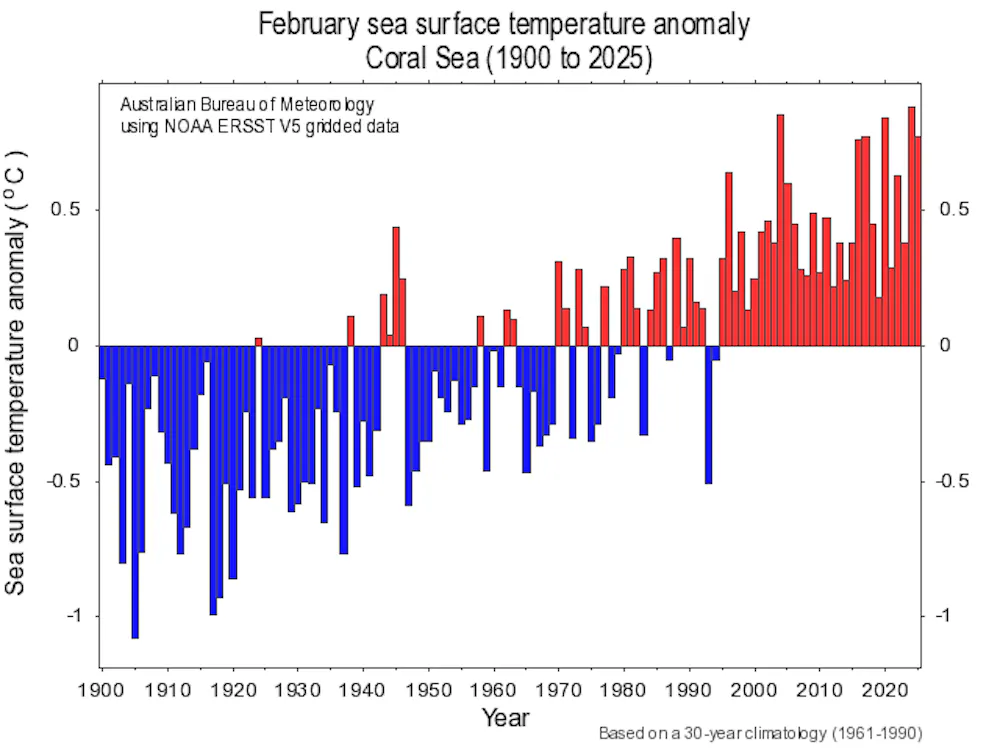
The northeastern Coral Sea, where Cyclone Alfred formed, experienced the fourth-hottest temperatures on record for February and the hottest on record for January.
In the Coral Sea, sea surface temperatures were the fourth highest on record in February 2025 and the highest on record in January 2025. This figure shows the trend over time for February. Bureau of Meteorology, CC BY-NC-ND
We also know Australia’s southern waters are warming up too.
The energy available to power tropical cyclones in subtropical regions has also increased in recent decades, due largely to rising ocean temperatures.
Average sea surface temperatures in central and southern Queensland on Thursday March 6th. Point Danger is on the Gold Coast. Bureau of Meteorology, CC BY-NC-ND
Climate link: Fewer cyclones but more likely to be intense
In the northern hemisphere, researchers have found a trend towards fewer cyclones over time. But of those which do form, a higher proportion are more intense.
It’s not fully clear if the same trend exists in the southern hemisphere, though we are seeing fewer cyclones forming over time.
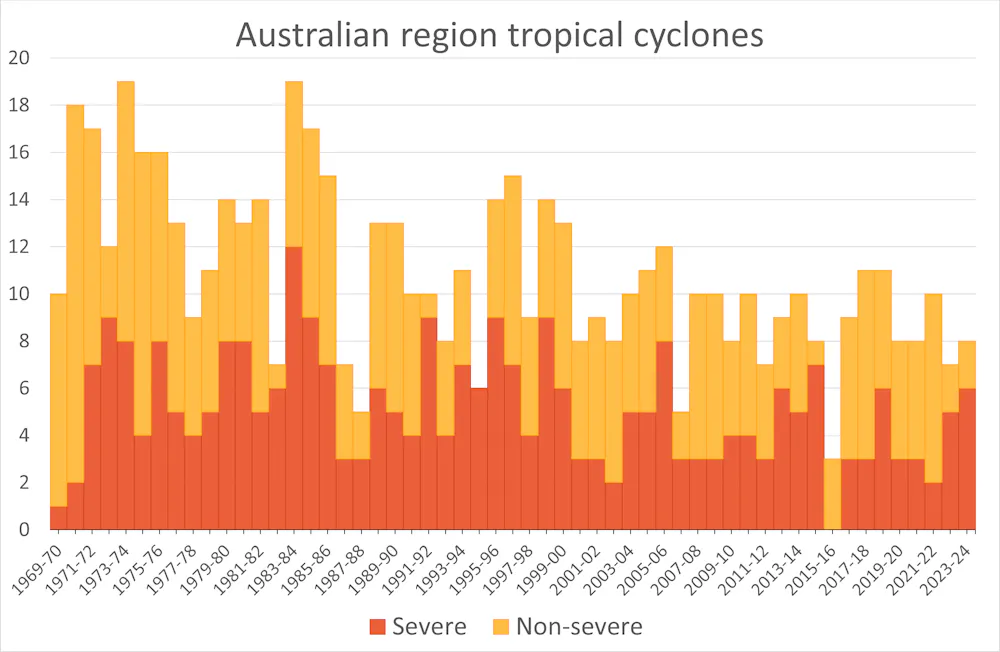
This summer, eight tropical cyclones have formed in Australian waters. Six were classified as severe (category 3 and up). Historically, Australia has experienced a higher proportion of category 1 and 2 cyclones, which bring weaker wind speeds.
On average, we see about 11 cyclones form and 4-5 make landfall. There has been a downward trend in the number of cyclones forming in the Australian region in recent decades.
Fewer cyclones, but more likely to be intense: this figure shows the number of severe (Category 3 and up) and non-severe tropical cyclones (Category 1 and 2) since 1970/71. Bureau of Meteorology, CC BY-NC-ND
Climate link: Cyclones dumping more rain
The intensity of a cyclone refers to the speed of the wind and size of the wind-affected area.
But a cyclone’s rain field is also important. This refers to the area of heavy rain produced by storms when they’re at cyclone intensity and afterwards as they decay into tropical lows.
The rate of rainfall brought by cyclones in Australia isn’t necessarily increasing, but more cyclones are moving slowly, such as Alfred. This means more rain per cyclone, on average.
Rising ocean temperatures mean more water evaporates off the sea surface, meaning forming cyclones can absorb more moisture and dump more rain when it reaches land.
Why are cyclones slowing down? This is likely because air current circulation in the tropics has weakened. This has a clear link to climate change. Wind speeds have fallen 5 to 15% in the tropics, depending on where you are in the world. It’s hard to pinpoint the change clearly in our region, because the historic record of cyclone tracks isn’t very long.
For every degree (°C) of warming, rainfall intensity increases 7%. This is well established. But newer research is showing the rate may actually be double this or even higher, as the process of condensation releases heat which can trigger more rain.
Clear climate link: Bigger storm surges due to sea level rise
When a cyclone is about to make landfall, its intense winds push up a body of seawater ahead of it – the storm surge. In low lying areas, this can spill out and flood streets.
Because climate change is causing baseline sea levels to rise, storm surges can reach further inland. Sea-level rise will also make coastal erosion more destructive.
What should we take from this?
We can’t say definitively that climate change is behind Cyclone Alfred’s unusual track.
But factors such as rising sea levels, slower cyclones and warmer oceans are changing how cyclones behave and the damage they can do.
Over time, we can expect to see cyclones arriving in regions not historically affected – and carrying more rain when they arrive.
Liz Ritchie-Tyo receives funding from The Australian Research Council and the U.S. Office of Naval Research
Andrew Dowdy receives funding from University of Melbourne as well as supported through the Australian Research Council.
Hamish Ramsay receives funding from the Australian Climate Service.
Source: The Conversation (Au and NZ) – By Sanjeev Kumar Srivastava, Associate Professor of Geospatial Analysis, University of the Sunshine Coast
Tropical Cyclone Alfred is now expected to make landfall early on Saturday morning – later than initial estimates that suggested it would strike southeast Queensland and northern New South Wales on Friday.
So, how do scientists track cyclones and make predictions about when and where they will hit?
I’m a geospatial analyst who uses satellites and other remote-sensing technology for natural resources management. I study data about storms, wildfires and vegetation regrowth around the world.
Remote-sensing satellites travel through space collecting data about Earth’s surface and atmosphere.
When it comes to cyclones, information these satellites collect about clouds, temperatures, wind speeds and other variables is crucial. It helps scientists make accurate weather predictions – enabling communities to prepare and protect themselves.
Remote-sensing satellites move with the Earth. They observe the same hemisphere constantly and send real-time images back to scientists on the ground. The main ones we use in Australia are called Himawari-8 and -9, and they were launched by the Japan Meteorological Agency.
As reported by the ABC, Himawari-9 captured images showing how Cyclone Alfred travelled down the coast of Queensland earlier this week and then headed toward Brisbane.
Himawari satellites images show how Cyclone Alfred has moved along its path.
Geostationary remote sensing satellites are excellent at helping us detect:
the centres of tropical cyclones over the ocean
developing thunderstorms
volcanic material in the atmosphere and
how clouds are moving.
Himawari collects images and information from the visible and infrared spectrum. This can give us cloud temperature, which can provide more precise information about where the eye of a cyclone is (the eye tends to have a higher temperature).
They collect information at various intervals and send it back to Earth. Well-known polar orbiting satellites include Landsat 8-9 (run by the US Geological Survey), and the National Oceanic and Atmospheric Administration (NOAA) Joint Polar Satellite System.
The polar-orbiting satellites give us clear images but not very often. They are just snapshots. They are more useful for providing post-cyclone damage assessments than they are for predicting the path of cyclones.
Valuable images, and data in the visible, infrared, and microwave range
Both geostationary and polar orbiting satellites collect data in the visible and infrared regions. There are polar satellites collecting data in the microwave range.
This means we can look at Earth through the cloud, get cloud temperature information and wind direction.
In addition to these satellites, the Bureau of Meteorology have their own weather watch radar sensors on the ground. These ground-based radar are set up at various locations and can detect moisture very easily, which helps us work out how moisture is moving into and through clouds.
Cyclone Alfred is currently shaping up to be a category two cyclone. This means once it makes landfall, it would have an average wind speed of between 89 and 117 kilometres an hour, and gusts between 125 and 164 kilometres an hour.
Wind speed is predicted using complex algorithms.
Why do predictions sometimes change?
Meteorology is a very complex area of science and predictions are based on many, many different data points.
Sometimes a cyclone’s path will deviate from initial projections, but this is very normal. It’s really hard to predict the future track of a cyclone!
This is particularly true when cyclones form over the Coral Sea, as in the case of Alfred. There, cyclones paths are among the most unpredictable in the world.
Sometimes unexpected factors may arise. For example, a recently arrived low pressure system in the west is currently slowing down the arrival of Cyclone Alfred.
Despite cyclone predictions being difficult, the Bureau of Meteorology is the most reliable and up-to-date source of information on Cyclone Alfred.
Sanjeev Kumar Srivastava has received funding in the past from the Asia Pacific Network for Global Change Research, various local councils and several cooperative research centres. He is a member of Earth Observation Australia.
It’s hard to keep track of US President Donald Trump’s many notable acts since returning to the White House. His recent pro-Russia stance on the war in Ukraine has, rightly, received a lot of attention.
But for every big moment, there are others that fly under the radar. One such issue is the politicisation of the Department of Justice (DoJ).
Although there is longstanding precedent that the DoJ remains politically neutral in its operations, recent events have indicated a dramatic break from that tradition.
And, importantly, Trump has been laying the groundwork to justify this for nearly two years, using a propaganda tactic that’s been employed by authoritarian governments throughout history.
Strategic sidelining
The current administration has attempted to fire or sideline anyone at the DoJ who was involved with prior investigations and prosecutions of the now-president.
This includes special counsel Jack Smith’s investigations into several aspects of Trump’s wrongdoing, which have since ended. Several lawyers have been fired, ostensibly because “the Acting Attorney-General does not trust these officials to assist in faithfully implementing the President’s agenda”.
This action is not only vindictive, but likely designed to intimidate would-be investigators and make them think twice before further examining any wrongdoing by Trump or his associates.
Equally noteworthy has been the department’s attempts to drop corruption charges against New York mayor Eric Adams.
The official reason is that pursuing the charges might “interfere” with Adams’ reelection campaign.
In reality, however, Adams has been accused of cutting a deal with the administration: he agrees to assist with Trump’s immigration crackdown in return for having the charges against him withdrawn (although not dropped entirely).
So deeply problematic was all this that two US attorneys for the Southern District of New York opted to resign in protest, rather than be party to what they saw as a nakedly corrupt act.
The whole scenario is eerily reminiscent of 1973’s “Saturday Night Massacre”, when President Richard Nixon ordered his Attorney-General Elliot Richardson to fire the special prosecutor investigating the Watergate scandal.
Nixon eventually had his way, but not before refusals and resignations from both Richardson, and the Deputy Attorney-General William Ruckleshaus.
But, where Nixon’s move dramatically hastened his own downfall, Trump’s actions have barely raised an eyebrow. Why?
The propaganda play
The answer lies in a propaganda technique known as “accusation in a mirror”, which entails accusing one’s opponents of the very wrongdoing one plans to commit.
a rhetorical practice in which one falsely accuses one’s enemies of conducting, plotting, or desiring to commit precisely the same transgressions that one plans to commit against them.
Accusation in a mirror has been used in the past, including in the Rwandan genocide. There, trusted voices claimed the Tutsi wanted to “exterminate” the Hutu. Tragically, it helped bring about the exact opposite circumstance.
Similarly, in February 2022 Russian President Vladimir Putin accused the Ukrainian government of committing genocide against Russian-speaking populations in the Donbas region. This baseless accusation provided a justification for invading Ukraine, which mirrored Russia’s own indiscriminate shelling of Ukrainian civilians.
We suggest Trump has been using this technique since he was first criminally indicted, in early 2023, on 34 felony charges related to the falsification of business records. He and his supporters have insisted the department, under President Joe Biden, was “weaponised” against him.
Yet Trump’s accusations of a partisan DoJ completely reframed legitimate investigations into alleged political vendettas. In doing so, it effectively justified his subsequent decisions.
A self-fulfilling prophecy
The idea that “if they did it to me, I’m entitled to do it back” was made explicit by Trump in late 2023.
When asked if he would use the DoJ to go after his political rivals, Trump argued he would only be levelling the playing field, stating:
they’ve already done it, but if they want to follow through on this, yeah, it could certainly happen in reverse.
In short, Trump’s false claim of being victimised by a politicised DoJ served as moral cover for his own politicisation of it.
This is a textbook example of how accusation in a mirror can help manufacture the reality it pretends to condemn.
Addressing the problem
This tactic has long been a play by totalitarian and authoritarian leaders.
Foundational propaganda scholars such as Hannah Arendt and Jacques Ellul highlighted how authoritarian rulers often repeat falsehoods – flipping the aggressor and victim – until the masses become desensitised, alienated and confused.
Once enough people believe the system is already corrupt and untrustworthy, they are less likely to be shocked by an actual purge (such as firing DoJ officials).
The implications of such tactics extend internationally, not just to the US.
History cries out to us about the risks of this sort of public discourse. It erodes trust in institutions and liberal democratic processes, paving the road for leaders to undermine them further, corrupting the system in the name of rooting out corruption.
Ultimately, one of the best antidotes is awareness. By exposing these tactics, we can better safeguard against disinformation, protect the rule of law and hold leaders accountable.
Stephen Harrington receives funding from the Australian Research Council, for the Discovery Project ‘Understanding and Combatting “Dark Political Communication”‘.
Timothy Graham receives funding from the Australian Research Council (ARC) for his Discovery Early Career Researcher Award, ‘Combatting Coordinated Inauthentic Behaviour on Social Media’. He also receives ARC funding for the Discovery Project, ‘Understanding and Combatting “Dark Political Communication”‘.
Cyclone Alfred has now been delayed, as the slow-moving system stalls in warm seas off southeast Queensland. Unfortunately, the expected slow pace of the cyclone will bring even more rain to affected communities.
This is because it will linger for longer over the same location, dumping more rain before it moves on. Alfred’s slowing means the huge waves triggered by the cyclone will last longer too, likely making coastal erosion and flooding worse.
Cyclone Alfred is unusual – the first cyclone in half a century to come this far south and make expected landfall.
When unusual disasters strike, people naturally want to know what role climate change played – a process known as “climate attribution”. Unfortunately, this process takes time if you want details on a specific event.
We can’t yet say if Alfred’s unusual path and slow speed are linked to climate change. But climate change is driving very clear trends which can load the dice for more intense cyclones arriving in subtropical regions. These include the warm waters which fuel cyclones spreading further south, and cyclones dumping more rain than they used to.
So, let’s unpick what’s driving Cyclone Alfred’s behaviour – including the potential role of climate change.
A Bureau of Meteorology update on Cyclone Alfred dated Thursday, March 6.
Not necessarily climate linked: Alfred’s southerly path
Many cyclones make it as far south as Brisbane – but they’re nearly all far out at sea. Weather patterns mean most cyclones heading south are diverted to the east, where remnants can hit New Zealand as large extratropical storms.
The fact that Alfred is set to make landfall is very unusual. But we can’t yet definitively say this is due to climate change. Cyclones are steered by winds and weather patterns, and the Coral Sea’s complex weather makes cyclone paths here very hard to predict.
Alfred’s abrupt westward shift is due to a large region of high pressure to its south, which has pushed it directly towards heavily populated areas of southeast Queensland and northern New South Wales. These steering winds are not very strong, which is why Alfred is moving slowly.
In 2014, researchers showed cyclones are reaching their maximum intensity in areas further south in the southern hemisphere and north in the northern hemisphere than they used to. In 2021, researchers also found cyclones were reaching their maximum intensity closer to coasts, moving about 30 km closer per decade.
Climate link: Warmer seas
Cyclones typically need water temperatures of 26.5°C or more to form.
More than 90% of all extra heat trapped by greenhouse gas emissions is stored in the seas. The oceans are the hottest on record, and records keep falling. But normal seasonal variability and shifting ocean currents are still at work too, and we can get unusually warm waters without climate change as a cause.
What we do know is that ocean temperatures around much of Australia have been unusually warm.
The northeastern Coral Sea, where Cyclone Alfred formed, experienced the fourth-hottest temperatures on record for February and the hottest on record for January.
In the Coral Sea, sea surface temperatures were the fourth highest on record in February 2025 and the highest on record in January 2025. This figure shows the trend over time for February. Bureau of Meteorology, CC BY-NC-ND
We also know Australia’s southern waters are warming up too.
The energy available to power tropical cyclones in subtropical regions has also increased in recent decades, due largely to rising ocean temperatures.
Average sea surface temperatures in central and southern Queensland on Thursday March 6th. Point Danger is on the Gold Coast. Bureau of Meteorology, CC BY-NC-ND
Climate link: Fewer cyclones but more likely to be intense
In the northern hemisphere, researchers have found a trend towards fewer cyclones over time. But of those which do form, a higher proportion are more intense.
It’s not fully clear if the same trend exists in the southern hemisphere, though we are seeing fewer cyclones forming over time.
This summer, eight tropical cyclones have formed in Australian waters. Six were classified as severe (category 3 and up). Historically, Australia has experienced a higher proportion of category 1 and 2 cyclones, which bring weaker wind speeds.
On average, we see about 11 cyclones form and 4-5 make landfall. There has been a downward trend in the number of cyclones forming in the Australian region in recent decades.
Fewer cyclones, but more likely to be intense: this figure shows the number of severe (Category 3 and up) and non-severe tropical cyclones (Category 1 and 2) since 1970/71. Bureau of Meteorology, CC BY-NC-ND
Climate link: Cyclones dumping more rain
The intensity of a cyclone refers to the speed of the wind and size of the wind-affected area.
But a cyclone’s rain field is also important. This refers to the area of heavy rain produced by storms when they’re at cyclone intensity and afterwards as they decay into tropical lows.
The rate of rainfall brought by cyclones in Australia isn’t necessarily increasing, but more cyclones are moving slowly, such as Alfred. This means more rain per cyclone, on average.
Rising ocean temperatures mean more water evaporates off the sea surface, meaning forming cyclones can absorb more moisture and dump more rain when it reaches land.
Why are cyclones slowing down? This is likely because air current circulation in the tropics has weakened. This has a clear link to climate change. Wind speeds have fallen 5 to 15% in the tropics, depending on where you are in the world. It’s hard to pinpoint the change clearly in our region, because the historic record of cyclone tracks isn’t very long.
For every degree (°C) of warming, rainfall intensity increases 7%. This is well established. But newer research is showing the rate may actually be double this or even higher, as the process of condensation releases heat which can trigger more rain.
Clear climate link: Bigger storm surges due to sea level rise
When a cyclone is about to make landfall, its intense winds push up a body of seawater ahead of it – the storm surge. In low lying areas, this can spill out and flood streets.
Because climate change is causing baseline sea levels to rise, storm surges can reach further inland. Sea-level rise will also make coastal erosion more destructive.
What should we take from this?
We can’t say definitively that climate change is behind Cyclone Alfred’s unusual track.
But factors such as rising sea levels, slower cyclones and warmer oceans are changing how cyclones behave and the damage they can do.
Over time, we can expect to see cyclones arriving in regions not historically affected – and carrying more rain when they arrive.
Liz Ritchie-Tyo receives funding from The Australian Research Council and the U.S. Office of Naval Research
Andrew Dowdy receives funding from University of Melbourne as well as supported through the Australian Research Council.
Hamish Ramsay receives funding from the Australian Climate Service.
Source: The Conversation (Au and NZ) – By Ferdi Botha, Senior Research Fellow, Melbourne Institute: Applied Economic & Social Research, The University of Melbourne
The HILDA Survey has been following the same people every year since 2001, which makes it possible to examine how the lives of Australians have changed across several aspects.
With data from 2001 to 2022, in this year’s report we looked at issues including income inequality, household chores, and the impact of natural disasters on Australian households.
Income inequality is the highest since 2001
Funded by the Australian government and managed by the Melbourne Institute, the survey is one of Australia’s most valuable social research tools.
HILDA examined the lives of 14,000 Australians in 2001 and has kept coming back each year to discover what has changed over the course of their lifetimes. It now covers 17,000 Australians, due to the expansion of participants’ families.
The survey shows that since COVID-era financial support ended, income inequality has risen substantially.
The increase in inequality stems from growth in higher incomes as compared to middle incomes, as well as a fall in the growth of lower incomes relative to middle incomes.
This means, relative to the median earner, Australians already earning a high income have seen the growth in their incomes rise. In contrast, Australians with low incomes have seen a decrease in the rate of growth in their incomes.
Between 2021 and 2022, 51.2% of respondents reported their real incomes have declined. This is up from about 41% in preceding years, suggesting a decrease in people’s purchasing power.
A technical measure called the Gini coefficient was 0.32 in 2022, the highest since we started the survey in 2001. The measure ranges from 0 to 1 and is an index that measures overall inequality, with higher scores suggesting greater income inequality.
Older Australians are getting richer too
Over the same period, household wealth has continued to grow.
However, there are large and growing age differences in the growth in household wealth. For young people aged between 18 and 34, net wealth rose by 72.4% to $238,942 over the 20 years to 2022.
But for older Australians aged 65 to 74, net household wealth jumped by 125% to about $1.26 million.
These age disparities in household wealth are partly explained by rates of home ownership, which are much higher among older Australians.
Home ownership is also the most important asset component in terms of total wealth. In 2022, almost 65% of households owned their home, and just over 20% of households held investment properties and holiday homes.
As a proportion of total wealth, the family home accounts for 44.5% and investment properties account for 14.9%.
Women are still doing most of the housework
Australian women still undertake the majority of housework, whereas men’s share of housework has remained constant over 20 years.
Women’s time spent on housework (such as cleaning, cooking, running errands) has fallen slightly from 23.8 hours per week in 2002 to 18.4 hours per week in 2022.
Men spent 12.8 hours per week on housework, precisely the same amount they did 20 years earlier. Thus, women are still doing close to 50% more housework than men are.
Men have increased the time they spend on caring responsibilities (such as playing with their children, helping with homework, caring for an elderly relative), from 5 hours per week in 2002 to 5.5 hours per week in 2022. The time women spend on care has risen from 10.1 hours per week to 10.7 hours per week over the same period. In 2022, women spent almost double the time on care duties than men.
Among couples, men are generally more satisfied than women are with the current division of unpaid work. Most women feel they do more than their fair share at home. Men tend to believe they share the housework and care fairly with their partner.
Surge in home damage due to weather-related disasters
Respondents were asked if a weather-related disaster (such as floods, bushfires or cyclone) had damaged or destroyed their home in the past 12 months. In 2022, 4.5% reported experiencing such an event.
This is a substantial increase from the year before, when only 1.3% of Australians reported weather-related home damage, and exceeding the previous peak of 2.7% in 2011.
There are also regional differences, closely corresponding with the timing of specific floods or bushfires in the states and territories. In 2022, 9% of New South Wales residents and 6% of Queensland reported home damage, consistent with major floods experienced in these regions in the months prior to the survey.
Among all Australians who in 2022 reported home damage due to a weather-related disaster, 62.5% were in NSW and 27.3% were in Queensland.
With the current cyclone Alfred forecast to hit Queensland and northern NSW on Friday, we expect a further significant increase in reported home damage.
Ferdi Botha is affiliated with the ARC Centre of Excellence for Children and Families over the Life Course.
Source: The Conversation (Au and NZ) – By Evangeline Mantzioris, Program Director of Nutrition and Food Sciences, Accredited Practising Dietitian, University of South Australia
Robert F. Kennedy Jr, who oversees the health of more than 340 million Americans, says vitamin A can prevent the worst effects of measles rather than urging more people to get vaccinated.
In an opinion piece for Fox News, the US health secretary said he was “deeply concerned” about the current measles outbreak in Texas. However, he said the decision to vaccinate was a “personal one” and something for parents to discuss with their health-care provider.
Here’s what the vitamin A study actually says and why public health officials are so concerned about Kennedy’s latest statement.
Why is a measles outbreak so worrying?
Measles is a highly contagious disease caused by a virus. It spreads easily including when an infected person breathes, coughs or sneezes.
Measles initially infects the respiratory tract and then the virus spreads throughout the body. Symptoms include a high fever, cough, red eyes, runny nose and a rash all over the body.
Measles can also be severe, can cause complications including blindness and swelling of the brain, and can be fatal. Measles can affect anyone but is most common in children.
Vitamin A is essential for our overall health. It has many roles in the body, from supporting our growth and reproduction, to making sure we have healthy vision, skin and immune function.
Foods rich in vitamin A or related molecules include orange, yellow and red coloured fruits and vegetables, green leafy vegetables, as well as dairy, egg, fish and meat. You can take it as a supplement.
Vitamin A can also be used therapeutically. In other words, doctors may prescribe vitamin A to treat a deficiency. Vitamin A deficiency has long been associated with more severe cases of infectious disease, including measles. Vitamin A boosts immune cells and strengthens the respiratory tract lining, which is the body’s first defence against infections.
Because of this, the CDC has recently said vitamin A can also be prescribed as part of treatment for children with severe measles – such as those in hospital – under doctor supervision.
One key message from the CDC’s advice is that people are already sick enough with measles to be in hospital. They’re not taking vitamin A to prevent catching measles in the first place.
The other key message is vitamin A is taken under medical supervision, under specific circumstances, where patients can be closely monitored to prevent toxicity from high doses.
Kennedy cites and links to a 2010 study, a type known as a systematic review and meta-analysis. Researchers reviewed and analysed existing studies, which included ones that looked at the effectiveness of vitamin A in preventing measles deaths.
They found three studies that looked at vitamin A treatment by specific dose. There were different doses depending on the age of the children, measured in IU (international units). Having two doses of vitamin A (200,000IU for children over one year of age or 100,000IU for infants below one year) reduced mortality by 62% compared to children who did not have vitamin A.
The 2010 study did not show vitamin A reduced your risk of getting measles from another infected person. To my knowledge no study has shown this.
To be fair, Kennedy did not say that vitamin A stops you from catching measles from another infected person. Instead, he used the following vague statement:
Studies have found that vitamin A can dramatically reduce measles mortality.
It’s easy to see how a reader could misinterpret this as “take vitamin A if you want to avoid dying from measles”.
We know what works – vaccines
The World Health Organization recommends all children receive two doses of measles vaccine.
The CDC states two doses of the measles vaccine (measles-mumps-rubella or MMR vaccine) is 97% effective against getting measles. This means out of every 100 people who are vaccinated only three will get it, and this will be a milder form.
relying on vitamin A instead of the vaccine is not only dangerous and ineffective […] it puts children at serious risk.
Evangeline Mantzioris is affiliated with Alliance for Research in Nutrition, Exercise and Activity (ARENA) at the University of South Australia. Evangeline Mantzioris has received funding from the National Health and Medical Research Council, and has been appointed to the National Health and Medical Research Council Dietary Guideline Expert Committee.
US company Colossal Biosciences has announced the creation of a “woolly mouse” — a laboratory mouse with a series of genetic modifications that lead to a woolly coat. The company claims this is the first step toward “de-extincting” the woolly mammoth.
The successful genetic modification of a laboratory mouse is a testament to the progress science has made in understanding gene function, developmental biology and genome editing. But does a woolly mouse really teach us anything about the woolly mammoth?
What has been genetically modified?
Woolly mammoths were cold-adapted members of the elephant family, which disappeared from mainland Siberia at the end of the last Ice Age around 10,000 years ago. The last surviving population, on Wrangel Island in the Arctic Ocean, went extinct about 4,000 years ago.
The house mouse (Mus musculus) is a far more familiar creature, which most of us know as a kitchen pest. It is also one of the most studied organisms in biology and medical research. We know more about this laboratory mouse than perhaps any other mammal besides humans.
Colossal details its new research in a pre-print paper, which has not yet been peer-reviewed. According to the paper, the researchers disrupted the normal function of seven different genes in laboratory mice via gene editing.
By tinkering with different genes, researchers produced mice with different kinds of fur. Colossal Biosciences
Six of these genes were targeted because a large body of existing research on the mouse model had already demonstrated their roles in hair-related traits, such as coat colour, texture and thickness.
The modifications in a seventh gene — FABP2 — was based on evidence from the woolly mammoth genome. The gene is involved in the transport of fats in the body.
Woolly mammoths had a slightly shorter version of the gene, which the researchers believe may have contributed to its adaptation to life in cold climates. However, the “woolly mice” with the mammoth-style variant of FABP2 did not show significant differences in body mass compared to regular lab mice.
What would it mean to de-extinct a species?
This work shows the promise of targeted editing of genes of known function in mice. After further testing, this technology may have a future place in conservation efforts. But it’s a long way from holding promise for de-extinction.
Colossal Biosciences claims it is on track to produce a genetically modified “mammoth-like” elephant by 2028, but what makes a mammoth unique is more than skin-deep.
De-extinction would need to go beyond modifying an existing species to show superficial traits from an extinct relative. Many aspects of an extinct species’ biology remain unknown. A woolly coat is one thing. Recreating the entire suite of adaptations, including genetic, epigenetic and behavioural traits that allowed mammoths to thrive in ice age environments, is another.
Prehistoric drawings of an ibex (left) and a mammoth (right) found at Rouffignac cave in France. Cave Painter / Wikimedia
Unlike the thylacine (or Tasmanian tiger) — another species Colossal aims to resurrect — the mammoth has a close living relative in the modern Asian elephant. The closer connections between the genomes of these two species may make mammoth de-extinction more technically feasible than that of the thylacine.
But whether or not a woolly mouse brings us any closer to that prospect, this story forces us to consider some important ethical questions. Even if we could bring back the woolly mammoth, should we? Is the motivation behind this effort conservation, or entertainment? Is it ethical to bring a species back into an environment that may no longer sustain it?
Extinction is a colossal problem facing the world. And Colossal is the company that’s going to fix it.
It’s hard to argue with the first part of that. But focusing on bringing back extinct species distracts from a more urgent reality: species are going extinct right now, and we are not doing enough to save them.
We should first focus on promises to save surviving species, rather than promises to bring back the dead.
With more investment in threatened species monitoring, new pest control methods, and conservation genetic management, we can turn the tide of extinction and secure the future for species that remain.
There’s a long list of threatened species that are still alive now. With the right funding and conservation attention, we can do something to save them before it’s too late.
Emily Roycroft receives funding from the Australian Research Council, the L’Oréal-UNESCO For Women in Science Programme, and the Australian Academy of Science.
“It’s really sore,” my (Josh’s) five-year-old daughter said, cradling her broken arm in the emergency department.
“But on a scale of zero to ten, how do you rate your pain?” asked the nurse.
My daughter’s tear-streaked face creased with confusion.
“What does ten mean?”
“Ten is the worst pain you can imagine.” She looked even more puzzled.
As both a parent and a pain scientist, I witnessed firsthand how our seemingly simple, well-intentioned pain rating systems can fall flat.
What are pain scales for?
The most common scale has been around for 50 years. It asks people to rate their pain from zero (no pain) to ten (typically “the worst pain imaginable”).
This focuses on just one aspect of pain – its intensity – to try and rapidly understand the patient’s whole experience.
How much does it hurt? Is it getting worse? Is treatment making it better?
Rating scales can be useful for tracking pain intensity over time. If pain goes from eight to four, that probably means you’re feeling better – even if someone else’s four is different to yours.
Consider my daughter’s dilemma. How can anyone imagine the worst possible pain? Does everyone imagine the same thing? Research suggests they don’t. Even kids think very individually about that word “pain”.
People typically – and understandably – anchor their pain ratings to their own life experiences.
This creates dramatic variation. For example, a patient who has never had a serious injury may be more willing to give high ratings than one who has previously had severe burns.
“No pain” can also be problematic. A patient whose pain has receded but who remains uncomfortable may feel stuck: there’s no number on the zero-to-ten scale that can capture their physical experience.
In reality, pain ratings are influenced by how much pain interferes with a person’s daily activities, how upsetting they find it, their mood, fatigue and how it compares to their usual pain.
Other factors also play a role, including a patient’s age, sex, cultural and language background, literacy and numeracy skills and neurodivergence.
For example, if a clinician and patient speak different languages, there may be extra challenges communicating about pain and care.
Still, we work with the tools available. There is evidence people do use the zero-to-ten pain scale to try and communicate much more than only pain’s “intensity”.
So when a patient says “it’s eleven out of ten”, this “impossible” rating is likely communicating more than severity.
They may be wondering, “Does she believe me? What number will get me help?” A lot of information is crammed into that single number. This patient is most likely saying, “This is serious – please help me.”
In everyday life, we use a range of other communication strategies. We might grimace, groan, move less or differently, use richly descriptive words or metaphors.
Collecting and evaluating this kind of complex and subjective information about pain may not always be feasible, as it is hard to standardise.
As a result, many pain scientists continue to rely heavily on rating scales because they are simple, efficient and have been shown to be reliable and valid in relatively controlled situations.
But clinicians can also use this other, more subjective information to build a fuller picture of the person’s pain.
Visual scales are one tool. For example, the “Faces Pain Scale-Revised” asks patients to choose a facial expression to communicate their pain. This can be particularly useful for children or people who aren’t comfortable with numeracy and literacy, either at all, or in the language used in the health-care setting.
A vertical “visual analogue scale” asks the person to mark their pain on a vertical line, a bit like imagining “filling up” with pain.
Modified visual scales are sometimes used to try to overcome communication challenges. Nenadmil/Shutterstock
Listen for the story behind the number, because the same number means different things to different people.
Use the rating as a launchpad for a more personalised conversation. Consider cultural and individual differences. Ask for descriptive words. Confirm your interpretation with the patient, to make sure you’re both on the same page.
Patients
To better describe pain, use the number scale, but add context.
Try describing the quality of your pain (burning? throbbing? stabbing?) and compare it to previous experiences.
Explain the impact the pain is having on you – both emotionally and how it affects your daily activities.
Paediatric health professionals are trained to use age-appropriate vocabulary, because children develop their understanding of numbers and pain differently as they grow.
A starting point
In reality, scales will never be perfect measures of pain. Let’s see them as conversation starters to help people communicate about a deeply personal experience.
That’s what my daughter did — she found her own way to describe her pain: “It feels like when I fell off the monkey bars, but in my arm instead of my knee, and it doesn’t get better when I stay still.”
From there, we moved towards effective pain treatment. Sometimes words work better than numbers.
Joshua Pate has received speaker fees for presentations on pain and physiotherapy. He receives royalties for children’s books.
Dale Langford has received honoraria and research support from the Analgesic, Anesthetic, and Addiction Clinical Trials, Translations, Innovations, and Opportunities Network (ACTTION), a public-private partnership with the United States (US) Food & Drug Administration. She has also been supported by the US National Institutes of Health.
Tory Madden works for the University of Cape Town, where she directs the African Pain Research Initiative. She receives funding from the US National Institutes of Health. She is affiliated with the University of South Australia, KU Leuven, and the Train Pain Academy not-for-profit organisation.
Source: The Conversation (Au and NZ) – By Jo Caust, Associate Professor and Principal Fellow (Hon), School of Culture and Communication, The University of Melbourne
For the past three weeks the arts have been dominated by a recent decision made by the board of Creative Australia. On February 7 it was announced Khaled Sabsabi and Michael Dagostino had been chosen as the artistic team to represent Australia at the Venice Biennale in 2026.
One week later, the board announced Sabsabi and Dagostino would no longer be representing the country because their selection would cause “a prolonged and divisive debate”.
This about-turn represents a low point in the relationship between artists and their funding body, Creative Australia.
Creative Australia (known as the Australia Council until 2023) has historically endured many attacks from the public, the media and political parties. This past weekend, for example, The Weekend Australian published three different stories critiquing Creative Australia and its arts funding processes.
While the amount of money Creative Australia receives is minuscule in relation to overall government spending (in 2023–24 it received A$258 million), the arts themselves enjoy a profile much greater than their monetary value.
So how does Creative Australia operate? And what does this decision on Sabsabi mean for its relationship with artists?
What is the peer review system?
Funding decisions at Creative Australia are based on two key principles: peer review, and arm’s length funding.
Peer review means decisions on who is funded are made by artists and arts workers with a deep understanding of the artform at hand.
Arm’s length funding means that, while the government funds Creative Australia, artists are supported free from direct political intervention.
The Australia Council, established in 1975, was originally structured around several artform boards, made up of peers from each of the artform sectors. These peers were given the task of overseeing their artforms and making funding decisions. Peers were selected by the government, usually after nomination by the Australia Council, and served terms of between two to five years.
Membership of an artform board was seen as an honour as well as a duty by those selected: a way of influencing funding decisions, but also a way of giving back to the sector.
As a result of an internal review in 2012, the process of peer decision making changed dramatically. The Australia Council in 2013 removed the artform boards (with a couple of exceptions) and introduced an ad hoc peer system where individuals were asked to self-nominate if they wanted to be part of the selection process. Staff then chose individuals, from a large pool of peers, to sit on a panel for each funding round.
As a result of the 2013 reforms the relationship with the minister for the arts was also changed. Up till then, the minister only had the power to appoint the members of the Australia Council board and the members of the various artform boards. In 2013 the act was changed so the minister could also give policy direction to the Australia Council.
In 2019, another category of selector was introduced. Industry advisors advise on multi-year funded applications, with the final decision made by Creative Australia staff.
The changing make-up of decision makers
The membership of the Australia Council’s governing board was historically more politicised, but its members were also often leading figures in the field.
The chair position was usually a leading figure from the arts and cultural field, including writers Donald Horne, Rodney Hall and Hilary McPhee, and music specialist Margaret Seares.
In the 2000s this changed under the Howard government, with the re-framing of the arts as businesses. This led to the appointment of business-people onto the board, particularly as chairs. Chairs this century have included business leaders David Gonski, James Strong, Rupert Myer and now Robert Morgan.
This meant priorities other than artform quality were introduced into the overall decision making.
The Venice Biennale process
Australia has been participating in the Venice Biennale since 1954.
Until 2019 there was a commissioner responsible for the selection of the Australian artist. The role was occupied by notable individuals in the arts world, such as philanthropist and art collector Simon Mordant. Artists would be individually invited by the commissioner to be the Venice representative.
In 2019 the Australia Council took over the role, and the process changed to an application system where artists were assessed by a panel of experts, before the final representatives (such as Sabsabi and Dagostino for 2026) were selected from a shortlist of six.
While all of the details of what happened in the lead up to rescinding Sabsabi’s invitation are unknown, some facts have been laid out: The Australian published an article criticising his selection; Coalition arts spokesperson Claire Chandler asked about his selection in Question Time; and Arts Minister Tony Burke phoned Creative Australia CEO Adrian Collette.
That night, Collette and the board decided Sabsabi’s invitation would be rescinded.
Who gets a say in the arts?
It seems now the funding model that Australia has created for the arts may no longer be serving the artists. The board’s decision following Burke’s phone call to Collette calls into question the principles of peer review and arm’s length funding.
The structure and decision-making processes of Creative Australia should now be reviewed as a matter of urgency. The peer system works remarkably well if structured appropriately. At present it would seem it is not.
Artists deserve a body that defends their rights, so they are not sacrificed for political needs.
Jo Caust has previously received funding from the Australia Council. She is a member of NAVA and the Arts Industry Council(SA). She also worked at the Australia Council in the 1980s.
The Trump presidency is turning much of the world order on its head. Tne United States president is arm-twisting Ukraine, playing nice with Russia, and using protection as an economic and political weapon.
The Australian government is pessimistic about escaping American tariffs on aluminium and steel when a decision is announced next week. Meanwhile, the message from the US is clear: we need to boost defence spending.
To discuss Trump Mark 2 on the world stage and what that means for Australia, we’re joined by James Curran, professor of modern history at the University of Sydney.
Curran says,
One gets the sense that we are looking at the kind of tectonic plates of world politics shifting before our very eyes.
Trump is about might is right. He does have an expansionary view of American power in the western hemisphere if we are to judge him by his statements on the Panama Canal and Greenland. But I think more broadly, his interpretation of American power is to simply “get out of America’s way”.
In terms of economic implications, [it’s] a confirmation that we are looking at the permanence of protectionism in the United States. This administration, along with the Biden administration and the first Trump administration, have been putting a wrecking ball through the multilateral trading system and the WTO. And that is certainly a not a good thing for free trade and for countries like Australia.
Curran explains what America’s expectation that countries need to spend more on defence would mean for Australia,
This has been the great concern, if you like, over a number of years – that Australia has got defence on the cheap, that it’s put so much of its national wealth into the middle class and welfare and infrastructure and developing the nation that it’s been able to rely on the American blanket of protection while it pursues its prosperity.
So if [defence spending] is to rise to 3% [of GDP], then that’s going to mean, firstly, a concentration on what are the lower cost alternatives to defend this continent? And secondly, where will the trade offs come? What will be sacrificed from the national budget? And what political leader in this country will front the Australian people and squarely and honestly and earnestly have a conversation about these dramatic strategic circumstances and why greater sacrifice is required from Australians to enable a higher defence expenditure.
Is the Trump world the new normal, or will this be over when Trump eventually leaves the White House?
I’m a little bit sceptical about this idea that we grit our teeth and close our eyes and hope that the nightmare is over in four years time. There is a really big question mark over how America can snap back in terms of its institutional robustness. The pressure that the courts, the media and the Congress are under. Does this all just snap back in four years time? Do we really think that either a Republican or a Democrat successor to Trump will ride into Washington, down Pennsylvania Avenue in a glittering chariot of liberal internationalism? To say everyone shouldn’t worry because the liberal international order is back and it’s gleaming and it’s working.
I really think this is up to America’s allies, both in Europe and in East Asia, to continue to protect as many of those rules and those institutions that have worked so well for so many of us, as much as they possibly can.
Michelle Grattan does not work for, consult, own shares in or receive funding from any company or organisation that would benefit from this article, and has disclosed no relevant affiliations beyond their academic appointment.
Keith Rankin, trained as an economic historian, is a retired lecturer in Economics and Statistics. He lives in Auckland, New Zealand.
Germany’s important election last week struggled to make the news cycle, even on Germany’s own Deutsche Welle(DW), Germany’s equivalent of Britain’s BBC. Especially (but not only) in the international media, most of the focus was on a single party (AFD, Alliance for Germany) that was never going to have the most votes and was (almost) never going to become part of the resulting government.
Germany is the world’s third largest national economy, and traditionally dominates the politics of the European Union; an important example of this dominance was the Eurozone financial crisis of the first-half of the 2010s; a crisis that was (unsatisfactorily) resolved, thanks to a problematic and controversial program of fiscal austerity.
At present, Germany, like New Zealand, is experiencing an economic recession. (Provisional annual economic growthwas -0.2% in 2024 and -0.3% in 2023.) The cause is similar, too, in both countries: the same ‘balance the Budget’ mentality that gave the world the Great Depression in the 1930s.
Election Result
The ‘winner’ of the German election was the CDU/CSU Alliance (see Wikipedia for a better presentation of the results), which works a bit like the Liberal/National Coalition in Australia. (The Christian Social Union functions in Bavaria much like Australia’s National Party functions in rural Queensland.) CDU/CSU (like National in New Zealand) comfortably prevailed with 28.5 percent of the vote, entitling that alliance to 33 percent of the seats in the Bundestag (Parliament).
The new Chancellor (equivalent to Prime Minister) will be Friedrich Merz; a 69-year-old version of our own Christopher Luxon, as far as I can tell. He is strongly anti-Putin and pro-Israel. He has come to power well and truly under the international media radar; and will be in a strong position to exert near-absolute power, given that he will always be able to turn to the AFD (who got more votes than the Social Democrats; 20.8%) for support in the Bundestag for any measure that is not palatable to Olaf Scholz’s Social Democrats. In the new Parliament, the Greens and the Left merely make up the numbers.
Merz’s Christian Democrats will form a coalition government with the losing SPD (Social Democratic Party, like Labour in New Zealand) who came third with 16.4 percent of the vote; 19 percent of the seats. Together these two parties of the establishment centre hold 52% of the new parliament, despite having less than 45% of the vote. (The outgoing minority government was a centrist coalition of the SPD and the Greens; the election was held early because the ACT-like Liberal Party – the FPD, Free Democrats – withdrew from the coalition. The FPD vote shrunk from 11.4 percent in 2021 to just 4.3 percent of the vote this time.)
The result in Germany proved to be very much like that of the United Kingdom in 2024: a slide in support for the two major parties (‘the establishment centre’), a consolidation of power to the self-same establishment centre, and a shift of that establishment centre to the right. (See my chart in Germany’s stale (and still pale) political mainstream, Evening Report 27 February 2025, for a timeline of decline.) While both countries technically underwent a change of government, in both countries the establishment has entrenched its power, and in both countries the political assumptions of the power centre have shifted to the right.
Clearly this is problematic for democracy, because historically disastrous popular support for the ‘broad church’ parties of the establishment centre has coincided with increased power to those parties, as well as policy convergence between them. Further, based on legislative electoral requirements, neither Germany nor the United Kingdom (nor the United States for that matter) will have a new government until 2029. At a time when a week is a long time in international politics, 208 weeks is an eternity. World War Three, a distinct possibility, may be in its second or third year by then.
Voting System
Germany represents the prototype upon which New Zealand’s MMP voting system is based. There are some differences though, and some recent changes.
Germany calls its all-important ‘party vote’ the ‘second vote’, disguising its importance. It is possible that many German voters do not fully appreciate its significance. The electorate vote is called ‘first vote’, and winners (by a plurality, not necessarily a majority) are elected ‘directly’. The second (party) vote is understood as a top-up vote to ensure proportionality.
Party lists are regional in Germany. And ‘ethnic parties’ may get special privileges.
In one respect the German version is more proportional than the New Zealand version of MMP, in that it no longer allows overhang MPs. (However, the most recent result is not proportional in the important sense that two parties together with less than 45% of the vote have 52% of the seats.) In MMP, one can easily imagine an overhang situation being frequent if the ‘major’ parties, which win most electorates, only get between 16% and 29% of the party vote.
In 2013, Germany’s Federal Constitutional Court decided that overhang seats were too big a threat to proportionality. So, they introduced ‘levelling seats’. In effect, it meant that if one party gets an overhang, then all parties get an overhang. The result was, in 2013, that a parliament that should have had 598 members (Deputies) ended up with 631, an effective overhang of 33. In 2017 that effective overhang grew to 111, and to 137 in 2021.
For 2025, they decided to abandon overhang representation altogether, by not guaranteeing direct election through the first vote. And they fixed the size of the Bundestag to 630 Deputies, up from a base-size of 598.
If the new German system was in place in New Zealand in 2023, then two of the Te Pati Māori electorate seats from 2023 would have been forfeit, going instead to second placed candidates; proportionality in 2023 entitled Te Pati Māori to four seats, not the six which they have. However, we should note that, if New Zealand was using the present German version of MMP, there would be no special Māori electorates, but the Māori Party would be exempt the five percent party threshold. Ethnic-privileged parties in Germany are incentivised to focus on the party vote, not the electorate vote. In Germany there is a Danish ethnic party (South Schleswig Voters’ Association) which is exempt the threshold. Its leader, Stefan Seidler, did not win his electorate. But his party got 0.15% of the nationwide vote, meaning it qualified for 0.15% of the 630 places in the Bundestag; one seat, for him.
New Zealand voters seem to have more tactical and strategic political nous than do German voters. Thus, it has been very rare for a party in New Zealand to miss out qualifying for Parliament because of getting between 4% and 5% of the party votes (noting that both countries operate a 5% disqualification threshold). In Germany, party-vote percentages just below 5% are not uncommon. In New Zealand, voters, conscious that they want to play a role in coalition-building, actively help parties near the threshold to get over the line. (Indeed, I voted New Zealand First in 2023, because I was 99.9% sure that the only post-election coalition options would be National/ACT or National/ACT/NZF; I favoured the three-party alternative, so I used my vote strategically to help block a National/ACT government.)
Indeed the latest German result was a bit like the latest New Zealand result, but with a party resembling New Zealand First (BSW) getting 4.972% of the vote, so getting no seats at all. BSW getting just a few more votes would have meant a substantial erosion of the two-party power result which eventuated. It is extremely difficult for new non-ethnic parties to get elected in Germany.
In 2025, two parties scored just under five percent of the vote. As well as the BSW, the (ACT-like) Free Democrats who had been part of the previous government, and who had indeed precipitated the early election, scored 4.3%. Indeed, fifteen percent of the votes were ‘wasted’ – that is, cast for ultimately unsuccessful parties. In New Zealand the wasted vote is typically around four percent. Indeed, this high wasted vote turns out to be a more serious challenge to proportionality in German than uncompensated overhang seats.
Both Germany and New Zealand have the contentious (in New Zealand) ‘electorate MP’ rule; the rule that’s misleadingly dubbed in New Zealand as the ‘coat-tail’ rule. (Misleading, because most MPs come in on the coat-tails of their party leadership, and always have.) In Germany the rule is stricter than in New Zealand. In order to avoid disqualification by getting less than 5% of the party vote, New Zealand requires that the party get one electorate MP. In Germany the rule (initially the same as New Zealand), since 1957 has been a requirement for three electorate MPs. In Germany in 2021, the Left Party got 4.87% of the vote and three electorate MPs; they just squeezed in, on both criteria!
Overall, United States’ Vice-President JD Vance’s pre-election comments about democracy in Germany were valid. German politics continues to exclude the non-establishment parties of both the right and the left, despite support for these parties having been increasing for a while, and now representing the majority of German voters.
Media Framing
German television electoral coverage, if DW is anything to go by, is superficial; indeed, is quite insensitive to the national and local dramas taking place. I watched the coverage live. In the hour before the Exit Poll results were announced, the discussion barely mentioned the potential dramas taking place, despite both the BSW and FDP parties pre-polling only just under the five percent threshold. The state of the economy was mentioned in a perfunctory way; clearly it was not a big issue for the political class on display.
At 6 o’clock exactly, the exit-poll results were read out, as if they were the election result. As indeed they turned out to be, more-or-less; the same as the pre-election polls. The subsequent uninterested attitude towards the actual counting of the votes was disappointing. There had been a bit of this in the 2024 UK election as well; as if the exit poll was the election result. In the UK case, Labour’s actual result (for the popular vote) was well under the exit poll result, while the Conservatives did significantly better than their exit poll tally; those facts, though, were for the nerds and psephologists.
In my observation, early votes and exit polls favour the parties supported by the political class; election day votes much less so. So, in New Zealand in 2023 it was initially looking like there would be a two-party coalition of the right. But, to the attentive, as the night wore on, the National Party percentage fell from 41% to 38%, meaning that NZF would have to be included in any resulting coalition.
I suspected something quite similar would happen in Germany, and I was only partially wrong. The exit poll results, and the subsequent counts, were presented to just one decimal place; indeed, the presentation of the numbers was very poor throughout. So, it was hard to see to what extent BSW was improving as the votes were counted.
In the exit poll, two parties – FPD and BSW – were shown as being on 4.7%, and the AFD was on 19.5%. So, the two 4.7% parties were largely written out of the subsequent discussion. We did see an early concession by the FPD, who – representing a segment of the political class – understood the polling dynamics rather well. And we did see the AFD’s Alice Weidel being asked if she was disappointed to get under 20%. Ms Weidel put on a brave face, but she did seem disappointed. When the votes were actually counted, her party got 20.8% exactly on Weidel’s prior expectations.
BSW was completely ignored. There was simply no interest in the possibility that they might reach the 5% threshold, even when the vote count had them upto 4.9%. In the end BSW reached 4.972%; so close! Out of sight, out of mind! In the official results the BSW were lumped with ‘Other Parties’. The DW election panel were too unaware to make any comments about the party itself, its philosophies, or how its possible success might influence the process of forming a coalition government. (Of particular importance was that, with just a few more votes, BSW might have given Eastern Germany a voice in a three-way coalition government.)
For DW, their perennial concern is the place of Germany within Europe and the World; they had little time to give the outside world a glimpse into the domestic lives and politics of ordinary Germans. And we heard nothing about the ‘ethnic vote’, the privileged Denmark Party notwithstanding. I suspect that many if not most of the recent immigrants who do much of the work in Germany either could not vote or did not vote. The election was about them, not for them; denizens, not citizens.
However, DW did invite on a gentleman who mildly focussed the attention of the discussants by suggesting that one of the priorities of the new Chancellor – Friedrich Merz – would be to acquire nuclear weapons! I don’t think the rest of the world had any prior insights into that; ordinary Germans were probably equally in the dark.
Who is Friedrich Merz? Who knows? It turns out that he dropped out of politics for a while, to play a leading role in BlackRock, the international acquisitions company which until recently owned New Zealand’s SolarZero (refer Update on SolarZero Liquidation by BlackRock, Scoop, 29 January 2025). Our media told us that the election was all about the “far-right” AFD Party; that is, the far non-establishment-right. We in New Zealand heard nothing about the far establishment-right; the shadowy man (or his party). Some now fear Merz will be an out-and-out warmonger. Even Al Jazeera, which can be relied upon to cover many stories about places New Zealand’s media barely touches (and in a bit more depth), had the portraits of Olaf Scholz and Alice Weidel on the screen, on 22 February, the day before the election, despite the certainty that Merz world become the new Chancellor.
In that vein, I heard a German woman interviewed in Christchurch, on RNZ on 25 February. She, disappointed with the election result, spent her whole edited four minutes railing about the AFD, as if the AFD had won. There was no useful commentary, by her or RNZ, of the actual result of Germany’s election.
Are we so shallow that we don’t care; that some of us with the loudest voices only want to rail against a non-establishment party, and to see the democratic support for alternative parties as being somehow anti-democratic?
East Germany
People of a certain age in New Zealand will remember the former East Germany; the DDR, German ‘Democratic’ Republic. Most people in Germany itself will have had knowledge of it, including the Berlin-based political staff of DW who were mostly in their thirties, forties and fifties. But the ongoing issues of Eastern Germany were barely in their mindframes.
In Eastern Germany – the former DDR – (especially outside of Berlin), support for the AFD was close to 40%, for BSW over 10%, and the Left much higher than in Western Germany. In the former East Berlin (which I visited in 1974), the Left seems to have been the most popular party. Support in the East for the establishment parties combined was between 25% and 30%, and with a lower turnout.
BSW, it turns out, is Left on economic policy and Right on social policy. And, in the German discourse, is categorised by the political class as ‘pro-Putin’. If BSW had got 5% of the vote, Merz could have tried to bring them into his government; or Merz might have turned to the Green Party instead of a ‘pro-Putin’ party. But I cannot see even the German Greens being able to govern as a junior partner to a belligerent establishment-right CDU-led government. BSW’s failure to get 5% of the vote may turn out to be one of the great ‘might-have-beens’ of Germany’s future history.
As JD Vance stated, this Eastern German situation poses a danger for democracy in Germany and in Europe. Eastern Germany is where the German state is at its most vulnerable. The majority of voters there have voted for ‘pro-Putin’ parties; and, significantly, parties prioritising the problems of economic failure over the big-politics of extranational power-plays.
The new German government, it would seem, is set to aggravate (or, at best, ignore) the problems of Germany’s ‘near-East’, while setting out to inflame the problems of Europe’s ‘far-East’.
The Debt Brake
This is Germany’s equivalent of Ruth Richardson’s 1994 ‘Fiscal Responsibility Act’ (now entrenched in New Zealand law and lore). This is the major single reason why New Zealand has had so many infrastructure problems this century, and why so many young men and families emigrated to Australia in the 1990s, with some of these emigrants coming back to New Zealand in recent years as ‘501s’.
The Merkel debt-brake is the self-inflicted single major reason why many European economies are in such a mess today; and Germany in particular. Germany is congenitally deeply committed to all kinds of financial austerity, with government financial austerity being the most ingrained. Rather than circulating as it should, money is concentrating. The debt-brake is “a German constitutional rule introduced [in 2009] during the Global Financial crisis to enforce budget discipline and reduce [public] debt loads in the country” (see Berlin Briefing, below).
Germany still has a parliamentary session under the old Parliament, before the new parliament convenes. Michaela Küfner (see Berlin Briefing, below) suggests the possibility that the old “lame duck” Parliament could remove the debt-brake from the German constitution, because she sees the make-up of the new more right-wing parliament as being less amenable to address this ‘elephant in the room’. Seems democratically dodgy to me, even talking about pushing dramatic constitutional legislation through a ‘lame duck’ parliament; like Robert Muldoon, pushing through a two-year parliamentary term for New Zealand in the week after the 1984 election!
(Two-year parliamentary terms are not unknown, by the way; the United States has a two-year term for its Congress. This is almost never mentioned when we discuss the parliamentary term in New Zealand. In the United States at present, there will be many people for whom the 2026 election cannot come fast enough; an opportunity to reign-in Donald Trump.)
Future German relations with the United States
On 27 February (28 Feb, New Zealand time) – before the fiasco in the White House on 28 February – I watched Berlin Briefing on DW. This programme is a regular panel discussion of the political editorship of Deutsche Welle.
The context here is that Friedrich Merz made an important speech the evening after the election; a speech that had the Berlin beltway – “people behind the scenes here in Berlin” – all agog. Merz said: “For me the absolute priority will be strengthening Germany so much so that we can achieve [defence] independence from the United States.”
The discussion proceeded as follows:
“How important is this anchoring in Nato of the idea of the United States as ‘The Great Protector’?” Nina Haase, DW political correspondent: “I don’t think there’s a word, ‘massive’ is not enough; people behind the scenes here in Berlin … they talk about are we going to part with the United States amicably or are we going to become enemies [my emphasis] … Europe has relied on the US so much since the Second World War is completely new thinking; just to prepare for a scenario with, if you will, would-be enemies on two sides; in the East with Russia launching a hybrid attack and then [an enemy] in the West as well.” They go on to talk about the possible need for conscription in Germany.
The political correspondents were talking like bourgeois brat adult children who had expected that they should be able to enjoy a power-lifestyle underwritten by ‘big daddy’ always there as a financial and security backstop; and just realising that the rug of entitlement might be being pulled from under them. Michaela Küfner (Chief Political Editor of DW) goes on to talk about an “existential threat from the United States”, meaning the withdrawal (and potential enmity) of the great protector. “Like your Rich Uncle from across the ocean turning against you”, she said.
Nina Haase: “Pacifism, the very word, needs to be redefined in Germany … Germans are only now able to understand that you have to have weapons in order not to use them.” She was referring to earlier generations of pacifists (like me) who saw weapons as the problem, not the solution.
Ulrike Franke: “Everything needs to change for everything to stay the same”, basically saying Germany itself may have to pursue domestic Rich Uncle policies to maintain the lifestyles of the (entitled) ten percenters.
Michaela Küfner, towards the end of the discussion: “The AFD is framing [the supporters of] the parties which will make up the coming coalition as the political class who we will challenge”. And she noted, but only at the very end of the long discussion, that the effectively disenfranchised people in Eastern Germany are “a lot more Russia-friendly”.
Maybe Merz has a plan to build employment-rich munitions factories in Eastern Germany, to address both his security concerns and the obvious political discontent arising from unemployment and fast-eroding living standards? But Merz will have to abandon his innate fiscal conservatism before he can even contemplate that; can he do a Hoover to Hitler transition? Rearmament was Hitler’s game; his means to full employment after the Depression.
Implications for Democracy
I sense that Friedrich Merz will become the face of coming German politics, just as Angela Merkel once was, and as Trump and Starmer are very much the faces of government in their countries; becoming – albeit through democratic means – similar to the autocrats that, in Eastern and Middle-Eastern countries, they [maybe not Trump] rail against.
We might note that if we look carefully at World War One and World War Two, the core conflict was Germany versus Russia. Will World War Three be the same? And which side will ‘we’ (or ‘US’) be on? In WW1 and WW2, we were on Russia’s side. (Hopefully, in the future, we can be neutral with respect to other countries’ conflicts.)
Democracy is under strain worldwide. The diminishing establishment-centre – the political and economic elites and the people with secure employment and housing who still vote for familiar major parties – is clinging on to power, and for the time-being remains more powerful than ever in Europe.
In the Europe of the early 1930s, it was the Great Depression as a period of abject political failure that resulted in the suspension of democracy. All the signs are that the same failures of democratic leadership – worldwide from the 1920s – will bring about similar consequences.
For democracies to save themselves, they should bring non-establishment voices to the table. In 2025. Germany will be another important test case, already sowing the seeds of political failure. We should be wary of demonising the far non-establishment-right while lionising the far establishment-right.
*******
Keith Rankin (keith at rankin dot nz), trained as an economic historian, is a retired lecturer in Economics and Statistics. He lives in Auckland, New Zealand.
SPECIAL REPORT:By Markela Panegyres and Jonathan Strauss in Sydney
The new Universities Australia (UA) definition of antisemitism, endorsed last month for adoption by 39 Australian universities, is an ugly attempt to quash the pro-Palestine solidarity movement on campuses and to silence academics, university workers and students who critique Israel and Zionism.
While the Scott Morrison Coalition government first proposed tightening the definition, and a recent joint Labor-Coalition parliamentary committee recommended the same, it is yet another example of the Labor government’s overreach.
It seeks to mould discussion in universities to one that suits its pro-US and pro-Zionist imperialist agenda, while shielding Israel from accountability.
The UA definition comes in the context of a war against Palestinian activism on campuses.
The false claim that antisemitism is “rampant” across universities has been weaponised to subdue the Palestinian solidarity movement within higher education and, particularly, to snuff out any repeat of the student-led Gaza solidarity encampments, which sprung up on campuses across the country last year.
Some students and staff who have been protesting against the genocide since October 2023 have come under attack by university managements.
Some students have been threatened with suspension and many universities are giving themselves, through new policies, more powers to liaise with police and surveil students and staff.
Palestinian, Arab and Muslim academics, as well as other anti-racist scholars, have been silenced and disciplined, or face legal action on false counts of antisemitism, merely for criticising Israel’s genocidal war on Palestine.
Randa Abdel-Fattah, for example, has become the target of a Zionist smear campaign that has successfully managed to strip her of Australian Research Council funding.
Intensify repression The UA definition will further intensify the ongoing repression of people’s rights on campuses to discuss racism, apartheid and occupation in historic Palestine.
By its own admission, UA acknowledges that its definition is informed by the antisemitism taskforces at Columbia University, Stanford University, Harvard University and New York University, which have meted out draconian and violent repression of pro-Palestine activism.
It should be noted that the controversial IHRA definition has been opposed by the National Tertiary Education Union (NTEU) for its serious challenge to academic freedom.
As many leading academics and university workers, including Jewish academics, have repeatedly stressed, criticism of Israel and criticism of Zionism is not antisemitic.
UA’s definition is arguably more detrimental to freedom of speech and pro-Palestine activism and scholarship than the IHRA definition.
In the vague IHRA definition, a number of examples of antisemitism are given that conflate criticism of Israel with antisemitism, but not the main text itself.
By contrast, the new UA definition overtly equates criticism of Israel and Zionism with antisemitism and claims Zionist ideology is a component part of Jewish identity.
The definition states that “criticism of Israel can be anti-Semitic . . . when it calls for the elimination of the State of Israel”.
Dangerously, anyone advocating for a single bi-national democratic state in historic Palestine will be labelled antisemitic under this new definition.
Anyone who justifiably questions the right of the ethnonationalist, apartheid and genocidal state of Israel to exist will be accused of antisemitism.
Sweeping claims The UA definition also makes the sweeping claim that “for most, but not all Jewish Australians, Zionism is a core part of their Jewish identity”.
But, as the JCA points out, Zionism is a national political ideology and is not a core part of Jewish identity historically or today, since many Jews do not support Zionism. The JCA warns that the UA definition “risks fomenting harmful stereotypes that all Jewish people think in a certain way”.
Moreover, JCA said, Jewish identities are already “a rightly protected category under all racial discrimination laws, whereas political ideologies such as Zionism and support for Israel are not”.
Like other aspects of politics, political ideologies, such as Zionism, and political stances, such as support for Israel, should be able to be discussed critically.
According to the UA definition, criticism of Israel can be antisemitic “when it holds Jewish individuals or communities responsible for Israel’s actions”.
While it would be wrong for any individual or community, because they are Jewish, to be held responsible for Israel’s actions, it is a fact that the International Criminal Court (ICC) has issued arrest warrants for Israel’s Prime Minister Benjamin Netanyahu and his former minister Yoav Gallant for Israel’s war crimes and crimes against humanity.
But under the UA definition, since Netanyahu and Gallant are Jewish, would holding them responsible be considered antisemitic?
The implication of the definition for universities, which teach law and jurisprudence, is that international law should not be applied to the Israeli state, because it is antisemitic to do so.
The UA’s definition is vague enough to have a chilling effect on any academic who wants to teach about genocide, apartheid and settler-colonialism. It states that “criticism of Israel can be antisemitic when it is grounded in harmful tropes, stereotypes or assumptions”.
What these are is not defined.
Anti-racism challenge Within the academy, there is a strong tradition of anti-racism and decolonial scholarship, particularly the concept of settler colonialism, which, by definition, calls into question the very notion of “statehood”.
With this new definition of antisemitism, will academics be prevented from teaching students the works of Chelsea Watego, Patrick Wolfe or Edward Said?
The definition will have serious and damaging repercussions for decolonial scholars and severely impinges the rights of scholars, in particular First Nations scholars and students, to critique empire and colonisation.
UA is the “peak body” for higher education in Australia, and represents and lobbies for capitalist class interests in higher education.
It is therefore not surprising that it has developed this particular definition, given its strong bilateral relations with Israeli higher education, including signing a 2013 memorandum of understanding with Association of University Heads, Israel.
All university students and staff committed to anti-racism, academic freedom and freedom of speech should join the campaign against the UA definition.
Local NTEU branches and student groups are discussing and passing motions rejecting the new definition and NTEU for Palestine has called a National Day of Action for March 26 with that as one of its key demands.
We will not be silenced on Palestine.
Jonathan Strauss and Markela Panegyres are members of the National Tertiary Education Union and the Socialist Alliance. Republished from Green Left with permission.
Europe is warmed by heat from ocean currents, which move water from the warm tropics to the colder North Atlantic. Once the warm, salty water from the tropics reach the polar region, they cool enough to sink to the depths and flow back towards the Southern Ocean.
This enormous system of currents is known as the Atlantic Meridional Overturning Circulation (AMOC). Climate scientists are increasingly worried about the AMOC, which appears to be slowing down.
While there’s still debate over whether the AMOC has weakened over the last decades, climate models consistently show the AMOC will significantly weaken over the coming century due to the increase in heat-trapping atmospheric greenhouse gases. As more heat stays in the system, the ocean heats up and ice melts, adding fresh water to polar oceans. The overall effect is to slow these currents. The AMOC could weaken 30% by 2060.
A weaker AMOC would mean big changes in Europe, which benefits directly from the warmer waters it brings. But it would also change the climate in the Southern Hemisphere. Our new research shows a weakening of the AMOC would lead to a large change in rainfall patterns, leading to wetter summers in northern Australia and a drier New Zealand year-round. Indonesia and northern Papua New Guinea would also become drier.
Running AMOC?
In the Earth’s long history, the AMOC has gone through many periods of weakening. These were most common during ice ages, when glaciers expanded, but they also occurred during periods as warm as today.
To reconstruct past climates, researchers use data from ice cores, marine sediment cores and speleothems (mineral deposits in caves such as flowstone and stalagmites), as well as simulations performed with climate models. These data show a weaker AMOC strongly affected the climate in the Northern Hemisphere. When flows of warmer water faltered, sea ice expanded in the North Atlantic, while Europe endured colder, drier conditions and the northern tropics became drier.
If the AMOC weakens significantly, it will mean major change for Northern Hemisphere nations. Average temperatures could actually drop 3°C in Western Europe.
At present, the AMOC’s flows of warmer water give European nations more pleasant climates and keeps ports ice free, while the Canadian side of the North Atlantic has a much more severe climate.
What does it mean for the Southern Hemisphere?
Data from ice cores and marine sediment cores also showed Antarctica and the Southern Ocean became warmer during these past AMOC weakening events. Until now, we haven’t understood what an AMOC weakening would mean for rainfall in the Australasian region.
To find out, we ran climate model simulations with the Australian Earth system model, ACCESS-ESM1.5. Our modelling reveals a complex and regionally varied response, primarily shaped by large-scale atmospheric changes.
As the AMOC weakens, it sets off a chain reaction in the oceans and atmosphere which alter rainfall and temperatures across Australasia.
A weaker AMOC would affect ocean temperatures, cooling surface waters in the northern hemisphere and warming waters in the southern hemisphere. This would push the Intertropical Convergence Zone – a belt of heavy rain near the equator – further south.
This means areas such as northern Papua New Guinea and Indonesia will get less rain, while northern Australia will cop wetter summers.
Next, a warmer south equatorial Atlantic triggers atmospheric waves – large-scale movements of air that travel across the globe. These waves lower air pressure over northern Australia, pulling in more moisture and making summer rainfall even heavier.
At the same time, a weaker AMOC disrupts the usual tropical Pacific and Indian Ocean dynamics, altering wind patterns and pressure systems in the Southern Hemisphere. High pressure systems shift southward, affecting storm tracks. The overall effect is fewer storms reaching southern Australia and New Zealand, leading to drier winters.
Last, as the Atlantic currents peter out, heat builds up in Southern Hemisphere oceans rather than being carried to the poles. This results in hotter summers, particularly in southern Australia and New Zealand.
Deluges and droughts
It’s likely we will see these important currents weaken this century, bringing major change to both hemispheres.
Those in Australia and New Zealand are likely to see a magnification of some existing climate shifts, such as a drier south and wetter north.
Policymakers and resource managers need to prepare for a future where water becomes an increasingly uncertain resource.
In the north, more rain over summer could mean a greater reliance on water storage and flood mitigation. In the south, drier conditions may force increased water use efficiency and drought planning.
In New Zealand, a year-round drying trend could challenge farm productivity and hydropower generation. Long-term water management will be critical.
What happens in the North Atlantic doesn’t stay there. It ripples through the atmosphere and oceans, with far-reaching consequences.
Himadri Saini receives funding from the Australian Research Council.
Laurie Menviel receives funding from the Australian Research Council.
Some of Australia’s major professional sports – such as the Australian Football League (AFL) and its clubs, the National Rugby League (NRL) and its clubs and Cricket Australia – are treated as not-for-profits. This means they do not pay income tax.
Not-for-profits and charities
The not-for-profit sector in Australia consists of about 600,000 organisations, 59,000 of which contributed $43 billion to Australia’s economy in 2010 (2010 is the most recent available data).
Some not-for-profit organisations receive special designation as charities and must have a charitable purpose that benefits the public.
The Australian Taxation Office (ATO) is aware of more than 200,000 entities that receive one or more tax concessions. But only 61,010 are registered charities.
Professinal sports and tax
Within the regulation of not-for-profits exists professional sport.
Sports receive an exemption from income tax if, under section 50-45 of the Income Tax Assessment Act 1997, a club or association encourages or promotes a game or sport.
In addition, the organisation must not conduct business for the purpose of profit for members.
The sports exemption does not differentiate between professional and community (or amateur) sport, as is the case in New Zealand, where charities and taxation law limit a sports charity to an amateur organisation.
Therefore, major Australian professional sports are considered not-for-profits and do not pay income tax.
None of these entities are registered charities.
This raises questions of fairness: these organisations receive revenue that ranges from tens of millions of dollars in the case of clubs to hundreds of millions and even billions for leagues.
When the sports exemption was introduced in the 1950s, it was designed to assist small community clubs. This might include the local golf club that operates on a public course and has operating revenue of $10,000, or the local tennis or football club with similar revenues.
The big business of pro sports
In recent years, the revenues of professional sport have ballooned, primarily due to lucrative broadcasting deals.
Also, the AFL and NRL receive a percentage of the income of betting agencies, reportedly $30 million a year for the AFL and $50 million for the NRL.
Half of the NRL clubs are sponsored by betting companies and three NRL stadiums are named after betting agencies.
Some non-Victorian AFL clubs, such as Brisbane and Greater Western Sydney, have gambling sponsorships, but Victorian clubs have signed up to the Victorian Responsible Gambling Foundation’s “Love the Game, Not the Odds” program.
This reliance on sports betting revenues raises issues as to the public benefit of these organisations and whether they should receive tax exemptions.
The issue of unrelated business income (the income a not-for-profit earns from commercial activities not related to its charitable purpose), especially from gambling and poker machines, raises concerns.
North Melbourne was the first Victorian AFL club to sell its poker machines in 2008. In 2016, it was the only club without pokies.
Collingwood sold its machines in 2018 and Hawthorn sold its two poker machine venues in 2022. But Carlton, Essendon, Richmond and St Kilda earned a collective $40 million from poker machines in 2022/2023.
The profits of poker machines by Victorian AFL clubs can be distinguished from sports clubs in New South Wales, where not less than 0.75% of poker machine profits must be distributed to charities under community development and support expenditure.
Poker machine venues are a considerable source of revenue in the NRL. In 2021, rugby league received $9.8 million from regional licensed clubs – $7.28 million to grassroots rugby and $2.52 million to NRL clubs.
Metropolitan venues gave $29.67 million to rugby league – $17.09 million to grassroots rugby and $12.58 million to NRL clubs.
A possible solution
Unrelated business income tax (UBIT) is a tax on the unrelated business income of not-for-profits. Related business income for a not-for-profit is membership fees and services directly related to the members such as restaurants or meals.
However, the major source of unrelated business income for sports are sponsorship and income from gambling companies and poker machines.
In the context of professional sport, a UBIT would fairly treat leagues and clubs, which increasingly engage in commercial activities outside their charitable activities, with a public benefit without removing the tax exemption.
For example, a UBIT would tax the profits of clubs with poker machines. It would also tax some of Australia’s most profitable professional sports clubs and leagues for revenue not related to promoting the sports.
It would also help distinguish between “real” not-for-profits and professional sports.
In doing so, it would also create a fair regulatory environment for the operation of for-profit and not-for-profit businesses.
The authors do not work for, consult, own shares in or receive funding from any company or organisation that would benefit from this article, and have disclosed no relevant affiliations beyond their academic appointment.
When Donald Trump’s benefactor and cost-cutter-in-chief Elon Musk recently supported a call for the United States to quit NATO and the United Nations, it should perhaps have been more surprising.
But the first months of the second Trump presidency have already seen key parts of the current international order undermined. Musk’s position fits a general pattern.
The drive to slash the federal deficit dovetails with this general abandonment of expensive international commitments. If the Trump regime follows through on its apparent strategy of manufacturing crises to advance its agenda, then leaving the UN entirely is a logical next step.
Undermined ideals
This is all in stark contrast to the central role the UN has traditionally played within the US-led international order since 1945.
Along with other institutions, the UN allowed the US to shape the international system in its own image and spread its domestic values and interests across the world. Along with NATO, the UN was designed as a global security institution to produce global stability.
In theory at least, the political and economic values of the US and other democracies enabled the construction of the postwar order. According to political scientist John Ikenberry, this was based on “multilateralism, alliance partnerships, strategic restraint, cooperative security, and institutional and rule-based relationships”.
But by the 21st century, US actions had undermined many of these principles. The US-led invasion of Iraq in 2003 bypassed the authority of the UN, causing then secretary-general Kofi Annan to declare that “from the charter point of view [the invasion] was illegal”.
This undermined the legitimacy of the UN and America’s place within it. But it also diminished the organisation as a force for maintaining international security and national sovereignty in global affairs.
The subsequent human rights violations by the US through its use of rendition, torture and detention at facilities such as Guantanamo Bay and Abu Ghraib further weakened the UN’s credibility as a protector of liberal international values.
Since the 1990s, several Republican politicians have argued for the US to withdraw entirely from the UN. In 1997, senator Ron Paul introduced the American Sovereignty Restoration Act, aimed at ending UN membership, expelling the UN headquarters from New York and ending US funding.
Although it received minimal support and never reached committee hearings, Paul reintroduced the act in every congressional session until his 2011 retirement. It was then taken up by other Republicans, including Paul Broun and Mike Rogers.
Americans’ hard-earned dollars have been funnelled into initiatives that fly in the face of our values – enabling tyrants, betraying allies, and spreading bigotry.
In 1920, US isolationists blocked the ratification of the Treaty of Versailles, and with it US participation in the League of Nations (the predecessor to the United Nations). Although the US would interact with the League of Nations until the UN’s formation in 1945, it never became an official member.
Criticism of the UN also has a bipartisan angle, with the US withdrawing funding of UNRWA in 2024 during Joe Biden’s presidency after Israel accused the agency of links to Hamas.
A diminished UN
If Trump harnesses these historical and modern forces to pull the US out of the UN, it would fundamentally – and likely irrevocably – undermine what has been a central pillar of the current international order.
It would also increase US isolationism, reduce Western influence, and legitimise alternative security bodies. These include the Shanghai Cooperation Organisation, which the US could potentially join, especially given Russia and India are both members.
More broadly, the reduced influence of the UN will endanger general peace and security in the international sphere, and the wider protection and promotion of human rights.
There would be greater unpredictability in global affairs, and the world would be a more dangerous place. For countries big and small, a UN without the US will force new strategic calculations and create new alliances and blocs, as the world leaps into the unknown.
Chris Ogden is a Senior Research Fellow with The Foreign Policy Centre, London.
Source: The Conversation – France – By Ashley Mantha-Hollands, Max Weber Fellow, Max Weber Programme for Postdoctoral Studies, European University Institute
The first month of US President Donald Trump’s second term saw an onslaught of executive orders. The order aiming to change how birthright citizenship – the constitutional guarantee of citizenship to most children born within US territory – is granted could be the most consequential. Federal judges in Maryland, Washington state, Massachusetts and New Hampshire have issued nationwide injunctions against the order, and the San Francisco-based US Court of Appeals for the Ninth Circuit rejected the Trump administration’s appeal.
To date, most media outlets, civil and human rights organisations, and activist groups have expressed concern about how a change to birthright citizenship would impact undocumented people and their children. However, a change could also have a series of further consequences, particularly for children of LGBTQ+ couples and children born through assisted reproductive technologies (ART) such as surrogacy.
There are at least three related outcomes to consider: tension between federal and state definitions of parentage, a heightened administrative burden for establishing proof of citizenship, and the potential harm to what is the world’s largest surrogacy market.
Who are the parents? Not so simple
In countries where children obtain citizenship based on the citizenship of their parents, the legal parameters of the family are of utmost importance. For this reason, countries often provide specific definitions of who “counts” as a parent. In the US, this responsibility falls to the states, which provide their own definitions. One common practice is known as the “parturient” rule, which holds that the person giving birth is the legal “mother” and her spouse the legal “father”. This practice is increasingly contested. With the rise of ART and, in particular, surrogacy, the person giving birth is not always the intended parent. In fact, at least 14 US states have recognized that the parturient rule does not encompass many types of family arrangements and have altered their administrative frameworks so that “intended parents” can be immediately placed on birth certificates.
While the establishment of parentage occurs at the state level, establishing citizenship is a federal responsibility. As a result, the federal government also provides its own legal definition of parenthood. This definition includes the following family roles: a genetic parent, a non-genetic gestational parent, a non-genetic and non-gestational spouse of a genetic and/or gestational parent, and parents of an adopted child. By contrast, the definitions in Trump’s executive order would spark a return to traditional heteronormative definitions of parentage. The mother is defined as “the immediate female biological progenitor” and the father as “the immediate male biological progenitor”. Such definitions leave out not only most LGBTQ+ couples, but also some families seeking ART, because children born through these modalities may not be biologically related to the intended parents.
If the order comes into force, it would result in a mismatch between federal and state definitions of parentage and likely invite many legal disputes, while leaving some children born through ART at risk of statelessness if their parents are unrecognized as such. Citizenship is vital to an individual’s personal security: stateless children can, in some cases, be separated from their intended parents. Moreover, without a legal status, children and their families cannot benefit from the full range of federal and state services, including access to the child welfare system, funding opportunities for higher education and health care. For example, according to officials in 24 states, children would lose benefits from the Children’s Health Insurance Program and Supplemental Nutrition Assistance Program, which all US-born babies are currently eligible to receive.
The bureaucratic burden
The administrative burden of citizenship recognition for newborns is another overlooked issue in discussions about Trump’s order. In most cases, a birth certificate from a US state is sufficient to prove one’s citizenship status. After a child is born, hospitals normally transmit birth-certified information to the local municipality. The child’s birth certificate is then issued three-to-five business days later. The certificate suffices for recognition of citizenship and for federal documentation such as a passport.
The executive order would increase the administrative burden for recognising citizenship. It is unclear, however, whether this burden would fall on the states or the federal government.
In the first scenario, state bureaucracies would need to check the parents’ immigration status prior to issuing a birth certificate. This would undoubtedly cause confusion, as each state would need to provide new guidance and training to local bureaucrats on the medley of US immigration statuses and their attendant rights. The processing times for issuing birth certificates would increase, as verification procedures would require additional documentation. The fees for issuing certificates, currently between $7 and $35, would likely rise as well, since bureaucrats would need to investigate each birth rather than issue certificates automatically.
If the administrative burden falls on the federal government, birth certificates would be issued in the same way and at the same cost by the states, but they would no longer be sufficient to prove a child’s citizenship. In this case, the government would need to issue citizenship certificates, which are normally reserved for proof of citizenship for children born abroad. Each case would require an individual investigation rather than being automatic, and while it’s hard to say how much fees could rise, current fees for citizenship certificates for children born abroad are north of $1,300. The processing of passport applications would take longer and likely be more costly, too, because a system to verify the immigration status of a child’s parents will need to be set up.
In 2012, the National Foundation for American Policy (NFAP) released a report that outlined the potential impacts of ending the current approach to birthright citizenship. The report estimates, based on the costs of US citizenship certificates for children born abroad, that changing the existing law – which Trump’s order seeks to reinterpret – would cost parents “approximately $600 in government fees to prove the citizenship status of each baby and likely an additional $600 to $1,000 in legal fees”. The report describes these costs as a “tax” on “each baby born in the United States”.
Alternately, the US could establish a new national ID card system, but this would also have bureaucratic costs. This type of ID card is common in European countries: with some variation between systems, cards can be used for travel within the EU (as an alternative to a passport) and are generally used to prove citizenship status to vote or receive certain social services. But unlike in the European states that issue these cards, the US government has no registry of vital records and would need a new administrative structure to create one. When the UK government discussed such a system in 2007, its total cost was estimated to be at least 5.75 billion pounds.
The NFAP report mentions the federal systems that rely on the current practice of state-administered birth certificates and automatic citizenship to function. These systems include the Social Security Administration, which handles retirement, disability and family benefits, and the E-Verify system, which determines whether a person has authorisation to work in the US. The report states that systems such as E-Verify “have cost the American taxpayer billions of dollars. There is no reason to believe that a change to the Citizenship Clause requiring the verification of parents’ immigration status would be any less expensive.”
Costs to the US surrogacy market
The US surrogacy industry is the largest in the world. It is valued at over $20 billion (and is expected to grow to $195 billion by 2034), and attracts families from European and Asian countries where surrogacy is not as prevalent or is illegal. An important factor in the size of this market is the attractive environment for surrogacy arrangements. First, surrogacy is relatively mainstreamed in the US, and there are many companies that help with finding donors, surrogates and with navigating the legal process. Second, intended parents have the security of knowing their children will have immediate access to travel documents, such as a US passport, after birth. If a new definition of parentage goes into effect, thus removing the guarantee of US citizenship, the status of children born through surrogacy could be at risk. The attractiveness of the US surrogacy market would likely suffer, because parents would face time-consuming and costly steps to secure status and immigration documents to allow travel between the US and their home country.
An unclear fate
The approach to parenthood in the executive order on birthright citizenship aligns with the Trump administration’s overall push toward pronatalism and traditional heterosexual family models. Trump has also signed another executive order expanding access to in vitro fertilization (IVF) for “longing mothers and fathers”. The definition of parentage in this order also leaves out same-sex couples, who often receive IVF treatments.
The fate of the birthright citizenship order is unclear, and it will likely end up reaching the Supreme Court. Legal debates must include the constitutionality of denying automatic citizenship to US-born children, the effect on children born via assisted reproductive technologies, and the bureaucratic and financial burdens placed on states and parents. While an end to birthright citizenship would immediately affect the children of undocumented people, taking a step back reveals other consequences that could impact the broader US public for generations to come.
Les auteurs ne travaillent pas, ne conseillent pas, ne possèdent pas de parts, ne reçoivent pas de fonds d’une organisation qui pourrait tirer profit de cet article, et n’ont déclaré aucune autre affiliation que leur organisme de recherche.
Source: The Conversation – Canada – By Vasundhara Saravade, Postdoctoral Fellow, Institute of the Environment, L’Université d’Ottawa/University of Ottawa
Imagine you are choosing between two similar investment options. One has a green label, promising to fund climate-friendly projects and assets. The other offers a slightly higher return, but has no green label. Which do you choose?
My recent study explored this question. My co-researchers and I found that, for most retail investors — individual, non-professional investors — the presence of a green label mattered more than the actual environmental impact of the bond or the higher financial return of a non-green option.
This finding raises critical questions about how sustainable finance is marketed and whether green labels alone are enough to drive real environmental change.
However, before retail investors venture into the green bond market, the sustainable finance sector must address a key question: do people invest in green bonds because they believe in their environmental benefits or simply because of the “green” label?
And, more importantly, does the green label alone persuade retail investors to accept a “greenium” — choosing a lower-return green bond over a higher-return non-green bond — like professional investors do?
The ‘green-label effect’ is real
To determine this, my co-researchers and I conducted an experiment with over 1,000 self-identified retail investors to see how different framing techniques — such as labels, environmental impact and reporting descriptions — shaped their willingness to invest in green bonds.
Our study identified a “green label effect.” Most retail investors relied on green labels as a shortcut to save time and avoid having to evaluate the environmental impact of a bond. Investors often relied on simplified decision cues like labels and financial returns to navigate complex financial information.
However, a small subset of environmentally conscious investors researched the validity of green bonds and aligned their investments with their values, even at the cost of lower returns.
This highlights the need for green bonds that offer a competitive return, given that a majority still invest based on financial returns in addition to labelling. Labelling alone is not enough to drive mainstream retail investment in sustainable finance.
Our study also found that certain types of personal characteristics made people more likely to invest in labelled green bonds, even if those bonds had the lowest financial returns. Investors with a high-risk tolerance were more likely to invest in green bonds.
Additionally, previous investment experience played a role. Those who had moderately invested in stocks, had none to high levels of experience investing in bonds.
The greenwashing challenge
Our findings highlight both the potential and pitfalls of sustainable finance. The popularity of green-labelled bonds suggests that retail investors are open to sustainable investment and would help to drive growth in this market considerably.
However, the fact that many choose labels without finding out whether the bond is actually green raises concerns about greenwashing. This practice occurs when companies exploit sustainability branding and use green labels on non-green bonds to avoid delivering environmental impact.
If investors rely too much on green labels without verifying the actual impact of their investments, they may inadvertently support projects that fail to make a meaningful difference.
As green finance regulations evolve, governments must strengthen labelling standards and transparency. This would ensure that labelled green bonds deliver on their promises.
Stronger green taxonomies and consumer oversight mechanisms would help prevent misleading claims, protect investors and ensure sustainable finance can scale quickly. Without these safeguards, green bonds could lose credibility and fail to scale effectively.
What should policymakers do?
To expand the green bond market and align it with Canada’s climate goals, policymakers could introduce tax-free government green bonds or green infrastructure bonds. These would incentivize retail investors and raise their awareness of sustainable finance.
Policymakers could allow banks to add green bonds to registered products like tax-free savings accounts or registered retirement savings plans. They could create new green registered products that would encourage individual-level savings and investment, like the first home savings account.
Green bonds have the potential to be a powerful tool in the fight against climate change, but only if they’re backed by real accountability. As our study shows, labels matter a lot — but what’s behind them matters most.
Vasundhara Saravade is affiliated with the Smart Prosperity Institute.
You can doubt just about anything. But there’s one thing you can know for sure: you are having thoughts right now.
This idea came to characterise the philosophical thinking of 17th century philosopher René Descartes. For Descartes, that we have thoughts may be the only thing we can be certain about.
But what exactly are thoughts? This is a mystery that has long troubled philosophers such as Descartes – and which has been given new life by the rise of artificial intelligence, as experts try to figure out whether machines can genuinely think.
Known for his proposition ‘cogito, ergo sum’ (‘I think, therefore I am’), Rene Descartes (1596-1650) was a leading figure in early modern philosophy and science. Wikimedia
Two schools of thought
There are two main answers to the philosophical question of what thoughts are.
The first is that thoughts might be material things. Thoughts are just like atoms, particles, cats, clouds and raindrops: part and parcel of the physical universe. This position is known as physicalism or materialism.
The second view is that thoughts might stand apart from the physical world. They are not like atoms, but are an entirely distinct type of thing. This view is called dualism, because it takes the world to have a dual nature: mental and physical.
To better understand the difference between these views, consider a thought experiment.
Suppose God is building the world from scratch. If physicalism is true, then all God needs to do to produce thoughts is build the basic physical components of reality – the fundamental particles – and put in place the laws of nature. Thoughts should follow.
However, if dualism is true, then putting in place the basic laws and physical components of reality will not produce thoughts. Some non-physical aspects of reality will need to be added, as thoughts are something over and above all physical components.
Why be a materialist?
If thoughts are physical, what physical things are they? One plausible answer is they are brain states.
This answer underpins much of contemporary neuroscience and psychology. Indeed, it is the apparent link between brains and thoughts that makes materialism seem plausible.
There are many correlations between our brain states and our thoughts. Certain parts of the brain predictably “light up” when someone is in pain, or if they think about the past or future.
What explains these correlations? One answer is that our thoughts just are varying states of the brain. This answer, if correct, speaks in favour of materialism.
Why be a dualist?
That said, the correlations between brain states and thoughts are just that: correlations. We don’t have an explanation of how brain states – or any physical states for that matter – give rise to conscious thought.
There is a well-known correlation between striking a match and the match lighting. But in addition to the correlation, we also have an explanation for why the match is lit when struck. The friction causes a chemical reaction in the match head, which leads to a release of energy.
We have no comparable explanation for a link between thoughts and brain states. After all, there seem to be many physical things that don’t have thoughts. We have no idea why brain states give rise to thoughts and chairs don’t.
Scans can show when and where our brains ‘light up’, but a clear connection between thoughts and brain states eludes us. Shutterstock
The colour scientist
The thing we are most certain about – that we have thoughts – is still completely unexplained in physical terms. That’s not for a lack of effort. Neuroscience, philosophy, cognitive science and psychology have all been hard at work trying to crack this mystery.
But it gets worse: we may never be able to explain how thoughts arise from neural states. To understand why, consider this famous thought experiment by Australian philosopher Frank Jackson.
Mary lives her entire life in a black-and-white room. She has never experienced colour. However, she also has access to a computer which contains a complete account of every physical aspect of the universe, including all the physical and neurological details of experiencing colour. She learns all of this.
One day, Mary leaves the room and experiences colour for the first time. Does she learn anything new?
It is very tempting to think she does: she learns what it’s like to experience colour. But remember, Mary already knew every physical fact about the universe. So if she learns something new, it must be some non-physical fact. Moreover, the fact she learns comes through experience, which means there must be some non-physical aspect to experience.
If you think Mary learns something new by leaving the room, you must accept dualism to be true in some form. And if that’s the case, then we can’t provide an explanation of thought in terms of the brain’s functions, or so philosophers have argued.
Minds and machines
Settling the question of what thoughts are won’t completely settle the question of whether machines can think, but it would help.
If thoughts are physical, then there’s no reason, in principle, why machines couldn’t think.
If thoughts are not physical, however, it’s less clear whether machines could think. Would it be possible to get them “hooked up” to the non-physical in the right way? This would depend on how non-physical thoughts relate to the physical world.
Either way, pursuing the question of what thoughts are will likely have significant implications for how we think about machine intelligence, and our place in nature.
Sam Baron receives funding from the Australian Research Council.
Boycotts are back. With people worried about everything from labour practices and human rights to tariffs and equal opportunity initiatives, collective consumer resistance has been rising globally.
Right now, there are several month-long boycotts of Target underway in the United States due to the company abandoning its diversity, equity and inclusion (DEI) programme. Longer boycotts of specific corporations, beginning with Amazon, are scheduled for March and April.
Last week, the non-partisan, grassroots People’s Union USA organised a “national economic blackout” by urging consumers to avoid buying anything beyond essentials. The inaugural event was, in part, spurred by anger at government cuts being made in the US by President Donald Trump and Elon Musk, with organisers saying:
Our strength lies in economic power. If corporations control politicians through money, then we control corporations by withholding ours. Targeted boycotts, economic blackouts, and financial pressure will make them listen.
More widely, the Palestinian-led Boycott, Divestiture, and Sanction (BDS) campaign against Israeli goods and companies has been operating for years now. And anti-American boycotts are underway in Canada as increased tariffs take effect .
As these campaigns gain momentum, some consumers will question how effective boycotts are at changing corporate behaviour. But there is a long history of ordinary citizens successfully “voting with their wallets”, even before the term “boycott” was coined.
Origins of the boycott
In 1792, a British campaign to stop buying sugar produced by enslaved Africans in the West Indies began. This originated in the American colonies with Quakers rejecting sugar in the 1750s. They viewed enslaved Africans as stolen people, and therefore slave products as stolen goods.
In Britain, the abolitionist movement appealed to women as household managers to give up slave products and sign a petition to end slavery. The power of this ethical consumerism gave women, not yet allowed to vote, a voice to parliament and a tangible way to participate in the cause.
The word “boycott” itself originated during the 1880 Irish Land Wars, and referred to the resistance to English land agent and former army officer Captain Charles Boycott. Tenants of the absentee landlord he represented complained he “treated his cattle better than he did us”.
Protests outside the gates of Captain Boycott’s residence during the Land League boycott in Ireland in 1880. Hulton Archive/Getty Images
After Boycott imposed fines and employed police to attempt evictions, the Irish Land League responded with a campaign to ostracise him. Crowds intimidated workers so his crops would not be harvested, local shops refused to sell to him, and the post boy was threatened to stop deliveries.
The parish priest, Father John O’Malley, adopted the term “boycott” for this collective action because he thought the County Mayo locals wouldn’t remember the word “ostracise”. Boycott was forced to flee Ireland, and the new term spread across the country.
Some 75 years later, across the Atlantic, Rosa Parks was arrested for refusing to give up her seat to a white woman, as required by Alabama’s racial segregation laws. In 1955, the Montgomery Improvement Association organised a 13-month long boycott of the city’s buses, led by Martin Luther King Jr.
African-Americans, who made up 75% of passengers, refused to ride the buses. In 1956, the US Supreme Court ruled segregated public buses were unconstitutional.
American civil rights activist Rosa Parks sparked the 381 day Montgomery bus boycott, part of the wider civil rights movement in the US. Underwood Archives/Getty Images
Can boycotts work in the 21st century?
Boycotts are not the exclusive province of progressive activists. Across the political spectrum, the rejection of brands because of corporate behaviour has had moments of significant traction.
In 2023, beer company Bud Light collaborated with transgender influencer Dylan Mulvaney as a brand ambassador. A backlash from conservative consumers saw the boycott cost parent company Anheuser-Busch Inbev an estimated US$1 billion.
Bud Light also lost is status as the best-selling beer in the US to Mexican import Modelo. The brand then tried to back away from its marketing strategy, which only alienated the LGBTQIA+ community.
Broad campaigns, such as the historical ones mentioned here, can be successful. But specifically targeted boycotts tend to be more effective in attracting media attention and sustaining momentum in the modern consumer age.
The most recent economic data show US consumer confidence is faltering, with its biggest drop since the summer of 2021. Inflation and the potential impact of a trade war are dampening retail sentiment.
This fragile economic environment may amplify the effects of boycotts, if not in terms of profit, then in terms of brand reputation. As messaging becomes more common in the news and on social media, the current consumer boycotts in the US will be a test of how effective the strategy still is.
Garritt C. Van Dyk has received funding from the Getty Research Institute.
Frogs and other amphibians rely on the surrounding environment to regulate their body temperature. On hot days they might seek shade, water or cool spaces underground. But what if everywhere is too hot?
There is a limit to how much heat amphibians can tolerate. My colleagues and I wanted to work out how close amphibians are to reaching these limits, globally.
Our new research, published today in Nature, shows 2% of the world’s amphibians are already overheating. Even when they have access to shade and moisture, more than 100 species are struggling to maintain a viable body temperature.
If global temperatures rise by 4°C, nearly 400 species (or 1 in 13 amphibians) could be pushed to their limits. However, this assumes access to shade and water, so it’s probably an underestimate. Habitat loss, drought and disease will likely make even more amphibians vulnerable to heat stress.
Here is why that matters — and what we can do about it.
Finding the missing pieces of the puzzle
The critical thermal maximum is the temperature beyond which an ectothermic (“cold-blooded”) species simply cannot function.
In laboratory experiments, it is defined as the temperature that renders the frog or salamander unable to right themselves when flipped on their back, or when they start having muscular spasms.
At this temperature, they are incapacitated and unable to escape. If amphibians stay under those conditions for extended periods, they will eventually die.
First, we searched the scientific literature for data on heat tolerance in amphibians and compiled a database. This database covers more than 600 species, but that’s only 7.5% of amphibians on Earth. Knowledge of the heat tolerance of amphibians from tropical regions and the Global South is especially sparse.
To build a global picture, we needed to fill those gaps. We used statistical models to predict the heat tolerance of species missing from the database.
Think of it like solving a puzzle: if a piece is missing, we can make an educated guess of what it looks like, based on the pieces around it.
By using what we know about a species’ biology and how its relatives cope with heat, we can predict how much heat it is likely to tolerate. With this approach, we estimated heat tolerance limits for more than 5,000 amphibian species — around 60% of all known species.
We then compared each species’ tolerance limits to temperatures experienced over the past decade, as well as future conditions under different climate scenarios. That allowed us to see which species could be pushed over the edge by extreme heat events.
We found 2% of amphibians (about 100 species) are probably already overheating. This is an optimistic scenario, assuming they always have access to shaded and humid conditions. In reality, many amphibians live in disturbed habitats, where shade and water are in short supply.
If global temperatures rise by 4°C, the number of vulnerable species jumps from 2% to about 7.5%. That’s nearly a fourfold increase, meaning almost 400 species — 1 in 13 amphibians — could be pushed to their heat tolerance limits.
We also found some interesting regional patterns. In the southern hemisphere, tropical species are most exposed to overheating. However, in the northern hemisphere, species outside the tropics often face higher risk. This underscores how local temperatures and species-specific tolerance limits matter more than just the distance from the equator, challenging common assumptions about the greater vulnerability of tropical species.
Local extinctions — where a species can no longer survive in a particular area — may occur if extreme heat events become too frequent. Amphibians often cannot just hop to cooler places. Many cannot relocate to different areas because they depend on specific wetlands, steams and ponds to breed and feed. If these habitats disappear or become too hot, some amphibians may have nowhere else to go.
Dense vegetation and reliable water sources act like natural air conditioners for amphibians. Our results show that if amphibians can stay hydrated and cool, many can survive heatwaves. Yet climate change is rapidly making these moist refuges more scarce.
With increasing deforestation, habitat disturbance, and droughts, amphibians are losing their ability to cope with the heat. Active efforts to protect, restore, and connect forested areas and wetlands are increasingly needed to boost their chances of survival.
Cutting greenhouse gas emissions is also crucial. It’s clear every fraction of a degree counts. Keeping climate warming as low as possible will reduce the risk of sudden, widespread overheating events, not only for amphibians but also for countless other species.
But if we protect and restore forests, wetlands, ponds, and streams — and reduce carbon emissions — many species may stand a chance.
More research on amphibians is needed. Our statistical models help us predict which species are most at risk, but these predictions cannot replace on-the-ground research.
By studying these species directly, we can better understand the threats they face and optimise conservation efforts. This is particularly needed in the lesser-studied areas of South America, Africa and Asia.
Amphibians have been around for millions of years. They are part of our cultural heritage and play vital roles in balancing ecosystems. Let’s not lose them to a climate crisis we hopefully still have time to fix.
Patrice Pottier works as a postdoctoral researcher for The University of New South Wales, Sydney. This research was funded by a UNSW Scientia PhD scholarship. Patrice Pottier is also a board member of the Society for Open, Reliable, and Transparent Ecology and Evolutionary biology (SORTEE).
Source: The Conversation (Au and NZ) – By Henry Cutler, Professor and Director, Macquarie University Centre for the Health Economy, Macquarie University
Over the weekend the Australian government announced A$644 million to build an extra 50 Medicare urgent care clinics around Australia. This is on top of nearly $600 million previously committed to establish 87 clinics.
Once these 50 new clinics open in the 2025–26 financial year, the government says four in five Australians will live within a 20 minute drive to a clinic. While this seems like a worthy pursuit, the question is whether they are worth the taxpayer dollar, when we already have GPs and emergency departments.
So what does the evidence say? Are urgent care clinics worth the money?
Remind me, what are urgent care clinics?
Urgent care clinics provide bulk-billed care for urgent but not life-threatening conditions, seven days a week for extended business hours. No appointment is necessary and anyone with a Medicare card can walk in and receive care. You can search online for your closest clinic.
Clinics are staffed by GPs and nurses. They treat people who perhaps don’t want to wait for a GP appointment, attend an emergency department or call healthdirect. Injuries and illnesses treated include minor infections and cuts, minor sports injuries and respiratory illness.
Patients may benefit from urgent care clinics through quicker access to care and lower costs if they would not otherwise be bulk billed.
They don’t however get to see their regular GP, which may reduce the appeal for patients who value continuity of care, such as those with chronic or mental health conditions.
Meanwhile, access to GP bulk-billing services has declined. The government is trying to address this by paying GPs billions more to reduce costs for patients.
Medicare urgent care clinics were introduced to reduce workload pressure on GPs, take pressure off public hospital emergency departments, and improve access to affordable primary care.
They were first announced by the Labor Party in 2022 when in opposition. Labor wanted to build its reputation as being “Medicare’s guardian”, a theme continued in the lead up to this next federal election.
Is there any evidence they work?
Medicare urgent care clinics were first established less than two years ago. While some states had already introduced these types of clinics, it will take time for Medicare urgent care clinics to embed themselves into the health-care system and for patients to become familiar with them.
Cost and waiting times are significant factors for people choosing between primary care, urgent care clinics and the emergency department.
Around 19% of people visited an emergency department in 2022–23 because the GP was not available when required.
Research suggests many people may have used urgent care clinics to avoid GP co-payments, and many may have used them because waiting times to see a GP were too long.
The Albanese government reported there had been one million visits to urgent care clinics as of December 2024 (about 1.5 years after they first opened). While this may seem impressive, it should be viewed in the context of emergency department presentations. There were 9 million of those in 2023–24.
Direct evidence on whether Medicare urgent care clinics are taking pressure off emergency departments does not yet exist. While research from the United States suggests these types of clinics reduce emergency department presentations, the effects won’t necessarily be the same in Australia.
The amount of time patients spend in emergency departments continues to rise across Australia.
Many patients will still use emergency departments despite access to clinics. Around 40% of emergency department presentations address an ailment that an urgent care clinic may handle, but only 16% of people who attend an emergency department think their care could have been delivered by a GP.
How can we improve their chance of success?
We need targeted public messaging to make sure patients understand how and when to best use urgent care clinics.
If we channel minor injuries and illness after hours into an urgent care clinic, rather than funding multiple after hours general practices to remain open, we could reduce health system costs. That is because the cost per patient will go down as the number of patients treated within a clinic increases.
None of this will work unless we have enough health workers to staff these clinics. Currently there are shortages of GPs and nurses, so urgent care clinics are competing with general practices for their workforce.
These workforce shortages are less than ideal and could increase GP waiting times or reduce the viability of urgent care clinics. The Mount Gambier urgent care clinic recently went into liquidation amid staff shortages.
The government has announced additional funding to train more GPs and nurses. Workforce investment is crucial to meet increasing demands, but will take time.
To the future
The government has committed more than $1 billion to urgent care clinics to date. Understanding whether urgent care clinics substitute for GP or emergency department presentations, or merely provide additional health-care access, is vital to their success. We need comprehensive and long-term evaluations to fully understand the extent to which urgent care clinics meet their objectives.
Henry Cutler has previously received funding from Northern Territory Health.
President Donald Trump’s declaration of a “national energy emergency” on his first day in office – and which he reiterated during his address to Congress on March 4, 2025 – might have seemed to echo other national emergencies, like those presidents declared in the wake of the Sept. 11, 2001, terrorist attacks and to deal with the COVID-19 pandemic in 2020.
But there has never before been a national energy emergency. During the energy crises of the 1970s, President Jimmy Carter declared local or regional energy emergencies in a handful of states. These actions suspended some environmental regulations, such as air-pollution limits for coal-fired power plants, for very short periods to make sure those states’ residents had enough electricity.
When a president declares a national emergency, he claims significant powers under the National Emergencies Act, which allow him to take steps to solve the emergency. In this situation, Trump might seek to override environmental regulations, order utility companies to buy power from particular power plants, or invoke the Defense Production Act to secure materials needed for power plant construction.
A natural gas well pad in Washington County, Pa., is one of many sites around the nation where fracking has boosted U.S. energy production. Rebecca Droke/AFP via Getty Images
Six weeks into his presidency, Trump had not taken any action to address this emergency, though during his speech to Congress he said he wants to increase drilling and build a new natural gas pipeline in Alaska. And Trump’s discussion of energy policy has not directly referred to the consumer price hikes expected as a result of the 10% tariffs he imposed on Canadian oil, gas and electricity starting on March 4, 2025.
Critics of the president’s declaration have described it as a “giveaway” to the fossil fuel industry in the form of looser regulations and measures to make it easier to drill for oil on government-owned land. In fact, the executive order’s definition of “energy” excludes energy generated from wind and solar, as well as efforts to conserve energy – all of which were major parts of the Biden administration’s energy strategy.
But over the past 15 years, the United States has become a global energy superpower even without any emergency declarations. The advent of hydraulic fracturing unleashed a wave of oil and gas production, even as U.S. energy demand barely budged. In a time of such energy abundance, there is no clear emergency on the scale of the energy crises of the 1970s. But there are some causes for concern.
Big increases in domestic production
One goal Trump’s declaration sets out is to increase what the executive order calls the nation’s “energy security.” Usually that phrase refers to an ability to operate using energy produced within the U.S. rather than overseas – particularly from countries that have long-standing conflicts or disagreements with the United States.
Based on raw numbers, however, the U.S. is already quite energy secure. In 2023, the nation produced nearly 13 million barrels of oil per day, which is more than any country has ever produced in the history of the oil business. Since 2015, when a federal ban on oil exports was lifted, the U.S. has been increasing the amount of oil it exports every year. And for the past several years, the U.S. has been the world’s leading exporter of gasoline, sending 10% of its total annual production to other countries.
The U.S. produces plenty of oil to meet its demands, but not the kinds of oil that American refineries are designed to process into useful fuels.
Therefore, despite the increases in domestic production, the U.S. is still a net importer of crude oil. In 2023, the U.S. imported almost twice as much oil as it exported.
And U.S. refineries’ output of gasoline and heating oil depends on imported oil. Most oil refineries in the U.S. are quite old and were engineered to process so-called “heavy” crude oil produced in countries such as Canada, which is historically the United States’ biggest source of imported oil.
Most of the recent increase in U.S. oil production comes from hydraulic fracturing of shale and is so-called “light” crude oil. Refining light crude would require new refineries or a major reengineering of existing refineries, with new equipment, expanded capacity or both.
Making those changes would be very expensive. So refinery owners are hesitant to make these kinds of investments because there is a risk that the investments won’t pay off. Because U.S. refineries produce so much gasoline and have limited capacity, the U.S. also continues to import some refined petroleum fuels such as jet fuel.
Concern over the nation’s aging electric power grid is another focus of Trump’s energy emergency declaration. Experts have been issuing warnings for years. A 2024 study on the national transmission grid commissioned by the U.S. Department of Energy has concluded the U.S. needs to double the size of the grid in the next couple of decades.
For the first time in nearly half a century, the U.S. is facing the prospect of rapidly increasing electricity demand. The demand for power has always gone up and down a bit with population and the health of the economy, but this time is different. Growth in electricity demand is now driven by the construction of massive data centers and by electrification of cars and heating and cooling systems. The Department of Energy reports that data center electricity use in particular has tripled in the past 10 years and could easily double in the next few years. At that rate, data centers could account for over 10% of all electricity demand in the country before 2030.
The U.S. supply of power generation in many regions is not ready for this surge in demand. Many power plants – particularly the older ones and those that burn coal – have shut down in the past several years, driven by a combination of economic pressures and environmental regulations. Building new power plants in many parts of the U.S. has become bogged down in regulatory red tape, public opposition and economic uncertainty. The North American Electric Reliability Corp., which develops standards for grid reliability, has placed over half of U.S. states at some level of risk for not having enough power generation to meet anticipated future demand.
Under Trump’s energy emergency declaration, the administration seems likely to take actions that will make it easier to drill for more oil and gas. And the federal government may also make it easier to build power plants that run on coal, natural gas and possibly nuclear fuel.
But expanded fracking, in and of itself, will probably not address any energy security issues in the U.S., unless there are major investments in refineries to handle the increased oil production. Reducing the barriers to building power plants addresses a much more pressing problem, but the country would still need to expand the transmission grid itself, which does not get as much attention in the president’s declaration.
Time will tell whether the energy emergency declaration will be used to solve real problems in the nation’s energy supplies, or whether it will be used to further bolster oil and gas producers that have already made the U.S. a global energy powerhouse.
Seth Blumsack receives funding from the U.S. National Science Foundation, Department of Energy, NASA, the Alfred P. Sloan Foundation and the Heising Simons Foundation.
Source: The Conversation – USA – By Lauren Lowman, Associate Professor of Civil and Environmental Engineering, Wake Forest University
A hillside burns near Tryon, N.C., on March 3, 2025. Fire season here typically starts in late March or April.Peter Zay/Anadolu via Getty Images
Scores of wildfires broke out across North Carolina, South Carolina and Georgia in early March 2025 as strong winds, abnormally dry conditions and low humidity combined to kindle and spread the flames.
The fires followed a year of weather whiplash in the Carolinas, from a flash drought over the summer to extreme hurricane flooding in September, and then back to drought again. A storm system on March 5, 2025, was likely to douse many of the fires still burning, but the Southeast fire season is only beginning. Wake Forest University wildfire experts Lauren Lowman and Nick Corak put the fires and the region’s dry winter into context.
Why did the Carolinas see so many wildfires?
Most of North and South Carolina have been abnormally dry or in moderate drought since at least November 2024. Consistently dry conditions through the winter dried out vegetation, leaving fuel for wildfires.
When the land and vegetation is this dry, all it takes is a lightning strike or a man-made fire and wind gusts to start a wildfire.
Drought maps: North and South Carolina conditions as of Feb. 25, 2025. U.S. Drought Monitor
Hurricanes did flood the region in late summer 2024, but before that, the Carolinas were experiencing a flash drought.
Flash droughts are extreme droughts that develop rapidly due to lack of precipitation and dry conditions in the atmosphere. When the atmosphere is dry, it pulls water from the vegetation and soils, causing the surface to dry out.
In August and September, Tropical Storm Debby and Hurricane Helene caused extensive flooding in the two states, but the Carolinas received little rainfall in the months that followed, leaving winter 2025 abnormally dry again.
How unusual are fires like this in the region?
Fires are historically fairly common in the Carolinas. They’re a natural part of the landscape, and many ecosystems have evolved to depend on them.
Carnivorous plants such as Venus flytraps and pitcher plants rely on frequent fire activity to remove shrubs and other plants that would grow over them and block the light. Even some wildlife depend on fire for their habitats and for food from the mix of native plants that regrow after a fire.
The expected return periods for wildfires – how often fires have historically burned in a region – range from one to 10 years for the Piedmont and Coastal Plains in the east and 10 to 40 years in the Appalachian Mountains. However, many unplanned fires today are put out. That means underbrush that would normally burn every decade or so can build up over time, fueling more intense fires when it does burn.
Some ecosystems rely on fire.
To avoid that overgrowth, land managers conduct annual prescribed fires to try to mimic that natural fire activity in a controlled way. These controlled burns are critical for removing vegetation that otherwise could provide additional fuel for more intense and damaging wildfires.
Increasing temperatures mean the atmosphere can hold more moisture, amplifying how much water it can draw from the land surface and eventually drop in heavier storms. That can lead to more extreme storms and longer dry periods. In humid regions like the Southeast, where there is an abundance of dense vegetation, periods of warm, dry conditions that dry out that vegetation will increase the risk of wildfire.
The weather variability also makes it harder to clear out forest undergrowth. Prescribed burns require that vegetation be dry enough to burn but also that winds are calm enough to allow firefighters to manage the flames. Studies show those conditions are likely to become less common in the Southeast in a warming world. Without that tool to reduce fuel, the risk of intense wildfires rises.
Lauren Lowman is a Co-PI on a National Science Foundation Grant titled, “AccelNet-Design: iFireNet: An international network of networks for prediction and management of wildland fires.”
Nick Corak receives funding from the North Carolina Space Grant Graduate Research Fellowship for his project titled “Disentangling Burn Severity and Vegetation Regrowth Dynamics Following Prescribed Fire Across North Carolina.” The work was previously supported by the joint NC Sea Grant – NC Space Grant Graduate Research Fellowship.
On March 1, the start of the holy month of Ramadan — observed by most of Turkey’s Sunni population — the imprisoned leader of the banned Kurdistan Workers’ Party, Abdullah Öcalan, made a historic call for the party to disarm and end its 40-year-long armed struggle against the Turkish state.
Though seemingly unexpected, this call for peace — made a few weeks before Nowruz, the Kurdish New Year, on March 20 — followed months of negotiations between Turkey’s ruling coalition made up of President Recep Tayyip Erdoğan’s Justice and Development Party (AKP), Devlet Bahçeli’s Nationalist Action Party (MHP) and Kurdish officials.
In a political landscape long shaped by conflict, Erdoğan’s recent overtures to Kurdish political forces mark a striking shift. In his speech during his party’s congress in Trabzon earlier this year, Erdoğan emphasized the unity and shared history among Turks and Kurds — the latter of whom have long been victims of imperialist designs of dividing the region and have been a mainstay of his populist rhetoric.
Change of course on the Kurds
Erdoğan’s speech suggested not only a willingness to re-engage with Kurds but also the possibility of a broader political compromise.
This is not Erdoğan’s first attempt to resolve the Kurdish issue. In 2009, he launched the “Kurdish Opening,” aimed at ending the conflict through dialogue. Similar initiatives followed in 2008–11 and 2013–15.
But all initiatives ultimately collapsed due to political disagreements, shifting alliances and Erdoğan’s increasingly authoritarian approach to governance.
This latest initiative follows the same transactional logic that marked the earlier processes. Erdoğan’s renewed interest in engaging with the Kurds appears driven less by a desire for peace-making and more by political necessity.
Domestically, Erdoğan’s AKP has grown increasingly reliant on its alliance with ultra-nationalist MHP. While this partnership secured his 2023 re-election as president, its fragility became evident in the country’s 2024 local elections, when opposition candidates won key mayoral races throughout the country. They were aided by the tacit support of the pro-Kurdish Peoples’ Equality and Democracy Party (DEM.)
The process that led to Öcalan’s statement from prison is quite likely to bring significant realignments to Turkish politics.
By engaging with the broader Kurdish movement, Erdoğan seeks to destabilize the fragile and fractured opposition coalition, whose unity hinged on their shared opposition to him. Their continued relevance also depends on the tacit support of DEM and its Kurdish voters.
By opening a new dialogue, Erdoğan may tip the balance in his favour by positioning DEM as a privileged negotiating partner. Drawing Kurdish political support away from the opposition and securing Kurdish backing for constitutional reforms would allow him to seek another presidential term.
With 57 parliamentary seats, DEM holds significant sway and can make all the difference if Erdoğan initiates a constitutional amendment process.
Regional and strategic implications
Erdoğan’s overtures also carry significant regional implications. Turkey’s military operations in Syria and Iraq have strained relations with Kurdish factions across the region.
By addressing the Kurdish issue domestically, Erdoğan could strengthen his hand regionally, perhaps replicating his co-operation with Iraq in relations with the Democratic Union Party in Northern Syria, positioning Turkey as a stabilizing force in both Iraq and Syria.
What comes next?
Despite Erdoğan’s conciliatory tone, the future of this peace process remains highly uncertain. Previous negotiations unravelled due to unresolved questions about Kurdish political autonomy, cultural rights and power-sharing.
The AKP’s emphasis on disarmament without addressing broader Kurdish political demands resulted in the eventual breakdown of dialogue.
Internal divisions within Kurdish political forces also complicate the process. While Öcalan’s influence remains strong, some Kurdish factions may resist concessions without meaningful political guarantees. And despite Bahçeli’s recent statements, Erdoğan’s MHP allies remain deeply skeptical of any reconciliation efforts.
As Nowruz approaches, Erdoğan’s engagement with Kurdish political forces could culminate in a new phase of dialogue — or serve as a strategic manoeuvre to consolidate power ahead of the next election cycle.
Whether his shift leads to genuine reconciliation or remains a political gambit will depend on Erdoğan’s willingness to address Kurdish demands for autonomy and cultural recognition.
If the past is any indicator, pro-Kurdish parties and civil society organizations currently engaged in negotiations may once again be discarded if they no longer serve Erdoğan’s interests. For now, the Kurdish question remains one of the most critical — and volatile — fault lines in Turkish politics.
Whether lasting peace is on the horizon, or another cycle of repression and conflict, will depend on how any potential peace process unfolds in the coming months.
Spyros A. Sofos receives funding from SSHRC and SFU.
A US biotech company has genetically modified mice to have traits from the extinct woolly mammoth. Researchers at Colossal Laboratories and Biosciences endowed their mice with the thick, shaggy hair of the mammoth and its efficient fat metabolism, which helped it survive in icy conditions.
Colossal’s ultimate goal is to introduce these woolly mammoth traits, along with others, into modern elephants. This general area of science has become known as de-extinction.
However, elephants have long gestation (pregnancy) periods, exhibit complex social behaviour, and experimentation on them raises significant ethical challenges, including the issue of animal welfare. Therefore, the researchers have chosen mice for the initial experiments.
Mice breed quickly, and their genes are easier to modify, which allows
scientists to test and refine their methods in an animal they understand well.
Instead of trying to clone a dead mammoth, Colossal is trying to transform an modern elephant into a mammoth. The process begins with ancient DNA. Colossal’s team extracted genetic material from woolly mammoth remains preserved in Arctic permafrost – a natural archive that has safeguarded genetic secrets for thousands of years.
By comparing this ancient DNA with that of modern elephants, the researchers identified the specific genes responsible for the mammoth’s distinctive woolly coat and its rapid fat metabolism.
The next step was to use a powerful gene editing tool called Crispr. This molecular technique enables scientists to make precise modifications (changes) in an organism’s DNA. In the laboratory, the researchers applied Crispr to edit the DNA of mouse embryos, introducing the mammoth versions of the genes that control hair texture and fat metabolism.
Many experiments were needed and a large number of mouse embryos underwent testing to ensure the genetic modifications were successful. However, the work clearly demonstrated that these complex genetic traits could be replicated in a living model.
This is a process that would be far more difficult, and ethically challenging, if
attempted directly in elephants. However, the success in mice provides a critical proof of concept.
In an elephant, the process would involve editing early-stage embryos and implanting them into a surrogate elephant mother. For now, the work in mice offers a safer, efficient and more cost-effective way to test and perfect the scientists’ gene editing approaches.
Although the prospect of an elephant with woolly mammoth characteristics may still
be a distant goal, the current work with mice is an essential early milestone. By focusing on a manageable animal, the scientists can gather vital data and refine their techniques without the immediate complications that would arise from working with larger, more complex animals.
This methodical progression – from mice to elephants – ensures that each step is
shown to be effective before moving on to the next. Such incremental progress in science can eventually lead to groundbreaking advances.
Although the whole concept of bringing the mammoth back might sound like science fiction, Colossal envisions a future where de-extinction and genetic enhancement play a key role in restoring natural ecosystems.
Their research could pave the way for reviving other species, such as the thylacine – a carnivore that lived on the island of Tasmania – or the dodo, which once roamed Mauritius. The work might even contribute to the survival of current endangered species by enhancing their natural defences, such as introducing genes that confer immunity to disease.
As habitats shrink and species become increasingly endangered, innovative conservation strategies are urgently needed. Gene editing, as demonstrated in these experiments, could provide a complementary tool to traditional conservation methods.
By bestowing modern species with traits that once helped extinct animals survive in extreme conditions, scientists hope to improve their resilience to a changing environment.
Timothy Hearn does not work for, consult, own shares in or receive funding from any company or organisation that would benefit from this article, and has disclosed no relevant affiliations beyond their academic appointment.
Source: The Conversation – UK – By Kieran File, Associate Professor, Department of Applied Linguistics, University of Warwick
Motor sport’s governing body the FIA (International Automobile Federation) has not ruled out extending its recent swearing ban to Formula One (F1) team radio communication. Last month FIA president Mohammed Sulayem said the body could “shut down the radios of live communication” over the issue.
At first glance, this might seem like a minor issue of professionalism. After all, athletes in many sports are expected to control their language.
For some, the idea that drivers need to swear during races may seem unconvincing, given that emotions can be expressed through other word choices. Many people are not permitted to swear in their workplaces, so why should F1 drivers be an exception?
But research suggests that banning drivers from swearing during races could have wider effects. It may disrupt how they regulate their emotions in Formula One’s extreme environment.
It could also affect how they communicate efficiently with their teams, and how they shape their identities as racing drivers – functions that swearing, arguably, serves in live racing communication.
Looking for something good? Cut through the noise with a carefully curated selection of the latest releases, live events and exhibitions, straight to your inbox every fortnight, on Fridays. Sign up here.
Experimental and lab-based studies suggest that swear words are processed differently to other words. They have been linked to brain regions responsible for processing emotion, threat detection and survival responses.
Given that F1 drivers operate in an intense, high-stakes environment where rapid decision-making and threat assessment are key, this connection may suggest that swearing is a natural response under pressure.
Some studies also suggest that swearing activates the fight-or-flight response, triggering physiological changes like increased heart rate, faster breathing and adrenaline release. The fight-or-flight response is an instinctive mechanism that helps humans react to danger.
For F1 drivers, who must remain highly alert while making critical decisions at extreme speeds, this connection between swearing and physiological arousal could play a role in maintaining focus and performance under pressure.
Beyond cognitive and emotional regulation, swearing may also increase pain tolerance, which has clear implications for F1 drivers enduring G-forces, mental strain and long stints behind the wheel in a very cramped space. Banning swearing could interfere with drivers’ instinctive mechanism for coping with extreme conditions involved in racing.
Swearing and communication
Beyond these more cathartic functions, swearing, arguably, plays a crucial role in interpersonal team communication, particularly in the high-pressure environment of live racing. In Formula One, where split-second decisions can define the outcome of a race, communication between driver and engineer must be concise, clear and unambiguous.
Research suggests that swearing, far from being just an emotional outburst, serves several pragmatic functions that may enhance communication in such high-stakes environments. One key function of swearing in interpersonal communication is that it acts as an “attention getter”.
Studies have shown that swear words command more cognitive focus than neutral words, making them particularly effective in cutting through noise and grabbing attention when urgency is required. For drivers, an expletive-laden message may serve as an immediate cue for the race engineer and the wider racing team to prioritise a response.
The strong response from drivers may also reflect the inextricable link between language and identity, and that, at a deeper level, this swearing policy may challenge how they construct their identities as racing drivers.
F1 drivers are socialised into the sport, often from a young age, learning not just how to drive but how to talk and interact like racing drivers. Perhaps due to these cathartic and team communication functions, swearing may have become an assumed way of claiming and performing the identity of a racing driver.
People (and communities) resist imposed changes to their language, especially when it is seen to alter how they present themselves. Seen in this way, the proposed swearing ban is more than a simple matter of professionalism. It is an external attempt to reshape how drivers construct and “perform” their identities within their sport.
Entertainment value
It is also worth mentioning the potential effects on the entertainment values of such a ban. One of the biggest shifts in modern F1 has been the opening up of the team radio communications to the public.
Once a private channel for strategy and decision-making, it is now part of the entertainment package – broadcast, clipped and replayed for millions of fans. This has given audiences insight into the intensity of racing, but it has also altered the meaning of driver communication, turning functional exchanges into public performances.
Yet team radio is not designed for entertainment: it is for the vital, two-way flow of information during racing events. So any decision about what is broadcast should be a negotiation, not a policy imposed on speech itself.
It should also see the broadcasters accommodating the norms of the environment rather than the other way around. The FIA’s approach treats this as a regulatory issue rather than a broadcasting one, placing restrictions on competitors instead of reconsidering how private communication is curated for public access.
Viewed in this context, this ban may inadvertently create a contradiction in F1’s wider media strategy. The sport wants the authenticity of raw radio exchanges but not the discomfort of unfiltered emotion.
A swearing ban risks making team radio feel sanitised and staged, diminishing the very sense of access that made it compelling and exciting in the first place.
Kieran File does not work for, consult, own shares in or receive funding from any company or organisation that would benefit from this article, and has disclosed no relevant affiliations beyond their academic appointment.
Source: The Conversation – UK – By Magdalena Frennhoff Larsén, Associate Professor in Politics and International Relations, University of Westminster
US president Donald Trump sees himself as a born negotiator with a knack for driving a hard bargain and striking a good deal. When it comes to trade, his approach is clearly positional, and negotiations are treated as zero-sum games with winners and losers.
Imposing tariffs – or threatening to do so – is his preferred way of exerting influence over US trading partners. While tariffs are unilaterally imposed – and not the result of negotiations – they can be interpreted as an opening gambit to gain leverage in trade negotiations further down the line.
Since taking office, Trump has already announced a series of sweeping new tariffs, including an across-the-board steel and aluminium tariff to be effective from March 12.
As the biggest trading partner of the US, the EU is concerned. Yet the EU is also a formidable negotiator.
Negotiations are very much part of the EU’s DNA. They are the bloc’s preferred way of engaging with third countries, and in trade the European Commission negotiates on behalf of the member states, projecting a unified EU front. With more trade agreements in place than any other country or regional bloc, it is considered a champion of a liberal global trade order.
Unlike Trump, the EU prefers a more open approach. Negotiations are considered win-win games, with a focus on relation-building and trying to understand where the other party comes.
Its response to the provocation from Washington has been rapid and strategic. Even so, the EU has already found that the only option with Trump is to play him at his own game.
The art of other deals
Sticking with what it knows best, the EU has hurried to conclude trade negotiations with other partners to offset some of the economic losses resulting from potential US tariffs, and to demonstrate its continued commitment to trade liberalisation and international cooperation.
Since Trump’s election, the EU has finalised negotiations for a groundbreaking trade deal with Mercosur – a South American trade bloc bringing together Argentina, Brazil, Paraguay and Uruguay. This agreement –- if ratified – will create a market of 800 million citizens and boost trade and political ties between the two regions.
Indirectly rejecting Trump’s “America first” approach, Commission president Ursula von der Leyen, stressed how the EU-Mercosur agreement is a political necessity, “bringing together like-minded partners that believe in openness and cooperation as engines of economic growth”.
This reaction is similar to the EU’s response to the isolationist approach taken by Trump during his first administration. Most significantly, it then reached an extensive free trade agreement with Japan.
Cecilia Malmström, the EU trade commissioner at the time, highlighted how the EU and Japan were “”sending a strong signal to the world that two of its biggest economies still believe in open trade, opposing both unilateralism and protectionism”.
It was also the first time the EU used a trade agreement to commit to the Paris agreement on climate change – a commitment that was replicated in the EU-Mercosur agreement. This again, was a way of taking a stance against Trump’s broader rejection of multilateralism and withdrawal from the Paris agreement.
Although not intentionally, Trump has triggered an expansion of the EU’s network of trade agreements. But while these are significant, they cannot fully protect the EU from the effects of US-imposed tariffs. After all, the EU and the US are each other’s largest trading partners, and they have the world’s most integrated economic relationship.
For that reason, the EU has engaged in intensive diplomacy to try to avert the looming tariffs, and to lure the US to the negotiating table. It has expressed openness to lowering tariffs on industrial goods, including cars, while insisting such a move needs to form part of a broader negotiated deal, compatible with the rules of the WTO. However, these efforts have been to no avail.
This has left the EU with no choice but to adopt Trump’s positional approach and threaten to impose retaliatory measures. In response to the economic pressure exerted by Trump in his first term, the EU has expanded its arsenal of punitive measures, including an anti-coercion instrument that allows for rapid retaliation.
There has long been strong resistance to use such measures as it runs counter to the EU’s traditionally open negotiating approach, but the tone in Brussels has now hardened.
A tit-for-tat tariff war would negatively affect businesses and consumers on both sides of the Atlantic. During his first term Trump imposed tariffs on steel and aluminium, and the EU responded with targeted tariffs on goods, such as American whiskey and jeans.
This was followed by a political agreement, opening the door for trade talks. While a trade deal never materialised, it demonstrates how both the US and the EU recognised the need for a de-escalation of the dispute, and a return to the negotiating table.
This time around, the looming tariffs are more comprehensive, and they would have more far-reaching implications. The question is how long – and how damaging – the trade war will be before the parties return to the negotiating table. After all, that’s where you reach a deal.
Magdalena Frennhoff Larsén does not work for, consult, own shares in or receive funding from any company or organisation that would benefit from this article, and has disclosed no relevant affiliations beyond their academic appointment.
During a wide-ranging 90-minute speech to the US congress of March 4, Donald Trump revisited his determination to “get” Greenland “one way or the other”. Trump said his country needed Greenland “for national security”. While he said he and his government “strongly support your right to determine your own future” he added that “if you choose, we welcome you into the United States of America”.
Trump’s ambitions regarding Greenland and its considerable mineral wealth are just one of a raft of issues in the first six weeks of his second term that have plunged European global politics into disarray.
As the White House ramps up the pressure on Ukraine’s president, Volodymyr Zelensky, to allow the US access to Ukraine’s mineral wealth, the US president is also talking about “cutting a deal” with Russian president Vladimir Putin. That deal would not only mean territorial losses for Kyiv, but would prepare the ground for a potentially far-reaching economic partnership between the White House and the Kremlin.
Currently, Trump and Putin are primarily focused on Ukrainian territory and mineral assets. But discussions have also begun on where else “deals” might be made, including in the Arctic.
A carve up of the Arctic is an attractive proposition for the two countries given the importance both leaders attach to mineral resource wealth. As in the case of Ukraine, such an approach would reflect Trump’s predisposition for transactional geopolitics at the expense of multilateral approaches.
In the Arctic, any deal would effectively end the principle of “circumpolar cooperation”. This has, since the end of the cold war, upheld the regional primacy of the eight Arctic states (A8) that have cooperated to solve common challenges.
Since the Arctic Council was established in 1996, the A8 has worked on issues of environmental protection, sustainable development, human security and scientific collaboration. That harmony has been crucial in an era in which climate change is causing the rapid melting of Arctic ice.
Notably, the Arctic Council played an instrumental role in negotiating several legally binding treaties. These include agreements on search and rescue (2011), marine oil pollution preparedness (2013) and scientific cooperation (2017). It also supported the Central Arctic Ocean fisheries agreement (CAO) signed in 2018 by the Arctic Ocean states with Iceland, the EU, China, Japan and South Korea.
The Arctic Council – and more broadly, circumpolar cooperation – withstood the geopolitical aftershocks of Russia’s seizure of Crimea and parts of eastern Ukraine between 2014 and 2015. But Russia’s full-scale invasion of Ukraine left trust teetering on the precipice.
Within a month, European and North American members had pressed pause on regular meetings of the Arctic Council and its scientific working groups, isolating Moscow. Some activity eventually resumed at the working group level in virtual formats, but full engagement with Russia has remained conditional on a military withdrawal from Ukraine. Meanwhile, hefty sanctions were imposed by the US and Europe, including targeting Russian Arctic energy projects.
Russia’s response was to enhance its relationships with others. Countries such as Brazil, India, Turkey and Saudi Arabia now work with Russia in the Arctic on commercial and scientific projects. This pivot raised concerns among Nato allies about a stronger and challenging Russia-China presence across the Arctic. But the second Trump administration has changed the calculus. There’s now the threat of a new Arctic order based on the primacy – not of the A8 – but on a reset of US-Russia relations.
Change of focus
Trump’s signing of an executive order on February 4 to determine whether to withdraw support from international institutions may lead the White House to conclude there is no place for the Arctic Council. Its longstanding focus on climate change and environmental protection is anathema to the Trump administration, which has already withdrawn from the Paris agreement and is destroying domestic climate-related science programmes.
The longstanding commitment of the A8 to circumpolar cooperation, or even a narrow A5 (Canada, Denmark, Norway, Russia and the US) view of the primacy of the Arctic Ocean coastal states, is likely to be dismissed by the White House, which favours the embrace of great power politics. While many have warned that the Arctic Council can’t survive without Russia, losing US interest and support would surely be its death knell.
In this landscape of “America first”, the prospect of Washington and Moscow dividing the Arctic and its resources seems increasingly realistic. In such a situation, the international treaties signed by the A8, and the CAO may also be at risk. Denmark may find itself excluded altogether from Arctic affairs if Trump gets his way over Greenland. At any rate, all the Nordic Arctic states are likely to struggle to make their voices in the region heard.
A key question for European Nato and EU members is whether Trump would worry about Russian dominance in the European Arctic if it brought US-Russia economic cooperation to extract the region’s wealth? Might Trump even be supportive of Russian attempts to revisit the terms of the 1920 Spitsbergen Treaty, which ultimately gave Norway sovereignty over the Arctic archipelago (albeit with some limitations), if that too meant jointly unlocking Svalbard’s mineral resources let alone the wealth of the Arctic seabed?
What room, if any, would a deal leave for Indigenous people to be heard, or for international scientific collaboration on critical challenges related to climate and biodiversity?
If we have learned anything in the tumult of recent weeks, it is that European countries, individually and collectively, struggle to exercise strategic influence over contemporary geopolitical events. If Trump and Putin do begin negotiations over the Arctic, Europe may simply have to accept the end of the Arctic Council and circumpolar cooperation.
Climate science, environmental protection, sustainable development and the ability of Indigenous people to decide their future would all suffer. The UK and Europe meanwhile will be left to consider what, if anything, can be done to defend Arctic interests.
The authors do not work for, consult, own shares in or receive funding from any company or organisation that would benefit from this article, and have disclosed no relevant affiliations beyond their academic appointment.
What we think of as “normal” body shape is affected by what we’re accustomed to – the range of body shapes we see. My new research with colleagues shows that this is true for young children as well as adults.
Research with adults and with children as young as five has already found that our understanding of what a face looks like is always being updated based on the faces we see around us, from childhood through adulthood.
This process of the brain flexibly changing in response to new repeated inputs is known as “adaptation”. When the brain adapts to the same input repeatedly, we can see long term changes in perceptions. For instance, viewing a series of images with larger (as opposed to contracted) facial features leads to an increased preference for large features afterwards.
But so far, research like this on how we view bodies has almost entirely been run with adults.
Among adults, we can see the same effects with body weight that we see with face shape in adults and children. If we are shown a lot of heavy bodies, the bodies we rate as attractive get heavier, the bodies we rate as “normal” get heavier, and the point at which we perceive a body being heavy or not shifts lower. And the opposite happens when we view a lot of thin bodies.
Altered perceptions
Our study tested whether this also holds true for children. Children aged seven to 15 years of age and adult undergraduate students completed the same experimental study. They rated a series of bodies for how heavy they were, then viewed either 20 very thin figures or 20 very heavy figures, and then rated the same bodies for heaviness as they did at the start.
We found that children, adolescents and adults all rated the same bodies as significantly lighter after viewing the heavy bodies than they did beforehand. This suggests our participants’ mental picture of a “normal” body got heavier, and so every body was perceived as “lighter” than it had been in comparison.
In contrast, those who viewed lighter bodies did not show this shift. They continued to rate the bodies as just as heavy or light as they had beforehand.
It’s difficult to say for sure why this is, although it is likely in part due to the stimuli used. In my own wider research with adults using the same images, I’ve found that larger images tend to produce stronger effects than thin images, but experiments in other labs with adults using different stimuli have shown shifts in perception as a result of viewing both heavier and thinner bodies.
When we compared just the youngest children with the adult participants, we found that the effect of viewing heavy versus light bodies was equally strong in the seven-year-olds as it was in adult students.
These results tell us that the brain’s “model” of a body becomes flexible in the same was as in adults by seven years of age.
Previous research shows that playing with ultra-thin dolls changes young girls’ perceptions of the body they want to have, making them want it to be thinner.
Our new study shows that the effect of dolls on girls’ body ideals isn’t just driven by dolls being aspirational or pretty. Just visual exposure to bodies can change body perceptions. And that means that changing that visual experience, for instance by giving girls a broad range of body sizes and toys, is an important part of maintaining healthy body perceptions.
These results also mean that the large body of research on the effects of visual media on adults’ body perceptions is also likely apply to children as young as seven. For instance, gaining access to television is associated with preferences for thinner bodies in rural communities, and viewing images of muscular male models increases preferences for muscle in male laboratory participants.
Therefore, all of the warnings and recommendations that exist in relation to reducing the biases in the bodies we see in adult’s visual media also apply to children.
Young children in western countries have been shown to associate being heavier with being less pretty or less desirable as a friend. We therefore need to think about how body sizes are represented in all aspects of children’s media and ensure that children do not have a bias towards one size or another if we don’t want them to develop the strong thin ideals that we often see in adulthood.
Lynda Boothroyd does not work for, consult, own shares in or receive funding from any company or organisation that would benefit from this article, and has disclosed no relevant affiliations beyond their academic appointment.
In any negotiation, understanding your counterpart’s style is paramount. The Ukraine conflict, and especially the heated discussion between presidents Trump and Zelensky in the Oval Office recently, has revealed a critical disconnect between the two administrations.
Volodymyr Zelensky later called the fiery showdown with President Trump and vice-president J.D. Vance “regrettable” and wrote to Trump to say he was ready to negotiate. But the Ukrainian president and his European allies have approached talks from a principles-based position. In terms of negotiating style, this means they tend to emphasise multilateral mechanisms, such as collegial decision-making, long-term relationship-building and cultural sensitivity.
Trump is a businessman and operates from a fundamentally different negotiation paradigm. Unfortunately, this misalignment has significant implications for Ukraine’s strategic position and for European security.
Research my colleagues and I conducted, comparing US and Italian negotiation styles, has shown that US negotiators typically use a more competitive, transactional approach. They might appear unilateral or domineering but are also adept at connecting different parts of a deal and trading concessions across issues to achieve their goals.
Trump, however, combines this with highly competitive tactics and emotional rhetoric. Unlike typical US negotiators who are thought to avoid emotional expression, as shown in our study, Trump uses anger and confrontation to dominate discussions and control narratives.
He frames negotiations in zero-sum terms, where every deal must have a clear winner and loser. This reinforces his public image as a strong leader.
And most importantly, Trump appears to negotiate selectively. He enters discussions only when he believes he holds the stronger position.
Our study shows that Americans prioritise bottom-line outcomes and use competitive tactics when they perceive themselves to be in positions of power.
Trump exemplifies this approach but adds his own distinctive elements – emotional pressure, public posturing and an unwavering commitment to his positions until a more favourable alternative emerges.
Zelensky’s miscalculation
President Zelensky’s primary negotiation error has been attempting to engage in a principles-based negotiation with a counterpart who favours transactional deal-making. When Zelensky appeals to democratic principles, territorial integrity and international law, he’s speaking a negotiation language that Trump doesn’t understand.
Classic negotiation research suggests Zelensky should have structured negotiations around US economic interests rather than western unity or moral imperatives.
Trump has made clear that he will protect Ukraine and Europe only insofar as it serves these economic interests. Zelensky is negotiating from a dependant position (Ukraine needs aid to survive). As such, the key is making the deal appealing to the stronger party while protecting his own interests.
In our study, we also found that the Italian negotiators often emphasise emotional engagement, treating counterparts as collaborators rather than adversaries. They tend to focus on mutual interests and their approach balances technical considerations with human relationships.
It is underpinned by principles such as liberal values and adherence to international norms. This chimes with other findings on the evolution of negotiation styles within the EU.
But this approach can be ineffective against Trump’s confrontational, power-based tactics. Emotional engagement may be misinterpreted as a weakness, and consensus-driven approaches fail when the counterpart insists on domination.
The liberal world order appears unprepared to negotiate at Trump’s level. It still expects rational, interest-based discussions rather than emotionally charged confrontations.
The rest of the world will have to adapt to Trump’s approach.
The EU’s experience negotiating Brexit provides a relevant template for addressing the Ukraine conflict. The appointment of Michel Barnier as chief negotiator, backed by a bloc of 27 nations, proved effective despite initial scepticism.
A similar approach could work for Ukraine. Appointing an authoritative chief negotiator with a clear mandate could be successful. Barnier, economist and former Italian prime minister Mario Draghi or ex-German chancellor Angela Merkel are obvious candidates. This structure might neutralise Trump’s preference for one-on-one, power-based deals and force negotiations on terms more aligned with European interests.
But to engage Trump, European and Ukrainian leaders need to reframe their approach.
First, proposals should be presented in terms of economic benefits. Trump prioritises trade, jobs and business opportunities over security or moral arguments. The negotiation landscape should emphasise the actual distribution of aid to Ukraine, highlighting that European nations collectively have provided substantial financial and humanitarian support.
Second, objective data and power-based arguments are better than moral appeals. Economic impact assessments and strategic calculations will resonate more effectively than principles-based reasoning.
Third, competitive tactics should be matched with controlled confrontation. Emotional engagement must be strategic, reinforcing firm but pragmatic positioning rather than appearing defensive.
Finally, win-win scenarios will allow Trump to claim victory. Trump negotiates to win, and deals must enable him to declare personal success in front of his own supporters.
The path forward requires strategic adaptation, not ideological entrenchment. Zelensky and European leaders must recognise that negotiating with Trump demands an understanding of his approach to international relations, perhaps favouring pragmatism over idealism.
A crucial insight from previous research on Trump’s negotiation behaviour is this: he rarely backtracks explicitly but frequently pivots to new objectives when they become more appealing. This should inspire European leaders to develop attractive alternatives that serve both Trump’s interests and Europe’s security needs.
Deal-making may not be the most desirable approach to geopolitical negotiations, but Trump’s return to power makes it the current reality. After decades of business negotiators learning from politicians, we now face a reversal. Political negotiators must learn from business tactics.
In the high-stakes arena of international security, understanding your counterpart’s negotiation style isn’t just good practice – it may be essential for survival. The lessons from Trump’s first term suggest that principled stands alone won’t secure Ukrainian or European interests. Pragmatic deal-making (underpinned with principles) offers a more promising path forward.
Andrea Caputo does not work for, consult, own shares in or receive funding from any company or organisation that would benefit from this article, and has disclosed no relevant affiliations beyond their academic appointment.