Category: Analysis

  • MIL-OSI Global: Kinshasa’s traffic cops run an extortion scheme generating five times more revenue than fines

    Source: The Conversation – Africa – By Raúl Sanchez de la Sierra, Assistant Professor, University of Chicago

    Commuting in Kinshasa, the capital of the Democratic Republic of Congo, presents challenges for its 17 million residents. Massive traffic jams and unsafe driving cause chaos on the roads, leading to long delays.

    The chaos has become a pressing concern for residents. Reaching Gombe, Kinshasa’s central business district, for instance, can take up to five hours from surrounding neighbourhoods.

    When he came to power in January 2019, President Felix Tshisekedi promised to combat Kinshasa’s traffic chaos by targeting road infrastructure. This included constructing an interchange and flyover. One-way traffic was introduced on certain streets. These have had little effect. Kinshasa’s traffic issues persist.

    While congestion in the capital is usually blamed on poor infrastructure, there are some harder-to-see causes. As social science researchers, we set out to understand what institutional factors might be behind the city’s gridlock.

    In a recent paper, we analysed an illegal revenue-generating scheme inside Kinshasa’s traffic police agency involving a coalition of traffic police agents, their managers and judicial officers. We studied the role this scheme plays in the city’s traffic conditions.

    Under the scheme, known as the quota system, station managers (police commanders) assign street agents a daily quota of drivers to escort to the station, often based on fabricated allegations.

    Our findings and analysis provide insights into how the quota system causes traffic jams and accidents, undermining the police agency’s mandate of traffic regulation. We also detail how corruption operates as a coordinated system rather than as isolated acts of individual misconduct.

    The problem

    Like many traffic police agencies worldwide, Kinshasa’s traffic police are tasked with managing key intersections and enforcing traffic rules.

    Similar to many other civil servants in the Democratic Republic of Congo, police officers earn meagre salaries – around US$70 monthly. Anecdotal observation suggests that the police service lacks funds for basic necessities such as fuel or communication costs. Low resources have contributed to police officers extracting funds from drivers, partly for personal profit, partly to cover the costs for their police work.

    A major way in which this is done is through a specific scheme involving traffic police agents. We found that station managers assign different street agents a daily quota of drivers to bring to the station.

    To meet this quota, agents often use brute force and have the discretion to invent infractions that they report at the police station. The dilapidated state of most cars in Kinshasa helps police officers with this task.

    At the station, agents pass the allegations to judicial officers, who have the power to issue charges – or demand bribes so drivers avoid formal penalties. Many drivers try to avoid this extortion by developing relationships with influential protectors. These are people who can intervene on a driver’s behalf and are often high-placed security officers or politicians.

    Our research

    After three years of qualitative fieldwork, we built trust with a large number of individuals inside and around the traffic police agency. This enabled us to design data collection systems in 2015 to study the traffic police agency’s practices.

    We relied on the cooperation of 160 individuals and generated the following data:

    • direct observations of over 13,000 interactions between officers and drivers at intersections

    • station records of 1,255 escorted vehicles, including bribe negotiations and outcomes

    • traffic flow and accident data from 6,399 hourly observations.

    To quantify the cost of this scheme on public service, we added an experiment: we collaborated with police commanders to reduce the daily quotas for some teams and days.

    We encouraged commanders to temporarily cut their teams’ quotas in half. Reducing quotas could be expected to lower corruption demands on agents, reducing corruption overall. It would also enable agents to focus more of their time on managing traffic – an outcome later confirmed by our findings.

    To ensure this approach worked, we compensated commanders for the private income losses they would experience due to the quota reduction, which we carefully estimated before implementing the study. This compensation is not unlike traditional anti-corruption incentives routinely used across the world, except that rather than it being targeted at street-level agents, it targeted the node of this particular scheme: the police commanders.

    What we found

    1. The scheme generates large illicit revenue. The traffic police agency’s real revenue is five times larger than its official income from fines. We found that 68% of the illicit revenue generated through the quota scheme came from bribes paid by drivers after they’d been escorted to the station. The rest of the illicit revenue comes from street-level bribes outside of this quota scheme.

    2. The revenue raised relies on extortion at police stations. Judicial police officers had the power to threaten to issue arbitrary charges. We found that, first, 82% of the allegations were unverifiable by third parties. Second, the amount raised in station bribes was strongly linked to whether a driver was able to call a powerful “protector”.

    3. Extortion in police stations relies on the street agents’ power to arbitrarily escort drivers. These agents use their discretion to fabricate allegations and/or physical force to bring drivers to the station. When a driver was not seen making an infraction, force was more likely to be used.

    Overall, this means that the scheme hinged on a coalition of managers, agents and judicial officers.

    Through the reduction in the quota scheme levels, our scheme also revealed some social costs of this scheme. We found two important results.

    Worse traffic: the quota scheme was accountable for a significant share of traffic jams and accidents observed at street intersections from where the agents operate. Partly through their induced absence and partly through their behaviour, the police officers also create numerous traffic jams and accidents. While this is suggestive rather than conclusive, our estimates suggest that 40% of traffic jams at the main intersections of the city are due to the scheme.

    Diluted incentives to respect the law: the scheme made it less likely that drivers would respect the law. They could be escorted to a police station regardless of whether they complied with the traffic code.

    Why the findings matter

    Our study, which provides rare, detailed evidence of how corruption operates, has three policy implications.

    1. Target officials’ managers, rather than the officials themselves. Visible corruption is only the tip of the iceberg, and hinges on relationships of power and coalitions inside the state.

    2. Limit the discretion of judicial officers to charge the public, or that of agents to escort drivers to police stations arbitrarily.

    3. Incentivise “good” corruption. Encouraging station officials to take a significant share of fines for genuine infractions could give agents an incentive to escort drivers who actually break traffic rules. However, the trade-offs between traffic flow, safety and compliance must be carefully weighed, as quotas tied to fines could worsen congestion.

    Raúl Sanchez de la Sierra is a co-founder of Marakuja Kivu Research, a data collection organization specialized in data collection in war-torn zones especially eastern Democratic Republic of the Congo.

    Kristof Titeca is an associate Senior Research Fellow at the Egmont Institute in Belgium.

    Albert Malukisa Nkuku and Haoyang (Stan) Xie do not work for, consult, own shares in or receive funding from any company or organisation that would benefit from this article, and have disclosed no relevant affiliations beyond their academic appointment.

    ref. Kinshasa’s traffic cops run an extortion scheme generating five times more revenue than fines – https://theconversation.com/kinshasas-traffic-cops-run-an-extortion-scheme-generating-five-times-more-revenue-than-fines-246786

    MIL OSI – Global Reports

  • MIL-OSI Global: Is there life out there? The existence of other technological species is highly likely

    Source: The Conversation – Canada – By Maikel Rheinstadter, Professor of Biophysics, McMaster University

    We live in a golden age for space exploration. Scientists are gathering massive amounts of new information and scientific evidence at a record pace. Yet the age-old question remains unanswered: are we alone?

    New telescope technologies, including space-based tools such as the James Webb Telescope, have enabled us to discover thousands of potentially habitable exoplanets that could support life similar to that on Earth.

    Gravitational wave detectors have opened a new avenue for space exploration by detecting space-time distortions caused by black holes and supernovae millions of light-years away.

    Commercial space ventures have further accelerated these advancements, leading to increasingly sophisticated spacecraft and reusable rockets, signifying a new era in space exploration.

    NASA’s OSIRIS-REx mission successfully touched down on asteroid Bennu when it was 207 million miles away from Earth and brought back rock and dust samples.


    Read more:
    Bennu asteroid reveals its contents to scientists − and clues to how the building blocks of life on Earth may have been seeded


    Several countries have developed the ability to deploy robots on the moon and Mars, with plans to send humans to these celestial bodies in the future.

    A central driver of all these ambitious endeavours is still that fundamental question of whether life exists — or ever existed — elsewhere in the universe.

    The James Webb telescope was launched in 2021, and is the most powerful telescope ever sent into space.
    (Shutterstock)

    Defining life

    Defining life is surprisingly challenging. While we intuitively recognize living organisms as having life, a precise definition remains elusive. Dictionaries offer various descriptions, such as the ability to grow, reproduce and respond to stimuli.

    But even these definitions can be ambiguous.

    A more comprehensive definition considers life as a self-sustaining chemical system capable of processing information and maintaining a state of low entropy, with little disorder or randomness.

    Living things constantly require energy to sustain their molecular organization and maintain their highly organized structures and functions. Without this energy, life would quickly descend into chaos and disrepair. This definition encompasses the dynamic and complex nature of life, emphasizing its ability to adapt and evolve.

    Life on Earth, as we currently understand it, is based on the interplay of DNA, RNA and proteins. DNA serves as the blueprint of life, containing the genetic instructions necessary for an organism’s development, survival and reproduction. These instructions are converted into messages that guide the production of proteins, the workhorses of the cell that are responsible for a vast array of functions.

    This intricate system of DNA replication, protein synthesis and cellular processes — all based on long strings of molecules linked by carbon atoms — is fundamental to life on Earth. However, the universe may harbour life forms based on entirely different principles and biochemistries.

    An illustration of NASA’s Perseverance Mars rover, which uses an X-ray spectrometer to help search for signs of ancient microbial life in rocks.
    (NASA/JPL-Caltech)

    Something other than carbon

    Life elsewhere could use different elements as building blocks. Silicon, with its chemical similarities to carbon, has been proposed as a potential alternative.

    If they exist, silicon-based life forms may exhibit unique characteristics and adaptations. For instance, they might use silicon-based structures for support, analogous to bones or shells in carbon-based organisms.

    Even though silicon-based organisms have not yet been found on Earth, silicon plays an important role in many existing life forms. It is an important secondary component for many plants and animals, serving structural and functional roles. For example, diatoms, a type of algae found in the ocean, feature glassy cell walls made of transparent silicon dioxide.

    This doesn’t make diatoms silicon-based life forms, but it does prove silicon can indeed act as a building block of a living organism. But we still don’t know if silicon-based life forms exist at all, or what they would look like.


    Read more:
    Extraterrestrial life may look nothing like life on Earth − so astrobiologists are coming up with a framework to study how complex systems evolve


    The origins of life on Earth

    There are competing hypotheses on how life arose on Earth. One is that that life’s building blocks were delivered on or in meteorites. The other is that those building blocks came together spontaneously via geochemistry in our planet’s early environment.

    Meteorites have indeed been found to carry organic molecules, including amino acids, which are essential for life. It’s possible that organic molecules formed in deep space and were then brought to Earth by meteorites and asteroids.

    On the other hand, geochemical processes on early Earth, such as those occurring in warm little ponds or in hydrothermal vents deep in the ocean, could have also provided the necessary conditions and ingredients for life to emerge.

    However, no lab has yet been able to present a comprehensive, certain pathway to the formation of RNA, DNA and the first cellular life on Earth.

    Many biological molecules are chiral, meaning they exist in two forms that are mirror images of each other, like left and right hands. While both left- and right-handed molecules are typically naturally produced in equal amounts, recent analyses of meteorites have revealed a slight asymmetry, favouring the left-handed form by as much as 60 per cent.

    Chirality refers to the existence in nature of mirror images of the same thing.
    (Shutterstock)

    This asymmetry in space-derived organic molecules is also observed in all biomolecules on Earth (proteins, sugars, amino acids, RNA and DNA), suggesting it could have arisen from the slight imbalance delivered from space, supporting the theory that life on Earth is extraterrestrial in origin.

    Chances of life

    The slight imbalance in chirality observed in many organic molecules could be an indicator that life on Earth originated from the delivery of organic molecules by extraterrestrial life. We could well be descendants of life that originated elsewhere.

    The Drake equation, developed by astronomer Frank Drake in 1961, provides a framework for estimating the number of detectable civilizations within our galaxy.

    This equation incorporates factors such as the rate of star formation, the fraction of stars with planets, and calculates the fraction of those planets where intelligent life may emerge. An optimistic estimate using this formula suggests that 12,500 intelligent alien civilizations might exist in the Milky Way alone.

    The primary argument for extraterrestrial life remains probabilistic: considering the sheer number of stars and planets, it seems highly improbable that life wouldn’t have arisen elsewhere.

    The probability of humanity being the sole technological civilization in the observable universe is considered to be less than one in 10 billion trillion. Additionally, the chance of a civilization developing on any single habitable planet is better than one in 60 billion.

    With an estimated 200 billion trillion stars in the observable universe, the existence of other technological species is highly likely, potentially even within our Milky Way galaxy.

    Maikel Rheinstadter receives funding from the National Science and Engineering Council Canada (NSERC), the Canadian Foundation for Innovation (CFI), the Province of Ontario and McMaster University..

    ref. Is there life out there? The existence of other technological species is highly likely – https://theconversation.com/is-there-life-out-there-the-existence-of-other-technological-species-is-highly-likely-248191

    MIL OSI – Global Reports

  • MIL-OSI Global: Rare portraits reveal the humanity of the slaves who revolted on the Amistad

    Source: The Conversation – USA – By Kate McMahon, Historian of Global Slavery, Smithsonian Institution

    John Warner Barber’s ‘Death of Capt. Ferrer,’ 1839. Sepia Times/Universal Images Group via Getty Images

    On the night of July 1, 1839, 53 enslaved Africans revolted aboard the slaving schooner La Amistad – Spanish for “Friendship” – while they were being shipped to a plantation in Puerto Príncipe, Cuba.

    Kidnapped and trafficked from modern-day Sierra Leone to Havana on a larger vessel, they had been transferred to the smaller La Amistad to reach Puerto Príncipe.

    A 25-year-old man named Sengbe Pieh led the rebels, who suffered 10 fatalities in the fray. They still managed to kill the captain, Ramon Ferrer, and take control of the ship, ordering the surviving crew to return them to Sierra Leone. But the crew instead sailed the vessel north, where it was captured in Long Island Sound.

    With the rebels detained in Connecticut, their fate would be decided by the state’s legal system.

    A remarkable set of 22 drawings reveal the faces of these rebels, providing a rare glimpse into their humanity when they were affirming their right to live free.

    I served as the lead historian and researcher for an exhibition where three of these portraits are now on display, “In Slavery’s Wake: Making Black Freedom in the World,” at the Smithsonian National Museum of African American History and Culture.

    Few images exist

    In 1808, the United States, along with a host of other countries, banned the participation of its citizens in the transportation of enslaved people from Africa to the Americas. Nonetheless, at least 2.8 million Africans were brought to the Americas between 1808 and 1866, primarily to work on sugar plantations in Brazil and Cuba. Shippers, plantation owners, merchants and crews reaped massive profits.

    But historians know very little about the individuals aboard these slave ships. More often than not, their existence was reflected in numbers on ledgers and spreadsheets. Their birth names, birth dates, family histories – anything that would have humanized them – were hard to come by.

    Portraits of enslaved people from the 19th century were also unusual. Enslavers often viewed them as mere chattel and not worth the expense and effort of commissioning a painting. If they did appear in art, it was in the background as loyal servants, helpless victims or stereotypical brutes.

    Putting faces to the names

    That’s what makes these drawings, created by Connecticut artist William H. Townsend during the trial, so remarkable.

    ‘Fuli,’ by William H. Townsend.
    Beinecke Rare Book and Manuscript Library, Yale University

    Historians don’t know exactly why Townsend decided to draw them, only that he lived locally and sat in the courtroom during the trial. In 1934, these portraits were donated to Yale University’s Beinecke Library by one of Townsend’s descendants.

    While his motivations for drawing these portraits remain unclear, the humanity he depicted is clear. The expressions of his subjects often evoke both their resistance and their desire for freedom.

    Fuli, one of several captives who had stolen water on board the vessel and had been ordered flogged by Captain Ferrer during the voyage, gazes at the viewer with a solemn, self-possessed air. It’s easy to imagine him as a leader steeled by all the suffering he experienced over the course of his journey.

    Marqu – or Margru – was one of the three young girls who were aboard the Amistad. In her portrait, she gently smiles – a glint of a personality that’s persevered despite the trauma of the voyage and her time spent in prison awaiting trial.

    Marqu, drawn by William H. Townsend, was one of three enslaved girls aboard the Amistad.
    Library of Congress

    Grabo – or Grabeau – was second-in-command to Pieh in the revolt. He was a rice planter and was married at the time of his capture, and was enslaved to repay a debt his family owed. In his portrait, he gazes with his eyebrows raised – inquisitive, proud and at ease.

    Lights of freedom

    Despite their different facial expressions, the three appear to be united in their collective determination to be agents in their own liberation. In Pieh’s words: “Brothers, we have done that which we purposed. … I am resolved it is better to die than to be a white man’s slave.”

    Grabo, second-in-command of the rebels aboard the Amistad, drawn by William H. Townsend.
    Library of Congress

    The lawyers hired by abolitionists to represent the 53 surviving rebels – Roger S. Baldwin, Theodore Sedgwick and Seth Staples – argued that they rebelled because “each of them are natives of Africa and were born free, and ever since have been and still of right are and ought to be free and not slaves.”

    Eventually, the case made it to the U.S. Supreme Court. The court found that because the captives aboard the Amistad were free at the time of their capture in Long Island, they could not be considered property of Spain.

    The verdict became a landmark case for litigating the illegal slave trade, which continued to expand over the next two decades until finally ending in the 1860s. The Amistad rebels inspired other captives: In 1841, as the American ship Creole traveled between Richmond, Virginia, and New Orleans, those on board revolted, wresting control of the ship and sailing it to the Bahamas, where they eventually gained their freedom.

    These portraits, like the testimony in court and the revolt onboard the Amistad, bring the massive, messy, contested story of slavery down to the scale of individual humans. Their visages call upon present and future generations to collectively imagine not only the horrors of the slave trade, but also the power of individual dignity and collective resistance.

    They light the darkness – in the 1840s and in the world today.

    Kate McMahon does not work for, consult, own shares in or receive funding from any company or organization that would benefit from this article, and has disclosed no relevant affiliations beyond their academic appointment.

    ref. Rare portraits reveal the humanity of the slaves who revolted on the Amistad – https://theconversation.com/rare-portraits-reveal-the-humanity-of-the-slaves-who-revolted-on-the-amistad-245133

    MIL OSI – Global Reports

  • MIL-OSI Global: Drought can hit almost anywhere: How 5 cities that nearly ran dry got water use under control

    Source: The Conversation – USA – By Sara Hughes, Adjunct Professor of Environment and Sustainability, University of Michigan

    Las Vegas’ water supplier offers rebates to residents who tear out their grass lawns to save water. LPETTET/iStock/Getty Images Plus

    Water scarcity is often viewed as an issue for the arid American West, but the U.S. Northeast’s experience in 2024 shows how severe droughts can occur in just about any part of the country.

    Cities in the Northeast experienced record-breaking drought conditions in the second half of 2024 after a hot, dry summer in many areas. Wildfires broke out in several states that rarely see them.

    By December, much of the region was experiencing moderate to severe drought. Residents in New York City and Boston were asked to reduce their water use, while Philadelphia faced risk to its water supply due to saltwater coming up the Delaware River.

    Parts of the Northeastern U.S. were so dry in summer 2024 that several large wildfires burned in New Jersey, as well as in New York, Connecticut, Massachusetts and even in New York City.
    New Jersey Department of Environmental Protection via AP

    Before the drought, many people in the region weren’t prepared for water shortages or even paying much attention to their water use.

    As global temperatures rise, cities throughout the U.S. are more likely to experience hotter, drier conditions like this. Those conditions increase evaporation, drying out vegetation and soil and lowering groundwater tables.

    The Northeast drought was easing in much of the region in early 2025, but communities across the U.S. should take note of what happened. They can learn from the experiences of cities that have had to confront major water supply crises – such as Cape Town, South Africa; São Paulo, Brazil; Melbourne, Australia; Las Vegas; and New Orleans – and start planning now to avoid the worst impacts of future droughts.

    Lessons from cities that have seen the worst

    Our new analysis of these five cities’ experiences provides lessons on how to avoid a water supply crisis or minimize the effects through proactive policies and planning.

    Many cities have had to confront major water supply crises in recent years. Perhaps the most well-known example is Cape Town’s “Day Zero.”

    After three years of persistent drought in the region, Cape Town officials in fall 2017 began a countdown to Day Zero – the point at which water supplies would likely run so low that water would be turned off in neighborhoods and residents would need to fetch a daily allocation of water at public distribution points. Initially it was forecast to occur in April 2018.

    Residents in Cape Town, South Africa, line up to fill water jugs during a severe drought in 2018.
    AP Photo/Bram Janssen

    Water rates were raised, and some households installed flow restrictors, which would automatically limit the amount of water that could be used. Public awareness and conservation efforts cut water consumption in half, allowing the city to push back its estimate for when Day Zero would arrive. And when the rains finally came in summer 2018, Day Zero was canceled.

    A second example is São Paulo, which similarly experienced a severe drought between 2013 and 2015. The city’s reservoirs were reduced to just 5% of their capacity, and the water utility reduced the pressure in the water system to limit water use by residents.

    Water pricing adjustments were used to penalize high water users and reward water conservation, and a citywide campaign sought to increase awareness and encourage conservation. As in Cape Town, the crisis ended with heavy rains in 2016. Significant investments have since been made in upgrading the city’s water distribution infrastructure, preventing leaks and bringing water to the city from other river basins.

    Planning ahead can reduce the harm

    The experiences of Cape Town and São Paulo – and the other cities in our study – show how water supply crises can affect communities.

    When major changes are made to reduce water consumption, they can affect people’s daily lives and pocketbooks. Rapidly designed conservation efforts can have harmful effects on poor and vulnerable communities that may have fewer alternatives in the event of restrictions or shutoffs or lack the ability to pay higher prices for water, forcing tough choices for households between water and other necessities.

    Planning ahead allows for more thoughtful policy design.

    For example, Las Vegas has been grappling with drought conditions for the past two decades. During that time, the region implemented water-conservation policies that focus on incentivizing and even requiring reduced water consumption.

    Lake Mead, a huge reservoir on the Colorado River that Las Vegas relies on for water, reached record low levels in 2022.
    AP Photo/John Locher

    Since 2023, the Las Vegas Valley Water District has implemented water rates that encourage conservation and can vary with the availability of water supplies during droughts. In its first year alone, the policy saved 3 billion gallons of water and generated US$31 million in fees that can be used by programs to detect and repair leaks, among other conservation efforts. A state law now requires businesses and homeowner associations in the Las Vegas Valley to remove their decorative grass by the end of 2026.

    Since 2002, per capita water use in Las Vegas has dropped by an impressive 58%.

    Solutions and strategies for the future

    Most of the cities we studied incorporated a variety of approaches to building water security and drought-proofing their community – from publishing real-time dashboards showing water use and availability in Cape Town to investing in desalination in Melbourne.

    But we found the most important changes came from community members committing to and supporting efforts to conserve water and invest in water security, such as reducing lawn watering.

    There are also longer-term actions that can help drought-proof a community, such as fixing or replacing water- and energy-intensive fixtures and structures. This includes upgrading home appliances, such as showers, dishwashers and toilets, to be more water efficient and investing in native and drought-tolerant landscaping.

    Prioritizing green infrastructure, such as retention ponds and bioswales, that help absorb rain when it does fall and investing in water recycling can also diversify water supplies.

    Taking these steps now, ahead of the next drought, can prepare cities and lessen the pain.

    Michael Wilson is an employee of RAND, a nonprofit, nonpartisan research organization. This research was funded by the RAND Center for Climate and Energy Futures.

    Sara Hughes does not work for, consult, own shares in or receive funding from any company or organization that would benefit from this article, and has disclosed no relevant affiliations beyond their academic appointment.

    ref. Drought can hit almost anywhere: How 5 cities that nearly ran dry got water use under control – https://theconversation.com/drought-can-hit-almost-anywhere-how-5-cities-that-nearly-ran-dry-got-water-use-under-control-248760

    MIL OSI – Global Reports

  • MIL-OSI Global: 3 ways the Trump administration could reinvest in rural America’s future, starting with health care

    Source: The Conversation – USA – By Randolph Hubach, Professor of Public Health, Purdue University

    Rural America can be idyllic, but many communities still need support. Mint Images via Getty Images

    Rural America faces many challenges that Congress and the federal government could help alleviate under the new Trump administration.

    Rural hospitals and their obstetrics wards have been closing at a rapid pace, leaving rural residents traveling farther for health care. Affordable housing is increasingly hard to find in rural communities, where pay is often lower and poverty higher than average. Land ownership is changing, leaving more communities with outsiders wielding influence over their local resources.

    As experts in rural health and policy at the Center for Rural and Migrant Health at Purdue University, we work with people across the United States to build resilient rural communities.

    Here are some ways we believe the Trump administration could work with Congress to boost these communities’ health and economies.

    1. Rural health care access

    One of the greatest challenges to rural health care is its vulnerability to shifts in policy and funding cuts because of rural areas’ high rates of Medicare and Medicaid beneficiaries.

    About 25% of rural residents rely on Medicaid, a federal program that provides health insurance for low-income residents. A disproportionate share of Medicare beneficiaries – people over 65 who receive federal health coverage – also live in rural areas. At the same time, the average health of rural residents lags the nation as a whole.

    Rural clinics and hospitals

    Funding from those federal programs affects rural hospitals, and rural hospitals are struggling.

    Nearly half of rural hospitals operate in the red today, and over 170 rural hospitals have closed since 2010. The low population density of rural areas can make it difficult for hospitals to cover operating costs when their patient volume is low. These hospital closures have left rural residents traveling an extra 20 miles (32 km) on average to receive inpatient health care services and an extra 40 miles (64 km) for specialty care services.

    The government has created programs to try to help keep hospitals operating, but they all require funding that is at risk. For example:

    • The Low-volume Hospital Adjustment Act, first implemented in 2005, has helped numerous rural hospitals by boosting their Medicare payments per patient, but it faces regular threats of funding cuts. It and several other programs to support Medicare-dependent hospitals are set to expire on March 31, 2025, when the next federal budget is due.

    • The rural emergency hospital model, created in 2020, helps qualifying rural facilities to maintain access to essential emergency and outpatient hospital services, also by providing higher Medicare payments. Thus far, only 30 rural hospitals have transitioned to this model, in part because they would have to eliminate inpatient care services, which also limits outpatient surgery and other medical services that could require overnight care in the event of an emergency.

    Rural emergency hospitals can get extra funding, but there’s a catch: They have no inpatient beds, so people in need of longer care must go farther.
    AP Photo/Rogelio V. Solis

    Services for pregnant women have also gotten harder to find in rural areas.

    Between 2011 and 2021, 267 rural hospitals discontinued obstetric services, representing 25% of the United States’ rural obstetrics units. In response, the federal government has implemented various initiatives to enhance access to care, such as the Rural Hospital Stabilization Pilot Program and the Rural Maternal and Obstetric Management Strategies Program. However, these programs also require funding.

    Expanding telehealth

    Before the COVID-19 pandemic, telehealth – the ability to meet with your doctor over video – wasn’t widely used. It could be difficult for doctors to ensure reimbursement, and the logistics of meeting federal requirements and privacy rules could be challenging.

    The pandemic changed that. Improving technology allowed telehealth to quickly expand, reducing people’s contact with sick patients, and the government issued waivers for Medicare and Medicaid to pay for telehealth treatment. That opened up new opportunities for rural patients to get health care and opportunities for providers to reach more patients.

    However, the Medicare and Medicaid waivers for most telehealth services were only temporary. Only payments for mental and behavioral health teleheath services continued, and those are set to expire with the federal budget in March 2025, unless they are renewed.

    One way to expand rural health care would be to make those waivers permanent.

    Increasing access to telehealth could also support people struggling with opioid addiction and other substance use disorders, which have been on the rise in rural areas.

    2. Affordable housing is a rural problem too

    Like their urban peers, rural communities face a shortage of affordable housing.

    Unemployment in rural areas today exceeds levels before the COVID-19 pandemic. Job growth and median incomes lag behind urban areas, and rural poverty rates are higher.

    Rural housing prices have been exacerbated by continued population growth over the past four years, lower incomes compared with their urban peers, limited employment opportunities and few high-quality homes available for rent or sale. Rural communities often have aging homes built upon outdated or inadequate infrastructure, such as deteriorating sewer and water lines.

    Rental homes in older towns can become run down. Community maintenance of pipes and other services also requires funding.
    LawrenceSawyer/E+ via Getty Images

    One proposal to help people looking for affordable rural housing is the bipartisan Neighborhood Homes Investment Act, which calls for creating a new federal tax credit to spur the development and renovation of family housing in distressed urban, suburban and rural neighborhoods.

    Similarly, the Section 502 Direct Loan Program through the U.S. Department of Agriculture, which subsidizes mortgages for low-income applicants to obtain safe housing, could be expanded with additional funding to enable more people to receive subsidized mortgages.

    3. Locally owned land benefits communities

    Seniors age 65 and older own 40% of the agricultural land in the U.S., according to the American Farmland Trust. That means that more than 360 million acres of farmland could be transferred to new owners in the next few decades. If their heirs aren’t interested in farming, that land could be sold to large operations or real estate developers.

    That affects rural communities because locally owned rural businesses tend to invest in their communities, and they are more likely to make decisions that benefit the community’s well-being.

    A farmer carries organic squash during harvest. Young farmers often struggle to find land to expand their operations.
    Thomas Barwick/Stone via Getty Images

    Congress can take some steps to help communities keep more farmland locally owned.

    The proposed Farm Transitions Act, for example, would establish a commission on farm transitions to study issues that affect locally owned farms and provide recommendations to help transition agricultural operations to the next generation of farmers and ranchers.

    About 30% of farmers have been in business for less than 10 years, and many of them rent the land they farm. Programs such as USDA’s farm loan programs and the Beginning Farmer and Rancher Development Program help support local land purchases and could be improved to identify and eliminate barriers that communities face.

    We believe that by addressing these issues, Congress and the new administration can help some of the country’s most vulnerable citizens. Efforts to build resilient and strong rural communities will benefit everyone.

    Randolph Hubach receives funding from the National Institutes of Health and the Health Resources and Services Administration.

    Cody Mullen receives funding from the Health Resources and Services Administration. He is affiliated with the National Rural Health Association.

    ref. 3 ways the Trump administration could reinvest in rural America’s future, starting with health care – https://theconversation.com/3-ways-the-trump-administration-could-reinvest-in-rural-americas-future-starting-with-health-care-245451

    MIL OSI – Global Reports

  • MIL-OSI Global: Trump’s tariff threats fit a growing global phenomenon: hardball migration diplomacy

    Source: The Conversation – USA – By Nicholas R. Micinski, Assistant Professor of Political Science and International Affairs, University of Maine

    View at the entrance of the United States Embassy taken in Bogota, Colombia Pablo Vera/AFP via Getty Images

    As diplomatic spats go, it was short-lived.

    On Jan 26, 2025, Colombian President Gustavo Petro turned away American military planes carrying people being deported from the United States. In response, U.S. President Donald Trump threatened 25% tariffs and travel bans on Colombian government officials. Despite insisting that “the U.S. cannot treat Colombian migrants as criminals” and needed to “establish a protocol for the dignified treatment of migrants before we receive them,” Petro’s government backed down and resumed cooperation with U.S. immigration officials.

    All this took place in the span of just a few hours. But “migration diplomacy” – the use of diplomatic tools and threats to control the number and flow of migrants – isn’t new. Indeed, it was a feature of Trump’s first administration. And it is not unique to Trump; it has been in the foreign policy playbook of previous U.S. presidents as well as the European Union and governments around the world.

    As an expert on migration policy and international affairs, I have observed the evolution of this global trend, in which nations leverage migration policies for geopolitical ends.

    Richer countries with increasingly populist, nationalist bases are putting in place anti-migrant policies. But these same nations depend on poorer countries to accept deportations and host the majority of the world’s refugees – governments can’t unilaterally “dump” deported immigrants back into the home country, or in a third country.

    And while migration diplomacy can be cooperative, there’s always the possibility a disagreement will spiral into diplomatic spats or outright conflict.

    Threats to control migration

    Migration diplomacy is a relatively recent academic term. But the practice of using foreign policy tools to control migration is centuries old. Common tools of migrant diplomacy fall between the “carrots” of bilateral treaties, development aid and infrastructure investment, and the “sticks” of tariffs, travel bans and sanctions.

    Trump, during his first term, focused more on the sticks, frequently threatening tariffs or cuts in aid to push through deals on migration. For example, in 2018, Trump posted on Twitter that if Honduras and other Central American governments did not stop migrant caravans to the U.S., he would cut all aid: “no more money or aid will be given … effective immediately!”

    A few months later, Trump followed through with the threat, suspending US$400 million in aid to Guatemala, Honduras and El Salvador.

    Trump then upped the ante, posting: “Now we are looking at the ‘BAN,’ … Tariffs, Remittance Fees, or all of the above. Guatemala has not been good.”

    Within three days, Guatemala signed a deal with the U.S. to cooperate on asylum and deportations. Honduras and El Salvador followed suit two months later.

    Similarly, in 2019, Trump threatened Mexico that the U.S. would impose a 5% tariff on goods “until such time as illegal migrants coming through Mexico, and into our Country, STOP.”

    Within 11 days, Mexico signed the Migrant Protection Protocols, known as the “Remain in Mexico” policy, institutionalizing what human rights groups called “illegal pushbacks” that put people at risk of torture, sexual violence and death.

    Imposing visa restrictions

    Under the Immigration and Nationality Act, the U.S. government can stop granting visas to any country that “denies or unreasonably delays accepting an alien who is a citizen.”

    And during his first term, Trump imposed visa restrictions on people from Cambodia, Eritrea, Ghana, Guinea, Laos, Myanmar, Pakistan and Sierra Leone because those countries were deemed to be not cooperating with deportations.

    Such visa restrictions worked with Guinea and Ghana, which both began accepting deportations of their citizens from the U.S.

    Migration as diplomatic weapon

    Nations also use migration policy as tools to push other foreign policy goals not necessarily related to migration. As political scientist Kelly Greenhill explored in her book “Weapons of Mass Migration,” governments are using coercive engineered migration to create pressure against other rival nations. This was seen in 2021 when Belarus bused asylum seekers to the Polish border in an apparent effort to overwhelm the EU’s asylum system.

    Migrants at the Belarusian-Polish border in 2021.
    Leonid Shcheglov/BELTA/AFP via Getty Images

    Similarly, Trump used migration policies to bully other nations into cooperating with the United States. The “Muslim ban” of his first administration – rebranded in later iterations as travel bans – banned entry of citizens from Chad, Iran, Iraq, Libya, Somalia, Sudan, Syria and Yemen. While the first executive order pertaining to the ban was immediately criticized as Islamophobic, the administration changed legal reasoning in front of the Supreme Court, arguing that the ban stemmed from nations not sharing information about potential terrorists and due to their passports being vulnerable to fraud.

    The travel bans were an attempt to coerce nations into sharing information with the U.S. and enforcing U.S. standards of identity documents. Indeed, Chad was later removed from the ban when it adopted these standards.

    The use of migration diplomacy by the U.S. government predates Trump. Tit-for-tat restrictions on travel were common throughout the Cold War. In 2001, President George W. Bush applied visa sanctions to Guyana when its government refused to cooperate on deportations. In 2016, President Barack Obama also applied retaliatory visa restrictions on Gambia for failing to accept U.S. deportation flights.

    Conditional aid from EU

    The European Union tends to use carrots rather than sticks to encourage cooperation on deportations. For example, a 2016 EU-Turkey deal provided 6 billion euros (US$6.25 million) in aid for refugees in Turkey in exchange for accepting the deportation of what the EU describes as “irregular migrants.” In 2023, the EU also struck a 105 million euro ($109 million) deal with Tunisia in return for the North African country’s cooperation on preventing irregular migration.

    But like Trump, the EU is not opposed to punishing states for refusing to cooperate on deportations. In April 2024, the EU tightened rules on visas for Ethiopians because their government refused to accept the return of citizens who had asylum claims denied. Earlier, the EU suspended 15 million euros ($15.6 million) in development aid to Ethiopia on similar grounds.

    Migration interdependence

    Trump’s threats and EU migration deals reveal a type of migration interdependence: Rich states in the Global North don’t want to host large numbers of migrants and refugees and need willing partners in the Global South to accept deportations, enforce emigration restrictions and continue hosting the majority of the world’s refugees.

    This interdependence is typically balanced by rich countries footing the bill and poor countries accepting deportations. But migration diplomacy is also used by less powerful nations aware of the opportunity of exacting concessions out of countries, blocs or international bodies. For example, the Kenyan government repeatedly threatened to close the Dadaab refugee camp and expel all Somali refugees unless it received more international aid. Similarly, Pakistan threatened to deport Afghan refugees unless the international community did more, but backed down after significant increases in aid.

    Rwanda extracted around $310 million from the British government without resettling a single person after a 2022 plan aimed at deterring asylum seekers to the U.K. by deporting them to Rwanda – where their cases would be reviewed and eventually settled – was blocked by the European Court of Human Rights and the U.K.’s Supreme Court.

    Similarly, the small South Pacific island nation of Nauru was paid more than $118 million with the aim of hosting all asylum seekers to Australia. The policy broke down after reports of abysmal conditions in Nauru’s detention facilities.

    While migration diplomacy does work both ways, richer countries by and large have the upper hand. And Trump’s threats against Colombia – and others – are just one example of this hardball migration diplomacy.

    Nicholas R. Micinski does not work for, consult, own shares in or receive funding from any company or organization that would benefit from this article, and has disclosed no relevant affiliations beyond their academic appointment.

    ref. Trump’s tariff threats fit a growing global phenomenon: hardball migration diplomacy – https://theconversation.com/trumps-tariff-threats-fit-a-growing-global-phenomenon-hardball-migration-diplomacy-248380

    MIL OSI – Global Reports

  • MIL-OSI Global: Trump’s Project 2025 agenda caps decades-long resistance to 20th century progressive reform

    Source: The Conversation – USA – By Colin Gordon, Professor of History, University of Iowa

    There has long been a tug-of-war over White House plans to make government more liberal or more conservative. Douglas Rissing/iStock / Getty Images Plus

    For much of the 20th century, efforts to remake government were driven by a progressive desire to make the government work for regular Americans, including the New Deal and the Great Society reforms.

    But they also met a conservative backlash seeking to rein back government as a source of security for working Americans and realign it with the interests of private business. That backlash is the central thread of the Heritage Foundation’s “Project 2025” blueprint for a second Trump Administration.

    Alternatively disavowed and embraced by President Donald Trump during his 2024 campaign, Project 2025 is a collection of conservative policy proposals – many written by veterans of his first administration. It echoes similar projects, both liberal and conservative, setting out a bold agenda for a new administration.

    But Project 2025 does so with particular detail and urgency, hoping to galvanize dramatic change before the midterm elections in 2026. As its foreword warns: “Conservatives have just two years and one shot to get this right.”

    The standard for a transformational “100 days” – a much-used reference point for evaluating an administration – belongs to the first administration of Franklin D. Roosevelt.

    President Franklin D. Roosevelt signs the Social Security Bill in Washington on Aug. 14, 1935.
    AP Photo, file

    Social reforms and FDR

    In 1933, in the depths of the Great Depression, Roosevelt faced a nation in which business activity had stalled, nearly a third of the workforce was unemployed, and economic misery and unrest were widespread.

    But Roosevelt’s so-called “New Deal” unfolded less as a grand plan to combat the Depression than as a scramble of policy experimentation.

    Roosevelt did not campaign on what would become the New Deal’s singular achievements, which included expansive relief programs, subsidies for farmers, financial reforms, the Social Security system, the minimum wage and federal protection of workers’ rights.

    Those achievements came haltingly after two years of frustrated or ineffective policymaking. And those achievements rested less on Roosevelt’s political vision than on the political mobilization and demands made by American workers.

    A generation later, another wave of social reforms unfolded in similar fashion. This time it was not general economic misery that spurred actions, but the persistence of inequality – especially racial inequality – in an otherwise prosperous time.

    LBJ’s Great Society

    President Lyndon B. Johnson’s Great Society programs declared a war on poverty and, toward that end, introduced a raft of new federal initiatives in urban, education and civil rights.

    These included the provision of medical care for the poor and older people via Medicaid and Medicare, a dramatic expansion of federal aid for K-12 education, and landmark voting rights and civil rights legislation.

    As with the New Deal, the substance of these policies rested less with national policy designs than with the aspirations and mobilization of the era’s social movements.

    Resistance to policy change

    Since the 1930s, conservative policy agendas have largely taken the form of reactions to the New Deal and the Great Society.

    The central message has routinely been that “big government” has overstepped its bounds and trampled individual rights, and that the architects of those reforms are not just misguided but treasonous. Project 2025, in this respect, promises not just a political right turn but to “defeat the anti-American left.”

    After the 1946 midterm elections, congressional Republicans struck back at the New Deal. Drawing on business opposition to the New Deal, popular discontent with postwar inflation, and common cause with Southern Democrats, they stemmed efforts to expand the New Deal, gutting a full employment proposal and defeating national health insurance.

    They struck back at organized labor with the 1947 Taft-Hartley Act, which undercut federal law by allowing states to pass anti-union “right to work” laws. And they launched an infamous anti-communist purge of the civil service, which forced nearly 15,000 people out of government jobs.

    In 1971, the U.S. Chamber of Commerce commissioned Lewis Powell – who would be appointed by Republican President Richard Nixon to the Supreme Court the next year – to assess the political landscape. Powell’s memorandum characterized the political climate at the dawn of the 1970s – including both Great Society programs and the anti-war and Civil Rights movements of the 1960s – as nothing less than an “attack on the free enterprise system.”

    In a preview of current U.S. politics, Powell’s memorandum devoted special attention to a disquieting “chorus of criticism” coming from “the perfectly respectable elements of society: from the college campus, the pulpit, the media, the intellectual and literary journals, the arts and sciences, and from politicians.”

    Powell characterized the social policies of the New Deal and Great Society as “socialism or some sort of statism” and advocated the elevation of business interests and business priorities to the center of American political life.

    A copy of Project 2025 is held during the Democratic National Convention on Aug. 21, 2024, in Chicago.
    AP Photo/J. Scott Applewhite

    Building a conservative infrastructure

    Powell captured the conservative zeitgeist at the onset of what would become a long and decisive right turn in American politics. More importantly, it helped galvanize the creation of a conservative infrastructure – in the courts, in the policy world, in universities and in the media – to push back against that “chorus of criticism.”

    This political shift would yield an array of organizations and initiatives, including the political mobilization of business, best represented by the emergence of the Koch brothers and the powerful libertarian conservative political advocacy group they founded, known as Americans for Prosperity. It also yielded a new wave of conservative voices on radio and television and a raft of right-wing policy shops and think tanks – including the Heritage Foundation, creator of Project 2025.

    In national politics, the conservative resurgence achieved full expression in President Ronald Reagan’s 1980 campaign. The “Reagan Revolution” united economic and social conservatives around the central goal of dismantling what was left of the New Deal and Great Society.

    Powell’s triumph was evident across the policy landscape. Reagan gutted social programs, declared war on organized labor, pared back economic and social regulations – or declined to enforce them – and slashed taxes on business and the wealthy.

    Publicly, the Reagan administration argued that tax cuts would pay for themselves, with the lower rates offset by economic growth. Privately, it didn’t matter: Either growth would sustain revenues, or the resulting budgetary hole could be used to “starve the beast” and justify further program cuts.

    Reagan’s vision, and its shaky fiscal logic, were reasserted in the “Contract with America” proposed by congressional Republicans after their gains in the 1994 midterm elections.

    This declaration of principles proposed deep cuts to social programs alongside tax breaks for business. It was perhaps most notable for encouraging the Clinton administration to pass the Personal Responsibility and Work Opportunity Act of 1996, “ending welfare as we know it,” as Clinton promised.

    Aiming at the ‘deep state’

    Project 2025, the latest in this series of blueprints for dramatic change, draws most deeply on two of those plans.

    As in the congressional purges of 1940s, it takes aim not just at policy but at the civil servants – Trump’s “deep state” – who administer it.

    In the wake of World War II, the charge was that feckless bureaucrats served Soviet masters. Today, Project 2025 aims to “bring the Administrative State to heel, and in the process defang and defund the woke culture warriors who have infiltrated every last institution in America.”

    As in the 1971 Powell memorandum, Project 2025 promises to mobilize business power; to “champion the dynamic genius of free enterprise against the grim miseries of elite-directed socialism.”

    Whatever their source – party platforms, congressional bomb-throwers, think tanks, private interests – the success or failure of these blueprints rested not on their vision or popular appeal but on the political power that accompanied them. The New Deal and Great Society gained momentum and meaning from the social movements that shaped their agendas and held them to account.

    The lineage of conservative responses has been largely an assertion of business power. Whatever populist trappings the second Trump administration may possess, the bottom line of the conservative cultural and political agenda in 2025 is to dismantle what is left of the New Deal or the Great Society, and to defend unfettered “free enterprise” against critics and alternatives.

    Colin Gordon receives funding from the National Endowment for the Humanities, the Mellon Foundation, and the Russell Sage Foundation.

    ref. Trump’s Project 2025 agenda caps decades-long resistance to 20th century progressive reform – https://theconversation.com/trumps-project-2025-agenda-caps-decades-long-resistance-to-20th-century-progressive-reform-247176

    MIL OSI – Global Reports

  • MIL-OSI Global: Your environment affects how well your medications work − identifying exactly how could make medicine better

    Source: The Conversation – USA – By Gary W. Miller, Professor of Environmental Health Sciences, Columbia University Mailman School of Public Health

    Even the air you breathe may influence how effective a drug may be for you. Jorg Greuel/Photodisc via Getty Images

    Your genes play a major role in determining your height, hair and eye color, and skin tone, but they don’t tell the entire story of who you are. Your environment is incredibly important in shaping your personality, your likes and dislikes, and your health. In fact, your diet, social interactions, exposure to pollution, physical activity and education often exceed the influence of genetics on many of the features that define you.

    Figuring out how your genes and environment increase your likelihood of developing asthma, heart disease, cancer, dementia and other conditions can have life-changing consequences. The field of genomics has made it relatively straightforward to test both in the hospital and at home for a wide range of genetic variations linked to disease risk.

    And in recent years, science has been making progress on tracking down the environmental culprits that drive risk for several diseases – and on identifying ways to optimize treatments based on your personal environmental exposures.

    Prescribing the most effective treatment from the get-go can reduce harmful drug reactions.
    Willie B. Thomas/DigitalVision via Getty Images

    My work as a pharmacologist and toxicologist has led me to the emerging science of exposomics – the study of all of the physical, chemical, biological and social factors that affect your biology. While your genome comprises all of the genes that encode your biology, your exposome is a concept that comprises all your environmental exposures. Like how researchers use DNA sequencers to study genomics, scientists in exposomics use chemistry and high-tech sensors to measure the effects of thousands of environmental factors on health.

    Medications don’t always work

    For many people, standard drug therapies to treat certain conditions simply don’t work. Controlling blood pressure often requires months of trial and error. It can take months or even years to identify an adequate treatment plan for depression.

    Adverse events caused by medications account for more than 1 million visits to emergency departments each year in the U.S. What drives these differences in drug effects between patients? Is it their genes? Are they not taking their medication as prescribed due to side effects? Or something else?

    As it turns out, your environment can have a major effect on how well specific treatments work for you. Think about the warning labels advising you not to drink grapefruit juice while taking a specific drug, for example. This is because a natural chemical in grapefruit inhibits the enzymes that break down those medications. Some common statins used to control high cholesterol can build up to toxic levels because the chemical in grapefruit juice blocks its normal processing.

    Grapefruit isn’t the only environmental factor affecting how you respond to your medications. Over 8,600 chemicals are used in commerce in the U.S., and you are exposed to thousands of these chemicals on a daily basis. It is more likely than not that many of these chemicals can interact with the drugs you take.

    Your exposome encompasses a wide range of factors.
    Nathalie Ruaux/Wikimedia Commons, CC BY-SA

    Some of the chemicals we use to keep fleas and ticks off pets can actually increase the levels of the same enzyme blocked by grapefruit juice, meaning a statin may be broken down so fast that it doesn’t control elevated cholesterol.

    Byproducts from the combustion of organic matter, such as engine exhaust and burning wood, can also interfere with drug-metabolizing enzymes. Some of these chemicals, called polyaromatic hydrocarbons, can inactivate medications used to treat asthma. The environmental factor triggering your asthma could prevent the drugs used to treat it from working.

    A chemical solution?

    Advances in chemistry are helping researchers figure out what chemicals are getting in the way of treatment.

    Your hospital laboratory can already measure dozens of molecules in your blood. Measuring your salt levels can tell doctors how your kidneys are working, cholesterol levels indicate your risk of heart disease, and specific enzymes reveal your liver’s health. These common tests are routine and useful for nearly every patient.

    There are many additional tests that can help determine how a specific condition is progressing or responding to therapy. Hemoglobin A1c levels help determine how well glucose levels are being controlled in those with prediabetes or diabetes. And thousands of other human diseases have their own corresponding biomarkers.

    In research laboratories, scientists can detect the presence of thousands of molecules at once using instruments called mass spectrometers. Each chemical in a sample has a unique mass, and these devices measure these masses for scientists to categorize. Thus, scientists can identify all of the pesticides, plasticizers, plastics, pollution and other chemicals present in a given sample. They can also measure your own internal biology, such as the compounds involved in processing the food you eat and the hormones influencing how you behave.

    Moreover, mass spectrometers can measure drug metabolites. When you take a drug, it is typically broken down or metabolized to several different compounds. Some of these compounds contribute to the drug’s effects, while others are inactive. Analyzing what metabolites are present in your body provides information about how you process drugs and whether the drugs you’re taking will interact with each other.

    Taking all these factors together, scientists can study how your environment may be interfering with the effectiveness of your medications.

    A better prescription – for you

    Together with dozens of scientists across many institutions, my colleagues and I are developing methods to measure all of the chemicals in your body. The project, dubbed IndiPHARM – short for individualized pharmacology – is designing tools to measure a wide range of drugs, drug metabolites and environmental chemicals at the same time.

    By combining environmental data with genetic information, we hope to improve how drugs work in people by figuring out whether chemicals in their environment or diet are altering how they process a given drug. This includes whether the administered drugs are at therapeutic levels, how the drugs and chemicals are interacting with each other, and determining whether other variables are affecting intended drug effects. This could lead to changing the amount of drug prescribed, switching to a different medication or even redesigning the medicines themselves.

    Our team is starting with identifying the environmental and biological factors associated with metabolic diseases, including obesity and diabetes, along with common co-occurring conditions such as hypertension, high cholesterol and depression. For example, there are significant differences in how well people respond to anti-obesity or anti-diabetes drugs, and we hope to figure out why that is so all patients can benefit through tailored treatment.

    Getting the right drug to the right person at the right time requires a better understanding of the environmental factors that influence how they work. We envision a future where a doctor can use your genetic and environmental history to figure out the best drug treatment that would work for you from the start, reducing the need for trial and error.

    Gary W. Miller receives funding from the National Institutes of Health, the Advanced Research Project Agency for Health, the Department of Defense, Cancer Research UK, and the European Commission. He is co-founder of Exposome Therapeutics.

    ref. Your environment affects how well your medications work − identifying exactly how could make medicine better – https://theconversation.com/your-environment-affects-how-well-your-medications-work-identifying-exactly-how-could-make-medicine-better-246476

    MIL OSI – Global Reports

  • MIL-OSI Global: Where does black fall on the color spectrum? A color scientist explains

    Source: The Conversation – USA – By Michael J. Murdoch, Associate Professor of Color Science, Rochester Institute of Technology

    You perceive electromagnetic radiation in the form of light in all the colors of the rainbow. MirageC/Movement via Getty Images

    Curious Kids is a series for children of all ages. If you have a question you’d like an expert to answer, send it to curiouskidsus@theconversation.com.


    Where does black fall on the color spectrum? – Utsav, age 17, Navi Mumbai, Maharashtra, India


    People love the rainbow of ROYGBIV colors: red, orange, yellow, green, blue, indigo and violet. Human eyes perceive visible light as this array of colors.

    You may notice that some colors you can perceive aren’t part of the classic rainbow, though. Where is black, for example?

    I’m an associate professor of color science, a field that combines physics and perception. Color scientists are interested in learning more about human vision and applying that knowledge to make color systems – such as in cameras, screens or lighting systems – work better.

    To understand where black falls on the color spectrum, first consider what light actually is.

    Light is radiation visible to the human eye

    Light is energy called electromagnetic radiation. It’s made up of a stream of energy particles called photons.

    Each photon has its own energy level. There are two characteristics you can use to describe a photon. Its frequency is how fast it vibrates back and forth – or oscillates – as it travels. And its wavelength is the distance between those oscillations in space.

    Light is made up of photons traveling as waves through space.
    DrSciComm via Wikimedia Commons, CC BY

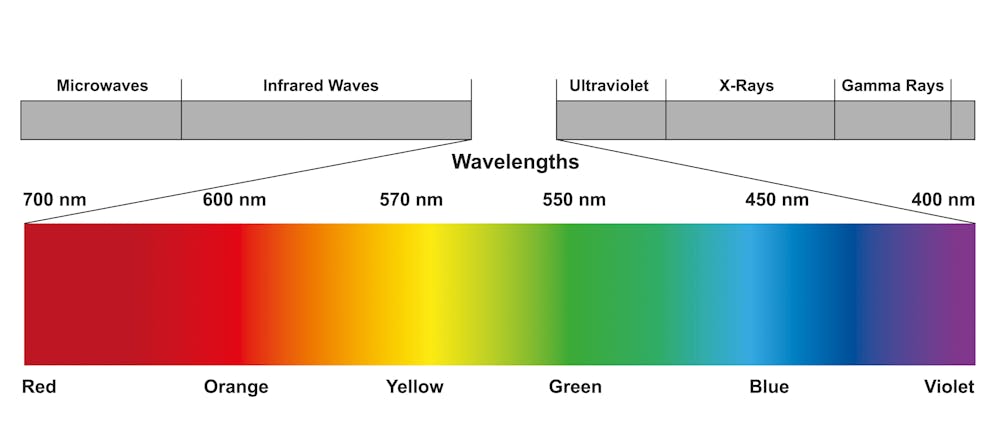
    As photons with wavelengths within a range of about 400–700 nanometers stream into your eyes, your brain perceives them as light. Scientists call these photons visible radiation. You perceive photons with different wavelengths as different colors.

    Photons outside that range of wavelengths are invisible to human eyes. Shorter wavelength energy includes ultraviolet, X-ray and gamma radiation, while longer wavelength energy includes infrared and radio waves.

    The human eye can perceive only a small range of wavelengths of radiation.
    Ali Damouh/Science Photo Library via Getty Images

    Shades and intensities

    Color perception is also affected by the quantity of photons – what physicists call the power – at different visible wavelengths. More photons means more powerful light, which looks brighter. A very vivid color consists mostly of photons of similar wavelength. For example, a pure red may consist of photons that all share the same wavelength near 620 nanometers.

    A stream of photons with a wider range of wavelengths will appear as a paler, less saturated color. White light, such as natural daylight, consists of photons with wavelengths spread fairly evenly across a wide range of the visible spectrum. LEDs and other electric light sources are not quite as uniform across the spectrum, but they still appear white or achromatic, meaning without color.

    Mixtures of wavelengths combine and appear as new colors. The human visual system interprets pure red light and pure green light combined as yellow. Add in pure blue, and this mix of radiation appears white. Scientists and engineers take advantage of this quality in display devices, which are able to create a huge range of perceived colors by mixing the primary colors red, green and blue.

    Black on the color spectrum

    While there’s no black in a rainbow, photons anywhere in the electromagnetic spectrum can be seen as black. Or in some cases, they can’t be seen at all!

    Radiation within the visible spectrum can appear black if it is low in power – more specifically, lower in power than its surroundings.

    Additionally, radiation outside the visible range of wavelengths appears black to our eyes. For example, infrared radiation appears black because it is invisible to humans.

    Perception is subjective

    Our eyes detect the wavelength and power of the light, but our brains interpret it. So color perception always depends on the context.

    People are good at adapting to a wide range of light levels, from sunlight to starlight. So our perception of color and brightness depends on what’s around and what we’ve been looking at recently. If you step from outdoor daylight into a dark theater, at first you probably perceive the whole environment as black, and you may even have trouble finding your way.

    However, your visual system immediately begins to adapt to the low light level. Soon, visual details begin to emerge. What appeared black now has different levels of lightness and color.

    Color perception depends on the surrounding environment.
    Michael J. Murdoch

    Consider the optical illusion that consists of a light rectangle next to a dark rectangle. Each rectangle contains a circle. The circles appear to be different shades but in fact are identical. Against the light background, the circle is dark enough to appear black. Surrounded by the black background, it becomes clear that the circle is merely dark gray. Even when you know the circles are the same, it’s hard to believe because the effect of the surrounding background is so strong.

    In a smooth gradient from gray to black, where does black begin?
    Michael J. Murdoch

    You might be asking yourself, how dark must a color be to appear black? Another way to ask the question is, how low in power must the physical light be in order to look black?

    For a visual answer, look at a gradient from dark gray to black. Where in the gradient is the boundary, or threshold, at which you call it black? What if you dim your display or view the screen in a much brighter or much darker environment? Probably the best answer for how dark it must be is, “It depends.”

    Color perception is a fascinating topic, and we color scientists are continuing to uncover details of how the human visual system works while also applying our knowledge to many other useful things, including dyes, cameras, printers, LED lighting systems and AR/VR displays.


    Hello, curious kids! Do you have a question you’d like an expert to answer? Ask an adult to send your question to CuriousKidsUS@theconversation.com. Please tell us your name, age and the city where you live.

    And since curiosity has no age limit − adults, let us know what you’re wondering, too. We won’t be able to answer every question, but we will do our best.

    Michael Murdoch is a member and former board member of the Inter-Society Color Council, part of the Color Literacy Project.

    ref. Where does black fall on the color spectrum? A color scientist explains – https://theconversation.com/where-does-black-fall-on-the-color-spectrum-a-color-scientist-explains-234540

    MIL OSI – Global Reports

  • MIL-OSI Global: Fossil shark teeth are abundant and can date the past in a unique way

    Source: The Conversation – USA – By Stephanie Killingsworth, Ph.D. Student in Geological Sciences, University of Florida

    A paleontologist holds a megalodon fossil tooth. Kristen Grace/FLMNH, CC BY-SA

    The ratios of strontium isotopes in fossil shark teeth can be used to better understand how coastal environments evolved in ancient times, according to our newly published work.

    As paleontologists with the Florida Museum of Natural History, we’re interested in understanding ancient Florida environments.

    Our study was one of the first to date Florida coastal deposits using fossil shark teeth and a technique that looks at variations in ocean strontium. Strontium is a chemical element that occurs naturally in rock, soil and water.

    Ocean strontium values change over time, which makes measuring the levels of the chemical element a unique global system for determining the age of similar coastal sedimentary rock deposits worldwide.

    Changes in strontium isotope ratios have multiple causes. Land erosion deposits strontium into oceans, while carbonate-producing marine life produce and release strontium when building their skeletons. Strontium is also released by deep-sea vents.

    Geochemist Donald DePaolo and geologist B. Lynn Ingram discovered variations in ocean strontium by examining strontium isotopes ratios in marine sediments, including fossils. The levels of strontium isotopes in marine sediments provide a “time stamp” that correlates to the strontium value of the seawater at that time.

    That data allowed scientists to map out ratios of strontium isotopes in seawater over time. This global strontium seawater curve correlates to the geologic timescale. Scientists use the curve to reconstruct past ocean chemistry and climate conditions, as well as the age of mollusks and other shell-producing marine fossils.

    Why it matters

    Properly dating ancient sites is key to understanding how Earth and its living creatures evolved over time.

    But historically, strontium dating, while reliable, had limitations.

    For example, it works best in fully marine environments and is challenging to use in fossil sites along coastlines. That’s because the strontium values might be influenced by land sediments and freshwater rivers.

    Additionally, material used for strontium dating must not have undergone considerable physical and chemical change during fossilization, the preservation of once living things from the past. Any major chemical alteration to the fossil can affect the strontium value and give an inaccurate date.

    Our study shows that fossil shark teeth are more resistant to these types of changes due to their outer enamel-like surface.

    Remarkably, fossil shark teeth are also incredibly abundant. Sharks ruled the earth’s oceans for 400 million years, and every individual grows and sheds thousands of teeth in their lifetime.

    How we did our work

    Florida fossil sites are unique in that they possess some of the richest fossil sediments for important times in geologic history. These sites can help us understand changing climates, vegetation and sea levels over time.

    The Florida Museum of Natural History has a collection of over 115,000 shark tooth specimens from Florida alone.

    To do our study, we selected shark tooth specimens from two significant Neogene-period fossil sites in Florida. The Neogene, from 2.6 to 23.5 million years ago, was a time of immense change in biodiversity because of changing climates.

    We analyzed the strontium present in powdered samples collected by shaving a thin layer from the surfaces of the teeth. The age of the teeth helped to clarify the age of the fossil sites where they were collected. This data enabled us to calibrate and differentiate the ages of our two sites, Montbrook and Palmetto Fauna Bone Valley, by about 600,000 years.

    Before our study, scientists could estimate the age of the sites based only on mammal fossils. The sites were thought to be the same age. Our work provides a more precise date.

    These ages offer new insights into what happened in the southeastern region of North America, some 5 million to 6 million years ago. Our revised age calibrations coincide with global events, including major sea-level fluctuations and the Great American Biotic Interchange – the migration of land mammals between North and South America after the formation of the Isthmus of Panama 4 million to 5 million years ago.

    For example, because certain species of ground sloths are not found at the Montbrook site (5.85 million years old) but are found at the Palmetto Fauna Bone Valley site (5.22 million years old), it suggests the immigration of ground sloths into North America occurred between these two dates.

    The Research Brief is a short take on interesting academic work.

    Bruce J. MacFadden receives funding from the National Science Foundation.

    Stephanie Killingsworth does not work for, consult, own shares in or receive funding from any company or organization that would benefit from this article, and has disclosed no relevant affiliations beyond their academic appointment.

    ref. Fossil shark teeth are abundant and can date the past in a unique way – https://theconversation.com/fossil-shark-teeth-are-abundant-and-can-date-the-past-in-a-unique-way-247749

    MIL OSI – Global Reports

  • MIL-OSI Global: While plastic dominates human consumption, the global economy will remain hooked on fossil fuels

    Source: The Conversation – UK – By Adam Hanieh, Professor of Political Economy and Global Development, Institute of Arab and Islamic Studies, University of Exeter

    Plastic waste in the Maldives. MOHAMED ABDULRAHEEM/Shutterstock

    In early December 2024, hopes for a landmark global treaty to curb plastic pollution were dashed as negotiations in South Korea stalled. Leading the campaign against the deal were major oil-producing nations, especially Saudi Arabia and Russia, who argued for a more flexible approach to any legally binding limits on plastic manufacturing.

    The collapse of any agreement came despite scientific research delivering ever more alarming warnings about the dangers of plastic pollution. Over the last two years, an avalanche of studies have revealed the pervasive presence of tiny plastic particles in human blood, brains, and even placental tissue.

    These particles, which stem from the breakdown of larger plastic waste, have been linked to everything from inflammation to hormonal disruption, and potential long-term health risks such as cancer. Aside from their effects on human health, plastics are wreaking havoc on marine ecosystems, with microplastics now found in Arctic ice and in the bodies of fish and birds.

    Behind these alarming studies stands a seemingly unstoppable juggernaut of plastic production. The annual global production of plastics reportedly grew nearly two hundredfold between 1950 (two million tonnes) and 2015 (381 million tonnes), and the pace of growth is accelerating.

    Over half of all plastics ever made were produced in the past 25 years, and production levels are estimated to double or triple again by 2050. And more production brings more waste.

    Less than 10% of all plastics ever produced have been recycled. And the volume of “mismanaged plastics” – those which are not recycled, incinerated, or sealed in landfills – is also estimated to double by 2050.

    It seems as if humans have become the organic detritus within a plastic world of our own creation.

    Plastic elephants

    But despite growing awareness around the problems associated with plastic, there is a fundamental flaw in how we tend to think about it as a product.

    For there is a tendency to frame plastic as a problem of pollution and recycling, rather than as an integral part of our fossil fuel-driven world. This narrative is also promoted by major oil companies, such as the American giant, ExxonMobil, which stated in the lead up to the South Korean summit: “The issue is pollution. The issue is not plastic.”

    The problem with this perspective is that it obscures the fact that plastics are petrochemical products: substances which are ultimately derived from oil and gas.

    Indeed, the future of fossil fuels is increasingly tied to the future of plastics. It has been estimated that by 2040, plastics will account for as much as 95% of net growth in oil demand.

    This is perhaps why 220 fossil fuel lobbyists attended those recent treaty discussions, outnumbering all other delegations. It could also explain why Saudi Arabia, home to one of the world’s largest petrochemical companies, led the opposition to any global limits on plastic production.

    At the core of capitalism

    The problem we confront is not simply the presence of an oil lobby, it is the systemic role that plastics play within capitalism.

    Plastics, and the wider petrochemical industry, played a crucial part in the transformation of global capitalism from the mid-20th century onwards.

    As I explore in my book, Crude Capitalism, the things we used to need to build and make things previously relied on sourcing naturally occurring, labour-intensive goods like timber, cotton or metals. But the invention of plastics and other synthetic materials separated commodity production from nature.

    More plastic in the pipeline.
    Kodda/Shutterstock

    Oil became more than a fuel – it was the substance that came to dominate our lives. A petrochemical shift to the rise of an oil-dominated world. With capitalism untethered from natural cycles, there was a radical reduction in the time taken to produce commodities and an end to any limits on the quantity and diversity of goods produced.

    Along with this, consumption habits became centred around notions of disposability and obsolescence. Plastics made the essential features of contemporary capitalism possible: a drive to limitless growth, continual acceleration of production and consumption, and the frenzied expansion of markets.

    The emergence of fast fashion is just one example. Alongside poorly paid garment workers in countries such as Bangladesh, really cheap clothing was only made possible through the massive expansion of polyester production (a kind of plastic), which freed the industry from its dependence on supplies of wool and cotton.

    The consumption of plastics looms large in today’s ecological crisis. And having become so accustomed to thinking about oil and gas as primarily an issue of energy and fuel choice, perhaps we have lost sight of how much of our lives depend upon the products of petroleum.

    These synthetic materials drove a post-war revolution in productivity, bringing labour-saving technology and mass consumption. It is now almost impossible to identify an area of life that has not been radically transformed by the presence of plastics and other petrochemicals.

    Plastic products have become normalised as natural parts of our daily existence. And it is this paradox which must be fully confronted if we are to move beyond fossil fuels.

    Adam Hanieh’s research into petrochemicals has been supported by a Political Economy Fellowship from the Independent Social Research Foundation (ISRF).

    ref. While plastic dominates human consumption, the global economy will remain hooked on fossil fuels – https://theconversation.com/while-plastic-dominates-human-consumption-the-global-economy-will-remain-hooked-on-fossil-fuels-247393

    MIL OSI – Global Reports

  • MIL-OSI Global: Presidential smiles: the untold story of teeth in the White House

    Source: The Conversation – UK – By Rae Gillibrand, Lecturer, Premodern History, University of Leeds

    When Donald Trump joined Elon Musk for a live interview on X (formerly Twitter) late last year, the conversation covered a range of significant topics: his near-assassination, Biden’s withdrawal from the race, and the future of the presidency. However, for many viewers, an unexpected detail stole the spotlight: Trump’s slurred speech and lisp.

    Was Trump wearing dentures? The public certainly seemed to think so. Throughout the interview, the word “dentures” was mentioned over 15,000 times on X and the interview sparked the resurgence of the hashtag #DenturedDonald.

    Why does this matter? Trump is, after all, 78 years old, and a 2017 survey showed that nearly one in four Americans aged 75 and older have no teeth left at all. However, presidential dental health has long had an impact on public perception and leadership itself. From George Washington’s infamous dentures to Teddy Roosevelt’s toothy grin, a president’s teeth (or lack thereof) have often shaped the way they are seen by the American public.

    Since the appointment of George Washington as the first US president, it has been tradition for each new president to commission a portrait of themselves during their time in office. However, it was not until Ronald Reagan’s portrait, completed in 1991, that we saw a president depicted with a smile.

    This is partly to do with practicality – many early portraits were painted from life, and sitting with a smile for hours was almost impossible – and partly to do with etiquette. In the 18th century, a wide smile was considered a sign of lewdness and drunkenness and associated largely with the lower classes.

    Indeed, a 1703 text on “decorum and civility” said that some people part their lips so that “their teeth are almost entirely visible. This is entirely contradictory to decorum, which forbids you to allow your teeth to be uncovered, since nature gave us lips to conceal them.”

    It is often suggested that historical portraits avoided smiles because of poor dental hygiene, but in reality, social conventions played a much larger role. For earlier presidents, maintaining an image of sobriety, morality and respectability was important, and a serious expression was seen as a reflection of these values.

    This all changed with Teddy Roosevelt. When Roosevelt became the 25th US president in 1901, photography was becoming much more accessible. Technological advancements and the introduction of handheld cameras meant that photography could be practised by a much broader range of people.

    Because of this, Roosevelt was often candidly photographed while laughing or smiling, leading to his reputation as “the first president who smiled”.

    He even capitalised on his grin in his 1904 campaign by releasing the Teddy’s Teeth Whistle. Retailing at five cents (US$1.77 or £1.44 in today’s money), supporters were encouraged to buy a set and “blow the horn for Teddy”.

    Roosevelt’s embrace of his smile and the promotion of his teeth marked a shift in how a president’s image could be used to influence public perception, showing that good dental health could be a powerful political tool.

    Worse than wood

    Not all presidents were as diligent as Roosevelt when it came to dental hygiene. George Washington, for example, was infamous for his poor dental health.

    His letters, diaries and financial accounts reveal a long history of dental troubles, ultimately leading to his use of dentures. However, contrary to popular belief, Washington’s dentures were not made of wood. Instead, they were made from materials including ivory, animal teeth and human teeth.

    One of Washington’s account books reveals that he bought nine teeth from enslaved people on his Mount Vernon plantation. This detail adds a sinister layer to the history of Washington’s dental care because, while these people were paid for their teeth, their enslaved status probably left them with little choice in the matter.

    Washington’s poor dental hygiene also extended to his care of his dentures. They became notoriously stained, largely due to his fondness for rich red wine. One letter from his dentist chastised him for the condition of his dentures, stating: “The set [of dentures] you sent me from Philadelphia … was very black, occasioned either by your soaking them in port wine, or by your drinking it. I advise you to either take them out after dinner and put them in clean water … or clean them with a brush.”

    These insights into Washington’s dental struggles underscore the lasting effect of oral health on the presidential image.

    Presidential dental health has played, and continues to play, an important role in shaping public perception, with teeth often serving as symbols of both personal care and political power. Whether influencing how a president is seen or reflecting broader social attitudes, the state of a leader’s teeth has clearly left its mark on the history of the office.

    Rae Gillibrand does not work for, consult, own shares in or receive funding from any company or organisation that would benefit from this article, and has disclosed no relevant affiliations beyond their academic appointment.

    ref. Presidential smiles: the untold story of teeth in the White House – https://theconversation.com/presidential-smiles-the-untold-story-of-teeth-in-the-white-house-248391

    MIL OSI – Global Reports

  • MIL-OSI Global: Why drying clothes indoors could put your health at risk

    Source: The Conversation – UK – By Rebecca A. Drummond, Associate Professor, Immunology and Immunotherapy, University of Birmingham

    Magic Lens/Shutterstock

    Hanging the washing out to dry in the garden has been a rare sight these last few months, with winter storms bringing freezing temperatures and 100mph gusts of wind. But does the way we dry our clothes indoors actually matter?

    Drying wet clothing on racks in poorly ventilated spaces could increase the amount of mould growing in your home, which is associated with poor health and, in some cases, even death.

    When mould grows in your home, it can form black or green coloured patches on the walls, and usually creates an unpleasant musty smell. It shouldn’t be ignored, because being exposed to mould over long periods of time can have serious health implications.

    Mould is a broad term for a group of fungi that produce tiny particles called spores. Fungi produce spores when conditions are right for their growth, which can include cooler temperatures and high humidity. This is why you’re more likely to find mould growing on bathroom ceilings or damp walls, where there is more water for fungal spores to settle and grow.

    There are many different species of mould. The most common ones to cause problems in damp homes are penicillium and aspergillus. It’s estimated that we breathe in small numbers of spores from these fungi on a daily basis.

    Luckily, our immune system is very good at spotting and killing fungal spores, which limits the number of fungal lung infections in humans even though we’re constantly exposed. Immune cells called macrophages sit inside the air spaces of the lungs (called alveoli), and these cells eat anything you inhale that could be considered harmful, including fungal spores.

    Risks for compromised immune systems

    However, there are many people whose immune systems are not able to remove fungal spores, and in these cases the fungi can cause dangerous infections or make underlying health conditions (such as asthma) much worse.

    People who have damaged or compromised immune systems are at higher risk of becoming seriously unwell from fungal infections. Moulds like aspergillus cause infections in patients with limited immune function, or who have lung damage from diseases like asthma, cystic fibrosis and chronic obstructive pulmonary disease (COPD) associated with heavy smoking.

    In people with asthma, the immune system overreacts to triggers (including fungal spores) causing inflammation in the lung. This inflammation makes it more difficult to breathe by reducing the size of the airways. The same type of immune response is responsible for the symptoms of asthma and allergic responses, and fungal spores can also trigger these same types of immune responses. This means that fungal spores can be a particularly powerful trigger for some people.

    In very extreme cases, the fungal spores don’t just cause inflammation but can invade the airways and block them leading to bleeding within the lung. This happens when spores germinate and form long spiderweb-like projections called mycelium which create sticky lumps that block airways and damage the delicate tissues of the lung.

    Growing resistance

    Aspergillus infections are treated with antifungal drugs called azoles, which prevent the fungal cells from forming properly. Azoles are very effective, but there are increasing rates of resistance to azoles reported in aspergillus which is a significant cause for concern.

    We have a limited range of antifungal drugs available to treat mould infections – and when resistance develops this can severely reduce the options a patient has for treatment.

    Resistance to drugs such as azoles can develop in patients who take these drugs for long periods of time, but recent research has indicated that resistance is more commonly developing in the environment, where most fungi are found. This means that even before a patient is diagnosed with an aspergillus infection, it may already be too late for the antifungal drugs to be effective.

    Development of drug resistance in environmental fungi has been linked to use of azoles and other antifungal drugs in farming. Fungal infections are a big problem for crops, and plants need protection from these infections the same way we do. Unfortunately, the same drugs we use in the clinic are the same types that are being used in agriculture.

    Climate change may also be driving drug resistance in environmental fungi. Exposure to high temperatures was recently found to help moulds develop resistance to commonly prescribed antifungal drugs. There have also been reports of patients becoming ill from species of mould that were not thought to cause human disease, in part because they could not grow at the human body temperature.

    More mould species could therefore be picking up the ability to cause infections, as well as becoming drug resistant. Research programs and healthcare initiatives that monitor for these changes are vital to help us become prepared for potential increases in mould infections.

    While a healthy immune system means that typical exposure to fungal spores is not likely to cause you any health problems, being exposed to very large amounts of fungal spores can prove to be fatal even for people who don’t have underlying health issues.

    In 2020, toddler Awaab Ishak died as a direct result of high exposure to fungal spores, caused by excessive damp and mould in his home.

    His death led to a change in UK law (Awaab’s Law) which requires landlords to respond promptly to damp in homes they manage, to ensure that tenants are not exposed to excessive levels of fungal spores which can affect their physical and mental health.

    It’s important, then, to help keep your home free of mould. The best way to do this is ensure you have good ventilation and take other measures to reduce damp, such as using a dehumidifier or investing in a heated clothes rack to dry your clothes indoors in the winter.

    Rebecca A. Drummond receives funding from the Medical Research Council, the Wellcome Trust and the Lister Institute.

    ref. Why drying clothes indoors could put your health at risk – https://theconversation.com/why-drying-clothes-indoors-could-put-your-health-at-risk-248467

    MIL OSI – Global Reports

  • MIL-OSI Global: How to argue without falling out – an expert guide

    Source: The Conversation – UK – By Jessica Robles, Lecturer in Social Psychology, Loughborough University

    Pormezz / Shutterstock

    To disagree is an inescapable part of being human. We simply are not all the same. But whereas a small disagreement may remain amiable, particularly over text or online where we can edit our responses, a face-to-face row over a sensitive topic can develop into a more antagonistic form of argument.

    You may have experienced this over the recent festive season, when many of us spend more time in close contact with our relatives than usual. This can sometimes bring simmering tensions to the surface.

    An argument can start over a lot of things, from politics to each other’s behaviour – something anyone who spends much time on social media will be familiar with. But the stronger the view, the more intense and complex an argument can become.

    So, what can you do to avoid a minor argument becoming a major row – whether online or face-to-face? As an expert in social interactions, I think paying attention to what someone says – and how they say it – is crucial, along with learning how to avoid responding in ways that might blow up in your face.

    Remember, disagreements are a normal part of life and relationships. But here are three key tips for how to avoid them escalating into something more serious.


    Ready to make a change? The Quarter Life Glow-up is a new, six-week newsletter course from The Conversation’s UK and Canada editions.

    Every week, we’ll bring you research-backed advice and tools to help improve your relationships, your career, your free time and your mental health – no supplements or skincare required. Sign up here to start your glow-up at any time.


    1. Manage escalation

    If you disagree with someone, stay in the conversation in a productive way by avoiding using direct insults. Also, take care to avoid actions that may put the other person on the back foot, such as accusing, complaining or mocking them.

    We tend to put a lot of emphasis on the content of an argument, and also on our assumptions about what the other person “really thinks”. What is the argument about? Is it just a misunderstanding – or is it a matter of personality, where one party is biased or has some ulterior motive?

    The rise of social media has created an age of endless conflict.
    pathdoc / Shutterstock

    We care very much whether the person actually believes what they are saying. Research suggests we often resent people playing “devil’s advocate” outside of certain settings.

    But you cannot truly know someone’s intentions, so it’s a good idea to avoid thinking the worst about the person you are arguing with. Otherwise, you might unfairly talk to them as if they’re being manipulative, unfair, damaging or thoughtless.

    2. Be open-minded

    Sometimes, what someone has said may sound (and feel) pretty awful. When this happens, keep two things in mind.

    First, nothing we say has just one meaning. There are often multiple interpretations, and you cannot always trust the first one that leaps to mind when you’re in the heat of the moment.

    During an argument, it’s worth slowing down and thinking through all possible interpretations. Consider asking for a moment to think, or getting a cup of tea to distract both of you from an escalation.

    Second, if what the person is saying still sounds negative no matter how charitable you try to be, ask them to explain more. This may not be easy to do, but people will often reveal what they meant if they have to elaborate. And helping them feel as if they are being carefully listened to might defuse a possible escalation.

    3. Stay on track

    There is another side to this coin: choosing carefully what you say, and keeping in mind how you will come across. Anyone can get caught up in an argument and say something they regret, including you.

    Something to balance carefully is “going meta” – pausing to talk about the argument you’re having and the way you’re having it. This can be productive if, for instance, you ask to keep the conversation focused on something specific. However, it can easily come across as an implicit criticism of the other person.

    If you do choose to discuss the quarrel you’re having, you may have to include an apology or speak in a quieter tone to keep the other person from thinking you are going to accuse them of arguing “wrongly” in some way. It’s challenging, so don’t feel bad if you don’t get it right the first time you try this technique.

    Anyone can get caught up in an argument, including you.
    fizkes / Shutterstock

    Do we have the same values?

    People don’t just argue for the sake of arguing. One of the main reasons for engaging in an argument is to position ourselves in relation to other people. Are we on the same side, and do we have the same values?

    Arguments are also tied to identity. The most contentious arguments generate strong feelings. We’re aware that we might be judged for our opinions, and others will assume that we might judge them in return.

    Mutual judgment can easily escalate not just during a disagreement but in the relationship as a whole, causing a temporary falling-out or even loss of friendship. People who want to avoid this often assume the answer is to simply put their feelings aside and “focus on facts”.

    But denying an emotional response might feel like denying one’s commitment to a valued cause. Recognising that someone feels this way is an important step to knowing what you might be able to change their mind about – and what is best left alone, at least for now.

    Jessica Robles does not work for, consult, own shares in or receive funding from any company or organisation that would benefit from this article, and has disclosed no relevant affiliations beyond their academic appointment.

    ref. How to argue without falling out – an expert guide – https://theconversation.com/how-to-argue-without-falling-out-an-expert-guide-236812

    MIL OSI – Global Reports

  • MIL-OSI Global: The Sims: from Hot Date to Get Famous, why expansion packs have been key to the game’s longevity

    Source: The Conversation – UK – By Aditya Deshbandhu, Lecturer of Communications, Digital Media Sociology, University of Exeter

    SimCity 3000, the predecessor to The Sims, played a pivotal part in my childhood, growing up in Hyderabad, India. Its recreation of the western, urban world helped me understand how cities were planned, designed and financed – and how they provided people with key services like transportation, health and education while preparing for accidents and other hazards.

    As an eight-year-old trying to figure out my place in the world, that game offered me a way to make meaning of the chaos that can be life. So, when The Sims launched in 2000 – enabling me to live inside a virtual city, rather than simply build one – I had to get my hands on a copy.

    Twenty-five years later, I write this piece in a drastically different gaming landscape, where games offer high visual fidelity and ever-increasing frame rates for ultra-smooth game play. But despite all these technological innovations and the pursuit of photo-realism, the popularity of The Sims’ game designer Will Wright’s satire on American consumer culture endures.


    Sul Sul! This article is part of a mini series from The Conversation marking 25 years of The Sims franchise.


    The franchise’s four Sims games had sold over 200 million copies before the latest instalment, The Sims 4, became free to play in 2022. Players now spend their money on extras within the game. Over 85 million people played The Sims worldwide in 2024.

    At a time when the success of a modern video game is measured in metrics like “cumulative engagement time” (number of players playing at the same time), acquisition of new players and “intensity of engagement” (number of hours spent by a player), now-over-a-decade-old The Sims 4 continues to excel with its mastery of the live-service format.

    The trailer for the first Sims game.

    Live-service describes the form modern digital games embrace when they transition from conventional products into “services” – a shift made possible because games today can be regularly updated, fixed and expanded upon by their makers remotely. They can acquire new levels and in-game features in a similar way to how streaming platforms like Netflix drop new episodes of your favourite show.

    Players don’t buy a live-service game, they sign up for the journey.

    Expanding player horizons

    In each incarnation of The Sims, players have been able to access new ways to perform roles and tasks that mimic everyday life, in the form of expansions and content packs.

    The original title, The Sims (2000), had seven expansion packs and two content packs. I distinctly remember brewing potions in the chemistry lab and rubbing a magic lamp to conjure a genie in the first expansion, Livin’ Large; the new holiday island that was built for The Sims: Vacation; and leaving my Sim’s home to visit downtown areas as part of Hot Date.

    The trailer for The Sims Hot Date expansion pack.

    But for The Sims 4 (2014), the developers went all in. This game – and its subsequent expansions – represents a digital supermarket of lifestyles, sub-cultures, activities and stardom. For example, 2018’s Get Famous pack not only introduced Del Sol Valley – a region that resembled Los Angeles and the Hollywood Hills – but also introduced the “reputation” mechanism for players.

    The Discover University expansion (2019) allowed players to take their Sims to school in a new region called Britechester – after this update, the game integrated Sims’ careers and education, and in many ways changed the rules of the game. And the Eco Lifestyle expansion pack (2020) is memorable because the game engaged with ideas of sustainable living for the first time.

    Genre, fantasy and reality

    From content packs featuring a digital recreation of singer Katy Perry in The Sims 3 to collaborations with streamers, content creators and fashion houses, The Sims has remained relevant by consistently blurring the lines between genre, reality and fantasy.

    Hot Date was a popular early Sims expansion pack.

    Today, video game makers the world over try to master formats like free-to-play games where players pay for cosmetic items, customisations and added content, or expansions offering downloadable content. The Sims set the standard for most of them.

    Over the past 25 years, this franchise has had several life simulation competitors in the form of Second Life, Facebook’s once popular Farmville, virtual reality experiences like Half-Life: Alyx and, during the pandemic when we worked, learnt and played online, initiatives like the Metaverse.

    However, today only The Sims endures. The game’s developers continue to give its players what they want, while also getting them to engage with difficult ideas like sustainability, the question of life and death, and even gentrification (For Rent expansion pack, anyone?).

    Few games let players critique life so closely. For game researchers like me, this begs the question: do people play life simulation games like The Sims in order to build alternative lives, relive their own – or create something entirely new?


    Looking for something good? Cut through the noise with a carefully curated selection of the latest releases, live events and exhibitions, straight to your inbox every fortnight, on Fridays. Sign up here.


    Aditya Deshbandhu does not work for, consult, own shares in or receive funding from any company or organisation that would benefit from this article, and has disclosed no relevant affiliations beyond their academic appointment.

    ref. The Sims: from Hot Date to Get Famous, why expansion packs have been key to the game’s longevity – https://theconversation.com/the-sims-from-hot-date-to-get-famous-why-expansion-packs-have-been-key-to-the-games-longevity-248604

    MIL OSI – Global Reports

  • MIL-OSI Global: Will multinational companies flock to Syria? Maybe, if foreign aid arrives first

    Source: The Conversation – UK – By Ana Carolina Garriga, Professor of Political Science, University of Essex

    hanohiki / Shutterstock

    Syria’s new foreign minister, Asaad al-Shaibani, recently appeared at the World Economic Forum’s annual conference in the Swiss resort of Davos. He announced that his country is open for business and seeking foreign investment.

    After more than 13 years of civil war and decades of dictatorship that saw Syria become a pariah state, the country needs all the financial support it can get. But will foreign firms set up shop in Syria?

    Countries like Syria, emerging from conflict, face the challenge of convincing investors they are a safe environment for investment. Our research suggests companies look at what governments are doing in terms of aid when considering whether to invest. In general, post-war countries that receive more foreign aid subsequently receive more foreign investment.

    Foreign direct investment (FDI) typically involves multinational companies building factories, opening stores or investing capital in businesses abroad. It can be highly beneficial for developing countries.

    FDI is the most stable source of international financing, and generally has positive long-term effects on economic growth and poverty reduction. More importantly for incumbent governments, FDI has positive short-term effects on domestic employment, government financing and spending, and foreign exchange reserves.

    It also has a potential positive effect on government approval ratings, as attracting inward FDI signifies political competence to voters. These reasons are why almost all governments compete to receive these financial flows.

    FDI is especially important in post-conflict countries. Civil wars typically destroy or seriously harm the productive capacity of countries. In Syria, the conflict destroyed tens of billions of US dollars worth of infrastructure, and incapacitated more than half its electrical grid.

    After 13 years of civil war, Syria needs all the financial support it can get.
    Vagabjorn / Shutterstock

    War often disrupts a country’s access to the international economic exchanges that help economic growth. Since the beginning of its conflict in March 2011, Syria’s annual exports have dropped from US$8.8 billion (£7.1 billion) to US$1 billion, due to the war and war-related sanctions. Its economy has shrunk by 54%.

    Foreign investment can contribute substantially to rebuilding the economy. But post-conflict countries might seem risky to investors.

    Foreign firms sometimes avoid countries plagued by violence, political instability, or political risk. Conflict could reemerge in Syria, and multinational corporations probably do not want their business in a place where factories could be bombed or customers killed.

    Post-conflict situations are also relatively information-poor environments. Conflict often hampers data collection efforts, and governments, in desperate need of capital, may be incentivised to misrepresent the actual state of the economy or strength of the political system.

    In the case of Syria, foreign observers do not know what to make of the new ruling coalition, which is led by a designated terrorist organisation in Hayat Tahrir al-Sham. While the international community seems to want to support Syria – the UK, for example, has been clear about its intention to help the country – observers are unsure about the environment and how it might change in the coming years.

    In these kinds of situation, international investors look at a variety of signals. In our research, we show that one key signal is whether other governments have sent official development aid to post-conflict countries.

    Following the aid

    We argue that the decision to send aid to a country signals the donors’ trust of local authorities. What matters is this presence of aid, whether or not the aid achieves its intended purpose.

    Examining decades of global data, we have found a robust relationship between foreign aid and subsequent investment in post-conflict countries – with one striking exception.

    There does not seem to be a relationship between aid from the US and foreign investment. Because so much of US foreign aid is geostrategic – to shore up alliances or secure access to particular areas – investors do not seem to view it as a valuable signal about the recipient country.

    So, Syria should perhaps not worry too much about the new US president Donald Trump’s plan to cut American foreign aid. If aid from other government donors can still flow in, this could encourage investment to follow.

    Fortunately for Syria, some countries and international organisations have already pledged aid – including the UK, which has announced £50 million in humanitarian aid for the country and its refugees. This seems like a good sign for Syria’s future – even more so because of the signal it sends to foreign investors.

    Specific domestic policies that encourage FDI and build stronger institutions will be necessary to secure investment in the longer term. Syria will need to demonstrate its commitment to the rule of law and property rights, while creating a stable environment for investment.

    However, if the pledged aid materialises – and if more countries chip in – this could lead to substantial economic benefits for Syria.

    The authors do not work for, consult, own shares in or receive funding from any company or organisation that would benefit from this article, and have disclosed no relevant affiliations beyond their academic appointment.

    ref. Will multinational companies flock to Syria? Maybe, if foreign aid arrives first – https://theconversation.com/will-multinational-companies-flock-to-syria-maybe-if-foreign-aid-arrives-first-248406

    MIL OSI – Global Reports

  • MIL-OSI Global: Representation gaps and the rise of populism

    Source: The Conversation – UK – By Laurenz Guenther, Postdoctoral researcher, Department of Economics, Bocconi University

    Shutterstock/Alejo Bernal

    The rise of rightwing populists continues across the west, leaving many wondering how mainstream parties can respond. Part of the picture is the failure of political parties to meet voters’ views on immigration with policy responses.

    Germany is a strong example here. In 2013, it had no notable rightwing populist party. Alternative for Germany (the AfD) did already exist, but it was neither populist nor strongly anti-immigrant. But immigration into Germany was increasing.

    In the years prior to 2013, several hundred thousand asylum seekers from Africa and the Middle East entered the country each year. Many Germans wanted lower immigration but German political parties were not offering corresponding policies. The public and parliamentarians were already on a different page.

    To measure this disagreement, researchers asked representative samples of German parliamentarians and ordinary citizens the following question in 2013: “Should it be easier or harder for foreigners to immigrate?”

    They could choose from 11 responses, ranging from “0 – immigration for foreigners should be much easier” to “10 – immigration for foreigners should be much harder”.

    The results show that most Germans wanted to restrict immigration in 2013. Despite this public demand, nearly all parliamentarians from all the four major parties wanted to facilitate immigration.

    Immigration attitudes in 2013:

    How the representation gap emerged over immigration.
    L Guenther, CC BY-ND

    Two years later, in 2015, the refugee crisis began. Over the course of just a few years, two million asylum seekers entered Germany. In response, Germans viewed immigration as an increasingly important issue and increasingly voted based on their attitudes towards immigration. Because most Germans wanted lower immigration, this increased the demand for an anti-immigration party.

    During this time, the AfD changed its policy platform to become Germany’s only party that was clearly calling for much lower immigration. As a result, the AfD became the only party to represent the will of many Germans on the issue they considered most important.

    Immigration attitudes in 2017:

    From this perspective, it is not surprising that the AfD strongly increased its vote share in the 2017 election and became the first party to the right of the conservatives to ever enter the federal parliament.

    In my research, I found similar patterns are evident across Europe. In 27 countries, most political mainstream parties are much more in favour of immigration than the majority of their voters and citizens demand.

    The representation gap is not only systematic across countries but also across political issues and voter subgroups. On nearly all cultural issues, such as multiculturalism or gender relations, I found that voters are more conservative than their parliamentarians.

    Across Europe, the difference between the average voter and parliamentarian is as large as the difference between the average conservative and socialist parliamentarian.

    Even voters with the same level of education, or voters who are well-informed about politics, are much more culturally conservative than their representatives. Even immigrants themselves are much more opposed to immigration and multiculturalism than the average parliamentarian.

    While these cultural representation gaps have existed for a long time, it is the increase in their salience and perceived importance that contributes to the rise of rightwing populism. This is most strongly driven by the increased importance in immigration.

    These results matter because they can equip politicians with the information they need to win (back) voters. And on a deeper level, these findings raise the question whether mainstream parties need to adjust their policies on immigration.

    One important argument of mainstream politicians against populists is that once populists come to power they aim to establish dictatorships and then rule against the interest of the people. However, this argument rings hollow if mainstream parties are unwilling to acknowledge and act on the issues considered most important by the people.

    Laurenz Guenther receives funding from Bocconi University. He is affiliated with the Instutute for European Policymaking at Bocconi University.

    ref. Representation gaps and the rise of populism – https://theconversation.com/representation-gaps-and-the-rise-of-populism-245871

    MIL OSI – Global Reports

  • MIL-OSI Global: How The Sims’ endless customisation fostered one of gaming’s most diverse player communities

    Source: The Conversation – UK – By Andra Ivănescu, Senior Lecturer in Game Studies and Ludomusicology, Brunel University of London

    Katy Perry is in a recording booth. She turns to the camera, smiles and begins to sing: “Badipsa frooby noop”. As if to confirm that we didn’t mishear her, she repeats “Badipsa frooby noop” and gives the camera a thumbs up.

    The moment was captured in 2010, in a behind-the-scenes video of Perry recording her song Last Friday Night in Simlish – the language spoken by characters in The Sims games. It was part of her branded downloadable content (DLC) package, Sweet Treats, which was available to players of The Sims 3.

    The Sims is celebrating its 25th anniversary in 2025, to the chagrin of many a millennial. From its groundbreaking approach to inclusive character creation to the surreal charm of global pop stars re-recording their hits in Simlish, The Sims has always operated at the intersection of individuality and shared culture.

    Created by one of the industry’s few auteur game-designers, Will Wright, The Sims 1 was released on the cusp of the millennium and changed the video game landscape forever.

    The game harks back to what game studies researcher Jesper Juul described, in his foundational book Half-Real (2005), as the “primordial game structure”. This is a game in which the player doesn’t follow a set story or structure in a linear way, but gets to design their own strategies, combining the rules in often unpredictable ways.


    Sul Sul! This article is part of a mini series from The Conversation marking 25 years of The Sims franchise.


    More than that, players are able to tell their own stories and build emergent narratives. These narratives are not about war, fantasy worlds or outer space, but regular people, regular homes, regular jobs and plenty of WooHoo (The Sims’ euphemism for sex).

    Custom creativity

    The Sims franchise provides players with a space to perform and experiment, to be cruel, silly or creative. These modes of play can take the form of machinima – using the game engine to make creative videos. Or using features like the family album, in which players can capture photos of their avatars within the game to make poignant statements about important social issues.

    The base game has provided an increasingly diverse range of opportunities for customisation of characters, spaces and activities. And the large quantity of available DLCs and mods (player-made modifications to the game) has offered even more variety.

    Many of the customisation options have been explicitly related to characters’ identities, and the series has gradually improved its representation. For instance, while the original game already included same-sex relationships, The Sims 2 included a “joined union” option which was similar to marriage. By The Sims 3, same-sex couples could marry with no distinction from opposite-sex couples. Similar developments have taken place in the diversity of skin tones and gender identities as the series progressed.


    Read more:
    Why The Sims 4’s new inclusion of transgender and disabled sims matters


    As a result of these inclusive changes, players enjoy gaming experiences as diverse as they are.

    Phillip Ring, executive producer on The Sims 4, provided an overview of the game’s demographics in a Game Developers Conference talk in 2023. Only 21% of Sims players are men, while 55% identify as heterosexual and 62% as white. Ring explained how the game’s developers, Maxis and Electronic Arts, consider equality, diversity and inclusion as part of hiring, development and engaging with the player community. Active inclusivity has become an essential part of The Sims design.

    None of this touts The Sims as a digital utopia. The franchise has been criticised for its consumerist ideology, and much of its progressive content has been deeply controversial in different territories of the game’s release.

    Katy Perry records Last Friday Night in Simlish.

    For better or worse, the game has both reflected and shaped pop culture – which brings us back to Katy Perry. The Simlish version of her song may sound nonsensical, but it reflected a cultural moment – the post-feminist, anthemic pop of the 2010s.

    That moment has now passed. In a post-Brat summer era, Perry’s Sims moment feels outdated. The Sims, however, remains relevant, evolving alongside popular culture.

    In his book Understanding Video Game Music (2016), musicologist Tim Summers interprets Simlish rerecordings as satires of contemporary pop culture. I disagree. Instead, I believe Simlish is designed to let players “fill in the blanks”, using their imagination to shape meaning.

    This has always been central to The Sims – allowing players to project their own stories onto a world within the cultural zeitgeist. Many of us grew up with The Sims. As we’ve evolved, so has the game – which remains a dynamic cultural artefact.


    Looking for something good? Cut through the noise with a carefully curated selection of the latest releases, live events and exhibitions, straight to your inbox every fortnight, on Fridays. Sign up here.


    Andra Ivănescu is the recepient of a British Academy/Leverhulme Small Research Grant for her project Gaming Censorship: Videogame Content Regulation in the UK.

    ref. How The Sims’ endless customisation fostered one of gaming’s most diverse player communities – https://theconversation.com/how-the-sims-endless-customisation-fostered-one-of-gamings-most-diverse-player-communities-248686

    MIL OSI – Global Reports

  • MIL-OSI Global: How The Sims accidentally invented the cosy game genre

    Source: The Conversation – UK – By Adam Jerrett, Lecturer, Faculty of Creative & Cultural Industries, University of Portsmouth

    Ooboo Vroose Baa Dooo! That’s “happy birthday” in Simlish, the delightfully nonsensical language of The Sims. The life simulation video game franchise turns 25 this year, making me feel officially old.

    Like many others, I grew up playing The Sims, oscillating between designing dream homes and orchestrating ideal careers, and trapping my Sim characters in a tiny block room, removing all the doors and watching the chaos ensue. For the more benevolent among us, The Sims was an endlessly rewarding digital dollhouse.

    Game designer Sid Meier (creator of the Civilisation series) defines a video game as “a series of interesting decisions”. In most games, interesting decisions are about which gun to use or which party member to heal. The Sims’ interesting decisions, however, were far more mundane. “What clothes should I make my simulated human (typically a digital avatar of myself or my friends) wear?”; “Who should they date?”; and, most importantly: “Should I use the ‘rosebud’ cheat to give myself infinite money?”

    The Sims went on to become one of the bestselling franchises of all time, with myriad sequels, expansions and an obsessed player base. While similar titles at the time, such as Black and White, had you playing as an omnipotent god, they were primarily strategy games based around controlling territory. What made The Sims special was its focus on emergent narratives – player-driven experiences where players could create their own stories.


    Sul Sul! This article is part of a mini series from The Conversation marking 25 years of The Sims franchise.


    Much of this focus is also present in what is now called the “cosy game” genre. These are games that focus not on conflict or challenges, but rather on creativity, exploration and personal expression.

    Before Stardew Valley let us befriend a moody fisherman, Animal Crossing allowed us to be financially terrorised by a raccoon, and Unpacking made us cry over a box of kitchen utensils, The Sims showed us a new way to play. One where the biggest challenge was forgetting to pay your bills, and the most rewarding accomplishment was finally affording a pool (whose exit ladder may or may not just have mysteriously disappeared).

    This normalised the idea that games didn’t need to be won to be fun. It was a shift in design philosophy that paved the way for later games that let players tend a farm, manage a café, or befriend ghosts without a game-defined goal.

    A trailer for one of the more recent expansion packs, Cottage Living.

    The Sims was less about victory than it was about making your own fun – whether that meant imagining your future family life with your crush, or seeing how well you could build your Sim’s career from the ground up before succumbing to late-stage capitalism.

    Copying The Sims’ homework

    Many features that define the cosy game genre today trace directly back to The Sims. It popularised meticulous environment building and customisation tools, for example, from house layouts to outfit choices and suspiciously elaborate hedge mazes. This DNA is the bedrock of many modern cosy games, like Tiny Glade’s whimsical castle-building or pandemic hit Animal Crossing: New Horizons’ island growing.

    The Sims was free from combat or major stressors (unless you count fire hazards and rogue Grim Reapers). No timers, no pressure – just vibes (unless you forgot to build a toilet, in which case the vibes would be bad). You could play at your own pace, which came to define other self-paced games like A Short Hike.


    Looking for something good? Cut through the noise with a carefully curated selection of the latest releases, live events and exhibitions, straight to your inbox every fortnight, on Fridays. Sign up here.


    Much of The Sims was about the relationships between the Sims themselves. They could get married, have children, make friends and even enemies. Instead of fighting for survival, Sims were fighting for their relationships.

    This was augmented by a growing “machinima” fan culture, where players made short films and movies using in-game footage. These forms of emergent, social storytelling are a mainstay of modern gaming and meme culture, made even more prevalent by social media and the “share” buttons now on many game controllers.

    In this work of machinima, a Sims player has made a sitcom trailer using footage from their gameplay.

    Over the years, The Sims franchise has become a bastion for diversity, equity and inclusion. Most recently, that’s meant allowing players to create disabled and transgender Sims.

    This provides more representation to players, and showcases the importance of cosy games for exploring an array of identities, values and stories. The move has even inspired copycats like the upcoming Inzoi, which provides even more realistic graphics and complex life simulation, building on the formula introduced by Sims creator Will Wright all those years ago.

    For 25 years, The Sims has proven that games can be different. They don’t need conflict, challenge or even victory to be engaging. Sometimes, the real joy comes from designing an entire town, crafting a chaotic soap opera – or simply watching a Sim pace around a door-less room, gradually descending into madness.

    Adam Jerrett does not work for, consult, own shares in or receive funding from any company or organisation that would benefit from this article, and has disclosed no relevant affiliations beyond their academic appointment.

    ref. How The Sims accidentally invented the cosy game genre – https://theconversation.com/how-the-sims-accidentally-invented-the-cosy-game-genre-248702

    MIL OSI – Global Reports

  • MIL-OSI Global: How to set healthy boundaries

    Source: The Conversation – Canada – By Gio Dolcecore, Assistant Professor, Social Work, Mount Royal University

    Boundaries are about what you do when something triggers an emotional response from you, and how you communicate to others what you are feeling. (Shutterstock)

    Setting our boundaries can sometimes be tough. Maybe you’re living with someone who’s always in your space. Or you’ve got that friend who feels a little too comfortable trauma-dumping on you. Maybe you feel your spouse isn’t respecting your choices.

    Whatever the reason, telling others how you feel isn’t always easy. And it can be difficult to figure out where to draw your lines and how to communicate them to others.

    There’s also a lot of misunderstanding about what boundaries are and what they aren’t. The prevalence of “therapy-speak” can make figuring that out even harder.

    Setting boundaries can often seem complicated and feel uncomfortable. That’s because it can take a lot of courage to stick up for yourself. It also takes a lot of emotional regulation and self-awareness.

    However, setting boundaries doesn’t have to be a daunting prospect. Taking time to figure out how to communicate them effectively can lead to healthier relationships with the people in your life.


    Ready to make a change? The Quarter Life Glow-up is a new, six-week newsletter course from The Conversation’s UK and Canada editions.

    Every week, we’ll bring you research-backed advice and tools to help improve your relationships, your career, your free time and your mental health – no supplements or skincare required. Sign up here to start your glow-up at any time.


    Setting healthy boundaries

    Think of boundaries as promises you make to yourself about how you will respond to others when their actions or words conflict with your self-worth, communication style and relationship expectations. Things that influence our beliefs towards boundaries can include our cultural, religious and political identities.

    Boundaries are about what you do when something triggers an emotional response from you, and how you communicate to others what you are feeling. Boundaries are not about telling others what to do or how to feel.

    People in different places approach them in different ways. American authors like Brené Brown see boundaries as a way of loving ourselves by saying no, even if that means we let someone else down.

    Looking at cultures around the world can also help us learn more about the intricate relationship between boundaries, communication style and relationship expectations. For example, in Iran the term gheirat refers to a moral-emotional experience. It is a concept referring to an experience when there is a violation involving people, such as romantic partners, family dynamics and politics.

    A healthy boundary can be invitational, meaning you are inviting others to participate in the problem-solving process. In relationships we have to balance our feelings, their feelings and what is needed for the relationship to blossom. This tricky balance means inviting others in, while indicating what is needed for you to safely participate.

    For example saying “let’s finish this conversation when neither of us is raising our voices” is a healthy way of setting a boundary compared to “leave me alone right now” or “don’t speak to me like that.”

    Telling someone not to speak to you during a hard conversation can sound dismissive of their feelings, especially if they’re feeling unheard. The boundary is not about the conversation ending, it’s about what is needed for the conversation to continue in a respectful way.

    You don’t always owe others your time to communicate and explain what you need. Sometimes, it’s about walking away from a situation that you know isn’t serving you.
    (Shutterstock)

    Communication is key

    Healthy boundaries can be a way to mutually emotionally regulate. For example, saying “it makes me uncomfortable when you tell your friends personal details about our relationship” is offering others two opportunities. The first, awareness of how their actions are making you feel. And second, the opportunity to problem-solve with you.

    Most people will respond by explaining why they are doing what they are doing. With that information, you can decide how you want to respond. Maybe they’re choosing to disclose information to their friends because they rely on external processing to help make decisions. Or maybe they’re looking for external validation. You get to choose how to respond now that you have their rationale.

    As a therapist, I often tell clients you have options when it comes to setting and maintaining boundaries. The next time you have to set a boundary, think of the following tips.

    Do:

    • Express how you’re feeling in response to someone’s actions or inaction.

    • Identify your priorities and know your limits. Provide an opportunity for repair.

    • If someone tells you why they did what they did, remind them it’s important for you they recognize how you’re feeling versus rationalizing their behaviour.

    Don’t:

    • Tell someone how to act or feel.

    • Expect others to know what you need or what you’re thinking.

    • Rely on others to uphold your boundaries.

    You don’t always owe others your time to communicate and explain what you need. Sometimes, it’s about walking away from a situation that you know isn’t serving you. Based on how you observe people living their life, how they talk about social or political issues, conduct themselves when you express your feelings, you can choose not to give people access to your life.

    Sometimes walking away is about preserving your self-worth, especially after you’ve tried communicating and problem solving. This is where boundaries become hard to maintain, because we have to determine whether someone’s actions are enough to protect ourselves and uphold our self worth.

    However you choose to set your boundaries, communicating them honestly and calmly is key to getting others to understand and respect them.

    Gio Dolcecore does not work for, consult, own shares in or receive funding from any company or organisation that would benefit from this article, and has disclosed no relevant affiliations beyond their academic appointment.

    ref. How to set healthy boundaries – https://theconversation.com/how-to-set-healthy-boundaries-237745

    MIL OSI – Global Reports

  • MIL-Evening Report: Troubled road in New Caledonia fully reopens after eight-month closure

    By Patrick Decloitre, RNZ Pacific correspondent French Pacific desk

    The main provincial road linking New Caledonia’s capital, Nouméa, to the south of the main island will be fully reopened to motorists after almost eight months.

    Route Provinciale 1 (RP1), which passes through Saint Louis, had been the scene of violent acts — theft, assault, carjackings — against passing motorists and deemed too dangerous to remain open to the public.

    Instead, since the violent riots that started in mid-May 2024, residents of nearby Mont-Dore had to take special sea ferries to travel to Nouméa, while police and gendarmes gradually organised protected convoys at specific hours.

    The rest of the time, motorists and pedestrians were “filtered” by law enforcement officers, with two “locks” located at each side of the Saint Louis village.

    The troubled road was even fully closed to traffic in July 2024 after tensions and violence in Saint Louis peaked.

    Last Friday, January 31, French High Commissioner Louis Le Franc announced that the RP1 would be fully reopened to traffic from today.

    Gendarme patrols stay
    The French High Commission, however, stressed that the law enforcement setup and gendarme patrols would remain posted “as long as it takes to ensure everyone’s safety”.

    “Should any problem arise, the high commission reserves the right to immediately reduce traffic hours,” a media release warned.

    The RP1’s reopening coincides with the beginning, this week, of crucial talks in Paris between pro-independence, pro-France camps and the French state on New Caledonia’s political future status.

    This article is republished under a community partnership agreement with RNZ.

    MIL OSI AnalysisEveningReport.nz

  • MIL-Evening Report: Labor’s dumping of Australia’s new nature laws means the environment is shaping as a key 2025 election issue

    Source: The Conversation (Au and NZ) – By Peter Burnett, Honorary Associate Professor, ANU College of Law, Australian National University

    Controversy over land clearing at the Lee Point (Binybara) housing development site, near Darwin, highlights the urgent need for environmental law reform. Euan Ritchie

    Prime Minister Anthony Albanese has shelved the proposed reforms to Australia’s 25-year-old environment laws, citing a lack of parliamentary support for the changes.

    The decision breaks Labor’s 2022 election commitment to overhaul the protections. The Albanese government is now the latest in a string of governments that have tried and failed to reform the law known formally as the Environmental Protection and Biodiversity Conservation (EPBC) Act.

    This is despite two major independent reviews calling for wholesale change.

    Labor’s capitulation does not, however, change the facts. Australia’s natural environment is deteriorating rapidly. Laws are urgently needed to protect our nation’s valuable natural assets.

    Establishing effective laws is an investment that will benefit Australia’s biodiversity, economy, cultural values, health and wellbeing. Nature is now a key 2025 election issue.

    How did we get here?

    An independent review of the EPBC Act, known as the Samuel Review, was completed in 2020 under the former Coalition government. It found that without urgent changes, most of Australia’s threatened plants, animals and ecosystems will become extinct.

    Federal Environment Minister Tanya Plibersek promised to act on the review’s recommendations, via a plan Labor badged as “Nature Positive”.

    The centrepiece of reform is to set national environmental standards that would be overseen by an independent regulator and watchdog called Environmental Protection Australia (EPA). But reform was split into three stages.

    Stage one legislated for national markets in nature repair and expanded the requirement to assess potential impacts on water resources under the EPBC Act. The so-called “water trigger” now captures “unconventional gas” projects such as shale gas recovery in the Northern Territory’s Beetaloo Basin. The law passed in December 2023, but the markets are not yet functioning.

    Stage two of the reforms, including establishing a federal EPA, came before the Senate in late 2024. Plibersek had reportedly made a deal with the crossbench to secure passage. But this deal was scuttled by Albanese at the eleventh hour.

    Stage two was relisted for discussion in the upcoming first parliamentary sitting week of 2025, this week. But on Saturday, Albanese told The Conversation the government would, again, not be proceeding with the reform this term.

    The reforms have been delayed for so long that we are now closer to the next statutory review of the laws, due in 2029, than to the last one.

    Stage three, which covers the bulk of substantive reform recommended in the Samuel Review, is yet to be seen publicly.

    What will happen after the next election?

    Albanese must go to the polls by May 17, but there is speculation the election may be as early as March. So what is the likely fate of these environmental reforms in the next term?

    A Roy Morgan poll on Monday found if a federal election were held now, the result would be a hung parliament. So the result is looking tight.

    Government control of the Senate is rare. So whoever is in power after the election is very likely to rely on crossbench support for any reforms.

    Albanese has ruled out forming a coalition with the Greens or crossbenchers in the event of a hung parliament. However, Opposition Leader Peter Dutton says he would negotiate with independents to form government.

    A returned Albanese majority government would probably revisit the scuttled deal on stage two. With elections in the rear-view mirror, Albanese may be prepared to wear some political pain early in the next term to secure a deal. He would also still need to roll out the bulk of the Nature Positive reforms, the detail of which remains hidden behind a vague “stage three” banner.

    A minority Albanese government may face a tougher ask: demands from an environmentally progressive crossbench for major commitments to environmental reform in return for promises of support on budget and confidence.

    A Coalition government would be coming from a very different angle. Dutton has painted Nature Positive as a
    disaster” for the economy, expressing particular concern about impacts on the mining sector.

    The Coalition’s environmental agenda is increasingly focused on “cutting green tape” – in other words, reducing bureaucratic hurdles for developers – and repealing bans on nuclear power stations. Finding crossbench support in the Senate for this agenda could be challenging.

    The Greens have vowed to make environmental protection a key election issue, urging voters to cast their ballot for nature this election.

    A recent poll published by the Biodiversity Council shows 75% of Australians support strengthening national environmental law to protect nature. Only 4% are opposed and the rest are undecided.

    But converting a high level of broad support into votes is another thing altogether – especially during a cost-of-living crisis.

    Crystal clear consequences

    The political crystal ball remains cloudy. But when it comes to the state of Australia’s environment, the picture is clear.

    The environment continues to decline and the consequences are increasingly serious. These consequences extend beyond further irreversible loss and the increasing cost of environmental repair, to include the economic and social consequences of losing more of the natural assets on which our quality of life depends.

    The building blocks of successful reform are all on the table, where the Samuel Review put them in 2020.

    When will governments accept that kicking the can down the road is selling us all down the drain?

    Peter Burnett is affiliated with the Biodiversity Council, an independent expert group founded by 11 Australian universities to promote evidence-based solutions to Australia’s biodiversity crisis.

    Euan Ritchie receives funding from the Australian Research Council and the Department of Energy, Environment, and Climate Action. Euan is a Councillor within the Biodiversity Council, a member of the Ecological Society of Australia and the Australian Mammal Society, and President of the Australian Mammal Society.

    Jaana Dielenberg was employed by the now-ended Threatened Species Recovery Hub of the Australian Government’s National Environmental Science Program, which led an earlier stage of this research. She is a Charles Darwin University Fellow and is employed by the University of Melbourne and the Biodiversity Council.

    ref. Labor’s dumping of Australia’s new nature laws means the environment is shaping as a key 2025 election issue – https://theconversation.com/labors-dumping-of-australias-new-nature-laws-means-the-environment-is-shaping-as-a-key-2025-election-issue-248872

    MIL OSI AnalysisEveningReport.nz

  • MIL-Evening Report: Sir Collin Tukuitonga criticises RFK Jr’s measles claims, slams health misinformation

    By Susana Suisuiki, RNZ Pacific Waves presenter/producer

    The chair of a World Health Organisation (WHO) advisory group is urging world leaders to denounce misinformation around health.

    Sir Collin Tukuitonga is reacting to comments made by US Senator Robert F Kennedy, who claimed that measles was not the cause of 83 deaths in Samoa during a measles outbreak there in 2019.

    Samoa’s Head of Health Dr Alec Ekeroma rejected Kennedy’s claim, calling it a “complete lie”.

    Speaking to RNZ Pacific Waves, Sir Collin said leaders had a duty to protect people from inaccurate public health statements.

    He said he was “absolutely horrified” that the person who “is the most influential individual in the US health system” could “tell lies and keep a straight face”.

    “But [I am] not surprised because Kennedy has a history of subscribing to fringe, incorrect knowledge, conspiracy theories, and odd things of that type.”

    He said Dr Ekeroma was very clear and direct in his condemnation of the lies from Kennedy and the group.

    ‘Call it for what it is’
    “I encourage all of our people who are in a position to call these people for what it is.”

    Sir Collin is the chair of the WHO’s Strategic and Technical Advisory Group on the Prevention and Control of Noncommunicable Diseases.

    He said Kennedy’s comments and attitude toward vaccination will feed the anti-vaxxers and and discourage parents who might be uncertain about vaccines.

    “So, [it is] potentially going to have a negative impact on immunisation programmes the world over. The United States has a significant influence on global health policy.

    “These kinds of proclamations and attitudes and ideologies will have disastrous consequences.”

    He believes that the scientific community should speak up, adding that political and business leaders in the region should also condemn such behaviour.

    Sir Collin Tukuitonga . . . “horrified” that the “most influential individual in the US health system” could “tell lies and keep a straight face”. Image: Ryan Anderson/Stuff/RNZ

    Withdrawal of US from WHO
    Sir Collin described President Donald Trump’s decision to pull the US out of the WHO as “dangerous”.

    He said Washington is a major contributor to the money needed by WHO, which works to protect world health, especially vulnerable communities in developing countries.

    “I understand they contribute about a fifth of the WHO budget,” he said.

    “The United States is a world leader in the technical, scientific expertise in a number of areas, that may not be as available to the rest of the world.

    “Research and development of new medicines and new treatments, a large chunk of which originates in the United States.

    “The United States falling out of the chain of surveillance and reporting of global outbreaks, like Covid-19, puts the whole world at risk.”

    He added there were ‘a good number of reasons” why the move by the US was “shameful and irresponsible”.

    This article is republished under a community partnership agreement with RNZ.

    MIL OSI AnalysisEveningReport.nz

  • MIL-Evening Report: The AEC wants to stop AI and misinformation. But it’s up against a problem that is deep and dark

    Source: The Conversation (Au and NZ) – By Susan Grantham, Lecturer in Communication, Griffith University

    From the moment you open your social media feed, you’re stepping into a digital battleground where not all political messages are what they seem.

    The upcoming federal election will see an influx of deepfakes, doctored images, and tailored narratives that blur the line between fact and fiction.

    Last week, the Australian Electoral Commission (AEC) relaunched its Stop and Consider campaign. The campaign urges voters to pause and reflect, particularly regarding information about how to vote. But its message applies to all forms of misinformation.

    AEC Commissioner Jeff Pope warns:

    A federal election must be held in the next few months, so now is the perfect time to encourage all Australians to have a healthy degree of scepticism when it comes to what they see, hear or read.

    The simple directives outlined in this campaign are designed to slow the spread of misleading information in a digital age where algorithms boost engagement at speed.

    So how effective is it likely to be in helping voters sift the real from the fake? While the campaign benefits from the AEC’s credibility and its accessible message, it also faces significant hurdles.

    Digital deception in action

    In 2024, AI made a notable impact on international political campaigns.

    In the US, the Federal Communications Commission fined a political consultant $6 million for orchestrating fake robocalls that featured an AI-generated deepfake of President Joe Biden’s voice.

    During India’s 2024 election, Meta (which owns Facebook) approved AI-manipulated ads spreading disinformation and hate. This exacerbated divisive narratives and failing to regulate harmful content.

    Meanwhile, the Australian Labor Party deployed an AI-generated video of opposition leader Peter Dutton as part of its online efforts.

    Additionally, the Liberal Party has again engaged duo Topham Guerin, who are known for their use of AI and controversial political tactics.

    Political leaders are increasingly turning to platforms like TikTok to attract votes. But one of the problems with TikTok for users is that it encourages endless scrolling and can cause users to miss subtle inaccuracies.

    Adding to these concerns is a recent scam in which doctored images and fabricated celebrity headlines were circulated. It created the illusion of legitimacy and defrauded many Australians of their money.

    These incidents are a stark reminder of how quickly digital manipulation can mislead, whether in commercial scams or political messaging.

    But are we taking it seriously?

    South Korea has taken a decisive stance against AI-generated deepfakes in political campaigns by banning them outright. Penalties include up to seven years in prison or fines of 50 million won (A$55,400). This measure forms part of a broader legal framework designed to enforce transparency, accountability, and ethical AI use.

    In Australia, teal independents are calling for stricter truth in political advertising laws. The proposed laws aim to impose civil penalties for misleading political ads, including disinformation and hate speech.

    However, combating misinformation created by anonymous or unknown parties, such as AI-generated deepfakes, remains a challenge that may require further regulatory measures and technological solutions.

    All of this is unfolding at a time when the approach to fact-checking is itself in flux. In January, Meta made headlines by scrapping its third-party fact-checking program in the US. This was done in favour of a “community notes” system. The change was championed by CEO Mark Zuckerberg as a way to reduce censorship and protect free expression.

    However, critics warn that without independent oversight, misinformation could spread more easily, potentially leading to a surge in hate speech and harmful rhetoric. These shifts in digital policy only add to the challenge of ensuring that voters receive reliable information.

    So, will the AEC’s campaign have any effect?

    Amid these challenges, the “Stop and Consider” campaign arrives at a critical moment. Yet despite scholars’ repeated calls to embed digital literacy in school curriculums and community programs, these recommendations often go unheard.

    The campaign is a positive step, offering guidance in an era of rapid digital manipulation. The simple message – to pause and verify political content — can help foster a more discerning electorate.

    However, given the volume of misinformation and sophisticated targeting techniques, the campaign alone is unlikely to be a silver bullet. Political campaigns are growing ever more sophisticated. With the introduction of anonymous deepfakes, voters, educators, regulators, and platforms must work together to ensure the truth isn’t lost in digital noise.

    A robust foundation in digital literacy is vital. Not only for this campaign to work but to help society distinguish credible sources from deceptive content. We must empower future voters to navigate the complexities of our digital world and engage more fully in democracy.

    Globally, diverse strategies provide valuable insights.

    While Australia’s “Stop and Consider” campaign takes a reflective approach, Sweden’s “Bli inte lurad” initiative is refreshingly direct. It warns citizens: “Don’t be fooled.”

    By delivering clear, actionable tips to spot scams and misleading content, the Swedish model leverages its strong tradition of public education and consumer protection.

    This no-nonsense strategy reinforces digital literacy efforts. It also highlights that safeguarding the public from digital manipulation requires both proactive education and robust regulatory measures.

    It may be time for Australian regulators to act decisively to protect the integrity of democracy.

    Susan Grantham does not work for, consult, own shares in or receive funding from any company or organisation that would benefit from this article, and has disclosed no relevant affiliations beyond their academic appointment.

    ref. The AEC wants to stop AI and misinformation. But it’s up against a problem that is deep and dark – https://theconversation.com/the-aec-wants-to-stop-ai-and-misinformation-but-its-up-against-a-problem-that-is-deep-and-dark-248773

    MIL OSI AnalysisEveningReport.nz

  • MIL-Evening Report: With the Gaza ceasefire in the balance, all eyes are on Benjamin Netanyahu’s trip to Washington

    Source: The Conversation (Au and NZ) – By Amin Saikal, Emeritus Professor of Middle Eastern and Central Asian Studies, Australian National University

    The brittle Gaza ceasefire between Israel and Hamas continues against all odds, given the depth of distrust and animosity between the warring parties.

    Since its enactment nearly three weeks ago, Hamas has released more than a dozen Israeli hostages captured on October 7 2023, in return for some 400 Palestinian prisoners from Israeli jails. Should the process move forward as relatively smoothly as it has so far, more hostages and prisoners are set to be freed during the remainder of the first stage of the truce.

    This is cause for a degree of optimism. However, negotiating the length, terms and implementation of the second and third stages of the ceasefire will prove very rocky.

    Israeli Prime Minister Benjamin Netanyahu, for instance, has already declared the ceasefire to be “temporary”.

    During the second stage, all Israeli hostages (alive and dead) are supposed to be freed in exchange for hundreds of prisoners. Israel is also expected to withdraw all its forces from Gaza as a prelude to the reconstruction of the coastal enclave in the final stage of the ceasefire.

    There are many issues that could derail the process, two of which are crucial:

    • Israel’s unrealised goal of wiping out Hamas and securing Gaza for itself

    • Hamas’ resolve to regain sovereign control over Gaza.

    Another factor is the influence of the new US president, Donald Trump. While
    Netanyahu has the full support of Trump, it remains unclear how much appetite the US leader has for more conflict in the Middle East.

    A meeting between the two in Washington this week could be pivotal to the success of the next phase of the ceasefire – or the resumption of the Gaza war.

    Hamas’ survival at odds with Israel’s war aims

    Israel has certainly degraded Hamas over the past 15 months of its scorched-earth operations in Gaza, which it launched in response to Hamas’ attacks on October 7 2023. However, it has not eliminated the group.

    The appearance of well-armed and well-composed Hamas fighters in the choreographed three rounds of hostage transfers in the areas that Israel has demolished testifies to the group’s survival.

    It essentially signals the failure of Netanyahu and his extremist supporters to achieve their main goals of uprooting Hamas and securing the release of the hostages through military action.

    Netanyahu’s acceptance of the ceasefire at this point clearly underlines the futility of the use of force as the only means to seek vengeance against Hamas. With the conflict in a stalemate for months, he could have embraced the ceasefire much earlier, thereby securing a quicker hostage release without more lives lost or more damage to Israel’s already-tarnished international reputation.

    Hamas’ survival means it is still a dangerous force, former US Secretary of State Antony Blinken said in mid-January. He said the group has “recruited almost as many new militants as it has lost” in the war.

    Reports also indicate Hamas has also maintained its control over Gaza’s administration and security forces, despite Israel’s efforts to destroy it.

    If that is the case, Israeli citizens – who have been highly polarised between those wanting the return of the hostages via a ceasefire and those backing Netanyahu’s government to continue the war – have the right to seriously question the prime minister’s leadership.

    The same applies to Israel’s outside supporters, especially the United States.

    Yet, this may not happen. The war-makers may win over the peace aspirants. For Netanyahu and his backers, the job is not finished. Many observers believe the very survival of Hamas can only motivate them further to resume the war once all the hostages are freed.

    What does Trump want?

    The future of the ceasefire now seems to hinge on Netanyahu’s meeting with Trump in Washington. According to media reports, the Israeli leader is keen to see where Trump stands on the second phase of the deal before negotiations continue.

    Trump recently doubled down on his suggestion to “clear out” Gaza’s 2.3 million citizens – though he has mentioned a figure of 1.5 million – by relocating them to Egypt and Jordan. Given the previous statements of the extremists in Netanyahu’s shaky coalition, nothing would please them more than a depopulated and annexed Gaza.

    Cairo and Amman, as well as other Arab countries, have firmly rejected the idea. Hamas and the enfeebled Palestinian Authority in the West Bank have outrightly condemned it.

    But Trump has insisted the Egyptian and Jordanian leaders would eventually come around because the US does a lot for them – referring presumably to their dependence on substantial annual American aid.

    If this plan were to transpire, it would not only be a recipe for more bloodshed and instability in the Middle East, but also more betrayal of the Palestinian cause and the two-state solution by the international community.

    While a ray of hope exists for the continuation of the ceasefire and the implementation of the ceasefire’s second stage, it is still very possible that Netanyahu will return to military action to destroy Hamas and annex part or all of Gaza along the lines of what Trump has suggested.

    The Trump-Netanyahu bond is so strong that it could even enable the Israeli leader to declare sovereignty over the West Bank.

    Given these uncertainties, the third stage of the ceasefire regarding the reconstruction of Gaza, which is estimated to be upwards of US$80 billion (A$1.3 trillion), is at this point nothing more than words on a piece of paper.

    Amin Saikal does not work for, consult, own shares in or receive funding from any company or organisation that would benefit from this article, and has disclosed no relevant affiliations beyond their academic appointment.

    ref. With the Gaza ceasefire in the balance, all eyes are on Benjamin Netanyahu’s trip to Washington – https://theconversation.com/with-the-gaza-ceasefire-in-the-balance-all-eyes-are-on-benjamin-netanyahus-trip-to-washington-248873

    MIL OSI AnalysisEveningReport.nz

  • MIL-Evening Report: Supersonic jets are making a comeback – but despite the hype, don’t expect to book yet

    Source: The Conversation (Au and NZ) – By Chris James, UQ Amplify Senior Lecturer, Centre for Hypersonics, School of Mechanical and Mining Engineering, The University of Queensland

    Rendering of Boom Supersonic’s proposed Overture supersonic airliner. Boom Supersonic

    Late last week, American company Boom Supersonic flew faster than the speed of sound with its XB-1 supersonic demonstrator aircraft. It’s now the first piloted non-military aircraft to break the sound barrier since the Concorde was retired from service in 2003.

    It’s the first step in Boom’s ambitious goal to have supersonic airliners carry passengers by 2029.

    But what exactly is supersonic travel? There are good reasons why it’s not more common, despite the hype.

    Boom Supersonic’s XB-1 supersonic demonstrator aircraft during its 11th test flight where it became the first civilian aircraft to fly supersonically since the Concorde.
    Boom Supersonic

    What is supersonic flight?

    The Mach number is defined as a plane’s speed divided by the speed that sound waves move through the air. To “break the sound barrier” means to fly faster than the speed of sound, with Mach numbers greater than 1.

    The Mach number is an important ratio: as a plane flies, it disturbs the air in front of it. These disturbances move at the speed of sound. In supersonic flight these disturbances combine to form shock waves around the vehicle.

    When people say you can see a fighter jet before you hear it, they’re referring to supersonic flight: fighter jets can travel at around Mach 2.

    The sound from the fighter jet is trapped inside its shock wave; until the shock wave moves to your position on the ground, you won’t hear the plane.

    Illustration of how disturbances propagate in subsonic, Mach 1, and supersonic flow.
    Chabacano/Wikimedia Commons, CC BY-SA

    The allure of supersonic travel

    For efficiency reasons, most passenger jets cruise slightly slower than the speed of sound, at around Mach 0.8 (this is subsonic flight).

    Boom plans to build an airliner called Overture that can fly at Mach 1.7. Flying supersonically can drastically decrease flight times. The company claims a trip from New York to Rome on Overture could take just four hours and 40 minutes, instead of eight hours.

    Boom isn’t the only company working on this lofty goal. American firm Spike Aerospace is also developing a supersonic business jet, with the tagline “delivering the world in half the time”.

    This is the value proposition of supersonic passenger travel.

    In limited ways, it did already exist in the 20th century. However, due to timing, bad luck and the laws of physics, it didn’t continue.

    Remember the Concorde?

    Designs for supersonic airliners began in the mid-20th century, and by the 1970s we had supersonic passenger flight.

    There was the little-known Russian Tupolev-144 and Concorde, a Franco-British supersonic airliner operated by British Airways and Air France from 1976 to 2003.

    Concorde had a capacity of up to 128 passengers and cruised at Mach 2. It regularly travelled from London to New York in around three hours. The flights were expensive, mainly shuttling business people and the rich and famous.

    British Airways Concorde in flight.
    Wikimedia Commons/Eduard Marmet, CC BY-SA

    Why supersonic passenger flight didn’t take off

    Concorde was designed in the 1960s when it seemed like supersonic passenger transport was going to be the next big thing.

    Instead, the Boeing 747 entered commercial service in 1970. Cheap, large and efficient airliners like it blew Concorde out of the water.

    Designed to cruise efficiently at supersonic speeds, Concorde was extremely fuel inefficient when taking off and accelerating. Concorde’s expensive, “gas guzzling” nature was a complaint levelled against it for most of its lifetime.

    A catastrophic 1973 Paris air show crash of the competing Russian airliner, Tupolev Tu-144, also shifted public perception on supersonic flight safety at a time when many airlines were considering whether or not to purchase Concordes.

    Only 20 Concordes were manufactured out of the planned 100. It is still disputed today whether Concorde ever made money for the airlines who operated it.

    Illustration of a shock wave propagating from a supersonic aeroplane and hitting the ground to produce a sonic boom.
    Cmglee/Wikimedia Commons, CC BY-SA

    Noise is a real problem for supersonic flight

    Remember the fighter jets? When a plane travels supersonically, its shock waves propagate to the ground, causing loud disturbances called sonic booms. In extreme cases they can shatter windows and damage buildings.

    In the early 1970s, sonic boom concerns led the United States government to ban supersonic passenger flight over land in the US. This hurt the Concorde’s potential market, hence its only two regular routes were trans-Atlantic flights principally over the water.

    The Concorde was also a very loud plane at take off, since it needed a lot of thrust to leave the ground.

    Video footage of the final Concorde takeoff from New York’s JFK airport.

    The future of supersonic travel

    A future for supersonic travel relies on solving some or all of the issues Concorde faced.

    NASA and Lockheed Martin’s Quesst project aims to show sonic boom can be dissipated to manageable levels. They plan to fly their X-59 supersonic aircraft over US cities and gauge responses from citizens.

    Quesst aims to use the geometry of the X-59, with a long elongated nose, to dissipate sonic booms to a weak “thump”, hopefully allowing supersonic airliners to travel over land in the future.

    NASA’s X-59 quiet supersonic research aircraft.
    NASA/Steve Freeman

    Spike Aerospace’s Spike S-512 Diplomat concept also aims to be a “quiet” supersonic aircraft with a less disruptive sonic boom.

    Can Boom surpass Concorde?

    Boom Supersonic don’t plan to fly supersonically over land. Their plan is to fly over land at Mach 0.94, which they claim will allow 20% faster overland travel than standard passenger airliners, even subsonically.

    They also claim the design of their engines will ensure Overture is no louder than modern subsonic airliners when it takes off.

    Rendering of Boom Supersonic’s Overture supersonic airliner on the runway.
    Boom Supersonic

    In terms of gas guzzling, they plan to use up to 100% sustainable aviation fuel to reduce emissions and their carbon footprint.

    Concorde was made of aluminium using design tools available in the 1960s. Modern design methods and modern aerospace materials such as titanium and carbon fibre should also allow Overture and similar craft to weigh much less than Concorde, improving efficiency.

    While Boom are currently receiving a lot of interest, with orders from many airlines, Concorde did have similar commitment before it become available. Most of it didn’t eventuate.

    Additionally, Concorde was the product of an analogue era when the idea of flying to London or New York for the day for an important business meeting seemed like a necessary thing. In a world of remote work and video meetings, is there still a need for a supersonic airliner in the 2020s?

    For now, supersonic airliners like Overture are likely to remain in the realm of the rich and famous, like Concorde did. But with modern technological advances, it will be interesting to see whether supersonic passenger travel once again becomes reality – or even goes mainstream. Only time will tell.

    Chris James receives funding from the Australian Research Council, the Commonwealth Defence Science and Technology Group (DSTG), and the US Office of Naval Research.

    ref. Supersonic jets are making a comeback – but despite the hype, don’t expect to book yet – https://theconversation.com/supersonic-jets-are-making-a-comeback-but-despite-the-hype-dont-expect-to-book-yet-248656

    MIL OSI AnalysisEveningReport.nz

  • MIL-Evening Report: Poison baits were used on 1,400 feral cats, foxes and dingoes. We studied their fate to see what works

    Source: The Conversation (Au and NZ) – By Pat Taggart, Adjunct Fellow in Ecology, University of Adelaide

    Bee Stephens, CC BY

    Poisoned baits are the main way land managers control foxes, feral cats and dingoes. Baiting is done to reduce livestock and economic losses, or pressure on endangered wildlife.

    Millions of baits are laid annually. But we still don’t understand how effective baiting actually is. Current evidence paints a mixed picture. That’s a problem, because baiting can have unintended consequences, such as killing native animals we don’t want to target. Some research suggests baiting can actually increase attacks on livestock, or that poisoning dingoes can increase feral cat and fox numbers and worsen the damage to native wildlife.

    We need better evidence on what baiting does and doesn’t do. Our new research draws on data from 34 previous studies assessing baiting effectiveness. In total, these largely Australian studies summarised the fate of more than 1,400 cats, foxes and dingoes. We used these data sets to conduct the most comprehensive analysis of baiting effectiveness to date.

    Biosecurity officers drying meat baits for a baiting program in Broken Hill in 2019.
    NSW Government, Local Land Services, Western Region, CC BY

    Baiting is ubiquitous

    Baits can be purchased commercially or produced in-house. In some states, land managers can bring meat baits to government authorities to have poison added free of charge. They are then distributed by vehicle along tracks and roads or dropped from aircraft across vast areas of Australia, New Zealand and islands worldwide.

    Single baiting programs can sometimes cover areas larger than 9,000 square kilometres – a land area similar to Puerto Rico or Cyprus.

    So how can we best undertake these baiting programs?

    1. Baiting does work

    Across the 34 studies, baiting cut predator survival in half (51.7%) – substantially higher than the death rate in unbaited areas (16%).

    This finding was broadly consistent regardless of whether baits were placed along tracks and roads or scattered over broader areas.

    In some cases, predator numbers can recover rapidly following baiting. Under favourable conditions, feral cat and fox populations can double in a year, while dingo populations can grow 50% annually. But, under average conditions, such high rates of population increase are likely uncommon.

    Predators from outside the control area can rapidly repopulate areas after a baiting program. For example, multiple studies have found no change in fox numbers even when baiting was conducted at monthly intervals. Similar results have been found after intensive fox shooting.

    But there are also examples where prolonged, broad-scale baiting has worked well. To protect the threatened yellow footed rock wallaby, researchers baited around wallaby populations in New South Wales and South Australia and largely eliminated foxes from large areas. Wallaby numbers then increased.

    2. Feral cats take baits too

    Feral cats are opportunistic ambush predators and hunt a wide range of prey. They’re visually driven and prefer fresh meat. For these reasons, it’s long been thought they are less likely to eat poisoned bait than foxes and dingoes.

    Feral cats are silent, stealthy hunters who prefer to hunt rather than scavenge.
    Vanessa Westcott, CC BY

    But our analysis doesn’t support this – feral cats appeared to be just as susceptible to baits as foxes and dingoes. That’s good news for wildlife.

    Significant and ongoing work has been put into designing better baits for feral cats to increase consumption rates. The most widely known of these baits is Eradicat, a sausage-style bait.

    While this bait is aimed at feral cats, our analysis didn’t provide strong evidence showing Eradicat actually killed more feral cats than other poison bait recipes. This suggests any bait is more effective than no bait when it comes to cat control.

    Eradicat baits have to be sweated to bring out the oils and make them more appealing.
    Luke Bayley, CC BY

    3. Blanket coverage works better

    In land manager circles, there’s a long-running debate over how best to bait. Some advocate putting out more baits over the same area, while others suggest more frequent baiting is better.

    So which is it? Our analysis shows more baits in an area is likely to equate to better control of predators, while distributing baits more frequently may not have the same effect.

    Why is this? Like people, animals are individuals, with their own behavioural tendencies. Wary animals may never take baits. Some foxes are known to store baits to eat later, by which time the baits may be less toxic, sickening rather than killing the animal.

    This is believed to lead to bait aversion, where foxes avoid baits in the future due to previous bad experiences – just as we might avoid foods which made us sick.

    A single, more intensive application of bait is likely to work better because susceptible predators eat the bait and die, and there is limited opportunity for bait aversion to develop. In contrast, more frequent baiting in a short period of time are of limited benefit because animals learn to avoid them.

    Dingoes have been routinely baited for decades.
    Ian Mayo, CC BY

    Fresh baits have long been believed to be eaten more readily than dry baits.

    But our analysis shows this may not always be true. Overall, the type of bait had little impact on whether or not it led to reduced predator survival.

    Optimising baiting

    More efficient control of predators will mean fewer baits are needed to achieve the same result. That, in turn, means less risk of harming other native animals, as well as reducing how much work and money it costs to control feral cats, foxes and dingoes.

    Our research shows baiting does indeed cut the number of predators prowling an area. But it also shows many factors we thought were important in making a baiting program effective may only have a limited effect.

    The goal of poison baiting is to reduce the damage predators do to livestock and wildlife. Baiting is an important and effective tool in reducing predator pressure on threatened species. But its efficacy – and the risk other animals could take the bait – means we have a responsibility to continually optimise its use and ensure its application is targeted.

    Pat Taggart receives funding from the federal Department of Agriculture, Fisheries and Forestry.

    Daniel Noble receives funding from the Australian Research Council.

    Yong Zhi Foo receives funding from the the Australian Research Council.

    ref. Poison baits were used on 1,400 feral cats, foxes and dingoes. We studied their fate to see what works – https://theconversation.com/poison-baits-were-used-on-1-400-feral-cats-foxes-and-dingoes-we-studied-their-fate-to-see-what-works-246324

    MIL OSI AnalysisEveningReport.nz

  • MIL-Evening Report: Can you get sunburnt or UV skin damage through car or home windows?

    Source: The Conversation (Au and NZ) – By Theresa Larkin, Associate Professor of Medical Sciences, University of Wollongong

    Zac Harris/Unsplash

    When you’re in a car, train or bus, do you choose a seat to avoid being in the sun or do you like the sunny side?

    You can definitely feel the sun’s heat through a window. But can you get sunburn or skin damage when in your car or inside with the windows closed?

    Let’s look at how much UV (ultraviolet) radiation passes through different types of glass, how tinting can help block UV, and whether we need sunscreen when driving or indoors.

    What’s the difference between UVA and UVB?

    Of the total UV radiation that reaches Earth, about 95% is UVA and 5% is UVB.

    UVB only reaches the upper layers of our skin but is the major cause of sunburn, cataracts and skin cancer.

    UVA penetrates deeper into our skin and causes cell damage that leads to skin cancer.

    UVA penetrates deeper than UVB.
    Shutterstock/solar22

    Glass blocks UVA and UVB radiation differently

    All glass used in house, office and car windows completely blocks UVB from passing through.

    But only laminated glass can completely block UVA. UVA can pass through other glass used in car, house and office windows and cause skin damage, increasing the risk of cancer.

    Car windscreens block UVA, but the side and rear windows don’t

    A car’s front windscreen lets in lots of sunshine and light. Luckily it blocks 98% of UVA radiation because it is made of two layers of laminated glass.

    But the side and rear car windows are made of tempered glass, which doesn’t completely block UVA. A study of 29 cars found a range from 4% to almost 56% of UVA passed through the side and rear windows.

    The UVA protection was not related to the car’s age or cost, but to the type of glass, its colour and whether it has been tinted or coated in a protective film. Grey or bronze coloured glass, and window tinting, all increase UVA protection. Window tinting blocks around 95% of UVA radiation.

    In a separate study from Saudi Arabia, researchers fitted drivers with a wearable radiation monitor. They found drivers were exposed to UV index ratings up to 3.5. (In Australia, sun protection is generally recommended when the UV index is 3 or above – at this level it takes pale skin about 20 minutes to burn.)

    So if you have your windows tinted, you should not have to wear sunscreen in the car. But without tinted windows, you can accumulate skin damage.

    UV exposure while driving increases skin cancer risk

    Many people spend a lot of time in the car – for work, commuting, holiday travel and general transport. Repeated UVA radiation exposure through car side windows might go unnoticed, but it can affect our skin.

    Indeed, skin cancer is more common on the driver’s side of the body. A study in the United States (where drivers sit on the left side) found more skin cancers on the left than the right side for the face, scalp, arm and leg, including 20 times more for the arm.

    Another US study found this effect was higher in men. For melanoma in situ, an early form of melanoma, 74% of these cancers were on the on the left versus 26% on the right.

    Earlier Australian studies reported more skin damage and more skin cancer on the right side.

    Cataracts and other eye damage are also more common on the driver’s side of the body.

    What about UV exposure through home or office windows?

    We see UV damage from sunlight through our home windows in faded materials, furniture or plastics.

    Most glass used in residential windows lets a lot of UVA pass through, between 45 and 75%.

    Residential windows can let varied amounts of UVA through.
    Sherman Trotz/Pexels

    Single-pane glass lets through the most UVA, while thicker, tinted or coated glass blocks more UVA.

    The best options are laminated glass, or double-glazed, tinted windows that allow less than 1% of UVA through.

    Skylights are made from laminated glass, which completely stops UVA from passing through.

    Most office and commercial window glass has better UVA protection than residential windows, allowing less than 25% of UVA transmission. These windows are usually double-glazed and tinted, with reflective properties or UV-absorbent chemicals.

    Some smart windows that reduce heat using chemical treatments to darken the glass can also block UVA.

    So when should you wear sunscreen and sunglasses?

    The biggest risk with skin damage while driving is having the windows down or your arm out the window in direct sun. Even untinted windows will reduce UVA exposure to some extent, so it’s better to have the car window up.

    For home windows, window films or tint can increase UVA protection of single pane glass. UVA blocking by glass is similar to protection by sunscreen.

    When you need to use sunscreen depends on your skin type, latitude and time of the year. In a car without tinted windows, you could burn after one hour in the middle of the day in summer, and two hours in the middle of a winter’s day.

    But in the middle of the day next to a home window that allows more UVA to pass through, it could take only 30 minutes to burn in summer and one hour in winter.

    When the UV index is above three, it is recommended you wear protective sunglasses while driving or next to a sunny window to avoid eye damage.

    Theresa Larkin does not work for, consult, own shares in or receive funding from any company or organisation that would benefit from this article, and has disclosed no relevant affiliations beyond their academic appointment.

    ref. Can you get sunburnt or UV skin damage through car or home windows? – https://theconversation.com/can-you-get-sunburnt-or-uv-skin-damage-through-car-or-home-windows-246599

    MIL OSI AnalysisEveningReport.nz

  • MIL-Evening Report: Political donations data show who’s funding whom in Australia – but they are coming out far too late

    Source: The Conversation (Au and NZ) – By Kate Griffiths, Deputy Program Director, Budgets and Government, Grattan Institute

    As federal parliament reconvenes this week, the pre-election buzz is palpable. When will the election be called? Which policies are on the table? And who’s backing whom in this election campaign?

    While the first two questions are yet to be answered, we ought to have a better sense of the third with the release of the annual political donations data.

    There’s plenty to unpick in the new data but there’s one glaring problem: we are only just now learning about donations made in 2023–24. Australians are left in the dark about who is donating right now.

    Here’s what happened in 2023–24

    In 2023–24, Australia’s political parties collectively raised $166 million, with most of the money (85%) flowing to the major parties. In federal election years the totals can be more than double this, and donations at the past two federal elections have been heavily dominated by Clive Palmer giving to his own party (in 2019 and 2022).

    The Coalition raised $74 million in 2023–24, with Labor not far behind on $68 million. The Greens were a distant third, with $17 million. Independents collectively declared just $2 million. In the lead-up to the last federal election, Labor raised $124 million, and the Coalition raised $115 million, so we would expect the major parties are raising much more right now.

    The big donors

    A few big donors dominate the $12 million in donations to political parties that are on the public record.

    Billionaire Anthony Pratt donated $1 million to Labor (through Pratt Holdings), while the Coalition was supported by billionaires Harry Triguboff (through Meriton Property Services) and Gina Rinehart (Hancock Prospecting), to the tune of around half a million dollars each. Both Labor and the Coalition also received major donations from their investment arms (Labor Holdings and Cormack Foundation, respectively).

    Other major donations included $575,000 to the Greens from Duncan Turpie, a longtime backer of the party; $474,000 from Climate 200 backing several independents (mainly Zoe Daniel and Monique Ryan); and $360,000 to the Greens from Lisa Barlow’s conservation trust.

    The big donor missing here is Clive Palmer. The size of his donations – $117 million in 2022 and $84 million in 2019 – blow everyone else out of the water, but he tends only to donate in election years. We won’t know how much he’s spending on the current election campaign until February 2026.

    What needs to change

    Money matters because it helps spread political messages far and wide. But when political parties are highly dependent on a small number of powerful individuals, businesses, and unions, to fund their campaigns, this dependence creates enormous risks of private influence over decision-making in the public interest.

    That’s why Australians need to know – in real time – who’s funding election campaigns.

    Under the current rules, it takes at least seven months and sometimes up to 19 months for a large federal donation to be made public. Yet at state level, donations must be made public within a month during election campaigns, and within six months at other times.

    Introducing quicker disclosure requirements at the federal level would mean Australians would know who’s donating while policy issues – and elections – are still “live”.

    The donations disclosure threshold should also be lowered to give Australians better visibility of substantial donors. In 2023–24, declared donations made up only 7% of political parties’ total income. There are other sources of income on the public record (including public funding), but about 45% of party income remains hidden because the disclosure threshold is so high.

    There is no exact science to choosing a threshold, but the current level of $16,900 is well above the amount an ordinary Australian could afford to contribute to a political cause.

    This high threshold is made much worse by the fact that political parties are not required to aggregate multiple donations from the same donor. That means, for example, one donor could make many donations of $15,000, but because each is below the threshold, the party doesn’t need to declare them. The donor is expected to declare themselves to the Australian Electoral Commission, but this is almost impossible to police.

    The federal government has a bill before the Senate that would reduce the donations disclosure threshold to $1,000, and make release of donations data more timely. These changes would substantially improve transparency around money in politics. But the bill also includes more complex reforms that may stall the progress of these transparency measures.

    Better and more timely information on political donations is urgently needed as a public check on the influence of money in politics.

    Let’s hope this is the last election Australians are left in the dark on who funds our political parties.

    The Grattan Institute began with contributions to its endowment of $15 million from each of the Federal and Victorian Governments, $4 million from BHP Billiton, and $1 million from NAB. In order to safeguard its independence, Grattan Institute’s board controls this endowment. The funds are invested and contribute to funding Grattan Institute’s activities. Grattan Institute also receives funding from corporates, foundations, and individuals to support its general activities as disclosed on its website.

    Jessica Geraghty does not work for, consult, own shares in or receive funding from any company or organisation that would benefit from this article, and has disclosed no relevant affiliations beyond their academic appointment.

    ref. Political donations data show who’s funding whom in Australia – but they are coming out far too late – https://theconversation.com/political-donations-data-show-whos-funding-whom-in-australia-but-they-are-coming-out-far-too-late-248662

    MIL OSI AnalysisEveningReport.nz

  • MIL-Evening Report: Politics with Michelle Grattan: John Blaxland and Richard Holden talk about what Trump will mean for Australia

    Source: The Conversation (Au and NZ) – By Michelle Grattan, Professorial Fellow, University of Canberra

    As Australia gears up for the election, the incoming government’ Labor or Coalition, will face global challenges, geo-political and economic, especially with Donald Trump starting to impose tariffs on selected countries including China,

    To discuss where Australia is placed to meet new circumstances we’re joined by two experts.

    John Blaxland is Director of the ANU North America Liaison Office, based in Washington, and Professor of International Security and Intelligence Studies. Richard Holden is Professor of Economics at UNSW.

    Blaxland outlines how Australia should continue to support the current international norms, and how changing norms could spell trouble,

    The rules based international order is something that we are going to feel the absence of quite keenly. For small and middle powers like Australia the reliance on that order has obviated the need to spend up a lot on military capabilities and that’s going to shift.

    We’ve seen the United States walking away from COP-related agreements but these arrangements still have global momentum and I would contend that Australia has an interest in continuing to support them as best as possible, particularly for the sake of our partners in the Pacific, but also just for our own sake.

    On who could deal with Trump better, Blaxland doesn’t think it would make a lot of difference,

    I don’t think the United States pays much attention to what happens internally in Australian politics and I think the Albanese government and Penny Wong and Richard Marles and others are wise to present as small a target as possible. The ALP is playing a difficult hand well in bilateral relations with the United States. Broadly it is still strongly in our interests to make that work as best we can.

    There’s no question there’s a closer Liberal-Trump alignment, and that may make it easier. But the economic and security relations are key and here it’s important to remember that the United States has a trade surplus with Australia and so that means we’re not in his [Trump’s] crosshairs immediately for having the opposite, and America is the biggest foreign direct investor in Australia by a country mile.

    Holden says of the economy internationally,

    The global economy is well on the way to recovering from the post-pandemic inflation, the associated increases in most advanced economies and interest rates in most of those jurisdictions, are coming down. In some of those, New Zealand is an example there’s been a real hit to the economy. But it’s generally looking reasonably positive with the one big looming thing, which is what happens to international trade as a result of the Trump tariff threats that are now starting to be put into action.

    But Holden is a bit more pessimistic about Australia’s economy,

    Not to be too gloomy about things, I think the news is a little less good. So the Prime Minister I heard on your podcast recently and the Treasurer talking about their last two budgets, and while they’re right that there has been two small budget surpluses, that’s really off the back of just an extraordinary windfall in terms of tax revenue.

    On debt,

    If you look going forward, even so far government decisions have added $78 to $80 billion to that debt and the recent mid-year update, MYEFO reports the cumulative debt for the next four years will be over $140 billion of the increase.

    I think there’s a sense that our fiscal house is really being put into really good shape and I don’t think that’s accurate.

    Michelle Grattan does not work for, consult, own shares in or receive funding from any company or organisation that would benefit from this article, and has disclosed no relevant affiliations beyond their academic appointment.

    ref. Politics with Michelle Grattan: John Blaxland and Richard Holden talk about what Trump will mean for Australia – https://theconversation.com/politics-with-michelle-grattan-john-blaxland-and-richard-holden-talk-about-what-trump-will-mean-for-australia-248866

    MIL OSI AnalysisEveningReport.nz