Category: Analysis

  • MIL-OSI Submissions: From Seattle to Atlanta, new social housing programs seek to make homes permanently affordable for a range of incomes

    Source: The Conversation – USA (2) – By Susanne Schindler, Research Fellow at the Joint Center for Housing Studies, Harvard Kennedy School
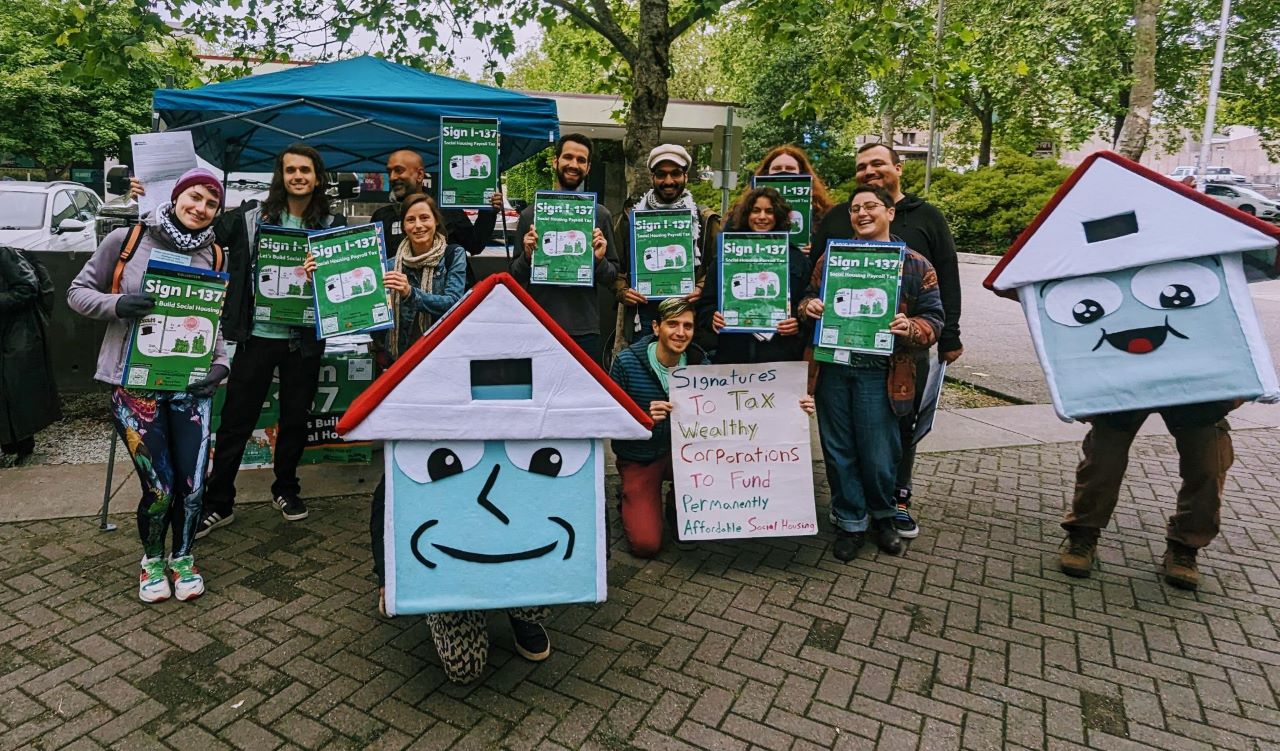
    Activists in Seattle gather signatures to put a social housing initiative on the ballot. In early 2025, voters passed the measure, which implements a payroll tax on high incomes to fund the program. House Our Neighbors, CC BY-SA

    Seattle astounded housing advocates around the country in February 2025, when roughly two-thirds of voters approved a ballot initiative proposing a new 5% payroll tax on salaries in excess of US$1 million.

    The expected revenue – estimated to amount to $52 million dollars annually – would go toward funding a public development authority named Seattle Social Housing, which would then build and maintain permanently affordable homes.

    The city has experienced record high rents and home prices over the past two decades, attributed in part to the high incomes and relatively low taxes paid by tech firms like Amazon. Prior attempts to make these companies do their part to keep the city affordable have had mixed results.

    So despite nationwide, bipartisan skepticism of government and tax increases, Seattle’s voters showed that in light of a severe affordability crisis, a new role for the public sector and a new, dedicated fiscal revenue stream for housing were not only necessary, but possible.

    As a trained architect and urban historian, I study how capitalist societies have embraced – or rejected – housing that’s permanently shielded from market forces and what that means for architecture and urban design.

    To me, Seattle’s social housing initiative shows that the country’s traditional, “either-or” housing model – of unregulated, market-rate housing versus tightly regulated, income-restricted affordable housing – has reached its limits.

    Social housing promises a different path forward.

    The rise of the ‘two-tiered’ system

    After World War I, amid a similarly dire housing crisis, journalist Catherine Bauer traveled to Europe and learned about the continent’s social housing programs.

    She publicized her findings in the 1934 book “Modern Housing,” in which she advocated for housing that would be permanently shielded from the private real estate market. High-quality design was central to her argument. (The book was reissued in 2020, reflecting a renewed hunger for her ideas.)

    Early New Deal programs supported “limited-dividend,” or nonprofit, housing sponsored by civic organizations such as labor unions. The Carl Mackley Houses in Philadelphia exemplified this approach: The government provided low-interest loans to the American Federation of Full-Fashioned Hosiery Workers, which then constructed housing for its workers with rents set at affordable rates. The complex was built with community rooms and a swimming pool for its residents.

    Financed by $1.2 million in federal funds, the Carl Mackley Houses, completed in 1935, provided homes for union workers.
    Alfred Kastner papers, Collection No. 7350, Box 45, Record 12, American Heritage Center, University of Wyoming

    However, the 1937 U.S. Housing Act omitted this form of middle-income housing. Instead, the federal government chose to support public rental housing for low-income Americans and private homeownership, with little in between.

    Historian Gail Radford has aptly termed this a “two-tiered system,” and it was problematic from the start.

    Funding for public housing in the U.S. – as well as for its successor, private-sector-built affordable housing – has always been capped in ways that fall far short of demand, with access to the homes largely restricted to households with the lowest incomes. Private-sector-built affordable housing depends on dangling tax credits for private investors, and rent restrictions can expire.

    While the U.S. promoted this two-tiered system, cities like Vienna pursued a different path.

    In Austria’s culturally vibrant capital, today half of all dwellings are permanently removed from the private market. Roughly 80% of households qualify to live in them. The buildings take a range of forms, are located in all neighborhoods, and are built and operated as rental or cooperative housing either by the city or by nonprofit developers.

    Rents do not rise and fall according to household income, but are instead set to cover capital and operation expenses. These are kept low thanks to long-term, low-interest loans. These loans are funded through a nationwide 1% payroll tax, split evenly between employers and employees. Renters also make a down payment, priced in relation to the size and age of the apartment, which keeps monthly rents down. To guarantee access to low-cost land, the municipality has pursued an active land acquisition policy since the 1980s.

    Vienna’s Pilotengasse Housing Estate, a social housing development featuring low-rise buildings with abundant greenery, was completed in 1992 and serves a range of income groups.
    Viennaslide/Construction Photography/Avalon/Getty Images

    Housing shielded from the private market

    The inequities created by the two-tiered system – along with the absence of viable options for moderate- and middle-income households – are what social housing advocates in the U.S. are trying to address today.

    In 2018, the think tank People’s Policy Project published what was likely the first 21st-century report advocating for social housing in the U.S., citing Vienna as a model.

    Across the U.S., social housing is being used to describe a range of programs, from limited equity cooperatives and community land trusts to public housing.

    They all share a few underlying principles, however.

    First and foremost, social housing calls for permanently shielding homes from the private real estate market, often referred to as “permanent affordability.” This usually means public investment in housing and public ownership of it. Second, unlike the ways in which public housing has traditionally operated in the U.S., most social housing programs aim to serve households across a broader range of incomes. The goal is to create housing that is both financially sustainable and appealing to broad swaths of the electorate. Third, social housing aspires to give residents more control over the governance of their homes.

    Social housing doesn’t all look the same. But thoughtful design is key to its success. It’s built to be owned and operated in the long-term, not for short-term financial gain. Construction quality matters, and developers realize it needs to be appealing to a range of tenants with different needs.

    Early successes

    In recent years, there have been significant wins for the social housing movement at the state and local levels.

    In 2023, Atlanta created a new quasi-public entity to co-develop mixed-income housing on city-owned land. In 2024, Rhode Island voters and the Massachusetts legislature funded pilot projects to test public investment in social housing. And 2025 has seen the the passage of Chicago’s Green Social Housing ordinance.

    Many of these programs were directly inspired by affordable housing initiatives in Montgomery County, Maryland.

    Since 2021, the county’s housing authority has used a $100 million housing fund to invest in new mixed-income developments. Through these investments, the county retains co-ownership and has been able to bring down the cost of development enough to offer 30% of homes at significantly below market rents, in perpetuity. If Vienna is the global paragon for social housing, Montgomery County has become its domestic counterpart.

    In Seattle, social housing will mean homes delivered and permanently owned by Seattle Social Housing, which is funded through the payroll tax on high incomes. The initiative envisions developments featuring a range of apartment sizes to meet the needs of different family sizes, built to high energy-efficiency standards. Homes will be available to households earning up to 120% of area median income, with residents paying no more than 30% of their income on rent. In Seattle, that means that a single-person household making up to $120,000 will qualify.

    Members of the New York City Council hold a rally with housing activists to promote social housing legislation in March 2023.
    William Alatriste/NYC Council Media Unit, CC BY-SA

    Ongoing debates

    Despite these successes, many Americans remain skeptical of social housing.

    Sign up for a webinar on the topic, and you’ll hear participants question the term itself. Isn’t it far too “socialist” to be broadly adopted in the U.S.? And isn’t this just “old wine in new bottles”?

    Join a housing task force, and established nonprofits will be the ones to push back, arguing that they already know how to build and manage housing, and that all they need is money.

    Some housing activists also question whether using scarce public dollars to pay for mixed-income housing will yet again shortchange those who most need governmental assistance – namely, the poor. Others point to the need to provide more ways to build intergenerational wealth, especially for racial minorities, who have historically faced barriers to homeownership.

    Urban planner Jonathan Tarleton has highlighted another important issue: the danger of social housing reverting over time to private ownership, as has been the case with some cooperatives in New York City. Tarleton stresses the need for “social maintenance” – the importance of telling and retelling the story of whom social housing is meant to serve.

    These debates raise important questions. Social housing may be a confusing term and an aspirational concept. But it is here to stay: It has galvanized organizers and policymakers around a new approach to the design, development and maintenance of housing.

    Social housing keeps prices down through long-term public investment, ensuring that future generations will still benefit. Developers can design and provide homes that respond to how people want to live. And in an increasingly polarized country, social housing will allow people of various backgrounds, incomes and ideological persuasions to live together again, rather than apart.

    Whether it’s the kind found in Seattle, in Maryland or somewhere in between, I believe social housing is needed more than ever before to address the country’s twin problems of affordability and a lack of political imagination.

    This article is part of a series centered on envisioning ways to deal with the housing crisis.

    Susanne Schindler receives funding from Harvard’s Joint Center for Housing Studies.

    ref. From Seattle to Atlanta, new social housing programs seek to make homes permanently affordable for a range of incomes – https://theconversation.com/from-seattle-to-atlanta-new-social-housing-programs-seek-to-make-homes-permanently-affordable-for-a-range-of-incomes-255097

    MIL OSI

  • MIL-OSI Submissions: What schools can learn from skate culture

    Source: The Conversation – UK – By Sander Hölsgens, Assistant Professor, Leiden Institute of Cultural Anthropology and Development Sociology, Leiden University

    Dean Drobot/Shutterstock

    At a school in Malmö, Sweden, skateboarding is on the curriculum. John Dahlquist, vice principal of Bryggeriets High School, teaches skate classes and brings lessons from skateboarding into other subjects. By encouraging teenagers to have fun together through skating and beyond, he notices that they want to attend school. Writing in a recent book I co-edited on skateboarding and teaching, Dahlquist notes that he even sees students longing to be back in the classroom after the weekend.

    Skateboarding is creative, requiring ingenuity in adapting to new environments. It’s collaborative and social: skaters cheer each other on when they try to learn something new, acknowledging that everyone operates at a different level and faces a distinct challenge.

    When skateboarding is done well, individual growth takes place among a community of care and mutual support. And it requires a willingness to fail. There’s no way to master a trick without trying and failing, over and over again.

    My colleagues and I have researched the value of a skateboarding philosophy in schools, and how teachers can bring it into their classrooms.


    Get your news from actual experts, straight to your inbox. Sign up to our daily newsletter to receive all The Conversation UK’s latest coverage of news and research, from politics and business to the arts and sciences.


    Take Dahlquist’s teaching in Malmö. He notes that interweaving skate classes with other subjects has multiple noteworthy effects. The physical activity of skateboarding improves levels of concentration. Some students even say that they’d never been successful in any other learning environment. Elsewhere, they’d be unable to focus on the task at hand.

    What’s more, a skateboarding mindset – being prepared to learn difficult tricks in unfamiliar settings – equipped students with the capacity to master other kinds of new skills.

    Able to fail

    The process of overcoming the anxiety to fail is crucial. Skaters cannot be afraid to fall if they want to learn new tricks. The motivation to learn through repeated efforts helps skaters in other areas of life, too. Skaters at Bryggeriet aren’t worried as much about failing grades, precisely because they see it as an opportunity to learn and move forward.

    As Dahlquist says, “At the end of my classes, I usually have to throw my students out of the classroom. A lot of them beg for three more tries: ‘I’ve got this, just give me three more tries. I promise I will learn.‘”

    This mindset decreases grades as education’s cornerstone and, by extension, enhances students’ mental health. My colleague Esther Sayers, who conducted fieldwork at Bryggeriets, found another effect. Teachers help students to develop the skills to get motivated, to reach a point of feeling inspired – or what skaters call “stoke”.

    Skateboarding fosters a non-competitive learning culture.
    PeopleImages.com – Yuri A

    Bryggeriets High School isn’t the only place where skateboarding is helping teach people how to learn. Reaching beyond its historical status as a self-regulated street culture, skateboarding now plays an important role in building engaged learning communities across the globe. Berlin-based skate organisation Skateistan hosts skate classes, gives young people access to education and offers funds for young and upcoming community leaders.

    Concrete Jungle Foundation co-builds skateparks with young people in Peru, Morocco and Jamaica, in order to exchange knowledge and drive local ownership and apprenticeship. Similarly, the New York-based Harold Hunter Foundation runs skate workshops that also provide mentoring and career guidance.

    Colleagues Arianna Gil and Jessica Forsyth have studied working class black and Latin American skate crews, run by genderdiverse community organisers. They found that skate crews such as Brujas and Gang Corp mobilise skaters according to the “for us, by us” spirit.

    Challenging institutional models of authority, these skate crews develop services based on the hopes and aspirations of their communities – ranging from teach-ins to recreational programmes. This includes a talk on the history and meaning of hoodies, and modules on the power of storytelling and the danger of propaganda. The crux, here, is to learn about stuff you encounter in your daily lives.

    Skaters who experience poverty and oppression create their own ecosystem for learning from one another, from being out of an educational system that is organised in a top-down way. This means creating a grassroots school model where skate crews choose what and how they want to learn. Rather than grades and degrees, education here is structured around the process of learning from your peers – with the idea of passing on this knowledge in the near future.

    The effects of this approach are threefold. First, it centers mentorship and apprenticeship, resulting in intergenerational knowledge exchange. Second, skateboarding’s DIY spirit can help overcome access barriers. By embracing grassroots teaching practices and formats, education can be tailored to the specific needs and desires of a community, rather than following standardised learning objectives.

    Third, rather than focusing on memorising facts or learning for grades, this new ecosystem is structured around problem-based learning. Presented with worldly problems such as human rights violations and hostile architecture, skaters learn not just how to analyse their surroundings, but also how to cope with and engage oppressive societal structures.

    As formal education faces incremental budget cuts and deepened governmental influence, skateboarding shows us new ways to organise our learning spaces. Schools and teachers can engage their students by integrating aspects of a learning culture that decentres evaluations and assessments and celebrates attempts, rather than just successes.

    Sander Hölsgens received a ‘starting grant’ from OCW, The Netherlands. He is affiliated with Pushing Boarders, a platform tracing the social impact of skateboarding worldwide.

    ref. What schools can learn from skate culture – https://theconversation.com/what-schools-can-learn-from-skate-culture-255239

    MIL OSI

  • MIL-OSI Submissions: What people really want from their GP – it’s simpler than you might think

    Source: The Conversation – UK – By Helen Atherton, Professor of Primary Care Research, University of Southampton

    Stephen Barnes/Shutterstock.com

    Booking a GP appointment is a routine task, yet for many people it’s a source of frustration. Long waits, confusing systems and impersonal processes have become all too familiar. While much attention has been paid to how difficult it is to get an appointment, less research has asked a more fundamental question: what do patients actually want from their general practice?

    To answer this, my colleagues and I reviewed 33 studies that were a mixture of study designs, and focused on patients’ expectations and preferences regarding access to their GP in England and Scotland.

    What people wanted was not complicated or cutting edge. People were looking for connection; a friendly receptionist and good communication from the practice about how they could expect to make an appointment. And they wanted a general practice in their own neighbourhood with clean, calm waiting rooms. So far, so simple.


    Get your news from actual experts, straight to your inbox. Sign up to our daily newsletter to receive all The Conversation UK’s latest coverage of news and research, from politics and business to the arts and sciences.


    People wanted booking systems that were simple and user-friendly, without long automated phone menus (“press one for reception”). Preferences varied. Some patients valued the option to book appointments in person at the reception desk, while others preferred the convenience of online booking.

    Regardless of how they booked, patients wanted shorter waiting times or, at least, clear information about when they could expect an appointment or a callback.

    Ideally, general practice would be open on Saturdays and Sundays for those who cannot attend during the week.

    Remote consultations – by phone, video or email – have become more common since the pandemic, and many patients found them helpful. For those with caring responsibilities or mobility issues, they offered a convenient way to access care without needing to leave home.

    However, remote appointments weren’t suitable for everyone. Some patients lacked privacy at work, while others – particularly those with hearing impairments – found telephone consultations difficult or impossible to use.

    What patients consistently wanted was choice, particularly when it came to remote consultations. While in-person appointments were seen as the gold standard, many recognised that telephone or video consultations could be useful in certain situations. Preferences varied widely, which made the ability to choose the type of consultation especially important.

    Patients also wanted choice over who they saw, especially for non-urgent issues or when managing ongoing health conditions.

    In today’s general practice, care is often delivered by a range of professionals, including nurses, pharmacists and physiotherapists. While many patients were open to seeing different healthcare professionals, older adults and people from minority ethnic backgrounds were more likely to prefer seeing a GP.

    Overall, patients wanted the option to choose a GP over another healthcare professional – or at least be involved in that decision.

    Satisfaction at all-time low

    Unsurprisingly, what patients want from general practice varies, reflecting different lifestyles, needs and circumstances. But what was equally clear is that many people are not able to get what they want from the appointment system.

    According to a recent British Social Attitudes survey, patient satisfaction with general practice is at an all-time low, with just below one in three people reporting that they are very or quite satisfied with GP services.

    Some elements of the UK government’s recently announced ten-year plan for the NHS in England may address some of these concerns, but it remains far from certain. The emphasis on the NHS app as a “doctor in your pocket” does not align with what many patients are asking for: genuine choice over whether they access care online or in person.


    Read more:
    NHS ten-year plan for England: what’s in it and what’s needed to make it work


    Not everyone wants a doctor in their pocket.
    NHS/Shutterstock.com

    The proposal to open neighbourhood health centres on weekends could benefit those who need more flexible access. However, simply increasing the number of appointments misses the point: patients want more than just availability. They want care that is accessible, personalised and responsive to their individual needs.

    The evidence is clear and the solutions simple, yet patient satisfaction remains at an all-time low. The government must stop assuming technology is the answer and start listening to what patients are actually telling them. The cost of ignoring their voices is a healthcare system that serves no one well.

    Helen Atherton receives funding from the National Institute for Health Research and the Research Council of Norway.

    ref. What people really want from their GP – it’s simpler than you might think – https://theconversation.com/what-people-really-want-from-their-gp-its-simpler-than-you-might-think-260520

    MIL OSI

  • MIL-OSI Submissions: Georgia: how democracy is being eroded fast as government shifts towards Russia

    Source: The Conversation – UK – By Natasha Lindstaedt, Professor in the Department of Government, University of Essex

    Georgia was once considered a post-Soviet success story. After years of authoritarian rule, followed by independence which brought near state collapse, corruption and chaos, Georgia appeared to have transitioned to democracy.

    In a period after independence in 1991 and before 2020, elections were regularly held and were deemed mostly free and fair, the media and civil society were vibrant and corruption levels had diminished significantly.

    The “Rose revolution” in 2003 ushered in an era of unprecedented reform and suggested a move towards democracy and a closer relationship with the west. Georgians were full of hope for the country’s future, and prospects of joining the European Union – or at least moving closer to Europe.

    Fast forward two decades and Georgia has fully returned to authoritarianism. Six opposition leaders are in prison or facing charges and now thinktank leaders are being targeted with investigations that could land them in prison. Typically these charges centre around accepting foreign funding or criticising the government.


    Get your news from actual experts, straight to your inbox. Sign up to our daily newsletter to receive all The Conversation UK’s latest coverage of news and research, from politics and business to the arts and sciences.


    In moves in line with other authoritarian regimes around the world, opposition organisations such as thinktanks are being told to produce financial documents in short timeframes, and accused of financial mismanagement and threatened with prosecution if they don’t.

    In May 2024, Georgia passed a Russian-inspired foreign agent law — which would require non-governmental organisations (NGOs) receiving foreign funding to register themselves and face restrictions. Protests erupted each time Georgia’s parliament debated this measure, but eventually the pro-RussianGeorgia Dream party prevailed. More than 90% of NGOs receive funding from abroad, so the new law cripples the efforts of some 26,000 of them.

    Many Georgians were outraged that the passage of the bill may end dreams of one day becoming a European Union candidate country. Regular surveys have found that about 80% of Georgians have aspirations for their country to join the EU.

    Though Georgia faces a host of economic problems, the Georgia Dream party has campaigned on delivering a return to traditional values. Like Russia they have also passed a series of laws in 2024 that target the LGBTQ+ community, such as banning content that features same-sex relationships and stripping same-sex couples of rights, such as adoption.

    Parallels with Russia?

    Georgia Dream also passed legislation making treason a criminal offence, a clear attempt to eliminate political opponents. Any insults of politicians online are also considered a criminal offence.

    Also, in June of this year civil society organisations in Georgia received court orders requiring them to disclose highly sensitive data. Meanwhile, members of the Georgia Dream party were accused of assaulting opposition party leader Giorgi Gakharia suffering a broken nose and a concussion, which they denied.

    In another effort to exercise greater control over the state, since the beginning of this year more than 800 civil servants have been dismissed. Similar to the purges that took place in Turkey — this is not being done in the name of efficiency, but to ensure that the bureaucracy is loyal to wishes of the Georgia Dream government.

    This hasn’t happened overnight, as the laws had already changed several times to weaken legal protections for civil servants.

    During its time in government, the Georgia Dream party has moved the country much closer to Russia, often by portraying the nation as locked in a cultural struggle against the west. Despite this, 69% of Georgians still see Russia as Georgia’s main enemy, up from 35% in 2012.

    Though the Georgia Dream party faces increasing public opposition to its rule, it gained nearly the same amount of votes in the 2024 elections as it did in 2012 – when it was at its peak of popularity. The election result in October 2024 may be partly explained by accusations of fraud and other irregularities.

    How did this happen?

    One of the first big threats to Georgia’s democracy came in August 2008 when Russia invaded the country to offer support for two breakaway regions in South Ossetia and Abkhazia which declared themselves independent from Georgia. The international community did little to censure Russia, giving Russian president Vladimir Putin the confidence to engage in further acts of aggression.

    Russia has maintained troops in South Ossetia, only about 30 miles from Georgia’s capital Tbilisi, and continues to play an important role in Georgian politics, undermining democracy.

    The next threat came from within. Billionaire Bidzina Ivanishvili was elected prime minister of Georgia in 2012 as the leader of Georgia Dream. despite the fact that he officially stepped down from this position in 2013, he has wielded power behind the scenes and is still widely considered to be the de facto leader of Georgia.

    Though Georgia did not immediately slide towards autocracy under the Georgia Dream party, today there are few remnants of democracy left. The major opposition parties are banned, opposition politicians and journalists are spied on, and protests are repressed by the police.

    Cameras are now installed on the streets of Tbilisi as part of a crackdown on protest and fines for protesting have increased. Elections are no longer considered to be free and fair by the European Union and others as the Georgia Dream party uses its access to the state resources to dole out patronage to its supporters and intimidate voters.

    In just over two decades, Georgia has managed to plunge back to authoritarianism. Once hailed as a beacon of democratic reform, the country is now gripped by a Russian-influenced ruling party that has consolidated power through repression, surveillance and manipulation.

    But while the Georgia Dream party has tried to dismantle the country’s democratic institutions, support for resistance is high. According to a poll in 2025, more than 60% of respondents supported protests against the government and 45% identified as active supporters. And 82% feel Georgia is in crisis, with 78% blaming Georgian Dream.

    It appears that Russia may have succeeded in undermining democracy in Georgia, but not in shaping hearts and minds.

    Natasha Lindstaedt does not work for, consult, own shares in or receive funding from any company or organisation that would benefit from this article, and has disclosed no relevant affiliations beyond their academic appointment.

    ref. Georgia: how democracy is being eroded fast as government shifts towards Russia – https://theconversation.com/georgia-how-democracy-is-being-eroded-fast-as-government-shifts-towards-russia-260430

    MIL OSI

  • MIL-OSI Submissions: US backs Nato’s latest pledge of support for Ukraine, but in reality seems to have abandoned its European partners

    Source: The Conversation – UK – By Stefan Wolff, Professor of International Security, University of Birmingham

    Recent news from Ukraine has generally been bad. Since the end of May, ever larger Russian air strikes have been documented against Ukrainian cities with devastating consequences for civilians, including in the country’s capital, Kyiv.

    Amid small and costly but steady gains along the almost 1,000km long frontline, Russia reportedly took full control of the Ukrainian region of Luhansk, part of which it had already occupied before the beginning of its full-scale invasion of Ukraine in February 2022.

    And according to Dutch and German intelligence reports, some of Russia’s gains on the battlefield are enabled by the widespread use of chemical weapons.


    Get your news from actual experts, straight to your inbox. Sign up to our daily newsletter to receive all The Conversation UK’s latest coverage of news and research, from politics and business to the arts and sciences.


    It was therefore something of a relief that Nato’s summit in The Hague produced a short joint declaration on June 25 in which Russia was clearly named as a “long-term threat … to Euro-Atlantic security”. Member states restated “their enduring sovereign commitments to provide support to Ukraine”. While the summit declaration made no mention of future Nato membership for Ukraine, the fact that US president Donald Trump agreed to these two statements was widely seen as a success.

    Yet, within a week of the summit, Washington paused the delivery of critical weapons to Ukraine, including Patriot air defence missiles and long-range precision-strike rockets. The move was ostensibly in response to depleting US stockpiles.

    This despite the Pentagon’s own analysis, which suggested that the shipment – authorised by the former US president Joe Biden last year – posed no risk to US ammunition supplies.

    This was bad news for Ukraine. The halt in supplies weakens Kyiv’s ability to protect its large population centres and critical infrastructure against intensifying Russian airstrikes. It also puts limits on Ukraine’s ability to target Russian supply lines and logistics hubs behind the frontlines that have been enabling ground advances.

    Despite protests from Ukraine and an offer from Germany to buy Patriot missiles from the US for Ukraine, Trump has been in no rush to reverse the decision by the Pentagon.

    Russia is now claiming to have completed its occupation of the province of Luhansk in eastern Ukraine.
    Institute for the Study of War

    Another phone call with his Russian counterpart, Vladimir Putin, on July 3, failed to change Trump’s mind, even though he acknowledged his disappointment with the clear lack of willingness by the Kremlin to stop the fighting. What’s more, within hours of the call between the two presidents, Moscow launched the largest drone attack of the war against Kyiv.

    A day later, Trump spoke with Zelensky. And while the call between them was apparently productive, neither side gave any indication that US weapons shipments to Ukraine would resume quickly.

    Trump previously paused arms shipments and intelligence sharing with Ukraine in March, 2025 after his acrimonious encounter with Zelensky in the Oval Office. But the US president reversed course after certain concessions had been agreed – whether that was an agreement by Ukraine to an unconditional ceasefire or a deal on the country’s minerals.

    It is not clear with the current disruption whether Trump is after yet more concessions from Ukraine. The timing is ominous, coming after what had appeared to be a productive Nato summit with a unified stance on Russia’s war of aggression. And it preceded Trump’s call with Putin.

    This could be read as a signal that Trump was still keen to accommodate at least some of the Russian president’s demands in exchange for the necessary concessions from the Kremlin to agree, finally, the ceasefire that Trump had once envisaged he could achieve in 24 hours.

    If this is indeed the case, the fact that Trump continues to misread the Russian position is deeply worrying. The Kremlin has clearly drawn its red lines on what it is after in any peace deal with Ukraine.

    These demands – virtually unchanged since the beginning of the war – include a lifting of sanctions against Russia and no Nato membership for Ukraine, while also insisting that Kyiv must accept limits on its future military forces and recognise Russia’s annexation of Crimea and four regions on the Ukrainian mainland.

    This will not change as a result of US concessions to Russia but only through pressure on Putin. And Trump has so far been unwilling to apply pressure in a concrete and meaningful way beyond the occasional hints to the press or on social media.

    Coalition of the willing

    It is equally clear that Russia’s maximalist demands are unacceptable to Ukraine and its European allies. With little doubt that the US can no longer be relied upon to back the European and Ukrainian position, Kyiv and Europe need to accelerate their own defence efforts.

    A European coalition of the willing to do just that is slowly taking shape. It straddles the once more rigid boundaries of EU and Nato membership and non-membership, involving countries such as Moldova, Norway and the UK.
    and including non-European allies including Canada, Japan and South Korea.

    The European commission’s white paper on European defence is an obvious indication that the threat from Russia and the needs of Ukraine are being taken seriously and, crucially, acted upon. It mobilises some €800 billion (£690 billion) in defence spending and will enable deeper integration of the Ukrainian defence sector with that of the European Union.

    At the national level, key European allies, in particular Germany, have also committed to increased defence spending and stepped up their forward deployment of forces closer to the borders with Russia.

    US equivocation will not mean that Ukraine is now on the brink of losing the war against Russia. Nor will Europe discovering its spine on defence put Kyiv immediately in a position to defeat Moscow’s aggression.

    After decades of relying on the US and neglecting their own defence capabilities, these recent European efforts are a first step in the right direction. They will not turn Europe into a military heavyweight overnight. But they will buy time to do so.

    Stefan Wolff is a past recipient of grant funding from the Natural Environment Research Council of the UK, the United States Institute of Peace, the Economic and Social Research Council of the UK, the British Academy, the NATO Science for Peace Programme, the EU Framework Programmes 6 and 7 and Horizon 2020, as well as the EU’s Jean Monnet Programme. He is a Trustee and Honorary Treasurer of the Political Studies Association of the UK and a Senior Research Fellow at the Foreign Policy Centre in London.

    ref. US backs Nato’s latest pledge of support for Ukraine, but in reality seems to have abandoned its European partners – https://theconversation.com/us-backs-natos-latest-pledge-of-support-for-ukraine-but-in-reality-seems-to-have-abandoned-its-european-partners-260334

    MIL OSI

  • MIL-OSI Submissions: Nature-friendly farming budget swells in UK – but cuts elsewhere make recovery fraught

    Source: The Conversation – UK – By Nathalie Seddon, Professor of Biodiversity, Smith School of Enterprise and Environment and Department of Biology, University of Oxford

    Skylarks are a red-listed species, which means they are of high conservation concern in the UK. WildlifeWorld/Shutterstock

    Nature in the UK appeared to receive a rare funding boost in the June spending review, with the government setting a spending target of up to £2 billion a year for England’s environmental land management (ELM) scheme by 2028-29.

    By steering public funds toward farmers who restore hedgerows, soils and wetlands, England’s ELM programme is meant to renew landscapes that absorb carbon, support pollinators and keep water clean while helping rural businesses stay viable in a changing climate.

    If delivered in full, the package would elevate the UK’s post-Brexit model of investing public money in shared ecological care (rather than payments based on acreage) to one of the most generously funded in the world.

    Yet, scrutinise the details and a more complicated story emerges.


    Get your news from actual experts, straight to your inbox. Sign up to our daily newsletter to receive all The Conversation UK’s latest coverage of news and research, from politics and business to the arts and sciences.


    The review has trimmed the day-to-day budget of the Department for Environment, Food and Rural Affairs (Defra) in real terms. Defra now faces the unenviable task of signing and monitoring thousands of new ELM agreements with fewer staff and shrinking data resources. Without the capacity to check whether fields really have become richer in skylarks or streams clearer of fertiliser, large sums could be delayed or misdirected.

    Scale is another challenge. An independent analysis published in 2024 estimated that roughly £6 billion every year across the UK is needed to bring agriculture in line with the Environment Act targets for habitat restoration and net zero commitments.

    Even the full £2 billion promised for England would meet only about half of that evidence-based need. And the “up to” £400 million for trees and peatlands is not new money: it is funding that was first promised in 2024 and the payment schedule has still not been confirmed.

    Money could be paid to farmers for allowing woodlands to regenerate.
    Richard Hepworth, CC BY

    While the review earmarked £4.2 billion for flood and coastal defence, it does not specify how much of that will support nature-based measures such as floodplain restoration, or the creation of saltmarshes or riparian woodlands. The Environment Agency is consulting on a funding model that could embed such solutions, but the Treasury papers are silent on who will pay for that shift.

    Tech spending dwarfs habitat investment

    Contrast this with the sums heading to the Department for Energy Security and Net Zero.

    Roughly £30 billion is earmarked for nuclear fission, fusion research and carbon-capture hubs. These projects are heavy on concrete and steel (materials with a hefty carbon cost) but have no immediate ecological benefit.

    While new low-carbon technologies are crucial, thriving and resilient soils, wetlands and woodlands nourish food systems, safeguard water and hold vast stores of carbon – benefits that deepen and become more cost-effective over time.

    Nature-based solutions can also revitalise local economies. The Office for National Statistics estimates that replacing the benefits flowing from the UK’s forests, rivers and soils – flood buffering, crop pollination, cleaner air, recreation and more – would cost about £1.8 trillion, a figure that only hints at their deeper, immeasurable value.

    Yet the review sets out no plan to safeguard these life-support systems, or to factor their decline into the Treasury’s green book (the rule book used to appraise public investments) or the Bank of England’s stress tests, which check how shocks could ripple through the financial system.

    This is also a matter of fairness and public health. Growing evidence shows that regular contact with nature lowers the risks of heart disease and anxiety, while improving children’s cognitive development. These are benefits with a value that defies any price tag.

    Yet the places with the fewest trees and parks tend to be the same post-industrial towns ministers want to “level up”. The review is silent on biodiversity net gain (the flagship policy meant to channel private finance into local habitats) and on a proposed national nature wealth fund that could blend public and private capital for large-scale restoration.

    Housing money could repeat past mistakes

    One line in the spending review could still shift the balance.

    The chancellor has earmarked £39 billion for building social and affordable housing over the next decade. If every development delivers at least a 10% net gain for biodiversity onsite, and if schemes build in climate-smart design (living roofs, shade-giving street trees, permeable surfaces) with local residents, Britain could pioneer the world’s first large-scale, nature-positive, net-zero housing programme.

    Without those safeguards, “levelling up” risks repeating old mistakes: sealing green space under concrete today and paying tomorrow to retrofit drainage, shade and parks.

    Green space is scarce on this new housing estate near Cardiff, Wales.
    Shutterstock

    That risk is heightened by the government’s planning and infrastructure bill, now before parliament. In an open letter to MPs, economists and ecologists warn that the bill would let developers “pay cash to trash” irreplaceable habitats by swapping onsite protection for a levy, a move they describe as a “licence to kill nature”.

    At the next UN climate summit, Cop30 in Brazil in November 2025, the UK will have to show the world that its domestic spending matches its international rhetoric.

    More than 150 UK researchers made that point in an open letter to the prime minister, urging him to put nature at the centre of the UK’s Cop30 stance. Converting the Treasury’s headline figures into habitat gains and locking robust rules into both the planning bill and the housing drive would give ministers credible proof of progress when they update the UK’s climate and nature pledges on the Cop30 stage.

    The spending review may have nudged farm policy in the right direction and set a new higher water mark for nature-positive agriculture. Yet amid the squeeze on Defra, the recycling rather than expansion of tree and peat budgets and the continued dominance of technology over habitat, nature still comes a distant second to hard infrastructure in the UK growth model.

    There is still time to change course. Guaranteeing Defra’s capacity, publishing a timetable for the tree-and-peat fund, reserving part of the flood budget for community-led nature-based solutions and hardwiring strong biodiversity net gain rules into housing and planning reforms would turn headline promises into projects that enrich daily life while stewarding public money wisely.


    Don’t have time to read about climate change as much as you’d like?

    Get a weekly roundup in your inbox instead. Every Wednesday, The Conversation’s environment editor writes Imagine, a short email that goes a little deeper into just one climate issue. Join the 45,000+ readers who’ve subscribed so far.


    Nathalie Seddon receives funding from UKRI and the Leverhulme Trust and sits on the UK Climate Change Committee. She is also a trustee of the Circular Bioeconomy Alliance and is a non-executive director of the social venture, Nature-based Insights.

    ref. Nature-friendly farming budget swells in UK – but cuts elsewhere make recovery fraught – https://theconversation.com/nature-friendly-farming-budget-swells-in-uk-but-cuts-elsewhere-make-recovery-fraught-259091

    MIL OSI

  • MIL-OSI Analysis: Are people at the South Pole upside down?

    Source: The Conversation – USA (2) – By Abigail Bishop, Ph.D. Student in Physics, University of Wisconsin-Madison

    At the South Pole, which way is up? Abigail Bishop

    Curious Kids is a series for children of all ages. If you have a question you’d like an expert to answer, send it to CuriousKidsUS@theconversation.com.


    Are people on the South Pole walking upside down from the rest of the world? – Ralph P., U.S.


    When I was standing at the South Pole, I felt the same way I feel anywhere on Earth because my feet were still on the ground and the sky was still overhead.

    I’m an astrophysicist from Wisconsin who lived at the South Pole for seven weeks from December 2024 to January 2025 to work on an array of detectors looking for extremely high energy particles from outer space.

    I didn’t feel upside down, but there were some differences that still made the South Pole feel flipped over from what I was used to.

    As someone who loves looking for the Moon, I noticed that the face of the man on the Moon was flipped over, like he went from to . All the craters that I was used to seeing on the top of the Moon from Wisconsin were now on the bottom – because I was looking at the Moon from the Southern Hemisphere instead of the Northern Hemisphere.

    How the Moon looks depends on your point of view.
    The Planetary Society, CC BY-SA

    After noticing this difference, I remembered something similar in the night skies of New Zealand, a country near Antarctica where my fellow travelers and I got our big red coats that kept us warm at the South Pole. I had looked for Orion, a constellation that in the Northern Hemisphere is viewed as a hunter holding a bow and drawing an arrow from his quiver. In the night sky of New Zealand, Orion looked like he was doing a handstand.

    Everything in the sky felt upside down and opposite, compared with what I was used to. A person who lives in the Southern Hemisphere might feel the same about visiting the Arctic or the North Pole.

    ‘The Big Blue Marble’ photo, taken in 1972 by the crew of Apollo 17.
    NASA

    An out-of-this-world perspective

    To understand what’s happening, and why things are really different but also feel very much the same, it might be useful to back up a bit from Earth’s surface. Like into outer space. On space missions to the Moon, astronauts could see one side of the Earth’s sphere at once.

    If they had superhero vision, an astronaut would see the people at the South Pole and North Pole standing upside down from each other. And a person at the equator would look like they were sticking straight out the side of the planet. In fact, even though they might be standing on the equator, people in Colombia and Indonesia would also look like they were upside down from each other, because they would be sticking out from opposite sides of the Earth.

    Of course, if you asked each person, they would say, “My feet are on the ground, and the sky is up.”

    That’s because Earth is essentially a really big ball whose gravitational pull on every one of us points to the center of the planet. The direction that Earth pulls us in is what people call “down” all over the planet. Think about holding a baseball between your pointer fingers. From the perspective of your fingertips on the ball’s surface, both are pointing “down.” But from the perspective of a friend nearby, your fingers are pointing in different directions – though always toward the center of the ball.

    These relationships between people on the Earth’s surface are good for a little bit of fun, though. While I was at the South Pole, I pointed my body in the same direction as my friends in Wisconsin – by doing a handstand. But if you look at the picture the other way around, it looks like I’m holding up the entire planet, like Superman.

    This is the right way up: Abigail Bishop does a handstand at the ceremonial South Pole.
    Abigail Bishop

    Hello, curious kids! Do you have a question you’d like an expert to answer? Ask an adult to send your question to CuriousKidsUS@theconversation.com. Please tell us your name, age and the city where you live.

    And since curiosity has no age limit – adults, let us know what you’re wondering, too. We won’t be able to answer every question, but we will do our best.

    Abigail Bishop receives funding from National Science Foundation Award 2013134 and has received funding from the Belgian American Education Foundation.

    ref. Are people at the South Pole upside down? – https://theconversation.com/are-people-at-the-south-pole-upside-down-256754

    MIL OSI Analysis

  • MIL-OSI Analysis: Are people at the South Pole upside down?

    Source: The Conversation – USA (2) – By Abigail Bishop, Ph.D. Student in Physics, University of Wisconsin-Madison

    At the South Pole, which way is up? Abigail Bishop

    Curious Kids is a series for children of all ages. If you have a question you’d like an expert to answer, send it to CuriousKidsUS@theconversation.com.


    Are people on the South Pole walking upside down from the rest of the world? – Ralph P., U.S.


    When I was standing at the South Pole, I felt the same way I feel anywhere on Earth because my feet were still on the ground and the sky was still overhead.

    I’m an astrophysicist from Wisconsin who lived at the South Pole for seven weeks from December 2024 to January 2025 to work on an array of detectors looking for extremely high energy particles from outer space.

    I didn’t feel upside down, but there were some differences that still made the South Pole feel flipped over from what I was used to.

    As someone who loves looking for the Moon, I noticed that the face of the man on the Moon was flipped over, like he went from to . All the craters that I was used to seeing on the top of the Moon from Wisconsin were now on the bottom – because I was looking at the Moon from the Southern Hemisphere instead of the Northern Hemisphere.

    How the Moon looks depends on your point of view.
    The Planetary Society, CC BY-SA

    After noticing this difference, I remembered something similar in the night skies of New Zealand, a country near Antarctica where my fellow travelers and I got our big red coats that kept us warm at the South Pole. I had looked for Orion, a constellation that in the Northern Hemisphere is viewed as a hunter holding a bow and drawing an arrow from his quiver. In the night sky of New Zealand, Orion looked like he was doing a handstand.

    Everything in the sky felt upside down and opposite, compared with what I was used to. A person who lives in the Southern Hemisphere might feel the same about visiting the Arctic or the North Pole.

    ‘The Big Blue Marble’ photo, taken in 1972 by the crew of Apollo 17.
    NASA

    An out-of-this-world perspective

    To understand what’s happening, and why things are really different but also feel very much the same, it might be useful to back up a bit from Earth’s surface. Like into outer space. On space missions to the Moon, astronauts could see one side of the Earth’s sphere at once.

    If they had superhero vision, an astronaut would see the people at the South Pole and North Pole standing upside down from each other. And a person at the equator would look like they were sticking straight out the side of the planet. In fact, even though they might be standing on the equator, people in Colombia and Indonesia would also look like they were upside down from each other, because they would be sticking out from opposite sides of the Earth.

    Of course, if you asked each person, they would say, “My feet are on the ground, and the sky is up.”

    That’s because Earth is essentially a really big ball whose gravitational pull on every one of us points to the center of the planet. The direction that Earth pulls us in is what people call “down” all over the planet. Think about holding a baseball between your pointer fingers. From the perspective of your fingertips on the ball’s surface, both are pointing “down.” But from the perspective of a friend nearby, your fingers are pointing in different directions – though always toward the center of the ball.

    These relationships between people on the Earth’s surface are good for a little bit of fun, though. While I was at the South Pole, I pointed my body in the same direction as my friends in Wisconsin – by doing a handstand. But if you look at the picture the other way around, it looks like I’m holding up the entire planet, like Superman.

    This is the right way up: Abigail Bishop does a handstand at the ceremonial South Pole.
    Abigail Bishop

    Hello, curious kids! Do you have a question you’d like an expert to answer? Ask an adult to send your question to CuriousKidsUS@theconversation.com. Please tell us your name, age and the city where you live.

    And since curiosity has no age limit – adults, let us know what you’re wondering, too. We won’t be able to answer every question, but we will do our best.

    Abigail Bishop receives funding from National Science Foundation Award 2013134 and has received funding from the Belgian American Education Foundation.

    ref. Are people at the South Pole upside down? – https://theconversation.com/are-people-at-the-south-pole-upside-down-256754

    MIL OSI Analysis

  • MIL-OSI Analysis: Are people at the South Pole upside down?

    Source: The Conversation – USA (2) – By Abigail Bishop, Ph.D. Student in Physics, University of Wisconsin-Madison

    At the South Pole, which way is up? Abigail Bishop

    Curious Kids is a series for children of all ages. If you have a question you’d like an expert to answer, send it to CuriousKidsUS@theconversation.com.


    Are people on the South Pole walking upside down from the rest of the world? – Ralph P., U.S.


    When I was standing at the South Pole, I felt the same way I feel anywhere on Earth because my feet were still on the ground and the sky was still overhead.

    I’m an astrophysicist from Wisconsin who lived at the South Pole for seven weeks from December 2024 to January 2025 to work on an array of detectors looking for extremely high energy particles from outer space.

    I didn’t feel upside down, but there were some differences that still made the South Pole feel flipped over from what I was used to.

    As someone who loves looking for the Moon, I noticed that the face of the man on the Moon was flipped over, like he went from to . All the craters that I was used to seeing on the top of the Moon from Wisconsin were now on the bottom – because I was looking at the Moon from the Southern Hemisphere instead of the Northern Hemisphere.

    How the Moon looks depends on your point of view.
    The Planetary Society, CC BY-SA

    After noticing this difference, I remembered something similar in the night skies of New Zealand, a country near Antarctica where my fellow travelers and I got our big red coats that kept us warm at the South Pole. I had looked for Orion, a constellation that in the Northern Hemisphere is viewed as a hunter holding a bow and drawing an arrow from his quiver. In the night sky of New Zealand, Orion looked like he was doing a handstand.

    Everything in the sky felt upside down and opposite, compared with what I was used to. A person who lives in the Southern Hemisphere might feel the same about visiting the Arctic or the North Pole.

    ‘The Big Blue Marble’ photo, taken in 1972 by the crew of Apollo 17.
    NASA

    An out-of-this-world perspective

    To understand what’s happening, and why things are really different but also feel very much the same, it might be useful to back up a bit from Earth’s surface. Like into outer space. On space missions to the Moon, astronauts could see one side of the Earth’s sphere at once.

    If they had superhero vision, an astronaut would see the people at the South Pole and North Pole standing upside down from each other. And a person at the equator would look like they were sticking straight out the side of the planet. In fact, even though they might be standing on the equator, people in Colombia and Indonesia would also look like they were upside down from each other, because they would be sticking out from opposite sides of the Earth.

    Of course, if you asked each person, they would say, “My feet are on the ground, and the sky is up.”

    That’s because Earth is essentially a really big ball whose gravitational pull on every one of us points to the center of the planet. The direction that Earth pulls us in is what people call “down” all over the planet. Think about holding a baseball between your pointer fingers. From the perspective of your fingertips on the ball’s surface, both are pointing “down.” But from the perspective of a friend nearby, your fingers are pointing in different directions – though always toward the center of the ball.

    These relationships between people on the Earth’s surface are good for a little bit of fun, though. While I was at the South Pole, I pointed my body in the same direction as my friends in Wisconsin – by doing a handstand. But if you look at the picture the other way around, it looks like I’m holding up the entire planet, like Superman.

    This is the right way up: Abigail Bishop does a handstand at the ceremonial South Pole.
    Abigail Bishop

    Hello, curious kids! Do you have a question you’d like an expert to answer? Ask an adult to send your question to CuriousKidsUS@theconversation.com. Please tell us your name, age and the city where you live.

    And since curiosity has no age limit – adults, let us know what you’re wondering, too. We won’t be able to answer every question, but we will do our best.

    Abigail Bishop receives funding from National Science Foundation Award 2013134 and has received funding from the Belgian American Education Foundation.

    ref. Are people at the South Pole upside down? – https://theconversation.com/are-people-at-the-south-pole-upside-down-256754

    MIL OSI Analysis

  • MIL-OSI Analysis: Are people at the South Pole upside down?

    Source: The Conversation – USA (2) – By Abigail Bishop, Ph.D. Student in Physics, University of Wisconsin-Madison

    At the South Pole, which way is up? Abigail Bishop

    Curious Kids is a series for children of all ages. If you have a question you’d like an expert to answer, send it to CuriousKidsUS@theconversation.com.


    Are people on the South Pole walking upside down from the rest of the world? – Ralph P., U.S.


    When I was standing at the South Pole, I felt the same way I feel anywhere on Earth because my feet were still on the ground and the sky was still overhead.

    I’m an astrophysicist from Wisconsin who lived at the South Pole for seven weeks from December 2024 to January 2025 to work on an array of detectors looking for extremely high energy particles from outer space.

    I didn’t feel upside down, but there were some differences that still made the South Pole feel flipped over from what I was used to.

    As someone who loves looking for the Moon, I noticed that the face of the man on the Moon was flipped over, like he went from to . All the craters that I was used to seeing on the top of the Moon from Wisconsin were now on the bottom – because I was looking at the Moon from the Southern Hemisphere instead of the Northern Hemisphere.

    How the Moon looks depends on your point of view.
    The Planetary Society, CC BY-SA

    After noticing this difference, I remembered something similar in the night skies of New Zealand, a country near Antarctica where my fellow travelers and I got our big red coats that kept us warm at the South Pole. I had looked for Orion, a constellation that in the Northern Hemisphere is viewed as a hunter holding a bow and drawing an arrow from his quiver. In the night sky of New Zealand, Orion looked like he was doing a handstand.

    Everything in the sky felt upside down and opposite, compared with what I was used to. A person who lives in the Southern Hemisphere might feel the same about visiting the Arctic or the North Pole.

    ‘The Big Blue Marble’ photo, taken in 1972 by the crew of Apollo 17.
    NASA

    An out-of-this-world perspective

    To understand what’s happening, and why things are really different but also feel very much the same, it might be useful to back up a bit from Earth’s surface. Like into outer space. On space missions to the Moon, astronauts could see one side of the Earth’s sphere at once.

    If they had superhero vision, an astronaut would see the people at the South Pole and North Pole standing upside down from each other. And a person at the equator would look like they were sticking straight out the side of the planet. In fact, even though they might be standing on the equator, people in Colombia and Indonesia would also look like they were upside down from each other, because they would be sticking out from opposite sides of the Earth.

    Of course, if you asked each person, they would say, “My feet are on the ground, and the sky is up.”

    That’s because Earth is essentially a really big ball whose gravitational pull on every one of us points to the center of the planet. The direction that Earth pulls us in is what people call “down” all over the planet. Think about holding a baseball between your pointer fingers. From the perspective of your fingertips on the ball’s surface, both are pointing “down.” But from the perspective of a friend nearby, your fingers are pointing in different directions – though always toward the center of the ball.

    These relationships between people on the Earth’s surface are good for a little bit of fun, though. While I was at the South Pole, I pointed my body in the same direction as my friends in Wisconsin – by doing a handstand. But if you look at the picture the other way around, it looks like I’m holding up the entire planet, like Superman.

    This is the right way up: Abigail Bishop does a handstand at the ceremonial South Pole.
    Abigail Bishop

    Hello, curious kids! Do you have a question you’d like an expert to answer? Ask an adult to send your question to CuriousKidsUS@theconversation.com. Please tell us your name, age and the city where you live.

    And since curiosity has no age limit – adults, let us know what you’re wondering, too. We won’t be able to answer every question, but we will do our best.

    Abigail Bishop receives funding from National Science Foundation Award 2013134 and has received funding from the Belgian American Education Foundation.

    ref. Are people at the South Pole upside down? – https://theconversation.com/are-people-at-the-south-pole-upside-down-256754

    MIL OSI Analysis

  • MIL-OSI Analysis: Are people at the South Pole upside down?

    Source: The Conversation – USA (2) – By Abigail Bishop, Ph.D. Student in Physics, University of Wisconsin-Madison

    At the South Pole, which way is up? Abigail Bishop

    Curious Kids is a series for children of all ages. If you have a question you’d like an expert to answer, send it to CuriousKidsUS@theconversation.com.


    Are people on the South Pole walking upside down from the rest of the world? – Ralph P., U.S.


    When I was standing at the South Pole, I felt the same way I feel anywhere on Earth because my feet were still on the ground and the sky was still overhead.

    I’m an astrophysicist from Wisconsin who lived at the South Pole for seven weeks from December 2024 to January 2025 to work on an array of detectors looking for extremely high energy particles from outer space.

    I didn’t feel upside down, but there were some differences that still made the South Pole feel flipped over from what I was used to.

    As someone who loves looking for the Moon, I noticed that the face of the man on the Moon was flipped over, like he went from to . All the craters that I was used to seeing on the top of the Moon from Wisconsin were now on the bottom – because I was looking at the Moon from the Southern Hemisphere instead of the Northern Hemisphere.

    How the Moon looks depends on your point of view.
    The Planetary Society, CC BY-SA

    After noticing this difference, I remembered something similar in the night skies of New Zealand, a country near Antarctica where my fellow travelers and I got our big red coats that kept us warm at the South Pole. I had looked for Orion, a constellation that in the Northern Hemisphere is viewed as a hunter holding a bow and drawing an arrow from his quiver. In the night sky of New Zealand, Orion looked like he was doing a handstand.

    Everything in the sky felt upside down and opposite, compared with what I was used to. A person who lives in the Southern Hemisphere might feel the same about visiting the Arctic or the North Pole.

    ‘The Big Blue Marble’ photo, taken in 1972 by the crew of Apollo 17.
    NASA

    An out-of-this-world perspective

    To understand what’s happening, and why things are really different but also feel very much the same, it might be useful to back up a bit from Earth’s surface. Like into outer space. On space missions to the Moon, astronauts could see one side of the Earth’s sphere at once.

    If they had superhero vision, an astronaut would see the people at the South Pole and North Pole standing upside down from each other. And a person at the equator would look like they were sticking straight out the side of the planet. In fact, even though they might be standing on the equator, people in Colombia and Indonesia would also look like they were upside down from each other, because they would be sticking out from opposite sides of the Earth.

    Of course, if you asked each person, they would say, “My feet are on the ground, and the sky is up.”

    That’s because Earth is essentially a really big ball whose gravitational pull on every one of us points to the center of the planet. The direction that Earth pulls us in is what people call “down” all over the planet. Think about holding a baseball between your pointer fingers. From the perspective of your fingertips on the ball’s surface, both are pointing “down.” But from the perspective of a friend nearby, your fingers are pointing in different directions – though always toward the center of the ball.

    These relationships between people on the Earth’s surface are good for a little bit of fun, though. While I was at the South Pole, I pointed my body in the same direction as my friends in Wisconsin – by doing a handstand. But if you look at the picture the other way around, it looks like I’m holding up the entire planet, like Superman.

    This is the right way up: Abigail Bishop does a handstand at the ceremonial South Pole.
    Abigail Bishop

    Hello, curious kids! Do you have a question you’d like an expert to answer? Ask an adult to send your question to CuriousKidsUS@theconversation.com. Please tell us your name, age and the city where you live.

    And since curiosity has no age limit – adults, let us know what you’re wondering, too. We won’t be able to answer every question, but we will do our best.

    Abigail Bishop receives funding from National Science Foundation Award 2013134 and has received funding from the Belgian American Education Foundation.

    ref. Are people at the South Pole upside down? – https://theconversation.com/are-people-at-the-south-pole-upside-down-256754

    MIL OSI Analysis

  • MIL-Evening Report: Cape Town’s sewage treatment isn’t coping: scientists are worried about what the city is telling the public

    Source: The Conversation (Au and NZ) – By Lesley Green, Professor of Earth Politics and Director: Environmental Humanities South, University of Cape Town

    Urban water bodies – rivers, lakes and oceans – are in trouble globally. Large sewage volumes damage the open environment, and new chemicals and pharmaceutical compounds don’t break down on their own. When they are released into the open environment, they build up in living tissues all along the food chain, bringing with them multiple health risks.

    The city of Cape Town, South Africa, is no exception. It has 300km of coastline along two bays and a peninsula, as well as multiple rivers and wetlands. The city discharges more than 40 megalitres of raw sewage directly into the Atlantic Ocean every day. In addition, large volumes of poorly treated sewage and runoff from shack settlements enter rivers and from there into both the Atlantic and the Indian Oceans.

    Over almost a decade, our multi-disciplinary team, and others, have studied contamination risks in Cape Town’s oceans, rivers, aquifers and lakes. Our goal has been to bring evidence of contaminants to the attention of officials responsible for a clean environment.

    Monitoring sewage levels in the city’s water bodies is essential because of the health risks posed by contaminated water to all citizens – farmers, surfers, and everybody eating fish and vegetables. Monitoring needs to be done scientifically and in a way that produces data that is trustworthy and not driven by vested interests. This is a challenge in cities where scientific findings are expected to support marketing of tourism or excellence of the political administration.

    Our research findings have been published in multiple peer-reviewed journals. We have also communicated with the public through articles in the media, a website and a documentary.

    Cape Town’s official municipal responses to independent studies and reports, however, have been hostile. Our work has been unjustifiably denounced by top city officials and politicians. We have been subject to attacks by fake social media avatars. Laboratory studies have even received a demand for an apology from the political party in charge of the city.

    These extraordinary responses – and many others – reflect the extent to which independent scientific inquiry has been under attack.

    We set about tracking the different kinds of denial and attacks on independent contaminant science in Cape Town over 11 years. Our recently published study describes 18 different types of science communication that have minimised or denied the problem of contamination. It builds on similar studies elsewhere.

    Our findings show the extent to which contaminant science in Cape Town is at risk of producing not public knowledge but public ignorance, reflecting similar patterns internationally where science communication sometimes obfuscates more than it informs. To address this risk, we argue that institutionalised conflicts of interest should be removed. There should also be changes to how city-funded testing is done and when data is released to citizens. After all, it is citizens’ rates and taxes that have paid for that testing, and the South African constitution guarantees the right to information.

    We also propose that the city’s political leaders take the courageous step of accepting that the current water treatment infrastructure is unworkable for a city of over 5 million people. Accepting this would open the door to an overhaul of the city’s approach to wastewater treatment.

    The way forward

    We divided our study of contaminant communication events into four sub-categories:

    • non-disclosure of data

    • misinformation that gives a partial or misleading account of a scientific finding

    • using city-funded science to bolster political authority

    • relying on point data collected fortnightly to prove “the truth” of bodies of water as if it never moves or changes, when in reality, water bodies move every second of every day.

    We found evidence of multiple instances of miscommunication. On the basis of these, we make specific recommendations.

    First: municipalities should address conflicts of interest that are built into their organisational structure. These arise when the people responsible for ensuring that water bodies are healthy are simultaneously contracting consultants to conduct research on water contaminants. This is particularly important because over the last two decades large consultancies have established themselves as providers of scientific certification. But they are profit-making ventures, which calls into question the independence of their findings.

    Second: the issue of data release needs to be addressed. Two particular problems stand out:

    • Real-time information. Water quality results for beaches are usually released a week or more after samples have been taken. But because water moves all the time every day, people living in the city need real-time information. Best-practice water contamination measures use water current models to predict where contaminated water will be, given each day’s different winds and temperatures.

    • Poor and incomplete data. When ocean contaminant data is released as a 12-month rolling average, all the very high values are smoothed out. The end result is a figure that does not communicate the reality of risks under different conditions.

    Third: Politicians should be accountable for their public statements on science. Independent and authoritative scientific bodies, such as the Academy of Science of South Africa, should be empowered to audit municipal science communications.

    Fourth: Reputational harm to the science community must stop. Government officials claiming that they alone know a scientific truth and denouncing independent scientists with other data closes down the culture of scientific inquiry. And it silences others.

    Fifth: The integrity of scientific findings needs to be protected. Many cities, including Cape Town, rely on corporate brand management and political reputation management. Nevertheless, cities, by their very nature, have to deal with sewage, wastes and runoff. Public science communication that is based on marketing strategies prioritises advancing a brand (whether of a political party or a tourist destination). The risk is that city-funded science is turned into advertising and is presented as unquestionable.

    Finally, Cape Town needs political leaders who are courageous enough to confront two evident realities. Current science communications in the city are not serving the public well, and wastewater treatment systems that use rivers and oceans as open sewers are a solution designed a century ago. Both urgently need to be reconfigured.

    Next steps

    As a team of independent contaminant researchers we have worked alongside communities where health, ecology, livestock and recreation have been profoundly harmed by ongoing contamination. We have documented these effects, only to hear the evidence denied by officials.

    We recognise and value the beginnings of some new steps to data transparency in Cape Town’s mayoral office, like rescinding the 2021 by-law that banned independent scientific testing of open water bodies, almost all of which are classified as nature reserves.

    We would welcome a dialogue on building strong and credible public science communications.

    This study is dedicated to the memory of Mpharu Hloyi, head of Scientific Services in the City of Cape Town, in acknowledgement of her dedication to the health of urban bodies of water. Her untimely passing was a loss for all.

    This article also drew on Masters theses written by Melissa Zackon and Amy Beukes.

    Lesley Green has received funding from the Science for Africa Foundation; the Seed Box MISTRA Formas Environmental Humanities Collaboratory; and the Science For Africa Foundation’s DELTAS Africa II program (Del:22-010).

    Cecilia Yejide Ojemaye receives funding from the University of Cape Town Carnegie DEAL Sustainable Development Goals Research Fellowship and the National Research Foundation for the SanOcean grant from the South Africa‐Norway Cooperation on Ocean Research (UID 118754).

    Leslie Petrik received funding from National Research Foundation for the SanOcean grant from the South Africa‐Norway Cooperation on Ocean Research (UID 118754) for this study.

    Nikiwe Solomon received funding at different stages for PhD research from the Water Research Commission (WRC) and National Institute for Humanities and Social Sciences (NIHSS), in collaboration with the South African Humanities Deans Association (SAHUDA). Opinions expressed and conclusions arrived at are those of the author and are not necessarily to be attributed to the WRC, NIHSS and SAHUDA.

    Jo Barnes and Vanessa Farr do not work for, consult, own shares in or receive funding from any company or organisation that would benefit from this article, and have disclosed no relevant affiliations beyond their academic appointment.

    ref. Cape Town’s sewage treatment isn’t coping: scientists are worried about what the city is telling the public – https://theconversation.com/cape-towns-sewage-treatment-isnt-coping-scientists-are-worried-about-what-the-city-is-telling-the-public-260317

    MIL OSI AnalysisEveningReport.nz

  • MIL-Evening Report: Kumanjayi Walker inquest: racism and violence, but findings too little and too late

    Source: The Conversation (Au and NZ) – By Thalia Anthony, Professor of Law, University of Technology Sydney

    First Nations people please be advised this article speaks of racially discriminating moments in history, including the distress and death of First Nations people.


    The inquest findings into the death of 19-year-old Kumanjayi Walker are among the most anticipated in the history of deaths in custody.

    It is almost six years since Walker was shot point blank three times by former Northern Territory (NT) Police constable Zachary Rolfe. These events occurred on the evening of November 9 2019 in a family home of Walker, as Warlpiri people of the remote Central Australian community of Yuendumu listened in fear.

    In the immediate aftermath of the shooting, Chief Minister Michael Gunner promised “consequences would flow”.

    In 2022, Rolfe was tried for murder and the alternate charges of manslaughter and violent act causing death. The first, non-lethal, shot was conceded by the prosecution to be in self-defence. The fatal second and third shots were the basis for the prosecution.

    The jury, with no Aboriginal representation, decided in March 2022 that self-defence also applied to the subsequent shots, and Rolfe was found not guilty.

    Legal experts have since contended that the first shot was not an act of self-defence, given Rolfe unlawfully ambushed Walker without permission to enter the home. They also maintain Rolfe’s history of racial violence and slurs against Aboriginal people should have been admissible evidence given their relevance to Rolfe’s conduct on the night of November 9.

    Following the trial, in September 2022 the inquest into Kumanjayi Walker’s death commenced. The coroner’s role is to determine the causes of Walker’s death.

    The issue of police racism, generally in the NT Police and specifically on the part of Rolfe, came within the scope of the inquest, along with Rolfe’s allegedly violent practices towards Aboriginal people, police relations with Aboriginal people in remote communities, and the use of police weapons, especially firearms.

    The inquest has been a litmus test for racism in police forces. The Yuendumu community has sought findings of racism and recommendations to redress this wicked problem, including disciplinary action for racist and violent police officers.

    Walker’s family has called for

    • funding from prisons and police to be reinvested in Aboriginal community-led supports
    • the disarming of police in remote communities
    • the banning of police force and discriminatory practices
    • respect for self-determination in Yuendumu.

    The North Australian Aboriginal Justice Agency (NAAJA) also argued for independent and robust police accountability mechanisms.

    The inquest was originally due to conclude in December 2022, but was substantially delayed based on a number of applications and appeals from Rolfe.

    Rolfe requested for Coroner Armitage to remove herself from the inquest based on perceived bias against him. He also refused to give evidence to the inquest, on the basis that his evidence would implicate him. Multiple appeals to higher courts were unsuccessful but time-consuming.

    Walker’s family expressed concerns that the significant delays in the inquest have been detrimental to their plight.

    A fortnight before the inquest findings were due to be delivered, another young Warlpiri man, 24-year-old Kumanjayi White from Yuendumu, was killed by police in May 2024. This set back the findings and reopened wounds endured by the Yuendumu community. Once again, the community has had to remobilise to campaign for justice. It has added to the sentiment of the community, which was expressed by Kumanjayi White’s grandfather Ned Jampijinpa Hargraves: “we do not trust police”.

    What did the inquest reveal?

    This inquest, more than any other in recent history, has put into sharp relief the violence of the police force. It received evidence of text messages in which Rolfe described Aboriginal people as “neanderthals who drink too much alcohol” and referred to Aboriginal people as “coon”.

    Footage was shown of Rolfe’s use of violence towards Aboriginal people. Forty-six incidents of violence, including punching Aboriginal people and rendering them unconscious, had been recorded between 2016 and 2019. Some of these attacks were the subject of professional standards and legal complaints. The inquest heard of the failure of police and prosecutors to investigate.

    However, the racism was not confined to Rolfe. Evidence of a culture of racism disclosed that it was endemic up to the highest levels. There was “normalised” and widespread use of racist language towards Aboriginal people, including use of the “n-word”.

    Rolfe provided evidence of the police annual racist awards (“Coon of the Year”) and officers who would describe a pub that Aboriginal people attended as the “animal bar”.

    The fact a white police officer, Rolfe, disclosed the racism gave it a legitimacy and widespread coverage that the Yuendumu community was unable to garner.

    The inquest identified issues with the substantial recruitment of former Australian Defence Force (ADF) personnel to the NT Police. Rolfe, who served in Afghanistan, gave evidence he was trained by the ADF to dehumanise the “enemy”.

    The inquest also heard that NT police officers who had served in the ADF were twice as likely to draw a firearm than non-ADF police officers. This use of force raised important questions around police recruitment.

    Leanne Liddle, who at the time was director of the NT government’s Aboriginal Justice Unit and conducted consultations across remote communities on criminal justice, gave evidence to the inquest that racism in the police was “systemic”.

    Findings and recommendations

    The findings of the coroner have identified acts of racism but have not delivered a crushing blow to racial violence in the NT Police. The recommendations do not seek to transform the force’s practices or dilute its powers.

    The coroner’s starting point in her findings delivered at Yuendumu was that police should be able to “defend themselves” against “serious attacks”. Coroner Armitage acknowledged the “stress” endured by Rolfe and his family along with the trauma of Walker’s family.

    While evidence before the inquest identified Rolfe’s days of planning around Walker’s forceful arrest, the coroner first considered Walker’s conduct, upbringing and circumstances that led to his death. The coroner did not give attention to the privilege of Rolfe’s background and how this may have contributed to his treatment of Aboriginal people in central Australia, including Walker.

    The coroner made some key findings:

    • Racism was “normalised” in the Alice Springs police station, including on the part of Rolfe. Racism “could have” contributed to Rolfe’s shooting of Walker. The coroner stopped short of finding systemic racism in NT Police due to the “modest amount of evidence on racism” across the police force. Arguably this inquest heard the most substantial evidence of institutional police racism in the history of inquests into deaths in custody. She determined that a separate inquiry into systemic racism was required given that the NT Police force had “significant hallmarks of institutional racism”.

    • The coroner also noted Alice Springs police officers are on the “receiving end” of racist comments from Aboriginal people.

    • Police racism, according to the coroner, existed because the officers are overwhelmingly dealing with Aboriginal people on a “negative” basis.

    • Rolfe used excessive force in his career as a police officer, and due to his dehumanisation of Aboriginal arrestees, had created a dangerous situation on November 9.

    • Ultimately, Walker’s death in custody arose from Rolfe’s “flawed decisions”.

    • Since Walker’s death in custody, NT Police have undertaken “significant changes”.

    The coroner’s recommendations are:

    • NT Police should strengthen its anti-racism strategy and publicly report on compliance
    • Mutual respect agreements should be developed between NT Police and Yuendumu
    • The NT government should enhance support for the Yuendumu community night patrol, youth services, mediators, and diversion and rehabilitation programs
    • NT Police should engage directly with Yuendumu leadership groups to discuss concerns, including when it would be appropriate for police not to carry firearms.

    Where to from here?

    The almost six years since the shooting of Kumanjayi Walker have not delivered on Chief Minister Michael Gunner’s promise that “consequences would flow”.

    The inquest findings do not bring the community any closer to consequences. There was no disciplinary action recommended for any officer involved in Walker’s death. The coroner also did not recommend consequences for police with a history of using force against Aboriginal people, or those who have expressed racist attitudes or behaved in racist ways.

    To date, Rolfe, or Adam Erbel who was restraining Walker at the time of the shooting, have not apologised for Walker’s death.

    The coroner also did not set down recommendations that had consequence for NT Police. These might have included reconstituting the force to make it community-oriented, relying less on force and not carrying firearms in remote communities, or redirecting funds to NT Aboriginal remote community-controlled law and justice groups.

    Even the modest recommendations that were made may not see the light of day in government policy or police practice. There is no legally enforceable obligation for governments and agencies to implement coronial recommendations, despite the Royal Commission into Aboriginal Deaths in Custody recommending governments routinely adopt inquest recommendations and report on their implementation.

    The NT government has stipulated that it decides which coronial recommendations to accept. The implementation of coronial recommendations in the NT has a sordid history.

    In a climate of expanding police numbers and powers in the NT, with an additional 200 police being recruited to add to the already highest police ratio in the country, Aboriginal deaths in custody will continue to happen. This was the clarion call of the royal commission: more police and police powers will result in more deaths in custody.

    Walker’s is one of the 598 deaths since the royal commission, and the brutal circumstances of his death show little has changed. The coronial recommendations fall short of calling for the structural overhaul demanded by Aboriginal families and advocates, to eradicate police racial violence from the lives of Aboriginal people in the NT.

    Thalia Anthony receives funding from the Australian Research Council.

    Eddie Cubillo does not work for, consult, own shares in or receive funding from any company or organisation that would benefit from this article, and has disclosed no relevant affiliations beyond their academic appointment.

    ref. Kumanjayi Walker inquest: racism and violence, but findings too little and too late – https://theconversation.com/kumanjayi-walker-inquest-racism-and-violence-but-findings-too-little-and-too-late-257636

    MIL OSI AnalysisEveningReport.nz

  • MIL-OSI Analysis: Cape Town’s sewage treatment isn’t coping: scientists are worried about what the city is telling the public

    Source: The Conversation – Africa – By Lesley Green, Professor of Earth Politics and Director: Environmental Humanities South, University of Cape Town

    Urban water bodies – rivers, lakes and oceans – are in trouble globally. Large sewage volumes damage the open environment, and new chemicals and pharmaceutical compounds don’t break down on their own. When they are released into the open environment, they build up in living tissues all along the food chain, bringing with them multiple health risks.

    The city of Cape Town, South Africa, is no exception. It has 300km of coastline along two bays and a peninsula, as well as multiple rivers and wetlands. The city discharges more than 40 megalitres of raw sewage directly into the Atlantic Ocean every day. In addition, large volumes of poorly treated sewage and runoff from shack settlements enter rivers and from there into both the Atlantic and the Indian Oceans.

    Over almost a decade, our multi-disciplinary team, and others, have studied contamination risks in Cape Town’s oceans, rivers, aquifers and lakes. Our goal has been to bring evidence of contaminants to the attention of officials responsible for a clean environment.

    Monitoring sewage levels in the city’s water bodies is essential because of the health risks posed by contaminated water to all citizens – farmers, surfers, and everybody eating fish and vegetables. Monitoring needs to be done scientifically and in a way that produces data that is trustworthy and not driven by vested interests. This is a challenge in cities where scientific findings are expected to support marketing of tourism or excellence of the political administration.

    Our research findings have been published in multiple peer-reviewed journals. We have also communicated with the public through articles in the media, a website and a documentary.

    Cape Town’s official municipal responses to independent studies and reports, however, have been hostile. Our work has been unjustifiably denounced by top city officials and politicians. We have been subject to attacks by fake social media avatars. Laboratory studies have even received a demand for an apology from the political party in charge of the city.

    These extraordinary responses – and many others – reflect the extent to which independent scientific inquiry has been under attack.

    We set about tracking the different kinds of denial and attacks on independent contaminant science in Cape Town over 11 years. Our recently published study describes 18 different types of science communication that have minimised or denied the problem of contamination. It builds on similar studies elsewhere.

    Our findings show the extent to which contaminant science in Cape Town is at risk of producing not public knowledge but public ignorance, reflecting similar patterns internationally where science communication sometimes obfuscates more than it informs. To address this risk, we argue that institutionalised conflicts of interest should be removed. There should also be changes to how city-funded testing is done and when data is released to citizens. After all, it is citizens’ rates and taxes that have paid for that testing, and the South African constitution guarantees the right to information.

    We also propose that the city’s political leaders take the courageous step of accepting that the current water treatment infrastructure is unworkable for a city of over 5 million people. Accepting this would open the door to an overhaul of the city’s approach to wastewater treatment.

    The way forward

    We divided our study of contaminant communication events into four sub-categories:

    • non-disclosure of data

    • misinformation that gives a partial or misleading account of a scientific finding

    • using city-funded science to bolster political authority

    • relying on point data collected fortnightly to prove “the truth” of bodies of water as if it never moves or changes, when in reality, water bodies move every second of every day.

    We found evidence of multiple instances of miscommunication. On the basis of these, we make specific recommendations.

    First: municipalities should address conflicts of interest that are built into their organisational structure. These arise when the people responsible for ensuring that water bodies are healthy are simultaneously contracting consultants to conduct research on water contaminants. This is particularly important because over the last two decades large consultancies have established themselves as providers of scientific certification. But they are profit-making ventures, which calls into question the independence of their findings.

    Second: the issue of data release needs to be addressed. Two particular problems stand out:

    • Real-time information. Water quality results for beaches are usually released a week or more after samples have been taken. But because water moves all the time every day, people living in the city need real-time information. Best-practice water contamination measures use water current models to predict where contaminated water will be, given each day’s different winds and temperatures.

    • Poor and incomplete data. When ocean contaminant data is released as a 12-month rolling average, all the very high values are smoothed out. The end result is a figure that does not communicate the reality of risks under different conditions.

    Third: Politicians should be accountable for their public statements on science. Independent and authoritative scientific bodies, such as the Academy of Science of South Africa, should be empowered to audit municipal science communications.

    Fourth: Reputational harm to the science community must stop. Government officials claiming that they alone know a scientific truth and denouncing independent scientists with other data closes down the culture of scientific inquiry. And it silences others.

    Fifth: The integrity of scientific findings needs to be protected. Many cities, including Cape Town, rely on corporate brand management and political reputation management. Nevertheless, cities, by their very nature, have to deal with sewage, wastes and runoff. Public science communication that is based on marketing strategies prioritises advancing a brand (whether of a political party or a tourist destination). The risk is that city-funded science is turned into advertising and is presented as unquestionable.

    Finally, Cape Town needs political leaders who are courageous enough to confront two evident realities. Current science communications in the city are not serving the public well, and wastewater treatment systems that use rivers and oceans as open sewers are a solution designed a century ago. Both urgently need to be reconfigured.

    Next steps

    As a team of independent contaminant researchers we have worked alongside communities where health, ecology, livestock and recreation have been profoundly harmed by ongoing contamination. We have documented these effects, only to hear the evidence denied by officials.

    We recognise and value the beginnings of some new steps to data transparency in Cape Town’s mayoral office, like rescinding the 2021 by-law that banned independent scientific testing of open water bodies, almost all of which are classified as nature reserves.

    We would welcome a dialogue on building strong and credible public science communications.

    This study is dedicated to the memory of Mpharu Hloyi, head of Scientific Services in the City of Cape Town, in acknowledgement of her dedication to the health of urban bodies of water. Her untimely passing was a loss for all.

    This article also drew on Masters theses written by Melissa Zackon and Amy Beukes.

    Lesley Green has received funding from the Science for Africa Foundation; the Seed Box MISTRA Formas Environmental Humanities Collaboratory; and the Science For Africa Foundation’s DELTAS Africa II program (Del:22-010).

    Cecilia Yejide Ojemaye receives funding from the University of Cape Town Carnegie DEAL Sustainable Development Goals Research Fellowship and the National Research Foundation for the SanOcean grant from the South Africa‐Norway Cooperation on Ocean Research (UID 118754).

    Leslie Petrik received funding from National Research Foundation for the SanOcean grant from the South Africa‐Norway Cooperation on Ocean Research (UID 118754) for this study.

    Nikiwe Solomon received funding at different stages for PhD research from the Water Research Commission (WRC) and National Institute for Humanities and Social Sciences (NIHSS), in collaboration with the South African Humanities Deans Association (SAHUDA). Opinions expressed and conclusions arrived at are those of the author and are not necessarily to be attributed to the WRC, NIHSS and SAHUDA.

    Jo Barnes and Vanessa Farr do not work for, consult, own shares in or receive funding from any company or organisation that would benefit from this article, and have disclosed no relevant affiliations beyond their academic appointment.

    ref. Cape Town’s sewage treatment isn’t coping: scientists are worried about what the city is telling the public – https://theconversation.com/cape-towns-sewage-treatment-isnt-coping-scientists-are-worried-about-what-the-city-is-telling-the-public-260317

    MIL OSI Analysis

  • MIL-Evening Report: A Shakespearean, small-town murder: why Australia became so obsessed with the Erin Patterson mushroom case

    Source: The Conversation (Au and NZ) – By Xanthe Mallett, Criminologist, CQUniversity Australia

    The “mushroom murder trial”, as it has popularly become known, has gripped Australia over the past 11 weeks. More than that, it’s prompted worldwide headlines, multiple daily podcasts, and even YouTube videos of self-proclaimed “body language experts” assessing defendant Erin Patterson’s every move.

    There’s an ABC drama series in the works. Acclaimed Australian author Helen Garner has been in the courtroom.

    But why did this tragedy, in which three people died and a fourth was lucky to survive, grip the public consciousness in way no other contemporary Australian case has?


    Read more:
    Erin Patterson has been found guilty in the mushroom murder trial. Legal experts explain why


    A not-so-wholesome family lunch

    On July 29 2023, in a sleepy town called Leongatha in the foothills of the Strzelecki Ranges in Victoria, a very normal woman called Erin Patterson made an ostensibly very normal lunch of beef wellington.

    She was cooking for her in-laws, Gail and Don Patterson, Gail’s sister Heather Wilkinson, and Heather’s husband Ian. Erin’s estranged husband, Simon Patterson, was also invited, but chose not to attend.

    Simon and Erin had two children, a boy and a girl, who did not attend the lunch either.

    Shortly after the lunch, all four guests were admitted to hospital with suspected gastroenteritis. Erin Patterson also presented to hospital, but refused to be admitted.

    Within a few days, Gail, Don, and Heather all died as a result of what was later confirmed as poisoning with Amanita phalloides, better known as death cap mushrooms.

    Ian survived, but he was lucky. He spent seven weeks in hospital and needed a liver transplant.

    The questions became, how did the mushrooms get into the beef wellington? Was this an awful accident or something more sinister?

    Public obsession

    These questions became the focus of very significant public and media attention.

    Erin Patterson spoke to the media in the days after the incident. She presented as your typical, average woman of 50.

    That is, in my opinion, where the obsession with this case began.

    This case had the feel of a Shakespearean drama: multiple deaths within one family, death by poison, and a female protagonist.

    The juxtaposition between the normality of a family lunch (and the sheer vanilla-ness of the accused) and the seriousness of the situation sent the media into overdrive.

    Then there were the lies. Patterson lied about foraging for mushrooms, and about having cancer to encourage the guests to attend.

    The location also played a huge part. Leongatha is known for its staggering natural beauty and thriving food and wine scene. It’s hardly a place where the world expected a mass murderer to live.

    However, the perception that rural areas are utopias of safety and social cohesion, and cities are dark and dangerous places, is a myth.

    One study by the Australian Institute of Health and Welfare paints a different picture.

    For serious assault cases that resulted in hospitalisation, for major cities the rates were 65 per 100,000 people. In rural areas, this rose to 1,244 people per 100,000. And for murder, in very remote areas the rate was five per 100,000 population, but fewer than one per 100,000 in urban areas.

    Then there was Erin Patterson’s unusual behaviour. She disposed of the desiccator in which the mushrooms she had foraged were dehydrated. She used multiple phones, one of which underwent multiple factory resets on in the days following the lunch. One of these resets was done remotely after police seized her phone.

    There are also the much-discussed plates. The court heard she prepared her meal on a different-coloured plate to those of her other guests so they were easily identifiable.

    The public latched onto these details, each providing a new talking point around water coolers or spurring new Reddit threads dedicated to unpacking their significance.

    The courtroom as a stage

    Ultimately, after three months, Erin Patterson was charged with three counts of murder and one count of attempted murder. She pleaded not guilty.

    The trial lasted 40 days. The prosecution alleged Patterson intentionally poisoned her guests, whereas the defence suggested it was all an awful, tragic accident.

    The jury took six and a half days to deliberate. During that time, various media outlets did everything they could to keep the story on the front page.

    Bizarre pieces began appearing online from credible sources such as the ABC, profiling people who had attended court. They included stories of people turning down work to attend the court daily, cases of friendships blossoming during the trial between regular attendees, and the outfit choices of locals turning up every day to watch the drama unfold.

    There were also articles profiling local cafe owners and how they felt about being at the centre of the legal theatrics. The daily podcasts continued even when news from the courtroom didn’t.

    The vibe felt more appropriate for a royal visit than a triple murder trial.

    It seemed everyone in Australia was gripped by one event, united in a way few other things could manage. We all waited with bated breath to see what the 12 men and women of the jury would decide.


    Read more:
    Justice on demand? The true crime podcasts serving up Erin Patterson’s mushroom murder trial


    Humanity behind the spectacle

    The end to this strange and unique criminal case came on Monday July 7.

    The result? Guilty on all four counts. Erin Patterson is formally a mass murderer, though many in the court of public opinion had reached the same conviction months earlier.

    Leongatha will always be known for being the setting of (arguably) the most infamous multiple murder case in Australian history. It will join Snowtown in South Australia (home of the “bodies in the barrell” murder case), Kendall in New South Wales (where William Tyrrell disappeared), and Claremont in Western Australia (the murder or disappearance of three women) as places forever linked to tragic crimes.

    While the trial is over, there’s much more content still to come, the public’s appetite yet to be satiated.

    But the final word should be saved for the Patterson and Wilkinson families. This is an awful tragedy, and there are no winners. Ian and Simon have lost loved ones. The Patterson children have lost grandparents and now have to come to terms with the fact their mother caused those deaths intentionally.

    Amid the spectacle, it’s easy to lose sight of the humanity at the centre. As the media spotlight dims, may the families get the privacy and respect they deserve.

    Xanthe Mallett does not work for, consult, own shares in or receive funding from any company or organisation that would benefit from this article, and has disclosed no relevant affiliations beyond their academic appointment.

    ref. A Shakespearean, small-town murder: why Australia became so obsessed with the Erin Patterson mushroom case – https://theconversation.com/a-shakespearean-small-town-murder-why-australia-became-so-obsessed-with-the-erin-patterson-mushroom-case-259982

    MIL OSI AnalysisEveningReport.nz

  • MIL-Evening Report: A Shakespearean, small-town murder: why Australia became so obsessed with the Erin Patterson mushroom case

    Source: The Conversation (Au and NZ) – By Xanthe Mallett, Criminologist, CQUniversity Australia

    The “mushroom murder trial”, as it has popularly become known, has gripped Australia over the past 11 weeks. More than that, it’s prompted worldwide headlines, multiple daily podcasts, and even YouTube videos of self-proclaimed “body language experts” assessing defendant Erin Patterson’s every move.

    There’s an ABC drama series in the works. Acclaimed Australian author Helen Garner has been in the courtroom.

    But why did this tragedy, in which three people died and a fourth was lucky to survive, grip the public consciousness in way no other contemporary Australian case has?


    Read more:
    Erin Patterson has been found guilty in the mushroom murder trial. Legal experts explain why


    A not-so-wholesome family lunch

    On July 29 2023, in a sleepy town called Leongatha in the foothills of the Strzelecki Ranges in Victoria, a very normal woman called Erin Patterson made an ostensibly very normal lunch of beef wellington.

    She was cooking for her in-laws, Gail and Don Patterson, Gail’s sister Heather Wilkinson, and Heather’s husband Ian. Erin’s estranged husband, Simon Patterson, was also invited, but chose not to attend.

    Simon and Erin had two children, a boy and a girl, who did not attend the lunch either.

    Shortly after the lunch, all four guests were admitted to hospital with suspected gastroenteritis. Erin Patterson also presented to hospital, but refused to be admitted.

    Within a few days, Gail, Don, and Heather all died as a result of what was later confirmed as poisoning with Amanita phalloides, better known as death cap mushrooms.

    Ian survived, but he was lucky. He spent seven weeks in hospital and needed a liver transplant.

    The questions became, how did the mushrooms get into the beef wellington? Was this an awful accident or something more sinister?

    Public obsession

    These questions became the focus of very significant public and media attention.

    Erin Patterson spoke to the media in the days after the incident. She presented as your typical, average woman of 50.

    That is, in my opinion, where the obsession with this case began.

    This case had the feel of a Shakespearean drama: multiple deaths within one family, death by poison, and a female protagonist.

    The juxtaposition between the normality of a family lunch (and the sheer vanilla-ness of the accused) and the seriousness of the situation sent the media into overdrive.

    Then there were the lies. Patterson lied about foraging for mushrooms, and about having cancer to encourage the guests to attend.

    The location also played a huge part. Leongatha is known for its staggering natural beauty and thriving food and wine scene. It’s hardly a place where the world expected a mass murderer to live.

    However, the perception that rural areas are utopias of safety and social cohesion, and cities are dark and dangerous places, is a myth.

    One study by the Australian Institute of Health and Welfare paints a different picture.

    For serious assault cases that resulted in hospitalisation, for major cities the rates were 65 per 100,000 people. In rural areas, this rose to 1,244 people per 100,000. And for murder, in very remote areas the rate was five per 100,000 population, but fewer than one per 100,000 in urban areas.

    Then there was Erin Patterson’s unusual behaviour. She disposed of the desiccator in which the mushrooms she had foraged were dehydrated. She used multiple phones, one of which underwent multiple factory resets on in the days following the lunch. One of these resets was done remotely after police seized her phone.

    There are also the much-discussed plates. The court heard she prepared her meal on a different-coloured plate to those of her other guests so they were easily identifiable.

    The public latched onto these details, each providing a new talking point around water coolers or spurring new Reddit threads dedicated to unpacking their significance.

    The courtroom as a stage

    Ultimately, after three months, Erin Patterson was charged with three counts of murder and one count of attempted murder. She pleaded not guilty.

    The trial lasted 40 days. The prosecution alleged Patterson intentionally poisoned her guests, whereas the defence suggested it was all an awful, tragic accident.

    The jury took six and a half days to deliberate. During that time, various media outlets did everything they could to keep the story on the front page.

    Bizarre pieces began appearing online from credible sources such as the ABC, profiling people who had attended court. They included stories of people turning down work to attend the court daily, cases of friendships blossoming during the trial between regular attendees, and the outfit choices of locals turning up every day to watch the drama unfold.

    There were also articles profiling local cafe owners and how they felt about being at the centre of the legal theatrics. The daily podcasts continued even when news from the courtroom didn’t.

    The vibe felt more appropriate for a royal visit than a triple murder trial.

    It seemed everyone in Australia was gripped by one event, united in a way few other things could manage. We all waited with bated breath to see what the 12 men and women of the jury would decide.


    Read more:
    Justice on demand? The true crime podcasts serving up Erin Patterson’s mushroom murder trial


    Humanity behind the spectacle

    The end to this strange and unique criminal case came on Monday July 7.

    The result? Guilty on all four counts. Erin Patterson is formally a mass murderer, though many in the court of public opinion had reached the same conviction months earlier.

    Leongatha will always be known for being the setting of (arguably) the most infamous multiple murder case in Australian history. It will join Snowtown in South Australia (home of the “bodies in the barrell” murder case), Kendall in New South Wales (where William Tyrrell disappeared), and Claremont in Western Australia (the murder or disappearance of three women) as places forever linked to tragic crimes.

    While the trial is over, there’s much more content still to come, the public’s appetite yet to be satiated.

    But the final word should be saved for the Patterson and Wilkinson families. This is an awful tragedy, and there are no winners. Ian and Simon have lost loved ones. The Patterson children have lost grandparents and now have to come to terms with the fact their mother caused those deaths intentionally.

    Amid the spectacle, it’s easy to lose sight of the humanity at the centre. As the media spotlight dims, may the families get the privacy and respect they deserve.

    Xanthe Mallett does not work for, consult, own shares in or receive funding from any company or organisation that would benefit from this article, and has disclosed no relevant affiliations beyond their academic appointment.

    ref. A Shakespearean, small-town murder: why Australia became so obsessed with the Erin Patterson mushroom case – https://theconversation.com/a-shakespearean-small-town-murder-why-australia-became-so-obsessed-with-the-erin-patterson-mushroom-case-259982

    MIL OSI AnalysisEveningReport.nz

  • MIL-Evening Report: View from The Hill: Albanese’s Curtin speech becomes latest political football in debate over US relationship

    Source: The Conversation (Au and NZ) – By Michelle Grattan, Professorial Fellow, University of Canberra

    Anthony Albanese seems to find himself on eggshells whenever the Australian-American relationship comes up.

    After the G7 debacle, he’s persistently pursued – to his obvious irritation – by journalists asking when he’ll have his first face-to-face meeting with Donald Trump. It’s a question he has so far been unable to answer, as he prepares for his fourth meeting with Chinese leader Xi Jinping.

    There is no Washington meeting lined up, so Albanese just talks about the various occasions when their paths are due to cross. The next time is the Quad in India later this year (there is no fixed date).

    Trump’s deadline for deals on his tariffs has now been moved from this week to August 1. Despite the months of negotiation, the government (as of now) is not expecting to receive a concession on the hefty 50% steel and aluminium tariffs, nor on the general 10% tariff. That will invite a fresh round of criticism that the government has not been able to leverage Australia’s advantages on critical minerals with the Trump administration.

    And now the PM has stirred controversy with his John Curtin Oration, delivered on Saturday night.

    Curtin is at the top of Labor’s pantheon of heroes, and generally regarded as one of Australia’s greatest prime ministers, by many as the greatest. Labor PMs regularly pay homage. (Bob Hawke and Paul Keating once had a spectacular falling out after Hawke considered Keating had slighted Curtin’s memory.)

    In the second world war Curtin famously stood up to United Kingdom Prime Minister Winston Churchill to insist Australian troops be returned home, rather than diverted to Burma as Churchill wanted. And in those dark wartime days, Curtin dramatically “looked to America” for Australia’s security.

    In delivering Saturday’s oration, Albanese painted the Curtin course as an example of Labor forging an independent foreign policy, and identified with it.

    He said Curtin was the “founder” of the Australia-US alliance (contested by those who date the alliance from the Menzies years, when ANZUS was signed).

    Albanese said “Curtin’s famous statement that Australia ‘looked to America’ was much more than the idea of trading one strategic guarantor for another”.

    “It was a recognition that Australia’s fate would be decided in our region.

    “It followed the decision Curtin had made in 1941 that Australia would issue its own declaration of war with Japan.

    “Speaking for ourselves, as a sovereign nation.”

    “We needed an Australian foreign policy anchored in strategic reality, not bound by tradition.”

    “So we remember Curtin not just because he looked to America. We honour him because he spoke for Australia.

    “For Australia and for Labor, that independence has never meant isolationism, Choosing our own way, doesn’t mean going it alone,” Albanese said.

    Curtin’s biographer John Edwards, writing in the Lowy Institute’s The Interpreter, says Albanese’s oration “adroitly positions Australia for a testing time on foreign policy.

    “Albanese’s speech affirms that in the competition between the United States and China, Australia will act in its own interests.”

    Edwards puts the December 1941 appeal to the US against a particular background. The context of the article was a meeting then taking place in Washington between Churchill and US President Roosevelt, he writes.

    Churchill was anxious the US not be distracted from the European conflict by the Pacific war. “Curtin’s article was a demand for Australia – not the United Kingdom – to be America’s principal partner in the war against Japan,” Edwards writes.

    Others, notably the Australian’s foreign editor Greg Sheridan, have accused Albanese of misrepresenting the history.

    But apart from details of the historical argument, the timing, emphasis and context of Albanese’s remarks are what’s relevant.

    Sheridan writes, “Who on earth is Albanese messaging in this speech? Because it implies greater Australian strategic distance from the US, it will be welcomed in Beijing.”

    Former ambassador to the United States Arthur Sinodinos (a Liberal government appointee but usually objective in his observations) said the speech made clear the bipartisan support for the alliance.

    But “given the context of Australia-US relations at present, the speech will need careful explanation to our American friends to avoid a misconception that was hyped that the speech would be a declaration of independence from the US,” Sinodinos said.

    An interpretive job that will presumably fall, in part, to ambassador Kevin Rudd.

    If the oration will require “careful explanation”, how much more carefully will the prime minister have to be in what he says in China next week and the messages he sends indirectly to Washington?

    It all serves to reinforce the importance of Albanese meeting the president as soon as feasible. The more time elapses, the more the fog needs to be cleared from the relationship.

    Michelle Grattan does not work for, consult, own shares in or receive funding from any company or organisation that would benefit from this article, and has disclosed no relevant affiliations beyond their academic appointment.

    ref. View from The Hill: Albanese’s Curtin speech becomes latest political football in debate over US relationship – https://theconversation.com/view-from-the-hill-albaneses-curtin-speech-becomes-latest-political-football-in-debate-over-us-relationship-259684

    MIL OSI AnalysisEveningReport.nz

  • MIL-Evening Report: View from The Hill: Albanese’s Curtin speech becomes latest political football in debate over US relationship

    Source: The Conversation (Au and NZ) – By Michelle Grattan, Professorial Fellow, University of Canberra

    Anthony Albanese seems to find himself on eggshells whenever the Australian-American relationship comes up.

    After the G7 debacle, he’s persistently pursued – to his obvious irritation – by journalists asking when he’ll have his first face-to-face meeting with Donald Trump. It’s a question he has so far been unable to answer, as he prepares for his fourth meeting with Chinese leader Xi Jinping.

    There is no Washington meeting lined up, so Albanese just talks about the various occasions when their paths are due to cross. The next time is the Quad in India later this year (there is no fixed date).

    Trump’s deadline for deals on his tariffs has now been moved from this week to August 1. Despite the months of negotiation, the government (as of now) is not expecting to receive a concession on the hefty 50% steel and aluminium tariffs, nor on the general 10% tariff. That will invite a fresh round of criticism that the government has not been able to leverage Australia’s advantages on critical minerals with the Trump administration.

    And now the PM has stirred controversy with his John Curtin Oration, delivered on Saturday night.

    Curtin is at the top of Labor’s pantheon of heroes, and generally regarded as one of Australia’s greatest prime ministers, by many as the greatest. Labor PMs regularly pay homage. (Bob Hawke and Paul Keating once had a spectacular falling out after Hawke considered Keating had slighted Curtin’s memory.)

    In the second world war Curtin famously stood up to United Kingdom Prime Minister Winston Churchill to insist Australian troops be returned home, rather than diverted to Burma as Churchill wanted. And in those dark wartime days, Curtin dramatically “looked to America” for Australia’s security.

    In delivering Saturday’s oration, Albanese painted the Curtin course as an example of Labor forging an independent foreign policy, and identified with it.

    He said Curtin was the “founder” of the Australia-US alliance (contested by those who date the alliance from the Menzies years, when ANZUS was signed).

    Albanese said “Curtin’s famous statement that Australia ‘looked to America’ was much more than the idea of trading one strategic guarantor for another”.

    “It was a recognition that Australia’s fate would be decided in our region.

    “It followed the decision Curtin had made in 1941 that Australia would issue its own declaration of war with Japan.

    “Speaking for ourselves, as a sovereign nation.”

    “We needed an Australian foreign policy anchored in strategic reality, not bound by tradition.”

    “So we remember Curtin not just because he looked to America. We honour him because he spoke for Australia.

    “For Australia and for Labor, that independence has never meant isolationism, Choosing our own way, doesn’t mean going it alone,” Albanese said.

    Curtin’s biographer John Edwards, writing in the Lowy Institute’s The Interpreter, says Albanese’s oration “adroitly positions Australia for a testing time on foreign policy.

    “Albanese’s speech affirms that in the competition between the United States and China, Australia will act in its own interests.”

    Edwards puts the December 1941 appeal to the US against a particular background. The context of the article was a meeting then taking place in Washington between Churchill and US President Roosevelt, he writes.

    Churchill was anxious the US not be distracted from the European conflict by the Pacific war. “Curtin’s article was a demand for Australia – not the United Kingdom – to be America’s principal partner in the war against Japan,” Edwards writes.

    Others, notably the Australian’s foreign editor Greg Sheridan, have accused Albanese of misrepresenting the history.

    But apart from details of the historical argument, the timing, emphasis and context of Albanese’s remarks are what’s relevant.

    Sheridan writes, “Who on earth is Albanese messaging in this speech? Because it implies greater Australian strategic distance from the US, it will be welcomed in Beijing.”

    Former ambassador to the United States Arthur Sinodinos (a Liberal government appointee but usually objective in his observations) said the speech made clear the bipartisan support for the alliance.

    But “given the context of Australia-US relations at present, the speech will need careful explanation to our American friends to avoid a misconception that was hyped that the speech would be a declaration of independence from the US,” Sinodinos said.

    An interpretive job that will presumably fall, in part, to ambassador Kevin Rudd.

    If the oration will require “careful explanation”, how much more carefully will the prime minister have to be in what he says in China next week and the messages he sends indirectly to Washington?

    It all serves to reinforce the importance of Albanese meeting the president as soon as feasible. The more time elapses, the more the fog needs to be cleared from the relationship.

    Michelle Grattan does not work for, consult, own shares in or receive funding from any company or organisation that would benefit from this article, and has disclosed no relevant affiliations beyond their academic appointment.

    ref. View from The Hill: Albanese’s Curtin speech becomes latest political football in debate over US relationship – https://theconversation.com/view-from-the-hill-albaneses-curtin-speech-becomes-latest-political-football-in-debate-over-us-relationship-259684

    MIL OSI AnalysisEveningReport.nz

  • MIL-Evening Report: Peter Russell-Clarke’s greatest gift was how he made you feel like one of the family

    Source: The Conversation (Au and NZ) – By Wendy Hunt, Senior Lecturer, Academic Chair, Food Science and Nutrition, Murdoch University

    Impressions/Getty Images

    Throughout my teenage years, our lounge room sang “Come and get it, come and get it” and all in earshot would carol back, “with Peter. Russell. Clarke!”

    The chef, restaurateur, cookbook author and illustrator, artist, cartoonist, TV presenter and media personality Peter Russell-Clarke has died after a stroke, aged 89. As Australia’s first television chef, he changed the way we thought about how to prepare food from local ingredients, championing food that was both healthy and tasty.

    Having always been fascinated by food, how it is produced and prepared, Russell-Clarke’s five minute program Come and Get It, which ran for 900 episodes over nine years from 1983 to 1992, had everything I was passionate about. He provided a lens into our food as it journeyed from farm to fork, a focus on healthy food – and, of course, a charismatic Aussie bloke at the helm.

    New flavours and new health messaging

    Television chefs and cooking show celebrities were not a thing in the 1980s.

    Reality TV had followed the adventures of naturalist Harry Butler and travel documentarians the Leyland Brothers from the mid-1970s, but we had not seen anything like Peter Russell-Clarke.

    On Come and Get It, Russell-Clarke shared his love of food with a smattering of classic Aussie idioms, a smile and a laugh.

    He was perhaps Australia’s first celebrity chef – and we couldn’t get enough.

    Come and Get It was launched at a time where our Australian diets were changing. Immigration in the 1970s and ‘80s saw a rise in Italian, Greek, Chinese, Indian and Vietnamese foods.

    Come and Get It included recipes with ingredients such as oxtail, tongue and lamb’s fry, but there was also chicken curry, bolognese pie, ravioli salad, dressed olives and vegetable fondue. Russell-Clarke even authored his own Italian cookbook.

    Not only were new and exotic foods available and new recipes passed about from treasured cookbooks, but we were becoming more aware of the impact of diet on our health. Iconic public health promotion campaigns were launched.

    In 1977, cartoon character Norm featured in the “Life be in it” campaign. He lay in his recliner, resting his TV remote on his “big stomach bones” and said, “I wouldn’t want to catch obesity.”

    In the 1980s we received our first version of the Healthy Eating Pyramid from the Australian Nutrition Foundation; the Heart Foundation Tick started to appear on food products; and a range of low-fat foods hit our shelves.

    Against this backdrop, Russell-Clarke was teaching kids and families where their food came from, the grass roots of it (literally), and how to prepare delicious and healthy meals.

    Russell-Clarke’s recipes tended towards fresh farm produce, and he avoided food waste. He strongly featured vegetables and would frequently talk about the health benefits of food.

    One of the family

    Russell-Clarke was the ambassador for many different agricultural products over the span of his career, including honey, trout and eggs.

    In my mind, he was inseparable from Philadelphia and Coon cheeses with his legendary “where’s the cheese?” catchphrase and promotion of the Australian dairy industry.

    I still have his Family Cook Book and use his recipes today. They actually work!

    The index, however, is terrible, largely because of his recipes start with “My” or “Peter’s”. For example, My Mum’s Muffins, My Weekend Soup, My Mate’s Bacon and Egg Muffins, My Dad’s Bubble and Squeak Fritters, Peter’s Salmon Patties and Peter’s Ripper Barbecue Sauce.

    To be honest, I don’t need that index anyway. I know where to find my go-to recipes; the pages naturally open there.

    First stop, his creamy chicken and broccoli casserole, which is still one of my feelgood favourites today.

    Possibly Russell-Clarke’s biggest gift to aspiring foodies was just that, the feelgood factor. Wholesome, delicious, feelgood food, prepared and presented in a way that made you feel like you were one of the family.

    Wendy Hunt receives funding from the Fisheries Research and Development Council and the Grains Research and Development Council.

    ref. Peter Russell-Clarke’s greatest gift was how he made you feel like one of the family – https://theconversation.com/peter-russell-clarkes-greatest-gift-was-how-he-made-you-feel-like-one-of-the-family-260587

    MIL OSI AnalysisEveningReport.nz

  • MIL-Evening Report: Peter Russell-Clarke’s greatest gift was how he made you feel like one of the family

    Source: The Conversation (Au and NZ) – By Wendy Hunt, Senior Lecturer, Academic Chair, Food Science and Nutrition, Murdoch University

    Impressions/Getty Images

    Throughout my teenage years, our lounge room sang “Come and get it, come and get it” and all in earshot would carol back, “with Peter. Russell. Clarke!”

    The chef, restaurateur, cookbook author and illustrator, artist, cartoonist, TV presenter and media personality Peter Russell-Clarke has died after a stroke, aged 89. As Australia’s first television chef, he changed the way we thought about how to prepare food from local ingredients, championing food that was both healthy and tasty.

    Having always been fascinated by food, how it is produced and prepared, Russell-Clarke’s five minute program Come and Get It, which ran for 900 episodes over nine years from 1983 to 1992, had everything I was passionate about. He provided a lens into our food as it journeyed from farm to fork, a focus on healthy food – and, of course, a charismatic Aussie bloke at the helm.

    New flavours and new health messaging

    Television chefs and cooking show celebrities were not a thing in the 1980s.

    Reality TV had followed the adventures of naturalist Harry Butler and travel documentarians the Leyland Brothers from the mid-1970s, but we had not seen anything like Peter Russell-Clarke.

    On Come and Get It, Russell-Clarke shared his love of food with a smattering of classic Aussie idioms, a smile and a laugh.

    He was perhaps Australia’s first celebrity chef – and we couldn’t get enough.

    Come and Get It was launched at a time where our Australian diets were changing. Immigration in the 1970s and ‘80s saw a rise in Italian, Greek, Chinese, Indian and Vietnamese foods.

    Come and Get It included recipes with ingredients such as oxtail, tongue and lamb’s fry, but there was also chicken curry, bolognese pie, ravioli salad, dressed olives and vegetable fondue. Russell-Clarke even authored his own Italian cookbook.

    Not only were new and exotic foods available and new recipes passed about from treasured cookbooks, but we were becoming more aware of the impact of diet on our health. Iconic public health promotion campaigns were launched.

    In 1977, cartoon character Norm featured in the “Life be in it” campaign. He lay in his recliner, resting his TV remote on his “big stomach bones” and said, “I wouldn’t want to catch obesity.”

    In the 1980s we received our first version of the Healthy Eating Pyramid from the Australian Nutrition Foundation; the Heart Foundation Tick started to appear on food products; and a range of low-fat foods hit our shelves.

    Against this backdrop, Russell-Clarke was teaching kids and families where their food came from, the grass roots of it (literally), and how to prepare delicious and healthy meals.

    Russell-Clarke’s recipes tended towards fresh farm produce, and he avoided food waste. He strongly featured vegetables and would frequently talk about the health benefits of food.

    One of the family

    Russell-Clarke was the ambassador for many different agricultural products over the span of his career, including honey, trout and eggs.

    In my mind, he was inseparable from Philadelphia and Coon cheeses with his legendary “where’s the cheese?” catchphrase and promotion of the Australian dairy industry.

    I still have his Family Cook Book and use his recipes today. They actually work!

    The index, however, is terrible, largely because of his recipes start with “My” or “Peter’s”. For example, My Mum’s Muffins, My Weekend Soup, My Mate’s Bacon and Egg Muffins, My Dad’s Bubble and Squeak Fritters, Peter’s Salmon Patties and Peter’s Ripper Barbecue Sauce.

    To be honest, I don’t need that index anyway. I know where to find my go-to recipes; the pages naturally open there.

    First stop, his creamy chicken and broccoli casserole, which is still one of my feelgood favourites today.

    Possibly Russell-Clarke’s biggest gift to aspiring foodies was just that, the feelgood factor. Wholesome, delicious, feelgood food, prepared and presented in a way that made you feel like you were one of the family.

    Wendy Hunt receives funding from the Fisheries Research and Development Council and the Grains Research and Development Council.

    ref. Peter Russell-Clarke’s greatest gift was how he made you feel like one of the family – https://theconversation.com/peter-russell-clarkes-greatest-gift-was-how-he-made-you-feel-like-one-of-the-family-260587

    MIL OSI AnalysisEveningReport.nz

  • MIL-Evening Report: Peter Russell-Clarke’s greatest gift was how he made you feel like one of the family

    Source: The Conversation (Au and NZ) – By Wendy Hunt, Senior Lecturer, Academic Chair, Food Science and Nutrition, Murdoch University

    Impressions/Getty Images

    Throughout my teenage years, our lounge room sang “Come and get it, come and get it” and all in earshot would carol back, “with Peter. Russell. Clarke!”

    The chef, restaurateur, cookbook author and illustrator, artist, cartoonist, TV presenter and media personality Peter Russell-Clarke has died after a stroke, aged 89. As Australia’s first television chef, he changed the way we thought about how to prepare food from local ingredients, championing food that was both healthy and tasty.

    Having always been fascinated by food, how it is produced and prepared, Russell-Clarke’s five minute program Come and Get It, which ran for 900 episodes over nine years from 1983 to 1992, had everything I was passionate about. He provided a lens into our food as it journeyed from farm to fork, a focus on healthy food – and, of course, a charismatic Aussie bloke at the helm.

    New flavours and new health messaging

    Television chefs and cooking show celebrities were not a thing in the 1980s.

    Reality TV had followed the adventures of naturalist Harry Butler and travel documentarians the Leyland Brothers from the mid-1970s, but we had not seen anything like Peter Russell-Clarke.

    On Come and Get It, Russell-Clarke shared his love of food with a smattering of classic Aussie idioms, a smile and a laugh.

    He was perhaps Australia’s first celebrity chef – and we couldn’t get enough.

    Come and Get It was launched at a time where our Australian diets were changing. Immigration in the 1970s and ‘80s saw a rise in Italian, Greek, Chinese, Indian and Vietnamese foods.

    Come and Get It included recipes with ingredients such as oxtail, tongue and lamb’s fry, but there was also chicken curry, bolognese pie, ravioli salad, dressed olives and vegetable fondue. Russell-Clarke even authored his own Italian cookbook.

    Not only were new and exotic foods available and new recipes passed about from treasured cookbooks, but we were becoming more aware of the impact of diet on our health. Iconic public health promotion campaigns were launched.

    In 1977, cartoon character Norm featured in the “Life be in it” campaign. He lay in his recliner, resting his TV remote on his “big stomach bones” and said, “I wouldn’t want to catch obesity.”

    In the 1980s we received our first version of the Healthy Eating Pyramid from the Australian Nutrition Foundation; the Heart Foundation Tick started to appear on food products; and a range of low-fat foods hit our shelves.

    Against this backdrop, Russell-Clarke was teaching kids and families where their food came from, the grass roots of it (literally), and how to prepare delicious and healthy meals.

    Russell-Clarke’s recipes tended towards fresh farm produce, and he avoided food waste. He strongly featured vegetables and would frequently talk about the health benefits of food.

    One of the family

    Russell-Clarke was the ambassador for many different agricultural products over the span of his career, including honey, trout and eggs.

    In my mind, he was inseparable from Philadelphia and Coon cheeses with his legendary “where’s the cheese?” catchphrase and promotion of the Australian dairy industry.

    I still have his Family Cook Book and use his recipes today. They actually work!

    The index, however, is terrible, largely because of his recipes start with “My” or “Peter’s”. For example, My Mum’s Muffins, My Weekend Soup, My Mate’s Bacon and Egg Muffins, My Dad’s Bubble and Squeak Fritters, Peter’s Salmon Patties and Peter’s Ripper Barbecue Sauce.

    To be honest, I don’t need that index anyway. I know where to find my go-to recipes; the pages naturally open there.

    First stop, his creamy chicken and broccoli casserole, which is still one of my feelgood favourites today.

    Possibly Russell-Clarke’s biggest gift to aspiring foodies was just that, the feelgood factor. Wholesome, delicious, feelgood food, prepared and presented in a way that made you feel like you were one of the family.

    Wendy Hunt receives funding from the Fisheries Research and Development Council and the Grains Research and Development Council.

    ref. Peter Russell-Clarke’s greatest gift was how he made you feel like one of the family – https://theconversation.com/peter-russell-clarkes-greatest-gift-was-how-he-made-you-feel-like-one-of-the-family-260587

    MIL OSI AnalysisEveningReport.nz

  • MIL-Evening Report: Peter Russell-Clarke’s greatest gift was how he made you feel like one of the family

    Source: The Conversation (Au and NZ) – By Wendy Hunt, Senior Lecturer, Academic Chair, Food Science and Nutrition, Murdoch University

    Impressions/Getty Images

    Throughout my teenage years, our lounge room sang “Come and get it, come and get it” and all in earshot would carol back, “with Peter. Russell. Clarke!”

    The chef, restaurateur, cookbook author and illustrator, artist, cartoonist, TV presenter and media personality Peter Russell-Clarke has died after a stroke, aged 89. As Australia’s first television chef, he changed the way we thought about how to prepare food from local ingredients, championing food that was both healthy and tasty.

    Having always been fascinated by food, how it is produced and prepared, Russell-Clarke’s five minute program Come and Get It, which ran for 900 episodes over nine years from 1983 to 1992, had everything I was passionate about. He provided a lens into our food as it journeyed from farm to fork, a focus on healthy food – and, of course, a charismatic Aussie bloke at the helm.

    New flavours and new health messaging

    Television chefs and cooking show celebrities were not a thing in the 1980s.

    Reality TV had followed the adventures of naturalist Harry Butler and travel documentarians the Leyland Brothers from the mid-1970s, but we had not seen anything like Peter Russell-Clarke.

    On Come and Get It, Russell-Clarke shared his love of food with a smattering of classic Aussie idioms, a smile and a laugh.

    He was perhaps Australia’s first celebrity chef – and we couldn’t get enough.

    Come and Get It was launched at a time where our Australian diets were changing. Immigration in the 1970s and ‘80s saw a rise in Italian, Greek, Chinese, Indian and Vietnamese foods.

    Come and Get It included recipes with ingredients such as oxtail, tongue and lamb’s fry, but there was also chicken curry, bolognese pie, ravioli salad, dressed olives and vegetable fondue. Russell-Clarke even authored his own Italian cookbook.

    Not only were new and exotic foods available and new recipes passed about from treasured cookbooks, but we were becoming more aware of the impact of diet on our health. Iconic public health promotion campaigns were launched.

    In 1977, cartoon character Norm featured in the “Life be in it” campaign. He lay in his recliner, resting his TV remote on his “big stomach bones” and said, “I wouldn’t want to catch obesity.”

    In the 1980s we received our first version of the Healthy Eating Pyramid from the Australian Nutrition Foundation; the Heart Foundation Tick started to appear on food products; and a range of low-fat foods hit our shelves.

    Against this backdrop, Russell-Clarke was teaching kids and families where their food came from, the grass roots of it (literally), and how to prepare delicious and healthy meals.

    Russell-Clarke’s recipes tended towards fresh farm produce, and he avoided food waste. He strongly featured vegetables and would frequently talk about the health benefits of food.

    One of the family

    Russell-Clarke was the ambassador for many different agricultural products over the span of his career, including honey, trout and eggs.

    In my mind, he was inseparable from Philadelphia and Coon cheeses with his legendary “where’s the cheese?” catchphrase and promotion of the Australian dairy industry.

    I still have his Family Cook Book and use his recipes today. They actually work!

    The index, however, is terrible, largely because of his recipes start with “My” or “Peter’s”. For example, My Mum’s Muffins, My Weekend Soup, My Mate’s Bacon and Egg Muffins, My Dad’s Bubble and Squeak Fritters, Peter’s Salmon Patties and Peter’s Ripper Barbecue Sauce.

    To be honest, I don’t need that index anyway. I know where to find my go-to recipes; the pages naturally open there.

    First stop, his creamy chicken and broccoli casserole, which is still one of my feelgood favourites today.

    Possibly Russell-Clarke’s biggest gift to aspiring foodies was just that, the feelgood factor. Wholesome, delicious, feelgood food, prepared and presented in a way that made you feel like you were one of the family.

    Wendy Hunt receives funding from the Fisheries Research and Development Council and the Grains Research and Development Council.

    ref. Peter Russell-Clarke’s greatest gift was how he made you feel like one of the family – https://theconversation.com/peter-russell-clarkes-greatest-gift-was-how-he-made-you-feel-like-one-of-the-family-260587

    MIL OSI AnalysisEveningReport.nz

  • MIL-Evening Report: Sleep divorce: could sleeping separately from your partner lead to a better night’s rest?

    Source: The Conversation (Au and NZ) – By Alix Mellor, Research Fellow, Psychology, Monash University

    Cemile Bingol/Getty Images

    Hundreds of years ago, it was common for married couples among the European upper classes to have separate bedrooms. Sleeping separately was a symbol of luxury and status historically reserved for royalty and the very wealthy.

    Nowadays, it’s common for married couples and other couples in relationships to sleep in the same bed. But sometimes – for reasons from conflicting schedules to snoring to sleep talking – couples might choose to sleep separately in pursuit of a better night’s sleep.

    This is known as “sleep divorce”. Though I prefer the term “sleep separation”, as this doesn’t have to be a permanent arrangement – but more on that later.

    So why might couples choose to sleep separately? And what does the evidence say about the effects on sleep quality if you sleep alone versus with a partner?

    Why do couples opt for a sleep separation?

    Couples may choose to sleep apart if one partner’s sleep is disturbing the other’s, or both are disrupting one another. This can happen for a variety of reasons.

    These include waking up frequently in the night, mismatched body clocks (for example, one person coming to bed later than the other), conflicting schedules (for example, shift workers), snoring, twitching legs or sleep talking.

    Parents with babies and young children may choose to sleep separately to avoid both partners’ sleep being disturbed.

    Those with conflicting preferences for sleeping environments, such as one partner liking a cool room with a fan and the other preferring warmth, may also decide to sleep apart.

    What are the benefits of sleeping alone?

    Many couples say they prefer to sleep – and sleep better – next to their partner.

    But when scientists measure sleep objectively, such as via an electroencephalogram (EEG) to assess brain waves, the data actually shows poorer sleep quality when co-sleeping. So sleeping alone may, in fact, mean better quality and longer sleep.

    Research also shows when one member of the couple has a sleep disorder, such as insomnia or sleep apnoea (where breathing is frequently interrupted during sleep), these people often inadvertently wake up their partner when they wake in the night. So sleeping alone could be a good idea if your bed partner has a sleep disorder.

    What’s more, studies have found sleep disturbances are linked to reduced relationship satisfaction. So sleeping apart could actually mean happier couples.

    Finally, anyone who has struggled with their sleep will know anxiety around sleep is common. Many clients I have seen who experience insomnia report sleeping alone can alleviate some of their anxiety because at least they know they won’t disturb, or be disturbed by, their partner.

    Disturbed sleep has been linked to lower relationship satisfaction.
    Gorodenkoff/Shutterstock

    Are there any downsides to separate sleeping arrangements?

    Some people dislike sleeping alone, reporting comfort, and feelings of safety and protection when sleeping alongside their partner – and loneliness when they don’t.

    Sleeping separately also requires two rooms, or at least two beds. Many couples may not have these options available to them in their home.

    Sleeping separately is often stigmatised, with some people seeing it as the death of a couple’s sex life. But while sleeping in separate beds may provide fewer opportunities for sex, this doesn’t necessarily mean the end of intimacy.

    Sleeping apart could mean some couples actually have more sex. We know better sleep is linked to more positive feelings about relationships, so it’s possible the desire to be intimate could increase after a good night’s sleep in separate beds. Sleeping apart may even mean some couples have more energy to be intimate.

    Nonetheless, if you choose to sleep separately from your partner, it’s important to have an open discussion and prioritise opportunities for connection and intimacy. One client I worked with referred to “visiting rights” where her partner came into her bed for a short period before sleep or in the morning.

    Who should potentially consider a sleep separation?

    You may wish to think about a “sleep separation” if you are disturbing each other’s sleep, have young children, or have different preferences in terms of temperature, light and noise, which are causing issues.

    Ultimately, if sleeping in the same bed is leading to poor sleep then sleeping apart, if it’s possible, could help.

    If you can’t sleep separately there may be other ways to reduce disturbance from a partner such as using an eye mask, white noise or earplugs.

    If you decide to try a sleep separation, remember this can be a flexible arrangement or “re-set” and doesn’t have to be permanent, or every night. Some couples find sleeping separately during the working week but sharing a bed on the weekend works well for them.

    Lastly, it’s important to talk to your GP about any persistent sleep problems, such as snoring, insomnia, or unusual behaviour during sleep (for example, shouting or walking around), as there may be an underlying sleep disorder which needs treating.

    Alix Mellor works for the Monash University Healthy Sleep Clinic at the Turner Clinics as a provisional psychologist.

    ref. Sleep divorce: could sleeping separately from your partner lead to a better night’s rest? – https://theconversation.com/sleep-divorce-could-sleeping-separately-from-your-partner-lead-to-a-better-nights-rest-258085

    MIL OSI AnalysisEveningReport.nz

  • MIL-Evening Report: In Texas, parents search flood debris for missing kids. Are Australians ready for our own sudden floods?

    Source: The Conversation (Au and NZ) – By Erica Kuligowski, Vice-Chancellor’s Senior Research Fellow, School of Engineering, RMIT University

    Harrowing stories are emerging in the wake of catastrophic and sudden flooding over the fourth of July weekend in Texas – where many people were camping, and children were at riverside summer camp.

    More than 80 people are confirmed dead (28 of whom were children) and 12 people are still missing. Parents have described finding children’s bodies while picking through flood debris searching for their own missing kids.

    In Texas, the floodwaters rose very rapidly and in the middle of the night. Authorities had issued flood warnings but many people were still caught off-guard.

    Sudden floods can also happen in Australia, as seen recently in New South Wales around Taree and Lismore, in the wake of ex-Cyclone Alfred.

    As climate change makes severe weather events more frequent, it’s worth asking: how ready is Australia for its next sudden flood? And what could help to encourage people to leave while there’s still time?

    It’s hard to appreciate how suddenly floods happen

    Decades of research shows disasters can emerge and change very quickly. Hazards at night are especially difficult, because much can change while people are sleeping.

    Even when flood warnings are issued, authorities can struggle to convince people the problem will affect them.

    People often base their risk assessments on what’s happened in the past. So, if they live in an area that has experienced minor flooding before, they may think the current flood will be similarly minor.

    Research also shows people often wait for extra evidence to confirm the initial warnings from officials. They might look to see if people around them are preparing to leave, or look for cues from the environment such as a sudden burst of loud rain.

    Unfortunately, waiting can mean you miss the opportunity to leave. A road may close, or services may be overwhelmed and evacuation may no longer be an option. Escape options can narrow incredibly quickly, especially when people are asleep.

    What about early warning systems?

    The Albanese government announced in 2023 it would spend A$236 million over a decade to establish a national flood warning network. This will involve buying and upgrading flood gauges across Australia and trying to repair what the government has called “patchwork flood gauge network”.

    That’s important, and it’s also positive to see other research on ways we can use existing technology infrastructure such as mobile phone towers to get early warnings on rising floodwaters.

    But technology is only one part of the bigger picture. As growing body of research shows, many people do not evacuate even when warned about floods or fire.

    Communicating risk in a disaster

    Authorities must find ways to communicate disaster risk in a way that people will respond to.

    Research shows getting the message out through as many channels as possible is crucial. People need to hear about the warnings on TV and on radio and online through various platforms and via local groups as well as national authorities.

    The evidence also suggests people are more likely to trust messages coming from others in their community.

    So, emergency agencies should work through community “champions” to help spread the word about an impending flood threat. It could be the principal of a school, a trusted source in a non-English speaking community, local emergency services volunteers or the manager of a local neighbourhood centre.

    Emergency and government agencies need to identify trusted sources in communities, and build connections with them, before the crisis arrives to ensure information is disseminated smoothly in an emergency.

    Tailoring information is key

    Many people hear warnings and believe a flood is coming, but may think the worst impacts won’t happen in their area. This is a very common misconception.

    That’s why information should be tailored so people understand the risk at their particular location.

    Helping people understand the consequences of not evacuating is also vital. This might mean messaging such as “if you don’t leave now, the floods will be over your roof and we may not be able to come and rescue you or your children or pet”.

    Residents may not understand how fast floodwaters can move, that conditions may be very choppy and windy, or that large and dangerous debris will be coming at them and their children in a flood. This should also be communicated clearly.

    Education prior to the crisis event can help people understand what flood waters can do at their location. This community awareness should be conducted in flood-prone areas at regular intervals.

    Localised, tailored information can help people understand what will happen to them and their families if they don’t leave early enough – hopefully preventing devastating death tolls of the kind Texas is now grappling with.

    Erica Kuligowski has received funding from the Australian Research Council and from Natural Hazards Research Australia.

    ref. In Texas, parents search flood debris for missing kids. Are Australians ready for our own sudden floods? – https://theconversation.com/in-texas-parents-search-flood-debris-for-missing-kids-are-australians-ready-for-our-own-sudden-floods-260581

    MIL OSI AnalysisEveningReport.nz

  • MIL-Evening Report: In Texas, parents search flood debris for missing kids. Are Australians ready for our own sudden floods?

    Source: The Conversation (Au and NZ) – By Erica Kuligowski, Vice-Chancellor’s Senior Research Fellow, School of Engineering, RMIT University

    Harrowing stories are emerging in the wake of catastrophic and sudden flooding over the fourth of July weekend in Texas – where many people were camping, and children were at riverside summer camp.

    More than 80 people are confirmed dead (28 of whom were children) and 12 people are still missing. Parents have described finding children’s bodies while picking through flood debris searching for their own missing kids.

    In Texas, the floodwaters rose very rapidly and in the middle of the night. Authorities had issued flood warnings but many people were still caught off-guard.

    Sudden floods can also happen in Australia, as seen recently in New South Wales around Taree and Lismore, in the wake of ex-Cyclone Alfred.

    As climate change makes severe weather events more frequent, it’s worth asking: how ready is Australia for its next sudden flood? And what could help to encourage people to leave while there’s still time?

    It’s hard to appreciate how suddenly floods happen

    Decades of research shows disasters can emerge and change very quickly. Hazards at night are especially difficult, because much can change while people are sleeping.

    Even when flood warnings are issued, authorities can struggle to convince people the problem will affect them.

    People often base their risk assessments on what’s happened in the past. So, if they live in an area that has experienced minor flooding before, they may think the current flood will be similarly minor.

    Research also shows people often wait for extra evidence to confirm the initial warnings from officials. They might look to see if people around them are preparing to leave, or look for cues from the environment such as a sudden burst of loud rain.

    Unfortunately, waiting can mean you miss the opportunity to leave. A road may close, or services may be overwhelmed and evacuation may no longer be an option. Escape options can narrow incredibly quickly, especially when people are asleep.

    What about early warning systems?

    The Albanese government announced in 2023 it would spend A$236 million over a decade to establish a national flood warning network. This will involve buying and upgrading flood gauges across Australia and trying to repair what the government has called “patchwork flood gauge network”.

    That’s important, and it’s also positive to see other research on ways we can use existing technology infrastructure such as mobile phone towers to get early warnings on rising floodwaters.

    But technology is only one part of the bigger picture. As growing body of research shows, many people do not evacuate even when warned about floods or fire.

    Communicating risk in a disaster

    Authorities must find ways to communicate disaster risk in a way that people will respond to.

    Research shows getting the message out through as many channels as possible is crucial. People need to hear about the warnings on TV and on radio and online through various platforms and via local groups as well as national authorities.

    The evidence also suggests people are more likely to trust messages coming from others in their community.

    So, emergency agencies should work through community “champions” to help spread the word about an impending flood threat. It could be the principal of a school, a trusted source in a non-English speaking community, local emergency services volunteers or the manager of a local neighbourhood centre.

    Emergency and government agencies need to identify trusted sources in communities, and build connections with them, before the crisis arrives to ensure information is disseminated smoothly in an emergency.

    Tailoring information is key

    Many people hear warnings and believe a flood is coming, but may think the worst impacts won’t happen in their area. This is a very common misconception.

    That’s why information should be tailored so people understand the risk at their particular location.

    Helping people understand the consequences of not evacuating is also vital. This might mean messaging such as “if you don’t leave now, the floods will be over your roof and we may not be able to come and rescue you or your children or pet”.

    Residents may not understand how fast floodwaters can move, that conditions may be very choppy and windy, or that large and dangerous debris will be coming at them and their children in a flood. This should also be communicated clearly.

    Education prior to the crisis event can help people understand what flood waters can do at their location. This community awareness should be conducted in flood-prone areas at regular intervals.

    Localised, tailored information can help people understand what will happen to them and their families if they don’t leave early enough – hopefully preventing devastating death tolls of the kind Texas is now grappling with.

    Erica Kuligowski has received funding from the Australian Research Council and from Natural Hazards Research Australia.

    ref. In Texas, parents search flood debris for missing kids. Are Australians ready for our own sudden floods? – https://theconversation.com/in-texas-parents-search-flood-debris-for-missing-kids-are-australians-ready-for-our-own-sudden-floods-260581

    MIL OSI AnalysisEveningReport.nz

  • MIL-Evening Report: In Texas, parents search flood debris for missing kids. Are Australians ready for our own sudden floods?

    Source: The Conversation (Au and NZ) – By Erica Kuligowski, Vice-Chancellor’s Senior Research Fellow, School of Engineering, RMIT University

    Harrowing stories are emerging in the wake of catastrophic and sudden flooding over the fourth of July weekend in Texas – where many people were camping, and children were at riverside summer camp.

    More than 80 people are confirmed dead (28 of whom were children) and 12 people are still missing. Parents have described finding children’s bodies while picking through flood debris searching for their own missing kids.

    In Texas, the floodwaters rose very rapidly and in the middle of the night. Authorities had issued flood warnings but many people were still caught off-guard.

    Sudden floods can also happen in Australia, as seen recently in New South Wales around Taree and Lismore, in the wake of ex-Cyclone Alfred.

    As climate change makes severe weather events more frequent, it’s worth asking: how ready is Australia for its next sudden flood? And what could help to encourage people to leave while there’s still time?

    It’s hard to appreciate how suddenly floods happen

    Decades of research shows disasters can emerge and change very quickly. Hazards at night are especially difficult, because much can change while people are sleeping.

    Even when flood warnings are issued, authorities can struggle to convince people the problem will affect them.

    People often base their risk assessments on what’s happened in the past. So, if they live in an area that has experienced minor flooding before, they may think the current flood will be similarly minor.

    Research also shows people often wait for extra evidence to confirm the initial warnings from officials. They might look to see if people around them are preparing to leave, or look for cues from the environment such as a sudden burst of loud rain.

    Unfortunately, waiting can mean you miss the opportunity to leave. A road may close, or services may be overwhelmed and evacuation may no longer be an option. Escape options can narrow incredibly quickly, especially when people are asleep.

    What about early warning systems?

    The Albanese government announced in 2023 it would spend A$236 million over a decade to establish a national flood warning network. This will involve buying and upgrading flood gauges across Australia and trying to repair what the government has called “patchwork flood gauge network”.

    That’s important, and it’s also positive to see other research on ways we can use existing technology infrastructure such as mobile phone towers to get early warnings on rising floodwaters.

    But technology is only one part of the bigger picture. As growing body of research shows, many people do not evacuate even when warned about floods or fire.

    Communicating risk in a disaster

    Authorities must find ways to communicate disaster risk in a way that people will respond to.

    Research shows getting the message out through as many channels as possible is crucial. People need to hear about the warnings on TV and on radio and online through various platforms and via local groups as well as national authorities.

    The evidence also suggests people are more likely to trust messages coming from others in their community.

    So, emergency agencies should work through community “champions” to help spread the word about an impending flood threat. It could be the principal of a school, a trusted source in a non-English speaking community, local emergency services volunteers or the manager of a local neighbourhood centre.

    Emergency and government agencies need to identify trusted sources in communities, and build connections with them, before the crisis arrives to ensure information is disseminated smoothly in an emergency.

    Tailoring information is key

    Many people hear warnings and believe a flood is coming, but may think the worst impacts won’t happen in their area. This is a very common misconception.

    That’s why information should be tailored so people understand the risk at their particular location.

    Helping people understand the consequences of not evacuating is also vital. This might mean messaging such as “if you don’t leave now, the floods will be over your roof and we may not be able to come and rescue you or your children or pet”.

    Residents may not understand how fast floodwaters can move, that conditions may be very choppy and windy, or that large and dangerous debris will be coming at them and their children in a flood. This should also be communicated clearly.

    Education prior to the crisis event can help people understand what flood waters can do at their location. This community awareness should be conducted in flood-prone areas at regular intervals.

    Localised, tailored information can help people understand what will happen to them and their families if they don’t leave early enough – hopefully preventing devastating death tolls of the kind Texas is now grappling with.

    Erica Kuligowski has received funding from the Australian Research Council and from Natural Hazards Research Australia.

    ref. In Texas, parents search flood debris for missing kids. Are Australians ready for our own sudden floods? – https://theconversation.com/in-texas-parents-search-flood-debris-for-missing-kids-are-australians-ready-for-our-own-sudden-floods-260581

    MIL OSI AnalysisEveningReport.nz

  • MIL-Evening Report: In Texas, parents search flood debris for missing kids. Are Australians ready for our own sudden floods?

    Source: The Conversation (Au and NZ) – By Erica Kuligowski, Vice-Chancellor’s Senior Research Fellow, School of Engineering, RMIT University

    Harrowing stories are emerging in the wake of catastrophic and sudden flooding over the fourth of July weekend in Texas – where many people were camping, and children were at riverside summer camp.

    More than 80 people are confirmed dead (28 of whom were children) and 12 people are still missing. Parents have described finding children’s bodies while picking through flood debris searching for their own missing kids.

    In Texas, the floodwaters rose very rapidly and in the middle of the night. Authorities had issued flood warnings but many people were still caught off-guard.

    Sudden floods can also happen in Australia, as seen recently in New South Wales around Taree and Lismore, in the wake of ex-Cyclone Alfred.

    As climate change makes severe weather events more frequent, it’s worth asking: how ready is Australia for its next sudden flood? And what could help to encourage people to leave while there’s still time?

    It’s hard to appreciate how suddenly floods happen

    Decades of research shows disasters can emerge and change very quickly. Hazards at night are especially difficult, because much can change while people are sleeping.

    Even when flood warnings are issued, authorities can struggle to convince people the problem will affect them.

    People often base their risk assessments on what’s happened in the past. So, if they live in an area that has experienced minor flooding before, they may think the current flood will be similarly minor.

    Research also shows people often wait for extra evidence to confirm the initial warnings from officials. They might look to see if people around them are preparing to leave, or look for cues from the environment such as a sudden burst of loud rain.

    Unfortunately, waiting can mean you miss the opportunity to leave. A road may close, or services may be overwhelmed and evacuation may no longer be an option. Escape options can narrow incredibly quickly, especially when people are asleep.

    What about early warning systems?

    The Albanese government announced in 2023 it would spend A$236 million over a decade to establish a national flood warning network. This will involve buying and upgrading flood gauges across Australia and trying to repair what the government has called “patchwork flood gauge network”.

    That’s important, and it’s also positive to see other research on ways we can use existing technology infrastructure such as mobile phone towers to get early warnings on rising floodwaters.

    But technology is only one part of the bigger picture. As growing body of research shows, many people do not evacuate even when warned about floods or fire.

    Communicating risk in a disaster

    Authorities must find ways to communicate disaster risk in a way that people will respond to.

    Research shows getting the message out through as many channels as possible is crucial. People need to hear about the warnings on TV and on radio and online through various platforms and via local groups as well as national authorities.

    The evidence also suggests people are more likely to trust messages coming from others in their community.

    So, emergency agencies should work through community “champions” to help spread the word about an impending flood threat. It could be the principal of a school, a trusted source in a non-English speaking community, local emergency services volunteers or the manager of a local neighbourhood centre.

    Emergency and government agencies need to identify trusted sources in communities, and build connections with them, before the crisis arrives to ensure information is disseminated smoothly in an emergency.

    Tailoring information is key

    Many people hear warnings and believe a flood is coming, but may think the worst impacts won’t happen in their area. This is a very common misconception.

    That’s why information should be tailored so people understand the risk at their particular location.

    Helping people understand the consequences of not evacuating is also vital. This might mean messaging such as “if you don’t leave now, the floods will be over your roof and we may not be able to come and rescue you or your children or pet”.

    Residents may not understand how fast floodwaters can move, that conditions may be very choppy and windy, or that large and dangerous debris will be coming at them and their children in a flood. This should also be communicated clearly.

    Education prior to the crisis event can help people understand what flood waters can do at their location. This community awareness should be conducted in flood-prone areas at regular intervals.

    Localised, tailored information can help people understand what will happen to them and their families if they don’t leave early enough – hopefully preventing devastating death tolls of the kind Texas is now grappling with.

    Erica Kuligowski has received funding from the Australian Research Council and from Natural Hazards Research Australia.

    ref. In Texas, parents search flood debris for missing kids. Are Australians ready for our own sudden floods? – https://theconversation.com/in-texas-parents-search-flood-debris-for-missing-kids-are-australians-ready-for-our-own-sudden-floods-260581

    MIL OSI AnalysisEveningReport.nz

  • MIL-Evening Report: Erin Patterson has been found guilty in the mushroom murder trial. Legal experts explain why

    Source: The Conversation (Au and NZ) – By Rick Sarre, Emeritus Professor in Law and Criminal Justice, University of South Australia

    After seven weeks of evidence, six days of summing up, and six and a half days of jury deliberation in the Victorian Supreme Court sitting in Morwell, Victoria, the verdict is finally in. Erin Patterson murdered her estranged husband’s parents, Don and Gail Patterson, along with Gail’s sister, Heather Wilkinson.

    She was also found guilty of attempting to murder Heather’s husband Ian: the only guest to survive the beef wellington lunch served in July 2023 at her home in Leongatha.

    In delivering the guilty verdict, the jury was satisfied Erin Patterson had complete control over the ingredients that went into the meal portions served to her guests – portions that included death cap mushrooms.

    There would not be too many observers surprised with the outcome, given the strength of the prosecution case presented by Nanette Rogers.

    There were no procedural surprises in this case. The prosecution presented its case, followed by the defence and ultimately, a jury verdict.

    But this much-publicised case raises a number of legal issues that contributed to the length of the trial and its outcome. Let’s unpack them.

    Motive doesn’t matter

    The first is the question of motive. Defence counsel Colin Mandy made much of his assertion that there was no apparent reason for the accused to kill her guests.

    It is, however, a mistake to think there needs to be a motive in order to convict. In cases of murder and attempted murder, all that’s required is for a jury to find a “culpable state of mind”.

    In the case of the three deceased, the jury needed to be satisfied, beyond any reasonable doubt, that there was an intention to kill, or to do serious bodily harm.

    In other words, it did not matter why Patterson killed her victims, only that she intended to do so, or to inflict serious harm with death resulting. In the case of the surviving guest, the jury was satisfied that there had been an intention to kill.

    Establishing a motive is a useful tool that prosecution counsel may deploy to add fuel to the fire in the courtroom, but it was not necessary for Rogers to locate a motive in order for the jury to reach guilty verdicts.

    Circumstantial, but substantial

    Another oft-repeated fallacy is that guilty verdicts require more than “mere” circumstantial evidence.

    In fact, most evidence in criminal cases is circumstantial, because direct evidence (such as an eyewitness or a visual or voice recording) is usually unavailable.

    The circumstantial evidence in this case, according to the prosecution, included the attempted hiding of a tainted dehydrator, the doubt cast over whether an Asian grocer was the source of the poisonous mushrooms, and the fact that Erin Patterson’s meal portion was free of the deadly ingredient.

    Placed together, this circumstantial evidence was strong enough for the 12 men and women to return guilty verdicts.

    Indeed, taking into consideration the strength of this evidence, it is perhaps surprising that Patterson did not plead guilty to murder, given the discount on sentence she may have received. She chose to take her chances with a jury. Ultimately, she failed.

    Days of summing up

    Another interesting aspect of the case is that the summing up by the two lead barristers, and then the judge, took more than six days. A generation ago, these addresses would have typically taken considerably less time than that.

    The change, which has occurred slowly over the last two decades, has been necessitated by appeal judgements following guilty verdicts in long trials. In some of these, defence counsel successfully argued the defence case was not sufficiently covered in the judge’s summing up.

    That being the case, the prosecution summary now needs to preempt every aspect of the defence case, knowing the defence counsel summary that follows will attend to every last point that the prosecution has raised.

    Then the judge needs to give chapter and verse (in this case, over four days) in relation to everything again, paying particular attention to the defence case.

    The process is now laborious and time-consuming. One might pity the jurors hearing everything over and over again.

    Indeed, we believe there is little evidence this very expensive change has raised the quality of verdicts.

    But one cannot doubt the way that the criminal process now goes to extraordinary lengths to ensure that an accused receives a fair trial. We will never know why the jury took over six days to reach its verdict (in Australia they are duty bound not to reveal anything of their deliberations), but it does indicate the seriousness with which they treat their role in this process.

    The trust that is placed in the hands of jurors, even with the high profile media frenzy that this case elicited, remains firm.

    On the other hand, with such drawn-out procedures, it’s perhaps not surprising that court backlogs continue to grow, and ever-increasing numbers of people (currently 42% of the Australian prison population) are sitting in prison on remand, awaiting trial.

    What now?

    The maximum sentence for murder in Victoria is life imprisonment. This does not necessarily mean life in prison, for the minimum non-parole period is 30 years, unless a court considers it not in the interests of justice to set such a term.

    Erin Patterson will likely receive a life sentence, with a non-parole period that is in keeping with the number of victims.

    The head sentence and non-parole period will be set by Justice Christopher Beale after sentencing submissions in the days and weeks to come.

    The so-called “mushroom case” still has another chapter to run.

    The authors do not work for, consult, own shares in or receive funding from any company or organisation that would benefit from this article, and have disclosed no relevant affiliations beyond their academic appointment.

    ref. Erin Patterson has been found guilty in the mushroom murder trial. Legal experts explain why – https://theconversation.com/erin-patterson-has-been-found-guilty-in-the-mushroom-murder-trial-legal-experts-explain-why-230294

    MIL OSI AnalysisEveningReport.nz

  • MIL-Evening Report: Erin Patterson has been found guilty in the mushroom murder trial. Legal experts explain why

    Source: The Conversation (Au and NZ) – By Rick Sarre, Emeritus Professor in Law and Criminal Justice, University of South Australia

    After seven weeks of evidence, six days of summing up, and six and a half days of jury deliberation in the Victorian Supreme Court sitting in Morwell, Victoria, the verdict is finally in. Erin Patterson murdered her estranged husband’s parents, Don and Gail Patterson, along with Gail’s sister, Heather Wilkinson.

    She was also found guilty of attempting to murder Heather’s husband Ian: the only guest to survive the beef wellington lunch served in July 2023 at her home in Leongatha.

    In delivering the guilty verdict, the jury was satisfied Erin Patterson had complete control over the ingredients that went into the meal portions served to her guests – portions that included death cap mushrooms.

    There would not be too many observers surprised with the outcome, given the strength of the prosecution case presented by Nanette Rogers.

    There were no procedural surprises in this case. The prosecution presented its case, followed by the defence and ultimately, a jury verdict.

    But this much-publicised case raises a number of legal issues that contributed to the length of the trial and its outcome. Let’s unpack them.

    Motive doesn’t matter

    The first is the question of motive. Defence counsel Colin Mandy made much of his assertion that there was no apparent reason for the accused to kill her guests.

    It is, however, a mistake to think there needs to be a motive in order to convict. In cases of murder and attempted murder, all that’s required is for a jury to find a “culpable state of mind”.

    In the case of the three deceased, the jury needed to be satisfied, beyond any reasonable doubt, that there was an intention to kill, or to do serious bodily harm.

    In other words, it did not matter why Patterson killed her victims, only that she intended to do so, or to inflict serious harm with death resulting. In the case of the surviving guest, the jury was satisfied that there had been an intention to kill.

    Establishing a motive is a useful tool that prosecution counsel may deploy to add fuel to the fire in the courtroom, but it was not necessary for Rogers to locate a motive in order for the jury to reach guilty verdicts.

    Circumstantial, but substantial

    Another oft-repeated fallacy is that guilty verdicts require more than “mere” circumstantial evidence.

    In fact, most evidence in criminal cases is circumstantial, because direct evidence (such as an eyewitness or a visual or voice recording) is usually unavailable.

    The circumstantial evidence in this case, according to the prosecution, included the attempted hiding of a tainted dehydrator, the doubt cast over whether an Asian grocer was the source of the poisonous mushrooms, and the fact that Erin Patterson’s meal portion was free of the deadly ingredient.

    Placed together, this circumstantial evidence was strong enough for the 12 men and women to return guilty verdicts.

    Indeed, taking into consideration the strength of this evidence, it is perhaps surprising that Patterson did not plead guilty to murder, given the discount on sentence she may have received. She chose to take her chances with a jury. Ultimately, she failed.

    Days of summing up

    Another interesting aspect of the case is that the summing up by the two lead barristers, and then the judge, took more than six days. A generation ago, these addresses would have typically taken considerably less time than that.

    The change, which has occurred slowly over the last two decades, has been necessitated by appeal judgements following guilty verdicts in long trials. In some of these, defence counsel successfully argued the defence case was not sufficiently covered in the judge’s summing up.

    That being the case, the prosecution summary now needs to preempt every aspect of the defence case, knowing the defence counsel summary that follows will attend to every last point that the prosecution has raised.

    Then the judge needs to give chapter and verse (in this case, over four days) in relation to everything again, paying particular attention to the defence case.

    The process is now laborious and time-consuming. One might pity the jurors hearing everything over and over again.

    Indeed, we believe there is little evidence this very expensive change has raised the quality of verdicts.

    But one cannot doubt the way that the criminal process now goes to extraordinary lengths to ensure that an accused receives a fair trial. We will never know why the jury took over six days to reach its verdict (in Australia they are duty bound not to reveal anything of their deliberations), but it does indicate the seriousness with which they treat their role in this process.

    The trust that is placed in the hands of jurors, even with the high profile media frenzy that this case elicited, remains firm.

    On the other hand, with such drawn-out procedures, it’s perhaps not surprising that court backlogs continue to grow, and ever-increasing numbers of people (currently 42% of the Australian prison population) are sitting in prison on remand, awaiting trial.

    What now?

    The maximum sentence for murder in Victoria is life imprisonment. This does not necessarily mean life in prison, for the minimum non-parole period is 30 years, unless a court considers it not in the interests of justice to set such a term.

    Erin Patterson will likely receive a life sentence, with a non-parole period that is in keeping with the number of victims.

    The head sentence and non-parole period will be set by Justice Christopher Beale after sentencing submissions in the days and weeks to come.

    The so-called “mushroom case” still has another chapter to run.

    The authors do not work for, consult, own shares in or receive funding from any company or organisation that would benefit from this article, and have disclosed no relevant affiliations beyond their academic appointment.

    ref. Erin Patterson has been found guilty in the mushroom murder trial. Legal experts explain why – https://theconversation.com/erin-patterson-has-been-found-guilty-in-the-mushroom-murder-trial-legal-experts-explain-why-230294

    MIL OSI AnalysisEveningReport.nz

  • MIL-Evening Report: A test of political courage: Yoorrook’s final reports demand action, not amnesia

    Source: The Conversation (Au and NZ) – By Jeremie M Bracka, Law Lecturer and Transitional Justice Academic, RMIT University

    Australia’s colonial era may be formally over but its legacies of inequality, land dispossession and systemic racism continue to shape daily life for First Peoples.

    Last week, the Victorian Yoorrook Justice Commission delivered its two final reports to the Victorian governor, concluding the most ambitious effort yet to reckon with these injustices.

    The reports, Yoorrook for Transformation and Yoorrook Truth Be Told, contain 100 detailed recommendations across five volumes. They deliver a devastating account of dispossession, family separation, cultural erasure and structural racism, past and present.

    Their scope is historic. But the question remains: will they change anything?

    A bold innovation in truth-telling

    Yoorrook is not just another inquiry.

    Established in 2021, it is Australia’s first formal truth commission and the only one globally to be established alongside a Treaty process in a settler-colonial democracy.

    It was designed by the First Peoples’ Assembly of Victoria and has been led and shaped by Aboriginal communities.

    Its mandate is wide: to investigate both historical and ongoing injustices across all areas of life from land, law, health and education to housing, finance and child protection.

    Over the past four years, Yoorrook has compelled testimony from ministers and senior bureaucrats, visited prisons and out-of-home care facilities, and travelled across the state to conduct on-country truth-telling with Elders.

    In the words of one witness, Aunty Stephanie Charles:

    Our Land, Our Language, Our
    Lore and Our Lives have been denied
    for far too long. In order to move
    forward these must be recognised
    an respected. This is Yoo-rrook.

    Why truth commissions matter

    Truth commissions emerged most famously in South Africa, where they were used to document atrocities during apartheid.

    In recent years, however, they’ve also appeared in stable democracies grappling with colonial legacies: Canada’s commission on residential schools, Belgium’s commission on its African empire, and multiple United States commissions examining slavery, segregation and systemic racism.

    In postcolonial states such as Australia, truth-telling is particularly powerful and necessary, because harm has not only been inflicted but denied.

    As anthropologist W.E.H. Stanner put it in 1968, Australia has long maintained a “great Australian silence” – a wilful forgetting of how the nation was built on the dispossession of others.

    Yoorrook challenges this silence. It has created an official record of Victoria’s colonial and ongoing harms, and opened a rare space for Indigenous people to define harm on their own terms, including what justice and healing should look like.

    Structural injustice laid bare

    The commission’s final reports lay out both stories and statistics. These include:

    • in the past, Victoria explicitly authorised child removals on racial grounds and controlled every aspect of Aboriginal life under protectionist laws
    • today, the state still removes Aboriginal children at more than 20 times the rate of non-Indigenous children
    • Aboriginal people remain vastly over-represented in police custody, prison populations and cases of public housing exclusion.

    Yoorrook is connecting these dots, showing how the injustices of colonisation did not end but evolved into contemporary legal and institutional forms.

    Importantly, the commission has not shied away from naming these harms. It has condemned Victoria’s systemic racism – including alleged genocide – and called for radical change not just recognition.

    Among its recommendations are calls to return land and water to Traditional Owners, to embed First Peoples’ control over education and child protection, and to establish reparations and shared governance structures across public institutions.

    Will this lead to real change?

    Yoorrook’s reports could be transformative if acted on – but this is far from guaranteed.

    The Canadian experience is instructive. While its Truth and Reconciliation Commission garnered attention, many Canadians today are unfamiliar with its findings and progress on its recommendations has been slow.

    In Australia, there’s a similar risk that Yoorrook may preach to the choir while political leaders move on. Despite a public apology in 2008, most recommendations of the 1991 Royal Commission into Aboriginal Deaths in Custody remain unfulfilled.

    Since then, more than 500 additional Indigenous people have died in custody.

    We must resist the cycle of “truth without justice.”

    In recent hearings, Yoorrook commissioners pressed ministers to move beyond rhetoric. While several public apologies were made, including from Victoria’s attorney-general and the police minister, the commission rightly warned apologies without action are hollow.

    Where to from here?

    The failure of the Voice referendum in 2023 showed just how contested questions of history, race and recognition remain in Australia.

    But it also underscored the need for renewed engagement with the truth, not just in parliaments but in homes, schools, workplaces and media.

    Yoorrook’s challenge is not only to shape policy but to shift public consciousness. In this sense, it must speak to all Victorians.

    Without broader buy-in, even the best-designed truth commission risks being forgotten.

    A test of political courage

    Yoorrook has done its part. It has listened to more than 1,500 voices. It has built the record. It has made the case for transformation.

    Now, the Victorian government and indeed all of us must decide what to do with that truth. Will we confront it? Will we act on it? Or will we retreat once more into silence?

    Yoorrook has narrowed the range of permissible lies in this country. But narrowing lies is not the same as achieving justice. That next step is ours to take.

    Jeremie M Bracka was awarded the Malcolm Moore Industry Research Grant to support the implementation of the Final Reports of the Yoorrook Justice Commission.

    ref. A test of political courage: Yoorrook’s final reports demand action, not amnesia – https://theconversation.com/a-test-of-political-courage-yoorrooks-final-reports-demand-action-not-amnesia-260580

    MIL OSI AnalysisEveningReport.nz