Category: Analysis

  • MIL-OSI Global: How Trump plays with new media says a lot about him – as it did with FDR, Kennedy and Obama

    Source: The Conversation – UK – By Sara Polak, University Lecturer in American Studies, Leiden University

    There is a strange and worrying parallel between the breakneck speed at which Donald Trump has operated in the first few months of his presidency and the ever-accelerating pace at which information moves on social media platforms. Where in his first term he used Twitter, now, the 47th US president is using his own platform, TruthSocial, to announce changes of direction that are sometimes so fundamental that they change decades of US policy.

    Social media has become a key tool of governing for Trump’s administration. He uses it both to make announcements and to drum up support for those announcements. His social media posts can move the markets and make or break careers. They can even, it seems, stop wars.

    So when he used TruthSocial to announce a ceasefire between Israel and Iran on June 23, giving the two countries a deadline to stop firing missiles, it appears that neither of the antagonists were fully aware of the situation, given they carried on attacking each other. So an all-caps message followed: “ISRAEL. DO NOT DROP THOSE BOMBS,” he posted. “BRING YOUR PILOTS HOME, NOW!” – adding, just in case anyone had any doubt he was serious: “DONALD J. TRUMP, PRESIDENT OF THE UNITED STATES.”

    Trump’s use of his TruthSocial platform began as he sought to re-establish himself from the political wilderness after the insurrection of January 6 2021. It has now become a tool of his extreme power and his willingness to use (and abuse) it – globally as well as domestically.


    Get your news from actual experts, straight to your inbox. Sign up to our daily newsletter to receive all The Conversation UK’s latest coverage of news and research, from politics and business to the arts and sciences.


    He’s the latest in a string of US presidents known for their adroit use of whichever is the medium most guaranteed to connect with the greatest number of people. From Theodore “Teddy” Roosevelt’s adept cultivation of print journalists in the early 20th century through Franklin D. Roosevelt’s comforting use of radio as it gained popularity and John F. Kennedy’s mastery of the rising medium of television, presidents have expanded their reach and influence through adept use of media.

    FDR’s “fireside chats”, broadcast on the radio throughout the US in the 1930s, reached an estimated 80% of the population, showing he understood the key media principle of reach. Roosevelt would address his listeners as “my friends” and Americans came to understand them as seemingly intimate conversations with their president.

    FDR dominated the airwaves at a time when many Americans hardly understood the important role that the federal government played in their own lives – and millions of households were only just getting mains electricity (thanks to the Rural Electrification Act of 1936). But radios were becoming a common mass medium and FDR perfectly understood how to use it. If you listen to the fireside chats, FDR may sound patrician – and at times formal – but his tone is also friendly, thoughtful and reassuring.

    In Germany at around the same time, Adolf Hitler’s massive stadium speeches were very effective for people who were in the stadium and being lifted by the intensity of the crowd and all the carefully thought out visual cues. But when broadcast on radio, Hitler had nothing like Roosevelt’s ability to connect with people on a personal level.

    Roosevelt was hardly the first leader – or even the first US president – to speak on the radio. But he was the first to master the medium. He figured out how to use its potential to deliver a key implicit message: that his government should and did take on a central role in people’s lives.

    Equally, John F. Kennedy can be said to have “discovered” political television. Not just as a medium for political campaigns, debates and speeches – but also for putting across to a mass audience his role as the embodiment of American decency, beauty and masculinity: JFK’s White House as Camelot.

    JFK was considered a master of the fast-growing medium of television.

    Both Roosevelt and Kennedy were in several ways physically disabled and lived with chronic illness, yet through the “new medium” of their time were able to project an image of quintessentially American strength and trustworthiness. In part this was their own doing – but it’s also a testament to the power of the media they used for their time.

    Mastering the medium

    These possibilities of a medium used to its best advantage – for example, to be heard around the US, but still to project a sense of intimacy – have become known as the “affordances” of a medium. The medium afforded Roosevelt space to be authentic without showing his disability. Kennedy appeared young, fit and handsome – even when dependent on painkillers.

    When a new medium is introduced, people start to play around with its affordances – and this applies to politicians too. Political leaders who develop a special aptitude for using the new medium to emphasise their unique style can become particularly successful, as has Donald Trump with his use of social media.

    The US president rose to power helped by his adept use of many of Twitter’s attributes – the imposed brevity of his messages, the ease of retweeting, the tendency for other users to “pile on” (and the user anonymity, which tends to encourage pile-ons) to polarise American public debate.

    Trump was forced off Twitter after the Capitol Hill insurrection of January 6 2021. So he came back with his own platform, TruthSocial, where he can also make the rules. And now he uses the platform to make foreign policy, trumpeting his positions (which can change with bewildering speed) on TruthSocial well before they can be announced by the White House press team, which often has to scramble to catch up.

    When Canadian communication theorist Marshall McLuhan penned his famous phrase: “The medium is the message” in his groundbreaking 1964 study, Understanding Media: The Extensions of Man, he meant to say that media form and content are not as distinct from one another as one might think and that the form of a medium of communication can shape society as much as its content. In Donald Trump’s use of social media, we are seeing this idea at work.

    Sara Polak does not work for, consult, own shares in or receive funding from any company or organisation that would benefit from this article, and has disclosed no relevant affiliations beyond their academic appointment.

    ref. How Trump plays with new media says a lot about him – as it did with FDR, Kennedy and Obama – https://theconversation.com/how-trump-plays-with-new-media-says-a-lot-about-him-as-it-did-with-fdr-kennedy-and-obama-248923
    MIL OSI – Global Reports

  • MIL-OSI Global: Why Asos should be wary of banning customers returning unwanted goods

    Source: The Conversation – UK – By Nic Sanders, Senior Lecturer in Management and Marketing, University of Westminster

    ‘Now where’s that returns label?’ Cast of Thousands.Shutterstock

    Shopping for clothes online is a risky business. How do you know if that top will be a good fit, or those shoes will definitely be the right colour? One popular solution to this predicament is to order lots of tops and lots of shoes, try them on at home, and send back all the ones you don’t want – often at no cost.

    But that tactic can be expensive for the fashion retailer, which needs to pay for all those deliveries and returns. And now Asos, which sends millions of shipments every month, has started banning some customers for over-returning items – prompting something of a backlash.

    The response by the retail giant, which says it wants to maintain a “commitment to offering free returns to all customers across all core markets”, also raises questions about the sustainability of the online fashion business model which Asos helped to create.

    Many online retailers rely on the emotional highs of shopping. The excitement of placing an order, the anticipation of delivery, and the dopamine hit of unpacking a purchase is central to its popular customer experience.


    Get your news from actual experts, straight to your inbox. Sign up to our daily newsletter to receive all The Conversation UK’s latest coverage of news and research, from politics and business to the arts and sciences.


    Online shopping generally has thrived on impulsive buying, with the option of returning items treated as a normal part of the process. Of course, even in the days before online shopping there would be customers who routinely returned items.

    But by digitising and simplifying the process, the likes of Asos have helped this to happen on a massive scale. Shoppers have become completely used to ordering multiple sizes or styles with the express intention of returning most of the items they receive. Their homes effectively become fitting rooms.

    And those customers could reasonably argue that online retailers often use digital strategies which encourage multi-item purchases.

    Some sites remind shoppers of recently viewed products and provide suggestions of similar items, for example. There may be are prompts and nudges towards clothes which are frequently bought together.

    Items are then sometimes temporarily reserved in a shopper’s basket for 60 minutes, creating a sense of urgency. Targeted emails and limited time offers drive bulging shopping baskets, encouraging more risk purchases and returns.

    Yet returned items carry a significant cost. They may be unfit for resale and ultimately disposed of, which beyond the financial burden, has an environmental price.

    In addition to creating landfill, each delivery and return has a carbon footprint. And although many younger consumers express support for sustainable practices, their buying behaviour continues to prioritise price and convenience.

    But free returns have become part of the online fashion industry landscape. Research suggests that customers are simply more likely to buy something if returns are free.

    And today’s tricky financial climate, marked by inflation and rising living costs will surely have made consumers even more cautious. Many will be reluctant to buy items that incur delivery and return costs.

    Shopping around

    Frustrations can then arise from unclear return policies, often buried in lengthy terms and conditions documents. Some of those banned by Asos say they were confused about the rules.

    Automated customer service systems offering generic responses may then leave shoppers with no clear way to challenge these decisions.

    Perhaps the wider issue here is that online shopping cannot fully replicate the benefits of shopping in store. In physical shops, customers can try on items before deciding.

    But online, this can’t happen, so returns become fundamental to the decision-making process. For cost-conscious shoppers, avoiding unnecessary spending is essential. But if returns policies become harder to access, they may turn to other retailers which offer more certainty.

    Return to sender?
    A08/Shutterstock

    For example, retailers such as Zara and H&M, with a business model which mixes online convenience with a high street (or shopping mall) presence, offer the option to order online and then return in person.

    This hybrid (or “omni-channel”) model appears to be driving consumers to physical shops for a blended experience which provides convenience and helps reduce return costs.

    For Asos, doing something similar would require major investment (in bricks and mortar) and increased operational costs – so is perhaps an unlikely solution for the company.

    But to balance sustainability, cost and customer satisfaction, Asos could explore other options. These might include clearer, more visible communication regarding “fair use” policies and their consequences. It could aim for more human interactions and better dialogue with customers it plans to ban.

    Offering physical retail locations or return collection points to simplify the process and reduce the environmental impact and costs will provide customer flexibility. Overall, these areas will help create a better customer service experience.

    Ultimately, Asos and other similar online clothing retailers must evolve. With changing consumer expectations, a challenging economic climate and rising operational costs, the model that defined these retailers’ early success cannot remain unchanged.

    If they make adjustments, they may emerge stronger. If they do not, they risk sparking a customer exodus that would be hard to reverse.

    Nic Sanders does not work for, consult, own shares in or receive funding from any company or organisation that would benefit from this article, and has disclosed no relevant affiliations beyond their academic appointment.

    ref. Why Asos should be wary of banning customers returning unwanted goods – https://theconversation.com/why-asos-should-be-wary-of-banning-customers-returning-unwanted-goods-259952

    MIL OSI – Global Reports

  • MIL-OSI Global: Humans and animals can both think logically − but testing what kind of logic they’re using is tricky

    Source: The Conversation – USA – By Olga Lazareva, Professor of Psychology, Drake University

    For some mental processes, humans and animals likely follow similar lines of thinking. Catherine Falls Commercial/Moment via Getty Images

    Can a monkey, a pigeon or a fish reason like a person? It’s a question scientists have been testing in increasingly creative ways – and what we’ve found so far paints a more complicated picture than you’d think.

    Imagine you’re filling out a March Madness bracket. You hear that Team A beat Team B, and Team B beat Team C – so you assume Team A is probably better than Team C. That’s a kind of logical reasoning known as transitive inference. It’s so automatic that you barely notice you’re doing it.

    It turns out humans are not the only ones who can make these kinds of mental leaps. In labs around the world, researchers have tested many animals, from primates to birds to insects, on tasks designed to probe transitive inference, and most pass with flying colors.

    As a scientist focused on animal learning and behavior, I work with pigeons to understand how they make sense of relationships, patterns and rules. In other words, I study the minds of animals that will never fill out a March Madness bracket – but might still be able to guess the winner.

    Logic test without words

    The basic idea is simple: If an animal learns that A is better than B, and B is better than C, can it figure out that A is better than C – even though it’s never seen A and C together?

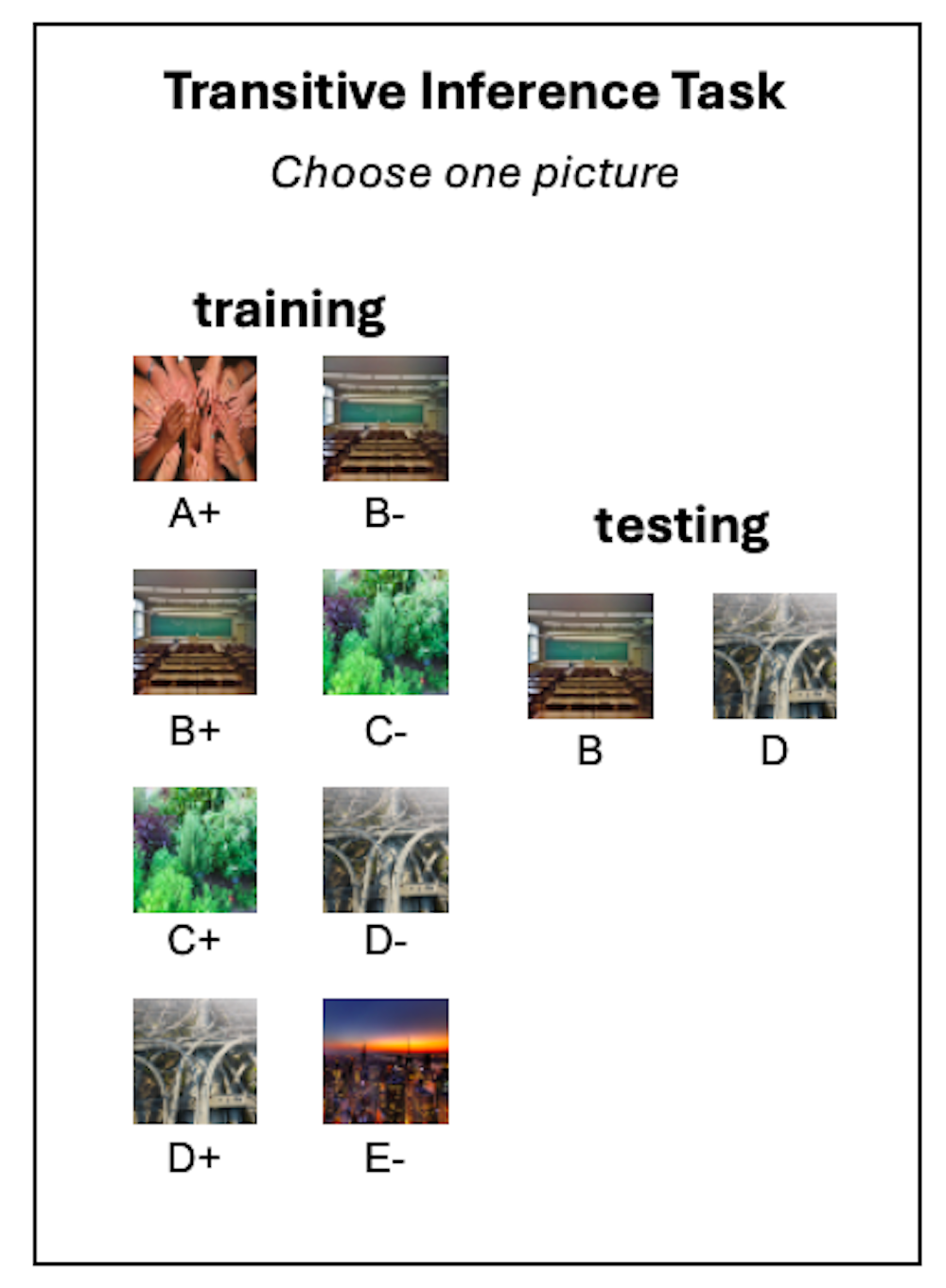
    In the lab, researchers test this by giving animals randomly paired images, one pair at a time, and rewarding them with food for picking the correct one. For example, animals learn that a photo of hands (A) is correct when paired with a classroom (B), a classroom (B) is correct when paired with bushes (C), bushes (C) are correct when paired with a highway (D), and a highway (D) is correct when paired with a sunset (E). We don’t know whether they “understand” what’s in the picture, and it is not particularly important for the experiment that they do.

    In a transitive inference task, subjects learn a series of rewarded pairs – such as A+ vs. B–, B+ vs. C– – and are later tested on novel pairings, like B vs. D, to see whether they infer an overall ranking.
    Olga Lazareva, CC BY-ND

    One possible explanation is that the animals that learn all the tasks create a mental ranking of these images: A > B > C > D > E. We test this idea by giving them new pairs they’ve never seen before, such as classroom (B) vs. highway (D). If they consistently pick the higher-ranked item, they’ve inferred the underlying order.

    What’s fascinating is how many species succeed at this task. Monkeys, rats, pigeons – even fish and wasps – have all demonstrated transitive inference in one form or another.

    The twist: Not all tasks are easy

    But not all types of reasoning come so easily. There’s another kind of rule called transitivity that is different from transitive inference, despite the similar name. Instead of asking which picture is better, transitivity is about equivalence.

    In this task, animals are shown a set of three pictures and asked which one goes with the center image. For example, if white triangle (A1) is shown, choosing red square (B1) earns a reward, while choosing blue square (B2) does not. Later, when red square (B1) is shown, choosing white cross (C1) earns a reward while choosing white circle (C2) does not. Now comes the test: white triangle (A1) is shown with white cross (C1) and white circle (C2) as choices. If they pick white cross (C1), then they’ve demonstrated transitivity.

    In a transitivity task, subjects learn matching rules across overlapping sets – such as A1 matches B1, B1 matches C1 – and are tested on new combinations, such as A1 with C1 or C2, to assess whether they infer the relationship between A1 and C1.
    Olga Lazareva, CC BY-ND

    The change may seem small, but species that succeed in those first transitive inference tasks often stumble in this task. In fact, they tend to treat the white triangle and the white cross as completely separate things, despite their common relationship with the red square. In my recently published review of research using the two tasks, I concluded that more evidence is needed to determine whether these tests tap into the same cognitive ability.

    Small differences, big consequences

    Why does the difference between transitive inference and transitivity matter? At first glance, they may seem like two versions of the same ability – logical reasoning. But when animals succeed at one and struggle with the other, it raises an important question: Are these tasks measuring the same kind of thinking?

    The apparent difference between the two tasks isn’t just a quirk of animal behavior. Psychology researchers apply these tasks to humans in order to draw conclusions about how people reason.

    For example, say you’re trying to pick a new almond milk. You know that Brand A is creamier than Brand B, and your friend told you that Brand C is even waterier than Brand B. Based on that, because you like a thicker milk, you might assume Brand A is better than Brand C, an example of transitive inference.

    But now imagine the store labels both Brand A and Brand C as “barista blends.” Even without tasting them, you might treat them as functionally equivalent, because they belong to the same category. That’s more like transitivity, where items are grouped based on shared relationships. In this case, “barista blend” signals the brands share similar quality.

    How researchers define logical reasoning determines how they interpret results.
    Svetlana Mishchenko/iStock via Getty Images

    Researchers often treat these types of reasoning as measuring the same ability. But if they rely on different mental processes, they might not be interchangeable. In other words, the way scientists ask their questions may shape the answer – and that has big implications for how they interpret success in animals and in people.

    This difference could affect how researchers interpret decision-making not only in the lab, but also in everyday choices and in clinical settings. Tasks like these are sometimes used in research on autism, brain injury or age-related cognitive decline.

    If two tasks look similar on the surface, then choosing the wrong one might lead to inaccurate conclusions about someone’s cognitive abilities. That’s why ongoing work in my lab is exploring whether the same distinction between these logical processes holds true for people.

    Just like a March Madness bracket doesn’t always predict the winner, a reasoning task doesn’t always show how someone got to the right answer. That’s the puzzle researchers are still working on – figuring out whether different tasks really tap into the same kind of thinking or just look like they do. It’s what keeps scientists like me in the lab, asking questions, running experiments and trying to understand what it really means to reason – no matter who’s doing the thinking.

    Olga Lazareva does not work for, consult, own shares in or receive funding from any company or organization that would benefit from this article, and has disclosed no relevant affiliations beyond their academic appointment.

    ref. Humans and animals can both think logically − but testing what kind of logic they’re using is tricky – https://theconversation.com/humans-and-animals-can-both-think-logically-but-testing-what-kind-of-logic-theyre-using-is-tricky-253001

    MIL OSI – Global Reports

  • MIL-Evening Report: Antarctic summer sea ice is at record lows. Here’s how it will harm the planet – and us

    Source: The Conversation (Au and NZ) – By Edward Doddridge, Senior Research Associate in Physical Oceanography, University of Tasmania

    An icebreaker approaches Denman Glacier in March, when there was 70% less Antarctic sea ice than usual. Pete Harmsen AAD

    On her first dedicated scientific voyage to Antarctica in March, the Australian icebreaker RSV Nuyina found the area sea-ice free. Scientists were able to reach places never sampled before.

    Over the past four summers, Antarctic sea ice extent has hit new lows.

    I’m part of a large group of scientists who set out to explore the consequences of summer sea ice loss after the record lows of 2022 and 2023. Together we rounded up the latest publications, then gathered new evidence using satellites, computer modelling, and robotic ocean sampling devices. Today we can finally reveal what we found.

    It’s bad news on many levels, because Antarctic sea ice is vital for the world’s climate and ecosystems. But we need to get a grip on what’s happening – and use this concerning data to prompt faster action on climate change.

    Sea ice around Antarctica waxes and wanes with the seasons, growing in the cold months and melting in warm ones. But this rhythmic cycle is changing.

    What we did and what we found

    Our team used a huge range of approaches to study the consequences of sea ice loss.

    We used satellites to understand sea ice loss over summer, measuring everything from ice thickness and extent to the length of time each year when sea ice is absent.

    Satellite data was also used to calculate how much of the Antarctic coast was exposed to open ocean waves. We were then able to quantify the relationship between sea ice loss and iceberg calving.

    Data from free-drifting ocean robots was used to understand how sea ice loss affects the tiny plants that support the marine food web.

    Every other kind of available data was then harnessed to explore the full impact of sea ice changes on ecosystems.

    Voyage reports from international colleagues came in handy when studying how sea ice loss affected Antarctic resupply missions.

    We also used computer models to simulate the impact of dramatic summer sea ice loss on the ocean.

    In summary, our extensive research reveals four key consequences of summer sea ice loss in Antarctica.

    1. Ocean warming is compounding

    Bright white sea ice reflects about 90% of the incoming energy from sunlight, while the darker ocean absorbs about 90%. So if there’s less summer sea ice, the ocean absorbs much more heat.

    This means the ocean surface warms more in an extreme low sea ice year, such as 2016 – when everything changed.

    Until recently, the Southern Ocean would reset over winter. If there was a summer with low sea ice cover, the ocean would warm a bit. But over winter, the extra heat would shift into the atmosphere.

    That’s not working anymore. We know this from measuring sea surface temperatures, but we have also confirmed this relationship using computer models.

    What’s happening instead is when summer sea ice is very low, as in 2016, it triggers ocean warming that persists. It takes about three years for the system to fully recover. But recovery is becoming less and less likely, given warming is building from year to year.

    Comparing an average sea ice summer (a) to an extreme low sea ice summer (b) in which there is less sea ice for wildlife and more sunlight is absorbed by the ocean. The ice shelf is more exposed to ocean waves, calving more icebergs. The ocean is also less productive and tourist vessels can make a closer approach.
    Doddridge, E., W., et al. (2025) PNAS Nexus., CC BY-NC-ND

    2. More icebergs are forming

    Sea ice protects Antarctica’s coast from ocean waves.

    On average, about a third of the continent’s coastline is exposed over summer. But this is changing. In 2022 and 2023, more than half of the Antarctic coast was exposed.

    Our research shows more icebergs break away from Antarctic ice sheets in years with less sea ice. During an average summer, about 100 icebergs break away. Summers with low sea ice produce about twice as many icebergs.

    Antarctic ice sheets without sea ice are more exposed to waves.
    Pete Harmsen AAD

    3. Wildlife squeezed off the ice

    Many species of seals and penguins rely on sea ice, especially for breeding and moulting.

    Entire colonies of emperor penguins experienced “catastrophic breeding failure” in 2022, when sea ice melted before chicks were ready to go to sea.

    After giving birth, crabeater seals need large, stable sea ice platforms for 2–3 weeks until their pups are weaned. The ice provides shelter and protection from predators. Less summer sea-ice cover makes large platforms harder to find.

    Many seal and penguin species also take refuge on the sea ice when moulting. These species must avoid the icy water while their new feathers or fur grows, or risk dying of hypothermia.

    4. Logistical challenges at the end of the world

    Low summer sea ice makes it harder for people working in Antarctica. Shrinking summer sea ice will narrow the time window during which Antarctic bases can be resupplied over the ice. These bases may soon need to be resupplied from different locations, or using more difficult methods such as small boats.

    Supply ships typically unload their cargo directly onto the sea ice, but that may have to change.
    Jared McGhie, Australian Antarctic Division

    No longer safe

    Anarctic sea ice began to change rapidly in 2015 and 2016. Since then it has remained well below the long-term average.

    The dataset we use relies on measurements from US Department of Defense satellites. Late last month, the department announced it would no longer provide this data to the scientific community. While this has since been delayed to July 31, significant uncertainty remains.

    One of the biggest challenges in climate science is gathering and maintaining consistent long-term datasets. Without these, we don’t accurately know how much our climate is changing. Observing the entire Earth is hard enough when we all work together. It’s going to be almost impossible if we don’t share our data.

    Antarctic sea ice extent anomalies (the difference between the long-term average and the measurement) for the entire satellite record since the late 1970s.
    Edward Doddridge, using data from the US NSIDC Sea Ice Index, version 3., CC BY

    Recent low sea ice summers present a scientific challenge. The system is currently changing faster than our scientific community can study it.

    But vanishing sea ice also presents a challenge to society. The only way to prevent even more drastic changes in the future is to rapidly transition away from fossil fuels and reach net zero emissions.

    Edward Doddridge receives funding from the Australian Research Council.

    ref. Antarctic summer sea ice is at record lows. Here’s how it will harm the planet – and us – https://theconversation.com/antarctic-summer-sea-ice-is-at-record-lows-heres-how-it-will-harm-the-planet-and-us-256104

    MIL OSI AnalysisEveningReport.nz

  • MIL-Evening Report: Antarctic summer sea ice is at record lows. Here’s how it will harm the planet – and us

    Source: The Conversation (Au and NZ) – By Edward Doddridge, Senior Research Associate in Physical Oceanography, University of Tasmania

    An icebreaker approaches Denman Glacier in March, when there was 70% less Antarctic sea ice than usual. Pete Harmsen AAD

    On her first dedicated scientific voyage to Antarctica in March, the Australian icebreaker RSV Nuyina found the area sea-ice free. Scientists were able to reach places never sampled before.

    Over the past four summers, Antarctic sea ice extent has hit new lows.

    I’m part of a large group of scientists who set out to explore the consequences of summer sea ice loss after the record lows of 2022 and 2023. Together we rounded up the latest publications, then gathered new evidence using satellites, computer modelling, and robotic ocean sampling devices. Today we can finally reveal what we found.

    It’s bad news on many levels, because Antarctic sea ice is vital for the world’s climate and ecosystems. But we need to get a grip on what’s happening – and use this concerning data to prompt faster action on climate change.

    Sea ice around Antarctica waxes and wanes with the seasons, growing in the cold months and melting in warm ones. But this rhythmic cycle is changing.

    What we did and what we found

    Our team used a huge range of approaches to study the consequences of sea ice loss.

    We used satellites to understand sea ice loss over summer, measuring everything from ice thickness and extent to the length of time each year when sea ice is absent.

    Satellite data was also used to calculate how much of the Antarctic coast was exposed to open ocean waves. We were then able to quantify the relationship between sea ice loss and iceberg calving.

    Data from free-drifting ocean robots was used to understand how sea ice loss affects the tiny plants that support the marine food web.

    Every other kind of available data was then harnessed to explore the full impact of sea ice changes on ecosystems.

    Voyage reports from international colleagues came in handy when studying how sea ice loss affected Antarctic resupply missions.

    We also used computer models to simulate the impact of dramatic summer sea ice loss on the ocean.

    In summary, our extensive research reveals four key consequences of summer sea ice loss in Antarctica.

    1. Ocean warming is compounding

    Bright white sea ice reflects about 90% of the incoming energy from sunlight, while the darker ocean absorbs about 90%. So if there’s less summer sea ice, the ocean absorbs much more heat.

    This means the ocean surface warms more in an extreme low sea ice year, such as 2016 – when everything changed.

    Until recently, the Southern Ocean would reset over winter. If there was a summer with low sea ice cover, the ocean would warm a bit. But over winter, the extra heat would shift into the atmosphere.

    That’s not working anymore. We know this from measuring sea surface temperatures, but we have also confirmed this relationship using computer models.

    What’s happening instead is when summer sea ice is very low, as in 2016, it triggers ocean warming that persists. It takes about three years for the system to fully recover. But recovery is becoming less and less likely, given warming is building from year to year.

    Comparing an average sea ice summer (a) to an extreme low sea ice summer (b) in which there is less sea ice for wildlife and more sunlight is absorbed by the ocean. The ice shelf is more exposed to ocean waves, calving more icebergs. The ocean is also less productive and tourist vessels can make a closer approach.
    Doddridge, E., W., et al. (2025) PNAS Nexus., CC BY-NC-ND

    2. More icebergs are forming

    Sea ice protects Antarctica’s coast from ocean waves.

    On average, about a third of the continent’s coastline is exposed over summer. But this is changing. In 2022 and 2023, more than half of the Antarctic coast was exposed.

    Our research shows more icebergs break away from Antarctic ice sheets in years with less sea ice. During an average summer, about 100 icebergs break away. Summers with low sea ice produce about twice as many icebergs.

    Antarctic ice sheets without sea ice are more exposed to waves.
    Pete Harmsen AAD

    3. Wildlife squeezed off the ice

    Many species of seals and penguins rely on sea ice, especially for breeding and moulting.

    Entire colonies of emperor penguins experienced “catastrophic breeding failure” in 2022, when sea ice melted before chicks were ready to go to sea.

    After giving birth, crabeater seals need large, stable sea ice platforms for 2–3 weeks until their pups are weaned. The ice provides shelter and protection from predators. Less summer sea-ice cover makes large platforms harder to find.

    Many seal and penguin species also take refuge on the sea ice when moulting. These species must avoid the icy water while their new feathers or fur grows, or risk dying of hypothermia.

    4. Logistical challenges at the end of the world

    Low summer sea ice makes it harder for people working in Antarctica. Shrinking summer sea ice will narrow the time window during which Antarctic bases can be resupplied over the ice. These bases may soon need to be resupplied from different locations, or using more difficult methods such as small boats.

    Supply ships typically unload their cargo directly onto the sea ice, but that may have to change.
    Jared McGhie, Australian Antarctic Division

    No longer safe

    Anarctic sea ice began to change rapidly in 2015 and 2016. Since then it has remained well below the long-term average.

    The dataset we use relies on measurements from US Department of Defense satellites. Late last month, the department announced it would no longer provide this data to the scientific community. While this has since been delayed to July 31, significant uncertainty remains.

    One of the biggest challenges in climate science is gathering and maintaining consistent long-term datasets. Without these, we don’t accurately know how much our climate is changing. Observing the entire Earth is hard enough when we all work together. It’s going to be almost impossible if we don’t share our data.

    Antarctic sea ice extent anomalies (the difference between the long-term average and the measurement) for the entire satellite record since the late 1970s.
    Edward Doddridge, using data from the US NSIDC Sea Ice Index, version 3., CC BY

    Recent low sea ice summers present a scientific challenge. The system is currently changing faster than our scientific community can study it.

    But vanishing sea ice also presents a challenge to society. The only way to prevent even more drastic changes in the future is to rapidly transition away from fossil fuels and reach net zero emissions.

    Edward Doddridge receives funding from the Australian Research Council.

    ref. Antarctic summer sea ice is at record lows. Here’s how it will harm the planet – and us – https://theconversation.com/antarctic-summer-sea-ice-is-at-record-lows-heres-how-it-will-harm-the-planet-and-us-256104

    MIL OSI AnalysisEveningReport.nz

  • MIL-OSI Global: Pop, soda or coke? The fizzy history behind America’s favorite linguistic debate

    Source: The Conversation – USA – By Valerie M. Fridland, Professor of Linguistics, University of Nevada, Reno

    ‘I’ll have a coke – no, not Coca-Cola, Sprite.’ Justin Sullivan/Getty Images

    With burgers sizzling and classic rock thumping, many Americans revel in summer cookouts – at least until that wayward cousin asks for a “pop” in soda country, or even worse, a “coke” when they actually want a Sprite.

    Few American linguistic debates have bubbled quite as long and effervescently as the one over whether a generic soft drink should be called a soda, pop or coke.

    The word you use generally boils down to where you’re from: Midwesterners enjoy a good pop, while soda is tops in the North and far West. Southerners, long the cultural mavericks, don’t bat an eyelash asking for coke – lowercase – before homing in on exactly the type they want: Perhaps a root beer or a Coke, uppercase.

    As a linguist who studies American dialects, I’m less interested in this regional divide and far more fascinated by the unexpected history behind how a fizzy “health” drink from the early 1800s spawned the modern soft drink’s many names and iterations.

    Bubbles, anyone?

    Foods and drinks with wellness benefits might seem like a modern phenomenon, but the urge to create drinks with medicinal properties inspired what might be called a soda revolution in the 1800s.

    An 1878 engraving of a soda fountain.
    Smith Collection/Gado via Getty Images

    The process of carbonating water was first discovered in the late 1700s. By the early 1800s, this carbonated water had become popular as a health drink and was often referred to as “soda water.” The word “soda” likely came from “sodium,” since these drinks often contained salts, which were then believed to have healing properties.

    Given its alleged curative effects for health issues such as indigestion, pharmacists sold soda water at soda fountains, innovative devices that created carbonated water to be sold by the glass. A chemistry professor, Benjamin Stillman, set up the first such device in a drugstore in New Haven, Connecticut, in 1806. Its eventual success inspired a boom of soda fountains in drugstores and health spas.

    By the mid-1800s, pharmacists were creating unique root-, fruit- and herb-infused concoctions, such as sassafras-based root beer, at their soda fountains, often marketing them as cures for everything from fatigue to foul moods.

    These flavored, sweetened versions gave rise to the linking of the word “soda” with a sweetened carbonated beverage, as opposed to simple, carbonated water.

    Seltzer – today’s popular term for such sparkling water – was around, too. But it was used only for the naturally carbonated mineral water from the German town Nieder-Selters. Unlike Perrier, sourced similarly from a specific spring in France, seltzer made the leap to becoming a generic term for fizzy water.

    Many late-19th-century and early 20th-century drugstores contained soda fountains – a nod to the original belief that the sugary, bubbly drink possessed medicinal qualities.
    Hall of Electrical History Foundation/Corbis via Getty Images

    Regional naming patterns

    So how did “soda” come to be called so many different things in different places?

    It all stems from a mix of economic enterprise and linguistic ingenuity.

    The popularity of “soda” in the Northeast likely reflects the soda fountain’s longer history in the region. Since a lot of Americans living in the Northeast migrated to California in the mid-to-late 1800s, the name likely traveled west with them.

    As for the Midwestern preference for “pop” – well, the earliest American use of the term to refer to a sparkling beverage appeared in the 1840s in the name of a flavored version called “ginger pop.” Such ginger-flavored pop, though, was around in Britain by 1816, since a Newcastle songbook is where you can first see it used in text. The “pop” seems to be onomatopoeic for the noise made when the cork was released from the bottle before drinking.

    A jingle for Faygo touts the company’s ‘red pop.’

    Linguists don’t fully know why “pop” became so popular in the Midwest. But one theory links it to a Michigan bottling company, Feigenson Brothers Bottling Works – today known as Faygo Beverages – that used “pop” in the name of the sodas they marketed and sold. Another theory suggests that because bottles were more common in the region, soda drinkers were more likely to hear the “pop” sound than in the Northeast, where soda fountains reigned.

    As for using coke generically, the first Coca-Cola was served in 1886 by Dr. John Pemberton, a pharmacist at Jacobs’ Pharmacy in Atlanta and the founder of the company. In the 1900s, the Coca-Cola company tried to stamp out the use of “Coke” for “Coca-Cola.” But that ship had already sailed. Since Coca-Cola originated and was overwhelmingly popular in the South, its generic use grew out of the fact that people almost always asked for “Coke.”

    No alcohol means not ‘hard’ but ‘soft.’
    Nostalgic Collections/eBay

    As with Jell-O, Kleenex, Band-Aids and seltzer, it became a generic term.

    What’s soft about it?

    Speaking of soft drinks, what’s up with that term?

    It was originally used to distinguish all nonalcoholic drinks from “hard drinks,” or beverages containing spirits.

    Interestingly, the original Coca-Cola formula included wine – resembling a type of alcoholic “health” drink popular overseas, Vin Mariani. But Pemberton went on to develop a “soft” version a few years later to be sold as a medicinal drink.

    Due to the growing popularity of soda water concoctions, eventually “soft drink” came to mean only such sweetened carbonated beverages, a linguistic testament to America’s enduring love affair with sugar and bubbles.

    With the average American guzzling almost 40 gallons per year, you can call it whatever you what. Just don’t call it healthy.

    Valerie M. Fridland does not work for, consult, own shares in or receive funding from any company or organization that would benefit from this article, and has disclosed no relevant affiliations beyond their academic appointment.

    ref. Pop, soda or coke? The fizzy history behind America’s favorite linguistic debate – https://theconversation.com/pop-soda-or-coke-the-fizzy-history-behind-americas-favorite-linguistic-debate-259114

    MIL OSI – Global Reports

  • MIL-OSI Global: In LGBTQ+ storybook case, Supreme Court handed a win to parental rights, raising tough questions for educators

    Source: The Conversation – USA – By Charles J. Russo, Joseph Panzer Chair in Education and Research Professor of Law, University of Dayton

    The parents who brought the case had requested that their children be excused when books with LGBTQ+ characters were used in class. SDI Productions/E+ via Getty Images

    The Supreme Court tends to save its blockbuster orders for the last day of the term – and 2025 was no exception.

    Among the important decisions handed down June 27, 2025, was Mahmoud v. Taylor – a case of particular interest to me, because I teach education law. Mahmoud, I believe, may become one of the court’s most consequential rulings on parental rights.

    An interfaith coalition of Muslim, Orthodox Christian and Catholic parents in Montgomery County, Maryland – including Tamer Mahmoud, for whom the case is named – questioned the school board’s refusal to allow them to opt their young children out of lessons using picture books with LGBTQ+ characters. Ruling in favor of the parents, the court found that the board violated their First Amendment right to the free exercise of religion by requiring their children to sit through lessons with materials inconsistent with their faiths.

    Case history

    The parents in Mahmoud challenged the use of certain storybooks that the board had approved for use in preschool and elementary school. “Pride Puppy!” for example – a book the schools later removed – portrays a family whose pet gets lost at a LGBTQ+ Pride parade, with each page devoted to a letter of the alphabet. The book’s “search and find” list of words directs readers to look for terms in the pictures, including “(drag) queen” and “king,” “leather” and “lip ring.” Other materials included stories about same-sex marriage, a transgender child, and nonbinary bathroom signs.

    Initially, school administrators agreed to allow opt-outs for students whose parents objected to the materials. A day later, however, educators changed their minds. School officials cited concerns about absenteeism, the feasibility of accommodating opt-out requests, and a desire to avoid stigmatizing LGBTQ+ students or families.

    In August 2023, a federal trial court rejected the parents’ claim that officials had violated their fundamental due process right to direct the care, custody and education of their children. The following year, the U.S. Court of Appeals for the 4th Circuit affirmed in favor of the board, finding that officials did not violate the parents’ rights to the free exercise of their religious beliefs, as protected by the First Amendment.

    A group of parents in Montgomery County, Maryland, protest the lack of opt-outs on July 20, 2023.
    Celal Gunes/Anadolu Agency via Getty Images

    On appeal, a 6-3 Supreme Court reversed in favor of the parents. Justice Samuel Alito, who authored the court’s opinion, was joined by Chief Justice John Roberts, plus Justices Clarence Thomas, Neil Gorsuch, Brett Kavanaugh and Amy Coney Barrett.

    Supreme Court

    In brief, the court held that by denying the parental requests to opt their children out of instruction inconsistent with their beliefs, school officials violated their First Amendment right to the free exercise of religion.

    Alito largely grounded the court’s rationale in a dispute from 1925, Pierce v. Society of Sisters of the Holy Name of Jesus and Mary, and even more heavily on 1972’s Wisconsin v. Yoder. Both cases recognize the primacy of parental rights to direct the education of their children. According to Pierce’s famous dictum, “the child is not the mere creature of the state; those who nurture him and direct his destiny have the right, coupled with the high duty, to recognize and prepare him for additional obligations.”

    In Yoder, Amish parents – an Anabaptist Christian community that avoids using many modern technologies – objected to sending their children to school after eighth grade because this would have violated their religious beliefs. The justices unanimously agreed with the parents that their children received all of the education they needed in their communities. The justices added that requiring the children to attend high school would have violated the parents’ rights to direct their children’s religious upbringing.

    Accordingly, the court acknowledged that the parental right “to guide the religious future and education of their children” was “established beyond debate.”

    Similarly, in Mahmoud the court declared that “the Board’s introduction of the ‘LGBTQ+-inclusive’ storybooks, along with its decision to withhold opt-outs, places an unconstitutional burden on the parents’ rights to the free exercise of their religion.”

    Thomas agreed fully with the court, yet wrote a separate concurrence, which emphasized “an important implication of this decision for schools across the country.” Citing Yoder, Thomas contended that rather than support inclusion, the board’s policy “imposes conformity with a view that undermines parents’ religious beliefs, and thus interferes with the parents’ right to ‘direct the religious upbringing of their children.’”

    Justice Sonia Sotomayor’s dissent, joined by Justices Elena Kagan and Ketanji Brown Jackson, feared “the result will be chaos for this Nation’s public schools. Requiring schools to provide advance notice and the chance to opt out of every lesson plan or story time that might implicate a parent’s religious beliefs will impose impossible administrative burdens on schools.”

    Supporters of LGBTQ+ rights demonstrate outside the U.S. Supreme Court during oral arguments in Mahmoud v. Taylor on April 22, 2025.
    Oliver Contreras/AFP via Getty Images

    She maintained that “simply being exposed to beliefs contrary to your own” does not violate a person’s free exercise rights. Insulating children from different ideas, she wrote, denies them of an experience that is crucial for democracy: “practice living in our multicultural society.”

    Implications

    After the decision was handed down, Montgomery County’s Board of Education issued a statement promising to “analyze the Supreme Court decision and develop next steps in alignment with today’s decision, and as importantly, our values.”

    Mahmoud raises challenging questions about the scope or reach of how far parents can question curricular content.

    On the one hand, parents should not be able to micromanage curricular content via the “heckler’s veto,” because this can lead to larger issues. Moreover, while Mahmoud concerns religious rights, what happens if parents question teachings based on another type of sincerely held belief – discussing war if they are pacifist, for example, or capitalism if they are socialists? While Mahmoud dealt with free-exercise rights, it may open the door to other types of First Amendment challenges from parents wishing to exempt their children from lessons.

    On the other hand, Mahmoud highlights the need to take legitimate parental concerns into consideration. While educators typically control instruction, how can they be respectful of parents’ rights as primary caregivers of their children when conflicts arise?

    Mahmoud may go a long way in defining parents’ free-exercise rights in public schools. Still, such disputes are likely far from over in America’s increasingly diverse religious culture.

    Charles J. Russo does not work for, consult, own shares in or receive funding from any company or organization that would benefit from this article, and has disclosed no relevant affiliations beyond their academic appointment.

    ref. In LGBTQ+ storybook case, Supreme Court handed a win to parental rights, raising tough questions for educators – https://theconversation.com/in-lgbtq-storybook-case-supreme-court-handed-a-win-to-parental-rights-raising-tough-questions-for-educators-260064

    MIL OSI – Global Reports

  • MIL-OSI Global: Invasive carp threaten the Great Lakes − and reveal a surprising twist in national politics

    Source: The Conversation – USA – By Mike Shriberg, Professor of Practice & Engagement, School for Environment & Sustainability, University of Michigan

    Invasive Asian carp are spreading up the Mississippi River system and already clog the Illinois River. AP Photo/John Flesher

    In his second term, President Donald Trump has not taken many actions that draw near-universal praise from across the political spectrum. But there is at least one of these political anomalies, and it illustrates the broad appeal of environmental protection and conservation projects – particularly when it concerns an ecosystem of vital importance to millions of Americans.

    In May 2025, Trump issued a presidential memorandum supporting the construction of a physical barrier that is key to keeping invasive carp out of the Great Lakes. These fish have made their way up the Mississippi River system and could have dire ecological consequences if they enter the Great Lakes.

    It was not a given that Trump would back this project, which had long been supported by environmental and conservation organizations. But two very different strategies from two Democratic governors – both potential presidential candidates in 2028 – reflected the importance of the Great Lakes to America.

    As a water policy and politics scholar focused on the Great Lakes, I see this development not only as an environmental and conservation milestone, but also a potential pathway for more political unity in the U.S.

    A feared invasion

    Perhaps nothing alarms Great Lakes ecologists more than the potential for invasive carp from Asia to establish a breeding population in the Great Lakes. These fish were intentionally introduced in the U.S. Southeast by private fish farm and wastewater treatment operators as a means to control algae in aquaculture and sewage treatment ponds. Sometime in the 1990s, the fish escaped from those ponds and moved rapidly up the Mississippi River system, including into the Illinois River, which connects to the Great Lakes.

    Sometimes said to “breed like mosquitoes and eat like hogs,” these fish can consume up to 40% of their body weight each day, outcompeting many native species and literally sucking up other species and food sources.

    Studies of Lake Erie, for example, predict that if the carp enter and thrive, they could make up approximately one-third of the fish biomass of the entire lake within 20 years, replacing popular sportfishing species such as walleye and other ecologically and economically important species.

    Invasive carp are generally not eaten in the U.S. and are not desirable for sportfishing. In fact, silver carp have a propensity to jump up to 10 feet out of the water when startled by a boat motor. That can make parts of the Illinois River, which is packed with the invasive fish, almost impossible to fish or even maneuver a boat.

    Look out! Silver carp fly out of the water, obstructing boats and hitting people trying to enjoy a river in Indiana.

    The Brandon Road Lock and Dam solution

    Originally, the Great Lakes and the Mississippi River were not connected to each other. But in 1900, the city of Chicago connected them to avoid sending its sewage into Lake Michigan, from which the city draws its drinking water.

    The most complete way to block the carp from invading the Great Lakes would be to undo that connection – but that would recreate sewage and flooding issues for Chicago, or require other expensive infrastructure upgrades. The more practical, short-term alternative is to modify the historic Brandon Road Lock and Dam in Joliet, Illinois, by adding several obstacles that together would block the carp from swimming farther upriver toward the Great Lakes.

    The barrier, estimated to cost US$1.15 billion, was authorized by Congress in 2020 and 2022 after many years of intense planning and negotiations. For the first phase of construction, the project received $226 million in federal money from the Bipartisan Infrastructure Law to complement $114 million in state funding – $64 million from Michigan and $50 million from Illinois.

    On the first day of Trump’s second term, however, he paused a wide swath of federal funding, including funding from the Bipartisan Infrastructure Law. And that’s when two different political strategies emerged.

    A brief documentary explains the construction of a connection between the Great Lakes and the Mississippi River basin.

    Pritzker vs. Whitmer vs. Trump

    Illinois, a state that has voted for the Democratic candidate in every presidential election since 1992, has the most financially at stake in the Brandon Road project because the project requires the state to acquire land and operate the barrier. When Trump issued his order, Illinois Gov. JB Pritzker, a Democrat, postponed the purchase of a key piece of land, blaming the “Trump Administration’s lack of clarity and commitment” to the project. Pritzker essentially dared Trump to be the reason for the collapse of the Great Lakes ecosystem and fisheries.

    Another Democrat, Gov. Gretchen Whitmer of Michigan, a swing state with the most at stake economically and ecologically if these carp species enter the Great Lakes, took a very different approach. She went to the White House to talk with Trump about invasive carp and other issues. She defended her nonconfrontational approach to critics, though she also hid her face from cameras when Trump surprised her with an Oval Office press conference. When Trump visited Michigan, she stood beside him as they praised each other.

    When Trump released the federal funding in early May, Pritzker kept up his adversarial language, saying he was “glad that the Trump administration heard our calls … and decided to finally meet their obligation.” Whitmer stayed more conciliatory, calling the funding decision a “huge win that will protect our Great Lakes and secure our economy.” She said she was “grateful to the president for his commitment.”

    Michigan Gov. Gretchen Whitmer greets President Donald Trump as he arrives in her state in late April 2025.
    AP Photo/Alex Brandon

    Why unity on carp?

    Whether coordinated or not, the net result of Pritzker’s and Whitmer’s actions drew praise from both sides of the aisle but was little noticed nationally.

    Trump’s support for the project was a rare moment of political unity and an extremely unusual example of leading Democrats being on the same page as Trump. I attribute this surprising outcome to two key factors.

    First, the Great Lakes region holds disproportionate power in presidential elections. Michigan, Wisconsin and Pennsylvania have backed the eventual winner in every presidential race for the past 20 years. This swing state power has been used by advocates and state political leaders to drive funding for Great Lakes protection for many years.

    Second, Great Lakes are the uniting force in the region. According to polling from the International Joint Commission, the binational body charged with overseeing waterways that cross the U.S.-Canada border, there is “nearly unanimous support (96%) for the importance of government investment in Great Lakes protections” from residents of the region.

    There aren’t any other issues with such high voter resonance, so politicians want to be sure Great Lakes voters are happy. For example, Vice President JD Vance has been particularly vocal about the Great Lakes. And Great Lakes restoration funding was one of the few things in the presidential budget that Democrats and Republicans agreed on.

    Both Pritzker and Whitmer likely had state-based and national motivations in mind and big aspirations at stake.

    Their combined effort has put the project back on track: As of May 12, 2025, Pritzker authorized Illinois to sign the land-purchase agreement he had paused back in February.

    And perhaps the governors have identified a new area for unity in a divided United States: Conservation and environmental issues have broad public support, particularly when they involve iconic natural resources, shared values and popular outdoor pursuits such as fishing and boating. Even when political strategies diverge, the results can bring bipartisan satisfaction.

    Mike Shriberg was previously the Great Lakes Regional Executive Director of the National Wildlife Federation, which entailed being a co-chair (and, for part of the time, Director) of the Healing Our Waters – Great Lakes Coalition.

    ref. Invasive carp threaten the Great Lakes − and reveal a surprising twist in national politics – https://theconversation.com/invasive-carp-threaten-the-great-lakes-and-reveal-a-surprising-twist-in-national-politics-257707

    MIL OSI – Global Reports

  • MIL-OSI Global: 1 in 4 Americans reject evolution, a century after the Scopes monkey trial spotlighted the clash between science and religion

    Source: The Conversation – USA – By William Trollinger, Professor of History, University of Dayton

    The 1925 Scopes trial, in which a Dayton, Tennessee, teacher was charged with violating state law by teaching biological evolution, was one of the earliest and most iconic conflicts in America’s ongoing culture war.

    Charles Darwin’s “Origin of Species,” published in 1859, and subsequent scientific research made the case that humans and other animals evolved from earlier species over millions of years. Many late-19th-century American Protestants had little problem accommodating Darwin’s ideas – which became mainstream biology – with their religious commitments.

    But that was not the case with all Christians, especially conservative evangelicals, who held that the Bible is inerrant – without error – and factually accurate in all that it has to say, including when it speaks on history and science.

    The Scopes trial occurred July 10-21, 1925. Between 150 and 200 reporters swooped into the small town. Broadcast on Chicago’s WGN, it was the first trial to be aired live over radio in the United States.

    One hundred years after the trial, and as we have documented in our scholarly work, the culture war over evolution and creationism remains strong – and yet, when it comes to creationism, much has also changed.

    The trial

    In May 1919, over 6,000 conservative Protestants gathered in Philadelphia to create, under the leadership of Baptist firebrand William Bell Riley, the World’s Christian Fundamentals Association, or WCFA.

    Holding to biblical inerrancy, these “fundamentalists” believed in the creation account detailed in chapter 1 of Genesis, in which God brought all life into being in six days. But most of these fundamentalists also accepted mainstream geology, which held that the Earth was millions of years old. Squaring a literal understanding of Genesis with an old Earth, they embraced either the “day-age theory” – that each Genesis day was actually a long period of time – or the “gap theory,” in which there was a huge gap of time before the six 24-hour days of creation.

    This nascent fundamentalist movement initiated a campaign to pressure state legislatures to prohibit public schools from teaching evolution. One of these states was Tennessee, which in 1925 passed the Butler Act. This law made it illegal for public schoolteachers “to teach any theory that denies the story of divine creation of man as taught in the Bible, and to teach instead that man has descended from a lower order of animals.”

    The American Civil Liberties Union persuaded John Thomas Scopes, a young science teacher in Dayton, Tennessee, to challenge the law in court. The WCFA sprang into action, successfully persuading William Jennings Bryan – populist politician and outspoken fundamentalist – to assist the prosecution. In response, the ACLU hired famous attorney Clarence Darrow to serve on the defense team.

    A huge crowd attending the Scopes trial.
    Bettmann/Contributor via Getty Images

    When the trial started, Dayton civic leaders were thrilled with the opportunity to boost their town. Outside the courtroom there was a carnivalesque atmosphere, with musicians, preachers, concession stands and even monkeys.

    Inside the courtroom, the trial became a verbal duel between Bryan and Darrow regarding science and religion. But as the judge narrowed the proceedings to whether or not Scopes violated the law – a point that the defense readily admitted – it seemed clear that Scopes would be found guilty. Many of the reporters thus went home.

    But the trial’s most memorable episode was yet to come. On July 20, Darrow successfully provoked Bryan to take the witness stand as a Bible expert. Due to the huge crowd and suffocating heat, the judge moved the trial outdoors.

    The 3,000 or so spectators witnessed Darrow’s interrogation of Bryan, which was primarily intended to make Bryan and fundamentalism appear foolish and ignorant. Most significant, Darrow’s questions revealed that, despite Bryan’s’ assertion that he read the Bible literally, Bryan actually understood the six days of Genesis not as 24-hour days, but as six long and indeterminate periods of time.

    American lawyer and politician William Jennings Bryan during the Scopes trial in Dayton, Tenn.
    Hulton Archive/Getty Image

    The very next day, the jury found Scopes guilty and fined him US$100. Riley and the fundamentalists cheered the verdict as a triumph for the Bible and morality.

    The fundamentalists and ‘The Genesis Flood’

    But very soon that sense of triumph faded, partly because of news stories that portrayed fundamentalists as ignorant rural bigots. In one such example, a prominent journalist, H. L. Mencken, wrote in a Baltimore Sun column that the Scopes trial “serves notice on the country that Neanderthal man is organizing in these forlorn backwaters of the land.”

    The media ridicule encouraged many scholars and journalists to conclude that creationism and fundamentalism would soon disappear from American culture. But that prediction did not come to pass.

    Instead, fundamentalists, including WCFA leader Riley, seemed all the more determined to redouble their efforts at the grassroots level.

    But as Darrow’s interrogation of Bryan made obvious, it was not easy to square a literal reading of the Bible – including the six-day creation outlined in Genesis – with a scientific belief in an old Earth. What fundamentalists needed was a science that supported the idea of a young Earth.

    In their 1961 book, “The Genesis Flood: The Biblical Record and its Scientific Implications, fundamentalists John Whitcomb, a theologian, and Henry Morris, a hydraulic engineer, provided just such a scientific explanation. Making use, without attribution, of the writings of Seventh-day Adventist geologist George McCready Price, Whitcomb and Morris made the case that Noah’s global flood lasted one year and created the geological strata and mountain ranges that made the Earth seem ancient.

    “The Genesis Flood” and its version of flood geology remains ubiquitous among fundamentalists and other conservative Protestants.

    Young Earth creationism

    Today, opinion polls reveal that roughly one-quarter of all Americans are adherents of this newer strand of creationism, which rejects both mainstream geology as well as mainstream biology.

    Replica of Noah’s Ark at the Ark Encounter, near Williamstown, Ky.
    Ron Buskirk/UCG/Universal Images Group via Getty Images

    This popular embrace of young Earth creationism also explains the success of Answers in Genesis – AiG – which is the world’s largest creationist organization, with a website that attracts millions of visitors every year.

    AiG’s tourist sites – the Creation Museum in Petersburg, Kentucky, and the Ark Encounter in Williamstown, Kentucky – have attracted millions of visitors since their opening in 2007 and 2016. Additional AiG sites are planned for Branson, Missouri, and Pigeon Forge, Tennessee.

    Presented as a replica of Noah’s Ark, the Ark Encounter is a gigantic structure – 510 feet long, 85 feet wide, 51 feet high. It includes representations of animal cages as well as plush living quarters for the eight human beings who, according to Genesis chapters 6-8, survived the global flood. Hundreds of placards in the Ark make the case for a young Earth and a global flood that created the geological strata and formations we see today.

    Ark Encounter has been the beneficiary of millions of dollars from state and local governments.

    Besides AiG tourist sites, there is also an ever-expanding network of fundamentalist schools and homeschools that present young Earth creationism as true science. These schools use textbooks from publishers such as Abeka Books, Accelerated Christian Education and Bob Jones University Press.

    The Scopes trial involved what could and could not be taught in public schools regarding creation and evolution. Today, this discussion also involves private schools, given that there are now at least 15 states that have universal private school choice programs, in which families can use taxpayer-funded education money to pay for private schooling and homeschooling.

    In 1921, William Bell Riley admonished his opponents that they should “cease from shoveling in dirt on living men,” for the fundamentalists “refuse to be buried.” A century later, the funeral for fundamentalism and creationism seems a long way off.

    The authors do not work for, consult, own shares in or receive funding from any company or organization that would benefit from this article, and have disclosed no relevant affiliations beyond their academic appointment.

    ref. 1 in 4 Americans reject evolution, a century after the Scopes monkey trial spotlighted the clash between science and religion – https://theconversation.com/1-in-4-americans-reject-evolution-a-century-after-the-scopes-monkey-trial-spotlighted-the-clash-between-science-and-religion-258163

    MIL OSI – Global Reports

  • MIL-OSI Global: Bill Moyers’ journalism strengthened democracy by connecting Americans to ideas and each other, in a long and extraordinary career

    Source: The Conversation – USA – By Julie Leininger Pycior, Professor of History Emeritus, Manhattan University

    “Bill Moyers? He’s spectacular!” George Clooney said – and no wonder.

    I mentioned this legendary television journalist to the actor and filmmaker after Clooney emerged from the Broadway theater where he just had been portraying another news icon: Edward R. Murrow. Or as the Museum of Broadcast Communications put it in a tribute to Moyers, he was “one of the few broadcast journalists who might be said to approach the stature of Edward R. Murrow. If Murrow founded broadcast journalism, Moyers significantly extended its traditions.”

    Moyers, who died at 91 on June 26, 2025, was among the most acclaimed broadcast journalists of the 20th century. He’s known for TV news shows that exposed the role of big money in politics and episodes that drew attention to unsung defenders of democracy, such as community organizer Ernesto Cortés Jr..

    Earlier in his life, Moyers served in significant roles in the Kennedy and Johnson administrations, but his fame comes from his journalism.

    Making a connection

    Despite his prominence, Moyers was the same down-to-earth guy in person as he seemed to be on the screen. In 1986, he was commanding a television audience of millions, and I was a historian at home with a preschooler, teaching the occasional college course in a dismal job market. Seeing that Moyers would be speaking at the conference on President Lyndon B. Johnson where I would be giving a paper, I wrote to him.

    To my utter amazement, he replied and then showed up to hear my paper, on Johnson’s experiences as a young principal of the “Mexican” school in Cotulla, Texas, where he championed his students but also forged links to segregationists. Cotulla was “seminal” to LBJ’s development, Moyers said. In 1993, he recommended me for a grant that helped me finish a book: “LBJ and Mexican Americans: The Paradox of Power.

    A few years later, he asked me to head up a project researching the documents related to his time in Johnson’s administration. His memoir of the Johnson years never materialized. Instead, I edited the bestselling ”Moyers on America: A Journalist and His Times.“

    Part of what always impressed me about Moyers was his belief that what matters is not how close you are to power, but how close you are to reality.

    ‘Amazing Grace’

    Moyers didn’t just dwell on politics and policy as a journalist. He also delved into the meaning of creativity and the life of the mind. Many of his most moving interviews spotlighted scientists, novelists and other exceptional people.

    He was also arguably among the best reporters on the religion beat. Even if it wasn’t always the main focus of his work or what comes to mind for those familiar with his legacy, still, he was a lifelong spiritual seeker.

    This is hardly surprising: Moyers had degrees in both divinity and journalism. As a young man, he briefly served as a Baptist minister.

    He once told me that his favorite of the many programs that he produced was the PBS documentary ”Amazing Grace.“ It featured inspiring renditions of this popular Christian hymn as performed by country legend Johnny Cash, folk icon Judy Collins, opera diva Jessye Norman and other musical geniuses. As they share with Moyers their personal connections to this song of redemption, he draws viewers into the stirring saga of its creator, John Newton: a slave trader who became an abolitionist through “amazing grace.”

    Bill Moyers interviews Judy Collins about singing ‘Amazing Grace,’ following the production of his PBS special about the hymn.

    Life’s ultimate questions

    This appreciation of the ineffable clearly informed Moyers’ blockbuster TV series exploring life’s ultimate questions, “Joseph Campbell and the Power of Myth.”

    His interviews with Campbell, a comparative mythologist, evoked moments that made time stand still, and this reminded me of Thomas Merton, the American monk and poet, writing, “Everything is emptiness and everything is compassion” on beholding the immense Polonnaruwa Buddhas of Sri Lanka.

    To my surprise, Moyers knew about this Trappist monk, telling me, “I always wished that I could have interviewed Merton,” who died in 1968.

    It turned out that Moyers had been introduced to Merton by Sargent Shriver, founding director of the Peace Corps, where Moyers was a founding organizer and the deputy director.

    Mentored by LBJ

    Moyers characterized his Peace Corps years as the most rewarding of his life. When Johnson, his mentor, became president, he asked Moyers to join the White House staff. Moyers turned down the offer, so Johnson made it a presidential command.

    The wunderkind – Moyers was 29 years old in 1963, when Johnson was sworn in after President John F. Kennedy’s assassination – coordinated the White House task forces that created the largest number of legislative proposals in American history. Among the programs and landmark reforms established and passed during the Johnson administration were Medicare and Medicaid, a landmark immigration law, the Freedom of Information Act, the Public Broadcasting Act and two historic civil rights laws.

    Johnson’s war on poverty, in addition, introduced several path-breaking programs, such as Head Start.

    Moyers served as one of Johnson’s speechwriters and was a top official in Johnson’s 1964 presidential campaign. The following year, the Johnson administration began escalating U.S. involvement in the Vietnam War and Johnson named a new press secretary: Bill Moyers. Again, the young man tried to decline, but the president prevailed.

    As Moyers had feared, he could not serve two masters – journalists and his boss – especially as the administration’s Vietnam War policies became increasingly unpopular.

    President Lyndon B. Johnson confers with Bill Moyers, his press secretary, in 1965.
    Corbis Historical via Getty Images

    Appreciating the world around you

    Moyers left the Johnson administration in 1967, turning to journalism. He became the publisher of Newsday, a Long Island, New York, newspaper, before becoming a producer and commentator at CBS News. His commentaries reached tens of millions of viewers, but the network refused to provide a regular time slot for his documentaries. He had previously worked at PBS. In 1987, he decamped there for good.

    Moyers’ programs won many journalism awards, including over 30 Emmys, along with the Lifetime Emmy for news and documentary productions.

    He helped millions of Americans appreciate the world around them. As he reflected in 2023, in one of the last interviews he gave, to PBS journalist Judy Woodruff at the Library of Congress: “Everything is linked, and if you can find that nerve that connects us to other things and other places and other ideas – and television should be doing it all the time – we’d be a better democracy.”

    Judy Woodruff interviews Bill Moyers about his life’s work in government and the media, including his contributions to the launch of PBS, at the Library of Congress.

    Today, with disinformation metastasizing, professional journalists losing their jobs by the thousands and some newspaper owners muzzling their editorial staff, thoughtful explanations can lose out. That means Americans can lose out.

    “It takes time, commitment” to dig below the surface and discover the deeper meaning of people’s lives, Moyers noted. He sought to understand, for example, why so many folks in his own hometown of Marshall, Texas, have become much more suspicious – resentful, even – of outsiders than when he gave these folks voice in his poignant, prize-winning 1984 program Marshall, Texas; Marshall, Texas.

    In this era of growing threats to democracy, what can a young person do who aspires to follow in Bill Moyers’ footsteps – whether in journalism or public life?

    Woodruff asked Moyers that question, to which he responded: “You can’t quit. You can’t get out of the boat! Find a place that gives you a sense of being, gives you a sense of mission, gives you a sense of participation.”

    Today, with the future of journalism – and of democracy itself – at stake, I think it would help everyone to take to heart the insights of this late, great American journalist.

    Julie Leininger Pycior edited the book “Moyers on America: A Journalist and His Times.” She also was hired by Moyers to direct the 18-month “LBJ Years” research project.

    In addtion, she served as an unpaid, informal historical adviser for some of his public television programs.

    ref. Bill Moyers’ journalism strengthened democracy by connecting Americans to ideas and each other, in a long and extraordinary career – https://theconversation.com/bill-moyers-journalism-strengthened-democracy-by-connecting-americans-to-ideas-and-each-other-in-a-long-and-extraordinary-career-260047

    MIL OSI – Global Reports

  • MIL-OSI Global: Keeping brain-dead pregnant women on life support raises ethical issues that go beyond abortion politics

    Source: The Conversation – USA – By Lindsey Breitwieser, Assistant Professor of Gender & Women’s Studies, Hollins University

    Laws such as Georgia’s LIFE Act can complicate ethical and legal decision-making in postmortem pregnancy.
    Darya Komarova/Moment via Getty Images

    Adriana Smith, a 30-year-old woman from Georgia who had been declared brain-dead in February 2025, spent 16 weeks on life support while doctors worked to keep her body functioning well enough to support her developing fetus. On June 13, 2025, her premature baby, named Chance, was born via cesarean section at 25 weeks.

    Smith was nine weeks pregnant when she suffered multiple blood clots in her brain. Her story gained public attention when her mother criticized doctors’ decision to keep her on a ventilator without the family’s consent. Smith’s mother has said that doctors told the family the decision was made to align with Georgia’s LIFE Act, which bans abortion after six weeks of pregnancy and bolsters the legal standing of fetal personhood. A statement released by the hospital also cites Georgia’s abortion law.

    “I’m not saying we would have chosen to terminate her pregnancy,” Smith’s mother told a local television station. “But I’m saying we should have had a choice.”

    The LIFE Act is one of several state laws that have passed across the U.S. since the 2022 Dobbs v. Jackson decision invalidated constitutional protections for abortion. Although Georgia’s attorney general denied that the LIFE Act applied to Smith, there’s little doubt that it invites ethical and legal uncertainty when a woman dies while pregnant.

    Smith’s case has swiftly become the focus of a reproductive rights political firestorm characterized by two opposing viewpoints. For some, it reflects demeaning governmental overreach that quashes women’s bodily autonomy. For others it illustrates the righteous sacrifice of motherhood.

    In my work as a gender and technology studies scholar, I have cataloged and studied postmortem pregnancies like Smith’s since 2016. In my view, Smith’s story doesn’t fit straightforwardly into abortion politics. Instead, it points to the need for a more nuanced ethical approach that does not frame a mother and child as adversaries in a medical, legal or political context.

    Birth after death

    For centuries, Catholic dogma and Western legal precedent have mandated immediate cesarean section when a pregnant woman died after quickening, the point when fetal movement becomes discernible. But technological advances now make it possible sometimes for a fetus to continue gestating in place when the mother is brain-dead, or “dead by neurological criteria”– a widely accepted definition of death that first emerged in the 1950s.

    The first brain death during pregnancy in which the fetus was delivered after time on life support, more accurately called organ support, occurred in 1981. The process is extraordinarily intensive and invasive, because the loss of brain function impedes many physiological processes. Health teams, sometimes numbering in the hundreds, must stabilize the bodies of “functionally decapitated” pregnant women to buy more time for fetal development. This requires vital organ support, ventilation, nutritional supplements, antibiotics and constant monitoring. Outcomes are highly uncertain.

    Adriana Smith’s baby was delivered by cesarian section on June 13, 2025.

    Smith’s 112-day stint on organ support ranks third in length for a postmortem pregnancy, with the longest being 123 days. Hers is also the earliest ever gestational age from which the procedure has been attempted. Because time on organ support can vary widely, and because there is no established minimum fetal age considered too early to intervene, a fetus could theoretically be deemed viable at any point in pregnancy.

    Postmortem pregnancy as gender-based violence

    Over the past 50 years, critics of postmortem pregnancy have argued that it constitutes gender-based violence and violates bodily integrity in ways that organ donation does not. Some have compared it with Nazi pronatalist policies. Others have attributed the practice to systemic sexism and racism in medicine. Postmortem pregnancy can also compound intimate partner violence by giving brain-dead women’s murderers decision-making authority when they are the fetus’s next of kin.

    Fetal personhood laws complicate end-of-life decision-making in ways that many consider violent too. As I have seen in my own research, when the fetus is considered a legal person, women’s wishes may be assumed, debated in court or committee, or set aside entirely, nearly always in favor of the fetus.

    From the perspective of reproductive rights advocates, postmortem pregnancy is the bottom of a slippery slope down which anti-abortion sentiment has led America. It obliterates women’s autonomy, pitting living and dead women against doctors, legislators and sometimes their own families, and weaponizing their own fetuses against them.

    A medical perspective on rights

    Viewed through a medical lens, however, postmortem pregnancy is not violent or violating, but an act of repair. Although care teams have responsibilities to both mother and fetus, a pregnant woman’s brain death means she cannot be physically harmed and her rights cannot be violated to the same degree as a fetus with the potential for life.

    Medical practitioners are conditioned to prioritize life over death, motivating a commitment to salvage something from a tragedy and try to partially restore a family. The high-stakes world of emergency medicine makes protecting life reflexive and medical interventions automatic. Once fetal life is detected, as one hospital spokesperson put it in a 1976 news article in The Boston Globe, “What else could you do?”

    This response does not necessarily stem from conscious sexism or anti-abortion sentiment, but from reverence for vulnerable patients. If physicians declare a pregnant woman brain-dead, patienthood often automatically transfers to the fetus needing rescue. No matter its age and despite its survival being dependent on machines, just like its mother, the fetus is entirely animate. Who or what counts as a legal person with privileges and protections might be a political or philosophical determination, but life is a matter of biological fact and within the doctors’ purview.

    The first baby born from a postmortem pregnancy was delivered in 1981.
    Emmanuel Faure/The Image Bank via Getty Images

    An ethics of anti-opposition

    Both of the above perspectives have validity, but neither accounts for postmortem pregnancy’s ethical and biological complexity.

    First, setting mother against fetus, with the rights of one endangering the rights of the other, does not match pregnancy’s lived reality of “two bodies, sutured,” as the cultural scholar Lauren Berlant put it.

    Even the Supreme Court recognized this entangled duality in their 1973 ruling on Roe v. Wade, which established both constitutional protections for abortion and a governmental obligation to protect fetal life. Whether a fetus is considered a legal person or not, they wrote, pregnant women and fetuses “cannot be isolated in their privacy” – meaning that reproductive rights issues must strike a balance, however tenuous, between maternal and fetal interests. To declare postmortem pregnancy unequivocally violent or a loss of the “right to choose” fails to recognize the complexity of choice in a highly politicized medical landscape.

    Second, maternal-fetal competition muddles the right course of action. In the U.S., competent patients are not compelled to engage in medical care they would rather avoid, even if it kills them, or to stay on life support to preserve organs for donation. But when a fetus is treated as an independent patient, exceptions could be made to those medical standards if the fetus’s interests override the mother’s.

    For example, pregnancy disrupts standard determination of death. To protect the fetus, care teams increasingly skip a necessary diagnostic for brain death called apnea testing, which involves momentarily removing the ventilator to test the respiratory centers of the brain stem. In these cases, maternal brain death cannot be confirmed until after delivery. Multiple instances of vaginal deliveries after brain death also remain unexplained, given that the brain coordinates mechanisms of vaginal labor. All in all, it’s not always clear women in these cases are entirely dead.

    Ultimately, women like Adriana Smith and their fetuses are inseparable and persist in a technologically defined state of in-betweenness. I’d argue that postmortem pregnancies, therefore, need new bioethical standards that center women’s beliefs about their bodies and a dignified death. This might involve recognizing pregnancy’s unique ambiguities in advance directives, questioning default treatment pathways that may require harm be done to one in order to save another, or considering multiple definitions of clinical and legal death.

    In my view, it is possible to adapt our ethical standards in a way that honors all beings in these exceptional circumstances, without privileging either “choice” or “life,” mother or fetus.

    This research was supported by a grant from The Institute for Citizens and Scholars.

    ref. Keeping brain-dead pregnant women on life support raises ethical issues that go beyond abortion politics – https://theconversation.com/keeping-brain-dead-pregnant-women-on-life-support-raises-ethical-issues-that-go-beyond-abortion-politics-258457

    MIL OSI – Global Reports

  • MIL-OSI Global: Mexican flags flown during immigration protests bother white people a lot more than other Americans

    Source: The Conversation – USA – By Edward D. Vargas, Associate Professor, School of Transborder Studies, Arizona State University

    Protesters wave the Mexican flag in Los Angeles on June 9, 2025. Luke Johnson/Los Angeles Times via Getty Images

    Agents with U.S. Immigration and Customs Enforcement conducted a series of raids throughout Los Angeles and Southern California in early June 2025, sparking protests in downtown Los Angeles and other cities, including New York, Chicago and Austin, Texas.

    Some demonstrators expressed growing frustration with ICE by showcasing the Mexican flag, which has become the defining symbol of the protests in Los Angeles.

    The use of the flag has also become the subject of intense debate in the media.

    Some outlets have depicted the flag as symbolizing ethnic pride, solidarity with immigrants and opposition to the Trump administration.

    Others have called it the “perfect propaganda” tool for Republicans and conservatives, some of whom have referred to the Mexican flag as the “confederate banner of the L.A. riots.” They point to its use as evidence of anarchy and a city taken over by immigrants.

    But what do Americans think about protesters waving the Mexican flag, and why?

    Much of our knowledge surrounding this question is based on the 2006 immigrant rights protests across the United States, which occurred in a much less politically polarized era. Additionally, a vast majority of protesters then brought U.S. flags compared with other national flags, including the Mexican flag.

    Research published in 2010 found that even though the public was more likely to be bothered by protesters waving the Mexican flag than the U.S. flag, that difference was largely absent once you divided the public into subgroups, including white people, Latinos and immigrants.

    To reexamine public attitudes toward protesters waving the Mexican flag, we conducted an online survey experiment among 10,145 U.S. adults in 2016.

    As political scientists who specialize in Latino politics and immigration-related issues, we tested how exposure to the Mexican flag versus the American flag shaped opinion about protests during Trump’s first presidential campaign in 2016.

    We found that even though much of the public continued to be less bothered by the American flag than the Mexican flag, there were also important and perhaps surprising differences in protest attitudes between white Americans and other racial and ethnic groups.

    A demonstrator holds a Mexican flag in front of law enforcement during a protest on June 13, 2025, in Los Angeles.
    AP Photo/Wally Skalij

    More or less bothered

    In the study, we randomly divided respondents into two groups: a treatment group and a control group. Respondents in the treatment group were shown an image of protesters waving a Mexican flag. Respondents in the control group were shown an image of protesters waving the U.S. flag. After viewing the image, respondents were then asked about the extent to which they supported or were bothered by the protests.

    Overall, 41% of the respondents said they were bothered by protesters waving the Mexican flag, and 28% said protesters waving the U.S. flag bothered them.

    Our results show important differences in opinion between racial and ethnic groups.

    White respondents were more likely than any other racial and ethnic group to say they were bothered by protesters waving Mexican flags. Sixty-nine percent of white respondents said they were bothered, 31 percentage points more than the average of nonwhite respondents.

    However, 51% of white respondents were also bothered by the image of protesters waving U.S. flags. By contrast, just 20% of Latinos, 33% of Black Americans and 34% of Asian Americans said they were bothered by protesters waving U.S. flags.

    Put differently, large majorities of nonwhite respondents were supportive of showing U.S. flags at protests despite their more positive views toward Mexican flags.

    What explains racial differences?

    When taking a deeper look at what causes Americans to feel bothered about protesters waving Mexican flags, some clear patterns emerge.

    On average, older Americans were more likely to be bothered relative to younger Americans. This was particularly true for Americans over 40 years of age compared with millennials, born between 1981 and 1996, and Gen Z respondents, born between 1997 and 2012.

    However, there are some nuances when examining age groups and whether they had attended a protest, march or rally in the previous year.

    Our findings suggest that older Americans who had not engaged in protests were most likely to be bothered when they saw images of protesters waving Mexican flags. Millennials and Gen Z respondents who participated in a protest were least likely to be bothered.

    Given that this issue intersects nationality, race, ethnicity, gender and citizenship status, it’s logical that these factors explained why Americans supported or opposed the use of Mexican flags at immigration protests.

    A woman carrying a flag with details of the United States and Mexican flags walks past members of the United States Marine Corps on June 14, 2025, in Los Angeles.
    Cristopher Rogel Blanquet/Getty Images

    For example, racial minorities who have a stronger sense of ethnic or racial identity were more likely to be supportive of protesters waving Mexican and U.S. flags. In other words, group identity is a strong predictor of support for protests in general, regardless of what flag is being flown.

    However, minorities who lack a sense of ethnic pride and identity were most likely to be upset when they saw others expressing their First Amendment right to peaceably assemble.

    The reality is that recent immigration protests across the country are the first time many of the Latino youth who are citizens have participated in these types of protests. Anyone under age 22 would not have memory of, or been alive during, the last large pro-immigrant protests in 2006.

    The Mexican flag represents more than nationalistic pride. It represents their parents’ heritage, hard work and their binational experience as Americans engaged in politics.

    The authors do not work for, consult, own shares in or receive funding from any company or organization that would benefit from this article, and have disclosed no relevant affiliations beyond their academic appointment.

    ref. Mexican flags flown during immigration protests bother white people a lot more than other Americans – https://theconversation.com/mexican-flags-flown-during-immigration-protests-bother-white-people-a-lot-more-than-other-americans-259004

    MIL OSI – Global Reports

  • MIL-OSI Global: The hidden cost of convenience: How your data pulls in hundreds of billions of dollars for app and social media companies

    Source: The Conversation – USA – By Kassem Fawaz, Associate Professor of Electrical and Computer Engineering, University of Wisconsin-Madison

    Many apps and social media platforms collect detailed information about you as you use them, and sometimes even when you’re not using them. Malte Mueller/fStop via Getty images

    You wake up in the morning and, first thing, you open your weather app. You close that pesky ad that opens first and check the forecast. You like your weather app, which shows hourly weather forecasts for your location. And the app is free!

    But do you know why it’s free? Look at the app’s privacy settings. You help keep it free by allowing it to collect your information, including:

    • What devices you use and their IP and Media Access Control addresses.
    • Information you provide when signing up, such as your name, email address and home address.
    • App settings, such as whether you choose Celsius or Fahrenheit.
    • Your interactions with the app, including what content you view and what ads you click.
    • Inferences based on your interactions with the app.
    • Your location at a given time, including, depending on your settings, continuous tracking.
    • What websites or apps that you interact with after you use the weather app.
    • Information you give to ad vendors.
    • Information gleaned by analytics vendors that analyze and optimize the app.

    This type of data collection is standard fare. The app company can use this to customize ads and content. The more customized and personalized an ad is, the more money it generates for the app owner. The owner might also sell your data to other companies.

    Many apps, including the weather channel app, send you targeted advertising and sell your personal data by default.
    Jack West, CC BY-ND

    You might also check a social media account like Instagram. The subtle price that you pay is, again, your data. Many “free” mobile apps gather information about you as you interact with them.

    As an associate professor of electrical and computer engineering and a doctoral student in computer science, we follow the ways software collects information about people. Your data allows companies to learn about your habits and exploit them.

    It’s no secret that social media and mobile applications collect information about you. Meta’s business model depends on it. The company, which operates Facebook, Instagram and WhatsApp, is worth US$1.48 trillion. Just under 98% of its profits come from advertising, which leverages user data from more than 7 billion monthly users.


    Read more:
    How Internet of Things devices affect your privacy – even when they’re not yours


    What your data is worth

    Before mobile phones gained apps and social media became ubiquitous, companies conducted large-scale demographic surveys to assess how well a product performed and to get information about the best places to sell it. They used the information to create coarsely targeted ads that they placed on billboards, print ads and TV spots.

    Mobile apps and social media platforms now let companies gather much more fine-grained information about people at a lower cost. Through apps and social media, people willingly trade personal information for convenience. In 2007 – a year after the introduction of targeted ads – Facebook made over $153 million, triple the previous year’s revenue. In the past 17 years, that number has increased by more than 1,000 times.

    Five ways to leave your data

    App and social media companies collect your data in many ways. Meta is a representative case. The company’s privacy policy highlights five ways it gathers your data:

    First, it collects the profile information you fill in. Second, it collects the actions you take on its social media platforms. Third, it collects the people you follow and friend. Fourth, it keeps track of each phone, tablet and computer you use to access its platforms. And fifth, it collects information about how you interact with apps that corporate partners connect to its platforms. Many apps and social media platforms follow similar privacy practices.

    Your data and activity

    When you create an account on an app or social media platform, you provide the company that owns it with information like your age, birth date, identified sex, location and workplace. In the early years of Facebook, selling profile information to advertisers was that company’s main source of revenue. This information is valuable because it allows advertisers to target specific demographics like age, identified gender and location.

    And once you start using an app or social media platform, the company behind it can collect data about how you use the app or social media. Social media keeps you engaged as you interact with other people’s posts by liking, commenting or sharing them. Meanwhile, the social media company gains information about what content you view and how you communicate with other people.

    Advertisers can find out how much time you spent reading a Facebook post or that you spent a few more seconds on a particular TikTok video. This activity information tells advertisers about your interests. Modern algorithms can quickly pick up subtleties and automatically change the content to engage you in a sponsored post, a targeted advertisement or general content.

    Your devices and applications

    Companies can also note what devices, including mobile phones, tablets and computers, you use to access their apps and social media platforms. This shows advertisers your brand loyalty, how old your devices are and how much they’re worth.

    Because mobile devices travel with you, they have access to information about where you’re going, what you’re doing and who you’re near. In a lawsuit against Kochava Inc., the Federal Trade Commission called out the company for selling customer geolocation data in August 2022, shortly after Roe v Wade was overruled. The company’s customers, including people who had abortions after the ruling was overturned, often didn’t know that data tracking their movements was being collected, according to the commission. The FTC alleged that the data could be used to identify households.

    Kochava has denied the FTC’s allegations.

    Information that apps can gain from your mobile devices includes anything you have given an app permission to have, such as your location, who you have in your contact list or photos in your gallery.

    If you give an app permission to see where you are while the app is running, for instance, the platform can access your location anytime the app is running. Providing access to contacts may provide an app with the phone numbers, names and emails of all the people that you know.

    Cross-application data collection

    Companies can also gain information about what you do across different apps by acquiring information collected by other apps and platforms.

    The settings on an Android phone show that Meta uses information it collects about you to target ads it shows you in its apps – and also in other apps and on other platforms – by default.
    Jack West, CC BY-ND

    This is common with social media companies. This allows companies to, for example, show you ads based on what you like or recently looked at on other apps. If you’ve searched for something on Amazon and then noticed an ad for it on Instagram, it’s probably because Amazon shared that information with Instagram.

    This combined data collection has made targeted advertising so accurate that people have reported that they feel like their devices are listening to them.

    Companies, including Google, Meta, X, TikTok and Snapchat, can build detailed user profiles based on collected information from all the apps and social media platforms you use. They use the profiles to show you ads and posts that match your interests to keep you engaged. They also sell the profile information to advertisers.

    Meanwhile, researchers have found that Meta and Yandex, a Russian search engine, have overcome controls in mobile operating system software that ordinarily keep people’s web-browsing data anonymous. Each company puts code on its webpages that used local IPs to pass a person’s browsing history, which is supposed to remain private, to mobile apps installed on that person’s phone, de-anonymizing the data. Yandex has been conducting this tracking since 2017, while Meta began in September 2024, according to the researchers.

    What you can do about it

    If you use apps that collect your data in some way, including those that give you directions, track your workouts or help you contact someone, or if you use social media platforms, your privacy is at risk.

    Aside from entirely abandoning modern technology, there are several steps you can take to limit access – at least in part – to your private information.

    Read the privacy policy of each app or social media platform you use. Although privacy policy documents can be long, tedious and sometimes hard to read, they explain how social media platforms collect, process, store and share your data.

    Check a policy by making sure it can answer three questions: what data does the app collect, how does it collect the data, and what is the data used for. If you can’t answer all three questions by reading the policy, or if any of the answers don’t sit well with you, consider skipping the app until there’s a change in its data practices.

    Remove unnecessary permissions from mobile apps to limit the amount of information that applications can gather from you.

    Be aware of the privacy settings that might be offered by the apps or social media platforms you use, including any setting that allows your personal data to affect your experience or shares information about you with other users or applications.

    These privacy settings can give you some control. We recommend that you disable “off-app activity” and “personalization” settings. “Off-app activity” allows an app to record which other apps are installed on your phone and what you do on them. Personalization settings allow an app to use your data to tailor what it shows you, including advertisements.

    Review and update these settings regularly because permissions sometimes change when apps or your phone update. App updates may also add new features that can collect your data. Phone updates may also give apps new ways to collect your data or add new ways to preserve your privacy.

    Use private browser windows or reputable virtual private networks software, commonly referred to as VPNs, when using apps that connect to the internet and social media platforms. Private browsers don’t store any account information, which limits the information that can be collected. VPNs change the IP address of your machine so that apps and platforms can’t discover your location.

    Finally, ask yourself whether you really need every app that’s on your phone. And when using social media, consider how much information you want to reveal about yourself in liking and commenting on posts, sharing updates about your life, revealing locations you visited and following celebrities you like.


    This article is part of a series on data privacy that explores who collects your data, what and how they collect, who sells and buys your data, what they all do with it, and what you can do about it.

    Kassem Fawaz receives funding from the National Science Foundation. In the past, his research group has received unrestricted gifts from Meta and Google.

    Jack West does not work for, consult, own shares in or receive funding from any company or organization that would benefit from this article, and has disclosed no relevant affiliations beyond their academic appointment.

    ref. The hidden cost of convenience: How your data pulls in hundreds of billions of dollars for app and social media companies – https://theconversation.com/the-hidden-cost-of-convenience-how-your-data-pulls-in-hundreds-of-billions-of-dollars-for-app-and-social-media-companies-251698

    MIL OSI – Global Reports

  • MIL-OSI Global: Why the US bombed a bunch of metal tubes − a nuclear engineer explains the importance of centrifuges to Iranian efforts to build nuclear weapons

    Source: The Conversation – USA – By Anna Erickson, Professor of Nuclear and Radiological Engineering, Georgia Institute of Technology

    An image from Iranian television shows centrifuges lining a hall at Iran’s Natanz uranium enrichment facility in 2021. IRIB via APPEAR

    When U.S. forces attacked Iran’s nuclear facilities on June 21, 2025, the main target was metal tubes in laboratories deep underground. The tubes are centrifuges that produce highly enriched uranium needed to build nuclear weapons.

    Inside of a centrifuge, a rotor spins in the range of 50,000 to 100,000 revolutions per minute, 10 times faster than a Corvette engine’s crankshaft. High speeds are needed to separate lighter uranium-235 from heavier uranium-238 for further collection and processing. Producing this level of force means the rotor itself must be well balanced and strong and rely on high-speed magnetic bearings to reduce friction.

    Over the years, Iran has produced thousands of centrifuges. They work together to enrich uranium to dangerous levels – close to weapons-grade uranium. Most of them are deployed in three enrichment sites: Natanz, the country’s main enrichment facility, Fordow and Isfahan. Inside of these facilities, the centrifuges are arranged into cascades – series of machines connected to each other. This way, each machine yields slightly more enriched uranium, feeding the gas produced into its neighbor to maximize production efficiency.

    As a nuclear engineer who works on nuclear nonproliferation, I track centrifuge technology, including the Iranian enrichment facilities targeted by the U.S. and Israel. A typical cascade deployed in Iran is composed of 164 centrifuges, working in series to produce enriched uranium. The Natanz facility was designed to hold over 50,000 centrifuges.

    Iran’s early intentions to field centrifuges on a very large scale were clear. At the peak of the program in the early 2010s it deployed over 19,000 units. Iran later scaled down the number of its centrifuges in part due to international agreements such as the since scrapped Joint Comprehensive Plan of Action signed in 2015.

    Legacy of enrichment

    Iran has a long history of enriching uranium.

    In the late 1990s, it acquired a Pakistani centrifuge design known as P-1. The blueprints and some components were supplied via the A.Q. Khan black market network – the mastermind of the Pakistani program and a serious source of nuclear proliferation globally. Today, the P-1 design is known as IR-1. IR-1 centrifuges use aluminum and a high-strength alloy, known as maraging steel.

    About one-third of the centrifuges that were deployed at the sites of the recent strike on June 21 are IR-1. Each one produces on the order of 0.8 separative work units, which is the unit for measuring the amount of energy and effort needed to separate uranium-235 molecules from the rest of the uranium gas. To put this in perspective, one centrifuge would yield about 0.2 ounces (6 grams) of 60%-enriched uranium-235 per year.

    A typical uranium-based weapon requires 55 pounds (25 kilograms) of 90%-enriched uranium. To get to weapons-grade level, a single centrifuge would produce only 0.14 ounces (4 grams) per year. It requires more work to go higher in enrichment. While capable of doing the job, the IR-1 is quite inefficient.

    The author explains the uranium enrichment process to CBS News.

    More and better centrifuges

    Small yields mean that over 6,000 centrifuges would need to work together for a year to get enough material for one weapon such as a nuclear warhead. Or the efficiency of the centrifuges would have to be improved. Iran did both.

    Before the strike by U.S. forces, Iran was operating close to 7,000 IR-1 centrifuges. In addition, Iran designed, built and operated more efficient centrifuges such as the IR-2m, IR-4 and IR-6 designs. Comparing the IR-1 with the latest designs is like comparing a golf cart with the latest electric vehicles in terms of range and payload.

    Iran’s latest centrifuge designs contain carbon fiber composites with exceptional strength and durability and low weight. This is a recipe for producing light and compact centrifuges that are easier to conceal from inspections. According to the international nuclear watchdog International Atomic Energy Agency, before the strike Iran was operating 6,500 IR-2m centrifuges, close to 4,000 IR-4 centrifuges and over 3,000 IR-6 centrifuges.

    With each new generation, the separative work unit efficiency increased significantly. IR-6 centrifuges, with their carbon fiber rotors, can achieve up to 10 separative work units per year. That’s about 2.8 ounces (80 grams) of 60%-enriched uranium-235 per year. The International Atomic Energy Agency verified that the IR-6 cascades have been actively used to ramp up production of 60%-enriched uranium.

    The most recent and advanced centrifuges developed by Iran, known as IR-9, can achieve 50 separative work units per year. This cuts down the time needed to produce highly enriched uranium for weapon purposes from months to weeks. The other aspect of IR-9 advanced centrifuges is their compactness. They are easier to conceal from inspections or move underground, and they require less energy to operate.

    Advanced centrifuges such as the IR-9 drive up the risk of nuclear weapons proliferation significantly. Fortunately, the International Atomic Energy Agency reports that only one exists in testing laboratories, and there is no evidence Iran has deployed them widely. However, it’s possible more are concealed.

    Bombs or talks?

    Uranium enrichment of 60% is far beyond the needs of any civilian use. The International Atomic Energy Agency confirmed that Iran stockpiled about 880 pounds (400 kilograms) of highly enriched uranium before the attack, and it might have escaped intact. That’s enough to make 10 weapons. The newer centrifuges – IR-2m, IR-4 and IR-6 – would need a bit over eight months to produce that much.

    It’s not clear what the U.S. attack has accomplished, but destroying the facilities targeted in the attack and hindering Iran’s ability to continue enriching uranium might be a way to slow Iran’s move toward producing nuclear weapons. However, based on my work and research on preventing nuclear proliferation, I believe a more reliable means of preventing Iran from achieving its nuclear aims would be for diplomacy and cooperation to prevail.

    Anna Erickson receives funding from Department of Energy National Nuclear Security Administration (NNSA) related to nuclear nonproliferation technologies. She has previously served on the Board of Directors of the American Nuclear Society.

    ref. Why the US bombed a bunch of metal tubes − a nuclear engineer explains the importance of centrifuges to Iranian efforts to build nuclear weapons – https://theconversation.com/why-the-us-bombed-a-bunch-of-metal-tubes-a-nuclear-engineer-explains-the-importance-of-centrifuges-to-iranian-efforts-to-build-nuclear-weapons-259883

    MIL OSI – Global Reports

  • MIL-OSI Analysis: The NHS plan to genetically test all newborns sounds smart – until it creates patients who aren’t sick

    Source: The Conversation – UK – By Luca Stroppa, Postdoctoral fellow (“borsista di ricerca) at the University of Turin, former Postdoctoral Fellow on the project “Early Diagnosis – Handling Knowing”, University of St Andrews

    The current heel-prick test checks for nine rare genetic conditions, antibydni/Shutterstock

    By 2030, every baby born in England could have their entire genome sequenced under a new NHS initiative to “predict and prevent illness”. This would dramatically expand the current heel-prick test, which checks for nine rare genetic conditions, into a far more extensive screen of hundreds of potential risks.

    On the surface, the idea sounds like an obvious win for public health: spot problems early, intervene sooner and save lives. But genetic testing on this scale carries real risks, especially if the results are misunderstood or poorly communicated.

    The new plan builds on a recent NHS pilot study that sequenced the genomes of 100,000 newborns in England to identify more than 200 genetic conditions. However, these tests don’t provide clear cut answers. They don’t offer a diagnosis or certainty, just an estimate of risk.

    A genetic result might suggest a child has a higher (or lower) probability of developing a certain disease later in life. But risk is not prediction. If parents, or even clinicians, misinterpret that nuance, the consequences could be serious.

    Some families may come to see a child flagged as “at risk” as a patient-in-waiting. In extreme cases, they may treat a probability as a certainty; assuming, for instance, that a child “has the gene” and will inevitably become ill. That assumption could reshape how children are raised, how they’re treated and how they could see themselves.

    Alarming language

    This isn’t speculation. Research shows that while some people understand risk scores accurately, many struggle with statistical information. Words like “high risk” or “likely” are interpreted differently by different people and often more seriously than intended. Even trained doctors can overestimate what a positive test result means. When it comes to genomics, the line between “you might get sick” and “you will get sick” can blur quickly.

    Policymakers haven’t helped this confusion. Government messaging refers to “diagnosis before symptoms even occur” and “leapfrogging disease.” But this language overpromises what genomic data can do and downplays its uncertainty.

    When testing is indiscriminate and communication unclear, the fallout can be wide ranging. Children identified as “high risk” may undergo years of monitoring, unnecessary medical appointments, or even treatment for diseases they never develop. In some cases, this leads to physical harms, from unnecessary medications to procedures with side effects. In others, the damage is psychological: shaping a child’s identity around an anticipated future of illness. These psychological effects can be lasting. Being told you’re likely to develop a condition like dementia may influence how a person plans their life, even if that illness never materialises.

    False positives

    There are also broader issues with applying this kind of screening to everyone. Risk based testing works best when it’s targeted; for example, among those with symptoms or a strong family history. But in the general population, where most people are healthy, false positives can far outnumber accurate results. Even well designed tests can produce misleading outcomes when applied at scale.

    This is a well-known statistical effect, discussed during the COVID pandemic. In populations where a disease is rare, even highly accurate tests produce more false positives than true ones. If DNA screening is rolled out universally, many families will be told their child is at risk when they are not. These false positives can lead to a cascade of further tests, stress and unnecessary clinical interventions; all of which consume time and resources and may cause real harm.

    This issue already affects adult testing. For example, Alzheimer’s tests that measure early changes in the brain work well in memory clinics, where patients already show symptoms. But when these same tests are used on the general population, where most people are healthy, they produce false positives in up to two-thirds of cases. If genetic screening in newborns is rolled out in the same way, it could lead to similar problems: mislabelling healthy children as sick, and causing unnecessary worry and follow-up tests.

    So what’s the solution? It’s not to abandon genetic testing altogether – far from it. When used carefully, genomic data can offer real benefits, particularly for patients with symptoms or in research settings. But if we’re going to roll this out to every newborn, the surrounding infrastructure needs to be robust.

    That includes:

    • Clear, consistent communication: Risk scores must be explained in ways that emphasise uncertainty, not oversold as definitive predictions.

    • Support for parents: For consent to be truly informed, parents need help understanding that a genetic flag is not a diagnosis – and that many people with elevated risk never go on to develop the condition.

    • Training for clinicians: Many doctors still lack the tools to interpret and explain genetic information accurately and responsibly.

    • A national network of genetic counsellors Genetic counsellors are essential for supporting families through testing and interpretation. But current numbers in the England fall far short of what universal newborn screening would require.

    Genomic data holds great promise. But using it as a blanket tool for all newborns demands caution, clarity, and investment in communication and care. Without these safeguards, we risk turning healthy babies into patients-in-waiting.

    Correction: An earlier version of this article incorrectly stated that every baby born in the UK could have their genome sequenced under a new NHS initiative. In fact, the initiative applies to England only.

    The authors do not work for, consult, own shares in or receive funding from any company or organisation that would benefit from this article, and have disclosed no relevant affiliations beyond their academic appointment.

    ref. The NHS plan to genetically test all newborns sounds smart – until it creates patients who aren’t sick – https://theconversation.com/the-nhs-plan-to-genetically-test-all-newborns-sounds-smart-until-it-creates-patients-who-arent-sick-259816

    MIL OSI Analysis

  • MIL-OSI Analysis: Air quality isn’t just bad in cities – here’s why and how we’re tracking pollution from upland fires

    Source: The Conversation – UK – By Rebecca Brownlow, Senior Lecturer in Environmental Science, Sheffield Hallam University

    Peatland burns over the reservoir in Langsett, a village in South Yorkshire. Wendy Birks, CC BY-NC-ND

    Early one October afternoon in 2023, thick grey smoke drifted across Sheffield’s western skyline. As much of the city became blanketed, residents turned to social media to complain about “bonfire smoke”, while others were forced to leave the city due to breathing difficulties.

    However, this smoke did not originate within the city. It was drifting in from the Peak District, more than nine miles away, where controlled heather burning was taking place on the moorlands. For around six hours, levels of fine particulate matter (known as PM2.5), tiny airborne pollutants known to harm human health, exceeded 40 micrograms per cubic metre of air (µg/m³) and peaked at 70µg/m³, well above the guidelines recommended by the World Health Organization.

    This single incident points to the wider and largely invisible problem of the routine burning of the UK’s uplands. This can be a serious source of air pollution, but because most official air pollution monitoring concentrates on urban areas, the effects are overlooked. This is why we have started monitoring upland fires and the pollution they cause.

    Prescribed burning is a longstanding land management practice often used to control vegetation for grouse shooting or livestock grazing. It happens across a range of upland landscapes. Many of the areas being burned sit on deep peat, an organic-rich soil made from layers of slowly decomposed plant material formed over thousands of years in waterlogged conditions.

    Peatlands are incredibly important. They are one of the most carbon-rich ecosystems on the planet. In the UK, they cover around 12% of the land area and store an estimated 3.2 billion tonnes of carbon. This is equivalent to all the forests of Germany, France and the UK combined. Most of the UK’s peat is found in Scotland, but notable areas in England include the Peak District and North York Moors. However, their value goes well beyond carbon.

    Around 70% of Britain’s drinking water comes from upland areas that are largely peatland, and healthy peatlands help reduce flooding by slowing the flow of water from hills to towns and cities. They also provide vital habitats for birds, insects and rare plants, forming the UK’s largest area of semi-natural habitat.


    Read more:
    Wildfire smoke can harm human health, even when the fire is burning hundreds of miles away – a toxicologist explains why


    Despite their ecological importance, more than 80% of English peatlands are classified as degraded, often through historic air pollution, draining, overgrazing and, importantly, repeated burning.

    One hidden consequence of that burning is air pollution. These burns are often viewed as isolated rural events, but their effect on regional air quality can be substantial. On that day in Sheffield, pollution levels briefly rivalled those seen across the city during bonfire night, a well-known peak in urban air pollution.

    In response to that October event, our research team launched a new pilot monitoring network across part of the Peak District national park. This FireUp project combines air quality sensors, satellite data and community observations to detect and measure pollution from upland fires.

    Planned burning event in the Peak District captured via Copernicus Sentinel-2 data (2024), retrieved from Copernicus SciHub and processed by European Space Agency.
    CC BY

    By using a mix of technologies and local reporting, we have documented spikes in PM2.5 pollution that would have otherwise been missed. Our system offers a clearer picture of when and where fires occur, and how far their smoke spreads, opening the door for better planning and stronger protections for public health. But the problem is not just a lack of data, it is also a failure of regulation. England’s current upland burning regulations are limited on four fronts.

    Heather and grass burning regulations introduced in 2021 prohibit burning only on peat deeper than 40cm inside designated sites. That means 60% of upland peat is excluded from these protections.

    With more than 95% of PM2.5 monitors located in urban areas, smoke from moorland fires in remote rural locations is rarely registered on official networks.

    The resources for organisations responsible for enforcing regulations have shrunk over the last decade. Natural England, one of the government’s statutory bodies responsible for environmental protection, has experienced a 4% decrease in funding for 2024-25 compared to the previous year.

    Prosecutions for illegal burning are exceptionally rare, with satellite analyses pointing to a higher level of unlicensed activity than official records suggest.

    In short, narrow legal scope, limited monitoring coverage and under-resourced enforcement leave many prescribed burns undetected and unaccounted for, along with the health and environmental risks they carry.

    Our FireUp system improves fire detections and helps quantify the effects of air pollution from these burns. As the UK government reviews regulations as part of the 2025 heather and grass burning consultation for England, and as upland fire risk increases, this kind of evidence is essential, not just to track what is happening, but to help shape a healthier and better future for the UK’s uplands.

    Our next step is to develop a citizen science app that makes it easier for people to report peatland fire incidents and upland burning to help improve regulation and log the effects of changes in air quality.


    Don’t have time to read about climate change as much as you’d like?

    Get a weekly roundup in your inbox instead. Every Wednesday, The Conversation’s environment editor writes Imagine, a short email that goes a little deeper into just one climate issue. Join the 45,000+ readers who’ve subscribed so far.


    James is a member of the Welsh Government Clean Air Advisory Panel, and Promoting Awareness of Air Quality Delivery Group. James also sits on the Scottish Government’s Air Quality Advisory Group.

    Maria Val Martin receives funding from UKRI and is a member of the DEFRA Air Quality Expert Group.

    Rebecca Brownlow does not work for, consult, own shares in or receive funding from any company or organisation that would benefit from this article, and has disclosed no relevant affiliations beyond their academic appointment.

    ref. Air quality isn’t just bad in cities – here’s why and how we’re tracking pollution from upland fires – https://theconversation.com/air-quality-isnt-just-bad-in-cities-heres-why-and-how-were-tracking-pollution-from-upland-fires-258034

    MIL OSI Analysis

  • MIL-OSI Analysis: With fresh songs and a spectacular set, Disney’s Hercules musical goes the distance

    Source: The Conversation – UK – By Emma Stafford, Professor of Greek Culture, University of Leeds

    “Whose daring deeds are great theatre? Hercules!” So sing the Muses, as they close act one of Disney’s Hercules, which opened at London’s Theatre Royal, Drury Lane last week.

    The 1997 Disney animation this new show is based on is, of course, already a successful musical film. The hit song Go the Distance was nominated for a Golden Globe and an Academy Award. The new West End version includes all the film’s familiar musical numbers, notably The Gospel Truth (which is reprised as many as six times) but also I Won’t Say (I’m In Love), Zero to Hero and A Star is Born.

    There are plenty of new original songs, too, by the composer Alan Menken and lyricist David Zippel.

    Some of the changes to the film’s story, however, are puzzling. In place of adoptive mortal parents Amphitryon and Alcmene, Hercules is born to a single mother, who is given a new (modern Greek) name and her own song: Despina’s Lullaby.


    Looking for something good? Cut through the noise with a carefully curated selection of the latest releases, live events and exhibitions, straight to your inbox every fortnight, on Fridays. Sign up here.


    More understandable is the skipping over of Hercules’ childhood, allowing Luke Brady’s engaging Hercules to emerge fully grown not too long into the show.

    Likewise, Meg (Mae Ann Jorolan) is made even feistier than her 1990s incarnation. Instead of being in the clutches of the centaur Nessus when Hercules first meets her, she has two Hydra-venom traders in a headlock, and she sings “let me tell you a little something about saving women who don’t need to be saved” in the great new duet Forget About It.

    Fans of the film may be disappointed that Pegasus – Hercules’s trusty flying steed – has been written out. Though he is nicely referenced through a topiary cameo. But there was effective use of puppetry for a suitably dramatic Hydra – the monster who grows two more heads for every one Hercules cuts off.

    Other highlights of stage-trickery include the contributions of air sculptor Daniel Wurtzel. The spirits of the dead are represented by light material floating in a stream of air, and statues of Zeus and Hera appeared to come to life – I really don’t know how they did it.

    In another controversial change, the shape-shifting comedy sidekicks Pain and Panic have been downgraded to the humans Bob (Craig Gallivan) and Charles (Lee Zarrett). They are an endearing pair nonetheless, who get their own new song Getting Even.

    Indeed, there’s more of an emphasis on both humanity and community throughout the show. In place of Danny de Vito’s satyr Philoctetes, with his hero-training facility based on a remote island, Phil (Trevor Dion Nicholas) operates out of his local pub – Medusa’s bar – with the help of a whole bunch of neighbours from Hercules’ hometown of Thebes.

    Also toned down is Hades, at least compared to James Wood’s flamboyant character in the animated film. Stephen Carlisle (previously seen as Scar in Lion King) plays Hades more in the tradition of the upper-class British villain we all love to boo. At the end of the show, however, he becomes literally larger-than-life as a giant puppet. The animation’s battle of the gods against the Titans is turned into a highly stylised confrontation between this turbo-charged Hades and everyone else.

    The trailer for Hercules.

    The show’s visuals, masterminded by Dane Laffrey, are undeniably impressive. Even before the curtain goes up, the theatre’s usual proscenium arch has been transformed into a monumental Greek temple facade. Thereafter the sets are dominated by four massive pairs of Doric columns, which glide smoothly into different formations. The backdrop to the gods’ home on Olympus is a giant gold sunburst motif, and everything to do with the gods is golden.

    Video-projected backgrounds (by George Reeve) feature further temples and a mosaic texture – really a Roman touch. But a more properly Greek element is the use of vases in the Attic black-figure style. These are seen especially in the early “young Hercules” scene in the market-place and again to go with the Zero to Hero line “they slapped his face on every vase”.

    And finally, the real stars of the show are the five Muses (played by Sharlene Hector, Brianna Ogunbawo, Robyn Rose-Li, Kamilla Fernandes and Kimmy Edwards the evening I attended).

    Their role – as a cross between the chorus of a Greek tragedy and a gospel choir – is even bigger here than in the animation, of which they were such an innovative feature. They must spend the whole evening on costume changes, appearing in a series of fabulous frocks (designed by Gregg Barnes and Sky Switser), each more spectacular than the last.

    Some early reviews have been critical of the show as lacking in emotional depth, and it’s true that the more serious theme of “finding where I belong” is subservient to the high-octane razzmatazz – but I suspect this won’t matter to the majority of West End audiences. Disney’s Hercules is indeed great (musical) theatre.

    Emma Stafford has received funding from the AHRC for the Hercules Project (https://herculesproject.leeds.ac.uk/).

    ref. With fresh songs and a spectacular set, Disney’s Hercules musical goes the distance – https://theconversation.com/with-fresh-songs-and-a-spectacular-set-disneys-hercules-musical-goes-the-distance-260024

    MIL OSI Analysis

  • MIL-OSI Analysis: From sore muscles to smartwatches and stubborn belly fat: answers to six of the most common fitness questions

    Source: The Conversation – UK – By Paul Hough, Lecturer Sport & Exercise Physiology , University of Westminster

    PeopleImages.com – Yuri A/Shutterstock

    In a world flooded with fitness fads and “quick-fix” workout plans, solid evidence can often get drowned out. Yet the science is clear: jogging for just five to ten minutes a day can lower your risk of dying from heart disease and even reduce your overall risk of dying from any cause. This kind of research rarely gets the attention it deserves.

    As a sport and exercise scientist, I’ve been asked hundreds of fitness questions over the years by athletes, clients and on social media. Many of these questions are rooted in persistent myths or internet misinformation. Here are six of the most common ones, starting with one of the most popular:

    1. What exercise is best for fat loss?

    No specific exercise can reduce fat in one area, despite what ads or fitness influencers might promise.

    Instead, losing body fat comes down to maintaining a caloric deficit over time: burning more calories than you consume. If you eat more than you burn, even the most intense workouts won’t shift body fat.

    That said, exercise plays a key role in fat loss. Combining a healthy diet with physical activity is the most effective strategy for fat loss and long-term weight maintenance. Exercise helps by burning calories, improving sleep regulation, increasing confidence, and promoting metabolic adaptations like improved insulin sensitivity.

    Resistance training is especially important. It helps preserve muscle during calorie restriction, meaning the weight you lose is more likely to come from fat rather than lean tissue.


    Read more:
    Weight loss: why you don’t just lose fat when you’re on a diet


    2. Does fasting before exercise help you burn more fat?

    Fasted exercise (working out on an empty stomach, typically in the morning) increases fat oxidation, the metabolic process where fatty acids are broken down to produce energy due to low blood glucose and insulin levels, paired with elevated cortisol.

    But does it lead to greater fat loss overall? Not really.
    Studies comparing fasted versus fed exercise show no significant differences in long-term fat loss when total calories are matched. In short: fasted workouts might burn more fat during the session, but it doesn’t translate into greater weight loss over time.

    3. Why do my muscles feel sore two days after training?

    That ache you feel 24 to 48 hours after an intense or unfamiliar workout is called delayed onset muscle soreness (Doms). The delay in soreness is caused by inflammation, which takes time to fully develop. The inflammation is beneficial because it signals your body to rebuild stronger tissue by breaking down damaged proteins and building new ones. In response to the inflammation, the muscle and connective tissues release “protein messengers” that sensitise pain receptors in the connective tissues, which can make even basic movements feel uncomfortable.

    Doms often peaks two days after exercise. But the good news? Your body adapts quickly. Doms is a normal part of muscle adaptation that enables you to experience less soreness when you next perform the same activity.

    4. Should I train if my muscles are sore?

    If your muscles feel sore after exercise, they are temporarily weakened and it’s best to avoid high-intensity exercise.

    Mild Doms? Low-intensity, low impact activities like swimming or cycling can help improve blood flow and reduce stiffness, easing the sensation of soreness. However, light activity won’t necessarily speed up the recovery process. Another option is to train different muscle groups, such as the upper body if your legs are sore.

    5. Is running bad for your knees?

    This myth is surprisingly persistent but the evidence says otherwise. A 2023 study found no higher rates of knee osteoarthritis among runners compared to non-runners. In fact, running may even strengthen cartilage by stimulating collagen production.

    That said, certain risk factors, such as previous knee injury, excess body weight, or ramping up mileage too quickly, can raise your risk of knee pain or injury. But with smart training, including resistance work and gradual progression, running can be safe and beneficial for your knees.

    6. Do smartwatches accurately track calories burned?

    Not quite. While wearables can give a rough estimate of your energy expenditure, they’re not precise enough to rely on for dietary or fitness planning.

    A 2022 study found that smartwatches significantly miscalculated calories burned across different activities like walking, cycling and resistance training. These findings align with a wider systematic review that concluded most fitness trackers are inaccurate for energy expenditure.

    These devices can still be helpful for tracking heart rate trends, daily step counts and staying motivated but if you’re planning your diet or workouts around the calorie numbers they give you, it’s time to think again.


    Read more:
    Wearable fitness trackers can make you seven times more likely to stick to your workouts – new research


    When it comes to exercise and fat loss, there’s no one-size-fits-all solution – and no shortcut. The basics still matter: eat well, move often and listen to your body. And when in doubt, stick with exercise and nutrition advice supported by science – not what’s trending online.

    Paul Hough does not work for, consult, own shares in or receive funding from any company or organisation that would benefit from this article, and has disclosed no relevant affiliations beyond their academic appointment.

    ref. From sore muscles to smartwatches and stubborn belly fat: answers to six of the most common fitness questions – https://theconversation.com/from-sore-muscles-to-smartwatches-and-stubborn-belly-fat-answers-to-six-of-the-most-common-fitness-questions-259305

    MIL OSI Analysis

  • MIL-OSI Analysis: Radical listening: two big ideas and six core skills that could help you connect more deeply with others

    Source: The Conversation – UK – By Christian van Nieuwerburgh, Professor of Coaching and Positive Psychology, RCSI University of Medicine and Health Sciences

    brizmaker/Shutterstock

    Even though we live in a constantly connected world, more people feel lonely than ever before. According to public polling company Gallup, nearly a quarter of the world’s population reports feeling lonely.

    At the same time, we’re overwhelmed by distractions: 80% of desk-based workers admit to losing concentration during meetings. And with just a scroll through our newsfeeds, we see growing polarisation and political division on a global scale.

    In such uncertain times, the practice of radical listening – listening with greater intention – offers a way to reconnect and to foster a deeper sense of empathy, engagement and hope.

    In our book, Radical listening: the art of true connection, which I co-authored with positive psychology expert Dr Robert Biswas-Diener, we explore how radical listening can improve motivation, wellbeing and meaningful connection. To become a radical listener, you’ll need to embrace two core ideas and develop six essential skills.

    The first idea is about clarifying your intention when listening. At the heart of radical listening is the belief that we always listen with a purpose — even if we’re not fully aware of it. For example, we might listen to a podcast with the intention of learning something, or attend a comedy show with the goal of being entertained.

    When we set a clear intention, we become more attuned to what matters. If your aim is to show appreciation during a conversation, you’ll naturally tune in to the qualities you value in the other person — a thoughtful comment, a kind gesture. If you want to elevate your listening, enter conversations with a positive, deliberate intention.

    The second idea is about matching your listening intention to what will be most helpful for your conversation partner. This is grounded in the principle of optimal matching of social support. Biswas-Diener explains it well here: meaningful conversations happen when there’s alignment between what the speaker needs and what the listener offers.

    This may sound obvious, but we often miss the mark. Say your partner has had a tough day. Should you offer advice? Reassure them with a personal story? Just listen and empathise? Change the subject to distract them? The most effective response might be asking: “What do you need from me right now?” When you get the match right, you’ll feel the connection.

    Six core skills

    We all have our own listening styles: empathetic, animated, quiet, curious. The good news is that everyone can improve their listening by practising these six core skills:

    1. Noticing: This means scanning for subtle but relevant cues: body language, facial expressions, changes in tone, or unusual word choices. Noticing shows you’re fully present. For example: “I noticed you lit up when you talked about your previous job.”

    2. Quieting: Managing distractions, both external and internal. Great listeners reduce interruptions by putting away their phones or turning off notifications – but also by calming their internal chatter. Being rested and mentally present makes quieting possible.

    3. Accepting: Respecting others’ right to their views – even when you disagree. Acceptance doesn’t mean agreement. It means acknowledging that others have a valid perspective. Try practising this by listening to someone whose views challenge your own.

    4. Acknowledging: Validating your conversation partner’s experiences and contributions. Look for opportunities to highlight their strengths, reflect their feelings and show empathy through both your words and expressions.

    5. Questioning: Curiosity is a cornerstone of radical listening. Ask questions that express genuine interest and invite deeper sharing. Try: “What was it about that moment that made it so special for you?”

    6. Interjecting: Jump in (briefly) with minimal encouragers to show you’re engaged – then jump back out. Minimal encouragers are short verbal or nonverbal cues used during a conversation to show you’re engaged without interrupting or taking over. They’re a key skill in radical listening because they let the speaker know you’re present and responsive while keeping the focus on them. Think of it as offering small bursts of energy, like “That’s amazing!” or “Wow, I didn’t know that.” It shows you’re actively listening, not passively absorbing.

    Radical listening is a hyper-intentional, purposeful and proactive approach to connection. It’s about helping others feel seen, valued and heard. The benefits for your conversation partner are clear — but there are also real advantages for you. You’ll build deeper relationships, experience more satisfying interactions, and be able to create trust quickly.

    In a world of loneliness, distraction, and division, radical listening isn’t just a nice idea – it’s a powerful tool for human connection.


    This article features references to books that have been included for editorial reasons, and may contain links to bookshop.org. If you click on one of the links and go on to buy something from bookshop.org The Conversation UK may earn a commission.

    Christian van Nieuwerburgh does not work for, consult, own shares in or receive funding from any company or organisation that would benefit from this article, and has disclosed no relevant affiliations beyond their academic appointment.

    ref. Radical listening: two big ideas and six core skills that could help you connect more deeply with others – https://theconversation.com/radical-listening-two-big-ideas-and-six-core-skills-that-could-help-you-connect-more-deeply-with-others-256289

    MIL OSI Analysis

  • MIL-OSI Analysis: What happens to your brain when you watch videos online at faster speeds than normal

    Source: The Conversation – UK – By Marcus Pearce, Reader in Cognitive Science, Queen Mary University of London

    ‘Hare speed, please.’ Pressmaster

    Many of us have got into the habit of listening to podcasts, audiobooks and other online content at increased playback speeds. For younger people, it might even be the norm. One survey of students in California, for instance, showed that 89% changed the playback speed of online lectures, while there have been numerous articles in the media about how common speedy viewing has become.

    It is easy to think of some advantages to watching things more quickly. It can let you consume more content in the same amount of time, or go through the same piece of content a couple of times to get the most out of it.

    This could be particularly useful in an educational context, where it might free up time for consolidating knowledge, doing practice tests and so forth. Watching quickly is also potentially a good way of making sure you sustain your attention and engagement for the entire duration to avoid the mind wandering.

    But what about the disadvantages? It turns out that there are one or two of those as well.

    When a person is exposed to spoken information, researchers distinguish three phases of memory: encoding the information, storing it and subsequently retrieving it. At the encoding phase, it takes the brain some time to process and comprehend the incoming speech-stream. Words must be extracted and their contextual meaning retrieved from the memory in real-time.

    People generally speak at a rate of about 150 words per minute, though doubling the rate to 300 or even tripling it to 450 words per minute is still within the range of what we can find intelligible. The question is more about the quality and longevity of the memories that we form.

    Incoming information is stored temporarily in a memory system called working memory. This allows chunks of information to be transformed, combined and manipulated into a form that is ready for transfer to the long-term memory. Because our working memory has a limited capacity, if too much information arrives too quickly it can be exceeded. This leads to cognitive overload and loss of information.

    Speedy viewing and information recall

    A recent meta analysis in this area examined 24 studies of learning from lecture videos. The studies varied in their design but generally involved playing a video lecture to one group at original speed (1x) and playing the same video lecture to another group at a faster speed (1.25x, 1.5x, 2x and 2.5x).

    Just like in a randomised controlled trial used to test medical treatments, participants were randomly assigned to each of the two groups. Both groups then completed an identical test after watching the video to assess their knowledge of the material. The tests either required them to recall information, used multiple choice questions to assess their recall, or both.

    Faster playback may not help with study.
    V.Studio

    The meta-analysis showed that increasing playback speed had increasingly negative effects on test performance. At speeds of up to 1.5x, the cost was very small. But at 2x and above, the negative effect was moderate to large.

    To put this in context, if the average score for a cohort of students was 75% with a typical variation of 20 percentage points in either direction, then increasing the playback speed to 1.5x would bring down the average person’s result by 2 percentage points. And increasing the playback speed to 2.5x would lead to an average loss of 17 percentage points.

    Older people

    Interestingly, one of the studies included in the meta-analysis also investigated older adults (aged 61-94) and found that they were more affected by watching content at faster speeds than younger adults (aged 18-36). This may reflect a weakening of memory capacity in otherwise healthy people, suggesting that older adults should watch at normal speed or even slower playback speeds to compensate.

    However, we don’t yet know whether you can reduce the negative effects of fast playback by doing it regularly. So it could be that younger adults simply have more experience of fast playback and are therefore better able to cope with the increased cognitive load. Similarly, it means we don’t know whether younger people can mitigate the negative effects on their ability to retain information by using faster playback more often.

    Another unknown is whether there are any long-term effects on mental function and brain activity from watching videos at increased playback speeds. In theory, such effects could be positive, such as a better ability to handle increased cognitive load. Or they could be negative, such as greater mental fatigue resulting from increased cognitive load, but we currently lack the scientific evidence to answer this question.

    A final observation is that even if playing back content at, say, 1.5 times the normal speed doesn’t affect memory performance, there is evidence to suggest the experience is less enjoyable. That may affect people’s motivation and experience at learning things, which might make them find more excuses not to do it. On the other hand, faster playback has become popular, so maybe once people get used to it, it’s fine – hopefully we’ll understand these processes better in the years to come.

    Marcus Pearce does not work for, consult, own shares in or receive funding from any company or organisation that would benefit from this article, and has disclosed no relevant affiliations beyond their academic appointment.

    ref. What happens to your brain when you watch videos online at faster speeds than normal – https://theconversation.com/what-happens-to-your-brain-when-you-watch-videos-online-at-faster-speeds-than-normal-259930

    MIL OSI Analysis

  • MIL-OSI Analysis: What happens to your brain when you watch videos online at faster speeds than normal

    Source: The Conversation – UK – By Marcus Pearce, Reader in Cognitive Science, Queen Mary University of London

    ‘Hare speed, please.’ Pressmaster

    Many of us have got into the habit of listening to podcasts, audiobooks and other online content at increased playback speeds. For younger people, it might even be the norm. One survey of students in California, for instance, showed that 89% changed the playback speed of online lectures, while there have been numerous articles in the media about how common speedy viewing has become.

    It is easy to think of some advantages to watching things more quickly. It can let you consume more content in the same amount of time, or go through the same piece of content a couple of times to get the most out of it.

    This could be particularly useful in an educational context, where it might free up time for consolidating knowledge, doing practice tests and so forth. Watching quickly is also potentially a good way of making sure you sustain your attention and engagement for the entire duration to avoid the mind wandering.

    But what about the disadvantages? It turns out that there are one or two of those as well.

    When a person is exposed to spoken information, researchers distinguish three phases of memory: encoding the information, storing it and subsequently retrieving it. At the encoding phase, it takes the brain some time to process and comprehend the incoming speech-stream. Words must be extracted and their contextual meaning retrieved from the memory in real-time.

    People generally speak at a rate of about 150 words per minute, though doubling the rate to 300 or even tripling it to 450 words per minute is still within the range of what we can find intelligible. The question is more about the quality and longevity of the memories that we form.

    Incoming information is stored temporarily in a memory system called working memory. This allows chunks of information to be transformed, combined and manipulated into a form that is ready for transfer to the long-term memory. Because our working memory has a limited capacity, if too much information arrives too quickly it can be exceeded. This leads to cognitive overload and loss of information.

    Speedy viewing and information recall

    A recent meta analysis in this area examined 24 studies of learning from lecture videos. The studies varied in their design but generally involved playing a video lecture to one group at original speed (1x) and playing the same video lecture to another group at a faster speed (1.25x, 1.5x, 2x and 2.5x).

    Just like in a randomised controlled trial used to test medical treatments, participants were randomly assigned to each of the two groups. Both groups then completed an identical test after watching the video to assess their knowledge of the material. The tests either required them to recall information, used multiple choice questions to assess their recall, or both.

    Faster playback may not help with study.
    V.Studio

    The meta-analysis showed that increasing playback speed had increasingly negative effects on test performance. At speeds of up to 1.5x, the cost was very small. But at 2x and above, the negative effect was moderate to large.

    To put this in context, if the average score for a cohort of students was 75% with a typical variation of 20 percentage points in either direction, then increasing the playback speed to 1.5x would bring down the average person’s result by 2 percentage points. And increasing the playback speed to 2.5x would lead to an average loss of 17 percentage points.

    Older people

    Interestingly, one of the studies included in the meta-analysis also investigated older adults (aged 61-94) and found that they were more affected by watching content at faster speeds than younger adults (aged 18-36). This may reflect a weakening of memory capacity in otherwise healthy people, suggesting that older adults should watch at normal speed or even slower playback speeds to compensate.

    However, we don’t yet know whether you can reduce the negative effects of fast playback by doing it regularly. So it could be that younger adults simply have more experience of fast playback and are therefore better able to cope with the increased cognitive load. Similarly, it means we don’t know whether younger people can mitigate the negative effects on their ability to retain information by using faster playback more often.

    Another unknown is whether there are any long-term effects on mental function and brain activity from watching videos at increased playback speeds. In theory, such effects could be positive, such as a better ability to handle increased cognitive load. Or they could be negative, such as greater mental fatigue resulting from increased cognitive load, but we currently lack the scientific evidence to answer this question.

    A final observation is that even if playing back content at, say, 1.5 times the normal speed doesn’t affect memory performance, there is evidence to suggest the experience is less enjoyable. That may affect people’s motivation and experience at learning things, which might make them find more excuses not to do it. On the other hand, faster playback has become popular, so maybe once people get used to it, it’s fine – hopefully we’ll understand these processes better in the years to come.

    Marcus Pearce does not work for, consult, own shares in or receive funding from any company or organisation that would benefit from this article, and has disclosed no relevant affiliations beyond their academic appointment.

    ref. What happens to your brain when you watch videos online at faster speeds than normal – https://theconversation.com/what-happens-to-your-brain-when-you-watch-videos-online-at-faster-speeds-than-normal-259930

    MIL OSI Analysis

  • MIL-OSI Analysis: Row over damage to Iran’s nuclear programme raises questions about intelligence

    Source: The Conversation – UK – By Robert Dover, Professor of Intelligence and National Security & Dean of Faculty, University of Hull

    The ongoing debate over whether Iranian nuclear sites were “obliterated”, as the US president and his team insist, or merely “damaged”, as much of the intelligence suggest, should make us pause and think about the nature and purpose of intelligence.

    As Donald Rumsfeld famously said “if it was a fact it wouldn’t be called intelligence”.

    The recorded fate of the Iranian nuclear sites will be decided by the collection and assessment of difficult to reach raw intelligence feeds. These will include imagery, technical, communications and human intelligence, among many secret techniques.

    The classified conclusions of these efforts are unlikely to make their way into the public realm, unless there is Congressional or Senate inquiry, like the one held after 9/11.

    So, why does it matter?

    There has been strong public interest in intelligence assessments since 9/11 and the 2003 invasion of Iraq. Intelligence is often only seen in public when something has gone wrong – either that something was missed or the public has been misled. Inquiries into 9/11 criticised intelligence agencies for not putting together single strands of intelligence into a whole picture, revealing the plot and the attack.

    Inquiries into the approach to the 2003 Iraq war suggested intelligence agencies had allowed their assessments to become shaped by political need, or had failed to adequately caution about what they did not know.

    Successful intelligence operations nearly always mean that something damaging to the country or the public has been prevented. If agencies celebrated these successes loudly they might reveal something about their techniques and reach that is useful to our adversaries. So, our understanding of intelligence tends to be framed by popular culture – or by the inquiries around intelligence failures.

    From these two sources, intelligence is simultaneously all-seeing and deeply flawed. Add in narratives around the “deep state” – a shorthand that accuses unnamed and publicly unaccountable government officials of frustrating the will of the people – and it should be no surprise that the public and politicians are sometimes confused about security intelligence and published assessmements.

    In the case of the Iranian nuclear facilities, the importance of the intelligence picture is focused around politics, diplomacy and security. Donald Trump would obviously prefer an official narrative that his decision and orders have put back the Iranian nuclear programme by years. This is why he talks about the sites being obliterated. And it’s why his director of national intelligence, Tulsi Gabbard, has affirmed that her intelligence-led assessment agrees. That said, she has opted not to give testimony to the Senate.

    When it comes diplomacy, the judgement of intelligence officials could do one of two things. It could either place Iran in a poorer negotiating position with no nuclear programme to provide it with the ultimate security. Or it could allow Tehran to present the country as an emerging nuclear power, with the added muscle that implies. This judgement will have an impact on Israel’s need to preemptively contain Iran. And in security terms, the classified judgement will also help to shape the next steps of the US president, his diplomats and his armed forces.

    Tulsi Gabbard, the US director of niitonal intellgence, delivers the annual threat assessment. She testifies that Iran is not actively building a nuclear weapon.

    The assessment given to the public may well be different from the one held within the administration. While uncomfortable for us outside of government circles, this is often a perfectly reasonable choice for a government to make. Security diplomacy is best done behind closed doors. Or at least, this used to be the case. Now Trump appears to be remaking the art of statecraft in public with his TruthSocial posts and his earthy and authentic language in press conferences.

    Misinformation and public mistrust

    Having a large gap between the secret intelligence assessment and the publicly acknowledged position can have stark consequences for a government. The 1971 Pentagon Papers are a good example of this.

    These were prepared for the government about the progress of the Vietnam war and leaked to the press. The leaks highlighted the inaccuracy in government reporting to the American public about the progress of the war. The fallout included a number of official inquiries that shone a negative light on intelligence agencies. They also resulted in a strengthening of media freedoms.

    Similarly, the 2003 Iraq war damaged the credibility of the US intelligence community. It became clear to that the unequivocal statements about Iraqi possession of weapons of mass destruction turned out to be overstated and under-evidenced. The loss of trust, limitations on the executive use of intelligence and the losses to the US in blood and treasure in the Iraq campaign are still being felt in American politics.

    Last, the Snowden leaks of 2013 highlighted the mismatch between what was understood about intelligence intrusion into private communications data, including internet browsing activities, and what was happening in the National Security Agency through programmes such as Prism.

    The Snowden leaks had an impact on America’s standing with its allies and resulted in the USA Freedom Act in 2015. This imposed some limits on the data that US intelligence agencies can collect on American citizens and also clarified the use of wiretaps and tracking “lone wolf” terrorists.

    The Snowden affair also fuelled a growing narrative about unaccountable deep state activity that has foregrounded online phenomena such as the conspiracy site QAnon. It has also boosted some populist politics that point to, and feed off the public suspicion on, mass surveillance and hidden government activities.

    The lessons for the current debate are clear. The first is that using intelligence assessments to justify military actions contain enduring hazards for governments, given the propensity among public servants for leaking.

    From that, it naturally follows that when published intelligence is shown to be incorrect, the unintended consequence for governments is a loss of trust and having fewer freedoms to make use of intelligence to protect the nation state.

    Robert Dover has previously received research funding from the AHRC to examine lessons that can be drawn from intelligence and he and Michael Goodman published an edited collection from this project.

    ref. Row over damage to Iran’s nuclear programme raises questions about intelligence – https://theconversation.com/row-over-damage-to-irans-nuclear-programme-raises-questions-about-intelligence-260021

    MIL OSI Analysis

  • MIL-OSI Analysis: Row over damage to Iran’s nuclear programme raises questions about intelligence

    Source: The Conversation – UK – By Robert Dover, Professor of Intelligence and National Security & Dean of Faculty, University of Hull

    The ongoing debate over whether Iranian nuclear sites were “obliterated”, as the US president and his team insist, or merely “damaged”, as much of the intelligence suggest, should make us pause and think about the nature and purpose of intelligence.

    As Donald Rumsfeld famously said “if it was a fact it wouldn’t be called intelligence”.

    The recorded fate of the Iranian nuclear sites will be decided by the collection and assessment of difficult to reach raw intelligence feeds. These will include imagery, technical, communications and human intelligence, among many secret techniques.

    The classified conclusions of these efforts are unlikely to make their way into the public realm, unless there is Congressional or Senate inquiry, like the one held after 9/11.

    So, why does it matter?

    There has been strong public interest in intelligence assessments since 9/11 and the 2003 invasion of Iraq. Intelligence is often only seen in public when something has gone wrong – either that something was missed or the public has been misled. Inquiries into 9/11 criticised intelligence agencies for not putting together single strands of intelligence into a whole picture, revealing the plot and the attack.

    Inquiries into the approach to the 2003 Iraq war suggested intelligence agencies had allowed their assessments to become shaped by political need, or had failed to adequately caution about what they did not know.

    Successful intelligence operations nearly always mean that something damaging to the country or the public has been prevented. If agencies celebrated these successes loudly they might reveal something about their techniques and reach that is useful to our adversaries. So, our understanding of intelligence tends to be framed by popular culture – or by the inquiries around intelligence failures.

    From these two sources, intelligence is simultaneously all-seeing and deeply flawed. Add in narratives around the “deep state” – a shorthand that accuses unnamed and publicly unaccountable government officials of frustrating the will of the people – and it should be no surprise that the public and politicians are sometimes confused about security intelligence and published assessmements.

    In the case of the Iranian nuclear facilities, the importance of the intelligence picture is focused around politics, diplomacy and security. Donald Trump would obviously prefer an official narrative that his decision and orders have put back the Iranian nuclear programme by years. This is why he talks about the sites being obliterated. And it’s why his director of national intelligence, Tulsi Gabbard, has affirmed that her intelligence-led assessment agrees. That said, she has opted not to give testimony to the Senate.

    When it comes diplomacy, the judgement of intelligence officials could do one of two things. It could either place Iran in a poorer negotiating position with no nuclear programme to provide it with the ultimate security. Or it could allow Tehran to present the country as an emerging nuclear power, with the added muscle that implies. This judgement will have an impact on Israel’s need to preemptively contain Iran. And in security terms, the classified judgement will also help to shape the next steps of the US president, his diplomats and his armed forces.

    Tulsi Gabbard, the US director of niitonal intellgence, delivers the annual threat assessment. She testifies that Iran is not actively building a nuclear weapon.

    The assessment given to the public may well be different from the one held within the administration. While uncomfortable for us outside of government circles, this is often a perfectly reasonable choice for a government to make. Security diplomacy is best done behind closed doors. Or at least, this used to be the case. Now Trump appears to be remaking the art of statecraft in public with his TruthSocial posts and his earthy and authentic language in press conferences.

    Misinformation and public mistrust

    Having a large gap between the secret intelligence assessment and the publicly acknowledged position can have stark consequences for a government. The 1971 Pentagon Papers are a good example of this.

    These were prepared for the government about the progress of the Vietnam war and leaked to the press. The leaks highlighted the inaccuracy in government reporting to the American public about the progress of the war. The fallout included a number of official inquiries that shone a negative light on intelligence agencies. They also resulted in a strengthening of media freedoms.

    Similarly, the 2003 Iraq war damaged the credibility of the US intelligence community. It became clear to that the unequivocal statements about Iraqi possession of weapons of mass destruction turned out to be overstated and under-evidenced. The loss of trust, limitations on the executive use of intelligence and the losses to the US in blood and treasure in the Iraq campaign are still being felt in American politics.

    Last, the Snowden leaks of 2013 highlighted the mismatch between what was understood about intelligence intrusion into private communications data, including internet browsing activities, and what was happening in the National Security Agency through programmes such as Prism.

    The Snowden leaks had an impact on America’s standing with its allies and resulted in the USA Freedom Act in 2015. This imposed some limits on the data that US intelligence agencies can collect on American citizens and also clarified the use of wiretaps and tracking “lone wolf” terrorists.

    The Snowden affair also fuelled a growing narrative about unaccountable deep state activity that has foregrounded online phenomena such as the conspiracy site QAnon. It has also boosted some populist politics that point to, and feed off the public suspicion on, mass surveillance and hidden government activities.

    The lessons for the current debate are clear. The first is that using intelligence assessments to justify military actions contain enduring hazards for governments, given the propensity among public servants for leaking.

    From that, it naturally follows that when published intelligence is shown to be incorrect, the unintended consequence for governments is a loss of trust and having fewer freedoms to make use of intelligence to protect the nation state.

    Robert Dover has previously received research funding from the AHRC to examine lessons that can be drawn from intelligence and he and Michael Goodman published an edited collection from this project.

    ref. Row over damage to Iran’s nuclear programme raises questions about intelligence – https://theconversation.com/row-over-damage-to-irans-nuclear-programme-raises-questions-about-intelligence-260021

    MIL OSI Analysis

  • MIL-OSI Analysis: How tennis takes a toll: the leg and foot injuries players need to watch out for

    Source: The Conversation – UK – By Craig Gwynne, Senior Lecturer in Podiatry, Cardiff Metropolitan University

    When Novak Djokovic limped out of the 2024 French Open with a torn meniscus in his knee, all eyes turned to whether he’d be fit for Wimbledon. And when Nick Kyrgios pulled out of Wimbledon for the third year running earlier this month due to a knee injury, fans were disappointed, but medical experts may not have been surprised.

    These weren’t freak accidents. They were reminders of just how much stress elite tennis puts on the legs and feet. But the same risks apply to anyone picking up a racket this summer. From Centre Court to local parks, tennis takes a toll on the body that many players don’t appreciate.

    Tennis demands explosive movement like lunges, pivots, sprints and sudden stops. Every serve starts with a push from the toes. Every rally shifts weight between the heel and forefoot. Unlike sports with linear movement, like sprinting, tennis places constant multi-directional stress on the feet and ankles – two of the most frequently injured body parts in the game.

    Grass courts like Wimbledon’s are notoriously slick, even when dry. They offer less traction than hard courts and can increase the risk of slipping and twisting injuries. Ankle sprains and midfoot stress injuries are more common on these surfaces, particularly for players not wearing surface-appropriate shoes.

    But problems aren’t limited to grass. Hard courts often trigger repetitive strain in the heel or forefoot. And while clay is more forgiving, it still demands relentless lateral movement. No matter the surface, tennis puts pressure on the small joints and bones of the foot.

    Consequently, even the world’s best aren’t immune. Nick Kyrgios’s long-running foot issues have disrupted multiple seasons for him. Rafael Nadal has battled Mueller-Weiss syndrome, which is a rare condition that damages the navicular bone in the foot and requires specialist treatment and custom shoe-inserts.

    In April 2024, French player Arthur Cazaux rolled his ankle at the Barcelona Open, posting a viral image of the swelling that underscored how brutal the sport can be.

    What science says about foot injuries in tennis

    Many foot and ankle injuries in tennis often don’t result from one big moment — they build slowly over time. Stress fractures in the navicular and metatarsals (small bones in the midfoot) are especially common in players who train and play often. These bones are repeatedly loaded during sprints, pivots and push-offs, and can become damaged without any obvious trauma.

    Sprained ankles are another common problem. The ligaments on the outside of the ankle (known as the lateral ligaments) are particularly at risk during sudden changes in direction, especially on slippery surfaces. This is a major feature of tennis movement and makes ankle injuries hard to avoid without good support or strength.

    Foot mechanics, which is the way the foot absorbs, transfers and responds to forces during movement, also play a key role in injury risk. Research shows that players shift their body weight across different areas of the foot depending on the shot. Over time, repeated pressure on the forefoot or heel can lead to tendon strain or bone stress injuries.

    Ankle flexibility and lower limb strength also matter. Studies show that players with poor ankle mobility or control are not only more likely to lose power in their shots, they’re also more prone to overloading the foot and ankle during play.

    Despite this, foot and ankle injuries still get overlooked in many tennis injury prevention plans. Most focus on the knees, hips or shoulders, leaving one of the most injury-prone parts of the body without enough attention or support.

    The Wimbledon effect

    Wimbledon inspires thousands to pick up a racket every summer. But this seasonal spike in participation is often matched by a rise in injuries, particularly among casual players.

    Studies show that leg and foot injuries are prevalent among amateur tennis players. Ankle sprains, Achilles tendon issues and plantar fasciitis (pain in the bottom of the foot) are among the most common complaints.

    Footwear is one of the main reasons for this. Professionals wear tennis-specific shoes tailored to surface type. Grass-court shoes, for example, have shallow pimples for traction without damaging the turf. But many recreational players hit the court in running shoes, which are designed for straight-line motion, not side-to-side movement. This increases the risk of slips, ankle rolls and stress to the plantar fascia.

    Others ignore foot pain, assuming it’s normal or age-related. But aching arches, bruised heels or soreness across the midfoot may signal deeper issues like tendon overload, early stress fractures or plantar tissue damage.

    How to protect your feet

    So if you’re heading out to play tennis this summer, whether at a club or on the local court, a few small changes can help protect your feet:

    1. Wear tennis shoes designed for the surface. Don’t rely on general trainers or running shoes.

    2. Warm up properly. Include ankle rolls, calf raises and lateral drills (side-to-side movements).

    3. Strengthen your feet between matches with balance work or resistance-band exercises. You can also do towel curls, which involves placing a towel on the floor and gripping it towards your arch with your toes.

    4. Listen to pain. Discomfort in the heel, arch or midfoot isn’t “just tiredness”. It may be a warning sign.

    5. Replace worn shoes regularly, especially if you play on grass where grip is crucial.

    If you do sustain a minor ankle sprain apply the “police” principle:

    Protection = Avoid activities that aggravate pain and further injury.

    Optimal loading = Gentle, controlled movement and weight-bearing as tolerated, aiming to promote tissue healing and prevent stiffness.

    Ice = Apply ice to reduce swelling and pain, typically for 15-20 minutes every few hours.

    Compression = Use an elastic bandage to help reduce swelling, but be mindful of circulation.

    Elevation = Keep the injured ankle elevated to minimise swelling.

    If pain doesn’t ease after 48 hours, or worsens during activity, speak to a podiatrist or physiotherapist. Stress fractures in particular can worsen without rest.

    Wimbledon is a celebration of tennis at its most graceful and exciting. But it’s also a high-impact sport that places a lot of strain on the body.

    Whether you’re serving aces at your club or just hitting a couple of balls with friends, your feet are your secret weapon and your first line of defence. Take care of them, and you’ll stay in the match for longer.

    Craig Gwynne does not work for, consult, own shares in or receive funding from any company or organisation that would benefit from this article, and has disclosed no relevant affiliations beyond their academic appointment.

    ref. How tennis takes a toll: the leg and foot injuries players need to watch out for – https://theconversation.com/how-tennis-takes-a-toll-the-leg-and-foot-injuries-players-need-to-watch-out-for-258872

    MIL OSI Analysis

  • MIL-OSI Analysis: New special tribunal for Ukraine will pave the way for holding Russian leaders to account for the invasion

    Source: The Conversation – UK – By Andrew Forde, Assistant Professor – European Human Rights Law, Dublin City University

    A special tribunal has been established by the international human rights organisation the Council of Europe (CoE) and the Ukrainian government to try crimes of aggression against Ukraine which could be used to hold Vladimir Putin and others to account for the February 2022 invasion and war crimes committed since.

    The Ukrainian president, Volodymyr Zelensky, signed an agreement with CoE secretary general, Alain Berset, on June 25, setting up the special tribunal. Subject to it securing the necessary political backing and budget the tribunal will be established within the framework of the CoE (which is not part of the European Union.

    Work on the first phase of the court could progress in 2026. In his speech to the Council of Europe parliamentary assembly in Strasbourg, Zelensky was cautious in his optimism but stressed that the agreement was “just the beginning”.

    “It will take strong political and legal cooperation to make sure every Russian war criminal faces justice – including Putin,” he said. He knows, through years of hard experience as he travelled the world seeking help from Ukraine’s allies, that political support can be fleeting.

    A new Nuremberg?

    Inspired by ad hoc courts established after major conflicts such as the Nuremberg tribunal after the second world war or, more recently the International Criminal Tribunal for the former Yugoslavia (ICTY)
    in the 1990s, the Ukraine has been established with the aim of holding to account the perpetrators of the first full-scale armed conflict in Europe in the 21st century.

    The prohibition against the crime of aggression is a basic principle of international law, and a key part of the UN charter.

    In principle, the crime of aggression should be prosecuted by the International Criminal Court (ICC). But as Russia is not a party to the Rome Statute which underpins the court, that option was ruled out. Similarly, Russia’s veto on the UN security council meant that it would be impossible in practice to practically set up a court under the mandate of the UN – as the ICTY was in 1993.

    The Ukraine special tribunal, which was developed by a Core Group, made up of states plus the EU and the Council of Europe, seeks to fill an obvious accountability gap. If the illegal invasion is left unpunished, it would set a dangerous precedent.

    Such impunity would embolden Russia and inspire others with revanchist ambitions, undermining an already shaky international order. The US, which was instrumental in setting up the Core Group under the presidency of Joe Biden, withdrew in March 2025 when Donald Trump took office.

    The statute of the special tribunal sets out that the court will be based on Ukrainian law and will have a strong link to the country’s legal system. Ukraine’s prosecutor-general will play a key role in the proceedings, referring evidence for further investigation by the tribunal. But it will be internationally funded with international judges and prosecutors, and strong cooperation with the International Criminal Court. It is likely to be based in the Hague – although this has yet to be confirmed.

    The need for accountability for the illegal invasion of Ukraine was stressed in a resolution of the UN general assembly in February 2023 as the war headed into its second year. The resolution, which calls for “appropriate, fair and independent investigations and prosecutions at the national or international level” to “ensure justice for all victims and the prevention of future crimes” was approved by an overwhelming majority of 141 states. Any country in the world can join this core group to support its establishment.

    Holding leaders accountable

    Unlike previous international courts, the caseload is likely to be extremely narrow. There are likely to be dozens of charges rather than hundreds or thousands, which is perhaps reassuring in terms of managing costs.

    The tribunal will focus on those “most responsible” including the so-called “troika”: the president Vladimir Putin, prime minister Mikhail Mishustin and the minister for foreign affairs Sergey Lavrov. Charges may also be levelled against the leadership of Belarus and North Korea for their role in aiding, abetting and actively participating in the war of aggression. But don’t expect Kim Jong-un or Alexander Lukashenko in the dock anytime soon.

    The Court has opted for a novel approach to a longstanding customary rule by noting that heads of state are not functionally immune from prosecution. But it adds that indictments won’t be confirmed until such time as the suspect is no longer in office.

    Trials can take place in absentia if the accused fails to attend and all reasonable steps taken to apprehend them have failed. But, like the ICC, the court will still rely on states to apprehend and physically transfer indicted individuals in due course. This will inevitably limit the chances of seeing any of the key individuals actually in a court, something that has also dogged the ICC.

    The fact that a tribunal has now been set up is a major development in international criminal justice. But it is now in a sort of purgatory, existing and not existing at the same time. To become operational, another treaty known as an enlarged partial agreement must be signed by interested states. This will have to be ratified by many national parliaments, depending on their constitutions. This process could take years.

    But simply by creating the framework for the tribunal, the Council of Europe has demonstrated its commitment to ensuring accountability. In a further development, the European Court of Human Rights delivers its long-awaited judgment in the case of Ukraine and the Netherlands v Russia on July 9.

    This concerns “complaints about the conflict in eastern Ukraine involving pro-Russian separatists which began in 2014, including the downing of Malaysia Airlines flight MH17, and the Russian military operations in Ukraine since 2022”. The judgement will add further momentum to these accountability efforts.

    Symbolic as it may seem, this week’s agreement creates a real opportunity for the international community to send a message that impunity for international aggression is intolerable – not just for the victims, but for all who believe in the rule of law.

    Andrew Forde is affiliated with Dublin City University (Assistant Professor, European Human Rights Law). He is also, separately, affiliated with the Irish Human Rights and Equality Commission (Commissioner).

    ref. New special tribunal for Ukraine will pave the way for holding Russian leaders to account for the invasion – https://theconversation.com/new-special-tribunal-for-ukraine-will-pave-the-way-for-holding-russian-leaders-to-account-for-the-invasion-260022

    MIL OSI Analysis

  • MIL-OSI Analysis: Class and masculinity are connected – when industry changes, so does what it means to ‘be a man’

    Source: The Conversation – UK – By Sophie Lively, PhD Candidate in Human Geography, Newcastle University

    Tero Vesalainen/Shutterstock

    On July 3, I’ll be discussing Youth, Masculinity and the Political Divide at an event with The Conversation and Cumberland Lodge at Newcastle University (get your tickets here).

    Young people involved in the panel have brought up class and the decline of industry as topics for discussion. This is particularly fitting, given my ongoing PhD research exploring masculinity and the contemporary lives of working-class men in Tyneside.

    Tyneside is an area in north-east England which was once a major centre of Britain’s Industrial Revolution. Its coal mining, shipbuilding and heavy engineering industries were seen as the backbone of the region, upheld by a large industrial skilled working class.

    As with many northern towns, widespread deindustrialisation, predominantly around the 1970s and 1980s, dramatically changed the area. At its peak, Swan Hunter – a globally recognised shipyard and significant employer in Wallsend (North Tyneside) and the surrounding area – employed up to 12,000 people. By 2005, the year before its closure, only 357 direct workers were employed.

    The process of deindustrialisation affected not just the type of work that was done, but how men in the region saw themselves. As I am currently researching, the effects of this ring true today.


    Boys and girls are together facing an uncertain world. But research shows they are diverging when it comes to attitudes about masculinity, feminism and gender equality.

    Social media, politics, and identity all play a role. But what’s really going on with boys and girls? Join The Conversation UK and Cumberland Lodge’s Youth and Democracy project at Newcastle University for a discussion of these issues with young people and academic experts. Tickets available here.


    Like other regions in Britain, Tyneside shifted from mostly masculine manual labour to a largely “feminised” service sector. Informal work, subcontracting and part-time work proliferated while rates of trade unionism declined.

    Changes in industry and understandings of social class have a surprising amount to do with how we think about masculinity. Paul Willis’ 1977 seminal study Learning to Labour explores how the links between social class and masculinity are forged early in life.

    Our ideas about masculinity are produced, reinforced and upheld through institutions such as schools, the workplace and media. There is no singular “form” of masculinity – men perform it in many different ways. There is, however, hegemonic masculinity. This is the most dominant form of masculinity in a society at any given time, valued above other forms of gender identities that do not match up to the dominant ideal.

    “Traditional” views of masculinity were particularly prevalent during the height of industry in the area. These views centred around ideas of men as providers and ideas of toughness. Value was placed on a willingness (or need) to do physical and often hazardous labour.

    The demise of “masculine” labour in areas such as Tyneside disrupted not only economic stability but also male identity and pride. As broader socioeconomic shifts unfolded across England, many working class men found themselves outside of those traditional masculine ideals around labour.

    This has been well documented, particularly in ethnographic work such as Anoop Nayak’s 2006 study Displaced Masculinities. This key text explored how working-class boys navigate “what it is to be a ‘man’ beyond the world of industrial paid employment”.

    Class and identity in a changing world

    Early findings from my research suggest that today, class (and working-class identity) is not as salient in mens’ everyday lives. Participants in my study have spoken about class, but it does not overtly feature in how they make sense of their identities. As one man put it: “Class means you have to use yourself to earn money. Your labour, that’s what I understand by it, but I’ve never thought about class much.”

    The quayside in Newcastle-upon-Tyne.
    Philip Mowbray/Shutterstock

    What happens to men when an area’s strong working-class identity declines, but there is no narrative to replace it? There is a risk that harmful ideas about masculinity step in to fill a gap left by declining industry and continued economic inequality. We have seen this in extensive research in the US about masculinity, class and the appeal of the far right.

    This is why class must be part of the discussion around the rise of the “manosphere” – online communities and influencers sharing content about masculinity that can veer into misogyny. Class politics also presents a positive and unifying alternative.

    It is imperative that working-class areas and the people within them aren’t portrayed as somehow inherently susceptible to, or represented by, the narratives of the manosphere. Indeed, the men I have spoken to have not been particularly pulled in by the manosphere. However they do recognise the feeling of being overlooked and not measuring up to idealised “standards” about masculinity.

    The “manosphere” preys on this, tapping into boys’ and young men’s fears around masculinity and their (perceived) social status. Narrow portrayals of what success looks like puts immense pressure on young people to live up to unattainable standards.

    As I have written before, mansophere content often relies on messages around hyper-individualism that ignore the broader effects of class, the economy and political views.

    Manosphere messaging that “most men are invisible” and that the system is now “rigged against men” fits neatly with young boys’ and men’s anxieties about not having the same place or opportunities in society that previous generations of men might have had.

    Without honest discussion about working-class communities and the effects of deindustrialisation on identity, this messaging may become alluring in postindustrial towns.

    Sophie Lively receives funding from the Economic and Social Research Council as part of the Northern Ireland and North East Doctoral Training Partnership.

    ref. Class and masculinity are connected – when industry changes, so does what it means to ‘be a man’ – https://theconversation.com/class-and-masculinity-are-connected-when-industry-changes-so-does-what-it-means-to-be-a-man-258857

    MIL OSI Analysis

  • MIL-OSI Submissions: Haiti on the brink: Gangs fill power vacuum as current solutions fail a nation in crisis

    Source: The Conversation – Canada – By Greg Beckett, Associate Professor of Anthropology, Western University

    Haiti is facing a multifaceted crisis unlike any in the country’s modern history.

    Haiti recently marked the one-year anniversary of Haiti’s Presidential Transitional Council’s (CPT) new government — an internationally backed effort to restore governance in the country after Prime Minister Ariel Henry was ousted by gangs.

    But rather than charting a path to stability, the CPT remains mired in dysfunction as Haiti’s crisis deepens with no end in sight. Armed gangs now control most of the capital, more than a million Haitians have been displaced and half the country faces acute food insecurity.

    Criminal gangs have taken control of most of the capital city of Port-au-Prince and significant parts of the country. Since 2021, gangs have killed more than 15,000 people and forcibly displaced over a million people.

    Beyond the security situation, there is a dire humanitarian emergency as more than half the country faces severe food insecurity.

    The United Nations says the country may be reaching a point of no return and risks falling into “total chaos.”

    Haitian friends tell me their whole country feels as blocked as the barricaded streets and choke points used by the gangs to control the capital.

    A security crisis paralyzing everything

    The impasse is undoubtedly shaped by entrenched gang violence. Armed groups have been used by political players for political ends in Haiti for decades.

    But now, new, well-organized armed gangs have emerged as political entities in their own right.

    For example, the G9 Alliance, the most notorious of gangs — actually a federation of gangs — is led by former police officer Jimmy “Barbecue” Chérizier.

    Chérizier presents himself on social media as a revolutionary figure fighting the elites, but in the streets of Port-au-Prince most, see him as a violent criminal.

    Last year, the G9 merged with rivals to form a coalition called Viv Ansamn (Live Together). Led by Chérizier and others, the group forced Prime Minister Ariel Henry from power. Henry had become prime pinister after the assassination of Haiti’s last elected head of state, President Jovenel Moïse, in July 2021, despite himself being implicated in the assassination.

    Both Henry and Moïse were accused of paying gangs to maintain control.

    Viv Ansamn’s takeover of the capital confirms gangs have become an autonomous political force. They have since expanded their power through their control over fuel supplies, critical infrastructure and key choke points.

    It’s telling that the gangs have become so powerful despite the presence of a UN-approved, Kenya-led Multinational Security Support (MSS) mission. The mission has been in Haiti since shortly after Henry was forced out of power.

    But with limited scope and funding from donor countries, including the United States, Canada and Ecuador, the mission has failed to achieve any major successes. Indeed, by the UN’s own estimates, gang violence continues to have a “devastating impact” on the population, despite the presence of the mission.

    Last month, the U.S. government designated Viv Ansamn and Gran Grif, Haiti’s two most powerful armed gangs, as terrorist organizations. Canada and others have also imposed sanctions on politicians and gang leaders, and perhaps this could lead to more sanctions against those who most directly benefit from the crisis. But for residents of Port-au-Prince, little has changed on the ground, where many feel the gangs are holding the country hostage.

    Democratic vacuum with no clear path forward

    A common saying in Haiti goes like this: peyi’m pa gen leta, my country has no state. Once a criticism of a particular government, it now feels literal. Haiti has no elected national officials.

    The CPT was established by the Organization of American States after Henry’s ousting, but has has done little to restore democracy. Elections are impossible under the current security conditions.

    Instead, the CPT has become another obstacle to resolution. Mired in internal conflict, some members have been accused of bribery. With no framework for political compromise, the council reflects a system where some key players actually benefit from the political impasse.

    Governing structures that can’t govern

    Haiti is now in uncharted territory. The CPT operates in a legal vacuum, making decisions without a clear mandate or authority.

    Still, the council is moving forward with a controversial plan to rewrite the Haitian constitution. The proposed changes will fundamentally alter Haiti’s government structure, including abolishing the senate and the prime minister, allowing presidents to hold consecutive terms, changing election procedures and allowing dual citizens and Haitians living abroad to run for office.

    This constitutional reform highlights the paradox at the heart of Haiti’s crisis: an institution with questionable legitimacy is attempting to redesign the very framework that would determine its own authority.

    These aren’t just procedural problems: they represent fundamental questions about who has the authority to govern and how decisions get made in a country where democratic institutions have always been fragile.

    International responses miss the mark

    International groups, including the UN, the Organization of American States and the Core Group that includes the United States, Canada and France, have overseen Haiti’s politics for decades. But their influence has often backfired. Many in Haiti see the international community as directly responsible for the current crisis.

    Whatever internal problems have given rise to the current crisis, the role played by the international community in Haiti has undoubtedly contributed to the impasse.

    The MSS mission is a stop gap at best and a liability at worst. It is insufficient for the scale of the crisis.

    Some observers have called for a full UN peacekeeping mission, but there is little support for it and such a mission would likely face resistance within Haiti given the country’s fraught history with international interventions.

    Can the international community undo the damage it has already done? And can Haiti make it through the impasse without the international community?

    Beyond the impasse: What needs to change

    There are no easy solutions. Addressing gang violence without legitimate governing institutions won’t create lasting stability. Yet the path to a legitimate government remains unclear as organizing elections without basic security is unrealistic.

    The international community must stop treating Haiti as a series of separate crises requiring separate responses. The current piecemeal approach treats symptoms while ignoring the underlying causes that block political resolutions.

    For Haitians, the stakes could not be higher. The question isn’t whether change is needed, but whether the international community and Haitian leaders can move beyond the impasse before the situation deteriorates even further.

    Greg Beckett receives funding from the Social Sciences and Humanities Research Council of Canada.

    ref. Haiti on the brink: Gangs fill power vacuum as current solutions fail a nation in crisis – https://theconversation.com/haiti-on-the-brink-gangs-fill-power-vacuum-as-current-solutions-fail-a-nation-in-crisis-257948

    MIL OSI

  • MIL-OSI Submissions: How pterosaurs learned to fly: scientists have been looking in the wrong place to solve this mystery

    Source: The Conversation – Global Perspectives – By Davide Foffa, Research Fellow in Palaeobiology, University of Birmingham

    Ever since the first fragments of pterosaur bone surfaced nearly 250 years ago, palaeontologists have puzzled over one question: how did these close cousins of land-bound dinosaurs take to the air and evolve powered flight? The first flying vertebrates seemed to appear on the geological stage fully formed, leaving almost no trace of their first tentative steps into the air.

    Taken at face value, the fossil record implies that pterosaurs suddenly originated in the later part of the Triassic period (around 215 million years ago), close to the equator on the northern super-continent Pangaea. They then spread quickly between the Triassic and the Jurassic periods, about 10 million years later, in the wake of a mass extinction that was most likely caused by massive volcanic activity.

    Most of the handful of Triassic specimens come from narrow seams of dark shale in Italy and Austria, with other fragments discovered in Greenland, Argentina and the southwestern US. These skeletons appear fully adapted for flight, with a hyper-elongated fourth finger supporting membrane-wings. Yet older rocks show no trace of intermediate gliders or other transitional forms that you might expect as evidence of pterosaurs’ evolution over time.

    There are two classic competing explanations for this. The literal reading says pterosaurs evolved elsewhere and did not reach those regions where most have been discovered until very late in the Triassic period, by which time they were already adept flyers. The sceptical reading notes that pterosaurs’ wafer-thin, hollow bones could easily vanish from the fossil record, dissolve, get crushed or simply be overlooked, creating this false gap.

    Eudimorphodon ranzii fossil from Bergamo in 1973 is one of many pterosaur discoveries from southern Europe.
    Wikimedia, CC BY-SA

    For decades, the debate stalled as a result of too few fossils or too many missing rocks. This impasse began to change in 2020, when scientists identified the closest relatives of pterosaurs in a group of smallish upright reptiles called lagerpetids.

    From comparing many anatomical traits across different species, the researchers established that pterosaurs and lagerpetids shared many similarities including their skulls, skeletons and inner ears. While this discovery did not bring any “missing link” to the table, it showed what the ancestor of pterosaurs would have looked like: a rat-to-dog-sized creature that lived on land and in trees.

    This brought new evidence about when pterosaurs may have originated. Pterosaurs and lagerpetids like Scleromochlus, a small land-dwelling reptile, diverged at some point after the end-Permian mass extinction. It occurred some 250 million years ago, 35 million years before the first pterosaur appearance in the fossil record.

    Scleromochlus is one of the lagerpetids, the closest known relatives to the pterosaurs.
    Gabriel Ugueto

    Pterosaurs and their closest kin did not share the same habitats, however. Our new study, featuring new fossil maps, shows that soon after lagerpetids appeared (in southern Pangaea), they spread across wide areas, including harsh deserts, that many other groups were unable to get past. Lagerpetids lived both in these deserts and in humid floodplains.

    They tolerated hotter, drier settings better than any early pterosaur, implying that they had evolved to cope with extreme temperatures. Pterosaurs, by contrast, were more restricted. Their earliest fossils cluster in the river and lake beds of the Chinle and Dockum basins (southwest US) and in moist coastal belts fringing the northern arm of the Tethys Sea, a huge area that occupied today’s Alps.

    Scientists have inferred from analysing a combination of fossil distributions, rock features and climate simulations that pterosaurs lived in areas that were warm but not scorching. The rainfall would have been comparable to today’s tropical forests rather than inland deserts.

    This suggests that the earliest flying dinosaurs may have lived in tree canopies, using foliage both for take-off and to protect themselves from predators and heat. As a result of this confined habitat, the distances that they flew may have been quite limited.

    Changing climates

    We were then able to add a fresh dimension to the story using a method called ecological niche modelling. This is routinely used in modern conservation to project where endangered animals and plants might live as the climate gets hotter. By applying this approach to later Triassic temperatures, rainfall and coastlines, we asked where early pterosaurs lived, regardless of whether they’ve shown up there in the fossil record.

    Many celebrated fossil sites in Europe emerge as poor pterosaur habitat until very late in the Triassic period: they were simply too hot, too dry or otherwise inhospitable before the Carnian age, around 235 million years ago. The fact that no specimens have been discovered there that are more than about 215 million years old may be because the climate conditions were still unsuitable or simply because we don’t have the right type of rocks preserved of that age.

    In contrast, parts of the south-western US, Morocco, India, Brazil, Tanzania and southern China seem to have offered welcoming environments several million years earlier than the age of our oldest discoveries. This rewrites the search map. If pterosaurs could have thrived in those regions much more than 215 million years ago, but we have not found them there, the problem may again lie not with biology but with geology: the right rocks have not been explored, or they preserve fragile fossils only under exceptional conditions.

    Our study flags a dozen geological formations, from rivers with fine sediment deposits to lake beds, as potential prime targets for the next breakthrough discovery. They include the Timezgadiouine beds of Morocco, the Guanling Formation of south-west China and, in South America, several layers of rock from the Carnian age, such as the Santa Maria Formation, Chañares Formation and Ischigualasto Formation.

    Pterosaurs were initially confined to tropical treetops near the equator. When global climates shifted and forested corridors opened, pterosaurs’ wings catapulted them into every corner of the planet and ultimately carried them through one of Earth’s greatest extinctions. What began as a tale of missing fossils has become a textbook example of how climate, ecology and evolutionary science have come together to illuminate a fragmentary history that has intrigued paleontologists for over two centuries.

    Davide Foffa is funded by Marie Skłodowska-Curie Actions: Individual (Global) Fellowship (H2020-MSCA-IF-2020; No.101022550), and by the Royal Commission for the Exhibition of 1851–Science Fellowship

    Alfio Alessandro Chiarenza receives funding from The Royal Society (Newton International Fellowship NIFR1231802)

    Emma Dunne does not work for, consult, own shares in or receive funding from any company or organisation that would benefit from this article, and has disclosed no relevant affiliations beyond their academic appointment.

    ref. How pterosaurs learned to fly: scientists have been looking in the wrong place to solve this mystery – https://theconversation.com/how-pterosaurs-learned-to-fly-scientists-have-been-looking-in-the-wrong-place-to-solve-this-mystery-259063

    MIL OSI

  • MIL-OSI Submissions: ‘Making decisions closer to the wharf’ can ensure the sustainability of Canada’s fisheries and oceans

    Source: The Conversation – Canada – By Matthew Robertson, Research Scientist, Fisheries and Marine Institute, Memorial University of Newfoundland

    The harbour in Bonavista, Newfoundland. Major reforms could fundamentally reshape fisheries science and management in Canada (Sally LeDrew/Wikimedia commons), CC BY-SA

    During the federal election campaign, Canadian Prime Minister Mark Carney announced that if elected, he would look into restructuring Fisheries and Oceans Canada (DFO). Carney stated that he understood the importance of DFO and of “making decisions closer to the wharf.”

    Carney’s statement was made in response to protesting fish harvesters in Newfoundland and Labrador who decried recent DFO decision-making for multiple fisheries, including Northern cod and snow crab.

    Although addressing industry concerns is important, any change to DFO decision-making must serve the broader public interest, which includes commitments to reconciliation and conserving biodiversity.

    Major reforms could fundamentally reshape fisheries science and management in Canada, yet most Canadians are unaware of how DFO’s science-management process works, or why change might be needed.

    The DFO’s dual mandate

    DFO has long been criticized for its dual mandate, which involves both supporting economic growth and conserving the environment.

    For organizations like DFO to be trusted by the public, they need to produce information and policies that are credible, relevant and legitimate.

    However, DFO’s dual mandates have been viewed as antithetical and have at the least created a perceived conflict of interest. The issue at stake is how science advice from DFO can be considered independent, if it is also supposed to serve commercial interests.

    One solution to this problem would be to shift control over the economic viability of fisheries to provinces. This is not a radical idea by any means, as most of the economic value of the fishery arises after fish are brought to harbour.

    Fishing boats in the town of Clarke’s Harbour, located on Cape Sable Island, Nova Scotia in July 2011.
    (Dennis G. Jarvis/Wikimedia commons), CC BY-SA

    For example, licences to process groundfish like cod, haddock and halibut —which Nova Scotia has just announced will be opened for new entrants following decades of a moratorium — as well as policies governing the purchase of seafood already fall to provinces.

    In 2024, all 13 ministers from the Canadian Council of Fisheries and Aquaculture Ministers indicated a desire for “joint management” between provinces and DFO.

    This was driven driven by a concern that the department has not focused enough on provincial and territorial fisheries issues. This shouldn’t be seen as a criticism of DFO, but rather an opportunity to embrace differentiated responsibility.

    DFO could maintain regulatory control for fisheries, like enforcing the Fisheries Act, defining licence conditions and performing long-term monitoring and assessments. As included in the modernized Fisheries Act, it could still consider the social and economic objectives in decision-making.

    Regional decision-making

    DFO is structured into regions with their own science and management branches, but many decisions end up being made by staff at DFO headquarters in Ottawa. In addition, the federal fisheries minister retains ministerial discretion for almost every decision, something that has been criticized as being inequitable.

    During an interview with researchers looking into fisheries management policy, a regional manager stated that they no longer make decisions:

    “Because of…risk aversion, much more of the decision-making has now been bumped up to higher levels. So I like to facetiously state that I am no longer a manager, I am a recommender.”

    Centralized decision-making can limit communication between regional scientists and managers and federal government policymakers.

    This communication gap can make it difficult for managers to use the latest science and adjust policies quickly and it can also lead to recommended policies that are challenging to implement at the local level.

    Handing management decision-making power to regional fisheries managers could therefore benefit science and policy, and contribute to decisions that are deemed more equitable by those impacted.

    A map representing DFO’s regional structure.
    (Fisheries and Oceans Canada)

    Other countries use a regional management approach. In the United States, marine fisheries are managed by eight regional fishery management councils that use scientific advice from the National Marine Fisheries Service. Although not without their flaws, the successful rebuilding of overfished stocks in the U.S. has been attributed, in part, to the regional council system.

    Governance systems that have multiple but connected centres of decision-making are generally expected to be more participatory, flexible to respond to changes and have improved spatial fit between knowledge and policy actions.

    This type of approach could shift the focus of Ottawa-based managers and the fisheries minister to ensuring national consistency.

    Local stakeholder involvement

    Canada’s current methods for inclusion of social and economic considerations are limited and have produced scientific advice that is not fully separable from rights holder and stakeholder input.

    Most of DFO’s scientific peer-review process is focused on ecological science conducted by DFO scientists. The peer-review process often also involves rights holders and stakeholders. While Indigenous rights holders and community stakeholders may not be trained in the presented analyses, they often contribute to these meetings by describing their knowledge and experiences.

    However, because the meetings are focused on DFO ecological science, they are not designed to formally consider stakeholder and rights holder knowledge. This can lead to two key issues. First, it may blur the line between peer-reviewed science and rights holder and stakeholder input, reducing the credibility of the scientific advice.

    Second, the valuable information provided by rights holders and stakeholders may be overlooked since it is not shared in a setting designed to incorporate it.

    The lack of review of alternative Indigenous knowledge sources and social and economic science during peer-review processes inherently limits the advice that can be provided. It suggests that the government is not benefiting from the opportunity to incorporate diverse knowledge bases.

    These problems could be addressed by developing procedures through which stakeholders and rights holders contribute their local and traditional knowledge to better inform ecological and socio-economic considerations.

    By increasing the number of peer-review platforms, rights holder and stakeholder input could be reviewed similarly to ecological science. This change would likely increase the credibility, legitimacy and salience of information used to inform fishery managers.

    Regardless of how rights holders and stakeholders perspectives are included, the process should be clearly structured and documented.

    By reconsidering DFO’s mandate, decentralizing management decision-making and improving the scientific consideration of varied forms of knowledge, DFO could make decisions that are closer to the wharf.

    Matthew Robertson receives funding from the Canadian Natural Sciences and Engineering Research Council of Canada (NSERC) Discovery Grant and the Fisheries & Oceans Canada (DFO) Atlantic Fisheries Fund (AFF).

    Megan Bailey receives research funding from multiple sources, including NSERC, SSHRC, CIRNAC, Genome Atlantic, Nippon Foundation Ocean Nexus Centre, Ocean Frontier Institute (through a Canada First Research Excellence Fund), and the Canada Research Chairs program.

    Tyler Eddy receives funding from the Natural Sciences and Engineering Research Council of Canada (NSERC) Discovery Grant, Fisheries & Oceans Canada (DFO) Atlantic Fisheries Fund (AFF) and Sustainable Fisheries Science Fund (SFSF), the Canada First Research Excellence Fund (CFREF), and the Crown Indigenous Relations and Northern Affairs Canada (CIRNAC) Indigenous Community-Based Climate Monitoring (ICBCM) Program.

    ref. ‘Making decisions closer to the wharf’ can ensure the sustainability of Canada’s fisheries and oceans – https://theconversation.com/making-decisions-closer-to-the-wharf-can-ensure-the-sustainability-of-canadas-fisheries-and-oceans-254874

    MIL OSI

  • MIL-OSI Submissions: Nineteen Eighty-Four might have been inspired by George Orwell’s fear of drowning

    Source: The Conversation – Global Perspectives – By Nathan Waddell, Associate Professor in Twentieth-Century Literature, University of Birmingham

    George Orwell had a traumatic relationship with the sea. In August 1947, while he was writing Nineteen Eighty-Four (1949) on the island of Jura in the Scottish Hebrides, he went on a fishing trip with his young son, nephew and niece.

    Having misread the tidal schedules, on the way back Orwell mistakenly piloted the boat into rough swells. He was pulled into the fringe of the Corryvreckan whirlpool off the coasts of Jura and Scarba. The boat capsized and Orwell and his relatives were thrown overboard.

    It was a close call – a fact recorded with characteristic detachment by Orwell in his diary that same evening: “On return journey today ran into the whirlpool & were all nearly drowned.” Though he seems to have taken the experience in his stride, this may have been a trauma response: detachment ensures the ability to persist after a near-death experience.

    We don’t know for sure if Nineteen Eighty-Four was influenced by the Corryvreckan incident. But it’s clear that the novel was written by a man fixated on water’s terrifying power.


    This article is part of Rethinking the Classics. The stories in this series offer insightful new ways to think about and interpret classic books and artworks. This is the canon – with a twist.


    Nineteen Eighty-Four isn’t typically associated with fear of death by water. Yet it’s filled with references to sinking ships, drowning people and the dread of oceanic engulfment. Fear of drowning is a torment that social dissidents might face in Room 101, the torture chamber to which all revolutionaries are sent in the appropriately named totalitarian state of Oceania.

    An early sequence in the novel describes a helicopter attack on a ship full of refugees, who are bombed as they fall into the sea. The novel’s protagonist, Winston Smith, has a recurring nightmare in which he dreams of his long-lost mother and sister trapped “in the saloon of a sinking ship, looking up at him through the darkening water”.

    George Orwell in 1943.
    National Union of Journalists

    The sight of them “drowning deeper every minute” takes Winston back to a culminating moment in his childhood when he stole chocolate from his mother’s hand, possibly condemning his sister to starvation. These watery graves imply that Winston is drowning in guilt.

    The “wateriness” of Nineteen Eighty-Four may have another interesting historical source. In his essay My Country Right or Left (1940), Orwell recalls that when he had just become a teenager he read about the “atrocity stories” of the first world war.

    Orwell states in this same essay that “nothing in the whole war moved [him] so deeply as the loss of the Titanic had done a few years earlier”, in 1912. What upset Orwell most about the Titanic disaster was that in its final moments it “suddenly up-ended and sank bow foremost, so that the people clinging to the stern were lifted no less than 300 feet into the air before they plunged into the abyss”.

    Sinking ships and dying civilisations

    Orwell never forgot this image. Something similar to it appears in his novel Keep the Aspidistra Flying (1936) where the idea of a sinking passenger liner evokes the collapse of modern civilisation, just as the Titanic disaster evoked the end of Edwardian industrial confidence two decades beforehand.

    The Titanic disaster had a profound impact on Orwell.
    Wiki Commons

    References to sinking ships and drowning people appear at key moments in many other works by Orwell, too. But did the full impact of the Titanic surface in Nineteen Eighty-Four?

    Sinking ships were part of Orwell’s descriptive toolkit. In Nineteen Eighty-Four, a novel driven by memories of unsympathetic water, they convey nightmares. Filled with references to water and liquidity, it’s one of the most aqueous novels Orwell produced, relying for many of its most shocking episodes on imagery of desperate people drowning or facing imminent death on sinking sea craft.

    The thought of trapped passengers descending into the depths survives in Winston’s traumatic memories of his mother and sister, who, in the logic of his dreams, are alive inside a sinking ship’s saloon.


    Looking for something good? Cut through the noise with a carefully curated selection of the latest releases, live events and exhibitions, straight to your inbox every fortnight, on Fridays. Sign up here.


    There’s no way to prove that the Nineteen Eighty-Four is “about” the Titanic disaster, but in the novel, and indeed in Orwell’s wider body of work, there are too many tantalising hints to let the matter rest.

    Thinking about fear of death by water takes us into Orwell’s terrors just as it takes us into Winston’s, allowing readers to see the frightened boy inside the adult man and, indeed, inside the author who dreamed up one of the 20th century’s most famous nightmares.

    Beyond the canon

    As part of the Rethinking the Classics series, we’re asking our experts to recommend a book or artwork that tackles similar themes to the canonical work in question, but isn’t (yet) considered a classic itself. Here is Nathan Waddell’s suggestion:

    As soon as the news broke of the Titanic’s sinking, literary works of all shapes and sizes started to appear in tribute to the disaster and its victims. As the century went on, and as research into the tragedy developed (particularly after the ships wreckage was discovered in 1985), more nuanced literary responses to the sinking became possible.

    One such response is Beryl Bainbridge’s Whitbread-prize-winning novel Every Man for Himself (1996). It reimagines the disaster from the first-person perspective of an imaginary character, Morgan, the fictional nephew of the historically real financier J. P. Morgan (who was due to sail on the Titanic but changed plans before it sailed).

    This article features references to books that have been included for editorial reasons, and may contain links to bookshop.org. If you click on one of the links and go on to buy something from bookshop.org The Conversation UK may earn a commission.

    Nathan Waddell does not work for, consult, own shares in or receive funding from any company or organisation that would benefit from this article, and has disclosed no relevant affiliations beyond their academic appointment.

    ref. Nineteen Eighty-Four might have been inspired by George Orwell’s fear of drowning – https://theconversation.com/nineteen-eighty-four-might-have-been-inspired-by-george-orwells-fear-of-drowning-251289

    MIL OSI