Category: Asia Pacific

  • MIL-Evening Report: Rain gave Australia’s environment a fourth year of reprieve in 2024 – but this masks deepening problems: report

    Source: The Conversation (Au and NZ) – By Albert Van Dijk, Professor, Water and Landscape Dynamics, Fenner School of Environment & Society, Australian National University

    Lauren Henderson/Shutterstock

    For the fourth year running, the condition of Australia’s environment has been relatively good overall. Our national environment scorecard released today gives 2024 a mark of 7.7 out of 10.

    You might wonder how this can be. After all, climate change is intensifying and threatened species are still in decline.

    The main reason: good rainfall partly offset the impact of global warming. In many parts of Australia, rainfall, soil water and river flows were well above average, there were fewer large bushfires, and vegetation continued to grow. Overall, conditions were above average in the wetter north and east of Australia, although parts of the south and west were very dry.

    But this is no cause for complacency. Australia’s environment remains under intense pressure. Favourable conditions have simply offered a welcome but temporary reprieve. As a nation we must grasp the opportunity now to implement lasting solutions before the next cycle of drought and fire comes around.

    This snapshot shows the environmental score for a range of indicators in Australia.
    Australia’s Environment Report 2024, CC BY-NC-ND

    Preparing the national scorecard

    For the tenth year running, we have trawled through a huge amount of data from satellites, weather and water measuring stations, and ecological surveys.

    We gathered information about climate change, oceans, people, weather, water, soils, plants, fire and biodiversity.

    Then we analysed the data and summarised it all in a report that includes an overall score for the environment. This score (between zero and ten) gives a relative measure of how favourable conditions were for nature, agriculture and our way of life over the past year in comparison to all years since 2000. This is the period we have reliable records for.

    While it is a national report, conditions vary enormously between regions and so we also prepare regional scorecards. You can download the scorecard for your region at our website.
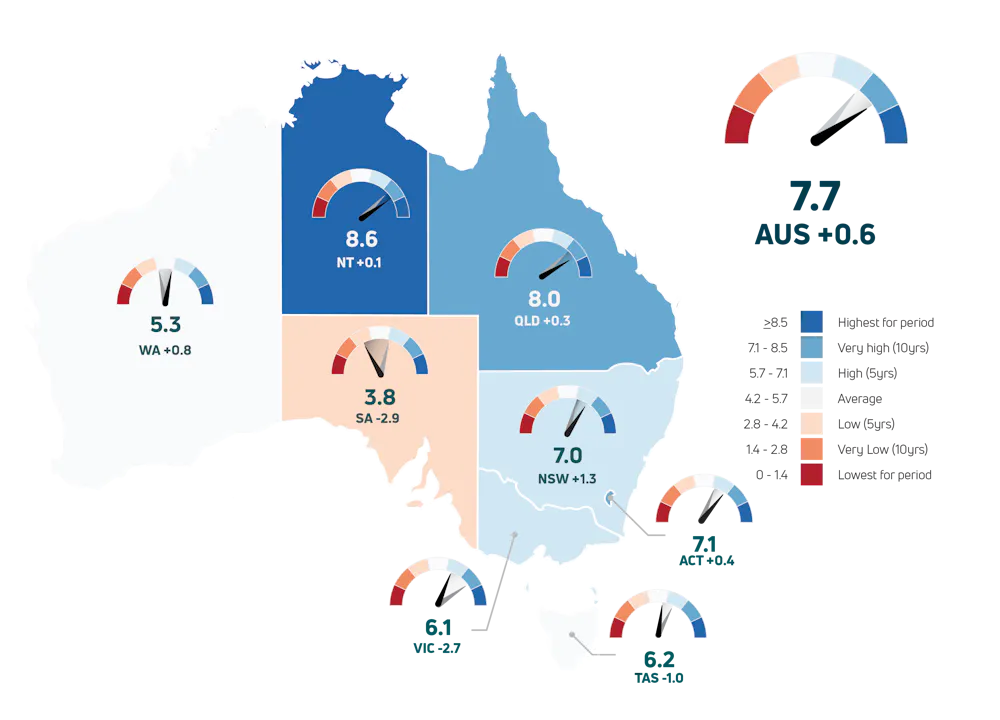
    Different jurisdictions had quite different environmental scores in 2024.
    Australia’s Environment Report 2024, CC BY-NC-ND

    Welcome news, but alarming trends continue

    Globally, 2024 was the world’s hottest year on record. It was Australia’s second hottest year, with the record warmest sea surface temperatures. As a result, the Great Barrier Reef experienced its fifth mass bleaching event since 2016, while Ningaloo Reef in Western Australia also experienced bleaching.

    Yet bushfire activity was low despite high temperatures, thanks to regular rainfall.

    National rainfall was 18% above average, improving soil condition and increasing tree canopy cover.

    States such as New South Wales saw notable improvements in environmental conditions, while conditions also improved somewhat in Western Australia. Others experienced declines, particularly South Australia, Victoria, and Tasmania. These regional contrasts were largely driven by rainfall – good rains can hide some underlying environmental degradation trends.

    Favourable weather conditions bumped up the nation’s score this year, rather than sustained environmental improvements.

    Mapping the environmental condition score to local government areas reveals poor (red) conditions in the west and the south, with good scores (blue) in the east and north. White is neutral.
    Australia’s Environment Explorer, CC BY-NC-ND

    A temporary respite?

    The past four years show Australia’s environment is capable of bouncing back from drought and fire when conditions are right.

    But the global climate crisis continues to escalate, and Australia remains highly vulnerable. Rising sea levels, more extreme weather and fire events continue to threaten our environment and livelihoods. The consequences of extreme events can persist for many years, like we have seen for the Black Summer of 2019–20.

    To play our part in limiting global warming, Australia needs to reduce its greenhouse gas emissions. Progress is stalling: last year, national emissions fell slightly (0.6%) below 2023 levels but were still higher than in 2022. Australia’s greenhouse gas emissions per person remain among the highest in the world.

    Biodiversity loss remains an urgent issue. The national threatened species list grew by 41 species in 2024. While this figure is much lower than the record of 130 species added in 2023, it remains well above the long-term average of 25 species added per year.

    More than half of the newly listed or uplisted species were directly affected by the Black Summer fires. Meanwhile, habitat destruction and invasive species continue to put pressure on native ecosystems and species.

    The Threatened Species Index captures data from long-term threatened species monitoring. The index is updated annually but with a three-year lag due largely to delays in data processing and sharing. This means the 2024 index includes data up to 2021.

    The index revealed the abundance of threatened birds, mammals, plants, and frogs has fallen an average of 58% since 2000.

    But there may be some good news. Between 2020 and 2021, the overall index increased slightly (2%) suggesting the decline has stabilised and some recovery is evident across species groups. We’ll need further monitoring to confirm whether this represents a lasting turnaround or a temporary pause in declines.

    This graph shows the relative abundance of different categories of species listed as threatened under the EPBC Act since 2000, as collated by the Threatened Species Index.
    Australia’s Environment Report 2024, CC BY-NC-ND

    What needs to happen?

    The 2024 Australia’s Environment Report offers a cautiously optimistic picture of the present. Without intervention, the future will look a lot worse.

    Australia must act decisively to secure our nation’s environmental future. This includes reducing greenhouse gas emissions, introducing stronger land management policies and increasing conservation efforts to maintain and restore our ecosystems.

    Without redoubling our efforts, the apparent environmental improvements will not be more than a temporary pause in a long-term downward trend.

    Australia’s Environment Report is produced by the ANU Fenner School for Environment & Society and the Terrestrial Ecosystem Research Network (TERN), which is enabled by the National Collaborative Research Infrastructure Strategy.

    Albert Van Dijk receives or has previously received funding from several government-funded agencies, grant schemes and programs.

    Shoshana Rapley is a Research Assistant and PhD candidate at the Australian National University and has received funding from the Ecological Society of Australia and BirdLife Australia.

    Tayla Lawrie is a current employee of the Terrestrial Ecosystem Research Network (TERN), funded by the National Collaborative Research Infrastructure Strategy.

    ref. Rain gave Australia’s environment a fourth year of reprieve in 2024 – but this masks deepening problems: report – https://theconversation.com/rain-gave-australias-environment-a-fourth-year-of-reprieve-in-2024-but-this-masks-deepening-problems-report-252183

    MIL OSI AnalysisEveningReport.nz

  • MIL-Evening Report: Southern elephant seals are adaptable – but they struggle when faced with both rapid climate change and human impacts

    Source: The Conversation (Au and NZ) – By Nic Rawlence, Associate Professor in Ancient DNA, University of Otago

    Wikimedia Commons/Antoine Lamielle, CC BY-SA

    Southern elephant seals (Mirounga leonina) are an iconic species of the Southern Ocean. But with rapid environmental changes in their ocean home, the seals’ population range has been shifting.

    Once spread across vast areas of the southern hemisphere, these apex predators are facing challenges from both climate shifts and human activities.

    Our new research examines ancient and modern DNA, archaeological records and ecological data.

    It reveals how these large marine mammals have adapted – and sometimes failed to adapt – to such pressures since the height of the last Ice Age thousands of years ago.

    A dynamic evolutionary history

    Today, the largest southern elephant seal populations are found on subantarctic islands, including South Georgia, Macquarie Island and the Falkland Islands. These colonies act as global strongholds for the species.

    Yet in the past, until just a few hundred years ago, many smaller populations existed on the Victoria Land Coast in Antarctica and closer to temperate zones, on mainland Australia and New Zealand.

    Our study focused on the Australasian lineage of southern elephant seals, drawing on samples from these ancient colonies. By analysing their genetic makeup, we pieced together a timeline of their biological heritage, including population expansions and contractions.

    This has crucial implications for understanding the resilience of elephant seals in the face of climate change.

    Subantarctic islands such as the Kerguelen islands remain strongholds for southern elephant seals.
    Antoine Lamielle, CC BY-SA

    From genetic clues in subfossil and archaeological remains, some thousands of years old, we found evidence of repeated population cycles. Expanding sea ice during cold glacial periods forced the seals northward, only for them to recolonise the Southern Ocean as sea ice retreated during warm interglacials.

    This history was particularly dynamic after the height of the last Ice Age 21,000 years ago. The planet started warming then, which led to dramatic ecological shifts.

    A mummified southern elephant seal found on the Victoria Land Coast in Antarctica.
    Brenda Hall, CC BY-SA

    Elephant seals likely expanded from ice-free refuges in temperate regions such as Tasmania and New Zealand into newly available subantarctic and Antarctic coastlines.

    However, this range expansion wasn’t permanent. As the current warm interglacial (the Holocene) progressed, new challenges arose: Indigenous hunting and, later, extensive European industrial sealing.

    For Indigenous communities in New Zealand and Australia, elephant seals were a part of their diet.

    We know this from seal remains in middens (rubbish dumps) and material culture, including necklaces made from elephant seal teeth which have been found in early Māori archaeological sites.

    Archaeological remains from coastal sites in New Zealand and Tasmania indicate significant hunting and reliance on seals by Indigenous populations. Along with human-driven environmental changes, this led to local extinctions.

    Impacts of humans and climate change

    Genetically, the seals from these ancient Australasian and Antarctic colonies were distinct but related. They formed a unique lineage in the Pacific that included Macquarie Island. This genetic diversity likely resulted from periods of isolation in separate refuges at the height of the last Ice Age.

    However, with modern climate shifts and human exploitation, much of this genetic diversity has been lost. The colonies that once thrived on the Victoria Land Coast in Antarctica are now extinct.

    Meanwhile, Macquarie Island is home to a significant breeding colony facing its own challenges. Changes in Antarctic sea ice are increasing the distance between breeding grounds on the island and feeding grounds at sea. This has affected the colony’s stability in recent decades.

    One of the most striking outcomes of our research is how quickly these large, long-lived animals can respond to environmental pressures. Seals adapted to a shifting climate by expanding their range in response to new habitats and retracting when conditions became unsuitable.

    This ability to move and adapt, however, was limited when confronted by the dual pressures of rapid climate change and human exploitation, which reduced their numbers and genetic diversity drastically over a short period.

    This schematic shows living (solid circles) and extinct (opaque circles) southern elephant seal populations and the extent of sea ice around Antarctica (opaque blue-grey) at the height of the last Ice Age.
    Berg et al (2025), CC BY-SA

    Can the Southern Ocean ecosystem adapt?

    As human-driven climate change continues, the Southern Ocean is expected to continue warming. This will cause further habitat loss for species that depend on sea ice and are affected by shifts in the availability of prey.

    The elephant seals’ history offers a window into how marine mammals may respond to these changes. But it also serves as a warning: human impacts, coupled with environmental pressures, can lead to swift, sometimes irreversible declines.

    Our research underscores the importance of conserving the genetic diversity and habitats of southern elephant seals. These seals are not just a testament to adaptability in a changing world; they are reminders of the vulnerability of even the most resilient species.

    Protecting their remaining strongholds and minimising human impacts on their food sources and breeding grounds will be crucial if we hope to avoid further contractions in their population.

    The story of the southern elephant seal is one of survival, adaptation and loss. As we face our own climate challenges, we must consider the lessons embedded in their genetic and ecological history.

    It’s a reminder that while nature often adapts to change and can weather some ecosystem threats, human-driven impacts can push even the most adaptable species beyond the point of recovery.

    Nic Rawlence receives funding from the Marsden Fund.

    Mark de Bruyn received funding from a Griffith University New Investigator grant.

    Michael Knapp does not work for, consult, own shares in or receive funding from any company or organisation that would benefit from this article, and has disclosed no relevant affiliations beyond their academic appointment.

    ref. Southern elephant seals are adaptable – but they struggle when faced with both rapid climate change and human impacts – https://theconversation.com/southern-elephant-seals-are-adaptable-but-they-struggle-when-faced-with-both-rapid-climate-change-and-human-impacts-251820

    MIL OSI AnalysisEveningReport.nz

  • MIL-Evening Report: Figs, meat – and not too much sex. A good diet in ancient times was more than what you ate

    Source: The Conversation (Au and NZ) – By Konstantine Panegyres, Lecturer in Classics and Ancient History, The University of Western Australia

    The Feast of Acheloüs by Peter Paul Rubens and Jan Brueghel the Elder, ca. 1615 The Metropolitan Museum of Art

    In the modern world, we know good nutrition is essential for our health.

    Doctors in ancient Greece and Rome knew this too – in fact diet advice was a mainstay of medical practice and health routines. There were extensive and intricate discussions of how to regulate food and drink to stay healthy.

    Some of their ideas – such as eating fish and vegetables as a healthy way to lose weight – make sense today. But others may raise eyebrows, such a fig-only diet for Olympic athletes.

    So, what did diet and nutrition look like in ancient times? And is there anything we can learn today?

    An expansive diet

    In modern times, diet refers to food and drink. In ancient times, however, the idea of diet was more expansive.

    Our word “diet” comes from the ancient Greek word diaita. This could refer to what we eat and drink, but it could also refer to our lifestyle as a whole – including exercise, sleep, sex and other activities.

    When prescribing a diaita, ancient doctors did not just tell patients what to eat and drink. They also advised them on what sorts of other activities they should be doing, like exercising or even going to the theatre.

    For instance, in the sixth book of the Epidemics, a medical text written in the late fifth century BC, the author calls for moderation not just in what we eat and drink, but also in exercise, sleep and sex.

    Ancient doctors believed balance was important for health.

    Extreme dieting

    However, not all ancient texts advocate moderation. There are some extreme cases of dieting. For example, the historian Hegesander of Delphi (2nd century BC) wrote:

    Anchimolus and Moschus, who were sophistic teachers in Elis, drank nothing but water all their lives and ate nothing but figs, but were no less physically vigorous than anyone else. Their sweat, however, smelled so bad that everyone tried to avoid them in the baths.

    Some ancient athletes swore by a fig-only diet.
    Wikimedia Commons

    In the seventh century BC, athletic trainers also focused on diet as a way to improve their athletes’ physical condition. Trainers such as Iccus of Tarentum introduced strict diets for their athletes to try and gain a competitive edge.

    However, their methods were often questionable, according to today’s standards and our knowledge about nutrition.

    For example, the Olympic runner Chionis of Laconia apparently also had a strict diet of figs when he was training for his competitions. He won in his event at the Olympics in 668, 664, 660, and 656BC, a remarkable record. Other athletes, such as Eurymenes of Samos (sixth century BC), opted for a diet entirely comprised of meat.

    However, there is no evidence to show these restricted diets would have improved athletic performance – and would not be recommended today.

    The physician Galen.
    Pierre-Roch Vigneron/Wikimedia Commons

    An ancient doctor’s perspective

    Greek and Roman doctors could not conduct controlled trials as scientists do today.

    Nevertheless, they were keen observers of the effects of certain foods on their patients – and saw with their own eyes that a bad diet is not good for us.

    For example, the physician Galen of Pergamum (129-216AD) in his work Hygiene attributes his patients’ ill health to poor diet.

    He observed

    some who are continuously diseased, not due to the intrinsic constitution of the body, but through a bad regimen, or living an idle life, or working too hard, or being in error regarding the qualities, quantities or times of foods, or practicing some exercise that is harmful, or erring in regard to the amount of sleep, or excessive indulgence in sex, or needlessly tormenting themselves with grief and anxiety. Every year I see very many who are sick through such a cause.

    Galen thought hard about how certain foods and drinks affect our health and wrote various books on the subject, such as On the Powers of Foods.

    This work contains many anecdotes. For instance, one young man drank the juice of the scammony plant, “to cleanse his system” (presumably as a laxative). However

    five hours after the dose no evacuation had taken place, and he complained that his stomach felt compressed, his belly was heavy and swollen, consequently he was pale and anxious.

    Galen also recognised different diets affect people in different ways:

    some people are harmed and some are benefited by the same things and similarly with opposites. […] I know of some who immediately become sick, if they remain three days without exercise, and others who continue indefinitely without exercise and yet are healthy.

    Nutrition and balance

    Galen’s advice for overweight or obese patients may sound familiar: a “thinning” diet and a lot of fast running. So, exercise, combined with foods that fill you up but don’t make you gain weight.

    According to Galen this meant eating vegetables and fish and avoiding wheat, red meat, fruit and wine.

    A lot has changed in the world of diet and nutrition. We now have professional dietiticians and empirical methods to measure the nutritional values of foods.

    However in their broader definition of “diet”, ancient doctors identified something that remains as true today: the importance of eating well as part of a healthy lifestyle, one that takes care of body and mind and includes exercise, sleep and pleasure.

    Konstantine Panegyres does not work for, consult, own shares in or receive funding from any company or organisation that would benefit from this article, and has disclosed no relevant affiliations beyond their academic appointment.

    ref. Figs, meat – and not too much sex. A good diet in ancient times was more than what you ate – https://theconversation.com/figs-meat-and-not-too-much-sex-a-good-diet-in-ancient-times-was-more-than-what-you-ate-249571

    MIL OSI AnalysisEveningReport.nz

  • MIL-OSI Europe: ASIA/INDONESIA – A ‘common vision’ for humanity and peace: Interview with the Indonesian Ambassador to the Holy See on the 75th anniversary of diplomatic relations

    Source: Agenzia Fides – MIL OSI

    Agenzi Fides

    by Paolo AffatatoRome (Agenzia Fides) – “Pope Francis’ visit to Indonesia and the signing of the Istiqlal Declaration last September were a crowning achievement of diplomatic relations between Indonesia and the Holy See,” says Michael Trias Kuncahyono, Ambassador of the Republic of Indonesia to the Holy See, on the occasion of the 75th anniversary of the official establishment of diplomatic relations between Indonesia and the Holy See on March 13, 1950. Fides Agency asked him some questions- Ambassador, can you recall the historical and political context in which the establishment of diplomatic relations between the Holy See and Indonesia took place, 75 years ago?Indonesia had recently completed the journey to gain independence from the Dutch colonizers: Indonesia proclaimed itself independent in 1945. But at that time, however, there were still colonial pressures from European powers, in the specific case of the Dutch. It was then the first native Indonesian bishop, Monsignor Albertus Sugiyopranoto who called on the Vatican to recognize Indonesian independence. Not only because of the assertion of the independence of the State but also because many missionaries were still imprisoned by colonial forces. This fact could have been a good push to get Indonesia’s recognition.- Was the personality of Albertus Sugiyopranoto therefore decisive?A bishop since 1940, he also made an important contribution during the occupation by Japanese forces in 1942, who had arrested priests and nuns. Bishop Sugiyopranoto took a very clear position. When Dutch forces attacked the Indonesians in 1947, he made an impassioned radio address urging Catholics to defend the homeland. He was an advocate for the involvement of Catholics in the independence movement. Meanwhile, he made contact with the Holy See, which sent one of its delegates in December 1947 and initiated direct relations with President Sukarno. Then the Apostolic Delegate, in agreement with Indonesian Vice President Mohamed Atta, dialogued to establish formal relations. Thus on March 13, 1950, the Holy See began diplomatic relations with Indonesia with the status of Apostolic Internunciature, which later became Apostolic Nunciature on December 6, 1966.- What were the respective goals on the two sides in establishing such relations?We know that the Holy See’s diplomacy is different from all other diplomacies in the world. The Vatican ambassador, today the Apostolic Nuncio, is sent to a State not only with the role of an intermediary between states but also to keep in connection and relationship the Church of Rome with the local Church, in the country in which it is located. At that time in Indonesia there was a great growth of the Catholic community, a phenomenon that aroused interest in the Holy See. So there was a need to facilitate the pastoral work and the life of the local Church. There was a need to follow and deepen the apostolic work in Indonesia. The goal of the Holy See is always to take care of the Catholic Church, and the Delegate was the Pope’s representative in this process.Indonesia, for its part, wanted to establish diplomatic relations because, as a very young country, it needed to be recognized in the international community. The international recognition by the Holy See was of immense value: the Holy See was the first European entity to recognize the Indonesian State. This then led other European States to follow the example. It was a decisive step.- Was the Catholic Church then already established in Indonesia? In what forms and with what configuration?The Catholic religion in Indonesia was already a well-established community, mainly thanks to some missionaries and “spiritual fathers” of the community, such as the Jesuit Franciscus Van Lith, who had been very involved in the apostolate of education, opening schools in Java, a work that was highly appreciated by Indonesian society at the time. The first Indonesian Bishop Sugiyopranoto was one of Father Van Lith’s students. Further east in the Flores area, then, a Catholic presence was already established thanks to the Portuguese. Let us remember that Christianity had arrived as early as the 7th century, and then in the 16th century several missionaries from Portugal had landed in Indonesia including Francis Xavier, passing through the Moluccas on his way to China.In addition, the fact that Indonesia, at its birth in 1945, was founded on the “Pancasila” the charter of five principles, one of which was faith in God; and that it adopted the principle of “diverse but one”: this made the Holy See realize that there was fertile ground in which all religions had a chance to flourish.- Was the “unity in diversity” approach a crucial point?That principle was the catalyst in diplomatic relations. But others, such as equality and brotherhood, are also in harmony with Christian values. The founding fathers were quite far-sighted in considering that a nation so rich in different cultures, ethnicities and religions could only survive by staying true to the motto “unity in diversity.” Pope Pius XII already appreciated this and Pope Francis also reiterated it, saying that the model should be taken as an example, especially in countries where there is great pluralism and it is difficult to remain united: we are different but we are brothers.- In Indonesian history, in designing the architecture of the Republic, the choice was made not to build a mono-religious state…It was: the first of the five founding principles was “faith in one God,” then that phrase should have continued by saying “in the Islamic way.” There was a great debate about it, then it was decided to leave only “faith in one God.” Mohammad Atta, the vice president, who was a Muslim and came from Padang a strongly Islamic city, pointed it out clearly because, he said, “we have to remain united.” It was a forward-looking vision.- What common points do you see between Indonesia and the Holy See today in their respective political and cultural approaches?Politically, Indonesia and the Holy See find themselves in a policy that is always in favor of humanity. The Holy See does not work for the maintenance of temporal power but for the development of man, his dignity and rights. I think Indonesia also has the same approach, as the Pancasila and our Constitution say, promoting equality, freedom, democracy as well as peace. These are points that Indonesia and the Holy See have in common.- Is there a common vision also in the use of the instrument of diplomacy?In the instrument of diplomacy, the aspect we have in common can be seen in the founding principles, such as freedom from colonialism and the promotion of peace: we see this in scenarios such as the Middle East, Ukraine, Myanmar. The “diplomacy of hope,” mentioned by Pope Francis in his recent address to the Diplomatic Corps, we understood it as diplomacy that wants to improve the world in a harmonious and comprehensive way. Hope must start from trust, which is the basis of relations between states. Hope for peace in the various conflict scenarios is generated on the basis of trust between the interlocutors.- What did Pope Francis’ trip to Indonesia in 2024 mean?Pope Francis’ visit to Indonesia and the signing of the Istiqlal Declaration last September was a crowning achievement of diplomatic relations between Indonesia and the Holy See. Not all countries with which the Holy See has relations are visited by the pontiff. And three Popes have visited Indonesia – Pope St. Paul VI (1970), Pope St. John Paul II (1989) and Pope Francis (2024).The trip was not perceived as a trip reserved for the Catholic community, but was perceived as a visit to all Indonesians, who welcomed the Pope with great warmth. The Pope became a model of a leader to follow: he was easy-going, showed himself in a non-luxury car, was always very humble, and stopped to greet everyone. Indonesia showed its true face, a plural face, composed of people of different cultures and religions who welcomed the Pope warmly and enthusiastically. Today, at the time of his illness, so many write to me, not only Catholics but also Muslims, saying: let us pray for him.- What do you hope for the future?We want to strengthen more and more the relations between Indonesia and the Holy See: and, since there is no political and economic aspect, to do it through culture. We intend to make the pluralism of Indonesian culture and its peaceful face better known. The Holy See is, for us, also a gateway to the rest of the world. Another field of fruitful cooperation is that of interreligious dialogue, according to the vision of Pope Francis. These are the paths for future relations. (Agenzia Fides, 18/3/2025)
    Share:

    MIL OSI Europe News

  • MIL-OSI Europe: Written question – Northern Adriatic as a strategic European interest: Commission security and financial support for Italian, Slovenian and Croatian ports – E-001036/2025

    Source: European Parliament

    Question for written answer  E-001036/2025
    to the Commission
    Rule 144
    Elena Donazzan (ECR), Carlo Fidanza (ECR), Nicola Procaccini (ECR), Carlo Ciccioli (ECR), Alessandro Ciriani (ECR), Giovanni Crosetto (ECR), Pietro Fiocchi (ECR), Daniele Polato (ECR), Mariateresa Vivaldini (ECR)

    Since the brutal attacks on merchant vessels in the Red Sea, navigation in the Suez Canal has been less secure. In the first five months of 2024, the average daily number of vessels transiting through the Mediterranean Sea was half that of the same period in 2023, as companies redirected vessels towards the Cape of Good Hope.

    Use of that African route lead to exponential growth of sea freight via the Mediterranean – from USD 2 000 to USD 7 000 per container – and an estimated 42 % increase in pollutant emissions per ship. The impact on the Italian ports of Ravenna, Trieste and Venice, the Slovenian port Koper and the Croatian port Rijeka is enormous.

    This state of affairs is damaging for the automotive, chemical, construction and energy supply chains on the Asia-Europe route.

    Taking into account the strategic importance of the Adriatic for Italy, Slovenia and Croatia and given that, should the dangerous conditions in the Suez Canal continue, transport for goods for Asia will be forcibly shifted from the Adriatic to the Atlantic Ocean, with a dramatic impact on European supply chains and jobs:

    • 1.How will the Commission protect the interests of the northern Adriatic ports and jobs there?
    • 2.What financial support measures could be taken to help the ports of Ravenna, Trieste, Venice, Koper and Rijeka to withstand the huge losses of economic activity to date?

    Submitted: 11.3.2025

    MIL OSI Europe News

  • MIL-OSI Global: How Canadian small businesses can expand into Asian markets and reduce their dependence on the U.S.

    Source: The Conversation – Canada – By Michael Joseph Dominic Roberts, Associate Dean & Associate Professor, Faculty of Business and Communications Studies, Mount Royal University

    The recent escalation of trade tensions under United States President Donald Trump has significantly increased uncertainty for Canadian SMEs (small- and medium-sized enterprises), particularly in the high-value service sector.

    Examples of this sector include financial technology and investment services, aerospace and advanced manufacturing, and clean technology sectors focused on renewable energy and sustainable resource management.

    For decades, Canadian businesses have relied on a stable trade relationship with the U.S. But under Trump’s “America First” protectionist policies, that stability has crumbled.

    With tariffs, trade barriers and shifting political dynamics making North American markets increasingly unpredictable, many Canadian businesses are searching for ways to reduce their dependence on the U.S. and expand elsewhere.

    Expanding into Asia

    Asia has emerged as an attractive alternative for businesses due to its rapidly expanding middle class, growing investments in infrastructure and technology, and rising demand for specialized expertise.

    This trend is particularly evident in the energy sector. The Asia-Pacific region — though currently accounting for only eight per cent of the global market — is expected to grow significantly as countries expand energy infrastructure and seek advanced technologies to improve resource extraction for environmental sustainability.


    Read more:
    Trump’s tariff threat is a sign that Canada should be diversifying beyond the U.S.


    This presents promising growth opportunities for Canadian businesses in sectors like engineering consulting, technology, energy and environmental services, where they already have a competitive edge.

    However, entering Asian markets presents unique challenges, requiring businesses to rethink their strategies.

    Breaking into Asian markets

    Expanding into Asian markets is no easy task for SMEs. These businesses face substantial barriers, including significant differences in regulatory environments, business practices and customer expectations.

    For service-based businesses, the challenge is even greater. Unlike physical products, which can be easily displayed and tested, services are harder to quantify and prove to new clients. This makes it more difficult for SMEs to build credibility and demonstrate their value in unfamiliar markets.

    Our recent study explored how Canadian SMEs in the service sector can successfully overcome these barriers when entering Asian markets like China, India and South Korea.

    We brought together industry experts, government officials and senior executives from SMEs already operating successfully in Asia for a two-day workshop. We analyzed their firsthand experiences, challenges and recommendations to develop a clear and actionable framework called the 4P strategy (potential, proposition, presence and policy).

    These four steps offer SMEs a structured approach to understanding local conditions, differentiating offerings, establishing trusted partnerships and gaining government support.

    1. Potential: Understand the local market

    SMEs must understand Asian market regulations, business culture and market structures. Unlike North America’s relatively stable environment, Asian markets often feature rapidly evolving regulations and unpredictable policy changes.

    Businesses should balance these regulatory uncertainties against economic opportunities and be prepared to swiftly adapt when necessary. For example, policy changes in Asian markets, such as shifting foreign investment regulations or evolving environmental standards, can create uncertainty for SMEs operating abroad.

    Companies must remain agile to navigate regulatory shifts while leveraging the relative economic stability of the region.

    Patience and flexibility are also critical. In many Asian markets, business deals take longer to close due to hierarchical, relationship-driven decision-making. SMEs should anticipate these extended timelines and factor them into their planning.

    Our study found that deals that might be finalized quickly in North America can take years to develop in Asia, requiring firms to exercise patience before realizing significant profits. Successful market entry depends on a long-term approach and the ability to adapt to extended gestation periods.

    2. Proposition: Adapt services to fit local needs

    SMEs need to localize their offerings beyond language translation, adapting their branding, marketing and customer-engagement strategies to fit local contexts.

    A clearly defined and differentiated service offering is critical. Businesses must clearly define what sets them apart from local competitors and ensure their services address specific market needs.

    Pricing strategies should also align with local market expectations. Many Asian markets, especially in business-to-business services, are highly price-sensitive. SMEs must balance competitive pricing with value.

    In some cases, businesses may need to use performance-based pricing models — where clients pay based on results rather than a fixed fee — to remain competitive while protecting profit margins.

    3. Presence: Build a local network and partnerships

    A strong local presence is vital for success in Asia. SMEs should invest in trusted local partnerships or regional offices to build credibility, facilitate smoother operations and better understand local customer needs.

    Relationships play a central role in doing business in Asia. Unlike in North America, where successful transactions often lead to partnerships, in Asia, relationships must be built first.

    This relationship-first approach is deeply embedded in business culture, requiring firms to prioritize long-term engagement over immediate gains. Research has shown that trust-building is essential for long-term success in Asian markets, as strong relationships ultimately lead to transactions.

    Canadian SMEs entering these markets should be prepared to shift their approach, recognizing that sustained commitment and relationship-building are key to unlocking business opportunities.

    4. Policy: Take advantage of government support

    Many Canadian SMEs underestimate the extent of available government support and miss out on resources that reduce risks and make it easier to establish a foothold abroad.

    Our study found that SMEs expanding to Asia can access valuable support from government departments and trade commissioners at Canadian embassies. In energy services subsectors, government and non-governmental organizations can assist SMEs in forming partnerships with Asian firms.

    Additionally, agencies like Export Development Canada offer training, financial support and market-entry resources that many SMEs overlook. Taking advantage of these programs can help businesses navigate regulatory challenges and accelerate their international expansion.

    Government-backed programs also support research, development and technology adaptation to help businesses tailor their services to local markets. Our study found that making use of these resources reduces barriers, lowers entry risks and significantly enhances businesses’ likelihood of success in Asia.

    Seizing the opportunity

    Rather than merely serving as an alternative to the increasingly restrictive U.S. market, Asia presents significant growth opportunities for Canadian SMEs but demands strategic patience, adaptability and sustained commitment.

    However, success in Asia won’t come overnight. Unlike the relatively familiar North American market, expanding into Asia requires a patience, adaptability and a willingness to learn a different business culture.

    By adopting the 4P strategies, Canadian businesses can effectively navigate market-entry barriers and position themselves for success in an era of shifting global trade dynamics.

    Etayankara Muralidharan receives funding from Social Sciences and Humanities Research Council (SSHRC).

    Michael Joseph Dominic Roberts does not work for, consult, own shares in or receive funding from any company or organisation that would benefit from this article, and has disclosed no relevant affiliations beyond their academic appointment.

    ref. How Canadian small businesses can expand into Asian markets and reduce their dependence on the U.S. – https://theconversation.com/how-canadian-small-businesses-can-expand-into-asian-markets-and-reduce-their-dependence-on-the-u-s-251991

    MIL OSI – Global Reports

  • MIL-OSI USA: Luján Joins Bipartisan Push to Deliver Combat-Injured Veterans Full Military Benefits

    US Senate News:

    Source: United States Senator Ben Ray Luján (D-New Mexico)

    Major Richard Star Act would provide combat-injured veterans with full earned disability compensation and retirement pay

    Española, N.M. – U.S. Senator Ben Ray Luján (D-N.M.) joined Senate Veterans’ Affairs Committee Ranking Member Richard Blumenthal (D-CT), U.S. Senators Mike Crapo (R-ID), Elizabeth Warren (D-Mass.), and Rick Scott (R-FL) to introduce S. 1032, the Major Richard Star Act—bipartisan legislation to provide combat-injured veteran retirees their full benefits.

    Currently, only veterans with disability ratings above 50 percent and more than 20 years of service are eligible to receive the full amount of their Department of Defense (DOD) retirement and Department of Veterans Affairs (VA) disability payments—leaving behind more than 50,000 combat-injured military retirees. The Senators’ Major Richard Star Act will fix this unjust policy for retired combat veteransproviding them their full VA disability and DOD retirement payments.

    “The men and women who risked their lives for our country and were injured in combat deserve the full benefits they have earned. Too many veterans have been left behind, and it’s far past time we correct this grave injustice,” said Senator Luján. “That’s why I am proud to stand with my colleagues working to fix the unjust veterans’ disability system.”

    “This measure corrects one of the deepest injustices in our present veterans’ disability system,” said Senator Blumenthal. “It is unacceptable that tens of thousands of combat-injured veterans are denied the full military benefits they earned. Our bipartisan bill will right this longstanding injustice and finally provide these military retirees who have already sacrificed so much their full VA disability and Defense Department retirement payments.”

    “The Major Richard Star Act corrects a severe injustice for combat-wounded veterans,” said Senator Crapo. “The support for this correction is clear.  Though the namesake of our legislation is no longer with us, I continue to press for its passage on behalf of the more than 50,000 veterans, including hundreds in Idaho, who stand to benefit.”  

    “Our veterans put their lives on the line for this country and it’s time our government gives them the full benefits they’ve earned,” said Senator Warren. “The Major Richard Star Act will ensure the federal government keeps its promise to our veterans by allowing them to collect both disability and retirement benefits they earned, even if combat injuries forced them to retire early.”

    “I am a proud veteran and the son of a World War II veteran, and I have immense respect for anyone who puts on the uniform to defend our nation,” said Senator Scott. “Our veterans are American heroes who have made countless sacrifices. The Major Richard Star Act ensures our veterans receive the full benefits they’ve earned through their service and sacrifice protecting our nation regardless of length of service. This legislation makes a critical change to treat our veterans fairly and support our nation’s heroes. I urge my colleagues to support its quick passage.”

    This bipartisan legislation is named in honor of Major Richard A. Star, a decorated war veteran who was forced to medically retire due to his combat-related injuries. Major Star sadly lost his battle with cancer on February 13, 2021. The legislation has 43 bipartisan cosponsors.

    The House companion version of this bill was introduced by Congressmen Gus Bilirakis (R-FL) and Raul Ruiz (D-CA), with 185 bipartisan cosponsors.

    The Senators’ bipartisan effort to provide combat-injured veterans their due benefits is supported by the Air Force Sergeants Association (AFSA), Air & Space Forces Association (AFA), American GI Forum, The American Legion,American Military Society,American Veterans (AMVETS), Armed Forces Retiree Association, Army Aviation Association of America (AAAA), Association of Military Surgeons of the United States (AMSUS), Association of the United States Army (AUSA), Association of the United States Navy (AUSN), Blinded Veterans Association (BVA), Burn Pits 360, Chief Warrant Officers Association of the US Coast Guard (CWOA), Commissioned Officers Association of the U.S. Public Health Service, Inc. (COA), Disabled American Veterans (DAV), Enlisted Association of the National Guard of the United States, Fleet Reserve Association (FRA), Heroes Athletic Association, Gold Star Wives of America (GSW), Iraq and Afghanistan Veterans of America (IAVA), Jewish War Veterans of the United States of America (JWV), K9s for Warriors, Marine Corps League (MCL), Marine Corps Reserve Association (MCRA), Military Chaplains Association of the United States of America (MCA), Military Officers Association of America (MOAA), Military Order of the Purple Heart (MOPH), Mission Roll Call, National Defense Committee, National Military Family Association (NMFA), Naval Enlisted Reserve Association (NERA), Non-Commissioned Officers Association (NCOA), Operation First Response, Paralyzed Veterans of America (PVA),Quality of Life Foundation, Reserve Organization of America (ROA), Stronghold Freedom Foundation, Tragedy Assistance Program for Survivors (TAPS), The Retired Enlisted Association (TREA), The Independence Fund (TIF), United States Army Warrant Officers Association (USAWOA), USCG Chief Petty Officers Association (CPOA), VetsFirst/United Spinal Association, Vietnam Veterans of America (VVA), Wounded Paw Project, Wounded Warrior Project (WWP).

    MIL OSI USA News

  • MIL-Evening Report: The Australian economy has changed dramatically since 2000 – the way we work now is radically different

    Source: The Conversation (Au and NZ) – By John Quiggin, Professor, School of Economics, The University of Queensland

    The most striking feature of the Australian economy in the 21st century has been the exceptionally long period of fairly steady, though not rapid, economic growth.

    The deep recession of 1989–91, and the painfully slow recovery that followed, led most observers to assume another recession was inevitable sooner or later.

    And nearly everywhere in the developed world, the Global Financial Crisis of 2007–08 did lead to recessions comparable in length and severity to the Great Depression of the 1930s.

    Through a combination of good luck and good management, Australia avoided recession, at least as measured by the commonly used criterion of two successive quarters of negative GDP growth.


    Recessions cause unemployment to rise in the short run. Even after recessions end, the economy often remains on a permanently lower growth path.

    Good management – and good luck

    The crucial example of good management was the use of expansionary fiscal policy in response to both the financial crisis and the COVID pandemic. Governments supported households with cash payments as well as increasing their own spending.

    The most important piece of good luck was the rise of China and its appetite for Australian mineral exports, most notably iron ore.


    This demand removed the concerns about trade deficits that had driven policy in the 1990s, and has continued to provide an important source of export income. Mining is also an important source of government revenue, though this is often overstated.

    Still more fortunately, the Chinese response to the Global Financial Crisis, like that in Australia, was one of massive fiscal stimulus. The result was that both domestic demand and export demand were sustained through the crisis.

    The shift to an information economy

    The other big change, shared with other developed countries, has been the replacement of the 20th century industrial economy with an economy dominated by information and information-intensive services.

    The change in the industrial makeup of the economy can be seen in occupational data.

    In the 20th century, professional and managerial workers were a rarefied elite. Now they are the largest single occupational group at nearly 40% of all workers. Clerical, sales and other service workers account for 33% and manual workers (trades, labourers, drivers and so on) for only 28%.

    The results are evident in the labour market. First, the decline in the relative share of the male-dominated manual occupations has been reflected in a gradual convergence in the labour force participation rates of men (declining) and women (increasing).

    Suddenly, work from home was possible

    Much more striking than this gradual trend was the (literally) overnight shift to remote work that took place with the arrival of COVID lockdowns.

    Despite the absence of any preparation, it turned out the great majority of information work could be done anywhere workers could find a desk and an internet connection.

    The result was a massive benefit to workers. They were freed from their daily commute, which has been estimated as equivalent to an 8–10% increase in wages, and better able to juggle work and family commitments.

    Despite strenuous efforts by managers, remote or hybrid work has remained common among information workers.


    CEOs regularly demand a return to full-time office work. But few if any have been prepared to pay the wage premium that would be required to retain their most valuable (and mobile) employees without the flexibility of hybrid or remote work.

    The employment miracle

    The confluence of all these trends has produced an outcome that seemed unimaginable in the year 2000: a sustained period of near-full employment. That is defined by a situation in which almost anyone who wants a job can get one.

    The unemployment rate has dropped from 6.8% in 2000 to around 4%. While this is higher than in the post-war boom of the 1950s and 1960s, this is probably inevitable given the greater diversity of both the workforce and the range of jobs available.

    Matching workers to jobs was relatively easy in an industrial economy where large factories employed thousands of workers. It’s much harder in an information economy where job categories include “Instagram influencer” and “search engine optimiser”.

    As we progress through 2025, it is possible all this may change rapidly, for better or for worse.

    The chaos injected into the global economy by the Trump Administration will radically reshape patterns of trade.

    Meanwhile the rise of artificial intelligence holds out the promise of greatly increased productivity – but also the threat of massive job destruction. Economists, at least, will be busy for quite a while to come.

    John Quiggin does not work for, consult, own shares in or receive funding from any company or organisation that would benefit from this article, and has disclosed no relevant affiliations beyond their academic appointment.

    ref. The Australian economy has changed dramatically since 2000 – the way we work now is radically different – https://theconversation.com/the-australian-economy-has-changed-dramatically-since-2000-the-way-we-work-now-is-radically-different-249942

    MIL OSI AnalysisEveningReport.nz

  • MIL-Evening Report: In 2000, Australia was defined by the Olympics, border politics and reconciliation. So what really has changed?

    Source: The Conversation (Au and NZ) – By Joshua Black, Visitor, School of History, Australian National University

    The world had its eyes on Sydney in 2000. A million people lined the harbour to ring in the new millennium (though some said it was actually the final year of the old one) on January 1.

    US television reporters called it “the biggest party in Australian history”. Bill Gates, chairman of Microsoft, whose corporation seemed to represent the coming age, was among those watching on.

    Sydney offered not only a world-leading party, but also a litmus test for the much-feared Y2K bug, which threatened to knock planes out of the sky and bring the global economy to a halt. Australia and New Zealand were said to be the “tripwire for the world’s computer systems”.

    It was fine in the end, although plenty of work had in fact been undertaken behind the scenes to make Australia’s systems more millennium-proof than they might have been.

    This was arguably the defining feature of Australia in the year 2000: a confident display for the world concealing a lot of angst and uncertainty. Australia was the “oldest continent on Earth”, the US broadcasters told their viewers, but it was “much more of an Asian nation”, and much closer to the rest of the world “thanks to technology”.

    Those confident claims would probably have surprised many Australians. Theirs was an old country trying to keep up with a new, interconnected world, and also a relatively young one trying to reconcile itself with the ancient cultures that its settler forebears had dispossessed.

    A curated Australia

    In September, the world’s sporting and political elite, followed by a train of journalists, arrived in Sydney for the 2000 Olympic Games. It had been years in the making, and every level of government was involved. There were no fewer than 47,000 volunteers.

    There was something for everyone in the well-curated opening ceremony. The event opened with the crack of a stockman’s whip and a fleet of flag-waving bushmen on horseback. There were highly sanitised displays of European arrival, pastoral settlement and a tribute to an armour-clad colonial Victorian bushranger that must have baffled those viewers watching from abroad who had not seen a Sidney Nolan painting before.

    Ancient stories and new cultural sensibilities were on display too. There were stylised performances of the Dreaming, striking First Nations dances and the distinctive sounds of the didgeridoo. A section entitled “Arrivals” recognised the importance of migration in the nation’s story.

    A young Aboriginal sprinter, Cathy Freeman, lit the cauldron in what became one of the iconic images of the year. The cauldron’s hydraulics unfortunately got stuck as it ascended, and the flame was mere seconds from snuffing out in what could have been a global embarrassment. But big ambitions incur big risks.

    This global performance of Australian-ness was arrestingly simple: that of a nation confident in its own diversity and capable of catering to everyone’s tastes.

    Even the musical selections seemed to reconcile the needs of the youth (with performances from a young Vanessa Amorosi and even younger Nikki Webster), and the more mature (represented by John Farnham and Olivia Newton-John).

    Australia’s athletes had their best ever showing with 58 medals, including Freeman’s own gold.

    Not quite comfortable, not quite relaxed

    The Olympics masked as much as they revealed.

    In 2000, many white Australians still weren’t sure if theirs was, or should be, a multicultural society.

    The reactionary Pauline Hanson was out of parliament for the time being, but her One Nation Party had won 7.5% of the vote in New South Wales in the March 1999 state election, and nearly 23% of the vote in Queensland the year before.

    Eight weeks before millennium day, Australians had roundly rejected two referendum proposals, one to become a republic, and for a Constitutional preamble that, among other things, recognised Indigenous Australians as “the nation’s first people”.

    But whether Hanson liked it or not, her lifetime had coincided with great demographic and social change.

    In 1976, roughly 1.8% of the population said they were born in Asia or the Middle East. In the 2001 census, 1.6% of the population were born in China or Vietnam alone, and many more were the descendants of migrants from these places.

    The Aboriginal and Torres Strait Islander population had more than doubled over the same period, while those identifying as Christian decreased from nearly 79% in 1976 to 56% in 2001.

    This increasingly diverse Australia claimed to be on a journey to “reconciliation”. That process had been sorely tested during the nasty debates about land rights and the Stolen Generations.

    Corroboree 2000, held on May 27 in Sydney, saw the Council for Aboriginal Reconciliation and the nation’s political leaders present their visions for the next phase of national healing. The leaders symbolically left their handprints on a “reconciliation canvas”.

    The following day, 250,000 Australians walked across the Sydney Harbour Bridge in a moving display of togetherness. John Howard, the prime minister, declined to participate.

    But his treasurer, Peter Costello, made a point of showing up for a similar event in Melbourne that December, leading Victorian Liberals and another 200,000 or so Australians.

    Their different approaches showed that the past was still a troubling present. Howard rebuffed suggestions of a treaty between Indigenous and settler Australians and maintained his refusal to apologise on behalf of the Commonwealth to the Stolen Generations, though all the states had done so by this time.

    The idea of such an apology was not as popular then as it seemed later on. The prime minister was sensitive to the fact that his was “an unpopular view with a lot of people”, but an opinion poll in The Australian newspaper showed a majority of voters were opposed to a national apology.

    Two survivors of the Stolen Generations, Peter Gunner and Lorna Cubillo, sued the Commonwealth for damages in 2000, giving their opponents the chance to challenge the legitimacy of their experiences. None of this looked like a nation that was as “comfortable and relaxed” as Howard had hoped it would be under his watch.

    Border politics

    Australian collective memory often gravitates toward 2001, the year of the Tampa affair and the September 11 terrorist attacks in New York.

    But Australia’s border was already highly politicised in 2000.

    In January, a boat arrived from Indonesia carrying 54 Christians fleeing religious conflict. They spent ten weeks at Port Hedland Immigration Detention facility, from which 39 went back to Indonesia and only 15 moved on to Adelaide to build new lives.

    Port Hedland and other detention centres made the news for all the wrong reasons. There were riots, hunger strikes and multiple breakouts. Authorities responded with upgraded security perimeters, character checks, and strip searches without warrants.

    Frustrated refugees set fire to South Australia’s Woomera facility, which former prime minister Malcolm Fraser publicly condemned as a “hell-hole”.

    In an end-of-year reflection for The Age newspaper, Gary Tippet said there had been a “touch of mean-spiritedness” about the handling of it all. Chris Wallace rightly suggests 2000 was a crucial moment in the “march towards an absolute offshore, extraterritorial approach” to refugees in Australia.

    In the intervening quarter-century, Australian officials have made mean-spiritedness an art form at the border and on the seas.

    First-rate democracy, third-rate economy

    Compared to the many legal challenges that came out of the US presidential contest in November 2000, Australia’s elections looked pretty smooth and sensible. The US seemed to have a backward democracy grafted onto its world-leading, information-age economy.

    Australia looked the opposite: a first-rate democracy with what looked increasingly like a “branch-office economy”.

    Reformers had tried for 20 years to make Australia efficient and competitive, but as one editorial in The Australian Financial Review explained, the country still suffered from its “old economy image”.

    The tech boom would soon become the tech wreck.
    Robert Cianflone/Getty Images

    Certainly, Australia still sold its minerals and farm products to the world in exchange for quality cars and cutting-edge computers.

    With global capitalists still enthralled by the global tech boom (though it was soon to become the “tech wreck”), they had little need for the Aussie dollar.

    The currency’s value declined through the year to just 50 US cents, and it would fall further in the following months. On its own, this mattered little, but a quarter of negative growth at the end of the year meant, as Paul Kelly later wrote, an “election-year recession” seemed a “real threat”.

    In the meantime, the much-debated Goods and Services Tax took effect around midnight on June 30 (a few hours later for businesses trading through the night).

    The 10% consumption tax was a big deal. Costello said in his memoir the “prices of three billion products were to change all at the same time”.

    The measure was politically brave, but soon became unpopular, helping raise petrol prices and alienate small business owners.

    The punters were pretty confident the Howard government was heading for defeat in 2001. They were wrong.

    Between the old and new

    The pace of social change accelerated from 2000.

    In the 2021 census, 2.6% of the population said they were born in India, and a further 3.2% in China and Vietnam. Aboriginal and Torres Strait Islander Australians had more than doubled over two decades, such that they made up 3.2% of the total population in 2021.

    People increasingly related to their economy differently, too. Half of the workforce had been unionised in the 1980s, but coverage fell to roughly a quarter in 2000 and just 12.5% in 2022.

    These and other changes make our politics look different from that of 25 years ago. Nailbiter elections are now more common than thumping majorities and attitudes toward the once-feared “minority government” have softened.

    For all that, many of the challenges of 2000 are still with us.

    Many Australians are less tolerant of overt racism than they once were, but the 2023 Voice referendum and our offshore detention regime remind us that race still matters in this country.

    Kevin Rudd apologised to the Stolen Generations in 2008, but Treaty and Truth-Telling are left unresolved.

    And for all our talk about human capital and the digital economy, resources make up a much higher share of our total export mix today than in 2000.

    A quarter-century on, Australia is still caught between the old and the new.

    Dr Joshua Black is a Postdoctoral Research Fellow at The Australia Institute.

    ref. In 2000, Australia was defined by the Olympics, border politics and reconciliation. So what really has changed? – https://theconversation.com/in-2000-australia-was-defined-by-the-olympics-border-politics-and-reconciliation-so-what-really-has-changed-250791

    MIL OSI AnalysisEveningReport.nz

  • MIL-Evening Report: We found the only kangaroo that doesn’t hop – and it can teach us how roos evolved their quirky gait

    Source: The Conversation (Au and NZ) – By Aaron Camens, Lecturer in Palaeontology, Flinders University

    Musky rat-kangaroo. Amy Tschirn

    In the remnant rainforests of coastal far-north Queensland, bushwalkers may be lucky enough to catch a glimpse of a diminutive marsupial that’s the last living representative of its family.

    The musky rat-kangaroo (Hypsiprymnodon moschatus) weighs only 500 grams and looks a bit like a potoroo. It’s part of a lineage that extends back to before kangaroos evolved their distinctive hopping gait.

    Unlike their bigger relatives, muskies can be seen out and about during the day, foraging in the forest litter for fruits, fungi and invertebrates.

    As the only living macropodoid (the group that includes kangaroos, wallabies, potoroos and bettongs) that doesn’t hop, they can provide a crucial insight into how and when this iconic form of locomotion evolved in Australia.

    Our study, published in Australian Mammalogy today, aimed to observe muskies in their native habitat in order to better understand how they move.

    Muskies can shed light on the evolution of kangaroo hops, but they haven’t been studied in detail.
    Amy Tschirn

    Why kangaroos are special

    If we look around the world, hopping animals are quite rare. Hopping evolved once in macropodoids, four times in rodents, and probably once in an extinct group of South American marsupials known as argyrolagids.

    In animals heavier than five kilograms, hopping is an incredibly efficient form of locomotion, in large part thanks to energy being stored in the Achilles tendon at the back of the heel.

    However, the vast majority of animals that hop are really small. The only hopping animals with body masses over 500 grams are kangaroos. And Australia used to have a lot more kangaroo species, many of them quite large.

    Despite the abundance of fossil kangaroos, we still don’t really know why they evolved their hopping gait, especially given it only really becomes more efficient at body masses over five kilograms. Hypotheses range from predator escape, to energy preservation, to the opening of vegetation as Australia shifted to a drier climate.

    Researchers looking at limb proportions have suggested that fossil kangaroos also hopped. But it’s likely the ways that extinct roos moved were much more diverse than has previously been suggested.

    Muskies can sometimes be seen foraging for fallen fruit in the leaf litter in the dense rainforests of far northern Queensland.
    Aaron Camens

    Why muskies are key in roo evolution

    Muskies are the last living member of the Hypsiprymnodontidae, a macropodoid family that branched off early in kangaroo evolution. For this reason, it is thought muskies may move in a similar way to early kangaroo ancestors.

    Studies on kangaroo evolution will often mention locomotion in muskies, but only in passing. And only a single, brief, first-hand description of locomotor behaviour in muskies has actually been published, in 1982. The authors observed that muskies moved their hindlimbs together in a bound and that all four limbs were used, even at fast speeds.

    So, we set out to answer the question: can H. moschatus hop? And if not, what form of locomotion does it use?

    Using high-speed video recordings, we studied the sequence in which muskies place their four feet on the ground, and the relative timing and duration of each footfall.

    The musky rat-kangaroo (Hypsiprymnodon moschatus) is the only macropodoid not to hop; instead, it bounds over obstacles on the forest floor.
    Amy Tschirn

    Through this gait analysis, we determined that muskies predominantly use what is called a “bound” or “half-bound” gait. Bounding gaits are characterised by the hindfeet moving together in synchrony – just like when bipedal kangaroos hop. In the case of muskies, the forefeet (or “hands”) also generally move together in close synchrony.

    No other marsupial that moves on all fours is known to use this distinctive style of movement to the same extent as muskies. Rather, other species tend to use a combination of the half-bound and some form of galloping (the gait that horses, cats and dogs use) or hopping.

    From all fours to hopping

    We were also able to confirm that tantalisingly brief observation from the 1980s: even when travelling at high speeds, muskies always use quadrupedal gaits, never rearing up on just their back legs.

    They are, therefore, the only living kangaroo that doesn’t hop.

    Combined with further investigation of their anatomy, these observations help us get closer to understanding how and why kangaroos adopted their distinctive bipedal hopping behaviours.

    These results also signal a potential pathway to how bipedal hopping evolved in kangaroos. Perhaps it started with an ancestor that moved about on all fours like other marsupials, such as brush-tail possums, then an animal that bounded like the muskies, and finally evolved into the iconic hopping kangaroos we see in Australia today.

    However, we are no clearer on how the remarkable energy economy of kangaroo movement evolved, or why hopping kangaroos got so much bigger than hopping rodents.

    The next part of the research needs to focus on that and will be informed by key fossil discoveries from early periods in kangaroo evolution.

    There’s more research to be done, but understanding musky gait in detail is a great first step.
    Amy Tschirn

    Amy Tschirn received funding from an Australian Government Research Training Program Scholarship and an Australian Research Council Discovery Grant (to G.J.P) during this project.

    Aaron Camens and Peter Bishop do not work for, consult, own shares in or receive funding from any company or organisation that would benefit from this article, and have disclosed no relevant affiliations beyond their academic appointment.

    ref. We found the only kangaroo that doesn’t hop – and it can teach us how roos evolved their quirky gait – https://theconversation.com/we-found-the-only-kangaroo-that-doesnt-hop-and-it-can-teach-us-how-roos-evolved-their-quirky-gait-251373

    MIL OSI AnalysisEveningReport.nz

  • MIL-OSI Africa: Cooperation between SA and Japan to continue 

    Source: South Africa News Agency

    South Africa and Japan continue to enjoy well-established diplomatic relations, which are particularly strong in the fields of trade and investment, science and technology and education, skills transfer and capacity building through development assistance. 

    This is according to Deputy President Paul Mashatile, who was speaking during an interview with the Foreign Correspondence Club of Japan as part of a working visit to the East Asian nation. 

    Full diplomatic relations with Japan were established in 1992, while in 2010, relations between the two countries were upgraded to a Strategic Cooperation Partnership. 

    This year marks 115 years of relations between the two nations. 

    READ | South Africa strengthens ties with Japan  

    Mashatile told the attendees that South Africa and Japan cooperate within the framework of the Partnership Forum held at a ministerial level, which covers the entire spectrum of sectoral cooperation. 

    The 13th Partnership Forum was held in 2022 in Tokyo and South Africa is expected to host the next session. 

    “Over the years, we have witnessed enhanced cooperation to foster closer relations through high-level engagements between our two countries. Japan is one of South Africa’s major economic partners with a sizeable investment in the South African economy, and the potential for increased investment exists,“ Mashatile said. 

    He stated that Japan is the fourth largest economy in the world and total bilateral trade between the two countries in 2024 was at R132 billion, with South Africa recording a trade surplus of R52 billion. 

    Development cooperation between South Africa and Japan involves technical assistance, research partnerships, financial loans, supplementary budget support through international organisations, and grassroots projects in collaboration with the Japan International Cooperation Agency (JICA). 

    In terms of multilateral cooperation, the Deputy President said Japan cooperates with Africa on the promotion of Africa’s developmental agenda, in line with Agenda 2063, through the Tokyo International Conference on African Development (TICAD) framework. 

    In addition, he said the two countries cooperate in the Group of 20 (G20) framework to strengthen efforts towards advancing international economic cooperation for the achievement of sustainable development. 

    The Deputy President reiterated the South African government’s key objectives, which include reducing poverty and the cost of living, driving economic growth and job creation, and building a capable and ethical State. 

    “We are committed to making sure that our country prospers, not only for us to attract investments, but also to ensure that South Africans, have an improved quality of life.” 

    Meanwhile, the Deputy President said South Africa continues to pursue strong bilateral relations with the United States, despite the recent withdrawal of South Africa’s ambassador to the United States of America (USA). 

    “Acknowledging the recent withdrawal of our Ambassador from the USA, as a country we maintain the position that South Africa should maintain strong bilateral relations with the USA. As a country, we are committed to improving mutually beneficial trade, political, and diplomatic relations with the USA,” the Deputy President said on Wednesday. 

    At the weekend, the Presidency stated that it remains committed to building a relationship with the USA, despite the “regrettable“ expulsion of the Ambassador. 

    Additionally, the Deputy President expressed gratitude to all Ministers, Deputy Ministers, senior government officials, the South African embassy, and all counterparts for contributing to the success of his brief visit. 

    In the past three days, the team has met with Prime Minister Shigeru Ishiba, Chief Cabinet Secretary, members of business, academia, research and numerous other stakeholders. 

    The Deputy President’s visit which began on Sunday, will conclude on Wednesday, 19 March. –SAnews.gov.za 

    MIL OSI Africa

  • MIL-OSI USA: Murphy, Blumenthal, 45 Colleagues File Amicus Brief To Protect Access To Reproductive Health Care

    US Senate News:

    Source: United States Senator for Connecticut – Chris Murphy

    March 19, 2025

    HARTFORD—U.S. Senators Chris Murphy (D-Conn.), a member of the U.S. Senate Committee on Health, Education, Labor, and Pensions (HELP), and Richard Blumenthal (D-Conn.)  joined the Senate Democratic caucus in filing an amicus brief with the U.S. Supreme Court in support of protecting the right of millions of Americans to receive reproductive health care from the provider of their choosing. The case, Medina v. Planned Parenthood of South Atlantic, challenges South Carolina Governor Henry McMaster’s attempt to block in-state Medicaid program beneficiaries from accessing reproductive health care at the Planned Parenthood South Atlantic (PPSAT) affiliate’s health centers.
    The case is centered around whether individuals can privately enforce the “free-choice-of-provider provision” in the Medicaid statute, which gives Medicaid beneficiaries the right to choose among any qualified health care provider that agrees to participate in Medicaid. A loss at the Supreme Court would pave the way for states to arbitrarily exclude Planned Parenthood from the Medicaid program and deny tens of millions of Americans the ability to receive comprehensive, essential reproductive health care from the provider of their choosing.
    In their amicus brief, the senators argue that the plain text of the Medicaid statute and legislative history make clear that Congress enacted the free-choice-of-provider provision to provide any individual eligible for Medicaid with the right to choose among qualified health care and that Congress has provided beneficiaries the ability to enforce that right in court.
    “The right to select one’s own healthcare provider has been a core promise of the program ever since. And for decades, Congress has approved of — indeed, relied on — private enforcement in federal court as a critical means of protecting that right,” the senators wrote.
    The senators continued: “Limiting Medicaid beneficiaries’ access to healthcare providers who specialize in women’s health care — merely because they separately provide abortion services — limits their access to all healthcare and erects false barriers to care.”
    “Private enforcement enables Medicaid beneficiaries to hold states accountable when they accept federal taxpayer money while violating beneficiaries’ right to choose the providers on whom that money is spent. Without such individual enforcement, vital healthcare facilities shutter, leaving our least resourced without access to affordable or accessible healthcare,” the senators added.
    Close to 70% of Planned Parenthood’s health centers are located in communities with a shortage of primary care services and unmet health care needs. This makes them critical heath care access points for people across the country, providing a number of essential health care services from wellness exams, cancer screenings, contraception and more.
    “Congress intentionally established Medicaid beneficiaries’ right to receive health care services from the provider of their choice when it enacted the free-choice-of-provider provision nearly sixty years ago. That promise to Medicaid beneficiaries should be honored,” the senators concluded.
    U.S. Senators Patty Murray (D-Wash.), Chuck Schumer (D-N.Y.), Ron Wyden (D-Ore.), Martin Heinrich (D-N.M.), Angela Alsobrooks (D-Md.), Tammy Baldwin (D-Wis.), Michael Bennet (D-Colo.), Lisa Blunt Rochester (D-Del.), Cory Booker (D-N.J.), Maria Cantwell (D-Wash.), Chris Coons (D-Del.), Catherine Cortez Masto (D-Nev.), Tammy Duckworth (D-Ill.), Dick Durbin (D-Ill.), John Fetterman (D-Pa.), Ruben Gallego (D-Ariz.), Kirsten Gillibrand (D-N.Y.), Maggie Hassan (D-N.H.), John Hickenlooper (D-Colo.), Mazie Hirono (D-Hawaii), Tim Kaine (D-Va.), Mark Kelly (D-Ariz.), Andy Kim (D-N.J.), Angus King (I-Maine), Amy Klobuchar (D-Minn.), Ben Ray Luján (D-N.M.), Ed Markey (D-Mass.), Jeff Merkley (D-Ore.), Jon Ossoff (D-Ga.), Alex Padilla (D-Calif.), Gary Peters (D-Mich.), Jack Reed (D-R.I.), Jacky Rosen (D-Nev.), Bernie Sanders (I-Vt.), Brian Schatz (D-Hawaii), Adam Schiff (D-Calif.), Jeanne Shaheen (D-N.H.), Elissa Slotkin (D-Mich.), Tina Smith (D-Minn.), Chris Van Hollen (D-Md.), Mark Warner (D-Va.), Raphael Warnock (D-Ga.), Elizabeth Warren (D-Mass.), Peter Welch (D-Vt.), and Sheldon Whitehouse (D-R.I.) also joined the senators in filing the brief. 
    The senators’ amicus brief to the Supreme Court can be read in full HERE.

    MIL OSI USA News

  • MIL-OSI Security: Salt River Man Convicted of Murder and Conspiracy

    Source: Federal Bureau of Investigation (FBI) State Crime News

    PHOENIX, Ariz. – On Wednesday, March 12, 2025, a jury found Clifton Nez Hamalowa, 47, of the Salt River Pima-Maricopa Indian Community, guilty of First-Degree Murder, Conspiracy to Commit Assault Resulting in Serious Bodily Injury, Assault with a Dangerous Weapon, Assault Resulting in Serious Bodily Injury, and Discharging a Firearm During, In Relation to, and in Furtherance of a Crime of Violence. The guilty verdict followed a seven-day jury trial before United States District Court Judge John J. Tuchi.

    During trial, evidence showed that Hamalowa became angry with the victim one evening and then shot the victim in the head multiple times the following morning, August 29, 2020. Hamalowa dumped the victim’s body in a remote area of the Salt River Pima-Maricopa Indian Reservation. Meanwhile, Hamalowa’s brother disposed of the victim’s car in Parker, Arizona, and Hamalowa’s sister made her daughter clean the victim’s blood from the crime scene on the Gila River Indian Reservation. Over the next two weeks, Hamalowa and his sister also intimidated witnesses into silence. Eventually, a witness was able to contact the Gila River Police Department so that officers could rescue the victim’s minor child who was still in the victim’s home.

    Hamalowa’s brother, Thomas Leon Hamalowa, pleaded guilty to Accessory-After-the-Fact to Murder and was sentenced to 108 months in prison on October 23, 2023. Hamalowa’s sister, Devonne Beth Hamalowa, pleaded guilty to Accessory-After-the-Fact to Murder and was sentenced to 84 months in prison on April 1, 2024.

    The Federal Bureau of Investigation and Gila River Police Department jointly investigated the case. Assistant U.S. Attorneys Jennifer E. LaGrange and Travis L. Wheeler, District of Arizona, Phoenix, handled the prosecution.
     

    CASE NUMBER:           CR-22-00751-PHX-JJT
    RELEASE NUMBER:    2025-037_Hamalowa

    # # #

    For more information on the U.S. Attorney’s Office, District of Arizona, visit http://www.justice.gov/usao/az/
    Follow the U.S. Attorney’s Office, District of Arizona, on X @USAO_AZ for the latest news.

    MIL Security OSI

  • MIL-OSI USA: 2024 Army Community Partnership Award winners announced

    Source: United States Army

    WASHINGTON – The Department of the Army has announced the seven winners of the 2024 Army Community Partnership Awards.

    “The installations honored this year highlight the excellent commitment to partnering with communities and strengthening those relationships that allow us to provide the best possible resources for Soldiers and their families,” said Lt. Gen. David Wilson, Deputy Chief of Staff, G-9.

    The Army Community Partnership Awards Program seeks to highlight examples of exceptional cooperation and diligence that will encourage continued collaboration to achieve the full potential of community partnerships. The awardees represent partnerships that have improved quality of life for Soldiers and their families, enhanced readiness, driven modernization and contributed to reform initiatives throughout the Army.

    “These partnerships exemplify the collaboration required to enhance our resilience, improve quality of life for our Soldiers and their families, and bolster our operational readiness to meet the needs of our Army today and tomorrow,” said Daniel M. Klippstein, senior official performing the duties of the Assistant Secretary of the Army for Installations, Energy and Environment.

    The Army selected seven winners and their neighboring communities that formed innovative partnerships that improve quality of life for Soldiers and families, enhance readiness, modernize services, provide efficiencies, expand capabilities and strengthen community relations.

    • Fort Leonard Wood and the cities of Saint Robert and Waynesville: Fort Leonard Wood’s new airfield lease project supports the construction of a new non-Army funded terminal critical to the long-term viability of commercial jet service to and from the installation. The new 25-year lease, new terminal, and past investments in planning, improvements, and repairs reiterates long-term commitments from the cities, the FAA and the state of Missouri to maintain accessibility to Fort Leonard Wood. The new terminal will modernize and increase the efficiency of all terminal operational and security services, systems and processes as compared to existing legacy facilities.
    • U.S. Army Garrison Hawaii, Pōhakuloa Training Area and the Hawaii County Fire & Emergency Services: The Mutual Aid Agreement between USAG-HI (PTA) and the Hawaii County Fire & Emergency Services seamlessly integrates resources and joint training exercises. This collaboration is a robust mutual support system enhancing the regional emergency response capabilities. Collaboration between PTA and Hawaii County Fire & Emergency Services maximizes shared resource utilization and operational efficiency.
    • Picatinny Arsenal and the Morris County Municipalities & Fire Districts: The MAA between Picatinny Arsenal and the Morris County Municipalities & Fire Districts provides 24-hour emergency dispatching service at no cost to the Army. The partnership enhances Picatinny’s emergency response capabilities and fills a gap in service availability. By partnering with Morris County, Picatinny Arsenal improved their firefighting capabilities through real-world responses and joint training exercises. The MAA enabled Picatinny to access 24/7 emergency response while also realizing significant cost savings.
    • Fort Carson and the Colorado Springs Utilities: The intergovernmental support agreement between Fort Carson and the Colorado Springs Utilities provides Fort Carson with superior operations and maintenance of electric and gas systems beyond pre-IGSA capabilities. Partnering with CSU enhances Fort Carson’s energy resilience by creating the capability to operate independently in the event of an off-post electrical grid failure. The IGSA created the on-post generation and microgrid capabilities necessary to operate during an off-post blackouts.
    • Fort Bliss and the El Paso Water Utilities Public Service Board: This IGSA between USAG-Fort Bliss and the El Paso Water Utilities Public Service Board provides engineering, technical, project design, consultant services, minor construction, repair, maintenance, geotechnical services, land surveying, soil borings, water quality testing, and water resource planning services associated with and incidental to stormwater management, water quality, water conservation, and those types of capital improvement projects.
    • U.S. Army Garrison Poland and the Republic of Poland: The Polish Provided Logistics Support provides in-kind logistical support to the U.S. Army. The PPLS provides infrastructure, logistical support and munitions storage to facilitate joint military exercises as part of the Enhanced Defense Cooperation Agreement. The availability of pre-positioned equipment and supplies improves the readiness of U.S. forces in the region, enabling a stronger alliance and faster response times.
    • U.S. Army War College and the Cumberland County Department of Public Safety: The MAA between U.S. Army War College and the Cumberland County Department of Public Safety expands operational and mission capabilities by sharing capacity, resources and capabilities. Cooperating with CCDPS has enhanced the War College’s emergency response capabilities. The partnership utilizes joint training and planning, shared emergency response resources, and shared expertise to enhance shared public safety and emergency response capabilities.

    Awardees included partnerships signed in fiscal years 2021-2024 by garrisons, reserve centers and armories. Submissions were evaluated using the following criteria:

    • Improves Soldier/family quality of life
    • Improves or enhances readiness
    • Modernizes a service, system or process
    • Provides cost or other efficiencies
    • Expands capability
    • Improves community relations

    The awards ceremony will be held in the Pentagon Hall of Heroes on April 10, 2025, from 10:00 to 11:00 AM.

    For additional information, please contact the Office of the Deputy Chief of Staff, G-9, usarmy.pentagon.hqda-dcs-g-9.list.sig@mail.mil.

    MIL OSI USA News

  • MIL-OSI: SolMicroGrid Completes its Latest Microgrid Project with Chick-fil-A in California

    Source: GlobeNewswire (MIL-OSI)

    NEW YORK and OCEANSIDE, Calif., March 19, 2025 (GLOBE NEWSWIRE) — SolMicroGrid, a leading national microgrid company, announced the completion of a microgrid project at a Chick-fil-A® Quarry Creek in Oceanside, California.

    SolMicroGrid typically leverages a combination of solar, on-site battery energy storage, and generators to enable reliable and continuous power to its clients. The project at this Chick-fil-A restaurant includes an 81 kWh battery energy storage system and has a 112 kW solar array consisting of canopy and ground-mounted modules. The project’s components are all controlled by a sophisticated energy management system which optimizes the performance and maximizes the synergies between the technologies. Due to the location’s unique, sloped terrain, SolMicroGrid approached the ground-mount installation with a technique specifically designed for rocky slopes – utilizing ground screws instead of standard concrete-poured footings.

    Among other benefits, microgrid projects strategically deploy distributed energy resources to lower energy bills. The Oceanside project is expected to deliver about one-third of the restaurant’s annual energy needs at a 10% discount to grid power.

    “The combination of solar and battery storage that we provided Chick-fil-A will help reduce energy costs while also achieving sustainability goals,” said Kirk Edelman, CEO of SolMicroGrid. “We’re grateful for the opportunity to provide Chick-fil-A with renewable energy at a discount.”

    SolMicroGrid and Chick-fil-A’s latest achievement comes after successful microgrid deployments at local owner-operated locations at Chick-fil-A Mendocino Avenue in Santa Rosa, CA and Chick-fil-A March Lane at I-5 in Stockton, CA.

    “Chick-fil-A’s investment in piloting solar-powered microgrids, in partnership with SolMicroGrid, demonstrates our commitment to environmental stewardship,” said Peden Young, a principal program lead on the sustainability team at Chick-fil-A, Inc. “Harnessing renewable energy onsite at our restaurants reduces our environmental footprint, while also reflecting Chick-fil-A’s dedication to pursuing what’s next and caring for our planet.”

    SolMicroGrid requires no upfront costs and provides quick-service restaurants, large franchises, grocery stores, and other building operators with customizable microgrid components that reduce energy costs and improve efficiency.

    About SolMicroGrid
    SolMicroGrid is a differentiated developer and operator of solar-enabled microgrid systems, offering energy resiliency and efficiency to commercial and industrial customers. The company’s service solution reduces operating expenses without the need for customer capital investment. SolMicroGrid is a portfolio company of Morgan Stanley Energy Partners.

    Media Contact
    SMG@fischtankpr.com
    FischTank PR

    About Chick-fil-A, Inc.
    Chick-fil-A, Inc. is the third largest quick-service restaurant company in the United States, known for its freshly prepared food, signature hospitality and unique franchise model. More than 200,000 Team Members are employed by local Owner-Operators in more than 3,000 restaurants across the United States, Canada and Puerto Rico.

    Chick-fil-A opened its first restaurant in the UK in early 2025 with the goal of launching five locations across the UK within the next two years. The first Singapore restaurant is set to open in late 2025, marking the brand’s entry into Asia.

    Chick-fil-A local Owner-Operators live and work in the communities their restaurants serve, each supporting local efforts to address hunger, education, and making a positive impact. The family-owned and privately held company was founded in 1967 by S. Truett Cathy. More information on Chick-fil-A is available at  www.chick-fil-a.com  and @ChickfilANews

    Photos accompanying this announcement are available at:

    https://www.globenewswire.com/NewsRoom/AttachmentNg/cc681a01-c073-46e5-8aa9-e87d8a02e206
    https://www.globenewswire.com/NewsRoom/AttachmentNg/df7428b3-163b-406f-a928-9a04034d8421
    https://www.globenewswire.com/NewsRoom/AttachmentNg/0569f111-cf92-4735-8a7b-29b4050268bd

    The MIL Network

  • MIL-OSI: BSN Finance Outperforms the Competition—Voted Best Australian Trading Company

    Source: GlobeNewswire (MIL-OSI)

    Singapore, March 19, 2025 (GLOBE NEWSWIRE) — In a defining moment for Australia’s financial sector, BSN Finance has been named the Best Australian Trading Company, solidifying its reputation as a market leader in cutting-edge trading solutions. This recognition comes as BSN Finance continues to outperform competitors, providing investors with powerful analytics, seamless execution, and data-driven market insights.

    As the demand for high-performance trading platforms grows, BSN Finance has emerged as the top choice for traders and investors across Australia, thanks to its advanced technology, real-time stock indicators, and institutional-grade execution speeds.

    A Market Leader in Trading Innovation

    Winning the title of Best Australian Trading Company is a testament to BSN Finance’s commitment to delivering cutting-edge solutions for stock market investors. The platform’s award-winning technology integrates:

    • Real-time stock analytics to help investors identify optimal trade opportunities.
    • High-speed execution capabilities, reducing slippage and maximizing returns.
    • Smart risk management tools for greater portfolio stability.
    • Customizable trading dashboards, tailored for Australian market conditions.

    By leveraging machine learning, advanced data analysis, and automated trading insights, BSN Finance ensures investors gain a competitive edge in stock trading.

    Why Australian Investors Prefer BSN Finance

    With a strong focus on the Australian Securities Exchange (ASX), BSN Finance provides localized insights and market-specific trading tools that help traders navigate the Australian stock market with precision.

    Unlike global platforms that cater to multiple regions, BSN Finance is uniquely designed to meet the needs of Australian investors, ensuring optimized trade execution, relevant stock data, and real-time analysis tailored for the ASX.

    This localized approach has driven a surge in user satisfaction, with traders praising the platform’s efficiency, accuracy, and ease of use.

    What Traders Are Saying About BSN Finance

    The impact of BSN Finance is best reflected in the experiences of its growing community of traders:

    Michael T., Sydney – “I’ve used multiple trading platforms, but BSN Finance is by far the best. The real-time stock indicators have helped me make smarter investment decisions, and the execution speed is unmatched!”

    Samantha L., Melbourne – “As a long-term investor, I rely on accurate market insights. BSN Finance gives me the data I need to analyze trends effectively, and their risk management tools have made my portfolio much more secure.”

    Daniel R., Brisbane – “I was skeptical about switching platforms, but BSN Finance has exceeded my expectations. The depth of market data and seamless interface make trading easier and more efficient than ever!”

    Emily K., Perth – “I love how BSN Finance is built for Australian traders. Their ASX-focused analytics are a game-changer, and I finally feel like I have the tools I need to trade with confidence.”

    Setting the Benchmark for Trading Technology

    As trading technology continues to evolve, BSN Finance remains committed to pushing the boundaries of market intelligence and execution performance. By focusing on data-driven trading solutions, the platform ensures that Australian investors have access to world-class tools and real-time insights to stay ahead of the market.

    The recognition as Best Australian Trading Company is a reflection of BSN Finance’s dedication to continuous improvement, innovation, and investor success.

    About BSN Finance

    BSN Finance is a premier financial technology company, providing advanced trading solutions for Australian investors. With a focus on market analytics, portfolio management tools, and cutting-edge execution technology, the platform is designed to help traders maximize their performance in the stock market.

    The MIL Network

  • MIL-OSI USA: Senators Coons, colleagues introduce bipartisan bill to strengthen medical supply chains

    US Senate News:

    Source: United States Senator for Delaware Christopher Coons
    WASHINGTON – U.S. Senators Chris Coons (D-Del.), Thom Tillis (R-N.C.), John Cornyn (R-Texas), and Michael Bennet (D-Colo.) introduced the Medical Supply Chain Resiliency Act, bipartisan legislation to jump start trade negotiations to ensure that hospitals, doctors, and patients have access to critical medical goods. U.S. Representatives Brad Schneider (D-Ill.) and Nicole Malliotakis (R-N.Y.) introduced companion legislation in the House. 
    “Life-threatening shortages of testing kits, drugs, and masks during the COVID-19 pandemic showed us just how fragile our medical supply chains are. If we are caught off-guard like we were during COVID once again, more Americans will die,” said Senator Coons. “Working with our most trusted trading partners to make our supply chains more resilient will strengthen our response to future public health emergencies while ensuring that health care providers have access to essential medical products and patients have access to life-saving care.”
    “The Medical Supply Chain Resiliency Act is a critical step toward ensuring that America’s healthcare providers have reliable access to the essential supplies they need,” said Senator Tillis. “By strengthening trade partnerships with our allies and expanding domestic manufacturing, we can enhance our nation’s preparedness for future health challenges. I’m proud to support this bipartisan effort to reinforce our medical supply chains and protect public health.” 
    “America’s medical supply chains rely heavily on China, posing risks to U.S. national security and public health,” said Senator Bennet. “Our bipartisan bill will address this vulnerability by authorizing the president to deepen relationships with our trading partners.”
    “During the pandemic, the U.S. faced severe shortages of medical supplies due to overreliance on foreign adversaries like China,” said Senator Cornyn. “This legislation would allow the U.S. to engage in trade negotiations with trusted allies for medical goods and services, helping ensure we’re better prepared to respond to future global health crises.”
    “The Medical Supply Chain Resiliency Act is the type of positive approach to trade America must embrace to deepen its economic partnerships with key allies,” said Brad Wood, Senior Director for Trade and Innovation Policy, National Foreign Trade Council.“By empowering the United States Trade Representative to negotiate new agreements with trusted trade partners, the United States has the opportunity to strengthen supply chain security, support U.S. innovation and jobs, and, ultimately, improve health outcomes. It is critically important that the United States collaborate with its allies to support the public health demands of our populations and prepare to meet the challenges of the next global health emergency. NFTC applauds Senators Tillis, Coons, Cornyn, and Bennet for championing this legislation, and urges Congress to support its swift passage.”
    “Premier commends Senators Thom Tillis, Chris Coons, John Cornyn and Michael Bennet and Representatives Brad Schneider and Nicole Malliotakis for their bipartisan leadership in reinforcing the resilience of our nation’s healthcare supply chain,” said Soumi Saha, Senior Vice President of Government Affairs, Premier Inc. “Building a stronger, more sustainable, and secure supply chain demands a balanced approach – expanding domestic manufacturing while fostering strategic trade partnerships. The Medical Supply Chain Resiliency Act is a critical step toward this goal by enabling the designation of trusted trade partners to diversify sourcing for medical devices and pharmaceuticals. Ensuring providers have reliable access to the essential supplies needed to deliver quality patient care is a paramount priority for our nation.”
    “The Chamber strongly supports the Medical Supply Chain Resilience Act, which will strengthen supply chains for medical goods and services while bolstering manufacturing in the U.S. and among our close allies and partners,” said John Murphy, Senior Vice President for International Policy, U.S. Chamber of Commerce. “Enhancing the resilience of medical supply chains is important to both our public health and our national security. The bill would direct the U.S. Trade Representative to negotiate trade agreements with trusted allies to eliminate tariffs and other trade barriers that weaken the U.S. medical goods manufacturing base and that of our allies. These agreements would also support intellectual property protection, regulatory cooperation, and collaboration on public and private R&D efforts. Only close allies and partners would qualify for such agreements. Close consultation with the legislative branch would be essential, and Congress would retain a right to disapprove any agreements. This is practical legislation that, if enacted, will apply lessons learned in the COVID-19 pandemic to strengthen America’s health preparedness. The Chamber urges Congress to pass it into law.”
    “Authorizing the administration to negotiate meaningful trade agreements with trusted partners, including the European Union, Japan, Switzerland, and the United Kingdom, would reduce trade barriers and strengthen medical supply chains. The biopharmaceutical industry, whose exports exceeded $101 billion in 2023, welcomes the Medical Supply Chain Resiliency Act and encourages the administration to embrace this pathway to expand trade with allies,” said PhRMA. 
    The COVID-19 pandemic presented significant challenges for supply chains around the world, disproportionately hampering health care providers’ access to medical devices, treatments, and equipment at a time when these products were desperately needed. By expanding U.S. engagement with our allies across the globe, this legislation would combat shortages of medical products and supplies by strengthening supply chain resiliency and safeguarding against future health crises. 
    You can read the full text of the bill here.

    MIL OSI USA News

  • MIL-OSI Global: Are mental health conditions overdiagnosed in the UK? Two experts go head to head

    Source: The Conversation – UK – By Joanna Moncrieff, Professor of Critical and Social Psychiatry, UCL

    Speaking on BBC One’s Sunday With Laura Kuenssberg, Wes Streeting, the UK health secretary, expressed concerns that some mental health conditions were overdiagnosed. The Conversation asked two experts to comment on Streeting’s claim. Is the health secretary right?

    Mental distress is under-diagnosed – but over-medicalised

    Susan McPherson, Professor in Psychology and Sociology, University of Essex

    A year ago, the UK’s then prime minister, the Conservative Rishi Sunak, announced “sick note culture” had gone too far. His work and pensions secretary claimed “mental health culture”, Mel Stride, had gone too far.

    These statements merged concern about affordability of disability benefits with ideas about overdiagnosis of mental illness. This appeared to be in response to a report from the Resolution Foundation, a thinktank.

    The report said that people in their 20s were more likely to be out of work than people in their 40s. The report attributed this to an increase in young people reporting mental distress (from 24% in 2000 to 34% in 2024).

    This was used by some journalists to support the idea of young people as work-shy snowflakes feigning mental illness, which angered many including disability activists, mental health campaigners and members of the opposition Labour party.

    A year on, the UK now has a Labour government. Wes Streeting, the secretary of state for health and social care, is facing criticism for appearing to echo conservative tropes. In an interview about government plans to reduce benefits for disabled people, he agreed that overdiagnosis accounts for an increase in people on benefits due to mental illness. This appears to mirror those media stereotypes about work-shy millennials.

    If that is what Streeting meant, then the evidence is not on his side. Ten years ago, a UK national survey of psychiatric symptoms found that a third of people whose psychological symptoms were severe enough to merit a diagnosis, did not have a diagnosis.

    More recent research using the UK Longitudinal Household Study grouped people according to whether they do or do not have a psychiatric diagnosis and whether they do or do not have psychological symptoms severe enough to merit a diagnosis. The study found 12 times as many people in the “undiagnosed distress” category (with severe symptoms but no diagnosis) than the overdiagnosed category.

    The study also identified significant inequalities. People living with a disability had nearly three times the risk of undiagnosed distress compared with people without a disability.

    Women had 1.5 times the risk of undiagnosed distress compared with men. Lesbian, gay or bisexual people were 1.4 times more likely to have undiagnosed distress compared with heterosexual people. People aged 16-24 had the highest risk compared with all other age groups.

    This all suggests inequalities in undiagnosed distress are a much bigger problem than overdiagnosis in the UK. Given that many forms of support in the UK depend on having a diagnosis, undiagnosed distress probably means people are not getting the support they need.

    However, Streeting also said that too many people “just aren’t getting the support they need. So if you can get that support to people much earlier, then you can help people to either stay in work or get back to work.”

    Given this nod towards prevention and the importance of non-medical support, it is conceivable that Streeting’s sentiment may have been about “over-medicalisation” of mental distress rather than overdiagnosis. The difference is important.

    The term “diagnosis” reflects a medical model of mental illness. Many would agree that the medical idea of “diagnose and treat” does not serve people with mental distress well. This is because there is a lot of evidence suggesting the underlying causes of mental distress are social, economic, environmental or a result of past trauma.

    If Streeting had said “over-medicalised”, he would have been in tune with a growing global concern about over-medicalisation and over-use of medication to treat mental distress, a position advocated by the UN and the World Health Organization.

    Despite UK guidelines recommending psychological treatments as first line interventions for depression, antidepressant prescribing has risen 46% over the last seven years with over 85 million prescriptions in 2022-23. This alongside an increase in long-term use of psychiatric medication with no reduction in mental distress at the population level. If Streeting had said “over-medicalised”, the evidence would have been on his side.

    A mental health diagnosis is just a label – and usually an unhelpful one

    Joanna Moncrieff, Professor of Critical and Social Psychiatry, UCL

    There has been a dramatic escalation in the number of people seeking treatment for mental health problems in recent years. In the year from April 2023 to 2024, 3.8 million people were in contact with mental health services in England alone, which is 40% higher than before the COVID pandemic. The figures include 1 million children. One in five 16-year-old girls is in contact with services.

    The statistics reveal a tendency to over-medicalise a variety of human problems that was supercharged by the pandemic and is likely to result in harmful effects on physical and mental health.

    What many people don’t realise about a mental health diagnosis is that it is nothing like the diagnosis of a physical condition. It doesn’t name an underlying biological state or process that can explain the symptoms someone is experiencing, as it does when someone gets a diagnosis of cancer or rheumatoid arthritis, for example.

    A mental health diagnosis doesn’t explain anything. It is simply a label that can be applied to a certain set of problems. The process by which this label is conferred is not scientific or objective and is influenced by commercial, professional and political interests.

    In most situations, giving people with mental health problems a diagnostic label is unhelpful. It convinces people they have a biological defect, it leads to ineffective and often harmful medical treatment, and most of the time, it misses the actual problems.

    Because getting a diagnosis implies you have a medical condition, it misleads people into thinking that they have an underlying biological abnormality, such as a chemical imbalance, even though there is no good evidence that mental disorders are caused by underlying brain or bodily dysfunctions. Research has shown this makes people pessimistic about their chances of recovery and less likely to improve.

    Being diagnosed often leads to being prescribed a psychiatric drug, such as an antidepressant. About 8.7 million people in England now take an antidepressant, half of them on a long-term basis.

    Prescriptions for other drugs, such as stimulants (prescribed for a diagnosis of ADHD), are also rising fast, even leading to medication shortages. Yet the evidence that any of these drugs improve people’s wellbeing or ability to function is minimal. Moreover, like all substances that alter our normal biological make-up, particularly those that interfere with brain function, they cause side-effects and health risks.

    Antidepressants can cause severe and prolonged withdrawal symptoms, sexual dysfunction (which may persist) and emotional numbing or apathy, among other unwanted effects. Stimulants can cause cardiovascular problems and neurological conditions. The widespread, unwarranted prescribing of these drugs will adversely affect the health of the population.

    Giving people a diagnosis can also obscure the nature of the person’s underlying problems and prevent these from being addressed.

    Mental health problems are often meaningful reactions to stressful circumstances, such as financial, housing and relationship problems and experiences of abuse, trauma, loneliness and lack of meaning. Reducing over-medicalisation doesn’t necessarily mean fewer services. What we need is different services that provide appropriate support for people’s actual problems, not treatment for medical labels.

    We also need ways to excuse people from responsibilities when necessary, without making them feel like they have to take on a “sick” role that implies they are forever ill and helpless.

    Much of today’s employment is poorly paid, insecure, boring, exploitative and pressurising. It shouldn’t surprise us that some people find it hard to endure. We need to improve working conditions for everyone, but we also need to support people who find these conditions especially challenging, without having to label them as sick.

    Joanna Moncrieff is or has been a co-investigator on grants funded by the UK’s National Institute of Health Research and the Australian government Medical Research Future Fund for studies exploring methods of antidepressant discontinuation. She is co-chair person of the Critical Psychiatry Network, an informal and unfunded group of psychiatrists

    Susan McPherson receives funding from NIHR Applied Research Collaboration East of England. She is affiliated with the Labour Party.

    ref. Are mental health conditions overdiagnosed in the UK? Two experts go head to head – https://theconversation.com/are-mental-health-conditions-overdiagnosed-in-the-uk-two-experts-go-head-to-head-252535

    MIL OSI – Global Reports

  • MIL-OSI Global: Earth’s lungs are choking on plastic and smoke – scientists hope to unblock them

    Source: The Conversation – UK – By Jack Marley, Environment + Energy Editor, UK edition

    Martin.Dlugo/Shutterstock

    A graph I saw in high school appeared to show the Earth breathing.

    It was a graph that plotted carbon dioxide in the atmosphere over the course of the 20th century and into the 21st. CO₂ had risen steadily, and then more rapidly, but it hadn’t gone up in a straight line. Each year it had fallen sharply before rising to a new peak, increasing over time in an upwards zig-zag.

    What explained this annual, temporary fall in CO₂, the gas that is overwhelmingly responsible for climate change? The answer was photosynthesis, my physics teacher explained – the miracle by which plants turn light and CO₂ into food.

    This is how our planet has regulated atmospheric carbon for longer than our species has existed. Fossil fuels are disrupting this equilibrium in several ways.


    This roundup of The Conversation’s climate coverage comes from our award-winning weekly climate action newsletter. Every Wednesday, The Conversation’s environment editor writes Imagine, a short email that goes a little deeper into just one climate issue. Join the 40,000+ readers who’ve subscribed.


    Spring is dawning in the northern hemisphere, where most of the planet’s green land is situated. Trees are unfurling leaves that will soak up carbon in the air and turn it into new bark, roots and branches. On a global scale, it’s like a gigantic inhalation of carbon. In autumn, when trees shed their leaves, Earth will exhale again.

    The air we all breathe is increasingly polluted by fossil fuels. That includes products of fossil fuels, like plastic, which is now so ubiquitous that research suggests simply breathing can introduce microscopic fragments into your brain.


    Read more:
    Breathing may introduce microplastics to the brain – new study


    Something similar is happening in plants – and it could have global consequences.

    Plants are losing their appetite

    “Microplastics are hindering photosynthesis, the process by which plants convert energy from the sun into the fruit and vegetables we eat,” says Denis J. Murphy, an emeritus professor of biotechnology at the University of South Wales.

    “This threatens massive losses in crop and seafood production over the coming decades that could mean food shortages for hundreds of millions of people.”

    Photosynthetic algae feed the fish that ultimately feed us.
    Sinhyu Photographer/Shutterstock

    These are the conclusions of a recent study by researchers in China, Germany and the US. Murphy wasn’t involved, but his own research with plant cells – which the tiniest microplastics can infiltrate, and damage the organs involved in photosynthesis – has him worried.


    Read more:
    Microplastics: are they poisoning crops and jeopardising food production?


    “Given the potential (albeit speculative) risk to global food production, more priority should be given to rigorous scientific research of microplastics and their effects on both crops and the marine life that supports fish and seafood stocks,” he says.

    Not so long ago, people wondered if our fossil fuel habit might actually benefit plant photosynthesis. After all, plants eat CO₂. Flooding the atmosphere with more of it each year could only whet their appetites, right?

    “The amount of CO₂ used by photosynthesis and stored in vegetation and soils has grown over the past 50 years, and now absorbs at least a quarter of human emissions in an average year,” say ecologists Amanda Cavanagh (University of Essex) and Caitlin Moore (University of Western Australia).

    Most of this extra carbon absorption has come from crops and young trees, the pair say, less from mature forests where a lot of the world’s carbon is stored. Cavanagh and Moore say this carbon pump is slowing down, as the other necessary ingredients for photosynthesis – soil nutrients and water – have fallen or stayed the same.


    Read more:
    Carbon dioxide feeds plants, but are earth’s plants getting full?


    Microplastics could slow the rate at which plants remove carbon further. And then there are the effects of climate change, like drought, fires and floods, which will intensify as long as we continue burning fossil fuels.

    After monitoring forests and shrublands in Australia for 20 years, Moore and a team of six colleagues concluded that these ecosystems are at risk of losing their ability to bounce back, and continue absorbing carbon, after successive climate disasters.


    Read more:
    In 20 years of studying how ecosystems absorb carbon, here’s why we’re worried about a tipping point of collapse


    Hacking photosynthesis

    We may have done plenty to reduce global photosynthesis, but a team of scientists at the University of Oxford and the Fraunhofer Society in Germany is trying to turn things around. How? By hacking plants to help them get more out of the process.

    “You would be forgiven for thinking nature has perfected the art of turning sunlight into sugar,” say Jonathan Menary, Sebastian Fuller and Stefan Schillberg.

    “But that isn’t exactly true. If you struggle with life goals, it might reassure you to know even plants haven’t yet reached their full potential.”

    The team say that plants tend to convert less than 5% of sunlight into new tissue – often as little as 1%. That’s because of a mistake plants regularly make, in which an enzyme involved in photosynthesis latches on to oxygen instead of CO₂.

    “If we could prevent this mistake, it would leave plants more energy for photosynthesis,” they say.


    Read more:
    How scientists are helping plants get the most out of photosynthesis


    Cyanobacteria are Earth’s most ancient photosynthesisers. Menary, Fuller and Schillberg say these microscopic organisms could possess useful genes for better sunlight management that might benefit crops like rice and potato plants. Another technique involves helping plants recover from high light exposure quicker.

    Young potato plants in bloom.
    George Trumpeter/Shutterstock

    More efficient photosynthesis, with the help of gene editing and other tools, is not “a silver bullet”, the team stress. Certainly not while fossil fuels continue to drown our green planet in carbon it cannot metabolise.

    However, this work is likely to prove useful as farmers seek to grow more in an increasingly volatile environment, while sparing enough land for nature.

    “This research is about making sure we can grow enough food to feed ourselves,” the team say.

    ref. Earth’s lungs are choking on plastic and smoke – scientists hope to unblock them – https://theconversation.com/earths-lungs-are-choking-on-plastic-and-smoke-scientists-hope-to-unblock-them-252549

    MIL OSI – Global Reports

  • MIL-OSI USA: SPC Mar 19, 2025 1630 UTC Day 1 Convective Outlook

    Source: US National Oceanic and Atmospheric Administration

    SPC AC 191559

    Day 1 Convective Outlook
    NWS Storm Prediction Center Norman OK
    1059 AM CDT Wed Mar 19 2025

    Valid 191630Z – 201200Z

    …THERE IS AN ENHANCED RISK OF SEVERE THUNDERSTORMS THIS
    AFTERNOON/EVENING FOR PARTS OF CENTRAL/NORTHERN ILLINOIS AND WEST
    CENTRAL INDIANA…

    …SUMMARY…
    Scattered severe thunderstorms are possible this afternoon/evening
    from central/northern Illinois to western Indiana. A few tornadoes,
    large hail, and damaging wind gusts will be possible.

    …IL/IN vicinity into early tonight…

    A deep (990mb) surface low over northwest MO this morning will
    continue to shift east into northern IL through late afternoon, and
    into IN/MI and southern Ontario overnight. Meanwhile, the exit
    region of a 90-100+ kt 500 mb jet will overspread IL/IN this
    afternoon into early evening.

    Cloud cover and elevated convection this morning across IA and
    northern IL, along with lofted dust moving over the region may
    inhibit heating to some degree into the afternoon. Furthermore,
    boundary layer moisture is expected to remain modest, most likely in
    the 51-54 F range given 15z upstream observations in the low 50s F.
    If any stronger heating occurs, mixing may further limit dewpoints
    from climbing into the mid/upper 50s F as suggested by some forecast
    guidance. Nevertheless, cold temperatures aloft (-17 C on 12z RAOBs
    from DVN) will support steep midlevel lapse rates and modest
    destabilization into the early afternoon. A dryline is noted across
    central MO at 15z. This feature will continue to sweep east into the
    afternoon and become a focus for stronger thunderstorm development
    across IL by 18-19z.

    Vertical shear will be favorable for supercells given elongated
    hodographs with enlarged, looping low-level hodographs. These
    vertical wind profiles are already evident in VWP data from DVN and
    LOT where a west to east oriented surface warm front is roughly
    aligned across east-central IA/northern IL. Evolution of modest
    boundary layer moisture will be key for determining the tornado risk
    this afternoon across IL/IN. If dewpoints can reach 55-56 F, a
    localized area of enhanced tornado potential may develop. While some
    risk for tornadoes will still exist with lower dewpoints, the risk
    would be more muted and likely less intense. Given the conditional
    risk for a strong tornado or two, will maintain the 10 percent SIG
    tornado risk. Otherwise, somewhat low-topped supercells will also
    pose a risk for damaging gusts of 60-70 mph and isolated large hail
    up to 1-1.5 inches in diameter. Isolated convection may develop
    southward along the dryline/cold front into western/central KY by
    late afternoon before convection weakens after sunset.

    …TN/MS/AL vicinity this afternoon/evening…

    Dewpoints have gradually increased into the mid 50s late this
    morning. Continued warm advection ahead of a wind shift this
    afternoon should allow dewpoints to reach the upper 50s to low 60s
    F. While forcing for ascent will be weak compared to further north,
    it should be sufficient to erode capping in the persistent warm
    advection regime. Instability will remain modest, generally
    near/less than 500 J/kg MLCAPE. While vertical shear will be quite
    strong, this should limit updraft intensity/longevity. A broken band
    of storms may still pose a risk for a few strong gusts.

    ..Leitman/Bunting.. 03/19/2025

    CLICK TO GET WUUS01 PTSDY1 PRODUCT

    NOTE: THE NEXT DAY 1 OUTLOOK IS SCHEDULED BY 2000Z

    MIL OSI USA News

  • MIL-OSI USA: SPC Mar 19, 2025 1300 UTC Day 1 Convective Outlook

    Source: US National Oceanic and Atmospheric Administration

     For best viewing experience, please enable browser JavaScript support.

    Mar 19, 2025 1300 UTC Day 1 Convective Outlook

    Updated: Wed Mar 19 12:45:23 UTC 2025 (Print Version |   |  )

    Probabilistic to Categorical Outlook Conversion Table

     Forecast Discussion

    SPC AC 191245

    Day 1 Convective Outlook
    NWS Storm Prediction Center Norman OK
    0745 AM CDT Wed Mar 19 2025

    Valid 191300Z – 201200Z

    …THERE IS AN ENHANCED RISK OF SEVERE THUNDERSTORMS THIS
    AFTERNOON/EVENING FOR PARTS OF CENTRAL/NORTHERN ILLINOIS AND WEST
    CENTRAL INDIANA…

    …SUMMARY…
    Scattered severe thunderstorms are possible this afternoon/evening
    from central/northern Illinois to western Indiana. A few tornadoes,
    large hail, and damaging wind gusts will be possible.

    …IL/IN this afternoon into early tonight…
    A deep (989 mb) cyclone near the northeast KS/northwest MO border
    will move northeastward to northern IL by this evening and Lower MI
    overnight, in conjunction with a deep midlevel trough and 100+ kt
    midlevel jet streak. Elevated convection is ongoing this morning in
    a zone of focused ascent with warm advection/frontogenesis across
    IA, where isolated large hail may occur with MUCAPE around 500 J/kg
    and steep midlevel lapse rates/cool midlevel temperatures. The warm
    sector of the cyclone is characterized by a narrow/modest corridor
    of returning moisture (low-mid 50s boundary-layer dewpoints) that
    will overspread MO/IL through the afternoon. Surface heating in
    cloud breaks, continued moisture advection and relatively cool
    midlevel temperatures will all contribute to warm sector
    destabilization (MLCAPE 500-750 J/kg) through the afternoon across
    IL.

    Surface-based thunderstorm development will become probable by
    early-mid afternoon in a broken band along and just ahead of a
    remnant dryline moving from MO into IL, and storms will subsequently
    move eastward/northeastward into IN by early tonight before
    weakening gradually. The deeper buoyancy profiles will be on the
    cyclonic side of the midlevel jet, where 500 mb temperatures will be
    < -20 C. Forecast wind profiles suggest supercell potential with long hodographs (effective bulk shear vectors >50 kt), and
    sufficient low-level hodograph curvature/shear for tornado
    potential. The primary uncertainty centers of the degree of
    low-level moistening/destabilization, and the current forecast
    represents a conditional/reasonable worst case scenario. Otherwise,
    occasional large hail (1-1.5 inches in diameter) will be possible in
    IL this afternoon/evening, and the threat for damaging gusts (60-70
    mph) and a couple of tornadoes will persist into IN through early
    tonight.

    …TN/MS/AL this afternoon/evening…
    Boundary-layer dewpoints will slowly increase to the upper 50s/lower
    60s ahead of the surface wind shift moving across AR/LA this
    afternoon. Forcing for ascent should be sufficient to remove the
    cap, allowing some deep convection in a broken band this
    afternoon/evening. Buoyancy will be relatively weak compared to the
    vertical shear, so it will be difficult to get sustained severe
    storms and isolated wind damage will be the most probable threat.

    ..Thompson/Dean.. 03/19/2025

    CLICK TO GET WUUS01 PTSDY1 PRODUCT

    .html”>Latest Day 2 Outlook/Today’s Outlooks/Forecast Products/Home

    MIL OSI USA News

  • MIL-OSI USA: SPC Tornado Watch 57

    Source: US National Oceanic and Atmospheric Administration

    Note:  The expiration time in the watch graphic is amended if the watch is replaced, cancelled or extended.Note: Click for Watch Status Reports.
    SEL7

    URGENT – IMMEDIATE BROADCAST REQUESTED
    Tornado Watch Number 57
    NWS Storm Prediction Center Norman OK
    1215 PM CDT Wed Mar 19 2025

    The NWS Storm Prediction Center has issued a

    * Tornado Watch for portions of
    Far Eastern Iowa
    Northern and Central Illinois
    Western Indiana

    * Effective this Wednesday afternoon and evening from 1215 PM
    until 900 PM CDT.

    * Primary threats include…
    A few tornadoes and a couple intense tornadoes possible
    Scattered damaging wind gusts to 70 mph possible
    Scattered large hail events to 1.5 inches in diameter possible

    SUMMARY…Scattered supercell thunderstorms are expected to develop
    northeast through the early evening. These storms may produce a few
    tornadoes, damaging gusts, and hail.

    The tornado watch area is approximately along and 90 statute miles
    east and west of a line from 25 miles west northwest of Marseilles
    IL to 60 miles east of Salem IL. For a complete depiction of the
    watch see the associated watch outline update (WOUS64 KWNS WOU7).

    PRECAUTIONARY/PREPAREDNESS ACTIONS…

    REMEMBER…A Tornado Watch means conditions are favorable for
    tornadoes and severe thunderstorms in and close to the watch
    area. Persons in these areas should be on the lookout for
    threatening weather conditions and listen for later statements
    and possible warnings.

    &&

    AVIATION…Tornadoes and a few severe thunderstorms with hail
    surface and aloft to 1.5 inches. Extreme turbulence and surface wind
    gusts to 60 knots. A few cumulonimbi with maximum tops to 400. Mean
    storm motion vector 22035.

    …Leitman

    SEL7

    URGENT – IMMEDIATE BROADCAST REQUESTED
    Tornado Watch Number 57
    NWS Storm Prediction Center Norman OK
    1215 PM CDT Wed Mar 19 2025

    The NWS Storm Prediction Center has issued a

    * Tornado Watch for portions of
    Far Eastern Iowa
    Northern and Central Illinois
    Western Indiana

    * Effective this Wednesday afternoon and evening from 1215 PM
    until 900 PM CDT.

    * Primary threats include…
    A few tornadoes and a couple intense tornadoes possible
    Scattered damaging wind gusts to 70 mph possible
    Scattered large hail events to 1.5 inches in diameter possible

    SUMMARY…Scattered supercell thunderstorms are expected to develop
    northeast through the early evening. These storms may produce a few
    tornadoes, damaging gusts, and hail.

    The tornado watch area is approximately along and 90 statute miles
    east and west of a line from 25 miles west northwest of Marseilles
    IL to 60 miles east of Salem IL. For a complete depiction of the
    watch see the associated watch outline update (WOUS64 KWNS WOU7).

    PRECAUTIONARY/PREPAREDNESS ACTIONS…

    REMEMBER…A Tornado Watch means conditions are favorable for
    tornadoes and severe thunderstorms in and close to the watch
    area. Persons in these areas should be on the lookout for
    threatening weather conditions and listen for later statements
    and possible warnings.

    &&

    AVIATION…Tornadoes and a few severe thunderstorms with hail
    surface and aloft to 1.5 inches. Extreme turbulence and surface wind
    gusts to 60 knots. A few cumulonimbi with maximum tops to 400. Mean
    storm motion vector 22035.

    …Leitman

    Note: The Aviation Watch (SAW) product is an approximation to the watch area. The actual watch is depicted by the shaded areas.
    SAW7
    WW 57 TORNADO IA IL IN 191715Z – 200200Z
    AXIS..90 STATUTE MILES EAST AND WEST OF LINE..
    25WNW MMO/MARSEILLES IL/ – 60E SLO/SALEM IL/
    ..AVIATION COORDS.. 80NM E/W /30NE BDF – 43N PXV/
    HAIL SURFACE AND ALOFT..1.5 INCHES. WIND GUSTS..60 KNOTS.
    MAX TOPS TO 400. MEAN STORM MOTION VECTOR 22035.

    LAT…LON 41498739 38638619 38638953 41499087

    THIS IS AN APPROXIMATION TO THE WATCH AREA. FOR A
    COMPLETE DEPICTION OF THE WATCH SEE WOUS64 KWNS
    FOR WOU7.

    Watch 57 Status Report Message has not been issued yet.

    Note:  Click for Complete Product Text.Tornadoes

    Probability of 2 or more tornadoes

    Mod (50%)

    Probability of 1 or more strong (EF2-EF5) tornadoes

    Mod (30%)

    Wind

    Probability of 10 or more severe wind events

    Mod (50%)

    Probability of 1 or more wind events > 65 knots

    Low (20%)

    Hail

    Probability of 10 or more severe hail events

    Mod (40%)

    Probability of 1 or more hailstones > 2 inches

    Low (20%)

    Combined Severe Hail/Wind

    Probability of 6 or more combined severe hail/wind events

    High (80%)

    For each watch, probabilities for particular events inside the watch (listed above in each table) are determined by the issuing forecaster. The “Low” category contains probability values ranging from less than 2% to 20% (EF2-EF5 tornadoes), less than 5% to 20% (all other probabilities), “Moderate” from 30% to 60%, and “High” from 70% to greater than 95%. High values are bolded and lighter in color to provide awareness of an increased threat for a particular event.

    MIL OSI USA News

  • MIL-OSI United Kingdom: Share your stories of Second World War Portsmouth with The D-Day Story

    Source: City of Portsmouth

    As 2025 marks 80 years since the end of the Second World War, The D-Day Story in Portsmouth is launching a new project to record the memories of those who lived and worked in the city during this pivotal time in history.

    With the 80th anniversaries of Victory in Europe (VE) Day on Thursday 8 May and Victory over Japan (VJ) Day on Friday 15 August, The D-Day Story is seeking to gather personal accounts from individuals who experienced life in wartime Portsmouth. These recollections will contribute to a valuable archive ensuring that future generations understand and appreciate the impact of the war on the city and its people.

    Councillor Steve Pitt, Leader of Portsmouth City Council with responsibility for culture, said:

    “The anniversary of the end of that conflict is an opportunity to reflect on the many impacts of the wartime years, which forever changed the city and the lives of its residents. This project is a chance for people to have their memories and experiences recorded for posterity, so these stories are not lost.”

    The D-Day Story, in collaboration with the University of Portsmouth and Portsmouth Libraries & Archive, will be filming interviews to preserve these narratives for future generations. The interviews will take place on selected dates in May at The D-Day Story at Clarence Esplanade, Southsea, and at Cosham Library.

    Do you have memories or stories of Portsmouth during the Second World War? Do you have any photographs you would be willing to share?

    For an initial discussion, please call the museum on 023 9288 2555 and ask about the “Memories Project.” For more information on The D-Day Story, visit theddaystory.com.

    MIL OSI United Kingdom

  • MIL-OSI Security: Indian National Found Guilty of Possession with Intent to Distribute More than 170 Pounds of MDMA in Eastern Washington

    Source: Office of United States Attorneys

    Spokane, Washington – Acting United States Attorney Richard R. Barker announced today that a jury returned a verdict in the federal trial of Jaskaran Singh, age 31, who is a native of Gujarat, India. Singh was found guilty of Possession with Intent to Distribute 3,4-Methylenedioxymethamphetamine (MDMA), which is more commonly known as “Ecstasy” or “Molly.” United States District Judge Thomas O. Rice presided over Singh’s trial, which began March 17, 2025. At sentencing, which is set for June 25, 2025, Singh faces a maximum term of imprisonment of twenty years. He may also face removal from the United States.

    The evidence presented at trial established that on April 29, 2023, at approximately 10:00 p.m., three unknown individuals tripped motion sensor cameras in a remote area just south of the U.S.-Canada border, approximately one-half-mile west of the Danville, Washington port of entry. U.S. Border Patrol officials at the Curlew Border Patrol Station saw images of these individuals, who had crossed into the United States from Canada and were carrying backpacks and a suitcase. From the U.S. side of the border, the only route to drive into or out of this area is an unestablished dead end, dirt road known as Fourth of July Creek Road.

    Minutes later, Border Patrol observed a 2014 Honda Odyssey traveling east on Fourth of July Creek Road. Border Patrol Agents responded to the area and stopped Singh, who was driving the rented Honda Odyssey away from the U.S. Canada border.

    From outside the van, Border Patrol agents observed backpacks and suitcase in the rear cargo area of the Odyssey. The backpacks and suitcase were same as those carried across the border by the three individuals, who tripped the motion sensor cameras just a few minutes earlier. Border Patrol Agents obtained authorization to search the van and seized 173.7 pounds of MDMA stored inside the backpacks and suitcase.  Investigators later located a map of the area on Singh’s phone and messages detailing where Singh should go, when he should arrive, and directing him to “leave the back hood open.”

    Testimony at trial established that the three men transported the MDMA from the Canadian side of the border by carrying the backpacks and suitcase through approximately 300 yards of remote wilderness to where Singh had parked the rented Odyssey van.  The three men then returned to the Canadian side of the border, escaping apprehension by law enforcement.

    Just one day before the massive seizure, Singh traveled from Northern California to Washington State. Singh had purchased his ticket just prior to the flight and then rented a car in Seattle, before driving to the remote area where the drugs were smuggled across the U.S.-Canada border.

    “Mr. Singh trafficked more than 170 pounds of illegal drugs across our northern border into the United States,” stated Acting United States Attorney Richard Barker. This seizure, which was one of the largest ever in Eastern Washington, had a street value exceeding $7.8 million. Today’s guilty verdict sends a clear message that those who seek to exploit our nation’s borders by flooding our communities with dangerous controlled substances will be held accountable for their crimes.”

    “The transnational drug trafficking organization for whom Singh worked had identified the ideal, isolated location in rural Washington to smuggle illegal drugs across the northern border,” continued Acting United States Attorney Barker. “Fortunately, our team of experienced Border Patrol agents were ready, and they intercepted this poison before it could harm communities in Eastern Washington.”

    “International drug traffickers like Mr. Singh profit by flooding our country with illicit, dangerous drugs that harm our citizens,” said David F. Reames, Special Agent in Charge, DEA Seattle Field Division. “I am gratified that we, at the Drug Enforcement Administration, can stand with our partners in the U.S. Border Patrol and the U.S. Attorney’s Office to hold people like Mr. Singh accountable for their crimes.”

    “Spokane Sector agents are vigilantly safeguarding our borders, swiftly detecting, and interdicting cross-border smuggling activities. This conviction highlights the Spokane Border Patrol Sector’s unwavering commitment to protecting communities from illicit drugs and those who attempt to smuggle them across our borders,” said Jason Liebe, Acting Chief Patrol Agent of the Spokane Sector for the U.S. Border Patrol.

    This case was investigated by the United States Border Patrol, the Drug Enforcement Administration, and Homeland Security Investigations. It is being prosecuted by Assistant United States Attorneys Alison L. Gregoire and Dan Fruchter.

    2:23-cr-00052-TOR

    MIL Security OSI

  • MIL-OSI Global: Evolution: features that help finding a mate may lead to smaller brains

    Source: The Conversation – UK – By Benjamin Padilla-Morales, Postdoctoral Researcher of Bioinformatics, University of Bath

    Male southern elephant seals are much larger than females. Jeremy Richards/Shutterstock

    A longstanding question in evolutionary biology is how sexual selection influences how entire genomes develop. Sexual selection is where individuals with certain traits have higher reproductive success, leading to the spread of those traits throughout a species.

    A study by me and my colleagues at the Milner Centre for Evolution has uncovered a significant link between the difference in body size between males and females – known as sexual size dimorphism (SSD) – and genetic changes in mammals. These findings provide new insights into how sexual selection shapes the structure and function of the genome.

    Sexual selection is a powerful evolutionary force that influences reproductive traits. It typically acts through mate choice (intersexual selection) and competition among individuals of the same sex (intrasexual selection). Over time, these constant pressures shape genome architecture, driving rapid evolution in genes associated with reproductive success.

    This may affect the voice, body size, plumage or other feature of a species over time. In fact, such pressures may be behind a rise in height in male humans compared with females.

    Recent work highlights how sexual selection contributes to changes in the genetic blueprint (genome) and genes actively used (transcriptome).

    Many sexually dimorphic traits arise through sex-specific differences in gene expression. This allows a single shared genome to produce distinct male and female types.

    Males and females differing in body size is a common outcome of sexual selection. Some examples are the southern elephant seal (Mirounga leonina), domestic ferret (Mustela putorius furo) and northern fur seal (Callorhinus ursinus), where males are more than 250% heavier than females. In contrast, species such as the natal long-fingered bat (Miniopterus natalensis), humans and wombats (vombatus ursinus) show lower SSD, with males weighting less than 50% more than females.

    Male sumatran orangutans (left) are much larger than female ones (right).
    wikipedia, CC BY-SA

    A large difference often correlates with intense male-male competition, leading to the evolution of traits that enhance reproductive success, such as tall stature. However, while the impact of this difference on physical traits is well documented, its influence on genome evolution has remained largely unexplored.

    Sense of smell versus brain size

    We analysed groups of related genes called gene families across 124 mammalian species. Our study provides compelling evidence that SSD is associated with major shifts in the sizes of such families.

    Specifically, species with high SSD have an expansion of gene families linked to sense of smell. At the same time, their gene families related to brain development tend to contract.

    This suggests that in species with strong male competition, investment in traits that aid in reproductive success, such as olfactory cues for mate recognition, is prioritised over cognitive development.

    Conversely, species with low SSD show an expansion of brain-related gene families. This pattern suggests that in these mammals, natural selection may favour cognitive abilities and complex social behaviours rather than traits driven by sexual competition.

    Sexual conflict, where selection acts in opposing directions in males and females, plays an important role in genome evolution. This may involve males evolving brighter colours and outstanding features, as seen in peacocks (Pavo cristatus) and guppies (Poecilia reticulata). While these traits enhance male success by attracting females, they might also increase the risk of being spotted by predators.

    Many sex differences arise due to selection acting differently on shared genetic material, creating evolutionary tension. This can lead to sex-biased gene expression, allowing genes to function differently in males and females. This is the case for genes controlling bright colouration in guppies, for example.

    Studies have suggested that genes under strong sexual selection tend to evolve rapidly, particularly those associated with male reproductive traits, such as body size or colour. Additionally, genomic features, such as the duplication of genes, can help the evolution of sex-specific traits, helping to alleviate conflicts between the sexes.

    Our findings support these ideas by demonstrating that SSD influences gene family evolution, shaping molecular pathways critical for sexual and cognitive development.

    Evolutionary give and take

    Sexual selection does not act in isolation. It interacts with other evolutionary forces, such as natural selection and ecological pressures, to shape diversity. For example, larger body size in males may confer advantages in physical competition. But it can also increase metabolic demands and the risk of being caught by predators.

    Similarly, large brains and complex social structures may be favoured in species where cognitive abilities play a role in reproductive success, such as humans. But this comes at the cost of slower development and greater energy expenditure.

    This interplay between sexual selection and other evolutionary pressures highlights the complexity of genome evolution. Traits that provide reproductive advantages may not always align with those that enhance survival. This leads to give-and-take situations that shape species diversity over time.

    By examining the genetic underpinnings of SSD, our study provides new perspectives on how these situations play out at the molecular level. Our findings ultimately refine our understanding of how sexual selection influences genome evolution among mammals.

    Future research should explore in depth how these genomic changes influence behaviour and cognitive abilities in different species. These findings will open exciting new avenues for research, helping to answer fundamental questions about how evolution shapes biodiversity at the genetic level.

    Benjamin Padilla-Morales does not work for, consult, own shares in or receive funding from any company or organisation that would benefit from this article, and has disclosed no relevant affiliations beyond their academic appointment.

    ref. Evolution: features that help finding a mate may lead to smaller brains – https://theconversation.com/evolution-features-that-help-finding-a-mate-may-lead-to-smaller-brains-252069

    MIL OSI – Global Reports

  • MIL-OSI United Kingdom: UN Human Rights Council 58: UK Statement for the Special Rapporteur on the DPRK

    Source: United Kingdom – Executive Government & Departments

    Speech

    UN Human Rights Council 58: UK Statement for the Special Rapporteur on the DPRK

    UK Statement for the Interactive Dialogue with Special Rapporteur on the Democratic People’s Republic of Korea. Delivered by the UK’s Human Rights Ambassador, Eleanor Sanders.

    Thank you, Mr Vice President.

    And thank you Special Rapporteur for your report and continued efforts to maintain international focus on the ongoing, systematic human rights violations in the DPRK.

    We are pleased that the DPRK engaged with the Universal Periodic Review in November and encourage them to implement recommendations and make lasting changes for the people of the DPRK.

    We share your serious concerns at the implementation of laws that further restrict the freedom of movement, work and expression in the DPRK.

    All governments have a responsibility to uphold their obligations in line with UN Conventions and international law.

    We also urge all Member States to respect the principle of non-refoulement and to not forcibly return those who have escaped the DPRK, where they face severe threats to their safety and human rights.

    The UK supports the Special Rapporteur’s recommendation that the DPRK incorporate all sustainable development goals, particularly those aimed at supporting individuals from vulnerable groups.

    Special Rapporteur,

    How do you propose to work with the DPRK to increase access to disaggregated data to better identify the needs of the most marginalised individuals?

    Thank you.

    Updates to this page

    Published 19 March 2025

    MIL OSI United Kingdom

  • MIL-OSI Canada: Federal government invests in natural infrastructure enhancements across British Columbia

    Source: Government of Canada News

    West Vancouver, British Columbia, March 19, 2025 — Three communities across British Columbia will see improvements to natural infrastructure that will increase their resilience while protecting local environments, after an investment of more than $1.6 million from the federal government.

    North of Kamloops, along the North Thompson River, funding will help Whispering Pines/Clinton Indian Band protect reserve lands and community infrastructure that are situated on the floodplain. The construction of a bioengineered living revetment will include brush and hedge brush layering, which will utilize live cuttings and rooted plants to stabilize approximately 130 metres of shoreline. This will reduce loss of land due to erosion, protect critical habitat, and increase flood resiliency in the community.

    In Tsay Keh Dene Nation (TKDN) Territory, funding will restore a portion of an existing wetland and construct a wetland park, featuring an interpretive trail with signage in both English and Tsek’ene (Sekani) languages. The project will address the loss of wetland area in TKDN Territory, following flooding and blocked waterways caused by the construction of the W.A.C. Bennett Dam and resulting Williston Reservoir.

    Additionally, funding will support the District of West Vancouver in developing and implementing a tree planting program to enhance local tree canopy cover in the community. 500 trees of varying species will be planted in high density areas, on streets and on slopes where trees are needed to provide shading and to minimize runoff and erosion during heavy rain by absorbing excess water. The planting program will support the District’s target of 52% tree canopy cover.

    These projects will help the Whispering Pines/Clinton Indian Band, Tsay Keh Dene Nation, and West Vancouver adapt to and increase resiliency against the impacts of climate change and better protect their communities by leveraging natural infrastructure.

    MIL OSI Canada News

  • MIL-OSI Asia-Pac: Hospital site usage explained

    Source: Hong Kong Information Services

    The Health Bureau today said at the present stage, the Government has no plan to use the King’s Park site for purposes other than for healthcare after the relocation of services at Queen Elizabeth Hospital (QEH) due to start from early 2026.

    It added that the Government will consider the site’s future healthcare use and development plan in the course of reviewing the Second Hospital Development Plan (HDP).

    In response to media enquiries on the QEH service relocation and the future use of the King’s Park site, the bureau said to dovetail with the implementation of the First HDP of the Hospital Authority (HA), the QEH services will be relocated to New Acute Hospital (NAH) at Kai Tak Development Area gradually from early 2026.

    By then, most of QEH’s clinical services, including the accident and emergency services, will be relocated to NAH; while the QEH Ambulatory Care Centre (Extension) will remain at the King’s Park site.

    Located in Central Kowloon, NAH will form a service network with a number of hospitals and the Ambulatory Care Centre (Extension) at QEH to provide comprehensive healthcare services to the residents in the community.

    The other hospitals involved in the new service network are: Our Lady of Maryknoll Hospital, Hong Kong Buddhist Hospital and Tung Wah Group of Hospitals Wong Tai Sin Hospital in Kowloon City District, and Kwong Wah Hospital, Kowloon Hospital and other hospitals in the Kowloon Central Cluster.

    The bureau noted that the HA has been maintaining close liaison with the Transport Department and other relevant departments about the various support to be provided for NAH.

    On public transport services, the TD will plan in advance the provision of appropriate public transport services taking into consideration the NAH project’s progress and anticipated completion date.

    The TD will also continue to closely monitor the area’s development, and adjust or strengthen the local public transport services based on actual circumstances, in order to further enhance the road traffic network in the NAH’s vicinity to meet passenger needs.

    Furthermore, the bureau is reviewing the Second HDP together with the HA, and there will be room for healthcare service development at the King’s Park site after the relocation of clinical services from QEH to NAH.

    Given the convenient geographical location, it will be a feasible option to consider the expansion of the ambulatory care services at the King’s Park site based on the demand of the population in Kowloon, it added.

    MIL OSI Asia Pacific News

  • MIL-OSI USA: United States and Australia ink historic defense manufacturing agreements

    Source: United States Army

    WASHINGTON – The United States and Australia marked a new chapter in their enduring partnership by signing two landmark memoranda of understanding on collaborative defense manufacturing on March 11, 2025. The historic completion of these documents, signed by Patrick Mason, Senior Official Performing the Duties of the Assistant Secretary of the Army for Acquisition, Logistics and Technology, and Rear Adm. Ian Murray, head of the Australian Defence Staff-Washington, paves the way for enhanced interoperability and strengthens the security of the Indo-Pacific region.

    “This is not just about putting pen to paper – we are launching a new era of collaborative defense manufacturing,” said Mason. “This effort builds upon our nations’ shared values, deep history of cooperation and unwavering commitment to a secure and stable Indo-Pacific region.”

    The first MOU solidifies a commitment to co-producing 155 mm ammunition by directly bolstering Australia’s sovereign defense capabilities and ensuring a reliable supply of critical ordnance. This initiative represents a significant investment in Australia’s ability to meet evolving security challenges and contributing to the global munitions supply chain.

    The second MOU breaks new ground with a co-assembly initiative for the Guided Multiple Launch Rocket System, laying the foundation for an Australian missile industry capable of producing advanced long-range strike capabilities. This partnership will enhance Australia’s defense posture and will increase interoperability with U.S. forces, allowing for greater coordination and effectiveness.

    These MOUs are a testament to the trust and shared values that underpin the U.S.-Australia alliance. We are not just allies, but partners who innovate and build together, bound by a strong and abiding “mateship” between our militaries.

    These MOUs represent a significant step toward developing advanced capabilities that deter aggression and safeguard the shared interests of both nations by fostering close collaboration between industries, engineers and military personnel, reinforcing the storied partnership between the United States and Australia for years to come.

    In 2024, the United States and Australia committed, through the Australia-United States Ministerial Consultation Joint Statement, to pursue a multi-service roadmap for expanded production and sustainment activities under Australia’s Guided Weapons and Explosive Ordnance enterprise, and these MOUs are the first munitions manufacturing arrangements to conclude in fulfillment of the GWEO roadmap.

    In February 2025, U.S. Secretary of Defense Pete Hegseth met with Australian Deputy Prime Minister and Minister for Defence Richard Marles and reiterated the department’s commitment to expanding cooperation with Australia through the GWEO enterprise.

    MIL OSI USA News

  • MIL-OSI United Kingdom: Joint Statement on UK-Philippines JETCO

    Source: United Kingdom – Executive Government & Departments

    News story

    Joint Statement on UK-Philippines JETCO

    On Monday 17 March, the UK and the Philippines held the inaugural Joint Economic and Trade Committee (JETCO) meeting.

    Joint Statement on UK-Philippines Joint Economic and Trade Committee

    On Monday 17 March, the UK and the Philippines held the inaugural Joint Economic and Trade Committee (JETCO) meeting.

    The Ministerial JETCO reflects a commitment from both governments to upgrade the growing bilateral economic relationship between both countries, including by exploring ways to boost trade and investment, as well as addressing barriers to market access.

    The committee was hosted in London by UK Minister for Trade Policy and Economic Security, Douglas Alexander MP, and co-chaired by Undersecretary Allan B. Gepty of the Philippines Department of Trade and Industry.

    Minister Alexander and Undersecretary Gepty endorsed a programme of work to advance bilateral cooperation over the next 12-18 months, including government-to-government and government-to-business activity in agreed priority areas such as infrastructure, agriculture, energy, economic development, life sciences, and technology.

    Much of this work will be delivered through four Sectoral Working Groups, which will meet annually to facilitate technical policy exchange and project delivery.

    Infrastructure

    The UK and the Philippines committed to progressing a government-to-government Financing Framework Partnership to support the delivery of national priority infrastructure and development programmes and projects in the Philippines.

    The Framework aims to expand access to £5 billion of financing from UK Export Finance (UKEF) and other sources of cooperation, and provide the Philippines with new paths to UK expertise, technology, and comparative advantage.

    Both countries agreed to develop a project pipeline through the Infrastructure Sectoral Working Group in anticipation of the establishment of the Framework.

    Energy

    The UK and the Philippines reflected on the extensive cooperation in the last year between the Department for Business and Trade (DBT), the Philippines Department of Energy, and the UK Offshore Renewable Energy Catapult, supporting the offshore wind development of the Philippines.

    Both countries emphasised the importance of the sector, recognising its contribution to economic growth and an inclusive green transition and committed to continue working closely on policy and regulatory engagement in the coming year, driven by cooperation at the Energy Sectoral Working Group.

    Agriculture

    Minister Alexander and Undersecretary Gepty discussed the benefits of collaboration between the UK Department for Environment, Food and Rural Affairs (DEFRA) and the Philippines Department of Agriculture with a view to safeguarding and expanding market access for agri-food exporters.

    They agreed to continue collaboration across issues such as animal disease detection and antimicrobial resistance as well as new opportunities for collaboration on precision breeding and genetics.

    They endorsed the role of the Agriculture Sectoral Working Group to drive greater trade and investment in our respective agriculture sectors, including by promoting commercial agriculture opportunities in the Philippines and the UK.

    Economic Development

    Minister Alexander and Undersecretary Gepty recognised the important role of bilateral trade in furthering economic development in the Philippines and endorsed efforts to improve utilisation of the Developing Countries Trading Scheme, which offers Philippine exporters tariff-free access on 92% of products.

    They were pleased to note the upcoming launch of an export handbook that details key regulatory compliance requirements, including how to leverage the UK Developing Countries Trading Scheme to benefit from preferential tariff rates.

    They agreed on activities to further strengthen the business landscape in the Philippines and facilitate investment and digitalisation of trade.

    This covers continuing collaboration on regulatory reform initiatives, facilitating business linkages, and capacity building on AI policy frameworks and governance.

    Regional collaboration

    Minister Alexander and Undersecretary Gepty used the JETCO meeting to discuss the importance of cooperation between the UK and the Philippines in support of regional economic integration.

    The UK looks forward to deepening the UK-ASEAN Partnership and working with the Philippines towards its Chairship of ASEAN in 2026.

    Trade promotion and investment

    Minister Alexander and Undersecretary Gepty concluded discussions by acknowledging the potential for future economic growth and shared prosperity through deepening trade links.

    They acknowledged that in 2024, the UK was the largest single investor in the Philippines, driven by investments in renewables.

    The Philippines, being one of the fastest growing economies in Southeast Asia last year with around 6% growth, has the capacity to boost trade in sectors where the UK holds significant commercial expertise.

    Minister Alexander and Undersecretary Gepty emphasised the importance of delivering real impact from strengthened trade and economic discussions.

    They encouraged future trade promotion and investment activities to facilitate more business opportunities in sectors such as technology and infrastructure including energy.

    After the JETCO meeting, UK Trade Envoy to the Philippines, George Freeman MP, and Undersecretary Gepty, co-hosted a business briefing in partnership with the UK-ASEAN Business Council to share insights from discussions and seek industry views on priorities for growing the bilateral trade and investment relationship.

    Bilateral economic relationship

    The Philippines was the UK’s 60th largest trading partner in the end of Q3 2024 accounting for 0.2% of total UK trade.

    Total trade in goods and services between the UK and the Philippines in the same period was £2.8 billion.  

    The new UK-Philippines JETCO adds extra emphasis to the UK’s deepening relationships across the wider Asia Pacific region.

    As an ASEAN Dialogue Partner, the UK is committed to further enhancing engagement with the region, through both multilateral and bilateral forums, including those with the Philippines.

    The JETCO follows the launch of the UK-Philippines Joint Framework for the Enhanced Partnership – an enhancement of our bilateral relations across foreign policy, economic growth, security and defence cooperation amongst other areas.

    Updates to this page

    Published 19 March 2025

    MIL OSI United Kingdom