China is firmly opposed to U.S. deployment of mid-range missile system in Asia, and the deployment is not welcomed by regional countries either, Chinese Foreign Minister Wang Yi said Friday.
“Years have passed since the United States released its ‘Indo-Pacific Strategy,’ but what has it done for regional countries? Nothing, except for stirring up troubles and creating disputes. It has proved to be more of a disruptive factor than a constructive contributor,” Wang said at a press conference on the sidelines of the third session of the 14th National People’s Congress.
Chinese foreign minister Wang Yi said on Friday that China remains confident in Europe and believes that it can be a trustworthy partner, adding that the two sides can solve pending issues properly.
Wang made the remarks at a press conference on the sidelines of the ongoing session of the national legislature.
Noting that this year marks the 50th anniversary of diplomatic relations between China and the EU, Wang said in the half-century-long relationship, the most valuable asset is mutual respect, the most powerful impetus is mutual benefit, the greatest unifying consensus is multilateralism, and the most accurate characterization is partnership.
Wang said that in the past five decades, China-EU trade has expanded from 2.4 billion U.S. dollars to 780 billion U.S. dollars. Investment has increased from almost zero to close to 260 billion U.S. dollars. China-Europe Railway Express has run more than 100,000 cargo trips and become a golden passage connecting Asia and Europe.
“Fifty years on, China and the EU jointly make up over one-third of the world economy, and the cooperation between the two has a greater strategic value and global influence,” Wang said, adding that a healthy and stable relationship will lift up both sides and make for a brighter world.
“The two sides have the capacity and wisdom to properly resolve pending issues through friendly consultation and jointly usher in another promising 50 years,” added Wang.
On March 3, US President Donald Trump paused all US military aid to Ukraine. This move was apparently triggered by a heated exchange a few days earlier between Trump, Vice President JD Vance and Ukrainian President Volodymyr Zelensky in the Oval Office.
In response, European Union leaders have now committed to rearm Europe by mobilising €800 billion (about A$1.4 trillion) in defence spending.
26 of the EU leaders (excluding Hungary) signed an agreement that peace for Ukraine must be accompanied by “robust and credible” security guarantees.
They agreed there can be no negotiations on Ukraine without Ukraine’s participation. It was also agreed the EU will continue to provide regular military and non-military support to Ukraine.
This jump in defence spending is unprecedented for the EU, with 2024 spending hitting a previous record high of €326 billion (A$558 billion).
At the same time, the United Kingdom has committed to the biggest increase in defence spending since the Cold War.
The EU’s united front will create strong defences and deter a direct attack on EU nations.
However, for Ukraine, it will not lead to a military victory in its war with Russia. While Europe has stepped up funding, this is not sufficient for Ukraine to defeat Russian forces currently occupying about 20% of the country.
For Ukraine, the withdrawal of US support will severely strain their ability to keep fighting. Ukraine will likely need to find a way to freeze the conflict this year. This may mean a temporary truce that does not formally cede Ukrainian territory to Russia.
A Trumpian worldview
The vastly different approaches of the US under Trump and the EU point to a deeper ideological divide.
While the Trump administration has acted more quickly and assertively in foreign affairs than many expected, its approach is not surprising.
Since Trump won the US presidential election in November last year, Europe and Ukraine have known that a shift in US policy would be on the cards.
Trump’s approach to Ukraine is not only about economic concerns and withdrawing US military aid. It is about a deeper, more significant clash of worldviews.
Trump (and, it appears, his core support base) hold a “great power politics” approach to world affairs.
This approach assumes we live in a competitive world where countries are motivated to maximise gains and dominate. Outcomes can be achieved through punishments or rewards.
Countries with greater military or economic strength “count” more. They are expected to impose their will on weaker countries. This viewpoint underpinned much of the colonial activity of the 19th and 20th centuries.
This worldview expects conflict – and it expects stronger countries to “win”.
Consistent with Trump’s outlook, Russia is a regional power that has the “right” to control smaller countries in its neighbourhood.
Trump’s approach to Ukraine is not an anomaly. Nor is it a temporary and spontaneous measure to grab the global spotlight.
Trump’s worldview leads to the logical and consistent conclusion that Russia will seek to control countries within its sphere of influence.
Russia’s full-scale invasion of Ukraine represented an attempt to impose its will on a militarily weaker country that it considered to be in its rightful domain of control.
The EU alternative
Contrary to this view, the EU is founded on the premise that countries can work together for mutual gains through collaboration and consensus. This approach underpins the operation of what are called the Bretton Woods Institutions created in the aftermath of World War II.
This worldview expects collaboration rather than conflict. Mutually beneficial and cooperative solutions are found through dialogue and negotiation.
According to this perspective, Russia’s invasion of Ukraine is about a conflict between the values of a liberal democracy and those of an oppressive authoritarian regime.
Zelensky has himself consistently framed the conflict as being about a clash of values: freedom and democracy versus authoritarianism and control.
A mix of both?
Since Trump’s second inauguration, European leaders have presented a united front, motivated by facing a world where US military backing cannot be guaranteed.
However, there is internal division within European countries. Recent years has seen a sharp rise in anti-EU sentiment within EU member states. The UK’s exit from the EU is an example of this phenomenon.
EU leaders previously followed a path of cooperation with Russia, with limited success. Following Russia’s annexation of Crimea in 2014, France and Germany helped mediate the Minsk Agreements. These agreements, signed in 2014 and 2015, were designed to prevent further incursions by Russian-backed groups into Ukrainian sovereign territory.
This did not prevent Russia’s full-scale invasion of Ukraine in 2022.
In an emerging new world order, leadership might require going beyond the seeming contradiction of a focus on military strength or cooperation. Leaders may need to integrate both.
Jessica Genauer does not work for, consult, own shares in or receive funding from any company or organisation that would benefit from this article, and has disclosed no relevant affiliations beyond their academic appointment.
The APS Data, Digital, and Cyber Workforce Plan 2025-30 sets out how we will build a capable, sustainable, and future-ready workforce. The Workforce Plan provides a coordinated approach to attract, develop, and retain the talent we need to navigate the complexities of a modern digital government.
Firefighters from six brigades, supported by five helicopters, are working to contain a large vegetation fire at Mangakahia in the Far North District of Te Tai Tokerau.
The fire was reported about 12.30pm and is burning through an estimated 11 hectares of scrub, gorse and grassland. One building – a derelict school – has been destroyed. No other structures are at immediate risk and there have been no evacuations.
Fire and Emergency Assistant Commander Corey Matchitt says that about 50 firefighters are working on the flanks of the fire to establish containment lines, with helicopters attacking the head of the fire.
Mangakahia Road has reopened, but people are asked to stay away from the area to let firefighters focus on their work.
Firefighting will be continue through the night and fresh crews will be on site tomorrow, supported by heavy machinery and helicopters.
Corey Matchitt says a fire investigation has begun and initial indications are that the fire was caused by sparks from a grinder.
If that cause is confirmed, it will be the second fire in Northland in three days to have been ignited by grinders. He is urging people not to carry out any activity that could generate sparks over the next few days when the fire danger remains very high.
A sparkling collection of trophies celebrating the history of agriculture shows and sport will travel to the Naracoorte Regional Art Gallery thanks to the Albanese Labor Government’s Sharing the National Collection program.
On loan from the National Gallery of Australia, the sixteen objects include an AFL goblet, an historic Championship Boxing belt buckle, and multiple works by Adelaide based J.M. Wendt, one of the best-known silversmiths of the 19th century.
Naracoorte Regional Art Gallery is the oldest public regional art gallery in South Australia, located four hours outside Adelaide. It will display these valuable works of art for two years.
Minister for the Arts, Tony Burke, said the loan is a great gain for people in Naracoorte and the surrounding region.
“Our Sharing the National Collection initiative is getting works out of storage in Canberra and into communities across Australia.
“At any point 98 per cent of our national collection is held in storage. This initiative will allow these normally unseen pieces to shine in Naracoorte.”
Director of the National Gallery of Australia, Dr Nick Mitzevich, said the loan showed cooperation between the Gallery and its regional partners.
“The Sharing the National Collection program allows collaboration with regional partners to curate exhibitions that will resonate with local audiences.”
Chair of the Naracoorte Regional Art Gallery, Julie Earle, said the Naracoorte community had strong ties to the sporting, agricultural and racing industries.
“This has been reflected in the pieces we have chosen from the national collection with the intent of inviting new audiences into our gallery. We look forward to placing these works of art in conversation to highlight stories from the region.”
Sharing the National Collection is part of Revive, Australia’s national cultural policy. The program has provided $11.8m over four years to fund the costs of transporting, installing and insuring works in the national art collection so that they can be seen right across the country.
Regional and suburban galleries can register their interest in the loan program here.
Works can be viewed via the National Gallery’s website.
Headline: Panasonic PR People Vlog #7: International Women’s Day
Han Ying
I have experience living in China, the US, and currently live in Japan. When I was a university student, I majored in marketing and minored in communications. I joined the Panasonic Group in 2020, and have worked in the PR department ever since. It’s become a custom of mine to go on many trips abroad, and as an ISFJ (Defender), I love to make plans before every trip. Delicious food and dancing are important parts of my life, too.
Source: United Kingdom – Executive Government & Departments
World news story
Workshop held to equip prosecutors combat corruption and money laundering
A 3-day workshop on enhancing use of financial intelligence tools in equipping prosecutors for combating corruption and money laundering concluded successfully in Honiara last month.
Group photo of the participants with Deputy High Commissioner Emma Davis.
The workshop aimed to address specific, demand-driven needs of the Office of the Director of Public Prosecutions in Solomon Islands by providing a blend of theoretical knowledge and practical mentoring.
Supported by the UK government, the workshop aimed to address the specific, demand-driven needs of the Office of the Director of Public Prosecutions in Solomon Islands by providing a blend of theoretical knowledge and practical, hands-on mentoring.
It focused on enhancing the use of financial intelligence tools to better equip prosecutors in their efforts to combat corruption and money laundering.
British Deputy High Commissioner to Solomon Islands and Nauru, Emma Davis opened the workshop on Monday 24 February saying:
As prosecutors you are key and must be professional and competent and for corruption cases this is essential. Prosecutors often come under closer scrutiny, and it is important that you operate with integrity, fairness, be accountable for your actions and have an open mind.
The challenge is immense. Corruption and money laundering are not just financial crimes; they are threats to stability, economic development, and public trust. Those who engage in these illicit activities seek to exploit vulnerabilities, obscure illicit gains, and undermine justice. As prosecutors, your role is pivotal in ensuring that these crimes are detected, investigated, and prosecuted effectively.
Workshop outcomes include knowledge sharing, exchange of experiences, sharing of best practices based on the knowledge products developed under the previous phases of the Pacific Anti-Corruption project, and adopting innovative approaches to tackling corruption among Pacific integrity institutions.
Capacity-building was among the workshop outcomes in terms of strengthening the technical and operational capabilities of the Office of the Director of Public Prosecutions in Solomon Islands to be able to effectively and efficiently prioritise and prosecute corruption and money laundering cases.
Partnerships were also fostered because of the workshop, enhancing regional collaboration and solidarity among key integrity institutions including financial intelligence units and prosecutorial agencies.
Staff of the Office of the Director of Public Prosecutions in Solomon Islands including resource personnel from the Central Bank of Solomon Islands Financial Intelligence Unit and UNDP Pacific Office in Fiji took part in the three-day workshop.
The Anti-Corruption Project is a UNDP initiative funded by the government of the United Kingdom of Great Britain and Northern Ireland and seeks to strengthen whole-of-society commitment to addressing corruption through increased support from officials, communities and civil society for tackling corruption and by strengthening national policy frameworks, institutions, processes and capacities to prevent and address the effects of corruption across multiple sectors.
Chinese Foreign Minister Wang Yi, also a member of the Political Bureau of the Communist Party of China Central Committee, attends a press conference on China’s foreign policy and external relations on the sidelines of the third session of the 14th National People’s Congress (NPC) in Beijing, capital of China, March 7, 2025. [Photo by Lun Xiaoxuan/China.org.cn]
The Global South should strengthen themselves, stand together in unity, and strive for development, Chinese Foreign Minister Wang Yi said Friday.
“The hallmark of our era is the prominent, growing strength of the Global South,” Wang told a press conference on the sidelines of the ongoing session of the national legislature.
Accounting over 40 percent of global GDP and contributing as high as 80 percent of global growth, the Global South is a key force for maintaining world peace, driving world development, and improving global governance, according to Wang.
“The Global South holds the key to bringing stability to the world and making it a better place,” Wang said.
Noting that Indonesia became a full member of BRICS at the beginning of the year, and nine partner countries have joined the BRICS family, Wang said BRICS is emerging as a backbone of cooperation and an engine of growth in the Global South.
This year, China will host the Shanghai Cooperation Organization summit, Brazil the BRICS summit, and South Africa the G20 summit. “We should speak in one voice to the world, safeguard our common interests, and steadily increase our representation and voice in global governance,” he said.
“We should keep development as a central item of international agenda, build up the momentum, enhance our capacity, and advance hand in hand toward modernization,” Wang said.
Kia ora koutou. Ngā mihi māhana ki a koutou. Nau mai haere mai, ra ki te Whare Kawana o Te Whanganui-a-Tara.
I’d like to begin by specifically acknowledging: The Honourable Karen Chhour, Minister for Children, and for the Prevention of Family Violence and Sexual Violence; Linda Surtees, Chief Executive of Caring Families Aotearoa; Tatum McKay, Interim Chief Executive of Grandparents Raising Grandchildren; and Matt Reid, Chief Executive of Barnardos.
And to all our very distinguished guests, including of course this afternoon’s award recipients – tēnā koutou katoa.
It is my great pleasure to welcome you all to Government House Wellington, for this year’s Excellence in Foster Care Awards. These awards hold a very special place in my heart – having spent so much of my life and career advocating for the wellbeing of tamariki and whānau – and I am honoured to host you here this afternoon.
During my time as Children’s Commissioner, I saw first-hand the profound and heartbreaking consequences for children who did not grow up in safe and nurturing environments; children who so often suffered neglect and abuse at the hands of those who should have been caring for them most. And I saw how devastating that impact could be on the rest of their lives, and on the lives of future generations.
New Zealand is home to the world’s foremost longitudinal study, The Dunedin Study, which has conclusively proven these very things: that children exposed to adverse psychosocial experiences are more likely to suffer enduring emotional and physiological problems over the course of their lives. And we know the inverse to be true: that children are more likely to lead long, happy, healthy lives, when they are part of a loving and nurturing family and home.
The United Nations Convention on the Rights of the Child, ratified in 1989, contained what was, at the time, a profound idea: that children are not simply objects who belong to their parents, and for whom decisions are made – but that childhood is a special, protected time: a time in which children should be allowed to grow, learn, and play with freedom and dignity.
I wish to thank all of this afternoon’s recipients for doing just that: for protecting that most sacred time of childhood, and for allowing children this precious and fleeting moment in their lives to simply delight in the world, and, over time, to come to understand and begin to shape their place within it.
I know that many of you receiving awards today might feel you are not worthy of any kind of recognition. I wish to insist on the opposite: I can think of few more deserving of acknowledgement and thanks for the work you do, and the deepest care you show to these most vulnerable members of our society.
The awards you will receive this afternoon are given in acknowledgment of your extraordinary manaakitanga, as well as your willingness and indeed your desire to go beyond what could reasonably be expected of you as foster parents.
It was the American puppeteer and animator Jim Henson who said that children ‘don’t remember what you try to teach them; they remember what you are.’ In being such models of selflessness, commitment, and love, you are instilling those very virtues in the children you’ve taken into your homes and care.
Speaking as a mother and a grandmother, I wholly believe that children should be limited by nothing other than the strength of their imaginations, and the reach of their dreams. I am sure that those children who have experienced the care of each of you here today will have the best possible opportunity to become whoever and whatever they wish to be in this world.
As Governor-General, on behalf of all New Zealanders, I extend my very sincerest thanks to you all – for filling the lives of these young New Zealanders with such hope, goodness, and love – and I congratulate you once again on your awards, which could not be more truly deserved.
Source: The Conversation (Au and NZ) – By Amy Peden, NHMRC Research Fellow, School of Population Health & co-founder UNSW Beach Safety Research Group, UNSW Sydney
Social media is awash with images of surfers chasing waves as Cyclone Alfred whips up seas off Australia’s east coast.
Queensland Premier David Crisafulli has branded beachgoers as “idiots”. On Friday morning, he said those going to the beach as the cyclone approaches put themselves and emergency services at risk, adding:
I plead to the people who might think that now is a great time to go out on the surf – it’s not. It’s not just for you I’m concerned, but for the innocent person who has to go in after you.
In Queensland, surfers have been warned they may face fines up to $16,000 for reckless behaviour.
Despite all this, surfers and others continue to enter the water. It’s important to ask why – and what will it take to get them to stop?
Only a surfer knows the feeling
I research injury prevention with a focus on drowning and safety in the water. As cofounder of the UNSW Beach Safety Research Group, I have also led research into surfing.
Surfers frequently chase waves in big surf. Research by my colleagues and I shows under normal conditions, surfers have a lower risk of dying during this activity than people taking part in other water-related activities such as swimming, wading, snorkelling and scuba diving.
Although drowning is the leading cause of death while surfing, other severe injuries are relatively rare.
Of course, injuries can occur. These include cervical spine fractures and other spinal cord injuries, head injuries and lacerations. These can be due to collision with a surfboard, a fin, or the ocean floor.
Yet most surfers usually manage to avoid serious injury. Throw some mega waves into the mix, however, and things can turn deadly, fast.
Research shows the risk of injury is almost 2.5 times higher when surfing in waves that were over head height or bigger, relative to other waves.
Research shows surfers are motivated by what’s known as “sensation seeking”. In other words, they are more likely to seek out intense experiences than those who participate in other, less extreme sports.
The desire to “master nature” – or go into battle with a big wave and come out on top – has been documented in analyses of surfing motivation.
For big wave surfers, the reward – and the risk – can can be even greater. The physical and mental preparation needed to take on such extremes are immense. Tragically, deaths do occur even when attempts are made to improve safety.
Beyond the waves, other hazards can cause increased risk of ill health and injury in stormy seas. Debris can increase the risk of blunt-force trauma, while fecal and other bacteria in stormwater can cause illness.
Sea foam should not be considered harmless either, having been implicated in rescues and tragic cases of drowning in the past.
In the long term, coastal erosion due to storm surges and powerful surf can create permanent changes, impacting infrastructure and changing the location and strength of rip currents – the number-one coastal drowning hazard.
Having a cyclone this far south is a rare event, so it’s only natural for people to want to take a look. But sometimes there’s no safe viewing distance, and the safest place to be is at home.
Unsafe behaviours in and around the surf are rife on social media. Mainstream media outlets often model unsafe behaviours too, with reporters delivering their “piece to camera” about the importance of staying away from the beach while themselves standing on the shore.
Conditions are unpredictable. These include powerful waves and storm surges that can knock you off your feet and sweep you out to sea.
Remember, emergency services are stretched right now. If you get into trouble in the surf, there may be no one to rescue you. Or untrained bystanders may come to your aid and get into trouble themselves.
With numerous flood warnings in place and roads closed, as well as the risks present on the coast, it’s best to stay away from beaches, rock platforms and coastal areas for now. Hit the waves again when conditions have calmed down.
Amy Peden receives funding from the Australian National Health and Medical Research Council, Surf Life Saving Australia and the NSW National Parks and Wildlife Service. She maintains an honorary (unpaid) affiliation with Royal Life Saving Society – Australia.
Secretary for Innovation, Technology & Industry Prof Sun Dong toured the largest Portugese science and technology park and incubator during his visit to Lisbon, Portugal, yesterday.
Prof Sun, together with a delegation of Hong Kong’s innovation and technology (I&T) sector, explored Taguspark to ascertain its latest effort in pooling technology companies to move in, developing applied science and technology and promoting economic activities.
He then met representatives of the Oeiras Valley Investment Agency where he received a briefing on its work in promoting the municipality’s economic growth and attracting investment.
He also exchanged views with the agency on the collaboration between the innovative parks of Hong Kong and Portugal, as well as investment and exchanges among enterprises in the two places.
In the evening, the technology chief met Ambassador Extraordinary & Plenipotentiary of the People’s Republic of China to the Portuguese Republic Zhao Bentang.
He briefed Mr Zhao on the Hong Kong Special Administrative Region Government’s initiatives to promote I&T and develop new industrialisation in its quest to support the city’s economic growth. They also explored ways to enhance Hong Kong’s co-operation with Portugal in I&T.
Topics: Labor reform of the National Insurance Disability Scheme.
DR GEORGE TALEPOROS, HOST: Minister Rishworth, welcome to the show.
AMANDA RISHWORTH, MINISTER FOR SOCIAL SERVICES: Thank you for having me. It’s great to be with you.
GEORGE TALEPOROS: It’s so good to have you on. You are now the Minister for NDIS, and that’s on top of your role as Minister for Social Services. That’s a lot – a lot for one person. How’s it going for you?
AMANDA RISHWORTH: It’s going really well. There’s a saying, give a busy person a job because you know they’ll get it done. But look, it’s really well. I think there’s a really lovely synergy between of course the work I was doing as Minister for Social Services under Australia’s Disability Strategy and some of the reform we’ve been doing in the Disability Employment Services, for example, to have that alongside the National Disability Insurance Scheme, because of course we need to be – in addition to making the NDIS the best it can be, in addition we need to make sure our communities, and Australia, is more inclusive of people with disability to ensure that people can be part of community. So, I have really enjoyed – I’ve had a good relationship with a lot of people within the disability community. So, by taking on the National Disability Insurance Scheme, it really adds to that work that we’re able to do to make Australia a more inclusive place.
GEORGE TALEPOROS: Absolutely, that’s so important that we’re heading in that direction. Now let’s talk about Support Needs Assessments. This is a major change that’s coming for NDIS participants, and I understand that it’s going to commence in September of this year. There’s a lot of apprehension and concern about what this means for our community. Can you walk us through what these assessments might look like?
AMANDA RISHWORTH: I really want to reassure participants that the new Needs Assessment work, we’ll be really taking a whole person approach, which I think is really important, and ensure that their support needs as a whole person are properly assessed, rather than focus just on functional capacity. So, I think as a principle that’s a really important principle, and look at how people can be best supported. I think in terms of the rollout, I think I need to be clear and reassure people here, it’s not expected that in September everyone will go to the new planning framework. It is expected that this planning framework will be rolled out over five years. So, I just wanted to reassure people this isn’t a big change that’s coming in right away, but we are working, and the NDIA’s working, on what some of the tool settings will look like, and then we’ll be working with states and territories, along with the disability community, about putting the rules in place.
But I need to be really clear, a lot of people have raised concerns with me around the equity and fairness of decision making, and issues around transparency as well. What the new planning framework will be able to do it is really support planners in their decision making, while making sure that an individual’s goals and requirements are taken into consideration. So, this is a big bit of work, but we are working very constructively across the board. And I really do need to say that this is about looking at what support people need in a really clear-eyed way and supporting them with that. But in terms of rolling out, it is over a five-year period, and of course we’ll continue, as these things are rolled out, to refine the process as well.
GEORGE TALEPOROS: People are saying to me that they’re concerned about having their fund being reduced after having an assessment. What would you say to participants who are a bit concerned?
AMANDA RISHWORTH: This is really about making sure people’s support needs are met, and that there is transparency and equity in decision making, which is also really important. So, this is really taking a whole of person approach, which is really important as part of it. So, I’d like to reassure people that we are looking at how we can make this process better for people, and make sure that it’s strength-based, but importantly that their supports needs across the whole of person are appropriately assessed. And of course, if there’s other supports that are already out there available for people, that they will be connected up with those supports as well. A great example of that is our new Disability Employment Service, which we have revamped to put the needs of people with disability at the centre, incentivise providers to provide quality.
If a participant’s goal is to get employment, then we want to connect those participants up with our new revamped Disability Employment Service which is there to meet the needs of people, not just tick off, for example, mutual obligation requirements. So, we are opening that up to volunteers, people that would like to access it. So that’s just one example of where a whole needs assessment – if employment is a goal for people, that we can connect them up with the other Disability Employment Service as well.
GEORGE TALEPOROS: Employment’s incredibly important, I agree with you. The NDIS review said that we need to codesign these Support Needs Assessments, do you think that we have enough time to do that between now and September?
AMANDA RISHWORTH: I do think the agency is very committed to codesign, as am I. I think there is work to be done in which we can all work together to do this work, but I would say that we’re not starting from scratch. The NDIS Review spoke to a lot of people about the direction of the NDIS, there were thousands of submissions, the NDIA continues to work – and as I said, when we start rolling out the new support framework there will be of course unintended consequences that we may become aware of, and that we will refine the process along the way. So, I think sometimes there’s circumstances where until you start implementing something you need to listen to feedback from people within the disability community how it’s practically working on the ground. I’m very much committed to, in the leadup to the new Supports Needs Assessment, but even after that’s been rolled out, to make sure that we’re always refining, improving, and making sure the process is as seamless as possible.
GEORGE TALEPOROS: Refining is incredibly important, and that’s relevant to Section 10 and the interim rule, I’ve had – a lot of people have found that interim rule quite inflexible, and we’re talking about Section 10, the in and the out lists. Are you aware of the frustration that people are having with the in and out lists, and will you be looking at fixing the problems with the more permanent rule?
AMANDA RISHWORTH: Obviously we responded with the Section 10 lists as a very clear guide to people about what is a NDIS support and what’s not, and I heard from a lot of people confusion about what people could spend their money on and what they couldn’t spend their money on. Of course, as we move to a more permanent list, which will be a new rule, of course we will continue to consult with people as we refine the permanent rule. But having guidance of what is a NDIS and isn’t a NDIS support doesn’t take away from the flexibility of how you use your money on NDIS supports.
The Section 10 list really is important guidance, which was already operational in many instances. A number of the things that are not deemed NDIS supports were already operationally not deemed, but there wasn’t the clear transparency about that. So, the new rule gives good transparency. But as we move to the permanent rule of course we will consider and continue to work with people where there may be some confusion or issues that need to be ironed out.
GEORGE TALEPOROS: That’s very reassuring, thank you for that. Let’s turn to the Royal Commission, that was a very important Commission for people with disability around violence, abuse, neglect and exploitation. The Commission found that group homes were often unsafe for people, and that we’ve seen more and more people being forced to live in group homes. So here at the Summer Foundation we really want people with disabilities to be able to build individualised living arrangements alternative from group homes, be part of the community and to choose who we live with and where we live. What is the government doing to enable more choice, so people aren’t forced to live in group homes?
AMANDA RISHWORTH: Thank you for that question and thank you for your advocacy on the importance of choice and control in terms of living arrangements. There’s quite a bit of work being done at the moment, particularly in light of the eight inclusive housing recommendations. Firstly, we have announced, and I’ll just get these details right, funding of close to $50 million over two years to support better design and consultation on reforms to housing and living supports. And there is a new Supported Independent Living pilot under the Quality Supports Program to look at better models of delivery support for people and looking at those pathways for people. So, there is work being done in how we design and implement new innovative models of living arrangements.
Of course, in addition, what’s really important as we do that work is making sure that there is improved safety in existing places where people are living together, and of course part of that is about the – we’re moving towards compulsory registration of group homes as part – through the NDIS Quality and Safeguards Commission, and that’s I think really, really important, and making sure, for example, to have an NDIS practice standards, or a review of the NDIS practice standards for supported independent living. So, it is an area that the government is very focused on, and looking at what are the new models, how do we work on those new models to ensure people do have genuine choice and control.
GEORGE TALEPOROS: Thank you, I think that’s critical. I’d like to talk to your favourite topic, and that’s foundational supports. I know that you’ve been putting a lot of work into this, this has been a real focus for you. Can you give us a timeline of when these supports will be in place?
AMANDA RISHWORTH: We’re working with our state and territory colleagues on what these look like. What the review identified was that there were current gaps, and just as some examples, in terms of early intervention for children for example, before they may even meet the eligibility of the NDIS making sure that that type of support was available, family capacity building, individual capacity building as just some examples of supports that need to be available, that may or may not be funded as part of the NDIS, but need to be available outside the scheme. So, we are working with our states and territories on what that system might look like and build that system. We’re working with our state and territory colleagues very closely. It’s not expected that these supports would be all up and running at once.
As with many of these elements, it is being phased in, and we expect it to start being phased in at the second half of this year. So that’s what we’re aiming towards. But certainly, the idea is that we will be continuing to rollout this concept of foundational supports. As you may, or you would be aware, George, the old concept of tier two supports that would be available to everyone with disability, not just NDIS participants, was a key concept when the design of the NDIS had happened. What became really clear I think during the NDIS review is that many of what was envisaged are just not available. So, we’re working to build this new system. I need to be clear that these supports are envisaged to be there for everyone.
So, if we look at early intervention supports for children that might make up part of foundational supports, it’s not about children not getting access to the NDIS versus getting access to foundational supports, what it’s about is trying to provide support so early on that they don’t actually need the NDIS later down the track. So, this is the concept of foundational supports, and a really important I think misnomer that some people have suggested that these will exist – they will exist only for people that otherwise would’ve been on the NDIS. These are about putting supports in place to make sure there’s a solid foundation whether or not people are on the NDIS or not.
GEORGE TALEPOROS: Absolutely. We originally envisaged that the NDIS wouldn’t be the only lifeboat in the ocean, and here we are. So, I’m interested in whether you feel like these foundational supports will be in place in time so that people don’t fall through the cracks. So that something that you’re going to make sure doesn’t happen?
AMANDA RISHWORTH: There’s no plan to change access to people – the Support Needs Assessment is not reliant on foundational supports. Obviously, the Support Needs Assessment changes are looking at what someone’s support needs are and are not reliant on foundational support. So, I need to be really clear that a lot of the reforms that we are embarking on do not rely on having foundational supports, but we recognise that if we’re going to have a functioning Disability Support System, we need these foundational supports. If we look at the numbers there’s about 680,000 people that are NDIS participants, but 5.5 million Australians that identify as having a disability. Now some of those people are aged, some of them are in different categories, but the foundational support system is looking much more broadly than servicing NDIS participants. There are no changes we’re proposing to accessing the NDIS. We’ll keep working on those, but they’re an important complement to make sure that we’ve got a functioning disability ecosystem that works together.
GEORGE TALEPOROS: That’s what we need. Looking ahead there could be an election soon, if Labor does win the election what other reforms can we expect in the NDIS, and what will your key priorities be if you’re the next Minister?
AMANDA RISHWORTH: George, it wouldn’t be a surprise to say I hope that we do win, and I hope that I will get to be the Minister because I am really passionate about this work. I think there’s a couple of reforms that are on the agenda. Of course, there are reforms around how we build quality supports and quality services, and making sure we have the right safeguarding in place for people with disability. So, for me, whether it’s been in the Disability Employment Services, I was stunned that quality was not a – while it was a KPI, it wasn’t something that services were measured on. So, I think that people have a pretty varied experience when it comes to quality service provision. And so, I would like to see a focus on quality and safeguarding, and I think that’s really critical, and looking at how the NDIS Safeguards and Quality Commission can play an even more important role.
So, for me that is an absolute focus. It is building these foundational supports and making sure that we continue to invest, so that will be critically important. We will have setup our NDIS Reform Advisory Committee that will be doing a lot of work and working with the government. I very much look forward to working with them. We’ll be standing up our Evidence Advisory Committee. Really important to make sure that people with disability are getting the most – the best evidence supports available. That is really critical, particularly in the areas that may be contestable, that we get good evidence of what’s available there. And standing up that committee to make sure it has lived experience on it is really, really critical.
There’s work to be done in pricing as well. Making sure that we are pricing – that prices for services reflects quality is a key interest of mine, and making sure, once again, that quality piece, that people with disability are getting the best quality services. And ultimately, I think making sure that people with disability are absolutely at the centre of the NDIS. I think what became really clear to me before Minister Shorten stepped into the role. Under the previous government, the NDIS had become a system that had been built around people with disability, not with and for people with disability. And so, for me I want to bring that focus back, but also make sure that we’re maintaining the social licence that we need for an excellent, world class National Disability Insurance Scheme. They’re some of the areas I’m very interested in focusing on, along with, of course, the housing challenge that we’ve got in front of us.
GEORGE TALEPOROS: Natalie Wade [Associate Commissioner, NDIS Quality and Safeguards Commission] was before the Senate yesterday, and to see her as a woman with a disability in that role was fantastic, and the work that she did with the taskforce. I’m really excited about the self-directed registration category.
AMANDA RISHWORTH: That piece of work was absolutely excellent work by Natalie Wade, and that is something I’m certainly eager to have a really good look at and look at how we progress it.
GEORGE TALEPOROS: Finally, Minister, before we wrap up, we have a lot of NDIS participants and families and also providers that listen to this podcast. Is there anything that you’d like to say to them directly?
AMANDA RISHWORTH: I would like to say that it is not lost on me that the NDIS has changed lives, and I think it’s important, out there some of the media commentary can be quite negative, but I know as Minister how lifechanging the NDIS is, and I am very keen to work across the board with people with disability, service providers, to make sure that we have got the NDIS the best it can be. It does need to be sustainable, but of course it does need to put people with disability at the centre of it, and I look forward to working with all of you to make that happen.
GEORGE TALEPOROS: Minister, thank you so much for coming on the show, and all the best.
AMANDA RISHWORTH: Thank you very much. Have a great day.
Source: Australia Government Statements – Agriculture
7 March 2025
Who does this notice affect?
All internal and external stakeholders who may require Department of Agriculture, Fisheries and Forestry regulatory services across southern Queensland and northern New South Wales.
What has changed?
As Tropical Cyclone Alfred continues towards the coast, communities across south-east Queensland and north-east New South Wales are already experiencing severe weather, including heavy rainfall and strong winds.
Source: Australian Government – Minister of Foreign Affairs
Jodie Oddy, host: Well, Hayesy, you know, I love myself a good politician. Am I right?
Andrew Hayes, host: Yes, you do.
Oddy: And one of the best in the business is Senator Penny Wong, and she is joining us ahead of International Women’s Day tomorrow. Good morning, Penny, and I’m really, really sorry that you had to listen while you were on hold to our fight about battle of the bangers. And…
Foreign Minister: Well, I learned a lot, mate. I did!
Oddy: Will you vote for me next week? For my song?
Foreign Minister: I’ll try and remember, I’ll try and remember to do that.
Hayes: I dare say, if Penny votes, it’s probably worth two or three, isn’t it?
Oddy: Yes, yes, very true.
Foreign Minister: Oh, I don’t know about that.
Oddy: Penny, you’ve just come off an International Women’s Day breakfast – 3000 people – what an event.
Foreign Minister: Oh, look, it’s amazing. You know, I feel so, so proud of Adelaide every time I host this event. We sell out within minutes. Three thousand people come to this event. It’s the largest International Women’s Day breakfast in Australia. So, it just tells you something about how Adelaide comes together. We’re very good at remembering events and anniversaries. And I’m so grateful we get so many women and men, and particularly so many school kids. It’s just wonderful.
Oddy: And Penny, I sit back and watch in your industry, and we’ve had a really historic moment in Adelaide radio this morning where we got all four breakfast hosts from all the, what are normally competing stations on together, in a show of unification? What is it like amongst the female politicians in Canberra? Is that, is there a sense of unity and that we’ve got to support each other, or are there bitter feuds going on everywhere?
Foreign Minister: Probably a bit of both, I think, like most things. Certainly, you know within, I can say within our government, and within the Labor Party, we’ve got 51% women now. We’re the first majority woman government in Australia’s history. And it’s a pretty extraordinary experience to be part of. I’ve been around a while, got a lot greyer over many years, as you know. But the difference now in our caucus where we’ve got 51% women, not just the focus on women’s issues, things like putting new contraceptives on the PBS for the first time in 30 years, but more generally, on so many issues and it’s a really good sense of camaraderie. So, I’m very privileged to be part of it.
Oddy: International relations are high on your agenda. Do you still encounter misogyny from blokes across the globe? Or have you seen an improvement in that space?
Foreign Minister: Look, I think you know, I always say to people, progress is not linear. Do you know what I mean? So you often it’s sort of whether it’s in your personal life, or it’s in your work life. You know, it’s often three steps forward, one or two steps back. But the thing is, you’ve got to, we’ve all got to keep working. You know, one of the things I spoke about today is, you’ve got to work hard for change, and you have to work hard to make sure change isn’t unwound. And you know that should be our approach in politics and in life, and when it comes to equality.
Oddy: I’m going to take that as a yes then…
Foreign Minister: And winning, winning, next week, there you go.
Oddy: Absolutely. Alright, Penny, I look forward to you voting for my battle of the banger song.
Thank you so much for joining us this morning on the eve of International Women’s Day. I know how busy you are. So, we really appreciate it. Thank you so much.
Foreign Minister: I really appreciate it. Thanks for having me, cheers.
People in southeast Queensland and northern NSW have spent days racing to prepare their homes ahead of Tropical Cyclone Alfred, now expected to make landfall over several hours on Saturday.
It’s not possible to completely cyclone-proof a house. But there’s a lot you can do – in the short and long term – to boost the resilience of your home and reduce damage caused by future cyclones.
How winds affects pressure on and in the house
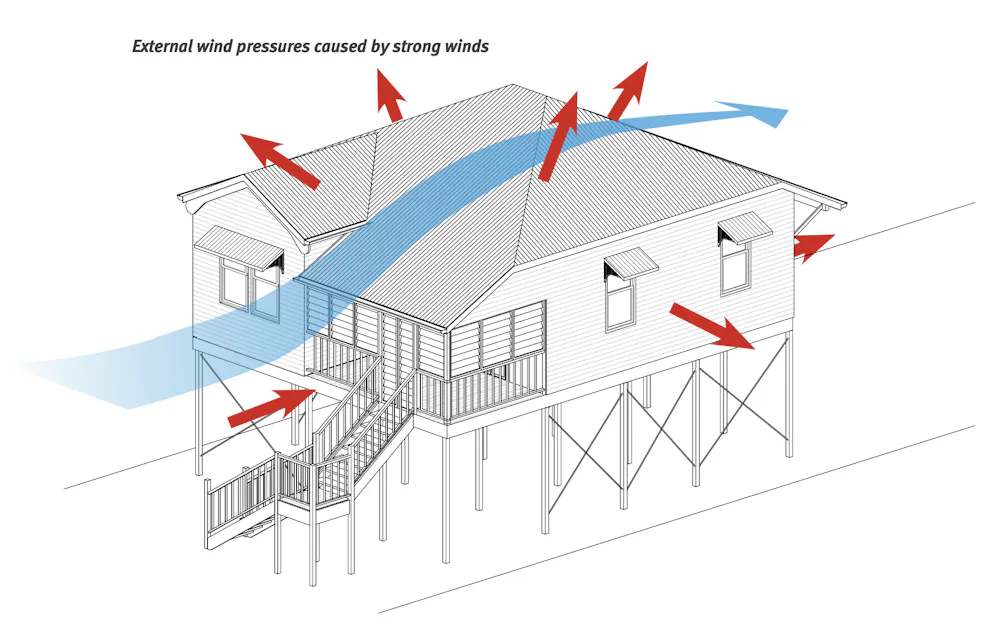
Strong winds generate pressure pushing and pulling on the outside and inside of a house.
When wind gusts hit a building, the wind is pushing on what we call the windward wall and going up and over the roof, creating a suction effect. The wind is trying very hard to peel the roof off your house, and in a cyclone is hammering the building for many hours.
If a windward window or door blows in or gets broken by debris, wind instantaneously enters the space. This almost doubles the load that the roof now has to resist.
In southeast Queensland and northern NSW, housing is not typically designed to resist that extra upward load on the roof if a door or window blows in.
Cyclone resilience is about maintaining the function of a building during severe weather, so even if there is some damage, it still can be used after the storm has passed. So it’s vital the roof stays on.
In practice, that means thinking about what’s known as the “tie down chain” – how all pieces of the house are held together to carry the wind loads from the roof to the ground.
A weak link in this tie down chain can lead to winds lifting entire roofs from homes. All the connections involved in keeping a roof on the house are exceptionally important.
Weather resistance in building codes is generally designed for rain that falls straight down and flows off the roof.
But in a cyclone, rain can come horizontally. It can get pushed under the the roof, into gutters and under sliding doors. And it’s not just a little bit – buckets and buckets of water can inundate a house.
Wind pressure can also mean water is blown into the house through gaps you may not even know existed. Wind-driven rain ingress can happen at wind speeds that don’t cause structural damage.
It comes in under doors and through windows, including holes in window sills. It can lead to buildings being unusable and a large number of insurance claims.
Dispelling major myths
You might have seen people taping a big “X” on their windows and glass doors. Unfortunately, this doesn’t really do much to improve window strength.
Some people put the tape on and then, during the cyclone, sit there watching their glass flex, falsely believing tape magically makes the window stronger. This is incredibly dangerous. If that glass shatters, the bystander would be hit by shards of glass travelling at high speed.
Sometimes people open a window to reduce pressure inside the house that happens if a door or window breaks. It’s true this might reduce some pressure, but it depends which side of the house is currently being hit by wind. And given wind direction can change during a cyclone, emergency services recommend it’s better just to stay sheltered in the smallest room; they don’t want you standing in front of a window during a cyclone.
Close all internal doors so if any windows do blow in, the high pressure is restricted to just that room (not spread throughout the house).
Designing beyond the bare minimum
Building codes require buildings to build to a “wind classification” according to the “wind zone” of that area.
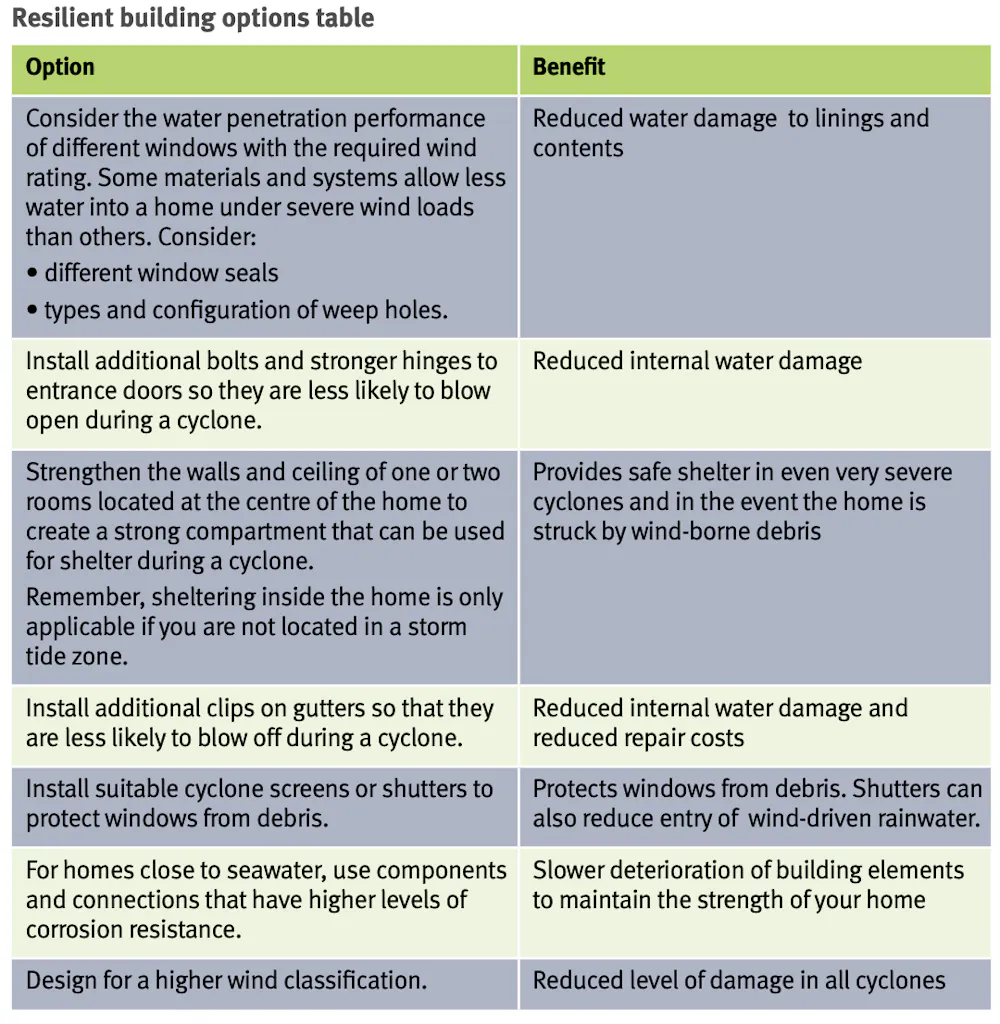
Buildings are often built only to the minimum standard of the Building Code. However, if we want a house to function after an extreme tropical cyclone, we should consider building beyond the minimum standard using resilience features that will keep your roof on in a cyclone and minimise the entry of rainwater.
Cyclone resilience also includes incorporating resilient building materials in your home – such as linoleum or vinyl floors instead of carpet, and ceilings from fibre-cement sheeting instead of plasterboard.
It’s also important all elements holding your house together are well maintained through the life of the building.
That means ensuring regular inspections by a trained professional to identify any potential weaknesses such as rot, rust or UV damage.
These inspections are not something you and a mate can do yourselves. It requires a building professionals to get into the roof and look for weak spots.
Think beyond your house. What about the carport? A pergola? That shed or patio you added? Are the solar panels installed correctly with the right fixings and brackets to resist the wind forces?
If all these things are not fixed down and maintained well, strong winds can pick them up and throw them at your house or your neighbours.
Just as you get your car serviced, you should get your house checked every five to seven years. Our homes have many important parts and a failure in one can lead to disastrous and expensive problems.
David Henderson serves on committees for Standards Australia. He is a member of Engineers Australia and has done consulting work with the Resilient Building Council.
Geoffrey Boughton serves on committees for Standards Australia. He is a member of Engineers Australia and has done consulting work with the Resilient Building Council.
Celebrate your multicultural community this Harmony Week, with a host of exciting events happening across the City of Wanneroo.
Running from 15 to 21 March each year, Harmony Week encourages all Western Australians to experience, explore and appreciate the State’s cultural, religious and linguistic diversity.
Wanneroo Mayor Linda Aitken said the City was proud to celebrate Harmony Week with a range of community activities designed to celebrate multiculturalism, and promote inclusiveness, respect and a sense of belonging for everyone.
“More than 40 per cent of the City’s population were born overseas and 20 per cent of residents speak a language other than English at home, with the most common languages being Vietnamese, Afrikaans, Arabic, Gujarati, Filipino and Mandarin,” she said.
“It is this multiculturalism that makes our City such a vibrant, progressive and incredible place to live.
“This year’s Harmony Week events will conclude with a colourful multicultural festival in the heart of Girrawheen on Friday 21 March, and I encourage everyone to come along and join in the celebrations.”
In 2011, as Cyclone Yasi approached the Queensland coast, I sat in my home in the tropical far north of the state and worried what the future would hold. Would my family be OK? Would our home be destroyed? Would my workplace be damaged and my job uncertain? Would my community be devastated?
Now, as we wait for Cyclone Alfred to make landfall, I am watching on from my new home in Melbourne. I am safe. But last night, I couldn’t sleep. I’m having intrusive thoughts, remembering what it was like when Cyclone Yasi barrelled into us. I feel agitated, distracted and anxious. The news coverage of the impending cyclone makes my heart race, so I have turned off the television.
As someone who has researched the impact of disasters for more than 20 years, I recognise what I am feeling now is similar to how I felt all those years ago. Again, I am experiencing the normal range of stress reactions common after living through a disaster, even though I am not directly impacted by this one.
This is known as retraumatisation, where we re-live stress reactions experienced as a result of a traumatic event when faced with a new, similar incident.
As a researcher in emergency responses to a broad range of disasters, I understand why I am feeling like this.
However, many people may not realise the stress they are experiencing right now is related to an earlier disaster or traumatic event in their life. That earlier disaster could be another cyclone, or a different event, such as a flood or bushfire.
Some signs and symptoms of retraumatisation might be:
intrusive thoughts (for example, I keep remembering my fear of the predicted tidal surge of water rushing up at me in the darkness as Cyclone Yasi made landfall)
nightmares and having trouble sleeping
hypervigilance (for example, feeling “on edge” all day)
sensitivity to triggers (for example, the sound of intense wind and windows creaking can trigger intense feelings because they remind me of the night we lived through Cyclone Yasi passing over the top of us)
feeling isolated
thinking about, planning or attempting suicide
panic atacks
using/abusing substances, such as alcohol and other drugs
increase in unhealthy behaviours (for example, being more prone to aggression or violence).
For many of us, Cyclone Alfred is awakening memories and feelings, and the re-emergence of those stress reactions can be confronting. It can feel like re-opening a wound that hasn’t quite healed.
Disaster upon disaster take their toll
We are now beginning to understand the effects of being exposed to multiple disasters – bushfires, cyclones, floods, and let’s not forget the COVID pandemic – that erode our resilience.
This type of multiple exposure influences our feelings of safety, security and even our hope for the future, all increasing the risk of poorer mental health.
For people with post-traumatic stress disorder (PTSD), retraumatisation may cause people to relive their past traumas in intense detail. It can feel like past traumatic events are happening all over again.
What to do now, and in the future
However, there are steps we can take to help build our resilience in the face of multiple disasters.
For now
Right now, it is useful to understand how we respond to trauma. We may notice a range of physical responses (for example, my heart has been racing), psychological reactions (for example, I am feeling more anxious than usual) and social impacts (for example, I cancelled dinner plans last night as I did not want to leave the house).
So, even though I stayed home last night, I was on a group chat discussing the Real Housewives of Sydney with friends, which helped reduce both the physical and psychological stress reactions I was experiencing.
Staying connected to friends, family, neighbours and other supports will help. Caftor/Shutterstock
For later
In the longer term, it is useful to develop and implement a self-care plan that includes activities to support our emotional, physical and spiritual health.
Self-care means taking the time to do things that help your wellbeing and improve your physical health and mental health. This can help you manage the stress reactions that may emerge as part of retraumatisation. Even small acts of self-care in your daily life can have a big impact.
Today, I made the time to go for a short walk in the park and listened to some of my favourite music. It helped in the moment, but it also helps me in the longer term when I routinely include these small acts of self-care in my daily life.
Most importantly, we need to understand that the way we are feeling is normal. Be patient with yourself and look for small opportunities to take control of your reactions.
I am keeping the television turned off (except when the Real Housewives is on).
Some resources
The website blueknot, from the National Centre of Excellence for Complex Trauma, gives more information about how we respond to trauma. The Black Dog Institute guides you through developing a self-care plan.
If this article has raised issues for you, or if you’re concerned about someone you know, call Lifeline on 13 11 14.
Erin Smith does not work for, consult, own shares in or receive funding from any company or organisation that would benefit from this article, and has disclosed no relevant affiliations beyond their academic appointment.
Source: United States Senator for Hawaii Brian Schatz
WASHINGTON – U.S. Senators Brian Schatz (D-Hawai‘i) and Mazie K. Hirono (D-Hawai‘i), along with U.S. Representatives Ed Case (D-Hawai‘i) and Jill Tokuda (D-Hawai‘i), introduced legislation to protect more than 10,000 plant and animal species native to the Hawaiian Islands. The Hawai‘i Native Species Conservation and Recovery Act would fund conservation and recovery projects addressing invasive species, the ecological consequences of climate change, native species’ habitats, and population recovery. Schatz met with The Nature Conservancy, Hawai‘i today to discuss the bill and other priorities.
“Native species foster a healthy ecosystem, with cleaner air, purer water, and a more resilient environment,” said Senator Schatz. “By funding new conservation measures and recovery projects, including for Native Hawaiian organizations and local non-profits, our bill will help save our native species for years to come.”
The 10,000 species native to Hawai‘i represent the highest degree of endemism in the world, but hundreds of these species are listed as endangered. The state’s unique biodiversity is in the midst of an extinction crisis, with more than half of native birds and more than 100 unique plant species already extinct.
The Hawai‘i Native Species Conservation and Recovery Act would:
Provide funding through cooperative agreements and grants to the State of Hawai‘i, local governments, Native Hawaiian organizations, non-profit organizations, businesses, and institutions of higher education to protect native species;
Support coordinated, evidence-based conservation and recovery projects addressing invasive species, the ecological consequences of climate change, native species’ habitats, and population recovery, as well as data collection and public outreach and education measures;
Require the U.S. Fish and Wildlife Service to coordinate with other federal and state agencies to develop annual funding priorities and criteria for ranking project proposals;
Require a 25 percent non-federal match for most projects;
Encourage applications for high impact, small dollar value projects, projects carried out by Native Hawaiian organizations, and projects promoting youth workforce readiness by waiving the non-federal match requirement for such projects; and
Authorize $30 million annually, subject to appropriations, to protect native species for ten years.
“Unique to our islands, Hawai‘i’s native species are critical to maintaining the health, balance, and biodiversity of our ecosystem,” said Senator Hirono. “Through initiatives such as funding conservation and recovery projects that address topics including invasive species, scientific research, and data collection, this legislation will help to preserve Hawai‘i’s ecosystems and safeguard the environment for future generations.”
“In Hawai‘i, invasives have caused significant ecological damage, threatening the survival of our unique plant and animal species,” saidRepresentative Case. “Protecting Hawai‘i’s unique biodiversity is not just an environmental necessity, but a cultural imperative that embraces our Native Hawaiian heritage. Unfortunately, these native species often lack the defenses to compete with or resist the pressures of invasive plants and animals, which can rapidly alter ecosystems and displace local species and requires intervention to prevent and reverse.”
“From ?ohi?a to kiwikiu, Hawai?i is home to some of the most stunning native biodiversity in the world, and we need to work collaboratively to protect and preserve our unique and fragile ecosystem,” said Representative Tokuda. “I am proud to support the Hawai‘i Native Species Conservation and Recovery Act to provide much-needed support for coordinated conservation projects across our state, protect our cultural assets, and ensure our native species can thrive for generations to come.”
The bill is endorsed by The Nature Conservancy, Hawai‘i Conservation Council, Friends of Hakalau Forest National Wildlife Refuge, National Tropical Botanical Garden, American Bird Conservancy, and National Wildlife Federation.
“Our community in Hawai‘i continues to rise to the challenge protecting our most vulnerable species. I want to thank Senator Schatz, Congressman Case and the rest of our Hawai‘i delegation for enabling the vision of our local communities to become a reality,” said Ulalia Woodside Lee, Executive Director of The Nature Conservancy Hawai‘i and Palmyra. “If enacted, this bill would add much needed support to ensure we can protect our treasured biodiversity and help build capacity in our local communities to malama ‘aina.”
Senator Schatz met with representatives from TNC Hawai‘i and Palmyra to discuss the bill.
“This groundbreaking legislation, would ensure protections against invasive species and ensures the viability of Hawai‘i’s endemic species and ecosystems that supports them from extinction. These species are found nowhere else on our planet. If implemented, this legislation will be a win for Hawai‘i, the U.S., and the world in being at the helm of protecting endangered species from becoming extinct. This will also set a course of action to help reverse the current situation of Hawai‘i being the extinction species capitol of the world by eradicating invasive species, foster and the restore biodiversity and help to stabilize our climate. Additionally, this measure will help to protect food sources and the community from harmful invasive pests, as well as, increase employment opportunities. There is no time to lose; we urge Congress to swiftly pass the Native Species Conservation and Recovery Act,” said Jonee Peters, Executive Director for the Conservation Council for Hawai‘i.
“Hawai‘i is home to some of the most unique and threatened plants and animals found anywhere in the world. The Hawai‘i Native Species Conservation and Recovery Act would be a significant step toward addressing the many challenges of protecting and recovering these irreplaceable natural and cultural resources. Many of Hawai‘i’s exceptional native species are quite literally on the brink of extinction; we urge Congress to pass this Act as soon as possible,” said Debbie Anderson, President of the Friends of Hakalau Forest National Wildlife Refuge.
“The National Tropical Botanical Garden strongly supports the proposed Hawai‘i Native Species Conservation and Recovery Act of 2025 because it aligns perfectly with NTBG’s mission to preserve and protect native plant species, restore ecosystems, and advance scientific research and education. By providing funding for community involvement and youth workforce training, the act would help ensure that future generations of conservationists and scientists are equipped to protect Hawai‘i’s fragile ecosystems. Supporting the Hawai‘i Native Species Conservation and Recovery Act of 2025 is not just beneficial for NTBG — it is essential for the future of Hawai‘i’s native ecosystems,” said Tami Rollins, Interim CEO of the National Tropical Botanical Garden.
“Birds such as the ‘I’iwi represent Hawai‘i’s extraordinary biodiversity. However, ‘I’iwi and countless other species are facing unprecedented challenges from threats like avian malaria. Thanks to Sen. Schatz for introducing the Hawai‘i Native Species Conservation and Recovery Act, which would address threats to native species by supporting community-led projects, ensuring native Hawaiian ecosystems are present for our keiki,” said Chris Farmer, Hawai‘i Program Director at American Bird Conservancy.
Source: Plant and Food New Zealand – Press Release/Statement:
Headline: Hope in turbulent times (PPF)
People | Planet | Food – Host Roger Robson-Williams speaks with sustainability experts Saskia Verraes and Martin Rich about the future they aspire to create through their work. They discuss the encouraging signs of progress in Aotearoa New Zealand and around the globe. Amid rising illiberalism, increasing geopolitical tensions, economic uncertainty, and an unstable climate, this episode offers a chance to reflect on how we can cultivate a more prosperous future for everyone. It also celebrates some of the outstanding initiatives already in progress. This episode serves as an invitation to hope and take action. To explore our full catalogue of podcasts, visit our Scigest page: www.plantandfood.com/scigest.
With western parts of four regions being burned to a crisp, Federated Farmers provincial presidents are pleased the Government is being proactive in declaring medium-scale adverse events.
Northland president Colin Hannah says the declaration is recognition of the growing seriousness for farmers of well-below-normal rainfall.
The medium-scale adverse event declaration also applies to Waikato, Horizons and Marlborough-Tasman, and follows the same status being called in Taranaki on 27 February.
“From the North Cape right down the west coast of Northland, there’s a major issue,” Hannah says.
“In Wellsford, springs and wells are drying up, putting huge pressure on stock water availability.”
Federated Farmers Waikato president Keith Holmes says the weather pattern is very unusual, and distressing for those farmers hit hardest.
“West of the Waikato River it’s drought conditions. Areas like Tuakau, Piopio and Mahoenui aren’t getting any rain.
“East of the river it’s getting quite serious too.
“Springs and wells providing stock water have dried up, and farmers are moving to once-a-day milking and sending stock to the works early.”
Holmes says sheep and beef farmers relying on income from grazing dairy cattle from eastern parts of the region are running out of feed, and some are having to send them back early in skinny condition.
“That’s a big hit on their incomes, and on the dairy farmers trying to capitalise on the strong milk prices.
“Maize crops may look good, but with insufficient water, they’re putting on minimal cob and come harvest time they’ll have very little feed value.
“Dairy farmers relying on maize for supplementary feed are going to come unstuck quickly.”
Holmes says he’s grateful to Ministers Todd McClay and Mark Patterson for calling it early.
The $100,000 for rural support groups in the four provinces will help, and the adverse event classification also unlocks tax relief for farmers and growers and enables the Ministry of Social Development to consider Rural Assistance Payments.
“For any farmers a bit slow to react to the threat, this will also help bring it front of mind and galvanise them into action,” Holmes says.
“If March stays dry, it doesn’t set up farmers well for winter in the five affected provinces.”
In late January work got underway to replace the 48-year-old Onetai Stream Bridge, north of Paeroa on State Highway 26 (SH26), and from Monday 10 March, the road reopens following completion of the first phase.
“SH26, between Paeroa and Thames, has been closed while work to replace the bridge has been underway. Due to the site being particularly narrow, and the small size of the bridge, the safest and most efficient option was closing the road to demolish the old bridge and install the new one,” says Andrew Oakley, Waikato System Manager at NZ Transport Agency Waka Kotahi (NZTA).
A wider, stronger bridge is making this route on the eastern side of the Waihou River safer and more resilient.
“Bridges in New Zealand are generally built with concrete, and for this one we’re piloting a new approach which has been successful overseas. The new Onetai Stream Bridge is being built with a timber deck and bridge beams,” says Mr Oakley.
The original bridge was designed and constructed in 1976. Its 2025 replacement will be 3 metres wider giving drivers more lane space, and with additional safety features including a new type of side barrier.
To plan ahead and see where disruptive works are, people can use the NZTA Journey Planner. This is kept up to date in real time so you can see all disruptive activity and potential hazards on the state highway network.
Source: Australia Government Statements – Agriculture
7 March 2025
Who does this notice affect?
Stakeholders in the import and shipping industries—including vessel masters, freight forwarders, offshore treatment providers, Biosecurity Industry Participants, importers, customs brokers, principal agents and master consolidators.
What has changed?
Following identification of critical non-compliance, we have suspended Ser.Chim. Fumigazioni S.R.L. (AEI: IT4027SB) from AusTreat.
Archaeologists have been restoring the ruined Chorm Temple within Angkor Thom in the UNESCO-listed Angkor Archaeological Park in northwest Cambodia, said an APSARA National Authority (ANA)’s news release on Thursday.
ANA architect Thai Yamang said the restoration work, in collaboration with the Korean Heritage Agency, began in November 2023 and has achieved significant progress so far, gradually regaining the temple’s original appearance and beauty.
“Prior to the restoration, Chorm Temple was in a severely dilapidated state, suffering from the effects of time and natural elements,” he said.
Tree roots had intruded into the structure, compromising its integrity and allowing rainwater to seep in, which weakened the foundation, Yamang said, adding that many stones had fallen or were damaged, including lintels and pillars, and some areas were missing stones altogether.
“Approximately 60 percent of the restoration work has been completed, with efforts focusing on reconstructing pillars, door frames, pediments, roofs, and lintels,” he said.
“The team is committed to reassembling the stones in their original positions, adhering to the guidelines set forth in the Angkor Charter,” he added.
Yamang said that due to these dedicated efforts, Chorm Temple, built in the early 12th century, is gradually transforming from a state of ruin back into a site of historical beauty and significance.
Located in Siem Reap province, the 401-square-km Angkor Archaeological Park is home to 91 ancient temples, which had been built from the 9th to the 13th centuries.
The ancient park attracted a total of 1.02 million international tourists in 2024, generating a gross revenue of $47.8 million from ticket sales, according to the state-owned Angkor Enterprise.
Labour welcomes Simeon Brown’s move to reinstate a board at Health New Zealand, bringing the destructive and secretive tenure of commissioner Lester Levy to an end.
“It’s past time that Lester’s time as commissioner ended – we called for this last week and are pleased to see Simeon Brown take our advice,” Labour health spokesperson Ayesha Verrall said.
“Lester Levy was Christopher Luxon’s pick for commissioner, yet all he’s done is destabilise our health system by cutting more than 3000 jobs with more to come, and going on a fantasy quest to find ‘back office bloat’ that doesn’t exist.
“When they couldn’t find the wasteful spending they’d imagined, they took Milo and toast from new parents, before having to backtrack.
“Levy failed to deliver the turnaround plan, hadn’t published a health plan, and showed up to meetings without information on major decisions.
“On his watch, our hospitals experienced a hiring freeze, making it nearly impossible to fill vacancies in time. Almost half of Health NZ’s data and digital team are facing cuts and another 358 from the National Public Health Service roles – a quarter of the workforce.
“Now Levy is gone, the cuts must stop, so our healthcare system can run smoothly and communities can get the healthcare they need,” Ayesha Verrall said.