Category: Asia Pacific

  • MIL-OSI Security: Hawaii ANG, Indonesian Air Force Advance Partnership with Second Year of Air-To-Air Refueling Engagement

    Source: United States INDO PACIFIC COMMAND

    This engagement was part of the Hawaii National Guard’s State Partnership Program (SPP), which has played a critical role in advancing air-to-air refueling capabilities between Hawaii ANG and the Indonesian Air Force.

    In this training cycle, five new and 21 IDAF F-16 pilots successfully earned their air-refueling qualifications. The 203rd Air Refueling Squadron (ARS) directly supported over 40 F-16 sorties, demonstrating the increasing complexity and operational integration of these joint capabilities.

    “For many of us, this mission isn’t just about fuel transfers—it’s about trust, adaptability, and building a foundation for future interoperability,” said 1st Lt. Alison Bowman, a pilot with the 203rd ARS. “Through pre- and post-mission briefings, we are exchanging air refueling tactics, techniques, and procedures to enhance operational efficiency.”

    For the 203rd ARS, this mission extended beyond technical proficiency—it was an engagement in adaptability and cross-cultural collaboration in a region with unique airspace and logistical challenges.

    “Air refueling engagements in this region gives us a great opportunity to fine-tune our skills while working closely with our partners in a dynamic environment,” said Tech. Sgt. Angellica Amian, 203rd ARS inflight refueler. “By staying in constant communication and giving each other real-time feedback, we were able to work together more smoothly. It’s all about building that trust and understanding so we can operate effectively as a team.”

    As the engagement progressed, both air forces refined their air domain awareness capabilities, reinforcing their commitment to regional stability.

    “This opportunity not only strengthens our operational readiness but also ensures we have the capabilities to secure our territorial integrity,” said Lt. Col Ripdho ‘Mohawk’ Utomo, IDAF exercise planner. “We want to thank the Hawaii Air National Guard for their support to maintain our currency and certifications. I’m looking forward to continuing this cooperation.”

    The Hawaii National Guard State Partnership Program (SPP) – Indonesia Military Bilateral Partnership, established in 2006 through the National Guard Bureau (NGB), continues to serve as a key initiative supporting USINDOPACOM’s goal of enhancing defense relations and strengthening Indonesia’s military capabilities.

    As the training concluded, the Hawaii Air National Guard reaffirmed its commitment to fostering international partnerships through high-level military operations, activities, and investments. Working alongside allies such as Indonesia, Hawaii ANG continues to support global stability and operational excellence in air mobility and aerial refueling capabilities.

    Looking ahead, future training opportunities will build upon the progress achieved during this exercise, further advancing U.S.-Indonesia defense cooperation. With continued collaboration and shared training objectives, both air forces are committed to strengthening regional security, enhancing readiness, and improving interoperational capabilities for future missions.

    MIL Security OSI

  • MIL-OSI New Zealand: Back out there: Custody Unit reopens on the North Shore

    Source: New Zealand Police (National News)

    Police is re-opening a state-of-the-art custody unit, ready to support frontline policing operations across the North Shore and Rodney.

    Crucially, it will reduce the time frontline staff in the area spend transporting people in custody.

    The Waitematā East District Custody Unit, based at the North Shore Policing Centre, officially began accepting detainees this morning.

    Police Commissioner Richard Chambers, Minister of Police Mark Mitchell and Waitematā District Commander Superintendent Naila Hassan were in attendance at this morning’s opening.

    The North Shore facility has undergone improvement works in recent months and will support Waitematā District’s existing unit based in Henderson.

    Commissioner Chambers says the population across North Shore and Rodney communities continues to grow.

    “Waitematā is a vast district geographically and it’s important my staff aren’t unnecessarily taken of the road for lengthy periods of time,” he says.

    “The new District Custody Unit will mean reduced travel times for staff working as far north as Wellsford, down to Devonport.”

    Advanced facilities will also mean reduced processing times for arresting officers.

    “The facility is technologically advanced and future-focused for our custody staff,” Commissioner Chambers says.

    “At the end of the day we’ll have frontline staff back out there faster working to keep the community safe.”

    Around the country, Police manage more than 120,000 people in custody each year.

    “Our Custody Units are an important part of managing people in our care and custody safely.

    “In many instances those people in custody require intensive monitoring, and features such as high-quality CCTV and intercom systems will help custody staff.”

    Commissioner Chambers acknowledges the team involved in re-commissioning the unit.

    “It’s great to see the use of technology to make savings and efficiencies, such as the high-quality audio-visual link suite installed,” he says.

    “In many instances for those detainees appearing in court remotely this will remove some costs and complexities associate in transporting them.”

    Superintendent Hassan says the North Shore facility is a welcome addition to the district.

    “We are continuing to find ways to adapt to the growing demand and population across communities in Waitemata,” she says.

    “This facility will be supported by sworn Police staff, alongside additional Authorised Officers recruited into the roles.”

    The facility has been re-opened after being decommissioned in 2013.

    It has been utilised by Police periodically, as required, including periods to support police operations during the pandemic response.

    ENDS

    Jarred Williamson/NZ Police

    MIL OSI New Zealand News

  • MIL-OSI Economics: New Development Bank and Bank of Communications Financial Leasing Co., Ltd. sign USD 150 mln Equivalent in RMB Loan Agreement for the LNG Transportation Project

    Source: New Development Bank

    The New Development Bank (NDB) and the Bank of Communications Financial Leasing Co., Ltd. (BCFL) are pleased to announce the signing of a USD 150 mln equivalent in RMB 1,069.23 mln loan agreement aimed to acquire at least three liquified natural gas (LNG) carriers, addressing the significant increase in demand for LNG in China and closing the gap between demand and supply of LNG carrier capacity. The signing took place in the headquarters of NDB on February 21, 2025. Mr. Vladimir Kazbekov, NDB Vice President and Chief Operating Officer, and Mr. Jiuyong Yin, Vice President of Bank of Communications and Mr. Bin Xu, Chairman of BCFL participated in the signing.

    This is the first non-sovereign loan granted by NDB to a non-banking financial institution in China. The relationship between the Bank of Communications (BoCom) and NDB, both headquartered in Shanghai, reflects a longstanding and strategic partnership formalised with a Memorandum of Understanding signed in 2016. The partnership reached another significant milestone with NDB granting its first non-sovereign loan to a non-banking financial institution in China – BCFL, BoCom’s wholly owned subsidiary. This achievement highlights NDB’s dedication to supporting a diverse range of financial institutions and strengthening local markets.

    Under the terms of the loan agreement, NDB will provide USD 150 mln equivalent in RMB 1,069.23 mln loan to BCFL to acquire at least three LNG carriers, resulting in the expansion of its green leasing portfolio. The imports of LNG will help reduce China’s coal consumption and related Greenhouse Gas (GHG) emissions, which is in alignment with the “2030 Agenda for Sustainable Development” issued by the Chinese Government. Meanwhile, this batch of LNG carriers will be equipped with advanced propulsion systems, representing a significant improvement in the shipping industry in terms of efficiency, economies of scale and environmental performance.

    Aligned with the NDB’s General Strategy for 2022–2026, this loan promotes private sector participation in addressing infrastructure gaps and scaling up infrastructure investments, with a focus on enhancing development impact in the local market. Additionally, the loan reflects NDB’s commitment to supporting cleaner energy solutions, as it is tied to LNG-related projects that contribute to a lower-carbon energy mix. By utilizing local currency for financing, NDB reaffirms its strategic focus on expanding local currency operations over the 2022–2026 strategy cycle.

    “The non-sovereign loan provided by the New Development Bank to BCFL will significantly enhance its liquefied natural gas transportation capacity. It demonstrates NDB’s dedication to supporting China in reaching a peak in its carbon dioxide (CO2) emissions before 2030 and achieving carbon neutrality by 2060. This transaction will further strengthen the strategic partnership between NDB and BoCom. The LNG Transportation Project is aligned with NDB’s focus on supporting clean energy and energy efficiency projects as well as the Bank’s commitment to scale up non-sovereign operations,” said Mr. Vladimir Kazbekov, NDB VP & COO.

    “Thanks to NDB for choosing BoCom Financial Leasing, a subsidiary of BoCom, to cooperate. This loan is closely related to the national strategy of green and sustainable development and further consolidates the long-term strategic relationship between NDB and BoCom. As financial institutions both in Shanghai, we hope that the two parties will continue to cooperate in more areas such as bond underwriting, financial markets, and international business in the future,” said Mr. Ying, Vice President of BoCom.

    “We would like to thank NDB for its recognition and trust in BoCom Financial Leasing. BCFL continues to work on green and sustainable financial development, and the proportion of green leasing keeps growing. The loan funds from this cooperation will be used for the company’s three LNG ships built by Hudong-Zhonghua Shipbuilding Co., LTD. We take this as an important cooperation for the strategic partnership between BoCom and NDB,” stated Mr. Xu, Chairman of BCFL.

    Background Information

    New Development Bank

    NDB was established by Brazil, Russia, India, China and South Africa to mobilize resources for infrastructure and sustainable development projects in BRICS and other emerging market economies and developing countries, complementing the existing efforts of multilateral and regional financial institutions for global growth and development.

    For more information on NDB, please visit www.ndb.int

    Bank of Communications Financial Leasing

    BCFL was founded as a wholly owned subsidiary of BoCom in 2007 with the headquarter in Shanghai, China. It is one of the leading financial leasing companies in China and was one of five pilot financial leasing entities approved by the State Council of China. With the support from BoCom, it has grown rapidly since its incorporation and has become one of largest financial leasing companies in China. It operates in various sectors including aviation, shipping, and traditional leasing business.

    For more information on BCFL, please visit www.bocommleasing.com

    MIL OSI Economics

  • MIL-Evening Report: Want a side of CO₂ with that? Better food labels help us choose more climate-friendly foods

    Source: The Conversation (Au and NZ) – By Yi Li, Senior Lecturer in Marketing, Macquarie University

    udra11, Shutterstock

    When you’re deciding what to eat for lunch or dinner, do you consider the meal’s greenhouse gas emissions? How do you compare the carbon footprint of a beef sandwich with that of a falafel wrap?

    Most people can’t tell what’s better for the climate. Even those who care deeply about making sustainable food choices can struggle.

    In Australia, meat products are responsible for almost half (49%) the greenhouse gas emissions of products consumed at home. Switching from these high-emission foods to lower-emission foods, such as plant-based meals, can significantly reduce household emissions. But a lack of knowledge may be stopping people doing the right thing.

    The good news is my colleagues and I have a simple solution. Highlighting the source of the food as animal- or plant-based on carbon labels makes a big difference to consumer choices. In our latest research, we show this new carbon label encourages switching from animal-based to plant-based foods.

    Closing the knowledge gap

    Previous research has shown consumers consistently underestimate the vast difference in greenhouse gas emissions between animal- and plant-based foods. For instance, producing one kilogram of beef emits 60kg of greenhouse gases, whereas producing the same quantity of peas emits just 1kg of greenhouse gases. However, most people think the gap between the two is much smaller.

    This matters because collectively, our food choices have a big impact on climate change. Agriculture generates almost a third of global greenhouse gas emissions, with animal products the biggest contributors.

    Making carbon labels more informative

    A “carbon footprint” refers to the greenhouse gas emissions associated with a product.

    Globally, there is increasing interest in carbon food labelling, given its potential to nudge consumers towards more sustainable food choices. In Australia, such labelling is voluntary and not yet widespread.

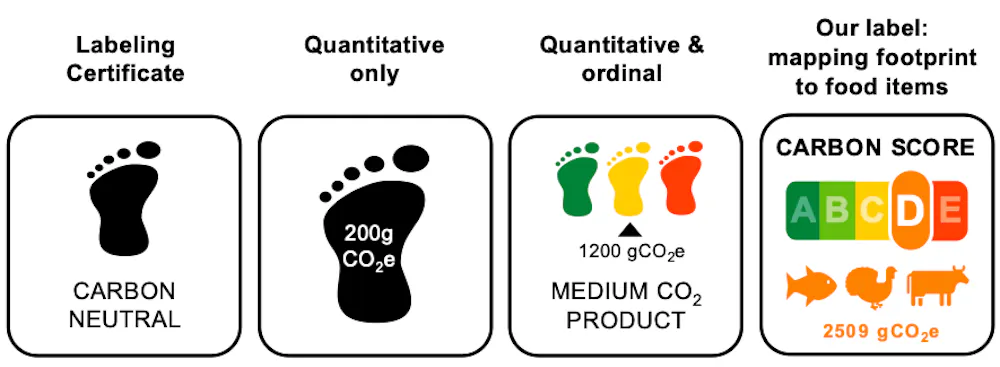
    Most carbon labels follow a similar approach. They typically display a number representing greenhouse gas emissions, and a traffic-light system indicating the level of environmental impact from green (low) to red (high). But such labels do not indicate whether the food is animal- or plant-based. So a high carbon score does not help people identify the source of the emissions.

    Our label maps the carbon footprint to the source of the food, whether plant or animal, along with information about the greenhouse gas emissions.
    Romain Cadario, Yi Li, Anne-Kathrin Klesse, (2025) Appetite., CC BY

    We designed a new type of label. It clearly displays whether the food is sourced mainly from animals or plants, along with the standard emissions score and traffic-light colour code. This approach is especially useful for the growing segment of pre-prepared and packaged foods such as soups and other ready-to-eat meals, which often contain a mix of meat and plant-based food.

    Our label creates a mental link between a food source and its carbon impact. When a consumer sees high carbon scores and red traffic lights appearing more frequently on meat and other animal products, they begin to make the connection between those products and higher emissions. This is key to addressing a lack of knowledge around food carbon emissions.

    We tested our label against the existing labels in a series of experiments with 1,817 everyday consumers from Australia, the United States and the Netherlands.

    One experiment involved soup. Compared with the group exposed to the standard carbon label, the group exposed to our label learned to associate animal-based soups with higher greenhouse gas emissions more effectively. They were more accurate at estimating the greenhouse gas emissions of a second batch of soups without labels.

    This improved knowledge also translates to more climate-friendly food choices. In another experiment with Australian consumers, we encouraged participants to choose five meals from ten options. Five were animal-based and five were plant-based.

    Half the participants saw the meal options with our carbon labels, and the other half did not see the carbon labels. The group exposed to our carbon labels chose fewer animal-based options in their weekly meal plan. In this case, we don’t know whether a third group exposed to the standard label would also make more climate-friendly choices, but our earlier experiments suggested our label was more effective.

    In the final experiment conducted in the Netherlands, displaying our carbon label made university students more likely to choose the plant-based snack option rather than the animal-based option.

    Providing information about the source of the food, whether plant or animal, influenced choices of meal plans.
    Romain Cadario, Yi Li, Anne-Kathrin Klesse, (2025) Appetite., CC BY

    When knowledge isn’t enough

    While people who care most about sustainable eating may think they know better than others, we found that is not the case. These people were not better able than other participants to tell the difference in greenhouse gas emissions between animal- and plant-based foods without seeing our carbon label.

    But they were better learners. When confronted with the facts about the differences between animal and plant-based foods on our labels, they were more likely to change their choices and switch to plant-based foods.

    What this means for consumers and businesses

    A simple change to food labels could help consumers make more informed environmental choices. For businesses and policymakers, it shows displaying only carbon numbers isn’t enough – the food source is crucial.

    Some forward-thinking restaurants and food companies are already experimenting with adding carbon labels to the menu to encourage diners to choose climate-friendly dishes. Our research suggests this approach could be more effective when combined with the new carbon labels we designed.

    Meat products make a significant contribution to climate change.
    Valmedia, Shutterstock

    Implications for climate action

    As Australia grapples with meeting its climate commitments, helping consumers understand the environmental impact of their food choices will become increasingly important.

    The challenge for businesses, policymakers and researchers isn’t convincing people to care about sustainability – they already do. Almost half of Australian shoppers (46%) say sustainability is important to them and influences their purchases, despite cost-of-living pressures.

    But most sustainable actions in retail involve recyclable packaging, products and materials, and local produce. The carbon emission implications of these actions, sadly, are far less than reducing animal-based food consumption.

    Instead, we need to focus on giving people the tools to make their environmental concerns count. Our carbon labels could be the key to helping consumers turn their sustainable intentions into meaningful climate action.

    Yi Li does not work for, consult, own shares in or receive funding from any company or organisation that would benefit from this article, and has disclosed no relevant affiliations beyond their academic appointment.

    ref. Want a side of CO₂ with that? Better food labels help us choose more climate-friendly foods – https://theconversation.com/want-a-side-of-co-with-that-better-food-labels-help-us-choose-more-climate-friendly-foods-250513

    MIL OSI AnalysisEveningReport.nz

  • MIL-Evening Report: Calculating the economic cost of climate change is tricky, even futile – it’s also a distraction

    Source: The Conversation (Au and NZ) – By Dennis Wesselbaum, Associate Professor, Department of Economics, University of Otago

    Piyaset/Shutterstock

    Climate change is no longer a distant threat. It’s here, it’s real and it increasingly affects us all.

    But predicting climate change and its associated costs, particularly over long periods of time, is inherently uncertain. And based on the best available evidence from organisations such as the United Nations’ Intergovernmental Panel on Climate Change, the economic costs of climate change appear to be small – making this a relatively weak argument for environmental action.

    At its most basic, climate is the long-term average of the weather we experience. Or, as former president of the American Meteorological Society, Marshall Shepherd, famously put it, “weather is your mood, and climate is your personality”.

    It’s widely accepted that climate change refers to a shift in long-term weather patterns, typically driven by human activities.

    But the impact of climate change, ranging from rising temperatures and extreme weather events to health impacts and disruptions to food and water supply, varies greatly. Some areas experience more extreme impacts than others, exacerbating social and economic disparities.

    There also appears to be a false sense about our state of knowledge. For example, many believe climate change already causes more frequent and intense storms, but the evidence for this is inconclusive.

    Trying to predict the unpredictable

    To understand the economic costs of climate change, we must first grasp how climate affects socioeconomic outcomes.

    The relationship between temperature and socioeconomic outcomes can be modelled using a “dose-response” function, which shows how much a given change in temperature (the “dose”) influences the outcome (for example, temperature-related mortality).

    A key challenge is to understand the shape of the dose-response function. Is the relationship between temperature and mortality linear or is it more complex? Does it have thresholds beyond which the effects substantially change? Is there only one function or are there different ones for different populations?

    As climate change shifts the distribution of weather variables, it alters the outcomes as well. Yet, predicting how these distributions will evolve is difficult.

    The further into the future we look, the harder it is to make reliable predictions about both weather and the associated economic costs.

    If you were asked in 1925 to predict the economy in 2000, for example, how accurate would you have been? In 1925 you drove a Ford Model T, used coal-fired steam trains and passenger ships for travel, and a trip from London to Auckland took up to eight weeks by sea. You used a telegraph for long-distance communication and a radio for entertainment.

    Compare that with the globalised, interconnected economy of the year 2000. Given the technological advancements, would your prediction have been even close?

    Rather than focusing on the uncertain future economic costs of climate change, we should be addressing how it is affecting human life now.
    James Andrews1/Shutterstock

    Cost estimates

    There are a wide range of estimates on the economic costs of climate change. But one of the most reliable has come from the UN’s Intergovernmental Panel on Climate Change.

    The panel’s latest assessment report avoids quantifying the economic costs of climate change. So, to understand the economic costs of climate change, we can use the best estimate based on the previous report and the insights from meta studies. These analyses posit a temperature rise of 3.7°C will reduce global gross domestic product (GDP) by about 2.6% (ranging from 0.5 to 8.2%) by 2100.

    For New Zealand, this is equivalent to about NZ$11 billion, or twice the cost of Auckland’s City Rail Link.

    However, this comparison is extremely misleading. The value of 2.6% today will differ substantially from 2.6% in 75 years.

    The New Zealand economy grew at a compound annual rate of 1.4% between 1960 and 2000. Using this same average growth rate, New Zealanders will have a 184% higher standard of living in 2100. If nothing is done to address climate change, and given the best cost estimate, our standard of living would still be 176% higher than it is now.

    Reporting costs

    There are also issues with how some people report costs. For instance, while the total damage caused by floods and hurricanes in the United States has gone up in dollar amounts, it has not actually increased as a percentage of peoples’ incomes.

    In this context, it is crucial to distinguish between the damage caused by climate change and that resulting from human activities – such as the construction of more houses, higher property prices and river management practices.

    The economic costs of climate change based on the best available evidence appear to be small and highly uncertain.

    Shifting the focus

    Even if we accept our best estimates, economic costs are not the issue, but saving the environment is.

    Instead of focusing the debate of climate change around economic costs, we need to refocus the debate on tangible impacts happening right now: retreating glaciers, species extinction, shifting seasons and coastal erosion, to name a few.

    Addressing these issues is costly, but action will be needed to save the environment and ensure a liveable world into the future.

    Dennis Wesselbaum does not work for, consult, own shares in or receive funding from any company or organisation that would benefit from this article, and has disclosed no relevant affiliations beyond their academic appointment.

    ref. Calculating the economic cost of climate change is tricky, even futile – it’s also a distraction – https://theconversation.com/calculating-the-economic-cost-of-climate-change-is-tricky-even-futile-its-also-a-distraction-248862

    MIL OSI AnalysisEveningReport.nz

  • MIL-OSI Australia: Botswana

    Source: Australia Safe Travel Advisories

    Heavy rains have caused severe flooding across Botswana. Some borders and roads have been temporarily closed due to the flooding. Take caution, seek local advice, monitor local media and check the Botswana Meteorological Services and Botswana Unified Revenue Service social media pages for up-to-date information on weather conditions and border crossing status prior to travel (see ‘Travel’).

    MIL OSI News

  • MIL-OSI China: US’ restrictive trade moves to be self-harming

    Source: China State Council Information Office

    China has called on the United States to adhere to international rules and end misguided policies, warning that it will take necessary measures to safeguard its legitimate rights, the Ministry of Commerce said on Sunday.

    On Friday, the Office of the United States Trade Representative invited comments from the public on proposed Section 301 actions aimed at China’s maritime, logistics and shipbuilding sectors.

    The US’ proposed restrictive measures, such as levying port fees, would be self-harming and have detrimental effects, according to an online statement issued by the Commerce Ministry.

    The statement said these moves would not only fail to revive the US shipbuilding industry, but also increase transportation costs on US-related shipping routes and intensify domestic inflationary pressures.

    The moves would diminish the global competitiveness of US goods and negatively affect the interests of US port and terminal operators, as well as their workers, it added.

    Since March 2024, China and the US have held multiple rounds of talks on the proposed actions. China has repeatedly expressed its stance on the Section 301 investigation, urging the US to be rational and objective, and to stop blaming China for its own industrial development issues.

    The ministry noted that a panel of the World Trade Organization has ruled that US imposition of Section 301 tariffs on China is in breach of WTO regulations. The misuse of the Section 301 investigation mechanism, driven by the US’ domestic political needs, continues to erode the multilateral trading system, the ministry said.

    Liao Fan, a professor of international law at the University of Chinese Academy of Social Sciences in Beijing, said that to counter rising protectionism and the weaponization of unilateral sanctions, WTO reform is urgently needed to address systemic issues, such as chronic underfunding and weak enforcement mechanisms.

    John Quelch, executive vice-chancellor of Duke Kunshan University in Kunshan, Jiangsu province, warned that international trade is entering a dangerous “Wild West” era, in which weaker economies and small countries more dependent on international trade are likely to suffer the most.

    “China needs to redouble its efforts to increase trade with Global South countries, gradually reducing dependence on traditional markets,” Quelch said, adding, “China should further stimulate domestic consumption if a global tariff war slows down international trade.”

    Guangxi Yuchai Machinery Co, an automotive engine manufacturer in Yulin, Guangxi Zhuang autonomous region, is already expanding into emerging markets.

    “We have leveraged multiple cooperation mechanisms and trade deals, such as the Belt and Road Initiative and the Regional Comprehensive Economic Partnership, to actively participate in international trade shows and establish new plants in Thailand and Vietnam in recent years. Our export value jumped 73 percent year-on-year in January, hitting a record high for a single month,” said Liu Hongbo, president of marketing at Guangxi Yuchai’s overseas business unit.

    “We have broadened our customer base in key regions, including Southeast Asia and the Middle East, while diversifying our market structure to reduce risks associated with overreliance on any single market,” Liu added.

    MIL OSI China News

  • MIL-OSI Australia: MEDIA RELEASE: Labor shuns business in new round of FWC appointees

    Source: Australian Mines and Metals Association – AMMA

     Statement by AREEA Chief Executive Officer Steve Knott AM 

    On the eve of the federal election, the Albanese Government has continued to stack the Fair Work Commission with Labor’s union and lawyer mates.

    Today’s announcement of four new members means the Albanese Government since taking office has appointed 21 members to the national workplace tribunal who have backgrounds in trade unions or with Labor-aligned law firms.

    The Commission now comprises 31* Labor appointees and 26 Coalition-appointed members.

    All this does is encourage a future Coalition government to perpetuate Labor’s unacceptably partisan nature of appointments in an effort to rebalance the tribunal.

    The Government’s sweeping legislative changes have elevated the FWC’s involvement in setting employment terms and conditions.

    Businesses are being significantly impacted by new intractable bargaining laws – or arbitration under a fancy label – multi-employer bargaining, same job same pay orders and more.

    At a time when the FWC is increasingly required to make decisions on major commercial and contractual matters, the growth of union-linked appointees and the dearth of tribunal members with business experience is alarming.

    You would think that raising the stocks of members with a proven background and record in business practice and analysis would be a good idea.

    By sidelining these candidates, the Albanese Government’s politicisation of the nation’s IR tribunal with union- and Labor-linked members is another kick in the teeth for business confidence and productivity.

    It comes despite only 7.9 per cent of private sector employees who are union members.

    The broader public trust and confidence in courts, tribunals and other institutions is undermined when appointments are so blatantly political in nature.

    *Figure amended

    MIL OSI News

  • MIL-OSI Security: Japan Self-Defense Forces and U.S. participate in Fleet Synthetic Training-Joint 25-71 (Resilient Shield)

    Source: United States INDO PACIFIC COMMAND

    FST-J 25-71 (Resilient Shield) will provide computer-generated training to commands ashore and ships at sea. This training provides the opportunity for ships, Patriot batteries, and command centers to integrate and hone warfighting skills collectively in a tactically demanding environment. The annual exercise focuses on testing and refining U.S.-Japan forces’ ballistic missile defense (BMD) tactics, techniques and procedures, pre-planned responses, and warfighting concepts.

    “With this year’s Resilient Shield 25, our joint and combined U.S.-Japan team continues to advance our collective ballistic missile defense,” said Vice Adm. Fred Kacher, commander, U.S. 7 Fleet. “This exercise presents our teams with dynamic, realistic BMD scenarios meant to sharpen our reflexes and harden our defenses as we provide an all-domain missile defense capability to the Indo-Pacific theater.”

    FST-J 71 (Resilient Shield) series is focused on strengthening the integrated operational capabilities of the joint U.S. forces and Japan Self-Defense Forces (JSDF) to improve proficiency in warfighting and joint operations for ballistic missile defense.

    Participating units include the Arleigh Burke-class guided-missile destroyers USS Higgins (DDG 76), USS Benfold (DDG 65) and USS Shoup (DDG 86), the Japan Maritime Self-Defense Force Atago-class guided-missile destroyer JS Ashigara (DDG 178) and the Kongo-class guided-missile destroyer JS Kongo (DDG 173). Additional participants include the 613th Air Operations Center, 94th Army Air and Missile Defense Command, 38th Air Defense Artillery Brigade, E-3 Terminal High Altitude Area Defense (THAAD) Battery, 1st Battalion 1st Air Defense Artillery Regiment, Japan Air Self-Defense Force and Japan Ground Self-Defense Force. The coordination across U.S. joint forces is key to planning and executing missions to fortify a bilateral all-domain missile defense capability that supports regional security and stability.

    The successful defense of the U.S. and our allies from ballistic missile threats requires detailed planning, precision ship stationing and quick defensive reactions. In turn, the BMD mission is one of many that the U.S. and its allies and partners practice routinely to maintain maximum proficiency and interoperability.

    U.S. 7th Fleet is the U.S. Navy’s largest forward deployed numbered fleet, and routinely interacts and operates with allies and partners in preserving a free and open Indo-Pacific region.

    MIL Security OSI

  • MIL-OSI Security: Eighth Army commemorates 74th anniversary of the Battle of Hill 180

    Source: United States INDO PACIFIC COMMAND

    The annual ceremony pays tribute to the Soldiers’ heroic actions during the Korean War, highlighting the enduring strength of the Republic of Korea-U.S. alliance and the commitment to defending South Korea. This event underscored Eighth Army’s dedication to fostering strong alliances and partnerships, emphasizing the importance of unity between the United States and the ROK.

    “The Battle of Hill 180 is a testament to the indomitable warrior spirit of the American and Korean Soldiers who fought side by side throughout the Korean War, forging the strong bonds and Katchi Kapshida spirit that remain alive and well today,” said Brig. Gen. Sean Crockett, Eighth Army deputy commanding general, operations, who served as the event’s guest speaker. “Not only did these Soldiers answer the call to serve their nation, but they also had the courage to charge the hill when they were needed most.”

    On Feb. 7, 1951, during the Korean War, Millett and his soldiers of Easy Company, 27th Infantry Regiment, launched a daring uphill bayonet charge against entrenched Chinese forces. Under relentless enemy fire, Millett led his men forward, famously shouting, “We’re going up the hill. Fix bayonets. Charge! Everyone goes with me!”

    Despite sustaining multiple injuries from grenade shrapnel, Millett fought fiercely, reached the summit of Hill 180, and secured the position. The attack cost the lives of nine American soldiers but marked a critical victory. The battle became one of the last major bayonet charges in American military history and a defining moment in the Korean War. Millett later received the Medal of Honor for his leadership and valor.

    The ceremony, held at Osan Air Base, included the playing of the ROK and U.S. national anthems, an invocation led by the 35th Air Defense Artillery chaplain, and remarks commemorating the historical significance of the battle. Crockett’s address emphasized the lasting lessons of Hill 180, drawing parallels to modern challenges.

    “In today’s volatile, uncertain, complex, and ambiguous environment, we must remember the hard-fought lessons of the Korean War,” Crockett said. “At the operational and tactical level, it is imperative to sustain consistent, tough, realistic, standards-based training in all conditions, both day and night. Training under these conditions forges cohesive teams that can fight and win. It also develops effective leaders who possess the courage, audacity, discipline, and tenacity to lead the charge shouting, ‘Fix bayonets and follow me!’ when the situation demands it.”

    Following Crockett’s remarks, the ceremony featured a wreath-laying tribute, a 21-gun salute by the 35th Air Defense Artillery firing party and the playing of “Taps” by the Eighth Army Band.

    Eighth Army Soldiers, leaders, and members of the local community attended the event to honor the legacy of the brave men who fought on Hill 180. The ceremony also emphasized the strength of the community, recognizing the shared history and unity among American service members, South Korean allies and the local populace.

    For more information, please contact the Eighth Army Public Affairs Office at usarmy.humphreys.8-army.mbx.public-affairs-office@army.mil.

    MIL Security OSI

  • MIL-OSI China: Fishing ban near HKZMB to begin in March

    Source: China State Council Information Office 2

    Fishing will be prohibited in the waters around the Hong Kong-Zhuhai-Macao Bridge starting in March to ensure navigation safety and protect the bridge structure in the Pearl River estuary.
    The ban covers water areas within 5 kilometers on both sides of the bridge’s entire axis in Guangdong, according to the Regulations on Safety Management of Sea Fishing in Zhuhai Special Economic Zone. It also applies to nearby nature reserves, military restricted zones and harbor waters.
    The regulation, passed by the Zhuhai People’s Congress, takes effect on March 1. It is the first rule in Guangdong province specifically regulating sea fishing safety.
    Sea fishing activities in the bridge waters could interfere with ship navigation and lead to accidents, said Wen Guangfu, deputy director of the Zhuhai maritime safety administration.
    The Hong Kong-Zhuhai-Macao Bridge, which spans a busy shipping lane, connects the eastern and western parts of the Pearl River Delta and is a key link in the Guangdong-Hong Kong-Macao Greater Bay Area. The 55-km project, which includes a bridge, undersea tunnels and artificial islands, opened in 2018.
    Ensuring the safety of the bridge and maintaining orderly ship navigation in surrounding waters is critical, Wen said.
    Zhuhai’s sea fishing industry has grown in recent years, bringing safety concerns, said Liang Xianming, deputy director of the Zhuhai ocean development bureau. The city, which has abundant fishing resources, has hosted multiple national and international sea fishing events.
    “The city government attaches great importance to the management of sea fishing events,” Liang said. “The new regulation will clarify government and industry responsibilities, strengthen safety oversight, minimize risks, and safeguard lives and property.”
    The regulation requires fishing vessels to report departure and return times to maritime authorities. Boats must be equipped with automatic identification systems, satellite positioning devices and other safety equipment. Passengers must be provided with life jackets and positioning devices.
    Unlicensed vessels are banned from participating in sea fishing events. The regulation also prohibits illegal docking, overloading, sailing beyond approved areas, night sailing without permission and captains from operating vessels while under the influence of alcohol.

    MIL OSI China News

  • MIL-OSI New Zealand: The Most Important Fact Schools Don’t Teach

    Source: ACT Party

    The Haps

    The Chinese navy has made a big mistake. Sending what Defence Minister Judith Collins called a ‘formidable ship’ so close to Sydney, and interrupting Air New Zealand domestic flights, shows the New Zealand public we need to spend more on defence. ACT supporters have been alone in voting for two per cent of GDP on defence, we predict there will now be more.

    We remember the Ukrainians who’ve lost their lives and their homes in the three years since the Russian invasion. Free Press remains resolute. There are basic facts that cannot be changed. Russia is the aggressor. The war is not just or legal. The breach of borders by force is dangerous to free people everywhere. We must never accept might is right, but we must build our strength so the world doesn’t end up that way.

    The Most Important Fact Schools Don’t Teach

    Schools are teaching children all sorts of things, but so far as we are aware they are not teaching the most important fact of human life. The fact they’re not teaching this fact tells us how mindless education has become, and it limits children’s thinking.

    The fact we’re talking about is the astonishing growth of human life expectancy in the last two centuries. For 100,000 years, people lived to thirty on average. Now, the global average is 72 years.

    People have different ideas about what a good life is. But (except for a few terrorists and cults), everyone agrees being alive is better than being dead. Something in the last 200 years gave us a whole extra life.

    If the education system teaches children nothing else, it should teach that something happened in the last 200 years and it doubled life expectancy. Once they know that, they can learn what works.

    We think the answer might be the problem. The education bureaucracy, academics, and teacher unions don’t want to teach that capitalism is a raging success.

    They’d have to teach about the genesis of the free market in the swamps of the Netherlands. People driven to the lowlands by violence decided to make something of themselves. They drained swamps and built dykes, creating usable land that was theirs.

    The result was a society where ordinary people could make a difference in their own lives. They demanded property rights because they’d literally created their own property. If you couldn’t take then you had to trade, and tribalism gave way to the market. It was around this time Abel Tasman discovered New Zealand for Europe.

    William of Orange, a Dutchman who became King of England, helped take the revolution across the sea, where it germinated on an island buffered from invasion. The common law and the market, along with the enlightenment made the industrial revolution possible.

    In turn the British Navy opened up the world’s sea lanes to trade, and spread their system of democracy and capitalism to the new world, ensuring it would endure for centuries even when they themselves came under attack from fascism.

    All the while ordinary people could get enough calories to be healthy, live in cities with sanitation free of disease, and medical care would stop children and their mothers dying in childbirth or shortly after. Violence that was normal for most humans most of the time, and shortened many lives, is now an exceptional event for most people most of the time.

    The revolution spread further after the Cold War, lifting billions from poverty in the East the same way they had thrived in the west. That same prosperity has raised their life expectancy too. Now the whole world lives twice as long on average as it did before the industrial revolution, but your teacher won’t dwell on that basic fact in most of the world’s schools.

    Instead we have an epidemic of anxiety and depression amongst young people. The tremendous gains of the last two centuries are barely understood. Instead the gains are banked and forgotten while children worry about comparatively small problems.

    We spend a lot of time worrying about differences between people living today when, in reality, everyone is doing vastly better than everyone was even a few generations ago. So much division, so little reality, and not enough hope.

    Imagine if the most important thing children learned was that we’ve doubled our lives in 200 years after 100,000 years of misery. That could be springboard for asking what works and building a much more hopeful future. We just need the Left to make peace with capitalism.

    MIL OSI New Zealand News

  • MIL-OSI Australia: NSW records first death of person with Japanese encephalitis since 2022

    Source: New South Wales Health – State Government

    NSW Health continues to urge the public to be vigilant and take precautions against mosquitoes as NSW records its first death of a person with Japanese encephalitis (JE) since May 2022.
    A man aged in his 70s from northern Sydney died on 23 February in a Sydney hospital, where he had been receiving care for JE since early February.
    It is likely the man acquired JE while holidaying in the Murrumbidgee region in January. This is the state’s third confirmed death from JE since the virus was first detected in NSW in 2022.
    NSW Health expresses its sincere condolences to his loved ones.
    Further, an additional case of JE has been identified in a woman in her 60s in northern NSW. She likely acquired the infection on her rural property in Tenterfield Shire and is receiving care in hospital.
    NSW Health’s Executive Director of Health Protection Dr Jeremy McAnulty said these developments are a reminder of the importance for people to take precautions against mosquitoes, including vaccination.
    “These two cases of JE virus, one of which was infected while travelling for a holiday, shows it is very important all people take precautions against mosquitoes, not just those living in affected regions,” Dr McAnulty said.
    “If you plan on travelling west of the Great Dividing Range, whether for work or holiday, and you plan to spend time outdoors, JE is a risk you must consider.
    “Thankfully, there are simple steps you can take to avoid mosquitoes, and there is also a safe and effective vaccine available.”
    JE vaccine is available through local general practitioners, Aboriginal health services and pharmacists to anyone who lives or routinely works in various inland LGAs or high-risk occupations.
    People who meet the eligibility criteria should make an appointment and let the provider know it is for the JE vaccine, as they may require a few days’ notice to order the vaccine.
    JE virus is spread by mosquitoes and can infect animals and humans. The virus cannot be transmitted between humans and it cannot be caught by eating pork or other pig products.
    There is no specific treatment for JE which, in some cases, can cause severe neurological illness with headache, convulsions, reduced consciousness and death.
    The best thing people throughout the state can do to protect themselves and their families is to take steps to avoid mosquitoes.
    Simple actions you can take include:

    Applying repellent to exposed skin. Use repellents that contain DEET, picaridin, or oil of lemon eucalyptus. Check the label for reapplication times
    Re-applying repellent regularly, particularly after swimming. Be sure to apply sunscreen first and then apply repellent
    Wearing light, loose-fitting long-sleeve shirts, long pants and covered footwear. and socks
    Avoiding going outdoors during peak mosquito times, especially dawn and dusk
    Using insecticide sprays, vapour dispensing units and mosquito coils to repel mosquitoes (mosquito coils should only be used outdoors in well-ventilated areas)
    Covering windows and doors with insect screens and checking there are no gaps
    Removing items that may collect water such as old tyres and empty pots from around your home to reduce the places where mosquitoes can breed
    Using repellents that are safe for children. Most skin repellents are safe for use on children aged three months and older. Always check the label for instructions
    Protecting infants aged less than three months by using an infant carrier draped with mosquito netting, secured along the edges
    While camping, use a tent that has fly screens to prevent mosquitoes entering or sleep under a mosquito net.

    Information on eligibility for a free JE vaccine is available on Japanese encephalitis vaccination.
    For further information on JE virus and ways to protect yourself visit Mosquito borne diseases.

    MIL OSI News

  • MIL-OSI Security: Companies That Own and Operate Bulk Carrier Guilty, Sentenced For Environmental Crimes

    Source: Office of United States Attorneys

    NEW ORLEANS, LOUISIANA – Acting United States Attorney Michael M. Simpson announced that two companies that owned and operated the bulk carrier M/V ASL Singapore—ASL Singapore Shipping Limited and Jia Feng Shipping (Fuzhou) Limited — pled guilty on February 20, 2025 to knowingly violating the Act to Prevent Pollution from Ships (APPS), and obstruction of justice related to the falsification of the vessel’s Oil Record Book, a required log.

    The guilty pleas occurred before U.S. District Judge Jay C. Zainey. The companies were sentenced during the same proceeding.  Pursuant to the court approved plea agreement, the companies were fined a total of $1.85 million and are banned from operating in the United States in the future.  Separate charges were filed against Fei Wang, a Chinese national who was the ship’s Chief Engineer.  Wang pled guilty and was sentenced on January 24, 2025.

    The criminal case stems from a routine U.S. Coast Guard inspection, which revealed that the crew had been using a portable pump and flexible hose—a so-called magic pipe—to dispose of oily bilge water.  This action constituted a violation of MARPOL, the International Convention for the Prevention of Pollution from Ships, coupled with the vessel’s failure to use the appropriate pollution prevention equipment and monitoring.  Crew members presented the vessel’s Oil Record Books to the Coast Guard knowing they contained fraudulent entries and omitted information about discharging oily bilge water directly overboard before arriving in the United States.  The falsified logs were intended to conceal that since at least June 2023, the crew had dumped oily bilge water overboard directly from the bilge holding tank and was non- compliant with international treaties regulating oil pollution from ships.

    ASL Singapore Shipping Limited is based in The Republic of the Marshall Islands, and Jia Feng is based in China.  The corporations were each charged with two felonies: an APPS violation and obstruction of justice.

    The Coast Guard Investigative Service and the EPA Criminal Investigations Division investigated the case with assistance from U.S. Coast Guard Sector New Orleans.  Assistant U.S. Attorneys Christine M. Calogero and G. Dall Kammer of the General Crimes Unit  are prosecuting the case.

    MIL Security OSI

  • MIL-OSI New Zealand: Boatie fined after illegal island landing

    Source: Department of Conservation

    Date:  25 February 2025

    The incident occurred on Saturday 8 February, when two people and two dogs from a 660 Haines Hunter recreational vessel were spotted on the shore of Kawhitu/Stanley Island – one of several pest-free islands off Coromandel’s east coast.

    DOC’s Coromandel Operations Manager Nick Kelly says DOC was tipped off to the landing by other concerned boaties in the area.

    “Landing on our pest-free islands is strictly prohibited, so our informants did the right thing by calling 0800 DOC HOT and reporting what they saw,” says Nick.

    “We’re very grateful for their assistance.”

    Publicity of the illegal landing prompted the vessel’s skipper – an Auckland man in his 50s, who had launched his vessel from Tairua – to contact DOC via the department’s 0800 DOC HOT (0800 362 468) phone line.

    “The boatie was interviewed by a DOC warranted officer, and he’s admitted landing on Kawhitu, and walking right past a sign warning stating the island is off-limits to the public.”

    The boatie was subsequently fined $800 under DOC’s infringement system.

    Nick encourages boaties who see people go ashore on Kawhitu, or any of Coromandel’s conservation islands (Cuvier Island, Aldermen Islands, Mercury Islands), to contact DOC immediately.

    “Anyone landing on our pest-free islands risks undoing decades of conservation work protecting vulnerable species, and potentially compromises island biosecurity.

    “Our nature is among the world’s most vulnerable, and we hope this makes people more aware of how important pest-free areas like Kawhitu are, and why we need to protect them.”

    Roughly 86 ha in size, Stanley Island/Kawhitu is a haven for a number of protected and threatened species, including tieke/saddlebacks, flesh-footed shearwaters/toanui, and kakariki/red-crowned parakeet.

    Contact

    For media enquiries contact:

    Email: media@doc.govt.nz

    MIL OSI New Zealand News

  • MIL-OSI New Zealand: Future use of storm-affected land

    Source: Auckland Council

    More than 1200 high-risk Auckland properties are expected to be purchased by Auckland Council before the end of 2025 – making it one of the largest land acquisition programmes undertaken in New Zealand.

    We are carefully deciding what to do with this storm-affected land, with decisions expected to take years.

    Uses being considered for storm-affected land

    We want to ensure Auckland’s land is used effectively to provide homes and maintain strong communities, while managing risk and reducing the financial impact to ratepayers.

    If we keep the land, options for use could include:

    • flood resilience and stream management

    • adding it to neighbouring parkland or bush

    • managing it as high-hazard land.

    If we don’t keep the land, options could include:

    • sale for safe redevelopment

    • sale with conditions to manage the risk (such as converting ground floor units to storage)

    • sale to neighbours for extra backyard space.

    Auckland Council is considering a range of options for storm-affected land that manages the risks, ensures the land is used effectively and efficiently.

    How decisions will be made

    Auckland Council’s Governing Body is responsible for deciding whether to keep or sell the land, costs associated with keeping the land (if applicable), and considering any views and preferences expressed by a local board.

    The local board is responsible for communicating their views and preferences about storm-affected land in their rohe (boundaries); and is responsible for any storm-affected land that the Governing Body makes available for a local park and/or local service activity – including budget required to maintain it.

    With 1200 properties to assess, carefully deciding the future use for every section will take several years.

    Diagram showing the management of council land after purchase.

    Have a suggestion for a site?

    Where people have suggestions for specific Category 3 sites, we can capture that information in our expressions of interest register.

    Draft policy and implementation plan

    You can read the Draft storm-affected land use – policy and implementation plan on the Auckland Council website (item 12, attachment 1). This policy was endorsed by the council’s Transport, Resilience and Infrastructure Committee on Thursday 13 February, ahead of the final approval step with the council’s Policy and Planning Committee expected in March.

    Frequently asked questions:

    What will happen to the land when properties are bought out?

    Auckland Council will explore all possible uses for the land and this may mean keeping it or selling it. We need to manage community expectations about what activities are possible, with safety being our no.1 priority.

    Redevelopment potential will be assessed by looking at the whole property rather than the existing dwelling – there may be scope to locate activity on other parts of the site, or options to re-engineer the land to mitigate risk.

    Who will decide how the land is used?

    We don’t know yet what the total land holdings will be from the buy-out process, so deciding the future use for every parcel of land will take several years.

    It’s anticipated that the council’s Governing Body will make most of the decisions regarding storm-affected land, with consideration of local interests.

    The Storm-affected Land Use Policy has been endorsed by Auckland Council’s Transport, Resilience and Infrastructure Committee and will go to the Policy and Planning Committee in March for final approval. This policy guides the use of this land. 

    Will the community have a say in what happens to land bought out by Auckland Council?

    We want to ensure communities are part of the process to determine the future use of the land, where possible, and we’re also exploring opportunities for partnerships with mana whenua.

    Where community members have suggestions for specific Category 3 sites, we can capture that information in our expressions of interest register, to consider as part of the Future Land Use process. Please send ideas to our expressions of interest register.

    Can the public access Category 3 land purchased by Auckland Council?

    Many of these properties are active worksites, where buildings are being demolished, deconstructed or removed. The council considers these properties pose significant health and safety risks for the public, and strongly discourages anyone from entering and accessing them.

    What will happen to vacant land while the long-term use is decided?

    Council-owned vacant land will be maintained to ensure a ‘kept look’ with a focus on maintaining areas visible from roads and footpaths (i.e. berms and front yards on properties that have road frontages). A budget of $39.4 million has been allocated over 10 years for ongoing maintenance including things like mowing and tree trimming. If you would like to report any maintenance issues please email recoveryoffice@aucklandcouncil.govt.nz or if you see any suspicious behaviour please report it to the police.

    Why does it take so long to decide on the future use of these vacant sites?

    More than 1200 high-risk properties are expected to be purchased by the end of the year – making it one of the largest land acquisition programmes undertaken in New Zealand.

    We want to make the best decisions for the land and the community. The safe use of the site is our no.1 priority.

    We have to undertake thorough analysis to explore all possible uses for the land. Making the right long-term decisions takes time and we ask that communities are patient while this work is undertaken.

    Will you be selling sites to recoup some of the costs of the buy-outs?

    Aucklanders have told us we need to minimise the impact on rates of the buy-out programme, which along with other recovery costs tallies to around $1 billion.

    Limited opportunities to sell land for redevelopment or to adjacent landowners, in situations where hazards can be mitigated, will be explored.

    Although the existing dwellings were unsafe to live in, there may be options to redevelop the site in a different way and build new housing that doesn’t have the same levels of risk. This may include amalgamating sites into clusters. More homes are an important outcome for local communities.

    Where we do sell land, we’ll ensure that it is sold with conditions appropriate to manage the level of risk e.g. converting ground floor units to storage.

    Read all recovery FAQs on OurAuckland.

    MIL OSI New Zealand News

  • MIL-OSI Australia: Operation Eclipse raids in the south-east

    Source: South Australia Police

    Police have seized almost $800,000 worth of illegal tobacco and $66,000 in cash in raids on 10 premises in the South-East of the state.

    Serious and Organised Crime Branch, Limestone Coast police and members from Consumer and Business Affairs searched premises at Mount Gambier, Naracoorte and Millicent on 19 and 20 February as part of Operation Eclipse investigations.

    The locations searched included tobacconists, candy and gift shops, a commercial storage facility and residential premises.

    In one search at a Mount Gambier gift shop $245,000 of illicit tobacco was located. Further investigations resulted in the seizure of $540,000 worth of tobacco products at a commercial storage premises in Mount Gambier.

    The searches resulted in the arrest of a man, 23, of Salisbury North for failing to provide his name and address.

    Operation Eclipse commander Detective Chief Inspector Brett Featherby said the regional seizures had significantly disrupted the activities of the syndicates.

    “If organised crime syndicates think they can operate in regional areas and not come to the attention of police they are wrong,’’ he said.

    “The seizures in the South-East have enhanced our knowledge of the operating model of the syndicates and are the subject of further investigations.

    “SAPOL will continue to have a whole of organisation response that targets the syndicates to disrupt their financial operations and criminal activity.

    “We will pursue criminal charges when sufficient evidence exists and that includes those who are supporting and enabling that activity.’’

    Operation Eclipse detectives have also searched another four premises in the metropolitan area since 18 February. Illicit tobacco worth $140,000 was seized in those searches.

    Detective Chief Inspector Featherby also appealed for public information into an arson attack at a tobacconist on Glynburn Road at Hectorville on Friday 21 February.

    In the incident three suspects arrived in a late model white sedan and attempted to set fire to the front of the premises. A witness extinguished the fire.

    “We would like to hear from anyone who knows of any person who may have burn injuries or who may have presented at a medical facility with burns since last Friday,’’ Detective Chief Inspector Featherby said.

    “We are also appealing for dash cam footage from vehicles in the Hectorville area between 4.30am and 5.30am on 21 February or anyone who observed people in a white late model sedan filling a fuel container at a petrol station.”

    Operation Eclipse has so far resulted in 29 arrests for offences including blackmail, arson, money laundering and serious criminal trespass.

    There have been 122 premises searched – 36 residential and 86 businesses – almost $1.25 million in cash, three firearms and almost $10.1 million in tobacco seized. Nine vehicles have also been seized for confiscation.

    Significantly, there have been 230 calls to Crime Stoppers since October 2 that have resulted in information being provided to police.

    Anyone with any information on criminal activities surrounding the sale of illicit tobacco is urged to call Crime Stoppers on 1800 333 000 or visit www.crimestopperssa.com.au – You can remain anonymous.

    MIL OSI News

  • MIL-OSI China: Hong Kong int’l airport’s passenger traffic up 27.8 pct in January

    Source: China State Council Information Office

    Hong Kong International Airport handled 5.28 million passengers in January, marking an annual growth of 27.8 percent, Airport Authority Hong Kong (AAHK) said on Monday.

    According to air traffic figures for Hong Kong International Airport in January released by AAHK, flight movements increased 17 percent year-on-year to 33,660, hitting a post-pandemic high.

    On Jan. 25, the airport handled over 193,000 passengers, reaching another post-pandemic high and representing a full recovery to the pre-pandemic peak level.

    In January, all passenger segments, including Hong Kong residents, visitors and transfer/transit passengers, experienced double-digit year-on-year increases in comparison with the same month last year. Traffic to and from Southeast Asia, the Chinese mainland and Japan recorded the most significant increases during the month.

    On a 12-month rolling basis, passenger volume surged 30.5 percent to 54.2 million, while flight movements experienced a significant 27.6 percent increase to 368,195. Cargo throughput saw a growth of 12 percent to 4.95 million tons. 

    MIL OSI China News

  • MIL-OSI China: ‘Ne Zha 2’ debut in HK, Macao wins hearts

    Source: China State Council Information Office 3

    People pose for photos in front of the poster of the Chinese animated feature “Ne Zha 2” at a cinema in Hong Kong, Feb. 18, 2025. [Photo/Xinhua]

    Chinese animated blockbuster “Ne Zha 2” grossed more than $845,900 upon its debut in the Hong Kong and Macao special administrative regions on Saturday, achieving the highest first-day box office revenue for an animated film in the SARs.

    Over 92,000 people in the two cities showed up on Saturday to watch the movie, which has raked in over 13.7 billion yuan ($1.89 billion) around the world and ranked eighth in terms of global box office revenue. This prompted distributors in the SARs to increase the number of screenings on day one from 500 to more than 800 in 2D and IMAX formats, also a record in the history of Hong Kong’s and Macao’s film industries.

    In Hong Kong and Macao, the film has traditional Chinese and English subtitles. Cinemas operated by the film’s four local distributors — Mandarin Motion Pictures, Intercontinental Film Distributors, Sil-Metropole Organisation and Emperor Motion Pictures — have arranged around 400 screenings for Monday, with tickets of some screenings sold out.

    On Sunday, China Retold, a local key opinion leader alliance dedicated to promoting the latest developments on the Chinese mainland and Hong Kong on social media platforms, organized a free screening of “Ne Zha 2”. Those attending the screening formed a long line outside a cinema in Causeway Bay early in the morning, and during the screening, audience members frequently erupted in laughter during humorous scenes and exclamations of awe at the spectacular special effects.

    After the screening, Sebastian Lee, a student from the United Kingdom studying at Chinese University of Hong Kong, said he had heard about the movie’s box office success, which piqued his curiosity, so he decided to attend the special screening.

    Although he wasn’t previously familiar with the background of Chinese mythology, the film explained these cultural elements in a simple and understandable way, making it easy for non-Chinese audiences to follow, Lee said.

    He also praised the film’s special effects, particularly those in the final battle scene, saying that the unprecedented level of detail and complexity of the animation provided an excellent viewing experience.

    Laurent Daury, a French lawyer who works in Hong Kong, said that although it was his first time to watch a Chinese animated film, the movie exceeded his expectations and gave him a strong sense of Chinese culture.

    He said the film reaffirmed his understanding of traditional Chinese culture, particularly the importance of respect, including respect for work, family and skills.

    Cultural values

    Daury said that the film, compared with Western-made animated films, conveys more traditional cultural values, which he admired. He added that he would definitely recommend the film to those around him and planned to watch it again with his wife and friends.

    Karolina Gruschka, a kindergarten teacher in Hong Kong, said the film’s elements of ancient Chinese mythology help viewers, especially children, better understand traditional Chinese culture.

    She said she was touched by the friendship between the two main characters, Ne Zha and Ao Bing. Despite coming from entirely different backgrounds, their connection endured all challenges, showing that true friendship can overcome any obstacle, regardless of one’s origins, she added.

    Gruschka also said that a unique aspect of the film is its core concept of the struggle between good and evil, conveying an uplifting belief that people can change their destiny through their choices.

    “Ne Zha 2” reimagines the tale of Ne Zha, a rebellious deity from Chinese mythology, intertwining ancient folklore with modern themes of defiance and self-determination.

    The film was released on the mainland on Jan. 29, the first day of the Year of the Snake, and soon became the highest-grossing film in China.

    The film has been released overseas in markets such as the United States, Australia and New Zealand, and will debut in Singapore and Malaysia in March.

    MIL OSI China News

  • MIL-OSI New Zealand: A Journey from Biomedical Science to Digital Marketing Entrepreneurship

    Source: Press Release Service – Press Release/Statement:

    Headline: A Journey from Biomedical Science to Digital Marketing Entrepreneurship

    In a rapidly changing digital landscape, Deesha Bhatia, COO and Co-founder of Adclics, reflects on her journey from biomedical science to entrepreneurship in the world of digital marketing.

    The post A Journey from Biomedical Science to Digital Marketing Entrepreneurship first appeared on PR.co.nz.

    – –

    MIL OSI New Zealand News

  • MIL-OSI Australia: Transcript – Radio 2SM Sydney – Breakfast with Ron Wilson

    Source: Australia Government Ministerial Statements

    RON WILSON [HOST]: Truck drivers in western Sydney are set to benefit from the city’s first dedicated heavy vehicle rest stop. It’s considered a crucial infrastructure project aimed at improving safety and reducing fatigue for long haul truckies. It’s located at Eastern Creek and the site is strategically placed near key motorway junctions. It comes with a $40 million investment price tag from both the Albanese and Minns Labor governments. The project was part of an election promise by the New South Wales Labor government, and marks a significant step in enhancing road safety and ensuring truck drivers have the facilities they need to rest and recharge during their long journeys.

    Catherine King is the Minister for Infrastructure, Transport and Regional Development and Local Government in Australia as well. She’s on the line right now. Catherine, good morning.

    CATHERINE KING [MINISTER]: Hi, Ron. It’s great to be with you.

    RON WILSON: Tell us about this truck stop. How important is it in the overall scheme of transport?

    CATHERINE KING: Well, it’s incredibly important. We know just how much- how busy that freight route is between Melbourne right the way through to Brisbane. Truck drivers are required under our law to actually have rest and rest stops. We can’t have fatigued drivers on the road. But in that area, particularly where there is such a high volume of freight going through, there just really isn’t anywhere for truck drivers to safely rest. And this will be the first dedicated area specifically for trucks ever in western Sydney and at Eastern Creek. We often hear, you know, truck drivers are parking on suburban roads. They’re parking on the side of the road, trying to make sure that they comply with their rest hours. And that is not safe for anybody. It’s certainly not safe for them.

    The other thing we know is that we’re seeing increasing numbers of female drivers. They want, as should anyone in their workplace, access to decent toilet facilities, decent shower facilities, safe places to be able to rest and shaded places to be able to rest as well. So this is a really important project. 40 million from the Albanese government, 40 million from the Minns government. They took it to the last state election. We’re saying we’re going to back this in. This is budgeted funding. This is not an election commitment. This is something we want to fund, really as part of the infrastructure program.

    It’s been identified by truck drivers as the area- really a missing spot. So this is a really important announcement both for truck drivers but also for road safety. We want drivers who are on our roads that have had- you know, have got decent workplaces that are well rested and have places where they can rest and actually shower and recover from what is a really gruelling and difficult job.

    RON WILSON: Boy, a total of over $80 million. It must be some truck stop.

    CATHERINE KING: Well, it takes a lot to, you know, build roads to actually get the hard surfacing, but also to get the services out there. You obviously need electricity, you need water, you need sewerage out there as well. Unfortunately, it just does take that amount of money to be able to do that and to build those proper dedicated facilities. Unfortunately, infrastructure is expensive.

    RON WILSON: Well, that’s one truck stop. It’s an awful big country. Have you got more of these planned?

    CATHERINE KING: Yeah. Well, what we’ve done, I’ve had a $180 million fund. And Senator Glenn Sterle, who might be known to all of you, he’s still driving trucks himself. Every now and again, he gets behind the wheel. He’s from over in the west. I asked him to chair- basically to bring trucking companies together and truck drivers together to identify sites to fund that. And we’ve put the first tranche out of that. There’s smaller stops, often in the regional areas, because we wanted truck drivers to identify, well, where are you stopping? Where are the facilities that are needed? How can we actually fund these? So that’s been part of the government- we took that to the last election, and that’s been steadily rolling its way out, as well as as we build big scale infrastructure. So you’d be aware, you know, there’s big projects up in the Hunter. We look at opportunities there to partner with state and local government to also build those facilities in at the same time. But there’s no doubt that we could have more. And we need to continue to look at opportunities to do that, which is why we’ve got the funding program to try and roll them out. But this will be a single biggest one, and it’s a really big missing area. Like there just isn’t anywhere in that area really. And often you’ll see truck drivers just trying to plough- keep going. But they’ve got to, you know, make sure that they’ve stopped within the hours that [indistinct] drive a certain number of hours.

    RON WILSON: [Talks over] Yeah, that’s right.

    CATHERINE KING: So it’s really difficult for them to then, you know, get that push through to get to the next stop where they can. And there’s really just nothing in that area for them to stop at.

    RON WILSON: Yeah. Minister, this is such good news for all road users, not just the trucking industry. So very pleased that you’re able to come on and have a chat to us about it this morning, I appreciate it.

    CATHERINE KING: Really good to be with you.

    RON WILSON: The Minister for Infrastructure, Transport, Regional Development and Local Government in Australia, Catherine King, talking about this new truck stop. It’s located at Eastern Creek. It comes at a cost of over $80 million.

    MIL OSI News

  • MIL-OSI NGOs: ‘Drill Baby, Drill’: Report shows Woodside hell-bent on profit while people and nature pay the price

    Source: Greenpeace Statement –

    SYDNEY/PERTH, Tuesday 25 February 2025 — Greenpeace Australia Pacific has condemned gas corporation Woodside’s annual earnings announcement today, saying its billion dollar profits come at the expense of Australian communities and nature on the frontlines of extreme weather disasters.

    The fossil fuel multinational reported AUD$3.57 billion in net profits after tax for 2024, a 115% year-on-year increase, as output rose to a record high.

    Joe Rafalowicz, Head of Climate and Energy at Greenpeace Australia Pacific, said: “With so many Australians struggling to pay for groceries or rent as the cost of living crisis rages on, it’s not right that fossil fuel corporations are raking in billions from destroying our planet. 

    “Communities across Australia are reeling from the extreme weather disasters unfolding every summer, which the Insurance Council estimates will cost $35.2 billion a year by 2050. It is immoral for fossil fuel corporations like Woodside to toast their profits today, while people on the frontlines are left to pick up the tab when floods or bushfires destroy their homes. 

    “As Ningaloo Reef suffers another mass coral bleaching, Woodside is hell-bent to ‘Drill Baby, Drill’ for even more polluting gas at neighbouring Scott Reef. We must not allow the nature we love to become another victim of the fossil fuel industry’s endless pursuit of profit.

    “The era of rampant corporate greed must end — it’s time for fossil fuel polluters to pay for the climate destruction they are unleashing on communities in Australia, the Pacific and around the world. We must hold polluters like Woodside accountable for their propaganda and for knowingly holding back climate action in this country.

    “Let’s invest in the proven climate solutions we have right now — renewable wind and solar energy backed by storage. Greenpeace will continue to advocate for clean, safe, affordable renewable energy that will reduce global emissions and ensure a livable planet for all.”

    Policies to make polluters pay are gaining momentum around the world, with governments including New York and Vermont introducing legislation forcing fossil fuel companies to pay for the climate destruction caused by their emissions. 

    -ENDS-

    For more information or interviews contact Kate O’Callaghan on 0406 231 892 or [email protected]

    MIL OSI NGO

  • MIL-OSI New Zealand: Violent crime drops for the first time since 2018

    Source: New Zealand Government

    Police data shows that violent crime has fallen for the first time since 2018, indicating that the Government’s tough-on-crime and victims-first approach is working, Police Minister Mark Mitchell and Justice Minister Paul Goldsmith say.
     “After year-on-year increases in violent crime since 2018, it is encouraging to see a reversal of this rise with a two per cent drop in the numbers for 2024,” Mr Mitchell says. 
     “It is especially encouraging when you consider that violent crime increased by 51 per cent between 2018 and 2023. 
     “This drop coincides with New Zealand’s prison population hitting its highest level since 2018, and a raft of other Police statistics showing crime overall reducing, with total victimisations down two per cent, and assaults and serious assaults both down 1 per cent.
     “This is good to see, and what it shows is that after six years of emptying our prisons, and a soft-on-crime approach, the Government’s approach of restoring consequences for crime, and backing Police with new powers, is beginning to yield results. 
     “Police are getting back to basics. They’re highly visible and demonstrating why they’re a world class Police Force. New tools enabling Police to crack down on gangs have proved their worth, with the insignia ban enabling Police to net further charges on a raft of things including drugs and firearms. Getting Police back out on the beat with 40 per cent more foot patrols, has seen aggravated robberies drop by 8 per cent, and the upward trend around theft in retail premises starting to slow. 
     “With theft in retail premises up 11 per cent there is still more work to do but I am pleased to note that the violent element of that has plateaued, and the upward trend overall is slowing – which will be welcome relief for our small retail business owners across the country.”
     “The latest New Zealand Crime and Victims Survey also shows how effective our work to restore law and order has been,” Mr Goldsmith says. 
     “There were 24,000 fewer victims over the year ending October 2024, compared to June 2024. 
     “These results are extremely promising, but we expect the data to remain volatile before a longer-term trend emerges. There’s still more work to do.
     “It’s important to remember this survey covers a 24-month period, so it will take some time before we see the full positive results of tougher legislation”. 
      “Our Government is committed to restoring law and order and ensuring there are 20,000 fewer victims of serious violent crime by 2029.”
     
    Notes to editors:

    Statistics (nationwide)
     
    2023
     
    2024
     
    Percentage change

    Ram raids
     
    495
     
    207
     
    -58%

    Foot patrols
     
    56,134
     
    78.830
     
    +40%

    Total victimisations
     
    381,743
     
    373,684
     
    -2%

    Serious assaults
     
    55,470
     
    54,656
     
    -1%

    Resulting in injury
     
    25,129
     
    24,509
     
    -2%

    Not resulting in injury
     
    30,341
     
    30,147
     
    -1%

    Common assault
     
    21,432
     
    21,397
     
    0%

    Abduction and kidnapping
     
    475
     
    482
     

    +1%
     

    Aggravated robbery
     
    3,261
     
    2,988
     
    -8%

    Unlawful entry with intent/Burglary, break and enter
     
    66,355
     
    62,200
     
    -6%

    Victimisations at retail premises:
     
    2023
     
    2024
     
    Percentage change

    Acts intended to cause injury
     
    4,353
     
    4,341
     
    0%

    Robbery, extortion and related offences
     
    915
     
    895
     
    -2%

    Unlawful entry with intent/Burglary, break and enter
     
    8,023
     
    8,294
     
    +3%

    Theft and related offences
     
    109,991
     
    122,773
     
    +12%                    

    Violent crime is not a category of data that Police tracks, and therefore data is based off of @Charteddaily’s post on x: https://x.com/Charteddaily/status/1885143695667978298. Their measure for violent crime includes common and sexual assaults, abductions, robberies and blackmail.

    MIL OSI New Zealand News

  • MIL-OSI New Zealand: Going for Growth: Public Works Act overhaul

    Source: New Zealand Government

    The Public Works Act will undergo its most significant reform in nearly 50-years to help unleash an infrastructure boom, Land Information Minister Chris Penk has announced.  
    “Removing barriers to make it faster and more affordable to build the homes Kiwis need, creating jobs through new projects and providing infrastructure to support better public services is a major part of the Government’s economic growth agenda,” Mr Penk says.  
    “Complex regulations and inefficient processes are slowing down development, resulting in blown out budgets and added costs for taxpayers. 
    “The Public Works Act is the mechanism which empowers us to acquire land for new infrastructure, while ensuring that fair compensation is provided to landowners – but it is no longer fit for purpose,” Mr Penk says.  
    “A targeted review last year has found unnecessary duplication in the system, issues with outdated negotiation processes and disjointed government agency practices. 
    “Right now, it takes up to a year on average to acquire land. If compulsory acquisition is required, the process generally takes up to two years, with at least another year tacked on if objections to the Environment Court are made.  
    “We cannot afford this in the face of a productivity crisis and critical infrastructure deficit. A modernised Public Works Act will set the foundation for building better.” 
    Extensive policy changes will be announced over coming weeks. The first tranche will:  

    Delegate land acquisition responsibility: Empower government agencies like the New Zealand Transport Agency, which regularly use the Public Works Act, to enter into acquisition agreements with landowners. The Minister for Land Information will remain responsible for compulsory acquisition by the Crown.  
    Enable collaboration between agencies: Allow government agencies to work together when acquiring land for connected public projects. Instead of each agency acquiring land separately, they will be able to coordinate acquisition of land as needed to make the process smoother. 
    Enable relocation of infrastructure: Allow both the government and local authorities to acquire land when they need to move existing infrastructure (like powerlines or pipes) that are in the way of new public works. 
    Refine the role of the Environment Court: Clarify the factors that the Environment Court can consider when reviewing objections to land acquisitions for public works, with a renewed focus on individual property rights, removing overlap with the Resource Management Act. 
    Require mediation for compensation disputes: Require that parties try to resolve disputes over compensation through mediation or alternative dispute resolution before going to the Land Valuation Tribunal, to avoid lengthy court proceedings where possible.  
    Allow Transpower to bypass standard processes: Enable Transpower, the State-Owned Enterprise managing New Zealand’s power grid, to use the Public Works Act to acquire land by agreement. This would streamline their process for building energy infrastructure.  

    “We have already announced the Government will fix a discrepancy in the Public Works Act which undervalues Māori freehold land compared to other land types,” Mr Penk says.  “Further improvements will be revealed as we prepare to introduce the Public Works Amendment Bill to Parliament around the middle of 2025.” The public will be able to provide feedback during the select committee process.  

    MIL OSI New Zealand News

  • MIL-OSI New Zealand: Release: Millions spent to rehash bad ideas on retail crime

    Source: New Zealand Labour Party

    The Government has spent $3.6 million dollars on a retail crime advisory group, including paying its chair $920 a day, to come up with ideas already dismissed as dangerous by police.

    “Instead of focusing on real solutions, the Government has wasted millions on an advisory group that took several months to release a report, only to recycle old and bad ideas,” Labour police spokesperson Ginny Andersen said.

    “Worse still, they’re paying Sunny Kaushal $920 a day to deliver a report with dangerous recommendations, like encouraging people to take the law into their own hands, which police have already rejected because they would put both retailers and the public at risk.

    “These are millions of dollars that could have gone to resourcing frontline police. Instead, they’re being used to pay a lofty salary for Kaushal to rehash his bad ideas.

    “His advisory group initially promised recommendations within weeks, but after months of delay, they’ve produced proposals that encourage citizens to use force against retail crime, something Police have consistently warned is unsafe.

    “This Government promised New Zealanders they would fix retail crime, but so far, all they’ve delivered is a hefty bill and no results.

    “The reality is they still don’t have a plan. This Government promised 500 more police officers, but they’re losing officers faster than they can recruit. Meanwhile, methamphetamine use is skyrocketing and instead of addressing the root causes of crime, they’re focusing on distractions like confiscating gang patches.

    “We need a government that will keep communities safe and break the cycle of crime, not one that wastes millions on rehashing bad ideas,” Ginny Andersen said.


    Stay in the loop by signing up to our mailing list and following us on FacebookInstagram, and X.

    MIL OSI New Zealand News

  • MIL-OSI Australia: How pumped hydro can provide the stability Australia’s energy transition needs

    Source: Allens Insights

    A reliable, durable and large-scale storage solution 10 min read

    Australia’s favourable natural geographical landscape and abundance of retiring mine sites provide a unique opportunity for pumped hydro energy storage (PHES) to play a key role in driving the energy transition in this country. By delivering consistent, long-duration, dispatchable capacity during peak demand, PHES can help stabilise the system when other technologies may struggle.

    The past two years have seen a surge in the uptake of battery energy storage systems (BESS). However, firming assets such as BESS and intermittent generators such as wind and solar are constrained by weather conditions, redundancy and, in the case of BESS, capacity and duration limits. These constraints highlight the need for a more reliable, durable, large-scale storage solution to complement the other technologies.

    In the first part of our pumped hydro Insight series, we explore the drivers behind the growing uptake of PHES in Australia, and highlight key considerations for developers, investors, financiers, contractors and other stakeholders assessing such projects.

    Key takeaways

    • There is growing interest in PHES as a long-term, firm, long-duration dispatchable asset that is unconstrained by weather, technology, asset life or capacity limitations.
    • Approximately 20 PHES projects are actively being developed in Australia, with over 22,000 sites identified as suitable for a PHES.
    • PHES projects are capital intensive and inherently complex in their planning, procurement, delivery and commercialisation. These factors necessitate careful planning, robust risk mitigation strategies and proactive engagement with stakeholders to ensure the success of PHES over the long term.

    What’s driving the uptake of PHES in Australia?

    There is no doubt that interest in PHES as an energy generation and storage solution is growing. There are a number of key drivers behind this.

    While BESS are an important part of the storage solution, they have limitations. Most BESS projects range between 200MW and 500MW, with larger projects, such as Melbourne Renewable Energy Hub’s 1,200MW battery, still only half the size of Snowy Hydro 2.0’s 2,200MW project. BESS typically provide around four hours of dispatchable energy before needing to recharge, while PHES can deliver up to 175 hours.

    BESS also have a shorter asset life of around 20 years, with a steady degradation profile down to 60–70% of the nameplate capacity over time, whereas PHES projects are designed to last over 50 years. While BESS technology is still maturing on a utility scale, PHES has a long-established track record and doesn’t face the same fire risk, making it a more sustainable option for long-term energy storage.

    In 2017, the Australian Renewable Energy Agency and the Australian National University identified 22,000 potential ‘bluefield’ PHES sites across Australia, with an estimated energy storage capacity of 67,000GWh. Many of these sites are in areas with natural elevation differences that facilitate the construction of connected upper and lower reservoirs with minimal excavation. The proximity of these sites to natural water sources, such as rivers and dams, would allow these projects to leverage existing water systems to create the necessary reservoirs.

    PHES can also take a ‘closed-loop’ form, where water is transported to a site away from existing river systems and cycled between the two reservoirs. This type of system can be located where topographical features support it, allowing for new PHES facilities to be co-located with solar and wind generation projects in renewable energy zones, boosting grid reliability in those areas.

    The planned and accelerated closure of mine sites presents a unique opportunity for owners to repurpose aging mines into PHES projects. Sites such as Kidston, Mt Rawdon and Muswellbrook show how former mine sites can be transformed into PHES facilities, capitalising on rehabilitation obligations and the potential for long-term, revenue-generating assets.

    Australia has over 60,000 abandoned mine sites, posing challenges for owners who must manage costly rehabilitation efforts on non-revenue-generating assets. With around 75% of mine closures being unplanned or premature, there is an opportunity to repurpose these sites into valuable operational assets. Many of these sites have existing excavated pits that can be used as reservoirs for closed-loop PHES, reducing excavation risk costs and supporting mining companies’ rehabilitation goals through sustainable energy projects.

    The Federal Government and most state governments are supporting private sector-led PHES projects through grants, concessional debt, revenue underwrites and streamlined approvals processes.

    In NSW, EnergyCo’s Pumped Hydro Recoverable Grants Program, which is part of the Electricity Infrastructure Roadmap, helps developers with the cost of early-stage feasibility studies. Additionally, developers can tender for Long-Term Energy Service Agreements (LTESA) in NSW and the Capacity Investment Scheme (CIS) across Australia. The NSW Energy Security Corporation (which received $1 billion in funding and will act as the state equivalent of the Clean Energy Finance Corporation) has been mandated to investigate co-investment opportunities with the private sector on energy storage projects, including PHES.

    Although no LTESA or CIS have been awarded to a PHES project yet, the NSW Government has shown strong long-term support for long-duration storage with an updated position to the Electricity Infrastructure Investment Act 2020 (NSW). By retaining the minimum dispatch duration definition at eight hours and broadening the long-duration storage LTESA assessment criteria, PHES projects are positioned to benefit from future government support. Similarly, under the proposed South Australian Firm Energy Reliability Mechanism, PHES projects offering dispatchable energy for at least eight hours will be able to bid for contracts to underwrite a portion of their revenue, complementing other state and federal policies.

    After the infrastructure boom of the past decade, the pace of the transport infrastructure sector has slowed, while demand for energy infrastructure has risen. Civil contractors with experience in metro, rail and road projects are now focusing on energy projects to capitalise on the available work.

    The civil infrastructure required for PHES, such as deep excavation, tunnelling and the construction of underground caverns and access routes, is similar to that required for transport infrastructure. Contractors with heavy engineering, excavation and tunnelling experience, and an available workforce, are well positioned to apply their skills to PHES projects.

    What challenges are emerging?

    Despite strong drivers and the promising potential of PHES, the uptake and reaching contract close of PHES transactions has lagged behind short to medium duration BESS, wind and solar projects.

    PHES projects are inherently complex and capital intensive, with several key challenges emerging.

    PHES projects typically require large areas of land, which can lead to complex environmental impacts, particularly biodiversity, water resources and, potentially, cultural heritage, and significant challenges with site access and spoil management. As a result, they require more detailed environmental impact assessments and complex approvals processes compared with BESS projects. In addition to state planning approval and environmental licences, PHES projects often require approval under the Environment Protection and Biodiversity Conservation Act 1999 (Cth), as well as being subject to any remediation obligations under any relevant mining tenements and approvals if located on a mine site.

    Securing land tenure is another significant challenge, especially when land is required within national parks, is over land held by Aboriginal land councils or land where native title is still active.

    Water entitlements and licences, crucial for establishing reservoirs, are also a key consideration, particularly for closed-loop projects. While some states, such as NSW, have introduced a special category of water licences for initial fills, these licences may come with restrictions that limit pumping from nearby water sources to periods of high flow, presenting programming challenges. In addition to securing the necessary approvals and resources, early engagement with traditional owners, landowners and local communities is essential for obtaining a social licence to operate.

    We have seen a continuing shift in risk transfer across energy and infrastructure. For PHES, in particular, this has been driven by a limited pool of experienced civil contractors with PHES experience in Australia, a lack of competition among original equipment manufacturer suppliers, and supply chain impacts and increasing demand for energy projects. A consequence of this shift has been the growing use of disaggregated contract packages, including in PHES procurement.

    By splitting contracts, developers can distribute risk among multiple parties and limit exposure to contractor insolvency, with each contractor focusing on their specialist area. Ideally, this improves quality and efficiency, at a more competitive price. However, this approach can create challenges, particularly for developers and financiers, introducing interface gap risks between the contractors, and resulting in smaller sizing for caps and security packages.

    Transport infrastructure procurement has traditionally been driven by state governments, creating a concentrated and aligned purchasing power that drove well-understood risk profiles. The energy infrastructure market is comparatively more diffused, involving a mix of government and private developers, contractors of all tiers and international entrants. This has meant that ‘market standard’ positions are fluid and highly bespoke contracts are being developed.

    An added complexity is that PHES procurement to date has been led by government-developers who are able to use collaborative commercial models with unfixed, variable cost elements. This is more difficult for private developers with limited funding sources who are required to demonstrate bankability to financiers. A balance will need to be struck between developers’ and financiers’ desire for firm pricing and transferred risk, with the contracting market’s calls for flexible, uncapped, commercial models.

    The contractor-led market has brought with it a rise in collaborative contracting in the infrastructure sector and the market is evolving. As an example, NSW and Victoria have adopted incentivised target cost models in infrastructure procurement projects, and Snowy 2.0 shifted from a traditional engineering, procurement and construction model to an incentivised target cost model. While the rise in collaborative contracting has not involved a full-scale move from wrapped lump sum to alliance models, there is an increased focus on fair risk allocation, considering each party’s ability to manage risks.

    In the PHES space, risk associated with input material costs, labour costs and underground work have been the particular focus of collaborative risk-sharing arrangements.

    • Input material and labour costs: PHES projects rely on significant quantities of materials such as concrete and steel, but supply chain issues and material cost escalation could increase project prices and timeframes. Additionally, the scale and construction duration of PHES projects requires substantial labour compared with other assets, with the remoteness of some projects potentially necessitating relocation packages and project-specific camps to attract skilled workers. Enterprise bargaining agreements can mitigate these challenges. However, the long construction period on PHES projects means that enterprise bargaining agreements are more likely to be renegotiated during delivery, reopening labour costs and creating the risk of industrial disputes. Given market changes, sensible and targeted risk-sharing mechanisms should be considered upfront to optimise value for money.
    • Underground work: PHES projects are complex and involve extensive subterranean work. While owners and developers can undertake geotechnical investigations prior to construction commencing, those have limitations, so a geotechnical risk-sharing mechanism is often needed. Geotechnical Baseline Reports are commonly used to set the agreed baseline conditions for tunnels and reservoirs, which serve as the test for any time or cost adjustments.

    Site selection is crucial for PHES projects, as suitable locations are often farther from existing grid infrastructure, leading to higher and more variable grid connection costs compared with BESS projects. Developers must ensure clarity on connection fees payable by a developer to the relevant network service provider and carefully consider the terms of connection agreements.

    Additionally, developers should be aware of the generator performance standards and how they align with other regulatory approvals for the project.

    A key challenge for developers is monetising storage projects and accessing debt capital markets. In the second part of our pumped hydro Insight series, we will explore the challenges, considerations and opportunities that developers, financiers and stakeholders face in monetising and creating stable revenue streams for PHES projects. Stay tuned.

    Actions that you can take now

    If you are considering entering the PHES space, as either a developer, investor, contractor, or financier, it is important to consider the following:

    • Strategic site selection: Rehabilitating existing assets, such as former mines or cleared agricultural sites with low biodiversity and cultural heritage value, and easy access water supply, may reduce planning delays, simplify environmental approval, and, for mine sites, limit the need for extensive excavation.
    • Early engagement: Engage early with all relevant parties, including local government, the community, traditional owners, landholders, consent authorities, regulators, contractors, geotechnical experts, financiers and government programs. The work done early in the project, and through concept and procurement processes, is crucial to the success of your PHES project.
    • Monitor the market: As more PHES projects emerge, market trends in commercial models, risk profiles and offtake strategies will evolve.
    • Adapting to changing regulations and government policies: We expect the regulatory landscape and government policies will evolve to better support PHES projects. Staying updated on these changes will be key to your project’s success.

    Keep an eye out for future Insights in the pumped hydro series, where we will expand further on the offtake and financing strategies that will underpin the bankability and revenue generation of PHES projects.

    MIL OSI News

  • MIL-OSI Australia: Embedding the right to paid family and domestic violence leave in our workplaces

    Source: Ministers for Social Services

    The Albanese Labor Government is reaffirming its commitment to end violence against women and children in one generation, today releasing the response to the independent review of the paid family and domestic violence leave.

    The independent review, conducted by Flinders University, found the leave was “life changing” for those who accessed it and that there was broad stakeholder support from both employers and unions.

    It found paid family and domestic violence leave is working as intended, supporting the financial security of those escaping or experiencing violence.

    The Government accepts all five recommendations from the review. Work is now underway to address the recommendations, including through:

    • Continued focus on raising awareness to integrate the leave as an ordinary workplace practice across Australian workplaces;
    • Tailored guidance for priority cohorts, such as First Nations, culturally and linguistically diverse and casual employees;
    • Training programs for first responders, health, allied health and community frontline workers who commonly interact with victim-survivors on the entitlement;
    • Additional strategies to improve awareness and access to the entitlement, opportunities to better understand usage of the leave, and further evaluation of the leave through the upcoming statutory review of Closing Loopholes reforms.

    The review also made 12 findings, the most notable, was there should be a focus on increasing awareness and understanding of the leave entitlement through communities and workplaces.

    It also found that ongoing stigma around family and domestic violence was a barrier to workers accessing the leave.

    Resources will be updated and repromoted to incorporate feedback from the review.

    The Government response highlights the important role that workplaces can play in addressing family and domestic violence. There is considerable goodwill from employees and employers alike to make sure anyone who needs the leave can access it, and the workplace is equipped to play its part in supporting people experiencing family and domestic violence.

    The Albanese Government will continue to engage with unions, employer groups, and state and territory governments on strategies to improve awareness and access to the leave.

    Paid family and domestic violence leave is just one of many actions the Albanese Government has taken to improve economic security for women and end gender-based violence.

    You can find the Government response and the review’s findings on the Department of Employment and Workplace Relations website.

    For more information on paid family and domestic violence leave, see the Fair Work Ombudsman’s guidance material and the one-stop shop hub for small business: www.10DayspaidFDVLeave.com

    Quotes attributable to Minister for Women Katy Gallagher:

    “Since coming to government, we have been deeply committed to ending gender-based violence – we were proud to introduce paid domestic and family violence leave as some of our first legislation, and the independent review has demonstrated its life changing impact.

    “The Opposition refused to implement this important change during their years in government, but the Albanese Government listened to the sector, unions and victim-survivors, and we can see the results – more women accessing important and life changing support.”

    Quotes attributable to Minister for Social Services Amanda Rishworth:

    “Paid family and domestic violence leave from work will save lives. This entitlement will allow victim-survivors to take time off to keep themselves and their family safe, without losing their income or their jobs.  

    “Everyone has a role to play to end violence against women and children. It’s vital to that first responders and frontline workers have the right training and education about paid family and domestic leave, so that they can best support victim-survivors of family and domestic violence.”

    Quotes attributable to Minister for Employment and Workplace Relations Murray Watt:    

    “No worker should have to choose between their safety and their pay. We’ve made sure all 12.4 million Australian employees, including casuals, can access 10 days’ paid leave each year when impacted by family and domestic violence.

    “This leave has been life changing for Australians so far, and the Albanese Labor Government is committed to raising awareness, understanding and uptake, so that anyone who would benefit from this leave can access it.

    “But it’s under threat from Peter Dutton and the Coalition – Shadow Minister for Employment and Workplace Relations, Michaelia Cash claimed paid family and domestic violence leave is a “perverse disincentive” to employers hiring women.

    “Peter Dutton and the Coalition need to tell Australians whether this leave will be part of the “targeted set of repeals” of workplace laws they’ve promised to take to the election.”

    MIL OSI News

  • MIL-OSI Australia: Albanese Labor Government building Australia’s mobile future

    Source: Australian Ministers 1

    The Albanese Labor Government has today announced a major world first reform to provide basic universal outdoor mobile coverage across Australia.

    Labor’s Universal Outdoor Mobile Obligation (UOMO) will require mobile carriers to provide access to mobile voice and SMS almost everywhere across Australia.  

    UOMO will ensure up to 5 million square kilometres of new competitive outdoor mobile coverage across Australia, including over 37,000 kilometres on regional roads.

    Whether it’s in national parks, hiking trails or out on the farm, outdoor coverage will be accessible almost anywhere where Australians can see the sky.

    The Albanese Government’s policy objectives are to: 

    • expand Triple Zero access for Australians across the nation; 
    • expand outdoor voice and SMS coverage into existing mobile black spots; and
    • improve the availability of mobile signals during disasters and power outages.

    This reform is only possible due to the transformative global innovations in Low Earth Orbit Satellites (LEOSats), and the arrival of Direct to Device (D2D) technology, which enables signals from space direct to mobile devices.

    The Government will consult and introduce legislation in 2025 to expand the universal service framework to incorporate mobile coverage for the first time.

    Implementation of outdoor SMS and voice will be expected by late 2027, with many Australians likely to obtain access before then.

    Basic mobile data will be considered in the future as technology roadmaps and capacity considerations develop.

    The Government will work with stakeholders and industry to get the legislation right, including flexibility where warranted by supply, spectrum and other factors.

    The Albanese Government will also engage with industry and examine incentives and removal of barriers to support public interest objectives and competition outcomes.

    Only the Albanese Labor Government has a plan to build Australia’s future, including delivering $3 billion to complete the building of the fibre NBN.

    With global industry expected to launch D2D messaging this year, the Government is moving to ensure this technology becomes an addition to a modernised and expanded voice Universal Service Obligation, including maintaining free access to Triple Zero.

    To ensure consumers are informed about device compatibility and experience, the Government will work with industry and the University of Technology Sydney to expand handset testing.

    The policy has been informed by engagement with the LEOSat working group, advice by the Australian Communications and Media Authority on radiocommunications spectrum, the findings of the Regional Telecommunications Review, and extensive feedback from regional and remote stakeholders and consumers about the need for multiple connectivity paths.

    The Government remains committed and will continue to evolve its existing co-investment programs like the Mobile Black Spot Program and Mobile Network Hardening Program to expand terrestrial mobile coverage, resilience and capacity.

    Further reforms to the longstanding universal services framework will be announced as the Government considers recommendations from the 2024 Regional Telecommunications Review.

    Quotes attributable to the Minister for Communications, the Hon Michelle Rowland MP: 

    “Labor governments have a proven record of expanding universal access to essential services, and the Albanese Government is forging another step forward.

    “The Universal Outdoor Mobile Obligation will improve public safety, increase resilience during natural disasters, and provide an extra layer of coverage in areas previously thought too difficult or costly to reach.

    “The experience will be different to land mobile networks, but the benefits transformative, particularly for a large continent such as ours.

    “Building our mobile future with the latest technology is a vital element of Labor’s plan to make Australia the most connected continent by 2030.”

    MIL OSI News

  • MIL-OSI: Dadachain Unveils Vision on February 20 with Whitepaper Release, Full Platform Launch on March 17

    Source: GlobeNewswire (MIL-OSI)

    NEW YORK, NY, Feb. 24, 2025 (GLOBE NEWSWIRE) — Dadachain, a blockchain platform focused on Real World Asset (RWA) tokenization, is set to release its official whitepaper on February 20, outlining its vision, technology, and roadmap. The platform is scheduled for official launch on March 17, 2025, with its first RWA issuance featuring Starnex, a South Korean defense company.

    Bridging the Gap: Tokenization of Pre-IPO Companies

    Dadachain aims to provide a tokenization framework for Pre-IPO and CSE IPO-ready private companies, offering an alternative way to access liquidity and diversify investment opportunities. Traditionally, early-stage investments are primarily accessible to institutional investors. Dadachain seeks to broaden access to growth-stage companies through:

    • Potential Exposure to Growth-Stage Companies: Providing access to companies before they go public.
    • Tokenized Asset Evolution: Digital assets reflecting companies’ development toward potential IPOs on CSE or NASDAQ.
    • Expanded Market Participation: Enabling a wider range of participants to engage with private equity investments.

    Strategic Support from Columbia Capital

    A key partner in Dadachain’s ecosystem, Columbia Capital provides IPO consultancy services to help companies navigate the public listing process on the CSE. Their support includes:

    • IPO Strategy & Compliance Guidance
    • Market Positioning & Investor Outreach
    • Regulatory Filing & Post-IPO Support

    “By integrating tokenization with expert IPO consultancy, Dadachain and Columbia Capital aim to support high-growth companies in their development,” said Gabriel Lee, CMO of Dadachain.

    Ondo Finance vs. Dadachain: A Different Approach to RWA

    Ondo Finance tokenizes existing NASDAQ-listed stocks, offering digital access to established assets. Dadachain, in contrast, focuses on early-stage companies, allowing investors to engage with businesses before their public listing. “Our platform is designed to support companies in their growth journey by leveraging tokenization,” said Gabriel Lee.

    First RWA Issuance: Starnex Takes the Lead

    Dadachain’s first tokenized asset will be Starnex, a South Korean defense company. “We are excited to be the first company utilizing Dadachain’s tokenization framework,” said Sangrae Park, CEO of Starnex. “This collaboration offers an opportunity to explore new funding avenues and expand our business through digital finance solutions.”

    Future Plans: Additional RWA Issuances to Follow

    Dadachain plans to announce further RWA issuances for CSE IPO-ready companies. Updates will be shared via the official website and social media channels.

    Join the Future of Digital Finance: Dadachain’s platform launch on March 17 marks an expansion of blockchain applications in asset tokenization.

    For Media Inquiries

    Brand: Dadachain

    Contact: Media team

    Email: ask@dadachain.xyz

    Website: https://www.dadachain.xyz

    The MIL Network

  • MIL-OSI Australia: Minister Rishworth interview on ABC Far North Breakfast with Charlie McKillop

    Source: Ministers for Social Services

    E&OE TRANSCRIPT

    Topics: Creating a more ‘Accessible Australia’ for people with disability; National Disability Insurance Scheme.

    CHARLIE MCKILLOP, HOST: When the temperatures escalate to the point where they have recently, the joys of living in Far North Queensland, being able to head down to one of our many tropical beaches, dip our toes in the water and cool off, well, that is not the reality for many people living in our community with a disability. But the Government is trying to do something about that. It has a new initiative that’s all about trying to increase accessibility of many places that are meant for our enjoyment and relaxation. But for a large section of the community, they remain off limits. The Minister for Social Services and the National Disability Insurance Scheme, Amanda Rishworth, is with us in Cairns today. Minister, good morning.

    AMANDA RISHWORTH, MINISTER FOR SOCIAL SERVICES: Great to be with you.

    CHARLIE MCKILLOP: How important is the initiative that you’re announcing today for people in our community?

    AMANDA RISHWORTH: The initiative we’re announcing is so important. What we’re announcing is funding to go through state governments, to local councils or other organisations to make the natural environment more accessible. People with disability, whether that be in wheelchairs or have other disability, often can’t access, for example, national parks. They can’t get down to the beach. They may not be able to go to a festival or community event because there isn’t an accessible place to go to the toilet, for example. So, the funding that we’re providing is really looking at how we get more of these spaces more accessible. Just as an example, close to 90 per cent of Australians live within 50 kilometres of a beach. But according to the registered charity Accessible Beaches Australia, only 2 per cent of our 12,000 beaches are actually accessible. So, we really want to open up our natural spaces and ensure that people with disability actually get the opportunity. So, this initiative also will look at, for example, funding all terrain wheelchairs, so people that may need a wheelchair could explore our national parks as well as beach wheelchairs, which means they can actually get in the water.

    CHARLIE MCKILLOP: So, up until now, the burden of responsibility for improving this situation on 2 per cent of our public areas accessible to disability, that has fallen on local government, is that right? How much good will $17 million do to reverse that, to open up such a large area that remains off limits?

    AMANDA RISHWORTH: It’s often actually fallen to philanthropic organisations and local councils that have done this work. But we’re hoping with the Federal Government money, that we will be able to open really about 350 new accessible spaces to allow more accessibility. But of course, we want to partner also with state and territory governments to maximise the ability of this program. So, for some of these spaces, what we will be asking for is potentially matched funding from state and territory governments so that we can get more spaces accessible. But we’re hoping this will contribute to about 350 extra spaces in our natural environment open for people with disability.

    CHARLIE MCKILLOP: You are hearing from Social Services Minister Amanda Rishworth in Cairns today to announce some really important funding that will increase accessibility to some of the most, well, some of the most sought-after experiences. We know that people come from around the world to be able to experience our beaches and our national parks across Far North Queensland. Amanda Rishworth, the bigger issue in your portfolio is of course, the National Disability Insurance Scheme. Leading up to a Federal election, when we have had a review of the scheme and so much controversy about whether or not the money, and there has been a lot of money invested in the scheme is getting through to the people who need it most. What are you hearing as you move around communities, regional communities like Far North Queensland?

    AMANDA RISHWORTH: It is a really, really important question and what I’m hearing is a couple of things. Firstly, we want to make sure we stamp out fraud and that’s why the previous Minister set up a taskforce to specifically make sure that service providers, and there’s a lot of good service providers, but others were taking advantage of participants. But we also need to see equal coverage across Australia. We know that rural and regional places, often there are thin markets, people can’t always access services and also participants don’t always have equality when it comes to their plans. So, making the plans more equitable, more fair, and making sure there’s transparency, along with making sure that there’s services in rural and regional areas, is a real focus of mine.

    CHARLIE MCKILLOP: That’s the aspiration. But Minister, is life with a disability getting any easier, any better?

    AMANDA RISHWORTH: The National Disability Insurance Scheme has changed the lives of people. You speak with people and they get perhaps the equipment or the personal care that they just didn’t get before the National Disability Insurance Scheme. So, yes, I would say that when I speak with people, the National Disability Insurance Scheme has absolutely transformed people’s lives. But we can always do better, we can always make it better. And that’s where we’re going through the process in the next 6 months to introduce a new planning framework to clearly identify the needs of people with disability and how do they get that extra support. And that’s particularly important in rural and regional areas where often there may not be as much choice. But certainly, the National Disability Insurance Scheme has changed people’s lives, but we want to make it the best it can be.

    CHARLIE MCKILLOP: Amanda Rishworth, thanks for your time on Breakfast today.

    AMANDA RISHWORTH: Thank you.

    MIL OSI News