Category: Asia Pacific

  • MIL-OSI Australia: Rates – non-business

    Source: Australian Department of Revenue

    MIL OSI News

  • MIL-OSI Global: Drought can hit almost anywhere: How 5 cities that nearly ran dry got water use under control

    Source: The Conversation – USA – By Sara Hughes, Adjunct Professor of Environment and Sustainability, University of Michigan

    Las Vegas’ water supplier offers rebates to residents who tear out their grass lawns to save water. LPETTET/iStock/Getty Images Plus

    Water scarcity is often viewed as an issue for the arid American West, but the U.S. Northeast’s experience in 2024 shows how severe droughts can occur in just about any part of the country.

    Cities in the Northeast experienced record-breaking drought conditions in the second half of 2024 after a hot, dry summer in many areas. Wildfires broke out in several states that rarely see them.

    By December, much of the region was experiencing moderate to severe drought. Residents in New York City and Boston were asked to reduce their water use, while Philadelphia faced risk to its water supply due to saltwater coming up the Delaware River.

    Parts of the Northeastern U.S. were so dry in summer 2024 that several large wildfires burned in New Jersey, as well as in New York, Connecticut, Massachusetts and even in New York City.
    New Jersey Department of Environmental Protection via AP

    Before the drought, many people in the region weren’t prepared for water shortages or even paying much attention to their water use.

    As global temperatures rise, cities throughout the U.S. are more likely to experience hotter, drier conditions like this. Those conditions increase evaporation, drying out vegetation and soil and lowering groundwater tables.

    The Northeast drought was easing in much of the region in early 2025, but communities across the U.S. should take note of what happened. They can learn from the experiences of cities that have had to confront major water supply crises – such as Cape Town, South Africa; São Paulo, Brazil; Melbourne, Australia; Las Vegas; and New Orleans – and start planning now to avoid the worst impacts of future droughts.

    Lessons from cities that have seen the worst

    Our new analysis of these five cities’ experiences provides lessons on how to avoid a water supply crisis or minimize the effects through proactive policies and planning.

    Many cities have had to confront major water supply crises in recent years. Perhaps the most well-known example is Cape Town’s “Day Zero.”

    After three years of persistent drought in the region, Cape Town officials in fall 2017 began a countdown to Day Zero – the point at which water supplies would likely run so low that water would be turned off in neighborhoods and residents would need to fetch a daily allocation of water at public distribution points. Initially it was forecast to occur in April 2018.

    Residents in Cape Town, South Africa, line up to fill water jugs during a severe drought in 2018.
    AP Photo/Bram Janssen

    Water rates were raised, and some households installed flow restrictors, which would automatically limit the amount of water that could be used. Public awareness and conservation efforts cut water consumption in half, allowing the city to push back its estimate for when Day Zero would arrive. And when the rains finally came in summer 2018, Day Zero was canceled.

    A second example is São Paulo, which similarly experienced a severe drought between 2013 and 2015. The city’s reservoirs were reduced to just 5% of their capacity, and the water utility reduced the pressure in the water system to limit water use by residents.

    Water pricing adjustments were used to penalize high water users and reward water conservation, and a citywide campaign sought to increase awareness and encourage conservation. As in Cape Town, the crisis ended with heavy rains in 2016. Significant investments have since been made in upgrading the city’s water distribution infrastructure, preventing leaks and bringing water to the city from other river basins.

    Planning ahead can reduce the harm

    The experiences of Cape Town and São Paulo – and the other cities in our study – show how water supply crises can affect communities.

    When major changes are made to reduce water consumption, they can affect people’s daily lives and pocketbooks. Rapidly designed conservation efforts can have harmful effects on poor and vulnerable communities that may have fewer alternatives in the event of restrictions or shutoffs or lack the ability to pay higher prices for water, forcing tough choices for households between water and other necessities.

    Planning ahead allows for more thoughtful policy design.

    For example, Las Vegas has been grappling with drought conditions for the past two decades. During that time, the region implemented water-conservation policies that focus on incentivizing and even requiring reduced water consumption.

    Lake Mead, a huge reservoir on the Colorado River that Las Vegas relies on for water, reached record low levels in 2022.
    AP Photo/John Locher

    Since 2023, the Las Vegas Valley Water District has implemented water rates that encourage conservation and can vary with the availability of water supplies during droughts. In its first year alone, the policy saved 3 billion gallons of water and generated US$31 million in fees that can be used by programs to detect and repair leaks, among other conservation efforts. A state law now requires businesses and homeowner associations in the Las Vegas Valley to remove their decorative grass by the end of 2026.

    Since 2002, per capita water use in Las Vegas has dropped by an impressive 58%.

    Solutions and strategies for the future

    Most of the cities we studied incorporated a variety of approaches to building water security and drought-proofing their community – from publishing real-time dashboards showing water use and availability in Cape Town to investing in desalination in Melbourne.

    But we found the most important changes came from community members committing to and supporting efforts to conserve water and invest in water security, such as reducing lawn watering.

    There are also longer-term actions that can help drought-proof a community, such as fixing or replacing water- and energy-intensive fixtures and structures. This includes upgrading home appliances, such as showers, dishwashers and toilets, to be more water efficient and investing in native and drought-tolerant landscaping.

    Prioritizing green infrastructure, such as retention ponds and bioswales, that help absorb rain when it does fall and investing in water recycling can also diversify water supplies.

    Taking these steps now, ahead of the next drought, can prepare cities and lessen the pain.

    Michael Wilson is an employee of RAND, a nonprofit, nonpartisan research organization. This research was funded by the RAND Center for Climate and Energy Futures.

    Sara Hughes does not work for, consult, own shares in or receive funding from any company or organization that would benefit from this article, and has disclosed no relevant affiliations beyond their academic appointment.

    ref. Drought can hit almost anywhere: How 5 cities that nearly ran dry got water use under control – https://theconversation.com/drought-can-hit-almost-anywhere-how-5-cities-that-nearly-ran-dry-got-water-use-under-control-248760

    MIL OSI – Global Reports

  • MIL-OSI Global: Trump’s tariff threats fit a growing global phenomenon: hardball migration diplomacy

    Source: The Conversation – USA – By Nicholas R. Micinski, Assistant Professor of Political Science and International Affairs, University of Maine

    View at the entrance of the United States Embassy taken in Bogota, Colombia Pablo Vera/AFP via Getty Images

    As diplomatic spats go, it was short-lived.

    On Jan 26, 2025, Colombian President Gustavo Petro turned away American military planes carrying people being deported from the United States. In response, U.S. President Donald Trump threatened 25% tariffs and travel bans on Colombian government officials. Despite insisting that “the U.S. cannot treat Colombian migrants as criminals” and needed to “establish a protocol for the dignified treatment of migrants before we receive them,” Petro’s government backed down and resumed cooperation with U.S. immigration officials.

    All this took place in the span of just a few hours. But “migration diplomacy” – the use of diplomatic tools and threats to control the number and flow of migrants – isn’t new. Indeed, it was a feature of Trump’s first administration. And it is not unique to Trump; it has been in the foreign policy playbook of previous U.S. presidents as well as the European Union and governments around the world.

    As an expert on migration policy and international affairs, I have observed the evolution of this global trend, in which nations leverage migration policies for geopolitical ends.

    Richer countries with increasingly populist, nationalist bases are putting in place anti-migrant policies. But these same nations depend on poorer countries to accept deportations and host the majority of the world’s refugees – governments can’t unilaterally “dump” deported immigrants back into the home country, or in a third country.

    And while migration diplomacy can be cooperative, there’s always the possibility a disagreement will spiral into diplomatic spats or outright conflict.

    Threats to control migration

    Migration diplomacy is a relatively recent academic term. But the practice of using foreign policy tools to control migration is centuries old. Common tools of migrant diplomacy fall between the “carrots” of bilateral treaties, development aid and infrastructure investment, and the “sticks” of tariffs, travel bans and sanctions.

    Trump, during his first term, focused more on the sticks, frequently threatening tariffs or cuts in aid to push through deals on migration. For example, in 2018, Trump posted on Twitter that if Honduras and other Central American governments did not stop migrant caravans to the U.S., he would cut all aid: “no more money or aid will be given … effective immediately!”

    A few months later, Trump followed through with the threat, suspending US$400 million in aid to Guatemala, Honduras and El Salvador.

    Trump then upped the ante, posting: “Now we are looking at the ‘BAN,’ … Tariffs, Remittance Fees, or all of the above. Guatemala has not been good.”

    Within three days, Guatemala signed a deal with the U.S. to cooperate on asylum and deportations. Honduras and El Salvador followed suit two months later.

    Similarly, in 2019, Trump threatened Mexico that the U.S. would impose a 5% tariff on goods “until such time as illegal migrants coming through Mexico, and into our Country, STOP.”

    Within 11 days, Mexico signed the Migrant Protection Protocols, known as the “Remain in Mexico” policy, institutionalizing what human rights groups called “illegal pushbacks” that put people at risk of torture, sexual violence and death.

    Imposing visa restrictions

    Under the Immigration and Nationality Act, the U.S. government can stop granting visas to any country that “denies or unreasonably delays accepting an alien who is a citizen.”

    And during his first term, Trump imposed visa restrictions on people from Cambodia, Eritrea, Ghana, Guinea, Laos, Myanmar, Pakistan and Sierra Leone because those countries were deemed to be not cooperating with deportations.

    Such visa restrictions worked with Guinea and Ghana, which both began accepting deportations of their citizens from the U.S.

    Migration as diplomatic weapon

    Nations also use migration policy as tools to push other foreign policy goals not necessarily related to migration. As political scientist Kelly Greenhill explored in her book “Weapons of Mass Migration,” governments are using coercive engineered migration to create pressure against other rival nations. This was seen in 2021 when Belarus bused asylum seekers to the Polish border in an apparent effort to overwhelm the EU’s asylum system.

    Migrants at the Belarusian-Polish border in 2021.
    Leonid Shcheglov/BELTA/AFP via Getty Images

    Similarly, Trump used migration policies to bully other nations into cooperating with the United States. The “Muslim ban” of his first administration – rebranded in later iterations as travel bans – banned entry of citizens from Chad, Iran, Iraq, Libya, Somalia, Sudan, Syria and Yemen. While the first executive order pertaining to the ban was immediately criticized as Islamophobic, the administration changed legal reasoning in front of the Supreme Court, arguing that the ban stemmed from nations not sharing information about potential terrorists and due to their passports being vulnerable to fraud.

    The travel bans were an attempt to coerce nations into sharing information with the U.S. and enforcing U.S. standards of identity documents. Indeed, Chad was later removed from the ban when it adopted these standards.

    The use of migration diplomacy by the U.S. government predates Trump. Tit-for-tat restrictions on travel were common throughout the Cold War. In 2001, President George W. Bush applied visa sanctions to Guyana when its government refused to cooperate on deportations. In 2016, President Barack Obama also applied retaliatory visa restrictions on Gambia for failing to accept U.S. deportation flights.

    Conditional aid from EU

    The European Union tends to use carrots rather than sticks to encourage cooperation on deportations. For example, a 2016 EU-Turkey deal provided 6 billion euros (US$6.25 million) in aid for refugees in Turkey in exchange for accepting the deportation of what the EU describes as “irregular migrants.” In 2023, the EU also struck a 105 million euro ($109 million) deal with Tunisia in return for the North African country’s cooperation on preventing irregular migration.

    But like Trump, the EU is not opposed to punishing states for refusing to cooperate on deportations. In April 2024, the EU tightened rules on visas for Ethiopians because their government refused to accept the return of citizens who had asylum claims denied. Earlier, the EU suspended 15 million euros ($15.6 million) in development aid to Ethiopia on similar grounds.

    Migration interdependence

    Trump’s threats and EU migration deals reveal a type of migration interdependence: Rich states in the Global North don’t want to host large numbers of migrants and refugees and need willing partners in the Global South to accept deportations, enforce emigration restrictions and continue hosting the majority of the world’s refugees.

    This interdependence is typically balanced by rich countries footing the bill and poor countries accepting deportations. But migration diplomacy is also used by less powerful nations aware of the opportunity of exacting concessions out of countries, blocs or international bodies. For example, the Kenyan government repeatedly threatened to close the Dadaab refugee camp and expel all Somali refugees unless it received more international aid. Similarly, Pakistan threatened to deport Afghan refugees unless the international community did more, but backed down after significant increases in aid.

    Rwanda extracted around $310 million from the British government without resettling a single person after a 2022 plan aimed at deterring asylum seekers to the U.K. by deporting them to Rwanda – where their cases would be reviewed and eventually settled – was blocked by the European Court of Human Rights and the U.K.’s Supreme Court.

    Similarly, the small South Pacific island nation of Nauru was paid more than $118 million with the aim of hosting all asylum seekers to Australia. The policy broke down after reports of abysmal conditions in Nauru’s detention facilities.

    While migration diplomacy does work both ways, richer countries by and large have the upper hand. And Trump’s threats against Colombia – and others – are just one example of this hardball migration diplomacy.

    Nicholas R. Micinski does not work for, consult, own shares in or receive funding from any company or organization that would benefit from this article, and has disclosed no relevant affiliations beyond their academic appointment.

    ref. Trump’s tariff threats fit a growing global phenomenon: hardball migration diplomacy – https://theconversation.com/trumps-tariff-threats-fit-a-growing-global-phenomenon-hardball-migration-diplomacy-248380

    MIL OSI – Global Reports

  • MIL-OSI Global: Where does black fall on the color spectrum? A color scientist explains

    Source: The Conversation – USA – By Michael J. Murdoch, Associate Professor of Color Science, Rochester Institute of Technology

    You perceive electromagnetic radiation in the form of light in all the colors of the rainbow. MirageC/Movement via Getty Images

    Curious Kids is a series for children of all ages. If you have a question you’d like an expert to answer, send it to curiouskidsus@theconversation.com.


    Where does black fall on the color spectrum? – Utsav, age 17, Navi Mumbai, Maharashtra, India


    People love the rainbow of ROYGBIV colors: red, orange, yellow, green, blue, indigo and violet. Human eyes perceive visible light as this array of colors.

    You may notice that some colors you can perceive aren’t part of the classic rainbow, though. Where is black, for example?

    I’m an associate professor of color science, a field that combines physics and perception. Color scientists are interested in learning more about human vision and applying that knowledge to make color systems – such as in cameras, screens or lighting systems – work better.

    To understand where black falls on the color spectrum, first consider what light actually is.

    Light is radiation visible to the human eye

    Light is energy called electromagnetic radiation. It’s made up of a stream of energy particles called photons.

    Each photon has its own energy level. There are two characteristics you can use to describe a photon. Its frequency is how fast it vibrates back and forth – or oscillates – as it travels. And its wavelength is the distance between those oscillations in space.

    Light is made up of photons traveling as waves through space.
    DrSciComm via Wikimedia Commons, CC BY

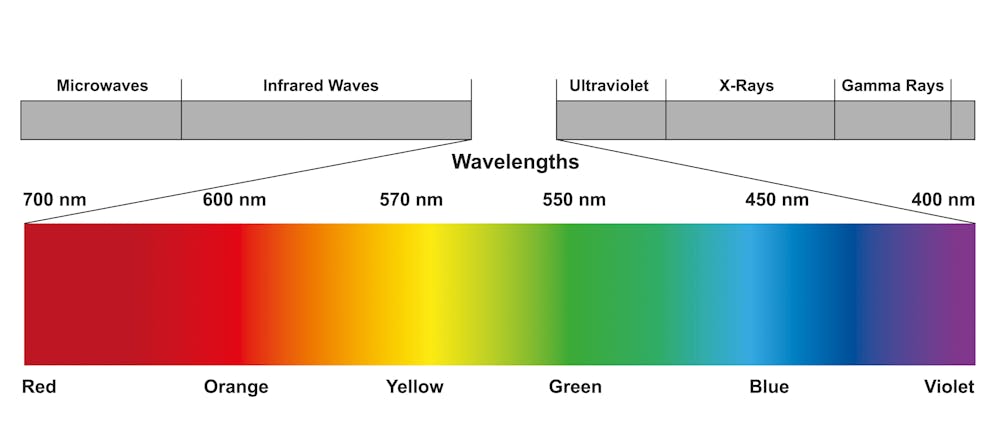
    As photons with wavelengths within a range of about 400–700 nanometers stream into your eyes, your brain perceives them as light. Scientists call these photons visible radiation. You perceive photons with different wavelengths as different colors.

    Photons outside that range of wavelengths are invisible to human eyes. Shorter wavelength energy includes ultraviolet, X-ray and gamma radiation, while longer wavelength energy includes infrared and radio waves.

    The human eye can perceive only a small range of wavelengths of radiation.
    Ali Damouh/Science Photo Library via Getty Images

    Shades and intensities

    Color perception is also affected by the quantity of photons – what physicists call the power – at different visible wavelengths. More photons means more powerful light, which looks brighter. A very vivid color consists mostly of photons of similar wavelength. For example, a pure red may consist of photons that all share the same wavelength near 620 nanometers.

    A stream of photons with a wider range of wavelengths will appear as a paler, less saturated color. White light, such as natural daylight, consists of photons with wavelengths spread fairly evenly across a wide range of the visible spectrum. LEDs and other electric light sources are not quite as uniform across the spectrum, but they still appear white or achromatic, meaning without color.

    Mixtures of wavelengths combine and appear as new colors. The human visual system interprets pure red light and pure green light combined as yellow. Add in pure blue, and this mix of radiation appears white. Scientists and engineers take advantage of this quality in display devices, which are able to create a huge range of perceived colors by mixing the primary colors red, green and blue.

    Black on the color spectrum

    While there’s no black in a rainbow, photons anywhere in the electromagnetic spectrum can be seen as black. Or in some cases, they can’t be seen at all!

    Radiation within the visible spectrum can appear black if it is low in power – more specifically, lower in power than its surroundings.

    Additionally, radiation outside the visible range of wavelengths appears black to our eyes. For example, infrared radiation appears black because it is invisible to humans.

    Perception is subjective

    Our eyes detect the wavelength and power of the light, but our brains interpret it. So color perception always depends on the context.

    People are good at adapting to a wide range of light levels, from sunlight to starlight. So our perception of color and brightness depends on what’s around and what we’ve been looking at recently. If you step from outdoor daylight into a dark theater, at first you probably perceive the whole environment as black, and you may even have trouble finding your way.

    However, your visual system immediately begins to adapt to the low light level. Soon, visual details begin to emerge. What appeared black now has different levels of lightness and color.

    Color perception depends on the surrounding environment.
    Michael J. Murdoch

    Consider the optical illusion that consists of a light rectangle next to a dark rectangle. Each rectangle contains a circle. The circles appear to be different shades but in fact are identical. Against the light background, the circle is dark enough to appear black. Surrounded by the black background, it becomes clear that the circle is merely dark gray. Even when you know the circles are the same, it’s hard to believe because the effect of the surrounding background is so strong.

    In a smooth gradient from gray to black, where does black begin?
    Michael J. Murdoch

    You might be asking yourself, how dark must a color be to appear black? Another way to ask the question is, how low in power must the physical light be in order to look black?

    For a visual answer, look at a gradient from dark gray to black. Where in the gradient is the boundary, or threshold, at which you call it black? What if you dim your display or view the screen in a much brighter or much darker environment? Probably the best answer for how dark it must be is, “It depends.”

    Color perception is a fascinating topic, and we color scientists are continuing to uncover details of how the human visual system works while also applying our knowledge to many other useful things, including dyes, cameras, printers, LED lighting systems and AR/VR displays.


    Hello, curious kids! Do you have a question you’d like an expert to answer? Ask an adult to send your question to CuriousKidsUS@theconversation.com. Please tell us your name, age and the city where you live.

    And since curiosity has no age limit − adults, let us know what you’re wondering, too. We won’t be able to answer every question, but we will do our best.

    Michael Murdoch is a member and former board member of the Inter-Society Color Council, part of the Color Literacy Project.

    ref. Where does black fall on the color spectrum? A color scientist explains – https://theconversation.com/where-does-black-fall-on-the-color-spectrum-a-color-scientist-explains-234540

    MIL OSI – Global Reports

  • MIL-OSI China: China’s CPC sends congratulatory message over 95th anniversary of Vietnam’s communist party

    Source: People’s Republic of China – State Council News

    China’s CPC sends congratulatory message over 95th anniversary of Vietnam’s communist party

    BEIJING, Feb. 3 — The Communist Party of China (CPC) Central Committee on Monday sent a congratulatory message to the Communist Party of Vietnam (CPV) marking the latter’s 95th anniversary of founding. The message is as follows:

    In the past 95 years, the CPV has united and led the Vietnamese people in successfully realizing national unification and liberation with remarkable achievements in the cause of the country’s socialist construction and transformation.

    Notably since the 13th CPV Central Committee meeting, the CPV stepped up efforts to build and reorganize the party, leading to political and social stability as well as vigorous economic development in the country with a steady rise in its international status.

    Currently, under the CPV’s strong leadership led by General Secretary To Lam, the CPV and the Vietnamese people are striving to complete the goals and missions set by the 13th CPV Central Committee meeting, and are marching towards the two centennial goals to welcome the holding of the 14th CPV Central Committee meeting. We believe you will surely realize the goals.

    The CPC and the CPV share a long-standing revolutionary friendship and amicable partnership. Under the personal guidance and careful nurturing of the leaders of previous generations including Mao Zedong and Ho Chi Minh, the two peoples have supported each other in revolutionary struggles, marching together in socialist construction, in the drive of reform and opening-up and on the journey of socialist modernization.

    The CPC has always viewed the development of relations between the two parties and the two countries from a strategic and long-term perspective. The CPC is willing to work with the CPV to implement the important consensus reached by the top leaders of the two parties, uphold the 16-word guideline of “long-term stability, future orientation, good-neighborly friendship and comprehensive cooperation” and the spirit of “good neighbors, good friends, good comrades and good partners,” and in line with the six major goals of greater political mutual trust, to increase high-level exchanges, strengthen strategic communication, consolidate traditional friendship, expand cooperation across various fields, and deepen exchanges and mutual learning on the theory and practice of party and state governance, jointly explore a socialist development path suited to their respective national conditions, and push for more progress in building a China-Vietnam community with a shared future to bring greater benefits to both peoples and contribute further to the cause of peace and progress for humanity.

    MIL OSI China News

  • MIL-OSI China: 2025 Asian Winter Games Torch Relay kicks off in Harbin

    Source: People’s Republic of China – State Council News

    2025 Asian Winter Games Torch Relay kicks off in Harbin

    Updated: February 3, 2025 19:28 Xinhua
    Torch bearer, Shen Xue greets audience during the 2025 Asian Winter Games Torch Relay in Harbin, northeast China’s Heilongjiang Province, on Feb. 3, 2025. [Photo/Xinhua]
    Torch bearer, Liu Jiayu poses during the 2025 Asian Winter Games Torch Relay in Harbin, northeast China’s Heilongjiang Province, on Feb. 3, 2025. [Photo/Xinhua]
    Artists perform during the 2025 Asian Winter Games Torch Relay in Harbin, northeast China’s Heilongjiang Province, on Feb. 3, 2025. [Photo/Xinhua]
    Photo taken on Feb. 3, 2025, shows the general view of the launch ceremony of the 2025 Asian Winter Games Torch Relay in Harbin, northeast China’s Heilongjiang Province. [Photo/Xinhua]
    Torch bearer, Wang Shun holds the torch during the 2025 Asian Winter Games Torch Relay in Harbin, northeast China’s Heilongjiang Province, on Feb. 3, 2025. [Photo/Xinhua]
    Torch bearer, Sui Wenjing lights the caldron during the Flame Retrieval Ceremony of the 2025 Asian Winter Games Torch Relay in Harbin, northeast China’s Heilongjiang Province, on Feb. 3, 2025. [Photo/Xinhua]
    Artists perform during the Flame Retrieval Ceremony of the 2025 Asian Winter Games Torch Relay in Harbin, northeast China’s Heilongjiang Province, on Feb. 3, 2025. [Photo/Xinhua]
    Artists perform during the Flame Retrieval Ceremony of the 2025 Asian Winter Games Torch Relay in Harbin, northeast China’s Heilongjiang Province, on Feb. 3, 2025. [Photo/Xinhua]
    Spectators take photos during the launch ceremony of the 2025 Asian Winter Games Torch Relay in Harbin, northeast China’s Heilongjiang Province, on Feb. 3, 2025. [Photo/Xinhua]
    Spectators cheer for the torch bearers during the 2025 Asian Winter Games Torch Relay in Harbin, northeast China’s Heilongjiang Province, on Feb. 3, 2025. [Photo/Xinhua]
    Artists perform during the launch ceremony of the 2025 Asian Winter Games Torch Relay in Harbin, northeast China’s Heilongjiang Province, on Feb. 3, 2025. [Photo/Xinhua]

    MIL OSI China News

  • MIL-OSI Asia-Pac: Public urged to get flu jabs early

    Source: Hong Kong Information Services

    The community should heighten its vigilance and enhance protection measures against influenza, including receiving the seasonal influenza vaccination (SIV), and those who plan to travel should stay alert to the situation of infectious diseases at their destination.

    The Centre for Health Protection (CHP) made the plea today as the seasonal influenza activity in Hong Kong and many other countries and regions in the northern hemisphere remains at a high level.

    Noting that Hong Kong entered the influenza season in early January, the CHP said it recorded 199 adult cases of intensive care unit admissions or deaths due to influenza in the first four weeks, as compared with 127 cases in the same period in the previous influenza season.

    Among them, there were 122 deaths and over 70% of these severe or death cases did not receive the SIV. For the deaths, nearly 90% involved people aged 65 or above, and nine cases of severe paediatric influenza-associated complications were recorded for children with seven of them unvaccinated.

    ​CHP Controller Edwin Tsui said that with the influenza activity in many parts of the northern hemisphere including the Mainland, Japan, Korea as well as Europe and North America staying at a high level, those planning to travel should monitor the flu situation at their destination before departure and take personal protective measures.

    These measures include receiving the SIV as soon as possible and wearing a surgical mask while in crowded places. Whether in Hong Kong or abroad, people who develop respiratory symptoms, even mild ones, should wear surgical masks and seek medical advice, he added.

    With reference to previous surveillance data, virus activity will continue to increase for a period of time after the start of the flu season before peaking. Currently, available data indicates that the influenza activity level is still on the rise.

    In view of the high levels of flu activity locally and in the northern hemisphere in the coming weeks, Dr Tsui urged people aged six months and above, particularly seniors and children with higher risk of getting infected and developing complications, to act immediately to minimise the risk of serious complications and death after infection.

    As of yesterday, about 1,932,000 vaccine doses were administered under the various vaccination programmes, about a 6.4% increase over the same period last year and an all time high, surpassing the 1,873,000 doses administered in 2023-24.

    The number of schools participating in the SIV School Outreach has also increased significantly this year. However, the SIV coverage rate for children aged six months to under two years remained relatively low.

    The Government has opened the Department of Health’s Maternal & Child Health Centres for children of that age range to receive the jab. Parents can book an appointment for them online.

    Visit the CHP’s seasonal influenza and COVID-19 & Flu Express webpages for the relevant information.

    MIL OSI Asia Pacific News

  • MIL-OSI: NEWTON GOLF Announces $1 Million Share Repurchase Authorization

    Source: GlobeNewswire (MIL-OSI)

    CAMARILLO, CA, Feb. 03, 2025 (GLOBE NEWSWIRE) — NEWTON GOLF Company (Nasdaq: SPGC) (“NEWTON GOLF” or the “Company”), a technology-forward golf company with a growing portfolio of golf products, including putters, golf shafts, golf grips, and other golf-related accessories, announces that its Board of Directors has approved a share repurchase authorization of up to $1 million of its common stock, effective January 31, 2025 and expiring January 31, 2026. The Company may repurchase the shares in open market transactions, privately negotiated transactions, or a combination thereof. Share repurchases are subject to the Company’s discretion based on market conditions, business considerations, legal requirements, and other factors. There is no guarantee as to the number of shares that will be repurchased, and the repurchase program may be extended, suspended, or discontinued without prior notice at the Company’s discretion.

    “Our share repurchase authorization reflects the confidence we have in our business, our outlook for continued growth, and a path to breakeven. Growing adoption of our Newton Motion replacement shafts is a significant factor that provides us the flexibility and discretion to repurchase our common stock,” commented NEWTON GOLF Executive Chairman Greg Campbell.

    About NEWTON GOLF: A Sacks Parente Company

    NEWTON GOLF: A Sacks Parente Company, is a technology-forward golf company that help golfers elevate their game. With a growing portfolio of golf products, including putters, golf shafts, golf grips, and other golf-related accessories, the Company’s innovative accomplishments include: the First Vernier Acuity putter, patented Ultra-Low Balance Point (ULBP) putter technology, weight-forward Center-of-Gravity (CG) design, and pioneering ultra-light carbon fiber putter shafts.

    In consideration of its growth opportunities in golf shaft technologies, the Company expanded its manufacturing business in April of 2022 to develop the advanced Newton brand of premium golf shafts by opening a new shaft manufacturing facility in St. Joseph, MO. It is the Company’s intent to manufacture and assemble substantially all products in the United States, while also expanding into golf apparel and other golf-related product lines to enhance its growth.

    The Company’s future expansions may include broadening its offerings through mergers, acquisitions or internal developments of product lines that are complementary to its premium brand. The Company currently sells its products through resellers, the Company’s websites, Club Champion retail stores, and distributors in the United States, Japan, and South Korea.

    For more information, please visit the Company’s website at www.newtongolfco.com or on social media at @newtongolfco.com, @newtonshafts, or @gravityputters.

    Investor Contact for NEWTON GOLF
    CORE IR
    516-222-2560
    investors@sacksparente.com

    The MIL Network

  • MIL-OSI Global: While plastic dominates human consumption, the global economy will remain hooked on fossil fuels

    Source: The Conversation – UK – By Adam Hanieh, Professor of Political Economy and Global Development, Institute of Arab and Islamic Studies, University of Exeter

    Plastic waste in the Maldives. MOHAMED ABDULRAHEEM/Shutterstock

    In early December 2024, hopes for a landmark global treaty to curb plastic pollution were dashed as negotiations in South Korea stalled. Leading the campaign against the deal were major oil-producing nations, especially Saudi Arabia and Russia, who argued for a more flexible approach to any legally binding limits on plastic manufacturing.

    The collapse of any agreement came despite scientific research delivering ever more alarming warnings about the dangers of plastic pollution. Over the last two years, an avalanche of studies have revealed the pervasive presence of tiny plastic particles in human blood, brains, and even placental tissue.

    These particles, which stem from the breakdown of larger plastic waste, have been linked to everything from inflammation to hormonal disruption, and potential long-term health risks such as cancer. Aside from their effects on human health, plastics are wreaking havoc on marine ecosystems, with microplastics now found in Arctic ice and in the bodies of fish and birds.

    Behind these alarming studies stands a seemingly unstoppable juggernaut of plastic production. The annual global production of plastics reportedly grew nearly two hundredfold between 1950 (two million tonnes) and 2015 (381 million tonnes), and the pace of growth is accelerating.

    Over half of all plastics ever made were produced in the past 25 years, and production levels are estimated to double or triple again by 2050. And more production brings more waste.

    Less than 10% of all plastics ever produced have been recycled. And the volume of “mismanaged plastics” – those which are not recycled, incinerated, or sealed in landfills – is also estimated to double by 2050.

    It seems as if humans have become the organic detritus within a plastic world of our own creation.

    Plastic elephants

    But despite growing awareness around the problems associated with plastic, there is a fundamental flaw in how we tend to think about it as a product.

    For there is a tendency to frame plastic as a problem of pollution and recycling, rather than as an integral part of our fossil fuel-driven world. This narrative is also promoted by major oil companies, such as the American giant, ExxonMobil, which stated in the lead up to the South Korean summit: “The issue is pollution. The issue is not plastic.”

    The problem with this perspective is that it obscures the fact that plastics are petrochemical products: substances which are ultimately derived from oil and gas.

    Indeed, the future of fossil fuels is increasingly tied to the future of plastics. It has been estimated that by 2040, plastics will account for as much as 95% of net growth in oil demand.

    This is perhaps why 220 fossil fuel lobbyists attended those recent treaty discussions, outnumbering all other delegations. It could also explain why Saudi Arabia, home to one of the world’s largest petrochemical companies, led the opposition to any global limits on plastic production.

    At the core of capitalism

    The problem we confront is not simply the presence of an oil lobby, it is the systemic role that plastics play within capitalism.

    Plastics, and the wider petrochemical industry, played a crucial part in the transformation of global capitalism from the mid-20th century onwards.

    As I explore in my book, Crude Capitalism, the things we used to need to build and make things previously relied on sourcing naturally occurring, labour-intensive goods like timber, cotton or metals. But the invention of plastics and other synthetic materials separated commodity production from nature.

    More plastic in the pipeline.
    Kodda/Shutterstock

    Oil became more than a fuel – it was the substance that came to dominate our lives. A petrochemical shift to the rise of an oil-dominated world. With capitalism untethered from natural cycles, there was a radical reduction in the time taken to produce commodities and an end to any limits on the quantity and diversity of goods produced.

    Along with this, consumption habits became centred around notions of disposability and obsolescence. Plastics made the essential features of contemporary capitalism possible: a drive to limitless growth, continual acceleration of production and consumption, and the frenzied expansion of markets.

    The emergence of fast fashion is just one example. Alongside poorly paid garment workers in countries such as Bangladesh, really cheap clothing was only made possible through the massive expansion of polyester production (a kind of plastic), which freed the industry from its dependence on supplies of wool and cotton.

    The consumption of plastics looms large in today’s ecological crisis. And having become so accustomed to thinking about oil and gas as primarily an issue of energy and fuel choice, perhaps we have lost sight of how much of our lives depend upon the products of petroleum.

    These synthetic materials drove a post-war revolution in productivity, bringing labour-saving technology and mass consumption. It is now almost impossible to identify an area of life that has not been radically transformed by the presence of plastics and other petrochemicals.

    Plastic products have become normalised as natural parts of our daily existence. And it is this paradox which must be fully confronted if we are to move beyond fossil fuels.

    Adam Hanieh’s research into petrochemicals has been supported by a Political Economy Fellowship from the Independent Social Research Foundation (ISRF).

    ref. While plastic dominates human consumption, the global economy will remain hooked on fossil fuels – https://theconversation.com/while-plastic-dominates-human-consumption-the-global-economy-will-remain-hooked-on-fossil-fuels-247393

    MIL OSI – Global Reports

  • MIL-OSI Global: The Sims: from Hot Date to Get Famous, why expansion packs have been key to the game’s longevity

    Source: The Conversation – UK – By Aditya Deshbandhu, Lecturer of Communications, Digital Media Sociology, University of Exeter

    SimCity 3000, the predecessor to The Sims, played a pivotal part in my childhood, growing up in Hyderabad, India. Its recreation of the western, urban world helped me understand how cities were planned, designed and financed – and how they provided people with key services like transportation, health and education while preparing for accidents and other hazards.

    As an eight-year-old trying to figure out my place in the world, that game offered me a way to make meaning of the chaos that can be life. So, when The Sims launched in 2000 – enabling me to live inside a virtual city, rather than simply build one – I had to get my hands on a copy.

    Twenty-five years later, I write this piece in a drastically different gaming landscape, where games offer high visual fidelity and ever-increasing frame rates for ultra-smooth game play. But despite all these technological innovations and the pursuit of photo-realism, the popularity of The Sims’ game designer Will Wright’s satire on American consumer culture endures.


    Sul Sul! This article is part of a mini series from The Conversation marking 25 years of The Sims franchise.


    The franchise’s four Sims games had sold over 200 million copies before the latest instalment, The Sims 4, became free to play in 2022. Players now spend their money on extras within the game. Over 85 million people played The Sims worldwide in 2024.

    At a time when the success of a modern video game is measured in metrics like “cumulative engagement time” (number of players playing at the same time), acquisition of new players and “intensity of engagement” (number of hours spent by a player), now-over-a-decade-old The Sims 4 continues to excel with its mastery of the live-service format.

    The trailer for the first Sims game.

    Live-service describes the form modern digital games embrace when they transition from conventional products into “services” – a shift made possible because games today can be regularly updated, fixed and expanded upon by their makers remotely. They can acquire new levels and in-game features in a similar way to how streaming platforms like Netflix drop new episodes of your favourite show.

    Players don’t buy a live-service game, they sign up for the journey.

    Expanding player horizons

    In each incarnation of The Sims, players have been able to access new ways to perform roles and tasks that mimic everyday life, in the form of expansions and content packs.

    The original title, The Sims (2000), had seven expansion packs and two content packs. I distinctly remember brewing potions in the chemistry lab and rubbing a magic lamp to conjure a genie in the first expansion, Livin’ Large; the new holiday island that was built for The Sims: Vacation; and leaving my Sim’s home to visit downtown areas as part of Hot Date.

    The trailer for The Sims Hot Date expansion pack.

    But for The Sims 4 (2014), the developers went all in. This game – and its subsequent expansions – represents a digital supermarket of lifestyles, sub-cultures, activities and stardom. For example, 2018’s Get Famous pack not only introduced Del Sol Valley – a region that resembled Los Angeles and the Hollywood Hills – but also introduced the “reputation” mechanism for players.

    The Discover University expansion (2019) allowed players to take their Sims to school in a new region called Britechester – after this update, the game integrated Sims’ careers and education, and in many ways changed the rules of the game. And the Eco Lifestyle expansion pack (2020) is memorable because the game engaged with ideas of sustainable living for the first time.

    Genre, fantasy and reality

    From content packs featuring a digital recreation of singer Katy Perry in The Sims 3 to collaborations with streamers, content creators and fashion houses, The Sims has remained relevant by consistently blurring the lines between genre, reality and fantasy.

    Hot Date was a popular early Sims expansion pack.

    Today, video game makers the world over try to master formats like free-to-play games where players pay for cosmetic items, customisations and added content, or expansions offering downloadable content. The Sims set the standard for most of them.

    Over the past 25 years, this franchise has had several life simulation competitors in the form of Second Life, Facebook’s once popular Farmville, virtual reality experiences like Half-Life: Alyx and, during the pandemic when we worked, learnt and played online, initiatives like the Metaverse.

    However, today only The Sims endures. The game’s developers continue to give its players what they want, while also getting them to engage with difficult ideas like sustainability, the question of life and death, and even gentrification (For Rent expansion pack, anyone?).

    Few games let players critique life so closely. For game researchers like me, this begs the question: do people play life simulation games like The Sims in order to build alternative lives, relive their own – or create something entirely new?


    Looking for something good? Cut through the noise with a carefully curated selection of the latest releases, live events and exhibitions, straight to your inbox every fortnight, on Fridays. Sign up here.


    Aditya Deshbandhu does not work for, consult, own shares in or receive funding from any company or organisation that would benefit from this article, and has disclosed no relevant affiliations beyond their academic appointment.

    ref. The Sims: from Hot Date to Get Famous, why expansion packs have been key to the game’s longevity – https://theconversation.com/the-sims-from-hot-date-to-get-famous-why-expansion-packs-have-been-key-to-the-games-longevity-248604

    MIL OSI – Global Reports

  • MIL-OSI: Australian Oilseeds Accelerates Growth with Expanded Distribution Across 1,000+ Woolworths Stores

    Source: GlobeNewswire (MIL-OSI)

    COOTAMUNDRA, Australia, Feb. 03, 2025 (GLOBE NEWSWIRE) — Australian Oilseeds Holdings Limited, a Cayman Islands exempted company (the “Company”) (NASDAQ: COOT) today announced expanded distribution of its premium cold pressed oils at Woolworths, a major retailer in Australia with over 1,000 locations across the country. Four SKUs of the Company’s cold pressed GEO Extra Virgin Non-GMO Canola oil and its cold pressed GEO Non-GMO Extra Virgin Vegetable oil are now available at Woolworths locations in pack sizes ranging from 750ml to 4L.

    “We are very pleased to partner with Woolworths to provide consumers greater access to our high-quality, sustainable and locally sourced oils,” said Gary Seaton, Chief Executive Officer of Australian Oilseeds Holdings Limited. “Our GEO brand exemplifies our mission by offering a unique range of products that significantly reduce the use of chemicals in farming and food production systems, creating a cleaner, healthier environment for all. This agreement, coupled with our recently announced expansion in China, demonstrates significant progress on our key strategic initiatives along with helping to accelerate our growth trajectory. We look forward to increasing our range of healthier GEO oils in Woolworths supermarkets throughout 2025.”

    Australian oilseed investments is also in discussions with other retail chains in both Australia and the United States for supply of its unique range of non-GMO cold pressed extra virgin vegetable oils.

    About Australian Oilseeds Investments Pty Ltd. Australian Oilseeds Investments Pty Ltd. is an Australian proprietary company that, directly and indirectly through its subsidiaries, is focused on the manufacture and sale of sustainable oilseeds (e.g., seeds grown primarily for the production of edible oils) and is committed to working with all suppliers in the food supply chain to eliminate chemicals from the production and manufacturing systems to supply quality products to customers globally. The Company engages in the business of processing, manufacture and sale of non-GMO oilseeds and organic and non-organic food-grade oils, for the rapidly growing oilseeds market, through sourcing materials from suppliers focused on reducing the use of chemicals in consumables in order to supply healthier food ingredients, vegetable oils, proteins and other products to customers globally. Over the past 20 years, the Company’s cold pressing oil plant has grown to become the largest in Australia, pressing strictly GMO-free conventional and organic oilseeds.

    Forward-Looking Statements: This press release contains “forward-looking statements” within the meaning of the “safe harbor” provisions of the Private Securities Litigation Reform Act of 1995, including but not limited to, statements regarding our financial outlook, business strategy and plans, market trends and market size, opportunities and positioning. These forward-looking statements are based on current expectations, estimates, forecasts and projections. Words such as “expect,” “anticipate,” “should,” “believe,” “hope,” “target,” “project,” “goals,” “estimate,” “potential,” “predict,” “may,” “will,” “might,” “could,” “intend,” “shall” and variations of these terms and similar expressions are intended to identify these forward-looking statements, although not all forward-looking statements contain these identifying words. Forward-looking statements are subject to a number of risks and uncertainties, many of which involve factors or circumstances that are beyond our control. For example, global economic conditions could in the future reduce demand for our products; we could in the future experience cybersecurity incidents; we may be unable to manage or sustain the level of growth that our business has experienced in prior periods; our financial resources may not be sufficient to maintain or improve our competitive position; we may be unable to attract new customers, or retain or sell additional products to existing customers; we may experience challenges successfully expanding our marketing and sales capabilities, including further specializing our sales force; customer growth could decelerate in the future; we may not achieve expected synergies and efficiencies of operations from recent acquisitions or business combinations, and we may not be able to pay off our convertible notes when due. Further information on potential factors that could affect our financial results is included in our most recent Annual Report on Form 10-K and our other filings with the Securities and Exchange Commission. The forward-looking statements included in this press release represent our views only as of the date of this press release and we assume no obligation and do not intend to update these forward-looking statements.

    Contact
    Australian Oilseeds Holdings Limited
    126-142 Cowcumbla Street
    Cootamundra New South Wales 2590
    Attn: Bob Wu, CFO
    Email: bob@energreennutrition.com.au

    Investor Relations Contact
    Reed Anderson
    (646) 277-1260
    reed.anderson@icrinc.com

    The MIL Network

  • MIL-OSI United Kingdom: New partnerships for growth: FCDO Minister’s speech at the LSE

    Source: United Kingdom – Executive Government & Departments

    FCDO Minister for Development Anneliese Dodds gave a keynote speech to the UK financial sector at the London Stock Exchange today on partnerships for growth.

    Thank you so much, Julia [Dame Julia Hoggett, CEO of the London Stock Exchange], and a very good morning to all of you.

    Thank you so much for joining us today, I really appreciate it.

    It was an absolute thrill to see the market open this morning.

    I am very keen to hear from as many of you as possible, so I’m not going to speak for too long.

    I want to leave plenty of time for questions.

    But I do want to share a few reflections with you this morning.

    This is, as Dame Julia kindly said, the second time I had the privilege of opening the London Stock Exchange.

    I had the privilege of speaking in this room almost two years ago, and it was then as now a very moving moment, because sat in the front row were some of the first women, in fact the first women, and others who set foot on the London Stock Exchange because they had not been allowed to do so until then.

    What a privilege to have been there for that moment, as for this moment.

    Two years ago, when I was here, I spoke about my own family background – with my dad having worked in financial services.

    And I want again to place on record, my respect for the work that goes on in this building, and across the country.

    Businesses in the financial sector power jobs and growth across the UK, and indeed often around the world as we’ve just heard.

    Well, of course, a lot has changed in the last two years, since I was last here.

    I am addressing you, not as a shadow minister – but now as the Minister for Development, and for Women and Equalities.

    We have a new government focused on growth and restoring our reputation on the world stage.

    And the Prime Minister and the Chancellor have set us all a guiding mission to grow our economy, and bring opportunity to people across our country.

    They have been clear that supporting growth and development around the globe is not just the right thing to do.

    It is an essential part of how we unlock growth, jobs, trade, investment, and pride in our economy here at home as well.

    Indeed, as the Foreign Secretary said in a major speech at the start of the new year, in today’s contested, competitive world, what we need now is a whole new level of global engagement – drawing on our greatest strengths.

    That absolutely includes the expertise, experience, and dynamism in this room.

    Clearly, the City of London and wider UK financial sector must be at the heart of how we meet the opportunities and challenges of our time.

    Twenty years ago, people marched and campaigned to Make Poverty History.

    [Political content redacted]

    That call was heeded and huge progress was made.

    Debt was cancelled, and development assistance was ramped up.

    Lives were saved and lives were changed.

    Today, the challenges we face are growing and becoming increasingly complex – not least because our world is so deeply interconnected.

    We have all seen how shocks can indeed reverberate across the globe.

    A vicious cycle of conflicts.

    The pandemic.

    The climate and nature crisis, and others.

    We have seen supply chains disrupted, and investor confidence shaken – harming our economy, here at home.

    Yet we have all seen the power of harnessing this interconnectedness as well.

    By working together – we can get ahead of global shocks, mitigate their impact, and unlock new opportunities for growth.

    For outward investment by UK businesses.

    To build future markets for UK exports.

    To support low-and-middle-income countries to grow their economies as well.

    As the UK’s Minister for Development, and for Women and Equalities, I am determined to build genuine partnerships across the Global South, based on genuine respect, and in service of our mutual interests.

    Indeed, in all of the visits I’ve undertaken over the last 6 months, from Indonesia to Malawi, to the major global gatherings of the UN General Assembly, the World Bank Annual Meetings, and the climate summit at COP29 – I heard loud and clear that our drive for growth is an ambition our partners all share.

    They want respectful, modern partnerships that benefit us all, too.

    They want to tap into your expertise and the innovative financial solutions you are pioneering – to harness the power of private finance.

    They want to work with us to build resilience to shocks.

    To escape the trap of unsustainable debt.

    To break down the barriers to private investment.

    And they want to work with us to champion much-needed reform of the global financial system, so we unlock more opportunities for everyone – from millions of women and girls around the world whose game-changing potential has yet to be unleashed, to investors right here in the City of London.

    Your hard work is at the heart of these partnerships.

    Already, 115 African companies are listed here.

    London is the world’s number one hub as I said before for green finance.

    All of this puts the UK in pole position to be the leading source of investment for emerging markets – and to build on the reputation you have worked so hard to develop.

    So today, I want to focus on four key areas, where the government and the City can make the most of the important roles we have to play – to support stable, resilient long-term growth, here at home, and around the world.

    Mobilising private capital – to help us maximise the impact of public and private finance.

    Reforming international financial institutions – to make sure they are bigger, better, and fit for the future.

    Tackling unsustainable debt – to achieve the fast, orderly restructuring that helps countries avoid default and supports stability.

    And scaling up insurance – to get more finance in place before disasters strike, to protect and promote growth across the world.

    First – mobilising private capital.

    Together, we can maximise the impact of billions of dollars of public money – and unlock many billions more.

    Consider that globally, there are some $121 trillion of assets under management.

    Currently, Africa accounts for less than 1% of the overseas portfolio allocation of UK pension funds.

    Yet Africa’s GDP growth – and I know I don’t need to tell many in this room of this – is projected to outpace the global average – and almost 70% of UK savers say they want their investments to consider impact on people and the planet.

    It is time to lean in.

    So, I was delighted to hear the Chancellor announce her plans – to consolidate the UK’s fragmented £1.3 trillion pension fund landscape, and create larger, more agile funds, capable of investing in high-growth emerging and developing markets.

    This is exactly the kind of opportunity we need to embrace.

    And I’m delighted that today, a new report from leading UK-based institutional investors sets out how the UK can continue to be the climate finance hub for the world.

    The report makes it clear that investing in other countries to accelerate the transition to clean energy is critical – to growing our economy at home, and to building financial stability long-term, in the UK, and right around the world.

    The Energy Secretary is rightly championing this through the new Global Clean Power Alliance, that the Prime Minister launched at the G20 in Rio.

    Well, today I am pleased to announce that alongside the Economic Secretary to the Treasury, I am convening an Investor Taskforce – to increase UK private investment for climate and development, in markets around the world.

    We are building partnerships with public markets like the London Stock Exchange to pursue this.

    In just four years, our flagship MOBILIST initiative has mobilised almost $250 million for listed products focussed on climate and development globally – including recent investments, like the infrastructure securitisation through Bayfront.

    This method of structuring bank infrastructure loans makes it possible for institutional investors to purchase them through investment-grade listed instruments.

    MOBLIST also helped achieve a $100 million first close for the Green Guarantee Company that will provide up to $1 billion of guarantees – for institutional investors buying green bonds, including those listed on the London Stock Exchange, and green loans issued in the private credit market.

    Today, I am pleased to announce up to £100 million of additional funding for MOBILIST – so we can build on this innovative work pioneering public market investment in emerging markets.

    This will allow MOBILIST to provide a platform for even more partners to draw on UK financial expertise – unlocking opportunities for investments in green growth, and helping more businesses to access new and affordable sources of capital across Asia, Africa, and Latin America.

    MOBILIST is not the only way that we are doing this.

    When I visited the London-based Private Infrastructure Development Group, funded by the UK and others – I saw how they are developing and de-risking infrastructure projects across Africa and Asia.

    The UK financial sector has been a key partner for them.

    For example, one arm of the group – GuarantCo – has guaranteed bonds and loans, to unlock $5.7 billion of private investment in infrastructure, benefitting over 44 million people.

    And – breaking news – I am delighted that a new $50 million deal with Standard Chartered Bank – signed today – will allow them to expand further.

    As another example, take British International Investment, or BII – the world’s oldest Development Finance Institution, at the forefront for 75 years.

    The BII teams were full of ambition when I visited their HQ in November.

    I am always proud to tell our partners that 25% of BII’s new investment commitments already meet the 2X Challenge standard – to increase investment in women.

    By making this a priority, BII is funding everything from affordable housing led by women in India, to making lines of credit accessible to small-scale retailers run by women in Nigeria – supporting jobs and growth.

    And when I sat down with key African investors alongside partners from the City in the autumn, I was able to highlight that over half of BII’s portfolio is invested in Africa, and at least 30% of BII’s investments are in climate finance.

    So today, I want to encourage you to engage with their live call for proposals that is open right now.

    BII are looking for innovative pilots to be funded through a new facility announced by the PM at UNGA in New York – that we expect to mobilise over $500 million of institutional investment.

    We are supporting public markets to mobilise finance in other ways as well.

    UK support has been instrumental in helping Ethiopia to launch its first public stock exchange just a few weeks ago, with support from the UK government through Financial Sector Deepening Africa – or ‘FSD Africa’ for short.

    This exchange brings transparency and international-standard accounting to listed companies – and the diverse ownership that should improve accountability, and broaden both the gains from growth, and the buy-in.

    We are sharing UK expertise on financial regulation with our partners as well.

    Through a partnership with the Foreign, Commonwealth, and Development Office, the Bank of England is now supporting more than 10 countries to improve monetary policy and strengthen financial stability – from Nigeria to South Africa, and from Bangladesh to Indonesia.

    And in the last few days we have signed a new partnership with the Financial Conduct Authority, that will lead to them sharing knowledge with partner countries – to ensure that markets are competitive and fair.

    That is good for our partners – and it is good for us as well.

    Last year, Tanzania’s NMB Bank cross-listed East Africa’s first sustainability bond on the London Stock Exchange and the Dar es Salaam Stock Exchange – again, with support from FSD Africa, and an anchor investment from BII.

    The $73 million raised through this ‘Jamii’ Bond will support renewable energy, food security, jobs, and growth.

    In fact, thanks in no small part to your hard work, these sorts of listing are becoming a trend on the London Stock Exchange.

    Last year, the Brazilian Government dual-listed its first $2 billion sovereign sustainable bond on the London Stock Exchange.

    That was followed by a full listing of its second $2 billion sustainable bond, a few weeks later.

    All of this was enabled by UK support that helped Brazil develop a Sovereign Sustainable Bonds framework.

    Now, as we heard earlier, just a few weeks ago, the first $500 million Climate Investment Funds Capital Markets Mechanism bond was issued on the London Stock Exchange.

    It generated considerable investor interest.

    As has already been mentioned of course, it was over-subscribed six times over.

    Further issuances could raise up to $7.5 billion over ten years, for new investments in clean energy in developing countries – leveraging UK government contributions, and those from our international partners.

    So, I could not have been more delighted to open the market this morning – and to congratulate the Climate Investment Funds and World Bank Treasury on issuing this promising new bond today.

    Now, of course, no one in this room is going to invest in developing economies, or provide climate finance – simply because it is a nice thing to do.

    You are making those investments and building those partnerships because they represent a remarkable opportunity – to marry investment in the economies and technologies of the future, with the experience and expertise of the City of London.

    [Political content redacted]

    Let us keep up the momentum – so the London Stock Exchange continues to be the preferred choice.

    My second point is about reforming international financial institutions.

    We are asking a lot of all of you – but of course, there are certain things that only governments can do.

    And reforming the multilateral development banks or MDBs is one of the biggest ways that we are holding up our end of the bargain.

    Every year, the World Bank Group and various regional development banks multiply every pound the UK government and other shareholders put in.

    Last year alone, they raised around £30 billion from bond issuances in London.

    Together with finance raised on other markets around the world, this allowed them to deploy over $170 billion to low-and-middle-income countries.

    This finance is on much more affordable terms than many of our partners could access directly – thanks to the banks’ triple-A credit ratings.

    They use this to invest in high-impact public and private projects.

    Green infrastructure, healthcare, education, women and girls – all underpinning the foundations for growth around the world, and here in the UK.

    So clearly, pursuing reforms that make the MDBs bigger, better, and fit for the future is key.

    As the Prime Minister set out at the UN General Assembly last year –that is exactly what we are using the UK’s influence to do, in partnership with the Global South.

    Indeed, when I travelled to Washington D.C in October, as the UK Governor of the World Bank Group, I made it my priority to agree changes to its risk appetite, that will unlock an additional $30 billion over ten years.

    This builds on UK government guarantees that have made it possible for the World Bank and other MDBs to lend an additional $6 billion, across Africa, Asia, and the Pacific.

    Ahead of the next big ‘Financing for Development’ summit in Seville this summer – we must do more.

    To make sure the MDBs can shoulder more risk.

    To create more opportunities for private companies to invest in emerging markets.

    And to empower the women and girls who have the power to lift up whole families, communities, countries, and economies.

    Thirdly – we have to tackle the unsustainable debt that is dampening global growth.

    As we take the next steps now, we need the City to be at the forefront of expertise and solutions, to make sure that countries facing unsustainable debt burdens can restructure it effectively.

    Clearly, fast, orderly restructuring can help countries avoid default, and support stability.

    This is squarely in the interest of lenders, such as bondholders and commercial lenders here in the City.

    Obviously, it is squarely in the interests of borrowers too.

    I heard that loud and clear from the governments of Malawi and Zambia during my visit at the end of last year.

    With some 95% of African bonds issued under English Law, the UK has a key role to play.   We need to leverage this.

    Half of the lowest income countries are now in debt distress, or at high risk of it.

    Some 3.3 billion people are living in countries that are spending more on servicing their debt, than on the health and education services that underpin long-term, global growth.

    So, I want us to build on the successes of Collective Action Clauses that featured in over 90% of new bond issuances.

    These have been rolled out widely since their introduction in 2004.

    They have played an important role in ensuring a smooth process and strong private sector participation, in recent debt restructuring negotiations in Ghana and Zambia – avoiding situations where one or two bondholders can hold up a deal.

    This is a great example of what market-friendly innovation can achieve.

    My challenge to the commercial banks now is to introduce the equivalent clauses for syndicated lending – that the UK government has worked with the International Capital Markets Association, legal and financial advisors based in the City, and international partners to develop.

    No lender has implemented them – yet.

    So today, I am announcing that the UK government will offer support for the first ten transactions that put ‘majority voting provisions’ into existing or new lending to low-or-middle-income countries.

    Together, we can speed up debt restructuring negotiations with syndicated lenders – and get growth recovering more quickly in cases where debt has become unmanageable.

    We can do more on Climate Resilient Debt Clauses as well.

    The UK government was the first bilateral creditor to offer these clauses.

    Several other lenders have followed since.

    The difference they can make is significant.

    They allow repayments to be paused when a shock hits.

    This frees up fiscal space for countries responding to a crisis.

    Helps avoid default.

    Supports stability.

    And safeguards growth.

    Just look at Grenada.

    At the end of last year, following Hurricane Beryl – these clauses were triggered on government-issued bonds

    The result was $30 million of interest payments being suspended over the following year – thanks to the bondholders who pioneered these clauses.

    Already, we are going further.

    In October, I announced that the UK will support small states to take up Climate Resilient Debt Clauses in their World Bank loans, by covering the fees.

    In the long run these should be offered at no cost – improving sustainability, and offering benefits both to borrowers and lenders.

    All of this builds on the leadership of countries like Grenada and Barbados who championed these clauses.

    Today, I am reiterating our call on all creditors to offer these clauses in their sovereign lending, by the end of this year – including private sector lenders here in the City.

    I want to see greater transparency on debt as well.

    This improves investors’ understanding – and reduces the hidden debt that poses substantial risks for creditors here in the City.

    It lowers the cost of borrowing for our partners.

    And it allows citizens across the world to hold their governments to account for borrowing and using resources.

    Already, the UK government publishes all its new lending quarterly, on a loan-by-loan basis.

    Now, we want to see other public and private creditors meeting the same standards of transparency in their lending – especially to low-income countries.

    The UK will keep under review if further action is needed – working together with the private sector, to combat high levels of indebtedness.

    Fourth and finally, we need to get insurance and other contingent finance in place before disasters strike, so we protect and promote growth around the world.

    Extreme weather events are on the rise, as we all know.

    Millions of the world’s poorest and most vulnerable people are bearing the brunt of repeated shocks.

    Yet currently, less than 2% of crisis finance is of the ‘pre-arranged’ variety – that makes sure every pound spent yields three or four times its worth in benefits.

    Changing that is so important – to help countries receive the rapid payments they need to avoid losses.

    To reduce the need for humanitarian support.

    And to protect growth and jobs.

    Once again, the City is well-placed to meet the needs of this growing, and largely untapped market – as a global leader in innovative insurance and managing risk.

    In Africa, the Caribbean, South-East Asia and the Pacific, the FCDO has helped to establish regional insurance schemes – helping countries get cheaper prices by buying insurance from the private sector as a group, pooling their risk.

    London reinsurers underwrote a quarter of the first eight pools that have allowed Africa to transfer over $1 billion of risk, through the UK-funded African Risk Capacity.

    On a visit at the end of last year, I saw first-hand the difference that payouts from the African Risk Capacity are making to people in Zambia and Malawi, as they respond to a devastating recent drought.

    I was proud to tell them that this was made possible by UK government subsidies for insurance premiums – for countries that otherwise wouldn’t have been able to afford them.

    Now, I want us all to engage with the ground-breaking report published by a high-level industry panel, that I helped to launch last week – on how we can strengthen the provision of insurance and other contingent finance, and scale up the use of pre-arranged finance.

    Improving modelling, and the way we price risk.

    Championing innovative parametric insurance.

    De-risking investments upfront.

    This work is so important for giving investors confidence, expanding markets in development economies, improving returns, and strengthening the UK’s role as a leading global financial hub.

    Cultivating a virtuous cycle of global resilience and growth is in all our best interests.

    Your expertise, innovation, and investment are critical.

    So, my pledge to you is that I will make it a priority to build stronger partnerships between the Foreign, Commonwealth, and Development Office and the City.

    So we face up to unprecedented challenges.

    Embrace new opportunities.

    And reinvigorate hope for our shared future – and for sustained and sustainable economic growth here and overseas – by working towards it together, in the months and years ahead.

    Thank you.

    Updates to this page

    Published 3 February 2025

    MIL OSI United Kingdom

  • MIL-OSI: OTC Markets Group Welcomes Digital Domain Holdings Limited to OTCQX

    Source: GlobeNewswire (MIL-OSI)

    NEW YORK, Feb. 03, 2025 (GLOBE NEWSWIRE) — OTC Markets Group Inc. (OTCQX: OTCM), operator of regulated markets for trading 12,000 U.S. and international securities, today announced Digital Domain Holdings Limited (Hong Kong Stock Exchange: 547; OTCQX: DDHLY), a global leader in visual effects and transformative experiences, has qualified to trade on the OTCQX® Best Market. Digital Domain Holdings Limited upgraded to OTCQX from the Pink® market.

    Digital Domain Holdings Limited begins trading today on OTCQX under the symbol “DDHLY.” U.S. investors can find current financial disclosure and Real-Time Level 2 quotes for the company on www.otcmarkets.com.

    Upgrading to the OTCQX Market is an important step for companies seeking to provide transparent trading for their U.S. investors. For companies listed on a qualified international exchange, streamlined market standards enable them to utilize their home market reporting to make their information available in the U.S. To qualify for trading on OTCQX, companies must meet high financial standards, follow best practice corporate governance, and demonstrate compliance with applicable securities laws.

    “We are pleased with the upgrade to the OTCQX Market, as it underscores our commitment to transparency and strengthens investor confidence,” says William Wong, Executive Director and the CEO of Digital Domain. “This milestone reflects our ongoing strategy to build trust and provide sustainable, long-term value for our shareholders.”

    About Digital Domain Holdings Limited
    Digital Domain is a pioneer in creating transportive experiences. Over the last 30 years, the company has solidified its position as a leader in the visual effects industry, expanding its expertise in virtual humans and visualization on a global scale. Digital Domain boasts an impressive legacy that includes contributions to hundreds of feature films and television episodes, advertisements, game cinematics, and groundbreaking immersive experiences. Renowned for its creative innovation in cutting-edge technology, Digital Domain has delivered exceptional artistry to Academy Award-winning films such as “Titanic,” “What Dreams May Come,” and “The Curious Case of Benjamin Button.” The skilled artists at Digital Domain have collectively earned over 100 prestigious awards, including Academy Awards, Clios, BAFTA awards, and Cannes Lions.

    Digital Domain is listed on the Hong Kong Stock Exchange (Stock code: 547) and is headquartered in Hong Kong. Digital Domain maintains operations in multiple cities, including Los Angeles, Vancouver, Montreal, Beijing, Shanghai, Hyderabad, and more.

    To learn more about Digital Domain, visit www.digitaldomain.com.

    Digital Domain PR Contact:

    Kavita Smith
    Director of Marketing Communications and PR
    kavita@d2.com

    Angela Yang
    Sr. PR Manager
    angela.yang@ddhl.com

    About OTC Markets Group Inc.
    OTC Markets Group Inc. (OTCQX: OTCM) operates regulated markets for trading 12,000 U.S. and international securities. Our data-driven disclosure standards form the foundation of our three public markets: OTCQX® Best Market, OTCQB® Venture Market and Pink® Open Market.

    Our OTC Link® Alternative Trading Systems (ATSs) provide critical market infrastructure that broker-dealers rely on to facilitate trading. Our innovative model offers companies more efficient access to the U.S. financial markets.

    OTC Link ATS, OTC Link ECN and OTC Link NQB are each an SEC regulated ATS, operated by OTC Link LLC, a FINRA and SEC registered broker-dealer, member SIPC.

    To learn more about how we create better informed and more efficient markets, visit www.otcmarkets.com.

    Subscribe to the OTC Markets RSS Feed

    Media Contact:
    OTC Markets Group Inc., +1 (212) 896-4428, media@otcmarkets.com

    The MIL Network

  • MIL-OSI: Allegro MicroSystems Appoints Dr. Krishna Palepu to its Board of Directors

    Source: GlobeNewswire (MIL-OSI)

    MANCHESTER, N.H., Feb. 03, 2025 (GLOBE NEWSWIRE) — Allegro MicroSystems, Inc. (“Allegro”) (Nasdaq: ALGM) a global leader in power and sensing semiconductor solutions for motion control and energy-efficient systems, today announced the appointment of Krishna Palepu, Ross Graham Walker Professor of Business Administration at Harvard Business School, to Allegro’s Board of Directors (“Board”) as an independent director. Dr. Palepu’s appointment was effective on January 31, 2025. 

    Dr. Palepu brings extensive expertise in strategy, governance, and emerging markets to the Board, as well as experience advising companies in the technology and semiconductor sectors. His academic research focuses on globalization, particularly in India and China, and corporate board effectiveness. He has served on multiple public company boards and is a fellow of the International Academy of Management.

    “I am delighted to welcome Krishna to Allegro’s board of Directors,” said Yoshihiro “Zen” Suzuki, Chairman of the Board. “He brings a unique perspective with his impressive background in academia combined with considerable board and consulting experience in the sectors and markets of focus for the company. Dr. Palepu’s deep understanding of business strategy and global markets positions him perfectly to navigate the complexities of international business. His practical experience complements his research background, bringing valuable insight to the Board as we move towards our next stage of growth.”

    “It is an exciting time to join Allegro’s Board, and I am honored to be appointed,” said Dr. Palepu. “I look forward to working closely with Allegro’s directors and management team and drawing upon my expertise in corporate governance, emerging markets, and global strategy to further enable the company to continue its strong progress.”

    Dr. Palepu holds a master’s degree in Electronics from Andhra University, an MBA-equivalent degree from the Indian Institute of Management, Calcutta, and a Ph.D. in Management from the MIT Sloan School of Management.

    About Allegro MicroSystems

    Allegro MicroSystems, Inc. is leveraging more than three decades of expertise in magnetic sensing and power ICs to propel automotive, clean energy and industrial automation forward with solutions that enhance efficiency, performance and sustainability. Allegro’s commitment to quality drives transformation across industries, reinforcing our status as a pioneer in “automotive grade” technology and a partner in our customers’ success. For additional information, visit www.allegromicro.com.

    Forward-Looking Statements

    This press release contains forward-looking statements within the meaning of the Private Securities Litigation Reform Act of 1995. We intend such forward-looking statements to be covered by the safe harbor provisions for forward-looking statements contained in Section 27A of the Securities Act of 1933, as amended, and Section 21E of the Securities Exchange Act of 1934, as amended. All statements other than statements of historical facts contained in this press release should be considered forward-looking statements. These statements involve known and unknown risks, uncertainties and other important factors that may cause our actual results, performance or achievements to be materially different from any future results, performance or achievements expressed or implied by the forward-looking statements. In some cases, you can identify forward-looking statements by terms such as “aim,” “may,” “will,” “should,” “expect,” “exploring,” “plan,” “anticipate,” “could,” “intend,” “target,” “project,” “would,” “contemplate,” “believe,” “estimate,” “predict,” “potential,” “seek,” or “continue” or the negative of these terms or other similar words and expressions, although not all forward-looking statements contain these words. No forward-looking statement is a guarantee of future results, performance or achievements, and one should avoid placing undue reliance on such statements.

    Forward-looking statements are based on our management’s current expectations, beliefs and assumptions and on information currently available to us. Such beliefs and assumptions may or may not prove to be correct. Additionally, such forward-looking statements are subject to a number of known and unknown risks, uncertainties and assumptions, and actual results may differ materially from those expressed or implied in the forward-looking statements due to various factors, including, but not limited to, those identified in Part II, Item 7. “Management’s Discussion and Analysis of Financial Condition and Results of Operations,” and Part I, Item 1A. “Risk Factors” in our Annual Report on Form 10-K for the year ended March 29, 2024, filed with the U.S. Securities and Exchange Commission on May 23, 2024, which is available at www.sec.gov. These risks and uncertainties include, but are not limited to: downturns or volatility in general economic conditions; our ability to compete effectively, expand our market share and increase our net sales and profitability; our reliance on a limited number of third-party semiconductor wafer fabrication facilities and suppliers of other materials; any failure to adjust purchase commitments and inventory management based on changing market conditions or customer demand; shifts in our product mix, customer mix or channel mix, which could negatively impact our gross margin; the cyclical nature of the semiconductor industry, including the analog segment in which we compete; any downturn or disruption in the automotive market or industry; our ability to successfully integrate the acquisition of other companies or technologies and products into our business; our ability to compensate for decreases in average selling prices of our products and increases in input costs; our ability to manage any sustained yield problems or other delays at our third-party wafer fabrication facilities or in the final assembly and test of our products; our ability to accurately predict our quarterly net sales and operating results and meet the expectations of investors; our dependence on manufacturing operations in the Philippines; our reliance on distributors to generate sales; events beyond our control impacting us, our key suppliers or manufacturing partners; our ability to develop new product features or new products in a timely and cost-effective manner; our ability to manage growth; any slowdown in the growth of our end markets; the loss of one or more significant customers; our ability to meet customers’ quality requirements; uncertainties related to the design win process and our ability to recover design and development expenses and to generate timely or sufficient net sales or margins; changes in government trade policies, including the imposition of export restrictions and tariffs; our exposures to warranty claims, product liability claims and product recalls; our dependence on international customers and operations; the availability of rebates, tax credits and other financial incentives on end-user demands for certain products; risks, liabilities, costs and obligations related to governmental regulations and other legal obligations, including export/trade control, privacy, data protection, information security, cybersecurity, consumer protection, environmental and occupational health and safety, antitrust, anti-corruption and anti-bribery, product safety, environmental protection, employment matters and tax; the volatility of currency exchange rates; our ability to raise capital to support our growth strategy; our indebtedness may limit our flexibility to operate our business; our ability to effectively manage our growth and to retain key and highly skilled personnel; our ability to protect our proprietary technology and inventions through patents or trade secrets; our ability to commercialize our products without infringing third-party intellectual property rights; disruptions or breaches of our information technology systems or confidential information or those of our third-party service providers; our principal stockholder continues to have influence over us; the negative impact any future issuance or sale of our shares may have on the market price of our common stock; anti-takeover provisions in our organizational documents and under the General Corporation Law of the State of Delaware; any failure to design, implement or maintain effective internal control over financial reporting; changes in tax rates or the adoption of new tax legislation; the negative impacts of sustained inflation on our business; the physical, transition and litigation risks presented by climate change; and other events beyond our control. Moreover, we operate in an evolving environment. New risk factors and uncertainties may emerge from time to time, and it is not possible for management to predict all risk factors and uncertainties.

    You should read this press release with the understanding that our actual future results may be materially different from what we expect. We qualify all of our forward-looking statements by these cautionary statements. All forward-looking statements speak only as of the date of this press release, and except as required by applicable law, we do not plan to publicly update or revise any forward-looking statements contained herein, whether as a result of any new information, future events, changed circumstances or otherwise.

    Allegro Contact
    Jalene Hoover
    VP of Investor Relations & Corporate Communications
    jhoover@allegromicro.com

    The MIL Network

  • MIL-OSI: Nokia selected by DE-CIX to upgrade New York’s largest Internet Exchange backbone

    Source: GlobeNewswire (MIL-OSI)

    Press Release

    Nokia selected by DE-CIX to upgrade New York’s largest Internet Exchange backbone 

    • New York’s largest Internet Exchange to receive 400GE backbone upgrade and 800GE support as network ecosystem grows, resulting in greater router flexibility and operational resilience.
    • Nokia optical solution offers improved flexibility, faster incident response times, and seamless customer experience with no service interruptions.

    3 February 2025
    New York, USA – Nokia and DE-CIX, the world’s leading Internet Exchange (IX) operator, today announced the upgrade of the backbone network for DE-CIX New York, the largest IX in NY and in the US Northeast region. The DE-CIX backbone will be upgraded to 400 Gigabit Ethernet (GE) using Nokia optical technology and redesigned in a ring topology, redundantly interconnecting the 10 data center facilities where DE-CIX infrastructure is housed and enhancing the resiliency of the platform for all participants.

    The Nokia optical solution also enables 800GE support for anticipated further growth of the IX and employs Reconfigurable Optical Add/Drop Multiplexer (ROADM) technology to ensure much greater routing flexibility, faster reaction times in the case of incidents, and a seamless customer experience without any service interruptions.

    Dr. Thomas King, CTO of DE-CIX, said: “When we began planning the upgrade of our New York backbone, we wanted to simplify our network, while also increasing the resilience of the platform. We took a detailed look at the options in the market, and Nokia was the best choice for us. We have worked with Nokia globally for more than 10 years now, and the capacity, reliability, and innovative strength of their hardware has always impressed us.”

    Within a dense wavelength-division multiplexing (DWDM) system, the ROADM technology in Nokia’s 1830 Photonic Service Switch (PSS) makes it possible to automatically reroute waves at the optical layer in any direction around the backbone. This means that incidents at any location in the network can be mitigated more rapidly and less capacity is required at the IP layer to guarantee the same level of resilience.

    James Watt, Senior Vice President and General Manager of Nokia’s Optical business, said: “In today’s connected world, staying resilient and ready to scale is a must. This upgrade to DE-CIX New York’s backbone isn’t just about supporting the largest Internet Exchange in the Northeast — it’s about shaping the future of connectivity in one of the world’s biggest markets. With Nokia’s cutting-edge optical tech, we’re ensuring networks are flexible, reliable, and ready to handle whatever comes next. Together with DE-CIX, we’re building the foundation for a limitless digital future.”

    Ed d’Agostino, Vice President DE-CIX North America, said: “This upgrade, powered by Nokia’s optical technology, allows us to future-proof our platform to best serve the New York market and start 2025 on track for further growth. With the number of data centers that we integrate, it is imperative that we have a state-of-the-art transport network with scalable capacity. DE-CIX New York is the largest IX in New York and the youngest Internet Exchange in the Top 5 largest IXs in the US. The platform covers an area spanning Long Island to the East and Piscataway and Edison to the South and West. It connects over 265 networks from across the city, with an infrastructure that spans over 40 data centers served.

    DE-CIX New York is connected to all other DE-CIX locations in North America, enabling remote peering and access to a vibrant ecosystem of networks not present in other local exchanges. The DE-CIX Internet and Cloud Exchanges in New York, Dallas, Chicago, Richmond, Houston, and Phoenix, and the dedicated Cloud Exchange in Seattle, form the largest carrier and data center neutral interconnection ecosystem in North America.

    Further, DE-CIX New York is directly connected to DE-CIX’s locations in Europe – e.g. DE-CIX Frankfurt, the largest IX in Europe – and beyond. Globally in 2025, the 30th year since the operator’s establishment, DE-CIX offers its interconnection services in close to 60 locations across Europe, Africa, North and South America, the Middle East, and Asia. Accessible from data centers in over 600 cities world-wide, DE-CIX interconnects thousands of network operators (carriers), Internet service providers (ISPs), content providers and enterprise networks from more than 100 countries, and offers peering, cloud, and other interconnection services.

    Nokia, DE-CIX and 650 Group to host webinar on 5 March 2025, 12PM EST

    Nokia will host a webinar together with DE-CIX and 650 Group on the topic of “Rewiring the Future: Conversations on Networking for an AI-Driven World”. Interested parties can join Rodney Dellinger, CTO of Webscale, Nokia, Dr Thomas King, CTO of DE-CIX, and Alan Weckel, co-founder and principal analyst of 650 Group, as they discuss what’s needed for the success of GenAI and how the network needs to evolve to deliver these services to the end users. Further information can be found here.

    Resources and additional information
    DE-CIX New York: https://www.de-cix.net/en/locations/new-york
    Product page: 1830 Photonic Service Switch (PSS)
    Webpage: Nokia Optical Networks
    Webpage: Webscale networking for AI

    About Nokia 
    At Nokia, we create technology that helps the world act together. 

    As a B2B technology innovation leader, we are pioneering networks that sense, think and act by leveraging our work across mobile, fixed and cloud networks. In addition, we create value with intellectual property and long-term research, led by the award-winning Nokia Bell Labs.  

    With truly open architectures that seamlessly integrate into any ecosystem, our high-performance networks create new opportunities for monetization and scale. Service providers, enterprises and partners worldwide trust Nokia to deliver secure, reliable and sustainable networks today – and work with us to create the digital services and applications of the future.

    About DE-CIX North America
    DE-CIX North America Inc., which began operations in 2014, is a wholly owned subsidiary of DE-CIX International AG, the international arm of DE-CIX, the world’s leading Internet Exchange operator. Together, the DE-CIX Internet and Cloud Exchanges in New York, Dallas, Chicago, Richmond, Houston, and Phoenix, and the dedicated Cloud Exchange in Seattle, create the largest neutral interconnection ecosystem in North America. DE-CIX provides network and data center-neutral peering and other interconnection services in North America. With access to DE-CIX North Americas’ Internet Exchanges, customers gain more control of their networks and access to world-class content providers, as well as IP transit, Virtual Private Network (VPN), and Blackholing services to mitigate the effects of DDoS attacks. DE-CIX New York is the youngest Internet Exchange in the Top 5 largest IXs in the US. It is carrier and data center-neutral and Open-IX certified. DE-CIX’s IXs are distributed across major carrier hotels and data centers throughout each metro region it serves. DE-CIX operates more access points than any other Internet Exchange operator in North America. For more information, please visit https://de-cix.net/north-america

    Media inquiries
    Nokia Press Office
    Email: Press.Services@nokia.com

    DE-CIX Global Public Relations
    Judith Ellis, Nils Klute, Elisabeth Marcard, Viola Schreiber, Robert Stotzem & Carsten Titt
    Telephone: +49 (0)69-1730902-130
    Email: media@de-cix.net 

    Follow us on social media
    LinkedIn X Instagram Facebook YouTube

    The MIL Network

  • MIL-OSI United Kingdom: New partnerships with financial sector to unlock growth in UK and overseas

    Source: United Kingdom – Government Statements

    UK Minister for Development announces funding and partnerships to deliver Sustainable Development Goals and domestic growth, in speech at London Stock Exchange.

    • Government to partner with UK financial sector to deliver on the Plan for Change by tackling climate change and driving growth at home.
    • Minister for Development Anneliese Dodds pays tribute to the UK financial services sector, which “powers jobs and growth across the UK”.
    • New funding and partnerships will unlock investment opportunities, as part of a new development approach supporting sustainable economic growth overseas.

    Efforts to address the climate crisis and boost growth in the Global South and at home will be enhanced under a partnership approach between the government and the UK financial sector, the UK’s Minister for Development Anneliese Dodds announced today (Monday 3 February).

    Speaking at the London Stock Exchange, Minister Dodds praised the “expertise, experience and dynamism” of the UK’s financial services sector, and pledged to put this expertise “at the heart of how we meet the opportunities and challenges of our time”, including accelerating delivery of the UN’s Sustainable Development Goals (SDGs). These seek to address global challenges, including poverty, inequality, and climate change, to achieve a better and more sustainable future for all, by 2030.

    Minister Dodds set out how investment in the Global South is an opportunity for UK financial services “to marry investment in the economies and technologies of the future, with the experience and expertise of the City of London”, adding that the government will hold up its end of the bargain by working internationally to reform the global financial system to provide greater opportunity and stability.

    Minister for Development Anneliese Dodds said:

    With businesses and the government working hand in hand to drive investment in the Global South, we can unlock growth, jobs, trade, investment, and pride in our economy overseas and here at home.

    This government is enabling the financial services sector to flourish and use its expertise and depth of capital to invest in the markets and technologies of the future.

    Through partnerships like this, we will deliver on the Plan for Change, drive domestic growth, and create a world free from poverty on a liveable planet.

    The Minister announced up to £100 million for the UK’s flagship public markets programme MOBILIST. This programme will provide businesses focused on delivering the SDGs with the anchor funding and expert advice they need to list on stock exchanges around the world, including in London, allowing them to attract significant sums of additional private investment. 

    This is expected to generate between £400 million and £600 million of new investments in businesses across emerging markets in Asia, Africa, and Latin America. These investments will support economic growth, sustainable development, and climate action in local markets.

    She also celebrated the issuance of the first Climate Investment Fund (CIF) Capital Markets Mechanism (CCMM) bond last month, which raised $500 million (approximately £400 million) for energy and clean technology projects in low- and middle-income countries. The CCMM, launched by the Prime Minister at COP29, is a new financial mechanism to leverage future loan repayments by issuing bonds on capital markets.

    As today’s announcements demonstrate, this government’s modern approach to development focuses on harnessing the power of the private sector in mobilising the finance emerging markets need to grow. This will create future export markets for the UK and new overseas investment opportunities, supporting domestic growth and delivering on the government’s Plan for Change. It will also make the UK safer and more stable by tackling the drivers of conflict, climate crises and economic decline in partner countries.

    UK Climate Minister Kerry McCarthy said: 

    This is a historic moment for tackling the climate crisis, with the first bond raising $500 million to accelerate the global clean energy transition and support the flow of climate finance to developing countries.

    Public finance alone cannot tackle the scale of this challenge, and this mechanism will help leverage the private finance needed to support those on the frontline of a changing climate.

    Its listing in the UK positions London as a green finance capital. By working with partners such as the World Bank the UK can drive the action needed to grow the economy and reap the rewards of net zero.

    Minister Dodds made the announcements during a speech to the UK financial sector, including pension funds, insurers, banks, and development finance organisations, after joining a market opening ceremony at the London Stock Exchange.

    Julia Hoggett, CEO of the London Stock Exchange, added:

    Flows of investment are vital to generating sustainable growth both in the UK and around the world. London’s capital markets have long played a leading role in driving flows of capital to where they need to go, and we welcome the focus on fuelling growth and supporting the just transition to net zero.

    As part of these efforts, we are proud to celebrate the listing of the Climate Investment Funds’ Capital Markets Mechanism on the London Stock Exchange. This pioneering bond issuance programme not only brings a new financing tool to our market but is facilitating critical investment in sustainable and clean assets.

    As part of the speech, the Minister also welcomed a first-of-its-kind report from UK institutional investors, co-led by Mercer, Aviva Investors and the Private Infrastructure Development Group (PIDG) and supported by the Institutional Investors Group on Climate Change (IIGCC), on scaling private capital for climate action in emerging markets, and announced a new taskforce to take its recommendations forward.

    The speech comes a week after British International Investment (BII), which is funded by the FCDO, launched a call for institutional investors to work with them to develop solutions that will boost the flow of private capital into emerging markets, which are often considered too risky by global investors, but can offer attractive investment opportunities for growth, diversification and impact for the climate transition. 

    Tariye Gbadegesin, Chief Executive Officer, Climate Investment Funds, said:

    The UK has long recognized that to transform our energy systems at the scale and speed required, we must deploy public money smartly. That means putting climate finance to work where it’s most needed: investing in promising new technologies and enabling new clean energy markets, to spur private sector interest at scale.

    As a founding member of the Climate Investment Funds and a proud partner in the launch of our next-generation CIF Capital Markets Mechanism today, the UK is demonstrating its commitment to bold new models of public-private partnership for both people and planet.

    Benoit Hudon, Mercer’s UK President and CEO said:

    UK institutional investors, as part of the wider financial and professional services ecosystem are uniquely placed to help finance development projects in emerging markets and developing economies, which will also support UK growth. The report published today, co-led by Mercer, sets out a range of measures the UK Government and finance industry can take to secure the UK’s position as the world’s leading destination for transition finance.

    Background

    The Minister’s full speech will be made available on gov.uk following the event: Search – GOV.UK

    Photos to be available on FCDO Flickr later today.

    About MOBILIST 

    A flagship UK government programme, MOBILIST (Mobilising Institutional Capital Through Listed Product Structures) identifies and invests in scalable, replicable transactions on public markets that help deliver the climate transition and the Sustainable Development Goals. MOBILIST invests capital on commercial terms, delivers technical assistance, conducts research, and builds partnerships to catalyse investment in newly listed products. Since its inception, MOBILIST has invested £87 million in equity and equity commitments, directly mobilising £247.5 million in private capital.

    Examples of initiatives supported by MOBILIST include:

    • Citicore Renewable Energy Company: in June 2024, MOBILIST supported the Philippines in its transition to renewable energy through a £9.9 million local currency investment in the initial public offering (IPO) of Citicore Renewable Energy Corporation (CREC) on the Philippines Stock Exchange, Inc. (PSE), helping to decarbonise the Philippines power generation fleet by rapidly rolling out wind and solar, adding 2.3GW by the end of 2025 and 5GW by 2028. MOBILIST’s investment supported £63.7 million of private investment, a mobilisation ratio of 6.25.
    • Bayfront Infrastructure Capital IV: MOBILIST’s £4 million equity investment in September 2023 into a $410 million securitisation vehicle that listed on the Singapore Stock Exchange and enabled the greening of bank balance sheets in Southeast Asia and attracted international investors into developing countries’ infrastructure. MOBILIST’s investment supported £90.5 million in private investment, a mobilisation ratio of 22.9.

    About the CIF & CCMM

    The Climate Investment Funds (CIF) were launched in 2008 to invest in Emerging Markets and Developing Economies (EMDEs) climate projects. To date, the CIF has leveraged over $64bn from $12.3bn of donor contributions, supporting over 400 projects in over 80 countries. The UK (led by DESNZ) is a leading donor and chairs its Joint Trust Fund Committee.

    The CIF Capital Markets Mechanism (CCMM) was launched by the Prime Minister at COP29, and the bonds were issued on the London Stock Exchange in January 2025. It is a new financial mechanism to leverage future loan repayments (reflows) from previous investments made under the CIF’s Clean Technology Fund (CTF), by issuing bonds on capital markets. 

    Examples of investments made by the CTF include:

    • In South Africa, CTF invested $430.9 million (with co-financing of $2.28 billion). Key achievements include supporting Sub-Saharan Africa’s first large-scale battery storage project and increasing clean energy share in the power grid. This has led to a reduction of 1 million tons of CO2 annually. Notable projects include the KaXu, Xina, and Khi solar plants and the 2023 launch of Africa’s largest battery energy storage system.
    • In Thailand, CTF invested $85.7 million (with co-financing of $1.1 billion). This funding supported over 480MW of solar and wind capacity, reducing 160,000 tons of CO2 annually. Over eight years, wind capacity increased seven-fold, and solar capacity more than doubled. CTF also helped finance the Theppana Wind Power Project and kickstarted the Solar Power Company Group to develop solar farms across northeastern Thailand.

    Media enquiries

    Email newsdesk@fcdo.gov.uk

    Telephone 020 7008 3100

    Contact the FCDO Communication Team via email (monitored 24 hours a day) in the first instance, and we will respond as soon as possible.

    Updates to this page

    Published 3 February 2025

    MIL OSI United Kingdom

  • MIL-OSI United Kingdom: Escalation of violence in eastern Democratic Republic of the Congo: G7 foreign ministers’ statement

    Source: United Kingdom – Executive Government & Departments 3

    G7 foreign ministers gave a statement condemning the Rwanda-backed M23 offensive in eastern Democratic Republic of the Congo and the capture of Minova, Saké and Goma.

    Joint statement:

    We, the G7 Foreign Ministers of Canada, France, Germany, Italy, Japan, the United Kingdom and the United States of America and the High Representative of the European Union, strongly condemn the Rwanda-backed M23 offensive in the eastern Democratic Republic of the Congo, and in particular, the capture of Minova, Saké and Goma. We urge M23 and the Rwanda Defence Force (RDF) to cease their offensive in all directions. We call for the urgent protection of civilians.

    We also call for an end to all direct and indirect support to the M23 and all non-state armed groups in the DRC. This offensive constitutes a flagrant disregard for the sovereignty and territorial integrity of the DRC. We also condemn M23’s intention to continue expansion into South Kivu.

    This latest M23 offensive has led to a dramatic increase in displaced civilians in Goma and across eastern DRC, on top of the displacement of hundreds of thousands of people since the start of the M23 offensive in January. We deplore the devastating consequences of the renewed M23 and RDF offensive, worsening already difficult humanitarian conditions.

    G7 Foreign Ministers call for the rapid, safe and unimpeded passage of humanitarian relief for civilians and reiterate that humanitarian personnel must be provided assurances of safety.

    We urge all parties to return to the negotiating table and honour their commitments under the Luanda Process. We urge the M23 to withdraw from all controlled areas. We also urge all parties to fully commit to a peaceful and negotiated resolution of the conflict.

    We reiterate our full support to the United Nations Organization Stabilization Mission in the DRC (MONUSCO) to protect civilians and stabilize the region and call on all parties to respect its mandate.

    Attacks against peacekeeping personnel are entirely unacceptable. We extend our deepest condolences to the families of the fallen peacekeepers of MONUSCO and the Southern African Development Community Mission in the Democratic Republic of the Congo (SAMIDRC).

    We strongly condemn all attacks against diplomatic missions in Kinshasa. We urge the Congolese authorities to take all appropriate steps to protect diplomats and the premises of diplomatic missions, as is their responsibility in accordance with international law.

    Updates to this page

    Published 2 February 2025

    MIL OSI United Kingdom

  • MIL-OSI Russia: HSE University Opens Dual Degree Master’s Program with Chinese University RIEM SWUFE

    Translartion. Region: Russians Fedetion –

    Source: State University Higher School of Economics – State University Higher School of Economics –

    In January 2025, HSE and Southwestern University of Finance and Economics (SWUFE) signed a cooperation agreement to implement a dual degree master’s program within the Financial Economics program at ICEF and the Master’s in Finance program at SWUFE. This program will allow students to gain a unique educational experience in two countries, combining the best educational traditions of Russia and China. ICEF’s counterpart is the Research Institute of Economics and Management (RIEM), established at SWUFE in 2006 to implement research and educational programs in economics and finance at a high international level.

    ICEF delegation at Southwestern University of Finance and Economics (SWUFE) in Chengdu, China, in October 2024. During the meetings, an agreement was reached to establish the ICEF–RIEM Dual Degree Master’s Program.

    © MIEF

    Features of the program

    The program is based on the principle of mirror mobility: students study for 1-1.5 years in China at RIEM SWUFE and for 1-1.5 years in Russia at ICEF HSE. During their studies, students will gain in-depth knowledge in economics, finance, and data analysis, and will also study the economic and cultural characteristics of both countries.

    To participate in the program, you must successfully complete the first year at your home university and be selected for the double degree program. In the second year, students will study at the partner university and then return to their home university to complete their studies. Master’s theses will be defended separately at each of the universities.

    The programme will be taught in English and will include courses in micro- and macroeconomics, asset valuation and corporate finance. Each university will offer its own unique emphasis: RIEM will focus on the Chinese economy and financial system, and ICEF on quantitative and applied finance and data analysis.

    Upon completion of the program, graduates will receive two diplomas: a Master’s degree from the National Research University Higher School of Economics in Economics and a SWUFE diploma in Economics (specialization in Finance).

    Dean of the Research Institute of Economics and Management RIEM, Professor Yan Dong (graduated with a Master’s degree from the London School of Economics, UK, and received a PhD from the University of Essex, UK) about RIEM:

    “Our institute is very special. From the name, it seems that we are a research institute, but in fact, we are an educational unit. We have about 1,000 undergraduate, graduate and doctoral students. Our institute is special because all of our teachers have obtained their PhD degrees abroad. We have graduates from universities in the United States, Europe, Asia and other countries. All of our teachers are fluent in English, and the language of instruction – the working language in our institute – is English. We have more than 100 foreign students studying at our institute. This is what makes our institute special – it is quite an internationalized institution, and we have teachers who do not speak Chinese at all – they are international specialists.”

    Academic Director of the ICEF Master’s Program “Financial Economics” Maxim Nikitin:

    “Since the creation of the Financial Economics program, its main feature has been its international format. We have sought to integrate international standards and practices into the educational process. Cooperation with one of China’s leading universities in the field of finance, such as SWUFE, is an important step in this direction and expands the geography of our educational interaction. We are pleased that this initiative is based on the principle of equal exchange, which will enrich the programs of both partners, and will also create a new platform for academic exchange and joint projects. We are confident that this partnership will provide our students with access to unique knowledge and skills that will be in demand in the global labor market.”

    Earlier in 2024, HSE ICEF and RIEM SWUFE launched Bachelor’s double degree program in economics and financeCurrently, the first cohort of 2nd year students of ICEF is already successfully studying at SWUFE under this program.

    Graduates of the program will receive a bachelor’s degree in economics from the National Research University Higher School of Economics and a bachelor’s degree in economics from SWUFE.

    Academic Director of the ICEF Bachelor’s Program Oleg Zamkov:

    “ICEF HSE and RIEM SWUFE are a very good match for each other in implementing dual degree programs due to the close financial and economic focus of the programs and the level of updating of the courses. All economic and financial subjects required for ICEF students are also available at SWUFE, and, conversely, ICEF has everything required for students of the partner university.”

    Please note: This information is raw content directly from the source of the information. It is exactly what the source states and does not reflect the position of MIL-OSI or its clients.

    MIL OSI Russia News

  • MIL-OSI Asia-Pac: Retail sales down 9.7% in December

    Source: Hong Kong Information Services

    The value of total retail sales for December, provisionally estimated at $32.8 billion, was 9.7% less than in the same month a year earlier, the Census & Statistics Department announced today.

    After netting out the effects of price changes over the same period, the provisional estimate represents an 11.5% year-on-year decrease.

    The value of total retail sales for 2024 as a whole was provisionally estimated at $376.8 billion, down 7.3% in value and 9% in volume against 2023.

    Online sales accounted for 7.2% of December’s total retail sales value. Provisionally estimated at $2.4 billion, the value of this segment fell 17.2% from the same month a year earlier.

    The value of sales of jewellery, watches, clocks and valuable gifts dropped by 13.8%.

    Meanwhile, decreases were likewise seen in sales of “consumer goods not elsewhere classified” (down 2.9%); commodities in supermarkets (down 3.1%); clothing (down 11.1%); food, alcoholic drinks and tobacco (down 0.6%); commodities in department stores (down 8.9%); and medicines and cosmetics (down 2.2%).

    Sales also declined in the following categories: electrical goods and other consumer durable goods not elsewhere classified (down 20.2%); motor vehicles and parts (down 36.3%); fuels (down 11.2%); footwear, allied products and other clothing accessories (down 4.9%); Chinese drugs and herbs (down 2.2%); furniture and fixtures (down 22%); books, newspapers, stationery and gifts (down 9.6%); and optical items (down 7.5%).

    The Government commented that the decline in the value of total retail sales in December from a year earlier partly reflected an increase in outbound trips by residents during the holidays.

    Looking ahead, it said the retail sector’s near-term performance will continue to be affected by changes in the consumption patterns of visitors and residents.

    However, it added that increasing earnings from employment, and the introduction of various measures by the central government to boost the Mainland’s economy and benefit Hong Kong, together with proactive efforts by the Hong Kong Special Administrative Region Government to promote tourism and boost market sentiment, will benefit the sector.

    MIL OSI Asia Pacific News

  • MIL-OSI Economics: Secretary-General of ASEAN meets with former Minister of Communications and Information Technology of the Republic of Indonesia

    Source: ASEAN

    Secretary-General of ASEAN, Dr. Kao Kim Hourn, today met with H.E. Rudiantara, former Minister of Communications and Information Technology of the Republic of Indonesia and current Chairman of Amartha, at the ASEAN Headquarters/ ASEAN Secretariat. The meeting exchanged views on the opportunities and challenges of ASEAN economic integration amidst the evolving global economic landscape and discussed preparations for the Asia Grassroots Forum 2025, to be hosted by Amartha, scheduled for 21-23 May 2025, in Bali, Indonesia.

    The post Secretary-General of ASEAN meets with former Minister of Communications and Information Technology of the Republic of Indonesia appeared first on ASEAN Main Portal.

    MIL OSI Economics

  • MIL-Evening Report: Troubled road in New Caledonia fully reopens after eight-month closure

    By Patrick Decloitre, RNZ Pacific correspondent French Pacific desk

    The main provincial road linking New Caledonia’s capital, Nouméa, to the south of the main island will be fully reopened to motorists after almost eight months.

    Route Provinciale 1 (RP1), which passes through Saint Louis, had been the scene of violent acts — theft, assault, carjackings — against passing motorists and deemed too dangerous to remain open to the public.

    Instead, since the violent riots that started in mid-May 2024, residents of nearby Mont-Dore had to take special sea ferries to travel to Nouméa, while police and gendarmes gradually organised protected convoys at specific hours.

    The rest of the time, motorists and pedestrians were “filtered” by law enforcement officers, with two “locks” located at each side of the Saint Louis village.

    The troubled road was even fully closed to traffic in July 2024 after tensions and violence in Saint Louis peaked.

    Last Friday, January 31, French High Commissioner Louis Le Franc announced that the RP1 would be fully reopened to traffic from today.

    Gendarme patrols stay
    The French High Commission, however, stressed that the law enforcement setup and gendarme patrols would remain posted “as long as it takes to ensure everyone’s safety”.

    “Should any problem arise, the high commission reserves the right to immediately reduce traffic hours,” a media release warned.

    The RP1’s reopening coincides with the beginning, this week, of crucial talks in Paris between pro-independence, pro-France camps and the French state on New Caledonia’s political future status.

    This article is republished under a community partnership agreement with RNZ.

    MIL OSI AnalysisEveningReport.nz

  • MIL-OSI Asia-Pac: Economy grows 2.5% in 2024

    Source: Hong Kong Information Services

    Hong Kong’s economy in the fourth quarter of 2024 increased 2.4% year-on-year, and grew 2.5% for 2024 as a whole.

    The Census & Statistics Department announced the figures today as it released its advance estimates on gross domestic product (GDP) for the fourth quarter and the whole of 2024.

    According to the estimates, private consumption expenditure decreased 0.2% in real terms in the fourth quarter of 2024 over a year earlier, while it decreased 0.6% for the whole year.

    Government consumption expenditure grew 1.9% year-on-year and expanded 0.9% for 2024 as a whole.

    Gross domestic fixed capital formation fell 0.9% year-on-year and increased 2.4% for the whole of 2024.

    Over the same period, total goods exports and imports grew 1.2% and 0.1% from a year earlier. For the whole of 2024, total goods exports and imports increased 4.7% and 2.3%.

    Compared with a year earlier, exports of services rose 5.6% in the fourth quarter, while imports of services went up 8.7%. For 2024 in full, exports and imports of services increased 4.8% and 11.8% respectively.

    Commenting on the figures, the Government said the Hong Kong economy posted moderate growth of 2.5% in 2024, further to 3.2% growth in 2023.

    During the year, total exports of goods resumed growth amid improved external demand. Exports of services continued to increase, driven by further growth of visitor arrivals and improvement in other cross-border economic activities. Overall investment expenditure showed a further increase as the economy continued to expand.

    However, private consumption expenditure recorded a slight decline, affected by the change in residents’ consumption patterns.

    Looking ahead, the Hong Kong economy is expected to register further growth in 2025 despite heightened uncertainties in the external environment. Trade protectionist policies implemented by the US may disrupt global trade flows and adversely affect Hong Kong’s goods exports, and also lead to a slower pace of interest rate cuts in the US and keep the Hong Kong dollar strong for longer.

    Nevertheless, the Mainland’s proactive policy to boost its economy will help bolster market confidence and benefit a wide spectrum of economic segments in Hong Kong. The central government’s various measures benefitting Hong Kong, coupled with the Hong Kong Special Administrative Region Government’s wide range of initiatives to promote economic growth, will also provide support to various economic activities, it added.

    MIL OSI Asia Pacific News

  • MIL-OSI Economics: Guest blog: The role of litigation funding in advancing international arbitration in MENA  

    Source: International Chamber of Commerce

    Headline: Guest blog: The role of litigation funding in advancing international arbitration in MENA  

    In this guest blog, sponsor of the 13th ICC MENA Conference, WinJustice, explains how litigation funding, an innovative financial solution, is now bridging this gap, transforming arbitration into a more accessible and equitable process for all parties. 

    As a leading  funding firm in the UAE, WinJustice is at the forefront of this transformation, advocating for broader adoption of litigation funding to strengthen the region’s arbitration ecosystem. 

    The benefits of litigation funding in arbitration 

    Litigation funding has become a game-changer in international arbitration. By covering the legal and procedural costs of arbitration, it provides claimants with the financial support needed to pursue meritorious claims. This is especially vital in the MENA region, where many businesses face significant financial constraints when initiating or defending claims in arbitration. 

    Key benefits of litigation funding include: 

    1. Reducing financial barriers: Claimants no longer need to rely solely on their financial resources to engage in arbitration, enabling fairer access to justice. 
    1. Promoting high-quality representation: Litigation funding ensures that claimants can access top-tier legal counsel and expert witnesses, significantly enhancing the quality of arbitration proceedings. 
    1. Risk mitigation: Funders typically work on a no-win, no-fee basis, assuming the financial risk of unsuccessful claims, thereby offering claimants peace of mind. 

    Case studies: Global lessons for the MENA region 

    In jurisdictions where litigation funding is well-established, such as the UK and Australia, the positive impact on arbitration proceedings is evident. For instance, a funded claimant in a high-profile cross-border dispute in London successfully recovered damages after overcoming significant financial hurdles. 

    Drawing on such global experiences, WinJustice believes that the adoption of litigation funding in the MENA region will similarly empower businesses to seek justice. By levelling the playing field, litigation funding fosters a more inclusive and robust arbitration environment. 

    Impact on the MENA region 

    The MENA region is witnessing rapid economic growth and diversification, leading to an inevitable increase in commercial disputes. As arbitration becomes the preferred method for resolving these disputes, litigation funding serves as a catalyst for the region’s legal and economic development. 

    1. Enhancing trust in arbitration: By providing financial solutions, litigation funding strengthens trust in arbitration as a fair and efficient dispute resolution mechanism. 
    1. Attracting international investors: A robust arbitration framework supported by litigation funding reassures investors about the region’s commitment to the rule of law and dispute resolution. 
    1. Accelerating economic growth: With greater access to arbitration, businesses can resolve disputes more effectively, contributing to overall economic stability. 

    WinJustice’s commitment to driving these outcomes highlights the transformative role of litigation funding in the MENA arbitration landscape. 

    Conclusion 

    Litigation funding is revolutionising international arbitration by ensuring that financial constraints no longer hinder access to justice. As a pioneer in this field, WinJustice is proud to lead the conversation at the 13th ICC MENA Conference, showcasing how litigation funding can accelerate arbitration proceedings and foster a fairer dispute resolution process in the region. 

    The future of arbitration in the MENA region lies in innovative solutions like litigation funding, which not only empower claimants but also strengthen the overall arbitration ecosystem. 

    *Disclaimer: The content of this article may not reflect the official views of the International Chamber of Commerce. The opinions expressed are solely those of the authors and other contributors. 

    MIL OSI Economics

  • MIL-OSI Video: Peacekeepers from Timor-Leste share their unique stories

    Source: United Nations (Video News)

    One of the main examples of successful stabilization by the UN comes from East Timor, a context that was marked by 24 years of conflict during the Indonesian occupation and violent internal crises after independence. With support from the United Nations, the small Asian nation achieved self-determination and pacification.

    To overcome divisions and other issues, Timor-Leste invested in reconciliation, an experience that can inspire global peace and security efforts in other contexts. Therefore, on a recent visit to the country, the UN Secretary-General, António Guterres, stated that “the world has a lot to learn” from the Timorese experience.

    Between 1999 and 2012, Timor-Leste hosted six of the organization’s missions, four of which were peacekeeping and the other two were political. The Asian nation lives under the motto “conflict never again, welcome development” and works to send more and more Timorese soldiers to stabilization missions around the world.

    https://www.youtube.com/watch?v=tQLOZv9Grhw

    MIL OSI Video

  • MIL-OSI United Kingdom: expert reaction to news that AstraZeneca has scrapped plans for a £450m expansion of a vaccine factory in Merseyside

    Source: United Kingdom – Executive Government & Departments

    Scientists comment on AstraZeneca scrapping plans for a UK based vaccine plant. 

    Sharon Todd, Chief Executive, Society of Chemical Industry (SCI), said:

    “Today’s news regarding AstraZeneca’s vaccine factory is a real concern for industry, sending out the wrong message at a time government is shaping its new industrial strategy, Invest 2035. 

    “Since 2013 inward FDI in life sciences has grown at a CAGR of 6% (2013-2023) across 18 major countries, however the UK growth in FDI was only 3%, falling way short of most of the other countries, which include France, Germany, Ireland and Singapore. 

    “If life sciences are going to be a major pillar of the UK’s new industrial strategy, then the UK needs to make some bold steps forward to ensure it is competitive for life sciences investments.”

    Declared interests

    The nature of this story means everyone quoted above could be perceived to have a stake in it. As such, our policy is not to ask for interests to be declared – instead, they are implicit in each person’s affiliation.

    MIL OSI United Kingdom

  • MIL-OSI Canada: G7 Foreign Ministers’ statement on the escalation of violence in the eastern Democratic Republic of the Congo

    Source: Government of Canada News

    We, the G7 Foreign Ministers of Canada, France, Germany, Italy, Japan, the United Kingdom and the United States of America and the High Representative of the European Union, strongly condemn the Rwanda-backed M23 offensive in the eastern Democratic Republic of the Congo, and in particular, the capture of Minova, Saké and Goma.

    MIL OSI Canada News

  • MIL-OSI Asia-Pac: PM congratulates musician Chandrika Tandon on winning Grammy award

    Source: Government of India

    Posted On: 03 FEB 2025 2:32PM by PIB Delhi

    The Prime Minister today congratulated musician Chandrika Tandon on winning Grammy award for the album Triveni. He commended her passion towards Indian culture and accomplishments as an entrepreneur, philanthropist and musician.

    In a post on X, he wrote:

    “Congratulations to @chandrikatandon on winning the Grammy for the album Triveni. We take great pride in her accomplishments as an entrepreneur, philanthropist and ofcourse, music! It is commendable how she has remained passionate about Indian culture and has been working to popularise it. She is an inspiration for several people. 

    I fondly recall meeting her in New York in 2023.”


    ***

    MJPS/SR

    (Release ID: 2099101) Visitor Counter : 40

    MIL OSI Asia Pacific News

  • MIL-OSI Asia-Pac: Advance estimates on Gross Domestic Product for fourth quarter and whole year of 2024

    Source: Hong Kong Government special administrative region

         The Census and Statistics Department (C&SD) released today (February 3) the advance estimates on Gross Domestic Product (GDP) for the fourth quarter and the whole year of 2024.
     
         According to the advance estimates, GDP increased by 2.4% in real terms in the fourth quarter of 2024 over a year earlier, compared with the increase of 1.9% in the third quarter. For 2024 as a whole, GDP increased by 2.5% in real terms over 2023.
     
         Analysed by major GDP component, private consumption expenditure (PCE) decreased by 0.2% in real terms in the fourth quarter of 2024 from a year earlier, narrowed from the decrease of 1.3% in the third quarter. For 2024 as a whole, PCE decreased by 0.6% in real terms from 2023.
     
         Government consumption expenditure (GCE) measured in national accounts terms recorded an increase of 1.9% in real terms in the fourth quarter of 2024 over a year earlier, compared with the increase of 1.7% in the third quarter. For 2024 as a whole, GCE increased by 0.9% in real terms over 2023.
     
         Gross domestic fixed capital formation (GDFCF) decreased by 0.9% in real terms in the fourth quarter of 2024 from a year earlier, as against the increase of 5.7% in the third quarter. For 2024 as a whole, GDFCF increased by 2.4% in real terms over 2023.
     
         Over the same period, total exports of goods measured in national accounts terms recorded an increase of 1.2% in real terms over a year earlier, moderated from the increase of 4.0% in the third quarter. Imports of goods measured in national accounts terms grew by 0.1% in real terms in the fourth quarter of 2024, compared with the increase of 2.8% in the third quarter. For 2024 as a whole, total exports of goods and imports of goods recorded increases of 4.7% and 2.3% respectively in real terms over 2023.
     
         Exports of services rose further by 5.6% in real terms in the fourth quarter of 2024 over a year earlier, after the increase of 2.9% in the third quarter. Imports of services increased by 8.7% in real terms in the fourth quarter of 2024, compared with the increase of 8.9% in the third quarter. For 2024 as a whole, exports of services and imports of services recorded increases of 4.8% and 11.8% respectively in real terms over 2023.
     
         On a seasonally adjusted quarter-to-quarter comparison basis, GDP increased by 0.8% in real terms in the fourth quarter of 2024 when compared with the third quarter.
     
    Commentary
     
         A Government spokesman said that the Hong Kong economy grew at an accelerated pace in the fourth quarter of 2024 over a year earlier. According to the advance estimates, real GDP expanded by 2.4% year-on-year in the fourth quarter. On a seasonally adjusted quarter-to-quarter basis, real GDP turned to growth of 0.8%.
     
         For 2024 as a whole, real GDP posted moderate growth of 2.5%, further to 3.2% growth in 2023. Total exports of goods resumed growth amid improved external demand. Exports of services continued to increase, driven by further growth of visitor arrivals and improvement in other cross-border economic activities. Overall investment expenditure showed a further increase as the economy continued to expand. However, private consumption expenditure recorded a slight decline, affected by the change in residents’ consumption patterns.
     
         Looking ahead, the Hong Kong economy is expected to register further growth in 2025 despite heightened uncertainties in the external environment. Trade protectionist policies implemented by the US may disrupt global trade flows and adversely affect Hong Kong’s goods exports. They may also lead to a slower pace of interest rate cuts in the US and keep the Hong Kong dollar strong for longer. Nevertheless, the Mainland’s proactive policy to boost its economy will help bolster market confidence and benefit a wide spectrum of economic segments in Hong Kong. The Central Government’s various measures benefitting Hong Kong, coupled with the SAR Government’s wide range of initiatives to promote economic growth, will also provide support to various economic activities.
     
         The revised figures on GDP and more detailed statistics for the fourth quarter and the whole year of 2024, as well as the real GDP growth forecast for 2025 will be released on February 26, 2025 when the 2025-26 Budget is announced.
     
    Further information
     
         The year-on-year percentage changes of GDP and selected major expenditure components in real terms from the fourth quarter of 2023 to the fourth quarter of 2024 are shown in Table 1.
     
         When more data become available, the C&SD will compile revised figures on GDP. The revised figures on GDP and more detailed statistics for the fourth quarter and the whole year of 2024 will be released at the C&SD website (www.censtatd.gov.hk/en/scode250.html) and the Gross Domestic Product by Expenditure Component report (www.censtatd.gov.hk/en/EIndexbySubject.html?pcode=B1030001&scode=250) on February 26, 2025.
     
         For enquiries about statistics on GDP by expenditure component, please contact the National Income Branch (1) of the C&SD (Tel: 2582 5077 or email: gdp-e@censtatd.gov.hk).

    MIL OSI Asia Pacific News

  • MIL-OSI Asia-Pac: Survey on Small and Medium-Sized Enterprises’ Credit Conditions for fourth quarter 2024

    Source: Hong Kong Government special administrative region

    Survey on Small and Medium-Sized Enterprises’ Credit Conditions for fourth quarter 2024
    Survey on Small and Medium-Sized Enterprises’ Credit Conditions for fourth quarter 2024
    ***************************************************************************************

    The following is issued on behalf of the Hong Kong Monetary Authority:     The Hong Kong Monetary Authority (HKMA) published today (February 3) the results of Survey on Small and Medium-Sized Enterprises (SMEs)’ Credit Conditions for the fourth quarter of 2024. According to the survey, SMEs’ credit conditions remained broadly stable.           Regarding SMEs’ perception of banks’ credit approval stance relative to 6 months ago, excluding respondents who answered “no idea/ don’t know”, 70 per cent perceived a “similar” or “easier” credit approval stance in the fourth quarter of 2024, down from 76 per cent in the previous quarter (Chart 1 in the Annex). 30 per cent perceived a “more difficult” credit approval stance, compared to 24 per cent in the previous quarter. The perception of a more difficult credit approval stance may not necessarily reflect actual difficulties faced by SMEs in obtaining bank credit as the perception could be affected by a number of factors, such as media/news reports, business conditions and opinions of relatives and friends.           Among respondents with existing credit lines, 0 per cent reported a “tighter” banks’ stance, down further from 1 per cent in the previous quarter (Chart 2 in the Annex). In this survey, a tighter stance on existing credit lines denotes a range of possible measures or arrangements, such as reducing unused and used credit lines, raising the interest rate, imposing additional collateral requirements, or shortening loan tenor. Therefore, respondents’ indication of banks’ stance on existing credit lines may not directly reflect banks’ supply of credit to SMEs.            The survey also gauged the results of new credit applications from SMEs. 4 per cent of the respondents reported that they had applied for new bank credit during the fourth quarter of 2024. Among the respondents who had already known their application outcomes, 77 per cent reported fully or partially successful applications, down from 79 per cent in the previous quarter (Chart 3 in the Annex).           Owing to small sample sizes of SMEs with existing credit lines (26 per cent of surveyed SMEs) and with new credit applications (4 per cent of surveyed SMEs) during the quarter, the results could be prone to large fluctuations, and hence should be interpreted with care.About Survey on Small and Medium-Sized Enterprises (SMEs)’ Credit Conditions           In light of the importance of SMEs to the Hong Kong economy and concerns about potential funding difficulties facing SMEs over the past few years, the HKMA has appointed the Hong Kong Productivity Council (HKPC) to carry out this survey, starting from the third quarter of 2016. This survey is conducted on a quarterly basis, covering about 2 500 SMEs from different economic sectors each time. The results of this survey can help monitor the development of SMEs’ access to bank credit from a demand-side perspective.           The results of this survey should be interpreted with caution. Similar to other opinion surveys, views collected in this survey may be affected by changes in sentiment due to idiosyncratic events that occurred over the survey period, which can make the results prone to fluctuations. Readers are advised to interpret the results together with other economic and financial information. In addition, views collected are limited to the expected direction of inter-quarter changes (e.g. “tighter”, “no change” or “easier”) without providing information about the magnitude of these changes.           Detailed tables and technical information of this survey are published on the website of the HKPC (smecc.hkpc.org).

     
    Ends/Monday, February 3, 2025Issued at HKT 16:30

    NNNN

    MIL OSI Asia Pacific News

  • MIL-OSI Asia-Pac: Provisional statistics of retail sales for December 2024 and whole year of 2024

    Source: Hong Kong Government special administrative region

         The Census and Statistics Department (C&SD) released the latest figures on retail sales today (February 3).

         The value of total retail sales in December 2024, provisionally estimated at $32.8 billion, decreased by 9.7% compared with the same month in 2023. The revised estimate of the value of total retail sales in November 2024 decreased by 7.3% compared with a year earlier.

         Of the total retail sales value in December 2024, online sales accounted for 7.2%. The value of online retail sales in that month, provisionally estimated at $2.4 billion, decreased by 17.2% compared with the same month in 2023. The revised estimate of online retail sales in November 2024 decreased by 7.2% compared with a year earlier.

         After netting out the effect of price changes over the same period, the provisional estimate of the volume of total retail sales in December 2024 decreased by 11.5% compared with a year earlier. The revised estimate of the volume of total retail sales in November 2024 decreased by 8.4% compared with a year earlier.

         Analysed by broad type of retail outlet in descending order of the provisional estimate of the value of sales and comparing December 2024 with December 2023, the value of sales of jewellery, watches and clocks, and valuable gifts decreased by 13.8%. This was followed by sales of other consumer goods not elsewhere classified (-2.9% in value); commodities in supermarkets (-3.1%); wearing apparel (-11.1%); food, alcoholic drinks and tobacco (-0.6%); commodities in department stores (-8.9%); medicines and cosmetics (-2.2%); electrical goods and other consumer durable goods not elsewhere classified (-20.2%); motor vehicles and parts (-36.3%); fuels (-11.2%); footwear, allied products and other clothing accessories (-4.9%); Chinese drugs and herbs (-2.2%); furniture and fixtures (-22.0%); books, newspapers, stationery and gifts (-9.6%); and optical shops (-7.5%).

         Based on the seasonally adjusted series, the provisional estimate of the value of total retail sales decreased by 0.1% in the fourth quarter of 2024 compared with the preceding quarter, while the provisional estimate of the volume of total retail sales decreased by 0.2%.

         For 2024 as a whole, the value of total retail sales was provisionally estimated at $376.8 billion, decreased by 7.3% in value and 9.0% in volume compared with 2023. The value of online retail sales was provisionally estimated at $31.7 billion, decreased by 2.6% over 2023.
     
         Analysed by broad type of retail outlet in descending order of the provisional estimate of the value of sales and comparing the whole year of 2024 with the whole year of 2023, the value of sales of jewellery, watches and clocks, and valuable gifts decreased by 14.5%. This was followed by sales of commodities in supermarkets (-1.5% in value); wearing apparel (-10.6%); food, alcoholic drinks and tobacco (-3.2%); electrical goods and other consumer durable goods not elsewhere classified (-11.3%); commodities in department stores (-13.9%); motor vehicles and parts (-17.2%); fuels (-11.4%); footwear, allied products and other clothing accessories (-7.5%); furniture and fixtures (-14.4%); Chinese drugs and herbs (-14.8%); and optical shops (-13.6%).

         On the other hand, the value of sales of other consumer goods not elsewhere classified increased by 0.4% in 2024 compared with 2023. This was followed by sales of medicines and cosmetics (+4.4% in value); and books, newspapers, stationery and gifts (+4.7%).

    Commentary

         A government spokesman said that the value of total retail sales declined further in December from a year earlier, partly reflecting the impact of residents’ increased outbound trips during the holidays. For the fourth quarter as a whole, the value of total retail sales fell by 6.7% year-on-year, narrower than the 9.6% decrease in the preceding quarter.

         Looking ahead, the spokesman said that the near-term performance of the retail sector would continue to be affected by the change in consumption patterns of visitors and residents. Nevertheless, the introduction of various measures by the Central Government to boost the Mainland economy and benefit Hong Kong, together with the SAR Government’s proactive efforts to promote tourism development and boost market sentiment, as well as increasing employment earnings, would benefit the retail sector.

    Further information

         Table 1 presents the revised figures on value index and value of retail sales for all retail outlets and by broad type of retail outlet for November 2024 as well as the provisional figures for December 2024. The provisional figures on the value of retail sales for all retail outlets and by broad type of retail outlet as well as the corresponding year-on-year changes for the whole year of 2024 are also shown.

         Table 2 presents the revised figures on value of online retail sales for November 2024 as well as the provisional figures for December 2024. The provisional figures on year-on-year changes for the whole year of 2024 are also shown.
     
         Table 3 presents the revised figures on volume index of retail sales for all retail outlets and by broad type of retail outlet for November 2024 as well as the provisional figures for December 2024. The provisional figures on year-on-year changes for the whole year of 2024 are also shown.

         Table 4 shows the movements of the value and volume of total retail sales in terms of the year-on-year rate of change for a month compared with the same month in the preceding year based on the original series, and in terms of the rate of change for a three-month period compared with the preceding three-month period based on the seasonally adjusted series.

         The classification of retail establishments follows the Hong Kong Standard Industrial Classification (HSIC) Version 2.0, which is used in various economic surveys for classifying economic units into different industry classes.

         These retail sales statistics measure the sales receipts in respect of goods sold by local retail establishments and are primarily intended for gauging the short-term business performance of the local retail sector. Data on retail sales are collected from local retail establishments through the Monthly Survey of Retail Sales (MRS). Local retail establishments with and without physical shops are covered in MRS and their sales, both through conventional shops and online channels, are included in the retail sales statistics.

         The retail sales statistics cover consumer spending on goods but not on services (such as those on housing, catering, medical care and health services, transport and communication, financial services, education and entertainment) which account for over 50% of the overall consumer spending. Moreover, they include spending on goods in Hong Kong by visitors but exclude spending outside Hong Kong by Hong Kong residents. Hence they should not be regarded as indicators for measuring overall consumer spending.

         Users interested in the trend of overall consumer spending should refer to the data series of private consumption expenditure (PCE), which is a major component of the Gross Domestic Product published at quarterly intervals. Compiled from a wide range of data sources, PCE covers consumer spending on both goods (including goods purchased from all channels) and services by Hong Kong residents whether locally or abroad. Please refer to the C&SD publication “Gross Domestic Product by Expenditure Component” for more details.

         More detailed statistics are given in the “Report on Monthly Survey of Retail Sales”. Users can browse and download this publication at the website of the C&SD (www.censtatd.gov.hk/en/EIndexbySubject.html?pcode=B1080003&scode=530).

         Users who have enquiries about the survey results may contact the Distribution Services Statistics Section of C&SD (Tel: 3903 7400; email : mrs@censtatd.gov.hk).

    MIL OSI Asia Pacific News