The completion of the Papakura to Pukekohe rail electrification project will provide commuters with more reliable and efficient journeys and help reduce congestion on our roads, Transport Minister Chris Bishop says.
“Auckland’s electrified commuter rail network currently stops at Papakura, with commuters further south from Pukekohe having to take a diesel train to Papakura and then change trains, with a sometimes long and frustrating wait,” Mr Bishop says.
“The further extension of electrification on the southern line to Pukekohe was first announced by then-Prime Minister Sir Bill English and Transport Minister Simon Bridges in 2017. Work began in 2022 and is now complete, along with a redeveloped station at Pukekohe. From tomorrow, passengers travelling from Pukekohe will enjoy direct, quieter, low-carbon journeys on AT’s modern electric trains.
“It’s exciting to see this important project finally finished. Over the next two decades 100,000 more people are expected to be living in the area south of Papakura, with more than 40,000 homes to be built in the area. Employment is expected to grow by 50,000 jobs.
“Enabling this growth by investing in our public transport network will ensure this growing part of Auckland is better connected, more attractive to move into, and offers more choice for people needing to get into and around the city.
“Auckland’s rail network is hugely important to the city and the government is investing more than $2 billion to rebuild, renew, and extend services in advance of the City Rail Link opening in 2026, which will be transformational for our biggest city.
“The next step of rail investment will be three new stations between Pukekohe and Papakura, at Drury, Ngākōroa (west of Drury) and Paerātā. Construction is expected to be completed at Drury and Paerātā stations toward the end of 2025, followed by Ngākōroa in 2026.
“Later this year, the Third Main Line project will also be finished, which includes building a new line in the busiest part of the network between Westfield and Wiri Junctions in South Auckland, building an additional platform and track at Middlemore Station and major improvements around Quay Park (central Auckland) to separate Eastern Line commuter trains from freight trains at the entrance to Port of Auckland.
“I want to thank the many contractors and other agencies who have worked incredibly hard over the last few years to make today a reality, as well as commuters and the wider community for their patience as these works have been delivered.
“There is still a lot of work on the rail network to be completed, but we are making good progress.”
Notes to editor:
The electrification project included:
Installing more than 800 mast structures.
130km of overhead electric line to power electric trains.
The redevelopment of Pukekohe Station, with new modern passenger and staff facilities, longer platforms to accommodate modern electric trains, a new stabling yard and additional rail tracks that will allow the through-running of freight services in the future.
Building platforms only for the three Drury stations.
Auckland Unlimited / Auckland Council’s economic masterplan estimates that over the next two decades:
100,000 more people are expected to be living in the area south of Papakura.
More than 40,000 homes will be built (7,000 homes in Drury East, 1,300 in Drury, 5,000 on the Paerata Rise, and 12,500 in Pukekohe).
Employment in the area is expected to grow by 50,000 jobs.
Source: Australian Government – Minister of Foreign Affairs
The Australian Government has imposed counter-terrorism financing sanctions on the white supremacist terrorist network Terrorgram, as part of our ongoing work to combat antisemitism and keep Australians safe.
Terrorgram is an online network that promotes white supremacy and racially-motivated violence.
It is now a criminal offence to use or deal with the assets of, or make assets available to, Terrorgram.
Penalties include up to 10 years’ imprisonment and/or heavy fines.
It is the first time any Australian Government has imposed counter-terrorism financing sanctions on an entity based entirely online.
The Australian Government has also re-listed for counter-terrorism financing sanctions four other entities that promote nationalist and racist violent extremist ideologies: National Socialist Order, the Russian Imperial Movement, Sonnenkrieg Division and The Base.
This demonstrates the Albanese Government’s commitment to disrupting the activities of terrorists and violent extremists and preventing them from recruiting and radicalising people online.
There is no place in Australia for antisemitism, hatred or violence.
The Australian Government has also imposed sanctions on Hizballah’s new Secretary-General and a leading spokesperson for the terrorist group, Mr Naim Qassem.
Hizballah is responsible for the deaths of countless civilians in Lebanon, Israel and across the Middle East.
One person and another four entities have also been re-listed for counter-terrorism financing sanctions.
A consolidated list of sanctions is available on the Department of Foreign Affairs website.
New Zealand’s superannuation is no longer enough to live on for the country’s retirees. Research has found people need hundreds of thousands in savings to live a comfortable life after work.
But the KiwiSaver scheme, introduced in 2007 to encourage New Zealanders to build their retirement savings, continues to be a political football. Since its creation, there have been multiple tweaks to the scheme, threatening to undermine its core purpose: supporting New Zealanders in their retirement.
In late 2024, the government proposed changes that would make it easier for KiwiSaver managers to invest in private assets.
But the changes required to enable investing in private assets – such as reduced transparency around fees – are concerning and may not be worth the limited benefits it would bring to KiwiSaver members.
Expanding KiwiSaver
At the moment KiwiSaver managers predominantly invest in publicly traded assets, specifically stocks and bonds.
The changes would open up KiwiSaver investors to a wide range of opportunities such as infrastructure projects (for example, toll roads), unlisted companies (KiwiBank has already been suggested by one provider) and property investments, among others.
Increasing private asset exposure from the current 2-3% of funds under management to a level similar to Australian super funds (15%+) could unlock significant investment for infrastructure or business capital.
But while there is definite appeal in using more KiwiSaver money to build roads and other essential infrastructure, the benefits to investors may be more modest.
The Ministry of Business, Innovation and Employment argues private assets may increase fund returns and should reduce risk for investors by reducing fund exposure to stock and bond markets.
But to achieve these possible outcomes KiwiSaver members risk being locked into a fund provider or having their funds split across providers when they opt to move. There is also the concern that transparency around the fees being charged by managers could worsen.
Gumming up the works
The advantage of the current system of investing in publicly traded assets is that they are relatively cheap to trade, can be bought or sold quickly and their market value is constantly known.
Private assets are none of these things.
Fund managers are currently required to release your funds within ten days when you opt to switch manager. Large investments in private assets that can not be sold quickly, or even worse, may be distressed (where the value is currently significantly below what it was bought for), could create a liquidity issue for a fund if a lot of investors decide to switch.
To encourage managers to invest in private assets the proposed changes would allow your existing fund manager to hold onto a portion of your investment until private assets could be liquidated if they deemed it in your best interest.
Essentially, you may have to stay with a fund manager for an indeterminate period even if you want to change, presumably while still paying them fees on the funds they are looking after.
New Zealand’s retirees rely on KiwiSaver to top up insufficient superannuation payments. Stramp/Shutterstock
Hiding fees
The government’s changes also suggest allowing managers to change the way the fees they report is calculated.
To encourage managers to invest in private assets, the government has proposed allowing them to exclude the costs associated with private assets from their reported fees. Why? Because private asset investing is significantly more expensive.
Managers may need to build specialised teams to evaluate private asset investments. There are substantial costs (consultants, lawyers, experts etc) incurred when evaluating these investments in the same way that a home buyer faces costs such as builder and valuer reports.
Additionally, managers will need to hire valuers periodically to reevaluate the value of the assets, resulting in more costs.
Removing private asset costs from disclosures will make it harder for New Zealanders to compare the fees on different funds.
Multiple other problems
Several other problems also exist with the plan.
The KiwiSaver market is relatively fragmented with 21 providers, nearly half of which manage less than NZ$1 billion in assets. Many private asset investments would require tens of millions, which means funds run the risk of becoming heavily exposed to just a few large investments. Only a handful of funds currently have the size to effectively use private assets to reduce investor risk.
There is also the difficulty in valuing private assets. Valuers can provide a best guess, but it will depend largely on what the market is willing to pay at the time you come to sell.
What is also unclear is how the value of private assets will be reflected in the unit prices that impact the price at which you buy into or sell out of fund. This introduces yet more opacity to a system that is currently transparent.
KiwiSaver will increasingly become a critical aspect of New Zealanders’ retirement. Changes to it need to be carefully considered and evaluated to avoid undermining confidence in KiwiSaver and to ensure that they support the primary goal, ensuring financial security in retirement. It is not clear that this change meets that threshold.
Aaron Gilbert does not work for, consult, own shares in or receive funding from any company or organisation that would benefit from this article, and has disclosed no relevant affiliations beyond their academic appointment.
The Security Bureau tonight confirmed that one more Hong Kong resident who had been detained for illegal work in Myanmar has been rescued and smoothly arrived in Thailand.
The bureau added that its dedicated task force has been maintaining communication with Thai authorities and the rescued Hong Kong resident, and will arrange for the individual’s return home as soon as possible.
For Canada, the tariffs on Canadian products will significantly affect Canada’s competitiveness in the U.S. market by driving up prices. Such tariffs could pose serious challenges for various sectors in Canada, given the country’s heavy reliance on the U.S. economy.
Effects on different sectors
The impact of U.S. tariffs on Canadian prices is likely to differ across sectors and products, depending on their reliance on the U.S. market.
Sectors with a higher dependence on U.S. trade are likely to experience more severe disruptions. If the tariffs make certain products uncompetitive, Canadian producers may struggle to secure alternative markets in the short term.
In the agricultural and forestry sector, wood and paper products, along with cereals, are among Canada’s largest exports to the U.S., with the U.S. accounting for 86 to 96 per cent of these exports, according to data from the World Integrated Trade Solution.
When examining the impact on different products, it’s not only the value of trade that matters, but also the share of trade. The share of trade indicates how reliant Canada is on the U.S. compared to other markets.
A high trade share with the U.S. suggests a product is particularly vulnerable to trade disruptions, as Canada depends heavily on the U.S. market for that product. Conversely, a lower share indicates that Canada has diversified suppliers, which reduces its dependence on the U.S.
For instance, in 2023, Canada’s top exports to the U.S. included vehicles and parts, nuclear machinery and plastics, according to data from the World Integrated Trade Solution. The U.S. accounted for 93 per cent of vehicle and parts exports, 82 per cent of nuclear machinery exports, and 91 per cent of plastics exports.
This data highlights Canada’s extreme dependence on the U.S. market, making these industries within the manufacturing sector highly susceptible to the tariff. This could harm jobs in the manufacturing sector, which is vital to employment in Canada, providing jobs for over 1.8 million people.
Canada’s reliance on the U.S. is also evident in imports. In 2023, vehicle imports totalled US$92 billion, with the U.S. accounting for 58 per cent of that amount.
The dependence is also evident in the agri-food and forestry sector, where Canada heavily relies on U.S. imports. This suggests that retaliatory tariffs on agricultural goods from the U.S. could have a substantial impact on food prices in Canada.
Prime Minister Justin Trudeau says this includes immediate tariffs on $30 billion worth of goods as of Tuesday, followed by further tariffs on $125 billion worth of American products in 21 days’ time to “allow Canadian companies and supply chains to seek to find alternatives.”
This will include tariffs on “everyday items such as American beer, wine and bourbon, fruits and fruit juices, including orange juice, along with vegetables, perfume, clothing and shoes,” and also on major consumer products like household appliances, furniture and sports equipment, and materials like lumber and plastics.
Given Canada’s significant dependence on U.S. imports, the retaliatory tariffs will raise the cost of American goods entering the country, further driving up consumer prices and exacerbating inflation.
In its latest policy rate announcement, the Bank of Canada warned of the severe economic consequences of Trump’s tariffs, highlighting their potential to reverse the current downward trend in inflation.
What should Canada do now?
Canada must extend its economic diplomacy efforts beyond the Trump administration, engaging with the U.S. Congress and Senate to advocate for the reconsideration of tariffs on Canadian goods. The Canadian government should persist in leveraging this channel to push for a reversal of the tariffs. This kind of broader negotiation remains the most effective approach to mitigating trade tensions and ensuring stable economic relations with the U.S.
At the same time, Canada must reduce dependence on the U.S. market by adopting a comprehensive export diversification strategy. While the U.S. remains a convenient and accessible trade partner, expanding into emerging and developing markets would help mitigate risks and create more stable long-term trade opportunities.
One effective way to achieve export diversification is by expanding free trade agreements (FTAs) with emerging and developing economies. Currently, Canada has 15 FTAs covering about 51 countries, but there is room for expansion. However, signing FTAs alone is insufficient; Canada must ensure these agreements translate into tangible trade growth with partner countries.
International politics is increasingly shaping global trade, making it imperative for Canada to proactively manage diplomatic and trade relations. In recent years, tensions have emerged with key partners such as China, India and Saudi Arabia. These countries could all become potential markets for Canadian products. Given that China is Canada’s second-largest export destination, there is significant potential to expand trade ties.
Canada stands at a critical juncture in its trade relationship with the U.S. While diplomatic efforts remain essential to averting harmful tariffs, they cannot be the country’s only line of defence.
Boosting productivity is one of the most effective ways for Canada to improve its competitiveness in global markets. Canadian producers should prioritize innovation and the adoption of advanced technologies to enhance efficiency and maintain a competitive edge, particularly as they seek to expand beyond the U.S.
In response to potential U.S. tariffs, the Canadian government should implement a bailout strategy to provide short-term relief and mitigate revenue losses to firms that will be mostly affected. Additionally, Canada should leverage its embassies and consulates worldwide to promote exports and help affected firms identify and access new market opportunities.
By doing this, Canada can position itself as a more self-reliant and competitive player in the global economy — one less vulnerable to shifting U.S. policies.
Sylvanus Kwaku Afesorgbor receives funding from the OMAFRA and the USDA. He is affiliated with the Centre for Trade Analysis and Development (CeTAD Africa).
Naduni Uduwe Welage and Promesse Essolema do not work for, consult, own shares in or receive funding from any company or organisation that would benefit from this article, and have disclosed no relevant affiliations beyond their academic appointment.
J’JO35, the project’s premier solution, is an index of the top 35 cryptocurrencies by market capitalization. This index provides users with a simplified way to invest in digital assets through a strategy focused on minimizing risk.
SINGAPORE, Feb. 02, 2025 (GLOBE NEWSWIRE) — J’JO Finance, a user-centric solution for risk-minimized crypto investing, launches “Market Segment Indexes,” its’ latest feature enabling users to customize their digital asset indexes. This solution offers users, particularly retail investors, a flexible tool to build their own crypto-investing strategy by hand-picking the specific tokens for their portfolio and determining specific allocations per currency.
For new users and retail investors, investing in digital assets can be overwhelming for several reasons. As a nascent industry known for its drastic price swings, crypto investing usually requires a solid understanding of technical jargon and the know-how to navigate a complex landscape of digital wallets and exchange platforms. This learning curve also presents challenges in finding reliable information needed for informed investment decisions. Furthermore, the ever-changing market conditions require investing a lot of time while constantly learning about new technologies with a vast ecosystem, meaning that no matter how much time spent, most users won’t ever fully understand what they are investing in.
J’JO’s core product is the J’JO35 index which provides users with a stable and diversified portfolio of the top 35 cryptocurrencies based on market capitalization, automatically rebalancing each month. New users only need an existing exchange account with one of the supported centralized exchanges to invest in the index. Included among these exchanges are Kraken, Binance, KuCoin, ByBit, Gate.io, and OKX. Users can choose any cryptocurrencies from any of the more than 11 supported centralized exchanges, allocating their funds however they see fit. J’JO automatically manages user funds via an API but never controls custody of the funds, nor will it transfer or withdraw them from an exchange.
By introducing the Market Segment Indexes feature, J’JO aims to expand its user-oriented ecosystem by offering savvy investors greater control over their investing strategy. This feature allows users to not only build customized indexes based on preference but also create an index from a preset based on the market segment, such as DeFi, AI, real-world assets, etc. Market Segment Indexes also enables experienced investors who recognize the potential of a specific segment to leverage J’JO’s dynamism and adaptability to try to maximize their profits. Of course, this approach can provide greater profit potential, but at a higher risk.
J’JO is free for investments of up to $500 as part of its mission to help onboard new users and get them acquainted with the service and empower them to invest confidently and in an informed manner. JJO’s Light plan costs $140 a year, offering unlimited investing amounts while allowing a single user to connect to up to three supported exchanges. Its Pro plan, priced at $188 a year, enables unlimited connections to supported exchanges while granting users access to the new Market Segment Indexes feature. Pro plan users also receive advanced analytics tools to track and compare returns.
“At J’JO we aim to provide a sustainable and secure mechanism for crypto users with the intent of being the primary tool for investing and managing their peer-to-peer finances,” says Andrei Ponomarev, Co-Founder of J’JO. “Market Segment Indexes allows experienced investors to fine-tune their strategies and maximize profits through their market knowledge and valuations. While this new feature enables investors to take more initiative, our top-35 index remains our core offering, providing new users and non-crypto natives with a diversified and user-friendly investing solution. By spreading their investments across the top 35 projects, users avoid putting all their eggs in one basket and don’t have to study blockchain theory or analyze hundreds of projects and market trends to make smart decisions.”
About J’JO: Founded in 2020 and based in Singapore, J’JO offers the J’JO35, an index of the top 35 cryptocurrencies in the market. The service connects users to their exchange of choice and balances their portfolios according to the index. As the S&P 500 of the decentralized economy, J’JO is a service for investing in a market index of cryptocurrencies that allows users to maintain full control over their assets. Since 2020, J’JO35 has outperformed Bitcoin and Ethereum and has an APY of 67 percent. For more information, visit: https://jjo.finance/en
Disclaimer: This content is provided by jjo.finance. The statements, views and opinions expressed in this column are solely those of the content provider. The information provided in this press release is not a solicitation for investment, nor is it intended as investment advice, financial advice, or trading advice. It is strongly recommended you practice due diligence, including consultation with a professional financial advisor, before investing in or trading cryptocurrency and securities. Please conduct your own research and invest at your own risk.
In his capacity as a member of the High-Level Task Force on ASEAN Community’s Post-2025 Vision, Secretary-General of ASEAN Dr. Kao Kim Hourn will lead the ASEAN Secretariat delegation to participate in the 21st Meeting of the High-Level Task Force on ASEAN Community’s Post-2025 Vision, which will be held in Manila, the Philippines, on 3 to 5 February 2025.
The post Secretary-General of ASEAN to participate in the 21st Meeting of the High-Level Task Force on ASEAN Community’s Post-2025 in Manila, the Philippines appeared first on ASEAN Main Portal.
Sultan Barakat, a professor at Qatar’s Hamad Bin Khalifa University, says the release of Palestinian prisoners is a “symbolic win” rather than a victory for the Palestinians, primarily showing the inhumane conditions they live under.
“Israel can capture people in the West Bank and Gaza because they all live in a confinement area under the control of Israel,” he told Al Jazeera.
Dr Barakat discussed the way Palestinians were “arbitrarily rounded up, taken to prison and treated badly” by Israel.
A total of 183 Palestinian prisoners were released today from Israeli jails as part of the exchange for three Israeli hostages under the ceasefire deal between Hamas and Israel.
They included 18 serving life sentences and 54 serving lengthy sentences, as well as 111 detained in Gaza since 7 October 2023.
Barakat stressed that the release of prisoners also “shows the unity of the Palestinians in the face of occupation”.
“The prisoners are not all necessarily Hamas sympathisers — some were at odds with Hamas for a long time,” the academic said.
“But they are united in their refusal of occupation and standing up to Israel,” he added.
Hamas ‘needs to stay in power’ Another academic, Dr Luciano Zaccara, an associate professor at Qatar University’s Gulf Studies Center, told Al Jazeera that Hamas needed to stay in power for the ceasefire agreement to be implemented in full.
“How are you going to reconstruct Gaza without Hamas? How are you going to make this deal complied [with] if Hamas is not there?” he questioned.
Dr Zaccara also said Israel seemed to have no plan on what to do in Gaza after the war.
“There was never a plan,” he said, adding that Israel did not want Hamas or the Palestinian Authority in the enclave running the administration.
The Israeli newspaper Ha’aretz, quoting a security source, reported that the Red Cross had expressed “outrage” at how the Israel Prison Service handled the Palestinian prisoners being released from Ketziot Prison.
Ha’aretz said the Red Cross alleged that the prisoners were led handcuffed with their hands above their heads and bracelets with the inscription “Eternity does not forget”.
The newspaper quoted the Israel Prison Service spokesman as saying that “the prison warders are dealing with the worst of Israel’s enemies, and until the last moment on Israeli soil, they will be treated under prison-like rule.
“We will not compromise on the security of our people.”
Source: United Kingdom – Executive Government & Departments
G7 Foreign Ministers have issued the following statement strongly condemning the Rwanda-backed M23 offensive in the eastern Democratic Republic of the Congo, and the the capture of Minova, Saké and Goma.
We, the G7 Foreign Ministers of Canada, France, Germany, Italy, Japan, the United Kingdom and the United States of America and the High Representative of the European Union, strongly condemn the Rwanda-backed M23 offensive in the eastern Democratic Republic of the Congo, and in particular, the capture of Minova, Saké and Goma. We urge M23 and the Rwanda Defence Force (RDF) to cease their offensive in all directions. We call for the urgent protection of civilians.
We also call for an end to all direct and indirect support to the M23 and all non-state armed groups in the DRC. This offensive constitutes a flagrant disregard for the sovereignty and territorial integrity of the DRC. We also condemn M23’s intention to continue expansion into South Kivu.
This latest M23 offensive has led to a dramatic increase in displaced civilians in Goma and across eastern DRC, on top of the displacement of hundreds of thousands of people since the start of the M23 offensive in January. We deplore the devastating consequences of the renewed M23 and RDF offensive, worsening already difficult humanitarian conditions.
G7 Foreign Ministers call for the rapid, safe and unimpeded passage of humanitarian relief for civilians and reiterate that humanitarian personnel must be provided assurances of safety.
We urge all parties to return to the negotiating table and honour their commitments under the Luanda Process. We urge the M23 to withdraw from all controlled areas. We also urge all parties to fully commit to a peaceful and negotiated resolution of the conflict.
We reiterate our full support to the United Nations Organization Stabilization Mission in the DRC (MONUSCO) to protect civilians and stabilize the region and call on all parties to respect its mandate.
Attacks against peacekeeping personnel are entirely unacceptable. We extend our deepest condolences to the families of the fallen peacekeepers of MONUSCO and the Southern African Development Community Mission in the Democratic Republic of the Congo (SAMIDRC).
We strongly condemn all attacks against diplomatic missions in Kinshasa. We urge the Congolese authorities to take all appropriate steps to protect diplomats and the premises of diplomatic missions, as is their responsibility in accordance with international law.
China’s manned deep-sea submersible Jiaolong and research vessel Dayang Yihao (Ocean No.1) are set to complete major upgrades in preparation for deep-sea exploration missions this year, according to the country’s oceanic affairs administration. Jiaolong, named after a mythical sea dragon, is capable of diving to depths exceeding 7,000 meters. The China-made underwater ship has explored waters in the Pacific Ocean, Indian Ocean and Atlantic Ocean. Its upgrades are currently in progress, and technicians have already completed major enhancements to its critical components, including the lithium battery system. The sea dragon-inspired submersible is scheduled to undergo tank tests in February and sea trials in the South China Sea in March. Major upgrades on Ocean No.1 include the installation of remotely-operated underwater vehicles, which will enhance its capabilities and provide reliable support for future deep-sea resources survey and development, said the administration. Ocean No.1 is China’s first modern comprehensive ocean-going scientific research vessel. With over four decades of service, it has conducted 27 oceanographic scientific expeditions.
Kahurangi Iritana Te Rangi Tāwhiwhirangi was close to many people and her passing will be felt across the motu, Māori Development Minister Tama Potaka says.
“Kahurangi Iritana was an icon who remained staunch to the spirit and substance of tino rangatiratanga.
“Her work over many kaupapa, including kohanga reo, reinforced the principle that Māori succeeding as Māori, by Māori, for Māori and for everyone, is a beating heart of our country’s future.
“Kahurangi Iritana’s commitment to challenging the status quo helped ensure te reo Māori was sustained and thrived in homes and communities across the motu.
“That was one of her greatest gifts to Aotearoa: the words – the language – that speaks to the wairua of our people was strengthened and shared across generations.
“Her efforts across multiple kaupapa epitomise mana wahine and pūkengatanga.
“To her whānau, we extend our mihi aroha and deepest condolences.
“While her tūpuna and ancestors have called her home, her legacy will continue with us for the great benefit of Iwi, Māori and of all Aotearoa New Zealand.”
Police are preparing a report for the coroner after the body of a man missing from Browns Beach was located this afternoon.
The alarm was raised about 8pm on Saturday 1 February after the man who was fishing with friends was seen to fall into the water.
Police coordinated a search and rescue effort which included PolAir, Water Operations Unit and national park rangers
At 1.40pm Sunday 2 February police recovered the body of the 41-year-old man from Salisbury after information from a fishing vessel they had located the man near to Pondalowie Bay.
There are no suspicious circumstances and police will be preparing a report for the coroner.
Source: State University of Management – Official website of the State –
February 2nd is celebrated in Russia as the Day of the defeat of the Nazi troops by the Soviet troops in the Battle of Stalingrad (1943). This was the largest land battle of the Second World War, which had a decisive strategic significance and became a turning point in the Great Patriotic War.
Stalingrad, in its very name, carried great ideological significance for the USSR, but there were also economic reasons to hold the city at any cost – it opened access to oil sources in the Caucasus and the rich arable lands of the Don, Kuban and Lower Volga region.
The Battle of Stalingrad was divided into two stages: defensive (from July 17 to November 19, 1943) and offensive (from November 19, 1942 to February 2, 1943). The Red Army was forced to enter the battle with an acute shortage of equipment, on unprepared lines and with recently formed units that were not battle-tested. At the initial stage of the battle, the Germans fought actively and skillfully, surrounded the Russians with entire divisions, took one of the two Soviet armies in pincers, and eventually quickly pushed the defenders back beyond the Don. On July 28, Stalin issued the famous order No. 227 (“Not one step back!”). The stubborn resistance of the Russians, even in encirclement, and the extended front slowed the Wehrmacht’s advance so much that our troops managed to launch a number of counterattacks. Nevertheless, by August 23, the battle had already begun within the city limits.
The fighting in the city is the most famous part of the Battle of Stalingrad. It was particularly brutal and was fought literally for every house, some of which changed hands so often that they even received their own names on military maps. Both sides suffered huge losses and were short of food. This battle eventually became one of the bloodiest in the history of mankind in terms of the number of irreparable losses: in the Red Army they amounted to just under 480 thousand people, in the Wehrmacht and allied forces – about half a million. The number of civilians killed is still difficult to establish even approximately.
Realizing that the German troops were bogged down in heavy fighting, the Red Army command began to hatch a plan for a large-scale counterattack in mid-September, which eventually evolved into Operation Uranus. It began on November 19. As a result, General Friedrich Pauls’ 6th Army was surrounded. As is well known, even the promotion of its commander to the rank of Field Marshal did not save it. Another Field Marshal, Erich Manstein, tried to save the situation by developing Operation Winter Storm, and he almost managed to break through the encirclement, but this was thwarted by fresh reinforcements of Soviet troops and his own completely demoralized allies – the Italians, Hungarians and Romanians. “Dumitrescu was powerless to fight the demoralization of his troops alone. “There was nothing left to do but remove them and send them to the rear, to their homeland,” Manstein wrote in his post-war memoirs, “Lost Victories,” about the 3rd Romanian Army and its commander.
The German group at Stalingrad was completely liquidated as a result of Operation Ring. But it cannot be said that it was easy. The operation was interrupted and adjusted in view of the desperate resistance of the enemy. Nevertheless, the outcome is known. The Germans lost about a quarter of all personnel fighting on the Eastern Front. Germany, for the first time since the beginning of World War II, declared national mourning. Its European allies began to look for ways to leave the war, and Turkey and Japan abandoned their plans to invade the USSR.
In memory of this battle, one of the largest and most famous memorials in honor of the participants of the Great Patriotic War, “To the Heroes of the Battle of Stalingrad,” was erected on Mamayev Kurgan, the height where the most fierce fighting took place, with the main monument “The Motherland Calls!” The ashes of more than 35,000 defenders of the city rest there in individual and mass graves. The monument-ensemble is an object of cultural heritage of the peoples of Russia and a candidate for inclusion in the UNESCO World Heritage List.
The State University of Management congratulates on this day of military glory and recalls our #scientific regiment near Stalingrad – university employees who took part in this grand battle:
-Hero of the Soviet Union, Alexander Davydov, Guard Lieutenant Colonel, Deputy Head of the Nile MIE-MIU department from 1962 to 1985;
-Gennady Belykh, Colonel, Head of the educational and methodological department of the MIU;
– George Bryansky, assistant to the division commander for political units, dean of the faculty of organizers of industrial production and construction of MIEI;
-Peter Burov, Major Engineer, Vice-Rector for the Academic Affairs of MIEI from 1952 to 1962;
– Vasily Svetlov, assistant to the platoon commander, associate professor of the Department of Political Economy of MEII, chairman of the University Council of Veterans from 1993 to 1997.
We also remind you that in the Year of the Defender of the Fatherland, on the initiative of the State University of Management, together with the Association “I am proud” and the “People’s Front” of the DPR, the All-Russian competition “Family history. Immortal memory” is being held.
Subscribe to the TG channel “Our GUU” Date of publication: 02.02.2025
Please note: This information is raw content directly from the source of the information. It is exactly what the source states and does not reflect the position of MIL-OSI or its clients.
Prime Minister Anthony Albanese in conversation with Michelle Grattan.
Anthony Albanese has outlined his pitch to improve his and his government’s standing among men, as he insists he can hold onto majority government at the election to be held in April or May.
In a wide-ranging interview on The Conversation’s Politics podcast, canvassing both his plans and current issues, the Prime Minister addresses the gender voter gap the polls have been showing, which is worrying Labor strategists.
On a two-party basis, a December Essential poll had the Coalition on 51% among men, and Labor on 44%, with 4% undecided. Among women, Labor was on 49% and the Coalition on 46%, with 5% undecided.
In a Resolve poll on preferred prime minister, Peter Dutton polled 40% among men, and Albanese 34%. Among women, Albanese was on 36% and Dutton on 31%.
Albanese tells the podcast: “One of the things that we will be really campaigning very hard on is the impact on blue collar workers of the Coalition promises to get rid of same job, same pay [law], the definition of casual in employment [and] their plan to essentially go back to wages going backwards, not forwards.”
Targeting younger voters
As Labor crafts its election policy, Albanese also flags he is looking to do more for young people.
Asked who he feels is being “left behind” in Australia at the moment, he points to the issue of “intergenerational equity”.
“I think that young people feel like they’ve got the rough end of the pineapple compared with previous generations,” he says. This is “something I’m really conscious of”.
Outlining what the government has done or announced already on student debt, housing supply, schools, the universities accord and free TAFE, he suggests there will be further policies targeted towards younger voters.
The likeliest election dates
Albanese confirms he has not locked in an election date. “We make decisions when we finalise them and I’ll consult,” he says.
“But I’ve always said […] one of the problems with three year terms is that they are too short.”
The speculation is the election will be either April 12, or one of the first three Saturdays in May, with May 17 the last practical date.
April 12 would mean scrapping the scheduled March 25 budget. “We certainly are working to hand down a budget in March,” Albanese says. “The ERC [Expenditure Review Committee] will be meeting this week, as it met last week.”
Asked whether he is confident he could still deliver his program if the election resulted in a minority Labor government, Albanese says: “I’m confident that we can achieve an ongoing majority government at this election. I think there are seats that we currently hold that we have good prospects in.”
He names two Victorian Liberal seats he had just visited – Menzies and Deakin – among those he believes Labor can win from the Coalition. (After the redistribution, Menzies is notionally a Labor seat by a tiny margin.)
Watching for a rate cut and trade wars
Asked when Australia might come out of the present per capital recession, Albanese says things are “heading in a positive direction”, but does not nominate a time.
He sounds confident about interest rates falling soon:
All of the economic commentators are saying that that is the most likely prediction of markets. It’s not up to me as prime minister to tell the independent Reserve Bank what to do, but I’m certain that we have created the conditions through, as well as our responsible economic management, producing two budget surpluses – the massive turnaround that we have seen, compared with what the Morrison 2022 budget handed down by the Coalition […] was predicting.
Prompted about the Reserve Bank’s next meeting on February 18, he says “I’m certainly conscious of that date”.
With United States President Donald Trump slapping tariffs on Canada, Mexico and China while foreshadowing wider tariffs, Albanese recalls his phone conversation after Trump was elected, in which he reminded the incoming president that America has a trade surplus with Australia. Australia would “put our arguments forward very clearly” if it faced the threat of tariffs, Albanese says.
Looking ahead
Looking ahead to this fortnight’s parliamentary sitting, Albanese confirmed to The Conversation that he will not proceed with the Nature Positive legislation. It had been strongly opposed by the Western Australian government, which has its election on March 8.
But he hopes the Senate will pass the legislation for political donation and spending caps, indicating the government is willing to compromise to get the bill through.
Looking to a second term, Albanese highlights in particular the opportunities presented by the energy transition.
“We are positioned better than anywhere else in the world to benefit, in my view, from this transition that’s occurring.”
He contrasts Dutton’s energy plan, which he describes as a “myopic vision” to make Australia smaller.
“I want Australia to be more successful, to be enlarged in our optimism and our vision. And I want to lead a government that does that.”
Michelle Grattan does not work for, consult, own shares in or receive funding from any company or organisation that would benefit from this article, and has disclosed no relevant affiliations beyond their academic appointment.
Source: United Kingdom – Executive Government & Departments
His Royal Highness The Duke of Edinburgh arrives in India today [2 February] on a three-day visit, with a focus on championing young people and promoting the benefits of non-formal education across the world.
His Royal Highness will travel to Mumbai and Delhi to promote The Duke of Edinburgh’s International Award, delivered as The International Award for Young People (IAYP) in India: a non-formal education and learning framework supporting young people to find their purpose, place and passion in the world. Since its inception in India in 1962, the Award has helped more than 150,000 students from 325 schools and educational institutions across the country.
In addition to meeting with members of the government, His Royal Highness is scheduled to undertake varied engagements spanning the breadth of the living bridge that connects the UK and India. This includes discussions with Indian education and business leaders and philanthropists, and joining events that celebrate our shared love for sport and the arts.
Lindy Cameron, British High Commissioner to India, said:
I am delighted to welcome His Royal Highness The Duke of Edinburgh to India. The visit is an important reminder of the vibrant and enduring links between our countries, including through a 1.7 million-strong Indian diaspora in the UK.
The UK-India partnership is helping drive solutions to some of the world’s most pressing issues. By investing in our youth today and ensuring they have all the opportunities to succeed, we can continue to build on the shared vision of a better tomorrow.
Kapil Bhalla, National Director, The International Award for Young People, India said:
We are deeply honoured to welcome His Royal Highness The Duke of Edinburgh to India as part of his continued commitment to inspiring young people worldwide. His visit reaffirms the transformative impact of The International Award for Young People in empowering the youth of India to realise their full potential. His Royal Highness’ presence is a testament to the enduring legacy of this programme and its ability to connect communities across the globe.
At the conclusion of the visit to India, The Duke will travel on to join The Duchess of Edinburgh in visiting Nepal.
Further information
Prince Edward, The Duke of Edinburgh, is His Majesty The King’s brother and the youngest child of Queen Elizabeth II and Prince Philip, The late Duke of Edinburgh.
His Royal Highness last visited India in 2018. This is his first official visit to India after being conferred the Dukedom of Edinburgh in 2023 by His Majesty King Charles III.
Founded by Prince Philip in 1956, The Duke of Edinburgh’s Award helps young people build their confidence and develop key life skills in order to reach their full potential. Today nearly half a million young people are actively doing their DofE in the UK, and more than a million are taking on the challenge of The Duke of Edinburgh’s International Award in more than 130 countries.
The Duke of Edinburgh’s International Award, delivered as The International Award for Young People (IAYP) in India, is the world’s leading youth achievement award, available to all young people aged 14-24. To know more about IAYP in India, visit www.iayp.co.in
Media
David Russell, Communications Counsellor and Spokesperson,
British High Commission, Chanakyapuri,
New Delhi 110021. Tel: 24192100
South Africa’s MeerKAT telescope has discovered a massive new radio galaxy spanning more than 32 times the size of the Milky Way, a researcher revealed Saturday.
“MeerKAT’s newest giant radio galaxy find is extraordinary. The plasma jets of this cosmic giant span 3.3 million light-years from end to end — over 32 times the size of the Milky Way,” said Jacinta Delhaize, a lecturer at the University of Cape Town and one of the lead researchers who made the discovery. She shared insights about the finding in an article published Saturday on Independent Online (IOL), a South African news platform.
According to Delhaize, the colossal galaxy, located 1.44 billion light-years from Earth, has been nicknamed “Inkathazo,” meaning “trouble” in African Xhosa and Zulu languages. “That’s because it’s been a bit troublesome to understand the physics behind what’s going on with Inkathazo,” she explained.
“This discovery has given us a unique opportunity to study giant radio galaxies. The findings challenge existing models and suggest that we don’t yet understand much of the complicated plasma physics at play in these extreme galaxies,” Delhaize added.
The discovery was published on Jan. 17 in the Monthly Notices of the Royal Astronomical Society, a peer-reviewed scientific journal.
Giant radio galaxies, or GRGs, are rare cosmic behemoths spewing jets of hot plasma millions of light-years across intergalactic space. These plasma jets, which glow at radio frequencies, are powered by supermassive black holes at the centers of galaxies.
The MeerKAT telescope, located in the Karoo region of South Africa, is made up of 64 radio dishes and is operated by the South African Radio Astronomy Observatory (SARAO). It’s a precursor to the Square Kilometer Array (SKA), which will be the world’s largest telescope when it commences science operations around 2028.
SKA is a network of thousands of radio antennas of varying types and sizes, located at several sites in Western Australia and Southern Africa. With a square kilometer of collecting area, it will feature much higher sensitivity and survey speeds than any other radio instrument developed so far.
The international big science project was jointly funded, built and run by more than 10 countries, with China being one of the seven founding members and a signatory to the SKA Observatory Convention signed in 2019.
Australian Prime Minister Anthony Albanese addresses a celebration of the Chinese New Year in Melbourne, Australia, Feb. 1, 2025. (Xinhua/Ma Ping)
Australian Prime Minister Anthony Albanese on Saturday expressed the wish to see stronger ties between Australia and China.
Speaking at a Chinese New Year celebration event in Melbourne, Albanese said it is in the interest of both Australia and China to be “great friends and that the Australian government is committed to stabilizing relations and cooperation between the two sides.
The prime minister said that economic ties between the two countries are very important as Australia exports products such as beef, lobsters and wine to China.
He stressed that in comparison with the economic ties, the relationship between the two peoples is even more important.
Tourists attend a celebration of the Chinese New Year in Melbourne, Australia, Feb. 1, 2025. (Xinhua/Ma Ping)
“Chinese culture has enriched Australia and broadened our horizons,” he said, adding that the Chinese New Year celebrations are part of Australia’s cultural heritage.
At the event, Australia’s opposition leader Peter Dutton said the Chinese New Year is a wonderful opportunity to celebrate a connection between Australia and China.
“The future, which is the most important element of this relationship, is brighter than it’s ever been before,” Dutton said.
The event was held by the Asian Business Association of Whitehorse, a non-profit organization to promote and facilitate trade and investment between Australia and China.
A flooded street in TownsvilleJohn Wilkinson/Facebook
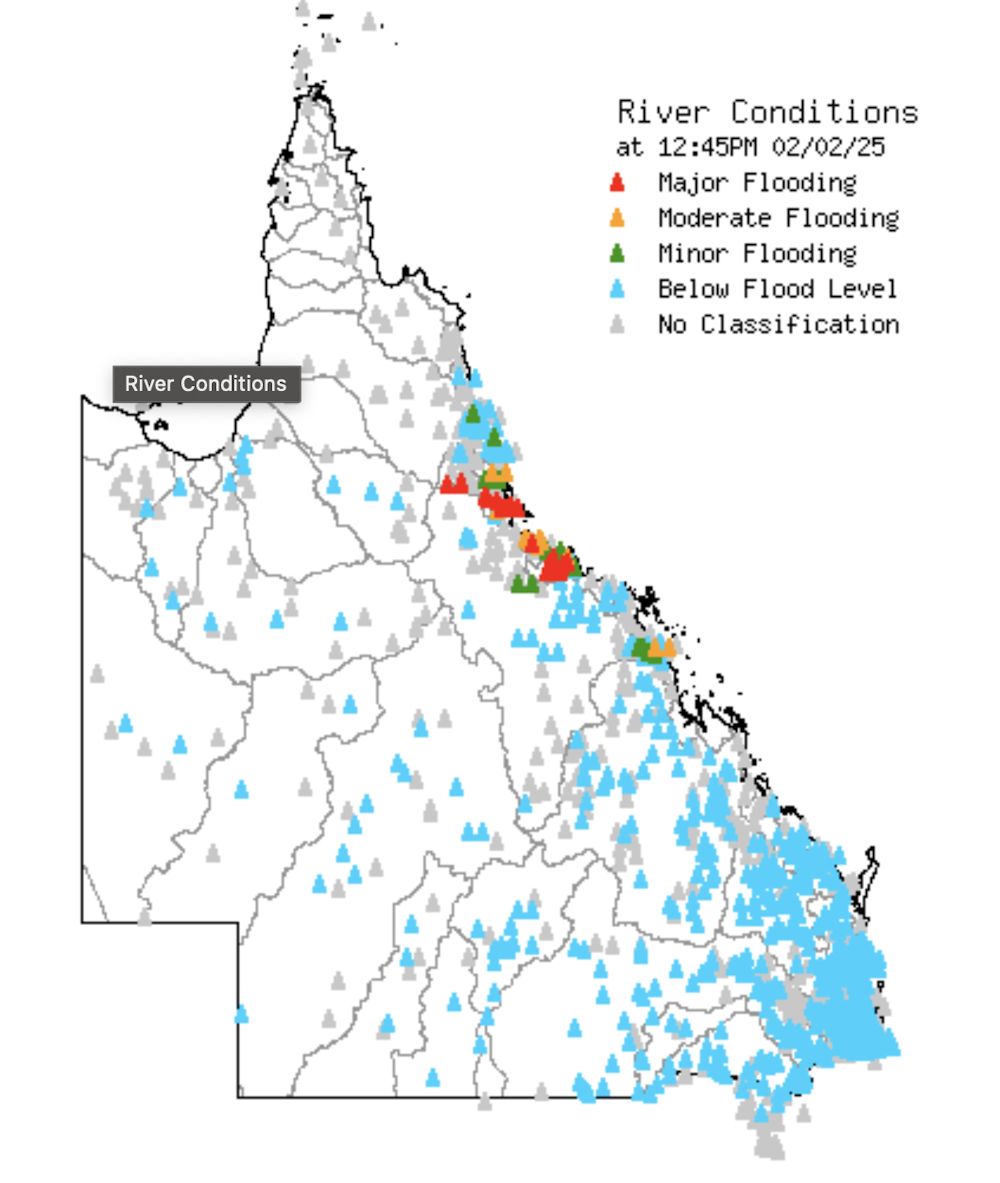
Record-breaking floods across north Queensland have now turned deadly, with one woman drowning while being rescued on Sunday morning. And the floodwaters are still rising, with rain set to continue.
Over the 48 hours to Sunday, there were reports of up to 1 metre of rainfall in parts of northeast Queensland. The torrential rain continues, particularly in the Herbert Coast region and north to around Tully.
Major flooding in northern Queensland rivers, as of 12.45pm February 2. Bureau of Meteorology
Residents of Ingham and nearby towns, about 100km from Townsville, are witnessing flooding from the nearby Herbert River. This morning, it was at 15 metres and rising. With more heavy rain forecast for the next 24 hours, the Herbert River is likely to break the 1967 record of 15.2 metres later today.
Queensland Premier David Crisafulli – who grew up on his family’s sugar cane farm in Ingham – has said the floods will be a “once in a century” event for the town. To make matters worse, authorities say the town has lost power and an extended outage is likely.
The atmospheric factors behind these floods are very similar to recent floods in the region – and climate change is no doubt playing a role.
The flood level for the Herbert River at Ingham set in 1967 was 15.2 metres. It’s likely to be breached this afternoon (Sunday February 2). Australian Bureau of Meteorology, CC BY
Where are the floods hitting?
For many people in Townsville – the largest city in Northern Australia – the unfolding emergency will bring back memories of the devastating February 2019 floods, which caused A$1.24 billion in damage. Residents have been asked to evacuate from several low-lying suburbs which were inundated in 2019.
Authorities in Townsville asked all residents in the low-lying black zone to evacuate by midday Sunday February 2. Floodwaters could reach second-storey heights in this zone. Residents in pink suburbs have been asked to be on standby. Townsville Council, CC BY
It is too early to say if this flood event will be worse. Fortunately, water levels in the city’s Ross River Dam are much lower than 2019. Townsville Airport has recorded 545mm of rain over the past 48 hours, with many northwest suburbs recording much higher levels. The township of Rollingstone – 60km northwest of Townsville – recorded a whopping 702mm over the 24 hours to 9am Sunday.
Further north in the Cairns to Daintree region, residents are watching with concern, with many still raw after the record-breaking floods of December 2023.
What triggered each of these floods was prolonged heavy rain falling on the southeast flank of a stationary tropical low weather system. Normally, tropical lows bring wind and rain, but move through quite quickly. But in recent years, we have seen a tendency for these systems to stall, sitting in place over or near land and dumping huge volumes of rain.
Last week, the Bureau of Meteorology warned that five tropical lows were forming around northern Australia. Most tropical cyclones form from tropical lows embedded in the region’s monsoon trough, a large low pressure band which forms over summer and draws in warm, moist air from the adjacent tropical seas.
But significant rain events like this one don’t necessarily require a tropical cyclone. Slow-moving deep monsoon lows over land can also deliver huge amounts of rain and widespread flooding.
These atmospheric conditions allow intense rain bands to form between converging winds: warm, moist winds from the northeast and southeast winds originating from the Coral Sea. As the winds collide, they push the moist air up into the cooler parts of the atmosphere where it condenses and falls as torrential rain.
More extreme rainfall and higher frequencies of flooded rivers and flash floods around the world have a clear link to climate change and ongoing global heating.
The main drivers behind these events include warming of the atmosphere. For every 1°C of warming, the atmosphere holds 7% more water vapour. Recent research suggests this figure could be even higher for short duration rainfall.
Hotter oceans hold more energy, meaning they can also amplify the global water cycle when atmospheric conditions are suitable.
This year’s latest ever monsoon
This year, sea surface temperatures in the northwest Coral Sea are 1-2°C above average. Ocean temperatures have risen because of a lack of cloud cover and rain last month. In northwestern Australia, this has given rise to an intensifying marine heatwave.
This ocean heat is likely to be driven by the Australian monsoon’s latest ever arrival. The monsoon brings heavy rains to northern Australia, triggering the wet season. When it arrives, sea surface temperatures generally drop due to a combination of high cloud cover and the cooling effect of rainwater.
After a slow start, the North Australian monsoon season is now in full swing.
The Bureau of Meteorology is monitoring an active monsoon trough for any low pressure systems, which may develop into tropical cyclones over the next week or so. If any cyclone does form, it will gain energy from warmer than usual sea surface temperatures.
What’s next for north Queensland?
The flood emergency in north Queensland is far from over. All global circulation models predict heavy rain to continue in the region, extending up towards Cape York and the Gulf Country as an active monsoon surge moves in from Indonesia.
As river catchments get saturated, more and more water will run off and engorge rivers. Forecasts are for rain to continue well into tonight and the next few days. We are likely to see more flooding in more places this week.
A flooded street in TownsvilleJohn Wilkinson/Facebook
Record-breaking floods across north Queensland have now turned deadly, with one woman drowning while being rescued on Sunday morning. And the floodwaters are still rising, with rain set to continue.
Over the 48 hours to Sunday, there were reports of up to 1 metre of rainfall in parts of northeast Queensland. The torrential rain continues, particularly in the Herbert Coast region and north to around Tully.
Major flooding in northern Queensland rivers, as of 12.45pm February 2. Bureau of Meteorology
Residents of Ingham and nearby towns, about 100km from Townsville, are witnessing flooding from the nearby Herbert River. This morning, it was at 15 metres and rising. With more heavy rain forecast for the next 24 hours, the Herbert River is likely to break the 1967 record of 15.2 metres later today.
Queensland Premier David Crisafulli – who grew up on his family’s sugar cane farm in Ingham – has said the floods will be a “once in a century” event for the town. To make matters worse, authorities say the town has lost power and an extended outage is likely.
The atmospheric factors behind these floods are very similar to recent floods in the region – and climate change is no doubt playing a role.
The flood level for the Herbert River at Ingham set in 1967 was 15.2 metres. It’s likely to be breached this afternoon (Sunday February 2). Australian Bureau of Meteorology, CC BY
Where are the floods hitting?
For many people in Townsville – the largest city in Northern Australia – the unfolding emergency will bring back memories of the devastating February 2019 floods, which caused A$1.24 billion in damage. Residents have been asked to evacuate from several low-lying suburbs which were inundated in 2019.
Authorities in Townsville asked all residents in the low-lying black zone to evacuate by midday Sunday February 2. Floodwaters could reach second-storey heights in this zone. Residents in pink suburbs have been asked to be on standby. Townsville Council, CC BY
It is too early to say if this flood event will be worse. Fortunately, water levels in the city’s Ross River Dam are much lower than 2019. Townsville Airport has recorded 545mm of rain over the past 48 hours, with many northwest suburbs recording much higher levels. The township of Rollingstone – 60km northwest of Townsville – recorded a whopping 702mm over the 24 hours to 9am Sunday.
Further north in the Cairns to Daintree region, residents are watching with concern, with many still raw after the record-breaking floods of December 2023.
What triggered each of these floods was prolonged heavy rain falling on the southeast flank of a stationary tropical low weather system. Normally, tropical lows bring wind and rain, but move through quite quickly. But in recent years, we have seen a tendency for these systems to stall, sitting in place over or near land and dumping huge volumes of rain.
Last week, the Bureau of Meteorology warned that five tropical lows were forming around northern Australia. Most tropical cyclones form from tropical lows embedded in the region’s monsoon trough, a large low pressure band which forms over summer and draws in warm, moist air from the adjacent tropical seas.
But significant rain events like this one don’t necessarily require a tropical cyclone. Slow-moving deep monsoon lows over land can also deliver huge amounts of rain and widespread flooding.
These atmospheric conditions allow intense rain bands to form between converging winds: warm, moist winds from the northeast and southeast winds originating from the Coral Sea. As the winds collide, they push the moist air up into the cooler parts of the atmosphere where it condenses and falls as torrential rain.
More extreme rainfall and higher frequencies of flooded rivers and flash floods around the world have a clear link to climate change and ongoing global heating.
The main drivers behind these events include warming of the atmosphere. For every 1°C of warming, the atmosphere holds 7% more water vapour. Recent research suggests this figure could be even higher for short duration rainfall.
Hotter oceans hold more energy, meaning they can also amplify the global water cycle when atmospheric conditions are suitable.
This year’s latest ever monsoon
This year, sea surface temperatures in the northwest Coral Sea are 1-2°C above average. Ocean temperatures have risen because of a lack of cloud cover and rain last month. In northwestern Australia, this has given rise to an intensifying marine heatwave.
This ocean heat is likely to be driven by the Australian monsoon’s latest ever arrival. The monsoon brings heavy rains to northern Australia, triggering the wet season. When it arrives, sea surface temperatures generally drop due to a combination of high cloud cover and the cooling effect of rainwater.
After a slow start, the North Australian monsoon season is now in full swing.
The Bureau of Meteorology is monitoring an active monsoon trough for any low pressure systems, which may develop into tropical cyclones over the next week or so. If any cyclone does form, it will gain energy from warmer than usual sea surface temperatures.
What’s next for north Queensland?
The flood emergency in north Queensland is far from over. All global circulation models predict heavy rain to continue in the region, extending up towards Cape York and the Gulf Country as an active monsoon surge moves in from Indonesia.
As river catchments get saturated, more and more water will run off and engorge rivers. Forecasts are for rain to continue well into tonight and the next few days. We are likely to see more flooding in more places this week.
Trucks transport railway containers at the Kunming cargo terminal of China United International Rail Containers Co., Ltd. (CRIntermodal) in Kunming, southwest China’s Yunnan Province, on Jan. 2, 2025. [Photo/Xinhua]
Having long been poring over China’s diversified culture, German vlogger Robert Adolf is particularly fascinated by Yunnan Province, home to over 20 ethnic groups.
This year’s Spring Festival is unique to Adolf and his mother, who traveled by train to Xishuangbanna, a tropical autonomous prefecture in Yunnan Province and one of the stations along the China-Laos Railway route.
Adolf has previously explored this 1,035 km-long route linking Kunming of Yunnan to the Laotian capital of Vientiane with eight stops in between, and felt a surge of excitement over how railroads have expanded to smaller cities and villages.
“It’s now much easier to visit rural areas,” he said.
Dressed in the traditional attire of the Shui ethnic group, Adolf told Xinhua that he felt “more real … and more to the hearts” in smaller towns. “There’s a family atmosphere.”
In Yunnan, Adolf has observed the Dai people’s Water-Splashing Festival and the Munao Zongge Festival (meaning “Dancing together”) of the Jingpo people. During the journey, Adolf posted videos on social platforms like Douyin and YouTube, with his bio describing him “on the quest to film all 56 Ethnic Groups in China.”
He said that people always find ways to keep traditions up to date, and the government helps preserve them by supporting cultural heritage, investing in museums and funding inheritors. “In China, they really keep the culture alive.”
His mother Anna Adolf referred to the journey in Yunnan as an adventure. “Everywhere I look, people are wearing beautiful clothes, singing and dancing.”
During the Spring Festival travel season, thousands of passengers travel home or explore new destinations via the China-Laos cross-border train.
At Kunming South Station, the starting point of the railway, waiting rooms were abuzz with travelers speaking Chinese, Lao, Thai and English, a testament to the cross-border railway’s growing international appeal.
“We’ve always had a good experience on trains in China. I’m sure this time it will be convenient and comfortable,” Susie, an American living in Beijing, told Xinhua, as she queued up for a train heading to Laos.
The railway also benefits Thai travelers, who said that it makes the homebound journey faster.
Since its launch in 2021, the China-Laos Railway, a flagship Belt and Road Initiative project, has handled over 43 million passenger trips and more than 48.3 million tonnes of cargo.
The Kunming-Vientiane D87 train is painted deep green. It might evoke memories of the old-style passenger trains in China, but its designed speed of 160 km/h integrates efficiency with the need to navigate complex terrain, transporting both passengers and freight.
Inside some of the train compartments during the Spring Festival holiday, red paper-cut decorations on the windows added a festive touch, marking the first Spring Festival since UNESCO listed the tradition as intangible cultural heritage.
For Southikiat Thavisouk, a Laotian TV host returning to Vientiane, the railway trip is more than transportation. “It’s a bridge between the Chinese and Laotian people,” he said.
Having studied at Huaqiao University in China’s Fujian Province, Thavisouk recalled the warm hospitality he received there. Now back in Laos, he sees the Chinese New Year celebrated as well.
Soulideth Lavanphone, a Laotian tour guide accompanying a group of Chinese travelers, shared a similar sentiment. “I studied in Sichuan, and China is my second home. I’ll do my best to make sure Chinese visitors have a great time in Laos,” he said.
“Many travelers from Western countries and ASEAN nations have all come to experience the Laos-China Railway firsthand,” said Laotian Consul General in Kunming Pongdong Paxaphacdy with much pride.
“Tickets are often sold out due to high demand, and we are working on solutions to improve capacity,” Paxaphacdy said.
“This railway has boosted investment, tourism and connectivity, bringing real benefits to the people. With strong support from both governments, this railway will only continue to grow,” he added.
The Ministry of Commerce said Japan’s plans for export controls on semiconductors will undermine the stability of the global industrial and supply chains as well as disrupt normal business operations.
“For some time, certain countries have been stretching the concept of national security and abusing export control measures to impose sanctions aimed at suppressing China’s semiconductor and other industries,” a spokesperson with the Ministry of Commerce said on Friday.
The spokesperson highlighted that Japan’s plans for export controls on chips will also harm the interests of both Chinese and Japanese companies.
According to the MOC spokesperson, China urges Japan to listen to the rational voices of industry stakeholders and reconsider its course of action. “We hope Japan will take into account the broader picture of international trade rules and China-Japan economic cooperation, and promptly correct these measures to avoid hindering the healthy development of bilateral economic relations.”
As Japan has announced tech and trade curbs including sanctions on some Chinese firms, China made it clear that it reserves the right to take countermeasures to safeguard its legitimate rights and interests, the spokesperson said. China also reaffirmed its stance on ensuring the smooth functioning of global industrial and supply chains.
Jin Xu, chairman of the China Association of International Trade, said some countries’ efforts to “decouple and sever industrial and supply chains” and build “small yards with high fences” will not benefit the local people and will ultimately harm local businesses.
China, with its robust technological capabilities, solid industrial foundation, and strong government support, is well-positioned to overcome any technological blockades, Jin said.
“I firmly believe China will make breakthroughs in the fields of chips. I am convinced that the suppression by some countries will not last,” he said.
A flooded street in TownsvilleJohn Wilkinson/Facebook
Record-breaking floods across north Queensland have now turned deadly, with one woman drowning while being rescued on Sunday morning. And the floodwaters are still rising, with rain set to continue.
Over the 48 hours to Sunday, there were reports of up to 1 metre of rainfall in parts of northeast Queensland. The torrential rain continues, particularly in the Herbert Coast region and north to around Tully.
Major flooding in northern Queensland rivers, as of 12.45pm February 2. Bureau of Meteorology
Residents of Ingham and nearby towns, about 100km from Townsville, are witnessing flooding from the nearby Herbert River. This morning, it was at 15 metres and rising. With more heavy rain forecast for the next 24 hours, the Herbert River is likely to break the 1967 record of 15.2 metres later today.
Queensland Premier David Crisafulli – who grew up on his family’s sugar cane farm in Ingham – has said the floods will be a “once in a century” event for the town. To make matters worse, authorities say the town has lost power and an extended outage is likely.
The atmospheric factors behind these floods are very similar to recent floods in the region – and climate change is no doubt playing a role.
The flood level for the Herbert River at Ingham set in 1967 was 15.2 metres. It’s likely to be breached this afternoon (Sunday February 2). Australian Bureau of Meteorology, CC BY
Where are the floods hitting?
For many people in Townsville – the largest city in Northern Australia – the unfolding emergency will bring back memories of the devastating February 2019 floods, which caused A$1.24 billion in damage. Residents have been asked to evacuate from several low-lying suburbs which were inundated in 2019.
Authorities in Townsville asked all residents in the low-lying black zone to evacuate by midday Sunday February 2. Floodwaters could reach second-storey heights in this zone. Residents in pink suburbs have been asked to be on standby. Townsville Council, CC BY
It is too early to say if this flood event will be worse. Fortunately, water levels in the city’s Ross River Dam are much lower than 2019. Townsville Airport has recorded 545mm of rain over the past 48 hours, with many northwest suburbs recording much higher levels. The township of Rollingstone – 60km northwest of Townsville – recorded a whopping 702mm over the 24 hours to 9am Sunday.
Further north in the Cairns to Daintree region, residents are watching with concern, with many still raw after the record-breaking floods of December 2023.
What triggered each of these floods was prolonged heavy rain falling on the southeast flank of a stationary tropical low weather system. Normally, tropical lows bring wind and rain, but move through quite quickly. But in recent years, we have seen a tendency for these systems to stall, sitting in place over or near land and dumping huge volumes of rain.
Last week, the Bureau of Meteorology warned that five tropical lows were forming around northern Australia. Most tropical cyclones form from tropical lows embedded in the region’s monsoon trough, a large low pressure band which forms over summer and draws in warm, moist air from the adjacent tropical seas.
But significant rain events like this one don’t necessarily require a tropical cyclone. Slow-moving deep monsoon lows over land can also deliver huge amounts of rain and widespread flooding.
These atmospheric conditions allow intense rain bands to form between converging winds: warm, moist winds from the northeast and southeast winds originating from the Coral Sea. As the winds collide, they push the moist air up into the cooler parts of the atmosphere where it condenses and falls as torrential rain.
More extreme rainfall and higher frequencies of flooded rivers and flash floods around the world have a clear link to climate change and ongoing global heating.
The main drivers behind these events include warming of the atmosphere. For every 1°C of warming, the atmosphere holds 7% more water vapour. Recent research suggests this figure could be even higher for short duration rainfall.
Hotter oceans hold more energy, meaning they can also amplify the global water cycle when atmospheric conditions are suitable.
This year’s latest ever monsoon
This year, sea surface temperatures in the northwest Coral Sea are 1-2°C above average. Ocean temperatures have risen because of a lack of cloud cover and rain last month. In northwestern Australia, this has given rise to an intensifying marine heatwave.
This ocean heat is likely to be driven by the Australian monsoon’s latest ever arrival. The monsoon brings heavy rains to northern Australia, triggering the wet season. When it arrives, sea surface temperatures generally drop due to a combination of high cloud cover and the cooling effect of rainwater.
After a slow start, the North Australian monsoon season is now in full swing.
The Bureau of Meteorology is monitoring an active monsoon trough for any low pressure systems, which may develop into tropical cyclones over the next week or so. If any cyclone does form, it will gain energy from warmer than usual sea surface temperatures.
What’s next for north Queensland?
The flood emergency in north Queensland is far from over. All global circulation models predict heavy rain to continue in the region, extending up towards Cape York and the Gulf Country as an active monsoon surge moves in from Indonesia.
As river catchments get saturated, more and more water will run off and engorge rivers. Forecasts are for rain to continue well into tonight and the next few days. We are likely to see more flooding in more places this week.
The Albanese Labor Government is extending the National Early Childhood Program (NECP) to support young children with disability or developmental concerns, their families and carers.
Autism Queensland and the Australian Catholic University (ACU) will each receive an additional $5 million from 2025-26 to 2026-27 to continue activities funded under the NECP.
Minister for Social Services Amanda Rishworth said the $10 million Federal investment for this extension will mean more children with disability or developmental concerns aged 0-8 years and their families are supported.
“We recognise the importance of a child’s early years and ensuring they and their families have what they need to ensure a bright future,” Minister Rishworth said.
“For children with developmental concerns or disability, it is crucial they and their families are given tailored support to ensure they can have their best start in life.
“The early childhood program activities under the NECP align withAustralia’s Disability Strategy 2021-2031and theEarly Years Strategy 2024-2034, helping children and building capacity in their families to support their development.
“The NECP was designed in consultation with parents, carers and peak bodies, and the Government is pleased to continue to fund these important activities.”
The NECP supports young children with newly identified disability or emerging developmental concerns and their parents and carers, increasing readiness for educational environments and providing opportunities to socialise with their peers and siblings in a supported and family-centred environment.
Initial funding of $13.8 million was awarded following two open grant rounds for 2022-23 to 2024-25. Under these grants:
Autism Queensland lead a consortium of organisations including playgroup and autism associations to provide regular, facilitated supports, including playgroups and music programs across the country.
ACU provides facilitated group workshops for parents and carers whose children have a newly identified disability or who have concerns regarding their child’s development.
Topics: NDIS; Foundational Supports; The Budget, Antisemitism; Nature Positive bill; Peter Dutton’s proposed investor visa.
ANDREW CLENNELL, HOST: Joining me live is the new NDIS Minister. She replaced Bill Shorten about a month ago, Amanda Rishworth, thanks for your time. Let me start with this news I’ve just revealed. Can you tell us what is the nature of the one-year deal being offered by the PM on Foundational Support money for the NDIS and why is it being tied to the hospital agreement?
AMANDA RISHWORTH, MINISTER FOR THE NATIONAL DISABILTY INSURANCE SCHEME: Firstly, I would say it’s not new that we are working with the states and territories to develop Foundational Supports. In fact, I have been working with my counterparts to work out the design of Foundational Supports, what they might look like and how we might go forward on that in terms of the agreements with states and territories. There are a lot of agreements with states and territories that our government is progressing. Certainly, the health reform is one of those. NDIS reform is another one. So, there is a lot of agreements to land with states and territories and what I’ve been doing is working very hard to put some meat on the bones about what we would be funding with Foundational Supports.
ANDREW CLENNELL: Well, you say it’s not new. The fact it’s a one-year deal is new, isn’t it, that you’re looking at?
AMANDA RISHWORTH: We’ve been working towards Foundational Supports for a long time. I’m not privy to the First Ministers negotiations, but I’ve been working very much with the idea of how we stand up supports outside the NDIS that are there to support people that may not need the intensity that the NDIS provides. So, the First Ministers will continue to have their discussions, but I’m certainly working on what Foundational Support looks like. How do we roll those out and how do we make a difference outside side of the scheme so that there are supports available.
ANDREW CLENNELL: Do you expect states to be providing these Foundational Supports by mid-year as envisioned? Are the states fair dinkum about this or could the deal just collapse?
AMANDA RISHWORTH: It’s never been expected that all the Foundational Supports would be stood up this year. Indeed, as the review outlined, they will have to be rolled out in a progressive way. But we’ve had good cooperation with states and territories. Just one example of a system change that we have with South Australia, for example, is what’s called the Inklings program. And the idea of that is to provide intervention before there is a diagnosis to ensure that children are put on a strong developmental pathway and don’t need the NDIS. There is already work being done around what these systems look like outside the NDIS. But we’ll keep working with the states and territories to start sending these supports up.
ANDREW CLENNELL: What money are you proposing to give the states to deliver these services which can act as a NDIS substitute? Is there a danger of just cost shifting from the NDIS or are there going to be real savings here?
AMANDA RISHWORTH: Let’s be clear. The NDIS is a joint endeavour by states and territories and the Commonwealth, and they co-govern. But what we’re talking about, and the review made it clear, is that for some people, for some children as well, that may have developmental delay, they might be served outside of the scheme with lower intensity supports. So, they don’t require the full individualised plan that is provided by the NDIS. And just in the nature of the way the supports will be delivered, they will be a lower cost. But I have to say, Andrew, when it comes to sustainability of the NDIS, Foundational Supports are not the only element that goes to sustainability. There is a lot of work we’ve been doing and will continue to do to improve the sustainability of the scheme and to hit that 8 per cent growth target which we are on track for.
ANDREW CLENNELL: I’m told, in terms of saving money through the Foundational Support one example is the Federal Government would want schools to have a staff speech pathologist, for example, rather than have say 10 private speech pathologists visit schools to see students one on one. Is that a good example of what you’re trying to achieve here?
AMANDA RISHWORTH: I don’t want to be so prescriptive because we’re still working through it, but a good example would be if a child might have some fine motor delay. Rather than an individualised plan that has a range of different supports they might be serviced with, for example, some adaptive technology like some specialised cutlery that helps them with their fine motor skills and perhaps some periodic OT input rather than a full individualised plan that gets reassessed and re put in place every single year. So, they are the types of things that we are looking at. How do you provide much more targeted, much more often episodic or periodic interventions that do not require this sort of individualised plan. I don’t think anyone accepted that for children with developmental delay that they would have an individualised plan for a lifetime. That certainly was not the vision for the scheme which is for significant and permanent impairment. So, we’ve got to work and identify these. Things look different in different states and that’s why systems are different in different states, and we will be working with each state and territory about what that looks like and how it might be delivered.
ANDREW CLENNELL: How did we get to the point where something like 35 per cent of people on this scheme have autism? Could there be closer scrutiny of who gets this support? When this scheme was set up, it was for people with significant and permanent disability. There was even an ANU study in 2023 which suggested there were more autism diagnoses in this country and that could be linked to accessing the NDIS.
AMANDA RISHWORTH: What the review said, Andrew, was that with the NDIS the only level of support, I think the review said is the only lifeboat in the ocean. Of course it has led to people gravitate to get support. That is partly what I said Foundational Supports are about. It’s also partly that there are two pathways in the NDIS. Firstly, the permanent and significant pathway and then there’s the early intervention pathway. And for me, I want to make sure that the early intervention pathway is making a difference, that it is evidence based and that we are seeing interventions that improve the developmental trajectory of a child, so that they don’t need to, on an ongoing basis, actually rely on the NDIS. The NDIS was never designed that it would be diagnosis driven. It was about functional capacity and what supports you need. We need to get back to having a focus on that and also make sure for those that may need a lower intensity of support, that it’s out there in the broader community through different service systems. And that’s what we’re working to. And quite frankly it’s been really left to drift under the previous government. There wasn’t the sustained focus. Now Former Minister Shorten had a sustained focus on this and I will continue that.
ANDREW CLENNELL: When Julia Gillard rose in the Parliament to announce this scheme, she said there were more than 400,000 people living with significant and permanent disabilities. And then 13 years later, we have 650,000 participants of the scheme. How many people do you envisage in say three to five years being on this scheme?
AMANDA RISHWORTH: I don’t have those projections, but I have to say what’s driving the scheme is or the costs in the scheme is not only the number of participants on the Scheme. It has been identified that intra-plan inflation also has an impact on the fiscal elements of the Scheme. So, while numbers are important, we’ve got to make sure that eligibility is correct and that it’s significant and permanent. And the supports put in place are about supporting people with supports that are reasonable and necessary. It is not just the numbers that are driving the cost. Here we had a situation where we’ve put some new rules in place to be clear about what’s funded and what’s not. There were grey areas about what is funded, what was not, and so we were seeing some confusion around that. We’ve put very clear guidelines now about what should be funded and what shouldn’t be funded. We’ve also put some clear guidelines about how people manage their budgets and their plans, and also make sure, for example, that there isn’t service providers gouging participants. It’s taken a lot of work to look at how we bring these costs down. Just to give you an example, 2021-22, when the previous government was in charge, there was a 23 per cent growth in the cost of the scheme. 2024-25 we have been able to bring that down to about 12 per cent.
ANDREW CLENNELL: It’s still 12 per cent. Your target’s eight per cent. Let me ask you this, I appreciate your point on the numbers, but Julia Gillard spoke about 400,000. We’ve now got 650,000. Could you envisage a million Australians being on the NDIS? Because it looks like we’re headed that way.
AMANDA RISHWORTH: I don’t think that’s right to characterise the trajectory. I’ll just give you an example. Recently, the numbers were revised of the number of Australians living with disability in this country, and it’s 5.5 million people. So, if we look at the numbers that are on the NDIS, it is certainly not all people living with disability in Australia. And of course, that 5.5 million had been revised, up from over 4.5 million. So, we are seeing the trajectory of people reporting disability increase in this country across the board. Not all of them are on the NDIS. In fact, only a small proportion of people are getting support from the NDIS. And that’s why we’ve got to be continuing to work hard to look at what other supports we can give people to make sure that they don’t need necessarily the NDIS but can get support elsewhere.
ANDREW CLENNELL: Peter Dutton’s spoken about cutting 36,000 public servants. Your predecessor, Bill Shorten, won the budget support to hire another 1,000 public servants in a bid to get the NDIS under control. In particular to look at eligibility for the scheme, what progress have they so far made and what sort of people are now being rejected from the scheme that were being accepted?
AMANDA RISHWORTH: I need to be clear in terms of the early intervention pathway, there has always been a reassessment at six years of age and nine years of age, because we’re hoping, of course, that the early interventions has made a difference and those children do not require the scheme anymore. Thee work that’s been undertaken is to make sure that those reassessments have happened. When Peter Dutton talks about cutting public servants, what he’s saying is he doesn’t want those reassessments to happen. He doesn’t want to make sure that plans are done efficiently, effectively and quickly. Is he planning to cut the Fraud Fusion Task Force? Because there was no focus on fraud in the NDIS previously. That requires people from across agencies to make sure that taxpayers money is spent correctly and is not gouged. When it comes to my other hat as Social Services Minister, is he talking about pensioners waiting on the phone for longer? These are frontline public servants that are making a difference. But importantly, when it comes to the NDIS, paying attention to all these elements that the previous government dropped, whether it’s fraud, whether it’s reassessment, whether it’s proper efficient planning, whether it’s responsiveness when people have a query, they are the public servants that Peter Dutton is talking about.
ANDREW CLENNELL: I just want to get through a couple more things. When it comes to a possible budget, we don’t know if it’s happening or during the election campaign the PM, Treasurer and Finance Minister have flagged more cost-of-living assistance. I ask you, in your social services portfolio, do you expect to be promising more in terms of rental assistance or in terms of welfare benefits or pension payments?
AMANDA RISHWORTH: We’ve been working through the budget process and Andrew; you’ll be not surprised. I won’t be announcing what will be in the budget here today, but when it comes to supporting people with cost of living, it’s clear. Two rent assistance increases that have led to the largest rent assistance in over 30 years. Of course we’ve increased other payments, we’ve improved arrangements for the pension, supporting pensioners with cost of living, we’ve supported more pensioners onto the concession card, helping them with cost doctors. Of course, there’s been medicines and a range of other cost of living measures. So, we’ve got a strong record when it comes to supporting people right across the board, including our tax cuts. Look, I’m going to say watch out on budget night. I know you’re an avid watcher of the budget and all will be revealed on budget night.
ANDREW CLENNELL: It sounds like you think there is a budget, Amanda Rishworth. I’m not so confident we’ll see in good time. I wanted to ask now about but this issue of the anti-Semitic attacks and the criticism of the Prime Minister in terms of either he didn’t get briefings, and he should investigate it. That’s what Peter Dutton and the opposition say. Or another version I’ve heard is he’s hearing things but not broadcasting them. There Is a fine balance here, isn’t there? Could it be politically detrimental for the Government if he doesn’t look on top of it? The Prime Minister?
AMANDA RISHWORTH: I think this is a ridiculous criticism from Peter Dutton and just shows that all he wants to do is play politics with what is a really serious issue. It is unacceptable that there are people of Jewish faith feeling unsafe in this country. But for the Government it is about being responsible in making sure people are actually safe, not playing politics. And I have to say, ensuring police and security agencies, can do their job and keep the community safe should be, in my view, the number one outcome we all want to see. So, if the leader of the Opposition just wants to play politics with this then he should be condemned, quite frankly, because it is about what leads to safety in our community. That should be a priority of every member of Parliament.
ANDREW CLENNELL: Health Minister Mark Butler made an announcement Friday concerning the establishment of an inquiry into the use of gender changing medicine. Is this a bid to head off Peter Dutton doing a Donald Trump on this issue this year?
AMANDA RISHWORTH: These guidelines have not been reviewed since 2018. It is timely that the guidelines be reviewed with the most up to date evidence, particularly when we’re talking about children. As a mum I would like to know that the guidelines are absolutely up to date, we’ve got proper medical evidence on the table and that young people in this country are getting the best possible medical care. So, it is timely that the evidence is looked at, that the input from research is added and that we have the most up to date medical guidelines in this country.
ANDREW CLENNELL: The Nature Positive bill, it looks dead in this term of Parliament. The Prime Minister is going to pull it. I understand?
AMANDA RISHWORTH: I think it’s clear that The Greens keep making more and more extreme demands. Peter Dutton has been incredibly oppositional to this will not even engage. This is despite the Samuel review identifying that both businesses wanted faster approvals, and we needed stronger protections for our environment. But with this type of opposition and people not willing to have discussions and make compromises, I think it’s clear that we won’t be able to pursue this piece of legislation in the Parliament.
ANDREW CLENNELL: What do you make of these comments by Peter Dutton at a fundraiser that he might reintroduce this significant investor visa and him trying to re-establish relations with the Chinese Australian community?
AMANDA RISHWORTH: I would say when it comes to migration, it just shows Peter Dutton likes to talk a lot of political game. But when it comes down to taking action, he failed to support our legislation to put a cap on international students. After being lobbied against that, he has now signalled that he will bring back a visa that we abolished. It really does show that he’s not serious when it comes to tackling our migration system. But we shouldn’t be surprised because he left it in a complete mess when he was in charge. And of course, you know, we’re getting down to the political season. You know, there’ll be a lot of political statements made clearly in the leader of the opposition’s case, it is contradictory from one day to the other, but that’s politics and that’s an election season.
ANDREW CLENNELL: We’ll have plenty more of it. Amanda Rishworth, thanks so much for your time.
An aerial drone photo taken on Dec. 15, 2023 shows a view of the Hong Kong-Zhuhai-Macao Bridge in south China. [Photo/Xinhua] The Zhuhai port of the Hong Kong-Zhuhai-Macao Bridge handled 156,000 inbound and outbound passenger trips on Friday, a daily record since the bridge’s opening in 2018. The 55-km bridge links China’s Hong Kong Special Administrative Region (SAR), Macao SAR, and the city of Zhuhai in Guangdong Province. It is the world’s longest bridge-and-tunnel sea crossing. According to the border inspection authorities in Zhuhai, more than 454,000 passenger trips and over 69,000 vehicle trips were recorded through the bridge’s Zhuhai port from Tuesday to Friday, the first four days of the Spring Festival holiday, up 22 percent and 32 percent respectively year on year. Daily passenger flows at the port exceeded 100,000 on 50 days in 2024, a 10-fold increase from 2023. More than 3 million trips by vehicles carrying number plates from Hong Kong or Macao were recorded at the port in 2024, accounting for 55 percent of its total traffic.
New traffic signals will be installed at the intersection of Brighton Road, Ocean Boulevard and Scholefield Road in South Australia to improve safety for road users, pedestrians and cyclists.
This work forms part of a $30 million upgrade to two intersections along Brighton Road with upgrades already delivered at the intersection of Brighton Road and Edwards Street.
As traffic demand has grown and with new development in the area, getting access to the arterial road network for communities in Seacliff, Kingston Park and Marino has become increasingly difficult and dangerous.
The Ocean Boulevard carries around 30 000 vehicles a day and Scholefield Road carries around 4,000 vehicles each day.
The new traffic signals will maintain a consistent and reliable level of service and access for these communities whilst improving pedestrian and cyclist access and safety through the creation of a new signalised crossing of Brighton Road / Ocean Boulevard.
Design development is planned throughout 2025, with a possible construction start date mid-2026 and completion late 2026 to early 2027.
The Australian and South Australian governments have each contributed $15 million to fund the $30 million Brighton Road Intersection Improvements project.
Quotes attributable to Federal Infrastructure, Transport, Regional Development and Local Government Minister Catherine King:
“Funding the intersection upgrade is an important investment in making sure people can get to where they want to go and home again safely.
“We have listened to the local community, particularly the messages from Louise Miller-Frost and Alex Dighton about the need for these traffic signals.
“South Australians deserve quality infrastructure, and the Albanese and Malinauskas Labor Governments are partnering to making that happen.”
Quotes attributable to South Australian Minister for Infrastructure and Transport Tom Koutsantonis:
“The intersection of Scholefield Road and Ocean Boulevard is the primary access point onto the arterial road network for the Kingston Park and Marino community.
“We know this intersection is already causing access issues due to traffic volumes and the Villawood and Seacliff developments currently underway will only add to that, particularly during peak hours.
“We committed to look into solutions and I’m delighted the Albanese Government has partnered with us to make this happen.”
Quotes attributable to the Federal Member for Boothby Louise Miller-Frost:
“Traffic lights and upgrades at the intersection of Brighton Road, Ocean Boulevard and Schofield Road at Seacliff will significantly reduce congestion and improve safety for vehicles, pedestrians and cyclists.
“I’ve heard what communities in Seacliff, Kingston Park and Marino have to say, and I am pleased that the Albanese Labor Government is delivering this in partnership with the Malinauskas Government.”
Quotes attributable to the South Australian Member for Black Alex Dighton:
“My community has consistently raised with me concerns over the difficulty of access at this intersection due to traffic volumes on Ocean Boulevard, which carries around 30,000 vehicles a day at this location.
“I’m delighted that the Albanese and Malinauskas Governments have followed through on this commitment to the community to properly consider solutions and ensure funding to make sure this gets done.”
ADDRESSING AN EMERGENCY SITUATION: The extraordinary threat posed by illegal aliens and drugs, including deadly fentanyl, constitutes a national emergency under the International Emergency Economic Powers Act (IEEPA).
Until the crisis is alleviated, President Donald J. Trump is implementing a 25% additional tariff on imports from Canada and Mexico and a 10% additional tariff on imports from China. Energy resources from Canada will have a lower 10% tariff.
President Trump is taking bold action to hold Mexico, Canada, and China accountable to their promises of halting illegal immigration and stopping poisonous fentanyl and other drugs from flowing into our country.
The orders make clear that the flow of contraband drugs like fentanyl to the United States, through illicit distribution networks, has created a national emergency, including a public health crisis. Chinese officials have failed to take the actions necessary to stem the flow of precursor chemicals to known criminal cartels and shut down money laundering by transnational criminal organizations.
In addition, the Mexican drug trafficking organizations have an intolerable alliance with the government of Mexico. The government of Mexico has afforded safe havens for the cartels to engage in the manufacturing and transportation of dangerous narcotics, which collectively have led to the overdose deaths of hundreds of thousands of American victims. This alliance endangers the national security of the United States, and we must eradicate the influence of these dangerous cartels.
There is also a growing presence of Mexican cartels operating fentanyl and nitazene synthesis labs in Canada. A recent study recognized Canada’s heightened domestic production of fentanyl, and its growing footprint within international narcotics distribution
USING OUR LEVERAGE TO ENSURE AMERICANS’ SAFETY: Previous Administrations failed to fully leverage America’s economic position as a tool to secure our borders against illegal migration and combat the scourge of fentanyl, preferring to let problems fester.
Access to the American market is a privilege. The United States has one of the most open economies in the world, and the lowest average tariff rates in the world.
While trade accounts for 67% of Canada’s GDP, 73% of Mexico’s GDP, and 37% of China’s GDP, it accounts for only 24% of U.S. GDP. However, in 2023 the U.S. trade deficit in goods was the world’s largest at over $1 trillion.
Tariffs are a powerful, proven source of leverage for protecting the national interest. President Trump is using the tools at hand and taking decisive action that puts Americans’ safety and our national security first.
Though previous Administrations have failed to leverage America’s combination of exceptional strength and its unique role in world trade to advance the security interests of the American people, President Trump has not.
PRESIDENT TRUMP IS KEEPING HIS PROMISE TO STOP THE FLOOD OF ILLEGAL ALIENS AND DRUGS: When voters overwhelmingly elected Donald J. Trump as President, they gave him a mandate to seal the border. That is exactly what he is doing.
The Biden Administration’s policies have fueled the worst border crisis in U.S. history.
More than 10 million illegal aliens attempted to enter the United States under Biden’s leadership, including a rising number of Chinese nationals and people on the terror watchlist.
This problem is not confined to the southern border – encounters at the northern border with Canada are rising as well.
The sustained influx of illegal aliens has profound consequences on every aspect of our national life – overwhelming our schools, lowering our wages, reducing our housing supply and raising rents, overcrowding our hospitals, draining our welfare system, and causing crime.
Gang members, smugglers, human traffickers, and illegal drugs and narcotics of all kinds are pouring across our borders and into our communities.
Last fiscal year, Customs and Border Protection (CBP) apprehended more than 21,000 pounds of fentanyl at our borders, enough fentanyl to kill more than 4 billion people.
It is estimated that federal officials are only able to seize a fraction of the fentanyl smuggled across the southern border.
These drugs kill tens of thousands of Americans each year, including 75,000 deaths per year attributed to fentanyl alone.
More Americans are dying from fentanyl overdoses each year than the number of American lives lost in the entirety of the Vietnam War.
BUILDING ON PAST SUCCESS: President Trump continues to demonstrate his commitment to ensuring U.S. trade policy serves the national interest.
As President Trump said in the Presidential Memorandum on American First Trade Policy, trade policy is a critical component in national security.
President Trump promised in November to “sign all necessary documents to charge Mexico and Canada a 25% Tariff on ALL products coming into the United States, and its ridiculous Open Borders. This Tariff will remain in effect until such time as Drugs, in particular Fentanyl, and all Illegal Aliens stop this Invasion of our Country!”
During his first term as President of the United States, President Trump established the President’s Commission on Combating Drug Addiction and the Opioid Crisis and declared the Opioid Crisis a public health emergency.
President Trump also has a long record of putting America first on trade. In his first term, President Trump successfully used threats of tariffs on Mexico to help secure our border.
When our national security was threatened by a global oversupply of steel and aluminum, President Trump took swift action to protect America’s national security by implementing tariffs on imports of these goods.
In response to China’s intellectual property theft, forced technology transfer, and other unreasonable behavior, President Trump acted with conviction to impose tariffs on imports from China, using that leverage to reach a historic bilateral economic agreement.
Just last week, President Trump leveraged tariffs to successfully resolve national security concerns with Colombia, swiftly reaching an outcome that prioritizes the safety and security of the American people and the sanctity of our national borders.
The Indonesian government’s proposal to grant amnesty to pro-independence rebels in West Papua has stirred scepticism as the administration of new President Prabowo Subianto seeks to deal with the country’s most protracted armed conflict.
Without broader dialogue and accountability, critics argue, the initiative could fail to resolve the decades-long unrest in the resource-rich region.
Yusril Ihza Mahendra, coordinating Minister for Law, Human Rights, Immigration and Corrections, announced the amnesty proposal last week.
On January 21, he met with a British government delegation and discussed human rights issues and the West Papua conflict.
“Essentially, President Prabowo has agreed to grant amnesty . . . to those involved in the Papua conflict,” Yusril told reporters last week.
On Thursday, he told BenarNews that the proposal was being studied and reviewed.
“It should be viewed within a broader perspective as part of efforts to resolve the conflict in Papua by prioritising law and human rights,” Yusril said.
‘Willing to die for this cause’ Sebby Sambom, a spokesman for the West Papua National Liberation Army (TPNPB) rebels, dismissed the proposal as insufficient.
“The issue isn’t about granting amnesty and expecting the conflict to end,” Sambom told BenarNews. “Those fighting in the forests have chosen to abandon normal lives to fight for Papua’s independence.
“They are willing to die for this cause.”
Despite the government offer, those still engaged in guerrilla warfare would not stop, Sambon said.
Papua, Indonesia’s easternmost region that makes up the western half of New Guinea island, has been a flashpoint of tension since its controversial incorporation into the archipelago nation in 1969.
Papua, referred to as “West Papua” by Pacific academics and advocates, is home to a distinct Melanesian culture and vast natural resources and has seen a low-level indpendence insurgency in the years since.
The Indonesian government has consistently rejected calls for Papua’s independence. The region is home to the Grasberg mine, one of the world’s largest gold and copper reserves, and its forests are a critical part of Indonesia’s climate commitments.
Papua among poorest regions Even with its abundant resources, Papua remains one of Indonesia’s poorest regions with high rates of poverty, illiteracy and infant mortality.
Critics argue that Jakarta’s heavy-handed approach, including the deployment of thousands of troops, has only deepened resentment.
President Prabowo Subianto . . . “agreed to grant amnesty . . . to those involved in the Papua conflict.” Image: Kompas
Yusril, the minister, said the new proposal was separate from a plan announced in November 2024 to grant amnesty to 44,000 convicts, and noted that the amnesty would be granted only to those who pledged loyalty to the Indonesian state.
He added that the government was finalising the details of the amnesty scheme, which would require approval from the House of Representatives (DPR).
Prabowo’s amnesty proposal follows a similar, albeit smaller, move by his predecessor, Joko “Jokowi” Widodo, who granted clemency to several Papuan political prisoners in 2015.
While Jokowi’s gesture was initially seen as a step toward reconciliation, it did little to quell violence. Armed clashes between Indonesian security forces and pro-independence fighters have intensified in recent years, with civilians often caught in the crossfire.
Cahyo Pamungkas, a Papua researcher at the National Research and Innovation Agency (BRIN), argued that amnesty, without prior dialogue and mutual agreements, would be ineffective.
“In almost every country, amnesty is given to resistance groups or government opposition groups only after a peace agreement is reached to end armed conflict,” he told BenarNews.
No unilateral declaration Yan Warinussy, a human rights lawyer in Papua, agreed.
“Amnesty, abolition or clemency should not be declared unilaterally by one side without a multi-party understanding from the start,” he told BenarNews.
Warinussy warned that without such an approach, the prospect of a Papua peace dialogue could remain an unfulfilled promise and the conflict could escalate.
Usman Hamid, director of Amnesty International Indonesia, said that while amnesty was a constitutional legal instrument, it should not apply to those who have committed serious human rights violations.
“The government must ensure that perpetrators of gross human rights violations in Papua and elsewhere are prosecuted through fair and transparent legal mechanisms,” he said.
Papuans Behind Bars, a website tracking political prisoners in Papua, reported 531 political arrests in 2023, with 96 political prisoners still detained by the end of the year.
Only 11 linked to armed struggle Most were affiliated with non-armed groups such as the West Papua National Committee (KNPB) and the Papua People’s Petition (PRP), while only 11 were linked to the armed West Papua National Liberation Army (TPNPB).
The website did not list 2024 figures.
Anum Siregar, a lawyer who has represented Papuan political prisoners, said that the amnesty proposal has sparked interest.
“Some of those detained outside Papua are requesting to be transferred to prisons in Papua,” she said.
Meanwhile, Agus Kossay, leader of the National Committee for West Papua, which campaigns for a referendum on self-determination, said Papuans would not compromise on “their God-given right to determine their own destiny”.
In September 2019, Kossay was arrested for orchestrating a riot and was sentenced to 11 months in jail. More recently, in 2023, he was arrested in connection with an internal dispute within the KNPB and was released in September 2024 after serving a sentence for incitement.
“The right to self-determination is non-negotiable and cannot be challenged by anyone. As long as it remains unfulfilled, we will continue to speak out,” Kossay told BenarNews.
Victor Mambor and Tria Dianti are BenarNews correspondents. Republished with permission.