Gaming is no longer a niche activity reserved for a select few – it’s a global pastime enjoyed by people of all ages, backgrounds and interests. In fact, studies show 81% of Australians engage in some form of gaming.
But for those who don’t consider themselves “gamers”, it can be hard to know where to start. The idea of picking up a complex, console-focused title might feel intimidating.
But fear not. Whether you’re looking for a game that’s mentally stimulating, addictive enough to help kill time, or simply something everyone can enjoy, there are plenty of options. Here are our top picks for beginners.
1. Real Bird Fake Bird
Since Wordle’s meteoric rise in 2022, we’ve seen a wave of daily browser games, including Tradle, Vulture’s Cinematrix and the New York Times’ Connections.
The Melbourne-based developers behind the critically acclaimed Scrabble-esque Gubbins have created the newest addition to this list: Real Bird Fake Bird.
The premise is simple. Each day you’re given a topic, and are supposed to guess whether seven different things are “real” or “fake” examples of that topic. For instance, Adele is a real example of a Grammy winner, but “sun condemnation” is a fake example of a yoga pose.
Sounds simple, right? It’s harder than it seems. The lists often have devilish examples of fakes that seem real, and real things that seem fake, leaving you second-guessing.
And just like with Wordle, you can share your score with friends once you’ve made all seven guesses. It’s a great way to spend a minute of your day.
You can share your Real Bird Fake Bird score with your friends. Studio Folly
Then there’s a hypnotic re-imagining of the card game poker, Balatro, (playable everywhere).
Each round involves playing poker hands to hit a points target, but these hands can be upgraded and augmented by a deck of “jokers” that favour particular poker hands or combinations of cards. Hands swiftly ascend to scoring tens of thousands (if not millions) of points per hand, in a near-perfect gameplay loop that combines card-game logic with the immersive flow of games like Tetris.
Balatro, largely developed by a single, anonymous developer, was one of 2024’s biggest hits. It sold more than 3,500,000 copies, won best indie game and best mobile game at the Game Awards 2024, and even secured a surprise nomination for game of the year.
This is the gaming equivalent of an anonymous independent filmmaker getting a nod for Best Picture at the Oscars.
3. The Case/Rise of the Golden Idol
This recommendation is targeted at mystery lovers. If you, or someone you know, can’t get enough of films like Knives Out (2019) or mystery books like The Thursday Murder Club, then the Golden Idol series (2022 and 2024) may be the perfect fit.
Each level shows the moment of a crime and it’s up to the player to interact with the characters and environment to fill in the blanks on a file explaining what happened.
With simple controls and a retro art style recalling the classic LucasArts adventure games, much of the joy in the Golden Idol games comes from the devious logic puzzles the cases provide.
One case revolves around placing the locations of all the house guests at an estate party, while another involves interpreting an entire language made out of dance moves. Combine these puzzles with a delightful sense of humour and a slightly mystical meta-narrative and these games will keep your inner detective occupied for hours.
The original and sequel are both Netflix games, and are available through Netflix on mobile and tablet.
4. Mouthwashing
Heavily inspired by the films Alien (1979) and The Shining (1980) – and not for the faint-of-heart – Mouthwashing (2024) is perfect for horror fans who want to dip their toes into the gaming world.
The cargo spaceship Tulpar is deliberately crashed by its captain mid-voyage. Unable to call for help, its five crew members can do nothing but wait for rescue. They open the hold in search of food or medicine, but instead find millions of bottles of mouthwash. Lost in space with minimal supplies, the crew begin to turn on each other – and wonder why their beloved captain crashed the ship in the first place.
A haunting story of human fallibility, Mouthwashing tells its tale through “walking sim” gameplay: the player simply wanders around the wreck of the Tulpar, interacting with objects and characters, without any complicated controls.
With a compelling cast, gorgeously surreal art direction and a focus on dread and despair (rather than jump scares), Mouthwashing is a wonderful introduction to the renaissance happening in horror games right now.
For those who have endless bird facts on hand, can identify a bird at a glance and look forward to the Aussie Bird Count each year, Wingspan is the perfect game.
The goal of this competitive, card-driven board game (which also has a videogame version) is to attract the best birds to various habitats by gathering food and laying eggs. Each player also has a randomly determined individual goal, which they can use to score extra points, making Wingspan very re-playable.
The best aspects of the game include the beautiful art and the delightful facts on each bird card. There is even an Oceania expansion, so you can gather and admire Australian birds, too!
Wingspan is a relaxing and captivating strategy card game about birds. Steam
Although Wingspan was released in 2018, last year its publisher, Stonemaier Games, also released Wyrmspan – a spiritual successor which focuses on hatching dragons instead of birds. Wyrmspan is more complex than Wingspan, though, and offers a steeper learning curve for less-experienced board game players.
Acknowledgement: we would like to acknowledge the contributions of Mads Mackenzie to this article, director of the upcoming game Drăculești and co-director of the Freeplay Independent Games Festival.
Marcus Carter is a recipient of an Australian Research Council Future Fellowship (#220100076) on ‘The Monetisation of Children in the Digital Games Industry’. He has previously received funding from Meta, TikTok and Snapchat, and has consulted for Telstra. He is a current board member, and former president, of the Digital Games Research Association of Australia.
Taylor Hardwick is employed under funding by the Australian Research Council (Future Fellowship #220100076; DECRA #240101275). She is a board member of Freeplay, a Melbourne-based independent games festival.
Finn Dawson and Ryan Stanton do not work for, consult, own shares in or receive funding from any company or organisation that would benefit from this article, and have disclosed no relevant affiliations beyond their academic appointment.
As January lingers on, families may find themselves struggling with what a friend of mine has labelled the “electronic nanny”.
Children have been out of their normal routines for weeks during the holidays. Some are still yet to go back to school. Meanwhile, parents are back at work and needing to juggle those commitments with bored kids.
How can families encourage healthy screen use as we ease back into the routine of a new school year?
Parental monitoring recommended
While screen use guidelines provide time limits, there is now a broader move among experts towards “curation over duration”.
This means it matters what children are watching – not simply how long they are watching it for.
Is the content age-appropriate? Is it educational or inspiring? Has it been well-reviewed)?
This means parents should play an active role in what content kids are viewing or engaging with. An easy way to do so is to view with children, or at a minimum be present in the same room and alert to what they are watching.
When you are “interactive co-viewing”, you not only watch together, you also discuss the content. This helps children engage with what they are watching and then make connections off-screen.
For example, if you are interested in a sea creature you see on Octonauts, you could go and find a book about it in the local library. Or you could discuss a moral dilemma you see on SpongeBob SquarePants: should SpongeBob have quit his job after another chef was mean about his cooking?
For older children, you could discuss plot points in films or strategies in games.
If possible, try to watch programs with your child and talk about what you are watching. Kevin Woblick/ Unsplash, CC BY
There are also lots of ways to use screens that can build skills and encourage critical thinking and creativity. Some things to try include:
producing a short film, or stop-motion animation, all the way from idea, to script, shooting and editing
taking and editing photos to make a calendar
exploring an area of interest, such as dinosaurs, the Titanic or ballet dancing, using sites such as ABC Education or PBS LearningMedia.
investigating generative artificial intelligence (AI). For example, test the capabilities of ChatGPT by asking it a question your child knows the answer to, and evaluating the response together. Does it contain all the relevant information? Is it fair and balanced?
exploring how easy it is to edit an image, and consider what this tells us about the potential for online misinformation.
Research shows interactive screen use – such as playing games or using educational apps – is more beneficial for kids than just passively viewing content. It can can even support literacy, numeracy and academic persistence.
You can also use screens to encourage physical activity. For example, these holidays, my little ones have enjoyed “shaking their sillies out” with dance-along videos by Danny Go!. They have also done “yoga in space” with Cosmic Kids.
Older kids may enjoy the dance fitness program Zumba, boxing or sports competitions on the Nintendo Switch.
It’s also important for kids to see parents doing things other than using phones and other screens when they have downtime. Parents play a powerful role modelling time away from screens.
Make sure your kids see you enjoy offline activities too, such as reading, playing sport and socialising. If you are struggling to do this as a family – and we all know it is is hard – think about revisiting some of the old standards. You could:
And remember, you are certainly not the only family telling your kids “this is the very last episode”. If today has been a struggle, take tomorrow to recharge and reconnect as a family. Screens are part of our lives today, and we are all striving to find balance.
Jennifer Stokes does not work for, consult, own shares in or receive funding from any company or organisation that would benefit from this article, and has disclosed no relevant affiliations beyond their academic appointment.
Source: The Conversation (Au and NZ) – By Natasa Gisev, Clinical pharmacist and Scientia Associate Professor at the National Drug and Alcohol Research Centre, UNSW Sydney
However, there are no new safety concerns when paracetamol is used as directed. And children’s products are not affected.
What is paracetamol?
Paracetamol is commonly sold under brand names such as Panadol, Dymadon and Panamax. It’s used to treat mild pain and fever for short periods or can be prescribed for chronic (long-term) pain.
Millions of packs of this cheap and accessible medicine are sold in Australia every year.
Small packs (up to 20 tablets) have been available from supermarkets and other retailers such as petrol stations. Larger packs (up to 100 tablets) are only available from pharmacies.
Paracetamol is relatively safe when used as directed. However, at higher-than-recommended doses, it can cause liver toxicity. In severe cases and when left untreated, this can be lethal.
Why are the rules changing?
In 2022, we wrote about how the Therapeutic Goods Administration (TGA) was considering changes to paracetamol access because of an increase in people going to hospital with paracetamol poisoning.
An expert review it commissioned found there were about 40-50 deaths every year from paracetamol poisoning between 2007 and 2020. Between 2009-10 and 2016-17, hospital admissions for this increased (from 8,617 to 11,697), before reducing in 2019-20 (8,723). Most admissions were due to intentional self-poisonings, and about half of these were among people aged ten to 24.
After the report, the TGA consulted with the public to work out how to prevent paracetamol poisonings.
Options included reducing pack sizes, limiting how many packs could be bought at once, moving larger packs behind the pharmacy counter and restricting access by age.
Responses were mixed. Although responses supported the need to prevent poisonings, there were concerns about how changes might affect:
people with chronic pain, especially those in regional areas, where it may be harder to access pharmacies and, therefore, larger packs
people on limited incomes, if certain products were made prescription-only.
Although deaths from paracetamol poisoning are tragic and preventable, they are rare considering how much paracetamol Australians use. There is less than one death due to poisoning for every million packs sold.
Because of this, it was important the TGA addressed concerns about poisonings while making sure Australians still had easy access to this essential medicine.
If you buy large packs of paracetamol for chronic pain, you’ll need to go to the pharmacy counter. StratfordProductions/Shutterstock
So what’s changing?
The key changesbeing introduced relate to new rules about the pack sizes that can be sold outside pharmacies, and the location of products sold in pharmacies.
From February 1, packs sold in supermarkets and places other than pharmacies will reduce from a maximum 20 tablets to 16 tablets per pack. These changes bring Australia in line with other countries. These include the United Kingdom, which restricted supermarket packs to 16 tablets in 1998, and saw reductions in poisonings.
In all jurisdictions except Queensland and Western Australia, packs sold in pharmacies larger than 50 tablets will move behind the pharmacy counter and can only be sold under pharmacist supervision. In Queensland and WA, products containing more than 16 tablets will only be available from behind the pharmacy counter and sold under pharmacist supervision.
In all jurisdictions, any packs containing more than 50 tablets will need to be sold in blister packs, rather than bottles.
Several paracetamol products are not affected by these changes. These include children’s products, slow-release formulations (for example, “osteo” products), and products already behind the pharmacy counter or only available via prescription.
What else do I need to know?
These changes have been introduced to reduce the risk of poisonings from people exceeding recommended doses. The overall safety profile of paracetamol has not changed.
Paracetamol is still available from all current locations and there are no plans to make it prescription-only or remove it from supermarkets altogether. Many companies have already been updating their packaging to ensure there are no gaps in supply.
The reduction in pack sizes of paracetamol available in supermarkets means
a pack of 16 tablets will now last two days instead of two-and-a-half days if taken at the maximum dose (two tablets, four times a day). Anyone in pain that does not improve after short-term use should speak to their pharmacist or GP.
For people who use paracetamol regularly for chronic pain, it is more cost-effective to continue buying larger packs from pharmacies. As larger packs (50+ tablets) need to be kept out of sight, you will need to ask at the pharmacy counter. Pharmacists know that for many people it’s appropriate to use paracetamol daily for chronic pain.
Natasa Gisev receives funding from the National Health and Medical Research Council.
Ria Hopkins receives funding from the National Health and Medical Research Council.
This rhetorical and ideological vagueness obscures a pivotal point: there is no such thing as a singular form of democracy.
The ACT Party is behind both bills, and its leader David Seymour has also justified the Treaty Principles Bill – now before select committee – as upholding and protecting democracy. He asks, “are we a modern democracy where all citizens have equal rights?”.
But democracy takes various forms, and has done for millennia. Derived from the Ancient Greek “demos” (people) and “kratos” (power or rule), the word broadly means “rule by, or power of, the people”. And this can be realised in a number of ways.
The classical Greek form was direct democracy, also known as deliberative or participatory democracy. This involved male citizens participating equally and directly in political decisions.
In contrast, the ancient Roman form was indirect, representative democracy. Representatives elected by eligible citizens made decisions on their behalf. This was the basic model enacted in the 1852 New Zealand Constitution Act, as in most modern democracies.
Other models exist, too. But the point is that democracy is an evolving concept. It’s wrong to assert that any type of governance or decision-making other than our existing system of representative democracy (one person, one vote, underpinned by the rule of law) is undemocratic or anti-democratic.
Tyranny of the majority
Many of the political mechanisms the current government wishes to dismantle – such as Māori wards and consultation processes – were established because of the problems associated with representative democracy.
It is widely accepted that political representation should reflect the different characteristics of a community. But what has been called the “tyranny of the majority” can lead to minorities being constantly outvoted.
Unable to gain representation in proportion to their population, their interests are excluded. In short, it is entirely possible for democracy to be applied in ways that promote inequality rather than equality.
The common interpretation of equality as meaning “sameness” – everybody receiving the same resources and opportunities – underlies the insistence that laws and policies must be applied regardless of individual and group difference. Anything else is unfair or “special” treatment.
However, these assertions overlook the bias of our institutions towards members of the dominant or majority culture, and the unequal outcomes (in health and elsewhere) for Māori people that have resulted in marginalisation and disadvantage.
Correcting that imbalance is a political challenge. As others have argued, “protecting minority rights is an equal characteristic of genuine democracy”.
Contentious legislation: the hīkoi (protest march) against the Treaty Principles Bill arrives at parliament, November 2024. Getty Images
Tino rangatiratanga and democracy
The term “equity” refers to this recognition of the inequalities that exist between people. Where these inequalities are avoidable and unfair, resources and opportunities need to be allocated to reach an equal outcome.
For Māori, the unfairness extends beyond unequal health and other socioeconomic outcomes. It involves the disregarded guarantees pledged by the Crown in te Tiriti o Waitangi/Treaty of Waitangi in 1840.
These included Māori rights of self-determination, or tino rangatiratanga, which is the source of so much contemporary debate.
Tino rangatiratanga challenges the singular base of power assumed by the Crown, and a “one size fits all” system of representation. But despite claims to the contrary, others argue upholding tino rangatiratanga is entirely possible within the realms of democracy.
The idea of “rule of and by the people” may take many forms, as the work of Matike Mai, the Independent Working Group on Constitutional Transformation, tries to demonstrate.
In proposing constitutional change, Matike Mai describes a sphere of influence based on the Māori-Crown relationship where “conciliatory and consensual democracy” operates.
Difference and equity
It has been argued that te Tiriti is “of its time” and should therefore be subject to reinterpretation. And yet the same argument is rarely made about notions of democracy and equality that have been with us since 1852.
This is relevant to many communities which experience avoidable and unfair health and social inequalities, not only Māori.
In September last year, a Cabinet Office circular required public sector agencies to ensure “services are not arbitrarily allocated on the basis of ethnicity or any other aspect of identity”.
On the face of it, this is a call for fair and equal treatment based on need. But the language suggests difference is about how an individual chooses to identify, rather than how their identity and circumstances cause them to be treated differently in the first place.
As long as this is the case, those differences and their associated needs will always be underserved.
Annabel Ahuriri-Driscoll does not work for, consult, own shares in or receive funding from any company or organisation that would benefit from this article, and has disclosed no relevant affiliations beyond their academic appointment.
The following text contains opinion that is not, or not necessarily, that of MIL-OSI –
Chairwoman McClain’s Statement on the U.S. House Passing the Born-Alive Abortion Survivors Protection Act
Washington, January 23, 2025
WASHINGTON – House Republican Conference Chair Lisa McClain (R-Mich.) released the following statement on the U.S. House of Representatives passing the Born-Alive Abortion Survivors Protection Act:
“Democrats don’t want born-alive babies to get life-saving medical care. This is insane. They prefer to do nothing—letting born-alive babies die in the delivery room. Their position is more extreme than communist countries like North Korea and China,” McClain said. “Fortunately, House Republicans just stepped up and passed a law to save babies’ lives. I am proud of Congresswoman Ann Wagner for her tireless effort on this legislation.”
Source: United States Senator for Illinois Tammy Duckworth
January 29, 2025
[WASHINGTON, D.C.] – Today, U.S. Senator Tammy Duckworth (D-IL)—a member of the Senate Committee on Commerce, Science and Transportation (CST)—pressed Howard Lutnick, President Trump’s nominee for Secretary of Commerce, on whether he would obey an illegal order from President Trump, such as following through on the President’s dangerous freeze of billions in federal grant funding. In her remarks, Duckworth underscored that the chaos and confusion caused by pausing these legally obligated funds to grant recipients would ultimately make America less globally competitive, stifle innovation and hurt businesses and jobs. Duckworth’s full remarks can be found on the Senator’s YouTube.
“Businesses, tech hubs and other grant recipients should not have to tune in each week to learn whether the funding Congress appropriated for them will actually come through,” said Duckworth. “I made it clear to Mr. Lutnick that this kind of chaos that President Trump unleashed will make America less globally competitive, not more. Any Secretary of Commerce must understand how critical it is that grant funding is disbursed on time, without delay, to support our farmers, boost manufacturing and keep our economy strong.”
Duckworth highlighted that the Economic Development Administration recently awarded $51 million to the Illinois Fermentation and Agriculture Biomanufacturing (iFAB) Tech Hub, which would support its work to strengthen American innovation and ensure our country remains a global leader in the agricultural sector while growing good-paying jobs across the Midwest. This is just one example of the many kinds of critical grants the Department of Commerce is in charge of distributing.
Duckworth is a proven leader in securing international investments that drive commerce and job growth in Illinois—all while strengthening economic ties with Indo-Pacific nations and improving security in the region. As a member of the U.S. Senate Foreign Relations Committee, Duckworth led a bipartisan delegation of her Senate colleagues to Taiwan last year to further enhance our bilateral economic ties, including deepening our trade ties on chip manufacturing and agricultural investments.
In 2023, Duckworth traveled to Japan where she met with government, trade and economic leaders as well as corporate and business officials to highlight how Illinois is uniquely positioned for greater investment and increased exports with international partners as a hub of agriculture manufacturing and technology. Specifically, Duckworth advocated on behalf of Illinois farmers to increase Japan’s importation of ethanol, corn, soybean, pork and other goods. As a result of her advocacy, Duckworth also helped secure Japan’s open market to all U.S. biofuels as well as Japan’s commitment to double Japan’s ethanol imports from the U.S. by 2030.
Duckworth also led an official visit to Thailand, Indonesia and the Philippines to meet with government and business leaders and discuss opportunities that would increase cooperation in areas of mutual interest, such as economic investments, regional stability and national security. In 2022, Duckworth led a Congressional delegation to Taiwan and South Korea to help strengthen economic ties between our people, specifically highlighting how Illinois is uniquely positioned for greater investment and increased exports with international partners as a hub of agriculture, manufacturing and technology.
Duckworth championed the Inflation Reduction Act, which was signed into law in 2022, providing $500 million to expand the number of service stations that offer low-carbon ethanol and biodiesel, made from Illinois corn and soybeans and also has incentives to make these low-carbon biofuels even lower-carbon than today. These climate-smart investments in Midwestern-grown fuels will also reduce our reliance on foreign oil.
-30-
Business confidence remains very high and shows the economy is on track to improve, Economic Growth Minister Nicola Willis says.
“The latest ANZ Business Outlook survey, released yesterday, shows business confidence and expected own activity are ‘still both very high’.”
The survey reports business confidence fell eight points to +54 in January, while expected own activity eased four points to +46.
ANZ summarises the business confidence change between months as “easing, but still extremely high”.
“This is another sign that the business outlook is on the right track. I’m pleased to see businesses feel more confident about the economy,” Nicola Willis says.
“I know New Zealanders have been doing it tough. Many have suffered through a high cost of living and sky-high interest rates.
“This survey result, along with NZIER’s this month, shows things are set to get better.
“New Zealanders are impatient for that change, and so am I. That’s why I am focused on driving economic growth to go further and faster.
“We’ve already had positive progress with inflation under control and interest rates finally coming down. The fact that firms expect an increase in their own activity is a sign of future economic growth.
“Economic growth means more and better-paying jobs for Kiwis and creates community wealth, bringing in the revenue we need to pay for the world-class infrastructure, health and education services New Zealanders deserve.
The recent merger of Hawaiian Airlines and Alaska Airlines has set into motion the preparation for negotiations of the two airlines on joint collective bargaining agreement contracts for the members of the two carriers.
IAM District 142 President and Directing Chair John M. Coveny Jr. recently appointed a 10-member team to serve on the Negotiating Committee.
The team recently attended the Negotiation Preparation class at the IAM’s William W. Winpisinger Education and Technology Center in Hollywood, Md., supported by District 142 General Chair Jesse Wilson, David Figueira, and International Representative Jeffrey Tobius. The team reviewed the current contract language, looking at all agreements for upcoming negotiations with the employer.
Negotiating Committee Members include: Melissa Hopson (Alaska, ANC) Jane McGrath (Alaska, ANC) Jackson Hartsfield (Alaska, BOS) Andrea Mondoy-Honaker (Alaska, SEA) Sandra Hagan (Alaska, SEA) Mark Walker (Alaska, SEA) Garrett Gebauer (Alaska, ANC) Stacy Williams (Hawaiian, HNL) Mana Kanahele (Hawaiian, HNL) Ku’ulei McGuire (Hawaiian, HNL)
Source: United States Senator for Nevada Cortez Masto
Washington, D.C. – Today, U.S. Senators Catherine Cortez Masto (D-Nev.) and John Cornyn (R-Tex.) introduced bipartisan legislation to prevent businesses from claiming a foreign tax credit or deduction against taxes paid to fund the Russian government’s war machine. Currently, businesses paying taxes in foreign countries are eligible to claim a tax credit or deduction in the United States to reduce the burden of double taxation. There are certain hostile countries to which this tax credit does not apply, including North Korea and Iran, and Cortez Masto’s HONOR Act would add Russia to that list.
In September 2023, Russia President Vladimir Putin illegally suspended the U.S-Russia Tax Treaty. Following a letter from Senators Cortez Masto and Cornyn, the United States Department of the Treasury retaliated by suspending benefits for Russian businesses and investors. The HONOR Act would take this suspension one step further and prevent businesses funding Putin’s illegal war in Ukraine from receiving tax breaks in the United States. This bill would ensure U.S. taxpayers are not subsidizing Putin’s oppressive government.
“We should not be giving tax breaks to businesses that are funding the Putin regime. It’s that simple,” said Senator Cortez Masto. “This bipartisan legislation expands upon current Treasury Department policy, holds Russia accountable for its criminal activity in Ukraine, and protects American national security.”
“Businesses that continue to engage with Russia are enriching Putin’s oppressive regime,” said Senator Cornyn. “This commonsense bill would force these businesses to give up their foreign tax credits and deductions for taxes paid to Russia, which subsidize the Russian war apparatus.”
Senator Cortez Masto has consistently advocated for the U.S. to stand up to Russian aggression and support Ukrainian sovereignty. She has voted to pass bipartisan legislation to support Ukraine and helped pass bipartisan economic sanctions that were signed into law to hold Russia accountable for its illegal invasion of Ukraine. She voted in support of sanctions against Russia and its Nord Stream 2 pipeline, and she supported similar sanctions in the 2020 and 2021 National Defense Authorization Acts.
The Justice Department today announced its participation in a multinational operation involving actions in the United States, Romania, Australia, France, Germany, Spain, Italy, and Greece to disrupt and take down the infrastructure of the online cybercrime marketplaces known as Cracked and Nulled. The operation was announced in conjunction with Operation Talent, a multinational law enforcement operation supported by Europol to investigate Cracked and Nulled.
Operation Talent Seizure Banner
Supervisory Official Antoinette T. Bacon of the Justice Department’s Criminal Division, U.S. Attorney Trini E. Ross for the Western District of New York, U.S. Attorney Jaime Esparza for the Western District of Texas, Assistant Director Brian A. Vorndran of the FBI’s Cyber Division, Special Agent in Charge Matthew Miraglia of the FBI Buffalo Field Office, and Special Agent in Charge Aaron Tapp for the FBI San Antonio Field Office made the announcement.
Cracked
According to seizure warrants unsealed today, the Cracked marketplace has been selling stolen login credentials, hacking tools, and servers for hosting malware and stolen data — as well as other tools for carrying out cybercrime and fraud — since March 2018. Cracked had over four million users, listed over 28 million posts advertising cybercrime tools and stolen information, generated approximately $4 million in revenue, and impacted at least 17 million victims from the United States. One product advertised on Cracked offered access to “billions of leaked websites” allowing users to search for stolen login credentials. This product was recently allegedly used to sextort and harass a woman in the Western District of New York. Specifically, a cybercriminal entered the victim’s username into the tool and obtained the victim’s credentials for an online account. Using the victim’s credentials, the subject then cyberstalked the victim and sent sexually demeaning and threatening messages to the victim. The seizure of these marketplaces is intended to disrupt this type of cybercrime and the proliferation of these tools in the cybercrime community.
The FBI, working in coordination with foreign law enforcement partners, identified a series of servers that hosted the Cracked marketplace infrastructure and eight domain names used to operate Cracked. They also identified servers and domain names for Cracked’s payment processor, Sellix, and the server and domain name for a related bulletproof hosting service. All of these servers and domain names have been seized pursuant to domestic and international legal process. Anyone visiting any of these seized domains will now see a seizure banner that notifies them that the domain has been seized by law enforcement authorities.
The FBI Buffalo Field Office is investigating the case.
Senior Counsel Thomas Dougherty of the Criminal Division’s Computer Crime and Intellectual Property Section (CCIPS) and Assistant U.S. Attorney Charles Kruly for the Western District of New York are prosecuting the case.
Nulled
The Justice Department announced the seizure of the Nulled website domain and unsealed charges against one of Nulled’s administrators, Lucas Sohn, 29, an Argentinian national residing in Spain. According to the unsealed complaint affidavit, the Nulled marketplace has been selling stolen login credentials, stolen identification documents, hacking tools, as well as other tools for carrying out cybercrime and fraud, since 2016. Nulled had over five million users, listed over 43 million posts advertising cybercrime tools and stolen information, and generated approximately $1 million in yearly revenue. One product advertised on Nulled purported to contain the names and social security numbers of 500,000 American citizens.
The FBI, working in coordination with foreign law enforcement partners, identified the servers that hosted the Nulled marketplace infrastructure, and the domain used to operate Nulled. The servers and domain have been seized pursuant to domestic and international legal process. Anyone visiting the Nulled domain will now see a seizure banner that notifies them that the domain has been seized by law enforcement authorities.
According to the complaint, Sohn was an active administrator of Nulled and performed escrow functions on the website. Nulled’s customers would use Sohn’s services to complete transactions involving stolen credentials and other information. For his actions, Sohn has been charged with conspiracy to traffic in passwords and similar information through which computers may be accessed without authorization; conspiracy to solicit another person for the purpose of offering an access device or selling information regarding an access device; and conspiracy to possess, transfer, or use a means of identification of another person with the intent to commit or to aid and abet or in connection with any unlawful activity that is a violation of federal law.
If convicted, Sohn faces a maximum penalty of five years in prison for conspiracy to traffic in passwords, 10 years in prison for access device fraud, and 15 years in prison for identity fraud.
The FBI Austin Cyber Task Force is investigating the case. The Task Force participants include the Naval Criminal Investigative Service, IRS Criminal Investigation, Defense Criminal Investigative Service, and the Department of the Army Criminal Investigation Division, among other agencies.
Assistant U.S. Attorneys G. Karthik Srinivasan and Christopher Mangels for the Western District of Texas are prosecuting the case, with Assistant U.S. Attorney Mark Tindall for the Western District of Texas handling the forfeiture component.
The Justice Department worked in close cooperation with investigators and prosecutors from several jurisdictions on the takedown of both the Cracked and Nulled marketplaces, including the Australian Federal Police, Europol, France’s Anti-Cybercrime Office (Office Anti-cybercriminalité) and Cyber Division of the Paris Prosecution Office, Germany’s Federal Criminal Police Office (Bundeskriminalamt) and Prosecutor General’s Office Frankfurt am Main – Cyber Crime Center (Generalstaatsanwaltschaft Frankfurt am Main – ZIT), the Spanish National Police (Policía Nacional) and Guardia Civil, the Hellenic Police (Ελληνική Αστυνομία), Italy’s Polizia di Stato and the General Inspectorate of Romanian Police (Inspectoratul General al Poliției Romane). The Justice Department’s Office of International Affairs provided significant assistance.
A complaint is merely an allegation. All defendants are presumed innocent until proven guilty beyond a reasonable doubt in a court of law.
our years since the military seized power and arbitrarily detained members of the democratically elected Government on 1 February 2001, the situation in Myanmar continues to deteriorate, with devastating consequences for civilians.
The Secretary-General condemns all forms of violence and calls on all parties to the conflict to exercise maximum restraint, uphold human rights and international humanitarian law, and prevent further incitement of violence and intercommunal tensions. He reiterates his concern regarding the military’s stated intention to hold elections amid intensifying conflict, including aerial bombardment and widespread human rights violations and without conditions that permit the people of Myanmar to freely and peacefully exercise their political rights, including safety and security.
Over 19.9 million people in Myanmar – more than one-third of its population – need humanitarian assistance, compared to one million before the military took over four years ago. Unimpeded access must be assured to enable the UN and its partners to continue to deliver humanitarian assistance and essential services.
The Secretary-General renews his calls for greater cooperation among all stakeholders to bring an end to the hostilities and help the people of Myanmar forge a path towards an inclusive democratic transition and return to civilian rule. The Secretary-General also appeals to countries in the region to grant access to safety and protection for those fleeing conflict and persecution and for the international community to provide greater support to countries, including Bangladesh, hosting refugees from Myanmar.
The Secretary-General’s Special Envoy, Julie Bishop, remains actively engaged with all stakeholders, in close cooperation with ASEAN, in the search of a Myanmar-led resolution to the crisis.
A viable future for Myanmar must ensure safety, accountability, and opportunity for all its communities, including the Rohingya, and address the root causes of conflict, discrimination and disenfranchisement in all its forms. The Secretary-General reaffirms the unwavering support of the United Nations to the people of Myanmar in these efforts.
The world’s major shipping companies say they won’t be sending vessels back to the Red Sea any time soon despite a pledge by Iran-backed Houthi militants in Yemen not to attack them as long as the ceasefire in Gaza holds.
French shipping and logistics company CMA CGM said in a statement on January 25 that the improved stability was “a positive but fragile sign” for the industry, and that it would continue to prioritise alternative routes.
Since November 2023, one month after the war in Gaza began, the Houthis have launched missile and drone attacks against roughly 190 commercial and naval ships in the Red Sea’s Bab al-Mandab Strait. The group claims to have carried out attacks on vessels connected with Israel, or heading to its ports, in solidarity with Palestinians in the Gaza Strip. Though this has not always been the case.
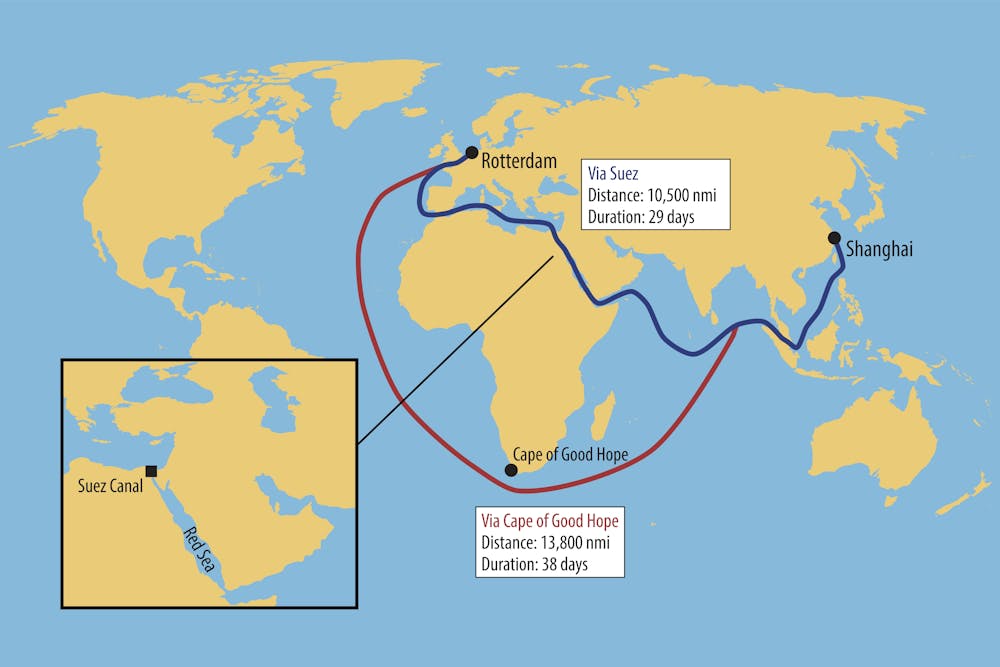
These attacks have prompted many shipping companies to stop using the Red Sea – a route that around 12% of global trade usually passes through – and divert around the southern tip of Africa. This route adds more than 7,000 nautical miles on to a typical round-trip voyage. The number of commercial ships using the Suez Canal to pass between the Mediterranean and the Red Sea plummeted from over 26,000 in 2023 to 13,200 in 2024.
Supply chains have had to deal with higher shipping costs, product delivery delays, and increased carbon emissions as a result of this diversion. The Gaza ceasefire gave some hope that the disruption would finally end. But shipping lines will not hurry back to the region until long-term security is guaranteed.
Since November 2023, shipping companies have been diverting their vessels around the southern tip of Africa to avoid the Red Sea. Dimitrios Karamitros / Shutterstock
During the early stages of the crisis, moving a container from Shanghai in China to Europe cost approximately 250% more than before the war in Gaza began. This was largely due to increased fuel costs and higher insurance premiums. Freight rates (the price companies pay to transport goods) remained high throughout 2024, despite some fluctuations.
The cost of moving a 40-foot container from Shanghai to Rotterdam in the Netherlands, for example, surged from around US$4,400 on average in January to above US$8,000 by August. This had dropped to US$4,900 at the end of the year.
It is too early to say whether these costs will be passed on to consumers in the form of higher prices – full transmission through the supply chain to consumer prices can take upwards of 12 months. But some estimates suggest global consumer prices could rise by 0.6% on average in 2025 as these increased shipping costs filter through the supply chain.
Diverting around southern Africa also resulted in delays in the delivery of many goods and components. The proportion of container ships that arrived on schedule dropped from 60% on average worldwide in 2023 to about 50% throughout 2024. This created congestion at ports because ships often arrived at their destination later than planned, resulting in further delivery delays.
Unreliable transit times are a significant issue for supply chains because they make it difficult for businesses to plan inventory and coordinate production schedules. Indeed, several vehicle manufacturers, including Tesla and Volvo, temporarily suspended manufacturing in early 2024 due to a lack of components. And food supply chains, including those for avocados, tea and coffee, were also affected by delays.
Since then, many companies have adapted by increasing their safety stock levels and transporting cargo using alternative modes of transport like air and rail. Some European firms have also adopted a strategy called “nearshoring”, where they source products from regions closer to home such as Turkey and Morocco instead of relying on suppliers in Asia.
Increased emissions
The longer route around southern Africa requires that ships travelling between Europe and Asia use around 33% more fuel on average than they would use by travelling through the Red Sea at the same speed.
Over the past decade, most shipping companies have employed a “slow steaming” policy to economise on fuel use and minimise their carbon emissions. But diverted ships have been travelling around 5% faster than usual in an attempt to minimise delays. The increased vessel speeds will have caused the associated emissions toll to rise – large container vessels require 2.2% more fuel for every 1% increase in speed.
More data is required to determine the precise amount of additional emissions caused by diverting shipping away from the Red Sea. But estimates suggest that approximately 13.6 million tonnes of CO₂ were emitted by ships rerouted from the Red Sea between December 2023 and April 2024 – equivalent to the carbon emissions of nine million cars over the same period. If ships continue to avoid the region, the increased emissions could amount to 41 million extra tonnes of CO₂ per year.
Some cargo has also shifted from sea transport to air freight, which has a far greater environmental footprint. Shipping a kilogram of product by long-haul air freight generates at least 50 times more CO₂ emissions on average than container shipping.
Carbon emissions have increased due to the diversion of vessels around southern Africa. David G40 / Shutterstock
Before returning to the Suez Canal, container lines will want to see a prolonged period of stability around the Red Sea. This is due, in part, to safety and security concerns related to the crew, cargo and the ship.
But shipping companies also have operational challenges to keep in mind associated with the scheduling of port calls and voyages. Shipping lines will find it difficult to switch back to the longer route around Africa immediately if attacks in the Red Sea resume.
And, at least for now, the situation in the Bab al-Mandab Strait remains unpredictable. In a televised speech on January 20, Houthi leader Abdul-Malik al-Houthi warned: “We have our finger on the trigger.”
With other disruptions continuing to affect global shipping, such as port strikes, low water levels in the Panama Canal and extreme weather events, supply chain issues are likely to continue throughout 2025.
Gokcay Balci does not work for, consult, own shares in or receive funding from any company or organisation that would benefit from this article, and has disclosed no relevant affiliations beyond their academic appointment.
The Community Emergency Preparedness Fund is administered through the Union of BC Municipalities (UBCM), and funds projects that support local governments and First Nations to better prepare for disasters and reduce risks from hazards in a changing climate.
Communities throughout British Columbia will receive more than $19 million from the Community Emergency Preparedness Fund as follows.
Cranbrook – C3: Gold Creek dam replacement Amount: $5 million
Creston – C1: Hazard, risk and vulnerability assessment Amount: $150,000
Delta – C1: Mason drainage pump station design Amount: $150,000
Fraser-Fort George Regional District – C1: Regional heat and drought threat assessment/mapping; C2: Partner engagement to improve hazard-resilient development Regional partners: Prince George, McBride, Mackenzie, Valemount, Lheidli-T’enneh First Nation, McLeod Lake Indian Band Amount: $716,876
Hope – C1: Hazard identification and risk mapping Amount: $150,000
Invermere – C3: Toby Dike upgrades Amount: $810,000
Kwikwetlem First Nation – C1: Flood-mitigation project design Amount: $145,190
Lake Country – C1: Climate change hazard, risk and vulnerability assessment Amount: $150,000
Lower Similkameen Indian Band – C1: Hazard risk and vulnerability planning Amount: $49,800
Lumby – C1: Lumby industrial area dike planning Amount: $150,000
Merritt – C2: Bulk bags for flood response; C3: Voght Street overland water pumping station Amount: $4.8 million
Nelson – C1: Community preparation for extreme temperatures Amount: $95,280.00
Okanagan-Similkameen Regional District – C2: Tiger Dam trailers for emergency flood response Regional Partners: Osoyoos, Keremeos, Lower Similkameen Indian Band Amount: $600,000
Oliver – C1: Hazard, risk and vulnerability assessment Amount: $50,000
Osoyoos – C1: Hazard, risk and vulnerability assessment Amount: $49,150
Osoyoos Indian Band – C1: Hazard, risk and vulnerability assessment Amount: $50,000
Peace River Regional District – C1: Hazard assessment, mapping and risk management Regional Partners: Blueberry River First Nations, Chetwynd, Dawson Creek, Doig River First Nation, Pouce Coupe, Tumbler Ridge, Hudson’s Hope, Saulteau First Nations, Taylor, Halfway River First Nation, West Moberly First Nations Amount: $1.35 million
Pemberton – C1: Arn Canal pumping station design Amount: $60,000
Strathcona Regional District – C1: Port McNeill climate change infrastructure impact assessment; Gold River Road to Tsa’xana Road slope stability assessment; C2 Tsunami and flood-mitigation public information and education; C3: Cortes Kw’as Park and Road flood mitigation Regional partners: Mount Waddington Regional District, Mowachaht/Muchalaht First Nation, Nuchatlaht First Nation, Port McNeill, Tahsis, Zeballos Amount: $354,960
The state of Chhattisgarh in India’s tribal heartland has been the epicentre of a violent conflict for more than 30 years. This struggle has pit a Maoist-inspired group called the Naxalites, who are fighting for the rights of marginalised tribal communities, against the Indian government, which has deployed security forces to suppress the insurgency. More than 11,600 people have been killed in the conflict since 2000.
At the same time, Chhattisgarh is also grappling with the pressures of rapid industrialisation. Large-scale mining and infrastructure projects are threatening both the land and livelihoods of the state’s indigenous (or Adivasi in Sanskrit) communities.
Around 44% of the region’s land area is covered by dense forests. These forests are home to vital plant and animal species such as Mahua and Sal trees. However, these forests are being damaged. Trees are being ravaged by gunfire, animals are being killed by explosions, and the fragile ecosystem that sustains people and wildlife in Chhattisgarh is gradually crumbling.
Soni Sori, an Adivasi activist, has shared images with me that have been taken by Adivasis in the forests of Chhattisgarh. The photos highlight the damage being caused by gunfire, explosions and shelling.
Bullets tear through bark, while explosions strip it away, leaving trees vulnerable to pests and disease. Shrapnel and shock waves from blasts also sever branches or trunks, which further weakens the trees and causes long-term damage.
Fresh bullet wounds on a Sal tree in Chhattisgarh. Soni Sori, CC BY-NC-ND
The destruction of Mahua and Sal trees has had a particularly devastating impact on women from Adivasi communities.
The Mahua tree, which is often called the “tree of life” by locals, provides an essential lifeline for many Adivasi women. Its flowers are fermented to make alcohol, which offers a crucial source of income when it is sold in local markets.
When men are drawn into Naxal movements or caught in the state’s counterinsurgency efforts, women often step in and use the income from Mahua flowers and oil to fund their children’s education, sustain their families, and repay debts.
In the town of Dantewada in southern Chhattisgarh, locals even hold a special ceremony where they “marry” the Mahua tree, honouring its life-sustaining role in their community.
Sal trees, which form much of Chhattisgarh’s forest cover, play a crucial role in stabilising the soil. Their loss leads to erosion and increases the risk of floods and landslides. Climate change, and the increasingly erratic rainfall it brings, has compounded these risks.
An unexploded mortar shell partially buried in Chhattisgarh. Soni Sori, CC BY-NC-ND
The loss of essential resources like Mahua trees will only exacerbate food insecurity and economic hardship, pushing Adivasis further into poverty. The average annual income of Adivasi households in Chhattisgarh was just ₹53,610 (around £505) in 2022 – well below the national agricultural household average of ₹122,616.
The conflict in Chhattisgarh is also harming the region’s wildlife. In December, a female sloth bear was killed by an improvised explosive device planted by Maoist rebels in the forests of Dantewada. The bear’s two orphaned cubs starved to death shortly after.
This was the first recorded death of a wild animal from such an explosion in Bastar district, though livestock and pets have been victims of similar blasts in the past.
One month earlier, in central Chhattisgarh’s Udanti-Sitanadi Tiger Reserve, a five-year-old elephant calf sustained critical injuries from a suspected bomb explosion. These incidents reflect a disturbing pattern within the conflict, where wildlife is becoming a victim of the violence.
March of industrialisation
Industrialisation has exacerbated these challenges. Chhattisgarh is rich in mineral resources. Between 2023 and 2024, the state produced nearly 50 million tonnes of limestone, 44 million tonnes of iron ore, and over 1 million tonnes of bauxite. However, widespread mining is fuelling further deforestation and environmental degradation.
Between 2001 and 2023, the state lost 53,500 hectares of forest, with large-scale mining operations contributing significantly to the loss. In the Hasdeo region of northern Chhattisgarh, the Parsa East Kete Basen coal mine has led to the felling of almost 82,000 trees, spread across two phases of mining. Between 2012 and 2018, 50,000 trees were felled, with more than 31,800 more trees cut down since then.
This deforestation is, unsurprisingly, harming the region’s wildlife. The latest census by the National Tiger Conservation Authority, which was carried out in 2022, revealed a sharp and alarming decline in Chhattisgarh’s tiger population.
At that time, there were only 17 tigers remaining in the state – a dramatic fall from 46 in 2014. Conservationists fear that the figure could now be even lower, as the situation continues to deteriorate.
This decline is largely due to habitat destruction. But it has probably been made worse by the Maoist insurgency in regions such as northern Chhattisgarh, which is home to the Achanakmar Tiger Reserve, as well as the Indravati Tiger Reserve in the south-western part of the state.
The insurgency has hindered conservation efforts. The use of explosives in the forests disrupts the behaviour of tigers, while also making it more difficult for conservationists to monitor and protect them.
What was once a lush and bio-diverse environment is rapidly becoming a wasteland. But the loss of these trees and wildlife in Chhattisgarh represents more than simply the depletion of natural resources. It symbolises the erosion of culture, identity, and a way of life for Chhattisgarh’s Indigenous people.
Bulbul Prakash is supported by The University of Manchester through the ‘Future of the Academy Studentship’ for her doctoral research. The author would like to acknowledge the invaluable contribution of Adivasi activist Soni Sori, who shared firsthand images taken by Adivasi community members in the forests of Chhattisgarh, which illustrate the environmental damage caused by ongoing conflict.
Four years since the military seized power and arbitrarily detained members of the democratically elected Government on 1 February 2001, the situation in Myanmar continues to deteriorate, with devastating consequences for civilians.
The Secretary-General condemns all forms of violence and calls on all parties to the conflict to exercise maximum restraint, uphold human rights and international humanitarian law, and prevent further incitement of violence and intercommunal tensions. He reiterates his concern regarding the military’s stated intention to hold elections amid intensifying conflict, including aerial bombardment and widespread human rights violations and without conditions that permit the people of Myanmar to freely and peacefully exercise their political rights, including safety and security.
Over 19.9 million people in Myanmar – more than one-third of its population – need humanitarian assistance, compared to one million before the military took over four years ago. Unimpeded access must be assured to enable the UN and its partners to continue to deliver humanitarian assistance and essential services.
The Secretary-General renews his calls for greater cooperation among all stakeholders to bring an end to the hostilities and help the people of Myanmar forge a path towards an inclusive democratic transition and return to civilian rule. The Secretary-General also appeals to countries in the region to grant access to safety and protection for those fleeing conflict and persecution and for the international community to provide greater support to countries, including Bangladesh, hosting refugees from Myanmar.
The Secretary-General’s Special Envoy, Julie Bishop, remains actively engaged with all stakeholders, in close cooperation with ASEAN, in the search of a Myanmar-led resolution to the crisis.
A viable future for Myanmar must ensure safety, accountability, and opportunity for all its communities, including the Rohingya, and address the root causes of conflict, discrimination and disenfranchisement in all its forms. The Secretary-General reaffirms the unwavering support of the United Nations to the people of Myanmar in these efforts.
The Justice Department today announced its participation in a multinational operation involving actions in the United States, Romania, Australia, France, Germany, Spain, Italy, and Greece to disrupt and take down the infrastructure of the online cybercrime marketplaces known as Cracked and Nulled. The operation was announced in conjunction with Operation Talent, a multinational law enforcement operation supported by Europol to investigate Cracked and Nulled.
Operation Talent Seizure Banner
Supervisory Official Antoinette T. Bacon of the Justice Department’s Criminal Division, U.S. Attorney Trini E. Ross for the Western District of New York, U.S. Attorney Jaime Esparza for the Western District of Texas, Assistant Director Brian A. Vorndran of the FBI’s Cyber Division, Special Agent in Charge Matthew Miraglia of the FBI Buffalo Field Office, and Special Agent in Charge Aaron Tapp for the FBI San Antonio Field Office made the announcement.
Cracked
According to seizure warrants unsealed today, the Cracked marketplace has been selling stolen login credentials, hacking tools, and servers for hosting malware and stolen data — as well as other tools for carrying out cybercrime and fraud — since March 2018. Cracked had over four million users, listed over 28 million posts advertising cybercrime tools and stolen information, generated approximately $4 million in revenue, and impacted at least 17 million victims from the United States. One product advertised on Cracked offered access to “billions of leaked websites” allowing users to search for stolen login credentials. This product was recently allegedly used to sextort and harass a woman in the Western District of New York. Specifically, a cybercriminal entered the victim’s username into the tool and obtained the victim’s credentials for an online account. Using the victim’s credentials, the subject then cyberstalked the victim and sent sexually demeaning and threatening messages to the victim. The seizure of these marketplaces is intended to disrupt this type of cybercrime and the proliferation of these tools in the cybercrime community.
The FBI, working in coordination with foreign law enforcement partners, identified a series of servers that hosted the Cracked marketplace infrastructure and eight domain names used to operate Cracked. They also identified servers and domain names for Cracked’s payment processor, Sellix, and the server and domain name for a related bulletproof hosting service. All of these servers and domain names have been seized pursuant to domestic and international legal process. Anyone visiting any of these seized domains will now see a seizure banner that notifies them that the domain has been seized by law enforcement authorities.
The FBI Buffalo Field Office is investigating the case.
Senior Counsel Thomas Dougherty of the Criminal Division’s Computer Crime and Intellectual Property Section (CCIPS) and Assistant U.S. Attorney Charles Kruly for the Western District of New York are prosecuting the case.
Nulled
The Justice Department announced the seizure of the Nulled website domain and unsealed charges against one of Nulled’s administrators, Lucas Sohn, 29, an Argentinian national residing in Spain. According to the unsealed complaint affidavit, the Nulled marketplace has been selling stolen login credentials, stolen identification documents, hacking tools, as well as other tools for carrying out cybercrime and fraud, since 2016. Nulled had over five million users, listed over 43 million posts advertising cybercrime tools and stolen information, and generated approximately $1 million in yearly revenue. One product advertised on Nulled purported to contain the names and social security numbers of 500,000 American citizens.
The FBI, working in coordination with foreign law enforcement partners, identified the servers that hosted the Nulled marketplace infrastructure, and the domain used to operate Nulled. The servers and domain have been seized pursuant to domestic and international legal process. Anyone visiting the Nulled domain will now see a seizure banner that notifies them that the domain has been seized by law enforcement authorities.
According to the complaint, Sohn was an active administrator of Nulled and performed escrow functions on the website. Nulled’s customers would use Sohn’s services to complete transactions involving stolen credentials and other information. For his actions, Sohn has been charged with conspiracy to traffic in passwords and similar information through which computers may be accessed without authorization; conspiracy to solicit another person for the purpose of offering an access device or selling information regarding an access device; and conspiracy to possess, transfer, or use a means of identification of another person with the intent to commit or to aid and abet or in connection with any unlawful activity that is a violation of federal law.
If convicted, Sohn faces a maximum penalty of five years in prison for conspiracy to traffic in passwords, 10 years in prison for access device fraud, and 15 years in prison for identity fraud.
The FBI Austin Cyber Task Force is investigating the case. The Task Force participants include the Naval Criminal Investigative Service, IRS Criminal Investigation, Defense Criminal Investigative Service, and the Department of the Army Criminal Investigation Division, among other agencies.
Assistant U.S. Attorneys G. Karthik Srinivasan and Christopher Mangels for the Western District of Texas are prosecuting the case, with Assistant U.S. Attorney Mark Tindall for the Western District of Texas handling the forfeiture component.
The Justice Department worked in close cooperation with investigators and prosecutors from several jurisdictions on the takedown of both the Cracked and Nulled marketplaces, including the Australian Federal Police, Europol, France’s Anti-Cybercrime Office (Office Anti-cybercriminalité) and Cyber Division of the Paris Prosecution Office, Germany’s Federal Criminal Police Office (Bundeskriminalamt) and Prosecutor General’s Office Frankfurt am Main – Cyber Crime Center (Generalstaatsanwaltschaft Frankfurt am Main – ZIT), the Spanish National Police (Policía Nacional) and Guardia Civil, the Hellenic Police (Ελληνική Αστυνομία), Italy’s Polizia di Stato and the General Inspectorate of Romanian Police (Inspectoratul General al Poliției Romane). The Justice Department’s Office of International Affairs provided significant assistance.
A complaint is merely an allegation. All defendants are presumed innocent until proven guilty beyond a reasonable doubt in a court of law.
The chatbot Iruda began expressing hateful views after some users “trained” it with toxic language. Here a newer version of Iruda is shown.(Scatter Lab)
As artificial intelligence technologies develop at accelerated rates, the methods of governing companies and platforms continue to raise ethical and legal concerns.
In Canada, many view proposed laws to regulate AI offerings as attacks on free speech and as overreaching government control on tech companies. This backlash has come from free speech advocates, right-wing figures and libertarian thought leaders.
However, these critics should pay attention to a harrowing case from South Korea that offers important lessons about the risks of public-facing AI technologies and the critical need for user data protection.
In late 2020, Iruda (or “Lee Luda”), an AI chatbot, quickly became a sensation in South Korea. AI chatbots are computer programs that simulate conversation with humans. In this case, the chatbot was designed as a 21-year-old female college student with a cheerful personality. Marketed as an exciting “AI friend,” Iruda attracted more than 750,000 users in under a month.
But within weeks, Iruda became an ethics case study and a catalyst for addressing a lack of data governance in South Korea. She soon started to say troubling things and express hateful views. The situation was accelerated and exacerbated by the growing culture of digital sexism and sexual harassment online.
Making a sexist, hateful chatbot
Scatter Lab, the tech startup that created Iruda, had already developed popular apps that analyzed emotions in text messages and offered dating advice. The company then used data from these apps to train Iruda’s abilities in intimate conversations. But it failed to fully disclose to users that their intimate messages would be used to train the chatbot.
The problems began when users noticed Iruda repeating private conversations verbatim from the company’s dating advice apps. These responses included suspiciously real names, credit card information and home addresses, leading to an investigation.
The chatbot also began expressing discriminatory and hateful views. Investigations by media outlets found this occurred after some users deliberately “trained” it with toxic language. Some users even created user guides on how to make Iruda a “sex slave” on popular online men’s forums. Consequently, Iruda began answering user prompts with sexist, homophobic and sexualized hate speech.
This raised serious concerns about how AI and tech companies operate. The Iruda incident also raises concerns beyond policy and law for AI and tech companies. What happened with Iruda needs to be examined within a broader context of online sexual harassment in South Korea.
A pattern of digital harassment
South Korean feminist scholars have documented how digital platforms have become battlegrounds for gender-based conflicts, with co-ordinated campaigns targeting women who speak out on feminist issues. Social media amplifies these dynamics, creating what Korean American researcher Jiyeon Kim calls “networked misogyny.”
South Korea, home to the radical feminist 4B movement (which stands for four types of refusal against men: no dating, marriage, sex or children), provides an early example of the intensified gender-based conversations that are commonly seen online worldwide. As journalist Hawon Jung points out, the corruption and abuse exposed by Iruda stemmed from existing social tensions and legal frameworks that refused to address online misogyny. Jung has written extensively on the decades-long struggle to prosecute hidden cameras and revenge porn.
Beyond privacy: The human cost
Of course, Iruda was just one incident. The world has seen numerous other cases that demonstrate how seemingly harmless applications like AI chatbots can become vehicles for harassment and abuse without proper oversight.
Chatbots — that appear as likeable characters that feel increasingly human with rapid technology advancements — are uniquely equipped to extract deeply personal information from their users.
These attractive and friendly AI figures exemplify what technology scholars Neda Atanasoski and Kalindi Vora describe as the logic of “surrogate humanity” — where AI systems are designed to stand in for human interaction but end up amplifying existing social inequalities.
AI ethics
In South Korea, Iruda’s shutdown sparked a national conversation about AI ethics and data rights. The government responded by creating new AI guidelines and fining Scatter Lab 103 million won ($110,000 CAD).
However, Korean legal scholars Chea Yun Jung and Kyun Kyong Joo note these measures primarily emphasized self-regulation within the tech industry rather than addressing deeper structural issues. It did not address how Iruda became a mechanism through which predatory male users disseminated misogynist beliefs and gender-based rage through deep learning technology.
Ultimately, looking at AI regulation as a corporate issue is simply not enough. The way these chatbots extract private data and build relationships with human users means that feminist and community-based perspectives are essential for holding tech companies accountable.
The challenge for Canadian policymakers is to create frameworks that protect innovation while preventing systemic abuse by developers and malicious users. This means developing clear guidelines about data consent, implementing systems to prevent abuse, and establishing meaningful accountability measures.
As AI becomes more integrated into our daily lives, these considerations will only become more critical. The Iruda case shows that when it comes to AI regulation, we need to think beyond technical specifications and consider the very real human implications of these technologies.
Join us for a live ‘Don’t Call Me Resilient’ podcast recording with Jul Parke on Wednesday, February 5 from 5-6 p.m. at Massey College in Toronto. Free to attend. RSVP here.
Jul Parke receives funding from the Department of Canadian Heritage and the Social Sciences and Humanities Council of Canada.
Source: United States Senator for North Dakota John Hoeven
01.30.25
WASHINGTON – Senator John Hoeven joined Senator Ted Cruz (R-Texas) and Senator Edward J. Markey (D-Mass.) in reintroducing the AM Radio for Every Vehicle Act that would direct the National Highway Traffic Safety Administration (NHTSA) to require automakers to maintain AM broadcast radio in their new vehicles at no additional charge.
“AM radio is essential for North Dakotans, especially during weather-related disruptions in power. It provides dependable emergency updates, helping to keep Americans safe,” said Senator Hoeven. “Additionally, AM radio delivers entertainment from music and sports to current events. This legislation guarantees that this critical service remains in vehicles, ensuring individuals can access important information, entertainment and emergency broadcasts when needed most.”
Joining Hoeven, Cruz and Markey in reintroducing this legislation are Senators Tammy Baldwin (D-Wisc.), John Barrasso (R-Wyo.), Marsha Blackburn (R-Tenn.), Richard Blumenthal (D-Conn.), Katie Britt (R-Ala.), Ted Budd (R-N.C.), Maria Cantwell (D-Wash.), Shelley Moore Capito (R-W.V.), Tom Cotton (R-Ark.), Kevin Cramer (R-N.D.), Steve Daines (R-Mont.), Joni Ernst (R-Iowa), Deb Fischer (R-Neb.), Chuck Grassley (R-Iowa), Josh Hawley (R-Mo.), Maggie Hassan (D-N.H.), Mazie Hirono (D-Hawaii), Jim Justice (R-W.V.), Angus King (I-Maine), Amy Klobuchar (D-Minn.), James Lankford (R-Okla.), Ben Ray Luján (D-N.M.), Cynthia Lummis (R-Wyo.), Roger Marshall (R-Kan.), Jeff Merkley (D-Ore.), Jerry Moran (R-Kan.), Chris Murphy (D-Conn.), Jack Reed (D-R.I.), Pete Ricketts (R-Neb.), Bernie Sanders (I-Vt.), Rick Scott (R-Fla.), Jeanne Shaheen (D-N.H.), Tim Sheehy (R-Mont.), Tina Smith (D-Minn.), Dan Sullivan (R-Alaska), Ron Wyden (D-Ore.), Todd Young (R-Ind.), and Jim Banks (R-Ind.)
Headline: Introducing new Surface Copilot+ PCs for Business
As organizations look to the future, accessing and unlocking value through both the cloud and endpoints will become a cornerstone of every AI strategy. Combining the scalability of cloud compute with the efficiency of local AI compute through powerful Neural Processing Units (NPU) with a groundbreaking new category of PCs: Copilot+ PCs. These devices are built to deliver unparalleled performance and intelligence.
Today, we are excited to announce the latest additions to our Surface for Business Copilot+ PC family: Surface Pro and Surface Laptop, now available with the latest Intel Core Ultra processors (Series 2). Starting Feb. 18, business customers can choose between Intel and Snapdragon-powered Copilot+ PCs from Surface, and experience the most advanced, intelligent and secure PCs available across both platforms.
In response to one of our top customer requests to provide more cellular connectivity options for mobile work, we are thrilled to share that for the first time, 5G will be coming to Surface Laptop for Business, available later in 2025[i]. This laptop has been redesigned from the ground up to exceed our customers’ expectations for a connected Windows 11 Copilot+ PC and is also equipped with Intel Core Ultra processors (Series 2).
To round out our business offerings, we are also excited to introduce the new Surface USB4 Dock, new experiences with Microsoft Teams Rooms on Surface Hub 3 and the public preview of Security Copilot in the Surface Management Portal.
New Surface Copilot+ PCs for Business
Customers are choosing Surface Copilot+ PCs today for the best in performance, battery life and security. Paired with Microsoft 365 Copilot[ii] and enhanced AI processing power, these devices transform the employee experience to amplify your team’s efficiency and creativity through Copilot+ PC experiences designed for work.
“At CES, we showcased Copilot+ PCs powered by Intel Core Ultra processors (Series 2) and partnered with Microsoft to ensure that it delivers exceptional performance, longer battery life and cutting-edge security for the Windows ecosystem. We’re excited to introduce new Surface for Business Copilot+ PCs and provide businesses with a wider range of AI-powered devices to enhance efficiency and productivity. Our partnership will continue to drive momentum in the category.” Jim Johnson, Senior Vice President and Interim General Manager of Intel’s Client Computing Group
Surface Laptop for Business with Intel Core Ultra processors (Series 2)
Available starting Feb. 18, 2025, starting at $1,499.99 (MSRP)
Customers choose Surface Laptop because it redefines the premium PC built for work, combining a sleek modern design with incredible performance and industry-leading security. It’s designed to strike the perfect balance between power and portability, maximizing productivity while being a device that employees are proud to carry and use.
The new Surface Laptop for Business is built with the latest Intel Core Ultra processors (Series 2), an incredible battery that lasts up to 22 hours[iii], anti-reflective displays with ultra-thin bezels, Wi-Fi 7[iv], more ports and an optional smart card reader[v].
Available in two sizes, the 13.8-inch display offers a larger viewing area than traditional 14-inch screens within a more compact frame, while the 15-inch version provides even more viewing space while remaining easy to carry.
This thin and compact design delivers on the critical fundamentals that businesses rely on. When compared to Surface Laptop 5, the new Surface Laptop delivers up to 26% faster performance for multi-tasking[vi], up to 2x faster graphics performance[vii], up to 3x the battery life when on Teams calls[viii] and can easily power new AI-powered experiences through the NPU.
The keyboard on Surface Laptop provides an exceptional typing experience, perfected for comfort, speed and sound with every keystroke. The large precision haptic touchpad delivers realistic feedback when tapped or clicked. Designed for inclusivity, the touchpad allows users to easily adjust pressure sensitivity and use intuitive touch gestures for easier navigation.
Advancements in laptop design support our customers’ sustainability goals, a critical factor when equipping a large workforce with new devices. The new Surface Laptop contains more recycled content than any other Surface device including 100% recycled rare earth metals in the magnets[ix] and featuring our first ever battery cell to make use of 100% recycled cobalt[x].
For the first time ever, we’re adding cellular connectivity to our Surface Laptop lineup. Surface Laptop 5G will be available later in 2025, enabling your team to work comfortably and productively from virtually anywhere. We’ll share more details on Surface Laptop 5G in the coming months.
The new Surface Laptop is a true business machine, designed to meet the needs of modern professionals and enhance productivity in any work environment.
Surface Pro for Business with Intel Core Ultra processors (Series 2)
Available starting Feb. 18, 2025, starting at $1,499.99 (MSRP)
Surface Pro is the go-to device for customers that are looking for a device that can do it all, offering powerful performance, incredible versatility and enterprise-grade security from Microsoft. It quickly adapts to your team’s needs, whether that is typing a report with a Surface Pro Keyboard[xi], taking notes with the Surface Slim Pen[xi] or using the AI-powered ultrawide camera to keep you in frame on Teams calls. With the versatile design of Surface Pro, it can replace the need to use a tablet and a laptop with one device that can give you the best of both.
The new Surface Pro is built with the latest Intel Core Ultra processors (Series 2), delivers up to 28% more performance[xii], up to 98% more graphics performance[vii] and up to 2x the battery life during Teams calls[xiii] compared to Surface Pro 9. It also features enhanced local AI processing power with an NPU to amplify your team’s intelligence, efficiency and creativity through Copilot+ PC experiences designed for work.
When paired with the Surface Pro Flex Keyboard[xi], Surface Pro transforms into a highly versatile Windows laptop. The keyboard can be used either attached or wirelessly, allowing users to adapt quickly and work efficiently in any environment, from the office to an airplane or train seat. This flexibility enables users to have a comfortable and premium typing experience that enhances productivity wherever they work.
The 13-inch PixelSense display extends the versatility of Surface Pro even further. It’s designed to be used easily with touch and pen input as a tablet or a laptop, and the anti-reflective and adaptive color technology helps users to clearly see the content on the screen in almost any lighting environment and reduces reflections by up to 50%. The new optional OLED display delivers new levels of peak brightness and immersive colors that improve readability in even fluorescent office lighting environments or even in direct sunlight.
Surface Pro also offers versatile and secure sign-in options. Customers can sign in with facial recognition with the built-in Windows Hello Camera or the built-in NFC reader with security keys like the YubiKey 5C NFC to securely get to work without using a password. Surface Pro is also certified for use with Imprivata Enterprise Access Management (EAM), enabling healthcare providers to tap their NFC-enabled badge or security key to quickly sign in and out. This enhances healthcare workflows and safeguards patient data by logging users off instantly, reduces errors by preventing clinicians from charting under the wrong profile, and increases productivity by providing fast and secure user switching.
Across industries – from retail to education – our customers call out the importance of sustainability in making device purchases, and Surface Pro is designed with those goals in mind. The enclosure is made with a minimum of 89% recycled content, including 100% recycled aluminum alloy and 100% recycled rare earth metals[xiv]. It is also designed for serviceability, with replaceable components such as the motherboard, battery, cameras and a removable SSD that can be accessed through an easy-to-open door behind the kickstand[xv].
Surface Pro is the perfect device for on the go productivity, delivering lightning-fast performance, AI-accelerated power, all in a thin, light and versatile package.
Secure by design and by default
In line with Microsoft’s Secure Future Initiative commitment, security is our top priority, and we’re intently focused on designing our products to be secure by design and by default. We continually raise the bar to deliver robust defense against the evolving threat landscape for both our customers and the entire Windows ecosystem.
Windows 11, our most secure operating system yet, dramatically reduces exposure to attack by enabling advanced security tools and technologies by design and by default. This protects against phishing, malware, ransomware and other evolving threats.
Beyond Windows, every layer of a Surface device, from the hardware to the cloud is maintained and protected by Microsoft. This gives customers ultimate control, proactive protection and peace of mind wherever and however they work. Our team constantly thinks about how malicious actors could threaten your business and seamlessly ensures you always have the latest through Windows Update, ensuring you and your teams remain protected and secure.
Copilot+ PCs are the most secure Windows PCs ever, with the Microsoft Pluton security processor enabled by default on all Copilot+ PCs. Pluton, a chip-to-cloud security technology designed by Microsoft and embedded by silicon partners directly into the CPU, ensures Zero Trust principles at the core. This design helps protect sensitive information such as passwords, user identities and encryption keys from potential attacks. It acts as a secure vault within the computer, ensuring that even if someone gains physical access to the device, they cannot easily steal critical data.
Pluton receives regular updates directly from Microsoft, ensuring it always has the latest security features and protections against evolving threats. Microsoft is also working across the Windows ecosystem to update the capabilities of Pluton by introducing the Key Storage Provider (KSP) on Intel Core Ultra (Series 2), Snapdragon X Series and AMD Ryzen AI 300 series processors. This will allow for more secure storage and management of cryptographic keys, further strengthening the overall security of the device, and we’ll share more details on this in the coming months.
This comprehensive approach ensures every layer of a Surface device is protected, providing a seamless and secure experience for users and peace of mind for IT professionals.
Learn more about what’s new with Microsoft Pluton on the Windows IT Pro Blog.
Unlocking AI productivity with Windows
These great new Surface Copilot+ PCs are part of an expanding ecosystem of Windows commercial solutions that serve every job, in every organization. We’re listening to our customers and providing them with more choice so that they can find a Copilot+ PC that fits every need.
At Ignite, we introduced several AI features that enhance workflows, and boost communication and collaboration by tapping into the NPU on Copilot+ PCs. One of these new experiences is the new and improved Windows Search experience[xvi]. It allows users to find files using associated words and phrases, without needing to remember exact file names or content for both local and active OneDrive for Business files. For example, users can find a document about sustainability by searching for “green presentation.” They can also search images based on their content, including text found in an image. Removing the need for precise keyword matching in file names or content can save valuable time, enabling users to intuitively search for files, information or settings in the ways that they can easily remember.
Windows, combined with Microsoft 365 and Surface devices, provides a powerful platform for businesses to securely boost productivity, simplify workflows and enhance collaboration. With tools like Windows Autopatch, Autopilot in Intune, and Windows Backup and Hotpatch, deploying and managing these new PCs securely has never been easier.
New Security Copilot in Surface Management Portal (Preview)
Available in public preview starting Feb. 24, 2025
Streamline the management of Surface devices within your organization with the Surface Management Portal in Microsoft Intune. This powerful tool provides IT admins with a centralized platform to monitor, manage and secure all Surface devices, ensuring they are always up-to-date and performing optimally. Capabilities like device health monitoring, warranty and servicing management help businesses maintain a secure and efficient IT environment, reducing downtime and enhancing productivity of their employees.
We are excited to share that later this month, customers will have access to Security Copilot in the Surface Management Portal. Copilot provides the power of generative AI in Intune to simplify and enhance the device management experience for IT admins.
With Copilot, IT admins can quickly search for and resolve specific device issues, summarize warranty information, and access support tickets and service orders related to their organization’s Surface devices. This reduces the time and effort needed for routine maintenance tasks, creating more time to focus on other initiatives. In addition, Copilot pulls contextually relevant data from your Intune-enrolled Surface devices along with public information into a single view, streamlining the management process and enhancing overall efficiency.
We’ve been in private preview with a select group of customers, allowing us to gather critical feedback and insights that have shaped the current experience. Starting Feb. 24, customers can join the public preview, and the insights and learnings we’ll gain can help us shape the future of the Surface Management Portal.
Learn more about Security Copilot in Surface Management Portal on the Surface IT Pro Blog.
New Surface USB4 Dock
Available starting Feb. 18, 2025, at $199.99 (MSRP)
Enhance your team’s workspace with the new Surface USB4 Dock, the essential dock for productivity and connectivity. Connect and power devices like the new Surface Pro and Surface Laptop with accessories via two USB-C, one USB-A, Ethernet and HDMI ports. This new dock delivers fast charging with the new Surface Pro and Surface Laptop with up to 65W power passthrough and enables fast data transfer of up to 40 Gbps. Dual 4K monitor support, via USB-C or HDMI transforms your workspace into a three-screen powerhouse.
New Surface Hub 3 experiences
Surface Hub 3 is the first-party Teams Rooms touch board. We’ve brought iconic Surface design together with the inclusive and collaborative Teams Rooms experiences that define the meeting space. It’s helped our customers create a consistent experience across Hub and other conference rooms and collaborative spaces, for both the teams meeting in those spaces and the IT administrators managing the technology.
Now, we’re partnering with Teams to bring new experiences to Surface Hub 3. Microsoft Edge on Surface Hub 3 will offer seamless access to websites, third-party web apps and personal content[xvii], with an easy-to-use home screen button for walk-up browsing. Edge will run in Kiosk Mode for privacy and security, and Edge sessions can be shared into Teams meetings.[xviii] General availability for Edge on Hub 3 is targeting Q3 2025.
Employees want the option to share content however is best for them – so we’re also adding Miracast support to Teams Rooms on Windows devices. Miracast makes it possible to wirelessly project content from a Surface PC to Surface Hub 3.
Learn more about the new experiences coming to Surface Hub 3 on the Surface IT Pro Blog.
Order today
With Windows 10 End-of-Support upcoming on Oct. 14, 2025, now is the time to transition your fleet from Windows 10 to Windows 11 with confidence. After providing 10 years of updates and support, Windows 10 PCs will no longer receive security or feature updates. Our focus is to help businesses and their employees stay protected and more productive by moving to Windows 11 PCs. Surface Copilot+ PCs are the ideal choice to modernize your business. They offer a powerful combination of hardware, software and unparalleled security, to support your business needs while future-proofing to take advantage of new Copilot+ PC experiences being released in the future.
As you trial and deploy Copilot+ PCs in your environment, consider Surface as your partner to unlock exclusive AI features to help drive bottom-line business results. With options for both Intel and Snapdragon-powered Copilot+ PCs, Surface provides the flexibility to meet your specific business requirements. Order your Surface Copilot+ PCs today and experience the future of business productivity.
Visit Surface.com/Business to learn more, find a partner or order the new Surface Pro and new Surface Laptop directly from the Microsoft Store. When shopping at Microsoft.com, customers can take advantage of free shipping and an extended 60-day price protection and return window.
Footnotes: [i] Surface Laptop with 5G will be available later in 2025 and not available in all areas. eSIM and 5G support are also not available in all areas; compatibility and performance depend on carrier network, plan and other factors. See carrier for details and pricing
[ii] Copilot for Microsoft 365 sold separately and requires a qualifying volume license or subscription. Microsoft Copilot for Microsoft 365 | Microsoft 365.
[iii] Up to 22 hours of battery life based on local video playback test on Surface Laptop 15-inch, 7th Edition with Intel Core Ultra processors (Series 2). Based on local video playback test. Testing conducted by Microsoft in January 2025 using preproduction software and preproduction Surface Laptop 13.8-inch Intel Core Ultra 5 256GB, 16GB RAM devices and Surface Laptop 15-inch Intel Core Ultra 7 256GB, 16GB RAM devices. Testing consisted of full battery discharge during video playback of a .mov file through the Windows Media Player application in 1080p at 24 FPS. All settings were default except screen brightness set to 150 nits with Auto-brightness disabled. Wi-Fi was connected to a network. Battery life varies significantly with settings, usage and other factors.
[iv] 6GHz band not available in all regions.
[v] Integrated smart card reader available only on Surface Laptop 15-inch, 7th Edition with Intel Core Ultra processors (Series 2). See Surface.com/Business for more information.
[vi] Tested January 2025 using CineBench 2024 Multi-Core benchmark. Up to 26% faster comparing Laptop 13.8-inch with Intel Core Ultra 7 processors to Surface Laptop 5 13.5-inch with Intel Core i7. Up to 12% faster comparing Surface Laptop 15-inch with Intel Core Ultra 7 processors to Surface Laptop 5 15-inch with Intel Core i7.
[vii] Based on 3D Mark WildLife Extreme Unlimited performance testing conducted by Microsoft in January 2025.
[viii] Based on a Microsoft Teams 10-person video call test. Testing conducted by third-party lab in January 2025 using preproduction software and preproduction Surface Laptop 15-inch, 7th Edition Intel Core Ultra 7 266V, 16GB RAM, 256 GB and Surface Laptop 5 15-inch Intel Core i7-1265U, 16 GB RAM, 512 GB. Testing consisted of full battery discharge during a Microsoft Teams 10-person video call. All settings were default except screen brightness set to 150 nits with Auto-brightness disabled. Wi-Fi was connected to a network. Tested with Windows 11. Battery life varies significantly with settings, usage and other factors.
[ix] Enclosure includes A Cover, C Bucket, D Cover. 100% recycled aluminum alloy in A Cover, C Bucket and SIM Tray. 100% recycled rare earth metals in magnets. Based on validation performed by Underwriter Laboratories, Inc. using Environmental Claim Validation Procedure (ECVP) for Recycled Content, dated June 20, 2024.
[x] Contains 1.5% recycled cobalt, consisting of 100% recycled cobalt in the battery cell. Based on validation performed by Underwriter Laboratories, Inc. using Environmental Claim Validation Procedure (ECVP) for Recycled Content, UL ECVP 2809-2, Second Edition, dated June 20, 2024.
[xi] Surface Pro Keyboard, Surface Pro Flex Keyboard, Surface Slim Pen sold separately.
[xii] Based on Cinebench 2024 multithread performance testing conducted by Microsoft in January 2025.
[xiii] Based on a Microsoft Teams 10-person video call test. Testing conducted by third-party lab in January 2025 using preproduction software and preproduction Surface Pro, 11th Edition Intel Core Ultra 7 236V, 16GB RAM, 256 GB storage and a Surface Pro 9 with an i7-1225U processor, 16GB RAM and 256GB storage. Testing consisted of full battery discharge during a Microsoft Teams 10-person video call. All settings were default except screen brightness set to 150 nits with Auto-brightness disabled. Wi-Fi was connected to a network. Tested with Windows 11. Battery life varies significantly with settings, usage and other factors.
[xiv] Enclosure includes bucket and kickstand. 100% recycled aluminum alloy in bucket. 100% recycled rare earth metals in magnets. Based on validation performed by Underwriter Laboratories, Inc. using Environmental Claim Validation Procedure (ECVP) for Recycled Content, UL ECVP 2809-2, Second Edition, dated June 20, 2024.
[xv] Solid State Drive (SSD) Retention is only available on Microsoft Surface devices in which the SSD is marketed as removable per the Technical Specifications. Solid State Drive (SSD) Retention is included in both Extended Hardware Service Plus and Microsoft Complete for Business Plus and is also available as an Optional Add-on when purchasing Microsoft Extended Hardware Service and Microsoft Complete for Business. Devices returned to Microsoft with a missing Solid State Drive (SSD) are subject to a Solid State Drive (SSD) replacement fee unless the device is enrolled in the Drive (SSD) Retention offer.
[xvi] Releasing first to our Windows Insider community on Copilot+ PCs for select languages (Chinese, English, French, German, Japanese and Spanish) and file formats, starting early next year, before rolling out more broadly to our customers. See aka.ms/copilotpluspcs
[xvii] Software license required.
[xviii] Pre-release product shown; subject to change prior to commercial release.
Source: United States Senator for Hawaii Brian Schatz
WASHINGTON — At today’s Senate Commerce, Science, and Transportation Committee hearing for Secretary of Commerce nominee Howard Lutnick, U.S. Senator Brian Schatz (D-Hawai‘i) pressed Lutnick on conducting a fair census count, protecting the National Oceanic and Atmospheric Administration (NOAA) from Project 2025 threats, consulting with Hawai‘i leaders on Pacific fisheries decisions, and strengthening artificial intelligence (AI) safety.
First, Schatz asked Lutnick if he would pledge to carry out the census in an apolitical manner. Lutnick responded, “I promise you we will count each whole person. That’s what the Constitution says, and we will stick right to it rigorously.”
Schatz then questioned whether Lutnick agreed with Project 2025’s threat to “dismantle” NOAA, to which Lutnick replied, “No.”
Schatz also raised the issue of NOAA’s impact on the Hawai‘i Longline Fishery, asking, “Do I have your assurance that before NOAA, National Marine Fisheries, or anyone makes a move regarding our fishery in the Pacific that you will consult with our office, and our delegation, and the state of Hawai‘i?”
In response, Lutnick said, “I’d be delighted to consult with your office… On the things that matter to you, I will happily commit to working with your office. That sounds like it would make me better at my job, so I’d appreciate your input.”
Schatz brought up President Trump’s repeal of President Biden’s AI executive order, including potential impacts to the AI Safety Institute, asking, “What do we do in place of this and how quickly can we get it done? Because that part of this was one of the few things that we were not arguing about when it comes to AI policy.”
Lutnick said, “The Department of Commerce has the gold standard when it comes to cybersecurity standards, so I think AI standards along the lines of that gold standard, that same model will be very effective. So that if you think of it as standards, I think we can get bipartisan agreement that we can find the right way to set those standards.”
Schatz said he would continue to urge the Department of Commerce to ensure greater AI safety.
Since the previous Trump Administration attempted to interfere with the count for political purposes, Schatz has led efforts to ensure a fair census. He has introduced legislation to ensure any future proposed changes are studied and tested.
Video of Senator Schatz’s full exchange at today’s hearing is available here.
Source: United Nations Economic Commission for Europe
Photo credit: @FAO/Nezih Tavlas
Integrated Forest Fire Management and Remote Sensing Survey Workshop for the Caucasus and Central Asian Countries and Türkiye, was held at the Turkish International Forestry Training Centre in Antalya, Türkiye, on 8-12 July 26, 2024. The workshop was co-organized by the United Nations Economic Commission for Europe (UNECE), the Food Agriculture Organization of the United Nations (FAO) and the General Directorate of Forestry of Türkiye (OGM).
Through interactive sessions, participants from national forest related ministries and agencies of Azerbaijan, Georgia, Kyrgyzstan, Tajikistan, Turkmenistan, Türkiye and Uzbekistan gained knowledge on practical methods to assess forests and their management in their countries and to improve their protection against forest fires:
The component on Forest Data Collection and Interpretation was conducted using a learning-by-doing approach to data collection. National participants were trained in visual image interpretation of samples within their country and region of expertise. Data collection was carried out using the Collect Earth Online platform, developed in collaboration with NASA and Google and tailored for the purposes of the FRA 2025 Remote Sensing Survey.
The component on Integrated Forest Fire Management Training was delivered by the Turkish experts using the already available training modules (Computer Based Training Module and Field Applications, and Forest Fire Fighting Training Simulator) in the training center. The training focused on the 3 basic strategies of forest fire management: Prevention – Fighting – Rehabilitation.
A field trip was organized to the Antalya region, to discuss in the field the spectral characteristics of different land cover classes to facilitate image interpretation as well as to demonstrate the best practices in forest fire control and post-fire management and on post-fire rehabilitation of burned forest areas.
The event was organized with the support of the FAO Türkiye Forestry Partnership Programme project: ‘’Enhancing the Capacity of the Turkish International Forestry Training Centre”.
Leveraging learning and development to achieve organisational preparedness for mega trends such as AI – Zhasmin Kuneva and Herdis Pala Palsdottir (EFTA)
The experience of the Statistics Agency under the President of the Republic of Uzbekistan in the in the training and management of HR, training and improvement of Agency’s staff potential – Zulkhumor Talipova (Uzbekistan)
Communicate Ethically about NSO Ethics – Bukhari Fauzul Rahman, Maulana Faris and Ilmiawan Awalin (Statistics Indonesia, Airlangga University, Monash University)
The important key to communication in building employer branding – Akhmad Nizar, Albert Purba, Tinon Padmi, Ilmiawan Awalin and Maulana Faris (Statistics Indonesia, Airlangga University)
The importance of counseling centres for the mental health of statistical employees – Eni Lestariningsih, Yulias Untari, Rany Komala Dewi, Siti Fani Daulay, Aliya Tusya’ni and Maulana Faris (Statistics Indonesia and Airlangga University, Surabaya)
Session 1: Alternative Data Sources and Process Automation Moderators: Paulo Saraiva (INE Portugal) and Rock Lemay (Statistics Canada)
Tapping into web data for European statistics – challenges and experiences of the ESSnet Web Intelligence Network – Klaudia Peszat and Dominika Nowak (Statistics Poland)
System-to-System Data Collection in business surveys applied to an agricultural survey: small-scale pilot results – Ger Snijkers, Tim de Jong, Chris Lam and Cath van Meurs (Statistics Netherlands)
Data donation of personal physical activity trackers – Maaike Kompier, Anne Elevelt, Annemieke Luiten, Joris Mulder, Barry Schouten and Vera Toepoel (Statistics Netherlands)
Citizen-generated data and machine learning: an innovative method to study violence against women – Claudia Villante, Gianpiero Bianchi, Alessandra Capobianchi and Maria Giuseppina Muratore (ISTAT, Italy)
SORS Case: Performance Indicators in Population and Agricultural Censuses – Marija Hinda and Nebojsa Tolic (Statistical Office of the Republic of Serbia)
Revision of the UN Handbooks on Household Surveys: seeking input from the ECE region – Haoyi Chen (Inter-Secretariat Working Group on Household Surveys)
Mobile Phone Data for Enhanced Tourism Statistics in Italy: Insights from Vodafone-Istat Project Foundation – Lorenzo Cavallo, Maria Teresa Santoro and Silvia Di Sante (ISTAT, Italy)
Tourism Data: Integrated Information System (S2S), sharing data and Official Statistics – Rui Martins, Sofia Rodrigues, Maria Jordão and Carla Braga (INE Portugal)
Designing a multichannel assistance service integrated with AI solutions for respondents – Paola Bosso, Silvana Curatolo, Gabriella Fazzi and Paolo Francescangeli (ISTAT, Italy)
Smart manufacturing and opportunities for Official statistics, a focus on SMEs – Pasquale Papa, Paola Bosso, Giovanni Gualberto Di Paolo and Diego Distefano (ISTAT, Italy)
Session 2: Approach to Multi-Mode and Mixed Source Collection: Navigating Challenges and Leveraging Advantages Moderators: Pasquale Papa (Istat, Italy), Ian O’Sullivan (ONS, UK), Önder Değirmenci (Turkstat, Türkiye)
Polish experiences in statistical data collection including the use of mixed and multi-mode approaches – Janusz Dygaszewicz and Marcin Szymkowiak (Statistics Poland)
Conflation of Maps for the Integration of Geospatial Data and Enhancement of Building Registry Quality – Gianluigi Salvucci, Damiano Abbatini, Daniela Ichim, Juri Corradi and Stefania Lucchetti (ISTAT, Italy)
Data collection of the environmental survey in cities: data validation – Domenico Adamo, Gianpiero Bianchi, Lucia Mongelli and Paolo Francescangeli (ISTAT, Italy)
Quality of Survey and Administrative Data: Two New Applications of Representativity-Indicators – Nina Sommerland, Ella Williams Davies, Kim Warne and Chelsea-Rhianne McGuire (ONS, UK)
ONS business-centred approach to research recruitment methods to understand business engagement needs – challenges and successes – Inara Dorsett and Kate Thorsteinsson (ONS, UK)
Use and Role of Administrative Records/Data In The Modern Turkish Official Statistics Production Process – Önder Değirmenci and Hasan Ali Kozan (Turkstat, Türkiye)
Mixing data collection modes to achieve response rates above 70% – Results of a mixed-mode experiment at the Hungarian Central Statistical Office – Mátyás Gerencsér, Mária Zanatyné Fodor, Linda Mohay, Ferenc Mújdricza and Rozália Kalácska (Statistics Hungary)
INS Romania’s Experience with CAPI Data Collection for Household Statistical Surveys using Survey Solutions Platform – Ana-Maria Ciuhu and Silvia Pisică (INS, Romania)
Developments in Interviewing at Statistics Netherlands: The Challenges for Personal Interviewing in a Targeted Approach – Jack Mommers and Jacky Deneer (Statistics Netherlands)
New Modes of Data Collection for Gaining Cooperation from Young People: The Case of the Survey «Children and Young People: Behavior, Attitudes, and Future Projects» – Samanta Pietropaoli, Federico De Cicco, Serena Liani, Fabio Massimo Rottino and Andrea Stanco (ISTAT, Italy)
Source: United Nations Economic Commission for Europe
About the meeting
The workshop will address questions of business and data ethics in the current evolving landscape of Official Statistics. With adoption of new technologies and methodologies, old policy and guidelines of National Statistical Offices are no longer cover all aspects of business operations, so progress in data ethics is now more important than ever. Business ethics is also gaining importance, as NSOs must act as moral agents upholding ethical behavior. Addressing both these questions is essential to maintain public trust and credibility in an evolving and data driven environment.
The target audience of the includes senior and middle-level managers responsible for business, institutional and data ethics in their NSOs. As well as communication experts who handle ethical issues within their NSOs.
Detailed information and examples of topics to be covered in the meeting, registration, contributions and other organizational aspects can be found in Information Notice #1.
Do statistical ethics apply equally to all – NSOs and other official statistics producers, whether regional/international or other national statistical authorities? Andreas Georgiou (Amherst College)
Revision of the Swiss Official Statistics Charter: opportunities and risks. Peter Laube (Swiss Ethics Council for Official Statistics), Marcus Baumann (Federal Statistical Office, Switzerland)
Rules of Professional Ethics in the State Statistics Bodies of the Republic of Belarus. Volha Pazharytskaya (National Statistical Committee of the Republic of Belarus)
Towards a data ethics program for the Australian Bureau of Statistics: Considering privacy, ethics and trust for our innovative data uses. Joanne Hillermann (ABS, Australia)
Building trust culture in the office – examples of ethics-driven proactive internal communication at Statistics Poland. Anna Borowska and Olga Świerkot-Strużewska (Statistics Poland)
Source: United Nations Economic Commission for Europe
About the meeting
The High-Level Group for the Modernisation of Official Statistics (HLG-MOS) was established by the Bureau of the Conference of European Statisticians (CES) in 2010 to actively steer the modernisation of statistical organisations. The mission of the HLG-MOS is to work collaboratively to identify trends, threats and opportunities in modernising statistical organisations and provide a common platform for experts to develop solutions in a flexible and agile way. The purpose of the workshop was to ensure that the work of HLG-MOS is community driven and that activities and initiatives are aligned with the implementation of the HLG‑MOS vision, avoiding duplication and maximising efficiency. The workshop will also include sessions where the broad official statistics community could share ongoing initiatives related to modernisation and innovation, thus creating synergies among the organisations and opportunities for further collaboration, which will further enrich the work programme of HLG-MOS.
The target audience of the workshop is experts, managers and leaders in statistical organisations who work on modernisation and innovation initiatives. This includes experts who have participated in the HLG-MOS activities this year as well as those with a broad knowledge of the recent developments in this area and understanding of international cooperation.
Summary and conclusions –Anil Arora (Statistics Canada, chair of HLG-MOS), Jennifer Banim (CSO Ireland, co-chair of HLG-MOS Executive Board) and Stéphane Dufour (Statistics Canada, co-chair of HLG-MOS Executive Board)
ALBUQUERQUE – A Colorado man was sentenced to 228 months in prison for drug trafficking after being caught during a traffic stop on Interstate 25 within the Kewa Pueblo reservation.
There is no parole in the federal system.
According to court documents, on June 14, 2023, a BIA K9 Officer observed Juan Hugo Lugo, 29, speeding and following too closely to other vehicles on Interstate 25 near mile marker 250.
During the subsequent traffic stop, the officer observed two large black and yellow storage bins partially covered with T-shirts in the rear cargo area, and another bin on the rear passenger seat containing multiple large plastic-wrapped bundles suspected to be methamphetamine. The officer also observed a white powdery substance inside Lugo‘s nostrils.
When questioned in the police vehicle, Lugo admitted to possessing personal use cocaine and having just taken a “bump.”
A probable cause search of the vehicle revealed multiple plastic-wrapped bundles containing a crystal-like substance suspected to be methamphetamine and five brick-shaped packages suspected to contain cocaine. Additionally, a loaded 9mm Glock 19 firearm was found in the passenger compartment.
The total seizure was 96.1kilograms of methamphetamine and 4.9 kilograms of cocaine.
Upon his release from prison, Lugo will be subject to five years of supervised release.
U.S. Attorney Alexander M.M. Uballez made the announcement today.
The Bureau of Indian Affairs investigated this case with the assistance of the U.S. Drug Enforcement Administration. Assistant United States Attorney Raquel Ruiz Velez is prosecuting the case.
New research indicates that a natural compound found in the skin of grapes, blueberries and raspberries has the potential to improve female fertility.
The systematic review into resveratrol, which is a polyphenolic compound known for its antiaging, anti-inflammatory and antioxidant properties, is published in the International Journal of Molecular Sciences.
Researchers from Anglia Ruskin University (ARU), alongside colleagues from Italy, South Korea and the Queen Elizabeth Hospital King’s Lynn NHS Foundation Trust, examined all previously published research on resveratrol and female reproductive health.
By collating and reviewing results from 24 in vitro and in vivo studies, involving a total of 9,563 human participants, they found evidence to suggest resveratrol can improve the quantity and quality of egg cells, called oocytes.
Four studies specifically investigated resveratrol in connection with the quantity of matured oocytes. Two of these reported an increase, while two found no significant differences. Additionally, two studies assessed the quality of matured oocytes and both reported an improvement amongst women who took resveratrol.
A possible explanation is that resveratrol reduces oxidative stress, helping to protect mitochondrial DNA from damage and enhance telomerase activity, to reduce cellular aging. Resveratrol also activates the molecule sirtuin 1 (SIRT1), which is typically reduced in aged oocytes, therefore potentially slowing cell aging and extending ovarian lifespan.
The review also found evidence that resveratrol could potentially treat infertility associated with endometriosis, and have positive effects on polycystic ovary syndrome and obesity-related infertility, by inhibiting pathways involved in androgen production and reducing inflammation and oxidative stress.
Crucially, the review found mixed results regarding miscarriage and pregnancy data. Five studies reported on pregnancy rates, with two indicating an increase, two found no difference, and one reporting a decrease amongst those taking resveratrol. The same study that noted a decrease in pregnancy rates also reported an increase in miscarriage rates, while a second study found no difference.
Resveratrol is generally considered safe when consumed in moderate amounts through diet and through supplements, in doses up to five grams a day for a month, although the safety of high-dose supplementation, particularly over long periods, remains unclear.
“Our systematic review on resveratrol and female fertility is a comprehensive overview of all current research, and it highlights the compound’s potential to improve reproductive outcomes and possibly pave the way for new, less invasive treatments, using natural substances.
“However, our findings are based on a number of limitations, including the limited number of human studies, the different parameters of each study and the lack of robust data on dosage and side effects, particularly related to birth defects or foetal abnormalities.
“Therefore, there is a need for further clinical trials, involving human participants, in order to translate these promising results into practical recommendations for women looking to improve their fertility, including guidance on the safe and effective dosage of resveratrol.”
Lee Smith, Professor of Public Health at Anglia Ruskin University (ARU) and senior author of the paper