Category: Asia Pacific

  • MIL-Evening Report: What are Veblen and Giffen goods?

    Source: The Conversation (Au and NZ) – By María Yanotti, Lecturer of Economics and Finance Tasmanian School of Business & Economics, University of Tasmania

    photo-lime/Shutterstock

    This article is part of The Conversation’s “Business Basics” series where we ask experts to discuss key concepts in business, economics and finance.


    In economics, goods and services can be classified in different ways. You might be surprised to realise you already knew this, even without knowing their classification names.

    Most goods and services are what we call normal goods. Normal goods are those that you purchase more of as your income increases.

    For example, you might put healthier and more nutritious food in your trolley, buy more shoes and clothes, or spend more on outings at restaurants and events.

    Normal goods still abide to what’s called the law of demand, which might feel like common sense: as the price of something goes up, the quantity of or frequency with which it is demanded will fall.

    But there are some categories that violate our intuitions around supply and demand. And they do so for very different reasons. Meet Veblen and Giffen goods, the products that “break the rules”.


    Read more:
    What’s inflation – and how exactly do we measure it?


    Needs and wants

    Normal goods can be further divided into two types: necessity goods and luxury goods.

    Most groceries are an example of necessity goods.
    No Revisions/Unsplash

    Broadly speaking, necessity goods are all those things we require for everyday life – food, housing, electricity and so on.

    Luxury goods, on the other hand, are the those things we don’t necessarily need but are nice to have. Luxury houses, fancier cars, more expensive clothes and so on.

    We become more able to afford luxury goods as we earn more. But as a result, they are also the first things we tend to cut when our income tightens.

    For most of these products, something called the “law of demand” applies. That is, if their price increases, people buy less of them than they did before. Demand for them shrinks.

    However, some types of good defy this “natural” principle.

    Symbols of status and wealth

    The first type are Veblen goods, named after American economist Thorstein Veblen. Sometimes they’re also called “snob” goods.

    When these goods go up in price, demand for them actually increases.

    Clear examples of Veblen goods are some forms of art, high-end designer clothes, exclusive cars and watches. The more expensive the good is, the more exclusive it is, and the more the consumers (who are attracted to it) want to purchase it.

    It all centres on signalling status. Being seen to be able to purchase them can indicate someone has exquisite taste, or lots of money to spend.

    Most times, Veblen goods are an example of what economists call “positional” goods. These are goods that are valued according to how they are distributed among people, and who exactly has them.

    The satisfaction of purchasing a Veblen good comes from the sense of having it and being able to show it off, not necessarily from how useful it is.

    The value of Veblen goods is driven by their artificial scarcity – they’re deliberately hard for people to acquire.
    Andrea Natali/Unsplash

    Inferior goods

    On the opposite side of normal goods are inferior goods. As our income increases, we tend to consume less of these goods.

    Think, for example, of two-minute noodles or the bus service.

    As your income increases, you may be able to afford more nutritious and healthier food and stop consuming cheaper food. You may be able to purchase a car or a bike and stop using public transport.

    But within inferior goods, one rare kind offers another exception to the law of demand – Giffen goods.

    Why does a rise in price cause demand to go up? Because for people on limited incomes, this limits their ability to buy substitutes.

    Take examples such as wheat, rice, potatoes, or bread. If the price of any of these goes up, a consumer on low income may have less to spend on higher quality goods like meat and fresh vegetables, increasing their demand for the inferior good.


    Read more:
    What is competition, and why is it so important for prices?


    María Yanotti receives funding from AHURI. She is affiliated with the Economic Society of Australia, and the Women in Economics Network.

    ref. What are Veblen and Giffen goods? – https://theconversation.com/what-are-veblen-and-giffen-goods-241799

    MIL OSI AnalysisEveningReport.nz

  • MIL-Evening Report: How do children learn good manners?

    Source: The Conversation (Au and NZ) – By Sophia Waters, Senior Lecturer in Writing, University of New England

    Pexels/Anna Shvets

    Ensuring kids have manners is a perennial preoccupation for parents and caregivers.

    How, then, do you teach good manners to children?

    Modelling good manners around the home and in your own interaction with others is obviously crucial.

    But there’s a clear uniting theme when it comes to manners in Australia: in Australian English, good manners centre on honouring personal autonomy, egalitarianism and not appearing to tell people what to do.

    Which manners matter most in Australia?

    Some of the most important manners in Australian English are behavioural edicts that focus on particular speech acts: greeting, requesting, thanking and apologising.

    These speech acts have a set of words associated with them:

    • hello
    • hi
    • may I please…?
    • could I please…?
    • thank you
    • ta
    • sorry
    • excuse me.

    Good manners make people feel comfortable in social situations by adding predictability and reassurance.

    They can act as signposts in interactions. Anglo cultures place a lot of weight on egalitarianism, personal autonomy and ensuring we don’t tell people what to do.

    If you want to get someone to do something for you – pass you a pen, for example – you frame the request as a question to signal that you’re not telling them what to do.

    You’ll also add one of the main characters in Anglo politeness: the magic word, “please”.

    This framing recognises you don’t expect or demand compliance. You’re acknowledging the other person as an autonomous individual who can do what they want.

    If the person does the thing you’ve asked, the next step is to say “thank you” to recognise the other person’s autonomy. You’re acknowledging they didn’t have to help just because you asked.

    ‘Say ta!’
    DGLimages/Shutterstock

    The heavy hitters

    The words “please” and “thank you” are such heavy hitters in Australian English good manners, they’re two of the words that language learners and migrants learn first.

    They can help soften the impact of your words. Think, for example, of the difference between “no” and “no, thank you”.

    Of course, there are times when “no” is a full sentence. But what if someone offered you a cup of tea and you replied “no” without its concomitant “thank you” to soften your rejection and acknowledge this offer didn’t have to be made? Don’t be surprised if they think you sound a bit rude.

    The other big players in Australian English good manners are “sorry” and “excuse me”. Much like in British English, the Australian “sorry” means many things.

    These can preface an intrusion on someone’s personal space, like before squeezing past someone in the cinema, or on someone’s speaking turn.

    Interrupting or talking over someone else is often heavily frowned on in Australian English because it is often interpreted as disregarding what the other person has to say.

    But in some cultures, such as French, this conversational style is actively encouraged. And some languages and cultures have different conventions around what good manners look like around strangers versus with family.

    Good manners involve saying certain words in predictable contexts.

    But knowing what these are and when to use them demonstrates a deeper cultural awareness of what behaviours are valued.

    Talking over someone else is often heavily frowned on in Australian English.
    MDV Edwards/Shutterstock

    How do children learn manners?

    As part of my research, I’ve analysed parenting forum posts about “good manners”. Some believe good manners should be effortless; one parent said:

    Good manners shouldn’t be something that a child has to think about […] teach them correctly at home from day one, manners become an integral part of the way they view things.

    Another forum user posited good modelling was the key, saying:

    the parent has to lead by example, rather than forcing a child to say one or the other.

    One study, which involved analysis of more than 20 hours of videorecorded family dinner interactions collected in Italy, found mealtimes are also sites where parents control their children’s conduct “through the micro-politics of good manners.”

    By participating in mealtime interactions, children witness and have the chance to acquire the specific cultural principles governing bodily conduct at the table, such as ‘sitting properly’, ‘eating with cutlery’, and ‘chewing with mouth closed’.

    Yet, they are also socialised to a foundational principle of human sociality: one’s own behavior must be self-monitored according to the perspective of the generalised Other.

    In Australian English, that means regulating your behaviour to make sure you don’t do something that could be seen as “rude”. As I argued in a 2012 paper:

    While child socialisation in Anglo culture involves heavy discouragement of rudeness, French does not have a direct equivalent feature […] French children are taught ça ne se fait pas, ‘that is not done’. Where the French proscribe the behaviours outright, the Anglos […] appeal to the image one has of oneself in interpersonal interactions.

    In Anglo English, the penalties for breaches could be other people’s disapproval and hurting their feelings.

    Good manners form part of the bedrock for human sociality.
    Shutterstock

    Why are good manners important?

    Good manners affect our interactions with others and help us build positive relationships.

    Fourteenth century English bishop and educator, William of Wykeham, declared that “manners maketh the man”.

    John Hopkins University Professor Pier Forni called them a “precious life-improvement tool.”

    The “Good Manners” chart, based on a set of rules devised by the Children’s National guild of Courtesy in UK primary schools in 1889, was issued to Queensland primary schools until the 1960s.

    It tells kids to remember the golden rule to “always do to others as you would wish them to do to you if you were in their place.”

    Good manners form part of the bedrock for human sociality. Childhood is when we give kids foundational training on interacting with others and help them learn how to be a culturally competent member of a society.

    Sophia Waters does not work for, consult, own shares in or receive funding from any company or organisation that would benefit from this article, and has disclosed no relevant affiliations beyond their academic appointment.

    ref. How do children learn good manners? – https://theconversation.com/how-do-children-learn-good-manners-237133

    MIL OSI AnalysisEveningReport.nz

  • MIL-Evening Report: State of the Climate 2024: Australia is enduring harsher fire seasons, more ocean heatwaves and sea-level rise

    Source: The Conversation (Au and NZ) – By Neil Sims, Senior Research Scientist, CSIRO

    ArliftAtoz2205, Shutterstock

    Worldwide, greenhouse gas emissions are still increasing, and temperatures are rising across land and sea.

    But what is climate change doing to Australia, the driest inhabited continent? The latest CSIRO and Bureau of Meteorology State of the Climate Report report highlights that Australia’s climate is continuing to warm.

    Extreme fire weather is increasing. Sea levels are rising. Marine heatwaves are becoming more intense and frequent. And oceans are getting more acidic. All of these come with serious consequences for Australia’s environment and communities.

    Australia’s land is already 1.5°C hotter

    On land, Australia has warmed by an average of 1.51°C since 1910. Our oceans have heated up by 1.08°C on average since 1900.

    This doesn’t mean we’ve breached the Paris Agreement goal of holding climate change to 1.5°C or less, because this goal is based on the long-term average of both land and ocean temperatures. But Australia’s land and seas are now at record levels of heat.

    Globally, 2023 was the hottest year on record – so far. But Australia’s warmest recorded year was 2019.

    Why the difference? Between 2020 and early 2023, three consecutive La Niña events have kept Australia wetter and cooler than during most of the past decade, leading to fewer heat extremes than in 2019. Even so, these years were still warmer than most years before 2000.

    As Australia keeps warming, extreme heat events will become more frequent and more extreme. Extreme heatwaves cause more deaths in Australia than any other natural hazard , peaking at 830 heat-related deaths during Australia’s hottest year in 2019.


    More heat waves, longer fire seasons

    Australia is notoriously fire prone. But fires differ hugely, from low-intensity grassfires through to enormous bushfires that consume forests. When extreme fire weather arrives – hot, dry and windy – small fires can turn large very quickly.

    Extreme fire weather is more frequent and more intense than in previous decades. Hotter conditions dry out grass and leaf litter, producing more fuel for fire. This has led to larger and more frequent forest fires, especially in the southeast of Australia over the past 30 years. Dangerous fire weather will be more common in the future, and the fire seasons will continue to lengthen.

    In extreme fire years such as the Black Summer of 2019-20, when large areas of Australia’s east coast burned, carbon dioxide emissions from bushfires and prescribed burns can actually outweigh Australia’s total emissions that year. However, these emissions are offset in large part when trees and shrubs regrow.

    Drier in the south, wetter in the north

    Climate change is driving a major divergence in where rain falls in Australia.

    In northern Australia, average wet-season rainfall is now about 20% higher than 30 years ago.

    But in southwestern Australia, rainfall in the cooler, growing-season months has declined 16%, and in the southeast by 9% in recent decades.

    More rain in these regions now falls in heavy, short-lived rainfall events.

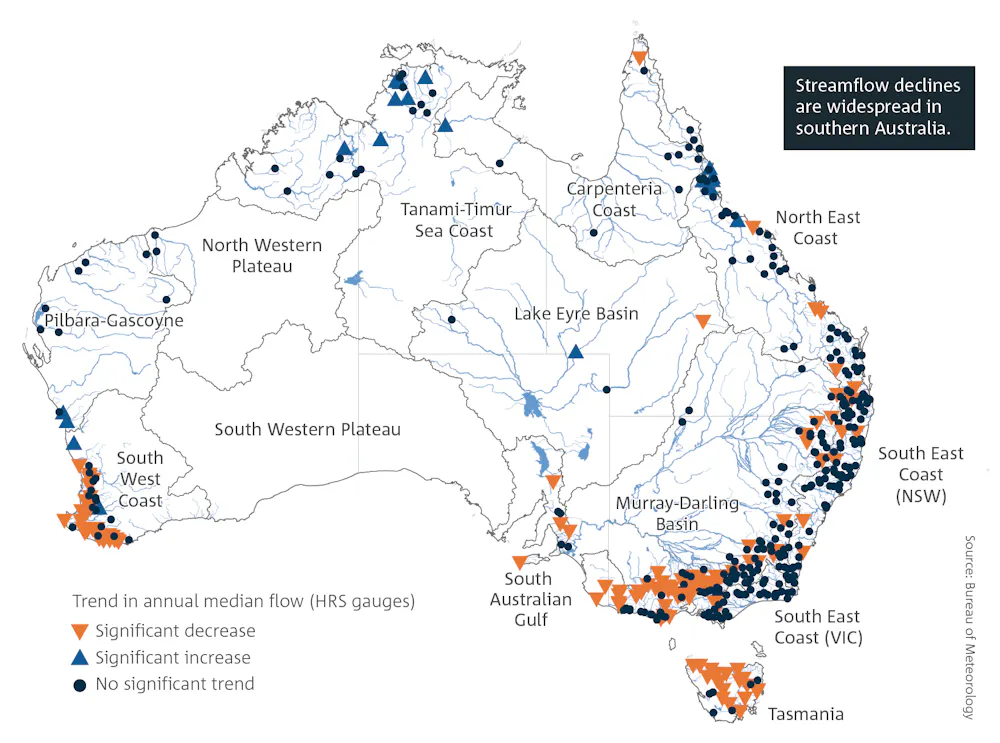
    These changes are also reflected in our rivers, with significantly lower flows for about one third of the gauges in the south. Australia-wide, only 4% of our river gauges are measuring increased flows, and almost all of these are in the north.

    Flows are declining in most rivers in Australia’s south due in part to reduced rainfall, while most rivers in the north are seeing increased flows linked to higher rainfall. This map shows trends in annual median streamflow from available river gauge data in the 1970−2023 period.
    CSIRO/Bureau of Meteorology, CC BY-NC-ND

    Hotter oceans, rising seas

    Almost all (90%) of the extra heat trapped by greenhouse gases has gone into the oceans. Oceans are getting rapidly hotter. This matters because ocean heat strongly influences weather patterns in Australia.

    Australia’s oceans are warming faster than the global average. But the oceans off south-east Australia and the Tasman Sea are a particular hotspot and are now warming at twice the global average.

    As the seas warm, they expand. This thermal expansion is one of the main contributors to rising sea levels. Around Australia, sea levels have risen 22 centimetres since 1900 – with half of that since 1970.

    More emissions equals more heat

    Avoiding the worst damage from climate change is conceptually simple and unequivocal: rapidly reduce greenhouse gases in the atmosphere will help Australia meet its net zero 2050 target.

    Tasmania’s northwest tip has some of the cleanest air in the world, which is why it was chosen to host the Kennaook/Cape Grim Baseline Air Pollution Station. For 48 years, this station has been recording concentrations of greenhouse gases. The picture it captures is stark.

    Carbon dioxide (CO₂) concentrations are now about 51% higher than pre-industrial levels, while concentrations of methane and nitrous oxide, both strong greenhouse gases, continue to increase. Their rate of atmospheric accumulation has rapidly increased in recent years even as some regions and some sources have begun to see emissions slow or even decline, such as reduced CO₂ emissions from land clearing, globally and in Australia.

    Global CO₂ emissions from fossil fuel use have been increasing since the beginning of the Industrial Revolution, and increased by 1.1% from 2022 to 2023, reaching the highest annual level ever recorded.

    The warming has led to an increase in the frequency of extreme heat events over land and in the oceans.
    Leah-Anne Thompson, Shutterstock

    Australia’s carbon contribution

    This year, the State of the Climate report for the first time quantifies Australia’s major human and natural carbon sources and sinks and how they contribute to global CO₂ levels.

    It shows the average annual carbon content embedded in Australia’s fossil fuel exports between 2010 and 2019 (1,055 megatonnes) was more than double the average annual national carbon emissions over the same period (455 Mt). However, the emissions of these carbon exports are accounted in the countries where the fossil fuels are used.

    It also demonstrates the importance of maintaining the integrity of our natural land ecosystems. Ecosystems are Australia’s most important carbon sinks, but their effectiveness as sinks depends on factors including the future evolution of the climate and how it will affect rainfall and wildfire regimes.

    Australia’s Carbon Budget 2010-2019. A product of the National Environmental Science Program – Climate Systems Hub; and a contribution to the Global Carbon Project – Regional Carbon Cycle Assessment and Processes-2.
    Source: NESP-2

    What lies ahead for Australia?

    Australia’s warming is expected to continue, which will lead to more extreme heat events, lower rainfall in some regions, and longer droughts.

    We can expect to see more intense rainfall events, even in regions where average rainfall falls or stays the same.

    Sudden intense rains make flooding more likely, especially in urban areas where concrete and tarmac prevent the ground from soaking up excess water and in low-lying coastal areas where rising sea levels amplify damage from other climate hazards.

    Climate change is already here. Through multiple lines of data and evidence, we have tracked what it is doing to make Australia hotter, more prone to floods and fires, and cutting river flows in the south where most of us live.

    If warming continues, these trends will get worse over time. Understanding these changes and the impacts to Australia will help manage climate risk, now and in the decades to come.

    Blair Trewin, Senior Research Scientist at the Bureau of Meteorology, contributed to this article

    Pep Canadell receives funding from the National Environmental Science Program – Climate Systems Hub

    Neil Sims does not work for, consult, own shares in or receive funding from any company or organisation that would benefit from this article, and has disclosed no relevant affiliations beyond their academic appointment.

    ref. State of the Climate 2024: Australia is enduring harsher fire seasons, more ocean heatwaves and sea-level rise – https://theconversation.com/state-of-the-climate-2024-australia-is-enduring-harsher-fire-seasons-more-ocean-heatwaves-and-sea-level-rise-242191

    MIL OSI AnalysisEveningReport.nz

  • MIL-Evening Report: Earth’s climate will keep changing long after humanity hits net-zero emissions. Our research shows why

    Source: The Conversation (Au and NZ) – By Andrew King, Senior Lecturer in Climate Science, The University of Melbourne

    Shutterstock

    The world is striving to reach net-zero emissions as we try to ward off dangerous global warming. But will getting to net-zero actually avert climate instability, as many assume?

    Our new study examined that question. Alarmingly, we found reaching net-zero in the next few decades will not bring an immediate end to the global heating problem. Earth’s climate will change for many centuries to come.

    And this continuing climate change will not be evenly spread. Australia would keep warming more than almost any other land area. For example if net-zero emissions are reached by 2060, the Australian city of Melbourne is still predicted to warm by 1°C after that point.

    But that’s not to say the world shouldn’t push to reach net-zero emissions as quickly as possible. The sooner we get there, the less damaging change the planet will experience in the long run.

    New research examines if climate change will stop once the world reaches net-zero emissions.
    Shutterstock

    Reaching net-zero is vital

    Global greenhouse gas emissions hit record highs in 2023. At the same time, Earth experienced its hottest year.

    Analysis suggests emissions may peak in the next couple of years then start to fall. But as long as emissions remain substantial, the planet will keep warming.

    Most of the world’s nations, including Australia, have signed up to the Paris climate agreement. The deal aims to keep global warming well below 2°C, and requires major emitters to reach net-zero as soon as possible. Australia, along with many other nations, is aiming to reach the goal by 2050.

    Getting to net-zero essentially means nations must reduce human-caused greenhouse gas emissions as much as possible, and compensate for remaining emissions by removing greenhouse gases from the atmosphere elsewhere. Methods for doing this include planting additional vegetation to draw down and store carbon, or using technology to suck carbon out of the air.

    Getting to net-zero is widely considered the point at which global warming will stop. But is that assumption correct? And does it mean warming would stop everywhere across the planet? Our research sought to find out.

    Centuries of change

    Computer models simulating Earth’s climate under different scenarios are an important tool for climate scientists. Our research used a model known as the Australian Community Climate and Earth System Simulator.

    Such models are like lab experiments for climate scientists to test ideas. Models are fed with information about greenhouse gas emissions. They then use equations to predict how those emissions would affect the movement of air and the ocean, and the transfer of carbon and heat, across Earth over time.

    We wanted to see what would happen once the world hit net-zero carbon dioxide at various points in time, and maintained it for 1,000 years.

    We ran seven simulations from different start points in the 21st century, at five-year increments from 2030 to 2060. These staggered simulations allowed us to measure the effect of various delays in reaching net-zero.

    We found Earth’s climate would continue to evolve under all simulations, even if net-zero emissions was maintained for 1,000 years. But importantly, the later net-zero is reached, the larger the climate changes Earth would experience.

    Warming oceans and melting ice

    Earth’s average temperature across land and sea is the main indicator of climate change. So we looked at that first.

    We found this temperature would continue to rise slowly under net-zero emissions – albeit at a much slower rate than we see today. Most warming would take place on the ocean surface; average temperature on land would only change a little.

    We also looked at temperatures below the ocean surface. There, the ocean would warm strongly even under net-zero emissions – and this continues for many centuries. This is because seawater absorbs a lot of energy before warming up, which means some ocean warming is inevitable even after emissions fall.

    Over the last few decades of high greenhouse gas emissions, sea ice extent fell in the Arctic – and more recently, around Antarctica. Under net-zero emissions, we anticipate Arctic sea ice extent would stabilise but not recover.

    In contrast, Antarctic sea ice extent is projected to fall under net-zero emissions for many centuries. This is associated with continued slow warming of the Southern Ocean around Antarctica.

    Importantly, we found long-term impacts on the climate worsen the later we reach net-zero emissions. Even just a five-year delay would affect on the projected climate 1,000 years later.

    Delaying net-zero by five years results in a higher global average surface temperature, a much warmer ocean and reduced sea ice extent for many centuries.

    Australia’s evolving climate

    The effect on the climate of reaching net-zero emissions differs across the world.

    For example, Australia is close to the Southern Ocean, which is projected to continue warming for many centuries even under net-zero emissions. This warming to Australia’s south means even under a net-zero emissions pathway, we expect the continent to continue to warm more than almost all other land areas on Earth.

    For example, the models predict Melbourne would experience 1°C of warming over centuries if net-zero was reached in 2060.

    Spell out GMST (global mean surface temperature?) in chart? Is listed as global average in caption??

    Net-zero would also lead to changes in rainfall in Australia. Winter rainfall across the continent would increase – a trend in contrast to drying currently underway in parts of Australia, particularly in the southwest and southeast.

    Knowns and unknowns

    There is much more to discover about how the climate might behave under net-zero.

    But our analysis provides some clues about what climate changes to expect if humanity struggles to achieve large-scale “net-negative” emissions – that is, removing carbon from the atmosphere at a greater rate than it is emitted.

    Experiments with more models will help improve scientists’ understanding of climate change beyond net-zero emissions. These simulations may include scenarios in which carbon removal methods are so successful, Earth actually cools and some climate changes are reversed.

    Despite the unknowns, one thing is very clear: there is a pressing need to push for net-zero emissions as fast as possible.

    Andrew King receives funding from the ARC Centre of Excellence for 21st Century Weather and the National Environmental Science Program.

    Tilo Ziehn receives funding from the ARC Centre of Excellence for 21st Century Weather and the National Environmental Science Program.

    ref. Earth’s climate will keep changing long after humanity hits net-zero emissions. Our research shows why – https://theconversation.com/earths-climate-will-keep-changing-long-after-humanity-hits-net-zero-emissions-our-research-shows-why-241692

    MIL OSI AnalysisEveningReport.nz

  • MIL-Evening Report: 215 million hectares of forest – an area bigger than Mexico – could grow back by itself, if we can just leave it alone

    Source: The Conversation (Au and NZ) – By Brooke Williams, Research Fellow, School of Biology & Environmental Science, Queensland University of Technology

    Gustavo Frazao/Shutterstock

    About 215 million hectares of land – an area bigger than Mexico – could be reforested naturally and without costly manual planting, our new research shows.

    This would allow us to offset around 23.4 gigatonnes of global carbon emissions over the next three decades. That’s about 50 years worth of Australia’s carbon emissions (assuming 2023 emission rates continue).

    Extensive and effective forest restoration is crucial to mitigating climate change and conserving biodiversity.

    It’s vital we find cost-effective ways to get and keep more trees in the ground. One way to do this is just to let forests grow back by themselves. However, this isn’t possible in all deforested lands, as certain environmental conditions are needed for this approach to work.

    Our research identified land where this approach had strong potential.

    Allowing forests to grow back naturally in deforested areas, such as this degraded land in Brazil, could be more cost-effective than manual reforestation projects.
    Author provided

    The benefits of natural regeneration

    Globally, 65% of original tropical forest extent has been lost to make way for human development such as agriculture, roads, and urbanisation. Deforestation has contributed to climate change and biodiversity loss.

    We’ve also lost a worrying amount of what researchers call “ecosystem services”, meaning the benefits people derive from nature, such as clean water.

    Forest restoration is an important strategy for reversing the damage.

    Our paper, published in the journal Nature, looked at where natural regeneration is likely to be successful due to the surrounding environmental conditions.

    Natural regeneration is important because it is sometimes better than manual tree planting, which includes the costs of saplings, manual labour, fertilisation and maintenance.

    Using manual techniques in degraded landscapes can be expensive. It can also be less effective in terms of native biodiversity recovery and keeping water systems functioning well.

    Natural regeneration is a less costly alternative. That means allowing forests to grow back on their own or with carefully planned human intervention.

    For example, natural reforestation may cost between $US12 and $3,880 per hectare. By contrast, active regeneration methods in the tropics would cost between $105 and $25,830 per hectare.

    Natural regeneration restoration methods often have better long-term success and biodiversity outcomes than full manual tree-planting.

    Studies have found that biodiversity “success” – meaning richer biodiversity and more species – can be up to 56% higher when natural regeneration approaches were used (rather than manual planting projects).

    It’s vital we find cost-effective ways to get and keep more trees in the ground.
    Richard Whitcombe/Shutterstock

    Where might natural reforestation projects succeed?

    Until now, it’s not always been clear how to predict areas where natural regeneration is most likely to occur. That’s made it hard to do large-scale natural regeneration projects.

    Our research addresses this gap. We identified the best areas to roll out natural approaches in the tropics.

    We focused on tropical forested regions because they are particularly important.

    Their biodiversity is unparalleled and they provide vast economic, cultural, and recreational services to people.

    They also grow much faster than other forest types, and many large tropical forests have already been cleared and degraded.

    Factors that make a forest likely to regenerate naturally include:

    • the amount of surrounding forest
    • distance to existing forest and
    • soil organic carbon content

    This suggests areas with higher levels of landscape degradation and intensive land uses would be less likely to regenerate naturally.

    We found suitable environmental conditions for natural regeneration occur across:

    • 98 million hectares in the Neotropics (which includes many areas in South and Central America)

    • 90 million hectares in the Indomalayan tropics (which includes many areas in Southeast Asia, Malaysia, and India)

    • 25.5 million hectares in the continent of Africa

    Up to 52% of this natural regeneration could occur in just five countries: Brazil, Indonesia, China, Mexico, and Colombia.

    This suggests these countries would be excellent candidates for large scale natural regeneration projects.

    We also found that 29 other countries have at least one million hectares each that could be naturally reforested.

    We identified 400,000 hectares of deforested lands with potential for natural forest regeneration in the Australian tropics.

    Fixing forests will also improve biodiversity.
    Martin Prochazkacz/Shutterstock

    The world has committed to fixing forests

    The world has committed to ambitious forest restoration targets in order to substantially increase the area of forest ecosystems by 2050.

    These commitments include the Bonn Challenge, which aims to restore 350 million hectares by 2030.

    Another is Target 2 of the recently adopted Global Biodiversity Framework, which calls for 30% of the area of degraded ecosystems to be restored by 2030.

    Achieving these targets, especially for nations with emerging economies, will not be possible using active restoration techniques alone. This due to cost and feasibility constraints.

    To assist with this global task, we have made our dataset publicly available and free to use.

    Local communities at the centre

    Encouraging natural regeneration remains a major challenge, particularly on privately held and communally managed land because it can mean reduced land available for other uses.

    Providing local people with training and support to grow, harvest and market products sourced from naturally regenerating forests is also crucial. This could help keep young naturally regenerating forests standing and growing.

    This income could supplement or replace payments landowners and local people currently receive to look after land and prevent it from being deforested. Payment-based approaches are not always sustainable in the long term.

    Currently, many forests are controlled and managed by central or national governments. Giving local and Indigenous communities control over their forests would help encourage restoration that meets local needs.

    However, this requires appropriate technical support and monitoring.

    Importantly, our analysis does not define where restoration activities should or should not occur. We only show where natural forest regeneration is possible or more likely to succeed.

    We echo calls to ensure restoration occurs as equitably as possible, and foregrounds the needs of local people.

    Forest restoration should be as equitable as possible, and foreground the needs of local people.
    WNDR Worlds/Shutterstock

    Let’s give it a chance

    Natural forest regeneration presents an opportunity to restore vast areas of forest cheaply and effectively. It can help mitigate the effects of climate change and help countries meet their emissions reduction targets.

    Other benefits include conserving biodiversity, regulating water resources, reducing erosion, and making ecosystems more resilient.

    Recognising the massive regeneration capacity of tropical forests is key.

    It’s also crucial it occurs alongside protecting intact forests, and reducing deforestation.

    Robin Chazdon is the global co-director of the Assisted Natural Regeneration Alliance. She is a senior fellow with the World Resources Institute’s Global Restoration Initiative.

    Brooke Williams does not work for, consult, own shares in or receive funding from any company or organisation that would benefit from this article, and has disclosed no relevant affiliations beyond their academic appointment.

    ref. 215 million hectares of forest – an area bigger than Mexico – could grow back by itself, if we can just leave it alone – https://theconversation.com/215-million-hectares-of-forest-an-area-bigger-than-mexico-could-grow-back-by-itself-if-we-can-just-leave-it-alone-236696

    MIL OSI AnalysisEveningReport.nz

  • MIL-Evening Report: The UN warns famine is likely in Gaza. What do malnutrition and hunger do to the body?

    Source: The Conversation (Au and NZ) – By Clare Dix, Lecturer In Nutrition & Dietetics, University of the Sunshine Coast

    Anas-Mohammed/Shutterstock

    The risk of famine looms in Gaza. International monitors warn more than 90% of the population face acute food insecurity, meaning their inability to eat enough food puts them in immediate danger of starvation. The number experiencing “catastrophic” hunger is set to double in the coming months.

    Israel has been accused of deliberately blocking humanitarian aid, including food. In September, deliveries of food and aid to Gaza fell to their lowest in seven months after Israel introduced new customs rules.


    Read more:
    Gaza: weaponisation of food has been used in conflicts for centuries – but it hasn’t always resulted in victory


    The World Health Organization has repeatedly warned about the consequences of hunger and food insecurity in the region, including the impact on rising infection rates and increased child mortality.

    The scale of this humanitarian crisis could be overwhelming, as extreme hunger threatens to engulf an entire population – nearly half of which are children.

    What does hunger mean for people’s health – especially children – at the individual level? And will survivors be able to recover from the damage?

    Who is most at risk?

    Food shortages mean people not only eat less overall but can miss out on essential nutrients.

    This can lead to severe acute malnutrition. In children, this means measurable negative effects on bodily functions and growth, including weight and muscle loss.

    Some people will experience the effects of starvation more rapidly. Those most at risk have low stores of energy and protein, and/or higher nutritional needs for growth and development. They include the elderly, infants, children, and women who are pregnant or breastfeeding.

    Childhood nutrition is critical

    From a nutritional viewpoint, the first 1,000 days of life are a critical window for growth and development.

    During this time, the microbiome (the bacteria that live in our digestive system) develops and is influenced by external factors such as diet, and exposure to microbes and pollutants, which shape how the body and immune system function.

    Severe acute malnutrition has several short-term impacts. Malnourished children have reduced immunity, meaning they are less able to fight infections – such as E.coli – partly due to changes to their microbiome. This makes them more vulnerable to contaminated food and water.

    Bacterial infection is a leading cause of death for children with severe acute malnutrition.

    Israel has destroyed around two-thirds of Gaza’s water systems, according to UNICEF, forcing children to drink unsafe water and increasing their exposure to sewage and waterborne diseases.


    Read more:
    Polio in Gaza: what does this mean for the region and the world?


    Long-term impacts of malnutrition

    The effects of malnutrition and starvation during childhood continue into adulthood. Those who survive have a higher risk of developing chronic diseases, including diabetes, high blood pressure and metabolic syndrome (a cluster of conditions that can increase your risk for heart disease and stroke).

    Damage to the gut lining can also cause long-term inflammation. This may make it harder to absorb nutrients, increase the risk of bacterial imbalances, and stop the pancreas and liver working properly.

    Muscle loss and changes in electrolytes can also impact the heart, increasing the risk of arrhythmia (irregular heartbeat).

    What about the brain?

    Malnutrition can harm brain development in children. It can reduce brain size and slow growth, potentially impairing function and memory.

    Impacts on how the brain develops could affect cognition, behaviour and reduce academic achievement.

    More research is needed to understand how malnutrition during childhood affects mental health. But studies suggest it may be linked to personality disorders, attention deficits, lower self-esteem and reduced quality of life.

    For children in Gaza, these harms will likely be compounded by trauma and displacement.

    Impact during pregnancy

    Malnutrition can also affect the health of unborn babies. Famine and food shortages in Gaza mean pregnant women are not getting enough folate, iron, vitamin B12 and iodine. These nutrients are crucial to ensure their baby’s healthy delivery and reduce long-term health impacts.

    Nutritional deficiencies for the mother during pregnancy can increase the baby’s risk of clinical obesity, type 2 diabetes and metabolic syndrome.

    Although less well-studied, there is also evidence a father’s diet, health, sperm quantity and quality can have similar health impacts on their offspring.

    How is severe acute malnutrition treated?

    Severely malnourished people need nutritional rehabilitation. This involves slowly increasing nutrient intake – by around 25% above normal requirements – and eating high-quality, protein-rich foods, essential fatty acids, vitamins and minerals.

    During the initial treatment phase children may need to be hospitalised. One concern is refeeding syndrome, a condition where sudden availability of glucose can cause rapid changes in electrolytes. In extreme cases, this can cause heart failure. Researchers are also investigating how to restore the microbiome of malnourished children.

    But access to adequate treatment is not assured, given the widespread damage to Gaza’s hospital system.

    Unfortunately successful treatment doesn’t guarantee survival. Lasting impacts of severe acute malnutrition are linked to high rates of disease and early death, even after treatment. Studies suggest up to 10.4% of children successfully treated in hospitals do not survive 12 months after they’re discharged.

    The devastating social and food conditions in Gaza are unimaginable to those of us living in other parts of the world. With no end in sight, the impact of food insecurity and lack of humanitarian aid can only lead to an escalation of the rates of malnutrition and diseases in those most vulnerable.

    The long-term consequences for Palestinians will be felt for generations to come.

    Clare Dix has received funding from the Australian Department of Health and Aged Care.

    Helen Truby receives funding from the Commonwealth Department of Health and Ageing, the MRFF, the NHMRC and various philanthropic agencies.

    ref. The UN warns famine is likely in Gaza. What do malnutrition and hunger do to the body? – https://theconversation.com/the-un-warns-famine-is-likely-in-gaza-what-do-malnutrition-and-hunger-do-to-the-body-241682

    MIL OSI AnalysisEveningReport.nz

  • MIL-Evening Report: How light can shift your mood and mental health

    Source: The Conversation (Au and NZ) – By Jacob Crouse, Research Fellow in Youth Mental Health, Brain and Mind Centre, University of Sydney

    llaszlo/Shutterstock

    This is the next article in our ‘Light and health’ series, where we look at how light affects our physical and mental health in sometimes surprising ways. Read other articles in the series.


    It’s spring and you’ve probably noticed a change in when the Sun rises and sets. But have you also noticed a change in your mood?

    We’ve known for a while that light plays a role in our wellbeing. Many of us tend to feel more positive when spring returns.

    But for others, big changes in light, such as at the start of spring, can be tough. And for many, bright light at night can be a problem. Here’s what’s going on.

    An ancient rhythm of light and mood

    In an earlier article in our series, we learned that light shining on the back of the eye sends “timing signals” to the brain and the master clock of the circadian system. This clock coordinates our daily (circadian) rhythms.

    “Clock genes” also regulate circadian rhythms. These genes control the timing of when many other genes turn on and off during the 24-hour, light-dark cycle.

    But how is this all linked with our mood and mental health?

    Circadian rhythms can be disrupted. This can happen if there are problems with how the body clock develops or functions, or if someone is routinely exposed to bright light at night.

    When circadian disruption happens, it increases the risk of certain mental disorders. These include bipolar disorder and atypical depression (a type of depression when someone is extra sleepy and has problems with their energy and metabolism).

    Light on the brain

    Light may also affect circuits in the brain that control mood, as animal studies show.

    There’s evidence this happens in humans. A brain-imaging study showed exposure to bright light in the daytime while inside the scanner changed the activity of a brain region involved in mood and alertness.

    Another brain-imaging study found a link between daily exposure to sunlight and how the neurotransmitter (or chemical messenger) serotonin binds to receptors in the brain. We see alterations in serotonin binding in several mental disorders, including depression.

    Our mood can lift in sunlight for a number of reasons, related to our genes, brain and hormones.
    New Africa/Shutterstock

    What happens when the seasons change?

    Light can also affect mood and mental health as the seasons change. During autumn and winter, symptoms such as low mood and fatigue can develop. But often, once spring and summer come round, these symptoms go away. This is called “seasonality” or, when severe, “seasonal affective disorder”.

    What is less well known is that for other people, the change to spring and summer (when there is more light) can also come with a change in mood and mental health. Some people experience increases in energy and the drive to be active. This is positive for some but can be seriously destabilising for others. This too is an example of seasonality.

    Most people aren’t very seasonal. But for those who are, seasonality has a genetic component. Relatives of people with seasonal affective disorder are more likely to also experience seasonality.

    Seasonality is also more common in conditions such as bipolar disorder. For many people with such conditions, the shift into shorter day-lengths during winter can trigger a depressive episode.

    Counterintuitively, the longer day-lengths in spring and summer can also destabilise people with bipolar disorder into an “activated” state where energy and activity are in overdrive, and symptoms are harder to manage. So, seasonality can be serious.

    Alexis Hutcheon, who experiences seasonality and helped write this article, told us:

    […] the season change is like preparing for battle – I never know what’s coming, and I rarely come out unscathed. I’ve experienced both hypomanic and depressive episodes triggered by the season change, but regardless of whether I’m on the ‘up’ or the ‘down’, the one constant is that I can’t sleep. To manage, I try to stick to a strict routine, tweak medication, maximise my exposure to light, and always stay tuned in to those subtle shifts in mood. It’s a time of heightened awareness and trying to stay one step ahead.

    So what’s going on in the brain?

    One explanation for what’s going on in the brain when mental health fluctuates with the change in seasons relates to the neurotransmitters serotonin and dopamine.

    Serotonin helps regulate mood and is the target of many antidepressants. There is some evidence of seasonal changes in serotonin levels, potentially being lower in winter.

    Dopamine is a neurotransmitter involved in reward, motivation and movement, and is also a target of some antidepressants. Levels of dopamine may also change with the seasons.

    But the neuroscience of seasonality is a developing area and more research is needed to know what’s going on in the brain.

    How about bright light at night?

    We know exposure to bright light at night (for instance, if someone is up all night) can disturb someone’s circadian rhythms.

    This type of circadian rhythm disturbance is associated with higher rates of symptoms including self-harm, depressive and anxiety symptoms, and lower wellbeing. It is also associated with higher rates of mental disorders, such as major depression, bipolar disorder, psychotic disorders and post-traumatic stress disorder (or PTSD).

    Why is this? Bright light at night confuses and destabilises the body clock. It disrupts the rhythmic regulation of mood, cognition, appetite, metabolism and many other mental processes.

    But people differ hugely in their sensitivity to light. While still a hypothesis, people who are most sensitive to light may be the most vulnerable to body clock disturbances caused by bright light at night, which then leads to a higher risk of mental health problems.

    Bright light at night disrupts your body clock, putting you at greater risk of mental health issues.
    Ollyy/Shutterstock

    Where to from here?

    Learning about light will help people better manage their mental health conditions.

    By encouraging people to better align their lives to the light-dark cycle (to stabilise their body clock) we may also help prevent conditions such as depression and bipolar disorder emerging in the first place.

    Healthy light behaviours – avoiding light at night and seeking light during the day – are good for everyone. But they might be especially helpful for people at risk of mental health problems. These include people with a family history of mental health problems or people who are night owls (late sleepers and late risers), who are more at risk of body clock disturbances.


    Alexis Hutcheon has lived experience of a mental health condition and helped write this article.

    If this article has raised issues for you, or if you’re concerned about someone you know, call Lifeline on 13 11 14.

    Jacob Crouse receives funding from Wellcome Trust and National Health and Medical Research Council.

    Professor Hickie is a Professor of Psychiatry and the Co-Director of Health and Policy, Brain and
    Mind Centre, University of Sydney. He has led major public health and health service development
    in Australia, particularly focusing on early intervention for young people with depression, suicidal
    thoughts and behaviours and complex mood disorders. He is active in the development through
    codesign, implementation and continuous evaluation of new health information and personal
    monitoring technologies to drive highly-personalised and measurement-based care. He holds a 3.2%
    equity share in Innowell Pty Ltd that is focused on digital transformation of mental health services.

    Emiliana Tonini does not work for, consult, own shares in or receive funding from any company or organisation that would benefit from this article, and has disclosed no relevant affiliations beyond their academic appointment.

    ref. How light can shift your mood and mental health – https://theconversation.com/how-light-can-shift-your-mood-and-mental-health-231282

    MIL OSI AnalysisEveningReport.nz

  • MIL-OSI New Zealand: Global privacy authorities issue follow-up joint statement on data scraping after industry engagement

    Source: Privacy Commissioner

    OPC and several global counterparts are highlighting how social media companies can better protect personal information, as concerns grow about mass scraping of personal information within social media platforms, including to support artificial intelligence systems.

    Mass data scraping poses significant risks to individuals fundamental right to privacy, said Canadian Commissioner Philippe Dufresne. Personal information, even when it is publicly accessible, is subject to privacy laws and must be adequately protected. This initiative highlights the importance of collaboration between data protection authorities and with industry.

    Commissioner Dufresne, New Zealand Privacy Commissioner Michael Webster and their counterparts engaged with some of the worlds largest social media companies after issuing a joint statement on data scraping last year. As a result of this engagement, they have now issued a follow-up statement laying out additional takeaways for industry.

    MIL OSI New Zealand News

  • MIL-OSI New Zealand: Sudan – Over 2.8 million children under five forced from their home across Sudan – Save the Children

    Source: Save the Children

    More than 2.8 million babies, toddlers and preschoolers are now displaced across Sudan, said Save the Children, with new figures released by the IOM showing the world’s largest displacement crisis is rapidly deteriorating for children.
    About 11 million people in Sudan – or 30% of the population – have been forced from their homes, including those displaced before and since the most recent conflict escalated in April 2023. The numbers have risen by 200,000 in the last month alone, with more than 45,000 people displaced in Al Jazirah state including 27,000 children in the past seven days [1].
    New figures reveal over half of the 11 million displaced – or 5.8 million – are children under 18, and over one quarter – or 2.8 million – are children aged under five [2]. These small children are uniquely vulnerable, and while displaced many will miss out on early childhood essentials – including vaccinations, clean water, healthcare, nutritious food, and shelter from extreme heat and cold.
    While about half of these children are now living in host communities, the remaining half are living in desperate conditions, with 18% in displacement camps, 16% in informal settlements or out in the open, and 9% in cramped schools or other public buildings. Many of these children are sharing their space with adults they don’t know, and have limited or no access to water and sanitation.
    Girls are particularly at risk, with over 3.2 million of the displaced children girls under 18, who face particular threats of sexual violence, rape, or early or forced marriage.
    Red Sea state in the country’s east has the highest proportion of displaced children, with children making up 60% of all displaced people, followed by Central Darfur with 57%. More than a third of those children and families now displaced in Sudan are from the capital Khartoum, which has witnessed some of the fiercest fighting of the conflict, followed by South Darfur (19%) and North Darfur (15%).
    Mohamed Abdiladif, Interim Country Director for Save the Children in Sudan, said:
    “Babies, toddlers, preschoolers – millions of the world’s most vulnerable people are currently living in some of the world’s worst conditions. The world has a duty of care for children and we are failing them.
    “When people are forced to flee their homes due to violence, it’s usually the women and. children who go first – and we often see displacement camps filled with children. But the number of children displaced in Sudan – and in particular, their young age and vulnerability – is staggering.
    “The situation in Sudan is spiralling out of control and every day more and more lives are put at risk with killings, violence and displacement. This has become one of the world’s most devastating humanitarian crisis but the world is not taking notice.
    “In the past week alone at least 10 children have been killed , including children as young as 10, and at least 43 children injured in Al Jazirah state. The UN has reported girls as young as 13 subjected to rape and sexual assault. We have also heard reports of children being detained, the widespread destruction of homes, and massive displacement, with families walking for days to reach safety.
    “We are urgently calling on the international community to take meaningful and urgent political action to address this crisis, for an immediate ceasefire and progress towards a lasting peace agreement.”
    Save the Children has worked in Sudan since 1983 and is currently supporting children and their families across Sudan providing health, nutrition, education, child protection and food security and livelihoods support. Save the Children is also supporting refugees from Sudan in Egypt and South Sudan.
    Notes
    [1] On 28 October, UNICEF reported more than 9,000 households, including over 45,000 people, were forced from their homes in Tamboul and its surrounding villages between 20 and 27 October 2024. A calculation of a household includes 2 adults and 3 children, thus 27,000 children displaced.
    [2] Figures from Sudan Mobility Update 29 October 2024 https://dtm.iom.int/reports/dtm-sudan-mobility-update-10

    MIL OSI New Zealand News

  • MIL-OSI USA: Cambodia stops publishing details of new citizenships issued to foreigners – The Straits Times

    Source: United States Institute of Peace

    SINGAPORE – Cambodia has stopped publishing data on new citizenships issued by the kingdom to foreigners, in the wake of the $3 billion money laundering probe in Singapore.

    Checks by The Straits Times and investigative journalism group, Organised Crime and Corruption Reporting Project (OCCRP), showed that the last time new citizenship details were published was in February.

    The latest Royal Gazette, published on Sept 27, did not contain any new citizenship data.

    Observers had zoomed in on the ease of access to Cambodian citizenship and passports after it emerged that nine of the 10 foreigners arrested in August 2023 in the probe in Singapore held Cambodian passports.

    All 10 were originally from China, which does not recognise dual citizenship.

    In 2018, Cambodia moved to allow foreign immigrants to request citizenship through the naturalisation process.

    To be granted citizenship, foreigners have to maintain good behaviour and morality, and have no convictions for serious crime.

    They must also legally reside in Cambodia for more than seven years, be able to speak Khmer, and understand the local culture and history.

    Of the nine foreigners apprehended in Singapore, at least five were convicted for online gambling or were wanted by the authorities in China.

    They are Wang Dehai, Vang Shuiming, Su Jianfeng, Chen Qingyuan and Su Wenqiang.

    Another 17 associates of the 10 foreigners held Cambodian passports as well.

    They include Su Binghai, Su Yongcan, Wang Huoqiang, Su Shuiming, Su Shuijun, Su Fuxiang and Chen Mulin.

    Cambodia had averaged around 50 new citizens every month between January 2020 and August 2023, with details published monthly in the Royal Gazette.

    After the raids in Singapore, the kingdom granted citizenship status to only four individuals in total between September 2023 and December 2023.

    A representative from the Royal Embassy of Cambodia in Singapore told ST on Sept 18 that it could not confirm the figures as it does not have access to the data.

    The representative added that he was unable to confirm if Cambodia’s citizenship by investment scheme, or naturalisation process, is still in place.

    ST had also reached out to government spokesman Pen Bona, the Prime Minister’s spokesman Meas Sophorn, the office of the council of ministers, and Cambodia’s immigration office.

    Established in 1996, the kingdom’s law on nationality also allows foreigners to obtain citizenship through investment in the nation.

    Under the law, foreigners who invest a minimum of US$300,000 (S$384,000) in the country, or donate at least US$250,000 to the economy, will have the right to apply for citizenship.

    Mr Jacob Sims, a visiting expert on transnational crime at the United States Institute of Peace, told ST that for years, Cambodia’s citizenship for investment scheme has served as a channel for individuals from sophisticated organised crime syndicates to migrate.

    Said Mr Sims: “The removal of that data from the public record helps to obscure the nature of the relationship between Cambodian state actions and those criminals, as well as the sheer volume of monied crime actors Cambodia has absorbed in recent years.”

    By removing the once publicly available data, Cambodia can protect those who have purchased citizenship while shielding the government from international scrutiny, he said.

    Associate Professor Kristin Surak from the London School of Economics and Political Science said that not all countries strictly vet citizenship by investment applications.

    She added: “I would say the scheme is very easy to exploit in Cambodia because the government does not do its due diligence. It has issues with corruption and does not have an effective bureaucratic process to ensure applications are properly checked and vetted.”

    Name changes have also made it harder for the authorities to track criminals.

    Dr Surak, the author of The Golden Passport: Global Mobility For Millionaires, pointed out that many applicants in the past have changed their names.

    “This makes it extremely easy for someone to take on a new identity, making Cambodia a target for those with criminal intent to take advantage of,” she added.

    One such example is casino kingpin She Zhijiang. ST previously reported on She and his links to scam operations in Myanmar and Cambodia.

    She, who was originally from China, became a naturalised citizen of Cambodia in 2017. He then changed his name to Tang Kriang Kai.

    He was arrested in Thailand in August 2022 and is currently fighting deportation to China.

    Businessman David Yong, chief executive of Evergreen Group Holdings, had similarly obtained Cambodian citizenship.

    Yong, who is currently facing four charges in Singapore of falsifying accounts, obtained Cambodian citizenship some time in 2023 and changed his name to Duong Dara.

    He was arrested on Aug 1, just three months after he appeared in Netflix series Super Rich In Korea.

    Yong’s lawyer said in court that he had surrendered his Cambodian passport to the authorities in Phnom Penh in June 2024.

    In response, the authorities in Singapore said they wrote several times to their Cambodian counterparts in August to confirm the fact, but have yet to receive any reply.

    Of the 10 foreigners convicted in Singapore’s largest money laundering case, eight were deported to Cambodia – which has an extradition treaty with China.

    Wang Dehai was deported to the UK, while Vang Shuiming was deported to Japan.

    MIL OSI USA News

  • MIL-OSI Submissions: Research – Great Place To Work® Releases Study On Workplace Well-being With Johns Hopkins University

    Source: Great Place To Work®

    Great Place To Work® Releases Study On Workplace Well-being With Johns Hopkins University In Critical Areas Of Mental And Emotional Support, Teamwork, Psychological Safety And Finance Stability

    Singapore, 30 October 2024 – Great Place To Work® Singapore marked its 10th anniversary at its Best Workplaces in Singapore 2024 event with the release of the Great is Possible: Charting a Decade of Progress in Singapore Workplaces (2015-2024) insights report. The report highlights the transformation of Singapore’s workplaces over the past decade, with a special focus on well-being and mental health. This year’s event also introduced the new Legends category, honouring organisations that have consistently made the Best Workplaces list for five or more consecutive years.

    Held at The Ritz-Carlton, the milestone celebration was graced by Deputy Prime Minister Heng Swee Keat and attended by close to 420 guests, including business leaders and employees from Great Place To Work Certified companies.

    Michael C. Bush, Chief Executive Officer of Great Place To Work®, giving his keynote address at the 10th Anniversary of Best Workplaces in Singapore / Great Place to Work® Singapore.

    A Decade of Change in Singapore’s Workplaces

    Over the past ten years, Great Place To Work has led the way in understanding what makes workplaces thrive in Singapore. Great Place To Work Singapore has administered over 400,000 surveys across nearly 1,000 workplaces from more than 440,000 employees since its establishment in 2015.

    In conjunction with its 10th anniversary, Great Place To Work Singapore unveiled the Great is Possible: Charting a Decade of Progress in Singapore Workplaces (2015-2024) insights report, which provides a comprehensive analysis of data collected from 2015 to 2024. The report, based on input from approximately 440,000 employees in the Trust Index Employee Survey, examines the evolving trends and shifts in workplace culture, leadership, and employee well-being. Key findings include:

    • Leadership integrity and psychological safety remain pivotal in fostering positive employee experiences
    • Concerns about fairness in compensation and bridging experience gaps across different organisational levels
    • Employee trust and satisfaction have been on the rise at Best Workplaces for the past ten years, evidenced by a steady increase in overall Trust Index scores

    Spotlight on Employee Well-Being and Burnout

    In response to the rising focus on employee burnout and mental health, Great Place To Work also conducted a study on workplace well-being over the past five years in Singapore. Produced in collaboration with Johns Hopkins University’s Human Capital Development Lab, Well-Being At Work: Fostering a Healthy Work Climate For All examines well-being trends from 2019 to 2024, identifying key factors that influence workplace well-being in Singapore. It draws on data from Great Place To Work’s proprietary Trust Index survey, which included insights from over 200 organisations and 40,000 respondents in the critical areas of mental and emotional support, teamwork, psychological safety, and financial stability.

    The results revealed significant variations in well-being across several dimensions:

    Age and Gender
    • Women and younger employees reported lower well-being levels
    • However, the gender gap narrows among younger generations, suggesting future workforces may experience fewer gender-based disparities.

    Management Levels
    • Senior management reported higher well-being scores, attributed to a sense of purpose, personal growth, and financial stability.

    Impact of COVID-19
    • The pandemic initially boosted employee well-being as organisations prioritised care for their teams.
    • A decline in overall well-being levels was observed as businesses returned to traditional work environments.

    Importance of Connections
    • Strong connections and personal support play a crucial role in fostering a positive work climate.
    • There are strong correlations between teamwork, psychological safety, and overall well-being.

    Notably, Best Workplaces lead the way in well-being, consistently demonstrating higher employee well-being scores. Many of these companies achieve this through certified mental well-being ambassadors and comprehensive health and wellness programs. However, the success of such initiatives depends on employee perceptions influenced by organisational culture and values, highlighting the need for solutions that align with management practices and HR processes, rather than merely addressing issues superficially.

    “Over the past decade, Great Place To Work has witnessed the evolving needs of Singapore’s workplaces. Our reports highlight the growing importance of leadership integrity, psychological safety, and employee well-being. Despite the challenges of the past few years, leading organisations have shown that prioritising inclusion and investing in their people is essential for creating thriving work environments. We hope our findings will inspire more organisations to create high-trust, high-performing workplace cultures where everyone can thrive,” shared Ms Evelyn Kwek, Managing Director of Great Place To Work ASEAN and ANZ.

    Looking Ahead: “Great is Possible”

    This year’s milestone event embraced the theme “Great is Possible,” acknowledging the resilience and innovation of organisations in the face of an ever-changing business climate. A highlight of the 10th anniversary celebration was the introduction of the new Legends category to recognise exceptional companies with an impressive record—having been placed on the Best Workplaces in Singapore List for at least five consecutive years. These Legends stand as models of excellence in what Great looks like in the ever-evolving landscape of the modern workplace.

    The inaugural Legends list includes:
    • Cisco (5 Years)
    • DHL Express (Singapore) Pte Ltd (8 Years)
    • HP (5 Years)
    • Micron Technology (6 Years)
    • Salesforce (10 Years)
    • World Wide Technology (5 Years)

    CEO Michael C. Bush delivered a keynote address on how businesses can transform into great workplaces by prioritising trust, inclusion, and employee value. He emphasised the necessity of achieving greatness for both the present and future of work, and urged leaders to take actionable steps to create environments where all employees can thrive and drive outstanding business outcomes.

    Managing Director of Great Place To Work ASEAN and ANZ, Ms Evelyn Kwek said, “As we celebrate 10 years of the Best Workplaces list in Singapore, we are proud to honour our Legends. They have set the standard for what it means to be a truly Great Workplace, and their success shows what organisations can achieve when they put their people first. We hope our list-makers continue to inspire more organisations to reach for Great.”

    About Great Place To Work®

    As the global authority on workplace culture, Great Place To Work brings 30 years of ground-breaking research and data to help every place become a great place to work for all. Their proprietary platform and For AllTM Model helps companies evaluate the experience of every employee, with exemplary workplaces becoming Great Place To Work Certified or receiving recognition on a coveted Best Workplaces List. Follow Great Place To Work® on LinkedIn, Facebook, and Instagram or visit greatplacetowork.com.sg to learn more.

    About Great Place To Work® Certification

    Great Place To Work Certification is the most definitive “employer-of-choice” recognition that companies aspire to achieve. It is the only recognition based entirely on what employees report about their workplace experience – specifically, how consistently they experience a high-trust workplace. Great Place To Work Certification is recognised worldwide by employees and employers alike and is the global benchmark for identifying and recognising outstanding employee experience. Every year, more than 10,000 companies across 97 countries apply to earn Great Place To Work Certification.

    MIL OSI – Submitted News

  • MIL-OSI New Zealand: Sniffing out threats: Archie’s nose for nuisance weeds

    Source: Environment Canterbury Regional Council

    Archie’s owner and handler is Lauren Piket, one of our biosecurity officers.

    She trained Archie herself for over two years, outside of her usual work hours. He passed his full certification test in November 2023 and will be sitting his first-year recertification in November, when it’s hoped he’ll also become qualified to hunt for great willowherb.

    Great willowherb is an invasive flowering weed that prefers wet or damp environments such as wetlands. It’s been found at several locations in Canterbury, and with Archie’s help, Lauren is hoping to target areas outside of the usual hotspots.

    After November, Archie will need to sit a test every three years to remain certified in the Conservation Dogs Programme.

    Lauren says Archie not only needs to show he can find the target species but that he can ignore distractions such as birds, stock and people.

    “The tests also check that he can come on command, do emergency stops – things like that. There’s a whole range of skills the dogs are assessed for.”

    MIL OSI New Zealand News

  • MIL-OSI New Zealand: Fatal crash, Dairy Flat

    Source: New Zealand Police (National News)

    One person has died following a motorcycle crash in Dairy Flat last night.

    A Police unit noticed a motorbike travelling at excess speed along Wilks Road at around 9.30pm.

    The Police unit turned around to conduct a traffic stop but was unable to locate the motorcyclist.

    A short time later Police were notified of a motorbike crash on Wilks Road.

    Emergency services quickly responded but the rider died at the scene.

    Enquiries into the circumstances of the crash are ongoing.

    ENDS

    MIL OSI New Zealand News

  • MIL-OSI USA: 56th Security Consultative Meeting Joint Communique

    Source: United States Department of Defense

    1. The 56th United States (U.S.)-Republic of Korea (ROK) Security Consultative Meeting (SCM) was held in Washington, D.C., on October 30, 2024. U.S. Secretary of Defense Lloyd J. Austin III and ROK Minister of National Defense Kim Yong Hyun led their respective delegations, which included senior defense and foreign affairs officials. On October 17, 2024, the U.S. Chairman of the Joint Chiefs of Staff, General Charles Q. Brown Jr., and ROK Chairman of the Joint Chiefs of Staff, Admiral Kim Myung-soo, presided over the 49th ROK-U.S. Military Committee Meeting (MCM).

    2. The Secretary and the Minister reaffirmed that the U.S.-ROK Alliance is the linchpin of peace, stability, and prosperity on the Korean Peninsula and beyond based on our shared values, including freedom, human rights, and the rule of law. The two leaders reviewed progress taken during 2024 to implement the “Defense Vision of the U.S.-ROK Alliance,” including enhancing extended deterrence against the Democratic People’s Republic of Korea (DPRK), modernizing Alliance capabilities based on science and technology cooperation, and strengthening solidarity and regional security cooperation with like-minded partners. They noted that the SCM has played a pivotal role in developing the ROK-U.S. Alliance into a Global Comprehensive Strategic Alliance and would continue maintaining its role as a core consultative mechanism to discuss the future development of the Alliance and provide strategic direction.  The two leaders also provided direction and guidance for continued progress in 2025 through a newly endorsed framework of U.S.-ROK bilateral defense consultative mechanisms that effectively and efficiently support Alliance objectives.  Both concurred that the current U.S.-ROK Alliance is stronger than ever and reaffirmed the two nations’ unwavering mutual commitment to a combined defense posture to defend the ROK as stated in the U.S-ROK Mutual Defense Treaty, and as reflected in the Washington Declaration. The two leaders also resolved to continue to strengthen the Alliances’ deterrence and defense posture against DPRK aggression and promote stability on the Korean Peninsula and throughout the region.

    3. The Secretary and the Minister reviewed the current security environment in and around the Korean Peninsula and discussed cooperative measures between the two nations. The Secretary and Minister expressed grave concern that the DPRK continues to modernize and diversify its nuclear and ballistic missile capabilities.  The two sides condemned the DPRK’s multiple missile launches, including ballistic missiles, its attempted launches of a space launch vehicle, and Russian-DPRK arms trade as clear violations of existing UN Security Council resolutions (UNSCRs).  They noted that these actions present profound security challenges to the international community and pose an increasingly serious threat to peace and stability on the Korean Peninsula and throughout the Indo-Pacific region, as well as in the Euro-Atlantic region.

    4. Secretary Austin reiterated the firm U.S. commitment to provide extended deterrence to the ROK, utilizing the full range of U.S. defense capabilities, including nuclear, conventional, missile defense, and advanced non-nuclear capabilities.  He noted that any nuclear attack by the DPRK against the United States or its Allies and partners is unacceptable and would result in the end of the Kim regime in line with the 2022 U.S. Nuclear Posture Review.  He highlighted the increased frequency and routinization of U.S. strategic asset deployments as committed to by President Biden in the Washington Declaration, and noted that these were tangible evidence of the U.S. commitment to defend the ROK.

    5. The two leaders highly appreciated the work of the Nuclear Consultative Group (NCG) inaugurated following the Washington Declaration.  Both applauded the completion on July 11, 2024, of “United States and Republic of Korea Guidelines for Nuclear Deterrence and Nuclear Operations on the Korean Peninsula,” which represents tremendous progress of the NCG commended and endorsed by President Biden and President Yoon. The two leaders affirmed that the completion of the Guidelines established the foundation for enhancing ROK-U.S. extended deterrence in an integrated manner.  Minister Kim noted that, through such progress, the ROK-U.S. Alliance was elevated to a nuclear-based alliance. The two leaders stressed that the principles and procedures contained in the Guidelines enable Alliance policy and military authorities to maintain an effective nuclear deterrence policy and posture.  The Secretary and Minister also welcomed the successful execution of the ROK-U.S. NCG table-top simulations and table-top exercises to enhance decision-making about nuclear deterrence and operations, and planning for potential nuclear contingencies on the Korean Peninsula.  Both sides affirmed that the full capabilities of the two countries would contribute to the Alliance’s combined deterrence and defense posture, and in this regard the Secretary welcomed the recent establishment of the ROK Strategic Command.  The Secretary and Minister directed the NCG to continue swift progress on NCG workstreams, including security protocols and expansion of information sharing; nuclear consultation processes in crises and contingencies; nuclear and strategic planning; ROK conventional support to U.S. nuclear operations in a contingency through conventional-nuclear integration (CNI); strategic communications; exercises, simulations, training, and investment activities; and risk reduction practices.  They noted that such efforts would be coordinated to strengthen capabilities of the ROK and United States to enhance U.S.-ROK extended deterrence cooperation in an integrated manner, and looked forward to receiving regular updates on NCG progress activities at future SCMs.

    6. The two sides pledged to continue coordinating efforts to deter DPRK’s nuclear threat with the Alliance’s overwhelming strength, while continuing to pursue efforts through sanctions and pressure to dissuade and delay DPRK’s nuclear development.  Both leaders stressed the importance of full implementation of UNSCRs by the entire international community, including the People’s Republic of China (PRC) and Russia, both permanent members of the UN Security Council.  The two leaders urged the international community to prevent and respond to DPRK’s sanctions evasion so that it abandons its illegal nuclear and ballistic missile development.  To this end, they decided to work closely with each other and the international community to combat the DPRK’s illegal and malicious cyber activities, cryptocurrency theft, overseas laborer dispatches, and ship-to-ship transfers.  The Secretary and Minister expressed concern that Russia-DPRK military cooperation, which has been intensified since the signing of a Comprehensive Strategic Partnership Treaty between the two, is deepening regional instability.  The two leaders made clear that military cooperation, including illegal arms trade and high-technology transfers between Russia and the DPRK, constitute a clear violation of UNSCRs, and called on Russia to uphold its commitments.  The two leaders also strongly condemned in the strongest terms with one voice that the military cooperation between Russia and the DPRK has expanded beyond transfers of military supplies to actual deployment of forces, and pledged to closely coordinate with the international community regarding this issue. 

    7. Both leaders reiterated the willingness of their Presidents to pursue dialogue and diplomacy, backed by a robust and credible deterrence and defense posture.  In this regard, Secretary Austin expressed support for the goals of the ROK’s Audacious Initiative and President Yoon’s vision of a free, peaceful, and prosperous unified Korean Peninsula, and welcomed President Yoon’s desire to open a path for serious and sustained diplomacy with the DPRK.  Both sides reaffirmed that they remain open to dialogue with the DPRK without preconditions and pledged to continue close coordination.

    8. The Minister and the Secretary noted concerns that the DPRK’s claims of “two hostile countries,” and activities near the Military Demarcation Line (MDL) could threaten peace and the Armistice on the Korean Peninsula.  The two leaders strongly condemned DPRK’s activities that raise tension on the Korean Peninsula, such as multiple unmanned aerial vehicle (UAV) infiltrations in the past, as well as the recent unilateral detonation of sections of inter-Korean roads and ongoing launches of “filth and trash balloons,” and urged the DPRK to immediately cease such activities.  The Secretary and the Minister concurred that the Armistice Agreement remains in effect as an international norm guaranteeing the stable security order on the Korean Peninsula, and that all parties of the Korean War should abide by it while it remains in force.  Both sides noted that the Northern Limit Line (NLL) has been an effective means of separating military forces and preventing military tension over the past 70 years, and urged the DPRK to respect the NLL.

    9. Secretary Austin and Minister Kim reaffirmed the role of the United Nations Command (UNC) in implementing, managing, and enforcing the Korean Armistice Agreement, deterring DPRK aggression, and coordinating a multinational, united response in case of contingencies on the Korean Peninsula.  They reaffirmed that UNC has successfully contributed to those aims for more than 70 years and continues to carry out its mission with the utmost respect for the sovereignty of ROK, the primary host nation.  Both sides welcomed the successful organization of the second ROK-UNC Member States Defense Ministerial Meeting and expressed their appreciation for UNC Member State contributions.  They welcomed the addition of Germany to UNC, and noted that peace and prosperity in the Indo-Pacific, including the Korean Peninsula, and Euro-Atlantic regions are increasingly connected.  The two leaders are determined to continue seeking the expanded participation in UNC by like-minded countries that share the values of the 1953 Washington Declaration, anchored in the principles of the UN Charter and mandates of relevant UNSCRs. Secretary Austin thanked Minister Kim for the ROK’s efforts to support the UNC’s role to maintain and enforce the Armistice Agreement, and to support the defense of the ROK against DPRK aggression.  In this regard, the Secretary and Minister both highlighted their desire to expand combined exercises, information sharing, and interoperability between the ROK, the Combined Forces Command, and UNC Member States.

    10. The Secretary and the Minister also noted the critical role that U.S. forces in the ROK have played for more than 70 years and reaffirmed that U.S. Forces Korea (USFK) continues to play a decisive role in preventing armed conflict on the Korean Peninsula, and in promoting peace and stability in Northeast Asia.  Secretary Austin reiterated the U.S. commitment to maintain current USFK force levels to defend the ROK. 

    11. The Secretary and Minister also reviewed the work of the various bilateral mechanisms such as the U.S.-Korea Integrated Defense Dialogue (KIDD).  They welcomed efforts to enhance information sharing through the U.S. Shared Early Warning System (SEWS) for strengthening the Alliance’s detection capabilities in response to advancing DPRK missile threats.  They also commended the work of the Counter-Missile Working Group (CMWG) and reviewed “the Joint Study on Alliance Comprehensive Counter-Missile Strategy” aimed at informing recommendations for counter-missile capabilities and posture of ROK and United States.  The Secretary and Minister also discussed concrete efforts to strengthen cooperation in space and cyber to robustly deter and defend against growing threats.  They endorsed efforts by the Space Cooperation Working Group (SCWG) to improve space situational awareness information sharing and interoperability, and acknowledged the need to expand ROK participation in exercises and training that can strengthen Alliance space capability and improve resilience against growing space threats.  In particular, the Secretary also welcomed ROK participation in the Joint Commercial Operations (JCO) cell to leverage space industry and strengthen allied space capabilities.  The Secretary and Minister also pledged to deepen cyber cooperation through the Cyber Cooperation Working Group and improve coordination through cyber defense exercises, such as Cyber Alliance and Cyber Flag.  Overall, both leaders expressed appreciation for the continuing cooperation to ensure the Alliance’s space, cyber, and counter-missile efforts to keep pace with the evolving threats posed by the DPRK.

    12. Noting the importance of science and technology (S&T) cooperation, the Secretary and Minister decided to establish the Defense Science and Technology Executive Committee (DSTEC) at the Vice-Minister-Under Secretary level within this year, to guide and prioritize Alliance defense S&T cooperation.  They noted priority areas for cooperation including autonomy, artificial intelligence, and crewed-uncrewed teaming are particularly vital to ensure the ROK is able to achieve the goals of Defense Innovation 4.0 and modernize Alliance capabilities.  Both leaders also welcomed future S&T cooperation related to quantum technologies, future-generation wireless communication technologies, and directed energy to ensure that S&T advancements enhance the combined capabilities of the Alliance.  This included efforts to identify potential areas of collaboration on AUKUS Pillar II.  The Secretary welcomed the Minister’s proposal to host a Defense Science and Technology conference in 2025, and concurred that the DSTEC should leverage this conference to baseline and prioritize Alliance defense S&T collaboration.

    13. The Secretary and Minister also reviewed efforts to improve the interoperability, interchangeability, and resilience of the U.S. and ROK defense industrial base.  They underscored the need to improve efficient and effective collaboration in the development, acquisition, fielding, logistics, sustainment, and maintenance of defense capabilities, and to ensure that S&T advancements are swiftly and seamlessly transitioned into acquisition and sustainment efforts.  Both leaders welcomed progress under the U.S. Regional Sustainment Framework (RSF) and welcomed ROK participation in a Maintenance, Repair, and Overhaul (MRO) pilot project on Air Force aviation maintenance.  The two leaders noted that this pilot project could lead to more bilateral co-sustainment opportunities, and also expand defense industrial collaboration with like-minded partners in the region in light of the ROK’s key role in the Partnership for Indo-Pacific Industrial Resilience (PIPIR) contact group.  The Secretary and Minister also noted with satisfaction the recent U.S. Navy contract with ROK shipyards to conduct MRO services for U.S. vessels, and underscored the potential to expand such work to improve the resilience of the Alliance’s posture in the Indo-Pacific Region.  The Secretary and Minister also recognized the need to improve reciprocal market access to deepen defense industrial cooperation and enhance supply chain resiliency, and are committed to accelerate cooperation with the goal of signing the Reciprocal Defense Procurement Agreement next year based on guidance from both Presidents.

    14. The Secretary and the Minister received and endorsed the MCM Report to the SCM presented by the U.S. Chairman of the Joint Chiefs of Staff, General Charles Q. Brown.  They welcomed the efforts of General Brown, Admiral Kim, and the MCM to enhance military plans, posture, training, exercises, and efforts to coordinate U.S.-ROK Combined Forces Command (CFC) activities and enhance military strength of the Alliance.  The Secretary and Minister concurred that the Freedom Shield 24 (FS 24) and Ulchi Freedom Shield 24 (UFS 24) exercises, which included realistic threats from the DPRK advancing nuclear, missile, space, and cyber threats, enhanced the Alliance’s crisis management and strengthened deterrence and defense capabilities.  In addition, they assessed that combined field training exercises (FTX), which were more extensive than the past year and conducted in land, maritime and air domains, enhanced interoperability and combined operations execution capabilities.  Based on such outcomes, both leaders decided to continue strengthening combined exercises and training in line with the rapidly changing security environment of the Korean Peninsula, and further decided that future combined exercises should include appropriate and realistic scenarios including responses to DPRK nuclear use.  The Secretary and the Minister also emphasized that ensuring consistent training opportunities for USFK is critical to maintaining a strong combined defense posture.  Secretary Austin noted the efforts of ROK Ministry of National Defense (MND) to improve the training conditions for U.S. and ROK forces and stressed the importance of maintaining close cooperation between USFK and MND for the joint use of ROK facilities and airspace for training. 

    15. Given the growth and diversification of the DPRK’s chemical, biological, radiological, and nuclear (CBRN) weapons and delivery systems, both leaders assessed efforts and works to ensure execution of Alliance missions under a CBRN-challenged environment.  In particular, they welcomed progress by the Countering Weapons of Mass Destruction Committee (CWMDC), including the expansion of information sharing required for nuclear elimination operations consistent with the Nuclear Weapons Non-proliferation Treaty (NPT), and the strengthening of cooperation to prevent proliferation of WMD in the Indo-Pacific region. Both leaders welcomed continued multinational counter-proliferation activities in the region amidst advancements of DPRK nuclear and missile program and intensification of arms trade between Russia and the DPRK following the Comprehensive Strategic Partnership Treaty.  Secretary Austin expressed appreciation for ROK contributions to various global security efforts such as Proliferation Security Initiative (PSI), and the Minister and the Secretary concurred on the importance of maintaining cooperative efforts to enforce relevant counter-proliferation UNSCRs.

    16. The Secretary and Minister also reviewed the progress and works to fulfill the Conditions-based Wartime Operational Control (OPCON) Transition Plan (COTP).  Both leaders reaffirmed that the conditions stated in the bilaterally approved COTP must be met before wartime OPCON is transitioned in a stable and systematic manner.  They received the results of the annual U.S.-ROK bilateral evaluation on the capabilities and systems for conditions #1 and #2 based on the bilaterally-approved assessment criteria and standards.  Both leaders affirmed that there was a significant progress of this year’s bilateral evaluation on readiness posture and capabilities, and pledged to continue close consultations between the ROK and the United States. for the establishment of the Future-CFC.  The Secretary and the Minister also reaffirmed that Future-CFC Full Operational Capability (FOC) Certification would be pursued when the results of the bilateral evaluation on the capabilities and systems of conditions #1 and #2 meet the mutually approved levels.  Regarding condition #3, the Secretary and the Minister decided to remain in close consultation for the assessment of the security environment.  Both sides pledged to support continued evaluation and progress in wartime OPCON transition implementation through annual MCMs and SCMs, and affirmed that the wartime OPCON transition would strengthen ROK and Alliance capabilities and the combined defense posture. 

    17. The Secretary and the Minister reviewed the regional security environment, and plans to expand U.S.-ROK security cooperation throughout the Indo-Pacific region to support maintaining a free and open Indo-Pacific that is connected, prosperous, secure, and resilient.  They also reaffirmed support for Association of Southeast Asian Nation (ASEAN) centrality and the ASEAN-led regional architecture as well as regional efforts of the Pacific Islands Forum.  In particular, the two leaders noted the importance of enhancing cooperation during the implementation of both the ROK and U.S. respective strategies for the Indo-Pacific region.  To this end, the Secretary and the Minister endorsed the “Regional Cooperation Framework for U.S.-ROK Alliance Contributions to Security in the Indo-Pacific,” and discussed priorities areas and partners to better respond to the complex regional and global security situation.  After reviewing the work of the ROK-U.S. Regional Cooperation Working Group (RCWG), both leaders reaffirmed their commitment to strengthen defense cooperation with ASEAN members and work together with the Pacific Island Countries to contribute to regional security.  The Secretary and the Minister also acknowledged the importance of preserving peace and stability in the Taiwan Strait as reflected in the April 2023 “Joint Statement in Commemoration of the 70th Anniversary of the Alliance between the United States of America and the Republic of Korea.”  

    18. The Secretary and the Minister reflected on the remarkable progress made during 2024 to fulfill the historic understandings at the Camp David Summit.  They welcomed the Memorandum of Cooperation on the Trilateral Security Cooperation Framework (TSCF), signed by the Ministers and the Secretary of the United States, ROK, and Japan in July, along with enhanced sharing of missile warning information and efforts to systematically conduct trilateral exercises, including the first execution of the multi-domain trilateral exercise FREEDOM EDGE.  The Secretary and the Minister reaffirmed their commitment to continuing to promote and expand trilateral security cooperation including senior-level policy consultations, trilateral exercises, information sharing, and defense exchange cooperation.

    19. The two sides also took the opportunity to reaffirm that expediting the relocation and return of U.S. military bases in the ROK is in the interests of both countries, and decided to work closely to ensure the timely return of the bases in accordance with the Status of Forces Agreement (SOFA) and related agreements.  The two leaders noted the significance of the complete construction of Yongsan Park, and pledged to expedite the remaining return of Yongsan Garrison.  The Minister and the Secretary also reaffirmed their mutual commitment to discuss the return of other U.S. military bases through regular consultations through SOFA channels to reach mutually acceptable outcomes in the future.

    20. Secretary Austin expressed his gratitude that the ROK is contributing toward ensuring a stable environment for U.S. Forces Korea.  The Secretary and Minister also welcomed the recent conclusion of consultations related to a 12th Special Measures Agreement (SMA), and concurred that it would greatly contribute to the strengthening of the U.S.-ROK combined defense posture.

    21. Secretary Austin and Minister Kim affirmed that the discussions during the 56th SCM and the 49th MCM contributed to strengthening the U.S.-ROK Alliance with a vision toward the further development of a truly global alliance.  The two leaders commended the U.S. and ROK military and civilian personnel that worked to strengthen the bond of the Alliance, and expressed appreciation for their shared commitment and sacrifice.  Both sides expect to hold the 57th SCM and 50th MCM in Seoul at a mutually convenient time in 2025.

    MIL OSI USA News

  • MIL-OSI USA: Regional Cooperation Framework for U.S.-ROK Alliance Contributions to Security in the Indo-Pacific

    Source: United States Department of Defense

    The United States (U.S.) – Republic of Korea (ROK) Alliance remains the linchpin of peace and security not only on the Korean Peninsula but also in the Indo-Pacific region.

    Today the U.S. Department of Defense and ROK Ministry of National Defense announce the following Regional Cooperation Framework for U.S.-ROK Alliance Contributions to Security in the Indo-Pacific to facilitate deeper collaboration between our two countries and to demonstrate our commitment to maintaining a free, peaceful, and prosperous Indo-Pacific region.

    Our two nations share fundamentally common interests and values that underpin regional security efforts, such as respect for democratic governance, the rule of law, territorial integrity, and sovereignty. We seek to better align our efforts in the Indo-Pacific to help realize the vision of a global comprehensive strategic alliance and to advance the security and prosperity of our people, the region, and the globe.

    This framework builds upon our respective strategies for the region – the U.S. Indo-Pacific Strategy, and the ROK Strategy for a Free, Peaceful, and Prosperous Indo-Pacific region – to help develop and maintain a sustainable, secure, and resilient regional order. Our cooperative efforts also draw upon the 2023 Defense Vision of the U.S.-ROK Alliance, which identifies strengthening solidarity and regional security cooperation with like-minded partners as one of our key bilateral priorities, and are intended to support the Republic of Korea’s goal of becoming a “Global Pivotal State.” 

    To advance this cooperation, the U.S. Secretary of Defense and the ROK Minister of National Defense endorse the following general principles and seek to chart a path forward that ensures our common national interest:

    • Our cooperative efforts should seek to create a region that is more connected, prosperous, secure, and resilient. We intend to utilize approaches and pursue initiatives that are based on mutual confidence, trust, reciprocity, and respect for relevant international laws, standards, and norms.
    • Both the U.S. and ROK recognize that our national interests, as well as those of our bilateral Alliance, can be advanced by firmly upholding and strengthening the rules-based order in the Indo-Pacific region; this includes the freedoms of navigation and overflight, and other uses of the sea guaranteed to all nations under international law.
    • Both sides reaffirm their strong support for Association of Southeast Asian Nations (ASEAN) centrality, unity, and the ASEAN-led regional architecture; we commit to partnering closely with ASEAN to advance implementation of the ASEAN Outlook on the Indo-Pacific in defense-related areas; we are also determined to work closely with Pacific Island countries and the Pacific Islands Forum to build capacity in the region.
    • Both sides intend to pursue initiatives and activities together that more comprehensively build partner capacity, bolster maritime security, and foster collaboration and interoperability with like-minded countries in the region.
    • Through increased participation in multilateral exercises, both sides are determined to enhance the readiness, capability, and resilience of combined forces to be prepared to respond to evolving and complex threats in the region.
    • To expand comprehensive security cooperation, the U.S. and ROK intend to pursue initiatives that strengthen collaboration in the areas of non-proliferation, counter-terrorism, humanitarian aid and disaster relief, climate change, and the prevention of infectious diseases as well as empower regional organizations to contribute to greater regional stability; both sides also intend to increase information sharing with like-minded countries to better address challenges in the region.
    • In the area of defense exports and defense industrial cooperation, both sides intend to work together on issues of mutual interest including: sharing best practices on export controls, foreign direct investment, and technology security; exchanging information on expert planning and decision-making; and cooperating effectively to secure supply chains.
    • Both sides are also determined to work together to increase information sharing in the cyber domain to enhance regional cybersecurity practices and situational awareness, and build cyber resilience to defend against globally-expanding malicious cyber threats.
    • Finally, both sides also pledge to continue using established forums such as the Regional Cooperation Working Group (RCWG), and other existing bilateral mechanisms, to develop and sustain dialogue between the U.S. and ROK on defense cooperation in priority areas identified in both the government and industrial sectors. The mechanisms will report to the annual Security Consultative Meeting (SCM) through the Korea-U.S. Integrated Defense Dialogue (KIDD).

    To implement this framework, both sides intend to present concepts for cooperative projects through government channels and, where appropriate, facilitate business-to-business connections that may advance opportunities for collaboration and cooperation. These projects should complement other efforts being undertaken by other like-minded countries in the region and seek to effectively utilize public sector resources.

    Initiatives and projects under this framework will focus on the following areas, which both sides have identified as priority areas for cooperation, with a particular focus on cooperation with ASEAN and Pacific Island countries:

    Maritime Security 

    Multilateral Exercises

    Capacity Building 

    Defense Exports and Defense Industrial Cooperation

    Technical Cooperation (e.g., cyber security and emerging capabilities)

    Information Sharing

    Both sides intend to identify points of contact responsible for coordinating engagements and tracking the implementation of cooperative projects decided upon under this framework. The lead points of contact should review potential opportunities and prioritize actions, with the goal of presenting at least one project or initiative each year before the SCM.

    MIL OSI USA News

  • MIL-OSI Australia: Albanese Government invests $100 million in pedestrian and cycleways

    Source: Australian Ministers for Regional Development

    Pedestrians and cyclists across the country will have safer and better connected travel options thanks to the Albanese Government’s $100 million Active Transport Fund, which opens for applications today. 

    The fund contributes to three long-term aims of our Government: improving road safety, encouraging Australians to live heather lives, and offering better options for Australians to contribute to our net zero vision. 

    The Active Transport Fund will contribute up to $5 million per project to construct new or upgrade existing bicycle and walking paths, and is open to all state and territory governments and Local Government Authorities. 

    We’ve heard Australians calls for more sustainable and lower cost travel options to get to school, work and local services. We also know that Australians want safer and more accessible pathways to better connect communities.

    We’re answering those calls, developing this fund to enable states, territories and local governments to deliver projects that will support liveable and healthy communities. 

    Applications will be assessed on merit basis and must meet at least one of the focus areas of the program: improving road safety for cyclists and pedestrians, reducing transport emissions, and supporting active and liveable communities. Applications close on 13 January 2025. 

    I encourage individuals to get involved and speak to their local or state government about pedestrian or cycle paths they’d like to see, and I encourage any interested state, territory or local governments to apply. 

    I look forward to announcing the successful projects in future, and building more liveable, connected communities for all Australians.

    For more information, including the funding guidelines, visit infrastructure.gov.au/atf

    MIL OSI News

  • MIL-OSI Australia: Housing boost for Victoria

    Source: Australian Ministers for Regional Development

    The Albanese Government is unlocking more homes in Victoria through funding the critical infrastructure that allows housing to be built more quickly.

    The Australian Government is providing more than $248 million to fast-track 3,781 dwellings across the State through the $1.5 billion Housing Support Program.

    Funding will be used on enabling infrastructure works across the state such as roads, sewage and water, as well as supporting access to social housing and increasing housing supply. 

    $4.5 million is being provided to deliver a signalised intersection and left turn lane access from Burwood Highway, Knoxfield. This will pave the way for around 400 new dwellings and increase access to the area.

    More than $88 million is being made available for social housing and enabling infrastructure across regional Victoria. At least 10 per cent of funding is directed towards First Nations’ housing outcomes, consistent with the Victorian Government’s commitment under the Big Housing Build.

    The Housing Support programs provides funding that increases housing supply by funding the infrastructure and amenities needed for new housing development, as well as improvements in building planning capability.

    It’s part of the Albanese Government’s $32 billion Homes for Australia Plan to meet the ambitious national target of building 1.2 million new, well-located homes over the next 5 years.

    Quotes attributable to Federal Minister for Infrastructure, Transport, Regional Development and Local Government Catherine King:

    “We have a $32 billion plan which is already building more homes, helping people buy homes, massively increasing rent assistance, and getting more social and affordable homes into the system.

    “We are turbocharging works to get housing sites ready more quickly so the building can begin to get people into their new homes sooner.

    “Together with the Victorian Government we’re delivering new homes close to jobs, schools, transport.”

    Quote attributable to Victorian Minister for Planning Sonia Kilkenny:

    “After a decade of neglect from the former Liberal National government, we welcome having a partner in Canberra that’s serious about delivering more infrastructure and more homes in Victoria.”

    Quote attributable to Victorian Minister for Housing Harriet Shing:

    “Our partnership with the Federal Government is an essential part of delivering more and better homes for Victorians through the first round of the Housing Support Program. We know that there is more to do all over Australia to address the housing shortage, and we are determined to use Commonwealth funding to ensure that all Victorians have access to safe, secure, and modern homes that they are proud to call their own.”

    MIL OSI News

  • MIL-OSI: FormFactor, Inc. Reports 2024 Third Quarter Results

    Source: GlobeNewswire (MIL-OSI)

    Record Quarterly Revenue, Profitability at the Top End of the Outlook Range;
    Sees Reduced Demand for Foundry and Logic in Q4, Partially Offset by Continued Strength in DRAM

    LIVERMORE, Calif., Oct. 30, 2024 (GLOBE NEWSWIRE) — FormFactor, Inc. (Nasdaq: FORM) today announced its financial results for the third quarter of fiscal 2024 ended September 28, 2024. Quarterly revenues were $207.9 million, a company record and an increase of 5.3% compared to $197.5 million in the second quarter of fiscal 2024, and an increase of 21.2% from $171.6 million in the third quarter of fiscal 2023.

    • Record revenue in the third quarter exceeded outlook range and non-GAAP EPS was at the top end of the range.
    • Strong DDR5 demand produced third consecutive record-setting quarter of DRAM probe-card revenue.
    • FormFactor’s diversification strategy enabled participation in expanding investments in generative AI and data center applications.

    “We are proud to have posted our all-time revenue record in the third quarter,” said Mike Slessor, CEO of FormFactor, Inc. “This performance was driven by continued strength in our DRAM probe-card business, layered on top of moderate growth in our Foundry & Logic and Systems businesses.”

    Third Quarter and Fiscal 2024 Highlights

    On a GAAP basis, net income for the third quarter of fiscal 2024 was $18.7 million, or $0.24 per fully-diluted share, compared to net income for the second quarter of fiscal 2024 of $19.4 million, or $0.25 per fully-diluted share, and net income for the third quarter of fiscal 2023 of $4.4 million, or $0.06 per fully-diluted share. Gross margin for the third quarter of 2024 was 40.7%, compared with 44.0% in the second quarter of 2024, and 40.4% in the third quarter of 2023.

    On a non-GAAP basis, net income for the third quarter of fiscal 2024 was $27.2 million, or $0.35 per fully-diluted share, compared to net income for the second quarter of fiscal 2024 of $27.3 million, or $0.35 per fully-diluted share, and net income for the third quarter of fiscal 2023 of $17.3 million, or $0.22 per fully-diluted share. On a non-GAAP basis, gross margin for the third quarter of 2024 was 42.2%, compared with 45.3% in the second quarter of 2024, and 41.9% in the third quarter of 2023.

    A reconciliation of GAAP to non-GAAP measures is provided in the schedules included below.

    GAAP net cash provided by operating activities for the third quarter of fiscal 2024 was $26.7 million, compared to $21.9 million for the second quarter of fiscal 2024, and $20.6 million for the third quarter of fiscal 2023. Free cash flow for the third quarter of fiscal 2024 was $20.0 million, compared to free cash flow for the second quarter of fiscal 2024 of $14.2 million, and free cash flow for the third quarter of 2023 of $16.9 million. A reconciliation of net cash provided by operating activities to non-GAAP free cash flow is provided in the schedules included below.

    Outlook

    Dr. Slessor added, “We continue to experience record levels of DRAM probe card demand, with contributions from both DDR5 and High Bandwidth Memory applications. This, combined with slightly higher Systems Segment revenue, is helping to partially offset the forecasted reduction in Foundry & Logic probe-card demand.”

    For the fourth quarter ending December 28, 2024, FormFactor is providing the following outlook*:

      GAAP   Reconciling Items**   Non-GAAP
    Revenue $190 million +/- $5 million     $190 million +/- $5 million
    Gross Margin 40% +/- 1.5%   $3 million   41% +/- 1.5%
    Net income per diluted share $0.16 +/- $0.04   $0.13   $0.29 +/- $0.04
    *This outlook assumes consistent foreign currency rates.
    **Reconciling items are stock-based compensation, amortization of intangible assets and fixed asset fair value adjustments due to acquisitions, and restructuring charges, net of applicable income tax impacts.
       

    We posted our revenue breakdown by geographic region, by market segment and with customers with greater than 10% of total revenue on the Investor Relations section of our website at www.formfactor.com. We will conduct a conference call at 1:25 p.m. PT, or 4:25 p.m. ET, today.

    The public is invited to listen to a live webcast of FormFactor’s conference call on the Investor Relations section of our website at www.formfactor.com. A telephone replay of the conference call will be available approximately two hours after the conclusion of the call. The replay will be available on the Investor Relations section of our website, www.formfactor.com.

    Use of Non-GAAP Financial Information:

    To supplement our condensed consolidated financial results prepared under generally accepted accounting principles, or GAAP, we disclose certain non-GAAP measures of non-GAAP net income, non-GAAP net income per basic and diluted share, non-GAAP gross profit, non-GAAP gross margin, non-GAAP operating expenses, non-GAAP operating income and free cash flow, that are adjusted from the nearest GAAP financial measure to exclude certain costs, expenses, gains and losses. Reconciliations of the adjustments to GAAP results for the three and nine months ended September 28, 2024, and for outlook provided before, as well as for the comparable periods of fiscal 2023, are provided below, and on the Investor Relations section of our website at www.formfactor.com. Information regarding the ways in which management uses non-GAAP financial information to evaluate its business, management’s reasons for using this non-GAAP financial information, and limitations associated with the use of non-GAAP financial information, is included under “About our Non-GAAP Financial Measures” following the tables below.

    About FormFactor:

    FormFactor, Inc. (NASDAQ: FORM), is a leading provider of essential test and measurement technologies along the full semiconductor product life cycle – from characterization, modeling, reliability, and design de-bug, to qualification and production test. Semiconductor companies rely upon FormFactor’s products and services to accelerate profitability by optimizing device performance and advancing yield knowledge. The Company serves customers through its network of facilities in Asia, Europe, and North America. For more information, visit the Company’s website at www.formfactor.com.

    Forward-looking Statements:

    This press release contains forward-looking statements within the meaning of the “safe harbor” provisions of the federal securities laws, including with respect to the Company’s future financial and operating results, and the Company’s plans, strategies and objectives for future operations. These statements are based on management’s current expectations and beliefs as of the date of this release, and are subject to a number of risks and uncertainties, many of which are beyond the Company’s control, that could cause actual results to differ materially from those described in the forward-looking statements. These forward-looking statements include, but are not limited to, statements regarding future financial and operating results, including under the heading “Outlook” above, customer demand, conditions in the semiconductor industry, and other statements regarding the Company’s business. Forward-looking statements may contain words such as “may,” “might,” “will,” “expect,” “plan,” “anticipate,” “forecast,” and “continue,” the negative or plural of these words and similar expressions, and include the assumptions that underlie such statements. The following factors, among others, could cause actual results to differ materially from those described in the forward-looking statements: changes in demand for the Company’s products; customer-specific demand; market opportunity; anticipated industry trends; the availability, benefits, and speed of customer acceptance or implementation of new products and technologies; manufacturing, processing, and design capacity, goals, expansion, volumes, and progress; difficulties or delays in research and development; industry seasonality; risks to the Company’s realization of benefits from acquisitions, investments in capacity and investments in new electronic data systems and information technology; reliance on customers or third parties (including suppliers); changes in macro-economic environments; events affecting global and regional economic and market conditions and stability such as military conflicts, political volatility, infectious diseases and pandemics, and similar factors, operating separately or in combination; and other factors, including those set forth in the Company’s most current annual report on Form 10-K, quarterly reports on Form 10-Q and other filings by the Company with the U.S. Securities and Exchange Commission. In addition, there are varying barriers to international trade, including restrictive trade and export regulations such as the US-China restrictions, dynamic tariffs, trade disputes between the U.S. and other countries, and national security developments or tensions, that may substantially restrict or condition our sales to or in certain countries, increase the cost of doing business internationally, and disrupt our supply chain. No assurances can be given that any of the events anticipated by the forward-looking statements within this press release will transpire or occur, or if any of them do so, what impact they will have on the results of operations or financial condition of the Company. Unless required by law, the Company is under no obligation (and expressly disclaims any such obligation) to update or revise its forward-looking statements whether as a result of new information, future events, or otherwise.

    FORMFACTOR, INC. 
    CONDENSED CONSOLIDATED STATEMENTS OF INCOME
    (In thousands, except per share amounts)
    (Unaudited)

      Three Months Ended   Nine Months Ended
      September 28,
    2024
      June 29,
    2024
      September 30,
    2023
      September 28,
    2024
      September 30,
    2023
    Revenues $ 207,917     $ 197,474     $ 171,575     $ 574,116     $ 494,939  
    Cost of revenues   123,212       110,574       102,290       339,773       304,293  
    Gross profit   84,705       86,900       69,285       234,343       190,646  
    Operating expenses:                  
    Research and development   31,243       31,564       31,014       91,434       87,599  
    Selling, general and administrative   35,607       37,874       35,564       106,560       101,561  
    Total operating expenses   66,850       69,438       66,578       197,994       189,160  
    Gain on sale of business         310             20,581        
    Operating income   17,855       17,772       2,707       56,930       1,486  
    Interest income, net   3,650       3,415       1,662       10,221       4,420  
    Other income (expense), net   (558 )     360       788       322       1,261  
    Income before income taxes   20,947       21,547       5,157       67,473       7,167  
    Provision for income taxes   2,211       2,155       786       7,564       626  
    Net income $ 18,736     $ 19,392     $ 4,371     $ 59,909     $ 6,541  
    Net income per share:                  
    Basic $ 0.24     $ 0.25     $ 0.06     $ 0.77     $ 0.08  
    Diluted $ 0.24     $ 0.25     $ 0.06     $ 0.76     $ 0.08  
    Weighted-average number of shares used in per share calculations:                
    Basic   77,406       77,235       77,571       77,364       77,265  
    Diluted   78,439       78,717       78,412       78,495       77,860  
    FORMFACTOR, INC.
    NON-GAAP FINANCIAL MEASURE RECONCILIATIONS
    (In thousands, except per share amounts)
    (Unaudited)
     
      Three Months Ended   Nine Months Ended
      September 28,
    2024
      June 29,
    2024
      September 30,
    2023
      September 28,
    2024
      September 30,
    2023
    GAAP Gross Profit $ 84,705     $ 86,900     $ 69,285     $ 234,343     $ 190,646  
    Adjustments:                  
    Amortization of intangibles, inventory and fixed asset fair value adjustments due to acquisitions, and other   530       584       1,118       1,661       3,580  
    Stock-based compensation   1,934       1,932       1,376       5,794       4,801  
    Restructuring charges   524                   607       357  
    Non-GAAP Gross Profit $ 87,693     $ 89,416     $ 71,779     $ 242,405     $ 199,384  
                       
    GAAP Gross Margin   40.7 %     44.0 %     40.4 %     40.8 %     38.5 %
    Adjustments:                  
    Amortization of intangibles, inventory and fixed asset fair value adjustments due to acquisitions, and other   0.3 %     0.3 %     0.7 %     0.3 %     0.7 %
    Stock-based compensation   0.9 %     1.0 %     0.8 %     1.0 %     1.0 %
    Restructuring charges   0.3 %     %     %     0.1 %     0.1 %
    Non-GAAP Gross Margin   42.2 %     45.3 %     41.9 %     42.2 %     40.3 %
                       
    GAAP operating expenses $ 66,850     $ 69,438     $ 66,578     $ 197,994     $ 189,160  
    Adjustments:                  
    Amortization of intangibles and other   (240 )     (240 )     (466 )     (720 )     (3,563 )
    Stock-based compensation   (7,002 )     (8,277 )     (9,463 )     (23,756 )     (24,532 )
    Restructuring charges   (249 )                 (249 )     (1,183 )
    Costs related to sale of business   (13 )     (43 )     (2,139 )     (702 )     (2,139 )
    Non-GAAP operating expenses $ 59,346     $ 60,878     $ 54,510     $ 172,567     $ 157,743  
                       
    GAAP operating income $ 17,855     $ 17,772     $ 2,707     $ 56,930     $ 1,486  
    Adjustments:                  
    Amortization of intangibles, inventory and fixed asset fair value adjustments due to acquisitions, and other   770       824       1,584       2,381       7,143  
    Stock-based compensation   8,936       10,209       10,839       29,550       29,333  
    Restructuring charges   773                   856       1,540  
    Gain on sale of business and related costs   13       (267 )     2,139       (19,879 )     2,139  
    Non-GAAP operating income $ 28,347     $ 28,538     $ 17,269     $ 69,838     $ 41,641  
    FORMFACTOR, INC. 
    NON-GAAP FINANCIAL MEASURE RECONCILIATIONS
    (In thousands, except per share amounts)
    (Unaudited)
     
      Three Months Ended   Nine Months Ended
      September 28,
    2024
      June 29,
    2024
      September 30,
    2023
      September 28,
    2024
      September 30,
    2023
    GAAP net income $ 18,736     $ 19,392     $ 4,371     $ 59,909     $ 6,541  
    Adjustments:                  
    Amortization of intangibles, inventory and fixed asset fair value adjustments due to acquisitions, and other   770       824       1,584       2,381       7,143  
    Stock-based compensation   8,936       10,209       10,839       29,550       29,333  
    Restructuring charges   773                   856       1,540  
    Gain on sale of business and related costs   13       (267 )     2,139       (19,879 )     2,139  
    Income tax effect of non-GAAP adjustments   (2,002 )     (2,835 )     (1,617 )     (3,924 )     (5,650 )
    Non-GAAP net income $ 27,226     $ 27,323     $ 17,316     $ 68,893     $ 41,046  
                       
    GAAP net income per share:                  
    Basic $ 0.24     $ 0.25     $ 0.06     $ 0.77     $ 0.08  
    Diluted $ 0.24     $ 0.25     $ 0.06     $ 0.76     $ 0.08  
                       
    Non-GAAP net income per share:                  
    Basic $ 0.35     $ 0.35     $ 0.22     $ 0.89     $ 0.53  
    Diluted $ 0.35     $ 0.35     $ 0.22     $ 0.88     $ 0.53  
    FORMFACTOR, INC. 
    CONDENSED CONSOLIDATED STATEMENTS OF CASH FLOWS
    (In thousands)
    (Unaudited)
     
      Nine Months Ended
      September 28,
    2024
      September 30,
    2023
    Cash flows from operating activities:      
    Net income $ 59,909     $ 6,541  
    Selected adjustments to reconcile net income to net cash provided by operating activities:      
    Depreciation   22,197       22,880  
    Amortization   1,920       6,043  
    Stock-based compensation expense   29,550       29,333  
    Provision for excess and obsolete inventories   10,052       12,566  
    Gain on sale of business   (20,581 )      
    Other activity impacting operating cash flows   (21,426 )     (22,011 )
    Net cash provided by operating activities   81,621       55,352  
    Cash flows from investing activities:      
    Acquisition of property, plant and equipment   (30,773 )     (46,094 )
    Proceeds from sale of business   21,585        
    Purchases of marketable securities, net   (15,464 )     (3,900 )
    Purchase of promissory note receivable   (1,500 )      
    Net cash used in investing activities   (26,152 )     (49,994 )
    Cash flows from financing activities:      
    Purchase of common stock through stock repurchase program   (37,211 )      
    Proceeds from issuances of common stock   9,748       8,822  
    Principal repayments on term loans   (803 )     (781 )
    Tax withholdings related to net share settlements of equity awards   (17,990 )     (9,349 )
    Net cash used financing activities   (46,256 )     (1,308 )
    Effect of exchange rate changes on cash, cash equivalents and restricted cash   3       (3,324 )
    Net increase in cash, cash equivalents and restricted cash   9,216       726  
    Cash, cash equivalents and restricted cash, beginning of period   181,273       112,982  
    Cash, cash equivalents and restricted cash, end of period $ 190,489     $ 113,708  
    FORMFACTOR, INC. 
    RECONCILIATION OF CASH PROVIDED BY OPERATING ACTIVITIES TO NON-GAAP FREE CASH FLOW
    (In thousands)
    (Unaudited)
     
      Three Months Ended   Nine Months Ended
      September 28,
    2024
      June 29,
    2024
      September 30,
    2023
      September 28,
    2024
      September 30,
    2023
    Net cash provided by operating activities $ 26,731     $ 21,878     $ 20,571     $ 81,621     $ 55,352  
    Adjustments:                  
    Sale of business related payments in working capital   2,134       630       2,139       2,811       2,139  
    Cash paid for interest   97       101       105       298       317  
    Capital expenditures   (8,939 )     (8,398 )     (5,917 )     (30,773 )     (46,094 )
    Free cash flow $ 20,023     $ 14,211     $ 16,898     $ 53,957     $ 11,714  
    FORMFACTOR, INC.
    CONDENSED CONSOLIDATED BALANCE SHEETS
    (In thousands)
    (Unaudited) 
     
      September 28,
    2024
      June 29,
    2024
      December 30,
    2023
    ASSETS          
    Current assets:          
    Cash and cash equivalents $ 184,506     $ 195,914     $ 177,812  
    Marketable securities   169,961       161,710       150,507  
    Accounts receivable, net of allowance for credit losses   116,866       113,277       102,957  
    Inventories, net   105,374       114,814       111,685  
    Restricted cash   3,773       5,939       1,152  
    Prepaid expenses and other current assets   34,302       28,964       29,667  
    Total current assets   614,782       620,618       573,780  
    Restricted cash   2,210       2,098       2,309  
    Operating lease, right-of-use-assets   25,034       26,650       30,519  
    Property, plant and equipment, net of accumulated depreciation   204,108       204,102       204,399  
    Goodwill   200,137       199,548       201,090  
    Intangibles, net   11,017       11,657       12,938  
    Deferred tax assets   92,826       88,841       78,964  
    Other assets   3,669       2,751       2,795  
    Total assets $ 1,153,783     $ 1,156,265     $ 1,106,794  
               
    LIABILITIES AND STOCKHOLDERS’ EQUITY          
    Current liabilities:          
    Accounts payable $ 52,086     $ 62,235     $ 63,857  
    Accrued liabilities   46,508       49,523       41,037  
    Current portion of term loan, net of unamortized issuance costs   1,098       1,090       1,075  
    Deferred revenue   20,972       17,953       16,704  
    Operating lease liabilities   8,512       8,240       8,422  
    Total current liabilities   129,176       139,041       131,095  
    Term loan, less current portion, net of unamortized issuance costs   12,488       12,765       13,314  
    Long-term operating lease liabilities   19,731       21,441       25,334  
    Deferred grant   18,000       18,000       18,000  
    Other liabilities   19,378       17,102       10,247  
    Total liabilities   198,773       208,349       197,990  
               
    Stockholders’ equity:          
    Common stock   77       77       77  
    Additional paid-in capital   845,466       863,283       861,448  
    Accumulated other comprehensive loss   (1,773 )     (7,948 )     (4,052 )
    Accumulated income   111,240       92,504       51,331  
    Total stockholders’ equity   955,010       947,916       908,804  
    Total liabilities and stockholders’ equity $ 1,153,783     $ 1,156,265     $ 1,106,794  
     

    About our Non-GAAP Financial Measures:

    We believe that the presentation of non-GAAP net income, non-GAAP net income per basic and diluted share, non-GAAP gross profit, non-GAAP gross margin, non-GAAP operating expenses, non-GAAP operating income and free cash flow provides supplemental information that is important to understanding financial and business trends and other factors relating to our financial condition and results of operations. Non-GAAP net income, non-GAAP net income per basic and diluted share, non-GAAP gross profit, non-GAAP gross margin, non-GAAP operating expenses, and non-GAAP operating income are among the primary indicators used by management as a basis for planning and forecasting future periods, and by management and our board of directors to determine whether our operating performance has met certain targets and thresholds. Management uses non-GAAP net income, non-GAAP net income per basic and diluted share, non-GAAP gross profit, non-GAAP gross margin, non-GAAP operating expenses, and non-GAAP operating income when evaluating operating performance because it believes that the exclusion of the items indicated herein, for which the amounts or timing may vary significantly depending upon our activities and other factors, facilitates comparability of our operating performance from period to period. We use free cash flow to conduct and evaluate our business as an additional way of viewing our liquidity that, when viewed with our GAAP results, provides a more complete understanding of factors and trends affecting our cash flows. Many investors also prefer to track free cash flow, as opposed to only GAAP earnings. Free cash flow has limitations due to the fact that it does not represent the residual cash flow available for discretionary expenditures, and therefore it is important to view free cash flow as a complement to our entire consolidated statements of cash flows. We have chosen to provide this non-GAAP information to investors so they can analyze our operating results closer to the way that management does, and use this information in their assessment of our business and the valuation of our Company. We compute non-GAAP net income, non-GAAP net income per basic and diluted share, non-GAAP gross profit, non-GAAP gross margin, non-GAAP operating expenses, and non-GAAP operating income, by adjusting GAAP net income, GAAP net income per basic and diluted share, GAAP gross profit, GAAP gross margin, GAAP operating expenses, and GAAP operating income to remove the impact of certain items and the tax effect, if applicable, of those adjustments. These non-GAAP measures are not in accordance with, or an alternative to, GAAP, and may be materially different from other non-GAAP measures, including similarly titled non-GAAP measures used by other companies. The presentation of this additional information should not be considered in isolation from, as a substitute for, or superior to, net income, net income per basic and diluted share, gross profit, gross margin, operating expenses, or operating income in accordance with GAAP. Non-GAAP financial measures have limitations in that they do not reflect certain items that may have a material impact upon our reported financial results. We may expect to continue to incur expenses of a nature similar to the non-GAAP adjustments described above, and exclusion of these items from our non-GAAP net income, non-GAAP net income per basic and diluted share, non-GAAP gross profit, non-GAAP gross margin, non-GAAP operating expenses, and non-GAAP operating income should not be construed as an inference that these costs are unusual, infrequent or non-recurring. For more information on the non-GAAP adjustments, please see the table captioned “Non-GAAP Financial Measure Reconciliations” and “Reconciliation of Cash Provided by Operating Activities to non-GAAP Free Cash Flow” included in this press release.

    Source: FormFactor, Inc.
    FORM-F

    Investor Contact:
    Stan Finkelstein
    Investor Relations
    (925) 290-4321
    ir@formfactor.com

    The MIL Network

  • MIL-OSI: Enovix Announces Proposed Public Offering of Common Stock

    Source: GlobeNewswire (MIL-OSI)

    FREMONT, Calif., Oct. 30, 2024 (GLOBE NEWSWIRE) — Enovix Corporation (“Enovix”) (NASDAQ: ENVX), a global high-performance battery company, today announced that it has commenced an underwritten public offering of $100.0 million of shares of its common stock, subject to market and other conditions. In connection with the offering, Enovix expects to grant the underwriter a 30-day option to purchase up to an additional $15.0 million of the shares of common stock offered in the public offering. There can be no assurances as to whether or when the offering may be completed, or as to the actual size or terms of the offering. All of the shares of common stock in the offering will be sold by Enovix.

    Cantor Fitzgerald & Co. is acting as sole book-running manager for the offering.

    Enovix intends to use the net proceeds from this offering, together with its existing cash, cash equivalents and short-term investments, for general corporate purposes, and for working capital and capital expenses to achieve high-volume manufacturing at its high-volume production facility “Fab2” in Penang, Malaysia.

    The securities described above are being offered by Enovix pursuant to a shelf registration statement on Form S-3, including a base prospectus, that was filed on August 9, 2023 and declared effective by the U.S. Securities and Exchange Commission (“SEC”) on August 18, 2023. The offering is being made only by means of a written prospectus and prospectus supplement that form a part of the registration statement. A preliminary prospectus supplement and accompanying prospectus relating to the offering will be filed with the SEC and will be available on the SEC’s website located at www.sec.gov. Copies of the preliminary prospectus supplement and the accompanying prospectus relating to the offering, when available, may also be obtained from Cantor Fitzgerald & Co., Attention: Capital Markets, 110 East 59th Street, 6th Floor, or by email at prospectus@cantor.com.

    This press release is neither an offer to sell nor a solicitation of an offer to buy any of these securities nor shall there be any sale of these securities in any state or jurisdiction in which such an offer, solicitation or sale would be unlawful prior to the registration or qualification thereof under the securities laws of any such state or jurisdiction.

    About Enovix
    Enovix is on a mission to deliver high-performance batteries that unlock the full potential of technology products. Everything from IoT, mobile, and computing devices, to the vehicle you drive, needs a better battery. Enovix partners with OEMs worldwide to usher in a new era of user experiences. Our innovative, materials-agnostic approach to building a higher performing battery without compromising safety keeps us flexible and on the cutting-edge of battery technology innovation.

    Forward-Looking Statements
    This press release contains forward-looking statements within the meaning of the Private Securities Litigation Reform Act of 1995, as amended, including, without limitation, statements regarding Enovix’s anticipated public offering. The words “may,” “might,” “will,” “could,” “would,” “should,” “expect,” “plan,” “anticipate,” “achieve”, “intend,” “believe,” “expect,” “estimate,” “seek,” “predict,” “future,” “project,” “potential,” “continue,” “target” and similar words or expressions are intended to identify forward-looking statements, although not all forward-looking statements contain these identifying words.

    Any forward-looking statements in this press release, such as the intended offering terms, are based on management’s current expectations and beliefs and are subject to a number of risks, uncertainties and important factors that may cause actual events or results to differ materially from those expressed or implied by any forward-looking statements contained in this press release, including, without limitation, uncertainties related to market conditions, the completion of the public offering on the anticipated terms or at all and Enovix’s intention to grant the underwriter an option to purchase additional shares. These and other risks and uncertainties are described in greater detail in the section entitled “Risk Factors” in Enovix’s Annual Report on Form 10-K for the year ended December 31, 2023, and its Quarterly Reports on Form 10-Q for the quarters ended March 31, 2024, June 30, 2024 and September 30, 2024. In addition, any forward-looking statements contained in this press release represent the Enovix’s views only as of the date hereof and should not be relied upon as representing its views as of any subsequent date. Enovix explicitly disclaims any obligation to update any forward-looking statements. No representations or warranties (expressed or implied) are made about the accuracy of any such forward-looking statements.

    For investor and media inquiries, please contact:

    Enovix Corporation
    Robert Lahey
    Email: ir@enovix.com

    The MIL Network

  • MIL-OSI: AMSC Reports Second Quarter Fiscal Year 2024 Financial Results and Provides Business Outlook

    Source: GlobeNewswire (MIL-OSI)

    Financial Highlights:

    • Reported Second Quarter Net Income of Nearly $5 Million
    • Generated Nearly $13 Million of Operating Cash Flow During the Quarter
    • Increased Revenue by 60% Year Over Year to Above $54 Million

    Company to host conference call tomorrow, October 31, at 10:00 am ET 

    AYER, Mass., Oct. 30, 2024 (GLOBE NEWSWIRE) — AMSC (Nasdaq: AMSC), a leading system provider of megawatt-scale power resiliency solutions that orchestrate the rhythm and harmony of power on the grid™ and protect and expand the capability and resiliency of our Navy’s fleet, today reported financial results for its second quarter of fiscal year 2024 ended September 30, 2024. The second quarter results include results from NWL, Inc. beginning as of the acquisition date, August 1, 2024.

    Revenues for the second quarter of fiscal 2024 were $54.5 million compared with $34.0 million for the same period of fiscal 2023. The year-over-year increase was primarily driven by the acquisition of NWL, Inc., increased shipments of new energy power systems and electrical control system shipments, versus the year ago period. 

    AMSC’s net income for the second quarter of fiscal 2024 was $4.9 million, or $0.13 per share, compared to a net loss of $2.5 million, or $0.09 per share, for the same period of fiscal 2023. The Company’s non-GAAP net income for the second quarter of fiscal 2024 was $10.0 million, or $0.27 per share, compared with a non-GAAP net income of less than $0.1 million, or $0.00 per share, in the same period of fiscal 2023. Please refer to the financial table below for a reconciliation of GAAP to non-GAAP results.

    Cash, cash equivalents, and restricted cash on September 30, 2024, totaled $74.8 million, compared with $95.5 million at June 30, 2024.

    “AMSC delivered fiscal second quarter net income of nearly $5 million and grew revenue by 60% when compared to the same period last year,” said Daniel P. McGahn, Chairman, President and CEO, AMSC. “During the second quarter of fiscal 2024 we booked nearly $60 million of new orders, with new energy power systems orders coming in stronger than previously demonstrated. We ended the quarter with over $200 million in 12-month backlog and over $300 million in total backlog. We are very excited for the second half of the fiscal year and remain focused on our execution as well as improving the resiliency of the power grid.”

    Business Outlook
    For the third quarter ending December 31, 2024, AMSC expects that its revenues will be in the range of $55.0 million to $60.0 million. The Company’s net loss for the third quarter of fiscal 2024 is expected not to exceed $1.0 million, or $0.03 per share. The Company’s non-GAAP net income (as defined below) is expected to exceed $2 million, or $0.05 per share.

    Conference Call Reminder
    In conjunction with this announcement, AMSC management will participate in a conference call with investors beginning at 10:00 a.m. Eastern Time on Thursday, October 31, 2024, to discuss the Company’s financial results and business outlook. Those who wish to listen to the live or archived conference call webcast should visit the “Investors” section of the Company’s website at https://ir.amsc.com. The live call can be accessed by dialing 1-844-481-2802 or 1-412-317-0675 and asking to join the AMSC call. A replay of the call may be accessed 2 hours following the call by dialing 1-877-344-7529 and using conference passcode 5836897.

    About AMSC (Nasdaq: AMSC)
    AMSC generates the ideas, technologies and solutions that meet the world’s demand for smarter, cleaner … better energy™. Through its Gridtec™ Solutions, AMSC provides the engineering planning services and advanced grid systems that optimize network reliability, efficiency and performance.  Through its Marinetec™ Solutions, AMSC provides ship protection systems and is developing propulsion and power management solutions designed to help fleets increase system efficiencies, enhance power quality and boost operational safety.  Through its Windtec® Solutions, AMSC provides wind turbine electronic controls and systems, designs and engineering services that reduce the cost of wind energy. The Company’s solutions are enhancing the performance and reliability of power networks, increasing the operational safety of navy fleets, and powering gigawatts of renewable energy globally. Founded in 1987, AMSC is headquartered near Boston, Massachusetts with operations in Asia, Australia, Europe and North America. For more information, please visit www.amsc.com.

    AMSC, American Superconductor, D-VAR, D-VAR VVO, Gridtec, Marinetec, Windtec, Neeltran, NEPSI, Smarter, Cleaner … Better Energy, and Orchestrate the Rhythm and Harmony of Power on the Grid are trademarks or registered trademarks of American Superconductor Corporation. All other brand names, product names, trademarks or service marks belong to their respective holders.

    Forward-Looking Statements

    This press release contains forward-looking statements within the meaning of Section 21E of the Securities Exchange Act of 1934, as amended (the “Exchange Act”). Any statements in this release regarding execution of our goals and strategies; backlog; expectations regarding the second half of fiscal 2024; our expected GAAP and non-GAAP financial results for the quarter ending December 31, 2024; and other statements containing the words “believes,” “anticipates,” “plans,” “expects,” “will” and similar expressions, constitute forward-looking statements within the meaning of the Private Securities Litigation Reform Act of 1995. Such forward-looking statements represent management’s current expectations and are inherently uncertain. There are a number of important factors that could materially impact the value of our common stock or cause actual results to differ materially from those indicated by such forward-looking statements. These important factors include, but are not limited to: We have a history of operating losses, which may continue in the future. Our operating results may fluctuate significantly from quarter to quarter and may fall below expectations in any particular fiscal quarter; We have a history of negative operating cash flows, and we may require additional financing in the future, which may not be available to us; Our technology and products could infringe intellectual property rights of others, which may require costly litigation and, if we are not successful, could cause us to pay substantial damages and disrupt our business; Changes in exchange rates could adversely affect our results of operations; We may be required to issue performance bonds or provide letters of credit, which restricts our ability to access any cash used as collateral for the bonds or letters of credit; If we fail to maintain proper and effective internal control over financial reporting, our ability to produce accurate and timely financial statements could be impaired and may lead investors and other users to lose confidence in our financial data; We may not realize all of the sales expected from our backlog of orders and contracts; Our contracts with the U.S. government are subject to audit, modification or termination by the U.S. government and include certain other provisions in favor of the government. The continued funding of such contracts remains subject to annual congressional appropriation, which, if not approved, could reduce our revenue and lower or eliminate our profit; Changes in U.S. government defense spending could negatively impact our financial position, results of operations, liquidity and overall business; Pandemics, epidemics or other public health crises may adversely impact our business, financial condition and results of operations; We rely upon third-party suppliers for the components and subassemblies of many of our Grid and Wind products, making us vulnerable to supply shortages and price fluctuations, which could harm our business; Uncertainty surrounding our prospects and financial condition may have an adverse effect on our customer and supplier relationship; Our success is dependent upon attracting and retaining qualified personnel and our inability to do so could significantly damage our business and prospects; A significant portion of our Wind segment revenues are derived from a single customer. If this customer’s business is negatively affected, it could adversely impact our business; Our success in addressing the wind energy market is dependent on the manufacturers that license our designs; Our business and operations would be adversely impacted in the event of a failure or security breach of our or any critical third parties’ information technology infrastructure and networks; We may acquire additional complementary businesses or technologies, which may require us to incur substantial costs for which we may never realize the anticipated benefits; Failure to comply with evolving data privacy and data protection laws and regulations or to otherwise protect personal data, may adversely impact our business and financial results; Many of our revenue opportunities are dependent upon subcontractors and other business collaborators; If we fail to implement our business strategy successfully, our financial performance could be harmed; Problems with product quality or product performance may cause us to incur warranty expenses and may damage our market reputation and prevent us from achieving increased sales and market share; Many of our customers outside of the United States may be either directly or indirectly related to governmental entities, and we could be adversely affected by violations of the United States Foreign Corrupt Practices Act and similar worldwide anti-bribery laws outside the United States; We have had limited success marketing and selling our superconductor products and system-level solutions, and our failure to more broadly market and sell our products and solutions could lower our revenue and cash flow; We or third parties on whom we depend may be adversely affected by natural disasters, including events resulting from climate change, and our business continuity and disaster recovery plans may not adequately protect us or our value chain from such events; Adverse changes in domestic and global economic conditions could adversely affect our operating results; Our international operations are subject to risks that we do not face in the United States, which could have an adverse effect on our operating results; Our products face competition, which could limit our ability to acquire or retain customers; We have operations in, and depend on sales in, emerging markets, including India, and global conditions could negatively affect our operating results or limit our ability to expand our operations outside of these markets. Changes in India’s political, social, regulatory and economic environment may affect our financial performance; Our success depends upon the commercial adoption of the REG system, which is currently limited, and a widespread commercial market for our products may not develop; Industry consolidation could result in more powerful competitors and fewer customers; Increasing focus and scrutiny on environmental sustainability and social initiatives could increase our costs, and inaction could harm our reputation and adversely impact our financial results; Growth of the wind energy market depends largely on the availability and size of government subsidies, economic incentives and legislative programs designed to support the growth of wind energy: Lower prices for other energy sources may reduce the demand for wind energy development, which could have a material adverse effect on our ability to grow our Wind business; We may be unable to adequately prevent disclosure of trade secrets and other proprietary information; Our patents may not provide meaningful or long-term protection for our technology, which could result in us losing some or all of our market position; There are a number of technological challenges that must be successfully addressed before our superconductor products can gain widespread commercial acceptance, and our inability to address such technological challenges could adversely affect our ability to acquire customers for our products; Third parties have or may acquire patents that cover the materials, processes and technologies we use or may use in the future to manufacture our Amperium products, and our success depends on our ability to license such patents or other proprietary rights; Our common stock has experienced, and may continue to experience, market price and volume fluctuations, which may prevent our stockholders from selling our common stock at a profit and could lead to costly litigation against us that could divert our management’s attention; Unfavorable results of legal proceedings could have a material adverse effect on our business, operating results and financial condition; and the other important factors discussed under the caption “Risk Factors” in Part 1. Item 1A of our Form 10-K for the fiscal year ended March 31, 2024, and our other reports filed with the SEC. These important factors, among others, could cause actual results to differ materially from those indicated by forward-looking statements made herein and presented elsewhere by management from time to time. Any such forward-looking statements represent management’s estimates as of the date of this press release. While we may elect to update such forward-looking statements at some point in the future, we disclaim any obligation to do so, even if subsequent events cause our views to change. These forward-looking statements should not be relied upon as representing our views as of any date subsequent to the date of this press release.

    UNAUDITED CONDENSED CONSOLIDATED STATEMENTS OF OPERATIONS
    (In thousands, except per share data)
     
        Three Months Ended     Six Months Ended  
        September 30,     September 30,  
        2024     2023     2024     2023  
    Revenues                                
    Grid   $ 46,936     $ 28,515     $ 79,272     $ 54,251  
    Wind     7,535       5,489       15,489       10,007  
    Total revenues     54,471       34,004       94,761       64,258  
                                     
    Cost of revenues     38,858       25,418       66,923       49,390  
                                     
    Gross margin     15,613       8,586       27,838       14,868  
                                     
    Operating expenses:                                
    Research and development     2,646       1,641       4,931       3,493  
    Selling, general and administrative     10,525       7,946       19,423       15,815  
    Amortization of acquisition-related intangibles     433       538       845       1,076  
    Change in fair value of contingent consideration     2,762       850       6,682       2,200  
    Restructuring           (20 )           (14 )
    Total operating expenses     16,366       10,955       31,881       22,570  
                                     
    Operating loss     (753 )     (2,369 )     (4,043 )     (7,702 )
                                     
    Interest income, net     979       194       2,099       368  
    Other expense, net     (329 )     (204 )     (489 )     (321 )
    Loss before income tax expense (benefit)     (103 )     (2,379 )     (2,433 )     (7,655 )
                                     
    Income tax (benefit) expense     (4,990 )     106       (4,796 )     228  
                                     
    Net income (loss)   $ 4,887     $ (2,485 )   $ 2,363     $ (7,883 )
                                     
    Net income (loss) per common share                                
    Basic   $ 0.13     $ (0.09 )   $ 0.07     $ (0.28 )
    Diluted   $ 0.13     $ (0.09 )   $ 0.06     $ (0.28 )
                                     
    Weighted average number of common shares outstanding                                
    Basic     36,952       28,828       36,317       28,545  
    Diluted     37,499       28,828       36,951       28,545  
    UNAUDITED CONDENSED CONSOLIDATED BALANCE SHEETS
    (In thousands, except per share data)
     
        September 30, 2024     March 31, 2024  
    ASSETS                
    Current assets:                
    Cash and cash equivalents   $ 72,131     $ 90,522  
    Accounts receivable, net     40,059       26,325  
    Inventory, net     70,880       41,857  
    Prepaid expenses and other current assets     10,806       7,295  
    Restricted cash     1,201       468  
    Total current assets     195,077       166,467  
                     
    Property, plant and equipment, net     38,765       10,861  
    Intangibles, net     7,329       6,369  
    Right-of-use assets     3,744       2,557  
    Goodwill     48,950       43,471  
    Restricted cash     1,454       1,290  
    Deferred tax assets     1,201       1,119  
    Equity-method investments     1,245        
    Other assets     683       637  
    Total assets   $ 298,448     $ 232,771  
                     
    LIABILITIES AND STOCKHOLDERS’ EQUITY                
                     
    Current liabilities:                
    Accounts payable and accrued expenses   $ 25,158     $ 24,235  
    Lease liability, current portion     555       716  
    Debt, current portion           25  
    Contingent consideration           3,100  
    Deferred tax liabilities, current portion     16        
    Deferred revenue, current portion     69,356       50,732  
    Total current liabilities     95,085       78,808  
                     
    Deferred revenue, long term portion     11,915       7,097  
    Lease liability, long term portion     2,814       1,968  
    Deferred tax liabilities     1,591       300  
    Other liabilities     28       27  
    Total liabilities     111,433       88,200  
                     
    Stockholders’ equity:                
    Common stock     398       373  
    Additional paid-in capital     1,253,168       1,212,913  
    Treasury stock     (3,765 )     (3,639 )
    Accumulated other comprehensive income     1,509       1,582  
    Accumulated deficit     (1,064,295 )     (1,066,658 )
    Total stockholders’ equity     187,015       144,571  
    Total liabilities and stockholders’ equity   $ 298,448     $ 232,771  
    UNAUDITED CONDENSED CONSOLIDATED STATEMENTS OF CASH FLOWS
    (In thousands)
     
        Six Months Ended September 30,  
        2024     2023  
    Cash flows from operating activities:                
                     
    Net income (loss)   $ 2,363     $ (7,883 )
    Adjustments to reconcile net income (loss) to net cash provided by (used in) operations:                
    Depreciation and amortization     2,395       2,234  
    Stock-based compensation expense     2,072       2,468  
    Provision for excess and obsolete inventory     780       1,070  
    Amortization of operating lease right-of-use assets     546       122  
    Deferred income taxes     (5,165 )      
    Change in fair value of contingent consideration     6,682       2,200  
    Other non-cash items     (15 )     273  
    Changes in operating asset and liability accounts:                
    Accounts receivable     2,538       3,152  
    Inventory     (6,672 )     (11,935 )
    Prepaid expenses and other assets     (2,082 )     8,015  
    Operating leases     (1,048 )     (123 )
    Accounts payable and accrued expenses     (4,455 )     (9,399 )
    Deferred revenue     18,182       8,458  
    Net cash provided by (used in) operating activities     16,121       (1,348 )
                     
    Cash flows from investing activities:                
    Purchases of property, plant and equipment     (852 )     (430 )
    Cash paid to settle contingent consideration liabilities     (3,278 )      
    Cash paid for acquisition, net of cash acquired     (29,577 )      
    Change in other assets     218       (10 )
    Net cash used in investing activities     (33,489 )     (440 )
                     
    Cash flows from financing activities:                
    Repurchase of treasury stock     (126 )      
    Repayment of debt     (25 )     (33 )
    Cash paid related to registration of common stock shares     (148 )      
    Proceeds from exercise of employee stock options and ESPP     157       136  
    Net cash (used in) provided by financing activities     (142 )     103  
                     
    Effect of exchange rate changes on cash     16       (10 )
                     
    Net decrease in cash, cash equivalents and restricted cash     (17,494 )     (1,695 )
    Cash, cash equivalents and restricted cash at beginning of period     92,280       25,675  
    Cash, cash equivalents and restricted cash at end of period   $ 74,786     $ 23,980  
    RECONCILIATION OF GAAP NET INCOME (LOSS) TO NON-GAAP NET INCOME (LOSS)
    (In thousands, except per share data)
     
        Three Months Ended
    September 30,
        Six Months Ended
    September 30,
     
        2024     2023     2024     2023  
    Net income (loss)   $ 4,887     $ (2,485 )   $ 2,363     $ (7,883 )
    Stock-based compensation     843       1,111       2,072       2,468  
    Acquisition costs     850             1,080        
    Amortization of acquisition-related intangibles     608       538       1,020       1,082  
    Change in fair value of contingent consideration     2,762       850       6,682       2,200  
    Non-GAAP net income (loss)   $ 9,950     $ 14     $ 13,217     $ (2,133 )
                                     
    Non-GAAP net income (loss) per share – basic   $ 0.27     $     $ 0.36     $ (0.07 )
    Non-GAAP net income (loss) per share – diluted   $ 0.27     $     $ 0.36     $ (0.07 )
    Weighted average shares outstanding – basic     36,952       28,828       36,317       28,545  
    Weighted average shares outstanding – diluted     37,499       28,828       36,951       28,545  
    Reconciliation of Forecast GAAP Net Loss to Non-GAAP Net Income
    (In millions, except per share data)

        Three Months Ending  
        December 31, 2024  
    Net loss   $ (1.0 )
    Stock-based compensation     2.3  
    Amortization of acquisition-related intangibles     0.7  
    Non-GAAP net income   $ 2.0  
    Non-GAAP net income per share   $ 0.05  
    Shares outstanding     38.5  


    Note: Non-GAAP net income (loss) is defined by the Company as net loss before; stock-based compensation; amortization of acquisition-related intangibles; acquisition costs; change in fair value of contingent consideration, other non-cash or unusual charges, and the tax effect of adjustments calculated at the relevant rate for our non-GAAP metric. The Company believes non-GAAP net income (loss) and non-GAAP net income (loss) per share assist management and investors in comparing the Company’s performance across reporting periods on a consistent basis by excluding these non-cash, non-recurring or other charges that it does not believe are indicative of its core operating performance. Actual GAAP and non-GAAP net loss for the fiscal quarter ending December 31, 2024, including the above adjustments, may differ materially from those forecasted in the table above. Generally, a non-GAAP financial measure is a numerical measure of a company’s performance, financial position or cash flow that either excludes or includes amounts that are not normally excluded or included in the most directly comparable measure calculated and presented in accordance with GAAP. The non-GAAP measure included in this release, however, should be considered in addition to, and not as a substitute for or superior to, operating income or other measures of financial performance prepared in accordance with GAAP. A reconciliation of GAAP to non-GAAP net loss is set forth in the table above.

    AMSC Contacts
    Investor Relations Contact:
    LHA Investor Relations
    Carolyn Capaccio
    (212) 838-3777
    amscIR@lhai.com

    Public Relations Contact:
    RooneyPartners
    Joe Luongo
    (914) 906-5903

    AMSC Director, Communications:
    Nicol Golez
    978-399-8344
    Nicol.Golez@amsc.com

    The MIL Network

  • MIL-OSI: Trupanion Reports Third Quarter 2024 Results

    Source: GlobeNewswire (MIL-OSI)

    SEATTLE, Oct. 30, 2024 (GLOBE NEWSWIRE) — Trupanion, Inc. (Nasdaq: TRUP), a leading provider of medical insurance for cats and dogs, today announced financial results for the third quarter ended September 30, 2024.

    “Q3 was a very strong financial quarter for the company, combining consistent revenue growth with a 66% year-over-year increase in subscription discretionary profit,” said Margi Tooth, Chief Executive Officer and President of Trupanion. “This outperformance was driven by aligning the cost of veterinary care with member pricing, resulting in the achievement of our target value proposition of 71%. Trupanion is solving a bigger problem today than ever before, and after generating $30 million in free cash flow over the past 12 months, we are well positioned to reach even more pets in this globally underpenetrated market.”

    Third Quarter 2024 Financial and Business Highlights

    • Total revenue was $327.5 million, an increase of 15% compared to the third quarter of 2023.
    • Total enrolled pets (including pets from our other business segment) was 1,688,903 at September 30, 2024, a decrease of 1% over September 30, 2023.
    • Subscription business revenue was $219.0 million, an increase of 20% compared to the third quarter of 2023.
    • Subscription enrolled pets was 1,032,042 at September 30, 2024, an increase of 6% over September 30, 2023.
    • Net income was $1.4 million, or $0.03 per basic and diluted share, compared to a net loss of $(4.0) million, or $(0.10) per basic and diluted share, in the third quarter of 2023.
    • Adjusted EBITDA was $14.5 million, compared to adjusted EBITDA of $6.1 million in the third quarter of 2023.
    • Operating cash flow was $15.3 million and free cash flow was $13.4 million in the third quarter of 2024. This compared to operating cash flow of $11.4 million and free cash flow of $7.0 million in the third quarter of 2023.

    First Nine Months 2024 Financial and Business Highlights

    • Total revenue was $948.4 million, an increase of 17% compared to the first nine months of 2023.
    • Subscription business revenue was $628.7 million, an increase of 21% compared to the first nine months of 2023.
    • Net loss was $(11.3) million, or $(0.27) per basic and diluted share, compared to a net loss of $(42.5) million, or $(1.03) per basic and diluted share, in the first nine months of 2023.
    • Adjusted EBITDA was $26.7 million, compared to adjusted EBITDA of $(2.1) million in the first nine months of 2023.
    • Operating cash flow was $24.6 million and free cash flow was $16.7 million in the first nine months of 2024. This compared to operating cash flow of $1.1 million and free cash flow of $(13.2) million in the first nine months of 2023.
    • At September 30, 2024, the Company held $293.1 million in cash and short-term investments, including $36.4 million held outside the insurance entities, with an additional $15 million available under its credit facility.
    • The Company maintained $274.6 million of capital surplus at its insurance subsidiaries. This was $139.9 million more than the estimated risk-based capital requirement of $134.7 million.

    Conference Call
    Trupanion’s management will host a conference call today to review its third quarter 2024 results. The call is scheduled to begin shortly after 1:30 p.m. PT/ 4:30 p.m. ET. A live webcast will be accessible through the Investor Relations section of Trupanion’s website at https://investors.trupanion.com/ and will be archived online for 3 months upon completion of the conference call. Participants can access the conference call by dialing 1-877-300-8521 (United States) or 1-412-317-6026 (International). A telephonic replay of the call will also be available after the completion of the call, by dialing 1-844-512-2921 (United States) or 1-412-317-6671 (International) and entering the replay pin number: 10192561.

    About Trupanion
    Trupanion is a leader in medical insurance for cats and dogs throughout the United States, Canada, Continental Europe, Australia, and Puerto Rico with over 1,000,000 pets enrolled. For over two decades, Trupanion has given pet owners peace of mind so they can focus on their pet’s recovery, not financial stress. Trupanion is committed to providing pet owners with the highest value in pet medical insurance with unlimited payouts for the life of their pets. With its patented process, Trupanion is the only North American provider with the technology to pay veterinarians directly in seconds at the time of checkout. Trupanion is listed on NASDAQ under the symbol “TRUP”. The company was founded in 2000 and is headquartered in Seattle, WA. Trupanion policies are issued, in the United States, by its wholly-owned insurance entity American Pet Insurance Company and, in Canada, by Accelerant Insurance Company of Canada. Trupanion Australia is a partnership between Trupanion and Hollard Insurance Company. Policies are sold and administered by Trupanion Managers USA, Inc. (CA license No. 0G22803, NPN 9588590). For more information, please visit trupanion.com.

    Forward-Looking Statements
    This press release contains forward-looking statements within the meaning of Section 27A of the Securities Act of 1933 and Section 21E of the Securities Exchange Act of 1934 relating to, among other things, expectations, plans, prospects and financial results for Trupanion, including, but not limited to, its expectations regarding its ability to continue to grow its enrollments and revenue, and otherwise execute its business plan. These forward-looking statements are based upon the current expectations and beliefs of Trupanion’s management as of the date of this press release, and are subject to certain risks and uncertainties that could cause actual results to differ materially from those described in the forward-looking statements. All forward-looking statements made in this press release are based on information available to Trupanion as of the date hereof, and Trupanion has no obligation to update these forward-looking statements.

    In particular, the following factors, among others, could cause results to differ materially from those expressed or implied by such forward-looking statements: the ability to achieve or maintain profitability and/or appropriate levels of cash flow in future periods; the ability to keep growing our membership base and revenue; the accuracy of assumptions used in determining appropriate member acquisition expenditures; the severity and frequency of claims; the ability to maintain high retention rates; the accuracy of assumptions used in pricing medical plan subscriptions and the ability to accurately estimate the impact of new products or offerings on claims frequency; actual claims expense exceeding estimates; regulatory and other constraints on the ability to institute, or the decision to otherwise delay, pricing modifications in response to changes in actual or estimated claims expense; the effectiveness and statutory or regulatory compliance of our Territory Partner model and of our Territory Partners, veterinarians and other third parties in recommending medical plan subscriptions to potential members; the ability to retain existing Territory Partners and increase the number of Territory Partners and active hospitals; compliance by us and those referring us members with laws and regulations that apply to our business, including the sale of a pet medical plan; the ability to maintain the security of our data; fluctuations in the Canadian currency exchange rate; the ability to protect our proprietary and member information; the ability to maintain our culture and team; the ability to maintain the requisite amount of risk-based capital; our ability to implement and maintain effective controls, including to remediate material weaknesses in internal controls over financial reporting; the ability to protect and enforce Trupanion’s intellectual property rights; the ability to successfully implement our alliance with Aflac; the ability to continue key contractual relationships with third parties; third-party claims including litigation and regulatory actions; the ability to recognize benefits from investments in new solutions and enhancements to Trupanion’s technology platform and website; our ability to retain key personnel; and deliberations and determinations by the Trupanion board based on the future performance of the company or otherwise.

    For a detailed discussion of these and other cautionary statements, please refer to the risk factors discussed in filings with the Securities and Exchange Commission (SEC), including but not limited to, Trupanion’s Annual Report on Form 10-K for the year ended December 31, 2023 and any subsequently filed reports on Forms 10-Q, 10-K and 8-K. All documents are available through the SEC’s Electronic Data Gathering Analysis and Retrieval system at https://www.sec.gov or the Investor Relations section of Trupanion’s website at https://investors.trupanion.com.

    Non-GAAP Financial Measures
    Trupanion’s stated results may include certain non-GAAP financial measures. These non-GAAP financial measures may not provide information that is directly comparable to that provided by other companies in its industry as other companies in its industry may calculate or use non-GAAP financial measures differently. In addition, there are limitations in using non-GAAP financial measures because the non-GAAP financial measures are not prepared in accordance with GAAP, may be different from non-GAAP financial measures used by other companies and exclude expenses that may have a material impact on Trupanion’s reported financial results. The presentation and utilization of non-GAAP financial measures is not meant to be considered in isolation or as a substitute for the directly comparable financial measures prepared in accordance with GAAP. Trupanion urges its investors to review the reconciliation of its non-GAAP financial measures to the most directly comparable GAAP financial measures in its consolidated financial statements, and not to rely on any single financial or operating measure to evaluate its business. These reconciliations are included below and on Trupanion’s Investor Relations website.

    Because of varying available valuation methodologies, subjective assumptions and the variety of equity instruments that can impact a company’s non-cash expenses, Trupanion believes that providing various non-GAAP financial measures that exclude stock-based compensation expense and depreciation and amortization expense allows for more meaningful comparisons between its operating results from period to period. Trupanion offsets new pet acquisition expense with sign-up fee revenue in the calculation of net acquisition cost because it collects sign-up fee revenue from new members at the time of enrollment and considers it to be an offset to a portion of Trupanion’s new pet acquisition expense. Trupanion believes this allows it to calculate and present financial measures in a consistent manner across periods. Trupanion’s management believes that the non-GAAP financial measures and the related financial measures derived from them are important tools for financial and operational decision-making and for evaluating operating results over different periods of time.

    Trupanion, Inc.
    Condensed Consolidated Statements of Operations
    (in thousands, except share data)
      Three Months Ended
    September 30,
      Nine Months Ended
    September 30,
        2024       2023       2024       2023  
      (unaudited)
    Revenue:              
    Subscription business $ 218,986     $ 182,906     $ 628,738     $ 521,369  
    Other business   108,470       102,947       319,639       291,379  
    Total revenue   327,456       285,853       948,377       812,748  
    Cost of revenue:              
    Subscription business(1)   177,365       157,444       525,237       455,055  
    Other business   100,712       93,176       297,265       266,741  
    Total cost of revenue(2)   278,077       250,620       822,502       721,796  
    Operating expenses:              
    Technology and development(1)   7,933       5,302       23,083       15,434  
    General and administrative(1)   16,977       12,664       46,903       46,817  
    New pet acquisition expense(1)   18,308       17,772       53,025       60,183  
    Depreciation and amortization   4,381       2,990       12,542       9,445  
    Total operating expenses   47,599       38,728       135,553       131,879  
    Gain (loss) from investment in joint venture   (34 )     4       (184 )     (140 )
    Operating income (loss)   1,746       (3,491 )     (9,862 )     (41,067 )
    Interest expense   3,820       3,053       11,071       8,380  
    Other income, net   (3,538 )     (2,465 )     (9,601 )     (6,445 )
    Income (loss) before income taxes   1,464       (4,079 )     (11,332 )     (43,002 )
    Income tax expense (benefit)   39       (43 )     (43 )     (472 )
    Net income (loss) $ 1,425     $ (4,036 )   $ (11,289 )   $ (42,530 )
                   
    Net income (loss) per share:              
    Basic $ 0.03     $ (0.10 )   $ (0.27 )   $ (1.03 )
    Diluted $ 0.03     $ (0.10 )   $ (0.27 )   $ (1.03 )
    Weighted average shares of common stock outstanding:              
    Basic   42,233,903       41,536,575       42,076,998       41,344,195  
    Diluted   42,822,505       41,536,575       42,076,998       41,344,195  
                   
    (1)Includes stock-based compensation expense as follows: Three Months Ended
    September 30,
      Nine Months Ended
    September 30,
     
        2024       2023       2024       2023  
    Cost of revenue $ 1,401     $ 1,176     $ 4,186     $ 3,801  
    Technology and development   1,259       650       3,774       1,985  
    General and administrative   4,125       3,281       11,435       14,448  
    New pet acquisition expense   1,555       1,785       5,743       5,626  
    Total stock-based compensation expense $ 8,340     $ 6,892     $ 25,138     $ 25,860  
                   
    (2)The breakout of cost of revenue between veterinary invoice expense and other cost of revenue is as follows:
      Three Months Ended
    September 30,
      Nine Months Ended
    September 30,
        2024       2023       2024       2023  
    Veterinary invoice expense $ 238,814     $ 212,441     $ 703,485     $ 613,316  
    Other cost of revenue   39,263       38,179       119,017       108,480  
    Total cost of revenue $ 278,077     $ 250,620     $ 822,502     $ 721,796  
    Trupanion, Inc.
    Condensed Consolidated Balance Sheets
    (in thousands, except share data)
      September 30, 2024   December 31, 2023
      (unaudited)    
    Assets      
    Current assets:      
    Cash and cash equivalents $ 137,477     $ 147,501  
    Short-term investments   155,580       129,667  
    Accounts and other receivables, net of allowance for doubtful accounts of $1,015 at September 30, 2024 and $1,085 at December 31, 2023   289,823       267,899  
    Prepaid expenses and other assets   16,692       17,022  
    Total current assets   599,572       562,089  
    Restricted cash   23,394       22,963  
    Long-term investments   14,215       12,866  
    Property, equipment and internal-use software, net   102,862       103,650  
    Intangible assets, net   14,888       18,745  
    Other long-term assets   16,004       18,922  
    Goodwill   45,183       43,713  
    Total assets $ 816,118     $ 782,948  
    Liabilities and stockholders’ equity      
    Current liabilities:      
    Accounts payable $ 10,136     $ 10,505  
    Accrued liabilities and other current liabilities   33,461       34,052  
    Reserve for veterinary invoices   56,668       63,238  
    Deferred revenue   260,238       235,329  
    Long-term debt – current portion   1,350       1,350  
    Total current liabilities   361,853       344,474  
    Long-term debt   127,548       127,580  
    Deferred tax liabilities   2,166       2,685  
    Other liabilities   4,376       4,487  
    Total liabilities   495,943       479,226  
    Stockholders’ equity:      
    Common stock: $0.00001 par value per share, 100,000,000 shares authorized; 43,368,881 and 42,340,695 issued and outstanding at September 30, 2024; 42,887,052 and 41,858,866 shares issued and outstanding at December 31, 2023          
    Preferred stock: $0.00001 par value per share, 10,000,000 shares authorized; no shares issued and outstanding          
    Additional paid-in capital   561,010       536,108  
    Accumulated other comprehensive income (loss)   3,243       403  
    Accumulated deficit   (227,544 )     (216,255 )
    Treasury stock, at cost: 1,028,186 shares at September 30, 2024 and December 31, 2023   (16,534 )     (16,534 )
    Total stockholders’ equity   320,175       303,722  
    Total liabilities and stockholders’ equity $ 816,118     $ 782,948  
    Trupanion, Inc.
    Condensed Consolidated Statements of Cash Flows
    (in thousands)
      Three Months Ended
    September 30,
      Nine Months Ended
    September 30,
        2024       2023       2024       2023  
      (unaudited)
    Operating activities              
    Net income (loss) $ 1,425     $ (4,036 )   $ (11,289 )   $ (42,530 )
    Adjustments to reconcile net loss to cash provided by (used in) operating activities:              
    Depreciation and amortization   4,381       2,990       12,542       9,445  
    Stock-based compensation expense   8,341       6,892       25,138       25,860  
    Other, net   (136 )     (549 )     (453 )     (1,134 )
    Changes in operating assets and liabilities:              
    Accounts and other receivables   (3,794 )     (12,409 )     (22,020 )     (45,593 )
    Prepaid expenses and other assets   101       452       2,398       (2,761 )
    Accounts payable, accrued liabilities, and other liabilities   1,377       2,632       (350 )     (3,832 )
    Reserve for veterinary invoices   (3,934 )     5,258       (6,469 )     17,697  
    Deferred revenue   7,535       10,168       25,088       43,979  
    Net cash provided by (used in) operating activities   15,296       11,398       24,585       1,131  
    Investing activities              
    Purchases of investment securities   (26,125 )     (29,458 )     (107,375 )     (109,389 )
    Maturities and sales of investment securities   26,089       29,713       81,767       147,365  
    Purchases of property, equipment, and internal-use software   (1,914 )     (4,391 )     (7,858 )     (14,310 )
    Other   490       837       1,552       1,420  
    Net cash provided by (used in) investing activities   (1,460 )     (3,299 )     (31,914 )     25,086  
    Financing activities              
    Proceeds from debt financing, net of financing fees         24,972             60,102  
    Proceeds from exercise of stock options   258       628       729       1,281  
    Shares withheld to satisfy tax withholding   (802 )     (272 )     (1,390 )     (1,296 )
    Repayments of debt financing   (338 )     (338 )     (1,013 )     (1,380 )
    Other financing   (157 )     (150 )     (609 )     (150 )
    Net cash provided by (used in) financing activities   (1,039 )     24,840       (2,283 )     58,557  
    Effect of foreign exchange rate changes on cash, cash equivalents, and restricted cash, net   481       (906 )     19       (830 )
    Net change in cash, cash equivalents, and restricted cash   13,278       32,033       (9,593 )     83,944  
    Cash, cash equivalents, and restricted cash at beginning of period   147,593       136,548       170,464       84,637  
    Cash, cash equivalents, and restricted cash at end of period $ 160,871     $ 168,581     $ 160,871     $ 168,581  
    The following tables set forth our key operating metrics.
                                   
      Nine Months Ended
    September 30,
                           
        2024       2023                          
    Total Business:                              
    Total pets enrolled (at period end)   1,688,903       1,712,177                          
    Subscription Business:                              
    Total subscription pets enrolled (at period end)   1,032,042       969,322                          
    Monthly average revenue per pet $ 71.94     $ 64.63                          
    Lifetime value of a pet, including fixed expenses $ 493     $ 428                          
    Average pet acquisition cost (PAC) $ 227     $ 232                          
    Average monthly retention   98.29 %     98.55 %                        
                                   
                                   
      Three Months Ended
      Sep. 30, 2024   Jun. 30, 2024   Mar. 31, 2024   Dec. 31, 2023   Sep. 30, 2023   Jun. 30, 2023   Mar. 31, 2023   Dec. 31, 2022
    Total Business:                              
    Total pets enrolled (at period end)   1,688,903       1,699,643       1,708,017       1,714,473       1,712,177       1,679,659       1,616,865       1,537,573  
    Subscription Business:                              
    Total subscription pets enrolled (at period end)   1,032,042       1,020,934       1,006,168       991,426       969,322       943,958       906,369       869,862  
    Monthly average revenue per pet $ 74.27     $ 71.72     $ 69.79     $ 67.07     $ 65.82     $ 64.41     $ 63.58     $ 63.11  
    Lifetime value of a pet, including fixed expenses $ 493     $ 450     $ 428     $ 419     $ 428     $ 470     $ 541     $ 641  
    Average pet acquisition cost (PAC) $ 243     $ 231     $ 207     $ 217     $ 212     $ 236     $ 247     $ 283  
    Average monthly retention   98.29 %     98.34 %     98.41 %     98.49 %     98.55 %     98.61 %     98.65 %     98.69 %
    The following table reflects the reconciliation of cash provided by operating activities to free cash flow (in thousands):
                   
      Three Months Ended
    September 30,
      Nine Months Ended
    September 30,
        2024       2023       2024       2023  
    Net cash provided by operating activities $ 15,296     $ 11,398     $ 24,585     $ 1,131  
    Purchases of property, equipment, and internal-use software   (1,914 )     (4,391 )     (7,858 )     (14,310 )
    Free cash flow $ 13,382     $ 7,007     $ 16,727     $ (13,179 )
    The following table reflects the reconciliation between GAAP and non-GAAP measures (in thousands except percentages):
        Three Months Ended
    September 30,
      Nine Months Ended
    September 30,
          2024       2023       2024       2023  
    Veterinary invoice expense   $ 238,814     $ 212,441     $ 703,485     $ 613,316  
    Less:                
    Stock-based compensation expense(1)     (830 )     (870 )     (2,535 )     (2,565 )
    Other business cost of paying veterinary invoices(4)     (82,507 )     (72,694 )     (239,342 )     (210,286 )
    Subscription cost of paying veterinary invoices (non-GAAP)   $ 155,477     $ 138,877     $ 461,608     $ 400,465  
    % of subscription revenue     71.0 %     75.9 %     73.4 %     76.8 %
                     
    Other cost of revenue   $ 39,263     $ 38,179     $ 119,017     $ 108,480  
    Less:                
    Stock-based compensation expense(1)     (536 )     (282 )     (1,479 )     (1,158 )
    Other business variable expenses(4)     (18,126 )     (20,482 )     (57,713 )     (56,455 )
    Subscription variable expenses (non-GAAP)   $ 20,601     $ 17,415     $ 59,825     $ 50,867  
    % of subscription revenue     9.4 %     9.5 %     9.5 %     9.8 %
                     
    Technology and development expense   $ 7,933     $ 5,302     $ 23,083     $ 15,434  
    General and administrative expense     16,977       12,664       46,903       46,817  
    Less:                
    Stock-based compensation expense(1)     (5,258 )     (3,754 )     (14,465 )     (16,072 )
    Non-recurring transaction or restructuring expenses(2)           (8 )           (4,175 )
    Development expenses(3)     (1,474 )     (1,594 )     (4,307 )     (3,417 )
    Fixed expenses (non-GAAP)   $ 18,178     $ 12,610     $ 51,214     $ 38,587  
    % of total revenue     5.6 %     4.4 %     5.4 %     4.7 %
                     
    New pet acquisition expense   $ 18,308     $ 17,772     $ 53,025     $ 60,183  
    Less:                
    Stock-based compensation expense(1)     (1,503 )     (1,679 )     (5,426 )     (5,433 )
    Other business pet acquisition expense(4)     (8 )     (10 )     (31 )     (123 )
    Subscription acquisition cost (non-GAAP)   $ 16,797     $ 16,083     $ 47,568     $ 54,627  
    % of subscription revenue     7.7 %     8.8 %     7.6 %     10.5 %
                     
    (1) Trupanion employees may elect to take restricted stock units in lieu of cash payment for their bonuses. We account for such expense as stock-based compensation according to GAAP, but we do not include it in any non-GAAP adjustments. Stock-based compensation associated with bonuses was approximately $0.2 million and $1.3 million for the three and nine months ended September 30, 2024, respectively.
    (2) Consists of business acquisition transaction expenses, severance and legal costs due to certain executive departures, and a $3.8 million non-recurring settlement of accounts receivable in the first quarter of 2023 related to uncollected premiums in connection with the transition of underwriting a third-party business to other insurers.
    (3) Consists of costs related to product exploration and development that are pre-revenue and historically have been insignificant.
    (4) Excludes the portion of stock-based compensation expense attributable to the other business segment.
    The following table reflects the reconciliation of GAAP measures to non-GAAP measures (in thousands, except percentages):
      Three Months Ended
    September 30,
      Nine Months Ended
    September 30,
        2024       2023       2024       2023  
    Operating income (loss) $ 1,746     $ (3,491 )   $ (9,862 )   $ (41,067 )
    Non-GAAP expense adjustments              
    Acquisition cost   16,805       16,093       47,599       54,750  
    Stock-based compensation expense(1)   8,127       6,585       23,905       25,228  
    Development expenses(3)   1,474       1,594       4,307       3,417  
    Depreciation and amortization   4,381       2,990       12,542       9,445  
    Non-recurring transaction or restructuring expenses(2)         8             4,175  
    Gain (loss) from investment in joint venture   (34 )     4       (184 )     (140 )
    Total adjusted operating income (non-GAAP) $ 32,567     $ 23,775     $ 78,675     $ 56,088  
                   
    Subscription Business:              
    Subscription operating income (loss) $ 3,824     $ (5,709 )   $ (4,109 )   $ (37,294 )
    Non-GAAP expense adjustments              
    Acquisition cost   16,797       16,083       47,568       54,627  
    Stock-based compensation expense(1)   6,215       4,996       18,723       19,229  
    Development expenses(3)   986       1,257       2,855       2,439  
    Depreciation and amortization   2,929       1,913       8,315       6,060  
    Non-recurring transaction or restructuring expenses(2)         5             223  
    Subscription adjusted operating income (non-GAAP) $ 30,751     $ 18,545     $ 73,352     $ 45,284  
                   
    Other Business:      
    Other business operating income (loss) $ (2,044 )   $ 2,214     $ (5,569 )   $ (3,633 )
    Non-GAAP expense adjustments              
    Acquisition cost   8       10       31       123  
    Stock-based compensation expense(1)   1,912       1,589       5,182       5,999  
    Development expenses(3)   488       337       1,452       978  
    Depreciation and amortization   1,452       1,077       4,227       3,385  
    Non-recurring transaction or restructuring expenses(2)         3             3,952  
    Other business adjusted operating income (non-GAAP) $ 1,816     $ 5,230     $ 5,323     $ 10,804  
                   
    (1) Trupanion employees may elect to take restricted stock units in lieu of cash payment for their bonuses. We account for such expense as stock-based compensation in accordance with GAAP, but we do not include it in any non-GAAP adjustments. Stock-based compensation associated with bonuses was approximately $0.2 million and $1.3 million for the three and nine months ended September 30, 2024, respectively.
    (2) Consists of business acquisition transaction expenses, severance and legal costs due to certain executive departures, and a $3.8 million non-recurring settlement of accounts receivable in the first quarter of 2023 related to uncollected premiums in connection with the transition of underwriting a third-party business to other insurers.
    (3) Consists of costs related to product exploration and development that are pre-revenue and historically have been insignificant.
    The following table reflects the reconciliation of GAAP measures to non-GAAP measures (in thousands, except percentages):
      Three Months Ended
    September 30,
      Nine Months Ended
    September 30,
       
        2024       2023       2024       2023  
    Subscription revenue $ 218,986     $ 182,906     $ 628,738     $ 521,369  
    Subscription cost of paying veterinary invoices   155,477       138,877       461,608       400,465  
    Subscription variable expenses   20,601       17,415       59,825       50,867  
    Subscription fixed expenses*   12,157       8,069       33,953       24,753  
    Subscription adjusted operating income (non-GAAP) $ 30,751     $ 18,545     $ 73,352     $ 45,284  
    Other business revenue   108,470       102,947     $ 319,639     $ 291,379  
    Other business cost of paying veterinary invoices   82,507       72,694       239,342       210,286  
    Other business variable expenses   18,126       20,482       57,713       56,455  
    Other business fixed expenses*   6,021       4,541       17,261       13,834  
    Other business adjusted operating income (non-GAAP) $ 1,816     $ 5,230     $ 5,323     $ 10,804  
    Revenue   327,456       285,853     $ 948,377     $ 812,748  
    Cost of paying veterinary invoices   237,984       211,571       700,950       610,751  
    Variable expenses   38,727       37,897       117,538       107,322  
    Fixed expenses*   18,178       12,610       51,214       38,587  
    Total business adjusted operating income (non-GAAP) $ 32,567     $ 23,775     $ 78,675     $ 56,088  
                   
    As a percentage of revenue: Three Months Ended
    September 30,
      Nine Months Ended
    September 30,
        2024       2023       2024       2023  
    Subscription revenue   100.0 %     100.0 %     100.0 %     100.0 %
    Subscription cost of paying veterinary invoices   71.0 %     75.9 %     73.4 %     76.8 %
    Subscription variable expenses   9.4 %     9.5 %     9.5 %     9.8 %
    Subscription fixed expenses*   5.6 %     4.4 %     5.4 %     4.7 %
    Subscription adjusted operating income (non-GAAP)   14.0 %     10.1 %     11.7 %     8.7 %
                   
    Other business revenue   100.0 %     100.0 %     100.0 %     100.0 %
    Other business cost of paying veterinary invoices   76.1 %     70.6 %     74.9 %     72.2 %
    Other business variable expenses   16.7 %     19.9 %     18.1 %     19.4 %
    Other business fixed expenses*   5.6 %     4.4 %     5.4 %     4.7 %
    Other business adjusted operating income (non-GAAP)   1.7 %     5.1 %     1.7 %     3.7 %
                   
    Revenue   100.0 %     100.0 %     100.0 %     100.0 %
    Cost of paying veterinary invoices   72.7 %     74.0 %     73.9 %     75.1 %
    Variable expenses   11.8 %     13.3 %     12.4 %     13.2 %
    Fixed expenses*   5.6 %     4.4 %     5.4 %     4.7 %
    Total business adjusted operating income (non-GAAP)   9.9 %     8.3 %     8.3 %     6.9 %
                   
    *Fixed expenses represent shared services that support both our subscription and other business segments and, as such, are generally allocated to each segment pro-rata based on revenues.
     

    Adjusted operating income is a non-GAAP financial measure that adjusts operating income (loss) to remove the effect of acquisition cost, development expenses, non-recurring transaction or restructuring expenses, and gain (loss) from investment in joint venture. Non-cash items, such as stock-based compensation expense and depreciation and amortization, are also excluded. Acquisition cost, development expenses, gain (loss) from investment in joint venture, stock-based compensation expense, and depreciation and amortization are expected to remain recurring expenses for the foreseeable future, but are excluded from this metric to measure scale in other areas of the business. Management believes acquisition costs primarily represent the cost to acquire new subscribers and are driven by the amount of growth we choose to pursue based primarily on the amount of our adjusted operating income period over period. Accordingly, this measure is not indicative of our core operating income performance. We also exclude development expenses, gain (loss) from investment in joint venture, stock-based compensation expense, and depreciation and amortization because some investors may not view those items as reflective of our core operating income performance.

    Management uses adjusted operating income and the margin on adjusted operating income to understand the effects of scale in its non-acquisition cost and development expenses and to plan future advertising expenditures, which are designed to acquire new pets. Management uses this measure as a principal way of understanding the operating performance of its business exclusive of acquisition cost and new product exploration and development initiatives. Management believes disclosure of this metric provides investors with the same data that the Company employs in assessing its overall operations and that disclosure of this measure may provide useful information regarding the efficiency of our utilization of revenues, return on advertising dollars in the form of new subscribers and future use of available cash to support the continued growth of our business.

    The following tables reflect the reconciliation of adjusted EBITDA to net income (loss) (in thousands):
                                   
      Nine Months Ended
    September 30,
                           
        2024       2023                          
    Net loss $ (11,289 )   $ (42,530 )                        
    Excluding:                              
    Stock-based compensation expense   23,906       25,228                          
    Depreciation and amortization expense   12,542       9,445                          
    Interest income   (9,412 )     (6,169 )                        
    Interest expense   11,071       8,380                          
    Other non-operating expenses                                  
    Income tax benefit   (43 )     (472 )                        
    Non-recurring transaction or restructuring expenses         4,175                          
    (Gain) loss from equity method investment   (33 )     (110 )                        
    Adjusted EBITDA $ 26,742     $ (2,053 )                        
                                   
      Three Months Ended
      Sep. 30, 2024   Jun. 30, 2024   Mar. 31, 2024   Dec. 31, 2023   Sep. 30, 2023   Jun. 30, 2023   Mar. 31, 2023   Dec. 31, 2022
    Net income (loss) $ 1,425     $ (5,862 )   $ (6,852 )   $ (2,163 )   $ (4,036 )   $ (13,714 )   $ (24,780 )   $ (9,285 )
    Excluding:                              
    Stock-based compensation expense   8,127       8,381       7,398       6,636       6,585       6,503       12,140       8,412  
    Depreciation and amortization expense   4,381       4,376       3,785       3,029       2,990       3,253       3,202       2,897  
    Interest income   (3,232 )     (3,135 )     (3,045 )     (2,842 )     (2,389 )     (2,051 )     (1,729 )     (1,614 )
    Interest expense   3,820       3,655       3,596       3,697       3,053       2,940       2,387       1,587  
    Other non-operating expenses                                          
    Income tax expense (benefit)   39       (44 )     (38 )     130       (43 )     (238 )     (191 )     (15 )
    Non-recurring transaction or restructuring expenses                       8       65       4,102       193  
    (Gain) loss from equity method investment   (33 )                   (110 )                  
    Adjusted EBITDA $ 14,527     $ 7,371     $ 4,844     $ 8,487     $ 6,058     $ (3,242 )   $ (4,869 )   $ 2,175  
     

    Contacts:

    Investors:
    Laura Bainbridge, Senior Vice President, Corporate Communications
    Gil Melchior, Director, Investor Relations
    Investor.Relations@trupanion.com

    A photo accompanying this announcement is available at https://www.globenewswire.com/NewsRoom/AttachmentNg/214fb96d-127a-4bf6-af8e-cc7b9498e1ec

    The MIL Network

  • MIL-OSI: iRhythm Technologies Announces Third Quarter 2024 Financial Results

    Source: GlobeNewswire (MIL-OSI)

    SAN FRANCISCO, Oct. 30, 2024 (GLOBE NEWSWIRE) —  iRhythm Technologies, Inc. (NASDAQ: IRTC), a leading digital health care company focused on creating trusted solutions that detect, predict, and prevent disease, today reported financial results for the three months ended September 30, 2024.

    Third Quarter 2024 Financial Highlights

    • Revenue of $147.5 million, an 18% increase compared to third quarter 2023
    • Gross margin of 68.8%, a 260-basis point increase compared to third quarter 2023
    • Unrestricted cash, cash equivalents and marketable securities of $522.0 million as of September 30, 2024

    Recent Operational Highlights

    • Strong quarterly registration volume driven by record demand from existing accounts combined with another record quarter of new account openings in the United States and record registrations in the United Kingdom
    • Received FDA 510(k) clearance for updates previously made to the Zio AT device as letter to file
    • Expanded global reach with commercial launch of Zio monitor in Austria, the Netherlands, Switzerland, and Spain, and received Japanese PMDA regulatory approval for Zio monitor, highlighting our continued commitment to bringing our innovative digital healthcare solutions to millions of people worldwide
    • Entered into technology license agreement with BioIntelliSense to incorporate medical grade, connected, multi-sensor capabilities into our future ambulatory cardiac monitoring products, positioning us to expand the capabilities of our product platform
    • Upcoming data at American Heart Association’s Scientific Sessions 2024 in Chicago from November 16–18

    “The third quarter of 2024 was an exceptional quarter of execution as our teams drove significant demand in our core business, made substantial progress in expanding our Zio services into global markets, and established an important licensing agreement with an external partner to drive future platform capabilities for long term growth,” said Quentin Blackford, president and chief executive officer of iRhythm. “Third quarter revenue growth of over 18% year-over-year was driven by record volume demand from existing accounts, and our field teams were also able to open a record number of new accounts during the quarter while continuing our expansion into primary care channels. We were also very pleased to be able to celebrate one million patients having been registered for Zio monitor – our newest generation, long-term continuous monitoring system – in October and have officially launched our first commercial account using Aura – Epic’s specialty diagnostics and devices suite.”

    “We also made tangible progress towards long-term initiatives to drive future growth. For the first time ever, we have achieved more than 10,000 billable registrations in a single quarter in the UK, and we are excited that we have begun receiving physician orders following commercial launch in four additional European countries. Furthermore, we have recently received a FDA 510(k) clearance for updates to our Zio AT device associated with our FDA remediation efforts, an ongoing and critical priority for our teams to demonstrate our commitment to quality, compliance and performance. With strong execution across multiple growth levers and with additional catalysts on the horizon, we could not be more excited about the future of iRhythm.”

    Third Quarter Financial Results
    Revenue for the third quarter of 2024 was $147.5 million, up 18% from $124.6 million during the same period in 2023. The increase was driven by growth in demand for Zio services.

    Gross profit for the third quarter of 2024 was $101.5 million, up 23% from $82.5 million during the same period in 2023, while gross margin was 68.8%, up from 66.2% during the same period in 2023. The increase in gross profit was primarily due to increased volume of Zio services provided due to higher demand. The increase in gross margin was primarily due to operational efficiencies as well as the absence of increased reserves for excess Zio XT printed circuit board assembly (PCBA) components that were incurred during the prior year.

    Operating expenses for the third quarter of 2024 were $151.8 million, compared to $110.1 million for the same period in 2023. Adjusted operating expenses for the third quarter of 2024 were $143.8 million, compared to $107.1 million during the same period in 2023. The increase in adjusted operating expenses was primarily driven by a $32.1 million charge for license consideration payable to BioIntelliSense that was recognized on iRhythm’s unaudited condensed consolidated statements of operations as acquired in-process research and development (“IPR&D”) expense during the third quarter of 2024. In alignment with SEC guidance around non-GAAP financial measures relating to acquired IPR&D expense, iRhythm does not exclude expenses related to acquired IPR&D from its non-GAAP results.

    Net loss for the third quarter of 2024 was $46.2 million, or a diluted loss of $1.48 per share, compared with net loss of $27.1 million, or a diluted loss of $0.89 per share, for the same period in 2023. Adjusted net loss for the third quarter of 2024 was $39.2 million, or a diluted loss of $1.26 per share, compared with an adjusted net loss of $24.1 million, or a diluted loss of $0.79 per share, for the same period in 2023. The increase in net loss was primarily driven by a $32.1 million charge for license consideration payable to BioIntelliSense that was recognized on iRhythm’s unaudited condensed consolidated statements of operations as acquired IPR&D expense during the third quarter of 2024.

    Unrestricted cash, cash equivalents, and marketable securities were $522.0 million as of September 30, 2024.

    2024 Annual Guidance
    iRhythm projects revenue for the full year 2024 to grow approximately 18% to 19% compared to prior year results, ranging from approximately $582.5 million to $587.5 million. Gross margin for the full year 2024 is expected to range from 68.5% to 69.0%. iRhythm now expects adjusted EBITDA margin for the full year 2024 to range from approximately negative 2% to negative 1.5% of full year revenues. Adjusted EBITDA guidance includes license consideration payable to BioIntelliSense that is recognized on iRhythm’s consolidated statements of operations as acquired IPR&D expenses, including a charge of approximately $32 million of expense incurred during the third quarter of 2024. In alignment with SEC guidance around non-GAAP financial measures relating to acquired IPR&D expense, iRhythm will not exclude expenses related to acquired IPR&D from its non-GAAP results, which include adjusted EBITDA.

    Webcast and Conference Call Information
    iRhythm’s management team will host a conference call today beginning at 1:30 p.m. PT/4:30 p.m. ET. Interested parties may access a live and archived webcast of the presentation on the “Events & Presentations” section of the company’s investor website at investors.irhythmtech.com.

    About iRhythm Technologies, Inc.
    iRhythm is a leading digital health care company that creates trusted solutions that detect, predict, and prevent disease. Combining wearable biosensors and cloud-based data analytics with powerful proprietary algorithms, iRhythm distills data from millions of heartbeats into clinically actionable information. Through a relentless focus on patient care, iRhythm’s vision is to deliver better data, better insights, and better health for all.

    Reclassifications
    Certain prior period amounts have been reclassified to conform to the current year presentation. These reclassifications have no impact on previously reported results of operations or financial position.

    Use of Non-GAAP Financial Measures
    We refer to certain financial measures that are not recognized under U.S. generally accepted accounting principles (GAAP) in this press release, including adjusted EBITDA, adjusted net loss, adjusted net loss per share and adjusted operating expenses. We use these non-GAAP financial measures for financial and operational decision-making and as a means to evaluate period-to-period comparisons. See the schedules attached to this press release for additional information and reconciliations of such non-GAAP financial measures. We have not reconciled our adjusted operating expenses and adjusted EBITDA estimates for full year 2024 because certain items that impact these figures are uncertain or out of our control and cannot be reasonably predicted. Accordingly, a reconciliation of adjusted operating expenses and adjusted EBITDA estimates is not available without unreasonable effort.

    Adjusted EBITDA excludes non-cash operating charges for stock-based compensation expense, changes in fair value of strategic investments, impairment and restructuring charges, business transformation costs, and loss on extinguishment of debt. Business transformation costs include costs associated with professional services, employee termination and relocation, third-party merger and acquisition, integration, and other costs to augment and restructure the organization, inclusive of both outsourced and offshore resources.

    Forward-Looking Statements
    This press release contains forward-looking statements within the meaning of Section 27A of the Securities Act of 1933, as amended, and Section 21E of the Securities Exchange Act of 1934, as amended, and the Private Securities Litigation Reform Act of 1995. These statements include statements regarding financial guidance, market opportunity, ability to penetrate the market, anticipated productivity improvements and expectations for growth. Such statements are based on current assumptions that involve risks and uncertainties that could cause actual outcomes and results to differ materially. These risks and uncertainties, many of which are beyond our control, include risks described in the section entitled “Risk Factors” and elsewhere in our filings made with the Securities and Exchange Commission, including those on the Form 10-Q expected to be filed on or about October 30, 2024. These forward-looking statements speak only as of the date hereof and should not be unduly relied upon. iRhythm disclaims any obligation to update these forward-looking statements.

    Investor Contact
    Stephanie Zhadkevich
    investors@irhythmtech.com

    Media Contact
    Kassandra Perry
    irhythm@highwirepr.com

    IRHYTHM TECHNOLOGIES, INC.
    Condensed Consolidated Balance Sheets
    (In thousands, except par value)
    (unaudited)

     
      September 30, 2024   December 31, 2023
    Assets      
    Current assets:      
    Cash and cash equivalents $ 519,535     $ 36,173  
    Marketable securities   2,496       97,591  
    Accounts receivable, net   77,427       61,484  
    Inventory   15,032       13,973  
    Prepaid expenses and other current assets   13,419       21,591  
    Total current assets   627,909       230,812  
    Property and equipment, net   122,390       104,114  
    Operating lease right-of-use assets   45,570       49,317  
    Restricted cash, long-term   8,358        
    Goodwill   862       862  
    Long-term strategic investments   59,059       3,000  
    Other assets   45,540       45,039  
    Total assets $ 909,688     $ 433,144  
    Liabilities and Stockholders’ Equity      
    Current liabilities:      
    Accounts payable $ 7,593     $ 5,543  
    Accrued liabilities   73,958       83,362  
    Deferred revenue   3,031       3,306  
    Operating lease liabilities, current portion   15,522       15,159  
    Total current liabilities   100,104       107,370  
    Long-term senior convertible notes   645,821        
    Debt, noncurrent portion         34,950  
    Other noncurrent liabilities   17,978       1,012  
    Operating lease liabilities, noncurrent portion   74,019       79,715  
    Total liabilities   837,922       223,047  
    Stockholders’ equity:      
    Preferred stock, $0.001 par value – 5,000 shares authorized; none issued and outstanding at September 30, 2024 and December 31, 2023          
    Common stock, $0.001 par value – 100,000 shares authorized; 31,516 shares issued and 31,287 shares outstanding at September 30, 2024, respectively; and 30,954 shares issued and outstanding at December 31, 2023   31       31  
    Additional paid-in capital   854,363       855,784  
    Accumulated other comprehensive loss   (66 )     (112 )
    Accumulated deficit   (757,562 )     (645,606 )
    Treasury stock, at cost; 229 and 0 shares at September 30, 2024 and December 31, 2023, respectively   (25,000 )      
    Total stockholders’ equity   71,766       210,097  
    Total liabilities and stockholders’ equity $ 909,688     $ 433,144  
    IRHYTHM TECHNOLOGIES, INC.
    Condensed Consolidated Statements of Operations
    (In thousands, except per share data)
    (unaudited)

     
        Three Months Ended September 30,   Nine Months Ended September 30,
          2024       2023       2024       2023  
    Revenue, net   $ 147,538     $ 124,604     $ 427,514     $ 360,170  
    Cost of revenue     46,062       42,130       135,051       115,790  
    Gross profit     101,476       82,474       292,463       244,380  
    Operating expenses:                
    Research and development     15,694       16,309       52,378       44,828  
    Acquired in-process research and development     32,069             32,069        
    Selling, general and administrative     103,375       93,768       318,797       285,531  
    Impairment charges     641             641        
    Total operating expenses     151,779       110,077       403,885       330,359  
    Loss from operations     (50,303 )     (27,603 )     (111,422 )     (85,979 )
    Interest and other income (expense), net:                
    Interest income     6,456       1,717       16,198       4,619  
    Interest expense     (3,329 )     (927 )     (9,501 )     (2,709 )
    Loss on extinguishment of debt                 (7,589 )      
    Other income (expense), net     1,182       (108 )     772       (143 )
    Total interest and other income (expense), net     4,309       682       (120 )     1,767  
    Loss before income taxes     (45,994 )     (26,921 )     (111,542 )     (84,212 )
    Income tax provision     188       195       414       495  
    Net loss   $ (46,182 )   $ (27,116 )   $ (111,956 )   $ (84,707 )
    Net loss per common share, basic and diluted   $ (1.48 )   $ (0.89 )   $ (3.59 )   $ (2.78 )
    Weighted-average shares, basic and diluted     31,262       30,607       31,147       30,470  
    IRHYTHM TECHNOLOGIES, INC.
    Reconciliation of GAAP to Non-GAAP Financial Information
    (in thousands, except per share data)
    (unaudited)

        Three Months Ended September 30,   Nine Months Ended September 30,
          2024       2023       2024       2023  
    Adjusted EBITDA reconciliation*                
    Net loss1   $ (46,182 )   $ (27,116 )   $ (111,956 )   $ (84,707 )
    Interest expense     3,329       927       9,501       2,709  
    Interest income     (6,456 )     (1,717 )     (16,198 )     (4,619 )
    Changes in fair value of strategic investments     (1,059 )           (1,059 )      
    Income tax provision     188       195       414       495  
    Depreciation and amortization     5,135       4,067       15,426       11,434  
    Stock-based compensation     17,158       21,008       59,970       53,358  
    Impairment charges     641             641        
    Business transformation costs     7,360       2,999       8,656       14,094  
    Loss on extinguishment of debt                 7,589        
    Adjusted EBITDA   $ (19,886 )   $ 363     $ (27,016 )   $ (7,236 )
                     
    Adjusted net loss reconciliation*                
    Net loss, as reported1   $ (46,182 )   $ (27,116 )   $ (111,956 )   $ (84,707 )
    Impairment charges     641             641        
    Business transformation costs     7,360       2,999       8,656       14,094  
    Changes in fair value of strategic investments     (1,059 )           (1,059 )      
    Loss on extinguishment of debt                 7,589        
    Adjusted net loss   $ (39,240 )   $ (24,117 )   $ (96,129 )   $ (70,613 )
                     
    Adjusted net loss per share reconciliation*                
    Net loss per share, as reported1   $ (1.48 )   $ (0.89 )   $ (3.59 )   $ (2.78 )
    Impairment charges per share     0.02             0.02        
    Business transformation costs per share     0.24       0.10       0.28       0.46  
    Changes in fair value of strategic investments per share     (0.03 )           (0.03 )      
    Loss on extinguishment of debt per share                 0.24        
    Adjusted net loss per share   $ (1.26 )   $ (0.79 )   $ (3.09 )   $ (2.32 )
    Weighted-average shares, basic and diluted     31,262       30,607       31,147       30,470  
                     
    Adjusted operating expense reconciliation*                
    Operating expense, as reported   $ 151,779     $ 110,077     $ 403,885     $ 330,359  
    Impairment charges     (641 )           (641 )      
    Business transformation costs     (7,360 )     (2,999 )     (8,656 )     (14,094 )
    Adjusted operating expense   $ 143,778     $ 107,078     $ 394,588     $ 316,265  

    *Certain numbers expressed may not sum due to rounding.
    1 Net loss for the three and nine months ended September 30, 2024 includes $32.1 million of acquired in-process research and development expense.

    The MIL Network

  • MIL-OSI: Apollo Commercial Real Estate Finance, Inc. Reports Third Quarter 2024 Results

    Source: GlobeNewswire (MIL-OSI)

    NEW YORK, Oct. 30, 2024 (GLOBE NEWSWIRE) — Apollo Commercial Real Estate Finance, Inc. (the “Company” or “ARI”) (NYSE:ARI) today reported results for the quarter ended September 30, 2024.

    Net loss attributable to common stockholders per diluted share of common stock was ($0.69) for the quarter ended September 30, 2024. Distributable Earnings (a non-GAAP financial measure defined below) and Distributable Earnings prior to net realized loss on investments per share of common stock was ($0.59) and $0.31 for the quarter ended September 30, 2024, respectively.

    Massachusetts Healthcare
    In March 2022, ARI and other Apollo-managed entities co-originated a 55% loan-to-cost first mortgage loan secured by eight hospitals in Massachusetts. ARI’s pro-rata interest in the commercial mortgage loan represented 41.2% of the original whole loan amount. The loan was made in connection with the capitalization of a joint venture between two parties and eight property owner subsidiaries of the joint venture (the “Borrowers”) to own the hospitals which were leased to Steward Health Care (“Steward”), who served as operator. ARI and other Apollo-managed entities (“Apollo Co-Lenders”) did not lend to Steward and do not have any involvement in Steward’s operation of the hospitals or performance under the lease.

    During the three months ended September 30, 2024, ARI ceased accruing interest on its loan and debt service payments received in July through September 2024 reduced the carrying value of the loan. During the three months ended September 30, 2024, ARI recorded a $127.5 million Specific CECL Allowance which was written-off on resolution of the loan during the same period. On September 4, 2024, ARI and Apollo Co-Lenders, through a joint venture, acquired title to one of the eight hospitals that previously secured the loan. On September 26, 2024, the hospital was taken by eminent domain by the Commonwealth of Massachusetts (the “Commonwealth”). In conjunction with this taking, ARI recorded a realized loss representing the difference between ARI’s allocation of the amount to be paid by the Commonwealth for the taking and ARI’s allocation of the loan related to the underlying property. ARI and Apollo Co-Lenders have challenged the Commonwealth’s taking of the hospital by eminent domain in Massachusetts court. If the challenge is not successful, ARI and Apollo Co-Lenders intend to further challenge the valuation of the hospital from which the amount to be paid by the Commonwealth was determined. If successful, ARI and other Apollo Co-Lenders may receive additional recovery of realized losses. The amount to be paid by the Commonwealth is $21.9 million ($9.0 million attributable to ARI), while the 2024 tax assessed value of the hospital was $200.8 million. On September 30, 2024, the guarantors made a guaranty payment on the loan and Borrowers transferred the deeds of the remaining seven hospitals into escrow, thereby releasing the Borrowers from their obligation under the loan agreement. Accordingly, ARI wrote-off the remaining Specific CECL Allowance and recorded a realized loss representing the difference between the loan’s remaining amortized cost basis and the allocation of the fair value of the seven remaining hospitals, less costs to sell, per the executed purchase and sale agreements and appraised values, where applicable, of the properties underlying the deeds in escrow. In aggregate, ARI recorded a $127.5 million realized loss within net realized loss on investments in its September 30, 2024 condensed consolidated statement of operations, and all Specific CECL Allowances related to ARI’s loan were written off.

    As of September 30, 2024, ARI recorded $159.7 million in other assets on its condensed consolidated balance sheet consisting of an equity method interest in the joint venture with other Apollo-managed entities and an interest in the property deeds in escrow. ARI did not hold title to the underlying properties as of September 30, 2024.

    Subsequently, on October 1, 2024, five of the seven hospitals were sold to third parties, and the proceeds were allocated among ARI and other Apollo Co-Lenders based on its pro-rata interests in the commercial mortgage loan.

    ARI issued a detailed presentation of the Company’s quarter ended September 30, 2024 results, which can be viewed at www.apollocref.com.

    Conference Call and Webcast
    The Company will hold a conference call to review third quarter results on October 31, 2024 at 9am ET. To register for the call, please use the following link:

    https://register.vevent.com/register/BIa37467c5213342ac9459168840830682

    After you register, you will receive a dial-in number and unique pin. The Company will also post a link in the Stockholders’ section on ARI’s website for a live webcast. For those unable to listen to the live call or webcast, there will be a webcast replay link posted in the Stockholders’ section on ARI’s website approximately two hours after the call.

    Distributable Earnings
    “Distributable Earnings,” a non-GAAP financial measure, is defined as net income available to common stockholders, computed in accordance with GAAP, adjusted for (i) equity-based compensation expense (a portion of which may become cash-based upon final vesting and settlement of awards should the holder elect net share settlement to satisfy income tax withholding), (ii) any unrealized gains or losses or other non-cash items (including depreciation and amortization related to real estate owned) included in net income available to common stockholders, (iii) unrealized income from unconsolidated joint ventures, (iv) foreign currency gains (losses), other than (a) realized gains/(losses) related to interest income, and (b) forward point gains/(losses) realized on the Company’s foreign currency hedges, and (v) provision for loan losses.

    As a REIT, U.S. federal income tax law generally requires the Company to distribute annually at least 90% of its REIT taxable income, without regard to the deduction for dividends paid and excluding net capital gains, and that the Company pay tax at regular corporate rates to the extent that it annually distributes less than 100% of its net taxable income. Given these requirements and the Company’s belief that dividends are generally one of the principal reasons shareholders invest in a REIT, the Company generally intends over time to pay dividends to its stockholders in an amount equal to its net taxable income, if and to the extent authorized by the Company’s board of directors. Distributable Earnings is a key factor considered by the Company’s board of directors in setting the dividend and as such the Company believes Distributable Earnings is useful to investors.

    During the nine months ended September 30, 2024, the Company recorded in the consolidated statement of operations realized losses on the sale of a commercial mortgage loan secured by a hotel in Honolulu, Hawaii, and the extinguishment of a commercial mortgage loan secured by a portfolio of eight hospitals in Massachusetts.

    The Company believes it is useful to its investors to also present Distributable Earnings prior to net realized loss on investments and realized gain on extinguishment of debt, in applicable periods, to reflect its operating results because (i) the Company’s operating results are primarily comprised of earning interest income on its investments net of borrowing and administrative costs, which comprise the Company’s ongoing operations and (ii) it has been a useful factor related to the Company’s dividend per share because it is one of the considerations when a dividend is determined. The Company believes that its investors use Distributable Earnings and Distributable Earnings prior to net realized loss on investments and realized gain on extinguishment of debt, or a comparable supplemental performance measure, to evaluate and compare the performance of the Company and its peers.

    A significant limitation associated with Distributable Earnings as a measure of the Company’s financial performance over any period is that it excludes unrealized gains (losses) from investments. In addition, the Company’s presentation of Distributable Earnings may not be comparable to similarly titled measures of other companies, that use different calculations. As a result, Distributable Earnings should not be considered as a substitute for the Company’s GAAP net income as a measure of its financial performance or any measure of its liquidity under GAAP. Distributable Earnings are reduced for realized losses on loans which include losses that management believes are near certain to be realized.

    A reconciliation of Distributable Earnings to GAAP net income (loss) available to common stockholders is included in the detailed presentation of the Company’s quarter ended September 30, 2024 results, which can be viewed at www.apollocref.com.

    About Apollo Commercial Real Estate Finance, Inc.
    Apollo Commercial Real Estate Finance, Inc. (NYSE: ARI) is a real estate investment trust that primarily originates, acquires, invests in and manages performing commercial first mortgage loans, subordinate financings and other commercial real estate-related debt investments. The Company is externally managed and advised by ACREFI Management, LLC, a Delaware limited liability company and an indirect subsidiary of Apollo Global Management, Inc., a high-growth, global alternative asset manager with approximately $696 billion of assets under management at June 30, 2024.

    Additional information can be found on the Company’s website at www.apollocref.com.

    Forward-Looking Statements
    Certain statements contained in this press release constitute forward-looking statements as such term is defined in Section 27A of the Securities Act of 1933, as amended, and Section 21E of the Securities Exchange Act of 1934, as amended, and such statements are intended to be covered by the safe harbor provided by the same. Forward-looking statements are subject to substantial risks and uncertainties, many of which are difficult to predict and are generally beyond the Company’s control. These forward-looking statements include information about possible or assumed future results of the Company’s business, financial condition, liquidity, results of operations, plans and objectives. When used in this release, the words believe, expect, anticipate, estimate, plan, continue, intend, should, may or similar expressions, are intended to identify forward-looking statements. Statements regarding the following subjects, among others, may be forward-looking: higher interest rates and inflation; market trends in the Company’s industry, real estate values, the debt securities markets or the general economy; the timing and amounts of expected future fundings of unfunded commitments; the return on equity; the yield on investments; the ability to borrow to finance assets; the Company’s ability to deploy the proceeds of its capital raises or acquire its target assets; and risks associated with investing in real estate assets, including changes in business conditions and the general economy. For a further list and description of such risks and uncertainties, see the reports filed by the Company with the Securities and Exchange Commission. The forward-looking statements, and other risks, uncertainties and factors are based on the Company’s beliefs, assumptions and expectations of its future performance, taking into account all information currently available to the Company. Forward-looking statements are not predictions of future events. The Company disclaims any intention or obligation to update or revise any forward-looking statements, whether as a result of new information, future events or otherwise, except as required by law.

    CONTACT: Hilary Ginsberg
    Investor Relations
    (212) 822-0767

    The MIL Network

  • MIL-OSI: Magic Empire Global Limited Announces First Half 2024 Unaudited Financial Results

    Source: GlobeNewswire (MIL-OSI)

    HONG KONG, Oct. 30, 2024 (GLOBE NEWSWIRE) — Magic Empire Global Limited (“MEGL” or the “Company”) (NASDAQ: MEGL), a financial services provider in Hong Kong which principally engages in the provision of corporate finance advisory services, today announced its unaudited financial results for the six months ended June 30, 2024.

    Overview:

      Revenue increased by approximately 26.9% from approximately HK$6.1 million for the six months ended June 30, 2023 to approximately HK$7.7 million (US$1.0 million) for the six months ended June 30, 2024
         
      Net income decreased by approximately 13.6% from approximately HK$0.7 million for the six months ended June 30, 2023 to approximately HK$0.6 million (US$80,000) for the six months ended June 30, 2024
         

    Six Month Financial Results Ended June 30, 2024

    Revenue. Revenue increased by approximately 26.9% from approximately HK$6.1 million for the six months ended June 30, 2023 to approximately HK$7.7 million (US$1.0 million) for the six months ended June 30, 2024. During the six months ended June 30, 2024, the Hong Kong capital markets and the general economic environment in Hong Kong remained difficult. In view of the market conditions of Hong Kong market, we diversified our business to explore projects of listing in other key capital markets such as the United States and we completed two financial advisory projects for clients pursuing listing on Nasdaq and our revenue from financial and independent advisory services significantly increased from approximately HK$0.2 million for the six months ended June 30, 2023 to approximately HK$6.9 million (US$0.9 million) for the six months ended June 30, 2024. Revenue from compliance advisory services decreased from approximately HK$1.4 million for the six months ended June 30, 2023 to approximately HK$0.5 million (US$59,000) for the six months ended June 30, 2024 due to completion of several of our compliance advisory projects during the six months ended June 30, 2024 and the decrease in the number of new IPOs in the Hong Kong market.

    Selling, general and administrative expenses. Selling, general and administrative expenses increased by approximately 27.6% from approximately HK$7.2 million for the six months ended June 30, 2023 to approximately HK$9.2 million (US$1.2 million) for the six months ended June 30, 2024, which was mainly due to (i) increase in staff costs resulting from increase in payroll and bonus to our staff; (ii) increase in travelling, accommodation and entertainment expenses due to increase in travelling for business development initiatives; and (iii) increase in depreciation charge.

    Other income, net. Other net income increased by approximately 13.7% from approximately HK$1.9 million for the six months ended June 30, 2023 to approximately HK$2.1 million (US$0.3 million) for the six months ended June 30, 2024, which was mainly due to the increase in interest income resulting from the increase in average cash balance.

    Income tax expense. Income tax expense was nil for the six months ended June 30, 2024 (six months ended June 30, 2023: nil) as we have available tax losses brought forward.

    Net income. Net income decreased by 13.6% from approximately HK$0.7 million for the six months ended June 30, 2023 to approximately HK$0.6 million (US$80,000) for the six months ended June 30, 2024, which was mainly due to the increase in selling, general and administrative expenses, partially offset by increase in revenue.

    Basic and diluted EPS. Basic and diluted EPS were approximately HK$0.03 (US$0.004) per ordinary share for the six months ended June 30, 2024, as compared to HK$0.04 per ordinary share for the six months ended June 30, 2023, respectively.

    About Magic Empire Global Limited

    Magic Empire Global Limited is a financial services provider in Hong Kong which principally engage in the provision of corporate finance advisory services and underwriting services. Its service offerings mainly comprise (i) IPO sponsorship services; (ii) financial advisory and independent financial advisory services; (iii) compliance advisory services; and (iv) underwriting services. For more information, visit the Company’s website at http://www.meglmagic.com.

    Exchange Rate Information

    This announcement contains translations of certain HK$ amounts into U.S. dollars (“US$”) at specified rates solely for the convenience of the reader. Unless otherwise stated, all translations from HK$ to US$ were made at the rate of HK$7.8083 to US$1.00, the exchange rate on June 28, 2024 set forth in the H.10 statistical release of the Federal Reserve Board. The Company makes no representation that the HK$ or US$ amounts referred could be converted into US$ or HK$, as the case may be, at any particular rate or at all.

    Safe Harbor Statement

    Certain statements in this announcement are forward-looking statements. These forward-looking statements involve known and unknown risks and uncertainties and are based on the Company’s current expectations and projections about future events that the Company believes may affect its financial condition, results of operations, business strategy and financial needs. Investors can identify these forward-looking statements by words or phrases such as “may,” “will,” “expect,” “anticipate,” “aim,” “estimate,” “intend,” “plan,” “believe,” “is/are likely to,” “potential,” “continue” or other similar expressions. The Company undertakes no obligation to update or revise publicly any forward-looking statements to reflect subsequent occurring events or circumstances, or changes in its expectations, except as may be required by law. Although the Company believes that the expectations expressed in these forward-looking statements are reasonable, it cannot assure you that such expectations will turn out to be correct, and the Company cautions investors that actual results may differ materially from the anticipated results and encourages investors to review other factors that may affect its future results in the Company’s registration statement and other filings with the SEC, which are available for review at www.sec.gov.

    Hong Kong:

    Magic Empire Global Limited
    Ms. Vivien Tai
    Tel: +852 3577 8770
    E-mail: meglir@giraffecap.com 

    MAGIC EMPIRE GLOBAL LIMITED

    UNAUDITED CONDENSED CONSOLIDATED BALANCE SHEETS

        As of  
        December 31,
    2023
        June 30,
    2024
        June 30,
    2024
     
        HK$     HK$     US$  
    ASSETS                        
    Current assets:                        
    Cash     92,407,813       92,659,337       11,866,775  
    Accounts receivable     2,302,436       1,656,000       212,082  
    Interest receivables     449,550       346,457       44,370  
    Deposits and prepayments     1,096,249       1,055,783       135,213  
                             
    Total current assets     96,256,048       95,717,577       12,258,440  
                             
    Non-current assets:                        
    Property and equipment, net     1,695,006       1,504,509       192,681  
    Right-of-use assets     1,658,382       710,735       91,023  
    Long-term investment     38,647,738       38,647,738       4,949,571  
                             
    Total non-current assets     42,001,126       40,862,982       5,233,275  
    Total assets     138,257,174       136,580,559       17,491,715  
                             
    LIABILITIES AND SHAREHOLDERS’ EQUITY                        
    Current liabilities:                        
    Accruals and other payables     1,079,000       263,003       33,682  
    Contract liabilities     1,164,000       664,000       85,038  
    Operating lease liabilities     1,746,317       757,717       97,040  
                             
    Total current liabilities     3,989,317       1,684,720       215,760  
                             
    Total liabilities     3,989,317       1,684,720       215,760  
                             
    COMMITMENTS AND CONTINGENCIES SHAREHOLDERS’ EQUITY                        
    Ordinary shares, US$0.0001 par value, 300,000,000 shares authorized, and 20,256,099 shares outstanding as of December 31, 2023 and June 30, 2024 respectively     15,826       15,826       2,027  
    Additional paid-in capital     138,662,858       138,662,858       17,758,393  
    Accumulated deficits     (4,410,827 )     (3,782,845 )     (484,465 )
    Total shareholders’ equity     134,267,857       134,895,839       17,275,955  
    Total liabilities and shareholders’ equity     138,257,174       136,580,559       17,491,715  


    MAGIC EMPIRE GLOBAL LIMITED

    UNAUDITED CONDENSED CONSOLIDATED STATEMENTS OF INCOME

        For the six months ended  
        June 30,
    2023
        June 30,
    2024
        June 30,
    2024
     
        HK$     HK$     US$  
    REVENUE     6,081,430       7,719,600       988,640  
                             
    OPERATING EXPENSES:                        
    Selling, general and administrative expenses     (7,230,225 )     (9,224,710 )     (1,181,399 )
    Total operating expenses     (7,230,225 )     (9,224,710 )     (1,181,399 )
                             
    INCOME FROM OPERATIONS     (1,148,795 )     (1,505,110 )     (192,759 )
                             
    OTHER INCOME (EXPENSE)                        
    Interest income     1,957,509       2,166,502       277,461  
    Other expenses     (81,527 )     (33,410 )     (4,279 )
    Total other income, net     1,875,982       2,133,092       273,182  
                             
    INCOME BEFORE INCOME TAXES     727,187       627,982       80,423  
    INCOME TAX EXPENSES                  
    NET INCOME     727,187       627,982       80,423  
                             
    WEIGHTED AVERAGE NUMBER OF ORDINARY SHARES                        
    Basic and diluted     20,256,099       20,256,099       20,256,099  
                             
    EARNINGS PER SHARE                        
    Basic and diluted     0.04       0.03       0.004  

    The MIL Network

  • MIL-OSI New Zealand: Your rates in action – an Auckland that is thriving and beautiful

    Source: Auckland Council

    1 July 2024

    Your rates help deliver a wide range of day-to-day activities and services, and support investment in Auckland’s assets.

    For 2024/2025, Auckland has some of the lowest rates rises in the country, at 6.8 per cent for the average value residential property. 

    We are working hard to keep your rates down by carefully balancing the need to strengthen the financial and physical resilience of Auckland, while investing where it is needed most to manage growth.

    What your rates deliver

    Your rates support community services and activities that make Auckland thriving and beautiful. This includes improving public transport, maintaining parks, providing local and regional events, delivering environmental services, rubbish collection and a variety of community facilities and services.

    A rising population means your rates need to work hard to meet increasing demand for the activities and services council provides and supports.

    Where we are investing

    We’ve been planning for the region’s growth and have just completed our Long-term Plan 2024-2034, which sets out how Auckland Council will use your rates to improve the daily lives of Aucklanders.

    This includes making the most of what we have and investing where it is needed most. This involves extensive investment in capital projects across the region, as well as funding many services for Aucklanders.

    In the next 10 years, your rates will help deliver:

    More travel choices
    Better public transport and new travel solutions (including a $50 capped weekly public transport pass).

    Safer, improved transport
    Investments to alleviate congestion, improve public transport and address safety issues.

    Flood protection
    Reducing existing flood risks, prevention, awareness and preparation.

    Rejuvenated neighbourhoods
    Regeneration continuing in Wynyard Quarter, City Centre, Takapuna, Northcote, Henderson, Avondale, Maungawhau, Panmure, Onehunga, Papatoetoe, Manukau, Pukekohe and Ormiston.

    Community investment
    Increased sports and recreation facilities through a $35 million fund, continued library and digital services, community-led arts and cultural activities, and local development. Local boards have a new, fairer funding model to support local communities.

    A transformed city centre
    A City Centre Masterplan will deliver a vibrant city centre, regenerating midtown to benefit from the City Rail Link and progress toward transforming Wynyard Point, the port and waterfront.

    A safer city
    We are increasing community patrols and CCTV surveillance to keep people safe in our city centres.

    Food scraps collection
    All urban households will have weekly kerbside food scraps collection. Rates-funded refuse collection will also be phased in for North Shore, Waitakere, Papakura, Franklin and Rodney.

    A growing Auckland economy
    Promoting Auckland as a great place to live, work, invest, study and visit – continuing our large cultural events and securing international and domestic events.

    Well-managed local government
    The Auckland Future Fund will help improve the financial and physical resilience of the council. The council will also be progressing Maori outcomes and continuing with storm recovery activities.

    Want to learn more?

    Our Long-term Plan 2024-2034 is our 10-year plan for Auckland.

    It focuses on our physical and financial resilience, while investing where it is needed most to manage growth. We are doing this in a way that recognises cost of living concerns and provides the greatest benefit to our communities.

    To learn more about all the investment priorities where your rates will go in the coming decade, see the Long-term Plan 2024-2034.

    MIL OSI New Zealand News

  • MIL-OSI New Zealand: Rural community urged to speak up

    Source: Auckland Council

    A strategy that will govern the future of Auckland’s southern rural area is open for consultation until 1 December.

    The Southern Rural Strategy is a part of of the Future Development Strategy for the development and growth of Tāmaki Makarau / Auckland.

    Franklin Ward Councillor Andy Baker says its crucial southern voices are heard.

    “Everyone I meet has an opinion on what is happening now, what should happen in the future, housing developments on prime agricultural land, or on how the rural character of our area is changing.

    “If people want to have a say, they are going to have to speak up. It is as simple as this, there’s no use staying silent then railing about how our home is changing, and the ‘good old days’ because nothing stays the same forever.

    “Auckland Council’s Southern Rural Strategy sets out how the area will accommodate a growing population, while enabling farming and food production to continue to thrive,” Baker, who chairs the working group overseeing strategy, says.

    The strategy covers the Franklin ward and includes rural land in the Howick and Papakura local board areas.  

    Franklin Local Board has already submitted a detailed response to the draft strategy, endorsing the development of a plan and noting the significant role rural Auckland plays in the well-being of the city, not only in terms of food security, but also financially.

    Board chair Angela Fulljames says many of the issues addressed in the strategy reflect the board’s own plans.

    “We believe this is a good chance to highlight the issue of deprivation through isolation. Many of our people don’t have access to things urban dwellers take for granted because they live in isolated rural communities where you can’t just pop down the road to a pool or library, and which may not even have internet access.”

    She says urban land costs and restrictions are increasingly impacting rural land use.

    “You need only drive on the motorway to see fertile land now being used to for non-rural commercial activities such as storage for relocated homes or heavy vehicles.”

    “Development in the rural south is leading to a series of private wastewater management systems and that’s a concern in terms of environmental impact and community health.”

    Drury, Opaheke, Pukekohe and Waiuku are all identified as towns where the most growth will occur in future.

    Board deputy chair Alan Cole, himself a farmer, says everyone in the south is aware of the development taking place.

    “There are long-term plans for how Drury and Pukekohe will expand over time – so it’s time for the people who make up those communities to say what they want for their towns.” 

    “Franklin is growing and will be home to another 100,000 people over the next 30 years. We need a strategy to manage that. We often boast that Auckland eats because Pukekohe exists, so it’s critical we strike the right balance.”

    You can have your say on the Southern Rural Strategy until Sunday 1 December.  

    Stay connected

    Sign up for your Local Board E-news and get the latest news and events direct to your inbox each month. Or follow us on Facebook.

    MIL OSI New Zealand News

  • MIL-OSI New Zealand: Expressions of interest for Te Ara ki Matangireia open

    Source: Leadership Development Centre

    Home Expressions of interest for Te Ara ki Matangireia open

    Expressions of interest for rangatahi and mentors are now open. Te ara ki Matangireia is a 10-month emerging leadership programme grounded in te ao Māori that supports early in career Māori with the skills and confidence to step into leadership and governance roles of the future.

    This kaupapa is grounded in whakaaro Māori and te reo me ōna tikanga to ensure the mauri of the kaupapa and its participants are protected and enhanced.  The kaupapa includes:

    • four 3-day wānanga hosted by different iwi (planned for March, June, September and November 2025. Specific dates will be confirmed by December 2024)
    • one on one mentoring with a senior leader in the Public Service.
    • personal reflective practice
    • regular check-ins with individuals and small groups
    • delivery of a service project.

    You can learn more or download an expression of interest form from the Te Ara ki Matangireia webpage. 

    Te Ara ki Matangireia

    MIL OSI New Zealand News

  • MIL-OSI New Zealand: Serious crash: Taradale Road, Napier

    Source: New Zealand Police (District News)

    Motorists on Taradale Road in Napier should expect delays following a crash this morning.

    One person has critical injuries following a collision between two vehicles at the intersection with Riverbend Road at Onekawa. The crash was reported about 8.10am.

    A lamp post has fallen in the crash and the northbound lane of the highway is blocked.

    The road will be closed for some time while the Serious Crash Unit conducts a scene examination.

    Diversions are in place and motorists are advised to avoid the area.

    ENDS

    Issued by the Police Media Centre

    MIL OSI New Zealand News

  • MIL-OSI: SEACOR Marine Announces Third Quarter 2024 Results

    Source: GlobeNewswire (MIL-OSI)

    HOUSTON, Oct. 30, 2024 (GLOBE NEWSWIRE) — SEACOR Marine Holdings Inc. (NYSE: SMHI) (the “Company” or “SEACOR Marine”), a leading provider of marine and support transportation services to offshore energy facilities worldwide, today announced results for its third quarter ended September 30, 2024.

    SEACOR Marine’s consolidated operating revenues for the third quarter of 2024 were $68.9 million, operating loss was $6.5 million, and direct vessel profit (“DVP”)(1) was $16.0 million. This compares to consolidated operating revenues of $76.9 million, operating income of $9.8 million, and DVP of $36.8 million in the third quarter of 2023, and consolidated operating revenues of $69.9 million, operating loss of $3.9 million, and DVP of $20.3 million in the second quarter of 2024.

    Notable third quarter items include:

    • 10.4% decrease in revenues from the third quarter of 2023 and a 1.4% decrease from the second quarter of 2024.
    • Average day rates of $18,879, a 4.6% increase from the third quarter of 2023, and a 1.4% decrease from the second quarter of 2024.
    • 67% utilization, a decrease from 73% in the third quarter of 2023 and a decrease from 69% in the second quarter of 2024.
    • DVP margin of 23.2%, a decrease from 47.8% in the third quarter of 2023 and a decrease from 29.1% in the second quarter of 2024, due in part to $8.3 million of drydocking and major repairs during the quarter compared to $2.0 million in the third quarter of 2023 and $8.5 million in the second quarter of 2024, all of which are expensed as incurred.

    For the third quarter of 2024, net loss was $16.3 million ($0.59 loss per basic and diluted share). This compares to a net loss for the third quarter of 2023 of $0.9 million ($0.03 loss per basic and diluted share). Sequentially, the third quarter 2024 results compare to a net loss of $12.5 million ($0.45 earnings per basic and diluted share) in the second quarter of 2024.

    Chief Executive Officer John Gellert commented:

    “The third quarter results reflect overall lower utilization driven by our heavy 2024 maintenance schedule and softer than expected demand during the quarter, particularly in the U.S. Gulf of Mexico and the North Sea markets. While we made progress in remarketing and repositioning our available tonnage, these efforts reduced the utilization of these vessels during the quarter. Our utilization figures were also affected by continuing work on drydockings and major repairs, some of which experienced additional delays as a result of ongoing shipyard and vendor capacity issues. We continue to see challenges as shipyards and other vendors expand their support teams, expertise and production capacity to respond to demand growth. In addition to lower utilization, these results also reflect higher operating expenses, driven mostly by 9.9% higher crewing costs and 30.0% higher maintenance costs relative to the year to date third quarter of 2023, both of which we attribute primarily to increased industry demand and vendor capacity constraints. Nevertheless, our average day rates held steady and we continued to add charters that will contribute improvements to our utilization, with contracted revenue backlog, including options, in excess of $360.0 million.

    In the near term, one of our premium liftboats located in the U.S. Gulf of Mexico will return to work in early November after being in the shipyard for maintenance since April. We are also seeing a stronger volume of inquiries for decommissioning work for our liftboats in the 2025-2026 timeframe, which is coming from both the U.S. Gulf of Mexico as well as international markets. We own one of the youngest and most fuel efficient and versatile fleets of offshore vessels in the world. Although demand for our services remains highly correlated to the underlying commodity prices, which have been very volatile during 2024, we are well positioned to capture attractive opportunities servicing offshore energy.”
    ___________________

    (1)   Direct vessel profit (defined as operating revenues less operating costs and expenses, “DVP”) is the Company’s measure of segment profitability. DVP is a critical financial measure used by the Company to analyze and compare the operating performance of its regions, without regard to financing decisions (depreciation and interest expense for owned vessels vs. lease expense for lease vessels). DVP is also useful when comparing the Company’s global fleet performance against those of our competitors who may have differing fleet financing structures. DVP has material limitations as an analytical tool in that it does not reflect all of the costs associated with the ownership and operation of our fleet, and it should not be considered in isolation or used as a substitute for our results as reported under GAAP. See page 4 for reconciliation of DVP to GAAP Operating Income (Loss), its most comparable GAAP measure.

    SEACOR Marine provides global marine and support transportation services to offshore energy facilities worldwide. SEACOR Marine operates and manages a diverse fleet of offshore support vessels that deliver cargo and personnel to offshore installations, including offshore wind farms; assist offshore operations for production and storage facilities; provide construction, well work-over, offshore wind farm installation and decommissioning support; carry and launch equipment used underwater in drilling and well installation, maintenance, inspection and repair; and handle anchors and mooring equipment for offshore rigs and platforms. Additionally, SEACOR Marine’s vessels provide emergency response services and accommodations for technicians and specialists.

    Certain statements discussed in this release as well as in other reports, materials and oral statements that the Company releases from time to time to the public constitute “forward-looking statements” within the meaning of the Private Securities Litigation Reform Act of 1995. Generally, words such as “anticipate,” “estimate,” “expect,” “project,” “intend,” “believe,” “plan,” “target,” “forecast” and similar expressions are intended to identify forward-looking statements. Such forward-looking statements concern management’s expectations, strategic objectives, business prospects, anticipated economic performance and financial condition and other similar matters. Forward-looking statements are inherently uncertain and subject to a variety of assumptions, risks and uncertainties that could cause actual results to differ materially from those anticipated or expected by the management of the Company. These statements are not guarantees of future performance and actual events or results may differ significantly from these statements. Actual events or results are subject to significant known and unknown risks, uncertainties and other important factors, many of which are beyond the Company’s control and are described in the Company’s filings with the SEC. It should be understood that it is not possible to predict or identify all such factors. Given these risk factors, investors and analysts should not place undue reliance on forward-looking statements. Forward-looking statements speak only as of the date of the document in which they are made. The Company disclaims any obligation or undertaking to provide any updates or revisions to any forward-looking statement to reflect any change in the Company’s expectations or any change in events, conditions or circumstances on which the forward-looking statement is based, except as required by law. It is advisable, however, to consult any further disclosures the Company makes on related subjects in its filings with the Securities and Exchange Commission, including Annual Reports on Form 10-K, Quarterly Reports on Form 10-Q and Current Reports on Form 8-K (if any). These statements constitute the Company’s cautionary statements under the Private Securities Litigation Reform Act of 1995.

    Please visit SEACOR Marine’s website at www.seacormarine.com for additional information.
    For all other requests, contact InvestorRelations@seacormarine.com

    SEACOR MARINE HOLDINGS INC.
    UNAUDITED CONDENSED CONSOLIDATED STATEMENTS OF INCOME (LOSS)
    (in thousands, except share data)

     
        Three Months Ended September 30,     Nine months ended September 30,  
        2024     2023     2024     2023  
    Operating Revenues   $ 68,916     $ 76,900     $ 201,553     $ 206,428  
    Costs and Expenses:                        
    Operating     52,907       40,142       150,526       116,381  
    Administrative and general     11,019       12,300       33,825       37,636  
    Lease expense     364       651       1,331       2,069  
    Depreciation and amortization     12,928       13,462       38,749       40,799  
          77,218       66,555       224,431       196,885  
    Gains (Losses) on Asset Dispositions and Impairments, Net     1,821       (512 )     1,857       3,352  
    Operating (Loss) Income     (6,481 )     9,833       (21,021 )     12,895  
    Other Income (Expense):                        
    Interest income     358       340       1,396       1,222  
    Interest expense     (10,127 )     (9,536 )     (30,626 )     (27,060 )
    Loss on debt extinguishment           (2,004 )           (2,004 )
    Derivative gains (losses), net     67             (372 )      
    Foreign currency (losses) gains, net     (1,717 )     571       (2,357 )     (857 )
    Other, net     29             (66 )      
          (11,390 )     (10,629 )     (32,025 )     (28,699 )
    Loss Before Income Tax (Benefit) Expense and Equity in Earnings of 50% or Less Owned Companies     (17,871 )     (796 )     (53,046 )     (15,804 )
    Income Tax (Benefit) Expense     (513 )     2,360       (270 )     2,421  
    Loss Before Equity in Earnings of 50% or Less Owned Companies     (17,358 )     (3,156 )     (52,776 )     (18,225 )
    Equity in Earnings of 50% or Less Owned Companies     1,012       2,273       878       3,182  
    Net Loss   $ (16,346 )   $ (883 )   $ (51,898 )   $ (15,043 )
                             
    Net Loss Per Share:                        
    Basic   $ (0.59 )   $ (0.03 )   $ (1.88 )   $ (0.56 )
    Diluted   $ (0.59 )   $ (0.03 )   $ (1.88 )   $ (0.56 )
    Weighted Average Common Stock and Warrants Outstanding:                        
    Basic     27,772,733       27,181,754       27,615,699       27,048,656  
    Diluted     27,772,733       27,181,754       27,615,699       27,048,656  
    SEACOR MARINE HOLDINGS INC.
    UNAUDITED CONSOLIDATED STATEMENTS OF INCOME (LOSS)
     (in thousands, except statistics and per share data)

              Three Months Ended
        Sep. 30,
    2024
        Jun. 30,
    2024
        Mar. 31,
    2024
        Dec. 31,
    2023
        Sep. 30,
    2023
       
    Time Charter Statistics:                                
    Average Rates Per Day   $ 18,879     $ 19,141     $ 19,042     $ 18,031     $ 18,046    
    Fleet Utilization     67 %     69 %     62 %     71 %     73 %  
    Fleet Available Days(2)     5,026       4,994       5,005       5,170       5,182    
    Operating Revenues:                                
    Time charter   $ 63,313     $ 65,649     $ 59,263     $ 66,498     $ 68,668    
    Bareboat charter     372       364       364       368       368    
    Other marine services     5,231       3,854       3,143       6,217       7,864    
          68,916       69,867       62,770       73,083       76,900    
    Costs and Expenses:                                
    Operating:                                
    Personnel     21,940       21,566       21,670       22,080       19,943    
    Repairs and maintenance     9,945       10,244       9,763       7,604       7,418    
    Drydocking     6,068       6,210       6,706       2,561       1,768    
    Insurance and loss reserves     2,584       3,099       1,738       2,944       1,833    
    Fuel, lubes and supplies     6,574       3,966       4,523       3,683       5,047    
    Other     5,796       4,435       3,699       4,397       4,133    
          52,907       49,520       48,099       43,269       40,142    
    Direct Vessel Profit(1)     16,009       20,347       14,671       29,814       36,758    
    Other Costs and Expenses:                                
    Lease expense     364       486       481       679       651    
    Administrative and general     11,019       10,889       11,917       11,547       12,300    
    Depreciation and amortization     12,928       12,939       12,882       13,022       13,462    
          24,311       24,314       25,280       25,248       26,413    
    Gains (Losses) on Asset Dispositions and Impairments, Net     1,821       37       (1 )     18,057       (512 )  
    Operating (Loss) Income     (6,481 )     (3,930 )     (10,610 )     22,623       9,833    
    Other Income (Expense):                                
    Interest income     358       445       593       222       340    
    Interest expense     (10,127 )     (10,190 )     (10,309 )     (10,444 )     (9,536 )  
    Derivative gains (losses), net     67       104       (543 )     608          
    Loss on debt extinguishment                             (2,004 )  
    Foreign currency (losses) gains, net     (1,717 )     (560 )     (80 )     (1,276 )     571    
    Other, net     29             (95 )              
          (11,390 )     (10,201 )     (10,434 )     (10,890 )     (10,629 )  
    (Loss) Income Before Income Tax (Benefit) Expense and Equity in Earnings (Losses) of 50% or Less Owned Companies     (17,871 )     (14,131 )     (21,044 )     11,733       (796 )  
    Income Tax (Benefit) Expense     (513 )     (682 )     925       6,378       2,360    
    (Loss) Income Before Equity in Earnings (Losses) of 50% or Less Owned Companies     (17,358 )     (13,449 )     (21,969 )     5,355       (3,156 )  
    Equity in Earnings (Losses) of 50% or Less Owned Companies     1,012       966       (1,100 )     374       2,273    
    Net (Loss) Income   $ (16,346 )   $ (12,483 )   $ (23,069 )   $ 5,729     $ (883 )  
                                     
    Net (Loss) Earnings Per Share:                                
    Basic   $ (0.59 )   $ (0.45 )   $ (0.84 )   $ 0.21     $ (0.03 )  
    Diluted   $ (0.59 )   $ (0.45 )   $ (0.84 )   $ 0.20     $ (0.03 )  
    Weighted Average Common Stock and Warrants Outstanding:                                
    Basic     27,773       27,729       27,344       27,182       27,182    
    Diluted     27,773       27,729       27,344       28,401       27,182    
    Common Shares and Warrants Outstanding at Period End     28,950       28,941       28,906       28,489       28,481    

     ____________________
    (1) See full description of footnote above.
    (2) Includes available days for a bareboat charter for one PSV, which has been excluded from days worked and average day rates.

    SEACOR MARINE HOLDINGS INC.
    UNAUDITED DIRECT VESSEL PROFIT (“DVP”) BY SEGMENT
    (in thousands, except statistics)

        Three Months Ended
        Sep. 30, 2024     Jun. 30, 2024     Mar. 31, 2024     Dec. 31, 2023     Sep. 30, 2023    
    United States, primarily Gulf of Mexico                                
    Time Charter Statistics:                                
    Average rates per day worked   $ 17,188     $ 22,356     $ 28,156     $ 22,584     $ 23,663    
    Fleet utilization     42 %     37 %     27 %     50 %     57 %  
    Fleet available days     920       921       927       1,152       1,196    
    Out-of-service days for repairs, maintenance and drydockings     116       179       137       61       151    
    Out-of-service days for cold-stacked status(2)     175       127       182       254       206    
    Operating Revenues:                                
    Time charter   $ 6,593     $ 7,697     $ 6,957     $ 12,929     $ 16,236    
    Other marine services     1,188       480       1,026       5,346       5,478    
          7,781       8,177       7,983       18,275       21,714    
    Direct Costs and Expenses:                                
    Operating:                                
    Personnel     6,297       6,284       5,781       6,906       6,712    
    Repairs and maintenance     1,655       1,879       1,404       819       1,560    
    Drydocking     2,615       2,570       1,968       303       462    
    Insurance and loss reserves     799       943       396       1,297       332    
    Fuel, lubes and supplies     964       866       667       1,032       958    
    Other     225       226       (171 )     475       375    
          12,555       12,768       10,045       10,832       10,399    
    Direct Vessel (Loss) Profit(1)   $ (4,774 )   $ (4,591 )   $ (2,062 )   $ 7,443     $ 11,315    
    Other Costs and Expenses:                                
    Lease expense   $ 140     $ 141     $ 138     $ 141     $ 116    
    Depreciation and amortization     3,194       3,194       2,750       3,479       3,810    
                                     
    Africa and Europe                                
    Time Charter Statistics:                                
    Average rates per day worked   $ 18,875     $ 18,580     $ 15,197     $ 15,233     $ 15,388    
    Fleet utilization     77 %     74 %     76 %     82 %     84 %  
    Fleet available days     1,990       1,969       1,775       1,748       1,748    
    Out-of-service days for repairs, maintenance and drydockings     203       203       238       124       111    
    Out-of-service days for cold-stacked status     58       91       91       92       54    
    Operating Revenues:                                
    Time charter   $ 28,809     $ 27,047     $ 20,555     $ 21,791     $ 22,528    
    Other marine services     3,048       1,028       169       189       1,943    
          31,857       28,075       20,724       21,980       24,471    
    Direct Costs and Expenses:                                
    Operating:                                
    Personnel     6,083       4,969       5,181       6,007       5,089    
    Repairs and maintenance     3,455       3,161       3,209       2,807       2,214    
    Drydocking     681       1,226       2,032       1,298       320    
    Insurance and loss reserves     599       819       334       416       573    
    Fuel, lubes and supplies     2,514       1,170       1,287       623       2,573    
    Other     3,975       2,801       2,199       2,267       2,448    
          17,307       14,146       14,242       13,418       13,217    
    Direct Vessel Profit(1)   $ 14,550     $ 13,929     $ 6,482     $ 8,562     $ 11,254    
    Other Costs and Expenses:                                
    Lease expense   $ 75     $ 172     $ 178     $ 289     $ 372    
    Depreciation and amortization     4,540       4,565       3,915       3,747       3,821    

      ____________________
    (1) See full description of footnote above.
    (2) Includes one liftboat and one FSV cold-stacked in this region as of September 30, 2024.

    SEACOR MARINE HOLDINGS INC.
     UNAUDITED DIRECT VESSEL PROFIT (“DVP”) BY SEGMENT (continued)
    (in thousands, except statistics)

     
        Three Months Ended  
        Sep. 30, 2024     Jun. 30, 2024     Mar. 31, 2024     Dec. 31, 2023     Sep. 30, 2023  
    Middle East and Asia                              
    Time Charter Statistics:                              
    Average rates per day worked   $ 17,825     $ 17,083     $ 16,934     $ 17,590     $ 16,313  
    Fleet utilization     71 %     82 %     71 %     69 %     67 %
    Fleet available days     1,288       1,296       1,365       1,461       1,472  
    Out-of-service days for repairs, maintenance and drydockings     229       168       224       360       297  
    Operating Revenues:                              
    Time charter   $ 16,411     $ 18,073     $ 16,477     $ 17,729     $ 16,087  
    Other marine services     375       619       350       539       267  
          16,786       18,692       16,827       18,268       16,354  
    Direct Costs and Expenses:                              
    Operating:                              
    Personnel     5,769       6,930       5,963       5,522       5,157  
    Repairs and maintenance     3,318       3,443       2,712       2,590       2,623  
    Drydocking     832       707       1,483       624       1,056  
    Insurance and loss reserves     927       798       618       1,022       711  
    Fuel, lubes and supplies     1,043       1,103       1,198       1,242       743  
    Other     1,131       989       1,000       1,133       943  
          13,020       13,970       12,974       12,133       11,233  
    Direct Vessel Profit(1)   $ 3,766     $ 4,722     $ 3,853     $ 6,135     $ 5,121  
    Other Costs and Expenses:                              
    Lease expense   $ 73     $ 71     $ 85     $ 158     $ 59  
    Depreciation and amortization     3,261       3,247       3,496       3,643       3,721  
                                   
    Latin America                              
    Time Charter Statistics:                              
    Average rates per day worked   $ 21,984     $ 22,437     $ 28,308     $ 20,745     $ 20,656  
    Fleet utilization     63 %     71 %     58 %     84 %     87 %
    Fleet available days(2)     828       808       938       809       766  
    Out-of-service days for repairs, maintenance and drydockings     94       41       1             67  
    Operating Revenues:                              
    Time charter   $ 11,500     $ 12,832     $ 15,274     $ 14,049     $ 13,817  
    Bareboat charter     372       364       364       368       368  
    Other marine services     620       1,727       1,598       143       176  
          12,492       14,923       17,236       14,560       14,361  
    Direct Costs and Expenses:                              
    Operating:                              
    Personnel     3,791       3,383       4,745       3,645       2,985  
    Repairs and maintenance     1,517       1,761       2,438       1,388       1,021  
    Drydocking     1,940       1,707       1,223       336       (70 )
    Insurance and loss reserves     259       539       390       209       217  
    Fuel, lubes and supplies     2,053       827       1,371       786       773  
    Other     465       419       671       522       367  
          10,025       8,636       10,838       6,886       5,293  
    Direct Vessel Profit(1)   $ 2,467     $ 6,287     $ 6,398     $ 7,674     $ 9,068  
    Other Costs and Expenses:                              
    Lease expense   $ 76     $ 102     $ 80     $ 91     $ 104  
    Depreciation and amortization     1,933       1,933       2,721       2,153       2,110  

     _______________
    (1) See full description of footnote above.
    (2) Includes available days for a bareboat charter for one PSV, which has been excluded from days worked and average day rates.

    SEACOR MARINE HOLDINGS INC.
    UNAUDITED PERFORMANCE BY VESSEL CLASS
    (in thousands, except statistics)

        Three Months Ended
        Sep. 30, 2024     Jun. 30, 2024     Mar. 31, 2024     Dec. 31, 2023     Sep. 30, 2023    
    AHTS                                
    Time Charter Statistics:                                
    Average rates per day worked   $ 10,316     $ 8,125     $ 8,538     $ 8,937     $ 9,947    
    Fleet utilization     46 %     49 %     75 %     64 %     50 %  
    Fleet available days     334       364       364       368       368    
    Out-of-service days for repairs, maintenance and drydockings     87       29             41       111    
    Out-of-service days for cold-stacked status     58       91       91       92       54    
    Operating Revenues:                                
    Time charter   $ 1,576     $ 1,459     $ 2,331     $ 2,102     $ 1,831    
    Other marine services     13       219             6       930    
          1,589       1,678       2,331       2,108       2,761    
    Direct Costs and Expenses:                                
    Operating:                                
    Personnel   $ 981     $ 1,045     $ 1,064     $ 944     $ 1,019    
    Repairs and maintenance     239       465       220       612       484    
    Drydocking     436       280       68       58       747    
    Insurance and loss reserves     66       97       43       73       88    
    Fuel, lubes and supplies     90       69       616       375       428    
    Other     263       230       287       295       378    
          2,075       2,186       2,298       2,357       3,144    
    Other Costs and Expenses:                                
    Lease expense   $ 4     $ 164     $ 171     $ 253     $ 331    
    Depreciation and amortization     175       175       175       175       249    
                                     
    FSV                                
    Time Charter Statistics:                                
    Average rates per day worked   $ 13,102     $ 12,978     $ 11,834     $ 11,841     $ 11,441    
    Fleet utilization     81 %     80 %     72 %     74 %     79 %  
    Fleet available days     2,024       2,002       2,002       2,105       2,116    
    Out-of-service days for repairs, maintenance and drydockings     96       128       216       337       227    
    Out-of-service days for cold-stacked status     83       36       91       92       69    
    Operating Revenues:                                
    Time charter   $ 21,606     $ 20,698     $ 17,081     $ 18,502     $ 19,135    
    Other marine services     1,012       516       126       163       652    
          22,618       21,214       17,207       18,665       19,787    
    Direct Costs and Expenses:                                
    Operating:                                
    Personnel   $ 5,637     $ 5,829     $ 5,649     $ 5,320     $ 5,144    
    Repairs and maintenance     4,378       4,572       3,093       2,691       2,787    
    Drydocking     448       457       1,869       1,710       870    
    Insurance and loss reserves     532       546       277       507       185    
    Fuel, lubes and supplies     1,962       993       1,051       1,441       1,501    
    Other     2,238       1,850       1,649       1,632       1,552    
          15,195       14,247       13,588       13,301       12,039    
    Other Costs and Expenses:                                
    Depreciation and amortization   $ 4,744     $ 4,746     $ 4,744     $ 4,879     $ 5,002    
    SEACOR MARINE HOLDINGS INC.
    UNAUDITED PERFORMANCE BY VESSEL CLASS (continued)
    (in thousands, except statistics)

        Three Months Ended
        Sep. 30, 2024     Jun. 30, 2024     Mar. 31, 2024     Dec. 31, 2023     Sep. 30, 2023    
    PSV                                
    Time Charter Statistics:                                
    Average rates per day worked   $ 21,819     $ 20,952     $ 19,133     $ 19,778     $ 19,528    
    Fleet utilization     58 %     66 %     53 %     77 %     78 %  
    Fleet available days(1)     1,932       1,900       1,911       1,902       1,870    
    Out-of-service days for repairs, maintenance and drydockings     349       291       307       109       110    
    Operating Revenues:                                
    Time charter   $ 24,488     $ 26,390     $ 19,390     $ 29,140     $ 28,580    
    Bareboat charter     372       364       364       368       368    
    Other marine services     2,855       2,266       416       595       696    
          27,715       29,020       20,170       30,103       29,644    
    Direct Costs and Expenses:                                
    Operating:                                
    Personnel   $ 9,360     $ 8,979     $ 8,850     $ 9,017     $ 8,793    
    Repairs and maintenance     3,798       3,151       4,393       3,520       2,504    
    Drydocking     2,629       2,616       3,386       472       232    
    Insurance and loss reserves     636       1,037       395       690       682    
    Fuel, lubes and supplies     3,594       1,575       1,889       1,027       2,352    
    Other     2,821       1,850       1,395       1,922       1,761    
          22,838       19,208       20,308       16,648       16,324    
    Other Costs and Expenses:                                
    Lease expense   $ (3 )   $ 3     $     $     $    
    Depreciation and amortization     4,117       4,128       4,073       4,073       4,073    

    ___________________
    (1) Includes available days for a bareboat charter for one PSV, which has been excluded from days worked and average day rates.

    SEACOR MARINE HOLDINGS INC.
    UNAUDITED PERFORMANCE BY VESSEL CLASS (continued)
    (in thousands, except statistics)

        Three Months Ended
        Sep. 30, 2024     Jun. 30, 2024     Mar. 31, 2024     Dec. 31, 2023     Sep. 30, 2023    
    Liftboats                                
    Time Charter Statistics:                                
    Average rates per day worked   $ 36,423     $ 43,204     $ 53,506     $ 40,181     $ 39,419    
    Fleet utilization     58 %     54 %     53 %     52 %     59 %  
    Fleet available days     736       728       728       795       828    
    Out-of-service days for repairs, maintenance and drydockings     109       143       78       60       111    
    Out-of-service days for cold-stacked status     92       91       91       162       137    
    Operating Revenues:                                
    Time charter   $ 15,643     $ 17,102     $ 20,461     $ 16,754     $ 19,122    
    Other marine services     1,142       666       1,772       4,666       4,710    
          16,785       17,768       22,233       21,420       23,832    
    Direct Costs and Expenses:                                
    Operating:                                
    Personnel   $ 5,926     $ 6,842     $ 6,140     $ 5,316     $ 4,983    
    Repairs and maintenance     1,531       2,054       2,035       769       1,643    
    Drydocking     2,555       2,857       1,383       321       (81 )  
    Insurance and loss reserves     1,334       1,482       1,282       1,554       1,148    
    Fuel, lubes and supplies     928       1,329       967       838       766    
    Other     473       519       343       531       445    
          12,747       15,083       12,150       9,329       8,904    
    Other Costs and Expenses:                                
    Depreciation and amortization     3,866       3,865       3,866       3,867       4,099    
                                     
    Other Activity                                
    Operating Revenues:                                
    Other marine services   $ 209     $ 187     $ 829     $ 787     $ 876    
          209       187       829       787       876    
    Direct Costs and Expenses:                                
    Operating:                                
    Personnel   $ 36     $ (1,129 )   $ (33 )   $ 1,483     $ 4    
    Repairs and maintenance     (1 )     2       22       12          
    Insurance and loss reserves     16       (63 )     (259 )     120       (270 )  
    Fuel, lubes and supplies                       2          
    Other     1       (14 )     25       17       (3 )  
          52       (1,204 )     (245 )     1,634       (269 )  
    Other Costs and Expenses:                                
    Lease expense   $ 363     $ 319     $ 310     $ 426     $ 320    
    Depreciation and amortization     26       25       24       28       39    
    SEACOR MARINE HOLDINGS INC.
    UNAUDITED CONDENSED CONSOLIDATED BALANCE SHEETS
    (in thousands)

     
        Sep. 30, 2024     Jun. 30, 2024     Mar. 31, 2024     Dec. 31, 2023     Sep. 30, 2023  
    ASSETS                              
    Current Assets:                              
    Cash and cash equivalents   $ 35,601     $ 40,605     $ 59,593     $ 67,455     $ 55,840  
    Restricted cash     2,263       2,255       2,566       16,676       2,796  
    Receivables:                              
    Trade, net of allowance for credit loss     76,497       70,770       58,272       63,728       63,246  
    Other     7,841       6,210       12,210       11,049       8,662  
    Tax receivable     983       983       983       983       445  
    Inventories     3,139       3,117       2,516       1,609       1,738  
    Prepaid expenses and other     4,840       5,659       3,425       2,686       2,957  
    Assets held for sale           500       500       500       6,093  
    Total current assets     131,164       130,099       140,065       164,686       141,777  
    Property and Equipment:                              
    Historical cost     921,445       921,443       919,139       918,823       936,520  
    Accumulated depreciation     (362,604 )     (349,799 )     (337,001 )     (324,141 )     (318,549 )
          558,841       571,644       582,138       594,682       617,971  
    Construction in progress     11,935       11,518       13,410       10,362       9,413  
    Net property and equipment     570,776       583,162       595,548       605,044       627,384  
    Right-of-use asset – operating leases     3,575       3,683       3,988       4,291       4,907  
    Right-of-use asset – finance leases     19       28       29       37       45  
    Investments, at equity, and advances to 50% or less owned companies     2,046       2,641       3,122       4,125       3,857  
    Other assets     1,864       1,953       2,094       2,153       2,095  
    Total assets   $ 709,444     $ 721,566     $ 744,846     $ 780,336     $ 780,065  
    LIABILITIES AND EQUITY                              
    Current Liabilities:                              
    Current portion of operating lease liabilities   $ 494     $ 861     $ 1,285     $ 1,591     $ 1,856  
    Current portion of finance lease liabilities     17       26       33       35       35  
    Current portion of long-term debt     28,605       28,605       28,605       28,365       28,005  
    Accounts payable     22,744       17,790       23,453       27,562       32,468  
    Other current liabilities     28,808       23,795       21,067       19,533       21,340  
    Total current liabilities     80,668       71,077       74,443       77,086       83,704  
    Long-term operating lease liabilities     3,221       3,276       3,390       3,529       3,571  
    Long-term finance lease liabilities     4       5             6       15  
    Long-term debt     272,325       277,740       281,989       287,544       291,843  
    Deferred income taxes     26,802       30,083       33,873       35,718       33,078  
    Deferred gains and other liabilities     1,416       1,447       2,285       2,229       2,217  
    Total liabilities     384,436       383,628       395,980       406,112       414,428  
    Equity:                              
    SEACOR Marine Holdings Inc. stockholders’ equity:                              
    Common stock     287       286       286       280       280  
    Additional paid-in capital     477,661       476,020       474,433       472,692       471,158  
    Accumulated deficit     (154,374 )     (138,028 )     (125,609 )     (102,425 )     (108,154 )
    Shares held in treasury     (8,110 )     (8,110 )     (8,071 )     (4,221 )     (4,221 )
    Accumulated other comprehensive income, net of tax     9,223       7,449       7,506       7,577       6,253  
          324,687       337,617       348,545       373,903       365,316  
    Noncontrolling interests in subsidiaries     321       321       321       321       321  
    Total equity     325,008       337,938       348,866       374,224       365,637  
    Total liabilities and equity   $ 709,444     $ 721,566     $ 744,846     $ 780,336     $ 780,065  
    SEACOR MARINE HOLDINGS INC.
    UNAUDITED CONDENSED CONSOLIDATED STATEMENTS OF CASH FLOWS
    (in thousands)

              Three Months Ended
        Sep. 30, 2024     Jun. 30, 2024     Mar. 31, 2024     Dec. 31, 2023     Sep. 30, 2023  
    Cash Flows from Operating Activities:                              
    Net (Loss) Income   $ (16,346 )   $ (12,483 )   $ (23,069 )   $ 5,729     $ (883 )
    Adjustments to reconcile net (loss) income to net cash provided by (used in) operating activities:                              
    Depreciation and amortization     12,928       12,939       12,882       13,022       13,462  
    Deferred financing costs amortization     298       297       295       279       459  
    Stock-based compensation expense     1,604       1,587       1,645       1,510       1,540  
    Debt discount amortization     2,061       1,993       1,926       1,862       1,714  
    Allowance for credit losses     101       39       3       266       594  
    (Gain) loss from equipment sales, retirements or impairments     (1,821 )     (37 )     1       (18,057 )     512  
    Losses on debt extinguishment                             177  
    Derivative (gains) losses     (67 )     (104 )     543       (608 )      
    Interest on finance lease           1             1       59  
    Settlements on derivative transactions, net                 164             197  
    Currency losses (gains)     1,717       560       80       1,276       (571 )
    Deferred income taxes     (3,281 )     (3,790 )     (1,845 )     2,640       (960 )
    Equity (earnings) losses     (1,012 )     (966 )     1,100       (374 )     (2,273 )
    Dividends received from equity investees     1,498       1,418             166       1,031  
    Changes in Operating Assets and Liabilities:                              
    Accounts receivables     (7,411 )     (6,928 )     4,291       (3,472 )     (747 )
    Other assets     1,032       (2,395 )     (1,290 )     733       493  
    Accounts payable and accrued liabilities     9,325       (4,378 )     (3,895 )     (6,456 )     (7,705 )
    Net cash provided by (used in) operating activities     626       (12,247 )     (7,169 )     (1,483 )     7,099  
    Cash Flows from Investing Activities:                              
    Purchases of property and equipment     (210 )     (658 )     (3,416 )     (3,644 )     (6,455 )
    Proceeds from disposition of property and equipment     2,331       86             36,692        
    Net investing activities in property and equipment     2,121       (572 )     (3,416 )     33,048       (6,455 )
    Principal payments on notes due from others                             5,000  
    Net cash provided by (used in) investing activities     2,121       (572 )     (3,416 )     33,048       (1,455 )
    Cash Flows from Financing Activities:                              
    Payments on long-term debt     (7,770 )     (6,533 )     (7,530 )     (6,173 )     (4,901 )
    Payments on debt extinguishment                             (104,832 )
    Payments on debt extinguishment cost                             (1,827 )
    Proceeds from issuance of long-term debt, net of issue costs                       87       121,207  
    Payments on finance leases     (10 )     (9 )     (9 )     (9 )     (204 )
    Proceeds from issuance of common stock, net of issue costs                       24        
    Proceeds from exercise of stock options     38       102                    
    Tax withholdings on restricted stock vesting           (39 )     (3,850 )            
    Net cash (used in) provided by financing activities     (7,742 )     (6,479 )     (11,389 )     (6,071 )     9,443  
    Effects of Exchange Rate Changes on Cash, Restricted Cash and Cash Equivalents     (1 )     (1 )     2       1       3  
    Net Change in Cash, Restricted Cash and Cash Equivalents     (4,996 )     (19,299 )     (21,972 )     25,495       15,090  
    Cash, Restricted Cash and Cash Equivalents, Beginning of Period     42,860       62,159       84,131       58,636       43,546  
    Cash, Restricted Cash and Cash Equivalents, End of Period   $ 37,864     $ 42,860     $ 62,159     $ 84,131     $ 58,636  
    SEACOR MARINE HOLDINGS INC.
    UNAUDITED FLEET COUNTS

     
        Owned     Leased-in     Managed     Total  
    September 30, 2024                        
    AHTS     2       1             3  
    FSV     22             1       23  
    PSV     21                   21  
    Liftboats     8                   8  
          53       1       1       55  
    December 31, 2023                        
    AHTS     3       1             4  
    FSV     22             3       25  
    PSV     21                   21  
    Liftboats     8                   8  
          54       1       3       58  

    The MIL Network

  • MIL-OSI United Kingdom: Russia should end the war now instead of sending other countries’ sons to die: UK statement at the UN Security Council

    Source: United Kingdom – Government Statements

    Statement by Ambassador Barbara Woodward, UK Permanent Representative to the UN, at the UN Security Council meeting on maintenance of peace and security of Ukraine.

    When Russia invaded Ukraine, almost 1000 days ago, the General Assembly was clear in its condemnation: it deplored Russia’s aggression in the strongest terms, demanded its full withdrawal and declared Russia’s invasion to be in violation of the UN Charter.

    Only five countries voted against, including the Democratic People’s Republic of Korea.

    Today the DPRK’s support for Russia goes even further. Pyongyang provides significant support to Russia by supplying munitions, arms, and other materiel, and now 10,000 troops have arrived in Russia, with a significant number believed to be deploying to Kursk.

    In addition to aiding Russia’s ongoing violation of the UN Charter, and a UN Member State’s sovereignty and territorial integrity, this cooperation between Russia and the DPRK is a direct violation of multiple UN Security Council resolutions.

    Russia voted for these resolutions. Now it violates them. This undermines not only international peace and security, but also the Security Council itself.

    Council members have repeatedly condemned these violations, yet the transfers continue.

    This latest development, Russia’s training and deployment of DPRK troops, is a significant step further for both countries. Russia has now suffered over 600,000 casualties. Instead of sending other countries’ sons to die for the imperialistic whims of one man, they should end the war now.

    Russia is not just paying for this invasion in the lives of young men. Defence and security will consume over 40% of state spending next year. 

    We can be sure that DPRK will be extracting a high price from Russia in return for the transfer of its troops, including military assistance. This risks further raising tensions on the Korean peninsula and undermining regional security in the Indo-Pacific.

    A DPRK with improved military technology and enhanced capacity to export weapons, could fuel instability in vulnerable conflict areas around the world.  An escalation of violence and expansion of the battlefield is in no one’s interest.

    It is clear that a desperate and impoverished Russia needs external support for this war to continue. Any country providing assistance to Russia’s aggression is thereby prolonging Russia’s illegal war.

    But Russia’s desperation will not deter our resolve to support Ukraine to exercise its right to self-defence in line with the UN Charter, and to protect their people and sovereignty.

    Updates to this page

    Published 30 October 2024

    MIL OSI United Kingdom