Apia, SAMOA – Last week, three Australian rugby teams visited to take part in Samoa’s 100 years of rugby celebrations.
Women’s Australia A team faced off against Manusina in a thrilling match that ended with a penalty kick in the final seconds, securing a hard-fought victory for the Samoan side.
In addition to the epic clash between Australia A and Manusina, Rugby Australia partnered with Llyod McDermott Foundation to form a First Nations men’s team comprised of indigenous players from across Australia.
The First Nations team accompanied Australia Women’s Development 7s team to participate in the inaugural Lakapi Samoa Teuila 7s tournament. This marked a milestone for Australian rugby as it was the first time a First Nations team has travelled to the Pacific to showcase their talent and cultures.
“This opportunity allows us to highlight the next wave of indigenous rugby talent. Many of our players have ambitions to represent Australia at the highest level, and this is the perfect platform to showcase their abilities,” said Matthew Sonter, Director Llyod McDermott Foundation.
The visit by Australian teams was also an opportunity for learning and cultural exchange. Teams engaged in community activities, visiting local schools and rugby clubs to learn and share knowledge and skills with young Samoan athletes. Players also experienced the rich traditions of Samoa, including participating in traditional ava ceremonies.
“This week has been a remarkable celebration of rugby, culture, and community. The connections formed here extend beyond the field, fostering mutual respect and understanding between our nations,” said HE Mr Will Robinson, Australia’s High Commissioner to Samoa.
This investment in rugby reflects the Australian Government’s continuous commitment in supporting sports in Samoa and the Blue Pacific, recognising its power to bring people and communities to learn, grow, and play together.
The visit was supported through the Australian Government’s PacificAus Sports initiative together with Rugby Australia.
Lau Susuga le Ta’ita’i o le Sauniga; Rev. Saaga Tuiletufuga
Australian High Commissioner to Samoa – H.E Will Robinson
and the Australian Department of Foreign and Trade in Samoa
UNICEF Chief of Field Office in Samoa – Ms. Khin Moe Aye and
the UNICEF office in Samoa
Ladies and Gentlemen,
Samoa has been making steady progress in terms of reaching all
eligible children with the vaccines as per the National
Immunisation Schedule. There has been successful roll out of 4
lifesaving childhood vaccines in the last 3 years like Rotavirus
vaccine, Pneumococcal Vaccine, HPV vaccine and Typhoid vaccine
to protect our children respectively from Diarrhoea, Pneumonia,
Cervical cancer and Typhoid fever. This year the coverage for the 2
doses of Measles vaccine has been quite encouraging for Samoa.
The coverage of first dose of Measles has reached 91% for the first time in the last 5 years after the Measles outbreak and the 2nd dose of Measles vaccine is around 64%. I am confident that our
Immunization Program or EPI team will be able to reach the
missed children in the remaining months of this year to achieve a
good coverage for the year through our continuous and existing
outreach vaccinations.
The new vaccine introduction initiative, Post-Measles Outbreak
recovery plan and COVID-19 Pandemic, brought in a C-change to
the immunization domain of Samoa. There are significant
developments in Cold Chain, capacity building of health workers,
documentation and reporting to strengthen the Health System
with regards to Immunization with technical support from UNICEF.
The transportation and distribution of vaccines in the country was
identified as a gap. Now with this new vehicle procured with the
funding support from Australian Government, transportation of
vaccines will be faster, which means a boost in efficient and timely
vaccine supply of vaccines and logistics to the healthcare facilities.
The vehicle is also covered to protect vaccines against
unfavourable weather conditions. Though this vehicle will have
priority for vaccines, it may be considered to accommodate the
pharmaceutical supplies for distribution to the health facilities
across the country to improve the cost efficiency.
We are immensely grateful to Australian Government for their
timely support and also to UNICEF for their able technical guidance
and support for strengthening our Health system to get equipped
to provide quality services in a cost-effective way.
SOIFUA MA IA MANUIA!
Lauga a le Afioga le Minisita o le Soifua Maloloina
Tatala Aloaia le Tauaaoina o le Ta’avale mo le tufaina/kilivaina o Tui Puipui ma Vailaau
Lau Susuga le Ta’ita’i le Sauniga – Rev. Saaga Tuiletufuga
Lau Susuga le Komisina Maualuga o Ausetalia i Samoa, H.E
Will Robinson
Lau Susuga le Sui o le Ofisa o le Faalapotopotoga o le UNICEF i
Samoa – Khin Moe Aye
Le paia o le aofia ua potopoto,
Ua molimauina e tusa ai ma fa’amaumauga lata mai, le alualu i
luma o taumafaiga a Samoa, e ala i le to’atele o alo ma fanau ua
fa’atino o latou tui puipui fa’aauau. I totonu o le 3 tausaga talu ai,
na fa’amauina le lelei o le faatinoina o nisi o tui Puipui fou na
fa’amanuiaina ai lo tatou atunu’u mo le puipuiga o alo ma fanau
mai le tele o fa’ama’i.
O nei tui Puipui e aofia ai tui e puipuia mai fa’ama’i e pei o le
manava tatā, o fa’ama’i e aofia ai le nimonia, o le fa’ama’i o le
taifoi, faapea ma tui puipui mo alo ma fanau teine e puipuia mai
nisi o Kanesa o tama’ita’i.
O le tausaga lenei, e fa’alototeleina lava le auaunaga, ona o le
maoa’e o le tulaga ua o’o iai le fa’atinoga o tui Puipui o le Misela.
O le tui muamua lava o le Misela (MR1) e 91% le faitau aofa’i o alo
ma fanau e agava’a na faia tui Puipui. Ao le tui lona lua o le Misela (MR2) e 64%. O lo’o mafanafana lava, o le a fa’aauau le una’i a le aufaigaluega ina ia ausia le 90-100% o le tui puipui lenei o le Misela i nai masina o totoe o lenei tausaga.
O le o’o mai o nisi o tui Puipui fou e faaopoopo i tui Puipui fa’aauau a le fanau e puipuia mai fa’ama’i e pei ona ou ta’ua, o
taumafaiga o le una’i o le faia o tui ina ua mae’a le pipisi o le
Misela, faapea ma le KOVITI-19 o ni matati’a sili ia mo le
Polokalame o Tui Puipui mo Samoa. Ua si’itia fo’i le tulaga o le
mata’itūina o le mālūlū ma le vevela talafeagai e teu malu ai tui
Puipui, aemaise le taimi e feavea’i ma kiliva ai i tua i falema’i ma
nofoaga o lo’o faatino ai tūiga.
O lo’o fa’aauau pea a’oa’oga mo le si’itia o le silafia o tausi soifua
i le fa’atinoga o tui Puipui. E le gata i lea a’o le si’itia o le silafia e
fa’aleleia atili ai fa’amaumauga e ala i metotia fa’aona-po-nei. O
le naunautaiga o nei taumafaiga uma, ina ia mautinoa e faia uma
tui Puipui o alo ma fanau faapea ma tagata matutua e agava’a. Ia
mafai ai ona puipuia mai le tele o fa’ama’i pipisi. E le galo Afia i si
ona vao, ma e faafetai ai le lagolago a le Faalapotopotoga o le
UNICEF faapea ma le Polokalame mo Tui Puipui Fou o lo’o
faatupeina e le ADB mo nei taumafaiga.
A’o le meaalofa o le a tau’aaoina nei, e pei ona iai le ta’avale
faapitoa mo le kilivaina o tui Puipui, o se foa’i sili lea ua
fa’aopoopo e unaia ai le auaunaga o tūiga. E le gata ina ia mautinoa e vave ona taunu’u le tufaina ma le kilivaina o Tui Puipui mana’omia mo falema’i uma. Ae faapea fo’i ma le puipuia mai o nei vailaau ma tui mai le vevela ma vave ona fa’aleaogāinaai.
O lenei foa’i o le a fesoasoani tele, e le na’o le fa’aaogaina mo Tui
Puipui, ae mo le kilivaina o nisi o vailaau mo’omia i tua i falema’i
fa’aitūmalo ma nofoaga mamao o lo’o faatinoina ai le auaunaga
fa’asoifua maloloina.
O le agaga fa’agae’etia mai le Malo o Samoa e tauala atu le
Matagaluega o le Soifua Maloloina, e fa’afetaia ai le Malo o
Ausetalia faapea ma le Faalapotopotoga o le UNICEF mo lenei
foa’i, ina ia si’itia le auaunaga mo le mamalu o le atunu’u.
Ia fa’aauau ai pea le tatou galulue fa’atasi aua se Samoa
(PRESS RELEASE- Ministry of Customs and Revenue)- A delegation from the Ministry of Custom and Revenue (MCR) is in Hong Kong, to attend the 5th Belt and Road Initiative Tax Administration Cooperation Forum (BRITACOF).
The delegation is led by the Deputy Prime Minister of Samoa, Hon. Tuala Tevaga Iosefo Ponifasio, and accompanied by the CEO of MCR, Fonoti Talaitupu Lia Taefu and the ACEO for Taxpayer Services, Auimatagi Galumalemana Michael Maua.
The BRITACOF is one of the major bodies of the Belt and Road Initiative Tax Administration Cooperation Mechanism (BRITACOM), a non profit body envisioned to facilitate trade and investment, foster economic growth for the Belt and Road jurisdictions, and contribute to the fulfillment of inclusive and sustainable development as set out in the UN 2030 Agenda for Sustainable Development. Samoa was one of the thirty four (34) member jurisdictions who signed the Memorandum of Understanding in the year 2019 when the BRITACOM was launched.
With the acceptance of the Maldives Inland Revenue Authority in this year’s forum, the membership now stands at thirty seven (37) council member jurisdictions, thirty (30) observer jurisdictions and more than thirty partners and members of the other bodies and the Advisory Board.
The Forum for this year, hosted by the Hong Kong Inland Revenue Department, commenced on Tuesday 24th September 2024 on the theme “Deepening Tax Administration Cooperation for High Quality Belt and Road Development”.
The program spreads over a period of three days and focuses on four main topics. The forum kicked off with selected member presentations and panel discussions on raising tax certainty and continues on the second and final day on discussions in the same format, on updates from members and task force on promoting digitalization, improving tax environment and reinforcing capacity building in tax administrations.
As MCR prepares for its tax reform and transformation project, the forum echoed the drive behind this project. Digitalization is indeed a positive way forward for all tax administrations on the international and regional realms.
Member administrations, tax practitioners, academic and partners who share their experiences recognizes the critical need for modernization in tax administrations.
The changing tax environment, taxpayer demands and needs, the need for the tax administrations to enhance compliance management and service delivery are some of the key drivers of modernization and transformation projects noted from the forum. Several approaches taken by members and platforms in the ICT enabled services, legislative frameworks, operational processes and procedures and capacity building for tax officers and stakeholders. Success stories driven by continual stakeholder consultation and engagement, tax administrators and political commitment provides key lessons for Samoa’s delegation and will form a strong foundation to the Ministry’s tax reform and modernization efforts.
NHRC’s two-day residential capacity- building programme on human rights organized in collaboration with Tamil Nadu Police concludes About 45 Tamil Nadu and Karnataka police officers attended
In seven specially designed lectures, they were sensitized by eminent experts on various aspects of human rights
Posted On: 08 OCT 2024 12:18PM by PIB Delhi
The National Human Rights Commission (NHRC), India has been organizing human rights awareness programmes for sensitization of All India Services officers including IAS, IPS, and IFS officers. In the series of such programmes, the Commission organized a two-day residential capacity-building programme for Tamil Nadu and Karnataka police officers in Coimbatore from 3rd-4th October, 2024. It was organized in collaboration with Tamil Nadu Police. In addition to the inaugural and valedictory sessions, the programme had seven technical sessions on various aspects of human rights and policing. About 45 police personnel including Additional Superintendents of Police (Addl. SP), Superintendents of Police (SP) and Deputy Inspectors General (DIG) rank attended.
On 3rd October, 2024, NHRC, India DG (I), Shri Ajay Bhatnagar inaugurated it in the presence of Shri Shankar Jiwal, Director General of Police, Tamil Nadu, Shri Devajyoti Roy, Additional Director General, Karnataka and Shri Joginder Singh, Registrar (Law), NHRC. He said that the concept of preventive actions by the states should preside over punitive actions. The idea should percolate to every aspect of policing. Shri Shankar Jiwal, DGP, Tamil Nadu, praised the innovative concept of conducting capacity-building training at the zonal level in Coimbatore and expressed gratitude to the NHRC for organizing such a flagship training program.
In the first session on the ‘Human Rights and Ethical Dilemmas – A Practitioner’s Perspective,’ Shri Ajay Bhatnagar highlighted the challenges officers encounter while balancing their responsibilities in upholding human rights within the framework of law enforcement.
In the second session, Justice Shri V. Kannadasan, Member, Tamil Nadu State Human Rights Commission spoke about the ‘Human Rights and the Role of Police Officers’. He highlighted issues including false complaints and the importance of judicial activism in ensuring justice.
Shri Joginder Singh, Registrar (Law), NHRC spoke in the third session on ‘Various Guidelines issued by the NHRC relating to Policing and Important Supreme Court Cases’. He highlighted the key areas where the Commission has issued directions to improve police practices, with a particular emphasis on human rights violations during investigations, custodial violence, and the need for transparency and accountability in law enforcement.
Shri Devajyoti Ray, Additional Director General of Police, Karnataka, spoke on the ‘Infrastructure of Human Rights Complaints Redressing System in Karnataka’ in the fourth session of the first day. He gave an insight into the Karnataka State Human Rights Commission’s (KSHRC’s) innovative approach to complaint registration, which includes both an app-based system and a web-based platform, making it easier for citizens to report violations.
On Day 2, NHRC, India Secretary General, Shri Bharat Lal spoke in the first session about the ‘Evolution of Human Rights Framework’ He emphasized that greatness is all about prioritizing others’ welfare and highlighted the police’s crucial role in delivering justice and upholding the human rights of all and particularly those who are most vulnerable. He cited examples from Lord Buddha and other Indians like Mahatma Gandhi, Dr. Ambedkar, Dr. Karve, Raja Ram Mohan Roy, and so many freedom fighters and social reformers who devoted their whole life for the wellbeing of others. Nelson Mandela, Martin Luthar King Jr. and many other civil rights activists worked as human rights defenders. Secretary General Shri Bharat Lal appealed the police officers to be the true human rights defender.
Shri Rajiv Jain, former Member NHRC delivered a lecture in the second session on ‘Jurisprudence on Human Rights. He emphasized the importance of protecting fundamental rights as in Article 21 of the Constitution and referenced landmark Supreme Court cases, including Sunil Batra and Maneka Gandhi in this regard. He discussed justice access, female prisoners’ rights, and state liability. He highlighted the critical role of judiciary in safeguarding human rights.
The last session was addressed by Shri Joginder Singh, Registrar (Law), on the ‘Cases of Human Rights Violations Registered at NHRC in Connection with Tamil Nadu.’
Apia, SAMOA – Seventy-six electric vehicles (EVs) were handed over to the Government of Samoa earlier today by the United Nations Development Programme (UNDP), thanks to a major regional project that Samoa is part of, funded by the Government of Japan.
Valued at more than US$6 million, the EVs were supplied by the Ford-Hyundai Samoa company.
They include 24 sedans, 19 SUVs, 12 pick-up trucks, two of which were converted to first-responder firefighter trucks, a flat-bed truck converted to an oxygen tanks carrier truck with loading/unloading platform, and 20 plug-in hybrid EV (PHEV) passenger vans (minibuses).
Fifty-three EVs will serve as official vehicles to cater for delegates of the Commonwealth Heads of Government Meeting (CHOGM) later this month.
Supporting infrastructure are also now in place, with 14 wall mounted EV charging stations installed at selected Government premises, five high capacity ground mounted Direct Current (DC) type charging stations at the Tuanaimato Bowser, and several public charging stations, such as a solar-powered DC type charging station at the Mulifanua wharf, and the Faleolo and Fagalii airports, as well as other locations. The Bowser central government charging station will be fully operational later this month.
All this was made possible under the Climate Action Pathways for Island Transport (CAP-IT) Project, implemented by the Government of Samoa via the leadership of the Ministry of Works, Transport and Infrastructure (MWTI), in partnership with UNDP, and funded by Japan.
“We applaud the fact that this is the first time in the world that some of these EV models have been manufactured and reconfigured to suit our purposes. Most significantly, the procurement of this first lot of EVs for the Government fleet, is our response to the Expected Outcomes of the Pathway to the Development of Samoa 2021 to 2026, in placing emphasis on strengthening and increasing ‘Green Developments’,” said Hon. Olo Fiti Afoa Vaai, Minister of Works, Transport and Infrastructure.
The project aims to promote urgent and inclusive transformation of the land and maritime transport sectors towards decarbonization. The project supports the achievement of Samoa’s enhanced NDCs (Nationally Determined Contributions) which is a climate action plan to cut emissions and adapt to climate impacts, for the energy and transport sector by 2030.
“Today’s launch of EVs represents a pivotal moment in our journey towards a cleaner and more resilient transportation system in Samoa. The CAP-IT project is a vital part of our efforts to reduce greenhouse gas emissions, improve air quality, and promote sustainable mobility solutions across the islands. With these electric vehicles, Samoa takes another step towards achieving our Sustainable Development Goals, also Samoa’s NDCs, and leading by example in the Pacific region,” said Aliona Niculita, UNDP Resident Representative.
Two critical related studies were also launched today focusing on (1) End-of-life EV battery management, and (2) Traffic volumes, vehicle registration, imports, and ownership.
“The two reports we are launching today – The Baseline Assessment of Samoa”
Transport Sector and The Report on Solutions for the Safe Disposal and Recycling of EV Batteries – will play a critical role in shaping Samoa’s National Transport Decarbonization Strategy. These reports represent a crucial step towards advancing sustainable transport solutions for the future,” said H.E. Senta Keisuke, Japan’s Ambassador to Samoa.
The CAP-IT project is a component of the Japan-funded regional project, ‘Promoting Green Transformation in the Pacific Region towards Net-zero and Climate-Resilient Development’, also supporting Papua New Guinea, Timor-Leste and Vanuatu in achieving their green transformation ambitions for a more inclusive, climate-resilient future.
The US$36.8 million regional project, with a country allocation of US$15.5 million for Samoa, is scheduled for completion in March 2025.
The CSIR-Indian Institute of Petroleum (IIP) proudly commemorated the 83rd Foundation Day of the Council of Scientific and Industrial Research (CSIR) with a ceremony on October 7, 2024 that showcased its achievements in research and commitment to sustainability.
Sh. Chandrasekhar N, ED and Head (R&D), BPCL graced the Event as Chief Guest while Sh. Rama Rao Marri, VP & MD of Lummus Technology was the Guest of Honor.
The celebration began with the ceremonial lighting of the lamp, a symbol of enlightenment and new beginnings. In his inaugural address, Director CSIR-IIP Dr. H S Bisht, highlighted the importance of developing sustainable technologies to address pressing challenges as India approaches its centenary of independence. He emphasized the need for innovative solutions that will pave the way for a sustainable future.
Chief Guest Sh. Chandrasekhar N discussed the critical necessity of collaboratively utilizing resources to meet India’s net-zero targets. He stressed the vital role of partnerships between research institutions and industry in fostering innovation and driving meaningful change in sustainability practices.
Guest of Honor Sh. Rama Rao Marri elaborated on the “IIP and Lummus’s potential collaboration for Bharat’s Growth Initiatives,” emphasizing the importance of comprehensive technologies that align with India’s Swachh Bharat and Global Biofuels Alliance (GBA) initiatives. He highlighted key areas of focus, including addressing plastic waste pollution, implementing decarbonization strategies, and advancing green technologies such as biofuel production and bio-petrochemical products.
The ceremony also honored employees with 25 years of dedicated service to CSIR, as well as those who retired between September 30, 2023, and August 31, 2024. Their contributions have significantly shaped the institute’s legacy.
In line with the tradition of recognizing excellence, awards were presented for the “Swatchata Mission” initiative. The IIP’s cleanliness drive serves as an inspiration to the community, encouraging active participation in maintaining cleanliness and promoting environmental awareness. Laboratory Representatives of CSIR-IIP were awarded for their commitment to maintaining clean and organized workspaces.
The evening festivities included a vibrant cultural program showcasing the talents of children of IIP staff, students, project personnel, and regular staff, who performed with enthusiasm through song and dance. The celebration also featured a prize distribution for the badminton event, further engaging the community.
The event concluded with a heartfelt vote of thanks from Dr. Hemant Madhukar Kulkarni, Chief Scientist and Head of SCDD at CSIR-IIP.
As CSIR-IIP continues to uphold CSIR’s vision of becoming a world-class research organization, it remains committed to delivering high-quality scientific and sustainable solutions that address both national and global challenges.
The Department of Administrative Reforms and Public Grievances organised a workshop on Cyber Security on 7th of October at CSOI to enhance cyber security awareness and promote initiative of Ministry of Electronics and Information Security during the ongoing Special Campaign 4.0 DARPG Organizes Workshop on Cyber Security to Promote Awareness and Strengthen Cyber Resilience in Public Governance
Cyber Security workshop Panel discussion on the current cyber security landscape in India and cyber security for e-office, Bhavishya, and CPGRAMS
Posted On: 08 OCT 2024 12:21PM by PIB Delhi
The Department of Administrative Reforms and Public Grievances (DARPG), organized a comprehensive workshop on Cyber Security at the Civil Services Officers’ Institute (CSOI), Vinay Marg, New Delhi. The initiative was inspired by the establishment of the Cyber Swachhta Kendra by CERT-In (Indian Computer Emergency Response Team) under MeitY.
This workshop aimed to enhance cyber security awareness, promote the initiatives of MeitY, and emphasize the need for a robust cyber infrastructure to safeguard public e-governance platforms. The workshop took place under the ambit of Special Campaign 4.0, with participation from more than 200 senior officials, including Senior Officers from NIC, Nodal Officers for Public Grievances/ Centralized Public Grievances Redressal and Monitoring System (CPGRAMS), Nodal Officers for National e-Governance Service Delivery Assessment (NeSDA) 2023, and senior officials involved in the creation and operation of your ministry’s digital platforms.
The workshop focused on raising awareness about the current cyber security landscape in India, cybersecurity considerations for various government applications, the critical need for cyber security in today’s digital environment, and will provide insights into the measures that can be taken to mitigate cyber threats.
The workshop featured two key panel discussion rounds. The first, titled ‘Current Cyber Security Landscape in India’,chaired by Dr. Sanjay Bahl (DG, CERT-In),included presentations from Shri Navin Kumar Singh (DG NCIIPC), Shri Santosh Mishra (Partner PWC on Cyber Security and NeSDA 2023), and MS. Seema Khanna (DDG &HoG Cyber Security – NIC) and Dr. Sanjay Bahl (DG, CERT-In) himself. The second panel discussion focused on ‘Cybersecurity considerations for e-Office, Bhavishya & CPGRAMS’ and featured insights from Smt. Jaya Dubey (Joint Secretary, DAPRG), Dr. Sushil Kumar (DDG &HoG, NIC), Ms. Rachna Srivastava (Scientist G, NIC – e-Office), Shri Anil Bansal (Sr Director (IT), DoPPW- Bhavishya), and Shri Sanjeev Saxena (STD, NIC, DARPG- CPGRAMS).
The Inaugural Session commenced with a welcome address by Shri Puneet Yadav, Additional Secretary, DARPG, who set the stage with a compelling message about the importance of building robust cyber infrastructure in today’s digital environment. He emphasized the need for secure and efficient e-governance platforms to ensure transparency and trust in public services.
Dr. Sanjay Bahl, Director General of CERT-In, discussed ongoing initiatives aimed at enhancing cyber resilience in India, emphasizing efforts to strengthen digital platforms against cyber threats, in line with the vision of a secure Digital India. Shri DhruvjyotiSengupta, Joint Secretary, DoPPW, highlighted the cyber safety features of the Bhavishya Portal, stressing the importance of data security and privacy in protecting sensitive pension information and ensuring secure service delivery to pensioners.
Shri V. Srinivas, Secretary, DARPG, also stressed on the critical need to safeguard e-governance platforms by strengthening cybersecurity measures. He also highlighted key initiatives such as the National e-Governance Service Delivery Assessment (NeSDA), where Information Security and Privacy serve as core parameters for ensuring the secure and efficient delivery of public services.
Shri S. Krishnan, Secretary, MeitY, underlined the ongoing efforts of the Government of India in fortifying India’s cybersecurity landscape through initiatives like the Cyber Swachhta Kendra (Botnet Cleaning and Malware Analysis Centre). These efforts, led by CERT-In, play a pivotal role in ensuring a secure digital future for the country.
The first panel, moderated by Dr. Sanjay Bahl, Director General of CERT-In, provided an overview of national cyber resilience efforts. Shri Navin Kumar Singh of NCIIPC highlighted the need to protect critical infrastructure from cyber threats. Shri Santosh Mishra of PwC discussed current cybersecurity trends driving digital transformation under NeSDA 2023, and Ms. Seema Khanna of NIC addressed the challenges faced by government digital platforms and NIC’s efforts to secure them.The second panel discussion focused on Cybersecurity Considerations for e-Office, Bhavishya, and CPGRAMS, and was moderated by Smt. Jaya Dubey, Joint Secretary, DARPG. She underscored the importance of incorporating strong cybersecurity measures to enhance the efficiency and integrity of key government platforms such as e-Office, Bhavishya, and CPGRAMS.
The second panel, moderated by Smt. Jaya Dubey, Joint Secretary, DARPG, explored cybersecurity measures for e-Office, Bhavishya, and CPGRAMS. Dr. Sushil Kumar emphasized e-Office security for seamless government operations, while Ms. Rachna Srivastava highlighted its role in enhancing productivity. Shri Anil Bansal stressed the need for data privacy in the Bhavishya Portal, and Shri Sanjeev Saxena outlined CPGRAMS’ cybersecurity strategies to ensure secure citizen grievance redressal.
The workshop concluded with a Vote of Thanks by Smt. Sarita Taneja, who praised the leadership of Shri S. Krishnan and Shri V. Srinivas. The event underscored the critical importance of cybersecurity for secure e-governance, showcasing initiatives by MeitY and DARPG aimed at strengthening India’s digital resilience.
Indian Air Force’s display of air power & ‘Aatmanirbharta’ resolve marks its 92nd anniversary celebrations at Air Force Station, Tambaram in Chennai Chief of Defence Staff graces the event; Chief of Air Staff reviews ceremonial parade
Current global security environment demonstrates an inescapable need of a strong & capable Air Force: Air Chief Marshal AP Singh
“Adopting latest tech with innovative thinking will play a decisive role in today’s multi-domain environment”
Posted On: 08 OCT 2024 1:24PM by PIB Delhi
An immaculate ceremonial parade, a breath-taking demonstration of air power and a spectacular static display of state-of-the-art equipment marked the celebrations of the 92nd anniversary of the Indian Air Force (IAF) at the Air Force Station, Tambaram in Chennai, Tamil Nadu on October 08, 2024. Chief of Defence Staff General Anil Chauhan graced the celebrations, while the ceremonial parade was reviewed by Chief of Air Staff Air Chief Marshal AP Singh.
In his address, the Chief of Air Staff underscored the need for IAF to remain prepared to meet any contingency that challenges the national interests. He stated that the current global security environment is in a state of constant flux and ongoing conflicts have demonstrated an inescapable need to have a strong and capable Air Force. Adopting the latest technology along with innovative and out-of-the-box thinking will play a decisive role in today’s multi-domain environment, he added.
Air Chief Marshal AP Singh emphasised that the theme of Air Force Day 2024, ‘Bhartiya Vayu Sena: Saksham, Sashakt, Aatmanirbhar’ perfectly describes the aspirations of IAF. “Over the years, we have become more empowered with better technology and achieved new levels op-exploitation of systems & weapons. Aatmanirbharta in the field of defence R&D and manufacturing is our priority. Concrete steps have been taken to support Make in India initiatives by engaging MSMEs, start-ups, individual innovators, professionals, R&D institutes and academia,” he added.
The Chief of Air Staff described the Air Force Day as an occasion for the air warriors to rededicate themselves in the service of the nation, introspect on the previous year, celebrate the achievements, recognise the areas of improvement and realign to the present & future requirements. On the previous year’s achievements, he said that IAF has proved its mettle on various fronts. “One of our primary objective is to deliver weapons, on target, on time, every time and this capability was aptly showcased during the firepower demonstration exercise ‘Vayu Shakti’ at Pokhran Range in February 2024,” he said.
Air Chief Marshal AP Singh added that the IAF, this year, expanded its participation in bilateral and multilateral exercises with friendly countries. He stated that the successful conduct of the largest multi-national exercise on Indian soil ‘Tarang Shakti’ was a testimony to the competence and professionalism of India’s air warriors.
The Chief of Air Staff asserted that IAF has always been the first responders in calls of humanitarian assistance and disaster relief both within the country & abroad, highlighting the various ops conducted in the last one year. He reaffirmed IAF’s full commitment towards providing a conducive and working environment to the air warriors, terming the welfare and well-being of the personnel & their families as of utmost importance.
Parade
The parade commenced with the marching-in of the President’s Colours, symbolising pride, unity, strength and esprit-de-corps. The atmosphere became even more melodious through the performance of a Tri-Services Band, which filled the air with patriotic fervor. The Air Warrior Drill Team captivated the audience with their sharp and synchronised movements, leaving a lasting impression on all present.
Airshow
The parade was followed by an aerial display, with various jets including Tejas Light Combat Aircraft, Sukhoi-30 MKI and Pilatus performing daring low-level aerobatic manoeuvres. The skies over Chennai were painted in the colours of the national flag as the Suryakiran Aerobatics Team and Sarang Helicopter Team mesmerised the crowd with thrilling performances.
Static display
The static display featured state-of-the-art such as ALH Mk-4, C-295 Transport aircraft, Akash Missile Defence System, HTT-40, and Rohini radar.
The event was a fitting tribute to IAF’s nearly a century of unwavering dedication and unparalleled service to the nation, embodying the theme of ‘Bhartiya Vayu Sena: Saksham, Sashakt, Aatmanirbhar’.
Indian Air Force’s display of firepower & ‘Aatmanirbharta’ resolve marks its 92nd anniversary celebrations at Air Force Station, Tambaram in Chennai Chief of Defence Staff graces the event; Chief of the Air Staff reviews ceremonial parade
Current global security environment demonstrates an inescapable need of a strong & capable Air Force: Air Chief Marshal AP Singh
“Adopting latest tech with innovative thinking will play a decisive role in today’s multi-domain environment”
Posted On: 08 OCT 2024 1:24PM by PIB Delhi
An immaculate ceremonial parade, a breath-taking aerial demonstration of firepower and a spectacular static display of state-of-the-art equipment marked the celebrations of the 92nd anniversary of the Indian Air Force (IAF) at the Air Force Station, Tambaram in Chennai, Tamil Nadu on October 08, 2024. Chief of Defence Staff General Anil Chauhan graced the celebrations, while the ceremonial parade was reviewed by Chief of the Air Staff Air Chief Marshal AP Singh.
In his address, the Chief of the Air Staff underscored the need for IAF to remain prepared to meet any contingency that challenges the national interests. He stated that the current global security environment is in a state of constant flux and ongoing conflicts have demonstrated an inescapable need to have a strong and capable Air Force. Adopting the latest technology along with innovative and out-of-the-box thinking will play a decisive role in today’s multi-domain environment, he added.
Air Chief Marshal AP Singh emphasised that the theme of Air Force Day 2024, ‘Bhartiya Vayu Sena: Saksham, Sashakt, Aatmanirbhar’ perfectly describes the aspirations of IAF. “Over the years, we have become more empowered with better technology and achieved new levels op-exploitation of systems & weapons. Aatmanirbharta in the field of defence R&D and manufacturing is our priority. Concrete steps have been taken to support Make in India initiatives by engaging MSMEs, start-ups, individual innovators, professionals, R&D institutes and academia,” he added.
The Chief of the Air Staff described the Air Force Day as an occasion for the air warriors to rededicate themselves in the service of the nation, introspect on the previous year, celebrate the achievements, recognise the areas of improvement and realign to the present & future requirements. On the previous year’s achievements, he said that IAF has proved its mettle on various fronts. “One of our primary objective is to deliver weapons, on target, on time, every time and this capability was aptly showcased during the firepower demonstration exercise ‘Vayu Shakti’ at Pokhran Range in February 2024,” he said.
Air Chief Marshal AP Singh added that the IAF, this year, expanded its participation in bilateral and multilateral exercises with friendly countries. He stated that the successful conduct of the largest multi-national exercise on Indian soil ‘Tarang Shakti’ was a testimony to the competence and professionalism of the India’s air warriors.
The Chief of the Air Staff asserted that IAF has always been the first responders in calls of humanitarian assistance and disaster relief both within the country & abroad, highlighting the various ops conducted in the last one year. He reaffirmed IAF’s full commitment towards providing a conducive and working environment to the air warriors, terming the welfare and well-being of the personnel & their families as of utmost importance.
Parade
The parade commenced with the marching-in of the President’s Colours, symbolising pride, unity, strength and esprit-de-corps. The atmosphere became even more melodious through the performance of a Tri-Services Band, which filled the air with patriotic fervor. The Air Warrior Drill Team captivated the audience with their sharp and synchronised movements, leaving a lasting impression on all present.
Airshow
The parade was followed by an aerial display, with various jets including Light Combat Aircraft, Tejas, Sukhoi-30 MKI and Pilatus performing daring low-level aerobatic manoeuvres. The skies over Chennai were painted in the colours of the national flag as the Suryakiran Aerobatics Team and Sarang Helicopter Team mesmerised the crowd with thrilling performances.
Static display
The static display featured state-of-the-art such as Light Combat Helicopter (Prachand), C-295 Transport aircraft, Akash Missile Defence System, Advanced Light Helicopter Mk-4, HTT-40 Trainer aircraft, and Rohini radar.
The event was a fitting tribute to IAF’s nearly a century of unwavering dedication and unparalleled service to the nation, embodying the theme of ‘Bhartiya Vayu Sena: Saksham, Sashakt, Aatmanirbhar’.
The Union Minister of Ports, Shipping & Waterways, Sarbananda Sonowal spent time with the Shramik brothers, especially the rickshaw and cart pullers here today. The MP from Dibrugarh LSC interacted while also savoured Poori Sabji with the Shramik brothers here.
Upholding the spirit of Antyodaya & Sabka Saath, Sabka Vikas!
Elated to spend this morning and have breakfast with our Shramik brothers in Dibrugarh.
Their blood and sweat are the driving power of Bharat. In a heart-to-heart, gave them my assurance to address their issues and… pic.twitter.com/cUi8e8DKZW
Speaking on this occasion, Shri Sarbananda Sonowal said, “The objective of Narendra Modi govt is to empower, enable every person of the society with the help of Antodaya philosophy which ensures equal development with honour for everyone. Your hard work has always supported the local economy to run smoothly. It has been a privilege to meet all of you today on this beautiful autumn season of Durga Puja. I relished the opportunity to have Poori Sabji with our Shramik brothers as it replenished memories of my childhood.”
Dr. Mansukh Mandaviya Chairs High-level Meeting on Employment Data Ministry Working on Mechanism for Collation of Employment Data and its Analytics
Posted On: 08 OCT 2024 3:30PM by PIB Delhi
Union Minister of Labour & Employment and Youth Affairs & Sports, Dr. Mansukh Mandaviya chaired a high-level meeting focusing on the key issues related to employment data and overseas emigration trends in New Delhi on 07.10.2024. Union Minister of State for Labour and Employment, Sushri Shobha Karandlaje was also present on the occasion.
The deliberations with Ministry of External Affairs (MEA) and NITI Aayog aimed to strengthen coordination and data assimilation for both overseas employment and domestic job creation, as well as to enhance the monitoring of recruiting agencies and skill requirements for employment abroad.
Dr. Mandaviya highlighted the need for a mechanism to have complete data of citizens going abroad for jobs / studies to ECR / Non–ECR countries. He also suggested that there should be an integration of National Career Service (NCS) portal, MY Bharat Platform, MADAD, eMigrate, eShram portals, state portals etc for a comprehensive view of supply and demand side of employment.
He further emphasized that industry associations can play a pivotal role in collating the employment data. The Minister underscored the role of NITI Aayog as an umbrella organization that can facilitate the compilation of employment related data from various Ministries.
It was emphasized that contracts with foreign employers should be standardized and the Migration and Mobility Partnership Arrangements (MMPA) & Social Security Agreements (SSA) should be reviewed to get feedback on efficacy of its provisions.
NITI Aayog shared insights from various studies on employment portals in the country, emphasizing the need for a unified platform to integrate employment data across government schemes and sectors.
The meeting underscored Government’s commitment to bridging current data gaps, especially in the informal sector, and to developing a comprehensive, multi-sector employment data portal to drive policy and job creation initiatives.
The meeting concluded with a strong commitment to strengthening employment data coordination, expanding overseas job opportunities, and security of Indian workers abroad. The proposed Unified Employment Data Portal will serve as a transformative tool in centralizing employment data, while the eMigrate and NCS integration will broaden access to international job markets.
Raksha Mantri Shri Rajnath Singh held a telephonic conversation with the German Federal Minister of Defence Mr Boris Pistorius on October 08, 2024. They briefly reviewed the ongoing defence cooperation activities including exercises in the air and maritime domains.
The Ministers discussed ways to further strengthen the defence industrial collaboration and enhance supply chain resilience. They planned to meet in the near future to give concrete shape to the defence engagements and joint projects with an aim to transform defence as a key pillar of the India-Germany bilateral relationship.
Union Minister of Road Transport and Highways Shri Nitin Gadkari Unveils ‘Humsafar Policy’ for Onboarding Service Providers for Wayside Amenities Along the National Highways Humsafar Policy aims at providing safe and pleasant travel experience to NH users, says Union Minister Shri Nitin Gadkari
Union Minister says Humsafar Policy to Benefit Marginal Sections and Promote Eco-Friendly Highway Amenities
Humsafar Policy to Enhance Commuter Experience with Standardized Highway Services
Service Providers to Gain Enhanced Online Visibility via NHAI’s ‘Rajmarg Yatra’ App
Posted On: 08 OCT 2024 4:08PM by PIB Delhi
Union Minister of Road Transport & Highways Shri Nitin Gadkari launched today the ‘Humsafar Policy’ in New Delhi to enhance convenience of travelling on National Highways and accelerate development of the Wayside Amenities in presence of Shri Ajay Tamta, Minister of State for Road Transport and Highways.
Speaking at the unveiling, Union Minister for Road Transport and Highways, Shri Nitin Gadkari said local marginal sections of the society will be benefitted from this initiative. He underscored that this scheme will help in facilitation of smooth, safe and pleasant journey for users. It will be environment friendly and has been prepared keeping the ecology and cleanliness in the perspective. He also said that water conservation, soil conservation, waste recycling, solar energy etc have been kept in mind while formulating this policy.
Union Minister Sh. Nitin Gadkari asked the officials of the ministry to ensure quality service to the passengers through this policy. A number of Green Highways of NHAI have been planned with keeping several amenities in the perspectives, he further added.
He called upon that petrol pump owners alongside NHs to ensure basic amenities at the petrol pump as per norms. He also said that Food court, cafeteria, Fuel station, Electric Vehicle Charging Station, parking facilities, Toilet facility, Baby Care room, ATM, Vehicle repair shop, Pharmacy services under this policy will ensure better experience for NH users.
Speaking on the occasion, Shri Ajay Tamta, Minister of State for Road Transport and Highways said that under the guidance of Shri Nitin Gadkari National Highways of 1.5 lakh KMs have been laid down. Prime Minister’s vision and Union Road Transport and Highways minister’s guidance is changing the course of infrastructure in this country despite several odds, he further added.
On this occasion, Union Minister Sh. Nitin Gadkari and MoS Sh. Ajay Tamta also visited the Exhibition displayed on the theme
The policy aims to provide a comprehensive framework to ensure that the commuters have access to standardized, well-maintained, and hygienic facilities by onboarding both existing and upcoming service providers along National Highways and Expressways. Existing and upcoming service providers under the categories of Eateries, Fuel Station and Trauma Centres will be eligible to register under the Humsafar Policy. The policy aims to benefit all stakeholders. Registered service providers will benefit from waiver of fees for renewal for existing access permission and will be provided space on National Highways to put up signages of their establishment to increase visibility. In addition, the service providers will be featured on NHAI ‘Rajmarg Yatra’, mobile app to boost their online visibility.
The ‘Humsafar’ policy will also benefit commuters by enabling access to standardized, well maintained and hygienic facilities. Commuters will be able to find details of relevant service providers near their location instantly on the ‘Rajmarg Yatra’ app. The app will also empower commuters to report issues and rate the service provided and facilities. Registered service providers will be able to avail a waiver of renewal fees for access permissions, if they maintain an average rating of 3 or higher.
The policy also outlines rigorous provisions for ‘Monitoring & Inspection’ of the registered service providers for maintaining the standard of the facilities and ensuring quality services to the commuters. Regular inspections will be conducted by a third-party agency appointed by the authority. Email/ SMS alerts shall be sent to service providers in case their ratings fall below average of 3-stars and more frequent inspections will be carried out on such facilities with low score.
The ‘Humsafar Policy’ will go a long way in establishing world-class services along the National Highways by standardizing high-quality facilities for commuters and enhancing the overall travel experience of the National Highway users.
The event was attended by Sh. D. Sarangi, Director General & Special Secretary in the Ministry, Sh. Santosh Kumar Yadav Chairman of NHAI, and senior officers of the ministry and NHAI, NHLML with representatives of Wayside Amenities Developers, Hospitality companies, Oil Marketing Companies, EV charging companies, consultants and academicians.
Central Ayurveda Research Institute achieves significant milestones during the first 100 days of the government CARI signs MoU with JNU to initiate a research project on entrepreneurship and commercialization in the Ayush industry
Under Special Camps, 1500 Members of Marginalized Communities Treated
CARI became the first CCRAS institute to receive NABH accreditation
Posted On: 08 OCT 2024 3:35PM by PIB Delhi
The Central Ayurveda Research Institute (CARI), under the aegis of the Central Council for Research in Ayurvedic Sciences (CCRAS), Ministry of Ayush, has achieved significant milestones during the first 100 days of the current government. These accomplishments reflect CARI’s commitment to enhancing healthcare through Ayurveda and contributing to the broader Ayush ecosystem.
1. Geriatric Care Program Exceeds Targets:In a special initiative to cater to the healthcare needs of the elderly, CARI set a target of covering 2,000 individuals from the geriatric population. The institute has surpassed this goal, reaching 2,272 elderly individuals through its dedicated OPD. The program provided consultations, therapies, and lifestyle modifications based on holistic Ayurveda practices. This initiative has not only addressed healthcare concerns but also improved the quality of life for senior citizens.
2. Outreach under SCSP: As part of the Scheduled Caste Sub Plan (SCSP), CARI conducted 80 tours, organizing 8 camps and treating 1,500 patients within the first 100 days. The institute also conducted a comprehensive survey of 480 individuals to study their living conditions, dietary habits, and prevalent diseases. Through 1,980 screenings, lifestyle disorders were identified, marking a proactive approach to preventive healthcare in underserved communities.
3. Establishment of Integrated Medicine at Lady Hardinge Hospital: CARI is spearheading the establishment of a Department of Integrated Medicine at Lady Hardinge Medical College and Hospital, New Delhi. This initiative aims to integrate Ayush systems with modern medical services, addressing the need for comprehensive healthcare as advocated by the National Health Policy (NHP) 2017. Baseline OPDs and Panchakarma procedures have already commenced, laying the groundwork for this pioneering department.
4. Strategic Collaboration with Jawaharlal Nehru University (JNU)In a significant academic collaboration, CARI signed an MoU with JNU to initiate a research project on entrepreneurship and commercialization in the Ayush industry. The project aims to develop management principles for Ayush products and services. The project was successfully launched within the first 100 days, marking a new phase in Ayush’s research and industry growth
5. Advancing Research and PublicationsCARI has completed two prestigious multi-center survey projects at Base Hospital Delhi Cantt and Air Force Hospital Hindon. 19 research projects are ongoing, with nine collaborative studies involving top institutions like AIIMS, Safdarjung Hospital, and JNU. During this period the institute also published a research article on allergic rhinitis in the Journal of Medical Internet Research (JMIR), indexed in PubMed, Scopus, and Web of Science, further enhancing the scientific credibility of Ayurvedic research.
6. Promoting Patient Safety through Ayurveda: To mark Patient Safety Day, CARI organized a two-day national seminar in collaboration with NPvCC and AIIA, New Delhi. To address Patient safety day on September 17, 2024; a National Seminar was held at India International center, Lodhi Road focusing on the role of diagnostic practices in Ayush systems. It brought together 150 students, research scholars, and faculty members across India, fostering greater awareness of patient safety within Ayush practices.
7. Accreditation and Empowerment InitiativesCARI became the first CCRAS institute to receive NABH accreditation and it also obtained NABL accreditation for its Pathology and Biochemistry labs. Additionally, the institute provided administrative training for Ayush officers, empowering them with crucial management skills for their capacity building on 3rd August 2024.
Receiving NABH accreditation certificate from Secretary, Ministry of Ayush
8. Social OutreachCARI ensured the active participation of all staff and officials in national campaigns, including Swachhata Pakhwada and Poshana Maah, organizing public awareness programs, webinars, and cleanliness drives.
9. 9th Ayurveda Day:This institute is committed to hold various activities in order to celebrate 9th Ayurveda Day on 29th October, 2024. Awareness seminars, webinars, public lectures along with other activities like distribution of medicinal plants, competitions in school, etc. will be covered under Ayurveda Day.
AUSTIN, Texas, Oct. 08, 2024 (GLOBE NEWSWIRE) — OPTIZMO Technologies, recognized for its leading solutions in email compliance, data security, and suppression list management, proudly introduces ZeroDual. This innovative platform is specifically designed to revolutionize the management of dual representation challenges faced by law firms in Mass Tort and Class Action litigation. ZeroDual harnesses OPTIZMO’s industry-leading technology to offer a secure, and intuitive approach to ensure clean dockets and reduce case attrition.
Launched in 2009 by co-founders Khris Thayer and Grant Fern, OPTIZMO has been at the cutting edge of managing and securing sensitive data for 15 years. With the launch of ZeroDual, OPTIZMO delivers a solution critically needed to enhance efficiency and data integrity within the mass tort industry.
ZeroDual: An Innovative Shift in Docket Management Catering to the complexities of Mass Tort litigation, ZeroDual presents a pivotal advancement in real-time case management and duplication checks. The platform enables law firms to ensure that cases being onboarded are not already represented by another firm, promoting real-time transparency in docket management, and reducing overall case attrition in the census/certification process.
Why ZeroDual is the Definitive Solution:
Instant Duplicate Claimant Checks: Instantaneously verify if claimants are unique within the MDL upon intake, significantly mitigating duplicate retainer purchases and longer-term case processing costs.
Streamlined Docket Certification: Facilitate smoother docket certification processes with courts, enhancing the efficiency of legal proceedings.
Privacy and Security at the Forefront: With encoded, anonymized case data, ZeroDual keeps your case demographics confidential and shielded from other law firms.
Centralized Plaintiff Database: ZeroDual creates a comprehensive, centralized case database for each MDL, streamlining case management.
User-Friendly Interface: Equipped with a simple, one-click tool for instant claimant duplicate checks, ZeroDual is designed for ease of use without compromising on precision.
Advanced Data Security Measures Building on OPTIZMO’s core commitment to data security, ZeroDual incorporates extensive security protocols, ensuring sensitive case information is rigorously protected. Through encoding, anonymization, and an array of vulnerability assessments, ZeroDual delivers industry-best data security protocols within the legal industry.
As OPTIZMO continues to expand its product and service offerings, ZeroDual exemplifies the company’s innovation-driven philosophy. By introducing ZeroDual, OPTIZMO not only addresses an industry-wide challenge but also reinforces its reputation as a pioneer in technological solutions for complex data management issues.
OPTIZMO Technologies is the recognized thought leader in the email and online marketing space for email suppression list management, email campaign management, data management, and risk mitigation services relative to email compliance. With an expert staff in pursuit of unrivaled efficiency, innovative technology, and an insatiable desire to problem-solve, clients find a customer-centric business model that not only enhances the way OPTIZMO clients do business but drives the company forward. The company is headquartered in Austin, TX, and has offices and team members in Charleston, Denver, and Brisbane, Australia.
SAN JOSE, Calif., Oct. 08, 2024 (GLOBE NEWSWIRE) — Infinera (NASDAQ: INFN) announced today that Converge ICT Solutions Inc. (PSE: CNVRG), the leading fiber broadband and technology solutions provider in the Philippines, selected Infinera as its submarine line terminal equipment (SLTE) vendor for the fiber pairs over which Converge has been granted an Indefeasible Right of Use (IRU) on the Bifrost Cable System, using Infinera’s industry-leading GX Series Compact Modular Platform and its next-generation high-performance 1.2T ICE7 optical engine.
Additionally, Converge will use Infinera’s solutions to modernize its nationwide terrestrial fiber network across the Philippines.
Keppel and Converge have entered into agreements for the grant of an IRU to Converge for one fiber pair on the main trunk and the entire Davao branch of the Bifrost Cable System. Developed by Keppel, Meta, and Telin, the Bifrost Cable System is an end-to-end trans-Pacific cable system spanning over 15,000 km, connecting the west coast of North America via Guam with the Philippines, Indonesia, and Singapore. Converge is also the landing party for the Davao branch segment of the Bifrost Cable System and owns the cable landing station in Davao, located in the southern Mindanao region.
Converge is the fastest-growing fiber broadband and Information and Communications Technology (ICT) solutions provider in the Philippines, with total fiber assets extending over 70,000 kilometers. It operates the biggest fiber-to-the-home network in the country, with total homes passed reaching 16 million.
Converge selected Infinera’s solution based on Infinera’s proven track record in subsea networking with industry-leading reach and capacity performance. Leveraging Infinera’s subsea solution will enable Converge to monetize its fiber assets by delivering the highest capacity at the lowest cost over ultra-long distances.
Once deployed, Converge will benefit from the industry’s latest generation of advanced high-speed optics and 5-nm technology, enabling single wavelengths of up to 1.2T and improved capacity-reach. Infinera’s solution provides Converge with an operationally seamless solution including advanced spectrum sharing capabilities in a single platform that supports both ICE7 transponders and next-generation optical line system (OLS) capabilities.
“We are excited to leverage the latest generation of Infinera’s technology for our terrestrial and subsea cable assets. Infinera provides the most advanced subsea networking solution with industry-leading capabilities including advanced power management,” said Dennis Anthony Uy, CEO and Co-Founder of Converge. “Leveraging Infinera’s innovative solution, Converge will be able to effectively scale to meet rapidly growing bandwidth demands across the Philippines and the entire Asia-Pacific region.”
“By selecting Infinera’s ICE7 as the SLTE for the fiber pairs utilized by Converge in the Bifrost Cable System and to modernize its terrestrial backbone, Converge will benefit from the industry’s latest technology, enabling them to provide their customers with access to cost-effective, high-performance, and high-capacity services,” said David Heard, CEO at Infinera. “We are pleased to have been selected for the company’s growth and expansion, which underscores the value of Infinera’s innovative optical engine solutions and expertise in deploying critical networks globally.”
About Converge ICT Solutions Converge Information and Communications Technology Solutions, Inc. (PSE:CNVRG) is the fastest-growing fixed broadband service provider in the Philippines. It is the first to run an end-to-end pure fiber internet network in the country, providing Filipinos simple, fast, and reliable connectivity. Aside from broadband services, Converge also offers integrated data center and network solutions services. With over 70,000 kilometers of fiber optic assets nationwide, it has one of the most extensive fiber networks in the Philippines. With this fiber-powered network, Converge provides premium world-class digital experience for residential, enterprise, and wholesale customers. Go to https://www.convergeict.com for more information.
About Infinera Infinera is a global supplier of innovative open optical networking solutions and advanced optical semiconductors that enable carriers, cloud operators, governments, and enterprises to scale network bandwidth, accelerate service innovation, and automate network operations. Infinera solutions deliver industry-leading economics and performance in long-haul, submarine, data center interconnect, and metro transport applications. To learn more about Infinera, visit http://www.infinera.com, follow us on Twitter and LinkedIn, and subscribe for updates.
Infinera and the Infinera logo are registered trademarks of Infinera Corporation.
This press release contains forward-looking statements, including but not limited to the operational, performance and financial benefits of Infinera’s GX Series Compact Modular Platform and its ICE7 optical engine. These statements are not guarantees of results and should not be considered as an indication of future activity or future performance. Actual results may vary materially from these expectations as a result of various risks and uncertainties. Information about these risks and uncertainties, and other risks and uncertainties that affect Infinera’s business, is contained in the risk factors section and other sections of Infinera’s Quarterly Report on Form 10-Q for the Fiscal Quarter ended June 29, 2024 as filed with the SEC on August 2, 2024, as well as any subsequent reports filed with or furnished to the SEC. These reports are available on Infinera’s website at http://www.infinera.com and the SEC’s website at http://www.sec.gov. Forward-looking statements include statements regarding our expectations, beliefs, intentions, or strategies and can be identified by words such as “anticipate,” “believe,” “could,” “estimate,” “expect,” “intend,” “may,” “should,” “will,” and “would” or similar words. Infinera assumes no obligation to, and does not currently intend to, update any such forward-looking statements.
RENO, Nev., Oct. 08, 2024 (GLOBE NEWSWIRE) — Ormat Technologies, Inc. (NYSE: ORA), a leading renewable energy company, today announced that it plans to publish its third quarter financial results in a press release that will be issued on Wednesday, November 6, 2024, after the market closes. In conjunction with this report, the Company has scheduled a conference call to discuss the results at 10:00 a.m. ET on Thursday, November 7, 2024.
To join the call, please dial +1-646-960-0440, approximately 15 minutes prior to the scheduled start of the call. The access code for the call is 2705841. Please request the “Ormat Technologies, Inc. call” when prompted by the conference call operator. The conference call will also be accompanied by a live webcast which will be hosted on the Investor Relations section of the Company’s website.
A replay will be available one hour after the end of the conference call. To access the replay, please dial +1-647-362-9199. Please use the replay access code 2705841. The webcast will also be archived on the Investor Relations section of the Company’s website.
ABOUT ORMAT TECHNOLOGIES
With over five decades of experience, Ormat Technologies, Inc. is a leading geothermal company and the only vertically integrated company engaged in geothermal and recovered energy generation (“REG”), with robust plans to accelerate long-term growth in the energy storage market and to establish a leading position in the U.S. energy storage market. The Company owns, operates, designs, manufactures and sells geothermal and REG power plants primarily based on the Ormat Energy Converter – a power generation unit that converts low-, medium- and high-temperature heat into electricity. The Company has engineered, manufactured and constructed power plants, which it currently owns or has installed for utilities and developers worldwide, totaling approximately 3,200 MW of gross capacity. Ormat leveraged its core capabilities in the geothermal and REG industries and its global presence to expand the Company’s activity into energy storage services, solar Photovoltaic (PV) and energy storage plus Solar PV. Ormat’s current total generating portfolio is 1,420MW with a 1,230MW geothermal and solar generation portfolio that is spread globally in the U.S., Kenya, Guatemala, Indonesia, Honduras, and Guadeloupe, and a 190MW energy storage portfolio that is located in the U.S.
Ormat Technologies Contact: Smadar Lavi VP, Head of IR and ESG Planning & Reporting 775-356-9029 (ext. 65726) slavi@ormat.com
Investor Relations Agency Contact: Josh Carroll or Joseph Caminiti Alpha IR Group 312-445-2870 ORA@alpha-ir.com
Analysis by Kelvin Davidson, CoreLogic NZ Chief Property Economist
The ‘perfect’ strategy for fixing mortgage rates through time is only ever known in hindsight, however new data points to a strong preference for short-term loans.
At a macro level this means any reduction in rates will flow through to balance sheets quickly, but with the labour market weakening there are clear ‘tail risks’ to watch for in terms of rising loan repayment problems.
As it’s become clear in recent months that the medium-term outlook is for fairly steady declines in the official cash rate and mortgage interest rates, there’s been a strong preference for borrowers to take out short-term fixed loans.
In December last year, for example, 36% of new loans (by value) were taken out for a fixed term of up to 12 months. But that had spiked to 56% by February and reached a new record high of 68% in August – driven by an especially large surge in six-month activity, off the back of that first OCR cut.
Our analysis suggests that existing borrowers who are rolling over their loans onto a new fixed rate will have been behaving in a very similar way to new borrowers, and indeed the Reserve Bank’s figures show that the share of existing loans that are currently fixed but due to change mortgage rates (‘reprice’) within the next 12 months has now risen back to around 66% – matching a peak previously seen in the first half of 2021.
Some of that stock growth will have also come from all of those recent new borrowers who have been fixing short too.
In hindsight, it might not have been the best decision for borrowers – in aggregate – to fix for such short periods back in mid-2021 (unless they wanted loan flexibility for lump sum repayments, as an example).
Indeed, anybody who bucked the trend and took out a five-year rate of around 3% at that time will still have about 18 months to run at those ultra-low rates. On the other hand, one can understand why borrowers are now choosing to take shorter fixed periods in the hope they will benefit from a series of loan renewals in the coming year or two at ever-lower rates.
On that note, the one-year change in the average ‘special’ (high equity) one-year fixed mortgage rate, for example, has recently turned negative for the first time since mid-2021; i.e. people currently rolling off a one-year rate from October 2023 will be seeing their costs fall.
Some of the currently available market interest rates have recently dropped below the average rate prevailing across the stock of existing fixed loans for the first time in about three years too.
Of course, much like it wasn’t necessarily an easy decision to decide on the ‘best’ fixed rate back in mid-2021 (although it’s clearer in hindsight what should have happened), it’s not necessarily straight-forward now either.
After all, the very short-term rates (e.g. six months fixed at 6.7%) remain quite a bit higher than the slightly longer terms (e.g. 12 months fixed at 6.2%) – so for the strategy of taking two consecutive six-month fixes to pay off (i.e. to get the lowest average rate over the relevant term), that rate basically needs to drop to 5.7% or less by April next year.
Could that happen? Nothing’s out of the question, especially given the continued weakness of the economy and an emerging risk that inflation falls much more sharply than has been anticipated; which would likely see the OCR also fall more rapidly, alongside extra downward pressure on mortgage rates.
But at the same time, there could also be a sense at the moment that some of the potential future falls in the OCR have already been captured (‘priced in’) by current mortgage rates, meaning that the scope for more declines from here, regardless of the fixed term, could be a bit slower/smaller than what we’ve seen to date. Either way, the delicate decisions currently faced by mortgage borrowers may continue for a while yet.
In addition, even though interest rates are now falling, it doesn’t necessarily mean we’ve passed the worst for financial stress amongst mortgage borrowers. Indeed, the non-performing loans ratio (loans that are at least 90 days in arrears or regarded as impaired) on banks’ books has recently edged up to around 0.6% of existing mortgages, the highest figure in more than a decade.
It was close to double that figure in 2009-10, however, these numbers are surely still a concern – and could continue to rise, given the job losses that we’re now seeing.
Based on RBNZ figures, the trading banks themselves recently seem to have been raising provisions for possible future ‘bad’ housing loans, to the point where these allowances are now about 40% above even the largest COVID-era figure.
Mortgage stress will remain a factor to watch for some time to come yet and is another reason to be cautious about the size and strength of any upturn in house sales and prices as we head into 2025.
It’s time to take Donald Trump seriously. Betting markets say it’s as likely as not he will be elected US president four weeks from today.
And unlike in 2016 when his program wasn’t clearly defined, he has set out plainly what he intends to do. Which means it’s possible to model the consequences.
The three Trump promises with the greatest economic impact are
the deportation of millions of US residents
steep restrictions on imports, especially from China
presidential influence over interest rates.
The best way to model the consequences is with an established model of the kind used by the International Monetary Fund and central banks around the world rather than one set up for the purpose that could be seen as designed to favour or not favour Trump.
The Washington-based Peterson Institute for International Economics has just done that, noting that during Trump’s first term as president he “by and large” did what he said he would do.
It finds
ironically, despite his ‘make the foreigners pay rhetoric’, Trump’s package of policies does more damage to the US economy than to any other in the world.
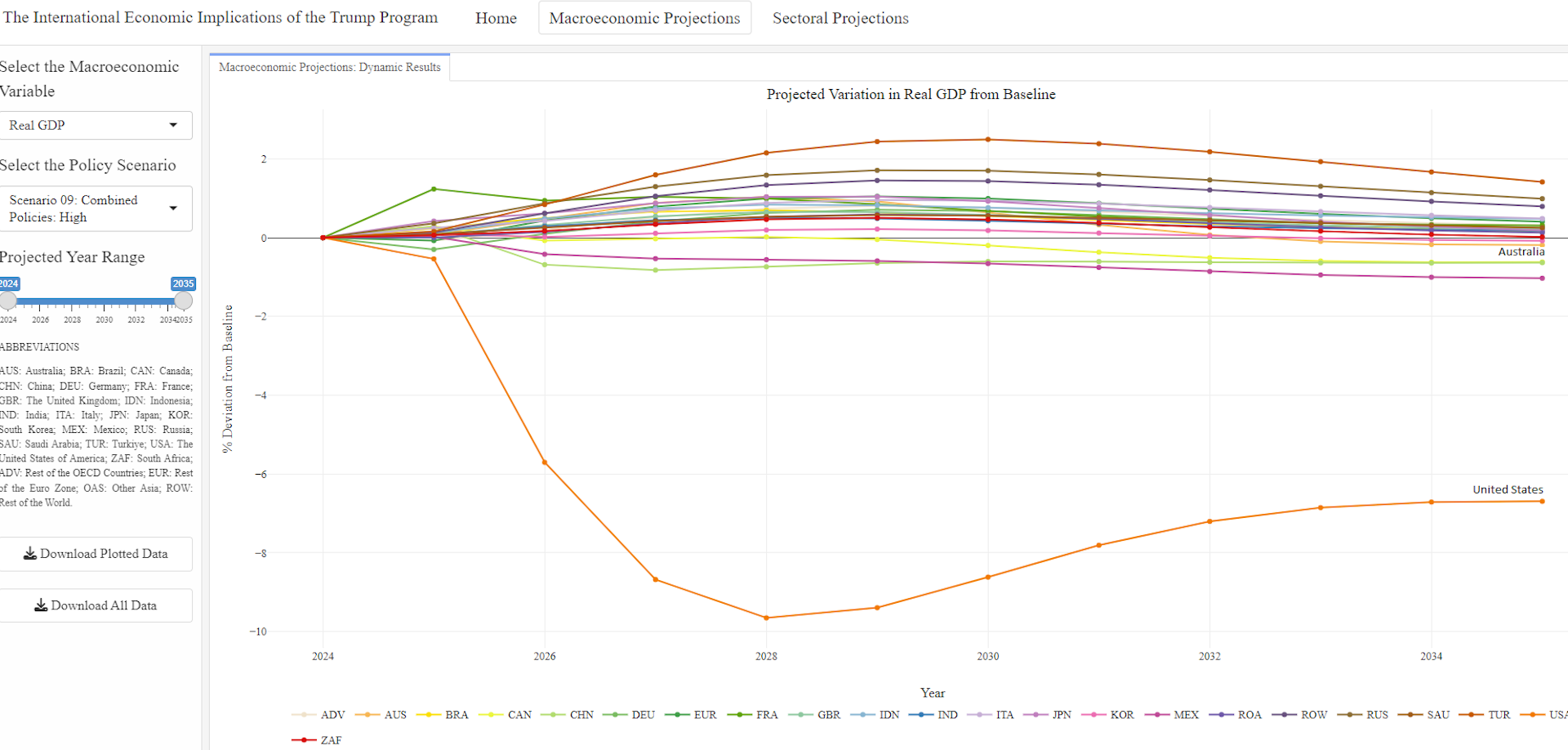
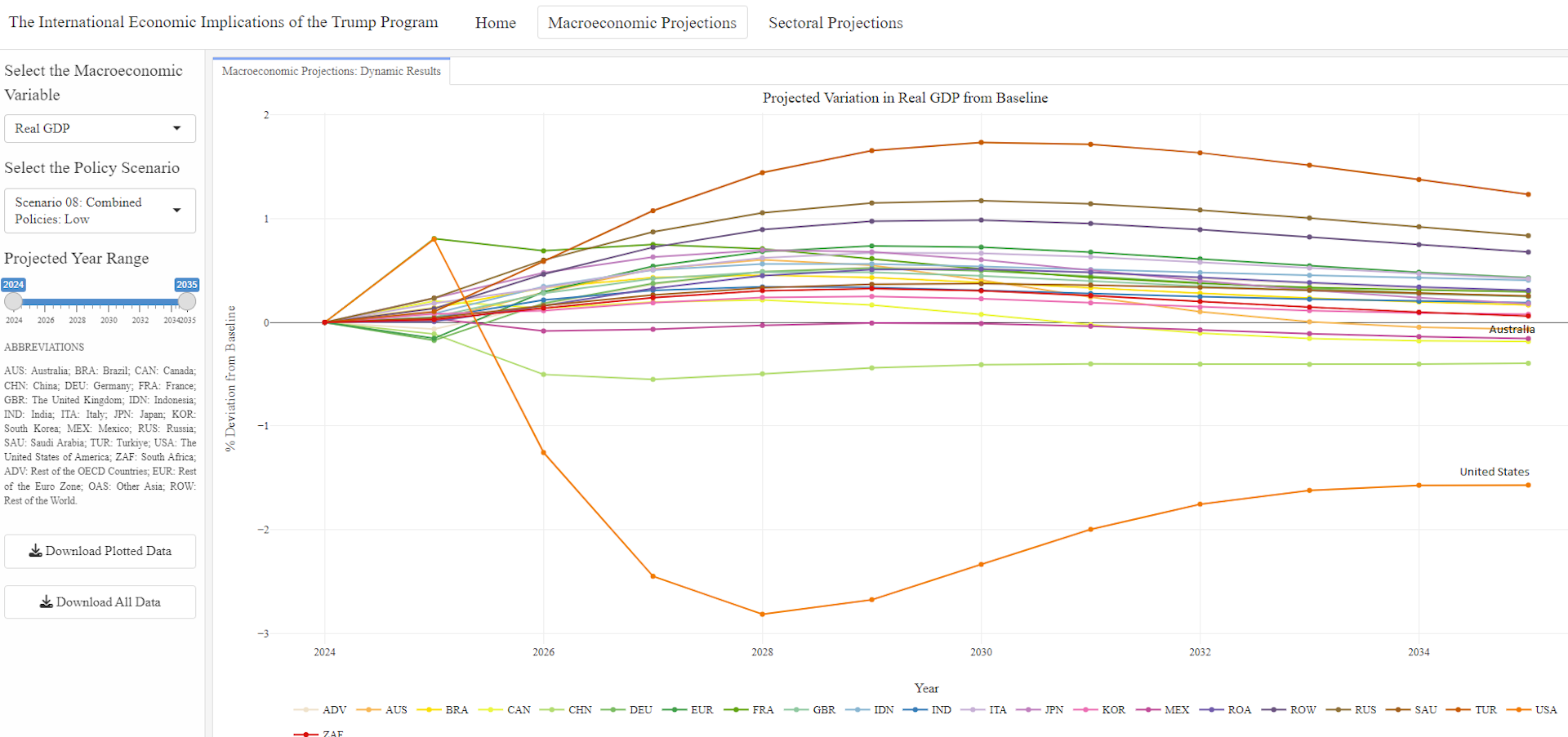
No other country in the world would be hurt by Trump’s program as much as the US – not even China – although several US allies would suffer, including Australia, which would be the fourth-worst hit by the most extreme version of what Trump is proposing.
Peterson Institute for International Economics.
Mass deportations
Trump has repeatedly promised the “largest domestic deportation operation in American history,” targeting up to 20 million unauthorised immigrants, including about 8.3 million thought to be in the workforce.
He says his model is Operation Wetback – a 1956 Eisenhower administration program that used military-style tactics to deport 1.3 million Mexicans.
The institute says Eisenhower’s success makes it easy to believe Trump could remove 1.3 million immigrant workers. It has modelled two scenarios: removing 1.3 million and 8.3 million, both over two years in 2025 and 2026.
Both slash employment, including the employment of non-immigrants, both push up inflation, which eventually is brought under control, and both make the US a less attractive place to invest, which benefits much of the rest of the world.
The institute says the low and high scenarios differ “only by the degree of damage inflicted on people, households, firms, and the overall economy”.
Huge tariff hikes
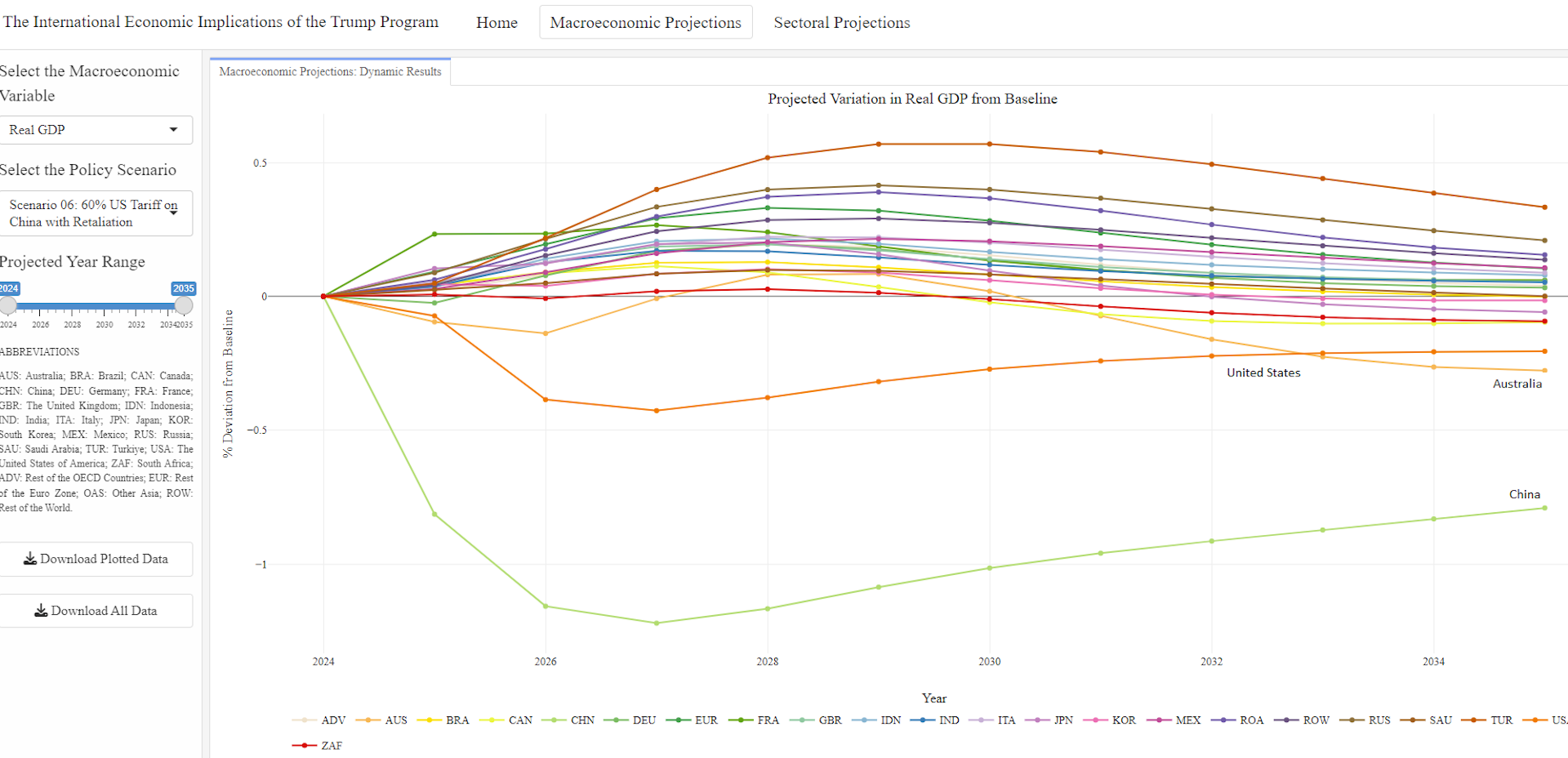
Trump wants to increase every tariff on goods imported to the US by 10 percentage points, including where there is at present no tariff. And he wants at least a 60% tariff on imports from China. The institute has modelled both, with and without retaliatory tariffs from China and the rest of the world.
It finds, unsurprisingly, that extra tariffs push up the price of US imports and the prices of US-produced goods that compete with imports. Many are used as inputs in manufacturing, which means US manufacturing suffers (which is probably not what Trump had in mind).
Fewer imports mean less demand for foreign exchange within the US, which means a higher US dollar which makes US exports less competitive. The US economy is weaker as a result, although China’s is weaker still and Australia’s is weakened as much as the US given its role in providing resources to China.
Nobbling the Fed
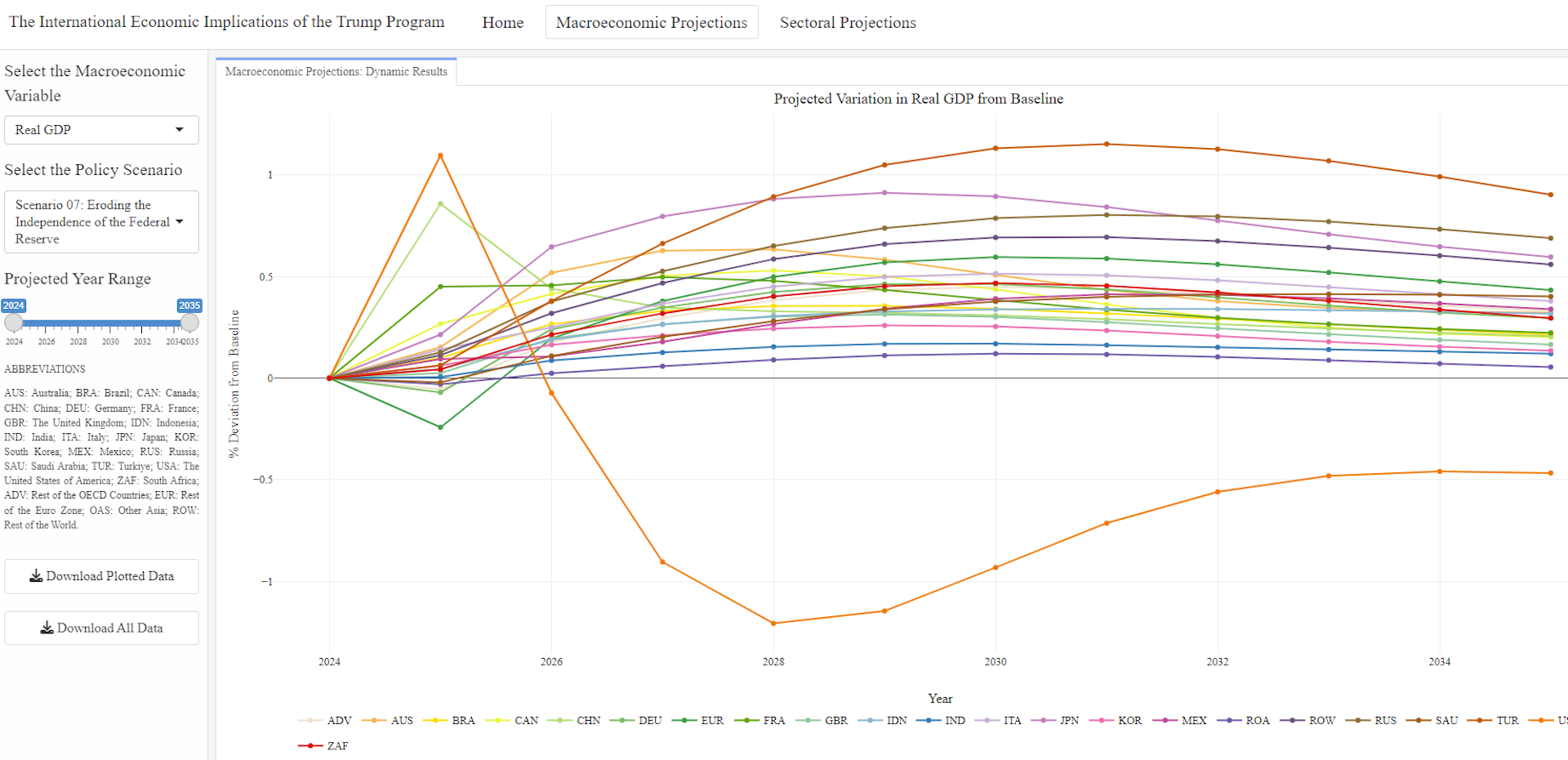
Trump has raised the prospect of more presidential influence over interest rates, saying he thinks he has “a better instinct than, in many cases” the board of US Federal Reserve. This could be achieved by requiring the president to be consulted on rate decisions or by appointing a compliant chair.
The modelled result is capital flight. While the US economy is initially stronger than it would have been because of the Fed’s willingness to tolerate higher inflation, after a few years it is weaker and every other economy is stronger.
When all the measures are combined, under the extreme scenarios the US economy is 6.7% weaker than it would have been by 2035 and Australia’s is 0.2% weaker. Under the more modest scenarios, the US economy is 1.6% weaker and Australia’s is 0.06% weaker.
Why not examine Harris?
Despite a history of non-partisanship, the Peterson Institute is prepared for criticism. It points out that the economic model it used is regarded as the best in the world for scenario planning and is Australian, built by Warwick McKibbin of the Australian National University.
And it says it has modelled the Trump policies rather than the Harris policies because only Trump’s represent a departure from business as usual.
As the Institute’s president Adam Posen put it in Washington last month, the Harris campaign has said it will not impose across-the-board tariffs, will not engage in mass deportations and will not interfere with the independence of the US Federal Reserve.
The Trump campaign has indicated it will do all three.
It’s entirely possible that in office Trump wouldn’t do everything he proposed while campaigning, and it’s entirely possible that he would change course if what was doing damaged the US in the way the modelling suggests.
But there’s something to be said for taking people at their word, at least to get an idea of what we could be in store for after a knife-edge election.
Peter Martin is Economics Editor of The Conversation.
Foreign influence campaigns, or information operations, have been widespread in the run-up to the 2024 U.S. presidential election. Influence campaigns are large-scale efforts to shift public opinion, push false narratives or change behaviors among a target population. Russia, China, Iran, Israel and other nations have run these campaigns by exploiting social bots, influencers, media companies and generative AI.
At the Indiana University Observatory on Social Media, my colleagues and I study influence campaigns and design technical solutions – algorithms – to detect and counter them. State-of-the-art methods developed in our center use several indicators of this type of online activity, which researchers call inauthentic coordinated behavior. We identify clusters of social media accounts that post in a synchronized fashion, amplify the same groups of users, share identical sets of links, images or hashtags, or perform suspiciously similar sequences of actions.
We have uncovered many examples of coordinated inauthentic behavior. For example, we found accounts that flood the network with tens or hundreds of thousands of posts in a single day. The same campaign can post a message with one account and then have other accounts that its organizers also control “like” and “unlike” it hundreds of times in a short time span. Once the campaign achieves its objective, all these messages can be deleted to evade detection. Using these tricks, foreign governments and their agents can manipulate social media algorithms that determine what is trending and what is engaging to decide what users see in their feeds.
Adversaries such as Russia, China and Iran aren’t the only foreign governments manipulating social media to influence U.S. politics.
Generative AI
One technique increasingly being used is creating and managing armies of fake accounts with generative artificial intelligence. We analyzed 1,420 fake Twitter – now X – accounts that used AI-generated faces for their profile pictures. These accounts were used to spread scams, disseminate spam and amplify coordinated messages, among other activities.
We estimate that at least 10,000 accounts like these were active daily on the platform, and that was before X CEO Elon Musk dramatically cut the platform’s trust and safety teams. We also identified a network of 1,140 bots that used ChatGPT to generate humanlike content to promote fake news websites and cryptocurrency scams.
In addition to posting machine-generated content, harmful comments and stolen images, these bots engaged with each other and with humans through replies and retweets. Current state-of-the-art large language model content detectors are unable to distinguish between AI-enabled social bots and human accounts in the wild.
Model misbehavior
The consequences of such operations are difficult to evaluate due to the challenges posed by collectingdata and carrying out ethical experiments that would influence online communities. Therefore it is unclear, for example, whether online influence campaigns can sway election outcomes. Yet, it is vital to understand society’s vulnerability to different manipulation tactics.
In a recent paper, we introduced a social media model called SimSoM that simulates how information spreads through the social network. The model has the key ingredients of platforms such as Instagram, X, Threads, Bluesky and Mastodon: an empirical follower network, a feed algorithm, sharing and resharing mechanisms, and metrics for content quality, appeal and engagement.
SimSoM allows researchers to explore scenarios in which the network is manipulated by malicious agents who control inauthentic accounts. These bad actors aim to spread low-quality information, such as disinformation, conspiracy theories, malware or other harmful messages. We can estimate the effects of adversarial manipulation tactics by measuring the quality of information that targeted users are exposed to in the network.
We simulated scenarios to evaluate the effect of three manipulation tactics. First, infiltration: having fake accounts create believable interactions with human users in a target community, getting those users to follow them. Second, deception: having the fake accounts post engaging content, likely to be reshared by the target users. Bots can do this by, for example, leveraging emotional responses and political alignment. Third, flooding: posting high volumes of content.
Our model shows that infiltration is the most effective tactic, reducing the average quality of content in the system by more than 50%. Such harm can be further compounded by flooding the network with low-quality yet appealing content, thus reducing quality by 70%.
Curbing coordinated manipulation
We have observed all these tactics in the wild. Of particular concern is that generative AI models can make it much easier and cheaper for malicious agents to create and manage believable accounts. Further, they can use generative AI to interact nonstop with humans and create and post harmful but engaging content on a wide scale. All these capabilities are being used to infiltrate social media users’ networks and flood their feeds with deceptive posts.
These insights suggest that social media platforms should engage in more – not less – content moderation to identify and hinder manipulation campaigns and thereby increase their users’ resilience to the campaigns.
The platforms can do this by making it more difficult for malicious agents to create fake accounts and to post automatically. They can also challenge accounts that post at very high rates to prove that they are human. They can add friction in combination with educational efforts, such as nudging users to reshare accurate information. And they can educate users about their vulnerability to deceptive AI-generated content.
Open-source AI models and data make it possible for malicious agents to build their own generative AI tools. Regulation should therefore target AI content dissemination via social media platforms rather then AI content generation. For instance, before a large number of people can be exposed to some content, a platform could require its creator to prove its accuracy or provenance.
These types of content moderation would protect, rather than censor, free speech in the modern public squares. The right of free speech is not a right of exposure, and since people’s attention is limited, influence operations can be, in effect, a form of censorship by making authentic voices and opinions less visible.
Filippo Menczer receives funding from the Knight Foundation, Sloan Foundation, NSF, DoD, and the Swiss National Science Foundation.
What makes these wildfires so destructive and difficult to contain?
The answer lies in a mix of changing climate, the legacy of past land-management practices, and current human activities that are reshaping fire behavior and increasing the risk they pose.
Fire’s perfect storm
Wildfires rely on three key elements to spread: conducive weather, dry fuel and an ignition source. Each of these factors has undergone pronounced changes in recent decades. While climate change sets the stage for larger and more intense fires, humans are actively fanning the flames.
Climate and weather
Extreme temperatures play a dangerous role in wildfires. Heat dries out vegetation, making it more flammable. Under these conditions, wildfires ignite more easily, spread faster and burn with greater intensity. In the western U.S., aridity attributed to climate change has doubled the amount of forestland that has burned since 1984.
Compounding the problem is the rapid rise in nighttime temperatures, now increasing faster than daytime temperatures. Nights, which used to offer a reprieve with cooler conditions and higher humidity, do so less often, allowing fires to continue raging without pause.
Ranchers watch as firefighting planes battle the Park Fire, which was fueled by extremely hot, dry conditions in Butte County, Calif. AP Photo/Noah Berger
Fuel
Fire is a natural process that has shaped ecosystems for over 420 million years. Indigenous people historically used controlled burns to manage landscapes and reduce fuel buildup. However, a century of fire suppression has allowed vast areas to accumulate dense fuels, priming them for larger and more intense wildfires.
Additionally, human development in fire-prone regions, especially in the wildland-urban interface, where neighborhoods intermingle with forest and grassland vegetation, has introduced new, highly flammable fuels. Buildings, vehicles and infrastructure often ignite easily and burn hotter and faster than natural vegetation. These changes have significantly altered fuel patterns, creating conditions conducive to more severe and harder-to-control wildfires.
More than 600 homes and buildings burned in the Park Fire, one of California’s largest fires on record. Officials say the fire was started by a man pushing a burning car into a ravine near Chico. AP Photo/Eugene Garcia
Lightning-started fires often coincide with storms that carry rain or higher humidity, which slows fires’ spread. Human-started fires, however, typically ignite under more extreme conditions – hotter temperatures, lower humidity and stronger winds. This leads to greater flame heights, faster spread in the critical early days before crews can respond, and more severe ecosystem effects, such as killing more trees and degrading the soil.
Human-ignited fires often occur in or near populated areas, where flammable structures and vegetation create even more hazardous conditions. As urban development expands into wildlands, the probability of human-started fires and the property potentially exposed to fire increase, creating a feedback loop of escalating wildfire risk.
2024 fire season’s whiplash weather
The record-breaking summer heat in 2024 intensified fire hazards, with vegetation rapidly drying out and leaving landscapes parched in many areas. In addition, a phenomenon known as whiplash weather, marked by unusually wet winters and springs followed by extreme summer heat, has been especially pronounced in Southern California.
A wet spring fostered vegetation growth, which then dried out under scorching summer temperatures, turning into highly combustible fuel. Severe heat waves, along with the associated lack of nighttime cooling, created conditions where fires not only spread faster, but were also more difficult to contain.
This cycle has fueled some of the biggest fires of the 2024 season, several of which were started by humans. Atmospheric instability during some of these fires also led to the formation of pyrocumulonimbus clouds – massive, fire-fueled thunderheads that can generate their own weather, including lightning and tornado-like winds that drive flames even further.
As these factors converge, the potential for increasingly severe wildfires looms ever larger. Severe fires also release large amounts of carbon from trees, vegetation and soils into the atmosphere, increasing greenhouse gas emissions and exacerbating climate change, contributing to more extreme fire seasons.
Virginia Iglesias receives funding from the National Science Foundation.
Source: Republic of Taiwan – Ministry of Foreign Affairs
MOFA sincerely congratulates Japanese Representative Ishiba on his election as LDP president
Date:2024-09-27
Data Source:TAIWAN-JAPAN RELATIONS ASSOCIATION
September 27, 2024
No. 319
The ruling Liberal Democratic Party (LDP) of Japan elected Shigeru Ishiba, a member of the House of Representatives, as its new president after two rounds of voting on September 27. The Ministry of Foreign Affairs (MOFA) extends its sincere congratulations and has instructed the Taipei Economic and Cultural Representative Office in Japan to promptly send a message of felicitations on behalf of the government of Taiwan.
Taiwan and the LDP have enjoyed close interactions over the years, sharing a robust partnership and like-minded friendship. LDP parliamentary delegations have often visited Taiwan, proactively fostering Taiwan-Japan cooperation and exchanges across various domains and enhancing bilateral relations with concrete actions through values-based and alliance diplomacy.
Representative Ishiba recently led a delegation to Taiwan to exchange views on security issues with various sectors in Taiwan. During the visit, he announced his decision to run in the LDP election. In recent years, the Japanese government, led by the LDP, has reiterated the importance of peace and stability across the Taiwan Strait at major international events and endorsed Taiwan’s participation in the World Health Organization and other international organizations. Taiwan expresses deep appreciation for this support.
MOFA sincerely hopes that the LDP, under the leadership of President Ishiba, will continue to strengthen cooperation with Taiwan, as well as promoting a comprehensive and substantive bilateral partnership to jointly uphold peace, stability, and prosperity in the Indo-Pacific. (E)
A decade ago, Sercan Canbolat ’17 MA ’23 Ph.D. was a graduate student in his home country of Turkey. His focus was studying the political psychology of leaders.
What makes them think?
How do they make decisions?
What influences them in their decision making?
His particular focus was on political leaders in the Middle East, where he had grown up and completed his undergraduate degrees.
But as a master’s student at Bilkent University in Turkey’s capital city of Ankara, he knew first-hand some of the challenges he would face as he tried to present his research to a broader, international audience.
“I’m from Turkey,” Canbolat says, “and I know in the broader Middle East and North Africa regions, we don’t have a lot of opportunities to get our work published, to present our work to top scholars in the field, and to get good feedback – to learn and acquire the best research skills and presentation skills.”
Sercan Canbolat ’17 MA ’23 Ph.D. at the ISA International Conference 2017 in Hong Kong. (Contributed photo)
It was during his master’s studies that his advisor, Özgür Özdamar, first introduced him to the International Studies Association, or ISA – one of the oldest interdisciplinary organizations dedicated to understanding international, transnational, and global affairs.
“I was writing my MA thesis with him,” Canbolat explains, “and he offered for me to write a paper that we could present at ISA. But I couldn’t get a visa. So, my advisor went to the conference instead, and he presented our paper.”
The following year, though – in 2014 – Canbolat was able to travel to the ISA conference in Toronto, where he put himself in front of a global audience for the first time to present his research.
“I got some feedback from the chair and from the audience, and it was great,” he says. “It helped me to build self-confidence, and actually, through ISA, I met many scholars based in the U.S., Canada, and Western Europe. Those connections helped me to apply for and receive a Fulbright scholarship to come to the U.S. for my Ph.D.”
That Fulbright Ph.D. grant led Canbolat to UConn in 2014, where he started his doctoral studies in political science.
And in 2015, the organization that helped Canbolat make those connections and first share his research on a global stage – the International Studies Association – also came to UConn.
Best-Kept Secret
Founded in 1959, the ISA has long served as a central hub for the exchange of ideas, for networking, and for programmatic initiatives among those involved in the study, teaching, and practice of international studies.
Through its international and regional conferences and its academic journals, the organization works to promote rigorous discussion, research, and writing on a broad range of topics, including foreign policy, environmental studies, global health, diplomacy, human rights, peace studies, law, and religion.
ISA has been headquartered at UConn since 2015. Under agreements with UConn’s Office of Global Affairs, it will remain in residence at UConn until at least 2030.
Sarah Dorr, Ph.D., ISA director of professional development (Contributed photo)
From 2015 to 2024, ISA was under the leadership of Mark Boyer, Board of Trustees Distinguished Professor Emeritus at UConn. As of July 1, 2024, Mike Bosia, professor of political science and international relations and director of gender and sexuality studies at Saint Michael’s College, took over the role of ISA’s executive director.
“ISA is a hidden gem – one of the best kept secrets at UConn,” says Sarah Dorr, the ISA’s director of professional development. “We have over 7,000 members in 120 countries.”
UConn and ISA are a good fit for each other, says Daniel Weiner, a professor of geography and UConn’s vice president for global affairs, because both the organization and the University share similar missions to foster a sense of global-mindedness and facilitate life-transformative educational and research experiences.
“ISA is really a success story about the positive impact of international collaboration,” Weiner says. “One of our major goals in Global Affairs is to support interdisciplinary research and engagement on issues of worldwide importance and impact, so partnership with ISA here at UConn is really a natural pairing.”
Evolving and Growing
In a complex and ever-changing world, adapting to the needs of the time is important for any organization – ISA included.
“Our organization is constantly evolving and growing,” says Dorr, “and we offer different levels of interaction to help people make connections and foster dialogue – something that we feel is particularly critical at this point in time in our increasingly polarized world.”
The ISA publishes seven academic journals, co-sponsors an eighth, and partners with Oxford University Press to publish the International Studies Encyclopedia, the most comprehensive reference work of its kind for the fields of international studies and international relations.
The organization has steadily grown its online and social media presence and, in response to the pandemic in 2020, launched a roster of unique virtual programs to broaden its reach to scholars who might not otherwise have the ability to take part in global opportunities.
Not all students and academics have access to the same resources at their institution. ISA’s virtual initiative provides these programs to level the playing field and create community whilst doing so. — Sarah Dorr, ISA’s director of professional development
“Not all students and academics have access to the same resources at their institution,” says Dorr, who curates virtual programming as part of her role at ISA. “ISA’s virtual initiative provides these programs to level the playing field and create community whilst doing so. Virtual programming allows people to interact with the association throughout the year, and it widens participation and increases accessibility to ISA’s pedagogical and research communities.”
ISA’s virtual programming is available to all members of the UConn community, regardless of membership. To date in 2024, ISA has produced more than 30 programs, with additional virtual events scheduled for the remainder of the calendar year on topics including banal nationalism, Fulbright scholar opportunities, and the impending results of the 2024 U.S. Presidential Election.
But what ISA has historically been known for are its national and regional conferences – gatherings where scholars from all walks of life and levels of experience come together to share their research, build new networks, and contribute to scholarship on a global level.
An Academic Home
Canbolat’s first ISA conference was in Toronto, but in the years since, ISA has taken him to San Francisco, Nashville, Atlanta, and even Hong Kong.
“It was a great experience; my first time in that part of the world,” he recalls about the 2017 Hong Kong conference. “It was amazing. I really enjoyed it.”
ISA supported Canbolat’s travel to its conferences through a grant program that assists junior scholars, senior graduate students, and scholars from low-income countries in attending conferences that would otherwise be out of reach.
“Grad students don’t have a great budget to go to conferences, and it’s expensive,” Canbolat says. “Travel, accommodations – ISA is really great at providing financial help, especially to students and junior scholars. I benefitted a lot from my ISA travel grants. It really helped make it happen, to go and attend the conferences.”
While on those trips, Canbolat says he had opportunities to meet eminent scholars in his field, network and build relationships with them, attend panel discussions, and meet and workshop with both journal editors and book publishers.
UConn President Radenka Maric delivers remarks at the ISA International Conference 2024 at the University of Rijeka in Croatia. (Photo Courtesy of UNIRI)
“Even if you don’t present, it’s still a great experience to go to panels, listen to state-of-the-art research being presented by both prominent scholars and rising scholars,” he says. “I’ve really enjoyed meeting top scholars, prominent scholars, in a personal setting – not in a panel or in a workshop, but at a reception, and to really make personal connections. Tell them about my family. Tell them about my background. Tell them about my plans. And they were very helpful, listening and giving great feedback.
“I think that stands out, meeting those big names. We always read their books, their articles, but it’s something else to meet them, especially in a personal setting, a relaxed environment. Having a coffee with them. That stands out,” he says.
ISA holds a series of regional conferences throughout each year as well as an annual convention, which will be held in Chicago in 2025.
“One of the major benefits of attending ISA regional conferences is they become a source of intellectual community,” says Dorr. “But ISA’s annual convention is where people go to find their ‘academic home.’”
In June 2024, the ISA built on its long-standing collaboration with the Central and Eastern European International Studies Association, or CEEISA, to host a joint international conference at the University of Rijeka in Croatia.
Focused on “Knowing the Global-Local: Imagining Pasts, Debating Futures,” the conference hosted 800 participants – including Weiner and UConn President Radenka Maric – from 65 countries to discuss global and local political science and international relations.
The conference marked the largest gathering of experts in international relations in Croatia to date.
Full Circle
Canbolat wasn’t able to travel to Croatia in June, but earlier this year, he attended an ISA conference in San Francisco – to accept the ISA Foreign Policy Analysis Section Best Book Award for 2024.
In 2023, Canbolat and his co-author, Özdamar, published their book, Leaders in the Middle East and North Africa: How Ideology Shapes Foreign Policy, through Cambridge University Press in 2023.
The book is based on the initial research that Canbolat presented at his very first ISA conference in Toronto in 2014.
Co-authors Sercan Canbolat ’17 MA ’23 Ph.D. (center) and Özgür Özdamar, professor of international relations at Bilkent University in Ankara, Turkey, (right) — with Danielle Lupton, associate professor of political science at Colgate University (left) — accept the 2024 ISA Best Book in Foreign Policy Analysis Award at the ISA 2024 Annual Convention in San Francisco. (Contributed photo)
“We published it as a journal article first,” he says. “After I presented at ISA, I got feedback. We published it in a good journal. It was well-received, and we got great feedback. And then, we discussed and decided to turn it into a book, into a larger project, and we worked on it for like five, six years. It was a blast, because it kept giving.”
Also in 2023, Canbolat completed his Ph.D. at UConn. He’s now serving as the inaugural director of Abrahamic Programs at UConn Global Affairs, and he’s teaching as a postdoctoral lecturer in the Department of Political Science.
He says he tells all his students about ISA – how it’s headquartered at UConn and how they can access the programs and opportunities ISA has to offer.
And he tells other faculty at UConn as well.
“I was surprised that some faculty don’t know that ISA is here at UConn,” Canbolat says. “I strongly suggest for anyone to try and at least give ISA a shot. Attend one year, and actually, they will be hooked.”
To learn more about or connect with the International Studies Association, headquartered at UConn Storrs, visitisanet.org. To stay up-to-date on the latest ISA virtual programs, sign up for ISA Connected atisanet.org/Programs/Virtual-Programs/ISA-Connected.
For more information about global learning, research, and entrepreneurship opportunities available through UConn’s Office of Global Affairs, visitglobal.uconn.edu.
The U.S. Census Bureau and the U.S. Bureau of Economic Analysis announced today that the goods and services deficit was $70.4 billion in August, down $8.5 billion from $78.9 billion in July, revised.
U.S. International Trade in Goods and Services Deficit
Deficit:
$70.4 Billion
–10.8%°
Exports:
$271.8 Billion
+2.0%°
Imports:
$342.2 Billion
–0.9%°
Next release: Tuesday, November 5, 2024
(°) Statistical significance is not applicable or not measurable. Data adjusted for seasonality but not price changes
Source: U.S. Census Bureau, U.S. Bureau of Economic Analysis; U.S. International Trade in Goods and Services, October 8, 2024
Exports, Imports, and Balance (exhibit 1)
August exports were $271.8 billion, $5.3 billion more than July exports. August imports were $342.2 billion, $3.2 billion less than July imports.
The August decrease in the goods and services deficit reflected a decrease in the goods deficit of $8.4 billion to $94.9 billion and an increase in the services surplus of $0.1 billion to $24.4 billion.
Year-to-date, the goods and services deficit increased $47.1 billion, or 8.9 percent, from the same period in 2023. Exports increased $79.0 billion or 3.9 percent. Imports increased $126.1 billion or 4.9 percent.
Three-Month Moving Averages (exhibit 2)
The average goods and services deficit decreased $1.6 billion to $74.1 billion for the three months ending in August.
Average exports increased $3.7 billion to $267.8 billion in August.
Average imports increased $2.0 billion to $342.0 billion in August.
Year-over-year, the average goods and services deficit increased $11.1 billion from the three months ending in August 2023.
Average exports increased $13.3 billion from August 2023.
Average imports increased $24.4 billion from August 2023.
Exports (exhibits 3, 6, and 7)
Exports of goods increased $4.4 billion to $179.4 billion in August.
Exports of goods on a Census basis increased $4.9 billion.
Industrial supplies and materials increased $0.9 billion.
Nonmonetary gold increased $1.5 billion.
Crude oil decreased $1.1 billion.
Automotive vehicles, parts, and engines increased $0.8 billion.
Passenger cars increased $0.6 billion.
Net balance of payments adjustments decreased $0.5 billion.
Exports of services increased $0.9 billion to $92.3 billion in August.
Travel increased $0.5 billion
Government goods and services increased $0.2 billion.
Transport decreased $0.2 billion.
Imports (exhibits 4, 6, and 8)
Imports of goods decreased $3.9 billion to $274.3 billion in August.
Imports of goods on a Census basis decreased $3.8 billion.
Industrial supplies and materials decreased $3.9 billion.
Nonmonetary gold decreased $1.2 billion.
Finished metal shapes decreased $1.0 billion.
Crude oil decreased $1.0 billion.
Automotive vehicles, parts, and engines decreased $1.3 billion.
Passenger cars decreased $1.1 billion.
Net balance of payments adjustments decreased $0.2 billion.
Imports of services increased $0.7 billion to $67.9 billion in August.
Travel increased $0.4 billion.
Charges for the use of intellectual property increased $0.4 billion.
Transport decreased $0.3 billion.
Real Goods in 2017 Dollars – Census Basis (exhibit 11)
The real goods deficit decreased $8.6 billion, or 8.9 percent, to $88.6 billion in August, compared to an 8.5 percent decrease in the nominal deficit.
Real exports of goods increased $5.5 billion, or 3.8 percent, to $150.1 billion, compared to a 2.9 percent increase in nominal exports.
Real imports of goods decreased $3.2 billion, or 1.3 percent, to $238.7 billion, compared to a 1.4 percent decrease in nominal imports.
Revisions
Revisions to July exports
Exports of goods were revised down less than $0.1 billion.
Exports of services were revised down $0.1 billion.
Revisions to July imports
Imports of goods were revised up $0.1 billion.
Imports of services were revised down $0.1 billion.
Goods by Selected Countries and Areas: Monthly – Census Basis (exhibit 19)
The August figures show surpluses, in billions of dollars, with Netherlands ($5.5), South and Central America ($4.0), Australia ($1.9), Hong Kong ($1.6), Brazil ($0.8), Singapore ($0.5), and United Kingdom ($0.3). Deficits were recorded, in billions of dollars, with China ($24.7), European Union ($19.1), Mexico ($14.3), Vietnam ($9.8), Ireland ($8.0), Taiwan ($7.3), Germany ($6.6), Japan ($4.9), South Korea ($4.9), Canada ($3.9), Italy ($2.9), India ($2.7), Switzerland ($2.5), France ($1.7), Malaysia ($1.1), Israel ($1.0), Belgium ($0.6), and Saudi Arabia ($0.1).
The deficit with Canada decreased $3.8 billion to $3.9 billion in August. Exports increased $1.1 billion to $28.5 billion and imports decreased $2.7 billion to $32.3 billion.
The deficit with China decreased $2.6 billion to $24.7 billion in August. Exports increased $1.1 billion to $12.6 billion and imports decreased $1.5 billion to $37.3 billion.
The balance with Belgium shifted from a surplus of $1.0 billion in July to a deficit of $0.6 billion in August. Exports decreased $0.1 billion to $2.8 billion and imports increased $1.5 billion to $3.4 billion.
Foreign Minister Lin hosts welcome luncheon for Ukrainian parliamentary delegation
Date:2024-10-04 Data Source:Department of European Affairs
October 4, 2024 No. 329
Minister of Foreign Affairs Lin Chia-lung hosted a luncheon on October 4 to welcome a delegation of Ukrainian parliamentarians led by MP Mykola Kniazhytskyi, Cochair of the Inter-Parliamentary Alliance on China (IPAC), and MP Akhtem Chyihoz. The two sides exchanged views on the Russia-Ukraine war, the peaceful development of Ukraine, and potential cooperation projects.
Minister Lin said that although Taiwan and Ukraine were geographically distant, both nations stood on the front line of democratic defense against the expansion of authoritarian regimes. He commended Ukraine for demonstrating resilience as well as defense and disaster response capabilities in its war against Russia, adding that this served as a valuable lesson and inspiration to all democratic countries. Minister Lin stated that Taiwan had actively assisted Ukraine with rebuilding critical infrastructure, schools, churches, and hospitals in the spirit of humanitarianism. He pledged that Taiwan would continue to support Ukraine through this difficult time.
The members of the Ukrainian delegation thanked the government of Taiwan and expressed appreciation for Taiwan’s humanitarian assistance and support. They stated that the people of Ukraine were deeply touched by Taiwan’s goodwill. Noting that Taiwan and Ukraine shared the core values of freedom, democracy, and human rights, they expressed the hope that the two countries would continue to support each other and cooperate on the basis of friendship and mutual trust.
Both Taiwan and Ukraine enjoy the common values shared by democracies and are faced with authoritarian expansionism. Since the outbreak of the Russia-Ukraine war in February 2022, Taiwan has extended consistent and unwavering support to Ukraine, staunchly backing democracy and freedom. Taiwan will continue to work with like-minded nations to assist Ukraine in overcoming adversity and returning to normal life as soon as possible. (E)
Acting Secretary for Culture, Sports & Tourism Raistlin Lau today extended his congratulations to Hong Kong actor Anson Kong for winning an award during the 29th Busan International Film Festival.
Mr Kong won the Rising Star of the Year award at the 6th Asia Contents Awards & Global OTT (Over-The-Top) Awards during the film festival.
Noting that Mr Kong has gained worldwide recognition among his peers in the industry for his acting skills, Mr Lau said this is a thrilling accomplishment that showcases the talent of Hong Kong actors.
The Asia Contents Awards & Global OTT Awards recognise outstanding television, over-the-top and online content across Asia.
Source: Hong Kong Government special administrative region
The seven-day National Day Golden Week of the Mainland ended yesterday (October 7), with the overall number of inbound visitors aligning with earlier estimates. The number recorded on National Day (October 1) reached a daily record high since the post-pandemic full opening of the borders. During the seven-day National Day Golden Week, the Immigration Department recorded a total of around 1.38 million visitors coming to Hong Kong through various sea, land and air control points. Among them, Mainland visitors accounted for about 1.22 million, representing 88 per cent of the total arrivals. The daily average of Mainland visitors was around 170 000, which exceeded that of the 2023 National Day Golden Week and the 2024 Labour Day Golden Week around 27 per cent and some 13 per cent respectively. Mainland inbound visitor arrivals peaked on National Day with around 220 000 visitors arriving in Hong Kong, marking a daily record high since the post-pandemic opening of the borders and setting a corresponding record for the overall number of visitors to Hong Kong in a single day. During the National Day Golden Week, the Lok Ma Chau Spur Line and the Express Rail Link West Kowloon were the two ports with the highest daily average number of Mainland visitors, and operations at various control points and transport services ran smoothly. Regarding large-scale events, the National Day Fireworks Display over Victoria Harbour on October 1 attracted over 330 000 spectators. The event concluded with effective crowd control arrangements and was well-received by local residents and tourists. Visitors went to different parts of Hong Kong during the National Day Golden Week, with high visitor flow observed at major tourist attractions including the West Kowloon Cultural District, Ocean Park, Hong Kong Disneyland, the Peak Tram and Ngong Ping 360. Smooth and effective crowd management measures were implemented. In addition, according to the information provided by the hotel industry, the overall hotel occupancy rate during the first four days of the Golden Week (October 1 to 4) reached 90 per cent. In terms of tour groups, according to the Travel Industry Authority’s information, around 1 050 Mainland inbound tour groups visited Hong Kong during the National Day Golden Week, with around 80 per cent engaged in overnight itineraries. These tour groups involved around 36 000 visitors, accounting for around 3 per cent of all Mainland visitors, and they were generally in good order. The interdepartmental working group on festival arrangements, led by the Chief Secretary for Administration, Mr Chan Kwok-ki, is pleased to note that the rich array of National Day special offers from the Government and various sectors of society were well-received by the public. Among them, the 1st October Movie Fiesta: Half-Price Spectacular 2024 organised by the Hong Kong Theatres Association and subsidised by the Government took place in 59 commercial theatres across Hong Kong. On the day of the event, there were nearly 2 000 screenings, with cumulative admissions reaching 189 000, breaking last year’s record of 155 000 and representing an increase of 22 per cent. Free admission was offered to museums and art spaces under the Leisure and Cultural Services Department on October 1, attracting nearly 60 000 attendees. Among them, there were more than 11 000 visitors to the Hong Kong Space Museum, setting a record for single-day attendance. In addition, several public transportation services provided free rides or discounts during National Day, benefitting a total of approximately 4.43 million passengers. Different sectors such as catering and retail actively launched special offers to attract spending from both locals and visitors, contributing to a festive atmosphere throughout the city. Various trade representatives and merchants reported increased customer flow and business during National Day. The embarkation and disembarkation arrangements for two homeport deployments of a mega cruise ship at Kai Tak Cruise Terminal (KTCT) during the National Day Golden Week of the Mainland were smooth, with various transport services arranged to adequately meet visitor needs. Notably, direct coach services connecting the Heung Yuen Wai Boundary Control Point and KTCT were arranged by the Hong Kong Tourism Board in collaboration with a local coach operator to provide facilitation for a total of 3 500 Mainland visitors. Mr Chan said, “Thanks to the concerted efforts of relevant government departments, organisations and industries in making preparations and responses, this year’s arrangements for receiving visitors during the National Day Golden Week operated smoothly, enabling both locals and visitors to celebrate National Day together. The Government will draw on this experience and further enhance various arrangements in future to provide an even better experience for visitors to Hong Kong during festive periods.”
The Albanese government on Wednesday will introduce legislation to ensure the NBN remains in government ownership.
The move is designed to set up a test for the Coalition, putting pressure on the opposition ahead of the election to declare whether it would try to privatise the NBN.
The government said in a statement from Prime Minister Anthony Albanese, Finance Minister Katy Gallagher and Communications Minister Michelle Rowland: “The Coalition rushed to declare the NBN ‘complete’ so they could put it on the block for sale – selling out Australian consumers and regional communities.
“The Albanese government won’t let that happen. This legislation will ensure the NBN is owned by who it belongs to – the Australian people.”
The upgrades the government had undertaken “are already making a real difference in the lives of Australians through faster, more reliable internet access. Keeping the NBN in public hands will lock in affordable and accessible high speed internet for all Australians for generations to come.”
Albanese said:“The Coalition made a mess of the NBN – my government is getting on with the job of fixing it and making sure it stays in public hands, where it belongs.”
Rowland said: “Australians don’t trust the Coalition not to flog off the NBN just like they did with Telstra, resulting in higher prices and poorer services, especially in the regions.”
Downgraded
The Rudd Labor government announced what was to be a predominantly fibre-to-the-home wholesale network in 2009, promising it would cost $43 billion and later be privatised to claw back the expense.
In 2010 Communications Minister Stephen Conroy said Labor “remained firmly committed to selling its stake in NBN Co after the network was fully built and operational, subject to market conditions and security considerations”.
By 2020 the government was estimated to have spent $51 billion on a scaled-down version of the project completed using a mix of technologies.
In June that year a review by the Parliamentary Budget Office put its fair value at $8.7 billion.
Michelle Grattan does not work for, consult, own shares in or receive funding from any company or organisation that would benefit from this article, and has disclosed no relevant affiliations beyond their academic appointment.
Secretary-General of ASEAN, Dr. Kao Kim Hourn, today met with the Director of Public Policy of TikTok Southeast Asia, Ms. Shinto Nugroho, at the sidelines of the 2024 ASEAN Business and Investment Summit, in Vientiane, Lao PDR. They discussed how the private sector, such as TikTok, could contribute to the region’s continued growth and development as well as explored future opportunities to advance ASEAN’s digital transformation.
The post Secretary-General of ASEAN meets with Director of Public Policy of TikTok appeared first on ASEAN Main Portal.