Category: Asia Pacific

  • Union Cabinet approves National Sports Policy 2025

    Source: Government of India

    Source: Government of India (4)

    In a move aimed at transforming India’s sporting ecosystem, the Union Cabinet, chaired by Prime Minister Narendra Modi, on Tuesday approved the National Sports Policy (NSP) 2025. The policy replaces the National Sports Policy of 2001 and sets a comprehensive roadmap to establish India as a leading sporting nation, with a particular focus on preparing for the 2036 Olympic Games.

    The National Sports Policy 2025 is the culmination of extensive consultations involving Central Ministries, NITI Aayog, State Governments, National Sports Federations, athletes, experts, and public stakeholders. It lays out a strategic framework for developing sports in the country across multiple dimensions, including excellence, economic growth, social development, mass participation, and educational integration.

    The policy aims to strengthen India’s sports ecosystem from grassroots to elite levels, focusing on early talent identification, building competitive leagues, expanding infrastructure in rural and urban areas, and enhancing training, coaching, and athlete support systems. It also seeks to modernize governance within National Sports Federations and promote the use of sports science, medicine, and technology to boost performance.

    Recognizing the economic potential of sports, the policy promotes sports tourism, international event hosting, and the development of a robust sports manufacturing and startup ecosystem. It calls for greater private sector participation through Public-Private Partnerships, Corporate Social Responsibility initiatives, and innovative financing mechanisms.

    Social inclusion is another key pillar, with targeted programs to increase sports participation among women, tribal communities, economically weaker sections, and persons with disabilities. The policy also aims to revive indigenous and traditional games, promote dual-career pathways, and engage the Indian diaspora through sports.

    To foster a culture of fitness and make sports a mass movement, National Sports Policy 2025 proposes nationwide campaigns, the introduction of fitness indices in schools and workplaces, and improved access to sports facilities. In line with the National Education Policy 2020, it emphasizes integrating sports into school curricula and equipping educators with specialized training.

    The policy outlines a robust implementation strategy, including a national monitoring framework with defined performance benchmarks and timelines. It will serve as a model for states and union territories to align their sports policies with national goals. The “whole-of-government” approach aims to mainstream sports across various departments and schemes, ensuring a unified and impactful strategy.

    With this ambitious and forward-looking policy, the government aims to position India not only as a global sporting powerhouse but also to promote healthier, more inclusive, and empowered citizens through sports.

  • Union Cabinet approves National Sports Policy 2025

    Source: Government of India

    Source: Government of India (4)

    In a move aimed at transforming India’s sporting ecosystem, the Union Cabinet, chaired by Prime Minister Narendra Modi, on Tuesday approved the National Sports Policy (NSP) 2025. The policy replaces the National Sports Policy of 2001 and sets a comprehensive roadmap to establish India as a leading sporting nation, with a particular focus on preparing for the 2036 Olympic Games.

    The National Sports Policy 2025 is the culmination of extensive consultations involving Central Ministries, NITI Aayog, State Governments, National Sports Federations, athletes, experts, and public stakeholders. It lays out a strategic framework for developing sports in the country across multiple dimensions, including excellence, economic growth, social development, mass participation, and educational integration.

    The policy aims to strengthen India’s sports ecosystem from grassroots to elite levels, focusing on early talent identification, building competitive leagues, expanding infrastructure in rural and urban areas, and enhancing training, coaching, and athlete support systems. It also seeks to modernize governance within National Sports Federations and promote the use of sports science, medicine, and technology to boost performance.

    Recognizing the economic potential of sports, the policy promotes sports tourism, international event hosting, and the development of a robust sports manufacturing and startup ecosystem. It calls for greater private sector participation through Public-Private Partnerships, Corporate Social Responsibility initiatives, and innovative financing mechanisms.

    Social inclusion is another key pillar, with targeted programs to increase sports participation among women, tribal communities, economically weaker sections, and persons with disabilities. The policy also aims to revive indigenous and traditional games, promote dual-career pathways, and engage the Indian diaspora through sports.

    To foster a culture of fitness and make sports a mass movement, National Sports Policy 2025 proposes nationwide campaigns, the introduction of fitness indices in schools and workplaces, and improved access to sports facilities. In line with the National Education Policy 2020, it emphasizes integrating sports into school curricula and equipping educators with specialized training.

    The policy outlines a robust implementation strategy, including a national monitoring framework with defined performance benchmarks and timelines. It will serve as a model for states and union territories to align their sports policies with national goals. The “whole-of-government” approach aims to mainstream sports across various departments and schemes, ensuring a unified and impactful strategy.

    With this ambitious and forward-looking policy, the government aims to position India not only as a global sporting powerhouse but also to promote healthier, more inclusive, and empowered citizens through sports.

  • Railways launches ‘RailOne’ app as one-stop solution for passenger services

    Source: Government of India

    Source: Government of India (4)

    In a major step toward enhancing passenger experience, Union Railway Minister Ashwini Vaishnaw on Tuesday launched the ‘RailOne’ app at the India Habitat Centre in New Delhi, marking the 40th Foundation Day of the Centre for Railway Information Systems (CRIS). Designed to be a comprehensive, all-in-one platform, the RailOne app aims to streamline and simplify access to a range of railway passenger services through a user-friendly interface.

    Available on both Android and iOS platforms, the RailOne app integrates key services such as booking unreserved and platform tickets with a 3% discount, live train tracking, grievance redressal, e-catering, porter booking, and last-mile taxi services. While reserved ticket bookings will continue through the Indian Railway Catering and Tourism Corporation platform, RailOne is authorized by IRCTC and joins a list of partner apps offering railway services.

    The app supports single sign-on via mPIN or biometric login and allows seamless access using existing RailConnect and UTS credentials, eliminating the need for multiple apps and offering a space-saving solution for users.

    Speaking at the event, Vaishnaw praised the CRIS team for their continued efforts in strengthening Indian Railways’ digital infrastructure. He also provided updates on the development of the Modern Passenger Reservation System (PRS), expected to be launched by December 2025. The upgraded PRS will be multilingual, agile, and scalable, with the capacity to handle up to 1.5 lakh ticket bookings and 40 lakh enquiries per minute. It will include advanced features like seat selection, fare calendar, and dedicated options for Divyangjan, students, and patients, among others.

    The launch of RailOne, along with the upcoming modernization of PRS, underscores Indian Railways’ commitment to leveraging technology for inclusive, efficient, and world-class passenger services. The initiative aligns with Prime Minister Narendra Modi’s vision of transforming Indian Railways into the engine of India’s development journey.

  • MIL-OSI: Marex completes acquisition of FX specialist Hamilton Court Group

    Source: GlobeNewswire (MIL-OSI)

    LONDON, July 01, 2025 (GLOBE NEWSWIRE) — Marex Group plc (‘Marex’ or the ‘Group’; NASDAQ: MRX), the diversified global financial services platform, today announces that it has completed the acquisition of foreign exchange (FX) specialist Hamilton Court Group. The acquisition expands the Group’s FX offering, bringing new capabilities onto the platform, consistent with its strategy to diversify earnings.

    The acquisition will bring around 170 employees across London, Milan, Madrid and Toronto to Marex.

    About Marex:
    Marex Group plc (NASDAQ: MRX) is a diversified global financial services platform providing essential liquidity, market access and infrastructure services to clients across energy, commodities and financial markets. The Group provides comprehensive breadth and depth of coverage across four services: Clearing, Agency and Execution, Market Making and Hedging and Investment Solutions. It has a leading franchise in many major metals, energy and agricultural products, with access to 60 exchanges. The Group provides access to the world’s major commodity markets, covering a broad range of clients that include some of the largest commodity producers, consumers and traders, banks, hedge funds and asset managers. With more than 40 offices worldwide, the Group has over 2,400 employees across Europe, Asia and the Americas. For more information visit www.marex.com.

    Enquiries please contact:

    Marex:
    Nicola Ratchford / Adam Strachan
    +44 778 654 8889 / +1 914 200 2508
    nratchford@marex.com/ astrachan@marex.com

    FTI Consulting US / UK
    +1 716 525 7239 / +44 797 687 0961
    marex@fticonsulting.com

    The MIL Network

  • MIL-OSI: Marex completes acquisition of FX specialist Hamilton Court Group

    Source: GlobeNewswire (MIL-OSI)

    LONDON, July 01, 2025 (GLOBE NEWSWIRE) — Marex Group plc (‘Marex’ or the ‘Group’; NASDAQ: MRX), the diversified global financial services platform, today announces that it has completed the acquisition of foreign exchange (FX) specialist Hamilton Court Group. The acquisition expands the Group’s FX offering, bringing new capabilities onto the platform, consistent with its strategy to diversify earnings.

    The acquisition will bring around 170 employees across London, Milan, Madrid and Toronto to Marex.

    About Marex:
    Marex Group plc (NASDAQ: MRX) is a diversified global financial services platform providing essential liquidity, market access and infrastructure services to clients across energy, commodities and financial markets. The Group provides comprehensive breadth and depth of coverage across four services: Clearing, Agency and Execution, Market Making and Hedging and Investment Solutions. It has a leading franchise in many major metals, energy and agricultural products, with access to 60 exchanges. The Group provides access to the world’s major commodity markets, covering a broad range of clients that include some of the largest commodity producers, consumers and traders, banks, hedge funds and asset managers. With more than 40 offices worldwide, the Group has over 2,400 employees across Europe, Asia and the Americas. For more information visit www.marex.com.

    Enquiries please contact:

    Marex:
    Nicola Ratchford / Adam Strachan
    +44 778 654 8889 / +1 914 200 2508
    nratchford@marex.com/ astrachan@marex.com

    FTI Consulting US / UK
    +1 716 525 7239 / +44 797 687 0961
    marex@fticonsulting.com

    The MIL Network

  • MIL-OSI Europe: Audiences

    Source: The Holy See

    Audiences, 01.07.2025

    This morning, the Holy Father Leo XIV received in audience:
    – Archbishop Odelir José Magri, M.C.C.J., of Chapecó, Brazil;
    – Archbishop Gil Antônio Moreira of Juiz de Fora, Brazil;
    – Archbishop Gilberto Alfredo Vizcarra Mori, S.J., of Trujillo, Peru;
    – Bishop Giovanni d’Ercole, F.D.P., emeritus of Ascoli Piceno, Italy;
    – His Eminence Cardinal Pedro Ricardo Barreto Jimeno, S.J., emeritus of Huancayo, Peru, president of the Ecclesial Conference of Amazonia (CEAMA);
    – His Eminence Cardinal Jaime Spengler, O.F.M., archbishop of Porto Alegre, Brazil, president of the Latin American Episcopal Conference (CELAM), with: His Eminence Cardinal Filipe Neri António Sebastião do Rosário Ferrão, archbishop of Goa and Damão, India, president of the Federation of Asian Bishops’ Conferences (FABC); His Eminence Cardinal Fridolin Ambongo Besungu, O.F.M. Cap., archbishop of Kinshasa, Democratic Republic of the Congo, president of the Symposium of Episcopal Conferences of Africa and Madagascar (SECAM); Bishop Lizardo Estrada Herrara, O.S.A., titular of Ausuccura, auxiliary of Cuzco, Peru, secretary general of CELAM; Msgr. Josef Sayer:
    – His Eminence Cardinal Blase Joseph Cupich, archbishop of Chicago, United States of America;
    – Members of the Ordinary Synod of Bishops of the Syriac Patriarchal Church of Antioch.

    MIL OSI Europe News

  • MIL-OSI Europe: Audiences

    Source: The Holy See

    Audiences, 01.07.2025

    This morning, the Holy Father Leo XIV received in audience:
    – Archbishop Odelir José Magri, M.C.C.J., of Chapecó, Brazil;
    – Archbishop Gil Antônio Moreira of Juiz de Fora, Brazil;
    – Archbishop Gilberto Alfredo Vizcarra Mori, S.J., of Trujillo, Peru;
    – Bishop Giovanni d’Ercole, F.D.P., emeritus of Ascoli Piceno, Italy;
    – His Eminence Cardinal Pedro Ricardo Barreto Jimeno, S.J., emeritus of Huancayo, Peru, president of the Ecclesial Conference of Amazonia (CEAMA);
    – His Eminence Cardinal Jaime Spengler, O.F.M., archbishop of Porto Alegre, Brazil, president of the Latin American Episcopal Conference (CELAM), with: His Eminence Cardinal Filipe Neri António Sebastião do Rosário Ferrão, archbishop of Goa and Damão, India, president of the Federation of Asian Bishops’ Conferences (FABC); His Eminence Cardinal Fridolin Ambongo Besungu, O.F.M. Cap., archbishop of Kinshasa, Democratic Republic of the Congo, president of the Symposium of Episcopal Conferences of Africa and Madagascar (SECAM); Bishop Lizardo Estrada Herrara, O.S.A., titular of Ausuccura, auxiliary of Cuzco, Peru, secretary general of CELAM; Msgr. Josef Sayer:
    – His Eminence Cardinal Blase Joseph Cupich, archbishop of Chicago, United States of America;
    – Members of the Ordinary Synod of Bishops of the Syriac Patriarchal Church of Antioch.

    MIL OSI Europe News

  • MIL-OSI Russia: Chinese Foreign Ministry: China hopes for stability and development in Thailand

    Translation. Region: Russian Federal

    Source: People’s Republic of China in Russian – People’s Republic of China in Russian –

    Source: People’s Republic of China – State Council News

    BEIJING, July 1 (Xinhua) — As a friendly neighbor, China hopes Thailand will maintain stability and development, Foreign Ministry spokesperson Mao Ning said Tuesday.

    She made the statement at a regular departmental press conference, answering a question related to the fact that the Constitutional Court of Thailand suspended Prime Minister Phetongthan Shinawatra from her duties on Tuesday.

    “This is Thailand’s internal matter. I will not comment on it,” Mao Ning said. “As a friendly neighbor, China hopes Thailand will maintain stability and development,” she added. -0-

    MIL OSI Russia News

  • MIL-OSI Russia: Six killed, several injured in Indian factory blast

    Translation. Region: Russian Federal

    Source: People’s Republic of China in Russian – People’s Republic of China in Russian –

    Source: People’s Republic of China – State Council News

    NEW DELHI, July 1 (Xinhua) — At least six people, including two women, were killed and several others injured in a powerful blast at a fireworks factory in India’s southern Tamil Nadu state, local police said by telephone.

    The blast, which led to a massive fire, took place at a factory in a village in Virudunagar district. Bodies of six people have been recovered so far and the injured have been admitted to a local hospital.

    The rescue operation is ongoing. The cause of the explosion is being investigated. –0–

    MIL OSI Russia News

  • MIL-OSI Asia-Pac: Warm Nights Expected To Continue In Next Fortnight

    Source: Government of Singapore

    Singapore, 1 July 2025 The prevailing Southwest Monsoon conditions are forecast to persist over Singapore and the surrounding region in the next fortnight with winds blowing mainly from the southeast or southwest.

    2          During this period, localised short-duration thundery showers are expected over parts of the island in the late morning and afternoon on most days. In addition, Sumatra squalls may bring widespread thundery showers and gusty winds in the pre-dawn and morning on a few days. The total rainfall for the first fortnight of July 2025 is forecast to be near average over most parts of the island.

    3          The daily maximum temperatures are likely to range between 33 degrees Celsius and 34 degrees Celsius on most days and slightly exceed 34 degrees Celsius on a few days. Several nights may also be warm and humid, and the temperatures may stay above 28 degrees Celsius.

    4          For updates of the daily weather forecast, please visit the MSS website (www.weather.gov.sg), NEA website (www.nea.gov.sg), or download the myENV app.

     REVIEW OF THE PAST TWO WEEKS (16 – 30 JUNE 2025)

    5          Southwest Monsoon conditions prevailed over Singapore and the surrounding region in the second fortnight of June 2025, with winds blowing mostly from the southeast or southwest.

    6          In the second fortnight of June 2025, localised short-duration thundery showers fell over parts of the island on several days. On 28 June 2025, regional convergence of winds brought moderate to heavy thundery showers over many areas of Singapore in the early afternoon. The daily total rainfall of 69.3mm recorded at Woodlands that day was the highest rainfall recorded for the second fortnight of June 2025.

    7          The daily maximum temperatures in the second fortnight of June 2025 were between 32 degrees Celsius and 34 degrees Celsius on most days. The highest daily maximum temperature of 35.3 degree Celsius was recorded at Paya Lebar on 22 June 2025. There were also several warm nights, particularly over the eastern, southern and western parts of the island where the minimum night-time temperatures stayed above 28 degrees Celsius.

     8          Most parts of Singapore recorded below average rainfall in the second fortnight of June 2025. The area around Jurong West registered rainfall of 69 per cent below average, and the area around Admiralty registered rainfall of 63 per cent above average.

    CLIMATE STATION STATISTICS

    Long-term Statistics for July
    (Climatological reference period: 1991-2020)
    Average daily maximum temperature: 31.4      °C
    Average daily minimum temperature: 25.4 °C
    Average monthly temperature: 28.2 °C
         
    Average rainfall: 146.6 mm
    Average number of rain days: 14  
     
    Historical Extremes for July
    (Rainfall since 1869 and temperature since 1929)
    Highest monthly mean daily maximum temperature: 32.4  °C (1997)
    Lowest monthly mean daily minimum temperature: 22.9  °C (1975)
         
    Highest monthly rainfall ever recorded:  527.3  mm (1890)
    Lowest monthly rainfall ever recorded: 12.2  mm (2019)

    METEOROLOGICAL SERVICE SINGAPORE
    1 Jul 2025

    ~~ End ~~

    For more information, please submit your enquiries electronically via the Online Feedback Form or myENV mobile application.

    MIL OSI Asia Pacific News

  • MIL-OSI USA: DBEDT NEWS RELEASE: Visitor Arrivals and Expenditures Increased in May 2025

    Source: US State of Hawaii

    DBEDT NEWS RELEASE: Visitor Arrivals and Expenditures Increased in May 2025

    Posted on Jun 30, 2025 in Latest Department News, Newsroom

    STATE OF HAWAIʻI

    KA MOKU ʻĀINA O HAWAIʻI


    JOSH GREEN, M.D.
    GOVERNOR

    KE KIAʻĀINA

    DEPARTMENT OF BUSINESS, ECONOMIC DEVELOPMENT AND TOURISM

    KA ʻOIHANA HOʻOMOHALA PĀʻOIHANA, ʻIMI WAIWAI A HOʻOMĀKAʻIKAʻI


    RESEARCH AND ECONOMIC ANALYSIS DIVISION


    JAMES KUNANE TOKIOKA

    DIRECTOR

    KA LUNA HOʻOKELE


    VISITOR ARRIVALS AND EXPENDITURES INCREASED IN MAY 2025


    FOR IMMEDIATE RELEASE

    June 30, 2025


    HONOLULU – According to preliminary statistics from the Department of Business, Economic Development and Tourism (DBEDT), total visitor arrivals and total visitor spending in May 2025 increased compared to May 2024. There were 771,038 visitors to the Hawaiian Islands in May 2025, up slightly by 1.0 percent from the same month last year. Total visitor spending measured in nominal dollars was $1.68 billion, a 3.7 percent growth from May 2024. May 2025 total visitor arrivals represent a 91.0 percent recovery compared to pre-pandemic May 2019 and total visitor spending was higher than May 2019 ($1.41 billion, +18.9%).

    In May 2025, 766,377 visitors arrived by air service, mainly from the U.S. West and U.S. East. Additionally, 4,661 visitors came via out-of-state cruise ships. In comparison, 757,841 visitors (+1.1%) arrived by air and 5,420 visitors (-14.0%) came by cruise ships in May 2024, and 836,058 visitors (-8.3%) arrived by air and 11,338 visitors (-58.9%) came by cruise ships in May 2019. The average length of stay by all visitors in May 2025 was 8.47 days, compared to 8.51 days (-0.5%) in May 2024 and 8.37 days (+1.2%) in May 2019. The statewide average daily census was 210,695 visitors in May 2025, compared to 209,543 visitors (+0.5%) in May 2024 and 228,768 visitors (-7.9%) in May 2019.

    In May 2025, 411,318 visitors arrived from the U.S. West, an increase compared to May 2024 (403,981 visitors, +1.8%) and May 2019 (387,844 visitors, +6.1%). U.S. West visitor spending of $831.1 million grew from May 2024 ($767.9 million, +8.2%) and was much higher than May 2019 ($564.0 million, +47.4%). Daily spending by U.S. West visitors in May 2025 ($248 per person) was up compared to May 2024 ($233 per person, +6.4%) and was considerably more than May 2019 ($174 per person, +42.7%).

    In May 2025, 207,445 visitors arrived from the U.S. East, a decline from May 2024 (209,711 visitors, -1.1%), but an increase compared to May 2019 (199,344 visitors, +4.1%). U.S. East visitor spending of $540.5 million rose slightly from May 2024 ($539.4 million, +0.2%) and was much greater than May 2019 ($392.4 million, +37.7%). Daily spending by U.S. East visitors in May 2025 ($279 per person) was higher than May 2024 ($274 per person, +1.8%) and up significantly from May 2019 ($211 per person, +32.3%).

    There were 45,895 visitors from Japan in May 2025, a slight drop from May 2024 (46,124 visitors, -0.5%) and much lower than May 2019 (113,226 visitors, -59.5%). Visitors from Japan spent $67.1 million in May 2025, compared to $68.4 million (-1.8%) in May 2024 and $162.4 million (-58.7%) in May 2019. Daily spending by Japanese visitors in May 2025 ($244 per person) was higher than May 2024 ($237 per person, +3.0%) and similar to May 2019 ($244 per person, +0.3%).

    In May 2025, 18,672 visitors arrived from Canada, a decrease compared to May 2024 (20,301 visitors, -8.0%) and May 2019 (26,424 visitors, -29.3%). Visitors from Canada spent $40.0 million in May 2025, down from May 2024 ($44.6 million, -10.2%) and May 2019 ($48.3 million, -17.1%). Daily spending by Canadian visitors in May 2025 ($221 per person) was lower than May 2024 ($225 per person, -1.7%), but considerably more than May 2019 ($170 per person, +29.8%).

    There were 83,047 visitors from all other international markets in May 2025, which included visitors from Oceania, Other Asia, Europe, Latin America, Guam, the Philippines, and the Pacific Islands. In comparison, there were 77,725 visitors (+6.8%) from all other international markets in May 2024 and 109,220 visitors (-24.0%) in May 2019.

    In May 2025, a total of 4,771 transpacific flights with 1,060,288 total seats serviced the Hawaiian Islands. There was a similar number of total flights (4,770, 0.0%) but fewer total seats (1,070,804, -1.0%) compared to May 2024. Air capacity in May 2025 decreased in comparison to May 2019 (5,085 total flights, -6.2% with 1,118,421 total seats, -5.2%).

    Year-to-Date 2025

     A total of 4,060,004 visitors arrived in the first five months of 2025, which was a 2.8 percent growth from 3,949,483 visitors in the first five months of 2024. Total arrivals declined 3.9 percent when compared to 4,224,071 visitors in the first five months of 2019.

    In the first five months of 2025, total visitor spending was $8.99 billion, which was an increase compared to $8.44 billion (+6.5%) in the first five months of 2024 and $7.23 billion (+24.3%) in the first five months of 2019.

    VIEW FULL NEWS RELEASE AND TABLES


    Statement by DBEDT Director James Kunane Tokioka

    May 2025 saw a modest increase in total visitors (+1.0%), led by growth from the U.S. West, which offset fewer arrivals from U.S. East (-1.1%), Japan (-0.5%) and Canada (-8.0%). Visitor expenditures in May 2025 were higher compared to May 2024.

    As we go into the summer months, air service from U.S., Japan and Canada is scheduled to decrease. Combined with political and economic uncertainties, both nationally and globally, we are expecting to see a soft summer. We have been hearing from our partners that the average booking window for a trip to Hawai‘i is about 120 days, however, they are still seeing bookings in the month for the month.


    # # #


    Media Contacts:


    Laci Goshi

    Communications Officer

    Department of Business, Economic Development and Tourism

    Cell: 808-518-5480

    Email: [email protected]


    Jennifer Chun

    Director of Tourism Research

    Department of Business, Economic Development and Tourism

    Phone: 808-973-9446

    Email: [email protected]

    MIL OSI USA News

  • MIL-OSI Security: NATO to participate at World Expo 2025 in Osaka, Japan

    Source: NATO

    From 1 to 12 August, NATO will participate in the 2025 edition of the World Expo in Japan. Taking place in Osaka, Kansai, the theme for this year’s Expo is “Designing Future Society for Our Lives”, with the sub-themes of “Saving Lives”, “Empowering Lives” and “Connecting Lives”. This landmark event is expected to welcome over 28 million visitors, making it one of the largest global gatherings after the FIFA World Cup and the Olympic Games.

    With a long tradition dating back to 1851, World Expos (also known as World’s Fairs) are grand international exhibitions where countries unite to showcase their cultures, technologies and innovations, fostering global cooperation and exchanging new ideas. Since 2000, they have taken place once every five years.

    Osaka’s Expo is taking place over several months, from 13 April to 13 October. The “NATO Days” will take place in August aligning appropriately with the “Peace, Human Security and Dignity Week.” Although NATO is not an official Expo participant, it will collaborate closely with NATO member countries hosting pavilions at the event — a partnership facilitated by the Mission of Japan to NATO and coordinated through Norway and Romania, NATO’s Contact Point Embassies for Japan.

    This collaboration is a prime example of NATO’s broad framework of partnership with Japan. Since the early 1990s, NATO and Japan have been working together on a range of global security challenges, enhancing political dialogue and practical cooperation, and upholding and strengthening the rules-based international order. This complements the firm relationships between NATO and its other partners in the Indo-Pacific region: Australia, the Republic of Korea and New Zealand.

    NATO’s engagement activities during the “Peace, Security and Dignity Week” will emphasise the importance of multilateralism and cooperative security in addressing today’s complex challenges, including cyber security, hybrid threats, information threats, the Women, Peace and Security agenda, emerging technologies, and industrial cooperation. The events will also showcase NATO’s Science for Peace and Security Programme, promoting joint scientific research, technological innovation and knowledge exchange.

    Like many other countries and organisations who will be represented in Osaka by mascots, NATO will be travelling to Japan with a new version of its long-term unofficial mascot, the NATO Hedgehog. Hedgehogs are peaceful animals, but formidable and resilient when attacked, making them the perfect representation of NATO’s role as a defensive alliance.

    The provisional agenda for NATO’s participation at the Expo can be found below. Sign-up links for events requiring registration will be shared in late July. Any questions may be addressed to Dr Pietro De Matteis, Programme Officer for the Indo-Pacific.

    1 August

    • Romanian Pavilion: Opening of the “Home Beyond the Dawn: Contemporary Art Exhibit”. This exhibition features works by Ukrainian artists and is organised by the European Union in collaboration with Romania. The exhibition will be open until 12 August.

    5 August – Ukrainian National Day at Expo 2025

    • Romanian Pavilion: 15:30–16:30 – Panel discussion with Ukrainian artists of the “Home Beyond the Dawn: Contemporary Art Exhibit” on the topic: “Art as an instrument for resistance and solidarity in times of war”.
       
    • Belgian Pavilion:
      • 17:00–18:00 (provisional) – Panel discussion on “Women (artists) at war” to contribute to the celebration of Ukraine National Day at World Expo Osaka celebrated on 5 August.
      • 20:00–21:00 (provisional) Cultural event with Ukrainian DJ Reset at the Belgian Pavilion organised by the European Union in collaboration with the Belgian Pavilion and Ukraine.
         
    • Expo Guest House:19:00–20:30 – Official Reception linked to the Ukraine National Day at Expo Guest House (by invitation only).

    7 August

    • Nordic Pavilion: 10:00–13:30 NATO Conference Day 1: “NATO’s Contribution to Preserving Peace & Stability” at the shared pavilion of Denmark, Finland, Iceland, Norway and Sweden. The conference will provide an opportunity to discuss NATO’s engagement and its commitment to peace, security and international cooperation with representatives from the diplomatic community, international organisations, academia, think-tanks and youth.
       
    • Nordic Pavilion: 19:00–21:00 (provisional) – Networking Reception

    8 August

    • Nordic Pavilion: 10:00–13:30 –NATO Conference Day 2 – Continuation of the conference “NATO’s Contribution to Preserving Peace & Stability”
       
    • Nordic Pavilion: 14:30–16:30 (provisional) – “Youth for peace & security”. Activities involving young people from Japan and NATO member countries in partnership with Japanese universities.
       
    • Czech Pavilion: 13:00–18:00 –NATO Industry Day: Designing Future Security for Our Lives”. This event will present NATO’s approach to industrial cooperation and foster connections with businesses, startups and young entrepreneurs from NATO member and partner countries.
       
    • Czech Pavilion: 19:00–21:00 – NATO Days Closing reception: A Spectacle of Air and Water show

    MIL Security OSI

  • MIL-OSI Security: NATO to participate at World Expo 2025 in Osaka, Japan

    Source: NATO

    From 1 to 12 August, NATO will participate in the 2025 edition of the World Expo in Japan. Taking place in Osaka, Kansai, the theme for this year’s Expo is “Designing Future Society for Our Lives”, with the sub-themes of “Saving Lives”, “Empowering Lives” and “Connecting Lives”. This landmark event is expected to welcome over 28 million visitors, making it one of the largest global gatherings after the FIFA World Cup and the Olympic Games.

    With a long tradition dating back to 1851, World Expos (also known as World’s Fairs) are grand international exhibitions where countries unite to showcase their cultures, technologies and innovations, fostering global cooperation and exchanging new ideas. Since 2000, they have taken place once every five years.

    Osaka’s Expo is taking place over several months, from 13 April to 13 October. The “NATO Days” will take place in August aligning appropriately with the “Peace, Human Security and Dignity Week.” Although NATO is not an official Expo participant, it will collaborate closely with NATO member countries hosting pavilions at the event — a partnership facilitated by the Mission of Japan to NATO and coordinated through Norway and Romania, NATO’s Contact Point Embassies for Japan.

    This collaboration is a prime example of NATO’s broad framework of partnership with Japan. Since the early 1990s, NATO and Japan have been working together on a range of global security challenges, enhancing political dialogue and practical cooperation, and upholding and strengthening the rules-based international order. This complements the firm relationships between NATO and its other partners in the Indo-Pacific region: Australia, the Republic of Korea and New Zealand.

    NATO’s engagement activities during the “Peace, Security and Dignity Week” will emphasise the importance of multilateralism and cooperative security in addressing today’s complex challenges, including cyber security, hybrid threats, information threats, the Women, Peace and Security agenda, emerging technologies, and industrial cooperation. The events will also showcase NATO’s Science for Peace and Security Programme, promoting joint scientific research, technological innovation and knowledge exchange.

    Like many other countries and organisations who will be represented in Osaka by mascots, NATO will be travelling to Japan with a new version of its long-term unofficial mascot, the NATO Hedgehog. Hedgehogs are peaceful animals, but formidable and resilient when attacked, making them the perfect representation of NATO’s role as a defensive alliance.

    The provisional agenda for NATO’s participation at the Expo can be found below. Sign-up links for events requiring registration will be shared in late July. Any questions may be addressed to Dr Pietro De Matteis, Programme Officer for the Indo-Pacific.

    1 August

    • Romanian Pavilion: Opening of the “Home Beyond the Dawn: Contemporary Art Exhibit”. This exhibition features works by Ukrainian artists and is organised by the European Union in collaboration with Romania. The exhibition will be open until 12 August.

    5 August – Ukrainian National Day at Expo 2025

    • Romanian Pavilion: 15:30–16:30 – Panel discussion with Ukrainian artists of the “Home Beyond the Dawn: Contemporary Art Exhibit” on the topic: “Art as an instrument for resistance and solidarity in times of war”.
       
    • Belgian Pavilion:
      • 17:00–18:00 (provisional) – Panel discussion on “Women (artists) at war” to contribute to the celebration of Ukraine National Day at World Expo Osaka celebrated on 5 August.
      • 20:00–21:00 (provisional) Cultural event with Ukrainian DJ Reset at the Belgian Pavilion organised by the European Union in collaboration with the Belgian Pavilion and Ukraine.
         
    • Expo Guest House:19:00–20:30 – Official Reception linked to the Ukraine National Day at Expo Guest House (by invitation only).

    7 August

    • Nordic Pavilion: 10:00–13:30 NATO Conference Day 1: “NATO’s Contribution to Preserving Peace & Stability” at the shared pavilion of Denmark, Finland, Iceland, Norway and Sweden. The conference will provide an opportunity to discuss NATO’s engagement and its commitment to peace, security and international cooperation with representatives from the diplomatic community, international organisations, academia, think-tanks and youth.
       
    • Nordic Pavilion: 19:00–21:00 (provisional) – Networking Reception

    8 August

    • Nordic Pavilion: 10:00–13:30 –NATO Conference Day 2 – Continuation of the conference “NATO’s Contribution to Preserving Peace & Stability”
       
    • Nordic Pavilion: 14:30–16:30 (provisional) – “Youth for peace & security”. Activities involving young people from Japan and NATO member countries in partnership with Japanese universities.
       
    • Czech Pavilion: 13:00–18:00 –NATO Industry Day: Designing Future Security for Our Lives”. This event will present NATO’s approach to industrial cooperation and foster connections with businesses, startups and young entrepreneurs from NATO member and partner countries.
       
    • Czech Pavilion: 19:00–21:00 – NATO Days Closing reception: A Spectacle of Air and Water show

    MIL Security OSI

  • MIL-OSI Analysis: Row over damage to Iran’s nuclear programme raises questions about intelligence

    Source: The Conversation – UK – By Robert Dover, Professor of Intelligence and National Security & Dean of Faculty, University of Hull

    The ongoing debate over whether Iranian nuclear sites were “obliterated”, as the US president and his team insist, or merely “damaged”, as much of the intelligence suggest, should make us pause and think about the nature and purpose of intelligence.

    As Donald Rumsfeld famously said “if it was a fact it wouldn’t be called intelligence”.

    The recorded fate of the Iranian nuclear sites will be decided by the collection and assessment of difficult to reach raw intelligence feeds. These will include imagery, technical, communications and human intelligence, among many secret techniques.

    The classified conclusions of these efforts are unlikely to make their way into the public realm, unless there is Congressional or Senate inquiry, like the one held after 9/11.

    So, why does it matter?

    There has been strong public interest in intelligence assessments since 9/11 and the 2003 invasion of Iraq. Intelligence is often only seen in public when something has gone wrong – either that something was missed or the public has been misled. Inquiries into 9/11 criticised intelligence agencies for not putting together single strands of intelligence into a whole picture, revealing the plot and the attack.

    Inquiries into the approach to the 2003 Iraq war suggested intelligence agencies had allowed their assessments to become shaped by political need, or had failed to adequately caution about what they did not know.

    Successful intelligence operations nearly always mean that something damaging to the country or the public has been prevented. If agencies celebrated these successes loudly they might reveal something about their techniques and reach that is useful to our adversaries. So, our understanding of intelligence tends to be framed by popular culture – or by the inquiries around intelligence failures.

    From these two sources, intelligence is simultaneously all-seeing and deeply flawed. Add in narratives around the “deep state” – a shorthand that accuses unnamed and publicly unaccountable government officials of frustrating the will of the people – and it should be no surprise that the public and politicians are sometimes confused about security intelligence and published assessmements.

    In the case of the Iranian nuclear facilities, the importance of the intelligence picture is focused around politics, diplomacy and security. Donald Trump would obviously prefer an official narrative that his decision and orders have put back the Iranian nuclear programme by years. This is why he talks about the sites being obliterated. And it’s why his director of national intelligence, Tulsi Gabbard, has affirmed that her intelligence-led assessment agrees. That said, she has opted not to give testimony to the Senate.

    When it comes diplomacy, the judgement of intelligence officials could do one of two things. It could either place Iran in a poorer negotiating position with no nuclear programme to provide it with the ultimate security. Or it could allow Tehran to present the country as an emerging nuclear power, with the added muscle that implies. This judgement will have an impact on Israel’s need to preemptively contain Iran. And in security terms, the classified judgement will also help to shape the next steps of the US president, his diplomats and his armed forces.

    Tulsi Gabbard, the US director of niitonal intellgence, delivers the annual threat assessment. She testifies that Iran is not actively building a nuclear weapon.

    The assessment given to the public may well be different from the one held within the administration. While uncomfortable for us outside of government circles, this is often a perfectly reasonable choice for a government to make. Security diplomacy is best done behind closed doors. Or at least, this used to be the case. Now Trump appears to be remaking the art of statecraft in public with his TruthSocial posts and his earthy and authentic language in press conferences.

    Misinformation and public mistrust

    Having a large gap between the secret intelligence assessment and the publicly acknowledged position can have stark consequences for a government. The 1971 Pentagon Papers are a good example of this.

    These were prepared for the government about the progress of the Vietnam war and leaked to the press. The leaks highlighted the inaccuracy in government reporting to the American public about the progress of the war. The fallout included a number of official inquiries that shone a negative light on intelligence agencies. They also resulted in a strengthening of media freedoms.

    Similarly, the 2003 Iraq war damaged the credibility of the US intelligence community. It became clear to that the unequivocal statements about Iraqi possession of weapons of mass destruction turned out to be overstated and under-evidenced. The loss of trust, limitations on the executive use of intelligence and the losses to the US in blood and treasure in the Iraq campaign are still being felt in American politics.

    Last, the Snowden leaks of 2013 highlighted the mismatch between what was understood about intelligence intrusion into private communications data, including internet browsing activities, and what was happening in the National Security Agency through programmes such as Prism.

    The Snowden leaks had an impact on America’s standing with its allies and resulted in the USA Freedom Act in 2015. This imposed some limits on the data that US intelligence agencies can collect on American citizens and also clarified the use of wiretaps and tracking “lone wolf” terrorists.

    The Snowden affair also fuelled a growing narrative about unaccountable deep state activity that has foregrounded online phenomena such as the conspiracy site QAnon. It has also boosted some populist politics that point to, and feed off the public suspicion on, mass surveillance and hidden government activities.

    The lessons for the current debate are clear. The first is that using intelligence assessments to justify military actions contain enduring hazards for governments, given the propensity among public servants for leaking.

    From that, it naturally follows that when published intelligence is shown to be incorrect, the unintended consequence for governments is a loss of trust and having fewer freedoms to make use of intelligence to protect the nation state.

    Robert Dover has previously received research funding from the AHRC to examine lessons that can be drawn from intelligence and he and Michael Goodman published an edited collection from this project.

    ref. Row over damage to Iran’s nuclear programme raises questions about intelligence – https://theconversation.com/row-over-damage-to-irans-nuclear-programme-raises-questions-about-intelligence-260021

    MIL OSI Analysis

  • MIL-OSI Analysis: Row over damage to Iran’s nuclear programme raises questions about intelligence

    Source: The Conversation – UK – By Robert Dover, Professor of Intelligence and National Security & Dean of Faculty, University of Hull

    The ongoing debate over whether Iranian nuclear sites were “obliterated”, as the US president and his team insist, or merely “damaged”, as much of the intelligence suggest, should make us pause and think about the nature and purpose of intelligence.

    As Donald Rumsfeld famously said “if it was a fact it wouldn’t be called intelligence”.

    The recorded fate of the Iranian nuclear sites will be decided by the collection and assessment of difficult to reach raw intelligence feeds. These will include imagery, technical, communications and human intelligence, among many secret techniques.

    The classified conclusions of these efforts are unlikely to make their way into the public realm, unless there is Congressional or Senate inquiry, like the one held after 9/11.

    So, why does it matter?

    There has been strong public interest in intelligence assessments since 9/11 and the 2003 invasion of Iraq. Intelligence is often only seen in public when something has gone wrong – either that something was missed or the public has been misled. Inquiries into 9/11 criticised intelligence agencies for not putting together single strands of intelligence into a whole picture, revealing the plot and the attack.

    Inquiries into the approach to the 2003 Iraq war suggested intelligence agencies had allowed their assessments to become shaped by political need, or had failed to adequately caution about what they did not know.

    Successful intelligence operations nearly always mean that something damaging to the country or the public has been prevented. If agencies celebrated these successes loudly they might reveal something about their techniques and reach that is useful to our adversaries. So, our understanding of intelligence tends to be framed by popular culture – or by the inquiries around intelligence failures.

    From these two sources, intelligence is simultaneously all-seeing and deeply flawed. Add in narratives around the “deep state” – a shorthand that accuses unnamed and publicly unaccountable government officials of frustrating the will of the people – and it should be no surprise that the public and politicians are sometimes confused about security intelligence and published assessmements.

    In the case of the Iranian nuclear facilities, the importance of the intelligence picture is focused around politics, diplomacy and security. Donald Trump would obviously prefer an official narrative that his decision and orders have put back the Iranian nuclear programme by years. This is why he talks about the sites being obliterated. And it’s why his director of national intelligence, Tulsi Gabbard, has affirmed that her intelligence-led assessment agrees. That said, she has opted not to give testimony to the Senate.

    When it comes diplomacy, the judgement of intelligence officials could do one of two things. It could either place Iran in a poorer negotiating position with no nuclear programme to provide it with the ultimate security. Or it could allow Tehran to present the country as an emerging nuclear power, with the added muscle that implies. This judgement will have an impact on Israel’s need to preemptively contain Iran. And in security terms, the classified judgement will also help to shape the next steps of the US president, his diplomats and his armed forces.

    Tulsi Gabbard, the US director of niitonal intellgence, delivers the annual threat assessment. She testifies that Iran is not actively building a nuclear weapon.

    The assessment given to the public may well be different from the one held within the administration. While uncomfortable for us outside of government circles, this is often a perfectly reasonable choice for a government to make. Security diplomacy is best done behind closed doors. Or at least, this used to be the case. Now Trump appears to be remaking the art of statecraft in public with his TruthSocial posts and his earthy and authentic language in press conferences.

    Misinformation and public mistrust

    Having a large gap between the secret intelligence assessment and the publicly acknowledged position can have stark consequences for a government. The 1971 Pentagon Papers are a good example of this.

    These were prepared for the government about the progress of the Vietnam war and leaked to the press. The leaks highlighted the inaccuracy in government reporting to the American public about the progress of the war. The fallout included a number of official inquiries that shone a negative light on intelligence agencies. They also resulted in a strengthening of media freedoms.

    Similarly, the 2003 Iraq war damaged the credibility of the US intelligence community. It became clear to that the unequivocal statements about Iraqi possession of weapons of mass destruction turned out to be overstated and under-evidenced. The loss of trust, limitations on the executive use of intelligence and the losses to the US in blood and treasure in the Iraq campaign are still being felt in American politics.

    Last, the Snowden leaks of 2013 highlighted the mismatch between what was understood about intelligence intrusion into private communications data, including internet browsing activities, and what was happening in the National Security Agency through programmes such as Prism.

    The Snowden leaks had an impact on America’s standing with its allies and resulted in the USA Freedom Act in 2015. This imposed some limits on the data that US intelligence agencies can collect on American citizens and also clarified the use of wiretaps and tracking “lone wolf” terrorists.

    The Snowden affair also fuelled a growing narrative about unaccountable deep state activity that has foregrounded online phenomena such as the conspiracy site QAnon. It has also boosted some populist politics that point to, and feed off the public suspicion on, mass surveillance and hidden government activities.

    The lessons for the current debate are clear. The first is that using intelligence assessments to justify military actions contain enduring hazards for governments, given the propensity among public servants for leaking.

    From that, it naturally follows that when published intelligence is shown to be incorrect, the unintended consequence for governments is a loss of trust and having fewer freedoms to make use of intelligence to protect the nation state.

    Robert Dover has previously received research funding from the AHRC to examine lessons that can be drawn from intelligence and he and Michael Goodman published an edited collection from this project.

    ref. Row over damage to Iran’s nuclear programme raises questions about intelligence – https://theconversation.com/row-over-damage-to-irans-nuclear-programme-raises-questions-about-intelligence-260021

    MIL OSI Analysis

  • MIL-OSI Analysis: New special tribunal for Ukraine will pave the way for holding Russian leaders to account for the invasion

    Source: The Conversation – UK – By Andrew Forde, Assistant Professor – European Human Rights Law, Dublin City University

    A special tribunal has been established by the international human rights organisation the Council of Europe (CoE) and the Ukrainian government to try crimes of aggression against Ukraine which could be used to hold Vladimir Putin and others to account for the February 2022 invasion and war crimes committed since.

    The Ukrainian president, Volodymyr Zelensky, signed an agreement with CoE secretary general, Alain Berset, on June 25, setting up the special tribunal. Subject to it securing the necessary political backing and budget the tribunal will be established within the framework of the CoE (which is not part of the European Union.

    Work on the first phase of the court could progress in 2026. In his speech to the Council of Europe parliamentary assembly in Strasbourg, Zelensky was cautious in his optimism but stressed that the agreement was “just the beginning”.

    “It will take strong political and legal cooperation to make sure every Russian war criminal faces justice – including Putin,” he said. He knows, through years of hard experience as he travelled the world seeking help from Ukraine’s allies, that political support can be fleeting.

    A new Nuremberg?

    Inspired by ad hoc courts established after major conflicts such as the Nuremberg tribunal after the second world war or, more recently the International Criminal Tribunal for the former Yugoslavia (ICTY)
    in the 1990s, the Ukraine has been established with the aim of holding to account the perpetrators of the first full-scale armed conflict in Europe in the 21st century.

    The prohibition against the crime of aggression is a basic principle of international law, and a key part of the UN charter.

    In principle, the crime of aggression should be prosecuted by the International Criminal Court (ICC). But as Russia is not a party to the Rome Statute which underpins the court, that option was ruled out. Similarly, Russia’s veto on the UN security council meant that it would be impossible in practice to practically set up a court under the mandate of the UN – as the ICTY was in 1993.

    The Ukraine special tribunal, which was developed by a Core Group, made up of states plus the EU and the Council of Europe, seeks to fill an obvious accountability gap. If the illegal invasion is left unpunished, it would set a dangerous precedent.

    Such impunity would embolden Russia and inspire others with revanchist ambitions, undermining an already shaky international order. The US, which was instrumental in setting up the Core Group under the presidency of Joe Biden, withdrew in March 2025 when Donald Trump took office.

    The statute of the special tribunal sets out that the court will be based on Ukrainian law and will have a strong link to the country’s legal system. Ukraine’s prosecutor-general will play a key role in the proceedings, referring evidence for further investigation by the tribunal. But it will be internationally funded with international judges and prosecutors, and strong cooperation with the International Criminal Court. It is likely to be based in the Hague – although this has yet to be confirmed.

    The need for accountability for the illegal invasion of Ukraine was stressed in a resolution of the UN general assembly in February 2023 as the war headed into its second year. The resolution, which calls for “appropriate, fair and independent investigations and prosecutions at the national or international level” to “ensure justice for all victims and the prevention of future crimes” was approved by an overwhelming majority of 141 states. Any country in the world can join this core group to support its establishment.

    Holding leaders accountable

    Unlike previous international courts, the caseload is likely to be extremely narrow. There are likely to be dozens of charges rather than hundreds or thousands, which is perhaps reassuring in terms of managing costs.

    The tribunal will focus on those “most responsible” including the so-called “troika”: the president Vladimir Putin, prime minister Mikhail Mishustin and the minister for foreign affairs Sergey Lavrov. Charges may also be levelled against the leadership of Belarus and North Korea for their role in aiding, abetting and actively participating in the war of aggression. But don’t expect Kim Jong-un or Alexander Lukashenko in the dock anytime soon.

    The Court has opted for a novel approach to a longstanding customary rule by noting that heads of state are not functionally immune from prosecution. But it adds that indictments won’t be confirmed until such time as the suspect is no longer in office.

    Trials can take place in absentia if the accused fails to attend and all reasonable steps taken to apprehend them have failed. But, like the ICC, the court will still rely on states to apprehend and physically transfer indicted individuals in due course. This will inevitably limit the chances of seeing any of the key individuals actually in a court, something that has also dogged the ICC.

    The fact that a tribunal has now been set up is a major development in international criminal justice. But it is now in a sort of purgatory, existing and not existing at the same time. To become operational, another treaty known as an enlarged partial agreement must be signed by interested states. This will have to be ratified by many national parliaments, depending on their constitutions. This process could take years.

    But simply by creating the framework for the tribunal, the Council of Europe has demonstrated its commitment to ensuring accountability. In a further development, the European Court of Human Rights delivers its long-awaited judgment in the case of Ukraine and the Netherlands v Russia on July 9.

    This concerns “complaints about the conflict in eastern Ukraine involving pro-Russian separatists which began in 2014, including the downing of Malaysia Airlines flight MH17, and the Russian military operations in Ukraine since 2022”. The judgement will add further momentum to these accountability efforts.

    Symbolic as it may seem, this week’s agreement creates a real opportunity for the international community to send a message that impunity for international aggression is intolerable – not just for the victims, but for all who believe in the rule of law.

    Andrew Forde is affiliated with Dublin City University (Assistant Professor, European Human Rights Law). He is also, separately, affiliated with the Irish Human Rights and Equality Commission (Commissioner).

    ref. New special tribunal for Ukraine will pave the way for holding Russian leaders to account for the invasion – https://theconversation.com/new-special-tribunal-for-ukraine-will-pave-the-way-for-holding-russian-leaders-to-account-for-the-invasion-260022

    MIL OSI Analysis

  • MIL-OSI Submissions: How pterosaurs learned to fly: scientists have been looking in the wrong place to solve this mystery

    Source: The Conversation – Global Perspectives – By Davide Foffa, Research Fellow in Palaeobiology, University of Birmingham

    Ever since the first fragments of pterosaur bone surfaced nearly 250 years ago, palaeontologists have puzzled over one question: how did these close cousins of land-bound dinosaurs take to the air and evolve powered flight? The first flying vertebrates seemed to appear on the geological stage fully formed, leaving almost no trace of their first tentative steps into the air.

    Taken at face value, the fossil record implies that pterosaurs suddenly originated in the later part of the Triassic period (around 215 million years ago), close to the equator on the northern super-continent Pangaea. They then spread quickly between the Triassic and the Jurassic periods, about 10 million years later, in the wake of a mass extinction that was most likely caused by massive volcanic activity.

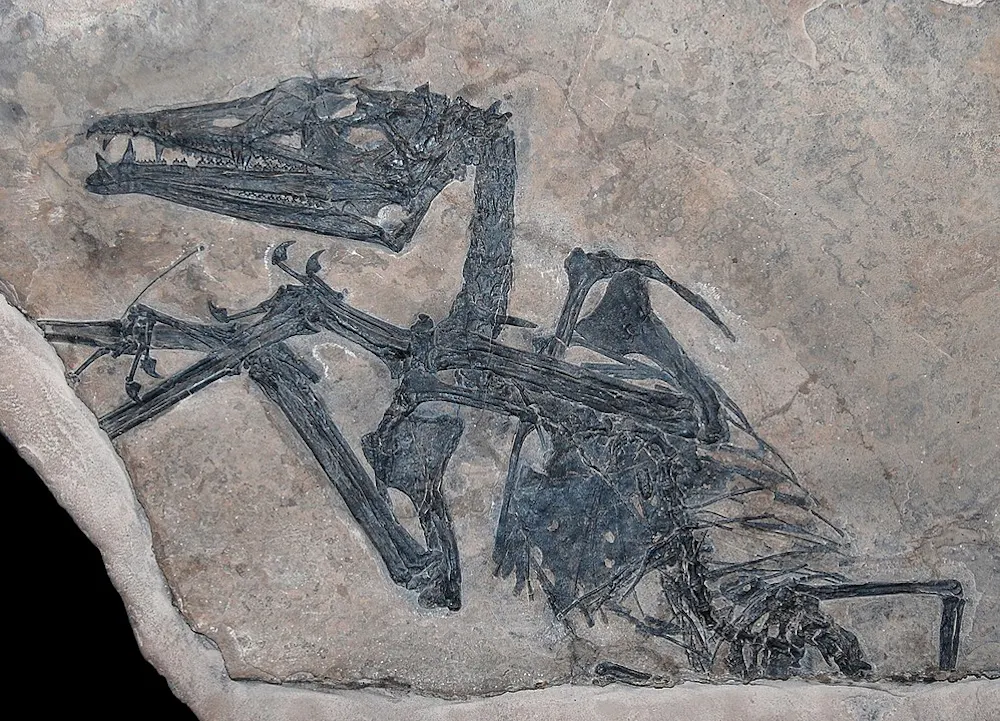
    Most of the handful of Triassic specimens come from narrow seams of dark shale in Italy and Austria, with other fragments discovered in Greenland, Argentina and the southwestern US. These skeletons appear fully adapted for flight, with a hyper-elongated fourth finger supporting membrane-wings. Yet older rocks show no trace of intermediate gliders or other transitional forms that you might expect as evidence of pterosaurs’ evolution over time.

    There are two classic competing explanations for this. The literal reading says pterosaurs evolved elsewhere and did not reach those regions where most have been discovered until very late in the Triassic period, by which time they were already adept flyers. The sceptical reading notes that pterosaurs’ wafer-thin, hollow bones could easily vanish from the fossil record, dissolve, get crushed or simply be overlooked, creating this false gap.

    Eudimorphodon ranzii fossil from Bergamo in 1973 is one of many pterosaur discoveries from southern Europe.
    Wikimedia, CC BY-SA

    For decades, the debate stalled as a result of too few fossils or too many missing rocks. This impasse began to change in 2020, when scientists identified the closest relatives of pterosaurs in a group of smallish upright reptiles called lagerpetids.

    From comparing many anatomical traits across different species, the researchers established that pterosaurs and lagerpetids shared many similarities including their skulls, skeletons and inner ears. While this discovery did not bring any “missing link” to the table, it showed what the ancestor of pterosaurs would have looked like: a rat-to-dog-sized creature that lived on land and in trees.

    This brought new evidence about when pterosaurs may have originated. Pterosaurs and lagerpetids like Scleromochlus, a small land-dwelling reptile, diverged at some point after the end-Permian mass extinction. It occurred some 250 million years ago, 35 million years before the first pterosaur appearance in the fossil record.

    Scleromochlus is one of the lagerpetids, the closest known relatives to the pterosaurs.
    Gabriel Ugueto

    Pterosaurs and their closest kin did not share the same habitats, however. Our new study, featuring new fossil maps, shows that soon after lagerpetids appeared (in southern Pangaea), they spread across wide areas, including harsh deserts, that many other groups were unable to get past. Lagerpetids lived both in these deserts and in humid floodplains.

    They tolerated hotter, drier settings better than any early pterosaur, implying that they had evolved to cope with extreme temperatures. Pterosaurs, by contrast, were more restricted. Their earliest fossils cluster in the river and lake beds of the Chinle and Dockum basins (southwest US) and in moist coastal belts fringing the northern arm of the Tethys Sea, a huge area that occupied today’s Alps.

    Scientists have inferred from analysing a combination of fossil distributions, rock features and climate simulations that pterosaurs lived in areas that were warm but not scorching. The rainfall would have been comparable to today’s tropical forests rather than inland deserts.

    This suggests that the earliest flying dinosaurs may have lived in tree canopies, using foliage both for take-off and to protect themselves from predators and heat. As a result of this confined habitat, the distances that they flew may have been quite limited.

    Changing climates

    We were then able to add a fresh dimension to the story using a method called ecological niche modelling. This is routinely used in modern conservation to project where endangered animals and plants might live as the climate gets hotter. By applying this approach to later Triassic temperatures, rainfall and coastlines, we asked where early pterosaurs lived, regardless of whether they’ve shown up there in the fossil record.

    Many celebrated fossil sites in Europe emerge as poor pterosaur habitat until very late in the Triassic period: they were simply too hot, too dry or otherwise inhospitable before the Carnian age, around 235 million years ago. The fact that no specimens have been discovered there that are more than about 215 million years old may be because the climate conditions were still unsuitable or simply because we don’t have the right type of rocks preserved of that age.

    In contrast, parts of the south-western US, Morocco, India, Brazil, Tanzania and southern China seem to have offered welcoming environments several million years earlier than the age of our oldest discoveries. This rewrites the search map. If pterosaurs could have thrived in those regions much more than 215 million years ago, but we have not found them there, the problem may again lie not with biology but with geology: the right rocks have not been explored, or they preserve fragile fossils only under exceptional conditions.

    Our study flags a dozen geological formations, from rivers with fine sediment deposits to lake beds, as potential prime targets for the next breakthrough discovery. They include the Timezgadiouine beds of Morocco, the Guanling Formation of south-west China and, in South America, several layers of rock from the Carnian age, such as the Santa Maria Formation, Chañares Formation and Ischigualasto Formation.

    Pterosaurs were initially confined to tropical treetops near the equator. When global climates shifted and forested corridors opened, pterosaurs’ wings catapulted them into every corner of the planet and ultimately carried them through one of Earth’s greatest extinctions. What began as a tale of missing fossils has become a textbook example of how climate, ecology and evolutionary science have come together to illuminate a fragmentary history that has intrigued paleontologists for over two centuries.

    Davide Foffa is funded by Marie Skłodowska-Curie Actions: Individual (Global) Fellowship (H2020-MSCA-IF-2020; No.101022550), and by the Royal Commission for the Exhibition of 1851–Science Fellowship

    Alfio Alessandro Chiarenza receives funding from The Royal Society (Newton International Fellowship NIFR1231802)

    Emma Dunne does not work for, consult, own shares in or receive funding from any company or organisation that would benefit from this article, and has disclosed no relevant affiliations beyond their academic appointment.

    ref. How pterosaurs learned to fly: scientists have been looking in the wrong place to solve this mystery – https://theconversation.com/how-pterosaurs-learned-to-fly-scientists-have-been-looking-in-the-wrong-place-to-solve-this-mystery-259063

    MIL OSI

  • MIL-OSI Submissions: Air India crash in Ahmedabad sends reverberations to Canadian families of Air India Flight 182

    Source: The Conversation – Canada – By Chandrima Chakraborty, Professor, English and Cultural Studies; Director, Centre for Global Peace, Justice and Health, McMaster University

    The June 12 Air India crash in Ahmedabad, Gujarat, India, with 230 passengers and 12 crew members aboard is sending deep reverberations through a group of Canadians who know all too well the shock, grief and horror of losing loved ones in hauntingly similar circumstances.

    They are the families of those killed in the bombing of Air India Flight 182 en route from Canada to India 40 years ago this month.

    I work closely with these families as a researcher and advocate. I began interviewing these families in 2014 and have witnessed firsthand their pain, advocacy and emotional turmoil of living in the shadow of a historical event.

    As reports of the Ahmedabad crash came in, the WhatsApp account of the Air India Flight 182 families immediately flooded with expressions of shock, concern, sympathy and memories triggered by the latest incident.

    On June 23, 1985, Flight 182 was brought down by terrorist bombs created and planted on Canadian soil. The devastating mid-air explosion occurred over the Atlantic Ocean near Ireland. It killed all 329 passengers and crew, including 268 Canadians. The crew and most of the passengers were of Indian origin.

    Investigations into the causes of the crash of Air India Flight 171, en route to London’s Gatwick airport, shortly after take-off are still underway. At least 279 people died in the crash, which also impacted people on the ground.

    Acknowledging losses as significant

    A recent public conference at McMaster University commemorated the 40th anniversary of Flight 182, bringing together Indian and Canadian families, researchers, creative artists and community members.

    Book cover for ‘Remembering Air India The Art of Public Mourning,’ edited by Chandrima Chakraborty, Amber Dean and Angela Failler.
    University of Alberta Press

    The conference dealt with critical themes, including the challenge of Flight 182 families recovering from their losses within a climate of broad indifference among their fellow Canadians.

    Regardless of what may have caused the more recent crash in western India, these Canadian families know the shock and loss that a new set of victims’ families are facing, and how important it is to support them.

    Hopefully, the home countries of last week’s crash victims — most of them Indian and British citizens, with at least one Canadian reported to have been aboard — will regard their deaths as significant losses. If so, this would be unlike what the 1985 victims’ families experienced in Canada.

    A little-mourned Canadian tragedy

    In Canada, we have a national day to remember on June 23, 1985. The bombing has been called a Canadian tragedy in a public inquiry report.

    Yet according to a 2023 Angus Reid poll, “nine out of 10 Canadians say they have little or no knowledge of the worst single instance of the mass killing of their fellow citizens.” That essentially means the bombing has yet to penetrate the consciousness of everyday Canadians or evoke shared grief or public mourning.

    The families continue to carry the torch of remembrance as they organize annual memorial vigils every June 23. Few others attend. Many victims’ relatives have died since 1985. Some spouses, siblings or parents are now in their 80s, wondering why the bombing is still not widely discussed in schools or in public discourse.

    The grinding and unsatisfying criminal proceedings, the belated public inquiry and the welcome but lukewarm apology by the Canadian government 25 years after the fact have all contributed to the failure of this tragedy to adhere more solidly to the Canadian consciousness. In fact, many continue to deny the Canadian significance of Flight 182 and view the bombing as a foreign event.

    A torch of remembrance

    At last month’s conference, my research team launched the Air India Flight 182 archive to counter this collective amnesia and lack of acknowledgement.

    Canadian archival consultant and writer Laura Millar has said that archives act as “touchstones to memory” and can aid the process of transforming individual memories into collective remembering. Adopting NYU professor Carol Gilligan’s ethics of care for the archive, we have been consulting with families to find ways to share their grief with the public.

    The Flight 182 memory archive — both physical and digital — serves as a repository for artefacts, first-person narratives, memorabilia and creative works related to the tragedy produced by family members. Family donations of artefacts such as dance videos and pilot wings redirect notions of archives away from a documental deposit. Hopefully, they can move the public to learn and care for the impacts of the Flight 182 bombing.

    The archive is a publicly accessible record of the tragedy, where scholars and everyday citizens can learn about the victims and their families.

    Since the past involves both the present and the future, the archive will enable a meaningful recognition of marginalized voices and histories. It can offer a form of memory justice for those who would otherwise be forgotten by sustaining memory from generation to generation.

    While the archive articulates the demand from families that the bombing of Flight 182 and its aftermath be incorporated into Canadian national consciousness, establishing this archive alone will not be enough to elevate the memory of Flight 182 to the place it deserves.

    But at least it establishes a rich, permanent academic and personal legacy for the community of mourners, and for the Canadian and global public to find it, use it and learn from its many lessons.

    Families of those on board the 1985 flight are preparing to commemorate the 40th anniversary of the terror bombing of Flight 182 that has devastated their lives.

    As we learn more about the tragic Air India Flight 171 crash on June 12, the lessons of Flight 182 will hopefully prevent a new set of families from feeling the pain of indifference on top of the unimaginable agony of loss they’re already experiencing.

    Chandrima Chakraborty receives funding from the Social Sciences and Humanities Research Council of Canada.

    ref. Air India crash in Ahmedabad sends reverberations to Canadian families of Air India Flight 182 – https://theconversation.com/air-india-crash-in-ahmedabad-sends-reverberations-to-canadian-families-of-air-india-flight-182-258991

    MIL OSI

  • MIL-OSI Submissions: The 28 Days Later franchise redefined zombie films. But the undead have an old, rich and varied history

    Source: The Conversation – Global Perspectives – By Christopher White, Historian, The University of Queensland

    The history of the dead – or, more precisely, the history of the living’s fascination with the dead – is an intriguing one.

    As a researcher of the supernatural, I’m often pulled aside at conferences or at the school gate, and told in furtive whispers about people’s encounters with the dead.

    The dead haunt our imagination in a number of different forms, whether as “cold spots”, or the walking dead popularised in zombie franchises such as 28 Days Later.

    The franchise’s latest release, 28 Years Later, brings back the Hollywood zombie in all its glory – but these archetypal creatures have a much wider and varied history.

    Zombis, revenants and the returning dead

    A zombie is typically a reanimated corpse: a category of the returning dead. Scholars refer to them as “revenants”, and continue to argue over their exact characteristics.

    In the Haitian Vodou religion, the zombi is not the same as the Hollywood zombie. Instead, zombi are people who, as a religious punishment, are drugged, buried alive, then dug out and forced into slavery.

    The Hollywood zombie, however, draws more from medieval European stories about the returning dead than from Vodou.

    A perfect setting for a ‘zombie’ film

    In 28 Years Later, the latest entry in Danny Boyle’s blockbuster horror franchise, the monsters technically aren’t zombies because they aren’t dead. Instead, they are infected by a “rage virus”, accidentally released by a group of animal rights activists in the beginning of the first film.

    This third film focuses on events almost three decades after the first film. The British Isles is quarantined, and the young protagonist Spike (Alfie Williams) and his family live in a village on Lindisfarne Island. This island, one of the most important sites in early medieval British Christianity, is isolated and protected by a tidal causeway that links it to the mainland.

    Aaron Taylor-Johnson and Alfie Williams star in the new film, out in Australian cinemas today.
    Sony Pictures

    The film leans heavily on how we imagine the medieval world, with scenes showing silhouetted fletchers at work making arrows, children training with bows, towering ossuaries and various memento mori. There’s also footage from earlier depictions of medieval warfare. And at one point, the characters seek sanctuary in the ruins of Fountains Abbey, in Yorkshire, which was built in 1132.

    The medieval locations and imagery of 28 Years Later evoke the long history of revenants, and the returned dead who once roved medieval England.

    Early accounts of the medieval dead

    In the medieval world, or at least the parts that wrote in Latin, the returning dead were usually called spiritus (“spirit”), but they weren’t limited to the non-corporeal like today’s ghosts are.

    Medieval Latin Christians from as early as the 3rd century saw the dead as part of a parallel society that mirrored the world of the living, where each group relied on the other to aid them through the afterlife.

    Depiction of the undead from a medieval manuscript.
    British Library, Yates Thompson MS 13

    While some medieval ghosts would warn the living about what awaited sinners in the afterlife, or lead their relatives to treasure, or prophesise the future, some also returned to terrorise the living.

    And like the “zombies” affected by the rage virus in 28 Years Later, these revenants could go into a frenzy in the presence of the living.

    Thietmar, the Prince-Bishop of Merseburg, Germany, wrote the Chronicon Thietmari (Thietmar’s Chronicle) between 1012 and 1018, and included a number of ghost stories that featured revenants.

    Although not all of them framed the dead as terrifying, they certainly didn’t paint them as friendly, either. In one story, a congregation of the dead at a church set the priest upon the altar, before burning him to ashes – intended to be read as a mirror of pagan sacrifice.

    These dead were physical beings, capable of seizing a man and sacrificing him in his own church.

    A threat to be dealt with

    The English monastic historian William of Newburgh (1136–98) wrote revenants were so common in his day that recording them all would be exhausting. According to him, the returned dead were frequently seen in 12th century England.

    So, instead of providing a exhausting list, he offered some choice examples which, like most medieval ghost stories, had a good Christian moral attached to them.

    William’s revenants mostly killed the people of the towns they lived, returning to the grave between their escapades. But the medieval English had a method for dealing with these monsters; they dug them up, tore out the heart and then burned the body.

    Other revenants were dealt with less harshly, William explained. In one case, all it took was the Bishop of Lincoln writing a letter of absolution to stop a dead man returning to his widow’s bed.

    These medieval dead were also thought to spread disease – much like those infected with the rage virus – and were capable of physically killing someone.

    Depiction of the undead from a medieval manuscript.
    British Library, Arundel MS 83.

    The undead, further north

    In medieval Scandinavia and Iceland, the undead draugr were extremely strong, hideous to look at and stunk of decomposition. Some were immune to human weapons and often killed animals near their tombs before building up to kill humans. Like their English counterparts, they also spread disease.

    But according to the Eyrbyggja saga, an anonymous 13th or 14th century text written in Iceland, all it took was a type of community court and the threat of legal action to drive off these returned dead.

    It’s a method the survivors in 28 Years Later didn’t try.

    The dead live on

    The first-hand zombie stories that were common during the medieval period started to dwindle in the 16th century with the Protestant Reformation, which focused more on individuals’ behaviours and salvation.

    Nonetheless, their influence can still be felt in Catholic ritual practices today, such as in prayers offered for the dead, and the lighting of votive candles.

    We still tell ghost stories, and we still worry about things that go bump in the night. And of course, we continue to explore the undead in all its forms on the big screen.

    Christopher White does not work for, consult, own shares in or receive funding from any company or organisation that would benefit from this article, and has disclosed no relevant affiliations beyond their academic appointment.

    ref. The 28 Days Later franchise redefined zombie films. But the undead have an old, rich and varied history – https://theconversation.com/the-28-days-later-franchise-redefined-zombie-films-but-the-undead-have-an-old-rich-and-varied-history-247900

    MIL OSI

  • MIL-OSI Submissions: Decolonizing history and social studies curricula has a long way to go in Canada

    Source: The Conversation – Canada – By Sara Karn, Postdoctoral Fellow, Department of History, McMaster University

    In June 2015, 10 years ago, the Truth and Reconciliation Commission of Canada (TRC) called for curriculum on Indigenous histories and contemporary contributions to Canada to foster intercultural understanding, empathy and respect. This was the focus of calls to action Nos. 62 to 65.

    As education scholars, we are part of a project supported by the Social Sciences and Humanities Research Council called Thinking Historically for Canada’s Future. This project involves researchers, educators and partner organizations from across Canada, including Indigenous and non-Indigenous team members.

    As part of this work, we examined Canadian history and social studies curricula in elementary, middle and secondary schools with the aim of understanding how they address — and may better address in future — the need for decolonization.

    We found that although steps have been made towards decolonizing history curricula in Canada, there is still a long way to go. These curricula must do far more to challenge dominant narratives, prompt students to critically reflect on their identities and value Indigenous world views.


    Read more:
    Looking for Indigenous history? ‘Shekon Neechie’ website recentres Indigenous perspectives


    Reimagining curriculum

    As white settler scholars and educators, we acknowledge our responsibility to unlearn colonial ways of being and learn how to further decolonization in Canada.

    In approaching this study, we began by listening to Indigenous scholars, such as Cree scholar Dwayne Donald. Donald and other scholars call for reimagining curriculum through unlearning colonialism and renewing relationships.


    Read more:
    Leaked Alberta school curriculum in urgent need of guidance from Indigenous wisdom teachings


    The late Arapaho education scholar Michael Marker suggested that in history education, renewing relations involves learning from Indigenous understandings of the past, situated within local meanings of time and place.

    History, social studies curricula

    Curricula across Canada have been updated in the last 10 years to include teaching about treaties, Indian Residential Schools and the cultures, perspectives and experiences of Indigenous Peoples over time.

    Thanks primarily to the work of Indigenous scholars and educators, including Donald, Marker, Mi’kmaw educator Marie Battiste, Anishinaabe scholar Nicole Bell and others, some public school educators are attentive to land-based learning and the importance of oral history.

    But these teachings are, for the most part, ad hoc and not supported by provincial curriculum mandates.

    Our study revealed that most provincial history curricula are still focused on colonial narratives that centre settler histories and emphasize “progress” over time. Curricula are largely inattentive to critical understandings of white settler power and to Indigenous ways of knowing and being.

    Notably, we do not include the three territories in this statement. Most of the territorial history curricula have been co-created with local Indigenous communities, and stand out with regard to decolonization.

    For example, in Nunavut’s Grade 5 curriculum, the importance of local knowledge tied to the land is highlighted throughout. There are learning expectations related to survival skills and ecological knowledge.

    Members of our broader research team are dedicated to analyzing curricula in Nunavut, the Northwest Territories and the Yukon. Their work may offer approaches to be adapted for other educational contexts.

    Dominant narratives

    In contrast, we found that provincial curricula often reinforce dominant historical narratives, especially surrounding colonialism. Some documents use the term “the history,” implying a singular history of Canada (for example, Manitoba’s Grade 6 curriculum).

    Historical content, examples and guiding questions are predominantly written from a Euro-western perspective, while minimizing racialized identities and community histories. In particular, curricula often ignore illustrations of Indigenous agency and experience.


    Read more:
    Moving beyond Black history month towards inclusive histories in Québec secondary schools


    Most curricula primarily situate Indigenous Peoples in the past, without substantial consideration for present-day implications of settler colonialism, as well as Indigenous agency and experiences today.

    For example, in British Columbia’s Grade 4 curriculum, there are lengthy discussions of the harms of colonization in the past. Yet, there is no mention of the ongoing impacts of settler colonialism or the need to engage in decolonization today.

    To disrupt these dominant narratives, we recommend that history curricula should critically discuss the ongoing impacts of settler colonialism, while centring stories of Indigenous resistance and survival over time.

    Identity and privilege

    There are also missed opportunities within history curricula when it comes to critical discussions around identity, including systemic marginalization or privilege.

    Who we are informs how we understand history, but curricula largely does not prompt student reflection in these ways, including around treaty relationships.

    In Saskatchewan’s Grade 5 curriculum, students are expected to explain what treaties are and “affirm that all Saskatchewan residents are Treaty people.”

    However, there is no mention of students considering how their own backgrounds, identities, values and experiences shape their understandings of and responsibilities for treaties. Yet these discussions are essential for engaging students in considering the legacies of colonialism and how they may act to redress those legacies.

    A key learning outcome could involve students becoming more aware of how their own personal and community histories inform their historical understandings and reconciliation commitments.

    Indigenous ways of knowing and being

    History curricula generally ignore Indigenous ways of knowing and being. Most curricula are inattentive to Indigenous oral traditions, conceptions of time, local contexts and relationships with other species and the environment.

    Instead, these documents reflect Euro-western, settler colonial worldviews and educational values. For example, history curricula overwhelmingly ignore local meanings of time and place, while failing to encourage opportunities for land-based and experiential learning.

    In Prince Edward Island’s Grade 12 curriculum, the documents expect that students will “demonstrate an understanding of the interactions among people, places and the environment.” While this may seem promising, environmental histories in this curriculum and others uphold capitalist world views by focusing on resource extraction and economic progress.

    To disrupt settler colonial relationships with the land and empower youth as environmental stewards, we support reframing history curricula in ways that are attentive to Indigenous ways of knowing the past and relations with other people, beings and the land.

    Ways forward

    Schools have been, and continue to be, harmful spaces for many Indigenous communities, and various aspects of our schooling beg questions about how well-served both Indigenous and non-Indigenous students are for meeting current and future challenges.

    If, as a society, we accept the premise that the transformation of current curricular expectations is possible for schools, then more substantive engagement is required in working toward decolonization.

    Decolonizing curricula is a long-term, challenging process that requires consideration of many things: who sits on curriculum writing teams; the resources allocated to supporting curricular reform; broader school or board-wide policies; and ways of teaching that support reconciliation.

    We encourage history curriculum writing teams to take up these recommendations as part of a broader commitment to reconciliation.

    While not exhaustive, recommendations for curricular reform are a critical step in the future redesign of history curricula. The goal is a history education committed to listening and learning from Indigenous communities to build more inclusive national stories of the past, and into the future.

    This is a corrected version of a story originally published June 17, 2025. The earlier story said Michael Marker was from the Lummi Nation instead of saying he was an Arapaho scholar.

    Sara Karn receives funding from the Social Sciences and Humanities Research Council (SSHRC).

    Kristina R. Llewellyn receives funding from the Social Sciences and Humanities Research Council (SSHRC).

    Penney Clark receives funding from the Social Sciences and Humanities Research Council of Canada (SSHRC).

    ref. Decolonizing history and social studies curricula has a long way to go in Canada – https://theconversation.com/decolonizing-history-and-social-studies-curricula-has-a-long-way-to-go-in-canada-253679

    MIL OSI

  • MIL-OSI Submissions: We have drugs to manage HIV. So why are we spending millions looking for cures?

    Source: The Conversation – Global Perspectives – By Bridget Haire, Associate Professor, Public Health Ethics, School of Population Health, UNSW Sydney

    Alim Yakubov/Shutterstock

    Over the past three decades there have been amazing advances in treating and preventing HIV.

    It’s now a manageable infection. A person with HIV who takes HIV medicine consistently, before their immune system declines, can expect to live almost as long as someone without HIV.

    The same drugs prevent transmission of the virus to sexual partners.

    There is still no effective HIV vaccine. But there are highly effective drugs to prevent HIV infection for people without HIV who are at higher risk of acquiring it.

    These drugs are known as as “pre-exposure prophylaxis” or PrEP. These come as a pill, which needs to be taken either daily, or “on demand” before and after risky sex. An injection that protects against HIV for six months has recently been approved in the United States.

    So with such effective HIV treatment and PrEP, why are we still spending millions looking for HIV cures?

    Not everyone has access to these drugs

    Access to HIV drugs and PrEP depends on the availability of health clinics, health professionals, and the means to supply and distribute the drugs. In some countries, this infrastructure may not be secure.

    For instance, earlier this year, US President Donald Trump’s dissolution of the USAID foreign aid program has threatened the delivery of HIV drugs to many low-income countries.

    This demonstrates the fragility of current approaches to treatment and prevention. A secure, uninterrupted supply of HIV medicine is required, and without this, lives will be lost and the number of new cases of HIV will rise.

    Another example is the six-monthly PrEP injection just approved in the US. This drug has great potential for controlling HIV if it is made available and affordable in countries with the greatest HIV burden.

    But the prospect for lower-income countries accessing this expensive drug looks uncertain, even if it can be made at a fraction of its current cost, as some researchers say.

    So despite the success of HIV drugs and PrEP, precarious health-care systems and high drug costs mean we can’t rely on them to bring an end to the ongoing global HIV pandemic. That’s why we also still need to look at other options.

    Haven’t people already been ‘cured’?

    Worldwide, at least seven people have been “cured” of HIV – or at least have had long-term sustained remission. This means that after stopping HIV drugs, they did not have any replicating HIV in their blood for months or years.

    In each case, the person with HIV also had a life-threatening cancer needing a bone marrow transplant. They were each matched with a donor who had a specific genetic variation that resulted in not having HIV receptors in key bone marrow cells.

    After the bone marrow transplant, recipients stopped HIV drugs, without detectable levels of the virus returning. The new immune cells made in the transplanted bone marrow lacked the HIV receptors. This stopped the virus from infecting cells and replicating.

    But this genetic variation is very rare. Bone marrow transplantation is also risky and extremely resource-intensive. So while this strategy has worked for a few people, it is not a scalable prospect for curing HIV more widely.

    So we need to keep looking for other options for a cure, including basic laboratory research to get us there.

    How about the ‘breakthrough’ I’ve heard about?

    HIV treatment stops the HIV replication that causes immune damage. But there are places in the body where the virus “hides” and drugs cannot reach. If the drugs are stopped, the “latent” HIV comes out of hiding and replicates again. So it can damage the immune system, leading to HIV-related disease.

    One approach is to try to force the hidden or latent HIV out into the open, so drugs can target it. This is a strategy called “shock and kill”. And an example of such Australian research was recently reported in the media as a “breakthrough” in the search for an HIV cure.

    Researchers in Melbourne have developed a lipid nanoparticle – a tiny ball of fat – that encapsulates messenger RNA (or mRNA) and delivers a “message” to infected white blood cells. This prompts the cells to reveal the “hiding” HIV.

    In theory, this will allow the immune system or HIV drugs to target the virus.

    This discovery is an important step. However, it is still in the laboratory phase of testing, and is just one piece of the puzzle.

    We could say the same about many other results heralded as moving closer to a cure for HIV.

    Further research on safety and efficacy is needed before testing in human clinical trials. Such trials start with small numbers and the trialling process takes many years. This and other steps towards a cure are slow and expensive, but necessary.

    Importantly, any cure would ultimately need to be fairly low-tech to deliver for it to be feasible and affordable in low-income countries globally.

    So where does that leave us?

    A cure for HIV that is affordable and scalable would have a profound impact on human heath globally, particularly for people living with HIV. To get there is a long and arduous path that involves solving a range of scientific puzzles, followed by addressing implementation challenges.

    In the meantime, ensuring people at risk of HIV have access to testing and prevention interventions – such as PrEP and safe injecting equipment – remains crucial. People living with HIV also need sustained access to effective treatment – regardless of where they live.

    Bridget Haire has received funding from the National Health and Medical Research Council. She is a past president of the Australian Federation of AIDS Organisations (now Health Equity Matters).

    Benjamin Bavinton receives funding from the National Health and Medical Research Council, the Australian government, and state and territory governments. He also receives funding from ViiV Healthcare and Gilead Sciences, both of which make drugs or drug classes mentioned in this article. He is a Board Director of community organisation, ACON, and is on the National PrEP Guidelines Panel coordinated by ASHM Health.

    ref. We have drugs to manage HIV. So why are we spending millions looking for cures? – https://theconversation.com/we-have-drugs-to-manage-hiv-so-why-are-we-spending-millions-looking-for-cures-258391

    MIL OSI

  • MIL-OSI Submissions: Trump’s worldview is causing a global shift of alliances – what does this mean for nations in the middle?

    Source: The Conversation – Global Perspectives – By Dilnoza Ubaydullaeva, Lecturer in Government – National Security College, Australian National University

    Since US President Donald Trump took office this year, one theme has come up time and again: his rule is a threat to the US-led international order.

    As the US political scientist John Mearsheimer famously argued, the liberal international order

    was destined to fail from the start, as it contained the seeds of its own destruction.

    This perspective has gained traction in recent years. And now, Trump’s actions have caused many to question whether a new world order is emerging.

    Trump has expressed a desire for a new international order defined by multiple spheres of influence — one in which powers like the US, China and Russia each exert dominance over distinct regions.

    This vision aligns with the idea of a “multipolar” world, where no single state holds overarching global dominance. Instead, influence is distributed among several great powers, each maintaining its own regional sphere.

    This architecture contrasts sharply with earlier periods – the bipolar world of the Cold War, dominated by the US and the Soviet Union; and the unipolar period that followed, dominated by the US.

    What does this mean for the world order moving forward?

    Shifting US spheres of influence

    We’ve seen this shift taking place in recent months. For example, Trump has backed away from his pledge to end the war between Russia and Ukraine and now appears to be leaving it to the main protagonists, and Europe, to find a solution.

    Europe, which once largely spoke in a unified voice with the US, is also showing signs of policy-making which is more independent. Rather than framing its actions as protecting “Western democratic principles”, Europe is increasingly focused on defining its own security interests.

    In the Middle East, the US will likely maintain its sphere of influence. It will continue its unequivocal support for Israel under Trump.

    Amid shifting global alliances, the Trump administration will continue to support Israel, led by Prime Minister Benjamin Netanyahu.
    noamgalai/Shutterstock

    The US will also involve itself in the region’s politics when its interests are at stake, as we witnessed in its recent strikes on Iranian nuclear facilities.

    This, along with increasing economic ties between the US and Gulf states, suggests US allies in the region will remain the dominant voices shaping regional dynamics, particularly now with Iran weakened.

    Yet it’s clear Trump is reshaping US dynamics in the region by signaling a desire for reduced military and political involvement, and criticising the nation building efforts of previous administrations.

    The Trump administration now appears to want to maintain its sphere of influence primarily through strong economic ties.

    Russia and China poles emerging elsewhere

    Meanwhile, other poles are emerging in the Global South. Russia and China have deepened their cooperation, positioning themselves as defenders against what they frame as Western hegemonic bullying.

    Trump’s trade policies and sanctions against many nations in the Global South have fuelled narratives (spread by China and Russia) that the US does not consistently adhere to the rules it imposes on others.

    Trump’s decision to slash funding to USAID has also opened the door to China, in particular, to become the main development partner for nations in Africa and other parts of the world.

    And on the security front, Russia has become more involved in many African and Middle Eastern countries, which have become less trustful and reliant on Western powers.

    Russian President Vladimir Putin and Chinese leader Xi Xinping see opportunities to spread their influence in the Global South.
    plavi011/Shutterstock

    In the Indo-Pacific, much attention has been given to the rise of China and its increasingly assertive posture. Many of Washington’s traditional allies are nervous about its continued engagement in the region and ability to counter China’s rise.

    Chinese leader Xi Jinping has sought to take advantage of the current environment, embarking on a Vietnam, Malaysia and Cambodia push earlier this year. But many nations continue to be wary of China’s increasing influence, in particular the Philippines, which has clashed with China over the South China Sea.

    Strategic hedging

    Not all countries, however, are aligning themselves neatly with one pole or another.

    For small states caught between great powers, navigating this multipolar environment is both a risk and an opportunity.

    Ukraine is a case in point. As a sovereign state, Ukraine should have the freedom to decide its own alignments. Yet, it finds itself ensnared in great power politics, with devastating consequences.

    Other small states are playing a different game — pivoting from one power to another based on their immediate interests.

    Slovakia, for instance, is both a NATO and EU member, yet its leader, Robert Fico, attended Russia’s Victory Day Parade in May and told President Vladimir Putin he wanted to maintain “normal relations” with Russia.

    Then there is Central Asia, which is the centre of a renewed “great game,” with Russia, China and Europe vying for influence and economic partnerships.

    Yet if any Central Asian countries were to be invaded by Putin, would other powers intervene? It’s a difficult question to answer. Major powers are reluctant to engage in direct conflict unless their core interests or borders are directly threatened.

    As a result, Central Asian states are hedging their bets, seeking to maintain relations with multiple poles, despite their conflicting agendas.

    A future defined by regional power blocs?

    While it is still early to draw definitive conclusions, the events of the past few months underscore a growing trend. Smaller countries are expressing solidarity with one power, but pragmatic cooperation with another, when it suits their national interests.

    For this reason, regional power blocs seem to be of increasing interest to countries in the Global South.

    For instance, the China-led Shanghai Cooperation Organisation has become a stronger and larger grouping of nations across Eurasia in recent years.

    Trump’s focus on making “America Great Again,” has taken the load off the US carrying liberal order leadership. A multipolar world may not be the end of the liberal international order, but it may be a reshaped version of liberal governance.

    How “liberal” it can be will likely depend on what each regional power, or pole, will make of it.

    Dilnoza Ubaydullaeva does not work for, consult, own shares in or receive funding from any company or organisation that would benefit from this article, and has disclosed no relevant affiliations beyond their academic appointment.

    ref. Trump’s worldview is causing a global shift of alliances – what does this mean for nations in the middle? – https://theconversation.com/trumps-worldview-is-causing-a-global-shift-of-alliances-what-does-this-mean-for-nations-in-the-middle-257113

    MIL OSI

  • MIL-OSI Submissions: Black holes spew out powerful jets that span millions of light-years – we’re trying to understand their whole life cycle

    Source: The Conversation – Africa (2) – By Gourab Giri, Postdoctoral researcher, University of Pretoria

    An artistic representation of what a giant cosmic jet the size of the distance between the Milky Way and Andromeda could look like. Author provided, CC BY-SA

    There is a supermassive black hole at the centre of nearly every big galaxy – including ours, the Milky Way (it’s called Sagittarius A*). Supermassive black holes are the densest objects in the universe, with masses reaching billions of times that of the Sun.

    Sometimes a galaxy’s supermassive black hole “wakes up” due to a sudden influx of gas and dust, most likely supplied from a neighbouring galaxy. It begins eating up lots of nearby gas and dust. This isn’t a calm, slow or passive process. As the black hole pulls in material, the material gets superheated on a scale of millions of degrees, far hotter than the surface temperature of our Sun, and is ejected from the galaxy at near-light speeds. This creates powerful jets that look like fountains in the cosmos.

    The accelerated high-speed plasma matter prompts these “fountains” to emit radio signals that can only be detected by very powerful radio telescopes. This gives them their name: radio galaxies. While black holes are common, radio galaxies are not. Only between 10% and 20% of all galaxies exhibit this phenomenon.

    Giant radio galaxies are even less common. They account for only 5% of all radio galaxies and take their name from the fact that they reach enormous distances. Some radio galaxies’ jets reach nearly 16 million light-years. (That’s almost six times the distance between the Milky Way and the Andromeda galaxy.) The largest jet discovered spans nearly 22 million light-years across.


    Read more:
    South African telescope discovers a giant galaxy that’s 32 times bigger than Earth’s


    But how do these structures cover such enormous distances? To find out, I led a study in which we used modern supercomputers to develop models that simulated behaviour of giant cosmic jets within a mock universe, constructed on the basis of fundamental physical laws governing the cosmos.

    This allowed us to observe how radio jets propagate over hundreds of millions of years – a process impossible to track directly in the real universe. These sophisticated simulations provide deeper insights into the life cycle of radio galaxies, highlighting the differences between their early, compact stages and their later, expansive forms.

    Understanding the evolution of radio galaxies helps us unravel the broader processes that shape the universe.

    Supercomputing

    Cutting-edge technology was key to this study.

    Sensitive observations from world-class radio telescopes like South Africa’s MeerKAT and LOFAR in the Netherlands have recently led to several discoveries of cosmic fountains.


    Read more:
    MeerKAT: the South African radio telescope that’s transformed our understanding of the cosmos


    However, modelling their origins has been challenging. Tracking events over millions of years is impossible in real-time.

    That’s where supercomputers come in. These high-performance computing systems are designed to process massive amounts of data. They can perform complex simulations at incredible speeds. In this study, their power was crucial for modelling the evolution of giant radio jets over millions of years.

    The necessary supercomputing power was provided by South Africa’s Inter-University Institute for Data Astronomy, a network comprising the University of Pretoria, the University of Cape Town and the University of the Western Cape.

    Our universe is governed by fundamental forces like gravity, which can be described through mathematical formulas. These formulas, essentially numbers, are fed into supercomputers to create a simulated “mock universe” that follows the same physical laws as the real cosmos. This allows scientists to experiment with how jets from supermassive black holes evolve over time. With their immense processing power, supercomputers can simulate millions of years of cosmic jet evolution in just a month.

    Key takeaways

    Gravity is the dominant force in the universe, pulling heavier matter and dragging nearby lighter matter. If gravity were the only force at play, the universe might have collapsed by now. Yet we see galaxies, galaxy clusters and even life itself thriving. We suspect that these cosmic fountains play a key role in solving the mystery of how this happens.

    By releasing thermal and mechanical energy, they heat up the surrounding collapsing gas, counteracting gravity and maintaining a balance that sustains cosmic structures.

    Our models also shed light on why some radio galaxies’ jets bend sharply, forming an “X” shape in radio waves instead of following a straight trajectory, and revealed the conditions under which giant fountains can continue growing even in dense cosmic environments (that is, in a galaxy cluster).

    The study also suggests that giant radio galaxies may be statistically more common than previously believed. There are potentially thousands of undiscovered giant cosmic fountains. Thanks to world-class telescopes like MeerKAT and LOFAR – and the power of supercomputers – there’s plenty more to explore as we try to understand our universe.

    The research on which this article is based required extensive collaboration with an international team, including Jacinta Delhaize from the University of Cape Town, Joydeep Bagchi from Christ University, India, and DJ Saikia from the Inter-University Centre for Astronomy and Astrophysics in India. Essential contributions by Kshitij Thorat and Roger Deane from the University of Pretoria also played a crucial role in shaping the study.

    Gourab Giri does not work for, consult, own shares in or receive funding from any company or organisation that would benefit from this article, and has disclosed no relevant affiliations beyond their academic appointment.

    ref. Black holes spew out powerful jets that span millions of light-years – we’re trying to understand their whole life cycle – https://theconversation.com/black-holes-spew-out-powerful-jets-that-span-millions-of-light-years-were-trying-to-understand-their-whole-life-cycle-250073

    MIL OSI

  • MIL-OSI Submissions: Ancient DNA reveals Maghreb communities preserved their culture and genes, even in a time of human migration

    Source: The Conversation – Africa (2) – By Giulio Lucarini, Senior Researcher, Institute of Heritage Science, National Research Council (CNR)

    Doukanet el Khoutifa, Tunisia, where some of the remains were found. Giulio Lucarini, CC BY-NC-ND

    The Neolithic period began in southwest Asia around 12,000 years ago. It marked a major shift in human history as societies transitioned from hunting and gathering to farming. This sparked migrations across Europe and dramatically reshaped the continent’s gene pool.

    For a long time, North Africa was seen as a passive participant in this transformation. The dominant narrative suggested that farming economies never fully took root there.

    Some studies proposed that North African communities actively resisted agriculture, except perhaps in the Nile Delta and the western Maghreb (modern-day Morocco). They continued to rely on land snails, wild plants, and hunting for survival. Only later, they also began herding domesticated sheep, goats, and cattle, introduced from southwest Asia.

    Genetic studies have only recently tested this reconstruction in North Africa. This has never been done in the eastern Maghreb (modern-day Tunisia and eastern Algeria) – until now.

    A burial at one of the study sites, SHM-1 (Hergla) in Tunisia.
    Simone Mulazzani, CC BY-NC-ND

    As an Africanist archaeologist, I specialise in the study of ancient societies across Mediterranean Africa and the Sahara. My focus is on how humans adapted to their environments and the rise of food production in these regions. I recently conducted research in the eastern Maghreb alongside an international team of archaeologists, geneticists, and physical anthropologists to trace ancient population movements.

    Our new study has just been published in Nature. We analysed the ancient genomes (complete DNA sequences) of nine individuals who lived in the eastern Maghreb between 15,000 and 6,000 years ago.

    This may seem like a small sample. But, in the field of ancient DNA research, even a few well-preserved genomes can provide significant insights. They serve as reference points for tracing genetic lineages and identifying ancestral connections.

    By adding genetic evidence to broader archaeological findings, we reconstructed patterns of population continuity, interaction and change over thousands of years.

    Our results were striking. It’s clear from these genomes that some influence from farmers did reach north Africa from across the Mediterranean. But much of the genetic makeup of the eastern Maghreb populations remained rooted in their ancient foraging heritage.

    This challenges the long-held narrative about migration into and out of north Africa before and during the Neolithic. It deepens our understanding of the past and highlights the incredible complexity of human movement and cultural exchange.

    As we continue to unravel the genetic legacy of our ancestors, studies like this remind us of the complexity of human history. They show that the history of agriculture in the Mediterranean was not merely one of population replacement. Rather, it was a tale of cultural exchange, adaptation and continuity.

    And researching these ancient human movements is more than just a matter of understanding history. It also provides insights into the patterns of migration and adaptation that can help us understand similar processes today.

    Extraction and analysis

    A map of the eastern Maghreb showing the study sites (1: Afalou Bou Rhummel; 2: Djebba; 3: Doukanet el Khoutifa; 4: SHM-1, Hergla)
    Giulio Lucarini, CC BY-NC-ND

    We worked with ancient genomes extracted from human skeletal remains housed in museum or heritage institution collections. They came from excavations at four sites Afalou Bou Rhummel, Djebba, Doukanet el Khoutifa and SHM-1 (Hergla), all in the eastern Maghreb.

    We chose the specimens because they were well-preserved, which is not always the case with ancient DNA.

    The analysis found that some of the sampled individuals possessed European farmer ancestry around 7,000 years ago. Europeans contributed some genes to the region – but no more than 20% per individual.

    Excavation of human remains at Doukanet el Khoutifa, Tunisia.
    Giulio Lucarini, CC BY-NC-ND

    This is a modest genetic influence compared to ancient western Maghreb populations where, at some sites, European farmer ancestry can reach as high as 80%.

    Our findings suggest that food-producing economies were introduced to the eastern Maghreb not by a large-scale replacement of the population (as seen in Europe) but more gradually. Change happened through sporadic migrations, mixing of cultures, and the spread of knowledge.

    Across sea and land

    One of the most intriguing discoveries was the genetic trace of European hunter-gatherers found in one individual from Djebba, Tunisia, dating to around 8,000 years ago. This suggests that early European and north African populations could interact via seafaring routes across the Strait of Sicily.

    Researchers have long known that cultural exchange took place across the Mediterranean. We see this from the spread of technologies such as the so-called pressure technique – a method of shaping stone tools by carefully applying force with a pointed implement rather than striking the stone directly.

    The discovery in Tunisia of obsidian (volcano glass) from Pantelleria, a small island in the Strait of Sicily, strengthens the link between the Mediterranean’s northern and southern shores.

    Prehistoric wooden artefacts are seldom preserved over time. This may explain the absence of boat remains from this period in North Africa. However, dugout canoes from similar periods found in central Italy (Bracciano Lake) suggest that seafaring skills were well established around the Mediterranean. While there is no direct evidence linking these specific canoes to connections between Europe and North Africa, they support the idea that navigation was within the technological capabilities of the time.

    Our study is the first time the connections suggested by this existing evidence have been substantiated genetically.


    Read more:
    Discovery of 5,000-year-old farming society in Morocco fills a major gap in history – north-west Africa was a central player in trade and culture


    Another exciting aspect of our study is the identification of early Levantine (modern southwest Asia)-related ancestry in the eastern Maghreb. This was detected in human remains dated to around 6,800 years ago. It’s a genetic signature that postdates the arrival of European farmer ancestry by several centuries. It likely reflects the movement of people associated with early pastoralism, who introduced domesticated animals, such as sheep and goats, to the region.

    Backing up archaeological evidence

    It is especially rewarding to see the genetic evidence aligning with the archaeological record. This underscores the value of multidisciplinary research in uncovering past human dynamics.

    What emerges overall is a region of strong genetic and cultural resilience, consistent with archaeological evidence.

    Giulio Lucarini receives funding for this study from the National Research Council of Italy (CNR) and ISMEO – International Association for Mediterranean and Oriental Studies, Italy. He is affiliated with the National Research Council of Italy, Institute of Heritage Science (CNR-ISPC).

    This study resulted from a collaboration between the following institutions: Harvard University, USA; the Max Planck Institute, Germany; the National Research Council of Italy (CNR); the Institut National du Patrimoine (INP), Tunisia; the Centre National de Recherche Préhistorique, Anthropologique et Historique (CNRPAH), Algeria; the Institut de Paléontologie Humaine (IPH), France; the University of Vienna, Austria; Sapienza University of Rome, Italy; and ISMEO – International Association for Mediterranean and Oriental Studies, Italy.

    ref. Ancient DNA reveals Maghreb communities preserved their culture and genes, even in a time of human migration – https://theconversation.com/ancient-dna-reveals-maghreb-communities-preserved-their-culture-and-genes-even-in-a-time-of-human-migration-248338

    MIL OSI

  • MIL-OSI Submissions: The first fossil thrips in Africa: this tiny insect pest met its end in a volcanic lake 90 million years ago

    Source: The Conversation – Africa (2) – By Sandiso Mnguni, Honorary Research Associate, University of the Witwatersrand

    The fossil thrips discovered in the Orapa Diamond Mine. Dr Sandiso Mnguni, CC BY-NC-ND

    Thrips are tiny insects – their sizes range between 0.5mm and 15mm in length and many are shorter than 5mm. But the damage they cause to crops is anything but small. A 2021 research paper found that in Indonesia “the damage to red chilli plants caused by thrips infestation ranges now from 20% to 80%”. In India, various thrips infestations in the late 2010s and early 2020s “damaged 40%-85% of chilli pepper crops in Karnataka, Andhra Pradesh and Telangana”.

    In Africa, a number of thrips species feed on sugarcane and have been known to damage nearly 30% of the crop in a single hectare of a farm. High rates of destruction have been recorded in Tanzania and Uganda on onion and tomato crops.

    Now it’s emerged that thrips are hardly new to the African continent and the southern hemisphere more broadly. South Africa’s first and only Black palaeoentomologist, Sandiso Mnguni, who studies fossil insects, recently described a fossil thrips from Orapa Diamond Mine in Botswana that’s more than 90 million years old. He discussed his unique fossil find with The Conversation Africa.

    What are thrips and how do they cause damage?

    Thrips, also known as thunderflies, thunderbugs or thunderblights, are small, slender and fragile insects. They can be identified by their typically narrow, strap-like, fringed and feathery wings. Over time, they have also evolved distinctive asymmetrical rasping-sucking mouthparts consisting of a labrum, labium, maxillary stylets and left mandible. Most species use these to feed primarily on fungi. Some feed on plants and eat the tender parts of certain crops like sugarcane, tomatoes, pepper, onions, avocado, legumes and citrus fruits, focusing on the buds, flowers and young leaves.

    This, along with their habit of accidentally distributing fungal spores while feeding or hunting, makes them destructive crop pests. They tend to feed as a group in large numbers, causing distinctive silver or bronze scarring on the surfaces of stems or leaves.

    However, not all thrips are harmful. A small fraction of the 6,500 species that have already been described so far are pollinators of flowering plants; and a handful are predators or natural enemies of moths and other smaller animals such as mites.

    Larva, pupa and adult Weeping fig thrips (Gynaikothrips uzeli)
    fcafotodigital

    Tell us about the fossil thrips you’ve discovered

    This is the first time that a fossil thrips has been recorded anywhere in Africa – or the entire southern hemisphere.

    The Orapa Diamond Mine in Botswana is one of the most important fossil deposits on the continent. It’s about 90 million years old, dating back to the Cretaceous period.


    Read more:
    Fossil beetles found in a Botswana diamond mine help us to reconstruct the distant past


    The deposit is situated 960 metres above sea level in the Kalahari Desert, about 250km due west of Francistown in Botswana, and 824km away from Johannesburg in South Africa. It was first discovered in 1967 and started producing carat diamonds in 1971.

    Roughly 90 million years go, steam and gas caused a double eruption of diamondiferous kimberlites. These are vertical, deep-source volcanic pipes that form when magma rapidly rises from the Earth’s mantle, carrying diamonds and other minerals up to the surface. They create a distinctive rock formation that gets studied by geologists. This explosive volcanic eruption formed a deep crater lake at the centre of the mine.

    Mining excavations during the 1980s and earlier uncovered and exposed fine-grained sedimentary rocks containing well preserved fossil plants and insects. These have already been studied by many researchers in the past. At the time, geology and palaeontology researchers from what was then the Bernard Price Institute, which has since been renamed the Evolutionary Studies Institute, at the University of the Witwatersrand in Johannesburg, were invited to collect the fossil material.

    Although some of the material has been studied in the past, the fossil thrips hadn’t yet been put under the microscope. And that’s just what we did. By using its body characteristics and comparing it to living thrips, we can say for sure that it’s a thrips. But we didn’t give it a formal scientific name because it doesn’t have enough characteristics to classify it at the species level and describe it either as a new species or one that still exists today.

    We think that the thrips either flew into the palaeolake that was formed by the volcanic eruption or was transported there through grass from a bird’s nest.

    Why is this useful to know?

    This discovery sheds light on the biodiversity and biogeography of thrips and many other groups of insects during a time when we know flowering plants that heavily relied on insect pollination were rapidly diversifying. This plant-insect reciprocal interaction goes back to the Devonian period, a time when there was a large super-continent called Gondwana. That’s when the first land plants evolved and dominated the Earth, and inadvertently led to many groups of insects, including thrips, diversifying to keep up with drastic changes in their preferred plant diets and habitats due to the dramatic environmental and climatic changes.


    Read more:
    Fossil insects help to reconstruct the past: how I ended up studying them (and you can too)


    The fossil find also contributes to a more accurate documentation of life on Earth during the Cretaceous and helps scientists in reconstructing the past environment and climate in Botswana.

    Hopefully there are more fossil insects waiting to be discovered in Botswana and elsewhere in Africa, to keep improving our picture of this long-ago world, and preserve the heritage of our continent.

    Sandiso Mnguni receives funding from the GENUS: DSTI-NRF Centre of Excellence in Palaeosciences (Grant 86073). He is affiliated with the Agricultural Research Council Plant Health and Protection (ARC-PHP) and the Sophumelela Youth Development Programme (SYDP).

    ref. The first fossil thrips in Africa: this tiny insect pest met its end in a volcanic lake 90 million years ago – https://theconversation.com/the-first-fossil-thrips-in-africa-this-tiny-insect-pest-met-its-end-in-a-volcanic-lake-90-million-years-ago-249077

    MIL OSI

  • MIL-Evening Report: Micronesian Summit in Majuro this week aims to be ‘one step ahead’

    By Giff Johnson, editor, Marshall Islands Journal/RNZ Pacific correspondent in Majuro

    The Micronesian Islands Forum cranks up with officials meetings this week in Majuro, with the official opening for top leadership from the islands tomorrow morning.

    Marshall Islands leaders are being joined at this summit by their counterparts from Kiribati, Nauru, Federated States of Micronesia, Guam, Commonwealth of the Northern Mariana Islands, and Palau.

    “At this year’s Leaders Forum, I hope we can make meaningful progress on resolving airline connectivity issues — particularly in Micronesia — so our region remains connected and one step ahead,” President Hilda Heine said on the eve of this subregional summit.

    The Marshall Islands and the Federated States of Micronesia have been negotiating with Nauru Airlines over the past two years to extend the current island hopper service with a link to Honolulu.

    “Equally important,” said President Heine, “the Forum offers a vital platform to strengthen regional solidarity and build common ground on key issues such as climate, ocean health, security, trade, and other pressing challenges.

    “Ultimately, our shared purpose must be to work together in support of the communities we represent.”

    Monday and Tuesday featured official-level meetings at the International Conference Center in Majuro. Tomorrow will be the official opening of the Forum and will feature statements from each of the islands represented.

    Handing over chair
    Outgoing Micronesian Island Forum chair Guam Governor Lourdes Leon Guerrero is expected to hand over the chair post to President Heine tomorrow morning.

    Other top island leaders expected to attend the summit: FSM President Wesley Simina, Kiribati President Taneti Maamau, Nauru Deputy Speaker Isabela Dageago, Palau Minister Steven Victor, Chuuk Governor Alexander Narruhn, Pohnpei Governor Stevenson Joseph, Kosrae Governor Tulensa Palik, Yap Acting Governor Francis Itimai, and CNMI Lieutenant-Governor David Apatang.

    Pacific Islands Forum Secretary-General Baron Waqa is also expected to participate.

    Pretty much every subject of interest to the Pacific Islands will be on the table for discussions, including presentations on education, health and transportation. The latter will include a presentation by the Marshall Islands Aviation Task Force that has been meeting extensively with Nauru Airlines.

    In addition, Pacific Ocean Commissioner Dr Filimon Manoni will deliver a presentation, gender equality will be on the table, as will updates on the SPC and Secretariat of the Pacific Region Environment Programme North Pacific offices, and the United Nations multi-country office.

    The Micronesia Challenge environmental programme will get focus during a luncheon for the leaders hosted by the Marshall Islands Marine Resources Authority on Thursday at its new headquarters annex.

    Bank presentations
    Pacific Island Development Bank and the Bank of Guam will make presentations, as will the recently established Pacific Center for Island Security.

    A special night market at the Marshall Islands Resort parking lot will be featured Wednesday evening.

    Friday will feature a leaders retreat on Bokanbotin, a small resort island on Majuro Atoll’s north shore. While the leaders gather, other Forum participants will join a picnic or fishing tournament.

    Friday evening is to feature the closing event to include the launching of the Marshall Islands’ Green Growth Initiative and the signing of the Micronesian Island Forum communique.

    This article is republished under a community partnership agreement with RNZ.

    MIL OSI AnalysisEveningReport.nz

  • MIL-OSI China: Foreign Minister Lin hosts welcome luncheon for former Japanese Economic Security Minister and current Representative Kobayashi

    Source: Republic of Taiwan – Ministry of Foreign Affairs

    Foreign Minister Lin hosts welcome luncheon for former Japanese Economic Security Minister and current Representative Kobayashi

    • Date:2025-06-27
    • Data Source:TAIWAN-JAPAN RELATIONS ASSOCIATION

    June 27, 2025 

    No. 223 

    Minister of Foreign Affairs Lin Chia-lung hosted a welcome luncheon on June 26 for Takayuki Kobayashi, former Japanese Minister in Charge of Economic Security and current member of the House of Representatives. They exchanged views on issues such as integrated diplomacy, response strategies for countering gray-zone tactics, and Taiwan-Japan cooperation in third countries.

    Minister Lin stated that since assuming office, he had been proactively implementing integrated diplomacy. He said that the policy combined the strengths of the public and private sectors to expand Taiwan’s international presence and promote the Diplomatic Allies Prosperity Project, which aimed to deepen substantive and mutually beneficial relations with diplomatic allies and like-minded countries. He added that Taiwan was pleased that the Japanese government had recently bolstered strategic partnerships with Palau, Paraguay, Guatemala, and other diplomatic allies of Taiwan, and thanked Japan for actively advancing cooperative relations with Taiwan’s allies. He emphasized that Taiwan and Japan faced similar regional security and economic challenges and that the two sides should enhance collaboration and joint strategic responses.

    Furthermore, he indicated that the industries of Taiwan and Japan were highly complementary and that, in the face of China’s aggressive pursuit of global high-tech industry dominance, Taiwan and Japan should work together to build non-red supply chains and boost economic resilience and industrial competitiveness to ensure that democracies steadily keep pace with technological developments worldwide.

    Representative Kobayashi stated that Taiwan and Japan had a close friendship in terms of history, the economy, and personnel exchanges. He expressed hope that the visit would increase his understanding of Taiwan. In addition, he affirmed his desire to help further Taiwan-Japan ties in the future, which would contribute to safeguarding regional peace and stability.

    Also in attendance at the luncheon were Taipei University of Marine Technology President Lu Yao-zhi, Institute for National Defense and Security Research Chief Secretariat Office Director Lin Yen-hung, and Japan-Taiwan Exchange Association Taipei Office Chief Representative Kazuyuki Katayama. The atmosphere was lively and cordial. (E)

    MIL OSI China News

  • Navy rescues 14 Indian crew members from burning vessel in Arabian Sea

    Source: Government of India

    Source: Government of India (4)

    The Indian Navy successfully rescued 14 Indian crew members from a Palau-flagged oil tanker, MT Yi Cheng 6, after a major fire broke out in its engine room. According to the Ministry of Defence, when the distress call was received, the tanker was near Fujairah, UAE in the North Arabian Sea.

    Responding to a distress call, received early Sunday morning, Indian Naval ship INS Tabar, which was on a mission-based deployment, rushed to the site located approximately 80 nautical miles east of Fujairah.

    Upon arrival, the crew of INS Tabar immediately established contact with the vessel’s master and began firefighting operations. Seven crew members were promptly evacuated to safety, while the remaining crew stayed onboard to assist in containing the blaze. No injuries were reported.

    A six-member Indian Navy firefighting and damage control team, equipped with specialized gear, was deployed to combat the fire. Their efforts were later bolstered by 13 more Navy personnel. Together with the ship’s crew, they managed to bring the fire under control and confine it to the engine room.

    The Navy continues to monitor the situation, with INS Tabar remaining on station to provide further assistance if required.

    This successful operation underscores the Indian Navy’s rapid response capabilities and its continued commitment to maritime safety and humanitarian efforts in the Indian Ocean Region.

  • MIL-OSI Asia-Pac: Hong Kong Customs seizes suspected cannabis buds worth about $1.5 million at airport (with photo)

    Source: Hong Kong Government special administrative region

    Hong Kong Customs seizes suspected cannabis buds worth about $1.5 million at airport.

    ​Hong Kong Customs yesterday (June 30) detected a drug trafficking case involving baggage concealment at Hong Kong International Airport and seized about 7 kilograms of suspected cannabis buds with an estimated market value of about $1.5 million.

    A male passenger, aged 37, arrived in Hong Kong from Bangkok, Thailand, yesterday. During customs clearance, Customs officers found the batch of suspected cannabis buds inside his check-in suitcase. He was subsequently arrested.

    The arrested person has been charged with one count of trafficking in a dangerous drug. The case will be brought up at the West Kowloon Magistrates’ Courts tomorrow (July 2).

    Customs will continue to step up enforcement against drug trafficking activities through intelligence analysis. The department also reminds members of the public to stay alert and not to participate in drug trafficking activities for monetary return. They must not accept hiring or delegation from another party to carry controlled items into and out of Hong Kong. They are also reminded not to carry unknown items for other people.

    Customs will continue to apply a risk assessment approach and focus on selecting passengers from high-risk regions for clearance to combat transnational drug trafficking activities.

    Under the Dangerous Drugs Ordinance, trafficking in a dangerous drug is a serious offence. The maximum penalty upon conviction is a fine of $5 million and life imprisonment.

    Members of the public may report any suspected drug trafficking activities to Customs’ 24-hour hotline 182 8080 or its dedicated crime-reporting email account (crimereport@customs.gov.hk) or online form (eform.cefs.gov.hk/form/ced002).

    Ends/Tuesday, July 1, 2025
    Issued at HKT 14:12

    MIL OSI Asia Pacific News

  • From Ghana to Brazil: PM Modi’s tour to cement South-South cooperation

    Source: Government of India

    Source: Government of India (4)

    Prime Minister Narendra Modi is set to embark on a five-nation tour on Tuesday covering Ghana, Trinidad and Tobago, Argentina, Brazil and Namibia, marking an important push to strengthen India’s ties with Africa, Latin America and the Caribbean.

    First Indian PM visit to Ghana in three decades

    Prime Minister Modi will begin his tour with an official visit to Ghana on July 2 and 3- the first visit by an Indian Prime Minister to the West African nation in 30 years.

    The Ministry of External Affairs (MEA) said the visit holds special significance as Ghana’s President John Dramani Mahama recently assumed office after a decisive electoral victory. PM Modi and President Mahama, who share a history of engagement since the India-Africa Forum Summit in 2015, will discuss ways to deepen bilateral ties.

    Key areas on the agenda include agriculture, defence cooperation, critical minerals, and a possible vaccine hub to serve West Africa. India’s capacity-building initiatives like the ITEC programme have long contributed to Ghana’s human resource development. Officials expect the two sides to sign MoUs in areas such as traditional medicine, standards and cultural exchange.

    Trinidad and Tobago: marking 180 years of Indian arrival

    From July 3 to 4, PM Modi will visit Trinidad and Tobago, marking the first bilateral visit by an Indian Prime Minister since 1999. The visit coincides with the 180th anniversary of the arrival of Indian immigrants to the island nation, which hosts one of the largest Indian-origin communities in the Caribbean.

    In Port of Spain, PM Modi will hold wide-ranging discussions with President Christine Carla Kangaloo, and Prime Minister Kamala Prasad Bisessar, both of whom are of Indian origin. Talks will cover cooperation in pharmaceuticals, renewable energy, digital public infrastructure, agriculture, disaster resilience, education and culture.

    Highlighting the shared heritage, PM Modi will address a joint session of the Trinidad and Tobago Parliament and interact with the vibrant Indian diaspora.

    Argentina visit: tapping new opportunities

    PM Modi’s next stop will be Argentina on July 4 and 5 – the first standalone bilateral visit by an Indian PM to Argentina in nearly six decades.

    Officials said the visit is timely as Argentina pursues major economic reforms and offers new avenues for partnership. PM Modi will hold talks with President Javier Milei, focusing on boosting cooperation in defence manufacturing, digital technology, telemedicine, mining and renewable energy.

    Argentina’s vast reserves of lithium, copper and rare earths align with India’s push for secure and sustainable critical mineral supplies. India’s KABIL has already secured mining concessions in Argentina this year. Discussions will also cover food security, green energy, infrastructure, science and technology.

    Brazil: BRICS summit and bilateral talks

    PM Modi will then travel to Brazil to attend the 17th BRICS Summit in Rio de Janeiro on July 6 and 7. The theme for this year’s summit — “Strengthening Global South Cooperation for Inclusive and Sustainable Governance” — aligns with India’s foreign policy priorities.

    Leaders will deliberate on reforming global governance, peace and security, climate change and artificial intelligence. India expects key outcomes including a Leaders’ Declaration and frameworks for climate finance and socially determined diseases.

    On July 8, PM Modi will pay a state visit to Brasilia for bilateral talks with President Luiz Inácio Lula da Silva. India and Brazil will review trade ties, currently valued at $12.2 billion, and aim to push the target to $20 billion. Cooperation in oil and gas, renewable energy, critical minerals, defence, agriculture, traditional medicine, and digital public infrastructure are expected to feature prominently.

    Namibia: energy, minerals, digital pay on radar

    PM Modi will conclude his tour with a landmark visit to Namibia on July 9- the first by an Indian Prime Minister in 27 years.

    India has long supported Namibia’s independence struggle and has maintained strong economic ties. Trade stands at around $600 million, with Indian investments of nearly $800 million, mostly in minerals like zinc and diamonds.

    During the visit, PM Modi will hold bilateral talks with President Netumbo Nandi-Ndaitwah and address Namibia’s Parliament. A key highlight will be a technology agreement enabling unified payment interoperability between the two countries — deepening fintech and digital cooperation.

    Namibia’s reserves of uranium, copper, cobalt and rare earths, and recent oil discoveries make it an attractive partner as India diversifies its energy and mineral supplies. The Cheetah translocation project from Namibia to India’s Kuno National Park remains a symbol of trust and collaboration.