Category: Asia Pacific

  • India rejects Pak Army’s claims on Waziristan suicide attack, says statement deserves contempt

    Source: Government of India

    Source: Government of India (4)

    The Ministry of External Affairs (MEA) on Sunday strongly rejected the Pakistan Army’s claim that India was behind the Waziristan suicide bomber attack.

    “We have seen an official statement by the Pakistan Army seeking to blame India for the attack on Waziristan on 28 June. We reject this statement with the contempt it deserves,” MEA spokesperson Randhir Jaiswal said in a statement on X.

    As many as 13 Pakistani soldiers were killed and 29 others injured, including 19 civilians, in a suicide attack early Saturday morning in the Khadi area of North Waziristan district of Khyber Pakhtunkhwa, Pakistan.

    Citing security agencies, Pakistani media stated that a suicide bomber crashed an explosive-laden vehicle into a mine-resistant Improvised Explosive Device (IED) vehicle belonging to the Bomb Disposal Unit amid a curfew imposed due to military movement in the area.

    The powerful blast resulted in the killing of 13 military personnel and injuring 29 people, including 19 civilians. There were reports of indiscriminate firing also, which caused injuries to 19 civilians, including women and children, in the area.

    The Usud al-Harab organisation, a sub-faction of the Hafiz Gul Bahadur group affiliated with Tehreek-e-Taliban (TTP) Pakistan, has reportedly taken responsibility for the suicide attack.

    The Pakistani media said the attack came just days after two soldiers were killed and 11 terrorists were eliminated during an intelligence-based operation (IBO) in South Waziristan.

    The incident is termed as the deadliest attack in North Waziristan in recent months, raising serious concerns over the deteriorating security conditions in the area.

    Last month, a car bomb exploded in the Gulistan Area of Qila Abdullah, a border area of Pakistan’s Balochistan province with Afghanistan, killing at least four people and injuring more than 20 others, eight of them critically injured. The explosion occurred in Jabbar commercial market situated on the Quetta-Chaman National Highway in Gulistan town, adjacent to the fort of Pakistan’s Frontier Corps (FC).

    (With inputs from IANS)

  • India rejects Pak Army’s claims on Waziristan suicide attack, says statement deserves contempt

    Source: Government of India

    Source: Government of India (4)

    The Ministry of External Affairs (MEA) on Sunday strongly rejected the Pakistan Army’s claim that India was behind the Waziristan suicide bomber attack.

    “We have seen an official statement by the Pakistan Army seeking to blame India for the attack on Waziristan on 28 June. We reject this statement with the contempt it deserves,” MEA spokesperson Randhir Jaiswal said in a statement on X.

    As many as 13 Pakistani soldiers were killed and 29 others injured, including 19 civilians, in a suicide attack early Saturday morning in the Khadi area of North Waziristan district of Khyber Pakhtunkhwa, Pakistan.

    Citing security agencies, Pakistani media stated that a suicide bomber crashed an explosive-laden vehicle into a mine-resistant Improvised Explosive Device (IED) vehicle belonging to the Bomb Disposal Unit amid a curfew imposed due to military movement in the area.

    The powerful blast resulted in the killing of 13 military personnel and injuring 29 people, including 19 civilians. There were reports of indiscriminate firing also, which caused injuries to 19 civilians, including women and children, in the area.

    The Usud al-Harab organisation, a sub-faction of the Hafiz Gul Bahadur group affiliated with Tehreek-e-Taliban (TTP) Pakistan, has reportedly taken responsibility for the suicide attack.

    The Pakistani media said the attack came just days after two soldiers were killed and 11 terrorists were eliminated during an intelligence-based operation (IBO) in South Waziristan.

    The incident is termed as the deadliest attack in North Waziristan in recent months, raising serious concerns over the deteriorating security conditions in the area.

    Last month, a car bomb exploded in the Gulistan Area of Qila Abdullah, a border area of Pakistan’s Balochistan province with Afghanistan, killing at least four people and injuring more than 20 others, eight of them critically injured. The explosion occurred in Jabbar commercial market situated on the Quetta-Chaman National Highway in Gulistan town, adjacent to the fort of Pakistan’s Frontier Corps (FC).

    (With inputs from IANS)

  • FIFA’s Arsene Wenger promises better pitch quality at 2026 World Cup

    Source: Government of India

    Source: Government of India (4)

    FIFA’s Global Football Development chief Arsene Wenger acknowledged that the quality of pitches hosting Club World Cup matches in the U.S. was not good enough, but insisted it would be better when the country co-hosts the 2026 World Cup.

    The pitches, often very dry and sprinkled with water during cooling breaks or at halftime, have been widely criticised, mainly by coaches and players of the European teams taking part.

    “I’ve been personally on the pitch at Orlando,” former Arsenal manager Wenger said on Saturday. “It’s not at the level that the European clubs are used to because it’s not perfect, but that will be rectified for the World Cup next year.”

    Paris St Germain coach Luis Enrique raised the issue early in the expanded Club World Cup tournament.

    “The ball bounces like a rabbit,” Luis Enrique said after his team’s opening 4-0 win over Atletico Madrid.

    “Today, for example, the field used to be artificial turf, and now it’s natural grass laid over it, which means it has to be watered manually. It’s a big problem for the way we play.”

    “FIFA really needs to take this seriously. Not just the stadium fields but also the training pitches. If we’re calling this the best club tournament in the world, it should have world‑class facilities. I can’t imagine an NBA game played on a court full of holes.”

    (Reuters)

  • Lok Sabha Speaker to inaugurate CPA India Region Zone-II Conference in Dharamshala

    Source: Government of India

    Source: Government of India (4)

    Lok Sabha Speakr Om Birla will inaugurate the Annual Conference of Zone II of the Commonwealth Parliamentary Association (CPA) India Region at Tapovan, Dharamshala on Monday. The conference brings together representatives from the states of Delhi, Haryana, Himachal Pradesh, Jammu & Kashmir, and Punjab to deliberate on key issues related to governance and legislative practices.

    Themed “Good Governance in the Digital Era: Managing Resources, Defending Democracy, and Embracing Innovation,” the two-day event will feature a series of plenary sessions and discussions on contemporary legislative and constitutional topics. These include the role of legislatures in managing state resources for development, the provisions regarding disqualification on grounds of defection under the Tenth Schedule, and the application of Artificial Intelligence in legislative functions.

    Prominent dignitaries attending the inaugural session include Himachal Pradesh Chief Minister Sukhvinder Singh Sukhu, Deputy Chairman of the Rajya Sabha Harivansh, Speaker of the Himachal Pradesh Legislative Assembly Kuldeep Singh Pathania, Leader of Opposition Jai Ram Thakur, and Parliamentary Affairs Minister Harshwardhan Chauhan.

    A unique spiritual element of the conference will be a special interaction with His Holiness the Dalai Lama, offering participants a moment of reflection amidst the deliberations.

    The valedictory session on July 1 will be addressed by Himachal Pradesh Governor Shiv Pratap Shukla, who will deliver the concluding remarks.

    The Commonwealth Parliamentary Association, a global organization aimed at promoting parliamentary democracy, has nine regions, with India being one of them. The CPA India Region is divided into nine zones, and Zone II focuses on North Indian states. This annual conference serves as a platform for lawmakers to share best practices, strengthen democratic institutions, and explore innovative approaches to governance in the digital age.

  • Amit Shah inaugurates projects worth Rs 125 crore at Shri Govind Guru University in Godhra

    Source: Government of India

    Source: Government of India (4)

    Union Home Minister Amit Shah on Saturday addressed the inauguration and foundation stone laying ceremony of several development projects at Shri Govind Guru University in Vinzol, Godhra, Gujarat via video message. Projects worth ₹125 crore, including a modern sports complex, were either inaugurated or launched at the event, marking a significant step forward in regional development.

    In his address, Amit Shah termed the occasion a “momentous day in the history of Panchmahal,” and recalled that the establishment of the university in 2015 was a vision of Prime Minister Narendra Modi during his tenure as Chief Minister of Gujarat. The institution, named after the revered tribal freedom fighter Govind Guru Ji, aims to serve as a beacon of inspiration, particularly for tribal youth.

    Paying tribute to Govind Guru Ji, Shah highlighted his vital role in India’s freedom struggle. “Born into the Vanzara community, Govind Guru Ji fought bravely against British colonial rule and dreamed of a separate Bhil region. His legacy includes the sacrifice of 1,512 tribal men and women in the Mangarh resistance, giving the place a special place in India’s history,” Shah said.

    Shah emphasised that under PM Modi’s leadership, Govind Guru Ji’s vision continues to guide India’s development, especially among tribal communities. He urged the youth to contribute actively to the Prime Minister’s goal of making India a developed nation by 2047.

    As part of the day’s events, Amit Shah also participated in a tree plantation drive and inaugurated multiple development works in the Sanand Assembly constituency. These included a newly built primary school in Juval, the Panchayat Bhawan in Phangdi village, and the premises of Adarora Seva Sahkari Mandali. He also held interactions with industrialists from the Gujarat Industrial Development Corporation (GIDC), highlighting the government’s focus on industrial growth and grassroots development.

  • MIL-Evening Report: Why manufacturing consent for war with Iran failed this time

    COMMENTARY: By Ahmad Ibsais

    On June 22, American warplanes crossed into Iranian airspace and dropped 14 massive bombs.

    The attack was not in response to a provocation; it came on the heels of illegal Israeli aggression that took the lives of more than 600 Iranians.

    This was a return to something familiar and well-practised: an empire bombing innocents across the orientalist abstraction called “the Middle East”.

    That night, US President Donald Trump, flanked by his vice-president and two state secretaries, told the world: “Iran, the bully of the Middle East, must now make peace”.

    There is something chilling about how bombs are baptised with the language of diplomacy and how destruction is dressed in the garments of stability. To call that peace is not merely a misnomer; it is a criminal distortion.

    But what is peace in this world, if not submission to the West? And what is diplomacy, if not the insistence that the attacked plead with their attackers?

    In the 12 days that Israel’s illegal assault on Iran lasted, images of Iranian children pulled from the wreckage remained absent from the front pages of Western media. In their place were lengthy features about Israelis hiding in fortified bunkers.

    Victimhood serving narrative
    Western media, fluent in the language of erasure, broadcasts only the victimhood that serves the war narrative.

    And that is not just in its coverage of Iran. For 20 months now, the people of Gaza have been starved and incinerated. By the official count, more than 55,000 lives have been taken; realistic estimates put the number at hundreds of thousands.

    Every hospital in Gaza has been bombed. Most schools have been attacked and destroyed.

    Leading human rights groups like Amnesty International and Human Rights Watch have already declared that Israel is committing genocide, and yet, most Western media would not utter that word and would add elaborate caveats when someone does dare say it live on TV.

    Presenters and editors would do anything but recognise Israel’s unending violence in an active voice.

    Despite detailed evidence of war crimes, the Israeli military has faced no media censure, no criticism or scrutiny. Its generals hold war meetings near civilian buildings, and yet, there are no media cries of Israelis being used as “human shields”.

    Israeli army and government officials are regularly caught lying or making genocidal statements, and yet, their words are still reported as “the truth”.

    Bias over Palestinian deaths
    A recent study found that on the BBC, Israeli deaths received 33 times more coverage per fatality than Palestinian deaths, despite Palestinians dying at a rate of 34 to 1 compared with Israelis. Such bias is no exception, it is the rule for Western media.

    Like Palestine, Iran is described in carefully chosen language. Iran is never framed as a nation, only as a regime. Iran is not a government, but a threat — not a people, but a problem.

    The word “Islamic” is affixed to it like a slur in every report. This is instrumental in quietly signalling that Muslim resistance to Western domination must be extinguished.

    Iran does not possess nuclear weapons; Israel and the United States do. And yet only Iran is cast as an existential threat to world order.

    Because the problem is not what Iran holds, but what it refuses to surrender. It has survived coups, sanctions, assassinations, and sabotage. It has outlived every attempt to starve, coerce, or isolate it into submission.

    It is a state that, despite the violence hurled at it, has not yet been broken.

    And so the myth of the threat of weapons of mass destruction becomes indispensable. It is the same myth that was used to justify the illegal invasion of Iraq. For three decades, American headlines have whispered that Iran is just “weeks away” from the bomb, three decades of deadlines that never arrive, of predictions that never materialise.

    Fear over false ‘nuclear threat’
    But fear, even when unfounded, is useful. If you can keep people afraid, you can keep them quiet. Say “nuclear threat” often enough, and no one will think to ask about the children killed in the name of “keeping the world safe”.

    This is the modus operandi of Western media: a media architecture not built to illuminate truth, but to manufacture permission for violence, to dress state aggression in technical language and animated graphics, to anaesthetise the public with euphemisms.

    Time Magazine does not write about the crushed bones of innocents under the rubble in Tehran or Rafah, it writes about “The New Middle East” with a cover strikingly similar to the one it used to propagandise regime change in Iraq 22 years ago.

    But this is not 2003. After decades of war, and livestreamed genocide, most Americans no longer buy into the old slogans and distortions. When Israel attacked Iran, a poll showed that only 16 percent of US respondents supported the US joining the war.

    After Trump ordered the air strikes, another poll confirmed this resistance to manufactured consent: only 36 percent of respondents supported the move, and only 32 percent supported continuing the bombardment

    The failure to manufacture consent for war with Iran reveals a profound shift in the American consciousness. Americans remember the invasions of Afghanistan and Iraq that left hundreds of thousands of Afghans and Iraqis dead and an entire region in flames. They remember the lies about weapons of mass destruction and democracy and the result: the thousands of American soldiers dead and the tens of thousands maimed.

    They remember the humiliating retreat from Afghanistan after 20 years of war and the never-ending bloody entanglement in Iraq.

    Low social justice spending
    At home, Americans are told there is no money for housing, healthcare, or education, but there is always money for bombs, for foreign occupations, for further militarisation. More than 700,000 Americans are homeless, more than 40 million live under the official poverty line and more than 27 million have no health insurance.

    And yet, the US government maintains by far the highest defence budget in the world.

    Americans know the precarity they face at home, but they are also increasingly aware of the impact US imperial adventurism has abroad. For 20 months now, they have watched a US-sponsored genocide broadcast live.

    They have seen countless times on their phones bloodied Palestinian children pulled from rubble while mainstream media insists, this is Israeli “self-defence”.

    The old alchemy of dehumanising victims to excuse their murder has lost its power. The digital age has shattered the monopoly on narrative that once made distant wars feel abstract and necessary. Americans are now increasingly refusing to be moved by the familiar war drumbeat.

    The growing fractures in public consent have not gone unnoticed in Washington. Trump, ever the opportunist, understands that the American public has no appetite for another war.

    ‘Don’t drop bombs’
    And so, on June 24, he took to social media to announce, “the ceasefire is in effect”, telling Israel to “DO NOT DROP THOSE BOMBS,” after the Israeli army continued to attack Iran.

    Trump, like so many in the US and Israeli political elites, wants to call himself a peacemaker while waging war. To leaders like him, peace has come to mean something altogether different: the unimpeded freedom to commit genocide and other atrocities while the world watches on.

    But they have failed to manufacture our consent. We know what peace is, and it does not come dressed in war. It is not dropped from the sky.

    Peace can only be achieved where there is freedom. And no matter how many times they strike, the people remain, from Palestine to Iran — unbroken, unbought, and unwilling to kneel to terror.

    Ahmad Ibsais is a first-generation Palestinian American and law student who writes the newsletter State of Siege.

    MIL OSI AnalysisEveningReport.nz

  • MIL-Evening Report: ‘Bridge for peace – not more bombs,’ say CNMI Gaza protesters

    By Bryan Manabat in Saipan

    Advocacy groups in the Commonwealth of the Northern Mariana Islands (CNMI) disrupted the US Department of Defense’s public meeting this week, which tackled proposed military training plans on Tinian, voicing strong opposition to further militarisation in the Marianas.

    Members of the Marianas for Palestine, Prutehi Guahan and Commonwealth670 burst into the public hearing at the Crowne Plaza hotel in Garapan, chanting, “No build-up! No war!” and “Free, free, Palestine!”

    As the chanting echoed throughout the venue on Wednesday, the DOD continued the proceedings to gather public input on its CNMI Joint Military Training proposal.

    The US plan includes live-fire ranges, a base camp, communications infrastructure, and a biosecurity facility. Officials said feedback from Tinian, Saipan and Rota communities would help shape the final environmental impact statement.

    Salam Castro Younis, of Chamorro-Palestinian descent, linked the military expansion to global conflicts in Gaza and Iran.

    “More militarisation isn’t the answer,” Younis said. “We don’t need to lose more land. Diplomacy and peace are the way forward – not more bombs.”

    Saipan-born Chamorro activist Anufat Pangelinan echoed Younis’s sentiment, citing research connecting climate change and environmental degradation to global militarisation.

    ‘No part of a war’
    “We don’t want to be part of a war we don’t support,” he said. “The Marianas shouldn’t be a tip of the spear – we should be a bridge for peace.”

    The groups argue that CJMT could make Tinian a target, increasing regional hostility.

    “We want to sustain ourselves without the looming threat of war,” Pangelinan added.

    In response to public concerns from the 2015 draft EIS, the DOD scaled back its plans, reducing live-fire ranges from 14 to 2 and eliminating artillery, rocket and mortar exercises.

    Mark Hashimoto, executive director of the US Marine Corps Forces Pacific, emphasised the importance of community input.

    “The proposal includes live-fire ranges, a base camp, communications infrastructure and a biosecurity facility,” he said.

    Hashimoto noted that military lease lands on Tinian could support quarterly exercises involving up to 1000 personnel.

    Economic impact concerns
    Tinian residents expressed concerns about economic impacts, job opportunities, noise, environmental effects and further strain on local infrastructure.

    The DOD is expected to issue a Record of Decision by spring 2026, balancing public feedback with national security and environmental considerations.

    In a joint statement earlier this week, the activist groups said the people of Guam and the CNMI were “burdened by processes not meant to serve their home’s interests”.

    The groups were referring to public input requirements for military plans involving the use of Guam and CNMI lands and waters for war training and testing.

    “As colonies of the United States, the Mariana Islands continue to be forced into conflicts not of our people’s making,” the statement read.

    “ After decades of displacement and political disenfranchisement, our communities are now in subservient positions that force an obligation to extend our lands, airspace, and waters for use in America’s never-ending cycle of war.”

    They also lamented the “intense environmental degradation” and “growing housing and food insecurity” resulting from military expansion.

    “Like other Pacific Islanders, we are also overrepresented disproportionately in the military and in combat,” they said.

    “Meanwhile, prices on imported food, fuel, and essential goods will continue to rise with inflation and war.”

    Republished from Pacific Island Times.

    MIL OSI AnalysisEveningReport.nz

  • EU plans to add carbon credits to new climate goal, document shows

    Source: Government of India

    Source: Government of India (4)

    The European Commission is set to propose counting carbon credits bought from other countries towards the European Union’s 2040 climate target, a Commission document seen by Reuters showed.

    The Commission is due to propose a legally binding EU climate target for 2040 on July 2.

    The EU executive had initially planned a 90% net emissions cut, against 1990 levels, but in recent months has sought to make this goal more flexible, in response to pushback from governments including Italy, Poland and the Czech Republic, concerned about the cost.

    An internal Commission summary of the upcoming proposal, seen by Reuters, said the EU would be able to use “high-quality international credits” from a U.N.-backed carbon credits market to meet 3% of the emissions cuts towards the 2040 goal.

    The document said the credits would be phased in from 2036, and that additional EU legislation would later set out the origin and quality criteria that the credits must meet, and details of how they would be purchased.

    The move would in effect ease the emissions cuts – and the investments required – from European industries needed to hit the 90% emissions-cutting target. For the share of the target met by credits, the EU would buy “credits” from projects that reduce CO2 emissions abroad – for example, forest restoration in Brazil – rather than reducing emissions in Europe.

    Proponents say these credits are a crucial way to raise funds for CO2-cutting projects in developing nations. But recent scandals have shown some credit-generating projects did not deliver the climate benefits they claimed.

    The document said the Commission will add other flexibilities to the 90% target, as Brussels attempts to contain resistance from governments struggling to fund the green transition alongside priorities including defence, and industries who say ambitious environmental regulations hurt their competitiveness.

    These include integrating credits from projects that remove CO2 from the atmosphere into the EU’s carbon market so that European industries can buy these credits to offset some of their own emissions, the document said.

    The draft would also give countries more flexibility on which sectors in their economy do the heavy lifting to meet the 2040 goal, “to support the achievement of targets in a cost-effective way”.

    A Commission spokesperson declined to comment on the upcoming proposal, which could still change before it is published next week.

    EU countries and the European Parliament must negotiate the final target and could amend what the Commission proposes.

    (Reuters)

  • Thousands demand Thai prime minister quit over border dispute with Cambodia

    Source: Government of India

    Source: Government of India (4)

    Thousands of protesters rallied in the Thai capital Bangkok on Saturday to demand the resignation of Prime Minister Paetongtarn Shinawatra, piling pressure on a government at risk of collapse over a border dispute with neighbouring Cambodia.

    In the largest such rally since the ruling Pheu Thai party came to power in 2023, crowds braved heavy monsoon rain to demonstrate against Paetongtarn, 38, who is also battling to revive a faltering economy and keep a fragile coalition together ahead of a potential no confidence vote next month.

    “She should step aside because she is the problem,” Parnthep Pourpongpan, a protest leader, said.

    The latest dispute started with a skirmish between Thailand and Cambodia over a disputed patch of border territory in May. Thai nationalist groups called for Paetongtarn to go after she appeared to criticize a Thai army commander and kowtow to Cambodia’s former leader, Hun Sen, in a leaked phone call with him.

    Public criticism of the army is a red line in a country where the military has significant clout. Paetongtarn apologised for her comments after the call.

    Parnthep, the protest leader, said many Thai people felt the prime minister and her influential father, Thaksin Shinawatra, were being manipulated by Hun Sen, a former ally of the family who has turned against them.

    ‘UNG ING, GET OUT’

    Blocking the busy intersection at Victory Monument, a war memorial, crowds including many elderly people waved flags bearing Thailand’s national tricolor.

    “Ung Ing, get out,” the crowd occasionally chanted in unison, calling the premier by a nickname.

    Thapanawat Aramroong, 73, said Paetongtarn’s comments about the army commander and seeming eagerness to please Hun Sen were unacceptable.

    The demonstration was organised by the United Force of the Land, a coalition of largely nationalist activists who have rallied against other Shinawatra-backed governments over the last two decades.

    In a statement read aloud before the crowds, the group said “the executive branch” and parliament were not working “in the interest of democracy and constitutional monarchy”.

    Remaining coalition partners should quit immediately, they said.

    While past protests against the Shinawatras did not directly cause the downfall of those governments, they built up pressure that led to judicial interventions and military coups in 2006 and 2014.

    Protester Somkhuan Yimyai, 68, said he did not want the military to end up staging a coup and that previous military takeovers had not “provided solutions for the nation in terms of solving corruption or the government’s administration of the country.”

    ECONOMIC TURMOIL

    The political turmoil in Thailand threatens to further damage the country’s struggling economic recovery.

    The prime minister now controls a slim majority coalition following the exit of former partner Bhumjaithai Party last week. Protesters on Saturday called for other coalition partners to quit.

    Paetongtarn also faces judicial scrutiny after a group of senators petitioned the Constitutional Court and a national anti-graft body with a wide remit to investigate her conduct over the leaked phone call.

    Decisions from either bodies could lead to her removal.

    Hun Sen also launched an unprecedented public attack on Paetongtarn and her family, calling for a change of government, in an hours-long televised speech on Friday, which the Thai foreign ministry described as “extraordinary” while insisting that Thailand prefers to use diplomacy.

    (Reuters)

  • Trump slams Israel’s prosecutors over Netanyahu corruption trial

    Source: Government of India

    Source: Government of India (4)

    President Donald Trump on Saturday lashed out at prosecutors in Israel over the corruption trial that Israeli Prime Minister Benjamin Netanyahu has faced, saying Washington, having given billions of dollars worth of aid to Israel, was not going to “stand for this”.

    Netanyahu was indicted in 2019 in Israel on charges of bribery, fraud and breach of trust – all of which he denies. The trial began in 2020 and involves three criminal cases.

    “It is INSANITY doing what the out-of-control prosecutors are doing to Bibi Netanyahu,” Trump said in a Truth Social post, adding that the judicial process was going to interfere with Netanyahu’s ability to conduct talks with Palestinian militants Hamas, and Iran.

    Trump’s second post over the course of a few days defending Netanyahu and calling for the cancellation of the trial went a step further to tie Israel’s legal action to U.S. aid.

    “The United States of America spends Billions of Dollar [sic] a year, far more than on any other Nation, protecting and supporting Israel. We are not going to stand for this,” Trump said.

    Netanyahu “right now” was in the process of negotiating a deal with Hamas, Trump said, without giving further details. On Friday, the Republican president told reporters that he believes a ceasefire is close.

    Hamas has said it is willing to free remaining hostages in Gaza under any deal to end the war, while Israel says it can only end if Hamas is disarmed and dismantled. Hamas refuses to lay down its arms.

    Interest in resolving the Gaza conflict has heightened in the wake of the U.S. and Israeli bombing of Iran’s nuclear facilities. A ceasefire to the 12-day Israel-Iran conflict went into effect early this week.

    (Reuters)

  • Trump slams Israel’s prosecutors over Netanyahu corruption trial

    Source: Government of India

    Source: Government of India (4)

    President Donald Trump on Saturday lashed out at prosecutors in Israel over the corruption trial that Israeli Prime Minister Benjamin Netanyahu has faced, saying Washington, having given billions of dollars worth of aid to Israel, was not going to “stand for this”.

    Netanyahu was indicted in 2019 in Israel on charges of bribery, fraud and breach of trust – all of which he denies. The trial began in 2020 and involves three criminal cases.

    “It is INSANITY doing what the out-of-control prosecutors are doing to Bibi Netanyahu,” Trump said in a Truth Social post, adding that the judicial process was going to interfere with Netanyahu’s ability to conduct talks with Palestinian militants Hamas, and Iran.

    Trump’s second post over the course of a few days defending Netanyahu and calling for the cancellation of the trial went a step further to tie Israel’s legal action to U.S. aid.

    “The United States of America spends Billions of Dollar [sic] a year, far more than on any other Nation, protecting and supporting Israel. We are not going to stand for this,” Trump said.

    Netanyahu “right now” was in the process of negotiating a deal with Hamas, Trump said, without giving further details. On Friday, the Republican president told reporters that he believes a ceasefire is close.

    Hamas has said it is willing to free remaining hostages in Gaza under any deal to end the war, while Israel says it can only end if Hamas is disarmed and dismantled. Hamas refuses to lay down its arms.

    Interest in resolving the Gaza conflict has heightened in the wake of the U.S. and Israeli bombing of Iran’s nuclear facilities. A ceasefire to the 12-day Israel-Iran conflict went into effect early this week.

    (Reuters)

  • PM Modi interacts with Shubhanshu Shukla, first Indian astronaut aboard ISS

    Source: Government of India

    Source: Government of India (4)

    Prime Minister Narendra Modi on Saturday held a video interaction with Group Captain Shubhanshu Shukla, the first Indian astronaut to visit the International Space Station (ISS). During the warm and inspiring conversation, PM Modi lauded Shukla’s achievement as the dawn of a new era for India’s space ambitions and extended the wishes of 140 crore Indians.

    “Though you are farthest from the motherland, you are closest to our hearts,” said the Prime Minister, praising Shukla’s journey as symbolic of the aspirations of a rising India. Shukla expressed gratitude for the blessings and support he has received and described the experience of space as transformative, mirroring India’s fast-paced progress.

    In a lighter moment, the Prime Minister asked if the traditional Indian delicacies Shukla carried—like carrot halwa and aam ras—had been shared aboard. Shukla confirmed his international colleagues relished the flavours, with some even expressing interest in visiting India.

    The astronaut spoke about the unity of Earth from space, where borders vanish, and India appears grand in both size and spirit. He described his daily experiences—like completing 16 orbits a day—and the challenges of living in microgravity, calling the mission a blend of science and wonder.

    Highlighting India’s space science potential, Shukla shared insights into seven pioneering experiments aboard the ISS, including studies on stem cell response and microalgae growth, which could benefit agriculture and health on Earth.

    PM Modi reflected on the resurgence of scientific curiosity among youth post-Chandrayaan and Shukla’s mission, saying, “Our children no longer just look at the sky—they now believe they can reach it.” The Prime Minister urged young Indians to dream big and announced key goals ahead: Mission Gaganyaan, building India’s own space station, and landing an Indian on the Moon.

    Shukla closed the conversation with an emotional note, saying, “The sky has never been the limit—not for me, not for India.” He proudly shared that the Indian national flag now flies aboard the ISS for the first time in history.

    PM Modi hailed the astronaut’s journey as the first chapter in India’s ambitious space future and assured him that the entire nation eagerly awaits his return.

  • Trump’s sweeping tax-cut, spending bill clears first US Senate hurdle

    Source: Government of India

    Source: Government of India (4)

    The Republican-controlled U.S. Senate advanced President Donald Trump’s sweeping tax-cut and spending bill in a key procedural vote late on Saturday, raising the odds that lawmakers will be able to pass his “big, beautiful bill” in the coming days.

    The measure, Trump’s top legislative goal, passed its first procedural hurdle in a 51 to 49 vote, with two Republican senators voting against it.

    The result came after several hours of negotiation as Republican leaders and Vice President JD Vance sought to persuade last-minute holdouts in a series of closed-door negotiations.

    The procedural vote, which would start debate on the 940-page megabill to fund Trump’s top immigration, border, tax-cut and military priorities, began after hours of delay.

    It then remained open for more than three hours of standstill as three Republican senators – Thom Tillis, Ron Johnson and Rand Paul – joined Democrats to oppose the legislation. Three others – Senators Rick Scott, Mike Lee and Cynthia Lummis – negotiated with Republican leaders into the night in hopes of securing bigger spending cuts.

    In the end, Wisconsin Senator Johnson flipped his no vote to yes, leaving only Paul and Tillis opposed among Republicans.

    Trump was monitoring the vote from the Oval Office late into the night, a senior White House official said.

    The megabill would extend the 2017 tax cuts that were Trump’s main legislative achievement during his first term as president, cut other taxes and boost spending on the military and border security.

    Nonpartisan analysts estimate that a version of Trump’s tax-cut and spending bill would add trillions to the $36.2-trillion U.S. government debt.

    Democrats fiercely opposed the bill, saying its tax-cut elements would disproportionately benefit the wealthy at the expense of social programs that lower-income Americans rely upon.

    Chuck Schumer, the Senate’s top Democrat, demanded that the bill be read aloud before debate could begin, saying the Senate Republicans were scrambling to pass a “radical bill”.

    “If Senate Republicans won’t tell the American people what’s in this bill, then Democrats are going to force this chamber to read it from start to finish,” the New York Democrat said.

    (Reuters)

  • MIL-Evening Report: A return to Nature.

    Headline: A return to Nature. – 36th Parallel Assessments

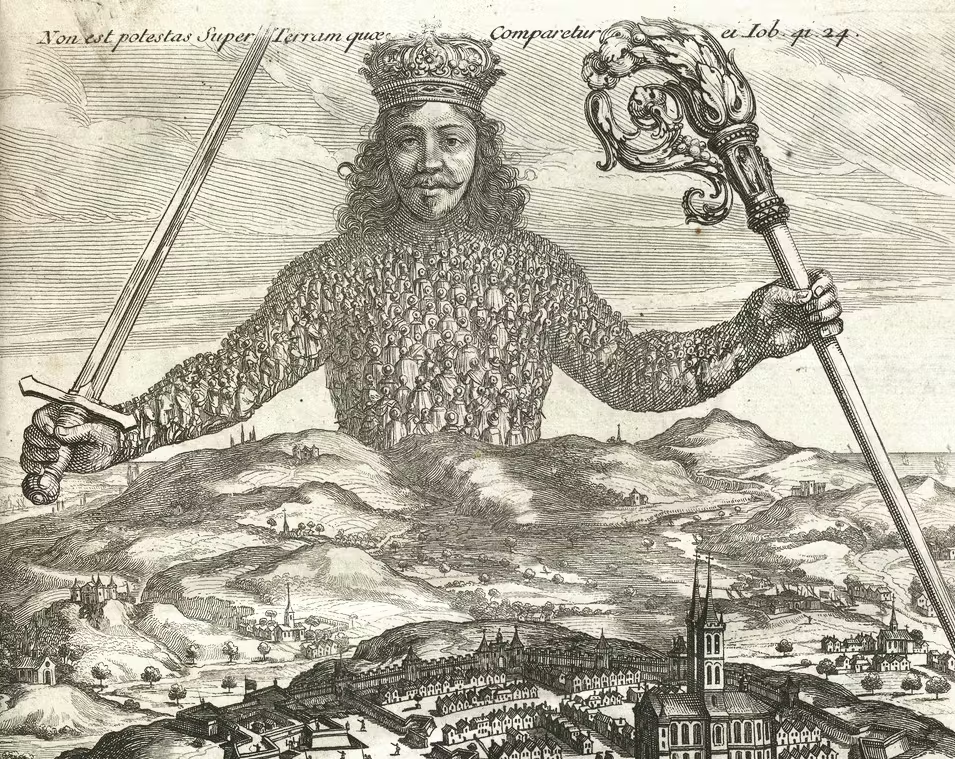
    Thomas Hobbes wrote his seminal work Leviathan in 1651. In it he describes the world system as it was then as being in “a state of nature,” something that some have interpreted as anarchy. However, anarchy has order and purpose. It is not chaos. In fact, if we think of Adam Smith’s “invisible hand of the market” we get something similar to what anarchy is in practice: the aggregate of individual acts of self-interest can lead to the optimisation of value and outcomes at the collective level. Anarchy clears; chaos does not.

    For Hobbes, the state of nature was chaos. Absent a “Sovereign” (i.e. a government) that could impose order on global and domestic societies, humans were destined to lead lives the were “solitary, poor, nasty, brutish and short.” This has translated into notions of “might makes right,” “survival of the fittest,” “to the victor goes the spoils” and other axioms of so-called power politics. The most elaborate of these, international relations realism, is a school of thought that is based on the belief that because the international system has no superseding Sovereign in the form of world government with comprehensive enforcement powers, and because there are no universally shared values and mores throughout the globe community that ideologically bind cultures, groups and individuals, global society exists as a state of nature where, even if there are attempts to manage the relationships between States (and other actors) via rules, norms, institutions and the like, the bottom line is that States (and other actors) have interests, not friends.

    Interests are pursued in a context of power differentials. Alliances are temporary and based on the convergence of mutual interests. Values are not universal and so are inconsequential. International exchange is transactional, not altruistic. Actors with greater resources at their disposal (human, natural, intellectual) prevail over those that have less. In case of resource parity between States or other actors, balances of power become systems regulators, but these are fluid and contingent, not permanent. Geography matters in that regard, which is why geopolitics (the relationship of power to geography) is the core of international relations.

    It is worth remembering this when evaluating contemporary international relations. It has been well established by now that the liberal international order of the post WW2 era has largely been dismantled in the context of increasing multipolarity in inter-State relations and the rise of the Global South within the emerging order. As I have written before, the long transition and systemic realignment in international affairs has led to norm erosion, rules violations, multinational institutional and international organizational decay or irrelevance and the rise of conflict (be it in trade, diplomacy or armed force) as the new systems regulator.

    These developments have accentuated over the last decade and now have a catalyst for a full move into a new global moment–but not into a multipolar or multiplex constellation arrangement in which rising and established powers move between multilateral blocs depending on the issues involved. Instead, the move appears to be one towards a modern Hobbesian state of nature, with the precipitant being the MAGA administration of Donald Trump and its foreign policy approach.

    We must be clear that it is not Trump who is the architect of this move. As mentioned in pervious posts, he is an empty vessel consumed by his own self-worth. That makes him a useful tool of far smarter people than he, people who work in the shadow of relative anonymity and who cut their teeth in rightwing think tanks and policy centres. In their view the liberal internationalist order placed too many constraints on the exercise of US power while at the same time requiring the US to over-extend itself as the “world’s policeman” and international aid donor . Bound by international conventions on the one hand and besieged by foreign rent-seekers and adversaries on the other, the US was increasingly bent under the weight of overlapped demands in which existential national interests were subsumed to a plethora of frivolous diversions (such as human rights and democracy promotion).

    For these strategists, the solution to the dilemma was not to be found in any new multipolar (or even technopolar) constellation but in a dismantling of the entire edifice of international order, something that was based on an architecture of rules, institutions and norms nearly 500 years in the making. Many have mentioned Trump’s apparent mercantilist inclinations and his admiration for former US president William McKinley’s tariff policies in the late 1890s. Although that may be true, the Trump/MAGA agenda is far broader in scope than trade. In fact, the US had its greatest period of (neo-imperial) expansion during McKinley’s tenure as president (1897-1901), winning the Spanish-American War and annexing Hawai’i, Puerto Rico, Guam, American Samoa and the Philippines, so Trump’s admiration for him may well be based on notions of territorial expansionism as well.

    Whatever Trump’s views of McKinley, the basic idea under-riding his foreign policy team’s approach is that in a world where the exercise of power is the ultimate arbiter of a State’s international status, the US remains the greatest Power of them all. It does not matter if the PRC or Russia challenge the US or if other emerging powers join the competition. Without the hobbling effect of its liberal obligations the US can and will dominate them all. This involves trade but also the exercise of raw (neo) imperialist ambitions in places like Greenland, the Panama Canal and even Canada. It involves sidelining the UN, NATO, EU and other international organisations where the US had to share equal votes with lesser powers who flaunted the respect and tribute that should naturally be given in recognition of the US’s superior power base.

    There appears to be a belief in this approach that the US can be a new hegemon–but not Sovereign–in a unipolar world, even more so than during the post-USSR-pre 9/11 interregnum. In a new state of nature it can sit at the core of the international system, orbited by constellations of lesser Great Powers like the PRC, Russia, the EU, perhaps India, who in turn would be circled by lesser powers of various stripes. The US will not seek to police the world or waste time and resources on well-meaning but ultimately futile soft power exercises like those involving foreign aid and humanitarian assistance. Its power projection will be sharp on all dimensions, be it trade, diplomacy or in military-security affairs. It will use leverage, intimidation and varying degrees of coercion as well as persuasion (and perhaps even bribery) as diplomatic tools. It will engage the world primarily in bilateral fashion, eschewing multilateralism for others to pursue according to their own interests and power capabilities. That may suit them, but for the US multilateralism is just another obsolescent vestige of the liberal internationalist past.

    Source: Northrop-Grumman.

    A possible (and partial) explanation for the change in the US foreign policy approach may be the learning effect in the US of Russia’s invasion of Ukraine and Israel’s scorched earth campaign in Gaza. Trump and his advisors may have learned that impunity has its own rewards, that no country or group of countries other than the US (if it has the will) can effectively confront a state determined to pursue its interests regardless of international law, the laws of war or institutional censorship (say, by the UN or International Criminal Court), or any other type of countervailing power. The Russians and Israelis have gotten away with their behaviour because, all rhetoric and hand-wringing aside, there is no actor or group of actors who have the will or capability to stop them. For Trump strategists, these lesser powers are pursuing their interests regardless of diplomatic niceties and international conventions, and they are prevailing precisely because of that. Other than providing military assistance to Ukraine, no one has lifted a serious finger against the Russians other than the Ukrainians themselves, and even fewer have seriously moved to confront Israel’s now evident ethnic cleansing campaign in part because the US has backed Israel unequivocally. The exercise of power in each case occurred in a norm enforcement vacuum in spite of the plethora of agencies and institutions designed to prevent such egregious violations of international standards.

    Put another way: if Israel and Russia can get away with their disproportionate and indiscriminate aggression, imagine what the US can do.

    If we go on to include the PRC’s successful aggressive military “diplomacy” in East/SE Asia, the use of targeted assassinations, hacking, disinformation and covert direct influence campaigns overseas by various States and assorted other unpunished violations of international conventions, then it is entirely plausible that Trump’s foreign policy brain trust sees the moment as ripe for finally breaking the shackles of liberal internationalism. Also recall that many in Trump’s inner circle subscribe to chaos or disruption theory, in which a norms-breaking “disruptor” like Trump seizes the opportunities presented by the breakdown of the status quo ante.

    Before the US could hollow out liberal internationalism abroad and replace it with a modern international state of nature it had to crush liberalism at home. Using Executive Orders as a bludgeon and with a complaint Republican-dominated Congress and Republican-adjacent federal courts. the Trump administration has openly exercised increasingly authoritarian control powers with the intention of subjugating US civil society to its will. Be it in its deportation policies, rollbacks of civil rights protections, attacks on higher education, diminishing of federal government capacity and services (except in the security field), venomous scapegoating of opponents and vulnerable groups, the Trump/MAGA domestic agenda not only seeks to turn the US into a illiberal or “hard” democracy (what Spanish language scholars call a “democradura” as a play on words mixing the terms democracia and dura (hard)). It also serves notice that the US under Trump/MAGA is willing to do whatever is necessary to re-impose its supremacy in world affairs, even if it means hurting its own in order to prove the point. By its actions at home Trump’s administration demonstrates capability, intent and steadfast resolve as it establishes a reputation for ruthless pursuit of its policy agenda. Foreign interlocutors will have to take note of this and adjust accordingly. Hence, for Trump’s advisors, authoritarianism at home is the first step towards undisputed supremacy abroad.

    The Trump embrace of international state of nature differs from Hobbes because it does not see the need for a superseding global governance network but instead believes that the US can dominate the world without the encumbrances of power-sharing with lesser players. In this view hegemony means domination, no more or less. It implies no attempt at playing the role of a Sovereign imposing order on a disorderly and recalcitrant community of Nation-States and non-State actors that do not share common values, much less interests.

    This is the core of the current US foreign policy approach. It is not about reorganising the international order within the extant frameworks as given. It is about removing those frameworks entirely and replacing them with an America First, go it alone agenda where the US, by virtue of its unrivalled power differential relative to all other States and global actors, can maximise its self-interest in largely unconstrained fashion. Some vestiges of the old international order may remain, but they will be marginalised and crippled the longer the US project is in force.

    What does not seem to be happening in Trump’s foreign policy circle are three things. First, recognition that other States and international actors may band together against the US move to unipolarity in a new state of nature and that for all its talk the US may not be able to impose unipolar dominance over them. Second, understanding that States like the PRC, Russia and other Great Powers and communities (like the EU) may resist the US move and challenge it before it can consolidate the new international status quo. Third, foreseeing that the technology titans who today are influential in the Trump administration may decide to transfer there loyalties elsewhere, especially if Trump’s ego starts becoming a hindrance to their (economic and digital) power bases. The fusion of private technology control and US State power may not be as compatible over time as presently appears to be the case, something that may not occur with States such as the PRC, India or Japan that have different corporate cultures and political structures. As the current investment in the Middle Eastern oligarchies shows, the fusion of State and private techno power may be easier to accomplish in those contexts rather than the US.

    In any event, whether it be a short-term interlude or a longue durée feature of international life, a modern state of nature is now our new global reality.

    Analysis syndicated by 36th Parallel Assessments

    MIL OSI AnalysisEveningReport.nz

  • MIL-OSI New Zealand: State Highway 1 blocked, Lichfield

    Source: New Zealand Police

    Motorists are advised to take alternative routes due to a bloackage on State Highway 1, between Tokoroa and Putāruru, following a crash this afternoon.

    Police were alerted to the two-vehicle crash between Taupo Street and Domain Road, at around 2:50pm.

    Indications are people have received moderate to serious injuries.

    ENDS.

    Issued by Police Media Centre

    MIL OSI New Zealand News

  • MIL-OSI China: Beijing breaks into global top 5 startup hubs

    Source: People’s Republic of China – State Council News

    This photo taken from Jingshan Hill on Aug. 12, 2024 shows the skyscrapers of the central business district (CBD) on a sunny day in Beijing, capital of China. [Photo/Xinhua]

    Beijing tied with Boston for fifth place in a global ranking of startup ecosystems, making it China’s sole city in the top five, according to the Global Startup Ecosystem Report 2025 released on June 12 by research firm Startup Genome.

    Silicon Valley held the top spot, followed by New York, London and Tel Aviv in second through fourth place, respectively. Other Chinese hubs, including Shanghai, Shenzhen, Hangzhou, Hong Kong and Guangzhou, also ranked among the top 40, with all except Hong Kong moving up the list.

    The report assessed six metrics: performance, funding, talent and expertise, market reach, AI-native transformation and knowledge supply. Beijing ranked third globally in performance and fourth in both talent and knowledge supply.

    The city far exceeded the global average in ecosystem value, number of active unicorn companies, software engineer salaries and total venture capital. From 2022 to 2024, the city’s startup ecosystem was valued at $533 billion, over 26 times the global average of $20.4 billion, and it boasted 61 active unicorn companies, compared to the global average of four.

    The report attributes Beijing’s robust innovation growth to strong government support, intellectual backing from top universities and a thriving capital market.

    In terms of policy support, Beijing has encouraged major commercial banks to increase investment in non-listed firms as part of broader efforts to support its startup ecosystem. In 2024, loans to small and micro businesses and entrepreneurs in Beijing jumped, with entrepreneurship guaranteed loans rising 79.6% year on year. That same year, the city also introduced over 250 business reform measures and added 287,000 new market entities.

    Beijing is home to 46 publicly listed companies focused on AI, big data and analytics, with a combined market value of $590.96 billion. The city has earned international recognition in AI-driven data analytics, life sciences and fintech, and has become a leading center for payment technology.

    To attract startups, Beijing has continued to bolster its support for tech companies, financing options and advanced research infrastructure. In August 2024, officials announced plans to expand the number of specialized, innovation-driven firms in Beijing to over 10,000 and introduced new policies and funding to support digital upgrades. 

    Several new investment funds have been set up targeting key technology sectors, while infrastructure initiatives such as a super-node computing power cluster and the rollout of 5G-Advanced mobile networks are expected to further support startup development.

    MIL OSI China News

  • MIL-OSI China: Olympic champion Zheng looking forward to better result at Wimbledon

    Source: People’s Republic of China – State Council News

    China’s Olympic champion Zheng Qinwen says she is looking forward to a better result at this year’s Wimbledon Championships, after having been knocked out of the women’s singles first round in the previous two years.

    Zheng, 22, will begin her fourth Wimbledon main draw appearance with a first-round match against Katerina Siniakova of the Czech Republic on Monday.

    Siniakova, 29, who has 10 women’s doubles Grand Slam titles, has previously beaten Zheng twice on grass, including at Wimbledon in 2023.

    “She’s a tough opponent, especially on grass,” said fifth seed Zheng at a pre-tournament media conference on Saturday. “Her shots are quite flat, so the balls won’t bounce too high on grass. I have lost to her twice and I will definitely be fully prepared this time.”

    Earlier this month, former Australian Open finalist Zheng reached her first career grass-court semifinal at Queen’s Club, but withdrew from the following Berlin Open due to a neck injury.

    “Competing at Queen’s Club was a good experience for me. I learned a lot from the matches I played there,” said Zheng. “Compared with the previous year at Wimbledon, my body is healthier so I can prepare better with my team. I hope this year everything is going to be great. “

    Despite her early exit in the past two years at the grass-court Grand Slam, Zheng maintained that her confidence remained high.

    “I believe I can perform well on grass. Last year I was injured at Wimbledon, and one year earlier I didn’t prepare well as I was with a new team,” said Zheng. “I think I can be much stronger this year if I prepare well.”

    Zheng also revealed that she is now working with Spanish coach Francisco Roig, who had previously worked with 22-time Grand Slam champion Rafael Nadal for 18 years.

    “He joined my team after Queen’s. My coach Pere Riba helped me contact him,” said Zheng. “He is such an experienced coach. I’m sure that I can learn a lot from him. We will see how this grass-court season goes, and then decide if we want to work together for the long term.”

    MIL OSI China News

  • MIL-OSI China: Wimbledon could be best chance for 25th Grand Slam title: Djokovic

    Source: People’s Republic of China – State Council News

    Serbian legend Novak Djokovic agreed that Wimbledon could offer his best chance to claim a record-extending 25th Grand Slam title.

    While attending the pre-Championships press conference on Saturday, the 38-year-old was asked if he believed this year’s Wimbledon could be his best chance to win the 25th Grand Slam title and could it be his last dance at the grass-court Grand Slam this year.

    “Whether it could be my last dance, I’m not sure, as I’m not sure about Roland Garros or any other Slam that I play next,” said Djokovic prior to his 20th appearance at Wimbledon.

    “My wish is to play for several more years. I would love to be healthy physically and also mentally motivated to keep on playing at the highest level. That’s the goal, but you never know at this stage.”

    “And yes, I would probably agree that Wimbledon could be the best chance because of the results I had, because of how I feel, how I play in Wimbledon, just getting that extra push mentally and motivation to perform the best tennis at the highest level,” the seven-time Wimbledon champion continued.

    Djokovic ranked Wimbledon “maybe the most consistently successful Grand Slam for me in the last 10 years”, as he reached six finals in the last six editions of the tournament. He won four titles consecutively before being beaten by Spaniard Carlos Alcaraz in the last two years.

    “I don’t chase the rankings anymore. I’m trying to play the best tennis in Grand Slams and trying to win Grand Slams. That hasn’t changed,” he said.

    Djokovic reached the semifinals at both Australian Open and US Open this year. “I think I still played a decent level of tennis that showed me that I can still play on a very high level at the later stages.”

    “That’s what is also giving me an extra motivation to keep going. Obviously clay court probably slightly less chances to win comparing to grass,” he added.

    The sixth-seeded veteran will face Frenchman Alexandre Muller in the opening round. If he reaches the semifinals, he could meet world No. 1 Jannik Sinner who defeated him in the French Open semifinals earlier this year.

    MIL OSI China News

  • MIL-Evening Report: ER Report: A Roundup of Significant Articles on EveningReport.nz for June 29, 2025

    ER Report: Here is a summary of significant articles published on EveningReport.nz on June 29, 2025.

    Do all Iranians hate the regime? Hate America? Life inside the country is more complex than that
    Source: The Conversation (Au and NZ) – By Simon Theobald, Postdoctoral researcher, Institute for Ethics and Society, University of Notre Dame Australia From 2015 to 2018, I spent 15 months doing research work in Mashhad, Iran’s second-largest city. As an anthropologist, I was interested in everyday life in Iran outside the capital Tehran. I was

    Talks result in PNG and Bougainville signing ‘Melanesian Agreement’
    RNZ Pacific The leaders of Bougainville and Papua New Guinea have signed a deal that may bring the autonomous region’s quest for independence closer. Called “Melanesian Agreement”, the deal was developed earlier this month in 10 days of discussion at the New Zealand army base at Burnham, near Christchurch. Both governments have agreed that the

    Eugene Doyle: Why Asia-Pacific should be cheering for Iran and not US bomb-based statecraft
    ANALYSIS: By Eugene Doyle Setting aside any thoughts I may have about theocratic rulers (whether they be in Tel Aviv or Tehran), I am personally glad that Iran was able to hold out against the US-Israeli attacks this month. The ceasefire, however, will only be a pause in the long-running campaign to destabilise, weaken and

    ER Report: A Roundup of Significant Articles on EveningReport.nz for June 28, 2025
    ER Report: Here is a summary of significant articles published on EveningReport.nz on June 28, 2025.

    MIL OSI AnalysisEveningReport.nz

  • MIL-Evening Report: ER Report: A Roundup of Significant Articles on EveningReport.nz for June 29, 2025

    ER Report: Here is a summary of significant articles published on EveningReport.nz on June 29, 2025.

    Do all Iranians hate the regime? Hate America? Life inside the country is more complex than that
    Source: The Conversation (Au and NZ) – By Simon Theobald, Postdoctoral researcher, Institute for Ethics and Society, University of Notre Dame Australia From 2015 to 2018, I spent 15 months doing research work in Mashhad, Iran’s second-largest city. As an anthropologist, I was interested in everyday life in Iran outside the capital Tehran. I was

    Talks result in PNG and Bougainville signing ‘Melanesian Agreement’
    RNZ Pacific The leaders of Bougainville and Papua New Guinea have signed a deal that may bring the autonomous region’s quest for independence closer. Called “Melanesian Agreement”, the deal was developed earlier this month in 10 days of discussion at the New Zealand army base at Burnham, near Christchurch. Both governments have agreed that the

    Eugene Doyle: Why Asia-Pacific should be cheering for Iran and not US bomb-based statecraft
    ANALYSIS: By Eugene Doyle Setting aside any thoughts I may have about theocratic rulers (whether they be in Tel Aviv or Tehran), I am personally glad that Iran was able to hold out against the US-Israeli attacks this month. The ceasefire, however, will only be a pause in the long-running campaign to destabilise, weaken and

    ER Report: A Roundup of Significant Articles on EveningReport.nz for June 28, 2025
    ER Report: Here is a summary of significant articles published on EveningReport.nz on June 28, 2025.

    MIL OSI AnalysisEveningReport.nz

  • MIL-Evening Report: Do all Iranians hate the regime? Hate America? Life inside the country is more complex than that

    Source: The Conversation (Au and NZ) – By Simon Theobald, Postdoctoral researcher, Institute for Ethics and Society, University of Notre Dame Australia

    From 2015 to 2018, I spent 15 months doing research work in Mashhad, Iran’s second-largest city. As an anthropologist, I was interested in everyday life in Iran outside the capital Tehran. I was also interested in understanding whether the ambitions of the 1979 Revolution lived on among “ordinary” Iranians, not just political elites.

    I first lived on a university campus, where I learned Persian, and later with Iranian families. I conducted hundreds of interviews with people who had a broad spectrum of political, social and religious views. They included opponents of the Islamic Republic, supporters, and many who were in between.

    What these interviews revealed to me was both the diversity of opinion and experience in Iran, and the difficulty of making uniform statements about what Iranians believe.

    Measuring the depth of antipathy for the regime

    When Israel’s strikes on Iran began on June 13, killing many top military commanders, many news outlets – both international and those run by the Iranian diaspora – featured images of Iranians cheering the deaths of these hated regime figures.

    Friends from my fieldwork also pointed to these celebrations, while not always agreeing with them. Many feared the impact of a larger conflict between Iran and Israel.

    Trying to put these sentiments in context, many analysts have pointed to a 2019 survey by the GAMAAN Institute, an independent organisation based in the Netherlands that tracks Iranian public opinion. This survey showed 79% of Iranians living in the country would vote against the Islamic Republic if a free referendum were held on its rule.

    Viewing these examples as an indicator of the lack of support for the Islamic Republic is not wrong. But when used as factoids in news reports, they become detached from the complexities of life in Iran. This can discourage us from asking deeper questions about the relationships between ideology and pragmatism, support and opposition to the regime, and state and society.

    A more nuanced view

    The news reporting on Iran has encouraged a tendency to see the Iranian state as homogeneous, highly ideological and radically separate from the population.

    But where do we draw the line between the state and the people? There is no easy answer to this.

    When I lived in Iran, many of the people who took part in my research were state employees – teachers at state institutions, university lecturers, administrative workers. Many of them had strong and diverse views about the legacy of the revolution and the future of the country.

    They sometimes pointed to state discourse they agreed with, for example Iran’s right to national self-determination, free from foreign influence. They also disagreed with much, such as the slogans of “death to America”.

    This ambivalence was evident in one of my Persian teachers. An employee of the state, she refused to attend the annual parades celebrating the anniversary of the revolution. “We have warm feelings towards America,” she said. On the other hand, she happily attended protests, also organised by the government, in favour of Palestinian liberation.

    Or take the young government worker I met in Mashhad: “We want to be independent of other countries, but not like this.”

    In a narrower sense, discussions about the “state” may refer more to organisations like the Islamic Revolutionary Guard Corps (IRGC) and the Basij, the paramilitary force within the IRGC that has cracked down harshly on dissent in recent decades. Both are often understood as being deeply ideologically committed.

    Said Golkar, a US-based Iranian academic and author, for instance, calls Iran a “captive society”. Rather than having a civil society, he believes Iranians are trapped by the feared Basij, who maintain control through their presence in many institutions like universities and schools.

    Again, this view is not wrong. But even among the Basij and Revolutionary Guard, it can be difficult to gauge just how ideological and homogeneous these organisations truly are.

    For a start, the IRGC relies on both ideologically selected supporters, as well as conscripts, to fill its ranks. They are also not always ideologically uniform, as the US-based anthropologist Narges Bajoghli, who worked with pro-state filmmakers in Tehran, has noted.

    As part of my research, I also interviewed members of the Basij, which, unlike the IRGC proper, is a wholly volunteer organisation.

    Even though ideological commitment was certainly an important factor for some of the Basij members I met, there were also pragmatic reasons to join. These included access to better jobs, scholarships and social mobility. Sometimes, factors overlapped. But participation did not always equate to a singular or sustained commitment to revolutionary values.

    For example, Sāsān, a friend I made attending discussion groups in Mashhad, was quick to note that time spent in the Basij “reduced your [compulsory] military service”.

    This isn’t to suggest there are not ideologically committed people in Iran. They clearly exist, and many are ready to use violence. Some of those who join these institutions for pragmatic reasons use violence, too.

    Looking in between

    In addition, Iran is an ethnically diverse country. It has a population of 92 million people, a bare majority of whom are Persians. Other minorities include Azeris, Kurds, Arabs, Baloch, Turkmen and others.

    It is also religiously diverse. While there is a sizeable, nominally Shi’a majority, there are also large Sunni communities (about 10-15% of the population) and smaller communities of Christians, Jews, Zoroastrians, Baha’is and other religions.

    Often overlooked, there are also important differences in class and social strata in Iran, too.

    One of the things I noticed about state propaganda was that it flattened this diversity. James Barry, an Australian scholar of Iran, noticed a similar phenomenon.

    State propaganda made it seem like there was one voice in the country. Protests could be dismissed out of hand because they did not represent the “authentic” view of Iranians. Foreign agitators supported protests. Iranians supported the Islamic Republic.

    Since leaving Iran, I have followed many voices of Iranians in the diaspora. Opposition groups are loud on social media, especially the monarchists who support Reza Pahlavi, the son of the deposed Shah.

    In following these groups, I have noticed a similar tendency to speak as though they represent the voice of all Iranians. Iranians support the shah. Or Iranians support Maryam Rajavi, leader of a Paris-based opposition group.

    Both within Iran, and in the diaspora, the regime, too, is sometimes held to be the imposition of a foreign conspiracy. This allows the Islamic Republic and the complex relations it has created to be dismissed out of hand. Once again, such a view flattens diversity.

    Over the past few years, political identities and societal divisions seem to have become harder and clearer. This means there is an increasing perception among many Iranians of a gulf between the state and Iranian society. This is the case both inside Iran, and especially in the Iranian diaspora.

    Decades of intermittent protests and civil disobedience across the country also show that for many, the current system no longer represents the hopes and aspirations of many people. This is especially the case for the youth, who make up a large percentage of the population.

    I am not an Iranian, and I strongly believe it is up to Iranians to determine their own futures. I also do not aim to excuse the Islamic Republic – it is brutal and tyrannical. But its brutality should not let us shy away from asking complex questions.

    If the regime did fall tomorrow, Iran’s diversity means there is little unanimity of opinion as to what should come next. And if a more pluralist form of politics is to emerge, it must encompass the whole of Iran’s diversity, without assuming a uniform position.

    It, too, will have to wrestle with the difficult questions and sometimes ambivalent relations the Islamic Republic has created.

    Simon Theobald received funding from the Australian National University during his research.

    ref. Do all Iranians hate the regime? Hate America? Life inside the country is more complex than that – https://theconversation.com/do-all-iranians-hate-the-regime-hate-america-life-inside-the-country-is-more-complex-than-that-259554
    MIL OSI AnalysisEveningReport.nz

  • MIL-OSI China: World’s first pure ammonia-fueled demonstration vessel completes maiden voyage in China

    Source: People’s Republic of China – State Council News

    The world’s first pure ammonia-powered demonstration vessel, the “Anhui,” successfully completed its maiden voyage in Hefei, east China’s Anhui Province, marking a major step forward for green shipping.

    An aerial drone photo taken on June 28, 2025 shows the pure ammonia-powered demonstration vessel, the “Anhui,” making its maiden voyage at the water area of Chaohu Lake in Hefei, east China’s Anhui Province. (Xinhua/Zhou Mu)

    Ammonia, a major chemical industry feedstock, has a high energy density and due to its carbon-free nature, produces only water and nitrogen when fully combusted. This makes it a highly promising fuel for decarbonizing shipping.

    In recent years, several shipping companies in countries like Japan and Norway have been investing in the development of ammonia-powered vessels. A report by the International Energy Agency published in 2021 estimated that by 2050, ammonia could account for around 45 percent of global energy demand for shipping in 2050 in the net-zero emissions. However, ammonia fuel also faces challenges such as ignition difficulties and unstable combustion.

    Ammonia-powered Anhui was jointly developed by the Institute of Energy of the Hefei Comprehensive National Science Center and its subsidiary, Shenzhen Haixu New Energy Co., Ltd. It is equipped with a 200kW high-speed gas internal combustion generator, two 100kW propulsion motors, and a twin-screw propulsion system. It has a full load capacity of 50 tonnes and a rated speed of 10 knots.

    According to Wu Dianwu from the institute, the research team overcame several key technological challenges. These include pure ammonia fuel plasma ignition, sustained combustion, efficient catalytic cracking of ammonia gas to produce hydrogen, and efficient combustion and control of hydrogen-ammonia mixed gas in internal combustion engines. The team also developed a pure ammonia fuel burner and various ammonia gas catalytic cracking devices.

    The maiden voyage achieved stable combustion of pure ammonia fuel, nearly zero carbon dioxide emissions, and effective control of nitrogen oxides. This confirms the potential for ammonia-hydrogen fuels to be widely used in marine and land transport, as well as in industrial boilers and fuel cells, Wu noted.

    Wang Junli, secretary-general of the Chinese Society of Naval Architects and Marine Engineers, said the vessel’s successful voyage marked a major milestone in creating a clean, low-carbon energy system for water transport. If pure ammonia engines reach the megawatt level, their applications will expand significantly, holding significant importance in achieving China’s dual carbon goals. 

    MIL OSI China News

  • MIL-OSI China: Forum highlights regional growth, attracts global partners in Xizang

    Source: People’s Republic of China – State Council News

    This aerial photo taken on July 20, 2023 shows a view of the Gaiba Village of Gongbo’Gyamda County in Nyingchi City, southwest China’s Xizang Autonomous Region. (Xinhua/Sun Fei)

    International business leaders gathered at a forum in southwest China’s Xizang Autonomous Region this week, exploring new economic opportunities.

    The two-day forum, opened on Friday in Nyingchi and themed “Gathering Trans-Himalaya Strength; Unleashing Development Momentum,” attracted 89 domestic and foreign companies, underscoring the region’s growing importance in cross-border collaboration. Eleven projects worth 4.8 billion yuan (about 670 million U.S. dollars) were signed during the event.

    Wang Jingcai, deputy director of the regional development and reform commission, presented an industrial “Opportunity List” featuring nine key sectors including clean energy, cultural tourism and Tibetan medicine at the forum.

    Fathuhulla Ali, a health tech company executive from Sri Lanka, expressed particular interest in the region’s traditional medicine.

    “What impressed me most was the traditional culture. It’s incredibly strong and rich,” said Ali, managing director of Panaka Health Tech Private Limited. “I’m from the medical supply industry. So basically, what I look forward to is the medical sector. The traditional medicine here is very rich,” Ali added.

    Zhao Peng, vice chairman of the regional government, emphasized the region’s strategic role as China’s gateway to South Asia, noting that it has established trade ties with 140 countries and regions.

    “Xizang is stepping up efforts to enhance cooperation with neighboring countries and expand high-level opening up to the outside world,” Zhao said.

    Tusar Tuladhar, managing director of Tunchhe Trans Himalayan Trading Concern, a Nepali company which has been operating business in Xizang’s regional capital Lhasa for about 30 years, praised the region’s business climate while noting Nyingchi’s distinct ecological advantages.

    “This is my first time in Nyingchi. There are so many trees, and I see a lot of green here. It’s really different from Lhasa,” noted Tuladhar. “The business environment in Xizang is good. We have a long-lasting business here, a very long-lasting relationship,” he added.

    Since 2021, Xizang’s trade with South Asian Association for Regional Cooperation members has totaled 14.92 billion yuan, with Nepal accounting for 87 percent. The land ports between China and Nepal have played a vital role.

    From January to May this year, Xizang’s import-export volume exceeded 3.84 billion yuan, up 13.2 percent year on year, according to Lhasa Customs.

    This marks the fifth Trans-Himalaya Forum since 2018, with each iteration strengthening cross-border collaboration in the region.

    MIL OSI China News

  • MIL-OSI New Zealand: Fatal Crash, Takapau Road, Waipukurau

    Source: New Zealand Police

    One person has died following a serious crash early this morning in Waipukurau.

    Police received a report of a single vehicle crash at the intersection of Takapau Road and Racecourse Road at around 3.50am.

    Sadly, despite best efforts of emergency services, the sole occupant of the vehicle died at the scene.

    The road was closed while the Serious Crash Unit conducted a scene examination. The road is now clear.

    Enquiries into the circumstances of the crash are ongoing.

    ENDS

    Issued by Police Media Centre

    MIL OSI New Zealand News

  • MIL-OSI Asia-Pac: Embracing greener final farewells

    Source: Hong Kong Information Services

    The desire to return to nature is one shared by many, not least when it comes to post-funeral arrangements. Tapping into a growing trend, the Food & Environmental Hygiene Department (FEHD) has in recent years stepped up efforts to promote green burials, where remains are returned directly to the earth, or scattered at sea.

    The department’s endeavours include organising tours of facilities such as the Tsang Tsui Columbarium & Garden of Remembrance in Tuen Mun. On one such tour recently, elderly participants shared their thoughts on green burials as an eco-friendly end-of-life choice.

    Besides explore the facility and its services, the visit gave them the chance to reflect on their approach to life’s final journey. In fact, several remarked that they had already received the full support of their families in their wish for a green burial.

    Tranquil setting

    Visiting the Garden of Remembrance for the first time, 82-year-old Lee Yuk-sim described its seaside setting as open and tranquil. “The sound of waves lifts my spirits,” she said.

    Ms Lee wishes to have her ashes scattered along the garden’s pebble path, however. Despite her love for the ocean, following a heart-to-heart conversation with her daughters she decided scattering at sea was not an option for her.

    “I once told my daughters, ‘I love the sea.’ They replied, ‘The sea is full of swimmers, and every time we pass by it, we will think of you, and we don’t want that.’ Then they said, ‘The Garden of Remembrance is different. It is about dust returning to dust, earth to earth.”

    Meanwhile, 87-year-old Choi Sau-ling, also on her first visit to the Garden of Remembrance, found it strikingly different from what she had expected.

    “There were rumours that stray dogs and cats might disturb the ashes, but that is a complete misconception,” she said. “The truth is that the Garden of Remembrance is absolutely beautiful, with a sea view.”

    Ms Choi highlighted that the garden’s peaceful atmosphere makes it both an ideal resting place and a convenient site for families to pay their respects.

    “It is breezy and uncrowded, like wandering in a garden,” she commented. “It hits differently. Without the need to burn incense or make extra preparations, the experience feels lighter for everyone.”

    Dignified farewell

    Cheng Ting-fai, 87, had already made trips to the Gardens of Remembrance in Diamond Hill and Cape Collinson before visiting Tsang Tsui. He said he had also spoken to his children about his wish to have his ashes scattered.

    “Placing ashes in an urn is almost like trapping them. There is no sense of freedom, and over time no-one may be around to look after them.”

    Mr Cheng described scattering ashes in a Garden of Remembrance as a better option. “The ashes can bask in the sunshine, and experience the changing weather,” he explained.

    He also expressed his hope that all 18 districts in Hong Kong can have a Garden of Remembrance. “Born here, raised here, and laid to rest here. How wonderful is that?”

    At present, those choosing green burials can have their ashes scattered at either of three designated maritime areas or in one of the Gardens of Remembrance.

    The department manages 13 Gardens of Remembrance, with Tsang Tsui being the largest. The site also features a ceremonial hall where simple memorial services can be held before the scattering of ashes.

    The garden’s layout includes a boat-shaped wooden artwork, helping to create a symbolic space of transition. Visitors are invited to inscribe dedication cards with heartfelt messages, giving their loved ones a dignified farewell.

    Meanwhile, a fourteenth garden – the Shek Mun Columbarium & Garden of Remembrance – is expected to open for use in the third quarter of this year.

    Growing trend

    Moving away from traditional funeral customs is no easy transition, but – thanks in no small part to the Government’s promotional efforts – green burial, as a sustainable means of handling ashes, has been gaining wider acceptance in society.

    FEHD Senior Health Inspector Alan Li said that, as of the end of May, more than 15,800 names were registered in the Green Burial Central Register.

    “About 70% of deceased registrants had their ashes disposed of in the form of green burial. Even if there is no prior registration, descendants can still adopt green burial for the deceased.”

    The department stated that green burials accounted for a record-high 18.2% of disposals last year, with 8,522 individuals’ remains being scattered in Gardens of Remembrance and 1,032 at sea.

    To enhance the sea burial experience, the FEHD has upgraded its free ferry service, available every Saturday, by introducing a new vessel design.

    Public education

    Meanwhile, in August of last year the department launched a large-scale “School of Life” programme that explores life’s closing chapters and sustainable options for being laid to rest.

    The programme includes a “Life & Death Expo”, showcasing support services for ageing and end-of-life planning, as well as community walking tours that encourage reflection on life’s transitions. These initiatives have attracted around 5,000 participants so far, and people of all ages are welcome to take part.

    The department also arranges green burial talks, guided tours to Gardens of Remembrance, and community tours, with these activities engaging more than 20,000 citizens to date.

    FEHD Chief Health Inspector Daniel Lam said the department will continue to enhance green burial facilities, promote advance planning for after-death arrangements through the “School of Life” programme, and strengthen public education and publicity, in order to gradually establish green burial as the common practice for handling ashes.

    MIL OSI Asia Pacific News

  • MIL-OSI New Zealand: Insurers step up as recovery gets underway

    Source: Insurance Council of NZ

    New Zealanders are now turning their attention to clean-up and recovery efforts following the easing of severe weather conditions across the country, particularly the upper regions of the North and South Islands.
    The Insurance Council of New Zealand | Te Kāhui Inihui o Aotearoa (ICNZ) is encouraging people to begin the recovery process safely and as soon as they’re able.
    “We understand that in the early stages of recovery not everyone can immediately lodge a claim,” ICNZ Chief Executive Kris Faafoi said.
    “While it’s important to contact your insurer as soon as you can, don’t wait to prevent further damage if it’s safe to do so.
    “Nelson-Tasman Emergency Management has established a community information centre at the Motueka Rec Centre on Old Wharf Road. Insurance staff will be available at the Centre to support affected residents.”
    To help speed up recovery and keep people safe, ICNZ recomm

    MIL OSI New Zealand News

  • MIL-OSI New Zealand: Auditor-General turns down PSA request to investigate Health NZ, refers issues to auditor

    Source: PSA

    The Auditor General has declined to investigate Health NZ’s decision to downsize the team of audit and fraud experts that monitors the $12 billion of health funding distributed every year.
    But the office has referred the PSA’s concerns to Audit NZ.
    This move follows the PSA writing to the Auditor-General in May urging it to investigate the restructure of the Audit Assurance and Risk team. Health NZ Te Whatu Ora is proposing to remove 23 roles from the team, a cut of 28% of the workforce.
    This is a critical unit focused on ensuring some $12 billion of annual funding of the primary health care sector is paid out correctly and not subject to fraud.
    In its response to the PSA the Auditor-General said this was outside its scope of its mandate but agreed to raise its concerns with Audit NZ, the government office which carries out annual audits of agencies to ensure public money is being spent responsibly.
    “We thank the Auditor-General for carefully considering our concerns and while it’s disappointing the office is unable to investigate, the issues remain. We hope Audit NZ will now take a close look,” said Fleur Fitzsimons, National Secretary for the Public Service Association Te Pūkenga Here Tikanga Mahi.
    “But it would be much simpler if Health NZ came to its senses and stopped these damaging cuts before it loses such experienced auditors and fraud investigators.
    “Millions of precious health dollars could be lost if the restructure goes ahead. Any money saved from the cuts will be lost through the failure to detect overpayments and fraud.
    “We are therefore pleased the Auditor-General has placed the issues that concern us on the radar of Audit NZ.
    “The Government’s underfunding of health to pay for tax cuts has put the health system under enormous pressure and now more than ever taxpayers need assurance health dollars are being spent wisely. We look forward to Audit NZ looking into this.”
    Previous statements
    The Public Service Association Te Pūkenga Here Tikanga Mahi is Aotearoa New Zealand’s largest trade union, representing and supporting more than 95,000 workers across central government, state-owned enterprises, local councils, health boards and community groups.

    MIL OSI New Zealand News

  • MIL-OSI Canada: Joint statement on International LGBTQI+ Pride Day 2025

    Source: Government of Canada News

    June 28, 2025 – Ottawa, Ontario – Global Affairs Canada

    The foreign ministers of Canada, Spain, Australia, Belgium, Brazil, Cape Verde, Chile, Colombia, Iceland, Ireland, Netherlands, Norway, Portugal, Slovenia and Uruguay today issued the following statement:

    “On the occasion of International LGBTQI+ Pride Day 2025, we, the Foreign Ministers of Canada, Spain, Australia, Belgium, Brazil, Cape Verde, Chile, Colombia, Iceland, Ireland, Netherlands, Norway, Portugal, Slovenia and Uruguay are speaking and acting as one to champion the rights of LGBTQI+ people.

    “At a time when hate speech and hate crimes are on the rise, and in view of efforts to strip LGBTQI+ people of their rights, we reject all forms of violence, criminalization, stigmatization or discrimination, which constitute human rights violations.

    “It is our understanding that respect for diversity, equality and tolerance require the support, at the international level, of measures aimed at decriminalization, and at preventing and eliminating harassment of all kinds—including homophobic and transphobic harassment. Also measures to advance the implementation of diversity policies and the fight against discrimination, and to favour the inclusion of LGBTQI+ people, especially transgender people in society and in the workplace.

    “We recognize that LGBTQI+ people face multiple and intersecting forms of discrimination, particularly when they are also part of other historically marginalized groups, communities, and populations, such as indigenous peoples, afro-descendants, people with disabilities, migrants, elderly people, or those who living in poverty. Promoting their full and effective inclusion requires an intersectional approach that structurally addresses these inequalities.

    “We are joining forces to work hand in hand for the equal rights of LGBTQI+ people and to bring the criminalization of same-sex relations worldwide to an end.

    “We call on all States to join us on this path, repealing discriminatory laws and refusing to adopt new laws that criminalize relations between persons of the same sex or punish people for their sexual orientation or gender identity. We call for an end to the prosecution of LGBTI+ people, and especially to the application of imprisonment and capital punishment. We further call for an end to so-called conversion “therapy” practices intended to change a person’s sexual orientation or gender identity, which can cause psychological and physical pain and suffering and are inherently discriminatory. What is at stake here is a matter of full respect for human rights and human dignity, of strengthening equality, diversity and prosperity, leaving no one behind.

    “Therefore, we, the public authorities, must implement policy that, in alignment with international human rights standards, pursues effective equality of LGBTQI+ people and seeks to combat all forms of discrimination. We celebrate sexual diversity and family diversity, in the conviction that inclusive, equitable, and tolerant societies founded on solidarity are also stronger, healthier and more resilient.

    “Lastly, we reassert our commitment to respecting the human rights of LGBTQI+ people, to ensuring that their equality before the law is incontestable and that no one is prosecuted or subject to discriminated because of their sexual orientation or gender identity. Let us build societies in which all human beings are free to live and love as they choose.”

    MIL OSI Canada News

  • MIL-OSI Europe: EUROPE/ITALY – Father Luigi Buccarello, Superior General of the Trinitarians, confirms: “Where there is dialogue, there is no violence”

    Source: Agenzia Fides – MIL OSI

    Saturday, 28 June 2025

    by Antonella PrennaRome (Agenzia Fides) – “We work in problematic, difficult, and complex contexts where persecution exists. Where violence and persecution prevail, there is no dialogue, there is no respect for others. Precisely for this reason, in support of our specific mission of helping persecuted Christians, we also focus on interreligious dialogue, on religious freedom as a topic for deepening and raising awareness not only on a social but also on a theological level.”This is what Father Luigi Buccarello said in an interview with Fides at the end of the General Chapter of the Order of the Most Holy Trinity and the Captives O.SS.T. (see Fides, 7/11/2023), where he was confirmed for a further term as Superior General. Also present was Father Antonio Aurelio Fernández Serrano, president of the organization Trinitarian International Solidarity (SIT), which coordinates activities to support persecuted Christians.In the wake of Dignitatis Humanae”Following the guidelines of the Vatican II document on religious freedom, Dignitatis Humanae, and the subsequent magisterium of the Pontiffs,” Father Buccarello continues, “we have been collaborating for two years with the Center for Interreligious Studies of the Pontifical Gregorian University, with whom we organized a six-month course entitled ‘Religious Freedom: Problems, Challenges, and Perspectives,’ which was offered for the first time this year. In addition to the course, which is aimed at theology students and those interested in the subject, we have established a two-year theological research group involving 15 specialists from various research fields. The topic of religious freedom requires an interdisciplinary and transdisciplinary approach; geopolitics, history, sociology, theology, canon law, civil law, and religious studies are all involved. A publication will be published at the end of this two-year research period.””The lack of religious freedom,” the priest continued, “is a challenge for every religion. Every day we hear about attacks in Nigeria, Yemen, and Syria. Syria had exuberantly celebrated the regime change, but we see that we are back to square one.” “Together with Father Antonio, we are always in contact with these countries, and since we touch these realities firsthand, we recognize that religious freedom is the only guarantee of peace and coexistence. Our service is not charitable; rather, we want to address the problem at its root and combat the causes underlying religious intolerance.””The General Chapter,” the Superior General continues, “placed great emphasis on the specific training of our students in these topics. Working in the field of interreligious dialogue means paving a path to peace. Religious freedom is the path to peace. One of the important themes of the post-conciliar Magisterium is the consideration of religious freedom as a prerequisite for peace, because where freedom is respected, there is obviously peace, acceptance of others, and appreciation of religious diversity. Fundamentalists resort to violence because they do not tolerate religious diversity. They want uniformity, even within their own religious tradition; they view religion as a monolithic bloc and consider themselves the sole bearers of the authentic religious message. If this acceptance of diversity is lacking and differences are perceived as a threat rather than an enrichment, peace is in danger. But our faith is also in danger, for it always leads us to an encounter with others.”A long historyThe current mission of the Trinitarian religious family coincides with an update of its founding charism. “The Trinitarian Order,” explains Father Buccarello, “was founded for persecuted Christians, obviously in a different time and in a different historical context. In our motto, “Gloria tibi Trinitas et captivis libertas,” we find the word ‘slaves,’ ‘prisoners.’ Our founder, Saint John of Matha, began the “liberation missions,” initially from Spain to Morocco, with a letter from Innocent III, in which he recommended the Trinitarians to the Sultan of Morocco, saying that the work of freeing slaves was a work of charity, the most important, the most significant, and of universal benefit. In fact, the Pope had given the Trinitarians permission to free Christian slaves through exchange with Muslim slaves, thus creating a double liberation of both Christian and Muslim slaves.”Saint John of Matha was a learned theologian and had no intention to found a new religious family. During his first Mass, he had a vision: he saw Christ in the center, holding the arms of two slaves, a white Christian and a Black Muslim. After a period of reflection, it became clear to him that he had to found a religious family dedicated to this special mission: the redemption of captives “pro fide Christi.””Today,” adds Father Buccarello, “we know that this inspiration of our founder is very timely. The two ‘lungs’ of our mission are the works of mercy and persecuted Christians. And the latter is the work that most identifies and unites us. To update this charism, the Extraordinary General Chapter of 1999, on the occasion of the 800th anniversary of the adoption of the Rule of the Order and the fourth anniversary of the Order’s reform, decided to create an organization to coordinate and promote this area of assistance to persecuted Christians, which would be called ‘Trinitarian International Solidarity.’”The organization’s current president, Father Antonio Aurelio Fernández Serrano, explains that “it is an internal body of the Trinitarian religious family, whose first 25th anniversary was just celebrated. On this occasion, we made a documentary to raise awareness of the problem of persecuted Christians.” “Our projects,” he explains, “are also present in countries like Sudan and South Sudan, where we have already freed several young people.”Father Buccarello adds details of a meeting of the aid organization in Bahrain, where, at the initiative of the Apostolic Vicar of Northern Arabia, Bishop Aldo Berardi, O.SS.T., a meeting was also held with Abdullah Abdullah, director of the Global Center for Peace Coexistence (see Fides, 23/10/2024). “Abdullah came to our Chapter to share his experience,” the Superior General said. “He was also in the Italian Parliament, where, at a meeting in the Chamber of Deputies, he described the Trinitarian Order as an example of dialogue, care, charity, and respect.”The challenges of todayThe Trinitarians are active in the Roman parish of Santa Maria delle Fornaci, the titular church of Cardinal Mario Zenari, Apostolic Nuncio to Syria. “The Cardinal,” Father Buccarello explains, “spoke to us extensively about the situation in Syria, about persecution, but also about poverty, about the many Christians who have left the country in recent years. When Christians disappear from the Middle East, the balance that ensures harmonious coexistence between different cultures and faiths is lost. Peaceful coexistence is most threatened when a historical component of a region’s religious landscape disappears.”The Trinitarian Order is present in 25 countries, including Vietnam, South Korea, and India, a country where, according to Father Buccarello, cases of violence and harassment against Christians are increasing year after year, as well as in many areas of Africa where “terrorist groups and movements engaged in aggressive proselytizing” are active.The specific contribution that the Trinitarian Order can make for the future, according to the Superior General, is to “train religious who are experts in interreligious dialogue. We all need to be sensitized; even in the Western world, where we often do not know how to deal with religious diversity, there is no genuine encounter between people. Everyone has their own space; there is no true integration.” “In many schools in northern Italy,” he notes, “for example, the majority of students are non-Catholic and non-Christian. What resources do we provide to the children so that they can interact and welcome others? And are there other situations that are unknown? Our Trinitarian sisters in Valence, for example, have a school on the outskirts of Marseille. Eighty percent of the students are Muslims, who choose Catholic rather than public schools because they prefer a religious approach to a materialistic, atheistic one. In our school in northern Assam, India, only five percent of the students are Catholic; the others are Hindus and Muslims. However, they live together without problems because religious diversity is a resource that fosters respect for others and promotes the value of coexistence and peace.”The “motto” of the General Chapter was a quote from Paul’s Second Letter to the Corinthians: “Persecuted, but not abandoned; struck down, but not destroyed.” “One of the criteria that was very well highlighted,” the Superior General emphasized, “is that religious freedom is not a theoretical question, but affects the lives and suffering of so many people, and that it must be analyzed in context. Each reality, in its complexity and problematic nature, presents different challenges to religious freedom. In Canada, for example, members of the order cannot go to the hospital wearing a religious habit. In the Western world, there is an aggressive secularism that tends to reduce religion to the private sphere, and identity-political cultural movements that instrumentalize religion. Identitarian movements aim to mark a kind of difference and opposition between “us and you” by fueling narratives that appeal to people’s fears, for example when migration is portrayed as a kind of invasion by the enemy who has come to destroy our identity. All of us, starting with religious leaders, must loudly emphasize that the name of God cannot be associated with war and violence. This must be said emphatically. Yet even these days, we hear statements from political leaders who seek to justify the war as a kind of divine mandate.” (Agenzia Fides, 28/6/2025)
    Share:

    MIL OSI Europe News

  • MIL-OSI Europe: EUROPE/ITALY – Father Luigi Buccarello, Superior General of the Trinitarians, confirms: “Where there is dialogue, there is no violence”

    Source: Agenzia Fides – MIL OSI

    Saturday, 28 June 2025

    by Antonella PrennaRome (Agenzia Fides) – “We work in problematic, difficult, and complex contexts where persecution exists. Where violence and persecution prevail, there is no dialogue, there is no respect for others. Precisely for this reason, in support of our specific mission of helping persecuted Christians, we also focus on interreligious dialogue, on religious freedom as a topic for deepening and raising awareness not only on a social but also on a theological level.”This is what Father Luigi Buccarello said in an interview with Fides at the end of the General Chapter of the Order of the Most Holy Trinity and the Captives O.SS.T. (see Fides, 7/11/2023), where he was confirmed for a further term as Superior General. Also present was Father Antonio Aurelio Fernández Serrano, president of the organization Trinitarian International Solidarity (SIT), which coordinates activities to support persecuted Christians.In the wake of Dignitatis Humanae”Following the guidelines of the Vatican II document on religious freedom, Dignitatis Humanae, and the subsequent magisterium of the Pontiffs,” Father Buccarello continues, “we have been collaborating for two years with the Center for Interreligious Studies of the Pontifical Gregorian University, with whom we organized a six-month course entitled ‘Religious Freedom: Problems, Challenges, and Perspectives,’ which was offered for the first time this year. In addition to the course, which is aimed at theology students and those interested in the subject, we have established a two-year theological research group involving 15 specialists from various research fields. The topic of religious freedom requires an interdisciplinary and transdisciplinary approach; geopolitics, history, sociology, theology, canon law, civil law, and religious studies are all involved. A publication will be published at the end of this two-year research period.””The lack of religious freedom,” the priest continued, “is a challenge for every religion. Every day we hear about attacks in Nigeria, Yemen, and Syria. Syria had exuberantly celebrated the regime change, but we see that we are back to square one.” “Together with Father Antonio, we are always in contact with these countries, and since we touch these realities firsthand, we recognize that religious freedom is the only guarantee of peace and coexistence. Our service is not charitable; rather, we want to address the problem at its root and combat the causes underlying religious intolerance.””The General Chapter,” the Superior General continues, “placed great emphasis on the specific training of our students in these topics. Working in the field of interreligious dialogue means paving a path to peace. Religious freedom is the path to peace. One of the important themes of the post-conciliar Magisterium is the consideration of religious freedom as a prerequisite for peace, because where freedom is respected, there is obviously peace, acceptance of others, and appreciation of religious diversity. Fundamentalists resort to violence because they do not tolerate religious diversity. They want uniformity, even within their own religious tradition; they view religion as a monolithic bloc and consider themselves the sole bearers of the authentic religious message. If this acceptance of diversity is lacking and differences are perceived as a threat rather than an enrichment, peace is in danger. But our faith is also in danger, for it always leads us to an encounter with others.”A long historyThe current mission of the Trinitarian religious family coincides with an update of its founding charism. “The Trinitarian Order,” explains Father Buccarello, “was founded for persecuted Christians, obviously in a different time and in a different historical context. In our motto, “Gloria tibi Trinitas et captivis libertas,” we find the word ‘slaves,’ ‘prisoners.’ Our founder, Saint John of Matha, began the “liberation missions,” initially from Spain to Morocco, with a letter from Innocent III, in which he recommended the Trinitarians to the Sultan of Morocco, saying that the work of freeing slaves was a work of charity, the most important, the most significant, and of universal benefit. In fact, the Pope had given the Trinitarians permission to free Christian slaves through exchange with Muslim slaves, thus creating a double liberation of both Christian and Muslim slaves.”Saint John of Matha was a learned theologian and had no intention to found a new religious family. During his first Mass, he had a vision: he saw Christ in the center, holding the arms of two slaves, a white Christian and a Black Muslim. After a period of reflection, it became clear to him that he had to found a religious family dedicated to this special mission: the redemption of captives “pro fide Christi.””Today,” adds Father Buccarello, “we know that this inspiration of our founder is very timely. The two ‘lungs’ of our mission are the works of mercy and persecuted Christians. And the latter is the work that most identifies and unites us. To update this charism, the Extraordinary General Chapter of 1999, on the occasion of the 800th anniversary of the adoption of the Rule of the Order and the fourth anniversary of the Order’s reform, decided to create an organization to coordinate and promote this area of assistance to persecuted Christians, which would be called ‘Trinitarian International Solidarity.’”The organization’s current president, Father Antonio Aurelio Fernández Serrano, explains that “it is an internal body of the Trinitarian religious family, whose first 25th anniversary was just celebrated. On this occasion, we made a documentary to raise awareness of the problem of persecuted Christians.” “Our projects,” he explains, “are also present in countries like Sudan and South Sudan, where we have already freed several young people.”Father Buccarello adds details of a meeting of the aid organization in Bahrain, where, at the initiative of the Apostolic Vicar of Northern Arabia, Bishop Aldo Berardi, O.SS.T., a meeting was also held with Abdullah Abdullah, director of the Global Center for Peace Coexistence (see Fides, 23/10/2024). “Abdullah came to our Chapter to share his experience,” the Superior General said. “He was also in the Italian Parliament, where, at a meeting in the Chamber of Deputies, he described the Trinitarian Order as an example of dialogue, care, charity, and respect.”The challenges of todayThe Trinitarians are active in the Roman parish of Santa Maria delle Fornaci, the titular church of Cardinal Mario Zenari, Apostolic Nuncio to Syria. “The Cardinal,” Father Buccarello explains, “spoke to us extensively about the situation in Syria, about persecution, but also about poverty, about the many Christians who have left the country in recent years. When Christians disappear from the Middle East, the balance that ensures harmonious coexistence between different cultures and faiths is lost. Peaceful coexistence is most threatened when a historical component of a region’s religious landscape disappears.”The Trinitarian Order is present in 25 countries, including Vietnam, South Korea, and India, a country where, according to Father Buccarello, cases of violence and harassment against Christians are increasing year after year, as well as in many areas of Africa where “terrorist groups and movements engaged in aggressive proselytizing” are active.The specific contribution that the Trinitarian Order can make for the future, according to the Superior General, is to “train religious who are experts in interreligious dialogue. We all need to be sensitized; even in the Western world, where we often do not know how to deal with religious diversity, there is no genuine encounter between people. Everyone has their own space; there is no true integration.” “In many schools in northern Italy,” he notes, “for example, the majority of students are non-Catholic and non-Christian. What resources do we provide to the children so that they can interact and welcome others? And are there other situations that are unknown? Our Trinitarian sisters in Valence, for example, have a school on the outskirts of Marseille. Eighty percent of the students are Muslims, who choose Catholic rather than public schools because they prefer a religious approach to a materialistic, atheistic one. In our school in northern Assam, India, only five percent of the students are Catholic; the others are Hindus and Muslims. However, they live together without problems because religious diversity is a resource that fosters respect for others and promotes the value of coexistence and peace.”The “motto” of the General Chapter was a quote from Paul’s Second Letter to the Corinthians: “Persecuted, but not abandoned; struck down, but not destroyed.” “One of the criteria that was very well highlighted,” the Superior General emphasized, “is that religious freedom is not a theoretical question, but affects the lives and suffering of so many people, and that it must be analyzed in context. Each reality, in its complexity and problematic nature, presents different challenges to religious freedom. In Canada, for example, members of the order cannot go to the hospital wearing a religious habit. In the Western world, there is an aggressive secularism that tends to reduce religion to the private sphere, and identity-political cultural movements that instrumentalize religion. Identitarian movements aim to mark a kind of difference and opposition between “us and you” by fueling narratives that appeal to people’s fears, for example when migration is portrayed as a kind of invasion by the enemy who has come to destroy our identity. All of us, starting with religious leaders, must loudly emphasize that the name of God cannot be associated with war and violence. This must be said emphatically. Yet even these days, we hear statements from political leaders who seek to justify the war as a kind of divine mandate.” (Agenzia Fides, 28/6/2025)
    Share:

    MIL OSI Europe News