Source: People’s Republic of China in Russian – People’s Republic of China in Russian –
Source: People’s Republic of China – State Council News
ASTANA, June 22 (Xinhua) — The China-Central Asia Cooperation Forum and the 3rd Silk Road International Communication Conference are being held at the Presidential Center of Kazakhstan on Sunday.
At the opening ceremony of the forum, a congratulatory message from the President of Kazakhstan Kassym-Jomart Tokayev was read out.
“I congratulate you on the visit of the Chairman of the People’s Republic of China Mr. Xi Jinping to Kazakhstan and the beginning of the collegial meetings held on the occasion of the 2nd Central Asia-China Summit. Such events contribute to the establishment of humanitarian dialogue between Kazakhstan, the countries of Central Asia and China, and the intensification of cultural cooperation. Kazakh-Chinese relations, based on the principles of good-neighborliness, friendship and eternal comprehensive strategic partnership, are strengthening every year,” says the address, which was read by the assistant to the President of Kazakhstan Arman Kyrykbayev.
The address notes that in 2025, declared the Year of China Tourism in Kazakhstan, events will be held aimed at deepening mutual understanding and cooperation between the two countries. “I am convinced that important proposals and valuable opinions will be expressed at this meeting, which will improve communication between the media of our countries. I wish the participants fruitful work, prosperity and success,” added K.-Zh. Tokayev.
In his speech at the opening of the forum, Fu Hua, Director General of the Chinese news agency Xinhua, noted that Chinese President Xi Jinping has consistently paid special attention to the development of cooperation between China and Central Asia. According to the Director General, a stable, prosperous, harmonious and interconnected Central Asia is of great importance to the entire world.
Fu Hua said that Xinhua is willing to work with its counterparts in media and think tanks in Central Asian countries to strengthen media exchanges, deepen cooperation in various fields such as news journalism, technological development, personnel exchanges, focus on the actual situation and development needs of China and Central Asia, conduct joint research on issues of common concern, strengthen field research, analysis and evaluation, information exchange and sharing of results, issue more meaningful and practical analytical reports, and put forward proposals for developing China-Central Asia cooperation.
As Qiu Xiaoqi, deputy head of the China Society for Public Diplomacy, noted, the official launch of the China-Central Asia Cooperation Forum marks a new stage of exchanges and cooperation between the journalistic, analytical and cultural circles of the six countries, which will provide stronger and more effective intellectual support and public opinion support for the process of building a China-Central Asia community with a shared future. According to Qiu Xiaoqi, all parties should make every effort to better tell the stories of China-Central Asia cooperation and the modernization of the Global South.
First Deputy Director of the Agency for Cultural Heritage of Uzbekistan Tursunali Kuziev emphasized that the Uzbek side fully agrees with the proverb “A close neighbor is better than a distant relative” and makes constant efforts to build good-neighborly, friendly, mutually beneficial and win-win relations between Central Asia and China. He expressed hope that the current conference will become another highly effective platform for the Central Asian states and China to exchange views, stimulate innovative ideas and plan areas for future cooperation.
In his speech, Chinese Ambassador to Kazakhstan Han Chunlin pointed out that the “China-Central Asian spirit” demonstrates the six countries’ firm aspiration for good-neighborliness, friendship, solidarity and mutual assistance. According to him, the media is an important bridge and link that promotes mutual understanding and rapprochement between peoples. The ambassador called for joint efforts for common development, proper interpretation of the “China-Central Asian spirit” and the creation of a favorable public opinion environment to promote high-quality development of relations between China and Central Asia.
Speaking at the opening ceremony, Secretary-General of the China-Central Asia Format Sun Weidong stated that think tanks and media outlets of the six countries bear an important responsibility in strengthening the social foundation of the China-Central Asia community with a shared future. He assured that the Secretariat of the China-Central Asia Format is willing to work closely with all parties to actively serve the cooperation mechanisms and platforms in all areas and contribute to building an even closer China-Central Asia community with a shared future.
In his speech, Zu Bin, a board member of China Huadian Corporation, pointed out that China Huadian, as one of the world’s largest energy enterprises, intends to comprehensively implement the initiative to jointly build the “Belt and Road” and the agreement of the “China-Central Asia” summit, adhere to the concept of mutual benefit and common gain, help Central Asian countries convert their resource advantages into development advantages, and promote the rapid development of green cooperation within the framework of the “Belt and Road”.
During the forum, the analytical center’s report “Development of the China-Central Asia Spirit: Achievements, Opportunities and Prospects for Regional Cooperation” was published in Chinese, Russian and English.
The theme of the forum is “Media Integration and Accumulation of Wisdom to Create a New Chapter of China-Central Asia Cooperation.” Participants of the event discuss ways to expand regional information exchanges, launch joint projects and strengthen humanitarian ties. The organizers are the Xinhua News Agency and the Television and Radio Complex of the President of Kazakhstan. The forum is attended by about 140 representatives of the media industry of China and five Central Asian countries. –0–
Source: People’s Republic of China in Russian – People’s Republic of China in Russian –
Source: People’s Republic of China – State Council News
ASTANA, June 22 (Xinhua) — The state-run Xinhua Analytical Center on Sunday released a report in the Kazakh capital Astana titled “Development of the China-Central Asia Spirit: Achievements, Possibilities and Prospects of Regional Cooperation.”
The report describes the fruitful results of cooperation between China and Central Asia, highlights existing opportunities and challenges, and analyzes the prospects for regional cooperation.
According to the report, since the beginning of the new era, China-Central Asia cooperation has achieved fruitful results in seven key areas: trade and economic exchanges, infrastructure, energy cooperation, emerging economic sectors, enhancing development potential, mutual learning among civilizations, and safeguarding peace and tranquility.
As the authors point out, China and the five Central Asian countries have become good neighbors, friends, partners, and brothers sharing a common destiny. Together, the six countries have created a new landscape of friendly, stable, and prosperous neighborhood in Eurasia.
China and Central Asian countries have formed a “China-Central Asian spirit” of mutual respect, mutual trust, mutual benefit, mutual assistance and promoting joint modernization through high-quality development, setting a standard for regional cooperation for the world.
The report notes that China’s high-quality development and its high-level opening up to the outside world, together with a new wave of scientific, technological and industrial transformation, have provided significant opportunities for cooperation between China and Central Asian countries. However, their interaction faces risks and challenges such as unilateralism, protectionism, geopolitical risks and non-traditional security threats.
The authors emphasize that further cooperation between China and Central Asia should be guided by the concept of building a community with a shared future for mankind, as well as three major global initiatives – the Global Development Initiative, the Global Security Initiative and the Global Civilization Initiative.
The report calls for the principle of mutual support, common development, common security and friendship passed down from generation to generation to be firmly upheld. The parties should make joint efforts to consolidate the foundation of a regional community with a shared future, open a new chapter in the history of regional prosperity, build a common shield of security and stability, and compose a new symphony of people-to-people ties. –0–
Prime Minister Christopher Luxon and Foreign Minister Winston Peters have announced a new $16 million package of support for Ukraine ahead of this week’s NATO Summit in the Hague. “New Zealand stands in solidarity with Ukraine. Its war of self-defence is well into its fourth year and our condemnation of Russia’s illegal full-scale invasion remains undiminished,” Mr Luxon says. New Zealand will make $4 million contributions to two multi-national funds providing lethal and non-lethal military assistance for Ukraine: the NATO Security Assistance and Training for Ukraine (NSATU) fund; and the United Kingdom and Latvia-led Drone Coalition for Ukraine. “The defence of Ukraine has significant implications not only for the security of the Euro-Atlantic, but also for the Indo-Pacific,” Mr Peters says. “We must continue to work with others in the international community to uphold a rules-based order that serves all our interests.” New Zealand will also provide $7 million in further humanitarian assistance for conflict affected communities in Ukraine, and $1 million for Ukrainians displaced in neighbouring countries. “The scale of need remains vast, as Russia continues its bombardment of densely populated civilian areas of Ukraine,” Mr Luxon says. This support package follows the recently announced sanctions targeting Russia’s “shadow fleet” and other enablers of Russia’s war in Ukraine. “It is vital the international community maintains pressure on Russia to end its war and engage meaningfully with efforts to achieve a just and lasting peace in Ukraine,” Mr Peters says. More information about diplomatic, military, humanitarian and economic support to Ukraine, as well as sanctions, travel bans, and export controls against Russia, can be found on the Ministry of Foreign Affairs and Trade website here.
One of the most sought-after items of 2025 isn’t a designer handbag or the latest tech gadget. It’s a plush elf with a snaggle-toothed grin.
Labubu (拉布布) is a global sensation. From David Beckham and Rihanna to Dua Lipa and Blackpink’s Lisa, celebrities – and even members of the Thai royal family – have been spotted showcasing their Labubu collections.
Created in 2015 by Hong Kong artist Kasing Lung for his picture-book series The Monsters, Labubu gained mass popularity when toy company Pop Mart began releasing it as blind-box collectables in 2019. The toys are often sold in these blind-boxes, where people don’t know what make they’ve bought until after opening the box.
The niche designer toy has since spiralled into a multi billion-dollar obsession. Plushies sell out within minutes, fans queue for hours, and rare editions like the human-sized mint-green-coloured Labubu have fetched over A$230,000 at auction.
Labubu isn’t just a toy. It’s a glimpse of how China’s long-awaited soft power is beginning to take shape in unexpected ways.
None of these efforts have matched the spontaneous global appeal of this small plush creature. Unlike Japan’s government-funded “Cool Japan” initiative launched in 2010, or South Korea’s highly coordinated export of creative industries, Labubu succeeded without central planning. It went viral organically: fanned by fandoms, fuelled by TikTok and amplified by celebrity endorsements.
Now, China is starting to look “cool” to the outside world.
Pop Mart’s blind-box sales model taps into the same reward mechanisms as online gaming. More than buying a toy, it’s about the thrill of unboxing the rarest edition, the social status of ownership, and the resale value of a seemingly childish product. This cultural product is emotionally charged and economically strategic.
Labubu uses ‘blind boxes’ – where buyers don’t know what model they’ll get – to emotionally hook collectors. Tatiana Diuvbanova/Shutterstock
For China, Labubu represents an unintentional yet potent form of soft power: a quirky figure that makes the country feel playful, creative and emotionally accessible.
In an era when global perceptions of China are often shaped by geopolitics, surveillance, and authoritarianism, Labubu seems to offer something different – something disarming.
How Japan and Korea use cultural exports
Japan, long celebrated for its exports of anime, fashion, and food culture, launched its “Cool Japan” strategy in 2010 to formalise and promote its creative industries abroad.
The initiative helped amplify global interest in sectors such as anime and cuisine but it often struggled with bureaucratic inefficiency, market misjudgements and unclear performance metrics.
Many of the country’s cultural successes – from Pokémon and Studio Ghibli to ramen and izakaya – were largely driven by market forces and fan communities, rather than by the government.
South Korea provides a more recent, effective model. The Korean Wave, or hallyu, has been heavily supported by state investment and infrastructure.
From the film Parasite to global icons such as K-Pop band BTS, South Korea’s cultural output has earned international acclaim and helped rebrand the nation on the world stage.
Importantly, it was a case of soft power being harnessed intentionally and strategically, with entertainment at the forefront of foreign policy.
Labubu represents a third model: accidental soft power born from a commercial ecosystem in China increasingly focused on intellectual property (IP), lifestyle branding and consumer-driven trends.
The emotional politics of toys
Beyond its political implications, the Labubu craze reflects wider shifts in global consumer culture. Today’s toy market is no longer just for children.
The adult “kidult” sector, driven by nostalgia, comfort-seeking, and collectability, is rising.
The frenzy over Labubu is part of this trend, where millennials and Gen Z buyers invest in emotionally charged objects as expressions of identity, status and belonging.
The popularity of labubu has seen long lines at PopMart shops around the world, like this one in South Jakarta. petanicupu/Shutterstock
At the same time, Labubu represents a growing intersection between play and finance. The resale markettreats plushies like speculative assets. Their scarcity creates value; their emotional resonance creates demand.
It’s capitalism with a fuzzy face.
Not everything is cuddly. In cities like London or Seoul, Pop Mart was forced to suspend sales after scuffles broke out among fans competing to buy the toys. And a surge in global counterfeits has raised growing concerns over IP protection and consumer trust.
The rise of China’s soft power
Labubu may look like a mischievous little elf, but it carries serious cultural weight.
It reflects a China that is no longer just a producer of goods, but a producer of desire.
It’s tempting to see Labubu as a fad like fidget spinners, Beanie Babies, or Tamagotchis. But it signals something deeper: a shift in how Chinese cultural products can evoke emotion, status and aspiration on a global scale.
This tiny plush toy took nearly a decade to become a global sensation. China’s hopes of fully realising its soft power potential may take even longer. But if Labubu is any indication, the way forward may depend less on state-led campaigns and more on organic, bottom-up cultural momentum.
Ming Gao receives funding from the Swedish Research Council. This research was produced with support from the Swedish Research Council grant “Moved Apart” (nr. 2022-01864). Ming Gao is a member of Lund University Profile Area: Human Rights.
One of the most sought-after items of 2025 isn’t a designer handbag or the latest tech gadget. It’s a plush elf with a snaggle-toothed grin.
Labubu (拉布布) is a global sensation. From David Beckham and Rihanna to Dua Lipa and Blackpink’s Lisa, celebrities – and even members of the Thai royal family – have been spotted showcasing their Labubu collections.
Created in 2015 by Hong Kong artist Kasing Lung for his picture-book series The Monsters, Labubu gained mass popularity when toy company Pop Mart began releasing it as blind-box collectables in 2019. The toys are often sold in these blind-boxes, where people don’t know what make they’ve bought until after opening the box.
The niche designer toy has since spiralled into a multi billion-dollar obsession. Plushies sell out within minutes, fans queue for hours, and rare editions like the human-sized mint-green-coloured Labubu have fetched over A$230,000 at auction.
Labubu isn’t just a toy. It’s a glimpse of how China’s long-awaited soft power is beginning to take shape in unexpected ways.
None of these efforts have matched the spontaneous global appeal of this small plush creature. Unlike Japan’s government-funded “Cool Japan” initiative launched in 2010, or South Korea’s highly coordinated export of creative industries, Labubu succeeded without central planning. It went viral organically: fanned by fandoms, fuelled by TikTok and amplified by celebrity endorsements.
Now, China is starting to look “cool” to the outside world.
Pop Mart’s blind-box sales model taps into the same reward mechanisms as online gaming. More than buying a toy, it’s about the thrill of unboxing the rarest edition, the social status of ownership, and the resale value of a seemingly childish product. This cultural product is emotionally charged and economically strategic.
Labubu uses ‘blind boxes’ – where buyers don’t know what model they’ll get – to emotionally hook collectors. Tatiana Diuvbanova/Shutterstock
For China, Labubu represents an unintentional yet potent form of soft power: a quirky figure that makes the country feel playful, creative and emotionally accessible.
In an era when global perceptions of China are often shaped by geopolitics, surveillance, and authoritarianism, Labubu seems to offer something different – something disarming.
How Japan and Korea use cultural exports
Japan, long celebrated for its exports of anime, fashion, and food culture, launched its “Cool Japan” strategy in 2010 to formalise and promote its creative industries abroad.
The initiative helped amplify global interest in sectors such as anime and cuisine but it often struggled with bureaucratic inefficiency, market misjudgements and unclear performance metrics.
Many of the country’s cultural successes – from Pokémon and Studio Ghibli to ramen and izakaya – were largely driven by market forces and fan communities, rather than by the government.
South Korea provides a more recent, effective model. The Korean Wave, or hallyu, has been heavily supported by state investment and infrastructure.
From the film Parasite to global icons such as K-Pop band BTS, South Korea’s cultural output has earned international acclaim and helped rebrand the nation on the world stage.
Importantly, it was a case of soft power being harnessed intentionally and strategically, with entertainment at the forefront of foreign policy.
Labubu represents a third model: accidental soft power born from a commercial ecosystem in China increasingly focused on intellectual property (IP), lifestyle branding and consumer-driven trends.
The emotional politics of toys
Beyond its political implications, the Labubu craze reflects wider shifts in global consumer culture. Today’s toy market is no longer just for children.
The adult “kidult” sector, driven by nostalgia, comfort-seeking, and collectability, is rising.
The frenzy over Labubu is part of this trend, where millennials and Gen Z buyers invest in emotionally charged objects as expressions of identity, status and belonging.
The popularity of labubu has seen long lines at PopMart shops around the world, like this one in South Jakarta. petanicupu/Shutterstock
At the same time, Labubu represents a growing intersection between play and finance. The resale markettreats plushies like speculative assets. Their scarcity creates value; their emotional resonance creates demand.
It’s capitalism with a fuzzy face.
Not everything is cuddly. In cities like London or Seoul, Pop Mart was forced to suspend sales after scuffles broke out among fans competing to buy the toys. And a surge in global counterfeits has raised growing concerns over IP protection and consumer trust.
The rise of China’s soft power
Labubu may look like a mischievous little elf, but it carries serious cultural weight.
It reflects a China that is no longer just a producer of goods, but a producer of desire.
It’s tempting to see Labubu as a fad like fidget spinners, Beanie Babies, or Tamagotchis. But it signals something deeper: a shift in how Chinese cultural products can evoke emotion, status and aspiration on a global scale.
This tiny plush toy took nearly a decade to become a global sensation. China’s hopes of fully realising its soft power potential may take even longer. But if Labubu is any indication, the way forward may depend less on state-led campaigns and more on organic, bottom-up cultural momentum.
Ming Gao receives funding from the Swedish Research Council. This research was produced with support from the Swedish Research Council grant “Moved Apart” (nr. 2022-01864). Ming Gao is a member of Lund University Profile Area: Human Rights.
Source: The Conversation (Au and NZ) – By Milton Speer, Visiting Fellow, School of Mathematical and Physical Sciences, University of Technology Sydney
Unexpected severe turbulence injured crew and passengers on a Qantas Boeing 737 during descent at Brisbane on May 4 2024. The subsequent Australian Transport Safety Bureau investigation suggested the severity of the turbulence caught the captain by surprise.
This is not an isolated event. Thunderstorms featuring severe wind gusts such as violent updrafts and downbursts are hazardous to aircraft. Downbursts in particular have been known to cause many serious accidents.
Our new research suggests global warming is increasing the frequency and intensity of wind gusts from thunderstorm “downbursts”, with serious consequences for air travel.
We used machine learning techniques to identify the climate drivers causing more thunderstorm downbursts. Increased heat and moisture over eastern Australia turned out to be the key ingredients.
The findings suggest air safety authorities and airlines in eastern Australia must be more vigilant during takeoff and landing in a warming world.
The weather radar system on a 737 jet plane can detect a microburst just before it causes heavy turbulence. Qantas, annotated by the ATSB
Warm, moist air spells trouble for planes
Global warming increases the amount of water vapour in the lower atmosphere. That’s because 1°C of warming allows the atmosphere to hold 7% more water vapour.
The extra moisture typically comes from adjacent warmer seas. It evaporates from the surface of the ocean and feeds clouds.
Increased heat and water vapour fuels stronger thunderstorms. So climate change is expected to increase thunderstorm activity over eastern Australia
For aircraft, the main problem with thunderstorms is the risk of hazardous, rapid changes in wind strength and direction at low levels.
Small yet powerful
Small downbursts, several kilometres wide, are especially dangerous. These “microbursts” can cause abrupt changes in wind gust speed and direction, creating turbulence that suddenly moves the plane in all directions, both horizontally and vertically.
On descent or ascent, aircraft encountering microbursts can experience sudden, unexpected losses or gains in altitude. This has caused numerous aircraft accidentsin the past. Microbursts will become increasingly problematic in a warming climate.
Delta Flight 191 is the most famous aviation accident caused by a microburst | Smithsonian Channel Aviation Nation
Microburst analysis and prediction
Microbursts are very difficult to predict, because they are so small. So we used machine learning to identify the environmental factors most conducive to the formation of microbursts and associated severe wind gusts.
We accessed observational data from the Bureau of Meteorology’s extensive archives. Then we applied eight different machine learning techniques to find the one that worked best.
Machine learning is a field of study in artificial intelligence using algorithms and statistical models to enable computers to learn from data without explicit programming. It enables systems to identify patterns, make predictions and improve performance over time as they take in more information.
We found atmospheric conditions in eastern Australia are increasingly favouring the development of stronger, more frequent thunderstorm microbursts.
Regional airports in Australia and around the world often use small aircraft. Small planes with 4–50 passenger seats are more vulnerable to the strong, even extreme, wind gusts spawned by thunderstorm microbursts.
Widespread consequences
Our extensive regional case study identified the weather patterns that create severe thunderstorms in eastern Australia during the warmer months.
High cloud water content creates a [downward force] [https://repository.library.noaa.gov/view/noaa/11215] in the cloud. This force induces a descending air current. When the heavier air reaches the ground, wind gusts spray out in multiple directions.
A small yet powerful downburst can deflect a plane from it’s intended path of descent, pushing it down towards the ground. Mehmood, K., et al (2023) Fluids., CC BY
These wind gusts endanger aircraft during takeoff and landing, because rapid wind shifts from tail winds to head winds can cause the aircraft to dangerously gain or lose altitude.
Our analysis highlights the elevated aviation risks of increased atmospheric turbulence from thunderstorm microbursts across eastern Australia.
Smaller aircraft at inland regional airports in southeastern Australia are especially vulnerable. But these sudden microburst-generated wind gusts will require monitoring by major east coast airports, such as Sydney and Brisbane.
Beware of heightened microburst activity
Flying has long been recognised as a very safe mode of travel, with an accident rate of just 1.13 per million flights.
However, passenger numbers worldwide have increased dramatically, implying even a small risk increase could affect a large number of travellers.
Previous research into climate-related risks to air travel has tended to focus on high-altitude cruising dangers, such as clear air turbulence and jet stream instability. In contrast, there has been less emphasis on dangers during low-level ascent and descent.
Our research is among the first to detail the heightened climate risk to airlines from thunderstorm microbursts, especially during takeoff and landing. Airlines and air safety authorities should anticipate more strong microbursts. More frequent wind gust turbulence from microbursts is to be expected over eastern Australia, in our ongoing warming climate.
The authors do not work for, consult, own shares in or receive funding from any company or organisation that would benefit from this article, and have disclosed no relevant affiliations beyond their academic appointment.
Source: The Conversation (Au and NZ) – By Milton Speer, Visiting Fellow, School of Mathematical and Physical Sciences, University of Technology Sydney
Unexpected severe turbulence injured crew and passengers on a Qantas Boeing 737 during descent at Brisbane on May 4 2024. The subsequent Australian Transport Safety Bureau investigation suggested the severity of the turbulence caught the captain by surprise.
This is not an isolated event. Thunderstorms featuring severe wind gusts such as violent updrafts and downbursts are hazardous to aircraft. Downbursts in particular have been known to cause many serious accidents.
Our new research suggests global warming is increasing the frequency and intensity of wind gusts from thunderstorm “downbursts”, with serious consequences for air travel.
We used machine learning techniques to identify the climate drivers causing more thunderstorm downbursts. Increased heat and moisture over eastern Australia turned out to be the key ingredients.
The findings suggest air safety authorities and airlines in eastern Australia must be more vigilant during takeoff and landing in a warming world.
The weather radar system on a 737 jet plane can detect a microburst just before it causes heavy turbulence. Qantas, annotated by the ATSB
Warm, moist air spells trouble for planes
Global warming increases the amount of water vapour in the lower atmosphere. That’s because 1°C of warming allows the atmosphere to hold 7% more water vapour.
The extra moisture typically comes from adjacent warmer seas. It evaporates from the surface of the ocean and feeds clouds.
Increased heat and water vapour fuels stronger thunderstorms. So climate change is expected to increase thunderstorm activity over eastern Australia
For aircraft, the main problem with thunderstorms is the risk of hazardous, rapid changes in wind strength and direction at low levels.
Small yet powerful
Small downbursts, several kilometres wide, are especially dangerous. These “microbursts” can cause abrupt changes in wind gust speed and direction, creating turbulence that suddenly moves the plane in all directions, both horizontally and vertically.
On descent or ascent, aircraft encountering microbursts can experience sudden, unexpected losses or gains in altitude. This has caused numerous aircraft accidentsin the past. Microbursts will become increasingly problematic in a warming climate.
Delta Flight 191 is the most famous aviation accident caused by a microburst | Smithsonian Channel Aviation Nation
Microburst analysis and prediction
Microbursts are very difficult to predict, because they are so small. So we used machine learning to identify the environmental factors most conducive to the formation of microbursts and associated severe wind gusts.
We accessed observational data from the Bureau of Meteorology’s extensive archives. Then we applied eight different machine learning techniques to find the one that worked best.
Machine learning is a field of study in artificial intelligence using algorithms and statistical models to enable computers to learn from data without explicit programming. It enables systems to identify patterns, make predictions and improve performance over time as they take in more information.
We found atmospheric conditions in eastern Australia are increasingly favouring the development of stronger, more frequent thunderstorm microbursts.
Regional airports in Australia and around the world often use small aircraft. Small planes with 4–50 passenger seats are more vulnerable to the strong, even extreme, wind gusts spawned by thunderstorm microbursts.
Widespread consequences
Our extensive regional case study identified the weather patterns that create severe thunderstorms in eastern Australia during the warmer months.
High cloud water content creates a [downward force] [https://repository.library.noaa.gov/view/noaa/11215] in the cloud. This force induces a descending air current. When the heavier air reaches the ground, wind gusts spray out in multiple directions.
A small yet powerful downburst can deflect a plane from it’s intended path of descent, pushing it down towards the ground. Mehmood, K., et al (2023) Fluids., CC BY
These wind gusts endanger aircraft during takeoff and landing, because rapid wind shifts from tail winds to head winds can cause the aircraft to dangerously gain or lose altitude.
Our analysis highlights the elevated aviation risks of increased atmospheric turbulence from thunderstorm microbursts across eastern Australia.
Smaller aircraft at inland regional airports in southeastern Australia are especially vulnerable. But these sudden microburst-generated wind gusts will require monitoring by major east coast airports, such as Sydney and Brisbane.
Beware of heightened microburst activity
Flying has long been recognised as a very safe mode of travel, with an accident rate of just 1.13 per million flights.
However, passenger numbers worldwide have increased dramatically, implying even a small risk increase could affect a large number of travellers.
Previous research into climate-related risks to air travel has tended to focus on high-altitude cruising dangers, such as clear air turbulence and jet stream instability. In contrast, there has been less emphasis on dangers during low-level ascent and descent.
Our research is among the first to detail the heightened climate risk to airlines from thunderstorm microbursts, especially during takeoff and landing. Airlines and air safety authorities should anticipate more strong microbursts. More frequent wind gust turbulence from microbursts is to be expected over eastern Australia, in our ongoing warming climate.
The authors do not work for, consult, own shares in or receive funding from any company or organisation that would benefit from this article, and have disclosed no relevant affiliations beyond their academic appointment.
How Australian pregnant women are tested for gestational diabetes is set to change, with new national guidelines released today.
Changes are expected to lead to fewer diagnoses in women at lower risk, reducing the burden of extra monitoring and intervention. Meanwhile the changes focus care and support towards women and babies who will benefit most.
These latest recommendations form the first update in screening for gestational diabetes in more than a decade, and potentially affect more than 280,000 pregnant women a year across Australia.
What is gestational diabetes? Why do we test for it?
Gestational diabetes (also known as gestational diabetes mellitus) is one of the most common medical complications of pregnancy. It affects nearly one in five pregnancies in Australia.
It is defined by abnormally high levels of glucose (sugar) in the blood that are first picked up during pregnancy.
Most of the time gestational diabetes goes away after the birth. But women with gestational diabetes are at least seven times more likely to develop type 2 diabetes later in life.
In Australia, routine screening for gestational diabetes is recommended for all pregnant women. This will continue.
That’s because treatment reduces the risk of poorer pregnancy outcomes. This includes
babies being born very large – a condition called macrosomia – which can lead to difficult births, and a caesarean. Treatment also reduces the risk of pre-eclampsia, when women have high blood pressure and protein in their urine, and other serious pregnancy complications.
Screening for gestational diabetes is also an opportunity to identify women who may benefit from diabetes prevention programs and ways to support their long-term health, including support with nutrition and physical activity.
Why is testing changing?
Most women benefit from detection and treatment. However, for some women, a diagnosis can have negative impacts. This often relates to how care is delivered.
Women have described feeling shame and stigma after the diagnosis. Others report challenges accessing the care and support they need during pregnancy. This may include access to specialist doctors, allied health professionals and clinics. Some women have restricted their diet in an unhealthy way, without appropriate supervision by a health professional. Some have had to change their preferred maternity care provider or location of birth because their pregnancy is now considered higher risk.
So we must diagnose the condition in women when the benefits outweigh the potential costs.
Diagnosing gestational diabetes is based on having blood glucose levels above a certain threshold.
However, there is no clear level above which the risk of complications starts to increase. And determining the best thresholds to identify who does, and who does not, have gestational diabetes has been subject to much research and debate.
Globally, screening approaches and diagnostic criteria vary substantially. There are differences in who is recommended to be screened, when in pregnancy screening should occur, which tests should be used, and what the diagnostic glucose levels should be.
So, what changes?
The new recommendations are the result of reviewing up-to-date evidence with input from a wide range of professional and consumer groups.
Screening will continue
All pregnant women who don’t already have a diagnosis of pre-pregnancy diabetes, or gestational diabetes, will still be recommended screening at between 24 and 28 weeks’ gestation. They’ll still have an oral glucose tolerance test, a measure of how the body processes sugar. The test involves fasting overnight, and having a blood test in the morning before drinking a sugary drink. Then there are two more blood tests over two hours. However, fewer women will have this test twice in their pregnancy.
Changes mean more targeted care
The following changes mean health services should be able to reorient resources to ensure women have access to the care they need to support healthier pregnancies, including early support for women who need it most:
women with risk factors of existing, undiagnosed diabetes (such as a higher body-mass index or BMI, or a previous large baby) will be screened in the first trimester, with a single, non-fasting blood test (known as HbA1c)
fewer women will have an oral glucose tolerance test early in the pregnancy, ideally between ten and 14 weeks gestation. This early testing will be reserved for women with specific risk factors, such as gestational diabetes in a previous pregnancy, or a high level on the HbA1c test
women will only be diagnosed if their blood glucose level is above new, higher cut-off points for the oral glucose tolerance test, for tests conducted early or later in the pregnancy.
Which tests do I need?
These changes will be implemented over coming months. So women are encouraged to speak to their maternity care provider about how the changes apply to them.
Alexis Shub is a board director of the Australasian Diabetes in Pregnancy Society. She has received research funding from ADIPS.
Matthew Hare has received research funding from the NHMRC, MRFF, Diabetes Australia, Australian Diabetes Society, Royal Australasian College of Physicians, Viertel Charitable Foundation and Australian government Department of Health. He has received honoraria for consultancies, steering committees and invited talks from Novo Nordisk, Eli Lilly, Boehringer Ingelheim and AstraZeneca. He is president and board chair of the Australasian Diabetes in Pregnancy Society, and a member of the Australian Diabetes Society and Endocrine Society of Australia.
Susan de Jersey has received research funding from the NHMRC, MRFF, Royal Brisbane and Women’s Hospital Foundation, Diabetes Australia, Metro North Health. She is a member of Dietitians Australia, Australian Diabetes Educators Association, and is vice chair and board director of the Australasian Diabetes in Pregnancy Society.
How Australian pregnant women are tested for gestational diabetes is set to change, with new national guidelines released today.
Changes are expected to lead to fewer diagnoses in women at lower risk, reducing the burden of extra monitoring and intervention. Meanwhile the changes focus care and support towards women and babies who will benefit most.
These latest recommendations form the first update in screening for gestational diabetes in more than a decade, and potentially affect more than 280,000 pregnant women a year across Australia.
What is gestational diabetes? Why do we test for it?
Gestational diabetes (also known as gestational diabetes mellitus) is one of the most common medical complications of pregnancy. It affects nearly one in five pregnancies in Australia.
It is defined by abnormally high levels of glucose (sugar) in the blood that are first picked up during pregnancy.
Most of the time gestational diabetes goes away after the birth. But women with gestational diabetes are at least seven times more likely to develop type 2 diabetes later in life.
In Australia, routine screening for gestational diabetes is recommended for all pregnant women. This will continue.
That’s because treatment reduces the risk of poorer pregnancy outcomes. This includes
babies being born very large – a condition called macrosomia – which can lead to difficult births, and a caesarean. Treatment also reduces the risk of pre-eclampsia, when women have high blood pressure and protein in their urine, and other serious pregnancy complications.
Screening for gestational diabetes is also an opportunity to identify women who may benefit from diabetes prevention programs and ways to support their long-term health, including support with nutrition and physical activity.
Why is testing changing?
Most women benefit from detection and treatment. However, for some women, a diagnosis can have negative impacts. This often relates to how care is delivered.
Women have described feeling shame and stigma after the diagnosis. Others report challenges accessing the care and support they need during pregnancy. This may include access to specialist doctors, allied health professionals and clinics. Some women have restricted their diet in an unhealthy way, without appropriate supervision by a health professional. Some have had to change their preferred maternity care provider or location of birth because their pregnancy is now considered higher risk.
So we must diagnose the condition in women when the benefits outweigh the potential costs.
Diagnosing gestational diabetes is based on having blood glucose levels above a certain threshold.
However, there is no clear level above which the risk of complications starts to increase. And determining the best thresholds to identify who does, and who does not, have gestational diabetes has been subject to much research and debate.
Globally, screening approaches and diagnostic criteria vary substantially. There are differences in who is recommended to be screened, when in pregnancy screening should occur, which tests should be used, and what the diagnostic glucose levels should be.
So, what changes?
The new recommendations are the result of reviewing up-to-date evidence with input from a wide range of professional and consumer groups.
Screening will continue
All pregnant women who don’t already have a diagnosis of pre-pregnancy diabetes, or gestational diabetes, will still be recommended screening at between 24 and 28 weeks’ gestation. They’ll still have an oral glucose tolerance test, a measure of how the body processes sugar. The test involves fasting overnight, and having a blood test in the morning before drinking a sugary drink. Then there are two more blood tests over two hours. However, fewer women will have this test twice in their pregnancy.
Changes mean more targeted care
The following changes mean health services should be able to reorient resources to ensure women have access to the care they need to support healthier pregnancies, including early support for women who need it most:
women with risk factors of existing, undiagnosed diabetes (such as a higher body-mass index or BMI, or a previous large baby) will be screened in the first trimester, with a single, non-fasting blood test (known as HbA1c)
fewer women will have an oral glucose tolerance test early in the pregnancy, ideally between ten and 14 weeks gestation. This early testing will be reserved for women with specific risk factors, such as gestational diabetes in a previous pregnancy, or a high level on the HbA1c test
women will only be diagnosed if their blood glucose level is above new, higher cut-off points for the oral glucose tolerance test, for tests conducted early or later in the pregnancy.
Which tests do I need?
These changes will be implemented over coming months. So women are encouraged to speak to their maternity care provider about how the changes apply to them.
Alexis Shub is a board director of the Australasian Diabetes in Pregnancy Society. She has received research funding from ADIPS.
Matthew Hare has received research funding from the NHMRC, MRFF, Diabetes Australia, Australian Diabetes Society, Royal Australasian College of Physicians, Viertel Charitable Foundation and Australian government Department of Health. He has received honoraria for consultancies, steering committees and invited talks from Novo Nordisk, Eli Lilly, Boehringer Ingelheim and AstraZeneca. He is president and board chair of the Australasian Diabetes in Pregnancy Society, and a member of the Australian Diabetes Society and Endocrine Society of Australia.
Susan de Jersey has received research funding from the NHMRC, MRFF, Royal Brisbane and Women’s Hospital Foundation, Diabetes Australia, Metro North Health. She is a member of Dietitians Australia, Australian Diabetes Educators Association, and is vice chair and board director of the Australasian Diabetes in Pregnancy Society.
Source: The Conversation (Au and NZ) – By Nick William Smith, Associate Investigator in Nutritional Science, Te Kunenga ki Pūrehuroa – Massey University
The latest update to the New Zealand food composition database, a comprehensive collection of nutrient data collated jointly by Plant & Food Research and the Ministry of Health, brings more than just numbers: it adds insights into culturally important foods and their role in diets.
For the first time, certain traditional foods such as rēwena (Māori bread) and ingredients such as natto, paneer, jackfruit and lentils are included. Alongside these are modern supermarket staples, including lactose-free yoghurts and dairy-free cheeses.
As New Zealand’s population continues to diversify and people’s food choices evolve, the database is keeping pace, ensuring everyone’s plate is represented. The latest update introduces 191 new or updated food records, each with a detailed list of all nutrients, from a wide range of culturally relevant, plant-based and speciality diet foods. These include:
traditional Māori foods such as rēwena
ethnic staples, including natto, paneer, black beans
high-protein yoghurts, dairy-free cheeses and lactose-free options, reflecting market trends.
New Zealanders’ changing food habits
New Zealand’s population is becoming more ethnically diverse. The 2023 census shows nearly a third of New Zealand residents were born overseas and the population of people with Asian ethnicity is the fastest growing in the country. Our supermarkets and food services reflect these changes in their offering.
At the same time, demand is growing for plant-based options, allergen-friendly foods and products tailored to different dietary needs. The database update captures these shifts, offering data on foods that might previously have been overlooked or underestimated.
For example, including rēwena means nutrition professionals working with Māori communities or individuals can offer tailored advice using culturally relevant foods. Including natto or paneer gives dietitians more information to support New Zealanders of Asian or Indian heritage.
Rēwena includes potato and is higher in protein and dietary fibre than most white breads. Shutterstock/EQRoy
The newly added foods weren’t chosen at random. They reflect real changes in the way New Zealanders eat, informed by surveys that reflect the quantities of foods consumed and also how important they are for delivering essential nutrients. The additions also capture new products available in supermarkets or significant changes in recipes.
Foods are collected from around the country to represent our geographically spread population. They are then sent for independent lab analysis to quantify their content of macro (proteins, carbohydrates, fats) and micronutrients (minerals and vitamins).
Including new foods ensures the database stays relevant for a modern, multicultural population and provides accurate nutrition information for consumers, healthcare providers, food businesses and researchers. This facilitates future national surveys to more accurately capture the diversity of New Zealand diets and their implications for population nutrition.
Where these new foods sit in a healthy diet
With the addition of 74 new food components, including detailed profiles of fatty acids and a new method for measuring dietary fibre, the database doesn’t just tell us what is in our food, but also how these foods contribute to nutrition.
Many of the newly included foods are rich in protein, dietary fibre or plant-based nutrients. This is true for rēwena, which includes potato and is higher in protein and dietary fibre than most white breads. Black beans and lentils are affordable sources of protein and iron, while jackfruit offers a low-fat, meat-like texture for vegetarian meals.
The database is reviewed and updated every two years to reflect what people are actually eating. With 2,857 foods and 434 nutrient components now in the system, it offers an unparalleled window into New Zealand’s food supply and provides information to support national nutrition surveys and dietary intake studies.
The data also supports educational resources, such as those produced by organisations that encourage New Zealanders to eat fruits and vegetables.
The food composition database is New Zealand’s most comprehensive source of high-quality nutrient data. It is used by researchers, the food industry, public health agencies and regulators to develop and reformulate products, create accurate nutrition labels, model dietary trends and monitor how changing food habits affect nutrition.
Nick William Smith works for Plant & Food Research.
Carolyn Elizabeth Lister does not work for, consult, own shares in or receive funding from any company or organisation that would benefit from this article, and has disclosed no relevant affiliations beyond their academic appointment.
Source: The Conversation (Au and NZ) – By Nick William Smith, Associate Investigator in Nutritional Science, Te Kunenga ki Pūrehuroa – Massey University
The latest update to the New Zealand food composition database, a comprehensive collection of nutrient data collated jointly by Plant & Food Research and the Ministry of Health, brings more than just numbers: it adds insights into culturally important foods and their role in diets.
For the first time, certain traditional foods such as rēwena (Māori bread) and ingredients such as natto, paneer, jackfruit and lentils are included. Alongside these are modern supermarket staples, including lactose-free yoghurts and dairy-free cheeses.
As New Zealand’s population continues to diversify and people’s food choices evolve, the database is keeping pace, ensuring everyone’s plate is represented. The latest update introduces 191 new or updated food records, each with a detailed list of all nutrients, from a wide range of culturally relevant, plant-based and speciality diet foods. These include:
traditional Māori foods such as rēwena
ethnic staples, including natto, paneer, black beans
high-protein yoghurts, dairy-free cheeses and lactose-free options, reflecting market trends.
New Zealanders’ changing food habits
New Zealand’s population is becoming more ethnically diverse. The 2023 census shows nearly a third of New Zealand residents were born overseas and the population of people with Asian ethnicity is the fastest growing in the country. Our supermarkets and food services reflect these changes in their offering.
At the same time, demand is growing for plant-based options, allergen-friendly foods and products tailored to different dietary needs. The database update captures these shifts, offering data on foods that might previously have been overlooked or underestimated.
For example, including rēwena means nutrition professionals working with Māori communities or individuals can offer tailored advice using culturally relevant foods. Including natto or paneer gives dietitians more information to support New Zealanders of Asian or Indian heritage.
Rēwena includes potato and is higher in protein and dietary fibre than most white breads. Shutterstock/EQRoy
The newly added foods weren’t chosen at random. They reflect real changes in the way New Zealanders eat, informed by surveys that reflect the quantities of foods consumed and also how important they are for delivering essential nutrients. The additions also capture new products available in supermarkets or significant changes in recipes.
Foods are collected from around the country to represent our geographically spread population. They are then sent for independent lab analysis to quantify their content of macro (proteins, carbohydrates, fats) and micronutrients (minerals and vitamins).
Including new foods ensures the database stays relevant for a modern, multicultural population and provides accurate nutrition information for consumers, healthcare providers, food businesses and researchers. This facilitates future national surveys to more accurately capture the diversity of New Zealand diets and their implications for population nutrition.
Where these new foods sit in a healthy diet
With the addition of 74 new food components, including detailed profiles of fatty acids and a new method for measuring dietary fibre, the database doesn’t just tell us what is in our food, but also how these foods contribute to nutrition.
Many of the newly included foods are rich in protein, dietary fibre or plant-based nutrients. This is true for rēwena, which includes potato and is higher in protein and dietary fibre than most white breads. Black beans and lentils are affordable sources of protein and iron, while jackfruit offers a low-fat, meat-like texture for vegetarian meals.
The database is reviewed and updated every two years to reflect what people are actually eating. With 2,857 foods and 434 nutrient components now in the system, it offers an unparalleled window into New Zealand’s food supply and provides information to support national nutrition surveys and dietary intake studies.
The data also supports educational resources, such as those produced by organisations that encourage New Zealanders to eat fruits and vegetables.
The food composition database is New Zealand’s most comprehensive source of high-quality nutrient data. It is used by researchers, the food industry, public health agencies and regulators to develop and reformulate products, create accurate nutrition labels, model dietary trends and monitor how changing food habits affect nutrition.
Nick William Smith works for Plant & Food Research.
Carolyn Elizabeth Lister does not work for, consult, own shares in or receive funding from any company or organisation that would benefit from this article, and has disclosed no relevant affiliations beyond their academic appointment.
Source: The Conversation (Au and NZ) – By Christian Jakob, Director, ARC Centre of Excellence for the Weather of the 21st Century, Monash University
Caleb Weiner / Unsplash
At any given time, about two-thirds of Earth’s surface is covered by clouds. Overall, they make the planet much cooler than it would be without them.
But as Earth gets warmer, mostly due to the rise in greenhouse gases in the atmosphere from humans burning fossil fuels, clouds are changing too. And that might already be causing more warming – adding to the greenhouse heat boost, and changing clouds even more.
Over the past few years, the world’s average temperature has increased more than climate scientists were expecting. In our latest research, led by NASA Goddard Institute for Space Studies, we show that changes in clouds have made a significant contribution to turning up the thermostat.
Clouds and climate
Clouds help to keep Earth cool by reflecting sunlight back out to space before it can reach the ground. But not all clouds are equal.
Shiny, white clouds reflect away more sunlight – especially when they are closer to the equator, in the parts of Earth that receive the most sun. Grey, broken clouds reflect less sunlight, as do clouds closer to the poles where less light falls.
Research published last year showed that Earth has been absorbing more sunlight than the greenhouse effect alone can explain. Clouds were involved, but it wasn’t clear exactly how.
Bright cloud zones are shrinking
Our new study shows what is happening. The areas covered by highly reflective clouds are shrinking. At the same time, the areas containing broken, less reflective clouds are growing.
The net effect is that additional energy from sunlight is reaching Earth’s surface. Here it is absorbed, leading to extra heating.
We also looked at the effect of changes in the properties of the highly reflective clouds, caused by things such as changes in the amount of aerosol pollution in the atmosphere. However, we found these effects are much smaller than the effect of the change in area.
The global picture
In the big picture, Earth’s wind patterns are driven by hot air rising near the equator and the rotation of the planet. This creates huge, looping currents of atmospheric circulation around the globe.
Local weather systems – the kind that determine the location and type of clouds – depend on these major, large-scale wind systems. The major circulation patterns in the atmosphere are changing as a result of global warming.
We found much of the cloud action is taking place at the edges of these major wind systems.
Highly reflective clouds are on the decline in a region near the equator called the intertropical convergence zone, and also two other bands called the storm tracks, which lie between 30 and 40 degrees of latitude.
At the same time the subtropical trade-wind regions, home to ever-present but less reflective broken clouds, are expanding.
A feedback loop
In short, the global warming induced by increased greenhouse gases changes the major wind systems on Earth. This in turn reduces the area of highly reflective clouds, leading to additional warming.
Warming changes wind patterns, which changes cloud patterns, which results in more warming. This is what we call a “positive feedback” in the climate system: warming leads to more warming.
We still have a lot to learn about the details of this feedback loop. Our research will use ongoing satellite-based observations of clouds and how much energy Earth receives and radiates back out to space.
Christian Jakob receives funding from the Australian Research Council.
Source: The Conversation (Au and NZ) – By Christian Jakob, Director, ARC Centre of Excellence for the Weather of the 21st Century, Monash University
Caleb Weiner / Unsplash
At any given time, about two-thirds of Earth’s surface is covered by clouds. Overall, they make the planet much cooler than it would be without them.
But as Earth gets warmer, mostly due to the rise in greenhouse gases in the atmosphere from humans burning fossil fuels, clouds are changing too. And that might already be causing more warming – adding to the greenhouse heat boost, and changing clouds even more.
Over the past few years, the world’s average temperature has increased more than climate scientists were expecting. In our latest research, led by NASA Goddard Institute for Space Studies, we show that changes in clouds have made a significant contribution to turning up the thermostat.
Clouds and climate
Clouds help to keep Earth cool by reflecting sunlight back out to space before it can reach the ground. But not all clouds are equal.
Shiny, white clouds reflect away more sunlight – especially when they are closer to the equator, in the parts of Earth that receive the most sun. Grey, broken clouds reflect less sunlight, as do clouds closer to the poles where less light falls.
Research published last year showed that Earth has been absorbing more sunlight than the greenhouse effect alone can explain. Clouds were involved, but it wasn’t clear exactly how.
Bright cloud zones are shrinking
Our new study shows what is happening. The areas covered by highly reflective clouds are shrinking. At the same time, the areas containing broken, less reflective clouds are growing.
The net effect is that additional energy from sunlight is reaching Earth’s surface. Here it is absorbed, leading to extra heating.
We also looked at the effect of changes in the properties of the highly reflective clouds, caused by things such as changes in the amount of aerosol pollution in the atmosphere. However, we found these effects are much smaller than the effect of the change in area.
The global picture
In the big picture, Earth’s wind patterns are driven by hot air rising near the equator and the rotation of the planet. This creates huge, looping currents of atmospheric circulation around the globe.
Local weather systems – the kind that determine the location and type of clouds – depend on these major, large-scale wind systems. The major circulation patterns in the atmosphere are changing as a result of global warming.
We found much of the cloud action is taking place at the edges of these major wind systems.
Highly reflective clouds are on the decline in a region near the equator called the intertropical convergence zone, and also two other bands called the storm tracks, which lie between 30 and 40 degrees of latitude.
At the same time the subtropical trade-wind regions, home to ever-present but less reflective broken clouds, are expanding.
A feedback loop
In short, the global warming induced by increased greenhouse gases changes the major wind systems on Earth. This in turn reduces the area of highly reflective clouds, leading to additional warming.
Warming changes wind patterns, which changes cloud patterns, which results in more warming. This is what we call a “positive feedback” in the climate system: warming leads to more warming.
We still have a lot to learn about the details of this feedback loop. Our research will use ongoing satellite-based observations of clouds and how much energy Earth receives and radiates back out to space.
Christian Jakob receives funding from the Australian Research Council.
Source: United States House of Representatives – Congresswoman Sydney Kamlager California (37th District)
WASHINGTON, D.C. — Today, Congresswoman Sydney Kamlager-Dove (CA-37), Ranking Member of the House Foreign Affairs Subcommittee on South and Central Asia, released the following statement on the U.S. strikes in Iran:
“The ‘President of peace’ just bombed Iran without Congressional authorization, without clear evidence that Iran is imminently close to having a nuclear weapon, without properly notifying both parties in Congress, and with no clear plan for what comes next.
“I support the longstanding U.S. policy that Iran, an adversary and state-sponsor of terror, must never acquire a nuclear weapon. However, I have not received any classified briefing on the intelligence that shows Iran could imminently develop a nuclear weapon, which directly contradicts DNI Tulsi Gabbard’s testimony to Congress in March. Equally concerning, President Trump and his incompetent national security team have not shown to the American people what their day after plan is and how they will manage the possibility of another forever war in the Middle East.
“The U.S. must not be dragged into a wider war in the Middle East, and I pray for the U.S. servicemembers Trump has now placed in harm’s way. The Trump Administration must come before Congress to seek approval for further actions and my colleagues on both sides of the aisle must reassert Congress’s constitutional authority to ensure we do not repeat the mistakes of past conflicts.”
Source: United States Senator for Vermont – Bernie Sanders
BURLINGTON, Vt. June 22 – Sen. Bernie Sanders (I-Vt.) today released the following statement about President Trump’s military strikes against Iran:
In the 1960s the United States government lied to the American people and took us into a terrible war in Vietnam. The result of that war was that over 58,000 young Americans died and many more came back wounded both in mind and in spirit. Millions of Vietnamese were also killed. Hundreds of billions of dollars of taxpayer money was wasted.
In 2002 we were told that we had to go to war against Iraq, that Iraq was building weapons of mass destruction, and that if we did not act quickly and decisively nuclear weapons would fall on America. Among those who told us that was none other than Benjamin Netanyahu, the Prime Minister of Israel, who stated in testimony before Congress: “There is no question whatsoever that Saddam is seeking… nuclear weapons… If you take out Saddam’s regime, I guarantee you that it will have enormous positive reverberations.” The United States invaded Iraq and became embroiled in a long civil war there. No weapons of mass destruction were ever found. That war was based on a lie – a lie which cost us 4,492 young Americans, 32,000 wounded, over half a million Iraqis and trillions of dollars.
The American people were lied to about Vietnam, with tragic consequences.
The American people were lied to about Iraq, with tragic consequences.
The American people are being lied to again today. We cannot allow history to repeat itself. The U.S. faces enormous problems here at home, which we must address. We cannot allow ourselves to be dragged into another Middle East war based on lies.
Source: People’s Republic of China in Russian – People’s Republic of China in Russian –
Source: People’s Republic of China – State Council News
BEIJING, June 22 (Xinhua) — Wang Huning, chairman of the National Committee of the Chinese People’s Political Consultative Conference (CPPCC), met with Wan Muhamad Nor Matha, chairman of the National Assembly (parliament) and speaker of the House of Representatives (lower house) of Thailand, in Beijing on Sunday.
Wang Huning recalled that in February of this year, Chinese President Xi Jinping and Thai Prime Minister Phetongthan Shinawatra reached important agreements on deepening the construction of a China-Thailand community of shared destiny and indicated the future direction of development of bilateral ties.
As the CPPCC National Committee Chairman noted, China hopes to work with Thailand to seize the 50th anniversary of the establishment of diplomatic relations as an opportunity to continue the traditional friendship, strengthen the political, economic and social foundation of the China-Thailand community with a shared future, and bring greater benefits to the peoples of both countries.
Wang Huning announced the CPPCC National Committee’s intention to contribute to the development of interstate relations.
Wan Muhamad Nor Matha, for his part, stressed that Thai-Chinese friendship has a long history, and the concept of “Thailand and China are close as one family” is deeply rooted in the hearts of the people.
According to him, the Thai side supports a number of global initiatives put forward by President Xi Jinping and is willing to strengthen cooperation with China in various fields, including the joint construction of the Belt and Road, economy, trade and tourism.
Wan Muhamad Nor Matha added that the Thai parliament is committed to expanding exchanges and cooperation with China to promote the common development and prosperity of the two countries. –0–
WASHINGTON, DC – Today, U.S. Senator Jacky Rosen (D-NV), Ranking Member of the Senate Foreign Relations Committee’s Subcommittee on the Near East, South Asia, Central Asia, and Counterterrorism, and a member of the Senate Armed Services Committee, released a statement following U.S. strikes against Iran’s nuclear facilities.
“While we wait to learn more about the results of U.S. strikes on Iran and whether or not we have damaged Iran’s nuclear infrastructure beyond repair, I thank our U.S. servicemembers for carrying out this limited, targeted, and hopefully decisive action,” said Senator Rosen. “The Iranian Regime has made it clear that they will do everything in their power to destroy the United States and Israel, and their nuclear program has been a means to that end. That is why I have never wavered in my firm belief that Iran cannot be allowed to develop or obtain a nuclear weapon.”
“As we await confirmation of the impact of last night’s mission, the President must involve Congress before taking any further U.S. military action against Iran and must respect Congress’s sole constitutional role in the authorization of the use of force,” Senator Rosen continued. “I look forward to being briefed by the Administration this week on the intelligence that led to U.S. strikes and how we plan to protect American servicemembers from retaliation. My thoughts are with our servicemembers who carried out these strikes, and I continue to pray for the safety of U.S. troops and personnel still in the region.”
Senator Rosen has been a steadfast advocate for strengthening our national security, combating terrorism, supporting Israel and other U.S. allies in the Middle East, and countering threats from Iran’s authoritarian regime and limiting its ability to pursue nuclear weapons. Senator Rosen has led bipartisan efforts to freeze Iranian assets, tighten oil sanctions, and ensure the regime is held accountable. Senator Rosen continues to support strong U.S. foreign policy priorities focused on safeguarding global stability.
Source: The Conversation – USA – By Jeffrey Fields, Professor of the Practice of International Relations, USC Dornsife College of Letters, Arts and Sciences
People observe fire and smoke from an Israeli airstrike on an oil depot in Tehran, Iran, on June 15, 2025. Stringer/Getty Images
The two countries have been particularly hostile to each other since Iranian students took over the U.S. Embassy in Tehran in November 1979, resulting in economic sanctions and the severing of formal diplomatic relations between the nations.
Some of the major events in U.S.-Iran relations highlight the differences between the nations’ views, but others arguably presented real opportunities for reconciliation.
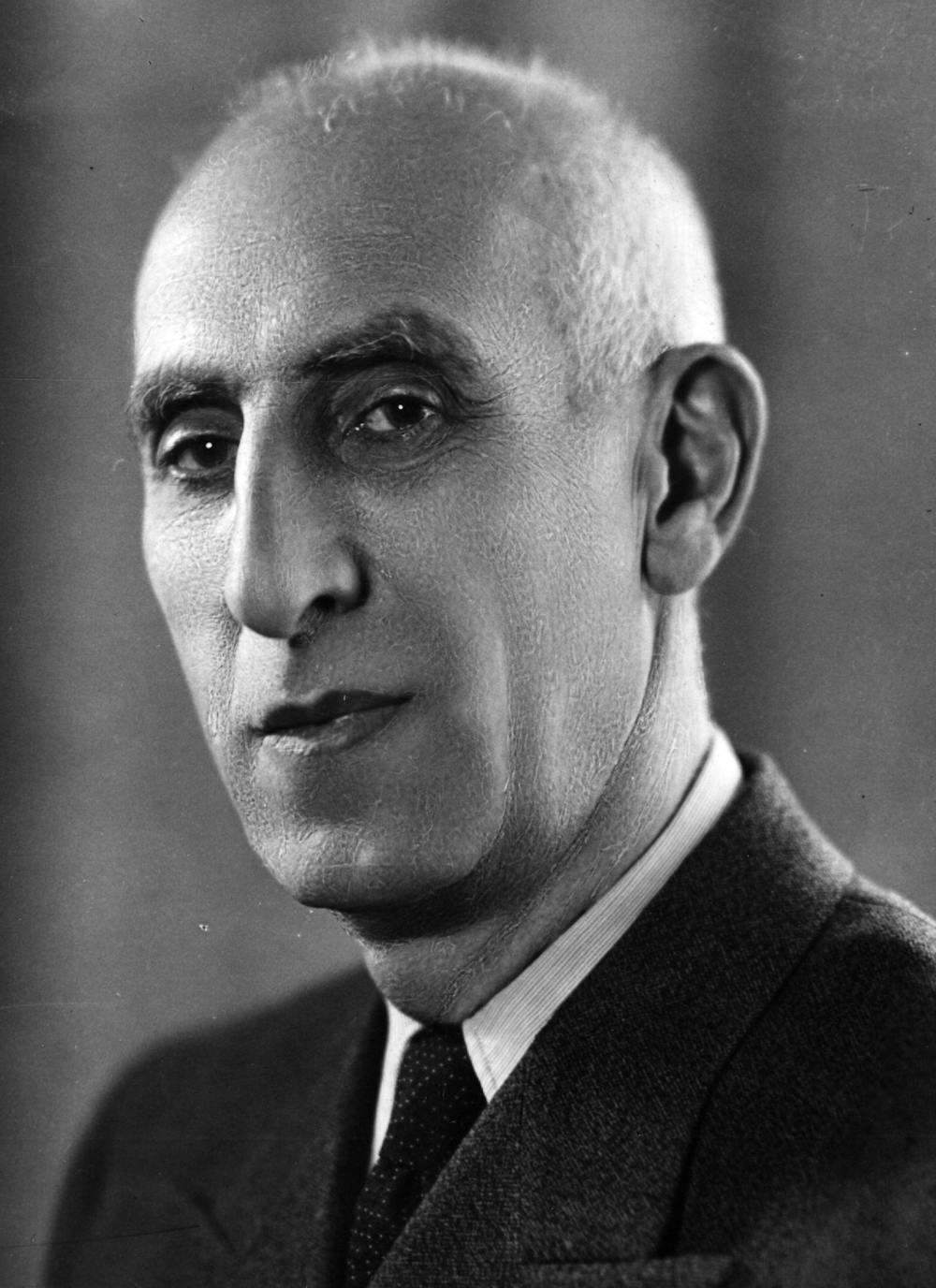
In 1951, the Iranian Parliament chose a new prime minister, Mossadegh, who then led lawmakers to vote in favor of taking over the Anglo-Iranian Oil Company, expelling the company’s British owners and saying they wanted to turn oil profits into investments in the Iranian people. The U.S. feared disruption in the global oil supply and worried about Iran falling prey to Soviet influence. The British feared the loss of cheap Iranian oil.
President Dwight Eisenhower decided it was best for the U.S. and the U.K. to get rid of Mossadegh. Operation Ajax, a joint CIA-British operation, convinced the Shah of Iran, the country’s monarch, to dismiss Mossadegh and drive him from office by force. Mossadegh was replaced by a much more Western-friendly prime minister, handpicked by the CIA.
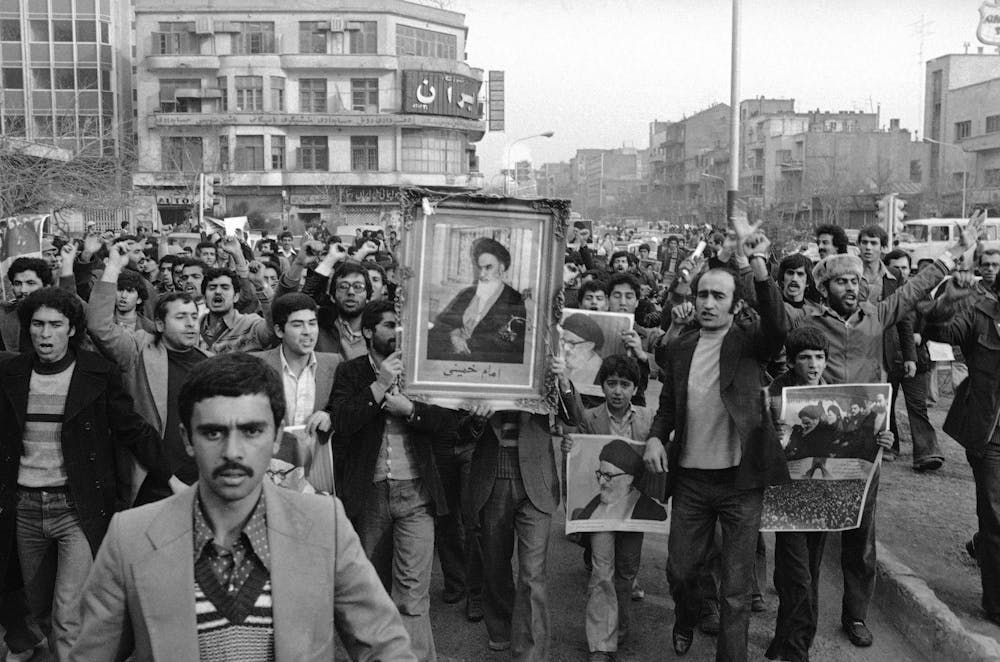
Demonstrators in Tehran demand the establishment of an Islamic republic. AP Photo/Saris
1979: Revolutionaries oust the shah, take hostages
After more than 25 years of relative stability in U.S.-Iran relations, the Iranian public had grown unhappy with the social and economic conditions that developed under the dictatorial rule of Shah Mohammad Reza Pahlavi.
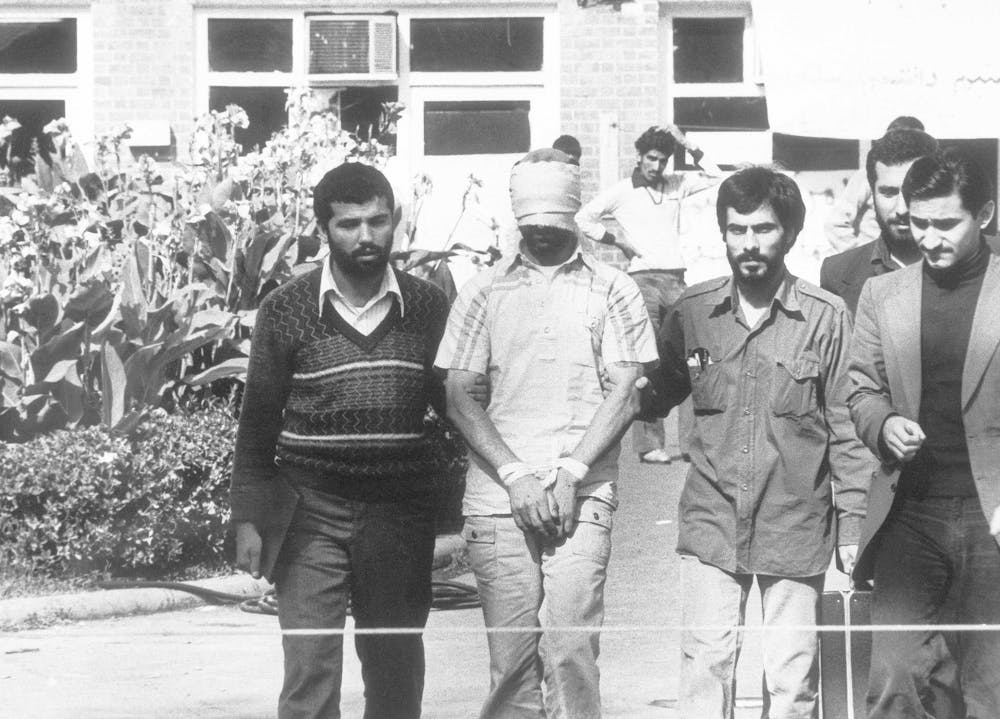
Iranian students at the U.S. Embassy in Tehran show a blindfolded American hostage to the crowd in November 1979. AP Photo
In October 1979, President Jimmy Carter agreed to allow the shah to come to the U.S. to seek advanced medical treatment. Outraged Iranian students stormed the U.S. Embassy in Tehran on Nov. 4, taking 52 Americans hostage. That convinced Carter to sever U.S. diplomatic relations with Iran on April 7, 1980.
Two weeks later, the U.S. military launched a mission to rescue the hostages, but it failed, with aircraft crashes killing eight U.S. servicemembers.
The shah died in Egypt in July 1980, but the hostages weren’t released until Jan. 20, 1981, after 444 days of captivity.
An Iranian cleric, left, and an Iranian soldier wear gas masks to protect themselves against Iraqi chemical-weapons attacks in May 1988. Kaveh Kazemi/Getty Images
The U.S. was concerned that the conflict would limit the flow of Middle Eastern oil and wanted to ensure the conflict didn’t affect its close ally, Saudi Arabia.
U.S. officials moderated their usual opposition to those illegal and inhumane weapons because the U.S. State Department did not “wish to play into Iran’s hands by fueling its propaganda against Iraq.” In 1988, the war ended in a stalemate. More than 500,000 military and 100,000 civilians died.
1981-1986: US secretly sells weapons to Iran
The U.S. imposed an arms embargo after Iran was designated a state sponsor of terrorism in 1984. That left the Iranian military, in the middle of its war with Iraq, desperate for weapons and aircraft and vehicle parts to keep fighting.
The last shipment, of anti-tank missiles, was in October 1986. In November 1986, a Lebanese magazine exposed the deal. That revelation sparked the Iran-Contra scandal in the U.S., with Reagan’s officials found to have collected money from Iran for the weapons and illegally sent those funds to anti-socialist rebels – the Contras – in Nicaragua.
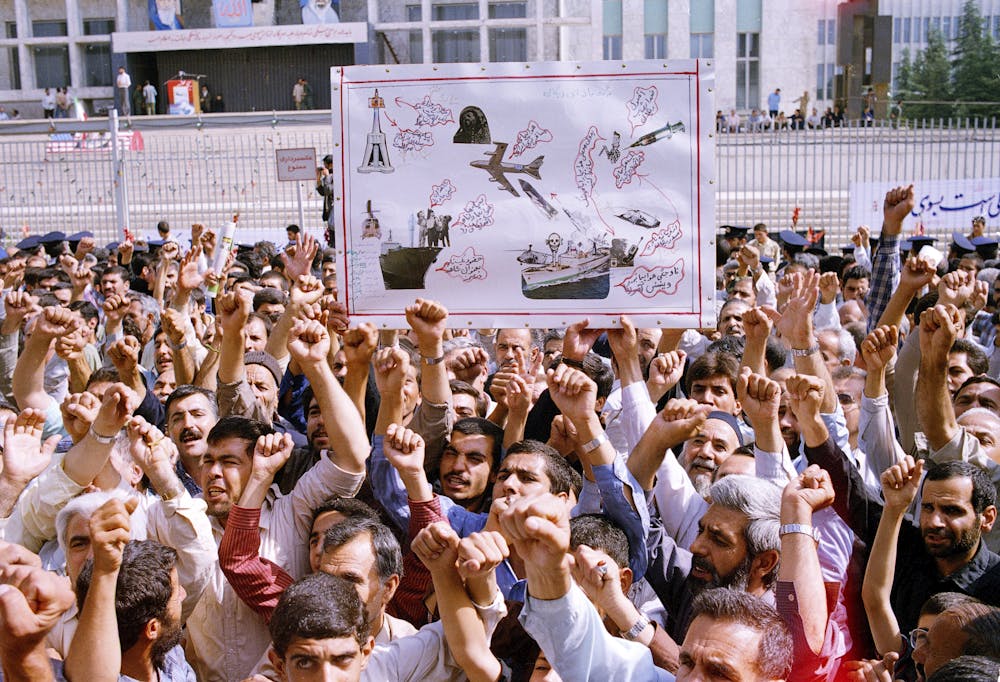
At a mass funeral for 76 of the 290 people killed in the shootdown of Iran Air 655, mourners hold up a sign depicting the incident. AP Photo/CP/Mohammad Sayyad
Either during or just after that exchange of gunfire, the Vincennes crew mistook a passing civilian Airbus passenger jet for an Iranian F-14 fighter. They shot it down, killing all 290 people aboard.
The U.S. called it a “tragic and regrettable accident,” but Iran believed the plane’s downing was intentional. In 1996, the U.S. agreed to pay US$131.8 million in compensation to Iran.
1997-1998: The US seeks contact
In August 1997, a moderate reformer, Mohammad Khatami, won Iran’s presidential election.
U.S. President Bill Clinton sensed an opportunity. He sent a message to Tehran through the Swiss ambassador there, proposing direct government-to-government talks.
Shortly thereafter, in early January 1998, Khatami gave an interview to CNN in which he expressed “respect for the great American people,” denounced terrorism and recommended an “exchange of professors, writers, scholars, artists, journalists and tourists” between the United States and Iran.
However, Supreme Leader Ayatollah Ali Khamenei didn’t agree, so not much came of the mutual overtures as Clinton’s time in office came to an end.
In his 2002 State of the Union address, President George W. Bush characterized Iran, Iraq and North Korea as constituting an “Axis of Evil” supporting terrorism and pursuing weapons of mass destruction, straining relations even further.
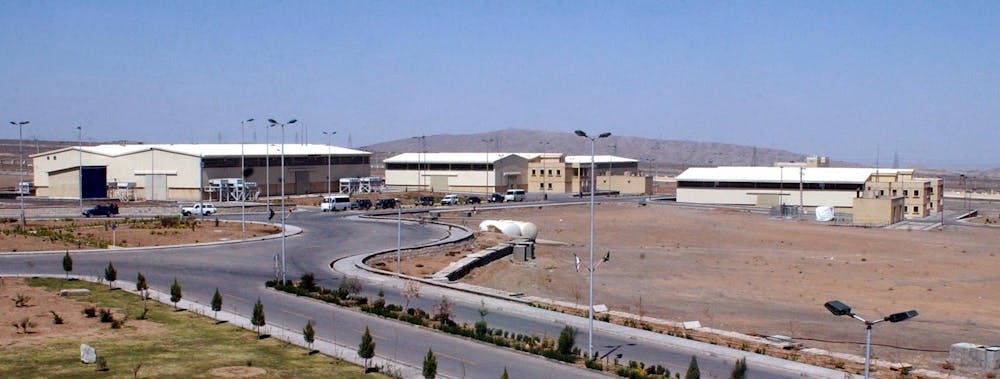
Inside these buildings at the Natanz nuclear facility in Iran, technicians enrich uranium. AP Photo/Vahid Salemi
That was a violation of the terms of the Nuclear Nonproliferation Treaty, which Iran had signed, requiring countries to disclose their nuclear-related facilities to international inspectors.
One of those formerly secret locations, Natanz, housed centrifuges for enriching uranium, which could be used in civilian nuclear reactors or enriched further for weapons.
Starting in roughly 2005, U.S. and Israeli government cyberattackers together reportedly targeted the Natanz centrifuges with a custom-made piece of malicious software that became known as Stuxnet.
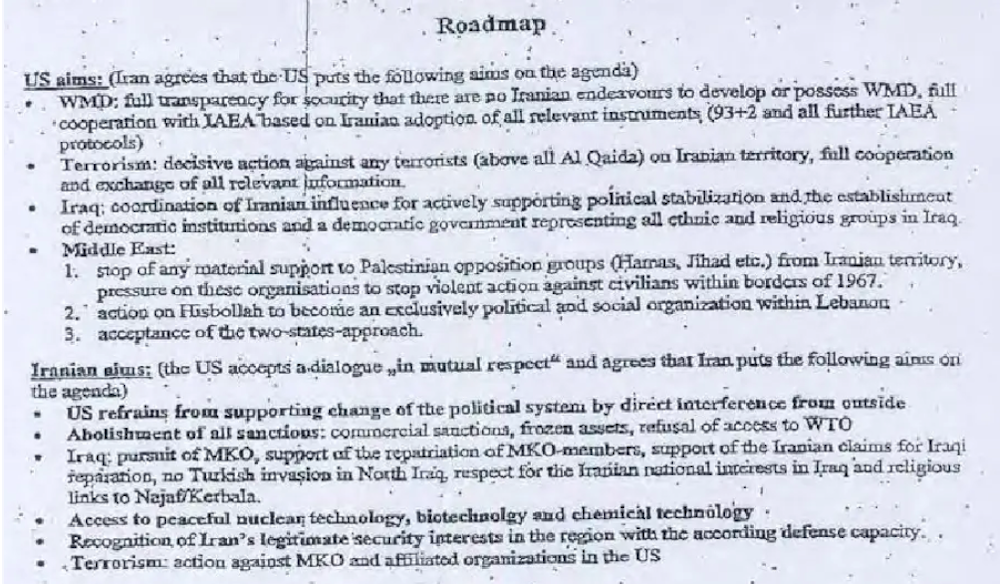
An excerpt of the document sent from Iran, via the Swiss government, to the U.S. State Department in 2003, appears to seek talks between the U.S. and Iran. Washington Post via Scribd
In May 2003, senior Iranian officials quietly contacted the State Department through the Swiss embassy in Iran, seeking “a dialogue ‘in mutual respect,’” addressing four big issues: nuclear weapons, terrorism, Palestinian resistance and stability in Iraq.
Hardliners in the Bush administration weren’t interested in any major reconciliation, though Secretary of State Colin Powell favored dialogue and other officials had met with Iran about al-Qaida.
When Iranian hardliner Mahmoud Ahmadinejad was elected president of Iran in 2005, the opportunity died. The following year, Ahmadinejad made his own overture to Washington in an 18-page letter to President Bush. The letter was widely dismissed; a senior State Department official told me in profane terms that it amounted to nothing.
After a decade of unsuccessful attempts to rein in Iran’s nuclear ambitions, the Obama administration undertook a direct diplomatic approach beginning in 2013.
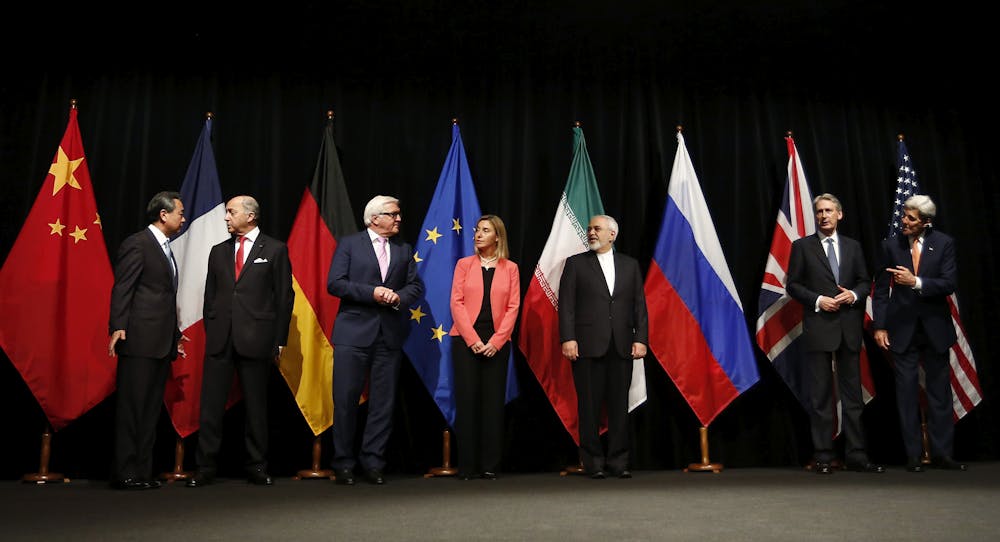
Iran, the U.S., China, France, Germany, Russia and the United Kingdom signed the deal in 2015. It severely limited Iran’s capacity to enrich uranium and mandated that international inspectors monitor and enforce Iran’s compliance with the agreement.
In return, Iran was granted relief from international and U.S. economic sanctions. Though the inspectors regularly certified that Iran was abiding by the agreement’s terms, President Donald Trump withdrew from the agreement in May 2018.
2020: US drones kill Iranian Maj. Gen. Qassem Soleimani
At the time, the Trump administration asserted that Soleimani was directing an imminent attack against U.S. assets in the region, but officials have not provided clear evidence to support that claim.
Hamas’ brazen attack on Israel on Oct. 7, 2023, provoked a fearsome militarized response from Israel that continues today and served to severely weaken Iran’s proxies in the region, especially Hamas – the perpetrator of the attacks – and Hezbollah in Lebanon.
2025: Trump 2.0 and Iran
Trump saw an opportunity to forge a new nuclear deal with Iran and to pursue other business deals with Tehran. Once inaugurated for his second term, Trump appointed Steve Witkoff, a real estate investor who is the president’s friend, to serve as special envoy for the Middle East and to lead negotiations.
Negotiations for a nuclear deal between Washington and Tehran began in April, but the countries did not reach a deal. They were planning a new round of talks when Israel struck Iran with a series of airstrikes on June 13, forcing the White House to reconsider is position.
On June 22, in the early morning hours, the U.S. chose to act decisively in an attempt to cripple Iran’s nuclear capacity, bombing three nuclear sites and causing what Pentagon officials called “severe damage.” Iran vowed to retaliate.
This story has been updated to reflect the U.S. bombing of Iranian nuclear sites on June 22, 2025.
Jeffrey Fields receives funding from the Carnegie Corporation of New York and Schmidt Futures.
Source: People’s Republic of China in Russian – People’s Republic of China in Russian –
Source: People’s Republic of China – State Council News
ASTANA, June 22 (Xinhua) — The China-Central Asia News Agency Forum was held in Astana, capital of Kazakhstan, on Sunday. The forum adopted the Astana Consensus of the China-Central Asia News Agency Forum, which proposes deepening cooperation between the media of China and Central Asian countries and promoting the building of a China-Central Asia community with a shared future.
The two sides noted that over the past 30 years since the establishment of diplomatic relations between China and the five Central Asian countries, their relations have been elevated to a comprehensive strategic partnership, with all-round cooperation continuously deepening. As stated in the document, the two sides are jointly building a China-Central Asia community with a shared future based on mutual assistance, common development, common security and friendship from generation to generation, making contributions to the construction of a community with a shared future for mankind.
The parties highly appreciated the results of cooperation between the media of China and the five Central Asian countries in recent years in such aspects as news exchange, high-level contacts and information coverage. It was emphasized that close communication and interaction between the media of the six countries within the framework of such multilateral mechanisms as the World Media Summit, the Global South Media and Think Tank Forum and the China-Central Asia News Agency Forum are conducive to further deepening mutual understanding and friendship between the peoples of China and Central Asia, deepening mutually beneficial cooperation and advancing the construction of a China-Central Asia community with a shared future.
The two sides noted that in the face of rapid and profound changes in the world and the complex international situation, the media of China and the five Central Asian countries should further expand exchanges, deepen cooperation, join forces and coordinate actions to promote international justice, push global governance in a more just and reasonable direction, inject new impetus into efforts to strengthen the unity and cooperation of the Global South and promote world peace and development.
The two sides agreed to develop and utilize the China-Central Asia News Agency Forum, conduct active bilateral and multilateral people-to-people exchanges, intensify high-level contacts and mutual visits of staff, organize joint reporting, professional exchange seminars and personnel training events to deepen mutual understanding, promote mutual learning and exchange of experience, and build media capacity.
The parties agreed that in the context of the rapid development of artificial intelligence /AI/ technologies, it is necessary to firmly adhere to journalistic ethics and professional standards, provide the audience with reliable, objective, comprehensive and impartial news information, oppose the use of AI technologies for such purposes as fabricating fake news and spreading rumors, and protect the authority of the media and public trust in them.
The two sides expressed support for further strengthening exchanges and cooperation in the field of economic information, as well as deepening cooperation in information exchange, holding events and sharing resources within the Belt and Road Economic Information Partnership network.
The two sides agreed to strengthen cooperation within multilateral mechanisms such as the World Media Summit, the Global South Media and Think Tank Forum and the International Committee for Belt and Road Think Tank Cooperation, actively support and participate in activities within the context of these mechanisms, and make joint contributions to their development.
The China-Central Asia News Agency Forum was initiated and held by the Chinese Xinhua News Agency within the framework of the 2nd China-Central Asia Summit. The forum was attended by the heads of the Xinhua News Agency, the Television and Radio Complex of the President of the Republic of Kazakhstan, the Kyrgyz National News Agency Kabar, the National News Agency of Tajikistan Khovar, the Media-Turkmen News Agency, and the National News Agency of Uzbekistan. –0–
SCARPERIA E SAN PIERO, Italy, June 22, 2025 (GLOBE NEWSWIRE) — Bitget, the leading cryptocurrency exchange and Web3 company, is teaming up with MotoGP, the highest class of motorcycle road racing events, in a high-octane partnership that merges the breakneck speed of racing with the high-stakes precision of crypto trading. As the newly minted Regional Partner for select Grand Prix events across Europe and Southeast Asia, Bitget is bringing crypto onto the track, and into the fast lane.
Kicking off at the iconic Mugello Circuit during the Italian Grand Prix, the collaboration marks a new era where precision engineering meets algorithmic agility, and where every second, like every trade, has the power to make it count.
Bitget’s partnership will speed across multiple marquee MotoGP events in 2025, including Italy, Germany, Spain, and Indonesia, bringing together fans of motorsport and crypto under one roaring banner of performance, resilience, and speed.
“Racing is a sport of milliseconds; crypto is a market of micro-decisions. This partnership is our way of showing the world that success — on the track or on the charts — comes down to smart moves and fearless execution,” said Gracy Chen, CEO at Bitget.“We’re excited to join MotoGP in putting power, precision, and potential into the hands of every user and every fan.”
At the heart of the campaign is three-time MotoGP World Champion Jorge Lorenzo, whose relentless pursuit of perfection makes him a fitting icon for Bitget’s iconic “Make It Count” slogan.
“I’ve always believed that you win races not just on instinct — but by making every lap, every line, every second count. It’s the same mindset Bitget brings to trading, and I’m proud to be part of this story,” said Jorge Lorenzo. “The worlds of MotoGP and crypto aren’t as different as they seem — they both reward those who stay sharp and think fast.”
The campaign features trackside activations, exclusive VIP experiences, and a series of cross-platform digital initiatives. At Mugello, KOLs and media will get behind-the-scenes access to the paddock and rider interactions, blending all the high-octane energy of race weekend, wrapped in a sleek, Bitget-branded experience.
“MotoGP is built on precision, innovation, and high-speed decisions — values that align naturally with Bitget,” agreed MotoGP CCO Dan Rossomondo.
This collaboration follows Bitget’s headline partnerships with Lionel Messi, Juventus, and LALIGA, reinforcing its track record in bridging the gap between crypto and culture. With over 120 million users globally and a daily trading volume topping $20 billion, Bitget continues to shift the narrative from volatility to victory.
About Bitget
Established in 2018, Bitget is the world’s leading cryptocurrency exchange and Web3 company. Serving over 120 million users in 150+ countries and regions, the Bitget exchange is committed to helping users trade smarter with its pioneering copy trading feature and other trading solutions, while offering real-time access to Bitcoin price, Ethereum price, and other cryptocurrency prices. Formerly known as BitKeep, Bitget Wallet is a leading non-custodial crypto wallet supporting 130+ blockchains and millions of tokens. It offers multi-chain trading, staking, payments, and direct access to 20,000+ DApps, with advanced swaps and market insights built into a single platform. Bitget is at the forefront of driving crypto adoption through strategic partnerships, such as its role as the Official Crypto Partner of the World’s Top Football League, LALIGA, in EASTERN, SEA and LATAM markets, as well as a global partner of Turkish National athletes Buse Tosun Çavuşoğlu (Wrestling world champion), Samet Gümüş (Boxing gold medalist) and İlkin Aydın (Volleyball national team), to inspire the global community to embrace the future of cryptocurrency.
Risk Warning:Digital asset prices are subject to fluctuation and may experience significant volatility. Investors are advised to only allocate funds they can afford to lose. The value of any investment may be impacted, and there is a possibility that financial objectives may not be met, nor the principal investment recovered. Independent financial advice should always be sought, and personal financial experience and standing carefully considered. Past performance is not a reliable indicator of future results. Bitget accepts no liability for any potential losses incurred. Nothing contained herein should be construed as financial advice. For further information, please refer to our Terms of Use.
About MotoGP
Faster. Forward. Fearless. Since 1949, MotoGP™ has grown into a global sports and entertainment brand with an incredible legacy and an even more exciting future. Each season, the greatest riders from across the globe come together to race the fastest prototype motorcycles on some of the world’s greatest racetracks – creating the most exciting sport on Earth.
SCARPERIA E SAN PIERO, Italy, June 22, 2025 (GLOBE NEWSWIRE) — Bitget, the leading cryptocurrency exchange and Web3 company, is teaming up with MotoGP, the highest class of motorcycle road racing events, in a high-octane partnership that merges the breakneck speed of racing with the high-stakes precision of crypto trading. As the newly minted Regional Partner for select Grand Prix events across Europe and Southeast Asia, Bitget is bringing crypto onto the track, and into the fast lane.
Kicking off at the iconic Mugello Circuit during the Italian Grand Prix, the collaboration marks a new era where precision engineering meets algorithmic agility, and where every second, like every trade, has the power to make it count.
Bitget’s partnership will speed across multiple marquee MotoGP events in 2025, including Italy, Germany, Spain, and Indonesia, bringing together fans of motorsport and crypto under one roaring banner of performance, resilience, and speed.
“Racing is a sport of milliseconds; crypto is a market of micro-decisions. This partnership is our way of showing the world that success — on the track or on the charts — comes down to smart moves and fearless execution,” said Gracy Chen, CEO at Bitget.“We’re excited to join MotoGP in putting power, precision, and potential into the hands of every user and every fan.”
At the heart of the campaign is three-time MotoGP World Champion Jorge Lorenzo, whose relentless pursuit of perfection makes him a fitting icon for Bitget’s iconic “Make It Count” slogan.
“I’ve always believed that you win races not just on instinct — but by making every lap, every line, every second count. It’s the same mindset Bitget brings to trading, and I’m proud to be part of this story,” said Jorge Lorenzo. “The worlds of MotoGP and crypto aren’t as different as they seem — they both reward those who stay sharp and think fast.”
The campaign features trackside activations, exclusive VIP experiences, and a series of cross-platform digital initiatives. At Mugello, KOLs and media will get behind-the-scenes access to the paddock and rider interactions, blending all the high-octane energy of race weekend, wrapped in a sleek, Bitget-branded experience.
“MotoGP is built on precision, innovation, and high-speed decisions — values that align naturally with Bitget,” agreed MotoGP CCO Dan Rossomondo.
This collaboration follows Bitget’s headline partnerships with Lionel Messi, Juventus, and LALIGA, reinforcing its track record in bridging the gap between crypto and culture. With over 120 million users globally and a daily trading volume topping $20 billion, Bitget continues to shift the narrative from volatility to victory.
About Bitget
Established in 2018, Bitget is the world’s leading cryptocurrency exchange and Web3 company. Serving over 120 million users in 150+ countries and regions, the Bitget exchange is committed to helping users trade smarter with its pioneering copy trading feature and other trading solutions, while offering real-time access to Bitcoin price, Ethereum price, and other cryptocurrency prices. Formerly known as BitKeep, Bitget Wallet is a leading non-custodial crypto wallet supporting 130+ blockchains and millions of tokens. It offers multi-chain trading, staking, payments, and direct access to 20,000+ DApps, with advanced swaps and market insights built into a single platform. Bitget is at the forefront of driving crypto adoption through strategic partnerships, such as its role as the Official Crypto Partner of the World’s Top Football League, LALIGA, in EASTERN, SEA and LATAM markets, as well as a global partner of Turkish National athletes Buse Tosun Çavuşoğlu (Wrestling world champion), Samet Gümüş (Boxing gold medalist) and İlkin Aydın (Volleyball national team), to inspire the global community to embrace the future of cryptocurrency.
Risk Warning:Digital asset prices are subject to fluctuation and may experience significant volatility. Investors are advised to only allocate funds they can afford to lose. The value of any investment may be impacted, and there is a possibility that financial objectives may not be met, nor the principal investment recovered. Independent financial advice should always be sought, and personal financial experience and standing carefully considered. Past performance is not a reliable indicator of future results. Bitget accepts no liability for any potential losses incurred. Nothing contained herein should be construed as financial advice. For further information, please refer to our Terms of Use.
About MotoGP
Faster. Forward. Fearless. Since 1949, MotoGP™ has grown into a global sports and entertainment brand with an incredible legacy and an even more exciting future. Each season, the greatest riders from across the globe come together to race the fastest prototype motorcycles on some of the world’s greatest racetracks – creating the most exciting sport on Earth.
Two international organisations are leading a call for the Melanesian Spearhead Group (MSG) to elevate the membership status of the United Liberation Movement for West Papua (ULMWP) at their upcoming summit in Honiara in September.
The collective, led by International Parliamentarians for West Papua (IPWP) and International Lawyers for West Papua (ILWP), has again highlighted the urgent need for greater international oversight and diplomatic engagement in the West Papua region.
This influential group includes PNG’s National Capital District governor Powes Parkop, UK’s former Labour Party leader Jeremy Corbyn, and New Zealand’s former Green Party MP Catherine Delahunty.
The ULMWP currently holds observer status within the MSG, a regional body comprising Fiji, Papua New Guinea, Solomon Islands, Vanuatu, and the Kanak and Socialist National Liberation Front (FLNKS) of New Caledonia.
A statement by the organisations said upgrading the ULMWP’s membership is “within the remit of the MSG” and requires a consensus among member states.
They appeal to the Agreement Establishing the MSG, which undertakes to “promote, coordinate and strengthen…exchange of Melanesian cultures, traditions and values, sovereign equality . . . to further MSG members’ shared goals of economic growth, sustainable development, good governance, peace, and security,” considering that all these ambitions would be advanced by upgrading ULMWP membership.
However, Indonesia’s associate membership in the MSG, granted in 2015, has become a significant point of contention, particularly for West Papuan self-determination advocates.
Strategic move by Jakarta This inclusion is widely seen as a strategic manoeuvre by Jakarta to counter growing regional support for West Papuan independence.
The ULMWP and its supporters consistently question why Indonesia, as the administering power over West Papua, should hold any status within a forum intended to champion Melanesian interests, arguing that Indonesia’s presence effectively stifles critical discussions about West Papua’s self-determination, creating a diplomatic barrier to genuine dialogue and accountability within the very body meant to serve Melanesian peoples.
Given Papua New Guinea’s historical record within the MSG, its likely response at the upcoming summit in Honiara will be characterised by a delicate balancing act.
While Papua New Guinea has expressed concerns regarding human rights in West Papua and supported calls for a UN Human Rights mission, it has consistently maintained respect for Indonesia’s sovereignty over the region.
Past statements from PNG leaders, including Prime Minister James Marape, have emphasised Indonesia’s responsibility for addressing internal issues in West Papua and have noted that the ULMWP has not met the MSG’s criteria for full membership.
Further complicating the situation, the IPWP and ILWP report that West Papua remains largely cut off from international scrutiny.
Strict journalist ban A strict ban on journalists entering the region means accounts of severe and ongoing human rights abuses often go unreported.
The joint statement highlights a critical lack of transparency, noting that “very little international oversight” exists.
A key point of contention is Indonesia’s failure to honour its commitments; despite the 2023 MSG leaders’ summit urging the UN High Commissioner for Human Rights to conduct a human rights mission to West Papua before the 2024 summit, Indonesia has yet to facilitate this visit.
The IPWP/ILWP statement says the continued refusal is a violation of its obligations as a UN member state.
This article is republished under a community partnership agreement with RNZ.
Source: The Conversation – Canada – By James Horncastle, Assistant Professor and Edward and Emily McWhinney Professor in International Relations, Simon Fraser University
Segment on Trump’s threats against Iran’s leader. (BBC News)
The American military can certainly make an impact in any air campaign against Iran. The problem from a military standpoint, however, is that the U.S., based on its forces’ deployment, will almost certainly seek to keep its involvement limited to its air force to avoid another Iraq-like quagmire.
While doing so could almost certainly disrupt Iran’s nuclear program, it will likely fall short of Israel’s goal of regime change.
In fact, it could reinforce the Iranian government and draw the U.S. into a costly ground war.
The initial stated reason for Israel’s bombing campaign — Iran’s nuclear capabilities — appears specious at best.
Israeli Prime Minister Benjamin Netanyahu has argued several times in the past, without evidence, that Iran is close to achieving a nuclear weapon. U.S. intelligence, however, have assessed that Iran is three years away from deploying a nuclear weapon.
Regardless of the veracity of the claims, Israel initiated the offensive and requires American support.
Israel’s need for U.S. assistance rests on two circumstances:
While Israel succeeded in eliminating key figures from the Iranian military in its initial strikes, Iran’s response appears to have exceeded Israel’s expectations with their Arrow missile interceptors nearing depletion.
Israel’s air strikes can only achieve so much in disrupting Iran’s nuclear ambitions. Most analysts note that Israel’s bombings are only likely to delay the Iranian nuclear program by a few months. This is due to the fact that Israeli missiles are incapable of penetrating the Fordow Fuel Enrichment Plant, which estimates place close to 300 feet underground.
Nonetheless, the efficacy of air power has been vastly overrated in the popular media and various air forces of the world. Air power is great at disrupting an opponent, but has significant limitations in influencing the outcome of a war.
Specifically, air power is likely to prove an inadequate tool for one of the supposed Israeli and American objectives in the war: regime change. For air power to be effective at bringing about regime change, it needs to demoralize the Iranian people to the point that they’re willing to oppose their own government.
Early air enthusiasts believed that a population’s demoralization would be an inevitable consequence of aerial bombardment. Italian general Giulio Douhet, a prominent air power theorist, argued that air power was so mighty that it could destroy cities and demoralize an opponent into surrendering.
Douhet was correct on the first point. He was wrong on the second.
Recent history provides evidence. While considerableink has been spilled to demonstrate the efficacy of air power during the Second World War, close examination of the facts demonstrate that it had a minimal impact. In fact, Allied bombing of German cities in several instances created the opposite effect.
More recent bombing campaigns replicated this failure. The U.S. bombing of North Vietnam during the Vietnam War did not significantly damage North Vietnamese morale or war effort. NATO’s bombing of Serbia in 1999, likewise, rallied support for the unpopular Slobodan Milosevic due to its perceived injustice — and continues to evoke strong emotions to this day.
Iran’s political regime may be unpopular with many Iranians, but Israeli and American bombing may shore up support for the Iranian government.
Nationalism is a potent force, particularly when people are under attack. The attacks on Iran will rally segments of the population to the government that would otherwise oppose it.
Few positive options
The limitations of air power to fuel significant political change in Iran should have given Trump pause about intervening in the conflict.
Some American support, such as providing weapons, is a given due to the close relationship between the U.S. and Israel. But any realization of American and Israeli aspirations of a non-nuclear Iran and a new government will likely require ground forces.
Recent American experiences in Afghanistan and Iraq show such a ground forces operation won’t lead to the swift victory that Trump desires, but could potentially stretch on for decades.
James Horncastle does not work for, consult, own shares in or receive funding from any company or organisation that would benefit from this article, and has disclosed no relevant affiliations beyond their academic appointment.
London, UK, June 22, 2025 (GLOBE NEWSWIRE) — RICH Miner, an intelligent cloud mining platform, has officially announced its global expansion and enhanced features, making it easier than ever for Robinhood users and crypto investors worldwide to earn daily passive income through clean-energy cloud mining.
With the increasing demand for sustainable, low-barrier crypto income streams, RICH Miner stands out by offering AI-driven mining allocation, 100% uptime, and a user-friendly experience — all without the need to purchase costly hardware or have technical expertise.
New users can register at https://richminer.com and instantly receive a $15 bonus, enabling them to start mining popular cryptocurrencies like Bitcoin (BTC) and Dogecoin (DOGE) with daily payouts from day one.
“At RICH Miner, our goal is to make cloud mining accessible, safe, and profitable for everyone, whether you’re a first-time investor or an experienced trader on platforms like Robinhood,” saidRICH, Emma Lesley, spokesperson for RICH Miner. “We combine intelligent mining, renewable energy, and robust fund security to deliver a worry-free passive income solution.”
Why RICH Miner is Gaining Global Popularity
✅ Zero Hassle, Daily Profits Users simply sign up, select a computing plan, and start earning. There’s no need for mining rigs, complex setups, or high electricity costs.
✅ Clean Energy Commitment RICH Miner’s mining farms operate on wind, hydro, and solar energy, supporting sustainable crypto production while minimizing carbon impact.
✅ AI Intelligent Allocation The platform uses AI to maximize mining efficiency and distribute computing power smartly, ensuring stable daily returns.
✅ Flexible Contract Plans With plans ranging from $100 to $180,800, users can choose contracts that match their budget and profit expectations — all details are transparently displayed on the official website.
✅ Proven Global Presence RICH Miner now serves over 5 million users across the United States, Japan, Europe, and Southeast Asia, with licensed operations in multiple regions.
For those interested in joining the fast-growing RICH Miner community, more information about plans and earnings potential can be found directly at https://richminer.com.
How to Get Started with RICH Miner
1️⃣ Register for free and claim your $15 bonus 2️⃣ Select a mining contract to suit your budget
Contract Potential Profit Table
Contract Price
Contract duration
Daily income
Total revenue
$100
2
$3
$100.00 + $6
$700
8
$8.68
$500.00 + $69.44
$1,600
15
$21.60
$1600.00 + $324
$3,300
18
$46.20
$3300.00 + $831.60
$5,600
22
$84.00
$5600.00 + $1848
$8,800
28
$140.80
$8800.00 + $3942.40
Completely transparent and open – control your wealth freedom anytime, anywhere, and download the official APP with one click.
Whether you’re managing your portfolio on Robinhood or looking for a diversified crypto income stream, RICH Miner offers a trusted, transparent, and eco-friendly way to build wealth with minimal effort.
About RICH Miner RICH Miner is a leading global cloud mining platform dedicated to providing simple, sustainable, and secure passive income opportunities through intelligent cloud mining solutions. Powered by clean energy and advanced AI, RICH Miner helps individuals worldwide profit from crypto mining without barriers or hidden costs.
CPC Central Committee Hong Kong & Macao Work Office Director and State Council Hong Kong & Macao Affairs Office Director Xia Baolong today had an engagement session with district leaders and visited a Community Living Room (CLR) in Hong Kong.
In the morning, Mr Xia, together with Chief Executive John Lee and Secretary for Home & Youth Affairs Alice Mak, met chairmen and representatives of the 18 District Councils at the engagement session. Mr Xia received briefings on their district work.
Accompanied by Mr Lee and Secretary for Labour & Welfare Chris Sun, Mr Xia inspected the facilities of the To Kwa Wan CLR to learn about the execution of the CLR Pilot Programme by the Hong Kong Special Administrative Region Government. He also took the opportunity to interact with its users.
Mr Xia concluded his visit and left Hong Kong in the evening.
Source: People’s Republic of China in Russian – People’s Republic of China in Russian –
Source: People’s Republic of China – State Council News
URUMQI, June 22 (Xinhua) — The cross-border e-commerce sector in northwest China’s Xinjiang Uygur Autonomous Region has seen dynamic growth, with the advantages of two key ports of Alashankou and Horgos as “global purchasing and selling” channels becoming increasingly evident, achieving highly efficient and smooth trade flow.
Alashankou Port has seen strong growth in cross-border e-commerce. In the first five months of this year, 55.7376 million parcels worth 3.579 billion yuan (about 492 million U.S. dollars) were exported through Alashankou in cross-border online commerce, up 103 percent year-on-year. At the Alashankou Comprehensive Bonded Zone Cross-Border E-Commerce Industrial Park, trucks loaded with toys, consumer goods and other products bearing the stamp “Made in China” are constantly streaming toward Europe, Russia and other regions.
“From January to May this year, our company’s cross-border e-commerce export volume exceeded 20 million parcels, up 50 percent year-on-year and reaching a historical high,” Kong Xianglin, deputy general manager of Oushengtong Kahang International Logistics Co., Ltd., told Xinhua. “We are currently cooperating with platforms such as Pinduoduo and AliExpress to build overseas warehouses. In the second half of the year, business with Europe is expected to grow by another 60 percent.”
With explosive growth, cross-border e-commerce at Horgos is complementing Alashankou’s success. Over the same period, the port is expected to reach 28.05 billion yuan in trade volume, a staggering 890 percent year-on-year increase. At the cargo yard of Zhongguang Zhida Co., Ltd., daily necessities, small appliances, air conditioners and other goods are packed into containers before being shipped.
“Today, our company’s trading volume has reached US$700 million, up about 110 percent from a year ago and a record high,” said Jiang Yong, deputy general manager of Zhongguang Zhida Co., Ltd. “Based on Khorgos’s advanced industrial base and highly efficient logistics network, we will continue to deepen our presence in the Central Asian and European markets,” he continued.
The strong growth of the two ports is driven by the continuous optimization of the business environment and the upgrading of infrastructure. The Alashankou Port Authority, taking advantage of the Belt and Road Initiative, has invested in building a multifunctional cross-border e-commerce industrial park, attracting 15 companies and covering all import and export models. The Horgos Cross-Border E-Commerce Industrial Park has also brought together more than 40 enterprises and is purposefully building a comprehensive service ecosystem covering the entire supply chain.
Zhang Yan, head of the New Business Model Department of Alashankou Port and Commerce Bureau, said: “We actively leverage the advantages of geographical location and industrial agglomeration, implement various support measures, solve practical difficulties for enterprises, and continuously provide cross-border e-commerce companies with turnkey services, from warehouse logistics to financial services.”
At present, Alashankou and Horgos are making the transition from a “transit corridor economy” to an “industrial cluster economy”. With innovative models and an open ecosystem, they are jointly building a digital trade hub in a key area of the Silk Road Economic Belt, giving a strong impetus to the deepening of the opening up of Xinjiang’s border areas. -0-
Source: People’s Republic of China in Russian – People’s Republic of China in Russian –
Source: People’s Republic of China – State Council News
ASTANA, June 22 (Xinhua) — The China-Central Asia News Agency Forum was held in Astana, capital of Kazakhstan, on Sunday. As one of the outcomes of the Second China-Central Asia Summit, the forum was initiated and hosted by Xinhua News Agency. It was attended by heads of Xinhua News Agency, Kazakh Presidential Television and Radio Broadcasting Complex, Kyrgyz National News Agency Kabar, Tajikistan National News Agency Khovar, Media-Turkmen News Agency and Uzbekistan National News Agency.
Fu Hua, Director General of Xinhua News Agency, chaired the forum and delivered a speech. He said that under the joint leadership of Chinese President Xi Jinping and the leaders of Central Asian countries, exchanges and cooperation between China and the countries in the region have gained new important historical opportunities and shown incredibly bright prospects. News agencies of China and Central Asia are charged with the responsibility of spreading the “Central Asia-China Spirit” and promoting high-quality development in the region, jointly telling the stories of China-Central Asia cooperation, promoting China-Central Asia people-to-people and cultural exchanges and mutual learning between civilizations, advancing innovation and cooperation in media technology, deepening exchanges and cooperation between news agencies, and contributing to promoting the building of a community with a shared future for China and Central Asia.
The officials of news agencies of the Central Asian countries highly appreciated the important role played by the China-Central Asia News Agency Forum in strengthening mutual understanding and cooperation, and expressed their willingness to continue to deepen exchanges and cooperation with Chinese media including the Xinhua News Agency, jointly promote the “Central Asia-China Spirit”, and make due contributions to promoting mutual learning among civilizations and achieving common development.
Director General of the Television and Radio Complex of the President of the Republic of Kazakhstan Raushan Kazhibayeva noted that the successful holding of the Second China-Central Asia Summit outlined the direction for the development of relations between China and the countries of the region. This forum is a vivid manifestation of good-neighborliness and deep friendship between China and the countries of Central Asia, and the media should support and promote the implementation of the results achieved at the summit.
Mederbek Shermetaliev, Director General of the Kyrgyz National News Agency Kabar, said that the Belt and Road Initiative has opened up new prospects for mutually beneficial cooperation between China and Central Asia. Strengthening information exchange and cooperation between all parties will help present an objective, truthful and three-dimensional image of China and Central Asian countries.
According to Subhiddin Shamsiddinzoda, Director of the National Information Agency of Tajikistan “Khovar”, fruitful results have been achieved in cooperation between the Central Asian countries and China in the field of media. He also expressed hope for continued in-depth exchange of views on issues such as training talents in the field of communications, strengthening cooperation between universities and promoting the development of creative industries.
Bekdurdy Amansaryev, Director General of the Media-Turkmen Information Agency, said all parties should set an example in establishing information partnerships based on mutual respect, equality and mutual benefit. New technologies have expanded the space for cooperation between media outlets, he noted, adding that he hopes to strengthen cooperation in the field of new media and promote digital transformation.
Abdusaid Kuchimov, Director General of the National News Agency of Uzbekistan, noted that the media plays an important role in strengthening bilateral and multilateral cooperation between Central Asian countries and China. Media partners from Central Asia and China came together to strengthen their cooperation, which is of great importance for discussing ways to overcome common challenges.
The forum participants agreed that the world is changing and facing many challenges, such as the spread of disinformation. The media of China and Central Asian countries should join efforts to enhance cooperation in information exchange, news dissemination and promotion of technological innovation to create a favorable information environment for regional peace and development.
Following the forum, the Astana Consensus was adopted. –0–
Source: People’s Republic of China in Russian – People’s Republic of China in Russian –
Source: People’s Republic of China – State Council News
XI’AN, June 22 (Xinhua) — “How is business going in Kazakhstan? Are there any difficulties in establishing contacts?” Begench Sakhedov, a Turkmen national, asked his business partner Wang Yi from Shaanxi Province, who was in Almaty at the time, via video link from Xi’an, northwest China’s Shaanxi Province. “Everything is going well. There are no problems in communication, even though I do not speak English or Russian, because many Kazakhs speak Chinese,” Wang Yi replied.
As transnational partners, Wang Yi and B. Sahedov jointly run a company in Xi’an that provides cultural exchange services. As trade, economic and cultural exchanges between China and Central Asian countries expand, their company, registered in September 2023, has seen good growth.
“After the successful holding of the first China-Central Asia Summit, we clearly felt that students from the five Central Asian countries have increased their desire to study in China because coming to China means more opportunities and no difficulties with employment,” the company’s business director, Turkmen Yagshi Aizhanov, told Xinhua. “In 2024, we helped more than 800 people come to study in China, most of them from the five Central Asian countries.”
As mutual visa-free travel agreements between China and Central Asian countries come into effect, travel has also become more convenient. “We are currently cooperating with more than 100 universities in China,” B. Sakhedov noted.
Xi’an, where a large number of universities and scientific and educational resources are concentrated, has become one of the popular cities for students from Central Asia who come to study in China. In recent years, many young people from Central Asia, such as B. Sakhedov, who came to China to receive higher education, choose Xi’an after graduating to start their entrepreneurial journey here.
The Qinchuanyuan Science and Technology Big Market in Xi’an New Area, Shaanxi Province, hosted an exchange of views on entrepreneurship among foreign youth. Amina Gusarova from Kyrgyzstan told Xinhua that she registered a consulting company in Xi’an late last year. “We have already signed our first order. A Chinese enterprise that needs to expand its business is going to Kyrgyzstan for a study tour, and we provide them with comprehensive services, from consulting to translation.”
“We have been implementing a pilot project on entrepreneurship among foreign specialists since May 2023. To date, 18 expat startup projects have already been attracted, most of the entrepreneurs are from five Central Asian countries,” said Han Ping, deputy head of the Department of Scientific and Technological Innovation and New Economy of Xi’an New Area in Shaanxi Province. “They have a very strong desire to work and live in China, and at the same time, they often invite business partners from Central Asia to Xi’an to seek cooperation opportunities.”
Doniyor Matmusayev from Uzbekistan is one such entrepreneur. After graduating from Northwestern Polytechnical University in 2023, he registered a trading company in Xi’an that supplies Chinese goods to Central Asian countries and Russia. “We sell Chinese construction equipment to Uzbekistan, and some Chinese brands of equipment are doing very well there; we mainly sell auto parts to Kazakhstan, but Chinese electric cars are also very popular there; and we mainly supply electronics to Russia, such as switches, servers, etc.,” he said.
Over the past two years, D. Matmusaev has worked in the provinces of Guangdong (South China), Jiangsu (East China), Zhejiang (East China), Shandong (East China) and other places. “The opening of a direct flight from Xi’an to Uzbekistan has significantly reduced the logistics shoulder. Now our electronics are delivered by air in three hours and cleared through customs on the same day,” said D. Matmusaev. “We transport large-sized equipment by road or by international freight railway routes from China to Europe. Road transportation takes 15 days, and the convenience of China-Europe express trains is not even worth mentioning.”
According to statistics from the Shaanxi Provincial Commerce Department, the province’s foreign trade turnover with the five Central Asian countries has been growing every year. In 2024, it reached 8.575 billion yuan (about 1.18 billion US dollars), which is 48.1 percent more than the previous year. Thanks to such development dynamics, Chinese ice cream has now appeared in the product range. To make the partners more confident, in early April, D. Matmusaev accompanied a client from Uzbekistan on a trip to a Chinese ice cream factory.
“Ice cream is a new project. We started working on it in March. These are types and flavors specially adapted for Uzbekistan from the supplier. From the beginning of April to the present, we have already sent 7 trucks of products, and they are very popular,” said D. Matmusayev.
Today, the total volume of trade of his company with the countries of Central Asia and Russia has exceeded 2 million US dollars. “My dream is to do global business. We are ready to expand the sphere of trade and plan to start cooperation with the regions of the Middle East, Europe and America, because Chinese products are popular in an increasing number of countries, and this is an excellent business opportunity,” shared D. Matmusaev. -0-
Source: People’s Republic of China in Russian – People’s Republic of China in Russian –
Source: People’s Republic of China – State Council News
BEIJING, June 22 (Xinhua) — Chinese authorities are taking a long-term approach to economic development, investing in technology and human capital, which is evident in the evolution of emerging industries, be it green energy, industrial transformation or advanced manufacturing, said Jim Hui Neo, Managing Director of the World Economic Forum (WEF).
In an exclusive interview with Xinhua ahead of the upcoming Summer Davos forum, which will be held from June 24 to 26 in Tianjin, northern China, Neo said the expected attendance of 1,800 delegates, more than half of whom are from global businesses, indicates significant interest in China and Asia as a whole.
Companies and investors attending the event in Tianjin will seek partnerships in advanced manufacturing, technology, healthcare and other areas, she said.
Commenting on the investment climate in China and Asia, Neo noted that the “ingredients” in terms of policy coherence and consistency, availability of human capital, technology readiness and broader market support are “very strong.”
“I believe these different elements create an ecosystem that is favorable for both investors and business partnerships,” she explained.
Notably, Neo also said the Chinese economy has shown greater resilience amid global economic uncertainty. She said Asia is expected to account for about 60 percent of global GDP growth this year, with China contributing about 30 percent.
“So the outlook for Asia and China remains very strong,” Neo stressed, adding that there will be significant interest and attention to the potential of China and Asia at the upcoming meeting in Tianjin this year. “In particular, we will have sessions on China’s economic outlook, its approach to artificial intelligence, and the broader innovation ecosystem.”
Addressing growing tensions in global trade, Neo noted that the WEF has a working group on trade and investment that seeks to bring together business with governments, academia and international organizations for constructive dialogue and the formation of mutually beneficial partnerships.
“I emphasize the word ‘mutually beneficial’ because we need to look for opportunities and areas of cooperation that can benefit everyone,” she said.
Neo said the WEF has a long-standing friendship with China and looks forward to continuing to work with the Chinese government, business and people to promote dialogue between China, Asia and the rest of the world.
“There is great interest in Asia and China, and we hope to continue to create a platform for constructive dialogue, exchange of ideas and views, and to stimulate new partnerships and find solutions to global challenges,” she said.
The 2025 Summer Davos Forum, or the 16th annual meeting of the World Economic Forum’s emerging leaders, entitled “Entrepreneurship in a New Era,” will focus on five key areas: decoding the global economy, China’s prospects, transforming industries, investing in people and the planet, and new energy and materials. -0-
Source: Hong Kong Government special administrative region
Police Recruitment Experience and Assessment Day The theme of this year’s READ was “One Force”, aiming to demonstrate to aspiring candidates the unity and solidarity of the Police Force in safeguarding Hong Kong. Through various experiential activities, participants were given opportunities to gain a better knowledge of the selection process, foundation training programmes at the Police College, and the diversified police duties. Participants were able to submit applications and undergo part of the initial screening on the spot. Top performing applicants in the group interview for Recruit Police Constables were invited to attend their final interview on the same day.
Additionally, the HKPF announced the introduction of the “Probationary Inspector DSE 4+ Express”, effective from July 1. Those who have obtained Level 4 or above in Chinese Language and English Language subjects in the Hong Kong Diploma of Secondary Education Examination, or equivalent, and have passed the Aptitude Test of the Common Recruitment Examination will be deemed to have passed the Probationary Inspector Written Examination, and gain direct access to the Extended Interview. The measure will expedite the selection process so that candidates meeting the above requirements can join the Police Force as soon as possible, enhancing the Force’s capacity to attract high-calibre candidates in the job market.
A number of new sessions have been added to READ, including the “Escape Room”, an interactive mystery-solving game, together with the “Crime Scene Investigation Mobile Laboratory” of the Identification Bureau, which enabled participants to experience criminal investigation and evidence collection in a simulated crime scene; the “Barrack and Living Quarters Tour”, which introduced visitors to the accommodation arrangements and welfare benefits for married junior police officers and trainees; and the “Unit Display”, which allowed Police officers to interact with the public through games to demonstrate the strength and skills of elite units.
For the first time, the Technical Services Division, the Communication Branch, the Police Band, Traffic Wardens and Police Communications Officers, set up booths to demonstrate to the public the diverse roles of the Force. Other recruitment activities included selection workshops for Probationary Inspectors and Recruit Police Constables, interactive exhibitions of various Police units, sharing sessions on training experience, and workshops on physical fitness tests.
The READ recorded an attendance of 2 397. A total of 505 on-spot applications were received, of which 158 for Probationary Inspector posts, 273 for RPC posts, and 36 for Police Constable (Auxiliary) posts, and 38 for the Cadet Programme. Applicants included students of local and overseas tertiary institutes and working people.
The Force accepts job applications year-round. Persons who are interested in applying for Probationary Inspector, Recruit Police Constable or Police Constable (Auxiliary) can complete the application form at the “HKPF Recruit” mobile application Issued at HKT 18:59