Category: Asia Pacific

  • MIL-Evening Report: Companies are betting on AI to help lift productivity. Workers need to be part of the process

    Source: The Conversation (Au and NZ) – By Llewellyn Spink, AI Corporate Governance Lead, Human Technology Institute, University of Technology Sydney

    The Conversation, CC BY-NC

    Australia’s productivity is flatlining, posting the worst vitals we’ve seen in 60 years.

    Politicians and chief executives are prescribing artificial intelligence (AI) like it’s the new penicillin – a wonder drug with almost magical healing powers. Prime Minister Anthony Albanese, Treasurer Jim Chalmers and the Productivity Commission all see AI as a key part of the plan to cure Australia’s productivity ills, with estimates that automation and AI could add A$600 billion to Australia’s annual economy.

    Unfortunately, AI is no panacea. It’s more like physiotherapy after major surgery: it only delivers if you put in the effort, follow the program and work with experts who know which muscles to strengthen and when.

    AI projects have high fail rates

    AI is a broad suite of tools and techniques, of which generative AI such as ChatGPT is just the latest iteration. When implemented well, AI can undoubtedly lift productivity across a wide variety of applications. Unilever’s legal team reports generative AI tools save its lawyers 30 minutes daily on document review and contract analysis.

    Other AI applications can deliver life-saving results at even greater efficiency. In a German study, AI-supported mammography screening reduced radiologists’ reading time by 43% for examinations tagged as normal, while improving cancer detection rates.


    The federal government is focused on improving productivity. In this five-part series, we’ve asked leading experts what that means for the economy, what’s holding us back and their best ideas for reform.


    But the hard truth is that AI-driven productivity gains like these depend on both smart implementation and trusted adoption. Organisations that skip the tough part – such as staff engagement, training and good governance – often find the promised benefits never materialise.

    The numbers back this up: some 80% of AI projects end up failing, twice the rate of traditional IT projects. Only one in four executives in a global survey report meaningful returns on their AI investments.

    We shouldn’t really be surprised. Other general-purpose technologies, such as electricity and earlier digital technologies followed a similar path. US economist Robert Solow famously said: “You can see the computer age everywhere but in the productivity statistics.”

    Workers don’t trust the technology

    Like the early days of the internet in the 1990s, the success of AI relies on adoption and trust. Without trust, uptake stalls and the benefits evaporate.

    That’s a big challenge in Australia, where public trust and optimism in AI remains comparatively low. Why? Australians also report lower levels of AI use, training and confidence. And people are less likely to trust what they don’t understand.

    Closing that trust gap means involving workers from the start. By listening to worker concerns and identifying existing pain points in processes, companies can deploy AI systems that help, rather than sideline employees.

    Conversely, when workers aren’t meaningfully involved, things don’t go well.

    Take Klarna. The Swedish fintech volunteered to be the generative AI platform OpenAI’s “favourite guinea pig”. It slashed jobs and claimed to have automated the equivalent of 700 employees. But
    CEO Sebastian Siemiatkowski now admits the shift to AI hurt customer service, forcing the company to rehire humans.

    Similarly, Duolingo recently faced a user backlash when it replaced 10% of contractors with AI.

    Workers need to be closely involved in developing AI processes.
    Summit Art Creations/Shutterstock

    Regrets? Bosses have a few

    These aren’t isolated cases. Some 55% of UK executives who replaced workers with AI later regretted it. In the rush to automate, workers are often seen as expendable.

    This attitude to AI leads to what US economists Daron Acemoglu and Pascual Restrepro call “so-so automation”, where technology displaces workers without delivering meaningful productivity gains.

    Rather than trying to replace staff with AI, organisations should be deeply engaging with them. Engaging workers can dramatically boost the AI’s return on investment.

    Like other general-purpose technologies, getting the most out of AI means transforming the way we work. And the data show companies that engage workers in organisational transformations are nine times more likely to succeed.

    The companies that are unlocking the benefit of AI understand it works best when it amplifies human capability, rather than replacing it. Workers still know things that algorithms don’t. They deeply understand the practical realities of their jobs, which is crucial for designing AI systems that actually get things done.

    Designing better solutions

    Our own research confirms this. Australian workers feel AI is being imposed on them without adequate consultation or training. This not only creates resistance to adoption but also means organisations are missing the experience of the people who actually do the work.

    Our most recent report shows worker engagement strengthens competitive advantage and profitability, and leads to better AI solutions rooted in workers’ problems and needs. When workers are involved in deciding how AI is used, the solutions are better designed, more effective and more widely adopted.

    Australia’s new Industry and Innovation Minister, Tim Ayres, recognises this. In a recent speech he emphasised the need to work “cooperatively with workers and their unions” on tech adoption.

    It’s a promising place to start. If AI is going to be an effective treatment for Australia’s productivity challenge, then workers must be an essential part of the recovery team.

    Llewellyn Spink receives funding from the Minderoo Foundation as part of the Human Technology Institute’s AI Corporate Governance Program. HTI is funded by a wide variety of academic, corporate and philanthropic partners.

    Nicholas Davis receives funding from the Minderoo Foundation as part of the Human Technology Institute’s AI Corporate Governance Program. HTI is funded by a wide variety of academic, corporate and philanthropic partners.

    ref. Companies are betting on AI to help lift productivity. Workers need to be part of the process – https://theconversation.com/companies-are-betting-on-ai-to-help-lift-productivity-workers-need-to-be-part-of-the-process-258396

    MIL OSI AnalysisEveningReport.nz

  • MIL-Evening Report: Would you cheat on your tax? It’s a risky move, the tax office knows a lot about you

    Source: The Conversation (Au and NZ) – By Robert B Whait, Senior Lecturer in Taxation Law, University of South Australia

    Soon, more than 15 million Australians should be lodging a tax return with the Australian Taxation Office in the hope of receiving at least a small refund.

    About 60% of taxpayers use an accountant to prepare their tax return while the other 40% lodge their returns via their MyGov account. This links them to the tax office, Medicare and other government services.

    The tax office receives about 1000 tip-offs a week from people who know or suspect evasion. Of these, the office deems about 90% warrant further investigation.

    What to remember when preparing your tax return

    These days, the tax office prefills much of your income information. The ATO will let you know through your MyGov account when your income statements from your employer are “tax ready”.

    But other income including bank interest, dividends and managed investment funds distributions may take longer to appear, so don’t rush to complete and lodge your tax return on July 1 if these aren’t there. When these items prefill, check them for accuracy and correct any errors.

    The tax office does not know about all your income so remember to provide details of other sources including capital gains on investments and income from other jobs for which you have an Australian Business Number.

    Some items, such as private health insurance information, are only partially pre-filled so be sure to check that all questions have been answered and all necessary information provided.

    How to claim deductions

    To claim a deduction you must have spent the money yourself and were not reimbursed from another source.

    The expense must be directly related to earning your income from either employment or services provided, from investments such as shares or a rental property, or from a business you operate.

    And you must have a record to prove your expense. This usually needs to be in the form of a receipt or a diary.

    If you don’t know how to record your deductions, an easy option is to use the tax office myDeductions app. You can scan receipts and allocate them to the correct section of your return.

    What the tax office will be looking for in 2025

    Each year the tax office targets particular areas. For 2025, these are:

    Working from home expenses: you can choose between two methods: the fixed rate method or the actual cost method.

    The fixed rate method allows you to claim 70 cents for each hour worked from home during the year. You do not need to keep receipts, but you must keep a record of the hours worked at home.

    The actual cost method allows you to claim the costs of working from home, but taxpayers must have a dedicated room set aside for the office and remove all private use.

    You cannot claim personal items like interest on a home loan or rent expenses unless you are operating a business from home.

    Personal items, such as coffee machines, are not claimable even if you use them while working from home. Mobile phone and internet costs are included in the 70 cents per hour fixed rate. The ATO will be looking for taxpayers who claim these twice – for example, on their return and from their employer.

    The 70 cents per hour rate does not include depreciation of work-related technology and office furniture, cleaning of the home office and repairs to these items. So these amounts can be claimed separately.

    Motor vehicle expenses: there are also two methods to work out this claim. The log book method requires you to have kept a record for 12 weeks. You then need to work out the percentage you used your car for work or business which is applied to your expenses.

    The cents per kilometre method allows you to claim 88 cents for each kilometre up to 5,000 km of work or business travel. No receipts need to be kept for this method, but you must be able to justify the total kilometres that you have claimed.

    If you use the cents per kilometre method, do not double dip by claiming additional motor vehicle expenses.

    Rental properties: make sure the expenses you claim do not include your personal costs. For example, the interest expenses must only be for the rental property and not interest from your personal home.

    Also, if you own 50% of the rental you can only claim 50% of the expenses, even if your taxable income is higher than the other owner. If you have a holiday home you can only claim expenses for when that home was rented out, not the whole year.

    Cryptocurrency: many taxpayers are buying and selling cryptocurrency. These transactions need to be reported in your tax return when they are sold as a capital gain or capital loss.

    Other forms of income: if you earn money through the sharing or gig economies, you must include all income from these activities in your return. If you sell goods online, the tax office may consider it to be a business, and it will expect the income to be declared.

    Don’t be tempted to cheat

    The ATO already knows a lot about your tax situation, which makes it harder than ever to cheat.

    The tax office uses data matching to check information you include in your return against data provided by other parties including share registries and your health insurer. It also gathers information from the internet.

    If the data doesn’t match your return, or your claim is considered excessive, the ATO may contact you. You may be asked to explain why and, if your explanation is unsatisfactory, you might be audited.

    Penalties of 25% to 75% of the tax owed may apply for falsely claiming deductions. The more dishonest the claim, the higher the penalty).

    The link between what you claim and what you earn has to be real. So do not claim the cost of your Armani suit as a work uniform or your pet as a mascot for your business. Even the cost of a massage chair to relieve work stress cannot be claimed.

    Dubious claims received by the tax office in recent years are many and varied. They have included Lego, school uniforms and sporting equipment purchased for kids, $9000 worth of wine bought by a wine expert while on a European holiday, for personal consumption, and a claim using receipts lodged by a doctor for an overseas conference he didn’t attend.

    What if I make a mistake or the ATO finds an error?

    If you make a mistake in your tax return, you can always amend it via MyTax.

    The tax office will not fine you unless you did not take reasonable care, but you will have to pay back the shortfall in tax.

    The due date to lodge your own return is October 31. If you are having trouble meeting this date, contact the tax office and ask for an extension.


    Disclaimer: this is general information only and not to be taken as financial or tax advice.

    Robert B Whait receives funding from the Federal Government as part of the National Tax Clinic Program, Financial Literacy Australia (now Ecstra Foundation), ANZ Bank, and the Consumer Policy Research Centre (CPRC). He is affiliated with the Tax Institute of Australia and Chartered Accountants Australia and New Zealand.

    Connie Vitale receives funding from the Federal Government as part of the National Tax Clinic Program. She is affiliated with the Institute of Public Accountants and Chartered Accountants Australia and New Zealand.

    ref. Would you cheat on your tax? It’s a risky move, the tax office knows a lot about you – https://theconversation.com/would-you-cheat-on-your-tax-its-a-risky-move-the-tax-office-knows-a-lot-about-you-258587

    MIL OSI AnalysisEveningReport.nz

  • MIL-Evening Report: Would you cheat on your tax? It’s a risky move, the tax office knows a lot about you

    Source: The Conversation (Au and NZ) – By Robert B Whait, Senior Lecturer in Taxation Law, University of South Australia

    Soon, more than 15 million Australians should be lodging a tax return with the Australian Taxation Office in the hope of receiving at least a small refund.

    About 60% of taxpayers use an accountant to prepare their tax return while the other 40% lodge their returns via their MyGov account. This links them to the tax office, Medicare and other government services.

    The tax office receives about 1000 tip-offs a week from people who know or suspect evasion. Of these, the office deems about 90% warrant further investigation.

    What to remember when preparing your tax return

    These days, the tax office prefills much of your income information. The ATO will let you know through your MyGov account when your income statements from your employer are “tax ready”.

    But other income including bank interest, dividends and managed investment funds distributions may take longer to appear, so don’t rush to complete and lodge your tax return on July 1 if these aren’t there. When these items prefill, check them for accuracy and correct any errors.

    The tax office does not know about all your income so remember to provide details of other sources including capital gains on investments and income from other jobs for which you have an Australian Business Number.

    Some items, such as private health insurance information, are only partially pre-filled so be sure to check that all questions have been answered and all necessary information provided.

    How to claim deductions

    To claim a deduction you must have spent the money yourself and were not reimbursed from another source.

    The expense must be directly related to earning your income from either employment or services provided, from investments such as shares or a rental property, or from a business you operate.

    And you must have a record to prove your expense. This usually needs to be in the form of a receipt or a diary.

    If you don’t know how to record your deductions, an easy option is to use the tax office myDeductions app. You can scan receipts and allocate them to the correct section of your return.

    What the tax office will be looking for in 2025

    Each year the tax office targets particular areas. For 2025, these are:

    Working from home expenses: you can choose between two methods: the fixed rate method or the actual cost method.

    The fixed rate method allows you to claim 70 cents for each hour worked from home during the year. You do not need to keep receipts, but you must keep a record of the hours worked at home.

    The actual cost method allows you to claim the costs of working from home, but taxpayers must have a dedicated room set aside for the office and remove all private use.

    You cannot claim personal items like interest on a home loan or rent expenses unless you are operating a business from home.

    Personal items, such as coffee machines, are not claimable even if you use them while working from home. Mobile phone and internet costs are included in the 70 cents per hour fixed rate. The ATO will be looking for taxpayers who claim these twice – for example, on their return and from their employer.

    The 70 cents per hour rate does not include depreciation of work-related technology and office furniture, cleaning of the home office and repairs to these items. So these amounts can be claimed separately.

    Motor vehicle expenses: there are also two methods to work out this claim. The log book method requires you to have kept a record for 12 weeks. You then need to work out the percentage you used your car for work or business which is applied to your expenses.

    The cents per kilometre method allows you to claim 88 cents for each kilometre up to 5,000 km of work or business travel. No receipts need to be kept for this method, but you must be able to justify the total kilometres that you have claimed.

    If you use the cents per kilometre method, do not double dip by claiming additional motor vehicle expenses.

    Rental properties: make sure the expenses you claim do not include your personal costs. For example, the interest expenses must only be for the rental property and not interest from your personal home.

    Also, if you own 50% of the rental you can only claim 50% of the expenses, even if your taxable income is higher than the other owner. If you have a holiday home you can only claim expenses for when that home was rented out, not the whole year.

    Cryptocurrency: many taxpayers are buying and selling cryptocurrency. These transactions need to be reported in your tax return when they are sold as a capital gain or capital loss.

    Other forms of income: if you earn money through the sharing or gig economies, you must include all income from these activities in your return. If you sell goods online, the tax office may consider it to be a business, and it will expect the income to be declared.

    Don’t be tempted to cheat

    The ATO already knows a lot about your tax situation, which makes it harder than ever to cheat.

    The tax office uses data matching to check information you include in your return against data provided by other parties including share registries and your health insurer. It also gathers information from the internet.

    If the data doesn’t match your return, or your claim is considered excessive, the ATO may contact you. You may be asked to explain why and, if your explanation is unsatisfactory, you might be audited.

    Penalties of 25% to 75% of the tax owed may apply for falsely claiming deductions. The more dishonest the claim, the higher the penalty).

    The link between what you claim and what you earn has to be real. So do not claim the cost of your Armani suit as a work uniform or your pet as a mascot for your business. Even the cost of a massage chair to relieve work stress cannot be claimed.

    Dubious claims received by the tax office in recent years are many and varied. They have included Lego, school uniforms and sporting equipment purchased for kids, $9000 worth of wine bought by a wine expert while on a European holiday, for personal consumption, and a claim using receipts lodged by a doctor for an overseas conference he didn’t attend.

    What if I make a mistake or the ATO finds an error?

    If you make a mistake in your tax return, you can always amend it via MyTax.

    The tax office will not fine you unless you did not take reasonable care, but you will have to pay back the shortfall in tax.

    The due date to lodge your own return is October 31. If you are having trouble meeting this date, contact the tax office and ask for an extension.


    Disclaimer: this is general information only and not to be taken as financial or tax advice.

    Robert B Whait receives funding from the Federal Government as part of the National Tax Clinic Program, Financial Literacy Australia (now Ecstra Foundation), ANZ Bank, and the Consumer Policy Research Centre (CPRC). He is affiliated with the Tax Institute of Australia and Chartered Accountants Australia and New Zealand.

    Connie Vitale receives funding from the Federal Government as part of the National Tax Clinic Program. She is affiliated with the Institute of Public Accountants and Chartered Accountants Australia and New Zealand.

    ref. Would you cheat on your tax? It’s a risky move, the tax office knows a lot about you – https://theconversation.com/would-you-cheat-on-your-tax-its-a-risky-move-the-tax-office-knows-a-lot-about-you-258587

    MIL OSI AnalysisEveningReport.nz

  • MIL-Evening Report: School playgrounds are one of the main locations for bullying. How can they be set up to stop it?

    Source: The Conversation (Au and NZ) – By Brendon Hyndman, Associate Dean (Academic), Faculty of Arts and Education, Charles Sturt University

    Dan Kenyon/ Getty Images

    Children spend thousands of hours in playgrounds at school. A lot of this time does not have the same levels of teacher preparation and supervision as classrooms do.

    Research shows school playgrounds are one of the main locations where bullying occurs.

    The federal government is doing a rapid review into what works and what else needs to be done to stop bullying in schools. School playgrounds can sometimes be overlooked when considering anti-bullying approaches.

    What is the relationship between playgrounds and bullying? And how can we better set up playgrounds to help prevent this damaging behaviour?

    Why do play spaces matter?

    The reasons for bullying are complex and stem from a range of factors.

    But research suggests bullying is more common in confined or contested spaces – for example, when students are mixing with other year levels.

    This research also suggests some students are more likely to bully other students, lash out and break rules when they are bored and frustrated in school play spaces.

    A new report from not-for-profit group Play Australia estimates just 2% of all Australian schools are using innovative, research-informed strategies that best encourage and support healthy play behaviours.

    An example of ‘loose parts’ play for children. Well established in early childhood, yet innovative in primary schools.

    What happens in Australia?

    School play spaces are not regulated in the way playgrounds are for younger children. For example, there are no minimum space requirements per student in high schools. There are some emerging primary school space guidelines, but these are not always followed.

    The lack of regulation for playground space has also seen classroom buildings taking over play areas and rules stopping students from moving in some areas (for example, no running or ball games).

    Many primary schools still rely on fixed play equipment installed in the 1980s. But primary school students report they get bored of playing on the same equipment over and over again.

    In public high schools, playgrounds tend to be large open spaces with ovals, hard-surfaced courts and picnic tables or benches.

    Not only is this not particularly stimulating or inviting, the design can lead to some (typically male) students dominating the open spaces with games.

    This can exclude other students from the playground. Research suggests if students lack a sense of community and belonging to their school, they are more likely to bully others.

    What should primary schools do?

    A growing body of research based on interviews with teachers and student observations suggests positive behaviours can be encouraged if primary students have more options and fewer restrictions on how they engage in play.

    Resources that can be moved, adapted and selected by students (with varying colours, shapes, sizes, quantities and types) can help develop problem-solving and teamwork skills and reduce bullying because children are busy and engaged.

    Examples of resources include both natural (rocks and twigs), loose sports equipment (small hurdles, bats and frisbees, balls) and other manufactured items (blocks, boxes, pipes, planks and crates).

    Research also suggests teachers’ engagement with students in the playground can help reduce bullying and antisocial behaviour.

    The “active supervision” method is recognised as one of the most effective ways to to do this, as it can improve students’ sense of belonging and safety.

    The method includes adults using positive language, showing an interest in supporting play and modelling positive play behaviours, which increase students’ participation and cooperation.

    What about high schools?

    Research with school architects suggests high school spaces with well maintained, diverse features can help promote a more positive social culture.

    It also suggests multiple spaces for students – as opposed to a single dominant space in a playground – can support students to feel as though there is space for them, and they belong at school.

    It is important for high school students to be consulted about what they want – they are the main users and have evolving needs as they progress through school.

    A 2025 Australian study found high school students want opportunities to retreat and be themselves.

    Examples include maintained gardens and courtyards to help relax after the stresses of classroom rules and routines. Students suggested trees, rocks and gardens could break up open spaces. Providing sufficient shade can also ensure students have more accessible space to engage with each other throughout a school year.

    What next?

    Improving playgrounds to better address student needs will require more resources from governments.

    But addressing bullying is complex and we know physical settings can impact social dynamics. So we need to look more closely at school playgrounds as a key place where bullying occurs and the role they play in this behaviour.

    Brendon Hyndman’s work on school play is mentioned in the Play Australia report referenced in this article.

    ref. School playgrounds are one of the main locations for bullying. How can they be set up to stop it? – https://theconversation.com/school-playgrounds-are-one-of-the-main-locations-for-bullying-how-can-they-be-set-up-to-stop-it-258566

    MIL OSI AnalysisEveningReport.nz

  • MIL-Evening Report: School playgrounds are one of the main locations for bullying. How can they be set up to stop it?

    Source: The Conversation (Au and NZ) – By Brendon Hyndman, Associate Dean (Academic), Faculty of Arts and Education, Charles Sturt University

    Dan Kenyon/ Getty Images

    Children spend thousands of hours in playgrounds at school. A lot of this time does not have the same levels of teacher preparation and supervision as classrooms do.

    Research shows school playgrounds are one of the main locations where bullying occurs.

    The federal government is doing a rapid review into what works and what else needs to be done to stop bullying in schools. School playgrounds can sometimes be overlooked when considering anti-bullying approaches.

    What is the relationship between playgrounds and bullying? And how can we better set up playgrounds to help prevent this damaging behaviour?

    Why do play spaces matter?

    The reasons for bullying are complex and stem from a range of factors.

    But research suggests bullying is more common in confined or contested spaces – for example, when students are mixing with other year levels.

    This research also suggests some students are more likely to bully other students, lash out and break rules when they are bored and frustrated in school play spaces.

    A new report from not-for-profit group Play Australia estimates just 2% of all Australian schools are using innovative, research-informed strategies that best encourage and support healthy play behaviours.

    An example of ‘loose parts’ play for children. Well established in early childhood, yet innovative in primary schools.

    What happens in Australia?

    School play spaces are not regulated in the way playgrounds are for younger children. For example, there are no minimum space requirements per student in high schools. There are some emerging primary school space guidelines, but these are not always followed.

    The lack of regulation for playground space has also seen classroom buildings taking over play areas and rules stopping students from moving in some areas (for example, no running or ball games).

    Many primary schools still rely on fixed play equipment installed in the 1980s. But primary school students report they get bored of playing on the same equipment over and over again.

    In public high schools, playgrounds tend to be large open spaces with ovals, hard-surfaced courts and picnic tables or benches.

    Not only is this not particularly stimulating or inviting, the design can lead to some (typically male) students dominating the open spaces with games.

    This can exclude other students from the playground. Research suggests if students lack a sense of community and belonging to their school, they are more likely to bully others.

    What should primary schools do?

    A growing body of research based on interviews with teachers and student observations suggests positive behaviours can be encouraged if primary students have more options and fewer restrictions on how they engage in play.

    Resources that can be moved, adapted and selected by students (with varying colours, shapes, sizes, quantities and types) can help develop problem-solving and teamwork skills and reduce bullying because children are busy and engaged.

    Examples of resources include both natural (rocks and twigs), loose sports equipment (small hurdles, bats and frisbees, balls) and other manufactured items (blocks, boxes, pipes, planks and crates).

    Research also suggests teachers’ engagement with students in the playground can help reduce bullying and antisocial behaviour.

    The “active supervision” method is recognised as one of the most effective ways to to do this, as it can improve students’ sense of belonging and safety.

    The method includes adults using positive language, showing an interest in supporting play and modelling positive play behaviours, which increase students’ participation and cooperation.

    What about high schools?

    Research with school architects suggests high school spaces with well maintained, diverse features can help promote a more positive social culture.

    It also suggests multiple spaces for students – as opposed to a single dominant space in a playground – can support students to feel as though there is space for them, and they belong at school.

    It is important for high school students to be consulted about what they want – they are the main users and have evolving needs as they progress through school.

    A 2025 Australian study found high school students want opportunities to retreat and be themselves.

    Examples include maintained gardens and courtyards to help relax after the stresses of classroom rules and routines. Students suggested trees, rocks and gardens could break up open spaces. Providing sufficient shade can also ensure students have more accessible space to engage with each other throughout a school year.

    What next?

    Improving playgrounds to better address student needs will require more resources from governments.

    But addressing bullying is complex and we know physical settings can impact social dynamics. So we need to look more closely at school playgrounds as a key place where bullying occurs and the role they play in this behaviour.

    Brendon Hyndman’s work on school play is mentioned in the Play Australia report referenced in this article.

    ref. School playgrounds are one of the main locations for bullying. How can they be set up to stop it? – https://theconversation.com/school-playgrounds-are-one-of-the-main-locations-for-bullying-how-can-they-be-set-up-to-stop-it-258566

    MIL OSI AnalysisEveningReport.nz

  • MIL-Evening Report: Winter viruses can trigger a heart attack or stroke, our study shows. It’s another good reason to get a flu or COVID shot

    Source: The Conversation (Au and NZ) – By Tu Nguyen, PhD Candidate, Department of Paediatrics, University of Melbourne, Murdoch Children’s Research Institute

    Irina Shatilova/Shutterstock

    Winter is here, along with cold days and the inevitable seasonal surge in respiratory viruses.

    But it’s not only the sniffles we need to worry about. Heart attacks and strokes also tend to rise during the winter months.

    In new research out this week we show one reason why.

    Our study shows catching common respiratory viruses raises your short-term risk of a heart attack or stroke. In other words, common viruses, such as those that cause flu and COVID, can trigger them.

    Wait, viruses can trigger heart attacks?

    Traditional risk factors such as smoking, high cholesterol, high blood pressure, diabetes, obesity and lack of exercise are the main reasons for heart attacks and strokes.

    And rates of heart attacks and strokes can rise in winter for a number of reasons. Factors such as low temperature, less physical activity, more time spent indoors – perhaps with indoor air pollutants – can affect blood clotting and worsen the effects of traditional risk factors.

    But our new findings build on those from other researchers to show how respiratory viruses can also be a trigger.

    The theory is respiratory virus infections set off a heart attack or stroke, rather than directly cause them. If traditional risk factors are like dousing a house in petrol, the viral infection is like the matchstick that ignites the flame.

    Think of a viral infection as the matchstick that ignites the flame, leading to a heart attack or stroke.
    anokato/Shutterstock

    For healthy, young people, a newer, well-kept house is unlikely to spontaneously combust. But an older or even abandoned house with faulty electric wiring needs just a spark to lead to a blaze.

    People who are particularly vulnerable to a heart attack or stroke triggered by a respiratory virus are those with more than one of those traditional risk factors, especially older people.

    What we did and what we found

    Our team conducted a meta-analysis (a study of existing studies) to see which respiratory viruses play a role in triggering heart attacks and strokes, and the strength of the link. This meant studying more than 11,000 scientific papers, spanning 40 years of research.

    Overall, the influenza virus and SARS-CoV-2 (the virus that causes COVID) were the main triggers.

    If you catch the flu, we found the risk of a heart attack goes up almost 5.4 times and a stroke by 4.7 times compared with not being infected. The danger zone is short – within the first few days or weeks – and tapers off with time after being infected.

    Catching COVID can also trigger heart attacks and strokes, but there haven’t been enough studies to say exactly what the increased risk is.

    We also found an increased risk of heart attacks or strokes with other viruses, including respiratory syncytial virus (RSV), enterovirus and cytomegalovirus. But the links are not as strong, probably because these viruses are less commonly detected or tested for.

    What’s going on?

    Over a person’s lifetime, our bodies wear and tear and the inside wall of our blood vessels becomes rough. Fatty build-ups (plaques) stick easily to these rough areas, inevitably accumulating and causing tight spaces.

    Generally, blood can still pass through, and these build-ups don’t cause issues. Think of this as dousing the house in petrol, but it’s not yet alight.

    So how does a viral infection act like a matchstick to ignite the flame? Through a cascading process of inflammation.

    High levels of inflammation that follow a viral infection can crack open a plaque. The body activates blood clotting to fix the crack but this clot could inadvertently block a blood vessel completely, causing a heart attack or stroke.

    Some studies have found fragments of the COVID virus inside the blood clots that cause heart attacks – further evidence to back our findings.

    We don’t know whether younger, healthier people are also at increased risk of a heart attack or stroke after infection with a respiratory virus.

    That’s because people in the studies we analysed were almost always older adults with at least one of those traditional risk factors, so were already vulnerable.

    The bad news is we will all be vulnerable eventually, just by getting older.

    What can we do about it?

    The triggers we identified are mostly preventable by vaccination.

    There is good evidence from clinical trials the flu vaccine can reduce the risk of a heart attack or stroke, especially if someone already has heart problems.

    We aren’t clear exactly how this works. But the theory is that avoiding common infections, or having less severe symptoms, reduces the chances of setting off the inflammatory chain reaction.

    COVID vaccination could also indirectly protect against heart attacks and strokes. But the evidence is still emerging.

    Heart attacks and strokes are among Australia’s biggest killers. If vaccinations could help reduce even a small fraction of people having a heart attack or stroke, this could bring substantial benefit to their lives, the community, our stressed health system and the economy.

    What should I do?

    At-risk groups should get vaccinated against flu and COVID. Pregnant women, and people over 60 with medical problems, should receive RSV vaccination to reduce their risk of severe disease.

    So if you are older or have predisposing medical conditions, check Australia’s National Immunisation Program to see if you are eligible for a free vaccine.

    For younger people, a healthy lifestyle with regular exercise and balanced diet will set you up for life. Consider checking your heart age (a measure of your risk of heart disease), getting an annual flu vaccine and discuss COVID boosters with your GP.

    Tu Nguyen is supported by an Australian Government Research Training Program PhD Scholarship and a Murdoch Children’s Research Institute Top-Up Scholarship.

    Christopher Reid receives funding from National Health and Medical Research Council and the Medical Research Future Fund.

    Jim Buttery receives funding from the Medical Research Future Fund, the US Centres for Disease Control, the Coalition for Epidemic Preparedness and Innovation, Department of Foreign Affairs and Trade and the Victorian State Government.

    Diana Vlasenko and Hazel Clothier do not work for, consult, own shares in or receive funding from any company or organisation that would benefit from this article, and have disclosed no relevant affiliations beyond their academic appointment.

    ref. Winter viruses can trigger a heart attack or stroke, our study shows. It’s another good reason to get a flu or COVID shot – https://theconversation.com/winter-viruses-can-trigger-a-heart-attack-or-stroke-our-study-shows-its-another-good-reason-to-get-a-flu-or-covid-shot-256090

    MIL OSI AnalysisEveningReport.nz

  • MIL-Evening Report: Winter viruses can trigger a heart attack or stroke, our study shows. It’s another good reason to get a flu or COVID shot

    Source: The Conversation (Au and NZ) – By Tu Nguyen, PhD Candidate, Department of Paediatrics, University of Melbourne, Murdoch Children’s Research Institute

    Irina Shatilova/Shutterstock

    Winter is here, along with cold days and the inevitable seasonal surge in respiratory viruses.

    But it’s not only the sniffles we need to worry about. Heart attacks and strokes also tend to rise during the winter months.

    In new research out this week we show one reason why.

    Our study shows catching common respiratory viruses raises your short-term risk of a heart attack or stroke. In other words, common viruses, such as those that cause flu and COVID, can trigger them.

    Wait, viruses can trigger heart attacks?

    Traditional risk factors such as smoking, high cholesterol, high blood pressure, diabetes, obesity and lack of exercise are the main reasons for heart attacks and strokes.

    And rates of heart attacks and strokes can rise in winter for a number of reasons. Factors such as low temperature, less physical activity, more time spent indoors – perhaps with indoor air pollutants – can affect blood clotting and worsen the effects of traditional risk factors.

    But our new findings build on those from other researchers to show how respiratory viruses can also be a trigger.

    The theory is respiratory virus infections set off a heart attack or stroke, rather than directly cause them. If traditional risk factors are like dousing a house in petrol, the viral infection is like the matchstick that ignites the flame.

    Think of a viral infection as the matchstick that ignites the flame, leading to a heart attack or stroke.
    anokato/Shutterstock

    For healthy, young people, a newer, well-kept house is unlikely to spontaneously combust. But an older or even abandoned house with faulty electric wiring needs just a spark to lead to a blaze.

    People who are particularly vulnerable to a heart attack or stroke triggered by a respiratory virus are those with more than one of those traditional risk factors, especially older people.

    What we did and what we found

    Our team conducted a meta-analysis (a study of existing studies) to see which respiratory viruses play a role in triggering heart attacks and strokes, and the strength of the link. This meant studying more than 11,000 scientific papers, spanning 40 years of research.

    Overall, the influenza virus and SARS-CoV-2 (the virus that causes COVID) were the main triggers.

    If you catch the flu, we found the risk of a heart attack goes up almost 5.4 times and a stroke by 4.7 times compared with not being infected. The danger zone is short – within the first few days or weeks – and tapers off with time after being infected.

    Catching COVID can also trigger heart attacks and strokes, but there haven’t been enough studies to say exactly what the increased risk is.

    We also found an increased risk of heart attacks or strokes with other viruses, including respiratory syncytial virus (RSV), enterovirus and cytomegalovirus. But the links are not as strong, probably because these viruses are less commonly detected or tested for.

    What’s going on?

    Over a person’s lifetime, our bodies wear and tear and the inside wall of our blood vessels becomes rough. Fatty build-ups (plaques) stick easily to these rough areas, inevitably accumulating and causing tight spaces.

    Generally, blood can still pass through, and these build-ups don’t cause issues. Think of this as dousing the house in petrol, but it’s not yet alight.

    So how does a viral infection act like a matchstick to ignite the flame? Through a cascading process of inflammation.

    High levels of inflammation that follow a viral infection can crack open a plaque. The body activates blood clotting to fix the crack but this clot could inadvertently block a blood vessel completely, causing a heart attack or stroke.

    Some studies have found fragments of the COVID virus inside the blood clots that cause heart attacks – further evidence to back our findings.

    We don’t know whether younger, healthier people are also at increased risk of a heart attack or stroke after infection with a respiratory virus.

    That’s because people in the studies we analysed were almost always older adults with at least one of those traditional risk factors, so were already vulnerable.

    The bad news is we will all be vulnerable eventually, just by getting older.

    What can we do about it?

    The triggers we identified are mostly preventable by vaccination.

    There is good evidence from clinical trials the flu vaccine can reduce the risk of a heart attack or stroke, especially if someone already has heart problems.

    We aren’t clear exactly how this works. But the theory is that avoiding common infections, or having less severe symptoms, reduces the chances of setting off the inflammatory chain reaction.

    COVID vaccination could also indirectly protect against heart attacks and strokes. But the evidence is still emerging.

    Heart attacks and strokes are among Australia’s biggest killers. If vaccinations could help reduce even a small fraction of people having a heart attack or stroke, this could bring substantial benefit to their lives, the community, our stressed health system and the economy.

    What should I do?

    At-risk groups should get vaccinated against flu and COVID. Pregnant women, and people over 60 with medical problems, should receive RSV vaccination to reduce their risk of severe disease.

    So if you are older or have predisposing medical conditions, check Australia’s National Immunisation Program to see if you are eligible for a free vaccine.

    For younger people, a healthy lifestyle with regular exercise and balanced diet will set you up for life. Consider checking your heart age (a measure of your risk of heart disease), getting an annual flu vaccine and discuss COVID boosters with your GP.

    Tu Nguyen is supported by an Australian Government Research Training Program PhD Scholarship and a Murdoch Children’s Research Institute Top-Up Scholarship.

    Christopher Reid receives funding from National Health and Medical Research Council and the Medical Research Future Fund.

    Jim Buttery receives funding from the Medical Research Future Fund, the US Centres for Disease Control, the Coalition for Epidemic Preparedness and Innovation, Department of Foreign Affairs and Trade and the Victorian State Government.

    Diana Vlasenko and Hazel Clothier do not work for, consult, own shares in or receive funding from any company or organisation that would benefit from this article, and have disclosed no relevant affiliations beyond their academic appointment.

    ref. Winter viruses can trigger a heart attack or stroke, our study shows. It’s another good reason to get a flu or COVID shot – https://theconversation.com/winter-viruses-can-trigger-a-heart-attack-or-stroke-our-study-shows-its-another-good-reason-to-get-a-flu-or-covid-shot-256090

    MIL OSI AnalysisEveningReport.nz

  • MIL-Evening Report: Robot eyes are power hungry. What if we gave them tools inspired by the human brain?

    Source: The Conversation (Au and NZ) – By Adam D Hines, Research Fellow, Centre for Robotics, Queensland University of Technology

    A hexapod robot navigating outdoors. Adam Hines

    Robots are increasingly becoming a part of our lives – from warehouse automation to robotic vacuum cleaners. And just like humans, robots need to know where they are to reliably navigate from A to B.

    How far, and for how long, a robot can navigate depends on how much power it consumes over time. Robot navigation systems are especially energy hungry.

    But what if power consumption was no longer a concern?

    Our research on “brain-inspired” computing, published today in Science Robotics, could make navigational robots of the future more energy efficient than previously imagined.

    This could potentially extend and expand what’s possible for battery-powered systems working in challenging environments such as disaster zones, underwater, and even in space.

    How do robots ‘see’ the world?

    The battery going flat on your smartphone is usually just a minor inconvenience. For a robot, running out of power can mean the difference between life and death – including for the people it might be helping.

    Robots such as search and rescue drones, underwater robots monitoring the Great Barrier Reef, and space rovers all need to navigate while running on limited power supplies.

    Robots that navigate challenging environments need a lot of battery power for their cameras and other sensors.
    NASA/JPL-Caltech/MSSS

    Many of these robots can’t rely on GPS for navigation. They keep track of where they are using a process called visual place recognition. Visual place recognition lets a robot estimate where it’s located in the world using just what it “sees” through its camera.

    But this method uses a lot of energy. Robotic vision systems alone can use up to a third of the energy from a typical lithium ion battery found onboard a robot.

    This is because modern robotic vision, including visual place recognition, typically relies on power-hungry machine learning models, similar to the ones used in AI like ChatGPT.

    By comparison, our brains require just enough power to turn on a light bulb, while allowing us to see things and navigate the world with remarkable precision.

    Robotics engineers often look to biology for inspiration. In our new study, we turned to the human brain to help us create a new, energy-efficient visual place recognition system.

    Mimicking the brain

    Our system uses a brain-inspired technology called neuromorphic computing. As the name suggests, neuromorphic computers take principles from neuroscience to design computer chips and software that can learn and process information like human brains do.

    An important feature of neuromorphic computers is that they are highly energy-efficient. A regular computer can use up to 100 times more power than a neuromorphic chip.

    Neuromorphic computing is not limited to just computer chips, however. It can be paired with bio-inspired cameras that capture the world more like the human eye does. These are called dynamic vision sensors, and they work like motion detectors for each pixel. They only “wake up” and send information when something changes in the scene, rather than constantly streaming data like a regular camera.

    What a regular camera sees (left) compared to a bio-inspired camera (right).
    Adam Hines

    These bio-inspired cameras are also highly energy efficient, using less than 1% of the power of normal cameras.

    So if brain-inspired computers and bio-inspired cameras are so wonderful, why aren’t robots using them everywhere? Well, there are a range of challenges to overcome, which was the focus of our recent research.

    A new kind of LENS

    The unique properties of a dynamic vision sensor are, ironically, a limiting factor in many visual place recognition systems.

    Standard visual place recognition models are built on the foundation of static images, like the ones taken by your smartphone. Since a neuromorphic sensor doesn’t produce static images but senses the world in a constantly changing way, we need a brain-inspired computer to process what it “sees”.

    Our research overcomes this challenge by combining neuromorphic chips and sensors for robots that use visual place recognition. We call this system Locational Encoding with Neuromorphic Systems, or LENS for short.

    LENS uses the continuous information stream from a dynamic vision sensor directly on a neuromorphic chip. The system uses a machine learning method known as spiking neural networks. These process information like human brains do.

    By combining all these neuromorphic components, we reduced the power needed for visual place recognition by over 90%. Since nearly a third of the energy needed for a robot is vision related, this is a significant reduction.

    To achieve this, we used an off-the-shelf product called SynSense Speck, which combines a neuromorphic chip and a dynamic vision sensor all in one compact package.

    The entire system only required 180 kilobytes of memory to map an area of Brisbane eight kilometres in length. That’s a tiny fraction of what would be needed in a standard visual place recognition system.

    Hexapod robots have six legs and can walk on different surfaces both indoors and outdoors.

    A robot in the wild

    For testing, we placed our LENS system on a hexapod robot. Hexapods are multi-terrain robots that can navigate both indoors and outdoors.

    In our tests, the LENS performed as well as a typical visual place recognition system, but used much less energy.

    Our work comes at a time when AI development is trending towards creating bigger, more power-hungry solutions for improved performance. The energy needed to train and use systems like OpenAI’s ChatGPT is notoriously demanding, with concerns that modern AI represents unsustainable growth in energy demands.

    For robots that need to navigate, developing more compact, energy-efficient AI using neuromorphic computing could be key for being able to go farther and for longer periods of time. There are still challenges to solve, but we are closer to making it a reality.

    Michael Milford receives funding from the Australian Research Council, the Australian Economic Accelerator, the Queensland Government, Amazon, Ford Motor Company, iMOVE CRC, the DAAD Australia-Germany Co-operation Scheme and DSTG. He is affiliated with the Motor Trades Association of Queensland as a non-executive board member.

    Tobias Fischer receives funding from the Australian Research Council, the DAAD Australia-Germany Co-operation Scheme, the Great Barrier Reef Foundation via the Reef Restoration and Adaptation Program, and the Queensland Department of Environment, Science and Innovation.

    Adam D Hines does not work for, consult, own shares in or receive funding from any company or organisation that would benefit from this article, and has disclosed no relevant affiliations beyond their academic appointment.

    ref. Robot eyes are power hungry. What if we gave them tools inspired by the human brain? – https://theconversation.com/robot-eyes-are-power-hungry-what-if-we-gave-them-tools-inspired-by-the-human-brain-257978

    MIL OSI AnalysisEveningReport.nz

  • MIL-Evening Report: Robot eyes are power hungry. What if we gave them tools inspired by the human brain?

    Source: The Conversation (Au and NZ) – By Adam D Hines, Research Fellow, Centre for Robotics, Queensland University of Technology

    A hexapod robot navigating outdoors. Adam Hines

    Robots are increasingly becoming a part of our lives – from warehouse automation to robotic vacuum cleaners. And just like humans, robots need to know where they are to reliably navigate from A to B.

    How far, and for how long, a robot can navigate depends on how much power it consumes over time. Robot navigation systems are especially energy hungry.

    But what if power consumption was no longer a concern?

    Our research on “brain-inspired” computing, published today in Science Robotics, could make navigational robots of the future more energy efficient than previously imagined.

    This could potentially extend and expand what’s possible for battery-powered systems working in challenging environments such as disaster zones, underwater, and even in space.

    How do robots ‘see’ the world?

    The battery going flat on your smartphone is usually just a minor inconvenience. For a robot, running out of power can mean the difference between life and death – including for the people it might be helping.

    Robots such as search and rescue drones, underwater robots monitoring the Great Barrier Reef, and space rovers all need to navigate while running on limited power supplies.

    Robots that navigate challenging environments need a lot of battery power for their cameras and other sensors.
    NASA/JPL-Caltech/MSSS

    Many of these robots can’t rely on GPS for navigation. They keep track of where they are using a process called visual place recognition. Visual place recognition lets a robot estimate where it’s located in the world using just what it “sees” through its camera.

    But this method uses a lot of energy. Robotic vision systems alone can use up to a third of the energy from a typical lithium ion battery found onboard a robot.

    This is because modern robotic vision, including visual place recognition, typically relies on power-hungry machine learning models, similar to the ones used in AI like ChatGPT.

    By comparison, our brains require just enough power to turn on a light bulb, while allowing us to see things and navigate the world with remarkable precision.

    Robotics engineers often look to biology for inspiration. In our new study, we turned to the human brain to help us create a new, energy-efficient visual place recognition system.

    Mimicking the brain

    Our system uses a brain-inspired technology called neuromorphic computing. As the name suggests, neuromorphic computers take principles from neuroscience to design computer chips and software that can learn and process information like human brains do.

    An important feature of neuromorphic computers is that they are highly energy-efficient. A regular computer can use up to 100 times more power than a neuromorphic chip.

    Neuromorphic computing is not limited to just computer chips, however. It can be paired with bio-inspired cameras that capture the world more like the human eye does. These are called dynamic vision sensors, and they work like motion detectors for each pixel. They only “wake up” and send information when something changes in the scene, rather than constantly streaming data like a regular camera.

    What a regular camera sees (left) compared to a bio-inspired camera (right).
    Adam Hines

    These bio-inspired cameras are also highly energy efficient, using less than 1% of the power of normal cameras.

    So if brain-inspired computers and bio-inspired cameras are so wonderful, why aren’t robots using them everywhere? Well, there are a range of challenges to overcome, which was the focus of our recent research.

    A new kind of LENS

    The unique properties of a dynamic vision sensor are, ironically, a limiting factor in many visual place recognition systems.

    Standard visual place recognition models are built on the foundation of static images, like the ones taken by your smartphone. Since a neuromorphic sensor doesn’t produce static images but senses the world in a constantly changing way, we need a brain-inspired computer to process what it “sees”.

    Our research overcomes this challenge by combining neuromorphic chips and sensors for robots that use visual place recognition. We call this system Locational Encoding with Neuromorphic Systems, or LENS for short.

    LENS uses the continuous information stream from a dynamic vision sensor directly on a neuromorphic chip. The system uses a machine learning method known as spiking neural networks. These process information like human brains do.

    By combining all these neuromorphic components, we reduced the power needed for visual place recognition by over 90%. Since nearly a third of the energy needed for a robot is vision related, this is a significant reduction.

    To achieve this, we used an off-the-shelf product called SynSense Speck, which combines a neuromorphic chip and a dynamic vision sensor all in one compact package.

    The entire system only required 180 kilobytes of memory to map an area of Brisbane eight kilometres in length. That’s a tiny fraction of what would be needed in a standard visual place recognition system.

    Hexapod robots have six legs and can walk on different surfaces both indoors and outdoors.

    A robot in the wild

    For testing, we placed our LENS system on a hexapod robot. Hexapods are multi-terrain robots that can navigate both indoors and outdoors.

    In our tests, the LENS performed as well as a typical visual place recognition system, but used much less energy.

    Our work comes at a time when AI development is trending towards creating bigger, more power-hungry solutions for improved performance. The energy needed to train and use systems like OpenAI’s ChatGPT is notoriously demanding, with concerns that modern AI represents unsustainable growth in energy demands.

    For robots that need to navigate, developing more compact, energy-efficient AI using neuromorphic computing could be key for being able to go farther and for longer periods of time. There are still challenges to solve, but we are closer to making it a reality.

    Michael Milford receives funding from the Australian Research Council, the Australian Economic Accelerator, the Queensland Government, Amazon, Ford Motor Company, iMOVE CRC, the DAAD Australia-Germany Co-operation Scheme and DSTG. He is affiliated with the Motor Trades Association of Queensland as a non-executive board member.

    Tobias Fischer receives funding from the Australian Research Council, the DAAD Australia-Germany Co-operation Scheme, the Great Barrier Reef Foundation via the Reef Restoration and Adaptation Program, and the Queensland Department of Environment, Science and Innovation.

    Adam D Hines does not work for, consult, own shares in or receive funding from any company or organisation that would benefit from this article, and has disclosed no relevant affiliations beyond their academic appointment.

    ref. Robot eyes are power hungry. What if we gave them tools inspired by the human brain? – https://theconversation.com/robot-eyes-are-power-hungry-what-if-we-gave-them-tools-inspired-by-the-human-brain-257978

    MIL OSI AnalysisEveningReport.nz

  • MIL-Evening Report: Jaws at 50: how a single movie changed our perception of white sharks forever

    Source: The Conversation (Au and NZ) – By John Long, Strategic Professor in Palaeontology, Flinders University

    Shane Myers Photography/Shutterstock

    It’s been 50 years since Steven Spielberg’s movie Jaws first cast a terrifying shadow across our screens.

    At a low point during production, Spielberg worried he’d only ever be known for “a big fish story”. The film, however, did not tank.

    Jaws broke box office records and became the highest-grossing movie at the time, only surpassed by the first Star Wars released two years later in 1977.

    A combination of mass advertising, familiar “hero” tropes and old-school showmanship launched Jaws as the first modern blockbuster.

    Hollywood, and our relationship to oceans and the sharks within them, would never be the same.

    The novel Jaws was based on was a bestseller in its own right.
    Snap Shot/Shutterstock

    An unrealistic monster

    In Peter Benchley’s 1974 novel that Jaws is based on, the shark is 6 metres long. For added screen excitement, in the movie it grew to a whopping 7.6 metres.

    However, that’s unrealistically large.

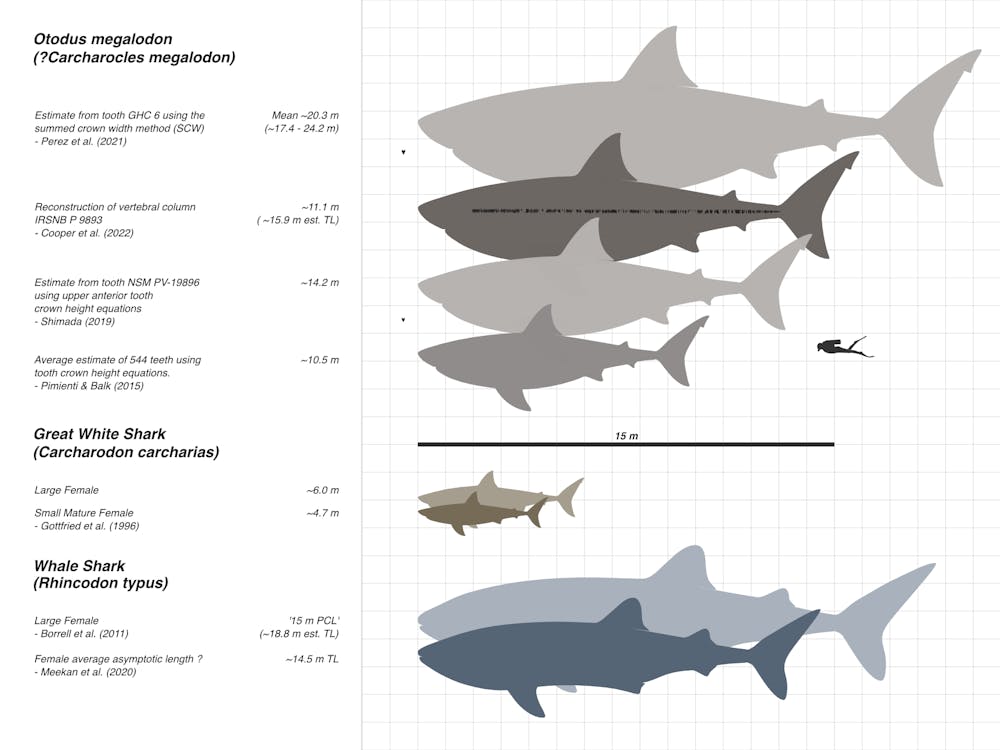
    The average size of a mature great white (Carcharodon carcharias, also known as the white shark) is between 4.6 and 4.9 metres for female sharks and up to 4 metres for male sharks.

    The largest recorded living specimens peak at about 6 metres, with one monster specimen caught in Cuba in 1945 reaching 6.4 metres.

    Earth’s oceans have seen bigger predatory sharks in the past. The biggest one of all time was the megalodon (Otodus megalodon) which lived from 23 to 3 million years ago, and may have been up to 24 metres in length. However, it looked nothing like the modern white shark.

    We don’t know precisely how big the megalodon was, but certainly larger than the great white shark.
    Steveoc 86/Wikimedia Commons, CC BY-SA

    They’re not even directly related – another thing scientists learned quite recently.

    Who was the megalodon, then?

    White sharks first evolved between 6 and 4 million years ago in the shadows of the megalodon. A recent study showed the megalodon’s large serrated teeth show signs of it being a supreme opportunistic super-predator.

    That means it ate just about anything, but especially liked whales and marine mammals.


    Read more:
    Friday essay: Giant shark megalodon was the most powerful superpredator ever. Why did it go extinct?


    But white sharks are not directly related to the megalodon, whose lineage began with a shark called Cretalamna during the age of dinosaurs about 100 million years ago.

    By contrast, the white shark lineage began with an ancient mako shark, Carcharodon hastalis. It was 7 to 8 metres long and had large, similarly shaped teeth to the modern white shark but lacking serrated edges.

    A fossil intermediate species, Carcharodon hubbelli shows the transition over time from weakly serrated to strongly serrated teeth.

    White shark fossil species. Left, the serrated fossil tooth teeth of the extant white shark; right, a similarly shaped unserrated tooth of the extinct giant mako shark which gave rise to white sharks.
    John Long, CC BY

    How did Jaws affect white shark populations?

    Last year, the International Shark Attack File reported 47 unprovoked shark bites to humans worldwide, resulting in seven fatalities. This was well below the previous ten-year average of 70 bites per year; your chances of getting bitten by a shark are extremely rare.

    Following the movies that made up the Jaws franchise, there was an increase in hunting and killing sharks – with a particular focus on great white sharks that were already going into a decline due to overfishing, trophy hunting and lethal control programs.

    Between 80% and 90% of white sharks have disappeared globally since the middle of the 20th century. Recent estimates calculate there are probably less than 500 individual white sharks in Australian waters right now.

    When Jaws first aired, scientists didn’t know how long sharks took to reproduce, or how many offspring a white shark could have each year. We now know it takes about 26 years for a male and 33 years for a female to sexually mature before they can start having pups.

    Data about white shark births is sparse, but recently a 5.6-metre-long female caught on a drum line off the coast of Queensland had just four large pups inside her. This is a very small number. Some large sharks, such as the whale shark, can give birth to up to 300 young.

    Now that we know just how slow they are to breed, it’s clear it will take many decades to reestablish the “pre-Jaws” population of white sharks – important apex predators in the marine ecosystem.

    Charlie Huveneers from Flinders University about to take a tissue sample for research on white sharks. There is still a lot we don’t know about their biology.
    Andrew Fox, Adelaide, CC BY

    Will white sharks survive?

    White sharks are currently listed as vulnerable.

    This classification means if we don’t change the current living conditions for white sharks, including impacts caused by human activities such as commercial fishing, and the impacts of climate change and ocean pollution, they will continue to decline and eventually could go extinct.

    Currently, white sharks are protected in several countries and form the basis for an important tourist industry in Australia, South Africa, western United States and most recently Nova Scotia, Canada.

    These sharks are iconic apex predators that fascinate people. One of us (John) went cage diving with them recently off the Neptune Islands of South Australia and can attest to how breathtaking it is to watch them in their natural environment.

    In terms of economic impact, they are worth far more alive than dead.

    White sharks are a growing tourism draw in several countries.
    Andrew Fox, Adelaide, CC BY

    There’s still much we don’t know about white sharks

    The complete white shark genome was first published only in 2019. It has 4.63 billion base pairs, making it much larger than the human genome (3.2 billion base pairs).

    The genome revealed some surprising things, like how white sharks show strong molecular adaptations for wound-healing processes, and a suite of “genome stability” genes – those used in DNA repair or DNA damage response.

    The transcriptome (or sum total of the messenger RNA) of the white shark showed greater similarity to the human transcriptome than to that of other fishes. This hints that “unexpressed genes” in the shark could one day play a role in uncovering genetic pathways for potential cures in human diseases.

    Jaws and its sequels certainly brought white sharks to the attention (and nightmares) of humans, with devastating impacts on how we treated them as a species.

    Our relationship with white sharks reflects our relationship with nature more broadly – a feared antagonist within the current capitalist paradigm; an enemy to be tamed, contained or consumed.

    As we learn more of the peril and potential of these remarkable creatures, we can learn how to live with them, to see beyond our fears and value their role within our delicate ocean ecosystems.

    John Long receives funding from The Australian Research Council.

    Heather L. Robinson does not work for, consult, own shares in or receive funding from any company or organisation that would benefit from this article, and has disclosed no relevant affiliations beyond their academic appointment.

    ref. Jaws at 50: how a single movie changed our perception of white sharks forever – https://theconversation.com/jaws-at-50-how-a-single-movie-changed-our-perception-of-white-sharks-forever-258306

    MIL OSI AnalysisEveningReport.nz

  • MIL-OSI New Zealand: Bachelor of Applied Science student lands internship mapping native bush remnants

    Source: Eastern Institute of Technology

    19 hours ago

    Bachelor of Applied Science (Biodiversity Management) student Emily Strong helped iwi identify remnants of the historic Seventy Mile Bush during a summer internship with Sustainable Hawke’s Bay.

    The internship was part of her third year of study, delivered by EIT in partnership with Unitec.

    EIT graduate Michael Strand (left) with current Bachelor of Applied Science (Biodiversity Management) student Emily Strong.

    During her internship, Emily worked under the guidance of EIT graduate Michael Strand, who works at Sustainable HB and secured a role as a geospatial analyst there before completing his studies. She contributed to a project focused on locating and assessing remaining areas of native bush in Southern Hawke’s Bay.

    The project involved the use of Geographic Information Systems (GIS) to overlay historical maps with satellite imagery, classify forest remnants, and assess vegetation health by calculating tree canopy height. Historical aerial imagery was also used to track vegetation change over time.

    “The Seventy Mile Bush was a massive podocarp forest that once stretched from Southern Hawke’s Bay to Wairarapa. Being able to contribute to a project that connects iwi with the remaining fragments of that landscape has been really rewarding.”

    Emily previously completed the Level 5 and 6 Diplomas in Environmental Management (Terrestrial strand) at EIT before progressing into the degree.

    Her interest in GIS and conservation has grown throughout her studies. In 2024, she completed a level 6 project focused on revegetation at Cape Sanctuary, comparing aerial images from the 1950s, 2014 and 2024 to assess habitat restoration over time.

    “I compared some aerial photography from the 1950s with current satellite images and then classified and analysed the difference. There was very much an increase in native vegetation. It was quite substantial actually and really cool to see.”

    Originally from Hawke’s Bay, Emily first enrolled at EIT in a teaching degree. After taking time off following the birth of her daughter, Eloise, she decided to return to study and pursue environmental management.

    “I’ve always had an interest in the environment, and once I started the primary industries course, I really enjoyed it,” she says.

    Balancing study and parenting hasn’t always been easy, but Emily says she’s had strong support around her.

    “It’s been quite tough but again I do have a fair amount of family support so that’s definitely been very helpful.”

    She credits her lecturers and tutors for being “really amazing”. “I’ve learned lots and lots and definitely improved from when I started in level 5.”

    Now 22, Emily is also involved in a local bat monitoring project with environmental researcher Kay Griffiths and is exploring future career opportunities that combine her skills in conservation and GIS.

    “There are so many different directions you can go with this degree, but I’d love to do something where I can use GIS to support conservation work.”

    EIT Environmental Management Senior Lecturer Dinusha Jayathilake said she is especially proud of this achievement.

    “This internship is a valuable opportunity for Emily’s professional growth and also benefits the Hawke’s Bay region, Sustainable HB, and EIT. In our Environmental Management programme, we always prefer community engagement. Through the GIS course, I am able to support the local community while introducing the latest  Geographic Information technologies to our region – something I am very proud of.”

    Dinusha said internships give students valuable work experience before they finish their studies, which helps them continue to produce skilled and experienced local graduates who are ready to join the workforce.

    MIL OSI New Zealand News

  • MIL-OSI Australia: Stargazing flight: how Bogong moths use the night sky to navigate hundreds of kilometres

    Source:

    19 June 2025

    Bogong moth. Photo credit: Ajay Narendra, Macquarie University.

    In a world-first discovery, researchers have shown that Australia’s iconic Bogong moth uses constellations of stars and the Milky Way to navigate hundreds of kilometres across the country during its annual migration – making it the first known invertebrate to rely on a stellar compass for long-distance travel.

    The landmark study, published today in Nature, reveals how this unassuming nocturnal moth combines celestial navigation with Earth’s magnetic field to pinpoint a specific destination it has never visited before: the cool alpine caves of the Snowy Mountains, where it hibernates for the summer.

    Led by an international team of scientists from Lund University, the Australian National University (ANU), the University of South Australia (UniSA) and other global institutions, the research sheds new light on one of nature’s great migration mysteries, involving approximately four million moths each year.

    “Until now, we knew that some birds and even humans could use the stars to navigate long distances, but this is the first time that it’s been proven in an insect,” says Lund University Professor of Zoology, Eric Warrant, who is also a Visiting Fellow at the ANU and an Adjunct Professor at UniSA.

    “Bogong moths are incredibly precise. They use the stars as a compass to guide them over vast distances, adjusting their bearing based on the season and time of night.”

    Each spring, billions of Bogong moths (Agrotis infusa) emerge from breeding grounds across southeast Australia and fly up to 1000 kilometres to a small number of caves and rocky outcrops in the Australian Alps.

    A wall of Bogong moths, aestivating in a cave in the Australian Alps.

    The moths lie dormant in the cool, dark shelters throughout summer, and in autumn make the return journey to breed and die.

    Using sophisticated flight simulators and brain recordings in controlled, magnetically neutral environments, the researchers tested how moths orient themselves under different sky conditions.

    When presented with natural starry skies and no magnetic field, they consistently flew in the correct migratory direction for the season – southward in spring, northward in autumn.

    When the starry skies were rotated 180 degrees, the moths reversed direction accordingly, but when the stars were scrambled, their orientation vanished.

    “This proves they are not just flying towards the brightest light or following a simple visual cue,” says Prof Warrant. “They’re reading specific patterns in the night sky to determine a geographic direction, just like migratory birds do.”

    Interestingly, when stars were obscured by clouds, the moths maintained their direction using only the Earth’s magnetic field. This dual compass system ensures reliable navigation even in variable conditions.

    The team also delved into the neurological basis of this behaviour, identifying specialised neurons in the moth’s brain that respond to the orientation of the starry sky. These cells, found in brain regions responsible for navigation and steering, fire most strongly when the moth is facing southwards.

    “This kind of directional tuning shows that the Bogong moth brain encodes celestial information in a surprisingly sophisticated way. It’s a remarkable example of complex navigational ability packed into a tiny insect brain.”

    Researchers say the discovery could inform technologies in robotics, drone navigation, and even conservation strategies for species threatened by habitat loss or climate change.

    Bogong moth populations have declined sharply in recent years, promoting their listing as vulnerable.

    The study underscores the importance of protecting migratory pathways and the dark skies these moths rely on.

    “This is not just about a moth  ̶  it’s about how animals read the world around them,” says Prof Warrant. “The night sky has guided human explorers for millennia. Now we know that it guides moths, too.”

    Co-author Professor Javaan Chahl, a remote sensing engineer from the University of South Australia, made headlines in August 2024 using the discoveries from a previous study led by Lund University involving dung beetles, who use the Milky Way as a reference point to roll balls of dung in straight lines.

    Prof Chahl’s team modelled the same technique used by dung beetles to develop an AI sensor for robot navigation in low light.

    The Nature paper “Bogong moths use a stellar compass for long-distance navigation at night” is authored by researchers from Europe, the UK, China, Australia, Canada and Australia. DOI: 10.1038/s41586-025-09135-3

    A video produced by the Australian Academy of Science, explaining Prof Warrant’s research, is available at: www.youtube.com/watch?v=AqiG_xBUFE0.  Prof Warrant was elected a Corresponding Member of the Academy in 2024.

    …………………………………………………………………………………………………………………………

    Media contact: Candy Gibson M: +61 434 605 142 E: candy.gibson@unisa.edu.au

    MIL OSI News

  • MIL-OSI USA: Following Trump Attacks on TPS, Markey, Van Hollen, Senate Democrats Put Forward Bill to Protect TPS and DED Recipients

    US Senate News:

    Source: United States Senator for Massachusetts Ed Markey

    Washington (June 18, 2025) – Today, U.S. Senator Chris Van Hollen (D-Md.) was joined by 30 Senate colleagues in putting forward legislation to provide qualified Temporary Protected Status (TPS) and Deferred Enforced Departure (DED) recipients a path to legal permanent residency. The Senators’ reintroduction of this legislation – the Safe Environment from Countries Under Repression and Emergency (SECURE) Act – comes as the Trump Administration and the right-wing Supreme Court undermine TPS, a program that has for years provided refuge to those living in America who have fled natural disasters, violence, and political insecurity. The Trump Administration has revoked TPS for an estimated 563,000 recipients from five countries – Venezuela, Haiti, Afghanistan, Cameroon, and Nepal – and while there have been legal challenges filed against this action, the Supreme Court has temporarily allowed the revocation to stand – putting hundreds of thousands at risk of deportation to their home countries where they would face serious danger.

    This legislation is endorsed by AFL-CIO, Laborers’ International Union of North America (LIUNA), International Union of Painters and Allied Trades (IUPAT), CASA, National TPS Alliance, Working Families United, the National Network for Arab American Communities, International Longshore and Warehouse Union (ILWU), Service Employees International Union (SEIU), and Communities United for Status and Protection (CUSP).

    “As Donald Trump continues to strip immigrant communities of critical legal protections, we must protect the individuals who came to our country seeking safe harbor and who cannot return home safely. I am proud to join my colleagues in introducing the SECURE Act, to ensure that individuals fleeing armed conflicts, political unrest, or environmental disasters have a guaranteed pathway to safety in the United States. Recipients of Temporary Protected Status and Deferred Enforced Departure are our friends, our neighbors, our colleagues, and we cannot turn our backs on them. We must be loud and clear – immigrants are welcome here,” said Senator Markey.

    “America has long used the TPS and DED programs to offer special legal protections to individuals in the United States whose lives would be put at extreme risk if forced to return to their countries of origin. As they’ve sought safety and stability here, TPS and DED recipients have built new lives in America, living here legally for years – sometimes decades – and making important contributions to our communities. But the Trump Administration is threatening both the lives they have built and the safety of these individuals – forcing TPS recipients to return to dangerous places like Haiti, Venezuela, Afghanistan, and more. This bill offers much-needed certainty to TPS and DED recipients – providing a path to stay safely in the U.S. and continue to call America their home,” said Senator Van Hollen.

    “TPS and DED recipients are valuable members of our communities. Many have lived here for years with U.S. children, spouses, and even businesses they’ve built — yet they are forced to live in uncertainty and fear that they may lose everything if they lose TPS or DED. I’m proud to introduce this legislation to give TPS and DED recipients a path to permanent residence so they can continue to contribute to America,” said Senator Kaine.

    “America is strengthened by the contributions and hard work of immigrants. But this Administration’s cruelty has left thousands of workers in limbo — without legal status and without work authorization,” said Senator Padilla. “The SECURE Act provides TPS holders who live and work in the United States legally, seeking safety after fleeing dangerous conditions in their home countries, the security of a pathway to permanent residency protections while continuing to contribute to our communities and economy.”

    “TPS recipients have come to the U.S. to escape widespread violence and environmental disasters in their countries that make returning home unsafe.  As they rebuild their lives here, TPS recipients, as longtime residents of the United States, deserve security and certainty about their immigration status,” said Senator Durbin. “I’m joining Senator Van Hollen to introduce the SECURE Act to provide TPS recipients a pathway to legal permanent residency.”

    “As the Trump administration terrorizes immigrant communities and arbitrarily revokes TPS and DED for law-abiding immigrants, it’s important that we speak up and push back every way we can, and support individuals who are contributing to our communities and would be at severe risk if they were to be forced to return to their countries of origin,” said Senator Murray. “I’m proud to join my colleagues in introducing the SECURE Act to provide immigrants with Temporary Protected Status and Deferred Enforced Departure a path to legal permanent residency.”

    “After escaping horrific violence and persecution in their home countries, TPS and DED recipients come to this country in search of a better life,” said Senator Cortez Masto. “These hardworking men and women have been living in and contributing to our communities for years, and it’s common sense to give them the certainty they need to fulfill the American Dream.”

    “Virginia is home to tens of thousands of law-abiding immigrants who are unable to return to their countries of origin due to painful extraordinary circumstances. Though these individuals benefit from certain protections from deportation, they remain in limbo despite having lived and worked in the U.S. for years,” said Senator Warner. “I’m proud to introduce this legislation to create a real pathway to permanent residency for TPS and DED recipients who drive our economy and make valuable contributions to their communities.”

    “The Temporary Protected Status program has been a lifeline that has allowed people and families facing unimaginable circumstances to find a safe refuge here in the United States,” said Senator Rosen. “TPS recipients contribute to our communities and our economy, and they deserve a pathway to permanent residency, which is why I’m proud to help introduce this bill. I’ll keep standing up to protect Nevada’s immigrant families.”

    “TPS holders deserve certainty, especially when the Trump administration is suddenly ending people’s status with no justification and forcing them to return to unsafe conditions,” said Senator Schatz. “Our bill would enable TPS holders to apply for permanent status so they can continue to live, work, and contribute in the United States without constantly being stuck in limbo.”

    “Families should have protection from ongoing wars, environmental disasters, widespread illness, and other dangers that make it difficult to return home,” said Senator Warren. “While Donald Trump makes it harder for immigrants to navigate our complex immigration system, Senate Democrats are fighting back to protect these vulnerable families.”

    “Scripture tells us: welcome the stranger in your midst,” said Senator Coons. “When we welcome those fleeing persecution and violence, hunger and poverty around the world, we show the world our values. That makes America safer, and it grows the economy in states like Delaware. The SECURE Act gives people searching for freedom and safety, who love this country, and who are already adding their valuable skills and gifts to our nation, a path to continue to do so.”

    “Our country has long supported families fleeing violence and seeking refuge,” said Senator Luján. “As this administration continues its attacks on TPS recipients, Congress must ensure a legal pathway to permanent residency for those who contribute to our communities every day. That’s why I’m partnering with my colleagues to reintroduce the SECURE Act to provide permanent protections for thousands of TPS recipients who live and work lawfully in the U.S.”

    “As immigrant communities continue to come under attack, the SECURE Act provides a clear pathway to permanent residency—offering overdue, necessary protections for immigrants and the lives they’ve built in our nation. America is a nation of immigrants and has a storied history of providing opportunity and refuge for those fleeing hardship or crisis. Individuals with TPS and DED have made America their home—using their talents and skills to strengthen our economies and enrich our communities—often while the countries from which they fled remain in turmoil,” said Senator Blumenthal.

    “Trump’s heartless immigration policies do nothing to make us safer and betray our core values—our nation always has been and always will be stronger because of our immigrant communities,” said Senator Duckworth. “While no one is arguing that we shouldn’t be deporting violent criminals who pose a danger to our country, it’s cruel to target people who fled from life-threatening situations and have been productive members of our communities for years. I’m proud to help Senator Van Hollen reintroduce this legislation to help give TPS and DED recipients a path to remain here as legal permanent residents.”

    “Our country should serve as a refuge for individuals who cannot return to their home country due to dangerous circumstances,” said Senator Hirono. “TPS holders and DED recipients living in our country are essential members of our communities, making up a significant amount of our workforce and contributing to our economy. As this administration continues its all-out attack on immigrants and their loved ones, I am proud to reintroduce this legislation to provide TPS and DED recipients peace of mind that they can remain in the country safely and with a path to lawful permanent residence.”

    “This bill is a necessary step in creating a pathway to legal permanent residency for TPS recipients,” said Senator Bennet. “They are already facing extraordinary and unstable conditions in their home countries; they shouldn’t have to face those same conditions here in the U.S.”

    “I’m joining the effort to pass the SECURE Act to stand by thousands in New Jersey who do not deserve to live in uncertainty and fear as the Trump administration arbitrarily revokes Temporary Protected Status,” said Senator Kim. “TPS recipients are friends and neighbors who are part of our communities and are essential to the economic growth of our state. We should use this moment to address disorder in our TPS program and immigration system – and deliver eligible families a pathway toward permanent stability and security.”

    “TPS provides protection for individuals and families who are unable to return to their countries due to dangerous conditions, including natural disasters, armed conflicts, and other disasters. Many find refuge in California where they can live and work lawfully under its protections. This legislation would provide a much-needed sense of security and stability to those who are living in the legal limbo caused by President Trump’s targeting of this program and his continued erosion of our nation’s commitment to helping those fleeing violence, famine, disease, and disaster,” said Senator Schiff.

    The legislation is cosponsored by Senators Angela Alsobrooks (D-Md.), Tammy Baldwin (D-Wis.), Michael Bennet (D-Colo.), Richard Blumenthal (D-Conn.), Cory Booker (D-N.J.), Chris Coons (D-Del.), Catherine Cortez-Masto (D-Nev.), Tammy Duckworth (D-Ill.), Dick Durbin (D-Ill.), Martin Heinrich (D-N.M.), John Hickenlooper (D-Colo.), Mazie Hirono (D-Hawaii), Tim Kaine (D-Va.), Andy Kim (D-N.J.) Amy Klobuchar (D-Minn.), Ben Ray Luján (D-N.M.), Patty Murray (D-Wash.), Alex Padilla (D-Calif.), Jack Reed (D-R.I.), Jacky Rosen (D-Nev.), Bernie Sanders (I-Vt.), Brian Schatz (D-Hawaii), Adam Schiff (D-Calif.), Tina Smith (D-Minn.), Mark Warner (D-Va.), Raphael Warnock (D-Ga.), Elizabeth Warren (D-Mass.), Sheldon Whitehouse (D-R.I.), and Ron Wyden (D-Ore.).

    “Immigrant workers are under unprecedented attack: hundreds of thousands of people have been stripped of their legal status and work authorization, throwing families and industries into chaos and uncertainty. Workers with Temporary Protected Status, many of whom have lived and worked in our country for decades, are vital members of our communities and our unions. The SECURE Act is common-sense legislation that would provide TPS holders with stable, permanent lawful status so they can continue to raise their families, work, and contribute to our economy,” said Liz Shuler, AFL-CIO President.

    “LIUNA commends Senator Van Hollen for his tireless efforts to protect workers and their family members who have Temporary Protected Status (TPS), many of whom are members of our union and who have lived and worked in the U.S. for decades. About 1/3 of TPS holders work in construction. The SECURE Act will not only provide permanence to these hard-working immigrants, but will also help the U.S. economy by retaining these valued immigrants in our workforce,” said Brent Booker, General President, LIUNA.

    “Every day, thousands of people with TPS and DED who have built their lives, families, and futures here are forced to live with fear and uncertainty. They deserve more than endless waiting; they deserve real, permanent protection. As attacks on immigrant communities grow across the country, we must act without hesitation. We are grateful to Senator Van Hollen’s leadership – in this time of growing instability, the SECURE Act will offer dignity, safety, and security for our community,” said Cathryn Jackson, Public Policy Director of CASA.

    “Immigrant families and allies continue to advocate for permanent protections. The National TPS Alliance calls for long-overdue justice to our immigrant communities. The reintroduction of the SECURE Act in the Senate addresses the uncertainty that our families have been living for years. This bill is timely, ensuring that TPS holders don’t fall out of status and in turn preventing irreparable harm to whole communities, continuing critical contributions to the nation’s economy. We urge congressional leaders to support this critical effort,” said Mardoel Hernandez, TPS recipient from Honduras and National TPS Alliance Executive Committee Member.

    “TPS holders, including members of my own union, contribute to our economy every single day. Some may not know it, but our society is dependent on TPS holders in different industries, including in the building and construction trades. We need the SECURE Act so these workers can continue living, working, and raising their families without fear,” said IUPAT General President Jimmy Williams, Jr.; IUPAT is a member of the Working Families United Coalition.

    “The SECURE Act offers overdue protection for hundreds of thousands living in fear of being uprooted from the families, homes, and careers they built. The National Network for Arab American Communities believes this bill reflects a critical truth: our democracy and safety are strongest when everyone has the opportunity to live and contribute freely and lawfully,” said Rima Meroueh, Director, National Network for Arab American Communities.

    “Now more than ever, we need a solution for immigrants with Temporary Protected Status from countries like El Salvador, Honduras, Venezuela and Haiti, whose lives have been in limbo under the chaos of this administration. We applaud the reintroduction of the SECURE Act by Senator Chris Van Hollen, which would create a path to citizenship for these individuals who contribute billions to our economy and whose lives would be in danger if they were sent back immediately to their home countries,” said Rocio Saenz, Secretary-Treasurer, SEIU.

    “The ILWU stands in strong support of the SECURE Act, a commonsense measure that serves our country’s interests and recognizes the dignity and contributions of TPS and DED holders — hardworking individuals who have paid their taxes, contributed to our economy, and been model members of our communities. These men and women have earned a chance to live without fear, continue to contribute to their communities and build their lives in the country they’ve long called home. We urge Congress to pass this vital legislation without delay,” said International Longshore and Warehouse Union President Robert Olvera.

    “Communities United for Status & Protection (CUSP) endorses the SECURE Act as a critical step toward justice and stability for immigrants with Temporary Protected Status (TPS) and Deferred Enforced Departure (DED). For decades, these communities—Black, Asian, brown, working-class immigrants from countries facing war, repression, and climate disaster—have lived, worked, and raised families in the U.S. They are essential to our economy, our neighborhoods, and our collective future. Yet they continue to live in uncertainty, without a pathway to permanent protection. The SECURE Act honors their dignity, recognizes their profound contributions, and upholds our nation’s values of fairness and humanitarian responsibility. We urge Congress to act with courage and conscience and pass this bill without delay,” said Carolyn Tran, Executive Director, Communities United for Status & Protection (CUSP).

    Additional Background

    TPS is a temporary, legal immigration status granted to foreign citizens who are endangered by conditions in their home country resulting from extraordinary events such as ongoing armed conflict, environmental disaster, or epidemic. TPS status is granted for set periods ranging from six to 18 months, requiring the Department of Homeland Security to extend a country’s status on a recurring basis. Each time a country is recertified, recipients must reapply and pass a thorough background check. Recent estimates found there are approximately 860,000 people with TPS in the United States.

    Deferred enforced departure (DED) is a temporary and discretionary administrative stay of removal granted to foreign citizens from designated countries. Unlike TPS, a DED designation emanates from the President’s constitutional powers to conduct foreign relations and has no statutory basis. Grants are usually in response to war, civil unrest, or natural disasters, through an executive order or presidential memorandum that provides eligibility guidelines.

    The SECURE Act will provide long-term stability for these individuals and their communities by giving them the ability to apply for legal permanent residency. Under the bill, all TPS recipients – current and past – and TPS and DED eligible individuals who have been continuously present in the United States for at least three years would be eligible to apply for legal permanent residency.

    Additionally, under the SECURE Act:

    • A spouse, domestic partner, child, or unmarried child of a qualifying non-citizen would be eligible to obtain permanent resident status (upon meeting certain requirements).
    • Individuals with a pending TPS application will receive work authorization and be eligible for travel authorization.
    • Non-citizens who have a pending application or is prima facie eligible for permanent status under the bill and intends to apply are shielded from deportation.
    • Information from an applicant’s application may not be shared or used for immigration enforcement purposes, with limited exceptions, such as for the identification of fraudulent claims.
    • DHS must report to Congress when terminating a country’s TPS designation with an explanation to justify the termination.

    MIL OSI USA News

  • MIL-OSI USA: Senators Ricketts and Kaine Introduce the AUKUS Improvement Act

    US Senate News:

    Source: United States Senator Pete Ricketts (Nebraska)

    WASHINGTON, D.C. – Today, U.S. Senators Pete Ricketts (R-NE) and Tim Kaine (D-VA) introduced the AUKUS Improvement Act. Building upon the bipartisan, AUKUS-enabling legislation in the FY24 National Defense Authorization Act, the AUKUS Improvement Act will further streamline defense industrial base collaboration and co-production between the United States, Australia, and the United Kingdom.  The legislation was also sponsored by Senators John Cornyn (R-TX), Chris Murphy (D-CT), and Dan Sullivan (R-AK).

    The United States, Australia, and the United Kingdom collectively face our most challenging threat environment since WWII. As we approach the 4th anniversary of AUKUS, it’s clear more should be done to break down bureaucratic obstacles and ensure a more seamless defense innovation and trade environment,” said Ricketts. “By streamlining transfers of critical capabilities to two of our closest allies while also facilitating a more efficient co-production ecosystem, the AUKUS Improvement Act will strengthen our allies’ warfighting edge, improve interoperability, and support our own industrial base.”

    “The AUKUS partnership is critical to countering the threat from China and ensuring the Indo-Pacific remains free and open,” said Kaine. “I’m proud to introduce this bipartisan legislation to strengthen AUKUS and boost defense collaboration among our countries.”

    The AUKUS Improvement Act would:

    • Exempt State Department-vetted entities that have been approved as AUKUS Authorized Users from the requirement to obtain Third Party Transfer approvals under Foreign Military Sales. 
    • Exempt Australia and the United Kingdom from the need for Congressional Notification for overseas manufacturing.

    BACKGROUND:

    In the last five years, Australia has placed $23 billion in Foreign Military Sales (FMS) orders, making it one of the biggest users of the FMS process. FMS ensures Australia is procuring the exact same variant that the U.S. military uses, enabling greater interoperability. It also supports American deployed forces operating in Australia through access to spare parts. Australia is often required to transfer elements of equipment procured through FMS to industry for further development, operation, maintenance, and sustainment. In order to do this, it must obtain written consent from the State Department in the form of a Third Party Transfer (TPT) request. However, the TPT process can be slow, with applications often taking many months before being approved. By making TPTs made under FMS subject to similar export controls to those made under AUKUS for Direct Commercial Sales (DCS), the AUKUS Improvement Act will get capability in the hands of our allies faster.

    In March 2021, Australia established the Guided Weapons and Explosive Ordnance (GWEO) Enterprise to expand its munitions and missile stockpiles, establish domestic manufacturing ofguided weapons, and supplement international partners’ supply chains. As part of this announcement, Australia and the U.S. agreed to collaborate on a flexible guided weapons production capability in Australia, with an initial focus on the potential for co-production of Guided Multiple Launch Rocket Systems (GMLRS) by 2025, and eventual co-production of the Precision Strike Missile (PrSM).

    However, the Arms Export Control Act requires Congressional Notification (CN) 15 days prior to approving a commercial technical assistance or manufacturing license agreement to manufacture significant military equipment abroad, regardless of the value. Currently, State Department excludes any transfer of defense articles, technical data, or services that requires a CN from the license-free environment and expedited processing provisions under AUKUS. Therefore, Australia is required to obtain a Manufacturing License Agreement to receive the technical data and manufacturing know-how for each component of a precision-guided munition. This adds complexity, time, and cost, therebylimiting munitions co-production cooperation that benefits both the U.S. and Australia.

    Bill text can be found here.

    MIL OSI USA News

  • Yoga Maha Kumbh Unfolds Across India: A Panoramic Prelude to International Day of Yoga 2025

    Source: Government of India

    Source: Government of India (4)

    As the nation counts down to the 11th International Day of Yoga (IDY) on June 21, a sweeping wave of yogic celebrations is energizing communities across India under the grand initiative titled Yoga Maha Kumbh. The nationwide movement aims to spotlight India’s rich yogic heritage and promote holistic well-being under the overarching theme for 2025: “Yoga for One Earth, One Health.”

    Leading the charge, a major three-day event began today at the Heartfulness Meditation Centre in RK Puram, New Delhi. Jointly organized by the Container Corporation of India (CONCOR) and the Morarji Desai National Institute of Yoga (MDNIY), in collaboration with the Heartfulness Institute, the event features yoga demonstrations, wellness sessions, and cultural performances. The focus is on mindfulness, community well-being, and encouraging citizens to adopt yoga as a way of life.

    Adding a dynamic and creative touch to the Delhi event was a spirited Nukkad Natak performance, through which performers portrayed yoga’s significance in daily life. The street play highlighted the physical, mental, and emotional benefits of yoga, aiming to inspire the audience toward a more balanced and healthy lifestyle.

    Simultaneously, another landmark celebration began on June 15 in Ladakh, where the International Festival of Yoga and Meditation (IFYM) 2025 is underway. Set against the dramatic backdrop of Ladakh’s high-altitude landscape, the festival is capturing national and global attention with yoga sessions conducted at iconic locations including Pangong Lake (over 13,000 feet), Nubra Valley, Sindhu Ghat, and the Mahabodhi International Meditation Centre (MIMC) Devachan Campus. The event is being organized by the Ministry of Ayush in partnership with MIMC, the UT Administration of Ladakh, LAHDC Leh, and allied institutions.

    In Noida, Uttar Pradesh, Arham Dhyan Yog launched its edition of the Yoga Maha Kumbh on June 15 at Sector 50. The event brought together youth, families, and wellness enthusiasts for Harit Yoga sessions, along with essay and debate competitions held at Ved Van Park in Sector 78. As part of the ongoing celebrations, Arham Dhyan Yog is set to host another major event on June 21 at Shivalik Park in Sector 33A, in synchrony with the nationwide Yoga Sangam initiative. The organization is also conducting parallel sessions across the globe, further expanding the reach and resonance of IDY 2025.

    From the towering Himalayan peaks to the cultural heart of Delhi and the bustling parks of Noida, Yoga Maha Kumbh 2025 is unfolding as an inclusive and unifying celebration of India’s yogic legacy. As communities come together in breath, movement, and mindfulness, the events reaffirm yoga’s universal relevance and India’s leadership in championing a healthier, more harmonious world.

  • MIL-OSI: Trupanion Announces Winners of the Veterinary Appreciation Day™ Awards

    Source: GlobeNewswire (MIL-OSI)

    SEATTLE, June 18, 2025 (GLOBE NEWSWIRE) — In honor of Veterinary Appreciation Day on June 18, Trupanion, the leading provider of medical insurance for cats and dogs in North America, held its annual awards event to celebrate and recognize the veterinary community for their profound impact on the lives of pets and their families.

    This year, the awards program saw an incredible outpouring of gratitude across North America, receiving more than 47,000 public votes.

    From the thousands of nominees, just 12 winners were chosen based on their significant influence on their veterinary teams, pet parents, and the communities they serve.

    “This year’s record-breaking voter turnout shows how increasingly important veterinary teams throughout the U.S. and Canada are to pet parents, peers, and their broader communities,” said Margi Tooth, President and CEO of Trupanion. “Each of these professionals works tirelessly to keep pets healthy, making picking just twelve honorees from the thousands of talented nominees a truly difficult job. Today, we’re proud to acknowledge and celebrate their achievements.”

    In 2015, Trupanion established June 18 as Veterinary Appreciation Day to celebrate the veterinary community. The annual awards have since become a platform to honor the extraordinary and often unsung efforts of these professionals.

    Here are the 2025 Veterinary Appreciation Day Award Winners.

    United States

    US West

    Veterinarian of the Year

    • Winner: Yafen Zhen, DVM
    • Practice: VCA San Martin Animal Hospital | San Martin, CA


    Veterinary Professional of the Year

    • Winner: Marie Marquez, CSR
    • Practice: VCA Veterinary Care Animal Hospital | Albuquerque, NM


    US Midwest

    Veterinarian of the Year

    • Winner: Jeffrey Baranack, DVM
    • Practice: West Side Animal Hospital | Alliance, OH


    Veterinary Professional of the Year

    • Winner: Ezzy Mercado, CSR
    • Practice: Buffalo Grove Animal Hospital | Buffalo Grove, IL


    US Northeast

    Veterinarian of the Year

    • Winner: Katherine Wheeler, DVM
    • Practice: Back Bay Veterinary Clinic | Boston, MA


    Veterinary Professional of the Year

    • Winner: Maddie LeMarquand, Veterinary Assistant
    • Practice: Heart + Paw – Glen Mills | Glen Mills, PA


    US South

    Veterinarian of the Year

    • Winner: Caitlin Townes, DVM
    • Practice: Paulding Animal Clinic | Dallas, GA


    Veterinary Professional of the Year

    • Winner: Marissa Love, Firefighter, EMT
    • Practice: Country Oaks Animal Hospital | New Port Richey, FL


    Canada

    Canada West

    Veterinarian of the Year

    • Winner: Jody McMurray, DVM, BSc (Ag)
    • Practice: Heartland Veterinary Clinic | Airdrie, AB


    Veterinary Professional of the Year

    • Winner: Leah Penner, RVT, Practice Manager
    • Practice: Pacific Cat Clinic | Victoria, BC


    Canada East

    Veterinarian of the Year

    • Winner: Deirdra Johnson, DVM
    • Practice: CBS Animal Hospital | Conception Bay South, NL


    Veterinary Professional of the Year

    • Winner: Julie Dorney, BSc, RVT, CCRP, CCFT
    • Practice: Gilmour Road Veterinary Services | Puslinch, ON

    “Few professions embody as much compassion, empathy, and dedication as veterinary medicine,” stated Dr. Steve Weinrauch, Chief Veterinary and Product Officer at Trupanion. “While Trupanion celebrates our community daily, the Veterinary Appreciation Day Awards offer a unique platform for fellow professionals and pet parents to express their gratitude. On behalf of Trupanion, I commend these twelve distinguished winners for their unwavering commitment and incredible achievements.”

    Pet lovers everywhere are encouraged to visit vetappreciationday.trupanion.com to learn more about the 2025 winners.

    About Trupanion

    Trupanion is the leader in medical insurance for cats and dogs throughout the United States, Canada, Europe, and Australia with over 1,000,000 pets enrolled. For over two decades, Trupanion has given pet parents peace of mind so they can focus on their pet’s recovery, not financial stress. Trupanion is committed to providing pet parents with the highest value in pet medical insurance with unlimited payouts for the life of their pets. With its patented process, Trupanion is the only North American provider with the technology to pay veterinarians directly in seconds at the time of checkout. Trupanion is listed on NASDAQ under the symbol “TRUP”. The company was founded in 2000 and is headquartered in Seattle, WA. Trupanion policies are issued, in the United States, by its wholly owned insurance entity American Pet Insurance Company and, in Canada, by Accelerant Insurance Company of Canada or GPIC Insurance Company. Trupanion Australia is a partnership between Trupanion and Hollard Insurance Company. Policies are sold and administered in Canada by Canada Pet Health Insurance Services, Inc. dba Trupanion 309-1277 Lynn Valley Road, North Vancouver, BC V7J 0A2 and in the United States by Trupanion Managers USA, Inc. (CA license No. 0G22803, NPN 9588590). Canada Pet Health Insurance Services, Inc. is a registered damage insurance agency and claims adjuster in Quebec #603927. Trupanion Australia is a partnership between Trupanion and Hollard Insurance Company. For more information, please visit trupanion.com

    Contacts:

    Corporate Communications
    Corporate.Communications@trupanion.com

    The MIL Network

  • MIL-OSI: Trupanion Announces Winners of the Veterinary Appreciation Day™ Awards

    Source: GlobeNewswire (MIL-OSI)

    SEATTLE, June 18, 2025 (GLOBE NEWSWIRE) — In honor of Veterinary Appreciation Day on June 18, Trupanion, the leading provider of medical insurance for cats and dogs in North America, held its annual awards event to celebrate and recognize the veterinary community for their profound impact on the lives of pets and their families.

    This year, the awards program saw an incredible outpouring of gratitude across North America, receiving more than 47,000 public votes.

    From the thousands of nominees, just 12 winners were chosen based on their significant influence on their veterinary teams, pet parents, and the communities they serve.

    “This year’s record-breaking voter turnout shows how increasingly important veterinary teams throughout the U.S. and Canada are to pet parents, peers, and their broader communities,” said Margi Tooth, President and CEO of Trupanion. “Each of these professionals works tirelessly to keep pets healthy, making picking just twelve honorees from the thousands of talented nominees a truly difficult job. Today, we’re proud to acknowledge and celebrate their achievements.”

    In 2015, Trupanion established June 18 as Veterinary Appreciation Day to celebrate the veterinary community. The annual awards have since become a platform to honor the extraordinary and often unsung efforts of these professionals.

    Here are the 2025 Veterinary Appreciation Day Award Winners.

    United States

    US West

    Veterinarian of the Year

    • Winner: Yafen Zhen, DVM
    • Practice: VCA San Martin Animal Hospital | San Martin, CA


    Veterinary Professional of the Year

    • Winner: Marie Marquez, CSR
    • Practice: VCA Veterinary Care Animal Hospital | Albuquerque, NM


    US Midwest

    Veterinarian of the Year

    • Winner: Jeffrey Baranack, DVM
    • Practice: West Side Animal Hospital | Alliance, OH


    Veterinary Professional of the Year

    • Winner: Ezzy Mercado, CSR
    • Practice: Buffalo Grove Animal Hospital | Buffalo Grove, IL


    US Northeast

    Veterinarian of the Year

    • Winner: Katherine Wheeler, DVM
    • Practice: Back Bay Veterinary Clinic | Boston, MA


    Veterinary Professional of the Year

    • Winner: Maddie LeMarquand, Veterinary Assistant
    • Practice: Heart + Paw – Glen Mills | Glen Mills, PA


    US South

    Veterinarian of the Year

    • Winner: Caitlin Townes, DVM
    • Practice: Paulding Animal Clinic | Dallas, GA


    Veterinary Professional of the Year

    • Winner: Marissa Love, Firefighter, EMT
    • Practice: Country Oaks Animal Hospital | New Port Richey, FL


    Canada

    Canada West

    Veterinarian of the Year

    • Winner: Jody McMurray, DVM, BSc (Ag)
    • Practice: Heartland Veterinary Clinic | Airdrie, AB


    Veterinary Professional of the Year

    • Winner: Leah Penner, RVT, Practice Manager
    • Practice: Pacific Cat Clinic | Victoria, BC


    Canada East

    Veterinarian of the Year

    • Winner: Deirdra Johnson, DVM
    • Practice: CBS Animal Hospital | Conception Bay South, NL


    Veterinary Professional of the Year

    • Winner: Julie Dorney, BSc, RVT, CCRP, CCFT
    • Practice: Gilmour Road Veterinary Services | Puslinch, ON

    “Few professions embody as much compassion, empathy, and dedication as veterinary medicine,” stated Dr. Steve Weinrauch, Chief Veterinary and Product Officer at Trupanion. “While Trupanion celebrates our community daily, the Veterinary Appreciation Day Awards offer a unique platform for fellow professionals and pet parents to express their gratitude. On behalf of Trupanion, I commend these twelve distinguished winners for their unwavering commitment and incredible achievements.”

    Pet lovers everywhere are encouraged to visit vetappreciationday.trupanion.com to learn more about the 2025 winners.

    About Trupanion

    Trupanion is the leader in medical insurance for cats and dogs throughout the United States, Canada, Europe, and Australia with over 1,000,000 pets enrolled. For over two decades, Trupanion has given pet parents peace of mind so they can focus on their pet’s recovery, not financial stress. Trupanion is committed to providing pet parents with the highest value in pet medical insurance with unlimited payouts for the life of their pets. With its patented process, Trupanion is the only North American provider with the technology to pay veterinarians directly in seconds at the time of checkout. Trupanion is listed on NASDAQ under the symbol “TRUP”. The company was founded in 2000 and is headquartered in Seattle, WA. Trupanion policies are issued, in the United States, by its wholly owned insurance entity American Pet Insurance Company and, in Canada, by Accelerant Insurance Company of Canada or GPIC Insurance Company. Trupanion Australia is a partnership between Trupanion and Hollard Insurance Company. Policies are sold and administered in Canada by Canada Pet Health Insurance Services, Inc. dba Trupanion 309-1277 Lynn Valley Road, North Vancouver, BC V7J 0A2 and in the United States by Trupanion Managers USA, Inc. (CA license No. 0G22803, NPN 9588590). Canada Pet Health Insurance Services, Inc. is a registered damage insurance agency and claims adjuster in Quebec #603927. Trupanion Australia is a partnership between Trupanion and Hollard Insurance Company. For more information, please visit trupanion.com

    Contacts:

    Corporate Communications
    Corporate.Communications@trupanion.com

    The MIL Network

  • MIL-OSI Canada: Tribunal Continues Orders—Circular Copper Tube from Brazil, Greece, China, South Korea and Mexico

    Source: Government of Canada News (2)

    Ottawa, Ontario, June 18, 2025—The Canadian International Trade Tribunal today continued its orders made on September 25, 2019, in expiry review RR‑2018‑005, concerning the dumping of circular copper tube from Brazil, Greece, China, South Korea and Mexico, and the subsidizing of these goods from China.

    The Tribunal found that the expiry of the orders was likely to result in injury. As such, the Tribunal continued its orders. The Canada Border Services Agency will therefore continue to impose anti-dumping and countervailing duties on these goods.

    The Tribunal is an independent quasi-judicial body that reports to Parliament through the Minister of Finance. It hears cases on dumped and subsidized imports, safeguard complaints, complaints about federal government procurement and appeals of customs and excise tax rulings. When requested by the federal government, the Tribunal also provides advice on other economic, trade and tariff matters.

    MIL OSI Canada News

  • MIL-OSI USA: Padilla, Schiff, Blumenthal Introduce Legislation to Limit Unchecked Presidential Authority Under the Insurrection Act

    US Senate News:

    Source: United States Senator Alex Padilla (D-Calif.)

    Padilla, Schiff, Blumenthal Introduce Legislation to Limit Unchecked Presidential Authority Under the Insurrection Act

    WASHINGTON, D.C. — U.S. Senators Alex Padilla (D-Calif.), Adam Schiff (D-Calif.), and Richard Blumenthal (D-Conn.) led a group of 22 Senators in introducing legislation to restrict the President’s authority under the 217-year-old Insurrection Act.

    The new Insurrection Act of 2025 would reform centuries-old legislation that gives the President broad and vague authority to deploy troops — either with or without the request of a state — to suppress “any insurrection, domestic violence, unlawful combination, or conspiracy.” The current law has been used sparingly by other presidents given the potential for the military to escalate tensions, rather than restore order, during a domestic crisis.

    “Our military should be focused on defending our national security — not silencing speech a president disagrees with or policing our own citizens,” said Senator Padilla. “President Trump’s unprecedented deployment of the National Guard and Marines to Los Angeles to manufacture a crisis and distract from his failing political agenda is a clear warning sign: we must strengthen legal protections around the executive authority to use the military for standard domestic law enforcement. The archaic Insurrection Act is far too broad and grants nearly unchecked powers to a president to abuse the military for their own political purposes — and we must make sure it continues to only be invoked in the most extreme of circumstances.”

    “The president’s dangerous decision to deploy the National Guard and the U.S. Marine Corps in Los Angeles over the objection of our governor brings us closer to the very real possibility that the president could invoke the Insurrection Act to turn our military into a political tool. That must never be allowed to happen,” said Senator Schiff. “This bill would prevent any president from deploying military forces domestically when civilian state and local authorities are engaged. This abuse of military resources that we are seeing in Los Angeles risks being replicated around the country if Congress doesn’t stand up to President Trump’s creeping authoritarianism.”

    “Americans believe deeply that our military should be used to defend our national security, not to silence peaceful protest at home. I support – and the Constitution protects – free expression and protest when peaceful and nonviolent,” said Senator Blumenthal. “President Trump may not have invoked the Insurrection Act yet, but he has threated to use our military as an instrument to crush dissent and Congress must act quickly. These urgent reforms would impose oversight and accountability to the President’s broad, virtually unrestricted power to use military force against Americans at home.”

    The legislation is cosponsored by U.S. Senator Jack Reed (D-R.I.), Ranking Member of the Senate Armed Services Committee, and Senators Tammy Baldwin (D-Wis.), Cory Booker (D-N.J.), Chris Coons (D-Del.), Tammy Duckworth (D-Ill.), Kirsten Gillibrand (D-N.Y.), John Hickenlooper (D-Colo.), Mazie K. Hirono (D-Hawaii), Mark Kelly (D-Ariz.), Andy Kim (D-N.J.), Edward J. Markey (D-Mass.), Jeff Merkley (D-Ore.), Bernie Sanders (I-Vt.), Elissa Slotkin (D-Mich.), Chris Van Hollen (D-Md.), Mark Warner (D-Va.), Elizabeth Warren (D-Mass.), Peter Welch (D-Vt.), and Ron Wyden (D-Ore.).

    Specifically, the new Insurrection Act of 2025 would:

    • Narrow and clarify the criteria for the domestic deployment of military troops for law enforcement purposes.
    • Specify that the use of the military is a last resort and is authorized only if civilian law enforcement authorities are overwhelmed.
    • Clarify that the law cannot be used to suspend habeas corpus, impose martial law, or deputize private militias to act as soldiers.
    • Require the President to consult with Congress prior to invoking the Insurrection Act and receive Congressional approval if the President seeks to exercise authority under the Act for longer than seven days.
    • Require a report to Congress providing an explicit justification for the use of the Insurrection Act’s authority, as enumerated in this legislation, and a full description of the scope and duration of its use.
    • Provide for judicial review to ensure that individuals, or a state or local government, may bring a civil action if the President’s authority under the Insurrection Act is misused or abused.

    Full text of the bill is available here.

    MIL OSI USA News

  • MIL-OSI Africa: Gabonese President Brice Oligui Nguema and African Development Bank’s (AfDB) Akinwumi Adesina Inaugurate Water Pumping Station for Greater Libreville

    • “Ten years without clean water: erased! Ten years without hope: forgotten! Ten years of suffering: over!”—Adesina to residents of Libreville’s outlying neighborhoods.
    • Adesina Receives Gabon’s Highest Civilian Honor

    Gabonese President Brice Oligui Nguema and African Development Bank Group President Dr. Akinwumi Adesina (www.AfDB.org) on Monday jointly inaugurated a new drinking water pumping station, marking the end of a decade-long water crisis in PK5, a densely populated district of Libreville.

    The new PK5 pumping station, with a daily capacity of 57,600 cubic meters, is designed to deliver clean water to 128,000 residents across seven northern districts of the capital.

    “These past few weeks, we’ve finally felt like citizens of real capital. Water is flowing from our taps at last,” said Sandrine Onanga, a 33-year-old mother living in PK5. “It has been eight years since we last saw a drop of water. We had even forgotten what a tap looked like,” added Astrid Momboukou, who joined the crowd to witness the inauguration of the facility.

    For years, taps had run dry in parts of Libreville. “That’s all behind us now. No more lugging water jugs for kilometers. No more waiting late into the night for police tankers to deliver water every two or three days,” said Sandrine, smiling under the light rain that fell over Libreville that Monday.

    The new station was inaugurated in the presence of senior government officials, members of the diplomatic corps, development partners, and an enthusiastic local population. It forms part of the Integrated Drinking Water Supply and Sanitation Program for Libreville (PAIEPAL). The program, with a total investment of €117.4 million, is financed through a €75.4 million loan from the African Development Bank and a €42 million loan from the Africa Growing Together Fund (AGTF), backed by the People’s Bank of China and administered by the Bank.

    The program aims to improve access to potable water and sanitation services in Libreville, strengthen sector governance, and build capacity for long-term transformation.

    The initiative ensures that more than 300,000 people—approximately 31% of Libreville’s 967,095 residents—now have sustainable and permanent access to clean water. The beneficiary communes include Libreville, Akanda, Owendo, and Ntoum.

    Adesina emphasized the life-changing impact of the new pumping station: “Ten years without drinking water: erased! Ten years without hope: forgotten! Ten years of suffering: ended!”

    The Bank, a reliable and strategic partner for Gabon

    Adesina also highlighted the Bank’s unwavering development support for Gabon during his ten-year tenure. “From 1974 to 2014, the Bank approved $1 billion in financing for Gabon. Since my election in 2015, we have committed an additional $1.5 billion—1.5 times the previous 40-year total,” he said.

    According to Philippe Tonangoye, Gabon’s Minister for Universal Access to Water and Energy, the project has significantly improved water infrastructure. It involved renewing 150 kilometers of pipelines, upgrading and extending another 150 kilometers of distribution networks, building and rehabilitating multiple water towers, and installing around 60 public standpipes across Libreville and surrounding areas.

    “The African Development Bank spared no effort to make this program a reality,” said Minister Tonangoye. “Some of these installations had not seen a single drop of water in ten years. My gratitude goes to the Bank for its commitment to Gabon.”

    President Adesina receives top Gabonese honor

    Ahead of the inauguration, Gabonese President Oligui Nguema conferred on Adesina the insignia of Grand Officer of the Order of the Gabonese Merit, one of Gabon’s highest civilian honors, in a ceremony witnessed by his wife, Grace Adesina.

    Recognized for his visionary leadership, Akinwumi Adesina—dubbed “Africa’s Chief Optimist”—will complete his second and final ten-year term as President of the African Development Bank Group on 31 August. Since 2015, he has led transformative projects across Africa under the Bank’s five strategic priorities, the “High 5s” (https://apo-opa.co/4n9ysad).

    Through these priorities, 565 million people have seen their lives transformed. In the water sector alone, 63 million people gained access to clean water and 34 million to sanitation services.

    Flagship projects in Gabon

    For decades, the Bank has supported Gabon’s socioeconomic development by helping diversify strategic sectors. It is now Gabon’s leading infrastructure partner.

    Among flagship projects, the Bank financed the New Owendo International Port. With a capacity of four million tonnes per year, this multi-purpose port (minerals, timber, containers) has reduced handling costs by 30% and become a critical link in Gabon’s logistics chain. In this context, the Gabonese President took Dr. Adesina on a tour of the La Baie des Rois Special Investment Zone, located 18 km from the port. The maritime façade of the Gabonese capital aims to be modern to attract international real estate investors to revitalize the country’s economy and create wealth for the population.

    The Bank is also helping Gabon develop the Kinguélé Aval hydroelectric power station—the country’s first energy PPP—which will add 40 megawatts of reliable, affordable, and clean energy. It is also financing the Ndende-Doussala road, a key segment of the Libreville-Brazzaville corridor that will connect Gabon and Congo and boost regional integration.

    With an active portfolio of $61.26 million, the African Development Bank Group’s strategy in Gabon focuses on two priority areas: supporting the development of sustainable infrastructure to drive industrialization, and strengthening economic governance and the business climate to promote social inclusion.

    Following the inauguration, President Oligui Nguema and Akinwumi Adesina visited two families in separate districts that were once severely impacted by water shortages. They also toured the National School for Hearing-Impaired Children, which serves hundreds of students. Since gaining access to clean drinking water, the school has seen a significant improvement in hygiene conditions.

    Distributed by APO Group on behalf of African Development Bank Group (AfDB).

    Contact: 
    Romaric Ollo Hien
    Communication and External Relations Department
    media@afdb.org

    About the African Development Bank Group:
    The African Development Bank Group (AfDB) is Africa’s premier development finance institution. It comprises three distinct entities: the African Development Bank (AfDB), the African Development Fund (ADF) and the Nigeria Trust Fund (NTF). On the ground in 44 African countries with an external office in Japan, the AfDB contributes to the economic development and the social progress of its 54 regional member states.

    For more information: www.AfDB.org

    MIL OSI Africa

  • ECI launches fast-track delivery of EPICs within 15 Days

    Source: Government of India

    Source: Government of India (4)

    In a major move aimed at enhancing voter convenience and efficiency in service delivery, the Election Commission of India (ECI) has announced a new Standard Operating Procedure (SOP) to ensure that Elector Photo Identity Cards (EPICs) are delivered within 15 days of any update in the electoral rolls. This includes both new enrolments and modifications to existing voter details.

    The initiative, introduced under the leadership of Chief Election Commissioner Shri Gyanesh Kumar and Election Commissioners Dr. Sukhbir Singh Sandhu and Dr. Vivek Joshi, is part of the Commission’s ongoing commitment to provide timely and citizen-centric services.

    Under the new system, each stage of EPIC processing—from generation by the Electoral Registration Officer (ERO) to final delivery by the Department of Posts (DoP)—will be tracked in real time. Electors will receive SMS notifications at every step, keeping them informed of their card’s status.

    The ECI has developed a dedicated IT module on its recently launched ECINet platform to support this initiative. This platform, designed to replace the older system, offers a streamlined workflow and enhanced data security. Integration with the DoP’s Application Programming Interface (API) ensures seamless coordination and quicker delivery of EPICs.

  • ECI launches fast-track delivery of EPICs within 15 Days

    Source: Government of India

    Source: Government of India (4)

    In a major move aimed at enhancing voter convenience and efficiency in service delivery, the Election Commission of India (ECI) has announced a new Standard Operating Procedure (SOP) to ensure that Elector Photo Identity Cards (EPICs) are delivered within 15 days of any update in the electoral rolls. This includes both new enrolments and modifications to existing voter details.

    The initiative, introduced under the leadership of Chief Election Commissioner Shri Gyanesh Kumar and Election Commissioners Dr. Sukhbir Singh Sandhu and Dr. Vivek Joshi, is part of the Commission’s ongoing commitment to provide timely and citizen-centric services.

    Under the new system, each stage of EPIC processing—from generation by the Electoral Registration Officer (ERO) to final delivery by the Department of Posts (DoP)—will be tracked in real time. Electors will receive SMS notifications at every step, keeping them informed of their card’s status.

    The ECI has developed a dedicated IT module on its recently launched ECINet platform to support this initiative. This platform, designed to replace the older system, offers a streamlined workflow and enhanced data security. Integration with the DoP’s Application Programming Interface (API) ensures seamless coordination and quicker delivery of EPICs.

  • PM Modi thanks Croatia for backing India’s fight against terrorism

    Source: Government of India

    Source: Government of India (4)

    Prime Minister Narendra Modi thanked Croatia for backing India’s fight against terrorism as both nations began a new chapter in bilateral relationship during his historic visit to the country – the first-ever by an Indian PM – on Wednesday.

    PM Modi held “productive discussions” with his Croatian counterpart Andrej Plenkovic in Zagreb as both leaders reviewed the full spectrum of India-Croatia bilateral relations and explored avenues to deepen collaboration in sectors like digital technologies, space, renewable energy, defence, maritime infrastructure, tourism and hospitality, amongst others.

    Asserting that India and Croatia are bound by shared values such as democracy, rule of law, pluralism, and equality, PM Modi thanked Croatia for its “steadfast support” to India in fighting cross-border terrorism. Both leaders also called for further deepening India-EU strategic ties.

    “We agree that terrorism is the enemy of humanity and opposed to those forces who believe in democracy. We are deeply grateful to Prime Minister Plenkovic and the Government of Croatia for their condolences on the terrorist attack in India on April 22. In such difficult times, the support of our friendly countries has been very valuable to us,” said PM Modi after the delegation-level talks.

    He added that both countries have agreed to enhance cooperation in many areas to boost bilateral trade and create reliable supply chains.

    “We will promote cooperation in pharma, agriculture, information technology, clean technology, digital technology, renewable energy, semiconductors. Cooperation will also be increased in shipbuilding and cyber security,” remarked PM Modi.

    In a gesture signifying the centuries-old close cultural links between the two countries, Prime Minister Modi received from his Croatian counterpart a reprint of Vezdin’s Sanskrit grammar – the first printed Sanskrit grammar written in Latin in 1790 by Croatian scientist and missionary Filip Vezdin during his time spent in India.

    “To the Prime Minister of India Narendra Modi, I handed over a reprint of Vezdin’s Sanskrit grammar – the first printed Sanskrit grammar, written in Latin in 1790 by the Croatian scientist and missionary Filip Vezdin (1748-1806), based on the knowledge he gained during his stay in India from Kerala Brahmins and local manuscripts. With this pioneering work, Filip Vezdin became one of the first European scientists to seriously devote himself to Indian languages and culture. At the same time, this is a symbol of early cultural ties between Croatia and India,” said Plenkovic.

    An Indologist of Croatian nationality, Ivan Filip Vezdin came to Malabar as a missionary in 1774 and later became the Vicar-General on the Malabar Coast.

    He is credited with publishing the first printed Sanskrit grammar in 1790. A plaque to commemorate him was unveiled in Trivandrum in 1999.

    Plenkovic also handed over a book titled ‘Croatia and India, Bilateral Navigator for Diplomats and Business’ to PM Modi, written by Croatian diplomat Sinise Grgica.

    “Grgica in a unique and comprehensive way gives a comparative view of our two countries and explores all dimensions of bilateral relations. This book reflects our achievements, as well as the potential we can still realise, and we believe that it will inspire and encourage the strengthening of our future cooperation and contribute to the further deepening of the mutual friendship between Croatia and India,” said Plenkovic.

    Earlier, Prime Minister Modi received a rousing welcome by the vibrant Indian community in Zagreb as he began his landmark visit to Croatia – the first-ever by an Indian Prime Minister to the country – on Wednesday.

    Zagreb is the last stop on PM Modi’s three-nation tour, which also included visits to Cyprus en route to Canada for Tuesday’s G7 Summit in Kananaskis.

    Prime Minister Modi had emphasised that the three-nation tour is also an opportunity to thank partner countries for their steadfast support to India in India’s fight against cross-border terrorism, and to galvanise global understanding on tackling terrorism in all its forms and manifestations.

    In a special gesture, PM Modi was warmly received by Plenkovic at the Franjo Tudman Airport with a ceremonial welcome.

    Members of the Indian diaspora, waiting to catch a glimpse of PM Modi, were seen gathered in huge numbers as the PM’s motorcade drove through the city.

    Hundreds of people, including locals, also gave a grand welcome to PM Modi as he arrived at his hotel.

    Amid chants of “Modi-Modi”, “Bharat Mata Ki Jai” and “Vande Mataram”, PM Modi witnessed vibrant and energy-filled cultural performances from people present at the venue.

    PM Modi joined a group of locals chanting Vedic shlokas and also interacted with a few in the gathering while getting inside the building.

    “The bonds of culture are strong and vibrant! Here is a part of the welcome in Zagreb. Happy to see Indian culture has so much respect in Croatia,” said PM Modi.

    “Croatia’s Indian community has contributed to Croatia’s progress and also remained in touch with their roots in India. In Zagreb, I interacted with some members of the Indian community, who accorded me an unforgettable welcome. There is immense enthusiasm among the Indian community here about this visit and its impact in making the bond between our nations stronger than ever before,” he added.

    PM Modi was then warmly received by Plenkovic at the iconic St. Mark’s Square and accorded a ceremonial welcome.

    It was followed by delegation-level bilateral talks between the two leaders.

    Plenkovic said that PM Modi’s significant visit comes at a pivotal moment.

    “We welcomed the Indian Prime Minister Narendra Modi to Zagreb! This is the first visit by the Prime Minister of India – the most populous country in the world, and it comes at an important geopolitical moment. We are starting a new chapter in Croatia-India relations and creating the conditions for strengthening bilateral cooperation in a number of areas,” the Croatian Prime Minister commented.

    Analysts reckon that the first-ever visit by an Indian PM to Croatia will help in fostering stronger political and economic collaboration with Croatia. It will also provide a crucial opportunity to expand bilateral cooperation in various sectors including trade, innovation, defence, ports, shipping, science and tech, cultural exchange, and workforce mobility.

    (IANS)

  • MIL-OSI Russia: Xi Jinping’s participation in the 2nd China-Central Asia Summit helped strengthen friendly ties and chart a course for development – Chinese Foreign Minister

    Translation. Region: Russian Federal

    Source: People’s Republic of China in Russian – People’s Republic of China in Russian –

    Source: People’s Republic of China – State Council News

    BEIJING, June 18 (Xinhua) — Chinese President Xi Jinping attended the 2nd China-Central Asia Summit in Astana, Kazakhstan, where he and the heads of five Central Asian states discussed traditional friendship and worked out a plan for further development, Chinese Foreign Minister Wang Yi said on Wednesday.

    Wang Yi, also a member of the Politburo of the CPC Central Committee, made the statement during a briefing for journalists following Xi Jinping’s visit.

    The Chinese diplomat noted that in Astana, Xi Jinping and the leaders of Central Asian countries discussed cooperation plans and achieved more than 100 cooperation results.

    According to the head of the Chinese Foreign Ministry, the most notable highlight of this summit was Xi Jinping’s introduction of the concept of “China-Central Asian spirit”, which is expressed in four aspects: mutual respect and equal treatment; deep mutual trust and mutual support; mutual benefit and joint development; mutual assistance and joint overcoming of difficulties.

    Central Asian leaders unanimously agreed to adhere to this spirit, Wang Yi said.

    The head of the Chinese Foreign Ministry stated that China and the five Central Asian countries are developing countries that always follow the path of modernization together.

    The most prominent theme of the summit, Wang Yi continued, was the joint announcement by the heads of the six states of 2025 and 2026 as the Years of High-Quality Development of China-Central Asian Cooperation.

    The two sides will focus cooperation on six priority areas: unimpeded trade, industrial investment, connectivity, green resources, agricultural modernization and facilitating people-to-people exchanges, to achieve new tangible results, the Chinese diplomat said.

    Wang Yi said that Xi Jinping attended the signing of the action plan for high-quality cooperation under the Belt and Road Initiative together with the heads of five Central Asian states. This was the first time that China signed a single document on cooperation under the Belt and Road Initiative with all countries in a neighboring region.

    The head of the Chinese Foreign Ministry recalled that China is the most important trade and investment partner of the Central Asian countries. All parties agreed that there are no winners in tariff and trade wars, and unilateralism and protectionism have no prospects.

    Responding to Central Asia’s urgent need to boost and enhance its capacity for independent development, Xi Jinping announced the establishment of three cooperation centers within the framework of China-Central Asia cooperation – on poverty alleviation, on educational exchanges, and on desertification prevention and control, and promised to provide 3,000 educational places for Central Asian countries in the next two years.

    The most important innovative initiative of this summit, as Wang Yi stated, was the signing by the heads of six states of the Treaty of Eternal Good-Neighborliness, Friendship and Cooperation, which enshrines the principle of eternal friendship in legal form and indicates that political mutual trust between China and the Central Asian countries has reached a new height.

    During the summit, China and Central Asian countries also achieved a number of new cooperation results in areas such as inter-regional cooperation, people-to-people exchanges, educational exchanges and cultural tourism.

    In addition, the six heads of state attended the signing of a number of sister city agreements. Wang Yi noted that this brought the number of sister city pairs between China and the five Central Asian countries to more than 100, achieving the goal of the initiative put forward by Xi Jinping three years ago. –0–

    MIL OSI Russia News

  • MIL-OSI USA: Ahead of Juneteenth, Momentum Grows for H.R. 40, Pressley’s Historic Reparations Legislation

    Source: United States House of Representatives – Congresswoman Ayanna Pressley (MA-07)

    Bill Would Form Commission to Develop Reparations Proposals for African American Descendants of Enslaved People

    Legislation Now Has Support of Over 100 National and Grassroots Organizations

    H.R. 40 Press Conference | H.R. 40 Bill Text | H.R. 40 Briefing Photos | H.R. 40 Briefing One-Pager

    WASHINGTON – Today, ahead of the Juneteenth holiday and a national celebration of Black joy and emancipation, Congresswoman Ayanna Pressley (MA-07) affirmed the strength of the reparations movement and announced growing support for H.R.40, legislation that she is championing to address the harmful legacy of slavery and establish a federal commission to develop reparations proposals for African American descendants of enslaved people. The legislation now has the support of more than 100 national and grassroots organizations and 85 members of Congress.

    In February, during Black History Month, Rep. Pressley and Senator Cory Booker reintroduced H.R. 40, serving as a powerful counterweight to the unprecedented onslaught against diversity, equity, and inclusion (DEI) initiatives from the Trump Administration and a call to action to address the systemic oppression of Black people. Last week, Rep. Pressley hosted a briefing on H.R. 40 to provide congressional staffers and their offices an expanded look into the bill, its 36-year legislative journey – led by Congressman John Conyers and Congresswoman Sheila Jackson Lee – and its vital role in the reparative justice movement.

    “The state of our reparations movement is strong and in this moment of heightened anti-Blackness in America, we are more resolved than ever,” said Congresswoman Pressley, lead House sponsor of H.R. 40. “H.R. 40 is racial justice, economic justice, and a moral imperative, and it is deeply necessary to confront America’s damning history of systemic racism head-on. I’m proud of the growing, broad, and intersectional support behind our bill and I am grateful to our grassroots organizations for their partnership in pushing to get this critical legislation over the finish line.”

    Support for reparations has grown nationwide, with state and local officials taking action, including in Massachusetts, Illinois, Tennessee, North Carolina and Oklahoma. H.R. 40 now has endorsements from over 100 national and grassroots organizations.

    “We are delighted that Congresswoman Ayanna Pressley has picked up the torch from Cong. Sheila Jackson Lee and Cong. John Conyers, Jr. to continue the historic push to achieve long overdue reparations for African Americans.” – National African American Reparations Commission

    “At this pivotal moment in the United States’ existence and identity, we proudly stand with Rep. Ayanna Pressley in the reintroduction of H.R. 40, which if enacted will provide concrete ways to implement reparations,” said Dreisen Heath, Why We Can’t Wait Reparations Coalition. “Providing reparations is a routine practice by the federal government from providing remedy in perpetuity to Holocaust survivors to providing free healthcare to 9/11 victims and veterans exposed to toxic waste waters. By embracing what H.R. 40 legislation will produce, we are not only educating the public on the truth but also energizing a strong movement towards reflection and accountability. While states and cities advance their own reparative efforts, the federal government can no longer neglect and obscure its responsibility to do right by Black Americans, and by extension the rest of the country.

    “The National Urban League, for over a century, has witnessed firsthand the devastating impact of systemic racism on countless lives. We have championed social and economic justice for Black Americans, striving to overcome the enduring legacy of slavery. For too long, we have avoided a full and honest reckoning with this history. A federal commission to study the vestiges of slavery, from the harrowing experiences of enslaved people to the ongoing struggles of their descendants, is not just overdue, it is essential. This examination is not about dwelling on the past but about better understanding the present. By understanding how the lingering effects of slavery continue to shape our society and policies, we can finally create a level playing field and unlock the full potential of our nation,” said the National Urban League. “The National Urban League fully supports H.R. 40, a bill establishing a commission to study and develop reparations proposals for Black Americans, as it represents a crucial step towards reconciliation and redress. We urge Congress to swiftly pass this vital legislation. The time for inaction is over. The time for justice is now.”

    “Eradicating poverty requires understanding its root causes and the economic injustices that plague Black communities today can be directly traced to the legacy of slavery and Jim Crow laws,” said Margaret Huang, President and CEO of the Southern Poverty Law Center. “This commission would be an important step toward grappling with how our country failed to support so many Americans after slavery and segregation ended. We need to take an honest look at the ugly history of racial discrimination that has denied so many Black and Brown families, particularly in the Deep South, economic opportunities to sustain their families.”

    “This legislation is not symbolic, it’s structural,” said Ebonie Riley, Senior Vice President of Policy & Strategic Partnerships at the National Action Network. “In a moment where the very language of equity is under assault, this bill confronts the unfinished business of this nation: the deliberate extraction of wealth, labor, and life from Black Americans. Under the leadership of Rev. Al Sharpton, NAN has consistently called for federal action that reflects the scale of harm inflicted. Reparations are a matter of economic policy, legal obligation, and historical accountability.”

    “The NAACP has supported the creation and passage of HR. 40/S.40 from its introduction by Congressman John Conyers (MI) through its reintroduction by Congresswoman Sheila Jackson Lee (TX) and Senator Cory Booker (NJ) continue to support the passage of this crucial legislation in the 119th Congress,” – NAACP

    “The United Methodist Book of Resolutions and the General Board of Church and Society strongly support HR 40 being reintroduced at a time when truth is under attack,” – United Methodist Church General Board of Church and Society

    “Black people have been the backbone to the growth and wealth of this nation and of the global economy, and justly, should be recipients of its fruits. Black people can’t achieve equity without the United States acknowledging the historical past and materially addressing past and present harms. Reparatory justice is a must,” –Network Lobby for Catholic Social Justice

    “The Council on American-Islamic Relations strongly supports the reintroduction of H.R. 40, recognizing it as a vital measure to confront America’s legacy of slavery and systemic racism head-on. We stand in solidarity with Congresswoman Pressley, Senator Booker, and their colleagues in calling for truth, accountability, and meaningful reparative actions that honor and protect the dignity of Black American communities,” – Council on American-Islamic Relations (CAIR)

    “As a church, we understand that the truth shall set us free. We have committed to and embarked on undertaking the work of truth-telling and reconciliation ourselves. H.R. 40/S. 40 would offer the opportunity for our country to begin a process to understand our own history and would present a path forward for repairing historical harms done to African Americans,” – The Episcopal Church

    “It has been nearly 40 years since Japanese Americans received redress for being incarcerated unjustly during WWII. Many of us in the Japanese American community recognize that our own experience of institutionalized racism at the hands of our government is part of a pattern that began with chattel slavery since our country’s inception as a British colony. Although slavery ended formally with the Civil War, its legacy persisted through Jim Crow policies well into the 20th century. Mere words of regret and apology for our history of slavery and Jim Crow do nothing to repay the unfulfilled promise of 40 acres and a mule.” – Japanese American Citizens League

    “We’re making historic progress advancing reparative justice in local communities nationwide.  We stand together in support of HR40, the most promising and just opportunity to repair the harm of the institution of slavery and its uninterrupted legacies to date. The outcomes of the HR40 Commission can result in a comprehensive and tangible portfolio of remedies that transform this nation,” – First Repair

    The full list of endorsing organizations include: AjabuSpeaks, All Souls Movement, Alliance of Baptists, American Humanist Association, Amnesty International USA, Bend the Arc: Jewish Action, Black Music Action Coalition, Black Veterans Project, Blackroots Alliance, BLIS Collective, California Black Power Network, Center for LGBTQ Economic Advancement & Research (CLEAR), Colombia Acuerdo de Paz NGO, Council on American-Islamic Relations (CAIR), DC Justice Lab, DC Reparations Coalition, Democrats Abroad Reparations Task Force, Disciples Center for Public Witness (Disciples of Christ), Empowerment Temple, Reparation Education Project, Episcopal City Mission, FirstRepair, Freedom Road Consulting, LLC, Friends Committee on National Legislation, Get Free, Human Rights Watch, Humanity2020 Group LLC, Institute for Justice & Democracy in Haiti, Japanese American Citizens League, Johnson & Klein Law, Justice for the 110, KC Reparations Coalition, Loc Community Association, Loyola Law School, Los Angeles Anti Racism Center (LARC), Make It Plain, Marijuana Justice, Maryknoll Office for Global Concerns, Media 2070, Missionary Oblates of Mary Immaculate, Movement for Black Lives, NAACP, National Action Network Education Team, National African American Reparations Commission , National Black Justice Collective, National Council of Churches, National Council of Jewish Women, National LGBTQ+ Bar Association, National Urban League, NETWORK Lobby for Catholic Social Justice, New Yorkers 4 Reparations, Northampton Reparations Study Commission, Not In Our Town, Princeton, NP/NCRR – Nikkei Progressives & Nikkei for Civil Rights & Redress, Pax Christi Metro DC-Baltimore, Pax Christi USA, RebuildingTheCommun7ty, Reparation Generation, Reparations Finance Lab, Reparations Interfaith Coalition of Massachusetts, Reparations United, Reparations4Slavery, San Francisco Bay Area Black & Jewish Unity Coalition, Sanctuary of Hope, SCOPE LA, Showing Up for Racial Justice, Sisters of Mercy of the Americas Justice Team, South Bend Reparations Working Group (SBRWG), State of Loc Nation Global Public Benefit Corp, Terence Crutcher Foundation, The Episcopal Church, The Southern Poverty Law Center, The United Methodist Church General Board of Church and Society, Tsuru for Solidarity, Tulsa African Ancestral Society, Union for Reform Judaism, Unitarian Universalists for Social Justice, United By Equity, United Church of Christ, USTRHT, Virago Strategies, Why We Can’t Wait Reparations Coalition, Women’s International League for Peace and Freedom, Young LLC.

    Co-sponsors of H.R. 40 include: Rep. Adams, Alma S. [D-NC-12], Rep. Balint, Becca [D-VT-At Large], Rep. Barragán, Nanette Diaz [D-CA-44], Rep. Beatty, Joyce [D-OH-3], Rep. Bera, Ami [D-CA-06], Rep. Beyer, Donald S. [D-VA-8], Rep. Bishop, Sanford D. [D-GA-2], Rep. Bonamici, Suzanne [D-OR-1], Rep. Brown, Shontel M. [D-OH-11], Rep. Brownley, Julia [D-CA-26], Rep. Carson, André [D-IN-7], Rep. Carter, Troy A. [D-LA-2], Rep. Casar, Greg [D-TX-35], Rep. Case, Ed [D-HI-1], Rep. Casten, Sean [D-IL-6], Rep. Cherfilus-McCormick, Sheila [D-FL-20], Rep. Chu, Judy [D-CA-28], Rep. Clarke, Yvette D. [D-NY-9], Rep. Cleaver, Emanuel [D-MO-5], Rep. Clyburn, James E. [D-SC-6], Rep. Cohen, Steve [D-TN-9], Rep. Connolly, Gerald E. [D-VA-11], Rep. Alexandria Ocasio-Cortez [D-NY-14], Rep. Jasmine Crockett [D-TX-30], Rep. Davis, Danny K. [D-IL-7], Rep. Dean, Madeleine [D-PA-4], Rep. Doggett, Lloyd [D-TX-37], Rep. Espaillat, Adriano [D-NY-13], Rep. Evans, Dwight [D-PA-3], Rep. Fletcher, Lizzie [D-TX-7], Rep. Foushee, Valerie P. [D-NC-4], Rep. Frost, Maxwell [D-FL-10], Rep. Garcia, Robert [D-CA-42], Rep. Garcia, Sylvia R. [D-TX-29], Rep. Green, Al [D-TX-9], Rep. Hayes, Jahana [D-CT-5], Rep. Himes, James A. [D-CT-4], Rep. Horsford, Steven [D-NV-4], Rep. Jackson, Jonathan L. [D-IL-1], Rep. Jacobs, Sara [D-CA-51], Rep. Jayapal, Pramila [D-WA-7], Rep. Johnson, Henry C. “Hank” [D-GA-4], Rep. Kamlager-Dove, Sydney [D-CA-37], Rep. Kelly, Robin L. [D-IL-2], Rep. Khanna, Ro [D-CA-17], Rep. Landsman, Greg [D-OH-1], Rep. Lee, Summer L. [D-PA-12], Rep. Lieu, Ted [D-CA-36], Rep. McClellan, Jennifer L. [D-VA-4], Rep. McGovern, Jim [D-MA-02], Rep. McIver, LaMonica [D-NJ-10], Rep. Meeks, Gregory W. [D-NY-5], Rep. Meng, Grace [D-NY-6], Rep. Mfume, Kweisi [D-MD-7], Rep. Moore, Gwen [D-WI-4], Rep. Nadler, Jerrold [D-NY-12], Del. Norton, Eleanor Holmes [D-DC-At Large], Rep. Omar, Ilhan [D-MN-5], Rep. Panetta, Jimmy [D-CA-19], Rep. Pingree, Chellie [D-ME-1], Rep. Pocan, Mark [D-WI-2], Rep. Quigley, Mike [D-IL-5], Rep. Ramirez, Delia C. [D-IL-3], Rep. Sánchez, Linda T. [D-CA-38], Rep. Scanlon, Mary Gay [D-PA-5], Rep. Schakowsky, Janice D. [D-IL-9], Rep. David Scott [D-GA-13], Rep. Simon, Lateefah [D-CA-12], Rep. Smith, Adam [D-WA-9], Rep. Stansbury, Melanie A. [D-NM-1], Rep. Stevens, Haley M. [D-MI-11], Rep. Strickland, Marilyn [D-WA-10], Rep. Swalwell, Eric [D-CA-14], Rep. Takano, Mark [D-CA-39], Rep. Thanedar, Shri [D-MI-13], Rep. Thompson, Bennie G. [D-MS-2], Rep. Titus, Dina [D-NV-1], Rep. Tlaib, Rashida [D-MI-12], Rep. Tokuda, Jill N. [D-HI-2], Rep. Torres, Ritchie [D-NY-15], Rep. Trahan, Lori [D-MA-3], Rep. Velázquez, Nydia M. [D-NY-7], Rep. Watson Coleman, Bonnie [D-NJ-12], Rep. Williams, Nikema [D-GA-5], Rep. Wilson, Frederica S. [D-FL-24]

    The full text of the bill is available here.

    Throughout her time in Congress, Rep. Pressley has championed policies to address the harmful legacy of slavery and support the true liberation of Black America, including Baby Bonds, a People’s Justice Guarantee, student debt cancellation, addressing the Black maternal morbidity crisis, supporting Black-owned microbusinesses, promoting anti-racist public health policy, and more.

    In April 2025, Rep. Pressley met with Northeastern University’s Center for Law, Equity, and Race to discuss efforts and further action in a shared push for reparative justice.

    Congresswoman Pressley is the lead sponsor of the People’s Justice Guarantee (PJG) – her comprehensive, decarceration-focused resolution that outlines a framework for a fair, equitable and just legal system. 

    Last year, Rep. Pressley and House Oversight Ranking Member Jamies Raskin introduced the Federal Government Equity Improvement Act and the Equity in Agency Planning Act to codify racial equity across federal agencies and improve government services for underserved communities.

    ###

    MIL OSI USA News

  • MIL-OSI New Zealand: Unexplained death, Riccarton

    Source: New Zealand Police

    Christchurch Police are continuing to make enquiries after a woman was found with critical injuries in a Riccarton car park yesterday afternoon.

    Emergency services were called to the car park at around 4.40pm.

    Tragically the woman passed away while being transported to hospital.

    Her death is currently being treated as unexplained and a scene guard is in place at the car park where she was found.

    Police are aware of speculation in the community that this may be related to missing woman Elisabeth Nicholls – we can confirm that is not accurate. The search for Elisabeth remains ongoing.

    ENDS

    Please note: An earlier statement from Police advised the woman had been found deceased in the car park – this was incorrect and we apologise for the error.

    MIL OSI New Zealand News

  • MIL-OSI USA: SPC Tornado Watch 435

    Source: US National Oceanic and Atmospheric Administration

    Note:  The expiration time in the watch graphic is amended if the watch is replaced, cancelled or extended.Note: Click for Watch Status Reports.
    SEL5

    URGENT – IMMEDIATE BROADCAST REQUESTED
    Tornado Watch Number 435
    NWS Storm Prediction Center Norman OK
    205 PM CDT Wed Jun 18 2025

    The NWS Storm Prediction Center has issued a

    * Tornado Watch for portions of
    Southern Illinois
    Southern Indiana
    Western Kentucky
    Southeast Missouri

    * Effective this Wednesday afternoon and evening from 205 PM
    until 800 PM CDT.

    * Primary threats include…
    A couple tornadoes possible
    Scattered damaging winds likely with isolated significant gusts
    to 75 mph possible
    Scattered large hail and isolated very large hail events to 2
    inches in diameter possible

    SUMMARY…Thunderstorms will continue to develop along and ahead of
    a boundary over southern Illinois and spread eastward through the
    afternoon. Damaging winds and large hail are possible, along with a
    few tornadoes.

    The tornado watch area is approximately along and 60 statute miles
    east and west of a line from 40 miles west of Fort Campbell KY to 75
    miles northeast of Evansville IN. For a complete depiction of the
    watch see the associated watch outline update (WOUS64 KWNS WOU5).

    PRECAUTIONARY/PREPAREDNESS ACTIONS…

    REMEMBER…A Tornado Watch means conditions are favorable for
    tornadoes and severe thunderstorms in and close to the watch
    area. Persons in these areas should be on the lookout for
    threatening weather conditions and listen for later statements
    and possible warnings.

    &&

    OTHER WATCH INFORMATION…CONTINUE…WW 432…WW 433…WW 434…

    AVIATION…Tornadoes and a few severe thunderstorms with hail
    surface and aloft to 2 inches. Extreme turbulence and surface wind
    gusts to 65 knots. A few cumulonimbi with maximum tops to 500. Mean
    storm motion vector 25035.

    …Hart

    SEL5

    URGENT – IMMEDIATE BROADCAST REQUESTED
    Tornado Watch Number 435
    NWS Storm Prediction Center Norman OK
    205 PM CDT Wed Jun 18 2025

    The NWS Storm Prediction Center has issued a

    * Tornado Watch for portions of
    Southern Illinois
    Southern Indiana
    Western Kentucky
    Southeast Missouri

    * Effective this Wednesday afternoon and evening from 205 PM
    until 800 PM CDT.

    * Primary threats include…
    A couple tornadoes possible
    Scattered damaging winds likely with isolated significant gusts
    to 75 mph possible
    Scattered large hail and isolated very large hail events to 2
    inches in diameter possible

    SUMMARY…Thunderstorms will continue to develop along and ahead of
    a boundary over southern Illinois and spread eastward through the
    afternoon. Damaging winds and large hail are possible, along with a
    few tornadoes.

    The tornado watch area is approximately along and 60 statute miles
    east and west of a line from 40 miles west of Fort Campbell KY to 75
    miles northeast of Evansville IN. For a complete depiction of the
    watch see the associated watch outline update (WOUS64 KWNS WOU5).

    PRECAUTIONARY/PREPAREDNESS ACTIONS…

    REMEMBER…A Tornado Watch means conditions are favorable for
    tornadoes and severe thunderstorms in and close to the watch
    area. Persons in these areas should be on the lookout for
    threatening weather conditions and listen for later statements
    and possible warnings.

    &&

    OTHER WATCH INFORMATION…CONTINUE…WW 432…WW 433…WW 434…

    AVIATION…Tornadoes and a few severe thunderstorms with hail
    surface and aloft to 2 inches. Extreme turbulence and surface wind
    gusts to 65 knots. A few cumulonimbi with maximum tops to 500. Mean
    storm motion vector 25035.

    …Hart

    Note: The Aviation Watch (SAW) product is an approximation to the watch area. The actual watch is depicted by the shaded areas.
    SAW5
    WW 435 TORNADO IL IN KY MO 181905Z – 190100Z
    AXIS..60 STATUTE MILES EAST AND WEST OF LINE..
    40W HOP/FORT CAMPBELL KY/ – 75NE EVV/EVANSVILLE IN/
    ..AVIATION COORDS.. 50NM E/W /67NE DYR – 53SE TTH/
    HAIL SURFACE AND ALOFT..2 INCHES. WIND GUSTS..65 KNOTS.
    MAX TOPS TO 500. MEAN STORM MOTION VECTOR 25035.

    LAT…LON 36668928 38798766 38798543 36668712

    THIS IS AN APPROXIMATION TO THE WATCH AREA. FOR A
    COMPLETE DEPICTION OF THE WATCH SEE WOUS64 KWNS
    FOR WOU5.

    Watch 435 Status Report Message has not been issued yet.

    Note:  Click for Complete Product Text.Tornadoes

    Probability of 2 or more tornadoes

    Mod (40%)

    Probability of 1 or more strong (EF2-EF5) tornadoes

    Low (20%)

    Wind

    Probability of 10 or more severe wind events

    High (70%)

    Probability of 1 or more wind events > 65 knots

    Mod (30%)

    Hail

    Probability of 10 or more severe hail events

    Mod (40%)

    Probability of 1 or more hailstones > 2 inches

    Mod (30%)

    Combined Severe Hail/Wind

    Probability of 6 or more combined severe hail/wind events

    High (90%)

    For each watch, probabilities for particular events inside the watch (listed above in each table) are determined by the issuing forecaster. The “Low” category contains probability values ranging from less than 2% to 20% (EF2-EF5 tornadoes), less than 5% to 20% (all other probabilities), “Moderate” from 30% to 60%, and “High” from 70% to greater than 95%. High values are bolded and lighter in color to provide awareness of an increased threat for a particular event.

    MIL OSI USA News

  • MIL-OSI USA: Hoyle, Schatz, Smith Introduce New Legislation to Reduce Economic Inequality and Make Wall Street Pay Its Fair Share

    Source: US Representative Val Hoyle (OR-04)

    June 18, 2025

    The Wall Street Tax Act aims to disincentivize dangerous, risky investments that threaten the stability of the U.S. economy

    For Immediate Release: June 18, 2025 

    EUGENE, OR – Today, U.S. Representative Val Hoyle (OR-04), U.S. Senator Brian Schatz (D-Hawaii), and Rep. Adam Smith (WA-09) introducedThe Wall Street Tax Act (H.R. 4035), which would deliver hundreds of billions of dollars back to the American people by making Wall Street pay its fair share. The bill would create a progressive tax aimed at reducing the risky trading practices that threaten our economic stability while generating revenues that can be reinvested towards services for working people. Once fully implemented, the bill is projected to raise $750 billion over 10 years. 

    “While Republicans push another tax break for billionaires that would blow up the deficit, we’re offering a smarter path. The Wall Street Tax Act puts a price on the risky, high-speed trading that benefits Wall Street and leaves working families behind,” said Rep. Hoyle. “This small, targeted tax will raise hundreds of billions from those who can afford it and reinvest it in things that actually help people—like schools, housing, and infrastructure. Working families shouldn’t have to pay for Wall Street’s gambling.”

    “Wall Street routinely cashes in on high-risk trades that add no real value to our economy. It’s long past time we curbed this dangerous trading to reduce market volatility and encourage investment that actually helps our economy grow,” said Senator Schatz. “Republicans are racing to enrich billionaires and corporations by ripping regular people off. We’re doing the opposite: raising new revenue from Wall Street to reinvest in our communities.”

    “It’s past time for the wealthiest to pay their fair share, which is why I’m proud to support the Wall Street Tax Act, which targets high-risk trades that create high volatility and instability in the markets,” said Rep. Smith. “I’ll continue to fight for a fairer economy that works for everyone and reflects the values of the communities I serve.”

    “Instead of the proposed heartless cuts to services that help vulnerable communities and everyday people—like Medicaid and nutrition assistance—that Congress is currently debating, there is another route that lawmakers can and must pursue: raising taxes on corporations and the super-rich—including Wall Street high rollers,” said Susan Harley, managing director of Public Citizen’s Congress Watch division. “The Wall Street Tax Act would generate hundreds of billions of dollars that could be used to expand programs that improve the lives of Americans and it has the simultaneous benefit of reducing harmful high-speed trading that hurts investors and increases risk in our markets.”

    This bill is cosponsored by U.S. Representatives Frost (D-FL), Jayapal (D-CA), McGovern (D-MA), Pingree (D-MN), Schakowsky (D-IL), Tlaib (D-MI), Watson Coleman (D-NJ) and by U.S. Senators Elizabeth Warren (D-Mass.), Chris Van Hollen (D-Md.), Sheldon Whitehouse (D-R.I.), John Fetterman (D-Pa.), and Jeff Merkley (D-Ore.).

    The Wall Street Tax Act is currently endorsed by 32 organizations, including:Affordable Homeownership Foundation, AFL-CIO, American Family Voices, American Federation of Teachers, Americans for Financial Reform, Americans for Tax Fairness (ATF), Blue Future, Chicago Political Economy Group, Child Labor Coalition, Citizens for Tax Justice, Coalition on Human Needs, Communications Workers of America (CWA), Consumer Action, Food & Water Watch, Greenpeace USA. Groundwork Collaborative, Institute for Policy Studies, Global Economy Project, Institute on Taxation and Economic Policy Medical Mission Sisters(Unit North America), National Consumers League, NETWORK Lobby for Catholic Social Justice, Our Revolution, Oxfam America, Public Citizen, Public Justice Center, Responsible Wealth, RootsAction, Take on Wall Street, Unitarian Universalists for Social Justice, United for a Fair Economy, United Church of Christ, and United Steelworkers International Union (USW).

    The Bill

    The Wall Street Tax Act will levy a 0.1% tax – phased in over five years–on the sale of stocks, bonds, and derivatives to discourage risky and unproductive trading practices and gives those profits back to the people. The tax would apply to the fair market value of assets. Initial public offerings (IPOs) and short-term debt would be exempted from the tax. 

    Background

    High frequency trading (HFT) is a type of asset trading that uses supercomputers and specialized algorithms to make large, high-volume trades in a fraction of a second. HFT allows corporations and the ultra-wealthy to benefit from minor fluctuations in stock prices by allowing them to buy and sell in large volumes to make larger profits off of small differences. These practices create undue market volatility, which overwhelmingly hurts everyday investors who are unable to trade as quickly.

    In addition, these speculative, high-volume trading practices add little to no real value to the U.S. economy because the gains from them are centralized within the hands of a wealthy few. However, these high stakes games do have a real impact, as their asset prices react to the trades. The volatility these trades causecan even lead to a “Flash Crash,” where such volatility prompts mass selloffs across the stock market. This volatility can affect the retirements, pensions, and investments of working people.

    The Wall Street Tax Act is considered a progressive tax, meaning lower income earners pay a lesser percentage of their income in taxes compared to those with higher incomes. 

    The full text of the bill can be found here.

    ###

    MIL OSI USA News

  • MIL-OSI Russia: Denis Manturov met Indonesian President Prabowo Subianto at St. Petersburg airport

    Translation. Region: Russian Federal

    Source: Government of the Russian Federation – An important disclaimer is at the bottom of this article.

    First Deputy Prime Minister of Russia Denis Manturov met Indonesian President Prabowo Subianto at Pulkovo Airport, who arrived on an official visit to hold talks with Russian President Vladimir Putin and participate in the XXVIII St. Petersburg International Economic Forum.

    Let us recall that First Deputy Prime Minister Denis Manturov, as the chairman of the Russian part of the Russian-Indonesian Joint Commission on Trade, Economic and Technical Cooperation, visited Jakarta in April of this year to hold the 13th meeting of the commission.

    The high dynamics of bilateral contacts contribute to the successful development of cooperation between Russia and Indonesia in a wide range of areas, including trade, industry, agriculture, energy, transport, tourism, as well as humanitarian spheres, in particular education, culture and sports.

    By the end of 2024, the volume of trade turnover between Russia and Indonesia amounted to 4.3 billion dollars.

    Please note: This information is raw content directly from the source of the information. It is exactly what the source states and does not reflect the position of MIL-OSI or its clients.

    MIL OSI Russia News

  • MIL-Evening Report: Tracing the Drax family’s millions – a story of British landed gentry, slavery and sugar plantations

    Source: The Conversation (Au and NZ) – By Paul Lashmar, Reader in Journalism, City St George’s, University of London

    ‘Planting the sugar-cane’: vast fortunes were made from the trades in both sugar and human slaves in the Americas. Schomburg Center for Research in Black Culture, Photographs and Prints Division, The New York Public Library

    Rich British aristocratic families with a legacy of owning colonial slave plantations are often accused by campaigners that their wealth solely originates from these plantations. One frequent target of this criticism has been the Drax family of Dorset, which is headed by Richard Grosvenor Plunkett-Ernle-Erle-Drax, who was the Conservative MP for South Dorset until July 2024.

    Historian Alan Lester of the University of Sussex has noted of Drax (as he is commonly known): “Much of his fortune is inherited, coming down the family line from ownership of the Drax sugar plantations and the 30,000 enslaved people who worked them as Drax property for 180 years before emancipation in Barbados.”

    Recently, I have researched and written a book on the Drax family’s history and involvement in the slave trade in the Caribbean, Drax of Drax Hall, that gives fresh insights into the level of wealth they derived from the sugar trade and the trade in African slaves who worked their plantations – as well as the family’s other income sources.

    I searched the archives in the UK and Caribbean for evidence of their revenue streams until Britain’s 1834 abolition of slavery in the colonies. I estimate that the family today are worth more than £150 million from their land and property in Dorset and Yorkshire.


    Get your news from actual experts, straight to your inbox. Sign up to our daily newsletter to receive all The Conversation UK’s latest coverage of news and research, from politics and business to the arts and sciences.


    Over a period of two centuries until 1834, eight generations of Drax ancestors owned and worked hundreds of enslaved African captives at any one time. The latest beneficiary of primogeniture – the legal concept that recognises the first-born child as heir to a familiy’s fortune – Richard Drax inherited the family’s still-operating 621-acre Drax Hall plantation in Barbados in 2021.

    Drax, 67, has said: “I am keenly aware of the slave trade in the West Indies, and the role my very distant ancestor played in it is deeply, deeply regrettable. But no one can be held responsible today for what happened many hundreds of years ago. This is a part of the nation’s history, from which we must all learn.”

    My research reveals the sources of his family’s wealth are more complex than the critics’ claims that it all derives from the slave-worked plantations.

    Like most British landed gentry, much of the Drax family income has come as extensive landlords of their British estates which, in 1883, exceeded 23,000 acres across various counties. Today, it includes nearly 16,000 acres in Dorset and 2,520 acres in the Yorkshire Dales.

    However, my research also shows the Drax family made more money from slavery than was previously thought, when taking into account the way revenues from their plantations were channelled into the family’s British estates over the two centuries of slavery.

    Drax Hall plantation in Barbados

    The Drax Hall plantation in the Barbados parish of Saint George has been described by Barbadian historian Sir Hilary Beckles, chair of the Caribbean Community reparations commission, as a “killing field” where as many as 30,000 slaves died in brutal conditions. Despite pressure from reparation campaigners in the Caribbean, Britain and elsewhere, Richard Drax has declined to make a formal public apology or gesture of recompense in the Caribbean for the years of slavery.

    A 19th-century drawing of Drax Hall plantation in Barbados.
    Unknown source, Wikimedia Commons

    As the prime minister of Barbados, Mia Mottley, explained in April 2024, despite the efforts of her government Drax has yet to agree to a settlement, pay reparations or contribute all or part of his family’s Drax Hall plantation to provide affordable housing or become a memorial to those who worked and died in colonial enslavement on the island.

    Some other British landed families whose ancestors owned slave plantations in the Caribbean, including the Trevelyans (who owned six slave plantations in Grenada) and the Gladstones (British prime minister William Gladstone’s father owned plantations in Guyana), have made formal apologies and reparations. And while some families have kept the terms of these reparations private, longtime BBC reporter Laura Trevelyan made a US$100,000 (£73,000) donation to a Caribbean development fund.

    The largest family estate

    Four thousand miles from Barbados, Richard Drax lives in Charborough House, a historic 17th-century mansion in Dorset. He oversees the 23.5-square mile estate, the largest family estate in Dorset with over 120 properties, many of which are rented out.

    Charborough was acquired by Drax’s ancestor Walter Erle by marriage in 1549. The family has gradually increased the estate over the centuries. Historically, their income comes from renting land to tenant farmers and cottages to agricultural workers. This, I identified, is where the bulk of their income has come from.

    Charborough House: the Drax family seat in Dorset.
    John Lamper/Wikimedia Commons, CC BY-SA

    However, profits from sugar produced by slavery also poured into the family coffers over 200 years. Richard Drax’s remote ancestor James Drax (1609-1661) was one of the first settler group to arrive in the then-uninhabited island of Barbados in 1627. In his introduction to my book, TV historian David Olusoga writes that the Drax family were key players – arguably the key players – in the origin story of British slavery:

    The Drax Hall plantation, the first estate on which a crop of sugar was commercially grown and processed by any English planter, became one of the laboratories in which early English slavery was developed and finessed.

    Built around 1650, the Jacobean plantation house is thought to be the one of the three oldest extant residential buildings in the Americas. From the 17th into the 18th century, the Draxes created and owned the largest acreage in Barbados with the Drax Hall and and Mount plantations – plus a 3,000-acre estate, also called Drax Hall, in Jamaica. The family became enormously wealthy: James Drax was said by a visitor to Drax Hall in the 1640s to “live like a prince”, putting on lavish dinners for friends and guests.

    In addition to owning slaves, James Drax shipped African captives to Barbados as a key part of the trade in slaves. Knighted by both Oliver Cromwell and Charles I, by 1660 he was a director and investor in the English East India Company which, in part, traded and exploited enslaved people.

    Paul Lashmar’s book, Drax of Drax Hall.
    Bookshop.com

    In her 1930 study, American historian Elizabeth Donnan presented evidence that the Draxes of the 17th century operated “off the books” – buying enslaved people from, and selling them to, “interloper” ships that circumvented the Royal African Company’s monopoly of slave trading to the colonies.

    The Drax family married into the Erle family in 1719, combining three fortunes: that of the Erles of Charborough, the Draxes of Yorkshire, Barbados and Jamaica, and the landed-gentry Ernles of Wiltshire.

    Despite being deeply involved in the South Sea Bubble scandal, the Drax family flourished. The slave registers in the National Archives show that between 1825 and 1834, the Drax Hall plantation in Barbados produced an average of 163 tonnes of sugar and 4,845 gallons of rum per year. This gave the family an average annual net profit of £3,591 – equivalent to about £600,000 now. Today, the plantation still produces 700 tonnes of sugar a year, earning the family something in the region of £250,000.

    Pressure for reparations

    In recent years, the value of Drax Hall’s land in Barbados has greatly increased as it is sought after for housing, and could now be worth as much as Bds$150,000 (£60,000) per acre. At the same time, pressure for reparations is growing. In 2023, the African Union threw its weight behind the Caribbean reparations campaign.

    David Comissiong, deputy chairman of the Barbados reparations task force, has said: “Other families are involved, though not as prominently as the Draxes. This reparations journey has begun.”

    Yet to date, the only reparations paid in the story of the Drax family’s involvement in the slave trade were to the family itself. In 1837, Jane-Frances Erle-Drax, the heiress of Charborough, received £4,293 12s 6d (worth more than £614,000 today) in reparations for freeing 189 slaves from Drax Hall plantation after the abolition of slavery in the colonies.

    In the course of researching and writing my book, I approached Richard Drax both directly and through his lawyers and put the claims made here to him. He had no comment to add.

    This page contains references to books included for editorial reasons, which may include links to bookshop.org. If you click on one of the links and go on to buy something from bookshop.org, The Conversation UK may earn a commission.

    Paul Lashmar is affiliated with the Labour Party.

    ref. Tracing the Drax family’s millions – a story of British landed gentry, slavery and sugar plantations – https://theconversation.com/tracing-the-drax-familys-millions-a-story-of-british-landed-gentry-slavery-and-sugar-plantations-257376

    MIL OSI AnalysisEveningReport.nz