Category: Asia Pacific

  • MIL-OSI USA: Bonamici, Goldman Lead Bill to Protect Student Access to Summer Meals

    Source: United States House of Representatives – Representative Suzanne Bonamici (1st District Oregon)

    WASHINGTON, DC [6/5/25] –Today Congresswoman Suzanne Bonamici (D-OR) and Congressman Dan Goldman (D-NY) introduced legislation to protect access to nutritious meals for children during the summer months.

    Families of students eligible for free or reduced-price school meals can receive a $40 per month per child grocery benefit during the summer through the Summer Electronic Benefit Transfer (S-EBT) Program. This program has successfully reduced hunger during the summer months, but some EBT cardholders have had their benefits stolen by skimming devices illegally installed on point-of-sale terminals. 

    The Mitigating Electronic Access Losses for Students (MEALS) Act will allow for the replacement of S-EBT benefits that have been targeted by scammers. Currently, EBT cardholders have limited protection and may lose all of their benefits if criminals skim their information and then cash out their benefits. 

    “Students should not have to go hungry if their families fall prey to scammers who install illegal skimming devices at the places where they buy groceries,” said Congresswoman Suzanne Bonamici. “The MEALS Act is commonsense legislation that will prevent the theft of S-EBT benefits and restore those that are stolen. This legislation will help keep hungry kids fed when school is out during the summer.”

    “It is unconscionable that any child should go hungry in the wealthiest nation on earth,” Congressman Dan Goldman said. “As lawmakers, we have a moral and legislative duty to ensure that every child has access to nutritious food year-round, especially during the summer months, when free or reduced-price school meals are unavailable. The Summer EBT program is a proven tool for combating food insecurity, yet far too often, these essential benefits are stolen through no fault of the families who rely on them. This is unacceptable. We must create a clear and efficient process to replace skimmed Summer EBT benefits quickly and in their entirety so that no child suffers due to theft or bureaucratic failure.” 

    This is the second year of Oregon’s Summer EBT program. On May 22, 2025, around 336,000 children received the grocery benefit to purchase nutritious meals during the summer break. 

    The MEALS Act will:

    1. Require the Secretary of Agriculture to
      1. Issue guidance to State agencies and covered Indian Tribal organizations (ITOs) in detecting and preventing theft of summer EBT benefits, and issue a rule for participating State agencies and ITOs to take appropriate security measures and implement procedures for the replacement of summer EBT benefits;
      2. Coordinate with the Office of Family Assistance at the U.S. Department of Health and Human Services and the Attorney General to determine how summer EBT benefits are being stolen and establish measures to prevent summer EBT benefits from being stolen and establish standard reporting methods;
      3. Submit a report to Congress that includes the prevalence of summer EBT theft and measures establishes by the Secretary and AG;
      4. Replace stolen summer EBT benefits, and State agencies and covered ITOs to submit claims for replacement benefits that include a signed statement by the affected household, data reports on benefit theft, and planned use of benefit theft prevention measures;
    2. Require GAO to submit a report to Congress that examines the risks related to summer EBT benefit payment system security and policy recommendations to improving the summer EBT payment system. 

    A summary of the Meals Act can be found here, and the full text can be found here.

    ###

    MIL OSI USA News

  • MIL-OSI USA: NASA Awards Third Crowdsourcing Contract Iteration

    Source: NASA

    NASA continues to collaborate with global communities to solve complex challenges through crowdsourcing with a series of 25 new NASA Open Innovation Service (NOIS) contracts managed by the agency’s Johnson Space Center in Houston.
    The contract aims to empower NASA’s workforce by actively engaging the public to find creative solutions to difficult space exploration challenges through rapid experimentation with new methodologies, new technologies, and unique perspectives, ensuring NASA remains at the forefront of innovation while accomplishing its missions.
    This is the third NOIS contract, managed by NASA’s Center of Excellence for Collaborative Innovation (CoECI), and used by NASA and other government agencies. The NOIS3 contract will provide solutions through multiple crowdsourcing tools and methodologies, which include public prize competitions, freelance tasking, technology searches, and other crowd-based methods.
    The total value of the NOIS3 contract is $475 million over 10 years. There is a guaranteed $500 minimum obligation for each contract award. The base contract spans June 5, 2025, through May 31, 2027, and there are two options, the first for three years, and the second for five years. If all options are exercised, work could continue through May 31, 2035.
    The awardees are:

    Blue Clarity, Vienna, Virginia
    Capital Consulting Corp., Fairfax, Virginia
    Challenge Works, London, United Kingdom
    CrowdPlat Inc., Pleasanton, California
    Design Interactive Inc., Orlando, Florida
    DrivenData Inc., Denver
    Ensemble Government Services, Hyattsville, Maryland
    Hyperion Technologies, Arlington, Virginia
    Floor23 Digital, Jackson, Wisconsin
    Freelancer International, Sydney, Australia
    HeroX, Wilmington, Delaware
    HYVE Innovate, Munchen, Germany
    Innoget, Rockville, Maryland
    Institute of Competition Sciences, San Francisco
    Loyal Source Government Services, Orlando, Florida
    Luminary Labs, New York City
    National Institute of Aerospace Associates, Hampton, Virginia
    Randstad Federal, Duluth, Georgia
    Rios Partners, Arlington, Virginia
    SecondMuse, Bernalillo, New Mexico
    TechConnect, Summerville, South Carolina
    Toffler Associates, Arlington, Virginia
    Tongal Inc., Los Angeles
    Topcocder, Indianapolis
    yet2.com Inc., Waltham, Massachusetts

    NASA’s CoECI provides guidance on open innovation initiatives, helping define challenges and requirements and formulating and evaluating potential solutions. The center’s end-to-end service allows NASA and other federal agencies to rapidly experiment with new methods and solve critical problems through innovation and collaboration.
    Learn more about the NASA Center of Excellence at:
    https://www.nasa.gov/coeci
    -end-
    Tiernan DoyleHeadquarters, Washington202-358-1600tiernan.doyle@nasa.gov
    Kelly HumphriesJohnson Space Center, Houston281-483-5111kelly.o.humphries@nasa.gov

    MIL OSI USA News

  • MIL-OSI Global: The pursuit of eternal youth goes back centuries. Modern cosmetic surgery is turning it into a reality – for rich people

    Source: The Conversation – Global Perspectives – By Margaret Gibson, Associate Professor of Sociology, Griffith University

    The Conversation, CC BY-SA

    Kris Jenner’s “new” face sparked myriad headlines about how she can look so good at 69 years old. While she’s not confirmed what sort of procedures she’s undergone, speculation abounds.

    As a US reality TV personality, socialite and Kardashian matriarch, Jenner has long curated her on-screen identity. Her fame and fortune are intimately tied to a multinational cosmetics industry that has, for centuries, bartered in the illusion of timeless beauty.

    The pursuit of cosmetic enhancement can be traced back as far as Ancient Egypt, reminding us the desire to look younger is hardly new.

    But while many women try in vain to battle the ageing process, Jenner is an example of someone who’s actually succeeded, at least visually. What does that mean for the rest of us?

    Decades of surgeries

    Modern cosmetic plastic surgery has its roots in compassion. It was developed to help disfigured first world war soldiers rebuild their faces and identities.

    But this origin story has been sidelined. Today, aesthetic procedures are overwhelmingly pursued by women and marketed as lifestyle enhancements rather than medical interventions.

    Advancements in reconstructive surgery were made after both world wars with treatments on wounded soldiers.
    AFP/Getty Images

    Plastic surgery, once considered extreme or shameful, began to gain popularity in the 1960s, and is now widespread.

    Hollywood has long played a role in shaping these standards. During its Golden Age, stars like Marilyn Monroe and John Wayne are reported to have undergone cosmetic surgeries – rhinoplasty (nose jobs), chin implants, facelifts – to preserve their screen personas.

    Even before Instagram, before-and-after images were a cultural obsession, often used to shame or expose.

    From taboo to trend

    The digital age has further normalised cosmetic enhancements, with social media influencers and celebrities promoting procedures alongside beauty products.

    It’s estimated Jenner spent upwards of US$130,000 (around A$200,000) on cosmetic interventions, resulting in a look that some media outlets suggest places her in her 30s.

    There’s been similar speculation about Lindsay Lohan, Christina Aguilera and Anne Hathaway, though none of the women have confirmed anything themselves.

    On Jenner, social media users are split. Some offer aspirational praise (“If I had the money, I’d get it all done!”), while others criticise her rejection of “ageing gracefully”.

    Today, celebrities increasingly control the narrative. Jenner has embraced her past cosmetic transformations, sharing them openly on social media and in interviews. The taboo is evolving.

    Yet many stars, including Courtney Cox, Ariana Grande, and Mickey Rourke, have spoken openly about regrets and the psychological toll of these procedures. Even with agency, the pressure remains immense.

    Youth as a cultural ideal

    This obsession with agelessness reflects a deeper societal discomfort with visible ageing, particularly in women.

    Celebrities, with access to elite medical professionals and procedures, seem to cheat time.

    Yet the outcome of is often disorienting: when Jenner appears younger than her children, the generational lines blur.

    This erasure of age difference entrenches youth as an end in itself. It also destabilises how we perceive kinship and mortality.

    Supermodel Bella Hadid has said she regrets getting a rhinoplasty as a teenager. Of Palestinian descent, she said “I wish I’d kept the nose of my ancestors”.

    In my own research, I’ve argued cosmetic enhancement is tied to a cultural denial of death.

    The ageing isn’t the problem – it’s our refusal to accept it.

    The desperate clinging to youth reflects a collective resistance to change. Celebrity culture and consumer capitalism exploit this vulnerability, making age a problem to be solved rather than a life stage to be honoured.

    We should mourn our ageing, not erase it. In another world, we could witness it, share it, and celebrate its quiet, powerful beauty.

    So what about us?

    But that’s not the world many live in, and the pressure extends beyond Hollywood.

    With filters, apps, and social media platforms, ordinary people also curate and enhance their images, playing their part in a fantasy of perfection.

    A recent study looked at the way young Australians use selfie editing tools. It found the widespread use of such apps have a significant effect on the body image of young people.


    Read more:
    ‘Perfect bodies and perfect lives’: how selfie-editing tools are distorting how young people see themselves


    The line between self-care and self-deception has never been blurrier. We all want to present the best version of ourselves, even if reality slips into illusion.

    So while women have long tried to outrun visible ageing, whether that be through anti-wrinkle creams or more invasive means, Jenner is an example of something relatively rare: a woman who’s actually managed to do it.

    In doing so, she and her celebrity counterparts set a new youthful beauty standard in what ageing should (or shouldn’t) look like.

    And while that standard may be felt by a variety of women, few will be able to achieve it.

    Extremely wealthy beauty moguls like Kris Jenner can afford elite treatments, while most people face growing financial pressure and a cost-of-living crisis. The divide isn’t just aesthetic – it’s economic.

    Beauty, in this context, is both a product and a privilege.

    And of course, judgement of women’s appearances remains a powerful force for discrediting their political, social, and moral worth. For every bit of praise there is for Jenner’s “youthful” appearance, there are videos claiming she’s “ruined her face” and questioning of whether she should spend so much money on such a cause.

    As long as gender inequality persists and beauty remains a currency of value, the pressure to conform will endure.

    Margaret Gibson does not work for, consult, own shares in or receive funding from any company or organisation that would benefit from this article, and has disclosed no relevant affiliations beyond their academic appointment.

    ref. The pursuit of eternal youth goes back centuries. Modern cosmetic surgery is turning it into a reality – for rich people – https://theconversation.com/the-pursuit-of-eternal-youth-goes-back-centuries-modern-cosmetic-surgery-is-turning-it-into-a-reality-for-rich-people-257969

    MIL OSI – Global Reports

  • Terrorism burned schools, silenced dreams—but not anymore: PM Modi in J&K

    Source: Government of India

    Source: Government of India (4)

    Prime Minister Narendra Modi on Friday strongly condemned Pakistan’s repeated attempts to destabilise peace and progress in the region, asserting that such acts would not derail India’s development push in Jammu and Kashmir.
     
    Addressing a public gathering in Katra, the Prime Minister laid the foundation stone and inaugurated multiple infrastructure projects worth over Rs 46,000 crore. These include the world’s highest railway arch bridge over the Chenab and India’s first cable-stayed railway bridge at Anji.
     
    He said that tourism has emerged as a key driver of economic growth in Jammu and Kashmir, creating jobs and fostering unity. “Tourism generates employment and strengthens bonds between people. But Pakistan seeks to destroy this progress,” he said. PM Modi accused Pakistan of deliberately targeting the tourism sector, which has seen record-high visitor footfall in recent years, to hurt the earnings of local workers such as porters, horse riders, guides, and shopkeepers.
     
    The Prime Minister paid tribute to Adil, a young man who died while resisting the attackers. “Adil was working hard to support his family. He stood up to terrorists and lost his life in the process. His courage will always be remembered,” he said. 
     
    Highlighting the shift in public sentiment, PM Modi said that the youth of Jammu and Kashmir are now determined to confront terrorism head-on. He recalled how the decades-long militancy in the Valley had scorched schools, hospitals, and even disrupted free and fair elections. “Generations lost their dreams, and many came to accept violence as their fate. But today, this has changed,” he said.
     
    He noted that the current atmosphere reflects a profound transformation. “Kashmiri youth today take pride in the sight of thriving markets, lively cinema halls, and new shopping malls. They dream of bringing back film shoots and transforming Jammu and Kashmir into a sports hub,” he said, citing the Mata Kheer Bhawani Mela, the upcoming Amarnath Yatra, and Eid celebrations as signs of the region’s renewed energy.
     
    PM Modi also recalled the military action carried out by India on May 6, named Operation Sindoor, which he said dealt a decisive blow to Pakistan-based terror networks. “The terror infrastructure built over decades was reduced to ruins within minutes. Pakistan never imagined such a bold response,” he said, adding that the operation would remain a reminder of Pakistan’s humiliation.
     
    He alleged that in retaliation, Pakistan targeted civilian areas in Jammu, Poonch, and other districts. “They shelled schools, hospitals, temples, mosques, and gurdwaras. The world witnessed their cruelty,” PM Modi said, praising the courage and unity displayed by residents in the face of cross-border aggression. He assured the affected families that the country stood with them in full solidarity.
     
    PM Modi announced that families who lost loved ones in cross-border firing have already been provided appointment letters for government jobs. He also said that the government had previously extended financial aid for home repairs in shelling-hit areas, and that this assistance would now be increased. Severely damaged houses will receive ₹2 lakh, while partially damaged homes will be granted ₹1 lakh in additional support.
     
    The Prime Minister reiterated the government’s recognition of border residents as the “nation’s frontline protectors”. Over the past decade, nearly 10,000 new bunkers have been built in the region, he said, noting their importance during recent escalations. Modi further announced the formation of two new Border Battalions in Jammu and Kashmir and confirmed the establishment of two Women Battalions to strengthen both security and women’s participation in the armed forces.
     
    PM Modi concluded his address by declaring that no obstacle would be allowed to hinder the aspirations of Jammu and Kashmir’s youth. “If anyone dares to threaten their dreams, they will have to face me first,” he said.
  • MIL-OSI Asia-Pac: Chief Executive in Council approves provision of land resources to Urban Renewal Authority to take forward redevelopment programmes

    Source: Hong Kong Government special administrative region

    Chief Executive in Council approves provision of land resources to Urban Renewal Authority to take forward redevelopment programmes 
    The Secretary for Development, Ms Bernadette Linn, said, “As an important partner of the Government in urban renewal, the URA has been adopting a district-based approach in planning and taking forward redevelopment projects over the past years to avoid ‘pencil’ block development, inject holistic planning into urban redevelopment, and enhance liveability. Meanwhile, redevelopment projects of larger scale involve huge acquisition costs. Coupled with the sluggish property market in recent years, the URA’s projects have been subject to the ‘buy-high-sell-low’ situation (i.e. acquiring properties at the market peak but tendering at low price or even a failed tender), thus affecting its cashflow.”
     
    The URA has taken a number of measures to maintain a financially healthy portfolio, such as adjusting the pacing of taking forward redevelopment projects, obtaining external financing through bond issuance and loan facilities, enhancing the market attractiveness of project tenders, and critically controlling its operating expenditure. Notwithstanding, according to the URA’s latest assessment, in the event that the property market continues to falter and the results of project tenders are not as expected, the URA will have to secure additional financial support in order to maintain the redevelopment momentum, including making acquisition offers for the commenced redevelopment projects.
     
    “The Government has been providing financial support to the URA to enable it to carry out redevelopment and fulfil other statutory missions in a self-financing manner. Granting land at nominal land premium has long been one of the major government support measures for the URA. For example, the Government will grant urban renewal sites to the URA at nil land premium, as well as, in recent years, Government, Institution or Community (G/IC) sites in the vicinity of individual urban redevelopment projects to increase the overall development potential. Granting the two sites to the URA is along the same direction that helps the URA to fulfil its urban renewal mission,” Ms Linn continued.
     
    Ms Linn added, “The granting of the two sites to the URA could also benefit the community. Specifically, the Bailey Street Site can create synergy with the URA’s cluster of redevelopment projects in the Kowloon City area. As for the TKO Site, the original housing development of which has been deferred due to re-prioritisation of the Hong Kong Housing Authority’s (HKHA) projects, granting the site to the URA would optimise the use of the land resources in a timely manner.”
     
    The Bailey Street Site, with a net site area of 7 610 square metres, was reserved for school development. Upon review, the Education Bureau considered that this site can be released for other uses. Granting the Bailey Street Site to the URA could result in optimised land use and enhanced planning gains for the area by accommodating G/IC facilities to meet the district shortfall, enhancing connectivity of the area, and amalgamating the adjacent Hoi Sum Park to provide public open space. The proposed total gross floor area (GFA) will be about 68 490 sq m with a plot ratio of 9.
     
    The TKO Site has a net site area of about 9.15 hectares. The proposed total GFA is about 713 700 sq m with a plot ratio of 7.8. While the residential site concerned was reserved for public housing development, having considered the re-prioritisation of the HKHA’s projects and with sufficient land supply for public housing over the next 10 years, the granting of the site to the URA will have no impact on the overall public housing supply target for the current 10-year period (from 2025-26 to 2034-35). Furthermore, there are still about 42 ha of land reserved for housing development in Tseung Kwan O Area 137, which can be flexibly deployed for public or private housing use. The Government will take into account the market needs and adjust the public-to-private housing ratio in the area in a timely and appropriate manner to provide flexibility in the mix of housing planned for the longer term.
     
    The Executive Council has set clear requirements for this land grant, including (i) requesting the URA to make good use of the two sites as its assets to enhance its financing and borrowing capacity to maintain the momentum of urban redevelopment in a financially prudent manner in the next few years including making acquisition offers to the six commenced redevelopment projects (Note) between now and 2027-28. Moreover, with the land sales revenue to be generated from the two sites for the URA in the future, the URA should make good use of the additional and other income and re-prioritise yet-to-be-commenced projects in light of its financial position; and (ii) the URA should work with the Government to review and refine its operating and financing model that can enable it to undertake urban redevelopment in a financially sustainable manner irrespective of market ups and downs. Furthermore, the URA should advise how to step up building rehabilitation to extend the service life of aged buildings and reduce the immediate need for redevelopment. The URA should come up with specific recommendations within 2026.
     
    For details of the above, please refer to the Legislative Council Brief 
    Note: These six commenced redevelopment projects are Kau Pui Lung Road/Chi Kiang Street Project, Ma Tau Wai Road/Lok Shan Road Project, Queen’s Road West/Kwai Heung Street Project, Ming Lun Street/Ma Tau Kok Road Project, To Kwa Wan Road/Ma Tau Kok Road Project and Sai Yee Street/Flower Market Road Project.
    Issued at HKT 11:06

    NNNN

    MIL OSI Asia Pacific News

  • MIL-OSI Asia-Pac: Hong Kong Customs special operation combats online sale of counterfeit perfumes and skincare products (with photo)

    Source: Hong Kong Government special administrative region

    Hong Kong Customs special operation combats online sale of counterfeit perfumes and skincare products (with photo)Issued at HKT 17:20

    Hong Kong Customs mounted a special enforcement operation on May 28 and yesterday (June 5), and detected two cases of selling suspected counterfeit goods on online platforms. A total of about 700 items of suspected counterfeit goods, including perfumes and skincare products, with an estimated market value of about $300,000, were seized, and two persons were arrested.

    Customs earlier received information from the public and a trademark owner alleging that counterfeit skincare products were put on sale through online platforms. Customs officers then made use of a big-data analytics system to conduct risk assessments and analyses, and through cyber patrols, discovered that another account on an online platform was also selling suspected counterfeit perfumes and skincare products. An investigation was then launched.

    After a comprehensive investigation and with the assistance of the trademark owner, Customs officers took enforcement actions on the aforementioned dates and searched two residential units in Mei Foo and Kwun Tong, resulting in the seizure of the batch of suspected counterfeit goods.

    During the operation, two women aged 43 and 31 were arrested.

    The investigation is ongoing, and the arrested persons have been released on bail pending further investigation. The likelihood of further arrests is not ruled out. Also, Customs is looking into the source of the goods involved in the cases, and samples will be sent to the Government Laboratory for safety testing.

    Customs reminds consumers to purchase goods at reputable shops or online shops and to avoid conducting transaction with suspicious traders. They should check with the trademark owners or their authorised agents if the authenticity of a product is in doubt.

    Customs has been striving to protect consumer rights and carries out inspections in the market and on the Internet from time to time. Moreover, Customs officers use a big-data analytics system to carry out risk assessments and analyses to verify whether online shops have complied with the Trade Descriptions Ordinance (TDO) with a view to safeguarding the interests of consumers during online purchases.

    Under the TDO, any person who sells or possesses for sale any goods with a forged trademark commits an offence. The maximum penalty upon conviction is a fine of $500,000 and imprisonment for five years.

    Members of the public may report any suspected counterfeiting activities to Customs’ 24-hour hotline 182 8080 or its dedicated crime reporting email account (crimereport@customs.gov.hk) or online form (eform.cefs.gov.hk/form/ced002).

    Ends/Friday, June 6, 2025
    Issued at HKT 17:20

    MIL OSI Asia Pacific News

  • MIL-OSI Asia-Pac: Incoming passenger convicted and jailed for possession of duty-not-paid cigarettes (with photo)

    Source: Hong Kong Government special administrative region

    Incoming passenger convicted and jailed for possession of duty-not-paid cigarettes (with photo)Issued at HKT 18:20

    An incoming male passenger was sentenced to three weeks’ imprisonment with a fine of $1,500 at the Fanling Magistrates’ Courts today (June 6) for possessing duty-not-paid cigarettes and failing to declare them to Customs Officers, in contravention of the Dutiable Commodities Ordinance (DCO).

    Customs officers intercepted the incoming 59-year-old male passenger at the Lo Wu Control Point yesterday (June 5) and seized 2 185 duty-not-paid cigarettes with an estimated market value of about $8,900 and a duty potential of about $7,200 from his personal baggage. The passenger was subsequently arrested.

    Customs welcomes the sentence. The custodial sentence has imposed a deterrent effect and reflects the seriousness of the offences. Customs reminds members of the public that under the DCO, tobacco products are dutiable goods to which the DCO applies. Any person who deals with, possesses, sells or buys illicit cigarettes commits an offence. The maximum penalty upon conviction is a fine of $1 million and imprisonment for two years.

    Members of the public may report any suspected illicit cigarette activities to Customs’ 24-hour hotline 182 8080 or its dedicated crime-reporting email account (crimereport@customs.gov.hk) or online form (eform.cefs.gov.hk/form/ced002).

    Ends/Friday, June 6, 2025
    Issued at HKT 18:20

    MIL OSI Asia Pacific News

  • MIL-OSI Europe: EU Fact Sheets – Pacific – 05-06-2025

    Source: European Parliament

    The EU’s relationship with the Pacific region has political, economic and development dimensions. The EU is the Pacific region’s second largest trading partner. Australia and New Zealand are the EU’s like-minded partners, facing common geostrategic challenges and promoting multilateralism and a global rules-based order. In June 2018, negotiations were launched for a comprehensive EU-Australia free trade agreement (FTA) and the fifteenth round of negotiations took place in April 2023. The EU signed an FTA with New Zealand in July 2023.Under the Samoa Agreement the EU has a partnership with the 15 Pacific Island Countries (PICs) that centres on development, fisheries and climate change. It also has partnerships with the three Pacific Overseas Countries and Territories (OCTs).

    MIL OSI Europe News

  • Face authentication gains traction as Aadhaar transactions surge past 15,223 crore

    Source: Government of India

    Source: Government of India (4)

    Aadhaar number holders carried out over 211 crore authentication transactions in May 2025, taking the cumulative number of such transactions since the inception of Aadhaar to more than 15,223 crore, the Ministry of Electronics and Information Technology said in a statement on Friday.

    The ministry noted that Aadhaar authentication transactions in May 2025 exceeded those recorded in May 2024, which stood at 201.76 crore.

    “The growing number of authentications highlights the extensive usage and utility of Aadhaar, and the expansion of the digital economy in the country,” the ministry said in a statement.

    The Unique Identification Authority of India (UIDAI) also reported continued growth in its AI/ML-powered face authentication system. In May alone, over 15 crore face authentication transactions were recorded, signalling increased adoption of the biometric modality.

    More than 100 entities including government ministries and departments, financial institutions, oil marketing companies and telecom service providers are using face authentication to ensure the seamless and secure delivery of services and welfare benefits.

    In May 2025, over 37 crore Aadhaar-based e-KYC transactions were conducted, underscoring the increasing adoption of digital verification in sectors such as banking and non-banking financial services. This trend is enhancing customer experience and promoting ease of doing business.

    Last month, UIDAI also began sharing non-personal, anonymised data from the Aadhaar Dashboard on the open government data platform, [data.gov.in](https://data.gov.in). According to the Ministry of Electronics and IT, the initiative aims to further promote transparency, research, and data-driven policy making.

    ANI

  • MIL-OSI Russia: Malaysia and China’s openness to dialogue helps strengthen civilizational exchanges

    Translation. Region: Russian Federal

    Source: People’s Republic of China in Russian – People’s Republic of China in Russian –

    Source: People’s Republic of China – State Council News

    KUALA LUMPUR, June 6 (Xinhua) — Malaysia and China’s openness to dialogue plays a key role in strengthening civilizational exchanges and people-to-people relations by overcoming differences, scholars and experts said Thursday at a forum titled “Youth’s Responsibility for a Common Future: Islamic-Confucian Dialogue and New Horizons of Malaysia-China Cooperation.”

    Shao Liang, Counselor of the Chinese Embassy in Malaysia, who attended the event, said that the Global Civilization Initiative proposed by China has important theoretical and practical significance for promoting exchanges and mutual learning among civilizations, building a fair international order and strengthening mutual understanding.

    “We are living in an era of great global uncertainty,” said Malaysia-China Friendship Association President Abdul Majid Ahmad Khan, noting that there is an urgent need for dialogue among civilizations in response to global challenges.

    Abdul Majid Ahmad Khan also called on the youth to boldly shoulder the responsibilities dictated by the times, promote the ideals of peace and dedicate themselves to building an inclusive and harmonious global future.

    International Islamic University Malaysia Rector Osman Bakar noted that in today’s increasingly diverse world, cultural exchange and understanding between Malaysia and China is more important than ever.

    In his opinion, through dialogue and cooperation, young people can become bridges between different civilizations, resolve differences and promote common values.

    The youth representatives who attended the forum generally agreed that young people should contribute to cultural exchanges and dialogue between the civilizations of Malaysia and China. –0–

    MIL OSI Russia News

  • Union Minister Kiren Rijiju launches UMEED Central Portal to modernize Waqf Property Management

    Source: Government of India

    Source: Government of India (4)

    Union Minister for Minority Affairs and Parliamentary Affairs, Kiren Rijiju, launched the UMEED Central Portal in New Delhi on Friday, marking a transformative step toward modernizing the management of Waqf properties across India. The event, attended by Union Minister of State for Minority Affairs, George Kurian, underscores the government’s commitment to enhancing transparency and efficiency in Waqf administration.

    The UMEED Central Portal, named after the Unified Waqf Management, Empowerment, Efficiency, and Development Act, 1995, is a centralized digital platform designed to enable real-time uploading, verification, and monitoring of Waqf properties. Rijiju described the initiative as a “historic step” that will redefine Waqf property governance. “The UMEED Portal will add a new chapter in the history of Waqf property management and administration in India. It will not only bring transparency but will also help common Muslims, particularly women and children,” he stated.

    Aimed at transforming Waqf asset administration, the portal introduces greater transparency, accountability, and public participation. It is designed to ensure that community-owned Waqf properties are utilized effectively to uplift underprivileged sections of the Muslim community. The platform features a comprehensive digital inventory with geo-tagging for precise identification of Waqf properties, an online grievance redressal system for efficient complaint resolution, and real-time monitoring to ensure transparent leasing and usage. It also integrates with GIS mapping and e-Governance tools for enhanced management and provides public access to verified records to foster trust and community engagement.

    Kurian highlighted the portal’s role as a long-overdue reform, noting that it ensures every property is accounted for and used as intended. “This system will curb misuse and bring Waqf administration closer to the people,” he said.

    Dr. Chandra Shekhar Kumar, Secretary of the Ministry of Minority Affairs, expressed confidence that the UMEED Portal would become the cornerstone of digital Waqf governance. “This platform will ensure Waqf assets contribute meaningfully to education, healthcare, livelihood generation, and social welfare for underprivileged Muslims,” he said.

  • MIL-OSI Asia-Pac: Fish restocking exercise held on National Fish Releasing Day 2025 (with photos)

    Source: Hong Kong Government special administrative region

    The Agriculture, Fisheries and Conservation Department (AFCD), the Urban Planning and Natural Resources Bureau of Shenzhen Municipality, and the Ocean Development Bureau of Shenzhen Municipality today (June 6) jointly organised the National Fish Releasing Day 2025 fish restocking exercise concurrently with other exercises nationwide, with an aim to restore and enhance aquatic resources as well as to raise public awareness of the conservation of aquatic resources and the need to improve aquatic habitats.

    Speaking at the launching ceremony, the Under Secretary for Environment and Ecology, Miss Diane Wong, said, “Today is the National Fish Releasing Day designated by the Ministry of Agriculture and Rural Affairs. Hence, fish restocking exercises are launched nationwide concurrently to restore and enhance aquatic resources. We are actively responding to this initiative and are conducting restocking exercises jointly with the Urban Planning and Natural Resources Bureau of Shenzhen Municipality and the Ocean Development Bureau of Shenzhen Municipality for the first time.”

    Miss Wong added that the Blueprint for the Sustainable Development of Agriculture and Fisheries, released by the Government in collaboration with the agriculture and fisheries sectors in December 2023, proposed the implementation of restocking to restore and enhance fisheries resources, as well as to strengthen public education, arouse public awareness of the conservation of marine resources and environment, and enhance understanding of the significance of restocking.

    After the launching ceremony, AFCD representatives and some guests proceeded to Tung Ping Chau Marine Park (TPCMP) and Hong Kong waters adjacent to Shenzhen in Mirs Bay, where they released some 23 500 juvenile fish of native species, including Hong Kong grouper (Epinephelus akaara), star snapper (Lutjanus stellatus), black seabream (Acanthopagrus schlegelii), and two newly added species this year, yellowfin seabream (Acanthopagrus latus) and red seabream (Pagrus major). The released juvenile fish are from reputable hatcheries and in good health, with their broodstock originating from Hong Kong or the nearby South China Sea. Restocking is a science-based approach of releasing appropriate species to their natural environment, allowing them to grow and reproduce. TPCMP, with its diverse habitats including artificial reefs, coral communities, natural rocky reefs and boulders, provides a favourable habitat for these juvenile fish. Commercial fishing has been banned in this marine park. The AFCD will conduct underwater surveys regularly to monitor the condition of the released fish and will continue to monitor the overall status of fishery resources in Hong Kong.

    The fish restocking exercise, supported by the Hong Kong Buddhist Association, the Hong Kong Fishermen Consortium, Ocean Park Hong Kong and the Ocean Park Conservation Foundation Hong Kong, brought together about 150 students, representatives from religious groups, fishermen’s associations and green groups, etc. The AFCD will also arrange for the public and students to take part in other restocking exercises later this year, and strengthen collaboration with various groups to organise more educational activities for the public and schools, share information about restocking, as well as provide technical advice to groups interested in conducting restocking in local waters.

    The AFCD reminds the public to think carefully before participating in animal release activities to avoid affecting the ecological environment or causing unnecessary suffering to animals. The public may consider participating in science-based restocking or other charitable activities as alternatives to animal releases.

    MIL OSI Asia Pacific News

  • MIL-OSI Asia-Pac: Town Planning Board visits Hangzhou and Shanghai (with photos)

    Source: Hong Kong Government special administrative region

    Town Planning Board visits Hangzhou and Shanghai  
    To gain insights into successful experiences in urban-rural integration, the delegation visited Xiaogucheng Village in Jingshan Town, where the delegation learned the pivotal role of enterprises in rural revitalisation. By creating distinctive village houses and streetscapes, promoting an agricultural and tea culture, and converting some village homes into home-stay lodgings linked with surrounding attractions, the Village has been transformed into a new agri-cultural tourism destination. The delegation also visited the Xixi National Wetland Park, the first national wetland park in China, where the members observed its ecological protection projects, which presented a sustainable development model worthy of reference for Hong Kong. 
    The delegation then proceeded to visit Shanghai. Representatives of the Shanghai Municipal Bureau of Planning and Natural Resources introduced to the delegation the history, current status and future prospects of Shanghai’s urban planning, particularly Shanghai’s development strategy to solidify its status as a leading financial and commercial hub, while also shifting focus to develop its I&T and manufacturing/industrial sector in recent years. The delegation visited the century-old Zhang Yuan to learn more about its revitalisation through acquisition and preservation of structures without demolition, and relocation of occupants by the local government, with a view to effectively preserve the traditional cultural landscape of Shanghai.
     
    The delegation also visited the GrandneoBay Sci-tech Innovation Park of Shanghai Jiao Tong University (SJTU) where members learned how the research and development (R&D) platform facilitating the integration of industry, academia and research, as well as the local Government’s leading role in initiating innovation from 0 to 1, passing on to enterprises to drive scalability from 1 to 100. The key focus is to leverage the SJTU’s applied R&D achievements and combine the effort of the Government and the support of enterprises to provide capital assistance for the SJTU’s research talent to launch start-ups, transforming scientific achievements into marketable products and driving industrialisation. Finally, the delegation visited the assembly manufacturing centre of the Commercial Aircraft Corporation of China (COMAC) to learn about COMAC’s outstanding achievements and contributions in the manufacturing of large civil aircraft and the advancement of the aviation industry, particularly the advanced automated manufacturing processes and comprehensive monitoring systems, which impressed the delegation.Issued at HKT 17:55

    NNNN

    MIL OSI Asia Pacific News

  • MIL-OSI Asia-Pac: 2 sites granted to URA

    Source: Hong Kong Information Services

    The Government today announced that the Chief Executive-in-Council approved granting a site at Bailey Street, Hung Hom, and a site in Tseung Kwan O Area 137 to the Urban Renewal Authority (URA) by private treaty at a nominal premium of $1,000.

    The grants aims to provide additional financial support to the URA to enhance its cashflow, so that it can continue to take forward its commenced redevelopment projects in an orderly manner.

    The two sites to be rezoned for residential use will be granted for 50 years from the date of execution through statutory town planning procedures in due course.

    Secretary for Development Bernadette Linn said the URA has been adopting a district-based approach in planning and taking forward redevelopment projects over the past years to avoid “pencil” block development, inject holistic planning into urban redevelopment, and enhance liveability.

    Meanwhile, redevelopment projects of larger scale involve huge acquisition costs. Coupled with the sluggish property market in recent years, the URA’s projects have been subject to the buy-high-sell-low situation, ie acquiring properties at the market peak but tendering at low price or even a failed tender, thus affecting its cashflow.

    Ms Linn noted that granting land at nominal land premium has long been one of the major government support measures for the URA.

    For example, the Government will grant urban renewal sites to the URA at nil land premium, as well as, in recent years, Government, Institution or Community (G/IC) sites in the vicinity of individual urban redevelopment projects to increase the overall development potential.

    Granting the two sites to the URA is along the same direction that helps fulfil its urban renewal mission.

    Ms Linn added that the granting of the two sites to the URA could also benefit the community.

    Specifically, the Bailey Street Site can create synergy with the URA’s cluster of redevelopment projects in the Kowloon City area.

    As for the Tseung Kwan O Site, the original housing development of which has been deferred due to reprioritisation of the Housing Authority’s projects, granting the site would optimise the use of the land resources in a timely manner.

    The Bailey Street Site, with a net site area of 7,610 sq m, was reserved for school development. Upon review, the Education Bureau considered that this site can be released for other uses. Granting the Bailey Street Site could result in optimised land use and enhanced planning gains for the area by accommodating G/IC facilities to meet the district shortfall. The proposed total gross floor area will be about 68,490 sq m.

    The Tseung Kwan O Site has a net site area of about 9.15 hectares. The proposed total gross floor area is about 713,700 sq m. While the residential site concerned was reserved for public housing development, having considered the reprioritisation of the Housing Authority’s projects and with sufficient land supply for public housing over the next 10 years. Furthermore, there are still about 42 ha of land reserved for housing development in Tseung Kwan O Area 137.

    Click here for details.

    MIL OSI Asia Pacific News

  • MIL-OSI Asia-Pac: Queens Hill water up to standard

    Source: Hong Kong Information Services

    The Government today said the water quality of Queens Hill Estate and Shan Lai Court, Fanling, meets the city’s drinking water standards, and the bitumen found in water samples taken from the two estates is not harmful to the human body.

    The Water Supplies Department (WSD) and the Housing Department (HD) outlined their follow-up work on the incidents where sediments were found in the drinking water at Queens Hill Estate and Shan Lai Court.

    A working group was set up immediately to check water supply pipes, clean water tanks, install filters, conduct daily testing on water samples continuously. Samples of sediments were also sent to the Government Laboratory for testing.

    So far, all water samples have complied with the Hong Kong Drinking Water Standards, including the Rapid Toxicity Test (light emitting bacteria) and Carcinogenic Benzo(a) pyrene for testing carcinogens. All water samples tested negative for these two paramenters.

    Furthermore, the WSD also conducted traceability work and passed 126 samples of materials collected from each block in the estates for the Government Laboratory’s testing on June 3. Preliminary test results indicated that most of the samples consist of bitumen mixed with resin.

    The WSD explained that bitumen was commonly used as a protective coating to prevent rust inside steel water pipes around the world in earlier years. It is an inert material and is insoluble in water.

    According to experts, bitumen will not release materials harmful to the human body after mixing with water. In other words, even if drinking water has come into contact with water pipes coated with bitumen, the relevant water quality will still comply with drinking water standards.

    However, after prolonged use of water pipes, bitumen coating is prone to spalling, which is not durable and affects the clarity of drinking water and people’s perception. Hence, for water supply pipes laid after 2005, durable epoxy resin-coated steel pipes had been in use instead.

    As to whether drinking water containing bitumen will affect health, the WSD commissioned an expert consultant in 2020 to conduct an experiment by boiling 10g of bitumen in three litres of hot water. The result confirmed that no toxic substances were released.

    Currently, the sediments (bitumen) in the water samples taken from Queens Hill Estate are three-thousandth of the amount used in that experiment, on a per-litre basis, so citizens need not worry even if they have consumed drinking water with bitumen.

    Records revealed that the relevant pipes in the two estates do not contain bitumen materials. Furthermore, the WSD installed screen filters outside the Queen’s Hill Estate in December 2022, which can block substances larger than 0.1mm in diameter.

    Since then, the WSD has been conducting weekly inspections of the filters’ condition.

    After receiving a report on the water quality incident on May 30, the WSD checked the filters again and confirmed they remained intact with no damage.

    Given that the sediments found within the estate exceeded 0.1mm, along with the discovery of a section of steel water pipe upstream that was coated with bitumen on the inner wall, the WSD reckoned that the sediments are likely residual bitumen materials that flowed into the Queens Hill Estate pipes from the aforementioned steel pipe before December 2022. 

    As for the resin material, its presence in the water is likely due to the flaking off of the protective layer from water valves.

    In the meantime, the HD continues to install additional filtering facilities with a density that can block impurities with a diameter of 0.1mm or larger on the existing facilities in Queens Hill Estate and Shan Lai Court.

    Apart from the additional nine filters that have been installed since the report of the incidents, 13 new filters were added today, seven at Queens Hill Estate and six at Shan Lai Court.

    The WSD will continue to probe the incidents and submit an investigation report to the Drinking Water Safety Advisory Committee for review.

    MIL OSI Asia Pacific News

  • MIL-OSI Asia-Pac: Stablecoins laws effective Aug 1

    Source: Hong Kong Information Services

    The Government today published in the Gazette the Stablecoins Ordinance (Commencement) Notice to appoint August 1, 2025, as the commencement date for the Stablecoins Ordinance to come into operation.

    Gazetted last Friday, the ordinance mainly aims to supervise activities involving stablecoins, and to introduce a licensing regime for regulated stablecoin activities in Hong Kong. 

    Secretary for Financial Services & the Treasury Christopher Hui said after the ordinance comes into force, the licensing regime will provide suitable guardrails for relevant stablecoin activities.

    “It will be a milestone in facilitating the sustainable development of the stablecoin and digital asset ecosystem in Hong Kong.”

    The Financial Secretary has also made the Stablecoins Ordinance (Specification of Persons for Purposes of Section 9(2)(b)(iii)) Notice to allow the offering of specified stablecoins issued by a person who is not granted a licence under the ordinance to professional investors.

    The Monetary Authority has launched a consultation on the detailed regulatory requirements of the regime, including provisions related to anti-money laundering and the counter-financing of terrorism.

    The notices will be tabled before the Legislative Council on Wednesday for negative vetting.

    MIL OSI Asia Pacific News

  • MIL-OSI Asia-Pac: Man charged in nat’l security case

    Source: Hong Kong Information Services

    Police’s National Security Department today arrested a 28-year-old man in Stanley.

    He was suspected of committing “conspiracy to collusion with a foreign country or with external elements to endanger national security” under the National Security Law and “dealing with property known or believed to represent proceeds of indictable offence” under the Organized & Serious Crimes Ordinance.

    The man was charged with one count of “conspiracy to collusion with a foreign country or with external elements to endanger national security”, with the case mentioned at the West Kowloon Magistrates’ Courts this afternoon.

    MIL OSI Asia Pacific News

  • MIL-Evening Report: Marshall Islands nuclear legacy: report highlights lack of health research

    By Giff Johnson, editor, Marshall Islands Journal, and RNZ Pacific correspondent

    A new report on the United States nuclear weapons testing legacy in the Marshall Islands highlights the lack of studies into important health concerns voiced by Marshallese for decades that make it impossible to have a clear understanding of the impacts of the 67 nuclear weapons tests.

    The Legacy of US Nuclear Testing in the Marshall Islands, a report by Dr Arjun Makhijani of the Institute for Energy and Environmental Research, was released late last month.

    The report was funded by Greenpeace Germany and is an outgrowth of the organisation’s flagship vessel, Rainbow Warrior III, visiting the Marshall Islands from March to April to recognise the 40th anniversary of the resettlement of the nuclear test-affected population of Rongelap Atoll.

    Dr Mahkijani said that among the “many troubling aspects” of the legacy is that the United States had concluded, in 1948, after three tests, that the Marshall Islands was not “a suitable site for atomic experiments” because it did not meet the required meteorological criteria.

    “Yet testing went on,” he said.

    “Also notable has been the lack of systematic scientific attention to the accounts by many Marshallese of severe malformations and other adverse pregnancy outcomes like stillbirths. This was despite the documented fallout throughout the country and the fact that the potential for fallout to cause major birth defects has been known since the 1950s.”

    Dr Makhijani highlights the point that, despite early documentation in the immediate aftermath of the 1954 Bravo hydrogen bomb test and numerous anecdotal reports from Marshallese women about miscarriages and still births, US government medical officials in charge of managing the nuclear test-related medical programme in the Marshall Islands never systematically studied birth anomalies.

    Committed billions of dollars
    The US Deputy Secretary of State in the Biden-Harris administration, Kurt Cambell, said that Washington, over decades, had committed billions of dollars to the damages and the rebuilding of the Marshall Islands.

    “I think we understand that that history carries a heavy burden, and we are doing what we can to support the people in the [Compact of Free Association] states, including the Marshall Islands,” he told reporters at the Pacific Islands Forum leaders’ meeting in Nuku’alofa last year.

    “This is not a legacy that we seek to avoid. We have attempted to address it constructively with massive resources and a sustained commitment.”

    Among points outlined in the new report:

    • Gamma radiation levels at Majuro, the capital of the Marshall Islands, officially considered a “very low exposure” atoll, were tens of times, and up to 300 times, more than background in the immediate aftermaths of the thermonuclear tests in the Castle series at Bikini Atoll in 1954.
    • Thyroid doses in the so-called “low exposure atolls” averaged 270 milligray (mGy), 60 percent more than the 50,000 people of Pripyat near Chernobyl who were evacuated (170 mGy) after the 1986 accident there, and roughly double the average thyroid exposures in the most exposed counties in the United States due to testing at the Nevada Test Site.
    Women from the nuclear test-affected Rongelap Atoll greeted the Rainbow Warrior and its crew with songs and dances as part of celebrating the 40th anniversary of the evacuation of Rongelap Atoll in 1985 by the Rainbow Warrior. Image: RNZ Pacific/Giff Johnson

    Despite this, “only a small fraction of the population has been officially recognised as exposed enough for screening and medical attention; even that came with its own downsides, including people being treated as experimental subjects,” the report said.

    Women reported adverse outcomes
    “In interviews and one 1980s country-wide survey, women have reported many adverse pregnancy outcomes,” said the report.

    “They include stillbirths, a baby with part of the skull missing and ‘the brain and the spinal cord fully exposed,’ and a two-headed baby. Many of the babies with major birth defects died shortly after birth.

    “Some who lived suffered very difficult lives, as did their families. Despite extensive personal testimony, no systematic country-wide scientific study of a possible relationship of adverse pregnancy outcomes to nuclear testing has been done.

    “It is to be noted that awareness among US scientists of the potential for major birth defects due to radioactive fallout goes back to the 1950s. Hiroshima-Nagasaki survivor data has also provided evidence for this problem.

    “The occurrence of stillbirths and major birth defects due to nuclear testing fallout in the Marshall Islands is scientifically plausible but no definitive statement is possible at the present time,” the report concluded.

    “The nuclear tests in the Marshall Islands created a vast amount of fission products, including radioactive isotopes that cross the placenta, such as iodine-131 and tritium.

    “Radiation exposure in the first trimester can cause early failed pregnancies, severe neurological damage, and other major birth defects.

    No definitive statement possible
    “This makes it plausible that radiation exposure may have caused the kinds of adverse pregnancy outcomes that were experienced and reported.

    “However, no definitive statement is possible in the absence of a detailed scientific assessment.”

    Scientists who traveled with the Rainbow Warrior III on its two-month visit to the Marshall Islands earlier this year collected samples from Enewetak, Bikini, Rongelap and other atolls for scientific study and evaluation.

    This article is republished under a community partnership agreement with RNZ.

    MIL OSI AnalysisEveningReport.nz

  • MIL-OSI Africa: 2025 National Basketball Association (NBA) Finals Presented by YouTube TV: Indiana Pacers defeat Oklahoma City Thunder, 111-110 (Recap)

    Source: Africa Press Organisation – English (2) – Report:

    OKLAHOMA CITY, United States of America, June 6, 2025/APO Group/ —

    The Indiana Pacers defeated Oklahoma City Thunder, 111-110, in Game 1 of the 2025 NBA Finals (www.NBA.com). Pascal Siakam (Cameroon) led the Pacers with 19 points and 10 rebounds while Tyrese Haliburton finished with 14 points (2 3PM), 10 rebounds, and 6 assists in the victory. Shai Gilgeous-Alexander totaled 38 points (3 3PM), 5 rebounds, and 3 steals for the Thunder in the loss.

    The Indiana Pacers lead the best-of-seven series against the Oklahoma City Thunder, 1-0. Game 2 will take place on Sunday, June 8 at 8:00 p.m. ET (Monday, June 9 at 2:00 a.m. CAT) on ESPN.

    Adam Silver on three-time NBA All-Star Pascal Siakam (Cameroon; participated in the Basketball Without Borders Africa camp in Johannesburg in 2012) and growing the game in Africa:

    • “He was the 27th pick in the draft. He obviously was the MVP of our Conference Finals. There’s an enormous amount of talent out there in the world.”
    • “I’m very optimistic about the continent and our ability to continue to grow the game there.”

    MIL OSI Africa

  • MIL-OSI Russia: New Alliance launched to support cooperation between RCEP countries on World Heritage sites

    Translation. Region: Russian Federal

    Source: People’s Republic of China in Russian – People’s Republic of China in Russian –

    Source: People’s Republic of China – State Council News

    HEFEI, June 6 (Xinhua) — Regions in China and five other countries of the Regional Comprehensive Economic Partnership (RCEP) where World Heritage sites are located have joined together in a new alliance to build a platform for exchanges and cooperation. The alliance was announced Thursday at the RCEP 2025 Regional Government and Sister City Cooperation Forum held in Huangshan City, east China’s Anhui Province.

    There are a total of 171 World Heritage sites in RCEP member countries, said Thes Sothy, Deputy Minister of Tourism and Culture Development of Cambodia, speaking at the forum.

    During the forum, the Huangshan Initiative for the establishment of a cooperation alliance between World Heritage sites in RCEP member countries was unveiled. The document outlines the goals of the alliance, including promoting dialogue, branding, and facilitating interactions between the relevant sites in the fields of culture and art, tourism, sports, education, and scientific research. The new association will seek to ensure the effective flow of technology, capital, and human resources.

    The Huangshan Forum brought together about 300 participants from 15 countries that have joined RCEP. Twenty-seven agreements were signed, covering areas such as trade, technology and sister city relations. Thailand was the honorary guest country of this year’s event. -0-

    MIL OSI Russia News

  • MIL-OSI New Zealand: Government congratulates Ahuwhenua Trophy winners

    Source: New Zealand Government

    Agriculture Minister Todd McClay and Māori Development Minister Tama Potaka have congratulated the winners of the 2025 Ahuwhenua Trophy and the Ahuwhenua Young Māori Farmer Award, recognising their excellence and leadership in Māori agribusiness.

    The Northland-based Whangaroa Ngaiotonga Trust was awarded the 2025 Ahuwhenua Trophy for excellence in Māori sheep and beef farming at a gala dinner in Palmerston North tonight.

    “Whangaroa Ngaiotonga Trust turned a struggling farm into a thriving 1,200-head bull beef operation, and it’s a clear example of what vision and hard work can achieve,” says Mr McClay.

    “This award celebrates Māori excellence in farming and the kind of leadership that will help us double the value of exports in 10 years,” says Mr McClay.

    Mr Potaka says the Ahuwhenua Trophy recognises excellence in farming know-how, as well as the wider role that Māori intergenerational farming entities play in our regional communities and in protecting the environment.

    “Sheep and beef farms are the backbone of the Māori primary sector, valued at over $12 billion, and these awards honour the landowners, rangatira and kaimahi who keep that success going,” says Mr Potaka.

    Te Tai Tokerau farm manager Coby Warmington took out the 2025 Ahuwhenua Young Māori Farmer Award for sheep and beef.

    “Congratulations to the winner and all those who took part in this year’s competition. 

    “The prosperity and wellbeing farming generates for Iwi and Māori across the motu has far reaching impacts for communities, for whānau, for reinvesting back into marae and more. I tautoko the outstanding work these finalists are doing.”

    Whakamihia ana e te Kāwanatanga ngā toa o te Tohutoa Ahuwhenua

    Kua whakamihia e te Minita Ahuwhenua Todd McClay me te Minita Whanaketanga Māori Tama Potaka ngā toa whakaihuwaka o te Tohutoa Ahuwhenua me te Tohu Kaiahuwhenua Rangatahi Māori 2025, e āhukahuka ana i tō rātou kairangi, hiranga hoki i te mahi ahuwhenua Māori.

    I whakawhiwhia ki te Whangaroa Ngaiotonga Trust nō te Taitokerau te Tohu Ahuwhenua 2025 mō te kairangi i te mahi pāmu Māori mō te hipi me te kau i te hākari whakanui i tū ki Te Papaioea i tēnei pō.

    “I hurihia e te Whangaroa Ngaiotonga Trust te pāmu kūraruraru ki te whakahaere momoho me te 1,200 kau pūru, ka mutu, he tauira mārama o te mahi e taea ai e te wawata me te pukumahi,” te kī a Minita McClay.

    “E whakanuia ana e tēnei tohu te kairangi Māori i te mahi pāmu me te momo ārahitanga e āwhina i a tātou ki te huarua i te uara o ngā hokotai i te tekau tau e tū mai nei,” te kōrero o Minita McClay.

    E kī ana a Minita Potaka e āhukahuka ana te Tohutoa Ahuwhenua i te kairangi i te mātauranga pāmu, ka mutu, te wāhi whānui ake a te mahi pāmu ā-whakatipuranga Māori i ō tātou hapori ā-takiwā, mō te mahi tiaki taiao anō hoki.

    “Ko te tuarā o te rāngai matua Māori ngā pāmu hipi me te kau, kei tōna $12 piriona te uara, ā, e whakamānawa ana ēnei tohu i ngā kaipupuri whenua, ngā rangatira me ngā kaimahi e whakapau kaha ana ki te hāpai tonu i taua angitu,” te kōrero a Minita Potaka.

    I riro i te kaiwhakahaere pāmu o Te Taitokerau a Coby Warmington te Tohu Kaiahuwhenua Rangatahi Māori 2025 mō te hipi me te kau.

    “Nei te mihi ki te toa, ka mutu, ki ngā tāngata katoa i whai wāhi mai ki te whakataetae i tēnei tau. 

    “He nui o te pānga o te tōnuitanga me te oranga e ahu mai ana i ngā mahi pāmu mā ngā Iwi me te iwi Māori puta noa i te motu mō ngā hapori, ngā whānau, hei whakahoki ki ngā marae me ngā āhuatanga i tua atu anō. Kei te tautoko au i ngā mahi mīharo e mahia mai ana e ēnei i tae ki te whiringa toa.”

    MIL OSI New Zealand News

  • EAM Jaishankar lauds Central Asia’s support in condemning Pahalgam attack at 4th India-Central Asia Dialogue

    Source: Government of India

    Source: Government of India (4)

    External Affairs Minister S. Jaishankar on Friday expressed gratitude to Central Asian nations for their solidarity in condemning the April 22, 2025, terrorist attack in Pahalgam, Jammu and Kashmir, during his opening remarks at the 4th India-Central Asia Dialogue. “I appreciate that your countries stood by India and condemned the heinous terrorist attack that took place in April in Pahalgam,” Jaishankar stated, underscoring the shared commitment to countering terrorism.

    Highlighting the deep historical and cultural connections between India and Central Asia, Jaishankar noted that these ties, spanning millennia, have evolved into a robust partnership. “India deeply cherishes its millennia-old civilizational and cultural ties with Central Asia. These age-old bonds forged through trade, exchange of ideas, and people-to-people contacts have strengthened over time,” he said. The minister traced the modern diplomatic relationship to 1992, with a significant boost following Prime Minister Narendra Modi’s visits to all five Central Asian capitals in July 2015.

    Jaishankar emphasized the growth in trade and economic ties over the past decade, facilitated by enhanced connectivity through direct flights and increased two-way tourism and business exchanges. He highlighted the popularity of Central Asian countries as destinations for Indian students pursuing higher education, which further strengthens people-to-people ties.

    India’s role as a trusted development partner was also a key focus. Jaishankar pointed to initiatives such as I-Tech training programs, Indian Council for Cultural Relations (ICCR) scholarships, and High-Impact Community Development Projects, including equipping schools with computers and hospitals with medical equipment. These efforts, he said, reflect India’s commitment to supporting socio-economic development in Central Asia.

    The minister recalled the elevation of India-Central Asia cooperation to a leaders’ level with the first virtual summit in January 2022, which expanded collaboration in areas such as trade, culture, security, and diplomacy. He also referenced productive discussions held on Thursday at the India-Central Asia Business Council, focusing on digital technology, fintech, and inter-bank relations to unlock the full potential of economic cooperation.

    Jaishankar reaffirmed India’s commitment to advancing mutually beneficial partnerships across sectors, including trade, investment, defense, agro-processing, textiles, pharmaceuticals, regional connectivity, security, education, culture, and emerging technologies. “I am sure that these deliberations would help us in forging even closer, deeper, stronger, and wider partnership which would serve the interest of the people of our countries,” he concluded, expressing optimism about the outcomes of the dialogue.

    (With ANI inputs)

  • MIL-OSI Banking: Analysis of the latest Mirai wave exploiting TBK DVR devices with CVE-2024-3721

    Source: Securelist – Kaspersky

    Headline: Analysis of the latest Mirai wave exploiting TBK DVR devices with CVE-2024-3721

    The abuse of known security flaws to deploy bots on vulnerable systems is a widely recognized problem. Many automated bots constantly search the web for known vulnerabilities in servers and devices connected to the internet, especially those running popular services. These bots often carry Remote Code Execution (RCE) exploits targeting HTTP services, allowing attackers to embed Linux commands within GET or POST requests.

    We recently observed the use of CVE-2024-3721 in attempts to deploy a bot in one of our honeypot services. This bot variant turned out to be part of the infamous Mirai botnet, targeting DVR-based monitoring systems. DVR devices are designed to record data from cameras, widely used by many manufacturers and can be managed remotely. In this article, we describe the new Mirai bot features and its revamped infection vector.

    Exploitation

    During a review of the logs in our Linux honeypot system, we noticed an unusual request line linked to a CVE-2024-3721. This vulnerability allows for the execution of system commands on TBK DVR devices without proper authorization as an entry point, using a specific POST request:

    The POST request contains a malicious command that is a single-line shell script which downloads and executes an ARM32 binary on the compromised machine.

    Typically, bot infections involve shell scripts that initially survey the target machine to determine its architecture and select the corresponding binary. However, in this case, since the attack is specifically targeted at devices that only support ARM32 binaries, the reconnaissance stage is unnecessary.

    Malware implant – Mirai variant

    The source code of the Mirai botnet was published on the internet nearly a decade ago, and since then, it has been adapted and modified by various cybercriminal groups to create large-scale botnets mostly focused on DDoS and resource hijacking.

    The DVR bot is also based on the Mirai source code but it includes different features as well, such as string encryption using RC4, anti-VM checks, and anti-emulation techniques. We’ve already covered Mirai in many posts, so we’ll focus on the new features of this specific variant.

    Data decryption

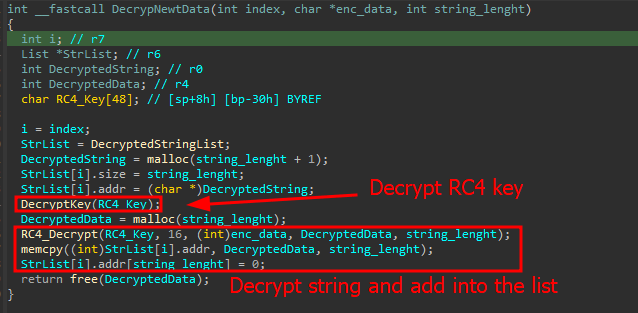
    The data decryption routine in this variant is implemented as a simple RC4 algorithm.

    The RC4 key is encrypted with XOR. After the key decryption, we were able to obtain its value: 6e7976666525a97639777d2d7f303177.

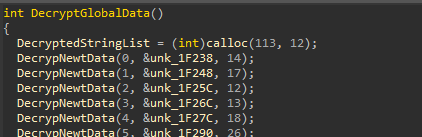
    The decrypted RC4 key is used to decrypt the strings. After each piece of data is decrypted, it is inserted into a vector of a custom DataDecrypted structure, which is a simple string list:

    Data decryption routine

    The global linked list with decrypted data is accessed whenever the malware needs particular strings.

    Adding decrypted strings to the global list

    Anti-VM and anti-emulation

    To detect if it is currently running inside a virtual machine or QEMU, the malware lists all processes until it finds any mention of VMware or QEMU-arm. Listing running processes is simply a matter of opening the /proc directory, which is the proc filesystem on Linux.

    Each process ID (PID) has its own folder containing useful information, such as cmdline, which describes the command used to start the process. Using this information, the malware verifies if there are any processes with VMware or QEMU-arm in their command line.

    Process check

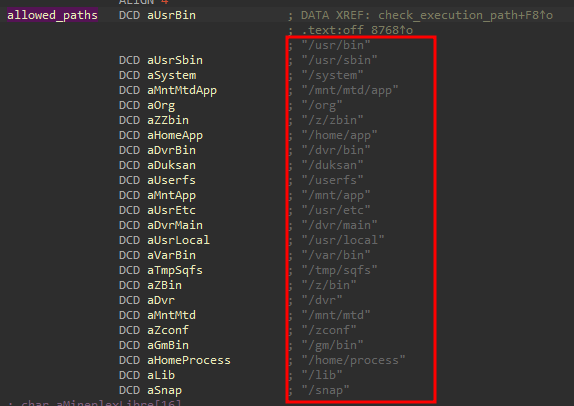
    The implant also verifies if the bot process is running outside an expected directory, based on a hardcoded list of allowed ones:

    Allowed directories

    Once those checks are successfully completed, Mirai will continue normal execution, preparing the vulnerable device for receiving commands from the operator.

    Infection statistics

    According to our telemetry data, the majority of infected victims are located in countries such as China, India, Egypt, Ukraine, Russia, Turkey, and Brazil. It’s challenging to ascertain the exact number of vulnerable and infected devices globally. However, by analyzing public sources, we’ve identified over 50,000 exposed DVR devices online, indicating that attackers have numerous opportunities to target unpatched, vulnerable devices.

    Conclusion

    Exploiting known security flaws in IoT devices and servers that haven’t been patched, along with the widespread use of malware targeting Linux-based systems, leads to a significant number of bots constantly searching the internet for devices to infect.

    The main goal of such bots is to carry out attacks that overwhelm websites and services (DDoS attacks). Most of these bots don’t stay active after the device restarts because some device firmware doesn’t allow changes to the file system. To protect against infections like these, we recommend updating vulnerable devices as soon as security patches become available. Another thing to consider is a factory reset if your device is indeed vulnerable and exposed.

    All Kaspersky products detect the threat as HEUR:Backdoor.Linux.Mirai and HEUR:Backdoor.Linux.Gafgyt.

    Indicators of compromise

    Host-based (MD5 hashes)
    011a406e89e603e93640b10325ebbdc8
    24fd043f9175680d0c061b28a2801dfc
    29b83f0aae7ed38d27ea37d26f3c9117
    2e9920b21df472b4dd1e8db4863720bf
    3120a5920f8ff70ec6c5a45d7bf2acc8
    3c2f6175894bee698c61c6ce76ff9674
    45a41ce9f4d8bb2592e8450a1de95dcc
    524a57c8c595d9d4cd364612fe2f057c
    74dee23eaa98e2e8a7fc355f06a11d97
    761909a234ee4f1d856267abe30a3935
    7eb3d72fa7d730d3dbca4df34fe26274
    8a3e1176cb160fb42357fa3f46f0cbde
    8d92e79b7940f0ac5b01bbb77737ca6c
    95eaa3fa47a609ceefa24e8c7787bd99
    96ee8cc2edc8227a640cef77d4a24e83
    aaf34c27edfc3531cf1cf2f2e9a9c45b
    ba32f4eef7de6bae9507a63bde1a43aa
    IPs
    116.203.104[.]203
    130.61.64[.]122
    161.97.219[.]84
    130.61.69[.]123
    185.84.81[.]194
    54.36.111[.]116
    192.3.165[.]37
    162.243.19[.]47
    63.231.92[.]27
    80.152.203[.]134
    42.112.26[.]36

    MIL OSI Global Banks

  • MIL-OSI Economics: Secretary-General of ASEAN meets with Minister Delegate for Francophonie and International Partnerships of France

    Source: ASEAN – Association of SouthEast Asian Nations

    Secretary-General of ASEAN, Dr. Kao Kim Hourn, had a bilateral meeting with H.E. Thani Mohamed Soilihi, Minister Delegate for Francophonie and International Partnerships of France, on 6 June 2025. Both sides discussed ways and means to enhance the ASEAN-France Development Partnership as ASEAN and France celebrate the fifth anniversary of their partnership this year.

    The post Secretary-General of ASEAN meets with Minister Delegate for Francophonie and International Partnerships of France appeared first on ASEAN Main Portal.

    MIL OSI Economics

  • ‘Bridges of hope’: PM Modi hails Chenab and Anji as symbols of India’s bright future

    Source: Government of India

    Source: Government of India (4)

    Prime Minister Narendra Modi on Friday inaugurated a series of landmark railway projects in Jammu and Kashmir, including the world’s highest railway arch bridge over the Chenab and India’s first cable-stayed rail bridge at Anji. The Prime Minister also flagged off two Vande Bharat Express trains from Katra, marking a major leap forward in rail connectivity between Jammu and the Kashmir Valley.
     
    Addressing a public gathering, PM Modi said the newly inaugurated bridges are not just engineering structures but “living symbols of India’s strength” and a reflection of the nation’s aspirations and capabilities. “These are not just made of brick, cement, steel, and iron. They stand as testaments to India’s bright future and bold ambitions,” he remarked.
     
    Highlighting the transformative impact of the Udhampur–Srinagar–Baramulla Railway Link (USBRL) project, Modi called it a “proclamation of Jammu and Kashmir’s new strength and a symbol of India’s growing capabilities.” He added, “Today, Kashmir Valley has been connected to the national rail network. We have often spoken of India from ‘Kashmir to Kanyakumari’—today, that idea has become a reality in rail connectivity as well.”
     
    The Prime Minister expressed pride that this long-awaited project was completed under his government’s tenure. “Many generations in Jammu and Kashmir dreamt of railway connectivity. Even former Chief Minister Farooq Abdullah recently recalled waiting for this project to be completed since he was in Class 7 or 8. This dream of lakhs has now been fulfilled. It is my good fortune that our government gave this project the momentum it needed and brought it to completion.”
     
    PM Modi also laid the foundation stone for a new medical college in Jammu, and announced that development projects worth ₹46,000 crore are currently underway in the Union Territory.
     
    Discussing the challenges faced during the USBRL project, the Prime Minister noted, “This was one of the most difficult railway projects in India. But our government believes in facing challenges head-on. From the Sonmarg tunnel to the Chenab and Anji bridges, we are committed to building all-weather infrastructure in this region.”
     
    He described his personal experience of walking on the newly completed bridges, calling it a moment that reflected the “lofty intentions of India and the courage of our engineers and workers.”
     
    Speaking about the Chenab Rail Bridge, Modi emphasized its global stature. “This is the tallest railway arch bridge in the world, even higher than the Eiffel Tower in Paris. Just as tourists visit the Eiffel Tower, I am confident people will come to witness this marvel in Jammu and Kashmir. It will soon become a major tourist destination.”
     
    He also praised the Anji Khad Bridge, India’s first cable-stayed railway bridge, as another example of cutting-edge engineering.
     
    “These bridges will not only strengthen connectivity but also boost the local economy,” Modi added. “They will promote tourism and benefit multiple sectors, creating new economic opportunities for the people of Jammu and Kashmir.”
     
    Earlier in the day, the Prime Minister flagged off two Vande Bharat Express trains from Katra Railway Station, providing direct and faster rail connectivity between Jammu and the Kashmir Valley.
     
  • MIL-OSI Asia-Pac: Appointments to SFC Advisory Committee announced

    Source: Hong Kong Government special administrative region

    Appointments to SFC Advisory Committee announced 
         The membership of the SFC Advisory Committee for the new term is as follows:
     
    New appointees
    ——————
    Mr Vincent Chui Yik-chiu
    Mr Lam Chi-ki
    Ms Elisa Ng Ka-li
    Ms Katherine Ng Kit-shuen
    Mr Xu Tao
     
    Reappointed members
    ————————–
    Professor Cai Hongbin
    Dr Jia Hongrui
    Ms Li Tong
    Mr Phillip Meyer
    Ms Fion Ng Siu-mui
    Mr Tse Yung-hoi
    Mr Harold Wong Tsu-hing
     
         The Government also expressed gratitude to the outgoing members, Ms June Wong Wai-man and Mr Wilfred Yiu Ka-yan, for their valuable contributions during their terms.
     
         A Government spokesman said, “The SFC Advisory Committee comprises members from different professions. They possess extensive operational experience and professional knowledge of the financial markets. We are confident that they will provide independent and professional advice to the SFC on matters related to the SFC’s policy and market regulation.”
     
         The SFC Advisory Committee was established under Section 7 of the Securities and Futures Ordinance to advise the SFC on policy matters regarding its regulatory objectives and functions. In addition to the 12 appointed members, the SFC Advisory Committee comprises the Chairman, Chief Executive Officer and two Executive Directors of the SFC.
    Issued at HKT 17:00

    NNNN

    MIL OSI Asia Pacific News

  • MIL-OSI Asia-Pac: Edison Awards_Bronze Featureless-Secure Encryption System for IOT(MIRDC)

    Source: Republic of China Taiwan

    In an era where cybersecurity has become a core focus of global industrial development, the MIRDC once again demonstrates Taiwan’s innovation strength in information security. Its self-developed “Featureless-Secure Encryption System for IoT (FSESI)” has been honored with the Bronze Award at the 2025 Edison Awards for Innovation. The technology overcomes long-standing limitations of chaotic encryption, offering a revolutionary solution for secure data transmission across IoT and international digital infrastructure.

    Chaotic encryption, known for its high randomness and theoretical unbreakability, has long been viewed as a promising approach to data security. However, its real-world application has been hindered by sensitive parameter dependencies, complex key management, high computational costs, and data length constraints. With FSESI, MIRDC has addressed these challenges by creating a next-generation encryption system featuring untraceable, high-entropy keys, a lightweight algorithm, and real-time synchronized encryption and decryption. This dramatically enhances both the practicality and security of chaotic encryption.

    At the core of FSESI is the use of multiple dynamically selected chaotic systems to generate keys that closely approximate true randomness. A specially designed sliding synchronization algorithm enables the rapid convergence of encryption and decryption systems, instantly generating identical key streams on both ends without requiring key transmission. This eliminates one of the most vulnerable points in traditional encryption: the key exchange process.

    Technically, FSESI also discretizes the continuous differential equations of chaotic systems and applies carefully selected parameters, reducing computational load by approximately 60%. This significantly lowers CPU/GPU resource consumption, enabling high-performance, low-power encryption protection. Meanwhile, encrypted data undergoes dynamic random topic transformation, making it completely unidentifiable during transmission and highly resistant to data interception and reverse engineering.

    FSESI is particularly suitable for environments requiring secure, synchronized communication across multiple devices and domains-such as IoT systems, blockchain nodes, drones, intelligent transportation, and medical data transmission. The system has already passed real-world validation through field testing with metal product manufacturers and equipment suppliers. It has also been successfully licensed to automation service integrators, helping manufacturing sectors strengthen the cybersecurity of their operational technology (OT) systems.

    More than just an evolution in encryption technology, FSESI represents a paradigm shift in cybersecurity-from identity-based defense to stealth-based protection. With its dynamic, featureless, and decentralized security architecture, FSESI offers robust defense against modern threats while preserving data privacy across digital ecosystems. Looking ahead, the system will continue expanding into global applications in manufacturing, healthcare, and smart cities, supporting industries in achieving higher levels of digital trust and security resilience.

    MIL OSI Asia Pacific News

  • MIL-OSI Asia-Pac: EMSD announces latest sampling results for legionella at fresh water cooling towers

    Source: Hong Kong Government special administrative region

    The Electrical and Mechanical Services Department (EMSD) today (June 6) announced that the department tested 70 water samples collected from cooling towers in 45 buildings in its routine inspections in May 2025. Three samples were detected to have a total legionella count at or above the upper threshold, which is 1 000 colony-forming units per millilitre. The latest statistics are set out in Annex 1.

    The cooling towers in which the samples were collected are located at 571 Canton Road, Yau Tsim Mong; Harbour Crystal Centre, 100 Granville Road, Yau Tsim Mong; and 294-296 King’s Road, Eastern. The EMSD has issued nuisance notices under the Public Health and Municipal Services Ordinance to the owners of the cooling towers requiring appropriate disinfection work to be done. Disinfection of the cooling towers in these cases have already been completed by the owners. Details of the cases can be found in Annex 2.

    The EMSD publishes the latest statistics of the above information on a half-monthly basis on its website (www.emsd.gov.hk/en/other_regulatory_services/cooling_towers/water_sampling/index.html).

    The EMSD reminds the owners of fresh water cooling towers that they have the responsibility to design, operate and maintain cooling towers properly. They should arrange regular inspections, timely maintenance and periodic testing of the water quality in their cooling towers in accordance with the Code of Practice for Fresh Water Cooling Towers issued by the department to prevent the proliferation of legionella.

    MIL OSI Asia Pacific News

  • MIL-OSI: QuantaSing Announces Unaudited Financial Results for the Third Quarter of Fiscal Year 2025

    Source: GlobeNewswire (MIL-OSI)

    BEIJING, June 06, 2025 (GLOBE NEWSWIRE) — QuantaSing Group Limited (NASDAQ: QSG) (“QuantaSing” or the “Company”), a leading lifestyle solution provider, today announced its unaudited financial results for the third quarter of the fiscal year ending June 30, 2025 (the “third quarter of FY 2025”, which refers to the quarter from January 1, 2025 to March 31, 2025).

    Business and Financial Highlights for the Third Quarter of FY 2025

    • Revenues for the third quarter of FY 2025 were RMB570.7 million (US$78.6 million), representing a decrease of 21.5% from the second quarter of the fiscal year ending June 30, 2025 (the “second quarter of FY 2025”) and a decrease of 39.6% from the third quarter of the fiscal year ended June 30, 2024 (the “third quarter of FY 2024”).
    • Gross billings of individual online learning services1 for the third quarter of FY 2025 were RMB515.6 million (US$71.0 million), representing a decrease of 5.6% from the second quarter of FY 2025 and a decrease of 47.5% from the third quarter of FY 2024.
    • Net income for the third quarter of FY 2025 was RMB41.1 million (US$5.7 million), representing a decrease of 67.5% from the second quarter of FY 2025 and an increase of 181.2% from the third quarter of FY 2024.
    • Adjusted net income2 for the third quarter of FY 2025 was RMB37.8 million (US$5.2 million), representing a decrease of 71.3% from the second quarter of FY 2025 and an increase of 18.5% from the third quarter of FY 2024.
    • Total registered users increased by 19.9% to approximately 145.0 million as of March 31, 2025, from 121.0 million as of March 31, 2024.
    • Paying learners was approximately 0.3 million in the third quarter of FY 2025.

    Company Highlight for the Third Quarter of FY 2025

    • Completed acquisition of 61% equity interest in Shenzhen Yiqi Culture Co., Ltd. (“Letsvan”) on March 31, 2025 for a total cash consideration of RMB235.0 million through a multi-step transaction. Results of operations of Letsvan were included in consolidated financials of the Company beginning April 1, 2025. The acquired assets and liabilities of Letsvan are included at fair value in the Company’s consolidated balance sheet as of March 31, 2025.

    Mr. Peng Li, Chairman and Chief Executive Officer of QuantaSing, commented, “Our third quarter results reflect our strategic pivot toward product-driven business models that create long-term value. The acquisition of Letsvan marks a significant milestone in our expansion into the pop toys market, a sector with strong growth potential that perfectly aligns with our brand-first philosophy. The early success of our WAKUKU IP, including the recent Fox and Rabbit collection launch, validates our approach of pairing strong product development capabilities with efficient go-to-market strategies. As we integrate Letsvan’s operations, we’re applying our test-and-scale methodology to build a global presence in this resilient market segment. We aim to create businesses where brand strength and product excellence drive sustainable growth, rather than simply pursuing traffic-driven metrics.”

    Mr. Dong Xie, Chief Financial Officer of QuantaSing, added, “Our financial performance this quarter underscores our commitment to disciplined capital allocation during this transformation phase. While revenue moderated to RMB570.7 million as we shifted resources away from traffic-driven businesses, we’ve maintained strong cash generation across our businesses. Our ROI-focused assessment methodology has allowed us to exit underperforming areas while preserving resources for high-potential opportunities. With our healthy cash position, we have the flexibility to support both our existing operations and our strategic initiatives in the pop toys space. Though we anticipate some near-term profitability fluctuations as we optimize our business mix, our financial foundation remains robust as we execute this strategic evolution.”

    Financial Results for the Third Quarter of FY 2025

    Revenues

    Revenues were RMB570.7 million (US$78.6 million) in the third quarter of FY 2025, compared to RMB945.6 million in the third quarter of FY 2024. The change reflects the Company’s deliberate shift from traffic-driven growth to high-quality growth.

    • Revenues from individual online learning services decreased by 43.6% year over year to RMB467.2 million (US$64.4 million) in the third quarter of FY 2025, from RMB828.1 million in the third quarter of FY 2024. This decrease was primarily due to a decrease of RMB268.3 million (US$37.0 million) in revenues from skills upgrading courses, a decline of RMB74.1 million (US$10.2 million) in revenues from financial literacy courses and a decline of RMB18.5 million (US$2.5 million) in revenues from recreation and leisure courses.
    • Revenues from enterprise services were RMB48.1 million (US$6.6 million) in the third quarter of FY 2025, compared to RMB65.1 million in the third quarter of FY 2024, representing a year-over-year change of 26.1%. The decline was primarily driven by reduced marketing services to enterprise customers.
    • Revenues from consumer business3 were RMB48.7 million (US$6.7 million) in the third quarter of FY 2025, compared to RMB49.4 million in the third quarter of FY 2024. The slight change was primarily attributable to the decline in baijiu revenue, partially offset by the modest increase in wellness products revenue.
    • Revenues from others3 were RMB6.7 million (US$0.9 million) in the third quarter of FY 2025, compared to RMB3.0 million in the third quarter of FY 2024, primarily due to revenue from the Company’s newly initiated business.

    Cost of revenues

    Cost of revenues was RMB96.6 million (US$13.3 million) in the third quarter of FY 2025, compared to RMB145.8 million in the third quarter of FY 2024, representing a 33.8% decrease. The decrease was primarily due to reduced labor outsourcing costs of RMB22.1 million (US$3.1 million), decreased procurement costs of RMB9.6 million (US$1.3 million) and lower staff costs of RMB5.1 million (US$0.7 million).

    Sales and marketing expenses

    Sales and marketing expenses were RMB395.2 million (US$54.5 million) in the third quarter of FY 2025, compared to RMB729.6 million in the third quarter of FY 2024, representing a decrease of 45.8%. The decrease was mainly due to a reduction in marketing and promotion expenses of RMB265.1 million (US$36.5 million), labor outsourcing costs of RMB46.4 million (US$6.4 million), and staff costs of RMB7.9 million (US$1.1 million), which included a decrease in share-based compensation expenses of RMB2.1 million (US$0.3 million).

    Research and development expenses

    Research and development expenses were RMB20.9 million (US$2.9 million) in the third quarter of FY 2025, compared to RMB38.8 million in the third quarter of FY 2024, representing a decrease of 46.2%. The decrease was primarily due to lower staff costs of RMB16.0 million (US$2.2 million).

    General and administrative expenses

    General and administrative expenses were RMB25.0 million (US$3.5 million) in the third quarter of FY 2025, compared to RMB36.4 million in the third quarter of FY 2024, representing a decrease of 31.2%. The decrease was primarily due to lower staff costs of RMB8.0 million (US$1.1 million), which included a decrease in share-based compensation expenses of RMB5.5 million (US$0.8 million).

    Remeasurement gain of previously held equity interests in connection with step acquisitions

    Remeasurement gain of previously held equity interests in connection with step acquisitions were RMB8.1 million (US$1.1 million) in the third quarter of FY 2025, reflecting the fair value adjustment of initial investments in Letsvan before obtaining control. Details of the acquisition can be found in the Recent Developments section of this report.

    Others, net

    Others, net were RMB15.4 million (US$2.1 million) in the third quarter of FY 2025, compared to RMB7.7 million in the third quarter of FY 2024, primarily driven by the increased fair value gains in one of the Company’s long-term investments.

    Net income and adjusted net income

    Net income was RMB41.1 million (US$5.7 million) in the third quarter of FY 2025, compared to RMB14.6 million in the third quarter of FY 2024. Adjusted net income was RMB37.8 million (US$5.2 million) in the third quarter of FY 2025, compared to RMB31.9 million in the third quarter of FY 2024.

    Earnings per share and adjusted earnings per share4

    Basic and diluted net income per share were both RMB0.25 (US$0.03) in the third quarter of FY 2025, compared to basic and diluted net income per share of RMB0.09 in the third quarter of FY 2024. Basic and diluted adjusted net income per share were RMB0.23 (US$0.03), in the third quarter of FY 2025, compared to RMB0.19 in the third quarter of FY 2024.

    Balance Sheet

    As of March 31, 2025, the Company had cash and cash equivalents, restricted cash and short-term investments of RMB1,134.9 million (US$156.4 million), compared with RMB1,026.3 million as of June 30, 2024.

    Recent Developments

    Investments in Letsvan

    On March 24, 2025, the Company announced that it entered into definitive agreements to invest in Shenzhen Yiqi Culture Co., Ltd., a PRC-based company specializing in IP incubation, copyright commercialization, and the promotion and sales of pop toys. The transaction marks the Company’s strategic entry into the pop toys market and broader consumer goods sector. Upon the completion of the investments in March 2025, Letsvan became a controlled subsidiary of the Company.

    Letsvan currently operates a number of established IPs, including “WAKUKU”, “ZIYULI”, “FUNII”, “FIILA” and “PIDOL”, with distribution channels spanning both online and offline platforms across China and Southeast Asian markets. Letsvan’s current growth strategy encompasses three key areas: strengthening collaborations with major retail partners to enhance IP influence and expand sales, developing self-operated retail locations including a recently opened pop-up store at Chaoyang Joy City in Beijing, and building comprehensive online brand and sales capabilities.

    International expansion initiatives are underway. Letsvan has already established its footprints in certain Southeast Asian markets and has been exploring opportunities in other overseas markets including the United States. With respect to IPs, Letsvan continues to strengthen internal product incubation and operational capabilities, partner with third-party artists, and collaborate with established IPs to diversify its product portfolio.

    Recent product launches include the “WAKUKU Fox and Bunny Trick or Treat”, which commenced offline distribution on May 17, 2025, followed by online channel availability on May 20, 2025. The Beijing Chaoyang Joy City pop-up store launch has generated favorable user response and increased product visibility in the market.

    2024 Share Repurchase Program

    On June 11, 2024, the Company announced that the Board had approved a share repurchase program of up to US$20.0 million of the Company’s Class A ordinary shares in the form of ADSs for a 12-month period beginning on June 11, 2024 and ending on June 10, 2025 (the “2024 Share Repurchase Program”). As of March 31, 2025, a total of 1.7 million ADSs had been repurchased for an aggregate consideration of US$3.6 million under the 2024 Share Repurchase Program.

    2025 Share Repurchase Program

    On June 6, 2025, the Company announced that the Board had approved a new share repurchase program of up to US$20.0 million of the Company’s Class A ordinary shares in the form of ADSs for a purchase period beginning from June 11, 2025 and ending on June 30, 2026 (the “2025 Share Repurchase Program”). Repurchases under the 2025 Share Repurchase Program may be made from time to time through open market transactions at prevailing market prices, in privately negotiated transactions, in block trades and/or through other legally permissible means. The repurchases will be subject to all applicable rules and regulations, including Rule 10b-18 and Rule 10b5-1 under the Securities Exchange Act of 1934, as amended, as well as the Company’s insider trading policy. The number of ADSs repurchased and the timing of repurchases will also depend on a number of factors, including, but not limited to, price, trading volume and general market conditions, along with the Company’s working capital requirements, general business conditions and other factors. The Board will review the 2025 Share Repurchase Program periodically, and may authorize adjustment of its terms and size or suspend or discontinue the program. The Company plans to fund the repurchases from its existing cash balance.

    Conference Call Information

    The Company’s management team will hold an earnings conference call at 07:00 A.M. Eastern Time on Friday, June 6, 2025 (07:00 P.M. Beijing Time on the same day) to discuss the financial results.

    Listeners may access the call by dialing the following numbers:

    International:   1-412-902-4272
    United States Toll Free:   1-888-346-8982
    Mainland China Toll Free:   4001-201203
    Hong Kong Toll Free:   800-905945
    Conference ID:   QuantaSing Group Limited
         

    The replay will be accessible through June 13, 2025 by dialing the following numbers:

    International:   1-412-317-0088
    United States Toll Free:   1-877-344-7529
    Replay Access Code:   3611954
         

    A live and archived webcast of the conference call will be available at the Company’s investor relations website at https://ir.quantasing.com.

    Non-GAAP Financial Measures

    To supplement the Company’s consolidated financial statements, which are prepared and presented in accordance with U.S. GAAP, the Company uses gross billings of individual online learning services, adjusted net income and basic and diluted adjusted net income per share as its non-GAAP financial measures. Gross billings of individual online learning services for a specific period represents revenues of the Company’s individual online learning services net of the changes in deferred revenues in such period, further adjusted by value-added tax in such period. Adjusted net income represents net income excluding share-based compensation expenses and remeasurement gain of previously held equity interests inconnection with step acquisitions. Basic and diluted adjusted net income per share represents adjusted net income attributable to QuantaSing Group Limited divided by weighted average number of ordinary shares outstanding during the periods used in computing adjusted net income per share, basic and diluted. The Company believes that the non-GAAP financial measures provide useful information about the Company’s results of operations, enhance the overall understanding of the Company’s past performance and future prospects and allow for greater visibility with respect to key metrics used by the Company’s management in its financial and operational decision-making.

    The non-GAAP financial measures are not defined under U.S. GAAP and are not presented in accordance with U.S. GAAP. The non-GAAP financial measures have limitations as analytical tools, and when assessing the Company’s operating performance, investors should not consider them in isolation, or as a substitute for revenue, net income, net income per share, basic and diluted or other consolidated statements of operations data prepared in accordance with U.S. GAAP. The Company’s definition of non-GAAP financial measures may differ from those of industry peers and may not be comparable with their non-GAAP financial measures.

    The Company mitigates these limitations by reconciling the non-GAAP financial measures to the most comparable U.S. GAAP performance measures, all of which should be considered when evaluating the Company’s performance. For more information on these non-GAAP financial measures, please see the table captioned “QuantaSing Group Limited Unaudited Reconciliation of GAAP and Non-GAAP Results” near the end of this release.

    Exchange Rate Information

    This announcement contains translations of certain Renminbi (“RMB”) amounts into U.S. dollars (“US$”) at specified rates solely for the convenience of the reader. Unless otherwise stated, all translations from Renminbi to U.S. dollars were made at the rate of RMB7.2567 to US$1.00, the exchange rate on March 31, 2025, set forth in the H.10 statistical release of the Federal Reserve Board. The Company makes no representation that the Renminbi or U.S. dollars amounts referred to could be converted into U.S. dollars or Renminbi, as the case may be, at any particular rate or at all.

    Safe Harbor Statements

    This announcement contains forward-looking statements within the meaning of Section 27A of Securities Act of 1933, as amended and Section 21E of the Securities Exchange Act of 1934, as amended and the Private Securities Litigation Reform Act of 1955. All statements other than statements of historical or current fact included in this press release are forward-looking statements, including but not limited to statements regarding QuantaSing’s financial outlook, beliefs and expectations. These statements can be identified by terminology such as “will,” “expects,” “anticipates,” “future,” “intends,” “plans,” “believes,” “estimates,” “potential,” “continue,” “ongoing,” “targets,” “guidance” and similar statements. The Company may also make written or oral forward-looking statements in its periodic reports to the U.S. Securities and Exchange Commission (the “SEC”), in its annual report to shareholders, in press releases, and other written materials and in oral statements made by its officers, directors or employees to third parties. Forward-looking statements involve inherent risks and uncertainties. A number of factors could cause actual results to differ materially from those contained in any forward-looking statement, including but not limited to the following: the Company’s growth strategies; its future business development, results of operations and financial condition; its ability to attract and retain new users and learners and to increase the spending and revenues generated from users and learners; its ability to maintain and enhance the recognition and reputation of its brand; its expectations regarding demand for and market acceptance of its services and products; the expected growth, trends and competition in the markets that the Company operates in; changes in its revenues and certain cost or expense items; PRC governmental policies and regulations relating to the Company’s business and industry, general economic and political conditions in China and globally, and assumptions underlying or related to any of the foregoing. Further information regarding these and other risks, uncertainties, or factors is included in the Company’s filings with the SEC, including, without limitation, the final prospectus related to the IPO filed with the SEC dated January 24, 2023. You are cautioned not to place undue reliance on these forward-looking statements, which speak only as of the date this press release. All forward-looking statements are qualified in their entirety by this cautionary statement, and the Company undertakes no obligation to revise or update any forward-looking statements to reflect events or circumstances after the date hereof.

    About QuantaSing Group Limited

    QuantaSing is a leading lifestyle solution provider that offers engaging, affordable and accessible online and offline services, as well as consumer products in selected areas that address senior users’ wellness aspirations. QuantaSing has expanded into the pop toys sector and continues to strategically diversify its portfolio by capturing opportunities in promising consumer sectors while maintaining financial discipline.

    For more information, please visit: https://ir.quantasing.com.

    Contact

    Investor Relations
    Leah Guo
    QuantaSing Group Limited
    Email: ir@quantasing.com
    Tel: +86 (10) 6493-7857

    Robin Yang, Partner
    ICR, LLC
    Email: QuantaSing.IR@icrinc.com
    Phone: +1 (212) 537-0429

    _________________________________
    1 Gross billings of individual online learning services is a non-GAAP financial measure. For a reconciliation of revenues of individual online learning services to gross billings of individual online learning services, see the “Non-GAAP Financial Measures” section and the table captioned “QuantaSing Group Limited Unaudited Reconciliation of GAAP and Non-GAAP Results” below.
    2 Adjusted net income is a non-GAAP financial measure. For a reconciliation of net income to adjusted net income, see the “Non-GAAP Financial Measures” section and the table captioned “QuantaSing Group Limited Unaudited Reconciliation of GAAP and Non-GAAP Results” below.
    3 Effective from the fourth quarter of FY 2024, the Company has introduced “Revenues from Consumer Business” as a separate line item. This revenue was previously included in “Revenues from Others”. The historical revenues presentation has been conformed to the current presentation.
    4 Basic and diluted adjusted net income per share are non-GAAP financial measures. For a reconciliation of basic and diluted net income per share to basic and diluted adjusted net income per share, see the “Non-GAAP Financial Measures” section and the table captioned “QuantaSing Group Limited Unaudited Reconciliation of GAAP and Non-GAAP Results” below.

    QUANTASING GROUP LIMITED
    UNAUDITED CONDENSED CONSOLIDATED BALANCE SHEETS
    (Amounts in thousands, except for share and per share data)
     
      As of
      June 30,
    2024
      March 31,
    2025
      March 31,
    2025
      RMB   RMB   US$
               
    ASSETS          
    Current assets:          
    Cash and cash equivalents 779,931   985,677   135,830
    Restricted cash 160   675   93
    Short-term investments 246,195   148,532   20,468
    Accounts receivable, net 16,676   37,392   5,153
    Amounts due from related parties 4,488   489   67
    Inventory, net 6,345   28,120   3,875
    Prepayments and other current assets 275,549   173,582   23,920
    Total current assets 1,329,344   1,374,467   189,406
               
    Non-current assets:          
    Property and equipment, net 6,569   11,571   1,595
    Long-term investments 9,010   44,428   6,122
    Intangible assets, net   68,973   9,505
    Operating lease right-of-use assets 58,889   29,479   4,062
    Deferred tax assets 847   914   126
    Goodwill   187,598   25,852
    Other non-current assets 21,360   5,177   713
    Total non-current assets 96,675   348,140   47,975
    TOTAL ASSETS 1,426,019   1,722,607   237,381
               
    LIABILITIES          
    Current liabilities:          
    Short-term Borrowings   14,500   1,998
    Accounts payables 62,066   55,219   7,609
    Accrued expenses and other current liabilities 190,508   186,084   25,643
    Income tax payable 20,399   53,565   7,381
    Contract liabilities, current portion 385,227   310,189   42,745
    Advance from customers 162,257   148,332   20,441
    Operating lease liabilities, current portion 49,099   30,837   4,249
    Total current liabilities 869,556   798,726   110,066
               
    Non-current liabilities:          
    Contract liabilities, non-current portion 11,365   33,495   4,616
    Operating lease liabilities, non-current portion 16,989   3,123   430
    Deferred tax liabilities 11,625   42,269   5,825
    Total non-current liabilities 39,979   78,887   10,871
    TOTAL LIABILITIES 909,535   877,613   120,937
               
    QUANTASING GROUP LIMITED
    UNAUDITED CONDENSED CONSOLIDATED BALANCE SHEETS- continued
    (Amounts in thousands, except for share and per share data)
     
      As of
      June 30,
    2024
      March 31,
    2025
      March 31,
    2025
      RMB   RMB   US$
               
    MEZZANINE EQUITY          
    Non-controlling interests with liquidation preferences     40,999     5,650  
               
    SHAREHOLDERS’ EQUITY          
    Class A ordinary shares 81     81     11  
    Class B ordinary shares 34     34     5  
    Treasury stock (109,257 )   (41,898 )   (5,774 )
    Additional paid-in capital 1,192,474     1,069,620     147,398  
    Accumulated other comprehensive income 17,313     18,491     2,548  
    Accumulative deficit (584,161 )   (335,573 )   (46,243 )
    TOTAL QUANTASING GROUP LIMITED SHAREHOLDERS’ EQUITY 516,484     710,755     97,945  
    Non-controlling interests     93,240     12,849  
    TOTAL SHAREHOLDERS’ EQUITY 516,484     803,995     110,794  
    TOTAL LIABILITIES, MEZZANINE EQUITY AND SHAREHOLDERS’ EQUITY 1,426,019     1,722,607     237,381  
                     
    QUANTASING GROUP LIMITED
    UNAUDITED CONDENSED CONSOLIDATED STATEMENTS OF OPERATIONS AND COMPREHENSIVE INCOME
    (Amounts in thousands, except for shares and per share data)
           
      For the Three Months
    Ended March 31,
      For the Nine Months
    Ended March 31,
      2024     2025     2025     2024     2025     2025  
      RMB     RMB     US$     RMB     RMB     US$  
                           
    Revenues 945,570     570,706     78,645     2,795,248     2,107,757     290,457  
    Cost of revenues (145,848 )   (96,556 )   (13,306 )   (409,058 )   (353,516 )   (48,716 )
                           
    Gross Profit 799,722     474,150     65,339     2,386,190     1,754,241     241,741  
                           
    Operating expenses:                      
    Sales and marketing expenses (729,620 )   (395,175 )   (54,457 )   (2,006,884 )   (1,317,206 )   (181,516 )
    Research and development expenses (38,840 )   (20,891 )   (2,879 )   (123,655 )   (77,325 )   (10,656 )
    General and administrative expenses (36,390 )   (25,049 )   (3,452 )   (114,211 )   (86,194 )   (11,878 )
    Total operating expenses (804,850 )   (441,115 )   (60,788 )   (2,244,750 )   (1,480,725 )   (204,050 )
                           
    (Loss)/Income from operations (5,128 )   33,035     4,551     141,440     273,516     37,691  
                           
    Other income:                      
    Interest income 2,513     880     121     8,369     4,040     557  
    Remeasurement gain of previously held equity interests in connection with step acquisitions     8,109     1,117         8,109     1,117  
    Others, net 7,685     15,400     2,122     22,163     31,418     4,330  
                           
    Income before income tax 5,070     57,424     7,911     171,972     317,083     43,695  
    Income tax benefit/(expense) 9,560     (16,280 )   (2,243 )   16,948     (68,495 )   (9,439 )
                           
    Net income 14,630     41,144     5,668     188,920     248,588     34,256  
    Net loss attributable to noncontrolling interests     1             1      
    Net income attributable to QuantaSing Group Limited 14,630     41,145     5,668     188,920     248,589     34,256  
                           
    Other comprehensive income/(loss)                      
    Foreign currency translation adjustments, net of nil tax 423     (289 )   (40 )   (4,954 )   1,178     162  
    Total other comprehensive income/(loss) 423     (289 )   (40 )   (4,954 )   1,178     162  
                           
    Total comprehensive income 15,053     40,855     5,628     183,966     249,766     34,418  
    Total comprehensive loss attributable to noncontrolling interests     1             1      
    Comprehensive income attributable to QuantaSing Group Limited 15,053     40,856     5,628     183,966     249,767     34,418  
                           
    Net income per ordinary share                      
    – Basic 0.09     0.25     0.03     1.14     1.55     0.21  
    – Diluted 0.09     0.25     0.03     1.10     1.52     0.21  
    Weighted average number of ordinary shares used in computing net income per share                      
    – Basic 164,753,256     162,791,862     162,791,862     166,399,349     160,479,027     160,479,027  
    – Diluted 170,890,581     165,216,173     165,216,173     171,089,530     163,949,787     163,949,787  
    Share-based compensation expenses included in                      
    Cost of revenues (2,878 )   (1,431 )   (197 )   (9,945 )   (5,214 )   (719 )
    Sales and marketing expenses (2,779 )   (642 )   (88 )   8,678     (1,540 )   (212 )
    Research and development expenses (3,599 )   (167 )   (23 )   (10,611 )   (2,474 )   (341 )
    General and administrative expenses (8,039 )   (2,571 )   (354 )   (28,961 )   (8,073 )   (1,112 )
                                       

    QUANTASING GROUP LIMITED
    UNAUDITED RECONCILIATION OF GAAP AND NON-GAAP RESULTS
    (Amounts in thousands, except for shares and per share data)

    The following table below sets forth a reconciliation of revenues to gross billings for the periods indicated:

      For the Three Months
    Ended March 31,
      For the Nine Months
    Ended March 31,
      2024     2025     2025     2024     2025     2025  
      RMB     RMB     US$     RMB     RMB     US$  
                           
    Revenues of individual online learning services: 828,127     467,247     64,388     2,457,588     1,777,552     244,953  
    Add: value-added tax 52,986     27,919     3,847     147,665     101,969     14,052  
    Add: ending deferred revenues(1) 744,320     461,026     63,531     744,320     461,026     63,531  
    Less: beginning deferred revenues(1) (643,929 )   (440,632 )   (60,721 )   (661,360 )   (565,030 )   (77,863 )
                         
    Gross billings of individual online learning services 981,504     515,560     71,045     2,688,213     1,775,517     244,673  
     
    (1) Deferred revenues include contract liabilities, advance from customers, and refund liability of individual online learning services included in “accrued expenses and other current liabilities”.
     

    QUANTASING GROUP LIMITED
    UNAUDITED RECONCILIATION OF GAAP AND NON-GAAP RESULTS – continued
    (Amounts in thousands, except for shares and per share data)

    The following table below sets forth a reconciliation of net income to adjusted net income and basic and diluted net income per share to basic and diluted adjusted net income per share for the periods indicated:

      For the Three Months
    Ended March 31,
      For Nine Months
    Ended March 31,
      2024   2025     2025     2024   2025     2025  
      RMB   RMB     US$     RMB   RMB       US$  
                           
    Net income 14,630   41,144     5,668     188,920   248,588     34,256  
    Add: Share-based compensation expenses 17,295   4,811     662     40,839   17,301     2,384  
    Less: Remeasurement gain of previously held equity interests in connection with step acquisitions   (8,109 )   (1,117 )     (8,109 )   (1,117 )
                         
    Adjusted net income 31,925   37,846     5,213     229,759   257,780     35,523  
    Attributable to noncontrolling interests   1           1      
    Adjusted net income attributable to QuantaSing Group Limited 31,925   37,847     5,213     229,759   257,781     35,523  
                           
    Weighted average number of ordinary shares used in computing net income per share                      
    – Basic 164,753,256   162,791,862     162,791,862     166,399,349   160,479,027   160,479,027  
    – Diluted 170,890,581   165,216,173     165,216,173     171,089,530   163,949,787   163,949,787  
    Weighted average number of ordinary shares used in computing adjusted net income per share                      
    – Basic 164,753,256   162,791,862     162,791,862     166,399,349   160,479,027   160,479,027  
    – Diluted 170,890,581   165,216,173     165,216,173     171,089,530   163,949,787   163,949,787  
                           
    Net income per ordinary share                      
    – Basic 0.09   0.25     0.03     1.14   1.55   0.21  
    – Diluted 0.09   0.25     0.03     1.10   1.52   0.21  
    Non-GAAP adjustments to net income per ordinary share                      
    – Basic 0.10   (0.02 )   0.00     0.24   0.06   0.01  
    – Diluted 0.10   (0.02 )   0.00     0.24   0.05   0.01  
    Adjusted net income per ordinary share                      
    – Basic 0.19   0.23     0.03     1.38   1.61   0.22  
    – Diluted 0.19   0.23     0.03     1.34   1.57   0.22  
                                 

    The MIL Network

  • MIL-OSI China: Regular Press Conference of the Ministry of National Defense on May 29, 2025 2025-06-06 Senior Colonel Zhang Xiaogang, spokesperson for the Ministry of National Defense (MND) of the People’s Republic of China (PRC), answers questions at a regular press conference on the afternoon of May 29, 2025.

    Source: People’s Republic of China – Ministry of National Defense

    By Senior Colonel Zhang Xiaogang, Spokesperson for the Ministry of National Defense (MND)

    Senior Colonel Zhang Xiaogang, spokesperson for the Ministry of National Defense (MND) of the People’s Republic of China (PRC), answers questions at a regular press conference on the afternoon of May 29, 2025. (mod.gov.cn)

    (The following English text is for reference. In case of any divergence of interpretation, the Chinese text shall prevail.)

    Zhang Xiaogang: Friends from the media, good afternoon, welcome to this month’s regular press conference of the Ministry of National Defense of the People’s Republic of China

    I have a piece of news to release at the top.

    The PLA National Defense University (NDU) sent a delegation to attend the 22nd Shangri-La Dialogue (SLD) upon invitation on May 29. The visit is scheduled till June 2, during which the delegation will also have exchanges with military and civilian units in Singapore.

    Journalist: Not long ago, the 4th Ministerial Meeting of the China-CELAC Forum was held in Beijing. President Xi Jinping attended the opening ceremony and delivered an important speech. Could you please provide more details about military cooperation between China and Latin American and Caribbean (LAC) countries?

    Zhang Xiaogang: Recently, President Xi Jinping attended the 4th Ministerial Meeting of the China-CELAC Forum and delivered a keynote address. He summarized the best practices for developing China-LAC relations, and announced the launch of five programs of Solidarity, Development, Civilization, Peace and People-to-People Connectivity. In the speech, President Xi has charted the course for building a China-LAC Community with a Shared Future.

    China-LAC cooperation has withstood winds and rains, and transcended mountains and oceans across half a globe. The cooperation has bolstered economic growth and improved the livelihoods of the LAC region, bringing tangible benefits to the local people. In recent years, the Chinese and LAC militaries have had frequent high-level exchange, and conducted numerous working level meetings. Events such as the China-LAC States Defense Forum, China-LAC Military Medicine Forum and Seminar for Senior Military Officers from LAC Countries have been held multiple times. China-LAC defense cooperation has been productive, deepening our friendship and mutual trust. The Chinese side stands ready to work with the defense establishments and militaries of LAC countries to act on the Global Security Initiative, and deepen substantive cooperation in such areas as mutual visits, professional exchanges and personnel training. Together, we will promote sustained and solid progress in building a China-LAC Community with a Shared Future.

    Journalist: In his recent speech, Lai Ching-te said that Taiwan would continue to strengthen its defenses and avoid war by preparing for it. Will the PLA conduct military exercises as countermeasures as before?

    Zhang Xiaogang: As long as Lai Ching-te continues his provocations for “Taiwan independence”, there will be no tranquility in the Taiwan Strait and no stability for our Taiwan compatriots. We warn the DPP authorities that “Taiwan independence” separatists will come to no good end. The PLA will remain combat-ready at all times, enhance combat readiness, and safeguard our national sovereignty and territorial integrity.

    Journalist: The US recently unveiled plans for the Golden Dome missile defense system, and announced that it would be completed in 3 years. May I have your comments on this?

    Zhang Xiaogang: The US presses ahead with the Golden Dome system and deploys space-based weapons, continuously expands its military build-up and stokes an arms race in outer space. Such acts violate relevant principles of the Outer Space Treaty, heighten the risk of turning the space into a war zone and triggering a space arms race, and shake the international security and arms control regime. Its actions will once again open the Pandora’s box. This proves again that no country has done more than the US in militarizing the space and making it a battlefield. We urge the US side to stop expanding military build-up in space, and take concrete actions to uphold global strategic stability.

    Journalist: I have two questions. The first one is that Japan’s Defense Ministry recently announced that Chinese aircraft carrier PLANS Liaoning conducted take-off and landing operations of ship-borne aircraft in the East China Sea. Officials of the Japan Self-Defense Forces said that similar activities were conducted by Chinese aircraft carriers before, but this training occurred in waters closer to Japan. The Japanese Defense Ministry therefore decided to make it public and this is the first time for the Ministry to release such information. What’s your comment on this?

    The second question is that the US President Donald Trump recently said that the US was mass-producing hypersonic missiles. As one of the major countries that develop hypersonic technologies, how does the Chinese side view the impact on the global arms control regime caused by the US accelerating its deployment of such strategic weapons?

    Zhang Xiaogang: On the first question, the task fleet led by PLANS Liaoning conducted training in relevant waters, which does not target any specific country or entity and is in line with international law and practice. I think the Japanese side overreacted.

    On your second question, We pursue a national defense policy that is defensive in nature, never engage in arms race with any other country, and are committed to global strategic stability.

    Journalist: I have two questions. The first one is that the US Carrier Strike Group led by USS Nimitz re-entered the South China Sea through the Singapore Strait on May 26 after its visit to Malaysia. What’s your comment on this?

    The second question is that reports suggest that the Indian side recovered an undetonated PL-15E air-air missile during the India-Pakistan conflict. Can you confirm this? Will this give the Indian side assess to relevant military technology?

    Zhang Xiaogang: On your first question, activities to flex its muscle and stir up troubles in the South China Sea will find no support. The Chinese side will firmly safeguard our territorial sovereignty and maritime rights and interests, and maintain peace and stability in the South China Sea.

    On your second question, the type of missile you mentioned is for export and has also been exhibited in international and domestic defense expos multiple times.

    Journalist: I have two questions. The first is the Commander of the US Army Pacific recently claimed that China’s increasingly aggressive behavior in the Indo-Pacific had made the situation more dangerous. He said that no one would have imagined that Beijing would conduct drills simulating a blockade of Taiwan five years ago, but now such moves were commonplace. In addition, head of the US Indo-Pacific Command said that the Chinese side was conducting comprehensive exercises in preparation for recovering Taiwan and was increasingly active in other regions of the Pacific. May I have your comments on this?

    The second question is that according to Taiwan media reports, the DPP authorities have stepped up its procurement of the Patriot missiles, drawn personnel from its Marine Corps to form combat units for the “Greater Taipei Area”, and launched several drills on responses to the so-called “PLA attacks on Taiwan”. Public opinion in Taiwan believes that these actions are preparing for Lai Ching-te’s desertion in the face of war. Do you have any comment?

    Zhang Xiaogang: For your first question, Taiwan is part of China. Resolving the Taiwan question is a matter for the Chinese, which brooks no external interference. For the cross-Strait situation, there is no factor more destabilizing than the provocations made by the “Taiwan independence” separatists and the disruptions by foreign forces. It’s legitimate, necessary, lawful and justified for the Chinese side to take actions to safeguard national sovereignty and territorial integrity. We urge the US side to stop fanning the flames on the Taiwan question. Such behaviors would only backfire.

    For your second question. Don’t be fooled by Lai Ching-te’s reckless provocations now. When the day comes, people like him will be the first to run away. For the PLA, defeating military elements of the “Taiwan independence” separatist forces is like shooting fish in a barrel. Those notorious separatists have no chance to escape.

    Senior Colonel Zhang Xiaogang, spokesperson for the Ministry of National Defense (MND) of the People’s Republic of China (PRC), answers questions at a regular press conference on the afternoon of May 29, 2025. (mod.gov.cn)

    Journalist: I have two questions. Firstly, you just announced that the PLA NDU sent a delegation to attend this year’s SLD. Why didn’t the Chinese side send higher level military officials to attend the dialogue? The US Department of Defense has already announced its attendance at the dialogue, and said that the US was a more credible regional partner than China. What’s your comment on that? My second question is that this year marks the 80th year of the World Anti-Fascist War. Many European countries have held celebrations commemorating this victory. September 3rd marks the 80th anniversary of the victory of the Chinese People’s War of Resistance against Japanese Aggression. Many people are expecting the Chinese side to hold a military parade to commemorate this anniversary. What’s your comment on that?

    Zhang Xiaogang: On your first question, China consistently engages in constructive dialogues to articulate our vision and initiatives. We are committed to enhancing mutual trust and deepening cooperation through these exchanges, contributing Chinese wisdom to the building of a community with a shared future for mankind. The PLA NDU delegation attending this year’s SLD will have in-depth exchanges with participating parties to build more consensus.

    As for the second question, I have no information to release here.

    Journalist: What is the Chinese Ministry of National Defense’s assessment on the equipment supplied by the Chinese military to Pakistan in the recent conflict between India and Pakistan? An Indian official said that China provided satellite and air defense systems for Pakistan, but these systems performed below average. What’s your comment on that?

    Zhang Xiaogang: Pakistan and India are neighbors who cannot move away from each other. We call on the both sides to keep calm, exercise restraint and avoid complicating the situation. China will continue to play a constructive role in maintaining regional peace and stability.

    Journalist: It’s reported that US Defense Secretary recently said that the US side would build up its military to meet China’s “threat” at every turn, and counter China in the Indo-Pacific. In addition, Commander of the US Army Pacific said that the US army was building agile new units in response to potential conflicts with China. What’s your comment on

    Zhang Xiaogang: Conflict and confrontation should not be the choice of either side. Mutual respect, peaceful coexistence and win-win cooperation is the right way for China and the US to deal with each other. The US side should stop conjuring up a powerful enemy for itself whether intentionally or unintentionally. Such imagination is not rational and extremely dangerous. The Chinese military will make all-out efforts to enhance our combat readiness, and firmly safeguard national sovereignty, security and development interests.

    Journalist: Some US and Israeli media outlets call on the US to stop its military assistance to Egypt, because of Egypt’s close cooperation with China. What’s your comment on this?

    Zhang Xiaogang: China-Egypt cooperation is not aimed at any third party, nor will it be interfered by any third party. The Chinese and Egyptian militaries will continue to deepen friendship, mutual trust and practical cooperation.

    Journalist: As China’s first aircraft carrier with catapult system, PLANS Fujian is undergoing a series of intensive sea trials. What kind of signal does that send out?

    Senior Colonel Zhang Xiaogang, spokesperson for the Ministry of National Defense (MND) of the People’s Republic of China (PRC), answers questions at a regular press conference on the afternoon of May 29, 2025. (mod.gov.cn)

    Zhang Xiaogang: The sea trial is a necessary part for the construction of aircraft carriers. PLANS Fujian will conduct relevant tests as planned.

    Journalist: According to a satellite image revealed last week, H-6 bombers and a KJ-500 airborne early warning aircraft were seen on Yongxing Dao of Xisha Qundao. What is the purpose of this deployment? Some experts suggest that it is to send signals to the Philippines and Vietnam. What’s your comment on that?

    Zhang Xiaogang: I am not aware of the information you mentioned. I want to emphasize that the Xisha Qundao is an inherent part of the Chinese territory. We oppose the hype about relevant military activities.

    Journalist: An African Young Officers Delegation visited China recently. Some commentary regarded the trip as one that combines culture, technology and friendship. Could you please provide more details on this?

    Zhang Xiaogang: The African Young Officers Delegation concluded its 10-day visit to China on May 15. During the visit, nearly a hundred military officers from over 40 African countries, including Egypt, Mozambique, Tanzania and Kenya, came to cities such as Beijing, Changsha and Shaoshan. They visited military units, academies and high-tech enterprises, attended themed lectures and seminars, toured the Museum of the Communist Party of China and the former residence of Comrade Mao Zedong, and had in-depth exchanges with their Chinese counterparts. Members of the delegation expressed how impressive and inspiring this visit was. This is the 4th African Young Officers Delegation invited to China by the Chinese Ministry of National Defense. This visit deepened the traditional friendship between the Chinese and African militaries, and advanced the building of an All-weather China-Africa Community with a Shared Future for the New Era.

    Journalist: I have two questions. The first one is that the US Indo-Pacific Commander reportedly said that China was outpacing the US in the production of warships and other equipment. He said that the rates of changes on the depth and breadth of PLA’s exercises was what kept him up at night. May I have your comments on this?

    The second question is that it’s reported that China’s third large hospital ship PLANS Ark Auspicious has been commissioned, marking the deployment of large ocean-going hospital ship to the Eastern Theater Command, South Theater Command and North Theater Command respectively. What’s your comment on this?

    Zhang Xiaogang: On your first question, China does not engage in arms race with any other country. We develop our military to defend China’s national sovereignty, security and development interests and to bring stability and positive energy to global peace and security.

    On your second question, PLANS Ark Auspicious is the third 10,000-ton-class ocean-going hospital ship domestically designed and built by China. It features a combat-oriented layout and is equipped with advanced medical equipment. PLANS Ark Auspicious, together with Ark Peace and Ark Silk Road, not only forms the backbone of medical support on the sea, but also executes tasks of international humanitarian medical services, emergency medical rescue in major disasters, and foreign exchanges and cooperation on military medicine. PLAN hospital ships will help the Chinese military materialize the vision of building a maritime community with a shared future and offer the world more public security goods of higher quality.

    Journalist: Does the Chinese delegation plan to meet with any other delegations on the sidelines of the Shangri-La Dialogue? Is there any planned meeting with the US delegation?

    Zhang Xiaogang: Regarding this, we will release information in due course. The Chinese side values our defense relations with the US military and is open to communications at different levels. We hope the US side will earnestly respect China’s core interests and major concerns, work with us in the same direction, and promote the steady and sound development of military-to-military relations.

    Journalist: Minister of National Defense Admiral Dong Jun recently visited France and Germany, and attended the 6th UN Peacekeeping Ministerial. Please provide further details about this.

    Zhang Xiaogang:Minister of National Defense Admiral Dong Jun led a delegation to visit France and Germany and attend the 6th UN Peacekeeping Ministerial in Berlin from May 11 to 17. Minister Dong held talks with French Minister of the Armed Forces Sébastien Lecornu and German Federal Minister of Defence Boris Pistorius respectively. The leaders had an in-depth exchange of view on international and regional issues of mutual interests, and reached consensus on strengthening substantive engagements and cooperation between the Chinese and French and the Chinese and German militaries. Minister Dong also met with UN Secretary-General António Guterres and Under Secretary-General Jean-Pierre Lacroix on the sidelines of the 6th UN Peacekeeping Ministerial. In his speech delivered at the conference, Minister Dong emphasized that the Chinese side will work with different parties to act on the Global Security Initiative, uphold the core position of the UN, redouble efforts on the United Nations Peacekeeping Operations (UNPKOs), support the training of professional peacekeepers, optimize the composition and capabilities of Chinese Peacekeeping Standby Force, advance continuous innovation of UNPKOs, and contribute more to UNPKOs.

    Journalist: Lately, official new media accounts of PLA theater commands and services and arms have been opened on the ‘China Bugle” app. What’s your comment on that?

    Zhang Xiaogang: China Bugle is the mobile flagship platform of information release launched by the PLA News Media Center. As of now, the PLA Army, Navy, Air Force, Rocket Force, and the PAP, as well as the PLA Eastern, Southern, Western, Northern and Central Theater Commands have opened their official new media accounts on this app. This demonstrates the deep integration of different forms of military media, and provides an important channel for the public to learn about defense and military development in an all-round manner. Going forward, more military units and media outlets will join the “China Bugle” app to form an integrated new media platform for military news.

    Journalist: The draft of the Japanese defense ministry’s Defense White Paper 2025 was revealed. The draft claims that China is ramping up its nuclear, missile, maritime and aviation capabilities; that PLA’s activities near Taiwan demonstrate that Beijing is trying to improve its combat capabilities; and strengthened China-Russia military cooperation is a concern for Japan. What’s your comment on this?

    Zhang Xiaogang: In the draft of its Defense White Paper, the Japanese side repeats its irresponsible comments about China’s military development, and points fingers at China’s legitimate military activities and external military cooperation. We are strongly opposed to this. This year marks the 80th year of the victory of the Chinese People’s War of Resistance Against Japanese Aggression and the World Anti-Fascist War. At this special historical juncture, it’s even more important for Japan to reflect on its behaviors, instead of making unfounded smears and accusations against others. We urge the Japanese side to follow the path of peaceful development, act prudently in the domain of military and security, and earn the trust of its Asian neighbors and the rest of the international community with concrete actions.

    Journalist: Head of Taiwan’s defense authorities Koo Li-hsiung reportedly said in an interview that US forces and alliances across Asia was crucial for holding Beijing in check. He also expressed hope for the US to expedite arms sales to Taiwan to help Taiwan address military threats from China.What’s your comments on this?

    Zhang Xiaogang: The Taiwan question is purely an internal affair of China, which brooks no interference. We will strive for the prospect of peaceful reunification with utmost sincerity and greatest effort. However, should the “Taiwan independence” separatists make provocations, challenge our bottom lines, or even cross the red lines, we will have to take decisive measures. The US side supports “Taiwan independence” separatists through arms sales. Such acts are self-defeating and will push Taiwan into the abyss of war.

    Journalist: Recently, the Chinese and Cambodian militaries successfully held the Golden Dragon 2025 joint exercise. Please provide more details.

    Zhang Xiaogang: The Chinese and Cambodian armed forces conducted the Golden Dragon 2025 joint exercise in Kampong Chhnang Province and the airspace and waters off the Sihanoukville Port from May 14 to 28. As the 7th iteration of the Golden Dragon series, this year’s exercise has three highlights. First, it focused on counter-terrorism and humanitarian assistance operations, conducting drills on relevant subjects. Second, the China-Cambodia Joint Support and Training Center at Port Ream provided support for drills on the sea for the first time. Air force helicopters took part in the exercise for the first time. Land, naval, air and joint logistic support components from both sides conducted drills together. Third, the exercise consisted of two parts: naval & air operations and ground & air operations. Participating troops were organized into mixed groups to learn from each other during tactical training and comprehensive drills, which helped to enhance command coordination and emergency response capabilities of the two sides. During the joint exercise, the PLA contingent also donated school supplies and provided free medical services to the local community. China and Cambodia are iron-clad friends with rock-solid relations. The Chinese and Cambodian militaries will work in concert to act on the important consensus between leaders of the two countries, and make greater contributions to building a China-Cambodia All-weather Community with a Shared Future for the New Era, and to preserving regional security and stability.

    Journalist: The Philippine Coast Guard said that the Coast Guard and Armed Forces of the Philippines and the US Coast Guard conducted a joint patrol in waters off Palawan, which reaffirmed the Philippines’ commitment to maritime security and the “rule-based international order”. What’s your comment on this?

    Senior Colonel Zhang Xiaogang, spokesperson for the Ministry of National Defense (MND) of the People’s Republic of China (PRC), answers questions at a regular press conference on the afternoon of May 29, 2025. (mod.gov.cn)

    Zhang Xiaogang: At present, the situation in the South China Sea remains generally stable. The freedom of navigation and overflight entitled to all countries under international law has never been an issue. Some countries provoke confrontation in the name of cooperation, flex muscles under the guise of freedom, and create chaos with the pretext of order. They have become the biggest source of risks that undermines peace and stability in the South China Sea. We urge relevant countries to stop ganging up and stirring up troubles in the South China Sea, and stop harming regional peace and stability.

    Journalist: I have two questions. The first question is about the PLA aircraft carrier Liaoning and its task fleet. They are currently off the southeast coast of Taiwan. The Taiwan authority said that they have taken joint intelligence means to monitor relevant operations throughout the whole process. Some people suggest that the PLA will probably conduct military exercises before or after the Dragon Boat Festival. Can you confirm whether the PLA has relevant plans? My second question. According to media reports, the CIA is about to release its annual report, suggesting that the Chinese mainland poses the greatest threat to the world and increasing menace against Taiwan. It also said that the rapid modernization of the PLA would prevent the US from entering the Pacific. What’s your comment on this?

    Zhang Xiaogang: On your first question. Relevant military activities organized by the PLA recently are routine arrangements according to our annual training plan.

    On your second question, as we all know, China is unwavering in our commitment to peace, development and international order. The biggest threat to the current cross-Strait situation comes from separatist activities for “Taiwan independence” and support from foreign forces. If relevant countries truly care about stability in the Taiwan Strait, they should abide by the one-China principle and unequivocally oppose “Taiwan independence”.

    If there are no other questions, this concludes today’s press conference. Thank you.

    MIL OSI China News