Category: Asia Pacific

  • MIL-OSI USA: Senator Murray, British Columbia Premier Eby, WA Small Businesses Speak Out About How Trump’s Reckless Trade War with Canada is Creating Chaos, Hurting Business, and Raising Costs

    US Senate News:

    Source: United States Senator for Washington State Patty Murray

    ICYMI: Senator Murray Hears from Mayors and Business Leaders About How Trump’s Trade War is Hurting Border Communities in Northwest Washington

    AP: Trump’s 35% Canada tariff plan deepens a rift between the neighbors

    ***WATCH HERE; DOWNLOAD HERE***

    Washington, D.C. –  Today, U.S. Senator Patty Murray (D-WA), Vice Chair of the Senate Appropriations Committee, held a virtual press conference with British Columbia Premier David Eby and Washington state business leaders to sound the alarm on how President Trump’s trade war with Canada is driving down business and creating chaos for families, small businesses, and economies on both sides of the border.

    Canada is the second-largest export market for Washington state, exporting $7.9 billion in goods and $2.2 billion in services annually. Washington state imports $17.8 billion in goods from Canada each year, with energy imports accounting for 54 percent of that total. 608 Canadian-owned companies employ 25,050 workers in Washington state. Canada is also the largest source of international visitors to the U.S., accounting for 20.4 million visits and $20.5 billion in spending in 2024. The Bureau of Transportation Statistics reported a 35 percent drop in border crossings into the U.S. through the Peace Arch and Pacific Highway Crossings in Washington state this May, compared to the same month last year. Additional data on trade between Washington state and Canada is available HERE.  

    President Trump recently announced a plan to impose 35 percent tariffs across-the-board on imports from Canada beginning August 1st. This comes after Trump has already applied 50 percent tariffs on steel and aluminum—of which Canada is the largest exporter to the United States—and 25 percent duties on cars, excluding U.S. made parts. Yesterday, after a meeting with Canada’s political leaders—including Premier Eby—Prime Minister Mark Carney downplayed the chances of success in talks aimed at reaching a trade deal with President Trump.

    “Canada isn’t just a trading partner for us—it is our ally, and they are our neighbor. We have friends, and families that span that northern border. We have supply lines and businesses that depend on the open flow of trade, tourism, and goodwill between our countries,” Senator Murray said at the press conference today. “Canada is one of our largest trading partners—accounting for, every year, nearly $8 billion in exports including our seafood, apples, and airplane parts and more than $2 billion in cross-border tourism and business. Not to mention we actually import nearly $18 billion in goods from Canada each year. So, for us, having Trump throw a tantrum with these tariffs is really throwing a wrench into our businesses that have operated for decades, and throwing communities on both sides of the border into chaos, and really throwing our neighborly way of life into jeopardy.”

    “Here’s what Trump needs to understand: this is not reality TV. It is actual reality,” Senator Murray continued. “These aren’t people playing ‘businessman’—they are trying to run actual businesses, that employ actual Americans. Unlike him, they don’t thrive on outrage. And they do not want any drama, they need certainty, they need common sense. And they need policies that bring in customers, not drive them away, and bring prices down, not drive them up. So, I want you all to know I am going to keep fighting in Congress to put an end to these pointless tariffs that are making life harder for people on both sides of our border. And I will keep pushing for legislation to reassert Congress’s power over tariff policy. It is beyond clear we cannot entrust this responsibility to a President who is toggling economic policies on and off like a kid with a joystick.”

    “We have a long and happy relationship with the American people; they’re our friends, our family members and coworkers. President Trump’s actions have broken our trust with his government, but they’ll never shake our relationship with our closest neighbours. I am grateful for Senator Murray’s leadership at this time in calling out a President that ran on an affordability agenda and is now bringing in tariffs that are raising the price of everyday goods for hard working families,” said David Eby, Premier of British Columbia.  

    “President Trump seems to have created the 51st state that he was talking about, which is the great state of uncertainty. And this is affecting all of us and that we predict that in 2025 alone, that tariffs will cost SEL $100 million in unanticipated federal taxes. These $100 million, divided by our 7000 owners, is a hit of $14,000 per employee around the world. And I agree so much with Senator Murray that the best thing we can do is to support the efforts by Democrats and Republicans in both the House and the Senate to restore congressional control over tariffs and block this President and future ones from abusing executive orders, especially here in the case of free trade,” saidDr. Ed Schweitzer, founder of Schweitzer Engineering Laboratories in Pullman.

    “Maintaining good relations with our northern neighbors is paramount to our maritime industry. Along with being a key supplier for vital parts of the industry, our relations also impact negotiations, such as the Pacific Salmon Treaty being negotiated right now. These negotiations and trade rely on goodwill and good relations, and we cannot state enough how much we value our Canadian partners in all sectors of our maritime industry here in the United States,” said Dan Tucker, Executive Director of the Whatcom Working Waterfront Coalition.

    Washington state has one of the most trade-dependent economies of any state in the country, with 40 percent of jobs in the state tied to international commerce. Washington state is the top U.S. producer of apples, blueberries, hops, pears, spearmint oil, and sweet cherries—all of which risk losing vital export markets due to retaliatory tariffs from key trading partners including Canada. Additionally, more than 12,000 small and medium-sized companies in Washington state export goods and will struggle to absorb the impact of retaliatory tariffs. Trump’s tariffs during his first term were extremely costly for Washington state—for example, India imposed a 20 percent retaliatory tariff on U.S. apples, causing Washington apple shipments to India to fall by 99 percent and growers to lose hundreds of millions of dollars in exports.

    Senator Murray has been a vocal opponent of Trump’s chaotic trade war and has been constantly lifting up the voices of people in every corner of Washington state who are being harmed by this administration’s approach to trade. Senator Murray continues to call on Republicans to end Trump’s trade war—which Congress has the power to do—and take back Congress’ Constitutionally-granted power to impose tariffs. Earlier this year—among many other events—Senator Murray brought together leaders across Washington state to highlight how Trump’s ongoing trade war is already a devastating hit to Washington state’s economy, businesses, and our agriculture sector, and held a roundtable discussion in Blaine on how Trump’s chaotic trade war and senseless tariffs are specifically hurting Washington state’s border communities and local businesses. Senator Murray has also taken to the Senate floor to lay out how Trump’s chaotic trade war is seriously threatening our economy, American businesses, families’ retirement savings, and so much else.

    Senator Murray’s full remarks, as delivered, are below and video is HERE:

    “Thank you everyone for joining us today.

    “You know for a so-called businessman, President Trump doesn’t seem to know the first thing about running a business—then again, maybe that explains his six bankruptcies. But besides that, every time Trump opens his mouth, he is demonstrating that he doesn’t understand how tariffs work and doesn’t care if his absurd tax hikes are hurting our economy and our small businesses. The reality is plain as day. Especially in places like Washington state where we are on the front line of a trade war with our neighbors that nobody asked for.

    “Canada isn’t just a trading partner for us—it is our ally, and they are our neighbor. We have friends, and families that span that northern border. We have supply lines and businesses that depend on the open flow of trade, tourism, and goodwill between our countries.

    “Canada is one of our largest trading partners—accounting for, every year, nearly $8 billion in exports including our seafood, apples, and airplane parts and more than $2 billion in cross-border tourism and business. Not to mention we actually import nearly $18 billion in goods from Canada each year.  

    “So, for us, having Trump throw a tantrum with these tariffs is really throwing a wrench into our businesses that have operated for decades, and throwing communities on both sides of the border into chaos, and really throwing our neighborly way of life into jeopardy.

    “How are farmers supposed to stay afloat when Trump just jacked up the cost of the supplies they need, at the same time that he is driving some of their best customers away?

    “How are businesses and factories supposed to keep the lights on when their supply chains are being disrupted, and their inputs—like energy, and steel, and aluminum—keep getting more expensive?

    “How are hotels and towns that are fueled by tourism supposed to keep their doors open, when cancellations are going up, bookings are going down, and 75 percent of Canadian travelers who weregoing to visit the U.S. are deciding they’d now rather go somewhere the President doesn’t constantly attack?

    “So, let’s be clear, these aren’t hypothetical questions. They are the cold, hard realities Trump is forcing onto our communities. It doesn’t take much imagination to see how hard Trump’s trade war is making life for people—especially for our border communities.

    “All you have to do is listen. Talk to ferry operators, who are feeling the squeeze of reduced travel. Talk to community leaders in Bellingham and Whatcom County, where 12 percent of taxable retail sales came from Canadians. Talk to business owners in Point Roberts, which just completely depends on Canadian trade and tourism.

    “I have been telling this over and over to my colleagues and anyone who will listen. If you want to understand the real cost of what is happening, come to Washington state, talk to people on the front lines of this pointless, painful trade war.

    “And that’s exactly why we are having this call today. To put a spotlight on what we are seeing on both sides of the border; to make more of these voices heard; to raise the alarm; and maybe even offer a little economics lesson to Trump—since he appears to need it.

    “When you raise the costs for small businesses—which is exactly what tariffs do, when you drive away loyal customers, and trading partners—which is exactly what happens when you toss up barriers and toss out insults—you make life harder, and you raise costs for everyday Americans. It is very clear that President Trump wants to treat tariffs like a reality TV show, constantly playing up the outrage and the uncertainty of the ‘Will he? Won’t he?’ drama that he seems to like living in. But the questions that I am hearing when I talk to folks home in Washington state, are more like, ‘Why on Earth would he do this?’ and ‘What the heck is he thinking?’ and ‘How am I going to be able to afford this?’

    “Because here’s what Trump needs to understand: this is not reality TV. This is actual reality. These aren’t peopleplaying ‘businessman’—they are trying to run actual businesses, that employ actual Americans. Unlike him, they don’t thrive on outrage. And they do not want any drama, they need certainty, they need common sense. And they need policies that bring in customers, not drive them away, and bring prices down, not drive them up.

    “So, I want you all to know I am going to keep fighting in Congress to put an end to these pointless tariffs that are making life harder for people on both sides of our border. And I will keep pushing for legislation to reassert Congress’s power over tariff policy.

    “It is beyond clear we cannot entrust this responsibility to a President who is toggling economic policies on and off like a kid with a joystick.

    “We have got to keep talking about this, which is why we are having this call today, until more of my Republican colleagues get the message. And I thank everybody who’s participating in this today to talk about what you are seeing.

    “So, I’m joined on this call by British Columbia Premier David Eby, he will be speaking next. As I’ve told him in the past, I appreciate our relationship and thank you for working with us on this. It’s a joy to have you on this call.”

    MIL OSI USA News

  • MIL-OSI Asia-Pac: Taisugar Stands with Farmers, Rent Relief of One to Three Months Offered to Typhoon-Affected Tenants, Based on Damage Severity

    Source: Republic of China Taiwan

    On July 7, Typhoon Danas passed through southern Taiwan leaving a trail of devastation. To reduce the burden on farmers and help them get through these difficult times, Taisugar is offering to waive rent for one to three months depending on the severity of the damage and proof of typhoon-related losses.

    According to Taisugar, tenants in areas eligible for agricultural national disaster financial assistance and low-interest rates as announced by the Ministry of Agriculture should report their disaster-related losses to their local town hall/district office and submit proof to the Taisugar land management unit. Taisugar will then issue rent waivers based on the extent of crop damage. Those that suffered between 20% to 40% damage will have their rent waived for 1 month. Those with over 40% but less than 60% damage will have their rent waived for 2 months. Those with over 60% damage will have their rent waived for 3 months. Additional extensions may be negotiated in special circumstances. Rent paid in advance can be rolled over to the following year or used to extend their lease.

    Taisugar added that if the tenant wishes to terminate their lease due to the impact of the disaster, any rent or bond paid in advance can be refunded without interest once both parties have agreed on a termination date. Taisugar is willing to do everything possible to stand with farmers and help them get through these difficult times.

    TSC News Contact Person:
    Chang Mu-Jung
    Public Relations, Department of Secretariat, TSC
    Contact Number: 886-6-337-8819 / 886-920-636-951
    Email:a63449@taisugar.com.tw

    MIL OSI Asia Pacific News

  • MIL-OSI Security: U.S. Coast Guard conducts bilateral maritime law enforcement operations with Republic of Marshall Island

    Source: United States INDO PACIFIC COMMAND

    MAJURO, Republic of the Marshall Islands — The crew of national security cutter USCGC Stratton (WMSL 752) conducted at-sea boardings with the Republic of the Marshall Islands (RMI) Sea Patrol within RMI’s exclusive economic zone from July 9 to 13.

    MIL Security OSI

  • MIL-OSI New Zealand: Exploring the societal impacts of medicines

    Source: PHARMAC

    “Right now, our decision-making framework—the Factors for Consideration—looks at how a medicine affects the person who needs it, their whānau, and the health system,” says Dr David Hughes, Pharmac’s Director of Advice and Assessment

    Like countries such as Australia, Canada, and the UK, our economic evaluations focus on the health system perspective. That means we look at how well a medicine works and what it will cost the health system in New Zealand.

    But there are other ways to look at the value of funding a medicine – for example, through a societal lens.

    “Medicines can have an impact on New Zealanders well beyond the hospital room. They can help people stay in work, reduce the need for unpaid care, and ease financial pressure on families,” says Dr Hughes.

    To begin exploring this idea, Pharmac partnered with researchers at Erasmus University in the Netherlands last year and is now working with the Institute for Medical Technology Assessment (iMTA) at Erasmus University – world leaders of the ‘societal perspective.’

    Their pilot study showed that using a societal perspective can change how New Zealand values medicines. Greater value was identified for treatments for chronic conditions affecting working-age people, for example, when broader impacts were considered.

    Pharmac is now commissioning two more assessments from iMTA. The Erasmus team will also train Pharmac staff to apply this approach in future assessments.

    Pharmac has also been talking with the Canadian Drug Agency (CDA) to share perspectives on measuring societal impacts. At the same time, the CDA has been piloting its own assessment of an expanded societal perspective.

    “We’re building our capability to see what it would look like if our assessments reflect the value of medicines not just to the health system, but to the whole of society,” says Dr Hughes.

    MIL OSI New Zealand News

  • MIL-OSI New Zealand: Budget uplift one year on: more medicines for more New Zealanders

    Source: PHARMAC

    “We originally estimated that the uplift would allow us to fund around 54 medicines – 26 for cancer and 28 for other conditions – benefiting about 175,000 New Zealanders,” says Geraldine MacGibbon, Director Pharmaceuticals.

    Pharmac has used the increase to fund 66 medicines – 33 for cancer conditions and 33 for non-cancer conditions. In the first year of funding, nearly 250,000 New Zealanders will benefit from these medicines.

    “These medicines are making a real difference in people’s lives,” says MacGibbon.

    “They’re helping New Zealanders manage a wide range of health conditions – from cancer and heart failure to osteoporosis and schizophrenia.”

    For example, about 580 people are expected to benefit from aripiprazole depot injection, used to treat schizophrenia. This medicine works by correcting chemical imbalances in the brain and can reduce the risk of schizophrenia symptoms coming back.

    Having access to the medicine denosumab will help 1,900 people with osteoporosis to live healthier lives.

    “We heard from people living with osteoporosis that this medicine helps reduce the risk of fractures and supports them to stay active in their communities,” MacGibbon says.

    Pembrolizumab (Keytruda) was one of the first medicines funded through the budget increase.  It’s now available for people with several types of cancer, including triple-negative breast cancer and Hodgkin lymphoma.

    “Access to these medicines will slow down the progression of these cancers and improve survival, so that people have more valuable time with their whānau and friends,” MacGibbon says.

    For 18,000 New Zealanders living with chronic heart failure, access to the heart medicine empagliflozin can reduce the risk of needing to be hospitalised, protect their heart, and reduce the risk of kidney failure.

    People with severe eczema also now have access to upadacitinib to help manage their condition. Upadacitinib is a medicine that supresses immune and inflammatory processes in eczema and provides a treatment option for those with severe disease.

    “These are just a few of the life-changing treatments that we’ve been able to fund using the budget increase,” says MacGibbon.

    Looking ahead, while there was no additional increase to the medicines budget in 2025, Pharmac will continue to fund new medicines through its usual funding and savings activities. These tools allow Pharmac to keep funding and widening access to medicines that make a meaningful difference for New Zealanders.

    MIL OSI New Zealand News

  • MIL-OSI New Zealand: Engaging with consumer advocacy groups

    Source: PHARMAC

    These organisations represent people and communities with lived experience of health conditions. They help to make sure that these voices are heard and considered in Pharmac’s decision-making.

    “We want to make sure these groups can hear directly from our senior leadership about the progress we are making on key initiatives, and that they have the opportunity to ask us questions and give us feedback,” says Pharmac’s Director Equity and Engagement, Dr Nicola Ngawati.

    “It’s really important that the voices of the people these groups represent are heard when we make decisions,” she says.

    “We know many of these advocates are busy, so we appreciate them taking the time to meet with us each month. We’ve been encouraged by the feedback we’ve received so far, but we’ll continue to adapt so that these meetings are helpful and relevant for people who attend.” 

    MIL OSI New Zealand News

  • MIL-OSI New Zealand: Pharmac working in partnership with consumers on organisational reset

    Source: PHARMAC

    “The recent external reviews have highlighted the need for Pharmac to continue evolving into a more outward-focused and transparent organisation,” says Pharmac’s Director Strategy, Policy & Performance Michael Johnson.

    A five-year change programme commenced on 1 July. It will occur in two phases, starting with an initial 12-month reset.

    “While some changes can be made quickly, other changes will take longer to make. In the first 12 months, we want to focus on making improvements that benefit consumers, and lay strong foundations for the future change work”, he says.

    A working group, made up of patient advocates and consumer representatives, is being established to support the development and delivery of the reset programme.  This supports recommendations from the Consumer Engagement Workshop Report released in March 2025.

    “This group will provide insight, lived experience, and practical advice to ensure that the reset programme is designed in a way that reflects the needs, values, and perspectives of consumers,” says Johnson.

    Patient advocate Dr Malcolm Mulholland has been elected by the consumer and patient community as the Chair of this group.

    Dr Mulholland said, “We’ve waited a long time for this opportunity.  The work that Pharmac does is vitally important for the health of patients and their families, and this is why getting Pharmac to work as well as it can, will be the focus of the working group.”

    Consumer and Patient Working Group

    MIL OSI New Zealand News

  • MIL-OSI New Zealand: Connecting with the medical devices industry

    Source: PHARMAC

    The Medical Technology Association of New Zealand (MTANZ) is the leading industry body representing medical technology manufacturers, importers and distributors of medical devices in New Zealand. HealthTech Week is New Zealand’s national conference for health technology industry and research.

    “It was fantastic to have such a strong presence at HealthTech week this year,” says Pharmac’s Director Medical Devices, Catherine Epps.

    Deputy Prime Minister and Associate Minister of Health – Pharmac, David Seymour, gave the opening address, followed shortly afterwards by Pharmac’s Board Chair Paula Bennett, who spoke about her work as Board chair of Pharmac and vision for the organisation

    Catherine Epps then provided an update on the progress of Pharmac’s medical devices programme.

    “It was great to be able to share the significant progress that we’ve made on the comprehensive list of medical devices,” she says.

    New Zealand’s first ever nationwide list of medical devices, effective from 1 July, will support better patient care and long-term investments in medical devices.

    This list represents medical devices that are used in hospitals or provided to people to use at home.

    “Having a comprehensive list of what is used will support the health system to make more strategic, long-term investments in medical devices,” Epps says.

    HealthTech week provided a great opportunity for Pharmac staff to meet with suppliers, hear their questions, and share more about our work.  

    “It’s essential that Pharmac’s medical devices programme is informed by those who work with medical devices every day – whether that’s clinicians, suppliers, consumers, advocates, or other industry partners,” says Epps.

     “We couldn’t have success in this programme without working together with many others,” she says.

    MIL OSI New Zealand News

  • MIL-Evening Report: Politics with Michelle Grattan: Chris Bowen on why it’s ‘a little frustrating’ bidding for COP 31

    Source: The Conversation (Au and NZ) – By Michelle Grattan, Professorial Fellow, University of Canberra

    Energy and climate issues are front and centre for both sides of politics. The government is struggling with pushback from some regional communities against the rollout of transmission lines and wind farms. At the same time, it will soon have to produce its 2035 target under the Paris climate agreement.

    Meanwhile, the opposition is fractured over whether to stick by its commitment to net zero emissions by 2050.

    We’re joined on this podcast by the Minister for Climate Change and Energy Chris Bowen.

    Bowen remains upbeat about the energy transition:

    I think it’s going well. We can always do more, and there’s always more effort needed, and the job is far from done. But when you consider what we’ve achieved over the first three years, I would say pleased but not yet satisfied. We are, by and large, on track for our 43% emissions reduction. Just in the last couple of days, [we saw] some excellent figures about the amount of new renewable electricity connected to the grid.

    So all this is a very significant turnaround from 2022, but I’m far from mission accomplished. There’s still a lot more to do. This is the biggest economic transition our country has undertaken, and you don’t sort of do three years’ work and put your feet up. This is a constant effort, and that’s an effort on which I’m entirely focused.

    Just now, Bowen is also focused on preliminary work for Treasurer Jim Chalmers’ Economic Reform Roundtable in August.

    Bowen announces he’ll be hosting two roundtables of his own, feeding into the broad August 19-21 meeting:

    I’ll be holding two roundtables, one on electricity and one on climate adaptation which is going to be an increasing focus of this government and future governments because tragically the world has left it too late to avoid the impacts of climate change. We can hopefully avoid the worst catastrophic impacts of more than 1.5 and two to three degrees.

    On Australia’s bid to host COP in 2026, Bowen says Australia has the votes against the other contender, Turkey, but the decision-making process is informal:

    So one of the things about the process to decide COPs I’ve learnt is it’s quite opaque and there’s no particular timeline and no particular rules to the ballot. I will say, I’ve said before, we’ve got very strong support. So it’s not a matter of going out and getting more votes.

    But there’s no agreed time or process for a ballot. It’s meant to work on a consensus, sort of an old world, sort of gentlemanly approach to say whoever loses will withdraw.

    Despite the delay, Bowen says Australia will be ready if the bid is successful:

    Having said that, the last COP, the one last year, in Azerbaijan, I accept Azerbaijan is a very different country to Australia, but they found out a year in advance as well. And logistically, physically, they put on a very good COP, that can be done. And I know the Premier of South Australia is a very, very enthusiastic supporter of hosting the COP.

    On the Coalition potentially dropping its commitment to net zero by 2050, Bowen calls the target “the basic bare minimum of action”:

    It’s what the IPCC has recommended as what is absolutely necessary to avoid […] the worst catastrophic impacts of [climate change]. To be debating net zero 2050 in Australia this year is like debating whether the sun should come up. It’s the most basic framework. It’s nowhere near enough.

    I think it’s got strong support, and it’s retaining that. I mean, the election result shows that. That we were told to get on with it. Keep going basically.

    I’ll just say this. At least Peter Dutton had net zero as a policy objective. I mean, Sussan may be indicating maybe she won’t. I used to say Peter Dutton would be the worst prime minister for climate than Tony Abbott, and I was correct at the time, but now it’s starting to look like Sussan Ley would be even worse.

    Michelle Grattan does not work for, consult, own shares in or receive funding from any company or organisation that would benefit from this article, and has disclosed no relevant affiliations beyond their academic appointment.

    ref. Politics with Michelle Grattan: Chris Bowen on why it’s ‘a little frustrating’ bidding for COP 31 – https://theconversation.com/politics-with-michelle-grattan-chris-bowen-on-why-its-a-little-frustrating-bidding-for-cop-31-261763

    MIL OSI AnalysisEveningReport.nz

  • MIL-OSI China: China’s public security authorities safeguard high-quality development over 14th Five-Year Plan period

    Source: People’s Republic of China – State Council News

    A telecom fraud suspect is escorted by Chinese police officers at the Kunming Changshui International Airport in Kunming, southwest China’s Yunnan Province, Jan. 30, 2024. [Photo/Xinhua]

    China’s public security organs have helped facilitate the nation’s high-quality development by resolutely safeguarding public safety during the 14th Five-Year Plan period (2021-2025), a senior Chinese public security official said on Wednesday.

    “China is widely recognized as one of the safest countries in the world,” Qi Yanjun, vice minister of public security, said at a press conference on public security during the 2021-2025 period.

    “China has maintained one of the lowest incidence rates of fatal criminal cases, the lowest rate of criminal offenses, and the fewest cases involving firearms and explosives in the world,” Qi noted.

    World’s safest country

    During the 14th Five-Year Plan period, public security authorities have focused on safeguarding the safety and well-being of the public, continuously intensifying efforts to combat criminal offenses, leading to a steady decline in the overall number of criminal cases nationwide, senior police officer Jiang Guoli said at the press conference.

    China has consistently ranked among the countries with the lowest homicide rates globally, with a rate of 0.44 per 100,000 people in 2024, said Jiang, who is the political commissar of the Ministry of Public Security (MPS) criminal investigation bureau.

    China has maintained a hard stance on gang-related crime. Chinese police have dismantled over 590 mafia-style organizations and over 8,900 other criminal gangs to date during the 14th Five-Year Plan period, according to Jiang.

    More than 105,000 gang-related criminal cases have been solved nationwide since 2021, he said, stressing that law enforcement agencies have maintained a zero-tolerance policy on organized crime — particularly for complex, high-profile cases.

    He noted that law enforcement authorities have also focused on the root causes of organized crime, utilizing long-term crime prevention and social governance mechanisms.

    “By disrupting the cycle in which disorder fosters crime and crime evolves into organized gangs, authorities aim to eliminate the conditions that allow such groups to thrive,” Jiang said.

    In the field of transportation, the number of major traffic accidents resulting in three or more deaths during the 14th Five-Year Plan period declined significantly — 34 percent — compared to the 2016-2020 period, Qi said.

    He highlighted that public security organs across the country have since 2021 intensified their identification and rectification of safety loopholes in sectors such as road traffic, railways and civil aviation, aiming to protect the people’s safety and property to the greatest possible extent.

    Telecom fraud crackdowns

    China launched harsh crackdowns on telecom and online fraud during the 14th Five-Year Plan period, effectively protecting the people’s lawful interests.

    Chinese police resolved 1.739 million such cases and arrested 366,000 related individuals, including 3,442 major financiers and core members of criminal groups, Jiang said.

    Police and relevant government departments intercepted 12.41 billion scam calls and 10.93 billion fraudulent text messages over the past five years, he noted.

    He said that during the same period, Chinese police deepened law enforcement cooperation with their international counterparts, dispatching work groups to countries such as Myanmar, Thailand and Cambodia to boost joint operations targeting telecom fraud.

    “These efforts led to the dismantling of over 2,000 overseas fraud centers and the capture of more than 80,000 individuals,” he added.

    Enhancing autonomous driving regulation

    Responding to a question on autonomous driving, Wang Qiang, director of the MPS traffic management bureau, said that China will tighten its regulation and management of intelligent driving, as the intelligent driving systems currently installed in vehicles have not yet achieved true autonomous driving.

    “The driver remains the ultimate party responsible for operating the vehicle,” Wang said.

    He stressed that if a driver takes their hands off the wheel or their eyes off the road while the vehicle is in motion, they pose a serious risk to traffic safety and their actions could result in civil liability, administrative penalties and criminal prosecution.

    To strengthen the regulation and management of intelligent driving, police will support the refining of laws and regulations to clarify manual control in vehicle autonomy from Level 0, which indicates no driving automation, to Level 2, which indicates partial driving automation, Wang said.

    China will also encourage vehicle manufacturers to continuously improve the reliability of assisted driving systems, and to establish relevant safety technology standards, he added.

    MIL OSI China News

  • MIL-OSI China: Sri Lanka to join China-ASEAN Expo in September as special partner

    Source: People’s Republic of China – State Council News

    The Port Access Elevated Highway project is pictured in Colombo, Sri Lanka, June 7, 2025. [Photo/Xinhua]

    Sri Lanka will join as a Special Partner Country for the 22nd China-ASEAN Expo (CAEXPO) scheduled for Sept. 17-21 in Nanning, capital city of south China’s Guangxi Zhuang Autonomous Region, the expo secretariat confirmed on Wednesday.

    A high-level Sri Lankan government delegation led by senior diplomatic officials will attend the event. National key enterprises, including port companies and spice companies, will participate to deepen economic and trade ties with China and ASEAN.

    Sri Lanka will hold a national image exhibition, product display and national promotion event during the expo.

    Introduced at the 11th CAEXPO, the Special Partner Country mechanism invites Regional Comprehensive Economic Partnership (RCEP) member states or Belt and Road participating countries outside China and ASEAN. This makes the expo a platform to boost exchanges and create business opportunities between China, ASEAN and beyond. Sri Lanka previously held the role at the 13th CAEXPO.

    China-Sri Lanka cooperation currently spans infrastructure, energy, port development and other sectors, helping strengthen bilateral economic and cultural ties.

    MIL OSI China News

  • MIL-OSI China: Chinese automakers unveil new models at Indonesia auto show

    Source: People’s Republic of China – State Council News

    This photo taken on July 23, 2025 shows products of Chinese auto brands during the exclusive media day of GAIKINDO Indonesia International Auto Show (GIIAS) 2025 at the Indonesia Convention Exhibition in Tangerang, Banten Province, Indonesia. [Photo/Xinhua]

    Chinese automakers on Wednesday unveiled new electric vehicle (EV) models in Indonesia, as demand for EVs continued to grow across the Southeast Asian country.

    At the GAIKINDO Indonesia International Auto Show (GIIAS), held in Tangerang, Banten province, Chinese automaker BYD launched its Atto 1 model, known as Seagull or Dolphin Mini in China.

    People visit the booth of Chinese auto brand BYD during the exclusive media day of GAIKINDO Indonesia International Auto Show (GIIAS) 2025 at the Indonesia Convention Exhibition in Tangerang, Banten Province, Indonesia, July 23, 2025. [Photo/Xinhua]

    “This is the first Atto 1 in Southeast Asia. We’re offering it in two variants: Dynamic and Premium,” said BYD Indonesia Operations Director Nathan Sun during the launch.

    Meanwhile, Wuling introduced a new multi-purpose vehicle designed for both family and business use, called the Cortez Darion.

    People visit the booth of Chinese auto brand Wuling during the exclusive media day of GAIKINDO Indonesia International Auto Show (GIIAS) 2025 at the Indonesia Convention Exhibition in Tangerang, Banten Province, Indonesia, July 23, 2025. [Photo/Xinhua]

    The Cortez Darion will be available in two versions: a plug-in hybrid and a full battery electric vehicle.

    The 2025 GIIAS officially opened on Wednesday, with public days scheduled from July 24 to Aug. 3.

    MIL OSI China News

  • MIL-OSI China: China power into women’s basketball final at Universiade

    Source: People’s Republic of China – State Council News

    China defeated Poland 71-67 after overtime to reach the women’s basketball final at the Rhine-Ruhr World University Games on Wednesday.

    China will face the United States, who edged Hungary 73-71 in the other semifinal, for the championship on Friday.

    Chinese guard Tian Yuanyuan emerged as the hero, scoring all seven of her points in overtime after the two teams were tied 62-62 at the end of regulation.

    China’s small forward Chen Yujie shot nine of 14 for a game-high 24 points, including four of five from beyond the arc. Center Liu Yutong and power forward Tang Zhiting added 14 points apiece.

    Poland’s shooting guard Magdalena Szymkiewicz led her side with 13 points, while 2.01-meter center Kamila Borkowska contributed 12.

    China started strong, jumping out to a 15-7 lead after Liu, Chen and Tang hit back-to-back 3-pointers, prompting Poland’s coach to call a timeout with four minutes left in the first quarter.

    Poland responded with a 26-11 run to take a 33-26 halftime lead.

    China surged back in the third quarter with an 11-0 run to go ahead 37-33 midway through the period. Poland answered with a 10-0 run of its own, capped by two free throws and a layup from Anna Winkowska, to take a 48-45 lead into the fourth.

    Li Xingnuo opened the final quarter with a 3-pointer to level the game at 48-48. The teams traded baskets down the stretch, tying at 58-58 with 1:50 to play.

    Szymkiewicz gave Poland a 60-58 lead with two free throws, but China responded with four straight points on a pair of layups. Poland’s Julia Piestrzynska attacked the basket to tie it 62-62. After Li’s missed 3-pointer, the game went to overtime.

    Poland managed just three points in the extra period, falling behind 69-65 with 18 seconds remaining. A timeout and late foul strategy couldn’t prevent China from sealing the 71-67 win.

    “We have tired legs after yesterday’s hard-fought quarterfinal win against Japan, so you could see we only scored a few points in the second quarter,” said Chinese coach Zhao Xuetong.

    “In the halftime break, I told the players to play as we planned and don’t think much about the result. To tell the truth, we have already reached where we expect before the Games,” added Zhao. “Reaching the last four is OK for us, so everyone is relaxed mentally.”

    MIL OSI China News

  • MIL-OSI USA: VIDEO: In Foreign Relations Subcommittee Hearing, Ranking Member Rosen Highlights Urgent Need to Strengthen Middle East Partnerships and Combat Iran

    US Senate News:

    Source: United States Senator Jacky Rosen (D-NV)

    Watch the full opening statement HERE.
    WASHINGTON, DC – During the first hearing of the Senate Foreign Relations Committee’s Subcommittee on Near East, South Asia, Central Asia, & Counterterrorism, Ranking Member Jacky Rosen (D-NV) stressed the urgent need for a coherent U.S. strategy in the Middle East that strengthens regional integration, restores stability, and counters a nuclear Iran. Senator Rosen called on the Trump Administration to work closely with Congress, particularly following recent U.S. strikes on Iran’s nuclear program, and criticized cuts to our diplomatic workforce and foreign assistance, warning they undermine national security. Emphasizing the importance of diplomacy and development, she advocated for expanding the Abraham Accords, supporting Israel’s qualitative military edge, increasing humanitarian aid into Gaza, and preventing terrorist resurgence throughout the region. 
    Below is Senator Rosen’s opening statement:
    Thank you, Chair McCormick, for holding today’s important hearing – like you said, this is the subcommittee’s first since you and I were named Chair and Ranking Member, respectively. I am incredibly excited about the work we will be able to do together to support U.S. interests across a broad swath of the globe – from the Middle East and North Africa to Central and South Asia.
    And I want to thank you as well to our witnesses for taking the time to offer your insights today. 
    I’d like to build upon your remarks, Senator McCormick, because as you illustrated the Middle East is at a critical juncture, full of risks, as well as opportunities. How we engage in the region in the coming weeks and months has the potential to alter its trajectory for decades to come. 
    In just the last few weeks, we have seen hostilities between Israel and Iran, we’ve seen increased Houthi attacks on maritime commerce in the Red Sea, skirmishes between Israel and Syria, and a lack of progress in ending the war in Gaza, bringing ALL of the hostages held by Hamas home, and addressing the humanitarian crisis.
    But since the beginning of the year, we have also seen the decline of Iran’s nuclear and ballistic capabilities, Assad’s regime crumble in Syria, Hezbollah be diminished to a shell of its former self in Lebanon, and the significant weakening of Hamas.
    To help set the Middle East on a path towards peace and prosperity, we not only have to deter our adversaries from engaging in harmful actions, we must also work to advance our interests by implementing a coherent strategy and assistance plan for the region. 
    So let me be clear – Iran can never be allowed to acquire or develop a nuclear weapon. I am hopeful our targeted strikes on Iran’s nuclear program earlier this summer will pave the way to a negotiated agreement that makes this a reality. It is critical the Administration works hand in glove with Congress on what comes next.
    We must also ensure that terror groups, especially Iranian proxies, cannot operate freely and threaten stability in the Middle East. And so on that end, I have led bipartisan efforts to freeze Iranian assets, tighten and renew sanctions, and integrate air and missile defenses throughout the region. But we must do more to bolster regional stability to deny extremist groups the instability on which they thrive.
    An integrated Middle East of like-minded partners and allies is essential to advancing our interests, which is why we must widen and deepen the Abraham Accords, including through economic integration and other people-to-people bonds that provide tangible benefits to the region. 
    In Gaza, Hamas remains an impediment to peace and poses a threat to both Israelis and Palestinians. We must continue to support Israel as it works to free the hostages, defeat Hamas, and protect itself against future threats. And we also must allow for more humanitarian aid for civilians in Gaza and do everything possible to prevent the loss of innocent lives and to support a negotiated end to the war.
    In Syria and Iraq, we cannot cede ground where the U.S.-led coalition has made significant progress in eliminating the ISIS threat. To consolidate our military gains, we need to ensure that terrorists are held accountable for their horrific crimes. But we also must make sure that there is a thoughtful plan for reintegration and rehabilitation of individuals from Al Hol and Al Roj camps. If we fail to reintegrate these populations, it will be at our peril.
    This leads me to my last point. Former Defense Secretary Jim Mattis once said “if you don’t fully fund the State Department, then I will need to buy more ammunition.” Diplomacy and foreign assistance is vital to the future of this region. 
    When people don’t have access to food or jobs, terror groups recruit them. When children don’t have access to education, they are more easily radicalized. 
    As this Administration slashes our diplomatic corps, expert civil servants, and foreign assistance programs, we are undeniably less safe and less prosperous. 
    To set the region on the right path, we can’t be afraid to leverage our military strength. But we certainly must also leverage our diplomatic and foreign assistance tools.
    I thank you for being here and I look forward to discussing this with you all further today.

    MIL OSI USA News

  • MIL-OSI New Zealand: Economics – Tariffs and uncertainty likely to dampen medium-term inflation pressures – Reserve Bank of NZ

    Source: Reserve Bank of New Zealand

    24 July 2025 – Global tariffs and economic uncertainty are likely to mean less inflation pressures in New Zealand and a pullback in business investment and household spending, RBNZ Chief Economist Paul Conway says.

    However, the economy is currently supported by high export prices and lower interest rates, he says.  

    In a speech delivered to Business New Zealand in Wellington today, Mr Conway says that as a small, open economy, we are heavily influenced by global developments.

    “Being tied in with the global economy helps us prosper. It also means that when something big happens offshore, such as the imposition of tariffs, its ripple effects impact the New Zealand economy,” he says.

    The US has made a decisive shift towards a more trade protectionist stance, which is a major change in the global trading environment with significant implications for the global economy, Mr Conway says.

    Tariffs may make global supply chains less efficient and could nudge up the cost of imports. This is why tariffs are expected to add to inflation pressures in the US.

    But for New Zealand, the main impact is likely to be weaker global growth, which could reduce demand for our exports and lower import prices. Import prices could fall further as other countries redirect their exports away from the US. This is expected to reduce inflation pressures here.

    At the same time, uncertainty is elevated, making it harder for households and businesses to plan.

    “When businesses aren’t sure what’s coming, they hold off hiring and delay big investments. Households tend to respond to increased uncertainty by putting off big sp

    MIL OSI New Zealand News

  • MIL-OSI Australia: Workers on the move: job mobility is easing back to pandemic levels but employers still affected

    Source: Jobs and Skills Australia

    Workers on the move: job mobility is easing back to pandemic levels but employers still affected

    Linda


    News and updates
    While mobility picked up following the pandemic, it has recently returned to a level similar seen through most of the 2010s. Read more.

    MIL OSI News

  • MIL-OSI Australia: Transcript – ABC Melbourne Mornings with Justin Smith

    Source: Murray Darling Basin Authority

    JUSTIN SMITH, HOST: Yesterday the Albanese Government announced legislation around child care, introduced the legislation into Parliament. The main part of this is the threat to withdraw funding from centres that do not come up to standard. The Federal Minister for Early Childhood Education, Victorian Senator Jess Walsh, is in our Canberra studio. Minister, good morning.

    SENATOR DR JESS WALSH, MINISTER FOR EARLY CHILDHOOD EDUCATION AND MINISTER FOR YOUTH: Good morning, Justin. Thanks for having me.

    SMITH: With this new plan, how would that have prevented what we’re now talking about?

    WALSH: Well, this has been a really distressing time, Justin, for families in Victoria, families of the children who are affected. Really, all parents of children who have their kids in early childhood education are watching on and they want strong action. So we have introduced legislation into the first sitting of our new Parliament to cut Commonwealth funding from those providers who do put profit ahead of child safety. This is a big lever that we have in the Commonwealth. We fund early learning centres through the Commonwealth Child Care Subsidy. This legislation will allow us for the first time to withdraw that subsidy from those providers who consistently and persistently fail to put child safety first.

    SMITH: OK. This has come up, though, because of what, particularly in Victoria, as you’re a Victorian Senator, what we’ve seen in the last three weeks. So, for that reason, you’re introducing this legislation. So how is that going to prevent what we’ve been talking about and what we’ve been seeing? How will it change that? How will it stop that?

    WALSH: Yeah, Justin, we announced this legislation some months ago and it certainly is in response to concerns about quality and safety in early childhood education. We know that the vast majority of providers do the right thing. We know that the vast majority of our dedicated, passionate early childhood educators do the right thing. But there is a small number of repeat offenders who this legislation is targeted at. It allows us to withdraw funding from those providers, it allows us to stop them expanding, and it allows us to take a range of actions against them, right from issuing them with show-cause notices, imposing conditions on their services, and again right through to withdrawing funding.

    SMITH: No, no, I understand. I understand. And respectfully, forgive me for interrupting, but I will have to ask the same question again. How is that going to prevent what we’re talking about? If somebody is working in the industry, they have got red flags against them but there are no charges and then they pop up at another child care centre, with the proposals that you’re now putting in place, how is that going to prevent that?

    WALSH: Yeah, thanks Justin. So, there’s two big pieces of work going on here and I hope you’ll let me go through them because –

    SMITH: Sure.

    WALSH: It’s really important, Justin. So, there’s our Commonwealth legislation, we have a big lever, being the funding and I’ve taken you through that. At the same time the Commonwealth States and Territories are working together shoulder-to-shoulder on a big package of reform – a strong and significant package of child safety reform. And that goes to some of the other things that are being discussed right now, including the first ever nationwide register of early childhood educators. You’re right that there have been flags raised about this alleged offender in Victoria. What we need is a nationwide register of early childhood educators that allows us to see those flags. And that register needs to be integrated with working with children checks. And yes, this individual, this alleged offender, had a working with children check. And it needs to be integrated with other information that we have about substantiated complaints and conduct against individuals. And that’s what we’re working towards. That register will raise those flags.

    SMITH: Yep.

    WALSH: It will allow us to track that behaviour, Justin, and provide information to regulators around the country about action that needs to be taken.

    SMITH: Just on that register, before you move on to anything else, the Productivity Commission recommended that last year. How long is that going to take to get up and running?

    WALSH: So, we’re working on it right now. As you’ve said, the Victorian Government is also working on these matters as well. They’ve announced their own register. We’re having discussions with them about making sure that it will be harmonised into the nationwide register. I think people want us to work together and we are. We do know that early childhood educators and providers cross borders and we need one strong national harmonised approach where we can see where our early childhood educators are working and where every regulator across the country can see those red flags.

    SMITH: How long will it take for the register to get up and running?

    WALSH: So, Justin, I don’t have an answer to that this morning. We’re meeting again in a couple of weeks, and we’ll announce the plans for the register then. We had an urgent ministers meeting – an urgent stand-alone meeting of Education Ministers focused on this issue at the end of June. At that meeting we put this nationwide register right on our agenda. We’re working on it. We’re coming back together in August, and we’ll have more to say then.

    SMITH: OK. You can understand, and I don’t mean to be disrespectful when I say this, but you understand that people listening to this, parents who are listening to this now, have a fear that what is being announced and what’s being introduced into Parliament is a bit of window dressing and that it’s not actually going to make any changes. You would understand that fear?

    WALSH: Justin, I met with three mums yesterday who had the courage to come up to here in Canberra and talk about their experiences. They were parents of children who had been abused in early learning settings historically, and I listened to their stories and their stories will stay with me and drive the action that we are taking. If there was one simple thing, Justin, that we could do, everyone would do it – the Commonwealth, States and Territories. There are many actions that need to be taken. I think everyone’s been really honest in this that not enough has been done up until now, but there is a real determination to do more. At the Commonwealth level, we have this lever of our funding, and we are sending a clear message to providers to lift their game or leave the sector. And we are working shoulder to shoulder with the States and Territories around a strong and significant package of reform.

    SMITH: I guess there –

    WALSH: Not enough has been –

    SMITH: I’m sorry. Finish, please.

    WALSH: Not enough has been done, Justin. I think everyone can see that. Everyone is clear about that. But we are all working together at a Commonwealth, State and Territory level and we are all driven by our understanding of the experiences that families are having right now and the fears that they have.

    SMITH: With the withdrawal of funding, who is going to police that? Who will make the spot checks? Who will do the reports and make a call on whether a centre is up to scratch or not?

    WALSH: So the Secretary of my Department is already looking at the data that we have. We know that there’s a small group of providers that consistently and persistently breach our national quality standards. We’re also looking at serious incidents, we’re looking at complaints, and we know which providers are of concern. It’s important to say, Justin, that if there are serious and imminent concerns, child care centres can be shut down immediately, and that does happen from time to time. This legislation is about the Commonwealth having the power for the first time to remove funding from those providers who are doing the wrong thing. And we also want it to send a message to the sector to lift their investment in quality and safety now.

    SMITH: It’s 14 to 9. We’re with Jess Walsh, who is the Early Childhood Education Minister in the Albanese Government. Minister, I’m sorry, I’ll have to ask that – I will have to ask you that question again. Who makes the decision? Who polices it? Who does the spot checks?

    WALSH: The Commonwealth is responsible for setting the standards, and the States and Territories for enforcing those standards with boots on the ground. It’s the States and Territories who have the regulators.

    SMITH: OK.

    WALSH: And we are of course all working together. We are hearing from the State regulators that this stick, if you like, that we have will help them do their job as well.

    SMITH: Does that not place us back into a problem that we’ve had, which is that the State and the Commonwealth are working, not working separately but they are separate entities and as you’re going to be relying on the States to gather this data to make the call on these child care centres, but each State seems to have a very different way of approaching child care? How is that all going to be pulled together nationally?

    WALSH: Well, the Commonwealth and the States do have different responsibilities, Justin, but we have one responsibility and that is to keep children safe in early learning and to give parents the confidence that their children are safe too. The regulators do provide information. We want to make sure that that information is shared nationally. And what we are doing this week with the legislation that we introduced yesterday is making sure that we can use the Commonwealth lever that we have, to withdraw funding from those providers who do put profit ahead of child safety. And there is one thing I want to add, Justin, to reassure parents. The vast majority of providers are meeting and exceeding our standards. Over 90 per cent of providers are meeting and exceeding standards. And the vast majority of educators out there are doing the very best job that they can do every day. There’s over a million families out there in Australia who are getting quality early education. This is a real problem that we’re seeing in terms of the distressing events that are occurring in Victoria, and more needs to be done about that. That’s why we’re focused on this legislation and bringing together a strong and significant package of child safety reforms.

    SMITH: Okay. Is the, you talk about standard, is the Allan Government up to standard?

    WALSH: Well, I think the Victorian Government, as with all governments around the country, have acknowledged that not enough has been done to date, and that more needs to be done. And we’ve acknowledged that at a Commonwealth level as well. Again, it’s why we’ve introduced this legislation in the first sitting of this Parliament because it’s such a big priority for us to keep children safe. It’s why we’re working shoulder to shoulder with the States on this package of reform. Of course, there is a review underway in Victoria, and we await the results of that review.

    SMITH: Thank you for your time, Minister.

    WALSH: Thank you.
     

    MIL OSI News

  • MIL-Evening Report: Swirling nebula of two dying stars revealed in spectacular detail in new Webb telescope image

    Source: The Conversation (Au and NZ) – By Benjamin Pope, Associate Professor, School of Mathematical and Physical Sciences, Macquarie University

    The day before my thesis examination, my friend and radio astronomer Joe Callingham showed me an image we’d been awaiting for five long years – an infrared photo of two dying stars we’d requested from the Very Large Telescope in Chile.

    I gasped – the stars were wreathed in a huge spiral of dust, like a snake eating its own tail.

    The coils of Apep as captured by the European Space Observatory’s Very Large Telescope.
    ESO/Callingham et al., CC BY

    We named it Apep, for the Egyptian serpent god of destruction. Now, our team has finally been lucky to use NASA’s James Webb Space Telescope (JWST) to look at Apep.

    If anything could top the first shock of seeing its beautiful spiral nebula, it’s this breathtaking new image, with the JWST data now analysed in two papers on arXiv.

    Violent star deaths

    Right before they die as supernovae, the universe’s most massive stars violently shed their outer hydrogen layers, leaving their heavy cores exposed.

    These are called Wolf-Rayet stars after their discoverers, who noticed powerful streams of gas blasting out from these objects, much stronger than the stellar wind from our Sun. The Wolf-Rayet stage lasts only millennia – a blink of the eye in cosmic time scales – before they violently explode.

    Unlike our Sun, many stars in the universe exist in pairs known as binaries. This is especially true of the most massive stars, such as Wolf-Rayets.

    When the fierce gales from a Wolf-Rayet star clash with their weaker companion’s wind, they compress each other. In the eye of this storm forms a dense, cool environment in which the carbon-rich winds can condense into dust. The earliest carbon dust in the cosmos – the first of the material making up our own bodies – was made this way.

    The dust from the Wolf-Rayet is blown out in almost a straight line, and the orbital motion of the stars wraps it into a spiral-shaped nebula, appearing exactly like water from a sprinkler when viewed from above.

    We expected Apep to look like one of these elegant pinwheel nebulas, discovered by our colleague and co-author Peter Tuthill. To our surprise, it did not.

    The ‘pinwheel’ nebula of the triple Wolf-Rayet star system WR104.
    Peter Tuthill

    Equal rivals

    The new image was taken using JWST’s infrared camera, like the thermal cameras used by hunters or the military. It represents hot material as blue, and colder material in green through to red.

    It turns out Apep isn’t just one powerful star blasting a weaker companion, but two Wolf-Rayet stars. The rivals have near-equal strength winds, and the dust is spread out in a very wide cone and wrapped into a wind-sock shape.

    When we originally described Apep in 2018, we noted a third, more distant star, speculating whether it was also part of the system or a chance interloper along the line of sight.

    The dust appeared to be moving much slower than the winds, which was hard to explain. We suggested the dust might be carried on a slow, thick wind from the equator of a fast-spinning star, rare today but common in the early universe.

    The new, much more detailed data from JWST reveals three more dust shells zooming farther out, each cooler and fainter than the last and spaced perfectly evenly, against a background of swirling dust.

    The Apep nebula in false colour, displaying infrared data from JWST’s MIRI camera.
    Han et al./White et al./Dholakia; NASA/ESA

    New data, new knowledge

    The JWST data are now published and interpreted in a pair of papers, one led by Caltech astronomer Yinuo Han, and the other by Macquarie University Masters student Ryan White.

    Han’s paper reveals how the nebula’s dust cools, links the background dust to the foreground stars, and suggests the stars are farther away from Earth than we thought. This implies they are extraordinarily bright, but weakens our original claim about the slow winds and rapid rotation.

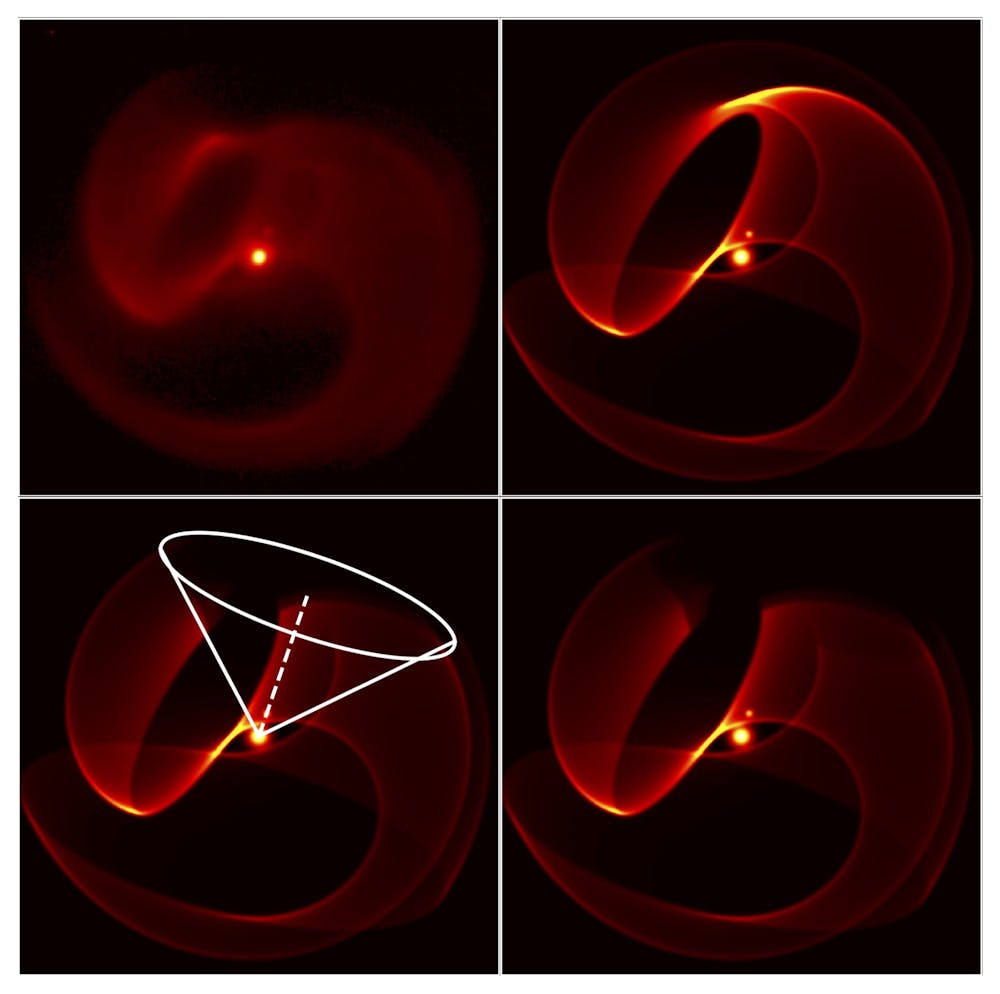
    In White’s paper, he develops a fast computer model for the shape of the nebula, and uses this to decode the orbit of the inner stars very precisely.

    He also noticed there’s a “bite” taken out out of the dust shells, exactly where the wind of the third star would be chewing into them. This proves the Apep family isn’t just a pair of twins – they have a third sibling.

    An illustration of the cavity carved by the third star companion in the Apep system.
    White et al. (2025)

    Understanding systems like Apep tells us more about star deaths and the origins of carbon dust, but these systems also have a fascinating beauty that emerges from their seemingly simple geometry.

    The violence of stellar death carves puzzles that would make sense to Newton and Archimedes, and it is a scientific joy to solve them and share them.

    Benjamin Pope receives funding from the Australian Research Council and the Big Questions Institute.

    ref. Swirling nebula of two dying stars revealed in spectacular detail in new Webb telescope image – https://theconversation.com/swirling-nebula-of-two-dying-stars-revealed-in-spectacular-detail-in-new-webb-telescope-image-258314

    MIL OSI AnalysisEveningReport.nz

  • MIL-OSI New Zealand: 10,000 to get family and sexual violence training

    Source: New Zealand Government

    Better, and more, training to help staff support in family and sexual violence responses are being rolled out across frontline services, with the goal of reaching 10,000 workers in the next two years. 

    Minister for the Prevention of Family and Sexual Violence Karen Chhour says, “this will ensure victim-survivors receive best practice support, and will empower staff to safely recognise, refer, and respond to family and sexual violence.”

    “This training is an important part of our response to family and sexual violence. I am proud of our progress against the second Te Aorerekura Action Plan, it shows the benefits of a multi-agency response and the dedication of government departments to best supporting victim-survivors.” 

    Other progress against the Action Plan includes:

    • The Ministry of Justice has delivered training to over 800 members of its court-related workforce. Ongoing training is expected to reach up to 500 people per year.
    • The Department of Corrections has given essential-level family violence training to more than 4,700 of its staff.
    • In 2024, Police redesigned the course for new recruits to include two weeks’ family violence training. Over 550 Police recruits received training in that first year, and over 850 recruits are expected to receive training by the end of 2025. 

    “The Action Plan sets out a number of key actions to be achieved, including training 10,000 frontline workers in family violence and sexual violence over two years.

    “These goals are bold. Achieving them will require strong cross-agency collaboration and re-enforced commitment to this focus area as a priority. 

    “This boldness is needed to improve the support provided to victim-survivors and will empower these frontline workers to undertake their roles with the greatest care,” says Mrs Chhour. 

    MIL OSI New Zealand News

  • MIL-OSI New Zealand: New investment to drive AI and biotech innovation

    Source: New Zealand Government

    The Government is investing $24 million in smart, practical science that will help New Zealanders live healthier lives and support the development of sustainable food industries.

    Science, Innovation and Technology Minister Dr Shane Reti today announced two major research programmes in partnership with Singapore, focusing on artificial intelligence (AI) tools for healthy ageing and biotechnology for future food production.

    “Science and innovation are critical to building a high-growth, high-value economy. That’s why we’re investing in research with a clear line of sight to commercial outcomes and real public benefit,” Dr Reti says.

    “This Government is focused on backing the technologies that will deliver real-world results for New Zealanders – not just in the lab, but in our hospitals, homes, and businesses.

    “Whether it’s supporting older Kiwis to live well for longer or developing smarter food production systems, these projects are about practical applications of advanced science to solve problems and grow our economy.”

    Funded through the Catalyst Fund, designed to facilitate international collaboration, the investment will support seven joint research projects over the next three years, deepening New Zealand’s research ties with Singapore and building capability in AI and biotechnology.

    The AI programme, delivered alongside AI Singapore, directly supports the Government’s Artificial Intelligence Strategy – a plan to use AI to safely and effectively boost productivity and deliver better public services.

    “Our AI Strategy is about encouraging the uptake of AI to improve productivity and realise its potential to deliver faster, smarter, and more personalised services, including in healthcare,” says Dr Reti.  

    “These projects will help develop tools that support clinicians and improve care for our ageing population. Our collaboration with Singapore, a country well advanced in their use and development of AI, will help grow Kiwi capability to explore future practical uses of AI.”

    The biotechnology programme will focus on turning scientific research into scalable food solutions, including alternative proteins and new food ingredients, in partnership with Singapore’s A*STAR.

    “These partnerships are about future-proofing our economy and our communities — tackling global challenges with New Zealand science at the forefront,” Dr Reti says.

    Notes to the Editor:

    The Leveraging AI for Health Ageing programme will partner with AI Singapore (AISG) and will fund three projects which apply AI to improve health outcomes for older adults, particularly in cognitive health and personalised care:

    • AI-Assisted interRAI Assessment – University of Otago will enhance aged care assessments by integrating AI to improve efficiency and personalisation.
    • AI-Driven Risk Score for Dementia – University of Auckland will build an AI tool to help clinicians identify individuals at high risk of progressing to dementia.
    • AI-Augmented Cognitive Health Monitoring – Victoria University of Wellington will develop a remote monitoring platform using speech analysis, cognitive games, and caregiver input.

    The Biotech in Future Food Research Programme will partner with Singapore’s Agency for Science, Technology and Research (A*STAR) and fund four groundbreaking projects:

    • Algae-Based Future Foods – Cawthron Institute will develop processing methods for two algae species suited to commercial development in both countries.
    • Hybrid Meat Production – University of Canterbury will design a novel, scalable approach to producing affordable hybrid meat.
    • Bio-Fermented Functional Foods – University of Auckland will create next-generation food ingredients from bacterial cellulose and mushroom mycelium.
    • Black Soldier Fly Bioproducts – Scion will explore the use of insect larvae to develop bioactive compounds and protein sources for human and animal nutrition.

    MIL OSI New Zealand News

  • MIL-OSI Asia-Pac: Bureau of Standards, Metrology and Inspection Strengthens Regulation of ‘Slime Toys’ to Ensure Children’s Safety

    Source: Republic of China Taiwan

    Since March 1, 2024, the Bureau of Standards, Metrology and Inspection (BSMI) has designated boron content in “slime toys” as a mandatory inspection item. Both imported and domestically manufactured slime toys must undergo random sampling inspections according to national standards before being released from the production premises, imported or places on the market. Only products meeting the relevant regulations are allowed to be sold. To further ensure children’s safety, beginning August 1, 2025, the inspection approach for these products will change from Random-selected batch inspection to Batch-by-batch examination, thereby reinforcing control at the source.
    BSMI explains that any products failing quality checks during market sampling will be required to be withdrawn and recalled for correction within a specified period in accordance with Article 59, Paragraph 1 of the Commodity Inspection Act. Any person who releases from production premises, exports, imports, or places on the market any commodity failing to meet inspection requirements shall be fined between NT$200,000 and NT$2,000,000 in accordance with Article 60, Paragraph 1 of the same Act. BSMI will continue to conduct market sampling and inspection programs for these toys. If non-compliance is detected, follow-up investigations will be carried out, including interviews and documentation, followed by enforcement actions in line with the Commodity Inspection Act, safeguarding consumer rights with a double protection mechanism.
    BSMI emphasizes that all toys intended for children under the age of 14 are subject to mandatory inspection as announced. Regardless of whether the toys are imported or domestically produced, they must complete the inspection process and display the commodity inspection mark before being allowed on the domestic market. BSMI also advises consumers to pay attention to the following when purchasing and playing toys:
    1.Purchase toys that label the Commodity Inspection Mark (Picture as attachment file ).
    2.Check whether the toy has detailed labeling in Chinese, and carefully read the information regarding the appropriate age range, precautions, main ingredients or materials, warnings, and instructions for playing.
    3.Choose toys that are appropriate for the child’s age. Do not give toys intended for older children to young children, as this may cause injury.
    4.Stretchable slime toys may contain chemical substances such as borax. Prolonged contact and play can easily cause allergic dermatitis or allergic reactions. Therefore, playing time should be limited, and hands should be washed immediately after playing.

    Responsible Division: Inspection Administration Division
    Contact Person: Cheng, Ching-Hong, Deputy Director
    Tel (O) +886-2343-1700#1211
    Email: ch.cheng@bsmi.gov.tw

    MIL OSI Asia Pacific News

  • MIL-OSI Australia: Collaborative burn trials addressing knowledge gaps in fire behaviour

    Source:

    Australian farmers could benefit from burn trials conducted in paddocks of canola stubble, which indicate current fire behaviour models are overestimating the spread and behaviour of fire in the crop under mild weather conditions.

    The Canola and Alternative Crop Experimental Burn project is a critical component of a national collaborative research initiative involving the Victorian Country Fire Authority (CFA), the Commonwealth Scientific and Industrial Research Organisation (CSIRO), and the South Australian Country Fire Service (SACFS).

    The aim of the collaborative project is to enhance Australia’s current understanding of fire behaviour in non-cereal crop stubbles, particularly canola and legume stubble, to address significant gaps in current fire behaviour models.

    SACFS Australian Fire Danger Rating System (AFDRS) Manager, Simeon Telfer said this collaborative project demonstrates our proactive approach to refining AFDRS, enhancing the accuracy of our fire simulators, and improving the quality and reliability of public warnings.

    ‘This project is a critical national partnership to address significant gaps in knowledge, as existing models are currently overestimating the fire spread risks in these fuel types under mild weather conditions,’ Mr Telfer said.

    ‘We are listening to communities and firefighters who have told us that canola burns differently; sometimes it will just stop spreading and other times it travels quickly, so we need to test the model.’

    He said a large portion of data still needs to be collected before changes are made but initial indications show changes could be made to refine Fire Danger Rating thresholds for canola.

    ‘One of the main advantages of the AFDRS is its ability to adopt new research as it comes along, once it is peer reviewed, we will be able to adopt this research straight into AFDRS, which will help across the nation,’ he said.

    ‘We know farmers are doing it tough in South Australia as they continue to grapple with drought conditions, so we want to do our part to support them by ensuring our data provides the best available information to protect their crops and properties.’

    A small delegation of fire scientists from SACFS, CFA and CSIRO have conducted stubble burns near Ungarra on South Australia’s Eyre Peninsula, in conjunction with local landowners and SACFS volunteers.

    CFA Senior Research Officer, Rachel Bessell, said the project helps to foster collaboration and gets more agencies involved in fire research, all while helping the community.

    ‘It’s not very often that volunteers get to stop and watch fire, so it’s a great learning experience for them to be involved in these burns.’

    ‘There’s a lot of complexities with getting these burns up and running, so we’re really appreciative of all the support from the suppression crews and the local community.’

    CSIRO Researcher Richard Hurley said the groundbreaking research will significantly enhance fire behavior predictions in cropping regions.

    ‘Currently throughout Australia, croplands are largely misunderstood and often misclassified as grasslands, which have different fuel characteristics. This highlights the need to better quantify fire propagation in these fuel types,’ Mr Hurley said.

    ‘From a scientific perspective, this type of research has never been done before at this scale. The next step is to conduct burns under much hotter and drier conditions to test fire behavior at the upper end of the fire behavior index.

    The second stage of the project is planned for summer 2025/26, as soon as practicable after harvest is complete. In this stage, fires will be lit under increased temperatures and wind speeds to measure crop stubble fires in more typical wildfire conditions. Safety measures will be increased for the next stage of the project to ensure containment of these hotter and drier stubble fires, including additional SACFS suppression resources, burn buffers surrounding the experimental area and mineral earth breaks.

    Media information
    For media enquiries call the CFS Media Line on 08 8115 3531.

    Submitted by CFA Media

    MIL OSI News

  • MIL-OSI Submissions: Swirling nebula of two dying stars revealed in spectacular detail in new Webb telescope image

    Source: The Conversation – Global Perspectives – By Benjamin Pope, Associate Professor, School of Mathematical and Physical Sciences, Macquarie University

    The day before my thesis examination, my friend and radio astronomer Joe Callingham showed me an image we’d been awaiting for five long years – an infrared photo of two dying stars we’d requested from the Very Large Telescope in Chile.

    I gasped – the stars were wreathed in a huge spiral of dust, like a snake eating its own tail.

    The coils of Apep as captured by the European Space Observatory’s Very Large Telescope.
    ESO/Callingham et al., CC BY

    We named it Apep, for the Egyptian serpent god of destruction. Now, our team has finally been lucky to use NASA’s James Webb Space Telescope (JWST) to look at Apep.

    If anything could top the first shock of seeing its beautiful spiral nebula, it’s this breathtaking new image, with the JWST data now analysed in two papers on arXiv.

    Violent star deaths

    Right before they die as supernovae, the universe’s most massive stars violently shed their outer hydrogen layers, leaving their heavy cores exposed.

    These are called Wolf-Rayet stars after their discoverers, who noticed powerful streams of gas blasting out from these objects, much stronger than the stellar wind from our Sun. The Wolf-Rayet stage lasts only millennia – a blink of the eye in cosmic time scales – before they violently explode.

    Unlike our Sun, many stars in the universe exist in pairs known as binaries. This is especially true of the most massive stars, such as Wolf-Rayets.

    When the fierce gales from a Wolf-Rayet star clash with their weaker companion’s wind, they compress each other. In the eye of this storm forms a dense, cool environment in which the carbon-rich winds can condense into dust. The earliest carbon dust in the cosmos – the first of the material making up our own bodies – was made this way.

    The dust from the Wolf-Rayet is blown out in almost a straight line, and the orbital motion of the stars wraps it into a spiral-shaped nebula, appearing exactly like water from a sprinkler when viewed from above.

    We expected Apep to look like one of these elegant pinwheel nebulas, discovered by our colleague and co-author Peter Tuthill. To our surprise, it did not.

    The ‘pinwheel’ nebula of the triple Wolf-Rayet star system WR104.
    Peter Tuthill

    Equal rivals

    The new image was taken using JWST’s infrared camera, like the thermal cameras used by hunters or the military. It represents hot material as blue, and colder material in green through to red.

    It turns out Apep isn’t just one powerful star blasting a weaker companion, but two Wolf-Rayet stars. The rivals have near-equal strength winds, and the dust is spread out in a very wide cone and wrapped into a wind-sock shape.

    When we originally described Apep in 2018, we noted a third, more distant star, speculating whether it was also part of the system or a chance interloper along the line of sight.

    The dust appeared to be moving much slower than the winds, which was hard to explain. We suggested the dust might be carried on a slow, thick wind from the equator of a fast-spinning star, rare today but common in the early universe.

    The new, much more detailed data from JWST reveals three more dust shells zooming farther out, each cooler and fainter than the last and spaced perfectly evenly, against a background of swirling dust.

    The Apep nebula in false colour, displaying infrared data from JWST’s MIRI camera.
    Han et al./White et al./Dholakia; NASA/ESA

    New data, new knowledge

    The JWST data are now published and interpreted in a pair of papers, one led by Caltech astronomer Yinuo Han, and the other by Macquarie University Masters student Ryan White.

    Han’s paper reveals how the nebula’s dust cools, links the background dust to the foreground stars, and suggests the stars are farther away from Earth than we thought. This implies they are extraordinarily bright, but weakens our original claim about the slow winds and rapid rotation.

    In White’s paper, he develops a fast computer model for the shape of the nebula, and uses this to decode the orbit of the inner stars very precisely.

    He also noticed there’s a “bite” taken out out of the dust shells, exactly where the wind of the third star would be chewing into them. This proves the Apep family isn’t just a pair of twins – they have a third sibling.

    An illustration of the cavity carved by the third star companion in the Apep system.
    White et al. (2025)

    Understanding systems like Apep tells us more about star deaths and the origins of carbon dust, but these systems also have a fascinating beauty that emerges from their seemingly simple geometry.

    The violence of stellar death carves puzzles that would make sense to Newton and Archimedes, and it is a scientific joy to solve them and share them.

    Benjamin Pope receives funding from the Australian Research Council and the Big Questions Institute.

    ref. Swirling nebula of two dying stars revealed in spectacular detail in new Webb telescope image – https://theconversation.com/swirling-nebula-of-two-dying-stars-revealed-in-spectacular-detail-in-new-webb-telescope-image-258314

    MIL OSI

  • MIL-OSI New Zealand: Hacking the Economic Downturn : Killing It Online in 2025

    Source: Press Release Service

    Headline: Hacking the Economic Downturn : Killing It Online in 2025

    In 2025, New Zealand businesses with strong, search-optimised websites are growing despite economic challenges. Agencies like The Web Guys show that good SEO and user-friendly design are key to online success.

    The post Hacking the Economic Downturn : Killing It Online in 2025 first appeared on PR.co.nz.

    MIL OSI New Zealand News

  • MIL-OSI New Zealand: Overhauling unsustainable electoral laws

    Source: New Zealand Government

    The Government is overhauling outdated and unsustainable electoral laws including stopping same-day enrolment, Justice Minister Paul Goldsmith says. 

    “Allowing late enrolments, however well intentioned, has placed too much strain on the system. The final vote count used to take two weeks, last election it took three.  

    “If we leave things as they are, it could well take even longer in future elections. The 20-day timeframe for a final result will likely already be challenging to achieve at the next election without changes. 

    “Therefore, the Government has agreed to close enrolment before advance voting begins. People will need to make sure they enrol or update their enrolment details by midnight on the Sunday, before advance voting opens on Monday morning. 

    “This is a significant, but necessary change. The Electoral Commission will have plenty of time to run an education campaign to ensure people understand the new requirements. For Australia’s federal election earlier this year, the enrolment deadline was 26 days before election day. I have every confidence New Zealand can manage within the 13-day deadline. 

    “We’ve also agreed to a range of other changes, including creating a new offence to strengthen the rules around treating near voting places. There has been some confusion in the past around what is and isn’t treating. This will make the rules crystal clear.

    “The donation threshold for reporting the names of party donors is also being adjusted from $5,000 to $6,000, to account for inflation.”

    Key changes include: 

    • Closing enrolment 13 days before election day to reduce pressure on post-election timeframes.
    • Requiring 12 days of advance voting at each election.
    • Introducing automatic enrolment updates so the Electoral Commission can update people’s enrolment details using data from other government agencies.
    • Enabling greater use of digital communication by removing postal requirements for enrolment.
    • Creating a new offence that prohibits the provision of free food, drink or entertainment within 100 metres of a voting place while voting is taking place. It will be punishable by a fine of up to $10,000.
    • Reinstating a total ban on prisoner voting. 

    The Bill makes a wide range of other changes including:  

    • Enabling special vote processing to begin earlier. 
    • Increasing the Electoral Commission’s board from three to up to seven members.
    • Setting a single deadline for all candidate nominations.
    • Changing party registration requirements and timeframes.
    • Providing flexibility on the contact details that can be included in promoter statements.

    The Government is progressing a separate bill to amend the Constitution Act 1986 to ensure the continuity of executive government in the post-election period. 

    MIL OSI New Zealand News

  • MIL-OSI China: Chinese team wins RoboCup Humanoid League in AdultSize category

    Source: People’s Republic of China – State Council News

    China’s Tsinghua University has placed top of the AdultSize category in the RoboCup Humanoid League soccer world championship, in the first time a Chinese team has claimed the top honor.

    RoboCup was founded in 1997 and ranks among the world’s most prestigious robotics competitions. This year’s event was held in Brazil, attracting over 20 teams from 12 countries, including China, the United States, Germany, the Republic of Korea and France.

    Tsinghua dominated the competition using Chinese-developed Booster T1 robots, achieving decisive victories over multiple opponents, including a team from the University of Texas. In an all-Chinese final, Tsinghua defeated a team from China Agricultural University, marking the first time teams from Chinese institutions secured both gold and silver in the category.

    Competing robots require not only lightweight, agile, impact-resistant hardware, but also sophisticated capabilities like real-time perception, cognitive decision-making, advanced motion control and multi-agent coordination, meaning the league constitutes a comprehensive test of full-stack robotic capabilities, according to a senior manager at Booster Robotics, which developed the T1 robots.

    Industry analysts noted that the outstanding performance of Chinese robots at this international event has reaffirmed China’s growing expertise in robotics R&D and application.

    MIL OSI China News

  • MIL-OSI New Zealand: More classrooms for state-integrated schools

    Source: New Zealand Government

    The Government is ensuring more parents have choice with their child’s education, delivering a $30 million investment package to deliver roll growth classrooms across the state-integrated school network.

    “State-integrated schools are an important part of our education system. It’s clear they are experiencing similar growth pressures to the state network and need support to meet this demand. We are making sure they have the resources to support and grow alongside their communities,” Education Minister Erica Stanford says.

    The $30 million investment will be phased equally over the next four years and is expected to deliver up to 1,250 new student places for students whose families choose state-integrated schooling. It is more than five times the value of the previous government’s investment

    The classrooms will be delivered through a combination of cost-effective repeatable designs and offsite manufactured buildings, so funding can go further, and more students benefit. Schools will be able to apply in the coming weeks. 

    “This Government is committed to providing parents with choice and high-quality schooling options for their children’s education. With this funding, integrated schools will be able to expand, giving students and teachers the spaces they need to thrive,” Ms Stanford said.”

    MIL OSI New Zealand News

  • MIL-OSI Australia: The wait is over – it’s time to lodge

    Source: New places to play in Gungahlin

    The Australian Taxation Office (ATO) is advising it is time to lodge, as most taxpayers with simple affairs will now have their information pre-filled into their accounts.

    Assistant Commissioner Rob Thomson said that the ATO had completed pre-fill of over 91 million pieces of information available for individual tax returns from employers, banks, government agencies and private health insurers.

    ‘You’ve been patiently waiting, but now you’re good to go! Whether you lodge using a registered tax agent or lodge yourself through myTax, pre-fill information will now be available,’ Mr Thomson said.

    Taxpayers should check the pre-filled data to ensure accuracy, add anything that may be missing and then include any deductions they are entitled to claim.

    ‘Don’t forget that you need to include all sources of income in your tax return. This includes side-hustles, linked income from providing ride sourcing services or selling services via an app.’

    ‘Remember, the ATO has 40 industry and occupation specific guides to assist you in what you can claim and what records are required to prove it,‘ Mr Thomson said.

    To help keep your personal information safe and protected, the ATO’s app now has powerful new safety features designed to give users real-time control over their tax affairs through alerts and instant account locking to help stop fraudsters in their tracks.

    ‘Fraudsters are getting smarter, but so are the protective features in the app. The ATO app will send you real-time messages when changes are made to your ATO record, and you can quickly lock your account to prevent unauthorised access or fraudulent refunds.‘

    ‘These features provide peace of mind knowing your account is protected and you remain in control of your tax affairs anytime, anywhere‘ Mr Thomson said.

    The ATO app and ATO online services through myGov also allow taxpayers to see the progress of their return once they or their registered tax agent have submitted it.

    ‘Most refunds are finalised within two weeks and this process cannot be sped up, even if you call us,’ Mr Thomson said.

    Taxpayers have until 31 October to lodge their tax return or to get on the books of a registered tax agent, which may allow them more time to lodge.

    Notes to journalists

    A high-resolution headshot of ATO Assistant Commissioner Rob ThomsonThis link will download a file is available for download from our media centre.

    ATO stock footage and images are available for use in news bulletins from our media centre.

    MIL OSI News

  • MIL-OSI New Zealand: Tāwhaki aerospace venture supported to grow

    Source: New Zealand Government

    Tāwhaki Joint Venture’s crucial role in the Government’s drive to grow our space and advanced aviation sectors has received a $5.85 million boost, Space Minister Judith Collins announced today.

    “These are rapidly growing sectors, with space alone growing 53 percent in the five years to 2024, contributing $2.47 billion to the economy in 2023-24,” Ms Collins says.

    “The Government sees space and advanced aviation as having huge economic potential, and that’s why we’re working towards delivering a world-class regulatory environment for advanced aviation by the end of this year, as signalled less than a year ago.

    “The first step towards this was Tāwhaki National Aerospace Centre being allocated permanent Special Use Airspace – essentially a test flight area that gives advanced aviation companies the freedom to safely trial next-generation technologies.

    “Already companies such as Kea Aerospace, Syos and Dawn Aerospace are using Tāwhaki National Aerospace Centre for test flights,” Ms Collins says.

    “The Crown’s $5.85 million in operational funding over the next three years will support the Tāwhaki Joint Venture to grow its role as a national aerospace centre and innovation hub.

    “This funding will help it scale up aerospace operations, attract new customers, and strengthen New Zealand’s position in the global advanced aviation sector.”

    Tāwhaki was established in 2021 by the Crown and two Rūnanga, Te Taumutu and Wairewa, and has established key infrastructure at Canterbury’s Kaitorete Spit, including a sealed runway and hangar.

    “The operational funding takes the Crown investment in Tāwhaki to more than $35 million, with this latest phase aimed at ensuring the venture continues to grow, attract commercial operators and deliver long-term value for the region and the country.”

    MIL OSI New Zealand News

  • MIL-OSI New Zealand: Modernising heart failure treatment in Hawke’s Bay

    Source: New Zealand Government

    A new digital model of care is transforming how heart failure is managed in Hawke’s Bay, delivering faster treatment, fewer hospital visits, and better outcomes for patients, Health Minister Simeon Brown says.

    “This Government is focused on practical, patient-centred improvements to healthcare,” Mr Brown says.

    “Instead of long waits, repeated hospital visits, and lengthy travel for more remote patients, people are now receiving tailored, home-based care that’s faster, safer, and more effective.”

    The remote patient monitoring pathway supports people with heart failure with reduced ejection fraction – a condition where the heart does not pump blood as it should. A key part of treatment is titration – the process of slowly adjusting medication doses to the safest and most effective level, based on how a patient responds. 

    “Traditionally, this requires frequent in-person appointments and can take many months. This new approach means patients can be safely monitored and have their medications adjusted from home.”

    The service uses hospital-supplied smart kits, including a tablet, scales, blood pressure cuff, and pulse oximeter, so patients can check their vital signs daily and connect with clinicians via regular video consults. 

    “This is about delivering more care, closer to home. Instead of travelling in for every check-up or medication change, patients can be supported where they’re most comfortable, while more frequent monitoring is enabling health professionals to step in more quickly if anything changes.”

    Results show clear improvements:
     

    Hospital readmissions within 30 days have dropped to zero, from a previous rate of 25 per cent
    Appointment attendance has improved, with no missed appointments compared to a previous 15.3 per cent no-show rate
    Medication titration now takes 6 – 8 weeks, a substantial reduction from the previous 6 – 8 months
    Increased capacity for clinical teams, enabling more patients to receive timely care

    “Under the old pathway, it could take up to nine months for patients to reach the right combination of medications. The new pathway is accelerating access to care, reducing hospitalisations, and making it possible for more patients to be seen and receive the care they need.

    “This is a smart, patient-focused solution that’s delivering real results for patients with heart failure in Hawke’s Bay,” Mr Brown says.

    MIL OSI New Zealand News