South Australia Police (SAPOL) has once again joined emergency services partners to rescue winter blood supplies as part of a lifesaving campaign.
Today Commissioner of Police Grant Stevens joined forces with other agencies to launch the 2025 Emergency Services Blood Drive at South Australian Metropolitan Fire Service (MFS) headquarters.
The blood drive, held annually by Australian Red Cross Lifeblood from 1 June to 31 August, calls on emergency services workers to compete in a special type of battle and make the highest number of blood and plasma donations.
“Our members are always onboard to help others, and I encourage them to continue making a life-changing impact by rolling up their sleeves and donating,” Commissioner Stevens said.
“Police often attend incidents where people have been seriously injured, and we understand firsthand that the need for blood is ongoing.
“I encourage all SAPOL staff and their family members who are able to donate via the South Australia Police Lifeblood team and contribute to this incredible cause.”
Last year overall SAPOL’s Lifeblood team helped save 6381 lives through 2127 donations: 963 blood, 1138 plasma, and 26 platelet.
Through the 2024 Emergency Services Blood Drive alone, SAPOL made 578 donations: 264 blood, 301 plasma, and 13 platelet – helping to save 1734 lives.
Recently, the Bleed 4 Blue Blood Drive from 1 December 2024 to 28 February 2025 also saw SAPOL’s team make 594 donations, helping to save 1782 lives.
In this current drive, SAPOL will compete against SA-based Australian Federal Police, SA Country Fire Service, SA Ambulance Service, St John Ambulance, SA Metropolitan Fire Service, SA Department of Correctional Services, SA State Emergency Service, Royal Flying Doctor Service and Aviation Rescue Fire Fighting Service – Airservices Australia.
“SAPOL’s efforts last year saw our team keep the state trophy and jump one place up the national leader board,” Commissioner Stevens added.
“We hope anyone in the community who is able to donate will be inspired by the efforts of police and our fellow first responders and will take the short time out of their day to make a lifesaving donation.”
Five metropolitan donor centres: Adelaide (Regent Donor Centre), Marion, Port Adelaide, Noarlunga, and Modbury are open for donations. Pop-up and mobile donor centres are also operating in metropolitan and regional areas.
Only donations made during the challenge period (1 June – 31 August) count towards the tally, however, Lifeblood Teams operate year-round.
To book a donation visit lifeblood.com.au, call 13 14 95 or download the donate blood app.
Commissioner of Police Grant Stevens joined forces with other agencies to launch the 2025 Emergency Services Blood Drive at South Australian Metropolitan Fire Service (MFS) headquarters this morning. He encourages those who are able to donate.
Senior Constable Bennett donating plasma for SAPOL’s Lifeblood team on Monday.
Bougainville, an autonomous archipelago currently part of Papua New Guinea, is determined to become the world’s newest country.
To support this process, it’s offering foreign investors access to a long-shuttered copper and gold mine. Formerly owned by the Australian company Rio Tinto, the Panguna mine caused displacement and severe environmental damage when it operated between 1972 and 1989.
Australia views Bougainville as strategically important to “inner security arc”. The main island is about 1,500 kilometres from Queensland’s Port Douglas.
Given this, the possibility of China’s increasing presence in Bougainville raises concerns about shifting allegiances and the potential for Beijing to exert greater influence over the region.
Australia’s tangled history in Bougainville
Bougainville is a small island group in the South Pacific with a population of about 300,000. It consists of two main islands: Buka in the north and Bougainville Island in the south.
Bougainville has a long history of unwanted interference from outsiders, including missionaries, plantation owners and colonial administrations (German, British, Japanese and Australian).
Two weeks before Papua New Guinea received its independence from Australia in 1975, Bougainvilleans sought to split away, unilaterally declaring their own independence. This declaration was ignored in both Canberra and Port Moresby, but Bougainville was given a certain degree of autonomy to remain within the new nation of PNG.
The opening of the Panguna mine in the 1970s further fractured relations between Australia and Bougainville. Landowners opposed the environmental degradation and limited revenues they received from the mine. The influx of foreign workers from Australia, PNG and China also led to resentment. Violent resistance grew, eventually halting mining operations and expelling almost all foreigners.
Under the leadership of Francis Ona, the Bougainville Revolutionary Army (BRA) fought a long civil war to restore Bougainville to Me’ekamui, or the “Holy Land” it once was.
After the war ended, Australia helped broker the Bougainville Peace Agreement in 2001. Although aid programs have since begun to heal the rift between Australia and Bougainville, many Bougainvilleans feel Canberra continues to favour PNG’s territorial integrity.
In 2019, Bougainvilleans voted overwhelmingly for independence in a referendum. Australia’s response, however, was ambiguous.
As Bougainville President Ishmael Toroama, a former BRA commander, told me in 2024:
We are moving forward. And it’s the people’s vision: independence. I’m saying, no earlier than 2025, no later than 2027. My benchmark is 2026, the first of September. I will declare. No matter what happens. I will declare independence on our republican constitution.
Major issues to overcome
Bougainville leaders see the reopening of Panguna mine as key to financing independence. Bougainville Copper Limited, the Rio Tinto subsidiary that once operated the mine, backs this assessment.
But reopening the mine would also require addressing the ongoing environmental and social issues it has caused. These include polluted rivers and water sources, landslides, flooding, chemical waste hazards, the loss of food security, displacement, and damage to sacred sites.
Many of these issues have been exacerbated by years of small-scale alluvial mining by Bougainvilleans themselves, eroding the main road into Panguna.
Some also worry reopening the mine could reignite conflict, as landowners are divided about the project. Mismanagement of royalties could also stoke social tensions.
Violence related to competition over alluvial mining has already been increasing at the mine.
The Bougainville government cannot deal with these complex issues on its own. Nor can it finance the infrastructure and development needed to reopen the mine. This is why it’s seeking foreign investors.
Open for business
Historically, China has a strong interest in the region. According to Pacific researcher Anna Powles, Chinese efforts to build relationships with Bougainville’s political elite have increased over the years.
Chinese investors have offered development packages contingent on long-term mining revenues and Bougainville’s independence. Bougainville is showing interest.
Patrick Nisira, the minister for commerce, trade, industry and economic development, said last year the proposed Chinese infrastructure investment is “aligning perfectly with Bougainville’s nationhood aspirations”.
The government has also reportedly made overtures to the United States, offering a military base in Bougainville in return for support reopening the mine.
Given American demand for minerals, Bougainville could very well end up in the middle of a battle between China and the US over influence in the new nation, and thus in our region.
Which path will Bougainville and Australia take?
There is support in Bougainville for a future without large-scale mining. One minister, Geraldine Paul, has been promoting the islands’ booming cocoa industry and fisheries to support an independent Bougainville.
The new nation will also need new laws to hold the government accountable and protect the people and culture of Bougainville. As Paul told me in 2024:
[…]the most important thing is we need to make sure that we invest in our foundation and that’s building our family and culture. Everything starts from there.
What happens in Bougainville affects Australia and the broader security dynamics in the Indo-Pacific. With September 1 2026 just around the corner, it is time for Australia to intensify its diplomatic and economic relationships with Bougainville to maintain regional stability.
Anna-Karina Hermkens receives funding from the Australian Research Council to follow and analyse Bougainville’s journey towards independence.
Secondly, experts disagree on whether populism is a threat or corrective to democracy. Some think it can be both.
Populism: left or right?
Much of the confusion about populism stems from the fact that it can appear across the ideological spectrum.
This is because “the people” and “the elite” are flexible terms, and populists can characterise them in very different ways.
Right-wing populists tend to characterise “the people” in socio-cultural terms, and often combine their populism with nativism.
Think for instance, of how Trump’s “people” are coded as White Americans.
Or, how Indian Prime Minister Narendra Modi evokes Hindu nationalism in his definition of “the people”.
Other prominent right-wing populist leaders include the likes of Viktor Orban of Hungary, Nigel Farage of the United Kingdom, Geert Wilders of the Netherlands, and Australia’s Pauline Hanson.
Left-wing populists, meanwhile, tend to characterise “the people” in socio-economic terms. They often combine their populism with calls for economic redistribution or shifts in power.
In the US, Bernie Sanders’ 2016 and 2020 presidential primary campaigns put the working class and people in precarious work at the heart of his “people”.
Other examples of left-wing populism include the Podemos and Syriza parties in Spain and Greece respectively.
This also means the way populists tend to define “the elite” is quite different.
Right-wing populist targets often include:
government and policy elites (think of Trump’s “drain the swamp”)
cultural elites (Trump’s attacks on media as “fake news”)
academics (attacks on the “ivory tower”) and
transnational bodies (such as attacks on the United Nations).
These groups are connected in right-wing populist discourse and purported to be undermining “the people’s” livelihood by abetting increased immigration or the destruction of “traditional values”.
Left-wing populists tend to target business and power elites, who they see as fleecing “the people” economically and keeping them from expressing their popular power (think of Occupy Wall Street’s divide between the 99% and the 1%).
Populists also tend to have a suspicion of transnational organisations. But while right-wing populists tend to focus on the likes of the United Nations and World Health Organisation, left-wing populists are more suspicious of business transnationals such as the World Trade Organization or World Economic Forum.
These metaphors suggest populism has come out of nowhere, and is causing a major and unexpected shock to the system.
But that’s simply not the case.
If anything, the story of 21st century politics has been one in which populism has become “normalised” and “mainstreamed”.
Populists are no longer merely “challenger” parties nor minor parties.
They increasingly are among the top three parties in their respective countries (particularly in Europe), and have won government in places from the US to India to the Netherlands to Italy to Greece.
This success has seen them steadily viewed as viable and “normal” political players.
Meanwhile, mainstream parties and leaders have increasingly adopted elements of populists’ discourse, platforms and political styles, as a way to compete with populists.
This, ironically, has had the effect of legitimising populists in many countries; it makes their policies and discourse look more “acceptable”.
It’s important to be cynical about any pundit crowing about the “death” of populism – or, on the flipside, the idea it has come out of nowhere.
Populism is here to stay. Acknowledging that can help us better understand its appeal, which in turn, can provide hints about how to best deal with it.
Benjamin Moffitt receives or has received funding from the Australian Research Council and the Marianne and Marcus Wallenberg Foundation.
The Northern Territory government recently announced the Dolphins, the NRL’s newest team that entered the league in 2023, would play a home game at TIO Stadium in Darwin every year from 2026 to 2028.
The Dolphins deal replaces a 12-year partnership between the NT and the Parramatta Eels, which ran from 2014 to 2025.
The NRL announcement came soon after the AFL’s Gold Coast played two “home” games at TIO Stadium during Sir Doug Nicholls Round, which is dedicated to Indigenous players, cultures and communities.
Looking ahead, Darwin will be the only capital city in Australia without an AFL or NRL team when the Tasmania Devils join the AFL in 2028 as its 19th team. The NT is, however, pushing hard to join as the AFL’s 20th club.
So, as the NRL dips its toes into the NT, will the AFL look to defend its territory?
The case for an AFL team in the NT
The “footy case” for a standalone NT team is strong: the Territory has produced rich reservoirs of football talent from Alice Springs to the Arafura Sea, with stars such as Michael Long, the Rioli family (Maurice Snr, Cyril, Dean, Daniel, Willie and Maurice Jnr) and Andrew McLeod dominating games and delighting fans.
According to James Coventry’s book Footballistics, the NT shines in terms of participation rates. Only about 250,000 people live in the Top End, but more than 13% participate in Aussie rules programs compared to 8% in Western Australia, 6% in South Australia and 2% in Victoria. In terms of girls and women, the Territory boasts the highest Aussie rules participation rate in the country.
The NT has traditionally been a strong source of AFL draftees, producing more per capita than any other state or territory except for Victoria and South Australia. Around 10% of AFL players are Indigenous, with many emanating from the NT.
But in recent years, Indigenous numbers have declined. In 2024, 70 men and 21 women players identified as Aboriginal and/or Torres Strait Islander – a decrease of 17% since 2020.
An NT team would surely be a boon for Indigenous players who want to stay local.
In the NRL, about 12% of players identify as Indigenous, although only a handful come from the NT.
How would an AFL team look?
The Territory AFL Team Taskforce, in its strategic business case for the 20th licence, has examined a number of options.
These include current AFL clubs playing more matches in Darwin and Alice Springs, a relocated club, or a Darwin-based standalone NT team that also plays in Alice Springs.
The taskforce has also considered a northern Australia team (Darwin based but also playing in Cairns), although that is a less likely option at this stage given it would be hard to have two home grounds so far apart, along with the need to play some games in Alice Springs.
The NT plan also includes an AFLW team and possibly a reserves team in second tier competitions such as the Victorian Football League (VFL) or maybe even the South Australian National Football League (SANFL) or West Australian Football League (WAFL).
Of course, that’s the footy case. The economic case is much more complex.
Dollars and cents
A standalone NT team would need significant financial assistance from the AFL and governments to be successful.
Even with a significant AFL contribution of A$7.83 million per year, the taskforce forecasted an NT club would need the federal and NT government to fund an operation funding gap of $18.89 million annually.
This would include a new or upgraded stadium, which would “anchor the opportunity to bid for a 20th licence,” according to AFL NT chairman Sean Bowden.
The economic benefit to the NT could be as much as $559 million if the new club was provided with a new stadium. An AFL team would create 160 full-time jobs, bring game day activation of the economy and add $116 million a year in economic output to the Territory economy.
Other considerations
Hand in hand with the economic benefits come the social impacts.
The taskforce has committed to develop pathways for elite AFL and AFLW footballers and also create a safety net of social programs for all Territorians under the umbrella of the NT AFL team.
The taskforce stated having elite pro sports teams could inspire Indigenous children, particularly in remote communities.
A big decision to make
As the NRL continues to make its presence felt in the NT, the AFL faces a big decision as the Territory pushes for a standalone team.
The prospect of Australia’s only indigenous game boasting teams from Tasmania to the Top End, and from the east coast to the west coast in every capital city, would no doubt warm the hearts of all football supporters.
It might also be too much for the AFL, as custodians of the great Australian game, to resist.
Tim Harcourt does not work for, consult, own shares in or receive funding from any company or organisation that would benefit from this article, and has disclosed no relevant affiliations beyond their academic appointment.
Source: The Conversation (Au and NZ) – By Rachael L. Brown, Director of the Centre for Philosophy of the Sciences and Associate Professor of Philosophy, Australian National University
vchal/shutterstock, The Conversation
Head lice, fleas and tapeworms have been humanity’s companions throughout our evolutionary history. Yet, the greatest parasite of the modern age is no blood-sucking invertebrate. It is sleek, glass-fronted and addictive by design. Its host? Every human on Earth with a wifi signal.
Far from being benign tools, smartphones parasitise our time, our attention and our personal information, all in the interests of technology companies and their advertisers.
In a new article in the Australasian Journal of Philosophy, we argue smartphones pose unique societal risks, which come into sharp focus when viewed through the lens of parasitism.
What, exactly, is a parasite?
Evolutionary biologists define a parasite as a species that benefits from a close relationship with another species – its host – while the host bears a cost.
The head louse, for example, is entirely dependent on our own species for its survival. They only eat human blood, and if they become dislodged from their host, they survive only briefly unless they are fortunate enough to fall onto another human scalp. In return for our blood, head lice give us nothing but a nasty itch; that’s the cost.
Smartphones have radically changed our lives. From navigating cities to managing chronic health diseases such as diabetes, these pocket-sized bits of tech make our lives easier. So much so that most of us are rarely without them.
Yet, despite their benefits, many of us are hostage to our phones and slaves to the endless scroll, unable to fully disconnect. Phone users are paying the price with a lack of sleep, weaker offline relationships and mood disorders.
From mutualism to parasitism
Not all close species relationships are parasitic. Many organisms that live on or inside us are beneficial.
Consider the bacteria in the digestive tracts of animals. They can only survive and reproduce in the gut of their host species, feeding on nutrients passing through. But they provide benefits to the host, including improved immunity and better digestion. These win-win associations are called mutualisms.
The human-smartphone association began as a mutualism. The technology proved useful to humans for staying in touch, navigating via maps and finding useful information.
Philosophers have spoken of this not in terms of mutualism, but rather as phones being an extension of the human mind, like notebooks, maps and other tools.
From these benign origins, however, we argue the relationship has become parasitic. Such a change is not uncommon in nature; a mutualist can evolve to become a parasite, or vice versa.
Smartphones as parasites
As smartphones have become near-indispensible, some of the most popular apps they offer have come to serve the interests of the app-making companies and their advertisers more faithfully than those of their human users.
These apps are designed to nudge our behaviour to keep us scrolling, clicking on advertising and simmering in perpetual outrage.
The data on our scrolling behaviour is used to further that exploitation. Your phone only cares about your personal fitness goals or desire to spend more quality time with your kids to the extent that it uses this information to tailor itself to better capture your attention.
So, it can be useful to think of users and their phones as akin to hosts and their parasites – at least some of the time.
While this realisation is interesting in and of itself, the benefit of viewing smartphones through the evolutionary lens of parasitism comes into its own when considering where the relationship might head next – and how we could thwart these high-tech parasites.
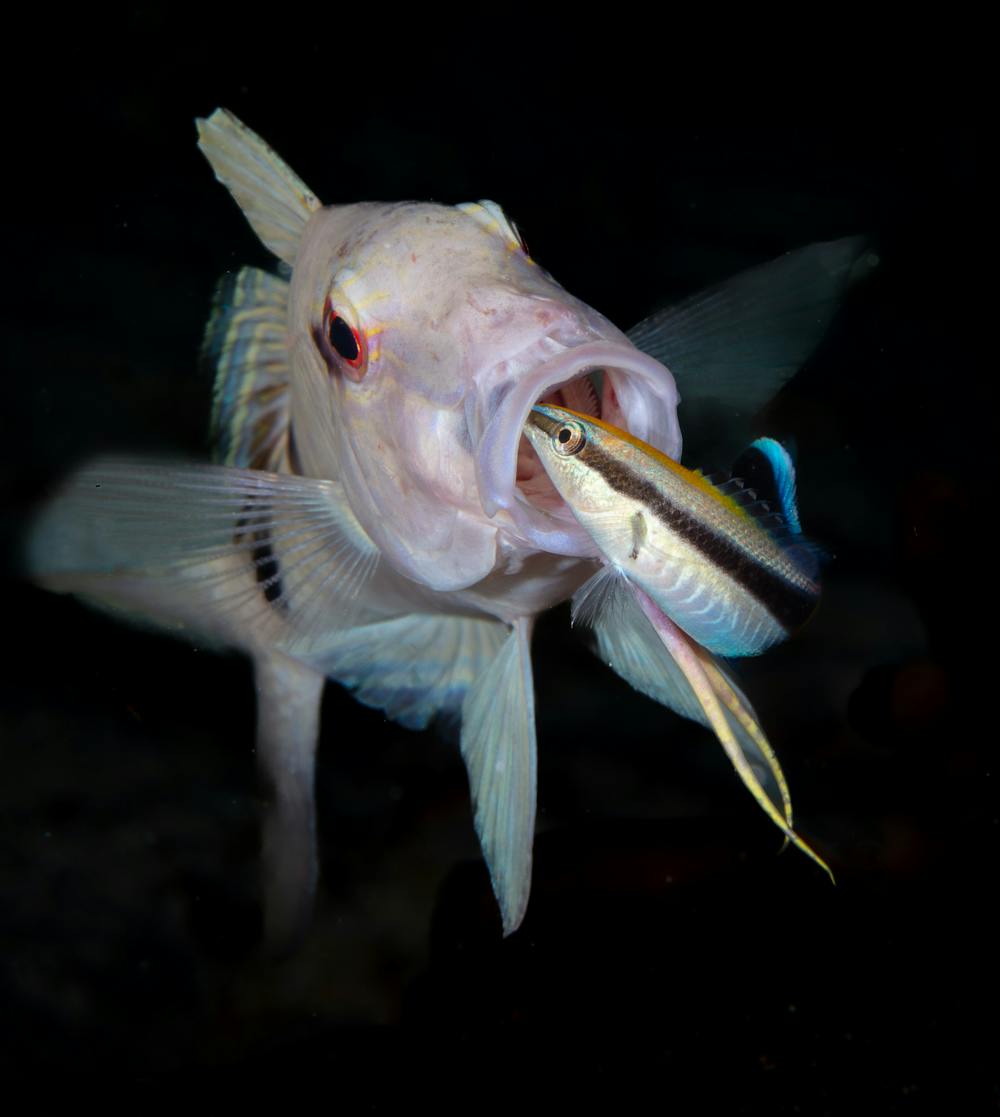
On the Great Barrier Reef, bluestreak cleaner wrasse establish “cleaning stations” where larger fish allow the wrasse to feed on dead skin, loose scales and invertebrate parasites living in their gills. This relationship is a classic mutualism – the larger fish lose costly parasites and the cleaner wrasse get fed.
Sometimes the cleaner wrasse “cheat” and nip their hosts, tipping the scale from mutualism to parasitism. The fish being cleaned may punish offenders by chasing them away or withholding further visits. In this, the reef fish exhibit something evolutionary biologists see as important to keeping mutualisms in balance: policing.
Could we adequately police our exploitation by smartphones and restore a net-beneficial relationship?
Evolution shows that two things are key: an ability to detect exploitation when it occurs, and the capacity to respond (typically by withdrawing service to the parasite).
A difficult battle
In the case of the smartphone, we can’t easily detect the exploitation. Tech companies that design the various features and algorithms to keep you picking up your phone aren’t advertising this behaviour.
But even if you’re aware of the exploitative nature of smartphone apps, responding is also more difficult than simply putting the phone down.
Many of us have become reliant on smartphones for everyday tasks. Rather than remembering facts, we offload the task to digital devices – for some people, this can change their cognition and memory.
Governments and companies have only further cemented our dependence on our phones, by moving their service delivery online via mobile apps. Once we pick up the phone to access our bank accounts or access government services, we’ve lost the battle.
How then can users redress the imbalanced relationship with their phones, turning the parasitic relationship back to a mutualistic one?
Our analysis suggests individual choice can’t reliably get users there. We are individually outgunned by the massive information advantage tech companies hold in the host-parasite arms race.
The Australian government’s under-age social media ban is an example of the kind of collective action required to limit what these parasites can legally do. To win the battle, we will also need restrictions on app features known to be addictive, and on the collection and sale of our personal data.
Rob Brooks receives funding from the Australian Research Council.
Rachael L. Brown does not work for, consult, own shares in or receive funding from any company or organisation that would benefit from this article, and has disclosed no relevant affiliations beyond their academic appointment.
Source: Hong Kong Government special administrative region
Missing man in Wong Tai Sin located
A man who went missing in Wong Tai Sin has been located.
Li Yiu-ming, aged 65, went missing after he left his residence in Ching Hong House, Tsz Ching Estate in the afternoon on May 28. His family made a report to Police on May 29.Issued at HKT 7:51
Source: Australian Ministers for Regional Development
The National Anti-Scam Centre is calling on businesses to join the fight against increasingly sophisticated scams by partnering and sharing data after Australians reported about $119 million in scam-related losses in the first four months of 2025.
The statistics, sourced from reports to Scamwatch, show that despite a 24 per cent drop in overall scam reports to 72,230, reported losses increased by 28 per cent to $118,993,148 compared to the same time last year.
However, the reported losses for early 2025 were 38 per cent below the $193.2 million in reported losses in the first four months of 2023.
The biggest increase in reported losses in 2025 came from phishing scams, which involve scammers impersonating entities such as government agencies or financial institutions, which accounted for $13.7 million in financial losses, compared to $4.6 million in early 2024.
“Scams are affecting Australians of all ages, often beginning with an unprompted or unexpected contact via social media and other digital platforms,” ACCC Deputy Chair Catriona Lowe said.
“Our approach to scam prevention is grounded in partnership. Sharing information is a key step towards improving community safety – organisations, such as banks, digital platforms, and telecommunication companies, can help disrupt scams faster and reduce the harm they cause.”
“The work of our fusion cells has demonstrated that a piece of data that may be unremarkable on its own, when joined with other pieces of data, can form powerful intelligence. With data held across the ecosystem, sharing data with the National Anti-Scam Centre enables those vital connections to be made,” Ms Lowe said.
The number of people reporting financial loss to social media scams increased by almost 50 per cent to 3,336 (up from 2,232 in 2024) and overall losses to these scams increased by 30 per cent to $23.4 million. Increases in the number of people reporting loss were also reported where initial scam contact occurred via digital channels including websites, email and mobile apps.
Phone scams appear to be declining, with an 11 per cent drop in reports compared to early 2024; however, they still account for the highest overall financial losses of any contact method, with $25.8 million lost in the first four months of 2025.
“While the average and median losses per victim have slightly decreased, the rise in overall financial loss and the number of people being impacted is a reminder to stay alert. We encourage all Australians to report suspicious scam activity, even if no money is lost as you can provide us with vital intelligence, and talk to friends and family to help spread awareness,” Ms Lowe said.
“Businesses in all industries also need to stay alert to the risk of scams and adapt their systems to keep customers safe.”
Scam Trends
Phishing scams had $13.7 million in financial losses reported to these scams, compared to $4.6 million in early 2024.
Investment scams also remain a significant issue, accounting for over half of all reported scam losses. In the first four months of 2025, Australians lost a total of $59 million to investment scams, a slight decrease of 1.4 per cent compared to last year. Despite this, investment scams continue to target vulnerable individuals with promises of high returns.
Scams through social media have increased considerably. There was a 50 per cent increase in people reporting financial loss through social media, with 3,300 reports totalling $23.4 million.
Older Australians aged 65 and over reported the highest total losses of any age group, totalling $33.1 million. However, younger Australians aged 25 to 34 (1,504 reports) and 35 to 44 (1,678 reports) were the most likely to report having lost money.
How to spot and avoid scams
STOP – Don’t give money or personal information to anyone if you’re unsure. Scammers will create a sense of urgency. Don’t rush to act. Say ‘no’, hang up, delete.
CHECK – Ask yourself could the call or text be fake? Scammers pretend to be from organisations you know and trust. Contact the organisation using information you source independently, so that you can verify if the call is real or not.
PROTECT – Act quickly if something feels wrong. Contact your bank immediately if you lose money. If you have provided personal information call IDCARE on 1800 595 160. The more we talk the less power they have. Report scams to the National Anti-Scam Centre’s Scamwatch service at scamwatch.gov.au when you see them. If you’re contacted on a messaging platform like WhatsApp or iMessage, please also report the scam in the app.
Background
The ACCC runs the National Anti-Scam Centre, which commenced on 1 July 2023, and Scamwatch service. The National Anti-Scam Centre is a virtual centre that sits within the ACCC and brings together experts from government, law enforcement and the private sector, to disrupt scams before they reach consumers.
The National Anti-Scam Centre analyses and acts on trends from shared data and raises consumer awareness about how to spot and avoid scams.
Scamwatch collects reports about scams to help us warn others and to take action to stop scams. It also provides up-to-date information to help consumers spot and avoid scams.
CALGARY, Alberta, June 01, 2025 (GLOBE NEWSWIRE) — Cenovus Energy Inc. (TSX: CVE) (NYSE: CVE) is providing an update on its Oil Sands operations following ongoing wildfire activity in northern Alberta. Cenovus is focused on the safety of its people and the integrity of its assets, and all staff are safe. Based on the inspections the company has completed to date, it is not aware of any damage to its infrastructure and would anticipate a full restart of Christina Lake operations in the near term.
As a precaution, currently only essential personnel are at the Christina Lake oil sands asset, where the company began safely and methodically shutting in production on May 29. Operations will resume as soon as it’s safe to do so. Approximately 238,000 barrels per day of production have been impacted, and the company will provide an update when it is in a position to restart.
Cenovus is closely monitoring the overall wildfire situation in Alberta. The company is grateful for the efforts of its teams who are working tirelessly to keep the company’s people and assets safe, and for the provincial emergency management teams and firefighters keeping communities safe.
Advisory Forward-looking Information This news release contains certain forward-looking statements and forward-looking information (collectively referred to as “forward-looking information”) about Cenovus’s current expectations, estimates and projections about the future, based on certain assumptions made in light of experience and perception of historical trends. Forward-looking information in this news release is identified by words such as “focus”, “anticipate” and “will” or similar expressions, including, but not limited to, statements about: safety; asset integrity; production impacts; and resumption of operations.
Except as required by applicable securities laws, Cenovus disclaims any intention or obligation to publicly update or revise any forward‐looking statements, whether as a result of new information, future events or otherwise. Readers are cautioned that the foregoing lists are not exhaustive and are made as at the date hereof. Events or circumstances could cause actual results to differ materially from those estimated or projected and expressed in, or implied by, the forward‐looking information.
For additional information regarding Cenovus’s material risk factors, the assumptions made, and risks and uncertainties which could cause actual results to differ from the anticipated results, refer to “Risk Management and Risk Factors” and “Advisory” in Cenovus’s Management’s Discussion and Analysis for the periods ended December 31, 2024 and March 31, 2025 and to the risk factors, assumptions and uncertainties described in other documents Cenovus files from time to time with securities regulatory authorities in Canada (available on SEDAR+ at sedarplus.ca, on EDGAR at sec.gov and Cenovus’s website at cenovus.com).
Cenovus Energy Inc. Cenovus Energy Inc. is an integrated energy company with oil and natural gas production operations in Canada and the Asia Pacific region, and upgrading, refining and marketing operations in Canada and the United States. The company is committed to maximizing value by developing its assets in a safe, responsible and cost-efficient manner, integrating environmental, social and governance considerations into its business plans. Cenovus common shares and warrants are listed on the Toronto and New York stock exchanges, and the company’s preferred shares are listed on the Toronto Stock Exchange. For more information, visit cenovus.com.
Māori Development Minister Tama Potaka today recognises the significant achievements of the Māori recipients in the King’s Birthday 2025 Honours List, for their dedicated mahi and outstanding contributions across various important areas.
“The impressive mahi of Māori recipients this year are too numerous to mention. They have been honoured for achievements across many fields, coming from Iwi right across New Zealand – it is my privilege to recognise all of them today and to highlight just some examples,” Mr Potaka says.
“The King’s Birthday Honours recognise the commitment and the passion that the recipients have shown, along with what has come from their dedication to their work and their causes.
“Among those recognised are, Mrs Deborah (Debbie) Davis, who has done extensive work to bring so much good, including through He Iwi Kotahi Tātou Trust, the grassroots organisation transforming the community of Moerewa in Northland, along with her husband, Mr Ngahau Davis (Ngāpuhi, Ngāti Manu, Kohatutaka)
“Mrs Davis (Ngāti Pāhauwera, Ngāti Kahungunu) has worked, through the Trust since 1987, to address challenges including housing, food security within the community, and youth engagement. Her and her husband’s work helped to provide insulation and heating solutions to more than 12,000 Northland homes since 2008.
“They have developed food rescue programmes and have introduced cultural and sports programmes that blend physical activity with the preservation of Māori traditions. They have expanded whānau support services to offer counselling, school programmes, and drug and alcohol programmes. Over the past 15 years, they have been involved in the establishment of a rehabilitative-focused sentencing in Kaikohe, Matariki Court.
“Hon Dover Samuels is recognised for services as a Member of Parliament and his achievements and what he progressed in that time, including as Minister of Māori Affairs.
“Mr Samuels (Ngāpuhi, Ngāti Kura, Ngāti Rēhia) was a Labour MP and MP for Te Tai Tokerau, working across various portfolios, including not least Māori Affairs, where his care and ability made considerable gains that continue to benefit Māori today. He also helped establish Rawene Health Hub for a rural Māori community and led the Rainbow Warrior project to sink the wreckage of the vessel and erect a memorial on Matauri Hill. He is kaumatua of several organisations.
“Mrs Elizabeth (Liz) Graham, who has dedicated more than 40 years to her community and to Māori education.
“Mrs Graham (Ngāti Kahungunu, Ngāi Toroiwahi), has contributed to her community in many ways – that includes through the education of our tamariki and to the education sector through many roles across her career, work she continues today as a teacher at Te Aute College. She helped guide her community through the Treaty Settlement process, and her knowledge of traditions, values, and customs, has helped the marae in hosting funerals, weddings, gatherings, and other events for over 20 years.
“The Honourable Sir Mark Cooper KC, High Court Judge, Court of Appeal Judge and President of the Court of Appeal, who was Chairperson of the Royal Commission of Inquiry into Building Failure caused by the Canterbury Earthquakes.
Sir Mark (Ngāti Mahanga, Waikato-Tainui) chaired 33 public hearings to deliver four reports, all of these under intense time pressure and public scrutiny. The detailed findings and recommendations of those reports helped avoid delay to the Canterbury rebuild and helped provide a resolution to the community.
Amongst some of his other work has been his leadership in resource management and local government law, and his work that helped integrate various councils into one North Shore-based Council.
I want to thank all of today’s recipients, those mentioned here and all others who I trust will be celebrated by their people and their communities, and all the people who have worked with them along the way.
The King’s Birthday 2025 Honours List recognises the outstanding depth of talent, dedication, and leadership across New Zealand’s sport sector, says Sport and Recreation Minister, Mark Mitchell. “I would like to particularly acknowledge the appointment of Catriona Williams as a Dame Companion of the New Zealand Order of Merit. As a former top equestrian rider, she became a tetraplegic after a riding accident in 2002. She has since turned adversity into advocacy, founding The CatWalk Spinal Cord Injury Trust in 2005 and raising significant funds and awareness for spinal cord injury research. Two of our cricketing greats, Sophie Devine and Timothy Southee, have also been recognised as Officers of the New Zealand Order of Merit. “Sophie Devine has led the White Ferns through international campaigns, including a T20 World Cup win in 2024 and a bronze medal at the 2022 Commonwealth Games. She is a cricket icon and powerful role model for the next generation. “Tim Southee’s legacy in cricket is vast. He became the only player to have achieved 300 Test, 200 ODI, and 100 T20I wickets. His influence goes beyond the pitch, as a mentor and leader whose impact on the sport will be felt for years to come.” Sarah Walker has also been appointed an Officer of the New Zealand Order of Merit for her services to BMX and sport governance. “Sarah’s success spans from Olympic podiums to global sports leadership. As an Olympic silver medallist and now a member of the International Olympic Committee, she has championed athlete rights and inspired countless young New Zealanders. Murray Mexted for his services to rugby, is another notable recipient. “As a legend of the game, both on the field as a formidable All Black, and as a charismatic and influential voice in rugby commentary, his commitment to rugby in New Zealand is something we are all proud of. “My congratulations to all our sportspeople honoured this year. Your contributions continue to shape New Zealand’s sporting legacy and inspire us all,” says Mr Mitchell.
Statement by IMF MD Kristalina Georgieva on the Passing of Former IMF FDMD Stanley Fischer
June 1, 2025
Washington, DC: Kristalina Georgieva, Managing Director of the International Monetary Fund (IMF), issued the following statement today after news of the death of Mr. Stanley Fischer, former IMF First Deputy Managing Director:
“We are deeply saddened to learn of the passing of our dear friend Stan Fischer, who among many career achievements, served as the First Deputy Managing Director of the IMF between 1994 and 2001. Stan will be remembered for his enormous influence on the economics profession, first as a leading academic and teacher, then as an accomplished policymaker across many prominent posts. During his time at the IMF, he helped lead the Fund’s response to a number of significant challenges, including the Mexican crisis of 1994 and the 1997 Asian financial crisis. To this day, Stan is deeply admired by Fund staff, management and the membership for his intellectual leadership, personal integrity, and dedication to public service. He believed strongly in the Fund’s core mission, as he put it: ‘to promote principles of good economic citizenship, and provide a forum for countries to discuss issues of mutual interest.’
“As an academic at the University of Chicago and MIT, Stan’s research had a profound effect on the field of macroeconomics, becoming a leading figure in the New Keynesian movement. Stan taught, mentored and influenced many leading policymakers and thought leaders. During his extraordinary policymaking career, he served as Chief Economist of the World Bank before becoming First Deputy Managing Director of the IMF. From 2005 until 2013, he served as Governor of the Bank of Israel, helping to steer the Israeli economy through the global financial crisis. He then became Vice-Chair of the Board of Governors of the Federal Reserve System in 2014, serving in that role until 2017. As a central banker, he was a staunch proponent of inflation targeting frameworks, transparency, and central bank independence.
“On behalf of the IMF, I extend my deepest condolences to Mr. Fischer’s three children Michael, David and Jonathan and their families. Stan led a life of exemplary public service, matched only by his innate goodness as a colleague, friend and human being.”
As we head into a new month of streaming, here’s a fresh wave of TV ready to challenge, transport and entertain you.
This month’s picks span genre and geography, from an eerie dystopian Buenos Aires, to a witty, awkward cyborg hero. Reality TV also gets a scandalous twist with the return of The Secret Lives of Mormon Wives. And Deaf President Now! delivers a powerful documentary on a historical milestone for Deaf rights.
There’s something for every kind of viewer — and every kind of mood.
The Eternaut
Netflix
Argentine sci-fi The Eternaut opens with a group of old friends in Buenos Aires meeting to play the card game truco on a hot summer night – when things suddenly get eerie.
The power goes out and a poisonous snowfall starts to blanket the city, killing thousands of people instantly. The survivors must get answers, quickly, as they start to grasp the true strength of their invisible enemy.
Based on Héctor Germán Oesterheld’s 1950s comic of the same name, The Eternaut portrays apocalypse through a deeply local and political lens – and in doing so has struck a chord in Argentina.
Directed by Bruno Stagnaro and led by Argentine film icon Ricardo Darín, as protagonist Juan Salvo, the series emphasises the power of collective heroism, and subtly critiques the current government’s uncompromising neoliberal approach.
It also pulses with national pride. Buenos Aires is not glamorized; real neighbourhoods are shown as classic Argentine tango, rock and folk plays in the background. Most importantly, Argentine identity is celebrated through themes of community spirit, grassroots resistance, and ingenuity in times of crisis.
The Eternaut feels both timely and timeless. Its slogan, “no one survives alone,” resonates for a country that has been long marked by both trauma and resistance efforts.
Its emotional weight is further deepened by Oesterheld’s legacy, including the tragic disappearance of him and his family members under the military rule of the 1970s.
With a second season on the way, this series is a powerful ode to Argentina.
Murderbot, Apple’s adaptation of Martha Wells’ science-fiction novella, All Systems Red (2017) is a satisfying combination of action, sci-fi and comedy. The show centres on a security unit (SecUnit) – an indentured private security cyborg – who secretly cracks the programming of its governing chip, granting itself autonomy.
Murderbot (Alexander Skarsgård), as it dubs itself, is both horrified and fascinated by humans. It’s far more afraid of eye contact, emotions and direct conversation than any physical danger. It’s also obsessed with mainlining media, particularly the ridiculous soap opera The Rise and Fall of Sanctuary Moon.
Murderbot is hired, reluctantly, by some hippy scientists from a group of “freehold” planets – ones that exist outside the Corporation Rim – to act as protection on a scientific expedition. It goes quickly awry.
Wells’ award-winning novella, the first in an equally good series, limits us to the first-person perspective of the sarcastic cyborg. The series expands this frame beautifully, building on the source material’s dry humour to create a world that is both goofy and grounded.
And while there are serious themes at play, such as the way SecUnits are effectively enslaved, and the violent capitalist dominance of the Corporation Rim, the show is not heavy. Skarsgård offers a pitch-perfect performance of the awkward, anxious robot – its eyes flickering in horror as the scientists try to befriend it.
The opening minutes of the first episode are clumsy and on-the-nose, but ignore them. This otherwise well-designed and well-directed show cracks along with brisk, highly-entertaining 22-minute episodes.
– Erin Harrington
The Secret Lives of Mormon Wives, season two
Disney+
Season one of The Secret Lives of Mormon Wives had us hooked at the end of 2024. Now, the women have returned for an explosive 10-episode second season.
The reality series follows a group of Mormon women living in Utah. While the title may have you anticipating stories of faith and motherhood, the show is more focused on the personal lives of Mormon mothers who rose to TikTok fame due to scandal and infamy.
Season one saw the women grapple with balancing traditional Mormon values with their online lives and subsequent businesses (along with the fallout from a “soft-swinging scandal”). Season two further highlights infidelity, jealously and money.
Old characters are brought back, with finger-pointing ex-husbands and former alienated friends adding to the fray. Police are called, insults are thrown and many of the women delve deeper into their pasts.
The show flips flops between difficult moments such as processing the death of loved ones and difficult pregnancies, with parties and poorly executed party games. At one point the women play pregnancy roulette (a game no one should recommend), and take pregnancy tests which are anonymously read out to the group. Chaos ensues.
And after watching, you can search for the TikTok accounts of the stars and watch new drama unfold in real-time – or watch them “correct” and expand on past situations based on their own perspectives – far removed from show’s editors.
– Edith Jennifer Hill
Deaf President Now!
Apple TV+
Deaf President Now! is a stirring documentary about an iconic student uprising at Gallaudet University, the world’s only Deaf university, in 1988. The film chronicles how Deaf students – tired of being led by hearing leadership – decided to take things in their own hands come the 1988 Gallaudet presidential election.
With two of the three candidates being Deaf, the appointment of Elisabeth Zinser, a hearing candidate unfamiliar with Deaf culture, sparked outrage. Fuelled by decades of marginalisation, the students barricaded campus gates, burned effigies of Zinser and marched to the Capitol, calling for Deaf leadership in Deaf spaces.
It worked. The protest forced Zinser’s resignation and ushered in Irving King Jordan, Gallaudet’s first Deaf president.
The film juxtaposes historic footage with present-day interviews with key leaders of the movement, allowing them to tell their stories their own way. These reflections, delivered in American Sign Language (ASL), underscore how storytelling itself can become an act of resistance for Deaf people.
At the same time, the documentary wrestles with a paradox. Co-directed by Deaf activist Nyle DiMarco and hearing filmmaker Davis Guggenheim, the film exemplifies how Deaf storytelling still often has hearing involvement, especially when the story is packaged for a mainstream audience.
Nevertheless, the release of Deaf President Now! couldn’t have been more timely. With disability rights in the United States threatened under Trump, the film is a call to action. It reminds us Deaf culture isn’t just about language: it’s about Pride, self-determination and visibility.
In Lorcan Finnegan’s The Surfer, our unnamed protagonist (Nicolas Cage) is returning to his former Australian home from the United States. He is newly divorced, and trying to buy a beachside property to win back his family.
He takes his teenage son (Finn Little) for a surf near the property, but they are run off by an unfriendly pack of locals.
Returning alone to the beachside car park to make some calls, he is besieged there by the same gang, and this continues over the next several days. The gang is led by a terrifying middle-aged Andrew Tate-esque influencer, Scally (Julian McMahon), who runs the beach like a combination of a frat bro party and wellness retreat.
It is impossible to think of an actor other than Cage who could make a character like this so enjoyable to watch. Cage’s distinctively American confidence has no resistance to the terrifying switches of Australian masculinity from friendly to teasing to violent.
The Surfer is an absolute blast. A lot of the fun is in anticipating each dreadful humiliation – and it somehow turning out worse than you could have expected.
The Surfer beautifully captures the natural surroundings, stunning views and shimmering heat of Australian coastal summer. At the same time, a confined, semi-urban feature like a beachside car park feels bleak and uninviting.
As a film setting, it is both a spectacular wide-open vista and stiflingly claustrophobic – a perfect mechanism for The Surfer’s psychological horror.
The story of serial killers, Fred and Rose West, has been highly narrativised since their shocking crimes were discovered in Gloucester in 1994. The horror of the Wests lies in the juxtaposition of their seemingly ordinary suburban family and what was hidden beneath the foundations of their home.
Fred and Rose West: A British Horror Story takes us back to the moment of that revelation via previously unheard interview tapes and recordings of the property search – and of Rose while she was kept in a safe house. Family home videos add to the disturbing sense of the couple’s duplicity.
Interviews with the family of some of the victims emphasise the ongoing pain caused by the Wests, who preyed on vulnerable young women. Meanwhile, Fred’s interviews reinforce his determination to protect his wife: “I trained Rose to do what I wanted. That is why our marriage worked out so well.”
Many details of the Wests’ true horror, however, are absent: the incredible torture suffered by the victims; Fred and Rose’s own childhoods of abuse and Fred’s earlier assault of young girls, including his own sister; and any reference to the couple’s surviving children and the extraordinary abuse they suffered.
The horror of this new documentary is present in the couple’s habitual lies, their casual attitude to violence and murder, and their refusal to take responsibility for their many crimes. Yet it only scratches the surface of the Wests’ true horror story.
– Jessica Gildersleeve
The Four Seasons
Netflix
The Four Seasons follows three 50-something affluent couples as they holiday together over the course of a year.
Friends since college, the group’s easy camaraderie is upended by Nick’s (Steve Carroll) bombshell decision to leave his seemingly unsuspecting wife, Anne (Kerri Kenney-Silver), after 25 years of marriage. The announcement sends shockwaves through the other couples, testing their own relationships.
Adapted from Alan Alda’s bittersweet 1981 comedy of the same name, the series preserves the film’s narrative conceit, unfolding over four seasonal mini trips. Episode one opens in full spring at Nick and Anne’s bucolic lake house.
Given the luxury on display, you’d be forgiven for mistaking The Four Seasons as another entry in the “rich-people-behaving-badly” genre. But while there’s plenty of quips and snarky humour, what unfolds is ultimately much kinder – less a scathing indictment of wealth and more a gentle exploration of the banalities of love and middle age.
The show’s creators make the most of the expanded running time to humanise the sextet. The open marriage between gregarious Italian Claude (Marco Calvini) and husband Danny (a marvellous Colman Domingo) updates the source material without sliding into tokenism or homonormativity.
The prickly Type-A Kate (Tina Fey) and peacekeeper Jack (Will Forte) provide the series’ beating heart, in a relationship that feels lived-in and familiar.
Despite its focus on ageing, loss, mortality and grief, The Four Seasons offers comfort viewing at its finest, best enjoyed with a cup of tea and a loved one who’s known you for decades.
– Rachel Williamson
Gemma King receives funding from the Australian Research Council.
Claudia Sandberg, Edith Jennifer Hill, Erin Harrington, Grace Russell, Jessica Gildersleeve, Rachel Williamson, Samuel Martin, and Sofya Gollan do not work for, consult, own shares in or receive funding from any company or organisation that would benefit from this article, and have disclosed no relevant affiliations beyond their academic appointment.
With the Reserve Bank of Australia easing monetary policy, interest rates are on the way down.
Already this year, mortgage pre-approvals had begun to rise, suggesting many aspiring home buyers are excited by the prospect of cheaper home loans.
With further cuts expected before the end of the year, some economists are predicting we could be on the cusp of another house price boom. Lower interest rates enable people to borrow more and potentially spend more on homes, bidding up prices.
So, how might the Reserve Bank’s actions affect home buying behaviour and the housing market more broadly? Research offers us some clues.
How rates affect prices
Researchshows that when a central bank lowers its benchmark interest rate, mortgage interest rates usually follow suit.
We saw this following the Reserve Bank’s May decision to cut rates. Australia’s big four banks immediately announced similar reductions in rates for new and existing borrowers.
Lower rates reduce the cost of servicing a loan. This is a big deal for Australian home buyers, whose mortgages can be very large.
With the average house price in Australia now hitting about $1 million, an 80% loan saddles the typical home buyer with $800,000 in debt.
Back in March, the average interest rate on new mortgages was 6%. For the average million-dollar house, this implies a monthly repayment of around $4,796, using the standard formula for amortising loans.
After the Reserve Bank cut the cash rate by 0.25 percentage points, this implies a new monthly repayment of $4,669 – $127 less. That’s a small, but surely welcome, relief for mortgage holders.
Combined with the Reserve Bank’s prior rate cut in February, such borrowers are now saving more than $250 a month relative to the start of the year.
Everyone can borrow more
Lower rates can also improve the borrowing capacity of new home buyers.
Before a bank issues a new mortgage, it weighs the ability of a borrower to service the loan. It does this by considering the amount of income they’ll have left over after meeting typical expenses.
This is known as a borrower’s “net income surplus”, and the proportion of this that is used to service a loan is known as the “net surplus ratio”.
The maximum ratio is capped at 90%, but the typical mortgage is lent against a ratio of less than 70%.
If a household earns $100,000 per year and allocates 25% to expenses, it can afford $4,375 in monthly mortgage repayments at a 70% net surplus ratio.
Given the previous interest rate of 6%, this maximum monthly repayment implies the household can afford to borrow $680,000. But after a 0.25 percentage point rate cut, this household can now afford a $695,000 home loan.
And following the 0.50 percentage points of cuts we’ve seen since January, this household’s borrowing capacity is up by $30,000.
Pulling up the ladder
For an individual home buyer, this extra borrowing may be enough to secure that dream home. But the rate cut affects everyone at the same time, increasing the borrowing capacity of home buyers all over the country.
All of this extra mortgage credit feeds housing demand, which is likely to pour more fuel into an already overheated market.
Indeed, recentresearch indicates that a 0.25 percentage point cut in the cash rate will likely lead to a 1.5–2% increase in average house prices over the following one to two years.
That’s an extra $20,000 on the current $1 million average home value.
Research also suggests the impact of interest rates across local housing markets may be strongest where housing supply is tightest and houses are already more expensive.
Mortgages get bigger
While lower rates reduce the cost of a given mortgage, the average mortgage size needs to grow to keep up with higher prices.
Recall that the monthly payment associated with an 80% loan on a million-dollar home at 6% interest was $4,796. If the interest rate falls by 0.25 percentage points but house prices rise by 2%, the new monthly payment is little changed, at $4,762.
On top of this, the 20% down payment on that new home will now have increased – by $4,000.
Despite the initial excitement of lower rates, aspiring home buyers may be disappointed to see the price of their dream home climb further out of reach. Some may end up no better off than they had been previously.
Others might try to snap up a home before lower rates are completely priced in – motivated by a fear-of-missing-out (FOMO). Research suggests it can take a year or more before house prices peak following a rate change.
And others still may decide to keep renting for the time being. Fortunately for them, recent research shows that changes in interest rates do not materially affect the rents that landlords charge their tenants.
Finally, one option is holding savings in the stock market while they wait, perhaps diversified via exchange-traded funds, as these assets usually rise in value following an interest rate cut.
It’s never a good idea to panic. It’s always important to think through your options before diving into the market. And remember, our discussion here is only for general information and is not intended to be financial advice. All investments carry risk.
James Graham has received research funding from the Australian Housing and Urban Research Institute and is a member of Sydney YIMBY.
We all want homes that keep us warm in winter and cool in summer, without breaking the bank. However, Australian homes built before 2003 have a low average energy rating of 1.8 stars out of 10. This means they’re often uncomfortable to live in and expensive to run.
There’s a strong case for a “renovation wave” of home energy upgrades across Australia. Reducing the use of fossil gas and improving the energy efficiency of existing housing by nearly 50% is also central to achieving net zero emissions by 2050.
Energy-saving upgrades such as solar panels, batteries, insulation, draught-proofing and hot water heat pumps also reduce the cost of energy bills. So while there’s an upfront cost, upgrades can reduce household expenses in the long run.
We wanted to find out what’s holding people back from getting energy-saving upgrades. We surveyed 100 Australian households and interviewed 19 people about their experiences. Our new research revealed five major barriers that stop these upgrades from being accessible to most households. Suppliers, governments and community organisations can all help overcome these barriers.
Embarking on home energy upgrades can be an emotional rollercoaster ride. RACE for 2030
1. Information about upgrades is confusing and overwhelming
Households told us the amount of information out there about energy saving upgrades is overwhelming and sometimes conflicting. There are many different types of upgrades and product choices, making it challenging to identify which options provide the best value and what to do first. People found it difficult to know what information and which suppliers to trust.
Households need clear information from a trusted source about what their homes need. Many governments internationally, such as Scotland, provide online resources and tools to provide tailored advice to help with this.
Energy upgrade programs run by neutral community organisations and councils can also help, such as Rewiring Australia’s Electrify 2515 or Geelong Sustainability’s Electric Homes Program. These programs use their expertise to vet suppliers and ensure households receive good deals and high quality products.
2. Homes need to engage multiple suppliers and tradespeople
Many households worked on their home gradually, one upgrade at a time. Each upgrade involved a labour-intensive process of researching products, selecting companies, getting quotes and managing the disruptions caused by the installation. One Sydney homeowner told us:
The process of needing both a plumber and an electrician to change to induction cooking was frustrating. [We had to] to coordinate availability times and appliance delivery.
Australians need companies that can do multiple upgrades at once, to simplify and streamline the process. In Ireland, the government helped stimulate a market for organisations that can cover all the upgrades needed by a household.
Ireland has “One Stop Shops” for home energy upgrades (Sustainable Energy Authority of Ireland)
3. Households are losing opportunities for straightforward upgrades
Every year, Australians invest billions in home renovations. They spent more than A$3 billion in the December 2024 quarter alone.
One of the best times to improve your home is during major renovations or when old appliances, such as hot water systems, break down. If you’re already facing disruptions and need to spend money, it can be an easy and more cost-effective way to increase your home’s energy efficiency at the same time.
Yet our research found advice on energy-saving upgrades was rarely provided to people undertaking major renovations or emergency replacements unless they asked for it. Households needed to seek out builders, architects and tradespeople who specialised in sustainability to get advice on an energy-saving renovation.
Providing energy upgrades to homes should be a standard component of modern renovations. Otherwise, households are missing out on easy and more affordable opportunities to get these upgrades.
4. Many tradespeople lack knowledge of energy-saving upgrades
Our research found tradespeople are the most common point of contact for households. They can be a valuable source of information and advice to facilitate upgrades. However, many households reported difficulty finding tradespeople knowledgeable about – and willing to install – energy-saving upgrades.
Some upgrades, such as solar panels, require specialised workforces. Others, such as hot water heat pumps are usually installed by regular plumbers and electricians.
Some tradespeople lack the knowledge to advise on energy-saving upgrades or need training to install new technologies to a high standard. This situation leaves households vulnerable to misinformation, with a shortage of skilled workers to do their upgrades.
Tradespeople require increased support and incentives to make energy-saving measures part of their skill set. This is especially true in regional areas, where there are fewer products and workers available.
5. The costs are too high for many households
A final, significant barrier was the cost of home upgrades, which often caused households to drop out early in the process. Australian households, particularly those with less disposable income, need more help with the upfront cost.
One way to do this is through targeted government rebates, which are currently only available in some regions. Another is affordable and accessible financing, like that available in Tasmania and the ACT. The national Home Energy Upgrades Fund could also be extended to make sure available finance matches the scale of the challenge.
Also needed are long-term reforms such as mandatory disclosure of energy performance when homes are sold and minimum energy standards for rental properties, which are currently only required in some jurisdictions in Australia. When these are both addressed we can make comfortable, and affordable homes the norm rather than the exception.
Keeping warm in winter and cool in summer is the number one motivation for energy saving upgrades. RACE for 2030
A worthwhile journey
Roadblocks aside, households also shared the joy and satisfaction of completing home energy upgrades. While the journey was often difficult, those who reached the end of the road were overwhelmingly pleased with the results. A homeowner who had installed solar panels and undertaken draught-proofing and insulation in Adelaide said:
It’s nice not to have huge electricity bills, and but I find it’s that day to day stuff of actually being comfortable that makes the biggest difference.
This research was undertaken by Jaime Comber, Kamyar Soleimani, Ed Langham, Nimish Biloria, Leena Thomas and Kerryn Wilmot from the University of Technology, Sydney.
Jaime Comber received funding for this research as part of the Energy Upgrades for Australian Homes (EUAH) initiative – a national collaboration between research, industry and government partners to enable scalable, community-led energy upgrades. EUAH is funded through the RACE for 2030 cooperative research centre, which includes contributions from the NSW Government, Government of South Australia and Knauf Insulation. The project is led by Climate-KIC Australia and Monash University.
Ed Langham undertakes contract research for government, community and consumer advocates, and the clean energy industry. This research was funded as part of the RACE for 2030 Cooperative Research Centre’s Energy Upgrades for Australian Homes project, which is co-funded by Australian Government, NSW Government, Government of South Australia and Knauf Insulation. Ed is also affiliated with Schumacher Institute for Sustainable Systems, based in the UK.
Nimish Biloria receives funding through the RACE for 2030 Cooperative Research Centre. This research was undertaken as part of the Energy Upgrades for Australian Homes initiative, which is funded in part by the NSW Government, the Government of South Australia, and Knauf Insulation. Before this, Nimish Biloria has received funding from various governmental bodies, not-for-profit organizations, and the Industry such as the Department of Industry, Innovation and Science, Australian Renewable Energy Agency (ARENA), City of Sydney, AusIndustry Smart Cities and Suburbs Program, Transport for New South Wales, Commonwealth Bank of Australia, Leigh Place Aged Care, Sydney, NSW, HMI Technologies.
In an emergency, police are often the first called to the scene. But they are rarely equipped to deal with complex mental health crises.
Following recent parliamentary inquiries and royal commissions there has been a push – led by researchers, advocates and some senior police officials – for a shift to a health-led and paramedic-first response.
South Australia is one of a number of states trialling a program based on a “co-responder” model. This means trained specialists accompany police to some mental health call-outs in the community.
So, how do co-responder programs work? And are they effective? Here’s what the evidence says.
The current situation
Mental health legislation in all states and territoriesgives police the power to use “reasonable force” to transport people who “appear to have a mental illness” to hospital to prevent harm.
In most cases, this involves police taking people experiencing mental health crises to hospital emergency departments, without help from mental health clinicians or paramedics.
Those who need mental health support may not need a hospital stay.
One study found only one in five (23%) of those taken to emergency by police – usually after expressing intention to self-harm – were admitted.
The strain on police resources is also significant. For example, in New South Wales, police now respond to triple zero calls about mental health crises in the community every nine minutes (in Victoria it’s every ten).
Criminalising mental health
The mere presence of police alone can escalate already heightened emotional situations.
Yet the main reason police take people to hospital is for self-harm or suicidal distress, and most are not deemed to be of risk to others.
What do people with mental health issues want instead?
In our research, conducted in 2021–2022, we interviewed 20 people across Australia who’d had police intervene when they had a mental health crisis.
Those we spoke to often had multiple experiences of police call-outs over their lifetime.
They told us excessive use of force by police had traumatising and long-term effects. Many were subject to pepper spray, tasers, police dogs, batons, handcuffs and restraints, despite not being accused of committing criminal offences.
For example, Alex*, said:
I was having an anxiety attack, and they pepper sprayed me. I had bruises all over my hands from the handcuffs they put on really roughly, even though I wasn’t under arrest. Then they took me to hospital.
In our study, people with mental health issues said they would prefer an ambulance-led response wherever possible, without police attending at all.
They also wanted to be linked to therapeutic and community-based services, including mental health peer support, housing, disability support and family violence services.
What are co-responder programs?
Co-responder programs aim to de-escalate mental health incidents, reduce the number of emergency department presentations and link people experiencing mental health crises with services.
These programs, such as the one being trialled in South Australia, mean mental health clinicians (for example, social workers, counsellors or psychologists) attend some mental health incidents alongside police.
Peer-reviewed research shows these kinds of responses can be effective when compared to traditional police-led interventions.
The success of programs in the United States and Canada shows many mental health crises can safely managed without police involvement, for example by addressing issues such as homelessness and addiction with health workers, and reducing the number of arrests.
Co-responder programs are not universally available. Often, they do not operate after usual business hours or across regions.
There is also a lack of long-term evaluations of these programs. This means what we understand about their implementation, design and effectiveness over time can be mixed.
More broadly, the mental health sector is facing significant and ongoing labour shortages across Australia, posing another resourcing challenge.
How can responses to mental health crises be improved?
Last year, the final report from the Royal Commission into Victoria’s Mental Health System recommended paramedics should act as first responders in mental health crises wherever possible, instead of police, diverting triple zero calls to Ambulance Victoria.
However that reform has been delayed, with no indication of when it may be implemented.
A 2023 NSW parliamentary inquiry also remarked on the need to explore reducing police involvement.
Co-responder and ambluance-first models offer an improvement.
But our research suggests people with lived experience of mental health issues want more than ambulances replacing the police as crisis responders.
They need a mental health system that supports them and provides what they needed, when they need it: compassionate, timely and non-coercive responses.
*Name has been changed.
If this article has raised issues for you, or if you’re concerned about someone you know, call Lifeline on 13 11 14.
Panos Karanikolas is a member of the Victorian Mental Illness Awareness Council (VMIAC). He received funding for this research from the National Disability Research Partnership as part of a partnership with VMIAC.
Chris Maylea receives funding from the Australian Research Council, National Health and Medical Research Council, and national and state legal aid commissions.
Hamilton Kennedy does not work for, consult, own shares in or receive funding from any company or organisation that would benefit from this article, and has disclosed no relevant affiliations beyond their academic appointment.
Source: The Conversation (Au and NZ) – By Maria Maley, Senior Lecturer in Politics, School of Politics and International Relations, Australian National University
Three and a half years ago, then-sex discrimination commissioner Kate Jenkins’ Set the Standard report was handed to federal parliament, commissioned after Brittany Higgins’ allegations of sexual assault in Parliament House, which had shocked the public and politicians alike. Since then, work has been underway to implement its 28 recommendations.
The report found unacceptable levels of sexual harassment, bullying and misconduct in parliamentary workplaces, and laid out a radical plan to create a standards regime. The plan would provide tools to deal with such conduct, and try to prevent it by changing the culture of parliament.
In 2025, parliament’s implementation of the Jenkins review is due to be evaluated by an external independent reviewer. Have the recommendations been implemented? What are the prospects for continued reform of conduct in the parliamentary workplace? Will the election of an historic number of women into parliament create pressure for further reform?
Action after the review
On February 8 2022, the first sitting day of federal parliament after the Jenkins review had been handed down, both houses of parliament made an historic statement of acknowledgement and apology to the victims of misconduct in its workplace. It stated:
We say sorry. […] This place and its members are committed to bringing about lasting and meaningful change to both culture and practice within our workplaces. We today declare our personal and collective commitment to make the changes required.
Parliamentarians committed to implement all 28 recommendations of the Jenkins review. A cross-party body was created to lead the implementation process.
Known as the Parliamentary Leadership Taskforce, it had members from both houses of parliament, ministers and legislators, Labor, the Coalition, the Greens and one independent parliamentarian. It worked hard for three years to design and put in place the rules and mechanisms laid out in the Jenkins review, before disbanding in September 2024.
The magnitude of the changes parliament had to make should not be understated. Among many ground-breaking reforms, it involved developing codes of conduct and a body to enforce them by investigating complaints about breaches of the code.
In February 2023, both houses of parliament agreed on codes of conduct. In October 2024, an Independent Parliamentary Standards Commission was established to receive complaints, investigate and make findings about misconduct. There are seven commissioners, appointed from outside parliament, who are lawyers, former public servants, tribunal members and ex-ombudsmen. For the first time, there will be external independent review of parliamentarians’ conduct.
An independent human resources body for the parliamentary workplace was also created, known as the Parliamentary Workplace Support Service. These are huge achievements and represent historic reforms.
In line with Jenkins’ recommendations, the taskforce committed to an external independent review of parliament’s implementation of the Jenkins report.
But has it been effective?
It is hard to evaluate new rules, systems and bodies that are in their infancy, but one part of the new standards architecture does not represent best practice. After the Independent Parliamentary Standards Commission has completed an investigation of a parliamentarian’s conduct, made findings and recommended sanctions, it will hand its report to the privileges committee in each house.
The privileges committees are made up of parliamentarians, almost exclusively members of the major parties. It is up to these committees to decide on any action to be taken. We won’t know if they depart from the commission’s recommendations, as standards commission reports are not public.
In the United Kingdom House of Commons, which represents best practice in this area, independent investigation reports are handed to a parliamentary committee called the Committee on Standards. Half the members of that committee are MPs, but half are “lay members” – that is, appointed members of the community, including lawyers and HR professionals.
The House of Commons established its standards regime in 2018, and has reviewed and improved it over time. Lay members were placed on the committee because it was evident MPs found it difficult to judge the conduct of their peers and struggled to hold them accountable.
Unfortunately Australia’s new standards system leaves decisions in the hands of parliamentarians, without the corrective and robustness that members of the public would provide. Will the federal parliament continue to reform and reshape its arrangements if they prove not to be robust enough?
Ongoing leadership is needed if parliament is to continue to address conduct issues, drive culture change and refine and develop its new standards regime. Some believe the culture of parliament has improved since the Jenkins review. Others disagree.
There are still recommendations of the review that have not been addressed. These include developing a ten-year strategy to increase diversity in the workplace, establishing a health and wellbeing service in parliament, and introducing an alcohol policy. Now that the Parliamentary Leadership Taskforce has disbanded, who will continue to advance the reform process?
In October 2024, parliament decided to create a Parliamentary Joint Committee on Parliamentary Standards. Its functions include reviewing the operation of the new codes and the Independent Parliamentary Standards Commission.
This committee should play a leadership role on conduct and culture issues, but its membership is tightly restricted. The government dominates positions and all members must also be members of the privileges committees. Presiding officers are not permitted to sit on the committee, despite their important leadership roles and responsibilities in parliament. Crossbenchers and independent parliamentarians are largely locked out of the committee (only two positions are reserved for them), despite the fact they have often been the leading voices calling for culture change.
With the influx of many more women and new faces into the parliament after the election, there is an opportunity to press for continued reform and for membership of the joint committee to include diverse voices from across the parliament.
In 2021 Maria Maley worked as a consultant to the Jenkins Review.
Source: The Conversation (Au and NZ) – By Albert Palazzo, Adjunct Professor in the School of Humanities and Social Sciences at UNSW Canberra, UNSW Sydney
If war breaks out someday between the United States and China, one of the major concerns for Australia is the impact on its trade.
Our trade routes are long and exposed. Every year, thousands of merchant ships — bulk carriers, tankers, container ships and other types — visit Australian ports to deliver imported goods and pick up exports for delivery at distant ports.
When a cargo ship of petroleum leaves the Persian Gulf for refining in East Asia, then sails for Australia, the total trip is approximately 20,000 kilometres. The ship passes through lonely stretches of sea and numerous choke points, such as the Strait of Malacca in Southeast Asia, often within range of missiles and other weapons.
Such attacks could come from Chinese ships in the event of a war, or as we’ve seen in the Middle East with the Houthi rebels, they could also come from militants seeking to disrupt global shipping.
Australia’s current defence strategy cites the security of our “sea lines of communication and maritime trade” as a priority. The aim is to prevent an adversary from cutting off critical supplies to our continent in a war.
To achieve this, the government has embarked on the lengthy process of expanding the Royal Australian Navy surface and sub-surface fleet, including the acquisition of nuclear-powered submarines.
As I explain in my forthcoming book, The Big Fix: Rebuilding Australia’s National Security, the problem with the government’s maritime plan is that it is built on a deeply flawed foundation and cannot deliver what it promises.
A flawed maritime plan
Defence documents insist on a need for the Australian Defence Force to be able to project naval power far from Australia’s shores in order to protect the nation’s trade. The presence of these warships would ostensibly deter attacks on our vital shipping.
However, those who developed the maritime plan do not appear to have considered whether the merchant ships delivering this trade would continue to sail to Australia in the event of a war — presumably with China.
The reality is that Australia’s A$1.2 trillion of exports and imports are carried in ships owned by non-Australian companies, flying foreign flags and largely crewed by citizens of other countries.
Decisions about whether to continue sailing to Australia during a conflict would be made in overseas boardrooms and capitals. The Australian government has no leverage to force the owners of these ships to continue to service our continent. Australia’s national interests may well not be the paramount concern.
Nor does the Australian government have the option to turn to Australian-flagged vessels. Australia’s shipping list contains only a handful of domestically owned and flagged cargo ships available in case of war.
In fact, the biggest vessel (by length) that the government could take into service is the Spirit of Tasmania IV ferry.
If all goes according to schedule, at some point in the 2040s, Australia will have at most 26 surface warships and perhaps eight nuclear-powered submarines the navy hopes to acquire through the AUKUS deal.
Due to training and maintenance requirements, the total number of vessels available at any one time would be more on the order of ten.
In other words, the government’s future maritime plan — costing hundreds of billion dollars — may result in just ten available ships at any given time to protect the nation’s trade over thousands of kilometres.
What could work instead
Fortunately, Australia has other options for safeguarding its trade that don’t necessitate the building of warships.
Our first investment in security should be diplomatic. The government should prioritise its investment in diplomacy across the region to promote security, including trade security.
Regional countries are best placed to secure the waterways around Australia, particularly from the most likely future threat: Houthi-like militants.
The Australian government should also modernise its shipping regulations and include in the budget provisions for war-risk insurance. Such insurance could compensate owners for the potential loss of ships and cargoes as an inducement for them to sail to and from Australia during war.
The government must also encourage greater investment in our national resilience. Currently, the biggest risk during a conflict is an interruption to the nation’s liquid fuel supply. We must greatly expand our on-shore reserves of fossil fuels in the short term, while initiating a nation-building project to electrify the economy in the long term. Electrification would eliminate a considerable vulnerability to national security.
Additionally, the government should identify and subsidise vital industries, such as fertilisers and certain medicines, which are essential to the continued functioning of our society in the event of a war. This would reduce our reliance on imports of critical materials.
Lastly, Australian industries, with the government’s assistance, should further diversify their trading partners to reduce over-dependence on one or two main destinations.
Trade is undoubtedly important to Australia and the government is correct to protect it. But it is also true that not all security problems are best answered by the military.
This is particularly important since the size of our planned fleet is obviously insufficient for the enormous task it will face. Either Australia invests in impossibly large numbers of warships or it takes a different path.
The art of war requires a balance between the desired ends and the means to achieve them. This simple statement underpins the formation of all good strategy, which a state ignores at its peril.
Unfortunately, in the case of the nation’s maritime plan, the ends and means are seriously out of whack. Instead of setting itself up for failure, the government needs to put aside its ineffectual maritime plan and choose the means that do align with the ends. Only then will it be possible to protect Australia’s trade.
Albert Palazzo was the long-serving director of War Studies for the Australian Army.
Source: People’s Republic of China in Russian – People’s Republic of China in Russian –
Source: People’s Republic of China – State Council News
BEIJING, June 1 (Xinhua) — Chinese Defense Ministry spokesperson Zhang Xiaogang on Sunday expressed serious dissatisfaction and strong disagreement with the negative remarks about China made by U.S. Defense Secretary Pete Hegseth at the 22nd Shangri-La Dialogue.
As Zhang Xiaogang noted, the US Defense Secretary’s remarks are filled with deep-rooted hegemonic logic, bullying practices and Cold War mentality, constitute a serious infringement on China’s sovereignty, rights and interests, and distort the policies and positions of the Chinese side.
According to Zhang Xiaogang, these statements also ignore the joint efforts of countries in the region to safeguard prosperity and stability, and run counter to the common aspiration of all countries for peace and development. “We express serious dissatisfaction and resolute opposition to this,” the official said.
Zhang Xiaogang noted that the United States is increasing its military presence in the Asia-Pacific region, grossly interfering in the internal affairs of other countries and inflaming tensions.
“The facts have shown time and again that the United States, going against the grain and acting willfully, will ultimately only hurt itself,” the official warned.
He recalled that the Taiwan issue is an exclusively internal affair of China. The United States has no right to make irresponsible statements on this issue, much less try to use it as a tool to contain China, Zhang Xiaogang said.
He added that the People’s Liberation Army will firmly safeguard national sovereignty and territorial integrity and resolutely suppress all separatist plans for “Taiwan independence” and any external interference.
Zhang Xiaogang stated that the United States, which seeks to destabilize the situation in the South China Sea by joining forces with other countries and escalating the situation, is the “biggest threat” to peace and stability in the region.
Noting that China has always stood guard over peace and development in the Asia-Pacific region, Zhang Xiaogang assured that the Chinese armed forces will work with regional countries to oppose hegemonism that harms the region, resist the region’s involvement in geopolitical conflicts, and oppose any country or force that brings war and chaos to the region. –0–
Australian researchers have identified a common genetic variant that significantly increases the risk of dementia in men, potentially paving the way for more personalised approaches to prevention and treatment.
The research team from Curtin University found that a variant of the HFE gene, known as H63D, is carried by approximately one in three people in a single copy and by one in 36 in a double-copy form.
Published in the journal Neurology, the study revealed that men who carry two copies of the H63D variant are more than twice as likely to develop dementia in their lifetime compared to women with the same genetic profile.
The study analysed data from 19,114 healthy older adults across Australia and the United States to determine whether mutations in the HFE gene—which regulates iron levels in the body—could influence dementia risk.
“Having just one copy of this gene variant does not impact a person’s health or increase their risk of dementia. However, having two copies more than doubled the risk of dementia in men, but not in women,” said Professor John Olynyk from the Curtin Medical School.
While the gene itself cannot be altered, Olynyk said the brain pathways it affects—and which ultimately cause damage leading to dementia—could be targets for future treatment.
The reason why this variant affects men more than women remains unclear. “Further research is needed to understand why this genetic variant increases dementia risk specifically in males,” Olynyk added.
The HFE gene is commonly tested in Western countries, including Australia, when screening for hemochromatosis—a disorder where the body absorbs too much iron. The researchers suggest that broader screening, especially for men, could be considered in light of these findings.
Interestingly, although the HFE gene influences iron regulation, the team found no direct link between elevated iron levels in the blood and dementia risk among men with the variant.
“This suggests other mechanisms may be involved, possibly including increased inflammation and cell damage in the brain,” Olynyk noted.
The findings offer promising insights into more targeted dementia prevention strategies and highlight the need for gender-specific research in understanding the genetic underpinnings of neurodegenerative diseases.
A team of US researchers has found that the Mediterranean diet may offer symptom relief for individuals suffering from irritable bowel syndrome (IBS), offering a less restrictive alternative to traditional dietary approaches.
IBS affects an estimated 4–11 per cent of the global population, and many patients prefer managing symptoms through dietary changes rather than medication.
While the low FODMAP diet is widely recommended and shown to improve symptoms in over half of IBS patients, it is known to be restrictive, costly, and difficult to follow. To address these challenges, researchers at Michigan Medicine have been exploring simpler and more accessible dietary strategies.
In a new study published in the journal Neurogastroenterology & Motility, participants were randomly assigned to either a Mediterranean diet group or a low FODMAP diet group.
According to the findings, 73 per cent of those on the Mediterranean diet reported symptom improvement, compared to 81.8 per cent of those on the low FODMAP diet.
“Restrictive diets like the low FODMAP plan can be hard for patients to adopt due to concerns about nutritional deficiencies, disordered eating, and the time and cost involved,” said Dr. Prashant Singh, gastroenterologist at Michigan Medicine and lead author of the study. “The Mediterranean diet is not an elimination diet and may overcome several of these challenges.”
Although both diets led to symptom relief, the low FODMAP group reported slightly better outcomes in terms of abdominal pain and overall symptom severity.
Still, researchers said the Mediterranean diet shows promise as a more sustainable option. “This study adds to a growing body of evidence suggesting that the Mediterranean diet could be a valuable, evidence-based option for managing IBS,” said Dr. William Chey, Chief of Gastroenterology at the University of Michigan.
Already well-regarded for its cardiovascular, cognitive, and general health benefits, the Mediterranean diet may now hold new potential for IBS patients seeking relief through more balanced and less restrictive eating plans.
Source: United States Senator for South Carolina Lindsey Graham
WASHINGTON – U.S. Senators Lindsey Graham (R-South Carolina) and Richard Blumenthal (D-Connecticut) today made this joint statement on their visit to Paris, France.
“Congratulations to Paris Saint-Germain for winning the Champions league and making history. We learned firsthand that the French are good at soccer and have amazing endurance when it comes to celebrating. Also during our time in Paris, we had worthwhile meetings with France’s Ministers of Foreign Affairs and Finance and President Macron’s national security advisor, and a lengthy and productive phone call with President Macron.
“As authors of the bone-crushing Russia sanctions bill that now has 82 Senate cosponsors, we assured President Macron and his team that we believe Putin is playing games regarding peace and is actually preparing for a military offensive in the late summer or early fall.
“President Macron shares the view that Putin’s behavior demonstrates that he is not interested in peace. Macron is also very determined to unite Europe, working in coordination with the U.S., to change the calculation for Putin. Importantly, we all agreed that if China and India stopped buying cheap Russian oil, Putin’s war machine would grind to a halt.
“President Macron supports lowering the price cap for Russian oil, which will hit Putin in the wallet, and working with his team, he committed to try to deliver a forceful message to China and India regarding their financial backing of Putin’s war. It is our hope that Europe will move forward together on lowering the price caps, and join together to send a clear message to China and India that they must change their behavior.
“Europe and the United States are holding all the cards and can make meaningful efforts to change China and India’s behavior.
“We are also hopeful Europe will up their game regarding the seizure of frozen assets of those who are benefiting off of Putin’s illegal invasion. President Macron was very open to that idea.
“We also discussed Russia’s kidnapping of approximately 20,000 Ukrainian children over the course of the war. President Macron has been a clear, moral voice against this barbaric kidnapping and other Russian atrocities.
“France has been terrific in supporting Ukraine. In many ways, this has been President Macron’s finest hour.
“We will be pushing the Senate to take action by using the expedited Rule 14 process to bring the sanctions bill to the floor. By the G7 summit, we hope to have sanctions put in place — in coordination with Europe — to deliver an unequivocal message to China.
“The theme of this engagement was that we appreciate President Trump’s earnest efforts to bring about peace and entice Putin to come to the table. It is our view Putin is not responding in kind, he is not interested in peace and that he plans to continue to dismember Ukraine. We appreciate that President Zelensky will send a delegation to Istanbul, which is a clear sign that he is earnestly seeking peace. Unfortunately, we believe Monday’s meeting will result in another demand by Russia that will be unrealistic.
“An end of the war that rewards Putin’s aggression will create a ripple effect around the world, which will be catastrophic in every corner. Bad actors will be emboldened, and those who want to align with the West will be deterred.
“If we can have a just and honorable peace, it will reset the world in all the right ways. History is watching.”
A police officer who has dedicated her career to supporting her community has been recognised in the King’s Birthday Honours.
Senior Constable Terri Middleton, a School Community Officer based in Greymouth on the West Coast, has been made a Member of the New Zealand Order of Merit (MNZM) for Services to New Zealand Police and the community.
In 34 years in Police, Terri’s work has included work with young people in and out of school, victims of child abuse and family harm, in drug education, Blue Light and inside the Gloriavale community (citation below).
Today Commissioner Richard Chambers led the congratulations.
“I congratulate Terri on this fantastically well-deserved honour,” he says.
“I’m absolutely delighted to see her awesome work in her community recognised at the highest level.
“It is impossible to count the lives Terri has changed for the better, or quantify the harm prevented by her engagement with some of the most vulnerable people in our society.
“I’m proud of the great work our people do every day to support their communities and, as a former Tasman District Commander, especially proud to see this honour go to a Tasman colleague who exemplifies the very best of community policing.”
Terri says she is humbled and deeply honoured.
“It is a privilege to be involved in so many people’s life experiences,” she says.
“I am passionate about helping people and trying to make a difference and for this to happen you need to be well supported by others.”
She thanks her Police Leadership Team, her colleagues and her family.
“I very much want to thank them as I know it isn’t easy for any family to have a police officer in the mix – there are definitely some challenges. I very much appreciate their love and support as I couldn’t do my job without them.”
CITATION
Member of the New Zealand Order of Merit For Services to New Zealand Police and the community.
Senior Constable Terri Middleton
Terri Middleton joined New Zealand Police in 1991 in Greymouth, spending nine years as an interviewer and investigating child abuse, and as the West Coast School Community Officer since 2002.
Ms Middleton has been instrumental in delivering education and prevention initiatives into all West Coast schools, as well as volunteering thousands of hours to local organisations, sporting clubs and charity events.
She has introduced numerous initiatives over and above her School Community Officer role including Youth Boot Camps, life skills programmes and others, intensive programmes requiring considerable coordination.
More recently, she has been a driving force for a Prevention First Drug Education across the region, both within schools and the broader community. She has chaired the West Coast Blue Light branch since 2010 and is the West Coast Health and Safety Area Representative for the Police Association and Welfare Officer.
She developed Te Wa Maaku in 2021, a community approach to help women exposed to family harm through fitness and wellbeing.
In 2015, Ms Middleton initiated engagement with the school principal of Gloriavale Christian Community that led to a multi-agency response of active engagement with Gloriavale, enabling her to build trust and co-deliver a range of initiatives that would otherwise have not been introduced to the young people of the community.
Today marks the start of Filipino Heritage Month. This is an opportunity to highlight the achievements and experiences of the third largest Asian community in the country.
The Filipino community in Canada is one of the fastest-growing populations, now representing nearly one million people. This community has played a vital role in helping build a stronger and more vibrant Canada.
Tragically, this year’s celebrations are overshadowed by the horrific attack at Vancouver’s Lapu-Lapu Festival on April 26, which claimed the lives of 11 people and left many others injured. This senseless act of violence has deeply affected not only the Filipino community, but all Canadians.
As we share in your sorrow and loss, we also stand in solidarity and hope. May this month continue to be a symbol of unity, resilience and strength in the face of adversity.
Filipino Canadians have made lasting contributions to this country’s vibrant history and continue to shape its future. Members of the community have made their mark in diverse fields including health care, entrepreneurship, the arts, sport, science, finance, social justice and politics. They are integral to our country and have played a key role in building the unified, inclusive society that, today, makes us so proud to be Canadian.
Throughout June, I encourage everyone to learn more about the rich traditions and history of the Filipino-Canadian community. And to those celebrating Philippine independence on June 12, I wish you a joyful 127th anniversary.
The 15th National Games Fencing test event held at Kai Tak Arena, Kai Tak Sports Park on May 31 and June 1 has concluded, the National Games Coordination Office (Hong Kong) (NGCO) said.
The test event, which was also the Challenge Cups Fencing Championships, consisted of the men’s and women’s épée, foil and sabre competitions featuring the open and veteran divisions. Over 500 athletes competed in all six event categories.
The test covered a wide array of areas, including event operations and procedures, competition organisation, venue setup, sports and prize presentations, information systems, medical services, volunteer services and broadcast arrangements.
NGCO Head Yeung Tak-keung said that this test event is the first fencing event ever held at Kai Tak Sports Park. Both venue facilities and competition arrangements have achieved the expected results.
Since last November, Hong Kong has completed test events for all eight National Games competition events.
The General Administration of Sport of China recently announced the Games’ schedule and the competition events in Hong Kong will be held from October 31 to November 20. The NGCO is making thorough preparations for the events.
Click here for information on the 15th National Games.
Source: People’s Republic of China – Ministry of National Defense
China’s Ministry of National Defense expressed strong dissatisfaction and firm opposition on Sunday to the United States defense chief’s speech at the Shangri-La Dialogue, which it said was filled with hegemonic logic and seriously provoked China’s sovereign rights and interests while distorting China’s policy positions.
The ministry’s spokesman Zhang Xiaogang made these remarks in a statement responding to the US defense secretary Pete Hegseth’s speech at the high-profile security summit on Saturday.
US Defense Secretary Pete Hegseth arrives for a trilateral meeting between Japan, the US and Australia, at the Shangri-La Dialogue security summit in Singapore, May 31, 2025. [Photo/Agencies]
The senior US official, in his speech, urged Asia-Pacific countries to increase their military spending to five percent of GDP to counter perceived threats from China in the region, including in the South China Sea and the Taiwan Strait.
Zhang said the US is accustomed to using the Shangri-La Dialogue to create disputes, incite confrontation, and seek its own interests.
The US remarks were rife with deeply ingrained hegemonic logic and Cold War mentality, he said, underscoring that the speech seriously ignored the joint efforts of regional countries to maintain prosperity and stability and deviated from the common desire of countries worldwide for peace and development.
The spokesman noted that the actions of the US are clear to the whole world.
“For its own selfish interests, the US launches tariff wars and trade wars; forms ‘small circles’ and engages in bloc confrontation, causing deep concerns among countries; strengthens military deployments in the Asia-Pacific, rudely interferes in the internal affairs of other countries, and stirs up tensions,” Zhang said.
Facts have repeatedly shown that the US, by going against the trend and acting willfully, will ultimately harm itself, the military official said.
Zhang reiterated China’s position on the Taiwan question and the South China Sea issue.
“The Taiwan question is purely China’s internal affair, and the US has no right to make irresponsible remarks, let alone attempt to use it as a bargaining chip to contain China,” he said.
The People’s Liberation Army will resolutely safeguard national sovereignty and territorial integrity and firmly crush any “Taiwan independence” separatist plots and any external interference, Zhang said.
“Our determination and will are rock-solid, and our capabilities and means are strong and reliable,” he said.
Emphasizing that the South China Sea is one of the busiest and safest shipping lanes globally, he said China will continue to resolve disputes through dialogue and consultation with relevant countries, uphold territorial sovereignty and maritime rights and interests in accordance with the law, and work with regional countries to build a sea of peace, friendship, and cooperation.
The US, fearing no chaos in the South China Sea, forms cliques and stirs up trouble, posing the greatest threat to regional peace and stability, Zhang said.
The spokesman said that China has always been a defender and builder of peace and development in the Asia-Pacific.
The Chinese military will work with regional countries to jointly oppose hegemonism that harms the Asia-Pacific, prevent geopolitical conflicts from being introduced into the region, and oppose any country or force that creates trouble here, he stressed.
“We will actively pursue the concept of a community with a shared future for mankind and the three major global initiatives, working together to maintain long-term peace, stability and prosperity in the Asia-Pacific,” said Zhang.
Source: People’s Republic of China in Russian – People’s Republic of China in Russian –
Source: People’s Republic of China – State Council News
URUMQI, June 1 (Xinhua) — The first freight train on the China-Europe/China-Central Asia international freight train route departed from Korla city in northwest China’s Xinjiang Uygur Autonomous Region on Saturday.
After leaving the country through the Xinjiang Khorgos checkpoint, the train will transport cargo to five junction railway stations, namely Almaty, Medea and Astana in Kazakhstan, as well as Tashkent and Chukursay in Uzbekistan.
It has been revealed that the freight train is carrying 41 containers containing various household goods worth approximately $1.29 million.
It is noteworthy that this is the first international freight train in Xinjiang carrying goods sold through barter trade. The opening of this route will both deepen cooperation between China and Central Asia in terms of production capacity through barter trade and improve the logistics network in Xinjiang. -0-
Collectible figurines on display at Pop Mart in Ivano-Frankivsk, Ukraine, on April 29, 2025.(Shutterstock)
If you’ve seen videos of people tearing into tiny toy packages online, or noticed teens obsessing over pastel-coloured figurines at the mall, you’ve probably encountered the global craze for blind box toys.
These small collectibles — usually figures of cartoonish characters — are sold in sealed packaging that hides which specific item is inside. You might get the one you want, or you might not. That uncertainty is part of the thrill.
Unlike traditional toys, these figures are marketed as collectibles. Many are part of themed series, with some designs labelled as “rare” or “secret,” appearing in as few as one in every 144 boxes. This sense of exclusivity fuels repeat purchases and has spawned a resale market where rare figures can command hundreds of dollars.
Popular among children and adults alike, blind box toys have grown into a billion-dollar industry. One of the more popular brands is Pop Mart, a Chinese toy company founded in 2010 known for its collectible designer toys sold in mystery packs.
Gen Z consumers, in particular, have embraced blind box toys both as a nostalgic pastime and as a form of legitimate collecting. The proliferation of unboxing videos on platforms like TikTok and YouTube, where creators open dozens of blind boxes on camera, has added to their appeal.
For many fans, these toys offer more than just cuteness: they also provide suspense, surprise and a rush of dopamine with every box opened. But how did this niche product become a global obsession?
From Tokyo streets to western malls
The origins of blind box toys trace back to East Asia. Capsule toy vending machines called gashaponoriginated in Japan in the 1960s. By the 1980s, they had become a cultural fixture. These machines dispense small toys in opaque plastic balls, with customers never quite sure which item they’ll receive.
A tourist uses a gashapon machine in Osaka, Japan, in 2024. Gashapon machines are similar to the coin-operated toy vending machines seen outside grocery stores and other retailers in North America. (Shutterstock)
Pop Mart’s success helped transform the blind box into a mainstream commercial phenomenon. Characters like Molly, Skullpanda and Dimoo became instant hits, combining Japanesekawaii esthetics with western pop art sensibilities.
Pop Mart figures have since developed a cult-like following. Many consumers treat the toys as affordable art objects, displayed in cabinets, on purses or traded online.
You never know exactly when you’ll score the item you’re after, but the possibility that the next box might contain it keeps people coming back. This unpredictability keeps people engaged, especially when the potential reward is framed as rare or valuable.
Cconsumer psychology research also suggests that anticipation plays a major role. Studies show that dopamine, the brain’s reward chemical, spikes not just when we get what we want, but when we anticipate it. The sealed packaging, the suspense of unwrapping and the hope for a rare figure all heighten this effect.
Sonny Angels on display in a store in Shenzhen, China, in March 2019. (Shutterstock)
For younger collectors, the excitement of “the chase” can foster compulsive buying habits. This effect is amplified by the social influence of watching unboxings online or seeing friends complete their sets, and it becomes a powerful loop.
Even when buyers don’t get the figure they want, the sunk cost fallacy — the feeling that they’ve already invested too much time or money to walk away — keeps them buying more.
The hidden costs of blind boxes
As blind box toys surge in popularity, they have drawn criticism from consumer advocates, psychologists and environmentalists alike.
Several countries, including Belgium and the Netherlands, have regulated loot boxes under gambling laws. Blind boxes, though currently unregulated, may be next in line for scrutiny.
There are also environmental concerns. Many blind box toys come in excessive packaging — plastic wraps, foil bags, cardboard boxes — most of which is discarded immediately. The collectibles themselves are often made of non-recyclable plastics, raising questions about sustainability in an era of rising consumer awareness over waste.
Even among adult fans, some critics question whether blind boxes are designed less to bring joy and more to trigger compulsive consumption. The joy of collecting, they argue, is increasingly overshadowed by the mechanics of engineered desire.
What should we make of the blind box boom?
Blind box toys are not inherently harmful, and for many, they’re a source of fun, nostalgia and self-expression. They also offer an accessible way for consumers to engage with designer art in a collectible, miniature form, as many of them are created by individual artists.
But blind box toys also raise deeper questions about how modern marketing leverages psychological triggers associated with gambling, especially when it comes to children.
As these toys continue to gain traction in the West, it’s worth asking more critical questions, like: are we buying into mystery or are we being sold obsession and compulsion?
The blind box trend reflects broader shifts in how products are marketed, how value is perceived and how consumer behaviour is shaped in a digital, attention-driven economy. Understanding the forces at play may be the first step toward more informed — and perhaps more mindful — collecting.
Eugene Y. Chan does not work for, consult, own shares in or receive funding from any company or organisation that would benefit from this article, and has disclosed no relevant affiliations beyond their academic appointment.
Since the onset of its genocide, Israel has persistently pushed a narrative that the famine devastating Gaza is not of its own making, but the result of “Hamas looting aid”.
This claim, repeated across mainstream media and parroted by officials, has been used to deflect responsibility for what many human rights experts have called a deliberate starvation campaign.
But that narrative has now been discredited by Israel’s internal reporting. Last week, the Israeli military admitted internally that out of 110 looting incidents they documented, none were carried out by Hamas.
Instead, the looting was done by “armed gangs, organised clans” and, to a lesser extent, starved civilians.
Those very gangs and clans are backed by Israel; they enjoy full Israeli army protection and operate in areas Israel deems “extermination zones”, where any Palestinian trying to enter would be killed or kidnapped on the spot.
The gangs had vanished during the two-month ceasefire but conveniently re-emerged as soon as Israel was pressured into allowing a limited trickle of aid to enter. The timing is no coincidence; Israeli policy has deliberately weaponised anarchy to preserve the conditions for starvation.
This pushed even the UAE to strongly condemn Israel after the army forced an Emirati aid convoy to drive through a “red zone” where Israel-backed gangs looted 23 out of 24 trucks.
So why does Israel continue to cling to a demonstrably false narrative while openly engineering a looting crisis through its proxies? Because the myth of “Hamas looting” serves a critical strategic purpose: to whitewash and legitimise a new plan that institutionalises starvation for blackmail, ethnic cleansing, collective punishment, and mass internment through a shell Israeli organisation.
This is coupled with another alarming tactic of recruiting warlords, drug dealers, and criminals to create a puppet “anti-terror” force.
Israel’s looting myth The “looting” talking point is devoid of any logic, as Hamas would be able to do very little with thousands of tons of looted aid.
Israel and US Ambassador Mike Huckabee both claim Hamas uses the looted aid to buy new weaponry. But where would they buy such weapons from when Gaza is fully sealed off by Israel, and Rafah — the city of smuggling tunnels — is under full Israeli control?
Israel claims Hamas sells looted aid on the black market. But, again, what would they do with the money? Virtually nothing is allowed into Gaza except a trickle of food.
Israel also claims Hamas uses looted aid to recruit new militants, but Hamas doesn’t operate this way. The group depends on utmost secrecy and discipline in its operations.
Each new member passes through a long process of vetting, training, and tests to minimise the risk of infiltration. It would compromise Hamas to recruit people openly, whose only attachment to the group is bread rather than ideological commitment.
Perhaps most damning is that Israel has never captured a single instance of Hamas looting aid, despite subjecting Gaza to the most meticulous surveillance on earth. Israeli predator drones cover every inch of the enclave every minute of the day, yet there is nothing to show for Israel’s claims.
Hamas is also aware that hijacking and looting aid trucks could lead to Israel bombing the vehicles and diverting them from their predetermined route.
The Israeli army has done this on countless occasions when it fired at or bombed humanitarian convoys under the pretext that Hamas policemen came near the trucks. Ironically, those law enforcement officials were actually trying to prevent looting when they were targeted.
Israel’s allies reject the narrative Israel’s strongest supporters have refuted the “Hamas looting” claim. President Joe Biden’s humanitarian envoy, David Satterfield, admitted in February of last year that “no Israeli official has . . . come to the administration with specific evidence of diversion or theft of assistance delivered by the UN”.
Satterfield reiterated last Tuesday that Israel has never privately alleged or offered evidence of Hamas stealing aid from the UN and INGO channels. Israel’s ambassador to the EU, Haim Regev, said in mid-October 2023 that “there’s no evidence EU aid went to Hamas”.
Cindy McCain, World Food Programme’s chief and widow of one of the most pro-Israeli GOP senators, forcefully rejected Israel’s narrative on Sunday, saying that looting “doesn’t have anything to do with Hamas . . . it has simply to do with the fact these people are starving to death”.
The Washington Post, meanwhile, reported last week that “Israel has never presented evidence publicly or privately to humanitarian organisations or Western government officials to back up claims that Hamas had systematically stolen aid brought into Gaza”.
An internal memo jointly drafted by UN agencies and 20 INGOs in April, and viewed by The New Arab, stated that “there is no evidence of large-scale aid diversion”.
Gangs and scarcity are responsible for looting While Israel failed to show any evidence of Hamas stealing aid, the only documented organised systematic looting happening in Gaza right now is by Israeli-backed criminal gangs who enjoy full protection from the Israeli army, according to the Washington Post, Financial Times, Ha’aretz, and the UN.
A UN memo said these gangs established a “military complex” in the heart of Rafah after Israel fully depopulated the city. Humanitarian officials say the looting often happens right in front of Israeli troops and tanks, less than 100m away, who take no action until the local police arrive, with Israeli troops then opening fire at them.
Israel not only provides protection and backing to these criminal gangs but has created the perfect conditions for looting to thrive through scarcity and a collapsing state of law and order.
Currently, a single bag of wheat flour sells for about 1,500 NIS ($425), which makes it profitable for gangs to loot and sell on the market. These astronomical prices are driven by scarcity after Israel banned all food from entering Gaza for nearly 80 days, then allowed less than 20 percent of what Gaza needs on a normal day for basic survival after intense international pressure.
During the ceasefire, however, when Israel was allowing 600 trucks to enter per day, prices went back to normal and looting disappeared because it was no longer profitable due to the abundance of food, and because the police were able to resume their work.
Manufactured crisis to advance genocide The engineered looting crisis has long served as a convenient excuse to cover up the deliberate weaponisation of starvation against Gaza’s entire population, allowing Israel to distract from its restrictions on the entry of aid and the spread of famine by saying Hamas is to blame for stealing aid.
But now, this manufactured crisis is serving a second objective: to justify a dystopian ‘aid plan’ Israel is implementing in Gaza that has been condemned and boycotted by every UN agency and humanitarian organisation working in the enclave, as well as donor countries.
A joint UN-INGO memo warned that the Gaza Humanitarian Foundation would facilitate the use of aid for forcible expulsion, by telling Gazans the only way they can receive food is by moving south to Rafah on Egypt’s border.
GHF, which Israeli opposition leaders said was an Israeli shell funded by Mossad, began its operations last Tuesday after being rocked by two scandals in one day.
GHF’s CEO had resigned on Sunday in protest of the organisation violating the principles of humanitarianism, while the organisation shut down its registered headquarters in Switzerland as soon as Swiss authorities launched an investigation.
Images coming out of the GHF’s militarised aid distribution site were immediately likened to concentration camps, where hundreds of emaciated Gazans were crowded into metal cages like cattle under the boiling sun, surrounded by armed US mercenaries, Israeli troops, and sand dunes.
Alarmingly, people who received aid noted the presence of Arabic speakers in addition to American mercenaries. Last week, the Israel-backed Islamic State-linked gang leader Yasser Abu Shabab emerged in Rafah again after a long disappearance.
Abu Shabab, a drug dealer and wanted criminal previously arrested multiple times by the local police, was the primary suspect in the systematic looting of aid under Israeli protection. This time, however, he emerged in a brand new uniform and military gear and started a Facebook page promoting himself in English and Arabic to mark a new “anti-terror” force operating in Israel-controlled Rafah.
Additional pictures viewed by The New Arab showed multiple armed men dressed in the same uniform as Abu Shabab armed with M-16s standing in front of a humanitarian convoy.
The unravelling of Israel’s “Hamas looting” narrative lays bare a chilling truth: starvation in Gaza is not collateral damage — it is a calculated weapon in a broader campaign of collective punishment and displacement.
By cultivating chaos, empowering criminal gangs, and then manipulating the humanitarian crisis they manufactured, Israel seeks to maintain extreme restrictions on aid, while externalising blame and avoiding accountability.
It is the machinery of genocide disguised in bureaucratic language and carried out under the watchful eyes of the world.
Muhammad Shehada is a Palestinian writer and analyst from Gaza and the European Union affairs manager at Euro-Med Human Rights Monitor. The article was first published by The New Arab. On X at: @muhammadshehad2
Eligible professional bodies, trade and industrial organisations and research institutes may apply.
With a total allocation of $200 million, the scheme offers subsidies to non-profit-making industry-led projects that increase exchanges and co-operation between Hong Kong’s professional services and external counterparts, promote relevant publicity activities, and enhance the sector’s standards and external competitiveness.
The scheme is open to a wide range of professional services including accounting, legal and dispute resolution, architecture, engineering, healthcare, information and communications technology, design as well as technical testing and analysis. Applications are welcome from both sector-specific projects and cross-sectoral projects.
The maximum grant for each approved project is $3 million or 90% of the total eligible project cost, whichever is lower.
As of early May 2025, more than 120 projects had been funded, covering project deliverables in Hong Kong and elsewhere.
The programme aims to subsidise Hong Kong’s major professional bodies to participate in activities organised by the Government and the Trade Development Council with a view to promoting Hong Kong’s competitive edge and professional services to the Mainland and overseas markets.
The scheme and the programme both accept applications all year round, with submissions processed on a quarterly basis.
A briefing session will be held this month for organisations interested in applying for funding via the scheme. Contact the secretariat on 3655 5418 or by email for enquiries.